Haymarket Affair Informative Essay
Page 1
Haymarket Affair Informative Essay
A historical examination of the 1886 Chicago labor protest, bombing, trial, and legacy
Introduction
The Haymarket Affair was one of the most consequential episodes in the history of
American labor. It developed in Chicago during the spring of 1886, when workers across the
United States were demanding a shorter workday and thousands of Chicago laborers joined
demonstrations for an eight-hour day. The events reached a violent turning point on May 4,
when a bomb was thrown during a workers’ meeting at Haymarket Square as police moved to
disperse the gathering. The explosion and subsequent gunfire killed police officers and
civilians and wounded many others. The episode was followed by a highly controversial trial of
eight labor activists associated with anarchism. The Haymarket Affair therefore became more
than a single night of violence: it reflected the tensions created by industrialization,
immigrant labor, labor organizing, political radicalism, and the struggle over working
conditions. Its aftermath influenced public attitudes toward unions and anarchists while
helping make May 1 an international symbol of workers’ rights.
Industrial Chicago and the Labor Movement
Chicago in the 1880s was a rapidly expanding industrial city. Railroads, factories,
meatpacking plants, machinery works, and construction projects attracted large numbers of
workers, including immigrants from Europe. Economic growth created jobs, but it also
produced difficult working conditions. Long hours were common, and many laborers worked
ten or twelve hours a day or more. Industrial workplaces could be dangerous, and workers
generally had fewer legal protections than employees would have in later generations. Labor
organizations grew as workers attempted to negotiate collectively for better wages, shorter
hours, and greater control over their working lives. The Federation of Organized Trades and
Labor Unions, the predecessor of the American Federation of Labor, had called for May 1,
1886, to become the starting point of a national movement for the eight-hour day.
The Eight-Hour-Day Campaign
The demand for an eight-hour workday had been developing for decades. Reformers and
labor organizations argued that dividing the day into eight hours of work, eight hours of rest,
and eight hours for personal life would improve workers’ health and family life. In 1886 the
issue became the focus of a nationwide labor campaign. On May 1, hundreds of thousands of
workers participated in strikes and demonstrations across the country. Chicago became one
of the most important centers of the movement. The demonstrations were not uniformly
violent; many were peaceful meetings intended to show employers and government officials
the scale of support for shorter hours. The campaign connected workers who differed in
occupation, nationality, and political outlook through a common workplace demand.
May 1 and the Chicago Strike
Haymarket Affair Informative Essay
Page 2
On May 1, Chicago workers joined the national movement for the eight-hour day. Large
demonstrations took place as labor activists urged employers to reduce hours. Some
employers accepted shorter schedules, while others resisted. The campaign reflected a
broader struggle over who would determine conditions in industrial workplaces: individual
employers or organized workers acting collectively. The atmosphere in Chicago was already
tense because employers, police, and labor organizations had clashed repeatedly. Newspapers
also portrayed the city as a place of growing radicalism, particularly because several
influential labor activists openly identified with anarchist ideas. These circumstances meant
that even peaceful labor demonstrations were viewed by some authorities as potential threats
to public order.
The McCormick Reaper Works Confrontation
The situation became more dangerous on May 3 at the McCormick Reaper Works on
Chicago’s West Side. Workers who were striking for labor demands confronted replacement
workers, and police intervened. Violence followed, and police fired into the crowd. Several
strikers were killed or wounded. The incident became a direct reason for labor activists to
organize another public meeting for the following evening. August Spies, a prominent labor
speaker and editor, had been present at the McCormick confrontation and was angered by the
police response. Flyers and public announcements called workers and supporters to gather at
Haymarket Square on May 4. The meeting was intended to protest the violence and discuss
the continuing struggle for the eight-hour day.
The Haymarket Meeting
Haymarket Square was a busy area near the center of Chicago. On the evening of May 4,
thousands of people gathered to hear labor speakers discuss the recent violence and the
broader labor campaign. The meeting began peacefully. August Spies, Albert Parsons, and
Samuel Fielden were among the speakers associated with the gathering. Rainy weather and
the late hour reduced the crowd as the meeting continued. Chicago Mayor Carter Harrison
had attended part of the gathering and concluded that the meeting was peaceful enough for
the police to remain at a distance. Later, however, police officials decided that the meeting
should be dispersed. A large police force moved toward the speakers’ wagon as Fielden was
finishing his remarks.
The Bomb Explosion
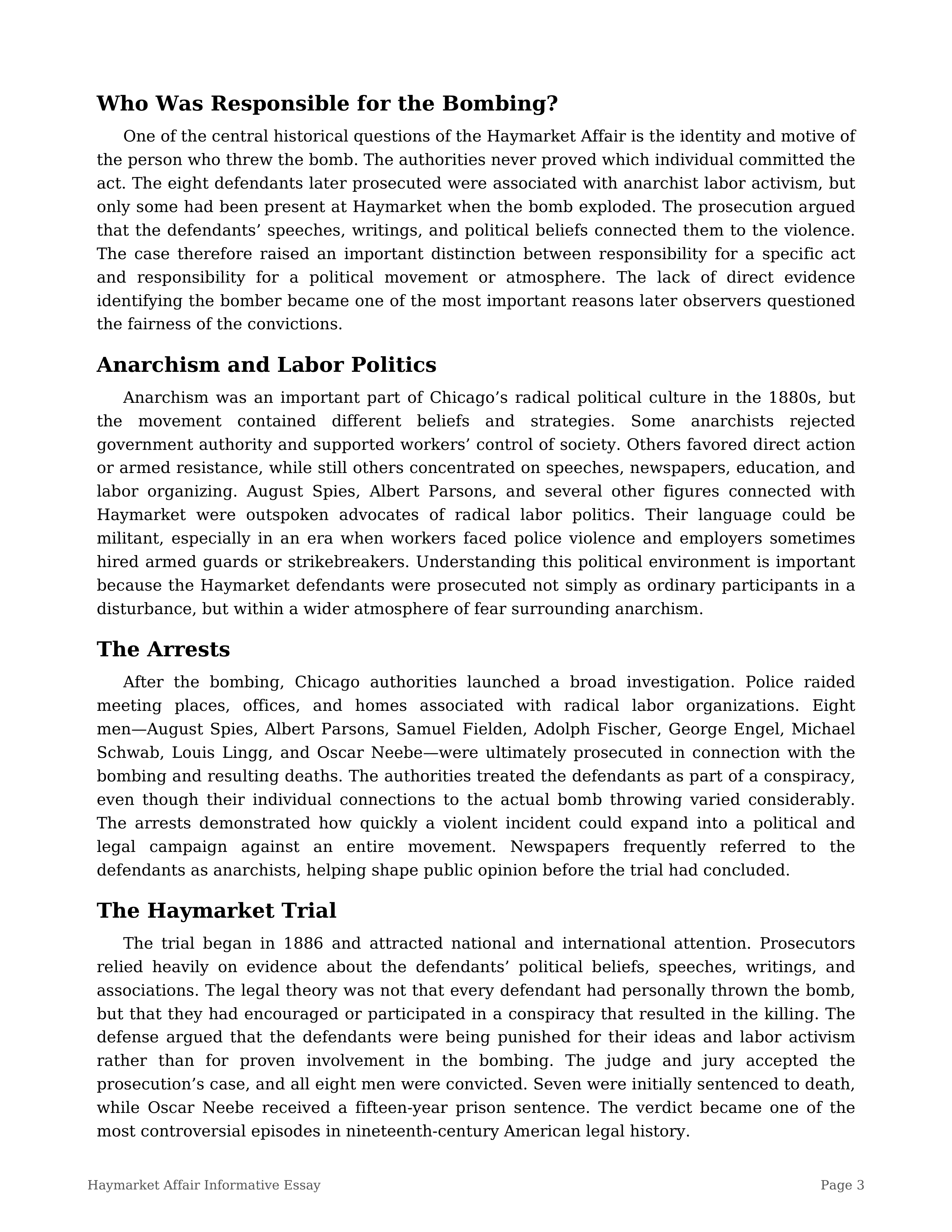
Shortly after ten o’clock, as police advanced, an unknown person threw a bomb into the
police formation. The explosion killed a police officer and wounded many others. The identity
of the person who threw the bomb was never established. Police then opened fire, and
confusion spread through the square. Some of the police casualties were caused by gunfire
from other officers rather than solely by the bomb or by demonstrators. Civilians were also
shot and wounded. The violence ended the meeting and transformed a labor demonstration
into a national crisis. Although the exact sequence of individual gunshots remains difficult to
reconstruct, the bomb and the ensuing exchange of gunfire produced deaths, injuries, panic,
and an intense public demand for punishment.
Haymarket Affair Informative Essay
Page 3
Who Was Responsible for the Bombing?
One of the central historical questions of the Haymarket Affair is the identity and motive of
the person who threw the bomb. The authorities never proved which individual committed the
act. The eight defendants later prosecuted were associated with anarchist labor activism, but
only some had been present at Haymarket when the bomb exploded. The prosecution argued
that the defendants’ speeches, writings, and political beliefs connected them to the violence.
The case therefore raised an important distinction between responsibility for a specific act
and responsibility for a political movement or atmosphere. The lack of direct evidence
identifying the bomber became one of the most important reasons later observers questioned
the fairness of the convictions.
Anarchism and Labor Politics
Anarchism was an important part of Chicago’s radical political culture in the 1880s, but
the movement contained different beliefs and strategies. Some anarchists rejected
government authority and supported workers’ control of society. Others favored direct action
or armed resistance, while still others concentrated on speeches, newspapers, education, and
labor organizing. August Spies, Albert Parsons, and several other figures connected with
Haymarket were outspoken advocates of radical labor politics. Their language could be
militant, especially in an era when workers faced police violence and employers sometimes
hired armed guards or strikebreakers. Understanding this political environment is important
because the Haymarket defendants were prosecuted not simply as ordinary participants in a
disturbance, but within a wider atmosphere of fear surrounding anarchism.
The Arrests
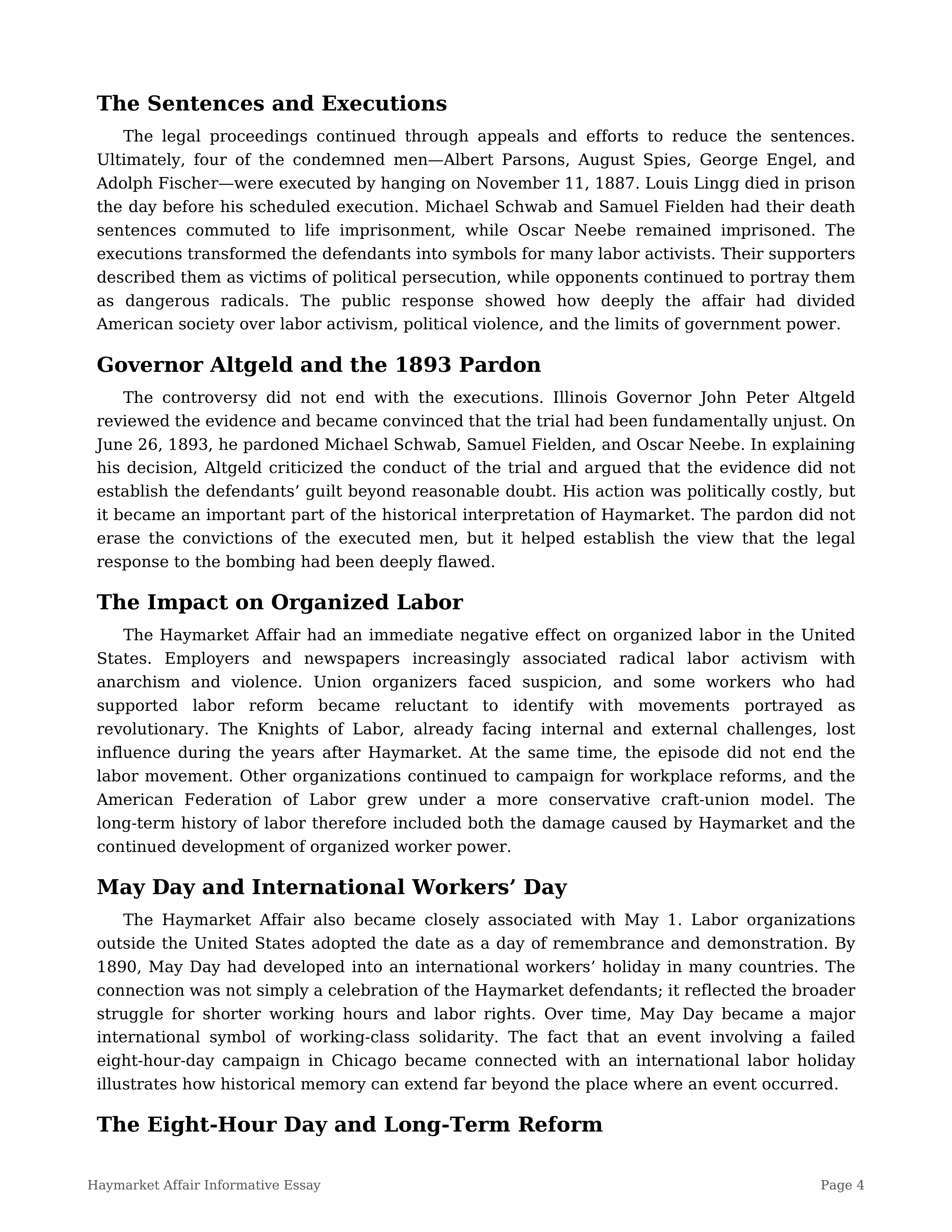
After the bombing, Chicago authorities launched a broad investigation. Police raided
meeting places, offices, and homes associated with radical labor organizations. Eight
men—August Spies, Albert Parsons, Samuel Fielden, Adolph Fischer, George Engel, Michael
Schwab, Louis Lingg, and Oscar Neebe—were ultimately prosecuted in connection with the
bombing and resulting deaths. The authorities treated the defendants as part of a conspiracy,
even though their individual connections to the actual bomb throwing varied considerably.
The arrests demonstrated how quickly a violent incident could expand into a political and
legal campaign against an entire movement. Newspapers frequently referred to the
defendants as anarchists, helping shape public opinion before the trial had concluded.
The Haymarket Trial
The trial began in 1886 and attracted national and international attention. Prosecutors
relied heavily on evidence about the defendants’ political beliefs, speeches, writings, and
associations. The legal theory was not that every defendant had personally thrown the bomb,
but that they had encouraged or participated in a conspiracy that resulted in the killing. The
defense argued that the defendants were being punished for their ideas and labor activism
rather than for proven involvement in the bombing. The judge and jury accepted the
prosecution’s case, and all eight men were convicted. Seven were initially sentenced to death,
while Oscar Neebe received a fifteen-year prison sentence. The verdict became one of the
most controversial episodes in nineteenth-century American legal history.
Haymarket Affair Informative Essay
Page 4
The Sentences and Executions
The legal proceedings continued through appeals and efforts to reduce the sentences.
Ultimately, four of the condemned men—Albert Parsons, August Spies, George Engel, and
Adolph Fischer—were executed by hanging on November 11, 1887. Louis Lingg died in prison
the day before his scheduled execution. Michael Schwab and Samuel Fielden had their death
sentences commuted to life imprisonment, while Oscar Neebe remained imprisoned. The
executions transformed the defendants into symbols for many labor activists. Their supporters
described them as victims of political persecution, while opponents continued to portray them
as dangerous radicals. The public response showed how deeply the affair had divided
American society over labor activism, political violence, and the limits of government power.
Governor Altgeld and the 1893 Pardon
The controversy did not end with the executions. Illinois Governor John Peter Altgeld
reviewed the evidence and became convinced that the trial had been fundamentally unjust. On
June 26, 1893, he pardoned Michael Schwab, Samuel Fielden, and Oscar Neebe. In explaining
his decision, Altgeld criticized the conduct of the trial and argued that the evidence did not
establish the defendants’ guilt beyond reasonable doubt. His action was politically costly, but
it became an important part of the historical interpretation of Haymarket. The pardon did not
erase the convictions of the executed men, but it helped establish the view that the legal
response to the bombing had been deeply flawed.
The Impact on Organized Labor
The Haymarket Affair had an immediate negative effect on organized labor in the United
States. Employers and newspapers increasingly associated radical labor activism with
anarchism and violence. Union organizers faced suspicion, and some workers who had
supported labor reform became reluctant to identify with movements portrayed as
revolutionary. The Knights of Labor, already facing internal and external challenges, lost
influence during the years after Haymarket. At the same time, the episode did not end the
labor movement. Other organizations continued to campaign for workplace reforms, and the
American Federation of Labor grew under a more conservative craft-union model. The
long-term history of labor therefore included both the damage caused by Haymarket and the
continued development of organized worker power.
May Day and International Workers’ Day
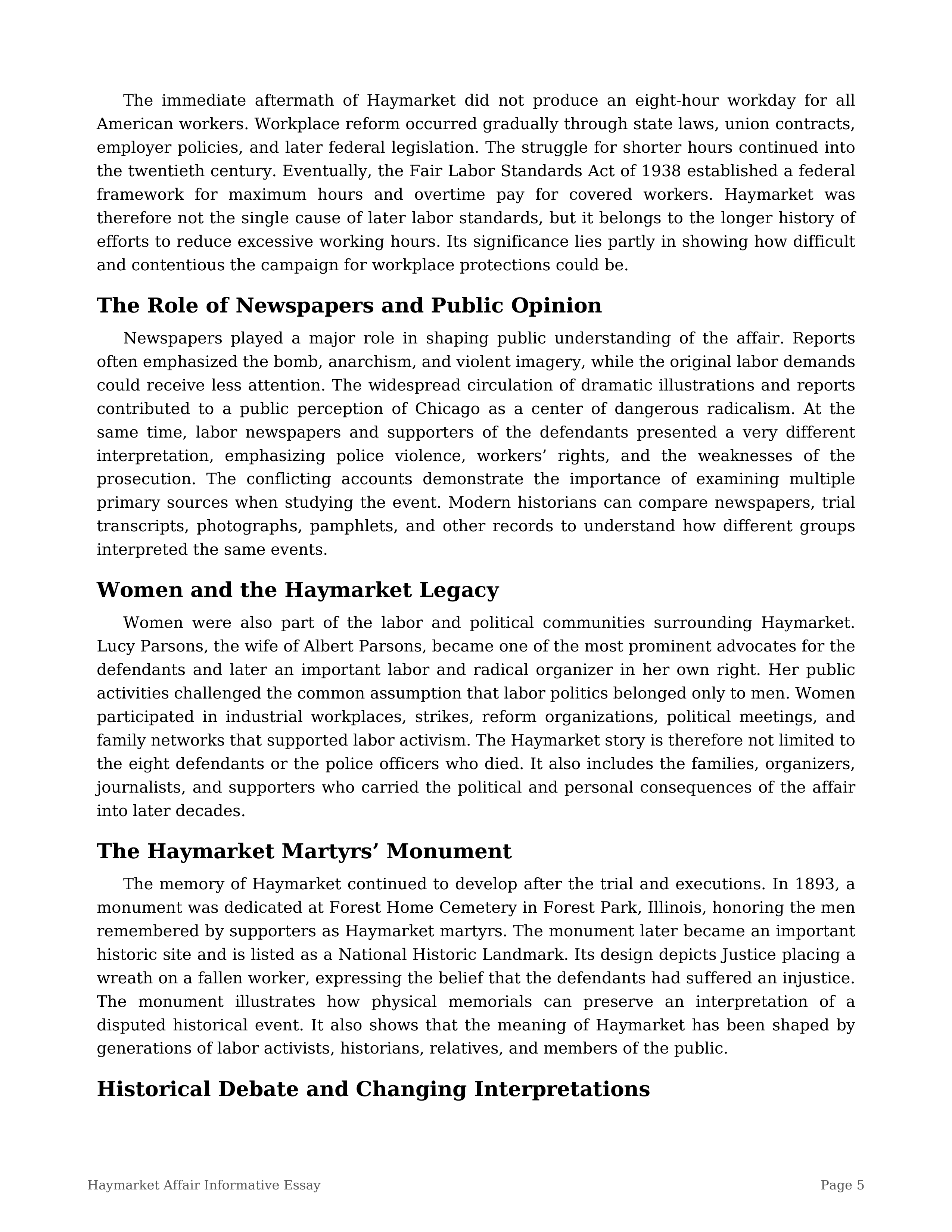
The Haymarket Affair also became closely associated with May 1. Labor organizations
outside the United States adopted the date as a day of remembrance and demonstration. By
1890, May Day had developed into an international workers’ holiday in many countries. The
connection was not simply a celebration of the Haymarket defendants; it reflected the broader
struggle for shorter working hours and labor rights. Over time, May Day became a major
international symbol of working-class solidarity. The fact that an event involving a failed
eight-hour-day campaign in Chicago became connected with an international labor holiday
illustrates how historical memory can extend far beyond the place where an event occurred.
The Eight-Hour Day and Long-Term Reform
Haymarket Affair Informative Essay
Page 5
The immediate aftermath of Haymarket did not produce an eight-hour workday for all
American workers. Workplace reform occurred gradually through state laws, union contracts,
employer policies, and later federal legislation. The struggle for shorter hours continued into
the twentieth century. Eventually, the Fair Labor Standards Act of 1938 established a federal
framework for maximum hours and overtime pay for covered workers. Haymarket was
therefore not the single cause of later labor standards, but it belongs to the longer history of
efforts to reduce excessive working hours. Its significance lies partly in showing how difficult
and contentious the campaign for workplace protections could be.
The Role of Newspapers and Public Opinion
Newspapers played a major role in shaping public understanding of the affair. Reports
often emphasized the bomb, anarchism, and violent imagery, while the original labor demands
could receive less attention. The widespread circulation of dramatic illustrations and reports
contributed to a public perception of Chicago as a center of dangerous radicalism. At the
same time, labor newspapers and supporters of the defendants presented a very different
interpretation, emphasizing police violence, workers’ rights, and the weaknesses of the
prosecution. The conflicting accounts demonstrate the importance of examining multiple
primary sources when studying the event. Modern historians can compare newspapers, trial
transcripts, photographs, pamphlets, and other records to understand how different groups
interpreted the same events.
Women and the Haymarket Legacy
Women were also part of the labor and political communities surrounding Haymarket.
Lucy Parsons, the wife of Albert Parsons, became one of the most prominent advocates for the
defendants and later an important labor and radical organizer in her own right. Her public
activities challenged the common assumption that labor politics belonged only to men. Women
participated in industrial workplaces, strikes, reform organizations, political meetings, and
family networks that supported labor activism. The Haymarket story is therefore not limited to
the eight defendants or the police officers who died. It also includes the families, organizers,
journalists, and supporters who carried the political and personal consequences of the affair
into later decades.
The Haymarket Martyrs’ Monument
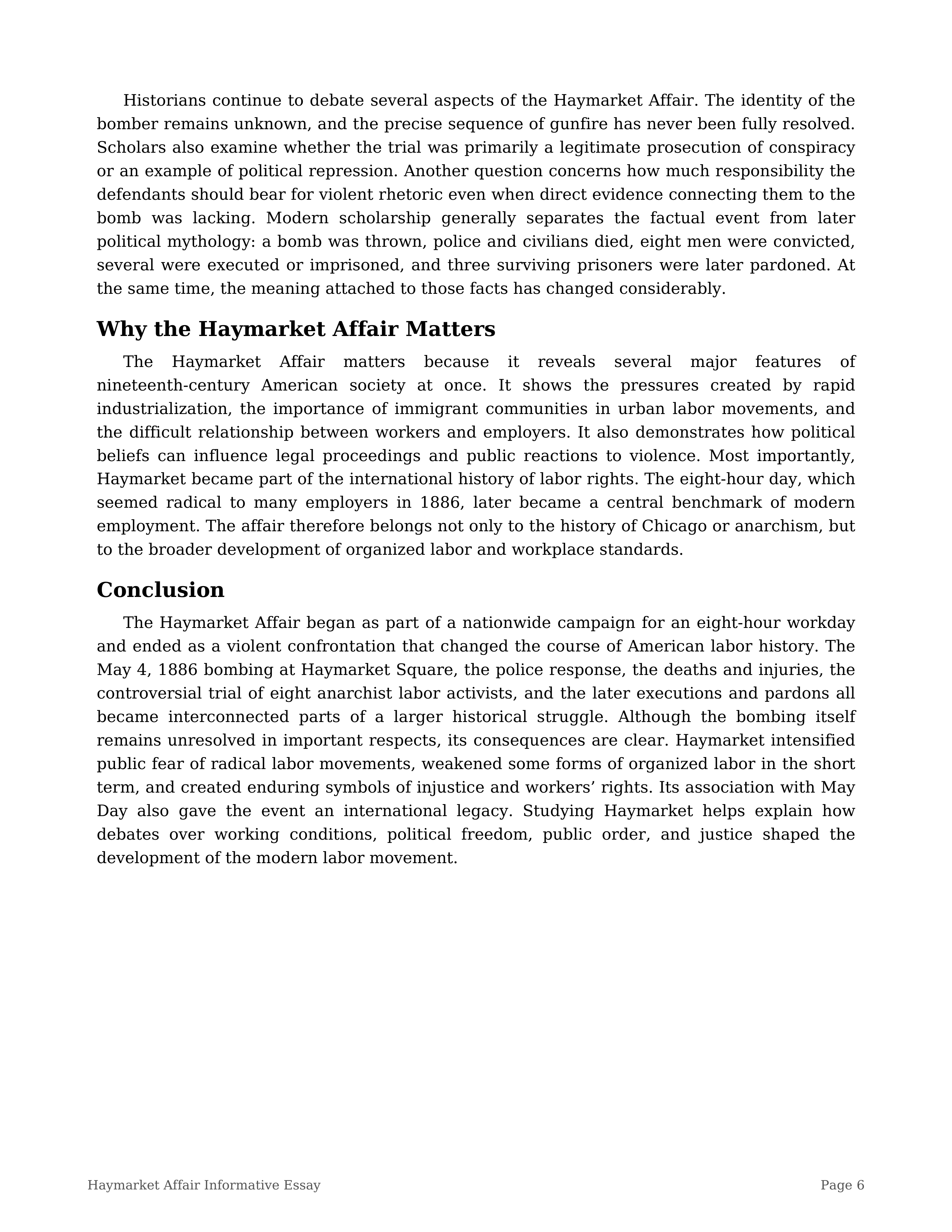
The memory of Haymarket continued to develop after the trial and executions. In 1893, a
monument was dedicated at Forest Home Cemetery in Forest Park, Illinois, honoring the men
remembered by supporters as Haymarket martyrs. The monument later became an important
historic site and is listed as a National Historic Landmark. Its design depicts Justice placing a
wreath on a fallen worker, expressing the belief that the defendants had suffered an injustice.
The monument illustrates how physical memorials can preserve an interpretation of a
disputed historical event. It also shows that the meaning of Haymarket has been shaped by
generations of labor activists, historians, relatives, and members of the public.
Historical Debate and Changing Interpretations
Haymarket Affair Informative Essay
Page 6
Historians continue to debate several aspects of the Haymarket Affair. The identity of the
bomber remains unknown, and the precise sequence of gunfire has never been fully resolved.
Scholars also examine whether the trial was primarily a legitimate prosecution of conspiracy
or an example of political repression. Another question concerns how much responsibility the
defendants should bear for violent rhetoric even when direct evidence connecting them to the
bomb was lacking. Modern scholarship generally separates the factual event from later
political mythology: a bomb was thrown, police and civilians died, eight men were convicted,
several were executed or imprisoned, and three surviving prisoners were later pardoned. At
the same time, the meaning attached to those facts has changed considerably.
Why the Haymarket Affair Matters
The
Haymarket
Affair
matters
because
it
reveals
several
major
features
of
nineteenth-century American society at once. It shows the pressures created by rapid
industrialization, the importance of immigrant communities in urban labor movements, and
the difficult relationship between workers and employers. It also demonstrates how political
beliefs can influence legal proceedings and public reactions to violence. Most importantly,
Haymarket became part of the international history of labor rights. The eight-hour day, which
seemed radical to many employers in 1886, later became a central benchmark of modern
employment. The affair therefore belongs not only to the history of Chicago or anarchism, but
to the broader development of organized labor and workplace standards.
Conclusion
The Haymarket Affair began as part of a nationwide campaign for an eight-hour workday
and ended as a violent confrontation that changed the course of American labor history. The
May 4, 1886 bombing at Haymarket Square, the police response, the deaths and injuries, the
controversial trial of eight anarchist labor activists, and the later executions and pardons all
became interconnected parts of a larger historical struggle. Although the bombing itself
remains unresolved in important respects, its consequences are clear. Haymarket intensified
public fear of radical labor movements, weakened some forms of organized labor in the short
term, and created enduring symbols of injustice and workers’ rights. Its association with May
Day also gave the event an international legacy. Studying Haymarket helps explain how
debates over working conditions, political freedom, public order, and justice shaped the
development of the modern labor movement.