Black Panther Party Informative Essay
Page 1
Black Panther Party Informative Essay
The founding, political ideas, community programs, conflicts, and historical legacy of the
Black Panther Party
Introduction
The Black Panther Party emerged in Oakland, California, in 1966 during a period of
intense debate over race, policing, economic inequality, and the direction of the Black
freedom struggle. Founded by Huey P. Newton and Bobby Seale, the organization initially
called itself the Black Panther Party for Self-Defense and focused heavily on police brutality
and community self-defense. It soon developed a broader political program that addressed
housing, employment, education, health care, food, and political power. The Panthers
became known for armed police patrols and revolutionary rhetoric, but their history also
includes extensive community programs that provided practical assistance to people in poor
neighborhoods. The party's influence extended well beyond Oakland, while internal
disagreements, government repression, legal battles, and changing political conditions
contributed to its decline. Understanding the Black Panther Party therefore requires
examining both its militant image and its efforts to build community institutions.
The Black Power Era
The Panthers emerged from the Black Power era of the mid-1960s. The civil rights
movement had achieved major federal victories through the Civil Rights Act of 1964 and the
Voting Rights Act of 1965, but racial inequality remained widespread. Police brutality,
unemployment, poor housing, underfunded schools, and unequal access to health care
continued to affect many Black communities. Younger activists increasingly questioned
whether integration alone could solve these problems. The National Archives places the
Black Panther Party within the broader Black Power movement, which differed in important
ways from the nonviolent integrationist strategy associated with Martin Luther King Jr.'s
Southern Christian Leadership Conference.
Founding in Oakland
Huey P. Newton and Bobby Seale met at Merritt College in Oakland and founded the
Black Panther Party in October 1966. Newton became the party's Minister of Defense, while
Seale served as chairman. According to the National Archives, the founders canvassed their
community to learn what residents considered their most urgent problems. Their responses
helped shape the Ten Point Platform and Program. The party's name and panther symbol
were inspired by the Lowndes County Freedom Organization in Alabama, which had used
the black panther as its emblem.
The Ten-Point Program
Black Panther Party Informative Essay
Page 2
The Ten Point Platform and Program provided a concise statement of what the Panthers
wanted and believed. Its demands included full employment, decent housing, education that
taught Black history and the realities of American society, an end to police brutality, fair
trials, and community control over institutions. The platform also expressed the belief that
Black communities should have the power to determine their own political and economic
futures. The Smithsonian notes that the program was written in language intended to be
understandable to ordinary people, reflecting the party's emphasis on connecting
revolutionary ideas to everyday problems.
Influences on Panther Ideology
The Panthers drew ideas from several political and intellectual sources. Malcolm X's
emphasis on Black self-determination strongly influenced Newton and Seale. They also
studied anticolonial and revolutionary writers, including Frantz Fanon, and were influenced
by socialist and international liberation movements. The party's ideology combined Black
nationalism, socialism, community control, and armed self-defense. These influences did not
produce a single fixed doctrine; Panther politics changed as the organization expanded and
leaders debated whether its priority should be local community programs, national political
organizing, or international revolutionary solidarity.
Armed Self-Defense and Police Patrols
The Panthers became nationally recognized for carrying firearms while monitoring
police activity. California law at the time permitted people to openly carry loaded firearms
under certain circumstances, and Panthers used this legal framework to observe police
stops. Their purpose, as they described it, was to deter police abuse and educate residents
about their rights. The practice alarmed many public officials and attracted intense media
attention. The image of armed Black activists confronting police challenged conventional
ideas about who was expected to exercise authority in public spaces.
The Mulford Act
The Panthers' armed patrols contributed to a major political controversy in California. In
1967, members entered the California State Capitol while carrying weapons to protest
proposed legislation restricting the public carrying of loaded firearms. The resulting
publicity helped propel the Mulford Act, which restricted the open carrying of loaded
firearms in public. The episode demonstrated how quickly the Panthers could turn a local
issue into a national political story, while also illustrating the limits authorities placed on
their armed self-defense strategy.
Police Confrontations and Legal Battles
The party's relationship with law enforcement was frequently confrontational. Panthers
and police officers were involved in numerous shootings, arrests, and prosecutions. Huey
Newton was charged in connection with the 1967 shooting of an Oakland police officer and
spent time in jail awaiting trial. The case became a major cause for Panther supporters, who
Black Panther Party Informative Essay
Page 3
organized campaigns demanding Newton's release. Eventually, after retrials and legal
proceedings, Newton was acquitted of the most serious charges. These conflicts reinforced
the party's belief that police institutions were central to racial oppression while also
contributing to its reputation as a militant organization.
Expansion Beyond Oakland
The Black Panther Party expanded rapidly during the late 1960s. Chapters and branches
appeared in cities including Chicago, Los Angeles, New York, Philadelphia, Seattle, and
elsewhere. Local chapters adapted the party's platform to their communities. They
organized around housing, food, education, police accountability, and political campaigns.
The National Archives identifies prominent members such as Elaine Brown, Fred Hampton,
Eldridge Cleaver, Ericka Huggins, Kathleen Cleaver, Newton, and Seale, illustrating the
organization's national reach and the range of people involved in its work.
Women in the Black Panther Party
Women played a major role in the Black Panther Party, even though popular images
have often focused on male leaders carrying weapons. Women worked as organizers,
writers, health workers, teachers, administrators, community advocates, and political
leaders. The Smithsonian notes that local chapters were often led by women and that
community survival programs depended heavily on their work. Elaine Brown eventually led
the national party from 1974 to 1977. Ericka Huggins became an important organizer and
educator, while Kathleen Cleaver served as a prominent communications figure. Their roles
demonstrate that the party's practical work relied heavily on women's leadership.
The Black Panther Newspaper
Communication was central to the Panthers' growth. The Black Panther newspaper
carried party statements, political analysis, artwork, reports on police activity, and
information about community programs. It helped connect local chapters and introduced
Panther ideas to readers across the country. The paper also used striking visual imagery to
communicate complex political arguments quickly. Its circulation contributed to the party's
national profile and helped establish a recognizable Panther political culture.
Community Survival Programs
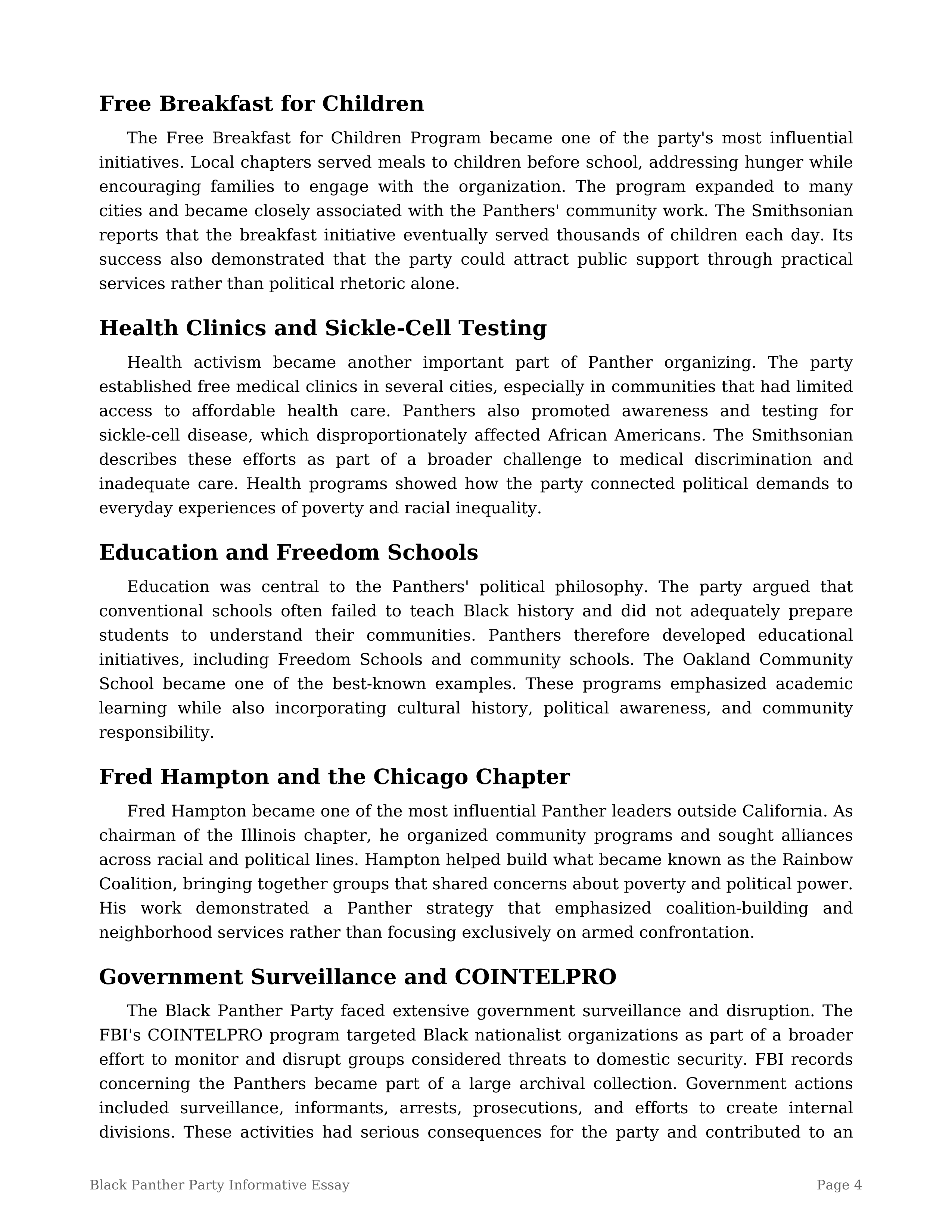
The Panthers increasingly described their community programs as “survival programs.”
These initiatives reflected the belief that political liberation required meeting immediate
material needs as well as changing laws and institutions. Programs included free food
distribution, clothing, transportation, education, health services, legal assistance, and voter
registration. The Smithsonian's National Museum of African American History and Culture
reports that the party's programs eventually included free breakfast for children, food
programs for families and older people, schools, legal aid offices, health clinics, and
sickle-cell testing centers.
Black Panther Party Informative Essay
Page 4
Free Breakfast for Children
The Free Breakfast for Children Program became one of the party's most influential
initiatives. Local chapters served meals to children before school, addressing hunger while
encouraging families to engage with the organization. The program expanded to many
cities and became closely associated with the Panthers' community work. The Smithsonian
reports that the breakfast initiative eventually served thousands of children each day. Its
success also demonstrated that the party could attract public support through practical
services rather than political rhetoric alone.
Health Clinics and Sickle-Cell Testing
Health activism became another important part of Panther organizing. The party
established free medical clinics in several cities, especially in communities that had limited
access to affordable health care. Panthers also promoted awareness and testing for
sickle-cell disease, which disproportionately affected African Americans. The Smithsonian
describes these efforts as part of a broader challenge to medical discrimination and
inadequate care. Health programs showed how the party connected political demands to
everyday experiences of poverty and racial inequality.
Education and Freedom Schools
Education was central to the Panthers' political philosophy. The party argued that
conventional schools often failed to teach Black history and did not adequately prepare
students to understand their communities. Panthers therefore developed educational
initiatives, including Freedom Schools and community schools. The Oakland Community
School became one of the best-known examples. These programs emphasized academic
learning while also incorporating cultural history, political awareness, and community
responsibility.
Fred Hampton and the Chicago Chapter
Fred Hampton became one of the most influential Panther leaders outside California. As
chairman of the Illinois chapter, he organized community programs and sought alliances
across racial and political lines. Hampton helped build what became known as the Rainbow
Coalition, bringing together groups that shared concerns about poverty and political power.
His work demonstrated a Panther strategy that emphasized coalition-building and
neighborhood services rather than focusing exclusively on armed confrontation.
Government Surveillance and COINTELPRO
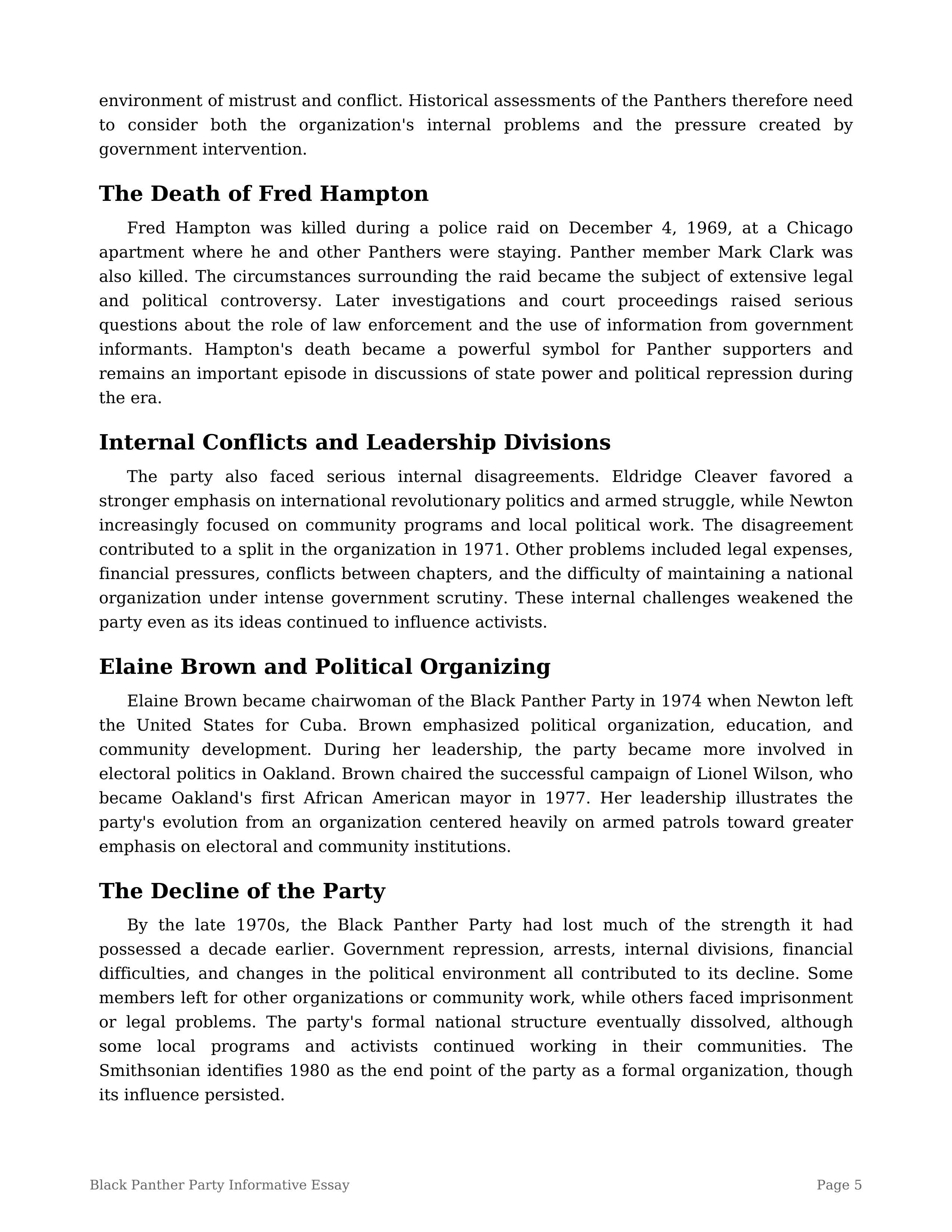
The Black Panther Party faced extensive government surveillance and disruption. The
FBI's COINTELPRO program targeted Black nationalist organizations as part of a broader
effort to monitor and disrupt groups considered threats to domestic security. FBI records
concerning the Panthers became part of a large archival collection. Government actions
included surveillance, informants, arrests, prosecutions, and efforts to create internal
divisions. These activities had serious consequences for the party and contributed to an
Black Panther Party Informative Essay
Page 5
environment of mistrust and conflict. Historical assessments of the Panthers therefore need
to consider both the organization's internal problems and the pressure created by
government intervention.
The Death of Fred Hampton
Fred Hampton was killed during a police raid on December 4, 1969, at a Chicago
apartment where he and other Panthers were staying. Panther member Mark Clark was
also killed. The circumstances surrounding the raid became the subject of extensive legal
and political controversy. Later investigations and court proceedings raised serious
questions about the role of law enforcement and the use of information from government
informants. Hampton's death became a powerful symbol for Panther supporters and
remains an important episode in discussions of state power and political repression during
the era.
Internal Conflicts and Leadership Divisions
The party also faced serious internal disagreements. Eldridge Cleaver favored a
stronger emphasis on international revolutionary politics and armed struggle, while Newton
increasingly focused on community programs and local political work. The disagreement
contributed to a split in the organization in 1971. Other problems included legal expenses,
financial pressures, conflicts between chapters, and the difficulty of maintaining a national
organization under intense government scrutiny. These internal challenges weakened the
party even as its ideas continued to influence activists.
Elaine Brown and Political Organizing
Elaine Brown became chairwoman of the Black Panther Party in 1974 when Newton left
the United States for Cuba. Brown emphasized political organization, education, and
community development. During her leadership, the party became more involved in
electoral politics in Oakland. Brown chaired the successful campaign of Lionel Wilson, who
became Oakland's first African American mayor in 1977. Her leadership illustrates the
party's evolution from an organization centered heavily on armed patrols toward greater
emphasis on electoral and community institutions.
The Decline of the Party
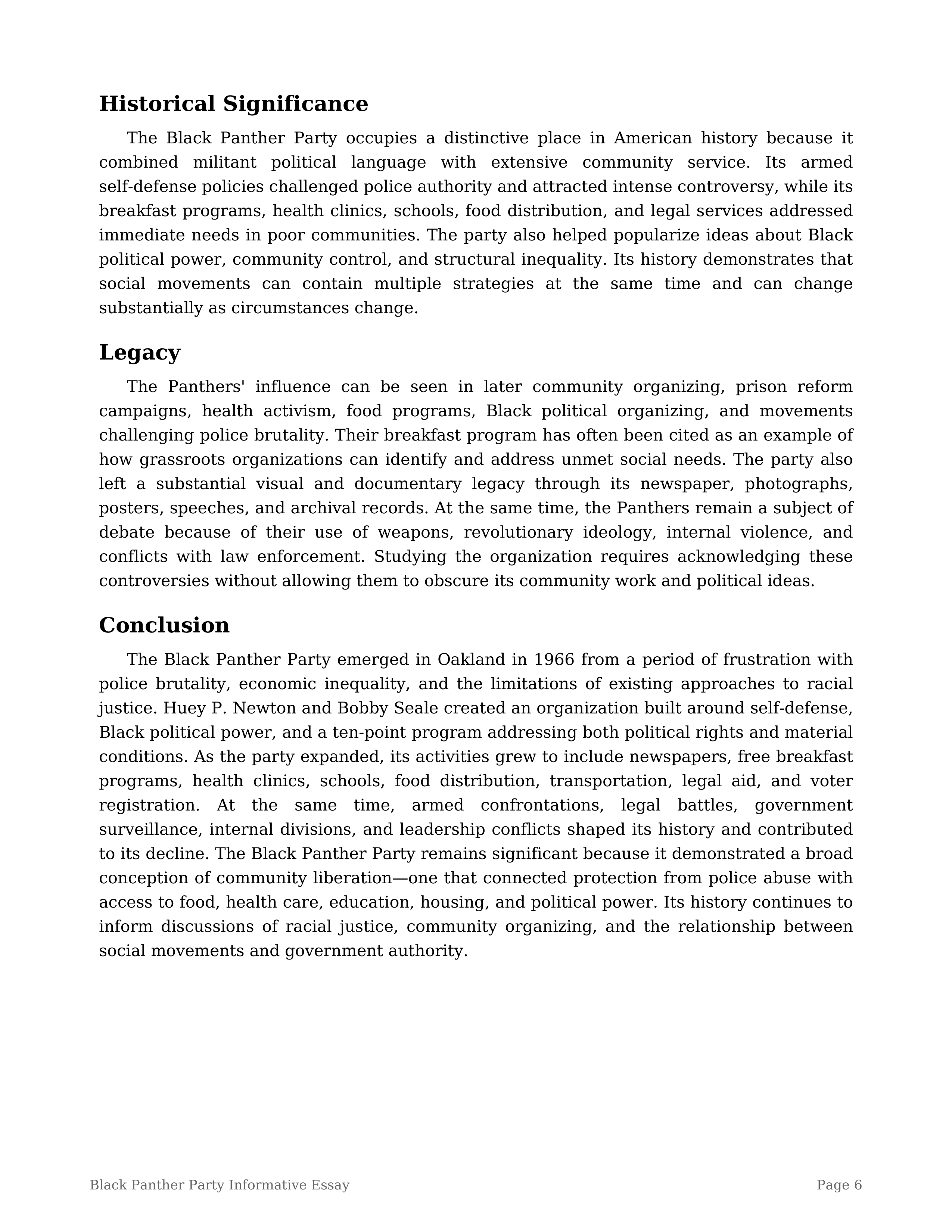
By the late 1970s, the Black Panther Party had lost much of the strength it had
possessed a decade earlier. Government repression, arrests, internal divisions, financial
difficulties, and changes in the political environment all contributed to its decline. Some
members left for other organizations or community work, while others faced imprisonment
or legal problems. The party's formal national structure eventually dissolved, although
some local programs and activists continued working in their communities. The
Smithsonian identifies 1980 as the end point of the party as a formal organization, though
its influence persisted.
Black Panther Party Informative Essay
Page 6
Historical Significance
The Black Panther Party occupies a distinctive place in American history because it
combined militant political language with extensive community service. Its armed
self-defense policies challenged police authority and attracted intense controversy, while its
breakfast programs, health clinics, schools, food distribution, and legal services addressed
immediate needs in poor communities. The party also helped popularize ideas about Black
political power, community control, and structural inequality. Its history demonstrates that
social movements can contain multiple strategies at the same time and can change
substantially as circumstances change.
Legacy
The Panthers' influence can be seen in later community organizing, prison reform
campaigns, health activism, food programs, Black political organizing, and movements
challenging police brutality. Their breakfast program has often been cited as an example of
how grassroots organizations can identify and address unmet social needs. The party also
left a substantial visual and documentary legacy through its newspaper, photographs,
posters, speeches, and archival records. At the same time, the Panthers remain a subject of
debate because of their use of weapons, revolutionary ideology, internal violence, and
conflicts with law enforcement. Studying the organization requires acknowledging these
controversies without allowing them to obscure its community work and political ideas.
Conclusion
The Black Panther Party emerged in Oakland in 1966 from a period of frustration with
police brutality, economic inequality, and the limitations of existing approaches to racial
justice. Huey P. Newton and Bobby Seale created an organization built around self-defense,
Black political power, and a ten-point program addressing both political rights and material
conditions. As the party expanded, its activities grew to include newspapers, free breakfast
programs, health clinics, schools, food distribution, transportation, legal aid, and voter
registration. At the same time, armed confrontations, legal battles, government
surveillance, internal divisions, and leadership conflicts shaped its history and contributed
to its decline. The Black Panther Party remains significant because it demonstrated a broad
conception of community liberation—one that connected protection from police abuse with
access to food, health care, education, housing, and political power. Its history continues to
inform discussions of racial justice, community organizing, and the relationship between
social movements and government authority.