Articles of Confederation Informative Essay
Page 1
Articles of Confederation Informative
Essay
The First U.S. Constitution, Its Structure, Achievements, Limitations, and Legacy
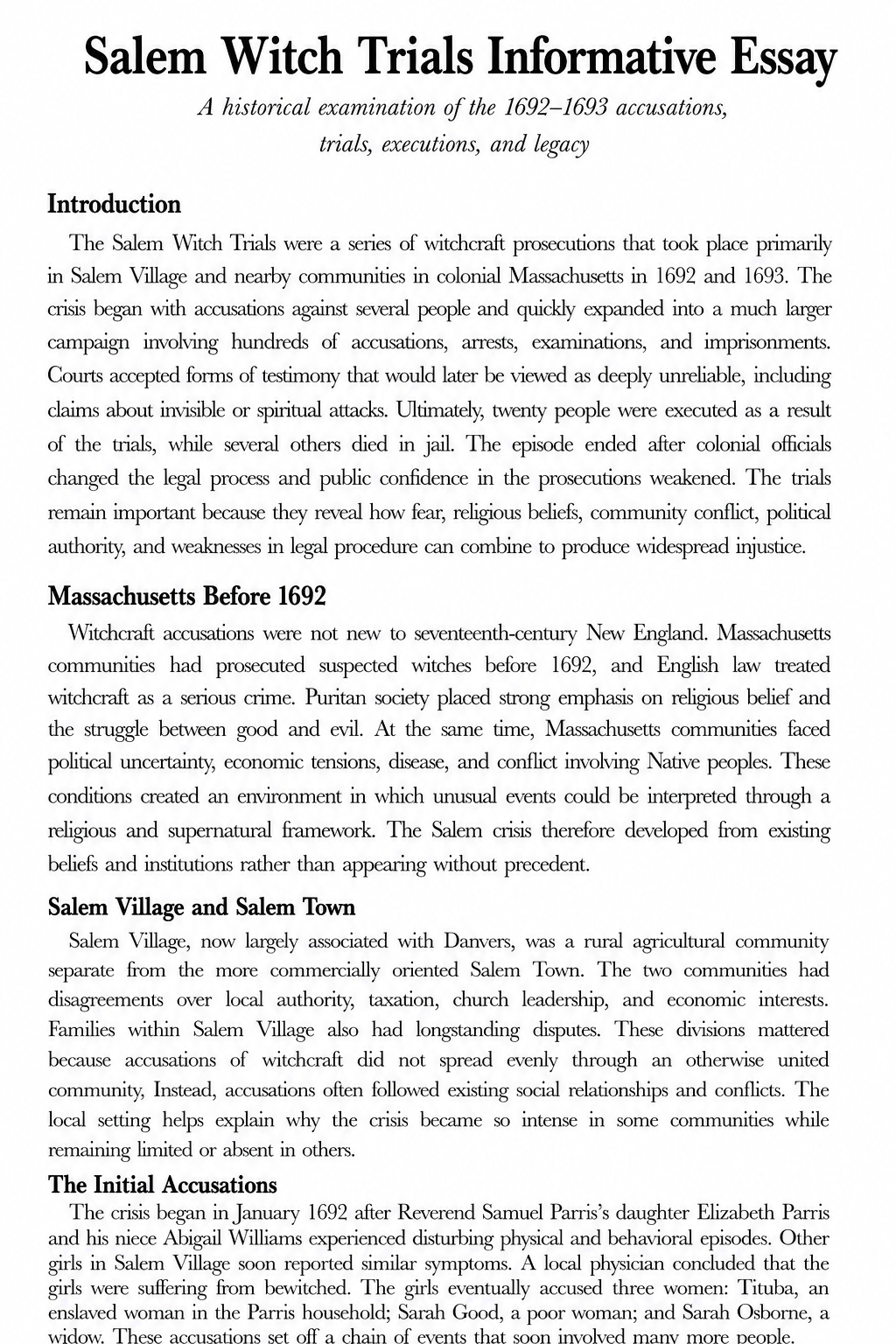
Introduction
When the American colonies declared independence in 1776, winning the war was only
one part of the challenge. The new states also had to determine how they could cooperate
without recreating the powerful central authority they had rejected under British rule. The
Articles of Confederation and Perpetual Union became the first constitutional framework
of the United States. The Continental Congress adopted the Articles on November 15,
1777, but all thirteen states did not ratify them until March 1, 1781. The system
deliberately placed most political authority in the states and gave the national government
limited powers. Although the Articles helped the United States conduct the final years of
the Revolutionary War, manage western lands, negotiate peace, and establish important
policies, their weak central structure created serious financial, commercial, and political
problems that eventually encouraged the creation of the Constitution.
Why a Confederation Was Created
The political experiences of the colonial period strongly influenced the design of the
new government. Many Americans associated centralized power with taxation without
representation, standing armies, executive authority, and other policies imposed by
Parliament and the Crown. During the Revolution, the Continental Congress had
coordinated the war, but it did not possess a permanent constitutional structure defining
the relationship among the states. The declaration of independence created a new political
reality, making a durable union necessary. The Articles were intended to preserve state
sovereignty while providing enough common authority for the states to cooperate in
matters that affected the entire nation.
Drafting the Articles
On June 11, 1776, the Second Continental Congress created committees to address the
organization of the new union. John Dickinson of Delaware became the principal writer of
the draft that developed into the Articles of Confederation. Delegates debated how much
authority Congress should receive, how states should be represented, and how western
territory should be handled. These disagreements reflected a central concern of the era:
Americans wanted a functioning union, but they were reluctant to create a national
Articles of Confederation Informative Essay
Page 2
government that might become as powerful as the British government had been. After
more than a year of debate and revision, Congress adopted the Articles on November 15,
1777.
Ratification and the Western Land Dispute
The Articles could not take effect until every state agreed to them. Ratification was
delayed partly by disagreements over western lands claimed by several states. States
without extensive western claims feared that states with large claims would gain
disproportionate advantages. Maryland, in particular, refused to ratify until the western
land question moved toward a settlement. Virginia eventually ceded its claims, and other
states followed with territorial concessions. Maryland became the thirteenth state to ratify
on March 1, 1781, bringing the Articles into operation during the closing phase of the
Revolutionary War.
Structure of the Government
The Articles established a confederation in which the states retained their sovereignty
and independence except for powers expressly delegated to the United States in Congress
assembled. There was a single legislative body rather than a two-house Congress. Each
state had one vote, regardless of population or geographic size. There was no separate
national executive comparable to the later presidency and no independent federal
judiciary. Congress handled the limited national responsibilities assigned to it, while the
states remained the principal centers of governmental authority. This structure reflected
the fear that concentrated national power could threaten individual liberty and state
independence.
Powers Given to Congress
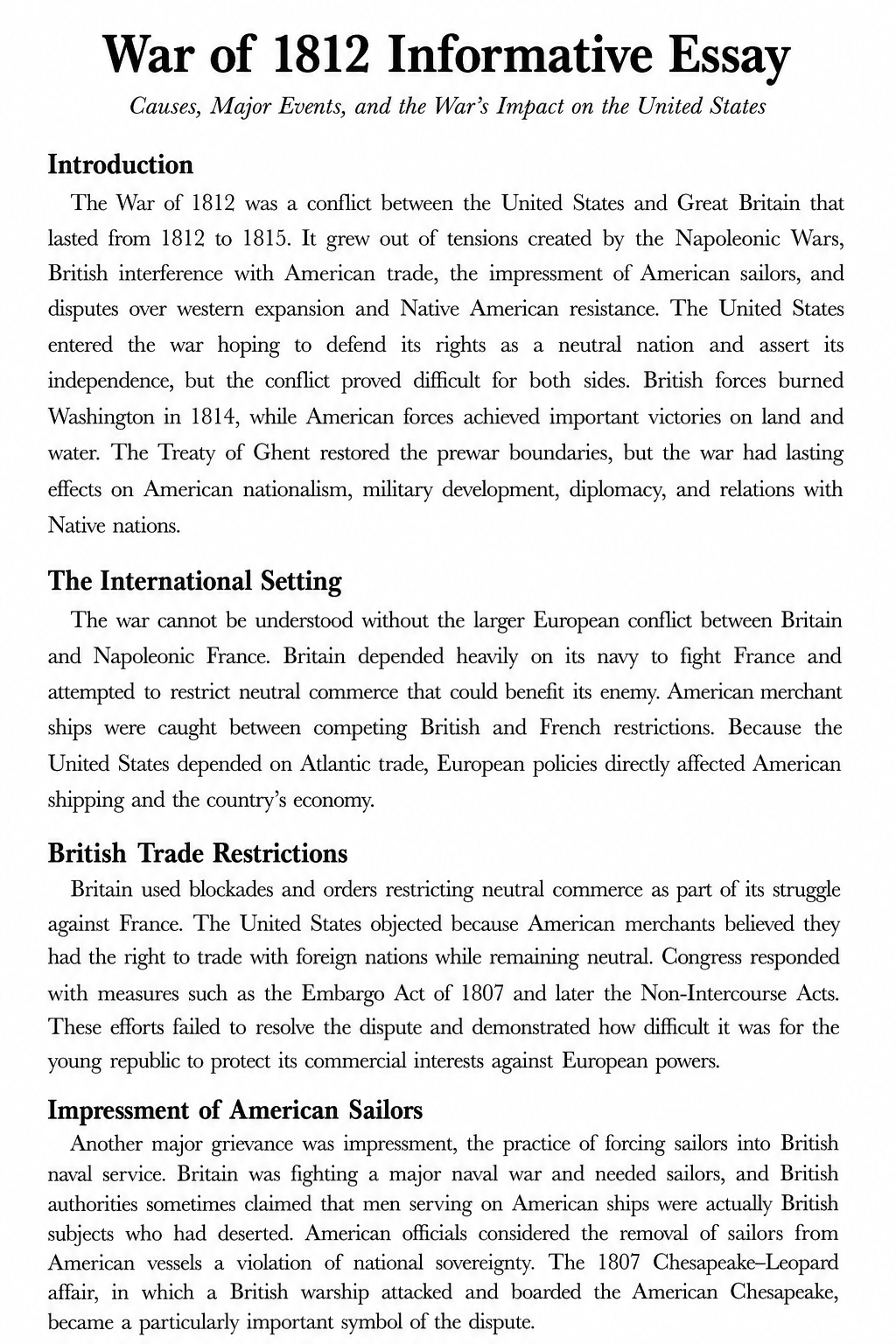
Congress under the Articles possessed several important national responsibilities. It
could declare war and make peace, conduct diplomacy, negotiate treaties, coin and
borrow money, establish postal services, manage relations with Native nations, and
coordinate military affairs. It could also make decisions concerning western territories and
other matters delegated by the states. These powers were significant, but their practical
effectiveness depended heavily on state cooperation. The Articles therefore created a
national government that could make decisions in certain areas but often lacked the
independent resources needed to carry them out.
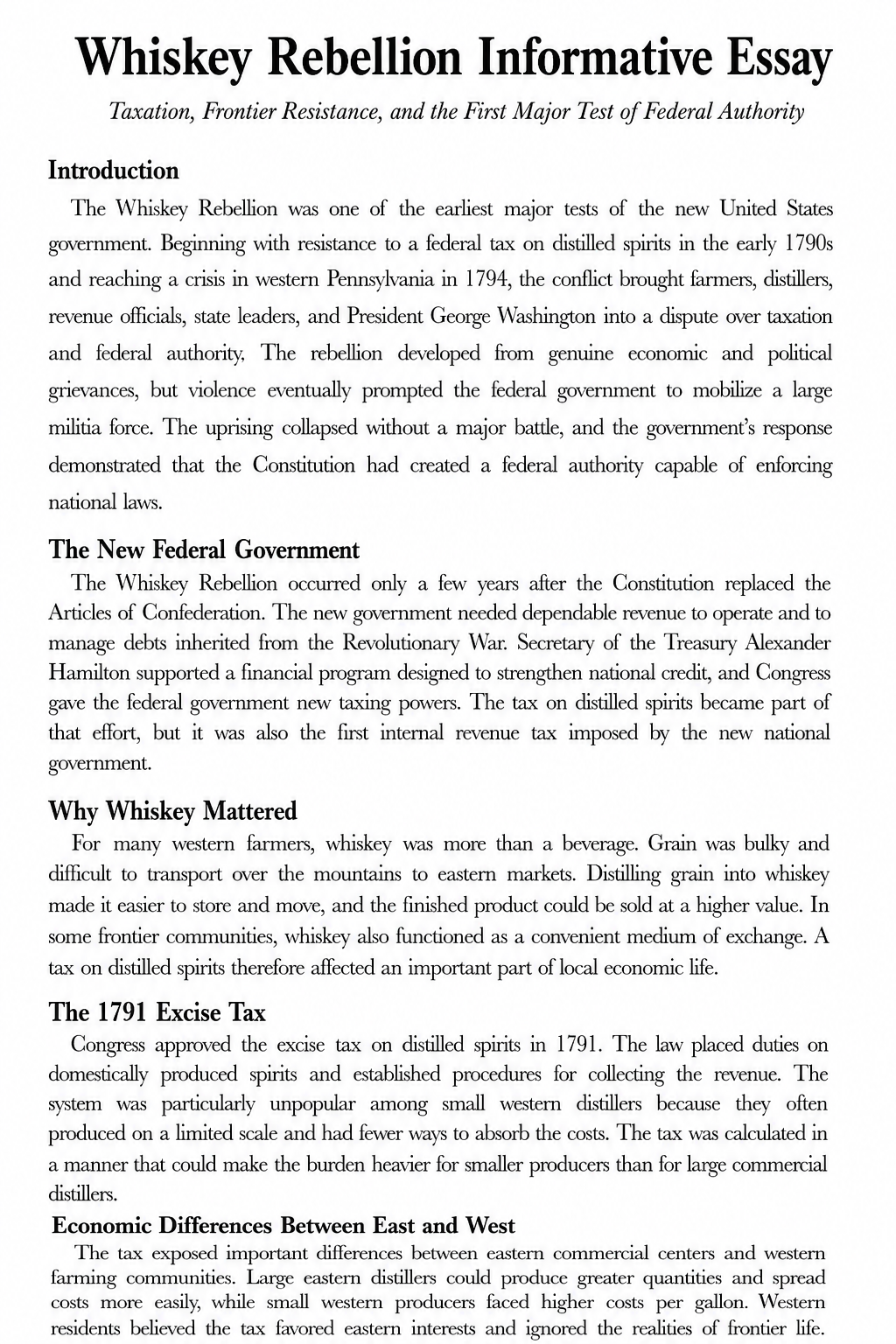
The Problem of Taxation
One of the most serious limitations was Congress's inability to levy taxes directly.
Instead, Congress could request money from the states. During wartime, this arrangement
made it difficult to obtain dependable revenue, and after the war the national government
remained burdened by debt. States frequently failed to provide the amounts requested.
Articles of Confederation Informative Essay
Page 3
Congress could not simply impose a national tax to meet its obligations. This weakness
contributed to financial instability and made it difficult for the government to pay soldiers,
creditors, and other expenses associated with the Revolution.
Debt and Economic Difficulties
The war had left the United States with substantial financial obligations. Congress
needed revenue for public expenses and debt payments, yet its requests for contributions
were often inadequate. The states themselves faced economic pressures, and different
states adopted different tax and monetary policies. Because there was no strong national
authority coordinating fiscal policy, economic problems could spread across state
boundaries without a unified response. The financial weakness of the Confederation
became one of the strongest arguments used by supporters of a stronger federal
government in the 1780s.
Trade and Commerce
The Articles also left Congress without general authority to regulate interstate and
foreign commerce. Individual states could establish their own trade policies, tariffs, and
commercial rules. These differences sometimes encouraged competition rather than
cooperation. A state could take actions that benefited its own merchants while creating
difficulties for neighboring states. Foreign governments also had reason to question
whether the United States could maintain consistent commercial policies when Congress
depended on the states. The lack of a unified commercial system exposed an important
weakness in a union whose states were becoming increasingly economically connected.
The Challenge of Enforcing National Decisions
The Confederation government could make decisions, but it had limited ability to
compel compliance. Congress generally acted through the states rather than directly
governing individual citizens. There was no separate executive department capable of
enforcing congressional decisions throughout the country. This arrangement meant that
national policies could depend on whether state governments chose to cooperate. The
problem became especially visible in diplomacy and treaty obligations, where foreign
governments could question the reliability of agreements if Congress lacked the means to
ensure that states followed them.
Representation and Voting
The one-state, one-vote system was designed to protect the political equality of the
states. A large state and a small state had the same vote in Congress. Supporters of the
arrangement feared that population-based voting would allow the most populous states to
dominate national decisions. At the same time, the system created tensions because
citizens of larger states were represented by the same number of congressional votes as
Articles of Confederation Informative Essay
Page 4
citizens of smaller states. Major decisions also required substantial agreement among the
states, making action difficult when political interests diverged.
The Requirement for Unanimous Amendments
Changing the Articles was deliberately difficult. Article XIII required an amendment to
be agreed upon in Congress and then confirmed by the legislatures of every state. This
requirement protected the states from having the constitutional system altered without
their consent, but it also meant that a single state could prevent reform. Congress
attempted to obtain additional authority in areas such as revenue and commerce, but
proposed changes failed when unanimous approval was not achieved. The amendment rule
became especially important because many problems with the system could not be
corrected without the very cooperation that was difficult to obtain.
Achievements During the Revolutionary Era
The Articles should not be understood simply as a failure. The Confederation
government helped preserve a political union during a dangerous transition from colonies
to independent states. Congress continued to coordinate national diplomacy and military
responsibilities while the Revolutionary War was being completed. Under the
Confederation system, the United States also concluded the Treaty of Paris in 1783,
formally ending the war with Great Britain. The government therefore demonstrated that
a union of sovereign states could perform important national functions even with limited
central authority.
Western Territory and the Land Ordinance
One of the Confederation Congress's most important achievements involved western
lands. The Land Ordinance of 1785 established a method for surveying and dividing much
of the public territory into organized units. The policy provided a systematic approach to
settlement and land sales rather than leaving the region entirely to competing claims. This
work helped create a framework for expansion and public administration. It also
demonstrated that the Confederation Congress could develop long-term national policies
in areas where the states had agreed to cooperate.
The Northwest Ordinance of 1787
The Northwest Ordinance was another major achievement of the Confederation
Congress. Adopted on July 13, 1787, it established a government for the Northwest
Territory and described a process by which territories could eventually become states
equal to the original states. It also protected certain civil and religious liberties and
prohibited slavery in the territory covered by the ordinance. The policy became an
important model for territorial government and was significant enough that the new
federal government later retained it after the Constitution took effect.
Articles of Confederation Informative Essay
Page 5
Foreign Relations After Independence
Independence did not end the need for diplomacy. The United States had to establish
relationships with European powers and deal with the consequences of the Revolutionary
War. Congress had authority to negotiate treaties, but its limited ability to enforce
national policies weakened its position. Britain, Spain, and other powers could observe the
disagreements among the states and question whether American commitments would be
honored consistently. These foreign-policy difficulties reinforced concerns that the United
States needed a national government capable of speaking and acting with greater
authority.
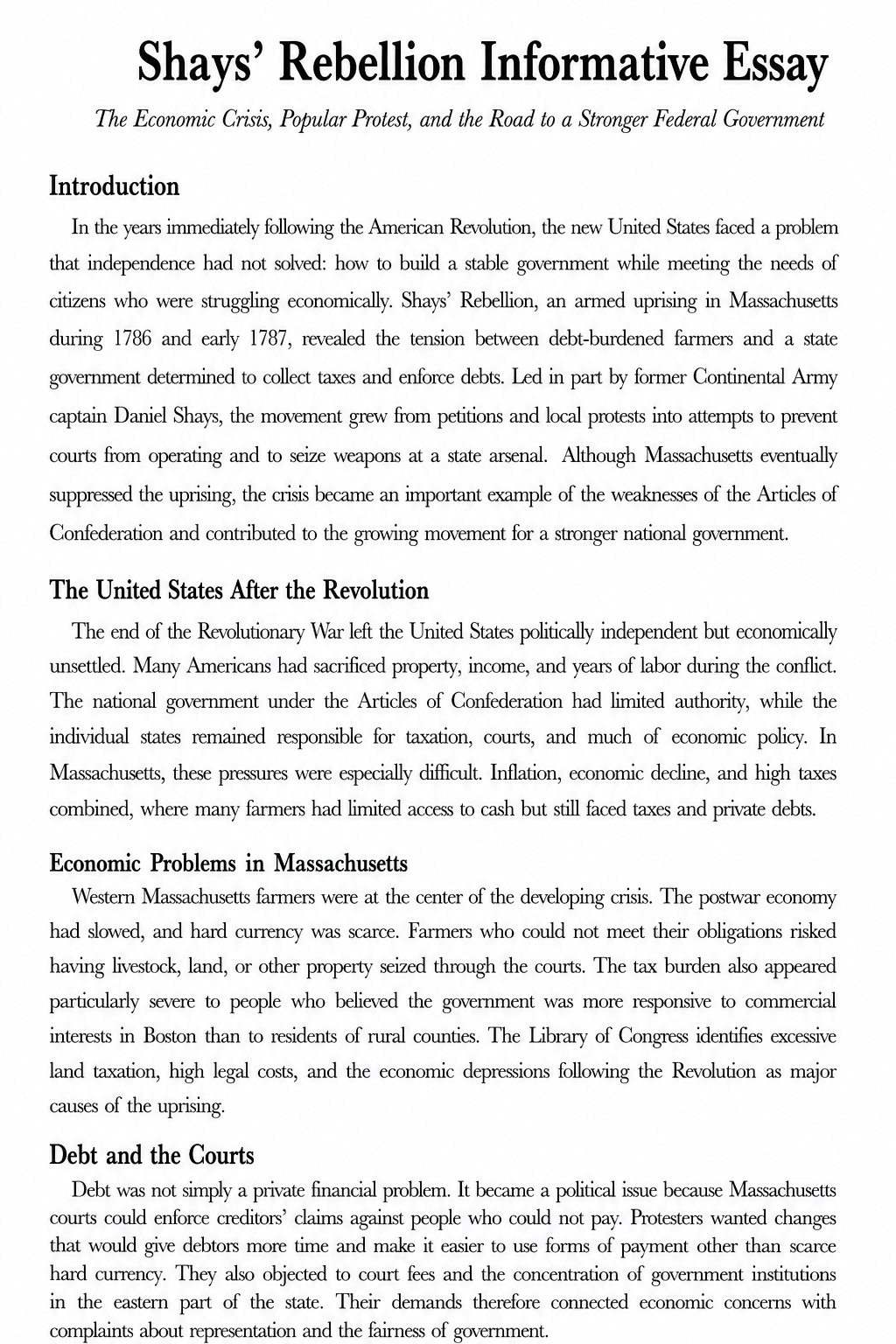
Shays' Rebellion and Public Concern
Economic and political tensions became particularly visible in Massachusetts during
Shays' Rebellion in 1786 and 1787. Farmers facing debt and court actions protested
against state economic policies and the collection of debts. The Massachusetts
government eventually suppressed the rebellion, but the episode alarmed many national
leaders. Figures such as George Washington and James Madison worried that continued
instability could weaken the republic. Although Shays' Rebellion was a state-level event
rather than a direct revolt against the Confederation Congress, it contributed to a broader
debate about whether the existing political system could maintain order while protecting
republican government.
The Annapolis Convention
Concerns about interstate commerce led to another important step toward
constitutional reform. Delegates met at Annapolis, Maryland, in 1786 to discuss
commercial problems, but attendance was too limited for the meeting to accomplish its
broader purpose. Instead, the delegates called for a larger convention to consider changes
to the system of government. The Annapolis meeting helped create momentum for the
Philadelphia Convention of 1787. Reformers increasingly concluded that modest
adjustments might not be enough to solve the Confederation's structural problems.
The Constitutional Convention
The Constitutional Convention opened in Philadelphia in May 1787. It had originally
been associated with the goal of improving the existing system, but delegates soon moved
toward a more comprehensive redesign. The Virginia Plan proposed a stronger national
government with separate legislative, executive, and judicial functions. The New Jersey
Plan sought to preserve more of the existing structure while giving Congress additional
powers. After months of debate and compromise, the delegates produced a new
Constitution that created a stronger federal system while retaining important roles for the
states.
Articles of Confederation Informative Essay
Page 6
From Confederation to Constitution
The Constitution did not simply erase the ideas behind the Articles. Instead, it
attempted to address their weaknesses while preserving the principle of a union of states.
The new federal government received power to tax, regulate interstate and foreign
commerce, conduct national defense, and enforce federal law. It also established an
executive branch and a federal judiciary. At the same time, the Constitution retained a
federal structure in which state governments continued to exercise substantial authority.
In this way, the experience under the Articles influenced the design of the government
that replaced them.
The End of the Articles
The Constitution became the governing framework of the United States in 1789. The
change represented a major transformation in the balance between state and national
authority. The Articles had been designed to make the central government dependent on
the states, while the Constitution created a federal government with independent powers
and institutions. The transition did not mean that the Confederation period was forgotten.
Instead, its successes and failures became part of the political experience used to explain
why the new system was structured differently.
Historical Significance
The Articles of Confederation are important because they reveal how early Americans
struggled to balance liberty, state sovereignty, national unity, and effective government.
The system addressed legitimate fears about centralized power and gave the states a
dominant role. At the same time, its inability to raise revenue directly, regulate commerce,
enforce national decisions, and amend the governing framework efficiently created serious
practical difficulties. The Confederation experience helped Americans understand that
independence required not only freedom from British rule but also institutions capable of
maintaining a functioning union.
Conclusion
The Articles of Confederation represented the first constitutional experiment of the
United States. Created during the Revolutionary era, they reflected a deep suspicion of
concentrated authority and a strong commitment to state independence. The Articles
enabled the states to cooperate during the war and produced important accomplishments
in diplomacy and western territorial administration. Yet the same decentralization that
protected state power made national action difficult. Financial weakness, commercial
disputes, enforcement problems, and the difficulty of constitutional reform gradually
convinced many leaders that a stronger federal structure was necessary. The Constitution
of 1787 emerged from that experience, making the Articles not merely a failed
government but an important stage in the development of American constitutional

Articles of Confederation Informative Essay
Page 7
government.