Financial
Independence
Life
Goals
1 / 5
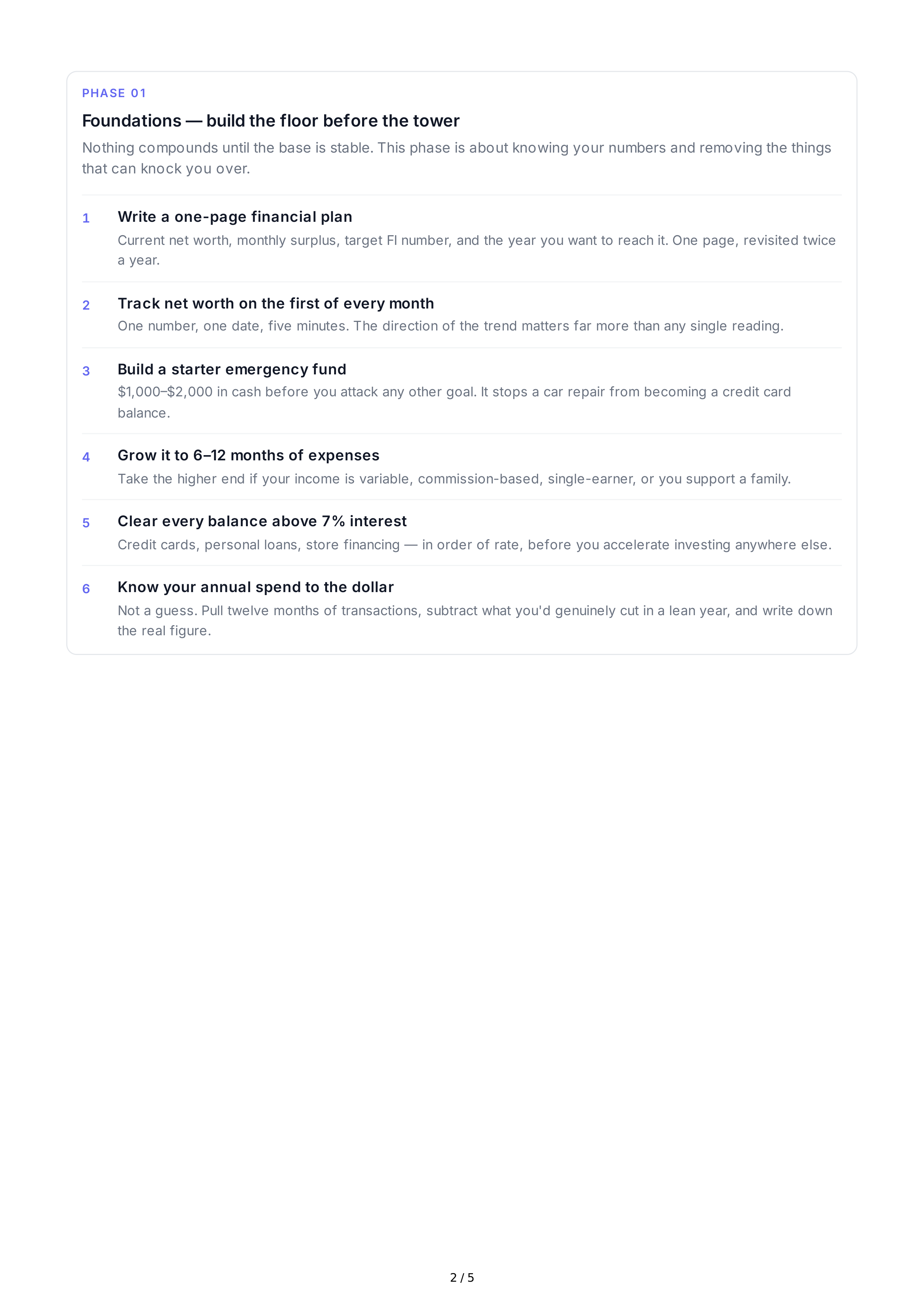
PHASE
0 1
Foundations
—
build
the
floor
before
the
tower
Nothing
compounds
until
the
base
is
stable
.
This
phase
is
about
knowing
your
numbers
and
removing
the
things
that
can
knock
you
over
.
1
Write
a
one
-
page
financial
plan
Current
net
worth
,
monthly
surplus
,
target
FI
number
,
and
the
year
you
want
to
reach
it
.
One
page
,
revisited
twice
a
year
.
2
Track
net
worth
on
the
first
of
every
month
One
number
,
one
date
,
five
minutes
.
The
direction
of
the
trend
matters
far
more
than
any
single
reading
.
3
Build
a
starter
emergency
fund
$
1,000–
$
2,000
in
cash
before
you
attack
any
other
goal
.
It
stops
a
car
repair
from
becoming
a
credit
card
balance
.
4
Grow
it
to
6–12
months
of
expenses
Take
the
higher
end
if
your
income
is
variable
,
commission
-
based
,
single
-
earner
,
or
you
support
a
family
.
5
Clear
every
balance
above
7%
interest
Credit
cards
,
personal
loans
,
store
financing
—
in
order
of
rate
,
before
you
accelerate
investing
anywhere
else
.
6
Know
your
annual
spend
to
the
dollar
Not
a
guess
.
Pull
twelve
months
of
transactions
,
subtract
what
you
'
d
genuinely
cut
in
a
lean
year
,
and
write
down
the
real
figure
.
2 / 5
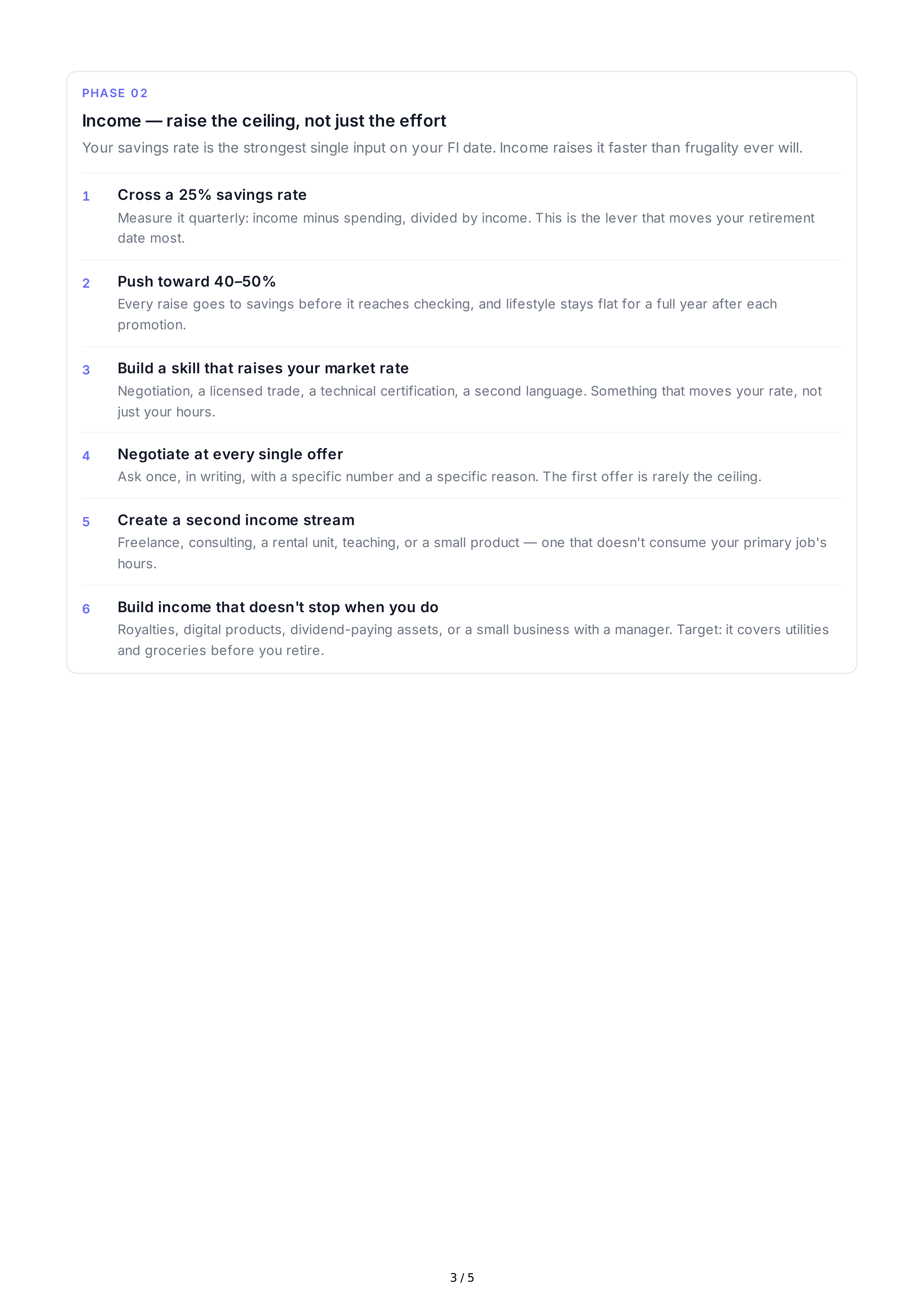
PHASE
0 2
Income
—
raise
the
ceiling
,
not
just
the
effort
Your
savings
rate
is
the
strongest
single
input
on
your
FI
date
.
Income
raises
it
faster
than
frugality
ever
will
.
1
Cross
a
25%
savings
rate
Measure
it
quarterly
:
income
minus
spending
,
divided
by
income
.
This
is
the
lever
that
moves
your
retirement
date
most
.
2
Push
toward
40–50%
Every
raise
goes
to
savings
before
it
reaches
checking
,
and
lifestyle
stays
flat
for
a
full
year
after
each
promotion
.
3
Build
a
skill
that
raises
your
market
rate
Negotiation
,
a
licensed
trade
,
a
technical
certification
,
a
second
language
.
Something
that
moves
your
rate
,
not
just
your
hours
.
4
Negotiate
at
every
single
offer
Ask
once
,
in
writing
,
with
a
specific
number
and
a
specific
reason
.
The
first
offer
is
rarely
the
ceiling
.
5
Create
a
second
income
stream
Freelance
,
consulting
,
a
rental
unit
,
teaching
,
or
a
small
product
—
one
that
doesn
'
t
consume
your
primary
job
'
s
hours
.
6
Build
income
that
doesn
'
t
stop
when
you
do
Royalties
,
digital
products
,
dividend
-
paying
assets
,
or
a
small
business
with
a
manager
.
Target
:
it
covers
utilities
and
groceries
before
you
retire
.
3 / 5
PHASE
0 3
Spending
—
control
the
outflow
with
rules
,
not
willpower
Decisions
made
once
,
in
advance
,
beat
decisions
made
in
the
checkout
aisle
.
Automate
the
good
ones
and
cap
the
big
ones
.
1
Automate
the
transfers
on
payday
Savings
and
investments
leave
the
moment
money
arrives
.
What
stays
in
checking
is
what
you
'
re
allowed
to
spend
.
2
Cap
your
three
largest
line
items
Housing
,
transport
,
food
.
Written
as
a
share
of
take
-
home
pay
—
roughly
25%, 10%,
and
12% —
reviewed
once
a
year
.
3
Buy
one
quality
item
instead
of
three
cheap
ones
Appliances
,
shoes
,
tools
,
mattresses
,
cookware
.
Judge
by
cost
per
year
of
use
,
not
price
at
checkout
.
4
Audit
every
recurring
charge
twice
a
year
Subscriptions
,
memberships
,
insurance
add
-
ons
,
cloud
storage
.
The
exercise
usually
pays
for
a
month
of
groceries
.
5
Practice
one
deliberate
"
no
"
a
month
Decline
an
upgrade
you
can
comfortably
afford
,
on
purpose
.
Cheap
muscle
memory
for
the
years
when
restraint
isn
'
t
optional
.
6
Set
a
lifestyle
ceiling
,
not
just
a
floor
Decide
the
highest
annual
spend
you
'
ll
allow
yourself
,
then
let
every
future
raise
flow
past
it
into
investments
.
PHASE
0 4
Investing
—
let
time
do
the
heavy
lifting
The
plan
should
be
boring
enough
to
follow
for
twenty
years
without
a
single
clever
decision
.
1
Capture
every
employer
match
Contributing
less
than
the
match
means
declining
part
of
your
own
compensation
.
Fix
this
before
anything
else
on
the
list
.
2
Fill
tax
-
advantaged
accounts
before
taxable
ones
401(
k
)
or
403(
b
),
then
an
IRA
or
Roth
IRA
,
then
an
HSA
if
you
'
re
on
a
high
-
deductible
health
plan
.
3
Hold
a
boring
three
-
fund
portfolio
Total
US
market
,
total
international
,
and
bonds
.
Rebalance
once
a
year
on
a
calendar
date
—
never
on
a
feeling
.
4
Keep
total
fees
under
0.10%
Expense
ratios
and
platform
fees
compound
against
you
exactly
the
way
returns
compound
for
you
.
5
Hold
the
line
through
two
full
drawdowns
Write
your
rules
now
:
what
you
'
ll
do
at
−20%, −35%,
and
−50%.
Then
do
nothing
except
rebalance
on
schedule
.
6
Reach
the
point
where
contributions
stop
mattering
When
a
year
of
market
movement
exceeds
a
year
of
saving
,
the
machine
is
built
.
Stop
checking
it
daily
.
4 / 5
PHASE
0 5
Life
design
—
decide
what
the
money
is
actually
for
Financial
independence
is
not
a
number
.
It
'
s
a
set
of
mornings
you
get
to
structure
yourself
.
Design
that
before
you
arrive
at
it
.
1
Define
what
the
freedom
is
for
,
in
three
sentences
More
time
with
your
kids
,
a
workshop
in
the
garage
,
six
months
abroad
each
year
.
Vague
freedom
gets
quietly
spent
.
2
Keep
12
months
of
expenses
liquid
The
"
I
could
quit
on
Monday
"
fund
.
It
buys
you
the
ability
to
say
no
long
before
you
can
technically
retire
.
3
Practice
retirement
before
you
retire
Take
a
four
-
week
sabbatical
,
unpaid
if
that
'
s
what
it
takes
.
Find
out
whether
unstructured
time
actually
suits
you
.
4
Buy
back
the
hours
that
drain
you
most
House
cleaning
,
meal
prep
,
tax
filing
,
yard
work
.
Calculate
the
hourly
rate
that
makes
each
one
worth
outsourcing
.
5
Protect
the
asset
that
produces
the
income
Annual
physical
,
consistent
sleep
,
strength
training
twice
a
week
,
mental
health
support
.
Nothing
compounds
without
the
body
doing
the
earning
.
6
Downshift
before
you
stop
Four
-
day
weeks
,
contract
work
,
or
a
lower
-
stress
role
for
two
years
.
A
glide
path
beats
a
cliff
edge
every
time
.
PHASE
0 6
Giving
—
decide
where
it
goes
before
it
accumulates
Generosity
that
starts
early
survives
wealth
.
Generosity
that
waits
for
a
number
usually
keeps
waiting
.
1
Give
a
fixed
percentage
while
still
accumulating
Five
percent
of
gross
,
automated
monthly
,
even
while
the
amounts
are
small
.
The
habit
is
the
asset
.
2
Fund
the
people
who
got
you
there
Parent
care
,
a
sibling
'
s
education
,
a
friend
'
s
medical
bill
.
Name
the
amount
in
advance
so
it
'
s
a
plan
,
not
an
emergency
.
3
Write
your
will
and
name
every
beneficiary
Retirement
accounts
and
insurance
pass
by
beneficiary
designation
,
not
by
will
.
Check
both
,
on
every
account
.
4
Leave
a
defined
legacy
A
scholarship
,
a
foundation
gift
,
a
paid
-
off
family
home
.
Choose
the
amount
now
and
let
the
plan
carry
it
for
decades
.
5 / 5