Self
-
Discipline
Life
Goals
01
Daily
Foundations
The
five
things
that
make
every
other
goal
easier
.
Fix
these
before
adding
anything
else
.
01
Wake
at
the
same
hour
every
day
Same
alarm
seven
days
a
week
,
no
snooze
,
phone
charging
across
the
room
.
A
fixed
wake
time
stabilises
sleep
more
than
a
fixed
bedtime
does
.
02
Make
the
bed
within
five
minutes
Chosen
precisely
because
it
is
trivial
.
The
point
is
to
win
one
small
negotiation
with
yourself
before
the
day
starts
arguing
.
03
Finish
one
hard
thing
before
10
a
.
m
.
The
task
you
would
normally
push
to
the
afternoon
.
Ninety
minutes
of
work
on
it
,
before
messages
and
meetings
take
the
good
hours
.
04
Eat
at
set
times
,
without
a
screen
Three
meals
at
roughly
the
same
hours
.
No
scrolling
,
no
laptop
,
no
standing
at
the
counter
.
Twenty
minutes
,
seated
.
05
Keep
the
last
hour
of
the
day
offline
No
feeds
,
no
email
,
no
news
after
the
evening
wind
-
down
begins
.
Reading
,
tidying
,
or
conversation
all
count
.
Screens
do
not
.
1 / 8
02
Body
&
Energy
Discipline
runs
on
a
nervous
system
.
These
goals
protect
the
fuel
supply
.
06
Train
four
times
a
week
—
no
renegotiating
Sessions
scheduled
in
the
calendar
like
meetings
.
Missing
one
is
acceptable
;
deciding
in
the
moment
whether
to
go
is
not
.
07
Walk
8,000
steps
every
day
Two
short
walks
,
outdoors
,
ideally
before
the
first
meeting
and
after
dinner
.
This
is
a
floor
,
not
a
fitness
target
.
08
Protect
a
seven
-
and
-
a
-
half
-
hour
sleep
window
Count
backwards
from
your
wake
time
and
treat
the
result
as
a
commitment
.
Lights
out
means
lights
out
,
not
one
more
episode
.
09
No
alcohol
on
weeknights
Sunday
through
Thursday
,
water
.
Sleep
quality
,
morning
energy
,
and
the
6
a
.
m
.
training
session
all
depend
on
this
one
.
10
Cook
five
dinners
from
scratch
each
week
Simple
meals
count
.
Knowing
what
you
ate
and
controlling
it
is
one
of
the
cheapest
forms
of
self
-
respect
available
.
2 / 8
03
Mind
&
Learning
Discipline
without
input
becomes
rigidity
.
These
goals
keep
the
thinking
sharp
.
11
Read
20
pages
a
day
Twenty
pages
is
roughly
one
book
a
month
and
takes
under
thirty
minutes
.
Paper
or
e
-
reader
,
but
not
a
feed
.
12
Write
30
minutes
of
deliberate
practice
every
weekday
One
block
dedicated
to
the
skill
you
are
actually
paid
for
or
actually
want
.
Editing
your
own
work
,
drilling
a
language
,
practising
scales
—
chosen
in
advance
.
13
Do
a
30-
minute
weekly
written
review
Friday
afternoon
,
one
page
:
what
worked
,
what
slipped
,
what
you
will
do
differently
.
Written
,
not
thought
about
in
the
shower
.
14
Learn
in
public
once
a
month
Publish
a
note
,
a
summary
,
or
a
short
write
-
up
of
something
you
just
learned
.
Explaining
it
to
strangers
is
the
fastest
way
to
find
the
gaps
.
15
Sit
with
30
minutes
of
no
input
daily
A
walk
without
headphones
,
a
commute
without
a
podcast
,
a
seat
by
a
window
.
Boredom
is
where
original
thought
gets
a
chance
to
appear
.
3 / 8
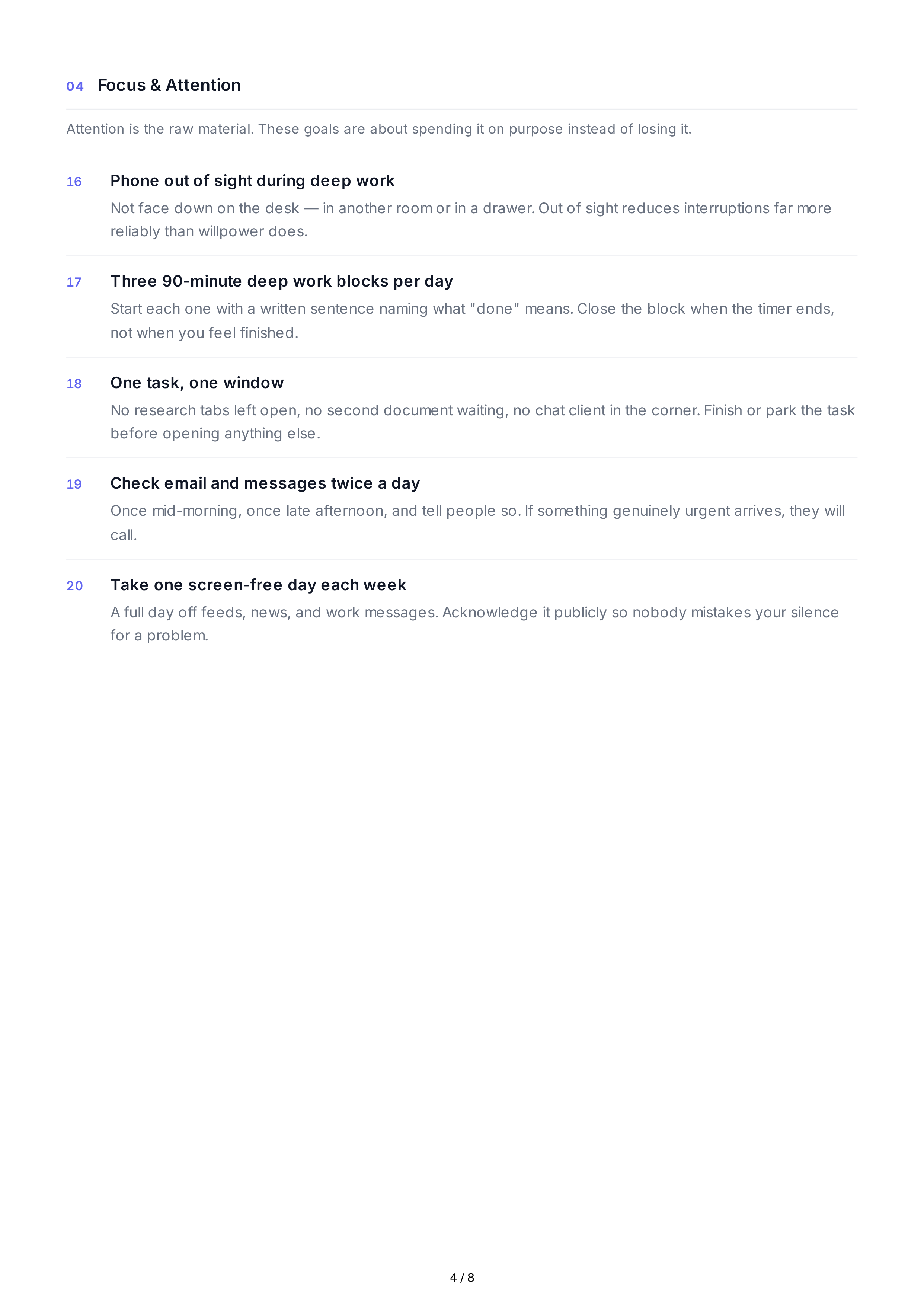
04
Focus
&
Attention
Attention
is
the
raw
material
.
These
goals
are
about
spending
it
on
purpose
instead
of
losing
it
.
16
Phone
out
of
sight
during
deep
work
Not
face
down
on
the
desk
—
in
another
room
or
in
a
drawer
.
Out
of
sight
reduces
interruptions
far
more
reliably
than
willpower
does
.
17
Three
90-
minute
deep
work
blocks
per
day
Start
each
one
with
a
written
sentence
naming
what
"
done
"
means
.
Close
the
block
when
the
timer
ends
,
not
when
you
feel
finished
.
18
One
task
,
one
window
No
research
tabs
left
open
,
no
second
document
waiting
,
no
chat
client
in
the
corner
.
Finish
or
park
the
task
before
opening
anything
else
.
19
Check
email
and
messages
twice
a
day
Once
mid
-
morning
,
once
late
afternoon
,
and
tell
people
so
.
If
something
genuinely
urgent
arrives
,
they
will
call
.
20
Take
one
screen
-
free
day
each
week
A
full
day
off
feeds
,
news
,
and
work
messages
.
Acknowledge
it
publicly
so
nobody
mistakes
your
silence
for
a
problem
.
4 / 8
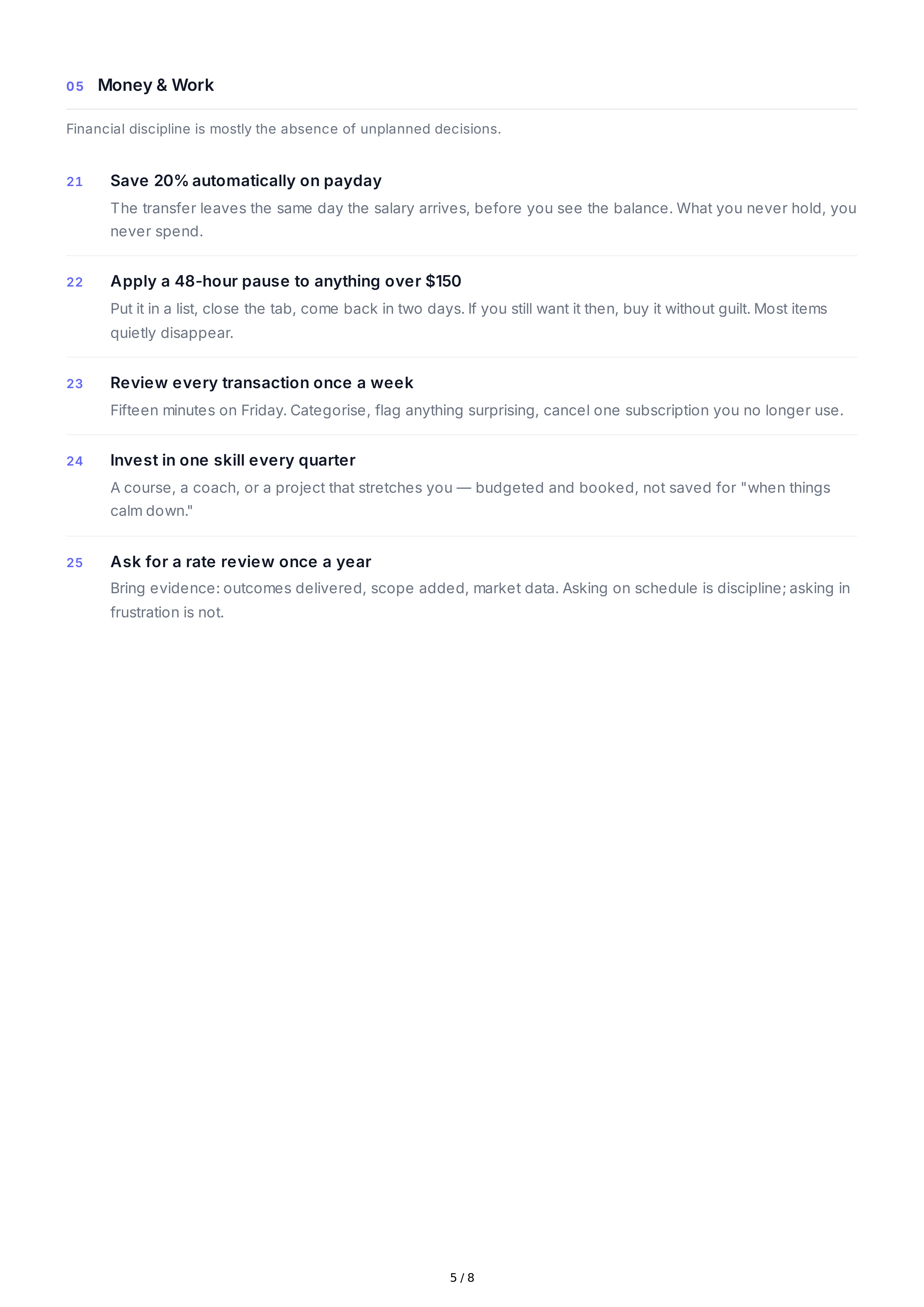
05
Money
&
Work
Financial
discipline
is
mostly
the
absence
of
unplanned
decisions
.
21
Save
20%
automatically
on
payday
The
transfer
leaves
the
same
day
the
salary
arrives
,
before
you
see
the
balance
.
What
you
never
hold
,
you
never
spend
.
22
Apply
a
48-
hour
pause
to
anything
over
$
150
Put
it
in
a
list
,
close
the
tab
,
come
back
in
two
days
.
If
you
still
want
it
then
,
buy
it
without
guilt
.
Most
items
quietly
disappear
.
23
Review
every
transaction
once
a
week
Fifteen
minutes
on
Friday
.
Categorise
,
flag
anything
surprising
,
cancel
one
subscription
you
no
longer
use
.
24
Invest
in
one
skill
every
quarter
A
course
,
a
coach
,
or
a
project
that
stretches
you
—
budgeted
and
booked
,
not
saved
for
"
when
things
calm
down
."
25
Ask
for
a
rate
review
once
a
year
Bring
evidence
:
outcomes
delivered
,
scope
added
,
market
data
.
Asking
on
schedule
is
discipline
;
asking
in
frustration
is
not
.
5 / 8
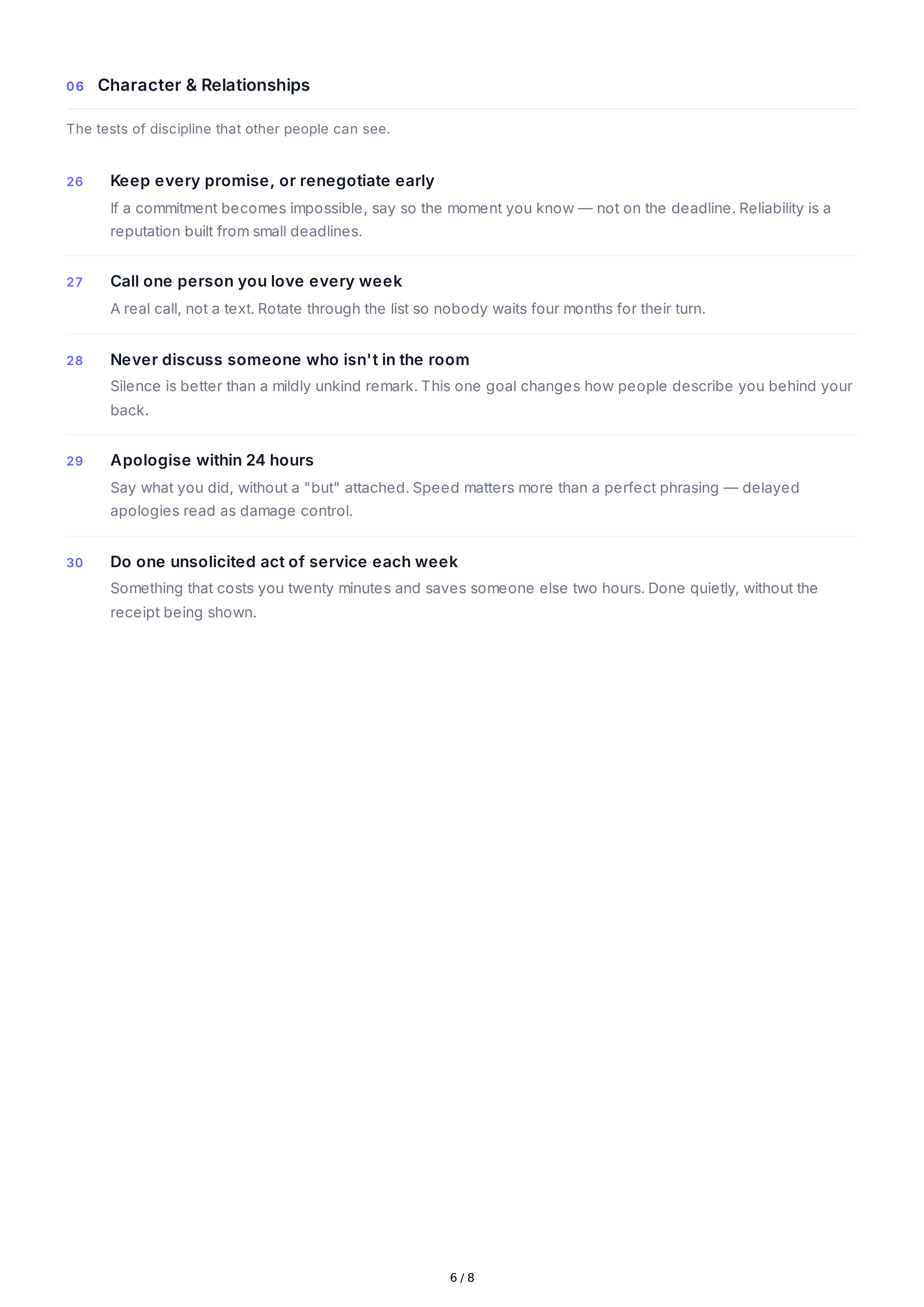
06
Character
&
Relationships
The
tests
of
discipline
that
other
people
can
see
.
26
Keep
every
promise
,
or
renegotiate
early
If
a
commitment
becomes
impossible
,
say
so
the
moment
you
know
—
not
on
the
deadline
.
Reliability
is
a
reputation
built
from
small
deadlines
.
27
Call
one
person
you
love
every
week
A
real
call
,
not
a
text
.
Rotate
through
the
list
so
nobody
waits
four
months
for
their
turn
.
28
Never
discuss
someone
who
isn
'
t
in
the
room
Silence
is
better
than
a
mildly
unkind
remark
.
This
one
goal
changes
how
people
describe
you
behind
your
back
.
29
Apologise
within
24
hours
Say
what
you
did
,
without
a
"
but
"
attached
.
Speed
matters
more
than
a
perfect
phrasing
—
delayed
apologies
read
as
damage
control
.
30
Do
one
unsolicited
act
of
service
each
week
Something
that
costs
you
twenty
minutes
and
saves
someone
else
two
hours
.
Done
quietly
,
without
the
receipt
being
shown
.
6 / 8
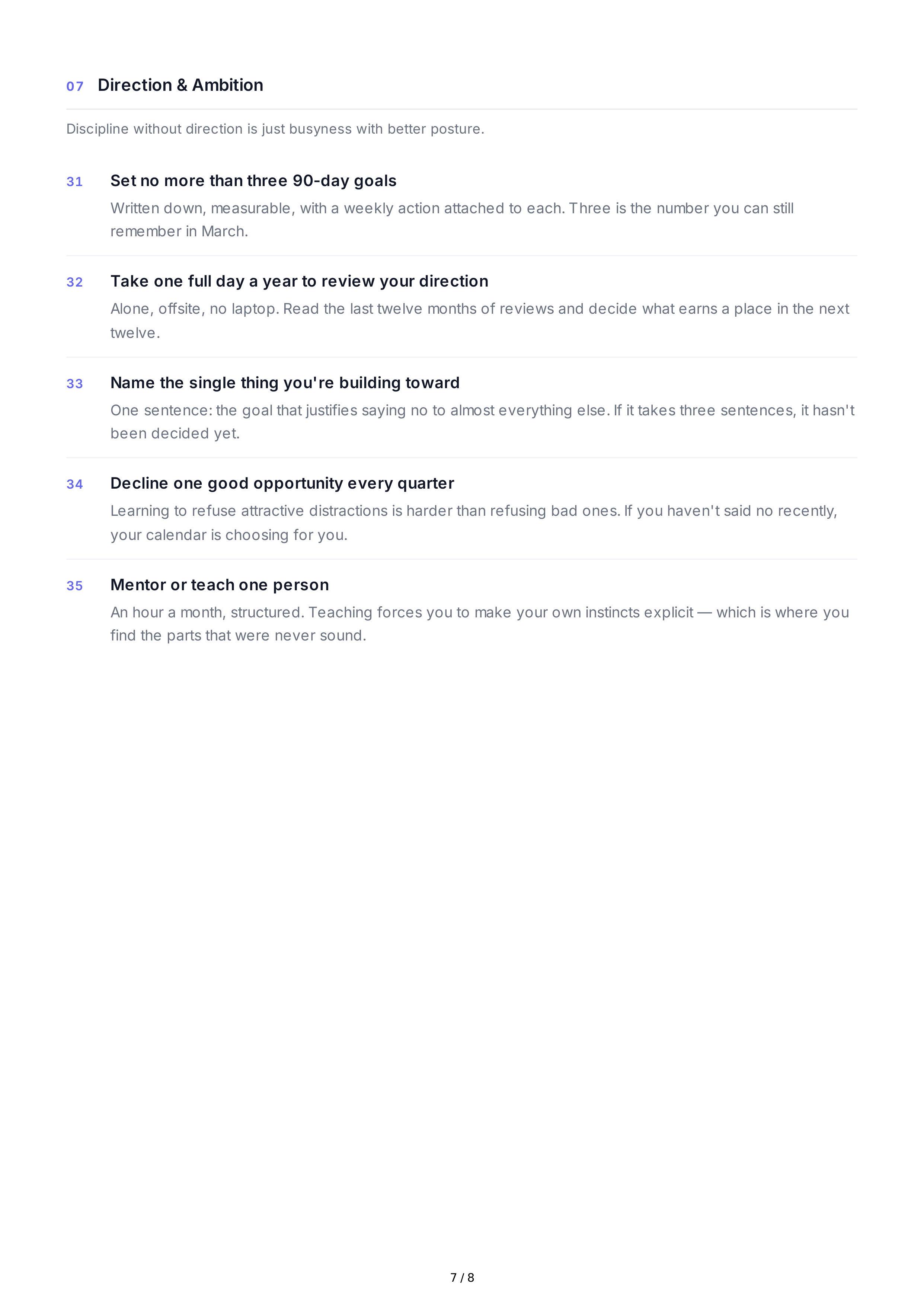
07
Direction
&
Ambition
Discipline
without
direction
is
just
busyness
with
better
posture
.
31
Set
no
more
than
three
90-
day
goals
Written
down
,
measurable
,
with
a
weekly
action
attached
to
each
.
Three
is
the
number
you
can
still
remember
in
March
.
32
Take
one
full
day
a
year
to
review
your
direction
Alone
,
offsite
,
no
laptop
.
Read
the
last
twelve
months
of
reviews
and
decide
what
earns
a
place
in
the
next
twelve
.
33
Name
the
single
thing
you
'
re
building
toward
One
sentence
:
the
goal
that
justifies
saying
no
to
almost
everything
else
.
If
it
takes
three
sentences
,
it
hasn
'
t
been
decided
yet
.
34
Decline
one
good
opportunity
every
quarter
Learning
to
refuse
attractive
distractions
is
harder
than
refusing
bad
ones
.
If
you
haven
'
t
said
no
recently
,
your
calendar
is
choosing
for
you
.
35
Mentor
or
teach
one
person
An
hour
a
month
,
structured
.
Teaching
forces
you
to
make
your
own
instincts
explicit
—
which
is
where
you
find
the
parts
that
were
never
sound
.
7 / 8
08
Resilience
&
Recovery
What
separates
people
who
keep
their
discipline
for
a
decade
from
people
who
keep
it
for
three
weeks
.
36
Use
the
ten
-
minute
rule
on
dreaded
tasks
Commit
to
ten
minutes
only
,
then
decide
whether
to
continue
.
Starting
is
the
obstacle
;
the
task
is
almost
never
as
bad
as
the
avoidance
.
37
Make
no
decisions
after
10
p
.
m
.
No
purchases
,
no
replies
to
difficult
messages
,
no
commitments
.
Write
the
decision
down
and
settle
it
in
daylight
.
38
Never
miss
twice
Missing
one
session
is
life
.
Missing
two
is
the
start
of
a
new
pattern
.
Any
streak
can
break
once
—
the
rule
is
about
what
happens
next
.
39
Finish
what
you
start
,
or
formally
abandon
it
A
single
open
-
project
rule
:
no
new
commitment
until
the
last
one
is
completed
,
archived
,
or
explicitly
closed
.
Half
-
finished
work
is
a
tax
on
attention
.
40
Do
one
deliberately
uncomfortable
thing
each
week
A
cold
shower
,
a
difficult
conversation
,
a
class
you
'
re
bad
at
.
Practising
voluntary
discomfort
keeps
the
discomfort
of
necessary
action
from
feeling
unusual
.
8 / 8