Emotional
Well
-
Being
Life
Goal
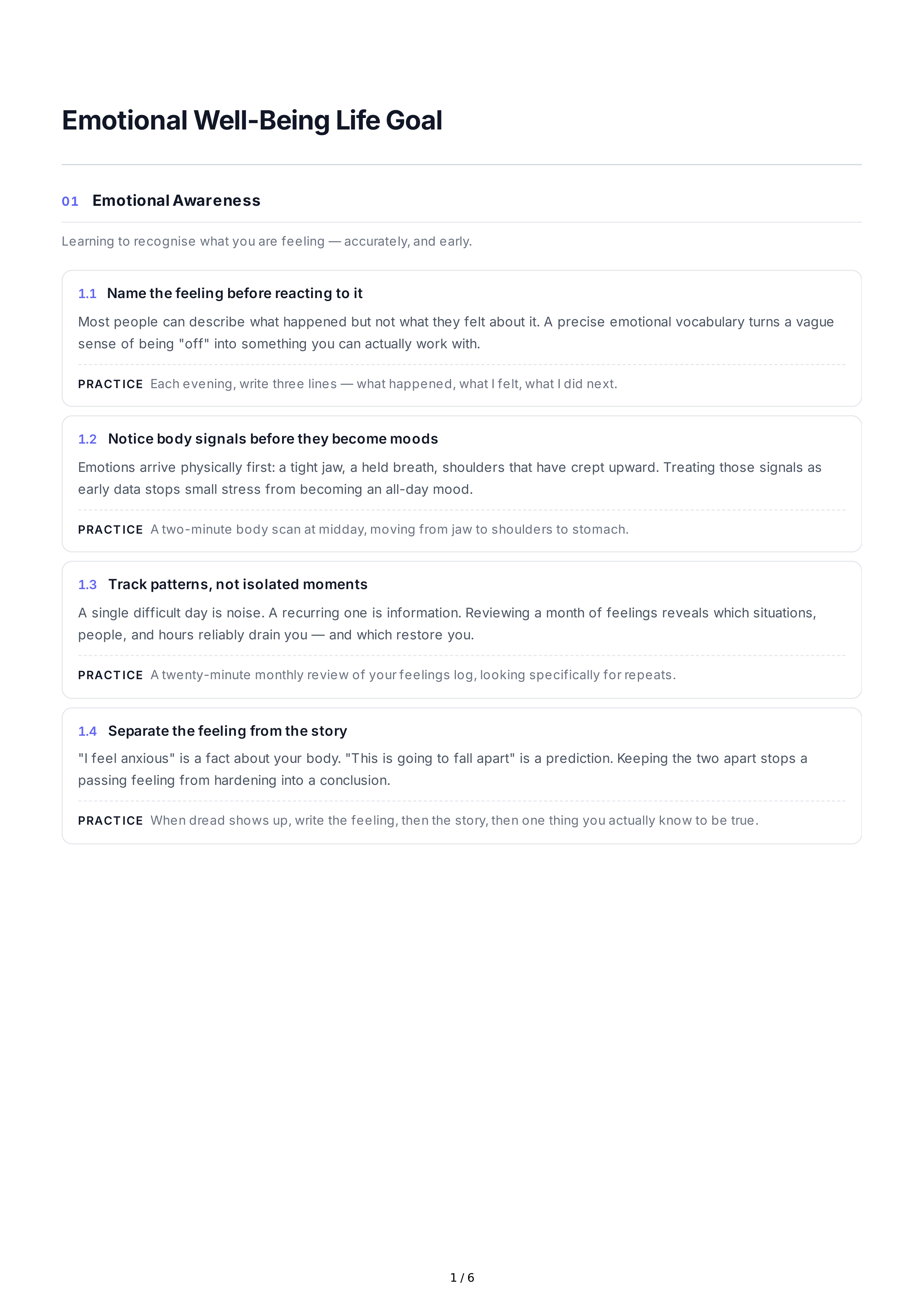
01
Emotional
Awareness
Learning
to
recognise
what
you
are
feeling
—
accurately
,
and
early
.
1.1
Name
the
feeling
before
reacting
to
it
Most
people
can
describe
what
happened
but
not
what
they
felt
about
it
.
A
precise
emotional
vocabulary
turns
a
vague
sense
of
being
"
off
"
into
something
you
can
actually
work
with
.
PRACTICE
Each
evening
,
write
three
lines
—
what
happened
,
what
I
felt
,
what
I
did
next
.
1.2
Notice
body
signals
before
they
become
moods
Emotions
arrive
physically
first
:
a
tight
jaw
,
a
held
breath
,
shoulders
that
have
crept
upward
.
Treating
those
signals
as
early
data
stops
small
stress
from
becoming
an
all
-
day
mood
.
PRACTICE
A
two
-
minute
body
scan
at
midday
,
moving
from
jaw
to
shoulders
to
stomach
.
1.3
Track
patterns
,
not
isolated
moments
A
single
difficult
day
is
noise
.
A
recurring
one
is
information
.
Reviewing
a
month
of
feelings
reveals
which
situations
,
people
,
and
hours
reliably
drain
you
—
and
which
restore
you
.
PRACTICE
A
twenty
-
minute
monthly
review
of
your
feelings
log
,
looking
specifically
for
repeats
.
1.4
Separate
the
feeling
from
the
story
"
I
feel
anxious
"
is
a
fact
about
your
body
. "
This
is
going
to
fall
apart
"
is
a
prediction
.
Keeping
the
two
apart
stops
a
passing
feeling
from
hardening
into
a
conclusion
.
PRACTICE
When
dread
shows
up
,
write
the
feeling
,
then
the
story
,
then
one
thing
you
actually
know
to
be
true
.
1 / 6
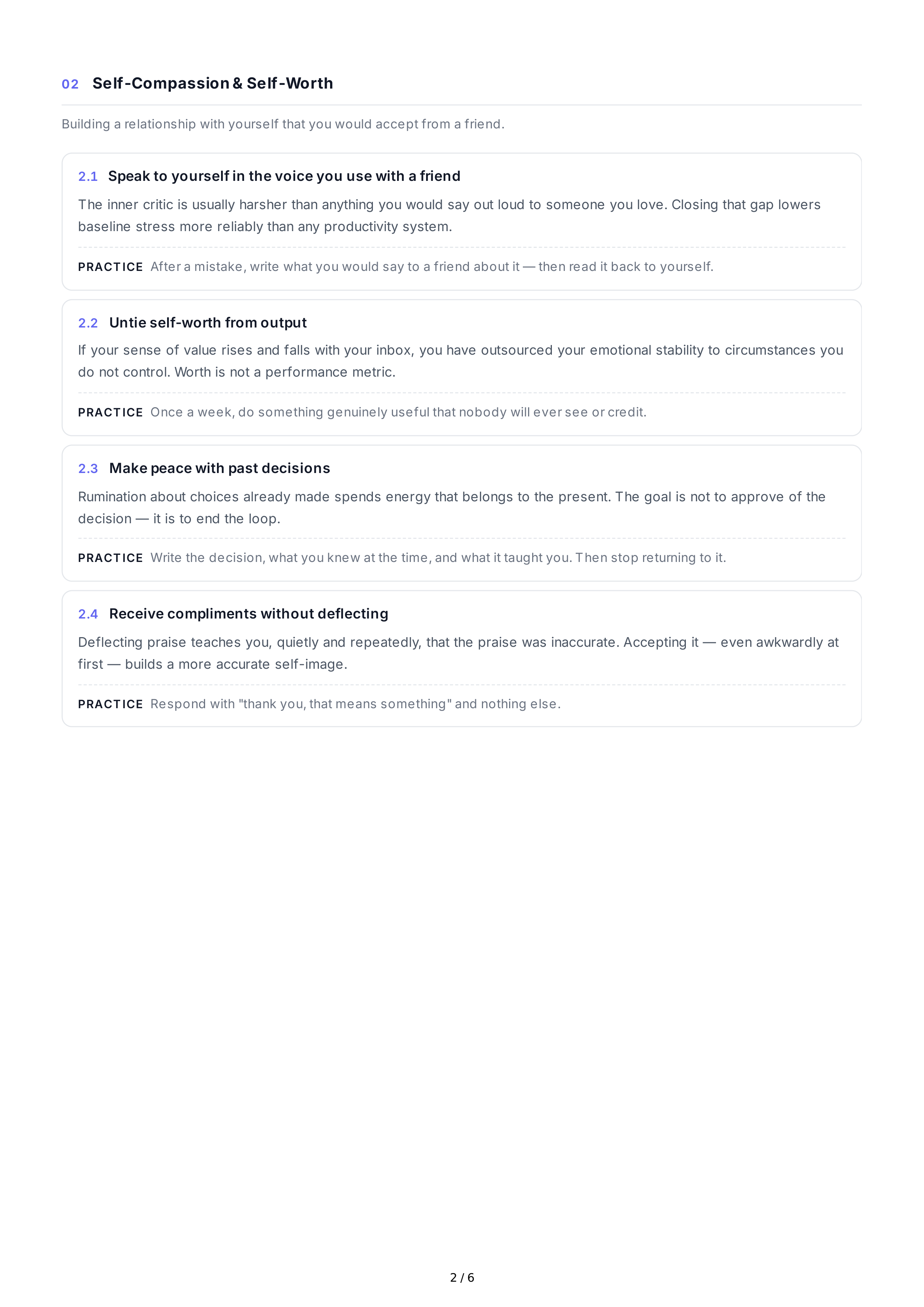
02
Self
-
Compassion
&
Self
-
Worth
Building
a
relationship
with
yourself
that
you
would
accept
from
a
friend
.
2.1
Speak
to
yourself
in
the
voice
you
use
with
a
friend
The
inner
critic
is
usually
harsher
than
anything
you
would
say
out
loud
to
someone
you
love
.
Closing
that
gap
lowers
baseline
stress
more
reliably
than
any
productivity
system
.
PRACTICE
After
a
mistake
,
write
what
you
would
say
to
a
friend
about
it
—
then
read
it
back
to
yourself
.
2.2
Untie
self
-
worth
from
output
If
your
sense
of
value
rises
and
falls
with
your
inbox
,
you
have
outsourced
your
emotional
stability
to
circumstances
you
do
not
control
.
Worth
is
not
a
performance
metric
.
PRACTICE
Once
a
week
,
do
something
genuinely
useful
that
nobody
will
ever
see
or
credit
.
2.3
Make
peace
with
past
decisions
Rumination
about
choices
already
made
spends
energy
that
belongs
to
the
present
.
The
goal
is
not
to
approve
of
the
decision
—
it
is
to
end
the
loop
.
PRACTICE
Write
the
decision
,
what
you
knew
at
the
time
,
and
what
it
taught
you
.
Then
stop
returning
to
it
.
2.4
Receive
compliments
without
deflecting
Deflecting
praise
teaches
you
,
quietly
and
repeatedly
,
that
the
praise
was
inaccurate
.
Accepting
it
—
even
awkwardly
at
first
—
builds
a
more
accurate
self
-
image
.
PRACTICE
Respond
with
"
thank
you
,
that
means
something
"
and
nothing
else
.
2 / 6
03
Stress
Regulation
&
Resilience
Shortening
the
distance
between
being
knocked
off
balance
and
returning
to
it
.
3.1
Build
one
down
-
regulation
practice
you
actually
use
Most
people
know
several
breathing
techniques
and
use
none
of
them
.
One
practice
that
reliably
settles
your
nervous
system
—
used
daily
,
not
only
in
crisis
—
is
worth
more
than
a
list
of
ten
.
PRACTICE
Five
minutes
of
slow
breathing
(
four
counts
in
,
six
out
)
at
the
same
time
every
day
.
3.2
Widen
the
gap
between
trigger
and
response
Emotional
maturity
is
largely
measured
in
seconds
.
The
longer
the
pause
between
an
event
and
your
reaction
,
the
more
options
you
have
about
what
happens
next
.
PRACTICE
When
something
lands
hard
,
wait
ninety
seconds
before
saying
or
sending
anything
.
3.3
Recover
faster
rather
than
hurt
less
Life
guarantees
setbacks
;
it
does
not
guarantee
that
you
take
three
weeks
to
get
over
each
one
.
Compressing
recovery
from
days
to
hours
is
a
trainable
skill
,
not
a
personality
trait
.
PRACTICE
After
a
hard
day
,
name
three
things
that
are
still
true
and
one
small
next
step
.
3.4
Protect
sleep
as
an
emotional
foundation
Sleep
debt
makes
everything
feel
more
personal
and
less
fixable
.
Most
emotional
-
regulation
goals
quietly
fail
here
first
,
long
before
they
fail
anywhere
else
.
PRACTICE
A
fixed
wind
-
down
time
,
and
no
difficult
conversations
after
9
pm
.
3 / 6
04
Relationships
&
Connection
Depth
over
breadth
—
and
the
willingness
to
repair
quickly
.
4.1
Go
deeper
with
a
few
rather
than
wider
with
many
Five
relationships
you
can
be
honest
with
do
more
for
well
-
being
than
fifty
you
can
only
be
pleasant
with
.
Connection
is
measured
by
candour
,
not
contact
count
.
PRACTICE
Set
up
a
recurring
forty
-
five
minute
call
with
one
person
you
would
otherwise
only
text
.
4.2
Repair
within
twenty
-
four
hours
Arguments
damage
relationships
far
less
than
the
silence
that
follows
them
.
Fast
repair
is
the
actual
skill
here
—
being
right
rarely
matters
by
the
next
morning
.
PRACTICE
After
a
conflict
,
reach
out
within
a
day
—
not
to
relitigate
,
but
to
reconnect
.
4.3
Ask
questions
that
don
'
t
have
a
logistical
answer
"
When
did
you
last
feel
really
good
about
something
?"
opens
a
person
up
. "
Did
you
book
the
thing
?"
closes
them
down
.
The
question
you
choose
sets
the
depth
of
the
conversation
.
PRACTICE
Ask
one
non
-
logistical
question
in
every
meaningful
conversation
this
week
.
4.4
Show
up
in
small
,
repeatable
ways
Consistency
reads
as
care
more
reliably
than
grand
gestures
.
What
people
remember
is
that
you
turned
up
,
not
how
impressively
you
did
it
.
PRACTICE
One
small
deliberate
act
each
week
for
someone
who
is
not
expecting
it
.
4 / 6
05
Meaning
&
Purpose
Connecting
daily
hours
to
something
you
would
actually
choose
.
5.1
Define
what
a
good
week
actually
looks
like
Without
a
definition
,
a
week
gets
judged
by
how
busy
it
felt
rather
than
how
it
went
.
Clarity
about
the
target
is
what
makes
the
evaluation
honest
.
PRACTICE
Write
six
markers
of
a
good
week
—
three
about
work
,
three
about
life
—
and
check
them
each
Friday
.
5.2
Contribute
to
something
that
outlasts
the
task
Purpose
is
rarely
found
by
searching
for
it
directly
;
it
is
usually
built
by
giving
something
away
.
The
contribution
has
to
keep
going
on
the
days
you
do
not
feel
like
it
.
PRACTICE
Commit
to
a
recurring
contribution
—
mentoring
,
volunteering
,
teaching
—
on
a
fixed
schedule
.
5.3
Align
daily
actions
with
your
stated
values
The
gap
between
what
you
say
matters
and
how
you
actually
spend
your
hours
is
where
most
quiet
unhappiness
lives
.
Naming
the
gap
is
the
first
step
to
closing
it
.
PRACTICE
List
your
top
four
values
,
then
log
how
many
hours
last
week
went
to
each
one
.
5.4
Keep
one
thing
you
do
purely
for
its
own
sake
Anything
pursued
only
for
outcomes
eventually
becomes
a
job
.
One
activity
with
no
audience
,
no
metric
,
and
no
return
protects
the
part
of
you
that
isn
'
t
optimizing
.
PRACTICE
Protect
a
weekly
block
for
something
with
no
deliverable
attached
to
it
.
5 / 6
06
Boundaries
,
Gratitude
&
Growth
Holding
the
line
on
your
time
,
and
keeping
the
goals
alive
over
years
.
6.1
Set
boundaries
without
apologising
for
them
Every
yes
is
a
withdrawal
from
something
else
.
Naming
what
you
are
giving
up
makes
the
trade
visible
—
and
makes
declining
a
request
far
less
loaded
.
PRACTICE
When
you
agree
to
something
,
name
to
yourself
what
it
costs
.
Decline
at
least
one
request
per
month
.
6.2
Practice
gratitude
concretely
Generic
gratitude
— "
I
'
m
grateful
for
my
family
" —
does
very
little
.
Specific
gratitude
— "
Priya
called
the
day
she
knew
I
'
d
had
a
rough
week
" —
does
a
great
deal
.
Detail
is
what
makes
it
land
.
PRACTICE
Three
specific
things
each
night
,
different
from
the
night
before
.
6.3
Let
hard
emotions
finish
Sadness
,
anger
,
and
grief
are
not
problems
to
be
solved
;
they
are
processes
to
be
completed
.
Suppressing
them
does
not
end
them
—
it
keeps
them
running
quietly
in
the
background
.
PRACTICE
Set
a
fifteen
-
minute
timer
,
feel
it
fully
without
trying
to
fix
it
,
then
stop
.
6.4
Revisit
these
goals
every
quarter
Goals
written
once
and
filed
away
become
decoration
.
Emotional
well
-
being
is
maintained
rather
than
achieved
,
and
the
goals
have
to
change
as
your
life
does
.
PRACTICE
A
thirty
-
minute
quarterly
review
—
keep
,
revise
,
or
honestly
drop
each
goal
.
6 / 6