W eiskircher 6
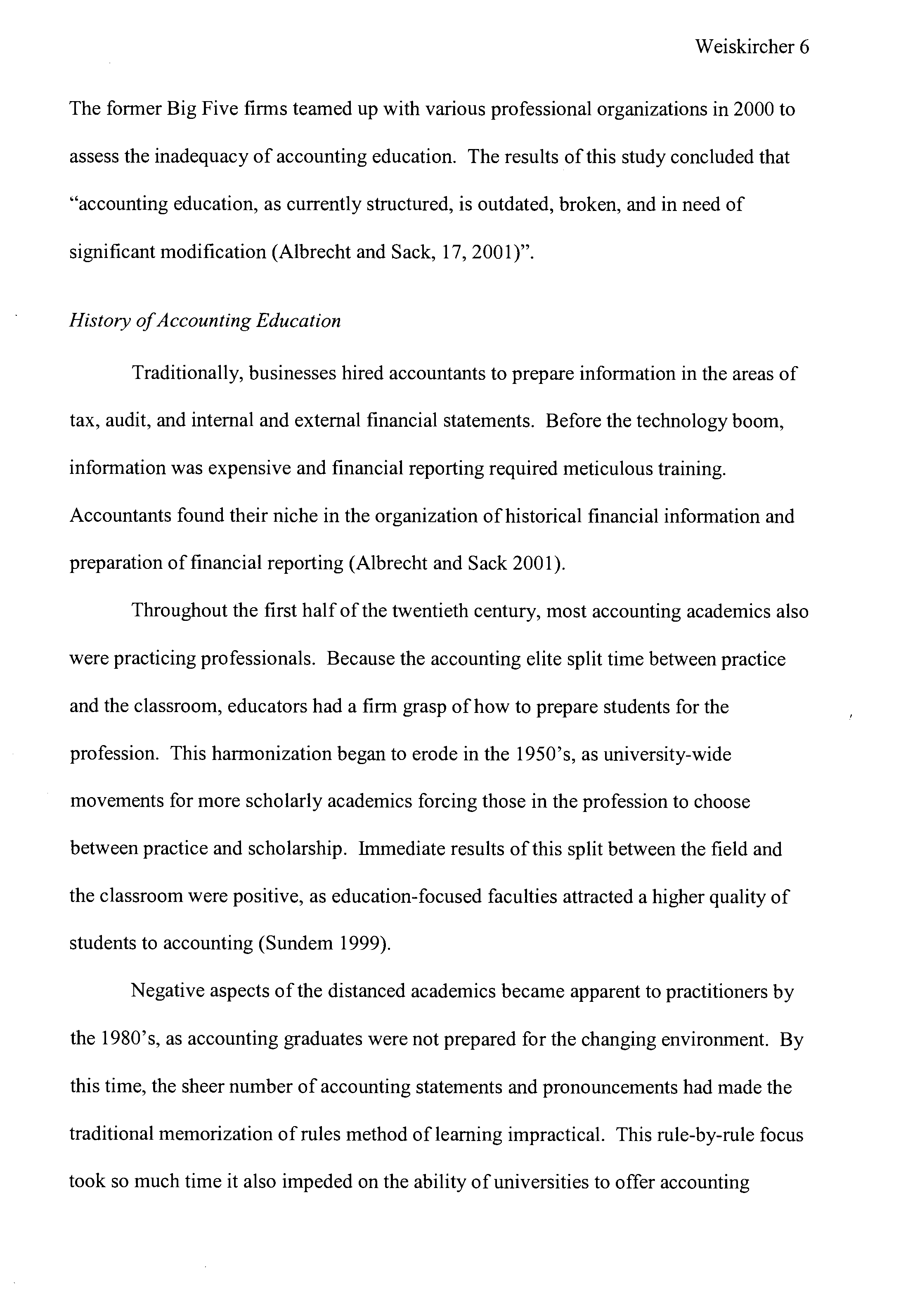
The former Big Five firms teamed up with various professional organizations in 2000 to
assess the inadequacy
of
accounting education. The results
of
this study concluded that
''accounting education, as currently structured, is outdated, broken, and in need
of
significant modification (Albrecht and Sack, 17, 2001)".
History
of
Accounting Education
Traditionally, businesses hired accountants to prepare information in the areas
of
tax, audit, and intemal and extemal financial statements. Before the technology boom,
information was expensive and financial reporting required meticulous training.
Accountants found their niche in the organization
of
historical financial information and
preparation
of
financial reporting (Albrecht and Sack 2001).
Throughout the first
half
of
the twentieth century, most accounting academics also
were practicing professionals. Because the accounting elite split time between practice
and the classroom, educators had a firm grasp
ofhow
to prepare students for the
profession. This harmonization began to erode in the 1950's, as university-wide
movements for more scholarly academics forcing those in the profession to choose
between practice and scholarship. Immediate results
of
this split between the field and
the classroom were positive, as education-focused faculties attracted a higher quality
of
students to accounting (Sundem 1999).
Negative aspects
of
the distanced academics became apparent
to
practitioners
by
the 1980's, as accounting graduates were not prepared for the changing environment. By
this time, the sheer number
of
accounting statements and pronouncements had made the
traditional memorization
of
rules method
of
leaming impractical. This rule-by-rule focus
took so much time it also impeded on the ability
of
universities to offer accounting