
AC 2010-436: BUILDING COMMUNICATION SKILLS IN SUPPLY CHAIN
MANAGEMENT AND FACILITY LOGISTICS CURRICULUM THROUGH
MULTI-INSTITUTIONAL VIRTUAL TEAMING
Suzanna Long, Missouri University of Science & Technology
Suzanna Long is an assistant professor of engineering management and systems engineering at
Missouri S&T. She holds a PhD and an M.S. in engineering management, B.S. in physics and a
B.A. in history from the University of Missouri-Rolla (UMR) and an M.A. in history from the
University of Missouri-St. Louis. Her research interests include strategic partnering in global
supply chain networks, supply chain curriculum development, virtual teaming in a global
marketplace, and sustainable energy management systems. She was a faculty researcher on a
Business and International Education Grant funded by the Department of Education, completing
projects on multimodal transport networks and international and global supply chain curriculum
development. She completed preliminary work on global, multi-institutional collaborative student
teams referenced in this proposal as part of the BIE grant award. Dr. Long is currently a
co-investigator on a related Missouri DOT project and is an investigator on a sustainable waste
water treatment project in EPA Region 7 funded by Missouri S&T’s Energy Research
Development Center. Dr. Long has over twenty five conference and journal publications, is a
reviewer for technical journals, holds national office in multiple technical societies, and holds
membership in multiple professional societies.
Hector Carlo, University of Puerto Rico
Hector Carlo is an Assistant Professor of Industrial Engineering at The University of Puerto
Rico-Mayagüez. Dr. Carlo earned a Doctor of Philosophy degree (2007) and a Master of Science
in Engineering degree (2003) from the Industrial and Operations Engineering department at The
University of Michigan, and a Bachelors of Science degree (2001) from the Industrial
Engineering department at the University of Puerto Rico-Mayagüez. Several of his articles have
appeared or are accepted to appear in scientific journals as ASME's Journal of Manufacturing
Science and Engineering, Computers & Industrial Engineering, and IIE Transactions. His
research interests include Material Handling & Logistics, and Operations Research applications to
non-traditional environments such as Education, Government, Healthcare, and Tourism.
Jane Fraser, Colorado State University, Pueblo
Jane M. Fraser has been a Professor and the Chair of the Department of Engineering in the
College of Education, Engineering and Professional Studies at Colorado State University-Pueblo
since 1998. Dr. Fraser has a Bachelor of Arts degree in mathematics with honors from
Swarthmore College, where she was elected to Phi Beta Kappa and Sigma Xi; she received her
master’s in 1972 and her doctorate in 1979 from University of California, Berkeley, in Industrial
Engineering & Operations Research. As a woman in engineering, Dr. Fraser has developed an
understanding of what it means to be treated differently and she has applied that understanding to
help others succeed. At Ohio State she conducted workshops on teaching for diversity and was
the advisor for a social sorority for engineering students. She chairs CSU-Pueblo’s Multicultural
Council, and she is a member of the Coordinating Committee for Women’s Studies at
CSU-Pueblo. She is one of the organizers of Science Day, in which Pueblo area children from the
Boys and Girls Clubs spend a Saturday at CSU-Pueblo in hands-on science and engineering
activities. She is the CSU-Pueblo coordinator for the Colorado Alliance for Minority
Participation. She was the Principal Investigator for a $485,000 grant to CSU-Pueblo from the
National Science Foundation for scholarships in Computer Science, Engineering, and
Mathematics.
Abhijit Gosavi, Missouri University of Science and Technology
Abhijit Gosavi is an Assistant Professor of Engineering Management and Systems Engineering at
© American Society for Engineering Education, 2010
Page 15.248.1
Missouri S & T. His Ph.D. is in industrial engineering with an emphasis on operations research.
His research interests include supply chain management, remanufacturing, productive
maintenance, and quality control. He has published in numerous journals, e.g., IIE Transactions,
European Journal of Operational Research, Management Science, Automatica, and the
International Journal of Production Research. In 2003, the first edition of his book entitled
“Simulation-Based Optimization” was published by Kluwer Academic Publishers (now
Springer). Gosavi is currently funded on an NSF grant that studies the use of machine learning
algorithms for large-scale problems commonly found in manufacturing planning and airline
systems. In the past, he has been funded by NSF and the Department of Defense on using
simulation-based techniques for solving supply chain problems and infrastructure rebuilding. He
has recently co-authored (see Shah et al., 2009) a journal paper that provides new solution
techniques for sustainable manufacturing processes. He reviews papers for a number of
prestigious journals in his field of research. He is a member of ASEE, IIE, POMS, and
INFORMS.
Scott Grasman, Missouri University of Science & Technology
Scott E. Grasman is an Associate Professor of Engineering Management and Systems
Engineering at Missouri S&T, having recently returned from an international visiting research
position. His primary research interests relate to the application of quantitative models to
manufacturing and service systems, focusing on the design and development of supply chain and
logistics networks. He has been the principal investigator on projects funded by, among others,
US DOT and US DOE. In addition, he has been a co-investigator on a number of related projects.
Dr. Grasman is currently working on related projects funded by the US DOE (PI), US DOT (PI),
Missouri DOT (PI), and the Defense Logistics Agency through the Air Force Research Lab
(co-PI) as part of a larger research focus on alternative fuels. His recent work on alternative
energy has resulted in much publicity in national media and numerous speaking invitations, as
well as a research sabbatical in Europe. His work on sustainable development in public-private
partnerships has been recognized by the United Nations Economic Commission for Europe
Committee on Economic Cooperation and Integration. He is the author or co-author of over 75
technical papers, reviewer for various technical journals, on the editorial board of a new journal,
and supervisor of dozens of graduate and undergraduate research students. He has also published
in the area of engineering education.
© American Society for Engineering Education, 2010
Page 15.248.2
Building Communication Skills in Supply Chain Management and Facility
Logistics Curriculum through Multi-institutional Virtual Teaming
Abstract
Engineering managers and other technology-based business professionals who possess cross-
organizational and cross-cultural communication skills, along with traditional quantitative
abilities, are more adept at handling the demands of the global supply chain environment.
Mastery of these skills must begin in the classroom and should be an essential component of
supply chain management curriculum in engineering management and industrial engineering
departments. Providing real world opportunities that explore collaboration across organizational
cultures, time zones, and practice gives students a tremendous competitive advantage as they
enter the workforce and fosters experience-based learning. This paper details the creation of an
integrated supply chain curriculum between engineering management and industrial engineering
departments at four universities and examines the value-added skills achieved through the
addition of a global, virtual student project environment. This partnership includes two
universities in the U.S., one in Puerto Rico, and one in Spain. Assessment is addressed through
both internal and external assessment mechanisms. These include the use of individual course
evaluation data, pre and post-test measures of progress toward learning goals and evaluation by
an external reviewer with expertise in curriculum design and course improvement.
Introduction
Global strategies and skill sets are essential to meet the challenges of the modern business
environment. Engineering managers and other technology-based business professionals must be
prepared to excel in a variety of social, political, and cultural settings. Awareness of these
business strategies must begin in the classroom and should be an essential component of supply
chain-logistics management programs. The importance of globalizing the curriculum has long
been recognized as an important facet of preparing students to meet the demands of the modern
marketplace. Accreditation bodies stress the importance of building programs that not only
contain a global emphasis, but also include adequate assessment measures to assure student
learning and success with established objectives.
This paper details an ongoing curriculum development effort between four engineering
departments, two in the U.S., one in Puerto Rico, and one in Spain. The partnership between
Missouri University of Science and Technology (Missouri S&T), Colorado State University-
Pueblo (CSUP), University of Puerto Rico-Mayaguez (UPRM), and Universidad Publica de
Navarra (UPNA)
is developing an integrated supply chain management curriculum designed to
foster effective communication skills. The collaborative environment created by the investigators
allows for concurrent development of curriculum materials capable of addressing identified
needs in the realm of global sustainability. The goal is to produce an educational curriculum that
produces an engineer or engineering manager who has a thorough understanding of the logistics
of sustainable manufacturing processes and is well able to communicate with colleagues from
around the globe. The central topics will be integrated within existing course curricula in a
seamless manner. A framework for using multi-institutional partnerships is developed to provide
Page 15.248.3
students with real world opportunities that explore collaboration across organizational cultures,
time zones, and practice. This framework fosters experience-based learning and examines the
value-added communication skills achieved through the addition of a global, virtual student
project environment to supply chain-logistics management courses.
Literature Review
The globalization of the world economy and the impact of technology on workforce preparation
and curriculum design are reflected in the literature and showcase a strong awareness of the
value of globalizing the curriculum. This shift is readily apparent when comparing the concerns
of authors in past decades over lack of global awareness with the strong advocacy and promotion
of globalization in current literature
2, 10, 18
.
Traditional supply chain courses provide students with very limited introductions to global
processes and concepts. Only 2.9% of the students sampled in the 1980s and 90s felt that they
had sufficient knowledge of global marketing to allow them to compete in the complex
international distribution system
2, 19
. The past decade has seen improvement. This is due in part
to the recognition of the importance of globalization by national accreditation bodies
8
. A global
perspective is heavily stressed by the Accreditation Board for Engineering and Technology, Inc.
(ABET), the American Assembly of Collegiate Schools of Business (AACSB) and the
Association of Collegiate Business Schools and Programs (ACBSP) in their accreditation
standards.
Students must possess more than technical competence. Strong communication skills are
essential for global innovation and organizational effectiveness. Supply chain courses should
include opportunities to practice communication skills as well as discussions of current global
issues
18
. Examining curriculum design for many engineering management and management of
technology programs reveals a lack of conceptual focus on key business issues. The bulk stress
mathematical decision theory as a first priority followed by management process. This does a
disservice to students by providing inadequate emphasis on interpersonal communications and
leadership. These issues are equally critical for effective curriculum design in areas such as
transportation-logistics
7
.
The existing literature shares common threads stressing the necessity of preparing today’s
students for a world shaped by global processes and communication patterns. An important first
step is awareness that what works for one country may not guarantee success in another.
Reducing ethnocentricity in students can be accomplished by the addition of coursework
exploring the global perspective or redesigning existing curriculum to include global
components. A redesign that infuses global concepts throughout a student’s degree program may
prove effective in providing skills and experiences that will provide students with a greater
awareness of the impact of globalization on the modern workforce. The remainder of this paper
showcases a multi-institutional collaborative designed to create a framework for structured,
global projects across international borders and university boundaries.
Page 15.248.4
Collaborative Partnering Framework: Development of Integrated Coursework
A global, multi-institutional partnership between four engineering departments is used to address
a recognized need to create true opportunities for global learning
15, 16
by future engineering
managers. Globalization of students and programs must be infused through a united front from
university governing bodies to the classroom
10
. Cross-cultural training programs that devise
methodologies to assist students in the development of goals and take into consideration the role
those goals play on student development of skills is the most effective in providing global
frameworks
11
. Integration will be accomplished on several levels. Common themes of global
sustainability and scalability are introduced in existing courses. Teaching cases, notes, and other
materials are being developed for use in all partner institutions by faculty collaborators. Faculty
will develop learning goals, objectives, and assessments for themed materials using virtual
collaborative software. Integration is reinforced through the creation of multi-institution student
group projects on themed materials. Faculty exchanges and virtual interaction with student
groups from all institutions will simulate organizational complexity for participating students and
provide diverse points of view and experiences that will further enhance learning opportunities.
Group projects will cross institutional and course boundaries to develop knowledge of cross-
functional teams beyond textbook descriptions. Student participants are at the senior/graduate
level; each team will include students from all partner schools and relevant course offerings
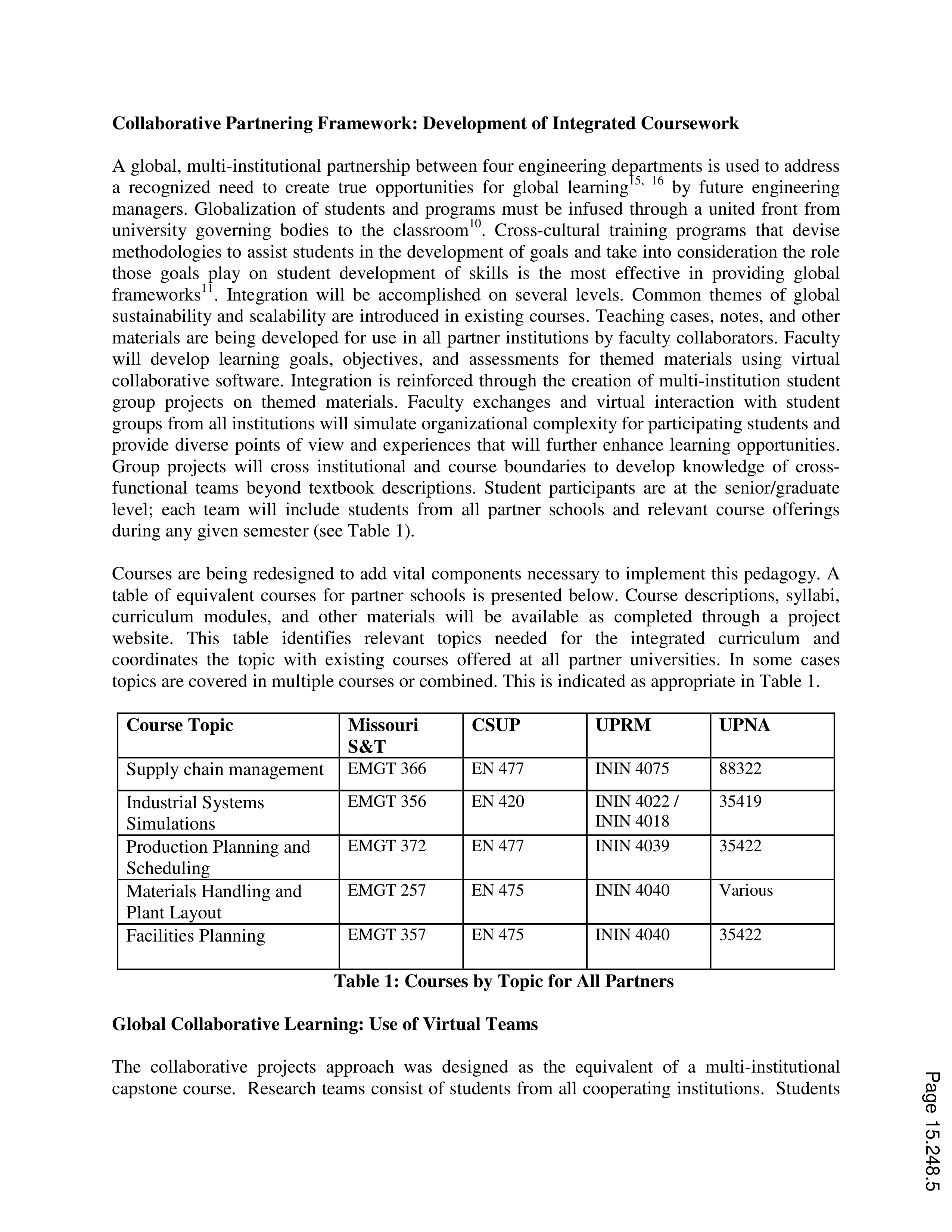
during any given semester (see Table 1).
Courses are being redesigned to add vital components necessary to implement this pedagogy. A
table of equivalent courses for partner schools is presented below. Course descriptions, syllabi,
curriculum modules, and other materials will be available as completed through a project
website. This table identifies relevant topics needed for the integrated curriculum and
coordinates the topic with existing courses offered at all partner universities. In some cases
topics are covered in multiple courses or combined. This is indicated as appropriate in Table 1.
Course Topic
Missouri
S&T
CSUP
UPRM
UPNA
Supply chain management
EMGT 366
EN 477
ININ 4075
88322
Industrial Systems
Simulations
EMGT 356
EN 420
ININ 4022 /
ININ 4018
35419
Production Planning and
Scheduling
EMGT 372
EN 477
ININ 4039
35422
Materials Handling and
Plant Layout
EMGT 257
EN 475
ININ 4040
Various
Facilities Planning
EMGT 357
EN 475
ININ 4040
35422
Table 1: Courses by Topic for All Partners
Global Collaborative Learning: Use of Virtual Teams
The collaborative projects approach was designed as the equivalent of a multi-institutional
capstone course. Research teams consist of students from all cooperating institutions. Students
Page 15.248.5
are required to collaborate on course projects utilizing various methods of communication and
contact consistent with the creation of an international classroom
12
. This approach provides the
basis for an experience with global, sustainable supply chain issues, and also provides students
with experience in a real world of intercultural communications, time zones, time management
and virtual teaming. Although project descriptions are provided, deliberate ambiguity is created
in terms of the establishment of milestones and project objectives to more naturally simulate
virtual teaming in global organizations.
Pedagogy is developed for global supply chain and materials/infrastructure education programs
that incorporate global virtual teams as part of a methodology for producing global knowledge
workers. Virtual teams are defined as groups of geographically and organizationally dispersed
knowledge workers brought together across time and space through information and
communication technologies (i.e., email, videoconferencing, or other computer-mediated
communication system) on an “as-needed basis” in response to specific needs or to complete
unique projects
13, 14, 9, 3
. Members of these working arrangements rarely, if ever, see each other.
To be considered virtual, a team must have three attributes. First, it must be a functioning team,
a collection of individuals who are interdependent in their tasks, share responsibility for
outcomes, see themselves and are viewed by others as an intact social unit embedded in one of
more social systems, and collectively manage their relationships across organizational
boundaries
4, 6, 1
. This requirement differentiates this working arrangement from groups. Simply
communicating with others electronically does not transform a grouping of people into a virtual
team. Virtual teams must have real tasks to perform, interdependent members, and shared
outcomes which are of higher quality than outcomes obtained if members had worked separately
and all individual efforts were combined. Awareness of these factors will be incorporated into
project guidelines and teaching notes. Finally, the challenges of virtual team leadership will be
addressed through identification of leadership roles. The standard virtual team consists of two
types of leaders: the task leader, and the social leader
14
. The task leader is oriented to the
activities of the team, and makes decisions required to accomplish results. In a similar vein to
earlier theories regarding task-oriented leadership (e.g., the Managerial Grid), meeting
productivity measures is the determinant of success for this leader. The social leader is oriented
toward creating feelings of group identity, status, attractiveness, and personal satisfaction. A
cohesive team is the determinant of success for this leader, and is equally critical to the virtual
team for maintenance.
Students are assigned to teams consisting of students from all partner universities and required to
collaborate on course projects utilizing various methods of communication and contact
consistent with the creation of an international classroom
12
. This approach provides the basis for
an experience with global supply chain issues, and also provides students with real-world
experience in intercultural communications, time zones, time management and virtual teaming.
Projects are comparative in nature between organizational supply chain management approaches
across international boundaries. This allows each team to have familiarity with supply chain
elements common in their own region, but also requires that each team member study and learn
from team members about another culture. Example projects include electric vehicles
manufacture and hydrogen fuel cell powered industrial forklifts.
Page 15.248.6
Team project presentations are required and must include input from all virtual teammates. This
further emphasizes the demands of asynchronous work in a global workforce. The structure of
the class projects will include goal setting behavior for the projects and intercultural relations.
Research has shown that goal setting behavior significantly enhances the participant's
performance
17
and plays an instrumental role in improving the student’s self-efficacy and
intrinsic interest in the task. In addition the course design allows for the creation of specific
tasks, roles, and learning goals. Specifically, each student is assigned tasks and is part of a team-
directed management structure; this structure includes the election of leaders for each sub-team
and the team at large. In addition, tasks are divided up into smaller focused tasks with frequent
reporting
requirements,
and
specific
questions
that
explore
intercultural
relations,
communications and learning styles must be included. This specific task, role and learning goal
focus has been identified as the necessary components for a successful intercultural learning
environment
5
. The structure of the class projects was specifically designed to include goal
setting behavior for the projects and intercultural relations. Research has shown that goal setting
behavior significantly enhances a participant's performance
17
and plays an instrumental role in
improving student self-efficacy and intrinsic interest in the task. In addition the course design
allows for the creation of specific tasks, roles, and learning goals. Specifically, each student is
identified as either project manager or researcher; tasks are divided up into smaller focused tasks
with frequent reporting requirements, and specific questions directed toward the intercultural
relations, communications and learning are included. This specific task, role and learning goal
focus has been identified as a necessary component for a successful intercultural learning
environment
5
.
Assessment
Assessment of project results are evaluated using an external reviewer through a combination of
pre- and post-test assessments of student learning in the realm of sustainability, measures of
global knowledge and multicultural learning, and student engagement. The assessment
framework is used to evaluate the ongoing project activities and the overall performance. It
consists of two types of evaluation: Implementation Evaluation and Performance Evaluation.
Implementation Evaluation is performed to assess whether the project is being conducted as
planned. Performance Evaluation assesses the progress made by the participants in meeting the
project goals, and evaluates the extent to which the outcomes have been realized.
In order to document outcomes of the project, participating students complete pre and post online
surveys adapted from prior successful programs. Survey questions pertain to the direct benefits
of the program (e.g., attitudes toward sustainability, acquisition of a range of skills, interest in a
career in science or engineering, self-confidence, and student perceptions of experiences with
virtual teaming). To assess whether course experiences lead to change in participants’
dispositions or beliefs, the program will use pre and post online surveys designed to gather
information on students’ attitudes, skills, self-confidence, interest in careers, and perceptions of
experiences related to integrated virtual teaming. For virtual teaming metrics include
communication level, leadership, and performance as a unit
4, 6, 1
. Quantitative data will be
analyzed with the Statistical Package for the Social Sciences (SPSS) to test for statistically
significant differences from pre to post.
Page 15.248.7
Faculty mentors also complete online surveys. Since mentoring is one of the hardest, yet most
rewarding activities in the program, survey questions clarify outcomes of mentoring relationships
and probe for descriptive information specific to the experience. It is important to document
direct benefits of the program in terms of continued participation in activities, retention in
engineering and science majors, academic performance in related courses, changes in self-
confidence, and pursuit of career goals. Thus, the program will maintain a database of
participants, including demographic information, major, research work, and career.
Directions for Future Research and Preliminary Conclusions
Although concepts of globalization and effective communication are being integrated into the
curriculum, the effectiveness of methods has not yet been fully analyzed. The full implications
of what this means in terms of longitudinal success beyond the classroom experience has yet to
be determined. What does it mean to fully integrate a curriculum? Attitudes may change over
the course of a semester, but are these changes long-term? Do changes in attitude continue into
the workplace after graduation? Future research will examine these questions and the extent to
which attitudes are changed and a more global perspective is achieved by tracking graduates of
the program into the workforce and conducting periodic surveys to determine whether
enthusiasm and perceived value for the instructional approach has waned over time.
A function of education is to broaden the global understanding of those under our charge. Just as
we equip students with the technical competencies necessary to function as local business
professionals, we must also prepare students with a global perspective that can allow them to
function wherever opportunities lie. Today’s marketplace and virtual business environs showcase
this on a daily basis. To fail to recognize this or to keep diversity limited to the context of the
workplace does a great disservice to our students. We are an increasingly global community.
Increasing numbers of US-based companies are seeking markets in foreign countries, and as well
as corresponding increases in international companies doing business in the United States. Not
everyone with whom we interact on a daily basis will share our values or customs regarding
work. Seeking to understand the business models and cultures that impact the supply chain of
regional business provides skills that enhance the chances for success for future engineers and
engineering managers both in the classroom and the workplace.
Acknowledgements
The authors wish to thank the NSF for their generous support of this project. We also thank Dr.
Leonardo Bedoyavalencia, Colorado State University-Pueblo, Assistant Professor and instructor
of one of the CSU-Pueblo courses, who joined the team in Spring 2010 and Laura Collins,
Center for Research and Learning, external assessment specialist for the project.
References
1.
Alderfer, Clayton P., (1977) Group and intergroup relations, In:
Improving Life at Work
, Hackman, J. Richard
and J. Lloyd Suttle, (eds.), Santa Monica, CA: Goodyear.
Page 15.248.8
2.
Bess, H. David and Collison, Frederick. (1987). Transportation and Logistics Curricula: Still Too Domestic?
Transportation Journal
, 26 (3), 48-58.
3.
DeSanctis, Gerardine and Poole, Marshall S., (1997) Transitions in teamwork in new organizational forms,
Advances in Group Processes
, Vol. 14, pp. 157-176.
4.
Forsyth, Donelson R., (1999)
Group Dynamics
, New York: Wadsworth Publishing Company.
5.
Gabb, D., (2006) Transcultural Dynamics in the Classroom.
Journal of Studies in International Education
.
10(4) 357-368.
6.
Hackman, J. Richard, (1987) The design of work teams, In:
Handbook of Organizational Behavior
, Jay W.
Lorsch, (ed.), Englewood Cliffs, NJ: Prentice-Hall, 1987.
7.
Hicks, Philip C., Westbrook, Jerry D., and Utley, Dawn R. (1999). What are We Teaching Our Engineering
Managers?
Engineering Management Journal,
11(1), 29-34.
8.
Hoffman, William. (2005, January 10). Logistics’ Evolving Curriculum.
Traffic World,
19-21.
9.
Jarvenpaa, Sirkka L, and Leidner, Dorothy E., (1998) Communication and trust in global virtual teams,
Journal
of Computer Mediated Communication
, Vol. 3, No. 4.
10.
Jefferson, R. W., (2001) Preparing for Globalization—Do We Need Structural Change for Our Academic
Programs?
Journal of Education for Business
, 76(3), 160-166.
11.
Kitsantas, A., (2004) Studying Abroad: The Role of College Students’ Goals on the Development of Cross-
Cultural Skills and Global Understanding.
College Student Journal
, 38(3), 441 -452.
12.
Leask, B., (2004) Internationalisation Outcomes for All Students Using Information and Communication
Technologies (ICTs).
Journal of Studies in International Education
. 8(4) 336-351.
13.
Lipnack, Jessica and Stamps, Jeffrey, (2000)
Virtual Teams: People Working Across Boundaries with
Technology, 2
nd.
Edition
, New York: John Wiley & Sons, Inc.
14.
Lipnack, Jessica and Stamps, Jeffrey, (1997)
Virtual Teams: Reaching Across Space, Time, and Organizations
with Technology
, New York: John Wiley and Sons.
15.
Lohman, J., (2008) A Rising Global Discipline,
Journal of Engineering Education
97 (3) 227-230.
16.
Sheppard, S., Pellegrino, J. and Olds., B., (2008) On Becoming a 21st Century Engineer,
Journal of
Engineering Education
97 (3) 231-235.
17.
Shunk, D. H. (2000). Learning theories: An educational Perspective (3rd edition). Prentice Hall.
18.
Tryggvason, Gretar and Apelian, Diran. (2006). Re-Engineering Engineering Education for the Challenges of
the 21st Century.
Journal of Management,
58 (10), 14-17.
19.
Turley, L.W. and Shannon, J. Richard. (1999). The International Marketing Curriculum: Views from Students.
Journal of Marketing Education,
21 (3), 175-181.
Page 15.248.9