
Infusing Communication Skills into Financial Accounting
Curriculum: A Perspective from the Digital Era
Nuwan Lakmal Hettiarachchi, Tamil Selvan Subramaniam*, Sarala Thulasi Palpanadan, and Anas Al-Fattal
Abstract
—This study investigates financial accounting
students’ attitudes about several aspects related to modern
pedagogies focusing on communication skills development. The
paper focuses on areas of students’ need to develop
communication skills irrespective of cultural diversity and
gender inequality, quiz-based learning, requirements, and
assessment. The study employed an online survey of students at
one of the largest business colleges in the Sultanate of Oman.
The study surveyed 96 currently registered students to cover
the research objectives and questions. The findings showed that
the students enjoyed a high level of awareness of the importance
and relevance of communication skills in relation to future
employability. Students believed developing communication
importance was not limited to careers in financial accounting as
it was also extended to other careers requiring a post-secondary
degree. Quiz-based learning strategies were found to be
relevant in improving communication skills. The results also
highlighted adaptability as a main assessment criterion of
communication skills. The study provided bases for higher
education institutions in the Sultanate of Oman or other
countries to empower the generalizability of the findings.
Another possible research could replicate the investigation in
other fields of study. This paper brings several implications for
instructional practice and pedagogies, as well as for policies of
instructional training and development. The study is original in
its particular context and specific time during the COVID-19
pandemic as attitudes toward online technologies have been
shifting paradigms.
Index Terms
—Quiz-based-learning, communication skills,
digital learning, instructional technology, financial accounting
education, occupational skills
I.
I
NTRODUCTION
The lifelong exposure to Information Communication
Technology (ICT) and the urgent necessity for occupational
skills took momentum at a great pace for university graduates
of all fields of study including accounting [1]. This study
investigated the concepts of digital-learning analogy that
were embedded into instructional technology with the
intention of examining possible advancements in Financial
Accounting (FA) education. New design principles that
could aid in improving learning materials for FA students are
also investigated in relation to communication skills
development. This could provide potential benefits for FA
Manuscript received October 24, 2022; revised January 4, 2023; accepted
January 13, 2023.
Nuwan Lakmal Hettiarachchi and Tamil Selvan Subramaniam are with
the Faculty of Technical and Vocational Education, Universiti Tun Hussein
Onn Malaysia (UTHM), Malaysia.
Sarala Thurlasi Palpanadan is with the Center for Language Studies,
Universiti Tun Hussein Onn Malaysia (UTHM), Malaysia.
Anas Al-Fattal is with the Business Department, University of Minnesota,
Crookston, USA.
*Correspondence: tselvan@uthm.edu.my (T.S.S.)
education and curriculum development and help bridge the
gap between FA education theory and practice.
A considerable amount of literature focused on the gap
between theory, which was being taught at schools, and the
reality or practice at work placement [2–4]. These studies
stress the importance of developing a logical path and
employment skills for graduates to follow and possess to
apply theoretical knowledge to work-based practices.
Accounting Information System (AIS) is among a few
strategies suggested to cross the gap between theory and
practice in accounting education. Mihaltan [4] recommends
using AIS as a decision-making tool, which is important for
all stakeholders of accounting information users. Therefore, a
digital platform of AIS can be used to enhance graduates‘
communication skills. AIS produces integrated and
generalized
information
for
accounting
users.
A
communicator uses this information to draft financial reports
and keep stakeholders informed about the latest technologies
available. Quick-Insight, Cloud storage, collaborative
environment, cyber security, and paperless workplace have
been pointed out as essential features of AIS.
Workplace preparedness for a chosen career is crucially
important for future career success. For accounting graduates,
several relevant skills are typically required by employers,
such as ICT literacy, financial analysis, or results
communication. On the latter, Sheridan [5] says ―This is
where new and trainee accountants will need to be prepared
to utilize their communication skills—noting anomalies and
seeking clarification on areas of uncertainty will ensure that a
clearer picture can be obtained‖. A satisfactory academic
result normally offers no guarantee for career success unless
it
helps
to
migrate
classroom-learning
to
work-based-learning. Collaboration between technical skills
and occupational skills is equally important for accounting
students. For example, an accountant with sound knowledge
of accounting matters, rather than technical skills, may
misuse accounting treatments due to poor skills in
communication [6]. Many researchers have been attempting
to understand 21st century digital skills and communication
skills are regarded as their top priority [7]. Some researchers
identified communication skills as social skills but failed to
accumulate such skills across careers [8].
The decreasing trend in the effectiveness of instructional
technology for accounting studies in a higher education
environment is identified by several studies and several
relevant
strategies
have
been
reported
in
relating
communication
skills
to
accounting
education.
Quizzed-Based-Learning (QBL) is one of these. QBL is
structured around the teaching and learning process that takes
as the key pedagogical tool for a specific game to enhance
communication skills. Some researchers have investigated
International Journal of Information and Education Technology, Vol. 13, No. 4, April 2023
664
doi: 10.18178/ijiet.2023.13.4.1851
the effectiveness of digital QBL and its impact on learning
outcomes [9]. The results showed that attributes and
motivations had a significant impact on QBL; nonetheless,
no significant impact on learning outcomes was found. As
different instructional tools, simulations were compared with
different games for the assessment of effectiveness [10].
Nonetheless, as per the factor analysis, only game
configuration and enjoyment have been used to understand
complex patterns and relationships. Online quizzes are
explicitly designed for educational purposes, and they can
take place in a formal or informal environment, and
one-on-one or in groups [11]. The research team assumes that
QBL can enhance various skills related to cognition
including communication skills. According to the QBL, the
application of quiz elements will enhance communication
skills in the diversity of complex tasks which require a high
caliber of problem-solving skills [12]. In recent years,
educational
systems
have
encouraged
in-class peer
interactions to improve communication skills. This
occupational skill will have a significant impact on continual
growth in FA and it requires a sound framework and a model.
A proven record is available to show high performance in
academic achievements and career success with sound
communication skills [13]. They pointed out ―instructors
have to develop students‘ communication by allowing
scholars to research thoughts, deepen their understanding of
these estimates, and establish links within and outside of
ideas‖. The ecological model of communication presented by
Foulger [14] is used to enhance the communication skills of
students. It is a QBL approach, vitally important in
developing an online QBL module. The adaptation to the
ecological model of communication has shown a significant
improvement in students‘ performance in the comparison of
experimental versus control groups (ibid).
One study presented by Radzia and Drahman
et al.
[15]
shows that a competition-based learning strategy is used to
overcome the students‘ challenges in their learning process.
To understand the perception of online accounting quizzes,
an investigation was carried out. The lack of application was
caused due to the gap between the theory and practice of FA.
The fourth Industrial Revolution (IR 4.0) has changed the
employment landscape, hence financial students are required
to equip with new technological aspects in both learning
environments and work-related industries [16]. Ongoing
educational reforms in Oman encourage the use of
technological tools in the educational system. This concept
has been adopted to enhance the education system in Oman
with the accreditation of the International Bureau of
Education [17].
Communication skills have been highlighted among the
most important employability skills for several reasons
including
intraorganizational
or
interorganizational
communication [18]. Communication skills can be assessed
by using the criteria of talking and listening skills,
adaptability, and resourcefulness [19]. They include
exchanging ideas with others, adapting to conversations,
making feedback, and public speaking. A high caliber of
communication skills makes students more effective in
communication in different workplace contexts. For example,
listening and paying attention to instructors develops
listening skills. Participation in classroom discussions could
develop active listening and even debating skills. Adaptation
to the audience is another configuration of good
communicators so that students can apply different
communication styles appropriate to a given situation. The
ability to transmit a message that involves the shared
understanding of peers in each context is regarded as a
communication skill [20]. Students are more likely to
respond to work-related queries once they become more
confident with their communication skills.
There are many digital platforms for QBL in the Omani
context and among these is Kahoot. Wang and Tahir [21]
point out the positive effect of using Kahoot for educational
landscapes. According to the authors (ibid), Kahoot supports
systematic analysis of learning performance, classroom
dynamics, students‘ and teachers‘ attitudes, and students‘
anxiety. Some challenges have been reported such as
network connectivity and scoring bases. Radzia
et al.
[15]
found that students experience mixed feelings about using
online quizzes for accounting courses. Turner and Johnston
et al.
[11] highlight that technological advancements,
including the use of QLB, have offered opportunities for
higher educational institutes (HEIs) to engage multiple
teaching and learning styles so that online QBL would be an
ideal solution in terms of infusing communication skills.
Mihaltan [4] suggests various approaches in bridging the gap
between theory and practice in accounting, including
communication skills. The paper suggested a novice follow
and focus on a logical path in the mission of applying
theoretical knowledge acquisition to practical disbursement.
This was confirmed by the accountants of twenty first
century who stressed the importance of communications
skills. The Omani students‘ perceptions of accounting
courses were tested by Khan and Salim
et al.
[20] who found
that most of the participants had ranked accounting as the
‗language of businesses. Thus, communication skills are
required to inspire stakeholders within the business context.
There
are
several
approaches
in
enhancing
communications skills which include blended learning and
gamification for FA students. Suartama and Ulfa
et al.
[22]
developed an instructional model to enhance the student‘s
capabilities at HEIs. It is found that blended learning case
scenarios are more relevant than conventional teaching
where students act as promotors and accelerators of mobile
internet technology. Game-based platforms and QBL are
used in most subject areas other than FA, such as English
[23], Music [24], and Marketing [25]. Furthermore, Dickey
[26] stressed that GBL can be introduced in aesthetic subjects
including arts and crafts. The most important aspects of GBL
were that it had impacted curriculum development and novel
educators used it in widespread areas of education [27].
Those studies reported that the gamification approach offered
improvement in learning gains as well as empowering
learners to overcome individual learning difficulties. Barr [19]
introduced different approaches to develop communications
skills as it is an important transferrable skill for college
graduates. In that study the author identifies a lack of
educational courses, including accounting as a major, to
promote communication skills explicitly. Arquero and
Michel
et al.
[28] identified a relationship between
International Journal of Information and Education Technology, Vol. 13, No. 4, April 2023
665
communication
apprehension
and
communication
self-efficacy. A negative relationship has been found
between apprehensions and self-efficacy, yet it is beyond
cultural barriers. It is important to inculcate communication
skills among the teachers, hence students‘ academic success
would be enhanced. Another point to consider is that the
majority of learners rank communication skills among the
most important and relevant ones [29].
Current FA teaching practices are mainly based on
conventional
pedagogies,
which
include face-to-face
teaching with the aid of teaching materials such as physical
hand-outs, power-point slideshows, and question banks [17].
The Sultanate of Oman is not exclusive to this approach and
continues to be a follower. Accounting is a challenging
subject across business programs, and it will be the career of
most financial professionals, and therefore, intervention is
vitally required. Students‘ learning habits could be enhanced
by reinforcing the skills-buildings intervention tool so that
the gap between the theory and practice of FA can be
narrowed. To identify the necessity of QBL pedagogy, a
needs assessment is required within the FA curriculum. Over
the past years, GBL was tested as a new educational tool but
its effectiveness and requirement were not tested for many
domains [30]. Hence, this research paper attempts to
understand the demand for a tech-savvy digital platform for
FA students with the aid of needs analysis. The preference for
equal access to communication skills and GBL for both male
and female students becomes another key objective in this
context. The needs and opportunities for new norms of
education should be available for all students regardless of
gender.
II.
M
ETHOD
Based on the theoretical discussion above, there is a
pressing need to investigate QBL in relation to its impact on
the development of communication skills and potential
development for FA curriculums and instructional methods.
This study is underpinned by the following research
questions:
RQ 1: How relevant do FA students view communication
skills to their area of study? Do views differ between males
and females?
RQ 2: How frequently do FA students use online QBL to
improve their communication skills?
RQ 3: What communication skills are required within the
FA curriculum?
RQ 4: What are the relevant assessment criteria needed to
measure the improvements in communication skills within
the QBL FA teaching pedagogy?
A.
Research Design and Participants
A suitable research methodology was adopted to answer
the research questions and those were aligned with the
respective research objectives. The empirical investigation
followed the Design and Development Research (DDR)
strategy [31]. The DDR is a systematic study of design,
development, and evaluation processes with the aim of
establishing an empirical basis for the creation of
instructional or non-instructional products and tools and new
or enhanced models that govern development [31]. The DDR
commenced with the need analysis has helped to understand
the need for a QBL platform as well as communication skills
for FA students. The target sample was selected from the
research domain of one college in Muscat, Sultanate of Oman.
Participants were studying Financial Accounting 2 (UG037)
in semester 2 at Undergraduate Department B.Sc.
Accounting, Auditing, and Finance, for the academic year of
Spring 2020/2021. It was one of the semesters which was
executed during the COVID-19
pandemic. Emails to recruit
participants explaining the aim of the study and a link to an
online survey were sent to all students matching the research
criteria (N=145). 96 responses were received with a response
rate of 66%.
B.
Collecting and Analysis Data
Data collection was carried out with the aid of an online
questionnaire with items adapted from the literature [32–36].
These studies were chosen due to the relevance of focus and
context. The research team prepared and used a
comprehensive questionnaire for need assessment. It
included various scales to measure the needs of students and
their willingness to use novel technology for career
aspirations. Students need assessment was carried out within
the scales of ‗extremely disagree‘ to ‗extremely agree‘.
Meanwhile, students‘ willingness to use online QBL
pedagogy was dispersed within the scale of always to never.
The questionnaire was drafted and reviewed by four FA
academics and three industry experts to check for relevance,
coverage, and wording. Reviews helped in developing the
final version of the questionnaire. The questionnaire was then
piloted with 30 participants. As for the prevailing results in
the pilot test, its reliability and validity test, the researchers
executed the original survey after amendments were made to
the pilot questionnaire. The questionnaire consisted of three
sections. Section A investigated participants‘ demographics
and the possible needs/motives for communication skills
within the range of not at all important to extremely
important. Meanwhile, Section B probed the frequencies of
online quizzes to improve communication skills with the
agreement of always to never. Section C assessed the
requirement of communications skills for FA students and its
assessment criteria ranged from: extremely disagree to
extremely agree.
Data collected were analyzed using Statistical Package for
Social Sciences (SPSS v23) with the view of obtaining both
descriptive and inferential statistical analysis. Each construct
consisted of several measurements as the key elements based
on the research objectives. Both t-test and one-way ANOVA
were utilized in conducting significance tests.
III.
R
ESULTS
This section presents the results following a similar
structure of the research questions starting with investigating
the need for developing communication skills focusing on
possible gender differences. This is followed by results
attitudes related to the use of online quizzes in developing
communication skills. The final two subsections present
results on communication skills requirements and relevant
International Journal of Information and Education Technology, Vol. 13, No. 4, April 2023
666
assessment criteria.
The questionnaire consisted of three main parts.
A.
Student Views about the Relevance of Communication
Skills (RQ1
)
The surveyed students believed that communication skills
were important as they related to FA. This question scored a
mean of 3.802 with 93 positive scores (extremely important
N=43 and important N=50). This rating reflected the higher
importance of communication skills within the FA
curriculum. The results showed a relatively high level of
standard deviation (SD=1.054). Therefore, each score
deviated from the mean of 3.802 by 1.054 points on average.
However, a low level of standard error (0.107) showed that
the sample was more representative of the overall population,
and this offered more confidence in the results.
When comparing the results for males and females, as
shown in Table I below, the gender composition of samples is
70 males and 26 females (73% and 27%, respectively). The
mean score for communication skills for males was 3.8286
whereas it was 3.7308 for females. The mean values of males
and females were expected to vary between ± 1.035 and
1.282 respectively. So that, the mean scores for male students
were within 1.035 points of 3.829, whereas for female
students, scores were within 1.282 points of 3.731.
TABLE
I:
D
ESCRIPTIVE
S
TATISTICS OF
N
EED FOR
C
OMMUNICATION
S
KILLS
Gender
N
Mean
Std.
Deviation
Std.
Error
Mean
Need
for
communication
skills
Male
70
3.829
1.035
0.123
Female
26
3.731
1.282
0.251
Total
96
3.802
1.05
0.107
An independent samples t-test and Levene test were used
to test the following hypotheses, where µ1 and µ2 were the
population mean scores for males and females, respectively.
H
o
: µ1 − µ2 = 0 (―the difference between the means of
males and females is equal to 0‖)
H
1
: µ1 − µ2 ≠ 0 (―the difference between the means of
males and females is not 0‖)
TABLE
II:
I
NDEPENDENT
S
AMPLE
T-
TEST FOR THE
N
EED FOR
C
OMMUNICATIONS
S
KILLS
Levene‘s Test
for Equality of
Variances
t-test for Equality of Means
F
Sig.
t
df
Sig.
(2-tail
ed)
Mean
dif.
Std.
Error
dif.
95% Confidence
Interval of the
Difference
Needs
of
communicat
ion skills
Equal
variances
assumed
Lower
Upper
4.732
0.032
0.385
94
0.701
0.097
0.254
−0.406
0.602
Equal
variances
not assumed
0.349
37.76
4
0.729
0.097
0.280
−0.469
0.665
According to Table II above, the p value of 0.032 (α) is
less than 0.05 as of Levene‘s test. Therefore, the research
team rejected the established null hypothesis and concluded
that the difference between the means of males and females
was not equal to 0 for the need for communication skills. The
variance in the need for communication skills of males was
significantly different from that of females. The perceived p
value was less than α and this suggested that equal variances
were not assumed for the discussion of t-test and confidence
intervals. As depicted above, the t-Test p value of 0.729 was
greater than the α value of 0.05. Accordingly, the group
means were not statistically different, and the established null
hypothesis was accepted. Furthermore, with the mean
difference of 0.097 between males and females, the
Confidence Interval (CI) suggested that the mean difference
was not significant as zero appeared between
−
0.469 and
0.665.
B.
Online Quizzes Use to Improve Communication Skills
(RQ2)
The use of online quizzes to improve communications
skills was tested within the extremes scales of ‗always to
never‘. The scale wise frequency, mean, standard deviation,
and standard error were reflected under the descriptive
analysis whereas the agreement of using online quizzes to
enhance communication skills was tested with an
independent sample t-test which was an inferential technique.
There were five scales in this construct: always (1), very
often (2), sometimes (3), rarely (4), and never (5). In order to
assess the need for online quizzes, two extreme scales were
selected. This overall mean of ‗always‘ reflected the
importance of online quizzes to enhance communication
skills within the FA curriculum. The value of the mean for
‗always‘ was comparatively lower as it was inversely
proportionate to the scales selected (always =1 and never =5).
TABLE
III:
D
ESCRIPTIVE
S
TATISTICS OF
O
NLINE
Q
UIZZES
U
SE
Online quizzes use to improve
communication skills
N
Mean
Std.
Deviation
Std. Error
Mean
Always
30
1.200
0.406
0.074
Never
4
1.500
0.577
0.288
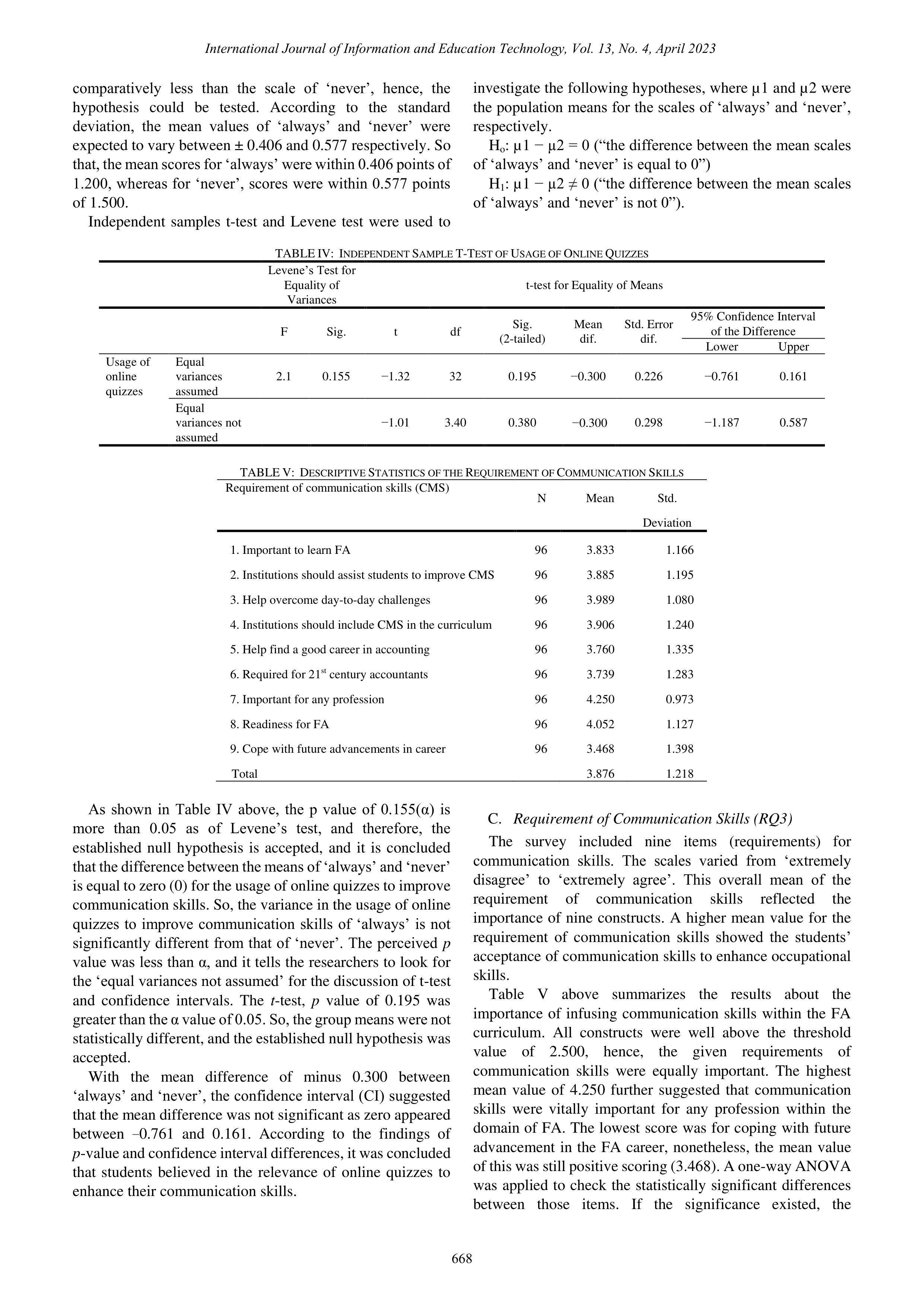
With reference to Table III above, the compositions of
‗always‘ and ‗never‘ are reflected as 30 and 4 which gives the
sum of 34 participants out of 96 in total. It showed
comparatively a higher percentage frequency of 88% for
‗always‘ and a low percentage frequency for the scales of
‗never‘ which was 12%. So, within the composition of 34
extreme-scale participants, most of the in-survey participants
hoped to use online quizzes to enhance communication skills.
The mean usage of online quizzes for ‗always‘ was 1.200
whereas it was 1.500 for ‗never‘. With the 5-point scale used,
having a threshold mean value of less than 2.500 showed the
need for online quizzes. The mean value of ‗always‘ was
International Journal of Information and Education Technology, Vol. 13, No. 4, April 2023
667
comparatively less than the scale of ‗never‘, hence, the
hypothesis could be tested. According to the standard
deviation, the mean values of ‗always‘ and ‗never‘ were
expected to vary between ± 0.406 and 0.577 respectively. So
that, the mean scores for ‗always‘ were within 0.406 points of
1.200, whereas for ‗never‘, scores were within 0.577 points
of 1.500.
Independent samples t-test and Levene test were used to
investigate the following hypotheses, where µ1 and µ2 were
the population means for the scales of ‗always‘ and ‗never‘,
respectively.
H
o
: µ1 − µ2 = 0 (―the difference between the mean scales
of ‗always‘ and ‗never‘ is equal to 0‖)
H
1
: µ1 − µ2 ≠ 0 (―the difference between the mean scales
of ‗always‘ and ‗never‘ is not 0‖).
TABLE
IV:
I
NDEPENDENT
S
AMPLE
T-T
EST OF
U
SAGE OF
O
NLINE
Q
UIZZES
Levene‘s Test for
Equality of
Variances
t-test for Equality of Means
F
Sig.
t
df
Sig.
(2-tailed)
Mean
dif.
Std. Error
dif.
95% Confidence Interval
of the Difference
Lower
Upper
Usage of
online
quizzes
Equal
variances
assumed
2.1
0.155
−1.32
32
0.195
−0.300
0.226
−0.761
0.161
Equal
variances not
assumed
−1.01
3.40
0.380
−0.300
0.298
−1.187
0.587
TABLE
V:
D
ESCRIPTIVE
S
TATISTICS OF THE
R
EQUIREMENT OF
C
OMMUNICATION
S
KILLS
Requirement of communication skills (CMS)
N
Mean
Std.
Deviation
1. Important to learn FA
96
3.833
1.166
2. Institutions should assist students to improve CMS
96
3.885
1.195
3. Help overcome day-to-day challenges
96
3.989
1.080
4. Institutions should include CMS in the curriculum
96
3.906
1.240
5. Help find a good career in accounting
96
3.760
1.335
6. Required for 21
st
century accountants
96
3.739
1.283
7. Important for any profession
96
4.250
0.973
8. Readiness for FA
96
4.052
1.127
9. Cope with future advancements in career
96
3.468
1.398
Total
3.876
1.218
As shown in Table IV above, the p value of 0.155(α) is
more than 0.05 as of Levene‘s test, and therefore, the
established null hypothesis is accepted, and it is concluded
that the difference between the means of ‗always‘ and ‗never‘
is equal to zero (0) for the usage of online quizzes to improve
communication skills. So, the variance in the usage of online
quizzes to improve communication skills of ‗always‘ is not
significantly different from that of ‗never‘. The perceived
p
value was less than α, and it tells the researchers to look for
the ‗equal variances not assumed‘ for the discussion of t-test
and confidence intervals. The
t
-test,
p
value of 0.195 was
greater than the α value of 0.05. So, the group means were not
statistically different, and the established null hypothesis was
accepted.
With the mean difference of minus 0.300 between
‗always‘ and ‗never‘, the confidence interval (CI) suggested
that the mean difference was not significant as zero appeared
between
−
0.761 and 0.161. According to the findings of
p
-value and confidence interval differences, it was concluded
that students believed in the relevance of online quizzes to
enhance their communication skills.
C.
Requirement of Communication Skills (RQ3)
The survey included nine items (requirements) for
communication skills. The scales varied from ‗extremely
disagree‘ to ‗extremely agree‘. This overall mean of the
requirement
of
communication
skills
reflected
the
importance of nine constructs. A higher mean value for the
requirement of communication skills showed the students‘
acceptance of communication skills to enhance occupational
skills.
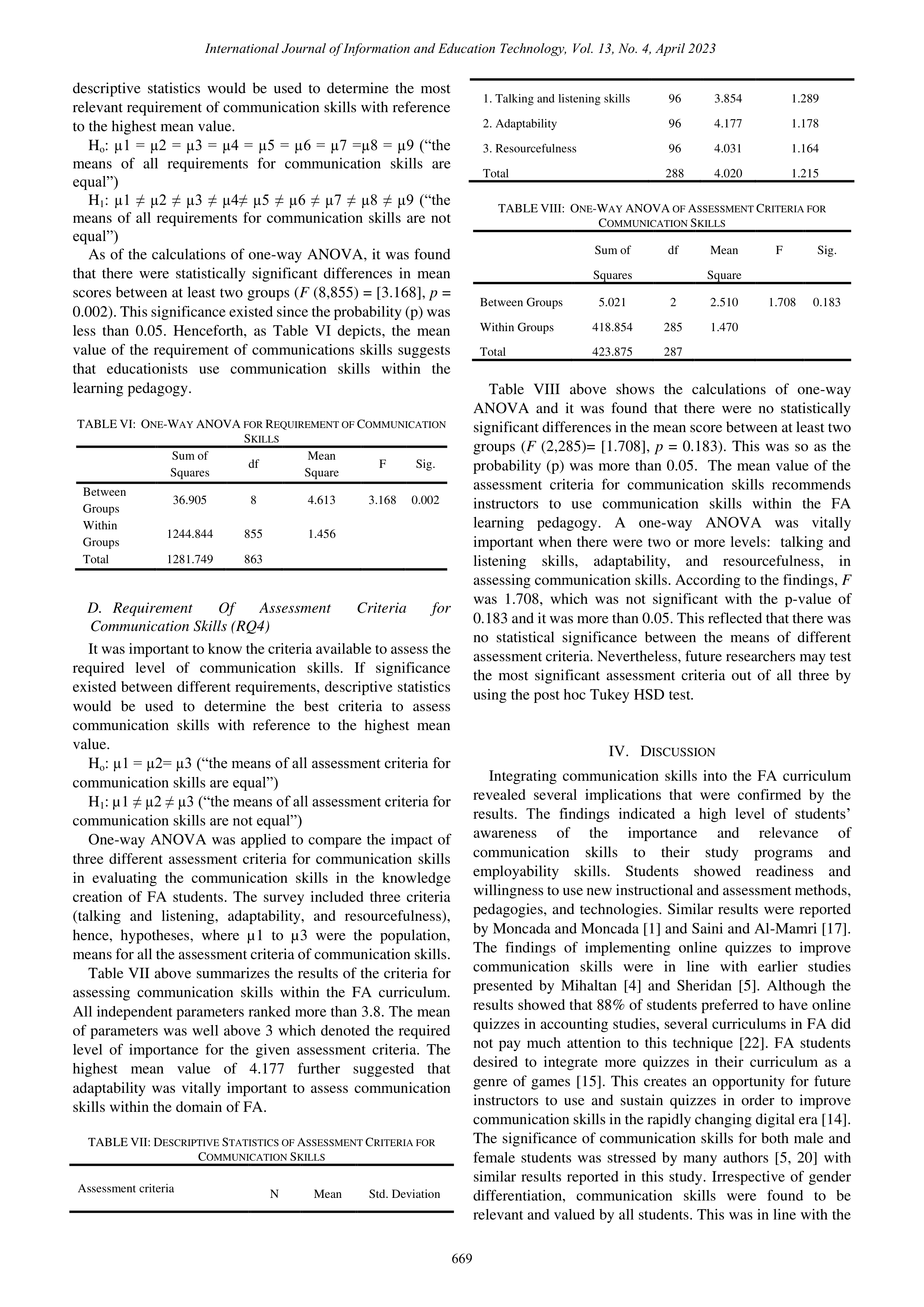
Table V above summarizes the results about the
importance of infusing communication skills within the FA
curriculum. All constructs were well above the threshold
value of 2.500, hence, the given requirements of
communication skills were equally important. The highest
mean value of 4.250 further suggested that communication
skills were vitally important for any profession within the
domain of FA. The lowest score was for coping with future
advancement in the FA career, nonetheless, the mean value
of this was still positive scoring (3.468). A one-way ANOVA
was applied to check the statistically significant differences
between those items. If the significance existed, the
International Journal of Information and Education Technology, Vol. 13, No. 4, April 2023
668
descriptive statistics would be used to determine the most
relevant requirement of communication skills with reference
to the highest mean value.
H
o
: µ1 = µ2 = µ3 = µ4 = µ5 = µ6 = µ7 =µ8 = µ9 (―the
means of all requirements for communication skills are
equal‖)
H
1
: µ1 ≠ µ2 ≠ µ3 ≠ µ4≠ µ5 ≠ µ6 ≠ µ7 ≠ µ8 ≠ µ9 (―the
means of all requirements for communication skills are not
equal‖)
As of the calculations of one-way ANOVA, it was found
that there were statistically significant differences in mean
scores between at least two groups (
F
(8,855) = [3.168],
p
=
0.002). This significance existed since the probability (p) was
less than 0.05. Henceforth, as Table VI depicts, the mean
value of the requirement of communications skills suggests
that educationists use communication skills within the
learning pedagogy.
TABLE
VI:
O
NE
-W
AY
ANOVA
FOR
R
EQUIREMENT OF
C
OMMUNICATION
S
KILLS
Sum of
Squares
df
Mean
Square
F
Sig.
Between
Groups
36.905
8
4.613
3.168
0.002
Within
Groups
1244.844
855
1.456
Total
1281.749
863
D.
Requirement
Of
Assessment
Criteria
for
Communication Skills (RQ4)
It was important to know the criteria available to assess the
required level of communication skills. If significance
existed between different requirements, descriptive statistics
would be used to determine the best criteria to assess
communication skills with reference to the highest mean
value.
H
o
: µ1 = µ2= µ3 (―the means of all assessment criteria for
communication skills are equal‖)
H
1
: µ1 ≠ µ2 ≠ µ3 (―the means of all assessment criteria for
communication skills are not equal‖)
One-way ANOVA was applied to compare the impact of
three different assessment criteria for communication skills
in evaluating the communication skills in the knowledge
creation of FA students. The survey included three criteria
(talking and listening, adaptability, and resourcefulness),
hence, hypotheses, where µ1 to µ3 were the population,
means for all the assessment criteria of communication skills.
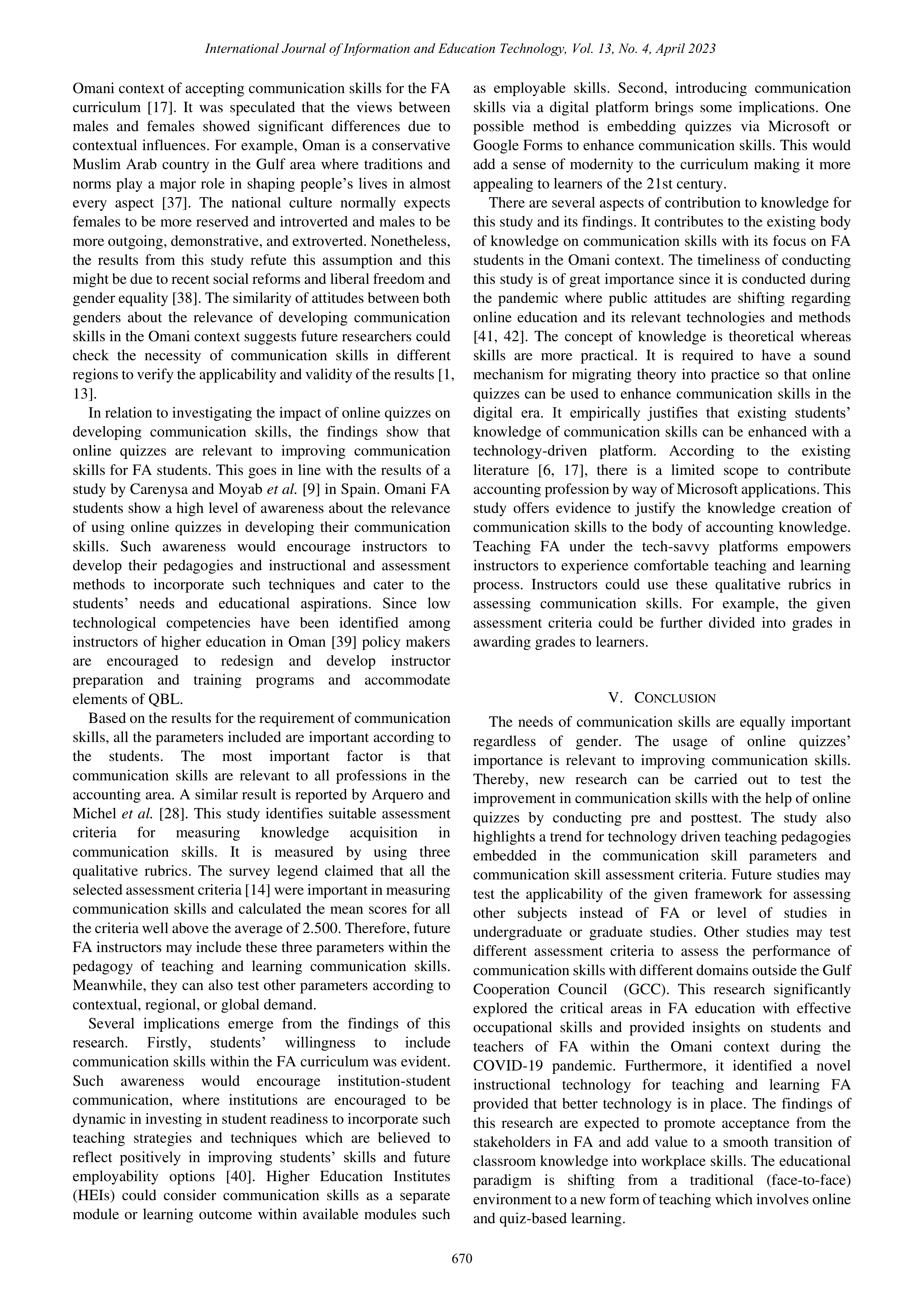
Table VII above summarizes the results of the criteria for
assessing communication skills within the FA curriculum.
All independent parameters ranked more than 3.8. The mean
of parameters was well above 3 which denoted the required
level of importance for the given assessment criteria. The
highest mean value of 4.177 further suggested that
adaptability was vitally important to assess communication
skills within the domain of FA.
TABLE
VII:
D
ESCRIPTIVE
S
TATISTICS OF
A
SSESSMENT
C
RITERIA FOR
C
OMMUNICATION
S
KILLS
Assessment criteria
N
Mean
Std. Deviation
1. Talking and listening skills
96
3.854
1.289
2. Adaptability
96
4.177
1.178
3. Resourcefulness
96
4.031
1.164
Total
288
4.020
1.215
TABLE
VIII:
O
NE
-W
AY
ANOVA
OF
A
SSESSMENT
C
RITERIA FOR
C
OMMUNICATION
S
KILLS
Sum of
Squares
df
Mean
Square
F
Sig.
Between Groups
5.021
2
2.510
1.708
0.183
Within Groups
418.854
285
1.470
Total
423.875
287
Table VIII above shows the calculations of one-way
ANOVA and it was found that there were no statistically
significant differences in the mean score between at least two
groups (
F
(2,285)= [1.708],
p
= 0.183). This was so as the
probability (p) was more than 0.05. The mean value of the
assessment criteria for communication skills recommends
instructors to use communication skills within the FA
learning pedagogy. A one-way ANOVA was vitally
important when there were two or more levels: talking and
listening skills, adaptability, and resourcefulness, in
assessing communication skills. According to the findings,
F
was 1.708, which was not significant with the p-value of
0.183 and it was more than 0.05. This reflected that there was
no statistical significance between the means of different
assessment criteria. Nevertheless, future researchers may test
the most significant assessment criteria out of all three by
using the post hoc Tukey HSD test.
IV.
D
ISCUSSION
Integrating communication skills into the FA curriculum
revealed several implications that were confirmed by the
results. The findings indicated a high level of students‘
awareness
of
the
importance
and
relevance
of
communication skills to their study programs and
employability skills. Students showed readiness and
willingness to use new instructional and assessment methods,
pedagogies, and technologies. Similar results were reported
by Moncada and Moncada [1] and Saini and Al-Mamri [17].
The findings of implementing online quizzes to improve
communication skills were in line with earlier studies
presented by Mihaltan [4] and Sheridan [5]. Although the
results showed that 88% of students preferred to have online
quizzes in accounting studies, several curriculums in FA did
not pay much attention to this technique [22]. FA students
desired to integrate more quizzes in their curriculum as a
genre of games [15]. This creates an opportunity for future
instructors to use and sustain quizzes in order to improve
communication skills in the rapidly changing digital era [14].
The significance of communication skills for both male and
female students was stressed by many authors [5, 20] with
similar results reported in this study. Irrespective of gender
differentiation, communication skills were found to be
relevant and valued by all students. This was in line with the
International Journal of Information and Education Technology, Vol. 13, No. 4, April 2023
669
Omani context of accepting communication skills for the FA
curriculum [17]. It was speculated that the views between
males and females showed significant differences due to
contextual influences. For example, Oman is a conservative
Muslim Arab country in the Gulf area where traditions and
norms play a major role in shaping people‘s lives in almost
every aspect [37]. The national culture normally expects
females to be more reserved and introverted and males to be
more outgoing, demonstrative, and extroverted. Nonetheless,
the results from this study refute this assumption and this
might be due to recent social reforms and liberal freedom and
gender equality [38]. The similarity of attitudes between both
genders about the relevance of developing communication
skills in the Omani context suggests future researchers could
check the necessity of communication skills in different
regions to verify the applicability and validity of the results [1,
13].
In relation to investigating the impact of online quizzes on
developing communication skills, the findings show that
online quizzes are relevant to improving communication
skills for FA students. This goes in line with the results of a
study by Carenysa and Moyab
et al.
[9] in Spain. Omani FA
students show a high level of awareness about the relevance
of using online quizzes in developing their communication
skills. Such awareness would encourage instructors to
develop their pedagogies and instructional and assessment
methods to incorporate such techniques and cater to the
students‘ needs and educational aspirations. Since low
technological competencies have been identified among
instructors of higher education in Oman [39] policy makers
are encouraged to redesign and develop instructor
preparation and training programs and accommodate
elements of QBL.
Based on the results for the requirement of communication
skills, all the parameters included are important according to
the
students.
The
most
important
factor
is
that
communication skills are relevant to all professions in the
accounting area. A similar result is reported by Arquero and
Michel
et al.
[28]. This study identifies suitable assessment
criteria
for
measuring
knowledge
acquisition
in
communication skills. It is measured by using three
qualitative rubrics. The survey legend claimed that all the
selected assessment criteria [14] were important in measuring
communication skills and calculated the mean scores for all
the criteria well above the average of 2.500. Therefore, future
FA instructors may include these three parameters within the
pedagogy of teaching and learning communication skills.
Meanwhile, they can also test other parameters according to
contextual, regional, or global demand.
Several implications emerge from the findings of this
research.
Firstly,
students‘
willingness
to
include
communication skills within the FA curriculum was evident.
Such
awareness
would
encourage
institution-student
communication, where institutions are encouraged to be
dynamic in investing in student readiness to incorporate such
teaching strategies and techniques which are believed to
reflect positively in improving students‘ skills and future
employability options [40]. Higher Education Institutes
(HEIs) could consider communication skills as a separate
module or learning outcome within available modules such
as employable skills. Second, introducing communication
skills via a digital platform brings some implications. One
possible method is embedding quizzes via Microsoft or
Google Forms to enhance communication skills. This would
add a sense of modernity to the curriculum making it more
appealing to learners of the 21st century.
There are several aspects of contribution to knowledge for
this study and its findings. It contributes to the existing body
of knowledge on communication skills with its focus on FA
students in the Omani context. The timeliness of conducting
this study is of great importance since it is conducted during
the pandemic where public attitudes are shifting regarding
online education and its relevant technologies and methods
[41, 42]. The concept of knowledge is theoretical whereas
skills are more practical. It is required to have a sound
mechanism for migrating theory into practice so that online
quizzes can be used to enhance communication skills in the
digital era. It empirically justifies that existing students‘
knowledge of communication skills can be enhanced with a
technology-driven platform. According to the existing
literature [6, 17], there is a limited scope to contribute
accounting profession by way of Microsoft applications. This
study offers evidence to justify the knowledge creation of
communication skills to the body of accounting knowledge.
Teaching FA under the tech-savvy platforms empowers
instructors to experience comfortable teaching and learning
process. Instructors could use these qualitative rubrics in
assessing communication skills. For example, the given
assessment criteria could be further divided into grades in
awarding grades to learners.
V.
C
ONCLUSION
The needs of communication skills are equally important
regardless of gender. The usage of online quizzes‘
importance is relevant to improving communication skills.
Thereby, new research can be carried out to test the
improvement in communication skills with the help of online
quizzes by conducting pre and posttest. The study also
highlights a trend for technology driven teaching pedagogies
embedded in the communication skill parameters and
communication skill assessment criteria. Future studies may
test the applicability of the given framework for assessing
other subjects instead of FA or level of studies in
undergraduate or graduate studies. Other studies may test
different assessment criteria to assess the performance of
communication skills with different domains outside the Gulf
Cooperation Council (GCC). This research significantly
explored the critical areas in FA education with effective
occupational skills and provided insights on students and
teachers of FA within the Omani context during the
COVID-19 pandemic. Furthermore, it identified a novel
instructional technology for teaching and learning FA
provided that better technology is in place. The findings of
this research are expected to promote acceptance from the
stakeholders in FA and add value to a smooth transition of
classroom knowledge into workplace skills. The educational
paradigm is shifting from a traditional (face-to-face)
environment to a new form of teaching which involves online
and quiz-based learning.
International Journal of Information and Education Technology, Vol. 13, No. 4, April 2023
670
C
ONFLICT OF
I
NTEREST
The authors declare no conflict of interest.
A
UTHOR
C
ONTRIBUTIONS
N.L Hettiarachchi had contributed to the study framework
development, instrument development; manuscript writing,
data analysis, and manuscript submission.
T. S. Subramaniam contributed to the study framework
development, instrument development its revisions.
S. T. Palpanadan contributed to typing, proofreading, and
editing.
A. F Anas contributed to typing, correction, editing, and
visualization/presentation of data in text.
F
UNDING
Communication of this research is made possible through
monetary assistance by Universiti Tun Hussein Onn
Malaysia and the UTHM Publisher‘s Office via Publication
Fund E15216.
R
EFERENCES
[1]
S. Moncada and T. Moncada, ―Gamification of learning in accounting
education,‖
Journal of Higher Education Theory and Practice
, vol. 14,
no. 3, pp. 9–19, 2014, DOI: 10.24191/smrj.v17i1.8140.
[2]
K. Benati, S. Lindsay, and J. Fisher, ―Applying theory in practice:
Views of graduating business students,‖
Education & Training
, vol. 63,
no. 9, pp. 1213–1224, 2021, DOI: 10.1108/ET-07-2020-0197.
[3]
C. Nealy, ―Authentic engagement through workplace pedagogy,‖
Administrative Issues Journal:
Connecting Education, Practice, and
Research
, vol. 10, no. 2, pp. 18–32, 2020, DOI: 10.5929/2020.10.2.2.
[4]
D. Mihaltan, ―Bridging the gap between theory and practice in
accounting,‖
Practical Application of Science
, vol. 7, no. 20, pp. 85–91,
2019, https://ideas.repec.org/a/cmj/seapas/y2019i20p85- 91.html.
[5]
Sheridan. (2020). The joys of problem solving.
ACCA Global
. [Online].
Available:
https://www.accaglobal.com/an/en/student/sa/features/problem-solvin
g.html
[6]
S. Jaafar, ―Are soft skills required for accounting students in future
careers?‖
SSRN Electronic Journal
, 2018, DOI: 10.2139/ssrn.3167595
[7]
E. Laar, A. Deursen, J. Dijk, and J. Haan, ―Determinants of 21st
century skills and 21st century digital skills for workers: A systematic
literature review,‖
SAGE Open,
vol. 10, no. 1, pp. 1–15, 2020, DOI:
10.1177/2158244019900176.
[8]
A. Wyant, A. Manzoni, and S. McDonald, ―Social skill dimensions and
career dynamics. Socius: sociological research for a dynamic world,‖
Sage
Journal
,
vol.
4,
no.
1,
pp.
1–12,
2018,
DOI:
10.1177/237802311876800.
[9]
J. Carenysa, S. Moyab, and J. Perramonc, ―Is it worth it to consider
video games in accounting education? A comparison of a simulation
and a video game in attributes, motivation and learning outcomes,‖
Spanish Accounting Review
, vol. 20, no. 2, pp. 118–130, 2017, DOI:
10.1016/j.rcsar.2016.07.003.
[10]
P. Wouters and E. Meulen, ―The role of learning styles in game-based
learning,‖
International Journal of Game-Based Learning
, vol. 10, no.
1, pp. 54–69, 2020, DOI: 10.4018/IJGBL.2020010104.
[11]
P. Turner, E. Johnston, M. Kebritchi, S. Evans, and D. Heflich,
―Influence of online computer games on the academic achievement of
nontraditional undergraduate students,‖
Cogent Education
, vol. 5, no. 1,
2018, DOI: 10.1080/2331186X.2018.1437671.
[12]
K. Rosli, R. M. Saat, and N. Khairudin, ―Simulating teaching and
learning of accounting subject through gamification approach,‖ in
Proc.
of the International Conference on Accounting Studies (ICAS)
, pp.
156–159, 2017.
[13]
H. Awang, and Z. Daud, ―Improving a communication skill through the
learning approach towards the environment of engineering classroom,‖
Procedia-Social and Behavioral Sciences
, vol. 195, pp. 480–486, 2015,
DOI: 10.1016/j.sbspro.2015.06.241.
[14]
D. Foulger. (2004). Models of the communication process,
evolutionary
media.
[Online].
Available
https://davis.foulger.info/research/unifiedModelOfCommunication.ht
m
[15]
A. Radzi, C. Drahman, M. Joseph, M. Rahmat, and K. Suria,
―Competition based learning strategy of the online introductory
accounting quiz for non-accounting majors,‖
International Business
Education Journal
, vol. 13, no. 1, pp. 83–94, 2020 DOI:
10.37134/ibej.vol13.1.7.2020
[16]
O. Groffin. (2020). How Artificial Intelligence will impact accounting.
ICAEW
.
[Online].
Available:
https://www.icaew.com/technical/technology/artificial-intelligence/art
ificial-intelligence-articles/how-artificial-intelligence-will-impact-acc
ounting
[17]
D. Saini and M. Al-Mamri, ―Investigation of technological tools used
in education system in Oman,‖
Social Sciences & Humanities
, vol.
100003, pp. 1–10, 2019, DOI: 10.1016/j.ssaho.2019.100003.
[18]
Indeed Career Guide. (2020). Communication skills: Definitions and
examples.
[Online].
Available:
https://in.indeed.com/career-advice/resumes-cover-letters/communicat
ion-skills
[19]
M. Barr, ―Using video games to develop communication skills in
higher education,‖ presented at Irish Conference on Game-Based
Learning (IGBL), Trinity College, Dubli, 2016.
[20]
F. Khan, H. Salim, and H. Mamari, ―Business major students‘
perception towards basic accounting courses in higher education
institutions of Oman,‖
International Journal of Management,
Innovation & Entrepreneurial Research
, vol. 5, no. 2, pp. 17–28, 2019,
DOI: 10.18510/ijmier.2019.523
[21]
A. Wang and R. Tahir, ―The effect of using Kahoot! For learning: a
literature review,‖
Computers & Education
, vol. 149, pp. 1–5, 2020,
DOI: 10.1016/j.compedu.2020.103818.
[22]
L. Suatrama, S. Ulfa, and P. Setyosari, ―Development of an
instructional design model for mobile blended learning in higher
education,‖
International Journal of Emerging Technologies in
Learning
. vol. 14, no. 16, 2019, DOI: 10.3991/ijet.v14i16.10633.
[23]
R. Li, ―Does game-based vocabulary learning app influence Chinese
EFL
learners‘
vocabulary
achievement,
motivation,
and
self-confidence?‖
SAGE Open
, vol. 11, no. 1, 2021, DOI:
10.1177/21582440211003092.
[24]
Y. Kang and A. Ritzhaupt, ―A comparative study of game-based online
learning in music appreciation: An analysis of student motivation and
achievement,‖
Journal of Educational Multimedia and Hypermedia
,
vol. 30, no.1, 2021.
[25]
E. Johnson and A. Salter,
Playful Pedagogy in the Pandemic Pivoting
to Game-Based Learning
, 1st Ed. Routledge: Taylor and Francis Group,
2022.
[26]
M. Dickey,
Aesthetics and Design for Game-Based Learning
,
Routledge: Taylor and Francis Group, 2015.
[27]
W. Kriz, ―Gaming in the time of COVID-19. Simulation & gaming,‖
Sage Journal Publication
, vol. 51, no. 4, pp. 403–410, 2020, DOI:
10.1177/1046878120931602.
[28]
J. Arquero, G. Michel, C. Polvillo, and A. Meda, ―Communication
apprehension and communication self-efficacy in Mexican accounting
students. International technology,‖ presented at the Education and
Development Conference, 2016, DOI: 10.21125/iceri.2016.1175.
[29]
A. Khan, S. Khan, S. Islam, and M. Khan, ―Communication skills of a
teacher and its role in the development of the students‘ academic
success,‖
Journal of Education and Practice
, vol. 8, no. 1, pp. 18–21,
2017.
[30]
H. Zeng, S. Zhou, G. Hong, Q. Li, and S. Xu, ―Evaluation of interactive
game-based learning in physics domain,‖
Journal of Baltic Science
Education
,
vol.
19,
no.
3,
pp.
484–498,
2020,
DOI:
10.33225/jbse/20.19.484.
[31]
R. Richey and D. Klein,
Design and Development Research: Methods,
Strategies, and Issues
,
New Jersey: Lawrence Erlbaum, 2007.
[32]
A. Badahdah, F. Khamis, and N. Mahyijari, ―The psychological
well-being of physicians during COVID-19 outbreak in Oman,‖
Psychiatry
Research
,
vol.
289,
2020,
DOI:
10.1016/j.psychres.2020.113053.
[33]
O. Kowalczyk, K. Roszkowski, X. Montane, W. Pawliszak, B.
Tylkowski, and A. Bajek, ‗Religion and faith perception in a pandemic
of COVID‑19,‖
Journal of Religion and Health
, vol. 59, no. 1, pp.
2671–2677, 2020, DOI: 10.1007/s10943-020-01088.
[34]
D. Amalia, ―Quizizz website as an online assessment for English
teaching and learning: Students‘ perspectives,‖
Journal of English
Language
Teaching
,
vol.
7,
no.
1,
pp.
1–8,
2020,
doi:10.33394/jo-elt.v7i1.2638.
[35]
N. Ngadiran, ―Design and development of mobile learning module for
self-directed learning to enhance English for academic survival skills,‖
International Journal of Information and Education Technology, Vol. 13, No. 4, April 2023
671
Ph.D. dissertation, Faculty of Education, Universiti Teknologi Mara,
Malaysia, 2020.
[36]
J. Jones and N. Ridout,
Oman, Culture and Diplomacy
, Edinburgh
University Press, 2012.
[37]
Z. Hussein and L. Goldsmith. (2020). Gender politics in Oman:
Between
state,
sect,
and
tribe.
[Online].
Available:
https://www.mei.edu/publications/gender-politics-oman-between-state
-sect-and-tribe
[38]
V. Thumiki and H. Magd, ―Online teaching competencies among
faculty members at modern college of business and science, sultanate
of Oman,‖
International Journal of Information and Education
Technology
, vol. 12, no. 9, pp. 840–850, 2022, DOI:
10.18178/ijiet.2022.12.9.1692.
[39]
W. Teng, C. Ma, S. Pahlevansharif, and J. Turner, ―Graduate readiness
for the employment market of the 4th industrial revolution: The
development of soft employability skill,‖
Education and Training
, vol.
61, no. 5, pp. 590–604, 2019, DOI: 10.1108/ET-07-2018-0154.
[40]
S. Barzani and R. Jamil, ―Students‘ perceptions towards online
education during COVID-19 pandemic: An empirical study,‖
International Journal of Social Sciences & Educational Studies
, vol. 8,
no. 2, pp. 28–38, 2021, DOI: 10.23918/ijsses.v8i2p28.
[41]
S. N. K. Rubani, T. S. Subramaniam, A. Ariffin, N. Hamzah, and M.
Bidin, ―Practical knowledge of prospective teachers‘ in pedagogy,‖
J.
Phys.
Conf.
Ser.
,
vol.
1049,
no.
1,
Jul.
2018,
DOI:
10.1088/1742-6596/1049/1/012095.
[42]
T. S. Subramaniam
et al.
, ―Important elements for a framework in
designing a mobile learning for English language listening and
speaking skills,‖
J. Crit. Rev.
, vol. 7, no. 6, pp. 312–315, 2020, DOI:
10.31838/jcr.07.06.54.
Copyright © 2023 by the authors. This is an open access article distributed
under the Creative Commons Attribution License which permits unrestricted
use, distribution, and reproduction in any medium, provided the original
work is properly cited (
CC BY 4.0
).
International Journal of Information and Education Technology, Vol. 13, No. 4, April 2023
672