



Corresponding author: Joey A. De la Cruz
Copyright © 2024 Author(s) retain the copyright of this article. This article is published under the terms of the Creative Commons Attribution Liscense 4.0.
Enhancing English language skills for technical professionals
MERLINA CULALA GARCIA
1
and JOEY ALEDO DE LA CRUZ
2, *
1
Department of English Literature, Nueva Ecija University of Science and Technology, Philippines.
2
Department of Information and Communication Technology, Nueva Ecija University of Science and Technology,
Philippines.
World Journal of Advanced Research and Reviews, 2024, 24(03), 1239–1244
Publication history: Received on 03 November 2024; revised on 11 December 2024; accepted on 13 December 2024
Article DOI:
https://doi.org/10.30574/wjarr.2024.24.3.3731
Abstract
This paper studies the critical role of good communication skills in information technology (IT), specifically in improving
the language proficiency of technical professionals.
The research delves into the current obstacles that IT professionals encounter when attempting to communicate
successfully in English, ascertains how language competency affects the findings of projects, and examines the many
approaches taken to improve communication abilities.
The research's conclusions emphasize the value of effective English communication in the IT industry and provide
advantageous recommendations for bridging communication barriers. IT workers may contribute more successfully to
international initiatives, promote smooth teamwork, and increase project success by enhancing their language skills.
This research is a priceless resource for IT professionals, educators, and businesses looking to strengthen
communication in the ever-changing and expanding IT industry.
Keywords:
Effective Communication; IT Industry; English Language Skills; IT workers
1
Introduction
Effective communication is the foundation for success in the fast-paced information technology (IT) field. It is a unique
gem involving more than just verbal communication - it involves turning concepts into deeds, issues into solutions, and
endeavors into victories.
Regardless of its advantages, effective communication is always accompanied by its difficulties. Misunderstandings,
misinterpretations, and differences in language proficiency can frequently cause communication failures.
Language proficiency is essential for career advancement, facilitating interaction, compromise, and establishing
connections in domestic and global settings. They help professionals navigate the dynamic environment in which their
fields are immersed.
Technical professionals are the architects of innovation, the problem solvers behind complex systems, and the engine
that propels our contemporary digital world within the dynamic information technology (IT)industry.
Furthermore, the IT service delivery process involves an in-depth exchange of task-related instructions between service
providers and clients. To be clear, client-service provider partners are engaged in a highly collaborative relationship
rather than a coordinating or cooperative one.
World Journal of Advanced Research and Reviews, 2024, 24(03), 1239–1244
1240
In conclusion, this study aims to solve the distinct roles, duties, and especially communication difficulties that
information technology (IT)technical specialists encounter as they significantly help construct the digital environment
that characterizes our contemporary world.
1.1
Objectives
The main goal is to disentangle the complexities of communication in information technology, where timeliness,
accuracy, and clarity are critical.
To explore the fundamentals of successful communication in this ever-changing field. To identify the best practices for
ensuring that IT language is spoken clearly and purposefully through in-depth research, surveys, and interviews.
Looking at IT workers' methods and instruments to communicate their ideas, oversee tasks, and bring disparate groups
of people together to achieve shared objectives is essential.
2
Review of related literature
This study aims to look into and create practical methods for improving technical personnel's English language
proficiency. English language competency is essential for career success in technical disciplines as the need for
international collaboration and communication grows. Through an assessment of current language enhancement
programs and an awareness of the difficulties experienced by technical professionals, this study seeks to provide
important information that can guide the development and application of focused interventions. The ultimate objective
is to provide technical professionals with the language skills required for productive interaction in multicultural and
global work settings.
2.1
English Language Skills
To evaluate technical personnel's present level of English language competency and pinpoint particular areas needing
development. This seeks to comprehend the language barriers people encounter in technical domains and how language
competency affects their ability to function in their work. English has established itself as a global lingua franca. The
worldwide growth of the usage of English has resulted in many reforms within educational institutions. The study aims
to ascertain and examine English needs for information technology purposes among professionals and learners on a
wide scale. A quantitative descriptive approach with a survey research design was employed in the study, and it applied
to the Cross-Sectional survey design. The English learning outcome implied different aims.
(Prasetya, 2021)
2.2
Technical Professionals
To provide an overview of the particular communication difficulties faced by those in technical professions. By
highlighting the significance of customizing language improvement techniques to match the unique needs of
professionals in technical disciplines, this aims to identify the particular communication demands and requirements of
technical positions. The professionals want to complete language instructions for information technology processing,
but students expect information access to the products. Professional speaking abilities are concerned with asking for
clarifications in group or personal meetings, yet students take and receive phone calls more often. In the same manner
as writing, professionals and students have the same expectation: to produce formal reports in academic or professional
situations. This study affirmed an interrelation between the English standing in professional IT and students' IT
positions in communication experiences in their present circumstances.
(Prasetya, 2021)
2.3
Impact of English Proficiency on Professional Success
To explore the relationship between professional performance in technical fields and English proficiency. The goal is to
comprehend how improved language proficiency affects prospects for international collaboration, professional growth,
and general success in the globalized setting of technological industries.
In many technical professions, the complete focus of education and training is on technical topics directly or indirectly
related to a career or discipline. Technical professionals in various disciplines, such as information technology,
engineering, architecture, and research and development, are increasingly required to broaden their skill sets and
master soft skills. Soft skills are "the cluster of personality traits, social graces, facility with language, personal habits,
World Journal of Advanced Research and Reviews, 2024, 24(03), 1239–1244
1241
friendliness, and optimism that mark people to varying degrees. Soft skills complement hard skills, which are the
technical requirements of a job.
(Bancino & Zevalkink, 2007)
2.4
Technology-Assisted Language Learning for Professionals
This study investigates a series of experiences and benefits of integrating technology into English Language learning in
Indonesia. The results show that some benefits of incorporating technology in English language learning are learners
can do some coding, practice online quizzes or tests, improve their speed of answering questions, improve scores in
English tests, learn another foreign language, do some collaborative learning, encourage independent learning, have
opportunities to write, speak, listen, and read in English, do online learning, get online references, use of multiple
computer application, obtain the latest information, translate, have opportunities to use multi-media presentation as
well as demonstrate new method of teaching.
(Rintaningrum, 2023
)
3
Methodology
This chapter outlines the research approach and methodology used in the study on 'Enhancing English Language Skills
for Technical Professionals.' It covers the research design, details about the respondents, the sampling technique used,
the method for collecting and gathering data, and the statistical treatment and analysis procedures.
3.1
Research Design
The research study used a non-experimental descriptive research design with a quantitative methodology. Presenting
a moment in time of the existing situation without changing factors defines descriptive research. It entails gathering
information to provide a thorough account or description of people, organizations, or circumstances.
(May, et al., 2022) presents the methodological design of a large-scale quantitative investigation of research use by
school-based practitioners through the "Survey of Evidence in Education for Schools (SEE-S)." It documents the
significant technical aspects of SEE-S development, including item development, sample selection, and reliability and
validity assessment. Descriptive statistics for data collected during the survey field trial are also detailed in this report.
Through the development and validation of multiple survey measures, this study aims to deepen the field's
understanding of the actions and activities that educators are involved in concerning the use of evidence in decision-
making.
3.2
Sample and Sampling Procedure
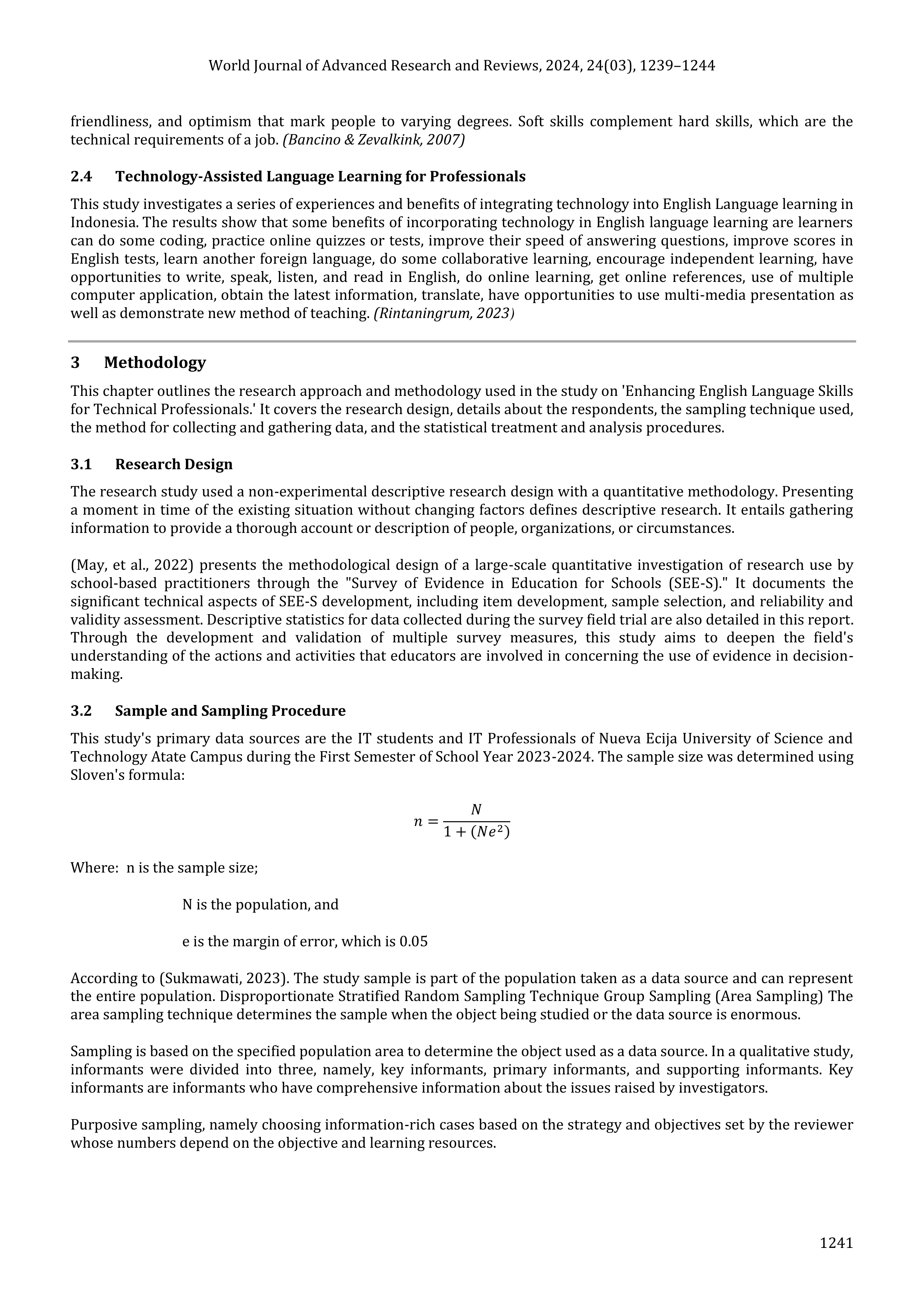
This study's primary data sources are the IT students and IT Professionals of Nueva Ecija University of Science and
Technology Atate Campus during the First Semester of School Year 2023-2024. The sample size was determined using
Sloven's formula:
𝑛=
𝑁
1 + (𝑁ⅇ
2
)
Where: n is the sample size;
N is the population, and
e is the margin of error, which is 0.05
According to (Sukmawati, 2023). The study sample is part of the population taken as a data source and can represent
the entire population. Disproportionate Stratified Random Sampling Technique Group Sampling (Area Sampling) The
area sampling technique determines the sample when the object being studied or the data source is enormous.
Sampling is based on the specified population area to determine the object used as a data source. In a qualitative study,
informants were divided into three, namely, key informants, primary informants, and supporting informants. Key
informants are informants who have comprehensive information about the issues raised by investigators.
Purposive sampling, namely choosing information-rich cases based on the strategy and objectives set by the reviewer
whose numbers depend on the objective and learning resources.
World Journal of Advanced Research and Reviews, 2024, 24(03), 1239–1244
1242
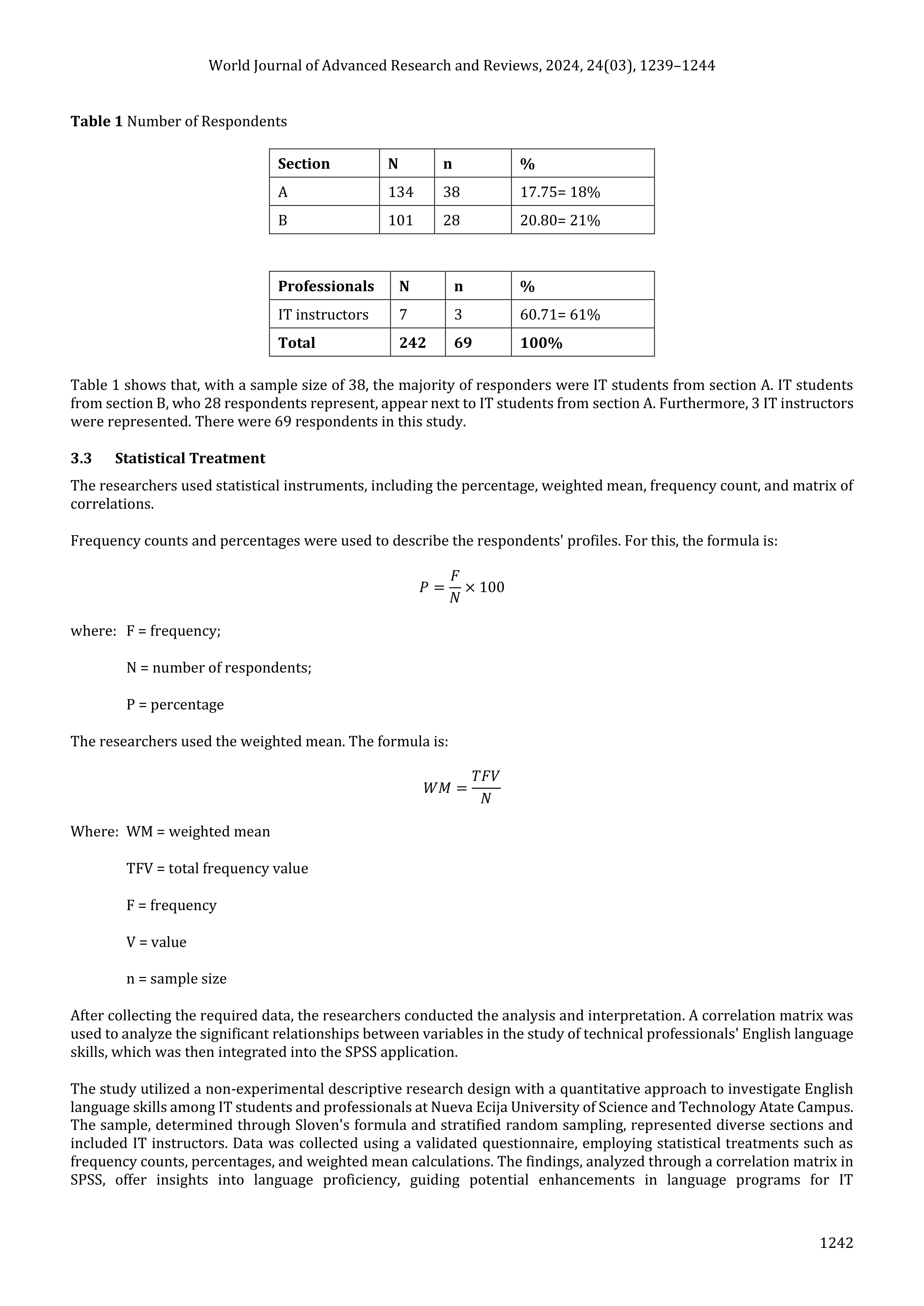
Table 1
Number of Respondents
Section
N
n
%
A
134
38
17.75= 18%
B
101
28
20.80= 21%
Professionals
N
n
%
IT instructors
7
3
60.71= 61%
Total
242
69
100%
Table 1 shows that, with a sample size of 38, the majority of responders were IT students from section A. IT students
from section B, who 28 respondents represent, appear next to IT students from section A. Furthermore, 3 IT instructors
were represented. There were 69 respondents in this study.
3.3
Statistical Treatment
The researchers used statistical instruments, including the percentage, weighted mean, frequency count, and matrix of
correlations.
Frequency counts and percentages were used to describe the respondents' profiles. For this, the formula is:
𝑃=
𝐹
𝑁
× 100
where: F = frequency;
N = number of respondents;
P = percentage
The researchers used the weighted mean. The formula is:
𝑊𝑀=
𝑇𝐹𝑉
𝑁
Where: WM = weighted mean
TFV = total frequency value
F = frequency
V = value
n = sample size
After collecting the required data, the researchers conducted the analysis and interpretation. A correlation matrix was
used to analyze the significant relationships between variables in the study of technical professionals' English language
skills, which was then integrated into the SPSS application.
The study utilized a non-experimental descriptive research design with a quantitative approach to investigate English
language skills among IT students and professionals at Nueva Ecija University of Science and Technology Atate Campus.
The sample, determined through Sloven's formula and stratified random sampling, represented diverse sections and
included IT instructors. Data was collected using a validated questionnaire, employing statistical treatments such as
frequency counts, percentages, and weighted mean calculations. The findings, analyzed through a correlation matrix in
SPSS, offer insights into language proficiency, guiding potential enhancements in language programs for IT
World Journal of Advanced Research and Reviews, 2024, 24(03), 1239–1244
1243
professionals to meet industry demands. The results serve as a basis for tailored language education initiatives to ensure
ongoing relevance and effectiveness in the dynamic IT landscape.
4
Presentation, Analysis, and Interpretation of Results
This chapter provides an analysis of the study's findings and an interpretation based on how the data was addressed. It
also includes illustrative tables.
4.1
Profile of Respondents
This study's first question was regarding the respondents' age, educational background, attainment, current
employment status, occupation, industry sector, and years of experience in the IT industry.
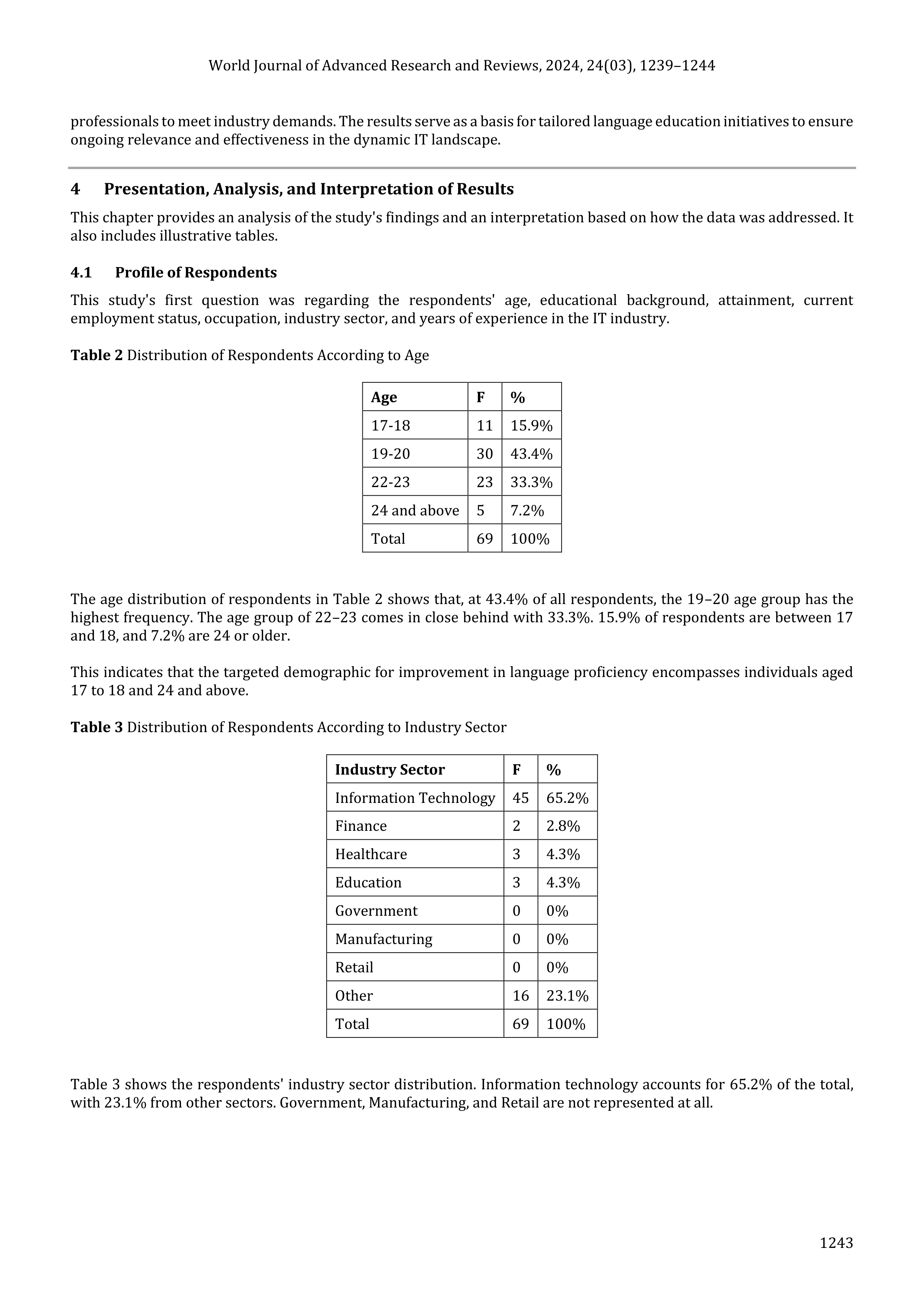
Table 2
Distribution of Respondents According to Age
Age
F
%
17-18
11
15.9%
19-20
30
43.4%
22-23
23
33.3%
24 and above
5
7.2%
Total
69
100%
The age distribution of respondents in Table 2 shows that, at 43.4% of all respondents, the 19–20 age group has the
highest frequency. The age group of 22–23 comes in close behind with 33.3%. 15.9% of respondents are between 17
and 18, and 7.2% are 24 or older.
This indicates that the targeted demographic for improvement in language proficiency encompasses individuals aged
17 to 18 and 24 and above.
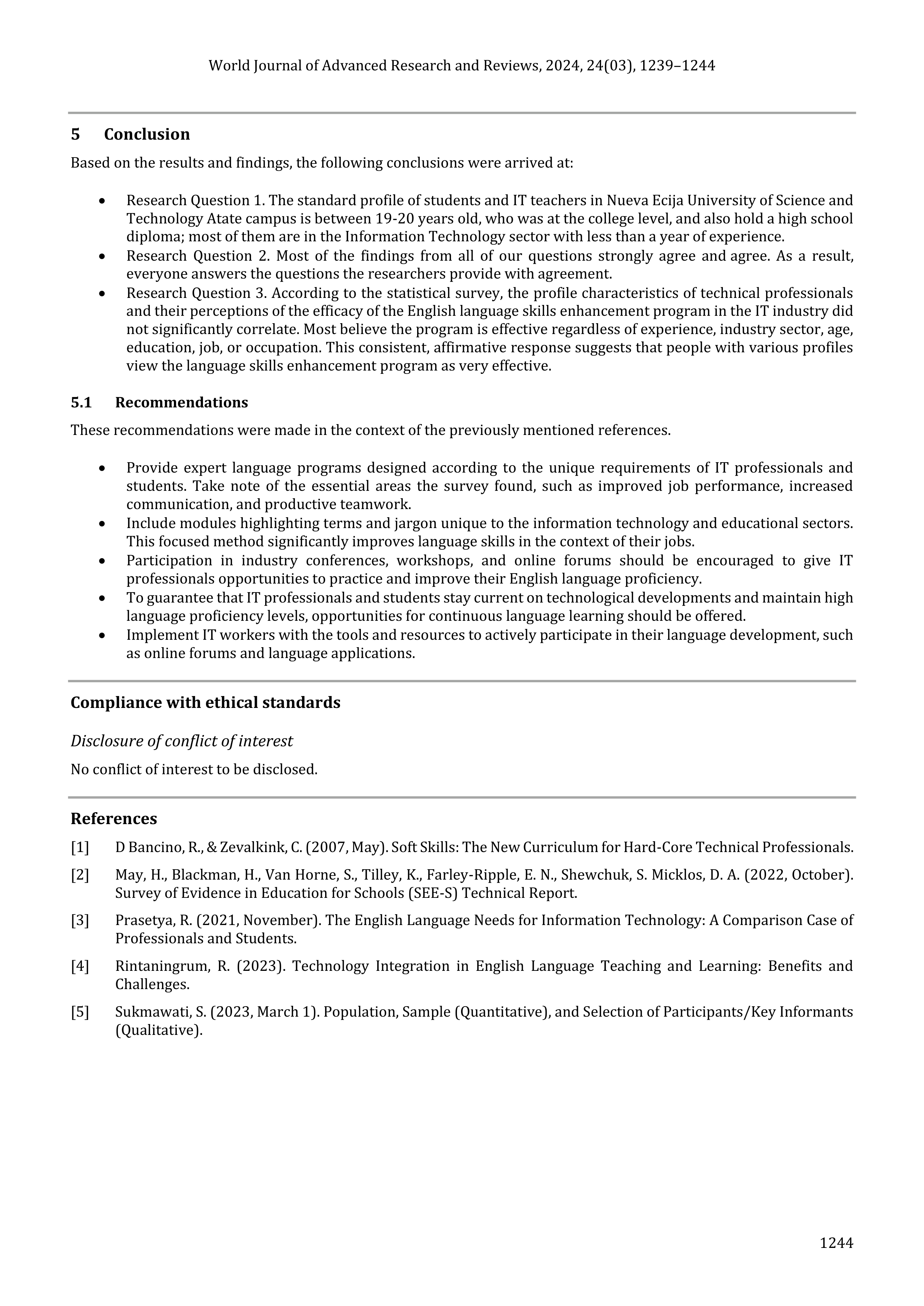
Table 3
Distribution of Respondents According to Industry Sector
Industry Sector
F
%
Information Technology
45
65.2%
Finance
2
2.8%
Healthcare
3
4.3%
Education
3
4.3%
Government
0
0%
Manufacturing
0
0%
Retail
0
0%
Other
16
23.1%
Total
69
100%
Table 3 shows the respondents' industry sector distribution. Information technology accounts for 65.2% of the total,
with 23.1% from other sectors. Government, Manufacturing, and Retail are not represented at all.
World Journal of Advanced Research and Reviews, 2024, 24(03), 1239–1244
1244
5
Conclusion
Based on the results and findings, the following conclusions were arrived at:
•
Research Question 1. The standard profile of students and IT teachers in Nueva Ecija University of Science and
Technology Atate campus is between 19-20 years old, who was at the college level, and also hold a high school
diploma; most of them are in the Information Technology sector with less than a year of experience.
•
Research Question 2. Most of the findings from all of our questions strongly agree and agree. As a result,
everyone answers the questions the researchers provide with agreement.
•
Research Question 3. According to the statistical survey, the profile characteristics of technical professionals
and their perceptions of the efficacy of the English language skills enhancement program in the IT industry did
not significantly correlate. Most believe the program is effective regardless of experience, industry sector, age,
education, job, or occupation. This consistent, affirmative response suggests that people with various profiles
view the language skills enhancement program as very effective.
5.1
Recommendations
These recommendations were made in the context of the previously mentioned references.
•
Provide expert language programs designed according to the unique requirements of IT professionals and
students. Take note of the essential areas the survey found, such as improved job performance, increased
communication, and productive teamwork.
•
Include modules highlighting terms and jargon unique to the information technology and educational sectors.
This focused method significantly improves language skills in the context of their jobs.
•
Participation in industry conferences, workshops, and online forums should be encouraged to give IT
professionals opportunities to practice and improve their English language proficiency.
•
To guarantee that IT professionals and students stay current on technological developments and maintain high
language proficiency levels, opportunities for continuous language learning should be offered.
•
Implement IT workers with the tools and resources to actively participate in their language development, such
as online forums and language applications.
Compliance with ethical standards
Disclosure of conflict of interest
No conflict of interest to be disclosed.
References
[1]
D Bancino, R., & Zevalkink, C. (2007, May). Soft Skills: The New Curriculum for Hard-Core Technical Professionals.
[2]
May, H., Blackman, H., Van Horne, S., Tilley, K., Farley-Ripple, E. N., Shewchuk, S. Micklos, D. A. (2022, October).
Survey of Evidence in Education for Schools (SEE-S) Technical Report.
[3]
Prasetya, R. (2021, November). The English Language Needs for Information Technology: A Comparison Case of
Professionals and Students.
[4]
Rintaningrum, R. (2023). Technology Integration in English Language Teaching and Learning: Benefits and
Challenges.
[5]
Sukmawati, S. (2023, March 1). Population, Sample (Quantitative), and Selection of Participants/Key Informants
(Qualitative).