

DEPARTMENT: "REGIONAL DEVELOPMENT"
AUTHOR'S ABSTRACT
On a dissertation for the award of an educational and scientific degree
"Doctor" in a scientific specialty in a professional direction 3.7.
"Administration and Management", to the Department of "Regional
Development"
"COMMUNICATION IN HUMAN RESOURCES
MANAGEMENT IN ORGANIZATIONS"
PhD Student:
Research Supervisor:
Desislava Todorova
Prof. Kliment
Ivanova
Naidenov D.Sc.
Assoc. Prof. Elena
Petkova PhD
Sofia
2024
"COMMUNICATION IN HUMAN RESOURCES MANAGEMENT IN ORGANIZATIONS"
2
For the dissertation
The dissertation consists of 233 pages, of which 211 pages are main text, which
includes Introduction, First Chapter, Second Chapter, Third Chapter and Conclusion, 14 pages
of Appendices and 7 pages of Bibliography. In addition, the thesis contains 27 tables and six
figures. In developing the work, 105 sources were used, of which 73 are in Bulgarian. On the
subject of the dissertation, four quantitative studies have been made. Two of the author's
studies are described in detail in the Third Chapter of the dissertation.
The dissertation was discussed and accepted for defense at an extended meeting of the
"Regional Development" Department at the Faculty of Geology and Geography of Sofia
University "St. Kliment Ohridski", held on June 11, 2024.
The defense of the dissertation will take place on 16.09.2024 at 11 am. in hall 1 of the
Rectorate of Sofia University "St. Kliment Ohridski" at an open meeting of a scientific jury
composed of:
1. Prof. Kamen Dimitrov Petrov PhD
2. Prof. Petar Borisov Borisov PhD
3. Assoc. Prof. Georgi Kostadinov Bardarov PhD
4. Assoc. Prof. Metodi Valeriev Ivanov PhD
5. Assoc. Prof. Nikolay Ivanov Tsonkov PhD
The materials for the defense are available to those interested in the "Regional
Development" department in the Rectorate of Sofia University "St. Kliment Ohridski" at 15
Tsar Osvoboditel Blvd.
"COMMUNICATION IN HUMAN RESOURCES MANAGEMENT IN ORGANIZATIONS"
3
I.
GENERAL CHARACTERISTICS OF THE DISSERTATION
1.
Relevance and importance of the problem
In practice, as well as in theory, predominant importance is given to differences in
human resource management in different business sectors and regions, job characteristics,
forms of management, specifics of legislation, labor relations, employee satisfaction in
business analysis . The present work analyzes communication and its influence on the
management of human resources in organizations. Based on the thesis that people are the
most important asset for an organization, the possibilities of communication in the
management of human resources in organizations will be examined so that it reflects
communication channels and effective management in organizations.
The problem of effective management of human resources in the workplace and
improvement of working conditions should always be at the forefront of managers at all levels
in organizations, regardless of size, ownership and state system of economic regulation. And
today, the human resources management system occupies a special place in the business
processes of companies, where the management of human resources, talents in organizations,
professional skills and competencies are included. The problem of human resource
management from the point of view of innovative development is of particular importance in
organizations. The perspective of creating an economy based on innovation is one of the main
directions for the development of more effective communication techniques in the
management of human resources in business organizations. Effective communications in the
management of human resources in organizations are a guarantee of good and successful
working relationships, satisfied workers and employees, hence – greater profit,
correspondingly higher salaries and last but not least, job security. The choice of the topic of
the present dissertation was dictated precisely by the importance of this problem.
For effective communications in human resource management in organizations,
standards must be mastered that apply to both managerial and executive personnel. These
standards are part of the necessary communication model for business, the development of
which reveals the relevance of the current dissertation work. The communication model is
important for every single business activity. A mandatory condition for the effectiveness of
the communication model is that it is closely linked to the business model of each
organization. The open communication model reflects the hidden business model of the
company. It provides clarity about the nature of the business, what happens in each structural
unit and what is required of the workers. The model serves to achieve better organization and
stronger cohesion in the work of workers and employees from all departments. In order to
develop a model for effective communications in the management of human resources in
organizations, it is necessary to clarify their main characteristics, principles and requirements,
as well as the peculiarities of work processes and motivating factors.
This topic is particularly relevant at a time of crisis for personnel in various branches,
especially in the tourism industry, when a number of organizations develop and advertise their
services, develop their markets in different regions, which leads to the need for a new
workforce, restructuring of organizations, including making various management decisions
"COMMUNICATION IN HUMAN RESOURCES MANAGEMENT IN ORGANIZATIONS"
4
(selection, working hours, remuneration, training, motivation), the most time and energy is
spent on communication in the management of human resources that carry out the
organization's activities.
The success in the work of any organization is mainly due to the quality of human
resources that it manages to attract, retain and develop. In today's complex and changing
economic environment, methods, techniques and communication channels must be sought and
applied more and more purposefully to ensure qualified, motivated, highly productive and
loyal personnel capable of realizing the organization's goals in the medium-term and long-
term perspective. Communication in the management of human resources is an important part
of implementing reforms and ensuring sustainable development and increasing the
effectiveness of organizations.
2.
Main aim and tasks of the research
The purpose of the present work is to investigate the effectiveness of communication
channels in human resource management and the types of communication channels as a
means of increasing it. Building and strengthening the principles of good management as a
basic condition for effective and efficient use of human resources opportunities in the
management of human resources in organizations. The study covers work behavior, policies
and strategies in human resource management, objectives of human resource management in
organizations, human resource planning, recruitment, career development in organizations,
training and qualification, attestation of specialists, motivation, retention, social activity,
ensuring equal opportunities, ethics and professional competence, the processes
accompanying the phenomenon of motivation, the factors that have a motivating influence on
the labor activity of workers and employees, as well as to examine the specific methods of
motivation (motivating effects). For the purpose of the present theoretical-empirical study,
motivation will be considered here primarily as an outcome. The objective is formulated in
this way, insofar as the period for the preparation of the project and the research is limited in
time. Motivation should be studied as a process, in a development that requires more
resources.
The purpose of the present work is to help solve the problem of assessing the
complexity of the factors that influence communication in the management of human
resources in the tourism industry, as well as the strength of their impact, through the
implementation of three main tasks:
The first task
is to collect, analyze, summarize and systematize information about the
various factors characteristic of communication and their influence on the management of
human resources in organizations.
The second task
is related to the practical application of the accumulated knowledge
through the preparation of a comparative characteristic of communication in the management
of human resources in organizations.
The third task
is expressed in giving specific recommendations for communication and
effective management of human resources in the tourism industry, thereby minimizing the
"COMMUNICATION IN HUMAN RESOURCES MANAGEMENT IN ORGANIZATIONS"
5
negative influence of factors from the cultural environment and improving the overall
effectiveness of management in organizations.
3.
Object, objects covered the research
Object of research
The object of the research research is the comparative characteristics of the influence of
communication in human resource management of two hotel complexes St. Ivan Rilski -
Hotel, Spa & Apartments, Bansko and Hotel Hill, Sofia - FPI Hotels & Resorts - FairPlay
Properties Management EOOD.
Subject of research
The subject of research research is communication in the management of human
resources in organizations, more specifically in the tourism sector, the state and opportunities
for the development of Bulgarian organizations in tourism.
Subject of the research - laws, principles, methods, processes and organizational and
management relations related to communication channels in the management of human
resources in the studied organizations. The subject of the theoretical analysis of
communication channels in the management of workers and employees in business are
considered as a complex process, requiring time, depending on factors, proceeding through
various mechanisms. In a differentiated analysis according to the management hierarchy, the
communication channels could be examined:
a)
vertical - then attention is directed to the essence and differences in the
communication channels inherent in the different levels;
b)
horizontal - then attention is directed to the essence and differences of
communication channels inherent in each hierarchical level.
Scope of the research
The research covers a previously identified group of managers and employees of two hotel
complexes St. Ivan Rilski - Hotel, Spa & Apartments, Bansko and Hotel Hill, Sofia - FPI
Hotels & Resorts - FairPlay Properties Management EOOD, in order to analyze
communication in human resources management and derive management recommendations,
through communication and communication channels in organizations.
4.
Research thesis and hypotheses derived
The scientific contribution of the study is to establish theoretical positions and the
development of methodological tools to improve the effectiveness of communications in the
management of human resources in organizations.
The thesis contains the following elements of scientific innovation:
• specified socio-economic essence of the concept of "communication in human
resources management", which is considered to be a systematic, continuous exposure of the
subject of management in the process of formation, distribution and redistribution, use and
development of human resources with the help of communication, innovation and
"COMMUNICATION IN HUMAN RESOURCES MANAGEMENT IN ORGANIZATIONS"
6
organizational methods, and the need for continuity of the strategic management of human
resources under the influence of dynamic factors in business;
• the author's approach to the classification of factors that affect the effectiveness of
communications in human resource management in organizations. The classification takes
into account factors of communication channels that have a direct impact on the management
of human resources in organizations;
• evaluation of the effectiveness of communications in the management of human
resources in organizations developed by the author's method based on the value of an
integrated performance indicator, determined on the basis of the calculation of the target
indicators for each of the three effects (economic, social, technological);
• developed institutional mechanisms to increase the effectiveness of communications in
the management of human resources, taking into account the state of human capital and
business in the country;
• methodological and scientific-practical recommendations regarding communication
channels in human resource management are proposed. These recommendations are intended
to overcome and minimize the negative effects on business organizations.
Theoretical and practical significance of the study is to develop the theoretical aspects,
as well as research on the level of concrete proposals for the effective management and
communication channels. The regulations contained in the legal and by-laws can be used by
companies for effective human resource management. The results of the conducted research
can be implemented and used by business organizations to deal with communication in
personnel management is effective communication channels.
Research Hypotheses, Concept Model:
Research hypothesis 1
. Communication and communication channels have a stronger
impact on human resources development than organizational structure.
In the analysis, the impact of the corporate culture on the development of human
resources was determined as very strong (rating 5), and the impact of the organizational
structure on the same element as strong (rating 4). These data confirm the hypothesis thus
formulated. However, the differences in this influence should be taken into account.
Corporate culture has a greater impact on the adaptation and training of employees, and to a
lesser extent on their career development. In the case of the organizational structure, this
impact has the opposite sign - the opportunities for career growth come to the fore, and in the
second place - the training of workers and employees (mostly through the opportunities for
rotation).
Research hypothesis 2
. In Hotel Hill Sofia, non-material factors (the nature of duties,
prestige, social status, work atmosphere) influence the motivation of employees to a greater
extent than material factors (remuneration, bonuses, social package, additional benefits), and
in St. Ivan Rilski - Hotel, Spa & Apartments, Bansko is the opposite.
In Hotel Hill Sofia, non-material factors (the nature of duties, prestige, social status,
work atmosphere) influence the motivation of employees to a greater extent than material
factors (remuneration, bonuses, social package, additional benefits), and in St. Ivan Rilski -
Hotel, Spa & Apartments, Bansko is the opposite.
"COMMUNICATION IN HUMAN RESOURCES MANAGEMENT IN ORGANIZATIONS"
7
The conducted interviews with workers and employees of the two hotel complexes
clearly show the predominant importance of intangible factors as the main incentive for work
among those working in St. Ivan Rilski - Hotel, Spa & Apartments, Bansko and the
intangibles among the employees at Hotel Hill Sofia, which confirms hypothesis 2. The main
reason for this can be the level of development of the two groups of workers and employees.
The city of Sofia is much ahead of the city of Bansko both economically and socially. If we
make an analogy with Maslow's pyramid, then the employees in St. Ivan Rilski - Hotel, Spa &
Apartments, Bansko are located in its lower levels, while Hotel Hill Sofia is in the higher
ones.
Research hypothesis 3.
Sociocultural elements of communication in human resource
management are influenced to a greater extent by intercultural differences.
To determine the validity of this statement, two analyzes of the given information
were made. The first aims to show the average assessment of the impact of all factors on the
two groups of elements of communication in human resource management. The second
provides a quantitative assessment of the number of impacts on the sociocultural and
technocratic elements.
5.
Research methodology
The main steps in carrying out the present study were data collection and sorting,
quality control, data processing and data analysis, and interpretation of results.
The main technique that is used to
collect the information
needed for the
practical research is that of questionnaire survey and interview.
The technology that is used to carry out the research and achieve the set goals
includes the following stages:
Preparation of the survey card -
1. Survey of workers and employees to clarify
their needs and their degree of satisfaction. The number of respondents depends on the
number of employees in the specific company and/or facility. The survey is written and
contains a different number of questions, which are also tailored to the size and subject of
activity of the specific company. 2. Observation of the behavior of both groups of workers
and employees in the process of their work. The compilation of such a ranking list of needs
and communication channels, and its presentation was made separately for two separate
groups:
Conducting the survey.
At this stage, it is required to explain through a conversation
the main actions that each participant should perform:
Ranking of the factors and communication channels
for successful human resource
management in organizations, based on the answers given by the surveyed workers and
employees. For this purpose, auxiliary tables have been compiled and all the answers given,
ranked according to each employee surveyed, are presented.
"COMMUNICATION IN HUMAN RESOURCES MANAGEMENT IN ORGANIZATIONS"
8
Empirical study of the problem of the
factors that have given rise to successful
communication channels in human resource management, establishing the differences in their
significance for labor activity.
Processing and analysis of information.
The technology of conducting these studies
alone does not solve the problems of communication in the management of human resources
in organizations. It is only a means, a tool for developing and carrying out actions resulting
from the research results.
The basis of the research methodology are:
the method of scientific classification,
scientific summary, systematic and comparative analysis, sociological methods, the method of
expert evaluations, graphic presentation of the results of economic and mathematical
presentation of the results. Data processing is carried out using the «MS Excel» application
package.
The information base of the study is composed of:
regulatory and legislative acts of
the Republic of Bulgaria, data from statistical organizations, the current documentation of
business organizations, materials, scientific conferences, informational data located on
Internet sites, personal research of the author.
The dissertation is based on two authors' quantitative studies - analysis of
communication differences in the management of human resources in FPI Hotels & Resorts -
FairPlay Properties Management EOOD, recommendations for improving the system and the
state and opportunities for the development of Bulgarian tourism in the conditions of crises,
empirical development and research of hotel complexes St. Ivan Rilski - Hotel, Spa &
Apartments, Bansko and Hotel Hill, Sofia - FPI Hotels & Resorts - FairPlay Properties
Management EOOD, realized through specially developed questionnaires and conducted in
the period November 2016 - March 2022. The research was done on the basis of comparative
characteristics of the two hotel complexes, which should be noted are in different regions and
two large-scale surveys, in the first two surveys were used - with 21 and 11 questions and a
comparative analysis was made. In the second study, there are two surveys with 15 and 10
questions each. Almost all employees in the two hotel complexes take part - 330 employees
and managers.
Data analysis was performed using MS Excel. Over the course of the study, several
different types of analysis were performed: 1) univariate studies for initial analyzes review of
means, 2) two-variable tables and a test to examine differences in the level of satisfaction
among different socio-demographic groups, 3) factor analysis for identification of individual
influence factors, 4) correlation analysis and study of dependencies and influences using
multiple linear regression
6.
Practical and academic value added
The aim of the current development is to build a model for effective communications in
the management of human resources in organizations by systematizing the indicators
revealing the competence and satisfaction of the participants in the communication process -
"COMMUNICATION IN HUMAN RESOURCES MANAGEMENT IN ORGANIZATIONS"
9
managers, staff and teams, the effectiveness of the rights and feedback between them, the
quality of the information messages and the effectiveness of the information means and
communication channels used. The present study could not exhaust all aspects of
communication in human resource management in organizations. The dissertation provides
answers to a number of questions related to the problem of the effectiveness of business
communications in organizations.
The combined use of historical, theoretical and empirical analysis makes it possible to
prove the statement that the more effective the communications, the more successfully the
business functions and, accordingly, realizes a higher financial result. Based on the theoretical
and empirical analysis, recommendations have been made that would be useful for business
organizations in the Republic of Bulgaria when undertaking initiatives in the field of
communications, for optimizing the work process in the company and for informing and
consulting employees. As a feature of business organizations in the future, it can be pointed
out the systematic informing and training of senior management on the problems of
communication in human resources management and the indisputable positive results of the
management efforts made for participation in the management by the employees of business
organizations.
The results of the survey clearly define the goals of communication in the management of
human resources and the company information system - to convey accurate, comprehensive
and up-to-date information, to implement motivation and teamwork, to periodically organize
general and specialized training for executive personnel, to cultivate a sense of company
affiliation and to be open to new ideas and technological changes.
The guidelines for improving communications in the management of human resources in
Hotels & Resorts - FairPlay Properties Management EOOD reflect the indicators involved in
the developed model for effective communications. These guidelines are addressed to
organizations and provide suggestions for future initiatives to improve communication
efficiency in terms of professional competence of workers and employees, quality of
transmitted bilateral information through the coordinated use of a company information
system, achieving synchronicity between the verbal and non-verbal means used, the
diversification and activity of the feedback from workers and employees and managers.
Study limitations
1. The communication in the management of human resources in the two hotel complexes
is examined.
2. The factors with the strongest influence on specific elements of human resources
management are limited. In this sense, the influence of all factors on all elements of human
resource management is not studied, but only on the main ones.
3. Outline the possibilities and make recommendations for dealing with the consequences
of the COVID crisis for the tourism business.
II.
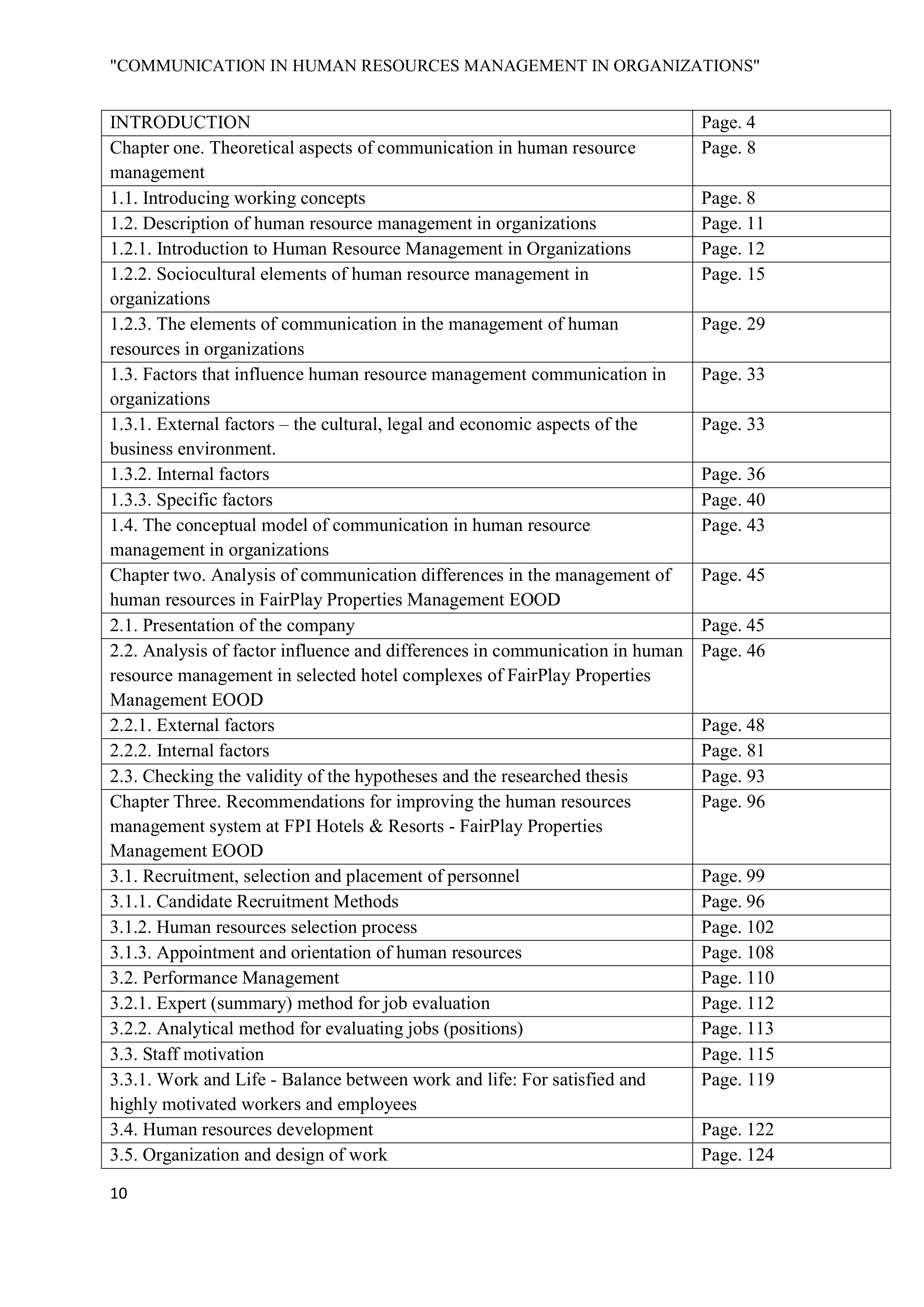
Content of the dissertation
"COMMUNICATION IN HUMAN RESOURCES MANAGEMENT IN ORGANIZATIONS"
10
INTRODUCTION
Page. 4
Chapter one. Theoretical aspects of communication in human resource
management
Page. 8
1.1. Introducing working concepts
Page. 8
1.2. Description of human resource management in organizations
Page. 11
1.2.1. Introduction to Human Resource Management in Organizations
Page. 12
1.2.2. Sociocultural elements of human resource management in
organizations
Page. 15
1.2.3. The elements of communication in the management of human
resources in organizations
Page. 29
1.3. Factors that influence human resource management communication in
organizations
Page. 33
1.3.1. External factors – the cultural, legal and economic aspects of the
business environment.
Page. 33
1.3.2. Internal factors
Page. 36
1.3.3. Specific factors
Page. 40
1.4. The conceptual model of communication in human resource
management in organizations
Page. 43
Chapter two. Analysis of communication differences in the management of
human resources in FairPlay Properties Management EOOD
Page. 45
2.1. Presentation of the company
Page. 45
2.2. Analysis of factor influence and differences in communication in human
resource management in selected hotel complexes of FairPlay Properties
Management EOOD
Page. 46
2.2.1. External factors
Page. 48
2.2.2. Internal factors
Page. 81
2.3. Checking the validity of the hypotheses and the researched thesis
Page. 93
Chapter Three. Recommendations for improving the human resources
management system at FPI Hotels & Resorts - FairPlay Properties
Management EOOD
Page. 96
3.1. Recruitment, selection and placement of personnel
Page. 99
3.1.1. Candidate Recruitment Methods
Page. 96
3.1.2. Human resources selection process
Page. 102
3.1.3. Appointment and orientation of human resources
Page. 108
3.2. Performance Management
Page. 110
3.2.1. Expert (summary) method for job evaluation
Page. 112
3.2.2. Analytical method for evaluating jobs (positions)
Page. 113
3.3. Staff motivation
Page. 115
3.3.1. Work and Life - Balance between work and life: For satisfied and
highly motivated workers and employees
Page. 119
3.4. Human resources development
Page. 122
3.5. Organization and design of work
Page. 124
"COMMUNICATION IN HUMAN RESOURCES MANAGEMENT IN ORGANIZATIONS"
11
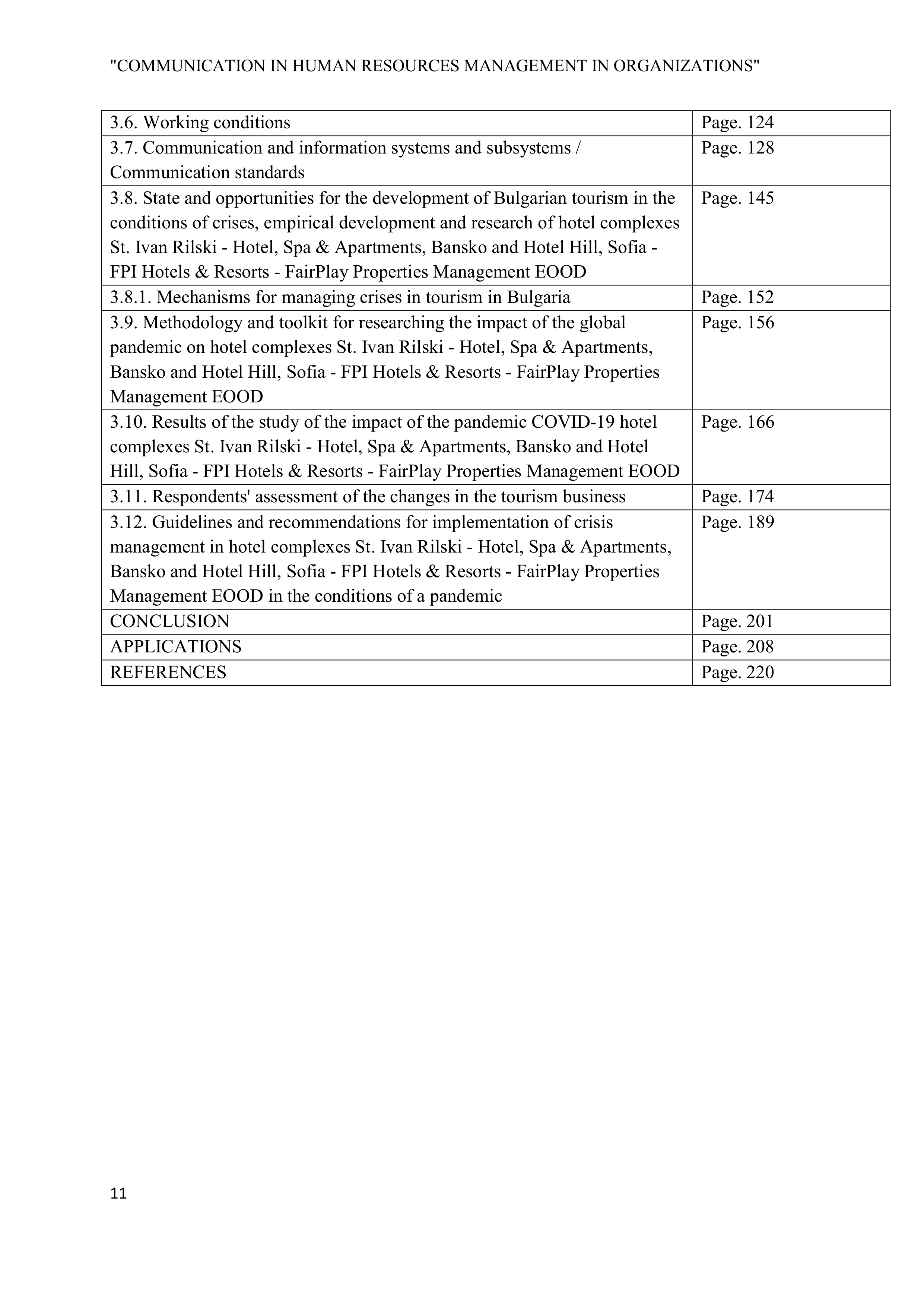
3.6. Working conditions
Page. 124
3.7. Communication and information systems and subsystems /
Communication standards
Page. 128
3.8. State and opportunities for the development of Bulgarian tourism in the
conditions of crises, empirical development and research of hotel complexes
St. Ivan Rilski - Hotel, Spa & Apartments, Bansko and Hotel Hill, Sofia -
FPI Hotels & Resorts - FairPlay Properties Management EOOD
Page. 145
3.8.1. Mechanisms for managing crises in tourism in Bulgaria
Page. 152
3.9. Methodology and toolkit for researching the impact of the global
pandemic on hotel complexes St. Ivan Rilski - Hotel, Spa & Apartments,
Bansko and Hotel Hill, Sofia - FPI Hotels & Resorts - FairPlay Properties
Management EOOD
Page. 156
3.10. Results of the study of the impact of the pandemic COVID-19 hotel
complexes St. Ivan Rilski - Hotel, Spa & Apartments, Bansko and Hotel
Hill, Sofia - FPI Hotels & Resorts - FairPlay Properties Management EOOD
Page. 166
3.11. Respondents' assessment of the changes in the tourism business
Page. 174
3.12. Guidelines and recommendations for implementation of crisis
management in hotel complexes St. Ivan Rilski - Hotel, Spa & Apartments,
Bansko and Hotel Hill, Sofia - FPI Hotels & Resorts - FairPlay Properties
Management EOOD in the conditions of a pandemic
Page. 189
CONCLUSION
Page. 201
APPLICATIONS
Page. 208
REFERENCES
Page. 220
"COMMUNICATION IN HUMAN RESOURCES MANAGEMENT IN ORGANIZATIONS"
12
1. A brief statement of the dissertation
Introduction
The introduction of the dissertation synthesizes the relevance of the research, the
research questions, goals and objectives, the object, the subject and the scope of the research,
which are presented in more detail in the first section of this abstract. Also included in the
introduction is a brief summary of the research part, the author's studies, as well as the
analytical methods and approaches used. The introduction ends with a description of the
structure of the dissertation.
2.
Chapter One: Theoretical foundations and empirical review
2.1.
Introduction of working concepts
The basic concept of human resource management, which is used in the introduction
of this paper, will be clarified using the term human resource management
1
, not personnel
management. According to some authors, these two concepts mean the same thing, namely: "a
term that increasingly refers to the philosophy, policies, procedures and practices related to
the management of people within an organization”
2
. In the scientific literature, there are also
other views on the meaning of the considered concept. Katya Vladimirova considers this term
in a broad and narrow sense: "in its broad sense, the management of human resources in the
organization includes the functions and activities of all management personnel related to the
management of employees. In the narrow sense, it includes the activity of the specialized unit
in the organization for the administration of hired human resources”
3
. Personnel management
is equated to the latter. Mathis and Jackson distinguish the two concepts as follows:
"personnel management is a set of activities focused on the operational management of
human resources in the organization, and human resource management is related to the
strategic planning and management of these resources"
4
. Associate Professor Apostol
Apostolov presents a similar view: "human resources management encompasses the strategic
aspects of solving problems, including issues of social development, and "personnel
management" to a greater extent refers to operational work with personnel"
5
In view of the specificity of the present work, which examines the influence of
communication in the management of human resources in organizations not only at the
operational, but also at the strategic level, covering the main management functions, a more
complete definition is needed to avoid ambiguity of both terms. As such, we accept the
definition given by E. Flipo, namely: "human resources management in the organization is
planning, organizing, leading and controlling recruitment, selection, development, payment,
the integration, maintenance and release of human resources in order to achieve determined
1
The concept is considered at the level of an organization, not at the level of government.
2
French, Wendell L., Human Resources Management, Houghton Mifflin Company, 1998, р. 4.
3
Владимирова, К., „Управление на човешките ресурси”, Университетско издателство „Стопанство”, С2006, с. 6-7.
4
Mathis, Robert L., John H. Jackson, Personnel / Human Resource Management, Fifth Edition, 1988, p6.
5
Владимирова, К., „Управление на човешките ресурси”, Университетско издателство „Стопанство”, С2006, с. 30-45.
"COMMUNICATION IN HUMAN RESOURCES MANAGEMENT IN ORGANIZATIONS"
13
individual, organizational and public interests“
6
. In the thus presented interpretation of the
considered concept, this author includes the main management functions, together with the
main elements of the human resources management system in the organization. An important
point is the consideration of the heterogeneous goals (individual, organizational and public),
which have a significant impact on the parameters of this system.
After the concept of human resources management has been clarified, the very object
of the present research should be clarified - communication in the management of human
resources in organizations. Each communication system is a set of elements arranged in a
certain way and related to certain relationships. The components of communication in the
management of human resources in organizations are of interest in this dissertation. They are
divided into two main groups: sociocultural and technocratic elements. The first is
characterized by the expressed influence of the individual's personal characteristics, his
values, beliefs, attitudes, interpersonal relationships, traditions, communicativeness, directed
to a greater extent to the intangible sphere of activity in the organization. Technocratic
elements are primarily tied to the material manifestation of labor and the tangible realization
of the relations accompanying it. The group of socio-cultural elements includes recruitment,
selection and appointment; performance management; motivation; human resource
development. Organization and design of work in the organization are considered
technocratic; working conditions; communication and information subsystem.
2.2.
Introduction to Human Resource Management in Organizations
In addition to the systemic view of the management of human resources in the
organization, which refers to the interdependence of its elements, there is also a process
approach to the consideration of HRM
7
. Here we mean the processual nature of the elements
of human resource management in organizations, which consist of a linear set of related
activities and procedures leading to a certain result (for example, the process of recruiting
workers and employees, which aims to satisfy the needs of the company by staff).
The activities or elements of human resources management mean the processes of:
- analysis of the positions - study of the positions and the requirements for the
contractors;
- design of the positions - determination of the content, actions and connections of the
positions;
- human resources planning - determining the need for human resources and outlining
the ways to satisfy them;
- selection - actions to attract, evaluate, select, appoint job candidates;
- training and development - improvement of skills and knowledge, career growth;
- assessment – assessment of work performance and guidelines for its improvement;
- remunerations – determination of fair remuneration for work;
- ensuring safe and healthy working conditions - protecting the health of employees
and improving working conditions;
6
Flippo, E., Personnel Management, Mc Craw-Hill, 1988, p. 5.
7
17 French, Wendell L., Human Resources Management, Houghton Mifflin Company, 1998, р. 6.
"COMMUNICATION IN HUMAN RESOURCES MANAGEMENT IN ORGANIZATIONS"
14
- improvement of labor relations - creation and maintenance of a favorable, peaceful
climate in the organization and the relations between the managed and the managers
8
.
An essential part in characterizing the human resources management system is the
representation of the elements listed above, functioning in close connection with each other.
For example, the analysis of positions and the design of positions, through its data, determines
the criteria for selection and evaluation, the conditions of work and rest, the system of pay,
etc. and thus turns out to be the main factor in the relationship between the managed and the
managers. Human resource planning develops plans for the development of all elements of
human resource management. Gaps in selection create subsequent difficulties in assessment,
training, etc. Training and development satisfies the need to acquire new knowledge and
skills, to grow and from this ch. t. has an impact on remuneration, labor relations, motivation.
The assessment, on the other hand, provides insight into training and development needs. The
payment of labor is related to all other elements and is an expression of their functioning.
Ensuring safe and healthy working conditions directly affects working and rest conditions, for
example, which is reflected in the determination of remuneration, changes in job content, etc.,
and this is largely related to the improvement of labor relations in the organization.
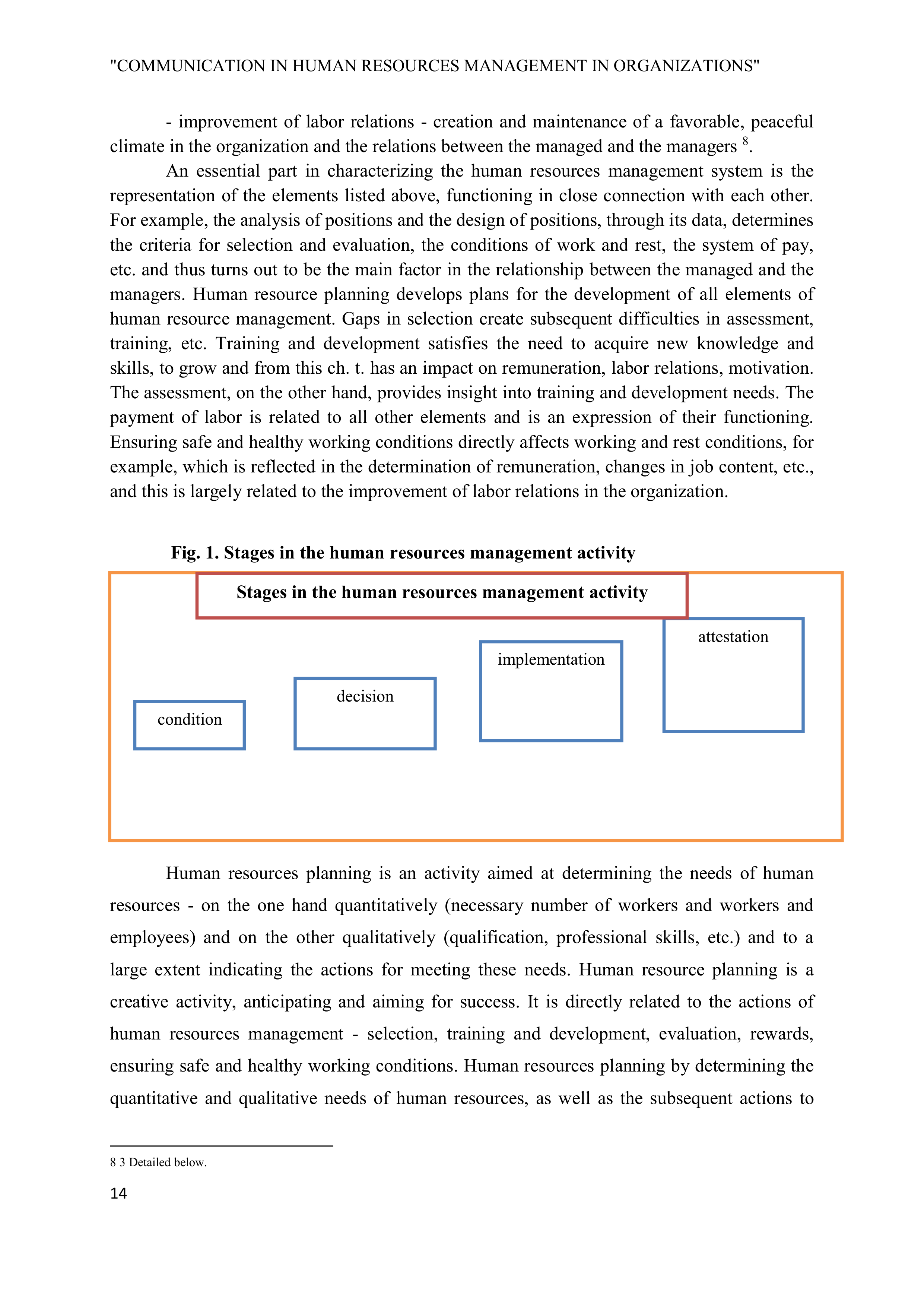
Fig. 1. Stages in the human resources management activity
Източник: Собствен
Планиране на човешките ресурси
Human resources planning is an activity aimed at determining the needs of human
resources - on the one hand quantitatively (necessary number of workers and workers and
employees) and on the other qualitatively (qualification, professional skills, etc.) and to a
large extent indicating the actions for meeting these needs. Human resource planning is a
creative activity, anticipating and aiming for success. It is directly related to the actions of
human resources management - selection, training and development, evaluation, rewards,
ensuring safe and healthy working conditions. Human resources planning by determining the
quantitative and qualitative needs of human resources, as well as the subsequent actions to
8 3 Detailed below.
condition
decision
implementation
attestation
Stages in the human resources management activity
"COMMUNICATION IN HUMAN RESOURCES MANAGEMENT IN ORGANIZATIONS"
15
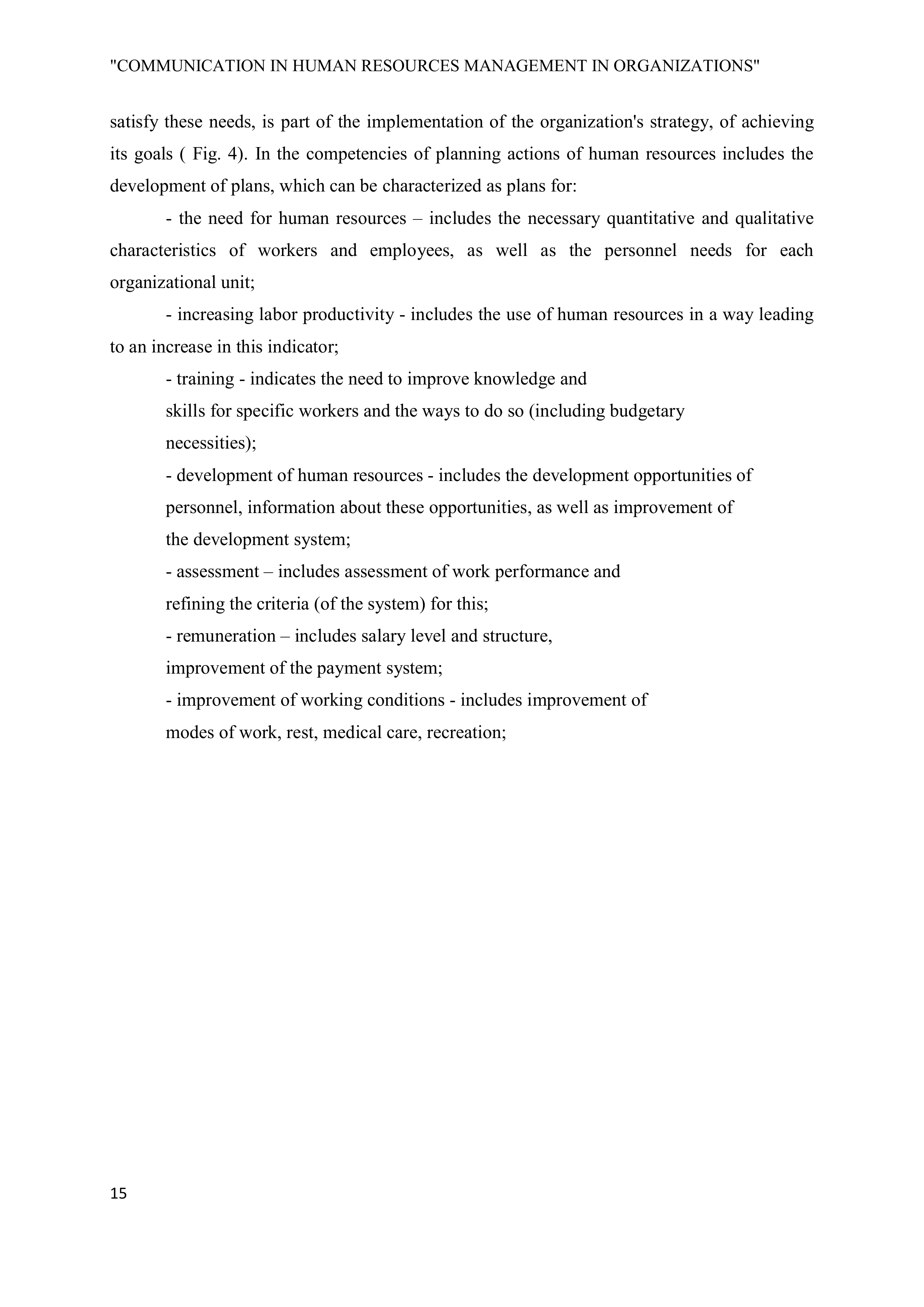
satisfy these needs, is part of the implementation of the organization's strategy, of achieving
its goals ( Fig. 4). In the competencies of planning actions of human resources includes the
development of plans, which can be characterized as plans for:
- the need for human resources – includes the necessary quantitative and qualitative
characteristics of workers and employees, as well as the personnel needs for each
organizational unit;
- increasing labor productivity - includes the use of human resources in a way leading
to an increase in this indicator;
- training - indicates the need to improve knowledge and
skills for specific workers and the ways to do so (including budgetary
necessities);
- development of human resources - includes the development opportunities of
personnel, information about these opportunities, as well as improvement of
the development system;
- assessment – includes assessment of work performance and
refining the criteria (of the system) for this;
- remuneration – includes salary level and structure,
improvement of the payment system;
- improvement of working conditions - includes improvement of
modes of work, rest, medical care, recreation;
"COMMUNICATION IN HUMAN RESOURCES MANAGEMENT IN ORGANIZATIONS"
16
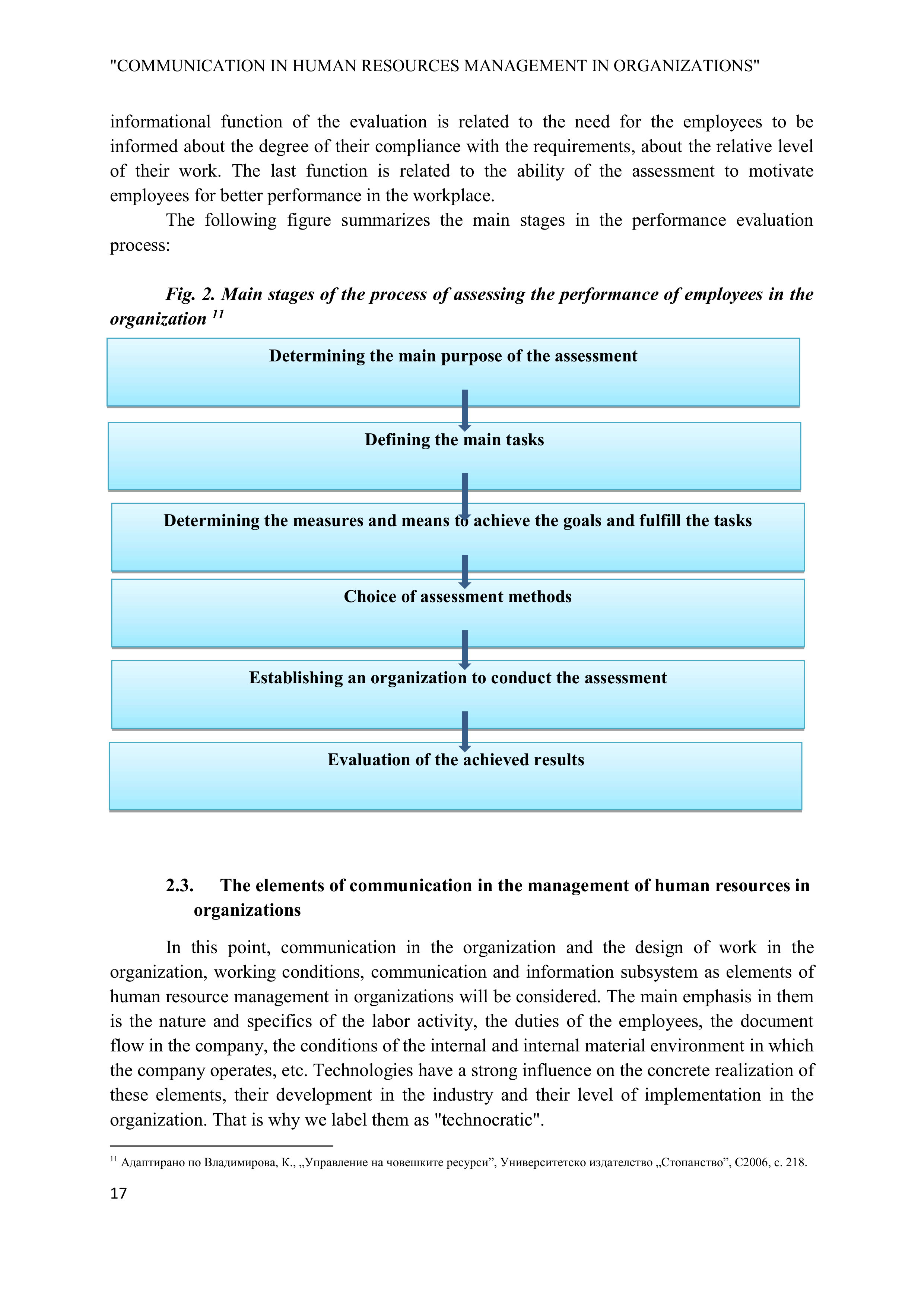
Fig. 4 – HR Planning
9
Performance Management
The management of human resources requires continuous work for the improvement
of the implementation, for the improvement of the achieved results, for increasing the quality
and productivity of work ”
10
. At the heart of successful performance management is
communication in evaluating the work performance of employees. This means determining
the suitability, the degree of labor efficiency of each of the organization's human resources
system. Assessment fulfills three main functions: administrative, informational and
motivational. Wendell L. French includes in the evaluation process (which he defines as "the
ongoing assessment of individual and group contributions to the organization") and informing
stakeholders of the results obtained. This is a very important point that is related to the
motivation of the employee, the improvement of his performance and the effectiveness of the
evaluation system as a whole. Evaluation performs three main functions: administrative,
informational and motivational. The first is related to the further status of the employee.
Possible solutions are promotion, demotion, transfer, release. The communication and
9
Source: Own
10
Владимирова, К., „Управление на човешките ресурси”, Университетско издателство „Стопанство”, С2006, с. 212.
Human resource planning
organization's purpose
formulation of actions to satisfy the
the needs of human resources
determination of quantitative and qualitative needs of
human resources





"COMMUNICATION IN HUMAN RESOURCES MANAGEMENT IN ORGANIZATIONS"
17
informational function of the evaluation is related to the need for the employees to be
informed about the degree of their compliance with the requirements, about the relative level
of their work. The last function is related to the ability of the assessment to motivate
employees for better performance in the workplace.
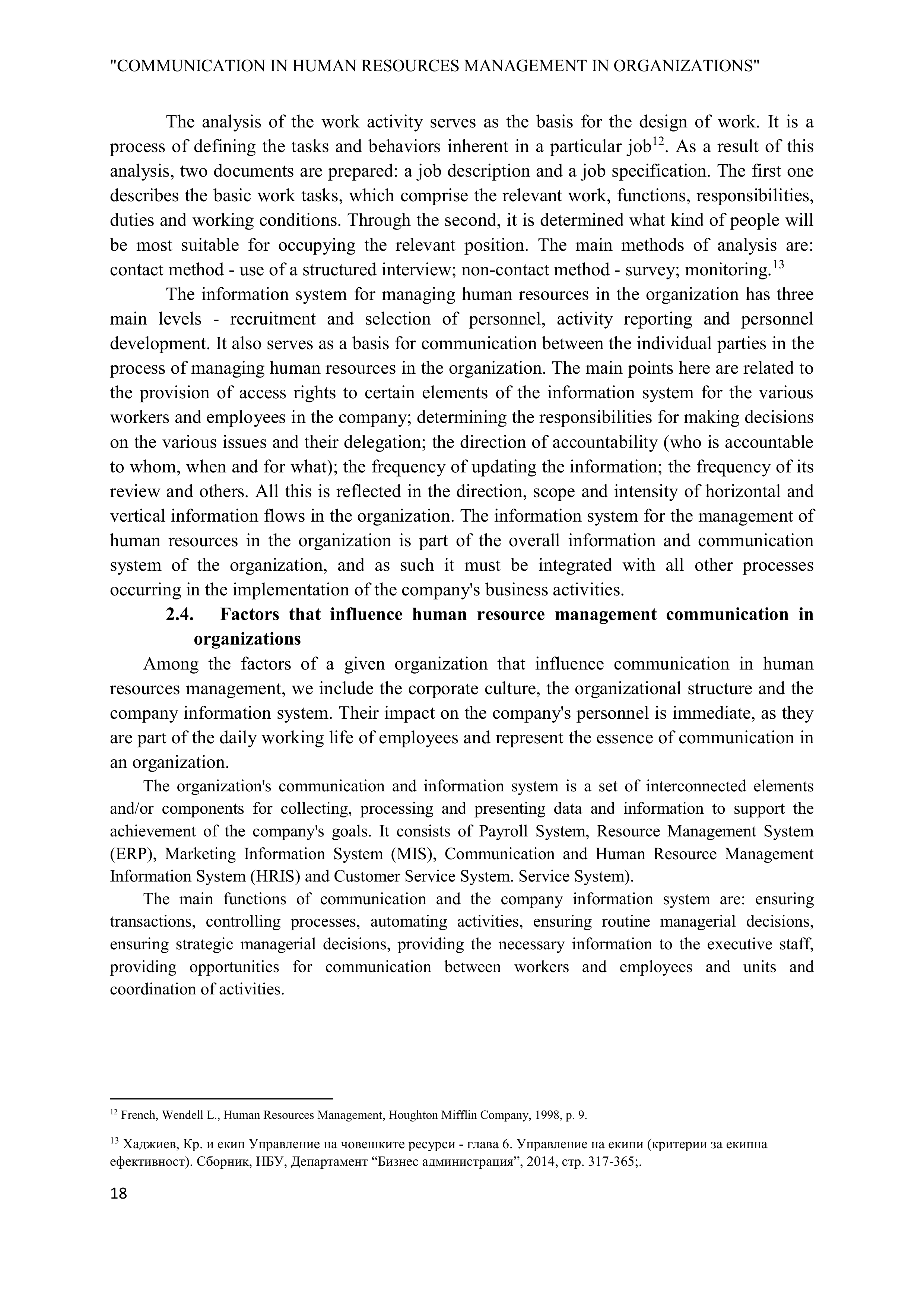
The following figure summarizes the main stages in the performance evaluation
process:
Fig. 2. Main stages of the process of assessing the performance of employees in the
organization
11
2.3.
The elements of communication in the management of human resources in
organizations
In this point, communication in the organization and the design of work in the
organization, working conditions, communication and information subsystem as elements of
human resource management in organizations will be considered. The main emphasis in them
is the nature and specifics of the labor activity, the duties of the employees, the document
flow in the company, the conditions of the internal and internal material environment in which
the company operates, etc. Technologies have a strong influence on the concrete realization of
these elements, their development in the industry and their level of implementation in the
organization. That is why we label them as "technocratic".
11
Адаптирано по Владимирова, К., „Управление на човешките ресурси”, Университетско издателство „Стопанство”, С2006, с. 218.
Determining the main purpose of the assessment
Defining the main tasks
Determining the measures and means to achieve the goals and fulfill the tasks
Choice of assessment methods
Establishing an organization to conduct the assessment
Evaluation of the achieved results
"COMMUNICATION IN HUMAN RESOURCES MANAGEMENT IN ORGANIZATIONS"
18
The analysis of the work activity serves as the basis for the design of work. It is a
process of defining the tasks and behaviors inherent in a particular job
12
. As a result of this
analysis, two documents are prepared: a job description and a job specification. The first one
describes the basic work tasks, which comprise the relevant work, functions, responsibilities,
duties and working conditions. Through the second, it is determined what kind of people will
be most suitable for occupying the relevant position. The main methods of analysis are:
contact method - use of a structured interview; non-contact method - survey; monitoring.
13
The information system for managing human resources in the organization has three
main levels - recruitment and selection of personnel, activity reporting and personnel
development. It also serves as a basis for communication between the individual parties in the
process of managing human resources in the organization. The main points here are related to
the provision of access rights to certain elements of the information system for the various
workers and employees in the company; determining the responsibilities for making decisions
on the various issues and their delegation; the direction of accountability (who is accountable
to whom, when and for what); the frequency of updating the information; the frequency of its
review and others. All this is reflected in the direction, scope and intensity of horizontal and
vertical information flows in the organization. The information system for the management of
human resources in the organization is part of the overall information and communication
system of the organization, and as such it must be integrated with all other processes
occurring in the implementation of the company's business activities.
2.4.
Factors that influence human resource management communication in
organizations
Among the factors of a given organization that influence communication in human
resources management, we include the corporate culture, the organizational structure and the
company information system. Their impact on the company's personnel is immediate, as they
are part of the daily working life of employees and represent the essence of communication in
an organization.
The organization's communication and information system is a set of interconnected elements
and/or components for collecting, processing and presenting data and information to support the
achievement of the company's goals. It consists of Payroll System, Resource Management System
(ERP), Marketing Information System (MIS), Communication and Human Resource Management
Information System (HRIS) and Customer Service System. Service System).
The main functions of communication and the company information system are: ensuring
transactions, controlling processes, automating activities, ensuring routine managerial decisions,
ensuring strategic managerial decisions, providing the necessary information to the executive staff,
providing opportunities for communication between workers and employees and units and
coordination of activities.
12
French, Wendell L., Human Resources Management, Houghton Mifflin Company, 1998, р. 9.
13
Хаджиев, Кр. и екип Управление на човешките ресурси - глава 6. Управление на екипи (критерии за екипна
ефективност). Сборник, НБУ, Департамент “Бизнес администрация”, 2014, стр. 317-365;.






"COMMUNICATION IN HUMAN RESOURCES MANAGEMENT IN ORGANIZATIONS"
19
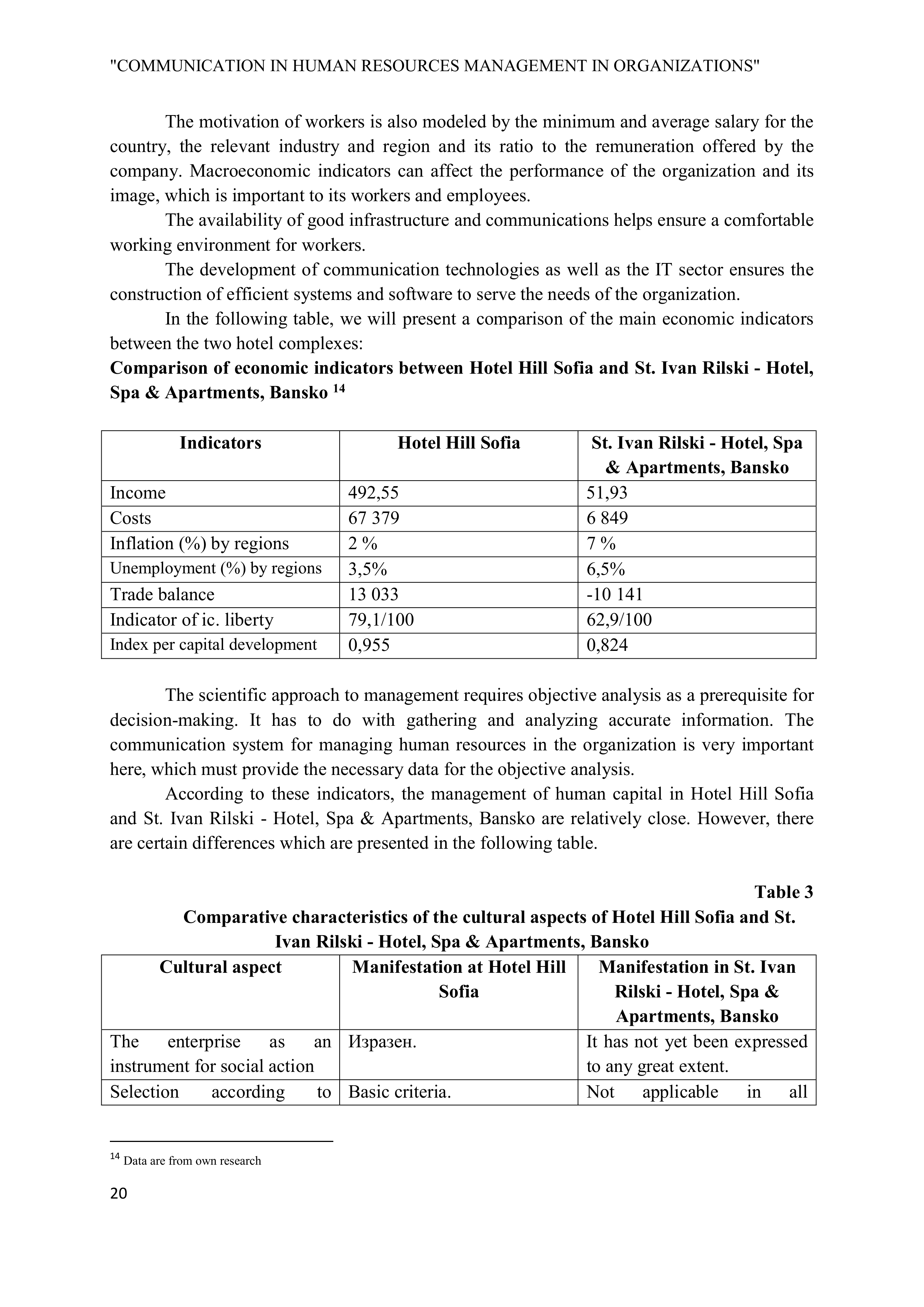
Fig. 6. Conceptual model of communication in the management of human resources in
organizations
3.3. Chapter two. Analysis of communication differences in the management of
human resources in FairPlay Properties Management EOOD
3.3.1. Analysis of factor influence and differences in communication in human
resource management in selected hotel complexes of FairPlay Properties Management
EOOD
The development of the media in the country has a great influence on the recruitment
of workers and employees, as they are the main means of communication with potential job
candidates. The development of the relevant industry and its popularity may have an impact
on the number of documents submitted. The location of the company and the available
infrastructure in that area also have such an impact.
Corporate strategy
Communication elements
Technocratic elements
Recruitment, selection and
appointment
Performance Management
Motivation
Development of human resources
Organization and design of work
Working conditions
Communication and information
subsystem
Internal factors
The corporate culture
Organizational structure
The company information system
Specific factors
Cultural aspects with a direct impact on
managerial practices
Managerial styles
Background of management
External factors
Cultural aspects (language, religion, values and attitudes, behavior and customs, aesthetics, education and
social institutions)
Legal aspects (regulations, trade unions, co-determination)
Economic aspects (development of the media in the country, influence of international business,
infrastructure, fiscal stability of the state, development of the banking system and others, reflected through
a
number of indicators)
"COMMUNICATION IN HUMAN RESOURCES MANAGEMENT IN ORGANIZATIONS"
20
The motivation of workers is also modeled by the minimum and average salary for the
country, the relevant industry and region and its ratio to the remuneration offered by the
company. Macroeconomic indicators can affect the performance of the organization and its
image, which is important to its workers and employees.
The availability of good infrastructure and communications helps ensure a comfortable
working environment for workers.
The development of communication technologies as well as the IT sector ensures the
construction of efficient systems and software to serve the needs of the organization.
In the following table, we will present a comparison of the main economic indicators
between the two hotel complexes:
Comparison of economic indicators between Hotel Hill Sofia and St. Ivan Rilski - Hotel,
Spa & Apartments, Bansko
14
Indicators
Hotel Hill Sofia
St. Ivan Rilski - Hotel, Spa
& Apartments, Bansko
Income
492,55
51,93
Costs
67 379
6 849
Inflation (%) by regions
2 %
7 %
Unemployment (%) by regions
3,5%
6,5%
Trade balance
13 033
-10 141
Indicator of ic. liberty
79,1/100
62,9/100
Index per capital development
0,955
0,824
The scientific approach to management requires objective analysis as a prerequisite for
decision-making. It has to do with gathering and analyzing accurate information. The
communication system for managing human resources in the organization is very important
here, which must provide the necessary data for the objective analysis.
According to these indicators, the management of human capital in Hotel Hill Sofia
and St. Ivan Rilski - Hotel, Spa & Apartments, Bansko are relatively close. However, there
are certain differences which are presented in the following table.
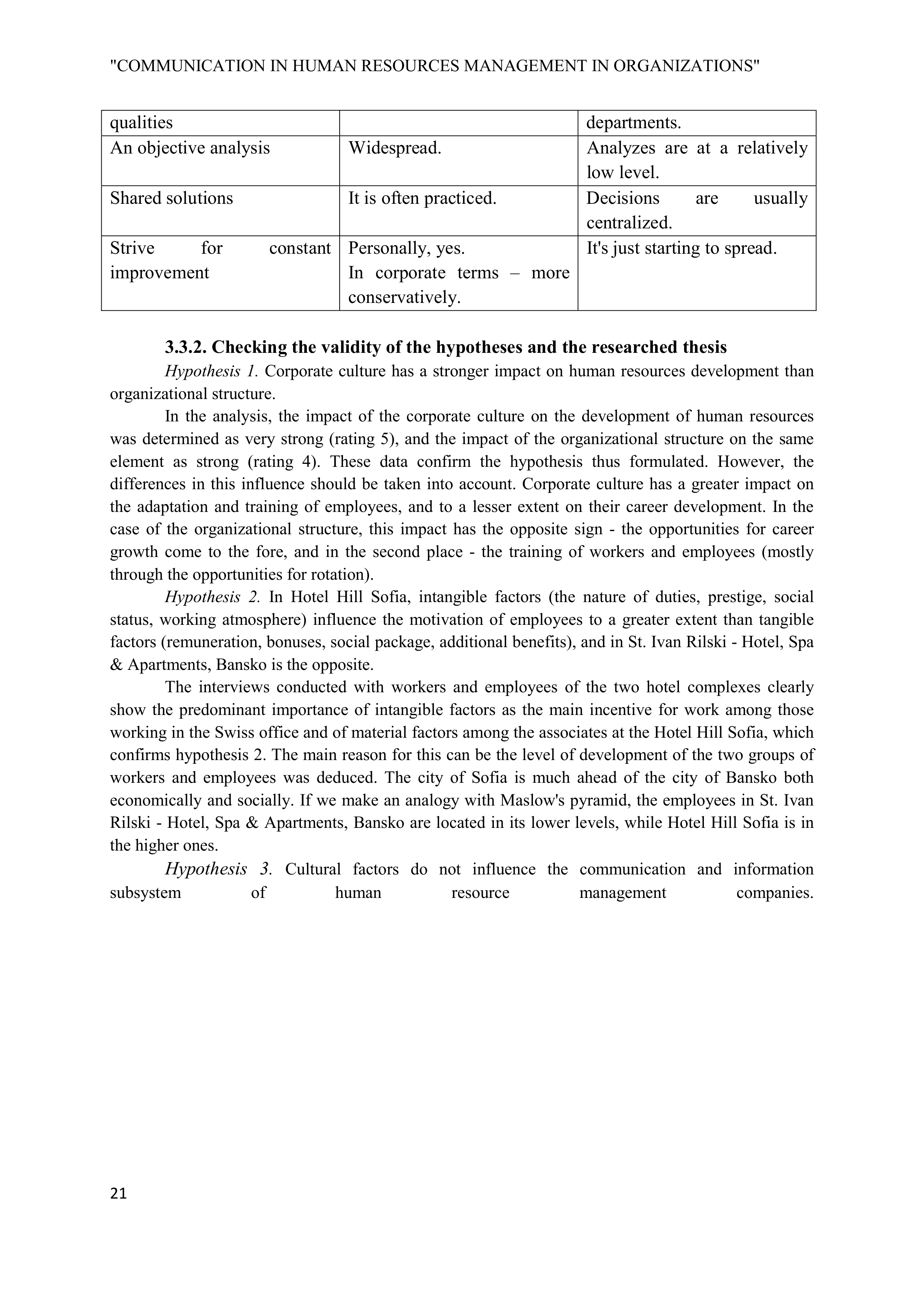
Table 3
Comparative characteristics of the cultural aspects of Hotel Hill Sofia and St.
Ivan Rilski - Hotel, Spa & Apartments, Bansko
Cultural aspect
Manifestation at Hotel Hill
Sofia
Manifestation in St. Ivan
Rilski - Hotel, Spa &
Apartments, Bansko
The
enterprise
as
an
instrument for social action
Изразен.
It has not yet been expressed
to any great extent.
Selection
according
to Basic criteria.
Not
applicable
in
all
14
Data are from own research
"COMMUNICATION IN HUMAN RESOURCES MANAGEMENT IN ORGANIZATIONS"
21
qualities
departments.
An objective analysis
Widespread.
Analyzes are at a relatively
low level.
Shared solutions
It is often practiced.
Decisions
are
usually
centralized.
Strive
for
constant
improvement
Personally, yes.
In corporate terms – more
conservatively.
It's just starting to spread.
3.3.2. Checking the validity of the hypotheses and the researched thesis
Hypothesis 1.
Corporate culture has a stronger impact on human resources development than
organizational structure.
In the analysis, the impact of the corporate culture on the development of human resources
was determined as very strong (rating 5), and the impact of the organizational structure on the same
element as strong (rating 4). These data confirm the hypothesis thus formulated. However, the
differences in this influence should be taken into account. Corporate culture has a greater impact on
the adaptation and training of employees, and to a lesser extent on their career development. In the
case of the organizational structure, this impact has the opposite sign - the opportunities for career
growth come to the fore, and in the second place - the training of workers and employees (mostly
through the opportunities for rotation).
Hypothesis 2.
In Hotel Hill Sofia, intangible factors (the nature of duties, prestige, social
status, working atmosphere) influence the motivation of employees to a greater extent than tangible
factors (remuneration, bonuses, social package, additional benefits), and in St. Ivan Rilski - Hotel, Spa
& Apartments, Bansko is the opposite.
The interviews conducted with workers and employees of the two hotel complexes clearly
show the predominant importance of intangible factors as the main incentive for work among those
working in the Swiss office and of material factors among the associates at the Hotel Hill Sofia, which
confirms hypothesis 2. The main reason for this can be the level of development of the two groups of
workers and employees was deduced. The city of Sofia is much ahead of the city of Bansko both
economically and socially. If we make an analogy with Maslow's pyramid,
the employees in St. Ivan
Rilski - Hotel, Spa & Apartments, Bansko are located in its lower levels, while Hotel Hill Sofia is in
the higher ones.
Hypothesis 3.
Cultural factors do not influence the communication and information
subsystem
of
human
resource
management
companies.
"COMMUNICATION IN HUMAN RESOURCES MANAGEMENT IN ORGANIZATIONS"
22
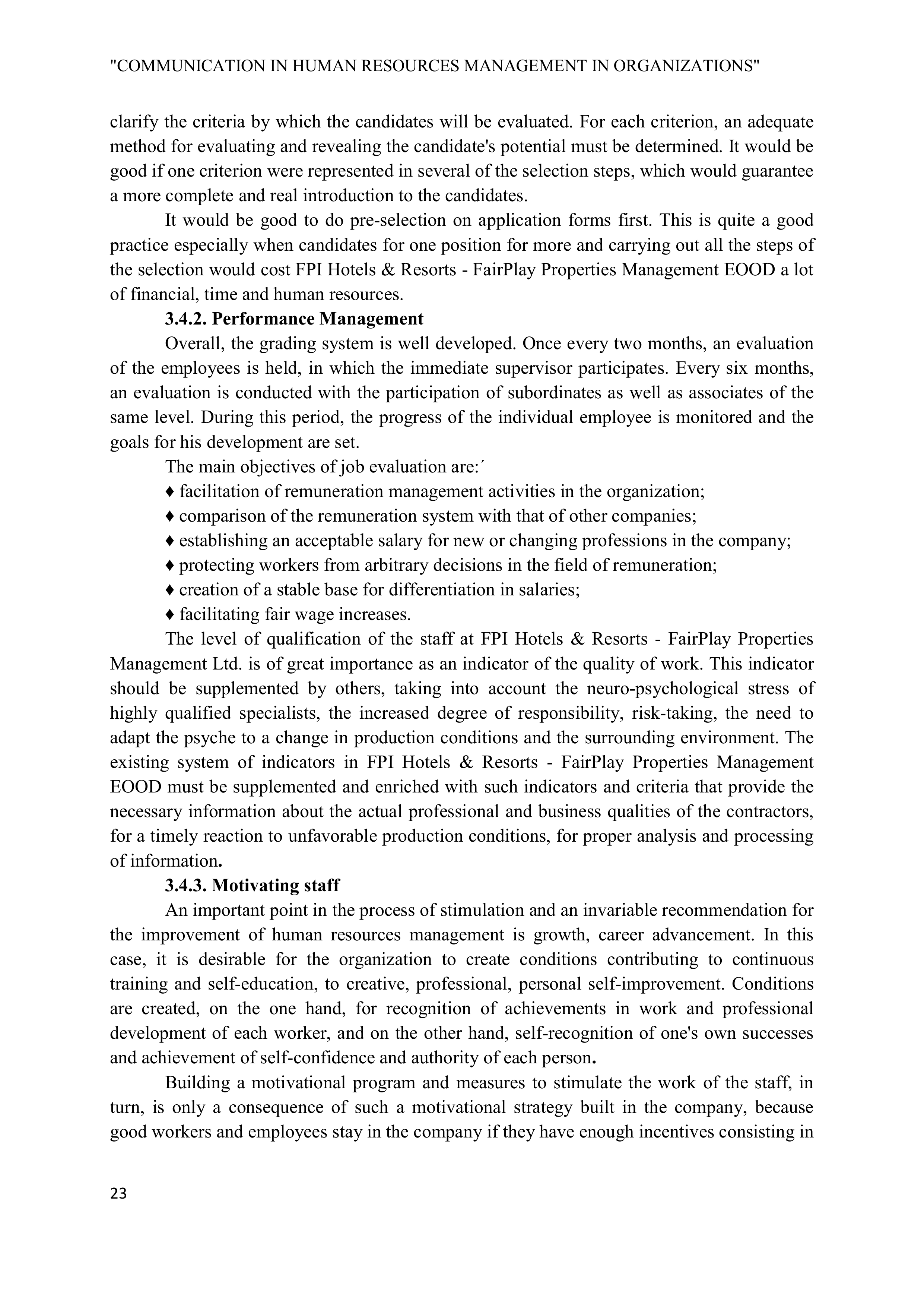
The sociocultural elements of HRM communication are more influenced by
intercultural differences than technocratic ones.
Table 4
Assessments of the impact of the considered factors on the elements of
communication in human resource management
15
Elements of communication in human
resource management
Assessments
Average rating
Recruitment, selection and appointment
5, 3, 4, 5, 5
4,40
Performance Management
4, 5
4,50
Motivation
3, 4, 4, 3, 3, 4, 4, 3, 4, 5
3,70
Human resources development
4, 5, 5, 4, 5, 5
4,67
General for the sociocultural
96 p.;
24 average
4,17
Organization and design of work
3, 3, 3, 3, 3, 4, 4, 4, 5
3,56
Working conditions
4, 3, 4, 2, 3, 5
3,50
Communication and information
subsystem
4, 3, 4, 5, 4, 5
4,17
Total for the technocratic:
78 p.;
26 average
3,71
3.4. Chapter Three. Recommendations for improving the human resources
management system at FPI Hotels & Resorts - FairPlay Properties Management EOOD
In this chapter, some suggestions will be made for optimizing the elements of
communication in human resource management in both complexes. The structure of the
exposition will follow the logic of their presentation in chapter one.
3.4.1. Recruitment, selection and placement of personnel
A recommendation can be made to both hotel complexes to diversify the means of
communication with potential job candidates. This can be realized by adding a "Careers"
section on the organization's website https://www.fpihotels.com/, where timely and detailed
information about vacant positions will be provided. Other opportunities for recruiting quality
staff and improving the company's image are: participation in career forums, organizing an
open day, maintaining close contacts with university career centers, departments and student
organizations.
During the selection in St. Ivan Rilski - Hotel, Spa & Apartments, Bansko, more
diverse methods can be used (besides selection based on documents and interview) such as
semi-structured and structured interview, situational interview, which cover to a greater extent
the qualities sought in candidates. What is missing in the selection process is assessing the
motivation of the candidates. Emphasis is placed more on their professional qualities. In this
regard, additional questions can be included in the interview, as well as the preparation of a
motivation letter when applying.
Once the appropriate number and type of candidates have been attracted, they should
go through a precise and professional selection in order to find the most correct and suitable
of them. The first step in FPI Hotels & Resorts - FairPlay Properties Management EOOD is to
15
A full breakdown of the influence of all factors on all elements is presented in Appendix 3. Research is author's.
"COMMUNICATION IN HUMAN RESOURCES MANAGEMENT IN ORGANIZATIONS"
23
clarify the criteria by which the candidates will be evaluated. For each criterion, an adequate
method for evaluating and revealing the candidate's potential must be determined. It would be
good if one criterion were represented in several of the selection steps, which would guarantee
a more complete and real introduction to the candidates.
It would be good to do pre-selection on application forms first. This is quite a good
practice especially when candidates for one position for more and carrying out all the steps of
the selection would cost FPI Hotels & Resorts - FairPlay Properties Management EOOD a lot
of financial, time and human resources.
3.4.2. Performance Management
Overall, the grading system is well developed. Once every two months, an evaluation
of the employees is held, in which the immediate supervisor participates. Every six months,
an evaluation is conducted with the participation of subordinates as well as associates of the
same level. During this period, the progress of the individual employee is monitored and the
goals for his development are set.
The main objectives of job evaluation are:´
♦ facilitation of remuneration management activities in the organization;
♦ comparison of the remuneration system with that of other companies;
♦ establishing an acceptable salary for new or changing professions in the company;
♦ protecting workers from arbitrary decisions in the field of remuneration;
♦ creation of a stable base for differentiation in salaries;
♦ facilitating fair wage increases.
The level of qualification of the staff at FPI Hotels & Resorts - FairPlay Properties
Management Ltd. is of great importance as an indicator of the quality of work. This indicator
should be supplemented by others, taking into account the neuro-psychological stress of
highly qualified specialists, the increased degree of responsibility, risk-taking, the need to
adapt the psyche to a change in production conditions and the surrounding environment. The
existing system of indicators in FPI Hotels & Resorts - FairPlay Properties Management
EOOD must be supplemented and enriched with such indicators and criteria that provide the
necessary information about the actual professional and business qualities of the contractors,
for a timely reaction to unfavorable production conditions, for proper analysis and processing
of information
.
3.4.3. Motivating staff
An important point in the process of stimulation and an invariable recommendation for
the improvement of human resources management is growth, career advancement. In this
case, it is desirable for the organization to create conditions contributing to continuous
training and self-education, to creative, professional, personal self-improvement. Conditions
are created, on the one hand, for recognition of achievements in work and professional
development of each worker, and on the other hand, self-recognition of one's own successes
and achievement of self-confidence and authority of each person
.
Building a motivational program and measures to stimulate the work of the staff, in
turn, is only a consequence of such a motivational strategy built in the company, because
good workers and employees stay in the company if they have enough incentives consisting in
"COMMUNICATION IN HUMAN RESOURCES MANAGEMENT IN ORGANIZATIONS"
24
good is a strong competitive advantage and a factor for increasing the company's productivity
and efficiency.
Through the use of modern forms of labor stimulation, such as training, specialization
in certain fields, qualification of personnel, a higher general level of knowledge in the
required areas, a higher mastery of the newly emerging work style, a new culture in terms of
service, advertising, as well as overall growth in terms of their work habits. The highly
qualified employee (worker), stimulated through ongoing training, opportunities for
originality in certain areas, creative spirit and entrepreneurial risk, has earned promotion to
the position he occupies, earned the respect of colleagues, stepped one step up in the hierarchy
of the company in which he works and will continue to climb, improving his skills and
abilities, reaching the degree of satisfaction with his own achievements and self-respect, as
long as there are forms of stimulation of his work. FPI Hotels & Resorts - FairPlay Properties
Management EOOD needs exactly this type of workers in order to turn the management of
labor resources into a more perfect and maximally efficient one to achieve the set company
goals.
3.4.4. Organization and design of work. Working conditions.
The organization of work at the Hotel Hill Sofia is without special remarks. This is
one of the main reasons for the efficient running of business activities and the high
results achieved by employees.
Opportunities to optimize the activity can be sought in the following areas:
Stricter control over compliance with working hours.
Setting individual goals and monitoring their achievement.
Diversification of activity by expanding responsibilities and/or adding new tasks; use
of employee rotation.
Introduction of a team principle of work where possible (when executed on mini
projects, for example).
Periodic updating of job descriptions (at least once a year).
Conducting an annual analysis of positions and performing activities and searching for
opportunities to optimize them.
Working conditions in both divisions are very good. They meet all the requirements
for safe and healthy work, and also provide an excellent working atmosphere. A
recommendation that applies to both hotel complexes can be the preparation of a
written policy and strategy for managing working conditions and determining their
place in the overall strategy of the organization. There is currently no such one. Such a
policy will justify the existing rules and regulations, and the strategy will give
direction to their development and a clearer vision for the management of working
conditions in the organization.
3.4.5. Communication and information systems and subsystem / Communication
standards
The communication and information system of FPI Hotels & Resorts - FairPlay
Properties Management EOOD must be a set of interconnected elements and/or components
for collecting, processing and presenting data and information to support the achievement of
the goals of the hotel chain. It should consist of Payroll System, Resource Management




"COMMUNICATION IN HUMAN RESOURCES MANAGEMENT IN ORGANIZATIONS"
25
System (ERP), Marketing Information System (MIS), Communication and Human Resource
Management Information System (HRIS) and Customer Service System. (Customer Service
System).
The human resources management information system must take into account the
specifics of the relevant complex. In view of the future development of FPI Hotels & Resorts
- FairPlay Properties Management EOOD, a plan must be drawn up for the expansion of the
communication and information system in human resources management, its unification and
its gradual implementation in all hotels and hotel complexes of the company. One of the main
problems will be its compatibility with the existing company information system.
The objectives and standards of the procedure are to determine the correct
communication channels and rules. The rule is – no division between the work of the central
office and the hotel complexes. It is not necessary for everyone to be informed about
everything, it is important that the information reaches all concerned parties.
The main functions of communication and the company information system are: ensuring
transactions, controlling processes, automating activities, ensuring routine managerial
decisions, ensuring strategic managerial decisions, providing the necessary information to the
executive staff, providing opportunities for communication between workers and employees
and units and coordination of activities.
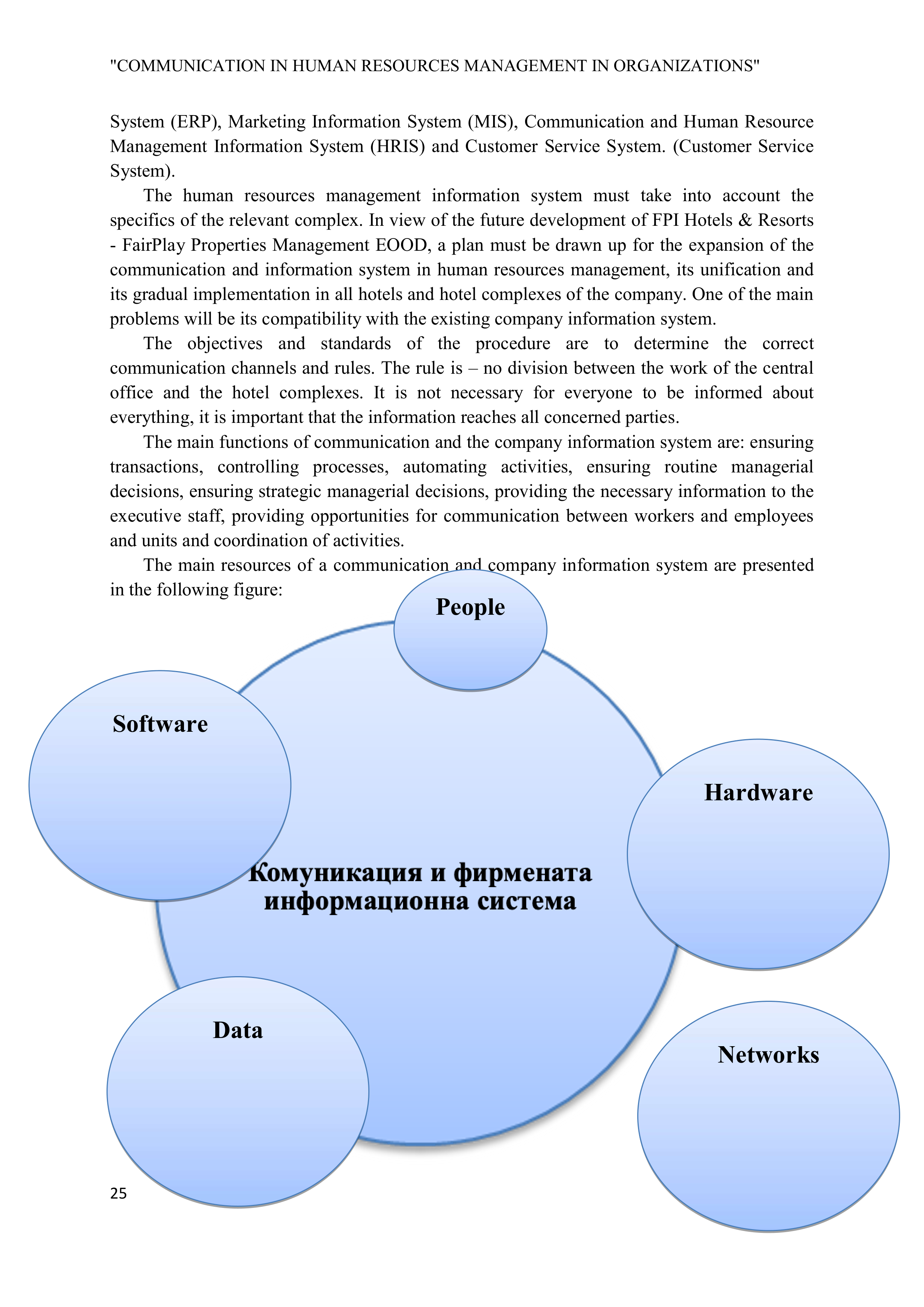
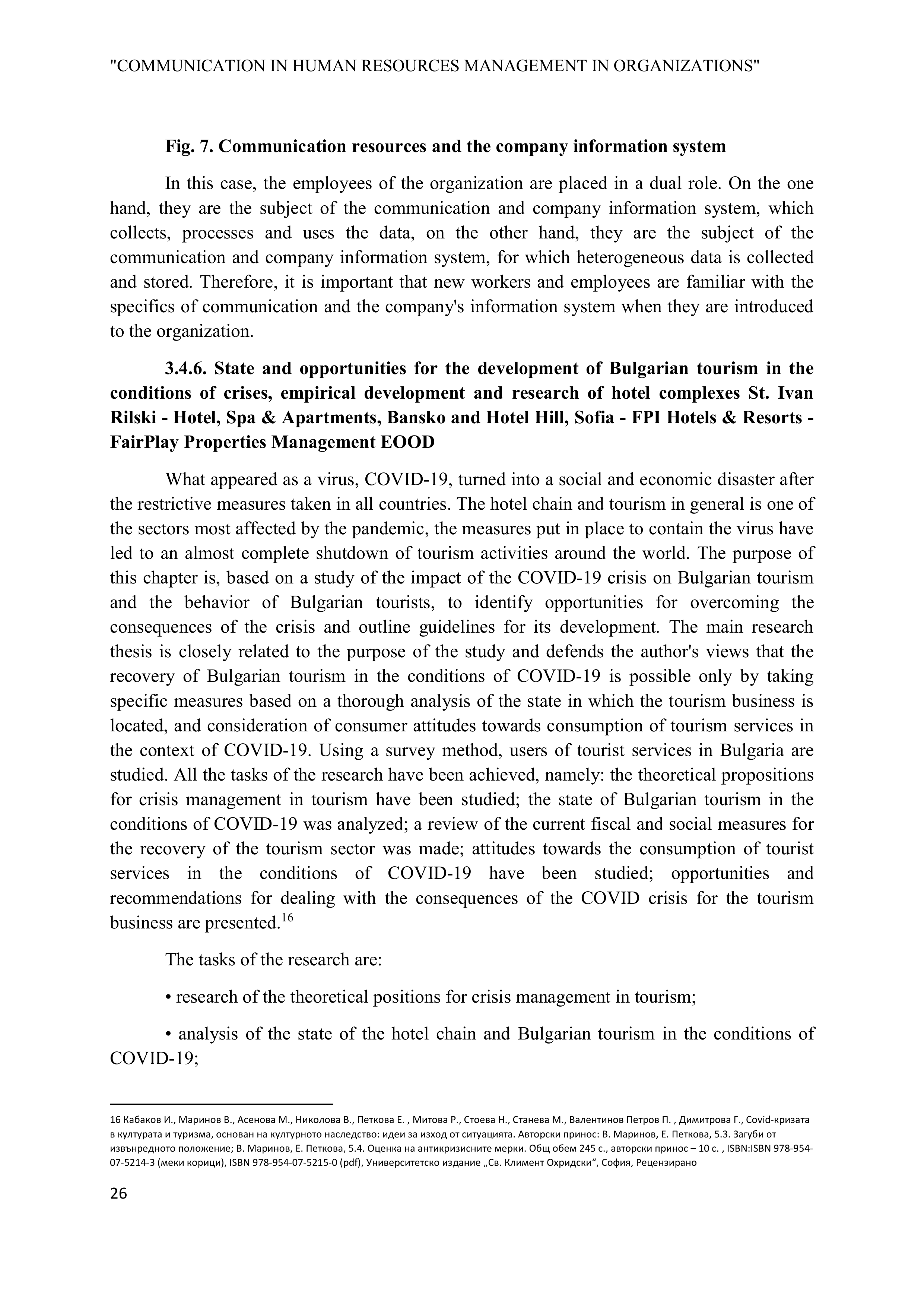
The main resources of a communication and company information system are presented
in the following figure:
Software
Hardware
Data
Networks
People
"COMMUNICATION IN HUMAN RESOURCES MANAGEMENT IN ORGANIZATIONS"
26
Fig. 7. Communication resources and the company information system
In this case, the employees of the organization are placed in a dual role. On the one
hand, they are the subject of the communication and company information system, which
collects, processes and uses the data, on the other hand, they are the subject of the
communication and company information system, for which heterogeneous data is collected
and stored. Therefore, it is important that new workers and employees are familiar with the
specifics of communication and the company's information system when they are introduced
to the organization.
3.4.6. State and opportunities for the development of Bulgarian tourism in the
conditions of crises, empirical development and research of hotel complexes St. Ivan
Rilski - Hotel, Spa & Apartments, Bansko and Hotel Hill, Sofia - FPI Hotels & Resorts -
FairPlay Properties Management EOOD
What appeared as a virus, COVID-19, turned into a social and economic disaster after
the restrictive measures taken in all countries. The hotel chain and tourism in general is one of
the sectors most affected by the pandemic, the measures put in place to contain the virus have
led to an almost complete shutdown of tourism activities around the world. The purpose of
this chapter is, based on a study of the impact of the COVID-19 crisis on Bulgarian tourism
and the behavior of Bulgarian tourists, to identify opportunities for overcoming the
consequences of the crisis and outline guidelines for its development. The main research
thesis is closely related to the purpose of the study and defends the author's views that the
recovery of Bulgarian tourism in the conditions of COVID-19 is possible only by taking
specific measures based on a thorough analysis of the state in which the tourism business is
located, and consideration of consumer attitudes towards consumption of tourism services in
the context of COVID-19. Using a survey method, users of tourist services in Bulgaria are
studied. All the tasks of the research have been achieved, namely: the theoretical propositions
for crisis management in tourism have been studied; the state of Bulgarian tourism in the
conditions of COVID-19 was analyzed; a review of the current fiscal and social measures for
the recovery of the tourism sector was made; attitudes towards the consumption of tourist
services in the conditions of COVID-19 have been studied; opportunities and
recommendations for dealing with the consequences of the COVID crisis for the tourism
business are presented.
16
The tasks of the research are:
• research of the theoretical positions for crisis management in tourism;
• analysis of the state of the hotel chain and Bulgarian tourism in the conditions of
COVID-19;
16 Кабаков И., Маринов В., Асенова М., Николова В., Петкова Е. , Митова Р., Стоева Н., Станева М., Валентинов Петров П. , Димитрова Г., Covid-кризата
в културата и туризма, основан на културното наследство: идеи за изход от ситуацията. Авторски принос: В. Маринов, Е. Петкова, 5.3. Загуби от
извънредното положение; В. Маринов, Е. Петкова, 5.4. Оценка на антикризисните мерки. Общ обем 245 с., авторски принос – 10 с. , ISBN:ISBN 978-954-
07-5214-3 (меки корици), ISBN 978-954-07-5215-0 (pdf), Университетско издание „Св. Климент Охридски“, София, Рецензирано
"COMMUNICATION IN HUMAN RESOURCES MANAGEMENT IN ORGANIZATIONS"
27
• an overview of the current fiscal and social measures for the recovery of the tourism
sector;
• study of attitudes towards the consumption of tourist services in the conditions of
COVID-19;
• outlining the possibilities and making recommendations for dealing with the
consequences of the COVID crisis in the tourism business.
3.4.7. Guidelines and recommendations for implementation of crisis management in
hotel complexes St. Ivan Rilski - Hotel, Spa & Apartments, Bansko and Hotel Hill, Sofia
- FPI Hotels & Resorts - FairPlay Properties Management EOOD in the conditions of a
pandemic
This paragraph outlines important recommendations for developing and implementing
crisis management through the necessary managerial and administrative actions to ensure
sustainable development of the sector in the short, medium and long term. Some basic
guidelines for the development of tourism organizations in the conditions of a global health
crisis are highlighted.
Guidelines and recommendations for hotel complexes St. Ivan Rilski - Hotel, Spa &
Apartments, Bansko and Hotel Hill, Sofia - FPI Hotels & Resorts - FairPlay Properties
Management EOOD for implementation of crisis management
The presentation of this subsection covers the outline of specific guidelines and
recommendations for the implementation of crisis management in hotel complexes St. Ivan
Rilski - Hotel, Spa & Apartments, Bansko and Hotel Hill, Sofia - FPI Hotels & Resorts -
FairPlay Properties Management EOOD. They were developed on the basis of the analyzed
survey responses and in-depth interviews with experts in the hotel chain. The COVID-19
pandemic has had a significant impact on tourism organizations (including tour operators,
intermediaries, transport organizers and accommodation or attraction providers). A
responsible tourism restart requires future tourism activities to be guided by a science-based
approach to support governments, businesses and local communities. Thus, they will
understand the trade-offs of decision-making processes that aim to align hygiene and health
protocols with sustainability criteria. There is an extremely wide variety of recommendations
and measures that can be taken to improve the management of the hotel chain after COVID-
19. The hotel chain could focus on improving the quality, knowledge and competences of the
staff, enriching the tourist tours, implementing a cultural element in them, integrating digital
technologies, etc. Special attention should be paid to family entertainment: special programs
for children and adolescents, development of appropriate menus, entertainment systems, etc..
In order to avoid overcrowding and over-tourism in Hotel Complexes St. Ivan Rilski - Hotel,
Spa & Apartments, Bansko and Hotel Hill, Sofia - FPI Hotels & Resorts - FairPlay Properties
"COMMUNICATION IN HUMAN RESOURCES MANAGEMENT IN ORGANIZATIONS"
28
Management EOOD can serve their customers in shifts, they could be divided into areas
separated from each other in order to social distancing is maintained
17
.
For the purpose of the study, the research interest is specifically directed to the field of
hospitality. The speed with which everything happened during the COVID-19
pandemic contrasts with the severe measures that paralyzed the accommodation
sector. The results can be used to guide hotel industry actors and policy makers in the
development of new tools, as well as to expand existing programs to promote
environmental restoration of the industry. The further modernization and maturation of
tourist accommodation must be based on sustainability and digital technologies, the
necessary public infrastructure and the effective management and promotion of
destinations as unique additions to the value chain. We can single out some guidelines
and recommendations for the implementation of crisis management specifically for
enterprises working in the hospitality industry:
updating cancellation policies, including new measures specifically for epidemics,
natural disasters and different levels of international concern;
offering guests different travel cancellation options in order to retain the customer in
the long term;
offering guests 24/7 medical assistance, various types of insurance services and
agreements for tourists as a way to build security and trust;
creating a comprehensive guide on hotel actions to prevent COVID-19 infections that
is easily accessible on the hotel or accommodation website;
investing in a digital future – this activity has a recognized value in achieving a wide-
ranging digital presence, especially to encourage direct bookings. This includes
implementing contactless technology, optimizing revenue with everyday services,
looking for new trends, putting the guest at the center of your strategy;
diversity of online distribution channels, investment in own website and development
of direct booking strategy;
introduction of an advanced revenue management system and pricing models for a
faster response to market developments;
applying for tax refunds and other financial relief measures;
negotiations with suppliers, financiers, project developers and contractors to more
effectively manage expectations and maintain trust;
focus on HR and communications to ensure clarity and maintain engagement and
morale at this difficult time;
17
Abbas, J., Exploring the impact of COVID-19 on tourism: transformational potential and implications for a sustainable recovery of the
travel and leisure industry, Current Research in Behavioral Sciences, 2021
"COMMUNICATION IN HUMAN RESOURCES MANAGEMENT IN ORGANIZATIONS"
29
using the time of crisis to reassess the business, to train employees and to develop new
products, in order to achieve flexibility and discover new opportunities;
discussion with suppliers about discounts on supplies, rent, etc.;
study of possible national, European or international funding programs for tourism
organizations to support and recover from the pandemic crisis. Hotels and other
accommodation facilities have been extremely hard hit by the COVID-19 pandemic
and will have a long recovery. There are many financial national and international
instruments that act as a support program to continue efforts to stabilize the local hotel
industry.
Figure 30 illustrates some specific guidelines and recommendations for implementing
crisis management for tour operators, travel agents and tourism intermediaries:
Figure 30. Recommendations to the hotel chain for implementing crisis management
18
Entering new markets – this recommendation inherently means a reassessment of the
competitive environment. Almost all hotels face financial difficulties and bankruptcy
during these critical times. The recovery will not be homogeneous as different parts of
the world struggle to control the spread of the virus in different timelines. This means
that organizations need to reconsider what the competitive environment might be like
18
Източник: Систематизация на автора
External
funding
Use of social
media
A business
model
integrated with
innovation
Information
about
limitations
A sustainable
strategy
New markets
Hotel chain
"COMMUNICATION IN HUMAN RESOURCES MANAGEMENT IN ORGANIZATIONS"
30
after the recovery. Companies need to take steps earlier to be ready to gain market
share, enter new markets and offer new products after the crisis has passed.
Developing a sustainable strategy – although many hoteliers are focused on cost-
cutting activities and maintaining the scope of the companies' business activities to
generate immediate impact, it is recommended that hoteliers renew their strategy to
gain long-term value and achieve sustainable development.
Awareness of travel restrictions and regulations – changes in travel rules and
requirements change almost weekly. In addition to securing a travel visa, travelers
must also complete a health declaration for many countries. In some cases, depending
on the destination, they are required to undergo pre-travel COVID-19 tests. Because
travel restrictions and warnings are dynamic, it is likely that a number of customers
will want to cancel or postpone their trips. Cancellation and postponement policies
should be updated periodically so that customers and employees are aware of them.
With all these factors, travelers will turn to professionals they can trust. This will save
significant time, not to mention increase the likelihood that customers will remember
their positive experience and book again in the future.
Developing a business model integrated with innovation – tourism hotel companies
will need to build an innovation engine that runs alongside their day-to-day
operations
19
. They will need to show improvement in their contribution to the natural
environment and human activity, while demonstrating that they have a business model
that can withstand the effects of another event like COVID-19.
Use of social media – this activity involves emphasizing accurate safety information
through employee training and informing potential visitors. In this way, it will expand
its online presence and create better relationships within its customer base despite
social distancing policies. As with all businesses, hoteliers need a strong online
identity. The pandemic has reinforced the need for a strong digital presence that will
help their businesses stay afloat in tough times. Hoteliers can use this transitional time
to create an action plan for the coming year, have a proactive social media presence
and provide online travel advice to their customers during the pandemic.
Applying for national or international funding programs for tourism organizations to
support and recover from the pandemic crisis – similar to hotels, this involves
reaching out to local tourism associations, regulatory bodies or government for
resources, support and funding. These types of schemes provide funds to hoteliers and
tour operators to support them in dealing with the economic impact of the COVID-19
pandemic. The difference between the size and type of business and the financial aid
will vary depending on the company's revenue from recent years.
19
Караилиева, М., Иновационен мениджмънт и глобални трансформации в туризма, издателство на Нов български университет,
2018
"COMMUNICATION IN HUMAN RESOURCES MANAGEMENT IN ORGANIZATIONS"
31
Tourism destination managers have an unprecedented opportunity right now to rethink
tourism and build ways to make it more sustainable and resilient in the face of future crises.
Destination branding and tourism marketing must take seriously the challenges destinations
will face to reopen. There is a need for accurate, measured, realistic and honest assessments of
what is safe to do and to communicate these requirements proactively. We can highlight some
essential guidelines and recommendations for the implementation of crisis management to the
organizations and managers who are involved in the management of tourist destinations
20
:
Encouraging “slow” travel – can help the local economy recover while reducing
the risk of the virus spreading. Just as COVID-19 has forced life to slow down, a
slower, more deliberate approach to travel should be considered. This means
taking one longer trip a year instead of five or six shorter ones, which will
dramatically reduce the carbon footprint of travelers.
Compliance with health regulations – destinations now require safe health
management: temperature check for visitors, proof of immunity certificates, one-
way entry systems and hand sanitizing stations. Consideration needs to be given to
what the new capacity levels will be if social distancing and other forms of safe
gathering continue. Tourism infrastructure and offers must comply with WHO
guidelines for ensuring and maintaining the safety of places that are tourist
destinations.
Controlling the usual over-tourism in popular destinations after the lifting of travel
measures and restrictions – the pandemic has given destinations the opportunity to
review their sustainable tourism policies. Smart technologies could help manage
tourist flows through time slots, limiting the length of a visit to an attraction. The
implementation of smart technologies can reduce waiting times for visitors,
minimize environmental impact and lead to a better experience for tourists.
Emphasis on local communities – local residents and their interests should be
central to any adjustment of the tourism strategy. For too long, destinations have
been focused only on attracting visitors without considering the impact on the host
community, their culture and environment. The step to sustainable recovery is to
understand what a community really needs and wants to offer visitors. This may
include prioritizing and promoting local products, protecting the environment,
reducing pollution and noise, creating jobs and income for the host community.
Businesses and local residents need to be involved in the destination's pandemic
response and resilience initiatives.
Limiting the supply of short-term vacation rentals – as managers begin to rethink
the concept of a “destination” and their role in it, they must seek a more balanced
offering between spaces for residents and places catering to tourists. Therefore, a
20
How Can Destinations Resume Tourism After the Pandemic, While Ensuring Sustainability?,
https://secureservercdn.net/198.12.144.78/d20.485.myftpupload.com/wp-content/uploads/TPBO-
White
Paper-Destination-Marketing-
Tourism-Sustainability.pdf, достъпен на 30.04.2022.
"COMMUNICATION IN HUMAN RESOURCES MANAGEMENT IN ORGANIZATIONS"
32
good crisis measure could include proposals to attract international students and
entrepreneurs: visitors who can become long-term residents.
Diversify the scope of the destination's offering – this includes targeting specific
niches where fewer tourists could bring the same, if not more, revenue to the
destination. Alternative types and forms of tourism, as well as different customer
segments, can be as beneficial to the destination as mass tourists.
Creating a sustainable model for the tourism destination – companies and
destination managers are the ones responsible for helping the economy recover
quickly, especially in tourism-dependent destinations. A purely economically
oriented approach to tourism is not the solution. A new, more sustainable model is
needed that is better for recovering the economy and strengthening its resilience.
Focusing on domestic tourism – domestic tourism is booming in contrast to the
slower recovery of international tourism. Visitors from the country or local region
are more aware of the new travel rules. The destination community must be
restored and ready to welcome visitors from other areas of the country or region,
which will take some time. Domestic travel needs to be emphasized before locals
feel ready to explore new destinations.
CONCLUSION
In this dissertation, the factors and elements of communication in human resource
management and their interaction from different aspects are considered. A comparative
characteristic was made between two hotel complexes of one company. It takes into account
the multiple impacts of differences by location.
The truth of the thesis formulated at the beginning, that the sociocultural elements of
communication in human resources management are influenced to a greater extent than
between cultural differences, has been verified. Motivation, which is influenced by the most
factors, and human resource development, which has the strongest impact, came to the fore.
An interesting question is why these results were obtained? What is the connecting link?
The answer is surprisingly simple - man. Man is both a product and a creator of
culture. His values, needs, desires, behavior are behind all the sociocultural factors we have
considered. At the same time, the two elements of communication in human resources
management, which to the greatest extent reflect the human factor, are precisely motivation
and development. So this result is not at all surprising.
The current development attempts to build a model for effective communications in
the management of human resources in organizations by systematizing the indicators
revealing the competence and satisfaction of the participants in the communication process -
managers, staff and teams, the effectiveness of rights and feedback between them, the quality
of the information messages and the effectiveness of the information means and
communication channels used. The present study could not exhaust all aspects of
communication in human resource management in organizations. However, the dissertation
provides an answer to a number of questions related to the problem of the effectiveness of
business communications in organizations.
"COMMUNICATION IN HUMAN RESOURCES MANAGEMENT IN ORGANIZATIONS"
33
The combined use of historical, theoretical and empirical analysis makes it possible to
prove the statement that the more effective the communications, the more successfully the
business functions and, accordingly, realizes a higher financial result. Based on the theoretical
and empirical analysis, recommendations have been made that would be useful for business
organizations in the Republic of Bulgaria when undertaking initiatives in the field of
communications, for optimizing the work process in the company and for informing and
consulting employees. As a feature of business organizations in the future, it can be pointed
out the systematic informing and training of senior management on the problems of
communication in human resources management and the indisputable positive results of the
management efforts made for participation in the management by the employees of business
organizations. There is no denying the fact that there is an understanding of the importance of
internal communications on the part of hoteliers, as well as a willingness in this professional
community to implement proven foreign good practices and communication tools
distinguished by high efficiency, requiring financial resources and investments, whose returns
are guaranteed and justified.
The results of the survey clearly define the goals of communication in the management
of human resources and the company information system - to convey accurate, comprehensive
and up-to-date information, to implement motivation and teamwork, to periodically organize
general and specialized training for executive personnel, to cultivate a sense of company
affiliation and to be open to new ideas and technological changes.
The communication process in the management of human resources in Hotels &
Resorts - FairPlay Properties Management EOOD is based on the assessment of the two main
key audiences - workers and employees, and managers and their interests. Management
efforts need to be combined into a single system that meets business goals. To be effective,
communication efforts in human resource management and the company information system
must be consistent and targeted. Part of these efforts should be directed to the development of
human resources and raising the qualifications of the personnel through additional trainings
and systematic internal company trainings. Additional staff training is related to increasing the
quality of service. The guidelines for improving communications in the management of
human resources in Hotels & Resorts - FairPlay Properties Management EOOD reflect the
indicators involved in the developed model for effective communications. These guidelines
are addressed to organizations and provide suggestions for future initiatives to improve
communication efficiency in terms of professional competence of workers and employees,
quality of transmitted bilateral information through the coordinated use of a company
information system, achieving synchronicity between the verbal and non-verbal means used,
diversification and activity of feedback from workers and employees and managers.
Hotels & Resorts - FairPlay Properties Management EOOD needs a model for a
company information system with workers and managers. The model must be closely tied to
the business model of the hotel chain. It has been proven that the high efficiency of
communication in human resources management is directly proportional to the high financial
result. Systematic measurement of the effectiveness of communication in human resource
management is also essential for the hotel chain, and the most recommended method of
gathering information is research. Measurement is a key tool for evaluating effective
"COMMUNICATION IN HUMAN RESOURCES MANAGEMENT IN ORGANIZATIONS"
34
communications, identifying areas requiring additional investment, and improving efforts to
increase the overall effectiveness of HRM communication in a hospitality company.
The present development only hints at the variety of impacts in the environment at the
national level. Its complexity and dynamics will continue to have a strong impact not only on
the market activity of large companies, but also on communication and human resource
management. Any underestimation of this system, especially in the conditions of international
financial and economic infighting and conflicts, can prove disastrous for business.
Hotels & Resorts - FairPlay Properties Management Ltd. must define and motivate
employees to the top of their careers, standardize processes, support, and engage at all levels
using the communication strategy of human resource management and performance
management. This approach links goals, performance and rewards at all levels of the hotel
chain. Those who undertake the approach share an additional benefit: HR becomes a strategic
business partner.
The development of organizational growth and the use of communication in human
resource management will keep the hotel chain competitive. When Hotels & Resorts -
FairPlay Properties Management Ltd. uses successful strategies, dynamic web-based solutions
such as performance management, employees, teams, managers and management are
encouraged to show the best level of performance. Performance management motivates, it is a
way of communication, it saves, it creates clarity at every level of the hotel chain. Everyone
can make decisions faster and easier. When Hotels & Resorts - FairPlay Properties
Management EOOD clearly defines its goals, the morale of employees improves, productivity
increases. With a pay-for-performance system, everyone is free to focus on building their
business, an enhanced focus on success. Human resource management communication system
solutions such as performance management represent a new perspective in the development of
any organization, enable human resources to become a fully strategic partner and help drive
progress and growth. The successful broad performance of a hotel chain depends on the
alignment between individual goals and the overall corporate strategy. By further tying
company rewards and incentives to personal goals, each employee understands how their
efforts contribute to the company's success. Hotels & Resorts - FairPlay Properties
Management EOOD must strive to keep workers engaged, motivated and focused on what
makes the hotel chain successful.
Communication in human resources management is important for Hotels & Resorts -
FairPlay Properties Management EOOD and for employees. They allow the hotel chain to be
more efficient and an integral part of employee engagement. Communication in human
resource management is the tool that is able to manage in the best way the workers and
employees in a company and the company itself. In practice, through human resource
management communication, it is possible to motivate employees, despite the objective
impossibility of sometimes getting the desired promotion or not being in the top five of the
company's most highly rated employees. Through the use of communication methods in
human resource management, negative responses can sometimes be used and turned into an
engine for development and professional improvement of employees. In the presence of all
the necessary conditions for the brilliant development of employees and the hotel chain, high
achievements, the inability to use the means of communication in human resources
"COMMUNICATION IN HUMAN RESOURCES MANAGEMENT IN ORGANIZATIONS"
35
management is able to lead to catastrophic results. People are the best investment of any
company. Every worker and employee should be personally given the necessary attention and
be given what they deserve. By following the rules of communication in human resources
management, this is easy and achievable, it is possible for workers and employees to be
continuously maintained in a state of high motivation and ambition, and the company through
them to accumulate continuous dividends.
The sustainable recovery of the tourism business requires affordable and more
sustainable transport and infrastructure, intelligent management of tourism flows and
resources, diversification of the tourism offer through the development of new products and
markets, development of appropriate skills among tourism professionals and more efforts to
increase the awareness of the variety of landscapes and cultural diversity of Bulgaria,
measures and activities for which are described in the present development. The development
and popularization of the use of digital channels provides new, different from traditional,
opportunities for imposing a recognizable brand and image. The global pandemic has sharply
changed people's attitudes towards travel. Factors such as security and tranquility will be
leading in their choice of destination in the future. Taking care of health - physical and
mental, as well as turning to nature are also imposed as a priority. For this reason, forms of
tourism such as healing, mud therapy, eco tourism, balneo and spa, etc. slow tourism should
be the focus of our brand communication. The current crisis is an opportunity to increase the
resilience of the tourism industry and to strengthen the environmental and digital
transformation, aiming for the position of a leading destination and maximizing the sector's
contribution to growth and employment.
The COVID-19 pandemic has proven to be a health and economic crisis with
devastating consequences for all countries around the world and especially for those
dependent on tourism. Undoubtedly, the sector is one of the most affected by the global health
crisis. It has led to travel restrictions and reduced passenger demand since late 2019. In the
final chapter, the dissertation analyzes the economic, social, technological, behavioral and
environmental consequences of the pandemic on tourism organizations. It aims to provide a
valuable resource for practitioners to compare and contrast tourism recovery and crisis
management practices through different research methodologies and models.
In a logical sequence, in the first chapter of the fourth chapter of the scientific
development, it presents the theoretical foundations of the tourist business in the conditions of
a deteriorated international health situation. Working definitions by established authors in the
field of the various types and degrees of viral diseases that have impacted the tourism industry
are provided. The relationship between the sector and global health crises is discussed. The
importance of tourism supply and demand in the context of the COVID-19 pandemic is
outlined. The trends in the tourism business are examined through the prism of crisis. The
impact of the deteriorating global health situation on key tourism sub-sectors is analysed.
Emphasis is placed on the impact of the pandemic on hotel complexes St. Ivan Rilski - Hotel,
Spa & Apartments, Bansko and Hotel Hill, Sofia - FPI Hotels & Resorts - FairPlay Properties
Management EOOD. The focus is on factors affecting the tourism business in the context of
"COMMUNICATION IN HUMAN RESOURCES MANAGEMENT IN ORGANIZATIONS"
36
the COVID-19 pandemic. The impact of technological, political, economic, social, behavioral
and environmental factors is emphasized.
The last part of the fourth chapter of the dissertation directs research interest to the
possibility of applying crisis management in the hotel chain and tourism in general. The
methodology and tools used in the empirical research are presented. The results of the
conducted survey and in-depth interviews are presented. On the basis of the exposition in the
present work, an author's model for crisis management in tourist organizations has been
developed. The same can be directly applied by the various enterprises in the sector. There are
specific guidelines and recommendations for tourist organizations to implement crisis
management. Prospects for crisis management in the tourism business under the threat of
global health crises are examined.
The systematization of the research results gives grounds for the claim that the main
goal of the dissertation work has been achieved. The specific research tasks set have been
fulfilled. The main thesis and the raised working hypotheses have been proven. Special
attention is paid to the development of a model for crisis management in tourist organizations.
The model is based on the analyzed survey results, conducted in-depth interviews with the
respondents and outside the survey.
In conclusion, it can be summarized that an effective measure in such future
international crises is for tourism organizations to undertake some of the crisis management
practices. His methods and tools for the recovery of tourism are based on a strategic approach
to introduce new business models, change the product and marketing mix, digitization,
innovation and education. Tourism organizations can encapsulate the lessons of the current
pandemic by forming recovery strategies and reliable crisis management. Adopting the
aforementioned practices is a prerequisite to more easily overcome potential health crises and
pave the way to a sustainable future for the tourism industry.
"COMMUNICATION IN HUMAN RESOURCES MANAGEMENT IN ORGANIZATIONS"
37
DISSERTATION CONTRIBUTIONS REFERENCE
Scientific contributions that have the character of enriching important theoretical
statements in the field of communication in the management of human resources in the
studied organizations are:
1.
An analysis of the theoretical concepts of the concepts "communication",
"communications in the management of human resources in organizations - business
communication" was carried out. As a result, a working definition of "communications
in human resource management in organizations" has been proposed;
2.
An algorithm was developed for the process of analysis, assessment and improvement
of communications in the management of human resources in organizations;
3.
A parallel has been drawn between the usability and efficiency indicators of the
information means and channels and the means of feedback by applying a specially
developed for the purpose "Usability-Effectiveness" matrix;
4.
A model for effective communications in the management of human resources in
organizations is proposed, adapted specifically for the studied companies, as well as a
specific model for stimulating the improvement of human resources and conditions
contributing to continuous training and self-education, for creative, professional,
personal self-improvement.
5.
A motivational program and measures to stimulate the work of the staff through a
motivational strategy in the studied hotel chain are proposed, consisting of a strong
competitive advantage and a factor for increasing the productivity and efficiency of
the company.
RECOMMENDATIONS AND CONCLUSIONS
Recommendations and conclusions are made that could be used by the studied
organizations in the preparation of future models for an effective communication policy;
Scientific contributions that have the character of enriching important theoretical statements
in the field of communication in the management of human resources in the studied
organizations. In the process of operation of a project for informing and consulting workers
and employees - informational meetings, trainings, studies, the following proposals for
amendments and additions to some provisions of the Labor Code can be made:
1. Amendment of the provision of Art. 7 b, para. 1 of the Labor Code, which enables
the General Assembly of workers and employees to be able to prematurely release the
representatives of Art. 7, para. 2 and Art. 7 a, outside of the explicitly formalized ones cases
exhaustively listed in items 1-4 of the same 7 b, paragraph 1 CT. The proposed amendment
gives the opportunity to the general meeting, the General Assembly to release the above-
mentioned representatives of workers and employees ahead of schedule and in the presence of
reasons other than those in items 1-4 of the cited article, which are also objective and point to
the behavior of the representatives, inconsistent with the interests of workers and employees.
In art. 7 b, para. 1 CT, a new point 5 should be created with the following content: "T.5 By
decision of the General Assembly (meeting of proxies) taken by a majority of more than two-
thirds of its members.
"COMMUNICATION IN HUMAN RESOURCES MANAGEMENT IN ORGANIZATIONS"
38
2. In Article 130, a new paragraph 3 should be created, which regulates the conduct of
an information and consultation procedure in the event of expired terms / mandates / of the
representatives under Article 7, paragraph 2 and Article 7 a CT and not yet were elected for a
new term. In Art. 130 CT to create a new para. 3 with the following content: /3/ In cases
where the terms under Art. 7 b, para. 1, for which the representatives of workers and
employees were elected under Art. 7, para. 2 and Art. 7 a, have expired, the employer
provides information, conducts consultations and coordination in the cases provided for by
law only with the representatives of the trade union organizations in the enterprise.
Accordingly, the current paragraphs 3, 4, 5 of Article 130 of the Criminal Code become
paragraphs 4, 5, 6 of the Criminal Code.
3. In order to clarify the provision of the current paragraph 5 of Article 130 of the
Criminal Code (future paragraph 6 of the proposal to create a new paragraph 3 of the old
article) and to bring maximum clarity, with a view to its correct application, I propose its
amendment, and it acquires the following new wording: /6/ With a collective labor agreement
concluded between the employer and the trade union organization in the enterprise, as well as
with an agreement concluded under Art. 130, para. 1 CT - between the employer and the
representatives of the workers Art. 7 a, can be negotiated with other practical measures for
informing and consulting the workers and employees, apart from those specified in the law.
4. A specific and important proposal that has been made is to change the text of Art.
7a of the Labor Code in its part determining the number of employed workers in the
enterprise for providing information and consulting. This proposal is directly related to the
specifics of the structures in business organizations, especially considering the small number
of employees in some of the organizations.
5. It is necessary to better guarantee the exercise of the rights of wage workers by
ensuring monitoring and control of the processes. There should be real penalties for
employers who do not provide the requested information.
6. Legislative decisions regarding labor relations workers for information and
consultation processes should find their full place in the labor code, since the right to
information and consultation is a general right, with the aim of successful communication
channels in the management of human resources in organizations .
"COMMUNICATION IN HUMAN RESOURCES MANAGEMENT IN ORGANIZATIONS"
39
AUTHOR'S DISSERTATION-RELATED PUBLICATIONS:
1.
Ivanova, D., "Communications and leadership - modern approaches to the
management of human resources in organizations (NBU 2015)".
2.
Ivanova, D., Flexibility as a managerial and organizational communication channel in
the management of human resources in organizations, "Geography and Regional
Development" conference, Sozopol 2023 (in press)
3.
Ivanova,
D.,
Cl.
Naydenov,
Contemporary
Perspectives
on
Successful
Communications and Leadership. Management and Leadership: Similarities and
Differences, "Geography and Regional Development", Sozopol 2023 (in press)
4.
Ivanova, D., Cl. Naydenov, Theoretical overview of the concept of human resources
management and intra-company communications as an element of management,
"Geography and Regional Development", Sozopol 2024 (in press)