

ENT 726
BUSINESS COMMUNICATION SKILLS FOR ENTREPRENEUR
i
COURSE
GUIDE
ENT 726
BUSINESS COMMUNICATION SKILLS FOR ENTREPRENEURS
Course Writers:
Dr. Eunice A. Adegbola
Department of Business Administration
Faculty of Management Sciences
National Open University of Nigeria
Dr Ada Mac-Ozigbo
Department of Business Administration
Faculty of Management Sciences
National Open University of Nigeria
Dr. Ibrahim M. G
Department of Entrepreneurial Studies
Faculty of Management Sciences
National Open University of Nigeria
Content Editor:
Prof Samaila Mande
Department of Business Administration
Faculty of Management Sciences
National Open University of Nigeria
Head of theDepartment:
Dr. Lawal K.A.A
Department of Entrepreneurial Studies
Faculty of Management Sciences
National Open University of Nigeria
Dean:
ASSO. Prof. Osoba S.B
Faculty of Management Sciences
NATIONAL OPEN UNIVERSITY OF NIGERIA
ENT 726
BUSINESS COMMUNICATION SKILLS FOR ENTREPRENEUR
ii
National Open University of Nigeria
Headquarters
University Village
Plot 91 Cadastral Zone
Nnamdi Azikiwe Expressway
Jabi, Abuja.
Lagos Office
14/16 Ahmadu Bello Way
Victoria Island, Lagos
e-mail: centralinfo@noun.edu.ng
URL: www.noun.edu.ng
Published by:
National Open University of Nigeria
ISBN:
Printed:
All Rights Reserved
ENT 726
BUSINESS COMMUNICATION SKILLS FOR ENTREPRENEUR
iii
INTRODUCTION
This course guide tells you the nature of the course, the materials you are going to use and how
you are expected to use the materials for meaningful benefits. It is expected that at least two
hours should be devoted to the study of every unit. For each course unit, there are exercises.
You are encouraged to do these exercises. They serve as points of reflections, which are
necessary for a proper understanding of the facts.
At the end of each unit, there are Tutor-marked Assignments, which you are expected to
answer.
áThey serve as revision and continuous assessment. Tutorial lectures will be provided. This
is the opportunity you have for a face-to-face contact with your facilitator. Any area you do
not understand will be explained during the tutorial classes.
COURSE AIMS
The course aims at exposing students to business communication skills.
The aim of the course will be achieved by:
•
Discussing the concept of business communication skills.
•
Explaining the fundamentals of communication.
•
Identifying and describing the forms of communication.
•
Knowing what business communication entails.
•
Listing different type of communication skills that is necessary for business to succeed.
•
Identifying various communication skills and explain them in detail.
•
Dealing with lapses in English communication.
COURSE OBJECTIVES
By the end of this course, the student should be able to:
•
Explain the concept of business communication skills.
•
Know the need for business communication training.
•
Discuss the process that takes place in communication.
•
List different types of communication.
•
Discussing what is English phonetics.
•
List different types of study skills.
•
Describe the functions of parts of speech in English grammar and use same in
specific examples.
•
Explain the steps in writing process.
•
State the principles of interpersonal relationship
•
Have an overview of interview skills for recruitment purpose
•
Identify the necessary plans to make before negotiating communication
•
State the importance of communication technology in business organisations.
ENT 726
BUSINESS COMMUNICATION SKILLS FOR ENTREPRENEUR
iv
Course Materials
•
Course Guide
•
Study Units.
•
Recommended Textbooks.
•
Assignment file.
•
Tutorials.
STUDY UNITS
There are sixteen study units into divided four modules of four units each.
Module 1
Unit 1:
Fundamentals of Communication
Unit 2:
Forms of Communication
Unit 3:
Introduction to Business Communication Skills
Unit 4:
Forms of Business Communication
Module 2
Unit 1:
One Study Skills
Unit 2:
English Grammar
Unit 3:
Punctuation In English
Unit 4:
Sentence Formation
Module 3
Unit One Oral Communication
Unit Two Writing Process
Unit Three Public Speaking
Unit Four Interpersonal Communication
Module 4
Unit 1:
Negotiation Skills
Unit 2:
Corporate Communication
Unit 3:
Interview Skills
Unit 4:
Communication Technology
MODULE 1
This is the first of the four modules that the business communication skills are made up of
There are four units in this module.
Unit 1:
Fundamentals
Of
Communication
Explains
The
Basic
Things
About
Communication
ENT 726
BUSINESS COMMUNICATION SKILLS FOR ENTREPRENEUR
v
Unit 2:
Forms Of Communication Gives Various Forms Of Communication In Life
Unit 3:
Introduction To Business Communication Skills Introduces Communication As Part Of
Business Enterprises
Unit 4:
Business Communication Treats Business Communication As A Type Of Communication
MODULE 2
This is the module that tries to teach students about the proper usage of English language in
communication.
Unit 1: Study Skills Teach Various Methods That A Student Can Adopt In Studying
Unit 2: English Grammar Thoroughly Explains Part Of Speech As Prerequisite To Proper
Understanding Of English Grammar
Unit 3: Punctuation In English Explains The Use Of Punctuation In English Language
Unit 4: Sentences Formations Describe Steps Towards Correct Sentence Formation
MODULE 3
This unit deals with some of the necessary communication skills that are needed for good
business communication.
MODULE 3
Unit 1:
Oral Communication Discusses English Phonetics As A Requirement For Good
Communication
Unit 2:
Writing Process Describes Writing Skills Required In The Business World
Unit 3:
Public Speaking Explains Speech Making And Its Requirements
Unit 4:
Interpersonal Communication Gives How Good Communication Promotes Interpersonal
Relationship In Business Enterprises
MODULE 4
This is the final unit and it contains units that deal with skills that an organization needs to
succeed in the business world
Unit 1: Negotiation Skills Give The Necessary Skills That Are Required In Business Negotiation
Unit 2: Corporate Communication Examines How An Organization Communicates Within Itself
And The Rest Of The World
Unit 3: Interview Skills Explain In Business Communication Called Interview
Unit 4: Communication Technology Describes The Current Trends And Technology In Business
Communication
For each study unit, on which you are expected to spend at least two hours, there are
specific objectives. At the end of this unit, measure what you have learnt against the
objectives. If there is any deviation go back to the contents of the unit. There are
textbooks, which you may refer to for additional information.
The exercises in each unit have to be attempted to ensure that you follow the ideas being
presented. In addition, there are tutor-marked assignments. You are entreated to attempt them,
as some of them will form part of the continuous assessment
ENT 726
BUSINESS COMMUNICATION SKILLS FOR ENTREPRENEUR
vi
ASSIGNMENT FILE
There will be 4 assignments, which will cover the following areas:
•
Understanding of what business communication skills is about from proper
understanding of communication process (Units 1,2,3,4 of module one)
•
Review of English grammar which includes proper knowledge of part of speech,
punctuation mark usage and sentence formation (Units 2,3,4 of module two)
•
Exposition to various forms of communications that are necessary for proper
business communication skills (Units 1,2,3 of module three)
•
Various areas of communications skills that add values and success to a business
enterprises (Units 1,2,3,4 of module four)
PRESENTATION SCHEDULE
This concerns dates for tutorials and submission of assignments, which will be sent to you in
due course.
ASSESSMENT
This will be in two forms
i.
The continuous assessment, which will be based on 30%.
ii.
The final semester examination comes after you have completed the material, which
is also 70%.
TUTOR-MARKED ASSIGNMENTS
There is a Tutor-Marked Assignments (TMA) at the end of each unit and you are to submit.
the four. Each of them is 10%. As soon as you complete your assignment, send it immediately
to the tutor. The best three (3) will be selected for continuous assessment purpose.
FINAL EXAMINATION AND GRADING
There will be a three-hour examination covering the whole course. You are expected to adhere
strictly to the instruction on your Question paper (s).
S/No.
Unit Title of the work
Weeks
Activity
Assessment End
of Unit
Course Guide
1
Introduction to Business communication skills
1
2
Fundamentals of communication
2
3
Forms of communication
3
1st Assignment
4
Business communication
4
5
Study Skills
5
6
English Grammar
6
7
Punctuation in English
7
ENT 726
BUSINESS COMMUNICATION SKILLS FOR ENTREPRENEUR
vii
8
Sentence Formation
8
9
Oral communication
9
2nd Assignment
10
Writing Process
10
11
Public Speaking
11
12
Interpersonal Communication
12
13
Negotiation Skill
13
14
Corporate Communication
14
3rd Assignment
15
Interview Skill
15
16
Communication Technology
16
4th Assignment
Revision
Total
4 Assignments
Hints on how to succeed.
•
As a diligent student, you are expected to devote at least two hours to go through
each unit. You are going to play a dual role: a lecturer and student. This means that
some confidence has been placed on you. Read the note carefully just as you listen
carefully to a lecturer.
•
As you read each paragraph, try to interpret and evaluate it so as to bring out the
sense in what you read.
•
After going through the introduction, read the objectives. As you read the main
content, ask yourself whether or not what you have read tallies with the objective(s).
•
Take time to work through the exercise and self-assessment questions. You may
discuss these with other students studying the same programme.
•
Once you schedule the tutor’s address, do not hesitate to contact him or her
anytime there is problem.
•
Always send your tutor-marked assignment on time. Note the tutor’s comments
against future assignments.
SUMMARY
Business communication skills give you the basic knowledge that will put you gradually on
the way that leads to acquiring an important aspect of successful business skill. Business
communication skill is very important to the success of a business. After completing the
course, you would become familiar with what business communication skills is all about. You
will also learn necessary tools for effective English communication. More so, you will learn
various skills that must be acquired to excel in business environment.
ENT 726
: Business Communication skills for entrepreneurs is a 2 credits course to be taken in
the postgraduate Diploma programme in the Department of Entrepreneurial Studies, Faculty
of Management, National Open University of Nigeria. It will be available to all learners as a
core course in the programme. The package is made of 16 study units and a course guide. It
introduces learners to the fundamentals of communication, forms and processes of
communication as well as discussing communication as a part of a business enterprise. The
course also links the English grammar and the various skills to learning English Language as a

ENT 726
BUSINESS COMMUNICATION SKILLS FOR ENTREPRENEUR
viii
pre-requisite to good communication. Interpersonal relationship in an organisation is
discussed, while negotiation and interviewing skills are presented as critical skills in
businesses. The use of technology in businesses and organisatons are also highlighted.
ENT 726
BUSINESS COMMUNICATION SKILLS FOR ENTREPRENEUR
1
MODULE 1
UNIT 1
FUNDAMENTALS OF COMMUNICATION
CONTENTS
1.0 Introduction
2.0 Objectives
3.0 Main Content
3.1 Communication process
3.2 Communication modelling
3.3 Levels of communication
3.4 Tips for Effective Communication
3.5 Barriers and Limitations to Effective communication
3.6 Types of communication
4.0 Conclusion
5.0 Summary
6.0 Tutor-Marked Assignment
7.0 References/ Further Readings
1.0 INTRODUCTION
Communication is a process of transferring information from one entity to another.
Communication processes are sign-mediated interactions between at least two agents which
share a repertoire of signs and semiotic rules. Communication is commonly defined as "the
imparting or interchange of thoughts, opinions, or information by speech, writing, or signs".
Communication can be perceived as a two-way process in which there is an exchange and
progression of thoughts, feelings or ideas towards a mutually accepted goal or direction.
2.0 OBJECTIVES OF THE UNIT
On completion of this unit, you should be able to:
•
Discuss the process that takes place in communication
•
Explain the interaction among the agents of communication
•
Identify the various levels of communication
•
List the tips for effective communication
3.0 MAIN CONTENT
3.1 Communication Process
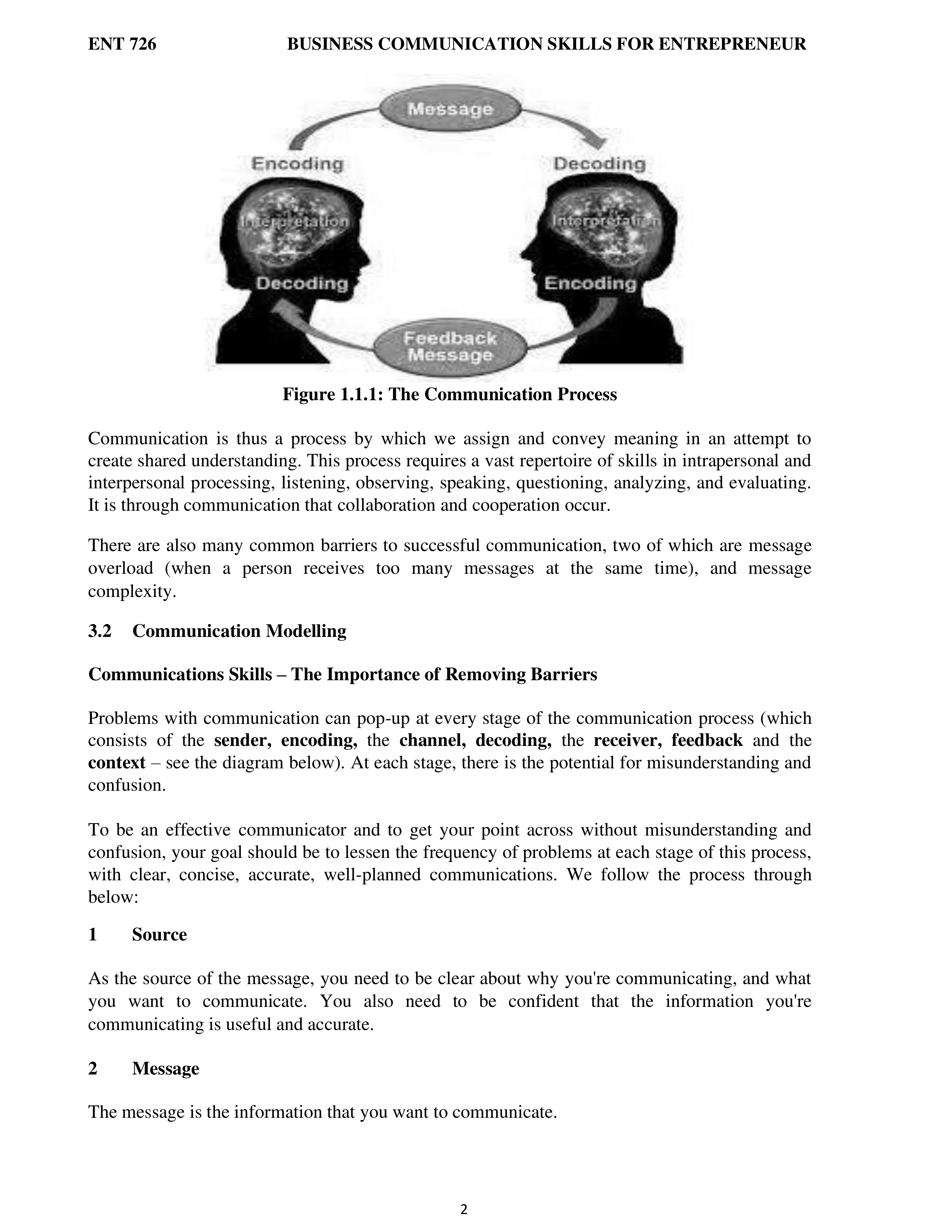
Communication is a process whereby information is enclosed in a package and is discrete and
imparted by a sender to a receiver via a channel/medium. The receiver then decodes the message
and gives the sender a feedback (
Fig 1.1.1
). Communication requires that all parties have an
area of communicative commonality. There are auditory means, such as speaking, singing and
sometimes tone of voice, and nonverbal, physical means, such as body language, sign language,
paralanguage, touch, eye contact, by using writing.
ENT 726
BUSINESS COMMUNICATION SKILLS FOR ENTREPRENEUR
2
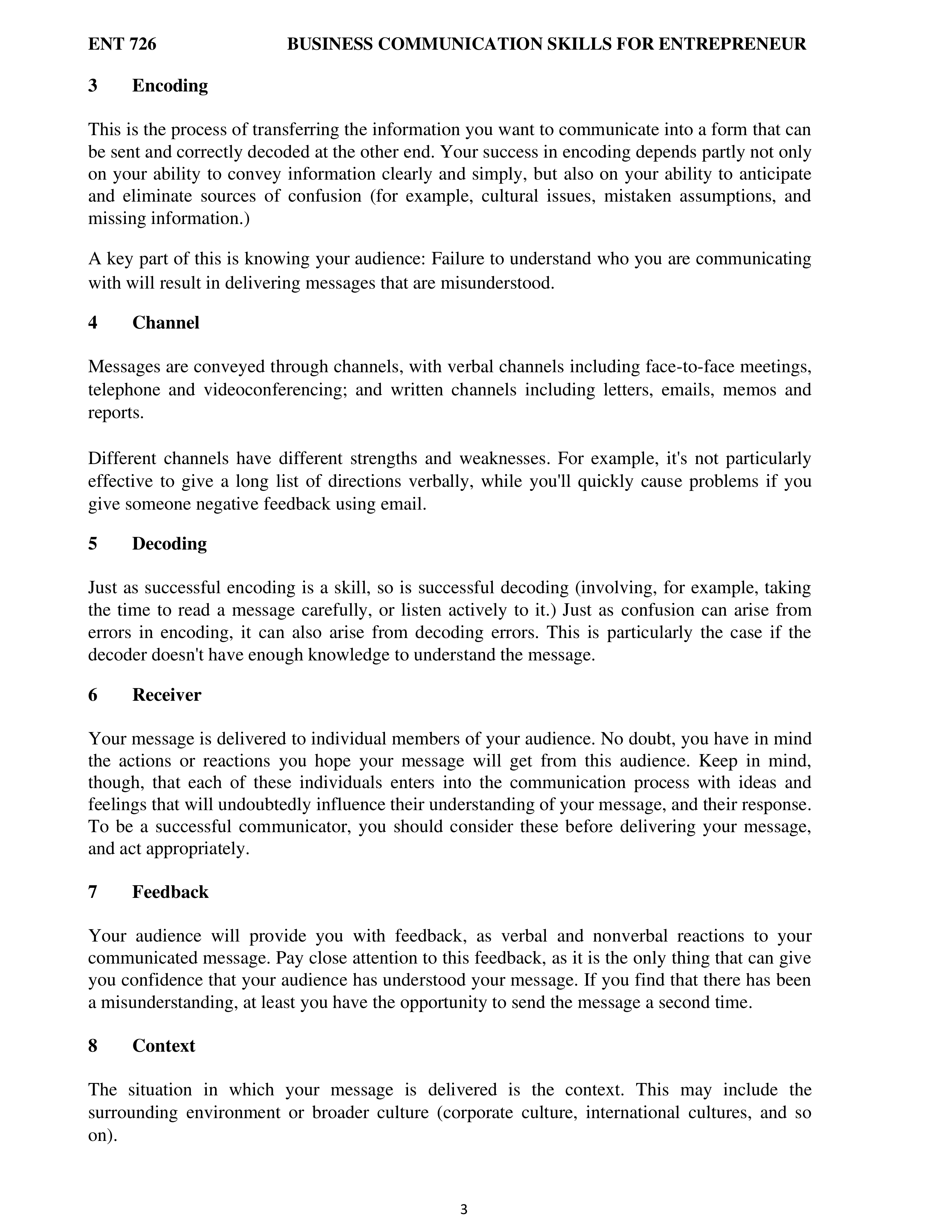
Figure 1.1.1: The Communication Process
Communication is thus a process by which we assign and convey meaning in an attempt to
create shared understanding. This process requires a vast repertoire of skills in intrapersonal and
interpersonal processing, listening, observing, speaking, questioning, analyzing, and evaluating.
It is through communication that collaboration and cooperation occur.
There are also many common barriers to successful communication, two of which are message
overload (when a person receives too many messages at the same time), and message
complexity.
3.2 Communication Modelling
Communications Skills – The Importance of Removing Barriers
Problems with communication can pop-up at every stage of the communication process (which
consists of the
sender, encoding,
the
channel, decoding,
the
receiver, feedback
and the
context
– see the diagram below). At each stage, there is the potential for misunderstanding and
confusion.
To be an effective communicator and to get your point across without misunderstanding and
confusion, your goal should be to lessen the frequency of problems at each stage of this process,
with clear, concise, accurate, well-planned communications. We follow the process through
below:
1
Source
As the source of the message, you need to be clear about why you're communicating, and what
you want to communicate. You also need to be confident that the information you're
communicating is useful and accurate.
2
Message
The message is the information that you want to communicate.
ENT 726
BUSINESS COMMUNICATION SKILLS FOR ENTREPRENEUR
3
3
Encoding
This is the process of transferring the information you want to communicate into a form that can
be sent and correctly decoded at the other end. Your success in encoding depends partly not only
on your ability to convey information clearly and simply, but also on your ability to anticipate
and eliminate sources of confusion (for example, cultural issues, mistaken assumptions, and
missing information.)
A key part of this is knowing your audience: Failure to understand who you are communicating
with will result in delivering messages that are misunderstood.
4
Channel
Messages are conveyed through channels, with verbal channels including face-to-face meetings,
telephone and videoconferencing; and written channels including letters, emails, memos and
reports.
Different channels have different strengths and weaknesses. For example, it's not particularly
effective to give a long list of directions verbally, while you'll quickly cause problems if you
give someone negative feedback using email.
5
Decoding
Just as successful encoding is a skill, so is successful decoding (involving, for example, taking
the time to read a message carefully, or listen actively to it.) Just as confusion can arise from
errors in encoding, it can also arise from decoding errors. This is particularly the case if the
decoder doesn't have enough knowledge to understand the message.
6
Receiver
Your message is delivered to individual members of your audience. No doubt, you have in mind
the actions or reactions you hope your message will get from this audience. Keep in mind,
though, that each of these individuals enters into the communication process with ideas and
feelings that will undoubtedly influence their understanding of your message, and their response.
To be a successful communicator, you should consider these before delivering your message,
and act appropriately.
7
Feedback
Your audience will provide you with feedback, as verbal and nonverbal reactions to your
communicated message. Pay close attention to this feedback, as it is the only thing that can give
you confidence that your audience has understood your message. If you find that there has been
a misunderstanding, at least you have the opportunity to send the message a second time.
8
Context
The situation in which your message is delivered is the context. This may include the
surrounding environment or broader culture (corporate culture, international cultures, and so
on).
ENT 726
BUSINESS COMMUNICATION SKILLS FOR ENTREPRENEUR
4
In a simple model, information or content (e.g. a message in natural language) is sent in some
form (as spoken language) from an emisor/ sender/ encoder to a destination/ receiver/ decoder.
In a slightly more complex form, a sender and a receiver are linked reciprocally. A particular
instance of communication is called a speech act. The sender's personal filters and the receiver's
personal filters may vary depending upon different regional traditions, cultures, or gender;
which may alter the intended meaning of message contents. In the presence of "communication
noise" on the transmission channel (air, in this case), reception and decoding of content may be
faulty, and thus the speech act may not achieve the desired effect. One problem with this
encode-transmit-receive-decode model is that the processes of encoding and decoding imply that
the sender and receiver each possess something that functions as a codebook and that these two
code books are, at the very least, similar if not identical. Although something like code books is
implied by the model, they are nowhere represented in the model, which creates many
conceptual difficulties. Creating and delivering the effective presentation requires basic
understanding of a communication process
Between parties, communication includes acts that confer knowledge and experiences, give
advice and commands, and ask questions. These acts may take many forms, in one of the
various manners of communication. The form depends on the abilities of the group
communicating together, communication content and form make messages that are sent towards
a destination. The target can be oneself, another person or being, another entity (such as a
corporation or group of beings).
SELF ASSESSMENT EXERCISE 1
Explain the stages in communication process
3.3 Levels of Communication
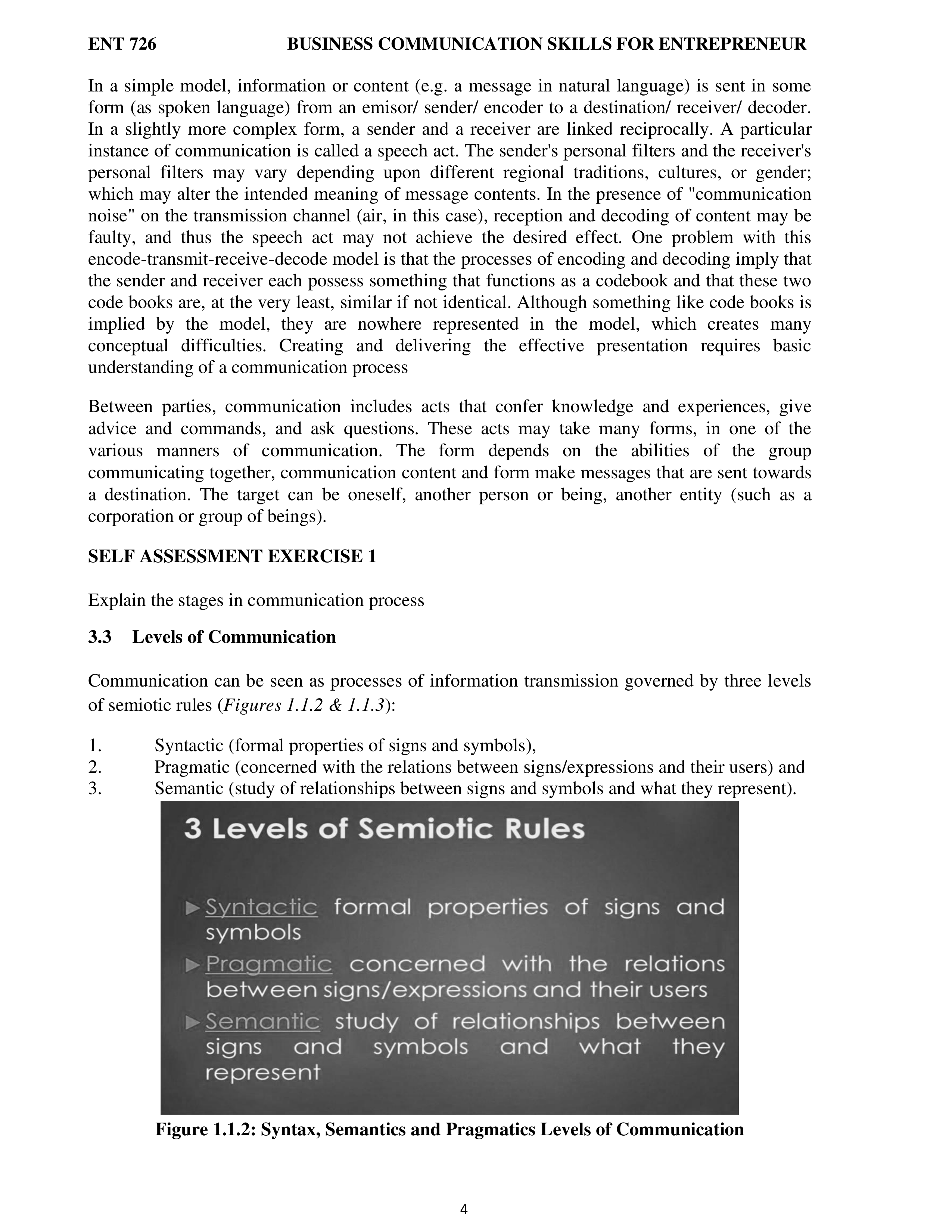
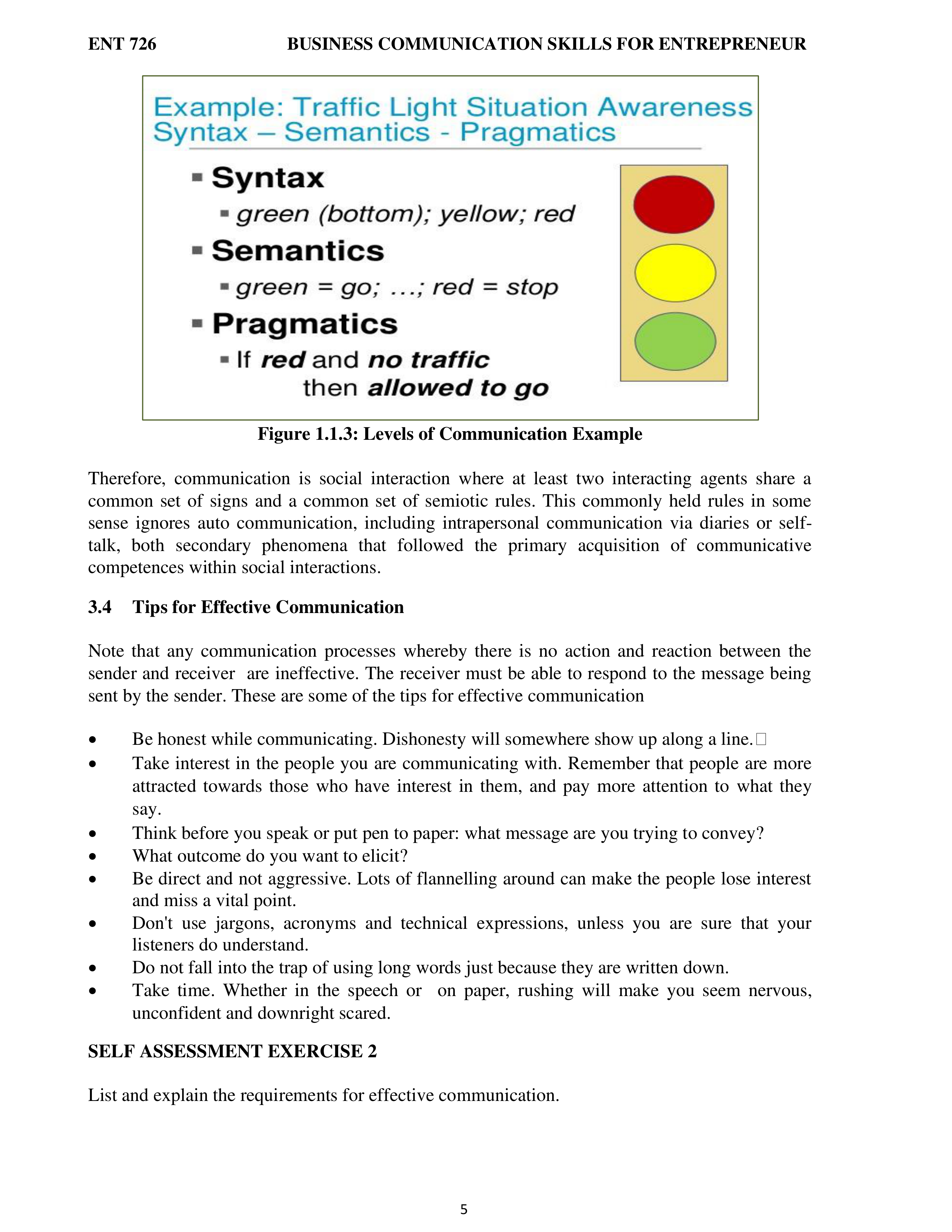
Communication can be seen as processes of information transmission governed by three levels
of semiotic rules (
Figures 1.1.2 & 1.1.3
):
1.
Syntactic (formal properties of signs and symbols),
2.
Pragmatic (concerned with the relations between signs/expressions and their users) and
3.
Semantic (study of relationships between signs and symbols and what they represent).
Figure 1.1.2: Syntax, Semantics and Pragmatics Levels of Communication

ENT 726
BUSINESS COMMUNICATION SKILLS FOR ENTREPRENEUR
5
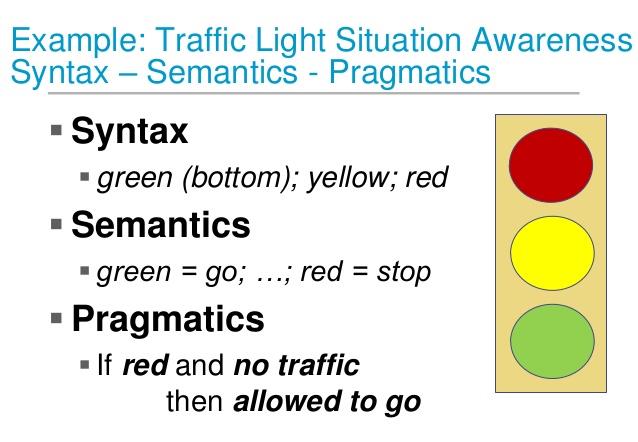
Figure 1.1.3: Levels of Communication Example
Therefore, communication is social interaction where at least two interacting agents share a
common set of signs and a common set of semiotic rules. This commonly held rules in some
sense ignores auto communication, including intrapersonal communication via diaries or self-
talk, both secondary phenomena that followed the primary acquisition of communicative
competences within social interactions.
3.4 Tips for Effective Communication
Note that any communication processes whereby there is no action and reaction between the
sender and receiver are ineffective. The receiver must be able to respond to the message being
sent by the sender. These are some of the tips for effective communication
•
Be honest while communicating. Dishonesty will somewhere show up along a line.
•
Take interest in the people you are communicating with. Remember that people are more
attracted towards those who have interest in them, and pay more attention to what they
say.
•
Think before you speak or put pen to paper: what message are you trying to convey?
•
What outcome do you want to elicit?
•
Be direct and not aggressive. Lots of flannelling around can make the people lose interest
and miss a vital point.
•
Don't use jargons, acronyms and technical expressions, unless you are sure that your
listeners do understand.
•
Do not fall into the trap of using long words just because they are written down.
•
Take time. Whether in the speech or on paper, rushing will make you seem nervous,
unconfident and downright scared.
SELF ASSESSMENT EXERCISE 2
List and explain the requirements for effective communication.
ENT 726
BUSINESS COMMUNICATION SKILLS FOR ENTREPRENEUR
6
3.5
Barriers and Limitations of Effective communication.
To deliver your messages effectively, you must commit to breaking down the barriers that exist
within each of the stages of the communication process.
Let’s begin with the message itself. If your message is too lengthy, disorganised, or contain
errors, you can expect the message to be misunderstood and misinterpreted. The use of poor
verbal and body language can also confuse the message.
Barriers in context tend to stem from senders offering too much information too fast. When in
doubt here, less is oftentimes more. It is best to be mindful of the demands on other people’s
time, especially in today’s ultra-busy society.
Once you understand this, you need to work to understand your audience’s culture, making sure
you can converse and deliver your message to people of different backgrounds and cultures
within your organisation, in your country and even abroad.
Noise-
is the interference that keeps a message from being understood or accurately
interpreted.
External noise:
Comes from the environment. i.e. loud music, hot sun, babies...
Internal noise:
Occurs in the minds of the sender or receiver when their thoughts and
feelings are focused on something other than the communication at hand.
Semantic:
Caused by people's emotional reaction to words.
3.6 Types of Communication
•
Intrapersonal communication
is communication that occurs within us; it is also referred
to as Self-talk.
•
Interpersonal communication
occurs when we communicate on a one-to-one basis-
usually in an informal, unstructured setting.
•
Small group communication
occurs when a small number of people meet to solve a
problem.
•
Public communication
the sender-receiver sends a message to an audience.
Intercultural communication
is communication that occurs whenever two or more
people from different cultures interact.
•
Ethical communication
is communication that is fair, honest, and considerate of others
rights.
4.0 CONCLUSION
Generally, communication is part of every living thing. Even the plants have their means of
communication. However, the most important thing in communication is that it involves the
interaction of every element in the communication process. Lack of this interaction can be seen
as noise or barrier in the communication process. Knowledge of this is the need for effective
business communication.
5.0 SUMMARY
This unit explained the following concepts in communication.
ENT 726
BUSINESS COMMUNICATION SKILLS FOR ENTREPRENEUR
7
•
Communication process
•
Levels of communication
•
Barriers to communication
•
Tips for effective communication
6.0 TUTOR-MARKED ASSIGNMENT
1.
What do you understand by noise in the communication process?
2.
Explain the three levels of communication in detail
7.0 REFERENCES/ FURTHER READINGS
Cohen, Herman. 1994. The History of Speech Communication: The Emergence of a Discipline,
1914-1945. Annandale, VA: Speech Communication Association. Packer, J., & Robertson, C.
(Eds.). (2006).
Thinking with James Carey: Essays on communications, transportation,
history
(Vol. 15). Peter Lang.
Peters, J. D. Peter Simonson, eds. 2004.
Mass Communication and American Social Thought:
Key Texts, 1919–1968
.
Wahl-Jorgensen, K. (2004). How not to found a field: New evidence on the origins of mass
communication research.
Journal of Communication
,
54
(3), 547-564.
ENT 726
BUSINESS COMMUNICATION SKILLS FOR ENTREPRENEUR
8
UNIT 2: FORMS OF COMMUNICATION
CONTENTS
1.0
Introduction
2.0
Objectives
3.0
Main Content
3.1 Types of communication
3.2 Dialogue or verbal communication
3.2.1 Sound
3.2.2 SpeakingandWriting
3.2.3 Listening
3.3 Non-verbal communication
3.3.1 Physical environment
3.3.1.1 Proxemics
3.3.1.2 Chronemics
3.3.2 Movement and body position
3.3.3 Paralanguage
3.3.4 Functions of nonverbal communication
3.4 Interaction of verbal and nonverbal communication
3.4.1 Dance and nonverbal communication
3.5 Visual communication
3.6 Other types of communication
4.0
Conclusion
5.0
Summary
6.0
Tutor-Marked Assignment
7.0
References/ Further Readings
1.0
INTRODUCTION
This unit deals with various forms by which communication can be achieved among people.
Human spoken and written languages can be described as a system of symbols (sometimes
known as lexemes) and the grammars (rules) by which the symbols are manipulated. The word
"language" is also used to refer to common properties of languages. Language learning is
normal in human childhood. Most human languages use patterns of sound or gesture for
symbols which enable communication with others around them. There are thousands of human
languages, and these seem to share certain properties, even though many shared properties have
exceptions.
There is no defined line between a language and a dialect, but the linguist Max Weinreich is
credited as saying that "a language is a dialect with an army and a navy". Constructed languages
such as Esperanto, programming languages, and various mathematical formalisms are not
necessarily restricted to the properties shared by human languages in communication.
2.0 OBJECTIVES OF THE UNIT
On completion of this unit, you should be able to:
•
List different types of communication
•
Explain what verbal, non-verbal and visual communications are


ENT 726
BUSINESS COMMUNICATION SKILLS FOR ENTREPRENEUR
9
•
Enumerate other types of communication
•
Discuss the interaction between verbal and non-verbal communication
3.0 MAIN CONTENT
3.1 Types of communication
There are three major parts in human face to face communication which are body language,
voice tonality, and words. According to the research:
•
55% of impact is determined by body language—postures, gestures, and eye contact.
•
38% by the tone of voice, and
•
7% by the content or the words used in the communication process.
Although the exact percentage of influence may differ from variables such as the listener and the
speaker, communication as a whole strives for the same goal and thus, in some cases, can be
universal. System of signals, such as voice sounds, intonations or pitch, gestures or written
symbols which communicate thoughts or feelings. If a language is about communicating with
signals, voice, sounds, gestures, or written symbols, can animal communications be considered
as a language? Animals do not have a written form of a language but use a language to
communicate with each other. In that sense, animal communication can be considered as a
separate language. Three forms of communication are:
•
Verbal Communication
•
Non-Verbal Communication
•
Visual communication
3.2 Verbal or Dialogue communication
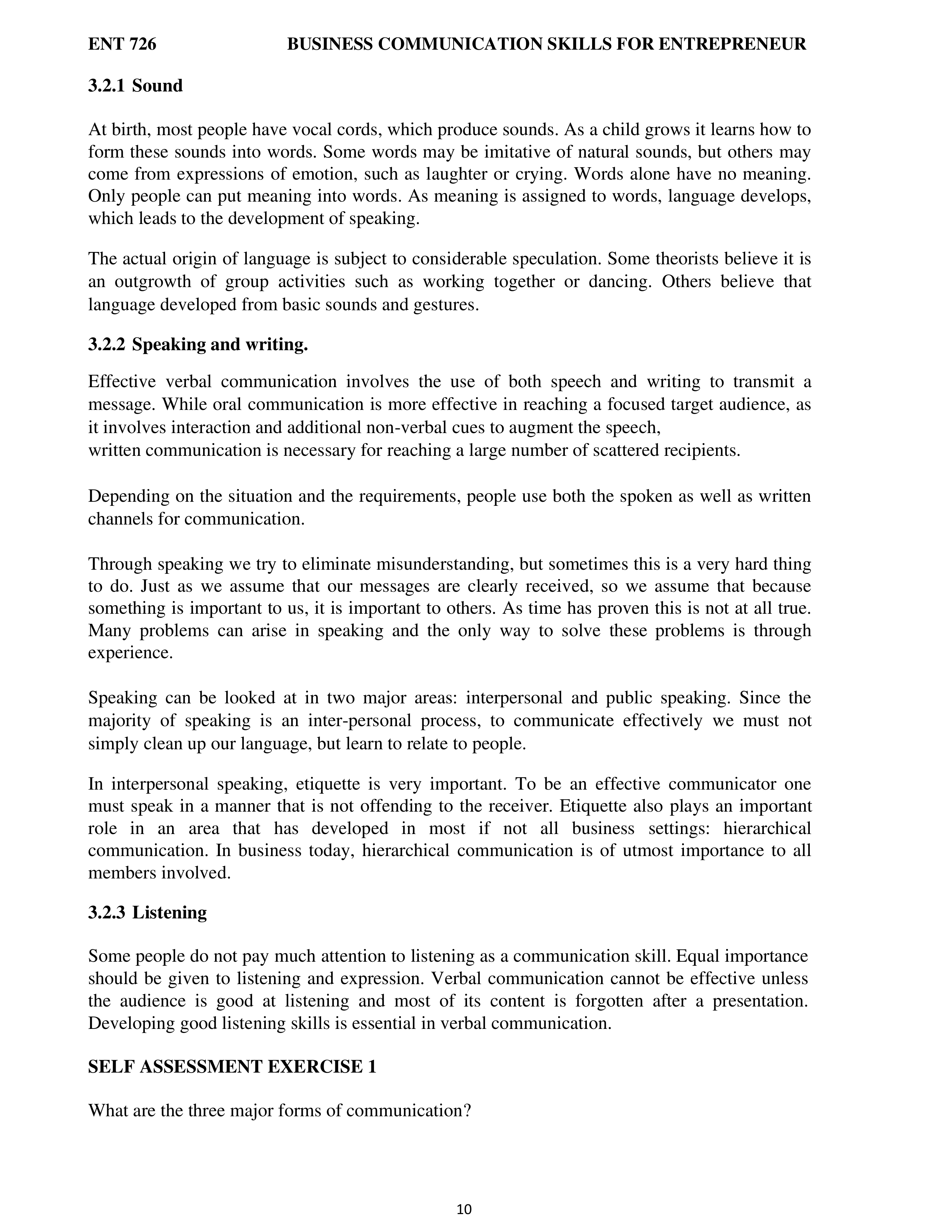
A dialogue is a reciprocal conversation between two or more entities (
Figure 1.2.1
). The
etymological origins of the word do not necessarily convey how people have come to use the
word, with some confusion between the prefix and the prefix leading to the assumption that a
dialogue is necessarily between only two parties.
Figure 1.2.1: Verbal Communication
The basis of communication is the interaction between people. Verbal communication is one
way for people to communicate face-to-face. Some of the key components of verbal
communication are sound, writing, speaking, and language.
ENT 726
BUSINESS COMMUNICATION SKILLS FOR ENTREPRENEUR
10
3.2.1 Sound
At birth, most people have vocal cords, which produce sounds. As a child grows it learns how to
form these sounds into words. Some words may be imitative of natural sounds, but others may
come from expressions of emotion, such as laughter or crying. Words alone have no meaning.
Only people can put meaning into words. As meaning is assigned to words, language develops,
which leads to the development of speaking.
The actual origin of language is subject to considerable speculation. Some theorists believe it is
an outgrowth of group activities such as working together or dancing. Others believe that
language developed from basic sounds and gestures.
3.2.2
Speaking and writing.
Effective verbal communication involves the use of both speech and writing to transmit a
message. While oral communication is more effective in reaching a focused target audience, as
it involves interaction and additional non-verbal cues to augment the speech,
written communication is necessary for reaching a large number of scattered recipients.
Depending on the situation and the requirements, people use both the spoken as well as written
channels for communication.
Through speaking we try to eliminate misunderstanding, but sometimes this is a very hard thing
to do. Just as we assume that our messages are clearly received, so we assume that because
something is important to us, it is important to others. As time has proven this is not at all true.
Many problems can arise in speaking and the only way to solve these problems is through
experience.
Speaking can be looked at in two major areas: interpersonal and public speaking. Since the
majority of speaking is an inter-personal process, to communicate effectively we must not
simply clean up our language, but learn to relate to people.
In interpersonal speaking, etiquette is very important. To be an effective communicator one
must speak in a manner that is not offending to the receiver. Etiquette also plays an important
role in an area that has developed in most if not all business settings: hierarchical
communication. In business today, hierarchical communication is of utmost importance to all
members involved.
3.2.3 Listening
Some people do not pay much attention to listening as a communication skill. Equal importance
should be given to listening and expression. Verbal communication cannot be effective unless
the audience is good at listening and most of its content is forgotten after a presentation.
Developing good listening skills is essential in verbal communication.
SELF ASSESSMENT EXERCISE 1
What are the three major forms of communication?
ENT 726
BUSINESS COMMUNICATION SKILLS FOR ENTREPRENEUR
11
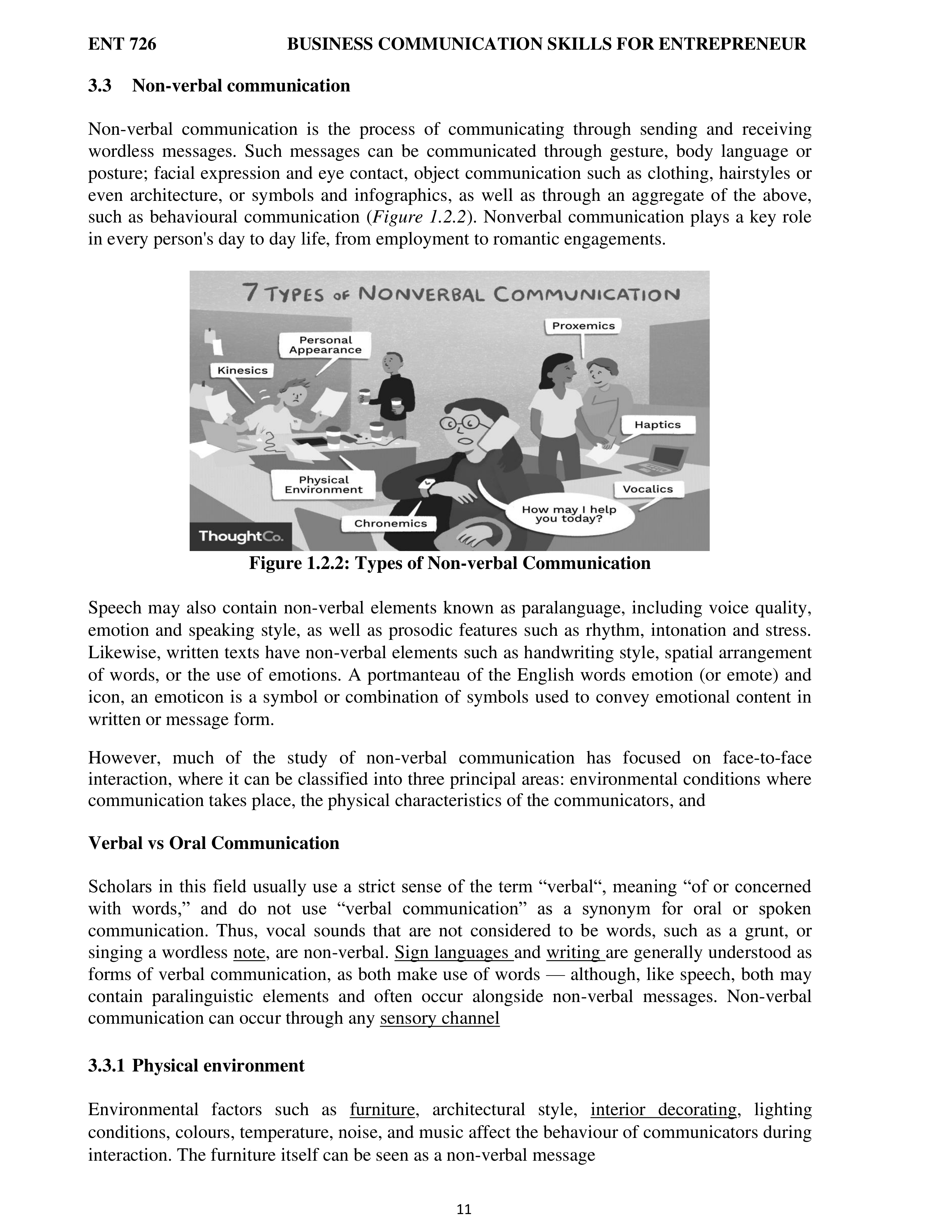
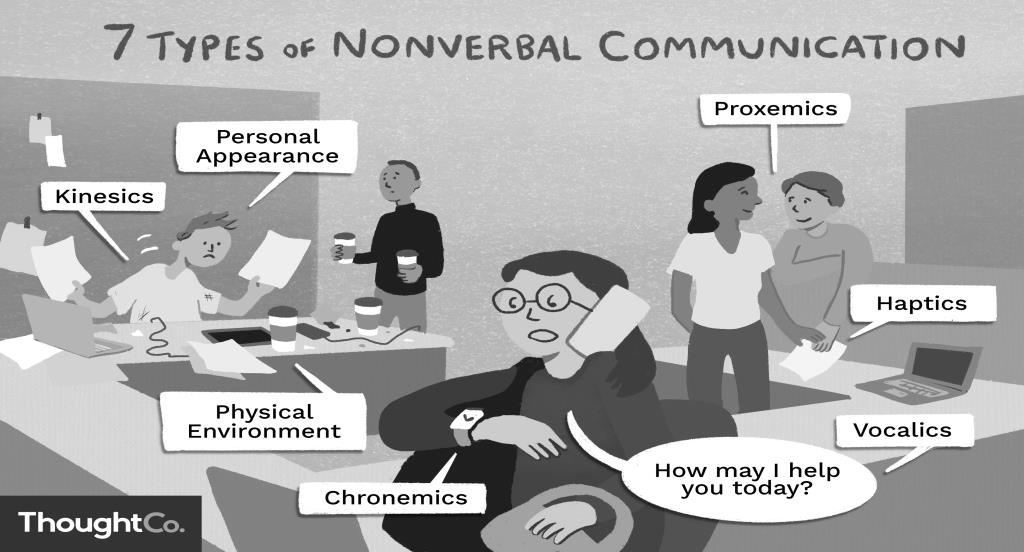
3.3 Non-verbal communication
Non-verbal communication is the process of communicating through sending and receiving
wordless messages. Such messages can be communicated through gesture, body language or
posture; facial expression and eye contact, object communication such as clothing, hairstyles or
even architecture, or symbols and infographics, as well as through an aggregate of the above,
such as behavioural communication (
Figure 1.2.2
). Nonverbal communication plays a key role
in every person's day to day life, from employment to romantic engagements.
Figure 1.2.2: Types of Non-verbal Communication
Speech may also contain non-verbal elements known as paralanguage, including voice quality,
emotion and speaking style, as well as prosodic features such as rhythm, intonation and stress.
Likewise, written texts have non-verbal elements such as handwriting style, spatial arrangement
of words, or the use of emotions. A portmanteau of the English words emotion (or emote) and
icon, an emoticon is a symbol or combination of symbols used to convey emotional content in
written or message form.
However, much of the study of non-verbal communication has focused on face-to-face
interaction, where it can be classified into three principal areas: environmental conditions where
communication takes place, the physical characteristics of the communicators, and
Verbal vs Oral Communication
Scholars in this field usually use a strict sense of the term “verbal“, meaning “of or concerned
with words,” and do not use “verbal communication” as a synonym for oral or spoken
communication. Thus, vocal sounds that are not considered to be words, such as a grunt, or
singing a wordless note, are non-verbal. Sign languages and writing are generally understood as
forms of verbal communication, as both make use of words — although, like speech, both may
contain paralinguistic elements and often occur alongside non-verbal messages. Non-verbal
communication can occur through any sensory channel
3.3.1 Physical environment
Environmental factors such as furniture, architectural style, interior decorating, lighting
conditions, colours, temperature, noise, and music affect the behaviour of communicators during
interaction. The furniture itself can be seen as a non-verbal message
ENT 726
BUSINESS COMMUNICATION SKILLS FOR ENTREPRENEUR
12
3.3.1.1 Proxemics
Proxemics is the study of how people use and perceive the physical space around them. The
space between the sender and the receiver of a message influences the way the message is
interpreted.
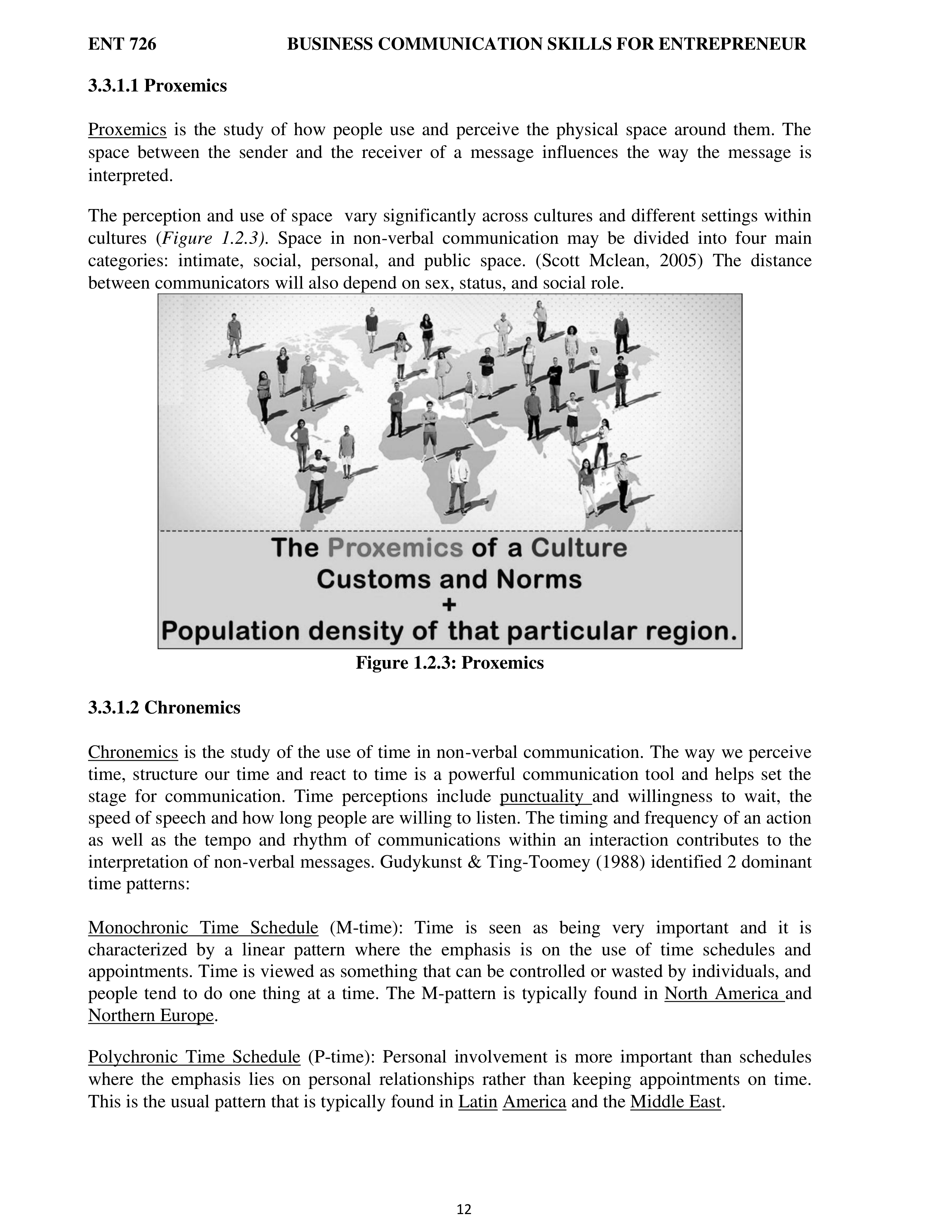
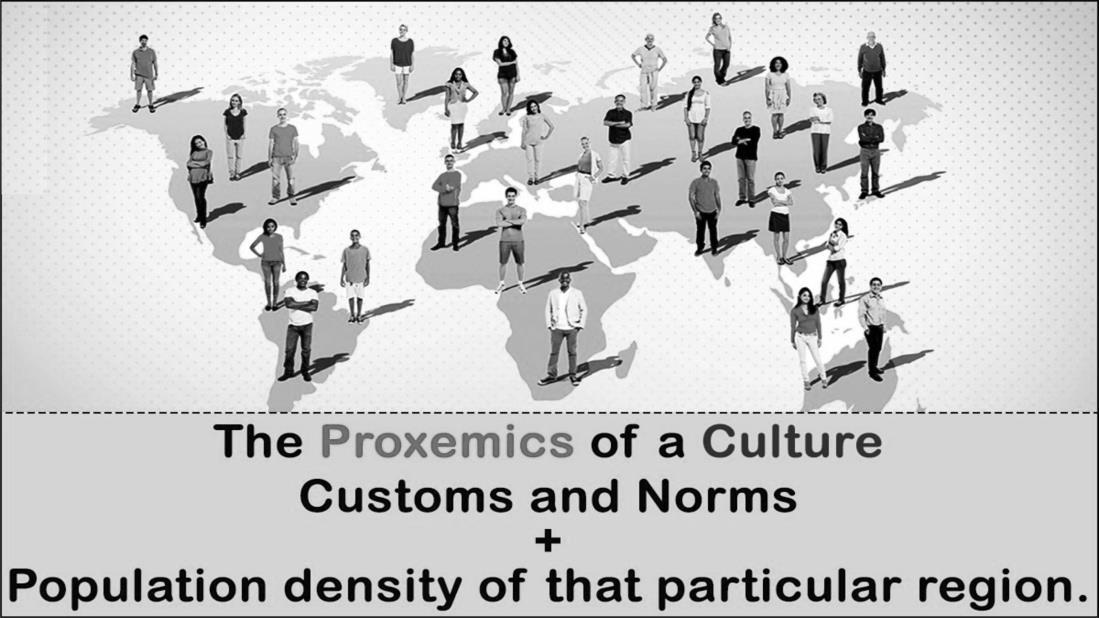
The perception and use of space vary significantly across cultures and different settings within
cultures (
Figure 1.2.3)
. Space in non-verbal communication may be divided into four main
categories: intimate, social, personal, and public space. (Scott Mclean, 2005) The distance
between communicators will also depend on sex, status, and social role.
Figure 1.2.3: Proxemics
3.3.1.2 Chronemics
Chronemics is the study of the use of time in non-verbal communication. The way we perceive
time, structure our time and react to time is a powerful communication tool and helps set the
stage for communication. Time perceptions include punctuality and willingness to wait, the
speed of speech and how long people are willing to listen. The timing and frequency of an action
as well as the tempo and rhythm of communications within an interaction contributes to the
interpretation of non-verbal messages. Gudykunst & Ting-Toomey (1988) identified 2 dominant
time patterns:
Monochronic Time Schedule (M-time): Time is seen as being very important and it is
characterized by a linear pattern where the emphasis is on the use of time schedules and
appointments. Time is viewed as something that can be controlled or wasted by individuals, and
people tend to do one thing at a time. The M-pattern is typically found in North America and
Northern Europe.
Polychronic Time Schedule (P-time): Personal involvement is more important than schedules
where the emphasis lies on personal relationships rather than keeping appointments on time.
This is the usual pattern that is typically found in Latin America and the Middle East.
ENT 726
BUSINESS COMMUNICATION SKILLS FOR ENTREPRENEUR
13
3.3.2 Movement and Body Position
•
Kinetics
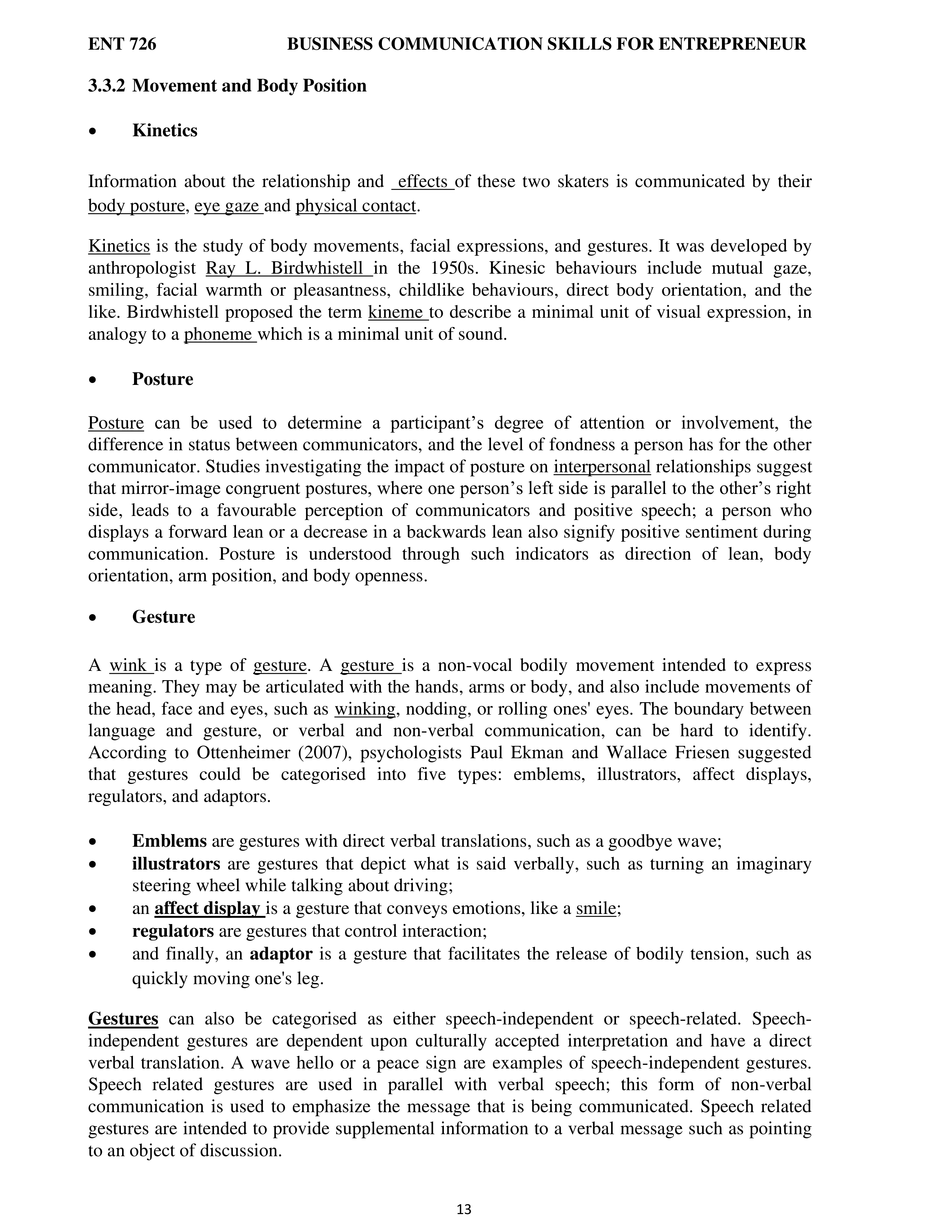
Information about the relationship and effects of these two skaters is communicated by their
body posture, eye gaze and physical contact.
Kinetics is the study of body movements, facial expressions, and gestures. It was developed by
anthropologist Ray L. Birdwhistell in the 1950s. Kinesic behaviours include mutual gaze,
smiling, facial warmth or pleasantness, childlike behaviours, direct body orientation, and the
like. Birdwhistell proposed the term kineme to describe a minimal unit of visual expression, in
analogy to a phoneme which is a minimal unit of sound.
•
Posture
Posture can be used to determine a participant’s degree of attention or involvement, the
difference in status between communicators, and the level of fondness a person has for the other
communicator. Studies investigating the impact of posture on interpersonal relationships suggest
that mirror-image congruent postures, where one person’s left side is parallel to the other’s right
side, leads to a favourable perception of communicators and positive speech; a person who
displays a forward lean or a decrease in a backwards lean also signify positive sentiment during
communication. Posture is understood through such indicators as direction of lean, body
orientation, arm position, and body openness.
•
Gesture
A wink is a type of gesture. A gesture is a non-vocal bodily movement intended to express
meaning. They may be articulated with the hands, arms or body, and also include movements of
the head, face and eyes, such as winking, nodding, or rolling ones' eyes. The boundary between
language and gesture, or verbal and non-verbal communication, can be hard to identify.
According to Ottenheimer (2007), psychologists Paul Ekman and Wallace Friesen suggested
that gestures could be categorised into five types: emblems, illustrators, affect displays,
regulators, and adaptors.
•
Emblems
are gestures with direct verbal translations, such as a goodbye wave;
•
illustrators
are gestures that depict what is said verbally, such as turning an
imaginary
steering wheel while talking about driving;
•
an
affect display
is a gesture that conveys emotions, like a smile;
•
regulators
are gestures that control interaction;
•
and finally, an
adaptor
is a gesture that facilitates the release of bodily tension, such as
quickly moving one's leg.
Gestures
can also be categorised as either speech-independent or speech-related. Speech-
independent gestures are dependent upon culturally accepted interpretation and have a direct
verbal translation. A wave hello or a peace sign are examples of speech-independent gestures.
Speech related gestures are used in parallel with verbal speech; this form of non-verbal
communication is used to emphasize the message that is being communicated. Speech related
gestures are intended to provide supplemental information to a verbal message such as pointing
to an object of discussion.
ENT 726
BUSINESS COMMUNICATION SKILLS FOR ENTREPRENEUR
14
•
Haptics
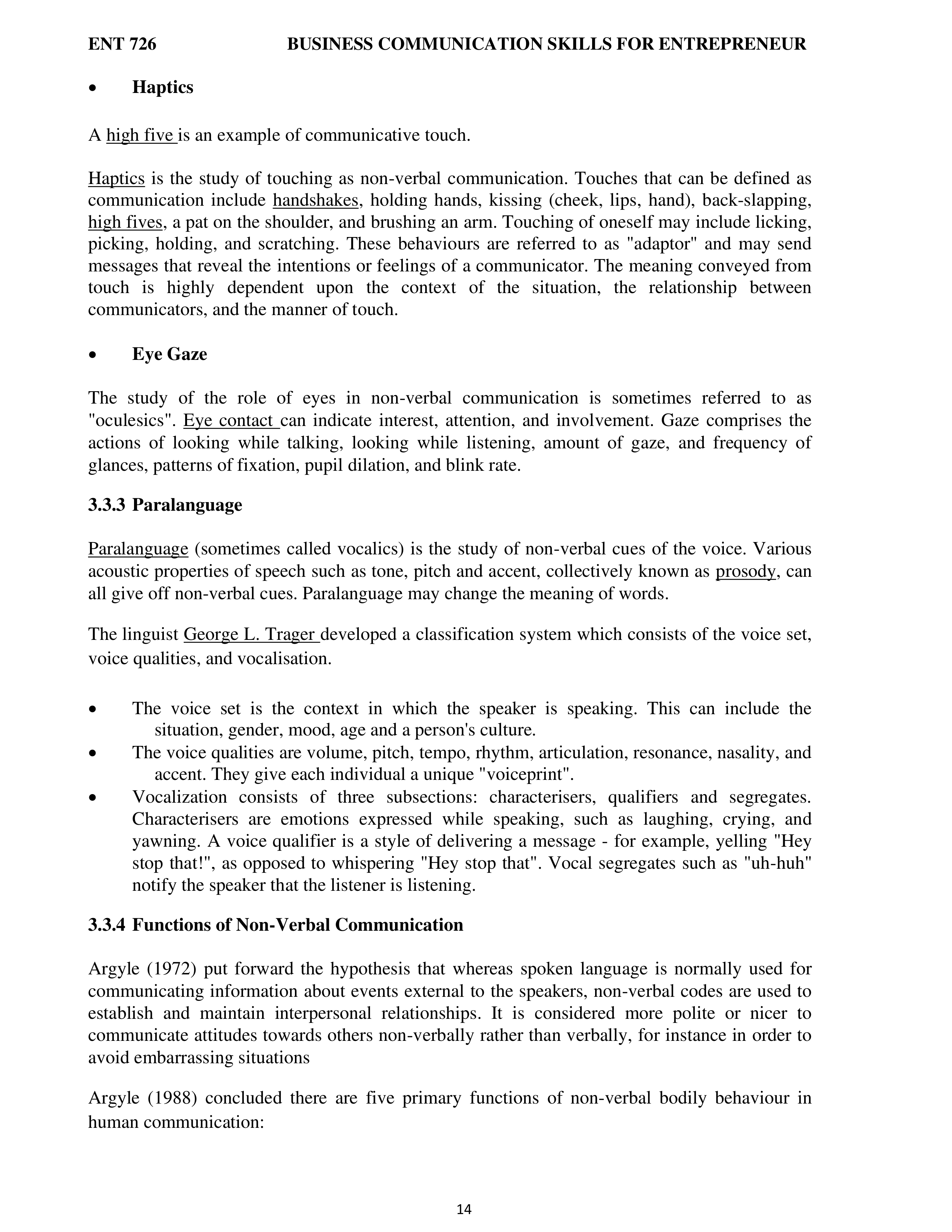
A high five is an example of communicative touch.
Haptics is the study of touching as non-verbal communication. Touches that can be defined as
communication include handshakes, holding hands, kissing (cheek, lips, hand), back-slapping,
high fives, a pat on the shoulder, and brushing an arm. Touching of oneself may include licking,
picking, holding, and scratching. These behaviours are referred to as "adaptor" and may send
messages that reveal the intentions or feelings of a communicator. The meaning conveyed from
touch is highly dependent upon the context of the situation, the relationship between
communicators, and the manner of touch.
•
Eye Gaze
The study of the role of eyes in non-verbal communication is sometimes referred to as
"oculesics". Eye contact can indicate interest, attention, and involvement. Gaze comprises the
actions of looking while talking, looking while listening, amount of gaze, and frequency of
glances, patterns of fixation, pupil dilation, and blink rate.
3.3.3 Paralanguage
Paralanguage (sometimes called vocalics) is the study of non-verbal cues of the voice. Various
acoustic properties of speech such as tone, pitch and accent, collectively known as prosody, can
all give off non-verbal cues. Paralanguage may change the meaning of words.
The linguist George L. Trager developed a classification system which consists of the voice set,
voice qualities, and vocalisation.
•
The voice set is the context in which the speaker is speaking. This can include the
situation, gender, mood, age and a person's culture.
•
The voice qualities are volume, pitch, tempo, rhythm, articulation, resonance, nasality, and
accent. They give each individual a unique "voiceprint".
•
Vocalization consists of three subsections: characterisers, qualifiers and segregates.
Characterisers are emotions expressed while speaking, such as laughing, crying, and
yawning. A voice qualifier is a style of delivering a message - for example, yelling "Hey
stop that!", as opposed to whispering "Hey stop that". Vocal segregates such as "uh-huh"
notify the speaker that the listener is listening.
3.3.4 Functions of Non-Verbal Communication
Argyle (1972) put forward the hypothesis that whereas spoken language is normally used for
communicating information about events external to the speakers, non-verbal codes are used to
establish and maintain interpersonal relationships. It is considered more polite or nicer to
communicate attitudes towards others non-verbally rather than verbally, for instance in order to
avoid embarrassing situations
Argyle (1988) concluded there are five primary functions of non-verbal bodily behaviour in
human communication:
ENT 726
BUSINESS COMMUNICATION SKILLS FOR ENTREPRENEUR
15
•
Express emotions
•
Express inter-personal attitudes
•
To accompany speech in managing the cues of interaction between speakers and listeners
•
Self-presentation of one’s personality
•
Rituals (greetings)
3.4 Interaction of Verbal and Non-Verbal Communication
When communicating, nonverbal messages can interact with verbal messages in six ways:
repeating, conflicting, complementing, substituting, regulating and accenting/moderating.
•
Repeating
"Repeating" consists of using gestures to strengthen a verbal message, such as pointing to the
object of discussion.
•
Conflicting
Verbal and non-verbal messages within the same interaction can sometimes send opposing or
conflicting messages. A person verbally expressing a statement of truth while simultaneously
fidgeting or avoiding eye contact may convey a mixed message to the receiver in the interaction.
Conflicting messages may occur for a variety of reasons often stemming from feelings of
uncertainty, ambivalence, or frustration. When mixed messages occur, non-verbal
communication becomes the primary tool people use to attain additional information to clarify
the situation; great attention is placed on bodily movements and positioning when people
perceive mixed messages during interactions.
•
Complementing
Accurate interpretation of messages is made easier when non-verbal and verbal communication
complements each other. Non-verbal cues can be used to elaborate on verbal messages to
reinforce the information sent when trying to achieve communicative goals; messages have been
shown to be remembered better when nonverbal signals affirm the verbal exchange.
•
Substituting
Non-verbal behaviour is sometimes used as the sole channel for communication of a message.
People learn to identify facial expressions, body movements, and body positioning as
corresponding with specific feelings and intentions. Non-verbal signals can be used without
verbal communication to convey messages; when non-verbal behaviour does not effectively
communicate a message, verbal methods are used to enhance understanding.
•
Regulating
Non-verbal behaviour also regulates our conversations. For example, touching someone's arm
can signal that you want to talk next or interrupt.
ENT 726
BUSINESS COMMUNICATION SKILLS FOR ENTREPRENEUR
16
•
Accenting/Moderating
Non-verbal signals are used to alter the interpretation of verbal messages. Touch, voice pitch,
and gestures are some of the tools people use to accent or amplify the message that is sent;
nonverbal behaviour can also be used to moderate or tone down aspects of verbal messages as
well.[26] For example, a person who is verbally expressing anger may accent the verbal
message by shaking a fist.
3.4.1 Dance and non-verbal communication
Dance is a form of non-verbal communication that requires the same underlying faculty in the
brain for conceptualization, creativity and memory as does verbal language in speaking and
writing. Means of self-expression, both forms have the vocabulary (steps and gestures in dance),
grammar (rules for putting the vocabulary together) and meaning. Dance, however, assembles
(choreographs) these elements in a manner that more often resembles poetry, with its ambiguity
and multiple, symbolic and elusive meanings.
SELF ASSESSMENT EXERCISE 2
What are the six ways of interaction between verbal and non-verbal forms of communication?
3.5 Visual Communication
Visual communication as the name suggests is communication through visual aid. It is the
conveyance of ideas and information in forms that can be read or looked upon. Primarily
associated with two-dimensional images, it includes signs, typography, drawing, graphic design,
illustration, colour and electronic resources. It solely relies on vision. It is a form of
communication with visual effect. It explores the idea that a visual message with text has a
greater power to inform, educate or persuade a person. It is communication by presenting
information through visual form.
The evaluation of a good visual design is based on measuring comprehension by the audience,
not on aesthetic or artistic preference. There are no universally agreed-upon principles of beauty
and ugliness. There exists a variety of ways to present information visually, like gestures, body
languages, video and TV. Here, the focus is on the presentation of text, pictures, diagrams,
photos, et cetera, integrated on a computer display. The term visual presentation is used to refer
to the actual presentation of information. Recent research in the field has focused on web design
and graphically oriented usability. Graphic designers use methods of visual communication in
their professional practice.
3.6 Other Types of Communication
Other more specific types of communication are listed below.
•
Facilitated communication.
•
Graphic communication.
•
Non-violent Communication.
•
Science communication.
•
Strategic Communication.
•
Superluminal communication.
ENT 726
BUSINESS COMMUNICATION SKILLS FOR ENTREPRENEUR
17
•
Technical communication.
4.0 CONCLUSION
Communication can now be seen as a very complex process which goes beyond speech making.
In the real sense, communication involves a lot of other things that symbols that can be
interpreted in various forms depend on the situation and at times the location of the event. For
instances, the meaning of a particular gesture might be different in another geographical
location. More so, silence is definitely a means of communication. Hence the various forms of
communication are inexhaustible.
5.0 SUMMARY
In this unit, we have been able to deal with the major forms of communication. Thorough
differentiation of each of the forms was discussed. Explanation of various non-verbal
communications were treated. Interaction between both verbal and non-verbal communication
was also examined.
6.0 TUTOR-MARKED ASSIGNMENT
1.
List and explain various types of non-verbal communication
2.
List four other types of communication.
7.0 REFERENCES/FURTHER READINGS
Argyle, M. (1972). Non-verbal communication in human social interaction.
Argyle, M. (1988). Bodily communication, Methuen.[aAW] Armstrong, D.(1984) The patients
view.
Social Science and Medicine
,
18
, 73744.
Gudykunst, W. B., & Ting-Toomey, S. (1988). Culture and affective communication.
American
behavioral scientist
,
31
(3), 384-400.
McLean, S. (2005).
The basics of interpersonal communication
. Pearson/A and B.
ENT 726
BUSINESS COMMUNICATION SKILLS FOR ENTREPRENEUR
18
UNIT 3
INTRODUCTION TO BUSINESS COMMUNICTION SKILLS
CONTENTS
1.0 Introduction
2.0 Objectives of the unit
3.0 Main Content
3.1 Introduction to Business communication skills
3.2 Communication studies
3.3 Business Communications training
3.3.1 Purpose of learning business communication skills
3.3.2 Types of skill development
3.3.3 Benefits of business communication training
4.0 Conclusion
5.0 Summary
6.0 Tutor-Marked Assignment
7.0 References/ Further Readings
1.0 INTRODUCTION
This course has been designed to prepare students for one of the most important aspects of
business organisation. Business communication skill is a key element of achieving success by
any business. Lack of good Communication process within and outside the organisation is
capable of making the business organisation lose growth. This means a bad signal for the
continuity of the organisation. Therefore, knowledge of this course is very important to all
prospective businessmen and women including business-oriented students. Before going into the
details of what business communication skill means, let us highlight the objectives.
2.0 OBJECTIVES OF THE UNIT
After completing this unit, you will be able to:
•
Explain the concept of business communication skills.
•
Discuss what communication studies is all about.
•
Explain and discuss the need for business communication training
3.0 MAIN CONTENT
3.1 Introduction to Business Communication Skills
Communication is an essential aspect of business life. Everyday, business persons have to
communicate with people at different levels of the organisation or with people external to the
organisation. And in this globalised environment, they also have to communicate with people
from different countries, with different cultural backgrounds. Poor or inaccurate communication
can lead to conflict and negativity in the workplace. It could even lead to the cancellation of a
deal or the loss of customer goodwill. In this competitive environment, businesses cannot afford
such losses.
ENT 726
BUSINESS COMMUNICATION SKILLS FOR ENTREPRENEUR
19
Business communication examines verbal, nonverbal and written communication in the world of
business. Through numerous examples of effective speaking, writing, negotiating and
interviewing is explored
Whether we are talking about procedures, work requests, or daily logs ...whether we are talking
about applying for a new position, making a suggestion for an in-house improvement, or asking
for a rise...whether we are talking about customer service responses, marketing details, or client
offers...ALL of it is accomplished through written or verbal communication.
Now, every business wants to increase profits, improve customer satisfaction, and maintain a
superior professional reputation. Your image isn’t yours alone; your image, your reputation
reflects on your coworkers, your manager, everything to do with your company – even up to an
international level corporation! But you want to be considered a valuable employee that
contributes to the company’s image, right? How else do you gain promotions and rise and move
up the ladder of success? You don’t without the most basic of job skills – good communication!
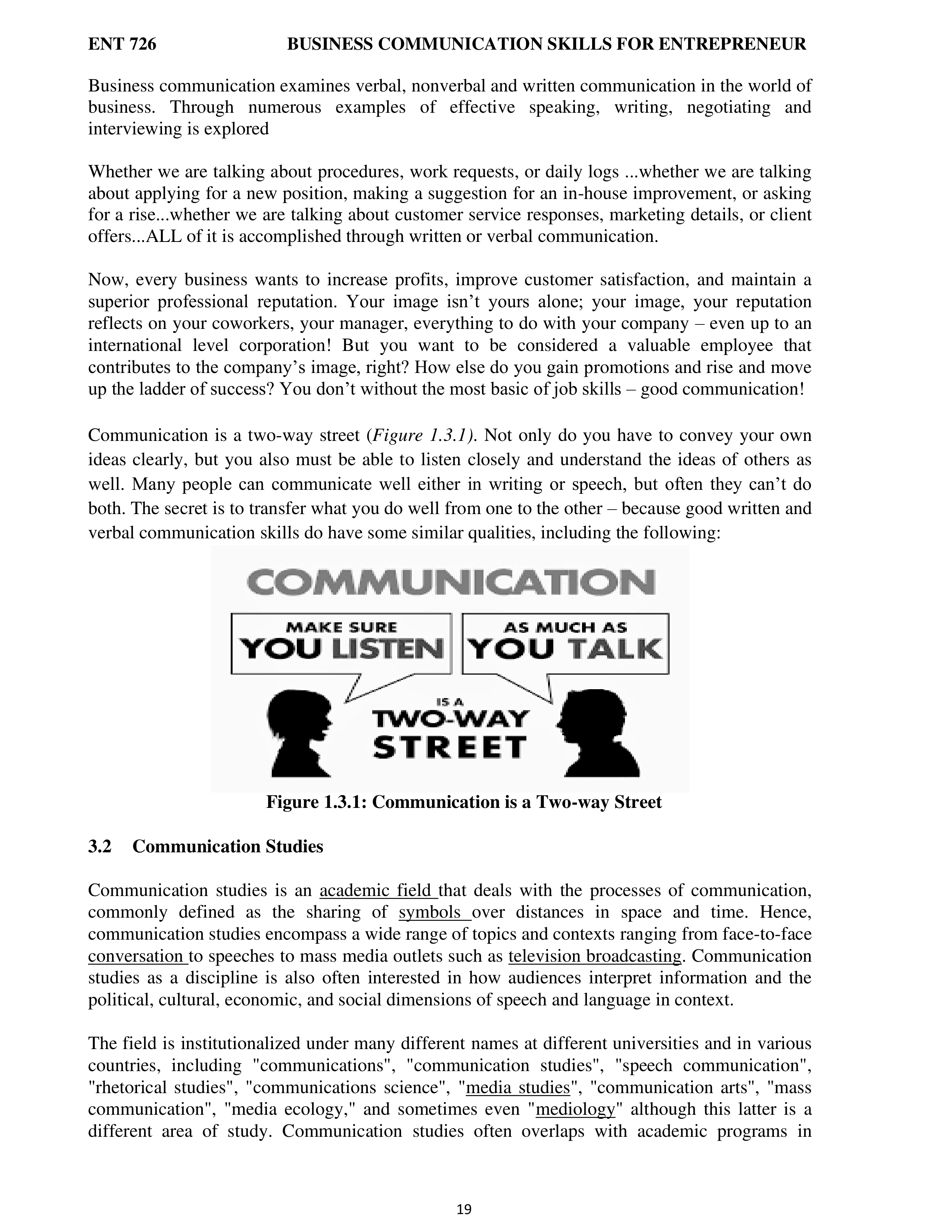
Communication is a two-way street (
Figure 1.3.1)
. Not only do you have to convey your own
ideas clearly, but you also must be able to listen closely and understand the ideas of others as
well. Many people can communicate well either in writing or speech, but often they can’t do
both. The secret is to transfer what you do well from one to the other – because good written and
verbal communication skills do have some similar qualities, including the following:
Figure 1.3.1: Communication is a Two-way Street
3.2 Communication Studies
Communication studies is an academic field that deals with the processes of communication,
commonly defined as the sharing of symbols over distances in space and time. Hence,
communication studies encompass a wide range of topics and contexts ranging from face-to-face
conversation to speeches to mass media outlets such as television broadcasting. Communication
studies as a discipline is also often interested in how audiences interpret information and the
political, cultural, economic, and social dimensions of speech and language in context.
The field is institutionalized under many different names at different universities and in various
countries, including "communications", "communication studies", "speech communication",
"rhetorical studies", "communications science", "media studies", "communication arts", "mass
communication", "media ecology," and sometimes even "mediology" although this latter is a
different area of study. Communication studies often overlaps with academic programs in
ENT 726
BUSINESS COMMUNICATION SKILLS FOR ENTREPRENEUR
20
journalism, film and cinema, radio and television, advertising and public relations and
performance studies.
Communication studies is often considered a part of both the social sciences and the humanities,
drawing heavily on fields such as sociology, psychology, anthropology, political science, and
economics as well as rhetoric, literary studies, linguistics, and semiotics. The field can
incorporate and overlap with the work of other disciplines as well, however, including
engineering, architecture, mathematics, computer science, gender and sexuality studies.
The vast breadth and interdisciplinary nature of communication studies has understandably
made it difficult for both students and institutions to place it within the broader educational
system. Despite intellectual incoherence, the field attracts and sustains large numbers of
students, scholarly journals, professional associations, and lively discussions across the academy
for researchers, educators, lawmakers, businesses, and reformers. Broadly understood, the
contemporary study of communication per se interfaces and overlaps with areas such as
business, organizational development, philosophy, languages, composition, theatre, debate
(often called "forensics"), literary criticism, sociology, psychology, history, anthropology,
semiotics, international policy, economics and political science , among others. The breadth and
the primacy of communication in many areas of life are responsible for the ubiquity of
communication studies, as well as for the resulting confusion about what does and does not
constitute communication. Ongoing debates rage as to whether communication studies can best
be understood as a discipline, a field, or simply a topic.
Most graduate programs in Communication today trace their history through speech to ancient
rhetoric. Programs in Communication, Communication Arts or Communication Sciences often
include Organisational Communication, Interpersonal Communication, Speech Communication
(or Rhetoric), Mass Communication, and sometimes Journalism, Film criticism, Theatre,
Political science (e.g., political campaign strategies, public speaking, effects of media on
elections), or Radio, Television or Film production. Graduates of formal communication
programs can be found in a wide range of fields working as university professors, marketing
researchers, media editors and designers, speech therapists, journalists, human resources
managers, corporate trainers, public relations practitioners, and media managers and consultants
in a variety of fields including, media production, life coaching, public speaking, organisational,
political campaign/issue management and public policy.
Communication is often recognised as a cornerstone of modern society—it would be hard to
conceive of modern life without it. However, communication as an English-language field of
study and a subject of social thought took off only in the first part of the twentieth century and is
thus a relatively recent and thus unsettling discovery. In what is sometimes called the
"transmission" view, communication is a process by which messages are sent, transmitted,
filtered, and received. At the core, the transmission view maps closely onto information theory
nothing of Communication." A more recent "ritual" view, proposed by the late James W. Carey,
holds that communication partakes in central daily rituals that forge meaningful human
relationships and communities. While transmission proposes a model of communication as
transportation (across space, in one time), the ritual model proposes that meaning can be
constituted in repeated media events (across times, in one space). The newspaper, for instance,
does not only transmit messages to the reader through text but reminds and reassures the reader
through repeated and meaningful events, such as its morning appearance on the doorstep and a
familiar page layout. A fuller conceptualization of communication activity, many scholars (e.g.,
Packer and Robertson, 2006) contend, lies somewhere between and beyond these two views.
ENT 726
BUSINESS COMMUNICATION SKILLS FOR ENTREPRENEUR
21
SELF ASSESSMENT EXERCISE 1
What do you understand by communication studies?
3.3
Business Communications Training
Communications training provides necessary skills for individuals to be effective in business.
Effective communication is vital for the success of personal interactions and for organisational
communication. Communication skills are particular to various situations. It is thus imperative
to undergo communications training to develop and improve communication skills related to
various roles in organisations. Communications training must balance both theoretical and
practical skills required for good communication.
3.3.1 Purpose of Learning Business Communication Skills
In an organisation, it is necessary to communicate with different sub-groups and overcome
difficulties in effective communication. Since each sub-group has a unique sub-culture, an
effective communications trainer may assist organisational members in improving
communications between sub-groups of the organisation. It is necessary to ensure that
communications between individuals the various sub-cultures serve to meet the mission and
goals of the organisation. Communications training can assist leaders to develop the ability to
perceive how various individuals and subgroups relate to each other and make appropriate
interventions.
3.3.2 Types of Skill Development
•
Listening skills.
•
Influence Skills.
•
Responding to conflict.
•
Interviewing skills.
•
Study skills.
•
Negotiation.
•
Writing skills; business and technical writing.
•
Public speaking, effective presentations.
SELF ASSESSMENT EXERCISE 2
i.
Explain the purpose of learning business communication skills
3.3.3 Benefits of Business Communication Training
1.
Business communication training:
It
is possible for developing the skills needed for
business networking and enhance their communication skills. It helps in communicating
the apt message to the appropriate person at the most right time and to effectively manage
and develop assertive skills. It enables candidates to manage competently, maintain long-
term relationships, form new alliances, meet new people and establish contact with them
and develop relationship with them
2.
Corporate communications training:
It
is useful for corporate events and helps in
dealing with other corporate participants, besides being helpful for routine dealings.
ENT 726
BUSINESS COMMUNICATION SKILLS FOR ENTREPRENEUR
22
3.
Executive communication training:
It focuses on how to conduct meetings by
helping to
develop facilitation skills and through exceptional executive communication coaching,
candidates learn how to open, manage, as well as end meetings.
4.
Crisis communication training:
It enables candidates to communicate while dealing
with
the various difficulties and emergencies that can arise including conflict management and
change management. With training, candidates will be fit to come up with beneficial
solutions for solving the crisis or conflict or make change/transition easier.
5.
Public speaking training:
It
is very useful to make presentations, for developing their
verbal communication skills so that it is possible to express their facts publicly with great
confidence. This is useful for even sales and marketing personnel who need to express
things in the best possible way.
4.0 CONCLUSION
After undergoing business communications training, candidates can evolve communications
strategy that integrates with business plans and achieve effective workplace communication,
enhance productivity, relate to others more efficiently, improve customer service, deal with
difficult customer situations satisfactorily, make changes effectively and efficiently, unite
employees and motivate them to achieve goals, build successful performance-oriented team and
effectively make and communicate performance assessment of employees.
5.0 SUMMARY
This unit has introduced to you what business communication skills are all about.
Communication studies and business communication training were explained. These will help
you to have an insight into what is expected in the subsequent units
6.0 TUTOR-MARKED ASSIGNMENT
Business communication skills are important for the development of business
organisations. Discuss.
7.0 REFERENCES/ FURTHER READINGS
Medhurst, M. J. (1993). The Academic Study of Public Address: A tradition in transition.
Landmark essays on American public address
, xi-xliii.
Ramsey, R. D. (1990). the life and work of Jay R. Gould.
Journal of Technical Writing and
Communication
,
20
(1), 19-24.
Wichelns, H. A. (1925). The Literary Criticism of Oratory. In A. M. Drummond (Ed.),
Studies
in rhetoric and public speaking in honor of James Albert Winans
(pp. 181-216). New
York, NY: The Century Company.
ENT 726
BUSINESS COMMUNICATION SKILLS FOR ENTREPRENEUR
23
UNIT 4
FORMS OF BUSINESS COMMUNICATION
CONTENTS
1.0
Introduction
2.0 Objectives of the unit
3.1
Main Content
3.2
Business Communication
3.2
The Importance of Business Communication
3.3
The Basic Forms of Business Communications
3.3.1 Non-verbal business communication
3.3.2 Verbal business communication
3.3.3 Methods of Business communication
3.4 Hierarchy in Business Communication
3.4.1 Vertical Business Communication
3.4.2 Horizontal Business Communication
3.4.3 Quasi-Vertical Business Communication
4.0 Conclusion
5.0 Summary
6.0 Tutor-Marked Assignment
7.0 References/ Further Readings
1.0
INTRODUCTION
Business Communication is the process of exchanging messages or information between two or
more parties for the purpose of promoting business growth. Businesses today are heavily dependent
on information to meet organisational needs. Effective communication plays a key role in fulfilling
these needs and contributes significantly to organisational success. Despite its importance, business
communication has not grown, as it should. Realising this, both industry and academic sectors have
begun training employees and students on business communication and its relevance. It has become
all the more evident that business communication is vital for effective functioning of business units.
This unit gives us an insight into what business communication is all about.
2.0 OBJECTIVES OF THE UNIT
On completion of this unit, you should be able to:
•
Explain the concept of business communication
•
Discuss the importance of business communication to an organisation
•
List the different forms of business communications
•
Describe the hierarchy of business communication
3.0 MAIN CONTENT
3.1 Business Communication
Business communications are used to promote a product, service, or an organisation; relay
information within the business; or deal with legal and similar issues. It is also a means of
relaying information between a supply chain, for example, the consumer and manufacturer. At

ENT 726
BUSINESS COMMUNICATION SKILLS FOR ENTREPRENEUR
24
its most basic level, the purpose of communication in the workplace is to provide employees
with the information they need to do their jobs.
Business Communication encompasses a variety of topics, including Marketing, Branding,
Customer
relations,
Consumer
behaviour,
Advertising,
Public
relations,
Corporate
communication, Community engagement, Research & Measurement, Reputation management,
Interpersonal communication, Employee engagement, Online communication, and Event
management. It is closely related to the fields of professional communication and technical
communication.
Business is conducted through various channels of communication, including the Internet, Print
(Publications), Radio, Television, Ambient media, Outdoor, and Word of mouth.
Business Communication can also refer to internal communication. A communications director
will typically manage internal communication and craft messages sent to employees. It is vital
that internal communications are managed properly because a poorly crafted or managed
message could foster distrust or hostility from employees.
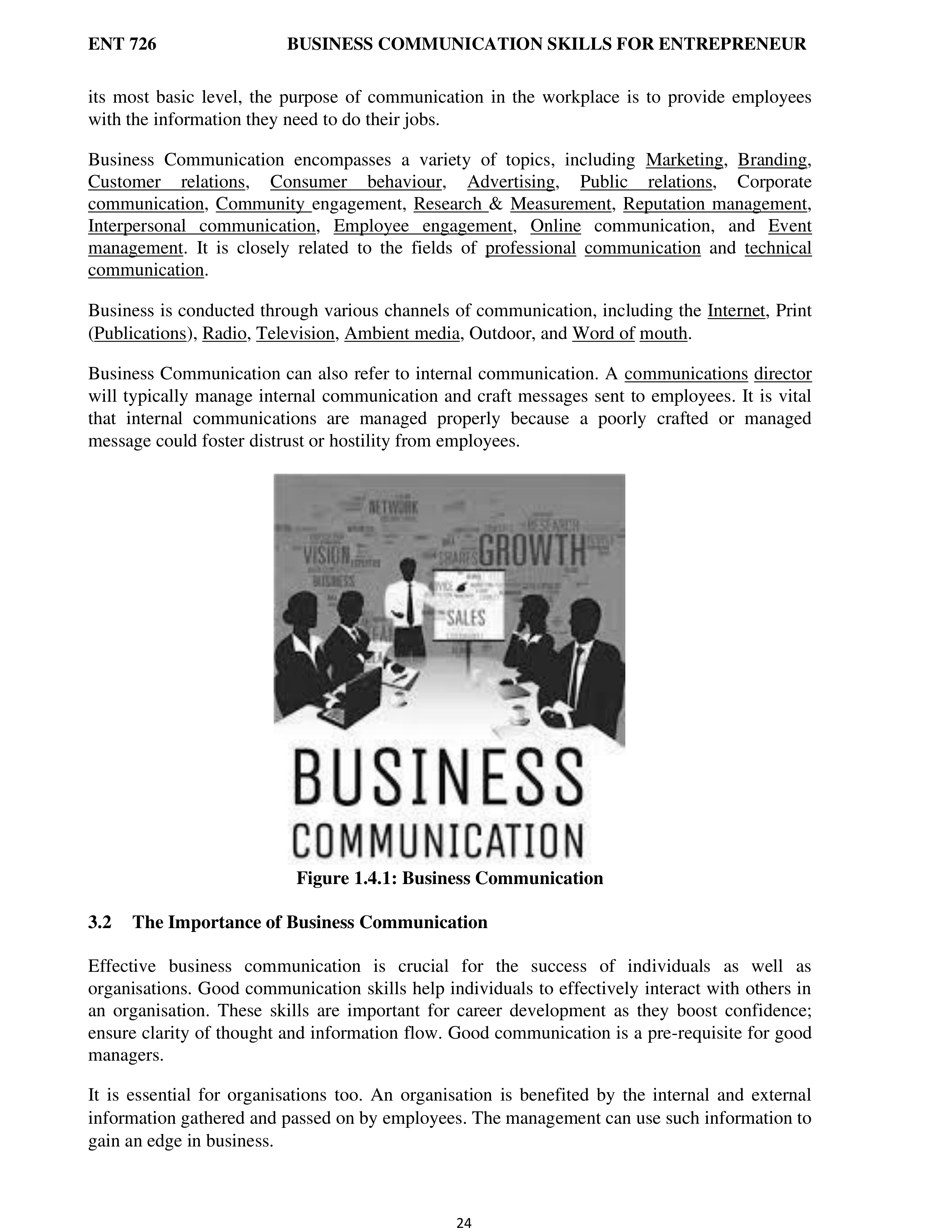
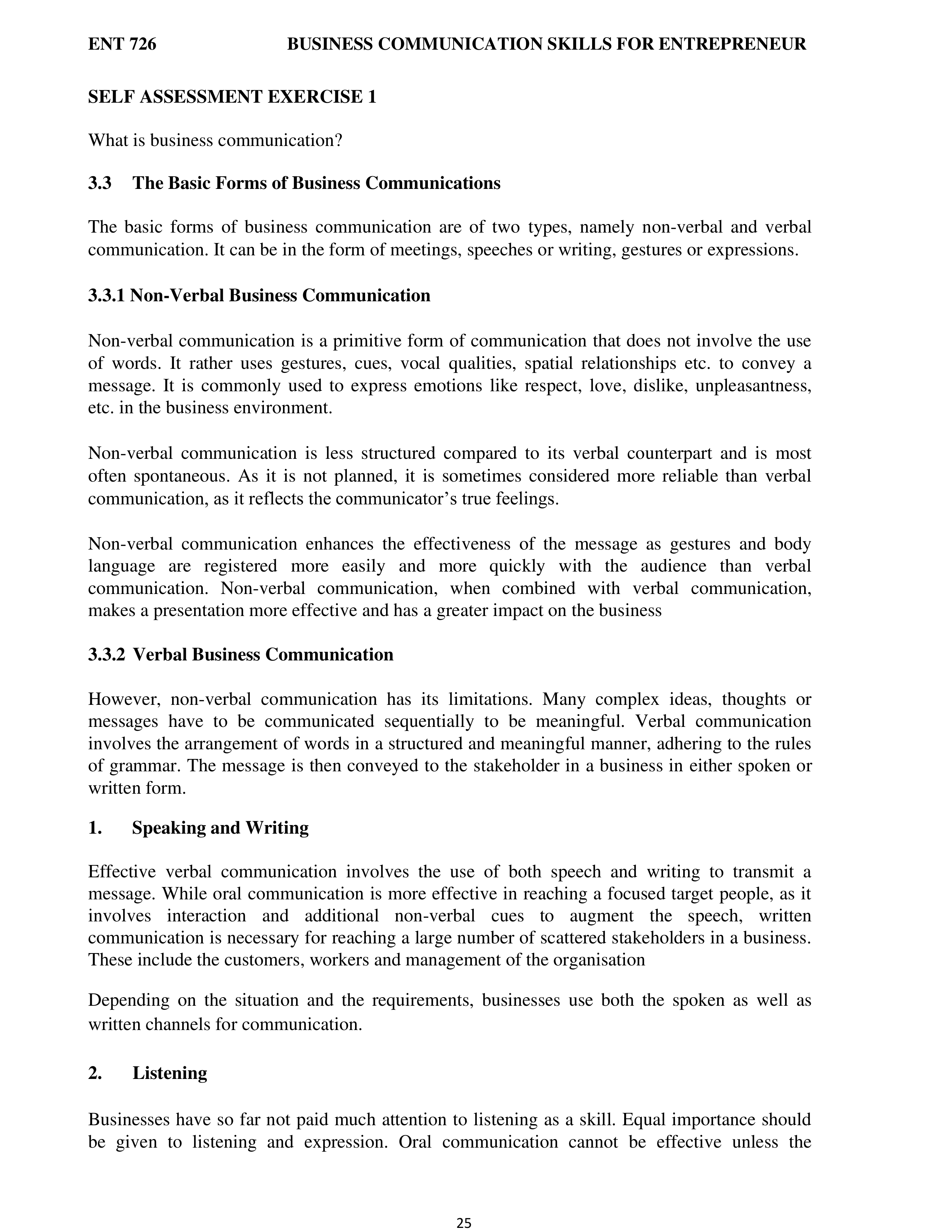
Figure 1.4.1: Business Communication
3.2 The Importance of Business Communication
Effective business communication is crucial for the success of individuals as well as
organisations. Good communication skills help individuals to effectively interact with others in
an organisation. These skills are important for career development as they boost confidence;
ensure clarity of thought and information flow. Good communication is a pre-requisite for good
managers.
It is essential for organisations too. An organisation is benefited by the internal and external
information gathered and passed on by employees. The management can use such information to
gain an edge in business.
ENT 726
BUSINESS COMMUNICATION SKILLS FOR ENTREPRENEUR
25
SELF ASSESSMENT EXERCISE 1
What is business communication?
3.3 The Basic Forms of Business Communications
The basic forms of business communication are of two types, namely non-verbal and verbal
communication. It can be in the form of meetings, speeches or writing, gestures or expressions.
3.3.1 Non-Verbal Business Communication
Non-verbal communication is a primitive form of communication that does not involve the use
of words. It rather uses gestures, cues, vocal qualities, spatial relationships etc. to convey a
message. It is commonly used to express emotions like respect, love, dislike, unpleasantness,
etc. in the business environment.
Non-verbal communication is less structured compared to its verbal counterpart and is most
often spontaneous. As it is not planned, it is sometimes considered more reliable than verbal
communication, as it reflects the communicator’s true feelings.
Non-verbal communication enhances the effectiveness of the message as gestures and body
language are registered more easily and more quickly with the audience than verbal
communication. Non-verbal communication, when combined with verbal communication,
makes a presentation more effective and has a greater impact on the business
3.3.2 Verbal Business Communication
However, non-verbal communication has its limitations. Many complex ideas, thoughts or
messages have to be communicated sequentially to be meaningful. Verbal communication
involves the arrangement of words in a structured and meaningful manner, adhering to the rules
of grammar. The message is then conveyed to the stakeholder in a business in either spoken or
written form.
1.
Speaking and Writing
Effective verbal communication involves the use of both speech and writing to transmit a
message. While oral communication is more effective in reaching a focused target people, as it
involves interaction and additional non-verbal cues to augment the speech, written
communication is necessary for reaching a large number of scattered stakeholders in a business.
These include the customers, workers and management of the organisation
Depending on the situation and the requirements, businesses use both the spoken as well as
written channels for communication.
2.
Listening
Businesses have so far not paid much attention to listening as a skill. Equal importance should
be given to listening and expression. Oral communication cannot be effective unless the
ENT 726
BUSINESS COMMUNICATION SKILLS FOR ENTREPRENEUR
26
audience is good at listening and most of its content is forgotten after a presentation. Developing
good listening skills is essential for grasping the contents of an oral presentation and retaining
them.
3.
The Process of Business Communication.
Business Communication also goes through a process, involving the following phases.
•
Sender
•
Message
•
Channel
•
Receiver
•
Feedback
4.
Barriers to Business Communication.
The process of communication is susceptible to many barriers. These can be categorised into
problems caused by the sender, problems in message transmission, problems in reception, and
problems in receiver comprehension.
5.
Dealing with Business Communication Barriers.
Though most communication barriers require situation-specific handling, a few basic methods
for dealing with them are available. These methods such as know your subject, focus on the
purpose, know your audience, and be organised.
3.3.3
Methods of Business Communication
There are several methods of business communication, they are:
•
Web-based communication - for better and improved communication, anytime
anywhere ...
•
e-mails, which provide an instantaneous medium of written communication
worldwide;
•
Reports - important in documenting the activities of any department;
•
Presentations - very popular method of communication in all types of organisations,
usually involving audio-visual material, like copies of reports, or material prepared in
Microsoft PowerPoint or Adobe Flash;
•
telephoned meetings, which allow for long-distance speech;
•
forum boards, which allow people to instantly post information at a centralised
location; and
•
Face to face meetings, which are personal and should be succeeded by a written
followup.
SELF ASSESSMENT EXERCISE
Highlight the methods that can be used to deal with business communication barriers.
ENT 726
BUSINESS COMMUNICATION SKILLS FOR ENTREPRENEUR
27
3.4
Hierarchy in Business Communication
People communicate in businesses with each other most often by oral communication. This
talking takes place between managers, co-workers and subordinates alike. In organisations,
communication skill is used to send messages 64% of the time. That is why it is important to
understand the concept of communication.
3.4.1 Vertical Business Communication
This is the form of communication between a worker and his or her boss. There is a sign of
seniority in this type of business communication. Have you ever noticed how people
communicate differently with their bosses than they would communicate with their co-workers?
This difference in communication is due to the chain of command. Managers or "bosses" are
typically in an influential position over their employees. Managers have the authority or the
right to give orders and expect the orders to be obeyed. Many employees may feel that any bad
attitude or disagreement with their superior may result in a bad relationship with the boss and
therefore create a bad work environment or job description.
Communication from a manager to a subordinate is also different. One reason for this may be
because of the arising concern by managers not to offend their workers or say the wrong thing.
In today’s society, lawsuits run rapidly over conversations that some employees may take
offensive from their bosses. Managers have a responsibility to know and follow guidelines of
good business communication etiquette.
3.4.2 Horizontal Business Communication
The communication process among workers of the same level is called the horizontal form of
business communication. There is actually no sense of seniority like horizontal communication.
However, it also attracts mutual respect in a business communication context. In most cases,
employees talk to their coworkers in a friendly manner. The overall standard is that workers will
speak more freely and openly to their fellow workers than to their superiors. When workers talk
to each other and relay information on to other workers it is called the "grapevine". The
grapevine is the unofficial way that communication takes place in an organization. It is neither
authorised nor supported by the organization. Information is spread by word of mouth and even
through electronic means today. The grapevine can be used by an "open" company and it will
have accurate information, however, in an authoritative culture, the rumour mill may not be
accurate.
3.4.3 Quasi-Vertical Business Communication
The last type of difference in communication in which there is an intermediary between the
communicators. This could be found in a situation where the communication between the
management of an organisation and the workers is achieved through the labour union which the
workers belong to. They do so to emphasise status and independence.
ENT 726
BUSINESS COMMUNICATION SKILLS FOR ENTREPRENEUR
28
4.0
CONCLUSION
Communication can be seen as the bedrock of any business organisation. There the study of
business communication should be paramount to correct communication barrier in various
organisations.
5.0 SUMMARY
This unit has led us into the knowledge of what business communication is all about. In order
for any human association to be functioning, effective communication system must be present.
This is also applicable to every business organisation. We also examined importance of business
communication, forms and methods of business communication. We finally dealt with hierarchy
in business communication.
6.0 TUTOR-MARKED ASSIGNMENT
1.
List and explain the three tiers in the hierarchy of business communication.
2.
What are the basic forms of business communication?
7.0 REFERENCES/ FURTHER READINGS
Pearce, W. B. (2008). Making Social Worlds: A Communication Perspective.
Hoboken.
ENT 726
BUSINESS COMMUNICATION SKILLS FOR ENTREPRENEUR
29
MODULE 2
UNIT 1
STUDY SKILLS
CONTENTS
1.0 Introduction
2.0 Objectives of the Unit
3.0 Main Content
3.1 Study Skills
3.1.1 Types of Study Skills
3.1.2 Study Methods
3.2 Listening skills
3.2.1 Why do we have Problems Listening?
3.2.2 Types of Listening
3.2.3 Forms of Non-Listening
3.3 Note taking
3.3.1 Systems of Note Taking
4.0 Conclusion
5.0 Summary
6.0 Tutor-Marked Assignment
7.0 References/Further Readings
1.0
INTRODUCTION
Study skills and study strategies are abilities and approaches applied to learning. They are
generally critical to success in school, are considered essential for acquiring good grades, and
they are useful for learning throughout one's life, in support of career and personal interests.
They include removing distractions, time management and note-taking.
Educational institutions often offer student counselling or provide resources for improving study
skills. There are a vast number of resources marketed as study skills. The learning methods
offered for sale range from how to manage time, to note-taking, to smart drugs and nutrients for
improving performance during study
Despite considerable research on subjects dealt with in study manuals, many lack evidence to
support their ideas. Some are paternalistic, offering philosophy and advice about personal
problems and, as with study skills, advice may be based on the author’s own beliefs. For
example, an author may offer suggestions for students on dealing with stress without referring to
any expert on the subject. Before going into detail on this to unit, let us get the objectives of the
unit.
2.0 OBJECTIVES OF THE UNIT
After studying through this unit, you should be able to:
•
List different types of study skills
•
Explain study methods
•
Understand the note-taking process
ENT 726
BUSINESS COMMUNICATION SKILLS FOR ENTREPRENEUR
30
•
Discuss listening processes
3.0 MAIN CONTENT
3.1 Study Skills
3.1.1 Types of Study Skills
•
Removing distractions to improve concentration, and studying in quiet areas
•
Self-motivation
•
Reducing stress and test anxiety
•
•
Time management
•
Scheduling study
•
Balancing between homework and other activities
•
Avoiding cramming
•
Studying when alert
•
Collaboration
•
Active listening
•
Note-taking
•
•
Completing practice tests
•
Memorisation
•
Flashcard training
•
Being quizzed by someone
•
Using multiple sources
•
Avoiding hunger and drowsiness
•
Using study methods
3.1.2 Study Methods
A study method, study system, or study technique, is a formalised learning process or
procedure of study. Each is considered a study skill, and each may, in turn, be comprised of
many study skills, combined for effectiveness.
1.
The PQRST method
A student studies for his final exams, using the PQRST method. One method used by
structured students to keep them on track is the PQRST method. This method prioritises the
information in a way that relates directly to how they will be asked to use that information in
an exam. The method can also be modified to suit any particular form of learning in most
subjects. It allows more accurate timing of work rather than the student having to decide how
much time to attribute to a topic. PQRST is an acronym for
P
review,
Q
uestion,
R
ead,
S
ummary,
and Test
.
ENT 726
BUSINESS COMMUNICATION SKILLS FOR ENTREPRENEUR
31
i.
Preview:
the student looks at the topic to be learned by glancing over the major
headings or the points in the syllabus.
ii.
Question:
then questions to answer are formulated once the topic has been
thoroughly
studied.
iii.
Read:
reference material related to the topic is read through, and the
information that
best relates to the questions is chosen.
iv.
Summary:
the student summarizes the topic, bringing his or her own ways of
summarizing information into the process, including written notes, spider diagrams,
flow diagrams, labelled diagrams, mnemonics, or even voice recordings.
v.
Test:
then the student answers the questions created in the question step as fully
as
possible, avoiding adding questions that might distract or change the subject.
2.
The Black-Red-Green method
This is a thoroughgoing method [developed through the Royal Literary Fund] which helps
the student to ensure that every aspect of the question posed has been considered, both in
exams and essays, The student underlines relevant parts of the question using three separate
colours (or some equivalent).
BLA
ck denotes '
BLA
tant instructions', i.e. something that
clearly must be done; a directive or obvious instruction.
RE
d is a
RE
ference Point or
RE
quired input of some kind, usually to do with definitions, terms,
cited authors, theory, etc.
(either explicitly referred to or strongly implied).
GRE
en denotes
GRE
mlins, which are
subtle signals one might easily miss, or a ‘
GRE
EN Light’ that gives a hint on how to
proceed, or where to place the emphasis in answers
3.
Re-writing notes
Re-writing notes is time-consuming, but one of the most effective ways of studying. There
are two types of information that can be written over again: notes taken in class, or
information out of a textbook. Highlighting important information prior to re-writing notes is
an effective use of time management.
4.
Summary skills
Summary methods should vary depending on the topic. Some methods are better suited to
different subjects and tasks, e.g. mnemonics may fare better for learning lists or facts while
spider diagrams better for linking concepts.
5.
Mnemonic
is a method of memorising lists and organising them.
Example:
Learning the points of the compass.
N
ever
E
at
S
hredded
W
heat reminds us not
only of the points of the compass but in the order they occur when encountered clockwise.
6.
Spider diagrams:
Using spider diagrams or mind maps can be an effective way of
linking concepts together. They can be useful for planning essays and essay responses
in exams.
7.
Diagrams:
Diagrams are often underrated tools. They can be used to bring all the
information together and provide practice reorganising what has been learned in order
to produce something practical and useful. They can also aid the recall of information
learned very quickly, particularly if the student made the diagram while studying the
ENT 726
BUSINESS COMMUNICATION SKILLS FOR ENTREPRENEUR
32
information. Try buying a notebook with no lines and make a sketch, diagram, or
pictogram of the information you have just learned. This could form part of the
Summary part of the PQRST method or in any other way. These pictures can then be
transferred to flash cards that are very effective last-minute revision tools rather than
rereading any written material.
8.
Flashcards (A5 index cards):
These are effective revision tools but students often set
out to make them and they become more of a chore. It is much more effective to make
cards at the time that you are revising. If these cards are made during the summary part
of the PQRST method then are directly associated with what you learned. The cards are
less effective when students set out to make them late in a revision cycle merely as
tools to look at during the 20-30 minutes before an exam. The cards are indeed useful
for last-minute reading as they offer nothing new and therefore is more likely to focus
on what you know and not alert you to something you don't know so well.
9.
Traffic lights:
It is a common pitfall in studying to set out to learn everything that you
have been taught in an orderly and precise fashion. If time, boredom, and fatigue were
not variables that can impact on your studying and even health then this may always be
possible. More normally you will have a set amount of time (that doesn't encroach on
leisure time for any reason) to learn a set amount of topics. An easy way to separate
what is really important to know (likely to constitute the majority of exam marks) from
what you would like to know if you had infinite time and energy is the traffic light
system.
i.
Green:
Take a green pen and label or place a star next to everything that is
essential to
know for your exam. These topics should be studied first and allow you to progress to
the less number of amber and red topics. These should generally be the first few on a
syllabus and be the easiest concepts to learn but also the easiest to underestimate.
ii.
Amber:
Take an orange or gold pen and label everything that is neither essential
to
know nor is not too time-consuming to learn. This should form the mainstay of your
learning and range from topics leading from the green range of topics to ones leading to
the red range of topics.
iii.
Red:
Take a red pen and label everything you would want to know if you had all
the
time and energy necessary but not at the expense of the essential green topics and
desired amber topics. This would include overly complicated ideas and subjects that
may add one or two marks but may cost you if you focus all your attention just on
knowing the more difficult bits and underestimating the importance of accumulating
the green and amber topics first and to a greater extent. A greater focus on green and
amber topics may also lead to topics that seemed red to become more amber as time
goes on.
The colour system reminds students that it is easier to get moving on green topics and
discourage wasted time on red and amber topics. It reminds students to keep learning in a
progressive manner, and not to stagnate when topics become redder in nature owing to
tiredness and boredom.
SELF ASSESSMENT EXERCISE 1
Enumerate different study methods as discussed in this unit.
ENT 726
BUSINESS COMMUNICATION SKILLS FOR ENTREPRENEUR
33
3.2 LISTENING SKILLS
Listening is the process of receiving, constructing meaning from, and responding to
spoken or nonverbal messages.
People can think approximately 500 words per minute.
And the average person speaks 125 - 150 words per minute.
People can give their full attention for approximately 20 seconds.
The average time spent on various communication skills.
•
53% listening
•
14% writing
•
16% speaking
•
17% reading
3.2.1 Why Do We Have Problems Listening
?
Cognitive Dissonance, a psychological theory that applies to communication, states that a
person feels conflict if they hold two or more attitudes that are in opposition to each other.
One way people reduce dissonance is by ignoring the conflict that is causing the conflict.
•
Anxiety
-Sometimes we can't listen because our anxiety is too high.
•
The Controlling Listener
-always looks for a way to talk about themselves and
what they are thinking about.
•
The Passive Listener-
Exerts little listening effort-listen like a couch potatoes
3.2.2 Types of Listening
•
Listening for information
•
Critical listening
•
Empathic listening
•
Listening for enjoyment
3.2.3 Forms of Non-Listening
•
Pseudo-listening
-pretending to listen
•
Monopolizing
-Hogging the stage by continuously focusing communication on
ourselves instead of the person who is talking
•
Selective listening
- We screen out the parts that don't interest us. We reject
communication that bores us or makes us uncomfortable.
•
Defensive Listening
- Perceiving personal attacks, criticism, or hostile undertones
in
communication where none is intended.
•
Ambushing
- Listening carefully for the purpose of attacking the other speaker
•
Literal Listening
-Listening only to the content level of meaning and ignoring the
relationship level of meaning.
ENT 726
BUSINESS COMMUNICATION SKILLS FOR ENTREPRENEUR
34
SELF ASSESSMENT EXERCISE 2
Write a short note on forms of non-listening
3.3 NOTETAKING
Note-taking is the practice of writing pieces of information, often in an informal or
unstructured manner. One major-specific type of note-taking is the practice of writing in
shorthand, which can allow large amounts of information to be put on paper very quickly.
Notes are frequently written in notebooks, though any available piece of paper can suffice in
many circumstances-some people are especially fond of Post-It notes, for instance. Note-
taking is an important skill for students, especially at the college level. Many different forms
are used to structure information and make it easier to find later.
3.3.1 Systems of Note-taking
1.
Cornell Notes
When using the Cornell note-taking system a column of white space is left to the left side of
the notes that are written as they come up. Questions or keywords based on the notes are
written in the white space after the session has ended. The Cornell method requires no
rewriting and yet results in systematic notes.
2.
Charting
Charting is creating a graph with symbols, or table with rows and columns. Graphs and flow-
charts are useful for documenting a process or event. Tables are useful for facts and values
3.
Outlining
While notes can be written freely, many people structure their writing in an outline. A
common system consists of headings that use Roman numerals, letters of the alphabet, and
the common Arabic numeral system at different levels. A typical structure would be:
I.
First main topic
A.
Subtopic
1.
Detail
2.
Detail
B.
Subtopic
II.
Second main topic A.
Subtopic
However, this sort of structure has limitations in written form since it is difficult to go back
and insert more information. Adaptive systems are used for paper-and-pen insertions, such as
using the backside of the preceding page in a spiral to note insertions. It is possible to simply
leave large spaces in between. (See Category: Outliners for more about application software
that supports outlining.)
ENT 726
BUSINESS COMMUNICATION SKILLS FOR ENTREPRENEUR
35
4.
Mapping
Here, ideas are written in a tree structure, with lines connecting them. Mind maps are
commonly drawn with a central point, purpose or goal in the centre of the page and then
branching outward to identify all the ideas connected to that goal. Colours, small graphics
and symbols are often used to help to visualize the information more easily. This note-taking
method is most common among visual learners and is a core practice of many accelerated
learning techniques. It is also used for planning and writing essays.
5.
Sentence method
Every new thought is written as a new line. Speed is the most desirable attribute of this
method because not much thought about formatting is needed to form the layout and create
enough space for more notes. Also, you must number each new thought.
6.
SQ3R
SQ3R is a method for taking notes from written material, though it might be better classed as
a method of reading and gaining understanding. Material is skimmed to produce a list of
headings, which are then converted into questions. These questions are then considered
whilst the text is read to motivate what is being covered. Notes are written under sections
headed by the questions as each of the material's sections is read. One then makes a summary
from memory and reviews the notes.
4.0 CONCLUSION
Study skills are a very important part of knowledge impartation. It helps in mental
preparation for learning. In order to acquire proper communication skills, various methods in
study skill must be thoroughly mastered. Their suitability for an individual varies but they
can achieve the same result where appropriately selected
5.0 SUMMARY
In this unit, we have examined study skills as an important aspect of business
communication. Discussed under these are types of study skills, listening skills and note-
taking skills.
6.0 TUTOR-MARKED ASSIGNMENT.
1.
List the different types of study skills.
2.
What are the methods of note-taking?
7.0 REFERENCES/ FURTHER READINGS
Baron, R. S., Dion, K. L., Baron, P. H., & Miller, N. (1971). Group consensus and
cultural values as determinants of risk taking.
Journal of Personality and Social
Psychology
,
20
(3), 446.
ENT 726
BUSINESS COMMUNICATION SKILLS FOR ENTREPRENEUR
36
Wallach, M. A., Kogan, N., & Bem, D. J. (1962). Group influence on individual risk taking.
The Journal of Abnormal and Social Psychology
,
65
(2), 75.
UNIT 2
ENGLISH GRAMMAR
CONTENTS
1.0
Introduction
2.0
Objectives of the unit
3.0
Main Content
3.1 English Grammar
3.2 What are Parts of Speech?
3.3 Parts of Speech in the English Language
3.3.1 Types of Nouns
3.2.2 The Verb
3.3.3 The Adjective
3.3.3.1 Types of adjectives
3.3.4 The Adverb
3.3.5 The Interjection
3.3.6 The Determiner
3.3.7 The Pronoun
3.3.8 The Preposition
3.3.9 The Conjunction
4.0
Conclusion
5.0
Summary
6.0
Tutor-Marked Assignment
7.0
References/Further Readings
1.0 INTRODUCTION
Proper understanding of English grammar is a pre-requisite to an effective communication in
English language. This unit begins with a search into the knowledge of English grammar and
its proper usage in business communication. We will start from the proper understanding of
parts of speech. Knowledge of punctuation and sentence formation will be treated in the
succeeding units. Before moving further, let us examine the objective of this unit.
2.0 OBJECTIVES OF THE UNIT
After studying this unit, you should be able to:
•
Enumerate the different parts of speech.
•
Explain the meaning of lexical category.
•
Discuss the functions of parts of speech in grammar.
•
Describe the usage and mode of each part of speech.
3.0 MAIN CONTENT
3.1 English Grammar
In linguistics, grammar refers to the logical and structural rules that govern the composition
of sentences, phrases, and words in any given natural language. The term refers also to the
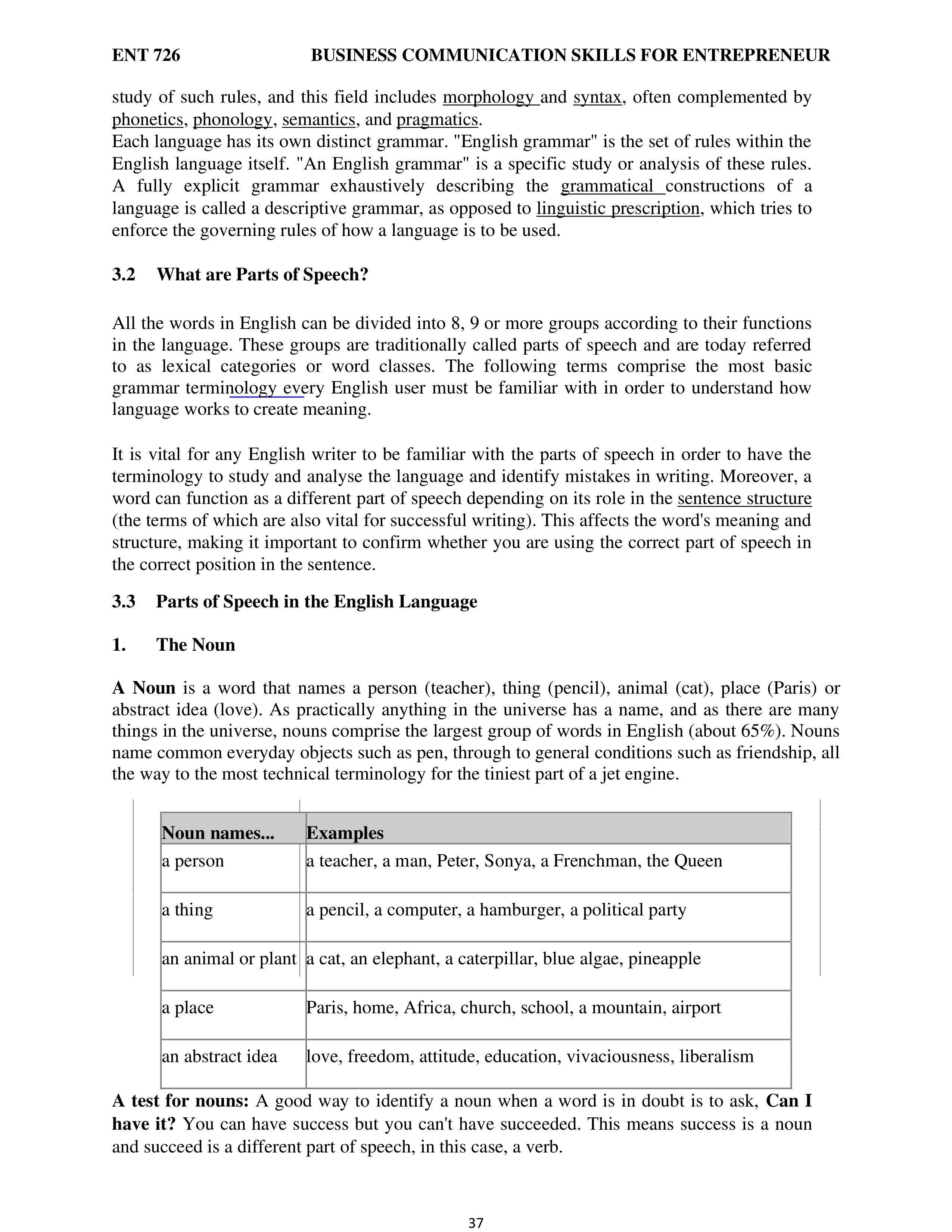




ENT 726
BUSINESS COMMUNICATION SKILLS FOR ENTREPRENEUR
37
study of such rules, and this field includes morphology and syntax, often complemented by
phonetics, phonology, semantics, and pragmatics.
Each language has its own distinct grammar. "English grammar" is the set of rules within the
English language itself. "An English grammar" is a specific study or analysis of these rules.
A fully explicit grammar exhaustively describing the grammatical constructions of a
language is called a descriptive grammar, as opposed to linguistic prescription, which tries to
enforce the governing rules of how a language is to be used.
3.2 What are Parts of Speech?
All the words in English can be divided into 8, 9 or more groups according to their functions
in the language. These groups are traditionally called parts of speech and are today referred
to as lexical categories or word classes. The following terms comprise the most basic
grammar terminology every English user must be familiar with in order to understand how
language works to create meaning.
It is vital for any English writer to be familiar with the parts of speech in order to have the
terminology to study and analyse the language and identify mistakes in writing. Moreover, a
word can function as a different part of speech depending on its role in the sentence structure
(the terms of which are also vital for successful writing). This affects the word's meaning and
structure, making it important to confirm whether you are using the correct part of speech in
the correct position in the sentence.
3.3 Parts of Speech in the English Language
1.
The Noun
A Noun
is a word that names a person (teacher), thing (pencil), animal (cat), place (Paris) or
abstract idea (love). As practically anything in the universe has a name, and as there are many
things in the universe, nouns comprise the largest group of words in English (about 65%). Nouns
name common everyday objects such as pen, through to general conditions such as friendship, all
the way to the most technical terminology for the tiniest part of a jet engine.
Noun names...
Examples
a person
a teacher, a man, Peter, Sonya, a Frenchman, the Queen
a thing
a pencil, a computer, a hamburger, a political party
an animal or plant a cat, an elephant, a caterpillar, blue algae, pineapple
a place
Paris, home, Africa, church, school, a mountain, airport
an abstract idea
love, freedom, attitude, education, vivaciousness, liberalism
A test for nouns:
A good way to identify a noun when a word is in doubt is to ask,
Can I
have it?
You can have success but you can't have succeeded. This means success is a
noun
and succeed is a different part of speech, in this case, a verb.
ENT 726
BUSINESS COMMUNICATION SKILLS FOR ENTREPRENEUR
38
3.3.1 Types of Nouns
There are many different types of nouns. As you know, you capitalise some nouns, such as
"Canada" or "Louise," and do not capitalise others, such as "badger" or "tree" (unless they
appear at the beginning of a sentence). In fact, grammarians have developed a whole series of
noun types, including the proper noun, the common noun, the concrete noun, the abstract
noun, the countable noun (also called the count noun), the non-countable noun (also called
the mass noun), and the collective noun. You should note that a noun will belong to more
than one type: it will be proper or common, abstract or concrete, and countable or non-
countable or collective.
•
Proper Nouns
You always write a
proper noun
with a capital letter, since the noun represents the name of
a specific person, place, or thing. The names of days of the week, months, historical
documents, institutions, organisations, religions, their holy texts and their adherents are
proper nouns. A proper noun is the opposite of a common noun. For example:
Many people dread
Monday
mornings.
•
Common Nouns
A
common noun
is a noun referring to a person, place, or thing in a general sense. Usually,
you should write it with a capital letter only when it begins a sentence. A common noun is
the opposite of a proper noun. For example:
According to the
sign
, the nearest
town
is 60
miles
away.
Sometimes you will make proper nouns out of common nouns, as in the following example.
Many witches refer to the Renaissance as the Burning
Times
•
Concrete Nouns
A
concrete noun
is a noun which names anything (or anyone) that you can perceive through
your physical senses: touch, sight, taste, hearing, or smell. A concrete noun is the opposite of
an abstract noun. For example,
The
judge
handed the
files
to the
clerk
•
Abstract Nouns
An
abstract noun
is a noun which names anything which you can not perceive through your
five physical senses and is the opposite of a concrete noun. For example,
Justice often seems
to slip out of our grasp.
•
Countable Nouns
A
countable noun
(or
count noun
) is a noun with both a singular and a plural form, and it
names anything (or anyone) that you can count. You can make a countable noun plural and



ENT 726
BUSINESS COMMUNICATION SKILLS FOR ENTREPRENEUR
39
attach it to a plural verb in a sentence. Countable nouns are the opposite of non-countable
nouns and collective nouns. For example,
We painted the
table
red and the
chairs
blue.
•
Non-Countable Nouns
A
non-countable noun
(or
mass noun
) is a noun which does not have a plural form, and
which refers to something that you could (or would) not usually count. A non-countable noun
always takes a singular verb in a sentence. Non-countable nouns are similar to collective
nouns and are the opposite of countable nouns. For example,
We decided to sell the
furniture
rather than take it with us when we
moved.
•
Collective Nouns
A
collective noun
is a noun naming a group of things, animals, or persons. You could count
the individual members of the group, but you usually think of the group as a whole is
generally as one unit. You need to be able to recognise collective nouns in order to maintain
subject-verb agreement. A collective noun is similar to a non-countable noun and is roughly
the opposite of a countable noun. For example:
The
flock
of geese spends most of its time in the pasture.
3.2.2 The Verb
A verb
is a word that expresses an action (to run), occurrence (to happen) or state of
being
(to appear). Verbs comprise the third largest group of words in English (about 10%) and
appear in any sentence as a major mandatory element tying the subject and predicate
together. Verbs also indicate time (past, present, future) and are used with many verb tenses.
The verb can be thought of as the centre, heart, or anchor of an English sentence.
Tests for verbs:
A good way to identify a verb when a word is in doubt is to ask,
"Can I do
it?"
I can succeed (do it) is correct but I can success is incorrect. This means succeed
is a
verb and the related part of speech success is not a verb; in this case, success is a noun.
Objects and Complements
Objects
Verbs of...
Examples
Action
Tope
dances
at the studio and performs every Sunday.
occurrence
Occurrence Tope
became
a professional dancer.
Verbs of...
Examples
state of being
Tope’s studio
has stood
there ever since she was a child.
ENT 726
BUSINESS COMMUNICATION SKILLS FOR ENTREPRENEUR
40
A verb may be followed by an
object
that completes the verb's meaning. Two kinds of
objects follow verbs: direct objects and indirect objects. To determine if a verb has a
direct
object
, isolate the verb and make it into a question by placing "whom?" or
"what?" after it.
The answer, if there is one, is the direct object:
Direct Object
The advertising executive drove
a flashy red Porsche
.
Direct Object
Her secret admirer gave her
a bouquet of flowers
.
The second sentence above also contains an
indirect object
. An indirect object (which, like a
direct object, is always a noun or pronoun) is, in a sense, the recipient of the direct object. To
determine if a verb has an indirect object, isolate the verb and ask to whom?, to what?, for
whom?, or for what? after it. The answer is the indirect object.
Not all verbs are followed by objects. Consider the verbs in the following sentences:
The guest speaker
rose
from her chair to protest.
After work, Randy usually
jogs
around the canal.
Transitive and Intransitive Verbs
Verbs that take objects are known as
transitive verbs
. Verbs not followed by objects are
called
intransitive verbs
.
Some verbs can be either transitive verbs or intransitive verbs, depending on the context:
Direct Object
I hope the Senators win the next game.
No Direct Object
Did we win?
Subject Complements
In addition to the transitive verb and the intransitive verb, there is a third kind of verb called
a linking verb. The word (or phrase) which follows a linking verb is called not an object, but
a
subject complement
.
The most common linking verb is "be." Other linking verbs are "become," "seem," "appear,"
"feel," "grow," "look," "smell," "taste," and "sound," among others. Note that some of these
are sometimes linking verbs, sometimes transitive verbs, or sometimes intransitive verbs,
depending on how you use them:
Linking verb with subject complement
He
was
a radiologist before he
became
a full-time yoga instructor.
ENT 726
BUSINESS COMMUNICATION SKILLS FOR ENTREPRENEUR
41
Linking verb with subject complement
Your home-made chilli
smells
delicious.
Transitive verb with direct object
I can't
smell
anything with this terrible cold.
Intransitive verb with no object
The interior of the beautiful new Buick
smells
strongly of fish.
Note that a subject complement can be either a noun ("radiologist", "instructor") or an
adjective ("delicious").
Object Complements
An
object complement
is similar to a subject complement, except that (obviously) it
modifies an object rather than a subject. Consider this example of a subject complement:
The driver seems
tired
.
In this case, as explained above, the adjective "tired" modifies the noun "driver," which is the
subject of the sentence.
Sometimes, however, the noun will be the object, as in the following example:
I consider the driver
tired
.
In this case, the noun "driver" is the direct object of the verb "consider," but the adjective
"tired" is still acting as its complement.
In general, verbs which have to do with perceiving, judging, or changing something can
cause their direct objects to take an object complement:
SELF ASSESSMENT EXERCISE 1
Explain the meaning of part of speech and discuss your understanding of noun
3.3.3
The Adjective
An adjective
is a word that modifies (describes) a noun or pronoun. Adjectives comprise
the
second largest group of words in English (about 23%). An adjective informs about the
qualities and features of people, things or concepts (big, strong, beautiful, and sensitive) and
can be considered as an added intensifier or even "decoration" to the required basic sentence
elements, adding variety and liveliness. Adjectives can also be expanded into adjective
clauses, which function similarly. In the following examples, the adjectives are
Underline and the nouns or pronouns they modify are in bold.
He
was happy when he moved to his new
house
[the adjective happy modifies the pronoun he, the adjective new modifies the noun house]
A test for adjectives:
A good way to identify an adjective when a word is in doubt is to
ask
about the modified noun,
what kind of (noun) is it?
He is a successful businessman is
ENT 726
BUSINESS COMMUNICATION SKILLS FOR ENTREPRENEUR
42
correct, as successful answers what kind of businessman is he? He is a successfully
businessman is incorrect as successfully answers "How" and not "What kind of". This means
successful is an adjective and successfully is a different part of speech, in this case, an
adverb.
Using the Comparative and Superlative
You should use the
comparative
form of an adjective or adverb to compare exactly two
things. You can form the comparative by adding the suffix "-er" to the modifier (for some
short words) or by using the word "more" with the modifier:
Of the two designs, the architect is convinced that the city will select the
more
experimental
one. (Comparing two designs)
Now that it is March, the days are getting
longer
(longer now than before).
You should use the
superlative
form to compare three or more things. You can form the
superlative by adding the suffix "-est" to the modifier (for some short words) or by using the
word "most" with the modifier:
This is definitely the smartest, wittiest, most imaginative comic strip I have ever seen.
(implying that I have seen more than two)
3.3.3.1 Types of Adjectives
•
Possessive Adjectives
A
possessive adjective
("my," "your," "his," "her," "its," "our," "their") is similar or identical
to a possessive pronoun; however, it is used as an adjective and modifies a noun or a noun
phrase, as in the following sentences:
I can't complete
my
assignment because I don't have the textbook.
In this sentence, the possessive adjective "my" modifies "assignment" and the noun phrase
"my assignment" functions as an object. Note that the possessive pronoun form "mine" is not
used to modify a noun or noun phrase.
What is
your
phone number?
Here the possessive adjective "your" is used to modify the noun phrase "phone number"; the
entire noun phrase "your phone number" is a subject complement. Note that the possessive
pronoun form "yours" is not used to modify a noun or a noun phrase.
•
Demonstrative Adjectives
The
demonstrative adjectives
"this," "these," "that," "those," and "what" are identical to the
demonstrative pronouns, but are used as adjectives to modify nouns or noun phrases, as in
the following sentences:
When the librarian tripped over
that
cord, she dropped a pile of books.
ENT 726
BUSINESS COMMUNICATION SKILLS FOR ENTREPRENEUR
43
In this sentence, the demonstrative adjective "that" modifies the noun "cord" and the noun
phrase "that cord" is the object of the preposition "over."
This
apartment needs to be fumigated.
Here "this" modifies "apartment" and the noun phrase "this apartment" is the subject of the
sentence.
Note that the relationship between a demonstrative adjective and a demonstrative pronoun is
similar to the relationship between a possessive adjective and a possessive pronoun, or to that
between an interrogative adjective and an interrogative pronoun.
•
Interrogative Adjectives
An
interrogative adjective
("which" or "what") is like an interrogative pronoun, except that
it modifies a noun or noun phrase rather than standing on its own (see also demonstrative
adjectives and possessive adjectives):
Which
plants should be watered twice a week?
Like other adjectives, "which” can be used to modify a noun or a noun phrase? In this
example, "which” modifies “plants” and the noun phrase “which plants” is the subject of the
compound verb “should be watered”?
What
book are you reading?
In this sentence, "what" modifies "book" and the noun phrase "what book" is the direct object
of the compound verb "are reading."
•
Indefinite Adjectives
An
indefinite adjective
is similar to an indefinite pronoun, except that it modifies a noun,
pronoun, or noun phrase, as in the following sentences:
Many people believe that corporations are under-taxed.
The indefinite adjective "many" modifies the noun "people" and the noun phrase "many
people" is the subject of the sentence.
I will send you any mail that arrives after you have moved to Sudbury.
The indefinite adjective "any" modifies the noun "mail" and the noun phrase "any mail" is
the direct object of the compound verb "will send."
3.3.4 The Adverb
An adverb
is a type of word that has many uses in English. It can modify (describe) a
verb, an adjective, another adverb, or a whole sentence (composed from at least an
independent clause). Adverbs (quickly, here, now, always, very, obviously) can be
considered as added intensifiers or even "decoration" to the required basic sentence
ENT 726
BUSINESS COMMUNICATION SKILLS FOR ENTREPRENEUR
44
elements, supplementing them with important pieces of information. Adverbs also appear
in multi-word phrases and can also be expanded into adverbial clauses which function
similarly. In the following examples, the adverbs are underlined and the elements they
modify are in bold.
The new typist
works
quickly and well.
[The adverbs quickly and well modify the verb works]
The new typist is extremely
busy
.
[The adverb extremely modifies the adjective busy]
The new typist works very
quickly
.
[The adverb very modifies the adverb quickly]
Fortunately,
the new typist works well.
[the adverb, fortunately, modifies the sentence the new typist works well]
As adverbs add several kinds of information, they can be divided into the following
groups of types, each answering the below-mentioned questions:
Adverb of
Examples
Manner –
how?
quietly, happily, sadly, quickly, slowly, clockwise, well
Place –
where?
away, at home, down, everywhere, round, here, there
time –
when?
daily, last week, a year ago, tomorrow, on Sunday,
immediately
frequency –
how often?
always, often, usually, sometimes, seldom, never
degree –
how much?
quite, rather, pretty, very, completely, really, hardly,
too, just
whole sentence –
under what
circumstance?
Fortunately, unfortunately, luckily, obviously, perhaps,
surprisingly
A test for adverbs:
A good way to identify an adverb when a word or phrase is in doubt
is to
ask one of the questions presented in bold in the adverb type table above. If the word or
phrase answers the question, then it functions as an adverb.
•
Conjunctive Adverbs
You can use a
conjunctive adverb
to join two clauses together. Some of the most common
conjunctive adverbs are "also," "consequently," "finally," "furthermore," "hence," "however,"
"incidentally," "indeed," "instead," "likewise," "meanwhile," "nevertheless," "next,"
"nonetheless," "otherwise," "still," "then," "therefore," and "thus." A conjunctive adverb is
not strong enough to join two independent clauses without the aid of a semicolon. For
examples:
•
The government has cut university budgets;
consequently
, class sizes have been
increased.



ENT 726
BUSINESS COMMUNICATION SKILLS FOR ENTREPRENEUR
45
•
He did not have all the ingredients the recipe called for;
therefore
, he decided to make
something else.
3.3.5 The Interjection
An interjection
is a word or expression that conveys a strong emotion, such as surprise,
joy
or disgust. It usually appears in dialogues and informal writing settings, as more formal
writing settings, such as academia or business warrant an objective formal writing style.
Interjections are usually used with an exclamation point (!) or set off with a comma.
Wow!
What a game!
Oh,
I forgot all about the game last night.
SELF ASSESSMENT EXERCISE 1
State and explain the types of adjectives.
3.3.6 The Determiner
A determiner
is a word that accompanies a noun or noun phrase and determines whether
it is
general or specific, its quantity, who it belongs to and more. Determiners are divided into the
following groups:
3.3.7 The Pronoun
A pronoun
is a word that replaces a noun or refers to it. Pronouns are divided into
the
following groups.
Pronoun Type
Examples
personal
I
remember
her
helping
us
our problems, not
yours
.
demonstrative
Those
are my favourite, but
these
are good too.
reflexive
They did it
themselves
. I saw it
myself
.
interrogative
Who
said so?
relative
The man
who
lives next-door borrowed the book
that
you lent me.
reciprocal
We like talking to
each other
.
indefinite
Everybody
comes to the party,
each and every one
.
Determine Type
Examples
articles
The
teacher asked
a
student to answer
the
question.
demonstrative
These
students got
this
grade on the test.
quantifiers
Many
got an average grade,
some
got a pass, and
few
excelled.
interrogative
What
answer was written the best?
numerical
The
fourth
section in the
second
test was very easy.
possessive
His
grade was lower than
her
grade.
relative
We know
which
test was copied.



ENT 726
BUSINESS COMMUNICATION SKILLS FOR ENTREPRENEUR
46
3.3.8 The Preposition
A preposition
is a word that conveys relationships between other words, usually in time,
place or direction. Prepositions are an integral part of many expressions with verbs and
adjectives, and also of idioms. They should always be learned together with the expression
they are part of, as their use cannot always be predicted. A prepositional phrase contains the
preposition and the words it modifies.
3.3.9 The Conjunction
A conjunction
is a word that connects other words, phrases and clauses reflecting some
kind of logical relationship between the connected elements (addition, illustration, cause,
effect, contrast etc.). Conjunctions connecting two elements of equal weight are coordinating
conjunctions, and those which introduce dependent clauses are subordinating conjunctions.
Conjunction Type
Examples
coordinating conjunctions
and, or, but, so, or, nor, for, yet
subordinating conjunctions
because, since, while, after, if, although, whether
correlative conjunctions
not only...but also, either...or, neither...nor, both...and
4.0
CONCLUSION
As this brief explanation shows, parts of speech are the basic building blocks of the English
language. If you know the basics, you will be able to understand your writing and develop it
further. While we can all be expected to know the rules of English grammar, careful study of
the parts of speech can ensure that our use of sentence structure and other grammar points is
always correct.
5.0 SUMMARY
This unit has mainly dealt with the meaning of grammar and part of speech. Various guiding
examples were given to broaden your understanding. This unit will greatly help to reduce
common mistakes that have hitherto messed up your grammar.
6.0 TUTOR-MARKED ASSIGNMENT
1.
What do you understand by determiners?
2.
Explain in detail your knowledge of types of Noun
Time
on
Sunday,
in
the summer,
at
5 o’clock
place
under
the bed,
between
you and me,
at
work,
in front of
the TV,
from
home direction
into
the box,
over
the city,
towards
the car,
away from
here
ENT 726
BUSINESS COMMUNICATION SKILLS FOR ENTREPRENEUR
47
7.0 REFERENCES/FURTHER READINGS
Davidson, D. (1967). The logical form of action sentences. In Rescher, N. (1967).
The
logic of decision and action
. University of Pittsburgh Pre.
Lester, M., & Beason, L. (2005).
The McGraw-hill handbook of English grammar and
usage
(p. 4). New York: McGraw-Hill.
Krifka, M. (1989). Nominal reference, temporal constitution and quantification in event
semantics.
Semantics and contextual expression
,
75
, 115.
ENT 726
BUSINESS COMMUNICATION SKILLS FOR ENTREPRENEUR
48
UNIT 3
PUNCTUATION IN ENGLISH
CONTENTS
1.0 Introduction
2.0 Objectives of the unit
3.0 Main Content
3.1 Punctuation in English
3.2
Quotation Marks
3.3
End Punctuation
3.4
The Comma
3.5
The Dash
3.6
The Apostrophe
3.7
The Colon
3.8
The Semicolon
4.0 Conclusion
5.0 Summary
6.0 Tutor-Marked Assignment
7.0 References/Further Readings
1.0 INTRODUCTION
Punctuation actually helps the flow of the message being presented in writing form to be
meaningful. It helps to know when to stop, when to shout, when to pause for some time etc. a
write up that is not well punctuated is likely to lose its meaning. It could however, not
connote the intension or message that is being passed across. This is detrimental to effective
business communication. Therefore the proper knowledge of punctuation is very important in
order to communicate effectively.
2.0 OBJECTIVES OF THE UNIT
On completion of this unit, you should be able to:
•
List different types of punctuation marks in English
•
Identify the uses of various punctuation marks
•
Explain the wrong use of some punctuation marks
•
Appropriately use all punctuation marks
3.0 MAIN CONTENT
3.1 Punctuation in English
Punctuation is the system of symbols (.,! - : etc) that we use to separate sentences and parts of
sentences, and to make their meaning clear. Each symbol is called a "punctuation mark. The
punctuation marks in English language are discussed below.
3.2
Quotation Marks
The exact rules for
quotation marks
vary greatly from language to language and even from
country to country within the English-speaking world. In North American usage, you should
ENT 726
BUSINESS COMMUNICATION SKILLS FOR ENTREPRENEUR
49
place double quotation marks (") before and after directly quoted material and words of
dialogue:
One critic ended his glowing review with this superlative: "It is simply the best
film ever made about potato farming."
May be replied, "This is the last cookie."
You also use quotation marks to set off certain titles, usually those of minor or short works --
essays, short stories, short poems, songs, articles in periodicals, etc. For titles of longer works
and separate publications, you should use italics (or underlined, if italics are not available).
Use italics for titles of books, magazines, periodicals, newspapers, films, plays, long poems,
long musical works, and television and radio programs.
Once when I was sick, my father read me a story called "The Happy Flower," which was
later made into a movie entitled Flower Child, starring Tiny Tim.
Sometimes, you will use quotation marks to set off words specifically referred to as terms,
though some publishers prefer italics.
I know you like the word "unique, "but do you really have to use it ten times in one essay?
"Well" is sometimes a noun, sometimes an adverb, sometimes an adjective and sometimes a
verb.
3.3
End Punctuation
The punctuation marks that signal the end of a sentence are the period, the question mark and
the exclamation mark.
You use the
period
, by far the most common of the
end punctuation
marks, to terminate a
sentence that makes a statement. You may also use periods with
imperative sentences
that
have no sense of urgency or excitement attached:
Without a doubt, Lady Emily was much happier after her divorce.
Turn right at the stop sign.
Bring me a cup of coffee and a slice of bread.
When you want to express a sense of urgency or very strong emotion, you may end your
imperative sentences and statements with an
exclamation mark
:
Look out below!
Leave this house at once!
I hate him!
Exclamation marks are, however, rare in formal writing. Use them sparingly, if at all.
You should use the
question mark
at the end of a
direct question
:
Who's on first?
ENT 726
BUSINESS COMMUNICATION SKILLS FOR ENTREPRENEUR
50
Where is my flowered cape?
Be careful not to use a question mark at the end of an indirect question. Indirect questions are
simply statements, and therefore end with a period:
I wonder who was chosen as Harvest King in the county fair.
She asked if she could play volley ball.
The teacher asked who was chewing gum.
SELF ASSESSMENT EXERCISE 1
List and Discuss the use of end punctuation marks
3.4
The Comma
Comma
usage is in some respects a question of personal writing style: some writers use
commas
liberally, while others prefer to use them sparingly. Most modern North American style guides
now recommend using fewer commas rather than more, so when faced with the option of using a
comma or not, you may find it wise to refrain.
For instance, the use of a comma before the "and" in a series is usually optional, and many
writers choose to eliminate it, provided there is no danger of misreading:
We bought scarves, mittens and sweaters before leaving for Ghana. (Comma unnecessary before
"and")
We ate apples, plums, strawberry and paw-paw. (comma needed before "and" for clarity)
Comma Usage
1.
Use a comma before a co-ordinating conjunction that joins independent clauses (unless the
independent clauses are very short):
I wrapped the fresh fish in three layers of newspaper, but my van still smelled like trout for the
next week. (commas with two independent clauses)
She invited him to her party and he accepted. (comma unnecessary with short clauses)
2.
Use a comma after an introductory adverb clause and, often, after an introductory phrase
(unless the phrase is very short):
After the hospital had completed its fund-raising campaign, an anonymous donour contributed an
additional N10,000. (after introductory adverb clause)
From the east wall to the west, her cottage measures twenty feet. (after introductory prepositional
phrase)
In the bottom drawer you will find some pink spandex tights. (no comma with short, closely
related phrase).
ENT 726
BUSINESS COMMUNICATION SKILLS FOR ENTREPRENEUR
51
3.
Use a comma to separate items in a series:
Playing in a band can be exciting, but many people do not realize the hardships involved:
constant rehearsals, playing until 2 a.m., handling drunken audience members, and transporting
heavy equipment to and from gigs. (the comma preceding "and" is optional unless needed to
prevent misreading)
4.
Use commas to set off
non-restrictive elements
and other parenthetical elements. A
non-
restrictive modifier
is a phrase or clause that does not restrict or limit the meaning of the
word it is modifying. It is, in a sense, interrupting material that adds extra information to a
sentence. Even though removing the non-restrictive element would result in some loss of
meaning, the sentence would still make sense without it. You should usually set off non-
restrictive elements with commas:
The people of Haiti, who for decades have lived with grinding poverty and mind-numbing
violence, are unfamiliar with the workings of a true democracy.
A
restrictive modifier
is a phrase or clause that limits the meaning of what it modifies and is
essential to the basic idea expressed in the sentence. You should not set off
restrictive elements
with commas:
Those residents in Lagos who do not hold secure, well-paying jobs must resent the common
portrayal of the city as a land of opportunity.
Note that you can use two other punctuation marks to set off non-restrictive elements or other
parenthetical information
:
parentheses
and dashes. Enclosing parenthetical information in
parentheses reduces the importance of that information:
Mr. Mumuni driving record (with one small exception) was exemplary.
5.
Placing parenthetical information between dashes has the opposite effect: it emphasises the
material:
Mr. Mumuni's driving record - with one exception - was exemplary. Nevertheless, you should
usually set off parenthetical information with commas.
Superfluous Commas
Equally important in understanding how to use commas effectively is knowing when not to use
them. While this decision is sometimes a matter of personal taste, there are certain instances
when you should definitely avoid a comma.
•
Do not use a comma to separate the subject from its predicate:
[WRONG] Registering for our fitness programs before September 15, will save you thirty
percent of the membership cost.
[RIGHT] Registering for our fitness programs before September 15 will save you thirty percent
of the membership cost.
ENT 726
BUSINESS COMMUNICATION SKILLS FOR ENTREPRENEUR
52
•
Do not use a comma to separate a verb from its object or its subject complement, or a
preposition from its object:
[WRONG] I hope to mail to you before Christmas, a current snapshot of my dog Benji.
She travelled around the world with, a small backpack, a bedroll, a pup tent and a camera.
[RIGHT] I hope to mail to you before Christmas a current snapshot of my dog Benji.
[RIGHT] She travelled around the world with a small backpack, a bedroll, a pup tent and a
camera.
•
Do not misuse a comma after a co-coordinating conjunction:
[WRONG] Sleet fell heavily on the tin roof but, the family was used to the noise and paid it no
attention.
[RIGHT] Sleet fell heavily on the tin roof, but the family was used to the noise and paid it no
attention.
•
Do not use commas to set off words and short phrases (especially introductory ones) that
are not parenthetical or that are very slightly so:
[WRONG] After dinner, we will play badminton. [RIGHT] After dinner we will play badminton.
•
Do not use commas to set off restrictive elements:
[WRONG] The fingers, on his left hand, are bigger than those on his right.
[RIGHT] The fingers on his left hand are bigger than those on his right.
•
Do not use a comma before the first item or after the last item of a series:
[WRONG] The treasure chest contained, three wigs, some costume jewellery and five thousand
Naira in Monopoly money.
[WRONG] You should practice your punches, kicks and foot sweeps, if you want to improve in
the martial arts.
[RIGHT] The treasure chest contained three wigs, some costume jewellery and five thousand
Naira in Monopoly money.
[RIGHT] You should practice your punches, kicks and foot sweeps if you want to improve in the
martial arts.
SELF ASSESSMENT EXERCISE 2
Explain what you understand by superfluous use of comma
3.5
The Dash
As noted in the section on commas, you can use a
dash
at the beginning and end of parenthetical
information. Usually, you will use dashes when you want to emphasize the information, but you
might also use them if the parenthetical information is too long or abrupt to be set off with
commas.
I think you would look fine wearing either the silk blouse -- the one with the blue pattern -- or
the angora sweater (abrupt interruption).
ENT 726
BUSINESS COMMUNICATION SKILLS FOR ENTREPRENEUR
53
The idea of returning to the basics in the classroom -- a notion which, incidentally, has been
quietly supported for years by many respected teachers -- is finally gaining some currency with
school administrators (lengthy interruption containing internal commas).
You can use a dash to conclude a list of elements, focusing them all toward one point.
Chocolate, cream, honey and peanut butter -- all go into this fabulously rich dessert.
Dashes also mark sharp turns in thought.
We pored over exotic, mouth-watering menus from Aisha Catering, Menu du Jour, Taste
Temptations, and three other reputable caterers -- and rejected them all.
3.6
The Apostrophe
You should use an
apostrophe
to form the possessive case of a noun or to show that you have
left out letters in a
contraction
. Note that you should not generally use contractions in formal,
academic writing.
The convertible's engine has finally died. (The noun "convertible's" is in the possessive case)
I haven't seen my roommate for two weeks. (The verb "haven't" is a contraction of "have not")
To form the possessive of a plural noun ending in "s," simply place an apostrophe after the "s."
He has his three sons' futures in mind.
In many suburbs, the houses' designs are too much alike.
Possessive pronouns - for example, "hers," "yours," and "theirs" -- do not take apostrophes. This
is the case for the possessive pronoun "its" as well: when you write "it's" with an apostrophe, you
are writing a contraction for "it is."
The spaceship landed hard, damaging its radar receiver. ("its" is the possessive pronoun)
It's your mother on the phone. ("it's" is the contraction of "it is")
3.7
The Colon
Writers often confuse the colon with the semicolon, but their uses are entirely different.
When to Use a Colon
The
colon
focuses the reader's attention on what is to follow, and as a result, you should use it to
introduce a list, a summation, or an idea that somehow completes the introductory idea. You may
use the colon in this way, however, only after an independent clause:
He visited three cities during his stay in the Maritimes: Halifax, Saint John and Moncton.
Their lobbying efforts were ultimately useless: the bill was soundly defeated.
My mother gave me one good piece of advice: to avoid wasting time and energy worrying about
things I cannot change.
ENT 726
BUSINESS COMMUNICATION SKILLS FOR ENTREPRENEUR
54
When Not to Use a Colon
You should not place a colon between a verb and its object or subject complement, or between a
preposition and its object:
[WRONG] His neighbour lent him: a pup-tent, a wooden canoe, and a slightly battered Coleman
stove (colon between verb and objects).
[RIGHT] His neighbour lent him a pup-tent, a wooden canoe, and a slightly battered Coleman
stove.
[WRONG] Her three goals are: to improve her public speaking skills, to increase her self-
confidence and to sharpen her sales techniques (colon between verb and subject complement).
[RIGHT] Her three goals are to improve her public speaking skills, to increase her self-
confidence and to sharpen her sales techniques.
[WRONG] We travelled to: London, Wales and Angola (colon between preposition and objects).
[RIGHT] We travelled to South Africa, Ghana and Angola.
3.8
The Semicolon
You will usually use the
semicolon
to link independent clauses not joined by a coordinating
conjunction. Semicolons should join only those independent clauses that are closely related in
meaning.
Abdominal exercises help prevent back pain; proper posture is also important. The auditors made
six recommendations; however, only one has been adopted so far.
Do not use a semicolon to link a dependent clause or a phrase to an independent clause.
[WRONG] Although gaining and maintaining a high level of physical fitness takes a good deal
of time; the effort pays off in the long run.
[RIGHT] Although gaining and maintaining a high level of physical fitness takes a good deal of
time, the effort pays off in the long run.
Generally, you should not place a semicolon before a co-coordinating conjunction that links two
independent clauses. The only exception to this guideline is if the two independent clauses are
very long and already contain a number of commas.
[WRONG] The economy has been sluggish for four years now; but some signs of improvement
are finally beginning to show.
[RIGHT] The economy has been sluggish for four years now, but some signs of improvement are
finally beginning to show.
It may be useful to remember that, for the most part, you should use a semicolon only where you
could also use a period.
There is one exception to this guideline. When punctuating a list or a series of elements in which
one or more of the elements contains an internal comma, you should use semicolons instead of
commas to separate the elements from one another:
ENT 726
BUSINESS COMMUNICATION SKILLS FOR ENTREPRENEUR
55
Henry's mother believes three things: that every situation, no matter how grim, will be happily
resolved; that no one knows more about human nature than she; and that Henry, who is thirty-
five years old, will never be able to do his own laundry.
4.0 CONCLUSION
Now writing process will be a lot better with the thorough knowledge of punctuation in English
grammar. Common mistakes and confusion in use of punctuation marks are expected to be
corrected and it could be misleading and detrimental.
5.0 SUMMARY
In this unit, we discussed various punctuation marks and their usage in writing process.
Examples were given for deeper understanding
6.0 TUTOR-MARKED ASSIGNMENT
1.
Write a short note on seven punctuation marks.
2.
State the difference in use of colon and semi-colon.
7.0 REFERENCES/ FURTHER READINGS
Ladefoged, Peter & Ian Maddieson (1996). The function of punctuation in English languages.
Oxford: Blackwells
ENT 726
BUSINESS COMMUNICATION SKILLS FOR ENTREPRENEUR
56
UNIT 4
SENTENCE FORMATION
CONTENTS
1.0 Introduction
2.0 Objectives
3.0 Main Content
3.1 Phrases
3.1.1 The Function of Phrases
3.2 Clauses
3.3 Sentence
3.3.1 The Structure of a Sentence
3.4 Writing Paragraphs
3.4.1 Writing Topic Sentences
3.4.2 Analysing a Topic Sentence
4.0 Conclusion
5.0 Summary
6.0 Tutor-Marked Assignment
7.0 References/Further Readings
1.0 INTRODUCTION
This is the final part of the study of English grammar. This unit deals with sentence formation
and its usage. Sentence is the building block of a proper composition. Therefore its knowledge
will go a long way in determining how good a composition will be. Because of its importance to
achieving a desirable communication process, the unit will start with explanations on phrase,
clause and the sentence. Various examples will be given to back the explanations up
2.0 OBJECTIVES OF THE UNIT
On completion of this unit, you should be able to:
•
Discuss what is meant by phrase, clause and sentence.
•
Describe the functions of phrase, clause and sentence.
•
Explain different structures of sentences.
•
Write logical and coherent paragraphs.
3.0 MAIN CONTENT
3.1 Phrases
A phrase is a group of two or more grammatically linked words without a subject and predicate -
a group of grammatically-linked words with a subject and predicate is called a clause.
The group "teacher both students and" is not a phrase because the words have no grammatical
relationship to one another. Similarly, the group "bay the across" is not a phrase.
In both cases, the words need to be rearranged in order to create phrases. The group "both
teachers and students" and the group "across the bay" are both phrases.
ENT 726
BUSINESS COMMUNICATION SKILLS FOR ENTREPRENEUR
57
You use a phrase to add information to a sentence and can perform the functions of a subject, an
object, a subject or object complement, a verb, an adjective, or an adverb.
The highlighted words in each of the following sentences make up a phrase:
She bought some spinach when she went
to the corner store
.
Lightning flashed brightly
in the night sky
.
3.1.1
The Function Of Phrases
A phrase may function as a verb, noun, an adverb, or an adjective.
•
Verb Phrases
A
verb phrase
consists of a verb, its direct and/or indirect objects, and any adverb, adverb
phrases, or adverb clauses which happen to modify it. The predicate of a clause or sentence is
always a verb phrase:
Chinwe
is trying to decide whether she wants to go to a medical school
or to go to a law
school
.
He
did not have all the ingredients the recipe called for
; therefore, he
decided to make
something else
.
After she
had learned to drive
, Alice
felt more independent
.
We
will meet at the library at 3:30 p.m.
•
Noun Phrases
A
noun phrase
consists of a pronoun or noun with any associated modifiers, including
adjectives, adjective phrases, adjective clauses, and other nouns in the possessive case.
Like a noun, a noun phrase can act as a subject, as the object of a verb or verbal, as a subject or
object complement, or as the object of a preposition, as in the following examples:
Subject
Small children
often insist that they can do it by themselves.
Object of a verb
To read quickly and accurately is
Seyi's goal
.
•
Adjective Phrases
An
adjective phrase
is any phrase which modifies a noun or pronoun. You often construct
adjective phrases using participles or prepositions together with their objects:
I was driven mad by the sound
of my neighbour's constant piano
practising
.
In this sentence, the
prepositional phrase
"of my neighbour's constant piano practising" acts as
an adjective modifying the noun "sound."
ENT 726
BUSINESS COMMUNICATION SKILLS FOR ENTREPRENEUR
58
•
Adverb Phrases
A prepositional phrase can also be an
adverb phrase
, functioning as an adverb, as in the
following sentences.
She bought some spinach when she went to the corner store.
In this sentence, the prepositional phrase "to the corner store" acts as an adverb modifying the
verb "went."
SELF ASSESSMENT EXERCISE 1
State and explain the different types of phrase.
3.2 Clauses
A
clause
is a collection of grammatically-related words including a predicate and a subject
(though sometimes the subject is implied). A collection of grammatically-related words without
a subject or without a predicate is called a phrase.
Clauses are the building blocks of sentences: every sentence consists of one or more clauses.
This chapter will help you to recognise and (more importantly) to use different types of clauses
in your own writing.
Using Clauses as Nouns, Adjectives, and Adverbs
If a clause can stand alone as a sentence, it is an
independent clause
, as in the following
example:
Independent
The President is in Lokoja.
Some clauses, however, cannot stand alone as sentences: in this case, they are
dependent
clauses
or
subordinate clauses
. Consider the same clause with the
subordinating
conjunction
"because" added to the beginning:
Dependent
When the President is in Lokoja
In this case, the clause could not be a sentence by itself, since the conjunction "because" suggests
that the clause is providing an explanation for something else. Since this dependent clause
answers the question "when," just like an adverb, it is called a
dependent adverb clause
(or
simply an adverb clause, since adverb clauses are always
dependent clauses). Note how the
clause can replace the adverb "tomorrow" in the following examples:
Adverb
The committee will meet
tomorrow
.
ENT 726
BUSINESS COMMUNICATION SKILLS FOR ENTREPRENEUR
59
Adverb Clause
The committee will meet
when the President is in Lokoja
.
Dependent clauses can stand not only for adverbs, but also for nouns and for adjectives.
Noun Clauses
A
noun clause
is an entire clause which takes the place of a noun in another clause or phrase.
Like a noun, a noun clause acts as the subject or object of a verb or the object of a preposition,
answering the questions "who(m)?" or "what?". Consider the following examples:
Noun
I know
Latin
.
noun clause
I know
that Latin is no longer spoken as a native language
.
In the first example, the noun "Latin" acts as the direct object of the verb "know." In the second
example, the entire clause "that Latin ..." is the direct object.
In fact, many noun clauses are indirect questions:
noun
Their
destination
is unknown.
noun clause
Where they are going
is unknown.
The question "Where are they going?," with a slight change in the word order, becomes a noun
clause when used as part of a larger unit -- like the noun "destination," the clause is the subject of
the verb "is."
Adjective Clauses
An
adjective clause
is a dependent clause which takes the place of an adjective in another clause
or phrase. Like an adjective, an adjective clause modifies a noun or pronoun, answering
questions like "which?" or "what kind of?" Consider the following examples:
Adjective
the
red
coat
Adjective clause
the coat
which I bought yesterday
Like the word "red" in the first example, the dependent clause "which I bought yesterday" in the
second example modifies the noun "coat." Note that an adjective clause usually comes after what
it modifies, while an adjective usually comes before.
In formal writing, an adjective clause begins with the relative pronouns "who(m)," "that," or
"which." In informal writing or speech, you may leave out the relative pronoun when it is not the
subject of the adjective clause, but you should usually include the relative pronoun in formal,
academic writing:
ENT 726
BUSINESS COMMUNICATION SKILLS FOR ENTREPRENEUR
60
Informal
The books people read were mainly religious.
Formal
The books
that
people read were mainly religious.
Adverb Clauses
An
adverb clause
is a dependent clause which takes the place of an adverb in another clause or
phrase. An adverb clause answers questions such as "when?", "where?", "why?", "with what
goal/result?", and "under what conditions?".
Note how an adverb clause can replace an adverb in the following example:
Adverb
The Governor gave a speech
here
.
Adverb Clause
The Governor gave a speech
where the workers were striking
.
Usually, a subordinating conjunction like "because," "when(ever)," "where(ever)," "since,"
"after," and "so that," will introduce an adverb clause. Note that a dependent adverb clause can
never stand alone as a complete sentence:
Independent Clause
they left the locker room.
Dependent Adverb Clause
after they left the locker room.
The first example can easily stand alone as a sentence, but the second cannot -- the reader will
ask what happened "after they left the locker room". Here are some more examples of adverb
clauses expressing the relationships of cause, effect, space, time, and condition:
Cause
Isah wanted to kill his uncle
because the uncle had murdered Isah 's father
. The adverb clause
answers the question "why?"
effect
Isah wanted to kill his uncle
so that his father's murder would be avenged
. The adverb clause
answers the question "with what goal/result?"
time
After Isah's uncle Emeka married Isah's mother
, Isah wanted to kill him.
The adverb clause answers the question "when?". Note the change in word order -- an adverb
clause can often appear either before or after the main part of the sentence.
place
Where the whole Ikoyi court was assembled
, Isah ordered a play in an attempt
to prove his
uncle's guilt.
ENT 726
BUSINESS COMMUNICATION SKILLS FOR ENTREPRENEUR
61
The adverb clause answers the question "where?".
condition
If the Libya co-operate
, the Africans may achieve monetary union.
The adverb clause answers the question "under what conditions?"
Recognising Clauses
Consider these examples:
clause
cows eat grass
This example is a clause, because it contains the subject "cows" and the predicate "eat grass."
phrase
cows eating grass
What about "cows eating grass"? This noun phrase could be a subject, but it has no predicate
attached to it: the adjective phrase "eating grass" show which cows the writer is referring to, but
there is nothing here to show why the writer is mentioning cows in the first place.
clause
cows eating grass are visible from the highway
This is a complete clause again. The subject "cows eating grass" and the predicate "are visible
from the highway" make up a complete thought.
clause
Run!
This single-word command is also a clause, even though it does seem to have a subject. With a
direct command, it is not necessary to include the subject, since it is obviously the person or
people you are talking to: in other words, the clause really reads "[You] run!". You should not
usually use direct commands in your essays, except in quotations.
3.3 Sentence
In linguistics, a
sentence
is an expression in natural language—a grammatical and lexical unit
consisting of one or more words, representing distinct and differentiated concepts, and combined
to form a meaningful statement, question, request, command, etc.
As with all language expressions, sentences contain both semantic and logical elements (words,
parts of speech), and also include action symbols that indicate sentence starts, stops, pauses, etc.
In addition, sentences also contain properties distinct to natural language, such as characteristic
intonation and timing patterns.
ENT 726
BUSINESS COMMUNICATION SKILLS FOR ENTREPRENEUR
62
Classification
By structure
One traditional scheme for classifying English sentences is by the number and types of finite
clauses:
•
A simple sentence consists of a single independent clause with no dependent clauses.
•
A compound sentence consists of multiple independent clauses with no dependent clauses.
These clauses are joined together using conjunctions, punctuation, or both.
•
A complex sentence consists of one or more independent clauses with at least one
dependent clause.
•
A complex-compound sentence (or compound-complex sentence) consists of multiple
independent clauses, at least one of which has at least one dependent clause.
By purpose
Sentences can also be classified based on their purpose.
•
A declarative sentence or declaration, the most common type, commonly makes a
statement: I am going home.
•
A negative sentence or negation denies that a statement is true: I am not going home.
•
An interrogative sentence or question is commonly used to request information — when
are you going to work? — but sometimes not; see rhetorical question.
•
An exclamatory sentence or exclamation is generally a more emphatic form of statement:
What a wonderful day this is!
•
An imperative sentence or command tells someone to do something: Go to work at 7:30
tomorrow morning.
SELF ASSESSMENT EXERCISE 1
Explain in detail, the different use of clauses
3.3.1 The Structure of a Sentence
Remember that every clause is, in a sense, a miniature sentence. A simple sentence contains only
a single clause, while a compound sentence, a complex sentence, or a compound-complex
sentence contains at least two clauses.
1.
The Simple Sentence
The most basic type of sentence is the
simple sentence
, which contains only one clause.
A simple sentence can be as short as one word:
Run!
Usually, however, the sentence has a subject as well as a predicate and both the subject and the
predicate may have modifiers. The following are simple sentences, because each contains only
one clause:
ENT 726
BUSINESS COMMUNICATION SKILLS FOR ENTREPRENEUR
63
Melt
!
Ice
melts
.
The ice
melts
quickly.
As you can see, a simple sentence can be quite long -- it is a mistake to think that you can tell a
simple sentence from a compound sentence or a complex sentence simply by its length.
The most natural sentence structure is the simple sentence: it is the first kind which children
learn to speak, and it remains by far the most common sentence in the spoken language of people
of all ages. In written work, simple sentences can be very effective for grabbing a reader's
attention or for summing up an argument, but you have to use them with care: too many simple
sentences can make your writing seem childish.
When you do use simple sentences, you should add transitional phrases to connect them to the
surrounding sentences.
2.
The Compound Sentence
A
compound sentence
consists of two or more independent clauses (or simple sentences)
joined by co-ordinating conjunctions like "and," "but," and "or":
Simple
Canada is a rich country.
Simple
Still, it has many poor people.
Compound
Canada is a rich country,
but
still it has many poor people.
Compound sentences are very natural for English speakers -- small children learn to use them
early on to connect their ideas and to avoid pausing (and allowing an adult to interrupt):
Today at school Mr. Oseka brought in his pet rabbit, and he showed it to the class, and I got to
pet it, and Funke held it, and we coloured pictures of it, and it ate part of my carrot at lunch, and
of course, this is an extreme example, but if you over-use compound sentences in written work,
your writing might seem immature.
A compound sentence is most effective when you use it to create a sense of balance or contrast
between two (or more) equally-important pieces of information:
Abuja has better clubs
, but
Lagos has better cinemas
.
3.
The Complex Sentence
A
complex sentence
contains one independent clause and at least one dependent clause. Unlike
a compound sentence, however, a complex sentence contains clauses which are not equal.
Consider the following examples:
ENT 726
BUSINESS COMMUNICATION SKILLS FOR ENTREPRENEUR
64
Simple
My friend invited me to a party. I do not want to go.
Compound
My friend invited me to a party, but I do not want to go.
Complex
Although my friend invited me to a party, I do not want to go.
In the first example, there are two separate simple sentences: "My friend invited me to a party"
and "I do not want to go." The second example joins them together into a single sentence with
the co-ordinating conjunction "but," but both parts could still stand as independent sentences --
they are entirely equal, and the reader cannot tell which is most important. In the third example,
however, the sentence has changed quite a bit: the first clause, "Although my friend invited me
to a party," has become incomplete, or a dependent clause.
A complex sentence is very different from a simple sentence or a compound sentence because it
makes clear which ideas are most important. When you write
My friend invited me to a party. I do not want to go.
or even
My friend invited me to a party, but I do not want to go.
The reader will have trouble knowing which piece of information is most important to you.
When you write the subordinating conjunction "although" at the beginning of the first clause,
however, you make it clear that the fact that your friend invited you is less important than, or
subordinate
, to the fact that you do not want to go.
Subject and Predicate
Every complete
sentence
contains two parts: a
subject
and a
predicate
. The subject is what (or
whom) the sentence is about, while the predicate tells something about the subject. In the
following sentences, the predicate is enclosed in braces ({}), while the subject is
highlighted
.
Nana
{runs}.
Nana and her dog
{run on the beach every morning}.
To determine the subject of a sentence, first isolate the verb and then make a question by placing
"who?" or "what?" before it - the answer is the subject.
The audience littered the theatre floor with torn wrappings and spilled popcorn.
The verb in the above sentence is "littered." Who or what littered? The audience did. "The
audience" is the subject of the sentence. The predicate (which always includes the verb) goes on
to relate something about the subject: what about the audience? It "littered the theatre floor with
torn wrappings and spilled popcorn."
ENT 726
BUSINESS COMMUNICATION SKILLS FOR ENTREPRENEUR
65
Unusual Sentences
Imperative sentences (sentences that give a command or an order) differ from conventional
sentences in that their subject, which is always "you," is understood rather than expressed.
Stand on your head. ("You" is understood before "stand.")
Be careful with sentences that begin with "there" plus a form of the verb "to be." In such
sentences, "there" is not the subject; it merely signals that the true subject will soon follow.
There were
three stray kittens
cowering under our porch steps this morning.
If you ask who? or what? before the verb ("were cowering"), the answer is "three stray kittens,"
the correct subject.
Simple Subject and Simple Predicate
Every subject is built around one noun or pronoun (or more) that, when stripped of all the words
that modify it, is known as the
simple subject
. Consider the following example:
A
piece
of meat pie would satisfy his hunger.
The subject is built around the noun "piece," with the other words of the subject - "a" and "of
meat pie " -modifying the noun. "Piece" is the simple subject.
Likewise, a predicate has at its centre a
simple predicate
, which is always the verb or verbs that
link up with the subject. In the example we just considered, the simple predicate is "would
satisfy" - in other words, the verb of the sentence.
A sentence may have a
compound subject
- a simple subject consisting of more than one noun
or pronoun - as in these examples:
Team
pennants
, rock
posters
and family
photographs
covered the boy's bedroom walls.
3.4 Writing Paragraphs
A
thesis
is a single, focused argument, and most
paragraphs
prove or demonstrate a thesis
through explanations, examples and concrete details. This chapter will help you learn how to
write and analyse the types of paragraphs common in academic essays.
Dividing your Argument
Starting a new paragraph is a signal to your reader that you are beginning a new thought or
taking up a new point. Since your outline will help you divide the essay into sections, the
resulting paragraphs must correspond to the logical divisions in the essay. If your paragraphs are
too long, divide your material into smaller, more manageable units; if they're too short, find
broader topic sentences that will allow you to combine some of your ideas.
Look at the list of sentences below:
ENT 726
BUSINESS COMMUNICATION SKILLS FOR ENTREPRENEUR
66
In preparation for study some students apportion a negligible period of time to clearing off a
desk, a table, a floor; others must scrub all surfaces and clean all toilet bowls within 50 meters
before the distraction of dirt disappears. Some eat or pace while they work.
Some work with deep concentration, others more fitfully.
Students might smoke, or chew their nails, or stare blankly at walls or at computer screens.
If asked what space is reserved for learning, many students would suggest the classroom, the lab
or the library.
The kitchen and the bedroom function as study spaces.
Some people need to engage in sports or other physical activity before they can work
successfully.
Being sedentary seems to inspire others.
Although most classes are scheduled between 8:30 and 22:00, some students do their best work
before the sun rises, some after it sets.
Some need a less flexible schedule than others, while a very few can sit and not rise until their
task is completed.
Some students work quickly and efficiently, while others cannot produce anything without much
dust and heat.
Were these sentences simply combined they would yield nothing but a long list of facts, not
obviously related to one another, except that they all refer to students and the way we study.
There is too much information here to include in one paragraph. The solution is to develop two
topic sentences under which all (or most) of the above information will fit.
For most students the process of studying involves establishing a complex set of rituals which
come to be repeated, with little variation, every time a task is assigned by a professor.
If we add the first five sentences to this topic sentence we have a unified but general description
of the types of "rituals" or study patterns which are such an important part of academic life.
For most students the process of studying involves establishing a complex set of rituals which
come to be repeated, with little variation, every time a task is assigned by a professor. In
preparation for study some students apportion a negligible period of time to clearing off a desk, a
table, a floor; others must scrub all surfaces and clean all toilet bowls within 50 meters before the
distraction of dirt disappears. Some eat or pace while they work. Some work with deep
concentration, others more fitfully. Students might smoke, or chew their nails, or stare blankly at
walls or at computer screens.
The rest of the sentences are more specific. They concern the distribution of individual time,
space and effort, and relate the rituals involved in study to those less commonly associated with
school. A topic sentence might look something like this:
Work tends, therefore, to be associated with non-work-specific environments, activities, and
schedules. If asked what space is reserved for learning, many students would suggest the
classroom, the lab or the library. What about the kitchen? The bedroom? In fact, any room in
ENT 726
BUSINESS COMMUNICATION SKILLS FOR ENTREPRENEUR
67
which a student habitually studies becomes a learning space, or a place associated with thinking.
Some people need to engage in sports or other physical activity before they can work
successfully. Being sedentary seems to inspire others. Although most classes are scheduled
between 8:30 and 22:00, some students do their best work before the sun rises, some after it sets.
Some need a less flexible schedule than others, while a very few can sit and not rise until their
task is completed. Some students work quickly and efficiently, while others cannot produce
anything without much dust and heat.
Some organisations and a couple of topic sentences have transformed a long and undifferentiated
listing of student activities into two unified paragraphs with a logical division between them.
3.4.1 Writing Topic Sentences
A
topic sentence
(also known as a
focus sentence
) encapsulates or organises an entire
paragraph, and you should be careful to include one in most of your major paragraphs. Although
topic sentences may appear anywhere in a paragraph, in academic essays they often appear at the
beginning.
It might be helpful to think of a topic sentence as working in two directions simultaneously. It
relates the paragraph to the essay's thesis, and thereby acts as a signpost for the argument of the
paper as a whole, but it also defines the scope of the paragraph itself. For example, consider the
following topic sentence:
Many fast-food chains make their profits from adding a special ingredient called "forget sauce"
to their foods.
If this sentence controls the paragraph that follows, then all sentences in the paragraph must
relate in some way to fast food, profit, and "forget sauce":
Made largely from edible oil products, this condiment is never listed on the menu.
This sentence fits in with the topic sentence because it is a description of the composition of
"forget sauce."
In addition, this well-kept industry secret is the reason why ingredients are never listed on the
packaging of victuals sold by these restaurants.
The transitional phrase "In addition" relates the composition of "forget sauce" to secret fast-food
industry practices.
"Forget sauce" has a chemical property which causes temporary amnesia in consumers.
Now the paragraph moves on to the short-term effect on consumers:
After spending too much money on barely edible food bereft of any nutritional value, most
consumers swear they will never repeat such a disagreeable experience.
This sentence describes its longer-term effects:
ENT 726
BUSINESS COMMUNICATION SKILLS FOR ENTREPRENEUR
68
Within a short period, however, the chemical in "forget sauce" takes effect, and they can be
depended upon to return and spend, older but no wiser.
Finally, I finish the paragraph by "proving" the claim contained in the topic sentence, that many
fast-food chains make their profits from adding a special ingredient called "forget sauce" to their
foods.
3.4.2 Analysing a Topic Sentence
Topic sentences often act like tiny thesis statements. Like a thesis statement, a topic sentence
makes a claim of some sort. As the thesis statement is the unifying force in the essay, so the topic
sentence must be the unifying force in the paragraph. Further, as is the case with the thesis
statement, when the topic sentence makes a claim, the paragraph which follows must expand,
describe, or prove it in some way. Topic sentences make a point and give reasons or examples to
support it.
Consider the last paragraph about topic sentences, beginning with the topic sentence itself:
Topic sentences often act like tiny thesis statements.
This is my
claim
, or the point I will prove in the following paragraph. All the sentences that
follow this topic sentence must relate to it in some way.
Like a thesis statement, a topic sentence makes a claim of some sort. As the thesis statement is
the unifying force in the essay, so the topic sentence must be the unifying force in the paragraph.
These two sentences show how the reader can compare thesis statements and topic sentences:
they both make a claim and they both provide a focus for the writing which follows.
Further, as is the case with the thesis statement, when the topic sentence makes a claim, the
paragraph which follows must expand, describe, or prove it in some way.
Using the transitional word "further" to relate this sentence to those preceding it, I expand on my
topic sentence by suggesting ways a topic sentence is related to the sentences that follow it.
Topic sentences make a point and give reasons or examples to support it.
Finally, I wrap up the paragraph by stating exactly how topic sentences act rather like tiny thesis
statements.
4.0 CONCLUSION
Owing to the importance of sentence formation in English communication, this unit has
thoroughly explained the various building blocks towards sentence formation. Therefore it is
expected that communication knowledge in English language will be a lot more explicit. The
right combination and positioning of words should be achieved towards getting to grammatically
correct sentences.
ENT 726
BUSINESS COMMUNICATION SKILLS FOR ENTREPRENEUR
69
5.0 SUMMARY
In this unit, the following topics were explained
•
Phrase and its composition
•
Clause and its composition
•
Sentence formation
•
Paragraph and its formation
6.0 TUTOR-MARKED ASSIGNMENT
1.
Differentiate between main clause and subordinate clause
2.
Explain the similarity between a clause and sentence
7.0 REFERENCES/FURTHER READINGS
Davidson, Donald. 1967. The logical form of action sentences. In Nicholas Rescher, ed., The
Logic of Decision and Action, Pittsburgh, Pa: University of Pittsburgh Press.
Parsons, Terence. 1990. Events in the semantics of English: a study in subatomic semantics.
Cambridge, Mass.:MIT Press
Croft, William. 1993. "Relationship between phrase and clause: Some reflections on the
universality of semantics". Proceedings of the Nineteenth Annual Meeting of the Berkeley
Linguistics Society, ed. Joshua S. Guenter, Barbara A. Kaiser and Cheryl C. Zoll, 369-80.
Berkeley: Berkeley Linguistics Society.
ENT 726
BUSINESS COMMUNICATION SKILLS FOR ENTREPRENEUR
70
MODULE 3
UNIT 1
ORAL ENGLISH COMMUNICATION SKILLS
CONTENTS
1.0 Introduction
2.0 Objectives of the unit
3.0 Main Content
3.1 Phonetics
3.2 English is not Phonetic
3.3 Word Stress in English
3.3.1 Understanding Syllables
3.3.2 What is Word Stress?
3.3.3 Why is Word Stress Important?
3.3.4 Where do I Put Word Stress?
3.3.5 Rules of Word Stress in English
3.4 Sentence Stress in English
3.5 Homophones
4.0 Conclusion
5.0 Summary
6.0 Tutor-Marked Assignment
7.0 References/Further Readings
1.0 INTRODUCTION
Another very important aspect of communication skill in English language is phonetics. Proper
pronunciation of words is important in fostering understanding between the parties that are
communicating. Therefore, knowledge of phonetics is needed for effective business
communication skills. This unit will explain more about English phonetic.
2.0 OBJECTIVES OF THE UNIT
On completion of this unit, you should be able to:
•
Explain what English phonetics is.
•
Discuss word stress in English phonetics.
•
Explain what is called syllable in oral English communication.
•
Describe sentence stress and the meaning of homophones.
Know the expectation from interviewee by the interviewer
3.0 MAIN CONTENT
3.1 Phonetics
Phonetics is the science of the sounds of human speech. Phonetic theory regards the nature of
sounds in speech (called phones) and how they are made, heard and thought of. Phonology,
which came from it, studies sound systems and sound units (such as phonemes and distinctive
ENT 726
BUSINESS COMMUNICATION SKILLS FOR ENTREPRENEUR
71
features). Phonetics is one of the two parts of orthographical linguistics, the other part being
spelling, differing from grammar and lexis.
3.2 English is not Phonetic
Always remember that English is not "phonetic". That means that we do not always say a word
the same way that we spell it.
Some words can have the
same spelling
but
different pronunciation
, for example:
•
I like to
read
[ri:d].
•
I have
read
[red] that book.
•
Some words have
different spelling
but the
same pronunciation
, for example:
•
I have
read
[red] that book.
•
My favourite colour is
red
[red].
Learn the 52 Sounds of English
The English language may have 26 letters of the alphabet, but it has double that number of
sounds: 52. Knowing and recognizing the 52 sounds will help to give you good pronunciation.
Of course, everybody knows that good pronunciation helps our speaking. But do you know that
good pronunciation also helps our
listening
?
3.3 Word Stress in English
Word stress is your
magic key
to understanding spoken English. Native speakers of English use
word stress naturally. Word stress is so natural for them that they don't even know they use it.
Non-native speakers, who speak English to native speakers without using word stress, encounter
two problems:
1.
They find it difficult to understand native speakers, especially those speaking fast.
2.
The native speakers may find it difficult to understand them.
In this lesson we look at the most important aspects of word stress, which are
•
Understanding Syllables for Word Stress
•
What is Word Stress?
•
Why is Word Stress Important?
•
Where do I Put Word Stress?
•
Word Stress Rules
•
Word Stress Quiz
3.3.1 Understanding Syllables
To understand word stress, it helps to understand
syllables
.
Every word is made from syllables.
Each word has one, two, three or more syllables.
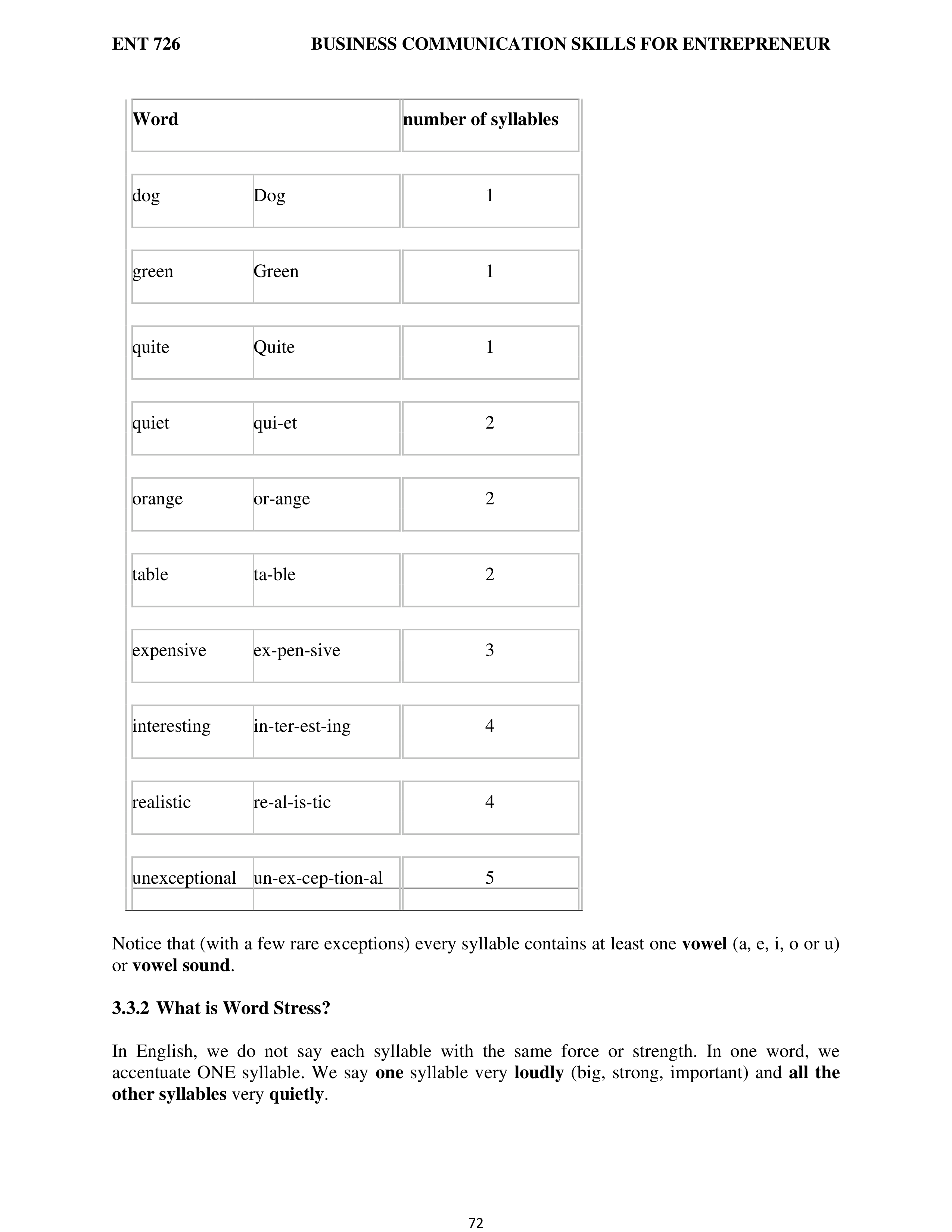
ENT 726
BUSINESS COMMUNICATION SKILLS FOR ENTREPRENEUR
72
Word
number of syllables
dog
Dog
1
green
Green
1
quite
Quite
1
quiet
qui-et
2
orange
or-ange
2
table
ta-ble
2
expensive
ex-pen-sive
3
interesting
in-ter-est-ing
4
realistic
re-al-is-tic
4
unexceptional un-ex-cep-tion-al
5
Notice that (with a few rare exceptions) every syllable contains at least one
vowel
(a, e, i, o or u)
or
vowel sound
.
3.3.2 What is Word Stress?
In English, we do not say each syllable with the same force or strength. In one word, we
accentuate ONE syllable. We say
one
syllable very
loudly
(big, strong, important) and
all
the
other syllables
very
quietly
.
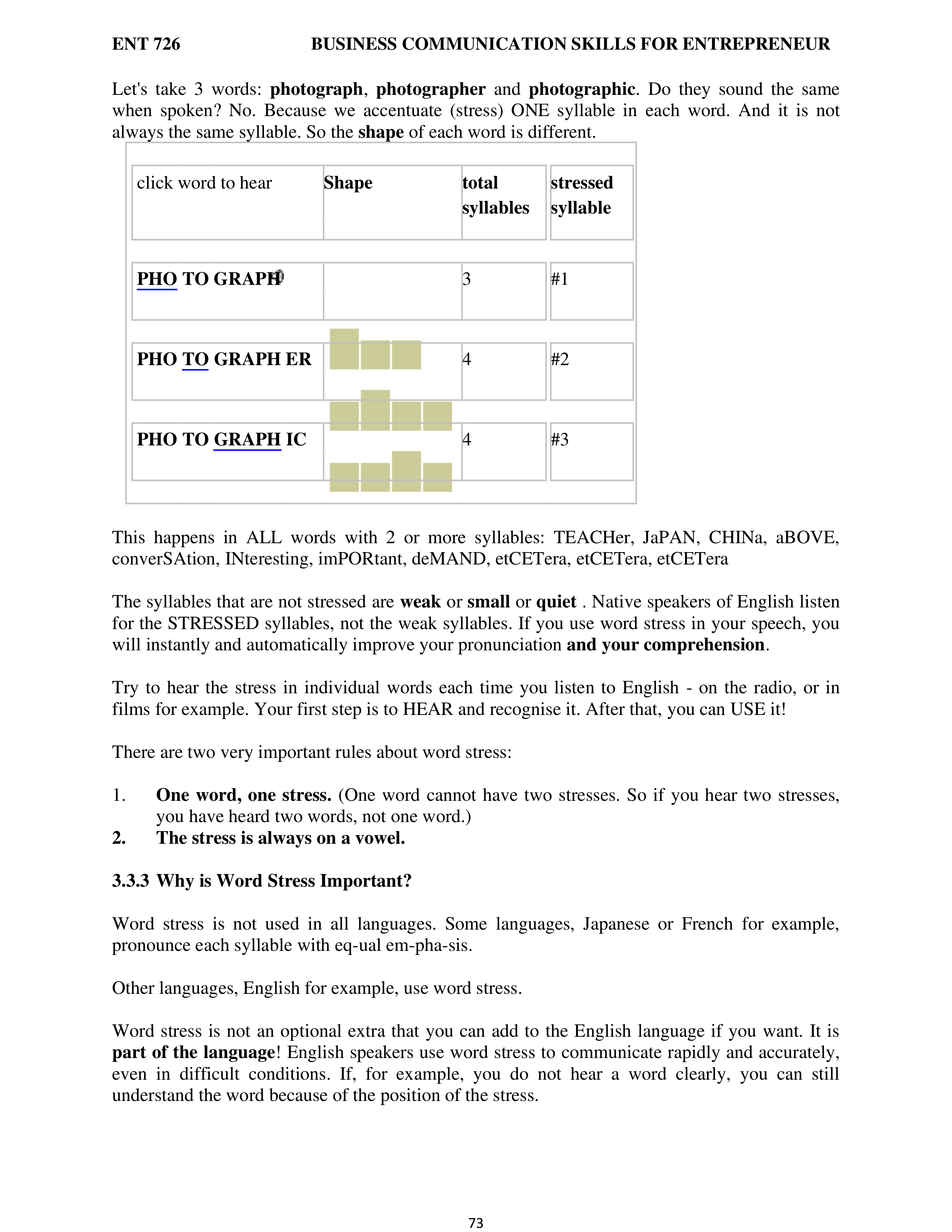




ENT 726
BUSINESS COMMUNICATION SKILLS FOR ENTREPRENEUR
73
Let's take 3 words:
photograph
,
photographer
and
photographic
. Do they sound the same
when spoken? No. Because we accentuate (stress) ONE syllable in each word. And it is not
always the same syllable. So the
shape
of each word is different.
click word to hear
Shape
total
stressed
syllables
syllable
PHO TO GRAPH
3
#1
PHO TO GRAPH ER
4
#2
PHO TO GRAPH IC
4
#3
This happens in ALL words with 2 or more syllables: TEACHer, JaPAN, CHINa, aBOVE,
converSAtion, INteresting, imPORtant, deMAND, etCETera, etCETera, etCETera
The syllables that are not stressed are
weak
or
small
or
quiet
. Native speakers of English listen
for the STRESSED syllables, not the weak syllables. If you use word stress in your speech, you
will instantly and automatically improve your pronunciation
and your
comprehension
.
Try to hear the stress in individual words each time you listen to English - on the radio, or in
films for example. Your first step is to HEAR and recognise it. After that, you can USE it!
There are two very important rules about word stress:
1.
One word, one stress.
(One word cannot have two stresses. So if you hear two
stresses,
you have heard two words, not one word.)
2.
The stress is always on a vowel.
3.3.3 Why is Word Stress Important?
Word stress is not used in all languages. Some languages, Japanese or French for example,
pronounce each syllable with eq-ual em-pha-sis.
Other languages, English for example, use word stress.
Word stress is not an optional extra that you can add to the English language if you want. It is
part of the language
! English speakers use word stress to communicate rapidly and accurately,
even in difficult conditions. If, for example, you do not hear a word clearly, you can still
understand the word because of the position of the stress.
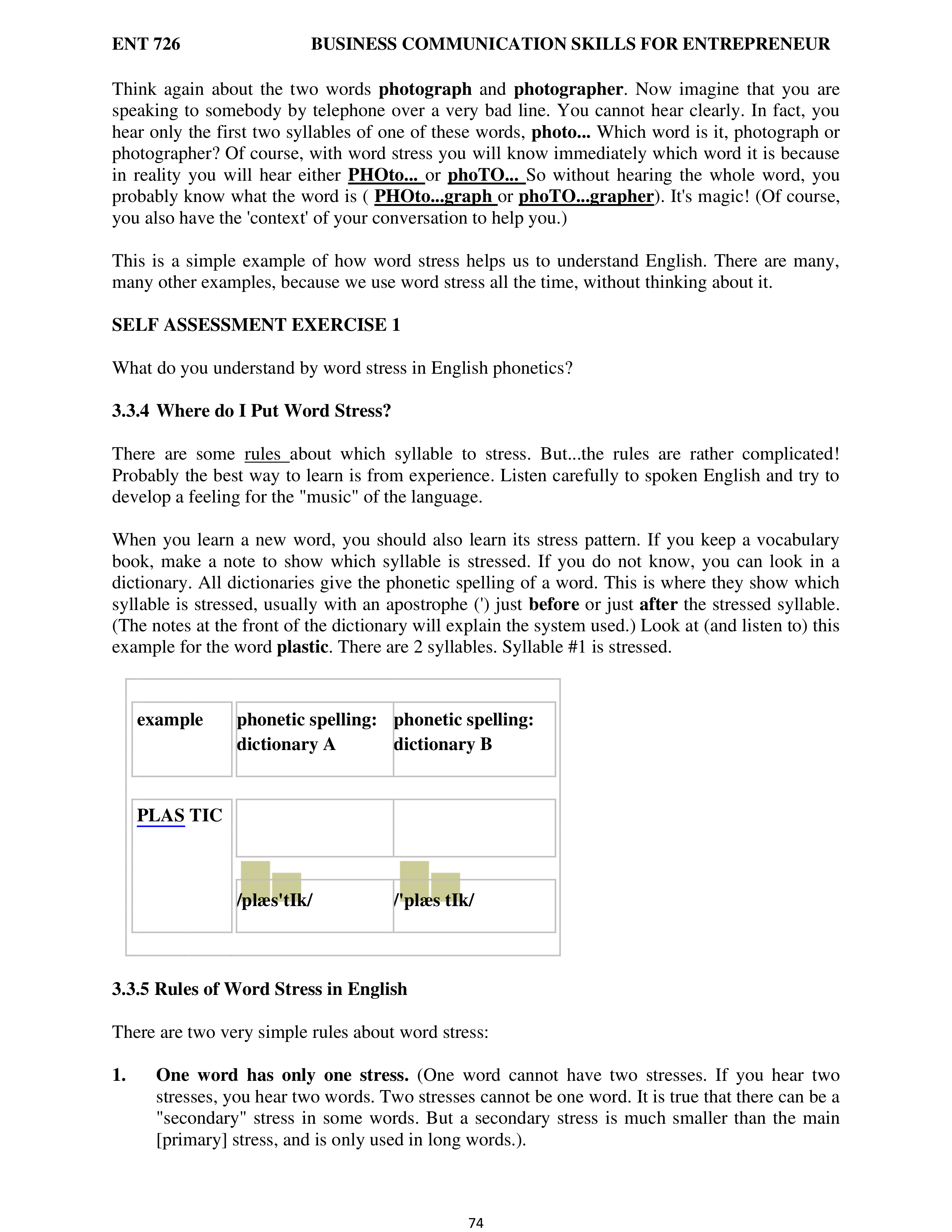


ENT 726
BUSINESS COMMUNICATION SKILLS FOR ENTREPRENEUR
74
Think again about the two words
photograph
and
photographer
. Now imagine that you are
speaking to somebody by telephone over a very bad line. You cannot hear clearly. In fact, you
hear only the first two syllables of one of these words,
photo...
Which word is it, photograph or
photographer? Of course, with word stress you will know immediately which word it is because
in reality you will hear either
PHOto...
or
phoTO...
So without hearing the whole word, you
probably know what the word is (
PHOto...graph
or
phoTO...grapher
). It's magic! (Of course,
you also have the 'context' of your
conversation to help you.)
This is a simple example of how word stress helps us to understand English. There are many,
many other examples, because we use word stress all the time, without thinking about it.
SELF ASSESSMENT EXERCISE 1
What do you understand by word stress in English phonetics?
3.3.4 Where do I Put Word Stress?
There are some rules about which syllable to stress. But...the rules are rather complicated!
Probably the best way to learn is from experience. Listen carefully to spoken English and try to
develop a feeling for the "music" of the language.
When you learn a new word, you should also learn its stress pattern. If you keep a vocabulary
book, make a note to show which syllable is stressed. If you do not know, you can look in a
dictionary. All dictionaries give the phonetic spelling of a word. This is where they show which
syllable is stressed, usually with an apostrophe (') just
before
or just
after
the stressed syllable.
(The notes at the front of the dictionary will explain the system used.) Look at (and listen to) this
example for the word
plastic
. There are 2 syllables. Syllable #1 is stressed.
example
phonetic spelling: phonetic spelling:
dictionary A
dictionary B
PLAS TIC
/plæs'tIk/
/'plæs tIk/
3.3.5 Rules of Word Stress in English
There are two very simple rules about word stress:
1.
One word has only one stress.
(One word cannot have two stresses. If you hear
two
stresses, you hear two words. Two stresses cannot be one word. It is true that there can be a
"secondary" stress in some words. But a secondary stress is much smaller than the main
[primary] stress, and is only used in long words.).
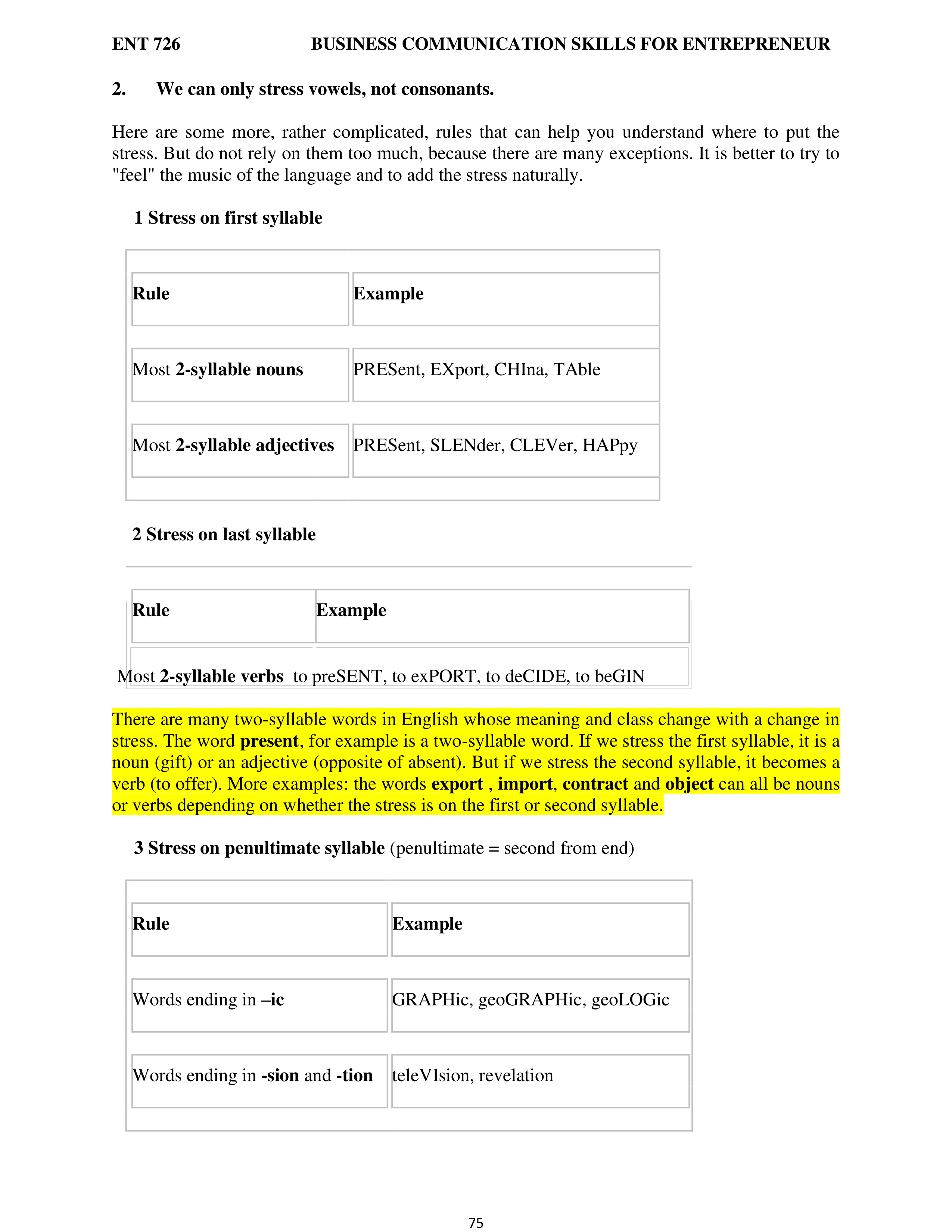

ENT 726
BUSINESS COMMUNICATION SKILLS FOR ENTREPRENEUR
75
2.
We can only stress vowels, not consonants.
Here are some more, rather complicated, rules that can help you understand where to put the
stress. But do not rely on them too much, because there are many exceptions. It is better to try to
"feel" the music of the language and to add the stress naturally.
1 Stress on first syllable
Rule
Example
Most
2-syllable nouns
PRESent, EXport, CHIna, TAble
Most
2-syllable adjectives
PRESent, SLENder, CLEVer, HAPpy
2 Stress on last syllable
Rule
Example
Most
2-syllable verbs
to preSENT, to exPORT, to deCIDE, to beGIN
There are many two-syllable words in English whose meaning and class change with a change in
stress. The word
present
, for example is a two-syllable word. If we stress the first syllable, it is a
noun (gift) or an adjective (opposite of absent). But if we stress the second syllable, it becomes a
verb (to offer). More examples: the words
export
,
import
,
contract
and
object
can all be nouns
or verbs depending on whether the stress is on the
first or second syllable.
3 Stress on penultimate syllable
(penultimate = second from end)
Rule
Example
Words ending in
–ic
GRAPHic, geoGRAPHic, geoLOGic
Words ending in
-sion
and
-tion
teleVIsion, revelation
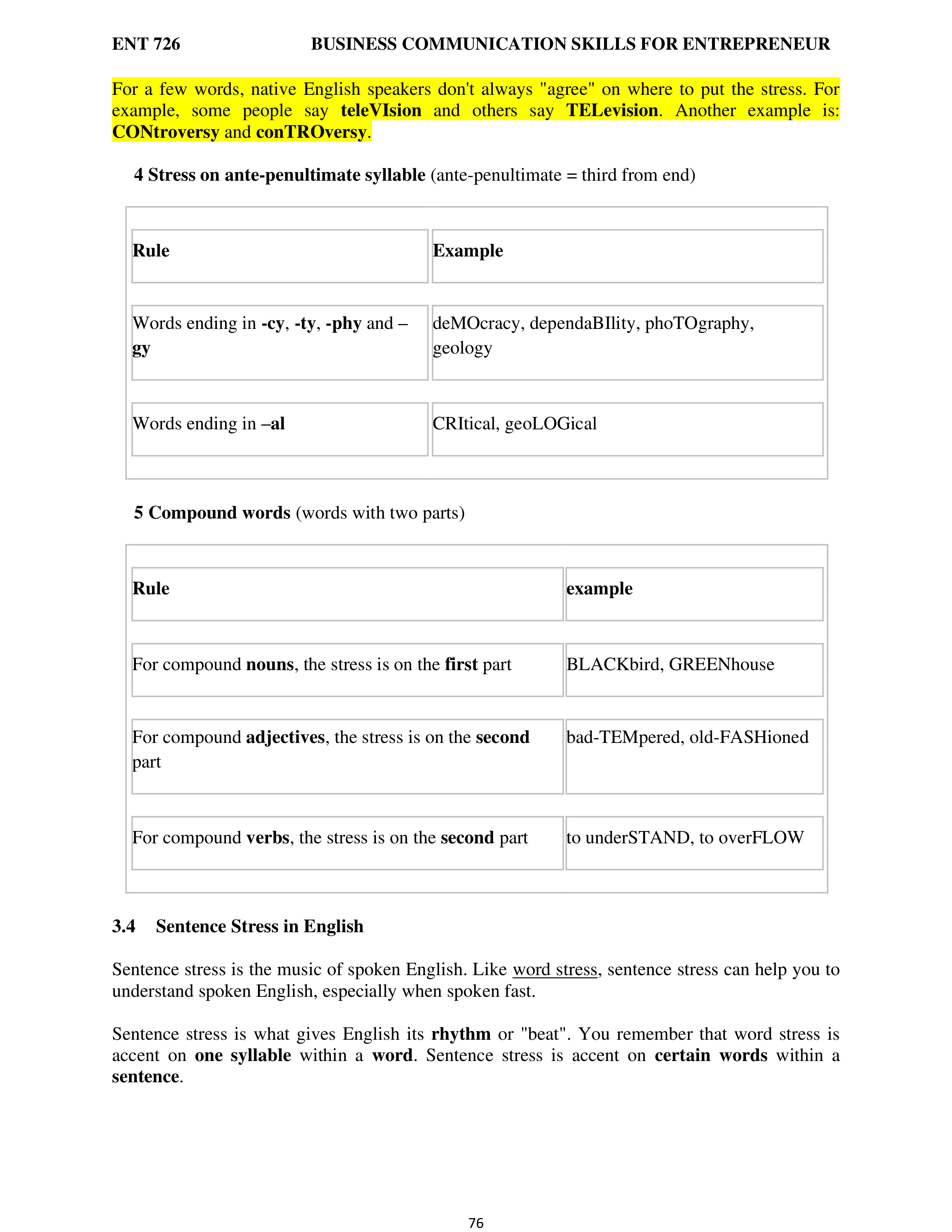
ENT 726
BUSINESS COMMUNICATION SKILLS FOR ENTREPRENEUR
76
For a few words, native English speakers don't always "agree" on where to put the stress. For
example, some people say
teleVIsion
and others say
TELevision
. Another example is:
CONtroversy
and
conTROversy
.
4 Stress on ante-penultimate syllable
(ante-penultimate = third from end)
Rule
Example
Words ending in
-cy
,
-ty
,
-phy
and
–
deMOcracy, dependaBIlity, phoTOgraphy,
gy
geology
Words ending in
–al
CRItical, geoLOGical
5 Compound words
(words with two parts)
Rule
example
For compound
nouns
, the stress is on the
first
part
BLACKbird, GREENhouse
For compound
adjectives
, the stress is on the
second
bad-TEMpered, old-FASHioned
part
For compound
verbs
, the stress is on the
second
part
to underSTAND, to overFLOW
3.4 Sentence Stress in English
Sentence stress is the music of spoken English. Like word stress, sentence stress can help you to
understand spoken English, especially when spoken fast.
Sentence stress is what gives English its
rhythm
or "beat". You remember that word stress is
accent on
one syllable
within a
word
. Sentence stress is accent on
certain
words
within a
sentence
.
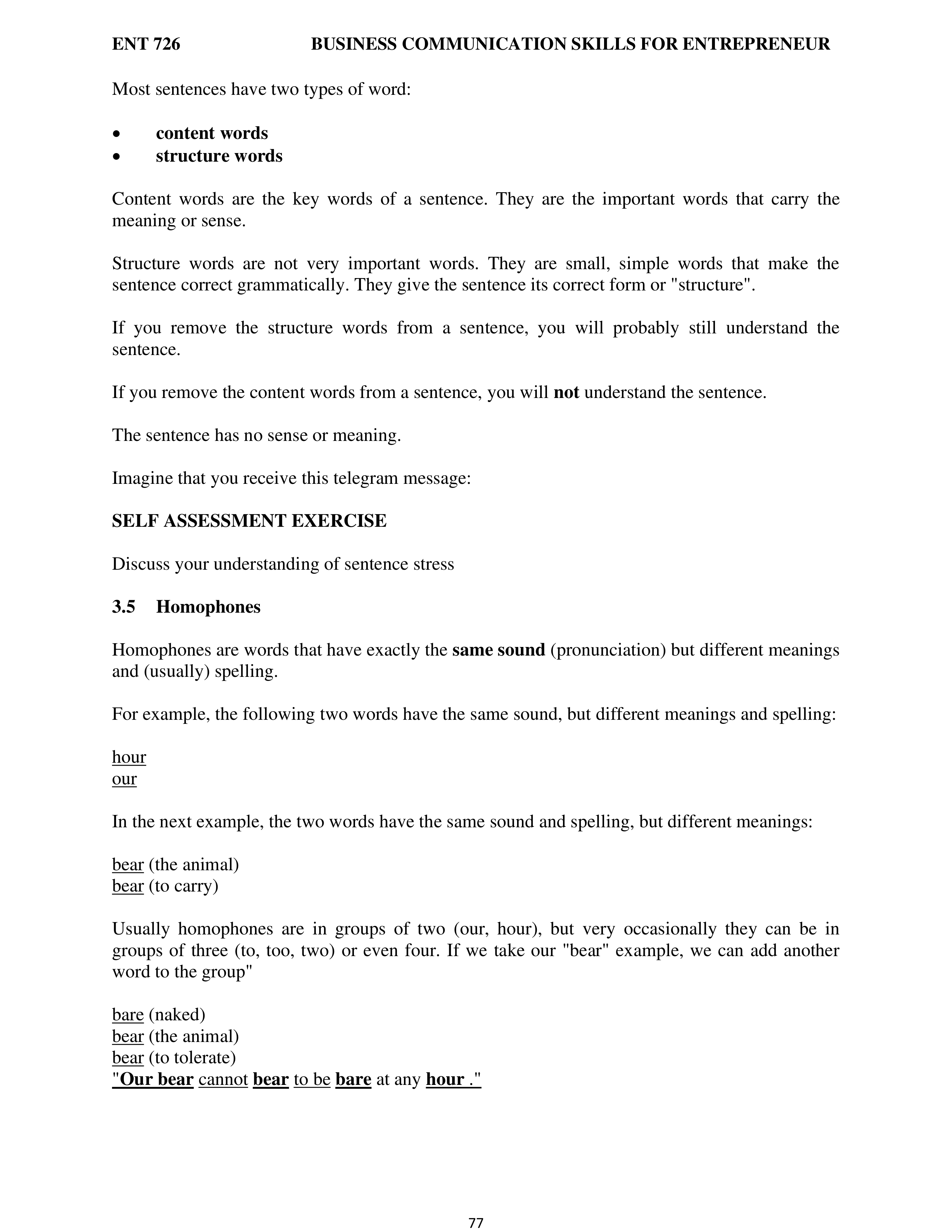
ENT 726
BUSINESS COMMUNICATION SKILLS FOR ENTREPRENEUR
77
Most sentences have two types of word:
•
content words
•
structure words
Content words are the key words of a sentence. They are the important words that carry the
meaning or sense.
Structure words are not very important words. They are small, simple words that make the
sentence correct grammatically. They give the sentence its correct form or "structure".
If you remove the structure words from a sentence, you will probably still understand the
sentence.
If you remove the content words from a sentence, you will
not
understand the sentence.
The sentence has no sense or meaning.
Imagine that you receive this telegram message:
SELF ASSESSMENT EXERCISE
Discuss your understanding of sentence stress
3.5 Homophones
Homophones are words that have exactly the
same sound
(pronunciation) but different meanings
and (usually) spelling.
For example, the following two words have the same sound, but different meanings and spelling:
hour
our
In the next example, the two words have the same sound and spelling, but different meanings:
bear (the animal)
bear (to carry)
Usually homophones are in groups of two (our, hour), but very occasionally they can be in
groups of three (to, too, two) or even four. If we take our "bear" example, we can add another
word to the group"
bare (naked)
bear (the animal)
bear (to tolerate)
"
Our bear
cannot
bear
to be
bare
at any
hour
."
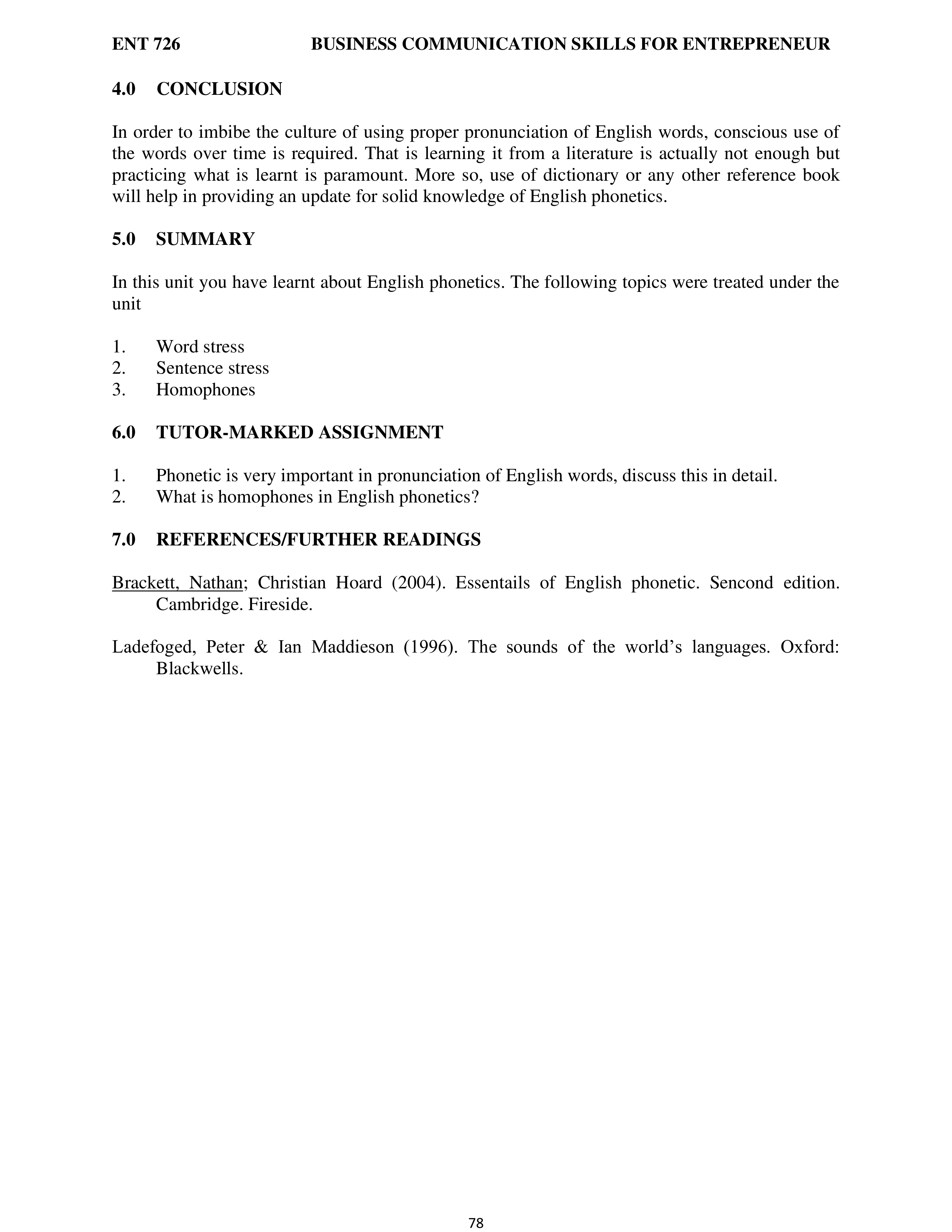
ENT 726
BUSINESS COMMUNICATION SKILLS FOR ENTREPRENEUR
78
4.0 CONCLUSION
In order to imbibe the culture of using proper pronunciation of English words, conscious use of
the words over time is required. That is learning it from a literature is actually not enough but
practicing what is learnt is paramount. More so, use of dictionary or any other reference book
will help in providing an update for solid knowledge of English phonetics.
5.0 SUMMARY
In this unit you have learnt about English phonetics. The following topics were treated under the
unit
1.
Word stress
2.
Sentence stress
3.
Homophones
6.0 TUTOR-MARKED ASSIGNMENT
1.
Phonetic is very important in pronunciation of English words, discuss this in detail.
2.
What is homophones in English phonetics?
7.0 REFERENCES/FURTHER READINGS
Brackett, Nathan; Christian Hoard (2004). Essentails of English phonetic. Sencond edition.
Cambridge. Fireside.
Ladefoged, Peter & Ian Maddieson (1996). The sounds of the world’s languages. Oxford:
Blackwells.
ENT 726
BUSINESS COMMUNICATION SKILLS FOR ENTREPRENEUR
79
UNIT 2
THE WRITING PROCESS
CONTENTS
1.0 Introduction
2.0 Objectives of the Unit
3.0 Main Content
3.1 Writing Process
3.1.1 Choosing a Topic
3.1.2 Gathering Information
3.1.3 Discussing Information
3.1.4 Narrowing the Topic
3.1.5 Organizing Content
3.1.6 Developmental Acquisition of Organising Skills
3.1.7 Writing Trials
3.1.8 Recursion
3.1.9 Variables
3.2 Correspondence
3.2.1 Memos
3.2.2 Letters
3.2.3 Electronic Mail
3.3 How to Write an Essay
3.3.1 Select Your Topic.
3.4
Formal Letter Writing
3.4.1 How to Write Formal Letters
3.4.2 Rules for Writing Formal Letters in English
3.4.3 Layout of a Formal Letter
3.4.4 Content of a Formal Letter
3.4.5 A Covering Letter
3.4.6 A Letter of Enquiry
4.0 Conclusion
5.0 Summary
6.0 Tutor-Marked Assignment
7.0 References/Further Readings
1.
INTRODUCTION
The writing process is the bedrock of communication in business organisation. Because of the
nature of interactions in business organisation, communication is expected to be formal to an
extent. Therefore, putting a message into writing is favoured over oral communication in some
setting. This unit treats writing process in business communication
2.0 OBJECTIVES OF THE UNIT
On the completion of this unit, you should be able to:
•
Explain the steps in writing process.
•
Explain the meaning of correspondence.
•
List forms of correspondence.
•
Describe the format of a formal letter
ENT 726
BUSINESS COMMUNICATION SKILLS FOR ENTREPRENEUR
80
3.0 MAIN CONTENT
3.1 Writing Process
Writing process is a pedagogical term that appears in the research of Janet Emig who published
The Composing Processes of Twelfth Graders in 1971. The term marks a shift from examining
the products of writing to the composing process of writers. This focus on process encourages
composition students to see writing as an ongoing, recursive process from conception of the idea
through publication. It asserts that all writing serves a purpose, and that writing passes through
some or all of several clear steps. It was part of the general whole language approach.
Generally the writing process is seen as consisting of five steps. They are:
•
Prewriting
: planning, research, outlining, diagramming, storyboarding or
clustering (for a
technique similar to clustering, see mindmapping)
•
Draft
: initial composition in prose form
•
Revision
: review, modification and organization (by the writer)
•
Editing
: proofreading for clarity, conventions, style (preferably by another writer)
•
Submittal
: sharing the writing: possibly through performance, printing, or
distribution of
written material.
These steps are not necessarily performed in any given order. For example, the skills used in the
prewriting process can be applied any time by writers seeking ideas throughout the process. It is
not necessary to go through each step for every writing project attempted. The steps make up a
recursive process. The instructional theory behind the model is similar to new product
development and life cycle theory, adapted to written works. By breaking the writing cycle into
discrete stages and focusing on strategies at each stage, it is hoped that writers will develop an
appreciation for the process of seeing an idea through to successful completion in a logical way.
Rather than presenting written works as acts of genius that emerge fully formed, they are shown
as the result of several distinct and learnable skills.
Prewriting is the first step of the writing process, followed by drafting, revision, editing and
publishing and is crucial to the success of any writing task, yet in writing instruction; it seldom
receives the attention it deserves.
Motivation and audience awareness
Prewriting begins with motivation and audience awareness: what is the student or writer trying to
communicate, why is it important to communicate it well and who is the audience for this
communication? Writers usually begin with a clear idea of audience, content and the importance
of their communication; sometimes, one of these needs to be clarified for the best
communication. Student writers find motivation especially difficult because they are writing for
a teacher or for a grade, instead of a real audience. Often teachers try to find a real audience for
students by asking them to read to younger classes or to parents, by posting writing for others to
read, by writing a blog, or by writing on real topics, such as a letter to the editor of a local
newspaper.
ENT 726
BUSINESS COMMUNICATION SKILLS FOR ENTREPRENEUR
81
3.1.1 Choosing A Topic
One important task in writing is choosing a topic and then narrowing it to a length that can be
covered in the space allowed. Oral storytelling is an effective way to search for a good topic for a
personal narration. Writers can quickly tell a story and judge from the listeners' reactions
whether it will be an interesting topic to write about. Two types of prewriting are: free writing
and researching. When free writing, you write any and every idea that comes to mind when
writing. Researching is another name for writing, which you get information from outside
sources.
3.1.2 Gathering Information
Several other methods of choosing a topic overlap with another broad concern of prewriting, that
of researching or gathering information. Reading (process) is effective in both choosing and
narrowing a topic and in gathering information to include in the writing. As a writer reads other
works, it expands ideas, opens possibilities and points toward options for topics and narrowing of
topics. It also provides specific content for the eventual writing. One traditional method of
tracking the content read is to create annotated note cards with one chunk of information per
card. Writers also need to document music, photos, web sites, interviews, and any other source
used to prevent plagiarism.
Besides reading what others have written, writers can also make original observations relating to
a topic. This requires on-site visits, experimentation with something, or finding original or
primary historical documents. Writers interact with the setting or materials and make
observations about their experience. For strong writing, particular attention should be given to
sensory details (what the writer hears, tastes, touches, smells and feels). While gathering
material, often writers pay particular attention to the vocabulary used in discussing the topic.
This would include slang, specific terminology, translations of terms, and typical phrases used.
The writer often looks up definitions, synonyms and finds ways in which different people use the
terminology. Lists, journals, teacher-student conference, drawing illustrations, using imagination,
restating a problem in multiple ways, watching videos, inventorying interests – these are some of
the other methods for gathering information.
3.1.3 Discussing Information
After reading and observing, often writers need to discuss material. They might brainstorm with
a group or topics or how to narrow a topic. Or, they might discuss events, ideas, and
interpretations with just one other person. Oral storytelling might enter again, as the writer turns
it into a narrative, or just tries out ways of using the new terminology. Sometimes writers draw
or use information as basis for artwork as a way to understand the material better.
3.1.4 Narrowing the Topic
Narrowing a topic is an important step of prewriting. For example, a personal narrative of five
pages could be narrowed to an incident that occurred in a thirty minute time period. This
restricted time period means that the writer must slow down and tell the event moment by
moment with many details. By contrast, a five page essay about a three day trip would only skim
the surface of the experience. The writer must consider again the goals of communication –
content, audience, importance of information – but add to this a consideration of the format for
ENT 726
BUSINESS COMMUNICATION SKILLS FOR ENTREPRENEUR
82
the writing. He or she should consider how much space is allowed for the communication and
what can be effectively communicated within that space?
3.1.5 Organizing Content
At this point, the writer needs to consider the organization of content. Outlining in a hierarchical
structure is one of the typical strategies, and usually includes three or more levels in the
hierarchy. Typical outlines are organized by chronology, spatial relationships, or by subtopics.
Other outlines might include sequences along a continuum: big to little, old to new, etc.
Clustering, a technique of creating a visual web that represents associations among ideas is
another help in creating structure, because it reveals relationships. Storyboarding is a method of
drawing rough sketches to plan a picture book, a movie script, a graphic novel or other fiction.
3.1.6 Developmental acquisition of organizing skills
While information on the developmental sequence of organising skills is sketchy, anecdotal
information suggests that children follow this rough sequence:
1)
sort into categories
2)
structure the categories into a specific order for best communication, using criteria such as
which item will best work to catch readers attention in the opening,
3)
within a category, sequence information into a specific order for best communication,
using criteria such as what will best persuade an audience. At each level, it is important that
student writers discuss their decisions; they should understand that categories for a certain
topic could be structured in several different ways, all correct. A final skill acquired is the
ability to omit information that is not needed in order to communicate effectively.
Even sketchier is information on what types of organisation are acquired first, but anecdotal
information and research suggests that even young children understand chronological
information, making narratives the easiest type of student writing. Persuasive writing usually
requires logical thinking and studies in child development indicate that logical thinking is not
present until a child is 10–12 years old, making it one of the later writing skills to acquire. Before
this age, persuasive writing will rely mostly on emotional arguments.
3.1.7 Writing trials
Writers can also use the writing phase to experiment with ways of expressing ideas. For oral
storytelling, a writer could tell a story three times, but each time begin at a different time, include
or exclude information, end at a different time or place. Writers often try writing the same
information but using different voices, in search of the best way to communicate this information
or tell this story.
3.1.8 Recursion
writing is recursive, that is, it can occur at any time and the writing process can return several
times. For example, after a first draft, a writer may need to return to an information gathering
stage, or may need to discuss the material with someone, or may need to adjust the outline.
ENT 726
BUSINESS COMMUNICATION SKILLS FOR ENTREPRENEUR
83
While the writing process is discussed as having distinct stages, in reality, they often overlap and
circle back on one another.
3.1.9 Variables
writing varies depending on the writing task or rhetorical mode. Fiction requires more
imagination, while informational essays or expository writing require stronger organization.
Persuasive writing must consider not just the information to be communicated, but how best to
change the reader’s ideas or convictions. Folktales will require extensive reading of the genre to
learn common conventions. Each writing task will require a different selection of writing
strategies, used in a different order.
SELF ASSESSMENT EXERCISE 1
Discuss the steps that are involved in writing process
3.2 Correspondence
Correspondence consists of memos, letters, and electronic mail. In engineering and science,
correspondence is an effective way to make requests, submit changes to a job, and deliver
specific information. Unlike telephone conversations, correspondence presents the audience with
a legal contract that is dated and can support a claim in court. This section presents formats for
memos and letters. Because electronic mail usually has a built-in format, no format is assigned
here for it.
In correspondence, you should concentrate on being clear and precise. Because audiences tend to
read letters and memos quickly, opt for shorter sentences and paragraphs than you would use in a
formal report or journal article. Also, in correspondence, you should consider carefully the tone.
Tone is difficult to control in correspondence. For instance, in a job application letter, how do
you talk about your accomplishments without sounding boastful? Or in a letter complaining
about faulty workmanship, how do you motivate the reader to repair the damage without
alienating the reader? The answers are not simple. Often, engineers and scientists lose control of
tone by avoiding simple straightforward wording. When some people sit down to write a
business letter or memo, they change their entire personality. Instead of using plain English, they
use convoluted phrases such as "per your request" or "enclosed please find." Because these
phrases are not natural or straightforward, they inject an undesired attitude, usually arrogance,
into the writing
3.2.1 Memos
Typically, you write memos to people within your place of work, and you write letters to people
outside your place of work. One major difference between memos and letters is the title line
found in memos. Because readers often decide whether to read the memo solely on the basis of
this title line, the line is important. Another difference between letters and memos is that you
sometimes write memos that serve as short reports. In such cases, the format for the memo
changes somewhat. For instance, in a memo serving as a progress report for a project, you might
include subheadings and sub-subheadings. Notice that people who are mentioned in a memo or
are directly affected by the memo should receive a copy.
ENT 726
BUSINESS COMMUNICATION SKILLS FOR ENTREPRENEUR
84
3.2.2 Letters
Formats for letters vary from company to company. For instance, some formats call for
paragraph indents; others don't. In a letter, notice how the writer gets to the point in the first
sentence of the first paragraph. Notice also the simple and straightforward salutation
("Sincerely"). As with a memo, people who are mentioned or directly affected by the letter
should receive a copy.
3.2.3 Electronic Mail
Electronic mail is a less formal version of memos and letters. Electronic mail is relatively new
and is changing in terms of sophistication in format and expectation by audience. The principal
advantages of electronic mail over other types of correspondence are its speed and ease of use.
For instance, in minutes, you can send out information to many recipients around the world.
One disadvantage of electronic mail is the crudeness of the format. Many electronic mail systems
do not allow such things as tabs or italics. For that reason, the look of the message is not as
attractive as a memo or letter that has been printed on letterhead paper. Because the message
does not look formal, many people mistakenly adopt a style that lacks the "appropriate
formality" [Markel, 1996]. For instance, these people include needless abbreviations (such as
"BTW" rather than "by the way").
Another disadvantage of electronic mail is also one of its advantages: its ease of use. With letters
and memos, you must print out the correspondence before you send it. That printing out allows
you to view the writing on paper--a step that makes it easier for you to proof for mechanical
mistakes in spelling, usage, and punctuation. With electronic mail, though, you are not forced to
print out on paper before you send. For that reason, electronic messages often are not as well
proofed as regular correspondence. Remember: because most networks archive electronic mail,
you should take the same care with electronic mail as you do with printed correspondence. That
means using the appropriate formality in style and carefully proofing your message before you
hit the "send" button.
SELF ASSESSMENT EXERCISE
Explain in detail what Memo is?
3.3 How to Write an Essay
Writing a good essay requires refined critical thinking, which can be improved by experience.
But one of the key elements to a good essay is form. There are numerous forms of writing that
we face everyday. The following is an explanation of the process of writing in a simple and
understandable way. An essay can have many purposes, but the basic structure is basically the
same. You may be writing an essay to argue for an article point of view or to explain the steps
necessary to complete a task. Either way, your essay will have the same basic format. If you
follow these simple steps, you will find that writing an essay is much easier than you had initially
thought.
3.3.1 Select your topic.
1.
Choose the thesis, or main idea of your essay.
2.
Prepare an outline or diagram of your main ideas.
ENT 726
BUSINESS COMMUNICATION SKILLS FOR ENTREPRENEUR
85
3.
Outline your essay into introductory, body and summary paragraphs.
4.
State your thesis idea in the first paragraph.
5.
Finish the introductory paragraph with a short summary or goal statement.
In each of the body paragraphs the ideas first presented in the introductory paragraph are
developed.
6.
Develop your body paragraphs by giving explanations and examples.
7.
The last paragraph should restate your basic thesis of the essay with a conclusion.
After you followed these easy steps your writing will improve and become more coherent.
Always remember, form is only a part of the process. You become a better writer primarily by
reflecting and analysing rather than memorizing.
3.4 Formal Letter Writing.
This comprises the following:
3.4.1 How to Write Formal Letters
A summary of writing rules including outlines for cover letters and letters of enquiry, and
abbreviations used in writing a formal letter is
3.4.2 Rules for Writing Formal Letters in English
In English there are a number of conventions that should be used when writing a formal or
business letter. Furthermore, you try to write as simply and as clearly as possible, and not to
make the letter longer than necessary. Remember not to use informal language like contractions.
Addresses:
1)
Your Address
The return address should be written in the top right-hand corner of the letter.
2)
The Address of the person you are writing to
The inside address should be written on the left, starting below your address.
Date:
Different people put the date on different sides of the page. You can write this on the right or the
left on the line after the address you are writing to. Write the month as a word.
Salutation or greeting:
1)
Dear Sir or Madam,
If you do not know the name of the person you are writing to, use this. It is always advisable to
try to find out a name.

ENT 726
BUSINESS COMMUNICATION SKILLS FOR ENTREPRENEUR
86
2)
Dear Mr. Okocha,
If you know the name, use the title (Mr, Mrs, Miss or Ms, Dr, etc.) and the surname only. If you
are writing to a woman and do not know if she uses Mrs or Miss, you can use Ms, which is for
married and single women.
Ending a letter
:
1)
Yours Faithfully
If you do not know the name of the person, end the letter this way.
2)
Yours Sincerely
If you know the name of the person, end the letter this way.
3)
Your signature
Sign your name, then print it underneath the signature. If you think the person you are writing to
might not know whether you are male of female, put your title in brackets after your name.
3.4.3 Layout of a Formal Letter
The example letter below shows you a general layout for a formal letter.
3.4.4 Content of a Formal Letter
First paragraph
The first paragraph should be short and state the purpose of the letter- to make an enquiry,
complain, request something, etc.
The paragraph or paragraphs in the middle of the letter should contain the relevant information
behind the writing of the letter. Most letters in English are not very long, so keep the information
ENT 726
BUSINESS COMMUNICATION SKILLS FOR ENTREPRENEUR
87
to the essentials and concentrate on organizing it in a clear and logical manner rather than
expanding too much.
Last Paragraph
The last paragraph of a formal letter should state what action you expect the recipient to take- to
refund, send you information, etc.
Abbreviations Used in Letter Writing
The following abbreviations are widely used in letters:
•
asap
= as soon as possible
•
cc
= carbon copy (when you send a copy of a letter to more than one person, you
use
this abbreviation to let them know)
•
enc.
= enclosure (when you include other papers with your letter)
•
pp
= per procurationem (A Latin phrase meaning that you are signing the letter on
somebody else's behalf; if they are not there to sign it themselves, etc)
•
ps
= postscript (when you want to add something after you've finished and signed
it)
•
pto (informal)
= please turn over (to make sure that the other person knows the
letter
continues on the other side of the page)
•
RSVP
= please reply
3.4.5 A Covering Letter
A covering letter is the one that accompanies your CV when you are applying for a job.
Here is a fairly conventional plan for the layout of the paragraphs.
1.
Opening Paragraph
Briefly identify yourself and the position you are applying for. Add how you found out about the
vacancy.
2.
Paragraph 2
Give the reasons why you are interested in working for the company and why you wish to be
considered for that particular post. State your relevant qualifications and experience, as well as
your personal qualities that make you a suitable candidate.
3.
Paragraph 3
Inform them that you have enclosed your current CV and add any further information that you
think could help your case.
4.
Closing Paragraph
Give your availability for interview, thank them for their consideration, restate your interest and
close the letter.
ENT 726
BUSINESS COMMUNICATION SKILLS FOR ENTREPRENEUR
88
3.4.6 A Letter of Enquiry
A letter of enquiry is when you are approaching a company speculatively, that is you are making
an approach without their having advertised or announced a vacancy.
1.
Opening Paragraph
Introduce yourself briefly and give your reason for writing. Let them know of the kind of
position you are seeking, why you are interested and how you heard about them.
Paragraph 2
Show why their company in particular interests you, mention your qualifications and experience
along with any further details that might make them interested in seeing you.
Paragraph 3
Refer to your enclosed CV and draw their attention to any particularly important points you
would like them to focus on in it.
Closing Paragraph
Thank them, explain your availability for interview and restate your enthusiasm for their
company and desire to be considered for posts that might as yet be unavailable.
4.0 CONCLUSION
A sound knowledge of writing process is very important in business communication. Obviously,
different writing steps as discussed above are necessary for good composition of a message or an
idea. Also, as explained, business writings also take cognisance of format in writing process
5.0 SUMMARY
This unit was started by explaining the concept of writing process. We then discussed various
steps in writing process. We went further to treat memo as forms of business letters. Methods for
writing essay, letter writings and their format were also discussed
6.0 TUTOR-MARKED ASSIGNMENT
1.
List various forms of correspondence
2.
Write a formal letter on a topic of your choice
7.0 REFERENCES/ FURTHER READINGS
Whitney, A (2008). Beyond Strategies: Teacher Practice, Writing Process, and the Influence of
Inquiry. English Education, v40 n3 p201-230.
Zhang, Liru (2006). Examining the Effects of Drafting and Revising Patterns on Students'
Writing Performance and the Implications in Writing Instruction. ERIC database.

ENT 726
BUSINESS COMMUNICATION SKILLS FOR ENTREPRENEUR
89
Blackburn-Brockman, Elizabeth (2001). Prewriting, Planning, and Professional Communication.
English Journal, v91 n2 p51-53.
Wagner, Brian J(1994).An Easy Outlining Approach for Producing Solidly Structured,
Audience-Directed Reports. Journal of Business and Technical Communication, v8 n4
p475-82.
ENT 726
BUSINESS COMMUNICATION SKILLS FOR ENTREPRENEUR
90
UNIT 3
INTERVIEW SKILLS
CONTENTS
1.0 Introduction
2.0 Objectives of the Unit
3.0 Main Content
3.1 Interview Skills
3.2 The Interviewer
3.2.1 Structure of Interviews
3.2.2 Environment and Atmosphere
3.2.3 Welcoming the Interviewee
3.2.4 Competent Questioning
3.2.5 Active Listening
3.2.6 Equal Opportunities
3.2.7 Evaluate your Performance
3.3 The Interviewee
3.3.1 Preparation
3.3.2 During Interview
3.3.3 After Interview
4.0 Conclusion
5.0 Summary
6.0 Tutor-Marked Assignment
7.0 References/Further Readings
1.0 INTRODUCTION
Interview skill is another very important skill in business communication. It is important because
it helps an organisation in making right decision concerning various issues that affect growth of
the organisation. Some of such issues are recruitment of employee for the organisation, getting
the best contractor for a supply and so on. This unit will explain the necessary interview skills in
business communication
2.0 OBJECTIVES OF THE UNIT
On completion of this unit, you should be able to:
•
Have an overview of interview skills for recruitment purpose
•
Explain the necessary interview skills that an interviewer should possess
•
Describe the structure of an interview
•
Protect the types of questions that should be asked by an interviewer
•
Project, give suggestions of what is expected from the interviewee by the interviewer
3.0 MAIN CONTENT
3.1 Interview Skills
The interview is, perhaps, the most nerve-wracking aspect of the recruitment process, not just for
the candidate but also for the interviewer. If an interview is conducted competently, it is a useful
opportunity for a candidate to prove that he or she will be an asset to a prospective employer. It
ENT 726
BUSINESS COMMUNICATION SKILLS FOR ENTREPRENEUR
91
is, however, also an opportunity for an employer to promote organisation and therefore attract
the best employees.
3.2 The Interviewer
Given that people are the most important resource in any organisation, recruiting the wrong ones
can be costly. In fact, replacing an employee can cost up to 5o percent of that employee’s annual
salary. It is far better to invest your time in fine-tuning your interview skills that spend time on
damage limitation after discovering that you have employed the wrong person. The interview is
your opportunity to get the right employee, and a good preparation is essential.
3.2.1 Structure of Interviews
In recruitment the process starts from the moment you have a shortlist of applicants and a pile of
application forms or Curricula vitae in front of you. The interview is essentially a meeting to put
the proverbial flesh on the bones of information provided by a candidate on their application
form of CV. Your purpose is to satisfy yourself that the candidate meets the requirement for the
job and fit in with the culture of your organisation.
You need to prepare questions in advance. Effective questions come from knowing what skills
and attitudes a job requires. You should have already defined the job criteria before advertising a
position and these criteria can be used as a basis for generating questions. Scan through
application forms or CVs carefully and make a note of any point that emerged. These could be
achievements or successful in a particular area of work or you may require clarification on some
aspect of the candidates’ application. For example, is there an unexplained gap in their
employment history?
Decide on or agree with colleague the areas that you wish to discuss during an interview. Having
done this, you need to draw up an agenda. If you are going to ‘panel interview’ with colleague,
identify in advance that will raise specific questions and at what point during the interview.
Remember that you want to present your employee as organised and efficient. If you appear
disorganised at interview, you will send out a negative message to a prospective employee.
The whole process needs to be carefully managed so that you allow sufficient time for the
interview itself and also time between a summary while the interview is still fresh in your mind,
especially if you have many interviewees.
Remember to give the interviewee an opportunity to ask questions. This serves two purposes: it
helps the applicant to decide if your organisation is right for him or her is a chance for you to
evaluate his or her knowledge of your organisation and ability to ask questions effectively.
3.2.2 Environment and Atmosphere
Preparation for the interview also includes getting the environment right. Interviews are stressful
enough without candidate being made to feel intimidated by the layout of the room. For example
try using a round rather than rectangular table, or seat the candidate at an angle rather than
directly in front of you. Layouts that allow candidate to feel equal rather than the victim are best.
In order to manage time discreetly, make sure that your watch is either on the desk in an
unobtrusive spot or, better still; use a clock which is positioned on the wall behind the candidate.
ENT 726
BUSINESS COMMUNICATION SKILLS FOR ENTREPRENEUR
92
It is important for all your staff to be kept informed about when the interviews are taking place.
It helps them to feel involved and makes them aware that their attitude and disposition, if they
meet candidate, could influence a good candidate’s decision to accept or reject a job offer.
3.2.3 Welcoming the Interviewee
Use the first few minutes of the interview as a “meet and greet” opportunity. Make the
candidates feel at ease by shaking hands and by making small talk. Next, outline the structure of
the interview and perhaps restate the objectives, for example what you are looking for in a
candidate and why. Make it clear that the interview is a two-way process and is equally about the
candidate making a decision about whether they wish to work for you as it is about you making a
decision about them.
3.2.4 Competent Questioning
The best questions to ask during interviews are open question rather that closed or leading
questions. However, because in everyday speech we get into the habit of poor questioning, it
takes effort to get it at interview. For checking, you may need to use closed questions but for
probing and analysis use question such as:
•
Tell me about …….?
•
What would you say if …….?
•
How would you react if ……?
•
What would you do if ……?
•
What are your opinions on ……?
Behavioural or competence based interviewing is perhaps the most commonly used interview
method. Interviewers use this method to try to determine how a candidate would behave or has
behaved in a given situation. Quite often candidate are asked to give an example of a situation
where they demonstrated a particular skill. For example, they may be asked:” can you give me an
example of how you dealt with a difficult situation at work?”
The purpose of interview is to find out whether the candidate really can do the job they claim
that they can on their application form or CV, which is why asking questions that are directly
related to the job being offered is useful. You also need to determine whether the candidate
really wants the job. For example how enthusiastic and committed do they appear?
SELF ASSESSMENT EXERCISE 1
Explain the detail, the best type of questions that are most suitable for interviewing process
3.2.5 Active Listening
If an interview works well, the candidate should be doing about 70 percent of the talking and you
should is spending most of your time listening. And you should be actively rather than just
passively listening to what candidates are saying. In ‘the interview’s pocketbook’, author John
Townsend gives the following g tips for people who want to become better listeners:
•
Maintain sensitive eye contact
•
Try to mirror the speaker’s body posture and talking speed
ENT 726
BUSINESS COMMUNICATION SKILLS FOR ENTREPRENEUR
93
•
Encourage the speaker to continue when you want more information
•
Paraphrase regularly
•
Clarify information
•
Give regular feedback on how you feel.
Use positive body language as you listen, if only to help the candidate feel more at ease. For
example, nodding occasionally, smiling or using open handed gestures should encourage a
candidate to continue speaking. You may also need to give some attention to your paralinguistic
skills, which is not so much about what you say but speech, pitch variation, volume and vocal
quality. It matters because the way you speak often affects the message that you send. Do you,
for example, use any inflection in your voice as you speak, or do you speak rather loudly?
3.2.6 Equal Opportunities
One costly mistake that has occurred during interviews is when the wrong questions have been
asked and have led feeling of discrimination. As an interviewer you must avoid asking questions
that contravene equal opportunities such as sex discrimination. You should avoid asking
questions about any of the following
•
Marital status
•
Number or age of children
•
Husband employment
•
Living arrangement
•
Parent occupation
•
Boyfriend
•
Plan to get engaged or to marry
As an interviewer your task is to asses solely on the basis of a person’s qualifications and
suitability for the job. The same standard should apply when assessing men and women. Criteria
adopted for assessment of candidates should not discriminate indirectly against women.
You also need to make sure that you do not use subtle discrimination based on you prejudices
about what you perceive to be the relative characteristics, lifestyles or abilities of men and
women. For example, do not assume that a woman may not be prepared to travel in her job
because of domestic responsibilities
3.2.7 Evaluate your Performance
Always evaluate your performance after an interview. This can be self-evaluation or, if you share
interviewing with colleague, peer-evaluation might be more appropriate. Try to assess whether
you achieved your objectives as an interviewer and try to use the information about your
interviewing skills to improve your technique for the subsequent interviews you conduct.
3.3 The Interviewee
Because many people will aspire to get a new job or change the present place of employment
during their career, good interviewee skills are also necessary. Having looked at what an
interviewer should be doing during an interview not hard to asses what need to be done if you are
on the other side of the table. Your task is to self-promote and self- market to make your
ENT 726
BUSINESS COMMUNICATION SKILLS FOR ENTREPRENEUR
94
interviewer believe that you are the best for the job. In ‘kick start your career’, the author
recommends the 4Ps methods for succeeding at interviews:
•
Preparation
•
Presentation
•
Personality
•
Positive mental attitude
3.3.1 Preparation
Appearance and first impressions really do count. Dress smartly and present yourself at interview
as someone who looks like they already work at the organisation or company in question
Prepare for interview by first of all convincing yourself that you really are the best person for the
job. You will have been selected for interview because your prospective employer believes that
you have at least satisfied, if not exceeded, the minimum requirements for the job. The challenge
you face is that other people will also have met
Those minimum requirements. You therefore have to demonstrate that you offer added value.
Your preparation should also include finding out as much as can about your potential employer
and noting down anything relevant that you could raise during the interview. It could be
something interesting about the company or organisation or you may need to raise a question of
clarification.
Review your copies of your application form and CV and be preparing to talk about anything
you have mentioned. For example, if you claim to be an excellent problem solver, go to the
interview armed with examples of when you successfully solve a problem. In addition, pre-empt
the type of questions that you will be asked at interview and rehearse the answers out aloud. It
really helps to practice with a friend. Try to understand what it is that the interviewer is really
trying to find out. For example, the answer to question “what are you goals for the next five
years?” usually demonstrates how motivated you are. Although some questions tend to be
variations on theme. Frequently asked questions include:
•
Tell me little about your previous experience as a worker?
•
How do you think your colleagues would describe you?
•
What is the most challenging issue you have faced at work?
•
What specific experience do you feel you can bring to the job?
•
Why do you think you are best person for the job?
•
What do you see as the key issues facing the industry in the future?
•
How would you deal with difficult member of staff?
•
What would you describe as your main strength?
•
What would you say motivates you at work?
SELF ASSESSMENT EXERCISE 2
i. List and explain the 4Ps methods that are necessary for succeeding in an interview
ENT 726
BUSINESS COMMUNICATION SKILLS FOR ENTREPRENEUR
95
3.3.2 During Interview
In spite of your nerves, try to maintain a friendly, positive disposition throughout the interview.
And remember that your task is to sell yourself. Enthusiasm pays dividends especially when you
are up against another candidate who on paper is equally qualified. As well as answering
questions at interview, it is also important to ask questions, for example about training or
opportunity for career progression.
3.3.3 After Interview
Whether you are offered the job or not, always try to get feedback about your interview. It will
boost your confidence if you are offered the job and, if you were not, you might learn something
about yourself or interview technique that will be helpful for the next interview
4.0 CONCLUSION
As explained above, the outcome of interviews that is conducted by a business organization goes
a long to determine the future of such company. The most important factor in the success of any
business is its human resource. Therefore, the process of recruitment should be taking very
serious. More time should be devoted to preparation for any interview process.
5.0 SUMMARY
In this unit, you have learnt about the necessary things that an interviewer and interviewee
should do before embarking on a job interview. The knowledge of this is necessary to have
balanced business communication skills
6.0 TUTOR-MARKED ASSIGNMENT
1.
Describe the concept of active listening in an interview process
2.
List seven likely questions that an interviewee can expect in an interview process
7.0 REFERENCES/ FURTHER READINGS
Grout P, Gerrin (2002). Effective Interviewing. 4th edition. London: Kogan page
Townsend J. (200), the interview’s pocket book. 2nd edition. Hamphire: Management
Pocketbooks.
ENT 726
BUSINESS COMMUNICATION SKILLS FOR ENTREPRENEUR
96
UNIT 4
INTERPERSONAL COMMUNICATION
CONTENTS
1.0 Introduction
2.0 Objectives of the unit
3.0 Main Content
3.1 Interpersonal communication
3.2 Four Principles of Interpersonal Communication
3.2.1 Interpersonal communication is inescapable
3.2.2 Interpersonal communication is irreversible
3.2.3 Interpersonal communication is complicated
3.2.4 Interpersonal communication is contextual
3.3 Ten Tips for Good interpersonal communication skills
3.4 Importance of interpersonal communication
4.0 Conclusion
5.0 Summary
6.0 Tutor-Marked Assignment
7.0 References/ Further Readings
1.0 INTRODUCTION
Interpersonal communication enhances mutual relationship. Relationship is an aspect of
every person within an organisation. There are relationships among the people within an
organisation. Organisations also relate with the external bodies to survive. This could be her
customer or government. However, mastering of interpersonal communication is required to
make a head way in every relationship. This unit explains the nitty-gritty of interpersonal
communication.
2.0 OBJECTIVES OF THE STUDY
At the end of this unit, you should be able to:
•
Explain the forms of interpersonal skills.
•
State the principles of interpersonal relationship.
•
Identify good things about interpersonal communication.
•
Discus the importance of interpersonal relationship.
3.0 MAIN CONTENT
3.1 Interpersonal communication
Interpersonal communication is defined by communication scholars in numerous ways,
usually describing participants who are dependent upon one another and have a shared
history. Communication channels, the conceptualization of mediums that carry messages
from sender to receiver, take two distinct forms: direct and indirect.
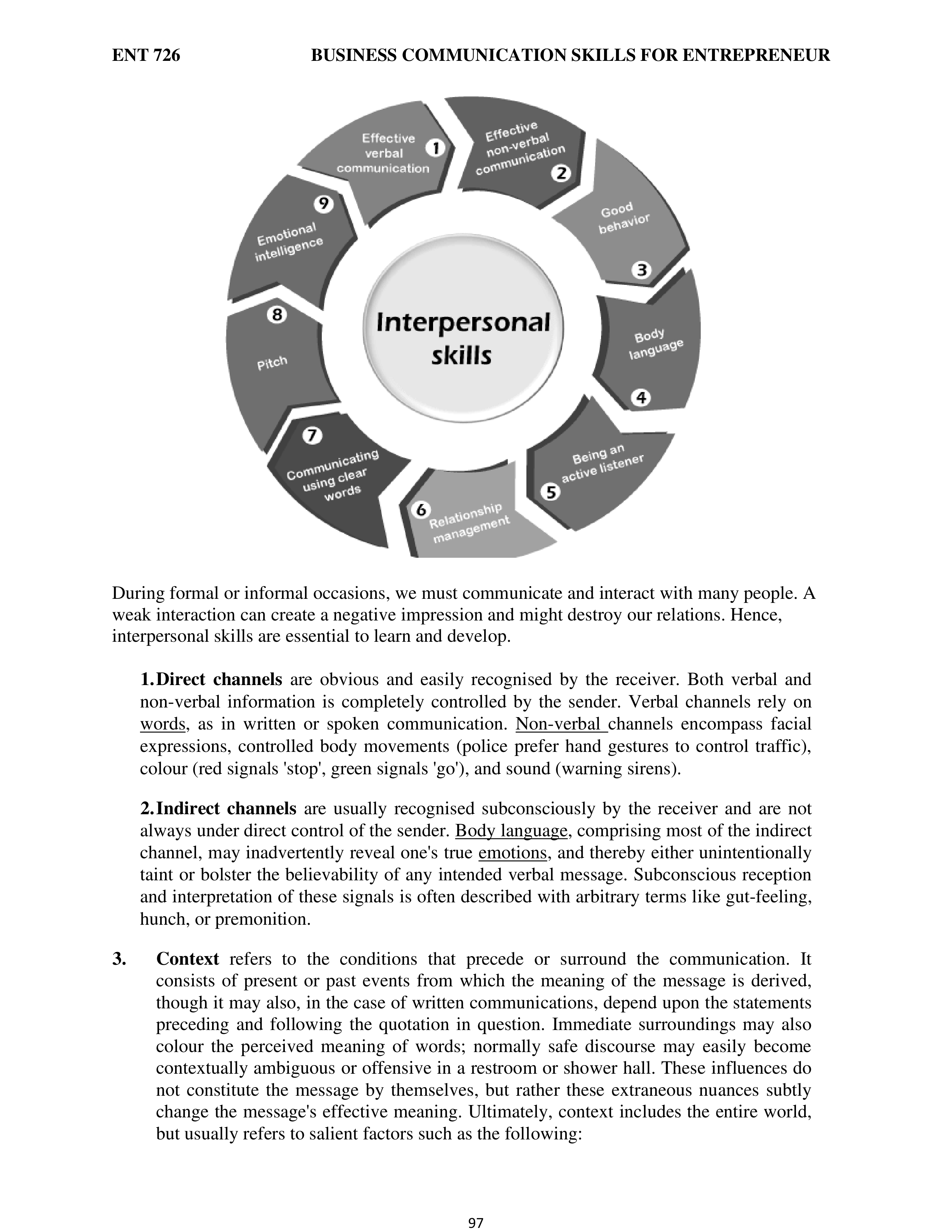
ENT 726
BUSINESS COMMUNICATION SKILLS FOR ENTREPRENEUR
97
During formal or informal occasions, we must communicate and interact with many people. A
weak interaction can create a negative impression and might destroy our relations. Hence,
interpersonal skills are essential to learn and develop.
1.
Direct channels
are obvious and easily recognised by the receiver. Both verbal and
non-verbal information is completely controlled by the sender. Verbal channels rely on
words, as in written or spoken communication. Non-verbal channels encompass facial
expressions, controlled body movements (police prefer hand gestures to control traffic),
colour (red signals 'stop', green signals 'go'), and sound (warning sirens).
2.
Indirect channels
are usually recognised subconsciously by the receiver and are not
always under direct control of the sender. Body language, comprising most of the indirect
channel, may inadvertently reveal one's true emotions, and thereby either unintentionally
taint or bolster the believability of any intended verbal message. Subconscious reception
and interpretation of these signals is often described with arbitrary terms like gut-feeling,
hunch, or premonition.
3.
Context
refers to the conditions that precede or surround the communication. It
consists of present or past events from which the meaning of the message is derived,
though it may also, in the case of written communications, depend upon the statements
preceding and following the quotation in question. Immediate surroundings may also
colour the perceived meaning of words; normally safe discourse may easily become
contextually ambiguous or offensive in a restroom or shower hall. These influences do
not constitute the message by themselves, but rather these extraneous nuances subtly
change the message's effective meaning. Ultimately, context includes the entire world,
but usually refers to salient factors such as the following:
ENT 726
BUSINESS COMMUNICATION SKILLS FOR ENTREPRENEUR
98
i.
Physical milieu
: the season or weather, current physical location and environment
ii.
Situational milieu:
classroom, military conflict, supermarket checkout Cultural and
linguistic backgrounds
iii.
Developmental
progress
(maturity)
or
emotional
state
iv.
Complementary or contrasting roles:
boss and employee; teacher and student;
parent,
child, and spouse; friend or enemy; partner or competitor
Ability to ask the questions and listen is vital to the good interpersonal skills. In fact the
empathetic listening is a number one skill which can help to build relationships.
SELF ASSESSMENT EXERCISE
State and explain the form of communication channel in interpersonal communication.
3.2 Four Principles of Interpersonal Communication
These principles underlie the workings in real life of interpersonal communication. They are
basic to communication as we cannot ignore them.
3.2.1 Interpersonal communication is Inescapable
We cannot do without communicating. The very attempt not to communicate communicates
something. Through not only words, but through tone of voice and through gesture, posture,
facial expression, etc., we constantly communicate to those around us. Through these
channels, we constantly receive communication from others. Even when you sleep, you
communicate. Remember a basic principle of communication in general: people are not mind
readers. Another way to put this is: people judge you by your behaviour, not your intent.
3.2.2 Interpersonal Communication Is Irreversible
You can't really take back something once it has been said. The effect must inevitably
remain. Despite the instructions from a judge to a jury to "disregard that last statement the
witness made," the lawyer knows that it can't help but make an impression on the jury. A
Russian proverb says, "Once a word goes out of your mouth, you can never swallow it
again."
3.2.3 Interpersonal Communication Is Complicated
No form of communication is simple. Because of the number of variables involved, even
simple requests are extremely complex. Theorists note that whenever we communicate there
are really at least six "people" involved:
1)
Who you think you are;
2)
Who you think the other person is;
3)
Who you think the other person thinks you are;
4)
Who the other person thinks s/he is;
5)
Who the other person thinks you are; and
6)
Who the other person thinks you think s/he is.
ENT 726
BUSINESS COMMUNICATION SKILLS FOR ENTREPRENEUR
99
We don't actually swap ideas; we swap symbols that stand for ideas. This also complicates
communication. Words (symbols) do not have inherent meaning; we simply use them in
certain ways, and no two people use the same word exactly alike.
Osmo Wiio gives us some communication maxims similar to Murphy's law.
•
If communication can fail, it will.
•
If a message can be understood in different ways, it will be understood in just that way
which does the most harm.
•
There is always somebody who knows better than you what you meant by your
message.
•
The more communication there is, the more difficult it is for communication to
succeed.
3.2.4
Interpersonal communication is contextual
In other words, communication does not happen in isolation. There is:
•
Psychological context, which is who you are and what you bring to the interaction. Your
needs, desires, values, personality, etc., all form the psychological context. ("You" here
refers to both participants in the interaction.)
•
Relational context, which concerns your reactions to the other person--the "mix."
•
Situational context deals with the psycho-social "where" you are communicating. An
interaction that takes place in a classroom will be very different from one that takes
place in a bar.
•
Environmental context deals with the physical "where" you are communicating.
Furniture, location, noise level, temperature, season, time of day, all are examples of
factors in the environmental context.
•
Cultural context includes all the learned behaviour and rules that affect the interaction.
If you come from a culture (foreign or within your own country) where it is considered
rude to make long, direct eye contact, you will out of politeness avoid eye contact. If
the other person comes from a culture where long, direct eye contact signals
trustworthiness, then we have in the cultural context a basis for misunderstanding.
3.3 Ten Tips for Good interpersonal communication skills
•
Listen to the person first. Communication is the two-way process; getting your entire
message across depends on understanding of other person.
•
Be interested in people you will be communicating with. Remember that the people are more
attracted towards those who have interest in them, and therefore will pay more attention to
what they will say
•
Relax. The bad body language like hunched shoulders, fidgeting, the toe-tapping or the hair-
twiddling all give a game away.
•
Smile and use the eye contact. It is a most positive signal which you can give
•
Ask the questions. It is great way to show the people that you really are interested in them.
•
If the other person has different point of view towards you, find out why they have such point
of view. The more you understand reasons behind
ENT 726
BUSINESS COMMUNICATION SKILLS FOR ENTREPRENEUR
100
their thinking, the more you will be able to understand their point of view or can help them
understand your point of view:
•
Be assertive So that we can try to value their input as your own inputs. Do not be pushy
and do not be a pushover. Try for a right balance.
•
When you will be speaking try to be enthusiastic in appropriate context. Use voice and
the body language to show this immediately don't try to latch to something which
someone has just now said ... "oh yes it happened to me" and immediately go on and
telling your own story.
•
Make sure that you ask questions about them first and then be careful while telling your
story so as not to sound like a competition.
•
Learn from the interactions. If you have a good conversations with someone try to
think why it all went well and remember key points for the next time. If it did not go
well - again try and learn something out of it.
SELF ASSESSMENT EXERCISE 1
What are the principles of interpersonal relationship?
3.4 Importance of Interpersonal Communication
Verbal communication is an essential part of business and when it is executed correctly, good
things happen. Here are a few different ideas and styles to remember when speaking to
anyone in a business setting.
Because speaking is such an indelible activity, we tend to do it without much thought. But,
that casual approach can be a problem in business. Have you ever wished you could make a
second, first impression because you said something that was out of character or
embarrassing? That comment that you didn’t think about before you said, has created an
image in someone’s mind that can not be replaced even when you meant something totally
different. When it comes to oral communication, your goal should be to take advantage of its
positive characteristics while minimising the dangers.
Speaking can be used as a tool to accomplish your objectives. But, first you must break the
habit of talking spontaneously without planning what you’re going to say or how you’re
going to say it. You must learn to manage the impression you create by consciously tailoring
your remarks and delivery style to suit the situation. Here are some things which will make
you an effective communicator:
•
Remember to become aware of what you are saying.
•
Apply the same process you use in written communication when you are
communicating orally.
•
Before you speak, think about your purpose, your main idea, and your audience.
•
Organize your thoughts in a logical way.
•
Decide on a style that suits the occasion and then edit your remarks
mentally.
•
As you speak, watch the other person to see whether your message is
making the desired impression. If not, revise it and try again.
ENT 726
BUSINESS COMMUNICATION SKILLS FOR ENTREPRENEUR
101
Remember that various situations call for different speaking styles, just as various writing
assignments call for different writing styles. Here are four different styles that will suit every
occasion.
1.
Expressive Style is spontaneous, conversational, and uninhibited. Use this when you
are expressing your feelings, joking, complaining, or socialising.
For example: "No way am I going to let that nerd force an incentive-pay plan on UPS
workers."
2.
Directive Style is an authoritative and judgmental style. We use this style to give
orders, exert leadership, pass judgment, or state our opinions.
For example: "I want Mike Romig to explain the new pay plan to each manager."
3.
Problem-Solving Style is rational, objective, unbiased, and bland. This is the style most
commonly used in business dealings. We use it when we are solving problems and
conveying routine information.
For example: "Stacy Lee might be able to present the plan more favourably."
4.
Meta Style is used to discuss the communication process itself. Meta languages enable
us to talk about our interactions.
For example: "We seem to be having a hard time agreeing on the specifics of the incentive-
pay plan."
Following these few helpful tips will increase your communication awareness which will
ultimately increase your value as an employee. Nice communicating with you!
4.0 CONCLUSION
Interpersonal communication is no doubt, an important aspect of business communication.
In-depth knowledge on interpersonal communication will go a long way to promote
development in a business environment. This would be achieved due to the cordiality that
can be fostered between an organisation and its stakeholders.
5.0 SUMMARY
This unit talked about interpersonal communication and its forms. Principles of interpersonal
communication and its importance were also discussed. Tips on how to achieve good
interpersonal communication skills were also explained.
6.0 TUTOR-MARKED ASSIGNMENT
1.
Enumerate Ten Tips for Good interpersonal communication skills.
2.
Discuss Four Principles of Interpersonal Communication.
7.0 REFERENCES/ FURTHER READINGS
•
Barnett Pearce, Making Social Worlds: A Communication Perspective, Wiley-
Blackwell, January, 2008,
•
Douglas Stone, Bruce Patton, and Sheila Heen, foreword by Roger Fisher,
Difficult Conversations: How to Discuss What Matters Most, Penguin, 1999.
ENT 726
BUSINESS COMMUNICATION SKILLS FOR ENTREPRENEUR
102
MODULE 4
UNIT 1
NEGOTIATION SKILLS
CONTENTS
1.0 Introduction
2.0 Objectives of the unit
3.0 Main Content
3.1 What is Negotiation?
3.2 How to Negotiate
3.3 The Successful Negotiator plan
3.3.1 What variables can I use?
3.4 Different Styles of Negotiation
3.5 Preparing for the Successful Negotiation
3.5.1 How well have you thought through the options?
3.6 Negotiating Your Value
3.6.1 Tips to Focus on During the Research and Negotiation
3.7 Negotiation Strategies to Maximize Salary Offer
4.0 Conclusion
5.0 Summary
6.0 Tutor-Marked Assignment
7.0 References/Further Readings
1.0 INTRODUCTION
Negotiation is a communication skill that must be mastered by every business organisation.
Businesses are set up to produce products or goods and services. This make business
organisation to interact with people who are in most cases their customers. Skill of
negotiation helps the organisation to make a head way in achieving the primary motive of
making profit. This unit will explain how to acquire the skill of negotiation. Those things that
need to be done in the negotiation process will be discussed.
2.0 OBJECTIVES OF THE UNIT
At the end of this unit, you should be able to:
•
Define the meaning of negotiation
•
Explain what is needed to negotiate
•
Identify the necessary plans to make before negotiating
•
Enumerate and describe the different styles of negotiation
•
Describe the Negotiation Strategies to maximise a salary offer
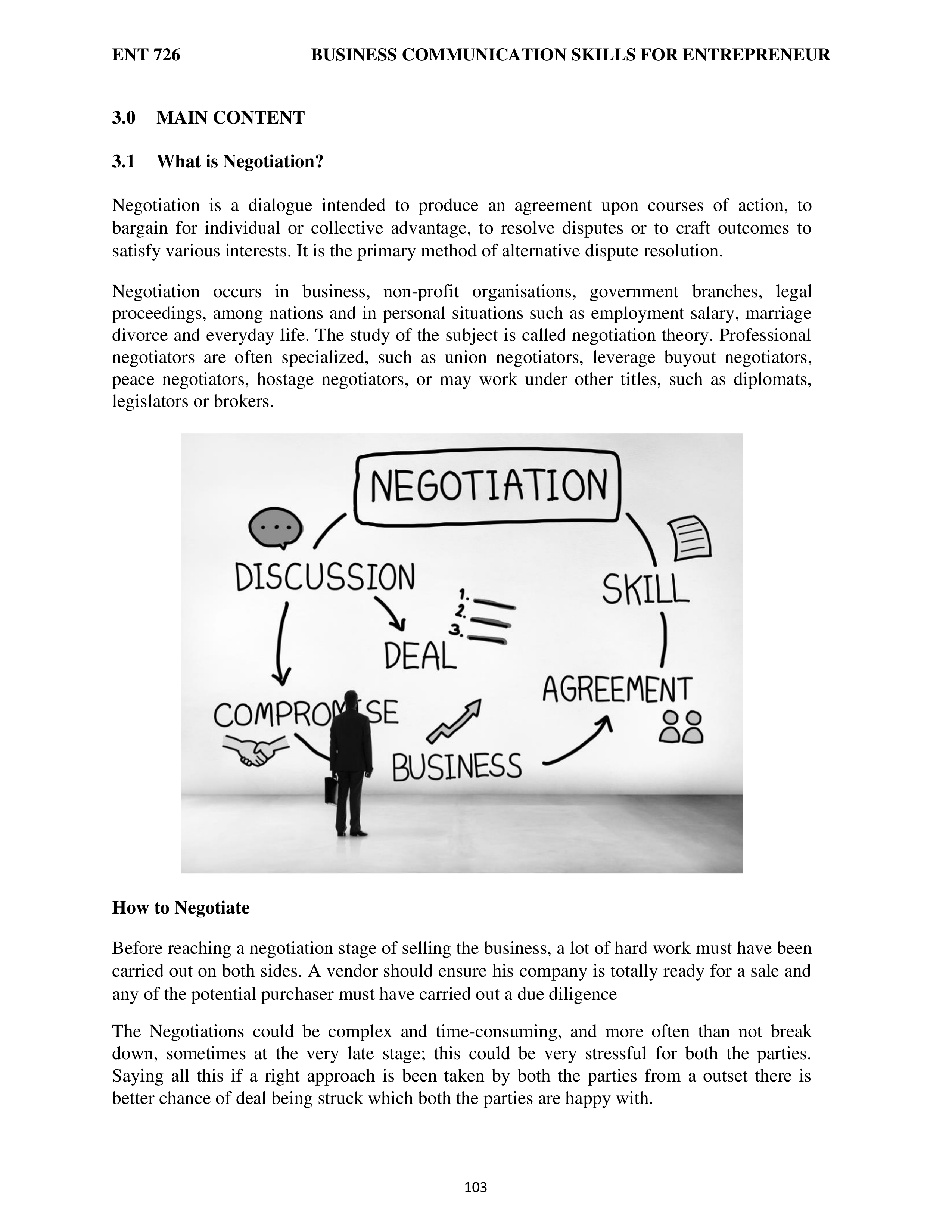
ENT 726
BUSINESS COMMUNICATION SKILLS FOR ENTREPRENEUR
103
3.0 MAIN CONTENT
3.1 What is Negotiation?
Negotiation is a dialogue intended to produce an agreement upon courses of action, to
bargain for individual or collective advantage, to resolve disputes or to craft outcomes to
satisfy various interests. It is the primary method of alternative dispute resolution.
Negotiation occurs in business, non-profit organisations, government branches, legal
proceedings, among nations and in personal situations such as employment salary, marriage
divorce and everyday life. The study of the subject is called negotiation theory. Professional
negotiators are often specialized, such as union negotiators, leverage buyout negotiators,
peace negotiators, hostage negotiators, or may work under other titles, such as diplomats,
legislators or brokers.
How to Negotiate
Before reaching a negotiation stage of selling the business, a lot of hard work must have been
carried out on both sides. A vendor should ensure his company is totally ready for a sale and
any of the potential purchaser must have carried out a due diligence
The Negotiations could be complex and time-consuming, and more often than not break
down, sometimes at the very late stage; this could be very stressful for both the parties.
Saying all this if a right approach is been taken by both the parties from a outset there is
better chance of deal being struck which both the parties are happy with.
ENT 726
BUSINESS COMMUNICATION SKILLS FOR ENTREPRENEUR
104
Prior to research, due diligence was and is always invaluable during any of the negotiation
process. It will show the vendor that you do have the true picture of their company; this could
be used to strengthen the bargaining position. The good purchaser will attempt to discover
any of the weaknesses in the company so this could be exploited, while on the other hand the
good vendor will attempt to highlight a company’s strengths.
The use of the basic psychology in a negotiation process is often used: the common tactic is
for a purchaser to try and understand the aspiration of a vendor. Most of the people become
emotionally attached to business and could have the personal friends within staff.
Understanding this is the very important tool for the successful negotiator. The good tactic
used by a vendor could be to highlight how well the particular sector is growing year by year
and how well an economy is doing and how well a purchaser will fair in future. While
preparing for the important negotiation, be sure to invest a time which it takes to answer the
following questions
•
What are other team's "hot buttons? What kind of facts, tactics, or evidence would they
perceive to be convincing, meaningful, or "powerful?"
•
What will they hope to achieve from a negotiation at company level, group level, and also
the personal level?
•
What will they hope to achieve from the other team’s previous negotiation?
•
What are other team’s needs and how you can gather the information for their needs?
•
Who are all interested parties for the negotiation?
•
Are there any of the penalties associated with negotiation, such as the penalty for bluffing?
•
What are time limits associated with a negotiation both as disclosed and undisclosed?
•
Who wants the change and who wants to keep the things in the way as they are?
•
What are best means of communication between two teams?
•
What is the cost of stalemate for their team and your team too?
•
What options do you have if you fail to reach the negotiated agreement?
A complex sales situation should be navigated by the sales professionals who do know how
to successfully handle the challenge. Negotiating Success provides the proven methods to
overcome the objections without relying on the price as a solution. This programme is non-
manipulative; allows the customer-focused process of ensuring that both sides win and leaves
the company in a stronger position for future opportunities. Negotiation is the natural process
in the business; both sides must be fully prepared and if possible should enjoy the process.
Through good negotiation it is possible for both the sides to come out of a deal happy.
SELF ASSESSMENT EXERCISE 1
What are the likely questions to be answered before going into negotiation?
3.3 The Successful Negotiator Plan
Each of the negotiation will, if done properly, be concerned with trading the concessions
against each other. There will be usually more issues and the variables than could be used for
such a trading than are immediately obvious. Good negotiators should consider all the
possible variables before meeting, calculate or do estimate what each will cost, then decide
which he/she will prefer to use and which others would prepare to use if it came to crunch. It
can't be emphasised too strongly that the essence of a good negotiation lies in obtaining the
ENT 726
BUSINESS COMMUNICATION SKILLS FOR ENTREPRENEUR
105
concessions from the other party, which will totally or largely compensate for what you have
extended.
3.3.1 What Variables Can I Use?
•
Price
•
Discount or rebate
•
Bonuses
•
Delivery times
•
Financial arrangements
•
Training
•
Packaging
•
Spare parts
•
Deposit arrangements
•
Balance arrangements
•
Credit terms
•
Guarantees
There are many other variables and you will undoubtedly be able to produce the core list of
the variables for most of your common negotiations. What each one would cost us at
different levels of the business? What will it cost them? What each one would be worth to
us? What worth would it be to them? These are the two crucial questions in the effective
negotiations because they will start the thought process of: What is cheap for me to give but
valuable for the one who gain? Also, what can I value which is cheap for them to agree to?
Once you have answers to these questions you will quickly realise that a negotiation can be
an art as it is a science.
3.4 Different Styles of Negotiation
There are varieties of styles of negotiation, depending on the circumstances. Where you do
not expect to deal with the people ever again, and you also do not need their goodwill, it
might be appropriate to play the hardball. Here you can seek to win the negotiation, while
other person losing out. Many people do go through this situation when they buy or sell a
house; that is why buying a house can be such a confrontational and an unpleasant
experience. Similarly, where there is a great deal at stake in negotiation, for an example, in
the large sales negotiations, then it might be appropriate to prepare the detail, and use the
gamesmanship to gain advantage. These approaches usually are wrong for resolving disputes
within the team. If the person plays the hardball, then this will put the other person at a
disadvantage. Similarly, using tricks and manipulation during the negotiation could severely
undermine trust, damaging the subsequent teamwork. While the manipulative person might
not be caught if the negotiation is infrequent, this is not a case when the people work together
on a day-by-day basis. Honesty and openness are best policies in the team-based negotiation.
3.5 Preparing for the Successful Negotiation
Depending on a scale of disagreement, the level of preparation might be appropriate for
conducting the successful negotiation. For a small disagreement, excessive preparation could
be counter-productive because it does take time, which is better focused in reaching the team
goals. It could also be seen as manipulative because just as it does strengthen your position, it
ENT 726
BUSINESS COMMUNICATION SKILLS FOR ENTREPRENEUR
106
weakens the other person. If the major disagreement needed to be resolved, preparing
thoroughly for that is required, and worthwhile. Think through the following points before
you could start negotiating.
Goals
What do you want to get out from the negotiation? What do you expect from the other
person?
Trading
What you and the other person have which you can trade? What do you and the other person
have so that the other wants it? What might you both be prepared to give away?
Alternatives
If you do not reach the agreement with him/her, what alternatives do you have? Are these
things good or bad alternatives? How much does it matter if you do not reach the agreement?
Will the failure to reach the agreement cut out future opportunities? What alternatives may
the other person have?
The relationship
What is a history of the relationship? Can or should this history impact on the negotiation?
Will there be any of the hidden issues that might influence negotiation? How will you handle
these?
Expected outcomes
What outcome would people be expecting from the negotiation? What was the outcome in
the past and what precedents are being set?
The consequences
What are the consequences of winning or losing this negotiation by you? What are the
consequences of winning or loosing by the other person?
Power:
Who has the power in the relationship? Who controls the resources? Who stands to lose most
if the agreement is not reached? What power does the other person have to deliver what you
do hope for?
Possible solutions:
Based on all considerations, what possible compromises might be there?
SELF ASSESSMENT EXERCISE 2
List what are needed to be done before engaging on negotiation.
3.5.1 How Well Have You Thought Through The Options?
ENT 726
BUSINESS COMMUNICATION SKILLS FOR ENTREPRENEUR
107
Negotiation is an art form – the more you practice, the better you are at it. Do the homework
and feel confident. Know all your worth. Doing it right requires the preparation, studying the
comparative situations, role playing and getting the other Perspective.
3.6 Negotiating Your Value
Each new job offer or the performance review is the opportunity to negotiate the basic salary,
the bonuses, the benefits, stock options and the various other incentives which will add to the
job satisfaction and ultimately, provide a more financial security. You will need to take
control over your job search before the new job offer and plan ahead of the time for the
annual performance review to reach the ultimate goal of the financial security and the
happiness. So are you all prepared to negotiate?
First step in negotiating is making a decision to reach the goal. Once you have made the
decision, there is a need for you to plan your approach, gather all the supporting information,
consider the alternatives and the viewpoints, do communicate specifically, and understand
the strengths and weaknesses. You should be able to respond effectively to a negotiating
party, and knowing all your competitors will enable you to bargain for your position more
efficiently and accurately.
3.6.1 Tips to Focus on During the Research and Negotiation
1.
Be Persuasive
It is very hard to force your boss to increase the compensation, and by trying to do so could
potentially damage the working relationship you currently have. Think about a process to
convince him/her, which might benefit organisation to increase your pay.
2.
Do aim high and be realistic
Many researchers have found the strong correlation between the people's aspirations and
results which they do achieve in the negotiation. At same time, you do want to suggest the
ideas for which your boss realistically could say yes.
Start with a right tone which you want
To let your boss to know that you will listen and will try to understand the views. At same
time, you do expect your boss to do same for you so you could work together to address this
issue. Avoid the ultimatums, threats and the other coercive behaviour.
4.
Clarify the interest
Your compensation must satisfy the range of needs, not just the salary. Make sure you do
have thoughts about the other points of value for you as well -- like the profit sharing, stock
options which vest immediately, the bonus, the greater work responsibilities, the quicker
promotion schedule, the increased vacation or the flexible hours.
5.
Anticipate the boss's interests
ENT 726
BUSINESS COMMUNICATION SKILLS FOR ENTREPRENEUR
108
Just like you, your boss does have needs and concerns. To make him to say yes, your ideas
should have to address the things which are important for him
6.
Create several of the options
The joint brainstorming is a most effective way to find the ideas which satisfy everybody's
interests. It works best when you separate it from the commitment – first create the possible
solutions, and later decide among them
7.
Focus on the objective criteria
It is very easy to make someone to agree with your proposal if he/she looks at how that
proposal is firmly grounded on the objective criteria, such as what similar firms do people of
like experience want or what do others in the company make of such experiences.
8.
Think through the alternatives
In case you cannot persuade your boss to say yes, you have to backup the plan. Part of the
preparation is creating the specific action plan so that you know what you will do if you do
have to walk away from a table.
9.
Do prepare thoughtfully to achieve your goals
This is only an aspect for your negotiations which you can completely control. To take the
advantages of all the above advice, you should invest significant amount of time and energy
in preparing for negotiation by studying or reading materials related to the object of
negotiation.
10.
Review to learn
Only way by which you can really improve the ability to negotiate is explicitly to learn from the
experiences. After finishing the negotiations, you reflect on what you did which worked well and
what you may want to do differently. Ultimately you will be successful in achieving the goal of
the financial security and the happiness!
3.7 Negotiation Strategies to Maximize Salary Offer
The best approach for the negotiation within the team is to adopt the win-win approach, i.e.
the one in which both the parties feel positive about a situation when a negotiation is
concluded. This will help to maintain the positive working relationship later on. This will
govern the style of a negotiation. Histrionics and the displays of emotion are clearly
inappropriate because they do undermine rational basis of negotiation and will bring the
manipulative aspect to it. Despite this, emotion can be an important subject of discussion. For
a team to function effectively, the emotional needs of team members must be fairly met. If
emotion is not discussed where needed, the agreement reached can be unsatisfactory and
temporary. Be as detached as possible when discussing your own emotions. Perhaps it would
be best to discuss your emotions as if they belonged to someone else. Take some time always
to consider the salary offer. Ask for the least of 24 to 48 hours. Silence is golden - or it could
become so - when do you just let it hang up awhile following the initial offer. Do not rush to
fill a quiet void. Weigh any of the offers against a company's expectations of you in a
ENT 726
BUSINESS COMMUNICATION SKILLS FOR ENTREPRENEUR
109
position rather than your own needs. A company has put itself on line with its offer. Rest
assured they do have a cap, but you might have some of the wiggle room based upon how
much value a company perceives you could bring them
Write the "counter-offer" letter thanking the company for its entire offer to you, recap why
do they say they want you, and will enthusiastically proclaim the desire to join their team
provided they will reconsider an amount of their offer. Accept a risk involved with this
approach and will be prepared to walk away if it will not work
Know when it is no longer in the best interest to keep the negotiating and then move on to
next opportunity. Usually, if a situation does not feel quite right, it is not. You will not be
happy working wherever you do feel you are a proverbial square peg in the round hole –
especially if you do feel you were taken advantage of
4.0 CONCLUSION
Negotiation skill, as a skill that gives business organisation headway in its profit motive,
needs to be carefully studied. The aftermath of a negotiation exercise should be able to put
smile in the faces of the party involved. This can only be if the parties involved play their
role perfectly well. Negotiation skill study is vital to business organisation.
5.0 SUMMARY
Explanation of what negotiation is and how to negotiate were treated in this unit. Also treated
are: successful negotiation plan, different styles of negotiation, negotiation strategy and
negotiating your value
6.0 TUTOR-MARKED ASSIGNMENT
What are the things to focus on during research and negotiation?
Explain the negotiation strategy for maximising a salary offer
7.0 REFERENCES/ FURTHER READINGS
William Ury, (1993): Negotiating Your Way from Confrontation to Cooperation,
revised second edition, Bantam, trade paperback, New York.
Roger Fisher (1981): Negotiating Agreement Without Giving in, Revised 2nd edition,
Penguin USA, , trade paperback
UNIT 2
CORPORATE COMMUNICATION
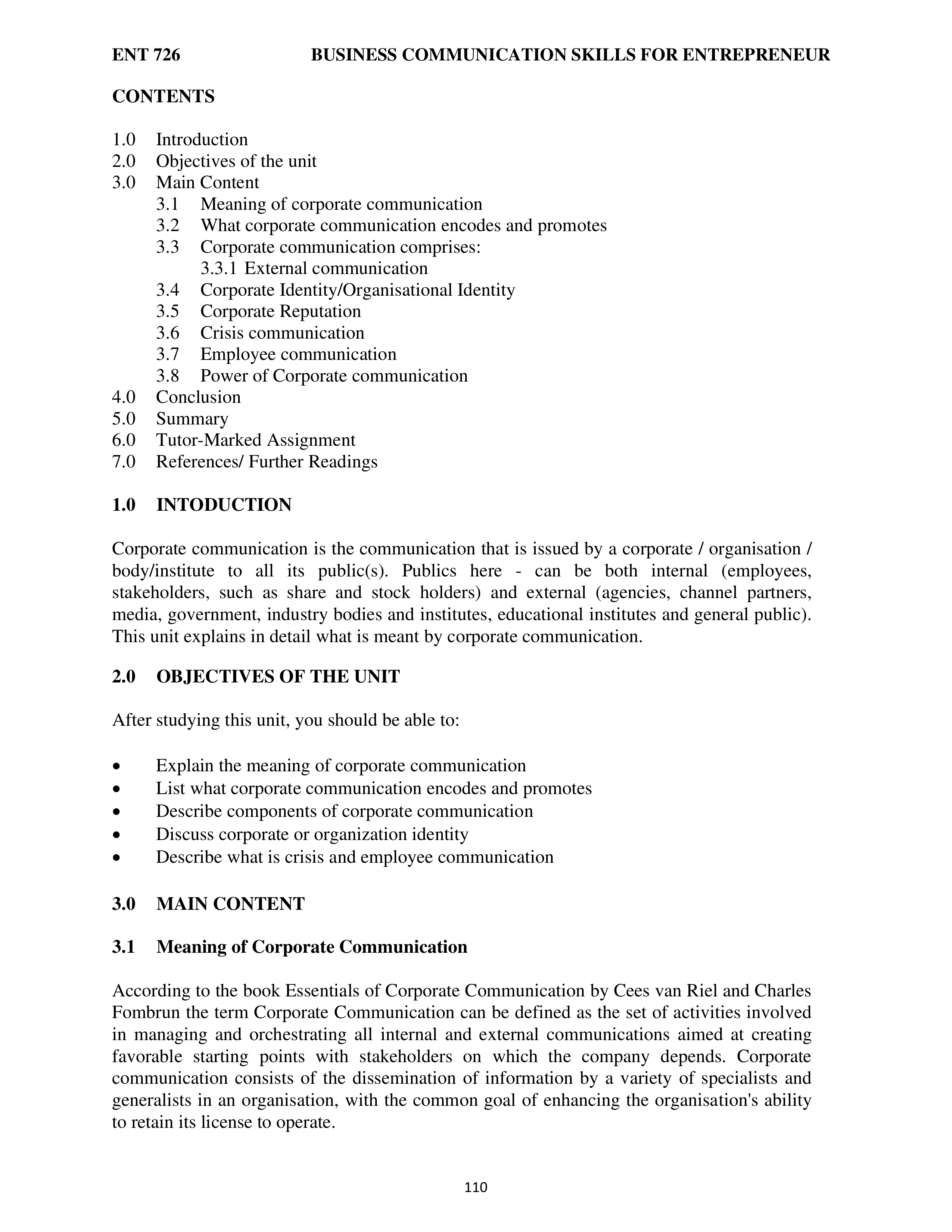
ENT 726
BUSINESS COMMUNICATION SKILLS FOR ENTREPRENEUR
110
CONTENTS
1.0 Introduction
2.0 Objectives of the unit
3.0 Main Content
3.1 Meaning of corporate communication
3.2 What corporate communication encodes and promotes
3.3 Corporate communication comprises:
3.3.1 External communication
3.4 Corporate Identity/Organisational Identity
3.5 Corporate Reputation
3.6 Crisis communication
3.7 Employee communication
3.8 Power of Corporate communication
4.0 Conclusion
5.0 Summary
6.0 Tutor-Marked Assignment
7.0 References/ Further Readings
1.0 INTODUCTION
Corporate communication is the communication that is issued by a corporate / organisation /
body/institute to all its public(s). Publics here - can be both internal (employees,
stakeholders, such as share and stock holders) and external (agencies, channel partners,
media, government, industry bodies and institutes, educational institutes and general public).
This unit explains in detail what is meant by corporate communication.
2.0 OBJECTIVES OF THE UNIT
After studying this unit, you should be able to:
•
Explain the meaning of corporate communication
•
List what corporate communication encodes and promotes
•
Describe components of corporate communication
•
Discuss corporate or organization identity
•
Describe what is crisis and employee communication
3.0 MAIN CONTENT
3.1 Meaning of Corporate Communication
According to the book Essentials of Corporate Communication by Cees van Riel and Charles
Fombrun the term Corporate Communication can be defined as the set of activities involved
in managing and orchestrating all internal and external communications aimed at creating
favorable starting points with stakeholders on which the company depends. Corporate
communication consists of the dissemination of information by a variety of specialists and
generalists in an organisation, with the common goal of enhancing the organisation's ability
to retain its license to operate.
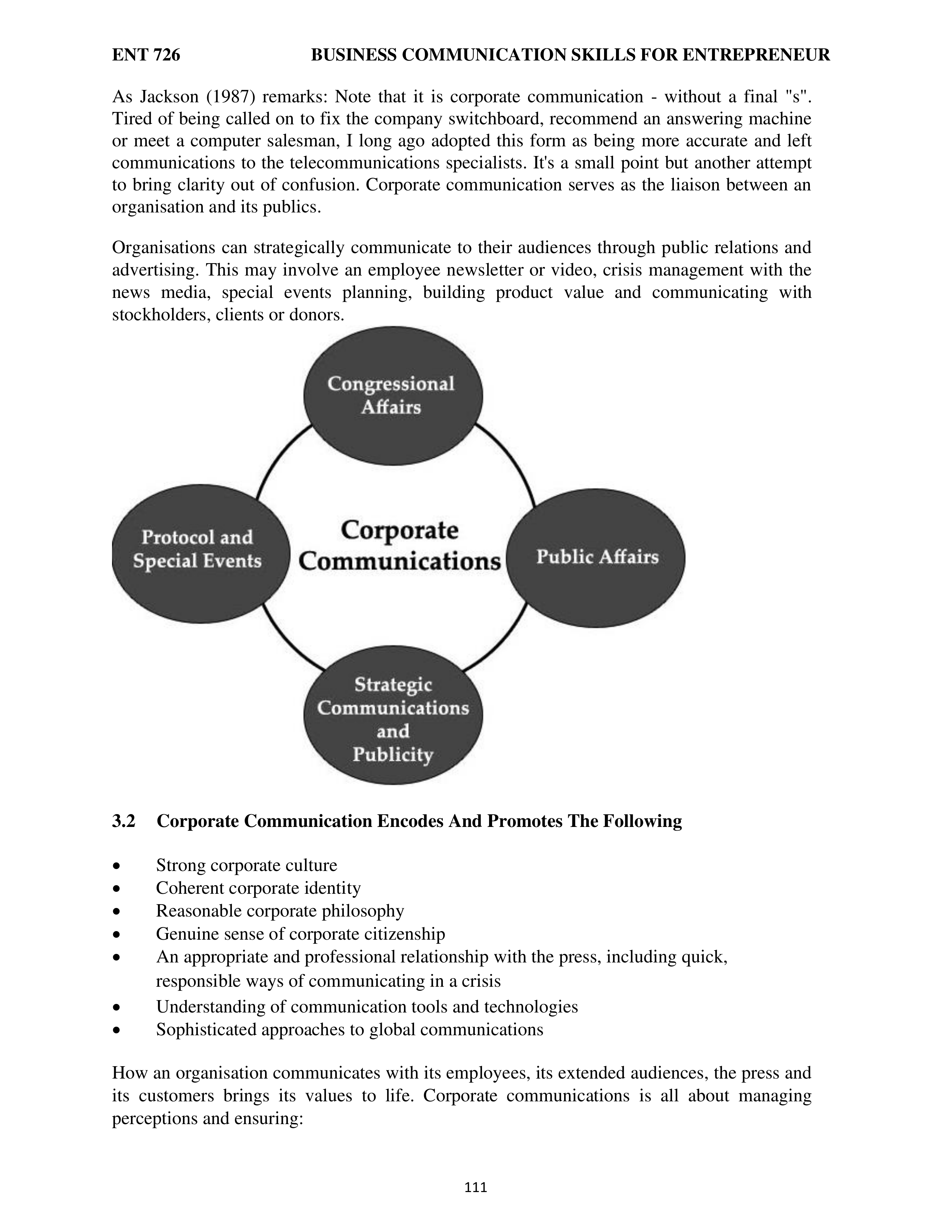
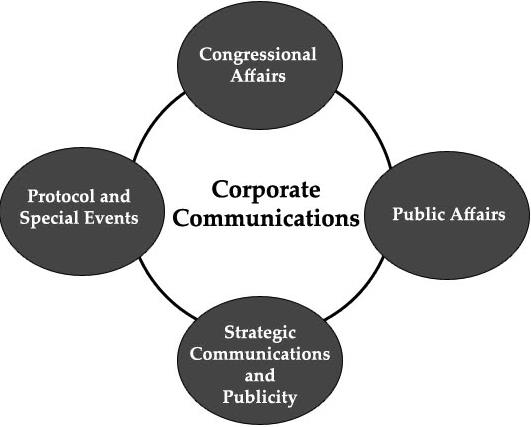
ENT 726
BUSINESS COMMUNICATION SKILLS FOR ENTREPRENEUR
111
As Jackson (1987) remarks: Note that it is corporate communication - without a final "s".
Tired of being called on to fix the company switchboard, recommend an answering machine
or meet a computer salesman, I long ago adopted this form as being more accurate and left
communications to the telecommunications specialists. It's a small point but another attempt
to bring clarity out of confusion. Corporate communication serves as the liaison between an
organisation and its publics.
Organisations can strategically communicate to their audiences through public relations and
advertising. This may involve an employee newsletter or video, crisis management with the
news media, special events planning, building product value and communicating with
stockholders, clients or donors.
3.2 Corporate Communication Encodes And Promotes The Following
•
Strong corporate culture
•
Coherent corporate identity
•
Reasonable corporate philosophy
•
Genuine sense of corporate citizenship
•
An appropriate and professional relationship with the press, including quick,
responsible ways of communicating in a crisis
•
Understanding of communication tools and technologies
•
Sophisticated approaches to global communications
How an organisation communicates with its employees, its extended audiences, the press and
its customers brings its values to life. Corporate communications is all about managing
perceptions and ensuring:
ENT 726
BUSINESS COMMUNICATION SKILLS FOR ENTREPRENEUR
112
•
Effective and timely dissemination of information
•
Positive corporate image
•
Smooth and affirmative relationship with all stakeholders.
Be it a corporate body, company, organisation, institution, non-governmental organisation,
governmental body, all of them needs to have a respectable image and reputation. In today's
day and age of increasing competition, easy access to information and the media explosion,
reputation management has gained even more importance. Therefore, corporate
communications as a role has become significant and professional in nature. Gone are the
days when corporate communication merely meant 'wining and dining the client' - it has now
emerged as a science and art of perception management.
SELF ASSESSMENT EXERCISE 1
List what corporate communicate encodes and promotes
3.3 Corporate Communication Comprises
3.3.1 External Communication
1.
Media Relations
This involves building and maintaining a positive relationship with the media (television,
print, web, et cetera). This includes, but is not limited to, drafting and dissemination of press
releases, organising press conferences and meeting with media professionals and organising
events for the media as a group.
2.
External Events
Could involve vendor/supplier/distributor needs? meetings? Channel partner meetings,
events related to product launches, important initiatives, et cetera.
3.
Company/spokesperson profiling
Ensuring that the company/organisations spokesperson is in the limelight, is well-known and
considered as an authority in the respective sector/field.
•
Managing content of corporate websites and/or other external touch points
•
Managing corporate publications - for the external world
•
Managing print media.
4.
Brand management
•
Development and upkeep of the corporate identity to ensure adherence to corporate brand
guidelines
•
To improve overall business communications so as to clearly and effectively
communicate the essence of the company.
Corporate communication structure
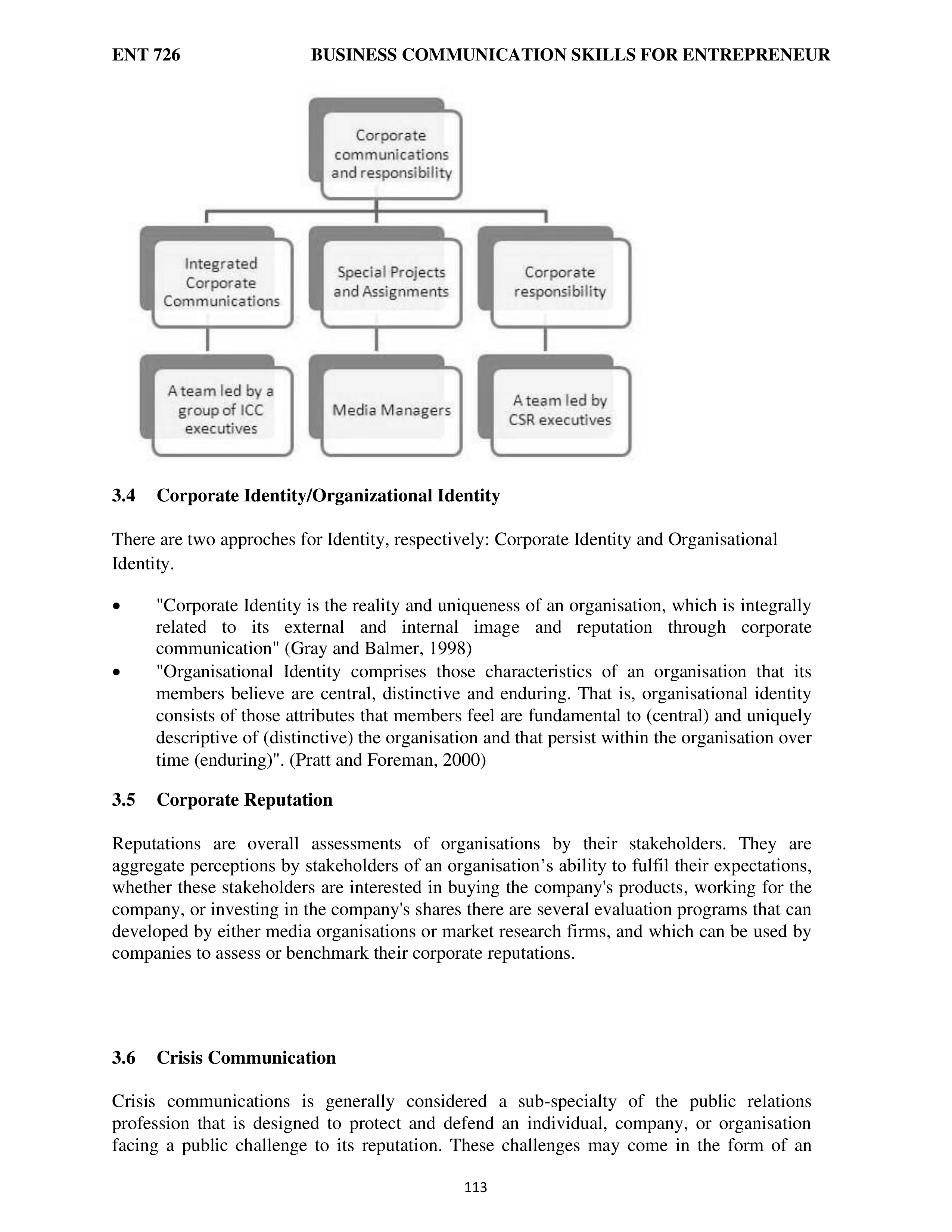
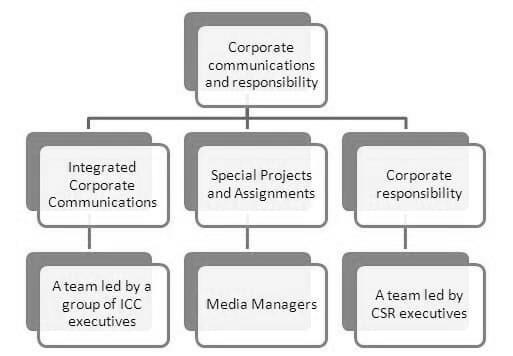
ENT 726
BUSINESS COMMUNICATION SKILLS FOR ENTREPRENEUR
113
3.4 Corporate Identity/Organizational Identity
There are two approches for Identity, respectively: Corporate Identity and Organisational
Identity.
•
"Corporate Identity is the reality and uniqueness of an organisation, which is integrally
related to its external and internal image and reputation through corporate
communication" (Gray and Balmer, 1998)
•
"Organisational Identity comprises those characteristics of an organisation that its
members believe are central, distinctive and enduring. That is, organisational identity
consists of those attributes that members feel are fundamental to (central) and uniquely
descriptive of (distinctive) the organisation and that persist within the organisation over
time (enduring)". (Pratt and Foreman, 2000)
3.5 Corporate Reputation
Reputations are overall assessments of organisations by their stakeholders. They are
aggregate perceptions by stakeholders of an organisation’s ability to fulfil their expectations,
whether these stakeholders are interested in buying the company's products, working for the
company, or investing in the company's shares there are several evaluation programs that can
developed by either media organisations or market research firms, and which can be used by
companies to assess or benchmark their corporate reputations.
3.6 Crisis Communication
Crisis communications is generally considered a sub-specialty of the public relations
profession that is designed to protect and defend an individual, company, or organisation
facing a public challenge to its reputation. These challenges may come in the form of an
ENT 726
BUSINESS COMMUNICATION SKILLS FOR ENTREPRENEUR
114
investigation from a government agency, a criminal allegation, a media inquiry, a
shareholders lawsuit, a violation of environmental regulations, or any of a number of other
scenarios involving the legal, ethical, or financial standing of the entity.
Crisis communications professionals preach that an organisation’s reputation is often its most
valuable asset. When that reputation comes under attack, protecting and defending it
becomes the highest priority. This is particularly true in today’s 24 hour news cycle, fuelled
by government investigations, Congressional or parliamentary hearings, lawsuits, and
“gotcha” journalism. When events like these happen, the media firestorm can quickly
overwhelm the ability of the entity to effectively respond to the demands of the crisis. To
emerge with its reputation intact, an organisation must anticipate every move and respond
immediately and with confidence. Companies facing such a threat will often bring in
experienced crisis communications specialists to help prepare and guide them through the
process.
Effectively responding to the challenges of a crisis requires more than the typical skills of the
public relations professional, requiring instead experience at the highest levels of the field,
such as investigative reporting, politics, and the government house
Crisis communications can include crafting thorough and compelling statements, known as
“messages,” often tested by research and polling. Additional tactics may include proactive
media outreach to get messages and context to the media, identifying and recruiting credible
third-party allies who can attest to the company’s side of the story, and striking first, not
waiting to be hit.
Crisis communications is a part of larger process referred to as crisis management though it
may well be a major tool of handling a crisis situation in government, organisation or
business.
It is also considered a sub-speciality of the Business Continuity area of modern business. The
aim of crisis communications in this context is to assist organisations to achieve continuity of
critical business processes and information flows under crisis, disaster or event driven
circumstances. Responding quickly, efficiently, effectively and in a premeditated way are the
primary objectives of an effective crisis communications strategy and/or solution. Harnessing
technology and people to ensure a rapid and co-ordinated response to a range of potentially
crippling scenarios distinguishes a well thought out and executed plan from a poorly or ill-
considered one. The inherent lag time in marshalling responses to a crisis can result in
considerable losses to company revenues, reputation as well as substantially impacting on
costs.
Effective crisis communications strategies will typically consider achieving most, if not all,
of the following objectives;
•
Maintain connectivity
•
Be readily accessible to the news media
•
Show empathy for the people involved
•
Allow distributed access
•
Streamline communication processes
•
Maintain information security
ENT 726
BUSINESS COMMUNICATION SKILLS FOR ENTREPRENEUR
115
•
Ensure uninterrupted audit trails
•
Deliver high volume communications
•
Support multi-channel communications
•
Remove dependencies on paper based processes
By definition a crisis is an unexpected and detrimental situation or event. Crisis
communications can play a significant role by transforming the unexpected into the
anticipated and responding accordingly.
SELF ASSESSMENT EXERCISE 2
State the target of effective crisis communication
3.7 Employee communication
•
Sharing information with employees, building employer pride, managing employee
issues, et cetera.
•
Manage the Intranet and other internal web portals
Internal communication
•
Managing corporate publications for employees and partners
•
Organising internal events for staff
Corporate communication officers
Recent research on the corporate communication function reports that corporate
communication officers (CCOs) in companies tend to have average tenures of about 4.5 years
and that nearly one- half (48 per cent) report to the Chief Executive Officer. CCOs say that
approximately 42 per cent of their job is strategic and 58 per cent is tactical. Over the next
year, they will be focusing more on social responsibility, social media and reputation. A
research found distinct differences between CCOs in Most Admired companies versus
Contender companies (Sofoluwe ;2007).
3.8 Power of Corporate Communication
The Corporate communication will involve much more than just motivating the employees
and then dispensing the good PR. It does represent the tool to be leveraged and the process
which is to be mastered. A Power of Corporate Communication shows the managers and the
executives how to communicate effectively with the fellow employees from a mailroom to
boardroom, and also between the organisations and across the industries. Fully accessible and
nonacademic refreshingly, it will create the easy-to-follow map of world of corporate
communication, with the workplace-tested approaches for addressing the common
challenges. Written by the two leaders in the today's corporate communication field Paul
Argenti is an author of 1994's Corporate Communicational. Power of Corporate
Communication is replete with the careful analyses, the real-world examples and the case
studies from leading organisations such as Sony, Coca-Cola, and the GE who know how to
manage corporate communication, especially when problem arise. A Power of the Corporate
Communication is the most straight-talking guide of todays for mastering an art and
ENT 726
BUSINESS COMMUNICATION SKILLS FOR ENTREPRENEUR
116
leveraging a power of the corporate communication. The key components of a corporate
communication function. Methods to manage the multiple constituencies and deliver
consistent, the relevant messages Crisis communication tactics, and dangers of creating the
"spin" as opposed to facing the problems head-on. The Successful communication program is
central to everything the organisation accomplishes, or will hope to accomplish. Let a Power
of the Corporate Communication provide you with tools which you need to establish and
maintain the program and build the corporate communication program which provides you
with the strategic advantage. "If it is left unaddressed, issues of the corporate communication
could come back to haunt the company, and when addressed, they could extend the success
of the organisation.
4.0 CONCLUSION
In order for corporate organisation to excel, she must be able effectively to communicate to
her entire stake holder. Such communication must be effective and timely. Motivating
employee, crisis management, maintaining the reputation of the organisation and corporate
communication have all been explained and discussed in this unit
5.0 SUMMARY
In this unit, we discussed corporate communication as the communication that is issued by a
corporate organisation to the public. We also discussed what corporate organisations connote
and their components. Crisis communication and employee communication are also treated
as part of the obligations of corporate communication. Corporate communication is vested
with some power; the nature of power of corporate communication was also explained.
6.0 TUTOR-MARKED ASSIGNMENT
1.
Explain the concept of power of communication
2.
What is crisis communication?
3.
What are the components of corporate communication?
7.0 REFERENCES/ FURTHER READINGS
Gray and Balmer, (1998) Corporate Communication for Managers, London: Pitman.
Pratt and Foreman, (2000) Reputation: Realizing Value from the Corporate Image, Boston:
Harvard Business School Press.
Riel, C.B.M. van & Fombrun, C. (2007) Essentials of Corporate Communication,
Abingdon: Routledge.
UNIT 3
INTERVIEW SKILLS
CONTENTS
1.0 Introduction
2.0 Objectives of the unit
ENT 726
BUSINESS COMMUNICATION SKILLS FOR ENTREPRENEUR
117
3.0 Main Content
3.1 Interview skills
3.2 The interviewer
3.2.1 Structure of interviews:
3.2.2 Environment and atmosphere
3.2.3 Welcoming the interviewee
3.2.4 Competent questioning
3.2.5 Active listening
3.2.6 Equal opportunities
3.2.7 Evaluate your performance
3.3 The interviewee
3.3.1 Preparation
3.3.2 During interview
3.3.3 After interview
4.0 Conclusion
5.0 Summary
6.0 Tutor-Marked Assignment
7.0 References/Further Readings
1.0
INTRODUCTION
Interview skill is another very important skill in business communication. It is important
because it helps an organisation in making right decision concerning various issues that
affect growth of the organisation. Some of such issues are recruitment of employee for the
organisation, getting the best contractor for a supply and so on. This unit will explain the
necessary interview skills in business communication
2.0 OBJECTIVES OF THE UNIT
At the end of this unit, you should be able to:
•
Have an overview of interview skills for recruitment purpose
•
Explain the necessary interview skills that an interviewer should possess
•
Describe the structure of an interview
•
Protect the types of questions that should be asked by an interviewer
•
Project, give suggestions of what is expected from the interviewee by the interviewer
3.0 MAIN CONTENT
3.1 Interview Skills
The interview is, perhaps, the most nerve-wracking aspect of the recruitment process, not just
for the candidate but also for the interviewer. If an interview is conducted competently, it is a
useful opportunity for a candidate to prove that he or she will be an asset to a prospective
employer. It is, however, also an opportunity for an employer to promote organisation and
therefore attract the best employees.
3.2 The Interviewer
ENT 726
BUSINESS COMMUNICATION SKILLS FOR ENTREPRENEUR
118
Given that people are the most important resource in any organisation, recruiting the wrong
ones can be costly. In fact, replacing an employee can cost up to 5o percent of that
employee’s annual salary. It is far better to invest your time in fine-tuning your interview
skills that spend time on damage limitation after discovering that you have employed the
wrong person. The interview is your opportunity to get the right employee, and a good
preparation is essential.
3.2.1 Structure of Interviews
In recruitment the process starts from the moment you have a shortlist of applicants and a
pile of application forms or Curricula vitae in front of you. The interview is essentially a
meeting to put the proverbial flesh on the bones of information provided by a candidate on
their application form of CV. Your purpose is to satisfy yourself that the candidate meets the
requirement for the job and fit in with the culture of your organisation.
You need to prepare questions in advance. Effective questions come from knowing what
skills and attitudes a job requires. You should have already defined the job criteria before
advertising a position and these criteria can be used as a basis for generating questions. Scan
through application forms or CVs carefully and make a note of any point that emerged. These
could be achievements or successful in a particular area of work or you may require
clarification on some aspect of the candidates’ application. For example, is there an
unexplained gap in their employment history?
Decide on or agree with colleague the areas that you wish to discuss during an interview.
Having done this, you need to draw up an agenda. If you are going to ‘panel interview’ with
colleague, identify in advance that will raise specific questions and at what point during the
interview. Remember that you want to present your employee as organised and efficient. If
you appear disorganised at interview, you will send out a negative message to a prospective
employee.
The whole process needs to be carefully managed so that you allow sufficient time for the
interview itself and also time between a summary while the interview is still fresh in your
mind, especially if you have many interviewees.
Remember to give the interviewee an opportunity to ask questions. This serves two purposes:
it helps the applicant to decide if your organisation is right for him or her is a chance for you
to evaluate his or her knowledge of your organisation and ability to ask questions effectively.
3.2.2 Environment and Atmosphere
Preparation for the interview also includes getting the environment right. Interviews are
stressful enough without candidate being made to feel intimidated by the layout of the room.
For example try using a round rather than rectangular table, or seat the candidate at an angle
rather than directly in front of you. Layouts that allow candidate to feel equal rather than the
victim are best. In order to manage time discreetly, make sure that your watch is either on the
desk in an unobtrusive spot or, better still; use a clock which is positioned on the wall behind
the candidate.
It is important for all your staff to be kept informed about when the interviews are taking
place. It helps them to feel involved and makes them aware that their attitude and disposition,
ENT 726
BUSINESS COMMUNICATION SKILLS FOR ENTREPRENEUR
119
if they meet candidate, could influence a good candidate’s decision to accept or reject a job
offer.
3.2.3 Welcoming the Interviewee
Use the first few minutes of the interview as a “meet and greet” opportunity. Make the
candidates feel at ease by shaking hands and by making small talk. Next, outline the structure
of the interview and perhaps restate the objectives, for example what you are looking for in a
candidate and why. Make it clear that the interview is a two-way process and is equally about
the candidate making a decision about whether they wish to work for you as it is about you
making a decision about them.
3.2.4 Competent Questioning
The best questions to ask during interviews are open question rather that closed or leading
questions. However, because in everyday speech we get into the habit of poor questioning, it
takes effort to get it at interview. For checking, you may need to use closed questions but for
probing and analysis use question such as:
•
Tell me about …….?
•
What would you say if …….?
•
How would you react if ……?
•
What would you do if ……?
•
What are your opinions on ……?
Behavioural or competence based interviewing is perhaps the most commonly used interview
method. Interviewers use this method to try to determine how a candidate would behave or
has behaved in a given situation. Quite often candidate are asked to give an example of a
situation where they demonstrated a particular skill. For example, they may be asked:” can
you give me an example of how you dealt with a difficult situation at work?”
The purpose of interview is to find out whether the candidate really can do the job they claim
that they can on their application form or CV, which is why asking questions that are directly
related to the job being offered is useful. You also need to determine whether the candidate
really wants the job. For example how enthusiastic and committed do they appear?
SELF ASSESSMENT EXERCISE 1
Explain the detail, the best type of questions that are most suitable for interviewing
process
3.2.5 Active Listening
If an interview works well, the candidate should be doing about 70 percent of the talking and
you should is spending most of your time listening. And you should be actively rather than
just passively listening to what candidates are saying. In ‘the interview’s pocketbook’, author
John Townsend gives the following g tips for people who want to become better listeners:
•
Maintain sensitive eye contact
ENT 726
BUSINESS COMMUNICATION SKILLS FOR ENTREPRENEUR
120
•
Try to mirror the speaker’s body posture and talking speed
•
Encourage the speaker to continue when you want more information
•
Paraphrase regularly
•
Clarify information
•
Give regular feedback on how you feel
Use positive body language as you listen, if only to help the candidate feel more at ease. For
example, nodding occasionally, smiling or using open handed gestures should encourage a
candidate to continue speaking. You may also need to give some attention to your
paralinguistic skills, which is not so much about what you say but speech, pitch variation,
volume and vocal quality. It matters because the way you speak often affects the message
that you send. Do you, for example, use any inflection in your voice as you speak, or do you
speak rather loudly?
3.2.6 Equal Opportunities
One costly mistake that has occurred during interviews is when the wrong questions have
been asked and have led feeling of discrimination. As an interviewer you must avoid asking
questions that contravene equal opportunities such as sex discrimination. You should avoid
asking questions about any of the following:
•
Marital status
•
Number or age of children
•
Husband employment
•
Living arrangement
•
Parent occupation
•
Boyfriend
•
Plan to get engaged or to marry
As an interviewer your task is to asses solely on the basis of a person’s qualifications and
suitability for the job. The same standard should apply when assessing men and women.
Criteria adopted for assessment of candidates should not discriminate indirectly against
women.
You also need to make sure that you do not use subtle discrimination based on you prejudices
about what you perceive to be the relative characteristics, lifestyles or abilities of men and
women. For example, do not assume that a woman may not be prepared to travel in her job
because of domestic responsibilities
3.2.7 Evaluate your Performance
Always evaluate your performance after an interview. This can be self-evaluation or, if you
share interviewing with colleague, peer-evaluation might be more appropriate. Try to assess
whether you achieved your objectives as an interviewer and try to use the information about
your interviewing skills to improve your technique for the subsequent interviews you
conduct.
3.3 The Interviewee
ENT 726
BUSINESS COMMUNICATION SKILLS FOR ENTREPRENEUR
121
Because many people will aspire to get a new job or change the present place of employment
during their career, good interviewee skills are also necessary. Having looked at what an
interviewer should be doing during an interview not hard to asses what need to be done if
you are on the other side of the table. Your task is to self-promote and self- market to make
your interviewer believe that you are the best for the job. In ‘kick start your career’, the
author recommends the 4Ps methods for succeeding at interviews:
•
Preparation
•
Presentation
•
Personality
•
Positive mental attitude
3.3.1 Preparation
Appearance and first impressions really do count. Dress smartly and present yourself at
interview as someone who looks like they already work at the organisation or company in
question
Prepare for interview by first of all convincing yourself that you really are the best person for
the job. You will have been selected for interview because your prospective employer
believes that you have at least satisfied, if not exceeded, the minimum requirements for the
job. The challenge you face is that other people will also have met
Those minimum requirements. You therefore have to demonstrate that you offer added value.
Your preparation should also include finding out as much as can about your potential
employer and noting down anything relevant that you could raise during the interview. It
could be something interesting about the company or organisation or you may need to raise a
question of clarification.
Review your copies of your application form and CV and be preparing to talk about anything
you have mentioned. For example, if you claim to be an excellent problem solver, go to the
interview armed with examples of when you successfully solve a problem. In addition, pre-
empt the type of questions that you will be asked at interview and rehearse the answers out
aloud. It really helps to practice with a friend. Try to understand what it is that the
interviewer is really trying to find out. For example, the answer to question “what are you
goals for the next five years?” usually demonstrates how motivated you are. Although some
questions tend to be variations on theme. Frequently asked questions include:
•
Tell me little about your previous experience as a worker?
•
How do you think your colleagues would describe you?
•
What is the most challenging issue you have faced at work?
•
What specific experience do you feel you can bring to the job?
•
Why do you think you are best person for the job?
•
What do you see as the key issues facing the industry in the future?
•
How would you deal with difficult member of staff?
•
What would you describe as your main strength?
ENT 726
BUSINESS COMMUNICATION SKILLS FOR ENTREPRENEUR
122
•
What would you say motivates you at work?
SELF ASSESSMENT EXERCISE 2
List and explain the 4Ps methods that are necessary for succeeding in an interview
3.3.2 During Interview
In spite of your nerves, try to maintain a friendly, positive disposition throughout the
interview. And remember that your task is to sell yourself. Enthusiasm pays dividends
especially when you are up against another candidate who on paper is equally qualified. As
well as answering questions at interview, it is also important to ask questions, for example
about training or opportunity for career progression.
3.3.3 After interview
Whether you are offered the job or not, always try to get feedback about your interview. It
will boost your confidence if you are offered the job and, if you were not, you might learn
something about yourself or interview technique that will be helpful for the next interview
4.0 CONCLUSION
As explained above, the outcome of interviews that is conducted by a business organization
goes a long to determine the future of such company. The most important factor in the
success of any business is its human resource. Therefore, the process of recruitment should
be taking very serious. More time should be devoted to preparation for any interview process.
5.0 SUMMARY
In this unit, you have learnt about the necessary things that an interviewer and interviewee
should do before embarking on a job interview. The knowledge of this is necessary to have
balanced business communication skills
6.0 TUTOR-MARKED ASSIGNMENT
•
Describe the concept of active listening in an interview process
•
List seven likely questions that an interviewee can expect in an interview process
7.0 REFERENCES/FURTHER READINGS
Grout P, Gerrin (2002). Effective Interviewing. 4th edition. London: Kogan page
Townsend J. (200), the interview’s pocket book. 2nd edition. Hamphire: Management
Pocketbooks.
ENT 726
BUSINESS COMMUNICATION SKILLS FOR ENTREPRENEUR
123
UNIT 4
COMMUNICATION TECHNOLOGY
CONTENTS
1.0 Introduction
2.0 Objectives of the unit
3.0 Main Content
3.1 Communication Technology
3.1.1 Teleconference
3.1.2 Telephone
3.1.3 E-mail
3.1.4 Fax
3.1.5 Internet
3.2 Computer Technology
3.3 Management Technology
4.0 Conclusion
5.0 Summary
6.0 Tutor-Marked Assignment
7.0 References/ Further Readings
1.0 INTRODUCTION
We are living in a Jet age and world that can now be described as a global village.
Consequently, technology revolution has been witnessed in recent past. Communication has
also been a beneficiary of such useful technologies. This has actually changed the forms of
business communication. Information is sent across the world in a twinkle of an eye. This is
really helping businesses to grow. In fact, the level of technology that is available at a
business’s disposal will determine the extent of success of the business. This unit will explain
what communication technology is all about
2.0 OBJECTIVES OF THE UNIT
At the end of this unit, you should be able to:
•
State the importance of communication technology to business organisation
•
Online and discuss the popular communication technology
•
Discuss the meaning of computer technology
•
Explain what is meant by management technology
3.0 MAIN CONTENT
3.1 Communication Technology
Communication technology provides access to information and markets in business
organisation. It connects people to various marketing opportunities. Thus, communication
technologies help in bringing about transformation in business environment. It causes
efficiency in transaction activities. The computer-mediated communication technology
includes conferencing technologies and messaging systems. This technology also facilitates
group work. Communication technology provides a way in transforming economies. It is also
useful for evaluating current information.

ENT 726
BUSINESS COMMUNICATION SKILLS FOR ENTREPRENEUR
124
Communication technology helps to:
•
Develop thinking skills
•
Decrease the need for memorisation of the facts
•
Evaluates current information
•
Develop accessing skills
Communication technologies also help in training the workers. It promotes better
understanding and coordination. The popular communication technologies are:
•
Teleconference
•
Telephone
•
E-mail
•
Fax
•
Internet
SELF ASSESSMENT EXERCISE 1
What are the functions of communication Technology?
3.1.1 Teleconference
A teleconference or teleseminar is the live exchange and mass articulation of information
among several persons and machines remote from one another but linked by a
telecommunications system. Terms as audio conferencing, telephone conferencing and phone
conferencing are also sometimes used to refer to teleconferencing.
The telecommunications system may support the teleconference by providing one or more of
the following audio, video, and/or data services by one or more means, such as telephone,
computer, telegraph, teletype, radio, and television.[1]
•
Internet teleconferencing
Internet teleconferencing includes internet telephone conferencing, videoconferencing, and
Augmented Reality conferencing.
Internet telephony involves conducting a teleconference over the Internet or a Wide Area
Network. One key technology in this area is Voice over Internet Protocol (VOIP). Popular
software for personal use includes Skype, Google Talk, Windows Live Messenger and
Yahoo Messenger.
•
Video-conferencing
Video-conferencing enables face to face interaction between the employees and their boss. It
enables effective communication of ideas. Video-conferencing motivates employees.
Students and teachers may also communicate through face to face interaction. Video-
conferencing increases intimacy and promotes interaction.
ENT 726
BUSINESS COMMUNICATION SKILLS FOR ENTREPRENEUR
125
3.1.2 Telephone
Learning how to communicate well on the telephone is one of the top priorities for many
businesses who need to use English at work. Learning the common phrases that are used on
the telephone helps the user to know what to expect. However, what users often need most is
practice, practice, and more practice. While helpful, practicing a role-play using a phone is
not always the best way to improve telephoning skills. Telephoning requires special skills as
there are a number of difficulties that arise when telephoning that are specific to telephoning.
The first and foremost difficulty is not being able to see the person you are communicating
with. This lack of visual communication often makes users, who can communicate quite
successfully in other situations, nervous and thereby hinders their communicative abilities.
Add to this the typical hectic pace of business communication, and you have a particularly
difficult situation. There is need for a feature which includes a number of ingredients to
improve telephoning skills. Also specific telephoning phrases, telephoning techniques to
improve confidence when telephoning and telephoning practice exercises will also help in the
process.
3.1.3 E-mail
Electronic mail, often abbreviated as email or e-mail, is a method of exchanging digital
messages, designed primarily for human use. E-mail systems are based on a store- and-
forward model in which e-mail computer server systems accept, forward, deliver and store
messages on behalf of users, who only need to connect to the e-mail infrastructure, typically
an e-mail server, with a network-enabled device (e.g., a personal computer) for the duration
of message submission or retrieval. Rarely is e-mail transmitted directly from one user's
device to another's.
An electronic mail message consists of two components, the message header, and the
message body, which is the email's content. The message header contains control
information, including, minimally, an originator's email address and one or more recipient
addresses. Usually additional information is added, such as a subject header field.
E-mail was widely accepted by the business community as the first broad electronic
communication medium and was the first ‘e-revolution’ in business communication. E-mail
is very simple to understand and like postal mail, e-mail solves two basic problems of
communication: logistics and synchronisation. Local area network based email is also an
emerging form of usage for business. It not only allows the business user to download mail
when offline, it also enables the small business user to have multiple users e-mail ID's with
just one e-mail connection
Exchanging emails has replaced the use of phone and personal conversations. To a large extent,
e-mails have their advantages for sure - they are fast, they can be sent 24/7 without disturbing
anyone, they create an information trail and they can help distribute documents, graphics, mp3
files and so on.
Emails are not always an appropriate way to communicate. Here are 3 instances when email is
not the recommended communication tool in business.
ENT 726
BUSINESS COMMUNICATION SKILLS FOR ENTREPRENEUR
126
•
Do not use email to communicate information that is top secret
When it is so easy for someone to forward and/or blind copying another person on your email, it
is unwise to convey information that would be considered competitive intelligence.
•
Do not use email to terminate and employee
Yes, scary but true, some employers resort to a pink email – as opposed to
a pink slip! If you
can't find the time, energy and respect for the person, then it says more about your leadership that
it does about their reason for termination. Common courtesy means using common sense
andcommonly held ethical beliefs to guide your actions.
•
Do not use email when conveying performance criticisms
Emotionally sensitive information should not be conveyed via email. Body language, tone of
voice, etc. can not be interpreted and you run the risk of people misunderstanding a message
due to the coldness of an email. Performance conversations should happen in person
whenever possible.
3.1.4 Fax
Fax (short for facsimile, from Latin fac simile, "make similar", i.e. "make a copy") is a
telecommunications technology used to transfer copies (facsimiles) of documents, especially
using affordable devices operating over the telephone network. The word telefax, short for
telefacsimile, for "make a copy at a distance", is also used as a synonym. Although fax is not
an acronym, it is often written as “FAX”. The device is also known as a telecopier in certain
industries. When sending documents to people at long distances, faxes have a distinct
advantage over postal mail in that the delivery is nearly instantaneous, yet its disadvantages
in quality have relegated it to a position beneath email as the prevailing form of electronic
document transfer.
Although devices for transmitting printed documents electrically have existed, in various
forms, since the 19th century, modern fax machines became feasible only in the mid-1970s
as the sophistication increased and cost of the three underlying technologies dropped. Digital
fax machines first became popular in Japan, where they had a clear advantage over
competing technologies like the teleprinter, since at the time (before the development of
easy-to-use input method editors) it was faster to handwrite than to type the characters. Over
time, faxing gradually became affordable, and by the mid-1980s, fax machines were very
popular around the world.
Although many businesses still maintain some kind of fax capability, the technology has
faced increasing competition from Internet-based systems. However, fax machines still retain
some advantages, particularly in the transmission of sensitive material which, due to
mandates like Sarbanes-Oxley and HIPAA, cannot be sent over the Internet unencrypted. In
some countries, because electronic signatures on contracts are not recognized by law while
faxed contracts with copies of signatures are, fax machines enjoy continuing support in
business.
ENT 726
BUSINESS COMMUNICATION SKILLS FOR ENTREPRENEUR
127
In many corporate environments, standalone fax machines have been replaced by "fax
servers" and other computerised systems capable of receiving and storing incoming faxes
electronically, and then routing them to users on paper or via an email (which may be
secured). Such systems have the advantage of reducing costs by eliminating unnecessary
printouts and reducing the number of inbound analog phone lines needed by an office.
3.1.5 Internet
The Internet is a global system of interconnected computer networks that use the
standardised Internet Protocol Suite (TCP/IP). It is a network of networks that consists of
millions of private and public, academic, business, and government networks of local to
global scope that are linked by copper wires, fiber-optic cables, wireless connections, and
other technologies.
The Internet carries a vast array of information resources and services, most notably the
inter-linked hypertext documents of the World Wide Web (WWW) and the infrastructure to
support electronic mail, in addition to popular services such as online chat, file transfer and
file sharing, online gaming, and Voice over Internet Protocol (VoIP) person-to-person
communication via voice and video.
The origins of the Internet reach back to the 1960s when the United States funded research
projects of its military agencies to build robust, fault-tolerant and distributed computer
networks. This research and a period of civilian funding of a new U.S. backbone by the
National Science Foundation spawned worldwide participation in the development of new
networking technologies and led to the commercialisation of an international network in the
mid 1990s, and resulted in the following popularization of countless applications in virtually
every aspect of modern human life. By 2009, an estimated quarter of Earth's population uses
the services of the Internet.
The Internet already has become a pervasive force in our society, and projections are that it
will continue to become even more so in the future. Every business organisation needs to be
sure adequate use of the rich resources found on the Internet for business communication.
SELF ASSESSMENT EXERCISE 2
List and explain the popular communication technologies that are available for business
communication.
3.2 Computer Technology
Computer technology promotes independence and self-assessment. It stimulates the interest
of the students. The various programs in the system help students in self-assessment. Word
processor programs help students in organising letters. Interactive computers also help
students with their pronunciation. Computer technology assists people in learning languages.
Teachers may re-evaluate their teaching methods with the help of computers. Teachers may
also effectively use computer technology to enhance their teaching skills. Computer
technology assists people with learning disabilities. The disabled people may use graphics
software and word processor to express themselves. Computers help students to improve
their spellings. Computer technologies also benefit people with speech disability. Students
ENT 726
BUSINESS COMMUNICATION SKILLS FOR ENTREPRENEUR
128
may film clips of their speech and replay them. Computer technology assists them in
practicing their speech skills.
3.3 Management Technology
Management technology protects the sensitive corporate information. Management
technologies offer solutions to many IT problems. It also reduces IT costs. An effective
management technology should provide the following benefits:
•
Trouble shooting and recovery: It increases the efficiency of IT staff.
•
Non volatile storage: It survives system rebuilds.
•
Proactive alerting: It decreases downtime.
•
Tamper resistant agents: It prevents users from disturbing the software.
An effective management technology helps technicians in obtaining accurate inventory
information. This technology improves asset management and reduces desk-side visits.
4.0 CONCLUSION
Technology is an ever dynamic field which determines the pace of activities in the world.
This shows that a business organisation must be ever prepare to synchronises itself into the
tunes of technology. Communication technology, though might be costly, makes business to
grow at a faster rate
5.0 SUMMARY
In this unit, we discussed some of communication technologies that are presently available
for business organisation. Computer technology and management technology were also
discussed.
6.0 TUTOR-MARKED ASSIGNMENT
•
Explain the following in detail
•
Communication Technology
•
Computer Technology
•
Management Technology
7.0 REFERENCES/FURTHER READINGS
Castells, M. (2001), “Lessons from the History of Internet”, in “The essence of communication
technology”, Ch. 1, pp 9–35. Oxford Univ. Press.