
2006-240: INTEGRATING COMMUNICATION SKILLS INTO A MECHANICAL
ENGINEERING DEPARTMENT
Craig Gunn, Michigan State University
CRAIG JAMES GUNN Craig James Gunn is Director of the Communication Program in the
Department of Mechanical Engineering at Michigan State University. In this role he directs the
integrated communication program in mechanical engineering while providing help to the
cooperative engineering education division of the College of Engineering. He serves as editor for
the CED Newsbriefs and MCCE Co-op Courier.
© American Society for Engineering Education, 2006
Page 11.781.1
Integrating Communication Skills
into a Mechanical Engineering Department
Overview
With the changes in accreditation through the current ABET criteria, providing adequate writing,
graphic, and speaking skills can easily become the second most important issue for engineering
departments next to the teaching of the technical skills themselves. As more and more
departments are seeking accreditation under the new rules, it is vital that varying methods of
addressing skill acquisition be viewed. The engineering student's already extensive list of
requirements, in most cases, can not be burdened with more credits, though. This creates a
dilemma that can only be solved by providing communication skill instruction in as many
engineering classes as are feasible within the constraints of the institution. These skills coupled
with technical information create for the student an atmosphere of interest within which
communication skills can easily be incorporated and emphasized. Careful planning and
coordination can provide needed instruction in the communication skills within the department.
These ideas are developed in a structured plan that incorporates communication instruction and
evaluation into all engineering classes offered by the Department of Mechanical Engineering.
The plan shows the development of communication skill awareness in the freshmen year through
the senior design experience.
There will always be a need for communication skill awareness. Students seem to forget the
important elements of their previous education and focus only on what they assume to be
important at the time. Within engineering, the areas of mathematics, chemistry, and physics will
hold a greater place than the written document or the grammatical correctness of that document.
Students will need to be continuously reminded of the importance of writing and speaking in a
professional manner. If those reminders are performed on a regular basis by faculty who really
do influence the lives of the students, then communication will be integrated into the life of the
engineer and never be forgotten.
In an earlier paper I wrote the following words.
When considering a diverse group of individuals and the issues that are most often
discussed in regard to their educational development, one concern about the failure of
education rears its head at almost every gathering. First and foremost is the ever present
inability of our students to communicate adequately in the English language. High
school graduates happily enrolled in the colleges of their choice take the full brunt of the
critical axe when they fail to perform at the levels expected of them by the professors and
the public alike. Engineering students fare just as badly as others in the continuous
barrage of negatives on Why Johnny can't READ, WRITE, SPEAK, etc.
At Michigan State University, the required university dictated writing classes for most
engineering students encompass only one semester of freshman Writing, Rhetoric, and American
Page 11.781.2
Culture instruction and one term of more specialized engineering writing in the junior or senior
years. After these courses in the educational structure, little or no formal training is offered or
required. The Department of Mechanical Engineering decided almost twenty years ago to
address the problem of communication through a change of focus from single course
requirements to multiple experiences in a variety of courses.
I believe that there has been a marked change in the quality of student writing in the Department
of Mechanical Engineering at Michigan State University since that decision was made. Words
repeated by a number of individuals in 1987 spoke of widespread opinions in industry that the
United States was graduating engineers who excelled in their technical skills but were missing
many of the important skills, including being able to communicate, that were necessary for
success and advancement in the industrial world. As we look at what has been accomplished
over the past twenty years, we see that those earlier negative comments have been reversed by
engineering departments and accreditation agencies that see the need for increased emphasis on
issues outside of the focused technical material. One of the principal reasons for an increased
awareness is the requirement by ABET that engineering departments address the communication
skill of their engineers.
The current focus of engineering faculty and corporate leaders over the lack of communication skill
expressed by engineering undergraduates has merit when we look at many of the documents
produced by young engineers in their early engineering courses before they have been indoctrinated
into mechanical engineering communication.
These poorly prepared documents become early examples of poor text production that is seen in the
upper level engineering courses. Poor training in and attitudes toward the production of technical
documents and a lack of concrete connections to the technical world in early writing classes have
created a weakness in the communication system in many engineering departments. It is necessary,
therefore, to address and correct this problem in any manner that will bring about improved
communication skill. Many avenues have been suggested to do just this: writing across the
curriculum, writing intensive courses, tutors. The list is extensive. Another method may be useful
in addressing the typical problems shown in the text produced by the average engineer.
As we think about text production and the need to improve it we have to realize that the goal of any
engineering course is to produce technically competent engineers. We also need to be aware that
they must be able to produce written text that is free of mistakes in both the technical content and
the presentation of that material. If communication skills are to be scrutinized in the engineering
classroom by the engineering faculty member, it is necessary to provide information on specific
areas of concern along with ways to address these concerns. By focusing on problems that are
generally encountered in engineering text, the faculty member does not have to assume the role of
English teacher. They become guides to better text production instead of being forced to function in
areas to which they may be uncomfortable. There will only be a necessity of directing the attention
of the students to a very specialized list and requiring that the student address the concerns.
Page 11.781.3
Background
In the fall of 1986 Dr. Clark Radcliffe, a professor in the ME Department at MSU, addressed
these needs by revamping his measurements class, ME 446, to incorporate the draft reading of
student papers to judge the students' ability in technical communication skills. Students were
given instruction in writing skills, available time for consultation, and extensive suggestions on
how to improve their written communication. The form of their communication in this class was
the formal report. This form provided practice in the writing of abstracts, introductions, analysis,
results, conclusions, and the equipment and procedures needed to conduct an experiment. This
class, although a senior course, was an apt place to start because it gave the soon-to-be
graduating seniors a last look at their writing before they entered the world of industry.
With this course as an impetus, three more classes were targeted for technical writing skills
work. The 332/333 series fluids lab classes under Dr. John Foss gave the junior engineering
students a chance to look closely at the writing that they were doing in the form of memos and
later in formal reports. The 422 Design Projects class emphasized the added skills needed in
group work on a much larger scale coupled with the presentation skills needed to explain and
champion the proposed designs.
In an effort to continue and expand this course of action, a writing class was designed in the
summer of 1987 especially for and contained within the Mechanical Engineering Department.
The articles read, the communications prepared, and the papers presented all contain information
relevant to the mechanical engineering field. Using the format of already created writing labs,
the Mechanical Engineering writing class takes the student/engineer through memo writing,
letters, proposals, short and long formal reports, and presentation skills while targeting the use of
language in the proper conveyance of information. Since the engineer is usually unaccustomed
to writing for a variety of audiences this skill is also addressed. Quite a lot to condense into
fifteen short weeks, but again it is another vital building block in an overall scheme to make
writing an integral part of the engineering program.
At this point in time, though, bits and pieces were being offered to bandage a large and growing
wound in the educational body. A few lab classes were servicing some of the needs of the
engineering population. Committees met to discuss possibilities for the future, while students
passed through the door of graduation unprepared for the massive communicative task ahead of
them.
Avenues for Improvement
After investigating almost ten years of text produced by junior and senior mechanical engineering
students, five common areas of concern were found to be most prevalent: the problems involved in
simply beginning the production of a text, specific grammatical mistakes, difficulty in creating text
that flows, awkward wording, and a lack of direction in editing. If every engineering professor
made an effort to direct students to focus on these concerns, the text production in engineering
courses would improve.
Page 11.781.4
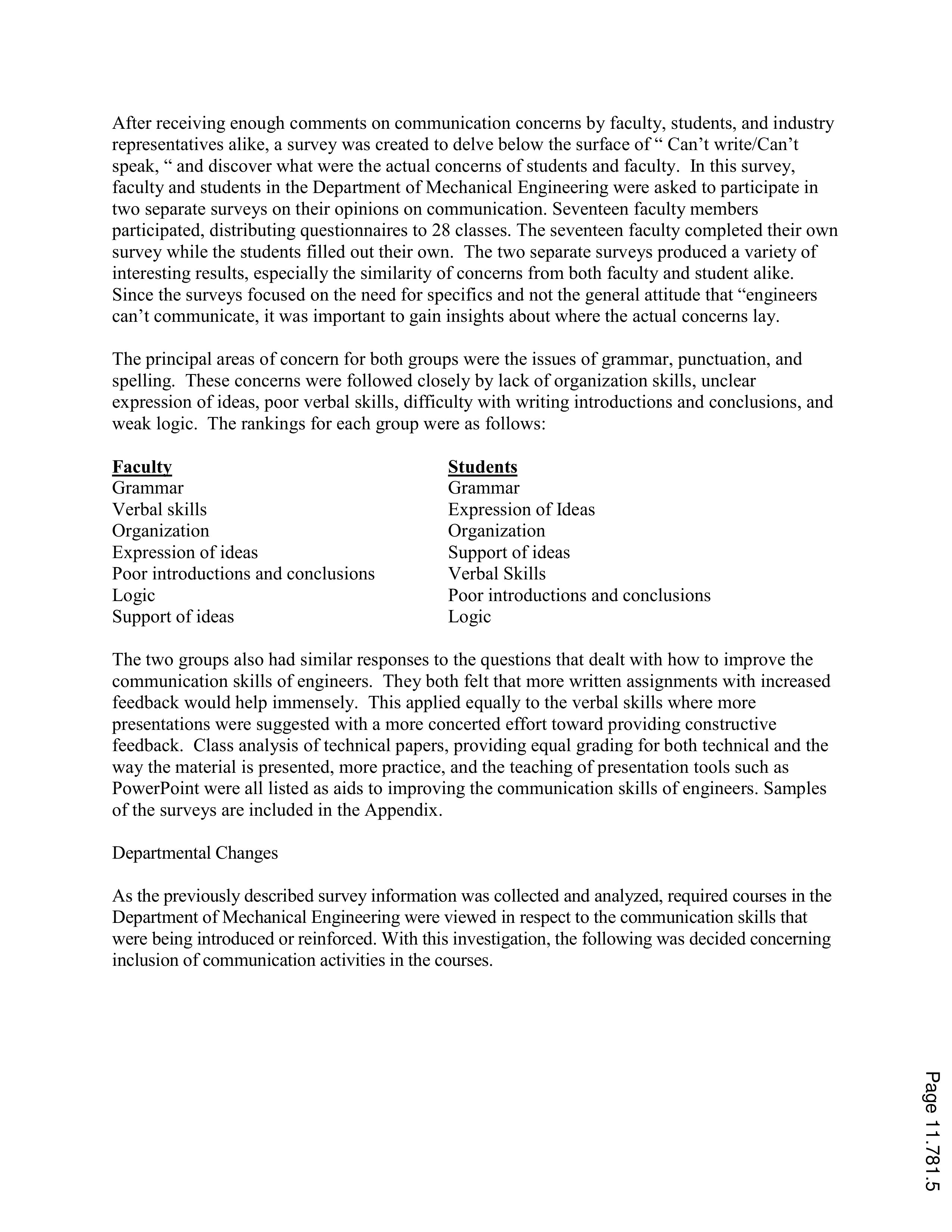
After receiving enough comments on communication concerns by faculty, students, and industry
representatives alike, a survey was created to delve below the surface of “ Can’t write/Can’t
speak, “ and discover what were the actual concerns of students and faculty. In this survey,
faculty and students in the Department of Mechanical Engineering were asked to participate in
two separate surveys on their opinions on communication. Seventeen faculty members
participated, distributing questionnaires to 28 classes. The seventeen faculty completed their own
survey while the students filled out their own. The two separate surveys produced a variety of
interesting results, especially the similarity of concerns from both faculty and student alike.
Since the surveys focused on the need for specifics and not the general attitude that “engineers
can’t communicate, it was important to gain insights about where the actual concerns lay.
The principal areas of concern for both groups were the issues of grammar, punctuation, and
spelling. These concerns were followed closely by lack of organization skills, unclear
expression of ideas, poor verbal skills, difficulty with writing introductions and conclusions, and
weak logic. The rankings for each group were as follows:
Faculty
Students
Grammar
Grammar
Verbal skills
Expression of Ideas
Organization
Organization
Expression of ideas
Support of ideas
Poor introductions and conclusions
Verbal Skills
Logic
Poor introductions and conclusions
Support of ideas
Logic
The two groups also had similar responses to the questions that dealt with how to improve the
communication skills of engineers. They both felt that more written assignments with increased
feedback would help immensely. This applied equally to the verbal skills where more
presentations were suggested with a more concerted effort toward providing constructive
feedback. Class analysis of technical papers, providing equal grading for both technical and the
way the material is presented, more practice, and the teaching of presentation tools such as
PowerPoint were all listed as aids to improving the communication skills of engineers. Samples
of the surveys are included in the Appendix.
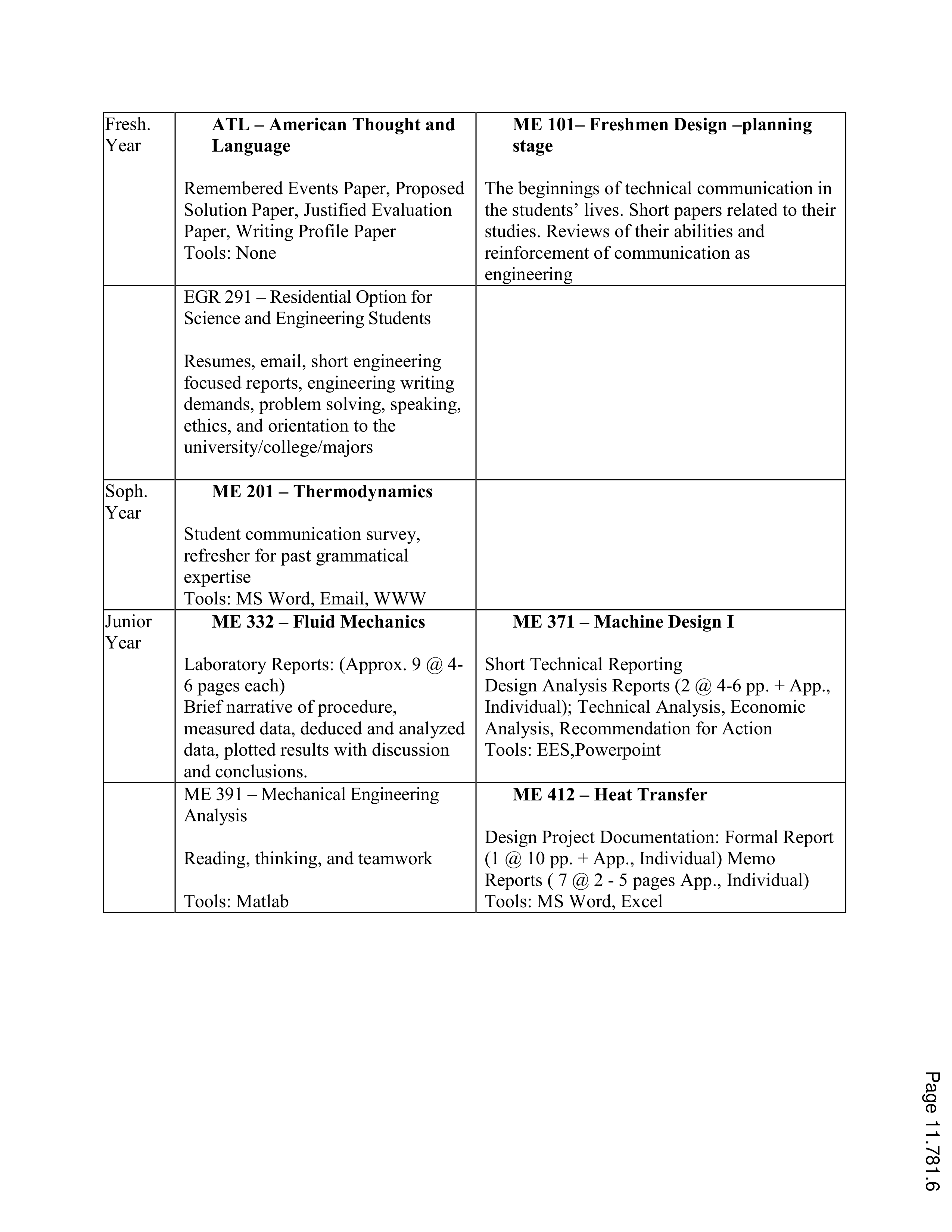
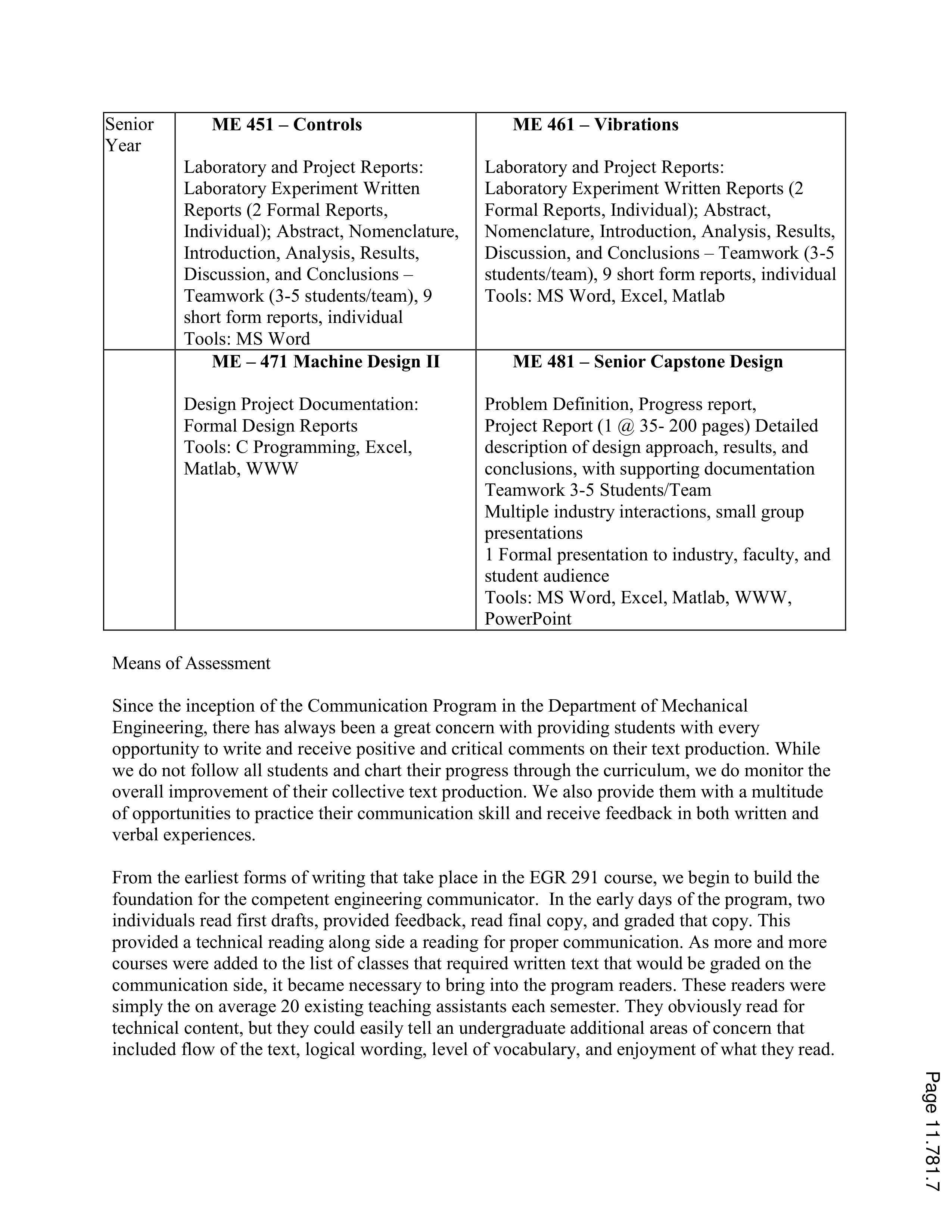
Departmental Changes
As the previously described survey information was collected and analyzed, required courses in the
Department of Mechanical Engineering were viewed in respect to the communication skills that
were being introduced or reinforced. With this investigation, the following was decided concerning
inclusion of communication activities in the courses.
Page 11.781.5
Fresh.
Year
ATL – American Thought and
Language
Remembered Events Paper, Proposed
Solution Paper, Justified Evaluation
Paper, Writing Profile Paper
Tools: None
ME 101– Freshmen Design –planning
stage
The beginnings of technical communication in
the students’ lives. Short papers related to their
studies. Reviews of their abilities and
reinforcement of communication as
engineering
EGR 291 – Residential Option for
Science and Engineering Students
Resumes, email, short engineering
focused reports, engineering writing
demands, problem solving, speaking,
ethics, and orientation to the
university/college/majors
Soph.
Year
ME 201 – Thermodynamics
Student communication survey,
refresher for past grammatical
expertise
Tools: MS Word, Email, WWW
Junior
Year
ME 332 – Fluid Mechanics
Laboratory Reports: (Approx. 9 @ 4-
6 pages each)
Brief narrative of procedure,
measured data, deduced and analyzed
data, plotted results with discussion
and conclusions.
ME 371 – Machine Design I
Short Technical Reporting
Design Analysis Reports (2 @ 4-6 pp. + App.,
Individual); Technical Analysis, Economic
Analysis, Recommendation for Action
Tools: EES,Powerpoint
ME 391 – Mechanical Engineering
Analysis
Reading, thinking, and teamwork
Tools: Matlab
ME 412 – Heat Transfer
Design Project Documentation: Formal Report
(1 @ 10 pp. + App., Individual) Memo
Reports ( 7 @ 2 - 5 pages App., Individual)
Tools: MS Word, Excel
Page 11.781.6
Senior
Year
ME 451 – Controls
Laboratory and Project Reports:
Laboratory Experiment Written
Reports (2 Formal Reports,
Individual); Abstract, Nomenclature,
Introduction, Analysis, Results,
Discussion, and Conclusions –
Teamwork (3-5 students/team), 9
short form reports, individual
Tools: MS Word
ME 461 – Vibrations
Laboratory and Project Reports:
Laboratory Experiment Written Reports (2
Formal Reports, Individual); Abstract,
Nomenclature, Introduction, Analysis, Results,
Discussion, and Conclusions – Teamwork (3-5
students/team), 9 short form reports, individual
Tools: MS Word, Excel, Matlab
ME – 471 Machine Design II
Design Project Documentation:
Formal Design Reports
Tools: C Programming, Excel,
Matlab, WWW
ME 481 – Senior Capstone Design
Problem Definition, Progress report,
Project Report (1 @ 35- 200 pages) Detailed
description of design approach, results, and
conclusions, with supporting documentation
Teamwork 3-5 Students/Team
Multiple industry interactions, small group
presentations
1 Formal presentation to industry, faculty, and
student audience
Tools: MS Word, Excel, Matlab, WWW,
PowerPoint
Means of Assessment
Since the inception of the Communication Program in the Department of Mechanical
Engineering, there has always been a great concern with providing students with every
opportunity to write and receive positive and critical comments on their text production. While
we do not follow all students and chart their progress through the curriculum, we do monitor the
overall improvement of their collective text production. We also provide them with a multitude
of opportunities to practice their communication skill and receive feedback in both written and
verbal experiences.
From the earliest forms of writing that take place in the EGR 291 course, we begin to build the
foundation for the competent engineering communicator. In the early days of the program, two
individuals read first drafts, provided feedback, read final copy, and graded that copy. This
provided a technical reading along side a reading for proper communication. As more and more
courses were added to the list of classes that required written text that would be graded on the
communication side, it became necessary to bring into the program readers. These readers were
simply the on average 20 existing teaching assistants each semester. They obviously read for
technical content, but they could easily tell an undergraduate additional areas of concern that
included flow of the text, logical wording, level of vocabulary, and enjoyment of what they read.
Page 11.781.7
In ME 332, 451, 461, 412, 371, and 481, all rough drafts are read and suggestions are made on
ways to improve the communication of the text. These rough drafts go back to the students for
rewrites and are graded by the teaching assistants. The grades reflect both facets: the technical
and the communication.
It is also felt that it is important to empower students to make decisions on their own concerning
their own writing. One way of doing this is to continually provide them with the means to check
what they have done and use as much of their own talent to modify text before it is handed in
rough draft and in final from. One of the ways of doing this is in using checklists. One of these
checklists follows. It focuses on a particular course – ME 451, Controls.
A significant benefit of the method that is to be described is that it works to improve the
students' written and spoken capabilities without adding classes to the curriculum, requiring no
great influx of new money and allowing the department to dictate and control material for the
needs of its own students.
If we envision change progressing at a slow and evolutionary pace in the overall curricula of
today, it becomes apparent that concerned collegiate departments must take the initiative to
formulate within their confines a means to rectify the unaddressed problems of communication
and forge ahead with improved skill techniques. It is time for the collegiate ranks to realize that
individual departments must shoulder the responsibility in the reeducation of those students who
have failed to grasp, who failed to have been taught, or who have simply ignored the English
language and its written counterparts. A reappraisal of responsibility will also help the
multitudes of foreign students who have learned the rudiments of the English language and now
need a greater grasp of the American tongue to move ahead in the realm of academia and
industry.
A great deal of movement in this direction stems from the needs expressed by industry,
emphasized by the words of Jack Withrow (Chrysler Corporation)
Communication for an engineer cannot be overemphasized. . .It probably comes second
only to technical skills. . .If you cannot express yourself, both verbally and in the written
form, then you cannot communicate adequately the thoughts that you have relative to any
given problem or solution or project or whatever it might be that you are working on.
Most universities (trying to provide adequate instruction in communication skills for their
students) require freshman composition classes that are quickly taken and even more quickly
forgotten. Instead of thinking of writing as a useful tool in the engineering field, writing
becomes both a required freshmen activity (more an initiation rite to suffer through) and a
process that must be endured throughout the rest of the engineer's undergraduate years. Students
are heard to complain that the biggest problem concerning their lab work is not the time, work,
or long hours in discussion, but the process of writing the terrible report at the end of the lab
itself. The report, for the most part, is never seen, read, or utilized after it has been graded. The
writing carries no continuum into any other classes. It is simply a task of drudgery.
The evolving communication program within the Mechanical Engineering Department at
Michigan State University offers a means by which the engineering students can improve upon
Page 11.781.8
their skills through a promising unit of in-house writing designed especially for the engineering
department and student alike. It was imperative to consider how this program could be
implemented without creating a hardship upon the professor and the student alike.
It is clear that faculty need to be involved in the learning process of communication skills by their
students. Engineering students need to be told to let text flow from the knowledge that they possess.
They need to sit down and brainstorm the information that may or may not be included in their
writing. Telling students to make an effort to generate as much text without a concern for order or
grammatical correctness produces a wealth of material that a student can then organize into a
coherent document. By producing copy with as much information as the student can generate, a
clear indication of gaps in necessary material will also be evident. Suggesting that outlines should
be produced from this early writing will allow the student to see the direction in which the text will
move, a movement that will result in a much more competent production.
That common concern among faculty readers - the level of poor grammatical skills expressed by
student writers – needs to be addressed in engineering courses. But where does one start in a fluid
mechanics or in a vibrations course to address these concerns. The unfocused feeling expressed by
faculty is probably the same as the students who have no idea where to begin their reports when
they have only the blank computer screen in front of them. There needs to be a basic list upon which
to focus. After looking at a wide range of technical reports, a common set of errors came to light.
These errors were in the use of tense: especially present and past. A simple request to look at the
tense usage in text may be enough to correct some of these mistakes.
Another area that seems to appear in many pieces of student text is incorrect documenting of
sources both in the text and in the way bibliographies and reference lists are created. A great deal of
complaint is raised, but if examples are given in the early days of a class, the problem might simply
disappear. The last broad grammatical problem area concerns simple punctuation mistakes:
punctuation with equations, both before and internally; where to place commas; the use of the semi-
colon; punctuation with lists; and where does the punctuation go in figures and tables. A few
grammar rules presented in the context of technical documentation to an engineering course at the
beginning of each semester or quarter will, in most cases, eliminate many of these mistakes.
A third concern among readers of student text is the flat, dull quality that comes from much of the
text that is produced by students. This quality reflects a lack of flow in the wording, a condition
similar to reading a list that indicates no apparent connection among the various parts of the list.
This lack of connection makes a reader quickly begin to wander, sometimes becoming lost in
personal thoughts far from the actual text. The three items that may help improve all student text are
a focus on outlines, a review of simple paragraphing with topic sentences and supporting
information, and an overview of the transitions that can be placed in a piece of writing to make the
text flow. These relatively easy elements in writing can make a great difference in the quality of a
student’s text.
Another problem that is seldom mentioned to an entire class of students (but appears at some time
or another in the text that they write) is awkward wording. Students are never shown examples of
text that absolutely makes no sense; sentences that are so long that the reader loses contact with the
core meaning; and word choices that are can be inappropriate, ambiguous, or redundant. Faculty
Page 11.781.9
who during the course of a semester or quarter give an overview of the kinds of text that do not
convey concise meaning provide students with a clear indication of what their own text should
avoid.
Many papers also look as though the writer made no effort to read the paper after it was completed.
Students sometimes feel that the final click on the computer to print the document is sufficient for a
quality piece of text. But does anyone really spend time in giving students an indication of how they
should approach their text to proofread and edit the copy. A simple process is to instill in students a
need to first look at the content and make sure that they have supplied all the information required.
They can then approach the issue of clarity. Is the wording clear and concise? In the third step they
review the text for grammatical correctness. The last two steps require students to evaluate their
own writing for its ability to present the text in the least number of words and to investigate their
own particular style. These efforts will lead to a much better production and fewer concerns over
the finished text.
Conclusions
Students enter and leave programs of engineering taking with them a myriad of skills. It is hoped
that at least the technical expertise needed to survive in the real world will be present, but we have
come to a point in our history that more than just technical skill is needed. Departments of
engineering must provide guidance to their students when it comes to the communication skill they
possess or the lack of that skill. By taking a close look at the particular needs of one’s students, a
department can start the process of making communication an integral part of the engineering
program. Surveying the faculty and students as to their needs and concerns, providing a plan to
approach communication skill acquisition, and necessary aids in this acquisition will go far in
providing young engineers with the tools to enter the workforce.
Bibliography
Blanchard, R.W.
Graphic Design
. Englewood Cliffs, N.J.: Prentice-Hall, Inc., 1984.
Blicq, R.S.
Technically Write!
3rd ed. Englewood Cliffs, N.J.:Prentice-Hall,Inc., 1986
Carrosso, R.E.
Technical Communications
. Belmont, Calif.: Wadsworth Publishing Company, 1986.
Condon, J.C.,Jr.
Semantics and Communication
. 3rd ed. New York: Macmillan Publishing Company,Inc., 1985.
Davis, B.G., Tools for Teaching, San Francisco: Jossey-Bass, 1993.
Elliot, N. et al. "The Assessment of Technical Writing: A Case Study," Journal of Technical Writing and
Communication, Vol.24, No.1, Winter 1994, p.9.
Foster, D.
A Primer for Writing Teachers
. Upper Monclair,New Jersey: Boynton/Cook, 1983.
Houp, K.W., and T.E.Pearsall.
Reporting Technical Information
. New York: Macmillan, 1988.
Lefferts, R.
How to Prepare Charts and Graphs For Effective Reports
. New York: Barnes and Noble Books, 1981.
Miller, R. L. and B. Olds, "A Model Curriculum for A Capstone Course in Multidisciplinary Engineering Design,"
Journal of Engineering Education, Vol.83,No.4 October 1993, pp. 311-323.
Peer commentary on Peer Review : A Case Study in Scientific Quality Control, New York: Cambridge University
Press, 1982.
Tacey, W.S.
Business and Professional Speaking
. 4th ed. Dubuque, Iowa: William C.Brown, 1983
The Chicago Manual of Style.
13th ed. Chicago: The University of Chicago Press, 1982.
Tichy, H.J.
Effective Writing
. New York: John Wiley & Sons, 1988.
Page 11.781.10
Tiedt, I.M., Writing: From topic to Evaluation, Boston: Allyn and Bacon, 1989
Williams, J.M.
Style:Ten Lessons in Clarity and Grace
. 2nd ed. Glenview,Ill.: Scott,Foresman & Company, 1984.
Zinsser, W.
On Writing Well
. 3rd ed. New York: Harper and Row, Publishers, 1985.
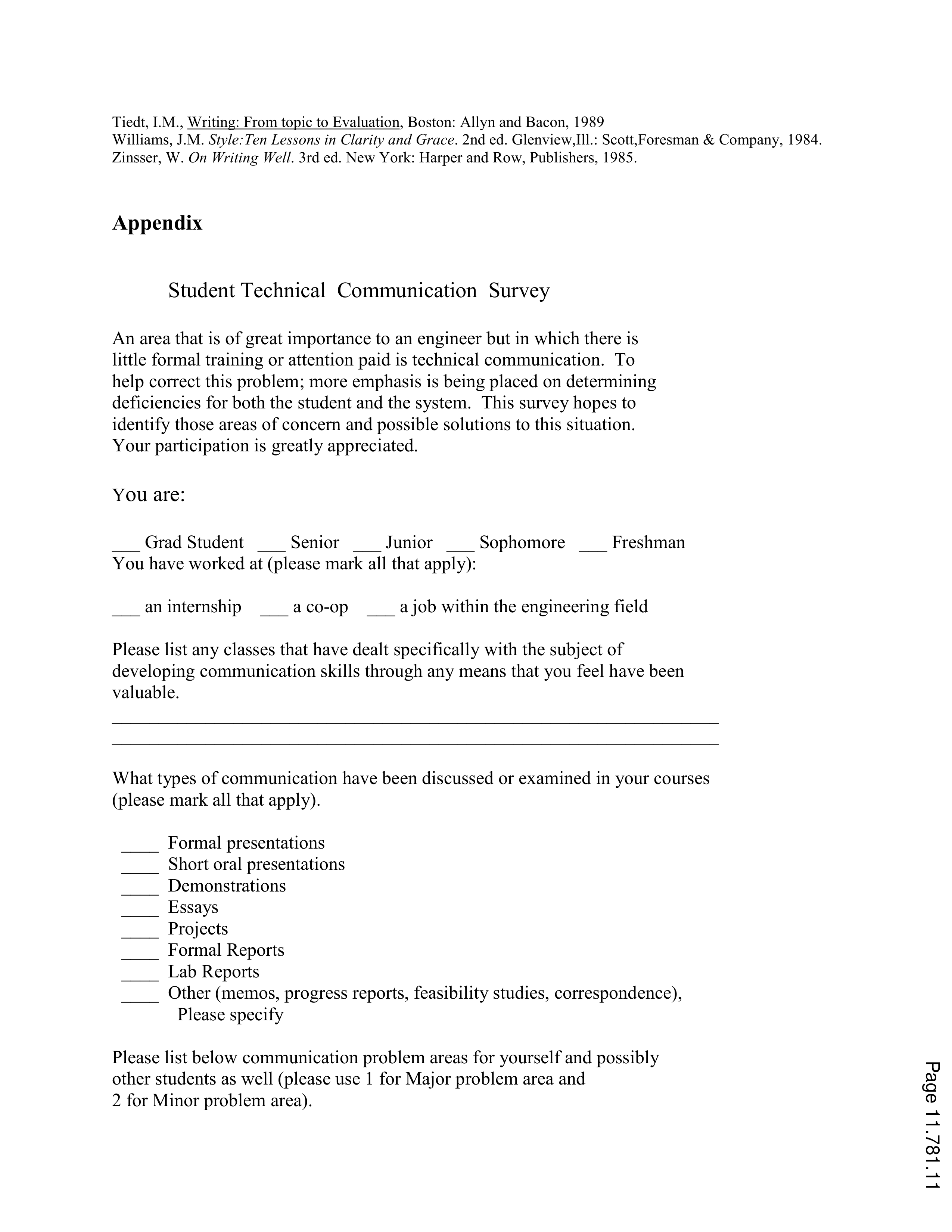
Appendix
Student Technical Communication Survey
An area that is of great importance to an engineer but in which there is
little formal training or attention paid is technical communication. To
help correct this problem; more emphasis is being placed on determining
deficiencies for both the student and the system. This survey hopes to
identify those areas of concern and possible solutions to this situation.
Your participation is greatly appreciated.
Y
ou are:
___ Grad Student ___ Senior ___ Junior ___ Sophomore ___ Freshman
You have worked at (please mark all that apply):
___ an internship ___ a co-op ___ a job within the engineering field
Please list any classes that have dealt specifically with the subject of
developing communication skills through any means that you feel have been
valuable.
_________________________________________________________________
_________________________________________________________________
What types of communication have been discussed or examined in your courses
(please mark all that apply).
____ Formal presentations
____ Short oral presentations
____ Demonstrations
____ Essays
____ Projects
____ Formal Reports
____ Lab Reports
____ Other (memos, progress reports, feasibility studies, correspondence),
Please specify
Please list below communication problem areas for yourself and possibly
other students as well (please use 1 for Major problem area and
2 for Minor problem area).
Page 11.781.11
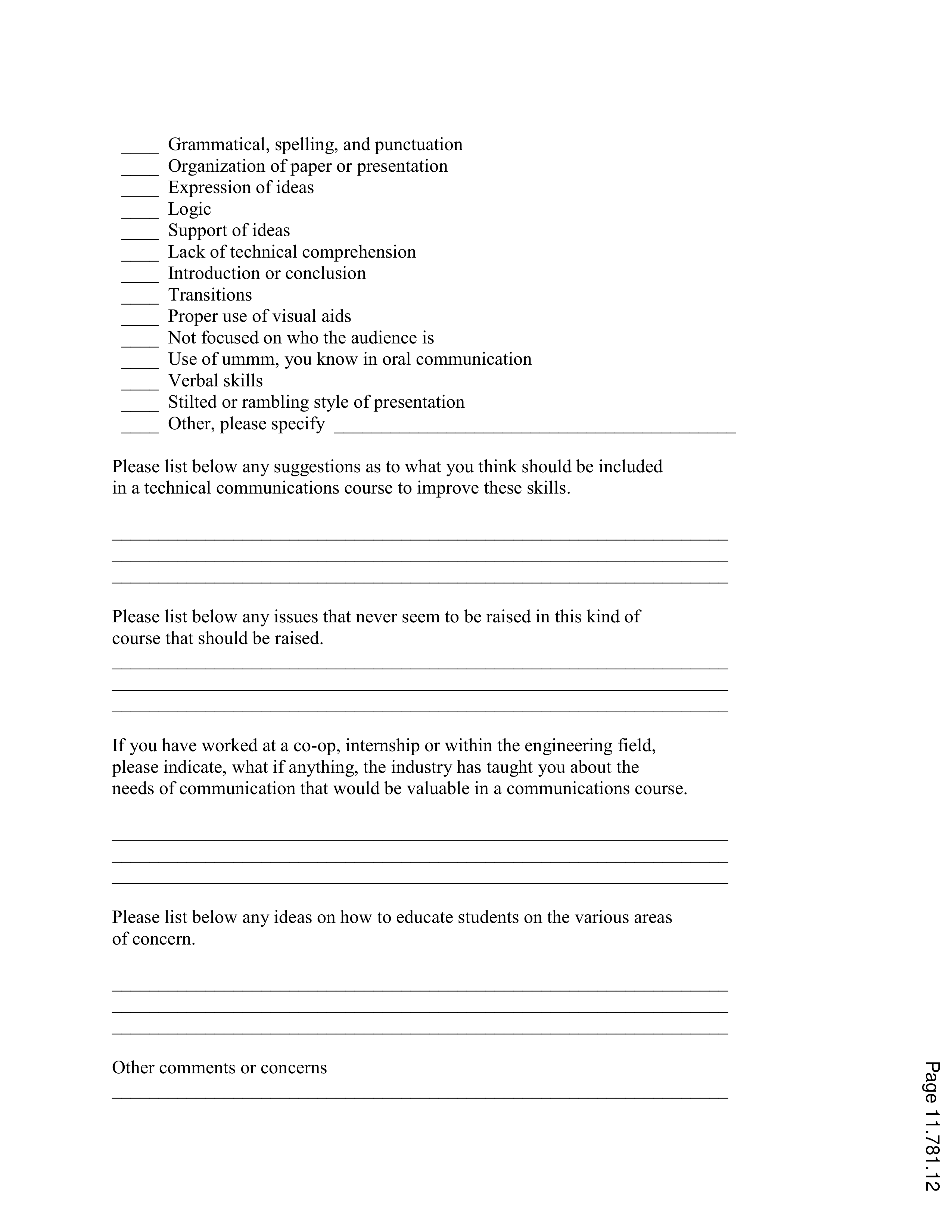
____ Grammatical, spelling, and punctuation
____ Organization of paper or presentation
____ Expression of ideas
____ Logic
____ Support of ideas
____ Lack of technical comprehension
____ Introduction or conclusion
____ Transitions
____ Proper use of visual aids
____ Not focused on who the audience is
____ Use of ummm, you know in oral communication
____ Verbal skills
____ Stilted or rambling style of presentation
____ Other, please specify ___________________________________________
Please list below any suggestions as to what you think should be included
in a technical communications course to improve these skills.
__________________________________________________________________
__________________________________________________________________
__________________________________________________________________
Please list below any issues that never seem to be raised in this kind of
course that should be raised.
__________________________________________________________________
__________________________________________________________________
__________________________________________________________________
If you have worked at a co-op, internship or within the engineering field,
please indicate, what if anything, the industry has taught you about the
needs of communication that would be valuable in a communications course.
__________________________________________________________________
__________________________________________________________________
__________________________________________________________________
Please list below any ideas on how to educate students on the various areas
of concern.
__________________________________________________________________
__________________________________________________________________
__________________________________________________________________
Other comments or concerns
__________________________________________________________________
Page 11.781.12
__________________________________________________________________
__________________________________________________________________
Thank you for your time and cooperation.
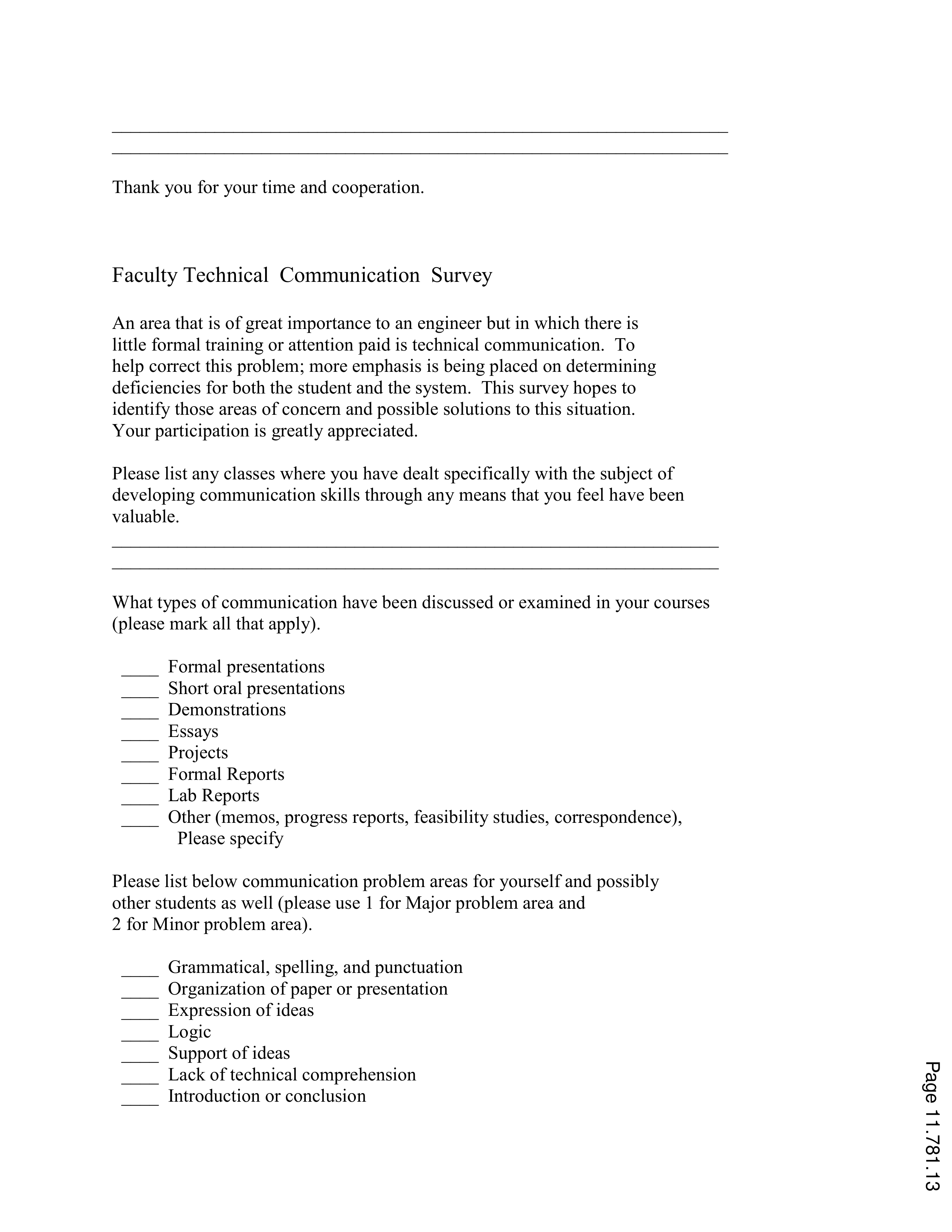
Faculty Technical Communication Survey
An area that is of great importance to an engineer but in which there is
little formal training or attention paid is technical communication. To
help correct this problem; more emphasis is being placed on determining
deficiencies for both the student and the system. This survey hopes to
identify those areas of concern and possible solutions to this situation.
Your participation is greatly appreciated.
Please list any classes where you have dealt specifically with the subject of
developing communication skills through any means that you feel have been
valuable.
_________________________________________________________________
_________________________________________________________________
What types of communication have been discussed or examined in your courses
(please mark all that apply).
____ Formal presentations
____ Short oral presentations
____ Demonstrations
____ Essays
____ Projects
____ Formal Reports
____ Lab Reports
____ Other (memos, progress reports, feasibility studies, correspondence),
Please specify
Please list below communication problem areas for yourself and possibly
other students as well (please use 1 for Major problem area and
2 for Minor problem area).
____ Grammatical, spelling, and punctuation
____ Organization of paper or presentation
____ Expression of ideas
____ Logic
____ Support of ideas
____ Lack of technical comprehension
____ Introduction or conclusion
Page 11.781.13
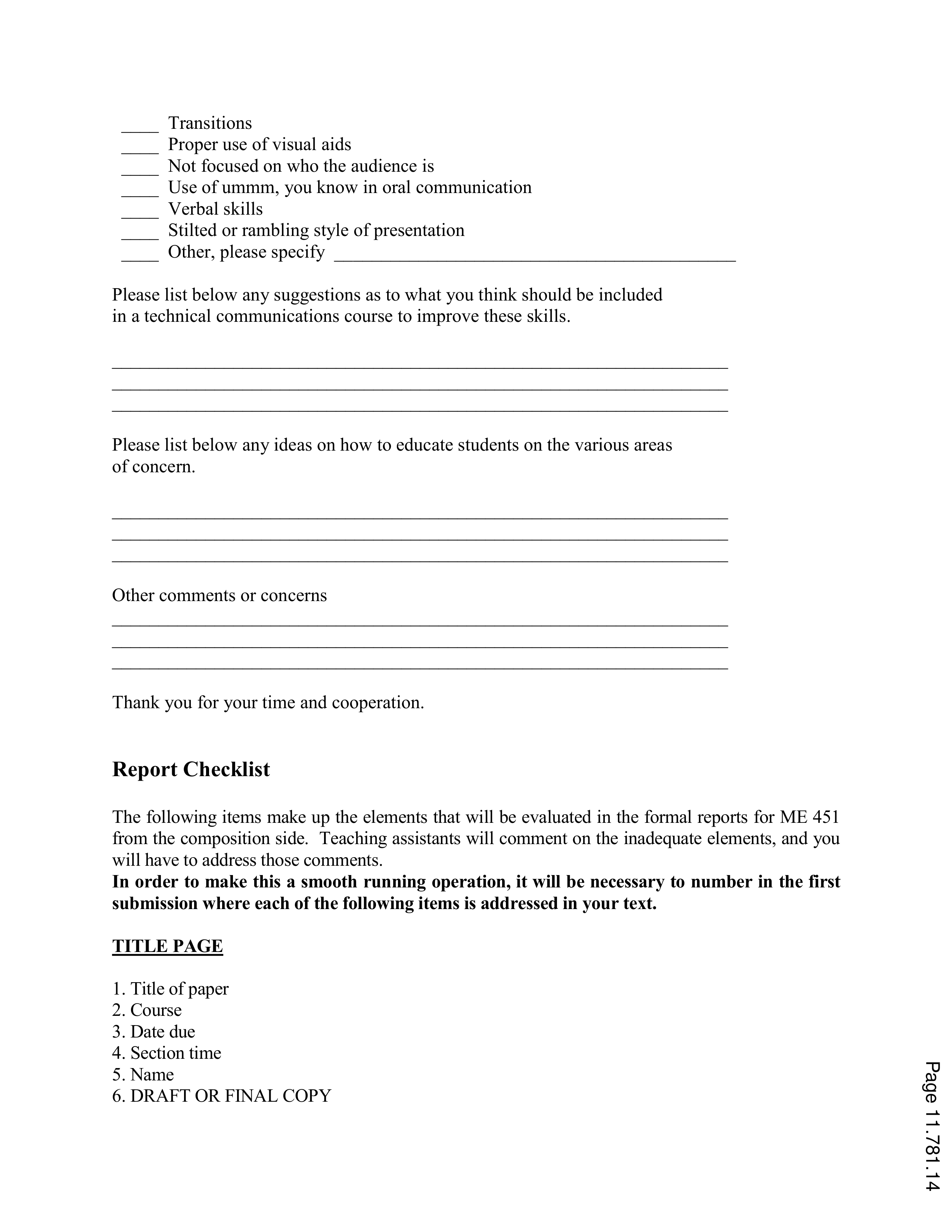
____ Transitions
____ Proper use of visual aids
____ Not focused on who the audience is
____ Use of ummm, you know in oral communication
____ Verbal skills
____ Stilted or rambling style of presentation
____ Other, please specify ___________________________________________
Please list below any suggestions as to what you think should be included
in a technical communications course to improve these skills.
__________________________________________________________________
__________________________________________________________________
__________________________________________________________________
Please list below any ideas on how to educate students on the various areas
of concern.
__________________________________________________________________
__________________________________________________________________
__________________________________________________________________
Other comments or concerns
__________________________________________________________________
__________________________________________________________________
__________________________________________________________________
Thank you for your time and cooperation.
Report Checklist
The following items make up the elements that will be evaluated in the formal reports for ME 451
from the composition side. Teaching assistants will comment on the inadequate elements, and you
will have to address those comments.
In order to make this a smooth running operation, it will be necessary to number in the first
submission where each of the following items is addressed in your text.
TITLE PAGE
1. Title of paper
2. Course
3. Date due
4. Section time
5. Name
6. DRAFT OR FINAL COPY
Page 11.781.14
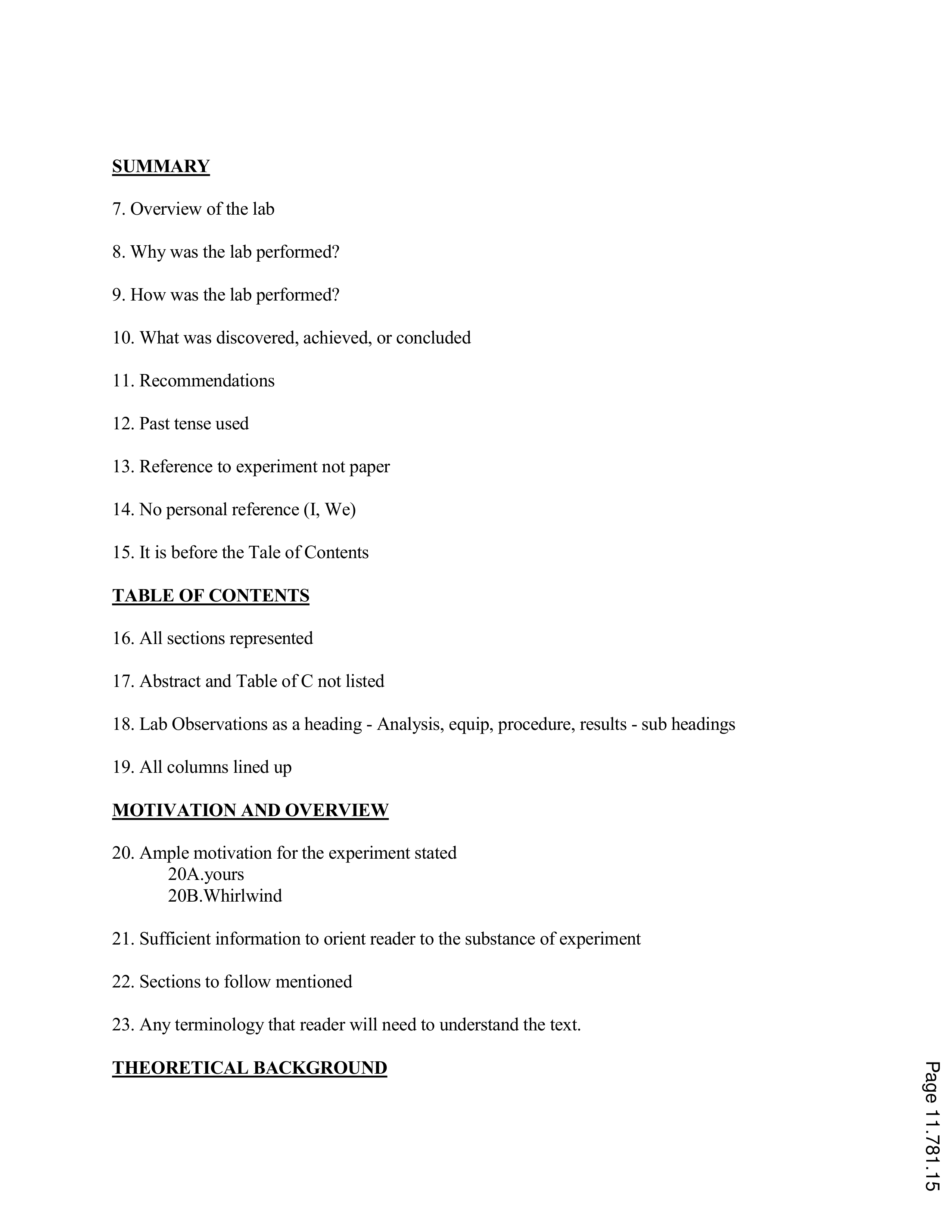
SUMMARY
7. Overview of the lab
8. Why was the lab performed?
9. How was the lab performed?
10. What was discovered, achieved, or concluded
11. Recommendations
12. Past tense used
13. Reference to experiment not paper
14. No personal reference (I, We)
15. It is before the Tale of Contents
TABLE OF CONTENTS
16. All sections represented
17. Abstract and Table of C not listed
18. Lab Observations as a heading - Analysis, equip, procedure, results - sub headings
19. All columns lined up
MOTIVATION AND OVERVIEW
20. Ample motivation for the experiment stated
20A.yours
20B.Whirlwind
21. Sufficient information to orient reader to the substance of experiment
22. Sections to follow mentioned
23. Any terminology that reader will need to understand the text.
THEORETICAL BACKGROUND
Page 11.781.15
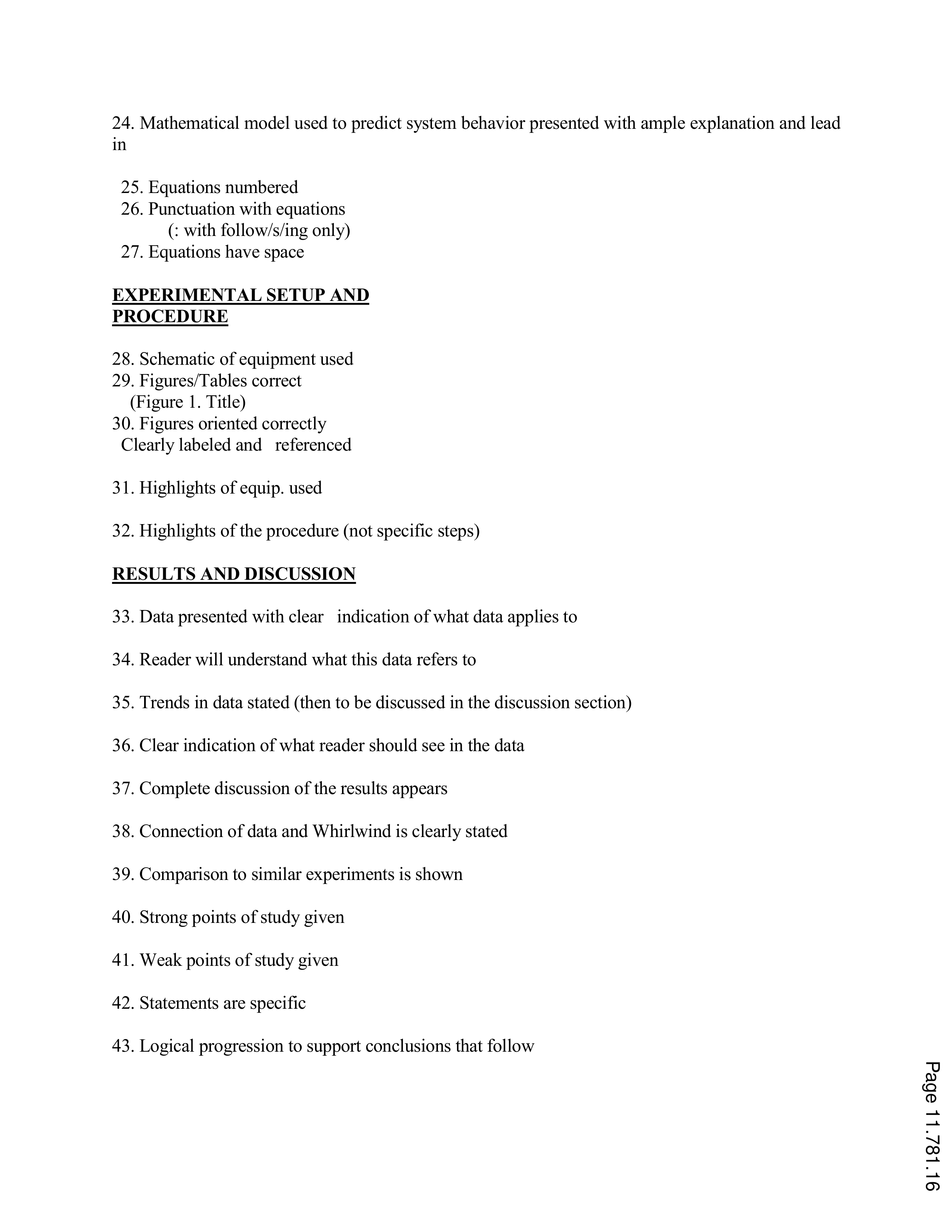
24. Mathematical model used to predict system behavior presented with ample explanation and lead
in
25. Equations numbered
26. Punctuation with equations
(: with follow/s/ing only)
27. Equations have space
EXPERIMENTAL SETUP AND
PROCEDURE
28. Schematic of equipment used
29. Figures/Tables correct
(Figure 1. Title)
30. Figures oriented correctly
Clearly labeled and referenced
31. Highlights of equip. used
32. Highlights of the procedure (not specific steps)
RESULTS AND DISCUSSION
33. Data presented with clear indication of what data applies to
34. Reader will understand what this data refers to
35. Trends in data stated (then to be discussed in the discussion section)
36. Clear indication of what reader should see in the data
37. Complete discussion of the results appears
38. Connection of data and Whirlwind is clearly stated
39. Comparison to similar experiments is shown
40. Strong points of study given
41. Weak points of study given
42. Statements are specific
43. Logical progression to support conclusions that follow
Page 11.781.16
CONCLUSIONS AND
RECOMMENDATIONS
44."The following conclusions are supported by this study:"
45. Conclusions are numbered
46. Conclusions are concise and highly specific
47. Vague statements do not exist
48. Conclusions directly flow from discussion
Page 11.781.17