

Continued on next page
Teaching Communication Skills:
A Toolkit for Educators
This toolkit provides information about how to help students
with autism spectrum disorder (ASD) improve their ability to
communicate, with a focus on teaching skills for
initiating
,
sending a message, and skills for
responding
, receiving a
message.
What is communication?
Communication involves
exchanging information between
people
. For communication to take place, there must be at
least two participants: a sender and a receiver.
The ability to communicate is different from the ability to talk.
•
Communication can occur without speech. This
includes sending messages with body language, facial
expressions, and behavior. Sign language and written
messages are also ways of communicating.
•
Speech can occur without communication. You might
talk aloud to yourself or repeat a phrase without
expecting to get a response.
A more detailed review of this material and additional resources can be found in the online version of this
toolkit, which can be accessed by registering for a free account at
triad.vkclearning.org
and accessing the
information in the
Early Childhood
folder and
Early Childhood Communication Series
.
A
B
C
Page 2 | Teaching Communication Skills: A Toolkit for Educators
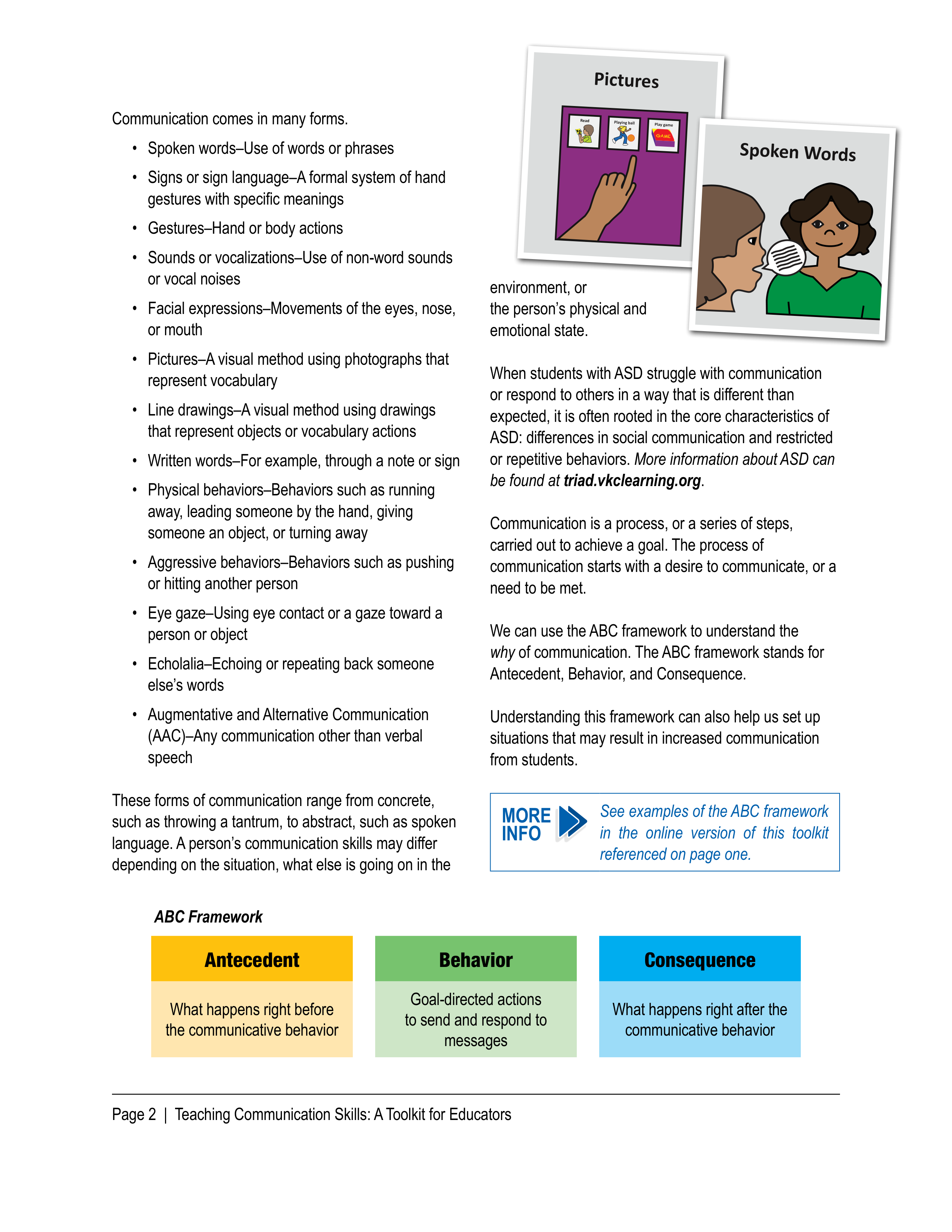
Communication comes in many forms.
•
Spoken words–Use of words or phrases
•
Signs or sign language–A formal system of hand
gestures with specific meanings
•
Gestures–Hand or body actions
•
Sounds or vocalizations–Use of non-word sounds
or vocal noises
•
Facial expressions–Movements of the eyes, nose,
or mouth
•
Pictures–A visual method using photographs that
represent vocabulary
•
Line drawings–A visual method using drawings
that represent objects or vocabulary actions
•
Written words–For example, through a note or sign
•
Physical behaviors–Behaviors such as running
away, leading someone by the hand, giving
someone an object, or turning away
•
Aggressive behaviors–Behaviors such as pushing
or hitting another person
•
Eye gaze–Using eye contact or a gaze toward a
person or object
•
Echolalia–Echoing or repeating back someone
else’s words
•
Augmentative and Alternative Communication
(AAC)–Any communication other than verbal
speech
These forms of communication range from concrete,
such as throwing a tantrum, to abstract, such as spoken
language. A person’s communication skills may differ
depending on the situation, what else is going on in the
a hand p
oint
ing to a pho
to o
f a visual support
a person talking to another
environment, or
the person’s physical and
emotional state.
When students with ASD struggle with communication
or respond to others in a way that is different than
expected, it is often rooted in the core characteristics of
ASD: differences in social communication and restricted
or repetitive behaviors.
More information about ASD can
be found at
triad.vkclearning.org
.
Communication is a process, or a series of steps,
carried out to achieve a goal. The process of
communication starts with a desire to communicate, or a
need to be met.
We can use the ABC framework to understand the
why
of communication. The ABC framework stands for
Antecedent, Behavior, and Consequence.
Understanding this framework can also help us set up
situations that may result in increased communication
from students.
MORE
INFO
See examples of the ABC framework
in the online version of this toolkit
referenced on page one.
ABC Framework
Antecedent
Behavior
Consequence
What happens right before
the communicative behavior
Goal-directed actions
to send and respond to
messages
What happens right after the
communicative behavior

Teaching Communication Skills: A Toolkit for Educators | Page 3
Why teach communication?
•
Being able to communicate with others is an
essential skill across settings. Communication is
important for expressing wants, needs, feelings,
and emotions. It is important for interacting with
others and building relationships. Communication
skills are important at school, at home, and in the
community.
•
Difficulty communicating plays a role in many
challenging behaviors. If students have a need and
don’t know an appropriate way to communicate
for it, they may use less socially appropriate ways
of getting that need met. Teaching communication
skills can help reduce and prevent challenging
behaviors.
•
Teaching communication opens up opportunities
for students. The more a student is able to
communicate, the more successful social
interactions they will be able to have, which in
turn create more opportunities for learning and
practicing communication skills.
•
Teaching communication also increases
educational opportunities and students’ ability
to participate in different settings. The more a
student is able to communicate and respond
to others independently, the more able they
will be to participate in a variety of educational
environments.
Deciding what to teach
The first step in teaching communication is deciding
what
communication skill to teach. It is important to use
your student’s current communication skills as a starting
place. Your ultimate goal for your student might be to
communicate like his or her peers, or to communicate
in an age- or grade-appropriate way. However, when
choosing a communication skill to teach, think about
the
best next step
.
The best next step for your student could be:
•
A
replacement behavior
for a challenging
behavior, such as
teaching a student to
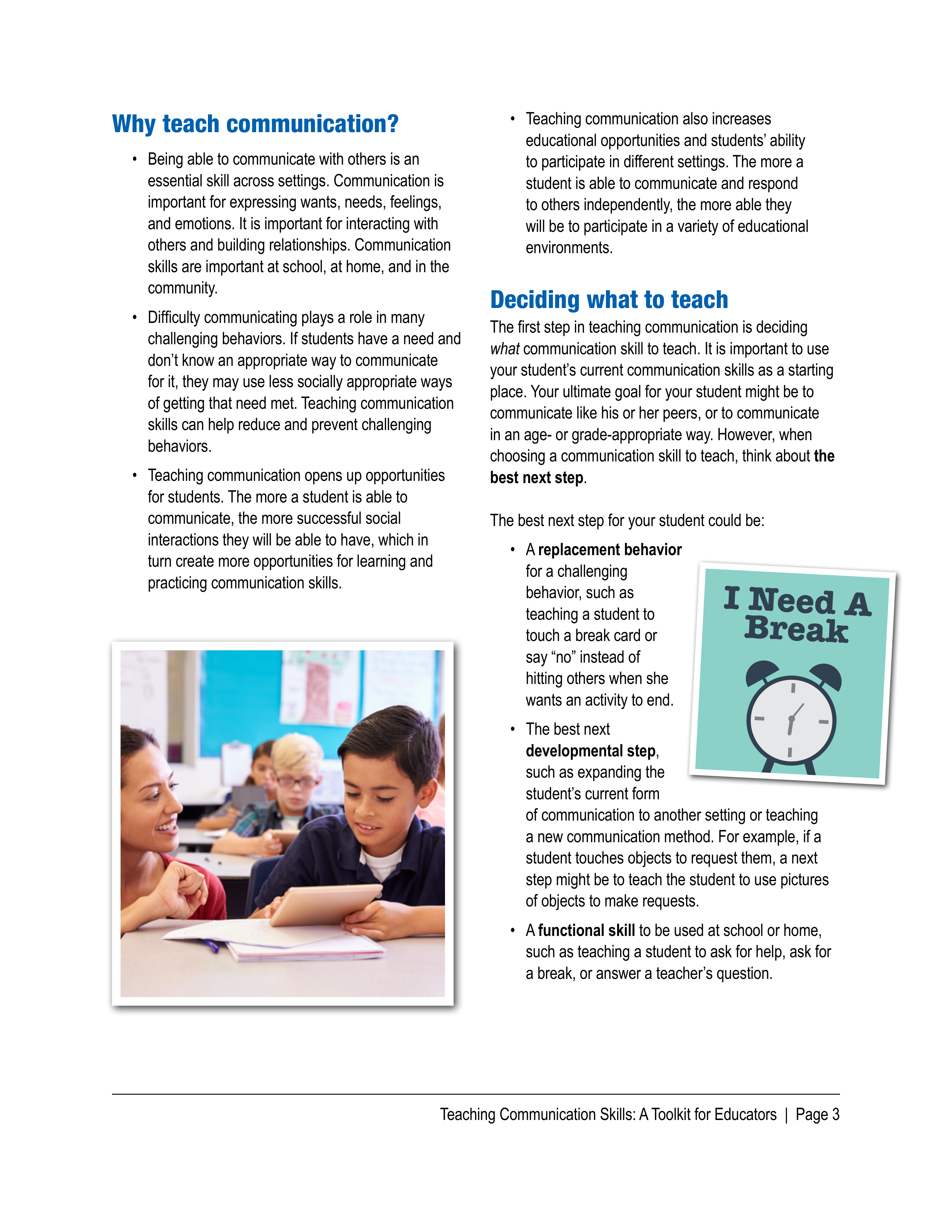
touch a break card or
say “no” instead of
hitting others when she
wants an activity to end.
•
The best next
developmental step
,
such as expanding the
student’s current form
of communication to another setting or teaching
a new communication method. For example, if a
student touches objects to request them, a next
step might be to teach the student to use pictures
of objects to make requests.
•
A
functional skill
to be used at school or home,
such as teaching a student to ask for help, ask for
a break, or answer a teacher’s question.
i need a
b
reak
Page 4 | Teaching Communication Skills: A Toolkit for Educators
Teaching Initiating
When we teach
initiating
, we are teaching a student
to
start
an interaction. To teach initiating, we need to
answer three questions:
1. What will motivate this student to
communicate?
What is motivating to your student will depend on his
or her unique wants, needs, and interests. In general,
students communicate to
access
or
escape
items,
activities, or attention. For example, a student might
be motivated to communicate when he or she wants
or needs help, wants an object but cannot access
it independently, does not want to continue doing
an activity, or needs a break from an overwhelming
situation.
With a student’s motivations in mind, you can set
up the environment to increase opportunities for a
student to initiate communication. Some strategies for
setting up the environment include:
•
“Sabotage”–Ask or tell students to do something
that you know they will need help with. For
example, place materials in a container they
cannot open without help.
•
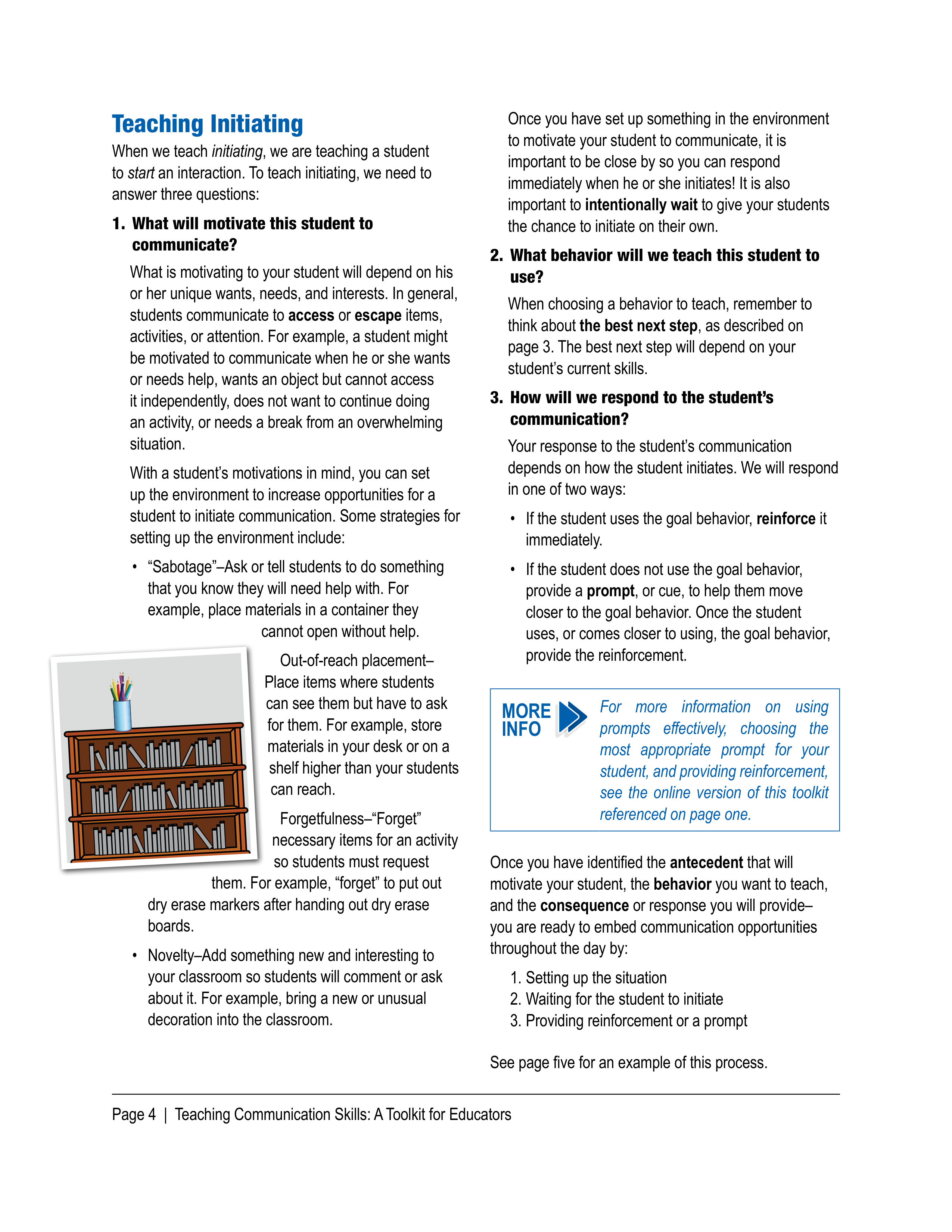
Out-of-reach placement–
Place items where students
can see them but have to ask
for them. For example, store
materials in your desk or on a
shelf higher than your students
can reach.
•
Forgetfulness–“Forget”
necessary items for an activity
so students must request
them. For example, “forget” to put out
dry erase markers after handing out dry erase
boards.
•
Novelty–Add something new and interesting to
your classroom so students will comment or ask
about it. For example, bring a new or unusual
decoration into the classroom.
Once you have set up something in the environment
to motivate your student to communicate, it is
important to be close by so you can respond
immediately when he or she initiates! It is also
important to
intentionally wait
to give your students
the chance to initiate on their own.
2. What behavior will we teach this student to
use?
When choosing a behavior to teach, remember to
think about
the best next step
, as described on
page 3. The best next step will depend on your
student’s current skills.
3. How will we respond to the student’s
communication?
Your response to the student’s communication
depends on how the student initiates. We will respond
in one of two ways:
•
If the student uses the goal behavior,
reinforce
it
immediately.
•
If the student does not use the goal behavior,
provide a
prompt
, or cue, to help them move
closer to the goal behavior. Once the student
uses, or comes closer to using, the goal behavior,
provide the reinforcement.
MORE
INFO
For more information on using
prompts effectively, choosing the
most appropriate prompt for your
student, and providing reinforcement,
see the online version of this toolkit
referenced on page one.
Once you have identified the
antecedent
that will
motivate your student, the
behavior
you want to teach,
and the
consequence
or response you will provide–
you are ready to embed communication opportunities
throughout the day by:
1. Setting up the situation
2. Waiting for the student to initiate
3. Providing reinforcement or a prompt
See page five for an example of this process.
Teaching Communication Skills: A Toolkit for Educators | Page 5
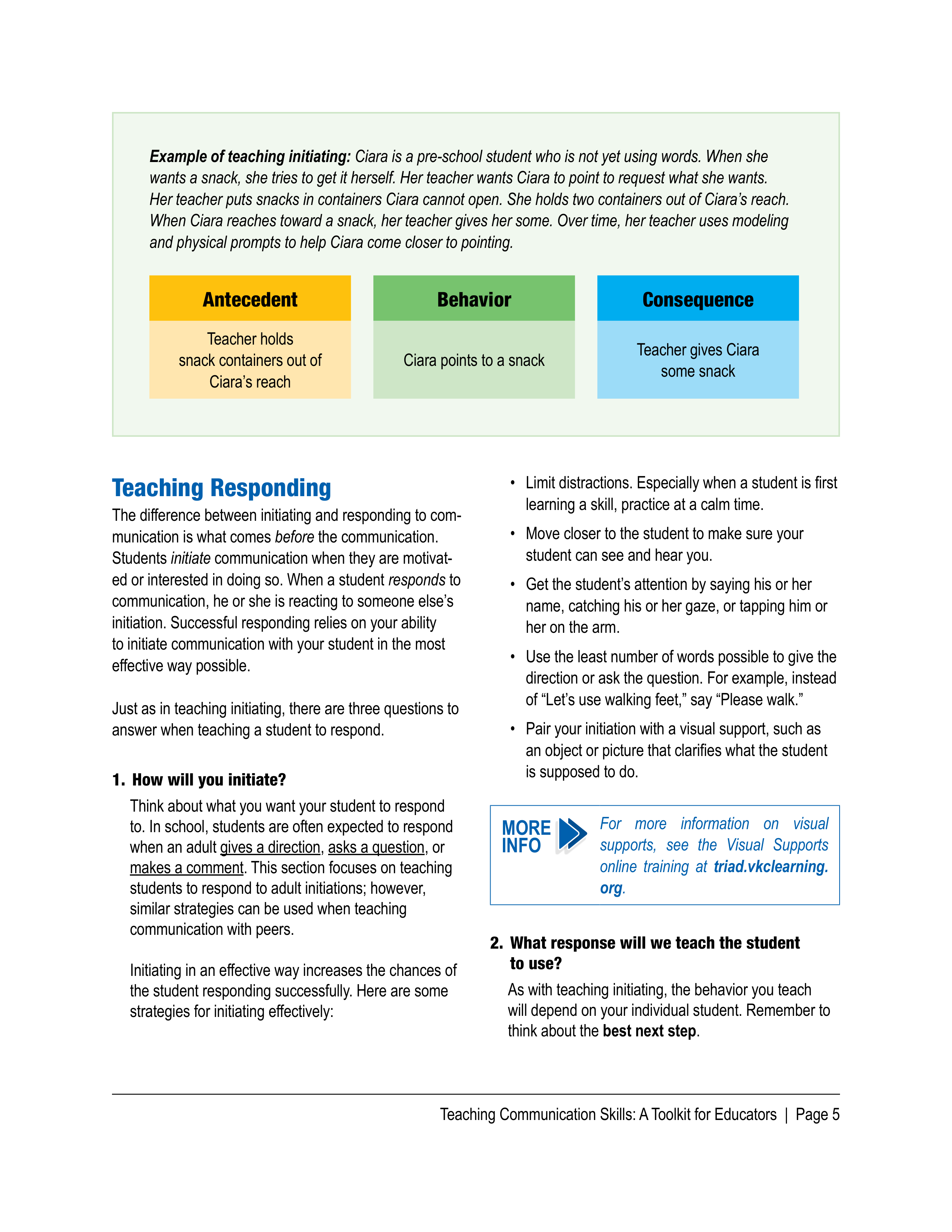
Example of teaching initiating:
Ciara is a pre-school student who is not yet using words. When she
wants a snack, she tries to get it herself. Her teacher wants Ciara to point to request what she wants.
Her teacher puts snacks in containers Ciara cannot open. She holds two containers out of Ciara’s reach.
When Ciara reaches toward a snack, her teacher gives her some. Over time, her teacher uses modeling
and physical prompts to help Ciara come closer to pointing.
Antecedent
Behavior
Consequence
Teacher holds
snack containers out of
Ciara’s reach
Ciara points to a snack
Teacher gives Ciara
some snack
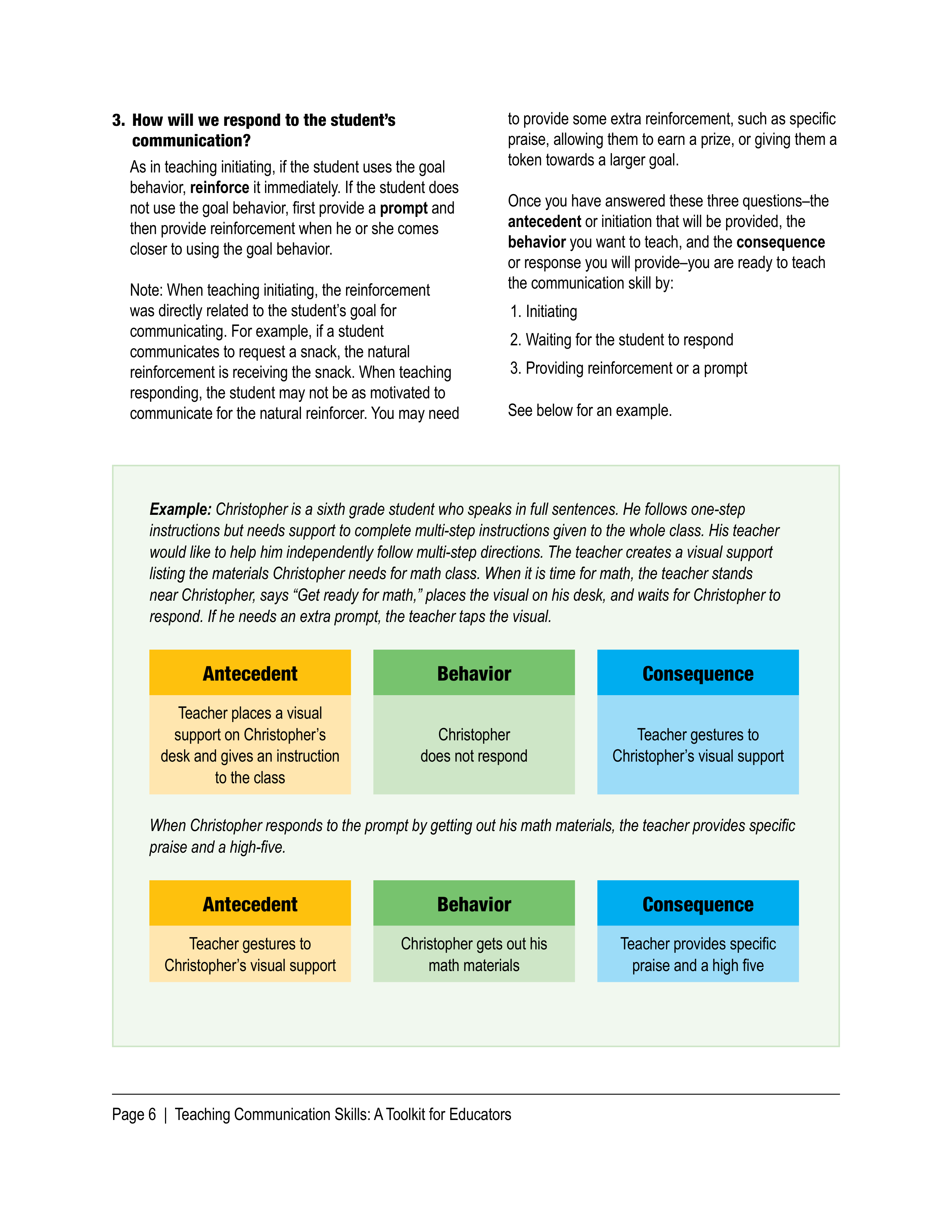
Teaching Responding
The difference between initiating and responding to com
munication is what comes
before
the communication.
Students
initiate
communication when they are motivat
ed or interested in doing so. When a student
responds
to
communication, he or she is reacting to someone else’s
initiation. Successful responding relies on your ability
to initiate communication with your student in the most
effective way possible.
Just as in teaching initiating, there are three questions to
answer when teaching a student to respond.
1. How will you initiate?
Think about what you want your student to respond
to. In school, students are often expected to respond
when an adult gives a direction, asks a question, or
makes a comment. This section focuses on teaching
students to respond to adult initiations; however,
similar strategies can be used when teaching
communication with peers.
Initiating in an effective way increases the chances of
the student responding successfully. Here are some
strategies for initiating effectively:
•
Limit distractions. Especially when a student is first
learning a skill, practice at a calm time.
•
Move closer to the student to make sure your
student can see and hear you.
•
Get the student’s attention by saying his or her
name, catching his or her gaze, or tapping him or
her on the arm.
•
Use the least number of words possible to give the
direction or ask the question. For example, instead
of “Let’s use walking feet,” say “Please walk.”
•
Pair your initiation with a visual support, such as
an object or picture that clarifies what the student
is supposed to do.
MORE
INFO
For more information on visual
supports, see the Visual Supports
online training at
triad.vkclearning.
org
.
2. What response will we teach the student
to use?
As with teaching initiating, the behavior you teach
will depend on your individual student. Remember to
think about the
best next step
.
Page 6 | Teaching Communication Skills: A Toolkit for Educators
3. How will we respond to the student’s
communication?
As in teaching initiating, if the student uses the goal
behavior,
reinforce
it immediately. If the student does
not use the goal behavior, first provide a
prompt
and
then provide reinforcement when he or she comes
closer to using the goal behavior.
Note: When teaching initiating, the reinforcement
was directly related to the student’s goal for
communicating. For example, if a student
communicates to request a snack, the natural
reinforcement is receiving the snack. When teaching
responding, the student may not be as motivated to
communicate for the natural reinforcer. You may need
to provide some extra reinforcement, such as specific
praise, allowing them to earn a prize, or giving them a
token towards a larger goal.
Once you have answered these three questions–the
antecedent
or initiation that will be provided, the
behavior
you want to teach, and the
consequence
or response you will provide–you are ready to teach
the communication skill by:
1. Initiating
2. Waiting for the student to respond
3. Providing reinforcement or a prompt
See below for an example.
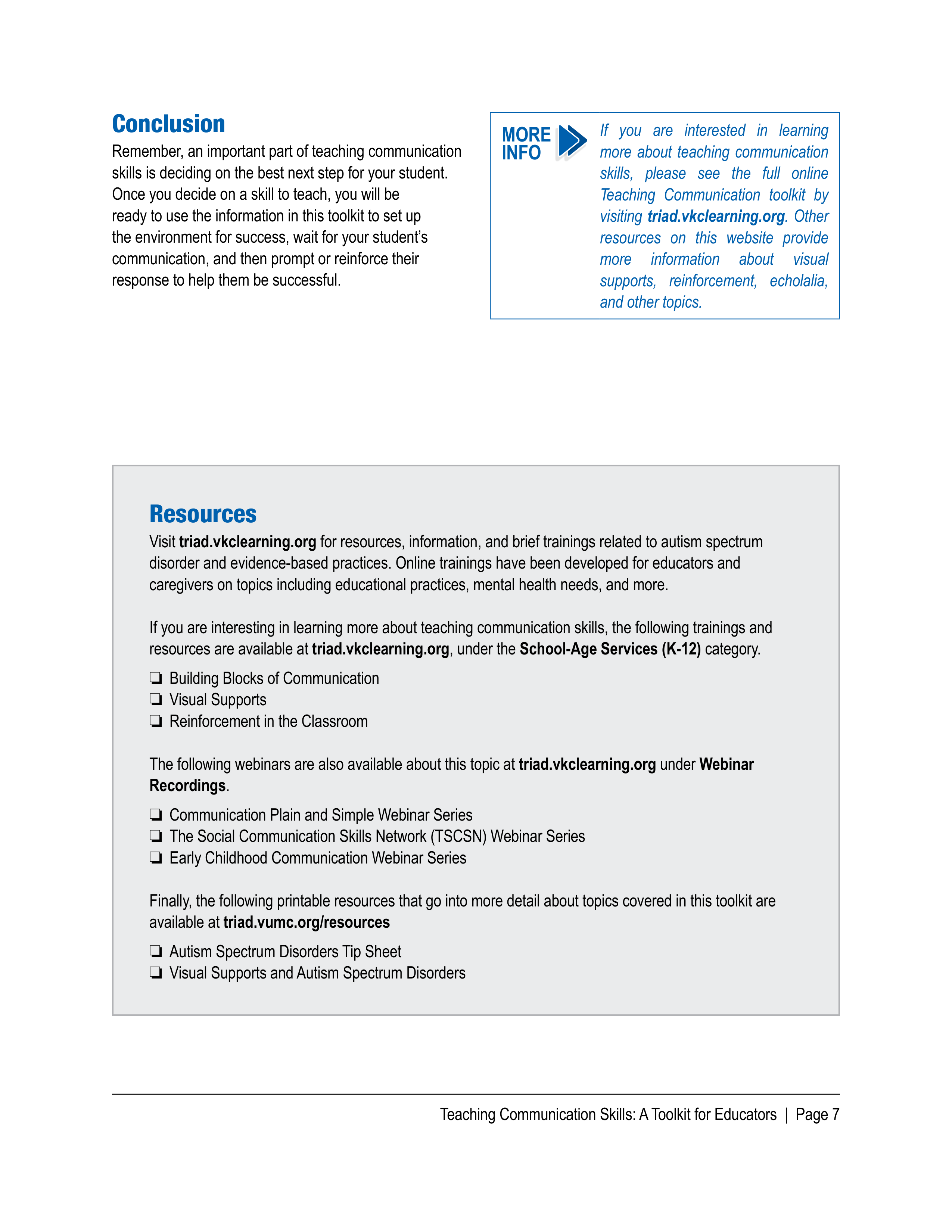
Example:
Christopher is a sixth grade student who speaks in full sentences. He follows one-step
instructions but needs support to complete multi-step instructions given to the whole class. His teacher
would like to help him independently follow multi-step directions. The teacher creates a visual support
listing the materials Christopher needs for math class. When it is time for math, the teacher stands
near Christopher, says “Get ready for math,” places the visual on his desk, and waits for Christopher to
respond. If he needs an extra prompt, the teacher taps the visual.
Antecedent
Behavior
Consequence
Teacher places a visual
support on Christopher’s
desk and gives an instruction
to the class
Christopher
does not respond
Teacher gestures to
Christopher’s visual support
When Christopher responds to the prompt by getting out his math materials, the teacher provides specific
praise and a high-five.
Antecedent
Behavior
Consequence
Teacher gestures to
Christopher’s visual support
Christopher gets out his
math materials
Teacher provides specific
praise and a high five
Teaching Communication Skills: A Toolkit for Educators | Page 7
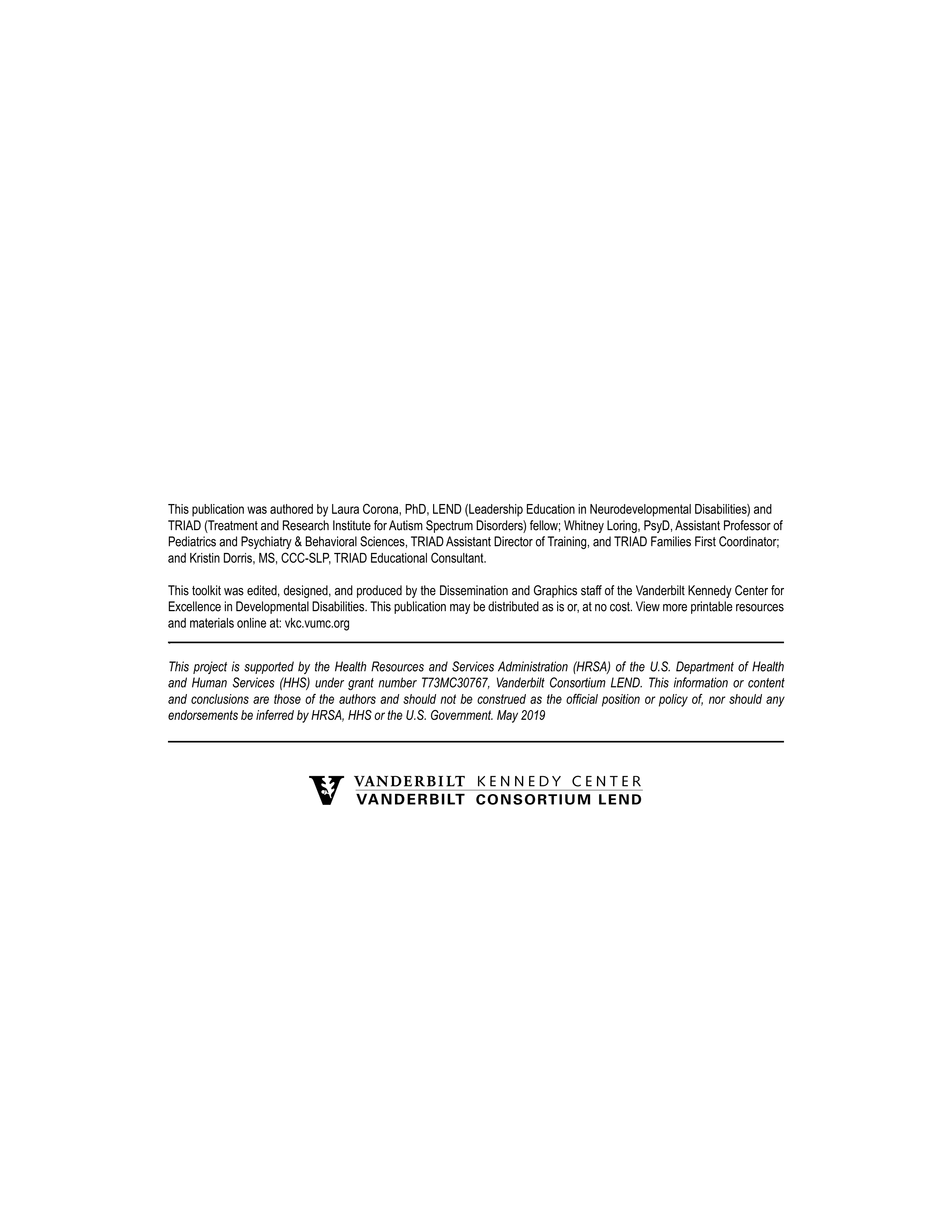
Conclusion
Remember, an important part of teaching communication
skills is deciding on the best next step for your student.
Once you decide on a skill to teach, you will be
ready to use the information in this toolkit to set up
the environment for success, wait for your student’s
communication, and then prompt or reinforce their
response to help them be successful.
MORE
INFO
If you are interested in learning
more about teaching communication
skills, please see the full online
Teaching Communication toolkit by
visiting
triad.vkclearning.org
. Other
resources on this website provide
more
information
about
visual
supports, reinforcement, echolalia,
and other topics.
Resources
Visit
triad.vkclearning.org
for resources, information, and brief trainings related to autism spectrum
disorder and evidence-based practices. Online trainings have been developed for educators and
caregivers on topics including educational practices, mental health needs, and more.
If you are interesting in learning more about teaching communication skills, the following trainings and
resources are available at
triad.vkclearning.org
, under the
School-Age Services (K-12)
category.
❏
Building Blocks of Communication
❏
Visual Supports
❏
Reinforcement in the Classroom
The following webinars are also available about this topic at
triad.vkclearning.org
under
Webinar
Recordings
.
❏
Communication Plain and Simple Webinar Series
❏
The Social Communication Skills Network (TSCSN) Webinar Series
❏
Early Childhood Communication Webinar Series
Finally, the following printable resources that go into more detail about topics covered in this toolkit are
available at
triad.vumc.org/resources
❏
Autism Spectrum Disorders Tip Sheet
❏
Visual Supports and Autism Spectrum Disorders
This publication was authored by Laura Corona, PhD, LEND (Leadership Education in Neurodevelopmental Disabilities) and
TRIAD (Treatment and Research Institute for Autism Spectrum Disorders) fellow; Whitney Loring, PsyD, Assistant Professor of
Pediatrics and Psychiatry & Behavioral Sciences, TRIAD Assistant Director of Training, and TRIAD Families First Coordinator;
and Kristin Dorris, MS, CCC-SLP, TRIAD Educational Consultant.
This toolkit was edited, designed, and produced by the Dissemination and Graphics staff of the Vanderbilt Kennedy Center for
Excellence in Developmental Disabilities. This publication may be distributed as is or, at no cost. View more printable resources
and materials online at: vkc.vumc.org
.
This project is supported by the Health Resources and Services Administration (HRSA) of the U.S. Department of Health
and Human Services (HHS) under grant number T73MC30767, Vanderbilt Consortium LEND. This information or content
and conclusions are those of the authors and should not be construed as the official position or policy of, nor should any
endorsements be inferred by HRSA, HHS or the U.S. Government. May 2019