
The Effect of Communication Skills of Civil Servant in Public
Service on Community Satisfaction
Andi Muhammad
Rivai
1
*,
Aris
Baharuddin
2
, Syarifuddin
3
,
Yusi Iren
Seppa
4
, Yusri
5
1234
Faculty of Social Sciences and Law, Universitas Negeri Makassar
5
Faculty of Language and Literature, Universitas Negeri Makassar
Abstract
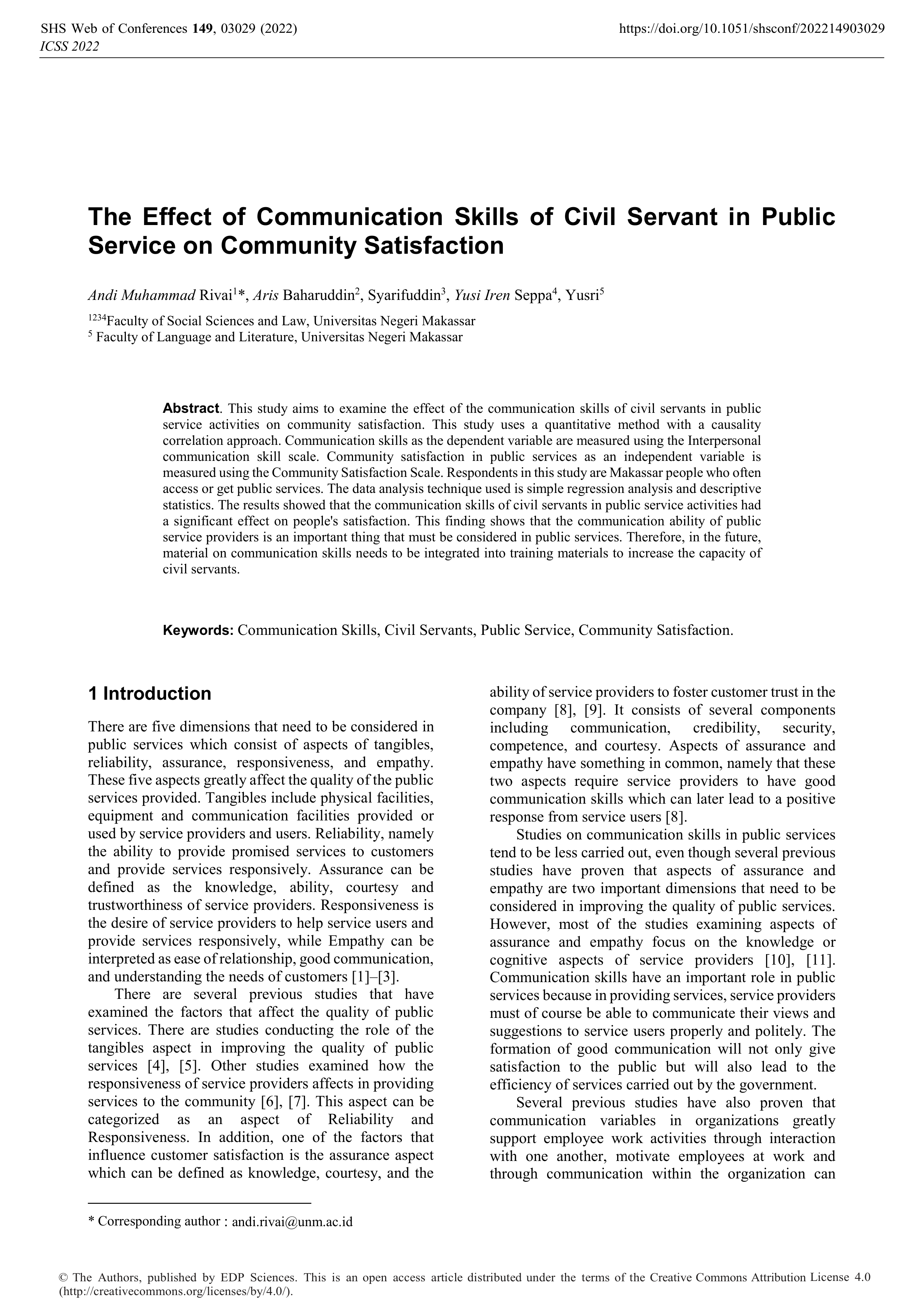
. This study aims to examine the effect of the communication skills of civil servants in public
service activities on community satisfaction. This study uses a quantitative method with a causality
correlation approach. Communication skills as the dependent variable are measured using the Interpersonal
communication skill scale. Community satisfaction in public services as an independent variable is
measured using the Community Satisfaction Scale. Respondents in this study are Makassar people who often
access or get public services. The data analysis technique used is simple regression analysis and descriptive
statistics. The results showed that the communication skills of civil servants in public service activities had
a significant effect on people's satisfaction. This finding shows that the communication ability of public
service providers is an important thing that must be considered in public services. Therefore, in the future,
material on communication skills needs to be integrated into training materials to increase the capacity of
civil servants.
Keywords:
Communication Skills, Civil Servants, Public Service, Community Satisfaction.
1 Introduction
There are five dimensions that need to be considered in
public services which consist of aspects of tangibles,
reliability, assurance, responsiveness, and empathy.
These five aspects greatly affect the quality of the public
services provided. Tangibles include physical facilities,
equipment and communication facilities provided or
used by service providers and users. Reliability, namely
the ability to provide promised services to customers
and provide services responsively. Assurance can be
defined as the knowledge, ability, courtesy and
trustworthiness of service providers. Responsiveness is
the desire of service providers to help service users and
provide services responsively, while Empathy can be
interpreted as ease of relationship, good communication,
and understanding the needs of customers [1]–[3].
There are several previous studies that have
examined the factors that affect the quality of public
services. There are studies conducting the role of the
tangibles aspect in improving the quality of public
services [4], [5]. Other studies examined how the
responsiveness of service providers affects in providing
services to the community [6], [7]. This aspect can be
categorized
as
an
aspect
of
Reliability
and
Responsiveness. In addition, one of the factors that
influence customer satisfaction is the assurance aspect
which can be defined as knowledge, courtesy, and the
* Corresponding author
:
andi.rivai@unm.ac.id
ability of service providers to foster customer trust in the
company [8], [9]. It consists of several components
including
communication,
credibility,
security,
competence, and courtesy. Aspects of assurance and
empathy have something in common, namely that these
two aspects require service providers to have good
communication skills which can later lead to a positive
response from service users [8].
Studies on communication skills in public services
tend to be less carried out, even though several previous
studies have proven that aspects of assurance and
empathy are two important dimensions that need to be
considered in improving the quality of public services.
However, most of the studies examining aspects of
assurance and empathy focus on the knowledge or
cognitive aspects of service providers [10], [11].
Communication skills have an important role in public
services because in providing services, service providers
must of course be able to communicate their views and
suggestions to service users properly and politely. The
formation of good communication will not only give
satisfaction to the public but will also lead to the
efficiency of services carried out by the government.
Several previous studies have also proven that
communication variables in organizations greatly
support employee work activities through interaction
with one another, motivate employees at work and
through communication within the organization can
https://doi.org/10.1051/shsconf/202214903029
, 03029 (2022)
SHS Web of Conferences
149
ICSS 2022
© The Authors, published by EDP Sciences. This is an open access article distributed under the terms of the Creative
Commons
Attribution License 4.0
(http://creativecommons.org/licenses/by/4.0/).
foster good relations between leaders and employees
[12]–[14]. This study examines how the influence of the
communication skills of state civil servants in public
service activities on community satisfaction as users of
public services. This study focuses on civil servants
because most of the previous research only focused on
private employees. In addition, several previous studies
have also shown that civil servants or ASN employees
tend to lack individual capacity building compared to
private employees [15], [16].
The expected results through the research are in the
form of recommendations on the importance of
improving the quality of civil servants, especially in the
aspect of effective communication in providing public
services. The purpose of this study is to find out how the
level of communication skills of state civil servants and
to find out how the influence of communication skills of
state civil servants to public satisfaction as service users.
2 Research Method
The type of research used in this study is quantitative
using a causal approach. Through this approach, we can
clearly see how the communication skills of civil
servants as service providers affect people's satisfaction.
Data collection techniques used in this study consisted
of interviews, observations and questionnaires. The type
of observation used in this study is participant
observation. Observations made in this study were
researchers made direct observations in several
locations that allow communication between service
providers and service users. Through observation,
researchers can see how the general description of the
communication process and the community's response
to the communication skills of civil servants in
providing services. The type of interview used in this
study is an open interview. Researchers do not have
specific guidelines in conducting interviews. Interviews
in this case were conducted with the community as
service users.
The communication skill scale developed by
Teramachi et al. (2011) was used to find out how the
communication skills of civil servants [17]. In addition,
to measure the satisfaction of public services to the
community, the service user satisfaction assessment
instrument developed by Lupiyodi (2015) was used
[18]. There are five dimensions in this scale, namely,
physical evidence, reliability, responsiveness, assurance
and empathy. Before taking data, the questionnaire that
will be used is tested for validity and reliability. This is
done to determine whether or not each item in the
questionnaire is appropriate to measure the research
variables. The data analysis technique used in this study
is the percentage technique using categorization, both
the variable of communication ability of the state civil
apparatus and the variable of community service
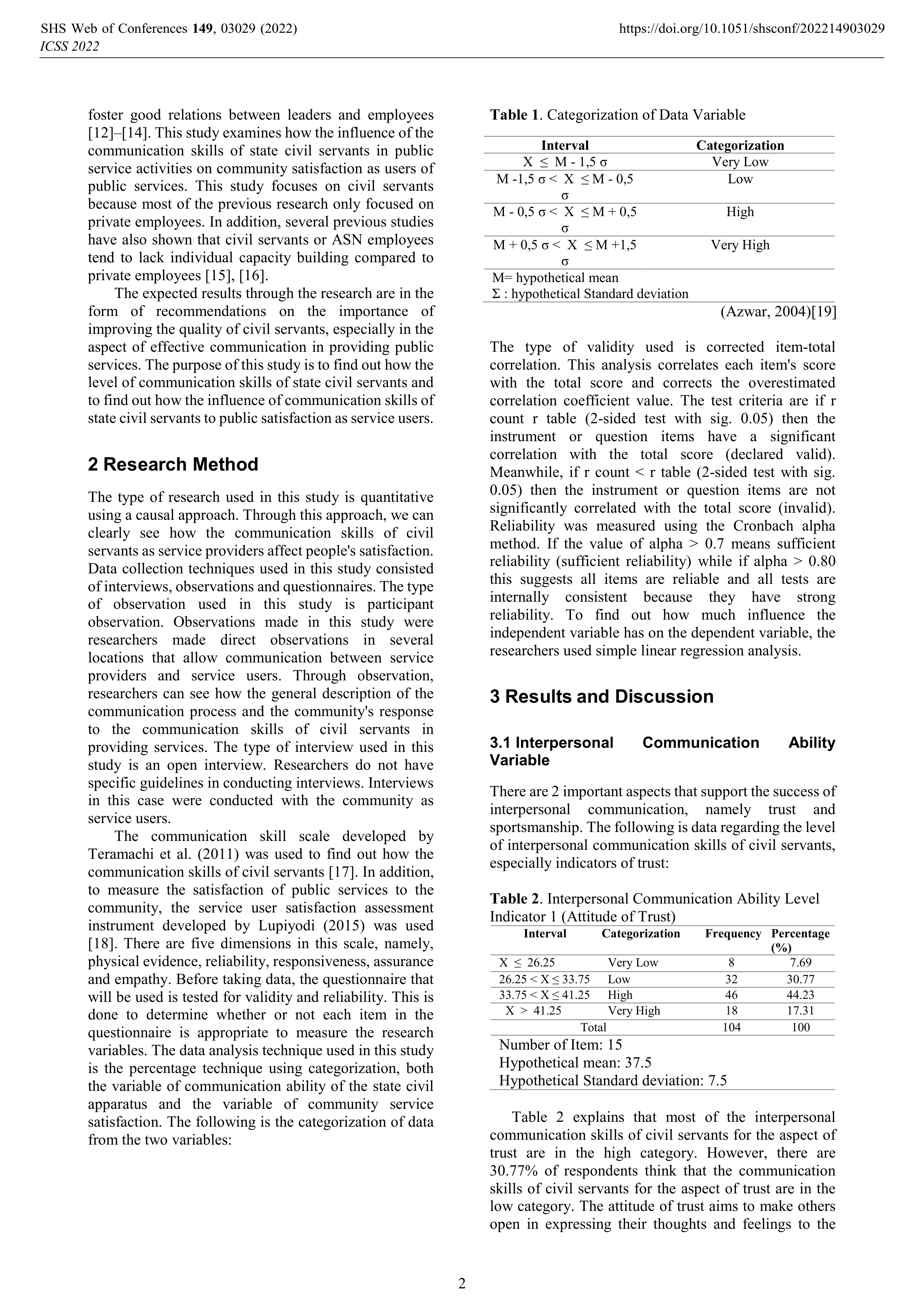
satisfaction. The following is the categorization of data
from the two variables:
Table 1
. Categorization of Data Variable
(Azwar, 2004)[19]
The type of validity used is corrected item-total
correlation. This analysis correlates each item's score
with the total score and corrects the overestimated
correlation coefficient value. The test criteria are if r
count r table (2-sided test with sig. 0.05) then the
instrument or question items have a significant
correlation with the total score (declared valid).
Meanwhile, if r count < r table (2-sided test with sig.
0.05) then the instrument or question items are not
significantly correlated with the total score (invalid).
Reliability was measured using the Cronbach alpha
method. If the value of alpha > 0.7 means sufficient
reliability (sufficient reliability) while if alpha > 0.80
this suggests all items are reliable and all tests are
internally consistent
because
they
have strong
reliability. To find out how much influence the
independent variable has on the dependent variable, the
researchers used simple linear regression analysis.
3 Results
and Discussion
3.1 Interpersonal
Communication
Ability
Variable
There are 2 important aspects that support the success of
interpersonal
communication,
namely
trust
and
sportsmanship. The following is data regarding the level
of interpersonal communication skills of civil servants,
especially indicators of trust:
Table 2
. Interpersonal Communication Ability Level
Indicator 1 (Attitude of Trust)
Interval
Categorization
Frequency
Percentage
(%)
X ≤ 26.25
Very Low
8
7.69
26.25 < X ≤ 33.75
Low
32
30.77
33.75 < X ≤ 41.25
High
46
44.23
X > 41.25
Very High
18
17.31
Total
104
100
Number of Item: 15
Hypothetical mean: 37.5
Hypothetical Standard deviation: 7.5
Table 2 explains that most of the interpersonal
communication skills of civil servants for the aspect of
trust are in the high category. However, there are
30.77% of respondents think that the communication
skills of civil servants for the aspect of trust are in the
low category. The attitude of trust aims to make others
open in expressing their thoughts and feelings to the
Interval
Categorization
X ≤ M - 1,5 σ
Very Low
M -1,5 σ < X ≤ M - 0,5
σ
Low
M - 0,5 σ < X ≤ M + 0,5
σ
High
M + 0,5 σ < X ≤ M +1,5
σ
Very High
M= hypothetical mean
Σ : hypothetical Standard deviation
https://doi.org/10.1051/shsconf/202214903029
, 03029 (2022)
SHS Web of Conferences
149
ICSS 2022
2
listener, so that a close and deep relationship will be
established between the listener and the speaker. The
second aspect of being an indicator in interpersonal
communication is sportsmanship. The following is data
regarding the level of interpersonal communication
skills of civil servants, especially indicators of
sportsmanship:
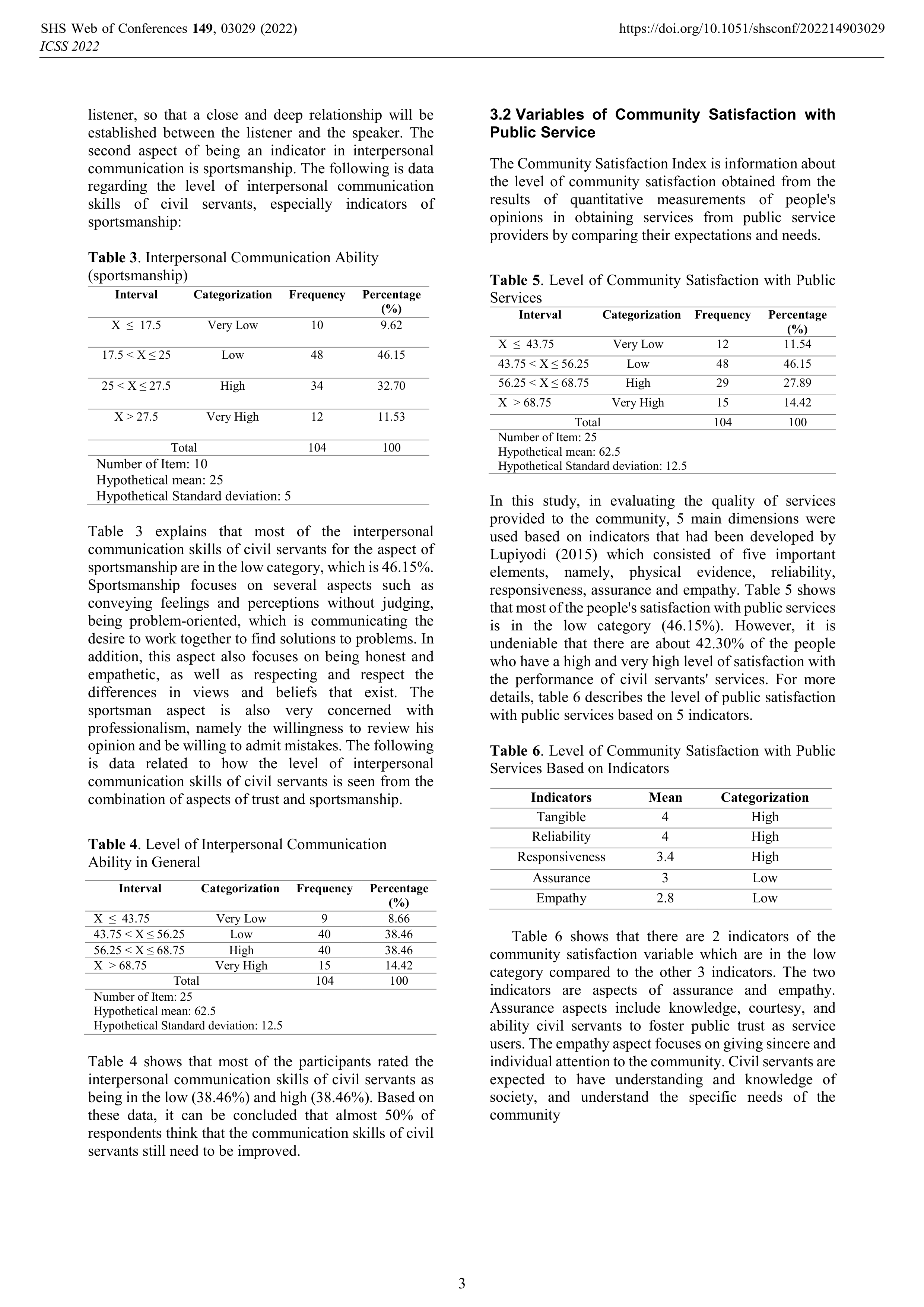
Table 3
. Interpersonal Communication Ability
(sportsmanship)
Table 3 explains that most of the interpersonal
communication skills of civil servants for the aspect of
sportsmanship are in the low category, which is 46.15%.
Sportsmanship focuses on several aspects such as
conveying feelings and perceptions without judging,
being problem-oriented, which is communicating the
desire to work together to find solutions to problems. In
addition, this aspect also focuses on being honest and
empathetic, as well as respecting and respect the
differences in views and beliefs that exist. The
sportsman aspect is also very concerned with
professionalism, namely the willingness to review his
opinion and be willing to admit mistakes. The following
is data related to how the level of interpersonal
communication skills of civil servants is seen from the
combination of aspects of trust and sportsmanship.
Table 4
. Level of Interpersonal Communication
Ability in General
Interval
Categorization
Frequency
Percentage
(%)
X ≤ 43.75
Very Low
9
8.66
43.75 < X ≤ 56.25
Low
40
38.46
56.25 < X ≤ 68.75
High
40
38.46
X > 68.75
Very High
15
14.42
Total
104
100
Number of Item: 25
Hypothetical mean: 62.5
Hypothetical Standard deviation: 12.5
Table 4 shows that most of the participants rated the
interpersonal communication skills of civil servants as
being in the low (38.46%) and high (38.46%). Based on
these data, it can be concluded that almost 50% of
respondents think that the communication skills of civil
servants still need to be improved.
3.2 Variables
of Community Satisfaction with
Public Service
The Community Satisfaction Index is information about
the level of community satisfaction obtained from the
results of quantitative measurements of people's
opinions in obtaining services from public service
providers by comparing their expectations and needs.
Table 5
. Level of Community Satisfaction with Public
Services
Interval
Categorization
Frequency
Percentage
(%)
X ≤ 43.75
Very Low
12
11.54
43.75 < X ≤ 56.25
Low
48
46.15
56.25 < X ≤ 68.75
High
29
27.89
X > 68.75
Very High
15
14.42
Total
104
100
Number of Item: 25
Hypothetical mean: 62.5
Hypothetical Standard deviation: 12.5
In this study, in evaluating the quality of services
provided to the community, 5 main dimensions were
used based on indicators that had been developed by
Lupiyodi (2015) which consisted of five important
elements, namely, physical evidence, reliability,
responsiveness, assurance and empathy. Table 5 shows
that most of the people's satisfaction with public services
is in the low category (46.15%). However, it is
undeniable that there are about 42.30% of the people
who have a high and very high level of satisfaction with
the performance of civil servants' services. For more
details, table 6 describes the level of public satisfaction
with public services based on 5 indicators.
Table 6
. Level of Community Satisfaction with Public
Services Based on Indicators
Table 6 shows that there are 2 indicators of the
community satisfaction variable which are in the low
category compared to the other 3 indicators. The two
indicators are aspects of assurance and empathy.
Assurance aspects include knowledge, courtesy, and
ability civil servants to foster public trust as service
users. The empathy aspect focuses on giving sincere and
individual attention to the community. Civil servants are
expected to have understanding and knowledge of
society, and understand the specific needs of the
community
Interval
Categorization
Frequency
Percentage
(%)
X ≤ 17.5
Very Low
10
9.62
17.5 < X ≤ 25
Low
48
46.15
25 < X ≤ 27.5
High
34
32.70
X > 27.5
Very High
12
11.53
Total
104
100
Number of Item: 10
Hypothetical mean: 25
Hypothetical Standard deviation: 5
Indicators
Mean
Categorization
Tangible
4
High
Reliability
4
High
Responsiveness
3.4
High
Assurance
3
Low
Empathy
2.8
Low
https://doi.org/10.1051/shsconf/202214903029
, 03029 (2022)
SHS Web of Conferences
149
ICSS 2022
3
3.3 The Effect of Interpersonal Communication
on Community Satisfaction
To determine the effect of interpersonal communication
skills on people's satisfaction, a simple regression
analysis was carried out. However, before doing the
reliability test and normality test as a prerequisite test
before performing regression analysis
Table 7.
Reliability Test
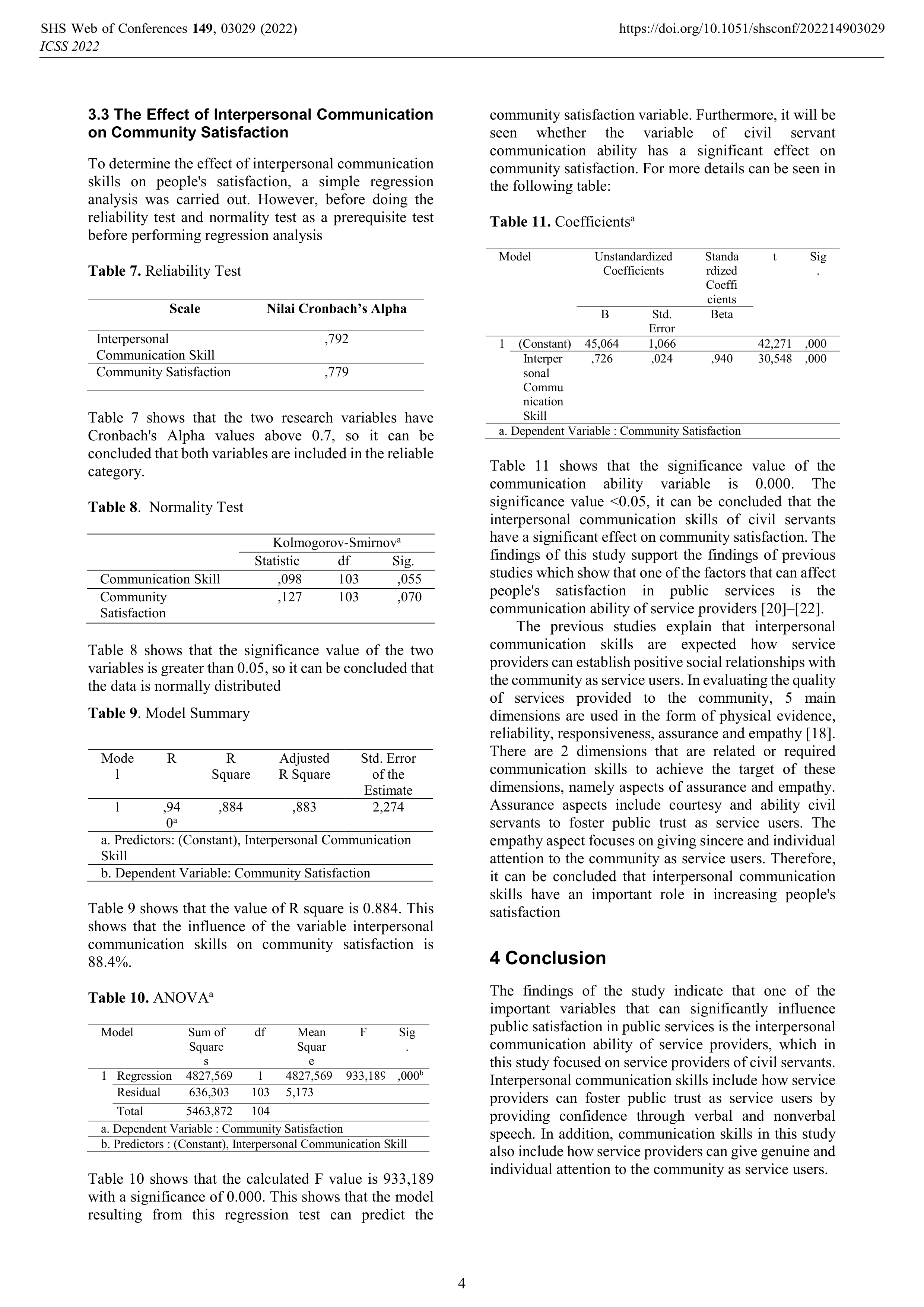
Table 7 shows that the two research variables have
Cronbach's Alpha values above 0.7, so it can be
concluded that both variables are included in the reliable
category.
Table 8
. Normality Test
Kolmogorov-Smirnov
a
Statistic
df
Sig.
Communication Skill
,098
103
,055
Community
Satisfaction
,127
103
,070
Table 8 shows that the significance value of the two
variables is greater than 0.05, so it can be concluded that
the data is normally distributed
Table 9
. Model Summary
Mode
l
R
R
Square
Adjusted
R Square
Std. Error
of the
Estimate
1
,94
0
a
,884
,883
2,274
a. Predictors: (Constant), Interpersonal Communication
Skill
b. Dependent Variable: Community Satisfaction
Table 9 shows that the value of R square is 0.884. This
shows that the influence of the variable interpersonal
communication skills on community satisfaction is
88.4%.
Table 10.
ANOVA
a
Model
Sum of
Square
s
df
Mean
Squar
e
F
Sig
.
1
Regression
4827,569
1
4827,569
933,189
,000
b
Residual
636,303
103
5,173
Total
5463,872
104
a. Dependent Variable : Community Satisfaction
b. Predictors : (Constant), Interpersonal Communication Skill
Table 10 shows that the calculated F value is 933,189
with a significance of 0.000. This shows that the model
resulting from this regression test can predict the
community satisfaction variable. Furthermore, it will be
seen
whether
the
variable
of
civil
servant
communication ability has a significant effect on
community satisfaction. For more details can be seen in
the following table:
Table 11.
Coefficients
a
Model
Unstandardized
Coefficients
Standa
rdized
Coeffi
cients
t
Sig
.
B
Std.
Error
Beta
1
(Constant)
45,064
1,066
42,271
,000
Interper
sonal
Commu
nication
Skill
,726
,024
,940
30,548
,000
a. Dependent Variable : Community Satisfaction
Table 11 shows that the significance value of the
communication
ability
variable
is
0.000.
The
significance value <0.05, it can be concluded that the
interpersonal communication skills of civil servants
have a significant effect on community satisfaction. The
findings of this study support the findings of previous
studies which show that one of the factors that can affect
people's satisfaction in public services is the
communication ability of service providers [20]–[22].
The previous studies explain that interpersonal
communication skills are expected how service
providers can establish positive social relationships with
the community as service users. In evaluating the quality
of services provided to the community, 5 main
dimensions are used in the form of physical evidence,
reliability, responsiveness, assurance and empathy [18].
There are 2 dimensions that are related or required
communication skills to achieve the target of these
dimensions, namely aspects of assurance and empathy.
Assurance aspects include courtesy and ability civil
servants to foster public trust as service users. The
empathy aspect focuses on giving sincere and individual
attention to the community as service users. Therefore,
it can be concluded that interpersonal communication
skills have an important role in increasing people's
satisfaction
4 Conclusion
The findings of the study indicate that one of the
important variables that can significantly influence
public satisfaction in public services is the interpersonal
communication ability of service providers, which in
this study focused on service providers of civil servants.
Interpersonal communication skills include how service
providers can foster public trust as service users by
providing confidence through verbal and nonverbal
speech. In addition, communication skills in this study
also include how service providers can give genuine and
individual attention to the community as service users.
Scale
Nilai Cronbach’s Alpha
Interpersonal
Communication Skill
,792
Community Satisfaction
,779
https://doi.org/10.1051/shsconf/202214903029
, 03029 (2022)
SHS Web of Conferences
149
ICSS 2022
4
References
[1]
T. Austin and D. C. Hestiriniah, “Effect of
Public Service Quality on People Satisfaction
toward
Implementation
of
Integrated
Administration Service Kecamatan in New
Normal Era Kecamatan Sako Palembang City,”
JPAS (Journal Public Adm. Stud.
, vol.
6
, no. 2,
pp. 19–23, (2021).
[2]
S. E. Adelina and S. Martono, “Public Service
Quality in Population Administration Services,”
Econ. Educ. Anal. J.
, vol.
10
, no. 2, pp. 253–
267, (2021).
[3]
R. Rusmanjaya and A. Widiyarta, “Quality Of
Direct Customer Complaints Service In Delta
Tirta Regional Drinking Water Companies In
Sidoarjo District, Sidoarjo Regency,”
DIA J.
Adm. Publik
, vol.
19
, no. 2, pp. 175–187,
(2021).
[4]
K. E. Yildirim, A. Yildirim, and S. Ozcan,
“Integrated usage of the SERVQUAL and
quality function deployment techniques in the
assessment of public service quality: the case of
Ardahan Municipality,”
Bus. Econ. Res. J.
, vol.
10
, no. 4, pp. 885–901, (2019).
[5]
B. D. Engdaw, “The impact of quality public
service delivery on customer satisfaction in
Bahir Dar city administration: The case of
Ginbot 20 sub-city,”
Int. J. public Adm.
, vol.
43
,
no. 7, pp. 644–654, (2020).
[6]
A. Hermawan Saputra, “Pengaruh Kualitas
Pelayanan Terhadap Kepuasan Pelanggan Auto
2000 Raden Intan Lampung.” Universitas
Teknokrat Indonesia, (2021).
[7]
I. Sofiati, N. Qomariah, and H. Hermawan,
“Dampak kualitas pelayanan terhadap loyalitas
konsumen,”
J. Sains Manaj. dan Bisnis
Indones.
, vol.
8
, no. 2, (2018).
[8]
L. Ocampo
et al.
, “Public service quality
evaluation with SERVQUAL and AHP-
TOPSIS: A case of Philippine government
agencies,”
Socioecon. Plann. Sci.
, vol.
68
, p.
100604, (2019).
[9]
N. Aoki, “The importance of the assurance that
‘humans are still in the decision loop’ for public
trust in artificial intelligence: Evidence from an
online experiment,”
Comput. Human Behav.
,
vol.
114
, p. 106572, (2021).
[10]
I. Idayati, I. M. Kesuma, R. Aprianto, and S.
Suwarno, “The Effect of Service Quality on
Citizen’s Expectation Through Dimension of
Tangible, Emphaty, Reliability, Responsiveness
and Assurance (TERRA),”
Sriwij. Int. J. Dyn.
Econ. Bus.
, vol.
4
, no. 3, pp. 241–252, (2020).
[11]
L. V. Matraeva, O. V. Kaurova, A. N.
Maloletko, and E. S. Vasiutina, “Conceptual
model to measure public service quality and
service
satisfaction:
Russian
practice,”
Calitatea
, vol.
21
, no. 177, pp. 77–85, (2020).
[12]
E.
Wakhyuni,
“Analisis
kemampuan,
komunikasi
dan
konflik
kerja
terhadap
kepuasan kerja karyawan pada PT. Mitha
Sarana Niaga,”
JUMANT
, vol.
11
, no. 1, pp.
271–278, (2019).
[13]
J. P. Rahmanto, F. D. Patrikha, S. S. Wulandari,
H. Harti, and T. Sudarwanto, “Analisis Model
Pembelajaran Project Based Learning Untuk
Meningkatkan
Keterampilan
Komunikasi
Dalam Organisasi,”
J. PROFIT Kaji. Pendidik.
Ekon. dan Ilmu Ekon.
, vol.
8
, no. 2, pp. 130–
136, (2021).
[14]
R.
Fransiska,
“Analisis
Kemampuan
Komunikasi dan Budaya Organisasi Terhadap
Efektivitas Kerja Karyawan Pada PT. Pegadaian
Palangka Raya,”
Al-Kalam J. Komunikasi,
Bisnis dan Manaj.
, vol.
6
, no. 2, pp. 89–105,
(2019).
[15]
N. A. I. Arifin and R. Syam, “Profil dan Faktor-
Faktor
yang
Memengaruhi
Occupational
Wellbeing Pegawai di Kota Makassar.”
[16]
R.
Sumanti,
“Pengembangan
Kompetensi
Pegawai Negeri Sipil (PNS) Di Daerah:
Tantangan dan Peluang,”
J. Transform. Adm.
,
vol.
8
, no. 2, pp. 115–129, (2018).
[17]
H. Teramachi, N. Komada, K. Tanizawa, Y.
Kuzuya, and T. Tsuchiya, “Development of skill
scale for communication skill measurement of
pharmacist,”
Yakugaku Zasshi J. Pharm. Soc.
Japan
, vol.
131
, no. 4, pp. 587–595, (2011).
[18]
R. Lupiyoadi and B. Putra, “The effects of
applying revenue management on customer
satisfaction in airline industry: an experimental
study in Indonesia,”
ASEAN Mark. J.
, (2014).
[19]
S. Azwar, “Metode Penelitian Cetakan 5,”
Yogyakarta: Pustaka Belajar
, (2004).
[20]
M. M. Y. Lai, N. Roberts, M. Mohebbi, and J.
Martin, “A randomised controlled trial of
feedback to improve patient satisfaction and
consultation skills in medical students,”
BMC
Med. Educ.
, vol.
20
, no. 1, pp. 1–10, (2020).
[21]
L. Handayani and N. Suryani, “Pengaruh
Kinerja Pegawai, Komunikasi Interpersonal dan
Lingkungan Kerja Fisik Terhadap Kepuasan
Masyarakat Melalui Kualitas Pelayanan,”
Econ.
Educ. Anal. J.
, vol.
8
, no. 2, pp. 743–757,
(2019).
[22]
B. Moeini, A. Karimi-Shahanjarini, A. R.
Soltanian, and Z. V. Matlabi, “The effect of
communication skills training on females
referred to health centers in Bahar; applying the
social support theory for increasing marital
satisfaction
among
couples,”
J.
Educ.
Community Heal.
, vol.
3
, no. 3, pp. 9–16,
(2016).
https://doi.org/10.1051/shsconf/202214903029
, 03029 (2022)
SHS Web of Conferences
149
ICSS 2022
5