









Communication
Skills for
Dental Health
Care Providers
Lance Brendan Young,
P
h
D
,
MBA
Cynthia Rozek O’Toole,
MS
,
RDH
Bianca Wolf,
P
h
D
,
MPH
Communication Skills for Dental Health Care Providers



Communication
Skills for
Dental Health Care
Providers
Quintessence Publishing Co, Inc
Chicago, Berlin, Tokyo, London, Paris, Milan, Barcelona, Istanbul,
Moscow, New Delhi, Prague, São Paulo, Seoul, and Warsaw
Lance Brendan Young,
PhD, MBA
Assistant Professor
Department of Communication
Western Illinois University-Quad Cities
Moline, Illinois
Cynthia Rozek O’Toole,
MS, RDH
Assistant Clinical Professor
Department of Preventive and Community Dentistry
The University of Iowa College of Dentistry
Iowa City, Iowa
Bianca Wolf,
PhD, MPH
Associate Professor
Department of Communication Studies
University of Puget Sound
Tacoma, Washington
Library of Congress Cataloging-in-Publication Data
Young, Lance Brendan, author.
Communication skills for dental health care providers / Lance Brendan
Young, Cynthia O’Toole, and Bianca Wolf.
p. ; cm.
Includes bibliographical references and index.
ISBN 978-0-86715-690-4 (softcover)
I. O’Toole, Cynthia, author. II. Wolf, Bianca, author. III. Title.
[DNLM: 1. Communication. 2. Dentist-Patient Relations. 3. Attitude
of Health Personnel. 4. Clinical Competence. 5. Cultural Competency.
WU 61]
RK28.3
617.6001’4--dc23
2015018425
© 2015 Quintessence Publishing Co, Inc
Quintessence Publishing Co, Inc
4350 Chandler Drive
Hanover Park, IL 60133
www.quintpub.com
5 4 3 2 1
All rights reserved. This book or any part thereof may not be reproduced, stored in a retriev-
al system, or transmitted in any form or by any means, electronic, mechanical, photocopy-
ing, or otherwise, without prior written permission of the publisher.
Editor: Leah Huffman
Design: Ted Pereda
Production: Angelina Sanchez
Printed in the USA
Part I
Communication Fundamentals
1
1
Understanding Communication
3
2
Preparing for Patient Communication
21
3
Developing Cultural Competence
43
Part II
Interaction Skills
69
4
Enhancing Listening Skills
71
5
Improving Verbal Skills
99
6
Refining Nonverbal Communication Skills
123
Part III
Communication During the
Appointment
155
7
Initiating and Interviewing
157
8
Interacting During and After Procedures
189
9
Presenting Treatment Plans
219
Part IV
Communication Challenges
245
10
Managing Life Span Challenges
247
11
Managing Hearing and Speaking Challenges
273
12
Managing Stigma Challenges
301
Preface
vii
About the Authors
x
Index
331
Contents

vii
Over the past 10 years, the three authors of this book have taught patient-provider
communication skills to the dental students at the University of Iowa College of Den-
tistry. In addition to our academic training, each of us has different real-world experi-
ence, ranging from clinical dentistry (O’Toole) to health insurance (Wolf) to business
marketing (Young). We therefore recognize the value of basing practical decisions on
sound research. Recent years have seen tremendous growth in research on commu-
nication between dental professionals and their patients. Individually and collectively,
however, we have been frustrated by the lack of a single resource presenting the most
reliable and recent evidence to suggest how dental providers should interact with
their patients.
In developing and refining our curricula at the university, we located four books
published within the previous 30 years that address communication in the dental set-
ting.
1–4
Although each text has its strengths, they all lack recent, evidence-based find-
ings to support the communication practices they recommend. The communication
patterns and expectations of patients have changed over time, so research conducted
in the 1970s and 1980s may be less reliable than research conducted more recently.
Further, demographic changes have resulted in patient diversity unknown to previous
generations of oral health professionals. Diversity challenges current dental providers
to develop flexible communication skills; scripted communication will not work.
The lack of a dental communication textbook left us scouring research journals for
information we believed our students should know before they began practicing on
patients. Having received positive feedback on the curricula we developed, we wrote
this manual so that other dental professionals may benefit from our work.
Because we exclusively teach future dentists, our focus in writing has been patient-
dentist communication. We can think of few instances, however, in which the evidence-
based communication skills described in this book do not also apply to dental aux-
iliaries, including dental hygienists, dental therapists, and dental assistants. We are
familiar with one text addressing communication for dental auxiliaries,
3
but it was
published 30 years ago and is long out of print. Until another such book is published,
we feel comfortable recommending our manual for dental auxiliaries who want to im-
prove their skills in communicating with patients. Throughout this manual, we typically
refer to dental or oral health providers and professionals, implying every member of
the dental team but particularly the dentist.
Preface
viii
Preface
The dental students we teach have completed an undergraduate degree, so most of
them have taken at least one course in communication studies. Similarly, dental auxil-
iaries may have taken a communication course during or after high school. Therefore,
this manual is written for readers with a basic understanding of communication theory
and skills. We assume, for instance, that a reader advised to “make eye contact” does
not need to be told how many seconds of eye contact are appropriate. We encourage
readers who need more basic instruction in culturally appropriate communication to
take an introductory course in communication.
Research into dental provider–patient communication is growing rapidly, yet it still
lags behind research into physician-patient communication. The two contexts share
many similarities, yet we are aware that they are not identical. In seeking research to
support the skills we advocate for dental professionals, we attempted to locate recent
articles using dentists or dental hygienists as participants. When such research has not
been conducted, we relied on communication research using other medical profes-
sionals (eg, physicians or nurses). All such research is cited. In areas where research
has not been conducted or is inconclusive, recommendations are based on clinical
experience, observation, and feedback from dentists, professors, and students. Such
recommendations are experience based and have no citation.
All three authors have completed extensive coursework in public health and highly
value the behavioral change theories in which so much patient-provider communi-
cation research is grounded. We have introduced our students to the more popular
theoretical models (eg, the transtheoretical model, the health belief model, and the
parallel processing model). Results were mixed. Although students appreciate that
these models provide a valid conceptual framework for encouraging patients toward
healthy dental behaviors, they prefer that limited class time be devoted to specific
recommendations for interacting with patients.
Given the considerable demands on the time of the dental students and profes-
sionals to whom this book is targeted, we have opted to write it as a practical manual
instead of a comprehensive textbook. We therefore focus on specific communication
skills and strategies rather than on the theory underlying them. The research cited
throughout the book includes material that will appeal to those interested in explor-
ing theories on health behavior.
Research suggests that much patient-provider communication training is not
grounded in evidence.
5
We wrote this book as a practical manual introducing dental
students and professionals to evidence-based suggestions for effective patient com-
munication. Readers vary in their communication skill level, and dental colleges vary
in their instructional emphasis, so we have written each chapter to be comprehensible
even if the other chapters are not read.
The manual consists of four parts. Part I presents fundamental communication skills
for dental professionals. Part II presents those skills as they are applied in specific
types of patient interactions. Part III presents chairside strategies to facilitate commu-
nication with patients during each stage of a regular appointment. Part IV presents
situations that sometimes challenge dental professionals and offers communication
strategies for managing such challenges.
ix
This book reviews broad skills and presents specific strategies for optimal patient-
provider communication. To enhance comprehension and retention of the material,
each chapter includes activities such as exercises, discussion topics, and self-tests.
In addition, because patient communication involves professional ethics, common
ethical dilemmas are included throughout the text in a feature called “Question of
ethics.” This feature fosters ethical behavior by enabling readers to consider how to
respond to ethical dilemmas before they happen. Finally, checklists are now the state
of the art in health care, so in lieu of chapter summaries we have included a checklist
near the end of each chapter to provide a quick summary of the recommended com-
munication strategies.
6,7
References
1. Geboy MJ. Communication and Behavior Management in Dentistry. Philadelphia: Decker, 1984.
2. Jameson C. Great Communication Equals Great Production, ed 2. Tulsa: PennWell, 2002.
3. Wiles CB, Ryan WJ. Communication for Dental Auxiliaries. Reston, VA: Reston, 1982.
4. Chambers DW, Abrams RG. Dental Communication. Sonoma, CA: Ohana Group, 1992.
5. Veldhuijzen W, Ram PM, Van Der Weijden T, Wassink MR, Van Der Vleuten C. Much variety
and little evidence: A description of guidelines for doctor-patient communication. Med Educ
2007;41:138–145.
6. Gawande AA. The Checklist Manifesto: How to Get Things Right. New York: Holt, 2009.
7. Weiser TG, Haynes AB, Lashoher A, et al. Perspectives in quality: Designing the WHO Surgical
Safety Checklist. Int J Qual Health Care 2010;22:365–370.
x
About the Authors
Lance Brendan Young,
PhD, MBA
Dr Young is an assistant professor at Western Illinois University. He earned a master of
business administration from Tulane University and worked in marketing for 14 years
before enrolling at the University of Iowa, where he earned his doctorate in commu-
nication studies with an emphasis on health communication. He completed a 2-year
postdoctoral fellowship with the Veterans Health Administration. He has also been
a visiting assistant professor at the University of Iowa College of Dentistry, teaching
patient-provider communication to dental students. His research has appeared in the
Archives of Internal Medicine
,
Culture and Psychology
, the
Journal of Gerontological
Nursing
, and the
Journal of Telemedicine and Telecare
.
Cynthia Rozek O’Toole,
MS, RDH
Ms O’Toole has worked at the University of Iowa College of Dentistry for 29 years.
In addition to her clinical duties, for several years she has taught the communication
curriculum to first-, second-, and third-year dental students. She contributed to the
development of the communication curriculum for the first- and second-year students
and single-handedly redesigned the standardized patient curriculum for the third-year
students. She has secured several grants to implement innovative curricular enhance-
ments through technology (eg, videotaping of patient interactions) and through diver-
sity training (eg, Hispanic and deaf/hard-of-hearing patient awareness).
Bianca Wolf,
PhD, MPH
Dr Wolf earned a master of arts in communication from Arizona State University and
worked in the health insurance field for several years before entering the University of
Iowa, where she earned a doctorate in communication studies and a master of public
health degree, focusing on community and behavioral health. She taught patient-
provider communication at the University of Iowa College of Dentistry. She is currently
an associate professor of communication studies at the University of Puget Sound.
She has presented her research on patient communication about cancer and other
illnesses at regional, national, and international conferences. Her research has also
appeared in
Qualitative Health Research,
the
Journal of Social and Personal Relation-
ships,
and the
Journal of Family Communication
.


Part
I
Communication
Fundamentals
This first section introduces key concepts that are fundamental to effective
chairside communication with patients. Individuals who develop communi-
cation skills without first understanding communication or their audience
may express themselves in a way that sounds insincere or even aggres-
sive. Effective communicators understand how communication functions
and can anticipate how it might function with a specific patient in context.
This section provides an overview of health communication and its im-
portance to patient-centered care (chapter 1), describes patients’ percep-
tions of dentistry (chapter 2), and discusses cultural influences that shape
patients’ communication patterns (chapter 3).
Part
I
Communication
Fundamentals
This first section introduces key concepts that are fundamental to effective
chairside communication with patients. Individuals who develop communi-
cation skills without first understanding communication or their audience
may express themselves in a way that sounds insincere or even aggres-
sive. Effective communicators understand how communication functions
and can anticipate how it might function with a specific patient in context.
This section provides an overview of health communication and its im-
portance to patient-centered care (chapter 1), describes patients’ percep-
tions of dentistry (chapter 2), and discusses cultural influences that shape
patients’ communication patterns (chapter 3).

Understanding
Communication
1
Why Communication Matters
This initial chapter provides a rationale for studying patient-provider communi-
cation. However, this manual is focused on skill acquisition, so we feel it is best
to present the rationale as a competence to master instead of simply listing the
reasons why you should read our book. The rationale-as-skill concept becomes
clearer to us the longer we teach dental students. Let us explain.
1
4
Understanding Communication
When people ask what we do, we reply that we teach patient-provider communi-
cation skills to future dentists. Usually, the responses fall into one of two categories.
Some people are completely baffled and ask to know what we mean. Others make a
lame attempt at humor: “It should be pretty easy to communicate with dental patients
because they can’t talk back!” We have heard many variations of this theme and try
to smile every time.
In truth, the fact that dental patients are often restricted in their verbal expression
makes instruction in communication more important, not less so. Communication is far
more than rattling off the latest sports scores while manipulating dental instruments in
a patient’s mouth. The quality of patient-provider communication determines a wide
range of outcomes, including satisfaction, treatment adherence, information compre-
hension and recall, and ultimately oral health.
1
For this reason, we have developed
a skill of explaining and illustrating the importance of effective communication with
dental patients. Those who work in a dental office—as a dentist, hygienist, assistant,
or receptionist—should master this skill so that all of the practice’s employees will
better understand the value of effective patient communication.
The fundamental communication lesson professionals must learn is that they
cannot assume that everyone understands a message in the same way.
To apply
this lesson to the task at hand, we will explain and explore four key concepts:
(1)
com-
munication,
(2)
health communication,
(3)
patient-provider communication, and
(4)
patient-provider communication in dentistry. For each concept, we will define the key
term and analyze its implications and associated goals.
What Communication Is
Definition of communication
People from varying disciplines have defined
communication
in vastly different ways,
from the mechanical definition that relates communication to audiology and broad-
cast transmission, to the philosophic definition that ties it to ontology and episte-
mology.
2,3
Between mechanics and philosophy is a social science discipline, which
acknowledges both the concrete realities of message transmission and the varied
ways humans interpret the meaning of messages. A good working definition has been
provided by Stoner et al
4
: “
Communication can be defined as the process by which
people share ideas, experiences, knowledge and feelings through the transmission
of symbolic messages.” Four aspects of this definition are particularly important for
dental professionals to keep in mind:
(1)
communication is a process,
(2)
communica-
tion is multifunctional,
(3)
communication is multichanneled, and
(4)
communication is
not always intentional.
5
What Communication Is
Communication is a process
Often, communication is understood as individual expression. However, when people
view communication as a singular act of self-expression, they risk treating other indi-
viduals as mere witnesses or audience members, rather than people with whom they
are building a relationship. The working definition on page 4 clarifies that communi-
cation
occurs only when two or more people are mutually involved in a process of
sharing
. Dental professionals must remember that
effective communicators cannot
rely on a script
to build relationships.
Communication is multifunctional
The messages shared when providers and patients communicate perform many func-
tions, often simultaneously
5
(Table 1-1). Because communication is a process, achiev-
ing those functions depends on both the way a message is sent and the way it is
received. Dental professionals must remain aware of their communication goals and
listen to patients for indications that the goals are being achieved.
Table 1-1
Functions of communication
Function
Example
Psychologic
Establishing your professional role in patient
introductions
Social
Cultivating patient trust through conversation
Informational
Explaining to patients the condition of their oral health
Influential
Urging patients to stop smoking
1
6
Understanding Communication
Communication is multichanneled
Too often, people think that
communication
is synonymous with
speech
, but messag-
es are transmitted through multiple channels, both verbal (speech and writing) and
nonverbal (appearance, gesture, and facial expression, among others). Those chan-
nels usually operate simultaneously. Dental professionals must remember that some
channels are better suited to certain messages than others
and that messages sent
through one channel should not contradict messages sent through another.
Communication is not always intentional
Another misconception is that communication is restricted to messages we intend
to send. While it is true that intentional communication is valuable, any behavior
can transmit a message, regardless of intent. Even complete passivity—the refusal
to act—communicates, leading some to argue that humans cannot
help but com-
municate. Further, the definition suggested by Stoner et al
4
acknowledges that we
communicate with others through symbols (such as words or gestures), and symbolic
messages are effective only insofar as they hold similar meaning for both sender and
receiver. This is perhaps the hardest lesson: Dental professionals are constantly com-
municating, and they have limited control over how messages are received. However,
the chance that patients will receive the intended message can be improved if den-
tists enhance their skills of expression and patient monitoring.
Health Communication
Definition of health communication
The study of communication contains numerous subfields. Some of those subfields
are differentiated based on message context or subject matter, such as family com-
munication and environmental communication.
Health communication
is a subfield
that has expanded tremendously in recent decades, as researchers and clinicians ob-
served its impact on patient health. Definitions of
health communication
vary widely.
6
The Centers for Disease Control and Prevention provides a useful definition: “
Health
communication is the crafting and delivery of messages and strategies, based on
consumer research, to promote the health of individuals and communities.”
7
Health communication can be further divided based on the number of people in-
volved in the communication: mass communication, organizational communication,
small group communication, and interpersonal communication. In this manual, we will
address interpersonal communication in the patient-provider dyad (or pair).
7
Health Communication
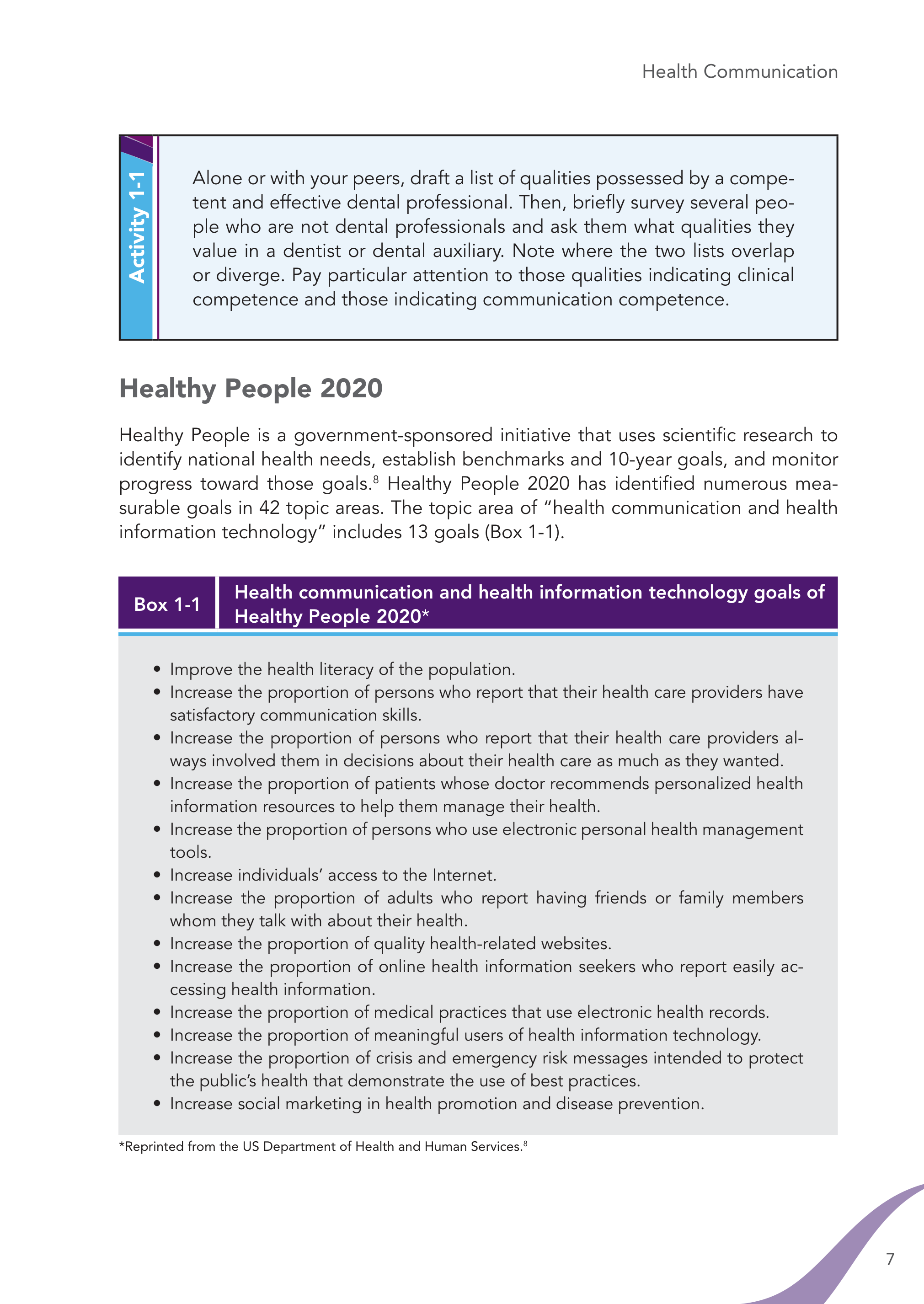
Healthy People 2020
Healthy People is a government-sponsored initiative that uses scientific research to
identify national health needs, establish benchmarks and 10-year goals, and monitor
progress toward those goals.
8
Healthy People 2020 has identified numerous mea-
surable goals in 42 topic areas. The topic area of “health communication and health
information technology” includes 13 goals (Box 1-1).
Box 1-1
Health communication and health information technology goals of
Healthy People 2020
*
•
•
Improve the health literacy of the population.
•
•
Increase the proportion of persons who report that their health care providers have
satisfactory communication skills.
•
•
Increase the proportion of persons who report that their health care providers al-
ways involved them in decisions about their health care as much as they wanted.
•
•
Increase the proportion of patients whose doctor recommends personalized health
information resources to help them manage their health.
•
•
Increase the proportion of persons who use electronic personal health management
tools.
•
•
Increase individuals’ access to the Internet.
•
•
Increase the proportion of adults who report having friends or family members
whom they talk with about their health.
•
•
Increase the proportion of quality health-related websites.
•
•
Increase the proportion of online health information seekers who report easily ac-
cessing health information.
•
•
Increase the proportion of medical practices that use electronic health records.
•
•
Increase the proportion of meaningful users of health information technology.
•
•
Increase the proportion of crisis and emergency risk messages intended to protect
the public’s health that demonstrate the use of best practices.
•
•
Increase social marketing in health promotion and disease prevention.
*Reprinted from the US Department of Health and Human Services.
8
Activity 1-1
Alone or with your peers, draft a list of qualities possessed by a compe-
tent and effective dental professional. Then, briefly survey several peo-
ple who are not dental professionals and ask them what qualities they
value in a dentist or dental auxiliary. Note where the two lists overlap
or diverge. Pay particular attention to those qualities indicating clinical
competence and those indicating communication competence.
1
8
Understanding Communication
Patient-Provider Communication
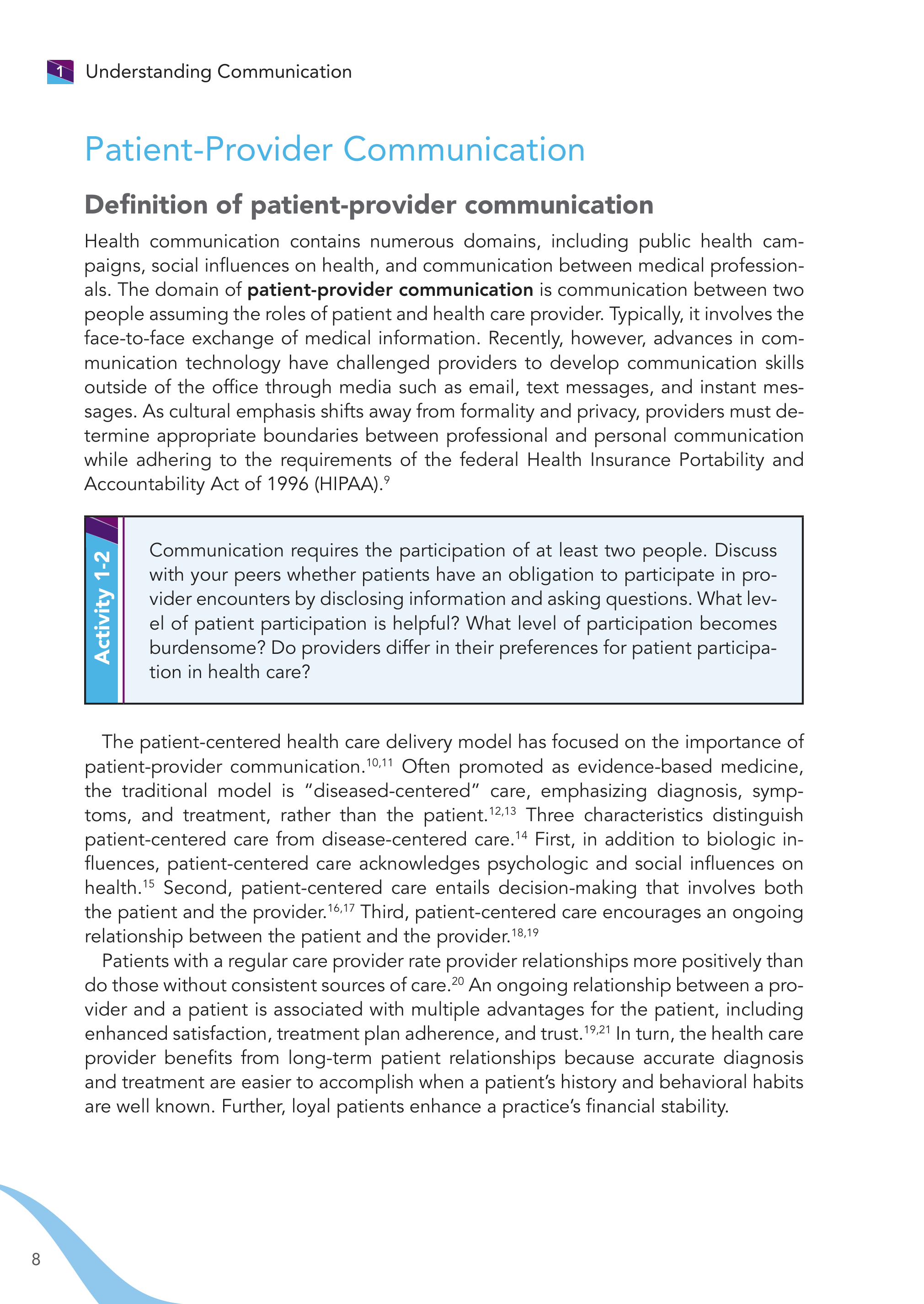
Definition of patient-provider communication
Health communication contains numerous domains, including public health cam-
paigns, social influences on health, and communication between medical profession-
als. The domain of
patient-provider communication
is communication between two
people assuming the roles of patient and health care provider. Typically, it involves the
face-to-face exchange of medical information. Recently, however, advances in com-
munication technology have challenged providers to develop communication skills
outside of the office through media such as email, text messages, and instant mes-
sages. As cultural emphasis shifts away from formality and privacy, providers must de-
termine appropriate boundaries between professional and personal communication
while adhering to the requirements of the federal Health Insurance Portability and
Accountability Act of 1996 (HIPAA).
9
The patient-centered health care delivery model has focused on the importance of
patient-provider communication.
10,11
Often promoted as evidence-based medicine,
the traditional model is “diseased-centered” care, emphasizing diagnosis, symp-
toms, and treatment, rather than the patient.
12,13
Three characteristics distinguish
patient-centered care from disease-centered care.
14
First, in addition to biologic in-
fluences, patient-centered care acknowledges psychologic and social influences on
health.
15
Second, patient-centered care entails decision-making that involves both
the patient and the provider.
16,17
Third, patient-centered care encourages an ongoing
relationship between the patient and the provider.
18,19
Patients with a regular care provider rate provider relationships more positively than
do those without consistent sources of care.
20
An ongoing relationship between a pro-
vider and a patient is associated with multiple advantages for the patient, including
enhanced satisfaction, treatment plan adherence, and trust.
19,21
In turn, the health care
provider benefits from long-term patient relationships because accurate diagnosis
and treatment are easier to accomplish when a patient’s history and behavioral habits
are well known. Further, loyal patients enhance a practice’s financial stability.
Activity 1-2
Communication requires the participation of at least two people. Discuss
with your peers whether patients have an obligation to participate in pro-
vider encounters by disclosing information and asking questions. What lev-
el of patient participation is helpful? What level of participation becomes
burdensome? Do providers differ in their preferences for patient participa-
tion in health care?
9
Patient-Provider Communication
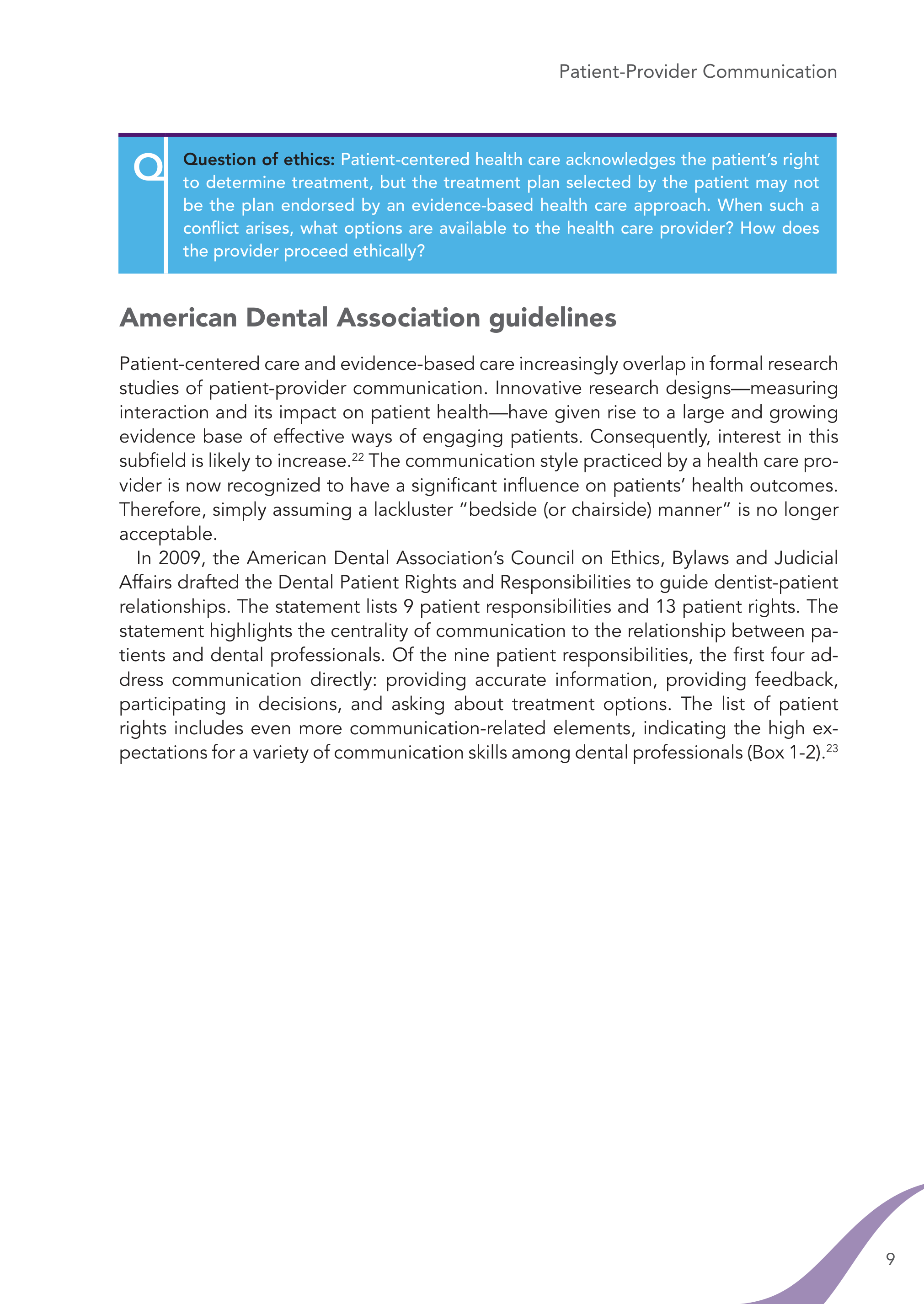
American Dental Association guidelines
Patient-centered care and evidence-based care increasingly overlap in formal research
studies of patient-provider communication. Innovative research designs—measuring
interaction and its impact on patient health—have given rise to a large and growing
evidence base of effective ways of engaging patients. Consequently, interest in this
subfield is likely to increase.
22
The communication style practiced by a health care pro-
vider is now recognized to have a significant influence on patients’ health outcomes.
Therefore, simply assuming a lackluster “bedside (or chairside) manner” is no longer
acceptable.
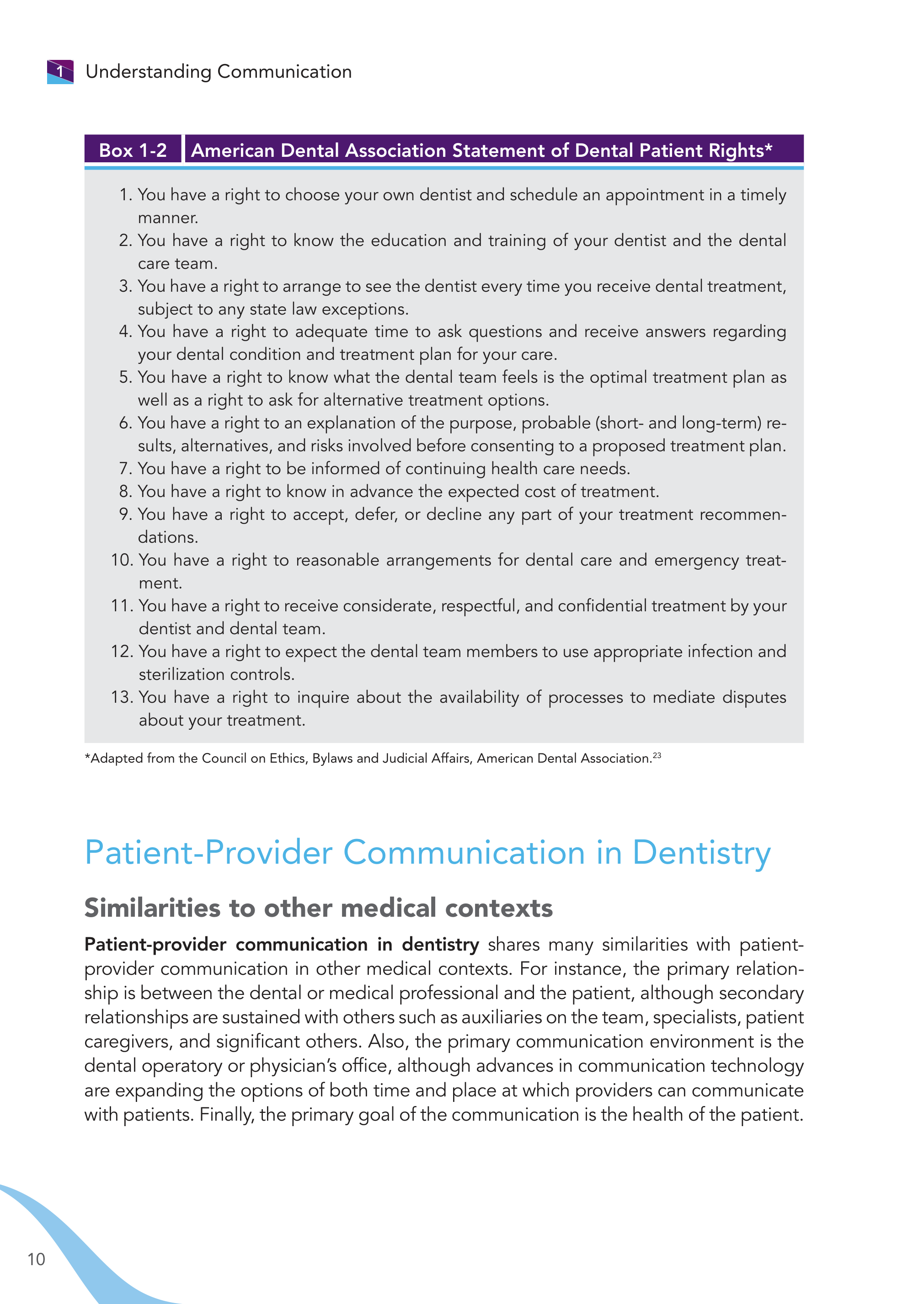
In 2009, the American Dental Association’s Council on Ethics, Bylaws and Judicial
Affairs drafted the Dental Patient Rights and Responsibilities to guide dentist-patient
relationships. The statement lists 9 patient responsibilities and 13 patient rights. The
statement highlights the centrality of communication to the relationship between pa-
tients and dental professionals. Of the nine patient responsibilities, the first four ad-
dress communication directly: providing accurate information, providing feedback,
participating in decisions, and asking about treatment options. The list of patient
rights includes even more communication-related elements, indicating the high ex-
pectations for a variety of communication skills among dental professionals (Box 1-2).
23
Question of ethics:
Patient-centered health care acknowledges the patient’s right
to determine treatment, but the treatment plan selected by the patient may not
be the plan endorsed by an evidence-based health care approach. When such a
conflict arises, what options are available to the health care provider? How does
the provider proceed ethically?
1
10
Understanding Communication
Patient-Provider Communication in Dentistry
Similarities to other medical contexts
Patient-provider communication in dentistry
shares many similarities with patient-
provider communication in other medical contexts. For instance, the primary relation-
ship is between the dental or medical professional and the patient, although secondary
relationships are sustained with others such as auxiliaries on the team, specialists, patient
caregivers, and significant others. Also, the primary communication environment is the
dental operatory or physician’s office, although advances in communication technology
are expanding the options of both time and place at which providers can communicate
with patients. Finally, the primary goal of the communication is the health of the patient.
*Adapted from the Council on Ethics, Bylaws and Judicial Affairs, American Dental Association.
23
Box 1-2
American Dental Association Statement of Dental Patient Rights*
1. You have a right to choose your own dentist and schedule an appointment in a timely
manner.
2. You have a right to know the education and training of your dentist and the dental
care team.
3. You have a right to arrange to see the dentist every time you receive dental treatment,
subject to any state law exceptions.
4. You have a right to adequate time to ask questions and receive answers regarding
your dental condition and treatment plan for your care.
5. You have a right to know what the dental team feels is the optimal treatment plan as
well as a right to ask for alternative treatment options.
6. You have a right to an explanation of the purpose, probable (short- and long-term) re-
sults, alternatives, and risks involved before consenting to a proposed treatment plan.
7. You have a right to be informed of continuing health care needs.
8. You have a right to know in advance the expected cost of treatment.
9. You have a right to accept, defer, or decline any part of your treatment recommen-
dations.
10. You have a right to reasonable arrangements for dental care and emergency treat-
ment.
11. You have a right to receive considerate, respectful, and confidential treatment by your
dentist and dental team.
12. You have a right to expect the dental team members to use appropriate infection and
sterilization controls.
13. You have a right to inquire about the availability of processes to mediate disputes
about your treatment.
11
Patient-Provider Communication in Dentistry
In addition to the three similarities noted above, it is worth considering the ways
in which disclosure in both dentistry and other medical contexts differs from typi-
cal dyadic (two-person) communication within social relationships. All medical pro-
fessionals must become accustomed to three particular characteristics that are quite
different from usual interpersonal communication. First, patient-provider communica-
tion is characterized by asymmetric disclosure. In social interactions, communicators
expect to contribute equally to the conversation, but in medical encounters, patients
disclose more than the provider. Second, high-level disclosure characterizes these
interactions.
24,25
Doctors should be prepared for patients to reveal information to their
doctors that their closest friends may not know. Third, rapid disclosure is a feature of
patient-provider communication. Within minutes of meeting a provider, patients may
quickly report details on their health and habits.
Differences from other medical contexts
Patient-provider communication in dentistry does differ from communication in other
medical contexts in four important ways. First, patient encounters with dental profes-
sionals are more physically intrusive than typical medical encounters. The accepted
normal amount of personal space for Americans and Europeans is about 20 inches.
26
During a routine examination, a physician may invade that space for a brief time, but
a dental professional usually stands very close to—and above—a reclining patient for
a substantial length of time. Second, dental examinations are routinely more invasive
than most physical examinations. Physicians and medical specialists typically explore
body cavities briefly, but dental professionals spend much of the appointment exam-
ining, cleaning, or repairing features of the oral cavity. Third, patients are more ag-
gressive during dental visits than in other medical encounters in which their bodies are
examined and manipulated. Inevitably, dental visits require patient activity (holding
the mouth open, swishing water, spitting, etc). Often this activity can make patients
feel uncomfortable and ultimately more difficult to manage. Finally, dental visits hold
more potential for pain than other medical encounters. Dental professionals focus on
the head and mouth, two of the most vulnerable and sensitive parts of the body. As
a result, even a simple dental examination can cause pain in a way physical examina-
tions rarely do. Taken together, these distinguishing features may explain why 1 in 10
people suffers from dental anxiety.
27
Question of ethics:
Research indicates that provider communication influences pa-
tient satisfaction. Is it ethical for a provider to communicate poorly with challenging
patients, patients with financial problems, or patients with difficult personalities in
the hopes they will find another provider?
1
12
Understanding Communication
12
Criteria for training in communication skills
In 2008, the American Dental Education Association issued revised competencies for
the new general dentist.
28
These 39 competencies fall into 6 domains:
(1)
critical think-
ing,
(2)
professionalism,
(3)
communication and interpersonal skills,
(4)
health promo-
tion,
(5)
practice management and informatics, and
(6)
patient care. Fifteen of those
competencies relate—either directly or indirectly—to communication with patients
(Box 1-3). Training in communication skills is now required in all US colleges of den-
tistry. The Commission on Dental Accreditation
29
now includes two behavioral science
standards entailing patient communication training:
•
•
2-15
Graduates must be competent in the application of the fundamental prin-
ciples of behavioral sciences as they pertain to patient-centered approaches for
promoting, improving, and maintaining oral health.
•
•
2-16
Graduates must be competent in managing a diverse patient population
and have the interpersonal and communications skills to function successfully in
a multicultural work environment.
Benefits and Challenges of
Enhanced Communication Skills
Value of communication skills
In dentistry, how important are interpersonal skills relative to clinical skills? Given
the tremendous amount of work and resources dental professionals commit to their
clinical training and the significant time and skill required at a dental practice, does
proficiency in patient communication justify the extra effort required to learn and im-
plement those skills? Patients indicate that it does. Perhaps surprisingly, practicing
dentists agree. A 1998 study determined that dentists rated interpersonal skills, stress
tolerance, and administrative skills as the most important determinants of professional
success.
30
Moreover, although dental professionals might believe patients evaluate
them solely on their clinical skills, patients tend to assume professionals are clinically
competent and therefore base their evaluations on communication skills.
31,32
Measurable benefits of effective communication
Effective patient-provider communication supports patient-centered health care and
is associated with specific, measurable benefits. Patient-provider communication is
associated with
greater patient satisfaction with care,
33–35
greater patient adherence
to treatment plans,
34,36,37
and
fewer medical errors and mistakes.
38,39
Skilled communi-
cation may even be associated with
fewer malpractice claims.
40–44
Ultimately, effective
patient-provider communication leads
to better health outcomes for the patient.
45–47
Skilled communication yields a complementary benefit for the provider: Along with
monetary reward and respect, positive patient relationships are a primary contributor
to
dentists’ job satisfaction.
48,49
13
Benefits and Challenges of Enhanced Communication Skills
Box 1-3
Communication-related competencies for the new general dentist*
1. Critical thinking
1.3
Evaluate and integrate best research outcomes with clinical expertise and pa-
tient values for evidence-based practice.
2. Professionalism
2.1
Apply ethical and legal standards in the provision of dental care.
3. Communication and interpersonal skills
3.1
Apply appropriate interpersonal and communication skills.
3.2
Apply psychosocial and behavioral principles in patient-centered health care.
3.3
Communicate effectively with individuals from diverse populations.
4. Health promotion
4.1
Provide prevention, intervention, and educational strategies.
4.2
Participate with dental team members and other health care professionals in
the management of and health promotion for all patients.
4.3
Recognize and appreciate the need to contribute to the improvement of oral
health beyond those served in traditional practice settings.
5. Practice management and informatics
5.3
Apply principles of risk management, including informed consent and appro-
priate record keeping in patient care.
5.6
Comply with local, state, and federal regulations including OSHA and HIPAA.
6. Patient care
6.3
Obtain and interpret patient/medical data, including a thorough intraoral/ex-
traoral examination, and use these findings to accurately assess and manage
all patients.
6.6
Formulate a comprehensive diagnosis, treatment, and/or referral plan for the
management of patients.
6.8
Prevent, diagnose, and manage pain and anxiety in the dental patient.
6.18
Recognize and manage patient abuse and/or neglect.
6.19
Recognize and manage substance abuse.
*Adapted from the American Dental Education Association
28
with permission.
1
14
Understanding Communication
*Adapted from Buhrmester et al
50
with permission.
Activity 1-3
Measure your social style using the instrument below,* scoring each item
from 1 (“poor”) to 5 (“very good”). Sum your score on the subscales and
the total instrument, and then compare your scores with your peers. Do
your personal scores reflect the strengths and weaknesses you perceive
in your communication skills? Take the test again after you have com-
pleted your communication training and note any changes.
Initiating relationships
1. How good are you at asking someone new to do things together, like go
to a ball game or a movie?
2. How good are you at going out of your way to start up new relation-
ships?
3. How good are you at carrying on conversations with new people whom
you would like to know better?
4. How good are you at introducing yourself to people for the first time?
5. How good are you at calling new people on the phone to set up a time
to get together to do things?
6. How good are you at going places where there are unfamiliar people in
order to get to know new people?
7. How good are you at making good first impressions when getting to
know new people?
Providing emotional support
8. How good are you at making someone feel better when he or she is
unhappy or sad?
9. How good are you at making others feel like their problems are under-
stood?
10. How good are you at helping people work through their thoughts and
feelings about important decisions?
11. How good are you at helping people handle pressure or upsetting
events?
12. How good are you at showing that you really care when someone talks
about problems?
13. How good are you at helping others understand their problems better?
14. How good are you at giving suggestions and advice in ways that are
received well by others?
Asserting influence
15. How good are you at getting people to go along with what you want?
16. How good are you at taking charge?
17. How good are you at sticking up for yourself?
18. How good are you at getting someone to agree with your point of view?
19. How good are you at deciding what should be done?
20. How good are you at voicing your desires and opinions?
21. How good are you at getting your way with others?
15
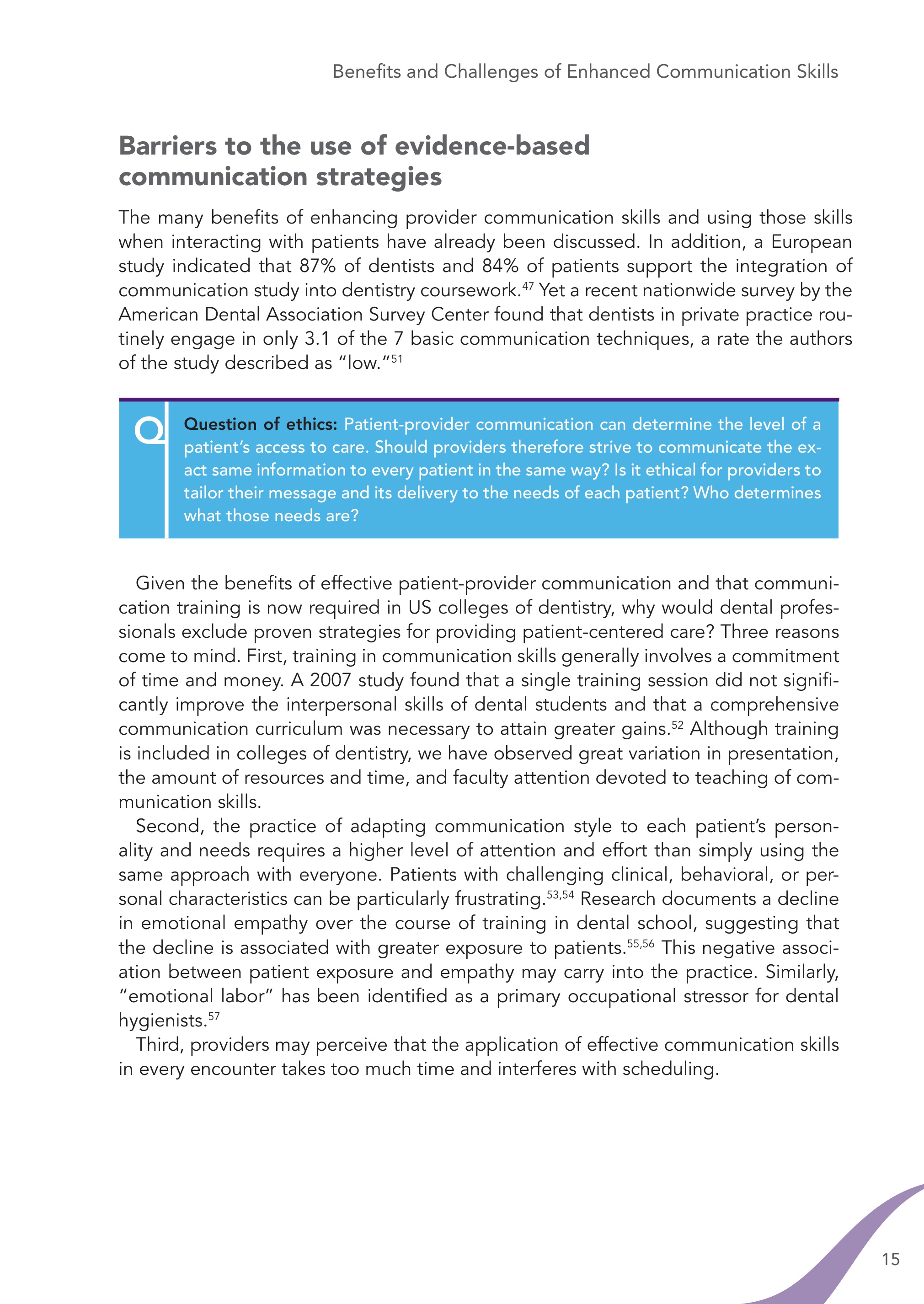
Question of ethics:
Patient-provider communication can determine the level of a
patient’s access to care. Should providers therefore strive to communicate the ex-
act same information to every patient in the same way? Is it ethical for providers to
tailor their message and its delivery to the needs of each patient? Who determines
what those needs are?
Benefits and Challenges of Enhanced Communication Skills
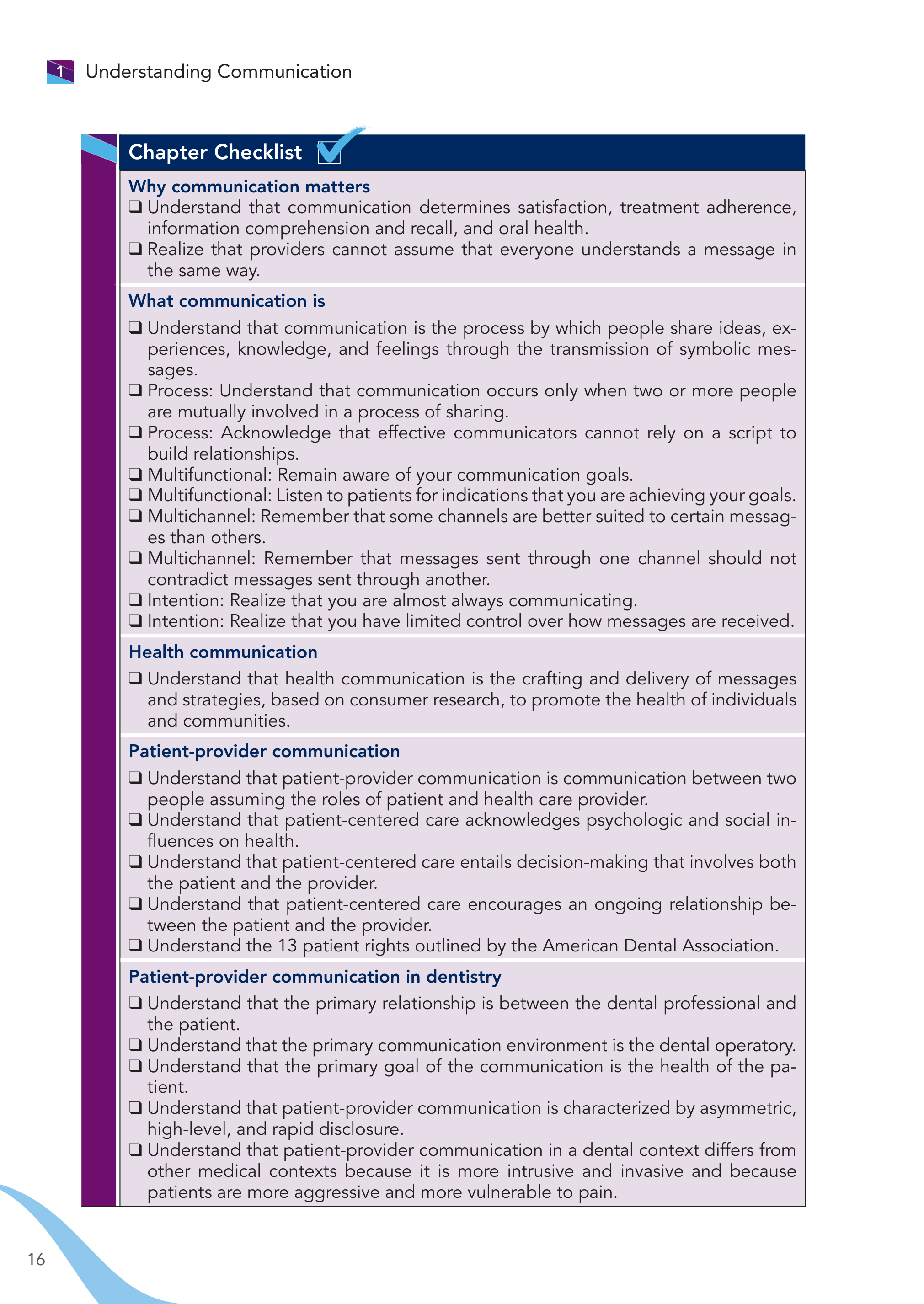
Given the benefits of effective patient-provider communication and that communi-
cation training is now required in US colleges of dentistry, why would dental profes-
sionals exclude proven strategies for providing patient-centered care? Three reasons
come to mind. First, training in communication skills generally involves a commitment
of time and money. A 2007 study found that a single training session did not signifi-
cantly improve the interpersonal skills of dental students and that a comprehensive
communication curriculum was necessary to attain greater gains.
52
Although training
is included in colleges of dentistry, we have observed great variation in presentation,
the amount of resources and time, and faculty attention devoted to teaching of com-
munication skills.
Second, the practice of adapting communication style to each patient’s person-
ality and needs requires a higher level of attention and effort than simply using the
same approach with everyone. Patients with challenging clinical, behavioral, or per-
sonal characteristics can be particularly frustrating.
53,54
Research documents a decline
in emotional empathy over the course of training in dental school, suggesting that
the decline is associated with greater exposure to patients.
55,56
This negative associ-
ation between patient exposure and empathy may carry into the practice. Similarly,
“emotional labor” has been identified as a primary occupational stressor for dental
hygienists.
57
Third, providers may perceive that the application of effective communication skills
in every encounter takes too much time and interferes with scheduling.
Barriers to the use of evidence-based
communication strategies
The many benefits of enhancing provider communication skills and using those skills
when interacting with patients have already been discussed. In addition, a European
study indicated that 87% of dentists and 84% of patients support the integration of
communication study into dentistry coursework.
47
Yet a recent nationwide survey by the
American Dental Association Survey Center found that dentists in private practice rou-
tinely engage in only 3.1 of the 7 basic communication techniques, a rate the authors
of the study described as “low.”
51
1
16
Understanding Communication
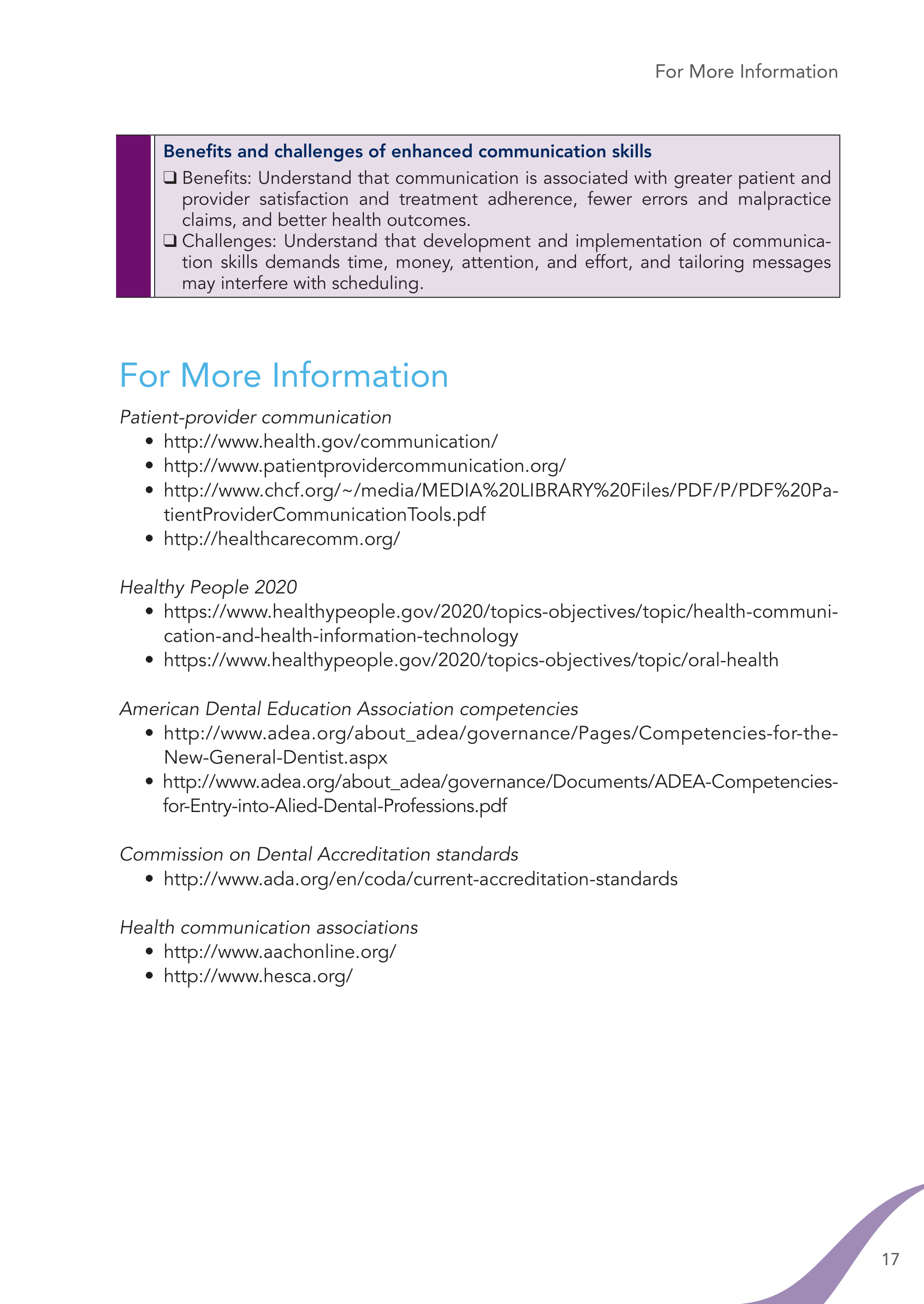
Chapter Checklist
Why communication matters
❑
❑
Understand that communication determines satisfaction, treatment adherence,
information comprehension and recall, and oral health.
❑
❑
Realize that providers cannot assume that everyone understands a message in
the same way.
What communication is
❑
❑
Understand that communication is the process by which people share ideas, ex-
periences, knowledge, and feelings through the transmission of symbolic mes-
sages.
❑
❑
Process: Understand that communication occurs only when two or more people
are mutually involved in a process of sharing.
❑
❑
Process: Acknowledge that effective communicators cannot rely on a script to
build relationships.
❑
❑
Multifunctional: Remain aware of your communication goals.
❑
❑
Multifunctional: Listen to patients for indications that you are achieving your goals.
❑
❑
Multichannel: Remember that some channels are better suited to certain messag-
es than others.
❑
❑
Multichannel: Remember that messages sent through one channel should not
contradict messages sent through another.
❑
❑
Intention: Realize that you are almost always communicating.
❑
❑
Intention: Realize that you have limited control over how messages are received.
Health communication
❑
❑
Understand that health communication is the crafting and delivery of messages
and strategies, based on consumer research, to promote the health of individuals
and communities.
Patient-provider communication
❑
❑
Understand that patient-provider communication is communication between two
people assuming the roles of patient and health care provider.
❑
❑
Understand that patient-centered care acknowledges psychologic and social in-
fluences on health.
❑
❑
Understand that patient-centered care entails decision-making that involves both
the patient and the provider.
❑
❑
Understand that patient-centered care encourages an ongoing relationship be-
tween the patient and the provider.
❑
❑
Understand the 13 patient rights outlined by the American Dental Association.
Patient-provider communication in dentistry
❑
Understand that the primary relationship is between the dental professional and
the patient.
❑
Understand that the primary communication environment is the dental operatory.
❑
Understand that the primary goal of the communication is the health of the pa-
tient.
❑
Understand that patient-provider communication is characterized by asymmetric,
high-level, and rapid disclosure.
❑
Understand that patient-provider communication in a dental context differs from
other medical contexts because it is more intrusive and invasive and because
patients are more aggressive and more vulnerable to pain.
17
For More Information
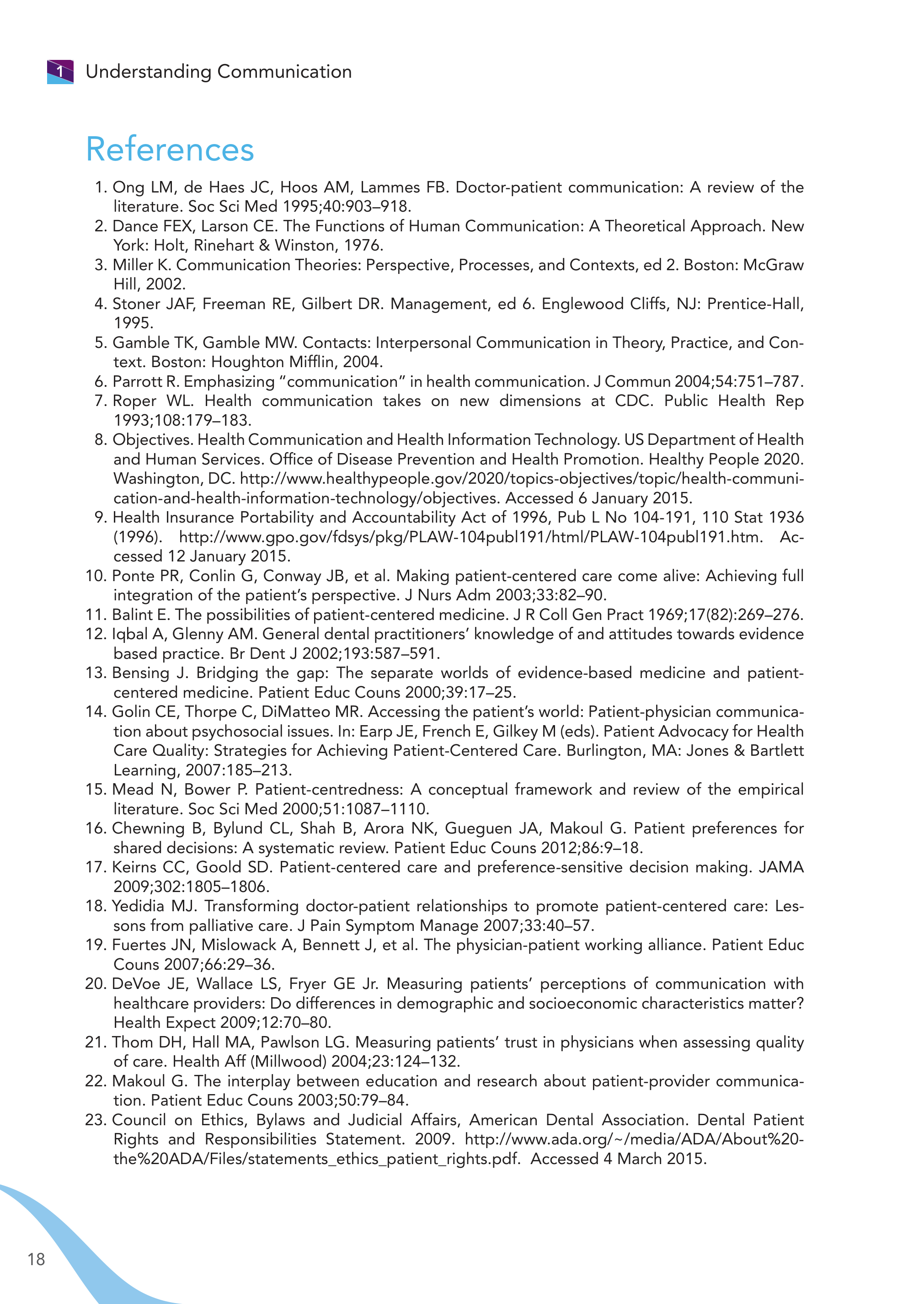
Benefits and challenges of enhanced communication skills
❑
❑
Benefits: Understand that communication is associated with greater patient and
provider satisfaction and treatment adherence, fewer errors and malpractice
claims, and better health outcomes.
❑
❑
Challenges: Understand that development and implementation of communica-
tion skills demands time, money, attention, and effort, and tailoring messages
may interfere with scheduling.
For More Information
Patient-provider communication
•
•
http://www.health.gov/communication/
•
•
http://www.patientprovidercommunication.org/
•
•
http://www.chcf.org/~/media/MEDIA%20LIBRARY%20Files/PDF/P/PDF%20Pa-
tientProviderCommunicationTools.pdf
•
•
http://healthcarecomm.org/
Healthy People 2020
•
•
https://www.healthypeople.gov/2020/topics-objectives/topic/health-communi-
cation-and-health-information-technology
•
•
https://www.healthypeople.gov/2020/topics-objectives/topic/oral-health
American Dental Education Association competencies
•
•
http://www.adea.org/about_adea/governance/Pages/Competencies-for-the-
New-General-Dentist.aspx
•
•
http://www.adea.org/about_adea/governance/Documents/ADEA-Competencies-
for-Entry-into-Alied-Dental-Professions.pdf
Commission on Dental Accreditation standards
•
•
http://www.ada.org/en/coda/current-accreditation-standards
Health communication associations
•
•
http://www.aachonline.org/
•
•
http://www.hesca.org/
1
18
Understanding Communication
References
1. Ong LM, de Haes JC, Hoos AM, Lammes FB. Doctor-patient communication: A review of the
literature. Soc Sci Med 1995;40:903–918.
2. Dance FEX, Larson CE. The Functions of Human Communication: A Theoretical Approach. New
York: Holt, Rinehart & Winston, 1976.
3. Miller K. Communication Theories: Perspective, Processes, and Contexts, ed 2. Boston: McGraw
Hill, 2002.
4. Stoner JAF, Freeman RE, Gilbert DR. Management, ed 6. Englewood Cliffs, NJ: Prentice-Hall,
1995.
5. Gamble TK, Gamble MW. Contacts: Interpersonal Communication in Theory, Practice, and Con-
text. Boston: Houghton Mifflin, 2004.
6. Parrott R. Emphasizing “communication” in health communication. J Commun 2004;54:751–787.
7. Roper WL. Health communication takes on new dimensions at CDC. Public Health Rep
1993;108:179–183.
8. Objectives. Health Communication and Health Information Technology. US Department of Health
and Human Services. Office of Disease Prevention and Health Promotion. Healthy People 2020.
Washington, DC. http://www.healthypeople.gov/2020/topics-objectives/topic/health-communi-
cation-and-health-information-technology/objectives. Accessed 6 January 2015.
9. Health Insurance Portability and Accountability Act of 1996, Pub L No 104-191, 110 Stat 1936
(1996). http://www.gpo.gov/fdsys/pkg/PLAW-104publ191/html/PLAW-104publ191.htm. Ac-
cessed 12 January 2015.
10. Ponte PR, Conlin G, Conway JB, et al. Making patient-centered care come alive: Achieving full
integration of the patient’s perspective. J Nurs Adm 2003;33:82–90.
11. Balint E. The possibilities of patient-centered medicine. J R Coll Gen Pract 1969;17(82):269–276.
12. Iqbal A, Glenny AM. General dental practitioners’ knowledge of and attitudes towards evidence
based practice. Br Dent J 2002;193:587–591.
13. Bensing J. Bridging the gap: The separate worlds of evidence-based medicine and patient-
centered medicine. Patient Educ Couns 2000;39:17–25.
14. Golin CE, Thorpe C, DiMatteo MR. Accessing the patient’s world: Patient-physician communica-
tion about psychosocial issues. In: Earp JE, French E, Gilkey M (eds). Patient Advocacy for Health
Care Quality: Strategies for Achieving Patient-Centered Care. Burlington, MA: Jones & Bartlett
Learning, 2007:185–213.
15. Mead N, Bower P. Patient-centredness: A conceptual framework and review of the empirical
literature. Soc Sci Med 2000;51:1087–1110.
16. Chewning B, Bylund CL, Shah B, Arora NK, Gueguen JA, Makoul G. Patient preferences for
shared decisions: A systematic review. Patient Educ Couns 2012;86:9–18.
17. Keirns CC, Goold SD. Patient-centered care and preference-sensitive decision making. JAMA
2009;302:1805–1806.
18. Yedidia MJ. Transforming doctor-patient relationships to promote patient-centered care: Les-
sons from palliative care. J Pain Symptom Manage 2007;33:40–57.
19. Fuertes JN, Mislowack A, Bennett J, et al. The physician-patient working alliance. Patient Educ
Couns 2007;66:29–36.
20. DeVoe JE, Wallace LS, Fryer GE Jr. Measuring patients’ perceptions of communication with
healthcare providers: Do differences in demographic and socioeconomic characteristics matter?
Health Expect 2009;12:70–80.
21. Thom DH, Hall MA, Pawlson LG. Measuring patients’ trust in physicians when assessing quality
of care. Health Aff (Millwood) 2004;23:124–132.
22. Makoul G. The interplay between education and research about patient-provider communica-
tion. Patient Educ Couns 2003;50:79–84.
23. Council on Ethics, Bylaws and Judicial Affairs, American Dental Association. Dental Patient
Rights and Responsibilities Statement. 2009. http://www.ada.org/~/media/ADA/About%20-
the%20ADA/Files/statements_ethics_patient_rights.pdf. Accessed 4 March 2015.
19
References
24. Hall MA, Dugan E, Zheng B, Mishra AK. Trust in physicians and medical institutions: What is it,
can it be measured, and does it matter? Milbank Q 2001;79:613–639.
25. Veatch RM. The Patient-Physician Relation: The Patient as Partner, Part 2. Bloomington, IN: In-
diana University, 1991.
26. Ting-Toomey S, Chung LC. Understanding Intercultural Communication. Los Angeles: Roxbury,
2005.
27. Doerr PA, Lang WP, Nyquist LV, Ronis DL. Factors associated with dental anxiety. J Am Dent
Assoc 1998;129:1111–1119.
28. American Dental Education Association. Competencies for the New General Dentist. Washing-
ton, DC: American Dental Education Association, 2008.
29. Commission on Dental Accreditation. Accreditation Standards for Dental Education Programs.
Chicago: American Dental Association, 2010.
30. Kulich KR, Rydén O, Bengtsson H. A descriptive study of how dentists view their profession and
the doctor-patient relationship. Acta Odontol Scand 1998;56:206–209.
31. Logan HL. The patient and the shifting health-care paradigm. J Am Coll Dent 1997;64:16–18.
32. Mazzei A, Russo V, Crescentini A. Patient satisfaction and communication as competitive levers
in dentistry. TQM Journal 2009;21:365–381.
33. Wanzer MB, Booth-Butterfield M, Gruber K. Perceptions of health care providers’ communica-
tion: Relationships between patient-centered communication and satisfaction. Health Commun
2004;16:363–384.
34. Beach MC, Sugarman J, Johnson RL, Arbelaez JJ, Duggan PS, Cooper LA. Do patients treated
with dignity report higher satisfaction, adherence, and receipt of preventive care? Ann Fam Med
2005;3:331–338.
35. Williams S, Weinman J, Dale J. Doctor-patient communication and patient satisfaction: A review.
Fam Pract 1998;15:480–492.
36. DiMatteo MR. Enhancing patient adherence to medical recommendations. JAMA 1994;271:79,
83.
37. Stewart MA. Effective physician-patient communication and health outcomes: A review. CMA J
1995;152:1423–1433.
38. Woolf SH, Kuzel AJ, Dovey SM, Phillips RL Jr. A string of mistakes: The importance of cascade
analysis in describing, counting, and preventing medical errors. Ann Fam Med 2004;2:317–326.
39. Bartlett G, Blais R, Tamblyn R, Clermont RJ, MacGibbon B. Impact of patient communication
problems on the risk of preventable adverse events in acute care settings. CMA J 2008;178:1555–
1562.
40. Kraman SS, Hamm G. Risk management: Extreme honesty may be the best policy. Ann Intern
Med 1999;131:963–967.
41. Schwartz B. Errors in dentistry: A call for apology. J Am Coll Dent 2005;72(2):26–32.
42. Gallagher TH, Waterman AD, Ebers AG, Fraser VJ, Levinson W. Patients’ and physicians’ atti-
tudes regarding the disclosure of medical errors. JAMA 2003;289:1001–1007.
43. Duclos CW, Eichler M, Taylor L, et al. Patient perspectives of patient-provider communication
after adverse events. Int J Qual Health Care 2005;17:479–486.
44. Lester GW, Smith SG. Listening and talking to patients. A remedy for malpractice suits? West J
Med 1993;158:268–272.
45. Street RL Jr, Makoul G, Arora NK, Epstein RM. How does communication heal? Pathways linking
clinician-patient communication to health outcomes. Patient Educ Couns 2009;74:295–301.
46. Stewart M, Brown JB, Donner A, et al. The impact of patient-centered care on outcomes. J Fam
Pract 2000;49:796–804.
47. Woelber JP, Deimling D, Langenbach D, Ratka-Krüger P. The importance of teaching communi-
cation in dental education. A survey amongst dentists, students and patients. Eur J Dent Educ
2011;16:e200–e204.
48. Logan HL, Muller PJ, Berst MR, Yeaney DW. Contributors to dentists’ job satisfaction and quality
of life. J Am Coll Dent 1997;64(4):39–43.
49. Shugars DA, DiMatteo MR, Hays RD, Cretin S, Johnson JD. Professional satisfaction among Cal-
ifornia general dentists. J Dent Educ 1990;54:661–669.