Apollo 11 Astronaut Neil Armstrong Broadcast from
the Moon (July 21, 1969)
Added to the National Registry: 2004
Essay by Rod Pyle (guest post)*
They may have been the most famous eleven words of the 20
th
century. Along with Roosevelt’s
“A date which will live in infamy…” and Martin Luther King’s “I have a dream,” “That’s one
small step for man...one giant leap for mankind” has been engraved into global memory.
Or were they twelve words?
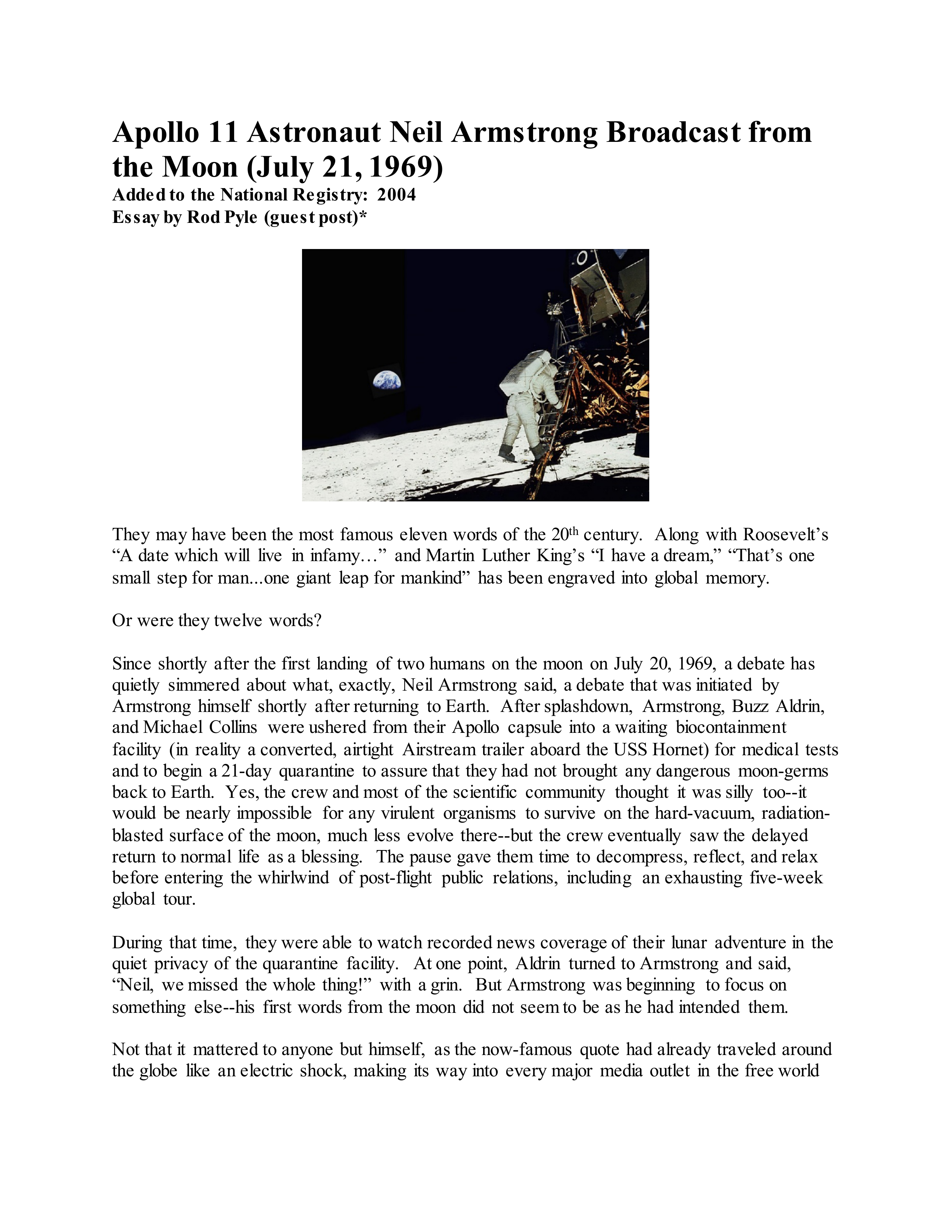
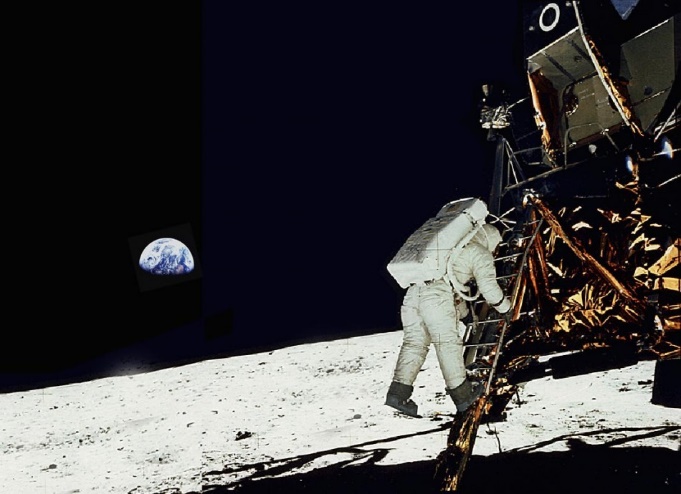
Since shortly after the first landing of two humans on the moon on July 20, 1969, a debate has
quietly simmered about what, exactly, Neil Armstrong said, a debate that was initiated by
Armstrong himself shortly after returning to Earth. After splashdown, Armstrong, Buzz Aldrin,
and Michael Collins were ushered from their Apollo capsule into a waiting biocontainment
facility (in reality a converted, airtight Airstream trailer aboard the USS Hornet) for medical tests
and to begin a 21-day quarantine to assure that they had not brought any dangerous moon-germs
back to Earth. Yes, the crew and most of the scientific community thought it was silly too--it
would be nearly impossible for any virulent organisms to survive on the hard-vacuum, radiation-
blasted surface of the moon, much less evolve there--but the crew eventually saw the delayed
return to normal life as a blessing. The pause gave them time to decompress, reflect, and relax
before entering the whirlwind of post-flight public relations, including an exhausting five-week
global tour.
During that time, they were able to watch recorded news coverage of their lunar adventure in the
quiet privacy of the quarantine facility. At one point, Aldrin turned to Armstrong and said,
“Neil, we missed the whole thing!” with a grin. But Armstrong was beginning to focus on
something else--his first words from the moon did not seem to be as he had intended them.
Not that it mattered to anyone but himself, as the now-famous quote had already traveled around
the globe like an electric shock, making its way into every major media outlet in the free world
(some countries, such as China and the Soviet Union, were a bit more reluctant to cover the
story). But, Armstrong wondered, had they gotten the story right?
Many in the press had postulated that NASA would craft a pithy, appropriately historic sentence
for him, but months before the landing, Julian Scheer, NASA’s assistant administrator for public
affairs at the time, said in an internal NASA memo addressing the seminal moment, “The truest
emotion at the historic moment is what the explorer feels within himself, not for the astronauts to
be coached before they leave or to carry a prepared text in their hip pockets....” The press
badgered Scheer, but he stuck with his story--the appropriate phrase would be a product of
Armstrong’s own thoughts, and his alone. When questioned in preflight press conferences,
Armstrong himself was characteristically laconic. As it turns out, this was probably because he
did not yet
know
what he wanted to say. Armstrong had, by his own telling, not come up with
the now-famous line until after he and Aldrin had landed on the moon. “I thought about it after
landing,” he said in a NASA oral history, “and because we had a lot of other things to do, it was
not something that I really concentrated on, but just something that was kind of passing around
subliminally or in the background.”
The half-billion people who would ultimately watch the moonwalk on television would simply
have to wait.
Some had even suggested that a poet should compose the wording, to which Scheer responded,
“Columbus wasn’t a poet...but his words were pretty dramatic to me. When he saw the Canary
Islands, he said, ‘I landed and saw people running around naked, some very green trees, much
water, and many fruits....’” Fortunately for history, Armstrong left the first dramatic description
of the scenery to Aldrin, who said with sufficient poetry, “Magnificent desolation.”
So, what was it that caught the First Man’s attention while watching the recordings of those first
moments of the moonwalk? Simply this: what was reported, and recorded on videotape, was not
what he thought he’d said. He later noted that he had intended to say, “That’s one small step for
a
man,” because “One small step for man” did not make sense in his mind. He went over it
again and again, and was sure he had said “a man,” but the recording appeared to indicate
otherwise.
In the cloistered world of space historians, this has been hotly debated ever since (this kind of
small mystery is what gets historians excited, after all). Countless replays of the recording have
been consumed by scholars over the ensuing decades, bent over archive desks with headphones
gripped tightly to tease out every breath of Armstrong’s words.
More objective analyses have been performed via computer, studying the electronic traces of
voice print analysis software. This debate continues and is unlikely to be settled to the
nitpickers’ satisfaction anytime soon, but one 2006 analysis did claim, definitively in the
author’s opinion, that Armstrong had in fact said “a man”--the verbal article was simply difficult
to hear. The moon is, after all, about 240,000 miles (386,242.6 kilometers) away from Earth,
and the radio transmitters in the astronauts’ backpacks had only modestly powerful radio
transmitters, producing poor audio quality. But the 2006 analysis revealed a tiny wave trace on
the computer screen, lasting just 35 milliseconds, where the “a” would have been, and that
convinced the researcher, Peter Shann Ford, and Roger Launius, the Senior Historian at the
Smithsonian Institution.
Whatever the truth is, we know what Armstrong intended to say, and that is enough. Regardless
of any debate, “That’s one small step for man, one giant leap for mankind” still brings chills to
those who were privileged to hear it at the time, and thrills succeeding generations. After nine
years of grueling national effort, over 20 billion dollars, and almost half a million Americans
directly involved in the effort to land Americans on the moon before 1970, these were the words
that marked the ultimate human achievement in the 20th century.
Rod Pyle is the author of 17 books on space history and other topics and the Editor-in-Chief of
“Ad Astra” magazine for the National Space Society. He has written books and articles for
NASA’s Jet Propulsion Laboratory and Caltech, and his stories have been published in
Space.com, LiveScience.com, “WIRED,” the BBC’s “Sky at Night” magazine, and many other
media outlets.
*The views expressed in this essay are those of the author and may not reflect those of the Library of Congress.