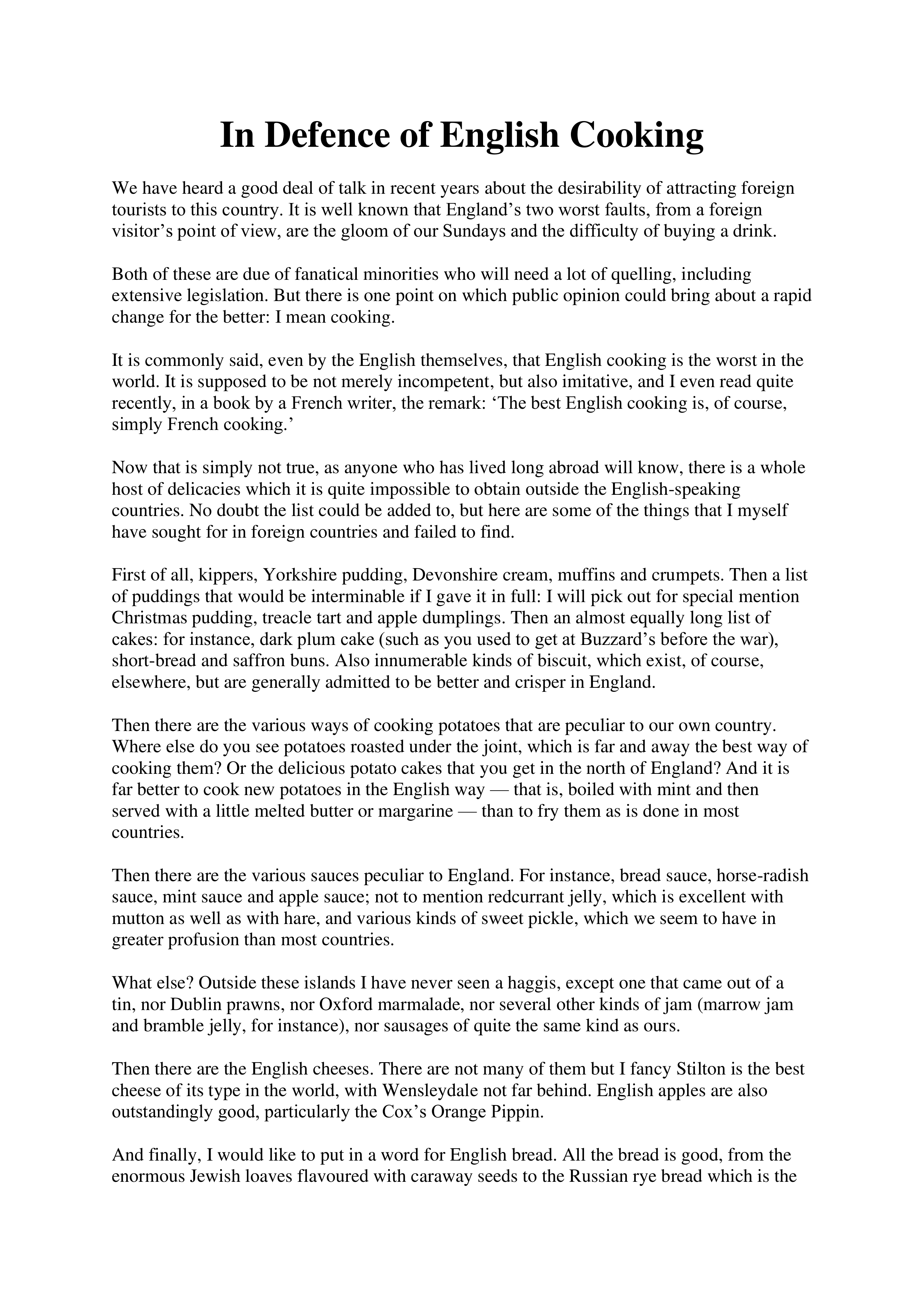
In Defence of English Cooking
We have heard a good deal of talk in recent years about the desirability of attracting foreign
tourists to this country. It is well known that England’s two worst faults, from a foreign
visitor’s point of view, are the gloom of our Sundays and the difficulty of buying a drink.
Both of these are due of fanatical minorities who will need a lot of quelling, including
extensive legislation. But there is one point on which public opinion could bring about a rapid
change for the better: I mean cooking.
It is commonly said, even by the English themselves, that English cooking is the worst in the
world. It is supposed to be not merely incompetent, but also imitative, and I even read quite
recently, in a book by a French writer, the remark: ‘The best English cooking is, of course,
simply French cooking.’
Now that is simply not true, as anyone who has lived long abroad will know, there is a whole
host of delicacies which it is quite impossible to obtain outside the English-speaking
countries. No doubt the list could be added to, but here are some of the things that I myself
have sought for in foreign countries and failed to find.
First of all, kippers, Yorkshire pudding, Devonshire cream, muffins and crumpets. Then a list
of puddings that would be interminable if I gave it in full: I will pick out for special mention
Christmas pudding, treacle tart and apple dumplings. Then an almost equally long list of
cakes: for instance, dark plum cake (such as you used to get at Buzzard’s before the war),
short-bread and saffron buns. Also innumerable kinds of biscuit, which exist, of course,
elsewhere, but are generally admitted to be better and crisper in England.
Then there are the various ways of cooking potatoes that are peculiar to our own country.
Where else do you see potatoes roasted under the joint, which is far and away the best way of
cooking them? Or the delicious potato cakes that you get in the north of England? And it is
far better to cook new potatoes in the English way — that is, boiled with mint and then
served with a little melted butter or margarine — than to fry them as is done in most
countries.
Then there are the various sauces peculiar to England. For instance, bread sauce, horse-radish
sauce, mint sauce and apple sauce; not to mention redcurrant jelly, which is excellent with
mutton as well as with hare, and various kinds of sweet pickle, which we seem to have in
greater profusion than most countries.
What else? Outside these islands I have never seen a haggis, except one that came out of a
tin, nor Dublin prawns, nor Oxford marmalade, nor several other kinds of jam (marrow jam
and bramble jelly, for instance), nor sausages of quite the same kind as ours.
Then there are the English cheeses. There are not many of them but I fancy Stilton is the best
cheese of its type in the world, with Wensleydale not far behind. English apples are also
outstandingly good, particularly the Cox’s Orange Pippin.
And finally, I would like to put in a word for English bread. All the bread is good, from the
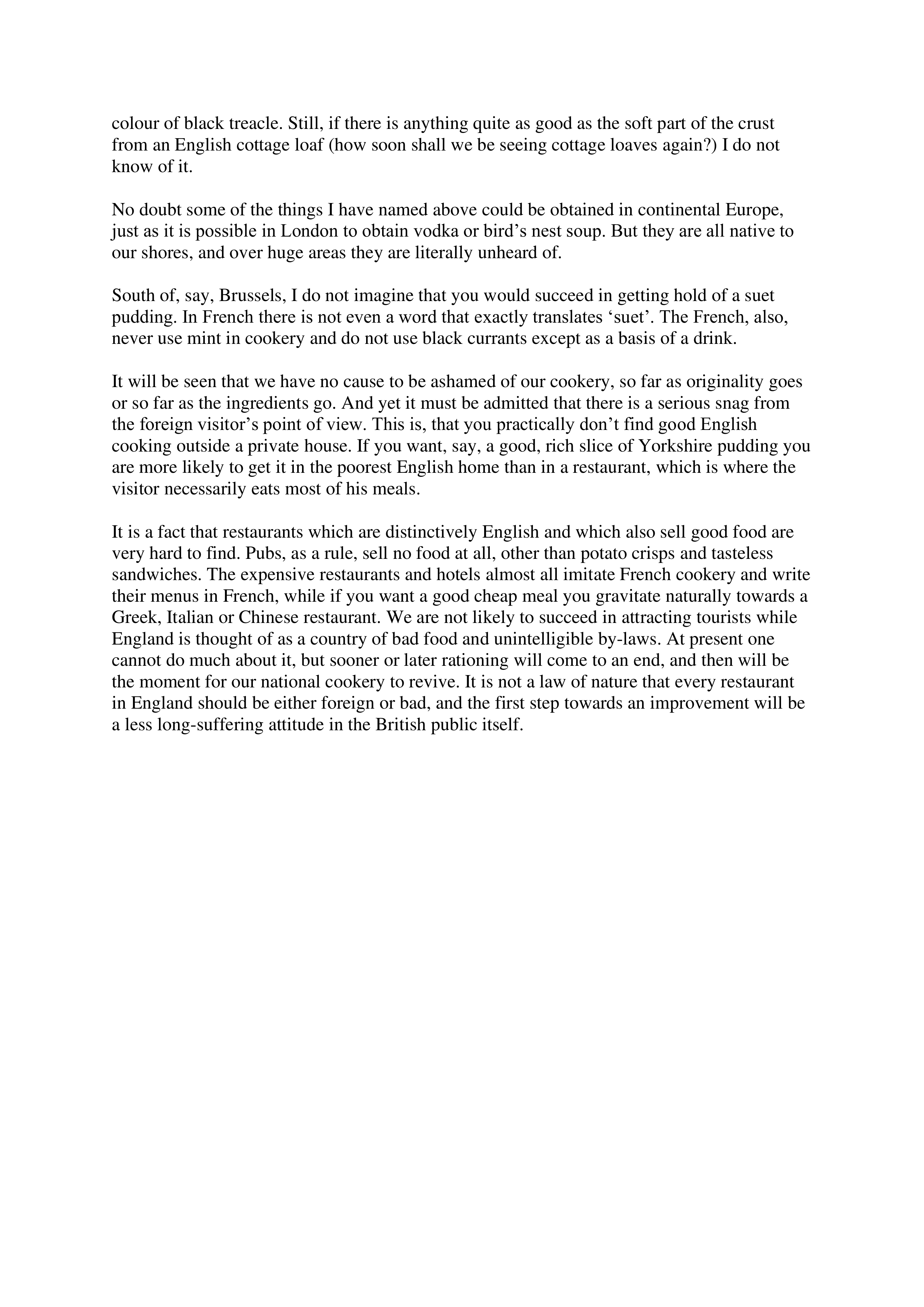
enormous Jewish loaves flavoured with caraway seeds to the Russian rye bread which is the