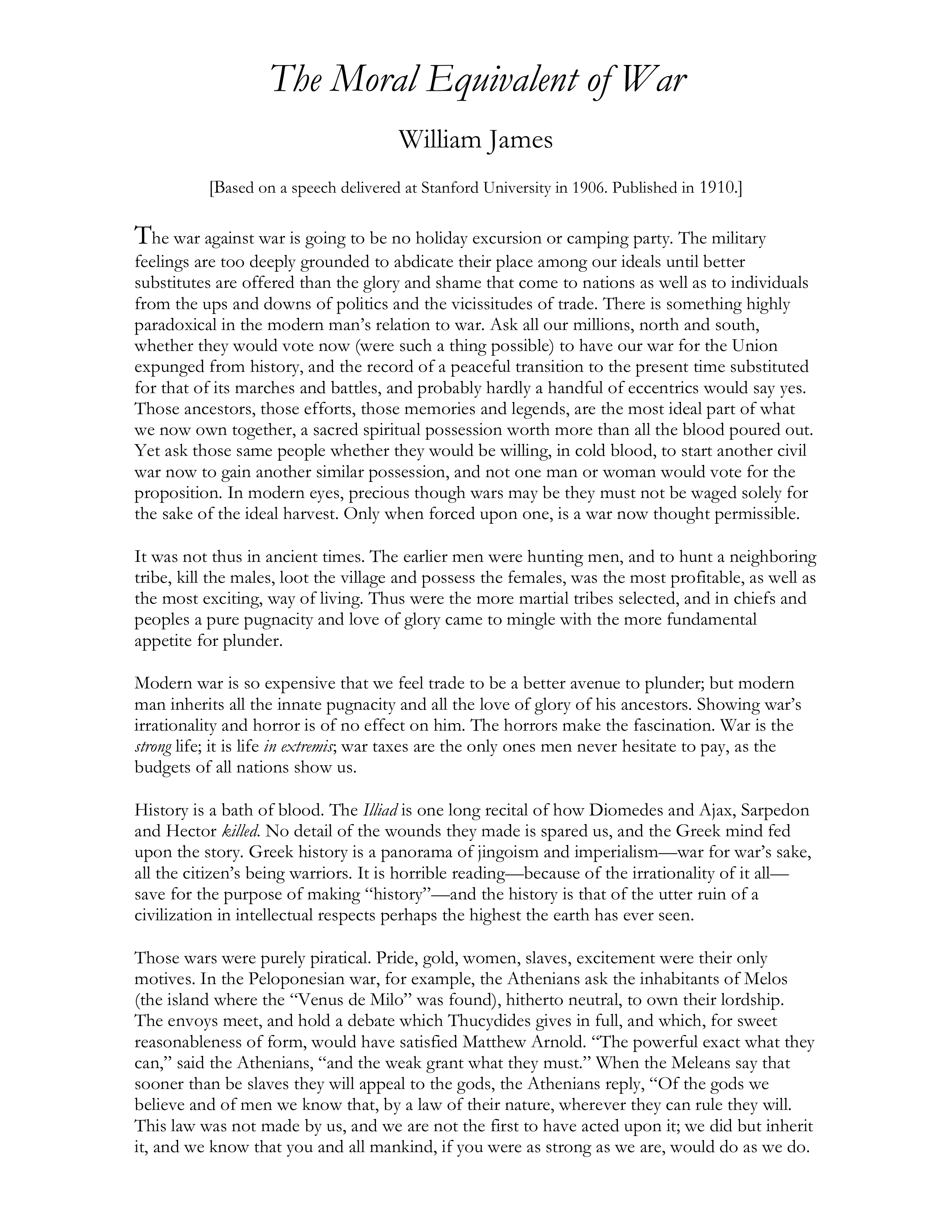
The Moral Equivalent of War
William James
[B
ased on a speech delivered at Stanford University in 1906. Published in
1910.]
T
he war against war is going to be no holiday excursion or camping party. The military
feelings are too deeply grounded to abdicate their place among our ideals until better
substitutes are offered than the glory and shame that come to nations as well as to individuals
from the ups and downs of politics and the vicissitudes of trade. There is something highly
paradoxical in the modern man’s relation to war. Ask all our millions, north and south,
whether they would vote now (were such a thing possible) to have our war for the Union
expunged from history, and the record of a peaceful transition to the present time substituted
for that of its marches and battles, and probably hardly a handful of eccentrics would say yes.
Those ancestors, those efforts, those memories and legends, are the most ideal part of what
we now own together, a sacred spiritual possession worth more than all the blood poured out.
Yet ask those same people whether they would be willing, in cold blood, to start another civil
war now to gain another similar possession, and not one man or woman would vote for the
proposition. In modern eyes, precious though wars may be they must not be waged solely for
the sake of the ideal harvest. Only when forced upon one, is a war now thought permissible.
It was not thus in ancient times. The earlier men were hunting men, and to hunt a neighboring
tribe, kill the males, loot the village and possess the females, was the most profitable, as well as
the most exciting, way of living. Thus were the more martial tribes selected, and in chiefs and
peoples a pure pugnacity and love of glory came to mingle with the more fundamental
appetite for plunder.
Modern war is so expensive that we feel trade to be a better avenue to plunder; but modern
man inherits all the innate pugnacity and all the love of glory of his ancestors. Showing war’s
irrationality and horror is of no effect on him. The horrors make the fascination. War is the
strong
life; it is life
in extremis
; war taxes are the only ones men never hesitate to pay, as the
budgets of all nations show us.
History is a bath of blood. The
Illiad
is one long recital of how Diomedes and Ajax, Sarpedon
and Hector
killed
. No detail of the wounds they made is spared us, and the Greek mind fed
upon the story. Greek history is a panorama of jingoism and imperialism—war for war’s sake,
all the citizen’s being warriors. It is horrible reading—because of the irrationality of it all—
save for the purpose of making “history”—and the history is that of the utter ruin of a
civilization in intellectual respects perhaps the highest the earth has ever seen.
Those wars were purely piratical. Pride, gold, women, slaves, excitement were their only
motives. In the Peloponesian war, for example, the Athenians ask the inhabitants of Melos
(the island where the “Venus de Milo” was found), hitherto neutral, to own their lordship.
The envoys meet, and hold a debate which Thucydides gives in full, and which, for sweet
reasonableness of form, would have satisfied Matthew Arnold. “The powerful exact what they
can,” said the Athenians, “and the weak grant what they must.” When the Meleans say that
sooner than be slaves they will appeal to the gods, the Athenians reply, “Of the gods we
believe and of men we know that, by a law of their nature, wherever they can rule they will.
This law was not made by us, and we are not the first to have acted upon it; we did but inherit
it, and we know that you and all mankind, if you were as strong as we are, would do as we do.
So much for the gods; we have told you why we expect to stand as high in their good opinion
as you.” Well, the Meleans still refused, and their town was taken. “The Athenians,”
Thucydides quietly says, “thereupon put to death all who were of military age and made slaves
of the women and children. They then colonized the island, sending thither five hundred
settlers of their own.”
Alexander’s career was piracy pure and simple, nothing but an orgy of power and plunder,
made romantic by the character of the hero. There was no rational purpose in it, and the
moment he died his generals and governors attacked one another. The cruelty of those times
is incredible. When Rome finally conquered Greece, Paulus Aemilius, was told by the Roman
Senate, to reward his soldiers for their toil by “giving” them the old kingdom of Epirus. They
sacked seventy cities and carried off one hundred and fifty thousand inhabitants as slaves.
How many they killed I know not; but in Etolia they killed all the senators, five hundred and
fifty in number. Brutus was “the noblest Roman of them all,” but to reanimate his soldiers on
the eve of Philippi he similarly promises to give them the cities of Sparta and Thessalonica to
ravage, if they win the fight.
Such was the gory nurse that trained soldiers to cohesiveness. We inherit the warlike type; and
for most of the capacities of heroism that the human race is full of we have to thank this cruel
history. Dead men tell no tales, and if there were any tribes of other type than this they have
left no survivors. Our ancestors have bred pugnacity into our bone and marrow, and
thousands of years of peace won’t breed it out of us. The popular imagination fairly fattens on
the thought of wars. Let public opinion once reach a certain fighting pitch, and no ruler can
withstand it. In the Boer war both governments began with bluff, but they couldn’t stay there;
the military tension was too much for them. In 1898 our people had read the word “war” in
letters three inches high for three months in every newspaper. The pliant politician, McKinley,
was swept away by their eagerness, and our squalid war with Spain became a reality.
At the present day, civilized opinion is a curious mental mixture. The military instincts and
ideals are as strong as ever, but they are confronted by reflective criticisms which sorely curb
their ancient freedom. Innumerable writers are showing up the bestial side of military service.
Pure loot and mastery seem no longer morally allowable motives, and pretexts must be found
for attributing them solely to the enemy. England and we, our army and navy authorities
repeat without ceasing, are solely for “peace.” Germany and Japan it is who are bent on loot
and glory. “Peace” in military mouths today is a synonym for “war expected.” The word has
become a pure provocative, and no government wishing peace sincerely should allow it ever
to be printed in a newspaper. Every up-to-date dictionary should say that “peace” and “war”
mean the same thing, now
in posse
, now
in actu
. It may even reasonably be said that the
intensely sharp
preparation
for war by the nations is the
real war
, permanent, unceasing; and that
the battles are only a sort of public verification of the mastery gained during the “peace”
interval.
It is plain that on this subject civilized man has developed a sort of double personality. If we
take European nations, no legitimate interest of any one of them would seem to justify the
tremendous destructions which a war to compass it would necessarily entail. It would seem
that common sense and reason ought to find a way to reach agreement in every conflict of
honest interests. I myself think it our bounden duty to believe in such international rationality
as possible. But, as things stand, I see how desperately hard it is to bring the peace-party and
the war-party together, and I believe that the difficulty is due to certain deficiencies in the
program of pacifism which set the military imagination strongly, and to a certain extent
justifiably, against it. In the whole discussion both sides are on imaginative and sentimental
ground. It is but one utopia against another, and everything one says must be abstract and
hypothetical. Subject to this criticism and caution, I will try to characterize in abstract strokes
the opposite imaginative forces, and point out what to my own very fallible mind seems the
best utopian hypothesis, the most promising line of conciliation.
In my remarks, pacifist though I am, I will refuse to speak of the bestial side of the war-
regime
(already done justice to by many writers) and consider only the higher aspects of militaristic
sentiment. Patriotism no one thinks discreditable; nor does any one deny that war is the
romance of history. But inordinate ambitions are the soul of any patriotism, and the possibility
of violent death the soul of all romance. The militarily-patriotic and the romantic-minded
everywhere, and especially the professional military class, refuse to admit for a moment that
war may be a transitory phenomenon in social evolution. The notion of a sheep’s paradise like
that revolts, they say, our higher imagination. Where then would be the steeps of life? If war
had ever stopped, we should have to re-invent it, on this view, to redeem life from flat
degeneration.
Reflective apologists for war at the present day all take it religiously. It is a sort of sacrament.
Its profits are to the vanquished as well as to the victor; and quite apart from any question of
profit, it is an absolute good, we are told, for it is human nature at its highest dynamic. Its
“horrors” are a cheap price to pay for rescue from the only alternative supposed, of a world of
clerks and teachers, of co-education and zoophily, of “consumer’s leagues” and “associated
charities,” of industrialism unlimited, and feminism unabashed. No scorn, no hardness, no
valor any more! Fie upon such a cattleyard of a planet!
So far as the central essence of this feeling goes, no healthy minded person, it seems to me,
can help to some degree parting of it. Militarism is the great preserver of our ideals of
hardihood, and human life with no use for hardihood would be contemptible. Without risks
or prizes for the darer, history would be insipid indeed; and there is a type of military character
which every one feels that the race should never cease to breed, for everyone is sensitive to its
superiority. The duty is incumbent on mankind, of keeping military character in stock—if
keeping them, if not for use, then as ends in themselves and as pure pieces of perfection—so
that Roosevelt’s weaklings and mollycoddles may not end by making everything else disappear
from the face of nature.
This natural sort of feeling forms, I think, the innermost soul of army writings. Without any
exception known to me, militarist authors take a highly mystical view of their subject, and
regard war as a biological or sociological necessity, uncontrolled by ordinary psychological
checks or motives. When the time of development is ripe the war must come, reason or no
reason, for the justifications pleaded are invariably fictions. War is, in short, a permanent
human
obligation
. General Homer Lea, in his recent book
The Valor of Ignorance
, plants himself
squarely on this ground. Readiness for war is for him the essence of nationality, and ability in
it the supreme measure of the health of nations.
Nations, General Lea says, are never stationary—they must necessarily expand or shrink,
according to their vitality or decrepitude. Japan now is culminating; and by the fatal law in
question it is impossible that her statesmen should not long since have entered, with
extraordinary foresight, upon a vast policy of conquest—the game in which the first moves
were her wars with China and Russia and her treaty with England, and of which the final
objective is the capture of the Philippines, the Hawaiian Islands, Alaska, and whole of our
Coast west of the Sierra passes. This will give Japan what her ineluctable vocation as a state
absolutely forces her to claim, the possession of the entire Pacific Ocean; and to oppose these
deep designs we Americans have, according to our author, nothing but our conceit, our
ignorance, our commercialism, our corruption, and our feminism. General Lea makes a
minute technical comparison of the military strength which we at present could oppose to the
strength of Japan, and concludes that the Islands, Alaska, Oregon and Southern California,
would fall almost without resistance, that San Francisco must surrender in a fortnight to a
Japanese investment, that in three or four months the war would be over and our republic,
unable to regain what it had heedlessly neglected to protect sufficiently, would then
“disintegrate,” until perhaps some Caesar should arise to weld us again into a nation.
A dismal forecast indeed! Yet not unplausible, if the mentality of Japan’s statesmen be of the
Caesarean type of which history shows us so many examples, and which is all that General Lea
seems able to imagine. But there is no reason to think that women can no longer be the
mother of Napoleonic or Alexandrian characters; and if these come in Japan and find their
opportunity, just such surprises as
The Valor of Ignorance
paints may lurk in ambush for us.
Ignorant as we still are of the innermost recesses of Japanese mentality, we may be foolhardy
to disregard such possibilities.
Other militarists are more complex and more moral in their considerations. The
Philosophie des
Krieges
, by S. R. Steinmetz is good example. War, according to this author, is an ordeal
instituted by God, who weighs the nations in its balance. It is the essential form of the State,
and the only function in which peoples can employ all their powers at once and convergently.
No victory is possible save as the resultant of a totality of virtues, no defeat for which some
vice or weakness is not responsible. Fidelity, cohesiveness, tenacity, heroism, conscience,
education, inventiveness, economy, wealth, physical health and vigor—there isn’t a moral or
intellectual point of superiority that doesn’t tell, when God holds his assizes and hurls the
peoples upon one another.
Die Weltgeschichte ist das Weltgericht
; and Dr. Steinmetz does not
believe that in the long run chance and luck play any part in apportioning the issues.
The virtues that prevail, it must be noted, are virtues anyhow, superiorities that count in
peaceful as well as in military competition; but the strain is on them, being infinitely intenser
in the latter case, makes war infinitely more searching as a trial. No ordeal is comparable to its
winnowings. Its dread hammer is the welder of men into cohesive states, and nowhere but in
such states can human nature adequately develop its capacity. The only alternative is
“degeneration.”
Dr. Steinmetz is a conscientious thinker, and his book, short as it is, takes much into account.
Its upshot can, it seems to me, be summed up in Simon Patten’s words, that mankind was
nursed in pain and fear, and that the transition to a “pleasure economy” may be fatal to a
being wielding no powers of defence against its degenerative influences. If we speak of the
fear
of emancipation from the fear-regime
, we put the whole situation into a single phrase; fear regarding
ourselves now taking the place of the ancient fear of the enemy.
Turn the fear over as I will in my mind, it all seems to lead back to two unwillingnesses of the
imagination, one aesthetic, and the other moral; unwillingness, first, to envisage a future in
which army-life, with its many elements of charm, shall be forever impossible, and in which
the destinies of peoples shall nevermore be decided quickly, thrillingly, and tragically by force,
but only gradually and insipidly by “evolution,” and, secondly, unwillingness to see the
supreme theatre of human strenuousness closed, and the splendid military aptitudes of men
doomed to keep always in a state of latency and never show themselves in action. These
insistent unwillingnesses, no less than other aesthetic and ethical insistencies, have, it seems to
me, to be listened to and respected. One cannot meet them effectively by mere counter-
insistency on war’s expensiveness and horror. The horror makes the thrill; and when the
question is of getting the extremest and supremest out of human nature, talk of expense
sounds ignominious. The weakness of so much merely negative criticism is evident—pacifism
makes no converts from the military party. The military party denies neither the bestiality nor
the horror, nor the expense; it only says that these things tell but half the story. It only says
that war is
worth
them; that, taking human nature as a whole, its wars are its best protection
against its weaker and more cowardly self, and that mankind cannot
afford
to adopt a peace
economy.
Pacifists ought to enter more deeply into the aesthetical and ethical point of view of their
opponents. Do that first in any controversy, says J. J. Chapman,
then move the point
, and your
opponent will follow. So long as antimilitarists propose no substitute for war’s disciplinary
function, no
moral equivalent
of war, analogous, as one might say, to the mechanical equivalent
of heat, so long they fail to realize the full inwardness of the situation. And as a rule they do
fail. The duties, penalties, and sanctions pictured in the utopias they paint are all too weak and
tame to touch the military-minded. Tolstoi’s pacifism is the only exception to this rule, for it is
profoundly pessimistic as regards all this world’s values, and makes the fear of the Lord
furnish the moral spur provided elsewhere by the fear of the enemy. But our socialistic peace-
advocates all believe absolutely in this world’s values; and instead of the fear of the Lord and
the fear of the enemy, the only fear they reckon with is the fear of poverty if one be lazy. This
weakness pervades all the socialistic literature with which I am acquainted. Even in Lowes
Dickinson’s exquisite dialogue, high wages and short hours are the only forces invoked for
overcoming man’s distaste for repulsive kinds of labor. Meanwhile men at large still live as
they always have lived, under a pain-and-fear economy—for those of us who live in an ease-
economy are but an island in the stormy ocean—and the whole atmosphere of present-day
utopian literature tastes mawkish and dishwatery to people who still keep a sense for life’s
more bitter flavors. It suggests, in truth, ubiquitous inferiority.
Inferiority is always with us, and merciless scorn of it is the keynote of the military temper.
“Dogs, would you live forever?” shouted Frederick the Great. “Yes,” say our utopians, “let us
live forever, and raise our level gradually.” The best thing about our “inferiors” today is that
they are as tough as nails, and physically and morally almost as insensitive. Utopians would see
them soft and squeamish, while militarism would keep their callousness, but transfigure it into
a meritorious characteristic, needed by “the service,” and redeemed by that from the suspicion
of inferiority. All the qualities of a man acquire dignity when he knows that the service of the
collectivity that owns him needs him. If proud of the collectivity, his own pride rises in
proportion. No collectivity is like an army for nourishing such pride; but it has to be
confessed that the only sentiment which the image of pacific cosmopolitan industrialism is
capable of arousing in countless worthy breasts is shame at the idea of belonging to
such
a
collectivity. It is obvious that the United States of America as they exist today impress a mind
like General Lea’s as so much human blubber. Where is the sharpness and precipitousness,
the contempt for life, whether one’s own or another’s? Where is the savage “yes” and “no,”
the unconditional duty? Where is the conscription? Where is the blood-tax? Where is anything
that one feels honored by belonging to?
Having said thus much in preparation, I will now confess my own utopia. I devoutly believe in
the reign of peace and in the gradual advent of some sort of socialistic equilibrium. The
fatalistic view of the war function is to me nonsense, for I know that war-making is due to
definite motives and subject to prudential checks and reasonable criticisms, just like any other
form of enterprise. And when whole nations are the armies, and the science of destruction
vies in intellectual refinement with the science of production, I see that war becomes absurd
and impossible from its own monstrosity. Extravagant ambitions will have to be replaced by
reasonable claims, and nations must make common cause against them. I see no reason why
all this should not apply to yellow as well as to white countries, and I look forward to a future
when acts of war shall be formally outlawed as between civilized peoples.
All these beliefs of mine put me firmly into the anti-military party. But I do not believe that
peace either ought to be or will be permanent on this globe, unless the states, pacifically
organized, preserve some of the old elements of army-discipline. A permanently successful
peace-economy cannot be a simple pleasure-economy. In the more or less socialistic future
toward which mankind seems drifting we must still subject ourselves collectively to those
severities which answer to our real position upon this only partly hospitable globe. We must
make new energies and hardihoods continue the manliness to which the military mind so
faithfully clings. Martial virtues must be the enduring cement; intrepidity, contempt of
softness, surrender of private interest, obedience to command, must still remain the rock upon
which states are built—unless, indeed, we which for dangerous reactions against
commonwealths, fit only for contempt, and liable to invite attack whenever a centre of
crystallization for military-minded enterprise gets formed anywhere in their neighborhood.
The war-party is assuredly right in affirming and reaffirming that the martial virtues, although
originally gain by the race through war, are absolute and permanent human goods. Patriotic
pride and ambition in their military form are, after all, only specifications of a more general
competitive passion. They are its first form, but that is no reason for supposing them to be its
last form. Men are now proud of belonging to a conquering nation, and without a murmur
they lay down their persons and their wealth, if by so doing they may fend off subjection. But
who can be sure that
other aspects of one’s country
may not, with time and education and
suggestion enough, come to be regarded with similarly effective feelings of pride and shame?
Why should men not some day feel that is it worth a blood-tax to belong to a collectivity
superior in
any
respect? Why should they not blush with indignant shame if the community
that owns them is vile in any way whatsoever? Individuals, daily more numerous, now feel this
civic passion. It is only a question of blowing on the spark until the whole population gets
incandescent, and on the ruins of the old morals of military honor, a stable system of morals
of civic honor builds itself up. What the whole community comes to believe in grasps the
individual as in a vise. The war-function has grasped us so far; but the constructive interests
may some day seem no less imperative, and impose on the individual a hardly lighter burden.
Let me illustrate my idea more concretely. There is nothing to make one indignant in the mere
fact that life is hard, that men should toil and suffer pain. The planetary conditions once for all
are such, and we can stand it. But that so many men, by mere accidents of birth and
opportunity, should have a life of
nothing else
but toil and pain and hardness and inferiority
imposed upon them, should have
no
vacation, while others natively no more deserving never
get any taste of this campaigning life at all—
this
is capable of arousing indignation in reflective
minds. It may end by seeming shameful to all of us that some of us have nothing but
campaigning, and others nothing but unmanly ease. If now—and this is my idea—there were,
instead of military conscription, a conscription of the whole youthful population to form for a
certain number of years a part of the army enlisted against
Nature
, the injustice would tend to
be evened out, and numerous other goods to the commonwealth would remain blind as the
luxurious classes now are blind, to man’s relations to the globe he lives on, and to the
permanently sour and hard foundations of his higher life. To coal and iron mines, to freight
trains, to fishing fleets in December, to dishwashing, clotheswashing, and windowwashing, to
road-building and tunnel-making, to foundries and stoke-holes, and to the frames of
skyscrapers, would our gilded youths be drafted off, according to their choice, to get the
childishness knocked out of them, and to come back into society with healthier sympathies
and soberer ideas. They would have paid their blood-tax, done their own part in the
immemorial human warfare against nature; they would tread the earth more proudly, the
women would value them more highly, they would be better fathers and teachers of the
following generation.
Such a conscription, with the state of public opinion that would have required it, and the
many moral fruits it would bear, would preserve in the midst of a pacific civilization the manly
virtues which the military party is so afraid of seeing disappear in peace. We should get
toughness without callousness, authority with as little criminal cruelty as possible, and painful
work done cheerily because the duty is temporary, and threatens not, as now, to degrade the
whole remainder of one’s life. I spoke of the “moral equivalent” of war. So far, war has been
the only force that can discipline a whole community, and until and equivalent discipline is
organized, I believe that war must have its way. But I have no serious doubt that the ordinary
prides and shames of social man, once developed to a certain intensity, are capable of
organizing such a moral equivalent as I have sketched, or some other just as effective for
preserving manliness of type. It is but a question of time, of skilful propogandism, and of
opinion-making men seizing historic opportunities.
The martial type of character can be bred without war. Strenuous honor and disinterestedness
abound everywhere. Priests and medical men are in a fashion educated to it, and we should all
feel some degree if its imperative if we were conscious of our work as an obligatory service to
the state. We should be
owned
, as soldiers are by the army, and our pride would rise
accordingly. We could be poor, then, without humiliation, as army officers now are. The only
thing needed henceforward is to inflame the civic temper as part history has inflamed the
military temper. H. G. Wells, as usual, sees the centre of the situation. “In many ways,” he
says, “military organization is the most peaceful of activities. When the contemporary man
steps from the street, of clamorous insincere advertisement, push, adulteration, underselling
and intermittent employment into the barrack-yard, he steps on to a higher social plane, into
an atmosphere of service and cooperation and of infinitely more honorable emulations. Here
at least men are not flung out of employment to degenerate because there is no immediate
work for them to do. They are fed a drilled and training for better services. Here at least a man
is supposed to win promotion by self-forgetfulness and not by self-seeking. And beside the
feeble and irregular endowment of research by commercialism, its little shortsighted snatches
at profit by innovation and scientific economy, see how remarkable is the steady and rapid
development of method and appliances in naval and military affairs! Nothing is more striking
than to compare the progress of civil conveniences which has been left almost entirely to the
trader, to the progress in military apparatus during the last few decades. The house-appliances
of today, for example, are little better than they were fifty years ago. A house of today is still
almost as ill-ventilated, badly heated by wasteful fires, clumsily arranged and furnished as the
house of 1858. Houses a couple of hundred years old are still satisfactory places of residence,
so little have our standards risen. But the rifle or battleship of fifty years ago was beyond all
comparison inferior to those we now possess; in power, in speed, in convenience alike. No
one has a use now for such superannuated things.”
Wells adds that he thinks that the conceptions of order and discipline, the tradition of service
and devotion, of physical fitness, unstinted exertion, and universal responsibility, which
universal military duty is now teaching European nations, will remain a permanent acquisition
when the last ammunition has been used in the fireworks that celebrate the final peace. I
believe as he does. It would be simply preposterous if the only force that could work ideals of
honor and standards of efficiency into English or American natures should be the fear of
being killed by the Germans or the Japanese. Great indeed is Fear; but it is not, as our military
enthusiasts believe and try to make us believe, the only stimulus known for awakening the
higher ranges of men’s spiritual energy. The amount of alteration in public opinion which my
utopia postulates is vastly less than the difference between the mentality of those black
warriors who pursued Stanley’s party on the Congo with their cannibal war-cry of “Meat!
Meat!” and that of the “general-staff” of any civilized nation. History has seen the latter
interval bridged over; the former one can be bridged over much more easily.
* * *