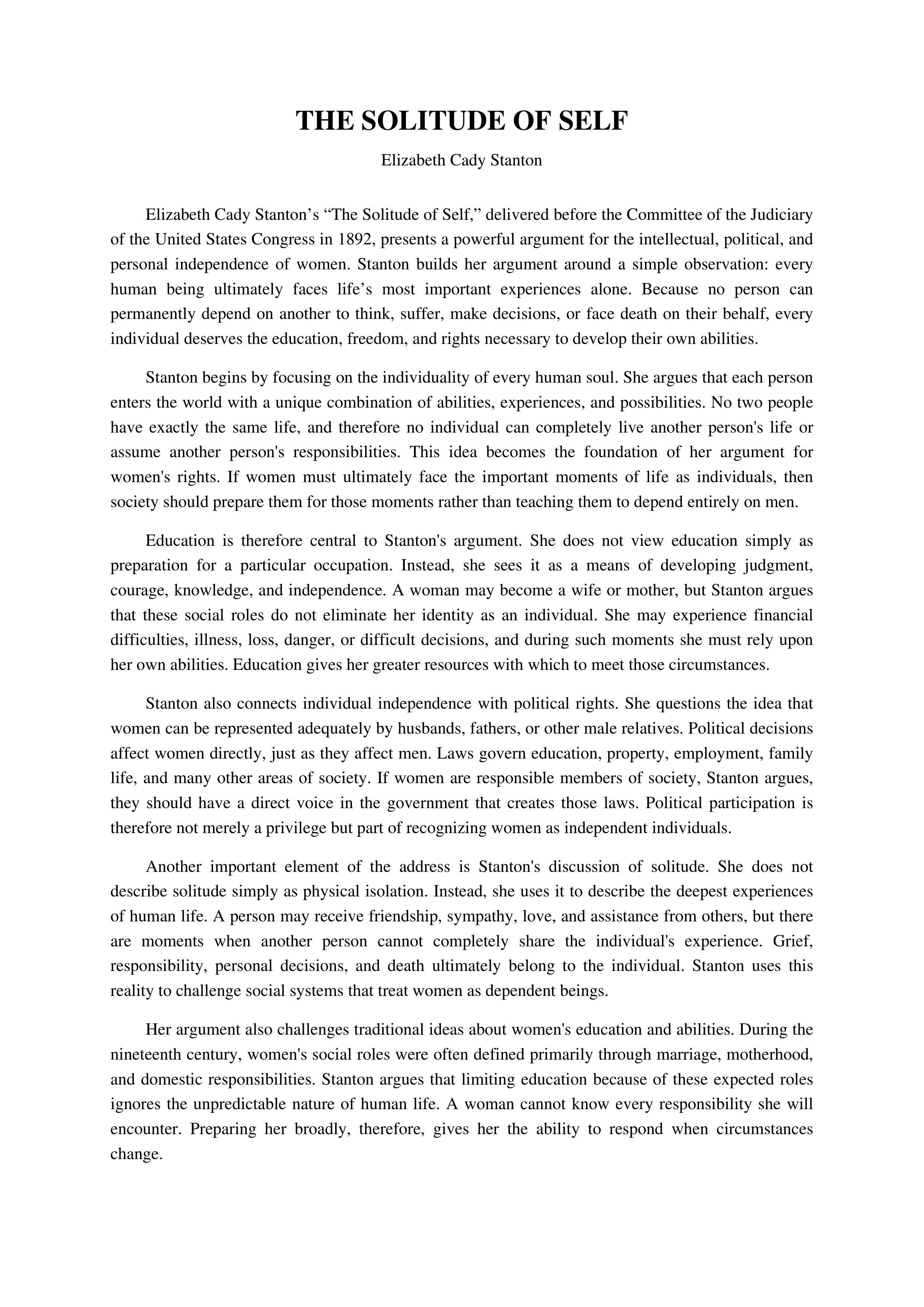
THE SOLITUDE OF SELF
Elizabeth Cady Stanton
Elizabeth Cady Stanton’s “The Solitude of Self,” delivered before the Committee of the Judiciary
of the United States Congress in 1892, presents a powerful argument for the intellectual, political, and
personal independence of women. Stanton builds her argument around a simple observation: every
human being ultimately faces life’s most important experiences alone. Because no person can
permanently depend on another to think, suffer, make decisions, or face death on their behalf, every
individual deserves the education, freedom, and rights necessary to develop their own abilities.
Stanton begins by focusing on the individuality of every human soul. She argues that each person
enters the world with a unique combination of abilities, experiences, and possibilities. No two people
have exactly the same life, and therefore no individual can completely live another person's life or
assume another person's responsibilities. This idea becomes the foundation of her argument for
women's rights. If women must ultimately face the important moments of life as individuals, then
society should prepare them for those moments rather than teaching them to depend entirely on men.
Education is therefore central to Stanton's argument. She does not view education simply as
preparation for a particular occupation. Instead, she sees it as a means of developing judgment,
courage, knowledge, and independence. A woman may become a wife or mother, but Stanton argues
that these social roles do not eliminate her identity as an individual. She may experience financial
difficulties, illness, loss, danger, or difficult decisions, and during such moments she must rely upon
her own abilities. Education gives her greater resources with which to meet those circumstances.
Stanton also connects individual independence with political rights. She questions the idea that
women can be represented adequately by husbands, fathers, or other male relatives. Political decisions
affect women directly, just as they affect men. Laws govern education, property, employment, family
life, and many other areas of society. If women are responsible members of society, Stanton argues,
they should have a direct voice in the government that creates those laws. Political participation is
therefore not merely a privilege but part of recognizing women as independent individuals.
Another important element of the address is Stanton's discussion of solitude. She does not
describe solitude simply as physical isolation. Instead, she uses it to describe the deepest experiences
of human life. A person may receive friendship, sympathy, love, and assistance from others, but there
are moments when another person cannot completely share the individual's experience. Grief,
responsibility, personal decisions, and death ultimately belong to the individual. Stanton uses this
reality to challenge social systems that treat women as dependent beings.
Her argument also challenges traditional ideas about women's education and abilities. During the
nineteenth century, women's social roles were often defined primarily through marriage, motherhood,
and domestic responsibilities. Stanton argues that limiting education because of these expected roles
ignores the unpredictable nature of human life. A woman cannot know every responsibility she will
encounter. Preparing her broadly, therefore, gives her the ability to respond when circumstances
change.