1
The Talented Tenth
By PROF. W.E. BURGHARDT DuBOIS
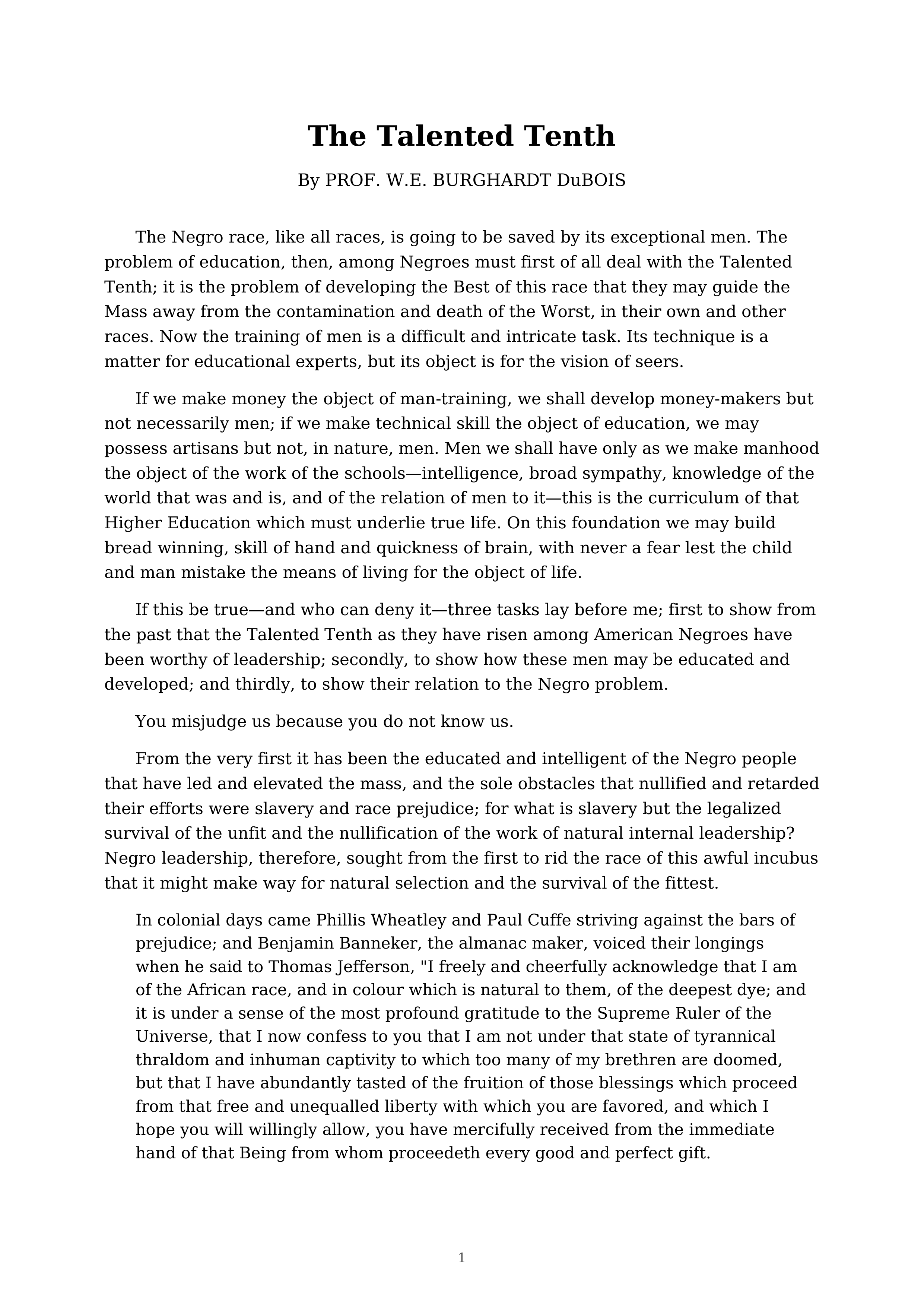
The Negro race, like all races, is going to be saved by its exceptional men. The
problem of education, then, among Negroes must first of all deal with the Talented
Tenth; it is the problem of developing the Best of this race that they may guide the
Mass away from the contamination and death of the Worst, in their own and other
races. Now the training of men is a difficult and intricate task. Its technique is a
matter for educational experts, but its object is for the vision of seers.
If we make money the object of man-training, we shall develop money-makers but
not necessarily men; if we make technical skill the object of education, we may
possess artisans but not, in nature, men. Men we shall have only as we make manhood
the object of the work of the schools—intelligence, broad sympathy, knowledge of the
world that was and is, and of the relation of men to it—this is the curriculum of that
Higher Education which must underlie true life. On this foundation we may build
bread winning, skill of hand and quickness of brain, with never a fear lest the child
and man mistake the means of living for the object of life.
If this be true—and who can deny it—three tasks lay before me; first to show from
the past that the Talented Tenth as they have risen among American Negroes have
been worthy of leadership; secondly, to show how these men may be educated and
developed; and thirdly, to show their relation to the Negro problem.
You misjudge us because you do not know us.
From the very first it has been the educated and intelligent of the Negro people
that have led and elevated the mass, and the sole obstacles that nullified and retarded
their efforts were slavery and race prejudice; for what is slavery but the legalized
survival of the unfit and the nullification of the work of natural internal leadership?
Negro leadership, therefore, sought from the first to rid the race of this awful incubus
that it might make way for natural selection and the survival of the fittest.
In colonial days came Phillis Wheatley and Paul Cuffe striving against the bars of
prejudice; and Benjamin Banneker, the almanac maker, voiced their longings
when he said to Thomas Jefferson, "I freely and cheerfully acknowledge that I am
of the African race, and in colour which is natural to them, of the deepest dye; and
it is under a sense of the most profound gratitude to the Supreme Ruler of the
Universe, that I now confess to you that I am not under that state of tyrannical
thraldom and inhuman captivity to which too many of my brethren are doomed,
but that I have abundantly tasted of the fruition of those blessings which proceed
from that free and unequalled liberty with which you are favored, and which I
hope you will willingly allow, you have mercifully received from the immediate
hand of that Being from whom proceedeth every good and perfect gift.
2
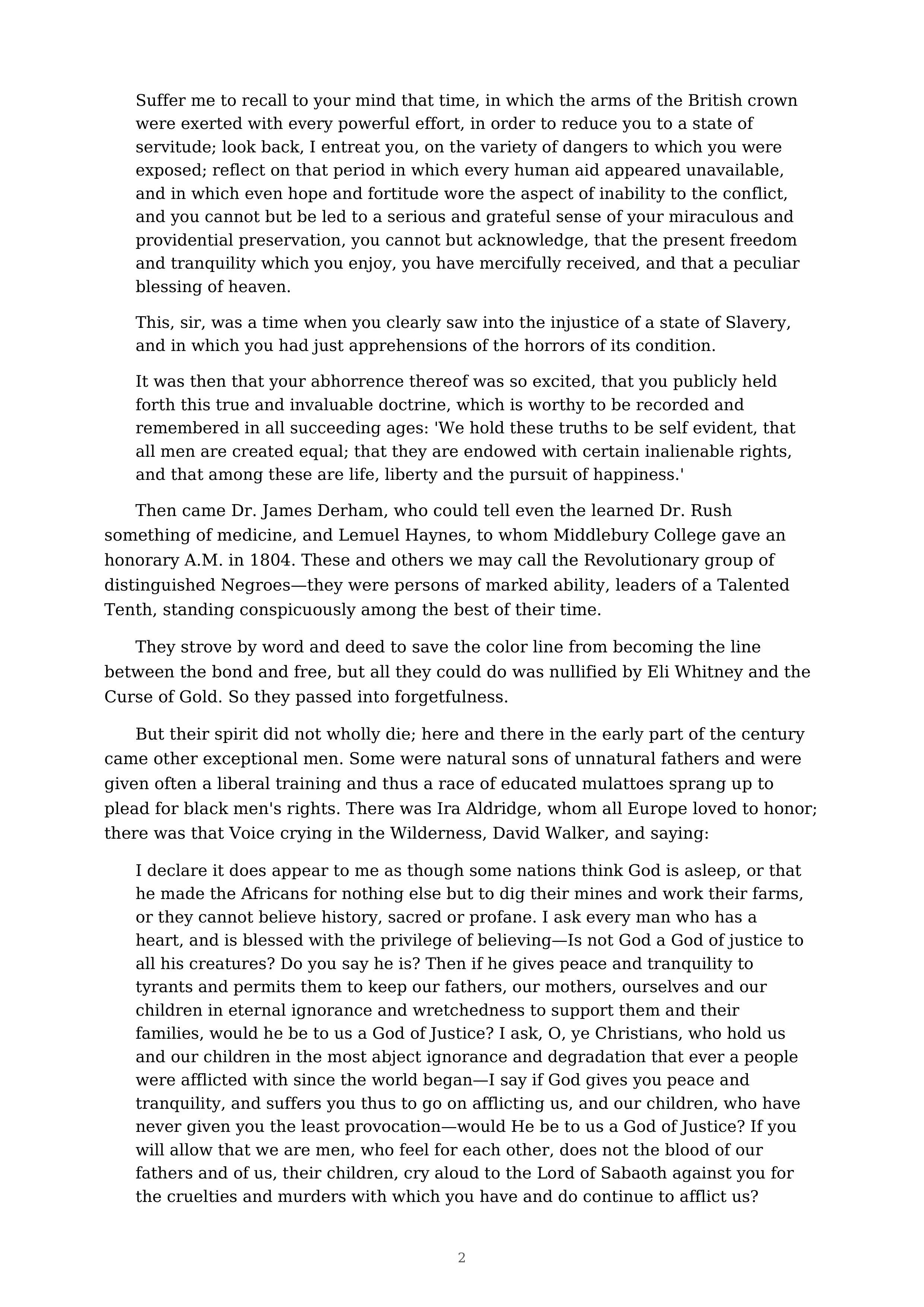
Suffer me to recall to your mind that time, in which the arms of the British crown
were exerted with every powerful effort, in order to reduce you to a state of
servitude; look back, I entreat you, on the variety of dangers to which you were
exposed; reflect on that period in which every human aid appeared unavailable,
and in which even hope and fortitude wore the aspect of inability to the conflict,
and you cannot but be led to a serious and grateful sense of your miraculous and
providential preservation, you cannot but acknowledge, that the present freedom
and tranquility which you enjoy, you have mercifully received, and that a peculiar
blessing of heaven.
This, sir, was a time when you clearly saw into the injustice of a state of Slavery,
and in which you had just apprehensions of the horrors of its condition.
It was then that your abhorrence thereof was so excited, that you publicly held
forth this true and invaluable doctrine, which is worthy to be recorded and
remembered in all succeeding ages: 'We hold these truths to be self evident, that
all men are created equal; that they are endowed with certain inalienable rights,
and that among these are life, liberty and the pursuit of happiness.'
Then came Dr. James Derham, who could tell even the learned Dr. Rush
something of medicine, and Lemuel Haynes, to whom Middlebury College gave an
honorary A.M. in 1804. These and others we may call the Revolutionary group of
distinguished Negroes—they were persons of marked ability, leaders of a Talented
Tenth, standing conspicuously among the best of their time.
They strove by word and deed to save the color line from becoming the line
between the bond and free, but all they could do was nullified by Eli Whitney and the
Curse of Gold. So they passed into forgetfulness.
But their spirit did not wholly die; here and there in the early part of the century
came other exceptional men. Some were natural sons of unnatural fathers and were
given often a liberal training and thus a race of educated mulattoes sprang up to
plead for black men's rights. There was Ira Aldridge, whom all Europe loved to honor;
there was that Voice crying in the Wilderness, David Walker, and saying:
I declare it does appear to me as though some nations think God is asleep, or that
he made the Africans for nothing else but to dig their mines and work their farms,
or they cannot believe history, sacred or profane. I ask every man who has a
heart, and is blessed with the privilege of believing—Is not God a God of justice to
all his creatures? Do you say he is? Then if he gives peace and tranquility to
tyrants and permits them to keep our fathers, our mothers, ourselves and our
children in eternal ignorance and wretchedness to support them and their
families, would he be to us a God of Justice? I ask, O, ye Christians, who hold us
and our children in the most abject ignorance and degradation that ever a people
were afflicted with since the world began—I say if God gives you peace and
tranquility, and suffers you thus to go on afflicting us, and our children, who have
never given you the least provocation—would He be to us a God of Justice? If you
will allow that we are men, who feel for each other, does not the blood of our
fathers and of us, their children, cry aloud to the Lord of Sabaoth against you for
the cruelties and murders with which you have and do continue to afflict us?
3
This was the wild voice that first aroused Southern legislators in 1829 to the
terrors of abolitionism.
In 1831 there met that first Negro convention in Philadelphia, at which the world
gaped curiously but which bravely attacked the problems of race and slavery, crying
out against persecution and declaring that "Laws as cruel in themselves as they were
unconstitutional and unjust, have in many places been enacted against our poor,
unfriended and unoffending brethren (without a shadow of provocation on our part),
at whose bare recital the very savage draws himself up for fear of contagion—looks
noble and prides himself because he bears not the name of Christian." Side by side
this free Negro movement, and the movement for abolition, strove until they merged
into one strong stream.
Too little notice has been taken of the work which the Talented Tenth among
Negroes took in the great abolition crusade. From the very day that a Philadelphia
colored man became the first subscriber to Garrison's "Liberator," to the day
when Negro soldiers made the Emancipation Proclamation possible, black leaders
worked shoulder to shoulder with white men in a movement, the success of which
would have been impossible without them.
There was Purvis and Remond, Pennington and Highland Garnett, Sojourner
Truth and Alexander Crummel, and above all, Frederick Douglass—what would
the abolition movement have been without them? They stood as living examples of
the possibilities of the Negro race, their own hard experiences and well wrought
culture said silently more than all the drawn periods of orators—they were the
men who made American slavery impossible.
As Maria Weston Chapman once said, from the school of anti-slavery agitation "a
throng of authors, editors, lawyers, orators and accomplished gentlemen of color
have taken their degree! It has equally implanted hopes and aspirations, noble
thoughts, and sublime purposes, in the hearts of both races. It has prepared the
white man for the freedom of the black man, and it has made the black man scorn
the thought of enslavement, as does a white man, as far as its influence has
extended.
Strengthen that noble influence! Before its organization, the country only saw
here and there in slavery some faithful Cudjoe or Dinah, whose strong natures
blossomed even in bondage, like a fine plant beneath a heavy stone. Now, under
the elevating and cherishing influence of the American Anti-slavery Society, the
colored race, like the white, furnishes Corinthian capitals for the noblest temples.
Where were these black abolitionists trained? Some, like Frederick Douglass,
were self-trained, but yet trained liberally; others, like Alexander Crummell and
McCune Smith, graduated from famous foreign universities. Most of them rose up
through the colored schools of New York and Philadelphia and Boston, taught by
college-bred men like Russworm, of Dartmouth, and college-bred white men like Neau
and Benezet.
After emancipation came a new group of educated and gifted leaders: Langston,
Bruce and Elliot, Greener, Williams and Payne. Through political organization,
4
historical and polemic writing and moral regeneration, these men strove to uplift their
people.
It is the fashion of to-day to sneer at them and to say that with freedom Negro
leadership should have begun at the plow and not in the Senate—a foolish and
mischievous lie; two hundred and fifty years that black serf toiled at the plow and yet
that toiling was in vain till the Senate passed the war amendments; and two hundred
and fifty years more the half-free serf of to-day may toil at his plow, but unless he
have political rights and righteously guarded civic status, he will still remain the
poverty-stricken and ignorant plaything of rascals, that he now is.
This all sane men know even if they dare not say it.
And so we come to the present—a day of cowardice and vacillation, of strident
wide-voiced wrong and faint hearted compromise; of double-faced dallying with Truth
and Right. Who are to-day guiding the work of the Negro people? The "exceptions" of
course.
And yet so sure as this Talented Tenth is pointed out, the blind worshippers of the
Average cry out in alarm: "These are exceptions, look here at death, disease and
crime—these are the happy rule." Of course they are the rule, because a silly nation
made them the rule: Because for three long centuries this people lynched Negroes
who dared to be brave, raped black women who dared to be virtuous, crushed
dark-hued youth who dared to be ambitious, and encouraged and made to flourish
servility and lewdness and apathy.
But not even this was able to crush all manhood and chastity and aspiration from
black folk. A saving remnant continually survives and persists, continually aspires,
continually shows itself in thrift and ability and character. Exceptional it is to be sure,
but this is its chiefest promise; it shows the capability of Negro blood, the promise of
black men.
Do Americans ever stop to reflect that there are in this land a million men of
Negro blood, well-educated, owners of homes, against the honor of whose
womanhood no breath was ever raised, whose men occupy positions of trust and
usefulness, and who, judged by any standard, have reached the full measure of the
best type of modern European culture? Is it fair, is it decent, is it Christian to ignore
these facts of the Negro problem, to belittle such aspiration, to nullify such leadership
and seek to crush these people back into the mass out of which by toil and travail,
they and their fathers have raised themselves?
Can the masses of the Negro people be in any possible way more quickly raised
than by the effort and example of this aristocracy of talent and character? Was there
ever a nation on God's fair earth civilized from the bottom upward? Never; it is, ever
was and ever will be from the top downward that culture filters. The Talented Tenth
rises and pulls all that are worth the saving up to their vantage ground.
This is the history of human progress; and the two historic mistakes which have
hindered that progress were the thinking first that no more could ever rise save the
5
few already risen; or second, that it would better the unrisen to pull the risen down.
How then shall the leaders of a struggling people be trained and the hands of the
risen few strengthened? There can be but one answer: The best and most capable of
their youth must be schooled in the colleges and universities of the land. We will not
quarrel as to just what the university of the Negro should teach or how it should teach
it—I willingly admit that each soul and each race-soul needs its own peculiar
curriculum.
But this is true: A university is a human invention for the transmission of
knowledge and culture from generation to generation, through the training of quick
minds and pure hearts, and for this work no other human invention will suffice, not
even trade and industrial schools.
All men cannot go to college but some men must; every isolated group or nation
must have its yeast, must have for the talented few centers of training where men are
not so mystified and befuddled by the hard and necessary toil of earning a living, as to
have no aims higher than their bellies, and no God greater than Gold. This is true
training, and thus in the beginning were the favored sons of the freedmen trained.
Out of the colleges of the North came, after the blood of war, Ware, Cravath,
Chase, Andrews, Bumstead and Spence to build the foundations of knowledge and
civilization in the black South. Where ought they to have begun to build? At the
bottom, of course, quibbles the mole with his eyes in the earth. Aye! truly at the
bottom, at the very bottom; at the bottom of knowledge, down in the very depths of
knowledge there where the roots of justice strike into the lowest soil of Truth.
And so they did begin; they founded colleges, and up from the colleges shot
normal schools, and out from the normal schools went teachers, and around the
normal teachers clustered other teachers to teach the public schools; the college
trained in Greek and Latin and mathematics, 2,000 men; and these men trained full
50,000 others in morals and manners, and they in turn taught thrift and the alphabet
to nine millions of men, who to-day hold $300,000,000 of property.
It was a miracle—the most wonderful peace-battle of the 19th century, and yet
to-day men smile at it, and in fine superiority tell us that it was all a strange mistake;
that a proper way to found a system of education is first to gather the children and
buy them spelling books and hoes; afterward men may look about for teachers, if
haply they may find them; or again they would teach men Work, but as for Life—why,
what has Work to do with Life, they ask vacantly.
Was the work of these college founders successful; did it stand the test of time?
Did the college graduates, with all their fine theories of life, really live? Are they
useful men helping to civilize and elevate their less fortunate fellows? Let us see.
Omitting all institutions which have not actually graduated students from a college
course, there are to-day in the United States thirty-four institutions giving something
above high school training to Negroes and designed especially for this race.
6
Three of these were established in border States before the War; thirteen were
planted by the Freedmen's Bureau in the years 1864-1869; nine were established
between 1870 and 1880 by various church bodies; five were established after 1881 by
Negro churches, and four are state institutions supported by United States'
agricultural funds. In most cases the college departments are small adjuncts to high
and common school work.
As a matter of fact six institutions—Atlanta, Fisk, Howard, Shaw, Wilberforce and
Leland, are the important Negro colleges so far as actual work and number of
students are concerned. In all these institutions, seven hundred and fifty Negro
college students are enrolled. In grade the best of these colleges are about a year
behind the smaller New England colleges and a typical curriculum is that of Atlanta
University.
Here students from the grammar grades, after a three years' high school course,
take a college course of 136 weeks. One-fourth of this time is given to Latin and
Greek; one-fifth, to English and modern languages; one-sixth, to history and social
science; one-seventh, to natural science; one-eighth to mathematics, and one-eighth
to philosophy and pedagogy.
In addition to these students in the South, Negroes have attended Northern
colleges for many years. As early as 1826 one was graduated from Bowdoin College,
and from that time till to-day nearly every year has seen elsewhere, other such
graduates. They have, of course, met much color prejudice. Fifty years ago very few
colleges would admit them at all. Even to-day no Negro has ever been admitted to
Princeton, and at some other leading institutions they are rather endured than
encouraged.
Oberlin was the great pioneer in the work of blotting out the color line in colleges,
and has more Negro graduates by far than any other Northern college.
The total number of Negro college graduates up to 1899, (several of the graduates
of that year not being reported), was as follows:
Negro Colleges. Before '76: 137. '75-80: 143. '80-85: 250. '85-90: 413. '90-95: 465.
'96-99: 475. Class Unknown: 57. Total: 1,914. White Colleges. Before '76: 75. '75-80:
22. '80-85: 31. '85-90: 43. '90-95: 66. '96-99: 88. Class Unknown: 64. Total: 390.
Of these graduates 2,079 were men and 252 were women; 50 per cent. of
Northern-born college men come South to work among the masses of their people, at
a sacrifice which few people realize; nearly 90 per cent. of the Southern-born
graduates instead of seeking that personal freedom and broader intellectual
atmosphere which their training has led them, in some degree, to conceive, stay and
labor and wait in the midst of their black neighbors and relatives.
The most interesting question, and in many respects the crucial question, to be
asked concerning college-bred Negroes, is: Do they earn a living? It has been
intimated more than once that the higher training of Negroes has resulted in sending
into the world of work, men who could find nothing to do suitable to their talents.
7
Now and then there comes a rumor of a colored college man working at menial
service, etc.
Fortunately, returns as to occupations of college-bred Negroes, gathered by the
Atlanta conference, are quite full—nearly sixty per cent. of the total number of
graduates.
This enables us to reach fairly certain conclusions as to the occupations of all
college-bred Negroes. Of 1,312 persons reported, there were: Teachers, 53.4 per
cent.; Clergymen, 16.8; Physicians, etc., 6.3; Students, 5.6; Lawyers, 4.7; In
Government Service, 4.0; In Business, 3.6; Farmers and Artisans, 2.7; Editors,
Secretaries and Clerks, 2.4; Miscellaneous, .5.
Over half are teachers, a sixth are preachers, another sixth are students and
professional men; over 6 per cent. are farmers, artisans and merchants, and 4 per
cent. are in government service. In detail the occupations are as follows: Teachers:
Presidents and Deans, 19; Teacher of Music, 7; Professors, Principals and Teachers,
675; Total 701. Clergymen: Bishop, 1; Chaplains U.S. Army, 2; Missionaries, 9;
Presiding Elders, 12; Preachers, 197; Total 221. Physicians: Doctors of Medicine, 76;
Druggists, 4; Dentists, 3; Total 83. Students, 74. Lawyers, 62. Civil Service: U.S.
Minister Plenipotentiary, 1; U.S. Consul, 1; U.S. Deputy Collector, 1; U.S. Gauger, 1;
U.S. Postmasters, 2; U.S. Clerks, 44; State Civil Service, 2; City Civil Service, 1; Total
53. Business Men: Merchants, etc., 30; Managers, 13; Real Estate Dealers, 4; Total
47. Farmers, 26. Clerks and Secretaries: Secretary of National Societies, 7; Clerks,
etc., 15; Total 22. Artisans, 9. Editors, 9. Miscellaneous, 5.
These figures illustrate vividly the function of the college-bred Negro. He is, as he
ought to be, the group leader, the man who sets the ideals of the community
where he lives, directs its thoughts and heads its social movements. It need hardly
be argued that the Negro people need social leadership more than most groups;
that they have no traditions to fall back upon, no long established customs, no
strong family ties, no well defined social classes. All these things must be slowly
and painfully evolved.
The preacher was, even before the war, the group leader of the Negroes, and the
church their greatest social institution. Naturally this preacher was ignorant and
often immoral, and the problem of replacing the older type by better educated
men has been a difficult one. Both by direct work and by direct influence on other
preachers, and on congregations, the college-bred preacher has an opportunity
for reformatory work and moral inspiration, the value of which cannot be
overestimated.
It has, however, been in the furnishing of teachers that the Negro college has
found its peculiar function. Few persons realize how vast a work, how mighty a
revolution has been thus accomplished. To furnish five millions and more of
ignorant people with teachers of their own race and blood, in one generation, was
not only a very difficult undertaking, but a very important one, in that, it placed
before the eyes of almost every Negro child an attainable ideal.
8
It brought the masses of the blacks in contact with modern civilization, made
black men the leaders of their communities and trainers of the new generation. In
this work college-bred Negroes were first teachers, and then teachers of teachers.
And here it is that the broad culture of college work has been of peculiar value.
Knowledge of life and its wider meaning, has been the point of the Negro's
deepest ignorance, and the sending out of teachers whose training has not been
simply for bread winning, but also for human culture, has been of inestimable
value in the training of these men.
In earlier years the two occupations of preacher and teacher were practically the
only ones open to the black college graduate. Of later years a larger diversity of
life among his people, has opened new avenues of employment. Nor have these
college men been paupers and spendthrifts; 557 college-bred Negroes owned in
1899, $1,342,862.50 worth of real estate, (assessed value) or $2,411 per family.
The real value of the total accumulations of the whole group is perhaps about
$10,000,000, or $5,000 a piece.
Pitiful, is it not, beside the fortunes of oil kings and steel trusts, but after all is the
fortune of the millionaire the only stamp of true and successful living? Alas! it is,
with many, and there's the rub.
The problem of training the Negro is to-day immensely complicated by the fact
that the whole question of the efficiency and appropriateness of our present
systems of education, for any kind of child, is a matter of active debate, in which
final settlement seems still afar off. Consequently it often happens that persons
arguing for or against certain systems of education for Negroes, have these
controversies in mind and miss the real question at issue.
The main question, so far as the Southern Negro is concerned, is: What under the
present circumstance, must a system of education do in order to raise the Negro
as quickly as possible in the scale of civilization? The answer to this question
seems to me clear: It must strengthen the Negro's character, increase his
knowledge and teach him to earn a living.
Now it goes without saying, that it is hard to do all these things simultaneously or
suddenly, and that at the same time it will not do to give all the attention to one
and neglect the others; we could give black boys trades, but that alone will not
civilize a race of ex-slaves; we might simply increase their knowledge of the world,
but this would not necessarily make them wish to use this knowledge honestly; we
might seek to strengthen character and purpose, but to what end if this people
have nothing to eat or to wear? A system of education is not one thing, nor does it
have a single definite object, nor is it a mere matter of schools.
Education is that whole system of human training within and without the school
house walls, which molds and develops men. If then we start out to train an
ignorant and unskilled people with a heritage of bad habits, our system of training
must set before itself two great aims—the one dealing with knowledge and
character, the other part seeking to give the child the technical knowledge
necessary for him to earn a living under the present circumstances.
9
These objects are accomplished in part by the opening of the common schools on
the one, and of the industrial schools on the other. But only in part, for there must
also be trained those who are to teach these schools—men and women of
knowledge and culture and technical skill who understand modern civilization,
and have the training and aptitude to impart it to the children under them.
There must be teachers, and teachers of teachers, and to attempt to establish any
sort of a system of common and industrial school training, without first (and I say
first advisedly) without first providing for the higher training of the very best
teachers, is simply throwing your money to the winds. School houses do not teach
themselves—piles of brick and mortar and machinery do not send out men.
It is the trained, living human soul, cultivated and strengthened by long study and
thought, that breathes the real breath of life into boys and girls and makes them
human, whether they be black or white, Greek, Russian or American.
Nothing, in these latter days, has so dampened the faith of thinking Negroes in
recent educational movements, as the fact that such movements have been
accompanied by ridicule and denouncement and decrying of those very
institutions of higher training which made the Negro public school possible, and
make Negro industrial schools thinkable.
It was Fisk, Atlanta, Howard and Straight, those colleges born of the faith and
sacrifice of the abolitionists, that placed in the black schools of the South the
30,000 teachers and more, which some, who depreciate the work of these higher
schools, are using to teach their own new experiments.
If Hampton, Tuskegee and the hundred other industrial schools prove in the
future to be as successful as they deserve to be, then their success in training
black artisans for the South, will be due primarily to the white colleges of the
North and the black colleges of the South, which trained the teachers who to-day
conduct these institutions.
There was a time when the American people believed pretty devoutly that a log of
wood with a boy at one end and Mark Hopkins at the other, represented the
highest ideal of human training. But in these eager days it would seem that we
have changed all that and think it necessary to add a couple of saw-mills and a
hammer to this outfit, and, at a pinch, to dispense with the services of Mark
Hopkins.
I would not deny, or for a moment seem to deny, the paramount necessity of
teaching the Negro to work, and to work steadily and skillfully; or seem to
depreciate in the slightest degree the important part industrial schools must play
in the accomplishment of these ends, but I do say, and insist upon it, that it is
industrialism drunk with its vision of success, to imagine that its own work can be
accomplished without providing for the training of broadly cultured men and
women to teach its own teachers, and to teach the teachers of the public schools.
But I have already said that human education is not simply a matter of schools; it
is much more a matter of family and group life—the training of one's home, of
one's daily companions, of one's social class. Now the black boy of the South
moves in a black world—a world with its own leaders, its own thoughts, its own
10
ideals. In this world he gets by far the larger part of his life training, and through
the eyes of this dark world he peers into the veiled world beyond.
Who guides and determines the education which he receives in his world? His
teachers here are the group-leaders of the Negro people—the physicians and
clergymen, the trained fathers and mothers, the influential and forceful men
about him of all kinds; here it is, if at all, that the culture of the surrounding world
trickles through and is handed on by the graduates of the higher schools.
Can such culture training of group leaders be neglected? Can we afford to ignore
it? Do you think that if the leaders of thought among Negroes are not trained and
educated thinkers, that they will have no leaders? On the contrary a hundred
half-trained demagogues will still hold the places they so largely occupy now, and
hundreds of vociferous busy-bodies will multiply.
You have no choice; either you must help furnish this race from within its own
ranks with thoughtful men of trained leadership, or you must suffer the evil
consequences of a headless misguided rabble.
I am an earnest advocate of manual training and trade teaching for black boys,
and for white boys, too. I believe that next to the founding of Negro colleges the
most valuable addition to Negro education since the war, has been industrial
training for black boys.
Nevertheless, I insist that the object of all true education is not to make men
carpenters, it is to make carpenters men; there are two means of making the
carpenter a man, each equally important: the first is to give the group and
community in which he works, liberally trained teachers and leaders to teach him
and his family what life means; the second is to give him sufficient intelligence
and technical skill to make him an efficient workman; the first object demands the
Negro college and college-bred men—not a quantity of such colleges, but a few of
excellent quality; not too many college-bred men, but enough to leaven the lump,
to inspire the masses, to raise the Talented Tenth to leadership; the second object
demands a good system of common schools, well-taught, conveniently located and
properly equipped.
The Sixth Atlanta Conference truly said in 1901:
We call the attention of the Nation to the fact that less than one million of the
three million Negro children of school age, are at present regularly attending
school, and these attend a session which lasts only a few months.
We are to-day deliberately rearing millions of our citizens in ignorance, and at the
same time limiting the rights of citizenship by educational qualifications. This is
unjust. Half the black youth of the land have no opportunities open to them for
learning to read, write and cipher. In the discussion as to the proper training of Negro
children after they leave the public schools, we have forgotten that they are not yet
decently provided with public schools.
Propositions are beginning to be made in the South to reduce the already meagre
school facilities of Negroes. We congratulate the South on resisting, as much as it has,
this pressure, and on the many millions it has spent on Negro education.
11
But it is only fair to point out that Negro taxes and the Negroes' share of the
income from indirect taxes and endowments have fully repaid this expenditure, so
that the Negro public school system has not in all probability cost the white taxpayers
a single cent since the war.
This is not fair. Negro schools should be a public burden, since they are a public
benefit. The Negro has a right to demand good common school training at the hands
of the States and the Nation since by their fault he is not in position to pay for this
himself.
What is the chief need for the building up of the Negro public school in the South?
The Negro race in the South needs teachers to-day above all else. This is the
concurrent testimony of all who know the situation. For the supply of this great
demand two things are needed—institutions of higher education and money for school
houses and salaries.
It is usually assumed that a hundred or more institutions for Negro training are
to-day turning out so many teachers and college-bred men that the race is threatened
with an over-supply. This is sheer nonsense. There are to-day less than 3,000 living
Negro college graduates in the United States, and less than 1,000 Negroes in college.
Moreover, in the 164 schools for Negroes, 95 per cent. of their students are doing
elementary and secondary work, work which should be done in the public schools.
Over half the remaining 2,157 students are taking high school studies. The mass
of so-called "normal" schools for the Negro, are simply doing elementary common
school work, or, at most, high school work, with a little instruction in methods. The
Negro colleges and the post-graduate courses at other institutions are the only
agencies for the broader and more careful training of teachers. The work of these
institutions is hampered for lack of funds.
It is getting increasingly difficult to get funds for training teachers in the best
modern methods, and yet all over the South, from State Superintendents, county
officials, city boards and school principals comes the wail, "We need TEACHERS!" and
teachers must be trained. As the fairest minded of all white Southerners, Atticus G.
Haygood, once said: "The defects of colored teachers are so great as to create an
urgent necessity for training better ones.
Their excellencies and their successes are sufficient to justify the best hopes of
success in the effort, and to vindicate the judgment of those who make large
investments of money and service, to give to colored students opportunity for
thoroughly preparing themselves for the work of teaching children of their people.
The truth of this has been strikingly shown in the marked improvement of white
teachers in the South. Twenty years ago the rank and file of white public school
teachers were not as good as the Negro teachers. But they, by scholarships and good
salaries, have been encouraged to thorough normal and collegiate preparation, while
the Negro teachers have been discouraged by starvation wages and the idea that any
training will do for a black teacher.
12
If carpenters are needed it is well and good to train men as carpenters. But to
train men as carpenters, and then set them to teaching is wasteful and criminal; and
to train men as teachers and then refuse them living wages, unless they become
carpenters, is rank nonsense.
The United States Commissioner of Education says in his report for 1900: "For
comparison between the white and colored enrollment in secondary and higher
education, I have added together the enrollment in high schools and secondary
schools, with the attendance on colleges and universities, not being sure of the actual
grade of work done in the colleges and universities. The work done in the secondary
schools is reported in such detail in this office, that there can be no doubt of its grade.
He then makes the following comparisons of persons in every million enrolled in
secondary and higher education: Whole Country—1880, 4,362; 1900, 10,743.
Negroes—1880, 1,289; 1900, 2,061.
And he concludes: "While the number in colored high schools and colleges had
increased somewhat faster than the population, it had not kept pace with the average
of the whole country, for it had fallen from 30 per cent. to 24 per cent. of the average
quota. Of all colored pupils, one (1) in one hundred was engaged in secondary and
higher work, and that ratio has continued substantially for the past twenty years.
If the ratio of colored population in secondary and higher education is to be equal
to the average for the whole country, it must be increased to five times its present
average." And if this be true of the secondary and higher education, it is safe to say
that the Negro has not one-tenth his quota in college studies. How baseless,
therefore, is the charge of too much training! We need Negro teachers for the Negro
common schools, and we need first-class normal schools and colleges to train them.
This is the work of higher Negro education and it must be done.
Further than this, after being provided with group leaders of civilization, and a
foundation of intelligence in the public schools, the carpenter, in order to be a man,
needs technical skill. This calls for trade schools. Now trade schools are not nearly
such simple things as people once thought.
The original idea was that the "Industrial" school was to furnish education,
practically free, to those willing to work for it; it was to "do" things—i.e.: become a
center of productive industry, it was to be partially, if not wholly, self-supporting, and
it was to teach trades.
Admirable as were some of the ideas underlying this scheme, the whole thing
simply would not work in practice; it was found that if you were to use time and
material to teach trades thoroughly, you could not at the same time keep the
industries on a commercial basis and make them pay. Many schools started out to do
this on a large scale and went into virtual bankruptcy.
Moreover, it was found also that it was possible to teach a boy a trade
mechanically, without giving him the full educative benefit of the process, and, vice
versa, that there was a distinctive educative value in teaching a boy to use his hands
13
and eyes in carrying out certain physical processes, even though he did not actually
learn a trade. It has happened, therefore, in the last decade, that a noticeable change
has come over the industrial schools.
In the first place the idea of commercially remunerative industry in a school is
being pushed rapidly to the back-ground. There are still schools with shops and farms
that bring an income, and schools that use student labor partially for the erection of
their buildings and the furnishing of equipment.
It is coming to be seen, however, in the education of the Negro, as clearly as it has
been seen in the education of the youths the world over, that it is the boy and not the
material product, that is the true object of education. Consequently the object of the
industrial school came to be the thorough training of boys regardless of the cost of the
training, so long as it was thoroughly well done.
Even at this point, however, the difficulties were not surmounted. In the first place
modern industry has taken great strides since the war, and the teaching of trades is
no longer a simple matter. Machinery and long processes of work have greatly
changed the work of the carpenter, the ironworker and the shoemaker. A really
efficient workman must be to-day an intelligent man who has had good technical
training in addition to thorough common school, and perhaps even higher training.
To meet this situation the industrial schools began a further development; they
established distinct Trade Schools for the thorough training of better class artisans,
and at the same time they sought to preserve for the purposes of general education,
such of the simpler processes of elementary trade learning as were best suited
therefor. In this differentiation of the Trade School and manual training, the best of
the industrial schools simply followed the plain trend of the present educational
epoch.
A prominent educator tells us that, in Sweden, "In the beginning the economic
conception was generally adopted, and everywhere manual training was looked upon
as a means of preparing the children of the common people to earn their living. But
gradually it came to be recognized that manual training has a more elevated purpose,
and one, indeed, more useful in the deeper meaning of the term.
It came to be considered as an educative process for the complete moral, physical
and intellectual development of the child.
Thus, again, in the manning of trade schools and manual training schools we are
thrown back upon the higher training as its source and chief support. There was a
time when any aged and wornout carpenter could teach in a trade school. But not so
to-day. Indeed the demand for college-bred men by a school like Tuskegee, ought to
make Mr. Booker T. Washington the firmest friend of higher training.
Here he has as helpers the son of a Negro senator, trained in Greek and the
humanities, and graduated at Harvard; the son of a Negro congressman and lawyer,
trained in Latin and mathematics, and graduated at Oberlin; he has as his wife, a
woman who read Virgil and Homer in the same class room with me; he has as college
14
chaplain, a classical graduate of Atlanta University; as teacher of science, a graduate
of Fisk; as teacher of history, a graduate of Smith,—indeed some thirty of his chief
teachers are college graduates, and instead of studying French grammars in the midst
of weeds, or buying pianos for dirty cabins, they are at Mr. Washington's right hand
helping him in a noble work. And yet one of the effects of Mr. Washington's
propaganda has been to throw doubt upon the expediency of such training for
Negroes, as these persons have had.
Men of America, the problem is plain before you. Here is a race transplanted
through the criminal foolishness of your fathers. Whether you like it or not the
millions are here, and here they will remain. If you do not lift them up, they will pull
you down. Education and work are the levers to uplift a people. Work alone will not do
it unless inspired by the right ideals and guided by intelligence. Education must not
simply teach work—it must teach Life.
The Talented Tenth of the Negro race must be made leaders of thought and
missionaries of culture among their people. No others can do this work and Negro
colleges must train men for it. The Negro race, like all other races, is going to be
saved by its exceptional men.
Source: W. E. B. Du Bois, “The Talented Tenth,” in The Negro Problem: A Series of Articles by
Representative American Negroes of To-Day (New York: James Pott and Company, 1903), pp. 31–75. Text
checked against the Project Gutenberg edition of The Negro Problem, eBook 15041.