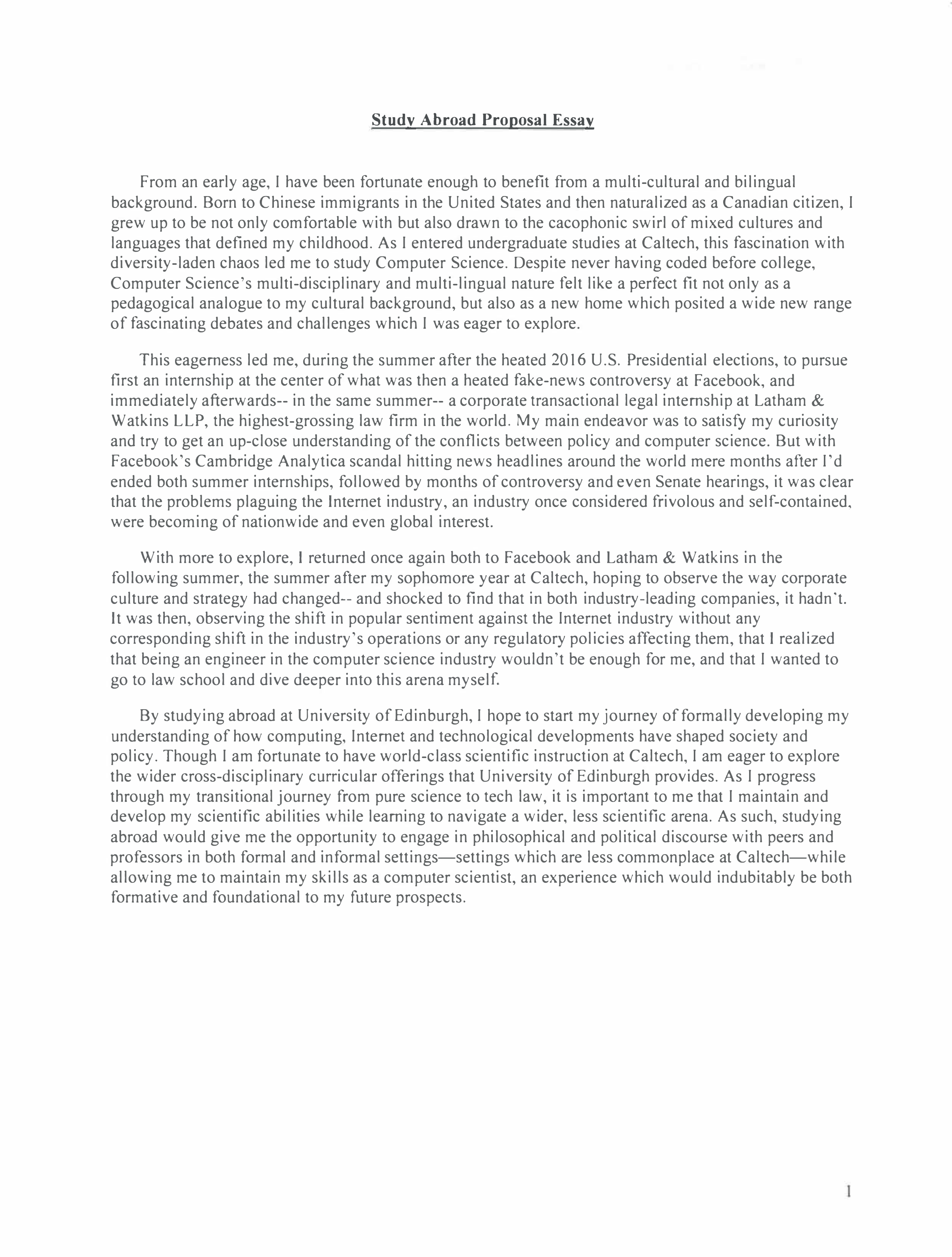

Study Abroad Proposal Essay
From an early age, I have been fortunate enough to benefit from a multi-cultural and bilingual
background. Born to Chinese immigrants in the United States and then naturalized as a Canadian citizen, I
grew up to be not only comfortable with but also drawn to the cacophonic swirl of mixed cultures and
languages that defined my childhood. As I entered undergraduate studies at Caltech, this fascination with
diversity-laden chaos led me to study Computer Science. Despite never having coded before college,
Computer Science's multi-disciplinary and multi-lingual nature felt like a perfect fit not only as a
pedagogical analogue to my cultural background, but also as a new home which posited a wide new range
of fascinating debates and challenges which I was eager to explore.
This eagerness led me, during the summer after the heated 2016 U.S. Presidential elections, to pursue
first an internship at the center of what was then a heated fake-news controversy at Facebook, and
immediately afterwards-- in the same summer-- a corporate transactional legal internship at Latham &
Watkins LLP, the highest-grossing law firm in the world. My main endeavor was to satisfy my curiosity
and try to get an up-close understanding of the conflicts between policy and computer science. But with
Facebook's Cambridge Analytica scandal hitting news headlines around the world mere months after I'd
ended both summer internships, followed by months of controversy and even Senate hearings, it was clear
that the problems plaguing the Internet industry, an industry once considered frivolous and self-contained,
were becoming of nationwide and even global interest.
With more to explore, I returned once again both to Facebook and Latham & Watkins in the
following summer, the summer after my sophomore year at Caltech, hoping to observe the way corporate
culture and strategy had changed-- and shocked to find that in both industry-leading companies, it hadn't.
It was then, observing the shift in popular sentiment against the Internet industry without any
corresponding shift in the industry's operations or any regulatory policies affecting them, that I realized
that being an engineer in the computer science industry wouldn't be enough for me, and that I wanted to
go to law school and dive deeper into this arena myself.
By studying abroad at University of Edinburgh, I hope to start my journey of formally developing my
understanding of how computing, Internet and technological developments have shaped society and
policy. Though I am fortunate to have world-class scientific instruction at Caltech, I am eager to explore
the wider cross-disciplinary curricular offerings that University of Edinburgh provides. As I progress
through my transitional journey from pure science to tech law, it is important to me that I maintain and
develop my scientific abilities while learning to navigate a wider, less scientific arena. As such, studying
abroad would give me the opportunity to engage in philosophical and political discourse with peers and
professors in both formal and informal settings-settings which are less commonplace at Caltech-while
allowing me to maintain my skills as a computer scientist, an experience which would indubitably be both
formative and foundational to my future prospects.
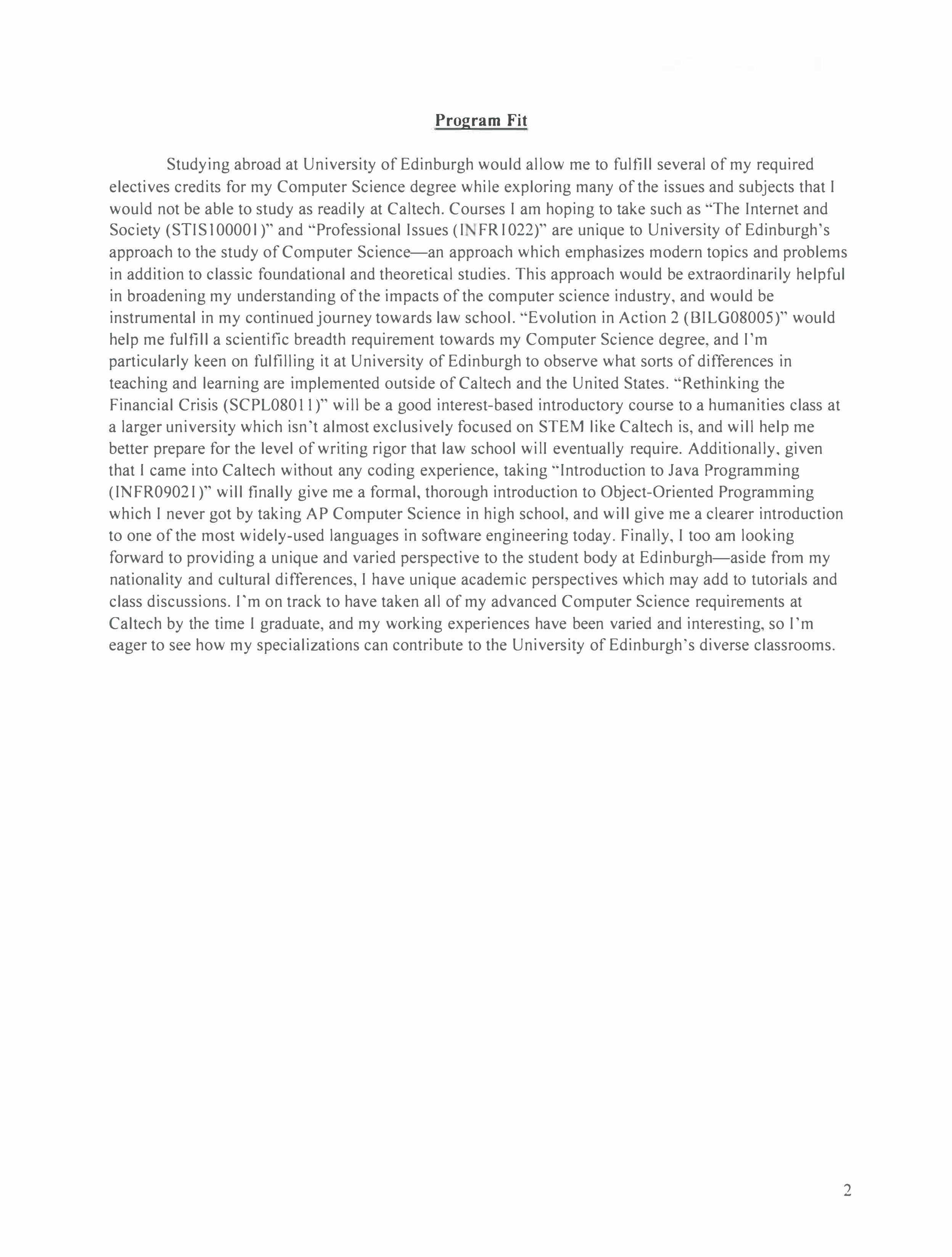

Program Fit
Studying abroad at University of Edinburgh would allow me to fulfill several of my required
electives credits for my Computer Science degree while exploring many of the issues and subjects that I
would not be able to study as readily at Caltech. Courses I am hoping to take such as "The Internet and
Society (STISl0000 l)" and "Professional Issues (I FRI022)" are unique to University of Edinburgh's
approach to the study of Computer Science-an approach which emphasizes modern topics and problems
in addition to classic foundational and theoretical studies. This approach would be extraordinarily helpful
in broadening my understanding of the impacts of the computer science industry, and would be
instrumental in my continued journey towards law school. "Evolution in Action 2 (BILG08005)" would
help me fulfill a scientific breadth requirement towards my Computer Science degree, and I'm
particularly keen on fulfilling it at University of Edinburgh to observe what sorts of differences in
teaching and learning are implemented outside of Caltech and the United States. "Rethinking the
Financial Crisis (SCPL08011 )" will be a good interest-based introductory course to a humanities class at
a larger university which isn't almost exclusively focused on STEM like Caltech is, and will help me
better prepare for the level of writing rigor that law school wi I eventually require. Additionally, given
that I came into Caltech without any coding experience, taking "Introduction to Java Programming
(INFR0902 I)" will finally give me a formal, thorough introduction to Object-Oriented Programming
which I never got by taking AP Computer Science in high school, and will give me a clearer introduction
to one of the most widely-used languages in software engineering today. Finally, I too am looking
forward to providing a unique and varied perspective to the student body at Edinburgh-aside from my
nationality and cultural differences, I have unique academic perspectives which may add to tutorials and
class discussions. I'm on track to have taken all of my advanced Computer Science requirements at
Caltech by the time I graduate, and my working experiences have been varied and interesting, so I'm
eager to see how my specializations can contribute to the University of Edinburgh's diverse classrooms.
2

Edinburgh Proposed Course List
Total Edinburgh Credits (60-80 Edin. Credits): 80
Total CIT Units: 45
Course by Correspondence/Units: N/A
1.
The Internet and Society (STIS10001)
College of Humanities and Social Science
School of Social and Political Science : Science, Technology and Innovation Studies
SCQF Level 10
Semester 1
20 SCQF Credits
9 Caltech Units
Prof. Thomas Vi dick
Option Credit (Breadth: Elective in E&AS or Ma)
"Internet technologies play an important, often controversial, role in contemporary society, touching almost
every aspect of our lives. Many dramatic, both dystopian and utopian, claims have been made about the
transformative 'effects' of these technologies. This course will investigate these claims across different areas of
life, technologies and practices. It will treat 'the internet' not as one monolithic entity, but as a collection of at
times disparate technologies, platforms, practices and discourses that are co-evolving with rather than impacting
on society. The course will cover key themes, historical and contemporary, that have informed and challenged
our understanding and assumptions about the interaction between the internet and society. This will include, but
will not be limited to: identity and subjectivity, social exclusion and inequality, politics and democracy,
globalisation and development, privacy and surveillance.
The course will focus on specific empirical case studies and technologies as well as theoretical and
methodological questions on how to best study and conceptualise the role of internet technologies in society. We
will draw, in particular, on the multidisciplinary area of research referred to as science and technology studies
(STS), but, where relevant, will complement this with research in sociology, geography, anthropology,
philosophy, history, media and communications, and politics. At the end of the course students will not only be
familiar with the social study of the internet, but will also be able to apply key conceptual frameworks and
sociological thinking to tackling contemporary issues, policy and practice pertaining to information and
communication technologies (/CT) and digital media more broadly.
No specialist technical knowledge
is
required other than students' personal experience of computers, internet,
and mobile phone use.
The classes will consist of a combination of lectures, group discussions and debates, in class and home work with
data and evidence, presentations, and on-line work. Students will be expected to read and summarise set papers
online before each class, and prepare personal exercises for use in group activities."
2.
Professional Issues (INFR10022)
College of Science and Engineering
School of Informatics : Informatics
SCQF Level 10
Semester 1
10 SCQF Credits
9 Caltech units
Prof. Thomas Vidick
Option Credit (Breadth: Elective in Ma, ACM or CS)
"* Personal Attributes: study skills, personal development, interpersonal skills; employers' views and expectations
of graduates; study skills, writing skills, presentation skills.
3

•
The Computing Profession: professional bodies; codes of conduct and practice.
•
Social and ethical issues: security, privacy, software ownership
•
Legal Issues: legal and regulatory frameworks; software contracts and liability; intellectual property, copyright
and patents; computer misuse, data protection; health and safety.
•
Commercial Issues: organisational structures; finance, accounting, audit; resource management.
•
Computing Projects: design, prototype and product; product development cycle; marketing and market
research; project management and team working; change management.
•
This course consolidates complements and assesses the students appreciation and understanding of Professional
Issues introduced across our curriculum.
Relevant QAA Computing Curriculum Sections: Professionalism"
3.
Introduction to Java Programming (INFR09021)
College of Science and Engineering
School of Informatics : Informatics
SCQF 9
Semester 1
10 SCQF Credits
9 Caltech units
Prof. Thomas Vi dick
Option Credit (Breadth: Elective in Ma, ACM, or CS)
"Learning to program requires practice, and students on this course typically have very diverse programming
backgrounds. Locating and working with online materials is also an essential skill for developing real applications.
For these reasons, the course has no regular lectures on the content
-
it is facilitated by structured assignments,
a recommended textbook, online materials, well-supported lab sessions (or online tutorials for distance learning
students), and an online forum. This provides a flexible learning environment, and students should be prepared
to manage their own schedule and to take advantage of the resources in a way which is most appropriate to their
own experience.
The course content includes the following topics:
-
Object-oriented design
-
classes, objects, inheritance, coupling, cohesion, responsibility.
-
The basics of the Java programming language.
-
The use of external libraries
-
collections, graphical interfaces, networking.
-
Development tools.
-
Code readability and documentation.
-
Graphical user interfaces.
Relevant QAA Computing Curriculum Sections: Programming Fundamentals."
4.
Evolution in Action 2 (BILG0S00S)
College of Science and Engineering
School of Biological Sciences : Biology
SCQF Level 8
Semester 1
20 SCQF Credits
9 Caltech units
Prof. Thomas Vidick
Option Credit (Scientific Fundamentals)
"Evolutionary biology is the subject of this course, and the aims are to outline the major processes giving rise to
the diversity of extinct and extant organic life, to indicate the time frame over which these processes occur, and
to introduce the methods used to study evolutionary processes. The examples used in the lectures and workshops
are drawn from animals, plants and microorganisms, and the characters considered are behavioural, ecological,
morphological, cellular and molecular.
4

After outlining the ecological context of evolution, the process of evolutionary change leading to speciation is
discussed. The origin and pattern of genetic variation in natural populations is then described, followed by a
detailed examination of the evolutionary forces · natural selection, genetic drift and gene flow. that determine
the fate of inherited variation. The evolution of social behaviour, particularly altruism and competition for
mates, is discussed. Finally, the special role played by change in developmental processes in evolution is
described.
The workshops expand upon material described in the lectures and provide opportunity for discussion of the
concepts and evidence involved. The workshops include demonstrations of the processes of evolution, genetic
variation in natural populations and the methods by which it can be measured, and simple methods for
interpreting such information and predicting the course of evolutionary change. Visits to Edinburgh Zoo and the
National Museum of Scotland allow students to think about how the evolutionary concepts that they learn apply
to real organisms. Facilitated discussions allow students to engage with their peers in examining some of the
more complex or applied aspects of evolutionary biology.
The course should be of interest to every biology student, because evolution is fundamental to understanding the
nature of living organisms at all levels from the ecological to the molecular."
5.
Rethinking the Financial Crisis (SCPL08011)
College of Humanities and Social Science
School of Social and Political Science : Social Policy
SCQF Level 8
Semester 1
20 SCQF Credits
9 Caltech units
Prof. Colin Camerer
General Credit
"This course is available to both year 1 and year 2 students.
The financial crisis of 2007/2008 affected most countries across the world with consequences felt until the
present day and with strong implications for the future. Current policy making is heavily influenced by the
consequences of this crisis with certain approaches dominating the political arena. Championed by a range of
politicians, media commentators and economists from many schools of thought, many of these dominants
paradigms are however contentious. Not only are they critiqued by certain macro-
and political economists, but
also by activists, scholars from other social sciences and the humanities focusing on more than the economic
mechanisms.
This course will place the current debate about the right approach to the role of the state in relation to the
economy in the context of a rich history of social and economic thought. By engaging with classic thinkers, we
will explore that the way we think of the economy nowadays is not the only way one could think about it and that
scholars traditionally thought of as founders of economics (such as Adam Smith) actually never saw economics as
particularly distinct from other forms of social analysis.
Based on this solid foundation we will embark to engage with the contemporary problems faced after the
financial crisis of 2007/2008, engaging actively with the political and social implications. In doing so we will ask
to what extent political parties provide genuine alternative conceptions of how to do social and economic policy
and why particular assumptions about the role of private actors vis a vis the state have become considered as
facts by actors on the traditional left and right, although they are very contentious.
For the course no prior knowledge of economics is assumed, as the course is not designed to teach the
technicalities of economics or political economy. Students from across the social sciences with an interest in
social policy, political decision making, the interplay between the economy and society and theoretical
approaches to understanding these issues will find the course useful. The course would also be relevant for
students with an interest in these issues from other disciplines (for example economics, history and philosophy).
At the end of the course students will be shown by staff members from different subject areas within the School
of Social and Political Science how they may pursue different interests to the learning about the economy in
depth through offers made during the honours years.
5


The course is broken down into three segments: In the first third we will engage with traditional ideas of how the
relationship between the economy, the state and society can be understood. In the second part we will look at
the emergence of dominant economic paradigms in the 1990s and
2000s
and then finally investigate how that has
shaped the way we engaged with the aftermath of the financial crisis (and how we do not consider engaging with
policy and politics).
Texts covered in this course will be a mixture of writings from classic thinkers (e.g. Adam Smith, Jeremy
Bentham, Karl Marx, Friedrich Hayek, Joseph Schumpeter), contemporary political and economic thinkers (e.g.
Martin Woolf, Mark Blyth, Philip Mirovski, Simon Griffiths) and journalists/commentators engaging with the
interplay between politics, academia and business (e.g. Owen Jones, Kevin Rose, Mark Leibovich)."
6