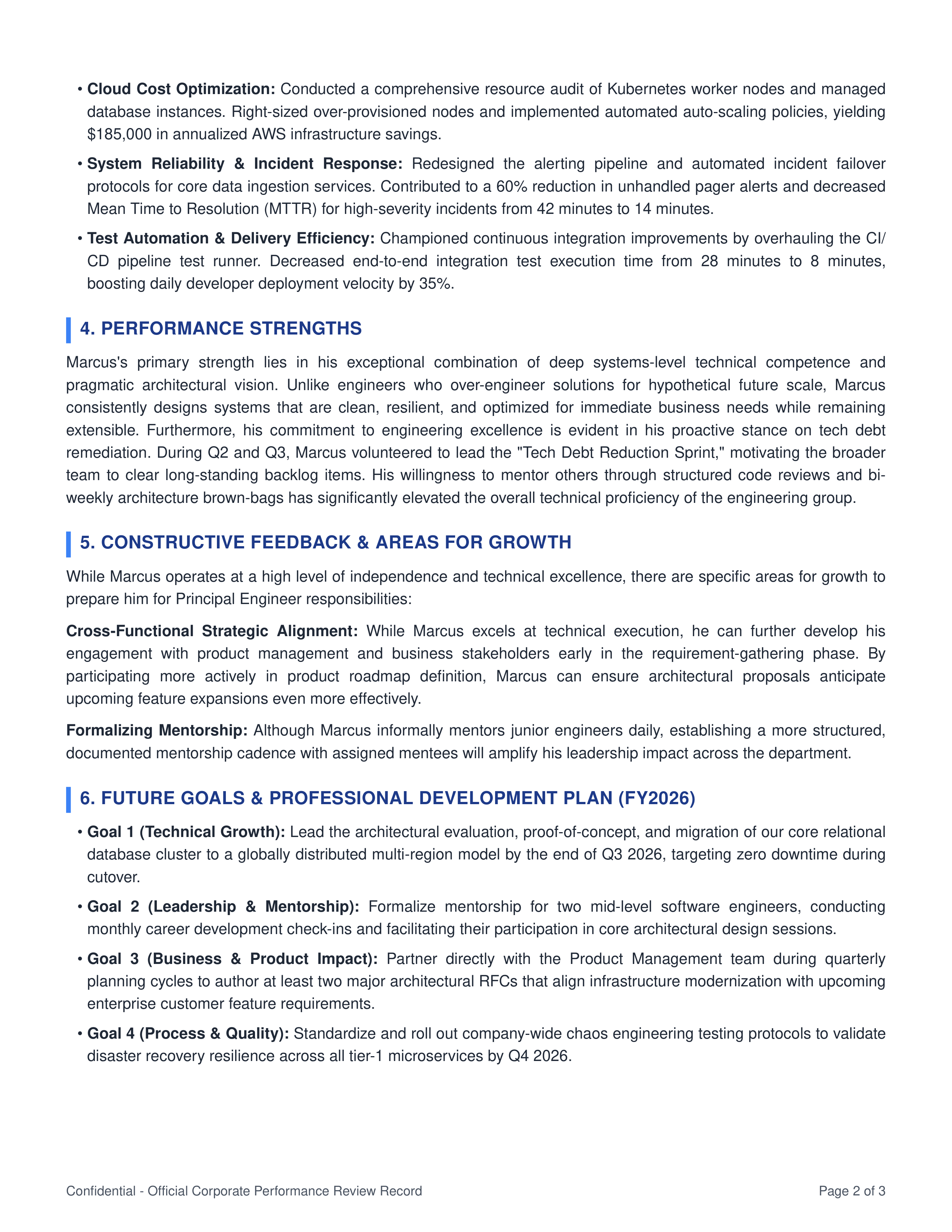
Cloud Cost Optimization:
Conducted a comprehensive resource audit of Kubernetes worker nodes and managed
database instances. Right-sized over-provisioned nodes and implemented automated auto-scaling policies, yielding
$185,000 in annualized AWS infrastructure savings.
System Reliability & Incident Response:
Redesigned the alerting pipeline and automated incident failover
protocols for core data ingestion services. Contributed to a 60% reduction in unhandled pager alerts and decreased
Mean Time to Resolution (MTTR) for high-severity incidents from 42 minutes to 14 minutes.
Test Automation & Delivery Efficiency:
Championed continuous integration improvements by overhauling the CI/
CD pipeline test runner. Decreased end-to-end integration test execution time from 28 minutes to 8 minutes,
boosting daily developer deployment velocity by 35%.
4. PERFORMANCE STRENGTHS
Marcus's primary strength lies in his exceptional combination of deep systems-level technical competence and
pragmatic architectural vision. Unlike engineers who over-engineer solutions for hypothetical future scale, Marcus
consistently designs systems that are clean, resilient, and optimized for immediate business needs while remaining
extensible. Furthermore, his commitment to engineering excellence is evident in his proactive stance on tech debt
remediation. During Q2 and Q3, Marcus volunteered to lead the "Tech Debt Reduction Sprint," motivating the broader
team to clear long-standing backlog items. His willingness to mentor others through structured code reviews and bi-
weekly architecture brown-bags has significantly elevated the overall technical proficiency of the engineering group.
5. CONSTRUCTIVE FEEDBACK & AREAS FOR GROWTH
While Marcus operates at a high level of independence and technical excellence, there are specific areas for growth to
prepare him for Principal Engineer responsibilities:
Cross-Functional Strategic Alignment:
While Marcus excels at technical execution, he can further develop his
engagement with product management and business stakeholders early in the requirement-gathering phase. By
participating more actively in product roadmap definition, Marcus can ensure architectural proposals anticipate
upcoming feature expansions even more effectively.
Formalizing Mentorship:
Although Marcus informally mentors junior engineers daily, establishing a more structured,
documented mentorship cadence with assigned mentees will amplify his leadership impact across the department.
6. FUTURE GOALS & PROFESSIONAL DEVELOPMENT PLAN (FY2026)
Goal 1 (Technical Growth):
Lead the architectural evaluation, proof-of-concept, and migration of our core relational
database cluster to a globally distributed multi-region model by the end of Q3 2026, targeting zero downtime during
cutover.
Goal 2 (Leadership & Mentorship):
Formalize mentorship for two mid-level software engineers, conducting
monthly career development check-ins and facilitating their participation in core architectural design sessions.
Goal 3 (Business & Product Impact):
Partner directly with the Product Management team during quarterly
planning cycles to author at least two major architectural RFCs that align infrastructure modernization with upcoming
enterprise customer feature requirements.
Goal 4 (Process & Quality):
Standardize and roll out company-wide chaos engineering testing protocols to validate
disaster recovery resilience across all tier-1 microservices by Q4 2026.
•
•
•
•
•
•
•
Confidential - Official Corporate Performance Review Record
Page 2 of 3