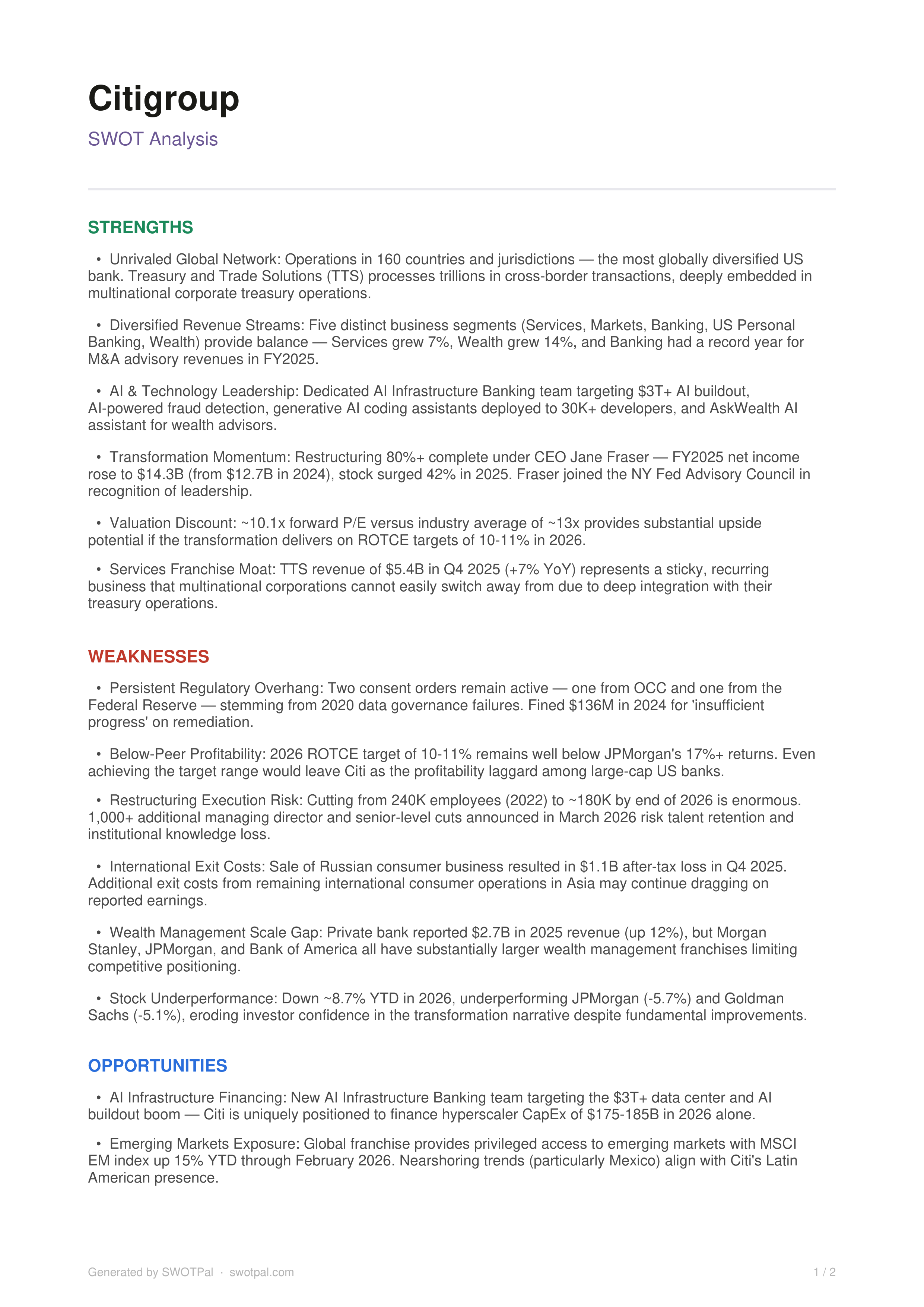
Citigroup
SWOT Analysis
STRENGTHS
• Unrivaled Global Network: Operations in 160 countries and jurisdictions — the most globally diversified US
bank. Treasury and Trade Solutions (TTS) processes trillions in cross-border transactions, deeply embedded in
multinational corporate treasury operations.
• Diversified Revenue Streams: Five distinct business segments (Services, Markets, Banking, US Personal
Banking, Wealth) provide balance — Services grew 7%, Wealth grew 14%, and Banking had a record year for
M&A advisory revenues in FY2025.
• AI & Technology Leadership: Dedicated AI Infrastructure Banking team targeting $3T+ AI buildout,
AI-powered fraud detection, generative AI coding assistants deployed to 30K+ developers, and AskWealth AI
assistant for wealth advisors.
• Transformation Momentum: Restructuring 80%+ complete under CEO Jane Fraser — FY2025 net income
rose to $14.3B (from $12.7B in 2024), stock surged 42% in 2025. Fraser joined the NY Fed Advisory Council in
recognition of leadership.
• Valuation Discount: ~10.1x forward P/E versus industry average of ~13x provides substantial upside
potential if the transformation delivers on ROTCE targets of 10-11% in 2026.
• Services Franchise Moat: TTS revenue of $5.4B in Q4 2025 (+7% YoY) represents a sticky, recurring
business that multinational corporations cannot easily switch away from due to deep integration with their
treasury operations.
WEAKNESSES
• Persistent Regulatory Overhang: Two consent orders remain active — one from OCC and one from the
Federal Reserve — stemming from 2020 data governance failures. Fined $136M in 2024 for 'insufficient
progress' on remediation.
• Below-Peer Profitability: 2026 ROTCE target of 10-11% remains well below JPMorgan's 17%+ returns. Even
achieving the target range would leave Citi as the profitability laggard among large-cap US banks.
• Restructuring Execution Risk: Cutting from 240K employees (2022) to ~180K by end of 2026 is enormous.
1,000+ additional managing director and senior-level cuts announced in March 2026 risk talent retention and
institutional knowledge loss.
• International Exit Costs: Sale of Russian consumer business resulted in $1.1B after-tax loss in Q4 2025.
Additional exit costs from remaining international consumer operations in Asia may continue dragging on
reported earnings.
• Wealth Management Scale Gap: Private bank reported $2.7B in 2025 revenue (up 12%), but Morgan
Stanley, JPMorgan, and Bank of America all have substantially larger wealth management franchises limiting
competitive positioning.
• Stock Underperformance: Down ~8.7% YTD in 2026, underperforming JPMorgan (-5.7%) and Goldman
Sachs (-5.1%), eroding investor confidence in the transformation narrative despite fundamental improvements.
OPPORTUNITIES
• AI Infrastructure Financing: New AI Infrastructure Banking team targeting the $3T+ data center and AI
buildout boom — Citi is uniquely positioned to finance hyperscaler CapEx of $175-185B in 2026 alone.
• Emerging Markets Exposure: Global franchise provides privileged access to emerging markets with MSCI
EM index up 15% YTD through February 2026. Nearshoring trends (particularly Mexico) align with Citi's Latin
American presence.
Generated by SWOTPal · swotpal.com
1 / 2
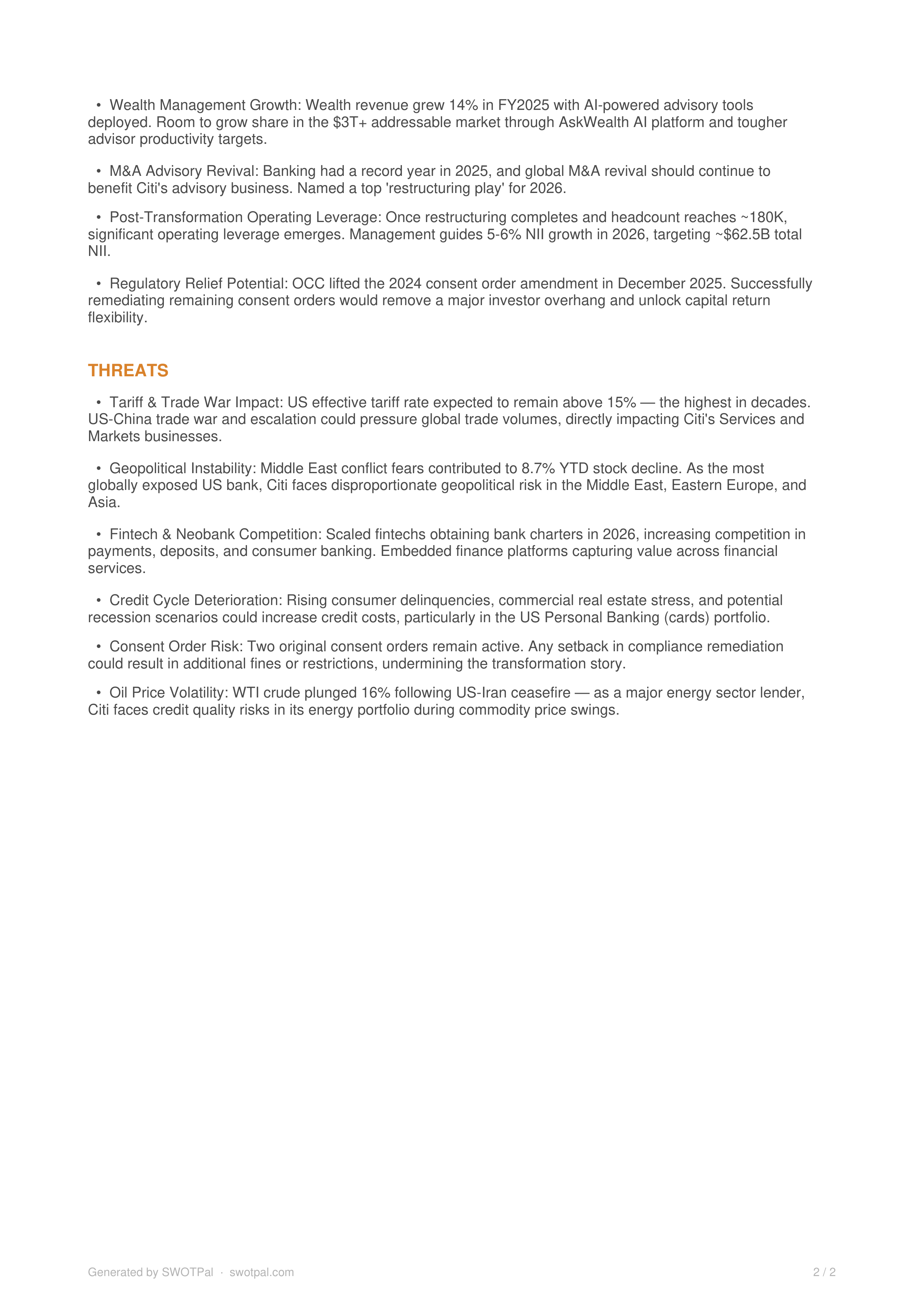
• Wealth Management Growth: Wealth revenue grew 14% in FY2025 with AI-powered advisory tools
deployed. Room to grow share in the $3T+ addressable market through AskWealth AI platform and tougher
advisor productivity targets.
• M&A Advisory Revival: Banking had a record year in 2025, and global M&A revival should continue to
benefit Citi's advisory business. Named a top 'restructuring play' for 2026.
• Post-Transformation Operating Leverage: Once restructuring completes and headcount reaches ~180K,
significant operating leverage emerges. Management guides 5-6% NII growth in 2026, targeting ~$62.5B total
NII.
• Regulatory Relief Potential: OCC lifted the 2024 consent order amendment in December 2025. Successfully
remediating remaining consent orders would remove a major investor overhang and unlock capital return
flexibility.
THREATS
• Tariff & Trade War Impact: US effective tariff rate expected to remain above 15% — the highest in decades.
US-China trade war and escalation could pressure global trade volumes, directly impacting Citi's Services and
Markets businesses.
• Geopolitical Instability: Middle East conflict fears contributed to 8.7% YTD stock decline. As the most
globally exposed US bank, Citi faces disproportionate geopolitical risk in the Middle East, Eastern Europe, and
Asia.
• Fintech & Neobank Competition: Scaled fintechs obtaining bank charters in 2026, increasing competition in
payments, deposits, and consumer banking. Embedded finance platforms capturing value across financial
services.
• Credit Cycle Deterioration: Rising consumer delinquencies, commercial real estate stress, and potential
recession scenarios could increase credit costs, particularly in the US Personal Banking (cards) portfolio.
• Consent Order Risk: Two original consent orders remain active. Any setback in compliance remediation
could result in additional fines or restrictions, undermining the transformation story.
• Oil Price Volatility: WTI crude plunged 16% following US-Iran ceasefire — as a major energy sector lender,
Citi faces credit quality risks in its energy portfolio during commodity price swings.
Generated by SWOTPal · swotpal.com
2 / 2