Honeywell
SWOT Analysis
STRENGTHS
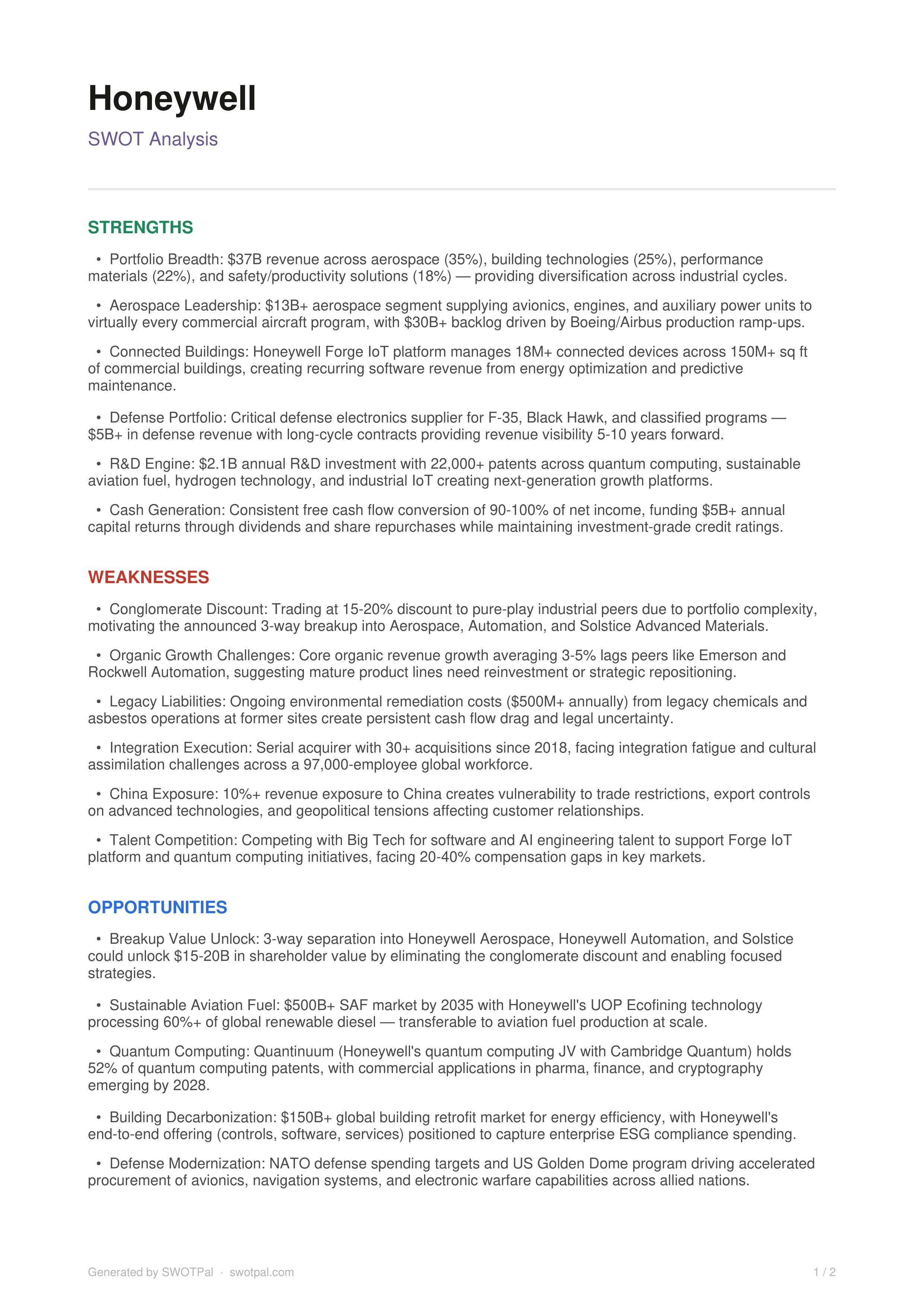
• Portfolio Breadth: $37B revenue across aerospace (35%), building technologies (25%), performance
materials (22%), and safety/productivity solutions (18%) — providing diversification across industrial cycles.
• Aerospace Leadership: $13B+ aerospace segment supplying avionics, engines, and auxiliary power units to
virtually every commercial aircraft program, with $30B+ backlog driven by Boeing/Airbus production ramp-ups.
• Connected Buildings: Honeywell Forge IoT platform manages 18M+ connected devices across 150M+ sq ft
of commercial buildings, creating recurring software revenue from energy optimization and predictive
maintenance.
• Defense Portfolio: Critical defense electronics supplier for F-35, Black Hawk, and classified programs —
$5B+ in defense revenue with long-cycle contracts providing revenue visibility 5-10 years forward.
• R&D Engine: $2.1B annual R&D investment with 22,000+ patents across quantum computing, sustainable
aviation fuel, hydrogen technology, and industrial IoT creating next-generation growth platforms.
• Cash Generation: Consistent free cash flow conversion of 90-100% of net income, funding $5B+ annual
capital returns through dividends and share repurchases while maintaining investment-grade credit ratings.
WEAKNESSES
• Conglomerate Discount: Trading at 15-20% discount to pure-play industrial peers due to portfolio complexity,
motivating the announced 3-way breakup into Aerospace, Automation, and Solstice Advanced Materials.
• Organic Growth Challenges: Core organic revenue growth averaging 3-5% lags peers like Emerson and
Rockwell Automation, suggesting mature product lines need reinvestment or strategic repositioning.
• Legacy Liabilities: Ongoing environmental remediation costs ($500M+ annually) from legacy chemicals and
asbestos operations at former sites create persistent cash flow drag and legal uncertainty.
• Integration Execution: Serial acquirer with 30+ acquisitions since 2018, facing integration fatigue and cultural
assimilation challenges across a 97,000-employee global workforce.
• China Exposure: 10%+ revenue exposure to China creates vulnerability to trade restrictions, export controls
on advanced technologies, and geopolitical tensions affecting customer relationships.
• Talent Competition: Competing with Big Tech for software and AI engineering talent to support Forge IoT
platform and quantum computing initiatives, facing 20-40% compensation gaps in key markets.
OPPORTUNITIES
• Breakup Value Unlock: 3-way separation into Honeywell Aerospace, Honeywell Automation, and Solstice
could unlock $15-20B in shareholder value by eliminating the conglomerate discount and enabling focused
strategies.
• Sustainable Aviation Fuel: $500B+ SAF market by 2035 with Honeywell's UOP Ecofining technology
processing 60%+ of global renewable diesel — transferable to aviation fuel production at scale.
• Quantum Computing: Quantinuum (Honeywell's quantum computing JV with Cambridge Quantum) holds
52% of quantum computing patents, with commercial applications in pharma, finance, and cryptography
emerging by 2028.
• Building Decarbonization: $150B+ global building retrofit market for energy efficiency, with Honeywell's
end-to-end offering (controls, software, services) positioned to capture enterprise ESG compliance spending.
• Defense Modernization: NATO defense spending targets and US Golden Dome program driving accelerated
procurement of avionics, navigation systems, and electronic warfare capabilities across allied nations.
Generated by SWOTPal · swotpal.com
1 / 2