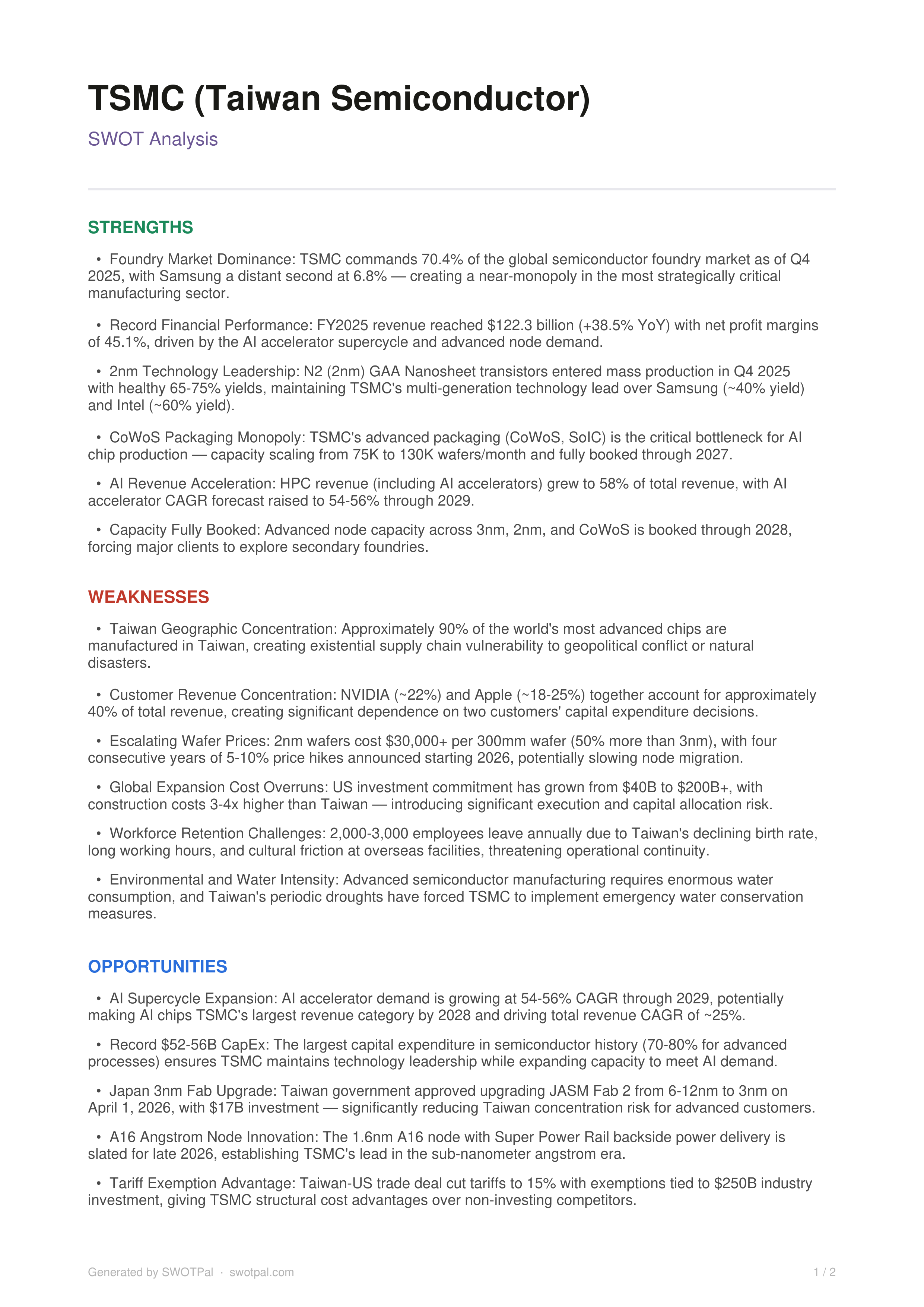
TSMC (Taiwan Semiconductor)
SWOT Analysis
STRENGTHS
• Foundry Market Dominance: TSMC commands 70.4% of the global semiconductor foundry market as of Q4
2025, with Samsung a distant second at 6.8% — creating a near-monopoly in the most strategically critical
manufacturing sector.
• Record Financial Performance: FY2025 revenue reached $122.3 billion (+38.5% YoY) with net profit margins
of 45.1%, driven by the AI accelerator supercycle and advanced node demand.
• 2nm Technology Leadership: N2 (2nm) GAA Nanosheet transistors entered mass production in Q4 2025
with healthy 65-75% yields, maintaining TSMC's multi-generation technology lead over Samsung (~40% yield)
and Intel (~60% yield).
• CoWoS Packaging Monopoly: TSMC's advanced packaging (CoWoS, SoIC) is the critical bottleneck for AI
chip production — capacity scaling from 75K to 130K wafers/month and fully booked through 2027.
• AI Revenue Acceleration: HPC revenue (including AI accelerators) grew to 58% of total revenue, with AI
accelerator CAGR forecast raised to 54-56% through 2029.
• Capacity Fully Booked: Advanced node capacity across 3nm, 2nm, and CoWoS is booked through 2028,
forcing major clients to explore secondary foundries.
WEAKNESSES
• Taiwan Geographic Concentration: Approximately 90% of the world's most advanced chips are
manufactured in Taiwan, creating existential supply chain vulnerability to geopolitical conflict or natural
disasters.
• Customer Revenue Concentration: NVIDIA (~22%) and Apple (~18-25%) together account for approximately
40% of total revenue, creating significant dependence on two customers' capital expenditure decisions.
• Escalating Wafer Prices: 2nm wafers cost $30,000+ per 300mm wafer (50% more than 3nm), with four
consecutive years of 5-10% price hikes announced starting 2026, potentially slowing node migration.
• Global Expansion Cost Overruns: US investment commitment has grown from $40B to $200B+, with
construction costs 3-4x higher than Taiwan — introducing significant execution and capital allocation risk.
• Workforce Retention Challenges: 2,000-3,000 employees leave annually due to Taiwan's declining birth rate,
long working hours, and cultural friction at overseas facilities, threatening operational continuity.
• Environmental and Water Intensity: Advanced semiconductor manufacturing requires enormous water
consumption, and Taiwan's periodic droughts have forced TSMC to implement emergency water conservation
measures.
OPPORTUNITIES
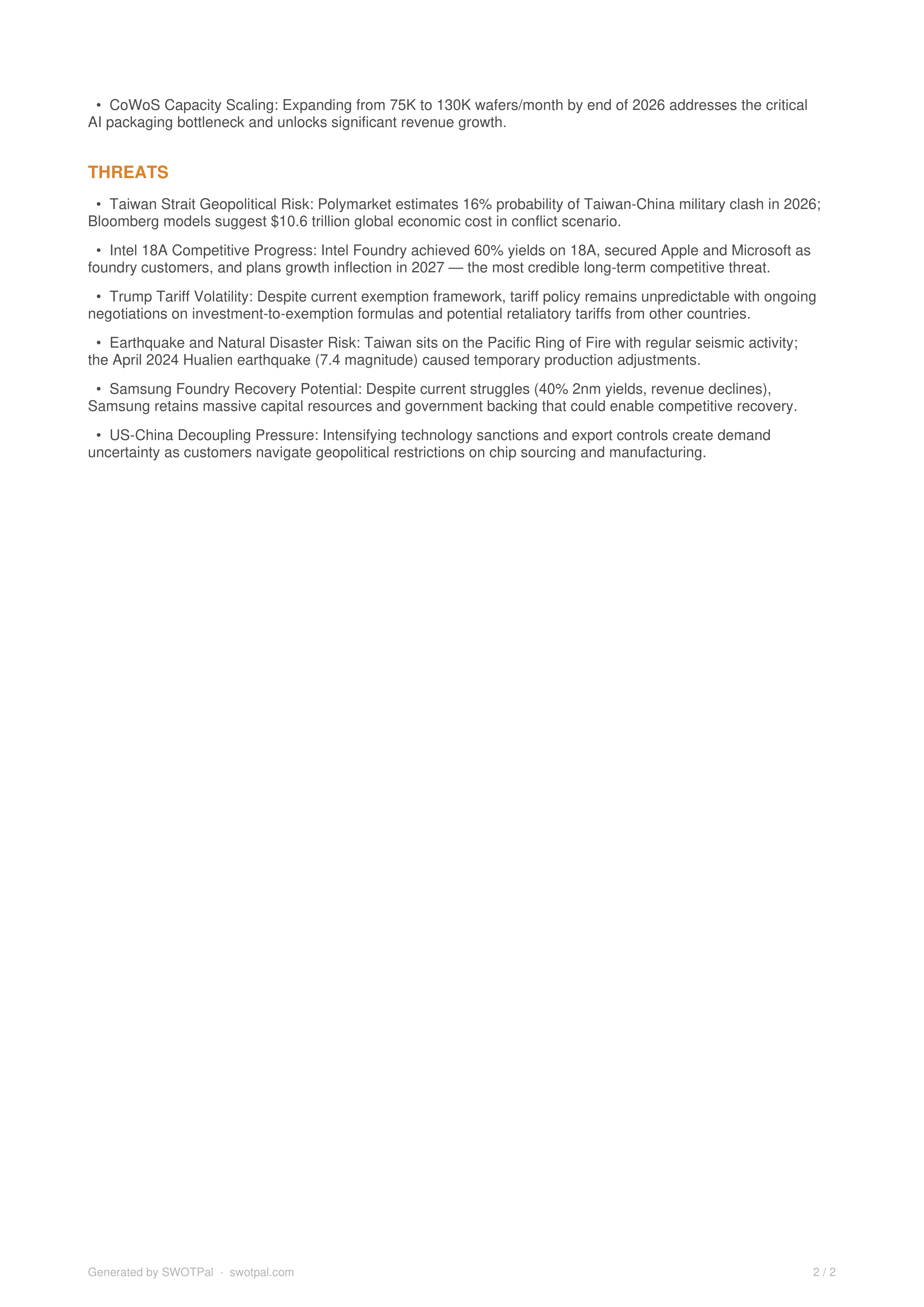
• AI Supercycle Expansion: AI accelerator demand is growing at 54-56% CAGR through 2029, potentially
making AI chips TSMC's largest revenue category by 2028 and driving total revenue CAGR of ~25%.
• Record $52-56B CapEx: The largest capital expenditure in semiconductor history (70-80% for advanced
processes) ensures TSMC maintains technology leadership while expanding capacity to meet AI demand.
• Japan 3nm Fab Upgrade: Taiwan government approved upgrading JASM Fab 2 from 6-12nm to 3nm on
April 1, 2026, with $17B investment — significantly reducing Taiwan concentration risk for advanced customers.
• A16 Angstrom Node Innovation: The 1.6nm A16 node with Super Power Rail backside power delivery is
slated for late 2026, establishing TSMC's lead in the sub-nanometer angstrom era.
• Tariff Exemption Advantage: Taiwan-US trade deal cut tariffs to 15% with exemptions tied to $250B industry
investment, giving TSMC structural cost advantages over non-investing competitors.
Generated by SWOTPal · swotpal.com
1 / 2