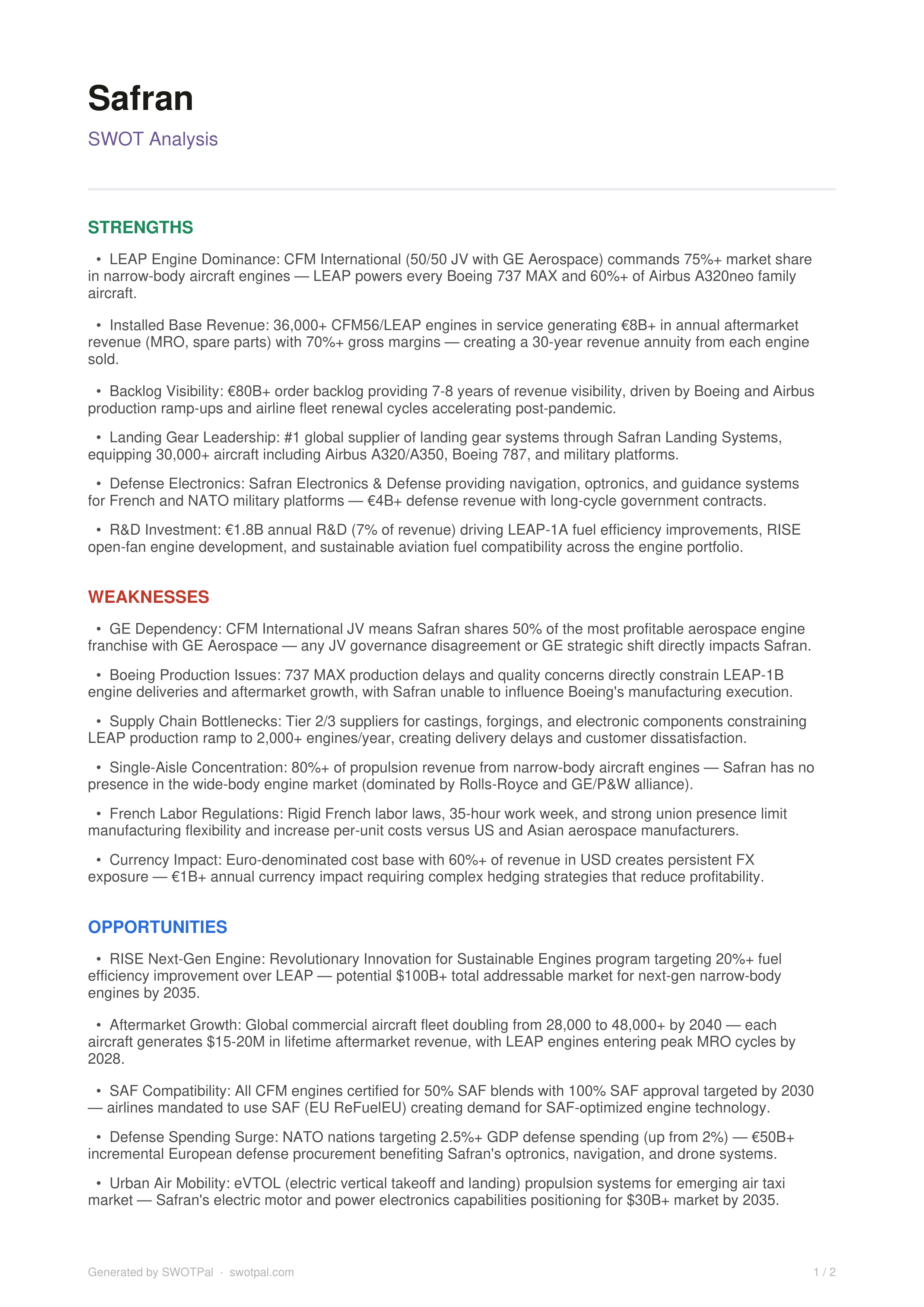
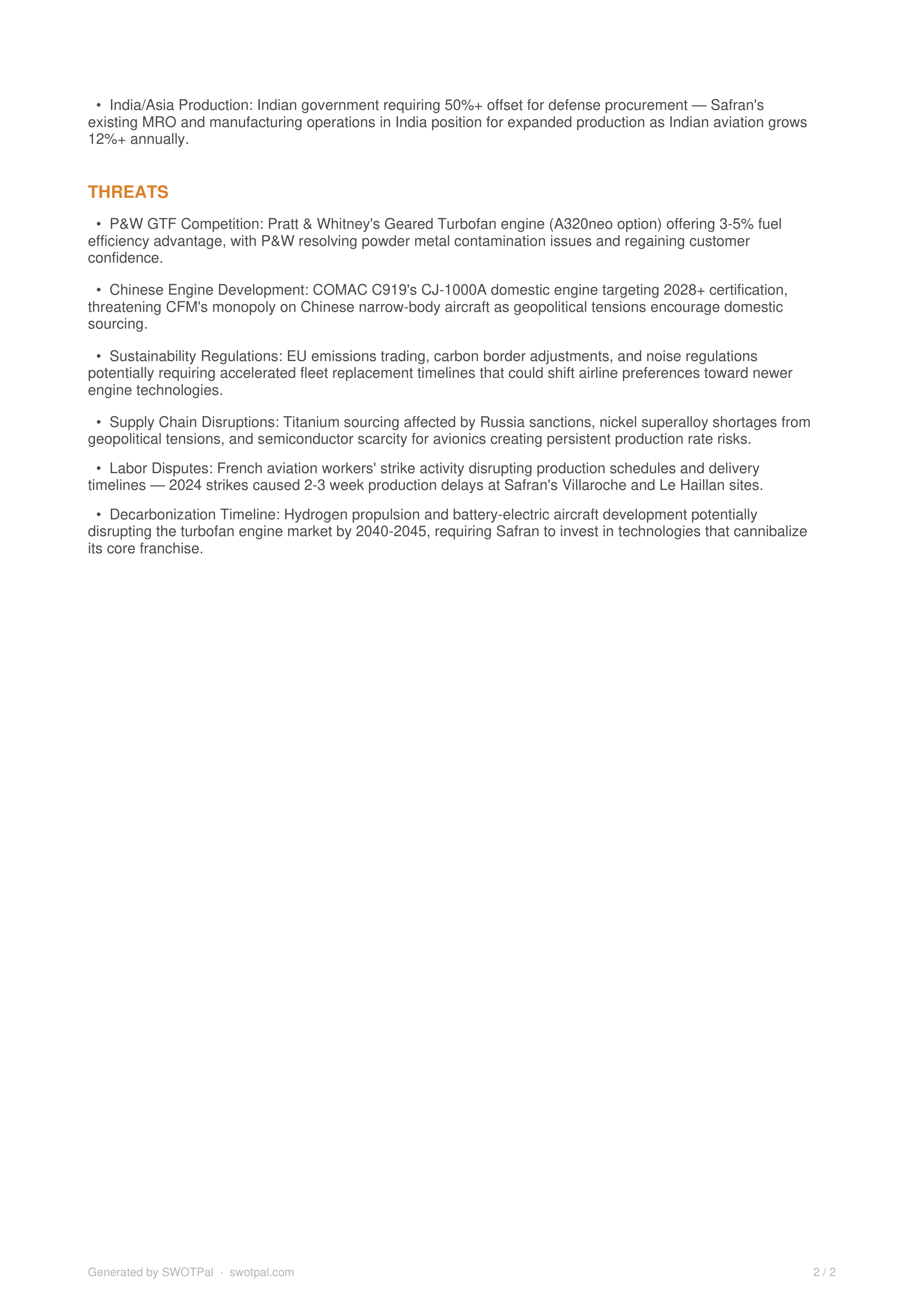
Safran
SWOT Analysis
STRENGTHS
• LEAP Engine Dominance: CFM International (50/50 JV with GE Aerospace) commands 75%+ market share
in narrow-body aircraft engines — LEAP powers every Boeing 737 MAX and 60%+ of Airbus A320neo family
aircraft.
• Installed Base Revenue: 36,000+ CFM56/LEAP engines in service generating €8B+ in annual aftermarket
revenue (MRO, spare parts) with 70%+ gross margins — creating a 30-year revenue annuity from each engine
sold.
• Backlog Visibility: €80B+ order backlog providing 7-8 years of revenue visibility, driven by Boeing and Airbus
production ramp-ups and airline fleet renewal cycles accelerating post-pandemic.
• Landing Gear Leadership: #1 global supplier of landing gear systems through Safran Landing Systems,
equipping 30,000+ aircraft including Airbus A320/A350, Boeing 787, and military platforms.
• Defense Electronics: Safran Electronics & Defense providing navigation, optronics, and guidance systems
for French and NATO military platforms — €4B+ defense revenue with long-cycle government contracts.
• R&D Investment: €1.8B annual R&D (7% of revenue) driving LEAP-1A fuel efficiency improvements, RISE
open-fan engine development, and sustainable aviation fuel compatibility across the engine portfolio.
WEAKNESSES
• GE Dependency: CFM International JV means Safran shares 50% of the most profitable aerospace engine
franchise with GE Aerospace — any JV governance disagreement or GE strategic shift directly impacts Safran.
• Boeing Production Issues: 737 MAX production delays and quality concerns directly constrain LEAP-1B
engine deliveries and aftermarket growth, with Safran unable to influence Boeing's manufacturing execution.
• Supply Chain Bottlenecks: Tier 2/3 suppliers for castings, forgings, and electronic components constraining
LEAP production ramp to 2,000+ engines/year, creating delivery delays and customer dissatisfaction.
• Single-Aisle Concentration: 80%+ of propulsion revenue from narrow-body aircraft engines — Safran has no
presence in the wide-body engine market (dominated by Rolls-Royce and GE/P&W alliance).
• French Labor Regulations: Rigid French labor laws, 35-hour work week, and strong union presence limit
manufacturing flexibility and increase per-unit costs versus US and Asian aerospace manufacturers.
• Currency Impact: Euro-denominated cost base with 60%+ of revenue in USD creates persistent FX
exposure — €1B+ annual currency impact requiring complex hedging strategies that reduce profitability.
OPPORTUNITIES
• RISE Next-Gen Engine: Revolutionary Innovation for Sustainable Engines program targeting 20%+ fuel
efficiency improvement over LEAP — potential $100B+ total addressable market for next-gen narrow-body
engines by 2035.
• Aftermarket Growth: Global commercial aircraft fleet doubling from 28,000 to 48,000+ by 2040 — each
aircraft generates $15-20M in lifetime aftermarket revenue, with LEAP engines entering peak MRO cycles by
2028.
• SAF Compatibility: All CFM engines certified for 50% SAF blends with 100% SAF approval targeted by 2030
— airlines mandated to use SAF (EU ReFuelEU) creating demand for SAF-optimized engine technology.
• Defense Spending Surge: NATO nations targeting 2.5%+ GDP defense spending (up from 2%) — €50B+
incremental European defense procurement benefiting Safran's optronics, navigation, and drone systems.
• Urban Air Mobility: eVTOL (electric vertical takeoff and landing) propulsion systems for emerging air taxi
market — Safran's electric motor and power electronics capabilities positioning for $30B+ market by 2035.
Generated by SWOTPal · swotpal.com
1 / 2