UnitedHealth Group
SWOT Analysis
STRENGTHS
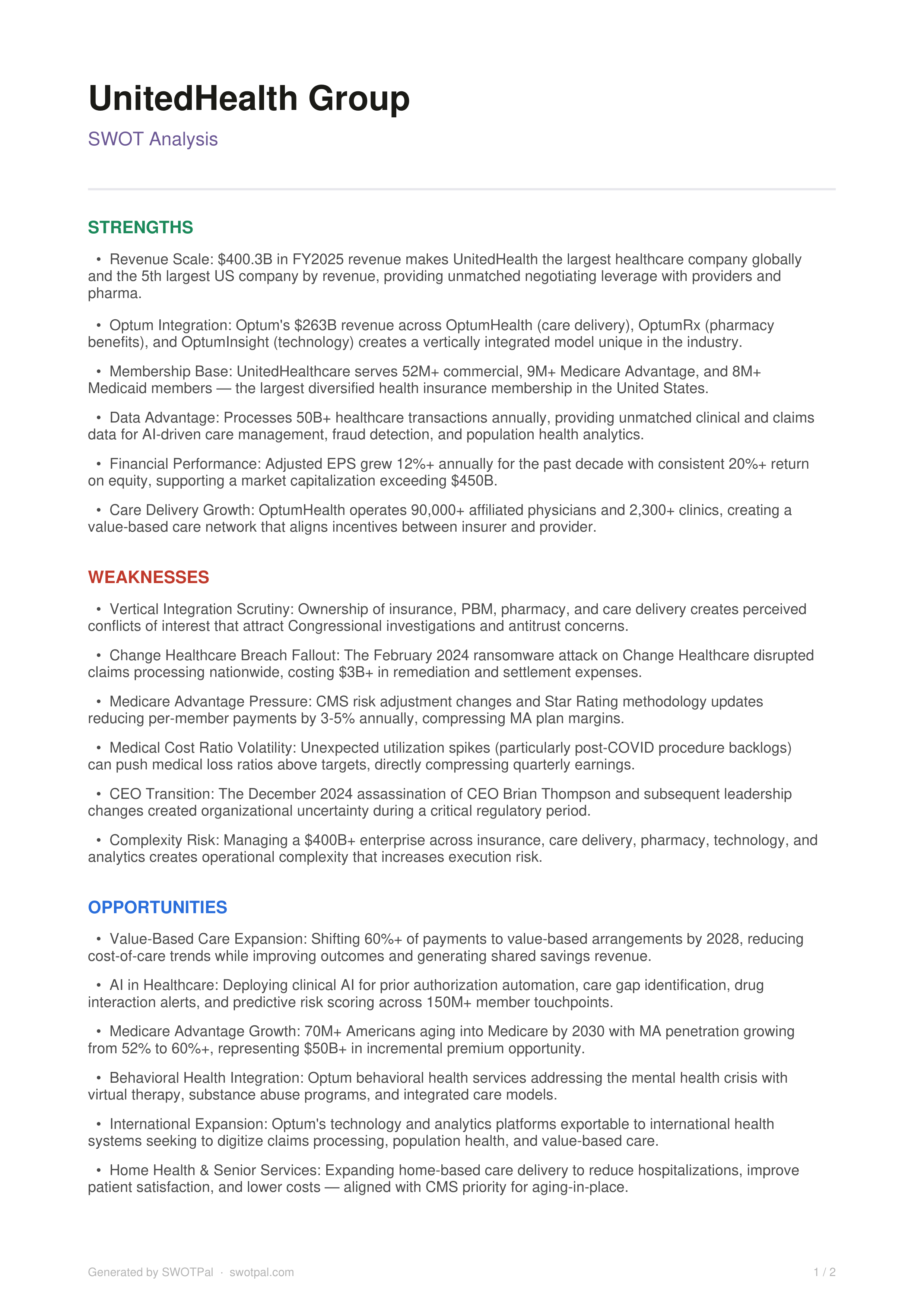
• Revenue Scale: $400.3B in FY2025 revenue makes UnitedHealth the largest healthcare company globally
and the 5th largest US company by revenue, providing unmatched negotiating leverage with providers and
pharma.
• Optum Integration: Optum's $263B revenue across OptumHealth (care delivery), OptumRx (pharmacy
benefits), and OptumInsight (technology) creates a vertically integrated model unique in the industry.
• Membership Base: UnitedHealthcare serves 52M+ commercial, 9M+ Medicare Advantage, and 8M+
Medicaid members — the largest diversified health insurance membership in the United States.
• Data Advantage: Processes 50B+ healthcare transactions annually, providing unmatched clinical and claims
data for AI-driven care management, fraud detection, and population health analytics.
• Financial Performance: Adjusted EPS grew 12%+ annually for the past decade with consistent 20%+ return
on equity, supporting a market capitalization exceeding $450B.
• Care Delivery Growth: OptumHealth operates 90,000+ affiliated physicians and 2,300+ clinics, creating a
value-based care network that aligns incentives between insurer and provider.
WEAKNESSES
• Vertical Integration Scrutiny: Ownership of insurance, PBM, pharmacy, and care delivery creates perceived
conflicts of interest that attract Congressional investigations and antitrust concerns.
• Change Healthcare Breach Fallout: The February 2024 ransomware attack on Change Healthcare disrupted
claims processing nationwide, costing $3B+ in remediation and settlement expenses.
• Medicare Advantage Pressure: CMS risk adjustment changes and Star Rating methodology updates
reducing per-member payments by 3-5% annually, compressing MA plan margins.
• Medical Cost Ratio Volatility: Unexpected utilization spikes (particularly post-COVID procedure backlogs)
can push medical loss ratios above targets, directly compressing quarterly earnings.
• CEO Transition: The December 2024 assassination of CEO Brian Thompson and subsequent leadership
changes created organizational uncertainty during a critical regulatory period.
• Complexity Risk: Managing a $400B+ enterprise across insurance, care delivery, pharmacy, technology, and
analytics creates operational complexity that increases execution risk.
OPPORTUNITIES
• Value-Based Care Expansion: Shifting 60%+ of payments to value-based arrangements by 2028, reducing
cost-of-care trends while improving outcomes and generating shared savings revenue.
• AI in Healthcare: Deploying clinical AI for prior authorization automation, care gap identification, drug
interaction alerts, and predictive risk scoring across 150M+ member touchpoints.
• Medicare Advantage Growth: 70M+ Americans aging into Medicare by 2030 with MA penetration growing
from 52% to 60%+, representing $50B+ in incremental premium opportunity.
• Behavioral Health Integration: Optum behavioral health services addressing the mental health crisis with
virtual therapy, substance abuse programs, and integrated care models.
• International Expansion: Optum's technology and analytics platforms exportable to international health
systems seeking to digitize claims processing, population health, and value-based care.
• Home Health & Senior Services: Expanding home-based care delivery to reduce hospitalizations, improve
patient satisfaction, and lower costs — aligned with CMS priority for aging-in-place.
Generated by SWOTPal · swotpal.com
1 / 2