Walmart
SWOT Analysis
STRENGTHS
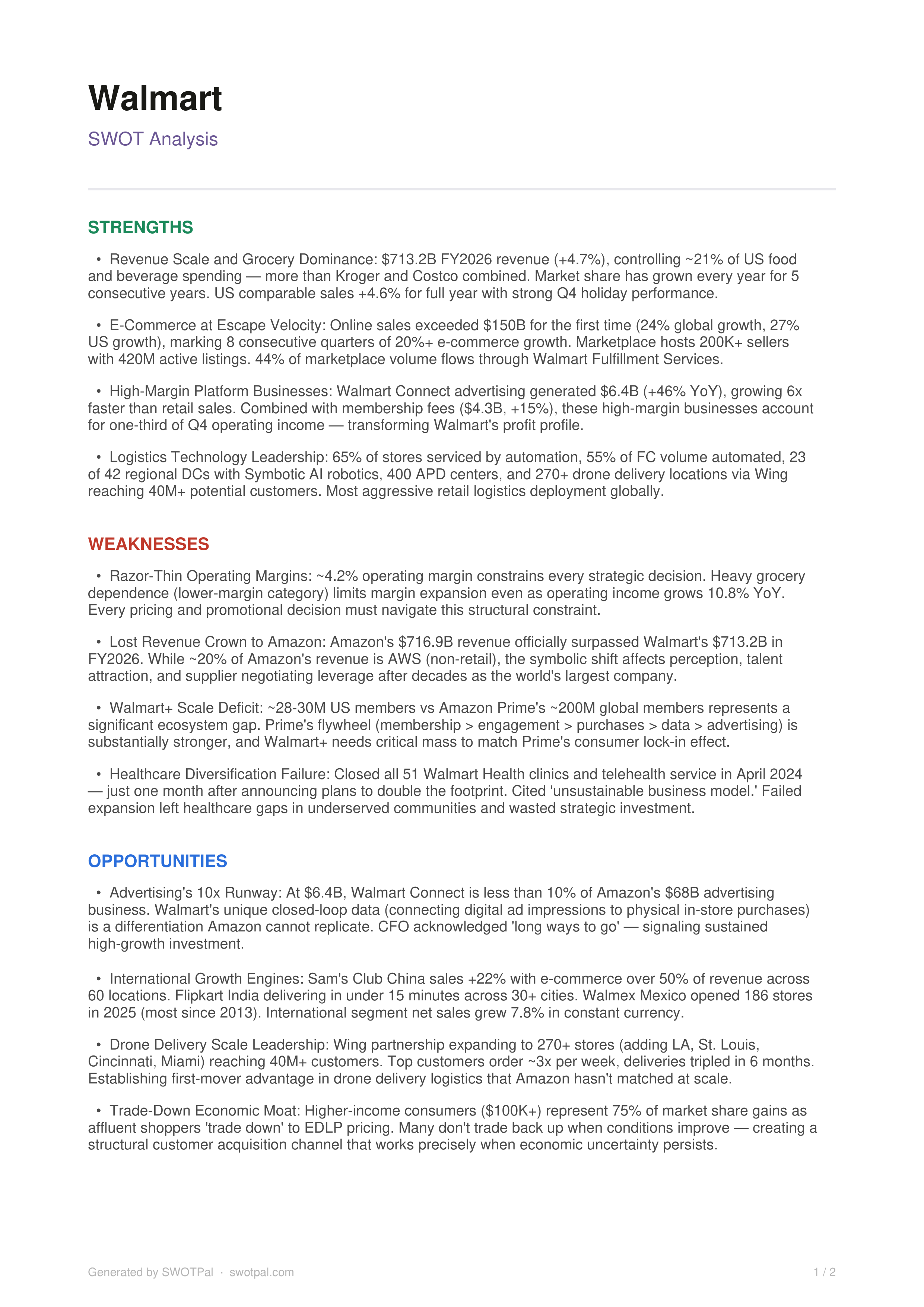
• Revenue Scale and Grocery Dominance: $713.2B FY2026 revenue (+4.7%), controlling ~21% of US food
and beverage spending — more than Kroger and Costco combined. Market share has grown every year for 5
consecutive years. US comparable sales +4.6% for full year with strong Q4 holiday performance.
• E-Commerce at Escape Velocity: Online sales exceeded $150B for the first time (24% global growth, 27%
US growth), marking 8 consecutive quarters of 20%+ e-commerce growth. Marketplace hosts 200K+ sellers
with 420M active listings. 44% of marketplace volume flows through Walmart Fulfillment Services.
• High-Margin Platform Businesses: Walmart Connect advertising generated $6.4B (+46% YoY), growing 6x
faster than retail sales. Combined with membership fees ($4.3B, +15%), these high-margin businesses account
for one-third of Q4 operating income — transforming Walmart's profit profile.
• Logistics Technology Leadership: 65% of stores serviced by automation, 55% of FC volume automated, 23
of 42 regional DCs with Symbotic AI robotics, 400 APD centers, and 270+ drone delivery locations via Wing
reaching 40M+ potential customers. Most aggressive retail logistics deployment globally.
WEAKNESSES
• Razor-Thin Operating Margins: ~4.2% operating margin constrains every strategic decision. Heavy grocery
dependence (lower-margin category) limits margin expansion even as operating income grows 10.8% YoY.
Every pricing and promotional decision must navigate this structural constraint.
• Lost Revenue Crown to Amazon: Amazon's $716.9B revenue officially surpassed Walmart's $713.2B in
FY2026. While ~20% of Amazon's revenue is AWS (non-retail), the symbolic shift affects perception, talent
attraction, and supplier negotiating leverage after decades as the world's largest company.
• Walmart+ Scale Deficit: ~28-30M US members vs Amazon Prime's ~200M global members represents a
significant ecosystem gap. Prime's flywheel (membership > engagement > purchases > data > advertising) is
substantially stronger, and Walmart+ needs critical mass to match Prime's consumer lock-in effect.
• Healthcare Diversification Failure: Closed all 51 Walmart Health clinics and telehealth service in April 2024
— just one month after announcing plans to double the footprint. Cited 'unsustainable business model.' Failed
expansion left healthcare gaps in underserved communities and wasted strategic investment.
OPPORTUNITIES
• Advertising's 10x Runway: At $6.4B, Walmart Connect is less than 10% of Amazon's $68B advertising
business. Walmart's unique closed-loop data (connecting digital ad impressions to physical in-store purchases)
is a differentiation Amazon cannot replicate. CFO acknowledged 'long ways to go' — signaling sustained
high-growth investment.
• International Growth Engines: Sam's Club China sales +22% with e-commerce over 50% of revenue across
60 locations. Flipkart India delivering in under 15 minutes across 30+ cities. Walmex Mexico opened 186 stores
in 2025 (most since 2013). International segment net sales grew 7.8% in constant currency.
• Drone Delivery Scale Leadership: Wing partnership expanding to 270+ stores (adding LA, St. Louis,
Cincinnati, Miami) reaching 40M+ customers. Top customers order ~3x per week, deliveries tripled in 6 months.
Establishing first-mover advantage in drone delivery logistics that Amazon hasn't matched at scale.
• Trade-Down Economic Moat: Higher-income consumers ($100K+) represent 75% of market share gains as
affluent shoppers 'trade down' to EDLP pricing. Many don't trade back up when conditions improve — creating a
structural customer acquisition channel that works precisely when economic uncertainty persists.
Generated by SWOTPal · swotpal.com
1 / 2