Samsung
SWOT Analysis
STRENGTHS
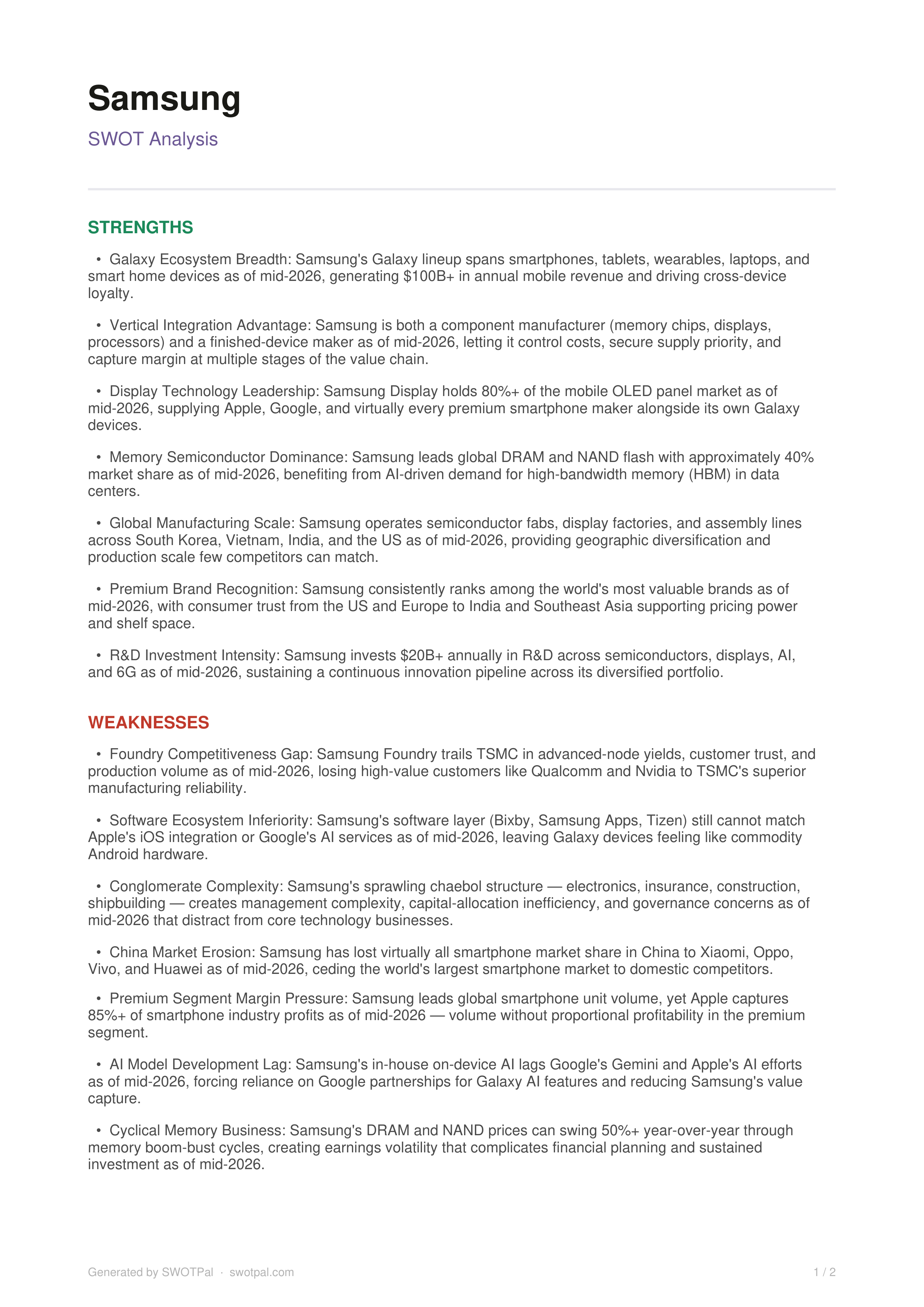
• Galaxy Ecosystem Breadth: Samsung's Galaxy lineup spans smartphones, tablets, wearables, laptops, and
smart home devices as of mid-2026, generating $100B+ in annual mobile revenue and driving cross-device
loyalty.
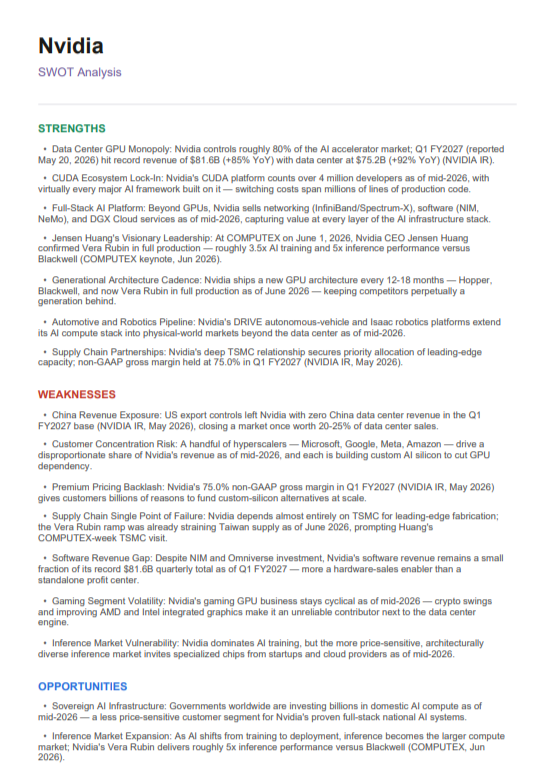
• Vertical Integration Advantage: Samsung is both a component manufacturer (memory chips, displays,
processors) and a finished-device maker as of mid-2026, letting it control costs, secure supply priority, and
capture margin at multiple stages of the value chain.
• Display Technology Leadership: Samsung Display holds 80%+ of the mobile OLED panel market as of
mid-2026, supplying Apple, Google, and virtually every premium smartphone maker alongside its own Galaxy
devices.
• Memory Semiconductor Dominance: Samsung leads global DRAM and NAND flash with approximately 40%
market share as of mid-2026, benefiting from AI-driven demand for high-bandwidth memory (HBM) in data
centers.
• Global Manufacturing Scale: Samsung operates semiconductor fabs, display factories, and assembly lines
across South Korea, Vietnam, India, and the US as of mid-2026, providing geographic diversification and
production scale few competitors can match.
• Premium Brand Recognition: Samsung consistently ranks among the world's most valuable brands as of
mid-2026, with consumer trust from the US and Europe to India and Southeast Asia supporting pricing power
and shelf space.
• R&D Investment Intensity: Samsung invests $20B+ annually in R&D across semiconductors, displays, AI,
and 6G as of mid-2026, sustaining a continuous innovation pipeline across its diversified portfolio.
WEAKNESSES
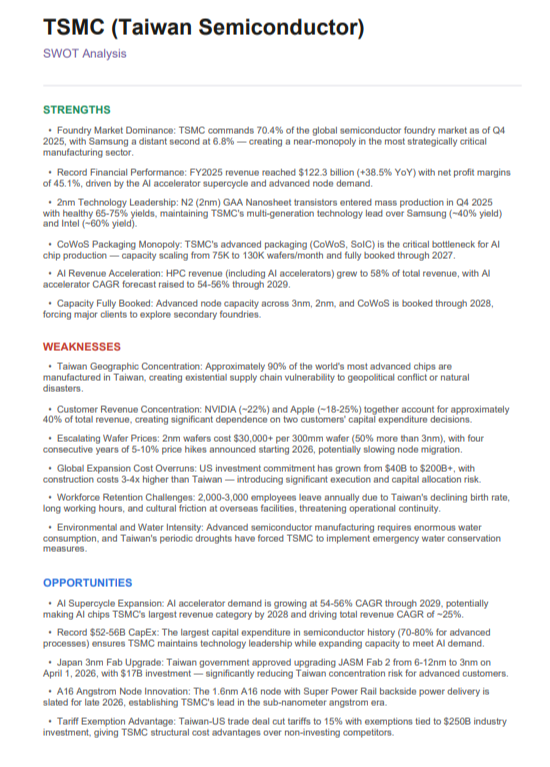
• Foundry Competitiveness Gap: Samsung Foundry trails TSMC in advanced-node yields, customer trust, and
production volume as of mid-2026, losing high-value customers like Qualcomm and Nvidia to TSMC's superior
manufacturing reliability.
• Software Ecosystem Inferiority: Samsung's software layer (Bixby, Samsung Apps, Tizen) still cannot match
Apple's iOS integration or Google's AI services as of mid-2026, leaving Galaxy devices feeling like commodity
Android hardware.
• Conglomerate Complexity: Samsung's sprawling chaebol structure — electronics, insurance, construction,
shipbuilding — creates management complexity, capital-allocation inefficiency, and governance concerns as of
mid-2026 that distract from core technology businesses.
• China Market Erosion: Samsung has lost virtually all smartphone market share in China to Xiaomi, Oppo,
Vivo, and Huawei as of mid-2026, ceding the world's largest smartphone market to domestic competitors.
• Premium Segment Margin Pressure: Samsung leads global smartphone unit volume, yet Apple captures
85%+ of smartphone industry profits as of mid-2026 — volume without proportional profitability in the premium
segment.
• AI Model Development Lag: Samsung's in-house on-device AI lags Google's Gemini and Apple's AI efforts
as of mid-2026, forcing reliance on Google partnerships for Galaxy AI features and reducing Samsung's value
capture.
• Cyclical Memory Business: Samsung's DRAM and NAND prices can swing 50%+ year-over-year through
memory boom-bust cycles, creating earnings volatility that complicates financial planning and sustained
investment as of mid-2026.
Generated by SWOTPal · swotpal.com
1 / 2
OPPORTUNITIES
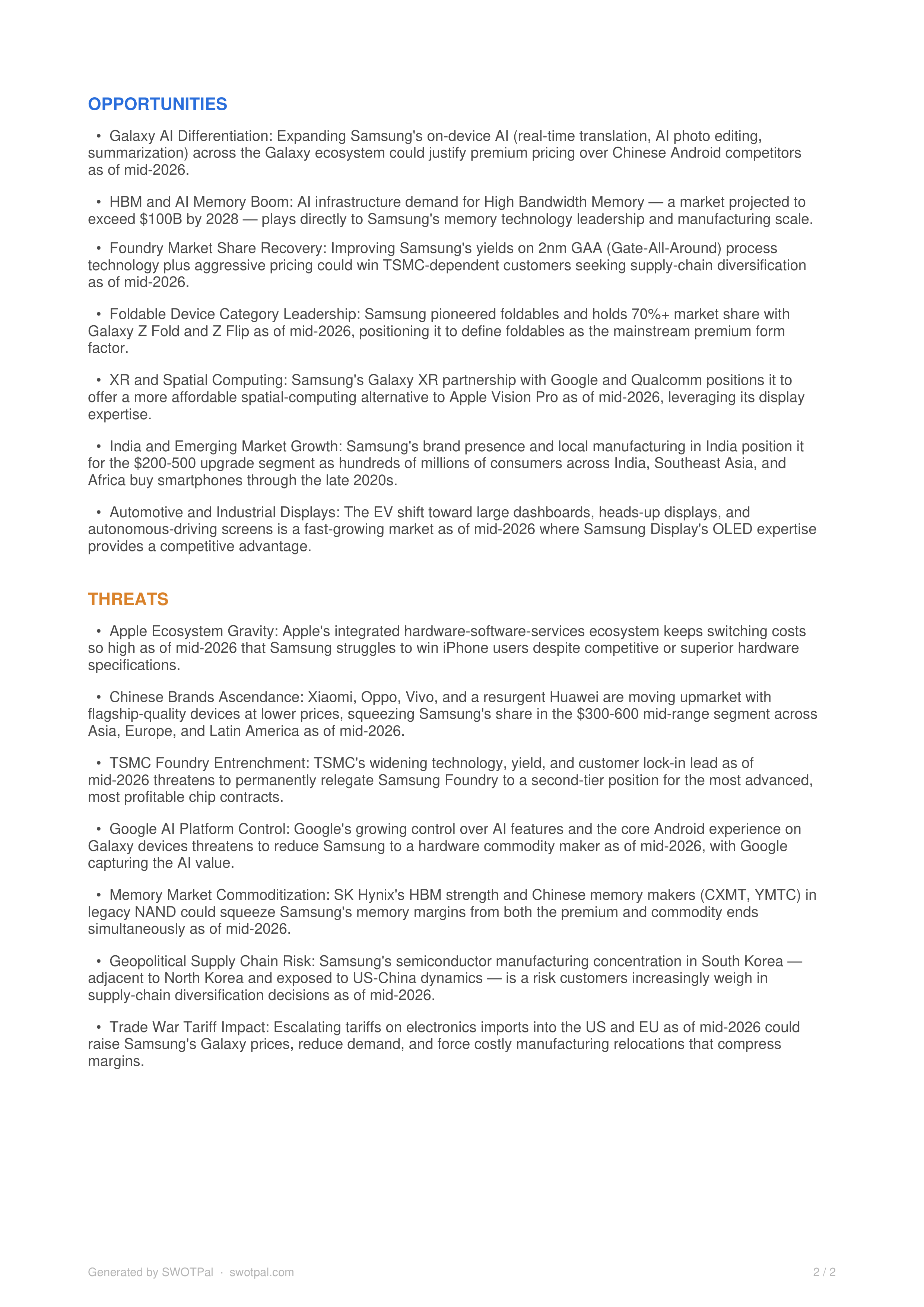
• Galaxy AI Differentiation: Expanding Samsung's on-device AI (real-time translation, AI photo editing,
summarization) across the Galaxy ecosystem could justify premium pricing over Chinese Android competitors
as of mid-2026.
• HBM and AI Memory Boom: AI infrastructure demand for High Bandwidth Memory — a market projected to
exceed $100B by 2028 — plays directly to Samsung's memory technology leadership and manufacturing scale.
• Foundry Market Share Recovery: Improving Samsung's yields on 2nm GAA (Gate-All-Around) process
technology plus aggressive pricing could win TSMC-dependent customers seeking supply-chain diversification
as of mid-2026.
• Foldable Device Category Leadership: Samsung pioneered foldables and holds 70%+ market share with
Galaxy Z Fold and Z Flip as of mid-2026, positioning it to define foldables as the mainstream premium form
factor.
• XR and Spatial Computing: Samsung's Galaxy XR partnership with Google and Qualcomm positions it to
offer a more affordable spatial-computing alternative to Apple Vision Pro as of mid-2026, leveraging its display
expertise.
• India and Emerging Market Growth: Samsung's brand presence and local manufacturing in India position it
for the $200-500 upgrade segment as hundreds of millions of consumers across India, Southeast Asia, and
Africa buy smartphones through the late 2020s.
• Automotive and Industrial Displays: The EV shift toward large dashboards, heads-up displays, and
autonomous-driving screens is a fast-growing market as of mid-2026 where Samsung Display's OLED expertise
provides a competitive advantage.
THREATS
• Apple Ecosystem Gravity: Apple's integrated hardware-software-services ecosystem keeps switching costs
so high as of mid-2026 that Samsung struggles to win iPhone users despite competitive or superior hardware
specifications.
• Chinese Brands Ascendance: Xiaomi, Oppo, Vivo, and a resurgent Huawei are moving upmarket with
flagship-quality devices at lower prices, squeezing Samsung's share in the $300-600 mid-range segment across
Asia, Europe, and Latin America as of mid-2026.
• TSMC Foundry Entrenchment: TSMC's widening technology, yield, and customer lock-in lead as of
mid-2026 threatens to permanently relegate Samsung Foundry to a second-tier position for the most advanced,
most profitable chip contracts.
• Google AI Platform Control: Google's growing control over AI features and the core Android experience on
Galaxy devices threatens to reduce Samsung to a hardware commodity maker as of mid-2026, with Google
capturing the AI value.
• Memory Market Commoditization: SK Hynix's HBM strength and Chinese memory makers (CXMT, YMTC) in
legacy NAND could squeeze Samsung's memory margins from both the premium and commodity ends
simultaneously as of mid-2026.
• Geopolitical Supply Chain Risk: Samsung's semiconductor manufacturing concentration in South Korea —
adjacent to North Korea and exposed to US-China dynamics — is a risk customers increasingly weigh in
supply-chain diversification decisions as of mid-2026.
• Trade War Tariff Impact: Escalating tariffs on electronics imports into the US and EU as of mid-2026 could
raise Samsung's Galaxy prices, reduce demand, and force costly manufacturing relocations that compress
margins.
Generated by SWOTPal · swotpal.com
2 / 2