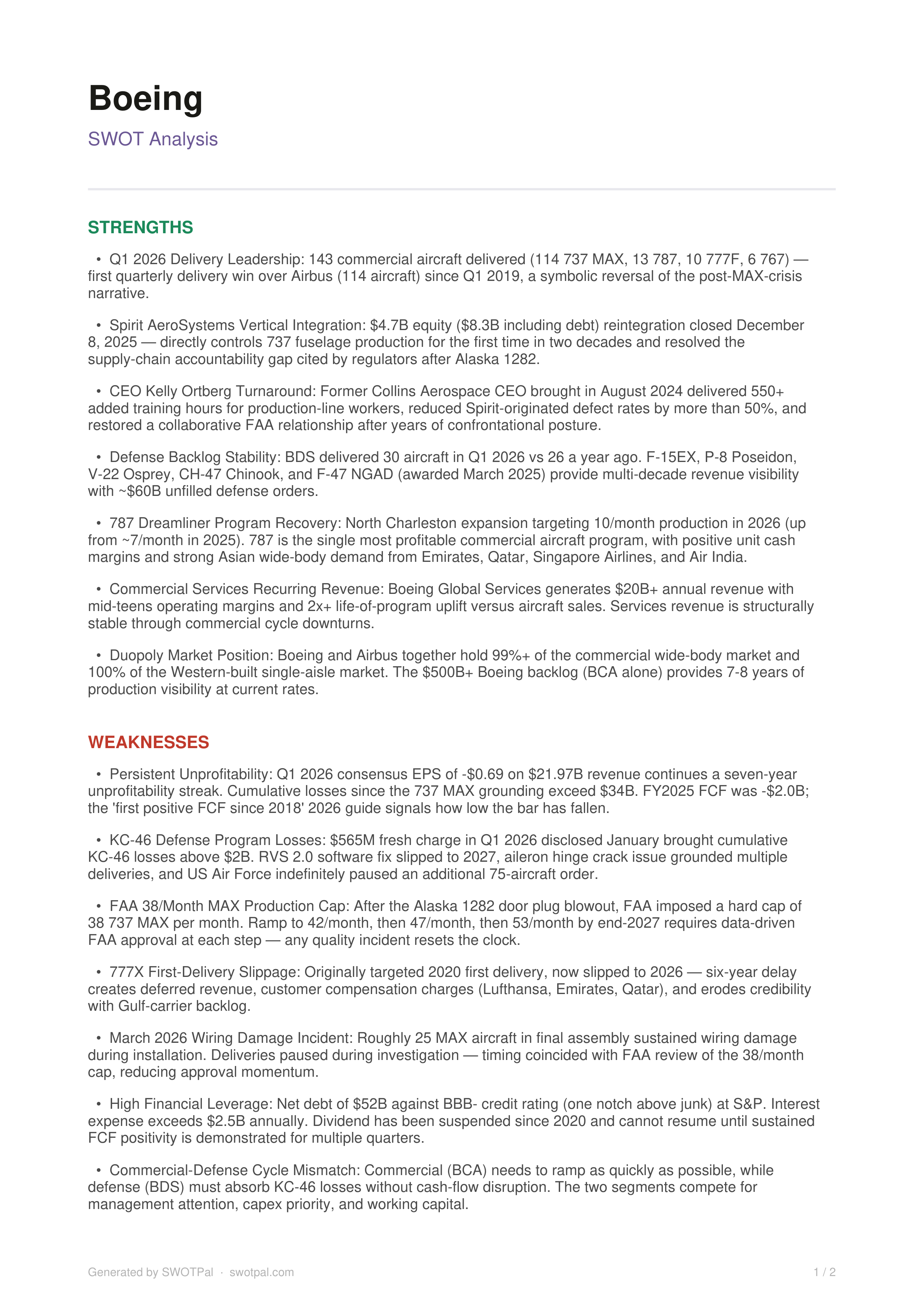
Boeing
SWOT Analysis
STRENGTHS
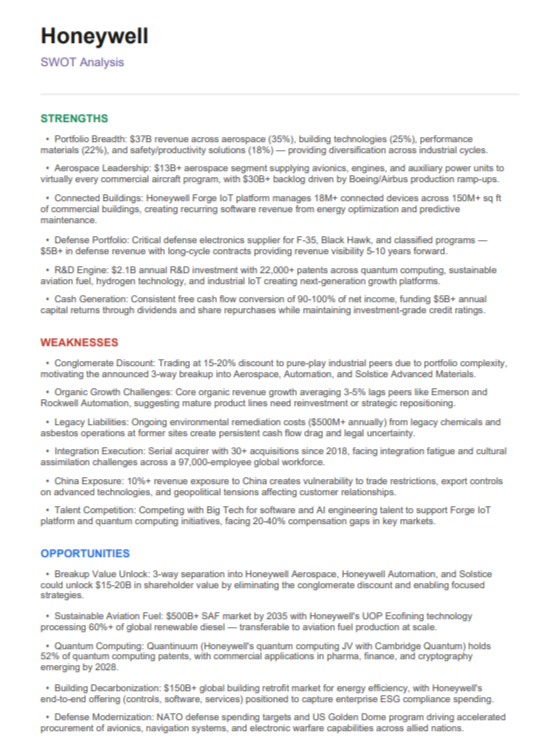
• Q1 2026 Delivery Leadership: 143 commercial aircraft delivered (114 737 MAX, 13 787, 10 777F, 6 767) —
first quarterly delivery win over Airbus (114 aircraft) since Q1 2019, a symbolic reversal of the post-MAX-crisis
narrative.
• Spirit AeroSystems Vertical Integration: $4.7B equity ($8.3B including debt) reintegration closed December
8, 2025 — directly controls 737 fuselage production for the first time in two decades and resolved the
supply-chain accountability gap cited by regulators after Alaska 1282.
• CEO Kelly Ortberg Turnaround: Former Collins Aerospace CEO brought in August 2024 delivered 550+
added training hours for production-line workers, reduced Spirit-originated defect rates by more than 50%, and
restored a collaborative FAA relationship after years of confrontational posture.
• Defense Backlog Stability: BDS delivered 30 aircraft in Q1 2026 vs 26 a year ago. F-15EX, P-8 Poseidon,
V-22 Osprey, CH-47 Chinook, and F-47 NGAD (awarded March 2025) provide multi-decade revenue visibility
with ~$60B unfilled defense orders.
• 787 Dreamliner Program Recovery: North Charleston expansion targeting 10/month production in 2026 (up
from ~7/month in 2025). 787 is the single most profitable commercial aircraft program, with positive unit cash
margins and strong Asian wide-body demand from Emirates, Qatar, Singapore Airlines, and Air India.
• Commercial Services Recurring Revenue: Boeing Global Services generates $20B+ annual revenue with
mid-teens operating margins and 2x+ life-of-program uplift versus aircraft sales. Services revenue is structurally
stable through commercial cycle downturns.
• Duopoly Market Position: Boeing and Airbus together hold 99%+ of the commercial wide-body market and
100% of the Western-built single-aisle market. The $500B+ Boeing backlog (BCA alone) provides 7-8 years of
production visibility at current rates.
WEAKNESSES
• Persistent Unprofitability: Q1 2026 consensus EPS of -$0.69 on $21.97B revenue continues a seven-year
unprofitability streak. Cumulative losses since the 737 MAX grounding exceed $34B. FY2025 FCF was -$2.0B;
the 'first positive FCF since 2018' 2026 guide signals how low the bar has fallen.
• KC-46 Defense Program Losses: $565M fresh charge in Q1 2026 disclosed January brought cumulative
KC-46 losses above $2B. RVS 2.0 software fix slipped to 2027, aileron hinge crack issue grounded multiple
deliveries, and US Air Force indefinitely paused an additional 75-aircraft order.
• FAA 38/Month MAX Production Cap: After the Alaska 1282 door plug blowout, FAA imposed a hard cap of
38 737 MAX per month. Ramp to 42/month, then 47/month, then 53/month by end-2027 requires data-driven
FAA approval at each step — any quality incident resets the clock.
• 777X First-Delivery Slippage: Originally targeted 2020 first delivery, now slipped to 2026 — six-year delay
creates deferred revenue, customer compensation charges (Lufthansa, Emirates, Qatar), and erodes credibility
with Gulf-carrier backlog.
• March 2026 Wiring Damage Incident: Roughly 25 MAX aircraft in final assembly sustained wiring damage
during installation. Deliveries paused during investigation — timing coincided with FAA review of the 38/month
cap, reducing approval momentum.
• High Financial Leverage: Net debt of $52B against BBB- credit rating (one notch above junk) at S&P. Interest
expense exceeds $2.5B annually. Dividend has been suspended since 2020 and cannot resume until sustained
FCF positivity is demonstrated for multiple quarters.
• Commercial-Defense Cycle Mismatch: Commercial (BCA) needs to ramp as quickly as possible, while
defense (BDS) must absorb KC-46 losses without cash-flow disruption. The two segments compete for
management attention, capex priority, and working capital.
Generated by SWOTPal · swotpal.com
1 / 2
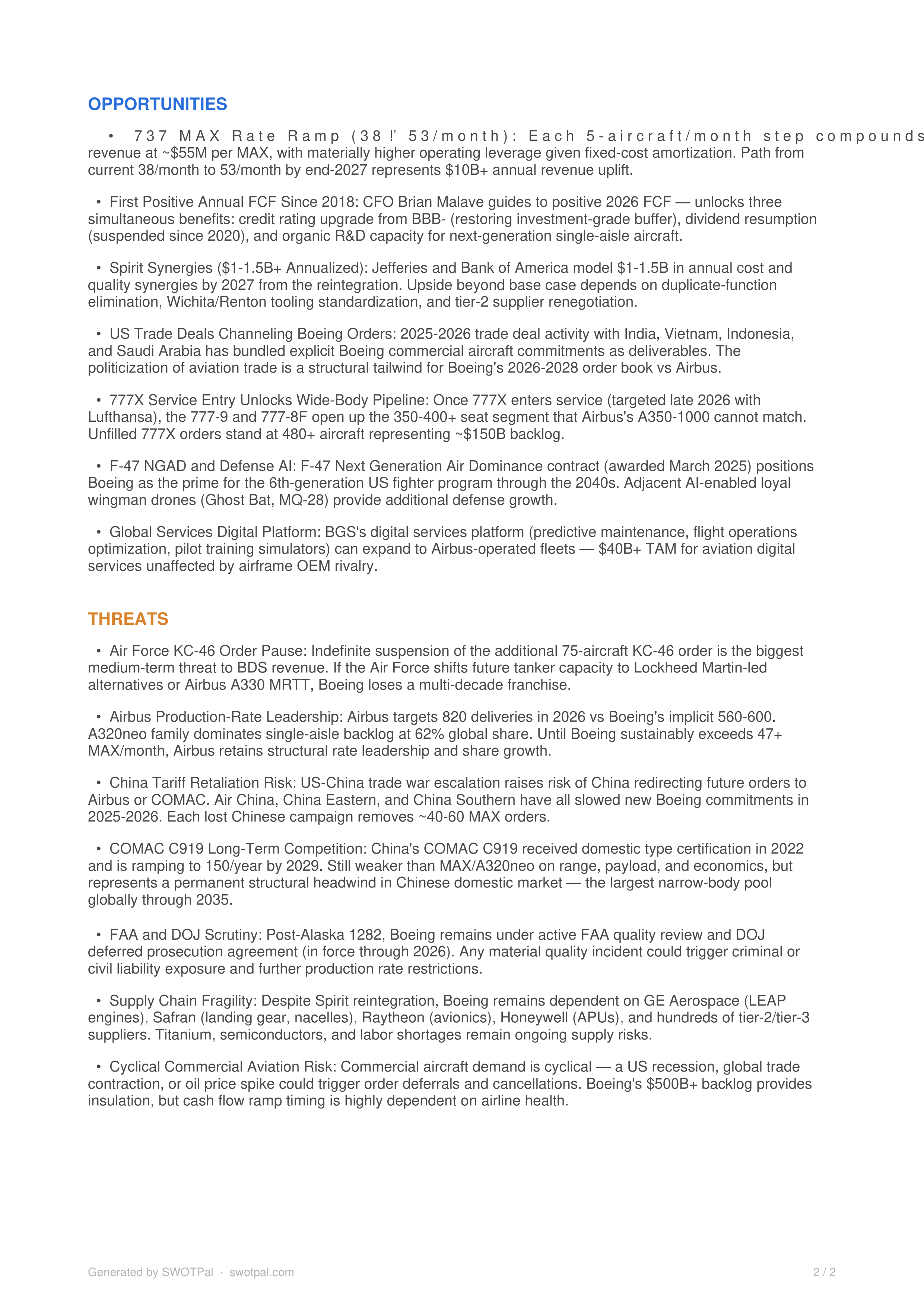
OPPORTUNITIES
• 737 MAX Rate Ramp (38 !’ 53/month): Each 5-aircraft/month step compounds
revenue at ~$55M per MAX, with materially higher operating leverage given fixed-cost amortization. Path from
current 38/month to 53/month by end-2027 represents $10B+ annual revenue uplift.
• First Positive Annual FCF Since 2018: CFO Brian Malave guides to positive 2026 FCF — unlocks three
simultaneous benefits: credit rating upgrade from BBB- (restoring investment-grade buffer), dividend resumption
(suspended since 2020), and organic R&D capacity for next-generation single-aisle aircraft.
• Spirit Synergies ($1-1.5B+ Annualized): Jefferies and Bank of America model $1-1.5B in annual cost and
quality synergies by 2027 from the reintegration. Upside beyond base case depends on duplicate-function
elimination, Wichita/Renton tooling standardization, and tier-2 supplier renegotiation.
• US Trade Deals Channeling Boeing Orders: 2025-2026 trade deal activity with India, Vietnam, Indonesia,
and Saudi Arabia has bundled explicit Boeing commercial aircraft commitments as deliverables. The
politicization of aviation trade is a structural tailwind for Boeing's 2026-2028 order book vs Airbus.
• 777X Service Entry Unlocks Wide-Body Pipeline: Once 777X enters service (targeted late 2026 with
Lufthansa), the 777-9 and 777-8F open up the 350-400+ seat segment that Airbus's A350-1000 cannot match.
Unfilled 777X orders stand at 480+ aircraft representing ~$150B backlog.
• F-47 NGAD and Defense AI: F-47 Next Generation Air Dominance contract (awarded March 2025) positions
Boeing as the prime for the 6th-generation US fighter program through the 2040s. Adjacent AI-enabled loyal
wingman drones (Ghost Bat, MQ-28) provide additional defense growth.
• Global Services Digital Platform: BGS's digital services platform (predictive maintenance, flight operations
optimization, pilot training simulators) can expand to Airbus-operated fleets — $40B+ TAM for aviation digital
services unaffected by airframe OEM rivalry.
THREATS
• Air Force KC-46 Order Pause: Indefinite suspension of the additional 75-aircraft KC-46 order is the biggest
medium-term threat to BDS revenue. If the Air Force shifts future tanker capacity to Lockheed Martin-led
alternatives or Airbus A330 MRTT, Boeing loses a multi-decade franchise.
• Airbus Production-Rate Leadership: Airbus targets 820 deliveries in 2026 vs Boeing's implicit 560-600.
A320neo family dominates single-aisle backlog at 62% global share. Until Boeing sustainably exceeds 47+
MAX/month, Airbus retains structural rate leadership and share growth.
• China Tariff Retaliation Risk: US-China trade war escalation raises risk of China redirecting future orders to
Airbus or COMAC. Air China, China Eastern, and China Southern have all slowed new Boeing commitments in
2025-2026. Each lost Chinese campaign removes ~40-60 MAX orders.
• COMAC C919 Long-Term Competition: China's COMAC C919 received domestic type certification in 2022
and is ramping to 150/year by 2029. Still weaker than MAX/A320neo on range, payload, and economics, but
represents a permanent structural headwind in Chinese domestic market — the largest narrow-body pool
globally through 2035.
• FAA and DOJ Scrutiny: Post-Alaska 1282, Boeing remains under active FAA quality review and DOJ
deferred prosecution agreement (in force through 2026). Any material quality incident could trigger criminal or
civil liability exposure and further production rate restrictions.
• Supply Chain Fragility: Despite Spirit reintegration, Boeing remains dependent on GE Aerospace (LEAP
engines), Safran (landing gear, nacelles), Raytheon (avionics), Honeywell (APUs), and hundreds of tier-2/tier-3
suppliers. Titanium, semiconductors, and labor shortages remain ongoing supply risks.
• Cyclical Commercial Aviation Risk: Commercial aircraft demand is cyclical — a US recession, global trade
contraction, or oil price spike could trigger order deferrals and cancellations. Boeing's $500B+ backlog provides
insulation, but cash flow ramp timing is highly dependent on airline health.
Generated by SWOTPal · swotpal.com
2 / 2