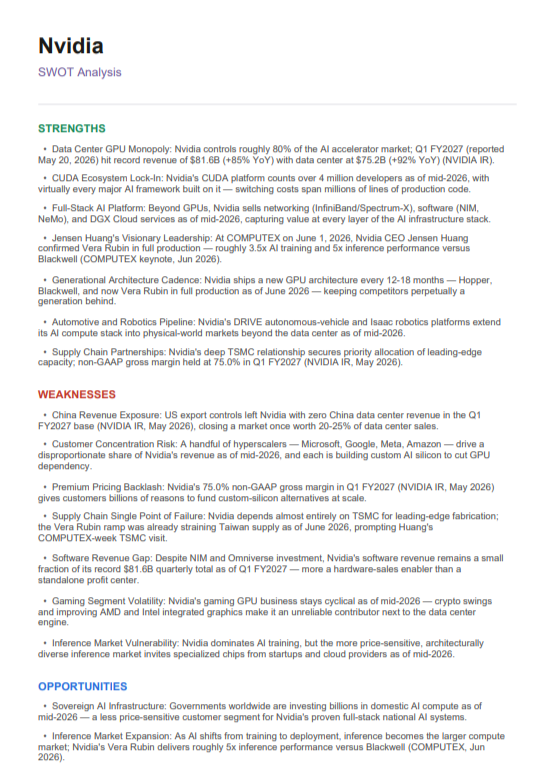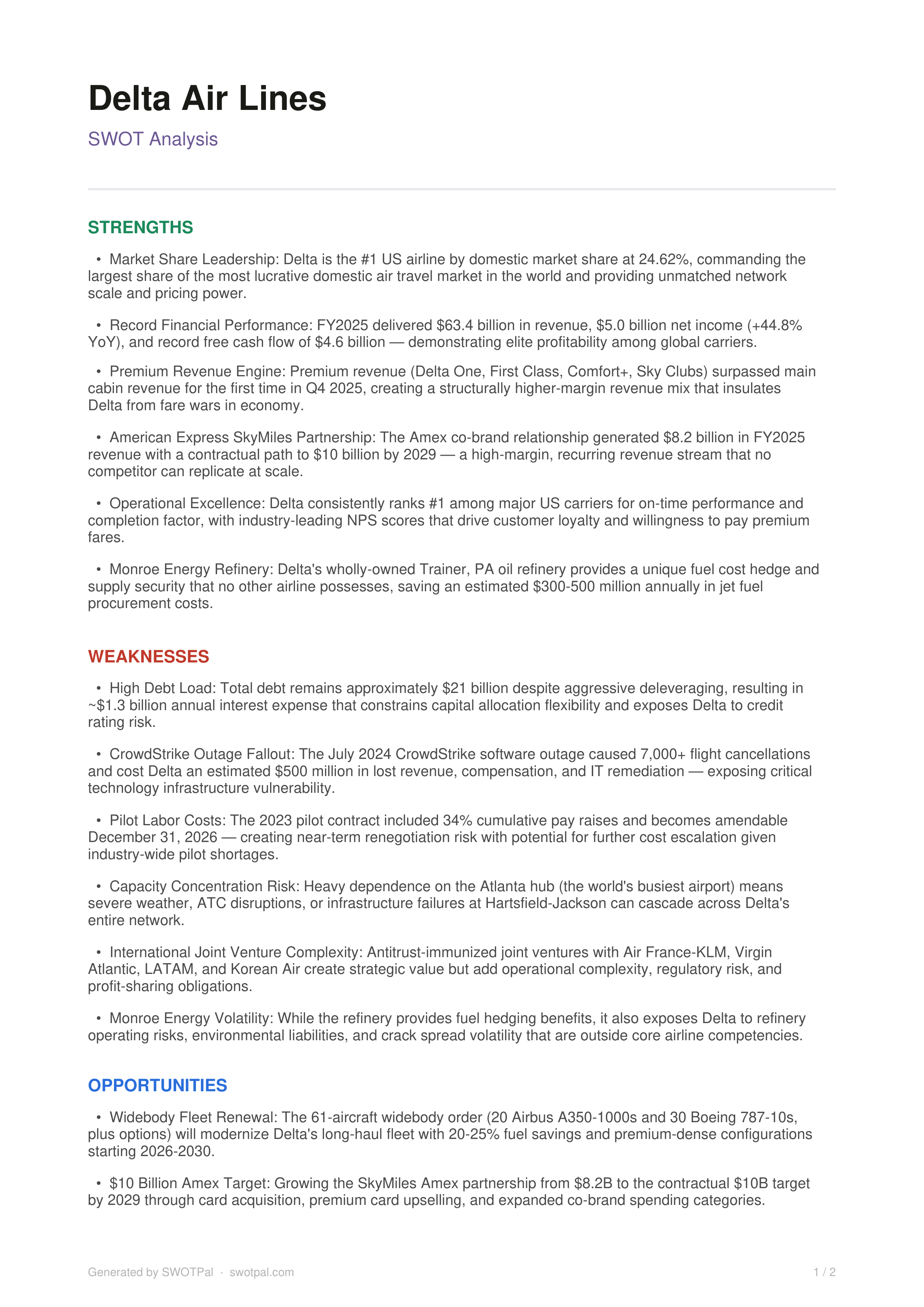
Delta Air Lines
SWOT Analysis
STRENGTHS
• Market Share Leadership: Delta is the #1 US airline by domestic market share at 24.62%, commanding the
largest share of the most lucrative domestic air travel market in the world and providing unmatched network
scale and pricing power.
• Record Financial Performance: FY2025 delivered $63.4 billion in revenue, $5.0 billion net income (+44.8%
YoY), and record free cash flow of $4.6 billion — demonstrating elite profitability among global carriers.
• Premium Revenue Engine: Premium revenue (Delta One, First Class, Comfort+, Sky Clubs) surpassed main
cabin revenue for the first time in Q4 2025, creating a structurally higher-margin revenue mix that insulates
Delta from fare wars in economy.
• American Express SkyMiles Partnership: The Amex co-brand relationship generated $8.2 billion in FY2025
revenue with a contractual path to $10 billion by 2029 — a high-margin, recurring revenue stream that no
competitor can replicate at scale.
• Operational Excellence: Delta consistently ranks #1 among major US carriers for on-time performance and
completion factor, with industry-leading NPS scores that drive customer loyalty and willingness to pay premium
fares.
• Monroe Energy Refinery: Delta's wholly-owned Trainer, PA oil refinery provides a unique fuel cost hedge and
supply security that no other airline possesses, saving an estimated $300-500 million annually in jet fuel
procurement costs.
WEAKNESSES
• High Debt Load: Total debt remains approximately $21 billion despite aggressive deleveraging, resulting in
~$1.3 billion annual interest expense that constrains capital allocation flexibility and exposes Delta to credit
rating risk.
• CrowdStrike Outage Fallout: The July 2024 CrowdStrike software outage caused 7,000+ flight cancellations
and cost Delta an estimated $500 million in lost revenue, compensation, and IT remediation — exposing critical
technology infrastructure vulnerability.
• Pilot Labor Costs: The 2023 pilot contract included 34% cumulative pay raises and becomes amendable
December 31, 2026 — creating near-term renegotiation risk with potential for further cost escalation given
industry-wide pilot shortages.
• Capacity Concentration Risk: Heavy dependence on the Atlanta hub (the world's busiest airport) means
severe weather, ATC disruptions, or infrastructure failures at Hartsfield-Jackson can cascade across Delta's
entire network.
• International Joint Venture Complexity: Antitrust-immunized joint ventures with Air France-KLM, Virgin
Atlantic, LATAM, and Korean Air create strategic value but add operational complexity, regulatory risk, and
profit-sharing obligations.
• Monroe Energy Volatility: While the refinery provides fuel hedging benefits, it also exposes Delta to refinery
operating risks, environmental liabilities, and crack spread volatility that are outside core airline competencies.
OPPORTUNITIES
• Widebody Fleet Renewal: The 61-aircraft widebody order (20 Airbus A350-1000s and 30 Boeing 787-10s,
plus options) will modernize Delta's long-haul fleet with 20-25% fuel savings and premium-dense configurations
starting 2026-2030.
• $10 Billion Amex Target: Growing the SkyMiles Amex partnership from $8.2B to the contractual $10B target
by 2029 through card acquisition, premium card upselling, and expanded co-brand spending categories.
Generated by SWOTPal · swotpal.com
1 / 2
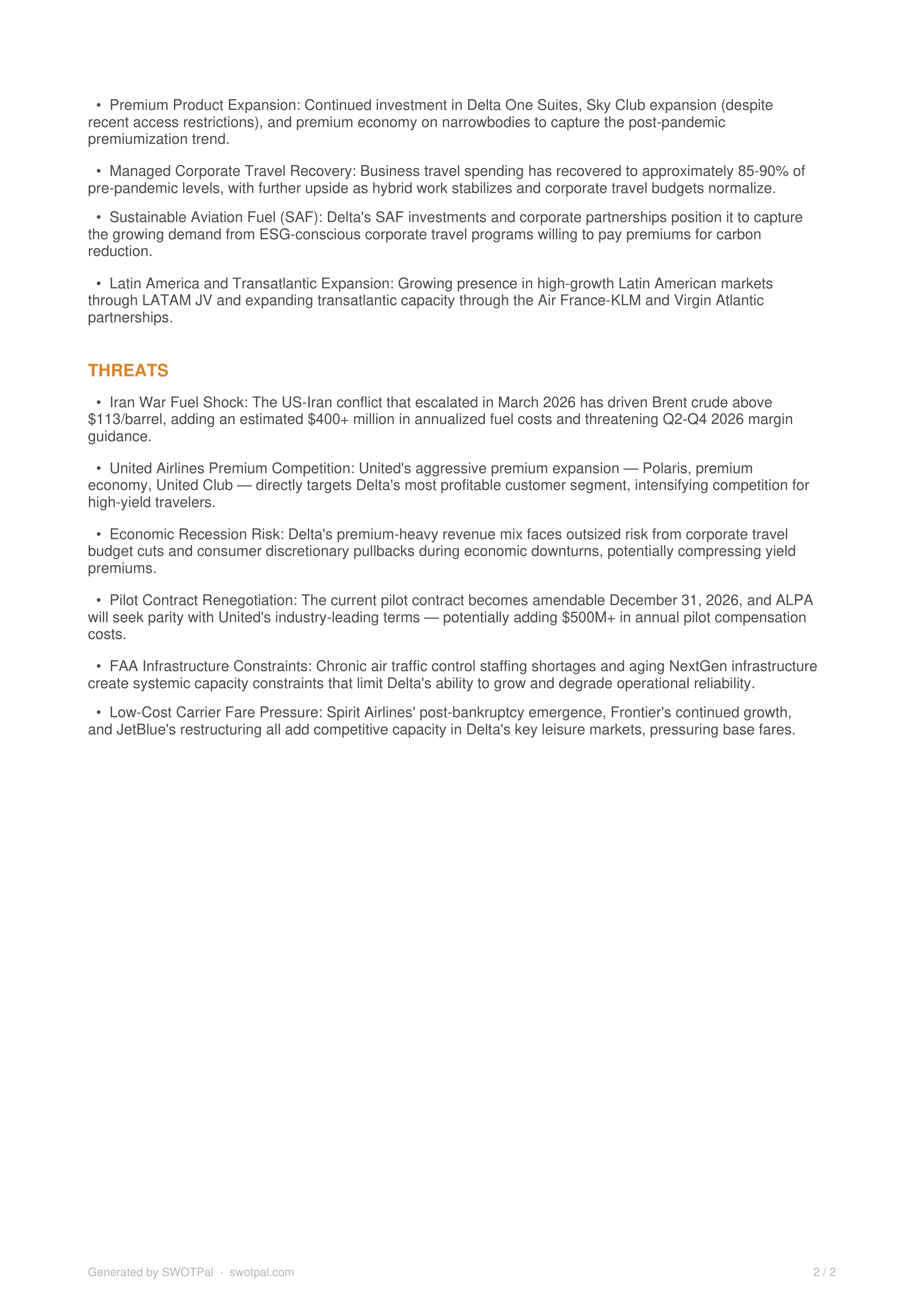
• Premium Product Expansion: Continued investment in Delta One Suites, Sky Club expansion (despite
recent access restrictions), and premium economy on narrowbodies to capture the post-pandemic
premiumization trend.
• Managed Corporate Travel Recovery: Business travel spending has recovered to approximately 85-90% of
pre-pandemic levels, with further upside as hybrid work stabilizes and corporate travel budgets normalize.
• Sustainable Aviation Fuel (SAF): Delta's SAF investments and corporate partnerships position it to capture
the growing demand from ESG-conscious corporate travel programs willing to pay premiums for carbon
reduction.
• Latin America and Transatlantic Expansion: Growing presence in high-growth Latin American markets
through LATAM JV and expanding transatlantic capacity through the Air France-KLM and Virgin Atlantic
partnerships.
THREATS
• Iran War Fuel Shock: The US-Iran conflict that escalated in March 2026 has driven Brent crude above
$113/barrel, adding an estimated $400+ million in annualized fuel costs and threatening Q2-Q4 2026 margin
guidance.
• United Airlines Premium Competition: United's aggressive premium expansion — Polaris, premium
economy, United Club — directly targets Delta's most profitable customer segment, intensifying competition for
high-yield travelers.
• Economic Recession Risk: Delta's premium-heavy revenue mix faces outsized risk from corporate travel
budget cuts and consumer discretionary pullbacks during economic downturns, potentially compressing yield
premiums.
• Pilot Contract Renegotiation: The current pilot contract becomes amendable December 31, 2026, and ALPA
will seek parity with United's industry-leading terms — potentially adding $500M+ in annual pilot compensation
costs.
• FAA Infrastructure Constraints: Chronic air traffic control staffing shortages and aging NextGen infrastructure
create systemic capacity constraints that limit Delta's ability to grow and degrade operational reliability.
• Low-Cost Carrier Fare Pressure: Spirit Airlines' post-bankruptcy emergence, Frontier's continued growth,
and JetBlue's restructuring all add competitive capacity in Delta's key leisure markets, pressuring base fares.
Generated by SWOTPal · swotpal.com
2 / 2