SMART
Decision
-
Making
Goals
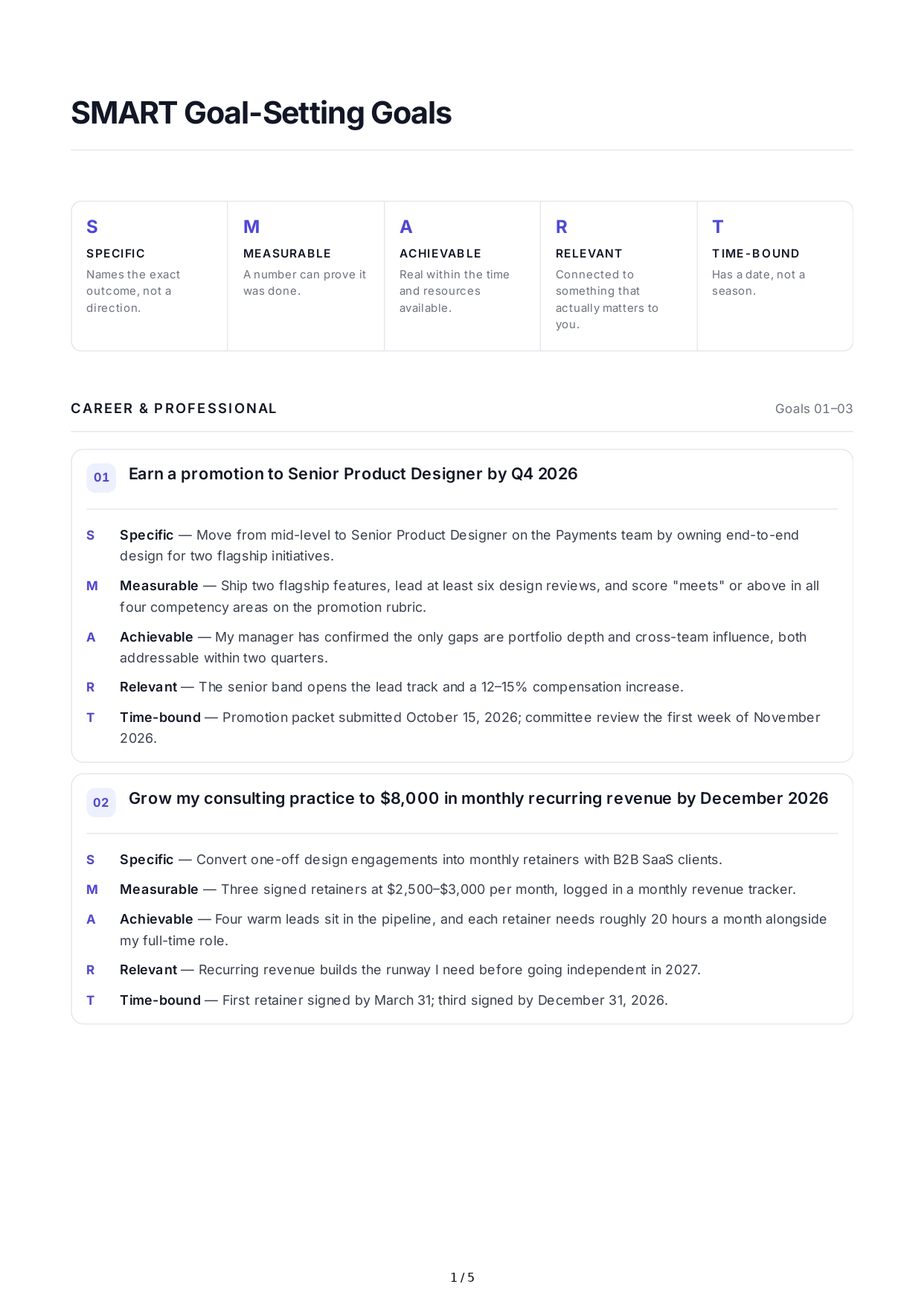
S
Specific
—
names
the
exact
behaviour
M
Measurable
—
carries
a
number
A
Achievable
—
within
current
resources
R
Relevant
—
tied
to
decision
quality
T
Time
-
bound
—
has
a
deadline
01
Decide
routine
matters
within
24
hours
By
March
31,
I
will
cut
my
average
turnaround
on
routine
operational
decisions
from
five
days
to
under
24
hours
by
setting
a
$
500
autonomy
threshold
for
my
team
and
blocking
15
minutes
every
morning
to
clear
the
decision
queue
.
S
Specific
—
a
$
500
autonomy
threshold
plus
a
daily
15-
minute
decision
block
.
M
Measurable
—
average
turnaround
measured
from
the
decision
log
,
target
under
24
hours
.
A
Achievable
—
no
new
tools
;
only
a
written
threshold
and
a
calendar
block
.
R
Relevant
—
slow
routine
decisions
are
the
largest
drag
on
project
throughput
.
T
Time
-
bound
—
checked
weekly
,
target
met
by
March
31.
02
Keep
a
decision
journal
for
six
months
Over
the
next
six
months
I
will
log
100
decisions
—
roughly
four
per
week
—
recording
the
options
considered
,
the
criteria
and
weights
used
,
the
choice
made
,
and
the
outcome
I
expect
,
then
review
the
log
at
the
end
of
each
month
.
S
Specific
—
a
structured
100-
entry
journal
with
four
defined
fields
per
entry
.
M
Measurable
—
100
entries
logged
,
checked
monthly
against
a
four
-
per
-
week
pace
.
A
Achievable
—
about
10
minutes
per
entry
,
roughly
40
minutes
a
week
.
R
Relevant
—
builds
the
evidence
base
needed
to
review
judgment
honestly
.
T
Time
-
bound
—
six
months
,
starting
the
first
Monday
of
next
month
.
1 / 5
03
Write
the
criteria
before
seeing
the
options
Effective
next
Monday
,
for
any
decision
above
$
1,000
or
affecting
more
than
two
people
,
I
will
write
down
three
to
five
criteria
and
their
weights
before
I
open
a
single
proposal
,
and
keep
that
criteria
sheet
attached
to
the
final
decision
record
.
S
Specific
—
a
written
,
weighted
criteria
sheet
completed
before
any
option
review
.
M
Measurable
—
100%
of
qualifying
decisions
,
about
15
per
month
,
carry
a
criteria
sheet
.
A
Achievable
—
a
five
-
line
template
that
takes
five
minutes
to
fill
in
.
R
Relevant
—
stops
criteria
being
reverse
-
engineered
to
justify
a
preferred
answer
.
T
Time
-
bound
—
committed
for
90
consecutive
days
,
then
formally
reviewed
.
04
Delegate
every
reversible
decision
under
$
2,000
Within
one
quarter
I
will
move
every
reversible
decision
under
$
2,000
to
the
person
closest
to
the
work
by
publishing
a
one
-
page
decision
-
rights
chart
,
cutting
my
own
logged
decision
volume
from
roughly
32
per
week
to
13.
S
Specific
—
a
one
-
page
decision
-
rights
chart
naming
the
owner
of
each
decision
category
.
M
Measurable
—
my
logged
decisions
drop
from
32
to
13
per
week
.
A
Achievable
—
these
decisions
are
reversible
and
low
-
cost
by
definition
,
so
downside
is
capped
.
R
Relevant
—
frees
senior
time
for
the
irreversible
decisions
only
I
can
make
.
T
Time
-
bound
—
chart
published
in
week
two
;
volume
target
reached
by
the
end
of
the
quarter
.
05
Run
a
pre
-
mortem
before
every
major
commitment
Before
each
project
or
commitment
above
$
10,000,
I
will
run
a
30-
minute
pre
-
mortem
that
names
at
least
five
ways
the
plan
could
fail
and
assigns
one
mitigation
and
one
named
owner
to
each
,
beginning
with
the
March
platform
migration
.
S
Specific
—
a
30-
minute
pre
-
mortem
producing
five
failure
modes
,
mitigations
and
owners
.
M
Measurable
—
five
documented
risks
per
project
, 100%
coverage
of
qualifying
projects
.
A
Achievable
—
30
minutes
with
the
team
and
no
new
tooling
.
R
Relevant
—
surfaces
failure
modes
while
they
are
still
cheap
to
correct
.
T
Time
-
bound
—
first
pre
-
mortem
on
March
6,
applied
to
every
qualifying
project
through
year
end
.
2 / 5
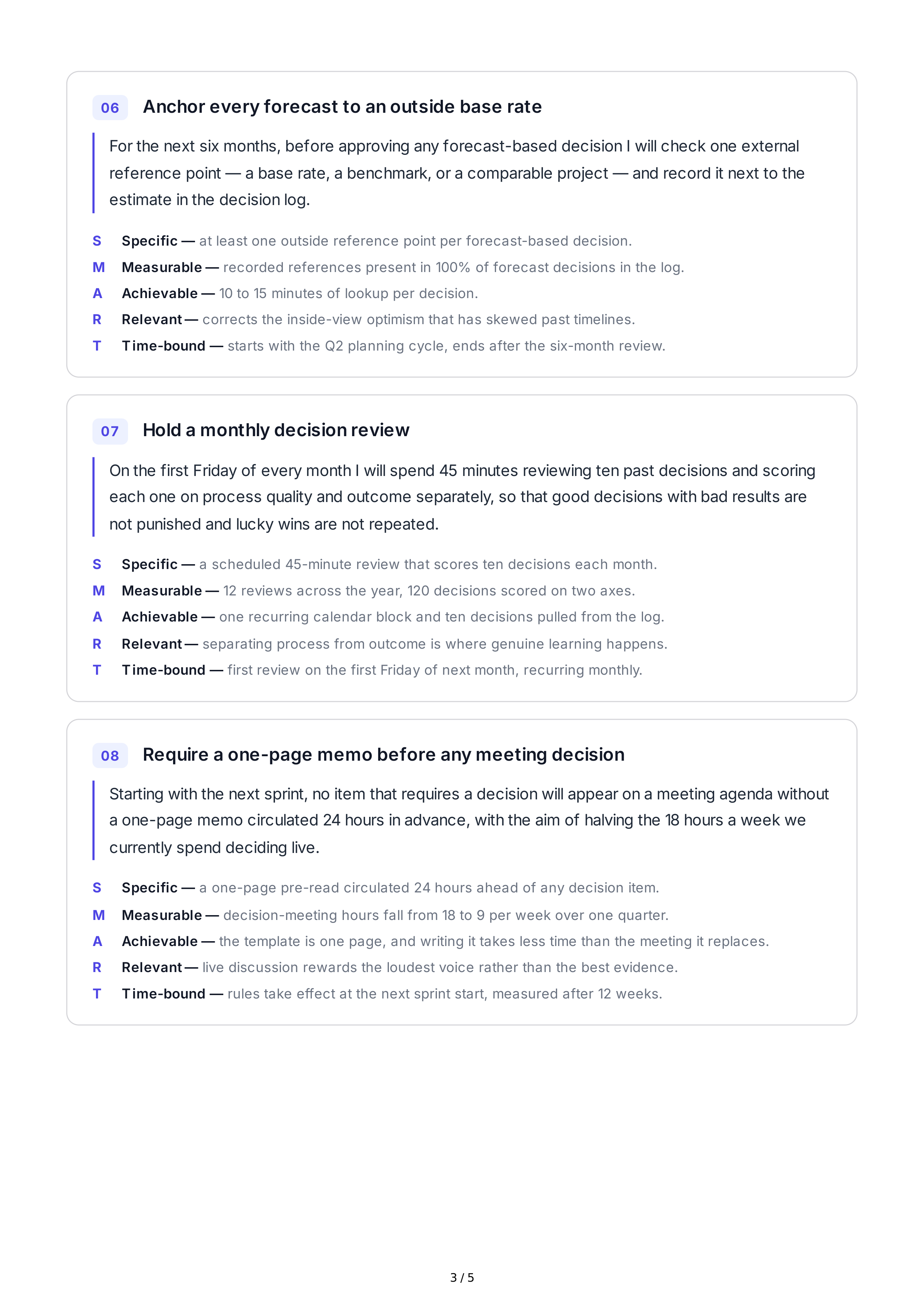
06
Anchor
every
forecast
to
an
outside
base
rate
For
the
next
six
months
,
before
approving
any
forecast
-
based
decision
I
will
check
one
external
reference
point
—
a
base
rate
,
a
benchmark
,
or
a
comparable
project
—
and
record
it
next
to
the
estimate
in
the
decision
log
.
S
Specific
—
at
least
one
outside
reference
point
per
forecast
-
based
decision
.
M
Measurable
—
recorded
references
present
in
100%
of
forecast
decisions
in
the
log
.
A
Achievable
—
10
to
15
minutes
of
lookup
per
decision
.
R
Relevant
—
corrects
the
inside
-
view
optimism
that
has
skewed
past
timelines
.
T
Time
-
bound
—
starts
with
the
Q
2
planning
cycle
,
ends
after
the
six
-
month
review
.
07
Hold
a
monthly
decision
review
On
the
first
Friday
of
every
month
I
will
spend
45
minutes
reviewing
ten
past
decisions
and
scoring
each
one
on
process
quality
and
outcome
separately
,
so
that
good
decisions
with
bad
results
are
not
punished
and
lucky
wins
are
not
repeated
.
S
Specific
—
a
scheduled
45-
minute
review
that
scores
ten
decisions
each
month
.
M
Measurable
—
12
reviews
across
the
year
, 120
decisions
scored
on
two
axes
.
A
Achievable
—
one
recurring
calendar
block
and
ten
decisions
pulled
from
the
log
.
R
Relevant
—
separating
process
from
outcome
is
where
genuine
learning
happens
.
T
Time
-
bound
—
first
review
on
the
first
Friday
of
next
month
,
recurring
monthly
.
08
Require
a
one
-
page
memo
before
any
meeting
decision
Starting
with
the
next
sprint
,
no
item
that
requires
a
decision
will
appear
on
a
meeting
agenda
without
a
one
-
page
memo
circulated
24
hours
in
advance
,
with
the
aim
of
halving
the
18
hours
a
week
we
currently
spend
deciding
live
.
S
Specific
—
a
one
-
page
pre
-
read
circulated
24
hours
ahead
of
any
decision
item
.
M
Measurable
—
decision
-
meeting
hours
fall
from
18
to
9
per
week
over
one
quarter
.
A
Achievable
—
the
template
is
one
page
,
and
writing
it
takes
less
time
than
the
meeting
it
replaces
.
R
Relevant
—
live
discussion
rewards
the
loudest
voice
rather
than
the
best
evidence
.
T
Time
-
bound
—
rules
take
effect
at
the
next
sprint
start
,
measured
after
12
weeks
.
3 / 5
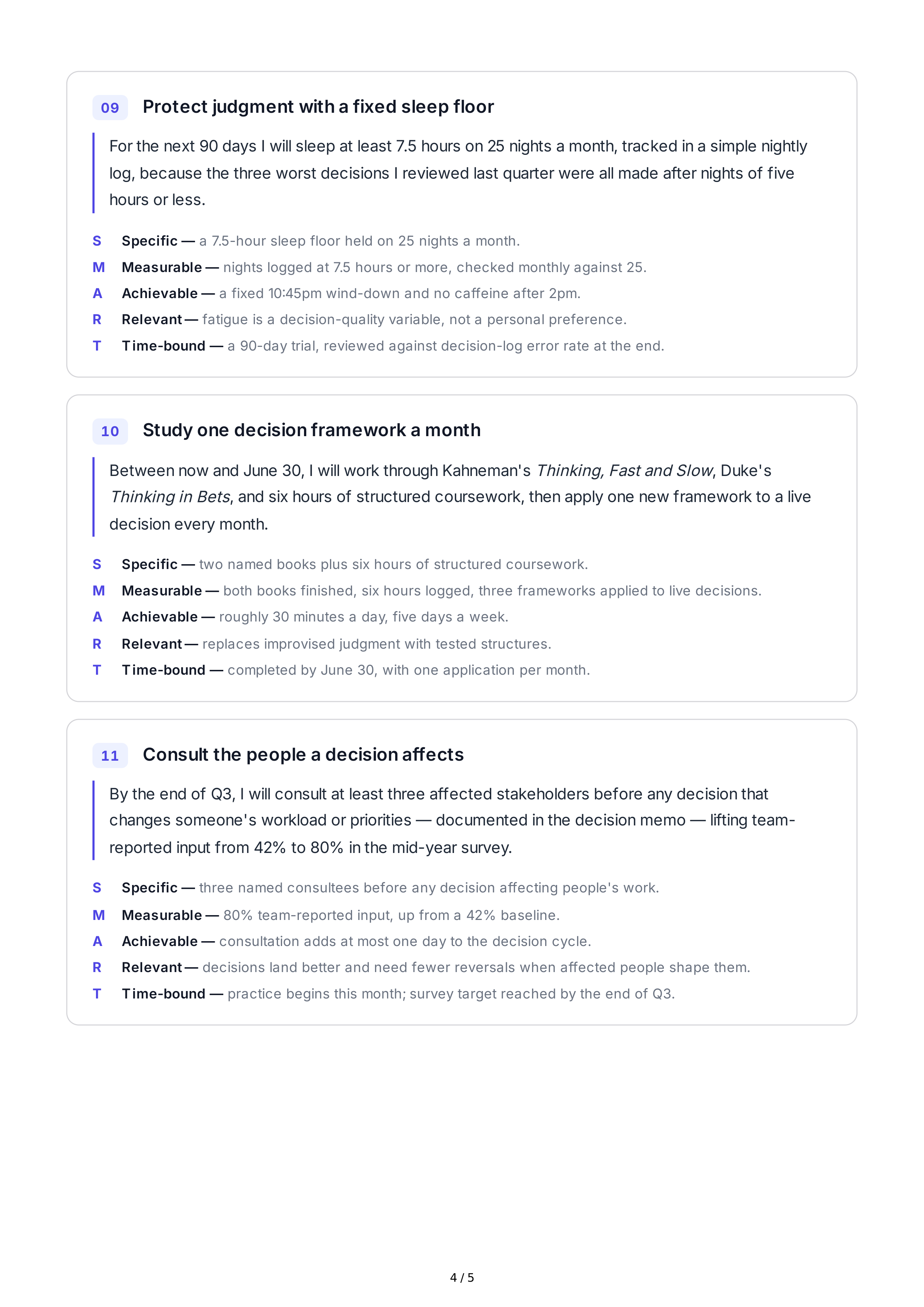
09
Protect
judgment
with
a
fixed
sleep
floor
For
the
next
90
days
I
will
sleep
at
least
7.5
hours
on
25
nights
a
month
,
tracked
in
a
simple
nightly
log
,
because
the
three
worst
decisions
I
reviewed
last
quarter
were
all
made
after
nights
of
five
hours
or
less
.
S
Specific
—
a
7.5-
hour
sleep
floor
held
on
25
nights
a
month
.
M
Measurable
—
nights
logged
at
7.5
hours
or
more
,
checked
monthly
against
25.
A
Achievable
—
a
fixed
10:45
pm
wind
-
down
and
no
caffeine
after
2
pm
.
R
Relevant
—
fatigue
is
a
decision
-
quality
variable
,
not
a
personal
preference
.
T
Time
-
bound
—
a
90-
day
trial
,
reviewed
against
decision
-
log
error
rate
at
the
end
.
10
Study
one
decision
framework
a
month
Between
now
and
June
30,
I
will
work
through
Kahneman
'
s
Thinking
,
Fast
and
Slow
,
Duke
'
s
Thinking
in
Bets
,
and
six
hours
of
structured
coursework
,
then
apply
one
new
framework
to
a
live
decision
every
month
.
S
Specific
—
two
named
books
plus
six
hours
of
structured
coursework
.
M
Measurable
—
both
books
finished
,
six
hours
logged
,
three
frameworks
applied
to
live
decisions
.
A
Achievable
—
roughly
30
minutes
a
day
,
five
days
a
week
.
R
Relevant
—
replaces
improvised
judgment
with
tested
structures
.
T
Time
-
bound
—
completed
by
June
30,
with
one
application
per
month
.
11
Consult
the
people
a
decision
affects
By
the
end
of
Q
3,
I
will
consult
at
least
three
affected
stakeholders
before
any
decision
that
changes
someone
'
s
workload
or
priorities
—
documented
in
the
decision
memo
—
lifting
team
-
reported
input
from
42%
to
80%
in
the
mid
-
year
survey
.
S
Specific
—
three
named
consultees
before
any
decision
affecting
people
'
s
work
.
M
Measurable
—
80%
team
-
reported
input
,
up
from
a
42%
baseline
.
A
Achievable
—
consultation
adds
at
most
one
day
to
the
decision
cycle
.
R
Relevant
—
decisions
land
better
and
need
fewer
reversals
when
affected
people
shape
them
.
T
Time
-
bound
—
practice
begins
this
month
;
survey
target
reached
by
the
end
of
Q
3.
4 / 5
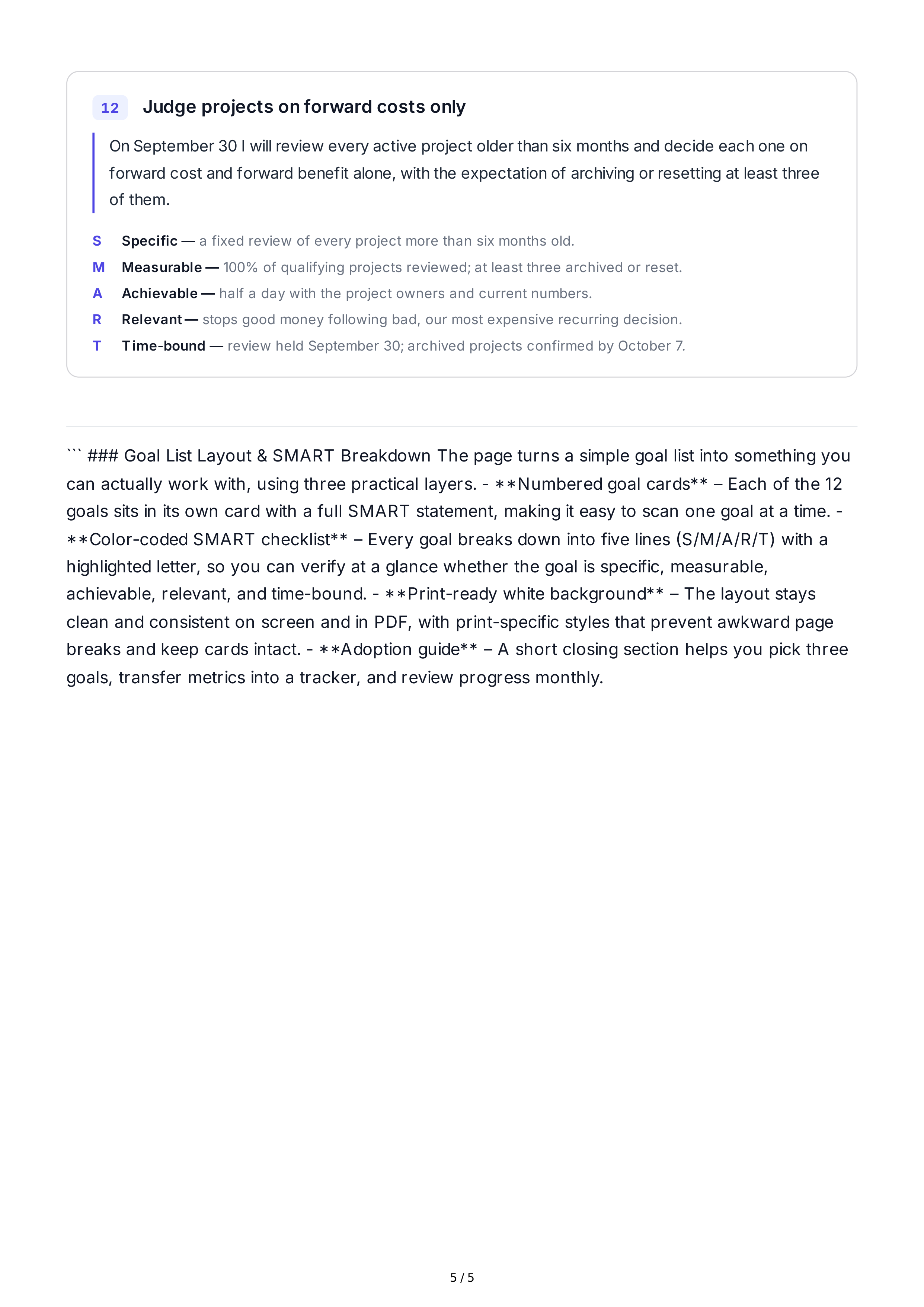
12
Judge
projects
on
forward
costs
only
On
September
30
I
will
review
every
active
project
older
than
six
months
and
decide
each
one
on
forward
cost
and
forward
benefit
alone
,
with
the
expectation
of
archiving
or
resetting
at
least
three
of
them
.
S
Specific
—
a
fixed
review
of
every
project
more
than
six
months
old
.
M
Measurable
—
100%
of
qualifying
projects
reviewed
;
at
least
three
archived
or
reset
.
A
Achievable
—
half
a
day
with
the
project
owners
and
current
numbers
.
R
Relevant
—
stops
good
money
following
bad
,
our
most
expensive
recurring
decision
.
T
Time
-
bound
—
review
held
September
30;
archived
projects
confirmed
by
October
7.
``` ###
Goal
List
Layout
&
SMART
Breakdown
The
page
turns
a
simple
goal
list
into
something
you
can
actually
work
with
,
using
three
practical
layers
. - **
Numbered
goal
cards
** –
Each
of
the
12
goals
sits
in
its
own
card
with
a
full
SMART
statement
,
making
it
easy
to
scan
one
goal
at
a
time
. -
**
Color
-
coded
SMART
checklist
** –
Every
goal
breaks
down
into
five
lines
(
S
/
M
/
A
/
R
/
T
)
with
a
highlighted
letter
,
so
you
can
verify
at
a
glance
whether
the
goal
is
specific
,
measurable
,
achievable
,
relevant
,
and
time
-
bound
. - **
Print
-
ready
white
background
** –
The
layout
stays
clean
and
consistent
on
screen
and
in
PDF
,
with
print
-
specific
styles
that
prevent
awkward
page
breaks
and
keep
cards
intact
. - **
Adoption
guide
** –
A
short
closing
section
helps
you
pick
three
goals
,
transfer
metrics
into
a
tracker
,
and
review
progress
monthly
.
5 / 5