SMART
Goals
for
Graduate
Students
The
goals
at
a
glance
Start
here
.
Each
goal
is
broken
down
in
full
in
the
next
section
.
01
Finish
and
submit
the
dissertation
literature
review
chapter
Draft
due
May
15
02
Submit
one
first
-
author
manuscript
to
a
peer
-
reviewed
journal
Submit
by
Apr
1
03
Present
research
at
one
national
conference
Abstract
due
Nov
1
04
Write
500
words
every
weekday
,
logged
and
tracked
12-
week
cycle
05
Hold
a
structured
advisor
meeting
every
two
weeks
12
per
year
06
Build
one
hard
technical
skill
to
working
proficiency
Complete
by
Aug
1
07
Apply
for
four
sources
of
external
and
internal
funding
Nov
–
Jan
deadlines
08
Run
two
professional
informational
interviews
each
month
24
per
year
09
Protect
a
sustainable
workload
and
sleep
schedule
Reviewed
monthly
10
Secure
the
next
step
:
internship
,
postdoc
,
or
first
role
Offer
by
Apr
30
1 / 12
Each
goal
,
broken
down
Every
breakdown
follows
the
same
five
-
part
structure
,
so
you
can
copy
the
pattern
for
goals
of
your
own
.
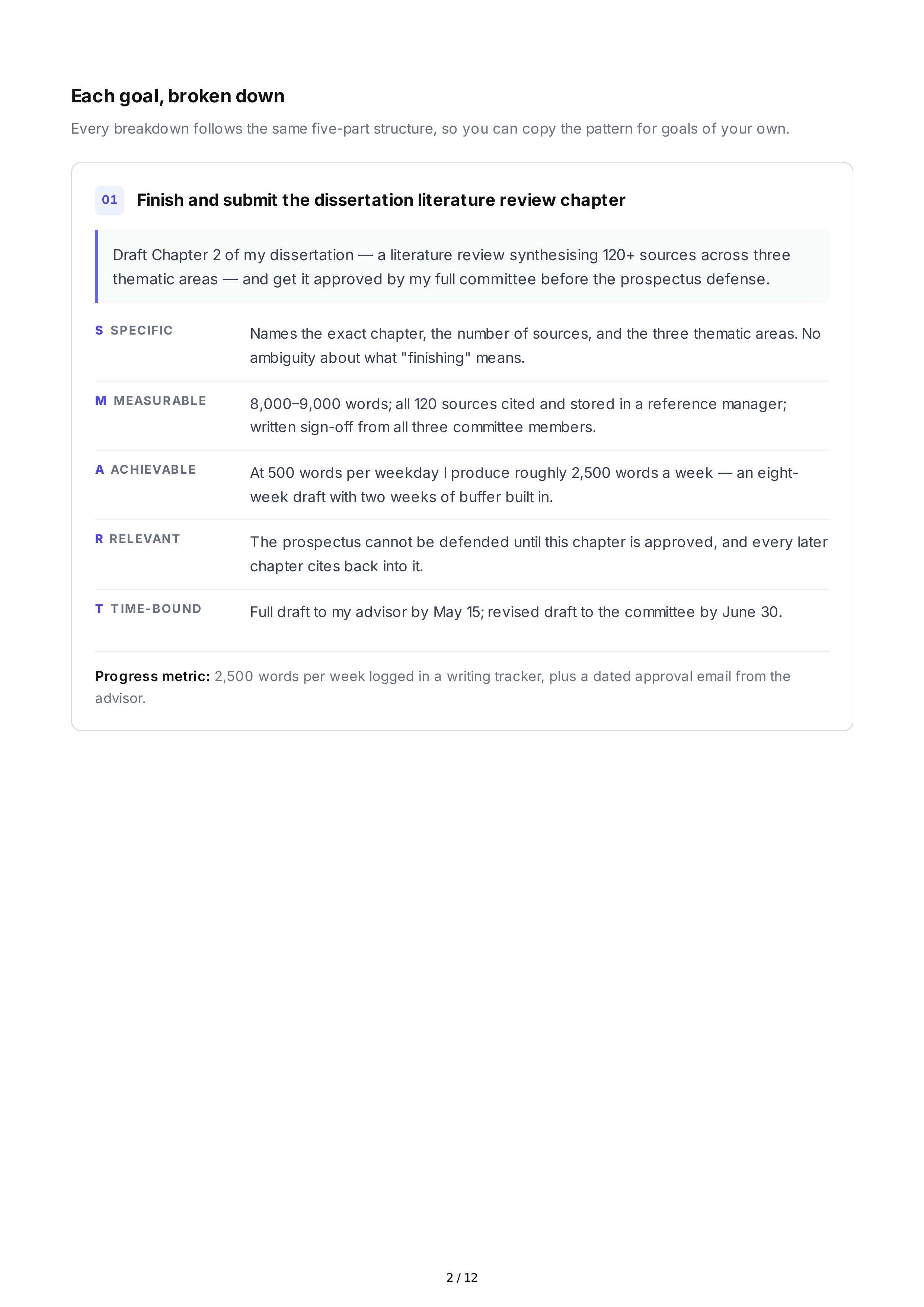
01
Finish
and
submit
the
dissertation
literature
review
chapter
Draft
Chapter
2
of
my
dissertation
—
a
literature
review
synthesising
120+
sources
across
three
thematic
areas
—
and
get
it
approved
by
my
full
committee
before
the
prospectus
defense
.
S
SPECIFIC
Names
the
exact
chapter
,
the
number
of
sources
,
and
the
three
thematic
areas
.
No
ambiguity
about
what
"
finishing
"
means
.
M
MEASURABLE
8,000–9,000
words
;
all
120
sources
cited
and
stored
in
a
reference
manager
;
written
sign
-
off
from
all
three
committee
members
.
A
ACHIEVABLE
At
500
words
per
weekday
I
produce
roughly
2,500
words
a
week
—
an
eight
-
week
draft
with
two
weeks
of
buffer
built
in
.
R
RELEVANT
The
prospectus
cannot
be
defended
until
this
chapter
is
approved
,
and
every
later
chapter
cites
back
into
it
.
T
T IME
-
BOUND
Full
draft
to
my
advisor
by
May
15;
revised
draft
to
the
committee
by
June
30.
Progress
metric
:
2,500
words
per
week
logged
in
a
writing
tracker
,
plus
a
dated
approval
email
from
the
advisor
.
2 / 12
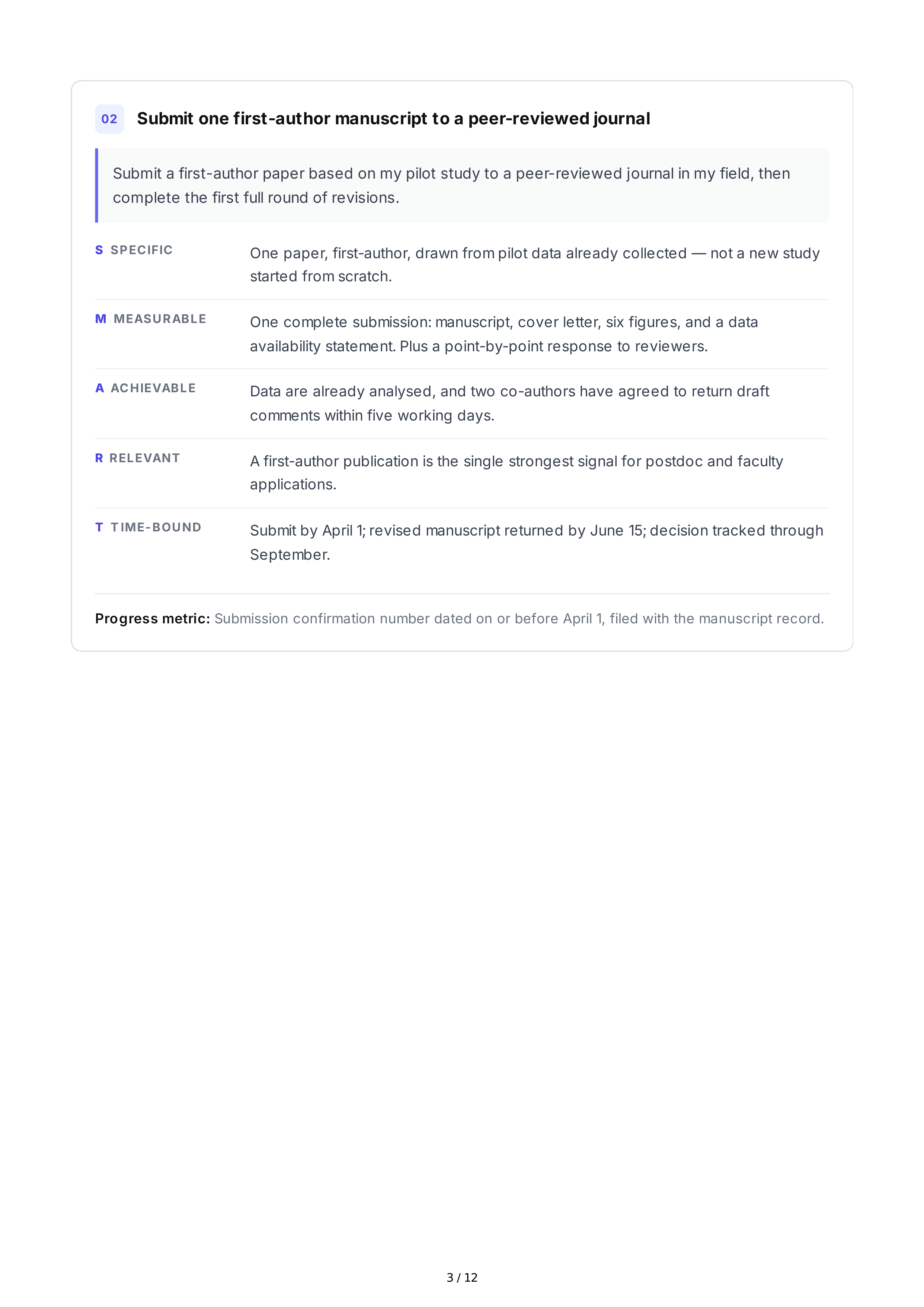
02
Submit
one
first
-
author
manuscript
to
a
peer
-
reviewed
journal
Submit
a
first
-
author
paper
based
on
my
pilot
study
to
a
peer
-
reviewed
journal
in
my
field
,
then
complete
the
first
full
round
of
revisions
.
S
SPECIFIC
One
paper
,
first
-
author
,
drawn
from
pilot
data
already
collected
—
not
a
new
study
started
from
scratch
.
M
MEASURABLE
One
complete
submission
:
manuscript
,
cover
letter
,
six
figures
,
and
a
data
availability
statement
.
Plus
a
point
-
by
-
point
response
to
reviewers
.
A
ACHIEVABLE
Data
are
already
analysed
,
and
two
co
-
authors
have
agreed
to
return
draft
comments
within
five
working
days
.
R
RELEVANT
A
first
-
author
publication
is
the
single
strongest
signal
for
postdoc
and
faculty
applications
.
T
T IME
-
BOUND
Submit
by
April
1;
revised
manuscript
returned
by
June
15;
decision
tracked
through
September
.
Progress
metric
:
Submission
confirmation
number
dated
on
or
before
April
1,
filed
with
the
manuscript
record
.
3 / 12
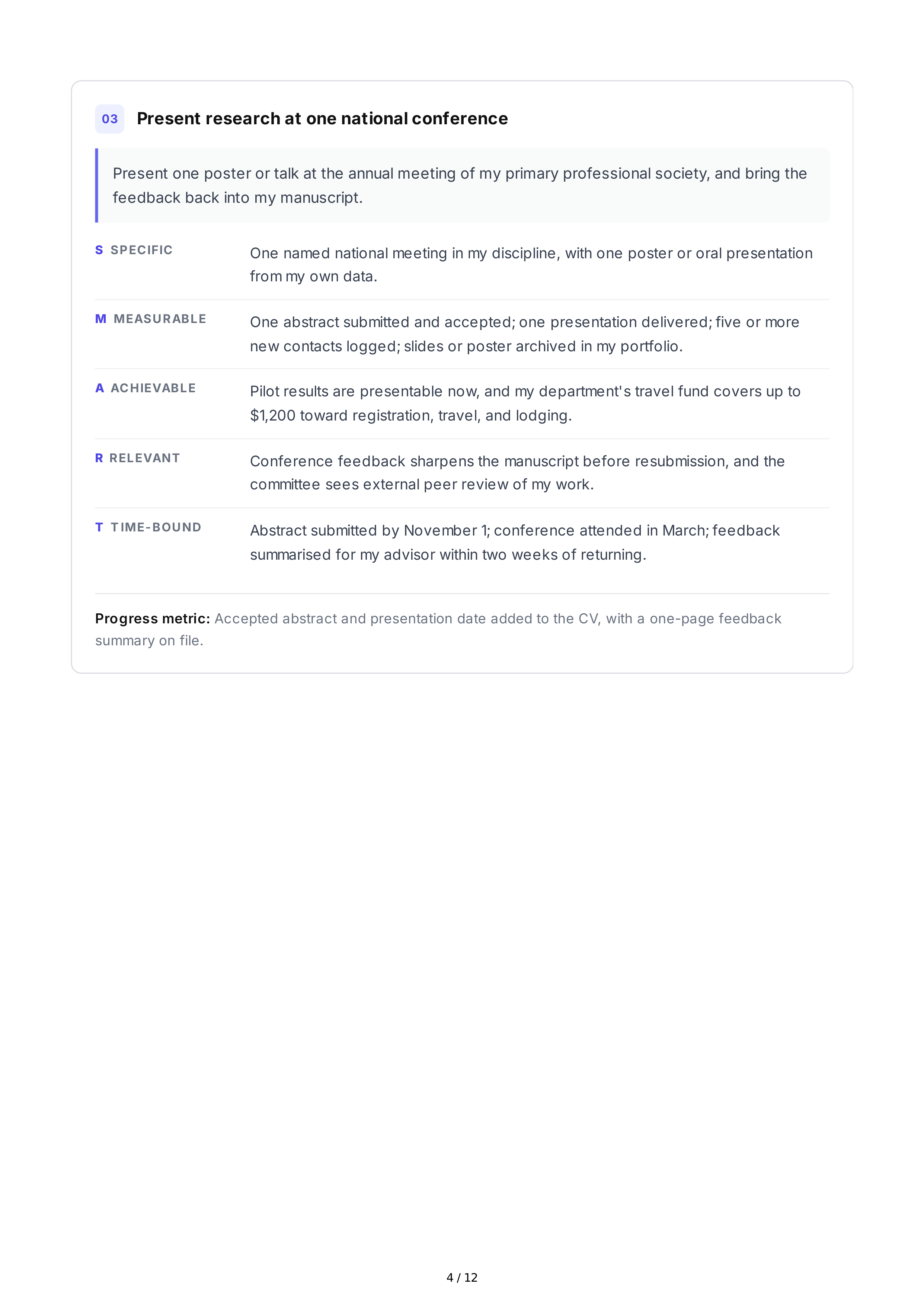
03
Present
research
at
one
national
conference
Present
one
poster
or
talk
at
the
annual
meeting
of
my
primary
professional
society
,
and
bring
the
feedback
back
into
my
manuscript
.
S
SPECIFIC
One
named
national
meeting
in
my
discipline
,
with
one
poster
or
oral
presentation
from
my
own
data
.
M
MEASURABLE
One
abstract
submitted
and
accepted
;
one
presentation
delivered
;
five
or
more
new
contacts
logged
;
slides
or
poster
archived
in
my
portfolio
.
A
ACHIEVABLE
Pilot
results
are
presentable
now
,
and
my
department
'
s
travel
fund
covers
up
to
$
1,200
toward
registration
,
travel
,
and
lodging
.
R
RELEVANT
Conference
feedback
sharpens
the
manuscript
before
resubmission
,
and
the
committee
sees
external
peer
review
of
my
work
.
T
T IME
-
BOUND
Abstract
submitted
by
November
1;
conference
attended
in
March
;
feedback
summarised
for
my
advisor
within
two
weeks
of
returning
.
Progress
metric
:
Accepted
abstract
and
presentation
date
added
to
the
CV
,
with
a
one
-
page
feedback
summary
on
file
.
4 / 12
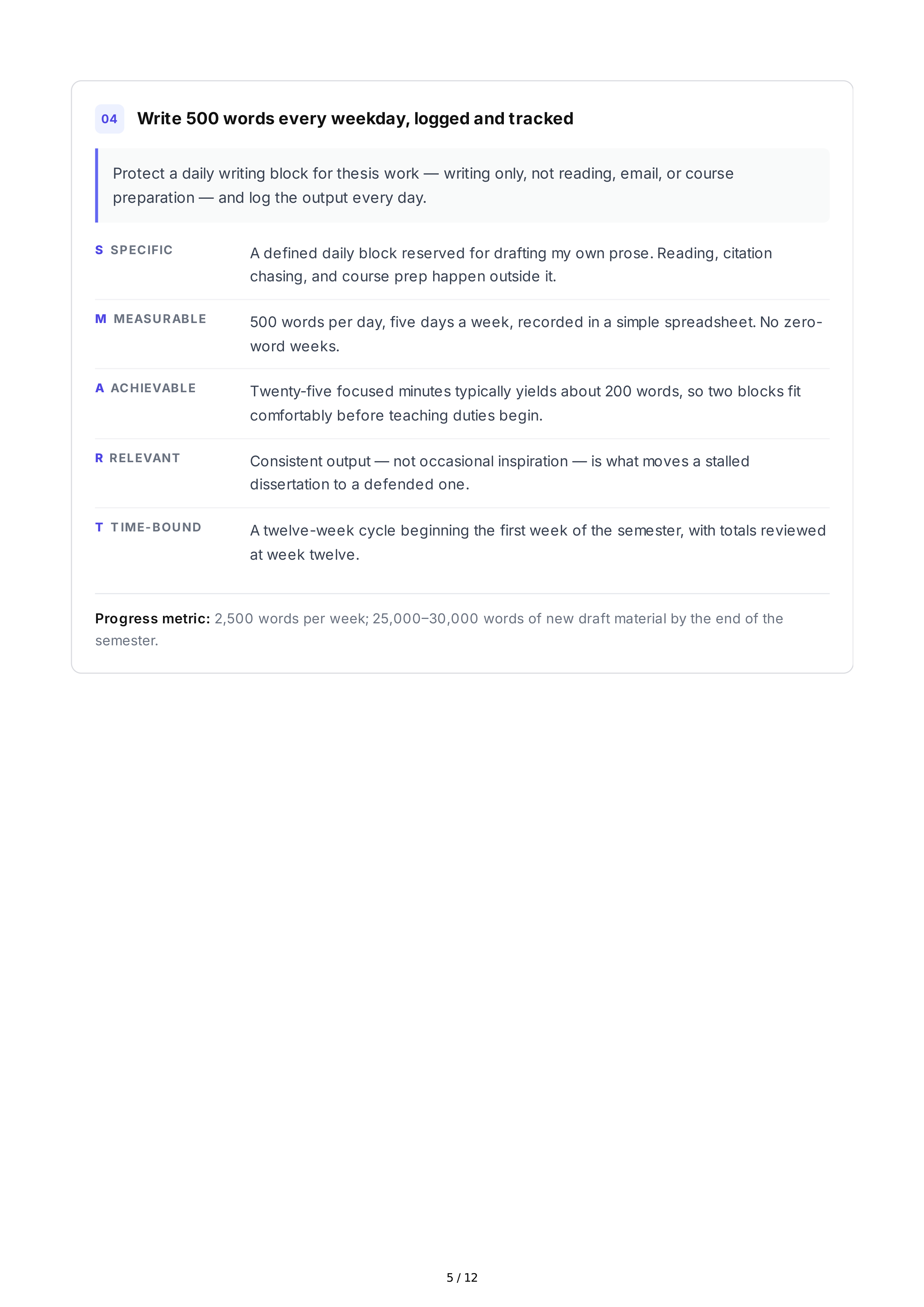
04
Write
500
words
every
weekday
,
logged
and
tracked
Protect
a
daily
writing
block
for
thesis
work
—
writing
only
,
not
reading
,
email
,
or
course
preparation
—
and
log
the
output
every
day
.
S
SPECIFIC
A
defined
daily
block
reserved
for
drafting
my
own
prose
.
Reading
,
citation
chasing
,
and
course
prep
happen
outside
it
.
M
MEASURABLE
500
words
per
day
,
five
days
a
week
,
recorded
in
a
simple
spreadsheet
.
No
zero
-
word
weeks
.
A
ACHIEVABLE
Twenty
-
five
focused
minutes
typically
yields
about
200
words
,
so
two
blocks
fit
comfortably
before
teaching
duties
begin
.
R
RELEVANT
Consistent
output
—
not
occasional
inspiration
—
is
what
moves
a
stalled
dissertation
to
a
defended
one
.
T
T IME
-
BOUND
A
twelve
-
week
cycle
beginning
the
first
week
of
the
semester
,
with
totals
reviewed
at
week
twelve
.
Progress
metric
:
2,500
words
per
week
; 25,000–30,000
words
of
new
draft
material
by
the
end
of
the
semester
.
5 / 12
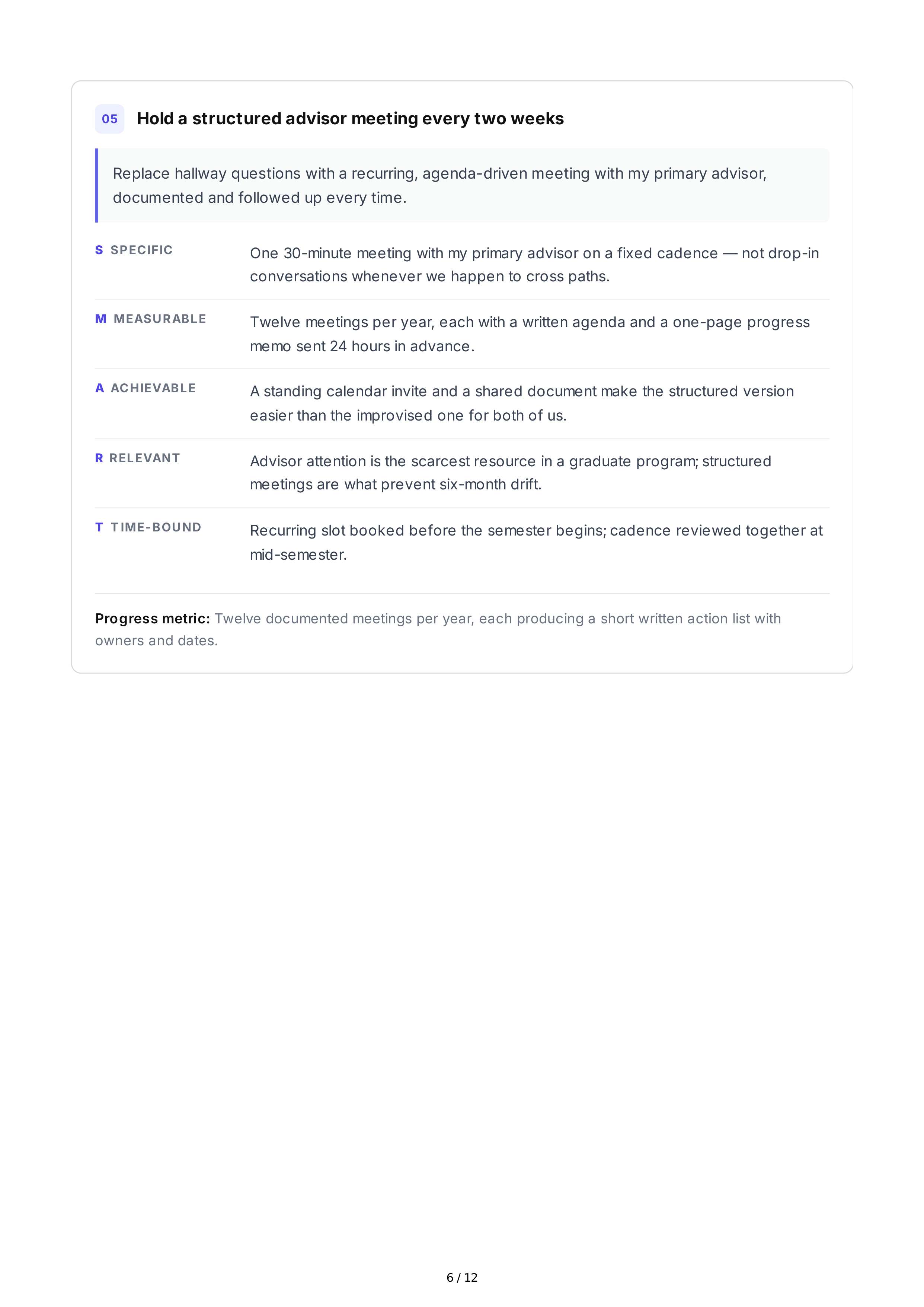
05
Hold
a
structured
advisor
meeting
every
two
weeks
Replace
hallway
questions
with
a
recurring
,
agenda
-
driven
meeting
with
my
primary
advisor
,
documented
and
followed
up
every
time
.
S
SPECIFIC
One
30-
minute
meeting
with
my
primary
advisor
on
a
fixed
cadence
—
not
drop
-
in
conversations
whenever
we
happen
to
cross
paths
.
M
MEASURABLE
Twelve
meetings
per
year
,
each
with
a
written
agenda
and
a
one
-
page
progress
memo
sent
24
hours
in
advance
.
A
ACHIEVABLE
A
standing
calendar
invite
and
a
shared
document
make
the
structured
version
easier
than
the
improvised
one
for
both
of
us
.
R
RELEVANT
Advisor
attention
is
the
scarcest
resource
in
a
graduate
program
;
structured
meetings
are
what
prevent
six
-
month
drift
.
T
T IME
-
BOUND
Recurring
slot
booked
before
the
semester
begins
;
cadence
reviewed
together
at
mid
-
semester
.
Progress
metric
:
Twelve
documented
meetings
per
year
,
each
producing
a
short
written
action
list
with
owners
and
dates
.
6 / 12
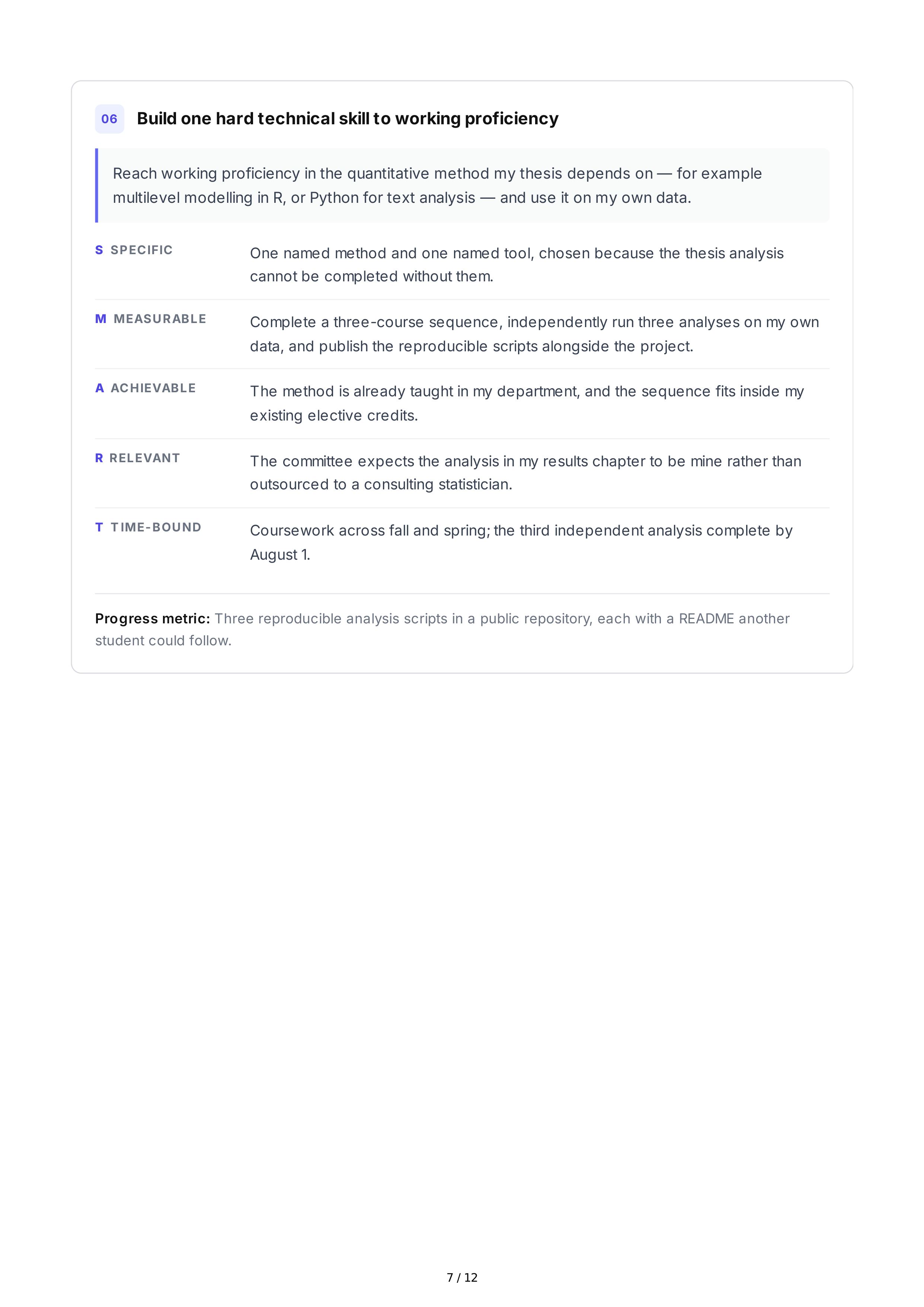
06
Build
one
hard
technical
skill
to
working
proficiency
Reach
working
proficiency
in
the
quantitative
method
my
thesis
depends
on
—
for
example
multilevel
modelling
in
R
,
or
Python
for
text
analysis
—
and
use
it
on
my
own
data
.
S
SPECIFIC
One
named
method
and
one
named
tool
,
chosen
because
the
thesis
analysis
cannot
be
completed
without
them
.
M
MEASURABLE
Complete
a
three
-
course
sequence
,
independently
run
three
analyses
on
my
own
data
,
and
publish
the
reproducible
scripts
alongside
the
project
.
A
ACHIEVABLE
The
method
is
already
taught
in
my
department
,
and
the
sequence
fits
inside
my
existing
elective
credits
.
R
RELEVANT
The
committee
expects
the
analysis
in
my
results
chapter
to
be
mine
rather
than
outsourced
to
a
consulting
statistician
.
T
T IME
-
BOUND
Coursework
across
fall
and
spring
;
the
third
independent
analysis
complete
by
August
1.
Progress
metric
:
Three
reproducible
analysis
scripts
in
a
public
repository
,
each
with
a
README
another
student
could
follow
.
7 / 12
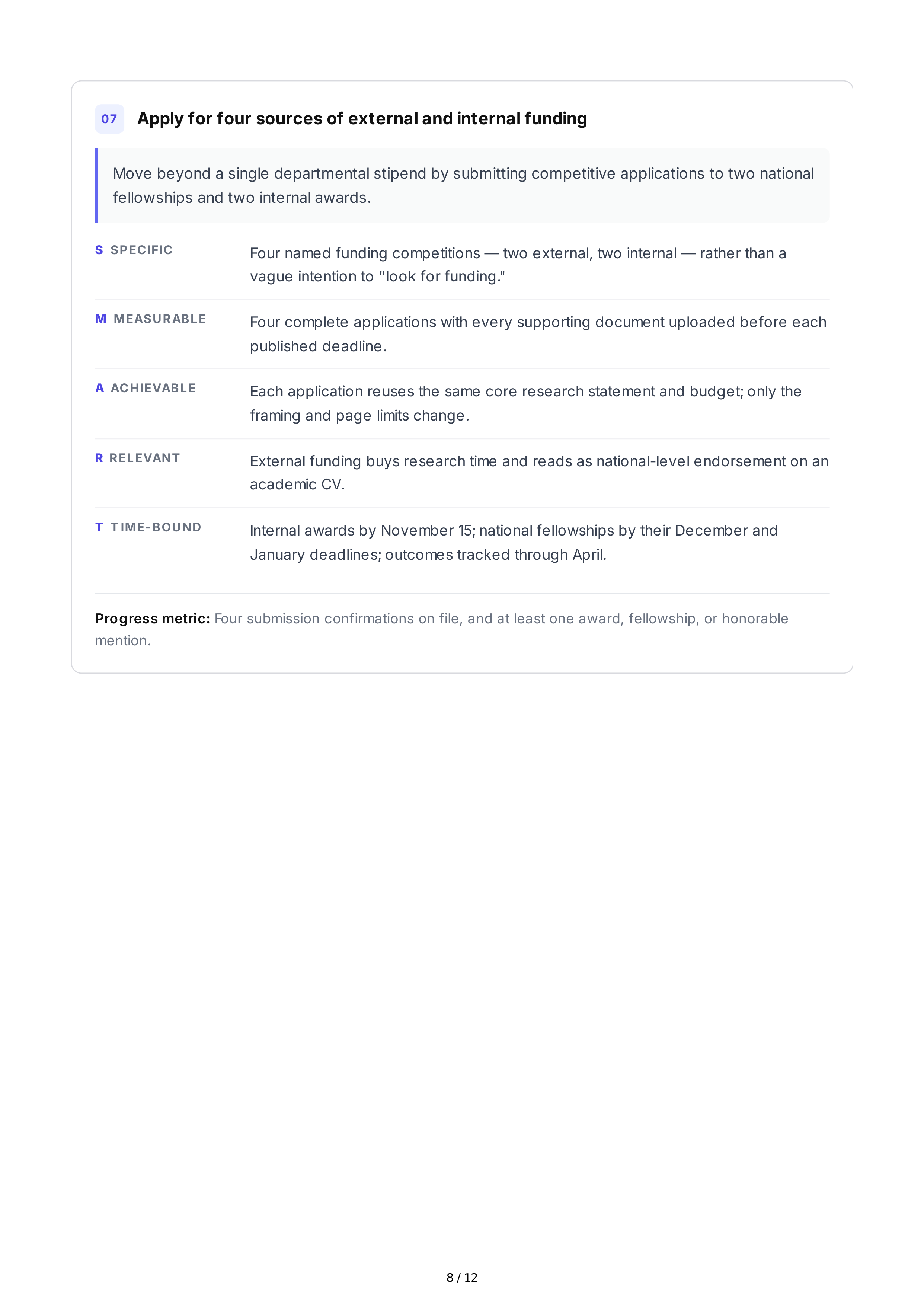
07
Apply
for
four
sources
of
external
and
internal
funding
Move
beyond
a
single
departmental
stipend
by
submitting
competitive
applications
to
two
national
fellowships
and
two
internal
awards
.
S
SPECIFIC
Four
named
funding
competitions
—
two
external
,
two
internal
—
rather
than
a
vague
intention
to
"
look
for
funding
."
M
MEASURABLE
Four
complete
applications
with
every
supporting
document
uploaded
before
each
published
deadline
.
A
ACHIEVABLE
Each
application
reuses
the
same
core
research
statement
and
budget
;
only
the
framing
and
page
limits
change
.
R
RELEVANT
External
funding
buys
research
time
and
reads
as
national
-
level
endorsement
on
an
academic
CV
.
T
T IME
-
BOUND
Internal
awards
by
November
15;
national
fellowships
by
their
December
and
January
deadlines
;
outcomes
tracked
through
April
.
Progress
metric
:
Four
submission
confirmations
on
file
,
and
at
least
one
award
,
fellowship
,
or
honorable
mention
.
8 / 12
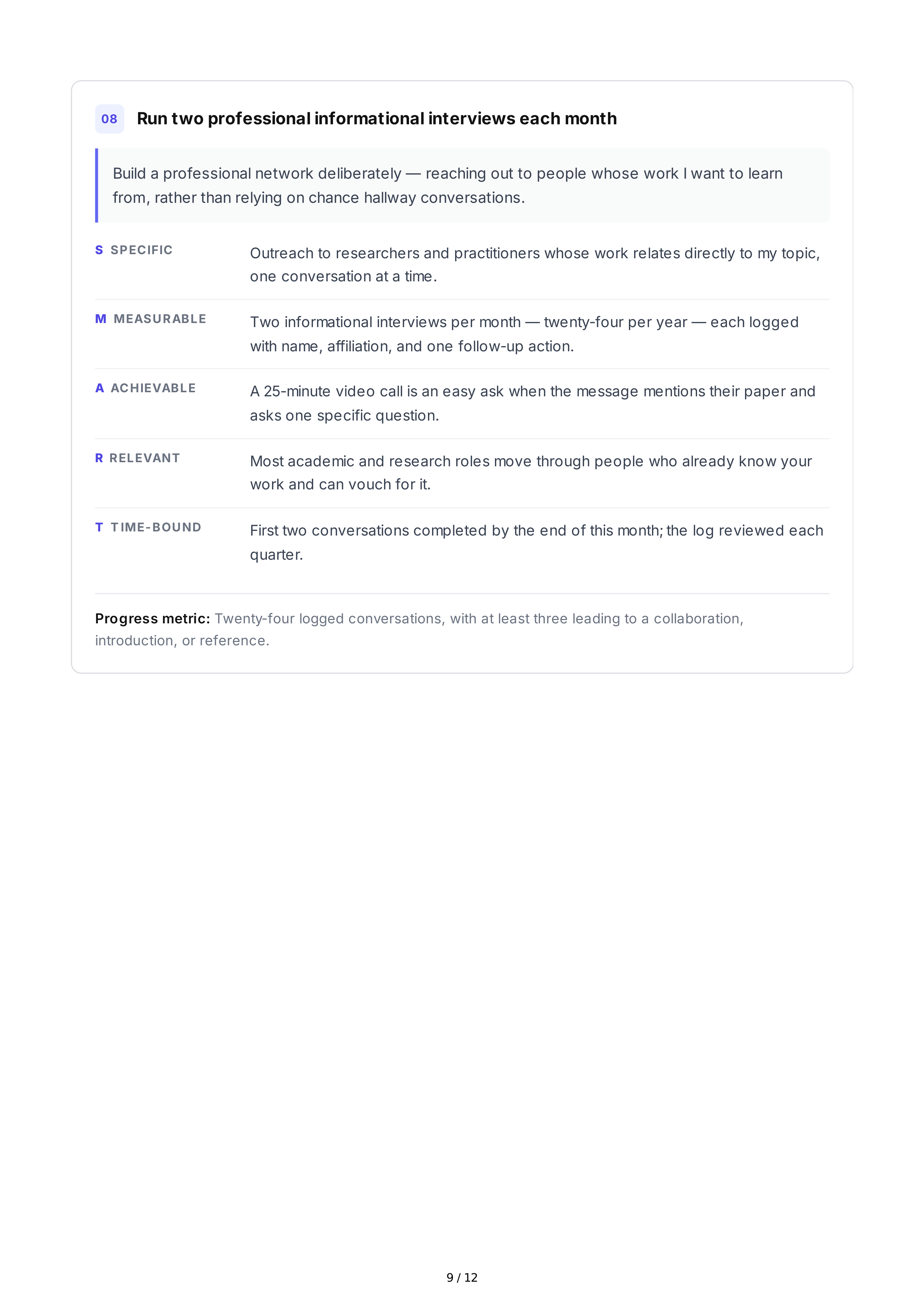
08
Run
two
professional
informational
interviews
each
month
Build
a
professional
network
deliberately
—
reaching
out
to
people
whose
work
I
want
to
learn
from
,
rather
than
relying
on
chance
hallway
conversations
.
S
SPECIFIC
Outreach
to
researchers
and
practitioners
whose
work
relates
directly
to
my
topic
,
one
conversation
at
a
time
.
M
MEASURABLE
Two
informational
interviews
per
month
—
twenty
-
four
per
year
—
each
logged
with
name
,
affiliation
,
and
one
follow
-
up
action
.
A
ACHIEVABLE
A
25-
minute
video
call
is
an
easy
ask
when
the
message
mentions
their
paper
and
asks
one
specific
question
.
R
RELEVANT
Most
academic
and
research
roles
move
through
people
who
already
know
your
work
and
can
vouch
for
it
.
T
T IME
-
BOUND
First
two
conversations
completed
by
the
end
of
this
month
;
the
log
reviewed
each
quarter
.
Progress
metric
:
Twenty
-
four
logged
conversations
,
with
at
least
three
leading
to
a
collaboration
,
introduction
,
or
reference
.
9 / 12
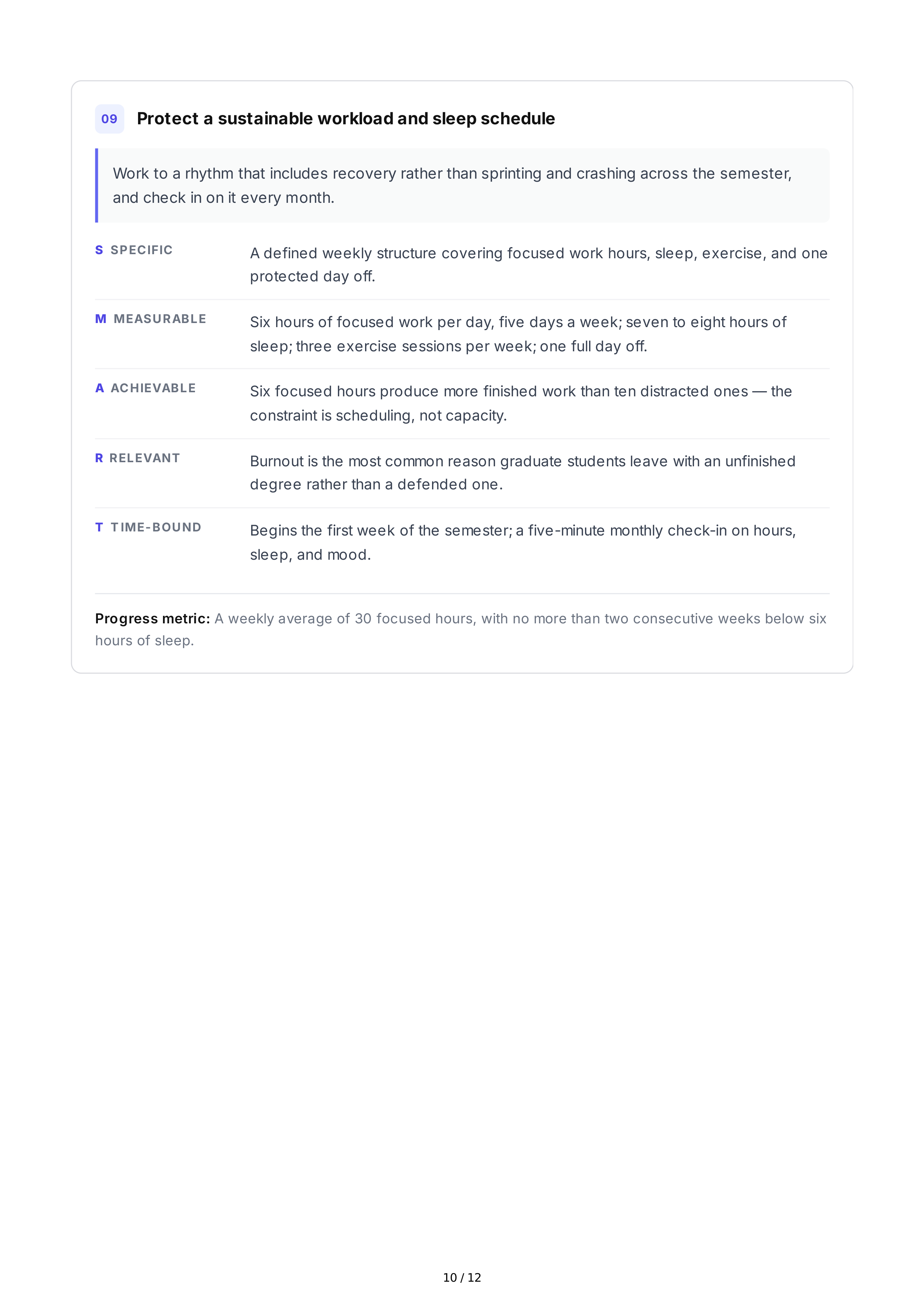
09
Protect
a
sustainable
workload
and
sleep
schedule
Work
to
a
rhythm
that
includes
recovery
rather
than
sprinting
and
crashing
across
the
semester
,
and
check
in
on
it
every
month
.
S
SPECIFIC
A
defined
weekly
structure
covering
focused
work
hours
,
sleep
,
exercise
,
and
one
protected
day
off
.
M
MEASURABLE
Six
hours
of
focused
work
per
day
,
five
days
a
week
;
seven
to
eight
hours
of
sleep
;
three
exercise
sessions
per
week
;
one
full
day
off
.
A
ACHIEVABLE
Six
focused
hours
produce
more
finished
work
than
ten
distracted
ones
—
the
constraint
is
scheduling
,
not
capacity
.
R
RELEVANT
Burnout
is
the
most
common
reason
graduate
students
leave
with
an
unfinished
degree
rather
than
a
defended
one
.
T
T IME
-
BOUND
Begins
the
first
week
of
the
semester
;
a
five
-
minute
monthly
check
-
in
on
hours
,
sleep
,
and
mood
.
Progress
metric
:
A
weekly
average
of
30
focused
hours
,
with
no
more
than
two
consecutive
weeks
below
six
hours
of
sleep
.
10 / 12
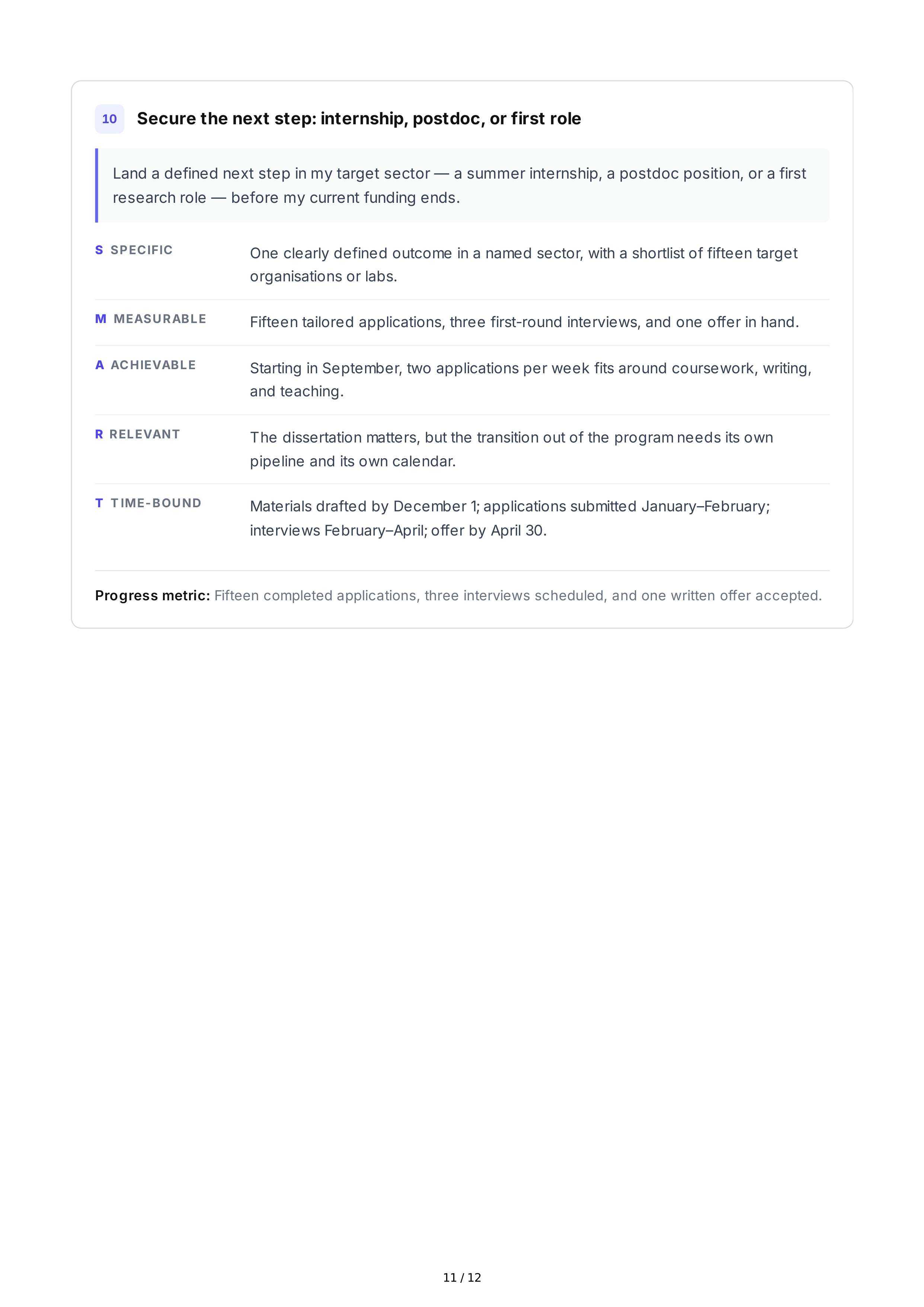
10
Secure
the
next
step
:
internship
,
postdoc
,
or
first
role
Land
a
defined
next
step
in
my
target
sector
—
a
summer
internship
,
a
postdoc
position
,
or
a
first
research
role
—
before
my
current
funding
ends
.
S
SPECIFIC
One
clearly
defined
outcome
in
a
named
sector
,
with
a
shortlist
of
fifteen
target
organisations
or
labs
.
M
MEASURABLE
Fifteen
tailored
applications
,
three
first
-
round
interviews
,
and
one
offer
in
hand
.
A
ACHIEVABLE
Starting
in
September
,
two
applications
per
week
fits
around
coursework
,
writing
,
and
teaching
.
R
RELEVANT
The
dissertation
matters
,
but
the
transition
out
of
the
program
needs
its
own
pipeline
and
its
own
calendar
.
T
T IME
-
BOUND
Materials
drafted
by
December
1;
applications
submitted
January
–
February
;
interviews
February
–
April
;
offer
by
April
30.
Progress
metric
:
Fifteen
completed
applications
,
three
interviews
scheduled
,
and
one
written
offer
accepted
.
11 / 12
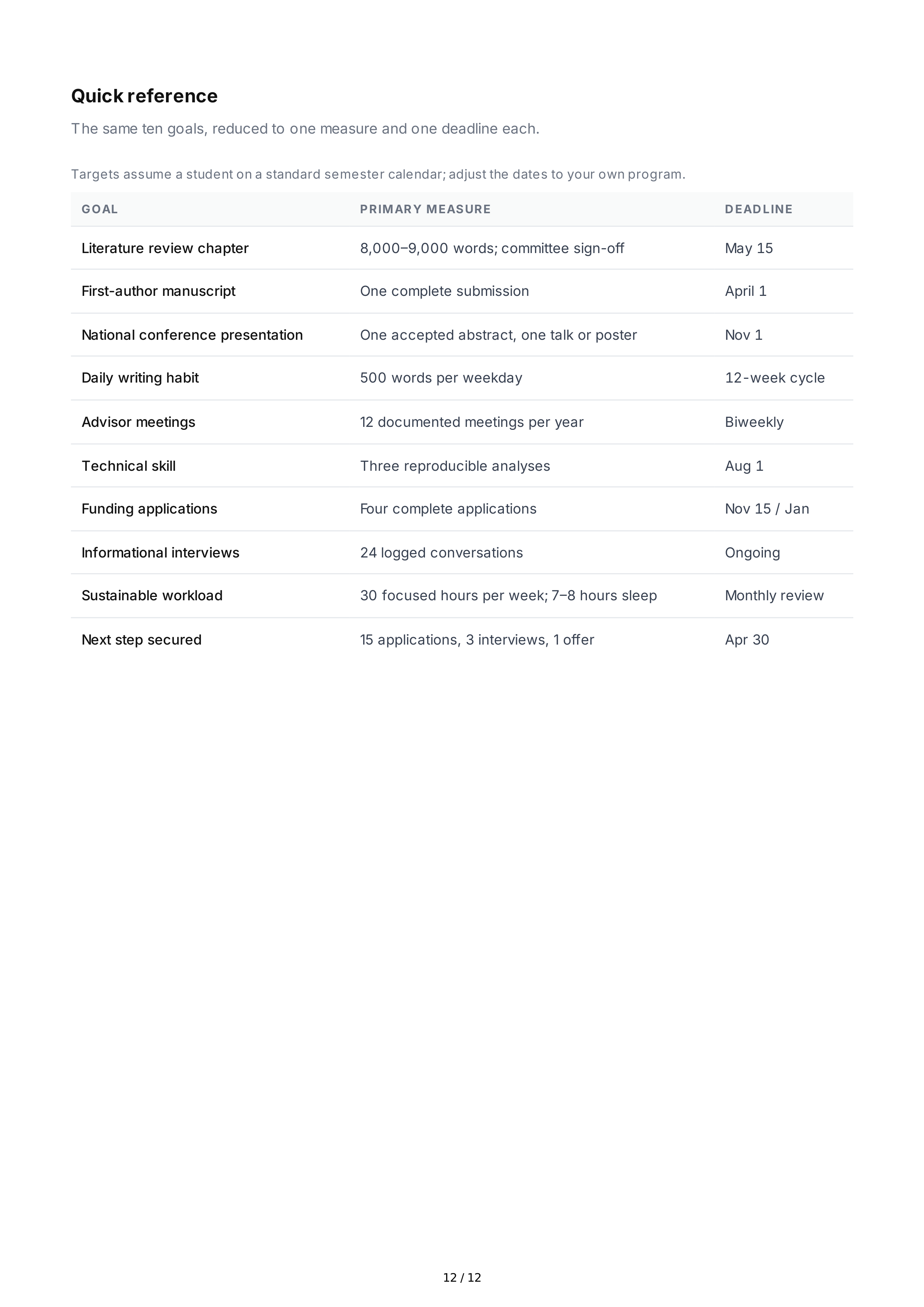
Quick
reference
The
same
ten
goals
,
reduced
to
one
measure
and
one
deadline
each
.
Targets
assume
a
student
on
a
standard
semester
calendar
;
adjust
the
dates
to
your
own
program
.
GOAL
PRIMARY
MEASURE
D EAD LINE
Literature
review
chapter
8,000–9,000
words
;
committee
sign
-
off
May
15
First
-
author
manuscript
One
complete
submission
April
1
National
conference
presentation
One
accepted
abstract
,
one
talk
or
poster
Nov
1
Daily
writing
habit
500
words
per
weekday
12-
week
cycle
Advisor
meetings
12
documented
meetings
per
year
Biweekly
Technical
skill
Three
reproducible
analyses
Aug
1
Funding
applications
Four
complete
applications
Nov
15 /
Jan
Informational
interviews
24
logged
conversations
Ongoing
Sustainable
workload
30
focused
hours
per
week
; 7–8
hours
sleep
Monthly
review
Next
step
secured
15
applications
, 3
interviews
, 1
offer
Apr
30
12 / 12