SMART
Exam
Preparation
Goals
1.
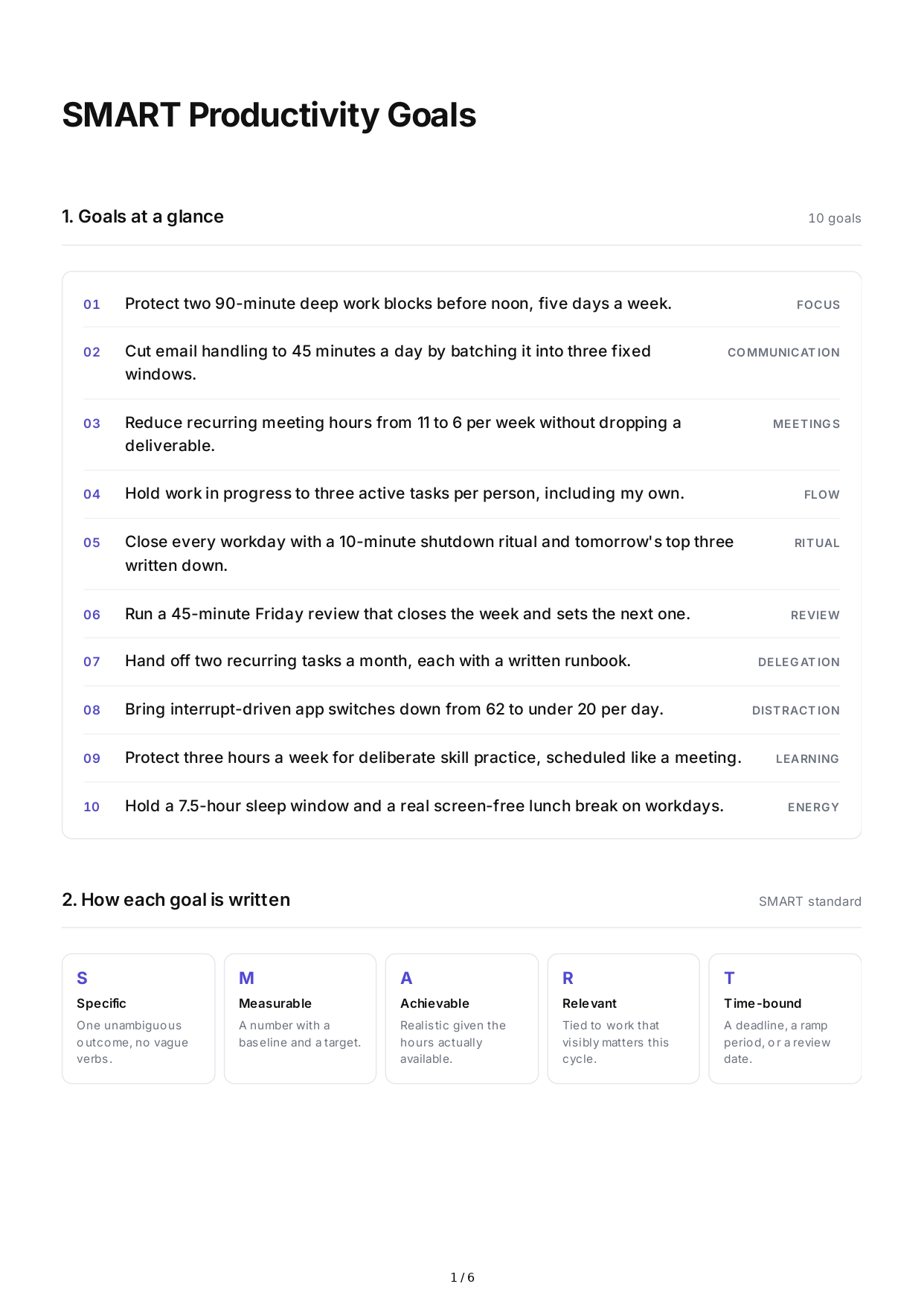
The
Goals
Read
this
list
first
.
Everything
after
it
is
the
same
ten
goals
broken
down
into
Specific
,
Measurable
,
Achievable
,
Relevant
and
Time
-
bound
parts
.
Cover
all
14
syllabus
units
at
least
once
by
15
March
2026.
Syllabus
coverage
·
first
pass
Score
80%
or
higher
on
every
full
-
length
mock
from
Mock
6
onward
,
ending
at
82%
average
.
Mock
performance
· 36
mocks
Study
20
focused
hours
per
week
for
15
consecutive
weeks
,
with
no
week
below
16
hours
.
Consistency
·
time
on
task
Solve
2,000
practice
questions
before
exam
day
.
Volume
·
question
bank
Cut
average
time
per
question
from
95
to
70
seconds
.
Speed
·
exam
pacing
Keep
the
mistake
log
under
40
recurring
errors
by
reducing
each
logged
error
to
zero
repeats
within
14
days
.
Accuracy
·
error
control
Review
300
spaced
-
repetition
cards
every
week
with
no
skipped
week
.
Retention
·
memory
system
Finish
every
mock
with
at
least
10
minutes
left
for
a
full
answer
-
sheet
review
.
Exam
technique
·
checking
Attend
12
doubt
-
clearing
sessions
,
each
with
two
written
questions
prepared
beforehand
.
Support
·
targeted
help
Protect
7.5
hours
of
sleep
a
night
and
one
full
rest
day
a
week
.
Sustainability
·
burnout
prevention
01
02
03
04
05
06
07
08
09
10
2 / 6
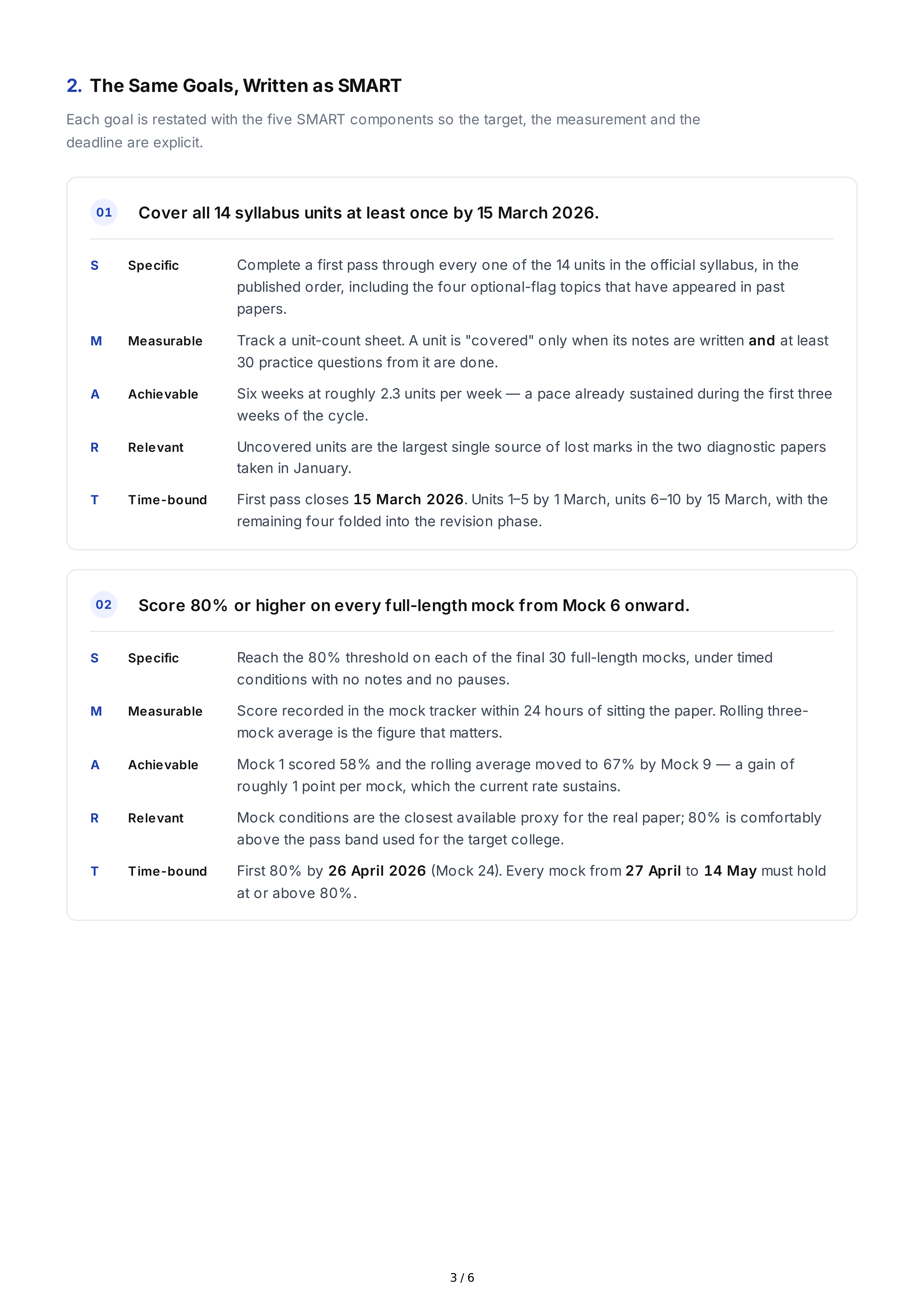
2.
The
Same
Goals
,
Written
as
SMART
Each
goal
is
restated
with
the
five
SMART
components
so
the
target
,
the
measurement
and
the
deadline
are
explicit
.
01
Cover
all
14
syllabus
units
at
least
once
by
15
March
2026.
S
Specific
Complete
a
first
pass
through
every
one
of
the
14
units
in
the
official
syllabus
,
in
the
published
order
,
including
the
four
optional
-
flag
topics
that
have
appeared
in
past
papers
.
M
Measurable
Track
a
unit
-
count
sheet
.
A
unit
is
"
covered
"
only
when
its
notes
are
written
and
at
least
30
practice
questions
from
it
are
done
.
A
Achievable
Six
weeks
at
roughly
2.3
units
per
week
—
a
pace
already
sustained
during
the
first
three
weeks
of
the
cycle
.
R
Relevant
Uncovered
units
are
the
largest
single
source
of
lost
marks
in
the
two
diagnostic
papers
taken
in
January
.
T
Time
-
bound
First
pass
closes
15
March
2026
.
Units
1–5
by
1
March
,
units
6–10
by
15
March
,
with
the
remaining
four
folded
into
the
revision
phase
.
02
Score
80%
or
higher
on
every
full
-
length
mock
from
Mock
6
onward
.
S
Specific
Reach
the
80%
threshold
on
each
of
the
final
30
full
-
length
mocks
,
under
timed
conditions
with
no
notes
and
no
pauses
.
M
Measurable
Score
recorded
in
the
mock
tracker
within
24
hours
of
sitting
the
paper
.
Rolling
three
-
mock
average
is
the
figure
that
matters
.
A
Achievable
Mock
1
scored
58%
and
the
rolling
average
moved
to
67%
by
Mock
9 —
a
gain
of
roughly
1
point
per
mock
,
which
the
current
rate
sustains
.
R
Relevant
Mock
conditions
are
the
closest
available
proxy
for
the
real
paper
; 80%
is
comfortably
above
the
pass
band
used
for
the
target
college
.
T
Time
-
bound
First
80%
by
26
April
2026
(
Mock
24).
Every
mock
from
27
April
to
14
May
must
hold
at
or
above
80%.
3 / 6
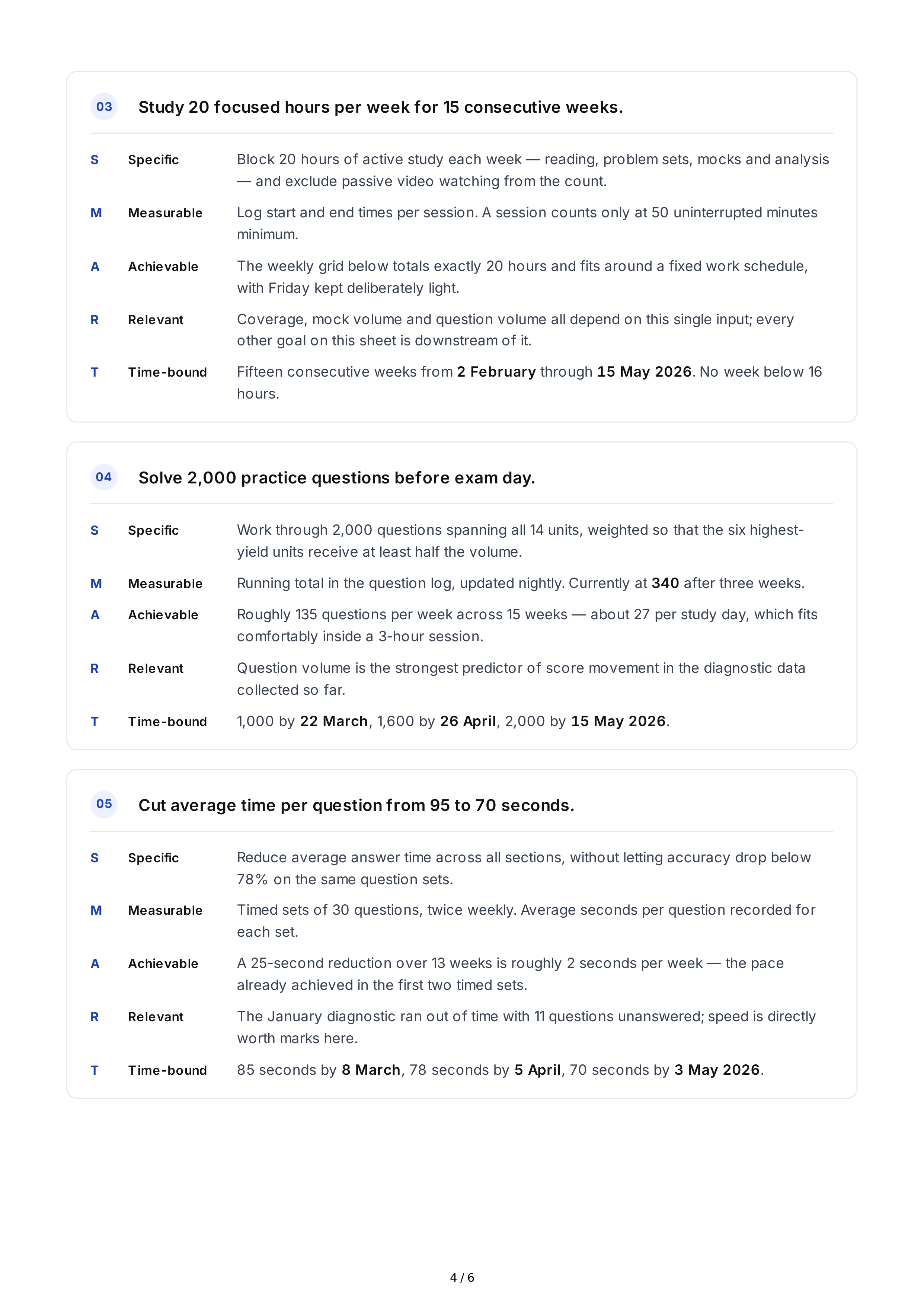
03
Study
20
focused
hours
per
week
for
15
consecutive
weeks
.
S
Specific
Block
20
hours
of
active
study
each
week
—
reading
,
problem
sets
,
mocks
and
analysis
—
and
exclude
passive
video
watching
from
the
count
.
M
Measurable
Log
start
and
end
times
per
session
.
A
session
counts
only
at
50
uninterrupted
minutes
minimum
.
A
Achievable
The
weekly
grid
below
totals
exactly
20
hours
and
fits
around
a
fixed
work
schedule
,
with
Friday
kept
deliberately
light
.
R
Relevant
Coverage
,
mock
volume
and
question
volume
all
depend
on
this
single
input
;
every
other
goal
on
this
sheet
is
downstream
of
it
.
T
Time
-
bound
Fifteen
consecutive
weeks
from
2
February
through
15
May
2026
.
No
week
below
16
hours
.
04
Solve
2,000
practice
questions
before
exam
day
.
S
Specific
Work
through
2,000
questions
spanning
all
14
units
,
weighted
so
that
the
six
highest
-
yield
units
receive
at
least
half
the
volume
.
M
Measurable
Running
total
in
the
question
log
,
updated
nightly
.
Currently
at
340
after
three
weeks
.
A
Achievable
Roughly
135
questions
per
week
across
15
weeks
—
about
27
per
study
day
,
which
fits
comfortably
inside
a
3-
hour
session
.
R
Relevant
Question
volume
is
the
strongest
predictor
of
score
movement
in
the
diagnostic
data
collected
so
far
.
T
Time
-
bound
1,000
by
22
March
, 1,600
by
26
April
, 2,000
by
15
May
2026
.
05
Cut
average
time
per
question
from
95
to
70
seconds
.
S
Specific
Reduce
average
answer
time
across
all
sections
,
without
letting
accuracy
drop
below
78%
on
the
same
question
sets
.
M
Measurable
Timed
sets
of
30
questions
,
twice
weekly
.
Average
seconds
per
question
recorded
for
each
set
.
A
Achievable
A
25-
second
reduction
over
13
weeks
is
roughly
2
seconds
per
week
—
the
pace
already
achieved
in
the
first
two
timed
sets
.
R
Relevant
The
January
diagnostic
ran
out
of
time
with
11
questions
unanswered
;
speed
is
directly
worth
marks
here
.
T
Time
-
bound
85
seconds
by
8
March
, 78
seconds
by
5
April
, 70
seconds
by
3
May
2026
.
4 / 6
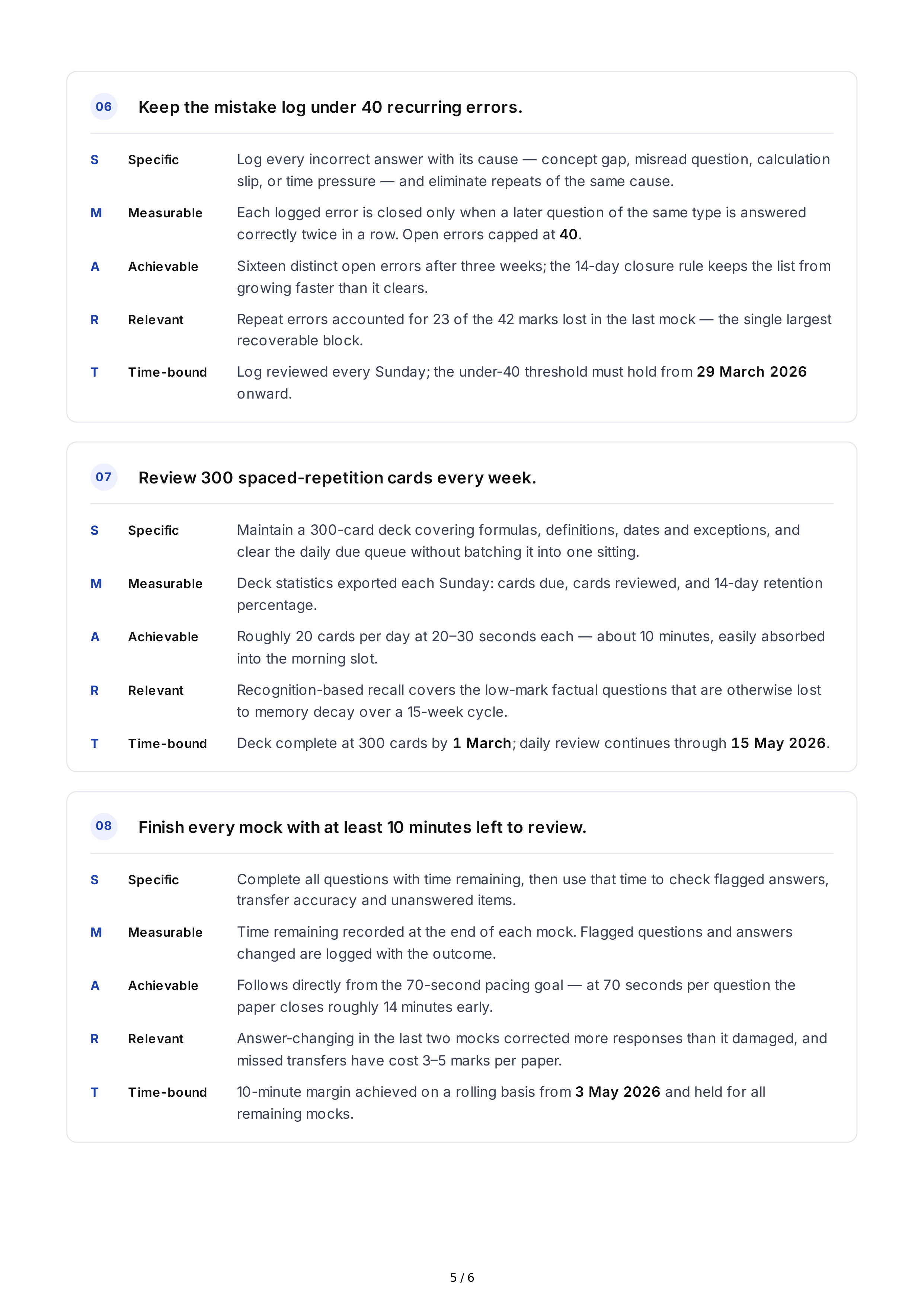
06
Keep
the
mistake
log
under
40
recurring
errors
.
S
Specific
Log
every
incorrect
answer
with
its
cause
—
concept
gap
,
misread
question
,
calculation
slip
,
or
time
pressure
—
and
eliminate
repeats
of
the
same
cause
.
M
Measurable
Each
logged
error
is
closed
only
when
a
later
question
of
the
same
type
is
answered
correctly
twice
in
a
row
.
Open
errors
capped
at
40
.
A
Achievable
Sixteen
distinct
open
errors
after
three
weeks
;
the
14-
day
closure
rule
keeps
the
list
from
growing
faster
than
it
clears
.
R
Relevant
Repeat
errors
accounted
for
23
of
the
42
marks
lost
in
the
last
mock
—
the
single
largest
recoverable
block
.
T
Time
-
bound
Log
reviewed
every
Sunday
;
the
under
-40
threshold
must
hold
from
29
March
2026
onward
.
07
Review
300
spaced
-
repetition
cards
every
week
.
S
Specific
Maintain
a
300-
card
deck
covering
formulas
,
definitions
,
dates
and
exceptions
,
and
clear
the
daily
due
queue
without
batching
it
into
one
sitting
.
M
Measurable
Deck
statistics
exported
each
Sunday
:
cards
due
,
cards
reviewed
,
and
14-
day
retention
percentage
.
A
Achievable
Roughly
20
cards
per
day
at
20–30
seconds
each
—
about
10
minutes
,
easily
absorbed
into
the
morning
slot
.
R
Relevant
Recognition
-
based
recall
covers
the
low
-
mark
factual
questions
that
are
otherwise
lost
to
memory
decay
over
a
15-
week
cycle
.
T
Time
-
bound
Deck
complete
at
300
cards
by
1
March
;
daily
review
continues
through
15
May
2026
.
08
Finish
every
mock
with
at
least
10
minutes
left
to
review
.
S
Specific
Complete
all
questions
with
time
remaining
,
then
use
that
time
to
check
flagged
answers
,
transfer
accuracy
and
unanswered
items
.
M
Measurable
Time
remaining
recorded
at
the
end
of
each
mock
.
Flagged
questions
and
answers
changed
are
logged
with
the
outcome
.
A
Achievable
Follows
directly
from
the
70-
second
pacing
goal
—
at
70
seconds
per
question
the
paper
closes
roughly
14
minutes
early
.
R
Relevant
Answer
-
changing
in
the
last
two
mocks
corrected
more
responses
than
it
damaged
,
and
missed
transfers
have
cost
3–5
marks
per
paper
.
T
Time
-
bound
10-
minute
margin
achieved
on
a
rolling
basis
from
3
May
2026
and
held
for
all
remaining
mocks
.
5 / 6
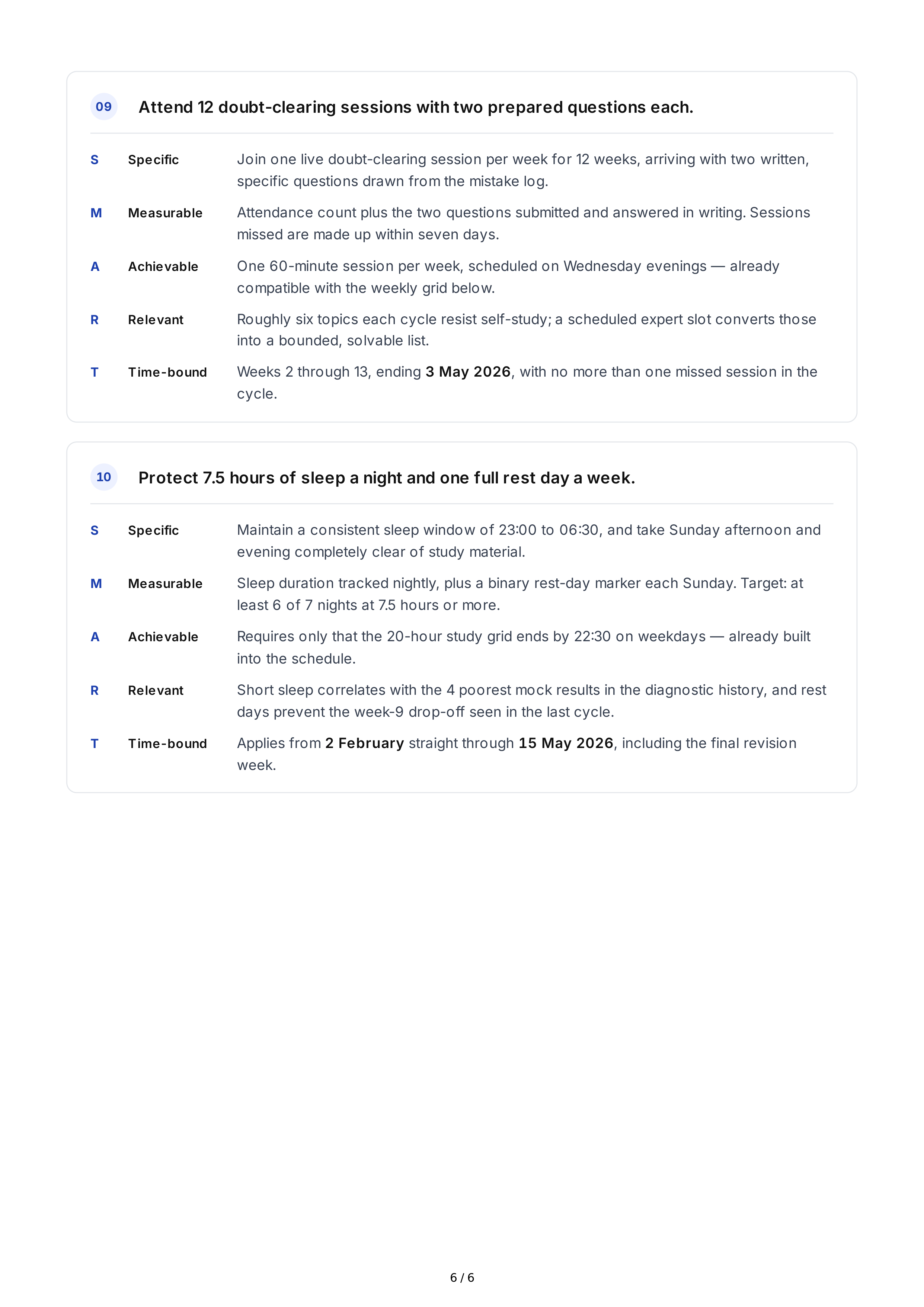
09
Attend
12
doubt
-
clearing
sessions
with
two
prepared
questions
each
.
S
Specific
Join
one
live
doubt
-
clearing
session
per
week
for
12
weeks
,
arriving
with
two
written
,
specific
questions
drawn
from
the
mistake
log
.
M
Measurable
Attendance
count
plus
the
two
questions
submitted
and
answered
in
writing
.
Sessions
missed
are
made
up
within
seven
days
.
A
Achievable
One
60-
minute
session
per
week
,
scheduled
on
Wednesday
evenings
—
already
compatible
with
the
weekly
grid
below
.
R
Relevant
Roughly
six
topics
each
cycle
resist
self
-
study
;
a
scheduled
expert
slot
converts
those
into
a
bounded
,
solvable
list
.
T
Time
-
bound
Weeks
2
through
13,
ending
3
May
2026
,
with
no
more
than
one
missed
session
in
the
cycle
.
10
Protect
7.5
hours
of
sleep
a
night
and
one
full
rest
day
a
week
.
S
Specific
Maintain
a
consistent
sleep
window
of
23:00
to
06:30,
and
take
Sunday
afternoon
and
evening
completely
clear
of
study
material
.
M
Measurable
Sleep
duration
tracked
nightly
,
plus
a
binary
rest
-
day
marker
each
Sunday
.
Target
:
at
least
6
of
7
nights
at
7.5
hours
or
more
.
A
Achievable
Requires
only
that
the
20-
hour
study
grid
ends
by
22:30
on
weekdays
—
already
built
into
the
schedule
.
R
Relevant
Short
sleep
correlates
with
the
4
poorest
mock
results
in
the
diagnostic
history
,
and
rest
days
prevent
the
week
-9
drop
-
off
seen
in
the
last
cycle
.
T
Time
-
bound
Applies
from
2
February
straight
through
15
May
2026
,
including
the
final
revision
week
.
6 / 6