My Projects
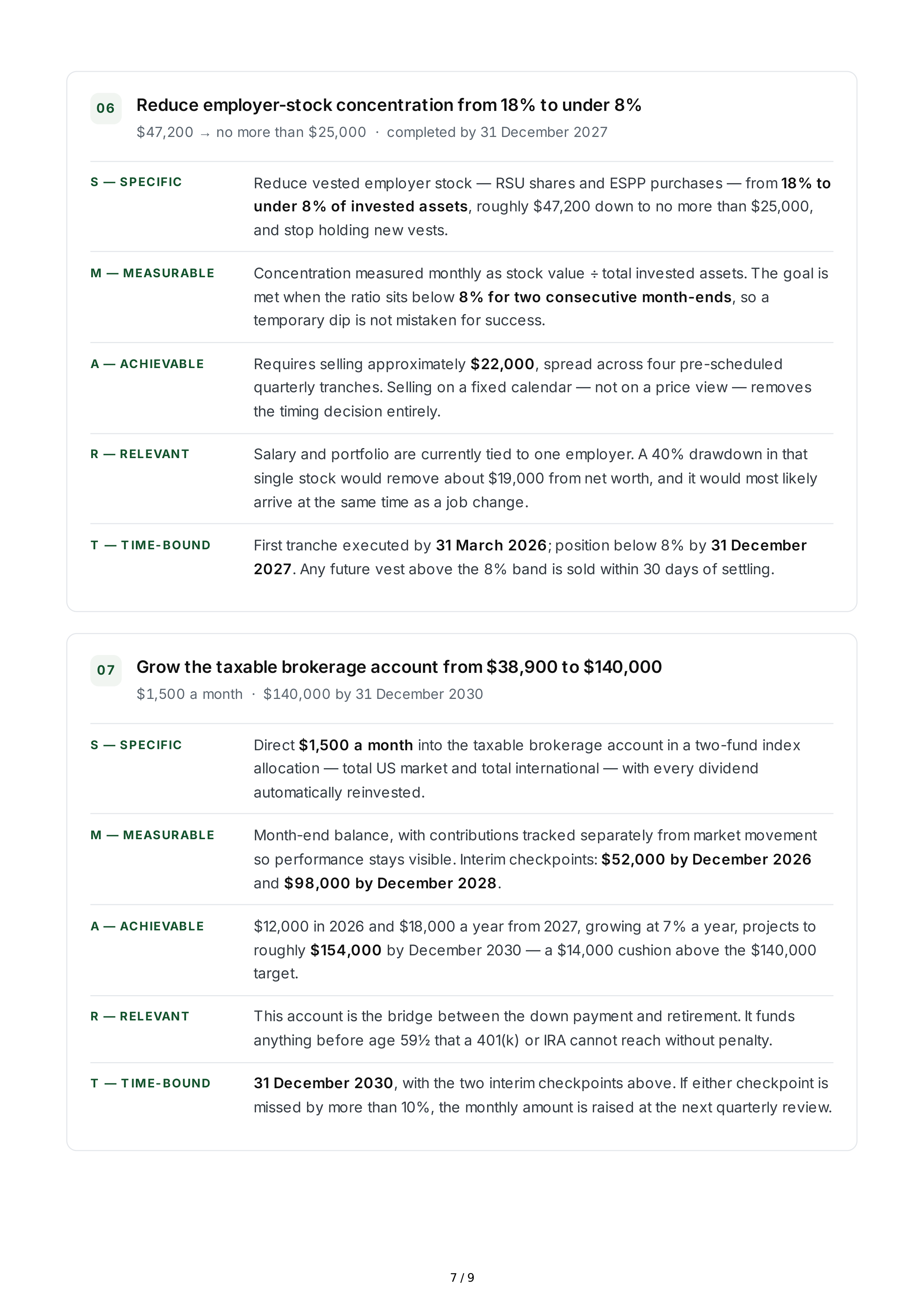
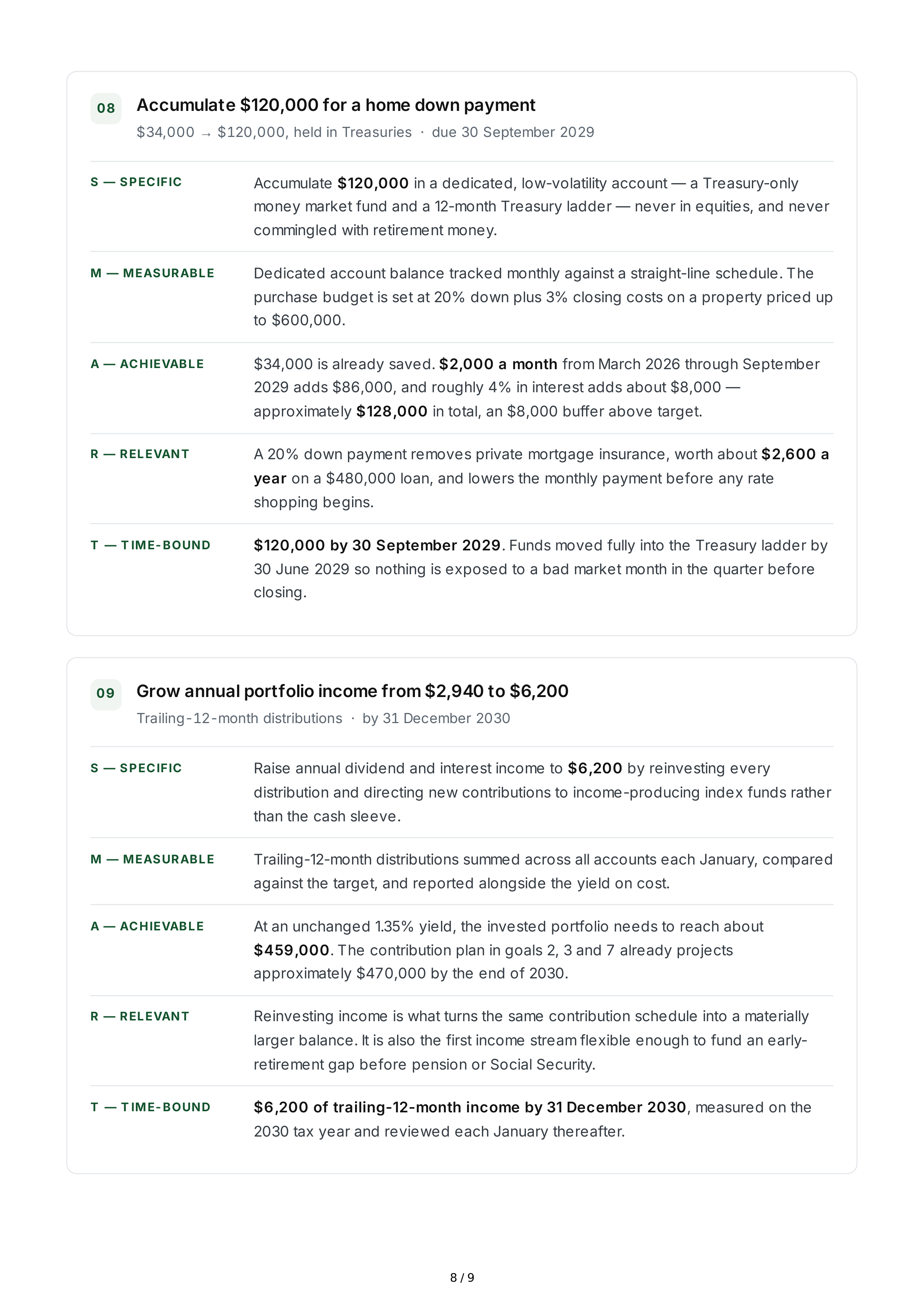
Home
Free AI SMART Goals Generator
SMART Investment Goals
1 / 9
SMART
Investment
Goals
2 / 9
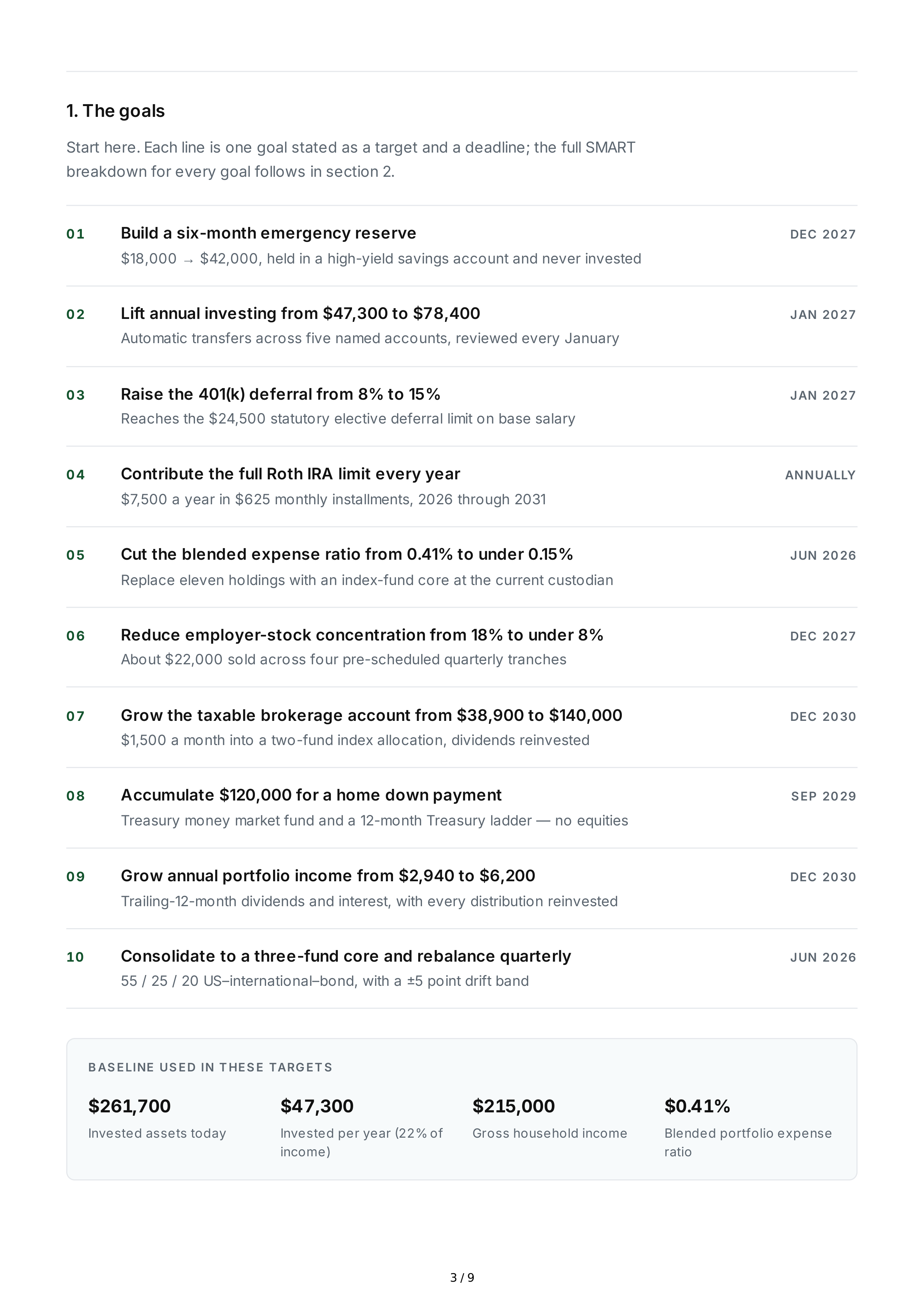
1.
The
goals
Start
here
.
Each
line
is
one
goal
stated
as
a
target
and
a
deadline
;
the
full
SMART
breakdown
for
every
goal
follows
in
section
2.
01
Build
a
six
-
month
emergency
reserve
$
18,000
→
$
42,000,
held
in
a
high
-
yield
savings
account
and
never
invested
DEC
2027
02
Lift
annual
investing
from
$
47,300
to
$
78,400
Automatic
transfers
across
five
named
accounts
,
reviewed
every
January
JAN
2027
03
Raise
the
401(
k
)
deferral
from
8%
to
15%
Reaches
the
$
24,500
statutory
elective
deferral
limit
on
base
salary
JAN
2027
04
Contribute
the
full
Roth
IRA
limit
every
year
$
7,500
a
year
in
$
625
monthly
installments
, 2026
through
2031
ANNUALLY
05
Cut
the
blended
expense
ratio
from
0.41%
to
under
0.15%
Replace
eleven
holdings
with
an
index
-
fund
core
at
the
current
custodian
JUN
2026
06
Reduce
employer
-
stock
concentration
from
18%
to
under
8%
About
$
22,000
sold
across
four
pre
-
scheduled
quarterly
tranches
DEC
2027
07
Grow
the
taxable
brokerage
account
from
$
38,900
to
$
140,000
$
1,500
a
month
into
a
two
-
fund
index
allocation
,
dividends
reinvested
DEC
2030
08
Accumulate
$
120,000
for
a
home
down
payment
Treasury
money
market
fund
and
a
12-
month
Treasury
ladder
—
no
equities
SEP
2029
09
Grow
annual
portfolio
income
from
$
2,940
to
$
6,200
Trailing
-12-
month
dividends
and
interest
,
with
every
distribution
reinvested
DEC
2030
10
Consolidate
to
a
three
-
fund
core
and
rebalance
quarterly
55 / 25 / 20
US
–
international
–
bond
,
with
a
±5
point
drift
band
JUN
2026
B AS ELINE
US ED
IN
T HES E
TARG ET S
$
261,700
Invested
assets
today
$
47,300
Invested
per
year
(22%
of
income
)
$
215,000
Gross
household
income
$
0.41%
Blended
portfolio
expense
ratio
3 / 9
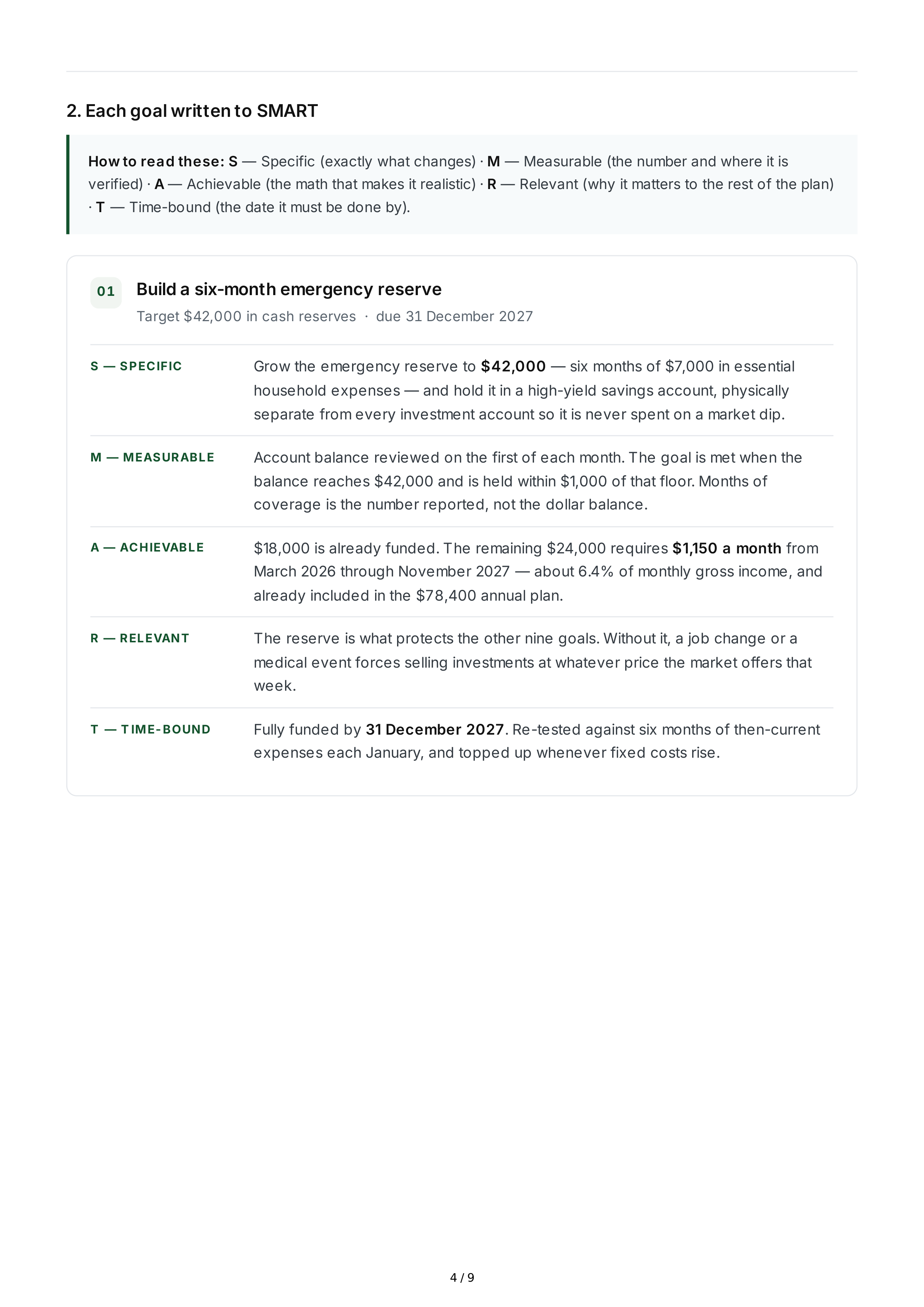
2.
Each
goal
written
to
SMART
How
to
read
these
:
S
—
Specific
(
exactly
what
changes
) ·
M
—
Measurable
(
the
number
and
where
it
is
verified
) ·
A
—
Achievable
(
the
math
that
makes
it
realistic
) ·
R
—
Relevant
(
why
it
matters
to
the
rest
of
the
plan
)
·
T
—
Time
-
bound
(
the
date
it
must
be
done
by
).
01
Build
a
six
-
month
emergency
reserve
Target
$
42,000
in
cash
reserves
·
due
31
December
2027
S
—
SPECIFIC
Grow
the
emergency
reserve
to
$
42,000
—
six
months
of
$
7,000
in
essential
household
expenses
—
and
hold
it
in
a
high
-
yield
savings
account
,
physically
separate
from
every
investment
account
so
it
is
never
spent
on
a
market
dip
.
M
—
MEASURABLE
Account
balance
reviewed
on
the
first
of
each
month
.
The
goal
is
met
when
the
balance
reaches
$
42,000
and
is
held
within
$
1,000
of
that
floor
.
Months
of
coverage
is
the
number
reported
,
not
the
dollar
balance
.
A
—
ACHIEVABLE
$
18,000
is
already
funded
.
The
remaining
$
24,000
requires
$
1,150
a
month
from
March
2026
through
November
2027 —
about
6.4%
of
monthly
gross
income
,
and
already
included
in
the
$
78,400
annual
plan
.
R
—
RELEVANT
The
reserve
is
what
protects
the
other
nine
goals
.
Without
it
,
a
job
change
or
a
medical
event
forces
selling
investments
at
whatever
price
the
market
offers
that
week
.
T
—
T IME
-
BOUND
Fully
funded
by
31
December
2027
.
Re
-
tested
against
six
months
of
then
-
current
expenses
each
January
,
and
topped
up
whenever
fixed
costs
rise
.
4 / 9
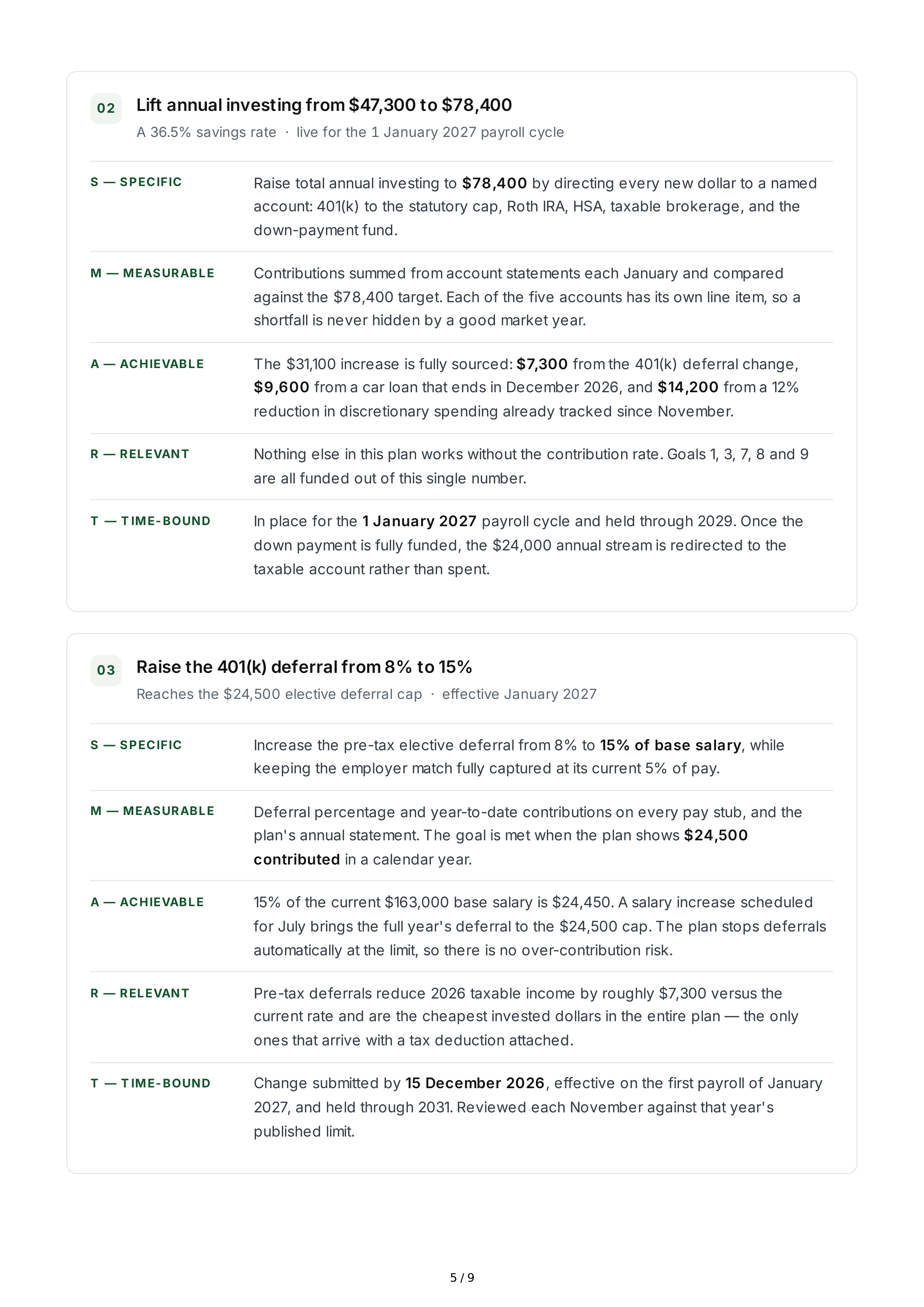
02
Lift
annual
investing
from
$
47,300
to
$
78,400
A
36.5%
savings
rate
·
live
for
the
1
January
2027
payroll
cycle
S
—
SPECIFIC
Raise
total
annual
investing
to
$
78,400
by
directing
every
new
dollar
to
a
named
account
: 401(
k
)
to
the
statutory
cap
,
Roth
IRA
,
HSA
,
taxable
brokerage
,
and
the
down
-
payment
fund
.
M
—
MEASURABLE
Contributions
summed
from
account
statements
each
January
and
compared
against
the
$
78,400
target
.
Each
of
the
five
accounts
has
its
own
line
item
,
so
a
shortfall
is
never
hidden
by
a
good
market
year
.
A
—
ACHIEVABLE
The
$
31,100
increase
is
fully
sourced
:
$
7,300
from
the
401(
k
)
deferral
change
,
$
9,600
from
a
car
loan
that
ends
in
December
2026,
and
$
14,200
from
a
12%
reduction
in
discretionary
spending
already
tracked
since
November
.
R
—
RELEVANT
Nothing
else
in
this
plan
works
without
the
contribution
rate
.
Goals
1, 3, 7, 8
and
9
are
all
funded
out
of
this
single
number
.
T
—
T IME
-
BOUND
In
place
for
the
1
January
2027
payroll
cycle
and
held
through
2029.
Once
the
down
payment
is
fully
funded
,
the
$
24,000
annual
stream
is
redirected
to
the
taxable
account
rather
than
spent
.
03
Raise
the
401(
k
)
deferral
from
8%
to
15%
Reaches
the
$
24,500
elective
deferral
cap
·
effective
January
2027
S
—
SPECIFIC
Increase
the
pre
-
tax
elective
deferral
from
8%
to
15%
of
base
salary
,
while
keeping
the
employer
match
fully
captured
at
its
current
5%
of
pay
.
M
—
MEASURABLE
Deferral
percentage
and
year
-
to
-
date
contributions
on
every
pay
stub
,
and
the
plan
'
s
annual
statement
.
The
goal
is
met
when
the
plan
shows
$
24,500
contributed
in
a
calendar
year
.
A
—
ACHIEVABLE
15%
of
the
current
$
163,000
base
salary
is
$
24,450.
A
salary
increase
scheduled
for
July
brings
the
full
year
'
s
deferral
to
the
$
24,500
cap
.
The
plan
stops
deferrals
automatically
at
the
limit
,
so
there
is
no
over
-
contribution
risk
.
R
—
RELEVANT
Pre
-
tax
deferrals
reduce
2026
taxable
income
by
roughly
$
7,300
versus
the
current
rate
and
are
the
cheapest
invested
dollars
in
the
entire
plan
—
the
only
ones
that
arrive
with
a
tax
deduction
attached
.
T
—
T IME
-
BOUND
Change
submitted
by
15
December
2026
,
effective
on
the
first
payroll
of
January
2027,
and
held
through
2031.
Reviewed
each
November
against
that
year
'
s
published
limit
.
5 / 9
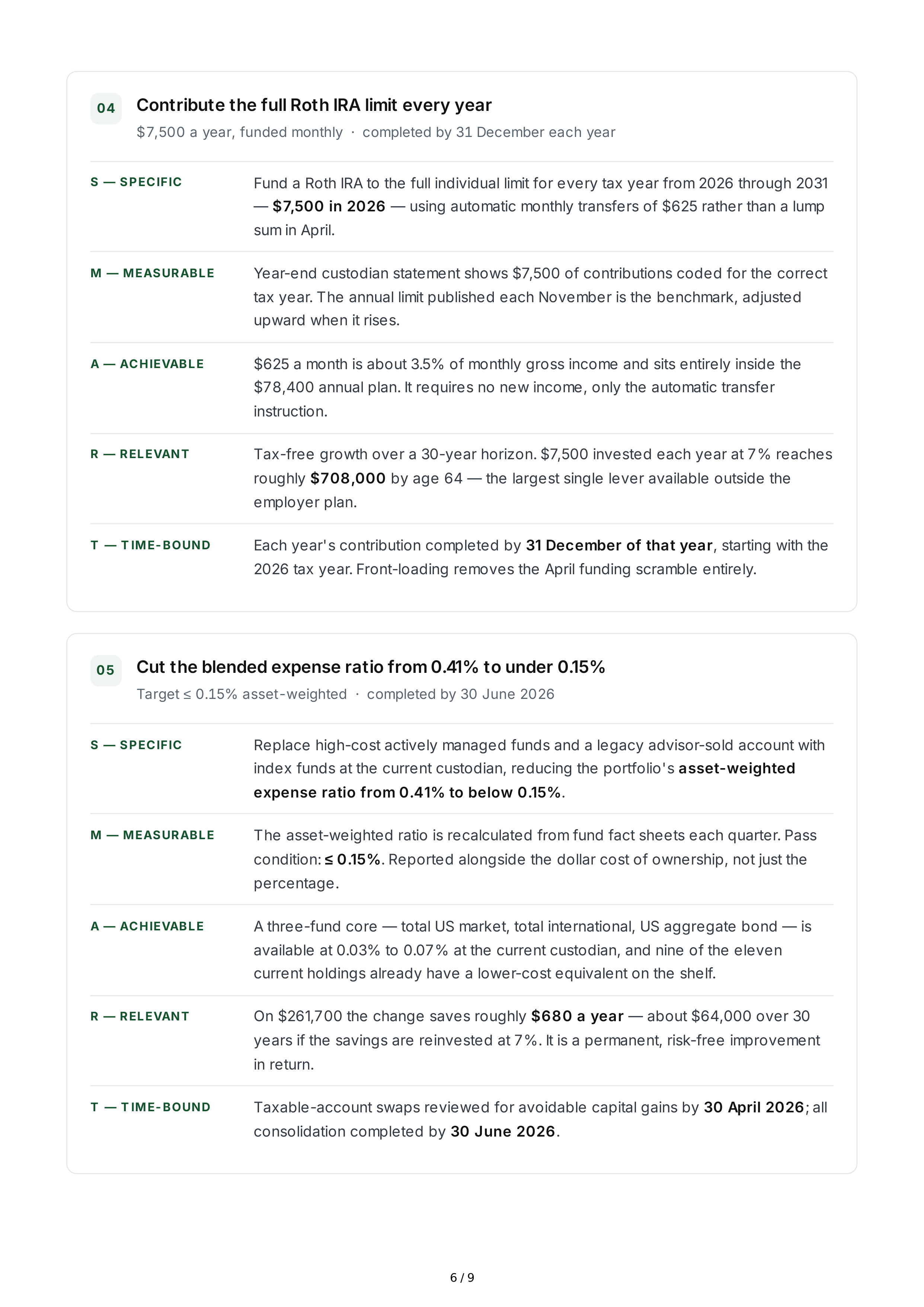
04
Contribute
the
full
Roth
IRA
limit
every
year
$
7,500
a
year
,
funded
monthly
·
completed
by
31
December
each
year
S
—
SPECIFIC
Fund
a
Roth
IRA
to
the
full
individual
limit
for
every
tax
year
from
2026
through
2031
—
$
7,500
in
2026
—
using
automatic
monthly
transfers
of
$
625
rather
than
a
lump
sum
in
April
.
M
—
MEASURABLE
Year
-
end
custodian
statement
shows
$
7,500
of
contributions
coded
for
the
correct
tax
year
.
The
annual
limit
published
each
November
is
the
benchmark
,
adjusted
upward
when
it
rises
.
A
—
ACHIEVABLE
$
625
a
month
is
about
3.5%
of
monthly
gross
income
and
sits
entirely
inside
the
$
78,400
annual
plan
.
It
requires
no
new
income
,
only
the
automatic
transfer
instruction
.
R
—
RELEVANT
Tax
-
free
growth
over
a
30-
year
horizon
.
$
7,500
invested
each
year
at
7%
reaches
roughly
$
708,000
by
age
64 —
the
largest
single
lever
available
outside
the
employer
plan
.
T
—
T IME
-
BOUND
Each
year
'
s
contribution
completed
by
31
December
of
that
year
,
starting
with
the
2026
tax
year
.
Front
-
loading
removes
the
April
funding
scramble
entirely
.
05
Cut
the
blended
expense
ratio
from
0.41%
to
under
0.15%
Target
≤
0.15%
asset
-
weighted
·
completed
by
30
June
2026
S
—
SPECIFIC
Replace
high
-
cost
actively
managed
funds
and
a
legacy
advisor
-
sold
account
with
index
funds
at
the
current
custodian
,
reducing
the
portfolio
'
s
asset
-
weighted
expense
ratio
from
0.41%
to
below
0.15%
.
M
—
MEASURABLE
The
asset
-
weighted
ratio
is
recalculated
from
fund
fact
sheets
each
quarter
.
Pass
condition
:
≤
0.15%
.
Reported
alongside
the
dollar
cost
of
ownership
,
not
just
the
percentage
.
A
—
ACHIEVABLE
A
three
-
fund
core
—
total
US
market
,
total
international
,
US
aggregate
bond
—
is
available
at
0.03%
to
0.07%
at
the
current
custodian
,
and
nine
of
the
eleven
current
holdings
already
have
a
lower
-
cost
equivalent
on
the
shelf
.
R
—
RELEVANT
On
$
261,700
the
change
saves
roughly
$
680
a
year
—
about
$
64,000
over
30
years
if
the
savings
are
reinvested
at
7%.
It
is
a
permanent
,
risk
-
free
improvement
in
return
.
T
—
T IME
-
BOUND
Taxable
-
account
swaps
reviewed
for
avoidable
capital
gains
by
30
April
2026
;
all
consolidation
completed
by
30
June
2026
.
6 / 9
06
Reduce
employer
-
stock
concentration
from
18%
to
under
8%
$
47,200
→
no
more
than
$
25,000 ·
completed
by
31
December
2027
S
—
SPECIFIC
Reduce
vested
employer
stock
—
RSU
shares
and
ESPP
purchases
—
from
18%
to
under
8%
of
invested
assets
,
roughly
$
47,200
down
to
no
more
than
$
25,000,
and
stop
holding
new
vests
.
M
—
MEASURABLE
Concentration
measured
monthly
as
stock
value
÷
total
invested
assets
.
The
goal
is
met
when
the
ratio
sits
below
8%
for
two
consecutive
month
-
ends
,
so
a
temporary
dip
is
not
mistaken
for
success
.
A
—
ACHIEVABLE
Requires
selling
approximately
$
22,000
,
spread
across
four
pre
-
scheduled
quarterly
tranches
.
Selling
on
a
fixed
calendar
—
not
on
a
price
view
—
removes
the
timing
decision
entirely
.
R
—
RELEVANT
Salary
and
portfolio
are
currently
tied
to
one
employer
.
A
40%
drawdown
in
that
single
stock
would
remove
about
$
19,000
from
net
worth
,
and
it
would
most
likely
arrive
at
the
same
time
as
a
job
change
.
T
—
T IME
-
BOUND
First
tranche
executed
by
31
March
2026
;
position
below
8%
by
31
December
2027
.
Any
future
vest
above
the
8%
band
is
sold
within
30
days
of
settling
.
07
Grow
the
taxable
brokerage
account
from
$
38,900
to
$
140,000
$
1,500
a
month
·
$
140,000
by
31
December
2030
S
—
SPECIFIC
Direct
$
1,500
a
month
into
the
taxable
brokerage
account
in
a
two
-
fund
index
allocation
—
total
US
market
and
total
international
—
with
every
dividend
automatically
reinvested
.
M
—
MEASURABLE
Month
-
end
balance
,
with
contributions
tracked
separately
from
market
movement
so
performance
stays
visible
.
Interim
checkpoints
:
$
52,000
by
December
2026
and
$
98,000
by
December
2028
.
A
—
ACHIEVABLE
$
12,000
in
2026
and
$
18,000
a
year
from
2027,
growing
at
7%
a
year
,
projects
to
roughly
$
154,000
by
December
2030 —
a
$
14,000
cushion
above
the
$
140,000
target
.
R
—
RELEVANT
This
account
is
the
bridge
between
the
down
payment
and
retirement
.
It
funds
anything
before
age
59½
that
a
401(
k
)
or
IRA
cannot
reach
without
penalty
.
T
—
T IME
-
BOUND
31
December
2030
,
with
the
two
interim
checkpoints
above
.
If
either
checkpoint
is
missed
by
more
than
10%,
the
monthly
amount
is
raised
at
the
next
quarterly
review
.
7 / 9
08
Accumulate
$
120,000
for
a
home
down
payment
$
34,000
→
$
120,000,
held
in
Treasuries
·
due
30
September
2029
S
—
SPECIFIC
Accumulate
$
120,000
in
a
dedicated
,
low
-
volatility
account
—
a
Treasury
-
only
money
market
fund
and
a
12-
month
Treasury
ladder
—
never
in
equities
,
and
never
commingled
with
retirement
money
.
M
—
MEASURABLE
Dedicated
account
balance
tracked
monthly
against
a
straight
-
line
schedule
.
The
purchase
budget
is
set
at
20%
down
plus
3%
closing
costs
on
a
property
priced
up
to
$
600,000.
A
—
ACHIEVABLE
$
34,000
is
already
saved
.
$
2,000
a
month
from
March
2026
through
September
2029
adds
$
86,000,
and
roughly
4%
in
interest
adds
about
$
8,000 —
approximately
$
128,000
in
total
,
an
$
8,000
buffer
above
target
.
R
—
RELEVANT
A
20%
down
payment
removes
private
mortgage
insurance
,
worth
about
$
2,600
a
year
on
a
$
480,000
loan
,
and
lowers
the
monthly
payment
before
any
rate
shopping
begins
.
T
—
T IME
-
BOUND
$
120,000
by
30
September
2029
.
Funds
moved
fully
into
the
Treasury
ladder
by
30
June
2029
so
nothing
is
exposed
to
a
bad
market
month
in
the
quarter
before
closing
.
09
Grow
annual
portfolio
income
from
$
2,940
to
$
6,200
Trailing
-12-
month
distributions
·
by
31
December
2030
S
—
SPECIFIC
Raise
annual
dividend
and
interest
income
to
$
6,200
by
reinvesting
every
distribution
and
directing
new
contributions
to
income
-
producing
index
funds
rather
than
the
cash
sleeve
.
M
—
MEASURABLE
Trailing
-12-
month
distributions
summed
across
all
accounts
each
January
,
compared
against
the
target
,
and
reported
alongside
the
yield
on
cost
.
A
—
ACHIEVABLE
At
an
unchanged
1.35%
yield
,
the
invested
portfolio
needs
to
reach
about
$
459,000
.
The
contribution
plan
in
goals
2, 3
and
7
already
projects
approximately
$
470,000
by
the
end
of
2030.
R
—
RELEVANT
Reinvesting
income
is
what
turns
the
same
contribution
schedule
into
a
materially
larger
balance
.
It
is
also
the
first
income
stream
flexible
enough
to
fund
an
early
-
retirement
gap
before
pension
or
Social
Security
.
T
—
T IME
-
BOUND
$
6,200
of
trailing
-12-
month
income
by
31
December
2030
,
measured
on
the
2030
tax
year
and
reviewed
each
January
thereafter
.
8 / 9
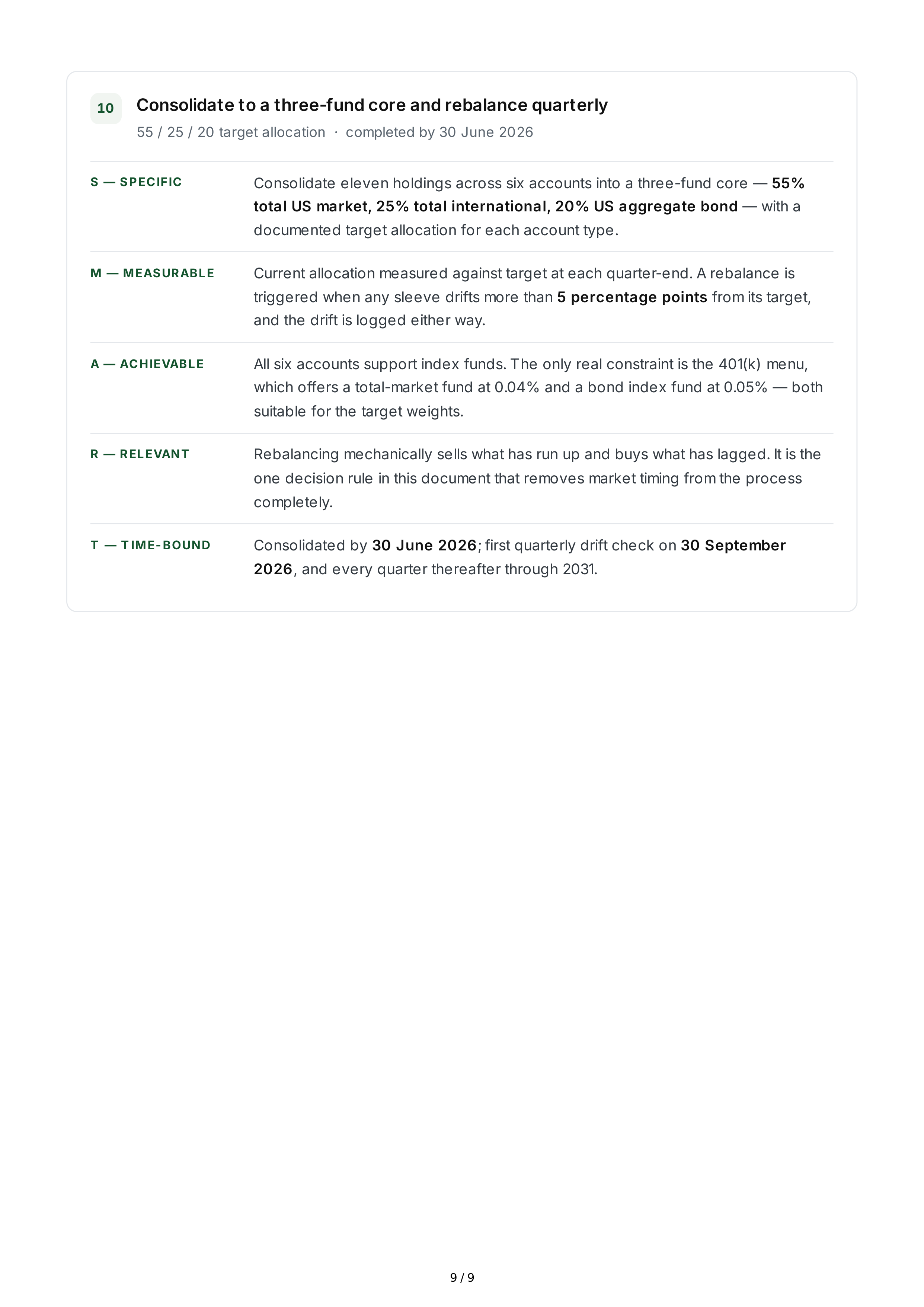
10
Consolidate
to
a
three
-
fund
core
and
rebalance
quarterly
55 / 25 / 20
target
allocation
·
completed
by
30
June
2026
S
—
SPECIFIC
Consolidate
eleven
holdings
across
six
accounts
into
a
three
-
fund
core
—
55%
total
US
market
, 25%
total
international
, 20%
US
aggregate
bond
—
with
a
documented
target
allocation
for
each
account
type
.
M
—
MEASURABLE
Current
allocation
measured
against
target
at
each
quarter
-
end
.
A
rebalance
is
triggered
when
any
sleeve
drifts
more
than
5
percentage
points
from
its
target
,
and
the
drift
is
logged
either
way
.
A
—
ACHIEVABLE
All
six
accounts
support
index
funds
.
The
only
real
constraint
is
the
401(
k
)
menu
,
which
offers
a
total
-
market
fund
at
0.04%
and
a
bond
index
fund
at
0.05% —
both
suitable
for
the
target
weights
.
R
—
RELEVANT
Rebalancing
mechanically
sells
what
has
run
up
and
buys
what
has
lagged
.
It
is
the
one
decision
rule
in
this
document
that
removes
market
timing
from
the
process
completely
.
T
—
T IME
-
BOUND
Consolidated
by
30
June
2026
;
first
quarterly
drift
check
on
30
September
2026
,
and
every
quarter
thereafter
through
2031.
9 / 9
Similar Examples
Generate Similar
SMART Time Management Goals
Generate Similar
SMART Organization Goals
Generate Similar
SMART Communication Goals
Generate Similar
SMART Confidence Goals
Generate Similar
SMART Habit-Building Goals
Generate Similar
SMART Self-Discipline Goals
Generate Similar
SMART Decision-Making Goals
Generate Similar
SMART Problem-Solving Goals
Generate Similar
SMART Creativity Goals
Generate Similar
SMART Leadership Development Goals
Generate Similar
SMART Goal-Setting Goals
Generate Similar
SMART Financial Goals
Generate Similar
SMART Savings Goals
Generate Similar
SMART Budgeting Goals
Generate Similar
SMART Debt Reduction Goals
Generate Similar
SMART Retirement Goals
Generate Similar
SMART Financial Independence Goals
Generate Similar
SMART Business Goals
Generate Similar
SMART Entrepreneurship Goals
Generate Similar
SMART Business Growth Goals
Generate Similar
SMART Sales Goals
Generate Similar
SMART Marketing Goals
Generate Similar
SMART Revenue Goals
Generate Similar
SMART Customer Service Goals
Generate Similar
SMART Project Management Goals