
FinGPT: Open-Source Financial Large Language Models
Hongyang Yang
1
, Xiao-Yang Liu
2
, Christina Dan Wang
3
∗
1
AI4Finance Foundation
†
;
2
Columbia University;
3
New York University Shanghai
contact@ai4finance.org
Abstract
Large
language
models
(LLMs)
have
shown
the
potential
of
revolutionizing
natural
language
pro-
cessing in diverse domains,
sparking great interest
in
finance.
However,
the
finance
domain
presents
unique
challenges,
including
high
temporal
sen-
sitivity,
constant
dynamism,
and
a
low
signal-
to-noise
ratio
(SNR).
While
proprietary
models
like
BloombergGPT
have
taken
advantage
of
their
unique
data
accumulation,
such
privileged
access
calls for an open-source alternative to democratize
internet-scale financial data.
In
this
paper,
we
present
an
open-source
large
language
model,
FinGPT,
for
the
finance
sec-
tor.
Unlike
proprietary
models,
FinGPT
takes
a
data-centric
approach,
providing
researchers
and
practitioners
with
accessible
and
transparent
re-
sources
to
customize
their
financial
LLMs
(Fin-
LLMs).
We
highlight
the
importance
of
an
au-
tomatic
data
curation
pipeline
and
the
lightweight
low-rank
adaptation
technique
in
building
Fin-
GPT.
Furthermore,
we
provide
fundamental
tasks
as
building
blocks
for
benchmarking
and
show-
case
potential
applications
as
stepping
stones
for
users,
such
as
robo-advising
and
sentiment
anal-
ysis.
Through
collaborative
efforts
within
the
open-source AI4Finance community, FinGPT aims
to
stimulate
innovation,
democratize
FinLLMs,
and
unlock
new
opportunities
in
open
finance.
Two
associated
code
repos
are
https://github.
com/AI4Finance-Foundation/FinGPT
and
https://
github.com/AI4Finance-Foundation/FinNLP
1
Introduction
The
continual
expansion
and
evolution
of
artificial
intel-
ligence
have
provided
a
fertile
ground
for
the
prolifera-
tion
of
LLMs
[Vaswani
et
al.
,
2017;
Radford
et
al.
,
2018;
Devlin
et
al.
,
2018;
Ethayarajh,
2019;
Lewis
et
al.
,
2019;
Lewis
et
al.
,
2020;
Brown
et
al.
,
2020;
Thoppilan
et
al.
,
2022], thereby effecting a transformative shift across diverse
∗
Corresponding author.
†
AI4Finance Foundation:
ai4finance.org
domains. This sweeping change has engendered keen interest
in the potential applications of financial LLMs (FinLLMs).
It
is,
however,
evident
that
the
acquisition
of
high-quality,
rel-
evant,
and
up-to-date
data
stands
as
a
critical
factor
in
the
development of efficacious and efficient FinLLMs.
Utilizing LLMs in the finance sector reveals intricate hur-
dles.
Firstly,
there’s
the
issue
of
high
temporal
sensitivity.
Financial
data
are
characterized
by
their
time-sensitive
na-
ture.
Market-moving
news
or
updates,
once
released,
pro-
vide
a
narrow
window
of
opportunity
for
investors
to
maxi-
mize
their
alpha
(the
measure
of
an
investment’s
relative
re-
turn).
Secondly,
the
financial
landscape
is
marked
by
high
dynamism.
It is in a constant state of flux due to the ceaseless
flow of news, social media updates, and other market-related
information.
Given these constant changes, retraining LLMs
frequently is not only expensive but also impractical.
Lastly,
financial data is often characterized by a low signal-to-noise
ratio
(SNR)
[Yang
et
al.
,
2020].
The
useful
information
is
often
hidden
amongst
a
significant
amount
of
irrelevant
or
noisy
data.
Extracting
valuable
insights
from
this
sea
of
in-
formation necessitates advanced techniques.
In the proprietary sphere, models like BloombergGPT [Wu
et al.
, 2023] have capitalized on their exclusive access to spe-
cialized
data
to
train
a
FinLLM.
However,
the
restricted
ac-
cessibility and transparency of their data collections and train-
ing
protocols
have
accentuated
the
demand
for
an
open
and
inclusive alternative.
In response to this demand, we are wit-
nessing a shifting trend towards democratizing internet-scale
financial data in the open finance domain.
In this paper, we address these aforementioned challenges
associated with financial data and introduce FinGPT, an end-
to-end
open-source
framework
for
financial
large
language
models
(FinLLMs).
Adopting
a
data-centric
approach,
Fin-
GPT
underscores
the
crucial
role
of
data
acquisition,
clean-
ing, and preprocessing in developing open-source FinLLMs.
By
championing
data
accessibility,
FinGPT
aspires
to
en-
hance
research,
collaboration,
and
innovation
in
finance,
paving the way for open finance practices.
Our contributions are summarized as follows:
•
Data-centric
approach
:
Recognizing
the
significance
of
data
curation,
FinGPT
adopts
a
data-centric
approach
and
implements
rigorous
cleaning
and
preprocessing
methods
for handling varied data formats and types.
International Symposium on Large Language Models for Financial Services (FinLLM 2023)@IJCAI 2023 —
https://finllm.github.io/workshop
arXiv:2306.06031v2 [q-fin.ST] 15 Nov 2025
•
End-to-end
framework
:
FinGPT
embraces
a
full-stack
framework with five layers:
–
Data
source
layer
:
Assures
comprehensive
market
coverage, addressing the temporal sensitivity of finan-
cial data through real-time information capture.
–
Data
engineering
layer
:
Primed
for
real-time
NLP
data
processing,
this
layer
tackles
the
inherent
chal-
lenges of high temporal sensitivity and low signal-to-
noise ratio in financial data.
–
LLMs
layer
:
Focusing
on
a
range
of
fine-tuning
methodologies, this layer takes care of the highly dy-
namic
nature
of
financial
data,
ensuring
the
model’s
relevance and accuracy.
–
Tasks
Layer
:
This
layer
is
responsible
for
execut-
ing
fundamental
tasks.
These
tasks
serve
as
the
benchmarks
for
performance
evaluations
and
cross-
comparisons in the realm of FinLLMs.
–
Applications layer
:
Showcasing practical applications
and demos, this layer highlights the potential capabil-
ity of FinGPT in the finance sector.
•
Democratization
:
FinGPT, as an open-source framework,
aims to democratize financial data and FinLLMs, uncover-
ing untapped potentials in open finance.
We envision Fin-
GPT
as
a
catalyst
for
stimulating
innovation
within
the
fi-
nance domain.
FinGPT is not limited to providing techni-
cal contributions, but also cultivates an open-source ecosys-
tem for FinLLMs, promoting real-time processing and cus-
tomized
adaptation
for
users.
By
nurturing
a
robust
col-
laboration
ecosystem
within
the
open-source
AI4Finance
community, FinGPT is positioned to refine our understand-
ing and application of FinLLMs.
2
Related Work
2.1
The Raise of FinLLMs
Large
Language
Models
(LLMs)
have
been
recognized
as
a
technological breakthrough in NLP, such as GPT-3 and GPT-
4
[Brown
et
al.
,
2020;
Jiang
et
al.
,
2023;
OpenAI,
2023;
Team
et
al.
,
2023;
Liu
et
al.
,
2024].
They
take
transformer-
based
architectures,
demonstrating
impressive
performance
across
various
text-generation
tasks.
As
an
offshoot
of
the
GPT
family
developed
by
OpenAI,
ChatGPT
was
designed
to
produce
human-like
texts
based
on
input
prompts.
It
has
shown
significant
utility
in
diverse
applications,
from
draft-
ing emails to writing code and even in creating art content.
LLMs have been applied to various tasks within the finan-
cial sector [Dredze
et al.
, 2016; Araci, 2019; Bao
et al.
, 2021;
DeLucia
et al.
, 2022], from predictive modeling to generating
insightful narratives from raw financial data. Recent literature
has focused on using these models for financial text analysis,
given
the
abundance
of
text
data
in
this
field,
such
as
news
articles, earnings call transcripts, and social media posts.
The
first
example
of
FinLLMs
is
BloombergGPT
[Wu
et
al.
, 2023], which was trained on a mixed dataset of financial
and general data sources.
Despite its impressive capabilities,
access limitations exist,
and the prohibitive training cost has
motivated the need for low-cost domain adaptation.
Our FinGPT responds to the aforementioned hurdles, pre-
senting
an
open-source
FinLLM.
It
employs
Reinforcement
Learning
from
Human
Feedback
(RLHF)
to
understand
and
adapt
to
individual
preferences,
paving
the
way
for
person-
alized
financial
assistants.
We
aim
to
combine
the
strengths
of general LLMs like ChatGPT with financial adaptation, ex-
ploiting LLM’s capability in open finance.
2.2
Why Open-Source FinLLMs?
AI4Finance Foundation
1
is a non-profit, open-source organi-
zation that integrates Artificial Intelligence (AI) and financial
applications.
With
a
proven
track
record
of
nurturing
an
in-
novative
ecosystem
of
FinTech
tools,
such
as
FinRL
[Yang
et
al.
,
2020]
and
FinRobot
[Yang
et
al.
,
2024],
the
founda-
tion is poised to accelerate the evolution of FinLLMs.
Stead-
fast commitment and cutting-edge contributions may pave the
way for AI’s transformative applications in open finance.
•
Advancing
equal
opportunities
via
democratizing
Fin-
LLMs:
Adopting
an
open-source
methodology
promotes
universal access to state-of-the-art technology, adhering to
the ethos of democratizing FinLLMs.
•
Cultivating transparency and trust:
Open-source FinLLMs
offer a comprehensive overview of their foundational code-
base, bolstering transparency and trust.
•
Accelerating
research
and
innovation:
The
open-source
model
fuels
progress
in
research
and
development
within
the
AI
domain.
It
allows
researchers
to
leverage
existing
models,
thus
nurturing
a
faster
progression
of
innovation
and scientific discovery.
•
Enhancing
education:
Open-source
FinLLMs
serve
as
robust
educational
tools,
presenting
students
with
the
prospect of exploring the complexities of FinLLMs through
direct engagement with fully operational models.
•
Upgrade foundation infrastructure for financial text data by
community
collaboration:
This
collaborative
participation
bolsters the model’s long-term durability and effectiveness.
3
Overview of FinGPT: An Open-Source
Framework for FinLLMs
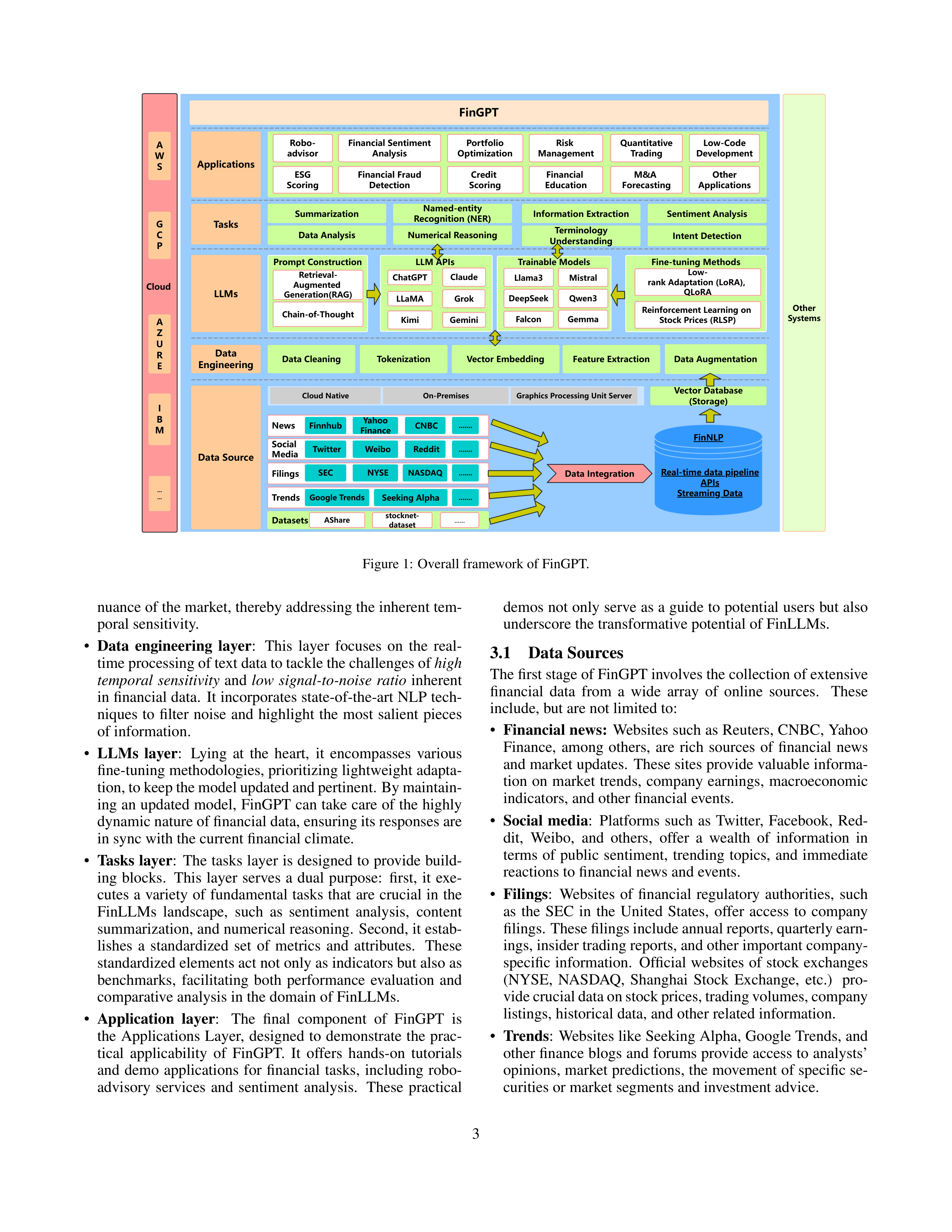
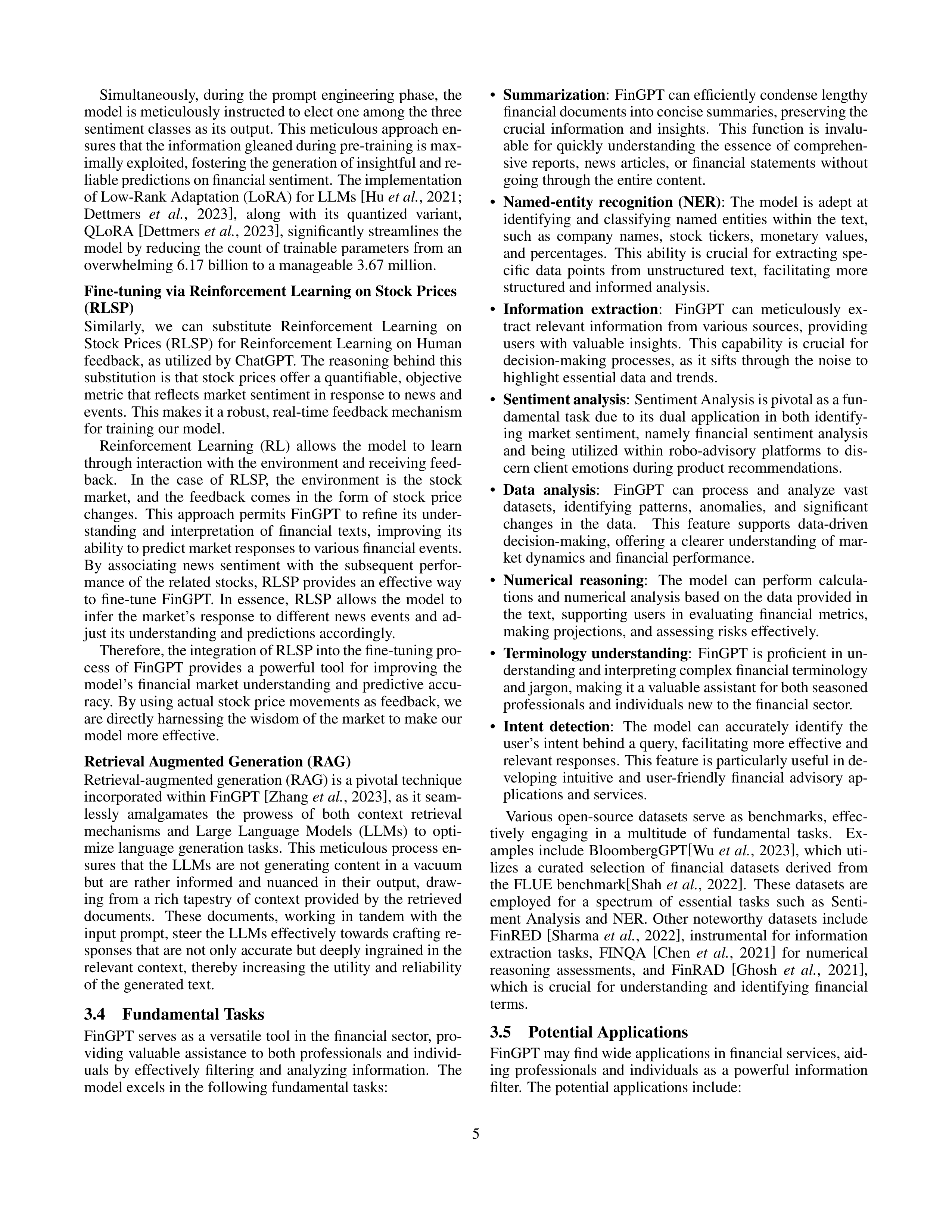
FinGPT represents an innovative open-source framework de-
signed
specifically
for
FinLLMs.
As
delineated
in
Fig.
1,
FinGPT consists of four components:
Data Source, Data En-
gineering, LLMs, and Applications.
Each plays a crucial role
in maintaining the functionality and adaptability of FinGPT.
•
Data
source
layer
:
The
starting
point
is
the
Data
Source
Layer,
which
orchestrates
the
acquisition
of
extensive
fi-
nancial data from a wide array of online sources. This layer
ensures comprehensive market coverage by integrating data
from news websites, social media platforms, financial state-
ments, market trends, and more.
The goal is to capture the
1
https://ai4finance.org.
The
AI4Finance
Foundation
is
a
U.S.-
registered
501(c)(3)
nonprofit
public
charity
focused
on
promoting
open scientific research in financial AI, building open-source infras-
tructure, and supporting a global community of researchers through
shared datasets, benchmarks, and educational programs.
2














































































































Trainable Models
Applications
Robo-
advisor
LLMs
LLM APIs
Llama3
Claude
ChatGPT
LLaMA
Kimi
Grok
Gemini
Data
Engineering
Tokenization
Data Cleaning
Vector Embedding
Feature Extraction
Data Source
Vector Database
(Storage)
Datasets
AShare
A
W
S
Other
Systems
stocknet-
dataset
......
Data Integration
Cloud Native
On-Premises
Graphics Processing Unit Server
Cloud
News
Finnhub
Yahoo
Finance
CNBC
.......
Social
Media
Twitter
Weibo
Reddit
.......
Filings
SEC
NYSE
NASDAQ
.......
Trends
Google Trends
Seeking Alpha
.......
Mistral
Fine-tuning Methods
Low-
rank Adaptation (LoRA),
QLoRA
Reinforcement Learning on
Stock Prices (RLSP)
Quantitative
Trading
Portfolio
Optimization
Financial Sentiment
Analysis
Risk
Management
Financial Fraud
Detection
Credit
Scoring
ESG
Scoring
Financial
Education
M&A
Forecasting
Other
Applications
Low-Code
Development
FinGPT
...
...
G
C
P
A
Z
U
R
E
I
B
M
Tasks
Terminology
Understanding
Information Extraction
Sentiment Analysis
Intent Detection
Named-entity
Recognition (NER)
Numerical Reasoning
Summarization
Data Analysis
DeepSeek
Falcon
Qwen3
Gemma
FinNLP
Real-time data pipeline
APIs
Streaming Data
Data Augmentation
Prompt Construction
Chain-of-Thought
Retrieval-
Augmented
Generation(RAG)
Figure 1:
Overall framework of FinGPT.
nuance of the market, thereby addressing the inherent tem-
poral sensitivity.
•
Data
engineering
layer
:
This
layer
focuses
on
the
real-
time processing of text data to tackle the challenges of
high
temporal
sensitivity
and
low
signal-to-noise
ratio
inherent
in financial data.
It incorporates state-of-the-art NLP tech-
niques
to
filter
noise
and
highlight
the
most
salient
pieces
of information.
•
LLMs
layer
:
Lying
at
the
heart,
it
encompasses
various
fine-tuning methodologies, prioritizing lightweight adapta-
tion, to keep the model updated and pertinent. By maintain-
ing an updated model, FinGPT can take care of the highly
dynamic nature of financial data, ensuring its responses are
in sync with the current financial climate.
•
Tasks layer
:
The tasks layer is designed to provide build-
ing
blocks.
This
layer
serves
a
dual
purpose:
first,
it
exe-
cutes
a
variety
of
fundamental
tasks
that
are
crucial
in
the
FinLLMs
landscape,
such
as
sentiment
analysis,
content
summarization, and numerical reasoning.
Second, it estab-
lishes
a
standardized
set
of
metrics
and
attributes.
These
standardized elements act not only as indicators but also as
benchmarks,
facilitating
both
performance
evaluation
and
comparative analysis in the domain of FinLLMs.
•
Application
layer
:
The
final
component
of
FinGPT
is
the
Applications
Layer,
designed
to
demonstrate
the
prac-
tical
applicability
of
FinGPT.
It
offers
hands-on
tutorials
and
demo
applications
for
financial
tasks,
including
robo-
advisory
services
and
sentiment
analysis.
These
practical
demos not only serve as a guide to potential users but also
underscore the transformative potential of FinLLMs.
3.1
Data Sources
The first stage of FinGPT involves the collection of extensive
financial
data
from
a
wide
array
of
online
sources.
These
include, but are not limited to:
•
Financial news:
Websites such as Reuters, CNBC, Yahoo
Finance,
among
others,
are
rich
sources
of
financial
news
and market updates.
These sites provide valuable informa-
tion
on
market
trends,
company
earnings,
macroeconomic
indicators, and other financial events.
•
Social
media
:
Platforms
such
as
Twitter,
Facebook,
Red-
dit,
Weibo,
and
others,
offer
a
wealth
of
information
in
terms
of
public
sentiment,
trending
topics,
and
immediate
reactions to financial news and events.
•
Filings
:
Websites
of
financial
regulatory
authorities,
such
as
the
SEC
in
the
United
States,
offer
access
to
company
filings. These filings include annual reports, quarterly earn-
ings, insider trading reports, and other important company-
specific information.
Official websites of stock exchanges
(NYSE,
NASDAQ,
Shanghai
Stock
Exchange,
etc.)
pro-
vide crucial data on stock prices, trading volumes, company
listings, historical data, and other related information.
•
Trends
:
Websites like Seeking Alpha, Google Trends, and
other finance blogs and forums provide access to analysts’
opinions, market predictions, the movement of specific se-
curities or market segments and investment advice.
3
•
Academic datasets
:
Research-based datasets that offer cu-
rated and verified information for financial analysis.
To
harness
the
wealth
of
information
from
these
diverse
sources,
FinGPT
incorporates
data
acquisition
tools
capable
of scraping structured and unstructured data, including APIs,
web
scraping
tools,
and
direct
database
access
where
avail-
able.
Moreover,
the
system
is
designed
to
respect
the
terms
of service of these platforms, ensuring data collection is ethi-
cal and legal.
Data APIs
:
In the FinGPT framework,
APIs are used not
only for initial data collection but also for real-time data up-
dates, ensuring the model is trained on the most current data.
Additionally,
error
handling
and
rate-limiting
strategies
are
implemented
to
respect
API
usage
limits
and
avoid
disrup-
tions in the data flow.
3.2
Real-Time Data Curation Pipeline for
Financial NLP
Financial
markets
operate
in
real-time
and
are
highly
sensi-
tive
to
news
and
sentiment.
Prices
of
securities
can
change
rapidly
in
response
to
new
information,
and
delays
in
pro-
cessing that information can result in missed opportunities or
increased risk. As a result, real-time processing is essential in
financial NLP.
The
primary
challenge
with
a
real-time
NLP
pipeline
is
managing
and
processing
the
continuous
inflow
of
data
ef-
ficiently.
The first step in the pipeline is to set up a system to
ingest
data
in
real-time.
This
data
could
be
streaming
from
our
data
source
APIs.
Below
are
the
steps
to
design
a
real-
time NLP pipeline for data ingestion.
Data cleaning
:
Real-time data can be noisy and inconsis-
tent.
Therefore,
real-time
data
cleaning
involves
removing
irrelevant
data,
handling
missing
values,
text
normalization
(like lowercasing), and error corrections.
Tokenization
:
In
real-time
applications,
tokenization
has
to be performed on the fly.
This involves breaking down the
stream of text into smaller units or tokens.
Vector embedding
: FinGPT encodes curated financial text
into
dense
semantic
vectors
using
domain-adapted
embed-
ding
models.
The
embedding
process
incorporates
entity-
aware
representations
(tickers,
ratios,
events)
and
temporal
metadata,
allowing
the
system
to
capture
fine-grained
fi-
nancial
meaning.
All
embeddings
are
indexed
in
a
vector
database
for
low-latency
retrieval,
supporting
RAG,
event
clustering, and market-aligned RLSP training.
Feature
extraction
:
Feature
extraction
involves
trans-
forming raw data into an input that can be understood by ML
models.
In real-time systems, this often needs to be a fast and
efficient process.
Techniques such as TF-IDF, Bag of Words,
or embedding vectors like Word2Vec can be used.
Data augmentation
: In the dynamic landscape of financial
markets, enhancing the variety and volume of training data is
crucial
for
building
robust
NLP
models.
Data
augmentation
strategies will be employed to generate synthetic data that can
mimic the characteristics of actual financial data.
3.3
Large Language Models (LLMs)
Once
the
data
has
been
properly
prepared,
it
is
used
with
LLMs
to
generate
insightful
financial
analyses.
The
LLM
layer includes:
•
LLM APIs
: Established LLM APIs offer foundational lan-
guage
capabilities
that
serve
as
the
base
for
further
model
development and customization.
•
Trainable models
:
Users can fine-tune FinGPT’s trainable
models
on
private
data
for
personalized
financial
applica-
tions, ensuring relevance and accuracy in specific use cases.
•
Fine-tuning
methods
:
FinGPT
supports
various
fine-
tuning
methodologies,
facilitating
its
adaptation
into
per-
sonalized robo-advisors efficiently and effectively.
•
Prompt
Engineering
:
Prompt
Engineering
is
crucial
for
optimizing input queries to LLMs, enhancing the extraction
of accurate financial information.
This iterative process re-
quires
careful
crafting
of
prompts
for
nuanced
responses,
necessitating a deep understanding of both finance and lan-
guage model characteristics.
Why lightweight fine-tuning LLMs for finance?
Fine-tuning or Instruction tuning of pre-existing LLMs for
finance,
as
described
in
[Ouyang
et
al.
,
2022],
presents
a
cost-efficient and time-saving alternative to the expensive and
lengthy process of retraining models from scratch.
BloombergGPT [Wu
et al.
, 2023], though remarkable in its
finance-specific
capabilities,
comes
with
an
intensive
com-
putational
requirement.
It
used
approximately
1.3
million
GPU hours
for training,
which,
when calculated
using AWS
cloud’s $2.3 rate, translates to a staggering cost of around $3
million
per
training.
In
contrast
to
the
high
computational
cost
of
models
like
BloombergGPT
[Wu
et
al.
,
2023],
Fin-
GPT
presents
a
more
accessible
solution
by
focusing
on
the
lightweight
adaptation
of
top
open-source
LLMs.
The
cost
of adaptation falls significantly, estimated at around $300 per
fine-tuning.
This approach ensures timely updates and adaptability, es-
sential in the dynamic financial domain.
Being open-source,
FinGPT
not
only
promotes
transparency
but
also
allows
user
customization,
catering
to
the
rising
trend
of
personal-
ized
financial
advisory
services.
Ultimately,
FinGPT’s
cost-
effective, flexible framework holds the potential to democra-
tize
financial
language
modeling
and
foster
user-focused
fi-
nancial services.
Fine-tuning via Low-rank Adaptation (LoRA)
In FinGPT, we fine-tune a pre-trained LLM utilizing a finan-
cial
dataset.
It’s
well
recognized
that
high-quality
labeled
data
is
a
pivotal
determinant
for
many
successful
LLMs,
in-
cluding ChatGPT. However, acquiring such top-notch labeled
data
often
proves
costly
in
terms
of
time
and
resources
and
generally requires the expertise of finance professionals.
When
the
application
of
LLMs
is
envisioned
for
the
scrutiny of financial texts and facilitation of quantitative trad-
ing
strategies,
it
is
imperative
to
contemplate
the
utilization
of
the
intrinsic
labeling
mechanisms
available
within
the
fi-
nancial marketplace.
In light of this, FinGPT adopts the per-
centage
of
relative
stock
price
changes
corresponding
to
in-
dividual
news
articles
as
output
labels.
By
assigning
prede-
termined
thresholds,
these
continuous
labels
are
categorized
into
three
discrete
sentiment
classes:
positive,
negative,
and
neutral.
4
Simultaneously,
during the prompt engineering phase,
the
model is meticulously instructed to elect one among the three
sentiment classes as its output.
This meticulous approach en-
sures that the information gleaned during pre-training is max-
imally exploited, fostering the generation of insightful and re-
liable predictions on financial sentiment. The implementation
of Low-Rank Adaptation (LoRA) for LLMs [Hu
et al.
, 2021;
Dettmers
et
al.
,
2023],
along
with
its
quantized
variant,
QLoRA [Dettmers
et al.
, 2023], significantly streamlines the
model by reducing the count of trainable parameters from an
overwhelming 6.17 billion to a manageable 3.67 million.
Fine-tuning via Reinforcement Learning on Stock Prices
(RLSP)
Similarly,
we
can
substitute
Reinforcement
Learning
on
Stock Prices (RLSP) for Reinforcement Learning on Human
feedback, as utilized by ChatGPT. The reasoning behind this
substitution is that stock prices offer a quantifiable, objective
metric that reflects market sentiment in response to news and
events. This makes it a robust, real-time feedback mechanism
for training our model.
Reinforcement
Learning
(RL)
allows
the
model
to
learn
through interaction with the environment and receiving feed-
back.
In
the
case
of
RLSP,
the
environment
is
the
stock
market,
and
the
feedback
comes
in
the
form
of
stock
price
changes.
This
approach
permits
FinGPT
to
refine
its
under-
standing
and
interpretation
of
financial
texts,
improving
its
ability to predict market responses to various financial events.
By
associating
news
sentiment
with
the
subsequent
perfor-
mance of the related stocks, RLSP provides an effective way
to
fine-tune
FinGPT.
In
essence,
RLSP
allows
the
model
to
infer
the
market’s
response
to
different
news
events
and
ad-
just its understanding and predictions accordingly.
Therefore, the integration of RLSP into the fine-tuning pro-
cess
of
FinGPT
provides
a
powerful
tool
for
improving
the
model’s financial market understanding and predictive accu-
racy.
By using actual stock price movements as feedback, we
are directly harnessing the wisdom of the market to make our
model more effective.
Retrieval Augmented Generation (RAG)
Retrieval-augmented generation (RAG) is a pivotal technique
incorporated within FinGPT [Zhang
et al.
, 2023], as it seam-
lessly
amalgamates
the
prowess
of
both
context
retrieval
mechanisms
and
Large
Language
Models
(LLMs)
to
opti-
mize language generation tasks.
This meticulous process en-
sures
that
the
LLMs
are
not
generating
content
in
a
vacuum
but
are
rather
informed
and
nuanced
in
their
output,
draw-
ing from a rich tapestry of context provided by the retrieved
documents.
These
documents,
working
in
tandem
with
the
input prompt, steer the LLMs effectively towards crafting re-
sponses that are not only accurate but deeply ingrained in the
relevant context, thereby increasing the utility and reliability
of the generated text.
3.4
Fundamental Tasks
FinGPT serves as a versatile tool in the financial sector, pro-
viding valuable assistance to both professionals and individ-
uals
by
effectively
filtering
and
analyzing
information.
The
model excels in the following fundamental tasks:
•
Summarization
:
FinGPT can efficiently condense lengthy
financial documents into concise summaries, preserving the
crucial
information
and
insights.
This
function
is
invalu-
able
for
quickly
understanding
the
essence
of
comprehen-
sive
reports,
news
articles,
or
financial
statements
without
going through the entire content.
•
Named-entity
recognition
(NER)
:
The
model
is
adept
at
identifying
and
classifying
named
entities
within
the
text,
such
as
company
names,
stock
tickers,
monetary
values,
and
percentages.
This
ability
is
crucial
for
extracting
spe-
cific
data
points
from
unstructured
text,
facilitating
more
structured and informed analysis.
•
Information
extraction
:
FinGPT
can
meticulously
ex-
tract
relevant
information
from
various
sources,
providing
users
with
valuable
insights.
This
capability
is
crucial
for
decision-making
processes,
as
it
sifts
through
the
noise
to
highlight essential data and trends.
•
Sentiment analysis
: Sentiment Analysis is pivotal as a fun-
damental
task
due
to
its
dual
application
in
both
identify-
ing
market
sentiment,
namely
financial
sentiment
analysis
and
being
utilized
within
robo-advisory
platforms
to
dis-
cern client emotions during product recommendations.
•
Data
analysis
:
FinGPT
can
process
and
analyze
vast
datasets,
identifying
patterns,
anomalies,
and
significant
changes
in
the
data.
This
feature
supports
data-driven
decision-making,
offering
a
clearer
understanding
of
mar-
ket dynamics and financial performance.
•
Numerical
reasoning
:
The
model
can
perform
calcula-
tions and numerical analysis based on the data provided in
the
text,
supporting
users
in
evaluating
financial
metrics,
making projections, and assessing risks effectively.
•
Terminology understanding
:
FinGPT is proficient in un-
derstanding and interpreting complex financial terminology
and jargon, making it a valuable assistant for both seasoned
professionals and individuals new to the financial sector.
•
Intent
detection
:
The
model
can
accurately
identify
the
user’s intent behind a query, facilitating more effective and
relevant responses.
This feature is particularly useful in de-
veloping
intuitive
and
user-friendly
financial
advisory
ap-
plications and services.
Various
open-source
datasets
serve
as
benchmarks,
effec-
tively
engaging
in
a
multitude
of
fundamental
tasks.
Ex-
amples include BloombergGPT[Wu
et al.
,
2023],
which uti-
lizes
a
curated
selection
of
financial
datasets
derived
from
the FLUE benchmark[Shah
et al.
,
2022].
These datasets are
employed
for
a
spectrum
of
essential
tasks
such
as
Senti-
ment
Analysis
and
NER.
Other
noteworthy
datasets
include
FinRED
[Sharma
et
al.
,
2022],
instrumental
for
information
extraction
tasks,
FINQA
[Chen
et
al.
,
2021]
for
numerical
reasoning
assessments,
and
FinRAD
[Ghosh
et
al.
,
2021],
which
is
crucial
for
understanding
and
identifying
financial
terms.
3.5
Potential Applications
FinGPT may find wide applications in financial services, aid-
ing
professionals
and
individuals
as
a
powerful
information
filter.
The potential applications include:
5
•
Financial
sentiment
analysis
:
Evaluating
sentiments
across
different
financial
platforms
for
insightful
invest-
ment guidance.
•
Robo-advisor
:
The
Robo-advisor
function
within
Fin-
LLMs plays a pivotal role in providing personalized finan-
cial
advice,
minimizing
the
necessity
for
continual
human
consultations.
•
Quantitative
trading
:
Producing
trading
signals
for
in-
formed trading decisions.
•
Portfolio
optimization
:
Utilizing
numerous
economic
in-
dicators
and
investor
profiles
for
optimal
investment
port-
folio construction.
•
Credit scoring
:
Predicting creditworthiness from financial
data to aid lending decisions.
•
Mergers
and
acquisitions
(M&A)
forecasting
:
Predict-
ing
potential
M&A
activities
by
analyzing
financial
data
and
company
profiles,
helping
investors
anticipate
market
movements.
•
ESG
(Environmental,
Social,
Governance)
scoring
:
Evaluating companies’ ESG scores by analyzing public re-
ports and news articles.
•
Risk
management:
Formulating
effective
risk
strategies
by analyzing various risk factors.
•
Fraud detection
:
Identifying potential fraudulent transac-
tion patterns for enhanced financial security.
•
Automating
KYC
Processes:
FinGPT
can
streamline
KYC procedures by analyzing documents for identity val-
idation, cross-checking information against databases, and
detecting inconsistencies.
It can also interpret complex le-
gal documents using its NLP capabilities.
•
Enhancing
Anti-Money
Laundering
(AML)
Measures:
FinGPT
can
be
a
valuable
tool
in
ML
operations.
It
can
be
used
to
analyze
the
flow
of
funds,
identify
suspicious
patterns,
and
highlight
transactions
that
require
further
in-
vestigation.
•
Low-code
development
:
Facilitating
software
creation
through
user-friendly
interfaces,
reducing
reliance
on
tra-
ditional programming.
•
Financial
education
:
Serving
as
an
AI
tutor
simplifying
complex financial concepts for better financial literacy.
By
linking
these
distinct
yet
interconnected
components,
FinGPT provides a holistic and accessible solution for lever-
aging
AI
in
finance,
facilitating
research,
innovation,
and
practical applications in the financial industry.
4
Data-Centric Approach for FinLLMs
For
financial
large
language
models
(FinLLMs),
a
success-
ful strategy is not solely based on the capability of the model
architecture
but
is
equally
reliant
on
the
training
data.
Our
data-centric
approach
prioritizes
collecting,
preparing,
and
processing financial data.
Financial data comes from a variety of sources, with unique
characteristics.
We delve into the specifics of different finan-
cial data sources, such as financial news, company fillings and
announcements, social media Discussions, and trends.
4.1
Financial News
Financial
news
carries
vital
information
about
the
world
economy, specific industries, and individual companies.
This
data source typically features:
•
Timeliness:
Financial
news
reports
are
timely
and
up-to-
date,
often
capturing
the
most
recent
developments
in
the
financial world.
•
Dynamism:
The
information
contained
in
financial
news
is
dynamic,
changing
rapidly
in
response
to
evolving
eco-
nomic conditions and market sentiment.
•
Influence:
Financial
news
has
a
significant
impact
on
fi-
nancial
markets,
influencing
traders’
decisions
and
poten-
tially leading to dramatic market movements.
4.2
Company Filings and Announcements
Company
filings
and
announcements
are
official
documents
that
corporations
submit
to
regulatory
bodies,
providing
in-
sight into a company’s financial health and strategic direction.
They feature:
•
Granularity
:
These documents offer granular information
about a company’s financial status, including assets, liabil-
ities, revenue, and profitability.
•
Reliability
:
Company fillings contain reliable and verified
data vetted by regulatory bodies.
•
Periodicity
:
Company
fillings
are
periodic,
usually
sub-
mitted on a quarterly or annual basis, offering regular snap-
shots of a company’s financial situation.
•
Impactfulness
:
Company announcements often have sub-
stantial impacts on the market, influencing stock prices and
investor sentiment.
4.3
Social Media Discussions
Social
media
discussions
related
to
finance
will
reflect
pub-
lic
sentiment
towards
specific
stocks,
sectors,
or
the
overall
market.
These discussions tend to exhibit:
•
Variability:
Social media discussions vary widely in tone,
content,
and
quality,
making
them
rich,
albeit
complex,
sources of information.
•
Real-time sentiment:
These platforms often capture real-
time market sentiment, enabling the detection of trends and
shifts in public opinion.
•
Volatility:
Sentiments
expressed
on
social
media
can
be
highly volatile, changing rapidly in response to news events
or market movements.
4.4
Trends
Trends
often
observable
through
websites
like
Seeking
Al-
pha, Google Trends, and other finance-oriented blogs and fo-
rums,
offer
critical
insights
into
market
movements
and
in-
vestment strategies.
They feature:
•
Analyst
perspectives:
These
platforms
provide
access
to
market
predictions
and
investment
advice
from
seasoned
financial analysts and experts.
6
•
Market
sentiment:
The
discourse
on
these
platforms
can
reflect
the
collective
sentiment
about
specific
securities,
sectors,
or
the
overall
market,
providing
valuable
insights
into the prevailing market mood.
•
Broad coverage:
Trends data spans diverse securities and
market segments, offering comprehensive market coverage.
Each of these data sources provides unique insights into the
financial world.
By integrating these diverse data types, Fin-
GPT
can
facilitate
a
comprehensive
understanding
of
finan-
cial markets and enable effective financial decision-making.
5
Experiments:
Financial Sentiment Analysis
In this section, we evaluate the sentiment analysis capability
of
FinGPT.
This
experiment
demonstrates
the
effectiveness
of
FinGPT’s
data-centric
design
and
lightweight
adaptation
methodology in real-world financial text classification.
5.1
Dataset
We
utilize
a
large-scale
financial
news
sentiment
dataset
cu-
rated through the FinGPT real-time data pipeline. The dataset
contains:
•
Over
620,000
cleaned financial news headlines;
•
Sources including
CNBC, Reuters, Yahoo Finance, Mar-
ketWatch, etc.
, collected through the FinNLP pipeline;
•
Time span from
2016–2024
;
•
Market-driven
labels
generated
using
short-term
price
movement:
label
=
Positive
,
r
> θ
p
Negative
,
r
<
−
θ
n
Neutral
,
|
r
| ≤
θ
where
r
denotes
the
stock’s
percentage
price
change
fol-
lowing
the
news.
This
“self-labeled”
approach
aligns
sen-
timent
with
true
market
reactions
and
avoids
costly
manual
annotation.
5.2
Model and Training Setup
We adopt a lightweight two-stage adaptation process.
LoRA-based Supervised Fine-Tuning
We
fine-tune
the
pretrained
Llama-3.1-8B-Instruct
model
using
Low-Rank
Adaptation
(LoRA).
Under
a
stan-
dard configuration of rank
r
=
8
and scaling factor
α
=
16
,
the total number of trainable parameters introduced by LoRA
is approximately
8.3M
, which is well below 0.1% of the orig-
inal 8B-parameter model.
The fine-tuning configuration is as follows:
•
Trainable parameters:
8.3M
;
•
LoRA rank:
r
= 8
, scaling factor
α
= 16
;
•
Batch size:
64
;
•
Learning rate:
2
×
10
−
4
;
•
Training epochs:
3
.
LoRA
enables
FinGPT
to
acquire
domain-specific
senti-
ment classification ability efficiently.
Reinforcement Learning on Stock Prices (RLSP)
To align the model with real market behavior, we further ap-
ply RLSP, where the environment is the financial market and
the reward is the stock price’s post-news reaction.
R
=
f
(∆
p
)
This aligns the sentiment output with actual financial out-
comes and enhances generalization.
5.3
Baselines
We
compare
FinGPT
against
standard
financial
NLP
base-
lines:
•
FinBERT [Araci, 2019];
•
BloombergGPT [Wu
et al.
, 2023];
•
ChatGPT (zero-shot)
[OpenAI, 2023];
•
Llama3.1-8B (zero-shot)
[Grattafiori
et al.
, 2024].
5.4
Evaluation Metrics
We evaluate performance using the following metrics:
•
Accuracy;
•
Precision, Recall, and F1-score for each class;
•
Macro-F1 (to mitigate class imbalance);
•
AUC for binary (positive/negative) subsets.
5.5
Results
Overall Performance
FinGPT
outperforms
all
baselines
significantly,
demonstrat-
ing the benefits of data-centric labeling and RLSP reinforce-
ment alignment.
Ablation Study
LoRA performs most of the heavy lifting, while RLSP further
improves market alignment.
Case Study
We illustrate the model’s financial reasoning capability using
the following headline:
“Tesla
cuts
prices
again
in
China
as
EV
competi-
tion intensifies.”
•
Human
Annotation
:
Negative
(Price
reductions
are
commonly
interpreted
as
a
sign
of
weakening
pric-
ing
power
and
intensified
competitive
pressure,
both
of
which imply potential margin compression and typically
induce negative investor sentiment.)
•
Base Llama3
: Neutral (The model captures the surface-
level
wording
but
fails
to
infer
the
underlying
financial
implications of price competition.)
•
FinGPT (SFT)
: Negative
•
FinGPT (RLSP)
: Negative (
with stronger alignment to
the subsequent price reaction
)
This
case
highlights
FinGPT’s
ability
to
incorporate
domain-specific financial reasoning and to produce sentiment
predictions that are more consistent with market-impactful in-
terpretations.
7
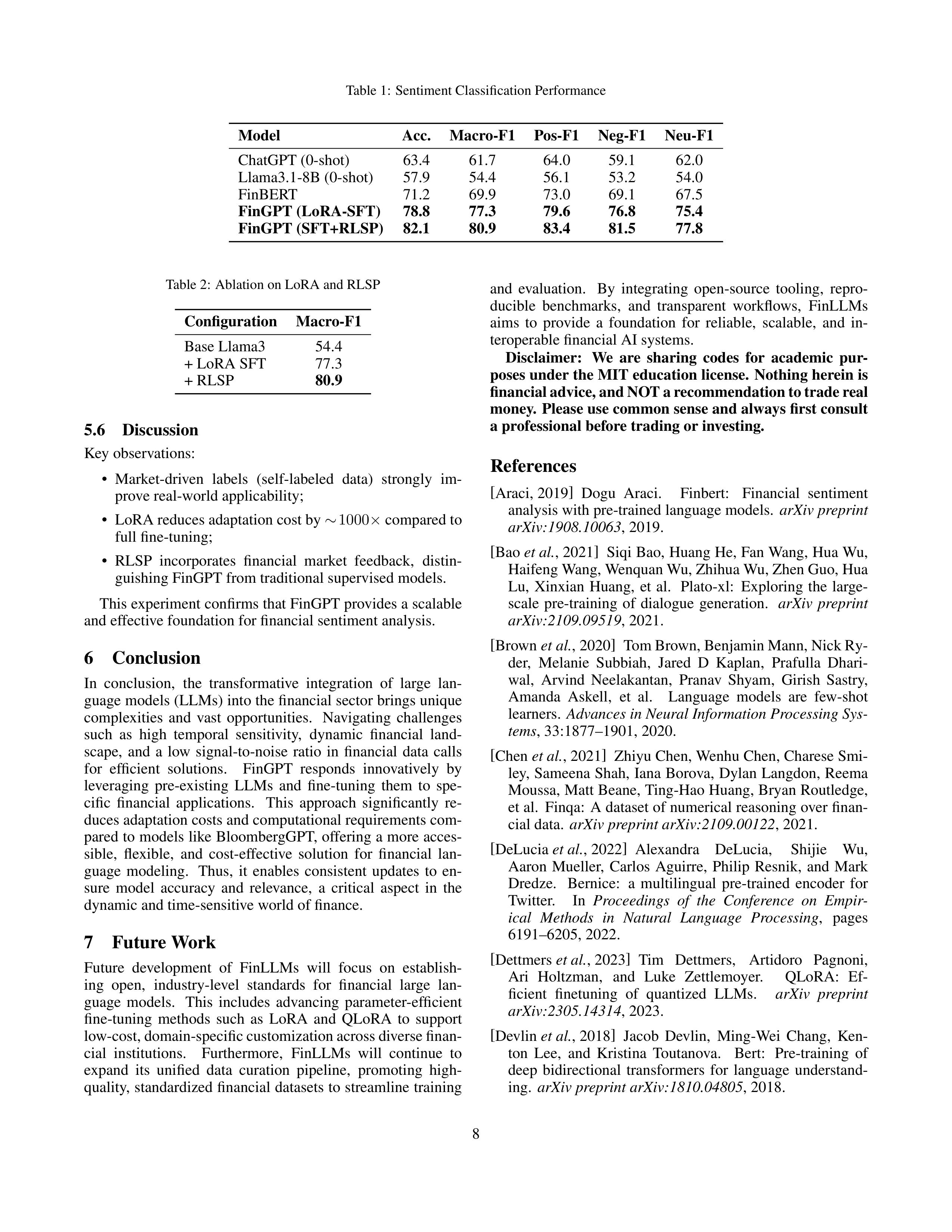
Table 1:
Sentiment Classification Performance
Model
Acc.
Macro-F1
Pos-F1
Neg-F1
Neu-F1
ChatGPT (0-shot)
63.4
61.7
64.0
59.1
62.0
Llama3.1-8B (0-shot)
57.9
54.4
56.1
53.2
54.0
FinBERT
71.2
69.9
73.0
69.1
67.5
FinGPT (LoRA-SFT)
78.8
77.3
79.6
76.8
75.4
FinGPT (SFT+RLSP)
82.1
80.9
83.4
81.5
77.8
Table 2:
Ablation on LoRA and RLSP
Configuration
Macro-F1
Base Llama3
54.4
+ LoRA SFT
77.3
+ RLSP
80.9
5.6
Discussion
Key observations:
•
Market-driven
labels
(self-labeled
data)
strongly
im-
prove real-world applicability;
•
LoRA reduces adaptation cost by
∼
1000
×
compared to
full fine-tuning;
•
RLSP
incorporates
financial
market
feedback,
distin-
guishing FinGPT from traditional supervised models.
This experiment confirms that FinGPT provides a scalable
and effective foundation for financial sentiment analysis.
6
Conclusion
In
conclusion,
the
transformative
integration
of
large
lan-
guage models (LLMs) into the financial sector brings unique
complexities
and
vast
opportunities.
Navigating
challenges
such
as
high
temporal
sensitivity,
dynamic
financial
land-
scape,
and
a
low
signal-to-noise
ratio
in
financial
data
calls
for
efficient
solutions.
FinGPT
responds
innovatively
by
leveraging
pre-existing
LLMs
and
fine-tuning
them
to
spe-
cific
financial
applications.
This
approach
significantly
re-
duces adaptation costs and computational requirements com-
pared to models like BloombergGPT, offering a more acces-
sible,
flexible,
and
cost-effective
solution
for
financial
lan-
guage
modeling.
Thus,
it
enables
consistent
updates
to
en-
sure
model
accuracy
and
relevance,
a
critical
aspect
in
the
dynamic and time-sensitive world of finance.
7
Future Work
Future
development
of
FinLLMs
will
focus
on
establish-
ing
open,
industry-level
standards
for
financial
large
lan-
guage
models.
This
includes
advancing
parameter-efficient
fine-tuning
methods
such
as
LoRA
and
QLoRA
to
support
low-cost, domain-specific customization across diverse finan-
cial
institutions.
Furthermore,
FinLLMs
will
continue
to
expand
its
unified
data
curation
pipeline,
promoting
high-
quality, standardized financial datasets to streamline training
and
evaluation.
By
integrating
open-source
tooling,
repro-
ducible
benchmarks,
and
transparent
workflows,
FinLLMs
aims
to
provide
a
foundation
for
reliable,
scalable,
and
in-
teroperable financial AI systems.
Disclaimer:
We
are
sharing
codes
for
academic
pur-
poses under the MIT education license.
Nothing herein is
financial advice, and NOT a recommendation to trade real
money.
Please use common sense and always first consult
a professional before trading or investing.
References
[Araci, 2019]
Dogu
Araci.
Finbert:
Financial
sentiment
analysis with pre-trained language models.
arXiv preprint
arXiv:1908.10063
, 2019.
[Bao
et al.
, 2021]
Siqi Bao, Huang He, Fan Wang, Hua Wu,
Haifeng Wang, Wenquan Wu, Zhihua Wu, Zhen Guo, Hua
Lu,
Xinxian
Huang,
et
al.
Plato-xl:
Exploring
the
large-
scale
pre-training
of
dialogue
generation.
arXiv
preprint
arXiv:2109.09519
, 2021.
[Brown
et al.
, 2020]
Tom Brown, Benjamin Mann, Nick Ry-
der,
Melanie
Subbiah,
Jared
D
Kaplan,
Prafulla
Dhari-
wal,
Arvind
Neelakantan,
Pranav
Shyam,
Girish
Sastry,
Amanda
Askell,
et
al.
Language
models
are
few-shot
learners.
Advances in Neural Information Processing Sys-
tems
, 33:1877–1901, 2020.
[Chen
et al.
, 2021]
Zhiyu Chen, Wenhu Chen, Charese Smi-
ley, Sameena Shah, Iana Borova,
Dylan Langdon, Reema
Moussa, Matt Beane, Ting-Hao Huang, Bryan Routledge,
et al.
Finqa:
A dataset of numerical reasoning over finan-
cial data.
arXiv preprint arXiv:2109.00122
, 2021.
[DeLucia
et al.
, 2022]
Alexandra
DeLucia,
Shijie
Wu,
Aaron
Mueller,
Carlos
Aguirre,
Philip
Resnik,
and
Mark
Dredze.
Bernice:
a
multilingual
pre-trained
encoder
for
Twitter.
In
Proceedings
of
the
Conference
on
Empir-
ical
Methods
in
Natural
Language
Processing
,
pages
6191–6205, 2022.
[Dettmers
et al.
, 2023]
Tim
Dettmers,
Artidoro
Pagnoni,
Ari
Holtzman,
and
Luke
Zettlemoyer.
QLoRA:
Ef-
ficient
finetuning
of
quantized
LLMs.
arXiv
preprint
arXiv:2305.14314
, 2023.
[Devlin
et al.
, 2018]
Jacob
Devlin,
Ming-Wei
Chang,
Ken-
ton
Lee,
and
Kristina
Toutanova.
Bert:
Pre-training
of
deep
bidirectional
transformers
for
language
understand-
ing.
arXiv preprint arXiv:1810.04805
, 2018.
8
[Dredze
et al.
, 2016]
Mark
Dredze,
Prabhanjan
Kambadur,
Gary Kazantsev, Gideon Mann, and Miles Osborne.
How
twitter is changing the nature of financial news discovery.
In
Proceedings
of
the
second
International
Workshop
on
Data Science for Macro-modeling
, pages 1–5, 2016.
[Ethayarajh, 2019]
Kawin
Ethayarajh.
How
contextual
are
contextualized
word
representations?
comparing
the
ge-
ometry
of
bert,
elmo,
and
gpt-2
embeddings.
arXiv
preprint arXiv:1909.00512
, 2019.
[Ghosh
et al.
, 2021]
Sohom Ghosh, Shovon Sengupta, Sudip
Naskar,
and
Sunny
Kumar
Singh.
FinRead:
A
trans-
fer
learning
based
tool
to
assess
readability
of
defini-
tions
of
financial
terms.
In
Proceedings
of
the
18th
In-
ternational
Conference
on
Natural
Language
Processing
(ICON)
, pages 658–659, National Institute of Technology
Silchar,
Silchar,
India,
December
2021.
NLP
Association
of India (NLPAI).
[Grattafiori
et al.
, 2024]
Aaron
Grattafiori,
Abhimanyu
Dubey,
Abhinav
Jauhri,
Abhinav
Pandey,
Abhishek
Kadian, Ahmad Al-Dahle, Aiesha Letman, Akhil Mathur,
Alan
Schelten,
Alex
Vaughan,
et
al.
The
llama
3
herd
of
models.
arXiv preprint arXiv:2407.21783
, 2024.
[Hu
et al.
, 2021]
Edward J Hu, Yelong Shen, Phillip Wallis,
Zeyuan
Allen-Zhu,
Yuanzhi
Li,
Shean
Wang,
Lu
Wang,
and
Weizhu
Chen.
LoRA:
Low-rank
adaptation
of
large
language
models.
International
Conference
on
Learning
Representations
, 2021.
[Jiang
et al.
, 2023]
Albert Q. Jiang, Alexandre Sablayrolles,
Arthur Mensch, Chris Bamford, Devendra Singh Chaplot,
Diego
de
las
Casas,
Florian
Bressand,
Gianna
Lengyel,
Guillaume Lample, Lucile Saulnier, L´elio Renard Lavaud,
Marie-Anne
Lachaux,
Pierre
Stock,
Teven
Le
Scao,
Thibaut
Lavril,
Thomas
Wang,
Timoth´ee
Lacroix,
and
William El Sayed.
Mistral 7b, 2023.
[Lewis
et al.
, 2019]
Mike Lewis, Yinhan Liu, Naman Goyal,
Marjan
Ghazvininejad,
Abdelrahman
Mohamed,
Omer
Levy,
Ves
Stoyanov,
and
Luke
Zettlemoyer.
Bart:
De-
noising sequence-to-sequence pre-training for natural lan-
guage
generation,
translation,
and
comprehension.
arXiv
preprint arXiv:1910.13461
, 2019.
[Lewis
et al.
, 2020]
Patrick Lewis, Myle Ott, Jingfei Du, and
Veselin Stoyanov. Pretrained language models for biomed-
ical
and
clinical
tasks:
understanding
and
extending
the
state-of-the-art. In
Proceedings of the 3rd Clinical Natural
Language Processing Workshop
, pages 146–157, 2020.
[Liu
et al.
, 2024]
Aixin
Liu,
Bei
Feng,
Bing
Xue,
Bingx-
uan
Wang,
Bochao
Wu,
Chengda
Lu,
Chenggang
Zhao,
Chengqi
Deng,
Chenyu
Zhang,
Chong
Ruan,
et
al.
Deepseek-v3
technical
report.
arXiv
preprint
arXiv:2412.19437
, 2024.
[OpenAI, 2023]
OpenAI.
Chatgpt.
https://chat.openai.com/,
2023.
Large language model accessed via ChatGPT inter-
face.
[Ouyang
et al.
, 2022]
Long
Ouyang,
Jeffrey
Wu,
Xu
Jiang,
Diogo
Almeida,
Carroll
Wainwright,
Pamela
Mishkin,
Chong
Zhang,
Sandhini
Agarwal,
Katarina
Slama,
Alex
Ray,
et
al.
Training
language
models
to
follow
instruc-
tions with human feedback.
Advances in Neural Informa-
tion Processing Systems
, 35:27730–27744, 2022.
[Radford
et al.
, 2018]
Alec
Radford,
Karthik
Narasimhan,
Tim
Salimans,
Ilya
Sutskever,
et
al.
Improving
language
understanding by generative pre-training.
OpenAI
, 2018.
[Shah
et al.
, 2022]
Raj Sanjay Shah, Kunal Chawla, Dheeraj
Eidnani,
Agam
Shah,
Wendi
Du,
Sudheer
Chava,
Na-
traj
Raman,
Charese
Smiley,
Jiaao
Chen,
and
Diyi
Yang.
When flue meets flang:
Benchmarks and large pre-trained
language
model
for
financial
domain.
arXiv
preprint
arXiv:2211.00083
, 2022.
[Sharma
et al.
, 2022]
Soumya
Sharma,
Tapas
Nayak,
Arusarka
Bose,
Ajay
Kumar
Meena,
Koustuv
Dasgupta,
Niloy
Ganguly,
and
Pawan
Goyal.
Finred:
A
dataset
for
relation
extraction
in
financial
domain.
In
Companion
Proceedings
of
the
Web
Conference
2022
,
WWW
’22,
page
595–597,
New
York,
NY,
USA,
2022.
Association
for Computing Machinery.
[Team
et al.
, 2023]
Gemini
Team,
Rohan
Anil,
Sebastian
Borgeaud, Jean-Baptiste Alayrac, Jiahui Yu, Radu Soricut,
Johan Schalkwyk, Andrew M Dai, Anja Hauth, Katie Mil-
lican, et al. Gemini: a family of highly capable multimodal
models.
arXiv preprint arXiv:2312.11805
, 2023.
[Thoppilan
et al.
, 2022]
Romal
Thoppilan,
Daniel
De
Fre-
itas,
Jamie
Hall,
Noam
Shazeer,
Apoorv
Kulshreshtha,
Heng-Tze
Cheng,
Alicia
Jin,
Taylor
Bos,
Leslie
Baker,
Yu
Du,
et
al.
Lamda:
Language
models
for
dialog
ap-
plications.
arXiv preprint arXiv:2201.08239
, 2022.
[Vaswani
et al.
, 2017]
Ashish Vaswani, Noam Shazeer, Niki
Parmar,
Jakob
Uszkoreit,
Llion
Jones,
Aidan
N
Gomez,
Ł ukasz Kaiser, and Illia Polosukhin.
Attention is all you
need.
In
Advances in Neural Information Processing Sys-
tems
, volume 30. Curran Associates, Inc., 2017.
[Wu
et al.
, 2023]
Shijie
Wu,
Ozan
Irsoy,
Steven
Lu,
Vadim
Dabravolski,
Mark
Dredze,
Sebastian
Gehrmann,
Prab-
hanjan
Kambadur,
David
Rosenberg,
and
Gideon
Mann.
BloombergGPT:
A
large
language
model
for
finance.
arXiv preprint arXiv:2303.17564
, 2023.
[Yang
et al.
, 2020]
Hongyang
Yang,
Xiao-Yang
Liu,
Shan
Zhong,
and
Anwar
Walid.
Deep
reinforcement
learning
for automated stock trading: An ensemble strategy. In
Pro-
ceedings
of
the
first
ACM
international
conference
on
AI
in finance
, pages 1–8, 2020.
[Yang
et al.
, 2024]
Hongyang
Yang,
Boyu
Zhang,
Neng
Wang, Cheng Guo, Xiaoli Zhang, Likun Lin, Junlin Wang,
Tianyu
Zhou,
Mao
Guan,
Runjia
Zhang,
et
al.
Fin-
robot:
An open-source ai agent platform for financial ap-
plications
using
large
language
models.
arXiv
preprint
arXiv:2405.14767
, 2024.
[Zhang
et al.
, 2023]
Boyu
Zhang,
Hongyang
Yang,
Tianyu
Zhou, Ali Babar, and Xiao-Yang Liu.
Enhancing financial
sentiment analysis via retrieval augmented large language
models.
ACM International Conference on AI in Finance
(ICAIF)
, 2023.
9