
From
Mind
to
Machine:
The
Rise
of
Manus
AI
as
a
Fully
Autonomous
Digital
Agent
Minjie
Shen
1
,
Yanshu
Li
2
,
Lulu
Chen
1
,
Zhichao
Fan
3
,
Yanhang
Li
4
,
Qikai
Yang
3
,
and
Haochen
Yang
5
1
Department
of
Electrical
and
Computer
Engineering,
Virginia
Tech
2
Department
of
Computer
Science,
Brown
University
3
Department
of
Computer
Science,
University
of
Illinois
at
Urbana-Champaign
4
Northeastern
University
5
Harvard
University
Abstract
Manus
AI
is
a
general-purpose
AI
agent
introduced
in
early
2025
as
a
breakthrough
in
au-
tonomous
artificial
intelligence.
Developed
by
the
Chinese
startup
Monica.im,
Manus
is
designed
to
bridge the gap between ”mind” and ”hand” – it not only thinks and plans like a large language model,
but
also
executes
complex
tasks
end-to-end
to
deliver
tangible
results.
This
paper
provides
a
com-
prehensive
overview
of
Manus
AI,
examining
its
underlying
technical
architecture,
its
wide-ranging
applications
across
industries
(including
healthcare,
finance,
manufacturing,
robotics,
gaming,
and
more),
as
well
as
its
advantages,
limitations,
and
future
prospects.
Ultimately,
Manus
AI
is
posi-
tioned as an early glimpse into the future of AI – one where intelligent agents could revolutionize work
and
daily
life
by
turning
high-level
intentions
into
actionable
outcomes,
auguring
a
new
paradigm
of
human-AI
collaboration.
1
Introduction
Recent
years
have
witnessed
tremendous
breakthroughs
in
artificial
intelligence
(AI),
from
the
rise
of
deep
neural
networks
to
large
language
models
that
can
converse
and
solve
complex
problems.
Models
like
OpenAI’s
GPT-4
[1]
have
demonstrated
unprecedented
language
understanding,
yet
such
systems
typically
operate
as
assistants
that
respond
to
queries
rather
than
autonomously
acting
on
tasks.
The
next
evolution
in
AI
is
the
development
of
general-purpose
AI
agents
that
can
bridge
the
gap
between
decision-making and action.
Manus AI
is a prominent new example, described as one of the world’s first
truly
autonomous
AI
agents
capable
of
“thinking”
and
executing
tasks
much
like
a
human
assistant
[2].
Manus
AI,
developed
by
the
Chinese
startup
Monica
in
2025,
has
quickly
drawn
global
attention
for
its
ability
to
perform
a
wide
array
of
real-world
jobs
with
minimal
human
guidance.
Unlike
traditional
chatbots
that
strictly
provide
information
or
suggestions,
Manus
can
plan
solutions,
invoke
tools,
and
carry out multi-step procedures on its own [3].
For example, rather than just giving travel advice, Manus
can
autonomously
plan
an
entire
trip
itinerary,
gather
relevant
information
from
the
web,
and
present
a
finalized
plan
to
the
user,
all
without
step-by-step
prompts
[3].
This
agent-centric
approach
represents
a
significant
leap
in
AI
capabilities
and
has
fueled
speculation
that
systems
like
Manus
herald
the
next
stage
in
AI
evolution
toward
artificial
general
intelligence
(AGI).
In
benchmark
evaluations
for
general
AI
agents,
Manus
AI
has
reportedly
achieved
state-of-the-art
results.
On
the
GAIA
test—a
comprehensive
benchmark
assessing
an
AI’s
ability
to
reason,
use
tools,
and
automate
real-world
tasks—Manus
outperformed
leading
models
including
OpenAI’s
GPT-4
[4].
In
fact,
early
reports
suggest
Manus
exceeded
the
previous
GAIA
leaderboard
champion’s
score
of
65%,
setting
a
new
performance
record
[4].
Such
achievements
underscore
the
importance
of
Manus
AI
as
a
breakthrough
system
in
the
competitive
landscape
of
AI.
This
paper
provides
a
detailed
examination
of
Manus
AI.
Section
2
explains
how
Manus
AI
works,
delving
into
its
model
architecture,
core
algorithms,
training
process,
and
unique
features.
Section
3
explores
Manus
AI’s
applications
across
various
industries—ranging
from
healthcare
and
finance
to
robotics
and
education—illustrating
its
versatility.
In
Section
4,
we
compare
Manus
AI
with
other
1
arXiv:2505.02024v4 [cs.AI] 24 Jul 2026
cutting-edge
AI
technologies
(including
offerings
from
OpenAI,
Google
DeepMind,
and
Anthropic)
to
analyze
how
Manus
stands
out.
Section
5
discusses
the
strengths
of
Manus
AI
as
well
as
its
limitations
and
ongoing
challenges.
Section
6
considers
future
prospects
for
Manus
AI
and
its
broader
implications
for
the
field.
Finally,
Section
7
concludes
with
a
summary
of
findings
and
reflections
on
Manus
AI’s
significance
in
the
trajectory
of
AI
development.
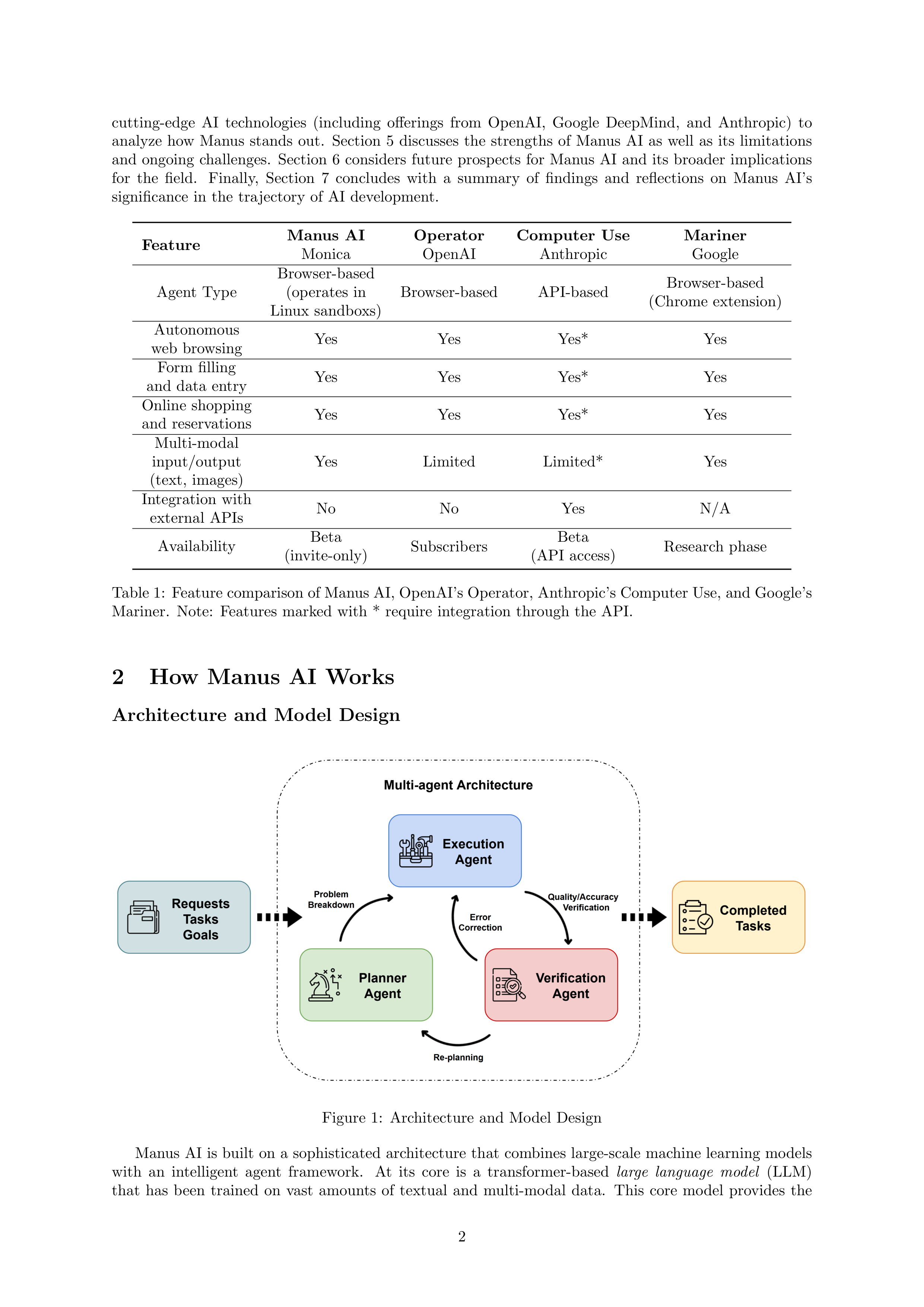
Feature
Manus
AI
Monica
Operator
OpenAI
Computer
Use
Anthropic
Mariner
Google
Agent
Type
Browser-based
(operates
in
Linux
sandboxs)
Browser-based
API-based
Browser-based
(Chrome
extension)
Autonomous
web
browsing
Yes
Yes
Yes*
Yes
Form
filling
and
data
entry
Yes
Yes
Yes*
Yes
Online
shopping
and
reservations
Yes
Yes
Yes*
Yes
Multi-modal
input/output
(text,
images)
Yes
Limited
Limited*
Yes
Integration
with
external
APIs
No
No
Yes
N/A
Availability
Beta
(invite-only)
Subscribers
Beta
(API
access)
Research
phase
Table 1:
Feature comparison of Manus AI, OpenAI’s Operator, Anthropic’s Computer Use, and Google’s
Mariner.
Note:
Features
marked
with
*
require
integration
through
the
API.
2
How
Manus
AI
Works
Architecture
and
Model
Design
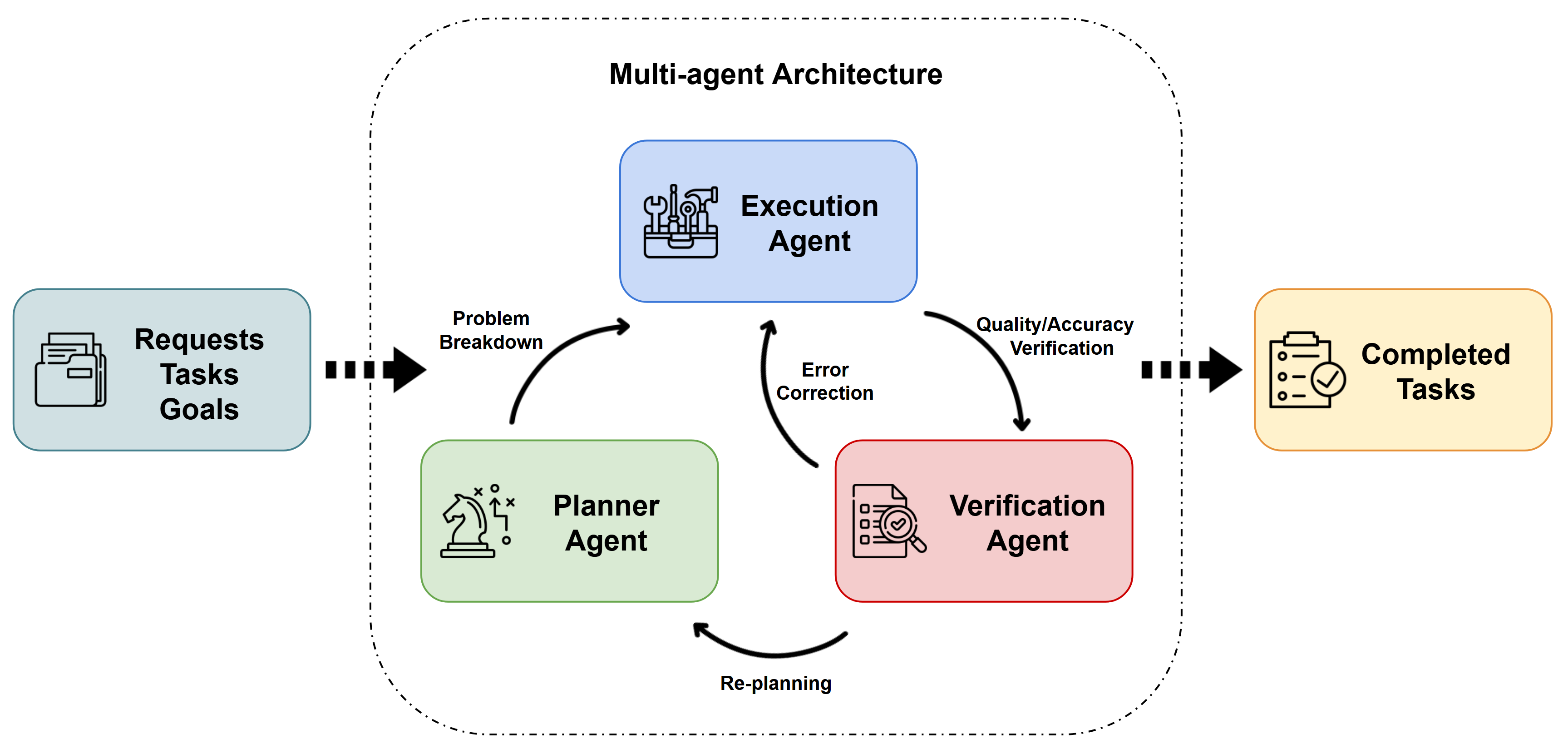
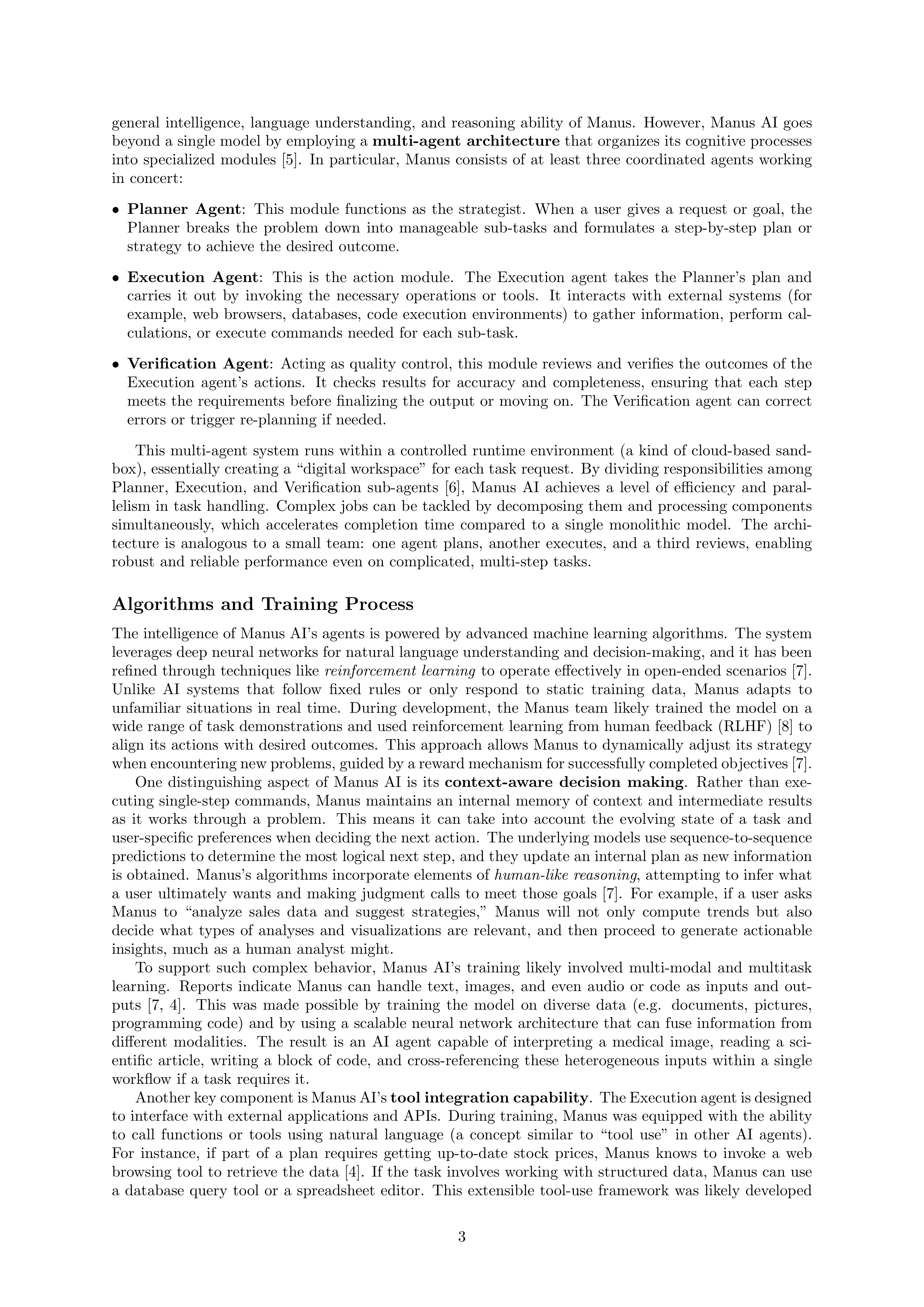
Figure
1:
Architecture
and
Model
Design
Manus
AI
is
built
on
a
sophisticated
architecture
that
combines
large-scale
machine
learning
models
with
an
intelligent
agent
framework.
At
its
core
is
a
transformer-based
large
language
model
(LLM)
that
has
been
trained
on
vast
amounts
of
textual
and
multi-modal
data.
This
core
model
provides
the
2
general
intelligence,
language
understanding,
and
reasoning
ability
of
Manus.
However,
Manus
AI
goes
beyond
a
single
model
by
employing
a
multi-agent
architecture
that
organizes
its
cognitive
processes
into
specialized
modules
[5].
In
particular,
Manus
consists
of
at
least
three
coordinated
agents
working
in
concert:
•
Planner
Agent
:
This
module
functions
as
the
strategist.
When
a
user
gives
a
request
or
goal,
the
Planner
breaks
the
problem
down
into
manageable
sub-tasks
and
formulates
a
step-by-step
plan
or
strategy
to
achieve
the
desired
outcome.
•
Execution
Agent
:
This
is
the
action
module.
The
Execution
agent
takes
the
Planner’s
plan
and
carries
it
out
by
invoking
the
necessary
operations
or
tools.
It
interacts
with
external
systems
(for
example,
web
browsers,
databases,
code
execution
environments)
to
gather
information,
perform
cal-
culations,
or
execute
commands
needed
for
each
sub-task.
•
Verification
Agent
:
Acting
as
quality
control,
this
module
reviews
and
verifies
the
outcomes
of
the
Execution
agent’s
actions.
It
checks
results
for
accuracy
and
completeness,
ensuring
that
each
step
meets
the
requirements
before
finalizing
the
output
or
moving
on.
The
Verification
agent
can
correct
errors
or
trigger
re-planning
if
needed.
This
multi-agent
system
runs
within
a
controlled
runtime
environment
(a
kind
of
cloud-based
sand-
box), essentially creating a “digital workspace” for each task request.
By dividing responsibilities among
Planner,
Execution,
and
Verification
sub-agents
[6],
Manus
AI
achieves
a
level
of
efficiency
and
paral-
lelism
in
task
handling.
Complex
jobs
can
be
tackled
by
decomposing
them
and
processing
components
simultaneously,
which
accelerates
completion
time
compared
to
a
single
monolithic
model.
The
archi-
tecture
is
analogous
to
a
small
team:
one
agent
plans,
another
executes,
and
a
third
reviews,
enabling
robust
and
reliable
performance
even
on
complicated,
multi-step
tasks.
Algorithms
and
Training
Process
The
intelligence
of
Manus
AI’s
agents
is
powered
by
advanced
machine
learning
algorithms.
The
system
leverages deep neural networks for natural language understanding and decision-making, and it has been
refined
through
techniques
like
reinforcement
learning
to
operate
effectively
in
open-ended
scenarios
[7].
Unlike
AI
systems
that
follow
fixed
rules
or
only
respond
to
static
training
data,
Manus
adapts
to
unfamiliar
situations
in
real
time.
During
development,
the
Manus
team
likely
trained
the
model
on
a
wide
range
of
task
demonstrations
and
used
reinforcement
learning
from
human
feedback
(RLHF)
[8]
to
align
its
actions
with
desired
outcomes.
This
approach
allows
Manus
to
dynamically
adjust
its
strategy
when encountering new problems, guided by a reward mechanism for successfully completed objectives [7].
One
distinguishing
aspect
of
Manus
AI
is
its
context-aware
decision
making
.
Rather
than
exe-
cuting
single-step
commands,
Manus
maintains
an
internal
memory
of
context
and
intermediate
results
as
it
works
through
a
problem.
This
means
it
can
take
into
account
the
evolving
state
of
a
task
and
user-specific preferences when deciding the next action.
The underlying models use sequence-to-sequence
predictions to determine the most logical next step, and they update an internal plan as new information
is
obtained.
Manus’s
algorithms
incorporate
elements
of
human-like
reasoning
,
attempting
to
infer
what
a
user
ultimately
wants
and
making
judgment
calls
to
meet
those
goals
[7].
For
example,
if
a
user
asks
Manus
to
“analyze
sales
data
and
suggest
strategies,”
Manus
will
not
only
compute
trends
but
also
decide
what
types
of
analyses
and
visualizations
are
relevant,
and
then
proceed
to
generate
actionable
insights,
much
as
a
human
analyst
might.
To
support
such
complex
behavior,
Manus
AI’s
training
likely
involved
multi-modal
and
multitask
learning.
Reports
indicate
Manus
can
handle
text,
images,
and
even
audio
or
code
as
inputs
and
out-
puts
[7,
4].
This
was
made
possible
by
training
the
model
on
diverse
data
(e.g.
documents,
pictures,
programming
code)
and
by
using
a
scalable
neural
network
architecture
that
can
fuse
information
from
different
modalities.
The
result
is
an
AI
agent
capable
of
interpreting
a
medical
image,
reading
a
sci-
entific
article,
writing
a
block
of
code,
and
cross-referencing
these
heterogeneous
inputs
within
a
single
workflow
if
a
task
requires
it.
Another key component is Manus AI’s
tool integration capability
.
The Execution agent is designed
to
interface
with
external
applications
and
APIs.
During
training,
Manus
was
equipped
with
the
ability
to
call
functions
or
tools
using
natural
language
(a
concept
similar
to
“tool
use”
in
other
AI
agents).
For
instance,
if
part
of
a
plan
requires
getting
up-to-date
stock
prices,
Manus
knows
to
invoke
a
web
browsing
tool
to
retrieve
the
data
[4].
If
the
task
involves
working
with
structured
data,
Manus
can
use
a
database
query
tool
or
a
spreadsheet
editor.
This
extensible
tool-use
framework
was
likely
developed
3
by
fine-tuning
Manus
on
examples
of
how
to
use
various
tools
and
by
incorporating
APIs
for
external
services.
It
allows
Manus
to
extend
its
capabilities
beyond
what
is
stored
in
its
neural
weights,
giving
it
access
to
real-time
information
and
specialized
functions
(like
running
code
or
searching
the
internet)
on-the-fly
[4].
Unique
Features
and
Capabilities
Through its architecture and training, Manus AI exhibits several unique features that distinguish it from
conventional
AI
assistants:
•
Autonomous
Task
Execution
:
Manus
AI
can
carry
out
complex
sequences
of
actions
with
minimal
user
intervention.
Once
given
a
high-level
goal,
it
will
plan,
execute,
and
finalize
the
task
largely
on
its
own.
This
goes
far
beyond
the
typical
AI,
which
would
require
the
user
to
break
down
the
problem
or
confirm
each
step.
Manus
“excels
at
various
tasks
in
work
and
life,
getting
everything
done
while
you
rest,”
as
its
creators
put
it
[2].
For
example,
it
can
generate
a
detailed
report (with visuals and text) from raw data entirely autonomously, or perform all steps of booking
a
trip
after
a
user
simply
requests
a
vacation
plan.
•
Multi-Modal
Understanding
:
Manus
AI
[4]
is
designed
to
process
and
generate
multiple
types
of
data,
including:
–
Text
(e.g.,
generating
reports,
answering
queries)
–
Images
(e.g.,
analyzing
visual
content)
–
Code
(e.g.,
automating
programming
tasks)
This versatility means Manus can tackle tasks like reading a diagram or X-ray and then writing an
explanation
of
it,
or
debugging
a
piece
of
software
based
on
both
the
code
and
error
screenshots.
•
Advanced
Tool
Use
:
Manus
AI
is
adept
at
integrating
with
external
tools
and
software
applica-
tions
to
augment
its
abilities.
It
has
built-in
support
for
web
browsing,
so
it
can
fetch
up-to-the-
minute
information
from
the
internet.
It
can
interface
with
productivity
software
(for
instance,
creating or editing spreadsheets and documents) and query databases.
This ability to interact with
external
applications
makes
Manus
AI
an
ideal
tool
for
businesses
looking
to
automate
workflows.
Integrating
tool
use
into
an
AI
agent
is
challenging,
and
Manus’s
effective
tool
usage
is
a
major
innovation
in
bridging
AI
with
practical
automation
tasks.
•
Continuous
Learning
and
Adaptation
:
Manus
AI
continuously
learns
from
user
interactions
and
optimizes
its
processes
to
provide
personalized
and
efficient
responses.
This
ensures
that
over
time,
the
AI
becomes
more
tailored
to
the
specific
needs
of
the
user
[4].
For
example,
if
a
user
consistently
prefers
data
presented
in
a
certain
format
or
tone,
Manus
will
adapt
to
those
preferences
in
future
outputs.
This
adaptive
learning
happens
during
use,
complementing
its
initial offline training.
Additionally, the developers emphasize ethical safeguards and transparency,
meaning
the
system
is
designed
to
adjust
its
actions
to
avoid
unsafe
outcomes
and
to
align
with
human
intentions
as
it
gains
experience.
In
summary,
Manus
AI’s
inner
workings
combine
a
powerful
general
AI
model
with
a
clever
agent
framework that enables autonomous operation.
Through specialized sub-agents for planning and verifica-
tion,
reinforcement
learning
for
decision-making,
multi-modal
and
tool-using
proficiencies,
and
adaptive
behavior, Manus achieves a level of autonomy and versatility that is at the cutting edge of AI technology.
These
technical
foundations
empower
the
wide-ranging
applications
of
Manus
AI
discussed
in
the
next
section.
3
Applications
in
Various
Industries
One
of
the
most
compelling
aspects
of
Manus
AI
is
its
potential
to
transform
numerous
industries
by
automating
and
augmenting
complex
tasks.
Because
it
is
not
confined
to
a
single
domain,
Manus
can
be
deployed
wherever
there
is
a
need
for
intelligent
decision-making
and
task
execution.
Below
we
explore
how
Manus
AI
can
be
applied
in
a
variety
of
sectors,
highlighting
use
cases
in
healthcare,
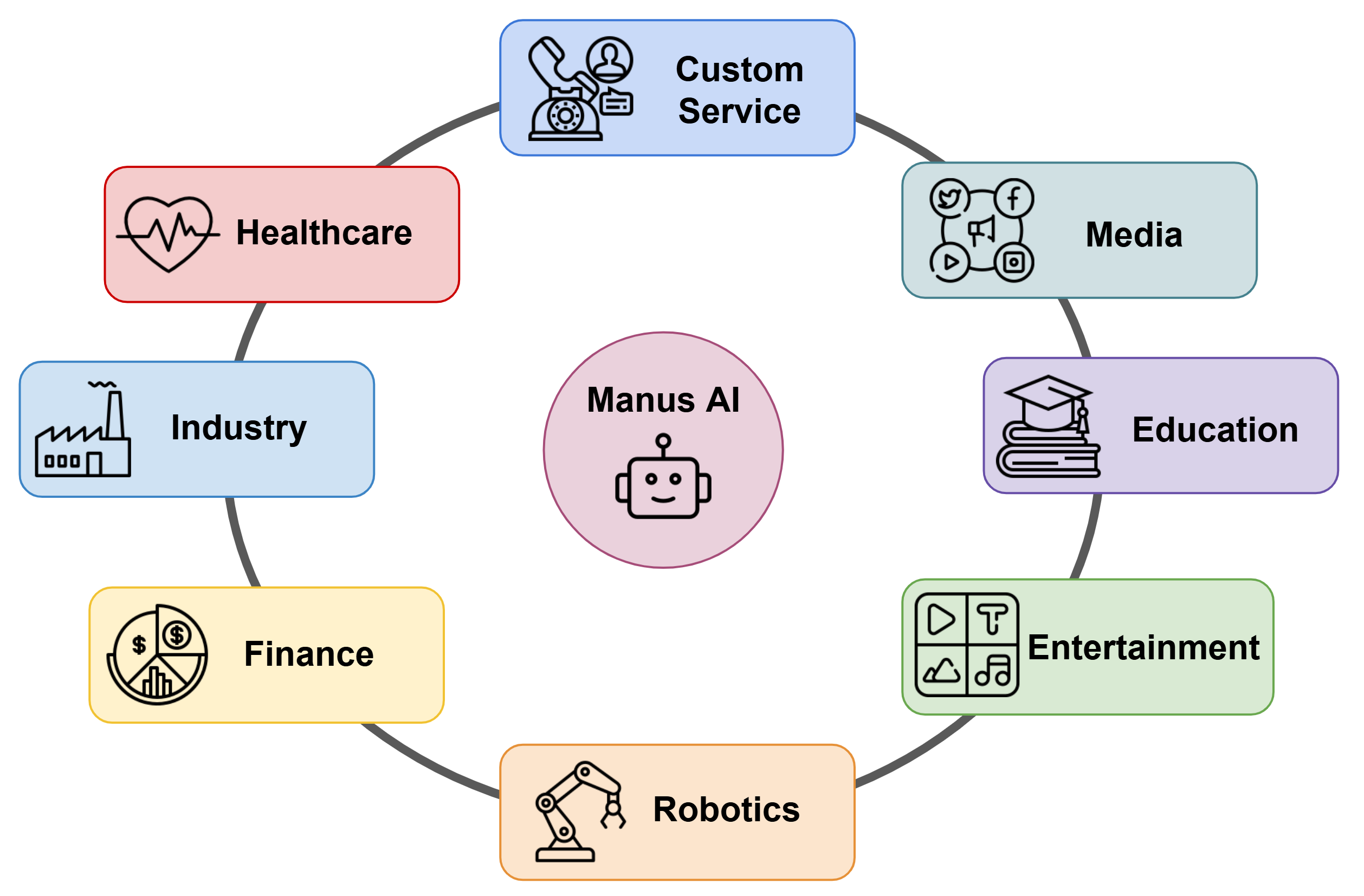
finance, robotics, entertainment, customer service, manufacturing, education, and more.
In each of these,
Manus’s
combination
of
data
analysis,
reasoning,
and
autonomous
action
has
the
capacity
to
improve
efficiency
and
unlock
new
capabilities.
4
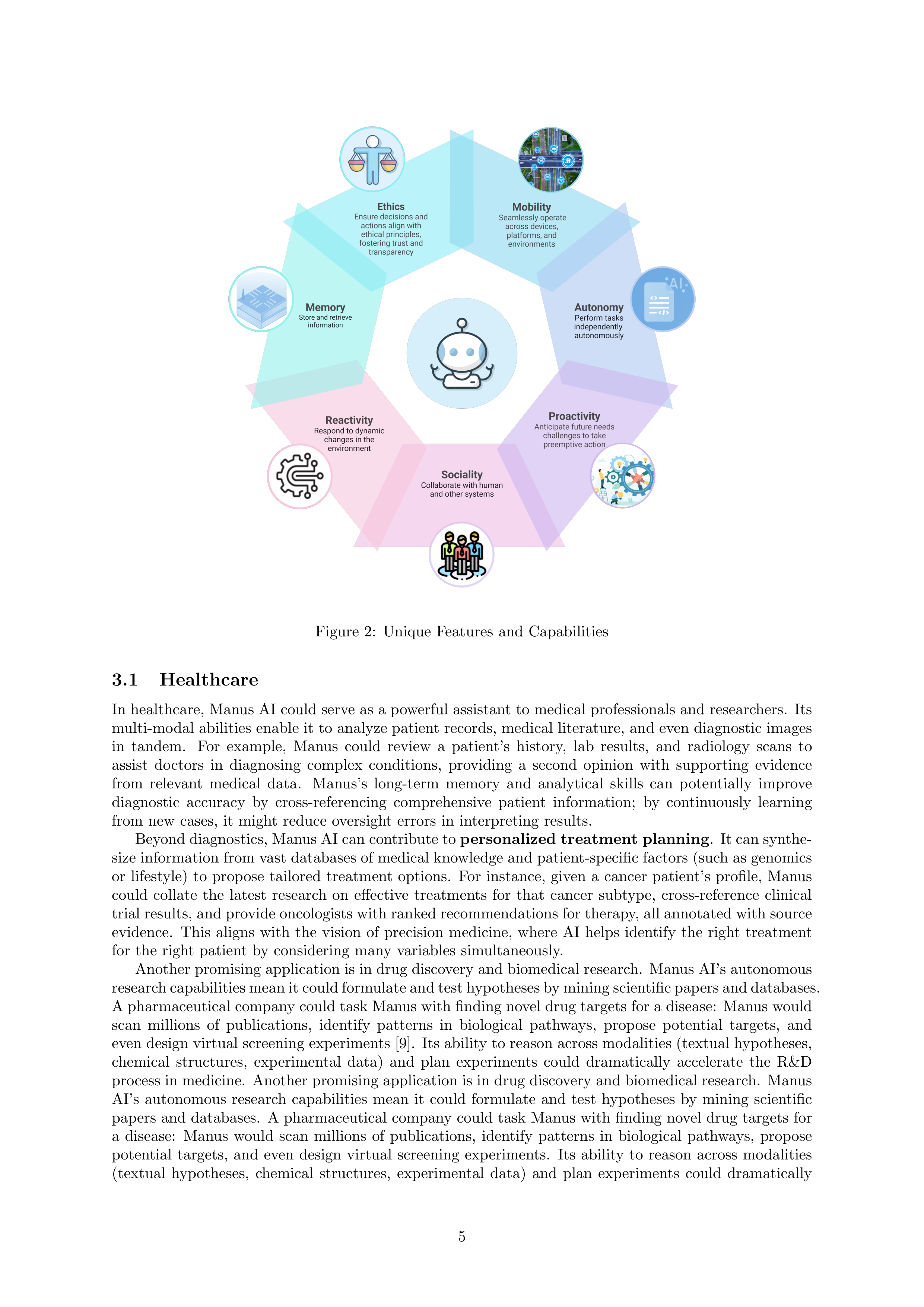
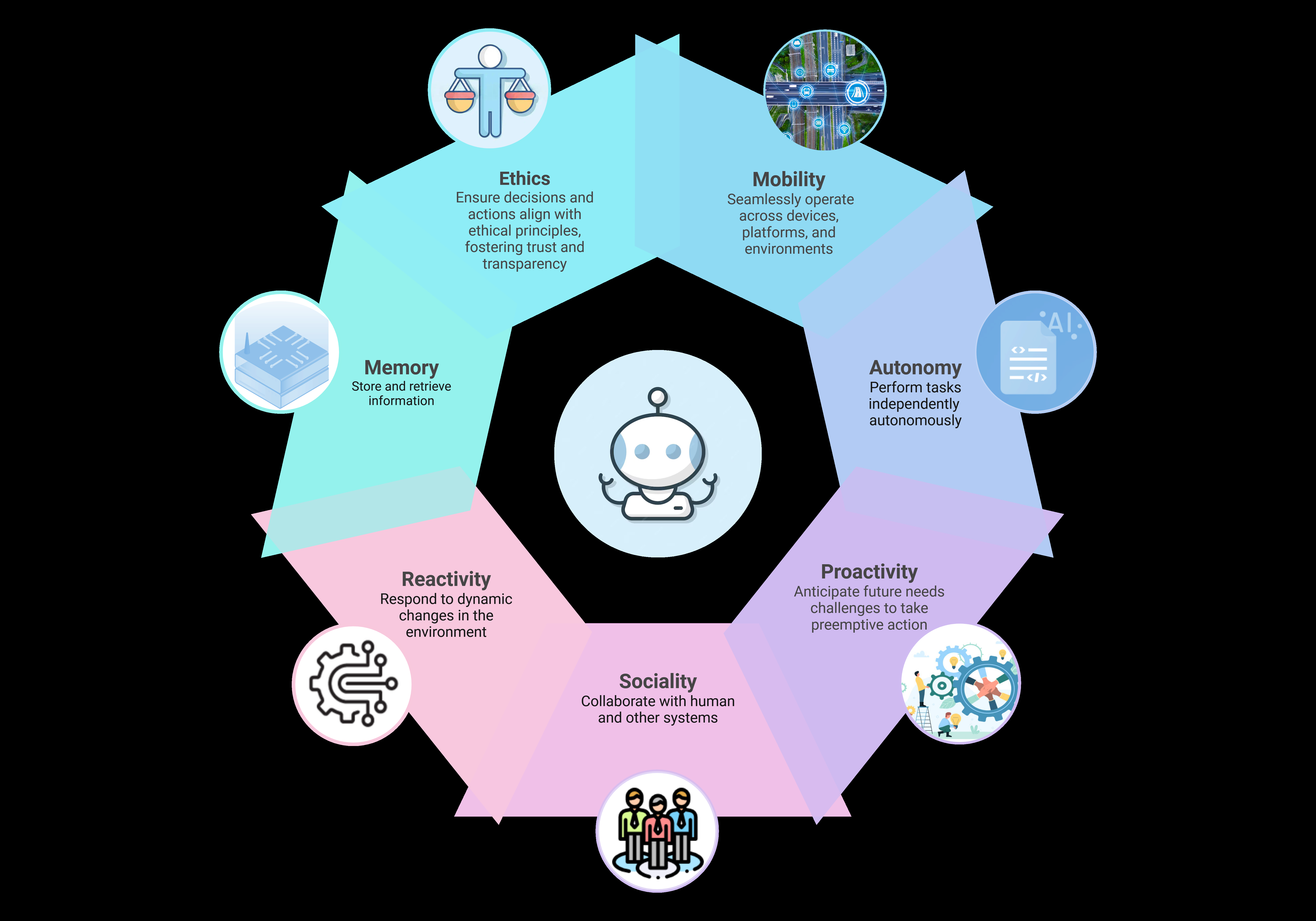
Figure
2:
Unique
Features
and
Capabilities
3.1
Healthcare
In
healthcare,
Manus
AI
could
serve
as
a
powerful
assistant
to
medical
professionals
and
researchers.
Its
multi-modal
abilities
enable
it
to
analyze
patient
records,
medical
literature,
and
even
diagnostic
images
in
tandem.
For
example,
Manus
could
review
a
patient’s
history,
lab
results,
and
radiology
scans
to
assist
doctors
in
diagnosing
complex
conditions,
providing
a
second
opinion
with
supporting
evidence
from
relevant
medical
data.
Manus’s
long-term
memory
and
analytical
skills
can
potentially
improve
diagnostic
accuracy
by
cross-referencing
comprehensive
patient
information;
by
continuously
learning
from
new
cases,
it
might
reduce
oversight
errors
in
interpreting
results.
Beyond diagnostics, Manus AI can contribute to
personalized treatment planning
.
It can synthe-
size information from vast databases of medical knowledge and patient-specific factors (such as genomics
or
lifestyle)
to
propose
tailored
treatment
options.
For
instance,
given
a
cancer
patient’s
profile,
Manus
could
collate
the
latest
research
on
effective
treatments
for
that
cancer
subtype,
cross-reference
clinical
trial results, and provide oncologists with ranked recommendations for therapy, all annotated with source
evidence.
This
aligns
with
the
vision
of
precision
medicine,
where
AI
helps
identify
the
right
treatment
for
the
right
patient
by
considering
many
variables
simultaneously.
Another promising application is in drug discovery and biomedical research.
Manus AI’s autonomous
research capabilities mean it could formulate and test hypotheses by mining scientific papers and databases.
A pharmaceutical company could task Manus with finding novel drug targets for a disease:
Manus would
scan
millions
of
publications,
identify
patterns
in
biological
pathways,
propose
potential
targets,
and
even design virtual screening experiments [9].
Its ability to reason across modalities (textual hypotheses,
chemical
structures,
experimental
data)
and
plan
experiments
could
dramatically
accelerate
the
R&D
process in medicine.
Another promising application is in drug discovery and biomedical research.
Manus
AI’s
autonomous
research
capabilities
mean
it
could
formulate
and
test
hypotheses
by
mining
scientific
papers
and
databases.
A
pharmaceutical
company
could
task
Manus
with
finding
novel
drug
targets
for
a
disease:
Manus
would
scan
millions
of
publications,
identify
patterns
in
biological
pathways,
propose
potential
targets,
and
even
design
virtual
screening
experiments.
Its
ability
to
reason
across
modalities
(textual
hypotheses,
chemical
structures,
experimental
data)
and
plan
experiments
could
dramatically
5
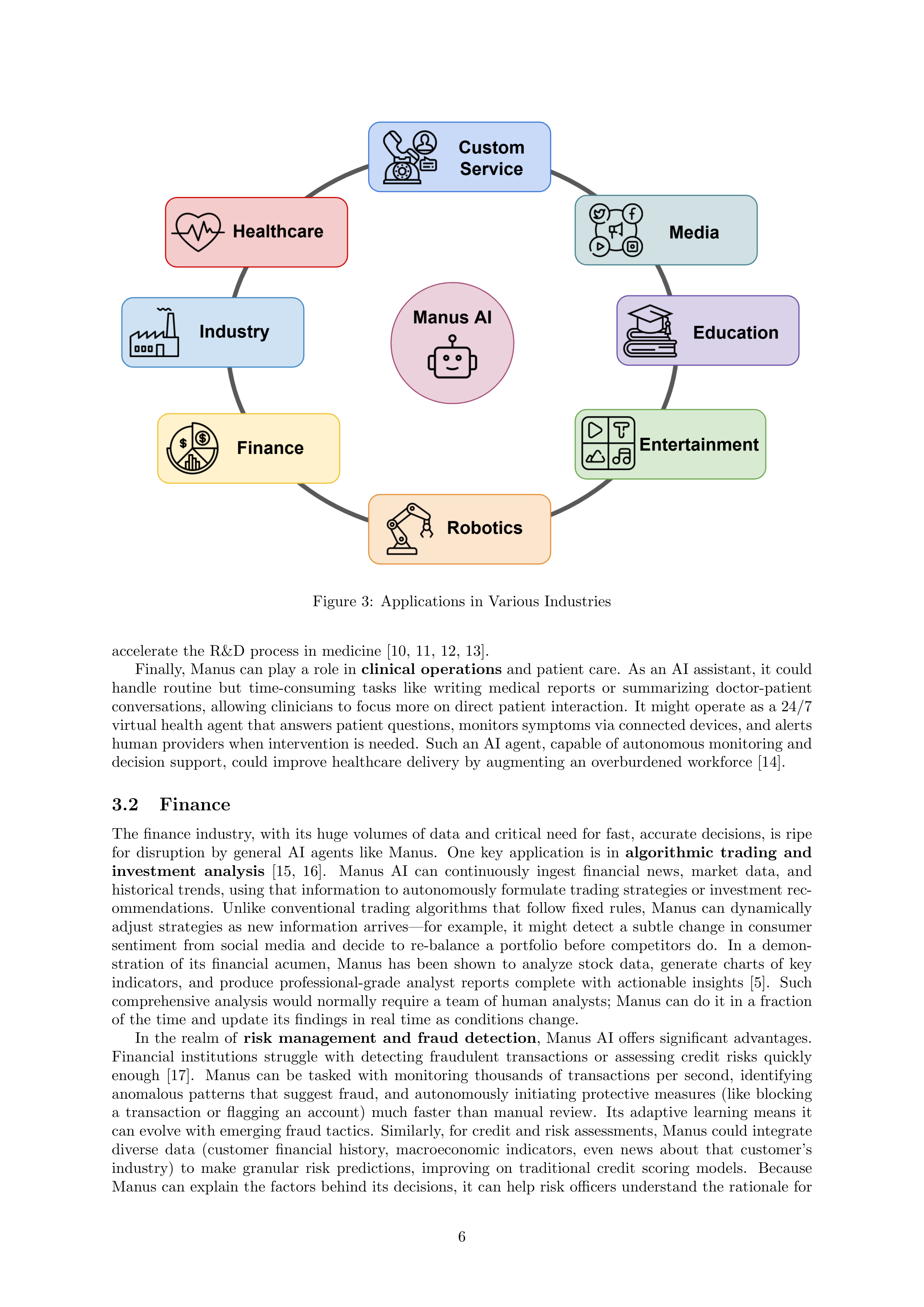
Figure
3:
Applications
in
Various
Industries
accelerate
the
R&D
process
in
medicine
[10,
11,
12,
13].
Finally,
Manus
can
play
a
role
in
clinical
operations
and
patient
care.
As
an
AI
assistant,
it
could
handle
routine
but
time-consuming
tasks
like
writing
medical
reports
or
summarizing
doctor-patient
conversations,
allowing
clinicians
to
focus
more
on
direct
patient
interaction.
It
might
operate
as
a
24/7
virtual health agent that answers patient questions, monitors symptoms via connected devices, and alerts
human providers when intervention is needed.
Such an AI agent, capable of autonomous monitoring and
decision
support,
could
improve
healthcare
delivery
by
augmenting
an
overburdened
workforce
[14].
3.2
Finance
The
finance
industry,
with
its
huge
volumes
of
data
and
critical
need
for
fast,
accurate
decisions,
is
ripe
for
disruption
by
general
AI
agents
like
Manus.
One
key
application
is
in
algorithmic
trading
and
investment
analysis
[15,
16].
Manus
AI
can
continuously
ingest
financial
news,
market
data,
and
historical trends, using that information to autonomously formulate trading strategies or investment rec-
ommendations.
Unlike
conventional
trading
algorithms
that
follow
fixed
rules,
Manus
can
dynamically
adjust
strategies
as
new
information
arrives—for
example,
it
might
detect
a
subtle
change
in
consumer
sentiment
from
social
media
and
decide
to
re-balance
a
portfolio
before
competitors
do.
In
a
demon-
stration
of
its
financial
acumen,
Manus
has
been
shown
to
analyze
stock
data,
generate
charts
of
key
indicators,
and
produce
professional-grade
analyst
reports
complete
with
actionable
insights
[5].
Such
comprehensive
analysis
would
normally
require
a
team
of
human
analysts;
Manus
can
do
it
in
a
fraction
of
the
time
and
update
its
findings
in
real
time
as
conditions
change.
In
the
realm
of
risk
management
and
fraud
detection
,
Manus
AI
offers
significant
advantages.
Financial
institutions
struggle
with
detecting
fraudulent
transactions
or
assessing
credit
risks
quickly
enough
[17].
Manus
can
be
tasked
with
monitoring
thousands
of
transactions
per
second,
identifying
anomalous
patterns
that
suggest
fraud,
and
autonomously
initiating
protective
measures
(like
blocking
a
transaction
or
flagging
an
account)
much
faster
than
manual
review.
Its
adaptive
learning
means
it
can evolve with emerging fraud tactics.
Similarly,
for credit and risk assessments,
Manus could integrate
diverse
data
(customer
financial
history,
macroeconomic
indicators,
even
news
about
that
customer’s
industry)
to
make
granular
risk
predictions,
improving
on
traditional
credit
scoring
models.
Because
Manus
can
explain
the
factors
behind
its
decisions,
it
can
help
risk
officers
understand
the
rationale
for
6
a
flagged
risk,
satisfying
regulatory
demands
for
transparency.
Another
financial
application
is
in
customer
service
and
personalized
finance
.
Manus
AI
could
serve
as
a
financial
advisor
chatbot
that
not
only
chats
with
customers
but
actually
takes
actions
on
their
behalf.
For
instance,
a
customer
might
ask,
“Help
me
optimize
my
monthly
budget
and
invest
the
surplus.”
Manus
could
analyze
the
person’s
spending
patterns
(by
accessing
transaction
data
with
permission),
identify
areas
to
save,
and
automatically
move
funds
into
an
investment
account,
select-
ing
appropriate
investments
based
on
the
customer’s
profile
and
goals.
All
of
this
could
be
done
au-
tonomously
while
keeping
the
customer
informed,
effectively
acting
as
a
personal
financial
planner
that
works
continuously
in
the
background.
3.3
Robotics
and
Autonomous
Systems
While
Manus
AI
exists
primarily
as
a
software
agent,
its
capabilities
can
extend
into
the
physical
realm
when
paired
with
robotic
systems.
In
robotics,
Manus
can
function
as
the
high-level
“brain”
that
gives
intelligent
direction
to
machines.
One
application
is
in
industrial
automation
,
where
Manus
oversees
fleets of robots on a factory floor.
Because it can plan and coordinate complex sequences of actions, Manus
could
dynamically
assign
tasks
to
different
robots,
schedule
their
activities
to
optimize
throughput,
and
adapt
plans
on
the
fly
if
one
robot
encounters
a
problem.
For
example,
if
a
manufacturing
robot
goes
down
for
maintenance,
Manus
would
detect
the
issue
and
immediately
reroute
tasks
to
other
machines
or adjust the assembly sequence to prevent an assembly line halt.
Its ability to integrate real-time sensor
data
means
Manus
can
make
context-aware
decisions
to
keep
operations
running
smoothly.
Another domain is
autonomous
vehicles
and
drones
[18, 19, 20, 21].
Manus AI’s decision-making
algorithms,
especially
its
reinforcement
learning
backbone,
are
well-suited
for
navigation
and
control
problems.
In
principle,
Manus
could
serve
as
the
central
AI
for
a
self-driving
car
network,
processing
traffic
data,
mapping
information,
and
even
verbal
passenger
requests
to
plan
safe
and
efficient
driving
routes.
It
would
execute
control
commands
(through
the
car’s
interface)
and
verify
outcomes,
analogous
to how its Execution and Verification agents work in digital tasks.
The human-like reasoning component
helps
in
scenarios
that
need
judgment—such
as
negotiating
an
unfamiliar
construction
zone
or
deciding
how
to
adjust
when
an
emergency
vehicle
approaches.
Similarly,
a
fleet
of
delivery
drones
could
be
managed
by
Manus
AI,
which
would
optimize
their
routes,
handle
exceptions
(like
a
drone
encountering
bad
weather)
by
recalculating
missions,
and
learn
from
each
delivery
to
improve
performance
over
time.
Crucially,
Manus
can
also
facilitate
human-robot
collaboration
[22].
Many
robots
lack
sophisti-
cated
on-board
intelligence
and
rely
on
either
pre-programmed
routines
or
manual
control
for
complex
tasks.
By
giving
such
robots
access
to
Manus
AI,
they
gain
a
form
of
common
sense
and
high-level
un-
derstanding.
Consider
a
scenario
in
a
hospital:
a
service
robot
is
tasked
with
fetching
items
for
nurses.
With
Manus,
the
robot
can
understand
a
request
like
“We
need
more
IV
stands
in
Room
12,
and
then
take this medication to Room 7 if the patient is awake.” Manus would break this down:
navigate to stor-
age
for
IV
stands,
prioritize
if
multiple
tasks
conflict,
interpret
patient
status
from
hospital
databases
to
know
if
the
patient
in
Room
7
is
ready
for
medication,
and
so
forth.
It
essentially
allows
robots
to
follow
multi-step
spoken
or
written
instructions
and
carry
them
out
intelligently,
asking
for
clarification
only
when
necessary.
Early
experiments
integrating
large
language
models
with
robotics
support
this
vision.
Researchers
have
shown
that
language
models
can
translate
high-level
instructions
into
low-level
robotic
actions,
aiding
human-robot
task
planning
[23].
With
a
system
like
Manus
overseeing
robots,
we
move
closer
to
general-purpose home or workplace robots that can be given abstract goals (“clean up this room and then
set
the
table
for
dinner”)
and
execute
them
reliably
by
combining
vision,
manipulation,
and
reasoning.
This
could
revolutionize
sectors
from
warehouse
logistics
to
eldercare,
where
flexible
automation
is
in
high
demand.
3.4
Entertainment
and
Media
Production
The
entertainment
industry
stands
to
be
profoundly
influenced
by
AI
agents
like
Manus,
which
can
con-
tribute to creative processes and production workflows.
In
game development
, Manus AI could be used
to design more intelligent and adaptive non-player characters (NPCs) or even entire game narratives [24].
Game
designers
could
specify
world
settings
and
objectives,
and
Manus
would
autonomously
generate
quest lines, dialogues, and dynamic events, effectively co-creating game content.
Because Manus can sim-
ulate
decision-making,
NPCs
powered
by
Manus
could
exhibit
human-like
strategic
behavior
or
dialogue
that
evolves
based
on
player
actions,
leading
to
games
with
unprecedented
depth
and
replayability.
7
In
film
and
content
creation
,
generative
AI
is
already
emerging
as
a
tool
for
script
writing,
visual
effects,
and
editing
[25,
26,
27].
Manus
AI
takes
this
further
by
acting
as
a
coordinator
and
creator
in
the
production
pipeline.
For
instance,
a
film
writer
could
ask
Manus
to
draft
several
plot
outlines
given
a
premise;
Manus
would
not
only
write
summaries
but
might
also
suggest
key
scenes
and
even
camera
angles,
integrating
knowledge
of
what
makes
a
compelling
story.
In
post-production,
an
AI
like
Manus could autonomously perform tasks such as editing raw footage into a coherent sequence according
to
a
desired
pacing,
or
generating
placeholder
special
effects
and
then
refining
them
based
on
director
feedback.
Manus’s
multi-modal
generation
means
it
could
create
storyboards
(as
images)
from
a
text
script,
or
propose
music
for
a
scene
after
analyzing
its
emotional
tone.
Another
area
is
personalized
entertainment
.
Because
Manus
can
understand
individual
prefer-
ences, it could curate media or even generate custom content on the fly.
Imagine an interactive storytelling
app
[28]
where
Manus
is
the
storyteller:
it
takes
a
user’s
inputs
(preferred
genre,
characters
they
like)
and spins up a personalized short story or even a short animated movie by controlling generative models
for
images
and
voices.
As
the
user
reacts
or
provides
feedback,
Manus
adjusts
the
narrative,
essentially
improvising
a
film
or
game
tailored
to
one
person.
This
kind
of
AI-directed
experience
blurs
the
line
between
creator
and
audience,
opening
up
new
entertainment
formats.
Moreover,
in
media
production
environments,
Manus
can
help
with
supporting
tasks
that
are
often
time-consuming:
subtitling
and
translating
content,
generating
marketing
materials
(trailers,
posters)
from
source
content,
analyzing
viewer
feedback
and
box
office
data
to
inform
sequels
or
edits.
An
agent
that
autonomously
sifts
through
audience
comments
or
critiques
and
then
suggests
concrete
improve-
ments for a show would be extremely valuable.
Some studios are already using AI to provide data-driven
predictions
on
how
unusual
story
elements
will
land
with
viewers
[29].
An
AI
like
Manus
could
take
those
predictions
and
directly
implement
changes
in
the
script
or
edit,
creating
a
more
efficient
feedback
loop.
While
creative
fields
have
understandable
reservations
about
AI,
Manus
AI’s
role
in
entertainment
can be seen as a powerful assistant—speeding up mundane tasks and offering a wellspring of ideas—while
leaving
final
creative
judgments
to
human
artists.
The
net
effect
could
be
faster
production
timelines
and
new
forms
of
interactive
content
that
were
previously
impractical
to
produce.
3.5
Customer
Service
and
Support
Customer service is an industry that has rapidly adopted AI in the form of chatbots and virtual assistants,
and
Manus
AI
represents
the
next
leap
for
this
domain.
Traditional
customer
service
bots
can
answer
FAQs or do simple ticket routing, but Manus can handle far more complex interactions and even execute
service
tasks
start-to-finish.
As
a
chatbot
,
Manus
would
be
highly
conversational
and
context-aware,
remembering
earlier
parts
of
a
dialogue
and
handling
multi-turn
inquiries
with
ease.
But
it
would
also
be able to take
actions
on behalf
of the
customer:
for example,
a customer might contact support saying
their smart home device isn’t working.
Manus could walk through troubleshooting steps conversationally
and simultaneously interface with diagnostic tools in the background (checking the device’s status online,
pushing a firmware update, etc.).
If a return or repair is needed, Manus could autonomously initiate that
process—filling
out
a
return
authorization,
scheduling
a
pickup,
and
confirming
with
the
customer—all
within
the
same
chat
session.
The
benefit
of
such
autonomy
in
customer
service
is
significantly
improved
resolution
time
and
con-
sistency.
Studies
have
shown
AI-driven
support
can
lead
to
faster
resolution
and
round-the-clock
avail-
ability,
with
one
analysis
reporting
a
3.5x
increase
in
support
capacity
for
businesses
using
AI
solutions.
Manus
AI
can
not
only
offer
24/7
service,
but
handle
many
issues
without
ever
needing
a
human
agent,
freeing human representatives to focus on the most challenging cases that truly require empathy or com-
plex
judgment.
Because
Manus
can
integrate
with
internal
company
databases
and
knowledge
bases,
it
can
retrieve
a
customer’s
purchase
history,
account
status,
and
relevant
policies
instantly,
allowing
it
to
personalize
interactions
and
solve
issues
more
efficiently
than
a
human
who
must
lookup
information.
In addition to reactive support, Manus enables
proactive
customer
service
.
For instance, it might
monitor
user
account
activity
or
device
logs
(with
permission)
to
predict
issues.
If
Manus
detects
that
a
user
is
frequently
encountering
an
error
in
a
software
product,
it
could
reach
out
to
offer
help
or
silently
implement
a
fix.
In
e-commerce,
Manus
could
act
as
a
personal
shopping
assistant
that
not
only
recommends products but handles the entire purchasing process via conversation (“I found a better price
for
this
item
at
another
store
and
placed
the
order
for
you,
shall
I
proceed?”).
There
is
also
an
application
in
training
and
assisting
human
agents
.
Manus
can
observe
inter-
actions
between
customers
and
human
support
staff
(with
appropriate
privacy
safeguards)
and
provide
8
real-time
suggestions
to
the
human
agent
on
how
to
resolve
issues
or
upsell
services,
based
on
what
it
has learned from past interactions.
It can also be used to train new support staff by simulating customer
queries
of
varying
difficulty
and
providing
feedback.
One
challenge
in
customer
service
is
maintaining
a
high
level
of
quality
and
empathy,
which
purely
automated
systems
can
struggle
with.
Manus’s
advanced
language
model
and
context
retention
help
it
to
handle
nuanced
queries
with
appropriate
tone.
However,
companies
would
likely
use
Manus
in
a
hybrid
approach:
the
AI
handles
routine
queries
fully
and
assists
with
complex
ones,
with
an
easy
escalation
path
to
humans
when
needed.
This
approach
yields
the
best
of
both
worlds—speed
and
efficiency
from
the
AI,
and
human
touch
where
it
matters.
As
AI
continues
to
improve,
a
system
like
Manus
could
eventually
resolve
the
majority
of
customer
issues
instantly,
fundamentally
changing
how
customer
service
centers
operate.
3.6
Manufacturing
and
Industry
4.0
Manufacturing is undergoing a digital transformation often referred to as Industry 4.0, and AI agents such
as
Manus
can
be
at
the
heart
of
this
evolution.
One
key
application
is
predictive
maintenance
[30,
31,
32,
33,
34,
35].
Factory
equipment
and
machines
generate
a
wealth
of
sensor
data
that,
if
analyzed
properly,
can
predict
when
a
part
is
likely
to
fail
or
when
maintenance
is
needed.
Manus
AI
can
autonomously
monitor
this
data
in
real
time
and
detect
subtle
signals
of
wear
and
tear—perhaps
a
vibration
pattern
in
a
motor
or
a
slight
temperature
increase
in
a
turbine
bearing.
By
catching
these
early,
Manus
can
schedule
maintenance
before
a
breakdown
occurs,
thus
avoiding
costly
downtime.
According
to
a
PwC
study,
manufacturers
using
AI-based
predictive
maintenance
have
seen
up
to
a
9%
increase
in
equipment
uptime
and
12%
reduction
in
maintenance
costs
[36].
Manus’s
ability
to
both
analyze
data
and
act
(by
generating
work
orders
or
alerts
to
technicians)
makes
it
a
full-cycle
solution
for
maintenance
optimization.
In
process
optimization
,
Manus
can
serve
as
a
real-time
decision
agent
on
the
production
line.
Modern manufacturing involves complex coordination of supply chains, production schedules, and quality
control
[37].
Manus
could
take
in
live
data
about
raw
material
availability,
machine
performance,
and
order
deadlines,
and
then
dynamically
adjust
the
production
plan.
For
example,
if
a
supply
shipment
is
delayed, Manus might re-order the assembly sequence to prioritize products that do have all components
ready,
or
instruct
machines
to
switch
to
a
different
batch
that
can
be
completed,
thereby
keeping
the
factory
productive.
Similarly,
Manus
can
monitor
quality
metrics
(via
sensors
or
machine
vision
on
the
line)
and
if
it
detects
the
production
of
substandard
units,
it
can
adjust
machine
settings
or
call
for
human inspection.
Over
time,
by
learning from output data and yields,
Manus could continuously refine
how
machines
are
configured,
pushing
production
efficiency
to
new
highs
that
would
be
hard
to
achieve
with
static,
pre-programmed
logic.
Another
significant
area
is
supply
chain
and
logistics
management
.
A
manufacturing
AI
agent
could seamlessly connect to suppliers, track inventory levels, and even negotiate orders or delivery sched-
ules.
Manus
might
predict
that
a
certain
component
will
run
out
in
two
weeks
based
on
the
current
burn
rate
and
automatically
place
an
order
while
also
arranging
the
most
cost-effective
shipping.
In
warehousing,
Manus
can
guide
autonomous
forklifts
or
robots
to
manage
inventory
placement
and
order
fulfillment optimally, as discussed in the robotics section.
By having a global view of the entire manufac-
turing
ecosystem
and
the
autonomy
to
make
decisions,
Manus
AI
can
eliminate
much
of
the
latency
and
inefficiency
in
supply
chain
responses.
Manufacturers
using
such
AI
could
react
to
market
changes
or
disruptions almost instantly—for instance, scaling back production ahead of a forecasted dip in demand,
or
quickly
sourcing
alternatives
if
a
supplier
fails—thus
saving
money
and
staying
agile.
One can envision a future “lights-out” factory where human oversight is minimal:
Manus AI schedules
production, runs the robots, ensures maintenance, manages supply chain logistics, and only pings humans
when
a
strategic
decision
or
a
truly
novel
situation
arises.
While
completely
autonomous
factories
are
still
rare,
the
components
of
this
vision
are
falling
into
place,
and
Manus
exemplifies
the
kind
of
general
AI
agent
that
could
coordinate
all
these
pieces
under
one
umbrella
of
intelligence.
3.7
Education
Education
is
another
field
where
Manus
AI’s
capabilities
can
be
transformative
by
enabling
highly
per-
sonalized
and
interactive
learning
experiences.
As
a
tutor
or
teaching
assistant
,
Manus
can
adapt
to
the
learning
style
and
pace
of
each
student.
It
can
explain
difficult
concepts
in
multiple
ways,
generate
practice
problems
tailored
to
a
student’s
weak
spots,
and
provide
instant
feedback
on
answers.
Unlike
a
9
human
teacher
who
must
divide
attention
among
many
students,
Manus
could
potentially
give
one-on-
one tutoring to every student simultaneously.
It can remember each student’s progress in detail, ensuring
that
no
concept
is
left
misunderstood.
For
example,
if
a
student
is
struggling
with
a
calculus
problem,
Manus
can
recognize
confusion
from
the
student’s
queries
or
mistakes
and
switch
strategies—perhaps
using
a
visual
demonstration
or
drawing
on
an
analogy
from
a
subject
the
student
excels
in—to
make
the
concept
click.
This
goes
hand-in-hand
with
personalized
curriculum
generation
[38].
Manus
AI
can
design
a
learning plan optimized for an individual’s goals and current knowledge.
Suppose a student wants to learn
programming
for
web
development.
Manus
can
assess
the
student’s
current
math
and
logic
skills
and
then create a sequence of lessons and projects that teach the necessary programming concepts, adjusting
difficulty as the student improves.
It can integrate multimedia (text, code examples, video explanations)
and
even
interactive
coding
environments
as
part
of
the
curriculum.
As
the
student
advances,
Manus
continuously
updates
the
learning
plan,
maybe
introducing
more
challenges
or
circling
back
to
reinforce
earlier
topics
that
were
troublesome.
For
teachers
and
educational
content
creators,
Manus
can
serve
as
a
content
generation
and
grading
assistant
[39].
It
can
generate
quiz
questions
or
exam
papers
covering
specific
topics
with
varying
difficulty
levels.
It
can
also
grade
free-form
answers
or
essays
by
applying
rubrics—providing
not
just
a
score
but
also
detailed
feedback.
This
is
particularly
useful
in
large
open
online
courses
or
education
at
scale,
where
subjective
grading
is
a
bottleneck.
Additionally,
Manus
could
help
in
creating
illustrative
examples,
diagrams,
or
even
educational
games
on
the
fly
to
help
explain
topics,
functioning
like
a
creative
partner
for
educators.
The
classroom
of
the
future
might
involve
each
student
having
an
AI
tutor
like
Manus
on
their
device
or
available
in
the
classroom.
The
AI
tutor
can
handle
routine
instruction
and
practice,
while
the
human
teacher
focuses
on
higher-level
mentoring,
motivation,
and
social-emotional
learning.
AI
like
Manus
can
also
assist
students
with
disabilities
by
offering
tailored
support—for
instance,
converting
lesson
content
to
more
accessible
formats
or
giving
extra
practice
in
areas
of
difficulty—thus
supporting
inclusive
education.
It is worth noting that early forms of AI tutors have shown promise in improving learning outcomes by
providing
students
with
immediate,
individualized
feedback.
Manus’s
advanced
reasoning
and
memory
could
amplify
these
benefits,
as
it
not
only
answers
questions
but
can
figure
out
why
a
student
made
a
mistake
and
address
the
root
cause.
As
a
concept
demonstration,
an
AI
agent
like
Manus
might
generate personalized learning plans for students and provide on-demand explanations, effectively acting
as
a
tireless
teaching
aide.
The
potential
scale
of
impact
in
education
is
huge:
Manus-like
AI
assistants
could
democratize
access
to
high-quality
tutoring
and
help
reduce
educational
inequities
by
giving
every
student
a
personal
tutor
attuned
to
their
needs.
3.8
Other
Fields
Beyond
the
industries
detailed
above,
Manus
AI’s
general
capabilities
open
opportunities
in
many
other
areas:
•
Legal
Services
:
Manus
can
function
as
a
paralegal
aide
by
reviewing
lengthy
legal
documents
and
contracts,
highlighting
key
points
or
inconsistencies,
and
even
drafting
initial
versions
of
legal
briefs.
Given
a
query,
it
can
research
case
law
and
compile
relevant
precedents.
This
automation
can
dras-
tically
reduce
the
time
lawyers
spend
on
research
and
document
preparation.
Demonstrations
have
shown
Manus
handling
legal
contract
review
from
end-to-end,
ensuring
no
clause
is
overlooked
[40].
•
Human Resources
:
In recruitment, Manus AI can screen r´esum´es and job applications at high speed,
identifying the most suitable candidates based on a company’s criteria.
It doesn’t just keyword-match;
Manus
can
interpret
descriptions
of
experience
and
skills
contextually,
making
judgments
much
like
a
human
recruiter.
One
use
case
had
Manus
parse
and
evaluate
a
stack
of
r´esum´es,
extracting
key
qualifications
and
ranking
applicants
efficiently
[5,
41].
Additionally,
Manus
can
assist
in
employee
training
by
providing
personalized
learning
modules
and
answering
policy-related
questions
for
staff.
•
Real
Estate
and
Planning
:
Manus
can
automate
real
estate
analysis
by
scanning
property
listings,
comparing
them
against
a
buyer’s
preferences
and
budget,
and
producing
a
shortlist
of
best
matches
complete with pros/cons and investment outlooks [42].
It can also generate property valuation reports
and
even
draft
offer
letters
or
rental
agreements.
As
noted
in
one
example,
Manus
was
tasked
with
real
estate
research
and
managed
to
compile
detailed
reports
on
available
properties
meeting
specific
criteria,
saving
clients
from
hours
of
search
and
comparison
[5].
10
•
Scientific Research
:
Researchers can use Manus as an analytical assistant to simulate experiments or
analyze experimental data.
For instance, in a physics lab, Manus could control equipment via software,
gather data, fit it to theoretical models, and suggest interpretations.
It can also automatically write up
initial
drafts
of
research
papers
by
organizing
the
experimental
context,
method,
results,
and
related
work
from
references
it
has
read.
Such
capabilities
could
accelerate
the
research
cycle
in
fields
from
biology
to
engineering
[43].
•
Public
Sector
and
Smart
Cities
:
Governments
and
city
planners
might
use
Manus
AI
to
optimize
public
services
[44].
For
example,
Manus
could
analyze
traffic
patterns,
public
transit
usage,
and
events
schedules
to
optimize
traffic
light
timings
or
recommend
changes
in
transit
routes
in
real
time,
improving urban mobility.
In public health, Manus could monitor epidemiological data and coordinate
responses to health crises by suggesting where to allocate resources.
Its autonomy means it could con-
tinuously manage and adjust city systems (water,
power distribution,
emergency services deployment)
based
on
current
data,
aiming
for
maximal
efficiency
and
rapid
response
to
incidents.
These examples only scratch the surface.
Virtually any field that involves complex decision processes,
large
datasets,
or
multi-step
workflows
could
leverage
Manus
AI
to
some
extent.
The
common
thread
is
that
Manus
brings
a
combination
of
cognitive
skills
(understanding
context,
learning,
reasoning)
and
the
ability
to
act
(through
tool
usage
or
executing
instructions).
This
makes
it
a
kind
of
universal
problem-solver
assistant
that can be pointed at tasks in any domain and, with minimal adaptation, start
contributing
productively.
4
Comparison
with
Other
AI
Technologies
Manus
AI’s
emergence
comes
at
a
time
when
many
organizations
are
racing
to
build
more
advanced
AI
systems.
It
stands
out
in
comparison
to
existing
technologies
from
leading
AI
labs
like
OpenAI,
Google
DeepMind,
and
Anthropic,
among
others.
In
this
section,
we
analyze
how
Manus
differs
from
and
potentially
surpasses
these
contemporaries,
highlighting
unique
aspects
as
well
as
any
trade-offs.
Manus
AI
vs.
OpenAI’s
GPT-4
and
Agents
OpenAI’s
GPT-4,
released
in
2023,
is
one
of
the
most
well-known
AI
models,
demonstrating
remarkable
abilities in language understanding and generation [45].
GPT-4 can solve problems, write code, and hold
conversations
at
a
high
level
of
fluency.
However,
GPT-4
(and
its
publicly
deployed
form,
ChatGPT)
operates
primarily
as
an
interactive
assistant
that
replies
to
user
inputs.
It
does
not
inherently
have
the
capacity
to
execute
multi-step
plans
autonomously
without
continuous
prompting.
Manus
AI
was
built
to
overcome
this
limitation.
Unlike
GPT-4
which
provides
suggestions
or
information,
Manus
is
designed
to
take
initiative
and
carry
out
tasks
end-to-end
[4].
For
instance,
GPT-4
might
tell
you
how
to
analyze
a
dataset,
but
Manus
will
actually
perform
the
analysis,
create
charts,
and
deliver
a
report
without
further
prompting.
In internal evaluations like the GAIA benchmark [46],
Manus AI demonstrated stronger performance
on
practical
task
execution
than
GPT-4
[4].
GPT-4,
augmented
with
plug-in
tools,
has
started
to
move
in
Manus’s
direction
by
allowing
limited
web
browsing
or
code
execution,
but
those
features
are
not
as
seamlessly
integrated
or
generally
capable
as
Manus’s
tool
use.
Manus
effectively
has
the
tool-using
and
action-taking
parts
woven
into
its
core
architecture
rather
than
tacked
on.
This
means
Manus
plans
when
and
how
to
use
tools
as
part
of
its
natural
reasoning
process,
whereas
GPT-4
relies
on
external
orchestration
to
do
something
similar.
Indeed,
Manus
achieved
higher
task
completion
rates
on
GAIA
than
a
version
of
GPT-4
with
plug-ins
enabled,
which
scored
significantly
lower
[4].
Another
distinction
is
accessibility
and
openness.
OpenAI’s
models,
while
proprietary,
are
widely
available
via
APIs
or
consumer-facing
apps,
enabling
extensive
independent
evaluation
by
the
commu-
nity.
Manus
AI,
in
contrast,
has
been
kept
relatively
closed
(invitation-only
beta
at
this
stage).
This
means
independent
benchmarks
are
limited
to
what
the
developers
report.
Some
experts
have
expressed
skepticism
about
Manus’s
claimed
superiority
until
more
public
testing
is
possible.
Nonetheless,
the
available
evidence
(demos
and
benchmark
reports)
indicates
Manus’s
novel
architecture
gives
it
an
edge
in
autonomy
that
even
GPT-4
doesn’t
have
out-of-the-box.
It’s
also
worth
noting
that
OpenAI
has
been
developing
its
own
agent-like
frameworks
(such
as
the
open-source
AutoGPT
[47]
or
internal
projects
to
make
GPT
models
more
agentive).
Manus
can
be
seen
as
part
of
the
same
paradigm
shift,
but
it
appears
to
have
leapfrogged
into
a
more
advanced
11
implementation
first.
If
GPT-4
is
an
exceptional
problem-solver
when
guided,
Manus
is
an
independent
problem-solver
that
can
figure
out
what
needs
doing
with
minimal
guidance
[48].
Manus
AI
vs.
Google
DeepMind’s
AI
Google’s DeepMind division has produced some of the most impressive AI breakthroughs, from AlphaGo
(which
mastered
the
game
of
Go)
[49,
50]
to
AlphaFold
(which
solved
protein
folding)
[51,
52],
and
they
have experimented with generalist models like
Gato
that can perform multiple kinds of tasks.
DeepMind
is also collaborating with Google Brain on next-generation models (e.g., the upcoming multimodal model
Gemini
).
However,
many
of
DeepMind’s
systems,
until
now,
have
been
highly
specialized
or
confined
to
specific
environments
(like
games
or
simulations)
rather
than
being
user-facing
general
agents.
Where Manus AI distinguishes itself is in being a broad, user-interactive agent capable of open-ended
tasks
in
the
real
world.
DeepMind’s
Sparrow
[53]
and
other
chatbots
focus
on
dialogue
and
factual
accuracy,
but
they
do
not
execute
physical
or
digital
tasks
for
the
user.
A
more
analogous
DeepMind
project
might
be
their
research
on
adaptive
agents
that
can
use
tools
(DeepMind
has
published
work
on
combining language models with tool use and reasoning as well).
However, those are research prototypes,
whereas
Manus
is
positioned
as
a
deployable
product.
DeepMind
has
a
track
record
of
emphasizing
fundamental
research
and
optimal
performance
(for
example,
AlphaGo was extremely optimized for Go).
Manus,
by comparison,
might not match a special-
ized
DeepMind
model
in
a
narrow
domain
(for
instance,
it
won’t
play
Go
as
well
as
AlphaGo),
but
it
brings a
breadth
of competence that DeepMind’s individual models don’t have.
It is akin to the difference
between
a
champion
sprinter
and
a
decathlete;
Manus
is
trying
to
be
a
decathlete
in
the
AI
sense.
One
area
to
compare
is
reasoning
and
safety.
DeepMind
models
often
incorporate
heavy
doses
of
reinforcement
learning
and
have
excelled
at
planning
in
simulated
environments
(like
game
strategies).
Manus also uses reinforcement learning for real-world task planning [7], effectively bringing that paradigm
into more practical settings.
Regarding safety, DeepMind has been cautious — for instance, Sparrow was
designed
with
constraints
to
avoid
unsafe
answers.
Manus
claims
to
implement
ethical
constraints
and
transparency as well, but until more public data is available, it is hard to gauge how its safety mechanisms
compare
to
DeepMind’s
alignment
work.
It
is
likely
that
Manus’s
developers
have
integrated
rule-based
filters
or
reward
signals
to
discourage
undesirable
behavior,
but
OpenAI
and
DeepMind
have
had
the
advantage
of
iterative
refinement
in
the
public
eye.
In
summary,
while
DeepMind
(and
Google’s
AI
efforts)
might
have
more
pure
research
power
and
resources
behind
them,
Manus’s
significance
is
in
showing
a
working
general
AI
agent
tackling
everyday
tasks
now.
It
stands
as
a
proof
of
concept
that
the
gap
between
experimental
AI
and
practical
general
agents
is
closing.
It
remains
to
be
seen
if
DeepMind’s
upcoming
systems
(like
Gemini)
will
incorporate
similar
agentive
features
and
how
they
will
stack
up
against
Manus.
Manus
AI
vs.
Anthropic’s
Claude
and
Others
Anthropic, an AI safety and research company, has developed the
Claude
series of language models, which
are
direct
competitors
to
OpenAI’s
GPT
models.
Claude
is
known
for
its
large
context
window
and
a
training
focus
on
helpfulness
and
harmlessness
through
a
method
called
Constitutional
AI
[54].
When
comparing
Manus
AI
to
Anthropic’s
Claude,
one
notes
a
similar
dichotomy
as
with
GPT-4:
Claude
is
an
extremely
capable
conversational
model,
but
it
does
not
natively
perform
multi-step
tool-using
tasks
without
external
frameworks.
Manus
has
been
touted
as
surpassing
Anthropic’s
Claude
on
combined
benchmarks
of
reasoning
and
action
(being
described
as
having
capabilities
beyond
“Claude
+
tool
use”
in
some
commentaries).
This
is
plausible
given
Claude
was
not
primarily
designed
as
an
autonomous
agent.
Another
perspective
is
that
Manus
was
described
as
a
fusion
of
“OpenAI’s
DeepResearch
[55]
and
Claude’s computer-use capabilities [56],” implying it took inspiration from strengths of both OpenAI and
Anthropic models.
Enthusiasts suggested that Manus combined OpenAI-level reasoning with Claude-like
tool use, plus the added ability to write and execute its own code — resulting in what one observer called
a
“monster”
of
AI
capability
that
arrived
sooner
than
expected.
Outside
of
Anthropic,
there
are
other
emerging
AI
systems.
For
example,
new
startups
and
big
tech
companies
are
launching
their
own
general
AI
agents:
Amazon’s
experimental
Nova
project
[57],
or
Elon
Musk’s
xAI
initiative
with
a
model
called
Grok,
are
aimed
at
similar
goals.
Manus’s
advantage
of
being
first
to
showcase
a
fully
autonomous
general
agent
could
be
challenged
as
these
players
catch
up.
That said,
according to industry commentary,
compared to competitors like xAI’s Grok and Anthropic’s
12
Claude, Manus’s autonomy and task completion capabilities are seen as differentiating advantages in this
early
stage
[58].
Manus
has
set
a
high
bar
that
others
will
now
aim
for.
It’s
also
worth
mentioning
smaller
but
notable
contributors:
H2O.ai’s
h2oGPT-based
agent
[59]
was
leading the GAIA benchmark before Manus, demonstrating that even less prominent players can innovate.
Manus overtook that score,
highlighting the rapid progress in this area.
In China,
another project called
DeepSeek
gained
attention
earlier
for
an
AI
chatbot
that
became
very
popular
[60].
Manus
is
often
compared
as
the
next
“DeepSeek
moment,”
but
focusing
on
autonomy
rather
than
just
conversation.
The
Chinese
tech
ecosystem,
backed
by
strong
investment,
means
Manus
might
soon
face
domestic
competition
as
well.
In
summary,
the
competitive
landscape
is
vibrant.
Manus
AI
sets
itself
apart
with
a
focus
on
true
autonomy
and
generality,
whereas
most
other
AI
products
currently
excel
either
in
conversational
in-
telligence
(like
GPT-4,
Claude)
or
in
narrow
domain
mastery
(like
AlphaGo).
Manus
attempts
to
do
both—to
understand
and
to
act—which
is
why
it
is
seen
as
a
step
toward
general
AI
agents.
It
is
not
necessarily
that
Manus
has
a
fundamentally
different
kind
of
AI
“brain”
—
it
still
relies
on
large
lan-
guage model technology similar to others — but it has an innovative system design that makes that brain
much
more
usefully
applied.
If
Manus’s
approach
proves
effective,
we
can
expect
other
AI
leaders
to
integrate
more
agent-like
behaviors
into
their
systems.
Manus
has,
in
a
sense,
thrown
down
a
gauntlet:
showing
what
a
focused
team
can
accomplish
by
tightly
integrating
existing
AI
techniques
(LLMs,
RL,
tool
interfaces)
into
a
single
agent.
The
ultimate
winners
are
likely
to
be
users
and
businesses,
who
will
gain
access
to
increasingly
powerful
AI
agents
from
multiple
sources.
5
Pros
and
Cons
of
Manus
AI
As
an
advanced
AI
agent,
Manus
AI
exhibits
a
number
of
significant
strengths,
while
also
presenting
certain
limitations
and
challenges.
Understanding
these
pros
and
cons
is
crucial
for
evaluating
Manus’s
overall
impact
and
guiding
future
improvements.
Strengths
and
Advantages
Autonomy
and
Efficiency
:
The foremost strength of Manus AI is its ability to operate autonomously
once
given
a
goal.
This
can
dramatically
increase
efficiency
in
completing
tasks.
Users
do
not
need
to
micromanage
or
break
tasks
into
sub-tasks—Manus
handles
the
entire
process.
In
practical
terms,
this
can
save
time
and
labor;
tasks
that
might
take
a
team
of
humans
hours
or
days
of
coordination
could
be
done
by
Manus
in
minutes
or
seconds.
For
example,
generating
a
comprehensive
market
research
report
might
normally
involve
researchers
gathering
data,
analysts
interpreting
it,
and
writers
compiling
the
document.
Manus
can
perform
all
these
stages
by
itself,
from
web
scraping
data
to
analysis
to
writing
up
results,
thus
collapsing
workflows.
Versatility
:
Manus’s
generalist
design
and
multi-modal
competence
make
it
highly
versatile.
It
can
transition
from
one
domain
to
another
without
needing
to
be
re-engineered.
This
“jack
of
all
trades”
ability
means
a
single
instance
of
Manus
AI
could
assist
multiple
departments
of
a
company
in
different
ways,
or a single user in various aspects of life.
Versatility also future-proofs Manus to an extent—if new
tasks
or
tools
emerge,
Manus’s
architecture
is
built
to
incorporate
them
(through
additional
training
or
integration)
relatively
easily,
rather
than
having
to
create
a
new
model
from
scratch.
State-of-the-Art
Performance
:
Manus
has
demonstrated
state-of-the-art
performance
on
chal-
lenging
benchmarks,
as
discussed
earlier
(GAIA
results
surpassing
other
models).
While
benchmarks
aren’t
everything,
they
indicate
that
Manus’s
reasoning
and
problem-solving
abilities
are
at
the
cutting
edge.
Its
creators
report
that
it
achieves
top-tier
results
even
on
the
hardest
task
categories,
outper-
forming
contemporary
AI
models
[40,
2].
In
user-facing
trials,
many
have
been
impressed
by
Manus’s
ability
to
handle
tasks
that
other
AI
systems
struggle
with
(like
deeply
multi-step
queries
or
combining
knowledge from disparate sources).
Being ahead of competitors technologically gives Manus a first-mover
advantage
in
the
market
for
autonomous
AI
agents.
Tool
Use
and
Integration
:
Manus’s
adeptness
at
integrating
with
external
systems
is
a
huge
practical
advantage.
It
can
plug
into
existing
software
ecosystems,
meaning
it
can
be
deployed
to
work
with
a
company’s
current
applications
rather
than
requiring
a
whole
new
platform.
Businesses
can,
for
instance,
connect
Manus
to
their
databases,
CRM
systems,
or
DevOps
pipeline
and
have
it
execute
actions.
This
integrated
approach
turns
Manus
into
an
“AI
employee”
of
sorts
that
can
actually
press
the
buttons
and
not
just
advise.
Competing
AI
that
lack
this
integration
act
more
like
consultants
that
tell
you
what
to
do,
whereas
Manus
can
be
the
hands
that
do
the
work.
13
Continuous
Improvement
:
Manus
AI
is
designed
to
learn
from
interactions.
Over
time
and
with
more usage, it can become even more personalized and fine-tuned to its environment.
This means Manus
deployments
have
the
potential
to
improve
without
major
updates,
as
the
system
adapts
to
the
specific
data
and
preferences
it
encounters.
Such
continual
learning
is
powerful;
it’s
akin
to
an
employee
gaining
experience
on
the
job.
Of
course,
this
requires
careful
handling
to
avoid
drifting
from
correctness,
but
in
controlled
ways
it
means
Manus
today
could
be
better
than
Manus
yesterday
if
it’s
learning
from
its
mistakes.
Moreover,
the
developers
of
Manus
will
likely
refine
the
model
with
broader
data
and
user
feedback,
addressing
weaknesses
and
expanding
knowledge,
so
the
core
AI
will
keep
getting
smarter
and
more
capable.
Global
Reach
and
Language
Support
:
Given
its
training
on
large-scale
data,
Manus
AI
likely
supports
multiple
languages
and
can
serve
globally.
This
broad
language
capability
means
Manus
can
be
beneficial
in
diverse
linguistic
contexts,
an
advantage
in
international
applications
compared
to
tools
that
might
be
English-centric.
It
can
potentially
mediate
multilingual
communication
(e.g.,
translating
while
analyzing
content)
which
adds
to
its
utility
in
globally
operating
organizations.
Limitations
and
Challenges
Lack
of
Transparency
:
One
challenge
with
Manus
AI,
as
with
many
deep
learning-based
systems,
is
that
its
decision-making
process
can
be
opaque.
While
it
has
a
Verification
agent
that
checks
results,
understanding
exactly
how
Manus
arrived
at
a
complex
decision
can
be
non-trivial.
This
“black
box”
nature
might
concern
users
in
high-stakes
domains
like
healthcare
or
law,
where
being
able
to
justify
a
decision
is
essential.
The
developers
have
stated
the
importance
of
transparency
and
ethical
boundaries
in
Manus’s
design,
but
it
is
not
clear
to
what
extent
Manus
can
explain
itself
beyond
providing
the
output.
Improving
explainability
(for
instance,
having
Manus
produce
a
rationale
or
audit
trail
for
its
actions
in
human-readable
terms)
is
an
ongoing
challenge.
Verification
and
Reliability
:
Although
Manus
has
an
internal
verifier,
no
AI
system
is
infallible.
There
may
be
cases
where
Manus
executes
a
plan
that
turns
out
to
be
suboptimal
or
even
wrong.
If
the
Verification
agent
fails
to
catch
an
error
or
if
the
data
sources
Manus
uses
are
flawed,
it
could
produce
incorrect
results
confidently.
For
example,
if
Manus
is
gathering
information
from
the
web
and
it
encounters
misinformation,
it
might
incorporate
that
into
its
analysis.
Current
AI
models
are
known
to
sometimes
“hallucinate”
facts
or
logic.
Manus’s
added
structure
might
reduce
that,
but
not
eliminate
it.
Therefore,
handing
over
critical
tasks
entirely
to
Manus
carries
risk
until
it
has
an
extensive
track
record.
Human oversight or review may still be needed for important outputs, which partially offsets the
autonomy
advantage.
Data
Privacy
and
Security
:
For
Manus
to
function
effectively,
it
often
needs
access
to
sensitive
data
(medical
records,
financial
information,
internal
business
documents,
etc.).
This
raises
concerns
about
data
privacy
and
security.
Organizations
might
be
hesitant
to
plug
Manus
in
with
full
access
to
their data silos without robust assurances that it won’t misuse or leak that information.
Any vulnerability
in
Manus’s
integration
(like
connecting
to
external
tools)
could
be
a
vector
for
cyberattacks
or
data
breaches.
Additionally,
if
Manus
is
a
cloud-based
service,
there
are
the
usual
concerns
about
storing
data
externally.
These
are
not
unique
to
Manus,
but
its
broad
applicability
means
it
will
frequently
face
scenarios
involving
protected
information
(e.g.,
patient
data
under
HIPAA
[61],
consumer
data
under
GDPR
[62]).
Addressing
these
requires
strong
encryption,
access
controls,
and
possibly
on-premise
deployment
options
where
necessary
so
data
doesn’t
leave
a
company’s
secure
environment.
Computational
Resources
:
Running
a
system
as
complex
as
Manus
AI
is
likely
computationally
intensive.
The
multi-agent
architecture
and
large
underlying
model
require
significant
processing
power,
especially
for
real-time
performance.
This
could
translate
into
high
operational
costs
or
the
need
for
specialized
hardware
(such
as
ASIC).
For
users,
it
might
mean
that
using
Manus
extensively
(e.g.,
for
large-scale
automation)
incurs
notable
cloud
computing
expenses,
which
could
be
a
barrier
compared
to
simpler
automation
scripts
or
even
human
labor
in
some
cases.
Over
time,
as
hardware
improves
and
the
model
is
optimized,
this
cost
will
come
down,
but
at
present,
the
cost
and
scalability
of
the
backend
might
limit
Manus’s
deployment
for
extremely
large-scale
or
latency-sensitive
scenarios.
Accessibility
and
Availability
:
As
noted,
Manus
AI
has
so
far
been
released
in
a
limited
manner
(invitation-only
web
preview).
Currently
it
is
not
broadly
accessible
to
all
who
might
want
to
use
it,
which
could
slow
the
accumulation
of
community
trust
and
widespread
adoption.
If
this
exclusivity
continues,
it
may
give
competitors
time
to
catch
up
or
reduce
Manus’s
mindshare.
Additionally,
if
the
model
and
agent
run
on
centralized
servers,
users
are
dependent
on
the
service
being
operational.
Any
downtime or outages on Manus’s platform could disrupt businesses that rely on it.
In contrast, some may
14
prefer
self-hosted
or
offline-capable
AI
systems
for
mission-critical
tasks
that
demand
maximum
uptime.
Providing
clear
availability
guarantees
or
offline
modes
is
a
challenge
Manus’s
providers
would
need
to
address
for
enterprise
acceptance.
Ethical
and
Control
Issues
:
Granting
an
AI
agent
autonomy
to
execute
tasks
raises
ethical
and
control
considerations.
Manus
can
act
like
a
super-assistant,
but
one
must
be
cautious
about
what
it
is
allowed to do.
For instance, if Manus is used in finance to execute trades and it makes a wrong judgment,
who is accountable?
If it’s used in HR and inadvertently shows bias in hiring recommendations (perhaps
reflecting
biases
in
the
training
data),
this
could
cause
fairness
issues.
Ensuring
Manus’s
decisions
align
with
human
values
and
company
policies
is
an
ongoing
challenge.
The
developers
must
carefully
encode
constraints and monitor outputs to prevent undesirable behavior (like privacy violations, biased decisions,
or
unsafe
actions).
This
is
part
of
AI
ethics.
While
Manus
is
built
with
an
emphasis
on
following
rules
and
maintaining
transparency,
constant
vigilance
is
needed
as
the
system
encounters
new
situations.
Organizations
using
Manus
will
likely
need
to
establish
guidelines
for
its
use
and
have
fallbacks
if
the
AI
behaves
unexpectedly.
In
summary,
Manus
AI’s
pros
position
it
as
a
groundbreaking
tool
that
can
drive
efficiency
and
innovation
across
many
fields.
Its
cons
remind
us
that
it
is
not
a
magic
infallible
entity
but
a
technology
with
limitations
that
must
be
managed.
Overcoming
issues
like
transparency,
reliability,
and
security
will
be
key
to
Manus
AI’s
sustained
success
and
acceptance.
Many
of
these
challenges
are
active
areas
of
development,
and
we
expect
improvements
as
Manus
and
similar
agents
evolve.
6
Future
Prospects
Manus
AI
represents
an
early
leap
into
a
new
category
of
AI
systems,
and
its
trajectory
will
be
shaped
by
both
technological
progress
and
how
society
chooses
to
embrace
such
agents.
Looking
ahead,
there
are
several
key
areas
where
Manus
AI
and
its
successors
are
likely
to
evolve,
as
well
as
broader
impacts
they
may
have
on
the
field
of
AI
and
on
society
at
large.
Advancements
in
Capabilities
In
future
iterations,
we
can
expect
Manus
AI
to
expand
its
toolkit
and
refine
its
skills.
One
anticipated
development
is
the
expansion
of
tool
integrations
[4].
Today
Manus
might
be
able
to
use
web
browsers,
office
applications,
and
coding
environments;
tomorrow
it
could
seamlessly
integrate
with
a
much
larger
array
of
third-party
services
and
hardware.
For
example,
we
might
see
Manus
tie
into
engineering
design
software
(to
act
as
an
AI
CAD
designer),
biotech
lab
equipment
(to
function
as
a
lab
assistant
controlling
experiments),
or
personal
smart
home
devices
(acting
as
an
AI
butler
for
home
automation).
Each
new
integration
would
increase
Manus’s
utility
and
domain
reach.
Another
area
of
growth
is
enhanced
multi-modal
perception
[4].
While
Manus
already
handles
text
and
images,
future
versions
may
achieve
deeper
understanding
of
audio
(e.g.,
transcribing
and
interpreting
real-time
conversations
or
sound
cues),
video
(e.g.,
analyzing
live
video
feeds
or
assisting
with
video
editing
in
real-time),
and
even
haptic
or
spatial
data
(if
connected
to
robots
or
IoT
sensors).
This
would
make
Manus
a
more
perceptive
agent
in
physical
environments.
For
instance,
pairing
it
with security cameras could allow Manus to monitor physical premises and trigger actions (like notifying
authorities
or
adjusting
building
controls)
based
on
what
it
“sees.”
Essentially,
Manus
could
evolve
from
a
mostly
digital-world
agent
to
one
that
also
navigates
and
responds
to
the
physical
world.
Another
likely
focus
is
learning
and
adaptation
.
We
might
see
Manus
incorporate
advanced
online
learning
algorithms
that
let
it
update
its
knowledge
base
or
model
parameters
as
it
encounters
new
data
(with
safety
checks).
If
achieved,
Manus
could
become
more
personalized
and
current
without
needing full retraining by its developers.
Imagine a corporate Manus AI that gradually learns the specific
terminology and procedures of that company over time,
becoming uniquely expert in that organization’s
operations.
Techniques
like
federated
learning
(learning
from
user
data
in
a
decentralized
way)
could
be
employed
to
maintain
privacy
while
improving
the
model
on
the
fly.
Wider
Deployment
and
Use
Cases
If
Manus
AI
continues
to
prove
its
worth,
we
can
expect
much
wider
deployment.
In
the
enterprise
sector,
general
AI
agents
could
become
as
common
as
databases
or
cloud
services.
Companies
might
have
an
AI
agent
integrated
into
many
departments
handling
cross-functional
tasks.
This
could
lead
to
workflow
redesign
:
organizations
may
restructure
around
what
tasks
humans
do
versus
AI
agents.
15
Routine
analytical
tasks
might
be
largely
handed
off
to
AI,
while
humans
focus
on
creative,
strategic,
or
interpersonal
roles.
New
job
categories
might
emerge,
like
”AI
workflow
manager”
or
”AI
ethicist,”
who
specialize
in
overseeing
AI
agents
like
Manus.
For
individual
consumers,
perhaps
a
future
Manus-like
assistant
becomes
a
ubiquitous
personal
com-
panion—far
more
powerful
and
proactive
than
today’s
voice
assistants
(like
Siri
or
Alexa).
It
could
manage
one’s
schedule,
finances,
communications,
and
more
in
an
integrated
way.
The
convenience
could
be
profound,
though
it
also
raises
questions
of
dependency
and
privacy
(entrusting
so
much
to
an
AI).
It’s
quite
possible
that
competition
in
this
space
will
produce
consumer-facing
general
agents
derived
from
the
Manus
concept,
each
integrated
into
tech
ecosystems
from
different
providers.
We
may
also
witness
collaboration
between
AI
agents
.
If
many
general
agents
exist,
they
might
communicate
to
coordinate
on
large
tasks—essentially
a
network
of
Manus
instances
dividing
and
conquering
a
massive
problem
(for
example,
climate
data
analysis
or
large-scale
economic
modeling).
Standard
protocols
for
AI-to-AI
collaboration
could
develop.
Alternatively,
one
Manus
could
consult
another specialized AI as a tool, orchestrating not just software APIs but other AI services (think Manus
invoking a medical diagnosis model as needed).
This synergy of AI systems could amplify what each can
do
alone.
Influence
on
AI
Research
and
Development
The
advent
of
Manus
AI
could
significantly
influence
the
direction
of
AI
research.
It
provides
a
concrete
demonstration
that
combining
language
models
with
planning,
memory,
and
tool
use
yields
powerful
results.
We will likely see more research into
agentive AI frameworks
.
Competing approaches, such as
those from academic labs or open-source communities, will iterate on multi-agent architectures, exploring
different
ways
to
split
tasks
among
sub-agents
or
even
using
different
cognitive
architectures
beyond
Transformers.
There
may
be
experiments
with
agents
that
incorporate
symbolic
reasoning
modules
to
improve
reliability
in
areas
like
mathematics
or
logic.
This
progress
could
accelerate
movement
toward
what
many
consider
the
holy
grail:
Artificial
General
Intelligence
(AGI)
.
Manus
itself
might
not
be
AGI,
but
it
points
in
that
direction
by
being
able
to
handle
variety
and
showing
a
glimmer
of
adaptive,
general
problem-solving.
Future
research
might
focus
on
increasing
the
generality
even
more—ensuring
the
AI
has
fewer
blind
spots
or
knowledge
gaps,
making
it
better
at
transfer
learning
(applying
knowledge
from
one
domain
to
a
completely
new
one),
and
integrating
it
with
formal
reasoning
to
reduce
errors.
Manus’s
success
(if
it
continues)
will
validate the concept that a system-oriented approach (multiple components + learning) can achieve more
general
behavior
without
requiring
an
impossibly
perfect
single
model.
This
could
shift
some
research
from
purely
scaling
models
up
to
also
composing
them
in
smarter
ways.
We might also see more emphasis on
benchmarks
and
standards
for AI agents.
GAIA is one such
benchmark;
others
will
likely
be
developed
to
measure
an
AI
agent’s
practical
usefulness,
safety,
and
generality.
Manus’s
top
ranking
will
be
challenged,
and
competitive
benchmarking
will
drive
improve-
ments
across
the
industry,
akin
to
how
benchmarks
like
ImageNet
drove
rapid
progress
in
vision
models
in
the
2010s.
Societal
Impact
and
Considerations
The proliferation of Manus-like AI will have broad societal implications.
In the workplace, as mentioned,
there
could
be
displacement
of
certain
job
functions.
Tasks
that
are
routine,
data-heavy,
or
procedural
might
largely
shift
from
humans
to
AIs.
This
doesn’t
necessarily
mean
eliminating
jobs;
it
might
trans-
form
jobs.
Professionals
might
have
an
AI
on
their
team
as
a
junior
(albeit
very
capable)
teammate.
Education and training may adapt to focus on skills that complement AI (like oversight, complex creative
thinking,
or
emotional
intelligence)
rather
than
compete
with
it.
There is also the possibility of
democratizing
expertise
.
If everyone has access to an AI agent that
is
a
competent
lawyer,
doctor,
accountant,
and
engineer
all-in-one,
that
could
greatly
reduce
barriers
to
knowledge
and
services.
People
in
remote
or
underserved
areas
could
get
expert
advice
via
AI
when
human experts are not available.
This is an optimistic outlook:
AI as a great equalizer.
The counterpoint
is
ensuring
the
advice
is
accurate
and
that
people
don’t
overly
rely
on
it
without
proper
context
(e.g.,
misinterpreting
medical
guidance
without
a
real
doctor
involved
at
some
point).
From an innovation standpoint, having AI agents handle a lot of grunt work might supercharge human
creativity and entrepreneurship.
Imagine an individual or a small startup able to achieve what currently
takes
a
whole
company,
because
their
AI
agents
handle
marketing,
coding,
design,
and
logistics
in
the
16
background.
This
could
lead
to
a
burst
of
innovation
and
productivity,
as
well
as
new
business
models
we
haven’t
thought
of
yet.
However,
concerns
will
remain
around
AI
alignment
and
control
.
As
these
agents
become
more
powerful and possibly are given more autonomy (for example, managing critical infrastructure or financial
systems),
ensuring
they
remain
aligned
with
human
values
is
paramount.
Ongoing
research
in
AI
safety
will
likely
intensify,
aiming
to
formally
verify
that
agents
do
not
act
outside
of
allowed
bounds.
Manus’s
developers
and
others
might
incorporate
more
rigorous
guardrails,
perhaps
limiting
the
scope
of
actions
in high-risk domains until confidence is extremely high.
We may also see policymakers stepping in to set
guidelines
for
autonomous
AI
behavior.
On
the
policy
front,
governments
may
start
to
regulate
AI
agents
specifically.
We
might
see
certifi-
cation
requirements
for
AI
used
in
medicine
or
finance,
for
instance.
There
could
be
discussions
about
whether
an
AI
must
identify
itself
as
such
when
interacting
(to
avoid
confusion
or
deception).
Liability
frameworks
will
need
updating:
if
an
autonomous
agent
causes
harm,
who
is
legally
responsible?
These
legal
and
ethical
frameworks
will
evolve
as
agents
like
Manus
become
integrated
into
daily
life.
In
conclusion,
the
future
for
Manus
AI
and
similar
general
AI
agents
is
one
of
tremendous
potential
coupled
with
significant
responsibility.
The
next
few
years
will
likely
see
rapid
improvements
in
the
technology,
broader
adoption
in
many
fields,
and
a
vigorous
global
dialogue
about
how
to
maximize
the
benefits
of
such
AI
while
managing
the
risks.
Manus
AI
has
set
in
motion
what
might
be
one
of
the
most
important
technological
shifts
of
the
coming
decade—one
where
AI
moves
from
the
role
of
a
tool
to
that
of
a
partner
or
autonomous
colleague
in
virtually
every
human
endeavor.
7
Conclusion
Manus
AI
stands
at
the
forefront
of
a
new
generation
of
AI
systems
that
combine
understanding,
rea-
soning,
and
action.
In
this
paper,
we
have
surveyed
the
landscape
of
Manus
AI:
starting
from
its
innovative architecture that interweaves multiple specialized agents with a powerful core model,
through
its
wide-ranging
applications
across
industries,
to
its
standing
among
contemporaries
and
the
strengths
and
weaknesses
that
define
it.
Manus
AI’s
ability
to
autonomously
plan
and
execute
tasks
marks
a
significant
departure
from
the
assistive
AI
paradigms
that
have
dominated
in
recent
years.
It
embodies
the
transition
toward
AI
that
not
only
answers
questions
but
delivers
results.
Our
exploration
shows
that
Manus
AI
can
potentially
revolutionize
fields
as
diverse
as
healthcare,
fi-
nance,
robotics,
entertainment,
customer service,
manufacturing,
and education.
By serving as a tireless
and knowledgeable assistant, it augments human capability and promises efficiency gains and innovations
that
are
just
beginning
to
be
realized.
At
the
same
time,
the
comparisons
with
other
AI
leaders
like
OpenAI, DeepMind, and Anthropic highlight that Manus is part of a broader momentum in AI—various
organizations
are
converging
on
the
idea
of
more
agentive,
general
AI,
though
with
different
implemen-
tations.
Manus
currently
leads
in
some
benchmarks
of
real-world
problem-solving
[40],
but
competition
will
spur
all
players
to
improve,
ultimately
benefiting
users
and
society.
We
also
delved
into
the
pros
and
cons
of
Manus
AI.
Its
autonomy,
versatility,
and
performance
are
balanced by concerns over transparency,
reliability,
and the need for robust ethical guardrails.
These are
active
areas
of
development.
How
well
Manus
addresses
these
issues
will
influence
trust
and
adoption.
Responsible
deployment
will
be
key
to
ensuring
that
the
technology
amplifies
human
potential
without
causing
inadvertent
harm
or
disruption.
Looking
ahead,
the
evolution
of
Manus
AI
and
its
successors
is
poised
to
be
rapid.
We
anticipate
ongoing
improvements
in
capability,
broader
deployment
scenarios,
and
consequential
impacts
on
work
and
daily
life.
Manus
AI
might
be
a
precursor
to
systems
that
eventually
qualify
as
a
form
of
artificial
general intelligence, albeit likely operating under human oversight and in partnership with us.
Its success
will
inform
design
principles
for
such
future
AI—demonstrating
the
importance
of
features
like
multi-
agent
coordination,
tool
use,
and
continuous
learning
in
achieving
generality.
In
conclusion,
Manus
AI
can
be
seen
as
both
a
milestone
and
a
harbinger.
It
is
a
milestone
in
that
it
has
showcased
what
is
possible
when
AI
is
designed
to
think
and
act
in
tandem,
solving
problems
in
an
end-to-end
fashion.
It
is
a
harbinger
in
that
it
foreshadows
a
near
future
where
intelligent
agents
are
commonplace,
handling
myriad
tasks
and
collaborating
with
humans
on
complex
endeavors.
The
arrival
of
Manus
AI
underscores
the
rapid
progress
of
AI
advancements
and
offers
a
glimpse
into
an
era
where
the
boundaries
between
human
work
and
machine
work
become
increasingly
fluid.
The
journey
of
Manus
AI
is
just
beginning,
but
it
encapsulates
many
of
the
hopes
and
challenges
of
the
AI
community.
If
developed
and
deployed
thoughtfully,
Manus
AI
and
systems
like
it
have
the
potential
to
drive
tremendous
positive
change—enhancing
productivity,
fostering
innovation,
and
even
17
helping
address
global
challenges
by
providing
powerful
new
tools
for
problem-solving.
It
also
urges
us
to
proactively
address
the
ethical
and
societal
dimensions
of
AI.
The
importance
of
Manus
AI
thus
goes
beyond
its
technical
specifications;
it
invites
us
all
to
participate
in
shaping
how
such
autonomous
AI
agents
will
integrate
into
our
world.
The
coming
years
will
reveal
how
this
balance
is
struck,
and
Manus
AI
will
undoubtedly
be
a
central
case
study
in
that
unfolding
story.
References
[1]
OpenAI.
GPT-4
Technical
Report.
Technical
report,
OpenAI,
2023.
[2]
The
next
deepseek
moment?
chinese
start-up
monica
unveils
’manus’,
claiming
world’s
first
ai
that
can
think
like
humans.
Malay
Mail
.
Tech
&
Gadgets
News.
[3]
Another
chinese
company
rattles
silicon
valley,
manus
ai
stuns
tech
world
with
deepseek-level
per-
formance
in
complex
task
handling;
is
agi
closer
than
we
think?
The
Economic
Times
.
[4]
LLMHacker.
Manus AI: The Best Autonomous AI Agent Redefining Automation and Productivity.
https://huggingface.co/blog/LLMhacker/manus-ai-best-ai-agent
, 2025.
Hugging Face Blog,
published
Mar.
6,
2025.
[5]
Manus
AI:
China’s
Revolutionary
AI
Agent
Set
to
Disrupt
Global
Industries.
https://pandayoo.
com/post/manus-ai-chinas-revolutionary-ai-agent-set-to-disrupt-global-industries/
,
2025.
PandaYoo
Tech
Blog,
2025.
[6]
Ao Li,
Yuexiang
Xie,
Songze
Li,
Fugee Tsung,
Bolin Ding,
and Yaliang Li.
Agent-oriented planning
in
multi-agent
systems.
arXiv
preprint
arXiv:2410.02189
,
2024.
[7]
Unveiling
manus:
The
autonomous
ai
agent
set
to
outperform
openai
models.
China.org.cn
,
2025.
[8]
Long
Ouyang,
Jeffrey
Wu,
Xu
Jiang,
Diogo
Almeida,
Carroll
Wainwright,
Pamela
Mishkin,
Chong
Zhang,
Sandhini
Agarwal,
Katarina
Slama,
Alex
Ray,
et
al.
Training
language
models
to
follow
instructions
with
human
feedback.
Advances
in
neural
information
processing
systems
,
35:27730–
27744,
2022.
[9]
Yingzhou Lu, Chiung-Ting Wu, Sarah J Parker, Zuolin Cheng, Georgia Saylor, Jennifer E Van Eyk,
Guoqiang
Yu,
Robert
Clarke,
David
M
Herrington,
and
Yue
Wang.
Cot:
an
efficient
and
accurate
method
for
detecting
marker
genes
among
many
subtypes.
Bioinformatics
Advances
,
2(1):vbac037,
2022.
[10]
Emily
Newton.
Applying
ai
to
improve
the
pharmaceutical
industry.
AI
Magazine
,
2022.
[11]
Yuelyu Ji, Zhuochun Li, Rui Meng, Sonish Sivarajkumar, Yanshan Wang, Zeshui Yu, Hui Ji, Yushui
Han, Hanyu Zeng, and Daqing He.
Rag-rlrc-laysum at biolaysumm:
Integrating retrieval-augmented
generation
and
readability
control
for
layman
summarization
of
biomedical
texts.
arXiv
preprint
arXiv:2405.13179
,
2024.
[12]
Yuelyu
Ji,
Wenhe
Ma,
Sonish
Sivarajkumar,
Hang
Zhang,
Eugene
Mathew
Sadhu,
Zhuochun
Li,
Xizhi
Wu,
Shyam
Visweswaran,
and
Yanshan
Wang.
Mitigating
the
risk
of
health
inequity
exacer-
bated
by
large
language
models.
arXiv
preprint
arXiv:2410.05180
,
2024.
[13]
Chenqian
Le,
Ziheng
Gong,
Chihang
Wang,
Haowei
Ni,
Panfeng
Li,
and
Xupeng
Chen.
Instruction
tuning and cot prompting for contextual medical qa with llms.
In
2025
International
Conference
on
Artificial
Intelligence,
Human-Computer
Interaction
and
Natural
Language
Processing
(ICAHN)
.
IEEE,
2025.
[14]
Shuroug
A
Alowais,
Sahar
S
Alghamdi,
Nada
Alsuhebany,
Tariq
Alqahtani,
Abdulrahman
I
Al-
shaya,
Sumaya N Almohareb,
Atheer Aldairem,
Mohammed Alrashed,
Khalid Bin Saleh,
Hisham A
Badreldin,
et
al.
Revolutionizing
healthcare:
the
role
of
artificial
intelligence
in
clinical
practice.
BMC
medical
education
,
23(1):689,
2023.
[15]
Philip
Treleaven,
Michal
Galas,
and
Vidhi
Lalchand.
Algorithmic
trading
review.
Commun.
ACM
,
56(11):76–85,
November
2013.
18
[16]
Haowei
Ni,
Shuchen
Meng,
Xupeng
Chen,
Ziqing
Zhao,
Andi
Chen,
Panfeng
Li,
Shiyao
Zhang,
Qifu
Yin,
Yuanqing
Wang,
and
Yuxi
Chan.
Harnessing
earnings
reports
for
stock
predictions:
A
qlora-enhanced
llm
approach.
In
2024
6th
International
Conference
on
Data-driven
Optimization
of
Complex
Systems
(DOCS)
,
page
909–915.
IEEE,
August
2024.
[17]
Identity
Management
Institute.
Ai
fraud
prevention
and
identity
verification,
2025.
Accessed:
2025-03-14.
[18]
Gourav
Bathla,
Kishor
Bhadane,
Rahul
Kumar
Singh,
Rajneesh
Kumar,
Rajanikanth
Aluvalu,
Ra-
jalakshmi
Krishnamurthi,
Adarsh
Kumar,
RN
Thakur,
and
Shakila
Basheer.
Autonomous
vehicles
and
intelligent
automation:
Applications,
challenges,
and
opportunities.
Mobile
Information
Sys-
tems
,
2022(1):7632892,
2022.
[19]
Zhicheng
Ding,
Zhixin
Lai,
Siyang
Li,
Panfeng
Li,
Qikai
Yang,
and
Edward
Wong.
Confidence
trig-
ger detection:
Accelerating real-time tracking-by-detection systems.
In
2024
5th
International
Con-
ference
on
Electronic
Communication
and
Artificial
Intelligence
(ICECAI)
,
pages
587–592.
IEEE,
2024.
[20]
Tianshi Wang, Yizhuo Chen, Qikai Yang, Dachun Sun, Ruijie Wang, Jinyang Li, Tomoyoshi Kimura,
and
Tarek
Abdelzaher.
Data
augmentation
for
human
activity
recognition
via
condition
space
in-
terpolation
within
a
generative
model.
In
2024
33rd
International
Conference
on
Computer
Com-
munications
and
Networks
(ICCCN)
,
pages
1–9.
IEEE,
2024.
[21]
Tianshi Wang, Qikai Yang, Ruijie Wang, Dachun Sun, Jinyang Li, Yizhuo Chen, Yigong Hu, Chaoqi
Yang,
Tomoyoshi
Kimura,
Denizhan
Kara,
et
al.
Fine-grained
control
of
generative
data
augmen-
tation
in
iot
sensing.
Advances
in
Neural
Information
Processing
Systems
,
37:32787–32812,
2024.
[22]
Francesco
Semeraro,
Alexander
Griffiths,
and
Angelo
Cangelosi.
Human–robot
collaboration
and
machine
learning:
A
systematic
review
of
recent
research.
Robotics
and
Computer-Integrated
Man-
ufacturing
,
79:102432,
2023.
[23]
Krishan
Rana,
Jesse
Haviland,
Sourav
Garg,
Jad
Abou-Chakra,
Ian
Reid,
and
Niko
Suenderhauf.
Sayplan:
Grounding
large
language
models
using
3d
scene
graphs
for
scalable
robot
task
planning.
arXiv
preprint
arXiv:2307.06135
,
2023.
[24]
NVIDIA.
Nvidia
ace
brings
autonomous
ai
companions
to
pubg
and
naraka:
Bladepoint,
2024.
Accessed:
2025-03-14.
[25]
Christopher
Mims.
The
russo
brothers
upended
hollywood
once.
now
they
aim
to
do
it
again.
The
Wall
Street
Journal
,
2025.
[26]
Qixin
Deng,
Qikai
Yang,
Ruibin
Yuan,
Yipeng
Huang,
Yi
Wang,
Xubo
Liu,
Zeyue
Tian,
Jiahao
Pan, Ge Zhang, Hanfeng Lin, et al.
Composerx:
Multi-agent symbolic music composition with llms.
arXiv
preprint
arXiv:2404.18081
,
2024.
[27]
Zhicheng
Ding,
Panfeng
Li,
Qikai
Yang,
and
Siyang
Li.
Enhance
image-to-image
generation
with
llava-generated
prompts.
In
2024
5th
International
Conference
on
Information
Science,
Parallel
and
Distributed
Systems
(ISPDS)
,
pages
77–81.
IEEE,
2024.
[28]
Mark
Owen
Riedl
and
Vadim
Bulitko.
Interactive
narrative:
An
intelligent
systems
approach.
Ai
Magazine
,
34(1):67–67,
2013.
[29]
Thomas
H.
Davenport
and
Randy
Bean.
The
impact
of
generative
ai
on
hollywood
and
entertain-
ment.
MIT
Sloan
Management
Review
.
[30]
Tiago Zonta, Cristiano Andr´e Da Costa, Rodrigo da Rosa Righi, Miromar Jose de Lima, Eduardo Sil-
veira
Da
Trindade,
and
Guann
Pyng
Li.
Predictive
maintenance
in
the
industry
4.0:
A
systematic
literature
review.
Computers
&
Industrial
Engineering
,
150:106889,
2020.
[31]
Yihong Jin, Ze Yang, Xinhe Xu, Yihan Zhang, and Shuyang Ji.
Adaptive fault tolerance mechanisms
of large
language
models
in
cloud
computing environments.
arXiv
preprint
arXiv:2503.12228
,
2025.
[32]
Ze Yang, Yihong Jin, and Xinhe Xu.
Hades:
Hardware accelerated decoding for efficient speculation
in
large
language
models.
arXiv
preprint
arXiv:2412.19925
,
2024.
19
[33]
Ze
Yang,
Yihong
Jin,
Yihan
Zhang,
Juntian
Liu,
and
Xinhe
Xu.
Research
on
large
language
model
cross-cloud privacy protection and collaborative training based on federated learning.
arXiv preprint
arXiv:2503.12226
,
2025.
[34]
Han
Xu.
Towards
seamless
user
query
to
rest
api
conversion.
In
CIKM
,
pages
5495–5498,
2024.
[35]
Han
Xu
et
al.
Restful-llama:
Connecting
user
queries
to
restful
apis.
In
EMNLP:
Industry
Track
,
pages
1433–1443,
2024.
[36]
Predictive
maintenance
4.0:
Beyond
the
hype.
Technical
report,
PwC
and
Mainnovation,
2018.
[37]
Neelam
Yadav,
Varuna
Gupta,
and
Aakansha
Garg.
Industrial
automation
through
ai-powered
intelligent machines—enabling real-time decision-making.
In
Recent
Trends
in
Artificial
Intelligence
Towards
a
Smart
World:
Applications
in
Industries
and
Sectors
,
pages
145–178.
Springer,
2024.
[38]
Xiaocong
Duan.
Automatic
generation
and
evolution
of
personalized
curriculum
based
on
genetic
algorithm.
International
Journal
of
Emerging
Technologies
in
Learning
(Online)
,
14(12):15,
2019.
[39]
Jung
X
Lee
and
Yeong-Tae
Song.
College
exam
grader
using
llm
ai
models.
In
2024
IEEE/ACIS
27th International Conference on Software Engineering,
Artificial Intelligence,
Networking and Par-
allel/Distributed
Computing
(SNPD)
,
pages
282–289.
IEEE,
2024.
[40]
Exploring
manus
ai’s
proficiency
in
navigating
multifaceted
challenges.
AI
Technology
Reviews
.
[41]
Ao
Xiang,
Bingjie
Huang,
Xinyu
Guo,
Haowei
Yang,
and
Tianyao
Zheng.
A
neural
matrix
decom-
position recommender system model based on the multimodal large language model.
In
Proceedings
of
the
2024
7th
International
Conference
on
Machine
Learning
and
Machine
Intelligence
(MLMI)
,
pages
146–150,
2024.
[42]
Shiqi
Yang,
Yu
Zhao,
and
Haoxiang
Gao.
Using
large
language
models
in
real
estate
transactions:
A
few-shot
learning
approach.
OSF
Preprints
,
2024.
[43]
Yue Wang, Tianfan Fu, Yinlong Xu, Zihan Ma, Hongxia Xu, Bang Du, Yingzhou Lu, Honghao Gao,
Jian Wu, and Jintai Chen.
Twin-gpt:
digital twins for clinical trials via large language model.
ACM
Transactions
on
Multimedia
Computing,
Communications
and
Applications
.
[44]
Anna
Kalyuzhnaya,
Sergey
Mityagin,
Elizaveta
Lutsenko,
Andrey
Getmanov,
Yaroslav
Aksenkin,
Kamil
Fatkhiev,
Kirill
Fedorin,
Nikolay
O
Nikitin,
Natalia
Chichkova,
Vladimir
Vorona,
et
al.
Llm
agents
for
smart
city
management:
Enhancing
decision
support
through
multi-agent
ai
systems.
Smart
Cities
(2624-6511)
,
8(1),
2025.
[45]
Josh Achiam, Steven Adler, Sandhini Agarwal, Lama Ahmad, Ilge Akkaya, Florencia Leoni Aleman,
Diogo Almeida,
Janko Altenschmidt,
Sam Altman,
Shyamal Anadkat,
et al.
Gpt-4 technical report.
arXiv
preprint
arXiv:2303.08774
,
2023.
[46]
Gr´egoire
Mialon,
Cl´ementine
Fourrier,
Thomas
Wolf,
Yann
LeCun,
and
Thomas
Scialom.
Gaia:
a
benchmark
for
general
ai
assistants.
In
The
Twelfth
International
Conference
on
Learning
Repre-
sentations
,
2023.
[47]
Significant
Gravitas.
Autogpt,
2025.
Version
1.0.0.
[48]
Dongping
Du,
Saurabh
Bhardwaj,
Yizhi
Wang,
Sarah
J
Parker,
Zhen
Zhang,
Jennifer
E
Van
Eyk,
Guoqiang
Yu,
Robert
Clarke,
David
M
Herrington,
et
al.
Embracing
the
informative
missingness
and
silent
gene
in
analyzing
biologically
diverse
samples.
Scientific
reports
,
14(1):28265,
2024.
[49]
David Silver, Aja Huang, Chris J Maddison, Arthur Guez, Laurent Sifre, George Van Den Driessche,
Julian
Schrittwieser,
Ioannis
Antonoglou,
Veda
Panneershelvam,
Marc
Lanctot,
et
al.
Mastering
the
game
of
go
with
deep
neural
networks
and
tree
search.
nature
,
529(7587):484–489,
2016.
[50]
David
Silver,
Julian
Schrittwieser,
Karen
Simonyan,
Ioannis
Antonoglou,
Aja
Huang,
Arthur
Guez,
Thomas Hubert, Lucas Baker, Matthew Lai, Adrian Bolton, et al.
Mastering the game of go without
human
knowledge.
nature
,
550(7676):354–359,
2017.
20
[51]
John
Jumper,
Richard
Evans,
Alexander
Pritzel,
Tim
Green,
Michael
Figurnov,
Olaf
Ronneberger,
Kathryn
Tunyasuvunakool,
Russ
Bates,
Augustin
ˇ
Z´ıdek,
Anna
Potapenko,
et
al.
Highly
accurate
protein
structure
prediction
with
alphafold.
nature
,
596(7873):583–589,
2021.
[52]
Andrew
W
Senior,
Richard
Evans,
John
Jumper,
James
Kirkpatrick,
Laurent
Sifre,
Tim
Green,
Chongli
Qin,
Augustin
ˇ
Z´ıdek,
Alexander
WR
Nelson,
Alex
Bridgland,
et
al.
Improved
protein
structure
prediction
using
potentials
from
deep
learning.
Nature
,
577(7792):706–710,
2020.
[53]
DeepMind.
Building
safer
dialogue
agents.
DeepMind
Blog,
2024.
Accessed:
2025-03-14.
[54]
Yuntao
Bai,
Saurav
Kadavath,
Sandipan
Kundu,
Amanda
Askell,
Jackson
Kernion,
Andy
Jones,
Anna
Chen,
Anna
Goldie,
Azalia
Mirhoseini,
Cameron
McKinnon,
et
al.
Constitutional
ai:
Harm-
lessness
from
ai
feedback.
arXiv
preprint
arXiv:2212.08073
,
2022.
[55]
OpenAI.
Introducing
deep
research,
2024.
Accessed:
2025-03-14.
[56]
Anthropic.
Claude
3.5
models
and
computer
use,
2024.
Accessed:
2025-03-14.
[57]
Amazon
Artificial
General
Intelligence.
The
amazon
nova
family
of
models:
Technical
report
and
model
card.
Amazon
Technical
Reports
,
2024.
[58]
Manus
internal
testing
launched:
Monica
team’s
universal
ai
agent
sparks
debate.
AI
Base
News
.
[59]
H2O.ai.
Enterprise
H2O
GPT:
AI
for
the
Enterprise,
2025.
Accessed:
2025-03-14.
[60]
Aixin
Liu,
Bei
Feng,
Bing
Xue,
Bingxuan
Wang,
Bochao
Wu,
Chengda
Lu,
Chenggang
Zhao,
Chengqi
Deng,
Chenyu
Zhang,
Chong
Ruan,
et
al.
Deepseek-v3
technical
report.
arXiv
preprint
arXiv:2412.19437
,
2024.
[61]
U.S.
Department
of
Health
and
Human
Services.
Health
insurance
portability
and
accountability
act
(hipaa),
2025.
Accessed:
2025-03-14.
[62]
General
data
protection
regulation
(gdpr),
2018.
Accessed:
2025-03-14.
21