
Envisioning the Roomba as AI Resource:
A Classroom and Laboratory Evaluation
Ben Tribelhorn and Zachary Dodds
Harvey Mudd College Computer Science Department
301 Platt Boulevard
Claremont, CA 91711
btribelh@cs.hmc.edu, dodds@cs.hmc.edu
Abstract
This
paper
investigates
the
suitability
of
iRobot’s
Roomba
as
a
low-cost
robotic
platform
for
use
in
AI
research and education.
Examining the sensing and ac-
tuation
capabilities
of
the
vacuum
base
led
us
to
de-
velop
sensor
and
actuation
models
more
accurate
than
those provided by the raw API. We validate these mod-
els
with
implementations
of
Monte
Carlo
Localization
and
FastSLAM,
algorithms
that
suggest
the
Roomba’s
viability for AI research.
Classroom trials incorporated
the Roomba into CS 1 and CS 2 courses in the Spring of
2006,
and student feedback has been similarly promis-
ing
for
educational
uses.
While
the
platform
has
both
benefits
and
drawbacks
relative
to
similarly-priced
al-
ternatives,
we
conclude
that
the
Roomba
will
interest
many educators, especially those focusing on the com-
putational
facets
of
robotics
or
applications
involving
large, homogeneous groups of physical agents.
Introduction
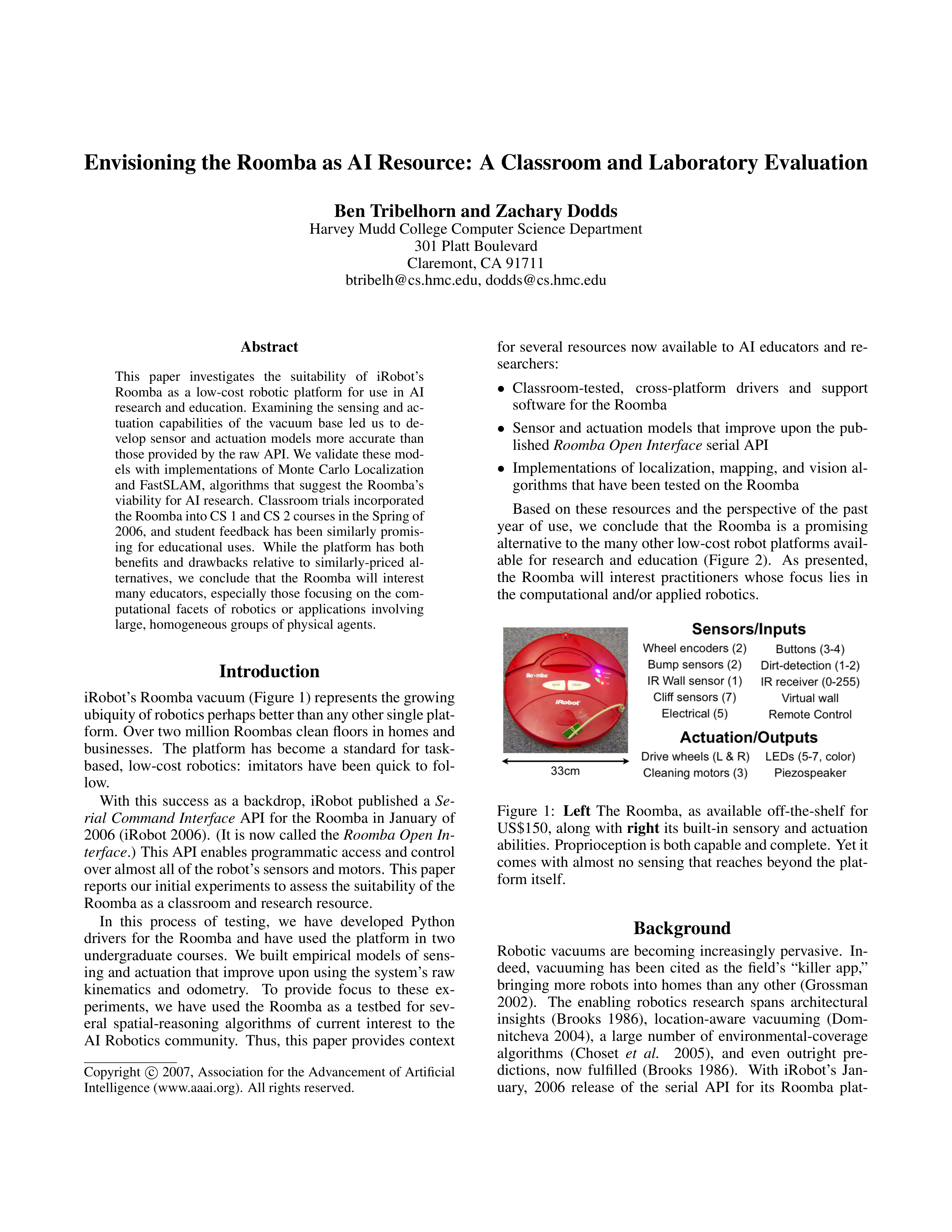
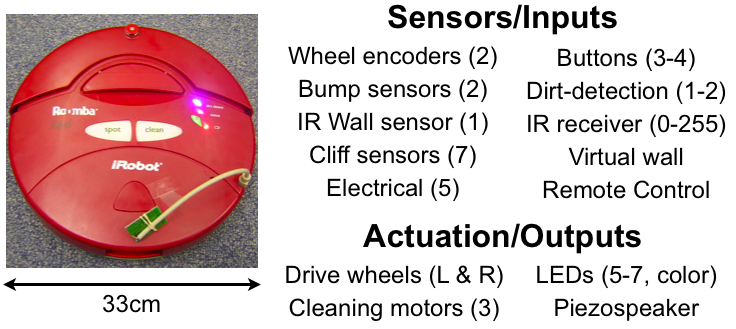
iRobot’s Roomba vacuum (Figure 1) represents the growing
ubiquity of robotics perhaps better than any other single plat-
form.
Over two million Roombas clean floors in homes and
businesses.
The
platform
has
become
a
standard
for
task-
based,
low-cost
robotics:
imitators
have
been
quick
to
fol-
low.
With
this
success
as
a
backdrop,
iRobot
published
a
Se-
rial Command Interface
API for the Roomba in January of
2006 (iRobot 2006).
(It is now called the
Roomba Open In-
terface
.)
This API enables programmatic access and control
over almost all of the robot’s sensors and motors.
This paper
reports our initial experiments to assess the suitability of the
Roomba as a classroom and research resource.
In
this
process
of
testing,
we
have
developed
Python
drivers
for
the
Roomba
and
have
used
the
platform
in
two
undergraduate
courses.
We
built
empirical
models
of
sens-
ing and actuation that improve upon using the system’s raw
kinematics
and
odometry.
To
provide
focus
to
these
ex-
periments,
we
have
used
the
Roomba
as
a
testbed
for
sev-
eral
spatial-reasoning
algorithms
of
current
interest
to
the
AI
Robotics
community.
Thus,
this
paper
provides
context
Copyright
c
⃝
2007, Association for the Advancement of Artificial
Intelligence (www.aaai.org).
All rights reserved.
for
several
resources
now
available
to
AI
educators
and
re-
searchers:
•
Classroom-tested,
cross-platform
drivers
and
support
software for the Roomba
•
Sensor and actuation models that improve upon the pub-
lished
Roomba Open Interface
serial API
•
Implementations of localization,
mapping,
and vision al-
gorithms that have been tested on the Roomba
Based
on
these
resources
and
the
perspective
of
the
past
year
of
use,
we
conclude
that
the
Roomba
is
a
promising
alternative to the many other low-cost robot platforms avail-
able
for
research
and
education
(Figure
2).
As
presented,
the
Roomba
will
interest
practitioners
whose
focus
lies
in
the computational and/or applied robotics.
Figure
1:
Left
The
Roomba,
as
available
off-the-shelf
for
US$150, along with
right
its built-in sensory and actuation
abilities. Proprioception is both capable and complete. Yet it
comes with almost no sensing that reaches beyond the plat-
form itself.
Background
Robotic
vacuums
are
becoming
increasingly
pervasive.
In-
deed,
vacuuming
has
been
cited
as
the
field’s
“killer
app,”
bringing more robots into homes than any other (Grossman
2002).
The
enabling
robotics
research
spans
architectural
insights
(Brooks
1986),
location-aware
vacuuming
(Dom-
nitcheva
2004),
a
large
number
of
environmental-coverage
algorithms
(Choset
et
al.
2005),
and
even
outright
pre-
dictions,
now
fulfilled
(Brooks
1986).
With
iRobot’s
Jan-
uary,
2006
release
of
the
serial
API
for
its
Roomba
plat-
Platform
Cost
Sensing
Lego RCX
$200
Bmp,Lt
Roomba
$230
Bmp,Enc,Vis,Mic,WL
Lego NXT
$250
Bmp,Lt,Son,Enc,WL
Intellibrain
$300
Bmp,Lt,IR,a2d,WL
PalmPRK
$325
IR,a2d
HandyBoard
$350
Bmp,Lt,IR,a2d
KIPR XBC
$500
Vis,Bmp,Lt,IR,Enc
UMN eRosi
$500
Lt,Enc,Pyr,WL
HandyBoard2
$750
Vis,Bmp,Lt,IR,Enc,a2d,WL
Hemisson
$780
Lt,IR,WL
Garcia
$1725
Vis,IR,Enc,WL
Khepera
$2000
IR,Enc
AIBO
$2000
Vis,Mic,Bmp,Enc,WL
Figure
2:
A
comparison
of
several
inexpensive
robot
plat-
forms/controllers, their costs, and their standard set of sens-
ing
capabilities.
Legend
:
Bmp
,
bump
or
tactile
sensing;
Lt
,
light
sensing;
Vis
,
vision;
Mic
,
microphone;
Enc
,
en-
coders
or
odometry;
WL
,
wireless
communication
with
a
controlling
PC;
a2d
,
general
analog/digital
inputs;
IR
,
in-
frared range sensing;
Pyr
, heat or flame sensing.
The vision
(and microphone) sensors on the Roomba are available from
an onboard laptop computer, e.g., as in Figure 10.
form (iRobot 2006), there is now an opportunity for robotics
researchers
and
educators
to
benefit
from
the
successes
of
the home-robot industry.
This
API
makes
any
Roomba
an
ordinary
serial
de-
vice,
though
vacuums
assembled
before
10/2005
require
a
firmware
upgrade.
The
API
specifies
a
byte-level
proto-
col; this protocol has been incorporated into software drivers
written
in
Java
(Kurt
2006),
C++
(within
Player/Stage)
(Gerkey
2006),
and
Python
(Dodds
&
Tribelhorn
2006b).
Even before the release of the API, the worldwide commu-
nity
of
robot
enthusiasts
had
shown
the
platform’s
promise
(Gerkey
2006)
(Mecklenburg
2005).
More
recently,
Blue-
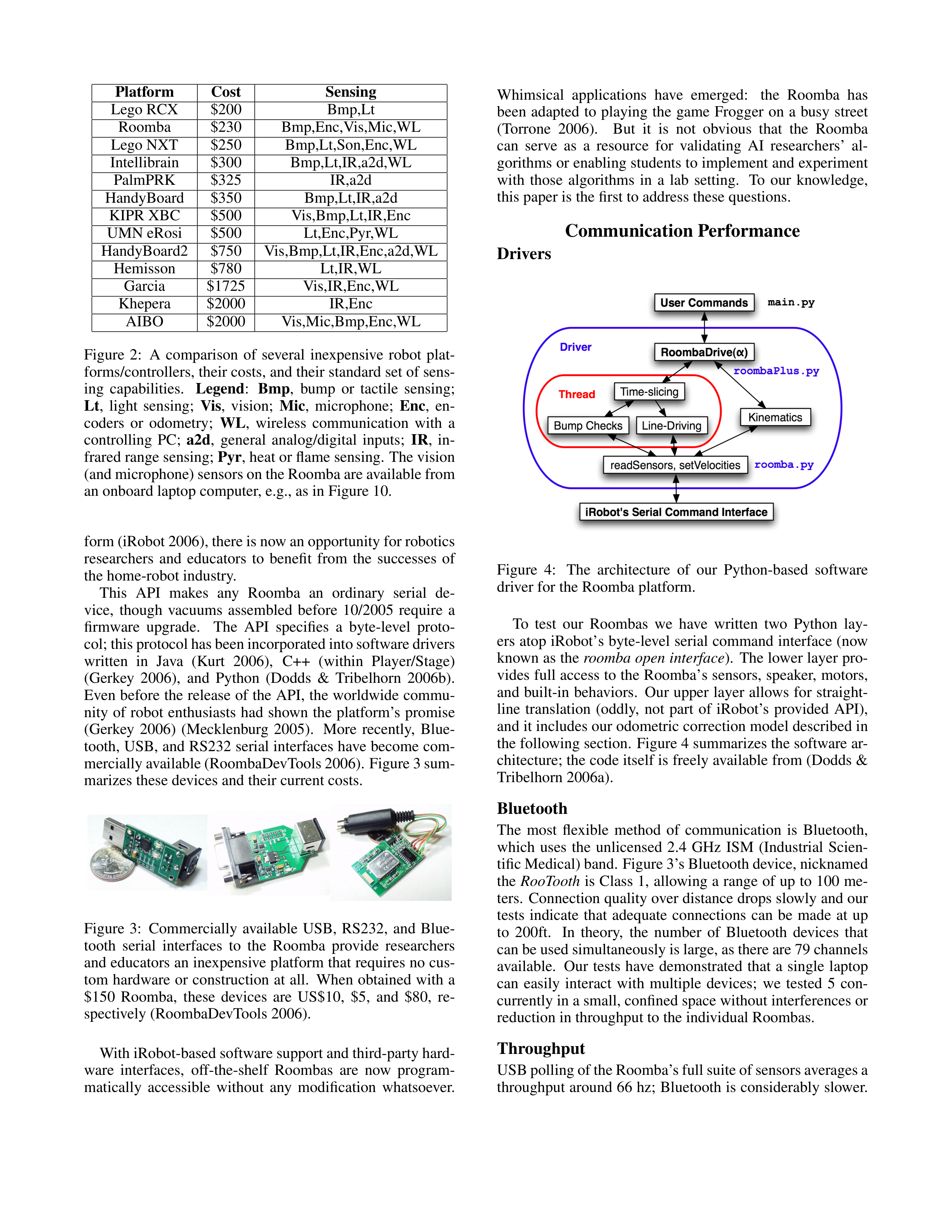
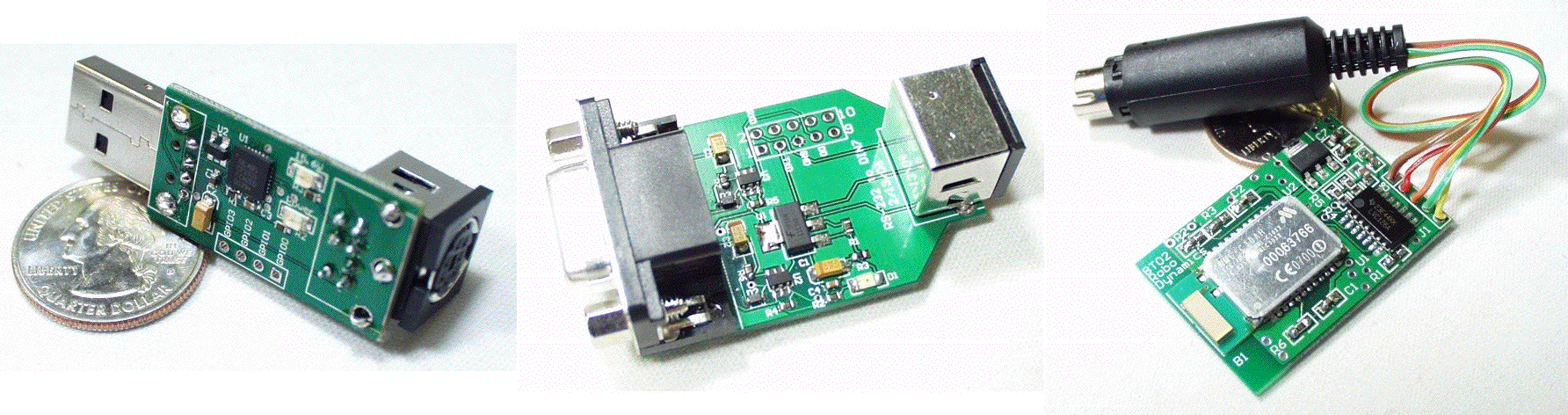
tooth, USB, and RS232 serial interfaces have become com-
mercially available (RoombaDevTools 2006). Figure 3 sum-
marizes these devices and their current costs.
Figure
3:
Commercially
available
USB,
RS232,
and
Blue-
tooth
serial
interfaces
to
the
Roomba
provide
researchers
and educators an inexpensive platform that requires no cus-
tom
hardware
or
construction
at
all.
When
obtained
with
a
$150
Roomba,
these
devices
are
US$10,
$5,
and
$80,
re-
spectively (RoombaDevTools 2006).
With iRobot-based software support and third-party hard-
ware
interfaces,
off-the-shelf
Roombas
are
now
program-
matically
accessible
without
any
modification
whatsoever.
Whimsical
applications
have
emerged:
the
Roomba
has
been
adapted
to
playing
the
game
Frogger
on
a
busy
street
(Torrone
2006).
But
it
is
not
obvious
that
the
Roomba
can
serve
as
a
resource
for
validating
AI
researchers’
al-
gorithms or enabling students to implement and experiment
with
those
algorithms
in
a
lab
setting.
To
our
knowledge,
this paper is the first to address these questions.
Communication Performance
Drivers
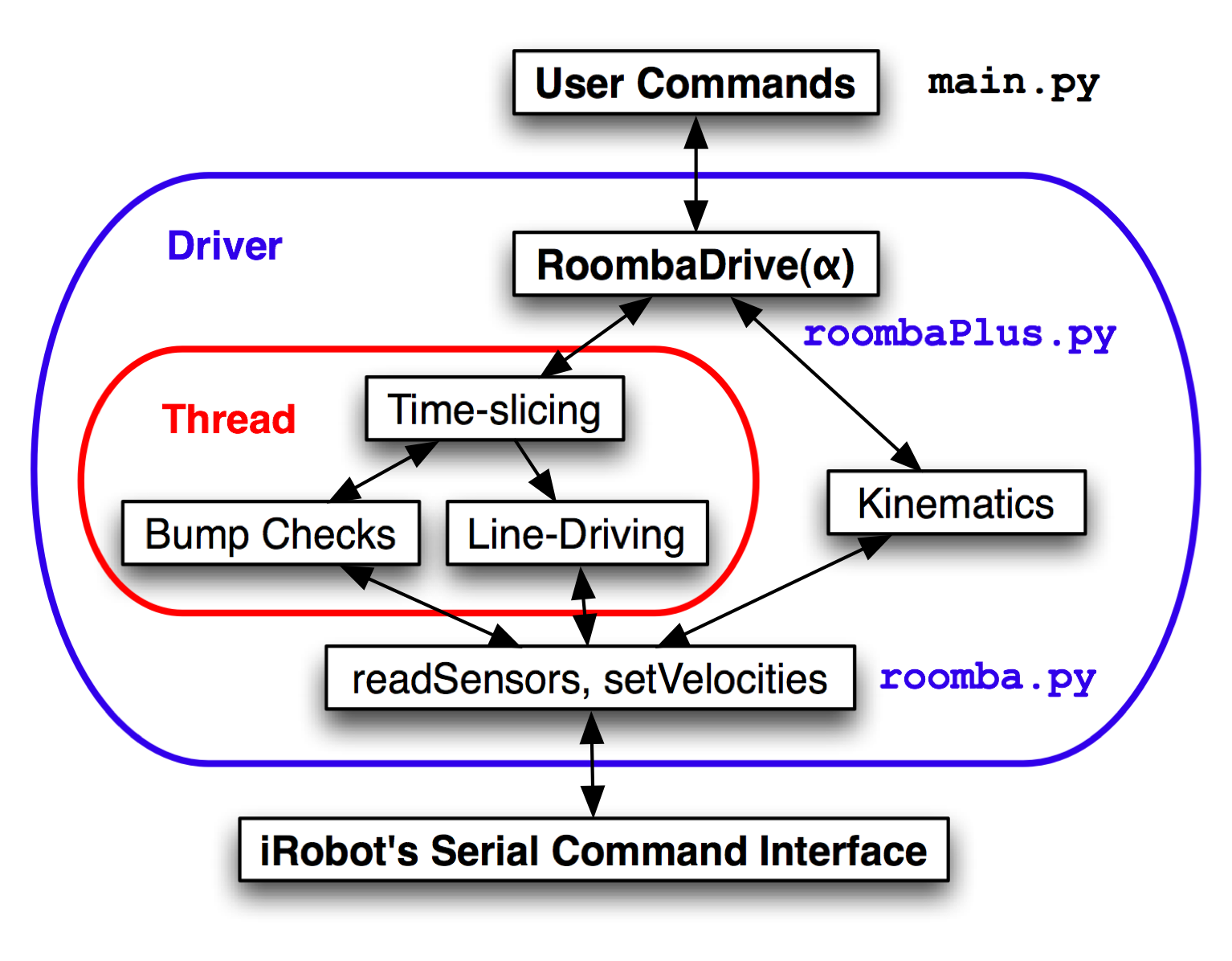
Figure
4:
The
architecture
of
our
Python-based
software
driver for the Roomba platform.
To
test
our
Roombas
we
have
written
two
Python
lay-
ers atop iRobot’s byte-level serial command interface (now
known as the
roomba open interface
).
The lower layer pro-
vides full access to the Roomba’s sensors, speaker, motors,
and built-in behaviors.
Our upper layer allows for straight-
line
translation
(oddly,
not
part
of
iRobot’s
provided
API),
and it includes our odometric correction model described in
the following section.
Figure 4 summarizes the software ar-
chitecture; the code itself is freely available from (Dodds &
Tribelhorn 2006a).
Bluetooth
The
most
flexible
method
of
communication
is
Bluetooth,
which
uses
the
unlicensed
2.4
GHz
ISM
(Industrial
Scien-
tific Medical) band.
Figure 3’s Bluetooth device, nicknamed
the
RooTooth
is Class 1, allowing a range of up to 100 me-
ters.
Connection quality over distance drops slowly and our
tests
indicate
that
adequate
connections
can
be
made
at
up
to
200ft.
In
theory,
the
number
of
Bluetooth
devices
that
can be used simultaneously is large, as there are 79 channels
available.
Our
tests
have
demonstrated
that
a
single
laptop
can
easily
interact
with
multiple
devices;
we
tested
5
con-
currently in a small, confined space without interferences or
reduction in throughput to the individual Roombas.
Throughput
USB polling of the Roomba’s full suite of sensors averages a
throughput around 66 hz; Bluetooth is considerably slower.
A single RooTooth will only peak at 16 hz in Fast Data Mode
and
6
hz
in
its
normal
mode.
Thus
despite
the
additional
setup
effort,
an
onboard
laptop
not
only
can
provide
a
sig-
nificant boost to a Roomba’s sensing capabilities, it enables
more effective use of existing sensors because of the consid-
erably faster polling rate.
Simulation
Building
atop
our
python
drivers,
James
Snow
has
cre-
ated
an
interface
to
the
Roomba
available
within
the
Python
Robotics
(Pyro)
toolset
(Snow
&
Fossum
2007).
Player/stage
support
is
also
available
(Gerkey
2006).
Al-
though
both
of
these
resources
provide
a
capable
and
so-
phisticated
interface
to
all
of
the
hardware
platforms
they
support,
we
used
a
simple,
homegrown
simulator
for
the
Roomba
as
a
testbed
for
our
algorithm
implementations.
This pure-Python, 2d visualizer (depicted in Figure 9 and at
right
in
Figures
8
and
11)
can
emulate
the
platform’s
sens-
ing and is packaged with the drivers at (Dodds & Tribelhorn
2006a).
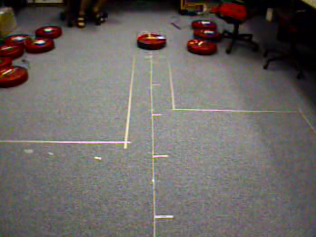
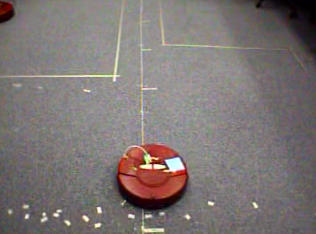
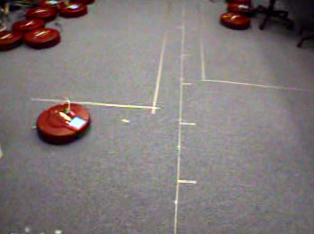
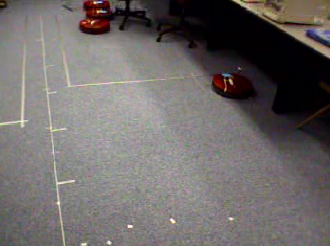
Figure
5:
Upper
left
The
central
robot
shows
the
starting
position for all three runs, each heading straight towards the
viewer
Lower
left
The
final
position
after
the
straightest-
possible
run
with
right-hand
bias
Lower
right
The
result
of the same command with left-hand bias
Upper right
The
final position after 3 meters of straight-line translation using
the odometric model presented in this section.
Modeling the Roomba
A
small
number
of
discrepancies
between
the
Roomba’s
published programming interface and the platform’s behav-
ior
motivated
our
own
modeling
of
its
actions
and
accu-
racy.
For
instance,
the
API
cites
special
codes
to
indicate
straight-line
driving
(iRobot
2006,
p.
4).
However,
as
Fig-
ure 5 attests, actual behavior did not differ from those com-
mands’ large radius of curvature (ROC) limits, published at
two
meters.
Discussions
among
many
experimenters
have
confirmed
the
difficulty
of
straight-line
motion
through
the
API alone.
Second, we found that Roombas within a single
production run are quite consistent in their behavior.
How-
ever, those from different production runs can be very differ-
ent in their responses to identical API actuation commands
under identical environmental conditions.
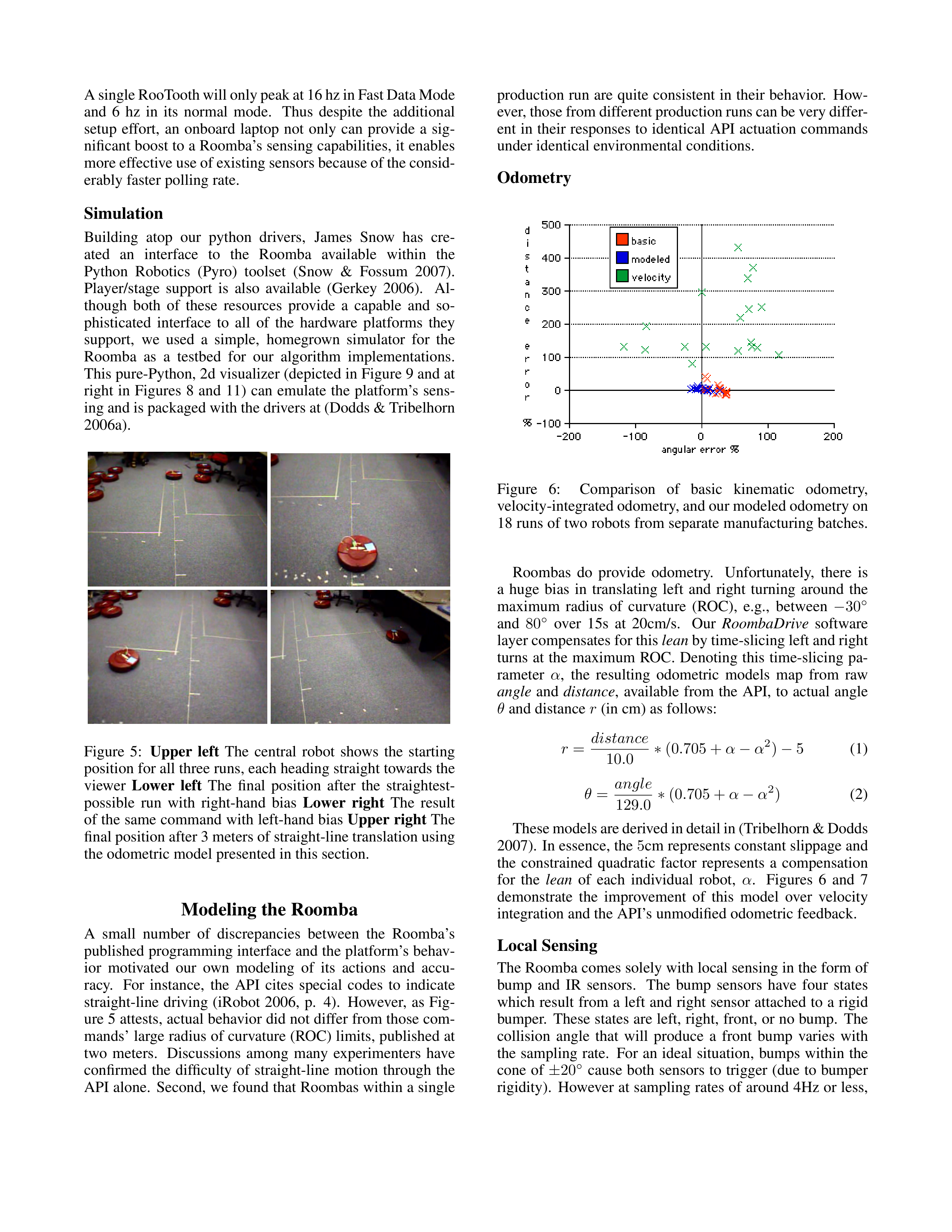
Odometry
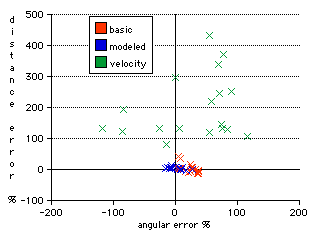
Figure
6:
Comparison
of
basic
kinematic
odometry,
velocity-integrated odometry, and our modeled odometry on
18 runs of two robots from separate manufacturing batches.
Roombas
do
provide
odometry.
Unfortunately,
there
is
a
huge
bias
in
translating
left
and
right
turning
around
the
maximum
radius
of
curvature
(ROC),
e.g.,
between
−
30
◦
and
80
◦
over
15s
at
20cm/s.
Our
RoombaDrive
software
layer compensates for this
lean
by time-slicing left and right
turns
at
the
maximum
ROC.
Denoting
this
time-slicing
pa-
rameter
α
,
the
resulting
odometric
models
map
from
raw
angle
and
distance
,
available
from
the
API,
to
actual
angle
θ
and distance
r
(in cm) as follows:
r
=
distance
10
.
0
∗
(0
.
705 +
α
−
α
2
)
−
5
(1)
θ
=
angle
129
.
0
∗
(0
.
705 +
α
−
α
2
)
(2)
These models are derived in detail in (Tribelhorn & Dodds
2007).
In essence, the
5
cm represents constant slippage and
the
constrained
quadratic
factor
represents
a
compensation
for
the
lean
of
each
individual
robot,
α
.
Figures
6
and
7
demonstrate
the
improvement
of
this
model
over
velocity
integration and the API’s unmodified odometric feedback.
Local Sensing
The Roomba comes solely with local sensing in the form of
bump
and
IR
sensors.
The
bump
sensors
have
four
states
which result from a left and right sensor attached to a rigid
bumper.
These states are left, right, front, or no bump.
The
collision
angle
that
will
produce
a
front
bump
varies
with
the
sampling
rate.
For
an
ideal
situation,
bumps
within
the
cone of
±
20
◦
cause both
sensors to trigger
(due to bumper
rigidity).
However at sampling rates of around 4Hz or less,
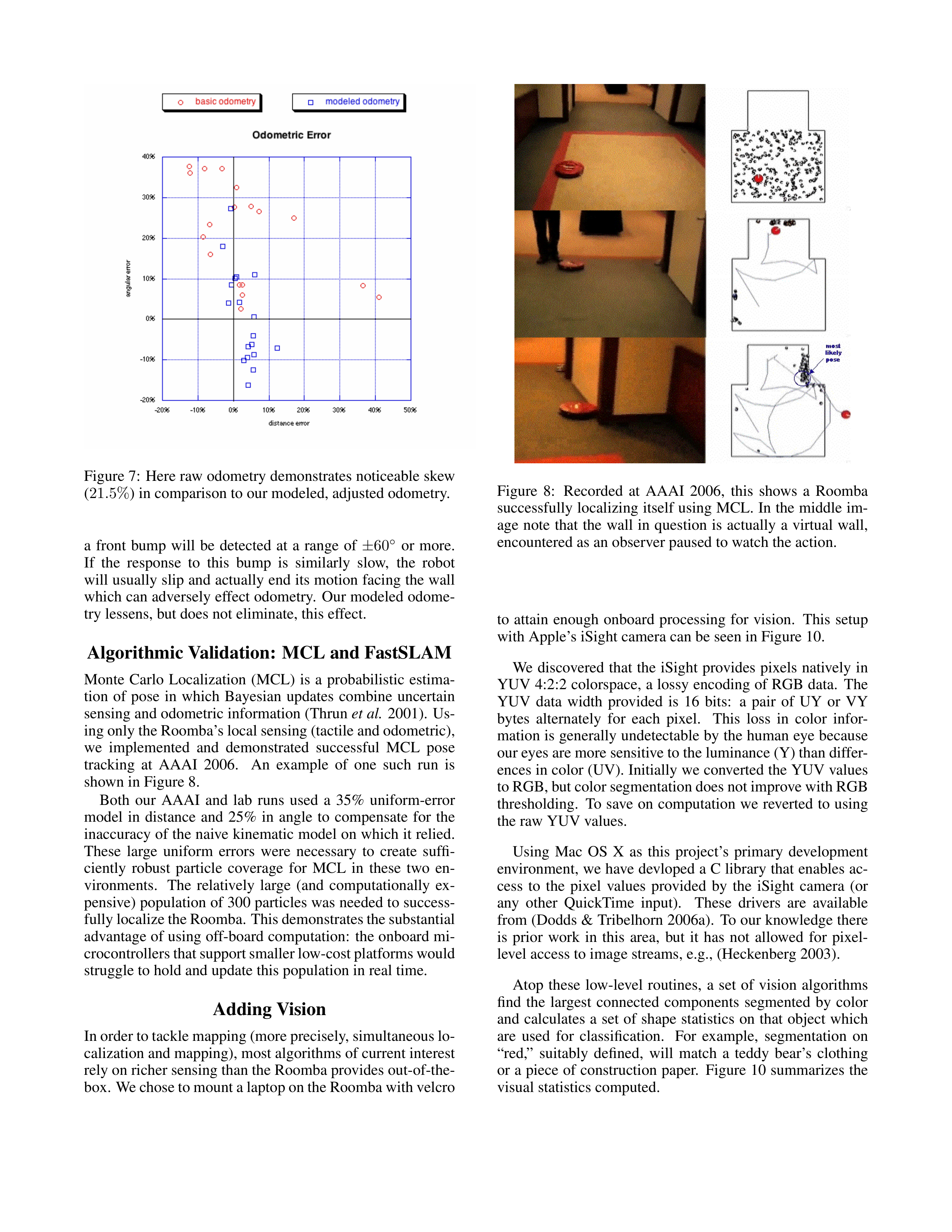
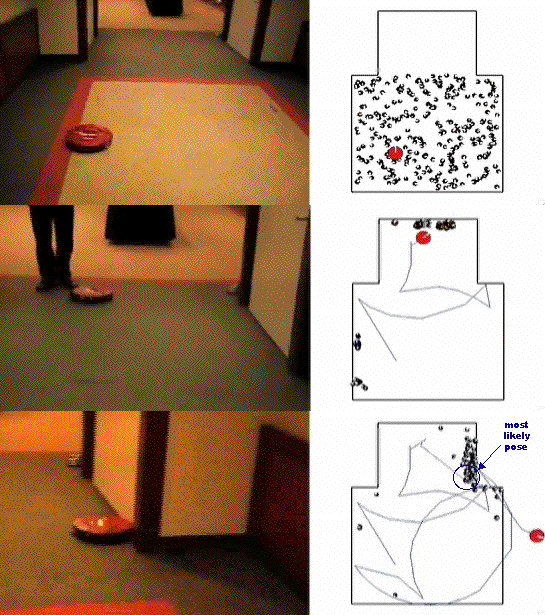
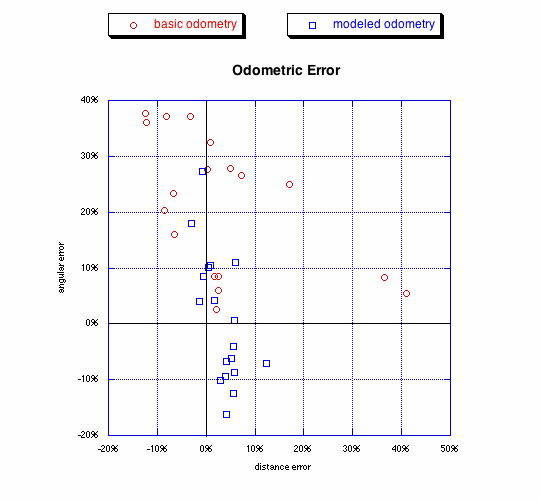
Figure 7:
Here raw odometry demonstrates noticeable skew
(
21
.
5%
) in comparison to our modeled, adjusted odometry.
a
front
bump
will
be
detected
at
a
range
of
±
60
◦
or
more.
If
the
response
to
this
bump
is
similarly
slow,
the
robot
will usually slip and actually end its motion facing the wall
which can adversely effect odometry.
Our modeled odome-
try lessens, but does not eliminate, this effect.
Algorithmic Validation:
MCL and FastSLAM
Monte
Carlo
Localization
(MCL)
is
a
probabilistic
estima-
tion
of
pose
in
which
Bayesian
updates
combine
uncertain
sensing and odometric information (Thrun
et al.
2001).
Us-
ing only the Roomba’s local sensing (tactile and odometric),
we
implemented
and
demonstrated
successful
MCL
pose
tracking
at
AAAI
2006.
An
example
of
one
such
run
is
shown in Figure 8.
Both
our
AAAI
and
lab
runs
used
a
35%
uniform-error
model
in
distance
and
25%
in
angle
to
compensate
for
the
inaccuracy of the naive kinematic model on which it relied.
These
large
uniform
errors
were
necessary
to
create
suffi-
ciently
robust
particle
coverage
for
MCL
in
these
two
en-
vironments.
The
relatively
large
(and
computationally
ex-
pensive) population of 300 particles was needed to success-
fully localize the Roomba. This demonstrates the substantial
advantage of using off-board computation:
the onboard mi-
crocontrollers that support smaller low-cost platforms would
struggle to hold and update this population in real time.
Adding Vision
In order to tackle mapping (more precisely, simultaneous lo-
calization and mapping), most algorithms of current interest
rely on richer sensing than the Roomba provides out-of-the-
box. We chose to mount a laptop on the Roomba with velcro
Figure
8:
Recorded
at
AAAI
2006,
this
shows
a
Roomba
successfully localizing itself using MCL. In the middle im-
age
note
that
the
wall
in
question
is
actually
a
virtual
wall,
encountered as an observer paused to watch the action.
to
attain
enough
onboard
processing
for
vision.
This
setup
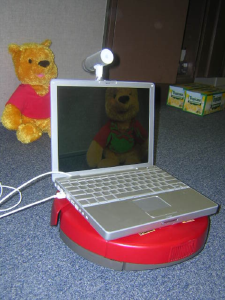
with Apple’s iSight camera can be seen in Figure 10.
We
discovered
that
the
iSight
provides
pixels
natively
in
YUV 4:2:2 colorspace, a lossy encoding of RGB data.
The
YUV
data
width
provided
is
16
bits:
a
pair
of
UY
or
VY
bytes
alternately
for
each
pixel.
This
loss
in
color
infor-
mation is generally undetectable by the human eye because
our eyes are more sensitive to the luminance (Y) than differ-
ences in color (UV). Initially we converted the YUV values
to RGB, but color segmentation does not improve with RGB
thresholding.
To
save on
computation
we
reverted
to
using
the raw YUV values.
Using
Mac
OS
X
as
this
project’s
primary
development
environment, we have devloped a C library that enables ac-
cess
to
the
pixel
values
provided
by
the
iSight
camera
(or
any
other
QuickTime
input).
These
drivers
are
available
from (Dodds & Tribelhorn 2006a).
To our knowledge there
is
prior
work
in
this
area,
but
it
has
not
allowed
for
pixel-
level access to image streams, e.g., (Heckenberg 2003).
Atop
these
low-level
routines,
a
set
of
vision
algorithms
find
the
largest
connected
components
segmented
by
color
and
calculates
a
set
of
shape
statistics
on
that
object
which
are
used
for
classification.
For
example,
segmentation
on
“red,”
suitably
defined,
will
match
a
teddy
bear’s
clothing
or a piece of construction paper.
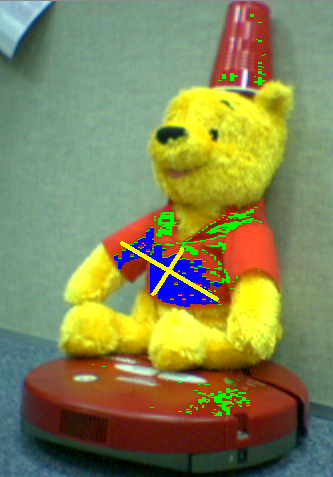
Figure 10 summarizes the
visual statistics computed.
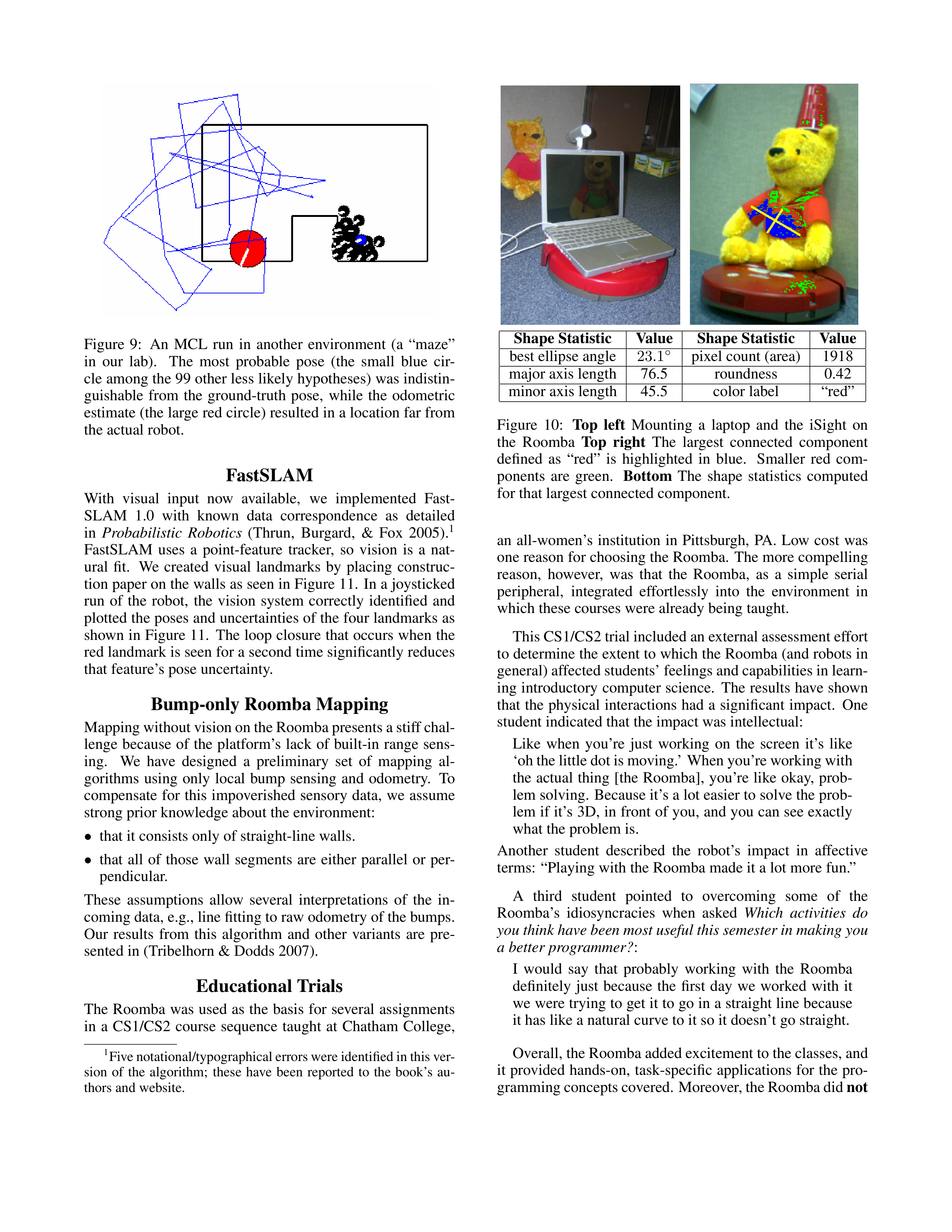
Figure
9:
An
MCL
run
in
another
environment
(a
“maze”
in
our
lab).
The
most
probable
pose
(the
small
blue
cir-
cle among the 99 other less likely hypotheses) was indistin-
guishable
from
the
ground-truth
pose,
while
the
odometric
estimate (the large red circle) resulted in a location far from
the actual robot.
FastSLAM
With
visual
input
now
available,
we
implemented
Fast-
SLAM
1.0
with
known
data
correspondence
as
detailed
in
Probabilistic
Robotics
(Thrun,
Burgard,
&
Fox
2005).
1
FastSLAM
uses
a
point-feature
tracker,
so
vision
is
a
nat-
ural
fit.
We
created
visual
landmarks
by
placing
construc-
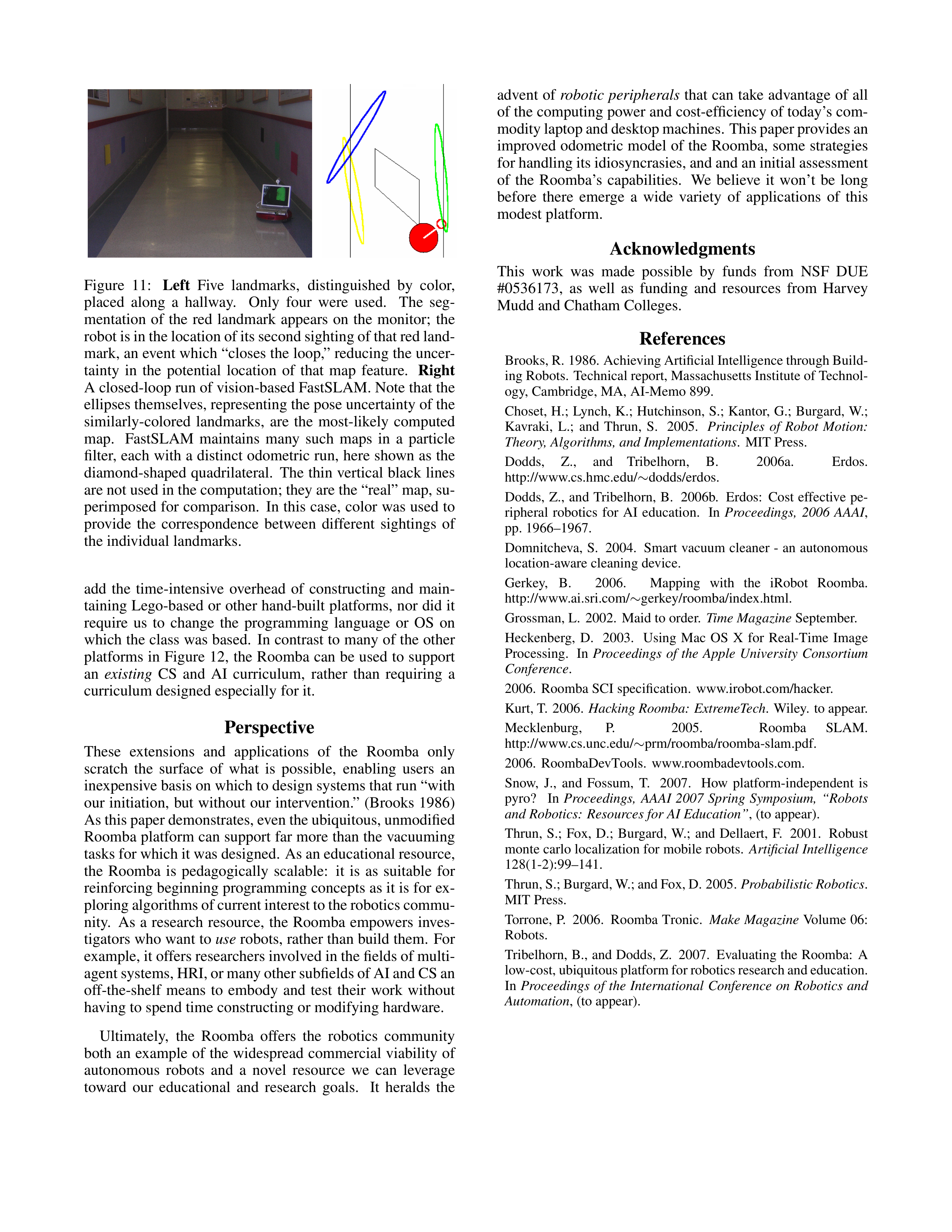
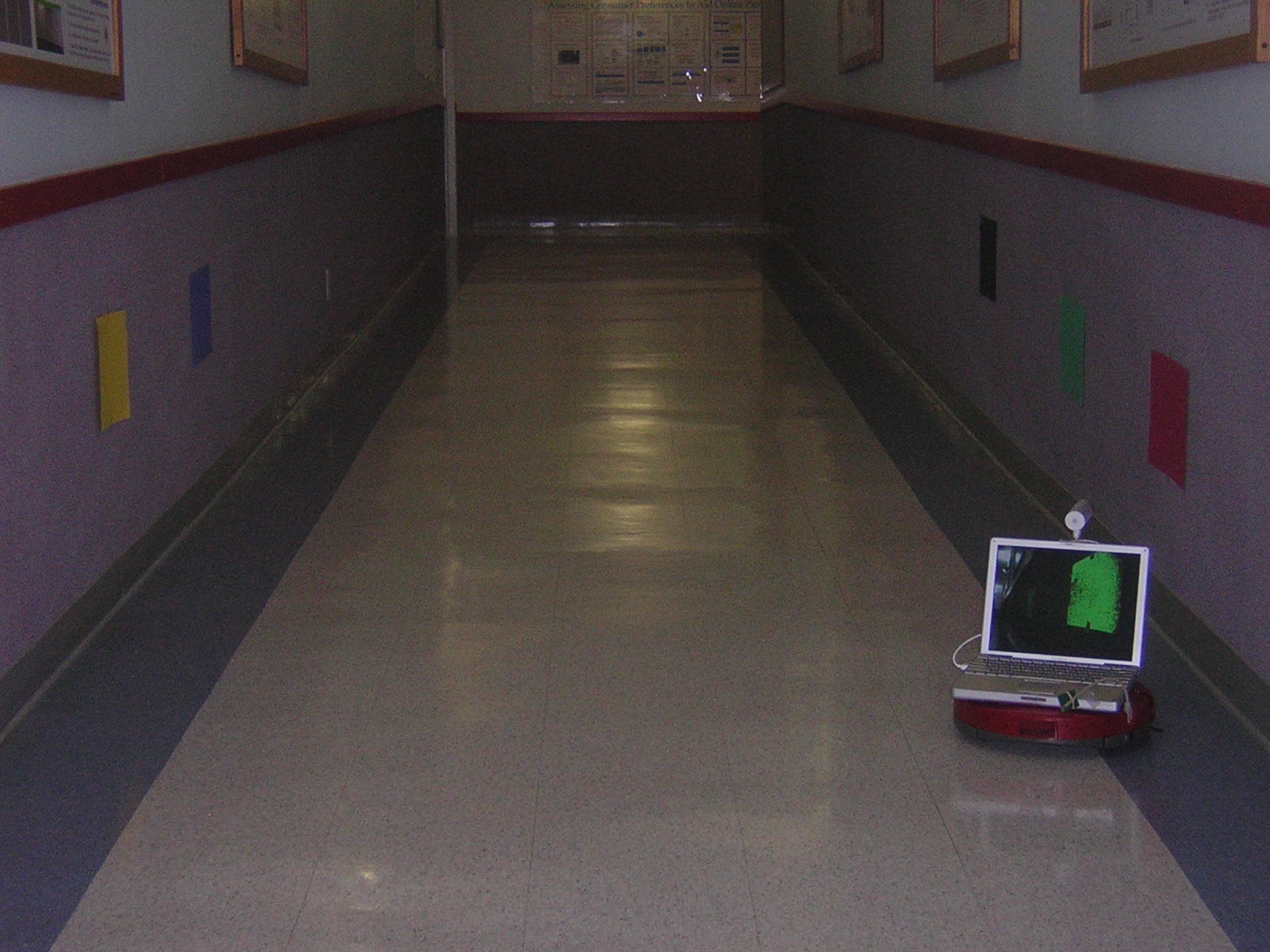
tion paper on the walls as seen in Figure 11.
In a joysticked
run
of
the
robot,
the
vision
system
correctly
identified
and
plotted the poses and uncertainties of the four landmarks as
shown in Figure 11.
The loop closure that occurs when the
red landmark is seen for a second time significantly reduces
that feature’s pose uncertainty.
Bump-only Roomba Mapping
Mapping without vision on the Roomba presents a stiff chal-
lenge
because
of
the
platform’s
lack
of
built-in
range
sens-
ing.
We
have
designed
a
preliminary
set
of
mapping
al-
gorithms
using
only
local
bump
sensing
and
odometry.
To
compensate for this
impoverished sensory
data,
we assume
strong prior knowledge about the environment:
•
that it consists only of straight-line walls.
•
that
all
of
those
wall
segments
are
either
parallel
or
per-
pendicular.
These
assumptions
allow
several
interpretations
of
the
in-
coming data, e.g., line fitting to raw odometry of the bumps.
Our
results
from
this
algorithm
and
other
variants
are
pre-
sented in (Tribelhorn & Dodds 2007).
Educational Trials
The
Roomba
was
used
as
the
basis
for
several
assignments
in
a
CS1/CS2
course
sequence
taught
at
Chatham
College,
1
Five notational/typographical errors were identified in this ver-
sion
of
the
algorithm;
these
have
been
reported
to
the
book’s
au-
thors and website.
Shape Statistic
Value
Shape Statistic
Value
best ellipse angle
23
.
1
◦
pixel count (area)
1918
major axis length
76.5
roundness
0.42
minor axis length
45.5
color label
“red”
Figure
10:
Top
left
Mounting
a
laptop
and
the
iSight
on
the
Roomba
Top
right
The
largest
connected
component
defined
as
“red”
is
highlighted
in
blue.
Smaller
red
com-
ponents
are
green.
Bottom
The
shape
statistics
computed
for that largest connected component.
an
all-women’s
institution
in
Pittsburgh,
PA.
Low
cost
was
one reason for choosing the Roomba.
The more compelling
reason,
however,
was
that
the
Roomba,
as
a
simple
serial
peripheral,
integrated
effortlessly
into
the
environment
in
which these courses were already being taught.
This CS1/CS2 trial included an external assessment effort
to determine the extent to which the Roomba (and robots in
general) affected students’ feelings and capabilities in learn-
ing introductory computer science.
The results have shown
that the physical interactions had a significant impact.
One
student indicated that the impact was intellectual:
Like
when
you’re
just
working
on
the
screen
it’s
like
‘oh the little dot is moving.’ When you’re working with
the actual thing [the Roomba],
you’re like okay,
prob-
lem solving.
Because it’s a lot easier to solve the prob-
lem if it’s 3D, in front of you, and you can see exactly
what the problem is.
Another
student
described
the
robot’s
impact
in
affective
terms:
“Playing with the Roomba made it a lot more fun.”
A
third
student
pointed
to
overcoming
some
of
the
Roomba’s
idiosyncracies
when
asked
Which
activities
do
you think have been most useful this semester in making you
a better programmer?
:
I
would
say
that
probably
working
with
the
Roomba
definitely
just
because
the
first
day
we
worked
with
it
we were trying to get it to go in a straight line because
it has like a natural curve to it so it doesn’t go straight.
Overall, the Roomba added excitement to the classes, and
it provided hands-on, task-specific applications for the pro-
gramming concepts covered. Moreover, the Roomba did
not
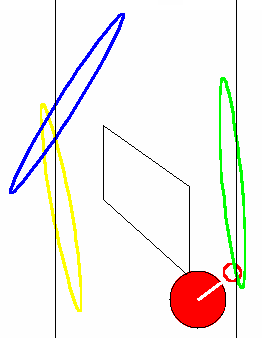
Figure
11:
Left
Five
landmarks,
distinguished
by
color,
placed
along
a
hallway.
Only
four
were
used.
The
seg-
mentation
of
the
red
landmark
appears
on
the
monitor;
the
robot is in the location of its second sighting of that red land-
mark, an event which “closes the loop,” reducing the uncer-
tainty
in
the
potential
location
of
that
map
feature.
Right
A closed-loop run of vision-based FastSLAM. Note that the
ellipses themselves, representing the pose uncertainty of the
similarly-colored
landmarks,
are
the
most-likely
computed
map.
FastSLAM
maintains
many
such
maps
in
a
particle
filter, each with a distinct odometric run, here shown as the
diamond-shaped quadrilateral.
The thin vertical black lines
are not used in the computation; they are the “real” map, su-
perimposed for comparison.
In this case, color was used to
provide
the
correspondence
between
different
sightings
of
the individual landmarks.
add
the
time-intensive
overhead
of
constructing
and
main-
taining Lego-based or other hand-built platforms, nor did it
require
us
to
change
the
programming
language
or
OS
on
which the class was based.
In contrast to many of the other
platforms in Figure 12,
the Roomba can be used to support
an
existing
CS
and
AI
curriculum,
rather
than
requiring
a
curriculum designed especially for it.
Perspective
These
extensions
and
applications
of
the
Roomba
only
scratch
the
surface
of
what
is
possible,
enabling
users
an
inexpensive basis on which to design systems that run “with
our initiation,
but without our intervention.” (Brooks 1986)
As this paper demonstrates, even the ubiquitous, unmodified
Roomba platform can support far more than the vacuuming
tasks for which it was designed.
As an educational resource,
the
Roomba
is
pedagogically
scalable:
it
is
as
suitable
for
reinforcing beginning programming concepts as it is for ex-
ploring algorithms of current interest to the robotics commu-
nity.
As
a
research
resource,
the
Roomba
empowers
inves-
tigators who want to
use
robots, rather than build them.
For
example, it offers researchers involved in the fields of multi-
agent systems, HRI, or many other subfields of AI and CS an
off-the-shelf
means
to
embody
and
test
their
work
without
having to spend time constructing or modifying hardware.
Ultimately,
the
Roomba
offers
the
robotics
community
both an example of the widespread commercial viability of
autonomous
robots
and
a
novel
resource
we
can
leverage
toward
our
educational
and
research
goals.
It
heralds
the
advent of
robotic peripherals
that can take advantage of all
of the computing power and cost-efficiency of today’s com-
modity laptop and desktop machines. This paper provides an
improved odometric model of the Roomba, some strategies
for handling its idiosyncrasies, and and an initial assessment
of
the
Roomba’s
capabilities.
We
believe
it
won’t
be
long
before
there
emerge
a
wide
variety
of
applications
of
this
modest platform.
Acknowledgments
This
work
was
made
possible
by
funds
from
NSF
DUE
#0536173,
as
well
as
funding
and
resources
from
Harvey
Mudd and Chatham Colleges.
References
Brooks, R. 1986. Achieving Artificial Intelligence through Build-
ing Robots.
Technical report, Massachusetts Institute of Technol-
ogy, Cambridge, MA, AI-Memo 899.
Choset, H.;
Lynch, K.;
Hutchinson, S.;
Kantor, G.;
Burgard, W.;
Kavraki,
L.;
and
Thrun,
S.
2005.
Principles
of
Robot
Motion:
Theory, Algorithms, and Implementations
.
MIT Press.
Dodds,
Z.,
and
Tribelhorn,
B.
2006a.
Erdos.
http://www.cs.hmc.edu/
∼
dodds/erdos.
Dodds,
Z.,
and
Tribelhorn,
B.
2006b.
Erdos:
Cost
effective
pe-
ripheral
robotics
for
AI
education.
In
Proceedings,
2006
AAAI
,
pp. 1966–1967.
Domnitcheva,
S.
2004.
Smart vacuum cleaner - an autonomous
location-aware cleaning device.
Gerkey,
B.
2006.
Mapping
with
the
iRobot
Roomba.
http://www.ai.sri.com/
∼
gerkey/roomba/index.html.
Grossman, L.
2002.
Maid to order.
Time Magazine
September.
Heckenberg,
D.
2003.
Using
Mac
OS
X
for
Real-Time
Image
Processing.
In
Proceedings
of
the
Apple
University
Consortium
Conference
.
2006.
Roomba SCI specification.
www.irobot.com/hacker.
Kurt, T.
2006.
Hacking Roomba:
ExtremeTech
.
Wiley.
to appear.
Mecklenburg,
P.
2005.
Roomba
SLAM.
http://www.cs.unc.edu/
∼
prm/roomba/roomba-slam.pdf.
2006.
RoombaDevTools.
www.roombadevtools.com.
Snow,
J.,
and
Fossum,
T.
2007.
How
platform-independent
is
pyro?
In
Proceedings,
AAAI
2007
Spring
Symposium,
“Robots
and Robotics:
Resources for AI Education”
, (to appear).
Thrun,
S.;
Fox,
D.;
Burgard,
W.;
and
Dellaert,
F.
2001.
Robust
monte carlo localization for mobile robots.
Artificial Intelligence
128(1-2):99–141.
Thrun, S.; Burgard, W.; and Fox, D. 2005.
Probabilistic Robotics
.
MIT Press.
Torrone, P.
2006.
Roomba Tronic.
Make Magazine
Volume 06:
Robots.
Tribelhorn, B., and Dodds, Z.
2007.
Evaluating the Roomba:
A
low-cost, ubiquitous platform for robotics research and education.
In
Proceedings
of
the International Conference on
Robotics
and
Automation
, (to appear).