


OpenDevin:
An Open Platform for
AI Software Developers as Generalist Agents
Xingyao Wang
1
,
10
, Boxuan Li
2
, Yufan Song
2
, Frank F. Xu
2
, Xiangru Tang
3
,
Mingchen Zhuge
6
, Jiayi Pan
4
, Yueqi Song
2
, Bowen Li, Jaskirat Singh
7
,
Hoang H. Tran
8
, Fuqiang Li, Ren Ma, Mingzhang Zheng, Bill Qian
3
, Yanjun Shao
3
,
Niklas Muennighoff
5
, Yizhe Zhang, Binyuan Hui
9
, Junyang Lin
9
,
Robert Brennan
10
, Hao Peng
1
, Heng Ji
1
, Graham Neubig
2
,
10
1
UIUC
2
CMU
3
Yale
4
UC Berkeley
5
Contextual AI
6
KAUST
7
ANU
8
HCMUT
9
Alibaba
10
All Hands AI
xingyao6@illinois.edu,
gneubig@cs.cmu.edu
Abstract
Software is one of the most powerful tools that we humans have at our disposal;
it
allows
a
skilled
programmer
to
interact
with
the
world
in
complex
and
pro-
found ways.
At the same time, thanks to improvements in large language models
(LLMs), there has also been a rapid development in AI agents that interact with
and affect change in their surrounding environments.
In this paper, we introduce
OpenDevin,
a platform for the development of powerful and flexible AI agents
that
interact
with
the
world
in
similar
ways
to
those
of
a
human
developer:
by
writing code, interacting with a command line, and browsing the web.
We describe
how the platform allows for the implementation of new agents, safe interaction
with sandboxed environments for code execution, coordination between multiple
agents, and incorporation of evaluation benchmarks.
Based on our currently in-
corporated benchmarks, we perform an evaluation of agents over 15 challenging
tasks, including software engineering (
e.g
., S
WE
-
BENCH
) and web browsing (
e.g
.,
W
EB
A
RENA
), among others.
Released under the permissive MIT license, Open-
Devin is a community project spanning academia and industry with more than 1.3K
contributions from over 160 contributors and will improve going forward.
Code
https://github.com/OpenDevin/OpenDevin
Benchmark
https://hf.co/spaces/OpenDevin/evaluation
Slack
https://bit.ly/OpenDevin-Slack
1
Introduction
Powered by large language models (LLMs; [
5
,
20
,
40
,
60
]), user-facing AI systems (such as ChatGPT)
have become increasingly capable of performing complex tasks such as accurately responding to
user queries, solving math problems, and generating code.
In particular, AI
agents
, systems that can
perceive and act upon the external environment, have recently received ever-increasing research focus.
They are moving towards performing complex tasks such as developing software [
21
], navigating
real-world websites [
79
], doing household chores [
1
], or even performing scientific research [
4
,
56
].
As AI agents become capable of tackling complex problems, their development and evaluation have
also become challenging.
There are numerous recent efforts in creating open-source frameworks
that
facilitate
the
development
of
agents
[
7
,
16
,
67
].
These
agent
frameworks
generally
include:
1)
interfaces
through which agents interact with the world (such as JSON-based function calls or
code
execution),
2)
environments
in
which
agents
operate,
and
3)
interaction
mechanisms
for
Preprint.
Under review.
arXiv:2407.16741v1 [cs.SE] 23 Jul 2024
human-agent or agent-agent communication.
These frameworks streamline and ease the development
process in various ways (Tab.
1
, §
C
).
When designing AI agents, we can also consider how
human
interacts with the world.
The most
powerful
way
in
which
humans
currently
interact
with
the
world
is
through
software
–
software
powers
every
aspect
of
our
life,
supporting
everything
from
the
logistics
for
basic
needs
to
the
advancement
of
science,
technology,
and
AI
itself.
Given
the
power
of
software,
as
well
as
the
existing tooling around its efficient development, use, and deployment, it provides the ideal interface
for AI agents to interact with the world in complex ways. However, building agents that can effectively
develop software comes with its own unique challenges.
How can we enable agents to effectively
create and modify code in complex software systems
?
How can we provide them with tools to
gather
information on-the-fly
to debug problems or gather task-requisite information?
How can we ensure
that development is
safe and avoids negative side effects
on the users’ systems?
In this paper, we introduce OpenDevin, a community-driven platform designed for the development
of generalist and specialist AI agents that interact with the world through software.
1
It features:
(1)
An
interaction mechanism
which allows user interfaces, agents, and environments to interact
through a
event stream
architecture that is powerful and flexible (§
2.1
).
(2)
An
environment
that
consists
of
a
sandboxed
operating
system
and
a
web
browser
that
the
agents can utilize for their tasks (§
2.2
).
(3)
An
interface
allowing the agent to interact with the environment in a manner similar to actual
software engineers (§
2.3
).
We provide the capability for agents to (a) create complex software,
(b) execute the code, and (c) browse websites to collect information.
(4)
Multi-agent delegation
, allowing multiple specialized agents to work together (§
2.4
).
(5)
Evaluation framework
, facilitating the evaluation of agents across a wide range of tasks (§
4
).
Importantly, OpenDevin is not just a conceptual framework, but it also includes a comprehensive
and immediately usable implementation of agents, environments, and evaluations.
As of this writing,
OpenDevin includes an agent hub with over 10 implemented agents (§
3
), including a strong generalist
agent implemented based on the CodeAct architecture [
63
], with additions for web browsing [
52
]
and code editing [
72
].
Interaction with users is implemented through a chat-based user interface that
visualizes the agent’s current actions and allows for real-time feedback (Fig.
1
, §
D
). Furthermore, the
evaluation framework currently supports 15 benchmarks, which we use to evaluate our agents (§
4
).
Released under a permissive MIT license allowing commercial use, OpenDevin is poised to support
a diverse array of research and real-world applications across academia and industry.
OpenDevin
has gained significant traction, with 28K GitHub stars and more than 1.3K contributions from over
160 contributors.
We envision OpenDevin as a catalyst for future research innovations and diverse
applications driven by a broad community of practitioners.
2
OpenDevin Architecture
We describe, using OpenDevin, (1) how to define and implement an agent (§
2.1
), (2) how each action
execution leads to an observation (§
2.2
), (3) how to reliably manage and extend commonly used skills
for agents (§
2.3
), and (4) how to compose multiple agents together for task solving (§
2.4
).
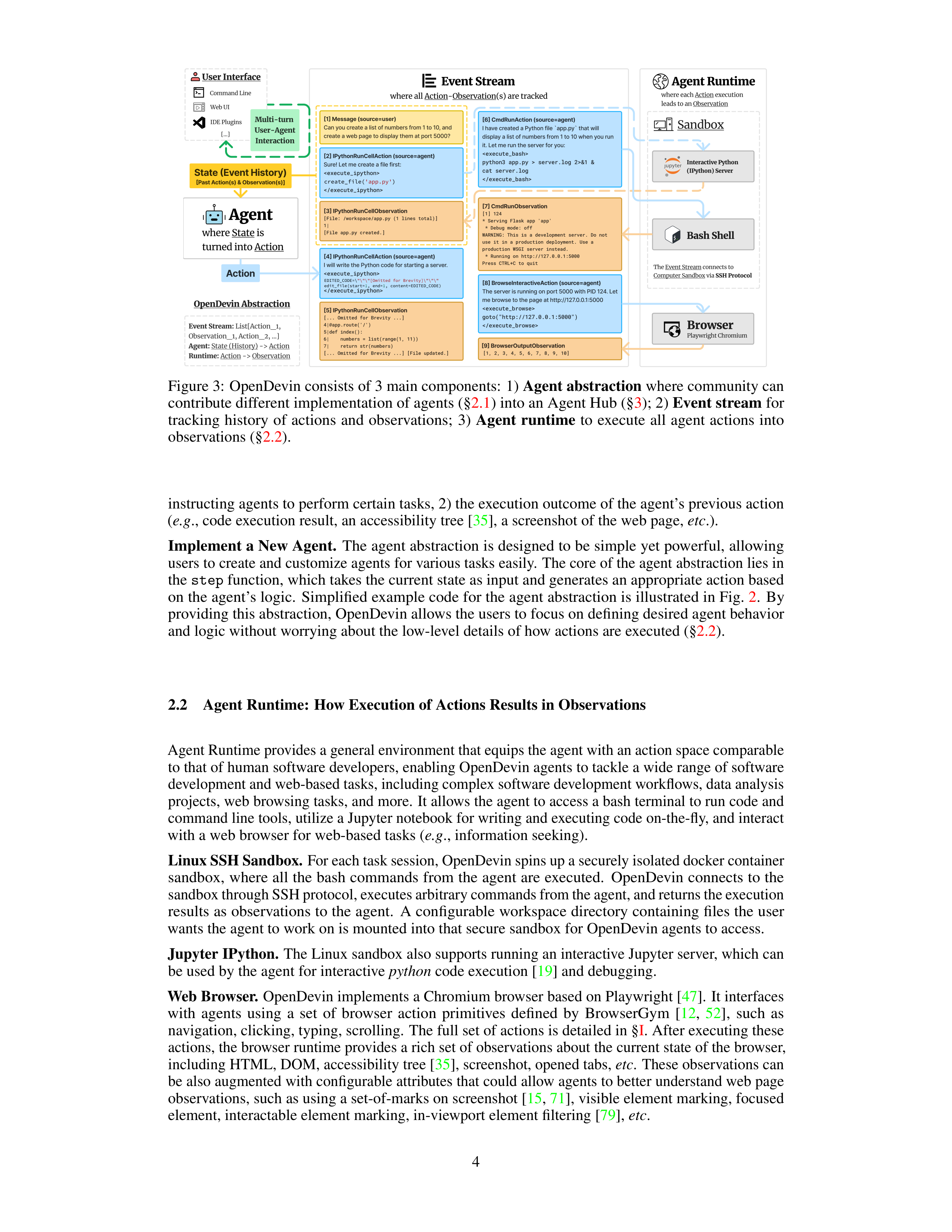
Fig.
3
provides an overview.
2.1
Agent Definition and Implementation
An
agent
can perceive the
state
of the environment (
e.g
., prior actions and observations) and produce
an
action
for execution while solving a user-specified task.
The State and Event Stream.
In OpenDevin, the state is a data structure that encapsulates all relevant
information for the agent’s execution.
A key component of this state is the
event stream
, which is a
chronological collection of past actions and observations, including the agent’s own actions and user
interactions (
e.g
., instructions, feedback).
However, the state extends beyond just the event stream.
It
1
While initially inspired by the AI software engineer Devin [
9
], OpenDevin has quickly evolved to support a
much wider range of applications beyond software engineering through diverse community contributions.
2
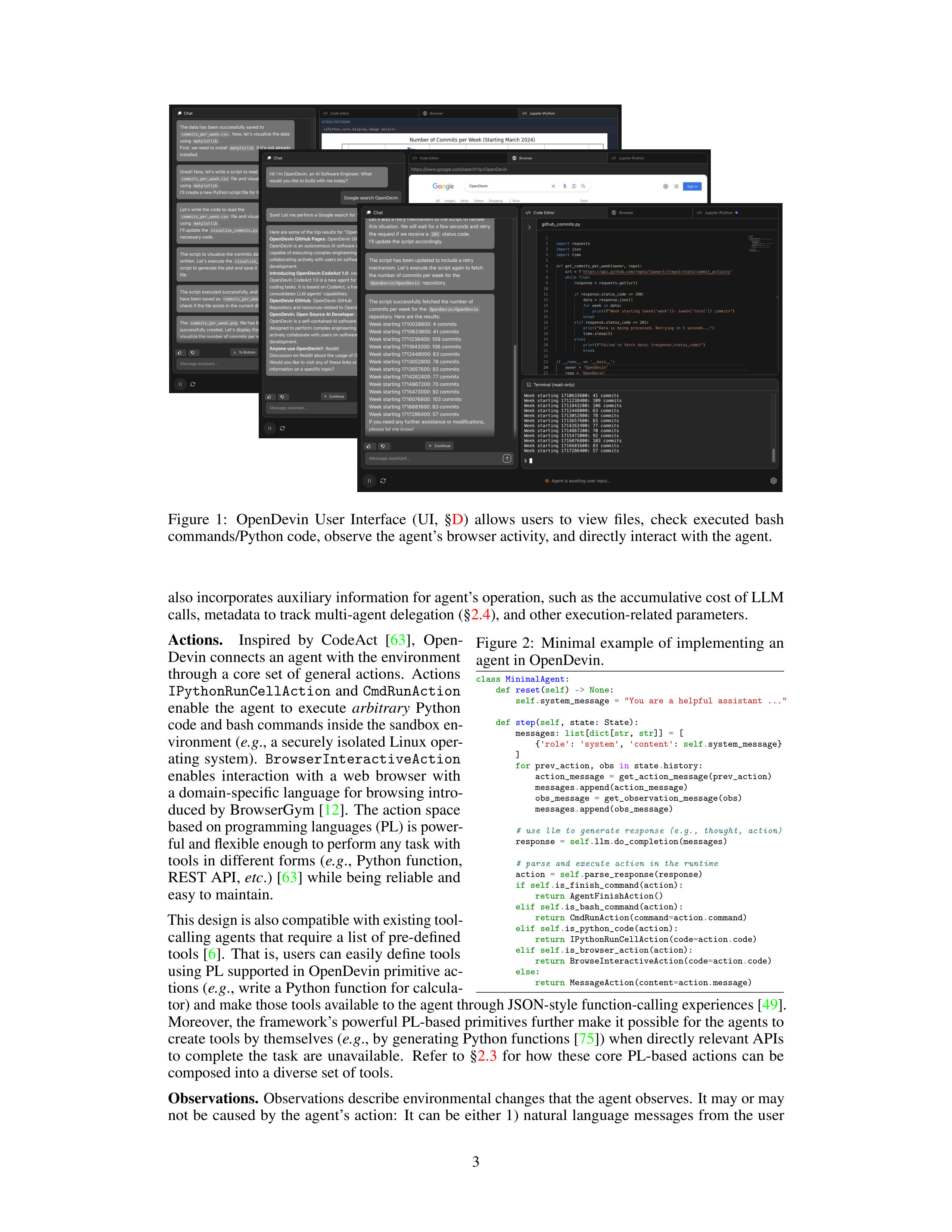
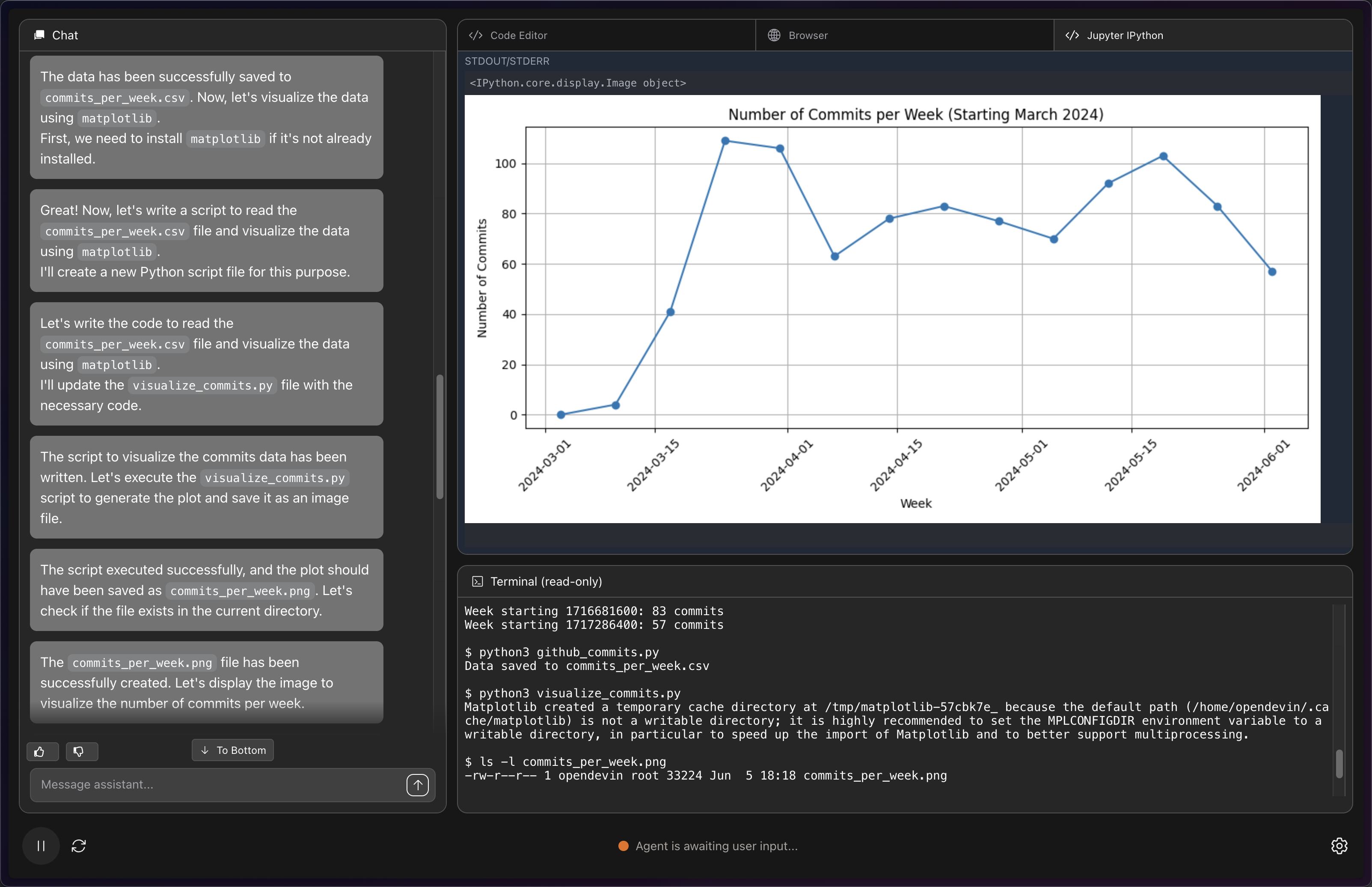
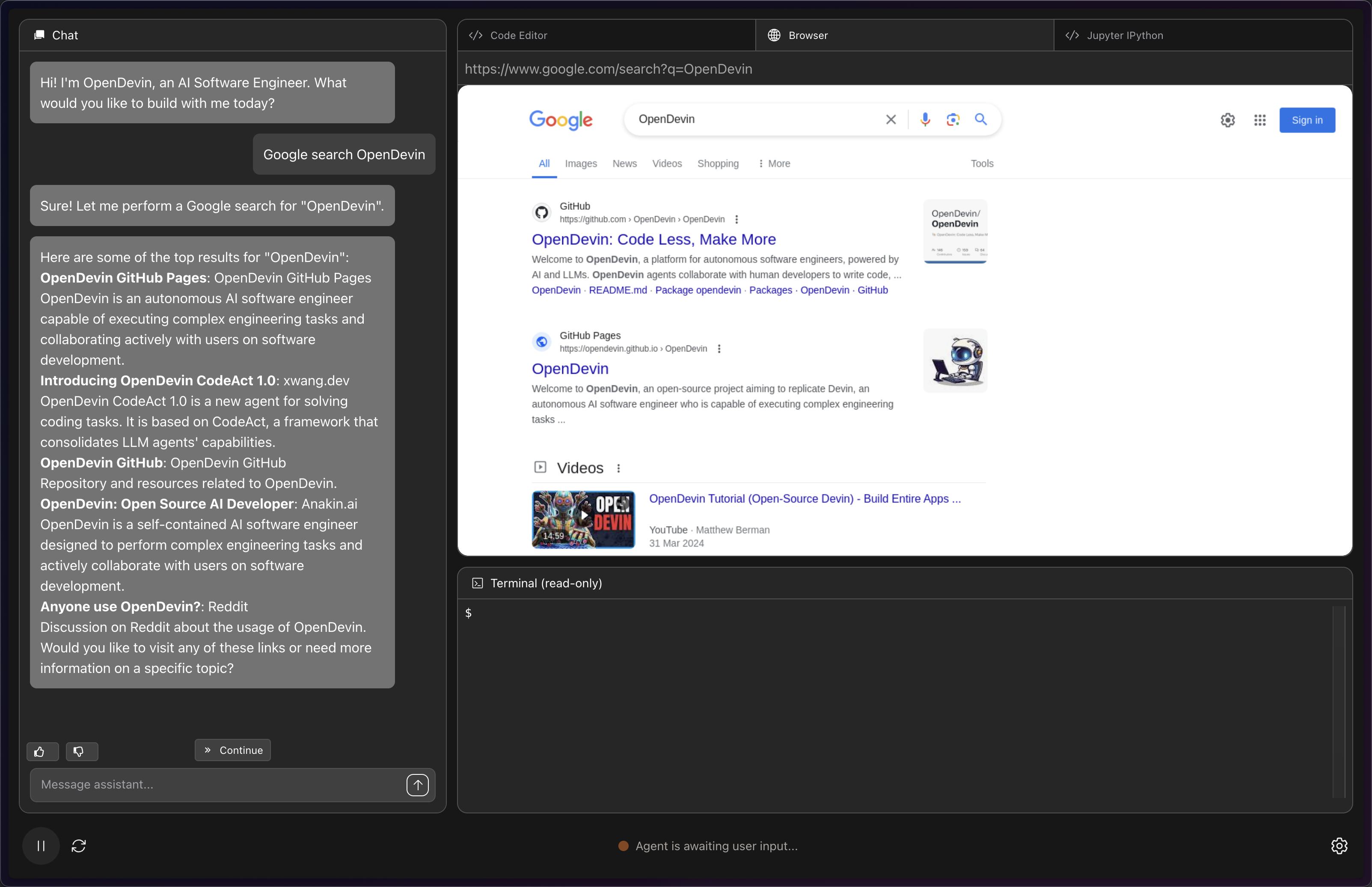
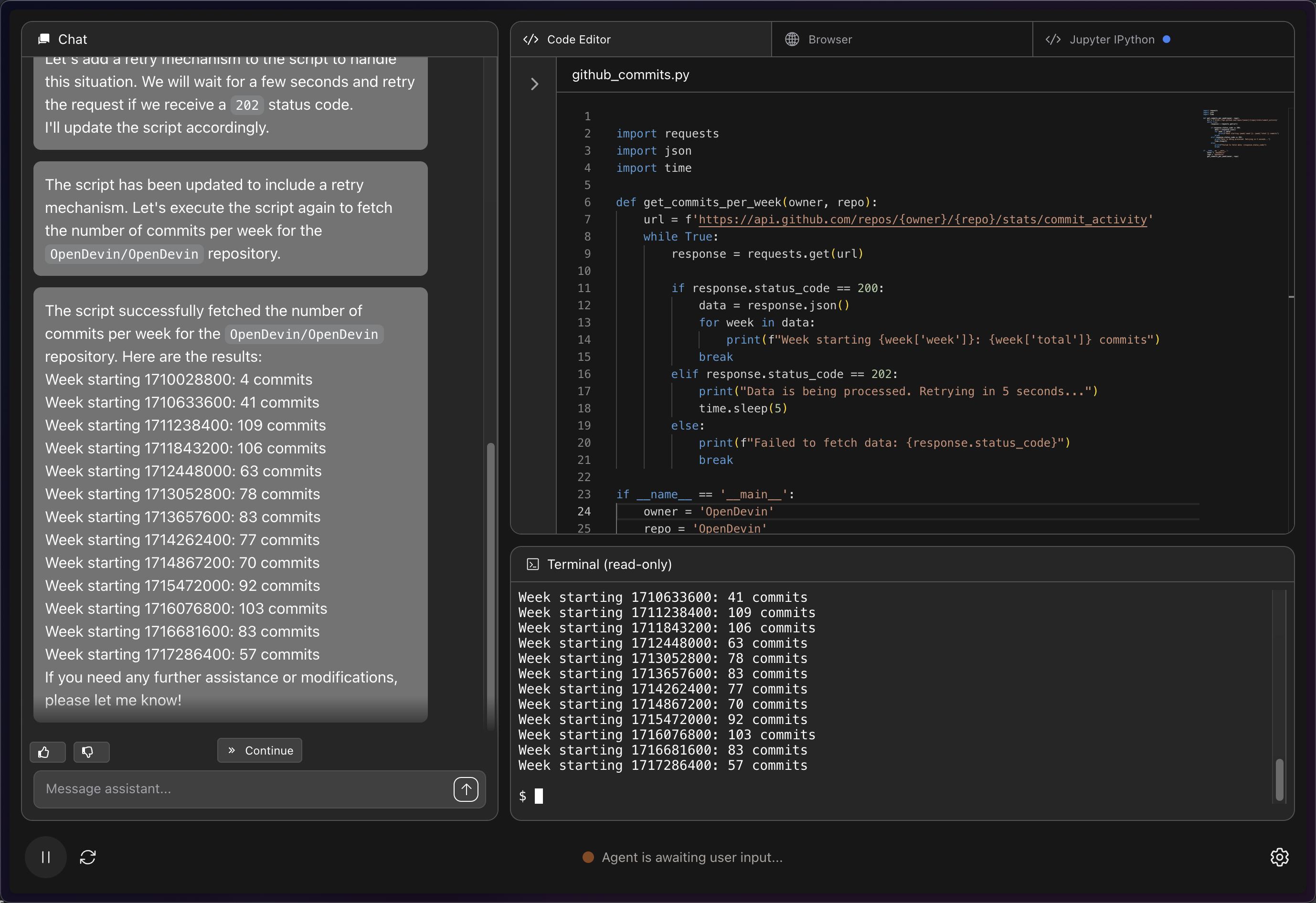
Figure
1:
OpenDevin
User
Interface
(UI,
§
D
)
allows
users
to
view
files,
check
executed
bash
commands/Python code, observe the agent’s browser activity, and directly interact with the agent.
also incorporates auxiliary information for agent’s operation, such as the accumulative cost of LLM
calls, metadata to track multi-agent delegation (§
2.4
), and other execution-related parameters.
Figure
2:
Minimal
example
of
implementing
an
agent in OpenDevin.
class
MinimalAgent
:
def
reset
(
self
)
->
None
:
self
.
system_message
=
"You
are
a
helpful
assistant
..."
def
step
(
self
,
state:
State):
messages:
list
[
dict
[
str
,
str
]]
=
[
{
'role'
:
'system'
,
'content'
:
self
.
system_message}
]
for
prev_action,
obs
in
state
.
history:
action_message
=
get_action_message(prev_action)
messages
.
append(action_message)
obs_message
=
get_observation_message(obs)
messages
.
append(obs_message)
#
use
llm
to
generate
response
(e.g.,
thought,
action)
response
=
self
.
llm
.
do_completion(messages)
#
parse
and
execute
action
in
the
runtime
action
=
self
.
parse_response(response)
if
self
.
is_finish_command(action):
return
AgentFinishAction()
elif
self
.
is_bash_command(action):
return
CmdRunAction(command
=
action
.
command)
elif
self
.
is_python_code(action):
return
IPythonRunCellAction(code
=
action
.
code)
elif
self
.
is_browser_action(action):
return
BrowseInteractiveAction(code
=
action
.
code)
else
:
return
MessageAction(content
=
action
.
message)
Actions.
Inspired
by
CodeAct
[
63
],
Open-
Devin connects an agent with the environment
through a core set of general actions.
Actions
IPythonRunCellAction
and
CmdRunAction
enable
the
agent
to
execute
arbitrary
Python
code and bash commands inside the sandbox en-
vironment (
e.g
., a securely isolated Linux oper-
ating
system).
BrowserInteractiveAction
enables
interaction
with
a
web
browser
with
a domain-specific language for browsing intro-
duced by BrowserGym [
12
].
The action space
based on programming languages (PL) is power-
ful and flexible enough to perform any task with
tools in different forms (
e.g
., Python function,
REST API,
etc
.) [
63
] while being reliable and
easy to maintain.
This design is also compatible with existing tool-
calling agents that require a list of pre-defined
tools [
6
].
That is, users can easily define tools
using PL supported in OpenDevin primitive ac-
tions (
e.g
., write a Python function for calcula-
tor) and make those tools available to the agent through JSON-style function-calling experiences [
49
].
Moreover, the framework’s powerful PL-based primitives further make it possible for the agents to
create tools by themselves (
e.g
., by generating Python functions [
75
]) when directly relevant APIs
to
complete
the
task
are
unavailable.
Refer
to
§
2.3
for
how
these
core
PL-based
actions
can
be
composed into a diverse set of tools.
Observations.
Observations describe environmental changes that the agent observes.
It may or may
not
be
caused
by
the
agent’s
action:
It
can
be
either
1)
natural
language
messages
from
the
user
3
Agent
where State is
turned into Action
[1] Message (source=user)
Can you create a list of numbers from 1 to 10, and
create a web page to display them at port 5000?
[2] IPythonRunCellAction (source=agent)
Sure! Let me create a file first:
State (Event History)
[Past Action(s) & Observation(s)]
[3] IPythonRunCellObservation
[File: /workspace/app.py (1 lines total)]
1|
[File app.py created.]
[
4
] IPythonRunCellAction (source=agent)
I
will write the
P
ython code for starting a ser
v
er
.
Action
EDITED_CODE=\"\"\"[Omitted for Brevity]\"\"\"
edit_file(start=1, end=1, content=EDITED_CODE)
create_file('app.py')
[
5
] IPythonRunCellObservation
[...
Om
itted
f
or
B
re
v
ity ...]
4|@
app.route(
'
/
')
5|
de
f
index()
:
6|
nu
mb
ers
=
list(ran
g
e(1
,
11)
)
7|
return str(nu
mb
ers
)
[...
Om
itted
f
or
B
re
v
ity ...] [File updated.]
[
6
] C
md
RunAction (source=agent)
I
ha
v
e created a
P
ython file
`
app
.
py
`
that will
display a list of numbers from 1 to 10 when you run
it
.
Let me run the ser
v
er for you:
<execute_
b
ash
>
python
3
app.py > ser
v
er.lo
g
2
>
&
1
&
cat ser
v
er.lo
g
</execute_
b
ash>
[
7
] C
md
RunObservation
[1] 1
24
*
S
er
v
in
g
Flask app
'
app
'
*
D
e
b
u
g
m
ode: o
f
f
WARNING
:
T
his is a de
v
elop
m
ent ser
v
er.
D
o not
use it in a production deploy
m
ent.
U
se a
production
WSGI
ser
v
er instead
.
*
R
unnin
g
on http://1
2
7
.
0
.
0
.1:
5
000
P
ress
CTRL+C
to
q
uit
[
8
]
B
ro
w
seInteractiveAction (source=agent)
T
he ser
v
er is running on port 5000 with
PI
D
1
24.
Let
me browse to the page at http
://
1
27.
0
.
0
.
1
:
500
0
<execute_
b
rowse
>
g
oto(
"
http://1
2
7
.
0
.
0
.1:
5
000"
)
</execute_
b
rowse>
[
9
]
B
ro
w
serOut
p
utObservation
[1
,
2
,
3
,
4,
5,
6,
7,
8
,
9
,
1
0
]
Sand
b
o
x
I
nte
rac
t
iv
e
Py
t
ho
n
(IPy
t
ho
n
)
S
e
rv
e
r
Bash
Sh
e
ll
Brows
e
r
Pl
a
y
wri
g
ht
C
hro
m
iu
m
T
he
Ev
ent Strea
m
connects to
C
o
mp
uter Sand
b
o
x
v
ia
SSH
Pro
t
ocol
where each Action e
x
ecution
l
eads to an
Ob
ser
v
ation
Ev
ent
S
t
r
e
am:
L
ist
[
Action
_1,
Ob
ser
v
ation
_1,
Action
_2,
...]
Agent
:
State
(H
istor
y)
->
Actio
n
Ru
nt
im
e
:
Action
->
Ob
ser
v
ation
Op
en
D
e
vi
n A
bs
t
rac
t
io
n
where a
ll
Action
-Ob
ser
v
ation
(
s
)
are trac
k
ed
Ev
ent
S
t
r
e
am
Agent
Ru
nt
im
e
Us
e
r
I
nte
rfac
e
C
o
mm
and
L
ine
W
e
b
UI
ID
E
Pl
u
g
ins
[...
]
M
ul
t
i
-
t
ur
n
Us
e
r
-
Agen
t
I
nte
rac
t
io
n
Figure 3:
OpenDevin consists of 3 main components:
1)
Agent abstraction
where community can
contribute different implementation of agents (§
2.1
) into an Agent Hub (§
3
); 2)
Event stream
for
tracking
history
of
actions
and
observations;
3)
Agent
runtime
to
execute
all
agent
actions
into
observations (§
2.2
).
instructing agents to perform certain tasks, 2) the execution outcome of the agent’s previous action
(
e.g
., code execution result, an accessibility tree [
35
], a screenshot of the web page,
etc
.).
Implement a New Agent.
The agent abstraction is designed to be simple yet powerful, allowing
users to create and customize agents for various tasks easily.
The core of the agent abstraction lies in
the
step
function, which takes the current state as input and generates an appropriate action based
on the agent’s logic.
Simplified example code for the agent abstraction is illustrated in Fig.
2
.
By
providing this abstraction, OpenDevin allows the users to focus on defining desired agent behavior
and logic without worrying about the low-level details of how actions are executed (§
2.2
).
2.2
Agent Runtime:
How Execution of Actions Results in Observations
Agent Runtime provides a general environment that equips the agent with an action space comparable
to that of human software developers, enabling OpenDevin agents to tackle a wide range of software
development and web-based tasks, including complex software development workflows, data analysis
projects, web browsing tasks, and more.
It allows the agent to access a bash terminal to run code and
command line tools, utilize a Jupyter notebook for writing and executing code on-the-fly, and interact
with a web browser for web-based tasks (
e.g
., information seeking).
Linux SSH Sandbox.
For each task session, OpenDevin spins up a securely isolated docker container
sandbox, where all the bash commands from the agent are executed.
OpenDevin connects to the
sandbox through SSH protocol, executes arbitrary commands from the agent, and returns the execution
results as observations to the agent.
A configurable workspace directory containing files the user
wants the agent to work on is mounted into that secure sandbox for OpenDevin agents to access.
Jupyter IPython.
The Linux sandbox also supports running an interactive Jupyter server, which can
be used by the agent for interactive
python
code execution [
19
] and debugging.
Web Browser.
OpenDevin implements a Chromium browser based on Playwright [
47
].
It interfaces
with
agents
using
a
set
of
browser
action
primitives
defined
by
BrowserGym
[
12
,
52
],
such
as
navigation, clicking, typing, scrolling.
The full set of actions is detailed in §
I
. After executing these
actions, the browser runtime provides a rich set of observations about the current state of the browser,
including HTML, DOM, accessibility tree [
35
], screenshot, opened tabs,
etc
.
These observations can
be also augmented with configurable attributes that could allow agents to better understand web page
observations, such as using a set-of-marks on screenshot [
15
,
71
], visible element marking, focused
element, interactable element marking, in-viewport element filtering [
79
],
etc
.
4
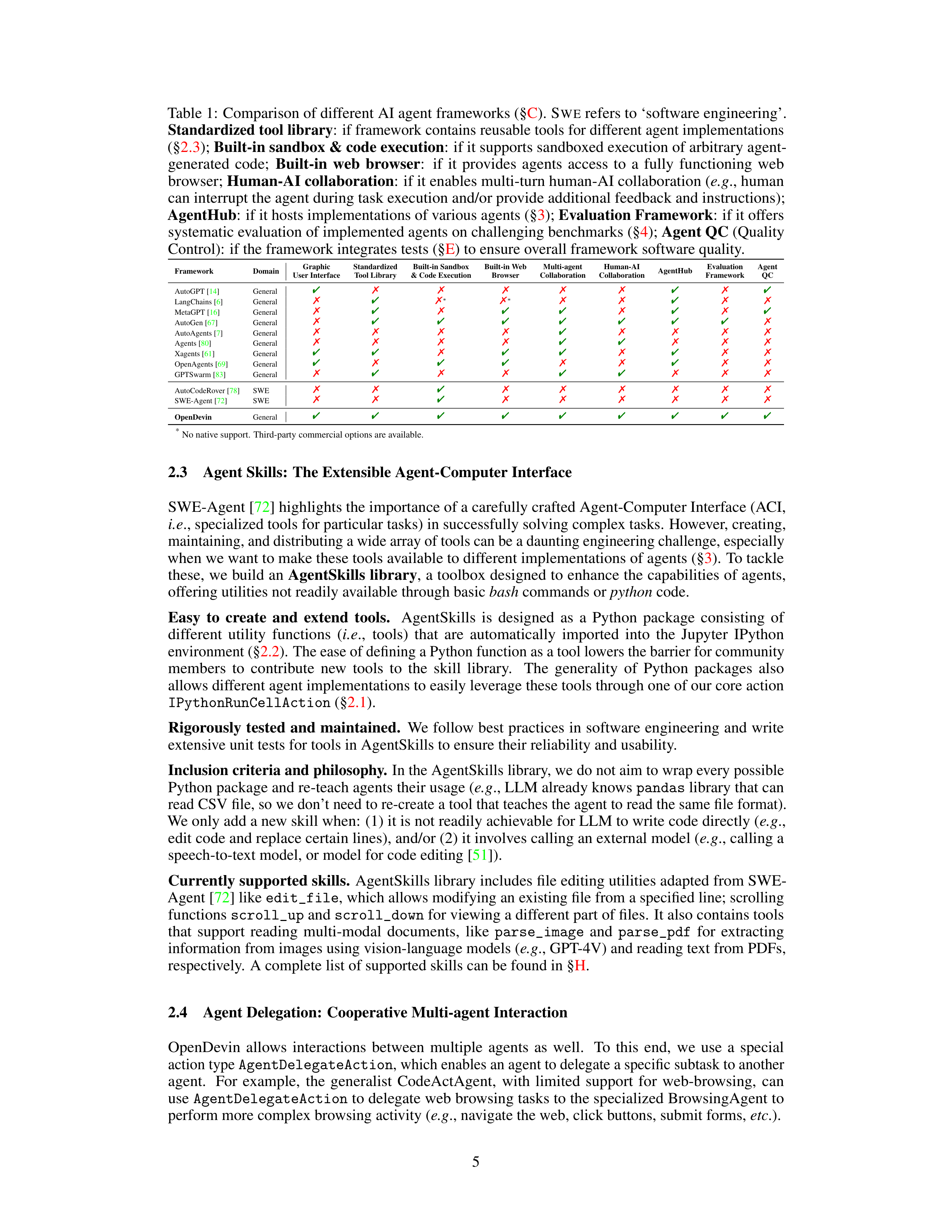
Table 1:
Comparison of different AI agent frameworks (§
C
). S
WE
refers to ‘software engineering’.
Standardized tool library
:
if framework contains reusable tools for different agent implementations
(§
2.3
);
Built-in sandbox & code execution
:
if it supports sandboxed execution of arbitrary agent-
generated
code;
Built-in
web
browser
:
if
it
provides
agents
access
to
a
fully
functioning
web
browser;
Human-AI collaboration
:
if it enables multi-turn human-AI collaboration (
e.g
., human
can interrupt the agent during task execution and/or provide additional feedback and instructions);
AgentHub
:
if it hosts implementations of various agents (§
3
);
Evaluation Framework
:
if it offers
systematic evaluation of implemented agents on challenging benchmarks (§
4
);
Agent QC
(Quality
Control):
if the framework integrates tests (§
E
) to ensure overall framework software quality.
Framework
Domain
Graphic
User Interface
Standardized
Tool Library
Built-in Sandbox
& Code Execution
Built-in Web
Browser
Multi-agent
Collaboration
Human-AI
Collaboration
AgentHub
Evaluation
Framework
Agent
QC
AutoGPT [
14
]
General
"
%
%
%
%
%
"
%
"
LangChains [
6
]
General
%
"
%
∗
%
∗
%
%
"
%
%
MetaGPT [
16
]
General
%
"
%
"
"
%
"
%
"
AutoGen [
67
]
General
%
"
"
"
"
"
"
"
%
AutoAgents [
7
]
General
%
%
%
%
"
%
%
%
%
Agents [
80
]
General
%
%
%
%
"
"
%
%
%
Xagents [
61
]
General
"
"
%
"
"
%
"
%
%
OpenAgents [
69
]
General
"
%
"
"
%
%
"
%
%
GPTSwarm [
83
]
General
%
"
%
%
"
"
%
%
%
AutoCodeRover [
78
]
SWE
%
%
"
%
%
%
%
%
%
SWE-Agent [
72
]
SWE
%
%
"
%
%
%
%
%
%
OpenDevin
General
"
"
"
"
"
"
"
"
"
*
No native support.
Third-party commercial options are available.
2.3
Agent Skills:
The Extensible Agent-Computer Interface
SWE-Agent [
72
] highlights the importance of a carefully crafted Agent-Computer Interface (ACI,
i.e
., specialized tools for particular tasks) in successfully solving complex tasks.
However, creating,
maintaining, and distributing a wide array of tools can be a daunting engineering challenge, especially
when we want to make these tools available to different implementations of agents (§
3
).
To tackle
these, we build an
AgentSkills library
, a toolbox designed to enhance the capabilities of agents,
offering utilities not readily available through basic
bash
commands or
python
code.
Easy
to
create
and
extend
tools.
AgentSkills
is
designed
as
a
Python
package
consisting
of
different
utility
functions
(
i.e
.,
tools)
that
are
automatically
imported
into
the
Jupyter
IPython
environment (§
2.2
).
The ease of defining a Python function as a tool lowers the barrier for community
members
to
contribute
new
tools
to
the
skill
library.
The
generality
of
Python
packages
also
allows different agent implementations to easily leverage these tools through one of our core action
IPythonRunCellAction
(§
2.1
).
Rigorously tested and maintained.
We follow best practices in software engineering and write
extensive unit tests for tools in AgentSkills to ensure their reliability and usability.
Inclusion criteria and philosophy.
In the AgentSkills library, we do not aim to wrap every possible
Python package and re-teach agents their usage (
e.g
., LLM already knows
pandas
library that can
read CSV file, so we don’t need to re-create a tool that teaches the agent to read the same file format).
We only add a new skill when:
(1) it is not readily achievable for LLM to write code directly (
e.g
.,
edit code and replace certain lines), and/or (2) it involves calling an external model (
e.g
., calling a
speech-to-text model, or model for code editing [
51
]).
Currently supported skills.
AgentSkills library includes file editing utilities adapted from SWE-
Agent [
72
] like
edit_file
, which allows modifying an existing file from a specified line; scrolling
functions
scroll_up
and
scroll_down
for viewing a different part of files.
It also contains tools
that
support
reading
multi-modal
documents,
like
parse_image
and
parse_pdf
for
extracting
information from images using vision-language models (
e.g
., GPT-4V) and reading text from PDFs,
respectively.
A complete list of supported skills can be found in §
H
.
2.4
Agent Delegation:
Cooperative Multi-agent Interaction
OpenDevin
allows
interactions
between
multiple
agents
as
well.
To
this
end,
we
use
a
special
action type
AgentDelegateAction
, which enables an agent to delegate a specific subtask to another
agent.
For
example,
the
generalist
CodeActAgent,
with
limited
support
for
web-browsing,
can
use
AgentDelegateAction
to delegate web browsing tasks to the specialized BrowsingAgent to
perform more complex browsing activity (
e.g
., navigate the web, click buttons, submit forms,
etc
.).
5
3
AgentHub:
A Hub of Community-Contributed Agents
Based on our agent abstraction (§
2.1
), OpenDevin supports a wide range of community-contributed
agent implementations for end users to choose from and act as baselines for different agent tasks.
CodeAct Agent.
CodeActAgent is the default generalist agent based on the CodeAct framework
[
63
].
At each step, the agent can (1) converse to communicate with humans in natural language to ask
for clarification, confirmation,
etc
., or (2) to perform the task by executing code (
a.k.a.
,
CodeAct
),
including executing bash commands, Python code, or browser-specific programming language (§
2.2
).
This
general
action
space
allows
the
agent
(v1.5
and
above)
to
perform
various
tasks,
including
editing files, browsing the web, running programs, etc.
Browsing Agent.
We implemented
a generalist
web
agent called
Browsing
Agent,
to
serve
as
a
simple yet effective baseline for web agent tasks.
The agent is similar to that in WebArena [
79
],
but with improved observations and actions, with only zero-shot prompting.
At each step, the agent
prompts the LLM with the task description, browsing action space description, current observation
of
the
browser
using
accessibility
tree,
previous
actions,
and
an
action
prediction
example
with
chain-of-thought reasoning.
The expected response from the LLM will contain chain-of-thought
reasoning plus the predicted next actions, including the option to finish the task and convey the result
to the user.
Full prompts are in §
J
. It can be extended to create more capable web agents, or called by
other agents through delegation (§
2.4
) to enable browsing capability.
GPTSwarm
Agent.
GPTSwarm
[
83
]
pioneers
the
use
of
optimizable
graphs
to
construct
agent
systems, unifying language agent frameworks through modularity.
Each node represents a distinct
operation,
while
edges
define
collaboration
and
communication
pathways.
This
design
allows
automatic optimization of nodes and edges, driving advancements in creating multi-agent systems.
Micro Agent(s).
In addition, OpenDevin enables the creation of
micro agent
, an agent
specialized
towards a particular task.
A micro agent re-uses most implementations from an existing generalist
agent
(e.g.,
CodeAct
Agent).
It
is
designed
to
lower
the
barrier
to
agent
development,
where
community
members
can
share
specialized
prompts
that
work
well
for
their
particular
use
cases.
Without programming, a user can create a micro agent by providing the agent’s name, description, the
schema for its inputs and outputs, and optionally a specialized prompt (e.g., example demonstrations
showing how to perform a particular task) that gear the generalist agent toward specific tasks, for
example, the
CommitWriterAgent
for generating git commit messages, and the
TypoFixerAgent
for correcting typos across the entire code repository.
4
Evaluation
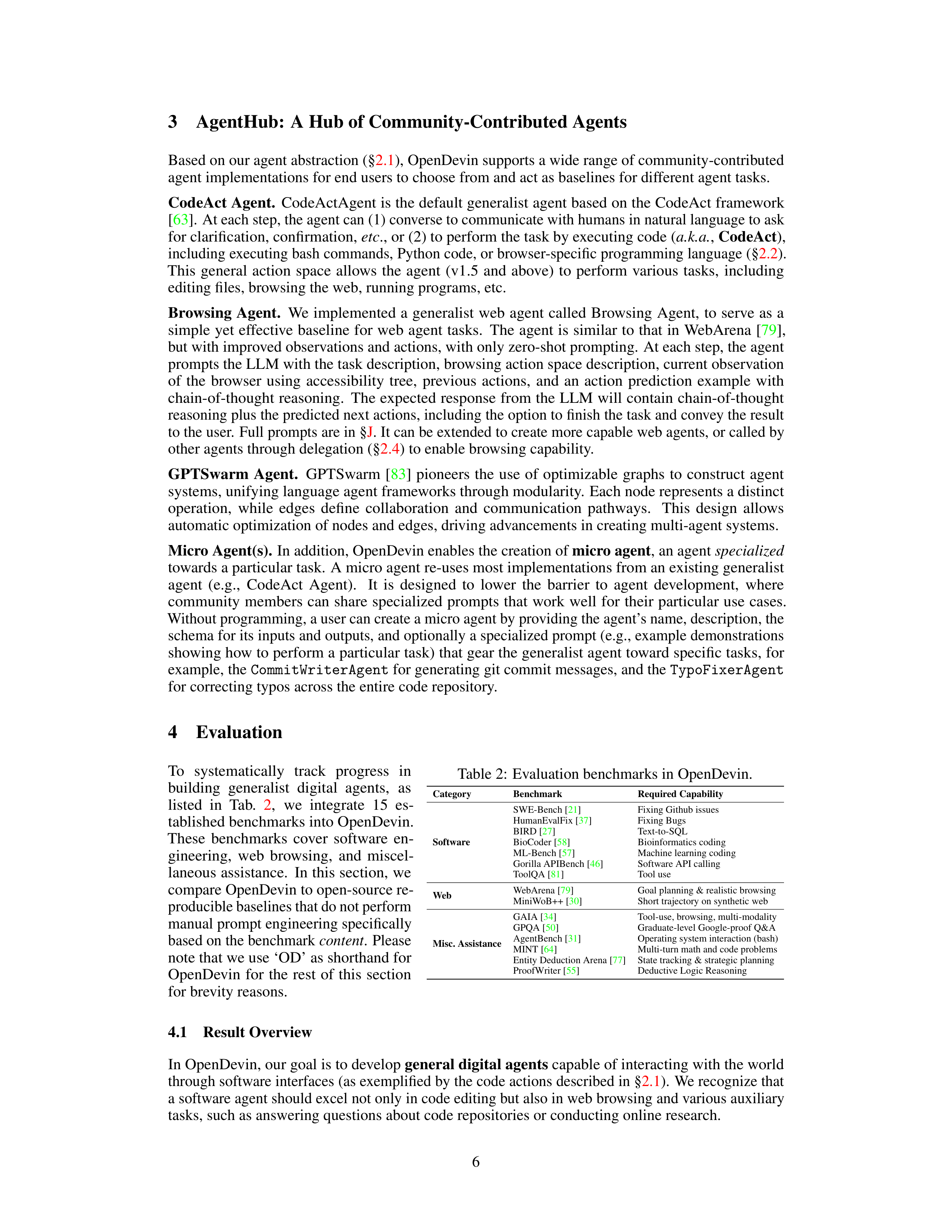
Table 2:
Evaluation benchmarks in OpenDevin.
Category
Benchmark
Required Capability
Software
SWE-Bench [
21
]
Fixing Github issues
HumanEvalFix [
37
]
Fixing Bugs
BIRD [
27
]
Text-to-SQL
BioCoder [
58
]
Bioinformatics coding
ML-Bench [
57
]
Machine learning coding
Gorilla APIBench [
46
]
Software API calling
ToolQA [
81
]
Tool use
Web
WebArena [
79
]
Goal planning & realistic browsing
MiniWoB++ [
30
]
Short trajectory on synthetic web
Misc. Assistance
GAIA [
34
]
Tool-use, browsing, multi-modality
GPQA [
50
]
Graduate-level Google-proof Q&A
AgentBench [
31
]
Operating system interaction (bash)
MINT [
64
]
Multi-turn math and code problems
Entity Deduction Arena [
77
]
State tracking & strategic planning
ProofWriter [
55
]
Deductive Logic Reasoning
To
systematically
track
progress
in
building
generalist
digital
agents,
as
listed
in
Tab.
2
,
we
integrate
15
es-
tablished benchmarks into OpenDevin.
These
benchmarks
cover
software
en-
gineering,
web
browsing,
and
miscel-
laneous assistance.
In this section, we
compare OpenDevin to open-source re-
producible baselines that do not perform
manual prompt engineering specifically
based on the benchmark
content
.
Please
note that we use ‘OD’ as shorthand for
OpenDevin
for
the
rest
of
this
section
for brevity reasons.
4.1
Result Overview
In OpenDevin, our goal is to develop
general digital agents
capable of interacting with the world
through software interfaces (as exemplified by the code actions described in §
2.1
).
We recognize that
a software agent should excel not only in code editing but also in web browsing and various auxiliary
tasks, such as answering questions about code repositories or conducting online research.
6
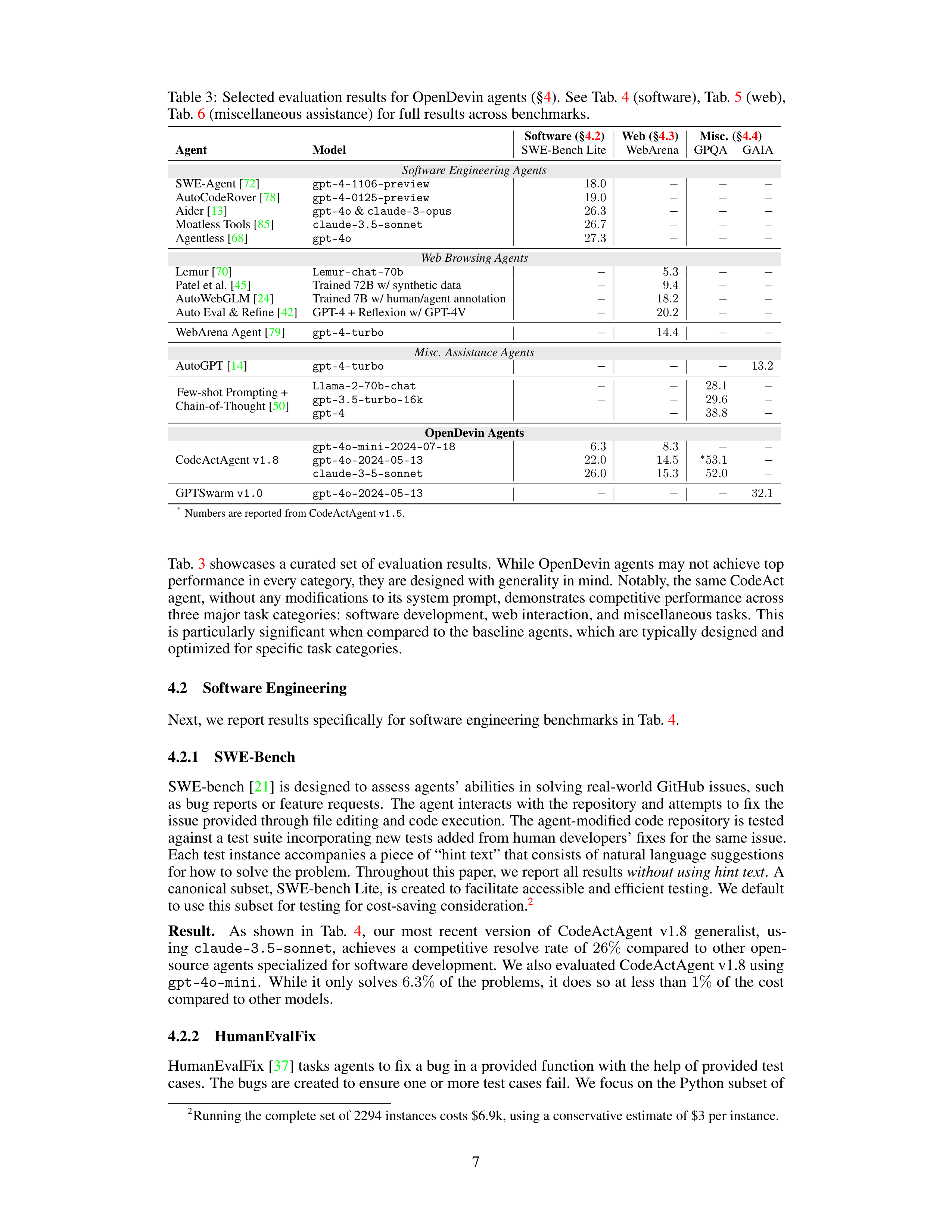
Table 3:
Selected evaluation results for OpenDevin agents (§
4
).
See Tab.
4
(software), Tab.
5
(web),
Tab.
6
(miscellaneous assistance) for full results across benchmarks.
Software (§
4.2
)
Web (§
4.3
)
Misc.
(§
4.4
)
Agent
Model
SWE-Bench Lite
WebArena
GPQA
GAIA
Software Engineering Agents
SWE-Agent [
72
]
gpt-4-1106-preview
18
.
0
−
−
−
AutoCodeRover [
78
]
gpt-4-0125-preview
19
.
0
−
−
−
Aider [
13
]
gpt-4o
&
claude-3-opus
26
.
3
−
−
−
Moatless Tools [
85
]
claude-3.5-sonnet
26
.
7
−
−
−
Agentless [
68
]
gpt-4o
27
.
3
−
−
−
Web Browsing Agents
Lemur [
70
]
Lemur-chat-70b
−
5
.
3
−
−
Patel et al. [
45
]
Trained 72B w/ synthetic data
−
9
.
4
−
−
AutoWebGLM [
24
]
Trained 7B w/ human/agent annotation
−
18
.
2
−
−
Auto Eval & Refine [
42
]
GPT-4 + Reflexion w/ GPT-4V
−
20
.
2
−
−
WebArena Agent [
79
]
gpt-4-turbo
−
14
.
4
−
−
Misc.
Assistance Agents
AutoGPT [
14
]
gpt-4-turbo
−
−
−
13
.
2
Few-shot Prompting +
Chain-of-Thought [
50
]
Llama-2-70b-chat
−
−
28
.
1
−
gpt-3.5-turbo-16k
−
−
29
.
6
−
gpt-4
−
38
.
8
−
OpenDevin Agents
CodeActAgent
v1.8
gpt-4o-mini-2024-07-18
6
.
3
8
.
3
−
−
gpt-4o-2024-05-13
22
.
0
14
.
5
∗
53
.
1
−
claude-3-5-sonnet
26
.
0
15
.
3
52
.
0
−
GPTSwarm
v1.0
gpt-4o-2024-05-13
−
−
−
32
.
1
*
Numbers are reported from CodeActAgent
v1.5
.
Tab.
3
showcases a curated set of evaluation results.
While OpenDevin agents may not achieve top
performance in every category, they are designed with generality in mind.
Notably, the same CodeAct
agent, without any modifications to its system prompt, demonstrates competitive performance across
three major task categories:
software development, web interaction, and miscellaneous tasks.
This
is particularly significant when compared to the baseline agents, which are typically designed and
optimized for specific task categories.
4.2
Software Engineering
Next, we report results specifically for software engineering benchmarks in Tab.
4
.
4.2.1
SWE-Bench
SWE-bench [
21
] is designed to assess agents’ abilities in solving real-world GitHub issues, such
as bug reports or feature requests.
The agent interacts with the repository and attempts to fix the
issue provided through file editing and code execution.
The agent-modified code repository is tested
against a test suite incorporating new tests added from human developers’ fixes for the same issue.
Each test instance accompanies a piece of “hint text” that consists of natural language suggestions
for how to solve the problem.
Throughout this paper, we report all results
without using hint text
.
A
canonical subset, SWE-bench Lite, is created to facilitate accessible and efficient testing.
We default
to use this subset for testing for cost-saving consideration.
2
Result.
As
shown
in
Tab.
4
,
our
most
recent
version
of
CodeActAgent
v1.8
generalist,
us-
ing
claude-3.5-sonnet
,
achieves
a
competitive
resolve
rate
of
26%
compared
to
other
open-
source agents specialized for software development.
We also evaluated CodeActAgent v1.8 using
gpt-4o-mini
.
While it only solves
6
.
3%
of the problems,
it does so at less than
1%
of the cost
compared to other models.
4.2.2
HumanEvalFix
HumanEvalFix [
37
] tasks agents to fix a bug in a provided function with the help of provided test
cases.
The bugs are created to ensure one or more test cases fail.
We focus on the Python subset of
2
Running the complete set of 2294 instances costs $6.9k, using a conservative estimate of $3 per instance.
7
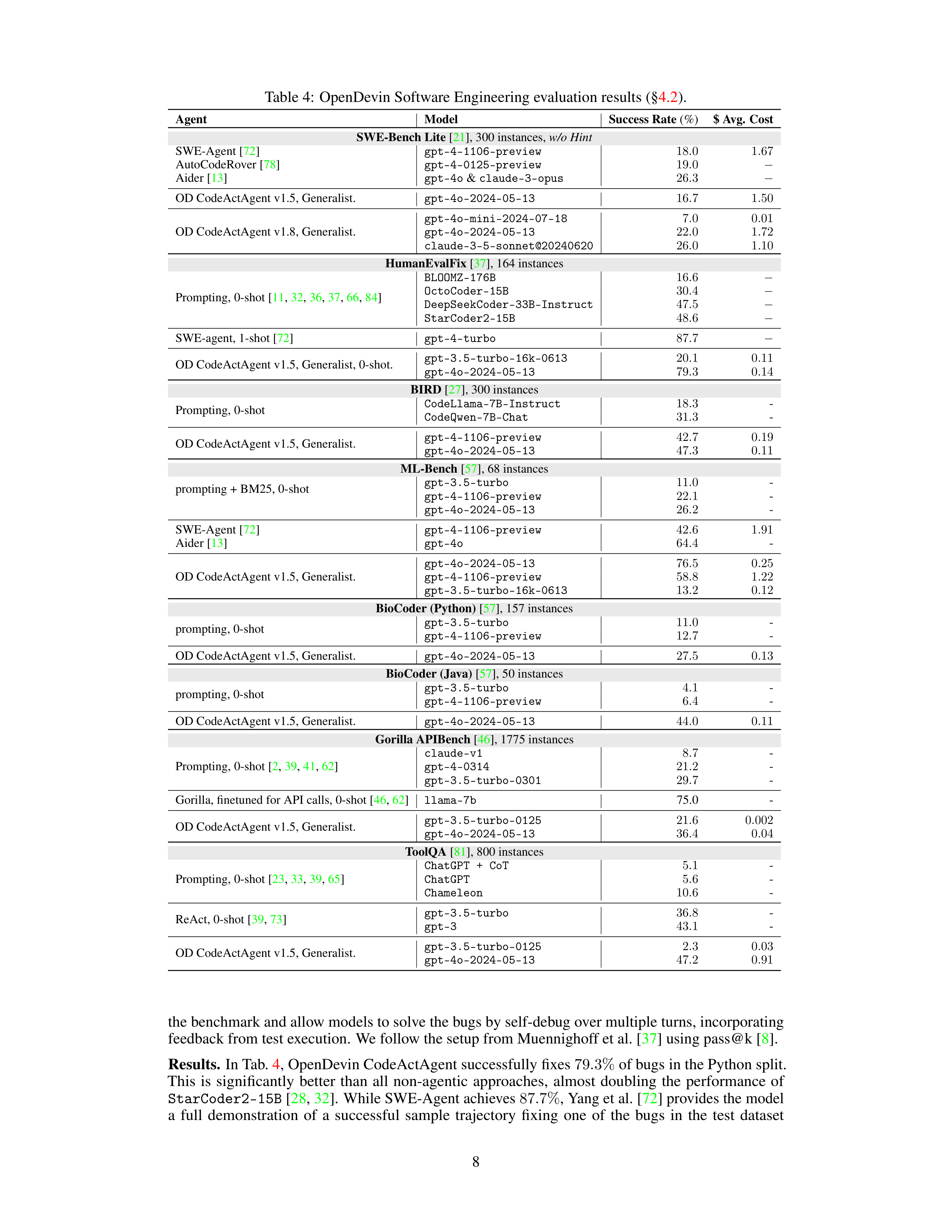
Table 4:
OpenDevin Software Engineering evaluation results (§
4.2
).
Agent
Model
Success Rate
(%)
$ Avg.
Cost
SWE-Bench Lite
[
21
], 300 instances,
w/o Hint
SWE-Agent [
72
]
gpt-4-1106-preview
18
.
0
1
.
67
AutoCodeRover [
78
]
gpt-4-0125-preview
19
.
0
−
Aider [
13
]
gpt-4o
&
claude-3-opus
26
.
3
−
OD CodeActAgent v1.5, Generalist.
gpt-4o-2024-05-13
16
.
7
1
.
50
OD CodeActAgent v1.8, Generalist.
gpt-4o-mini-2024-07-18
7
.
0
0
.
01
gpt-4o-2024-05-13
22
.
0
1
.
72
claude-3-5-sonnet@20240620
26
.
0
1
.
10
HumanEvalFix
[
37
], 164 instances
Prompting, 0-shot [
11
,
32
,
36
,
37
,
66
,
84
]
BLOOMZ-176B
16
.
6
−
OctoCoder-15B
30
.
4
−
DeepSeekCoder-33B-Instruct
47
.
5
−
StarCoder2-15B
48
.
6
−
SWE-agent, 1-shot [
72
]
gpt-4-turbo
87
.
7
−
OD CodeActAgent v1.5, Generalist, 0-shot.
gpt-3.5-turbo-16k-0613
20
.
1
0
.
11
gpt-4o-2024-05-13
79
.
3
0
.
14
BIRD
[
27
], 300 instances
Prompting, 0-shot
CodeLlama-7B-Instruct
18
.
3
-
CodeQwen-7B-Chat
31
.
3
-
OD CodeActAgent v1.5, Generalist.
gpt-4-1106-preview
42
.
7
0
.
19
gpt-4o-2024-05-13
47
.
3
0
.
11
ML-Bench
[
57
], 68 instances
prompting + BM25, 0-shot
gpt-3.5-turbo
11
.
0
-
gpt-4-1106-preview
22
.
1
-
gpt-4o-2024-05-13
26
.
2
-
SWE-Agent [
72
]
gpt-4-1106-preview
42
.
6
1
.
91
Aider [
13
]
gpt-4o
64
.
4
-
OD CodeActAgent v1.5, Generalist.
gpt-4o-2024-05-13
76
.
5
0
.
25
gpt-4-1106-preview
58
.
8
1
.
22
gpt-3.5-turbo-16k-0613
13
.
2
0
.
12
BioCoder (Python)
[
57
], 157 instances
prompting, 0-shot
gpt-3.5-turbo
11
.
0
-
gpt-4-1106-preview
12
.
7
-
OD CodeActAgent v1.5, Generalist.
gpt-4o-2024-05-13
27
.
5
0
.
13
BioCoder (Java)
[
57
], 50 instances
prompting, 0-shot
gpt-3.5-turbo
4
.
1
-
gpt-4-1106-preview
6
.
4
-
OD CodeActAgent v1.5, Generalist.
gpt-4o-2024-05-13
44
.
0
0
.
11
Gorilla APIBench
[
46
], 1775 instances
Prompting, 0-shot [
2
,
39
,
41
,
62
]
claude-v1
8
.
7
-
gpt-4-0314
21
.
2
-
gpt-3.5-turbo-0301
29
.
7
-
Gorilla, finetuned for API calls, 0-shot [
46
,
62
]
llama-7b
75.0
-
OD CodeActAgent v1.5, Generalist.
gpt-3.5-turbo-0125
21
.
6
0
.
002
gpt-4o-2024-05-13
36
.
4
0
.
04
ToolQA
[
81
], 800 instances
Prompting, 0-shot [
23
,
33
,
39
,
65
]
ChatGPT
+
CoT
5
.
1
-
ChatGPT
5
.
6
-
Chameleon
10
.
6
-
ReAct, 0-shot [
39
,
73
]
gpt-3.5-turbo
36
.
8
-
gpt-3
43
.
1
-
OD CodeActAgent v1.5, Generalist.
gpt-3.5-turbo-0125
2
.
3
0
.
03
gpt-4o-2024-05-13
47
.
2
0
.
91
the benchmark and allow models to solve the bugs by self-debug over multiple turns, incorporating
feedback from test execution.
We follow the setup from Muennighoff et al. [
37
] using pass@k [
8
].
Results.
In Tab.
4
, OpenDevin CodeActAgent successfully fixes
79
.
3%
of bugs in the Python split.
This
is
significantly
better
than
all
non-agentic
approaches,
almost
doubling
the
performance
of
StarCoder2-15B
[
28
,
32
].
While SWE-Agent achieves
87
.
7%
, Yang et al.
[
72
]
provides the model
a
full
demonstration
of
a
successful
sample
trajectory
fixing
one
of
the
bugs
in
the
test
dataset
8
(“1-shot”),
whereas
our
evaluation
of
OpenDevin
is
0-shot.
As
HumanEvalFix
has
been
created
by humans and all bugs carefully validated, achieving
100%
on this benchmark is entirely feasible,
which we seek to do in future iterations of OpenDevin.
4.2.3
ML-Bench
ML-Bench [
57
] evaluates agents’ ability to solve machine learning tasks across 18 GitHub repositories.
The
benchmark
comprises
9,641
tasks
spanning
169
diverse
ML
problems,
requiring
agents
to
generate bash scripts or Python code in response to user instructions.
In the sandbox environment,
agents
can
iteratively
execute
commands
and
receive
feedback,
allowing
them
to
understand
the
repository context and fulfill user requirements progressively.
Following the setup from the original
paper, we perform agent evaluation on the quarter subset of ML-Bench.
Results.
As shown in Table
4
, OpenDevin agents with GPT-4o achieve the highest success rate of
76
.
47%
on ML-Bench, outperforming SWE-Agent (
42
.
64%
).
Performance drops with less capable
models.
These results demonstrate the effectiveness of OpenDevin agent in complex ML tasks.
We
notice that agents show potential in reducing hallucination and syntax errors compared to non-agent
approaches in the ML-LLM-Bench settings [
57
].
4.2.4
Gorilla APIBench
Gorilla APIBench [
46
] evaluates agents’ abilities to use APIs.
it incorporates tasks on TorchHub,
TensorHub, and HuggingFace.
During the evaluation, models are given a question related to API
usage,
such
as
"
identify
an
API
capable
of
converting
spoken
language
in
a
recording
to
text
."
Correctness is evaluated based on whether the model’s API call is in the correct domain.
Results.
As shown in Table
4
, OpenDevin using GPT-4o, with a success rate of
36
.
4%
, outperforms
baselines not specifically finetuned for API calling.
While Gorilla shows higher performance on
APIBench, Patil et al. [
46
] finetune this model for API calling in particular.
4.2.5
ToolQA
ToolQA
[
81
]
evaluates
agents’
abilities
to
use
external
tools.
This
benchmark
includes
tasks
on
various topics like flight status, coffee price, Yelp data, and Airbnb data, requiring the use of various
tools
such
as
text
tools,
database
tools,
math
tools,
graph
tools,
code
tools,
and
system
tools.
It
features
two
levels:
easy
and
hard.
Easy
questions
focus
more
on
single
tool
usage,
while
hard
questions emphasize reasoning.
For evaluation, the easy subset is used to assess tool use capabilities.
Results.
Compared to all baselines, OpenDevin with GPT-4o shows the highest performance.
We
notice
that
agents
perform
better
on
tasks
related
to
CSV
and
database
tool
usage
but
requires
improvements on math and calculator tool usage.
4.2.6
BioCoder
BioCoder [
58
] is a repository-level code generation benchmark that evaluates agents’ performance
on bioinformatics-related tasks, specifically the ability to retrieve and accurately utilize context.
The
original prompts contain the relevant context of the code; however, in this study, we have removed
them to demonstrate the capability of OpenDevin to perform context retrieval, self-debugging, and
reasoning in multi-turn interactions.
BioCoder consists of 157 Python and 50 Java functions, each
targeting
a
specific
area
in
bioinformatics,
such
as
proteomics,
genomics,
and
other
specialized
domains.
The benchmark targets real-world code by generating code in existing repositories where
the relevant code has been masked out.
Results.
Table
4
shows that OpenDevin, using GPT-4o, achieves a success rate of
44
.
0%
.
This out-
performs all prompting-based non-agent baselines, with GPT-4 alone only achieving
6
.
4%
.
BioCoder
proves to be a particularly challenging benchmark for non-agent methods, as they did not incorpo-
rate any repository-level retrieval methods, making these models lack access to crucial repo-level
information such as global variables and function declarations.
9
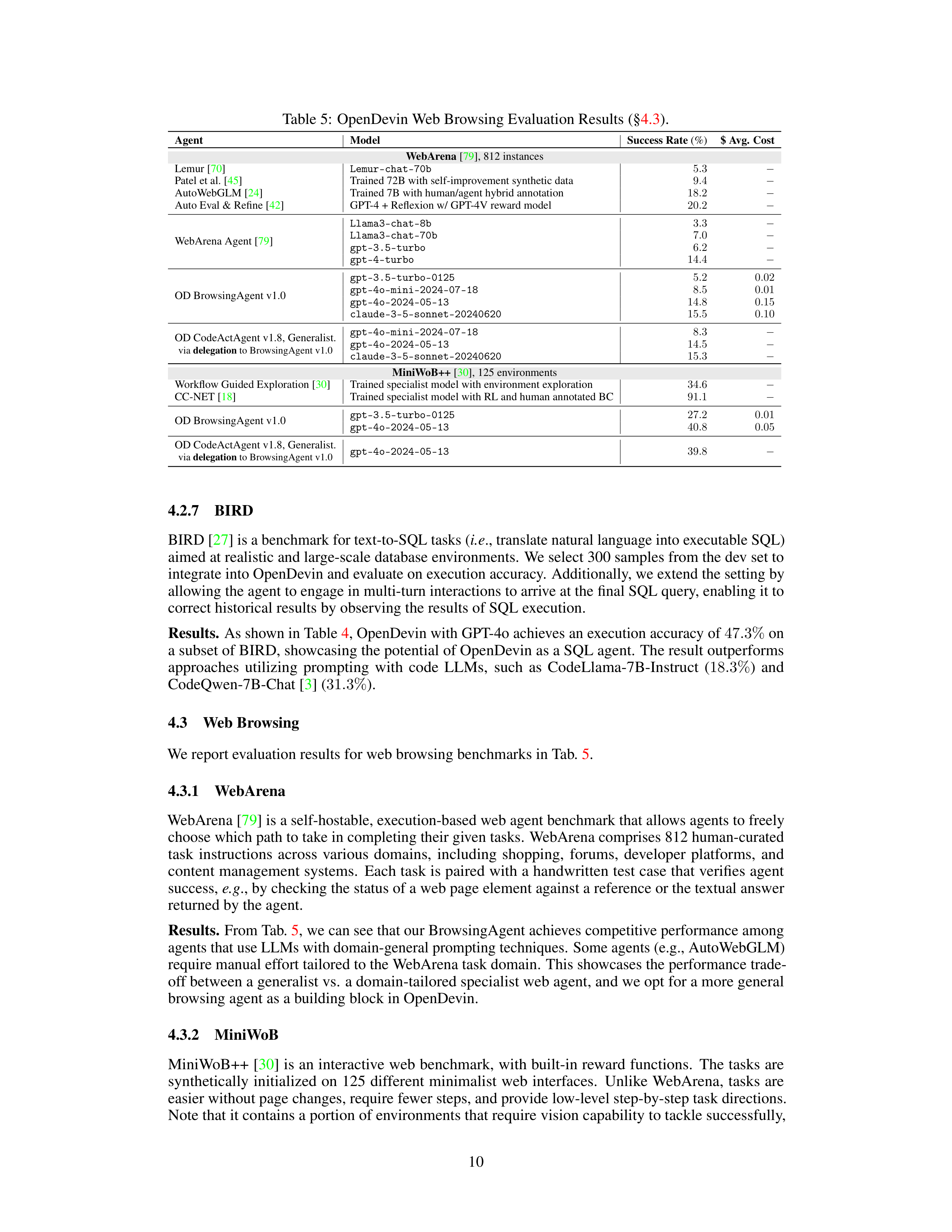
Table 5:
OpenDevin Web Browsing Evaluation Results (§
4.3
).
Agent
Model
Success Rate
(%)
$ Avg.
Cost
WebArena
[
79
], 812 instances
Lemur [
70
]
Lemur-chat-70b
5
.
3
−
Patel et al. [
45
]
Trained 72B with self-improvement synthetic data
9
.
4
−
AutoWebGLM [
24
]
Trained 7B with human/agent hybrid annotation
18
.
2
−
Auto Eval & Refine [
42
]
GPT-4 + Reflexion w/ GPT-4V reward model
20
.
2
−
WebArena Agent [
79
]
Llama3-chat-8b
3
.
3
−
Llama3-chat-70b
7
.
0
−
gpt-3.5-turbo
6
.
2
−
gpt-4-turbo
14
.
4
−
OD BrowsingAgent v1.0
gpt-3.5-turbo-0125
5
.
2
0
.
02
gpt-4o-mini-2024-07-18
8
.
5
0
.
01
gpt-4o-2024-05-13
14
.
8
0
.
15
claude-3-5-sonnet-20240620
15
.
5
0
.
10
OD CodeActAgent v1.8, Generalist.
via
delegation
to BrowsingAgent v1.0
gpt-4o-mini-2024-07-18
8
.
3
−
gpt-4o-2024-05-13
14
.
5
−
claude-3-5-sonnet-20240620
15
.
3
−
MiniWoB++
[
30
], 125 environments
Workflow Guided Exploration [
30
]
Trained specialist model with environment exploration
34
.
6
−
CC-NET [
18
]
Trained specialist model with RL and human annotated BC
91
.
1
−
OD BrowsingAgent v1.0
gpt-3.5-turbo-0125
27
.
2
0
.
01
gpt-4o-2024-05-13
40
.
8
0
.
05
OD CodeActAgent v1.8, Generalist.
via
delegation
to BrowsingAgent v1.0
gpt-4o-2024-05-13
39
.
8
−
4.2.7
BIRD
BIRD [
27
] is a benchmark for text-to-SQL tasks (
i.e
., translate natural language into executable SQL)
aimed at realistic and large-scale database environments.
We select 300 samples from the dev set to
integrate into OpenDevin and evaluate on execution accuracy.
Additionally, we extend the setting by
allowing the agent to engage in multi-turn interactions to arrive at the final SQL query, enabling it to
correct historical results by observing the results of SQL execution.
Results.
As shown in Table
4
, OpenDevin with GPT-4o achieves an execution accuracy of
47
.
3%
on
a subset of BIRD, showcasing the potential of OpenDevin as a SQL agent.
The result outperforms
approaches
utilizing
prompting
with
code
LLMs,
such
as
CodeLlama-7B-Instruct
(
18
.
3%
)
and
CodeQwen-7B-Chat [
3
] (
31
.
3%
).
4.3
Web Browsing
We report evaluation results for web browsing benchmarks in Tab.
5
.
4.3.1
WebArena
WebArena [
79
] is a self-hostable, execution-based web agent benchmark that allows agents to freely
choose which path to take in completing their given tasks.
WebArena comprises 812 human-curated
task
instructions
across
various
domains,
including
shopping,
forums,
developer
platforms,
and
content management systems.
Each task is paired with a handwritten test case that verifies agent
success,
e.g
., by checking the status of a web page element against a reference or the textual answer
returned by the agent.
Results.
From Tab.
5
, we can see that our BrowsingAgent achieves competitive performance among
agents that use LLMs with domain-general prompting techniques.
Some agents (e.g., AutoWebGLM)
require manual effort tailored to the WebArena task domain.
This showcases the performance trade-
off between a generalist vs.
a domain-tailored specialist web agent, and we opt for a more general
browsing agent as a building block in OpenDevin.
4.3.2
MiniWoB
MiniWoB++ [
30
] is an interactive web benchmark, with built-in reward functions.
The tasks are
synthetically initialized on 125 different minimalist web interfaces.
Unlike WebArena,
tasks are
easier without page changes, require fewer steps, and provide low-level step-by-step task directions.
Note that it contains a portion of environments that require vision capability to tackle successfully,
10
and many existing work choose to focus only on a subset of the tasks [
22
,
29
,
53
].
Still, we report the
performance on the full set and only include baselines that are evaluated on the full set.
Results.
From Tab.
5
we see that our generalist BrowsingAgent finishes nearly half of the tasks
without any adaptation on the environment.
However, due to the synthetic nature of MiniWoB++,
the state-of-the-art agents explicitly trained for the environments with reinforcement learning and/or
human behavior cloning have almost saturated the performance.
This shows an even bigger trade-off
between generalist and specialist agents than on the more general WebArena benchmark.
4.4
Miscellaneous Assistance
Results
for
miscellaneous
assistance
benchmarks
are
reported
in
Tab.
6
.
In
particular,
we
report
results for:
4.4.1
GAIA
GAIA [
34
] evaluates agents’ general task-solving skills, covering different real-world scenarios.
It
requires various agent capabilities, including reasoning, multi-modal understanding, web browsing,
and coding.
GAIA consists of 466 curated tasks across three levels.
Setting up GAIA is traditionally
challenging
due
to
the
complexity
of
integrating
various
tools
with
the
agent,
but
OpenDevin’s
infrastructure (
e.g
., runtime §
2.2
, tool library §
2.3
) simplifies the integration significantly.
Results.
In our experiments, we achieved a score of
32
.
1
on the GAIA (level-1 val), significantly
improving over the original AutoGPT [
14
].
GAIA is sensitive to the support of multimodal input
and
web
navigation
skills,
suggesting
further
score
improvements
as
OpenDevin’s
infrastructure
improves.
4.4.2
GPQA
GPQA [
50
] evaluates agents’ ability for coordinated tool use when solving challenging graduate-level
problems.
It consists of 448 curated and difficult multiple-choice questions in biology, physics, and
chemistry.
Tool use (
e.g
., python) and web search are often useful to assist agents in answering these
questions since they provide accurate calculations that LLMs are often incapable of and access to
information outside of the LLM’s parametric knowledge base.
Results.
Results are shown in Tab.
6
and
7
.
We observe that OpenDevin’s integrated for supporting
diverse tool use (
e.g
., python for calculations) as well as web-search (for searching relevant facts)
allows the resulting agent to better solve complex multi-step problems, surpassing the prior
state-of-
the-art
by 9.6% and 12.3% on the main and diamond subsets respectively on GPQA [
50
].
4.4.3
AgentBench
AgentBench [
31
] evaluates agents’ reasoning and decision-making abilities in a multi-turn, open-
ended generation setting.
We selected the code-grounded operating system (OS) subset with 144
tasks.
Agents from OpenDevin interact directly with the task-specific OS using bash commands in a
multi-turn manner, combining interaction and reasoning to automate task completion.
Results.
In our experiments (Tab.
6
), OpenDevin CodeActAgent v1.5 achieves a score of
57
.
6%
on
the AgentBench using
gpt-4o
, outperforming the
42
.
4%
baseline using
gpt-4
from the original
paper.
Interestingly, when employing weaker models such as
gpt-3.5-turbo
, OpenDevin agents
generally underperform compared to the original baseline agents.
This finding suggests that generalist
agents,
like
those
implemented
in
OpenDevin,
require
a
certain
threshold
of
foundation
model
capability - particularly instruction following - to function effectively.
4.4.4
MINT
MINT [
64
] is a benchmark designed to evaluate agents’ ability to solve challenging tasks through
multi-turn
interactions
using
tools
and
natural
language
feedback
simulated
by
GPT-4.
We
use
coding and math subsets used in Eurus [
76
] for evaluation.
We follow the same setting as the original
paper and allows the agent to interact up-to five iterations with two chances to propose solutions.
Results.
As shown in Tab.
6
), OpenDevin agents achieve comparable performance to the default
agent in the original benchmark, with a performance improvement in the
math
subset.
11
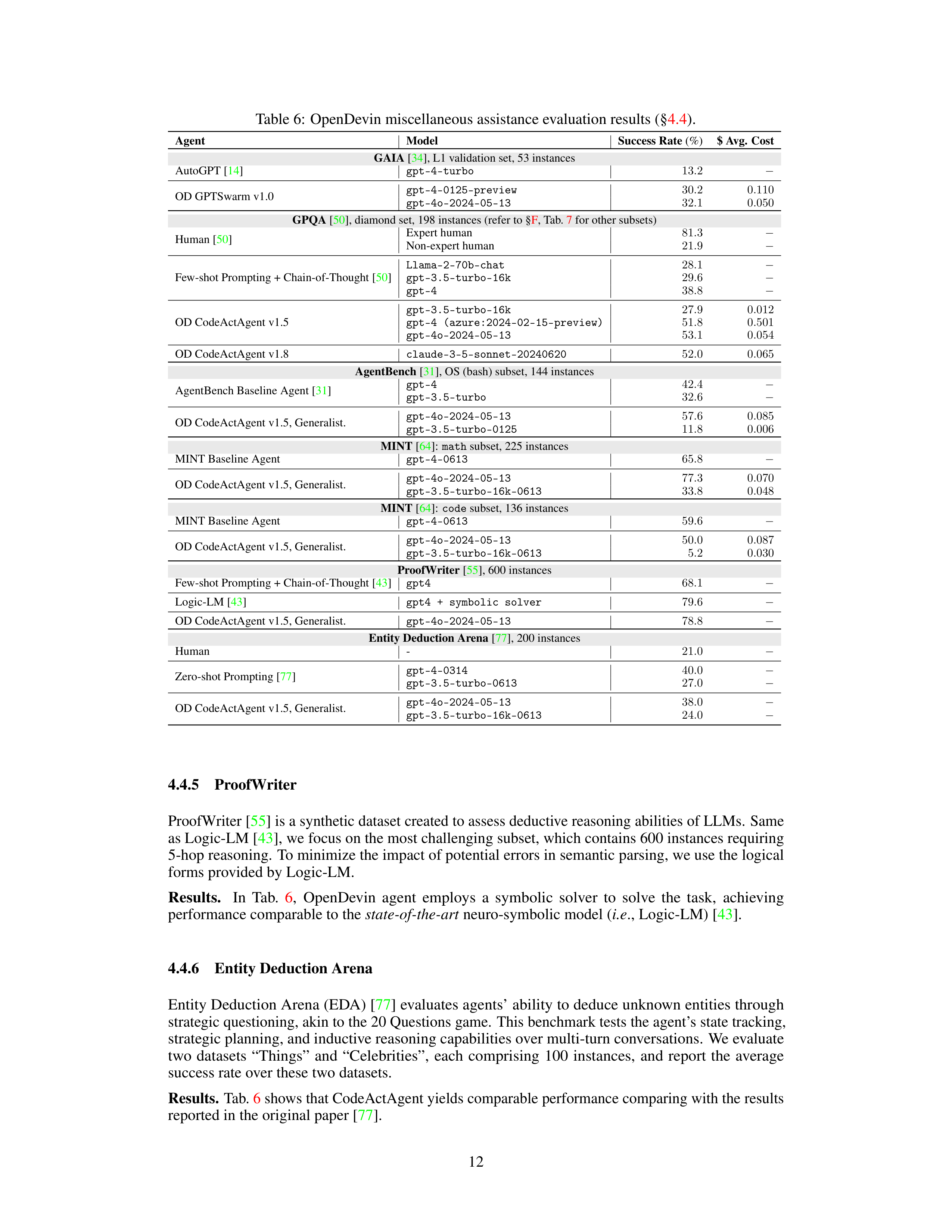
Table 6:
OpenDevin miscellaneous assistance evaluation results (§
4.4
).
Agent
Model
Success Rate
(%)
$ Avg.
Cost
GAIA
[
34
], L1 validation set, 53 instances
AutoGPT [
14
]
gpt-4-turbo
13
.
2
−
OD GPTSwarm v1.0
gpt-4-0125-preview
30
.
2
0
.
110
gpt-4o-2024-05-13
32
.
1
0
.
050
GPQA
[
50
], diamond set, 198 instances (refer to §
F
, Tab.
7
for other subsets)
Human [
50
]
Expert human
81
.
3
−
Non-expert human
21
.
9
−
Few-shot Prompting + Chain-of-Thought [
50
]
Llama-2-70b-chat
28
.
1
−
gpt-3.5-turbo-16k
29
.
6
−
gpt-4
38
.
8
−
OD CodeActAgent v1.5
gpt-3.5-turbo-16k
27
.
9
0
.
012
gpt-4
(azure:2024-02-15-preview)
51
.
8
0
.
501
gpt-4o-2024-05-13
53
.
1
0
.
054
OD CodeActAgent v1.8
claude-3-5-sonnet-20240620
52
.
0
0
.
065
AgentBench
[
31
], OS (bash) subset, 144 instances
AgentBench Baseline Agent [
31
]
gpt-4
42
.
4
−
gpt-3.5-turbo
32
.
6
−
OD CodeActAgent v1.5, Generalist.
gpt-4o-2024-05-13
57
.
6
0
.
085
gpt-3.5-turbo-0125
11
.
8
0
.
006
MINT
[
64
]:
math
subset, 225 instances
MINT Baseline Agent
gpt-4-0613
65
.
8
−
OD CodeActAgent v1.5, Generalist.
gpt-4o-2024-05-13
77
.
3
0
.
070
gpt-3.5-turbo-16k-0613
33
.
8
0
.
048
MINT
[
64
]:
code
subset, 136 instances
MINT Baseline Agent
gpt-4-0613
59
.
6
−
OD CodeActAgent v1.5, Generalist.
gpt-4o-2024-05-13
50
.
0
0
.
087
gpt-3.5-turbo-16k-0613
5
.
2
0
.
030
ProofWriter
[
55
], 600 instances
Few-shot Prompting + Chain-of-Thought [
43
]
gpt4
68
.
1
−
Logic-LM [
43
]
gpt4
+
symbolic
solver
79
.
6
−
OD CodeActAgent v1.5, Generalist.
gpt-4o-2024-05-13
78
.
8
−
Entity Deduction Arena
[
77
], 200 instances
Human
-
21
.
0
−
Zero-shot Prompting [
77
]
gpt-4-0314
40
.
0
−
gpt-3.5-turbo-0613
27
.
0
−
OD CodeActAgent v1.5, Generalist.
gpt-4o-2024-05-13
38
.
0
−
gpt-3.5-turbo-16k-0613
24
.
0
−
4.4.5
ProofWriter
ProofWriter [
55
] is a synthetic dataset created to assess deductive reasoning abilities of LLMs.
Same
as Logic-LM [
43
], we focus on the most challenging subset, which contains 600 instances requiring
5-hop reasoning.
To minimize the impact of potential errors in semantic parsing, we use the logical
forms provided by Logic-LM.
Results.
In
Tab.
6
,
OpenDevin
agent
employs
a
symbolic
solver
to
solve
the
task,
achieving
performance comparable to the
state-of-the-art
neuro-symbolic model (
i.e
., Logic-LM) [
43
].
4.4.6
Entity Deduction Arena
Entity Deduction Arena (EDA) [
77
] evaluates agents’ ability to deduce unknown entities through
strategic questioning, akin to the 20 Questions game.
This benchmark tests the agent’s state tracking,
strategic planning, and inductive reasoning capabilities over multi-turn conversations.
We evaluate
two
datasets
“Things”
and
“Celebrities”,
each
comprising
100
instances,
and
report
the
average
success rate over these two datasets.
Results.
Tab.
6
shows that CodeActAgent yields comparable performance comparing with the results
reported in the original paper [
77
].
12
5
Conclusion
We introduce OpenDevin, a community-driven platform that enables the development of agents that
interact with the world through software interfaces.
By providing a powerful interaction mechanism,
a safe sandboxed environment, essential agent skills, multi-agent collaboration capabilities, and a
comprehensive evaluation framework, OpenDevin accelerates research innovations and real-world
applications of agentic AI systems.
Despite challenges in developing safe and reliable agents (§
A
),
we are excited about our vibrant community and look forward to OpenDevin’s continued evolution.
Acknowledgments
We extend our heartfelt gratitude to all contributors who have made OpenDevin possible.
Over 160
individuals have made more than 1,300 contributions
3
,
demonstrating the power of collaborative
development.
We are deeply appreciative of everyone
4
who has participated in discussions, raised
issues, suggested improvements, and contributed code or documentation.
References
[1]
Michael Ahn, Anthony Brohan, Noah Brown, Yevgen Chebotar, Omar Cortes, Byron David,
Chelsea Finn, Chuyuan Fu, Keerthana Gopalakrishnan, Karol Hausman, et al.
Do as i can, not
as i say:
Grounding language in robotic affordances.
arXiv preprint arXiv:2204.01691
, 2022.
1
[2]
https://www.anthropic.com/index/introducing-claude Anthropic.
Claude,
2022.
URL
https:
//www.anthropic.com/index/introducing-claude
.
8
[3]
Jinze Bai, Shuai Bai, Yunfei Chu, Zeyu Cui, Kai Dang, Xiaodong Deng, Yang Fan, Wenbin
Ge, Yu Han, Fei Huang, Binyuan Hui, Luo Ji, Mei Li, Junyang Lin, Runji Lin, Dayiheng Liu,
Gao Liu, Chengqiang Lu, Keming Lu, Jianxin Ma, Rui Men, Xingzhang Ren, Xuancheng Ren,
Chuanqi Tan, Sinan Tan, Jianhong Tu, Peng Wang, Shijie Wang, Wei Wang, Shengguang Wu,
Benfeng Xu, Jin Xu, An Yang, Hao Yang, Jian Yang, Shusheng Yang, Yang Yao, Bowen Yu,
Hongyi Yuan, Zheng Yuan, Jianwei Zhang, Xingxuan Zhang, Yichang Zhang, Zhenru Zhang,
Chang Zhou, Jingren Zhou, Xiaohuan Zhou, and Tianhang Zhu.
Qwen technical report.
arXiv
preprint arXiv:2309.16609
, 2023.
10
[4]
Daniil
A
Boiko,
Robert
MacKnight,
Ben
Kline,
and
Gabe
Gomes.
Autonomous
chemical
research with large language models.
Nature
, 624(7992):570–578, 2023.
1
[5]
Yupeng
Chang,
Xu
Wang,
Jindong
Wang,
Yuan
Wu,
Linyi
Yang,
Kaijie
Zhu,
Hao
Chen,
Xiaoyuan Yi, Cunxiang Wang, Yidong Wang, et al.
A survey on evaluation of large language
models.
ACM Transactions on Intelligent Systems and Technology
, 15(3):1–45, 2024.
1
[6]
Harrison Chase.
LangChain, October 2022.
URL
https://github.com/langchain-ai/langchain
.
3
,
5
,
23
[7]
Guangyao Chen, Siwei Dong, Yu Shu, Ge Zhang, Jaward Sesay, Börje F. Karlsson, Jie Fu, and
Yemin Shi.
Autoagents:
A framework for automatic agent generation, 2024.
1
,
5
,
23
[8]
Mark Chen, Jerry Tworek, Heewoo Jun, Qiming Yuan, Henrique Ponde de Oliveira Pinto, Jared
Kaplan, Harri Edwards, Yuri Burda, Nicholas Joseph, Greg Brockman, et al.
Evaluating large
language models trained on code.
arXiv preprint arXiv:2107.03374
, 2021.
8
[9]
Cognition.ai.
Introducing devin, the first ai software engineer.
URL
https://www.cognition.ai/
blog/introducing-devin
.
2
[10]
Jiaxi Cui, Zongjian Li, Yang Yan, Bohua Chen, and Li Yuan.
Chatlaw:
Open-source legal large
language model with integrated external knowledge bases, 2023.
23
3
A full list of contributors can be found at
https://github.com/OpenDevin/OpenDevin/graphs/contributors
.
4
Including our stargazers at
https://github.com/OpenDevin/OpenDevin/stargazers
13
[11]
DeepSeek-AI, Qihao Zhu, Daya Guo, Zhihong Shao, Dejian Yang, Peiyi Wang, Runxin Xu,
Y.
Wu,
Yukun
Li,
Huazuo
Gao,
Shirong
Ma,
Wangding
Zeng,
Xiao
Bi,
Zihui
Gu,
Hanwei
Xu, Damai Dai, Kai Dong, Liyue Zhang, Yishi Piao, Zhibin Gou, Zhenda Xie, Zhewen Hao,
Bingxuan Wang, Junxiao Song, Deli Chen, Xin Xie, Kang Guan, Yuxiang You, Aixin Liu, Qiushi
Du, Wenjun Gao, Xuan Lu, Qinyu Chen, Yaohui Wang, Chengqi Deng, Jiashi Li, Chenggang
Zhao, Chong Ruan, Fuli Luo, and Wenfeng Liang.
Deepseek-coder-v2:
Breaking the barrier of
closed-source models in code intelligence, 2024.
URL
https://arxiv.org/abs/2406.11931
.
8
[12]
Alexandre Drouin, Maxime Gasse, Massimo Caccia, Issam H. Laradji, Manuel Del Verme, Tom
Marty, Léo Boisvert, Megh Thakkar, Quentin Cappart, David Vazquez, Nicolas Chapados, and
Alexandre Lacoste.
Workarena:
How capable are web agents at solving common knowledge
work tasks?, 2024.
3
,
4
[13]
Paul Gauthier.
How aider scored sota 26.3% on swe bench lite | aider.
https://aider.chat/2024/
05/22/swe-bench-lite.html
.
Accessed:
2024-06-05.
7
,
8
[14]
Significant Gravitas.
Auto-gpt:
An autonomous gpt-4 experiment, 2023.
URL https://github.
com/Significant-Gravitas/Auto-GPT
, 2023.
5
,
7
,
11
,
12
,
23
[15]
Hongliang He, Wenlin Yao, Kaixin Ma, Wenhao Yu, Yong Dai, Hongming Zhang, Zhenzhong
Lan,
and Dong Yu.
Webvoyager:
Building an end-to-end web agent with large multimodal
models.
arXiv preprint arXiv:2401.13919
, 2024.
4
[16]
Sirui
Hong,
Mingchen
Zhuge,
Jonathan
Chen,
Xiawu
Zheng,
Yuheng
Cheng,
Jinlin
Wang,
Ceyao Zhang, Zili Wang, Steven Ka Shing Yau, Zijuan Lin, et al.
Metagpt:
Meta programming
for a multi-agent collaborative framework.
In
The Twelfth International Conference on Learning
Representations
, 2023.
1
,
5
,
23
[17]
Dong
Huang,
Qingwen
Bu,
Jie
M.
Zhang,
Michael
Luck,
and
Heming
Cui.
Agentcoder:
Multi-agent-based code generation with iterative testing and optimisation, 2024.
23
[18]
Peter
C
Humphreys,
David
Raposo,
Tobias
Pohlen,
Gregory
Thornton,
Rachita
Chhaparia,
Alistair Muldal, Josh Abramson, Petko Georgiev, Adam Santoro, and Timothy Lillicrap.
A
data-driven approach for learning to control computers. In
International Conference on Machine
Learning
, pages 9466–9482. PMLR, 2022.
10
[19]
IPython.
Jupyter and the future of IPython — IPython.
URL
https://ipython.org
.
4
[20]
Albert Q Jiang, Alexandre Sablayrolles, Antoine Roux, Arthur Mensch, Blanche Savary, Chris
Bamford, Devendra Singh Chaplot, Diego de las Casas, Emma Bou Hanna, Florian Bressand,
et al.
Mixtral of experts.
arXiv preprint arXiv:2401.04088
, 2024.
1
[21]
Carlos
E
Jimenez,
John
Yang,
Alexander
Wettig,
Shunyu
Yao,
Kexin
Pei,
Ofir
Press,
and
Karthik
R
Narasimhan.
SWE-bench:
Can
Language
Models
Resolve
Real-world
Github
Issues?
In
The Twelfth International Conference on Learning Representations
, 2024.
URL
https://openreview.net/forum?id=VTF8yNQM66
.
1
,
6
,
7
,
8
,
22
,
24
[22]
Geunwoo Kim, Pierre Baldi, and Stephen McAleer.
Language models can solve computer tasks.
Advances in Neural Information Processing Systems
, 36, 2024.
11
[23]
Takeshi Kojima, Shixiang Shane Gu, Machel Reid, Yutaka Matsuo, and Yusuke Iwasawa.
Large
language models are zero-shot reasoners.
Advances in neural information processing systems
,
35:22199–22213, 2022.
8
[24]
Hanyu
Lai,
Xiao
Liu,
Iat
Long
Iong,
Shuntian
Yao,
Yuxuan
Chen,
Pengbo
Shen,
Hao
Yu,
Hanchen Zhang, Xiaohan Zhang, Yuxiao Dong, et al.
Autowebglm:
Bootstrap and reinforce a
large language model-based web navigating agent.
arXiv preprint arXiv:2404.03648
, 2024.
7
,
10
[25]
Hareton K. N. Leung and Lee J. White.
A study of integration testing and software regression at
the integration level.
In
Proceedings of the Conference on Software Maintenance, ICSM 1990,
San Diego, CA, USA, 26-29 November, 1990
, pages 290–301. IEEE, 1990.
doi:
10.1109/ICSM.
1990.131377.
URL
https://doi.org/10.1109/ICSM.1990.131377
.
24
14
[26]
Guohao
Li,
Hasan
Abed
Al
Kader
Hammoud,
Hani
Itani,
Dmitrii
Khizbullin,
and
Bernard
Ghanem.
Camel:
Communicative agents for" mind" exploration of large scale language model
society.
arXiv preprint arXiv:2303.17760
, 2023.
23
[27]
Jinyang
Li,
Binyuan
Hui,
GE
QU,
Jiaxi
Yang,
Binhua
Li,
Bowen
Li,
Bailin
Wang,
Bowen
Qin,
Ruiying Geng,
Nan Huo,
Xuanhe Zhou,
Chenhao Ma,
Guoliang Li,
Kevin Chang,
Fei
Huang, Reynold Cheng, and Yongbin Li.
Can LLM already serve as a database interface?
a BIg
bench for large-scale database grounded text-to-SQLs.
In
Thirty-seventh Conference on Neural
Information Processing Systems Datasets and Benchmarks Track
, 2023.
6
,
8
,
10
,
22
[28]
Raymond Li, Loubna Ben Allal, Yangtian Zi, Niklas Muennighoff, Denis Kocetkov, Chenghao
Mou, Marc Marone, Christopher Akiki, Jia Li, Jenny Chim, Qian Liu, Evgenii Zheltonozhskii,
Terry Yue Zhuo, Thomas Wang, Olivier Dehaene, Mishig Davaadorj, Joel Lamy-Poirier, João
Monteiro, Oleh Shliazhko, Nicolas Gontier, Nicholas Meade, Armel Zebaze, Ming-Ho Yee,
Logesh Kumar Umapathi, Jian Zhu, Benjamin Lipkin, Muhtasham Oblokulov, Zhiruo Wang,
Rudra Murthy, Jason Stillerman, Siva Sankalp Patel, Dmitry Abulkhanov, Marco Zocca, Manan
Dey, Zhihan Zhang, Nour Fahmy, Urvashi Bhattacharyya, Wenhao Yu, Swayam Singh, Sasha
Luccioni, Paulo Villegas, Maxim Kunakov, Fedor Zhdanov, Manuel Romero, Tony Lee, Nadav
Timor,
Jennifer
Ding,
Claire
Schlesinger,
Hailey
Schoelkopf,
Jan
Ebert,
Tri
Dao,
Mayank
Mishra,
Alex
Gu,
Jennifer
Robinson,
Carolyn
Jane
Anderson,
Brendan
Dolan-Gavitt,
Dan-
ish Contractor, Siva Reddy, Daniel Fried, Dzmitry Bahdanau, Yacine Jernite, Carlos Muñoz
Ferrandis, Sean Hughes, Thomas Wolf, Arjun Guha, Leandro von Werra, and Harm de Vries.
Starcoder:
may the source be with you!, 2023.
URL
https://arxiv.org/abs/2305.06161
.
8
[29]
Tao Li,
Gang Li,
Zhiwei Deng,
Bryan Wang,
and Yang Li.
A zero-shot language agent for
computer control with structured reflection.
arXiv preprint arXiv:2310.08740
, 2023.
11
[30]
Evan Zheran Liu, Kelvin Guu, Panupong Pasupat, Tianlin Shi, and Percy Liang.
Reinforcement
learning on web interfaces using workflow-guided exploration.
In
International Conference on
Learning Representations (ICLR)
, 2018.
URL
https://arxiv.org/abs/1802.08802
.
6
,
10
,
22
[31]
Xiao Liu, Hao Yu, Hanchen Zhang, Yifan Xu, Xuanyu Lei, Hanyu Lai, Yu Gu, Hangliang Ding,
Kaiwen Men, Kejuan Yang, Shudan Zhang, Xiang Deng, Aohan Zeng, Zhengxiao Du, Chenhui
Zhang, Sheng Shen, Tianjun Zhang, Yu Su, Huan Sun, Minlie Huang, Yuxiao Dong, and Jie
Tang.
Agentbench:
Evaluating llms as agents.
arXiv preprint arXiv:
2308.03688
, 2023.
6
,
11
,
12
,
22
[32]
Anton Lozhkov, Raymond Li, Loubna Ben Allal, Federico Cassano, Joel Lamy-Poirier, Noua-
mane
Tazi,
Ao
Tang,
Dmytro
Pykhtar,
Jiawei
Liu,
Yuxiang
Wei,
Tianyang
Liu,
Max
Tian,
Denis Kocetkov, Arthur Zucker, Younes Belkada, Zijian Wang, Qian Liu, Dmitry Abulkhanov,
Indraneil
Paul,
Zhuang
Li,
Wen-Ding
Li,
Megan
Risdal,
Jia
Li,
Jian
Zhu,
Terry
Yue
Zhuo,
Evgenii Zheltonozhskii, Nii Osae Osae Dade, Wenhao Yu, Lucas Krauß, Naman Jain, Yixuan
Su, Xuanli He, Manan Dey, Edoardo Abati, Yekun Chai, Niklas Muennighoff, Xiangru Tang,
Muhtasham Oblokulov, Christopher Akiki, Marc Marone, Chenghao Mou, Mayank Mishra,
Alex
Gu,
Binyuan
Hui,
Tri
Dao,
Armel
Zebaze,
Olivier
Dehaene,
Nicolas
Patry,
Canwen
Xu,
Julian
McAuley,
Han
Hu,
Torsten
Scholak,
Sebastien
Paquet,
Jennifer
Robinson,
Car-
olyn
Jane
Anderson,
Nicolas
Chapados,
Mostofa
Patwary,
Nima
Tajbakhsh,
Yacine
Jernite,
Carlos Muñoz Ferrandis, Lingming Zhang, Sean Hughes, Thomas Wolf, Arjun Guha, Leandro
von Werra, and Harm de Vries.
Starcoder 2 and the stack v2:
The next generation, 2024.
URL
https://arxiv.org/abs/2402.19173
.
8
[33]
Pan Lu, Baolin Peng, Hao Cheng, Michel Galley, Kai-Wei Chang, Ying Nian Wu, Song-Chun
Zhu, and Jianfeng Gao. Chameleon: Plug-and-play compositional reasoning with large language
models.
Advances in Neural Information Processing Systems
, 36, 2024.
8
[34]
Grégoire Mialon, Clémentine Fourrier, Craig Swift, Thomas Wolf, Yann LeCun, and Thomas
Scialom.
GAIA: a benchmark for general AI assistants.
CoRR
, abs/2311.12983, 2023.
doi:
10.48550/ARXIV.2311.12983.
URL
https://doi.org/10.48550/arXiv.2311.12983
.
6
,
11
,
12
,
22
[35]
Mozilla.
Accessibility tree - MDN Web Docs Glossary:
Definitions of Web-related terms |
MDN.
URL
https://developer.mozilla.org/en-US/docs/Glossary/Accessibility_tree
.
4
15
[36]
Niklas
Muennighoff,
Thomas
Wang,
Lintang
Sutawika,
Adam
Roberts,
Stella
Biderman,
Teven
Le
Scao,
M
Saiful
Bari,
Sheng
Shen,
Zheng-Xin
Yong,
Hailey
Schoelkopf,
Xiangru
Tang, Dragomir Radev, Alham Fikri Aji, Khalid Almubarak, Samuel Albanie, Zaid Alyafeai,
Albert Webson, Edward Raff, and Colin Raffel.
Crosslingual generalization through multitask
finetuning, 2023.
URL
https://arxiv.org/abs/2211.01786
.
8
[37]
Niklas Muennighoff, Qian Liu, Armel Zebaze, Qinkai Zheng, Binyuan Hui, Terry Yue Zhuo,
Swayam Singh, Xiangru Tang, Leandro von Werra, and Shayne Longpre.
Octopack:
Instruction
tuning code large language models, 2024.
6
,
7
,
8
,
22
[38]
Y Nakajima.
Babyagi.
URL https://github.com/yoheinakajima/babyagi
, 2023.
23
[39]
OpenAI.
Chatgpt:
May
2024
version.
https://www.openai.com/chatgpt
,
2024.
Accessed:
2024-05-29.
8
,
23
[40]
OpenAI.
Hello gpt-4o.
https://openai.com/index/hello-gpt-4o/
, 2024.
Accessed:
2024-05-15.
1
[41]
OpenAI,
Josh
Achiam,
Steven
Adler,
Sandhini
Agarwal,
Lama
Ahmad,
Ilge
Akkaya,
Flo-
rencia Leoni Aleman, Diogo Almeida, Janko Altenschmidt, Sam Altman, Shyamal Anadkat,
Red
Avila,
Igor
Babuschkin,
Suchir
Balaji,
Valerie
Balcom,
Paul
Baltescu,
Haiming
Bao,
Mohammad
Bavarian,
Jeff
Belgum,
Irwan
Bello,
Jake
Berdine,
Gabriel
Bernadett-Shapiro,
Christopher Berner, Lenny Bogdonoff, Oleg Boiko, Madelaine Boyd, Anna-Luisa Brakman,
Greg Brockman, Tim Brooks, Miles Brundage, Kevin Button, Trevor Cai, Rosie Campbell, An-
drew Cann, Brittany Carey, Chelsea Carlson, Rory Carmichael, Brooke Chan, Che Chang, Fotis
Chantzis, Derek Chen, Sully Chen, Ruby Chen, Jason Chen, Mark Chen, Ben Chess, Chester
Cho, Casey Chu, Hyung Won Chung, Dave Cummings, Jeremiah Currier, Yunxing Dai, Cory
Decareaux, Thomas Degry, Noah Deutsch, Damien Deville, Arka Dhar, David Dohan, Steve
Dowling, Sheila Dunning, Adrien Ecoffet, Atty Eleti, Tyna Eloundou, David Farhi, Liam Fedus,
Niko Felix,
Simón Posada Fishman,
Juston Forte,
Isabella Fulford,
Leo Gao,
Elie Georges,
Christian Gibson,
Vik Goel,
Tarun Gogineni,
Gabriel Goh,
Rapha Gontijo-Lopes,
Jonathan
Gordon, Morgan Grafstein, Scott Gray, Ryan Greene, Joshua Gross, Shixiang Shane Gu, Yufei
Guo,
Chris
Hallacy,
Jesse
Han,
Jeff
Harris,
Yuchen
He,
Mike
Heaton,
Johannes
Heidecke,
Chris Hesse,
Alan Hickey,
Wade Hickey,
Peter Hoeschele,
Brandon Houghton,
Kenny Hsu,
Shengli Hu, Xin Hu, Joost Huizinga, Shantanu Jain, Shawn Jain, Joanne Jang, Angela Jiang,
Roger Jiang, Haozhun Jin, Denny Jin, Shino Jomoto, Billie Jonn, Heewoo Jun, Tomer Kaftan,
Łukasz Kaiser, Ali Kamali, Ingmar Kanitscheider, Nitish Shirish Keskar, Tabarak Khan, Logan
Kilpatrick, Jong Wook Kim, Christina Kim, Yongjik Kim, Jan Hendrik Kirchner, Jamie Kiros,
Matt Knight, Daniel Kokotajlo, Łukasz Kondraciuk, Andrew Kondrich, Aris Konstantinidis,
Kyle Kosic, Gretchen Krueger, Vishal Kuo, Michael Lampe, Ikai Lan, Teddy Lee, Jan Leike,
Jade
Leung,
Daniel
Levy,
Chak
Ming
Li,
Rachel
Lim,
Molly
Lin,
Stephanie
Lin,
Mateusz
Litwin, Theresa Lopez, Ryan Lowe, Patricia Lue, Anna Makanju, Kim Malfacini, Sam Man-
ning,
Todor
Markov,
Yaniv
Markovski,
Bianca
Martin,
Katie
Mayer,
Andrew
Mayne,
Bob
McGrew, Scott Mayer McKinney, Christine McLeavey, Paul McMillan, Jake McNeil, David
Medina, Aalok Mehta, Jacob Menick, Luke Metz, Andrey Mishchenko, Pamela Mishkin, Vinnie
Monaco, Evan Morikawa, Daniel Mossing, Tong Mu, Mira Murati, Oleg Murk, David Mély,
Ashvin Nair, Reiichiro Nakano, Rajeev Nayak, Arvind Neelakantan, Richard Ngo, Hyeonwoo
Noh, Long Ouyang, Cullen O’Keefe, Jakub Pachocki, Alex Paino, Joe Palermo, Ashley Pan-
tuliano, Giambattista Parascandolo, Joel Parish, Emy Parparita, Alex Passos, Mikhail Pavlov,
Andrew Peng, Adam Perelman, Filipe de Avila Belbute Peres, Michael Petrov, Henrique Ponde
de Oliveira Pinto, Michael, Pokorny, Michelle Pokrass, Vitchyr H. Pong, Tolly Powell, Alethea
Power,
Boris
Power,
Elizabeth
Proehl,
Raul
Puri,
Alec
Radford,
Jack
Rae,
Aditya
Ramesh,
Cameron Raymond, Francis Real, Kendra Rimbach, Carl Ross, Bob Rotsted, Henri Roussez,
Nick Ryder, Mario Saltarelli, Ted Sanders, Shibani Santurkar, Girish Sastry, Heather Schmidt,
David Schnurr, John Schulman, Daniel Selsam, Kyla Sheppard, Toki Sherbakov, Jessica Shieh,
Sarah Shoker, Pranav Shyam, Szymon Sidor, Eric Sigler, Maddie Simens, Jordan Sitkin, Kata-
rina Slama, Ian Sohl, Benjamin Sokolowsky, Yang Song, Natalie Staudacher, Felipe Petroski
Such, Natalie Summers, Ilya Sutskever, Jie Tang, Nikolas Tezak, Madeleine B. Thompson, Phil
Tillet, Amin Tootoonchian, Elizabeth Tseng, Preston Tuggle, Nick Turley, Jerry Tworek, Juan
Felipe Cerón Uribe, Andrea Vallone, Arun Vijayvergiya, Chelsea Voss, Carroll Wainwright,
Justin Jay Wang, Alvin Wang, Ben Wang, Jonathan Ward, Jason Wei, CJ Weinmann, Akila
Welihinda, Peter Welinder, Jiayi Weng, Lilian Weng, Matt Wiethoff, Dave Willner, Clemens
16
Winter, Samuel Wolrich, Hannah Wong, Lauren Workman, Sherwin Wu, Jeff Wu, Michael Wu,
Kai Xiao, Tao Xu, Sarah Yoo, Kevin Yu, Qiming Yuan, Wojciech Zaremba, Rowan Zellers,
Chong Zhang, Marvin Zhang, Shengjia Zhao, Tianhao Zheng, Juntang Zhuang, William Zhuk,
and Barret Zoph.
Gpt-4 technical report, 2024.
8
,
23
[42]
Jiayi
Pan,
Yichi Zhang,
Nicholas
Tomlin,
Yifei
Zhou,
Sergey
Levine,
and
Alane Suhr.
Au-
tonomous evaluation and refinement of digital agents.
arXiv preprint arXiv:2404.06474
, 2024.
7
,
10
,
23
[43]
Liangming Pan, Alon Albalak, Xinyi Wang, and William Yang Wang.
Logic-lm:
Empowering
large
language
models
with
symbolic
solvers
for
faithful
logical
reasoning.
arXiv
preprint
arXiv:2305.12295
, 2023.
12
[44]
Joon Sung Park, Joseph C. O’Brien, Carrie J. Cai, Meredith Ringel Morris, Percy Liang, and
Michael S. Bernstein.
Generative agents:
Interactive simulacra of human behavior, 2023.
23
[45]
Ajay Patel, Markus Hofmarcher, Claudiu Leoveanu-Condrei, Marius-Constantin Dinu, Chris
Callison-Burch, and Sepp Hochreiter.
Large language models can self-improve at web agent
tasks.
arXiv preprint arXiv:2405.20309
, 2024.
7
,
10
[46]
Shishir G. Patil, Tianjun Zhang, Xin Wang, and Joseph E. Gonzalez.
Gorilla:
Large language
model connected with massive apis.
arXiv preprint arXiv:2305.15334
, 2023.
6
,
8
,
9
,
22
[47]
Playwright.
Fast
and
reliable
end-to-end
testing
for
modern
web
apps
|
Playwright.
URL
https://playwright.dev/
.
4
[48]
Chen Qian, Xin Cong, Wei Liu, Cheng Yang, Weize Chen, Yusheng Su, Yufan Dang, Jiahao
Li, Juyuan Xu, Dahai Li, Zhiyuan Liu, and Maosong Sun.
Communicative agents for software
development, 2023.
23
[49]
Yujia Qin, Shihao Liang, Yining Ye, Kunlun Zhu, Lan Yan, Yaxi Lu, Yankai Lin, Xin Cong,
Xiangru Tang, Bill Qian, Sihan Zhao, Runchu Tian, Ruobing Xie, Jie Zhou, Mark Gerstein,
Dahai Li, Zhiyuan Liu, and Maosong Sun. Toolllm: Facilitating large language models to master
16000+ real-world apis.
CoRR
, abs/2307.16789,
2023.
doi:
10.48550/ARXIV.2307.16789.
URL
https://doi.org/10.48550/arXiv.2307.16789
.
3
[50]
David Rein, Betty Li Hou, Asa Cooper Stickland, Jackson Petty, Richard Yuanzhe Pang, Julien
Dirani, Julian Michael, and Samuel R Bowman.
GPQA: A Graduate-Level Google-Proof Q&A
Benchmark.
arXiv preprint arXiv:2311.12022
, 2023.
6
,
7
,
11
,
12
,
22
,
25
[51]
Aman Sanger. Near-instant full-file edits.
https://www.cursor.com/blog/instant-apply
. Accessed:
2024-06-05.
5
[52]
ServiceNow.
BrowserGym:
a
Gym
Environment
for
Web
Task
Automation.
URL
https:
//github.com/ServiceNow/BrowserGym
.
2
,
4
[53]
Peter Shaw, Mandar Joshi, James Cohan, Jonathan Berant, Panupong Pasupat, Hexiang Hu,
Urvashi Khandelwal, Kenton Lee, and Kristina N Toutanova. From pixels to ui actions: Learning
to follow instructions via graphical user interfaces.
Advances in Neural Information Processing
Systems
, 36:34354–34370, 2023.
11
[54]
Noah
Shinn,
Federico
Cassano,
Ashwin
Gopinath,
Karthik
Narasimhan,
and
Shunyu
Yao.
Reflexion: Language agents with verbal reinforcement learning.
Advances in Neural Information
Processing Systems
, 36, 2024.
23
[55]
Oyvind
Tafjord,
Bhavana
Dalvi,
and
Peter
Clark.
ProofWriter:
Generating
implications,
proofs, and abductive statements over natural language.
In Chengqing Zong, Fei Xia, Wenjie
Li, and Roberto Navigli, editors,
Findings of the Association for Computational Linguistics:
ACL-IJCNLP 2021
, pages 3621–3634, Online, August 2021. Association for Computational
Linguistics.
doi:
10.18653/v1/2021.findings-acl.317.
URL
https://aclanthology.org/2021.
findings-acl.317
.
6
,
12
,
22
17
[56]
Xiangru Tang, Qiao Jin, Kunlun Zhu, Tongxin Yuan, Yichi Zhang, Wangchunshu Zhou, Meng
Qu, Yilun Zhao, Jian Tang, Zhuosheng Zhang, et al.
Prioritizing safeguarding over autonomy:
Risks of llm agents for science.
arXiv preprint arXiv:2402.04247
, 2024.
1
[57]
Xiangru Tang, Yuliang Liu, Zefan Cai, Yanjun Shao, Junjie Lu, Yichi Zhang, Zexuan Deng,
Helan Hu, Kaikai An, Ruijun Huang, Shuzheng Si, Sheng Chen, Haozhe Zhao, Liang Chen,
Yan
Wang,
Tianyu
Liu,
Zhiwei
Jiang,
Baobao
Chang,
Yin
Fang,
Yujia
Qin,
Wangchunshu
Zhou, Yilun Zhao, Arman Cohan, and Mark Gerstein.
ML-Bench:
Evaluating large language
models
and
agents
for
machine
learning
tasks
on
repository-level
code,
2024.
URL
https:
//arxiv.org/abs/2311.09835
.
6
,
8
,
9
,
22
[58]
Xiangru
Tang,
Bill
Qian,
Rick
Gao,
Jiakang
Chen,
Xinyun
Chen,
and
Mark
B
Gerstein.
BioCoder:
a benchmark for bioinformatics code generation with large language models.
Bioin-
formatics
, 40(Supplement_1):i266–i276, 06 2024.
ISSN 1367-4811.
6
,
9
,
22
[59]
Xiangru Tang, Anni Zou, Zhuosheng Zhang, Ziming Li, Yilun Zhao, Xingyao Zhang, Arman
Cohan, and Mark Gerstein.
Medagents:
Large language models as collaborators for zero-shot
medical reasoning, 2024.
23
[60]
Gemini Team, Rohan Anil, Sebastian Borgeaud, Yonghui Wu, Jean-Baptiste Alayrac, Jiahui Yu,
Radu Soricut, Johan Schalkwyk, Andrew M Dai, Anja Hauth, et al.
Gemini:
a family of highly
capable multimodal models.
arXiv preprint arXiv:2312.11805
, 2023.
1
[61]
XAgent Team.
Xagent:
An autonomous agent for complex task solving, 2023.
5
,
23
[62]
Hugo Touvron, Thibaut Lavril, Gautier Izacard, Xavier Martinet, Marie-Anne Lachaux, Timo-
thée Lacroix, Baptiste Rozière, Naman Goyal, Eric Hambro, Faisal Azhar, Aurelien Rodriguez,
Armand Joulin, Edouard Grave, and Guillaume Lample.
Llama:
Open and efficient foundation
language models.
arXiv preprint arXiv:2302.13971
, 2023.
8
[63]
Xingyao Wang, Yangyi Chen, Lifan Yuan, Yizhe Zhang, Yunzhu Li, Hao Peng, and Heng Ji.
Executable Code Actions Elicit Better LLM Agents.
In
ICML
, 2024.
2
,
3
,
6
,
22
[64]
Xingyao Wang, Zihan Wang, Jiateng Liu, Yangyi Chen, Lifan Yuan, Hao Peng, and Heng Ji.
MINT: Evaluating LLMs in Multi-turn Interaction with Tools and Language Feedback.
In
ICLR
,
2024.
6
,
11
,
12
,
22
[65]
Jason Wei, Xuezhi Wang, Dale Schuurmans, Maarten Bosma, Fei Xia, Ed Chi, Quoc V Le,
Denny Zhou,
et al.
Chain-of-thought prompting elicits reasoning in large language models.
Advances in neural information processing systems
, 35:24824–24837, 2022.
8
[66]
BigScience Workshop, :, Teven Le Scao, Angela Fan, Christopher Akiki, Ellie Pavlick, Suzana
Ili´c, Daniel Hesslow, Roman Castagné, Alexandra Sasha Luccioni, François Yvon, Matthias
Gallé, Jonathan Tow, Alexander M. Rush, Stella Biderman, Albert Webson, Pawan Sasanka
Ammanamanchi, Thomas Wang, Benoît Sagot, Niklas Muennighoff, Albert Villanova del Moral,
Olatunji Ruwase, Rachel Bawden, Stas Bekman, Angelina McMillan-Major, Iz Beltagy, Huu
Nguyen,
Lucile
Saulnier,
Samson
Tan,
Pedro
Ortiz
Suarez,
Victor
Sanh,
Hugo
Laurençon,
Yacine Jernite, Julien Launay, Margaret Mitchell, Colin Raffel, Aaron Gokaslan, Adi Simhi,
Aitor Soroa, Alham Fikri Aji, Amit Alfassy, Anna Rogers, Ariel Kreisberg Nitzav, Canwen
Xu,
Chenghao
Mou,
Chris
Emezue,
Christopher
Klamm,
Colin
Leong,
Daniel
van
Strien,
David Ifeoluwa Adelani,
Dragomir Radev,
Eduardo González Ponferrada,
Efrat Levkovizh,
Ethan Kim, Eyal Bar Natan, Francesco De Toni, Gérard Dupont, Germán Kruszewski, Giada
Pistilli, Hady Elsahar, Hamza Benyamina, Hieu Tran, Ian Yu, Idris Abdulmumin, Isaac John-
son, Itziar Gonzalez-Dios, Javier de la Rosa, Jenny Chim, Jesse Dodge, Jian Zhu, Jonathan
Chang, Jörg Frohberg, Joseph Tobing, Joydeep Bhattacharjee, Khalid Almubarak, Kimbo Chen,
Kyle Lo, Leandro Von Werra, Leon Weber, Long Phan, Loubna Ben allal, Ludovic Tanguy,
Manan Dey, Manuel Romero Muñoz, Maraim Masoud, María Grandury, Mario Šaško, Max
Huang, Maximin Coavoux, Mayank Singh, Mike Tian-Jian Jiang, Minh Chien Vu, Moham-
mad A. Jauhar, Mustafa Ghaleb, Nishant Subramani, Nora Kassner, Nurulaqilla Khamis, Olivier
Nguyen,
Omar
Espejel,
Ona
de
Gibert,
Paulo
Villegas,
Peter
Henderson,
Pierre
Colombo,
Priscilla Amuok, Quentin Lhoest, Rheza Harliman, Rishi Bommasani, Roberto Luis López, Rui
Ribeiro, Salomey Osei, Sampo Pyysalo, Sebastian Nagel, Shamik Bose, Shamsuddeen Hassan
18
Muhammad, Shanya Sharma, Shayne Longpre, Somaieh Nikpoor, Stanislav Silberberg, Suhas
Pai,
Sydney
Zink,
Tiago
Timponi
Torrent,
Timo
Schick,
Tristan
Thrush,
Valentin
Danchev,
Vassilina Nikoulina, Veronika Laippala, Violette Lepercq, Vrinda Prabhu, Zaid Alyafeai, Zeerak
Talat, Arun Raja, Benjamin Heinzerling, Chenglei Si, Davut Emre Ta¸sar, Elizabeth Salesky,
Sabrina J. Mielke, Wilson Y. Lee, Abheesht Sharma, Andrea Santilli, Antoine Chaffin, Arnaud
Stiegler,
Debajyoti
Datta,
Eliza
Szczechla,
Gunjan
Chhablani,
Han
Wang,
Harshit
Pandey,
Hendrik
Strobelt,
Jason
Alan
Fries,
Jos
Rozen,
Leo
Gao,
Lintang
Sutawika,
M
Saiful
Bari,
Maged S. Al-shaibani, Matteo Manica, Nihal Nayak, Ryan Teehan, Samuel Albanie, Sheng
Shen, Srulik Ben-David, Stephen H. Bach, Taewoon Kim, Tali Bers, Thibault Fevry, Trishala
Neeraj, Urmish Thakker, Vikas Raunak, Xiangru Tang, Zheng-Xin Yong, Zhiqing Sun, Shaked
Brody, Yallow Uri, Hadar Tojarieh, Adam Roberts, Hyung Won Chung, Jaesung Tae, Jason
Phang,
Ofir
Press,
Conglong
Li,
Deepak
Narayanan,
Hatim
Bourfoune,
Jared
Casper,
Jeff
Rasley,
Max
Ryabinin,
Mayank
Mishra,
Minjia
Zhang,
Mohammad
Shoeybi,
Myriam
Pey-
rounette, Nicolas Patry, Nouamane Tazi, Omar Sanseviero, Patrick von Platen, Pierre Cornette,
Pierre François Lavallée, Rémi Lacroix, Samyam Rajbhandari, Sanchit Gandhi, Shaden Smith,
Stéphane Requena, Suraj Patil, Tim Dettmers, Ahmed Baruwa, Amanpreet Singh, Anastasia
Cheveleva, Anne-Laure Ligozat, Arjun Subramonian, Aurélie Névéol, Charles Lovering, Dan
Garrette,
Deepak
Tunuguntla,
Ehud
Reiter,
Ekaterina
Taktasheva,
Ekaterina
Voloshina,
Eli
Bogdanov, Genta Indra Winata, Hailey Schoelkopf, Jan-Christoph Kalo, Jekaterina Novikova,
Jessica Zosa Forde, Jordan Clive, Jungo Kasai, Ken Kawamura, Liam Hazan, Marine Carpuat,
Miruna Clinciu, Najoung Kim, Newton Cheng, Oleg Serikov, Omer Antverg, Oskar van der
Wal, Rui Zhang, Ruochen Zhang, Sebastian Gehrmann, Shachar Mirkin, Shani Pais, Tatiana
Shavrina, Thomas Scialom, Tian Yun, Tomasz Limisiewicz, Verena Rieser, Vitaly Protasov,
Vladislav
Mikhailov,
Yada
Pruksachatkun,
Yonatan
Belinkov,
Zachary
Bamberger,
Zdenˇek
Kasner, Alice Rueda, Amanda Pestana, Amir Feizpour, Ammar Khan, Amy Faranak, Ana San-
tos, Anthony Hevia, Antigona Unldreaj, Arash Aghagol, Arezoo Abdollahi, Aycha Tammour,
Azadeh HajiHosseini, Bahareh Behroozi, Benjamin Ajibade, Bharat Saxena, Carlos Muñoz Fer-
randis, Daniel McDuff, Danish Contractor, David Lansky, Davis David, Douwe Kiela, Duong A.
Nguyen,
Edward
Tan,
Emi
Baylor,
Ezinwanne
Ozoani,
Fatima
Mirza,
Frankline
Ononiwu,
Habib Rezanejad, Hessie Jones, Indrani Bhattacharya, Irene Solaiman, Irina Sedenko, Isar Ne-
jadgholi, Jesse Passmore, Josh Seltzer, Julio Bonis Sanz, Livia Dutra, Mairon Samagaio, Maraim
Elbadri, Margot Mieskes, Marissa Gerchick, Martha Akinlolu, Michael McKenna, Mike Qiu,
Muhammed Ghauri, Mykola Burynok, Nafis Abrar, Nazneen Rajani, Nour Elkott, Nour Fahmy,
Olanrewaju Samuel, Ran An, Rasmus Kromann, Ryan Hao, Samira Alizadeh, Sarmad Shubber,
Silas
Wang,
Sourav
Roy,
Sylvain
Viguier,
Thanh
Le,
Tobi
Oyebade,
Trieu
Le,
Yoyo
Yang,
Zach Nguyen, Abhinav Ramesh Kashyap, Alfredo Palasciano, Alison Callahan, Anima Shukla,
Antonio Miranda-Escalada, Ayush Singh, Benjamin Beilharz, Bo Wang, Caio Brito, Chenxi
Zhou, Chirag Jain, Chuxin Xu, Clémentine Fourrier, Daniel León Periñán, Daniel Molano, Dian
Yu, Enrique Manjavacas, Fabio Barth, Florian Fuhrimann, Gabriel Altay, Giyaseddin Bayrak,
Gully Burns, Helena U. Vrabec, Imane Bello, Ishani Dash, Jihyun Kang, John Giorgi, Jonas
Golde, Jose David Posada, Karthik Rangasai Sivaraman, Lokesh Bulchandani, Lu Liu, Luisa
Shinzato, Madeleine Hahn de Bykhovetz, Maiko Takeuchi, Marc Pàmies, Maria A Castillo,
Marianna Nezhurina, Mario Sänger, Matthias Samwald, Michael Cullan, Michael Weinberg,
Michiel
De
Wolf,
Mina
Mihaljcic,
Minna
Liu,
Moritz
Freidank,
Myungsun
Kang,
Natasha
Seelam, Nathan Dahlberg, Nicholas Michio Broad, Nikolaus Muellner, Pascale Fung, Patrick
Haller, Ramya Chandrasekhar, Renata Eisenberg, Robert Martin, Rodrigo Canalli, Rosaline
Su, Ruisi Su, Samuel Cahyawijaya, Samuele Garda, Shlok S Deshmukh, Shubhanshu Mishra,
Sid Kiblawi, Simon Ott, Sinee Sang-aroonsiri, Srishti Kumar, Stefan Schweter, Sushil Bharati,
Tanmay Laud, Théo Gigant, Tomoya Kainuma, Wojciech Kusa, Yanis Labrak, Yash Shailesh
Bajaj,
Yash
Venkatraman,
Yifan
Xu,
Yingxin
Xu,
Yu
Xu,
Zhe
Tan,
Zhongli
Xie,
Zifan
Ye,
Mathilde Bras, Younes Belkada, and Thomas Wolf.
Bloom:
A 176b-parameter open-access
multilingual language model, 2023.
URL
https://arxiv.org/abs/2211.05100
.
8
[67]
Qingyun Wu, Gagan Bansal, Jieyu Zhang, Yiran Wu, Shaokun Zhang, Erkang Zhu, Beibin Li,
Li Jiang, Xiaoyun Zhang, and Chi Wang.
Autogen:
Enabling next-gen llm applications via
multi-agent conversation framework.
arXiv preprint arXiv:2308.08155
, 2023.
1
,
5
,
23
[68]
Chunqiu Steven Xia, Yinlin Deng, Soren Dunn, and Lingming Zhang.
Agentless:
Demystifying
llm-based software engineering agents.
arXiv preprint
, 2024.
7
19
[69]
Tianbao Xie, Fan Zhou, Zhoujun Cheng, Peng Shi, Luoxuan Weng, Yitao Liu, Toh Jing Hua,
Junning Zhao, Qian Liu, Che Liu, et al.
Openagents:
An open platform for language agents in
the wild.
arXiv preprint arXiv:2310.10634
, 2023.
5
[70]
Yiheng Xu, Hongjin Su, Chen Xing, Boyu Mi, Qian Liu, Weijia Shi, Binyuan Hui, Fan Zhou,
Yitao Liu, Tianbao Xie, et al.
Lemur:
Harmonizing natural language and code for language
agents.
arXiv preprint arXiv:2310.06830
, 2023.
7
,
10
[71]
Jianwei Yang, Hao Zhang, Feng Li, Xueyan Zou, Chunyuan Li, and Jianfeng Gao.
Set-of-mark
prompting unleashes extraordinary visual grounding in gpt-4v.
arXiv preprint arXiv:2310.11441
,
2023.
4
[72]
John
Yang,
Carlos
E.
Jimenez,
Alexander
Wettig,
Kilian
Lieret,
Shunyu
Yao,
Karthik
Narasimhan, and Ofir Press.
Swe-agent:
Agent-computer interfaces enable automated software
engineering, 2024.
2
,
5
,
7
,
8
,
23
[73]
Shunyu Yao, Jeffrey Zhao, Dian Yu, Nan Du, Izhak Shafran, Karthik R Narasimhan, and Yuan
Cao. React: Synergizing reasoning and acting in language models. In
The Eleventh International
Conference on Learning Representations
, 2023.
URL
https://openreview.net/forum?id=WE_
vluYUL-X
.
8
[74]
Yining
Ye,
Xin
Cong,
Shizuo
Tian,
Jiannan
Cao,
Hao
Wang,
Yujia
Qin,
Yaxi
Lu,
Heyang
Yu, Huadong Wang, Yankai Lin, et al.
Proagent:
From robotic process automation to agentic
process automation.
arXiv preprint arXiv:2311.10751
, 2023.
23
[75]
Lifan
Yuan,
Yangyi
Chen,
Xingyao
Wang,
Yi
R.
Fung,
Hao
Peng,
and
Heng
Ji.
CRAFT:
customizing llms by creating and retrieving from specialized toolsets.
CoRR
, abs/2309.17428,
2023.
doi:
10.48550/ARXIV.2309.17428.
URL
https://doi.org/10.48550/arXiv.2309.17428
.
3
[76]
Lifan Yuan, Ganqu Cui, Hanbin Wang, Ning Ding, Xingyao Wang, Jia Deng, Boji Shan, Huimin
Chen, Ruobing Xie, Yankai Lin, Zhenghao Liu, Bowen Zhou, Hao Peng, Zhiyuan Liu, and
Maosong Sun.
Advancing llm reasoning generalists with preference trees, 2024.
11
[77]
Yizhe Zhang, Jiarui Lu, and Navdeep Jaitly.
Probing the multi-turn planning capabilities of llms
via 20 question games.
2024.
6
,
12
,
22
[78]
Yuntong Zhang,
Haifeng Ruan,
Zhiyu Fan,
and Abhik Roychoudhury.
Autocoderover:
Au-
tonomous program improvement, 2024.
5
,
7
,
8
,
23
[79]
Shuyan Zhou, Frank F Xu, Hao Zhu, Xuhui Zhou, Robert Lo, Abishek Sridhar, Xianyi Cheng,
Tianyue Ou, Yonatan Bisk, Daniel Fried, et al.
Webarena:
A realistic web environment for build-
ing autonomous agents.
In
The Twelfth International Conference on Learning Representations
,
2023.
1
,
4
,
6
,
7
,
10
,
22
[80]
Wangchunshu
Zhou,
Yuchen
Eleanor
Jiang,
Long
Li,
Jialong
Wu,
Tiannan
Wang,
Shi
Qiu,
Jintian Zhang, Jing Chen, Ruipu Wu, Shuai Wang, Shiding Zhu, Jiyu Chen, Wentao Zhang,
Xiangru Tang, Ningyu Zhang, Huajun Chen, Peng Cui, and Mrinmaya Sachan.
Agents:
An
open-source framework for autonomous language agents, 2023.
5
,
23
[81]
Yuchen Zhuang, Yue Yu, Kuan Wang, Haotian Sun, and Chao Zhang.
Toolqa:
A dataset for llm
question answering with external tools.
Advances in Neural Information Processing Systems
,
36, 2024.
6
,
8
,
9
,
22
[82]
Mingchen
Zhuge,
Haozhe
Liu,
Francesco
Faccio,
Dylan
R
Ashley,
Róbert
Csordás,
Anand
Gopalakrishnan,
Abdullah
Hamdi,
Hasan
Abed
Al
Kader
Hammoud,
Vincent
Herrmann,
Kazuki Irie,
et al.
Mindstorms in natural language-based societies of mind.
arXiv preprint
arXiv:2305.17066
, 2023.
23
[83]
Mingchen Zhuge, Wenyi Wang, Louis Kirsch, Francesco Faccio, Dmitrii Khizbullin, and Jurgen
Schmidhuber.
Language agents as optimizable graphs.
arXiv preprint arXiv:2402.16823
, 2024.
5
,
6
,
22
,
23
20

[84]
Terry Yue Zhuo, Armel Zebaze, Nitchakarn Suppattarachai, Leandro von Werra, Harm de Vries,
Qian Liu, and Niklas Muennighoff.
Astraios:
Parameter-efficient instruction tuning code large
language models, 2024.
URL
https://arxiv.org/abs/2401.00788
.
8
[85]
Albert Örwall.
Moatless tools.
URL
https://github.com/aorwall/moatless-tools
.
7
21
Author Contributions
This
work
was
an
open-source
collaborative
effort
across
multiple
institutions.
We
employed
a
point-based system to determine contributions and award authorships, with technical contributions
tracked and measured in units of pull requests (PRs)
5
.
Xingyao Wang led the project, coordinating
overall development and paper writing efforts.
Detailed contributions were as follows:
•
Agent Development
(§
3
):
Xingyao Wang led the implementation of CodeAct [
63
] and Code-
ActSWE
agents.
Frank
F.
Xu
led
the
development
of
web
browsing
agents
[
79
].
Mingchen
Zhuge orchestrated the integration of the GPTSwarm agent [
83
].
Robert Brennan and Boxuan Li
lead the development of the Micro Agent.
•
Architectural Development
(Fig.
3
):
Robert Brennan initiated the architecture design.
Boxuan
Li, Frank F. Xu, Xingyao Wang, Yufan Song, and Mingzhang Zheng further refined and expanded
the architecture.
Boxuan Li implemented the initial version of integration tests (§
E
), maintained
the agentskills library (§
2.3
), managed configurations, and resolved resource leaks in evaluation.
Frank F. Xu developed the web browsing environment (§
I
) for both agent execution and evaluation
and
integrated
it
with
both
agent
and
front-end
user
interfaces.
Xingyao
Wang
authored
the
initial code for the agentskills library and the Docker sandbox.
Yufan Song implemented cost
tracking for evaluation, while Mingzhang Zheng developed an image-agnostic docker sandbox
for more stable SWE-Bench evaluation.
•
Benchmarking, Integration, and Code Review
:
Boxuan Li and Yufan Song led benchmark
integration efforts, including coordination, evaluation, and code review.
Yufan Song also helped
track PR contributions.
Graham Neubig, Xingyao Wang, Mingzhang Zheng, Robert Brennan,
Hoang H. Tran, Frank F. Xu, Xiangru Tang, Fuqiang Li, and Yanjun Shao provided additional
support in integration and code reviews.
Specific benchmark contributions included:
–
SWE-Bench [
21
]:
Bowen Li and Xingyao Wang
–
WebArena [
79
] and MiniWob++ [
30
]:
Frank F. Xu
–
GAIA [
34
]:
Jiayi Pan (integration) and Mingchen Zhuge (GPTSwarm evaluation)
–
API-Bench [
46
] and ToolQA [
81
]:
Yueqi Song
–
HumanEvalFix [
37
]:
Niklas Muennighoff and Xiangru Tang
–
ProofWriter [
55
]:
Ren Ma
–
MINT [
64
]:
Hoang H. Tran
–
AgentBench [
31
]:
Fuqiang Li
–
BIRD [
27
]:
Binyuan Hui
–
GPQA [
50
]:
Jaskirat Singh
–
BioCoder [
58
]:
Xiangru Tang and Bill Qian
–
ML-Bench [
57
]:
Xiangru Tang and Yanjun Shao
–
Entity-Deduction-Arena [
77
]:
Yizhe Zhang
•
Advising
:
Graham Neubig advised the project, providing guidance, resources, and substantial
paper edits.
Heng Ji and Hao Peng offered additional project advice and assisted with paper
writing.
Junyang Lin contributed advisory support and sponsored resources.
All authors contributed to the result discussions and manuscript preparation.
A
Limitations and Future Work
We are excited about the foundations our vibrant community has laid in OpenDevin and look forward
to its continued evolution.
We identify several directions for future work:
Enhanced multi-modality support.
While our current implementation already supports a wide
range of file formats through predefined agent skills, we are interested in enabling multi-modality
in a principled way through standard IPython and browser integration, such as viewing images and
videos using vision-language model through a browser or processing XLSX files with code.
Stronger agents.
Current agents still struggle with complex tasks, and we are interested in building
better agents through both training and inference time techniques.
5
For more details, please refer to
https://github.com/OpenDevin/OpenDevin/pull/1917
.
22
Web browsing improvements.
Due to the extensible nature of OpenDevin, orthogonal components
that could improve agents can be integrated easily.
For example, thanks to OpenDevin’s extensible
architecture, Auto Eval & Refine [
42
], an agent retry-on-error strategy with Reflexion [
54
] prompts
and task completion reward models,
will be integrated as an optional component attached to our
browsing agent.
Stable Runtime.
Currently,
OpenDevin’s default sandbox environment,
SSH sandbox,
relies on
pexpect
library
6
to
pass
commands
and
messages
between
the
sandbox
and
agent
controller.
It
doesn’t suit other types of sandboxes (
e.g
. commercial cloud sandboxes) and is not stable enough.
In the future, we plan to use EventStream as the bridge for the agent controller and the sandbox to
communicate, which will be more stable, sandbox-agnostic, and enables better observability.
Automatic
workflow
generation.
Currently,
OpenDevin’s
workflow
still
requires
a
substantial
handcrafted
workload.
We
believe
that
graph-based
frameworks
such
as
GPTSwarm
[
83
]
and
LangGraph [
6
] could serve as alternative solutions for building agents.
Particularly in GPTSwarm,
when
agents
are
constructed
using
graphs,
it
becomes
easier
to
incorporate
various
optimization
methods (e.g., reinforcement learning, meta-prompting).
OpenDevin considers these methods to lay
the groundwork for promising solutions in automatic workflow generation in future versions.
B
Ethics Statement
Most AI agents today are still research artifacts and lack the ability to perform complex, long-horizon
tasks in the real world reliably.
However, as their performance continues to improve and they are
increasingly deployed in real world, they have the potential to boost productivity while also posing
security risks to society significantly.
OpenDevin helps mitigate risks by:
(1)
Enabling systematic evaluation of these agents, which can identify and address risks before they
are widely deployed.
(2)
Facilitating human-agent interaction rather than allowing agents to operate autonomously without
oversight.
(3)
More importantly, we hope OpenDevin allows researchers worldwide to access the best suites of
agents to conduct frontier safety research towards building safe and helpful agents.
C
Related Work
The
breakthroughs
in
large
language
models
(LLMs)
like
ChatGPT
[
39
]
and
GPT-4
[
41
]
have
significantly enhanced the capabilities of autonomous agents across various domains [
10
,
44
,
59
,
74
].
These advances have spurred a multitude of generalist agent proposals [
14
,
38
,
67
] aimed at
performing diverse user tasks and have gained attention from both developers and broader audiences.
Notable
works
such
as
Auto-GPT
[
14
]
harness
LLMs
for
task
completion
by
decomposing
user
goals into executable steps.
Multi-agent collaboration systems leverage LLMs for elements like role-
playing and task-solving capabilities [
26
,
61
,
80
,
82
], with MetaGPT [
16
] emphasizing standardized
operating procedures, and AutoGen [
67
] providing a conversation framework for interactive systems.
AGENTS [
80
] and AutoAgents [
7
] offer new paradigms for customizable agent architecture, while
XAgent [
61
] and GPTSwarm [
83
] introduce complex management systems and optimizable graphs,
respectively, for enhanced agent operations.
Software
development,
a
front-runner
in
applying
LLM-based
agents,
has
seen
advancements
in
frameworks for facilitating the development processes [
16
,
48
].
Innovations such as ChatDev [
48
]
automate the software development lifecycle akin to the waterfall model, and AutoCodeRover [
78
]
addresses GitHub issues via code search and abstract syntax tree manipulation.
AgentCoder [
17
]
iteratively
refines
code
generation
with
integrated
testing
and
feedback,
while
SWE-Agent
[
72
]
integrates LLMs for automated Github issue fixing, streamlining software engineering.
6
https://pexpect.readthedocs.io/en/stable/
23
D
Graphical User Interface
Besides running from the command line,
OpenDevin features a rich graphical user interface that
visualizes the agent’s current actions (
e.g
., browsing the web, executing base commands or Python
code,
etc
.)
and
allows
for
real-time
feedback
from
the
user.
Screenshots
of
the
UI
are
shown
in
Fig.
1
.
The user may interrupt the agent at any moment to provide additional feedback, comments, or
instruction while the agent is working.
This user interface directly connects with the event streams
(§
2.1
) to control and visualize the agents and runtime, making it agent and runtime agnostic.
E
Quality Control:
Integration Tests for Agents
Integration tests [
25
] have long been used by software developers to ensure software quality.
Unlike
large
language
models
with
simple
input-output
schema,
agents
are
typically
complex
pieces
of
software where minor errors can be easily introduced during the development process and hurt final
task performance.
While running a full suite evaluation (§
4
) is the ultimate measure of performance
degradation, running them for
every
code changes can be prohibitively slow and expensive.
7
.
In
OpenDevin, we pioneer an end-to-end agent test framework that tests prompt regression, actions, and
sandbox environments.
It combines integration testing from software engineering and foundation
model mocking for deterministic behavior to prevent the accidental introduction of bugs during agent
development.
Defining an integration test.
The integration test framework for OpenDevin is structured to validate
end-to-end
functionality by
automating
task
execution
and
result verification.
Developers
define
tasks and expected results; for instance, a task might involve correcting typos in a document named
"bad.txt".
Upon task execution through OpenDevin, outputs are compared against a predefined "gold
file" to ensure accuracy.
Mocking LLM for deterministic behavior.
Addressing the challenge of non-determinism in large
language
models
(LLMs)
and
the
associated
high
costs,
the
framework
intercepts
all
LLM
calls
and supplies predefined responses based on exact prompt matches.
This method not only ensures
consistency in test outcomes but also reduces operational costs by minimizing the reliance on real
LLMs.
Regenerate LLM responses on breaking changes.
Prompt-response pairs are managed through
a script that generates and stores these pairs when new tests are introduced or existing prompts are
modified.
For routine tests,
the framework attempts to reuse existing LLM responses by slightly
adjusting the prompts.
Substantial changes that affect task handling require regeneration of these
pairs using real LLMs.
Benefits of integration tests.
The framework offers several advantages, including 1) Prompt regres-
sion testing:
Stored prompt-response pairs facilitate change tracking and provide a reference for new
team members to understand LLM interactions, 2) Multi-platform support:
Tests are automatically
scheduled for every pull request and commit on the main branch, running across multiple platforms,
environments, and agents, including Linux and Mac, and in local, SSH, and exec sandboxes, and
3) Comprehensive error detection:
It captures errors in prompt generation, message passing, and
sandbox execution, thereby maintaining a high test coverage.
F
Additional Results For GPQA Benchmark
We showcase more detailed results, including performance on other subsets for GPQA benchmark
in Tab.
7
.
G
In-context Demonstration for CodeActSWEAgent
The prompt is re-adopted from the SWE-agent’s released trajectory (
https://github.com/princeton-nlp/
SWE-agent/tree/main/trajectories/demonstrations
).
The prompt can be found at
https://github.com/
OpenDevin/OpenDevin/blob/main/agenthub/codeact_swe_agent/prompt.py
.
7
Running a SWE-Bench Lite [
21
] evaluation with
gpt-4o
costs around 600 USD.
24
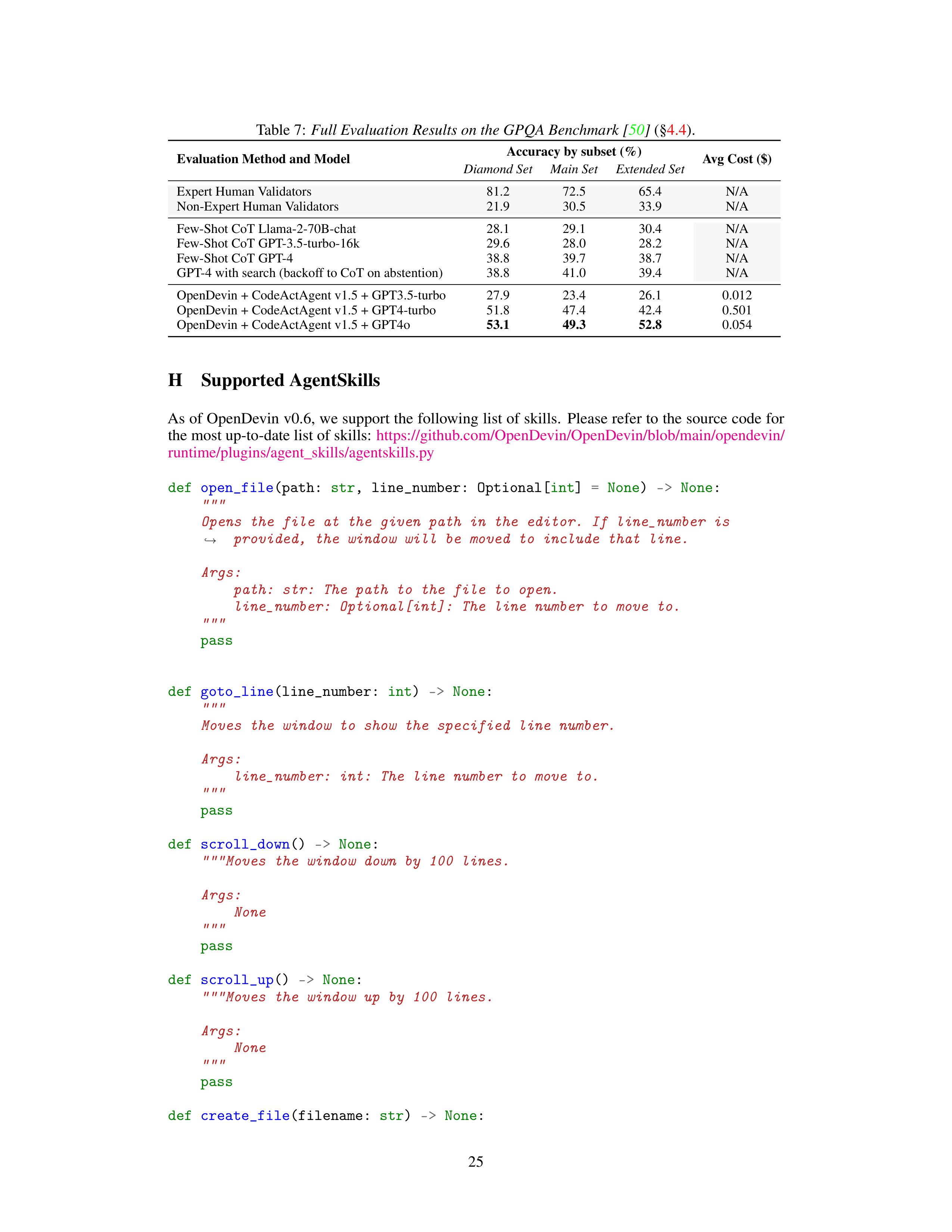
Table 7:
Full Evaluation Results on the GPQA Benchmark [
50
]
(§
4.4
).
Evaluation Method and Model
Accuracy by subset (%)
Avg Cost ($)
Diamond Set
Main Set
Extended Set
Expert Human Validators
81.2
72.5
65.4
N/A
Non-Expert Human Validators
21.9
30.5
33.9
N/A
Few-Shot CoT Llama-2-70B-chat
28.1
29.1
30.4
N/A
Few-Shot CoT GPT-3.5-turbo-16k
29.6
28.0
28.2
N/A
Few-Shot CoT GPT-4
38.8
39.7
38.7
N/A
GPT-4 with search (backoff to CoT on abstention)
38.8
41.0
39.4
N/A
OpenDevin + CodeActAgent v1.5 + GPT3.5-turbo
27.9
23.4
26.1
0.012
OpenDevin + CodeActAgent v1.5 + GPT4-turbo
51.8
47.4
42.4
0.501
OpenDevin + CodeActAgent v1.5 + GPT4o
53.1
49.3
52.8
0.054
H
Supported AgentSkills
As of OpenDevin v0.6, we support the following list of skills.
Please refer to the source code for
the most up-to-date list of skills:
https://github.com/OpenDevin/OpenDevin/blob/main/opendevin/
runtime/plugins/agent_skills/agentskills.py
def
open_file
(path:
str
,
line_number:
Optional[
int
]
=
None
)
->
None
:
"""
Opens
the
file
at
the
given
path
in
the
editor.
If
line_number
is
provided,
the
window
will
be
moved
to
include
that
line.
,
→
Args:
path:
str:
The
path
to
the
file
to
open.
line_number:
Optional[int]:
The
line
number
to
move
to.
"""
pass
def
goto_line
(line_number:
int
)
->
None
:
"""
Moves
the
window
to
show
the
specified
line
number.
Args:
line_number:
int:
The
line
number
to
move
to.
"""
pass
def
scroll_down
()
->
None
:
"""Moves
the
window
down
by
100
lines.
Args:
None
"""
pass
def
scroll_up
()
->
None
:
"""Moves
the
window
up
by
100
lines.
Args:
None
"""
pass
def
create_file
(filename:
str
)
->
None
:
25
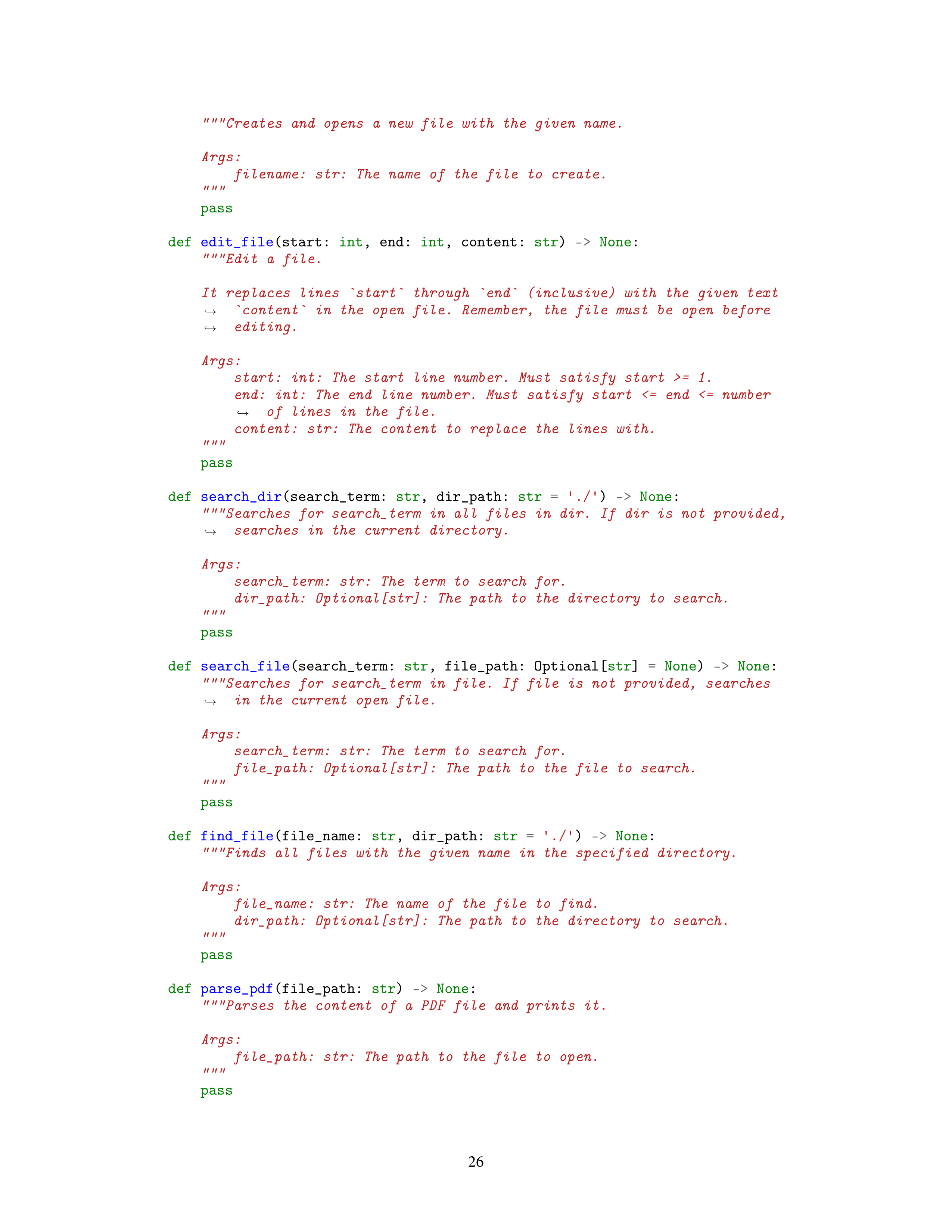
"""Creates
and
opens
a
new
file
with
the
given
name.
Args:
filename:
str:
The
name
of
the
file
to
create.
"""
pass
def
edit_file
(start:
int
,
end:
int
,
content:
str
)
->
None
:
"""Edit
a
file.
It
replaces
lines
`start`
through
`end`
(inclusive)
with
the
given
text
`content`
in
the
open
file.
Remember,
the
file
must
be
open
before
editing.
,
→
,
→
Args:
start:
int:
The
start
line
number.
Must
satisfy
start
>=
1.
end:
int:
The
end
line
number.
Must
satisfy
start
<=
end
<=
number
of
lines
in
the
file.
,
→
content:
str:
The
content
to
replace
the
lines
with.
"""
pass
def
search_dir
(search_term:
str
,
dir_path:
str
=
'./'
)
->
None
:
"""Searches
for
search_term
in
all
files
in
dir.
If
dir
is
not
provided,
searches
in
the
current
directory.
,
→
Args:
search_term:
str:
The
term
to
search
for.
dir_path:
Optional[str]:
The
path
to
the
directory
to
search.
"""
pass
def
search_file
(search_term:
str
,
file_path:
Optional[
str
]
=
None
)
->
None
:
"""Searches
for
search_term
in
file.
If
file
is
not
provided,
searches
in
the
current
open
file.
,
→
Args:
search_term:
str:
The
term
to
search
for.
file_path:
Optional[str]:
The
path
to
the
file
to
search.
"""
pass
def
find_file
(file_name:
str
,
dir_path:
str
=
'./'
)
->
None
:
"""Finds
all
files
with
the
given
name
in
the
specified
directory.
Args:
file_name:
str:
The
name
of
the
file
to
find.
dir_path:
Optional[str]:
The
path
to
the
directory
to
search.
"""
pass
def
parse_pdf
(file_path:
str
)
->
None
:
"""Parses
the
content
of
a
PDF
file
and
prints
it.
Args:
file_path:
str:
The
path
to
the
file
to
open.
"""
pass
26
def
parse_docx
(file_path:
str
)
->
None
:
"""
Parses
the
content
of
a
DOCX
file
and
prints
it.
Args:
file_path:
str:
The
path
to
the
file
to
open.
"""
pass
def
parse_latex
(file_path:
str
)
->
None
:
"""
Parses
the
content
of
a
LaTex
file
and
prints
it.
Args:
file_path:
str:
The
path
to
the
file
to
open.
"""
pass
def
parse_audio
(file_path:
str
,
model:
str
=
'whisper-1'
)
->
None
:
"""
Parses
the
content
of
an
audio
file
and
prints
it.
Args:
file_path:
str:
The
path
to
the
audio
file
to
transcribe.
model:
Optional[str]:
The
audio
model
to
use
for
transcription.
Defaults
to
'whisper-1'.
,
→
"""
pass
def
parse_image
(
file_path:
str
,
task:
str
=
'Describe
this
image
as
detail
as
possible.'
,
→
)
->
None
:
"""
Parses
the
content
of
an
image
file
and
prints
the
description.
Args:
file_path:
str:
The
path
to
the
file
to
open.
task:
Optional[str]:
The
task
description
for
the
API
call.
Defaults
to
'Describe
this
image
as
detail
as
possible.'.
,
→
"""
pass
def
parse_video
(
file_path:
str
,
task:
str
=
'Describe
this
image
as
detail
as
possible.'
,
frame_interval:
int
=
30
,
)
->
None
:
"""
Parses
the
content
of
an
image
file
and
prints
the
description.
Args:
file_path:
str:
The
path
to
the
video
file
to
open.
task:
Optional[str]:
The
task
description
for
the
API
call.
Defaults
to
'Describe
this
image
as
detail
as
possible.'.
,
→
frame_interval:
Optional[int]:
The
interval
between
frames
to
analyze.
Defaults
to
30.
,
→
27
"""
pass
def
parse_pptx
(file_path:
str
)
->
None
:
"""
Parses
the
content
of
a
pptx
file
and
prints
it.
Args:
file_path:
str:
The
path
to
the
file
to
open.
"""
pass
I
BrowserGym Actions
The following are all the supported actions defined in BrowserGym
8
as of v0.3.4.
The actions can
be
categorized
into
several
types
and
can
be
configured
to
use
only
a
subset
of
the
functionality.
There are agent control actions, navigation actions, page element-based actions, coordinate-based
actions, as well as tab-related actions.
We use these actions from the BrowserGym library as our
main browsing action primitives.
def
send_msg_to_user
(text:
str
):
"""
Sends
a
message
to
the
user.
Examples:
send_msg_to_user("Based
on
the
results
of
my
search,
the
city
was
built
in
1751.")
,
→
"""
pass
def
report_infeasible
(reason:
str
):
"""
Notifies
the
user
that
their
instructions
are
infeasible.
Examples:
report_infeasible("I
cannot
follow
these
instructions
because
there
is
no
email
field
in
this
form.")
,
→
"""
pass
def
noop
(wait_ms:
float
=
1000
):
"""
Do
nothing,
and
optionally
wait
for
the
given
time
(in
milliseconds).
Examples:
noop()
noop(500)
"""
pass
#
https://playwright.dev/docs/input#text-input
def
fill
(bid:
str
,
value:
str
):
"""
8
https://github.com/ServiceNow/BrowserGym/blob/main/core/src/browsergym/core/action/functions.py
28
Fill
out
a
form
field.
It
focuses
the
element
and
triggers
an
input
event
with
the
entered
text.
,
→
It
works
for
,