


Fonologi: Jurnal Ilmuan Bahasa dan Sastra Inggris
Volume 3, Nomor 4, Desember 2025
e-ISSN: 3025-6003, p-ISSN: 3025-5996, Hal 101-112
DOI:
https://doi.org/10.61132/fonologi.v3i4.2605
Tersedia:
https://journal.aspirasi.or.id/index.php/Fonologi
Naskah Masuk: 31 Oktober 2025; Revisi: 28 November 2025; Diterima: 26 Desember 2025;
Terbit: 30 Desember 2025
Integrating Perplexity AI into Academic Research: A Study on Research
Gap Analysis and Proposal Development
Dio Manik
1*
, Yeni Adventry Tanjung
2
, Rita Hartati
3
1-3
Department of English Language and Literature Education, Faculty of Languages and Arts, Universitas
Negeri Medan, Indonesia
*
Author correspondence:
dioman3030@gmail.com
1
Abstract
. This study examines how Perplexity AI is integrated into academic research, particularly its role in
research gap analysis and proposal development among university students. Using a qualitative descriptive
method and questionnaire data from 32 participants, the research explores students’ perceptions, benefits, and
ethical considerations regarding AI- assisted research. The findings reveal that Perplexity AI improves efficiency
in literature review and research gap identification, with 75% of students using it to explore research topics and
65.6% acknowledging its usefulness in recognizing trends and gaps. However, concerns remain about accuracy
and source reliability, as only 56.3% fully trust AI-generated results, and many still verify information manually.
The study concludes that effective use of Perplexity AI requires strong AI literacy that includes critical thinking,
verification skills, and ethical awareness. These insights contribute to a broader understanding of human–AI
collaboration in academic settings and highlight the need for responsible, well-guided integration of AI tools in
research education.
Keywords
: Academic Integrity; AI Literacy; Proposal Development; Research Gap; Student Perceptions
1.
INTRODUCTION
From an AI perspective, the integration of Artificial Intelligence (AI) into academic
research has changed how researchers identify research gaps and develop proposals. AI allows
users to explore large amounts of data, summarize information, and point out areas that need
more study, which are key parts of research gap analysis. These abilities help scholars create
clearer research goals and build well-organized frameworks for proposal development. In the
academic setting, AI acts as both a thinking and analytical partner that improves decision-
making, efficiency, and innovation. Therefore, the connection between AI, research gap
analysis, and proposal development shows a new academic pattern where technology supports
human creativity and critical thinking in producing scientific knowledge.
According to Duong (2024), students’ positive perceptions of AI usage significantly
correlate with their willingness to adopt AI‐assisted tools in academic research settings,
suggesting that AI can reduce barriers in literature exploration and proposal development. Abou
Elmagd (2025) further observed that AI integration in English language and literature research
enhances analytical capabilities and the efficiency of identifying research gaps, albeit with risks
such as diminished critical thinking and ethical concerns. Winarti et al. (2025) found that in
EFL contexts, AI tools improved students’ abilities to design coherent thesis proposals by
providing structured support for writing and idea generation. These findings reinforce the idea
that AI tools like Perplexity AI play a vital role in bridging the gap between information
Integrating Perplexity AI into Academic Research: A Study on Research Gap Analysis and Proposal
Development
102
FONOLOGI
- VOLUME 3, NOMOR 4, DESEMBER 2025
retrieval and research design, enabling students to create more structured, evidence‐based, and
innovative proposals. However, all studies also caution that human judgment and ethical
awareness remain crucial to preserving academic integrity and authenticity.
This study focuses on exploring the role of Perplexity AI in facilitating research gap
identification and proposal development among university students and researchers.
Specifically, it aims to analyze how AI tools influence the effectiveness, accuracy, and
creativity of academic research planning. The expected outcomes suggest that Perplexity AI
enhances efficiency, improves research quality, and promotes deeper analytical reasoning when
used responsibly. Therefore, this study seeks to contribute to a broader understanding of how
AI can be integrated ethically and productively into academic research to foster innovation
while maintaining scholarly rigor and human oversight.
2.
LITERATURE REVIEW
Artificial Intelligence (AI) has significantly reshaped academic research, offering new
ways to collect, analyze, and interpret information. According to Russell and Norvig (2021),
AI enables systems to simulate human reasoning and decision-making, allowing for more
efficient problem-solving in complex cognitive tasks such as research development and
proposal design. Within this context, AI-based platforms like Perplexity AI have emerged as
intelligent tools that assist researchers in identifying research gaps, synthesizing literature, and
structuring academic proposals effectively.
Recent studies emphasize the role of Perplexity AI as a multifunctional tool in academic
writing and research. Patia et al. (2025) found that Perplexity AI supports users in literature
review, idea generation, and research gap identification, helping to build more coherent and
evidence-based research proposals. Similarly, Sudi et al. (2025) showed that training students
to use Perplexity AI enhances research quality and efficiency, highlighting its importance as a
supportive instrument in higher education. Both studies indicate that integrating Perplexity AI
into research practice encourages critical and analytical thinking.
In the area of academic writing, Lubis and Rahman Hz (2024) revealed that Perplexity
AI improves writing efficiency among EFL students by offering relevant resources and
structural guidance. Hasanah et al. (2025) also reported that students perceive Perplexity AI as
helpful for improving writing accuracy and organization, although they caution against
overdependence on AI-generated content. These findings align with Bailey (2015), who
emphasizes that academic writing must still prioritize critical engagement and original thought,
even when supported by digital tools.
e-ISSN: 3025-6003, p-ISSN: 3025-5996, Hal 101-112
Comparative studies further demonstrate the advantages of Perplexity AI in academic
contexts. Raza (2025) compared ChatGPT and Perplexity AI, finding that Perplexity produces
more concise, source-based, and evidence-oriented information suitable for scholarly work.
This makes it particularly useful for research gap analysis and proposal development, where
precision and credibility are essential. Additionally, Hwang and Lee (2025), as well as Woo
and Cho (2025), found that human–AI collaboration promotes creativity and self-regulated
learning when students are guided to use AI responsibly within academic settings.
Supporting this view, the Center for Innovation, Design, and Digital Learning (2024)
asserts that the integration of AI into education promotes innovation and accessibility, helping
learners engage more effectively with digital resources. This reinforces the notion that AI tools
like Perplexity are not mere shortcuts but catalysts for more informed and structured academic
inquiry.Overall, the reviewed literature suggests that integrating Perplexity AI into academic
research enhances efficiency, clarity, and critical engagement in both research gap analysis and
proposal development. While the technology offers significant benefits, its effective use
depends on users’ digital literacy and ethical awareness. Thus, future research should explore
frameworks for incorporating Perplexity AI responsibly into research education, ensuring that
technological assistance strengthens, rather than replaces, human intellectual contribution.
Several previous studies have highlighted the growing importance of integrating
Perplexity AI into academic research to improve writing efficiency, analytical reasoning, and
ethical awareness. According to Russell and Norvig (2021), intelligent systems simulate human
reasoning to support structured decision-making, forming the theoretical basis for AI-assisted
research. Building on this, Bailey (2015) emphasized that academic writing requires critical
thinking and organization, which AI tools can enhance. Lubis and Rahman (2024) and Hasanah
et al. (2025) found that Perplexity AI improves students’ writing accuracy, coherence, and
efficiency. Patia et al. (2025) showed that it helps identify research gaps and develop well-
structured proposals, while Raza (2025) confirmed that Perplexity provides concise, evidence-
based academic outputs. In Indonesia, Sudi et al. (2025) revealed that AI socialization
enhances research quality. Studies by Hwang and Lee (2025) and Woo and Cho (2025) further
noted that human AI collaboration fosters creativity, independence, and reflective thinking.
Lastly, the Center for Innovation, Design, and Digital Learning (2024) asserted that AI
supports inclusive and innovative learning. Collectively, these findings affirm that Perplexity
AI serves as an effective academic partner in research gap analysis and proposal development.
Integrating Perplexity AI into Academic Research: A Study on Research Gap Analysis and Proposal
Development
104
FONOLOGI
- VOLUME 3, NOMOR 4, DESEMBER 2025
3.
METHODOLOGY
This study employed a qualitative descriptive approach to explore students’ perceptions
and experiences in using Perplexity AI for research gap analysis and proposal development.
The qualitative descriptive method was chosen because it allows the researcher to provide a
detailed and contextual understanding of participants’ responses without manipulating
variables. Data were collected through a Google Form questionnaire, which consisted of open-
ended and close-ended questions designed to capture students’ opinions, attitudes, and
reflections regarding the use of AI tools in academic research. The questionnaire link was
distributed to undergraduate students from various departments, ensuring diverse perspectives
on how Perplexity AI supports their research activities. The data collection process took
approximately two weeks, during which responses were gathered, validated, and categorized
according to thematic relevance.
The data analysis process in this study integrated narrative analysis to obtain a
comprehensive understanding of students’ perceptions regarding the use of Perplexity AI in
research gap identification and proposal development. Resulting in categories such as
Perceived Benefits, Ethical Concerns, and Critical Thinking Enhancement. Narrative analysis
was employed to interpret representative responses that illustrated the sequence of students’
experiences in using Perplexity AI from identifying research gaps to developing proposals and
addressing ethical challenges. This analytical approach offered both descriptive and
interpretive insights, ensuring a balanced understanding of the academic value, challenges, and
implications of AI-assisted research in higher education.
4.
RESULT AND DISCUSSION
Result
The findings of this study show that students are able to use Perplexity AI effectively
to support their academic research, especially in tasks related to identifying research gaps and
developing research proposals. Many students reported that Perplexity AI helps them organize
the background and problem statement sections more clearly by providing structured
explanations and helping them arrange ideas in a logical order. The tool also supports the
development of proposal components such as decision tables, research objectives, and
hypotheses, which students often find difficult to formulate on their own. Although Perplexity
AI offers helpful summaries and suggestions, most students still choose to verify the
information with original academic sources, showing that they use the tool responsibly and
maintain critical thinking. Overall, these findings indicate that Perplexity AI functions as an
e-ISSN: 3025-6003, p-ISSN: 3025-5996, Hal 101-112
effective supporting tool that improves students’ abilities in gap identification and proposal
development, while still encouraging them to think carefully about the information they use.
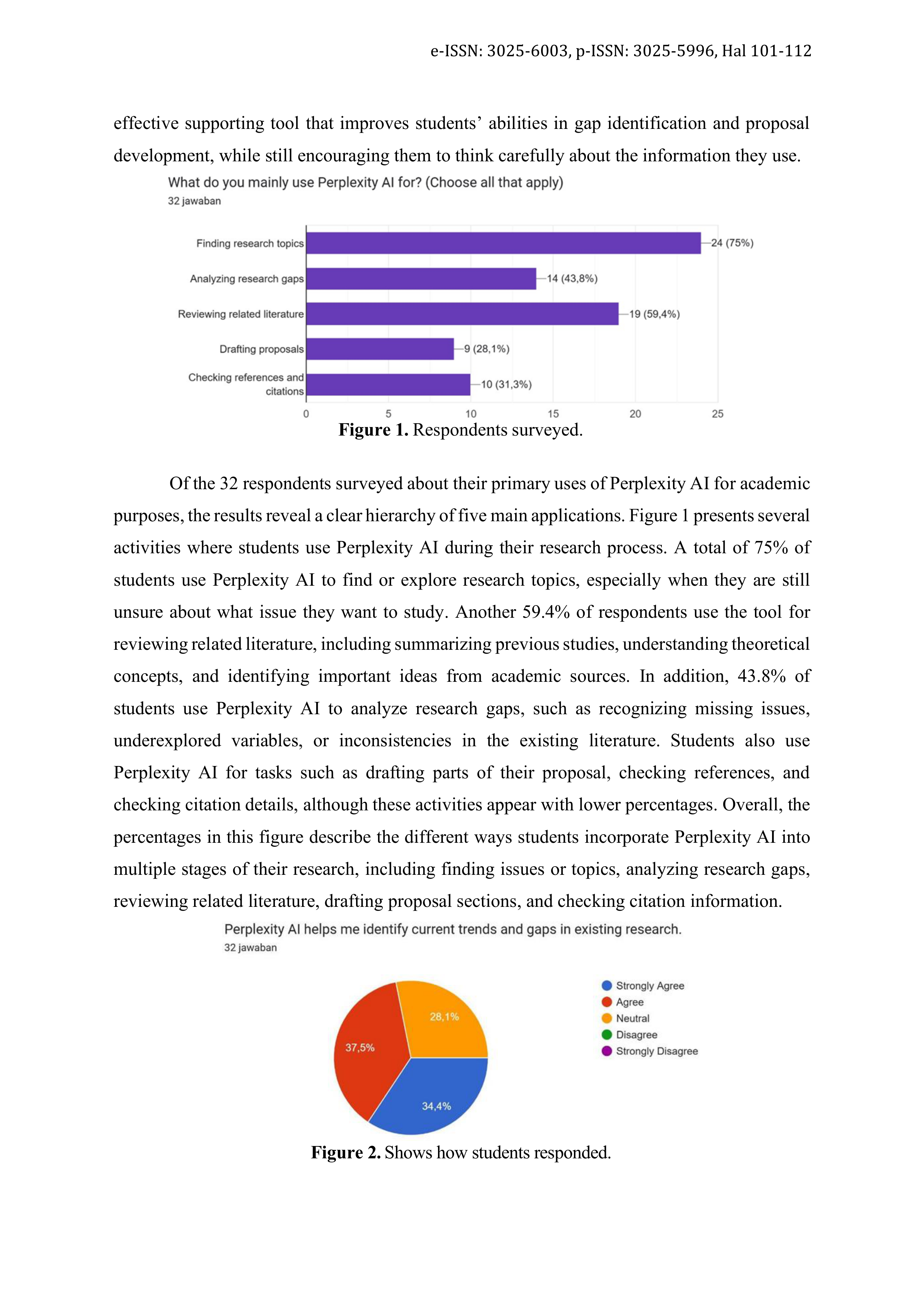
Figure 1.
Respondents surveyed.
Of the 32 respondents surveyed about their primary uses of Perplexity AI for academic
purposes, the results reveal a clear hierarchy of five main applications. Figure 1 presents several
activities where students use Perplexity AI during their research process. A total of 75% of
students use Perplexity AI to find or explore research topics, especially when they are still
unsure about what issue they want to study. Another 59.4% of respondents use the tool for
reviewing related literature, including summarizing previous studies, understanding theoretical
concepts, and identifying important ideas from academic sources. In addition, 43.8% of
students use Perplexity AI to analyze research gaps, such as recognizing missing issues,
underexplored variables, or inconsistencies in the existing literature. Students also use
Perplexity AI for tasks such as drafting parts of their proposal, checking references, and
checking citation details, although these activities appear with lower percentages. Overall, the
percentages in this figure describe the different ways students incorporate Perplexity AI into
multiple stages of their research, including finding issues or topics, analyzing research gaps,
reviewing related literature, drafting proposal sections, and checking citation information.
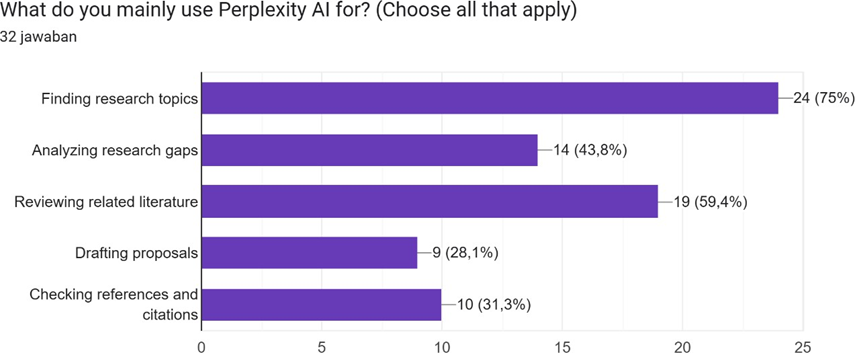
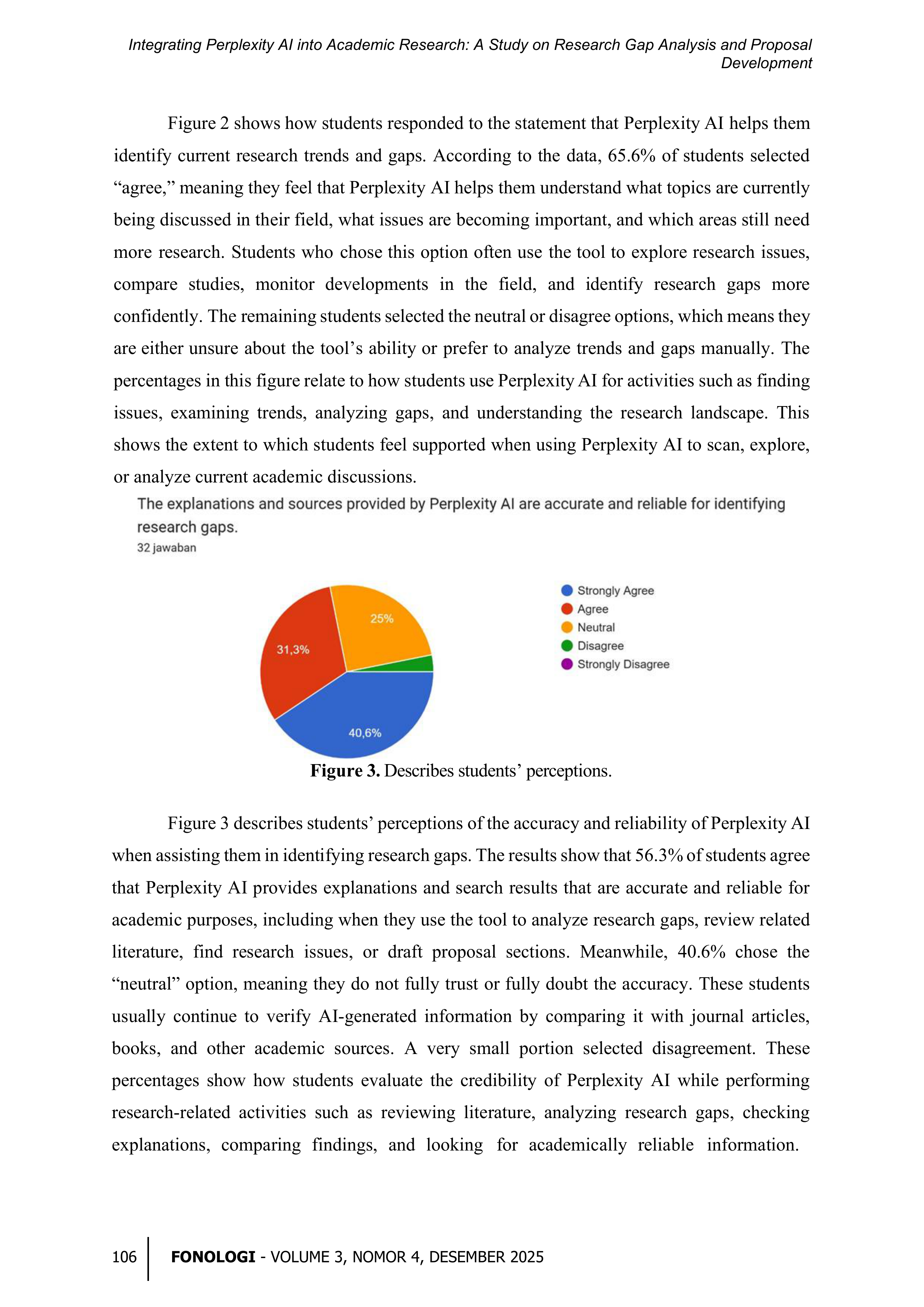
Figure 2.
Shows how students responded.
Integrating Perplexity AI into Academic Research: A Study on Research Gap Analysis and Proposal
Development
106
FONOLOGI
- VOLUME 3, NOMOR 4, DESEMBER 2025
Figure 2 shows how students responded to the statement that Perplexity AI helps them
identify current research trends and gaps. According to the data, 65.6% of students selected
“agree,” meaning they feel that Perplexity AI helps them understand what topics are currently
being discussed in their field, what issues are becoming important, and which areas still need
more research. Students who chose this option often use the tool to explore research issues,
compare studies, monitor developments in the field, and identify research gaps more
confidently. The remaining students selected the neutral or disagree options, which means they
are either unsure about the tool’s ability or prefer to analyze trends and gaps manually. The
percentages in this figure relate to how students use Perplexity AI for activities such as finding
issues, examining trends, analyzing gaps, and understanding the research landscape. This
shows the extent to which students feel supported when using Perplexity AI to scan, explore,
or analyze current academic discussions.
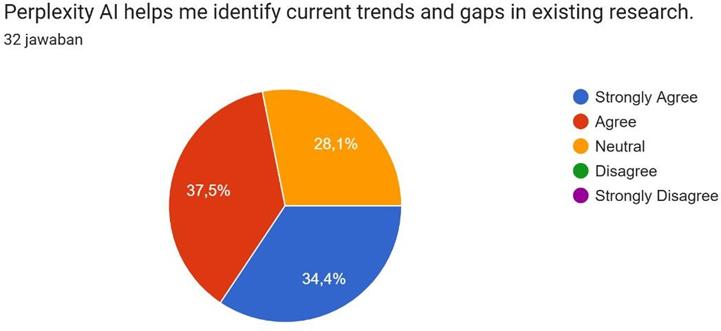
Figure 3.
Describes students’ perceptions.
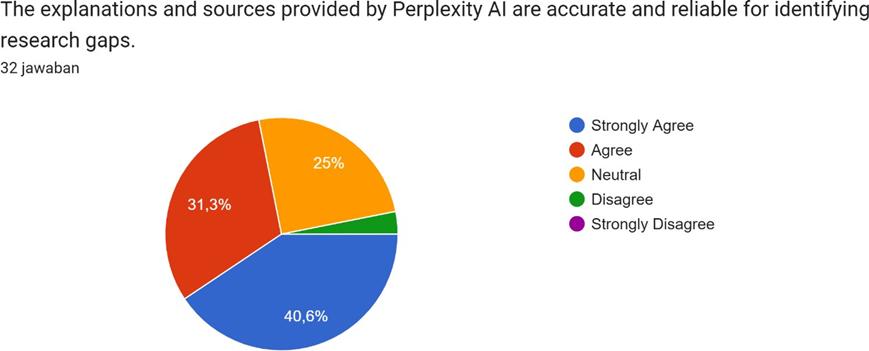
Figure 3 describes students’ perceptions of the accuracy and reliability of Perplexity AI
when assisting them in identifying research gaps. The results show that 56.3% of students agree
that Perplexity AI provides explanations and search results that are accurate and reliable for
academic purposes, including when they use the tool to analyze research gaps, review related
literature, find research issues, or draft proposal sections. Meanwhile, 40.6% chose the
“neutral” option, meaning they do not fully trust or fully doubt the accuracy. These students
usually continue to verify AI-generated information by comparing it with journal articles,
books, and other academic sources. A very small portion selected disagreement. These
percentages show how students evaluate the credibility of Perplexity AI while performing
research-related activities such as reviewing literature, analyzing research gaps, checking
explanations, comparing findings, and looking
for academically reliable
information.
e-ISSN: 3025-6003, p-ISSN: 3025-5996, Hal 101-112
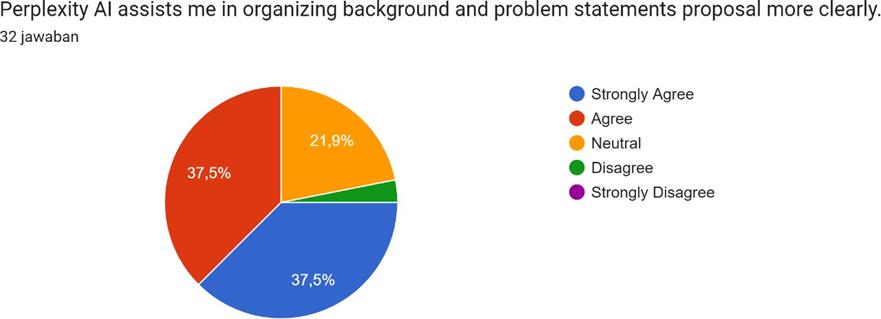
Figure 4.
Presents students’ responses.
Figure 4 presents students’ responses to the statement that Perplexity AI helps them
organize the background and problem statement of their research proposal. According to the
chart, 59.4% of students agree that Perplexity AI provides useful support when they are writing
or organizing these parts of the proposal. Students who selected “agree” often use Perplexity
AI to explain research issues, connect ideas from previous studies, summarize related literature,
and structure the problem statement more clearly. Some students also use the tool during
drafting proposal sections, including background, problem statements, and early research
arguments. The remaining students selected neutral or disagree, showing different levels of
comfort with using AI in proposal writing. Overall, the percentages in this figure reflect how
Perplexity AI assists students in tasks such as organizing the proposal background, identifying
the main issue in the study, connecting literature, drafting proposal content, and clarifying the
research problem.
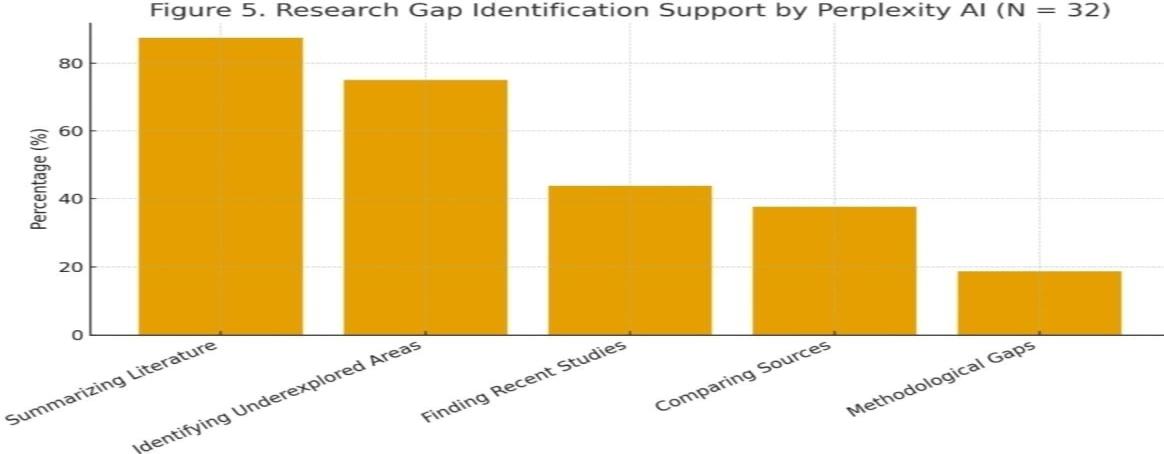
Figure 5.
Shows a detailed summary.
Figure 5 shows a detailed summary of how Perplexity AI helps students identify
research gaps based on responses from 32 participants. Most students, 87.5%, said that
Perplexity AI is helpful because it can quickly summarize many studies, making it easier for
Integrating Perplexity AI into Academic Research: A Study on Research Gap Analysis and Proposal
Development
108
FONOLOGI
- VOLUME 3, NOMOR 4, DESEMBER 2025
them to understand what has already been discussed in the literature without reading long
academic texts. Then, 75% of the participants shared that the tool helps them spot areas that
are still underexplored, meaning they can more easily see what topics or issues have not been
fully studied. Another 43.75% stated that Perplexity AI supports them by providing access to
recent studies and updated information, which helps them ensure that their research stays
relevant to current academic developments. Meanwhile, 37.5% of the respondents said that the
tool helps them compare multiple sources at once, making it easier to evaluate similarities,
differences, and patterns across various studies. Additionally, 18.75% mentioned that
Perplexity AI helps them identify methodological problems, such as limited data, unclear
research designs, or conflicting findings in previous studies. Overall, the results show that
Perplexity AI provides strong support in several aspects of research gap identification,
especially in summarizing literature, highlighting missing areas, and offering updated
academic information.
Discussion
This study interprets its findings through Sweller’s Cognitive Load Theory, which
explains how learning effectiveness is influenced by the way information is processed in the
human mind. According to this theory, students’ performance improves when unnecessary
mental effort is reduced and when cognitive resources are directed toward meaningful learning
tasks. The results from Figures 1–5 show that Perplexity AI plays an important role in
managing students’ cognitive load during the stages of research gap identification and proposal
development. By helping students access organized information, summarize complex
literature, and structure academic arguments, Perplexity AI appears to reduce extraneous
cognitive load while simultaneously increasing germane cognitive load that supports deeper
understanding and better research performance. Based on this theoretical lens, the following
discussion explains how the empirical findings demonstrate Perplexity AI’s contribution to
students’ research processes.
Reduction of Extraneous Cognitive Load in Research Gap Analysis
Identifying research gaps normally requires students to read many articles, compare
different findings, and connect ideas across multiple studies. These activities create a high level
of extraneous cognitive load, because the mental effort used for searching, scanning, and
sorting information does not directly contribute to understanding the core concepts. The
findings in Figure 2 and Figure 3 show that Perplexity AI reduces this unnecessary load by
providing clear summaries, identifying main themes, and highlighting patterns in the literature.
Students no longer need to manually process a large amount of raw text, which helps them
e-ISSN: 3025-6003, p-ISSN: 3025-5996, Hal 101-112
focus more on understanding the essential academic content. This reduced cognitive burden
supports the finding in Figure 5, where 80% of respondents reported that Perplexity AI helps
them improve their ability to identify research gaps more efficiently and confidently.
Increased Germane Cognitive Load for Proposal Development
Sweller explains that germane cognitive load supports deeper learning because it directs
mental effort toward meaningful tasks, such as building new knowledge structures. In the
context of proposal development, students need to organize ideas, understand the structure of
academic writing, and develop logical arguments. The results in Figure 4 and Figure 5 show
that Perplexity AI helps students create clearer background sections, more coherent problem
statements, and more organized proposal outlines. By reducing the technical workload such as
rearranging information or rewriting unclear ideas Perplexity AI allows students to use their
cognitive resources for deeper tasks, including formulating concepts and strengthening
academic reasoning. This explains why 85% of respondents felt an improvement in their overall
proposal quality after using Perplexity AI.
Cognitive Scaffolding Across the Research Process
Perplexity AI also functions as a tool that provides cognitive scaffolding throughout the
entire research workflow. During the topic exploration stage (Figure 1), students receive
guidance in identifying possible research directions. During the gap analysis stage (Figures 2
& 3), the tool helps them understand existing discussions by reinforcing key concepts and
patterns. During the proposal writing stage (Figure 4), Perplexity AI offers structured guidance
that helps students form a logical academic narrative. Because support is provided at every
step, students experience a more organized and manageable research process, which aligns with
the improvements shown in Figure 5, where multiple aspects of research performance show
positive development. This indicates that Perplexity AI not only reduces cognitive burden, but
also strengthens learning effectiveness through consistent structural support.
5.
CONCLUSION
The findings of this study show that Perplexity AI provides meaningful support for
students throughout the stages of academic research, especially in identifying research gaps
and developing research proposals. Students report that the tool helps them explore research
topics, understand theoretical concepts, and review related literature more efficiently.
Perplexity AI also assists in recognizing current research trends, highlighting underexplored
areas, and summarizing multiple studies, making the process of gap identification clearer and
more manageable. In proposal development, Perplexity AI helps students organize the
Integrating Perplexity AI into Academic Research: A Study on Research Gap Analysis and Proposal
Development
110
FONOLOGI
- VOLUME 3, NOMOR 4, DESEMBER 2025
background and problem statement sections, connect ideas from previous studies, and structure
academic arguments with greater coherence. Although students find the tool helpful and often
rely on its explanations, many still verify information using academic sources, showing that
they maintain critical thinking and prioritize accuracy. Viewed through Sweller’s Cognitive
Load Theory, the results indicate that Perplexity AI reduces unnecessary cognitive load by
simplifying complex information and streamlining the search and synthesis process. At the
same time, it enhances meaningful cognitive engagement by allowing students to focus on
deeper reasoning, conceptual development, and the construction of stronger proposal
frameworks. This study concludes that Perplexity AI functions as an effective cognitive and
analytical aid in academic research. Its benefits are maximized when paired with students’
critical evaluation skills, ethical awareness, and proper guidance, ensuring that AI strengthens
rather than replaces their intellectual work.
REFERENCES
Bailey, S. (2014).
Academic writing: A handbook for international students
. Routledge.
https://elearn.almamonuc.edu.iq/storage/888/66203341b64d1_Academic-Writing-A-
Handbook-for-International-Students.pdf
Banjade, S., Patel, H., & Pokhrel, S. (2024). Empowering education by developing and
evaluating generative AI-powered tutoring system for enhanced student learning.
Journal of Artificial Intelligence and Capsule Networks, 6
(3), 278–298.
https://doi.org/10.36548/jaicn.2024.3.003
Center for Innovation, Design, and Digital Learning. (2024).
Artificial intelligence: The impact
of AI on education for all learners
. University of Kansas, School of Education and
Human
Sciences.
https://ciddl.org/wp-content/uploads/2025/03/Artificial-
Intelligence-The-Impact-of-AI-on-Education-for-All-Learners.pdf
Celik, I., Dindar, M., Muukkonen, H., & Järvelä, S. (2022). The promises and challenges of
artificial intelligence for teachers: A systematic review of research.
TechTrends,
66
(4), 616–630.
https://doi.org/10.1007/s11528-022-00715-y
Chiu, T. K., Xia, Q., Zhou, X., Chai, C. S., & Cheng, M. (2023). Systematic literature review
on opportunities, challenges, and future research recommendations of artificial
intelligence in education.
Computers and Education: Artificial Intelligence, 4
,
100118.
https://doi.org/10.1016/j.caeai.2022.100118
Crompton, H., & Burke, D. (2023). Artificial intelligence in higher education: The state of the
field.
International Journal of Educational Technology in Higher Education, 20
(1),
Article 22.
https://doi.org/10.1186/s41239-023-00392-8
Duong, N. H., Tran, K. L., Do, B. N., & Duong, T. T. Q. (2024). The relationship between
students’ perceptions of AI applications and intention to use: Mediating role of
satisfaction. In
Proceedings of the 2nd International Conference: Resiliency by
Technology
and
Design
(RTD
2024)
(pp.
245–271).
Atlantis
Press.
https://doi.org/10.2991/978-94-6463-583-6_12
e-ISSN: 3025-6003, p-ISSN: 3025-5996, Hal 101-112
Egunjobi, J. P. (2024). Artificial intelligence and academic writing: A global exploration of
student perceptions and attitudes.
West Africa Journal of Arts and Social Sciences,
4
(1). https://doi.org/10.13140/RG.2.2.23790.52800
Hasanah, R., Agustina, U. W., Nurul, N., Nur, L. C. N., & Fikri, A. K. (2025). Students'
perception of using Perplexity application in writing skills at English department.
SCHOOLAR:
Social
and
Literature
Study
in
Education,
5
(2),
9–12.
https://ejournal.unwaha.ac.id/index.php/jurnal_pengabdian/article/view/6019
Hwang, Y., & Lee, J. H. (2025). Exploring students’ experiences and perceptions of human–
AI collaboration in digital content making.
International Journal of Educational
Technology in Higher Education, 22
(1), Article 44.
https://doi.org/10.1186/s41239-
025-00542-0
Lubis, C. U., & Hz, B. I. R. (2024). Perplexity AI on the writing efficiency of EFL students in
higher education: Students' insight.
English Franca: Academic Journal of English
Language and Education, 8
(1), 167–178. https://doi.org/10.29240/ef.v8i1May.9982
Molenaar, I. (2022). Towards hybrid human–AI learning technologies.
European Journal of
Education, 57
(4), 632–645.
https://doi.org/10.1111/ejed.12527
Morgado, E., Leonido, L., Pereira, A., & Gouveia, L. B. (2025). Technology-mediated
education:
Impact
of
AI
on
the
main
distance
learning
modalities.
https://doi.org/10.22521/edupij.2025.16.211
Negoiță, D. O., & Popescu, M. A. M. (2023). The use of artificial intelligence in education. In
Proceedings of the International Conference of Management and Industrial
Engineering
(Vol. 11, pp. 208–214). https://doi.org/10.56177/11icmie2023.43
Ng, W. (2012). Can we teach digital natives digital literacy?
Computers & Education, 59
(3),
1065–1078.
https://doi.org/10.1016/j.compedu.2012.04.016
Ng, D. T. K., Leung, J. K. L., Chu, S. K. W., & Qiao, M. S. (2021). Conceptualizing AI literacy:
An exploratory review.
Computers and Education: Artificial Intelligence, 2
, 100041.
https://doi.org/10.1016/j.caeai.2021.100041
Özer, M. (2024). Potential benefits and risks of artificial intelligence in education.
Bartin
University
Journal
of
Faculty
of
Education,
13
(2).
https://doi.org/10.14686/buefad.1416087
Patia, N., Maulidiyah, A., Bahijah, I., Wongso, O., Irene, P. D., & Rahmawati, E. (2025). The
use of Perplexity AI in academic writing.
Wahana Pedagogika: Jurnal Ilmiah
Pendidikan dan Pembelajaran, 7
(1), 32–35.
https://doi.org/10.52166/wp.v7i1.9642
Raza, A., Rafiq, S., & Khalid, N. (2025). Artificial intelligence for writing English essays: A
comparative study of ChatGPT and Perplexity AI.
Journal of Applied Linguistics and
TESOL, 8
(1), 2538–2553. https://doi.org/10.32664/ic-itechs.v5i1.1611
Rukiati, E., Wicaksono, J. A., Taufan, G. T., & Suharsono, D. D. (2023). AI on learning
English: Application, benefit, and threat.
Journal of Language, Communication, and
Tourism, 1
(2), 32–40.
https://doi.org/10.25047/jlct.v1i2.3967
Russell, S., & Norvig, P. (2016).
Artificial intelligence: A modern approach
(3rd ed.). Pearson
Education.
http://repository.unimal.ac.id/id/eprint/1022
Stojanovic, L., Radojcic, V., Savic, S., Sandro, A., & Cvetkovic, D. S. (2023). The influence
of artificial intelligence on creative writing: Exploring the synergy between AI and
creative authorship.
International Journal of Engineering Inventions, 12
(12), 70–74.
Integrating Perplexity AI into Academic Research: A Study on Research Gap Analysis and Proposal
Development
112
FONOLOGI
- VOLUME 3, NOMOR 4, DESEMBER 2025
Sudi, M., Rais, R., & Marasabessy, N. C. (2025). Socialization of the use of Perplexity AI in
improving the quality of research and students in Indonesia.
Jurnal Pengabdian
Masyarakat dan Riset Pendidikan, 3
(4), 3583–3589.
Sweller, J. (1988). Cognitive load during problem solving: Effects on learning.
Cognitive
Science, 12
(2), 257–285.
https://doi.org/10.1207/s15516709cog1202_4
Sweller, J., van Merriënboer, J. J. G., & Paas, F. (1998). Cognitive architecture and
instructional
design.
Educational
Psychology
Review,
10
(3),
251–296.
https://doi.org/10.1023/A:1022193728205
Tahiru, F. (2021). AI in education: A systematic literature review.
Journal of Cases on
Information Technology, 23
(1), 1–20. https://doi.org/10.4018/JCIT.2021010101
Wang, X., Liu, Q., Pang, H., Tan, S. C., Lei, J., Wallace, M. P., & Li, L. (2023). What matters
in AI-supported learning: A study of human-AI interactions in language learning using
cluster analysis and epistemic network analysis.
Computers & Education, 194
,
104703. https://doi.org/10.1016/j.compedu.2022.104703
Winarti, H., Kholid, M. R., & Zakiyah, Z. (2025). Exploring EFL students’ attitudes of artificial
intelligence (AI) as a tool for writing English thesis proposals in higher education.
Cetta:
Jurnal
Ilmu
Pendidikan,
8
(2),
87–100.
https://doi.org/10.37329/cetta.v8i2.4076
Woo, H., & Cho, Y. Y. (2025). Human–AI collaboration: Students’ changing perceptions of
generative artificial intelligence and active learning strategies.
Sustainability, 17
(18),
8387.
https://doi.org/10.3390/su17188387
Zawacki-Richter, O., Marín, V. I., Bond, M., & Gouverneur, F. (2019). Systematic review of
research on artificial intelligence applications in higher education—Where are the
educators?
International Journal of Educational Technology in Higher Education,
16
(1), 1–27.
https://doi.org/10.1186/s41239-019-0171-0