

Preprint
T
OOL
LLM:
F
ACILITATING
L
ARGE
L
ANGUAGE
M
ODELS
TO
M
ASTER
16000+ R
EAL
-
WORLD
API
S
Yujia Qin
1
∗
, Shihao Liang
1
∗
, Yining Ye
1
, Kunlun Zhu
1
, Lan Yan
1
, Yaxi Lu
1
, Yankai Lin
3
†
,
Xin Cong
1
, Xiangru Tang
4
, Bill Qian
4
, Sihan Zhao
1
, Lauren Hong
1
, Runchu Tian
1
,
Ruobing Xie
5
, Jie Zhou
5
, Mark Gerstein
4
, Dahai Li
2
,
6
, Zhiyuan Liu
1
†
, Maosong Sun
1
†
1
Tsinghua University
2
ModelBest Inc.
3
Renmin University of China
4
Yale University
5
WeChat AI, Tencent Inc.
6
Zhihu Inc.
yujiaqin16@gmail.com
A
BSTRACT
Despite
the
advancements
of
open-source
large
language
models
(LLMs),
e.g.,
LLaMA, they remain significantly limited in tool-use capabilities, i.e., using exter-
nal tools (APIs) to fulfill human instructions.
The reason is that current instruction
tuning largely focuses on basic language tasks but ignores the tool-use domain.
This is in contrast to the excellent tool-use capabilities of state-of-the-art (SOTA)
closed-source LLMs, e.g., ChatGPT. To bridge this gap, we introduce ToolLLM,
a
general
tool-use
framework
encompassing
data
construction,
model
training,
and evaluation.
We first present ToolBench, an instruction-tuning dataset for tool
use,
which
is
constructed
automatically
using
ChatGPT.
Specifically,
the
con-
struction can be divided into three stages:
(i) API collection:
we collect
16
,
464
real-world RESTful APIs spanning
49
categories from RapidAPI Hub; (ii) instruc-
tion generation:
we prompt ChatGPT to generate diverse instructions involving
these APIs, covering both single-tool and multi-tool scenarios; (iii) solution path
annotation:
we
use
ChatGPT
to
search
for
a
valid
solution
path
(chain
of
API
calls)
for
each
instruction.
To
enhance
the
reasoning
capabilities
of
LLMs,
we
develop a novel depth-first search-based decision tree algorithm.
It enables LLMs
to
evaluate
multiple
reasoning
traces
and
expand
the
search
space.
Moreover,
to
evaluate
the
tool-use
capabilities
of
LLMs,
we
develop
an
automatic
evalu-
ator:
ToolEval.
Based
on
ToolBench,
we
fine-tune
LLaMA
to
obtain
an
LLM
ToolLLaMA, and equip it with a neural API retriever to recommend appropriate
APIs
for
each
instruction.
Experiments
show
that
ToolLLaMA
demonstrates
a
remarkable ability to execute complex instructions and generalize to unseen APIs,
and exhibits comparable performance to ChatGPT. Our ToolLLaMA also demon-
strates
strong
zero-shot
generalization
ability
in
an
out-of-distribution
tool-use
dataset:
APIBench.
The codes, trained models, and demo are publicly available at
https://github.com/OpenBMB/ToolBench
.
1
I
NTRODUCTION
Tool learning (Qin et al., 2023b) aims to unleash the power of large language models (LLMs) to effec-
tively interact with various tools (APIs) to accomplish complex tasks. By integrating LLMs with APIs,
we can greatly expand their utility and empower them to serve as efficient intermediaries between
users and the vast ecosystem of applications.
Although open-source LLMs, e.g., LLaMA (Touvron
et
al.,
2023a),
have
achieved
versatile
capabilities
through
instruction
tuning
(Taori
et
al.,
2023;
Chiang et al., 2023), they still lack the sophistication in performing higher-level tasks, such as appro-
priately interacting with tools (APIs) to fulfill complex human instruction.
This deficiency is because
current
instruction
tuning
largely
focuses
on
basic
language
tasks,
with
a
relative
neglect
of
the
tool-use domain.
On the other hand, current state-of-the-art (SOTA) LLMs (e.g., ChatGPT (OpenAI,
∗
Indicates equal contribution.
†
Corresponding author.
1
arXiv:2307.16789v2 [cs.AI] 3 Oct 2023














Preprint
API
Collection
Instruction
Generation
Solution Path
Annotation
LLaMA
ToolLLaMA
RapidAPI
Data Construction &
Train
&
Inference
ToolBench
SFT
Instructions & relevant APIs
API Retriever
Instruction
N
API Retriever
ToolEval
···
Retrieved APIs
Final Answer
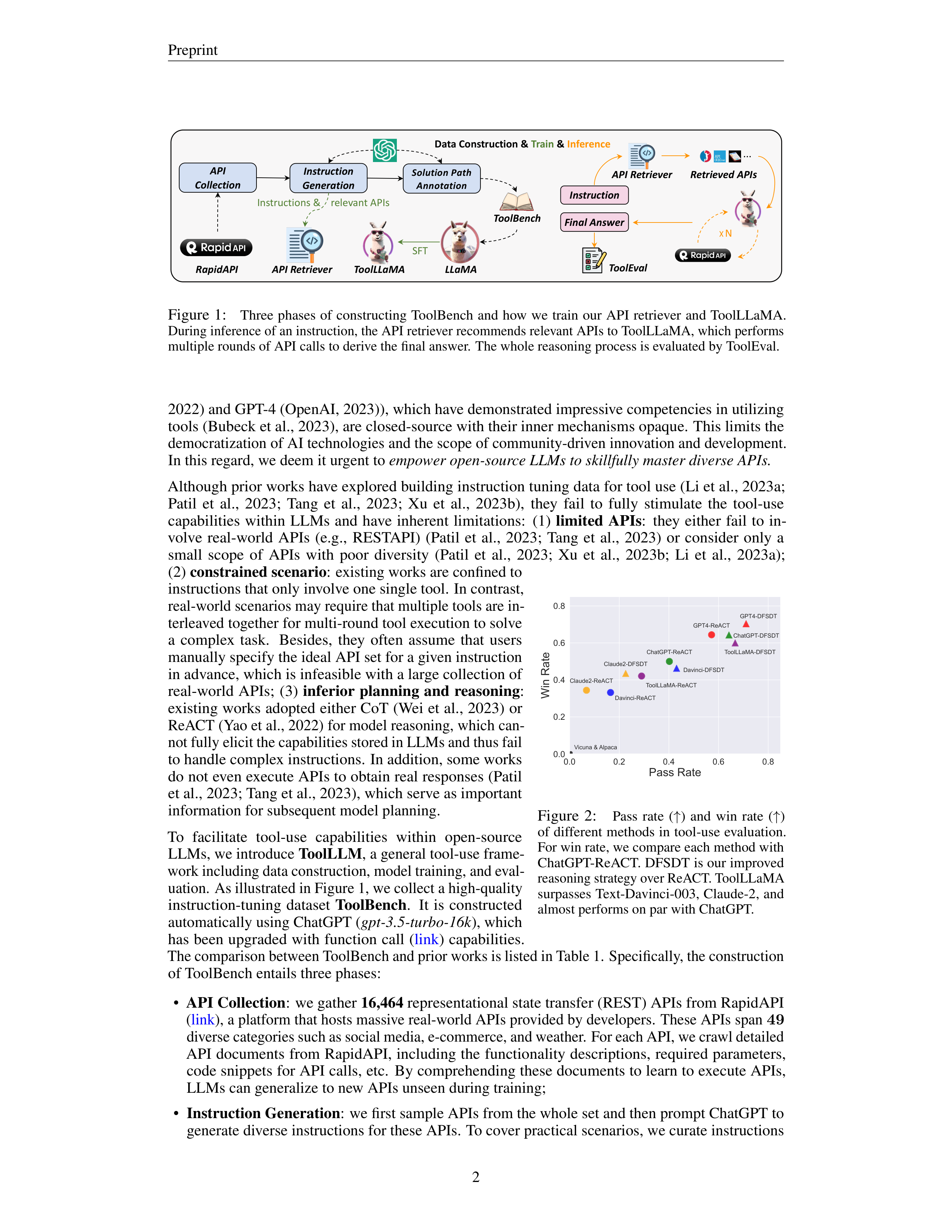
Figure
1:
Three
phases
of
constructing
ToolBench
and
how
we
train
our
API
retriever
and
ToolLLaMA.
During inference of an instruction, the API retriever recommends relevant APIs to ToolLLaMA, which performs
multiple rounds of API calls to derive the final answer.
The whole reasoning process is evaluated by ToolEval.
2022) and GPT-4 (OpenAI, 2023)), which have demonstrated impressive competencies in utilizing
tools (Bubeck et al., 2023), are closed-source with their inner mechanisms opaque.
This limits the
democratization of AI technologies and the scope of community-driven innovation and development.
In this regard, we deem it urgent to
empower open-source LLMs to skillfully master diverse APIs.
Although prior works have explored building instruction tuning data for tool use (Li et al., 2023a;
Patil
et
al.,
2023;
Tang
et
al.,
2023;
Xu
et
al.,
2023b),
they
fail
to
fully
stimulate
the
tool-use
capabilities
within
LLMs
and
have
inherent
limitations:
(1)
limited
APIs
:
they
either
fail
to
in-
volve
real-world
APIs
(e.g.,
RESTAPI)
(Patil
et
al.,
2023;
Tang
et
al.,
2023)
or
consider
only
a
small
scope
of
APIs
with
poor
diversity
(Patil
et
al.,
2023;
Xu
et
al.,
2023b;
Li
et
al.,
2023a);
0.0
0.2
0.4
0.6
0.8
Pass Rate
0.0
0.2
0.4
0.6
0.8
Win Rate
Vicuna & Alpaca
Davinci-ReACT
Davinci-DFSDT
Claude2-ReACT
Claude2-DFSDT
ChatGPT-ReACT
ChatGPT-DFSDT
ToolLLaMA-ReACT
ToolLLaMA-DFSDT
GPT4-ReACT
GPT4-DFSDT
Figure
2:
Pass
rate
(
↑
)
and
win
rate
(
↑
)
of different methods in tool-use evaluation.
For win rate, we compare each method with
ChatGPT-ReACT. DFSDT is our improved
reasoning strategy over ReACT. ToolLLaMA
surpasses Text-Davinci-003, Claude-2, and
almost performs on par with ChatGPT.
(2)
constrained scenario
:
existing works are confined to
instructions that only involve one single tool.
In contrast,
real-world scenarios may require that multiple tools are in-
terleaved together for multi-round tool execution to solve
a
complex
task.
Besides,
they
often
assume
that
users
manually specify the ideal API set for a given instruction
in advance, which is infeasible with a large collection of
real-world
APIs;
(3)
inferior
planning
and
reasoning
:
existing works adopted either CoT (Wei et al., 2023) or
ReACT (Yao et al., 2022) for model reasoning, which can-
not fully elicit the capabilities stored in LLMs and thus fail
to handle complex instructions.
In addition, some works
do not even execute APIs to obtain real responses (Patil
et al., 2023; Tang et al., 2023), which serve as important
information for subsequent model planning.
To
facilitate
tool-use
capabilities
within
open-source
LLMs, we introduce
ToolLLM
, a general tool-use frame-
work including data construction, model training, and eval-
uation.
As illustrated in Figure 1, we collect a high-quality
instruction-tuning
dataset
ToolBench
.
It
is
constructed
automatically using ChatGPT (
gpt-3.5-turbo-16k
), which
has been upgraded with function call (
link
) capabilities.
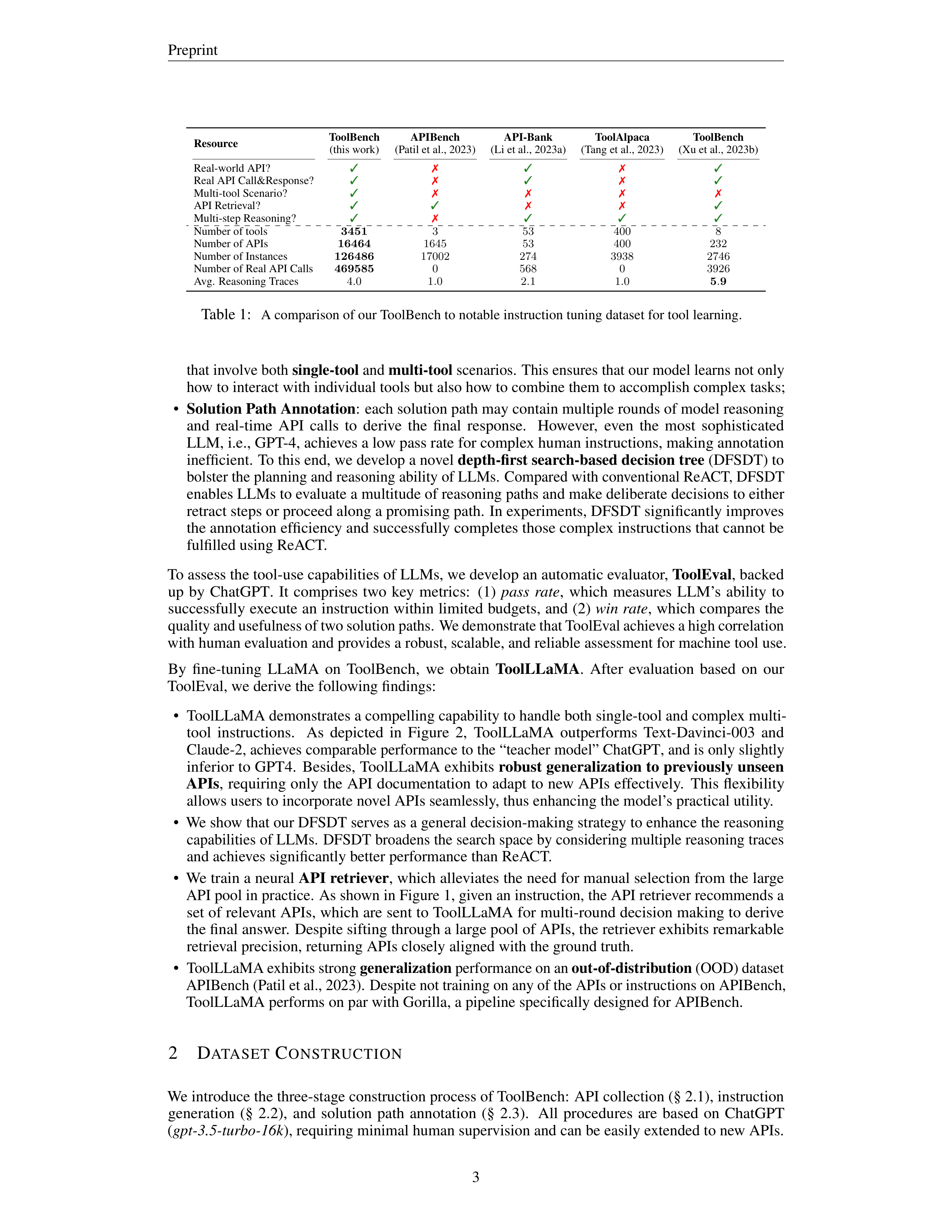
The comparison between ToolBench and prior works is listed in Table 1.
Specifically, the construction
of ToolBench entails three phases:
•
API Collection
:
we gather
16,464
representational state transfer (REST) APIs from RapidAPI
(
link
), a platform that hosts massive real-world APIs provided by developers.
These APIs span
49
diverse categories such as social media, e-commerce, and weather.
For each API, we crawl detailed
API documents from RapidAPI, including the functionality descriptions,
required parameters,
code snippets for API calls, etc.
By comprehending these documents to learn to execute APIs,
LLMs can generalize to new APIs unseen during training;
•
Instruction Generation
:
we first sample APIs from the whole set and then prompt ChatGPT to
generate diverse instructions for these APIs.
To cover practical scenarios, we curate instructions
2
Preprint
Resource
ToolBench
(this work)
APIBench
(Patil et al., 2023)
API-Bank
(Li et al., 2023a)
ToolAlpaca
(Tang et al., 2023)
ToolBench
(Xu et al., 2023b)
Real-world API?
✓
✗
✓
✗
✓
Real API Call&Response?
✓
✗
✓
✗
✓
Multi-tool Scenario?
✓
✗
✗
✗
✗
API Retrieval?
✓
✓
✗
✗
✓
Multi-step Reasoning?
✓
✗
✓
✓
✓
Number of tools
3451
3
53
400
8
Number of APIs
16464
1645
53
400
232
Number of Instances
126486
17002
274
3938
2746
Number of Real API Calls
469585
0
568
0
3926
Avg.
Reasoning Traces
4
.
0
1
.
0
2
.
1
1
.
0
5
.
9
Table 1:
A comparison of our ToolBench to notable instruction tuning dataset for tool learning.
that involve both
single-tool
and
multi-tool
scenarios.
This ensures that our model learns not only
how to interact with individual tools but also how to combine them to accomplish complex tasks;
•
Solution Path Annotation
:
each solution path may contain multiple rounds of model reasoning
and
real-time
API
calls
to
derive
the
final
response.
However,
even
the
most
sophisticated
LLM, i.e., GPT-4, achieves a low pass rate for complex human instructions, making annotation
inefficient.
To this end, we develop a novel
depth-first search-based decision tree
(DFSDT) to
bolster the planning and reasoning ability of LLMs.
Compared with conventional ReACT, DFSDT
enables LLMs to evaluate a multitude of reasoning paths and make deliberate decisions to either
retract steps or proceed along a promising path.
In experiments, DFSDT significantly improves
the annotation efficiency and successfully completes those complex instructions that cannot be
fulfilled using ReACT.
To assess the tool-use capabilities of LLMs, we develop an automatic evaluator,
ToolEval
, backed
up
by
ChatGPT.
It
comprises
two
key
metrics:
(1)
pass
rate
,
which
measures
LLM’s
ability
to
successfully execute an instruction within limited budgets, and (2)
win rate
, which compares the
quality and usefulness of two solution paths. We demonstrate that ToolEval achieves a high correlation
with human evaluation and provides a robust, scalable, and reliable assessment for machine tool use.
By
fine-tuning
LLaMA
on
ToolBench,
we
obtain
ToolLLaMA
.
After
evaluation
based
on
our
ToolEval, we derive the following findings:
•
ToolLLaMA demonstrates a compelling capability to handle both single-tool and complex multi-
tool
instructions.
As
depicted
in
Figure
2,
ToolLLaMA
outperforms
Text-Davinci-003
and
Claude-2, achieves comparable performance to the “teacher model” ChatGPT, and is only slightly
inferior to GPT4.
Besides, ToolLLaMA exhibits
robust generalization to previously unseen
APIs
, requiring only the API documentation to adapt to new APIs effectively.
This flexibility
allows users to incorporate novel APIs seamlessly, thus enhancing the model’s practical utility.
•
We show that our DFSDT serves as a general decision-making strategy to enhance the reasoning
capabilities of LLMs.
DFSDT broadens the search space by considering multiple reasoning traces
and achieves significantly better performance than ReACT.
•
We train a neural
API retriever
, which alleviates the need for manual selection from the large
API pool in practice.
As shown in Figure 1, given an instruction, the API retriever recommends a
set of relevant APIs, which are sent to ToolLLaMA for multi-round decision making to derive
the final answer.
Despite sifting through a large pool of APIs, the retriever exhibits remarkable
retrieval precision, returning APIs closely aligned with the ground truth.
•
ToolLLaMA exhibits strong
generalization
performance on an
out-of-distribution
(OOD) dataset
APIBench (Patil et al., 2023).
Despite not training on any of the APIs or instructions on APIBench,
ToolLLaMA performs on par with Gorilla, a pipeline specifically designed for APIBench.
2
D
ATASET
C
ONSTRUCTION
We introduce the three-stage construction process of ToolBench:
API collection (§ 2.1), instruction
generation
(§
2.2),
and
solution
path
annotation
(§
2.3).
All
procedures
are
based
on
ChatGPT
(
gpt-3.5-turbo-16k
), requiring minimal human supervision and can be easily extended to new APIs.
3














Preprint
Finance
Jobs
···
···
Movies
GET
Genres
GET
Search By Title
···
API Name
: Search By Title
API Description
: Search movies and series by title, …
Required Parameters
: (1) title (
string, title to search for
), (2) country (
string, …
)
Optional Parameters
: (1) show_type (
string, Type of shows to include in the results,
either “movie”, “series”, or “all”. Default is “all”
), (2) output_language (string, …)
Code Snippets
: GET /v2/search/title?title=batman&country=us&show…
Example Response
: type:"movie", title:"Batman", overview:"Japanese…
Tool
API
Top QR Code APIs
GET
Services
Category
1
2
3
APIs & API
Documentation
Instructions &
Relevant APIs
Category
Tool
API
···
···
···
···
···
···
···
···
···
···
···
···
···
Single-tool instructions
Intra-category multi-tool instructions
Intra-collection multi-tool instructions
API Documentation
Sampled
API1
API Name: xxx
API Description: xxx
Required Parameters: xxx
…
Sampled
API2
API Name: xxx
…
Relevant APIs
Instruction
We are planning a movie
night in the mountains. Can
you suggest …
API1, API2, API5…
Sampled
APIs
Star Wars Characters
Streaming Availability
IMDB Search
Category / Collection
Tool
API
Collection
+
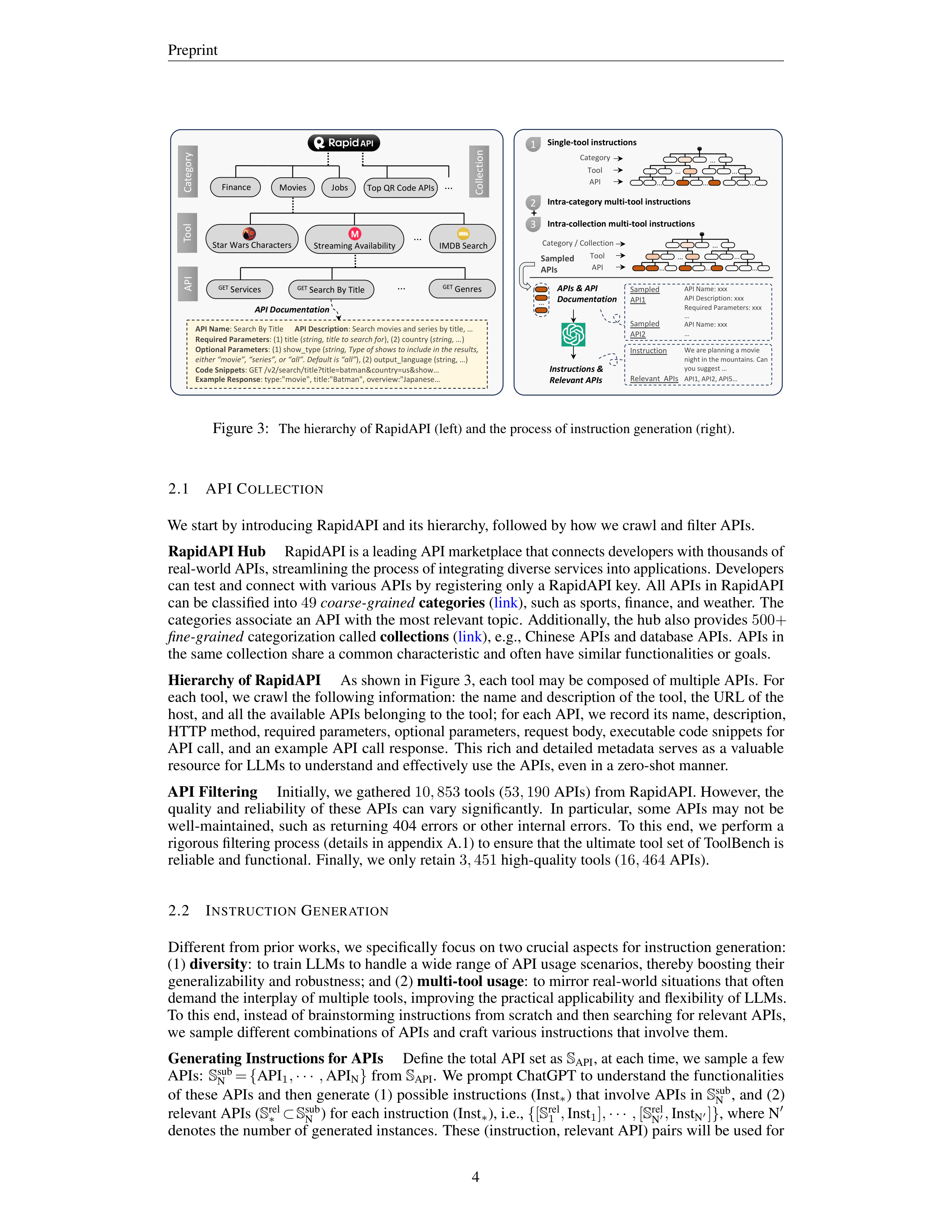
Figure 3:
The hierarchy of RapidAPI (left) and the process of instruction generation (right).
2.1
API
C
OLLECTION
We start by introducing RapidAPI and its hierarchy, followed by how we crawl and filter APIs.
RapidAPI Hub
RapidAPI is a leading API marketplace that connects developers with thousands of
real-world APIs, streamlining the process of integrating diverse services into applications.
Developers
can test and connect with various APIs by registering only a RapidAPI key.
All APIs in RapidAPI
can be classified into
49
coarse-grained
categories
(
link
), such as sports, finance, and weather.
The
categories associate an API with the most relevant topic.
Additionally, the hub also provides
500+
fine-grained
categorization called
collections
(
link
), e.g., Chinese APIs and database APIs.
APIs in
the same collection share a common characteristic and often have similar functionalities or goals.
Hierarchy of RapidAPI
As shown in Figure 3, each tool may be composed of multiple APIs.
For
each tool, we crawl the following information:
the name and description of the tool, the URL of the
host, and all the available APIs belonging to the tool; for each API, we record its name, description,
HTTP method, required parameters, optional parameters, request body, executable code snippets for
API call, and an example API call response.
This rich and detailed metadata serves as a valuable
resource for LLMs to understand and effectively use the APIs, even in a zero-shot manner.
API Filtering
Initially, we gathered
10
,
853
tools (
53
,
190
APIs) from RapidAPI. However, the
quality
and
reliability
of
these
APIs
can
vary
significantly.
In
particular,
some
APIs
may
not
be
well-maintained,
such as returning 404 errors or other internal errors.
To this end,
we perform a
rigorous filtering process (details in appendix A.1) to ensure that the ultimate tool set of ToolBench is
reliable and functional.
Finally, we only retain
3
,
451
high-quality tools (
16
,
464
APIs).
2.2
I
NSTRUCTION
G
ENERATION
Different from prior works, we specifically focus on two crucial aspects for instruction generation:
(1)
diversity
:
to train LLMs to handle a wide range of API usage scenarios, thereby boosting their
generalizability and robustness; and (2)
multi-tool usage
:
to mirror real-world situations that often
demand the interplay of multiple tools, improving the practical applicability and flexibility of LLMs.
To this end, instead of brainstorming instructions from scratch and then searching for relevant APIs,
we sample different combinations of APIs and craft various instructions that involve them.
Generating Instructions for APIs
Define the total API set as
S
API
, at each time, we sample a few
APIs:
S
sub
N
=
{
API
1
,
· · ·
,
API
N
}
from
S
API
.
We prompt ChatGPT to understand the functionalities
of these APIs and then generate (1) possible instructions (
Inst
∗
) that involve APIs in
S
sub
N
, and (2)
relevant APIs (
S
rel
∗
⊂
S
sub
N
) for each instruction (
Inst
∗
), i.e.,
{
[
S
rel
1
,
Inst
1
]
,
· · ·
,
[
S
rel
N
′
,
Inst
N
′
]
}
, where
N
′
denotes the number of generated instances.
These (instruction, relevant API) pairs will be used for
4


Preprint
Normal
Normal
Error
Fail
···
Success
Error
Thought:
I will first get some information
about Hailee Steinfeld.
API Name:
get_extra_character_details
Arguments:
{“name”: “Hailee Steinfeld”}
CoT / ReACT
DFSDT (ours)
Instruction
···
Instruction
Reasoning Chains of Different Methods
···
User: I want to give my friend a birthday surprise. I know her
favorite actress is Hailee Steinfeld. Help me please!
Observation:
{“age”: 28, “recent
movies”: [“Spider-Man: Across the
Spider-Verse”, …]}
API Name:
Finish with Final Answer
Arguments:
{“Final Answer”: Hailee Steinfeld
recently voiced Spider-Woman in "Spider-
Man: Across the Spider-Verse”. You could
buy a Spider-Woman mask as a gift, and she
would probably like it.}
API Name:
Finish by Giving Up
or
Observation:
{“message”: “server
is not available.”}
API Call with Normal Response
API Call with Error
Final Answer
Give Up
1
Fail
Fail
Error
Normal
Normal
Normal
Error
Fail
Success
Normal
Normal
Error
···
2
3
4
5
1
2
3
4
5
8
9
6
7
or
Selected Path
x
N
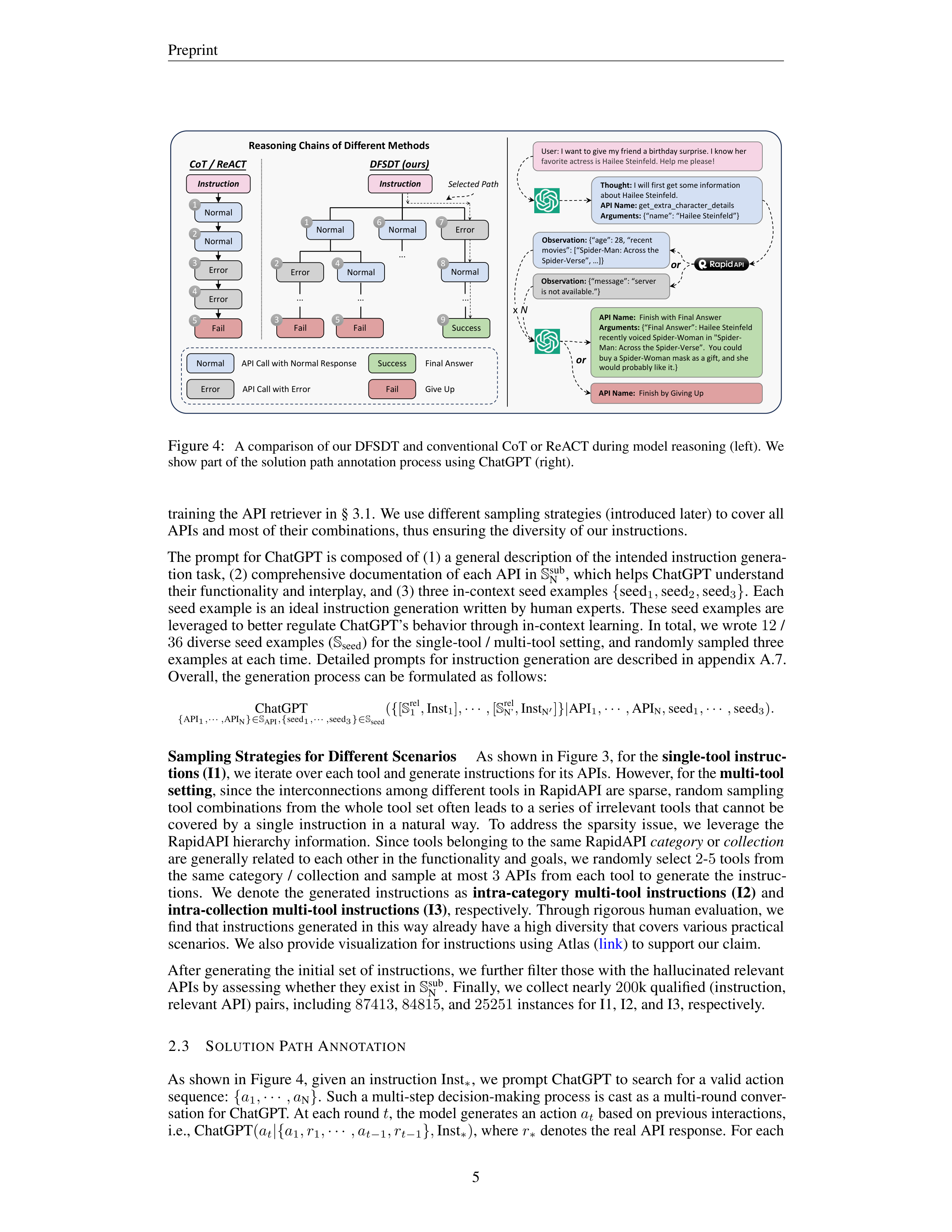
Figure 4:
A comparison of our DFSDT and conventional CoT or ReACT during model reasoning (left).
We
show part of the solution path annotation process using ChatGPT (right).
training the API retriever in § 3.1.
We use different sampling strategies (introduced later) to cover all
APIs and most of their combinations, thus ensuring the diversity of our instructions.
The prompt for ChatGPT is composed of (1) a general description of the intended instruction genera-
tion task, (2) comprehensive documentation of each API in
S
sub
N
, which helps ChatGPT understand
their functionality and interplay, and (3) three in-context seed examples
{
seed
1
,
seed
2
,
seed
3
}
.
Each
seed example is an ideal instruction generation written by human experts.
These seed examples are
leveraged to better regulate ChatGPT’s behavior through in-context learning.
In total, we wrote
12
/
36
diverse seed examples (
S
seed
) for the single-tool / multi-tool setting, and randomly sampled three
examples at each time.
Detailed prompts for instruction generation are described in appendix A.7.
Overall, the generation process can be formulated as follows:
ChatGPT
{
API
1
,
···
,
API
N
}∈
S
API
,
{
seed
1
,
···
,
seed
3
}∈
S
seed
(
{
[
S
rel
1
,
Inst
1
]
,
· · ·
,
[
S
rel
N’
,
Inst
N
′
]
}|
API
1
,
· · ·
,
API
N
,
seed
1
,
· · ·
,
seed
3
)
.
Sampling Strategies for Different Scenarios
As shown in Figure 3, for the
single-tool instruc-
tions (I1)
, we iterate over each tool and generate instructions for its APIs.
However, for the
multi-tool
setting
, since the interconnections among different tools in RapidAPI are sparse, random sampling
tool combinations from the whole tool set often leads to a series of irrelevant tools that cannot be
covered
by
a
single
instruction
in
a
natural
way.
To
address
the
sparsity
issue,
we
leverage
the
RapidAPI hierarchy information.
Since tools belonging to the same RapidAPI
category
or
collection
are generally related to each other in the functionality and goals, we randomly select
2
-
5
tools from
the same category / collection and sample at most
3
APIs from each tool to generate the instruc-
tions.
We
denote
the
generated
instructions
as
intra-category
multi-tool
instructions
(I2)
and
intra-collection multi-tool instructions (I3)
, respectively.
Through rigorous human evaluation, we
find that instructions generated in this way already have a high diversity that covers various practical
scenarios.
We also provide visualization for instructions using Atlas (
link
) to support our claim.
After generating the initial set of instructions, we further filter those with the hallucinated relevant
APIs by assessing whether they exist in
S
sub
N
.
Finally, we collect nearly
200
k qualified (instruction,
relevant API) pairs, including
87413
,
84815
, and
25251
instances for I1, I2, and I3, respectively.
2.3
S
OLUTION
P
ATH
A
NNOTATION
As shown in Figure 4, given an instruction
Inst
∗
, we prompt ChatGPT to search for a valid action
sequence:
{
a
1
,
· · ·
, a
N
}
.
Such a multi-step decision-making process is cast as a multi-round conver-
sation for ChatGPT. At each round
t
, the model generates an action
a
t
based on previous interactions,
i.e.,
ChatGPT
(
a
t
|{
a
1
, r
1
,
· · ·
, a
t
−
1
, r
t
−
1
}
,
Inst
∗
)
, where
r
∗
denotes the real API response.
For each
5
Preprint
a
t
, ChatGPT should specify its “thought”, which API to use, and the specific parameters for this API,
i.e.,
a
t
has the following format:
“
Thought
:
· · ·
,
API
Name
:
· · ·
,
Parameters
:
· · ·
”.
To leverage the
function call
feature of ChatGPT, we treat each API as a special function and feed
its API documentation into ChatGPT’s function field.
In this way, the model understands how to
call the API. For each instruction
Inst
∗
, we feed all the sampled APIs
S
sub
N
to ChatGPT’s as available
functions.
To let ChatGPT finish an action sequence, we define two additional functions, i.e., “Finish
with Final Answer” and “Finish by Giving Up”.
The former function has a parameter that corresponds
to a detailed final answer to the original instruction; while the latter function is designed for cases
where the provided APIs cannot complete the original instruction after multiple API call attempts.
Depth First Search-based Decision Tree
In our pilot studies, we find that CoT (Wei et al., 2023)
or ReACT (Yao et al., 2022) has inherent limitations:
(1)
error propagation
:
a mistaken action may
propagate the errors further and cause the model to be trapped in a faulty loop, such as continually
calling an API in a wrong way or hallucinating APIs; (2)
limited exploration
:
CoT or ReACT only
explores one possible direction, leading to limited exploration of the whole action space.
Hence even
GPT-4 often fails to find a valid solution path, making annotation difficult.
To
this
end,
we
propose
to
construct
a
decision
tree
to
expand
the
search
space
and
increase
the
possibility of finding a valid path.
As depicted in Figure 4, our DFSDT allows the model to assess
different reasoning paths and choose to either (1) proceed along a promising path or (2) abandon
an existing node by calling the “Finish by Giving Up” function and expand a new node.
During
node expansion, to diversify the child nodes and expand the search space, we prompt ChatGPT with
the information of the previously generated nodes and explicitly encourage the model to generate a
distinct node.
For the searching process, we prefer depth-first search (DFS) instead of breadth-first
search (BFS) because the annotation can be finished as long as one valid path is found.
Using BFS
will
cost
excessive
OpenAI
API
calls.
More
details
are
described
in
appendix
A.8.
We
perform
DFSDT for all the generated instructions and only retain those passed solution paths.
Ultimately, we
generate
126
,
486
(instruction, solution path) pairs, which are used to train ToolLLaMA in § 3.2.
3
E
XPERIMENTS
In
this
section,
we
investigate
the
performance
of
ToolLLM
framework.
We
first
introduce
the
evaluation metric and evaluate the efficacy of API retriever and DFSDT in § 3.1.
Then we present the
main experiments in § 3.2, followed by a generalization experiment in § 3.3.
3.1
P
RELIMINARY
E
XPERIMENTS
ToolEval
Considering the API’s temporal variability on RapidAPI and the infinite potential solution
paths for an instruction, it is infeasible to annotate a fixed ground-truth solution path for each test
instruction.
Moreover, when comparing different models, it is crucial to ensure they employ the same
version of APIs during evaluation.
Considering that human evaluation can be time-consuming, we
follow AlpacaEval (Li et al., 2023b) to develop an efficient evaluator
ToolEval
based on ChatGPT,
which incorporates two evaluation metrics (details in appendix A.5):
(1)
Pass Rate
:
it calculates the
proportion of successfully completing an instruction within limited budgets.
The metric measures the
executability of instructions for an LLM and can be seen as a basic requirement for ideal tool use;
and (2)
Win Rate
:
we provide an instruction and two solution paths to ChatGPT evaluator and obtain
its preference (i.e., which one is better).
We pre-define a set of criteria for both metrics and these
criteria are organized as prompts for our ChatGPT evaluator.
We evaluate multiple times based on
ChatGPT to improve the reliability.
Then we calculate the average results from the evaluator.
Through
rigorous
testing
(details
in
appendix
A.5),
we
find
that
ToolEval
demonstrates
a
high
agreement
of
87
.
1%
in
pass
rate
and
80
.
3%
in
win
rate
with
human
annotators.
This
shows
that
ToolEval can reflect and represent human evaluation to a large extent.
Efficacy of API Retriever
The API retriever aims to retrieve relevant APIs to an instruction.
We
employ
Sentence-BERT
(Reimers
&
Gurevych,
2019)
to
train
a
dense
retriever
based
on
BERT-
BASE (Devlin et al., 2019).
The API retriever encodes the instruction and API document into two
embeddings, and calculates their relevance with embedding similarity.
For training, we regard the
relevant APIs of each instruction generated in § 2.2 as positive examples and sample a few other
6
Preprint
Method
I1
I2
I3
Average
NDCG
NDCG
NDCG
NDCG
@1
@5
@1
@5
@1
@5
@1
@5
BM25
18
.
4
19
.
7
12
.
0
11
.
0
25
.
2
20
.
4
18
.
5
17
.
0
Ada
57
.
5
58
.
8
36
.
8
30
.
7
54
.
6
46
.
8
49
.
6
45
.
4
Ours
84.2
89.7
68.2
77.9
81.7
87.1
78.0
84.9
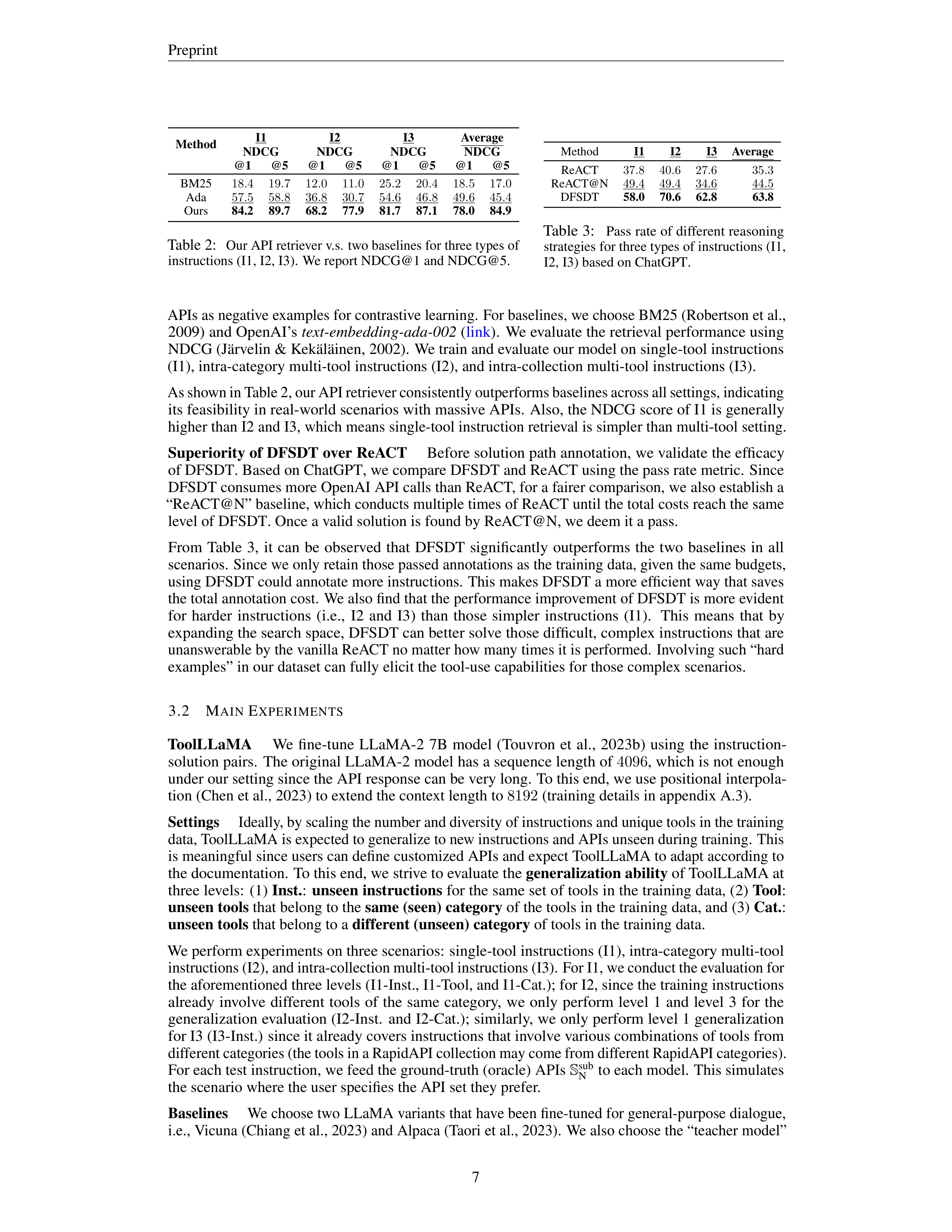
Table 2:
Our API retriever v.s.
two baselines for three types of
instructions (I1, I2, I3).
We report NDCG@1 and NDCG@5.
Method
I1
I2
I3
Average
ReACT
37
.
8
40
.
6
27
.
6
35
.
3
ReACT@N
49
.
4
49
.
4
34
.
6
44
.
5
DFSDT
58.0
70.6
62.8
63.8
Table 3:
Pass rate of different reasoning
strategies for three types of instructions (I1,
I2, I3) based on ChatGPT.
APIs as negative examples for contrastive learning.
For baselines, we choose BM25 (Robertson et al.,
2009) and OpenAI’s
text-embedding-ada-002
(
link
).
We evaluate the retrieval performance using
NDCG (J
¨
arvelin & Kek
¨
al
¨
ainen, 2002).
We train and evaluate our model on single-tool instructions
(I1), intra-category multi-tool instructions (I2), and intra-collection multi-tool instructions (I3).
As shown in Table 2, our API retriever consistently outperforms baselines across all settings, indicating
its feasibility in real-world scenarios with massive APIs.
Also, the NDCG score of I1 is generally
higher than I2 and I3, which means single-tool instruction retrieval is simpler than multi-tool setting.
Superiority of DFSDT over ReACT
Before solution path annotation, we validate the efficacy
of DFSDT. Based on ChatGPT, we compare DFSDT and ReACT using the pass rate metric.
Since
DFSDT consumes more OpenAI API calls than ReACT, for a fairer comparison, we also establish a
“ReACT@N” baseline, which conducts multiple times of ReACT until the total costs reach the same
level of DFSDT. Once a valid solution is found by ReACT@N, we deem it a pass.
From
Table
3,
it
can
be
observed
that
DFSDT
significantly
outperforms
the
two
baselines
in
all
scenarios.
Since we only retain those passed annotations as the training data, given the same budgets,
using DFSDT could annotate more instructions.
This makes DFSDT a more efficient way that saves
the total annotation cost.
We also find that the performance improvement of DFSDT is more evident
for
harder
instructions
(i.e.,
I2
and
I3)
than
those
simpler
instructions
(I1).
This
means
that
by
expanding the search space, DFSDT can better solve those difficult, complex instructions that are
unanswerable by the vanilla ReACT no matter how many times it is performed.
Involving such “hard
examples” in our dataset can fully elicit the tool-use capabilities for those complex scenarios.
3.2
M
AIN
E
XPERIMENTS
ToolLLaMA
We
fine-tune
LLaMA-2
7B
model
(Touvron
et
al.,
2023b)
using
the
instruction-
solution pairs.
The original LLaMA-2 model has a sequence length of
4096
, which is not enough
under our setting since the API response can be very long.
To this end, we use positional interpola-
tion (Chen et al., 2023) to extend the context length to
8192
(training details in appendix A.3).
Settings
Ideally, by scaling the number and diversity of instructions and unique tools in the training
data, ToolLLaMA is expected to generalize to new instructions and APIs unseen during training.
This
is meaningful since users can define customized APIs and expect ToolLLaMA to adapt according to
the documentation.
To this end, we strive to evaluate the
generalization ability
of ToolLLaMA at
three levels:
(1)
Inst.
:
unseen instructions
for the same set of tools in the training data, (2)
Tool
:
unseen tools
that belong to the
same (seen) category
of the tools in the training data, and (3)
Cat.
:
unseen tools
that belong to a
different (unseen) category
of tools in the training data.
We perform experiments on three scenarios:
single-tool instructions (I1), intra-category multi-tool
instructions (I2), and intra-collection multi-tool instructions (I3). For I1, we conduct the evaluation for
the aforementioned three levels (I1-Inst., I1-Tool, and I1-Cat.); for I2, since the training instructions
already
involve
different
tools
of
the
same
category,
we
only
perform
level
1
and
level
3
for
the
generalization evaluation (I2-Inst.
and I2-Cat.); similarly, we only perform level 1 generalization
for I3 (I3-Inst.)
since it already covers instructions that involve various combinations of tools from
different categories (the tools in a RapidAPI collection may come from different RapidAPI categories).
For each test instruction, we feed the ground-truth (oracle) APIs
S
sub
N
to each model.
This simulates
the scenario where the user specifies the API set they prefer.
Baselines
We choose two LLaMA variants that have been fine-tuned for general-purpose dialogue,
i.e., Vicuna (Chiang et al., 2023) and Alpaca (Taori et al., 2023).
We also choose the “teacher model”
7
Preprint
Model
Method
I1-Inst.
I1-Tool
I1-Cat.
I2-Inst.
I2-Cat.
I3-Inst.
Average
Pass
Win
Pass
Win
Pass
Win
Pass
Win
Pass
Win
Pass
Win
Pass
Win
ChatGPT
ReACT
41
.
5
-
44
.
0
-
44
.
5
-
42
.
5
-
46
.
5
-
22
.
0
-
40
.
2
-
DFSDT
54
.
5
60
.
5
65
.
0
62
.
0
60
.
5
57
.
3
75
.
0
72
.
0
71
.
5
64.8
62
.
0
69
.
0
64
.
8
64
.
3
Claude-2
ReACT
5
.
5
31
.
0
3
.
5
27
.
8
5
.
5
33
.
8
6
.
0
35
.
0
6
.
0
31
.
5
14
.
0
47
.
5
6
.
8
34
.
4
DFSDT
20
.
5
38
.
0
31
.
0
44
.
3
18
.
5
43
.
3
17
.
0
36
.
8
20
.
5
33
.
5
28
.
0
65
.
0
22
.
6
43
.
5
Text-Davinci-003
ReACT
12
.
0
28
.
5
20
.
0
35
.
3
20
.
0
31
.
0
8
.
5
29
.
8
14
.
5
29
.
8
24
.
0
45
.
0
16
.
5
33
.
2
DFSDT
43
.
5
40
.
3
44
.
0
43
.
8
46
.
0
46
.
8
37
.
0
40
.
5
42
.
0
43
.
3
46
.
0
63
.
0
43
.
1
46
.
3
GPT4
ReACT
53
.
5
60
.
0
50
.
0
58
.
8
53
.
5
63
.
5
67
.
0
65
.
8
72
.
0
60
.
3
47
.
0
78
.
0
57
.
2
64
.
4
DFSDT
60
.
0
67.5
71.5
67.8
67.0
66.5
79
.
5
73.3
77.5
63
.
3
71.0
84.0
71.1
70.4
Vicuna
ReACT & DFSDT
0
.
0
0.0
0
.
0
0.0
0
.
0
0.0
0
.
0
0.0
0
.
0
0.0
0
.
0
0.0
0
.
0
0.0
Alpaca
ReACT & DFSDT
0
.
0
0.0
0
.
0
0.0
0
.
0
0.0
0
.
0
0.0
0
.
0
0.0
0
.
0
0.0
0
.
0
0.0
ReACT
25
.
0
45
.
0
29
.
0
42
.
0
33
.
0
47
.
5
30
.
5
50
.
8
31
.
5
41
.
8
25
.
0
55
.
0
29
.
0
47
.
0
ToolLLaMA
DFSDT
57
.
0
55
.
0
61
.
0
55
.
3
62
.
0
54
.
5
77
.
0
68
.
5
77
.
0
58
.
0
66
.
0
69
.
0
66
.
7
60
.
0
DFSDT-Retriever
64.0
62
.
3
64
.
0
59
.
0
60
.
5
55
.
0
81.5
68
.
5
68
.
5
60
.
8
65
.
0
73
.
0
67
.
3
63
.
1
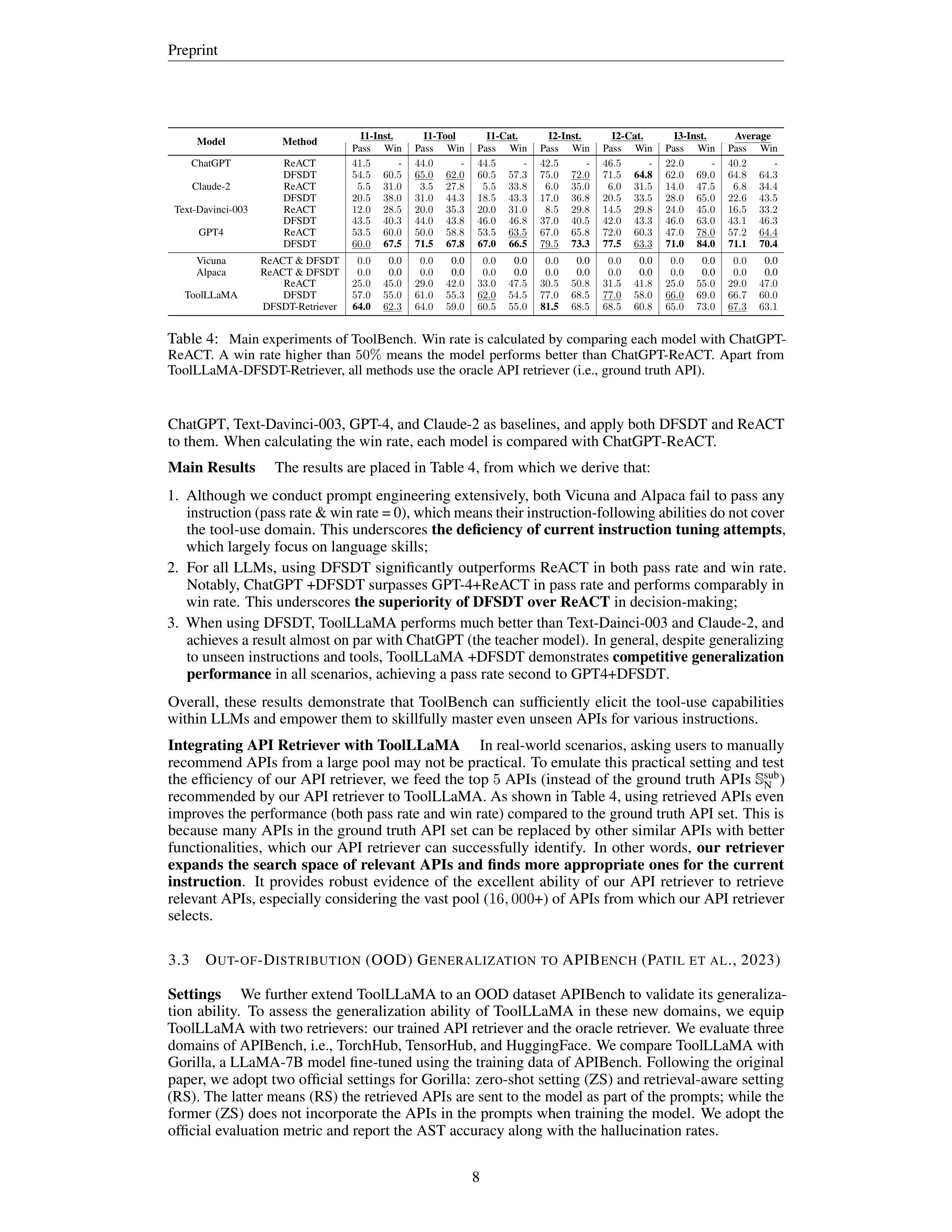
Table 4:
Main experiments of ToolBench.
Win rate is calculated by comparing each model with ChatGPT-
ReACT.
A
win
rate
higher
than
50%
means
the
model
performs
better
than
ChatGPT-ReACT.
Apart
from
ToolLLaMA-DFSDT-Retriever, all methods use the oracle API retriever (i.e., ground truth API).
ChatGPT, Text-Davinci-003, GPT-4, and Claude-2 as baselines, and apply both DFSDT and ReACT
to them.
When calculating the win rate, each model is compared with ChatGPT-ReACT.
Main Results
The results are placed in Table 4, from which we derive that:
1.
Although we conduct prompt engineering extensively, both Vicuna and Alpaca fail to pass any
instruction (pass rate & win rate = 0), which means their instruction-following abilities do not cover
the tool-use domain.
This underscores
the deficiency of current instruction tuning attempts
,
which largely focus on language skills;
2.
For all LLMs,
using DFSDT significantly outperforms ReACT in both pass rate and win rate.
Notably, ChatGPT +DFSDT surpasses GPT-4+ReACT in pass rate and performs comparably in
win rate.
This underscores
the superiority of DFSDT over ReACT
in decision-making;
3.
When using DFSDT, ToolLLaMA performs much better than Text-Dainci-003 and Claude-2, and
achieves a result almost on par with ChatGPT (the teacher model).
In general, despite generalizing
to unseen instructions and tools, ToolLLaMA +DFSDT demonstrates
competitive generalization
performance
in all scenarios, achieving a pass rate second to GPT4+DFSDT.
Overall,
these
results
demonstrate
that
ToolBench
can
sufficiently
elicit
the
tool-use
capabilities
within LLMs and empower them to skillfully master even unseen APIs for various instructions.
Integrating API Retriever with ToolLLaMA
In real-world scenarios, asking users to manually
recommend APIs from a large pool may not be practical.
To emulate this practical setting and test
the efficiency of our API retriever, we feed the top
5
APIs (instead of the ground truth APIs
S
sub
N
)
recommended by our API retriever to ToolLLaMA. As shown in Table 4, using retrieved APIs even
improves the performance (both pass rate and win rate) compared to the ground truth API set.
This is
because many APIs in the ground truth API set can be replaced by other similar APIs with better
functionalities,
which
our
API
retriever
can
successfully
identify.
In
other
words,
our
retriever
expands the search space of relevant APIs and finds more appropriate ones for the current
instruction
.
It
provides
robust
evidence
of
the
excellent
ability
of
our
API
retriever
to
retrieve
relevant APIs, especially considering the vast pool (
16
,
000
+) of APIs from which our API retriever
selects.
3.3
O
UT
-
OF
-D
ISTRIBUTION
(OOD) G
ENERALIZATION
TO
APIB
ENCH
(P
ATIL
ET
AL
., 2023)
Settings
We further extend ToolLLaMA to an OOD dataset APIBench to validate its generaliza-
tion ability.
To assess the generalization ability of ToolLLaMA in these new domains,
we equip
ToolLLaMA with two retrievers:
our trained API retriever and the oracle retriever.
We evaluate three
domains of APIBench, i.e., TorchHub, TensorHub, and HuggingFace.
We compare ToolLLaMA with
Gorilla, a LLaMA-7B model fine-tuned using the training data of APIBench.
Following the original
paper, we adopt two official settings for Gorilla:
zero-shot setting (ZS) and retrieval-aware setting
(RS). The latter means (RS) the retrieved APIs are sent to the model as part of the prompts; while the
former (ZS) does not incorporate the APIs in the prompts when training the model.
We adopt the
official evaluation metric and report the AST accuracy along with the hallucination rates.
8
Preprint
Method
HuggingFace
TorchHub
TensorHub
Hallu.
(
↓
)
AST (
↑
)
Hallu.
(
↓
)
AST (
↑
)
Hallu.
(
↓
)
AST (
↑
)
ToolLLaMA + Our Retriever
10.60
16.77
15.70
51.16
6.48
40.59
Gorilla-ZS + BM25
46.90
10.51
17.20
44.62
20.58
34.31
Gorilla-RS + BM25
6.42
15.71
5.91
50.00
2.77
41.90
ToolLLaMA + Oracle
8.66
88.80
14.12
85.88
7.44
88.62
Gorilla-ZS + Oracle
52.88
44.36
39.25
59.14
12.99
83.21
Gorilla-RS + Oracle
6.97
89.27
6.99
93.01
2.04
94.16
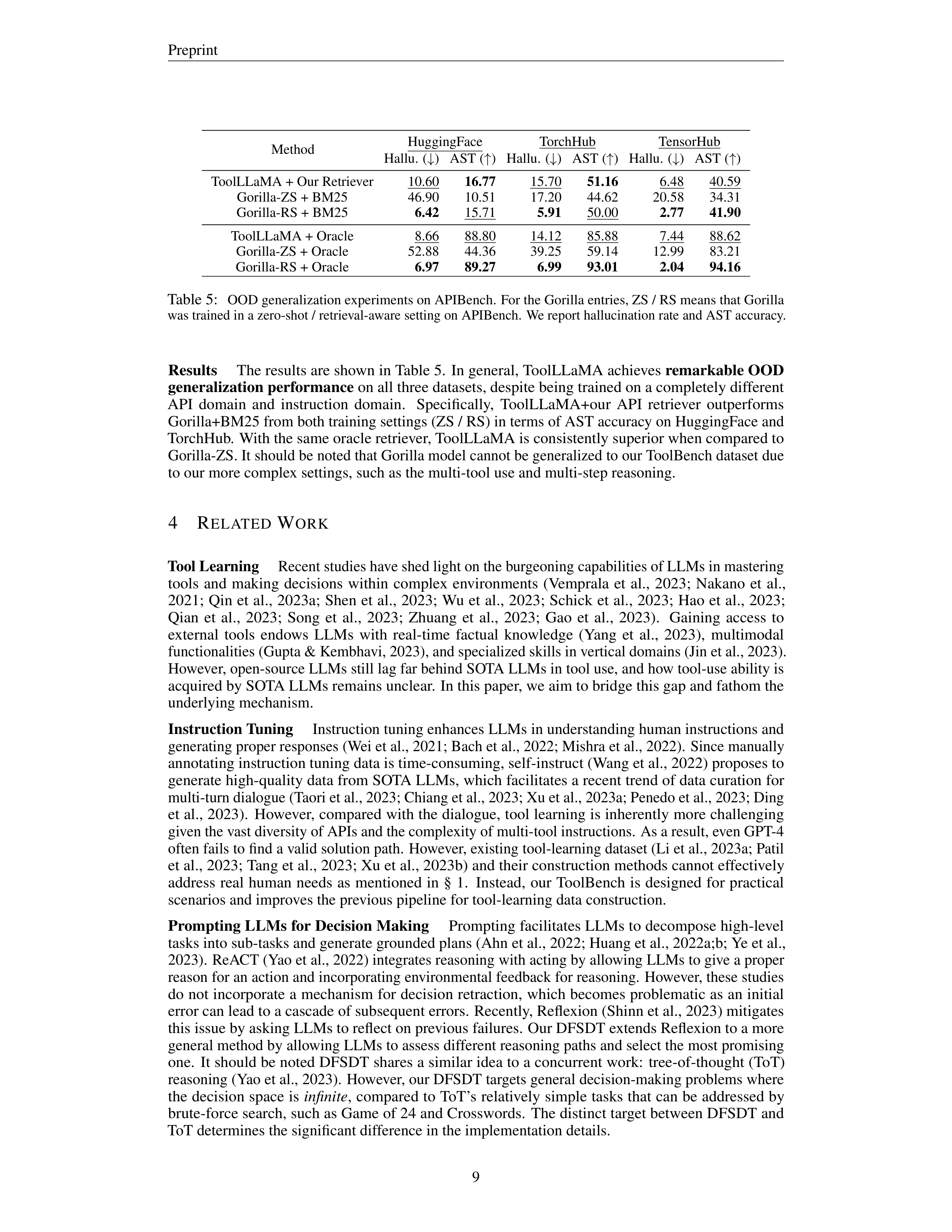
Table 5:
OOD generalization experiments on APIBench.
For the Gorilla entries, ZS / RS means that Gorilla
was trained in a zero-shot / retrieval-aware setting on APIBench.
We report hallucination rate and AST accuracy.
Results
The results are shown in Table 5.
In general, ToolLLaMA achieves
remarkable OOD
generalization performance
on all three datasets, despite being trained on a completely different
API
domain
and
instruction
domain.
Specifically,
ToolLLaMA+our
API
retriever
outperforms
Gorilla+BM25 from both training settings (ZS / RS) in terms of AST accuracy on HuggingFace and
TorchHub.
With the same oracle retriever, ToolLLaMA is consistently superior when compared to
Gorilla-ZS. It should be noted that Gorilla model cannot be generalized to our ToolBench dataset due
to our more complex settings, such as the multi-tool use and multi-step reasoning.
4
R
ELATED
W
ORK
Tool Learning
Recent studies have shed light on the burgeoning capabilities of LLMs in mastering
tools
and
making
decisions
within
complex
environments
(Vemprala
et
al.,
2023;
Nakano
et
al.,
2021; Qin et al., 2023a; Shen et al., 2023; Wu et al., 2023; Schick et al., 2023; Hao et al., 2023;
Qian
et
al.,
2023;
Song
et
al.,
2023;
Zhuang
et
al.,
2023;
Gao
et
al.,
2023).
Gaining
access
to
external
tools
endows
LLMs
with
real-time
factual
knowledge
(Yang
et
al.,
2023),
multimodal
functionalities (Gupta & Kembhavi, 2023), and specialized skills in vertical domains (Jin et al., 2023).
However, open-source LLMs still lag far behind SOTA LLMs in tool use, and how tool-use ability is
acquired by SOTA LLMs remains unclear.
In this paper, we aim to bridge this gap and fathom the
underlying mechanism.
Instruction Tuning
Instruction tuning enhances LLMs in understanding human instructions and
generating proper responses (Wei et al., 2021; Bach et al., 2022; Mishra et al., 2022).
Since manually
annotating instruction tuning data is time-consuming, self-instruct (Wang et al., 2022) proposes to
generate high-quality data from SOTA LLMs, which facilitates a recent trend of data curation for
multi-turn dialogue (Taori et al., 2023; Chiang et al., 2023; Xu et al., 2023a; Penedo et al., 2023; Ding
et al., 2023).
However, compared with the dialogue, tool learning is inherently more challenging
given the vast diversity of APIs and the complexity of multi-tool instructions.
As a result, even GPT-4
often fails to find a valid solution path.
However, existing tool-learning dataset (Li et al., 2023a; Patil
et al., 2023; Tang et al., 2023; Xu et al., 2023b) and their construction methods cannot effectively
address
real
human
needs
as
mentioned
in
§
1.
Instead,
our
ToolBench
is
designed
for
practical
scenarios and improves the previous pipeline for tool-learning data construction.
Prompting LLMs for Decision Making
Prompting facilitates LLMs to decompose high-level
tasks into sub-tasks and generate grounded plans (Ahn et al., 2022; Huang et al., 2022a;b; Ye et al.,
2023).
ReACT (Yao et al., 2022) integrates reasoning with acting by allowing LLMs to give a proper
reason for an action and incorporating environmental feedback for reasoning.
However, these studies
do not incorporate a mechanism for decision retraction, which becomes problematic as an initial
error can lead to a cascade of subsequent errors.
Recently, Reflexion (Shinn et al., 2023) mitigates
this issue by asking LLMs to reflect on previous failures.
Our DFSDT extends Reflexion to a more
general method by allowing LLMs to assess different reasoning paths and select the most promising
one.
It should be noted DFSDT shares a similar idea to a concurrent work:
tree-of-thought (ToT)
reasoning (Yao et al., 2023).
However, our DFSDT targets general decision-making problems where
the decision space is
infinite
,
compared to ToT’s relatively simple tasks that can be addressed by
brute-force search, such as Game of 24 and Crosswords.
The distinct target between DFSDT and
ToT determines the significant difference in the implementation details.
9
Preprint
5
C
ONCLUSION
In this work, we introduce how to elicit the tool-use capabilities within LLMs.
We first present an
instruction tuning dataset, ToolBench, which covers
16
k+ real-world APIs and various practical use-
case scenarios including both single-tool and multi-tool tasks.
The construction of ToolBench purely
uses ChatGPT and requires minimal human supervision.
Moreover, we propose DFSDT to reinforce
the
planning
and
reasoning
ability
of
LLMs,
enabling
them
to
navigate
through
reasoning
paths
strategically.
For efficient evaluation of tool learning, we devise an automatic evaluator ToolEval.
By fine-tuning LLaMA on ToolBench, the obtained model ToolLLaMA matches the performance
of ChatGPT and exhibits remarkable generalization ability to unseen APIs.
Besides, we develop a
neural API retriever to recommend relevant APIs for each instruction.
The retriever can be integrated
with ToolLLaMA as a more automated tool-use pipeline.
In the experiments, we demonstrate the
generalization ability of our pipeline to out-of-distribution domains.
In general, this work paves the
way for future research in the intersection of instruction tuning and tool use for LLMs.
R
EFERENCES
Michael Ahn, Anthony Brohan, Noah Brown, Yevgen Chebotar, Omar Cortes, Byron David, Chelsea
Finn, Keerthana Gopalakrishnan, Karol Hausman, Alex Herzog, et al.
Do as i can, not as i say:
Grounding language in robotic affordances.
ArXiv preprint
, abs/2204.01691, 2022.
Stephen Bach, Victor Sanh, Zheng Xin Yong, Albert Webson, Colin Raffel, Nihal V Nayak, Abheesht
Sharma,
Taewoon
Kim,
M
Saiful
Bari,
Thibault
F
´
evry,
et
al.
Promptsource:
An
integrated
development environment and repository for natural language prompts.
In
Proceedings of the 60th
Annual Meeting of the Association for Computational Linguistics:
System Demonstrations
, pp.
93–104, 2022.
S
´
ebastien Bubeck, Varun Chandrasekaran, Ronen Eldan, Johannes Gehrke, Eric Horvitz, Ece Kamar,
Peter Lee, Yin Tat Lee, Yuanzhi Li, Scott Lundberg, et al.
Sparks of artificial general intelligence:
Early experiments with gpt-4.
arXiv preprint arXiv:2303.12712
, 2023.
Shouyuan Chen, Sherman Wong, Liangjian Chen, and Yuandong Tian.
Extending context window of
large language models via positional interpolation.
arXiv preprint arXiv:2306.15595
, 2023.
Wei-Lin
Chiang,
Zhuohan
Li,
Zi
Lin,
Ying
Sheng,
Zhanghao
Wu,
Hao
Zhang,
Lianmin
Zheng,
Siyuan Zhuang, Yonghao Zhuang, Joseph E. Gonzalez, Ion Stoica, and Eric P. Xing.
Vicuna:
An
open-source
chatbot
impressing
gpt-4
with
90%*
chatgpt
quality,
March
2023.
URL
https:
//lmsys.org/blog/2023-03-30-vicuna/
.
Jacob Devlin, Ming-Wei Chang, Kenton Lee, and Kristina Toutanova.
BERT: Pre-training of deep
bidirectional transformers for language understanding.
In
Proceedings of the 2019 Conference of
the North American Chapter of the Association for Computational Linguistics:
Human Language
Technologies, Volume 1 (Long and Short Papers)
, pp. 4171–4186, Minneapolis, Minnesota, 2019.
Association
for
Computational
Linguistics.
doi:
10.18653/v1/N19-1423.
URL
https://
aclanthology.org/N19-1423
.
Ning Ding, Yulin Chen, Bokai Xu, Yujia Qin, Zhi Zheng, Shengding Hu, Zhiyuan Liu, Maosong
Sun,
and Bowen Zhou.
Enhancing chat language models by scaling high-quality instructional
conversations.
arXiv preprint arXiv:2305.14233
, 2023.
Difei Gao, Lei Ji, Luowei Zhou, Kevin Qinghong Lin, Joya Chen, Zihan Fan, and Mike Zheng Shou.
Assistgpt:
A general multi-modal assistant that can plan, execute, inspect, and learn.
arXiv preprint
arXiv:2306.08640
, 2023.
Tanmay Gupta and Aniruddha Kembhavi.
Visual programming:
Compositional visual reasoning
without training.
In
Proceedings of the IEEE/CVF Conference on Computer Vision and Pattern
Recognition
, pp. 14953–14962, 2023.
Shibo Hao, Tianyang Liu, Zhen Wang, and Zhiting Hu.
Toolkengpt:
Augmenting frozen language
models with massive tools via tool embeddings.
arXiv preprint arXiv:2305.11554
, 2023.
10
Preprint
Wenlong Huang, Pieter Abbeel, Deepak Pathak, and Igor Mordatch.
Language models as zero-shot
planners:
Extracting actionable knowledge for embodied agents.
In Kamalika Chaudhuri, Stefanie
Jegelka, Le Song, Csaba Szepesv
´
ari, Gang Niu, and Sivan Sabato (eds.),
International Conference
on Machine Learning, ICML 2022, 17-23 July 2022, Baltimore, Maryland, USA
, volume 162 of
Proceedings of Machine Learning Research
, pp. 9118–9147. PMLR, 2022a.
Wenlong Huang, Fei Xia, Ted Xiao, Harris Chan, Jacky Liang, Pete Florence, Andy Zeng, Jonathan
Tompson, Igor Mordatch, Yevgen Chebotar, et al.
Inner monologue:
Embodied reasoning through
planning with language models.
ArXiv preprint
, abs/2207.05608, 2022b.
Kalervo J
¨
arvelin and Jaana Kek
¨
al
¨
ainen.
Cumulated gain-based evaluation of ir techniques.
ACM
Transactions on Information Systems (TOIS)
, 20(4):422–446, 2002.
Qiao Jin, Yifan Yang, Qingyu Chen, and Zhiyong Lu.
Genegpt:
Augmenting large language models
with domain tools for improved access to biomedical information.
ArXiv
, 2023.
Minghao Li, Feifan Song, Bowen Yu, Haiyang Yu, Zhoujun Li, Fei Huang, and Yongbin Li. Api-bank:
A benchmark for tool-augmented llms.
arXiv preprint arXiv:2304.08244
, 2023a.
Xuechen Li,
Tianyi Zhang,
Yann Dubois,
Rohan Taori,
Ishaan Gulrajani,
Carlos Guestrin,
Percy
Liang, and Tatsunori B. Hashimoto.
Alpacaeval:
An automatic evaluator of instruction-following
models.
https://github.com/tatsu-lab/alpaca_eval
, 2023b.
Swaroop Mishra, Daniel Khashabi, Chitta Baral, and Hannaneh Hajishirzi.
Cross-task generalization
via natural language crowdsourcing instructions.
In
Proceedings of the 60th Annual Meeting of the
Association for Computational Linguistics (Volume 1:
Long Papers)
, pp. 3470–3487, 2022.
Reiichiro Nakano, Jacob Hilton, Suchir Balaji, Jeff Wu, Long Ouyang, Christina Kim, Christopher
Hesse,
Shantanu
Jain,
Vineet
Kosaraju,
William
Saunders,
et
al.
Webgpt:
Browser-assisted
question-answering with human feedback.
ArXiv preprint
, abs/2112.09332, 2021.
OpenAI.
OpenAI: Introducing ChatGPT, 2022.
URL
https://openai.com/blog/chatgpt
.
OpenAI.
Gpt-4 technical report, 2023.
Shishir G Patil, Tianjun Zhang, Xin Wang, and Joseph E Gonzalez.
Gorilla:
Large language model
connected with massive apis.
arXiv preprint arXiv:2305.15334
, 2023.
Guilherme Penedo, Quentin Malartic, Daniel Hesslow, Ruxandra Cojocaru, Alessandro Cappelli,
Hamza Alobeidli,
Baptiste Pannier,
Ebtesam Almazrouei,
and Julien Launay.
The refinedweb
dataset for falcon llm:
outperforming curated corpora with web data, and web data only.
arXiv
preprint arXiv:2306.01116
, 2023.
Cheng Qian, Chi Han, Yi R Fung, Yujia Qin, Zhiyuan Liu, and Heng Ji.
Creator:
Disentangling
abstract and concrete reasonings of large language models through tool creation.
arXiv preprint
arXiv:2305.14318
, 2023.
Yujia Qin, Zihan Cai, Dian Jin, Lan Yan, Shihao Liang, Kunlun Zhu, Yankai Lin, Xu Han, Ning Ding,
Huadong Wang, et al.
Webcpm:
Interactive web search for chinese long-form question answering.
arXiv preprint arXiv:2305.06849
, 2023a.
Yujia
Qin,
Shengding
Hu,
Yankai
Lin,
Weize
Chen,
Ning
Ding,
Ganqu
Cui,
Zheni
Zeng,
Yufei
Huang,
Chaojun
Xiao,
Chi
Han,
et
al.
Tool
learning
with
foundation
models.
arXiv
preprint
arXiv:2304.08354
, 2023b.
Nils Reimers and Iryna Gurevych.
Sentence-bert:
Sentence embeddings using siamese bert-networks.
arXiv preprint arXiv:1908.10084
, 2019.
Stephen Robertson, Hugo Zaragoza, et al.
The probabilistic relevance framework:
Bm25 and beyond.
Foundations and Trends® in Information Retrieval
, 3(4):333–389, 2009.
Timo Schick, Jane Dwivedi-Yu, Roberto Dess
`
ı, Roberta Raileanu, Maria Lomeli, Luke Zettlemoyer,
Nicola Cancedda, and Thomas Scialom.
Toolformer:
Language models can teach themselves to
use tools.
ArXiv preprint
, abs/2302.04761, 2023.
11
Preprint
Yongliang Shen, Kaitao Song, Xu Tan, Dongsheng Li, Weiming Lu, and Yueting Zhuang. Hugginggpt:
Solving ai tasks with chatgpt and its friends in huggingface, 2023.
Noah Shinn, Federico Cassano, Beck Labash, Ashwin Gopinath, Karthik Narasimhan, and Shunyu
Yao.
Reflexion:
Language agents with verbal reinforcement learning, 2023.
Yifan
Song,
Weimin
Xiong,
Dawei
Zhu,
Cheng
Li,
Ke
Wang,
Ye
Tian,
and
Sujian
Li.
Restgpt:
Connecting large language models with real-world applications via restful apis.
arXiv preprint
arXiv:2306.06624
, 2023.
Qiaoyu Tang, Ziliang Deng, Hongyu Lin, Xianpei Han, Qiao Liang, and Le Sun.
Toolalpaca: General-
ized tool learning for language models with 3000 simulated cases.
arXiv preprint arXiv:2306.05301
,
2023.
Rohan Taori,
Ishaan Gulrajani,
Tianyi Zhang,
Yann Dubois,
Xuechen Li,
Carlos Guestrin,
Percy
Liang,
and
Tatsunori
B.
Hashimoto.
Stanford
alpaca:
An
instruction-following
llama
model.
https://github.com/tatsu-lab/stanford_alpaca
, 2023.
Hugo Touvron, Thibaut Lavril, Gautier Izacard, Xavier Martinet, Marie-Anne Lachaux, Timoth
´
ee
Lacroix, Baptiste Rozi
`
ere, Naman Goyal, Eric Hambro, Faisal Azhar, Aurelien Rodriguez, Armand
Joulin, Edouard Grave, and Guillaume Lample.
Llama:
Open and efficient foundation language
models.
arXiv preprint arXiv:2302.13971
, 2023a.
Hugo Touvron, Louis Martin, Kevin Stone, Peter Albert, Amjad Almahairi, Yasmine Babaei, Nikolay
Bashlykov, Soumya Batra, Prajjwal Bhargava, Shruti Bhosale, et al.
Llama 2:
Open foundation
and fine-tuned chat models.
arXiv preprint arXiv:2307.09288
, 2023b.
Sai Vemprala, Rogerio Bonatti, Arthur Bucker, and Ashish Kapoor.
Chatgpt for robotics:
Design
principles and model abilities.
Technical Report MSR-TR-2023-8, Microsoft, February 2023.
Yizhong Wang, Yeganeh Kordi, Swaroop Mishra, Alisa Liu, Noah A Smith, Daniel Khashabi, and
Hannaneh Hajishirzi.
Self-instruct:
Aligning language model with self generated instructions.
arXiv preprint arXiv:2212.10560
, 2022.
Jason Wei, Maarten Bosma, Vincent Y Zhao, Kelvin Guu, Adams Wei Yu, Brian Lester, Nan Du,
Andrew M Dai, and Quoc V Le.
Finetuned language models are zero-shot learners.
arXiv preprint
arXiv:2109.01652
, 2021.
Jason Wei, Xuezhi Wang, Dale Schuurmans, Maarten Bosma, Brian Ichter, Fei Xia, Ed Chi, Quoc Le,
and Denny Zhou.
Chain-of-thought prompting elicits reasoning in large language models, 2023.
Chenfei
Wu,
Shengming
Yin,
Weizhen
Qi,
Xiaodong
Wang,
Zecheng
Tang,
and
Nan
Duan.
Vi-
sual
chatgpt:
Talking,
drawing
and
editing
with
visual
foundation
models.
ArXiv
preprint
,
abs/2303.04671, 2023.
Can Xu, Qingfeng Sun, Kai Zheng, Xiubo Geng, Pu Zhao, Jiazhan Feng, Chongyang Tao, and Daxin
Jiang.
Wizardlm:
Empowering large language models to follow complex instructions, 2023a.
Qiantong
Xu,
Fenglu
Hong,
Bo
Li,
Changran
Hu,
Zhengyu
Chen,
and
Jian
Zhang.
On
the
tool
manipulation capability of open-source large language models.
arXiv preprint arXiv:2305.16504
,
2023b.
Linyao
Yang,
Hongyang
Chen,
Zhao
Li,
Xiao
Ding,
and
Xindong
Wu.
Chatgpt
is
not
enough:
Enhancing large language models with knowledge graphs for fact-aware language modeling.
arXiv
preprint arXiv:2306.11489
, 2023.
Shunyu Yao, Jeffrey Zhao, Dian Yu, Nan Du, Izhak Shafran, Karthik Narasimhan, and Yuan Cao.
React:
Synergizing reasoning and acting in language models.
ArXiv preprint
, abs/2210.03629,
2022.
Shunyu
Yao,
Dian
Yu,
Jeffrey
Zhao,
Izhak
Shafran,
Thomas
L
Griffiths,
Yuan
Cao,
and
Karthik
Narasimhan.
Tree of thoughts:
Deliberate problem solving with large language models.
arXiv
preprint arXiv:2305.10601
, 2023.
12

Preprint
Yining Ye, Xin Cong, Yujia Qin, Yankai Lin, Zhiyuan Liu, and Maosong Sun.
Large language model
as autonomous decision maker.
arXiv preprint arXiv:2308.12519
, 2023.
Yuchen Zhuang,
Yue Yu,
Kuan Wang,
Haotian Sun,
and Chao Zhang.
Toolqa:
A dataset for llm
question answering with external tools.
arXiv preprint arXiv:2306.13304
, 2023.
13
Preprint
A
PPENDIX
A
I
MPLEMENTATION
D
ETAILS
A.1
D
ETAILS
FOR
F
ILTERING
R
APID
API
We perform a rigorous filtering process to ensure that the ultimate tool set of ToolBench is reliable
and functional.
The filtering process is as follows:
(1)
initial testing
:
we begin by testing the basic
functionality of each API to ascertain whether they are operational.
We discard any APIs that do not
meet this basic criterion; (2)
example response evaluation
:
we make API calls to obtain an example
response.
Then we evaluate their effectiveness by response time and quality.
APIs that consistently
exhibit a long response time are omitted.
Also, we filter out the APIs with low-quality responses,
such as HTML source codes or other error messages.
A.2
API
R
ESPONSE
C
OMPRESSION
When examining the response returned by each API, we discover that some responses may contain
redundant information and are too long to be fed into LLMs.
This may lead to problems due to the
limited context length of LLMs.
Therefore, we perform a response compression to reduce the length
of API responses while maintaining their critical information.
Since
each
API
has
a
fixed
response
format,
we
use
ChatGPT
to
analyze
one
response
example
and
remove
unimportant
keys
within
the
response
to
reduce
its
length.
The
prompt
of
ChatGPT
contains the following information for each API: (1) tool documentation, which includes tool name,
tool description, API name, API description, parameters, and an example API response.
This gives
ChatGPT
a
hint
of
the
API’s
functionality;
(2)
3
in-context
learning
examples,
each
containing
an original API response and a compressed response schema written by experts.
In this way, we
obtain the response compression strategies for all APIs.
During inference, when the API response
length exceeds
1024
tokens, we compress the response by removing unimportant information.
If the
compressed response is still longer than
1024
, we only retain the first
1024
tokens.
Through human
evaluation, we find that this compression retains important information contained in the API response
and successfully removes the noises.
A.3
D
ETAILS
FOR
T
RAINING
T
OOL
LL
A
MA
We train the model in a multi-round conversation mode.
For the training data format, we keep the
input
and
output
the
same
as
those
of
ChatGPT.
Since
it
is
unclear
how
ChatGPT
organizes
the
function
call
field,
we
just
concatenate
this
information
into
the
input
as
part
of
the
prompt
for
ToolLLaMA.
For
the
training
hyper
parameters,
we
use
a
learning
rate
of
5
×
10
−
5
,
a
warmup
ratio of
4
×
10
−
2
, a total batch size of
64
, a maximum sequence length of
8192
, and use a position
interpolation ratio of
2
.
We train the model for two epochs and select the model checkpoint with the
best performance on the development set and then evaluate it on the test set.
A.4
D
ETAILS
FOR
DFSDT
In
practice,
it
is
essential
to
balance
effectiveness
with
costs
(the
number
of
OpenAI
API
calls).
Classical DFS algorithms generate multiple child nodes at each step, then sort all the child nodes,
and select the highest-scoring node for expansion.
After greedily expanding to the terminal node,
DFS backtracks to explore nearby nodes, expanding the search space.
Throughout the algorithm, the
most resource-intensive part is the sorting process of child nodes.
If we use an LLM to evaluate two
nodes at a time, it requires approximately
O
(
n
log
n
)
complexity of OpenAI API calls, where
n
is
the number of child nodes.
In fact, we find empirically that in most cases, the nodes ranked highest are often the node generated
at first.
Therefore, we skip the sorting process of child nodes and choose a pre-order traversal (a
variant for DFS) for the tree search.
This design has the following advantages:
•
If the model does not retract an action (e.g., for the case of simple instructions), then DFSDT
degrades to ReACT, which makes it as efficient as ReACT.
14
Preprint
•
After the algorithm finishes, the nodes explored by this method are almost the same as those
found by a classical DFS search.
Hence, it can also handle complex instructions that only
DFS can solve.
Overall, this design achieves a similar performance as DFS while significantly reducing costs.
It
should
also
be
noted
that
ReACT
can
be
viewed
as
a
degraded
version
of
DFSDT.
Therefore,
although ToolLLaMA is trained on data created by DFSDT, the model can be used either through
ReACT or DFSDT during inference.
A.5
D
ETAILS
FOR
T
OOL
E
VAL
We adopt two metrics for automatic tool-use capability evaluation:
pass rate and win rate.
Details for Pass Rate
To assess whether a solution path completes the tasks outlined in the original
instruction and successfully passes it, we need to first consider the solvability of the instruction.
In
principle,
an
instruction
can
be
classified
as
either
(1)
solvable:
for
example,
at
least
one
of
the
provided tools is potentially helpful in solving the original instruction; or (2) unsolvable:
for example,
all APIs are irrelevant to the instruction or the instruction provides invalid information such as invalid
email address.
To
determine
whether
a
solution
path
is
deemed
passed
or
not,
we
need
to
consider
whether
the
instruction is solvable or unsolvable.
In our evaluation, three types of labels can be given to each
solution path, i.e.,
Pass
,
Fail
, and
Unsure
.
Specifically, we define different rules as follows:
If the instruction is solvable:
1.
If the model gives finish type “Finish by Giving Up”,
(a)
After trying all the APIs extensively during and receiving no helpful information from
APIs, the solution path is deemed a
Pass
.
(b)
If the model only calls a few API or receiving valid information from the APIs, the
solution path is deemed a
Fail
.
2.
If the model gives finish type “Finish with Final Answer”,
(a)
If the APIs provide no valid information, and the model has tried all the APIs to retrieve
useful information, but the final answer still does not resolve the original instruction or
conveys a refusal (such as “I’m sorry, but I can’t provide you with this, because the
tools are unavailable”), the solution path is deemed a
Pass
.
(b)
If the tools provide valid information, and the final answer does not completely resolve
the instruction or is a refusal, the solution path is deemed a
Fail
.
(c)
If the final
answer completely resolves
the original instruction,
the
solution
path is
deemed a
Pass
.
(d)
If it is unable to determine if the instruction is resolved based on the content of the final
answer, the solution path is deemed an
Unsure
.
If the instruction is unsolvable:
1.
If the model gives finish type “Finish with Final Answer”,
(a)
If the final answer resolves an instruction that was initially considered unresolvable,
the solution path is deemed a
Pass
.
(b)
If the final answer is a refusal, the solution path is deemed a
Pass
.
(c)
If
the
final
answer
is
hallucinated
by
the
model
itself
and
provides
a
false
positive
response (such as “I’ve completed the task, the final answer is *”), the solution path is
deemed a
Fail
.
2.
If the model gives finish type “Finish by Giving Up”,
(a)
Under this case, the solution path is deemed a
Pass
.
For every solution path, we instruct the ChatGPT evaluator to generate multiple (
≥
4
) predictions
and perform a majority vote to derive the final pass rate.
15
Preprint
Details for Win Rate
Since pass rate only measures whether an instruction is completed or not,
instead of how well it is completed, we adopt another metric:
win rate.
It is measured by comparing
two solution paths for a given instruction.
We assume that a passed candidate is better than a failed
candidate and only compare those solution paths that are both “
Pass
”, or both “
Failed
” annotated
by the ChatGPT evaluator.
Note that compared with another solution path, one solution path will be
annotated with one of the following:
win
,
lose
, or
tie
.
We build rules for the evaluator’s behavior
to decide which solution path is better, and the criteria are listed as follows:
1.
Information richness:
whether the final answer contains all the necessary information to
answer the original instruction.
A significantly richer answer is better, while a similar level
of richness that is sufficient to answer the question ties.
2.
Factuality:
whether it accurately describes what has been done, and what failed in the end.
A more accurate description in the final answer is better.
3.
Reasoning:
whether
a
detailed
and
accurate
reason
for
failure
is
provided
if
the
query
remains unresolved.
A more detailed reason is better.
4.
Milestone:
calculating the number of milestones reached during execution.
5.
Exploration:
whether more potentially useful APIs were attempted during the execution
process.
The use of a greater number of APIs is better.
6.
Cost:
Having fewer repeated (redundant) API calls is better if the number of APIs used is
the same.
For every solution path, we also generate multiple (
≥
4
) predictions and then perform a majority
vote to derive the final win rate.
In Table 4, for ease of reading, we split the ratio of
tie
into two
pieces and add them to
win
and
lose
, respectively.
In Table 6, we report the original numbers as a
reference.
Comparing
Human
Evaluation
and
ToolEval
To
validate
the
reliability
of
ChatGPT
evalua-
tor
in
both
pass
rate
and
win
rate,
we
sample
among
four
different
methods
(ChatGPT+ReACT,
ChatGPT+DFSDT, ToolLLaMA+DFSDT and GPT4+DFSDT) to obtain solution pairs for
300
test in-
structions for
each
method.
Then we engage humans to annotate the pass rate for ChatGPT+DFSDT,
ToolLLaMA+DFSDT
and
GPT4+DFSDT,
and
the
win
rate
among
ChatGPT+ReACT
and
Chat-
GPT+DFSDT. Our ChatGPT evaluator demonstrates a high agreement of
87.1%
in pass rate and
80.3%
in win rate with human annotators.
This result shows that our evaluator generates highly
similar evaluation results to humans and can be viewed as a credible evaluator who simulates human
evaluation on pass rate and win rate.
It
should
also
be
noted
that
the
evaluation
for
tool
learning
is
far
more
intricate
than
traditional
tasks such as dialogue.
The reason is that there may exist infinite “correct” solution paths for each
instruction.
In our initial investigations, we surprisingly found that even human experts often disagree
with each other in deciding which solution path is better, leading to a relatively low agreement.
For
instance, one may prefer a solution path that uses only a few APIs to derive the final answer quickly;
while another may prefer a solution path that extensively tries all the APIs to cross-validate specific
information.
In
this
regard,
we
believe
there
is
still
a
long
way
to
go
for
a
fair
evaluation
of
the
tool-use domain, and we believe this work has paved the way for it.
We expect more future works to
explore this interesting research problem.
A.6
D
ETAILS
FOR
E
XPERIMENTS
ON
APIB
ENCH
When generalizing ToolLLaMA to APIBench, no training updates were made to ToolLLaMA, but
instead of treating each API in the prompt as a function call.
We define one function that represents
selecting an API, providing the code for invoking it, and describing the generated output in natural
language.
We do not consider the zero-shot setting of APIBench where the prompts do not contain
any API descriptions because the APIs from the three tested domains were never encountered during
training.
16
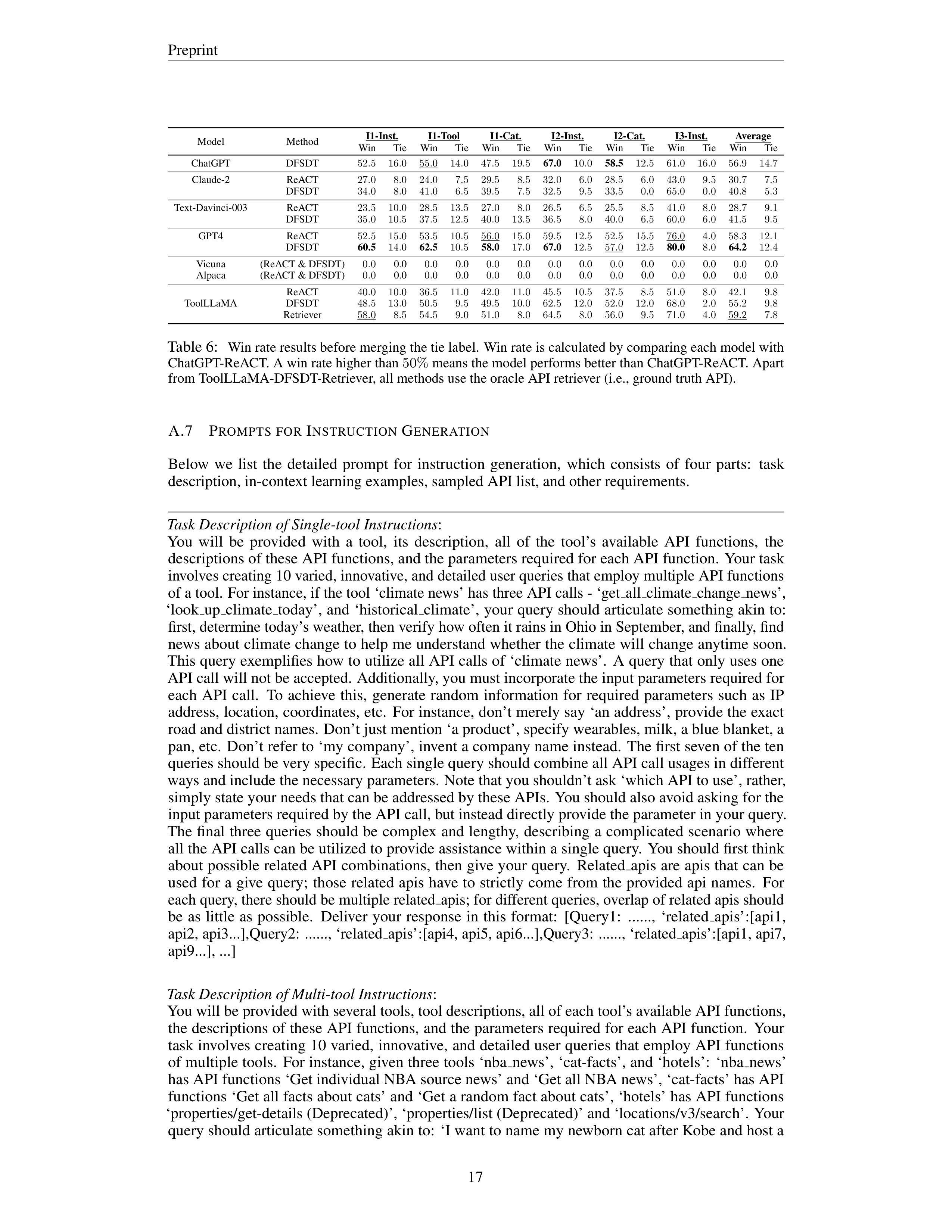
Preprint
Model
Method
I1-Inst.
I1-Tool
I1-Cat.
I2-Inst.
I2-Cat.
I3-Inst.
Average
Win
Tie
Win
Tie
Win
Tie
Win
Tie
Win
Tie
Win
Tie
Win
Tie
ChatGPT
DFSDT
52
.
5
16
.
0
55
.
0
14
.
0
47
.
5
19
.
5
67.0
10
.
0
58.5
12
.
5
61
.
0
16
.
0
56
.
9
14
.
7
Claude-2
ReACT
27
.
0
8
.
0
24
.
0
7
.
5
29
.
5
8
.
5
32
.
0
6
.
0
28
.
5
6
.
0
43
.
0
9
.
5
30
.
7
7
.
5
DFSDT
34
.
0
8
.
0
41
.
0
6
.
5
39
.
5
7
.
5
32
.
5
9
.
5
33
.
5
0
.
0
65
.
0
0
.
0
40
.
8
5
.
3
Text-Davinci-003
ReACT
23
.
5
10
.
0
28
.
5
13
.
5
27
.
0
8
.
0
26
.
5
6
.
5
25
.
5
8
.
5
41
.
0
8
.
0
28
.
7
9
.
1
DFSDT
35
.
0
10
.
5
37
.
5
12
.
5
40
.
0
13
.
5
36
.
5
8
.
0
40
.
0
6
.
5
60
.
0
6
.
0
41
.
5
9
.
5
GPT4
ReACT
52
.
5
15
.
0
53
.
5
10
.
5
56
.
0
15
.
0
59
.
5
12
.
5
52
.
5
15
.
5
76
.
0
4
.
0
58
.
3
12
.
1
DFSDT
60.5
14
.
0
62.5
10
.
5
58.0
17
.
0
67.0
12
.
5
57
.
0
12
.
5
80.0
8
.
0
64.2
12
.
4
Vicuna
(ReACT & DFSDT)
0
.
0
0.0
0
.
0
0.0
0
.
0
0.0
0
.
0
0.0
0
.
0
0.0
0
.
0
0.0
0
.
0
0.0
Alpaca
(ReACT & DFSDT)
0
.
0
0.0
0
.
0
0.0
0
.
0
0.0
0
.
0
0.0
0
.
0
0.0
0
.
0
0.0
0
.
0
0.0
ReACT
40
.
0
10
.
0
36
.
5
11
.
0
42
.
0
11
.
0
45
.
5
10
.
5
37
.
5
8
.
5
51
.
0
8
.
0
42
.
1
9
.
8
ToolLLaMA
DFSDT
48
.
5
13
.
0
50
.
5
9
.
5
49
.
5
10
.
0
62
.
5
12
.
0
52
.
0
12
.
0
68
.
0
2
.
0
55
.
2
9
.
8
Retriever
58
.
0
8
.
5
54
.
5
9
.
0
51
.
0
8
.
0
64
.
5
8
.
0
56
.
0
9
.
5
71
.
0
4
.
0
59
.
2
7
.
8
Table 6:
Win rate results before merging the tie label.
Win rate is calculated by comparing each model with
ChatGPT-ReACT. A win rate higher than
50%
means the model performs better than ChatGPT-ReACT. Apart
from ToolLLaMA-DFSDT-Retriever, all methods use the oracle API retriever (i.e., ground truth API).
A.7
P
ROMPTS
FOR
I
NSTRUCTION
G
ENERATION
Below
we
list
the
detailed
prompt
for
instruction
generation,
which
consists
of
four
parts:
task
description, in-context learning examples, sampled API list, and other requirements.
Task Description of Single-tool Instructions
:
You
will
be
provided
with
a
tool,
its
description,
all
of
the
tool’s
available
API
functions,
the
descriptions of these API functions, and the parameters required for each API function.
Your task
involves creating 10 varied, innovative, and detailed user queries that employ multiple API functions
of a tool.
For instance, if the tool ‘climate news’ has three API calls - ‘get
all
climate
change
news’,
‘look
up
climate
today’, and ‘historical
climate’, your query should articulate something akin to:
first, determine today’s weather, then verify how often it rains in Ohio in September, and finally, find
news about climate change to help me understand whether the climate will change anytime soon.
This query exemplifies how to utilize all API calls of ‘climate news’.
A query that only uses one
API call will not be accepted.
Additionally, you must incorporate the input parameters required for
each
API
call.
To
achieve
this,
generate
random
information
for
required
parameters
such
as
IP
address, location, coordinates, etc.
For instance, don’t merely say ‘an address’, provide the exact
road and district names.
Don’t just mention ‘a product’, specify wearables, milk, a blue blanket, a
pan, etc.
Don’t refer to ‘my company’, invent a company name instead.
The first seven of the ten
queries should be very specific.
Each single query should combine all API call usages in different
ways and include the necessary parameters.
Note that you shouldn’t ask ‘which API to use’, rather,
simply state your needs that can be addressed by these APIs.
You should also avoid asking for the
input parameters required by the API call, but instead directly provide the parameter in your query.
The final three queries should be complex and lengthy,
describing a complicated scenario where
all the API calls can be utilized to provide assistance within a single query.
You should first think
about possible related API combinations, then give your query.
Related
apis are apis that can be
used for a give query;
those related apis have to strictly come from the provided api names.
For
each query, there should be multiple related
apis; for different queries, overlap of related apis should
be
as
little
as
possible.
Deliver
your
response
in
this
format:
[Query1:
......,
‘related
apis’:[api1,
api2, api3...],Query2:
......, ‘related
apis’:[api4, api5, api6...],Query3:
......, ‘related
apis’:[api1, api7,
api9...], ...]
Task Description of Multi-tool Instructions
:
You will be provided with several tools, tool descriptions, all of each tool’s available API functions,
the descriptions of these API functions, and the parameters required for each API function.
Your
task involves creating 10 varied, innovative, and detailed user queries that employ API functions
of multiple tools.
For instance, given three tools ‘nba
news’, ‘cat-facts’, and ‘hotels’:
‘nba
news’
has API functions ‘Get individual NBA source news’ and ‘Get all NBA news’, ‘cat-facts’ has API
functions ‘Get all facts about cats’ and ‘Get a random fact about cats’, ‘hotels’ has API functions
‘properties/get-details (Deprecated)’, ‘properties/list (Deprecated)’ and ‘locations/v3/search’.
Your
query should articulate something akin to:
‘I want to name my newborn cat after Kobe and host a
17

Preprint
party to celebrate its birth.
Get me some cat facts and NBA news to gather inspirations for the cat
name.
Also, find a proper hotel around my house in Houston Downtown for the party.’
This query
exemplifies how to utilize API calls of all the given tools.
A query that uses API calls of only one
tool will not be accepted.
Additionally, you must incorporate the input parameters required for each
API call.
To achieve this, generate random information for required parameters such as IP address,
location, coordinates, etc.
For instance, don’t merely say ‘an address’, provide the exact road and
district names.
Don’t just mention ‘a product’, specify wearables, milk, a blue blanket, a pan, etc.
Don’t refer to ‘my company’,
invent a company name instead.
The first seven of the ten queries
should be very specific.
Each single query should combine API calls of different tools in various
ways and include the necessary parameters.
Note that you shouldn’t ask ‘which API to use’, rather,
simply state your needs that can be addressed by these APIs.
You should also avoid asking for the
input parameters required by the API call, but instead directly provide the parameters in your query.
The final three queries should be complex and lengthy, describing a complicated scenario where all
the provided API calls can be utilized to provide assistance within a single query.
You should first
think about possible related API combinations, then give your query.
Related APIs are APIs that can
be used for a given query; those related APIs have to strictly come from the provided API names.
For
each query, there should be multiple related APIs; for different queries, overlap of related APIs should
be as little as possible.
Deliver your response in this format:
[Query1:
......, ‘related
apis’:[[tool name,
api name], [tool name, api name], [tool name, api name]...],Query2:
......, ‘related
apis’:[[tool name,
api name], [tool name, api name], [tool name, api name]...],Query3:
......, ‘related
apis’:[[tool name,
api name], [tool name, api name], [tool name, api name]...], ...]
In-context Seed Examples
.
In the following, we show one single-tool instruction seed example and
one multi-tool instruction seed example.
For
example,
with
tool
ASCII
Art,
the
given
api
names
are
‘figlet’,
‘list
figlet
styles’,
‘cowsay’,
‘list
cowsay
styles’, ‘matheq’.
Some sample queries and related
apis would be:
“Query”:
“Need to create an ASCII art representation of a mathematical equation.
The equation
is
‘y
=
mx
+
c’,
where
m
and
c
are
constants.
Help
me
generate
the
ASCII
art
for
this
equation.
Also please generate an ASCII art representation of the text ‘Newton’s Second Law of Motion’.”,
“related
apis”:
[’figlet’, ‘list figlet styles’, ‘matheq’]
“Query”:
“Working on a research paper on cows and need to include ASCII art representations of
various cows.
Can you first retrieve available ASCII art styles for cows?
Then, can you generate
ASCII art for cows like the Jersey, Holstein, and Guernsey?
Finally, I want the cow to say ‘Moo!’
in
the ASCII art.”, “related
apis”:
[’figlet’, ‘list figlet styles’, ‘cowsay’, ‘list
cowsay
styles’]
“Query”: “I’m writing a blog post on ASCII art and need to include some examples.
Can you generate
ASCII art for the following strings:
‘ASCII’, ‘art’, and ‘gallery’?
You can first retrieve available
figlet styles and then generate ASCII art for the strings using the styles.”, “related
apis”:
[’figlet’,
‘list figlet styles’]
“Query”:
“Greetings!
I’m putting together a quirky slideshow about our furry friends and need your
help
to
sprinkle
some
ASCII
art
goodness.
Could
you
kindly
fetch
me
the
catalog
of
ASCII
art
styles available for animals?
Also, I’m particularly keen on featuring ASCII art for creatures like
pandas, cows, elephants, and penguins.
And if they could say something cute like ‘Hello!’
or ‘Hugs!’
in
the
ASCII
art,
that
would
be
purr-fect!”,
“related
apis”:
[’figlet’,
‘list
figlet
styles’,
‘cowsay’,
‘list
cowsay
styles’]
For
example,
with
tool
[’Entrepreneur
Mindset
Collection’,
‘Random
Words’,
‘thedigitalnews-
feederapi’,
‘Chemical
Elements’],
the
given
api
names
are
(tool
‘Entrepreneur
Mindset
Collec-
tion’)’Random Quote in JSON format’, (tool ‘Random Words’)’Get multiple random words’, (tool
‘Random
Words’)’Get
a
random
word’,
(tool
‘thedigitalnewsfeederapi’)’getting
specific
cricket
articles’,
(tool
‘thedigitalnewsfeederapi’)’Getting
Cricket
Articles’,
(tool
‘thedigitalnewsfeeder-
api’)’getting specific news articles’, (tool ‘thedigitalnewsfeederapi’)’Getting News Articles’, (tool
‘thedigitalnewsfeederapi’)’getting all news articles’, (tool ‘Chemical Elements’)’Get All Chemical
Elements’.
Some sample queries and related
apis would be:
“Query”:
“For my best friend’s surprise birthday party,
I require inspiration for party games and
decorations.
Kindly suggest some random words that can serve as themes for the party.
Furthermore,
I’m interested in gathering news articles about the latest party trends to ensure a modern celebration.
18
Preprint
Also, I would appreciate details about the local hotels in my area for accommodation options.
Your
assistance is greatly appreciated.”, “related
apis”:
[[’Random Words’, ‘Get multiple random words’],
[’thedigitalnewsfeederapi’, ‘Getting News Articles’], [’thedigitalnewsfeederapi’, ‘Getting all news
articles’]]
“Query”:
“In the midst of organizing a team-building event for my esteemed company, I eagerly seek
your valued input for invigorating activities.
Might I kindly request a collection of random quotes
that encapsulate the essence of teamwork and motivation?
Additionally, I am keen on exploring news
articles that showcase triumphant team-building events, as they serve as a wellspring of inspiration.”,
“related
apis”:
[[’Entrepreneur Mindset Collection’, ‘Random Quote in JSON format’], [’thedigi-
talnewsfeederapi’, ‘Getting News Articles’]] “Query”:
“I need specific cricket articles that discuss
the health benefits of sports for my research paper on exercise.
I also want to know which chemical
elements are associated with exercising, like increased iron (Fe) and its impact on bone marrow.”,
“related
apis”:
[[’thedigitalnewsfeederapi’, ‘getting specific cricket articles’], [’Chemical Elements’,
‘Get All Chemical Elements’]]
“Query”:
“I’m starting a new business venture and I need to make a speech announcing the new
dawn.
Provide me some quotes and words for me to start with.
I would like to gather news articles
about successful entrepreneurs for inspiration.”, “related
apis”:
[[’Entrepreneur Mindset Collection’,
‘Random Quote in JSON format’], [’Random Words’, ‘Get multiple random words’], [’thedigital-
newsfeederapi’, ‘getting specific news articles’]]
These are only examples to show you how to write the query.
Do not use APIs listed in the above
examples, but rather, use the ones listed below in the INPUT.
Sampled API List
(An example)
{
"tool_description":
"EntreAPI
Faker
is
used
to
dynamically
create
mock,
demo,
test
and
sample
data
for
your
application",
"name":
"EntreAPI
Faker",
"api_list":
[
{
"name":
"Longitute",
"url":
"https://entreapi-faker.p.rapidapi.com/address/
longitude",
"description":
"Generate
a
random
longitude.",
"method":
"GET",
"required_parameters":
[],
"optional_parameters":
[
{
"name":
"max",
"type":
"NUMBER",
"description":
"Maximum
value
for
latitude.",
"default":
""
},
{
"name":
"min",
"type":
"NUMBER",
"description":
"Minimum
value
for
latitude.",
"default":
""
},
{
"name":
"precision",
"type":
"NUMBER",
"description":
"Precision
for
latitude.",
"default":
""
}
],
"tool_name":
"EntreAPI
Faker",
"category_name":
"Data"
19
Preprint
},
{
"name":
"Boolean",
"url":
"https://entreapi-faker.p.rapidapi.com/datatype
/boolean",
"description":
"Randomly
generate
a
boolean
value.",
"method":
"GET",
"required_parameters":
[],
"optional_parameters":
[],
"tool_name":
"EntreAPI
Faker",
"category_name":
"Data"
},
{
"name":
"Past",
"url":
"https://entreapi-faker.p.rapidapi.com/date/
past",
"description":
"Randomly
generate
a
date
value
in
the
past.",
"method":
"GET",
"required_parameters":
[],
"optional_parameters":
[
{
"name":
"refDate",
"type":
"STRING",
"description":
"Starting
reference
date",
"default":
""
},
{
"name":
"years",
"type":
"NUMBER",
"description":
"Number
of
years
for
the
range
of
dates.",
"default":
""
}
],
"tool_name":
"EntreAPI
Faker",
"category_name":
"Data"
},
{
"name":
"Image
Url",
"url":
"https://entreapi-faker.p.rapidapi.com/image/
imageUrl",
"description":
"Randomly
generate
an
image
URL.",
"method":
"GET",
"required_parameters":
[],
"optional_parameters":
[
{
"name":
"width",
"type":
"NUMBER",
"description":
"Width
of
the
image.
Default
is
640.",
"default":
""
},
{
"name":
"height",
"type":
"NUMBER",
"description":
"Height
of
the
image.
Default
is
480.",
"default":
""
20
Preprint
},
{
"name":
"useRandomize",
"type":
"BOOLEAN",
"description":
"Add
a
random
number
parameter
to
the
returned
URL.",
"default":
""
},
{
"name":
"category",
"type":
"STRING",
"description":
"The
category
for
the
image.
Can
be
one:
abstract,
animal,
avatar,
business,
cats,
city,
fashion,
food,
nature,
nightlife,
people,
sports,
technics,
transport",
"default":
""
}
],
"tool_name":
"EntreAPI
Faker",
"category_name":
"Data"
},
{
"name":
"Sentence",
"url":
"https://entreapi-faker.p.rapidapi.com/lorem/
sentence",
"description":
"Randomly
generate
a
sentence
of
Lorem
Ipsum.",
"method":
"GET",
"required_parameters":
[],
"optional_parameters":
[
{
"name":
"wordCount",
"type":
"NUMBER",
"description":
"Number
of
words
in
the
sentence.",
"default":
""
}
],
"tool_name":
"EntreAPI
Faker",
"category_name":
"Data"
},
{
"name":
"Gender",
"url":
"https://entreapi-faker.p.rapidapi.com/name/
gender",
"description":
"Randomly
select
a
gender.",
"method":
"GET",
"required_parameters":
[],
"optional_parameters":
[
{
"name":
"useBinary",
"type":
"BOOLEAN",
"description":
"Use
binary
genders
only.",
"default":
""
}
],
"tool_name":
"EntreAPI
Faker",
"category_name":
"Data"
21
Preprint
},
{
"name":
"Prefix",
"url":
"https://entreapi-faker.p.rapidapi.com/name/
prefix",
"description":
"Randomly
generate
a
prefix
(e.g.,
Mr.,
Mrs.,
etc.)",
"method":
"GET",
"required_parameters":
[],
"optional_parameters":
[
{
"name":
"gender",
"type":
"STRING",
"description":
"Optional
gender.",
"default":
""
}
],
"tool_name":
"EntreAPI
Faker",
"category_name":
"Data"
},
{
"name":
"Array
Element",
"url":
"https://entreapi-faker.p.rapidapi.com/random/
arrayElement",
"description":
"Randomly
select
an
array
element.",
"method":
"GET",
"required_parameters":
[],
"optional_parameters":
[
{
"name":
"array",
"type":
"ARRAY",
"description":
"The
list
of
elements
to
choose
from.
Default
is
[\"a\",
\"b\",
\"c\"].",
"default":
""
}
],
"tool_name":
"EntreAPI
Faker",
"category_name":
"Data"
},
{
"name":
"Number
Value",
"url":
"https://entreapi-faker.p.rapidapi.com/random/
number",
"description":
"Randomly
generate
a
number
value.",
"method":
"GET",
"required_parameters":
[],
"optional_parameters":
[
{
"name":
"min",
"type":
"NUMBER",
"description":
"Minimum
value.",
"default":
""
},
{
"name":
"max",
"type":
"NUMBER",
"description":
"Maximum
value.",
"default":
""
},
22
Preprint
{
"name":
"precision",
"type":
"NUMBER",
"description":
"Precision
of
the
number.",
"default":
""
}
],
"tool_name":
"EntreAPI
Faker",
"category_name":
"Data"
},
{
"name":
"URL",
"url":
"https://entreapi-faker.p.rapidapi.com/internet
/url",
"description":
"Randomly
generate
a
URL.",
"method":
"GET",
"required_parameters":
[],
"optional_parameters":
[],
"tool_name":
"EntreAPI
Faker",
"category_name":
"Data"
}
]
}
Other Requirements:
Please produce ten queries in line with the given requirements and inputs.
These ten queries should
display a diverse range of sentence structures:
some queries should be in the form of imperative
sentences, others declarative, and yet others interrogative.
Equally, they should encompass a variety
of
tones,
with
some
being
polite,
others
straightforward.
Ensure
they
vary
in
length
and
contain
a wide range of subjects:
myself, my friends, family, and company.
Aim to include a number of
engaging queries as long as they relate to API calls.
Keep in mind that for each query, invoking just
one API won’t suffice; each query should call upon two to five APIs.
However, try to avoid explicitly
specifying which API to employ in the query. Each query should consist of a minimum of thirty words.
A.8
P
ROMPTS
FOR
S
OLUTION
P
ATH
A
NNOTATION
We use the following prompt when searching for the solution path.
When expanding the child nodes,
we use diversity
user
prompt, showing the information of previous child nodes.
------------------------------------------------------------------
system_prompt:
You
are
Tool-GPT,
capable
of
utilizing
numerous
tools
and
functions
to
complete
the
given
task.
1.First,
I
will
provide
you
with
the
task
description,
and
your
task
will
commence.
2.At
each
step,
you
need
to
analyze
the
current
status
and
determine
the
next
course
of
action
by
executing
a
function
call.
3.Following
the
call,
you
will
receive
the
result,
transitioning
you
to
a
new
state.
Subsequently,
you
will
analyze
your
current
status,
make
decisions
about
the
next
steps,
and
repeat
this
process.
4.After
several
iterations
of
thought
and
function
calls,
you
will
ultimately
complete
the
task
and
provide
your
final
answer.
Remember:
1.The
state
changes
are
irreversible,
and
you
cannot
return
to
a
previous
state.
23
Preprint
2.Keep
your
thoughts
concise,
limiting
them
to
a
maximum
of
five
sentences.
3.You
can
make
multiple
attempts.
If
you
plan
to
try
different
conditions
continuously,
perform
one
condition
per
try.
4.If
you
believe
you
have
gathered
enough
information,
call
the
function
"Finish:
give_answer"
to
provide
your
answer
for
the
task.
5.If
you
feel
unable
to
handle
the
task
from
this
step,
call
the
function
"Finish:
give_up_and_restart".
Let’s
Begin!
Task
description:
{task_description}
---------------------------------------------------------
diversity_user_prompt:
This
is
not
the
first
time
you
try
this
task,
all
previous
trails
failed.
Before
you
generate
your
thought
for
this
state,
I
will
first
show
you
your
previous
actions
for
this
state,
and
then
you
must
generate
actions
that
is
different
from
all
of
them.
Here
are
some
previous
actions
candidates:
{previous_candidate}
Remember
you
are
now
in
the
intermediate
state
of
a
trail,
you
will
first
analyze
the
now
state
and
previous
action
candidates,
then
make
actions
that
is
different
from
all
the
previous.
---------------------------------------------------------
Finish_function_description:
{
"name":
"Finish",
"description":
"If
you
believe
that
you
have
obtained
a
result
that
can
answer
the
task,
please
call
this
function
to
provide
the
final
answer.
Alternatively,
if
you
recognize
that
you
are
unable
to
proceed
with
the
task
in
the
current
state,
call
this
function
to
restart.
Remember:
you
must
ALWAYS
call
this
function
at
the
end
of
your
attempt,
and
the
only
part
that
will
be
shown
to
the
user
is
the
final
answer,
so
it
should
contain
sufficient
information.",
"parameters":
{
"type":
"object",
"properties":
{
"return_type":
{
"type":
"string",
"enum":
["give_answer","give_up_and_restart"],
},
"final_answer":
{
"type":
"string",
"description":
"The
final
answer
you
want
to
give
the
user.
You
should
have
this
field
if
\"
return_type\"==\"give_answer\"",
}
},
"required":
["return_type"],
}
}
24