
Published as a conference paper at ICLR 2024
M
ETA
GPT:
M
ETA
P
ROGRAMMING
FOR
A
M
ULTI
-A
GENT
C
OLLABORATIVE
F
RAMEWORK
Sirui Hong
1
∗
, Mingchen Zhuge
2
∗
, Jiaqi Chen
1
, Xiawu Zheng
3
, Yuheng Cheng
4
,
Ceyao Zhang
4
,
Jinlin Wang
1
,
Zili Wang
,
Steven Ka Shing Yau
5
,
Zijuan Lin
4
,
Liyang Zhou
6
,
Chenyu Ran
1
,
Lingfeng Xiao
1
,
7
,
Chenglin Wu
1
†
,
J¨urgen Schmidhuber
2
,
8
1
DeepWisdom,
2
AI Initiative, King Abdullah University of Science and Technology,
3
Xiamen University,
4
The Chinese University of Hong Kong, Shenzhen,
5
Nanjing University,
6
University of Pennsylvania,
7
University of California, Berkeley,
8
The Swiss AI Lab IDSIA/USI/SUPSI
A
BSTRACT
Remarkable
progress
has
been
made
on
automated
problem
solving
through
so-
cieties
of
agents
based
on
large
language
models
(LLMs).
Existing
LLM-based
multi-agent
systems
can
already
solve
simple
dialogue
tasks.
Solutions
to
more
complex
tasks,
however,
are
complicated
through
logic
inconsistencies
due
to
cascading
hallucinations
caused
by
naively
chaining
LLMs.
Here
we
introduce
MetaGPT,
an
innovative
meta-programming
framework
incorporating
efficient
human
workflows
into
LLM-based
multi-agent
collaborations.
MetaGPT
en-
codes Standardized Operating Procedures (SOPs) into prompt sequences for more
streamlined
workflows,
thus
allowing
agents
with
human-like
domain
expertise
to
verify
intermediate
results
and
reduce
errors.
MetaGPT
utilizes
an
assembly
line paradigm to assign diverse roles to various agents, efficiently breaking down
complex
tasks
into
subtasks
involving
many
agents
working
together.
On
col-
laborative
software
engineering
benchmarks,
MetaGPT
generates
more
coherent
solutions than previous chat-based multi-agent systems.
Our project can be found
at
https://github.com/geekan/MetaGPT
.
1
I
NTRODUCTION
Autonomous agents utilizing Large Language Models (LLMs) offer promising opportunities to en-
hance and replicate human workflows.
In real-world applications, however, existing systems (
Park
et al.
,
2023
;
Zhuge et al.
,
2023
;
Cai et al.
,
2023
;
Wang et al.
,
2023c
;
Li et al.
,
2023
;
Du et al.
,
2023
;
Liang et al.
,
2023
;
Hao et al.
,
2023
;
Zhou et al.
,
2023b
) tend to oversimplify the complexities.
They
struggle
to
achieve
effective,
coherent,
and
accurate
problem-solving
processes,
particularly
when
there is a need for meaningful collaborative interaction (
Chen et al.
,
2024
;
Zhang et al.
,
2023a
;
Dong
et al.
,
2023
;
Zhou et al.
,
2023a
;
Qian et al.
,
2023
;
Tang et al.
,
2023b
;
Hong et al.
,
2024
).
Through
extensive
collaborative
practice,
humans
have
developed
widely
accepted
Standardized
Operating Procedures (SOPs) across various domains (
Belbin
,
2012
;
Manifesto
,
2001
;
DeMarco &
Lister
,
2013
).
These SOPs play a critical role in supporting task decomposition and effective coor-
dination.
Furthermore,
SOPs
outline
the
responsibilities
of
each
team
member,
while
establishing
standards
for
intermediate
outputs.
Well-defined
SOPs
improve
the
consistent
and
accurate
exe-
cution of tasks that align with defined roles and quality standards (
Belbin
,
2012
;
Manifesto
,
2001
;
DeMarco
&
Lister
,
2013
;
Wooldridge
&
Jennings
,
1998
).
For
instance,
in
a
software
company,
Product Managers analyze competition and user needs to create Product Requirements Documents
(PRDs) using a standardized structure, to guide the developmental process.
Inspired
by
such
ideas,
we
design
a
promising
GPT-based
Meta-Programming
framework
called
MetaGPT
that
significantly
benefits
from
SOPs.
Unlike
other
works
(
Li
et
al.
,
2023
;
Qian
et
al.
,
2023
),
MetaGPT requires agents to generate structured outputs,
such as high-quality requirements
∗
These authors contributed equally to this work.
†
Chenglin Wu (alexanderwu@fuzhi.ai) is the corresponding author, affiliated with DeepWisdom.
1
arXiv:2308.00352v7 [cs.AI] 1 Nov 2024
Published as a conference paper at ICLR 2024
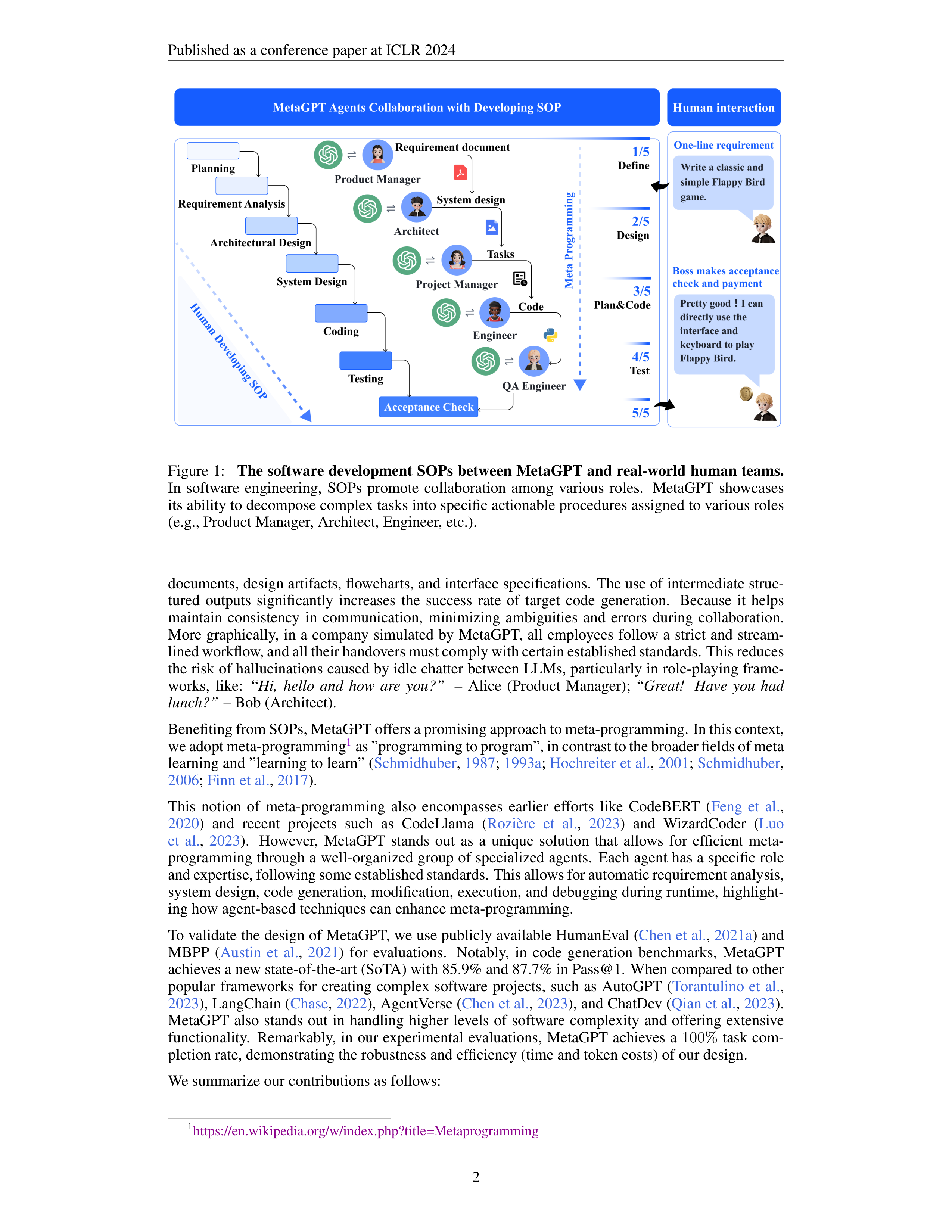
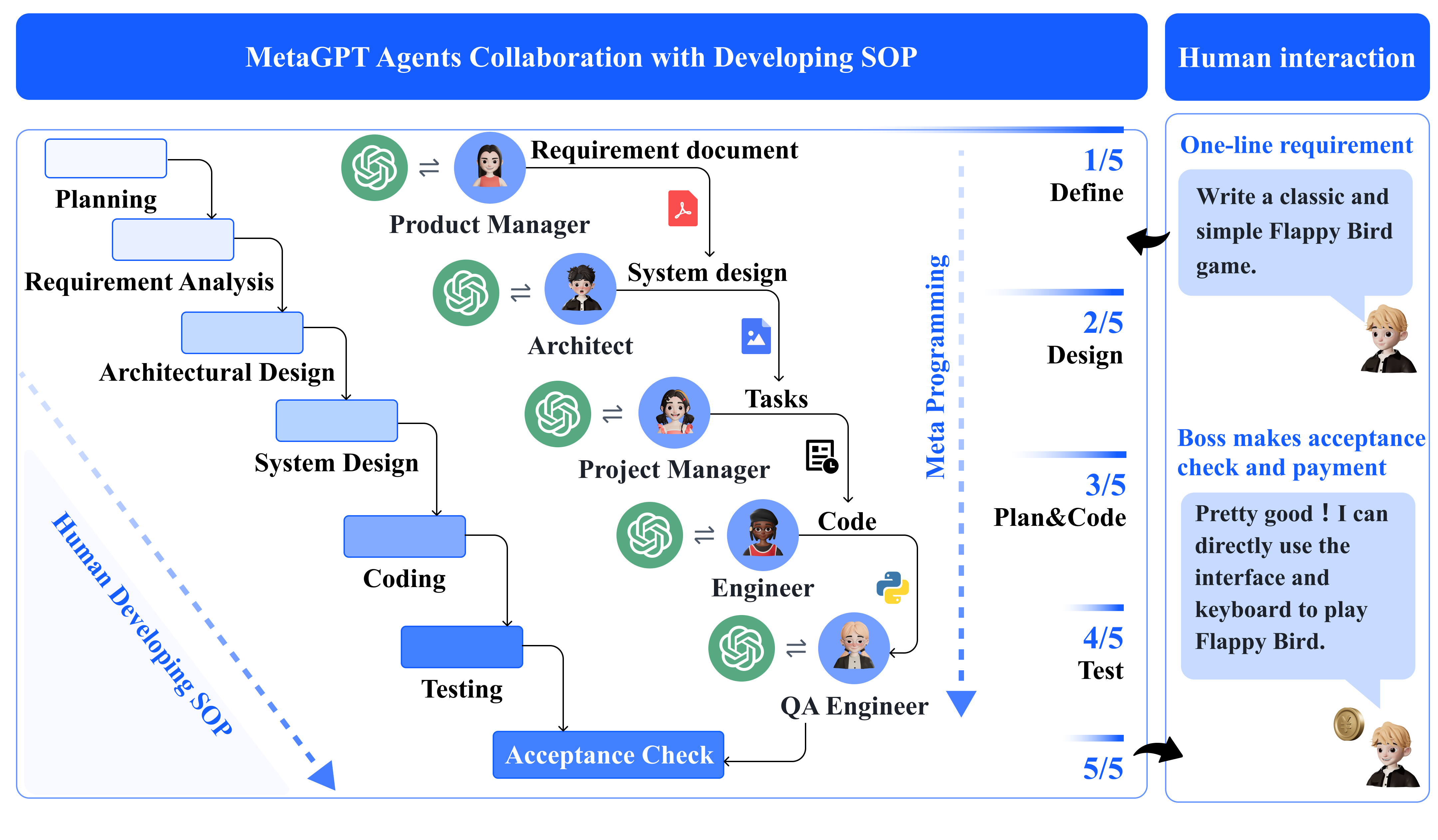
Figure 1:
The software development SOPs between MetaGPT and real-world human teams.
In
software
engineering,
SOPs
promote
collaboration
among
various
roles.
MetaGPT
showcases
its ability to decompose complex tasks into specific actionable procedures assigned to various roles
(e.g., Product Manager, Architect, Engineer, etc.).
documents, design artifacts, flowcharts, and interface specifications.
The use of intermediate struc-
tured
outputs
significantly
increases
the
success
rate
of
target
code
generation.
Because
it
helps
maintain
consistency
in
communication,
minimizing
ambiguities
and
errors
during
collaboration.
More
graphically,
in
a
company
simulated
by
MetaGPT,
all
employees
follow
a
strict
and
stream-
lined workflow, and all their handovers must comply with certain established standards. This reduces
the risk of hallucinations caused by idle chatter between LLMs, particularly in role-playing frame-
works,
like:
“
Hi,
hello
and
how
are
you?”
–
Alice
(Product
Manager);
“
Great!
Have
you
had
lunch?”
– Bob (Architect).
Benefiting from SOPs, MetaGPT offers a promising approach to meta-programming. In this context,
we adopt meta-programming
1
as ”programming to program”, in contrast to the broader fields of meta
learning and ”learning to learn” (
Schmidhuber
,
1987
;
1993a
;
Hochreiter et al.
,
2001
;
Schmidhuber
,
2006
;
Finn et al.
,
2017
).
This
notion
of
meta-programming
also
encompasses
earlier
efforts
like
CodeBERT
(
Feng
et
al.
,
2020
)
and
recent
projects
such
as
CodeLlama
(
Rozi`ere
et
al.
,
2023
)
and
WizardCoder
(
Luo
et
al.
,
2023
).
However,
MetaGPT
stands
out
as
a
unique
solution
that
allows
for
efficient
meta-
programming through a well-organized group of specialized agents.
Each agent has a specific role
and expertise, following some established standards. This allows for automatic requirement analysis,
system design, code generation, modification, execution, and debugging during runtime, highlight-
ing how agent-based techniques can enhance meta-programming.
To validate the design of MetaGPT, we use publicly available HumanEval (
Chen et al.
,
2021a
) and
MBPP
(
Austin
et
al.
,
2021
)
for
evaluations.
Notably,
in
code
generation
benchmarks,
MetaGPT
achieves a new state-of-the-art (SoTA) with 85.9% and 87.7% in Pass@1.
When compared to other
popular
frameworks
for
creating
complex
software
projects,
such
as
AutoGPT
(
Torantulino
et
al.
,
2023
), LangChain (
Chase
,
2022
), AgentVerse (
Chen et al.
,
2023
), and ChatDev (
Qian et al.
,
2023
).
MetaGPT
also
stands
out
in
handling
higher
levels
of
software
complexity
and
offering
extensive
functionality.
Remarkably,
in
our
experimental
evaluations,
MetaGPT
achieves
a
100%
task
com-
pletion rate, demonstrating the robustness and efficiency (time and token costs) of our design.
We summarize our contributions as follows:
1
https://en.wikipedia.org/w/index.php?title=Metaprogramming
2
Published as a conference paper at ICLR 2024
•
We introduce MetaGPT, a meta-programming framework for multi-agent collaboration based on
LLMs.
It
is
highly
convenient
and
flexible,
with
well-defined
functions
like
role
definition
and
message sharing, making it a useful platform for developing LLM-based multi-agent systems.
•
Our
innovative
integration
of
human-like
SOPs
throughout
MetaGPT’s
design
significantly
en-
hances its robustness, reducing unproductive collaboration among LLM-based agents.
Furthermore,
we introduce a novel executive feedback mechanism that debugs and executes code during runtime,
significantly elevating code generation quality (e.g., 5.4% absolute improvement on MBPP).
•
We
achieve
state-of-the-art
performance on HumanEval (
Chen et
al.
,
2021a
) and MBPP (
Austin
et
al.
,
2021
).
Extensive
results
convincingly
validate
MetaGPT,
suggesting
that
it
is
a
promising
meta-programming framework for developing LLM-based multi-agent systems.
2
R
ELATED
W
ORK
Automatic
Programming
The
roots
of
automatic
programming
reach
back
deep
into
the
previ-
ous
century.
In
1969,
Waldinger
&
Lee
(
1969
)
introduced
“PROW,”
a
system
designed
to
accept
program
specifications
written
in
predicate
calculus,
generate
algorithms,
and
create
LISP
imple-
mentations (
McCarthy
,
1978
).
Balzer
(
1985
) and
Soloway
(
1986
) made efforts to advance automatic
programming and identified potential methods to achieve it. Recent approaches use natural language
processing (NLP) techniques (
Ni et al.
,
2023
;
Skreta et al.
,
2023
;
Feng et al.
,
2020
;
Li et al.
,
2022
;
Chen
et
al.
,
2018
;
2021b
;
Zhang
et
al.
,
2023a
;
Liu
et
al.
,
2023b
;
Tang
et
al.
,
2023a
;
Muennighoff
et
al.
,
2023
).
Automatic
programming
has
grown
into
an
industry
delivering
paid
functions
such
as
Microsoft
Copilot.
Lately,
LLMs-based
agents
(
Yao
et
al.
,
2022
;
Shinn
et
al.
,
2023
;
Lin
et
al.
,
2023
) have advanced automatic programming development.
Among them, ReAct (
Yao et al.
,
2022
)
and Reflexion (
Shinn et al.
,
2023
) utilize a chain of thought prompts (
Wei et al.
,
2022
) to generate
reasoning
trajectories
and
action
plans
with
LLMs.
Both
works
demonstrate
the
effectiveness
of
the
ReAct
style
loop
of
reasoning
as
a
design
paradigm
for
empowering
automatic
programming.
Additionally, ToolFormer (
Schick et al.
,
2023
) and ToolLLM (
Qin et al.
,
2023
) can learn how to use
external tools through simple APIs.
The research most closely aligned with our work by
Li et al.
(
2023
) proposes a straightforward role-play framework for programming that involves communica-
tion between agents playing different roles.
Qian et al.
(
2023
) utilizes multiple agents for software
development.
Although existing papers (
Li et al.
,
2023
;
Qian et al.
,
2023
) have improved productiv-
ity, they have not fully tapped into effective workflows with structured output formats.
This makes
it harder to deal with complex software engineering issues.
LLM-Based
Multi-Agent
Frameworks
Recently,
LLM-based
autonomous
agents
have
gained
tremendous interest in both industry and academia (
Wang et al.
,
2023b
;
Zhou et al.
,
2023b
;
Zhang
et
al.
,
2023b
).
Many
works
(
Chen
et
al.
,
2024
;
Wang
et
al.
,
2023c
;
Du
et
al.
,
2023
;
Zhuge
et
al.
,
2023
;
Hao et al.
,
2023
;
Akata et al.
,
2023
;
Tang et al.
,
2023b
) have improved the problem-solving
abilities of LLMs by integrating discussions among multiple agents.
Stable-Alignment (
Liu et al.
,
2023a
)
creates
instruction
datasets
by
deriving consensus on
value judgments through
interactions
across a
sandbox
with LLM
agents.
Other works focus on sociological phenomena.
For example,
Generative
Agents
(
Park
et
al.
,
2023
)
creates
a
“town”
of
25
agents
to
study
language
interaction,
social understanding, and collective memory.
In the Natural Language-Based Society of Mind (NL-
SOM) (
Zhuge et al.
,
2023
), agents with different functions interact to solve complex tasks through
multiple rounds of “mindstorms.”
Cai et al.
(
2023
) propose a model for cost reduction by combining
large models as tool makers and small models as tool users.
Some works emphasize cooperation and competition related to planning and strategy (
Bakhtin et al.
,
2022
);
others
propose
LLM-based
economies
(
Zhuge
et
al.
,
2023
).
These
works
focus
on
open-
world
human
behavior
simulation,
while
MetaGPT
aims
to
introduce
human
practice
into
multi-
agents frameworks.
Besides,
LLM-based agents face the challenges of “assistant repeated instruc-
tion”
or
“infinite
loop
of
message”
(
Talebirad
&
Nadiri
,
2023
;
Li
et
al.
,
2023
).
These
challenges
become more urgent in task-oriented collaborations, which require consistent and mutually benefi-
cial interactions (
Elazar et al.
,
2021
;
Wang et al.
,
2022
;
Jiang et al.
,
2023
).
This motivates our focus
on applying advanced concepts such as Standard Operating Procedures in software development to
multi-agent frameworks.
3
Published as a conference paper at ICLR 2024
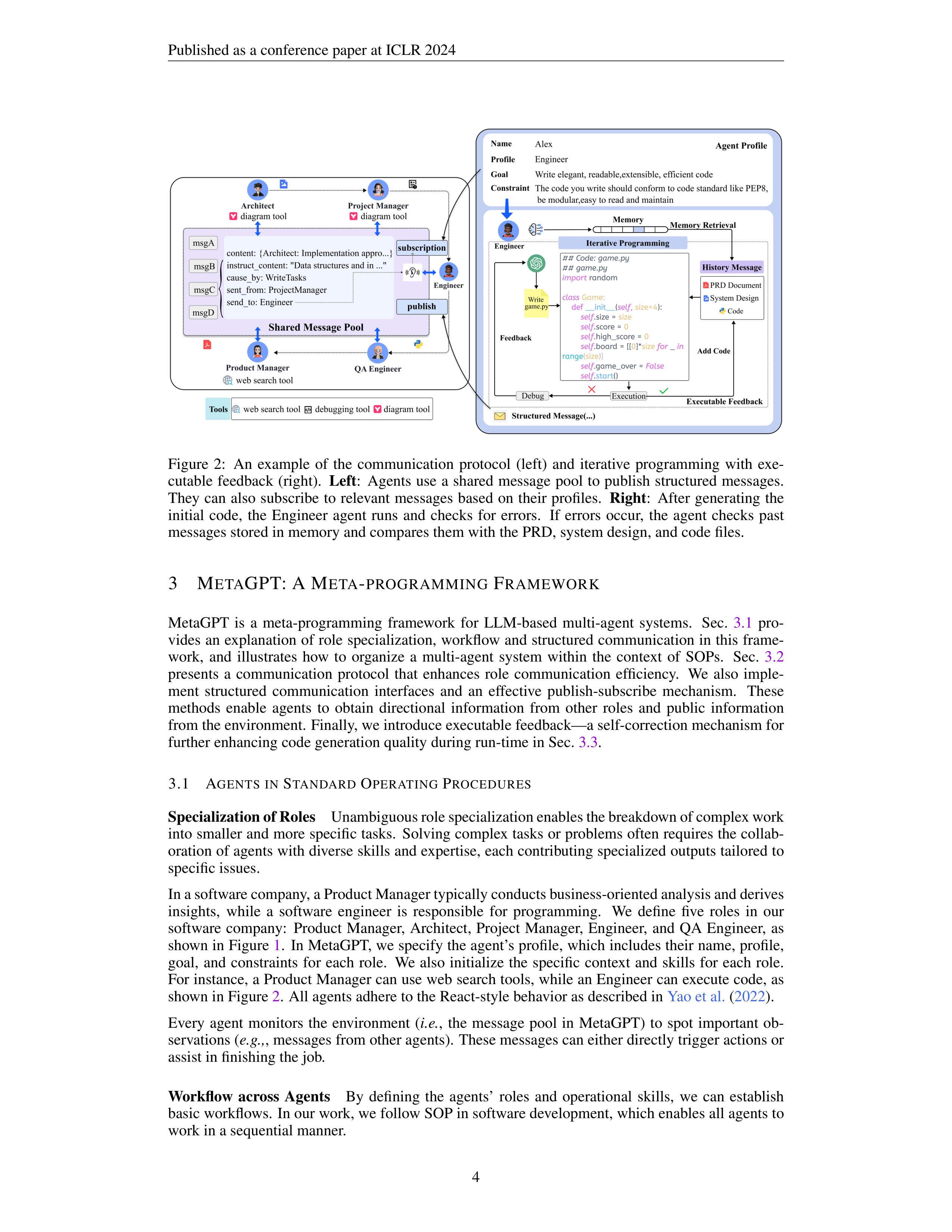
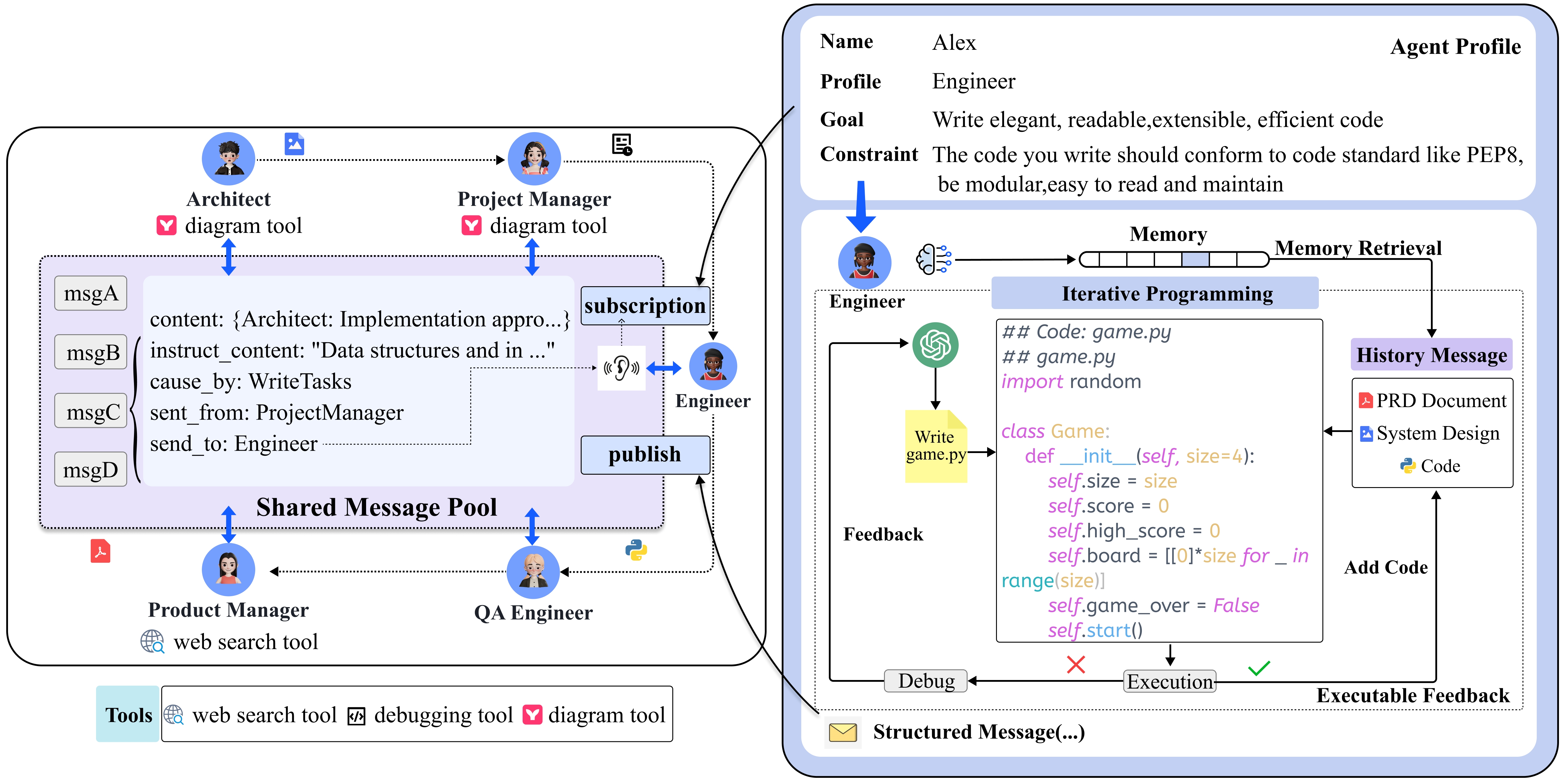
Figure
2:
An
example
of
the
communication
protocol
(left)
and
iterative
programming
with
exe-
cutable
feedback
(right).
Left
:
Agents
use
a
shared
message
pool
to
publish
structured
messages.
They
can
also
subscribe
to
relevant
messages
based
on
their
profiles.
Right
:
After
generating
the
initial
code,
the
Engineer
agent
runs
and
checks
for
errors.
If
errors
occur,
the
agent
checks
past
messages stored in memory and compares them with the PRD, system design, and code files.
3
M
ETA
GPT:
A
M
ETA
-
PROGRAMMING
F
RAMEWORK
MetaGPT
is
a
meta-programming
framework
for
LLM-based
multi-agent
systems.
Sec.
3.1
pro-
vides an explanation of role specialization,
workflow and structured communication in this frame-
work,
and
illustrates
how
to
organize
a
multi-agent
system
within
the
context
of
SOPs.
Sec.
3.2
presents
a
communication
protocol
that
enhances
role
communication
efficiency.
We
also
imple-
ment
structured
communication
interfaces
and
an
effective
publish-subscribe
mechanism.
These
methods
enable
agents
to
obtain
directional
information
from
other
roles
and
public
information
from the environment.
Finally, we introduce executable feedback—a self-correction mechanism for
further enhancing code generation quality during run-time in Sec.
3.3
.
3.1
A
GENTS
IN
S
TANDARD
O
PERATING
P
ROCEDURES
Specialization of Roles
Unambiguous role specialization enables the breakdown of complex work
into smaller and more specific tasks.
Solving complex tasks or problems often requires the collab-
oration of agents with diverse skills and expertise, each contributing specialized outputs tailored to
specific issues.
In a software company, a Product Manager typically conducts business-oriented analysis and derives
insights,
while
a
software
engineer
is
responsible
for
programming.
We
define
five
roles
in
our
software
company:
Product
Manager,
Architect,
Project
Manager,
Engineer,
and
QA
Engineer,
as
shown in Figure
1
.
In MetaGPT, we specify the agent’s profile, which includes their name, profile,
goal,
and
constraints
for
each
role.
We
also
initialize
the
specific
context
and
skills
for
each
role.
For instance, a Product Manager can use web search tools, while an Engineer can execute code, as
shown in Figure
2
.
All agents adhere to the React-style behavior as described in
Yao et al.
(
2022
).
Every
agent
monitors
the
environment
(
i.e.
,
the
message
pool
in
MetaGPT)
to
spot
important
ob-
servations (
e.g.,
, messages from other agents).
These messages can either directly trigger actions or
assist in finishing the job.
Workflow
across
Agents
By
defining
the
agents’
roles
and
operational
skills,
we
can
establish
basic workflows.
In our work, we follow SOP in software development, which enables all agents to
work in a sequential manner.
4
Published as a conference paper at ICLR 2024
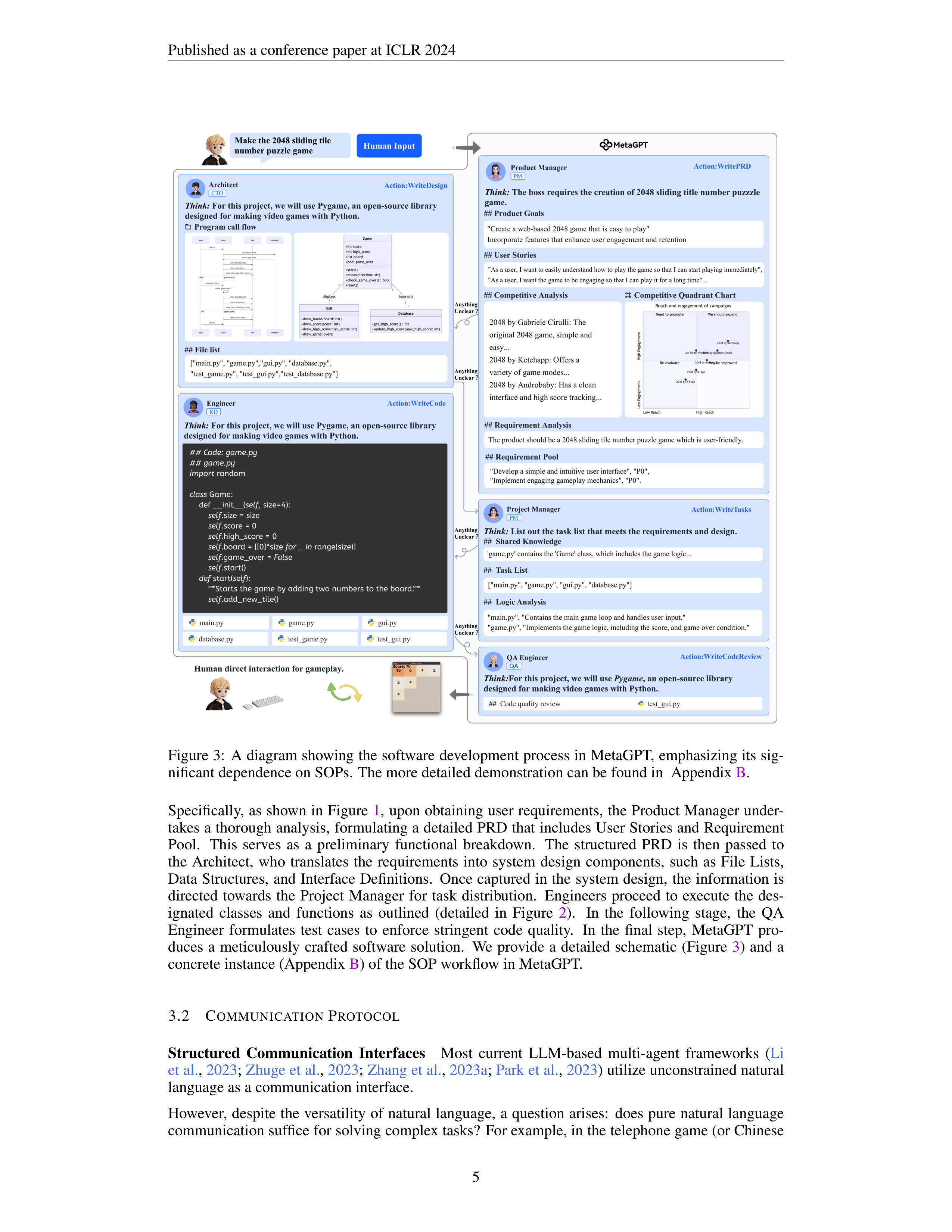
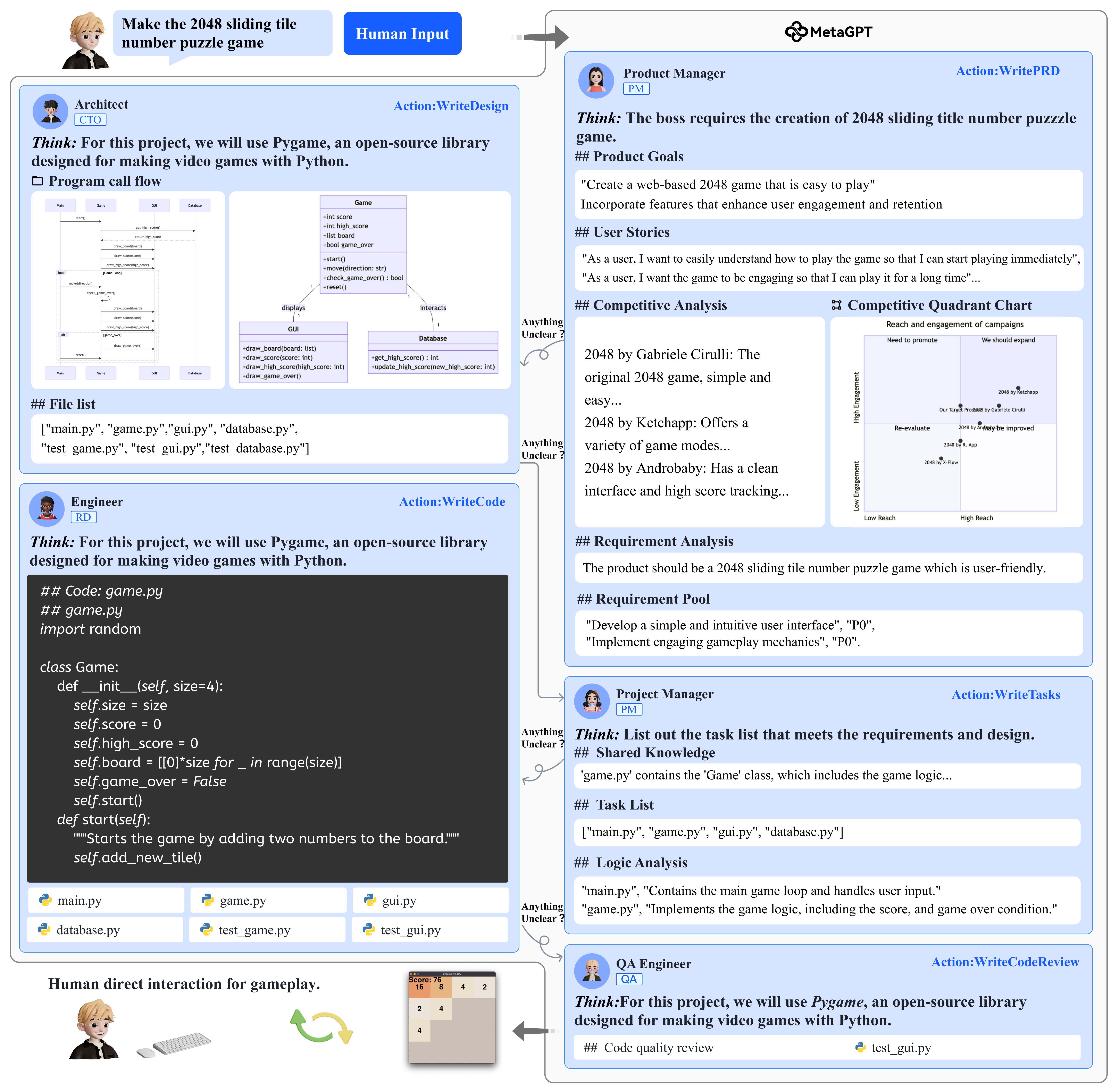
Figure 3:
A diagram showing the software development process in MetaGPT, emphasizing its sig-
nificant dependence on SOPs.
The more detailed demonstration can be found in
Appendix
B
.
Specifically,
as shown in Figure
1
,
upon obtaining user requirements,
the Product Manager under-
takes a thorough analysis,
formulating a detailed PRD that includes User Stories and Requirement
Pool.
This
serves
as
a
preliminary
functional
breakdown.
The
structured
PRD
is
then
passed
to
the
Architect,
who
translates
the
requirements
into
system
design
components,
such
as
File
Lists,
Data Structures,
and Interface
Definitions.
Once captured in the system design,
the information is
directed
towards
the
Project
Manager
for
task
distribution.
Engineers
proceed
to
execute
the
des-
ignated
classes
and
functions
as
outlined
(detailed
in
Figure
2
).
In
the
following
stage,
the
QA
Engineer
formulates
test
cases
to
enforce
stringent
code
quality.
In
the
final
step,
MetaGPT
pro-
duces
a
meticulously
crafted
software
solution.
We
provide
a
detailed
schematic
(Figure
3
)
and
a
concrete instance (Appendix
B
) of the SOP workflow in MetaGPT.
3.2
C
OMMUNICATION
P
ROTOCOL
Structured
Communication
Interfaces
Most
current
LLM-based
multi-agent
frameworks
(
Li
et al.
,
2023
;
Zhuge et al.
,
2023
;
Zhang et al.
,
2023a
;
Park et al.
,
2023
) utilize unconstrained natural
language as a communication interface.
However,
despite
the
versatility
of
natural language,
a
question
arises:
does pure
natural
language
communication suffice for solving complex tasks?
For example, in the telephone game (or Chinese
5
Published as a conference paper at ICLR 2024
whispers)
2
, after several rounds of communication, the original information may be quite distorted.
Inspired
by
human
social
structures,
we
propose
using
structured
communication
to
formulate
the
communication of agents.
We establish a schema and format for each role and request that individ-
uals provide the necessary outputs based on their specific role and context.
As shown in Figure
3
, the Architect agent generates two outputs:
the system interface design and a
sequence flow diagram. These contain system module design and interaction sequences, which serve
as
important
deliverables
for
Engineers.
Unlike
ChatDev
(
Zhao
et
al.
,
2023
),
agents
in
MetaGPT
communicate
through
documents
and
diagrams
(structured
outputs)
rather
than
dialogue.
These
documents contain all necessary information, preventing irrelevant or missing content.
Publish-Subscribe
Mechanism
Sharing
information
is
critical
in
collaboration.
For
instance,
Architects and Engineers often need to reference PRDs.
However, communicating this information
each time in a one-to-one manner, as indicated by previous work (
Li et al.
,
2023
;
Zhao et al.
,
2023
;
Zhang et al.
,
2023a
), can complicate the communication topology, resulting in inefficiencies.
To
address
this
challenge,
a
viable
approach
is
to
store
information
in
a
global
message
pool
.
As
shown
in
Figure
2
(left),
we
introduce
a
shared
message
pool
that
allows
all
agents
to
exchange
messages directly. These agents not only
publish
their structured messages in the pool but also access
messages
from
other
entities
transparently.
Any
agent
can
directly
retrieve
required
information
from the shared pool, eliminating the need to inquire about other agents and await their responses.
This enhances communication efficiency.
Sharing all information with every agent can lead to information overload.
During task execution,
an
agent
typically
prefers
to
receive
only
task-related
information
and
avoid
distractions
through
irrelevant details.
Effective management and dissemination of this information play a crucial role.
We
offer
a
simple
and
effective
solution-
subscription
mechanism
(in
Figure
2
(left)).
Instead
of
relying
on
dialogue,
agents
utilize
role-specific
interests
to
extract
relevant
information.
They
can
select
information
to
follow
based
on
their
role
profiles.
In
practical
implementations,
an
agent
activates its action only after receiving all its prerequisite dependencies.
As illustrated in Figure
3
,
the
Architect
mainly
focuses
on
PRDs
provided
by
the
Product
Manager,
while
documents
from
roles such as the QA Engineer might be of lesser concern.
3.3
I
TERATIVE
PROGRAMMING
WITH
EXECUTABLE
FEEDBACK
In
daily
programming
tasks,
the
processes
of
debugging
and
optimization
play
important
roles.
However, existing methods often lack a self-correction mechanism, which leads to unsuccessful code
generation.
Previous
work
introduced
non-executable
code
review
and
self-reflection
(
Zhao
et
al.
,
2023
;
Yao et al.
,
2022
;
Shinn et al.
,
2023
;
Dong et al.
,
2023
).
However, they still face challenges in
ensuring code executability and runtime correctness.
Our
first
MetaGPT
implementations
overlooked
certain
errors
during
the
review
process,
due
to
LLM
hallucinations
(
Manakul
et
al.
,
2023
).
To
overcome
this,
after
initial
code
generation,
we
introduce an executable feedback mechanism to improve the code iteratively.
More specifically, as
shown in Figure
2
,
the Engineer is asked to write code based on the original product requirements
and design.
This
enables
the
Engineer
to
continuously
improve
code
using
its
own
historical
execution
and
debugging
memory.
To
obtain
additional
information,
the
Engineer
writes and
executes
the
corre-
sponding unit test cases, and subsequently receives the test results.
If satisfactory, additional devel-
opment tasks are initiated.
Otherwise the Engineer debugs the code before resuming programming.
This iterative testing process continues until the test is passed or a maximum of 3 retries is reached.
4
E
XPERIMENTS
4.1
E
XPERIMENTAL
SETTING
Datasets
We
use
two
public
benchmarks,
HumanEval
(
Chen
et
al.
,
2021a
)
and
MBPP
(
Austin
et al.
,
2021
), and a self-generated, more challenging software development benchmark named Soft-
2
https://en.wikipedia.org/wiki/Chinese
whispers
6
Published as a conference paper at ICLR 2024
wareDev:
(1)
HumanEval
includes
164
handwritten
programming
tasks.
These
tasks
encompass
function specifications,
descriptions,
reference codes,
and tests.
(2) MBPP consists of 427 Python
tasks.
These
tasks
cover
core
concepts
and
standard
library
features
and
include
descriptions,
ref-
erence
codes,
and
automated
tests.
(3)
Our
SoftwareDev
dataset
is
a
collection
of
70
representa-
tive
examples
of
software
development
tasks,
each
with
its
own
task
prompt
(see
Table
8
).
These
tasks
have
diverse
scopes
(See
Figure
5
),
such
as
mini-games,
image
processing
algorithms,
data
visualization.
They
offer
a
robust
testbed
for
authentic
development
tasks.
Contrary
to
previous
datasets (
Chen et al.
,
2021a
;
Austin et al.
,
2021
), SoftwareDev focuses on the engineering aspects.
In the comparisons, we randomly select seven representative tasks for evaluation.
Evaluation
Metrics
For
HuamnEval
and
MBPP,
we
follow
the
unbiased
version
of
Pass @
k
as
presented by (
Chen et al.
,
2021a
;
Dong et al.
,
2023
), to evaluate the functional accuracy of the top-k
generated codes:
Pass @
k
=
E
Problems
1
−
(
n
−
c
k
)
(
n
k
)
.
For SoftwareDev,
we prioritize practical use and evaluate performance through human evaluations
(A, E) or statistical analysis (B, C, D):
(A)
Executability:
this metric rates code from 1 (failure/non-
functional)
to
4
(flawless).
‘1’
is
for
non-functional,
‘2’
for
runnable
but
imperfect,
‘3’
for
nearly
perfect, and ‘4’ for flawless code.
(B)
Cost:
the cost evaluations here include the (1) running time,
(2) token usage, and (3) expenses.
(C)
Code Statistics:
this includes (1) code files, (2) lines of code
per
file,
and
(3)
total
code
lines.
(D)
Productivity:
basically,
it
is
defined
as
the
number
of
token
usage divided by the number of lines of code,
which refers to the consumption of tokens per code
line.
(E)
Human Revision Cost:
refers to times of manual code corrections, which tackle problems
like
package
import
errors,
incorrect
class
names,
or
incomplete
reference
paths.
Typically,
each
correction involves up to 3 lines of code.
Baselines
We compare our method with recent domain-specific LLMs in the code generation field,
including AlphaCode (
Li et al.
,
2022
), Incoder (
Fried et al.
,
2022
), CodeGeeX (
Zheng et al.
,
2023
),
CodeGen
(
Nijkamp
et
al.
,
2023
),
CodeX
(
Chen
et
al.
,
2021a
),
and
CodeT
(
Chen
et
al.
,
2022
)
and
general domain LLMs such as PaLM (
Chowdhery et al.
,
2022
), and GPT-4 (
OpenAI
,
2023
).
Several
results of baselines (such as Incoder, CodeGeeX) are provided by
Dong et al.
(
2023
).
In HumanEval
and
MBPP,
we
slightly
modified
the
prompts
to
align
with
response
format
requirements.
These
modifications aim to address format-specific issues (i.e., Python problems).
With the SoftwareDev
benchmark,
we
provide
a
comprehensive
comparison
between
MetaGPT,
AutoGPT
(
Torantulino
et
al.
,
2023
),
LangChain
(
Chase
,
2022
)
with
Python
Read-Eval-Print
Loop
(REPL)
tool
3
,
Agent-
Verse (
Chen et al.
,
2023
), and ChatDev (
Qian et al.
,
2023
).
4.2
M
AIN
R
ESULT
AlphaCode
(1.1B)
Incoder (6.7B)
CodeGeeX (13B)
17.1
—
15.2
17.6
18.9
26.9
CodeGeeX-Mono
(16.1B)
32.9
38.6
GPT-4
67.0
—
MetaGPT
(w/o Feedback)
81.7
82.3
Pass@1 of MBPP and HumanEval (%)
PaLM Coder
(540B)
36.0
47.0
Codex (175B)
47.0
58.1
Codex + CodeT
65.8
67.7
HumanEval
MBPP
MetaGPT
85.9
87.7
Figure 4:
Pass rates on the MBPP and HumanEval with a single attempt.
Performance
Figure
4
demonstrates that MetaGPT outperforms all preceding approaches in both
HumanEval and MBPP benchmarks.
When MetaGPT collaborates with GPT-4, it significantly im-
proves the
Pass @
k
in the HumanEval benchmark compared to GPT-4. It achieves 85.9% and 87.7%
3
https://en.wikipedia.org/wiki/Read–eval–print
loop
7
Published as a conference paper at ICLR 2024
Figure 5:
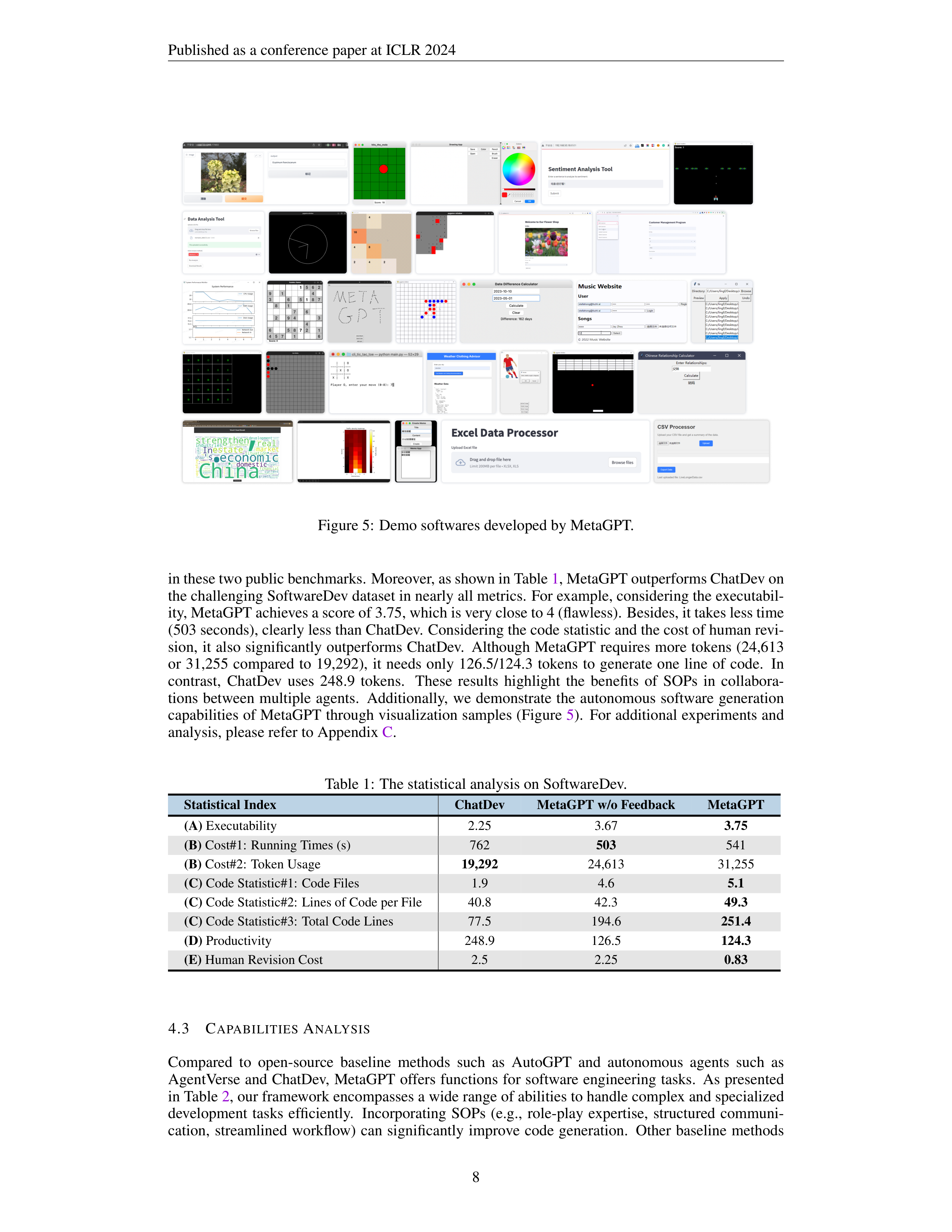
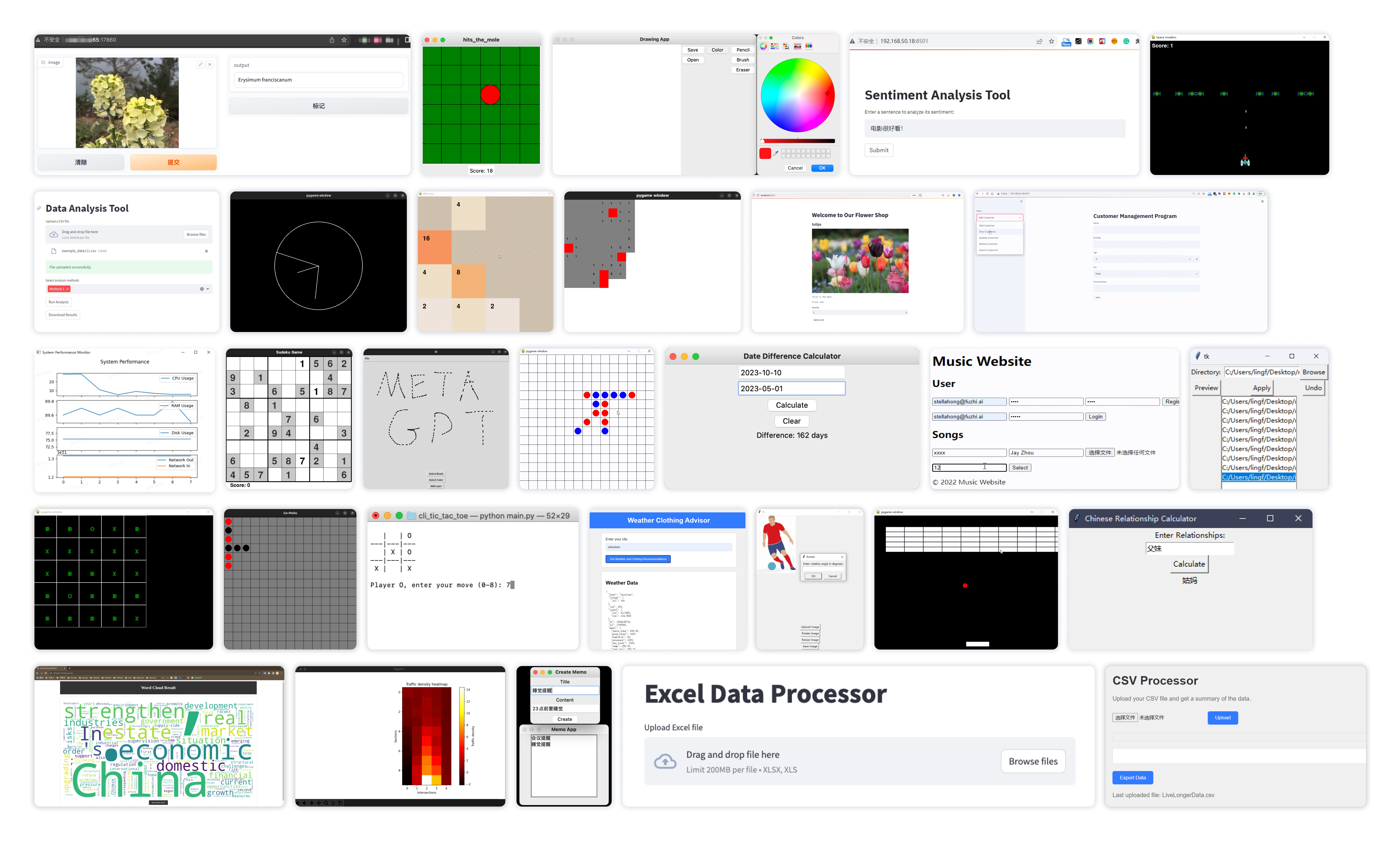
Demo softwares developed by MetaGPT.
in these two public benchmarks.
Moreover, as shown in Table
1
, MetaGPT outperforms ChatDev on
the challenging SoftwareDev dataset in nearly all metrics.
For example, considering the executabil-
ity, MetaGPT achieves a score of 3.75, which is very close to 4 (flawless).
Besides, it takes less time
(503 seconds), clearly less than ChatDev.
Considering the code statistic and the cost of human revi-
sion,
it also significantly outperforms ChatDev.
Although MetaGPT requires more tokens (24,613
or
31,255
compared
to
19,292),
it
needs
only
126.5/124.3
tokens
to
generate
one
line
of
code.
In
contrast,
ChatDev
uses
248.9
tokens.
These
results
highlight
the
benefits
of
SOPs
in
collabora-
tions
between
multiple
agents.
Additionally,
we
demonstrate
the
autonomous
software
generation
capabilities of MetaGPT through visualization samples (Figure
5
).
For additional experiments and
analysis, please refer to Appendix
C
.
Table 1:
The statistical analysis on SoftwareDev.
Statistical Index
ChatDev
MetaGPT w/o Feedback
MetaGPT
(A)
Executability
2.25
3.67
3.75
(B)
Cost#1:
Running Times (s)
762
503
541
(B)
Cost#2:
Token Usage
19,292
24,613
31,255
(C)
Code Statistic#1:
Code Files
1.9
4.6
5.1
(C)
Code Statistic#2:
Lines of Code per File
40.8
42.3
49.3
(C)
Code Statistic#3:
Total Code Lines
77.5
194.6
251.4
(D)
Productivity
248.9
126.5
124.3
(E)
Human Revision Cost
2.5
2.25
0.83
4.3
C
APABILITIES
A
NALYSIS
Compared
to
open-source
baseline
methods
such
as
AutoGPT
and
autonomous
agents
such
as
AgentVerse and ChatDev,
MetaGPT offers functions for software engineering tasks.
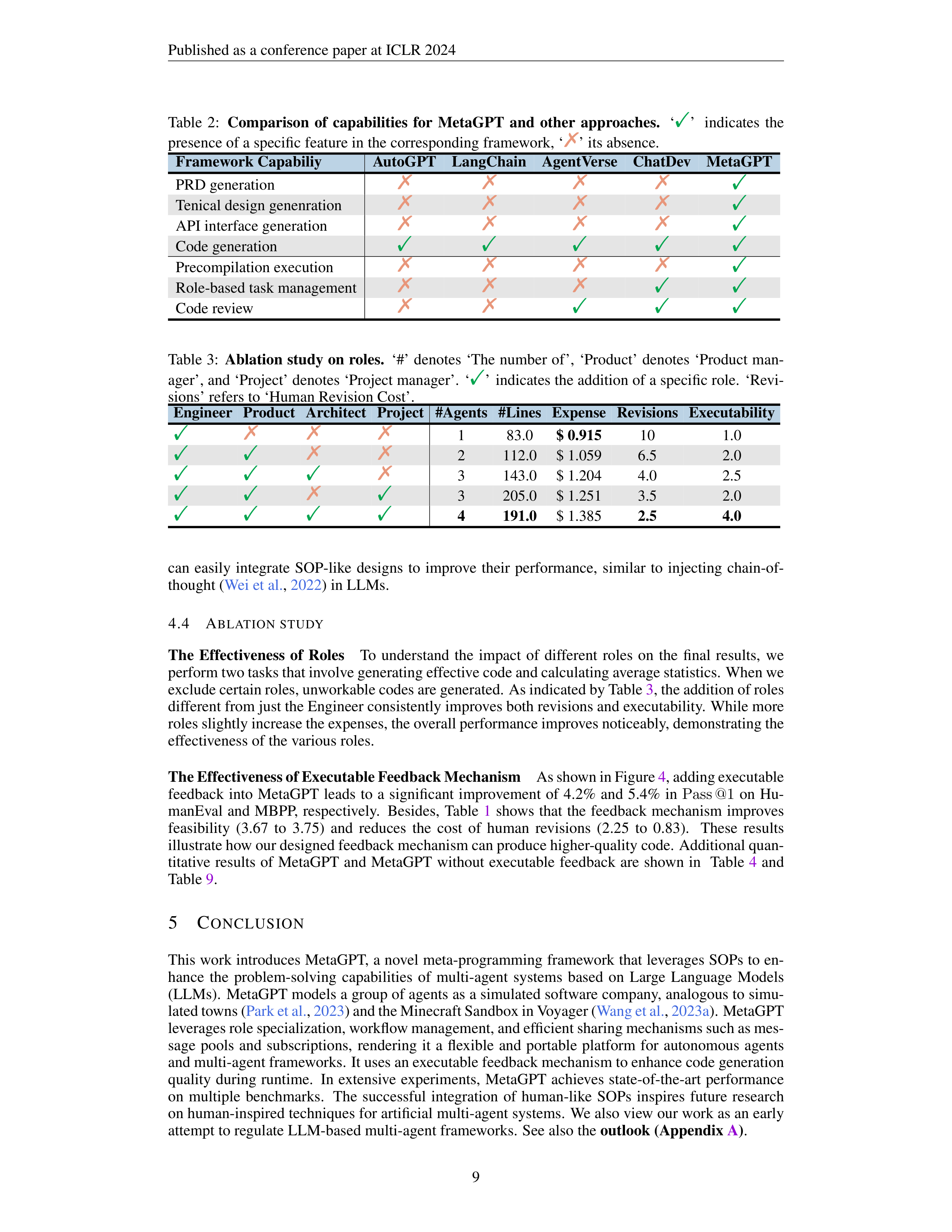
As presented
in Table
2
, our framework encompasses a wide range of abilities to handle complex and specialized
development
tasks
efficiently.
Incorporating
SOPs
(e.g.,
role-play
expertise,
structured
communi-
cation,
streamlined
workflow)
can
significantly
improve
code
generation.
Other
baseline
methods
8
Published as a conference paper at ICLR 2024
Table
2:
Comparison
of
capabilities
for
MetaGPT
and
other
approaches.
‘
!
’
indicates
the
presence of a specific feature in the corresponding framework, ‘
%
’ its absence.
Framework Capabiliy
AutoGPT
LangChain
AgentVerse
ChatDev
MetaGPT
PRD generation
%
%
%
%
!
Tenical design genenration
%
%
%
%
!
API interface generation
%
%
%
%
!
Code generation
!
!
!
!
!
Precompilation execution
%
%
%
%
!
Role-based task management
%
%
%
!
!
Code review
%
%
!
!
!
Table 3:
Ablation study on roles.
‘#’ denotes ‘The number of’,
‘Product’ denotes ‘Product man-
ager’, and ‘Project’ denotes ‘Project manager’.
‘
!
’
indicates the addition of a specific role.
‘Revi-
sions’ refers to ‘Human Revision Cost’.
Engineer
Product
Architect
Project
#Agents
#Lines
Expense
Revisions
Executability
!
%
%
%
1
83.0
$ 0.915
10
1.0
!
!
%
%
2
112.0
$ 1.059
6.5
2.0
!
!
!
%
3
143.0
$ 1.204
4.0
2.5
!
!
%
!
3
205.0
$ 1.251
3.5
2.0
!
!
!
!
4
191.0
$ 1.385
2.5
4.0
can
easily
integrate
SOP-like
designs
to
improve
their
performance,
similar
to
injecting
chain-of-
thought (
Wei et al.
,
2022
) in LLMs.
4.4
A
BLATION
STUDY
The
Effectiveness
of
Roles
To
understand
the
impact
of
different
roles
on
the
final
results,
we
perform two tasks that involve generating effective code and calculating average statistics. When we
exclude certain roles, unworkable codes are generated. As indicated by Table
3
, the addition of roles
different from just the Engineer consistently improves both revisions and executability.
While more
roles slightly increase the expenses, the overall performance improves noticeably, demonstrating the
effectiveness of the various roles.
The Effectiveness of Executable Feedback Mechanism
As shown in Figure
4
, adding executable
feedback
into
MetaGPT
leads
to
a
significant
improvement
of
4.2%
and
5.4%
in
Pass @1
on
Hu-
manEval
and
MBPP,
respectively.
Besides,
Table
1
shows
that
the
feedback
mechanism
improves
feasibility
(3.67
to
3.75)
and
reduces
the
cost
of
human
revisions
(2.25
to
0.83).
These
results
illustrate how our designed feedback mechanism can produce higher-quality code.
Additional quan-
titative
results
of
MetaGPT
and
MetaGPT
without
executable
feedback
are
shown
in
Table
4
and
Table
9
.
5
C
ONCLUSION
This work introduces MetaGPT, a novel meta-programming framework that leverages SOPs to en-
hance
the
problem-solving
capabilities
of
multi-agent
systems
based
on
Large
Language
Models
(LLMs).
MetaGPT models a group of agents as a simulated software company, analogous to simu-
lated towns (
Park et al.
,
2023
) and the Minecraft Sandbox in Voyager (
Wang et al.
,
2023a
). MetaGPT
leverages role specialization, workflow management, and efficient sharing mechanisms such as mes-
sage
pools
and
subscriptions,
rendering
it
a
flexible
and
portable
platform
for
autonomous
agents
and multi-agent frameworks.
It uses an executable feedback mechanism to enhance code generation
quality
during
runtime.
In
extensive
experiments,
MetaGPT
achieves
state-of-the-art
performance
on
multiple
benchmarks.
The
successful
integration
of
human-like
SOPs
inspires
future
research
on human-inspired techniques for artificial multi-agent systems.
We also view our work as an early
attempt to regulate LLM-based multi-agent frameworks.
See also the
outlook (Appendix
A
)
.
9
Published as a conference paper at ICLR 2024
Acknowledgement
We thank Sarah Salhi, the Executive Secretary of KAUST AI Initiative, and Yuhui Wang, Postdoc-
toral
Fellow
at
the
KAUST
AI
Initiative,
for
helping
to
polish
some
of
the
text.
We
would
like
to
express our gratitude to Wenyi Wang, a PhD student at the KAUST AI Initiative, for providing com-
prehensive feedback on the paper and for helping to draft the outlook (Appendix
A
) with Mingchen.
We
also
thank
Zongze
Xu,
the
vice
president
of
DeepWisdom,
for
providing
illustrative
materials
for AgentStore.
Author Contributions
Sirui Hong conducted most of the experiments and designed the executable feedback module.
She
also led the initial version of the write-up, supported by Ceyao Zhang, and also by Jinlin Wang and
Zili
Wang.
Mingchen
Zhuge
designed
the
self-improvement
module,
discussed
additional
experi-
ments,
and
led
the
current
write-up.
Jiaqi
Chen
helped
with
the
MBPP
experiments,
outlined
the
methods section, and contributed to the current write-up.
Xiawu Zheng provided valuable guidance,
reviewed and edited the paper.
Yuheng Cheng contributed to the evaluation metric design and Hu-
manEval experiments.
Steven Ka Shing Yau, Zijuan Lin, Liyang Zhou, Lingfeng Xiao helped with
the
MBPP
experiments
and
comparisons
to
open-source
baseline
methods.
Chenyu
Ran
created
most of the illustrative figures.
Chenglin Wu is the CEO of DeepWisdom, initiated MetaGPT, made
the most significant code contributions to it, and advised this project.
J¨urgen Schmidhuber, Director
of the AI Initiative at KAUST and Scientific Director of IDSIA, advised this project and helped with
the write-up.
R
EFERENCES
Elif
Akata,
Lion
Schulz,
Julian
Coda-Forno,
Seong
Joon
Oh,
Matthias
Bethge,
and
Eric
Schulz.
Playing repeated games with large language models.
arXiv preprint
, 2023.
Jacob Austin, Augustus Odena, Maxwell Nye, Maarten Bosma, Henryk Michalewski, David Dohan,
Ellen Jiang, Carrie Cai, Michael Terry, Quoc Le, and Charles Sutton. Program synthesis with large
language models, 2021.
Anton Bakhtin, Noam Brown, Emily Dinan, Gabriele Farina, Colin Flaherty, Daniel Fried, Andrew
Goff, Jonathan Gray, Hengyuan Hu, et al.
Human-level play in the game of diplomacy by com-
bining language models with strategic reasoning.
Science
, 2022.
Robert Balzer.
A 15 year perspective on automatic programming.
TSE
, 1985.
R.M. Belbin.
Team Roles at Work
.
Routledge, 2012.
URL
https://books.google.co.uk/
books?id=MHIQBAAAQBAJ
.
Tianle Cai, Xuezhi Wang, Tengyu Ma, Xinyun Chen, and Denny Zhou.
Large language models as
tool makers.
arXiv preprint
, 2023.
Harrison Chase.
LangChain.
https://github.com/hwchase17/langchain
, 2022.
Bei
Chen,
Fengji
Zhang,
Anh
Nguyen,
Daoguang
Zan,
Zeqi
Lin,
Jian-Guang
Lou,
and
Weizhu
Chen.
Codet:
Code generation with generated tests, 2022.
Jiaqi Chen, Yuxian Jiang, Jiachen Lu, and Li Zhang. S-agents: self-organizing agents in open-ended
environment.
arXiv preprint
, 2024.
Mark
Chen,
Jerry
Tworek,
Heewoo
Jun,
Qiming
Yuan,
Henrique
Ponde
de
Oliveira
Pinto,
Jared
Kaplan,
Harri
Edwards,
Yuri
Burda,
Nicholas
Joseph,
Greg
Brockman,
Alex
Ray,
Raul
Puri,
Gretchen Krueger, Michael Petrov, Heidy Khlaaf, Girish Sastry, Pamela Mishkin, Brooke Chan,
Scott
Gray,
Nick
Ryder,
Mikhail
Pavlov,
Alethea
Power,
Lukasz
Kaiser,
Mohammad
Bavarian,
Clemens
Winter,
Philippe
Tillet,
Felipe
Petroski
Such,
Dave
Cummings,
Matthias
Plappert,
Fo-
tios
Chantzis,
Elizabeth
Barnes,
Ariel
Herbert-Voss,
William
Hebgen
Guss,
Alex
Nichol,
Alex
Paino, Nikolas Tezak, Jie Tang, Igor Babuschkin, Suchir Balaji, Shantanu Jain, William Saunders,
Christopher Hesse, Andrew N. Carr, Jan Leike, Josh Achiam, Vedant Misra, Evan Morikawa, Alec
Radford, Matthew Knight, Miles Brundage, Mira Murati, Katie Mayer, Peter Welinder, Bob Mc-
Grew, Dario Amodei, Sam McCandlish, Ilya Sutskever, and Wojciech Zaremba.
Evaluating large
language models trained on code, 2021a.
10
Published as a conference paper at ICLR 2024
Weize
Chen,
Yusheng
Su,
Jingwei
Zuo,
Cheng
Yang,
Chenfei
Yuan,
Chen
Qian,
Chi-Min
Chan,
Yujia Qin, Yaxi Lu, Ruobing Xie, Zhiyuan Liu, Maosong Sun, and Jie Zhou.
Agentverse:
Facili-
tating multi-agent collaboration and exploring emergent behaviors in agents, 2023.
Xinyun Chen, Chang Liu, and Dawn Song.
Execution-guided neural program synthesis.
In
ICLR
,
2018.
Xinyun
Chen,
Dawn
Song,
and
Yuandong
Tian.
Latent
execution
for
neural
program
synthesis
beyond domain-specific languages.
NeurIPS
, 2021b.
Aakanksha
Chowdhery,
Sharan
Narang,
Jacob
Devlin,
Maarten
Bosma,
Gaurav
Mishra,
Adam
Roberts, Paul Barham, Hyung Won Chung, Charles Sutton, Sebastian Gehrmann, Parker Schuh,
Kensen Shi, Sasha Tsvyashchenko, Joshua Maynez, Abhishek Rao, Parker Barnes, Yi Tay, Noam
Shazeer,
Vinodkumar
Prabhakaran,
Emily
Reif,
Nan
Du,
Ben
Hutchinson,
Reiner
Pope,
James
Bradbury,
Jacob Austin,
Michael Isard,
Guy Gur-Ari,
Pengcheng Yin,
Toju Duke,
Anselm Lev-
skaya, Sanjay Ghemawat, Sunipa Dev, Henryk Michalewski, Xavier Garcia, Vedant Misra, Kevin
Robinson,
Liam
Fedus,
Denny
Zhou,
Daphne
Ippolito,
David
Luan,
Hyeontaek
Lim,
Barret
Zoph,
Alexander
Spiridonov,
Ryan
Sepassi,
David
Dohan,
Shivani
Agrawal,
Mark
Omernick,
Andrew
M.
Dai,
Thanumalayan
Sankaranarayana
Pillai,
Marie
Pellat,
Aitor
Lewkowycz,
Erica
Moreira, Rewon Child, Oleksandr Polozov, Katherine Lee, Zongwei Zhou, Xuezhi Wang, Bren-
nan Saeta, Mark Diaz, Orhan Firat, Michele Catasta, Jason Wei, Kathy Meier-Hellstern, Douglas
Eck, Jeff Dean, Slav Petrov, and Noah Fiedel.
Palm:
Scaling language modeling with pathways,
2022.
T. DeMarco and T.R. Lister.
Peopleware:
Productive Projects and Teams
.
Addison-Wesley, 2013.
URL
https://books.google.co.uk/books?id=DVlsAQAAQBAJ
.
Yihong Dong, Xue Jiang, Zhi Jin, and Ge Li.
Self-collaboration code generation via chatgpt.
arXiv
preprint
, 2023.
Yilun
Du,
Shuang
Li,
Antonio
Torralba,
Joshua
B.
Tenenbaum,
and
Igor
Mordatch.
Improving
factuality and reasoning in language models through multiagent debate, 2023.
Yanai
Elazar,
Nora
Kassner,
Shauli
Ravfogel,
Abhilasha
Ravichander,
Eduard
Hovy,
Hinrich
Sch¨utze, and Yoav Goldberg.
Measuring and improving consistency in pretrained language mod-
els.
TACL
, 2021.
Zhangyin Feng, Daya Guo, Duyu Tang, Nan Duan, Xiaocheng Feng, Ming Gong, Linjun Shou, Bing
Qin,
Ting
Liu,
Daxin
Jiang,
et
al.
Codebert:
A
pre-trained
model
for
programming
and
natural
languages.
arXiv preprint
, 2020.
Chrisantha Fernando, Dylan Banarse, Henryk Michalewski, Simon Osindero, and Tim Rockt¨aschel.
Promptbreeder:
Self-referential self-improvement via prompt evolution.
arXiv preprint
, 2023.
Chelsea Finn, Pieter Abbeel, and Sergey Levine.
Model-agnostic meta-learning for fast adaptation
of deep networks.
In
ICML
, 2017.
Daniel
Fried,
Armen
Aghajanyan,
Jessy
Lin,
Sida
Wang,
Eric
Wallace,
Freda
Shi,
Ruiqi
Zhong,
Wen-tau Yih, Luke Zettlemoyer, and Mike Lewis.
Incoder:
A generative model for code infilling
and synthesis.
arXiv preprint
, 2022.
Irving John Good.
Speculations concerning the first ultraintelligent machine.
Adv. Comput.
, 1965.
Rui
Hao,
Linmei
Hu,
Weijian
Qi,
Qingliu
Wu,
Yirui
Zhang,
and
Liqiang
Nie.
Chatllm
network:
More brains, more intelligence.
arXiv preprint
, 2023.
S. Hochreiter, A. S. Younger, and P. R. Conwell. Learning to learn using gradient descent. In
Lecture
Notes on Comp. Sci. 2130, Proc. Intl. Conf. on Artificial Neural Networks (ICANN-2001)
, pp. 87–
94. Springer:
Berlin, Heidelberg, 2001.
Sirui Hong,
Yizhang Lin,
Bangbang Liu,
Binhao Wu,
Danyang Li,
Jiaqi Chen,
Jiayi Zhang,
Jinlin
Wang,
Lingyao Zhang,
Mingchen Zhuge,
et al.
Data interpreter:
An llm agent for data science.
arXiv preprint arXiv:2402.18679
, 2024.
11
Published as a conference paper at ICLR 2024
Xue Jiang, Yihong Dong, Lecheng Wang, Qiwei Shang, and Ge Li.
Self-planning code generation
with large language model.
arXiv preprint
, 2023.
Guohao Li, Hasan Abed Al Kader Hammoud, Hani Itani, Dmitrii Khizbullin, and Bernard Ghanem.
Camel:
Communicative
agents
for”
mind”
exploration
of
large
scale
language
model
society.
arXiv preprint
, 2023.
Yujia
Li,
David
Choi,
Junyoung
Chung,
Nate
Kushman,
Julian
Schrittwieser,
R´emi
Leblond,
Tom
Eccles, James Keeling, Felix Gimeno, Agustin Dal Lago, et al. Competition-level code generation
with alphacode.
Science
, 2022.
Tian Liang, Zhiwei He, Wenxiang Jiao, Xing Wang, Yan Wang, Rui Wang, Yujiu Yang, Zhaopeng
Tu,
and Shuming Shi.
Encouraging divergent thinking in large language models through multi-
agent debate.
arXiv preprint
, 2023.
Bill Yuchen Lin, Yicheng Fu, Karina Yang, Prithviraj Ammanabrolu, Faeze Brahman, Shiyu Huang,
Chandra Bhagavatula,
Yejin Choi,
and Xiang Ren.
Swiftsage:
A generative agent with fast and
slow thinking for complex interactive tasks.
arXiv preprint
, 2023.
Ruibo
Liu,
Ruixin
Yang,
Chenyan
Jia,
Ge
Zhang,
Denny
Zhou,
Andrew
M
Dai,
Diyi
Yang,
and
Soroush Vosoughi.
Training socially aligned language models in simulated human society.
arXiv
preprint
, 2023a.
Yuliang Liu, Xiangru Tang, Zefan Cai, Junjie Lu, Yichi Zhang, Yanjun Shao, Zexuan Deng, Helan
Hu,
Zengxian
Yang,
Kaikai
An,
et
al.
Ml-bench:
Large
language
models
leverage
open-source
libraries for machine learning tasks.
arXiv preprint arXiv:2311.09835
, 2023b.
Ziyang
Luo,
Can
Xu,
Pu
Zhao,
Qingfeng
Sun,
Xiubo
Geng,
Wenxiang
Hu,
Chongyang
Tao,
Jing
Ma, Qingwei Lin, and Daxin Jiang.
Wizardcoder:
Empowering code large language models with
evol-instruct.
arXiv preprint
, 2023.
Potsawee Manakul, Adian Liusie, and Mark JF Gales.
Selfcheckgpt:
Zero-resource black-box hal-
lucination detection for generative large language models.
arXiv preprint
, 2023.
Agile Manifesto.
Manifesto for agile software development
.
Snowbird, UT, 2001.
John McCarthy.
History of lisp.
In
History of programming languages
. 1978.
Niklas
Muennighoff,
Qian
Liu,
Armel
Zebaze,
Qinkai
Zheng,
Binyuan
Hui,
Terry
Yue
Zhuo,
Swayam
Singh,
Xiangru
Tang,
Leandro
Von
Werra,
and
Shayne
Longpre.
Octopack:
Instruc-
tion tuning code large language models.
arXiv preprint arXiv:2308.07124
, 2023.
Ansong Ni, Srini Iyer, Dragomir Radev, Veselin Stoyanov, Wen-tau Yih, Sida Wang, and Xi Victoria
Lin.
Lever:
Learning to verify language-to-code generation with execution.
In
ICML
, 2023.
Erik
Nijkamp,
Bo
Pang,
Hiroaki
Hayashi,
Lifu
Tu,
Huan
Wang,
Yingbo
Zhou,
Silvio
Savarese,
and Caiming Xiong.
Codegen:
An open large language model for code with multi-turn program
synthesis, 2023.
OpenAI.
Gpt-4 technical report, 2023.
Joon
Sung
Park,
Joseph
C
O’Brien,
Carrie
J
Cai,
Meredith
Ringel
Morris,
Percy
Liang,
and
Michael S Bernstein. Generative agents: Interactive simulacra of human behavior.
arXiv preprint
,
2023.
Chen
Qian,
Xin
Cong,
Cheng
Yang,
Weize
Chen,
Yusheng
Su,
Juyuan
Xu,
Zhiyuan
Liu,
and
Maosong Sun.
Communicative agents for software development, 2023.
Yujia Qin, Shihao Liang, Yining Ye, Kunlun Zhu, Lan Yan, Yaxi Lu, Yankai Lin, Xin Cong, Xiangru
Tang, Bill Qian, et al.
Toolllm:
Facilitating large language models to master 16000+ real-world
apis.
arXiv preprint arXiv:2307.16789
, 2023.
Baptiste Rozi`ere, Jonas Gehring, Fabian Gloeckle, Sten Sootla, Itai Gat, Xiaoqing Ellen Tan, Yossi
Adi, Jingyu Liu, Tal Remez, J´er´emy Rapin, et al.
Code llama:
Open foundation models for code.
arXiv preprint
, 2023.
12
Published as a conference paper at ICLR 2024
Timo Schick, Jane Dwivedi-Yu, Roberto Dess`ı, Roberta Raileanu, Maria Lomeli, Luke Zettlemoyer,
Nicola Cancedda, and Thomas Scialom.
Toolformer:
Language models can teach themselves to
use tools.
arXiv preprint
, 2023.
J.
Schmidhuber.
A
self-referential
weight
matrix.
In
Proceedings
of
the International
Conference
on Artificial Neural Networks, Amsterdam
, pp. 446–451. Springer, 1993a.
J.
Schmidhuber.
G¨odel
machines:
self-referential
universal
problem
solvers
making
provably
optimal
self-improvements.
Technical
Report
IDSIA-19-03,
arXiv:cs.LO/0309048
v3,
IDSIA,
Manno-Lugano, Switzerland, December 2003.
J. Schmidhuber.
G¨odel machines:
Fully self-referential optimal universal self-improvers.
In B. Go-
ertzel
and
C.
Pennachin
(eds.),
Artificial
General
Intelligence
,
pp.
199–226.
Springer
Verlag,
2006.
Variant available as arXiv:cs.LO/0309048.
J. Schmidhuber.
Ultimate cognition
`a la
G¨odel.
Cognitive Computation
, 1(2):177–193, 2009.
J¨urgen
Schmidhuber.
Evolutionary
principles
in
self-referential
learning,
or
on
learning
how
to
learn:
the meta-meta-... hook
.
PhD thesis, 1987.
J¨urgen Schmidhuber.
A ‘self-referential’weight matrix.
In
ICANN’93:
Proceedings of the Interna-
tional Conference on Artificial Neural Networks Amsterdam, The Netherlands 13–16 September
1993 3
, 1993b.
J¨urgen Schmidhuber.
On learning to think:
Algorithmic information theory for novel combinations
of reinforcement learning controllers and recurrent neural world models.
arXiv preprint
, 2015.
J¨urgen
Schmidhuber,
Jieyu
Zhao,
and
Nicol
N
Schraudolph.
Reinforcement
learning
with
self-
modifying policies.
In
Learning to learn
. 1998.
Noah Shinn,
Beck Labash,
and Ashwin Gopinath.
Reflexion:
an autonomous agent with dynamic
memory and self-reflection.
arXiv preprint
, 2023.
Marta
Skreta,
Naruki
Yoshikawa,
Sebastian
Arellano-Rubach,
Zhi
Ji,
Lasse
Bjørn
Kristensen,
Kourosh
Darvish,
Al´an
Aspuru-Guzik,
Florian
Shkurti,
and
Animesh
Garg.
Errors
are
useful
prompts:
Instruction
guided
task
programming
with
verifier-assisted
iterative
prompting.
arXiv
preprint
, 2023.
Elliot Soloway.
Learning to program
=
learning to construct mechanisms and explanations.
Com-
munications of the ACM
, 1986.
Yashar
Talebirad
and
Amirhossein
Nadiri.
Multi-agent
collaboration:
Harnessing
the
power
of
intelligent llm agents, 2023.
Xiangru
Tang,
Bill
Qian,
Rick
Gao,
Jiakang
Chen,
Xinyun
Chen,
and
Mark
Gerstein.
Biocoder:
A
benchmark
for
bioinformatics
code
generation
with
contextual
pragmatic
knowledge.
arXiv
preprint arXiv:2308.16458
, 2023a.
Xiangru Tang, Anni Zou, Zhuosheng Zhang, Yilun Zhao, Xingyao Zhang, Arman Cohan, and Mark
Gerstein.
Medagents:
Large
language
models
as
collaborators
for
zero-shot
medical
reasoning.
arXiv preprint arXiv:2311.10537
, 2023b.
Torantulino
et
al.
Auto-gpt.
https://github.com/Significant-Gravitas/
Auto-GPT
, 2023.
R. J. Waldinger and R. C. T. Lee.
PROW: a step toward automatic program writing.
In D. E. Walker
and L. M. Norton (eds.),
Proceedings of the 1st International Joint Conference on Artificial Intel-
ligence (IJCAI)
, 1969.
Guanzhi
Wang,
Yuqi
Xie,
Yunfan
Jiang,
Ajay
Mandlekar,
Chaowei
Xiao,
Yuke
Zhu,
Linxi
Fan,
and Anima Anandkumar.
Voyager:
An open-ended embodied agent with large language models.
arXiv preprint
, 2023a.
13
Published as a conference paper at ICLR 2024
Lei Wang, Chen Ma, Xueyang Feng, Zeyu Zhang, Hao Yang, Jingsen Zhang, Zhiyuan Chen, Jiakai
Tang, Xu Chen, Yankai Lin, et al.
A survey on large language model based autonomous agents.
arXiv preprint
, 2023b.
Xuezhi Wang, Jason Wei, Dale Schuurmans, Quoc Le, Ed Chi, Sharan Narang, Aakanksha Chowdh-
ery, and Denny Zhou.
Self-consistency improves chain of thought reasoning in language models.
arXiv preprint
, 2022.
Zhenhailong
Wang,
Shaoguang
Mao,
Wenshan
Wu,
Tao
Ge,
Furu
Wei,
and
Heng
Ji.
Unleashing
cognitive
synergy
in
large
language
models:
A
task-solving
agent
through
multi-persona
self-
collaboration.
arXiv preprint
, 2023c.
Jason Wei, Xuezhi Wang, Dale Schuurmans, Maarten Bosma, Fei Xia, Ed Chi, Quoc V Le, Denny
Zhou,
et
al.
Chain-of-thought
prompting
elicits
reasoning
in
large
language
models.
NeurIPS
,
2022.
Michael
Wooldridge
and
Nicholas
R.
Jennings.
Pitfalls
of
agent-oriented
development.
In
Pro-
ceedings
of
the
Second
International
Conference
on
Autonomous
Agents
,
1998.
URL
https:
//doi.org/10.1145/280765.280867
.
Shunyu
Yao,
Jeffrey
Zhao,
Dian
Yu,
Nan
Du,
Izhak
Shafran,
Karthik
Narasimhan,
and
Yuan
Cao.
React:
Synergizing reasoning and acting in language models.
arXiv preprint
, 2022.
Eric Zelikman, Eliana Lorch, Lester Mackey, and Adam Tauman Kalai. Self-taught optimizer (stop):
Recursively self-improving code generation.
arXiv preprint
, 2023.
Hongxin Zhang, Weihua Du, Jiaming Shan, Qinhong Zhou, Yilun Du, Joshua B Tenenbaum, Tian-
min Shu, and Chuang Gan.
Building cooperative embodied agents modularly with large language
models.
arXiv preprint
, 2023a.
Zhuosheng
Zhang,
Yao
Yao,
Aston
Zhang,
Xiangru
Tang,
Xinbei
Ma,
Zhiwei
He,
Yiming
Wang,
Mark Gerstein, Rui Wang, Gongshen Liu, et al.
Igniting language intelligence:
The hitchhiker’s
guide
from
chain-of-thought
reasoning
to
language
agents.
arXiv
preprint
arXiv:2311.11797
,
2023b.
Xufeng Zhao, Mengdi Li, Cornelius Weber, Muhammad Burhan Hafez, and Stefan Wermter.
Chat
with
the
environment:
Interactive
multimodal
perception
using
large
language
models.
arXiv
preprint
, 2023.
Qinkai
Zheng,
Xiao
Xia,
Xu
Zou,
Yuxiao
Dong,
Shan
Wang,
Yufei
Xue,
Zihan
Wang,
Lei
Shen,
Andi
Wang,
Yang
Li,
Teng
Su,
Zhilin
Yang,
and
Jie
Tang.
Codegeex:
A
pre-trained
model
for
code generation with multilingual evaluations on humaneval-x, 2023.
Shuyan
Zhou,
Frank
F
Xu,
Hao
Zhu,
Xuhui
Zhou,
Robert
Lo,
Abishek
Sridhar,
Xianyi
Cheng,
Yonatan Bisk, Daniel Fried, Uri Alon, et al.
Webarena:
A realistic web environment for building
autonomous agents.
arXiv preprint
, 2023a.
Wangchunshu
Zhou,
Yuchen
Eleanor
Jiang,
Long
Li,
Jialong
Wu,
Tiannan
Wang,
Shi
Qiu,
Jin-
tian
Zhang,
Jing
Chen,
Ruipu
Wu,
Shuai
Wang,
et
al.
Agents:
An
open-source
framework
for
autonomous language agents.
arXiv preprint arXiv:2309.07870
, 2023b.
Mingchen
Zhuge,
Haozhe
Liu,
Francesco
Faccio,
Dylan
R
Ashley,
R´obert
Csord´as,
Anand
Gopalakrishnan, Abdullah Hamdi, Hasan Abed Al Kader Hammoud, Vincent Herrmann, Kazuki
Irie, et al.
Mindstorms in natural language-based societies of mind.
arXiv preprint
, 2023.
14
Published as a conference paper at ICLR 2024
A
O
UTLOOK
A.1
S
ELF
-I
MPROVEMENT
M
ECHANISMS
One limitation of the MetaGPT version in the main text of this paper is that each software project is
executed
independently.
However,
through
active
teamwork,
a
software
development
team
should
learn from the experience gained by developing each project,
thus becoming more compatible and
successful over time.
This
is
somewhat
related
to
the
idea
of
recursive
self-improvement,
first
informally
proposed
in
1965
(
Good
,
1965
),
with
first
concrete
implementations
since
1987
(
Schmidhuber
,
1987
;
1993b
;
Schmidhuber
et
al.
,
1998
),
culminating
in
the
concept
of
mathematically
optimal
self-referential
self-improvers (
Schmidhuber
,
2003
;
2009
).
Generally speaking, a system should learn from experi-
ence in the real world, and meta-learn better learning algorithms from experiences of learning, and
meta-meta-learn
better
meta-learning
algorithms
from
experiences
of
meta-learning,
etc.,
without
any limitations except those of computability and physics.
More
recent,
somewhat
related
work
leverages
the
reasoning
ability
of
Large
Language
Models
(LLMs) and recursively improves prompts of LLMs, to improve performance on certain downstream
tasks (
Fernando et al.
,
2023
;
Zelikman et al.
,
2023
),
analogous to the adaptive prompt engineer of
2015
(
Schmidhuber
,
2015
)
where
one
neural
network
learns
to
generate
sequence
of
queries
or
prompts for another pre-trained neural network whose answers may help the first network to learn
new tasks more quickly.
In our present work, we also explore a self-referential mechanism that recursively modifies the con-
straint
prompts
of
agents
based
on
information
they
observe
during
software
development.
Our
initial implementation works as follows.
Prior to each project, every agent in the software company
reviews
previous
feedback
and
makes
necessary
adjustments
to
their
constraint
prompts.
This
en-
ables them to continuously learn from past project experiences and enhance the overall multi-agent
system by improving each individual in the company.
We first establish a
handover feedback
action
for each agent.
This action is responsible for critically summarizing the information received dur-
ing
the
development
of
previous
projects
and
integrating
this
information
in
an
updated
constraint
prompt.
The
summarized
information
is
stored
in
long-term
memory
such
that
it
can
be
inherited
by
future
constraint
prompt
updates.
When
initiating
a
new
project,
each
agent
starts
with
a
react
action.
Each
agent
evaluates
the
received
feedback
and
summarizes
how
they
can
improve
in
a
constraint prompt.
One
current
limitation
is
that
these
summary-based
optimizations
only
modify
constraints
in
the
specialization of roles (Sec.
3.1
) rather than structured communication interfaces in communication
protocols (Sec.
3.2
).
Future advancements are yet to be explored.
A.2
M
ULTI
-A
GENT
E
CONOMIES
In real-world teamwork, the interaction processes are often not hardcoded.
For example, in a soft-
ware company, the collaboration SOP may change dynamically.
One
implementation
of
such
self-organization
is
discussed
in
the
paper
on
a
“Natural
Language-
Based Society of Mind” (NLSOM) (
Zhuge et al.
,
2023
), which introduced the idea of an “Economy
of
Minds”
(EOM),
a
Reinforcement
Learning
(RL)
framework
for
societies
of
LLMs
and
other
agents.
Instead of using standard RL techniques to optimize the total reward of the system through
modifications of neural network parameters, EOMs use the principles of supply and demand in free
markets to assign credit (money) to those agents that contribute to economic success (reward).
The
recent
agent-based
platform
of
DeepWisdom
(AgentStore
4
)
is
compatible
with
the
credit
as-
signment concept of EOMs.
Each agent in AgentStore provides a list of services with corresponding
costs.
A
convenient
API
is
provided so that human users or agents in
the platform can easily pur-
chase services from other agents to accomplish their services.
Figure
6
displays the User Interface
(UI)
of
AgentStore,
where
various
agents
with
different
skills
are
showcased.
Besides,
individual
developers can participate in building new agents and enable collaborative development within the
community.
Specifically, AgentStore allows users to subscribe to agents according to their demands
4
http://beta.deepwisdom.ai
15
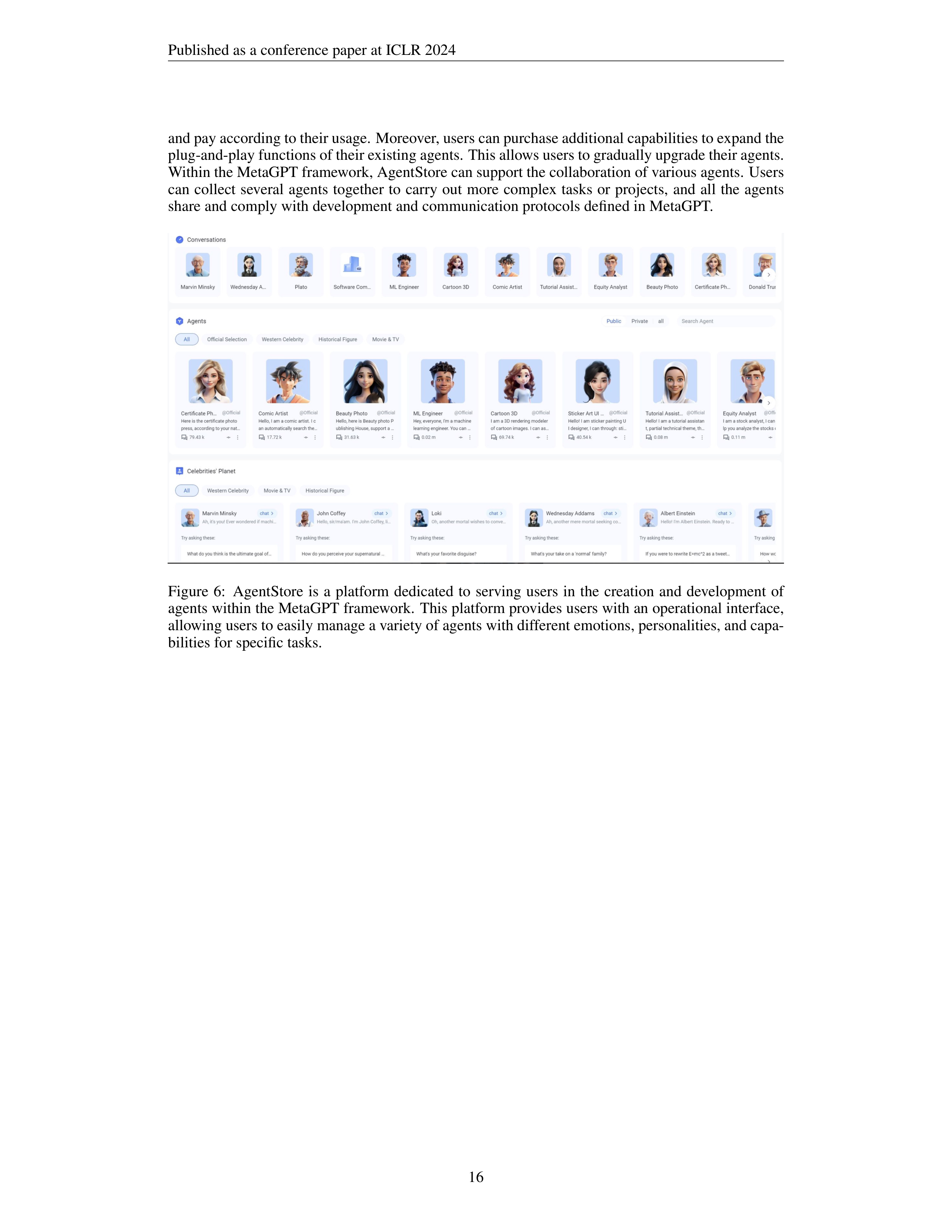
Published as a conference paper at ICLR 2024
and pay according to their usage.
Moreover, users can purchase additional capabilities to expand the
plug-and-play functions of their existing agents.
This allows users to gradually upgrade their agents.
Within the MetaGPT framework, AgentStore can support the collaboration of various agents.
Users
can
collect
several
agents
together
to
carry
out
more
complex
tasks
or
projects,
and
all
the
agents
share and comply with development and communication protocols defined in MetaGPT.
Figure
6:
AgentStore
is
a
platform
dedicated
to
serving
users
in
the
creation
and
development
of
agents within the MetaGPT framework.
This platform provides users with an operational interface,
allowing users to easily manage a variety of agents with different emotions, personalities, and capa-
bilities for specific tasks.
16
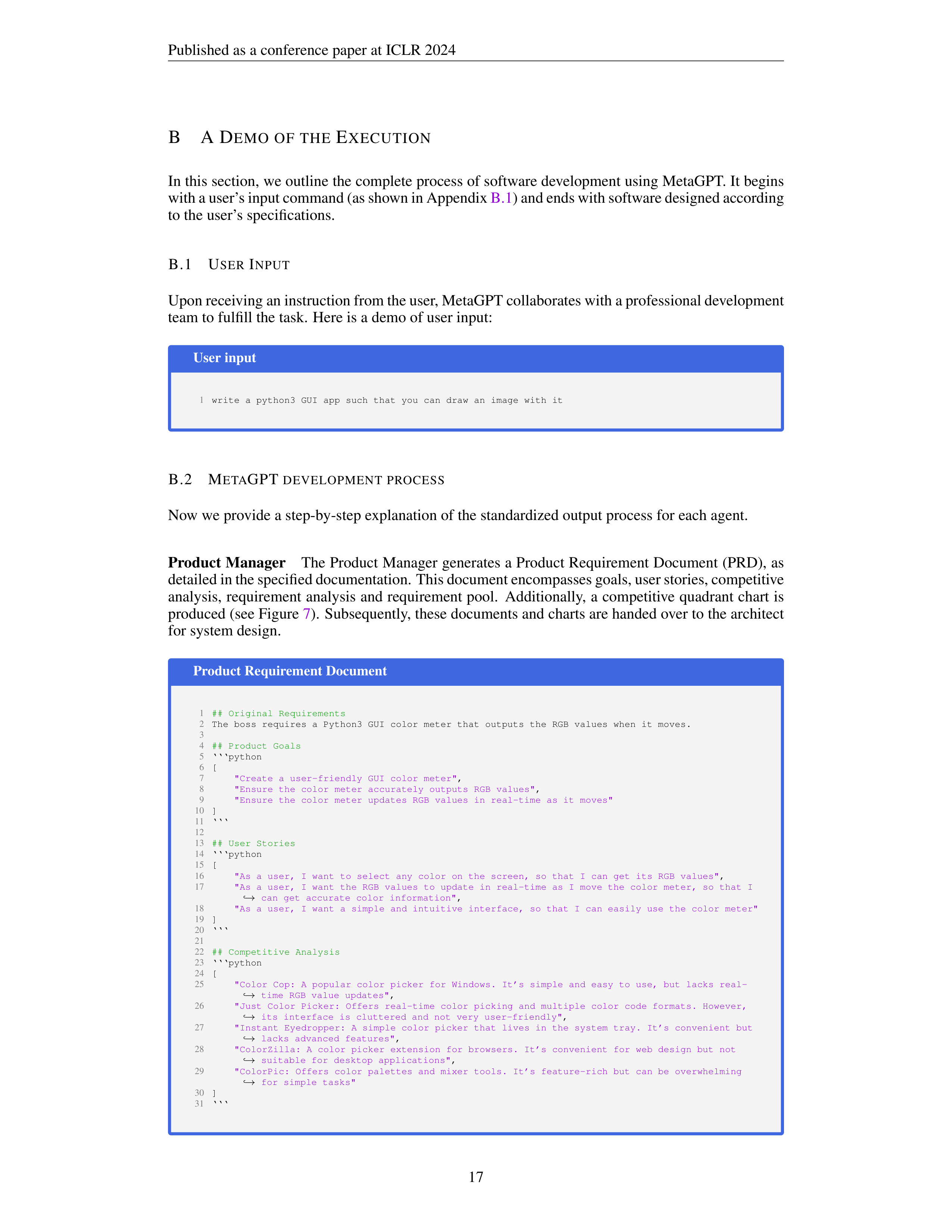
Published as a conference paper at ICLR 2024
B
A
D
EMO
OF
THE
E
XECUTION
In this section, we outline the complete process of software development using MetaGPT. It begins
with a user’s input command (as shown in Appendix
B.1
) and ends with software designed according
to the user’s specifications.
B.1
U
SER
I
NPUT
Upon receiving an instruction from the user, MetaGPT collaborates with a professional development
team to fulfill the task.
Here is a demo of user input:
User input
1
write
a
python3
GUI
app
such
that
you
can
draw
an
image
with
it
B.2
M
ETA
GPT
DEVELOPMENT
PROCESS
Now we provide a step-by-step explanation of the standardized output process for each agent.
Product Manager
The Product Manager generates a Product Requirement Document (PRD), as
detailed in the specified documentation. This document encompasses goals, user stories, competitive
analysis,
requirement analysis and requirement pool.
Additionally,
a competitive quadrant chart is
produced (see Figure
7
).
Subsequently, these documents and charts are handed over to the architect
for system design.
Product Requirement Document
1
##
Original
Requirements
2
The
boss
requires
a
Python3
GUI
color
meter
that
outputs
the
RGB
values
when
it
moves.
3
4
##
Product
Goals
5
‘‘‘python
6
[
7
"Create
a
user-friendly
GUI
color
meter"
,
8
"Ensure
the
color
meter
accurately
outputs
RGB
values"
,
9
"Ensure
the
color
meter
updates
RGB
values
in
real-time
as
it
moves"
10
]
11
‘‘‘
12
13
##
User
Stories
14
‘‘‘python
15
[
16
"As
a
user,
I
want
to
select
any
color
on
the
screen,
so
that
I
can
get
its
RGB
values"
,
17
"As
a
user,
I
want
the
RGB
values
to
update
in
real-time
as
I
move
the
color
meter,
so
that
I
,
→
can
get
accurate
color
information"
,
18
"As
a
user,
I
want
a
simple
and
intuitive
interface,
so
that
I
can
easily
use
the
color
meter"
19
]
20
‘‘‘
21
22
##
Competitive
Analysis
23
‘‘‘python
24
[
25
"Color
Cop:
A
popular
color
picker
for
Windows.
It’s
simple
and
easy
to
use,
but
lacks
real-
,
→
time
RGB
value
updates"
,
26
"Just
Color
Picker:
Offers
real-time
color
picking
and
multiple
color
code
formats.
However,
,
→
its
interface
is
cluttered
and
not
very
user-friendly"
,
27
"Instant
Eyedropper:
A
simple
color
picker
that
lives
in
the
system
tray.
It’s
convenient
but
,
→
lacks
advanced
features"
,
28
"ColorZilla:
A
color
picker
extension
for
browsers.
It’s
convenient
for
web
design
but
not
,
→
suitable
for
desktop
applications"
,
29
"ColorPic:
Offers
color
palettes
and
mixer
tools.
It’s
feature-rich
but
can
be
overwhelming
,
→
for
simple
tasks"
30
]
31
‘‘‘
17
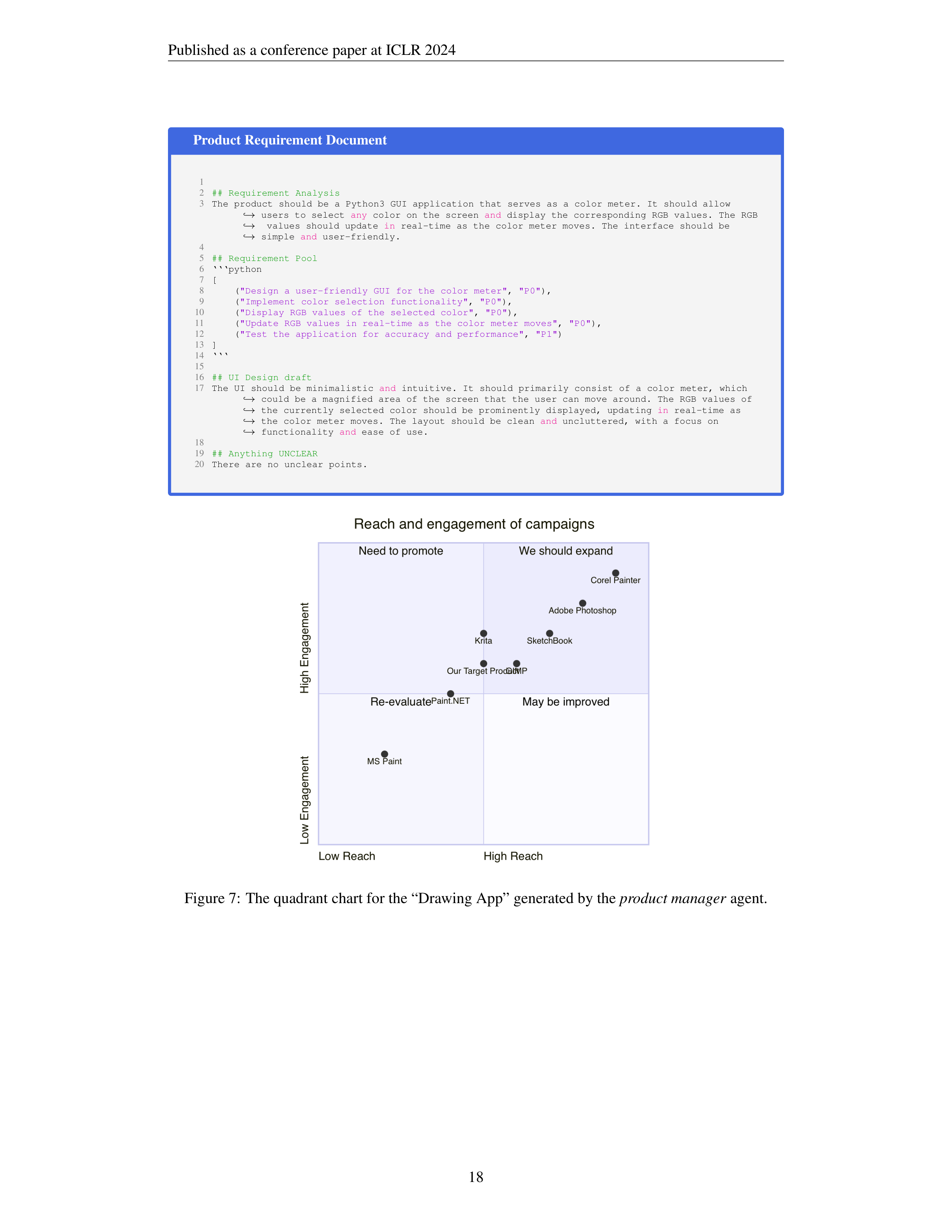
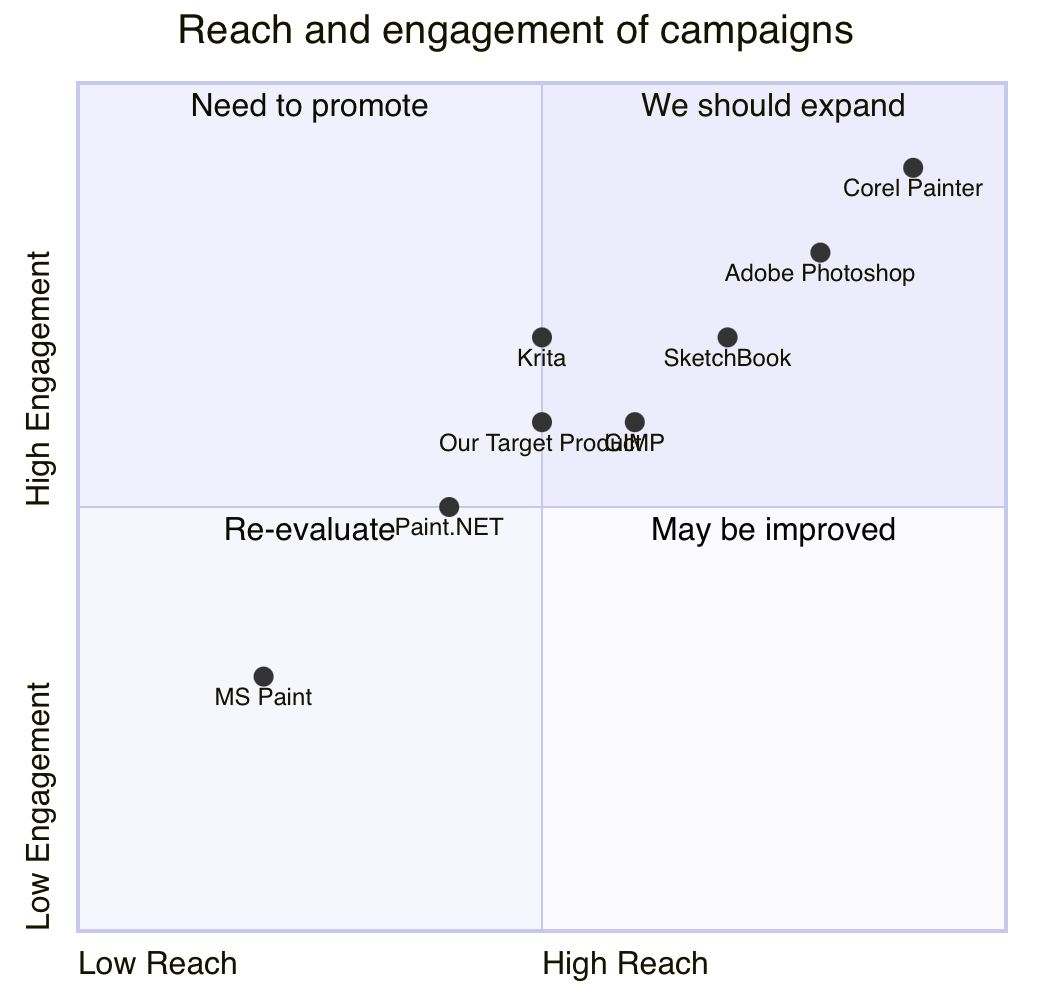
Published as a conference paper at ICLR 2024
Product Requirement Document
1
2
##
Requirement
Analysis
3
The
product
should
be
a
Python3
GUI
application
that
serves
as
a
color
meter.
It
should
allow
,
→
users
to
select
any
color
on
the
screen
and
display
the
corresponding
RGB
values.
The
RGB
,
→
values
should
update
in
real-time
as
the
color
meter
moves.
The
interface
should
be
,
→
simple
and
user-friendly.
4
5
##
Requirement
Pool
6
‘‘‘python
7
[
8
(
"Design
a
user-friendly
GUI
for
the
color
meter"
,
"P0"
),
9
(
"Implement
color
selection
functionality"
,
"P0"
),
10
(
"Display
RGB
values
of
the
selected
color"
,
"P0"
),
11
(
"Update
RGB
values
in
real-time
as
the
color
meter
moves"
,
"P0"
),
12
(
"Test
the
application
for
accuracy
and
performance"
,
"P1"
)
13
]
14
‘‘‘
15
16
##
UI
Design
draft
17
The
UI
should
be
minimalistic
and
intuitive.
It
should
primarily
consist
of
a
color
meter,
which
,
→
could
be
a
magnified
area
of
the
screen
that
the
user
can
move
around.
The
RGB
values
of
,
→
the
currently
selected
color
should
be
prominently
displayed,
updating
in
real-time
as
,
→
the
color
meter
moves.
The
layout
should
be
clean
and
uncluttered,
with
a
focus
on
,
→
functionality
and
ease
of
use.
18
19
##
Anything
UNCLEAR
20
There
are
no
unclear
points.
Figure 7:
The quadrant chart for the “Drawing App” generated by the
product manager
agent.
18
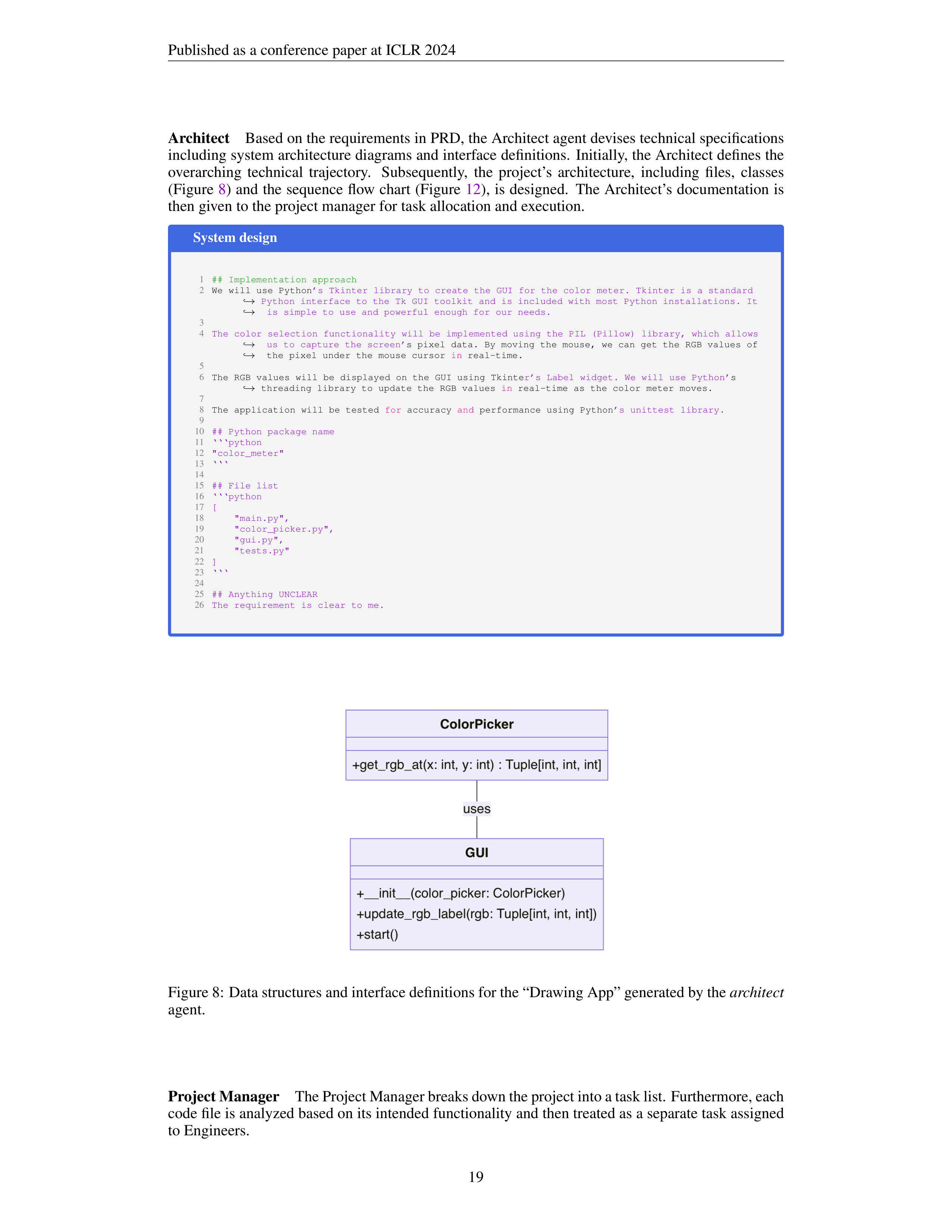
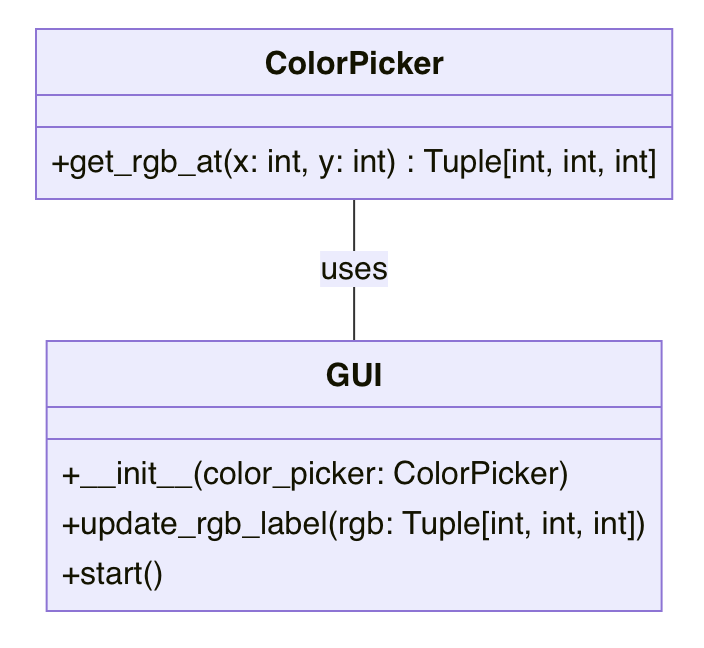
Published as a conference paper at ICLR 2024
Architect
Based on the requirements in PRD, the Architect agent devises technical specifications
including system architecture diagrams and interface definitions.
Initially, the Architect defines the
overarching
technical
trajectory.
Subsequently,
the
project’s
architecture,
including
files,
classes
(Figure
8
) and the sequence flow chart (Figure
12
),
is designed.
The Architect’s documentation is
then given to the project manager for task allocation and execution.
System design
1
##
Implementation
approach
2
We
will
use
Python
’s
Tkinter
library
to
create
the
GUI
for
the
color
meter.
Tkinter
is
a
standard
,
→
Python
interface
to
the
Tk
GUI
toolkit
and
is
included
with
most
Python
installations.
It
,
→
is
simple
to
use
and
powerful
enough
for
our
needs.
3
4
The
color
selection
functionality
will
be
implemented
using
the
PIL
(Pillow)
library,
which
allows
,
→
us
to
capture
the
screen’
s
pixel
data.
By
moving
the
mouse,
we
can
get
the
RGB
values
of
,
→
the
pixel
under
the
mouse
cursor
in
real-time.
5
6
The
RGB
values
will
be
displayed
on
the
GUI
using
Tkinte
r’s
Label
widget.
We
will
use
Python’
s
,
→
threading
library
to
update
the
RGB
values
in
real-time
as
the
color
meter
moves.
7
8
The
application
will
be
tested
for
accuracy
and
performance
using
Python
’s
unittest
library.
9
10
##
Python
package
name
11
‘‘‘python
12
"color_meter"
13
‘‘‘
14
15
##
File
list
16
‘‘‘python
17
[
18
"main.py",
19
"color_picker.py",
20
"gui.py",
21
"tests.py"
22
]
23
‘‘‘
24
25
##
Anything
UNCLEAR
26
The
requirement
is
clear
to
me.
Figure 8:
Data structures and interface definitions for the “Drawing App” generated by the
architect
agent.
Project Manager
The Project Manager breaks down the project into a task list. Furthermore, each
code file is analyzed based on its intended functionality and then treated as a separate task assigned
to Engineers.
19
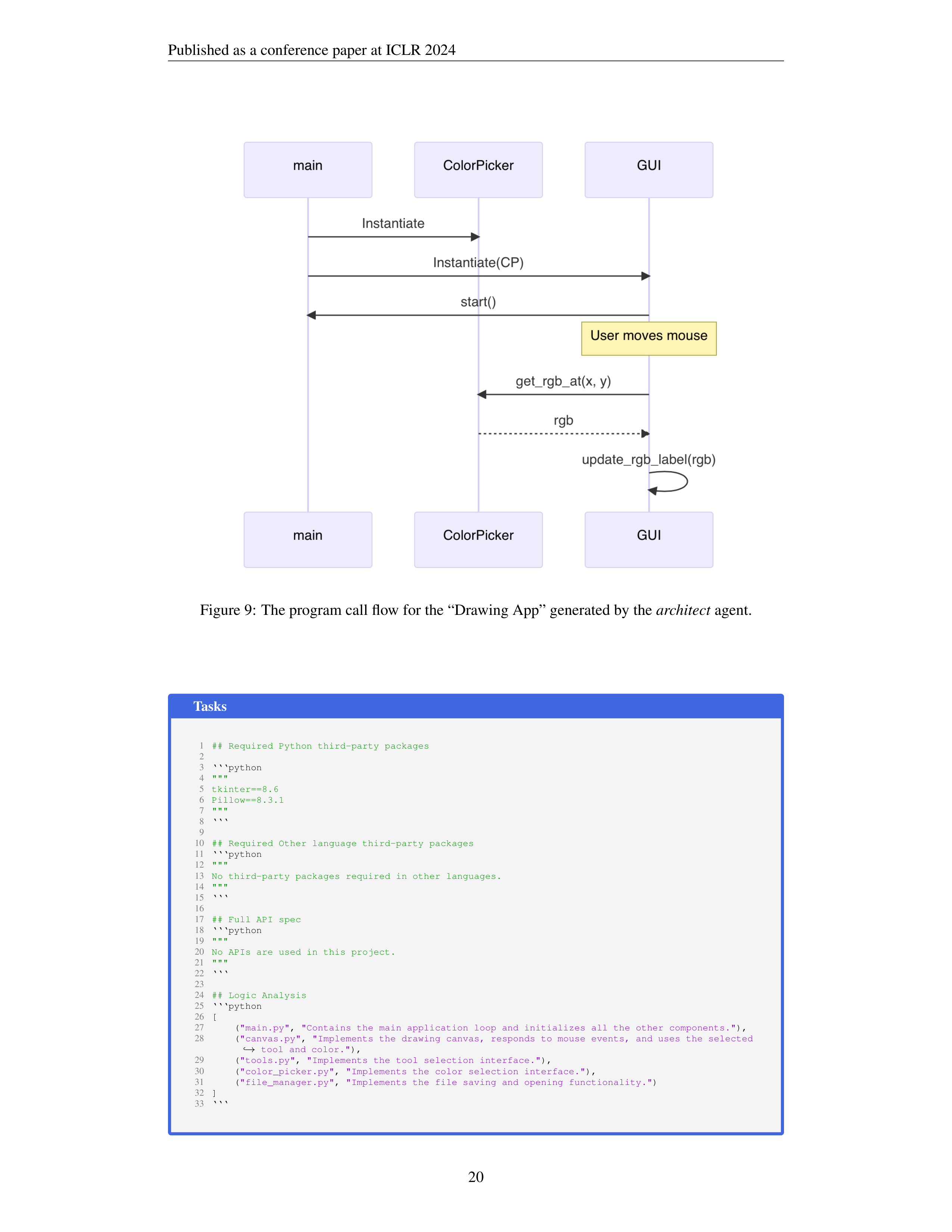
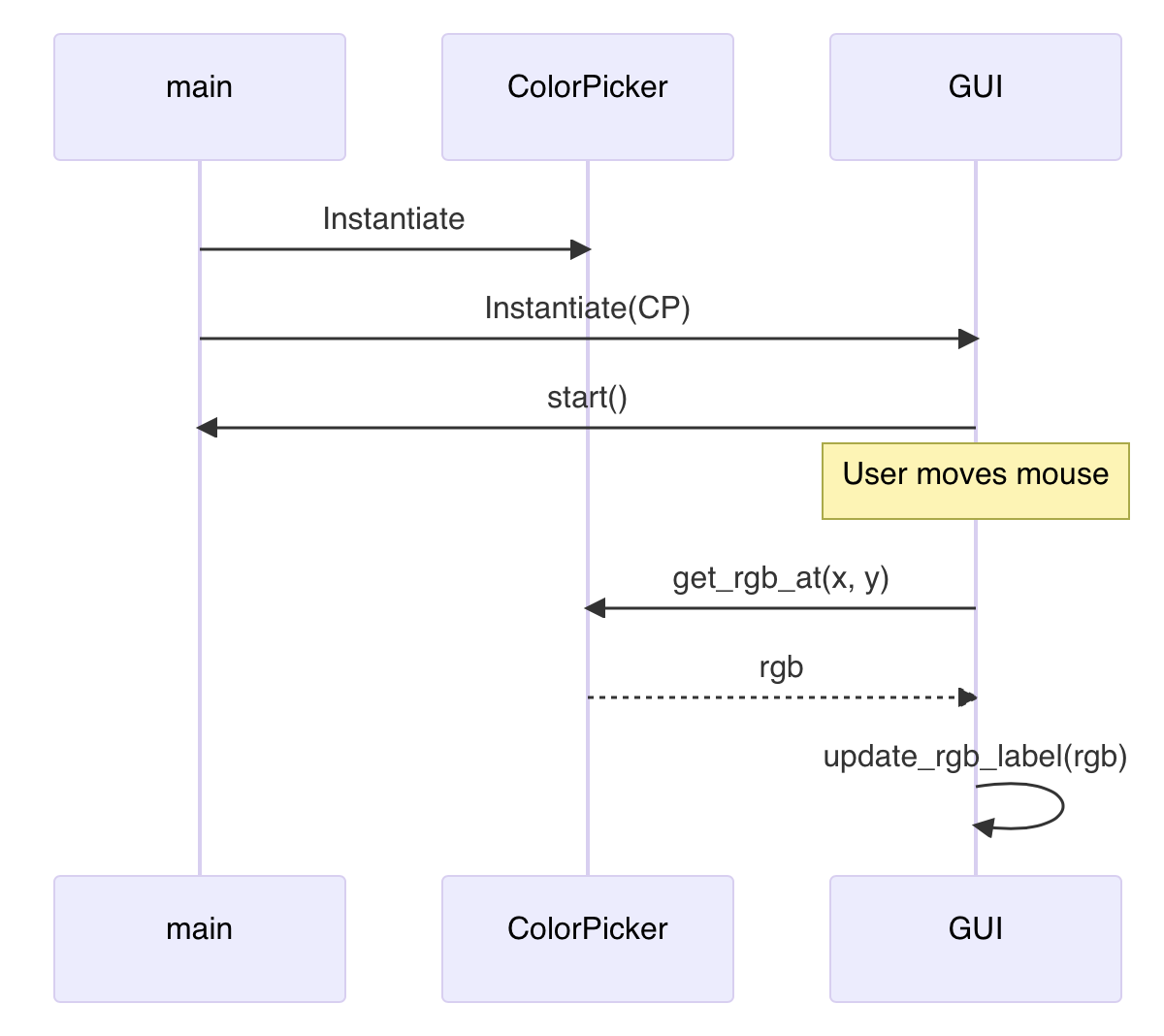
Published as a conference paper at ICLR 2024
Figure 9:
The program call flow for the “Drawing App” generated by the
architect
agent.
Tasks
1
##
Required
Python
third-party
packages
2
3
‘‘‘python
4
"""
5
tkinter==8.6
6
Pillow==8.3.1
7
"""
8
‘‘‘
9
10
##
Required
Other
language
third-party
packages
11
‘‘‘python
12
"""
13
No
third-party
packages
required
in
other
languages.
14
"""
15
‘‘‘
16
17
##
Full
API
spec
18
‘‘‘python
19
"""
20
No
APIs
are
used
in
this
project.
21
"""
22
‘‘‘
23
24
##
Logic
Analysis
25
‘‘‘python
26
[
27
(
"main.py"
,
"Contains
the
main
application
loop
and
initializes
all
the
other
components."
),
28
(
"canvas.py"
,
"Implements
the
drawing
canvas,
responds
to
mouse
events,
and
uses
the
selected
,
→
tool
and
color."
),
29
(
"tools.py"
,
"Implements
the
tool
selection
interface."
),
30
(
"color_picker.py"
,
"Implements
the
color
selection
interface."
),
31
(
"file_manager.py"
,
"Implements
the
file
saving
and
opening
functionality."
)
32
]
33
‘‘‘
20
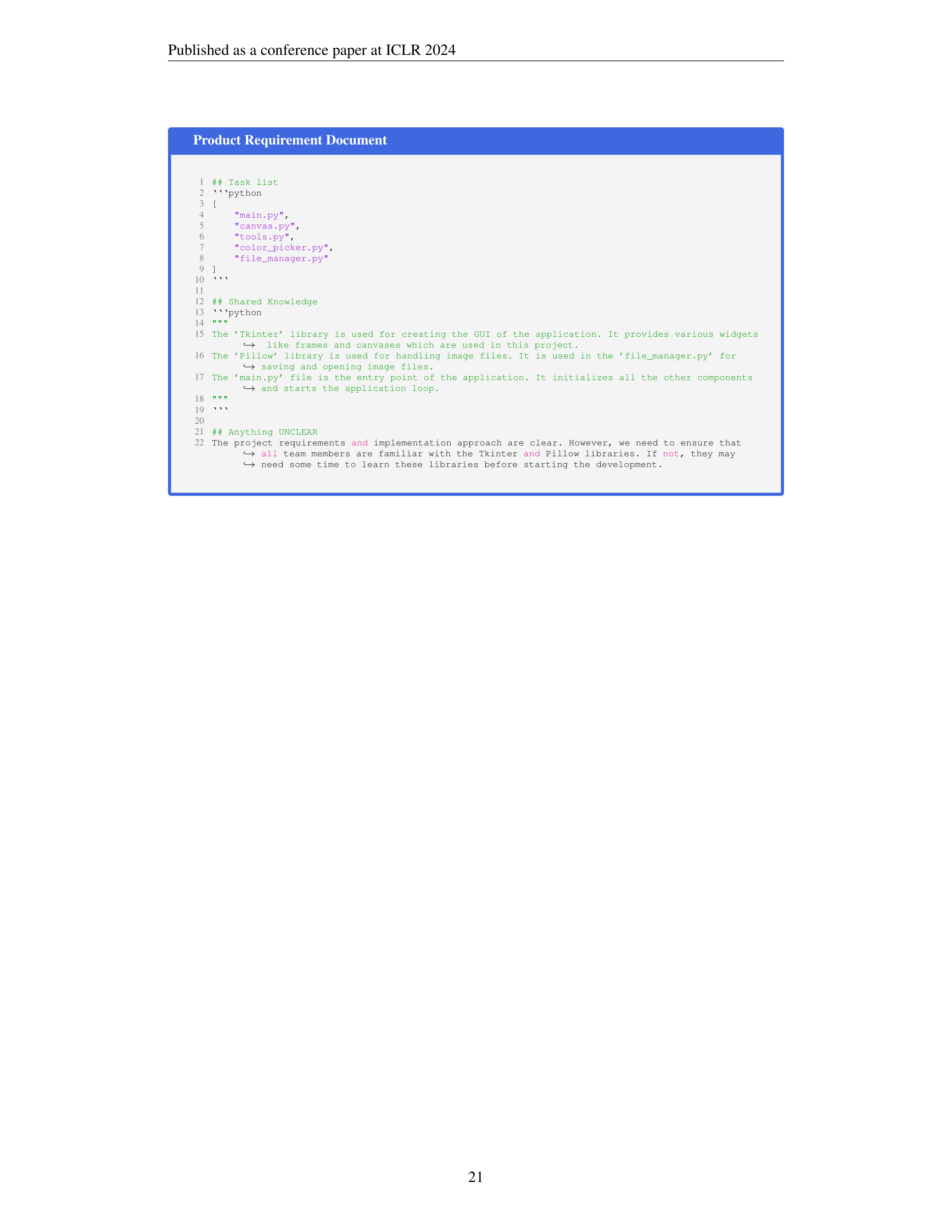
Published as a conference paper at ICLR 2024
Product Requirement Document
1
##
Task
list
2
‘‘‘python
3
[
4
"main.py"
,
5
"canvas.py"
,
6
"tools.py"
,
7
"color_picker.py"
,
8
"file_manager.py"
9
]
10
‘‘‘
11
12
##
Shared
Knowledge
13
‘‘‘python
14
"""
15
The
’Tkinter’
library
is
used
for
creating
the
GUI
of
the
application.
It
provides
various
widgets
,
→
like
frames
and
canvases
which
are
used
in
this
project.
16
The
’Pillow’
library
is
used
for
handling
image
files.
It
is
used
in
the
’file_manager.py’
for
,
→
saving
and
opening
image
files.
17
The
’main.py’
file
is
the
entry
point
of
the
application.
It
initializes
all
the
other
components
,
→
and
starts
the
application
loop.
18
"""
19
‘‘‘
20
21
##
Anything
UNCLEAR
22
The
project
requirements
and
implementation
approach
are
clear.
However,
we
need
to
ensure
that
,
→
all
team
members
are
familiar
with
the
Tkinter
and
Pillow
libraries.
If
not
,
they
may
,
→
need
some
time
to
learn
these
libraries
before
starting
the
development.
21
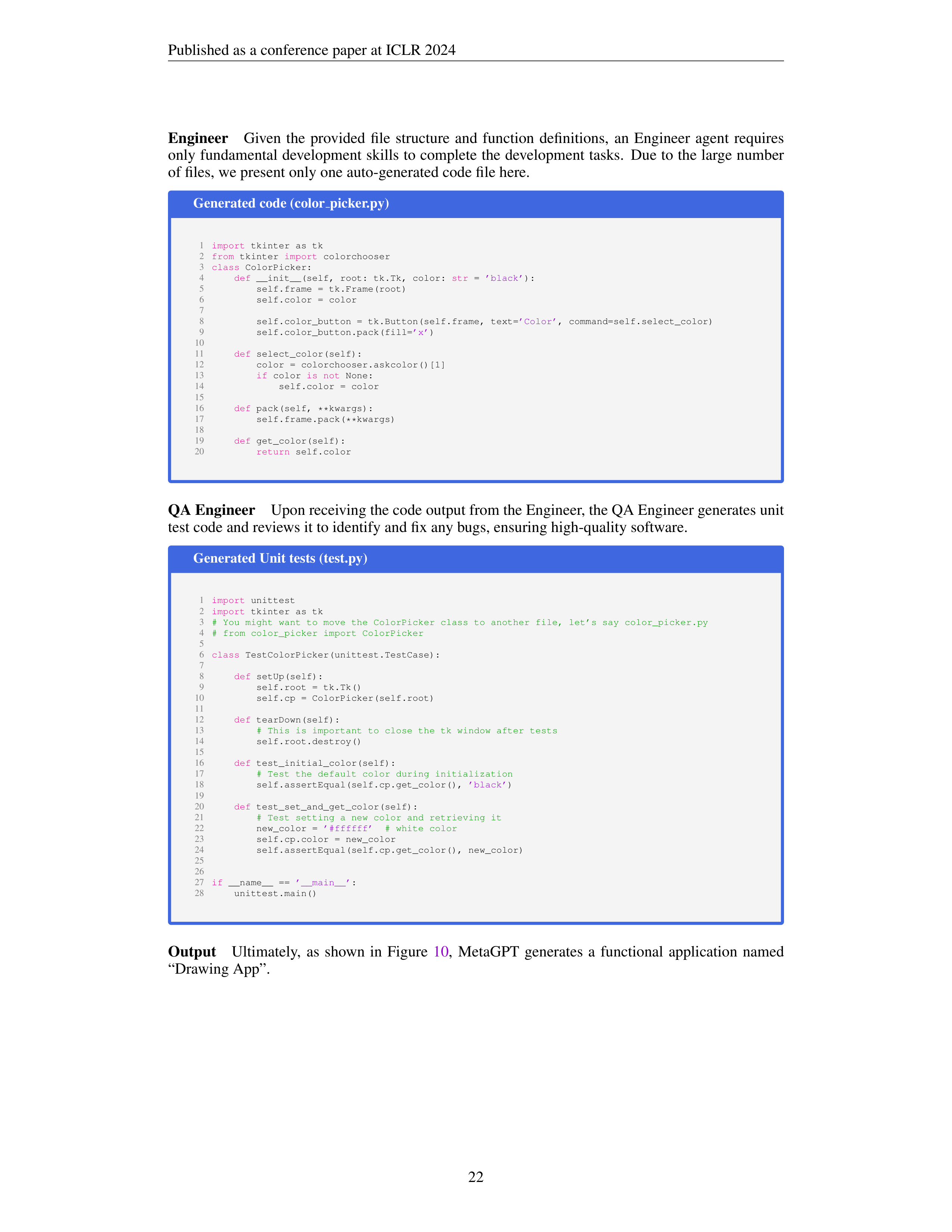
Published as a conference paper at ICLR 2024
Engineer
Given
the
provided
file
structure
and
function
definitions,
an
Engineer
agent
requires
only fundamental development skills to complete the development tasks.
Due to the large number
of files, we present only one auto-generated code file here.
Generated code (color
picker.py)
1
import
tkinter
as
tk
2
from
tkinter
import
colorchooser
3
class
ColorPicker:
4
def
__init__(self,
root:
tk.Tk,
color:
str
=
’black’
):
5
self.frame
=
tk.Frame(root)
6
self.color
=
color
7
8
self.color_button
=
tk.Button(self.frame,
text=
’Color’
,
command=self.select_color)
9
self.color_button.pack(fill=
’x’
)
10
11
def
select_color(self):
12
color
=
colorchooser.askcolor()[1]
13
if
color
is
not
None:
14
self.color
=
color
15
16
def
pack(self,
**kwargs):
17
self.frame.pack(**kwargs)
18
19
def
get_color(self):
20
return
self.color
QA Engineer
Upon receiving the code output from the Engineer, the QA Engineer generates unit
test code and reviews it to identify and fix any bugs, ensuring high-quality software.
Generated Unit tests (test.py)
1
import
unittest
2
import
tkinter
as
tk
3
#
You
might
want
to
move
the
ColorPicker
class
to
another
file,
let’s
say
color_picker.py
4
#
from
color_picker
import
ColorPicker
5
6
class
TestColorPicker(unittest.TestCase):
7
8
def
setUp(self):
9
self.root
=
tk.Tk()
10
self.cp
=
ColorPicker(self.root)
11
12
def
tearDown(self):
13
#
This
is
important
to
close
the
tk
window
after
tests
14
self.root.destroy()
15
16
def
test_initial_color(self):
17
#
Test
the
default
color
during
initialization
18
self.assertEqual(self.cp.get_color(),
’black’
)
19
20
def
test_set_and_get_color(self):
21
#
Test
setting
a
new
color
and
retrieving
it
22
new_color
=
’#ffffff’
#
white
color
23
self.cp.color
=
new_color
24
self.assertEqual(self.cp.get_color(),
new_color)
25
26
27
if
__name__
==
’__main__’
:
28
unittest.main()
Output
Ultimately,
as
shown
in
Figure
10
,
MetaGPT
generates
a
functional
application
named
“Drawing App”.
22
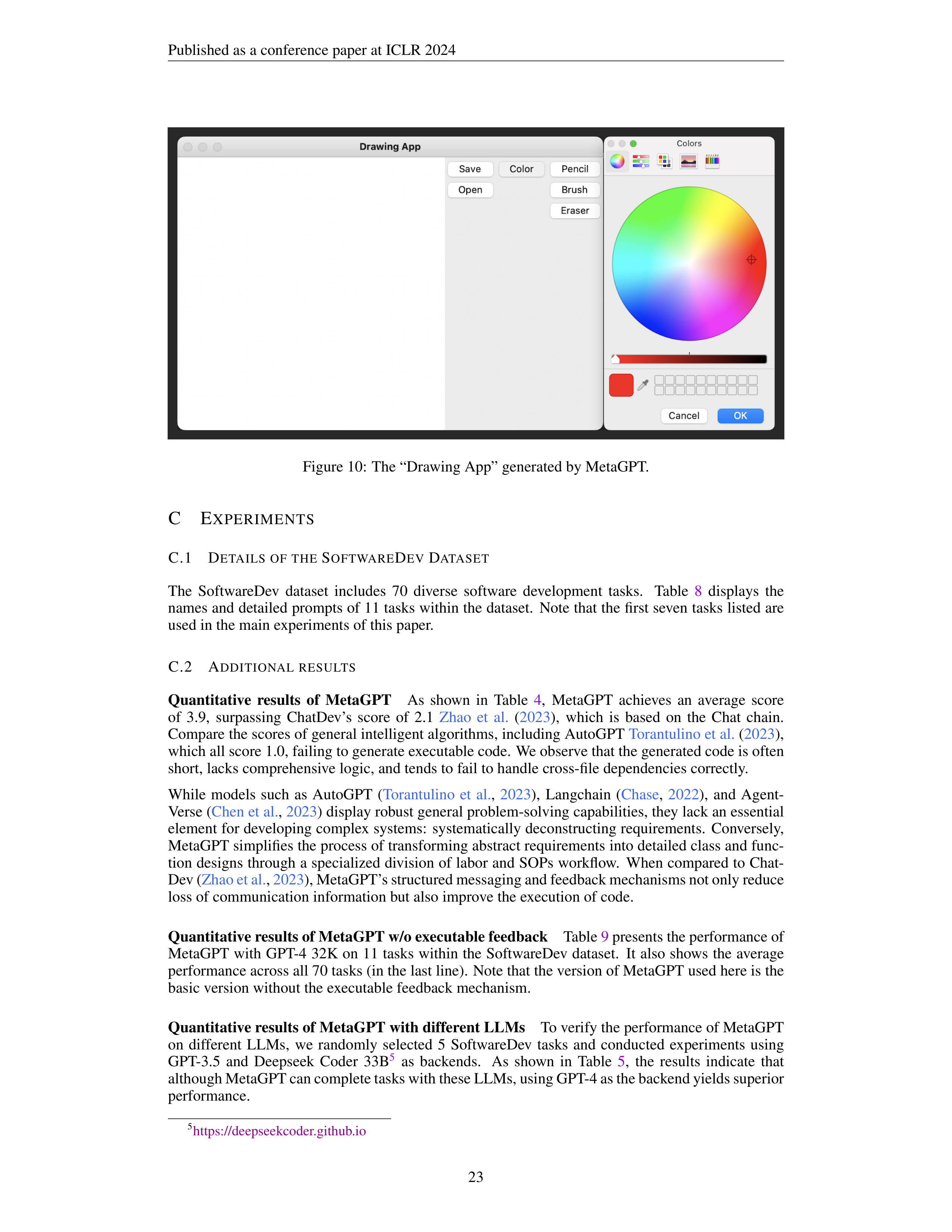
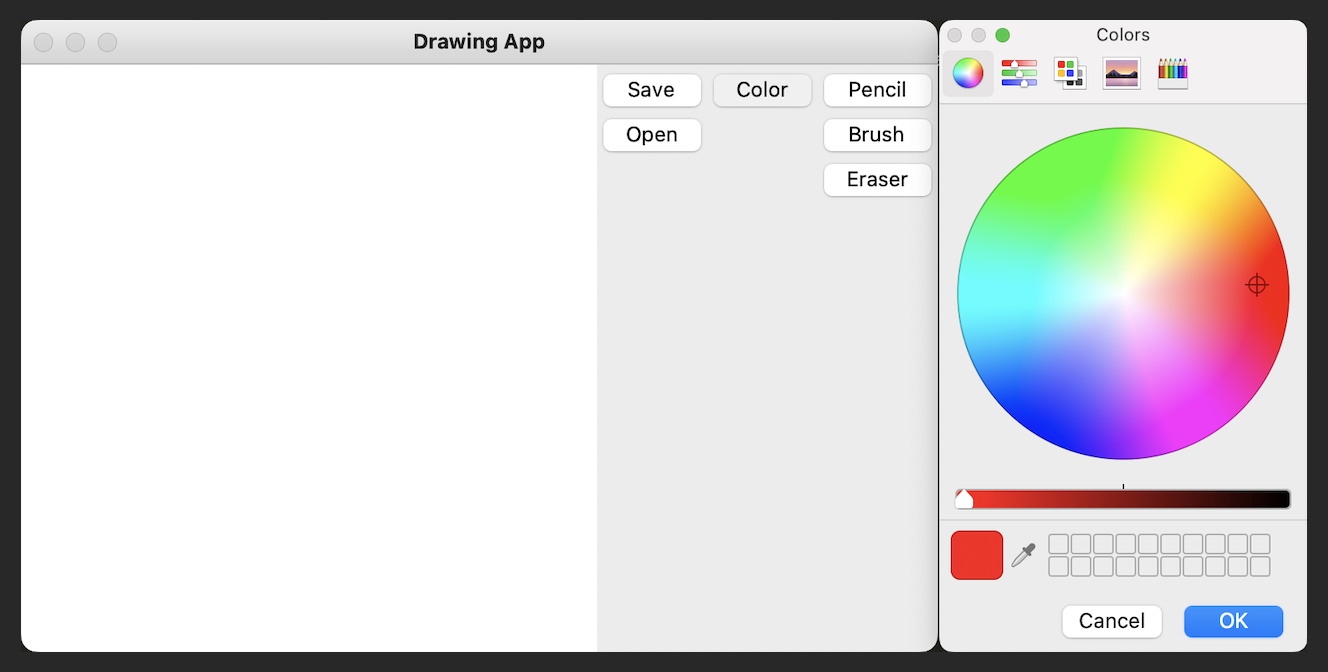
Published as a conference paper at ICLR 2024
Figure 10:
The “Drawing App” generated by MetaGPT.
C
E
XPERIMENTS
C.1
D
ETAILS
OF
THE
S
OFTWARE
D
EV
D
ATASET
The
SoftwareDev
dataset
includes
70
diverse
software
development
tasks.
Table
8
displays
the
names and detailed prompts of 11 tasks within the dataset.
Note that the first seven tasks listed are
used in the main experiments of this paper.
C.2
A
DDITIONAL
RESULTS
Quantitative
results
of
MetaGPT
As
shown
in
Table
4
,
MetaGPT
achieves
an
average
score
of
3.9,
surpassing
ChatDev’s
score
of
2.1
Zhao
et
al.
(
2023
),
which
is
based
on
the
Chat
chain.
Compare the scores of general intelligent algorithms, including AutoGPT
Torantulino et al.
(
2023
),
which all score 1.0, failing to generate executable code.
We observe that the generated code is often
short, lacks comprehensive logic, and tends to fail to handle cross-file dependencies correctly.
While
models
such
as
AutoGPT
(
Torantulino
et
al.
,
2023
),
Langchain
(
Chase
,
2022
),
and
Agent-
Verse (
Chen et al.
,
2023
) display robust general problem-solving capabilities, they lack an essential
element for developing complex systems:
systematically deconstructing requirements.
Conversely,
MetaGPT simplifies the process of transforming abstract requirements into detailed class and func-
tion designs through a specialized division of labor and SOPs workflow.
When compared to Chat-
Dev (
Zhao et al.
,
2023
), MetaGPT’s structured messaging and feedback mechanisms not only reduce
loss of communication information but also improve the execution of code.
Quantitative results of MetaGPT w/o executable feedback
Table
9
presents the performance of
MetaGPT with GPT-4 32K on 11 tasks within the SoftwareDev dataset.
It also shows the average
performance across all 70 tasks (in the last line).
Note that the version of MetaGPT used here is the
basic version without the executable feedback mechanism.
Quantitative results of MetaGPT with different LLMs
To verify the performance of MetaGPT
on
different
LLMs,
we
randomly
selected
5
SoftwareDev
tasks
and
conducted
experiments
using
GPT-3.5
and
Deepseek
Coder
33B
5
as
backends.
As
shown
in
Table
5
,
the
results
indicate
that
although MetaGPT can complete tasks with these LLMs, using GPT-4 as the backend yields superior
performance.
5
https://deepseekcoder.github.io
23
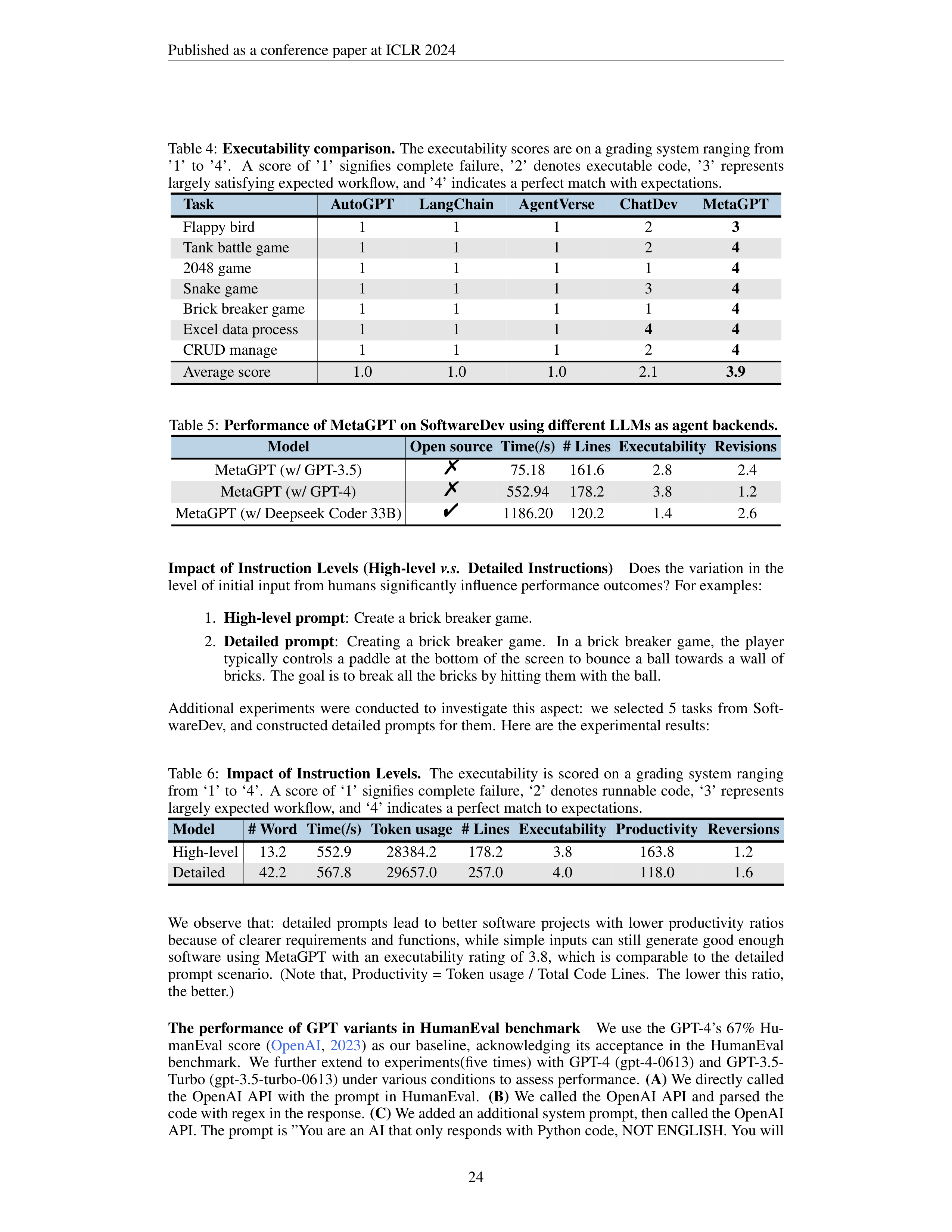
Published as a conference paper at ICLR 2024
Table 4:
Executability comparison.
The executability scores are on a grading system ranging from
’1’
to
’4’.
A
score
of
’1’
signifies
complete
failure,
’2’
denotes
executable
code,
’3’
represents
largely satisfying expected workflow, and ’4’ indicates a perfect match with expectations.
Task
AutoGPT
LangChain
AgentVerse
ChatDev
MetaGPT
Flappy bird
1
1
1
2
3
Tank battle game
1
1
1
2
4
2048 game
1
1
1
1
4
Snake game
1
1
1
3
4
Brick breaker game
1
1
1
1
4
Excel data process
1
1
1
4
4
CRUD manage
1
1
1
2
4
Average score
1.0
1.0
1.0
2.1
3.9
Table 5:
Performance of MetaGPT on SoftwareDev using different LLMs as agent backends.
Model
Open source
Time(/s)
# Lines
Executability
Revisions
MetaGPT (w/ GPT-3.5)
%
75.18
161.6
2.8
2.4
MetaGPT (w/ GPT-4)
%
552.94
178.2
3.8
1.2
MetaGPT (w/ Deepseek Coder 33B)
"
1186.20
120.2
1.4
2.6
Impact
of
Instruction
Levels
(High-level
v.s.
Detailed
Instructions)
Does
the
variation
in
the
level of initial input from humans significantly influence performance outcomes?
For examples:
1.
High-level prompt
:
Create a brick breaker game.
2.
Detailed
prompt
:
Creating
a
brick
breaker
game.
In
a
brick
breaker
game,
the
player
typically
controls
a
paddle
at
the
bottom
of
the
screen
to
bounce
a
ball
towards
a
wall
of
bricks.
The goal is to break all the bricks by hitting them with the ball.
Additional
experiments
were
conducted
to
investigate
this
aspect:
we
selected
5
tasks
from
Soft-
wareDev, and constructed detailed prompts for them.
Here are the experimental results:
Table
6:
Impact
of
Instruction
Levels.
The
executability
is
scored
on
a
grading
system
ranging
from ‘1’ to ‘4’.
A score of ‘1’ signifies complete failure, ‘2’ denotes runnable code, ‘3’ represents
largely expected workflow, and ‘4’ indicates a perfect match to expectations.
Model
# Word
Time(/s)
Token usage
# Lines
Executability
Productivity
Reversions
High-level
13.2
552.9
28384.2
178.2
3.8
163.8
1.2
Detailed
42.2
567.8
29657.0
257.0
4.0
118.0
1.6
We
observe
that:
detailed
prompts
lead
to
better
software
projects
with
lower
productivity
ratios
because of clearer requirements and functions,
while simple inputs can still generate good enough
software
using
MetaGPT
with
an
executability
rating
of
3.8,
which
is
comparable
to
the
detailed
prompt scenario.
(Note that,
Productivity = Token usage / Total Code Lines.
The lower this ratio,
the better.)
The
performance
of
GPT
variants
in
HumanEval
benchmark
We
use
the
GPT-4’s
67%
Hu-
manEval
score
(
OpenAI
,
2023
)
as
our
baseline,
acknowledging
its
acceptance
in
the
HumanEval
benchmark.
We
further
extend
to
experiments(five
times)
with
GPT-4
(gpt-4-0613)
and
GPT-3.5-
Turbo (gpt-3.5-turbo-0613) under various conditions to assess performance.
(A)
We directly called
the
OpenAI
API
with
the
prompt
in
HumanEval.
(B)
We
called
the
OpenAI
API
and
parsed
the
code with regex in the response.
(C)
We added an additional system prompt, then called the OpenAI
API. The prompt is ”You are an AI that only responds with Python code, NOT ENGLISH. You will
24
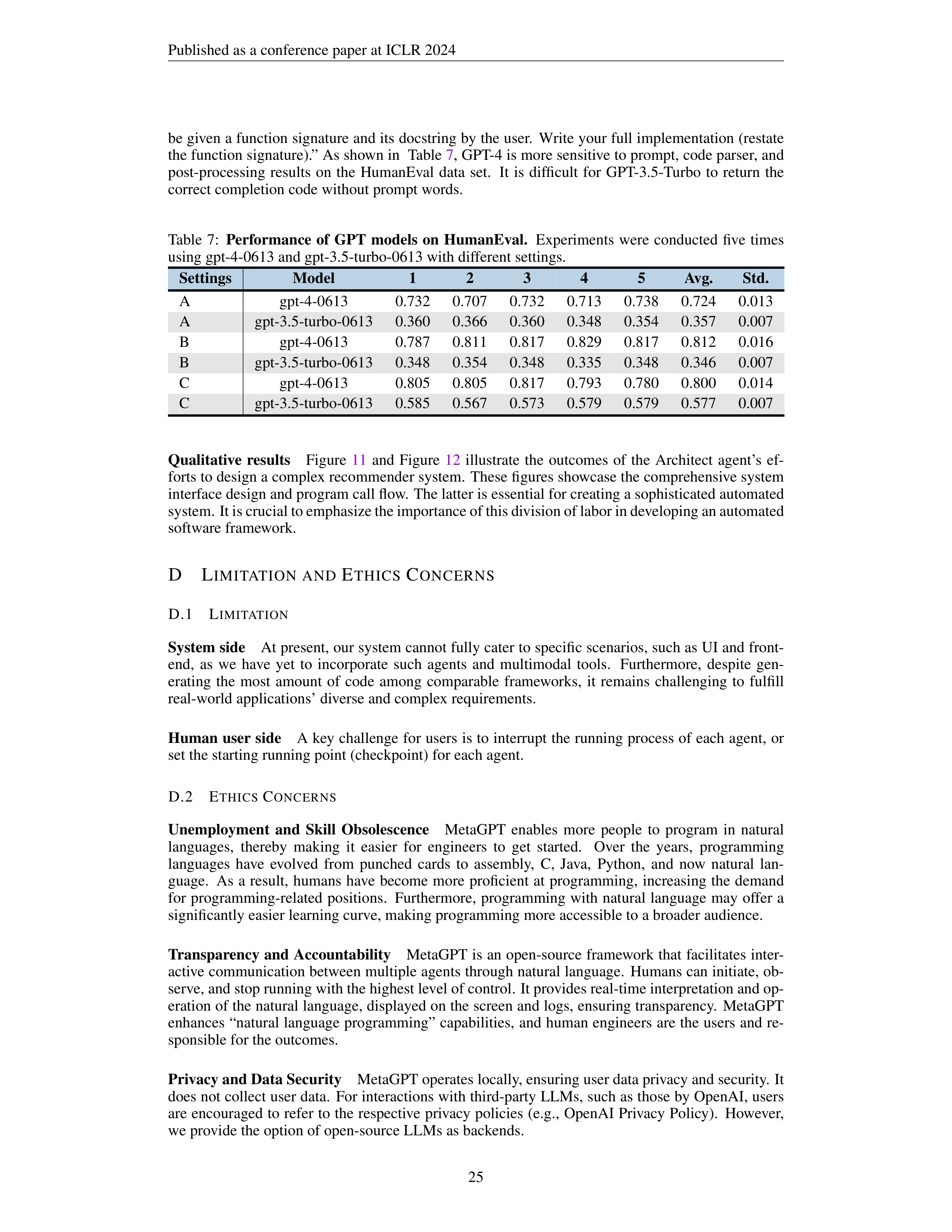
Published as a conference paper at ICLR 2024
be given a function signature and its docstring by the user.
Write your full implementation (restate
the function signature).” As shown in
Table
7
, GPT-4 is more sensitive to prompt, code parser, and
post-processing
results
on
the
HumanEval
data
set.
It
is
difficult
for
GPT-3.5-Turbo
to
return
the
correct completion code without prompt words.
Table
7:
Performance
of
GPT
models
on
HumanEval.
Experiments
were
conducted
five
times
using gpt-4-0613 and gpt-3.5-turbo-0613 with different settings.
Settings
Model
1
2
3
4
5
Avg.
Std.
A
gpt-4-0613
0.732
0.707
0.732
0.713
0.738
0.724
0.013
A
gpt-3.5-turbo-0613
0.360
0.366
0.360
0.348
0.354
0.357
0.007
B
gpt-4-0613
0.787
0.811
0.817
0.829
0.817
0.812
0.016
B
gpt-3.5-turbo-0613
0.348
0.354
0.348
0.335
0.348
0.346
0.007
C
gpt-4-0613
0.805
0.805
0.817
0.793
0.780
0.800
0.014
C
gpt-3.5-turbo-0613
0.585
0.567
0.573
0.579
0.579
0.577
0.007
Qualitative
results
Figure
11
and
Figure
12
illustrate
the
outcomes
of
the
Architect
agent’s
ef-
forts to design a complex recommender system.
These figures showcase the comprehensive system
interface design and program call flow.
The latter is essential for creating a sophisticated automated
system. It is crucial to emphasize the importance of this division of labor in developing an automated
software framework.
D
L
IMITATION
AND
E
THICS
C
ONCERNS
D.1
L
IMITATION
System side
At present, our system cannot fully cater to specific scenarios, such as UI and front-
end,
as
we
have
yet
to
incorporate
such
agents
and
multimodal
tools.
Furthermore,
despite
gen-
erating
the
most
amount
of
code
among
comparable
frameworks,
it
remains
challenging
to
fulfill
real-world applications’ diverse and complex requirements.
Human user side
A key challenge for users is to interrupt the running process of each agent,
or
set the starting running point (checkpoint) for each agent.
D.2
E
THICS
C
ONCERNS
Unemployment
and
Skill
Obsolescence
MetaGPT
enables
more
people
to
program
in
natural
languages,
thereby
making
it
easier
for
engineers
to
get
started.
Over
the
years,
programming
languages
have
evolved
from
punched
cards
to
assembly,
C,
Java,
Python,
and
now
natural
lan-
guage.
As
a
result,
humans
have
become
more
proficient
at
programming,
increasing
the
demand
for
programming-related
positions.
Furthermore,
programming
with
natural
language
may
offer
a
significantly easier learning curve, making programming more accessible to a broader audience.
Transparency and Accountability
MetaGPT is an open-source framework that facilitates inter-
active communication between multiple agents through natural language.
Humans can initiate, ob-
serve, and stop running with the highest level of control.
It provides real-time interpretation and op-
eration of the natural language, displayed on the screen and logs, ensuring transparency.
MetaGPT
enhances “natural language programming” capabilities,
and human engineers are the users and re-
sponsible for the outcomes.
Privacy and Data Security
MetaGPT operates locally, ensuring user data privacy and security.
It
does not collect user data.
For interactions with third-party LLMs, such as those by OpenAI, users
are encouraged to refer to the respective privacy policies (e.g.,
OpenAI Privacy Policy).
However,
we provide the option of open-source LLMs as backends.
25
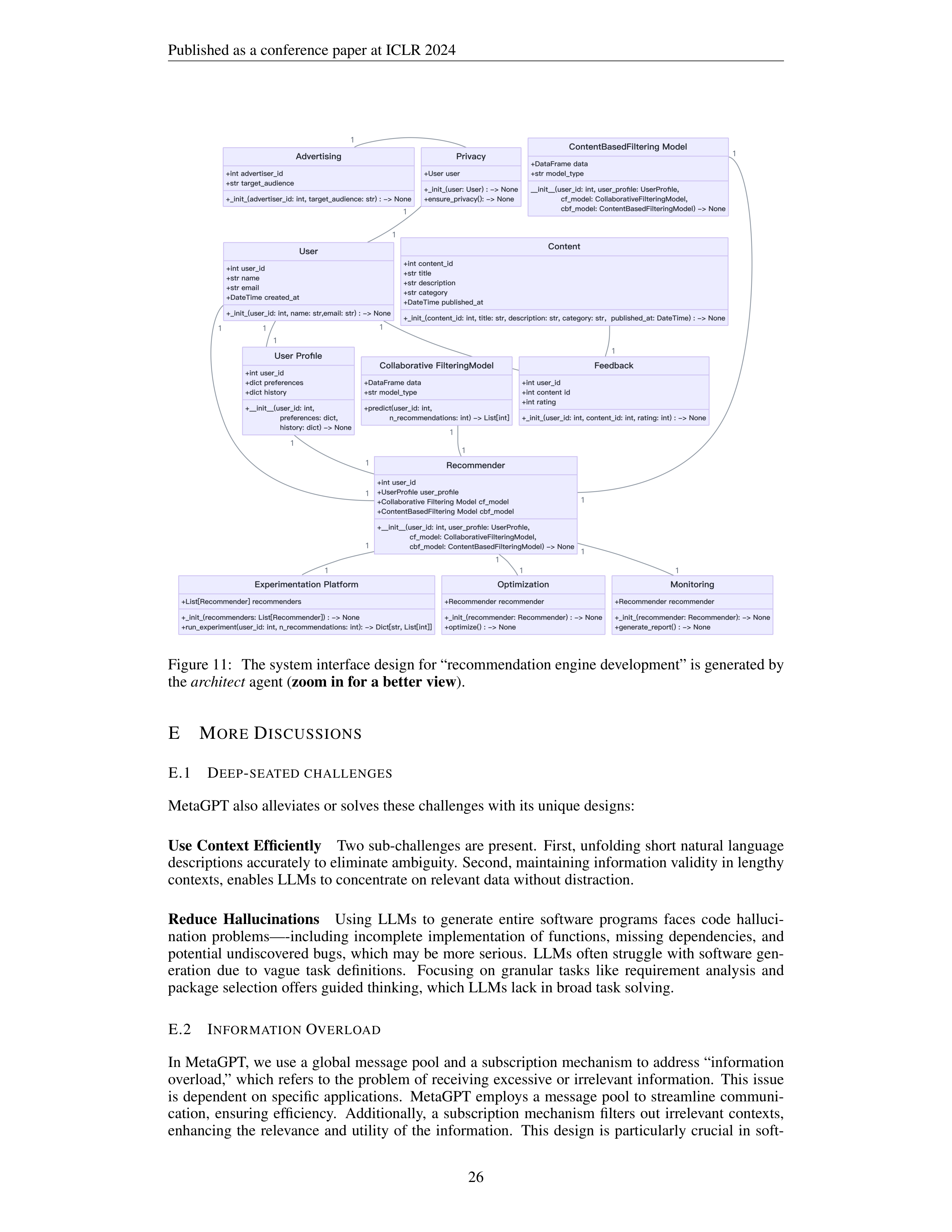
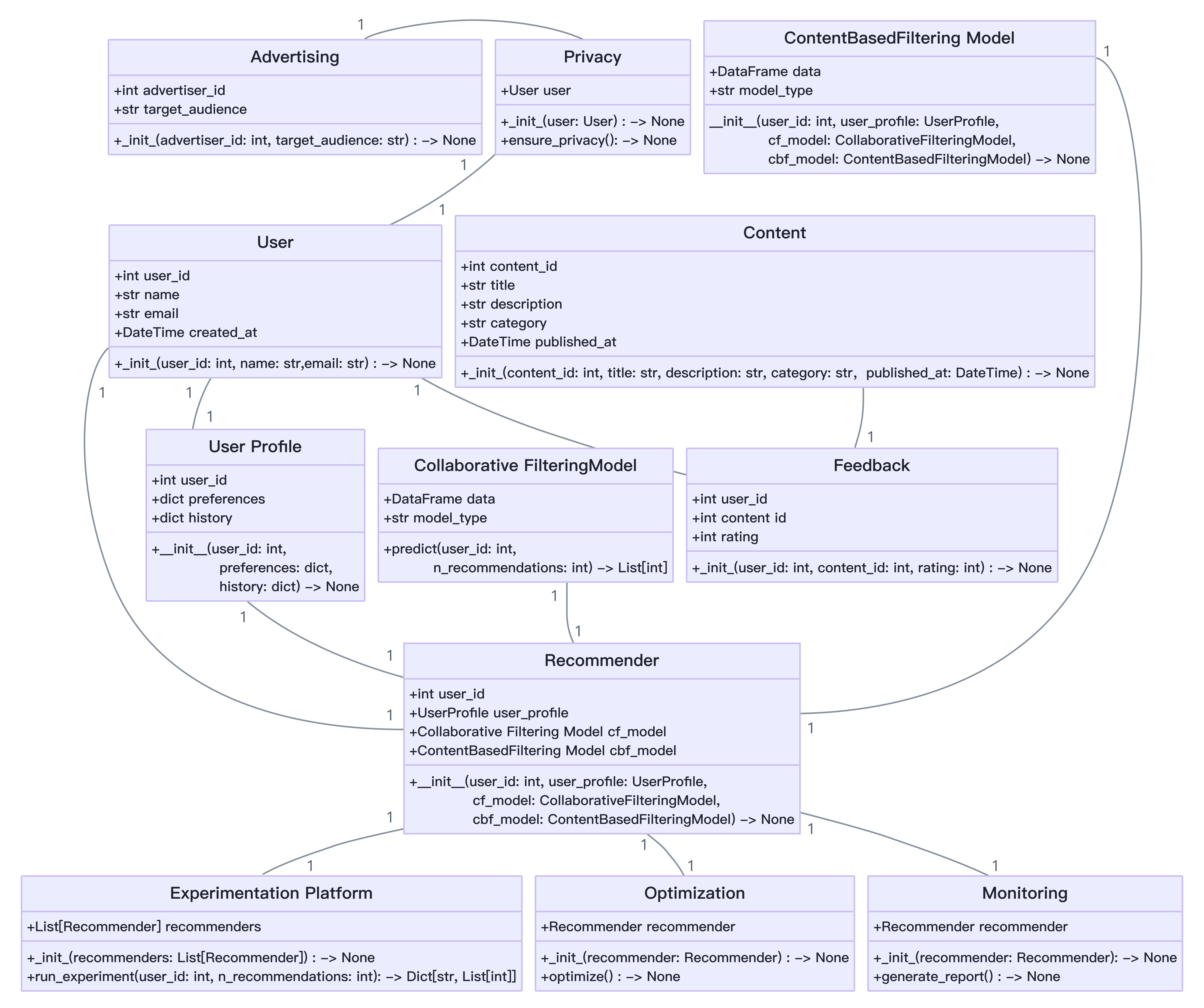
Published as a conference paper at ICLR 2024
Figure 11:
The system interface design for “recommendation engine development” is generated by
the
architect
agent (
zoom in for a better view
).
E
M
ORE
D
ISCUSSIONS
E.1
D
EEP
-
SEATED
CHALLENGES
MetaGPT also alleviates or solves these challenges with its unique designs:
Use Context Efficiently
Two sub-challenges are present.
First, unfolding short natural language
descriptions accurately to eliminate ambiguity.
Second, maintaining information validity in lengthy
contexts, enables LLMs to concentrate on relevant data without distraction.
Reduce
Hallucinations
Using
LLMs
to
generate
entire
software
programs
faces
code
halluci-
nation
problems—-including
incomplete
implementation
of
functions,
missing
dependencies,
and
potential undiscovered bugs, which may be more serious.
LLMs often struggle with software gen-
eration
due
to
vague
task
definitions.
Focusing
on
granular
tasks
like
requirement
analysis
and
package selection offers guided thinking, which LLMs lack in broad task solving.
E.2
I
NFORMATION
O
VERLOAD
In MetaGPT, we use a global message pool and a subscription mechanism to address “information
overload,” which refers to the problem of receiving excessive or irrelevant information.
This issue
is
dependent
on
specific
applications.
MetaGPT
employs
a
message
pool
to
streamline
communi-
cation,
ensuring
efficiency.
Additionally,
a
subscription
mechanism
filters
out
irrelevant
contexts,
enhancing
the
relevance
and
utility
of
the
information.
This
design
is
particularly
crucial
in
soft-
26
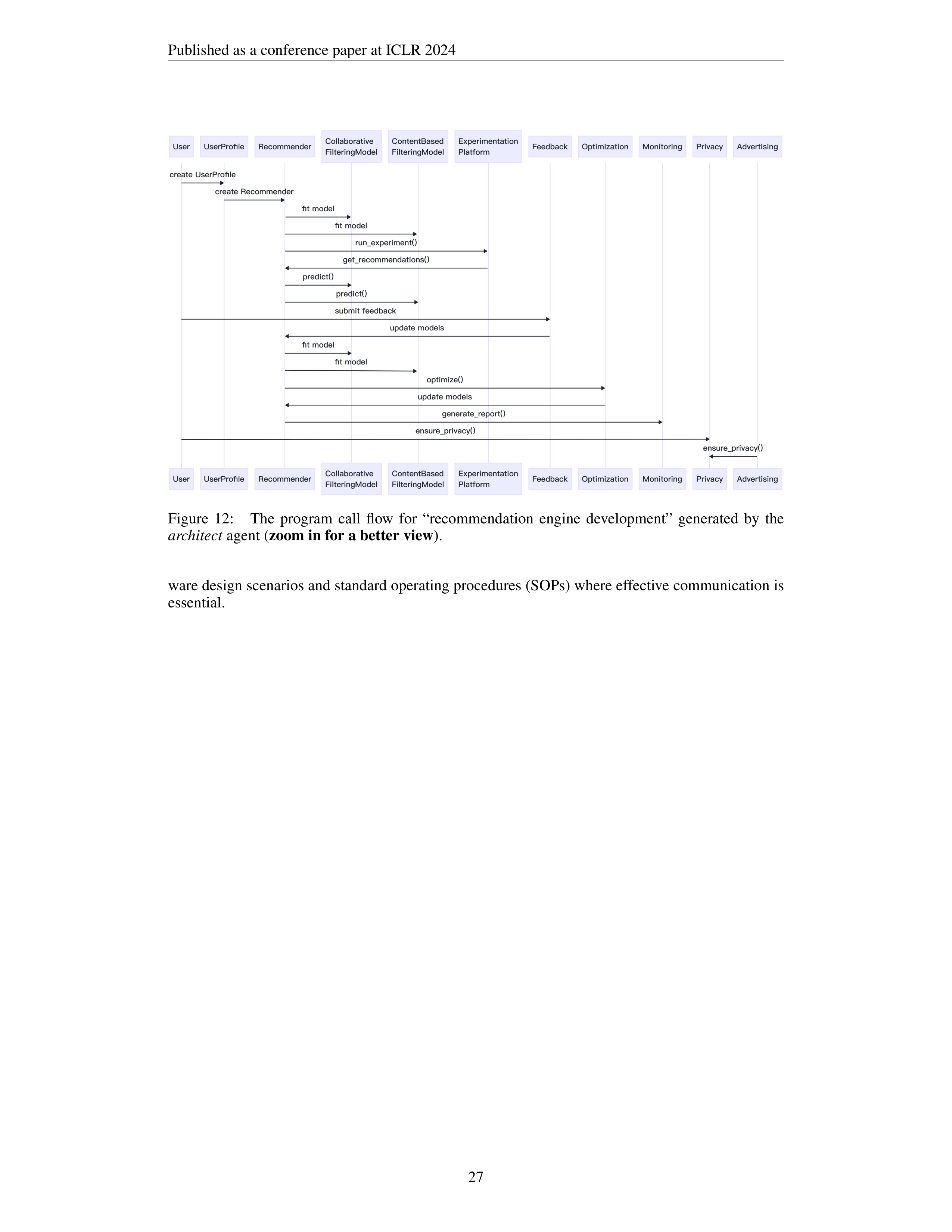
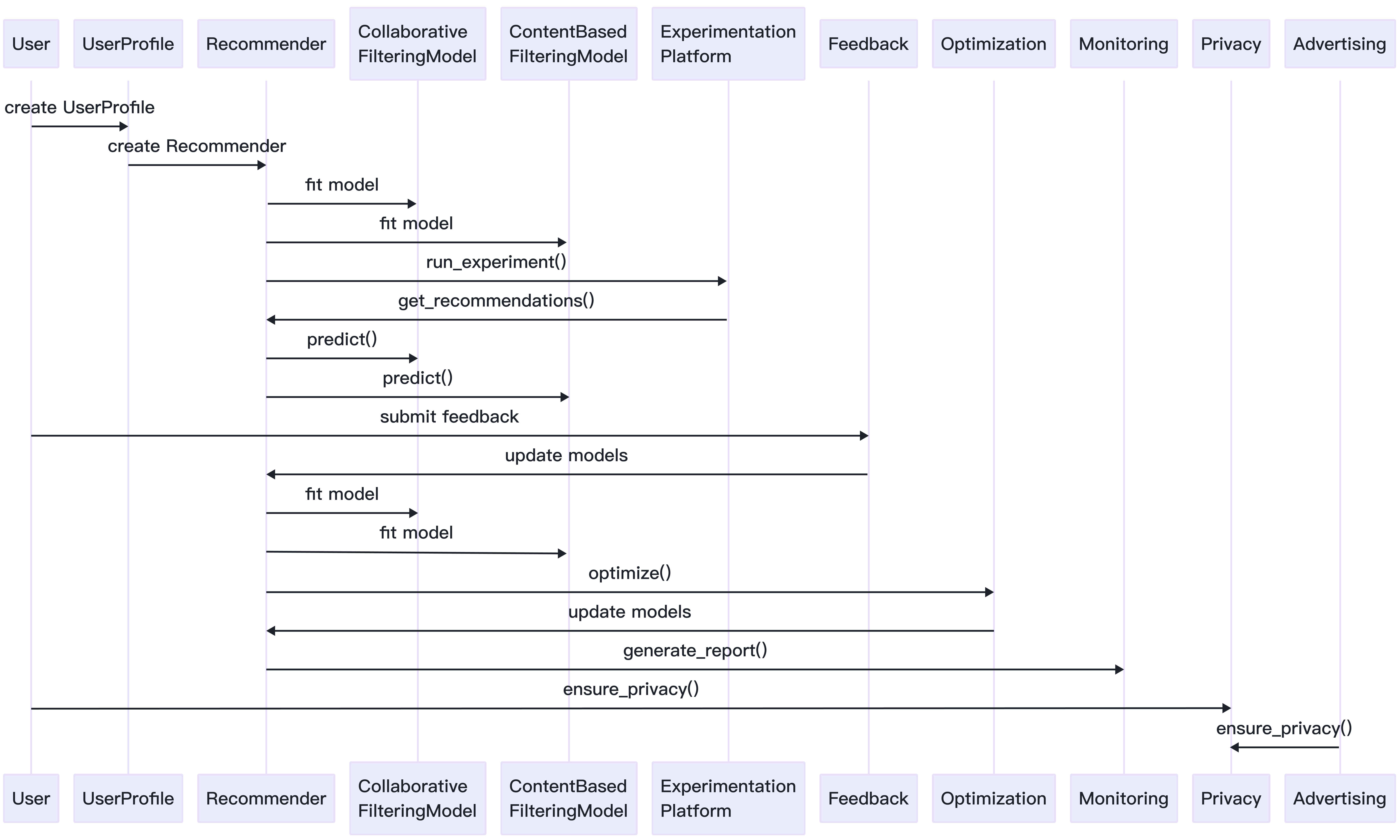
Published as a conference paper at ICLR 2024
Figure
12:
The
program
call
flow
for
“recommendation
engine
development”
generated
by
the
architect
agent (
zoom in for a better view
).
ware design scenarios and standard operating procedures (SOPs) where effective communication is
essential.
27

Published as a conference paper at ICLR 2024
Table 8:
Examples of SoftwareDev dataset.
Task ID
Task
Prompt
0
Snake game
Create a snake game.
1
Brick breaker game
Create a brick breaker game.
2
2048 game
Create a 2048 game for the web.
3
Flappy bird game
Write
p5.js
code
for
Flappy
Bird
where
you
control
a
yellow
bird
continu-
ously flying between a series of green pipes.
The bird flaps every time you
left
click
the
mouse.
If
it
falls
to
the
ground
or
hits
a
pipe,
you
lose.
This
game goes on indefinitely until you lose; you get points the further you go.
4
Tank battle game
Create a tank battle game.
5
Excel data process
Write an excel data processing program based on streamlit and pandas.
The
screen first shows an excel file upload button. After the excel file is uploaded,
use pandas to display its data content.
The program is required to be concise,
easy
to
maintain,
and
not
over-designed.
It
uses
streamlit
to
process
web
screen displays, and pandas is sufficient to process excel reading and display.
Please make sure others can execute directly without introducing additional
packages.
6
CRUD manage
Write a
management
program based on the crud addition,
deletion,
modifi-
cation
and
query
processing
of
the
customer
business
entity.
The
customer
needs to save this information: name, birthday, age, sex, and phone. The data
is stored in client.db, and there is a judgement whether the customer table ex-
ists. If it doesn’t, it needs to be created first. Querying is done by name; same
for deleting. The program is required to be concise, easy to maintain, and not
over-designed.
The screen is realized through streamlit and sqlite—no need
to introduce other additional packages.
7
Music transcriber
Develop
a
program
to
transcribe
sheet
music
into
a
digital
format;
provid-
ing
error-free
transcribed
symbolized
sheet
music
intelligence
from
audio
through
signal
processing
involving
pitch
and
time
slicing
then
training
a
neural net to run Onset Detected CWT transforming scalograms to chroma-
grams decoded with Recursive Neural Network focused networks.
8
Custom press releases
Create
custom
press
releases;
develop
a
Python
script
that
extracts
rele-
vant information about company news from external sources, such as social
media;
extract
update
interval
database
for
recent
changes.
The
program
should
create
press
releases
with
customizable
options
and
export
writings
to PDFs,
NYTimes API JSONs,
media format styled with interlink internal
fixed character-length metadata.
9
Gomoku game
Implement
a
Gomoku
game
using
Python,
incorporating
an
AI
opponent
with varying difficulty levels.
10
Weather dashboard
Create a Python program to develop an interactive weather dashboard.
28
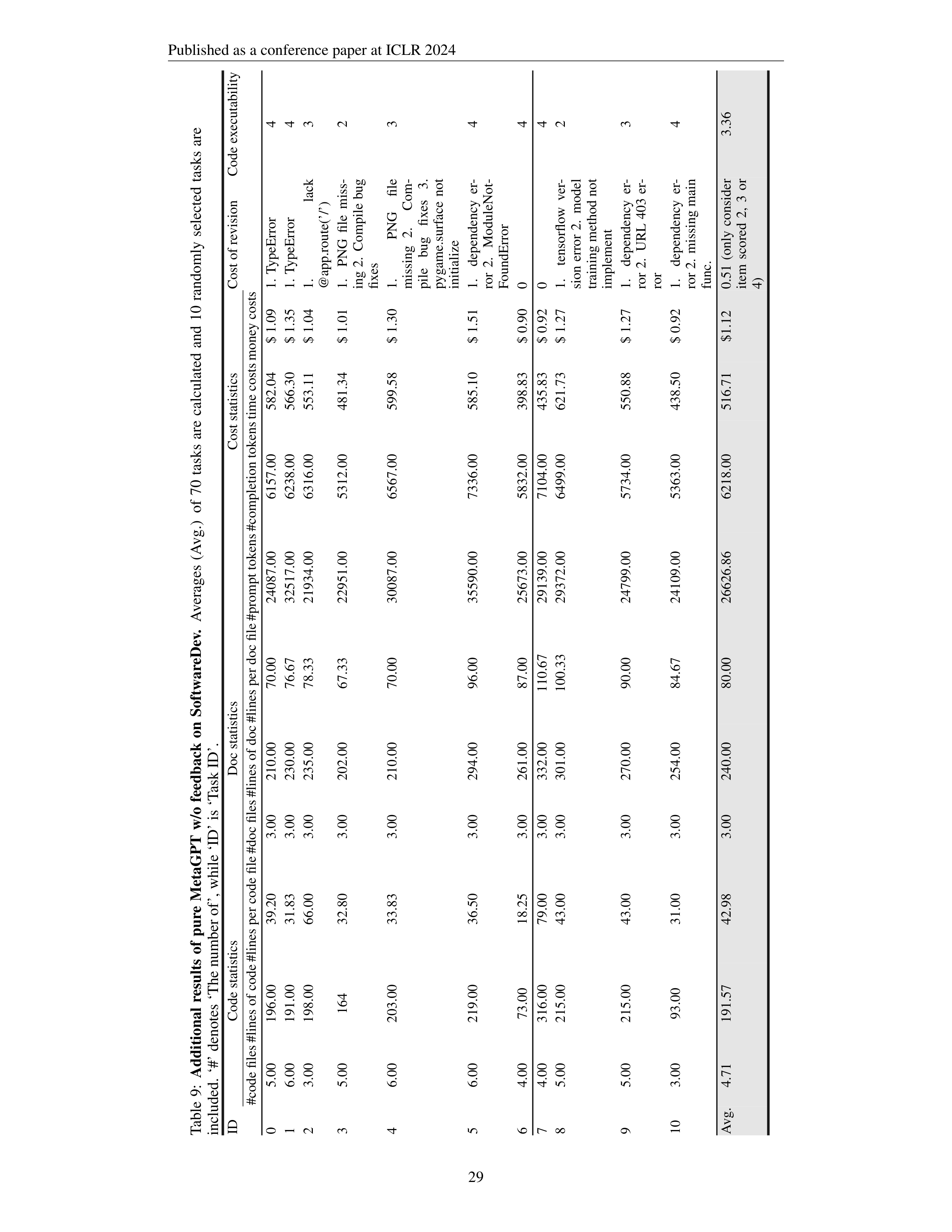
Published as a conference paper at ICLR 2024
Table
9:
Additional
results
of
pure
MetaGPT
w/o
feedback
on
SoftwareDev.
Averages
(Avg.)
of
70
tasks
are
calculated
and
10
randomly
selected
tasks
are
included.
‘#’ denotes ‘The number of’, while ‘ID’ is ‘Task ID’.
ID
Code statistics
Doc statistics
Cost statistics
Cost of revision
Code executability
#code files #lines of code #lines per code file #doc files #lines of doc #lines per doc file #prompt tokens #completion tokens time costs money costs
0
5.00
196.00
39.20
3.00
210.00
70.00
24087.00
6157.00
582.04
$ 1.09
1.
TypeError
4
1
6.00
191.00
31.83
3.00
230.00
76.67
32517.00
6238.00
566.30
$ 1.35
1.
TypeError
4
2
3.00
198.00
66.00
3.00
235.00
78.33
21934.00
6316.00
553.11
$ 1.04
1.
lack
@app.route(’/’)
3
3
5.00
164
32.80
3.00
202.00
67.33
22951.00
5312.00
481.34
$ 1.01
1.
PNG
file
miss-
ing 2.
Compile bug
fixes
2
4
6.00
203.00
33.83
3.00
210.00
70.00
30087.00
6567.00
599.58
$ 1.30
1.
PNG
file
missing
2.
Com-
pile
bug
fixes
3.
pygame.surface
not
initialize
3
5
6.00
219.00
36.50
3.00
294.00
96.00
35590.00
7336.00
585.10
$ 1.51
1.
dependency
er-
ror
2.
ModuleNot-
FoundError
4
6
4.00
73.00
18.25
3.00
261.00
87.00
25673.00
5832.00
398.83
$ 0.90
0
4
7
4.00
316.00
79.00
3.00
332.00
110.67
29139.00
7104.00
435.83
$ 0.92
0
4
8
5.00
215.00
43.00
3.00
301.00
100.33
29372.00
6499.00
621.73
$ 1.27
1.
tensorflow
ver-
sion error 2.
model
training method not
implement
2
9
5.00
215.00
43.00
3.00
270.00
90.00
24799.00
5734.00
550.88
$ 1.27
1.
dependency
er-
ror
2.
URL
403
er-
ror
3
10
3.00
93.00
31.00
3.00
254.00
84.67
24109.00
5363.00
438.50
$ 0.92
1.
dependency
er-
ror 2.
missing main
func.
4
Avg.
4.71
191.57
42.98
3.00
240.00
80.00
26626.86
6218.00
516.71
$1.12
0.51
(only
consider
item
scored
2,
3
or
4)
3.36
29