
DS-Agent:
Automated Data Science
by Empowering Large Language Models with Case-Based Reasoning
Siyuan Guo
1 2 3
Cheng Deng
4
Ying Wen
4
Hechang Chen
1 2
Yi Chang
1 2 3
Jun Wang
5
Abstract
In this work, we investigate the potential of large
language
models
(LLMs)
based
agents
to
auto-
mate
data
science
tasks,
with
the
goal
of
com-
prehending task requirements, then building and
training the best-fit machine learning models.
De-
spite
their
widespread
success,
existing
LLM
agents are hindered by generating unreasonable
experiment plans within this scenario.
To this end,
we present DS-Agent, a novel automatic frame-
work that harnesses LLM agent and case-based
reasoning (CBR). In the development stage, DS-
Agent follows the CBR framework to structure an
automatic
iteration
pipeline,
which
can
flexibly
capitalize on the expert knowledge from Kaggle,
and
facilitate
consistent
performance
improve-
ment through the feedback mechanism. Moreover,
DS-Agent implements a low-resource deployment
stage
with
a
simplified
CBR
paradigm
to
adapt
past successful solutions from the development
stage for direct code generation, significantly re-
ducing the demand on foundational capabilities
of
LLMs.
Empirically,
DS-Agent
with
GPT-4
achieves 100% success rate in the development
stage,
while
attaining
36%
improvement
on
av-
erage
one
pass
rate
across
alternative
LLMs
in
the deployment stage.
In both stages, DS-Agent
achieves
the
best
rank
in
performance,
costing
$1.60 and $0.13 per run with GPT-4, respectively.
Our data and code are open-sourced at
https:
//github.com/guosyjlu/DS-Agent
.
1
School of Artificial Intelligence, Jilin University
2
Engineering
Research
Center
of
Knowledge-Driven
Human-Machine
In-
telligence,
Jilin
University
3
International
Center
of
Future
Science,
Jilin
University
4
Shanghai
Jiao
Tong
University
5
University College London.
Correspondence to:
Hechang Chen
<
chenhc@jlu.edu.cn
>
,
Yi
Chang
<
yichang@jlu.edu.cn
>
,
Jun
Wang
<
jun.wang@cs.ucl.ac.uk
>
.
Proceedings
of
the
41
st
International
Conference
on
Machine
Learning
, Vienna, Austria.
PMLR 235, 2024.
Copyright 2024 by
the author(s).
1. Introduction
Recently, the remarkable foundational capabilities of large
language models (LLMs) (
OpenAI
,
2022
;
2023
) have em-
powered
autonomous
language
agents
to
address
a
wide
spectrum of tasks effectively (
Brohan et al.
,
2023
;
Kim et al.
,
2023
;
Shen et al.
,
2023
;
Boiko et al.
,
2023
;
Romera-Paredes
et al.
,
2023
).
In this work, we explore an open-ended deci-
sion making scenario-automated data science (
De Bie et al.
,
2022
;
Mahadi Hassan et al.
,
2023
), which aims at democra-
tizing access to data insights while minimizing the need for
specialized expertise.
Specifically, our focus is on automat-
ing machine learning (ML), a particularly specialized part,
with the primary goal of comprehending task requirements,
building
and
training
the
best-fit
ML
models,
and
finally
deploying the trained model.
Despite
the
widespread
success
of
LLM
agents,
a
recent
work (
Huang et al.
,
2023
) indicates that existing agents, in-
cluding AutoGPT (
Significant Gravitas
,
2023
), LangChain
(
Chase
,
2022
),
and
the
state-of-the-art
ResearchAgent
(
Huang et al.
,
2023
), struggle to achieve a high task com-
pletion
rate
within
the
data
science
scenario,
even
when
implemented with the most powerful LLM GPT-4.
This is
mainly attributed to LLMs’ deficiency in generating reason-
able plans and their hallucination issues.
To mitigate this,
a promising solution is to further finetune LLMs to align
with the automated data science scenario (
Carta et al.
,
2023
;
Zeng et al.
,
2023
;
Chen et al.
,
2023
;
Christianos et al.
,
2023
).
Nevertheless,
collecting
sufficient
samples
for
finetuning
poses a significant challenge due to the time costs involved,
particularly because feedback from automated data science
tasks necessitates the completion of code execution.
Worse
still, since LLMs typically have billions of parameters, the
back-propagation
and
optimization
during
the
finetuning
leads to intensive computation resources.
In this context, Kaggle emerges as a pivotal resource.
As the
world’s largest data science competition platform, it boasts a
vast repository of technical reports and codes contributed by
a community of seasoned data scientists.
To empower LLM
agents to harness this wealth of expert knowledge efficiently,
we turn to a classical AI problem-solving paradigm–case-
based reasoning (CBR) (
Kolodner
,
1992
;
Watson & Marir
,
1994
).
The CBR framework operates by retrieving similar
1
arXiv:2402.17453v5 [cs.LG] 28 May 2024

DS-Agent:
Automated Data Science by Empowering Large Language Models with Case-Based Reasoning
past problems, reusing their solutions for the current prob-
lem, evaluating the effectiveness, revising the solution, and
retaining successful solutions.
Utilizing CBR enables LLM
agents to analyze, extract and reuse solution patterns from
these human insights, and to iteratively revise the solution
based on the execution feedback to attain consistently im-
proved
performance.
The
integration
of
CBR
into
LLM
agents not only enhances their problem-solving abilities in
data science tasks but also achieves high efficiency in both
sample and computation resources.
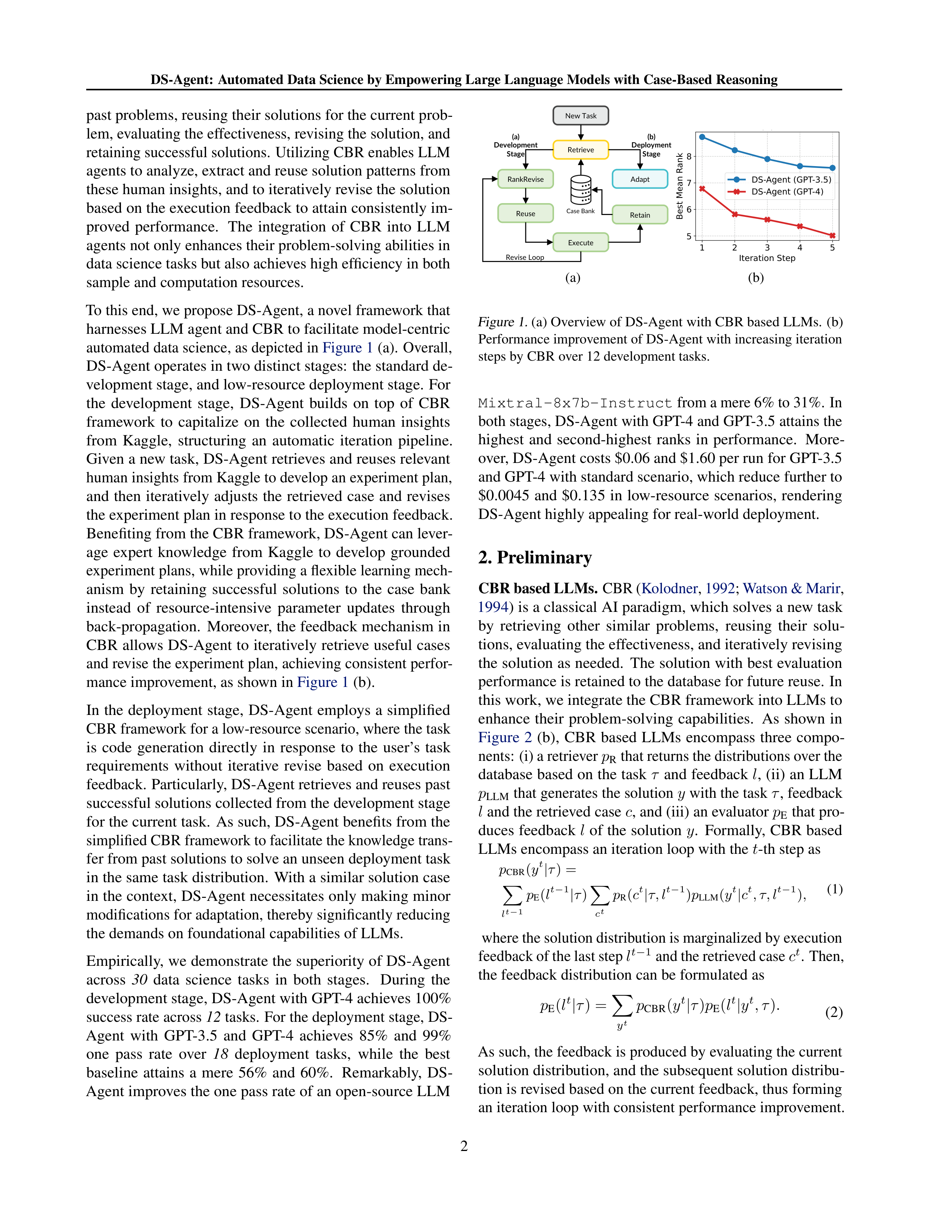
To this end, we propose DS-Agent, a novel framework that
harnesses LLM agent and CBR to facilitate model-centric
automated data science, as depicted in
Figure 1
(a).
Overall,
DS-Agent operates in two distinct stages:
the standard de-
velopment stage, and low-resource deployment stage.
For
the
development
stage,
DS-Agent
builds
on
top
of
CBR
framework
to
capitalize
on
the
collected
human
insights
from
Kaggle,
structuring
an
automatic
iteration
pipeline.
Given a new task, DS-Agent retrieves and reuses relevant
human insights from Kaggle to develop an experiment plan,
and
then
iteratively
adjusts
the
retrieved
case
and
revises
the experiment plan in response to the execution feedback.
Benefiting from the CBR framework, DS-Agent can lever-
age
expert
knowledge
from
Kaggle
to
develop
grounded
experiment plans, while providing a flexible learning mech-
anism
by
retaining
successful
solutions
to
the
case
bank
instead
of
resource-intensive
parameter
updates
through
back-propagation.
Moreover, the feedback mechanism in
CBR allows DS-Agent to iteratively retrieve useful cases
and revise the experiment plan, achieving consistent perfor-
mance improvement, as shown in
Figure 1
(b).
In the deployment stage,
DS-Agent employs a simplified
CBR framework for a low-resource scenario, where the task
is
code
generation
directly
in
response
to
the
user’s
task
requirements
without
iterative
revise
based
on
execution
feedback.
Particularly, DS-Agent retrieves and reuses past
successful solutions collected from the development stage
for the current task.
As such, DS-Agent benefits from the
simplified CBR framework to facilitate the knowledge trans-
fer from past solutions to solve an unseen deployment task
in the same task distribution.
With a similar solution case
in the context, DS-Agent necessitates only making minor
modifications for adaptation, thereby significantly reducing
the demands on foundational capabilities of LLMs.
Empirically, we demonstrate the superiority of DS-Agent
across
30
data
science
tasks
in
both
stages.
During
the
development stage, DS-Agent with GPT-4 achieves 100%
success rate across
12
tasks.
For the deployment stage, DS-
Agent
with
GPT-3.5
and
GPT-4
achieves
85%
and
99%
one
pass
rate
over
18
deployment
tasks,
while
the
best
baseline
attains
a
mere
56%
and
60%.
Remarkably,
DS-
Agent improves the one pass rate of an open-source LLM
New Task
Retrieve
RankRevise
Reuse
Execute
Retain
Adapt
Case Bank
(a)
Development
Stage
(b)
Deployment
Stage
Revise Loop
(a)
1
2
3
4
5
Iteration Step
5
6
7
8
Best Mean Rank
DS-Agent (GPT-3.5)
DS-Agent (GPT-4)
(b)
Figure 1.
(a) Overview of DS-Agent with CBR based LLMs.
(b)
Performance improvement of DS-Agent with increasing iteration
steps by CBR over 12 development tasks.
Mixtral-8x7b-Instruct
from a mere 6% to 31%.
In
both stages, DS-Agent with GPT-4 and GPT-3.5 attains the
highest
and
second-highest
ranks
in
performance.
More-
over, DS-Agent costs $0.06 and $1.60 per run for GPT-3.5
and GPT-4 with standard scenario, which reduce further to
$0.0045
and
$0.135
in
low-resource
scenarios,
rendering
DS-Agent highly appealing for real-world deployment.
2. Preliminary
CBR based LLMs.
CBR (
Kolodner
,
1992
;
Watson & Marir
,
1994
) is a classical AI paradigm, which solves a new task
by
retrieving
other
similar
problems,
reusing
their
solu-
tions, evaluating the effectiveness, and iteratively revising
the solution as needed.
The solution with best evaluation
performance is retained to the database for future reuse.
In
this work, we integrate the CBR framework into LLMs to
enhance
their
problem-solving
capabilities.
As
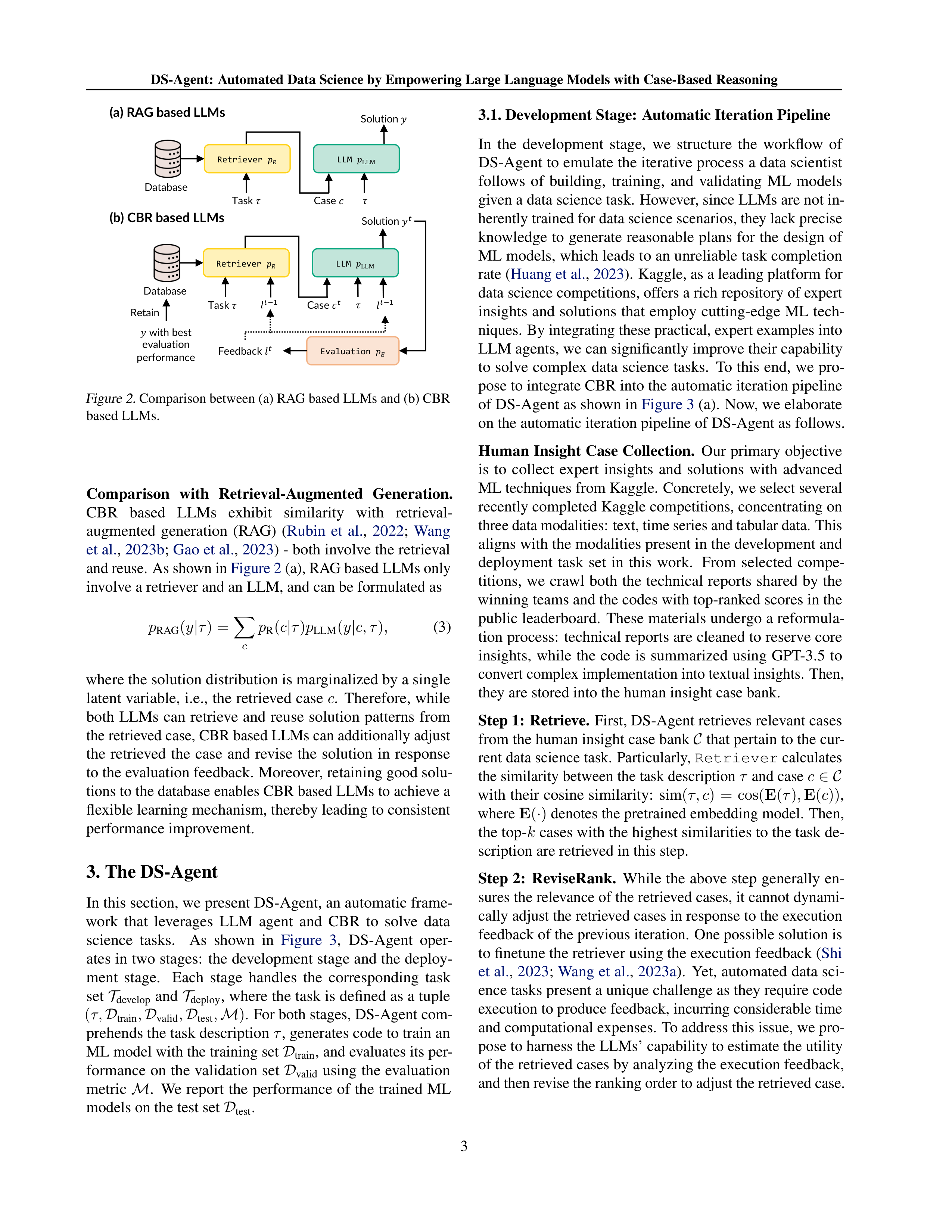
shown
in
Figure
2
(b),
CBR
based
LLMs
encompass
three
compo-
nents: (i) a retriever
p
R
that returns the distributions over the
database based on the task
τ
and feedback
l
, (ii) an LLM
p
LLM
that generates the solution
y
with the task
τ
, feedback
l
and the retrieved case
c
, and (iii) an evaluator
p
E
that pro-
duces feedback
l
of the solution
y
.
Formally, CBR based
LLMs encompass an iteration loop with the
t
-th step as
p
CBR
(
y
t
|
τ
) =
X
l
t
−
1
p
E
(
l
t
−
1
|
τ
)
X
c
t
p
R
(
c
t
|
τ, l
t
−
1
)
p
LLM
(
y
t
|
c
t
, τ, l
t
−
1
)
,
(1)
where the solution distribution is marginalized by execution
feedback of the last step
l
t
−
1
and the retrieved case
c
t
. Then,
the feedback distribution can be formulated as
p
E
(
l
t
|
τ
) =
X
y
t
p
CBR
(
y
t
|
τ
)
p
E
(
l
t
|
y
t
, τ
)
.
(2)
As such, the feedback is produced by evaluating the current
solution distribution, and the subsequent solution distribu-
tion is revised based on the current feedback, thus forming
an iteration loop with consistent performance improvement.
2

DS-Agent:
Automated Data Science by Empowering Large Language Models with Case-Based Reasoning
Database
(a) RAG based LLMs
(b) CBR based LLMs
Task
𝜏
Solution
𝑦
𝜏
Retriever
𝑝
!
LLM
𝑝
""#
Case
𝑐
Database
Task
𝜏
Solution
𝑦
!
𝜏
Retriever
𝑝
!
LLM
𝑝
""#
Case
𝑐
!
𝑙
!"#
𝑙
!"#
Evaluation
𝑝
$
Feedback
𝑙
!
𝑦
with best
evaluation
performance
Retain
Figure 2.
Comparison between (a) RAG based LLMs and (b) CBR
based LLMs.
Comparison
with
Retrieval-Augmented
Generation.
CBR
based
LLMs
exhibit
similarity
with
retrieval-
augmented
generation
(RAG)
(
Rubin
et
al.
,
2022
;
Wang
et al.
,
2023b
;
Gao et al.
,
2023
) - both involve the retrieval
and reuse.
As shown in
Figure 2
(a), RAG based LLMs only
involve a retriever and an LLM, and can be formulated as
p
RAG
(
y
|
τ
) =
X
c
p
R
(
c
|
τ
)
p
LLM
(
y
|
c, τ
)
,
(3)
where the solution distribution is marginalized by a single
latent variable, i.e., the retrieved case
c
.
Therefore, while
both
LLMs
can
retrieve
and
reuse
solution
patterns
from
the retrieved case, CBR based LLMs can additionally adjust
the
retrieved
the
case
and
revise
the
solution
in
response
to the evaluation feedback.
Moreover, retaining good solu-
tions to the database enables CBR based LLMs to achieve a
flexible learning mechanism, thereby leading to consistent
performance improvement.
3. The DS-Agent
In this section, we present DS-Agent, an automatic frame-
work
that
leverages
LLM
agent
and
CBR
to
solve
data
science
tasks.
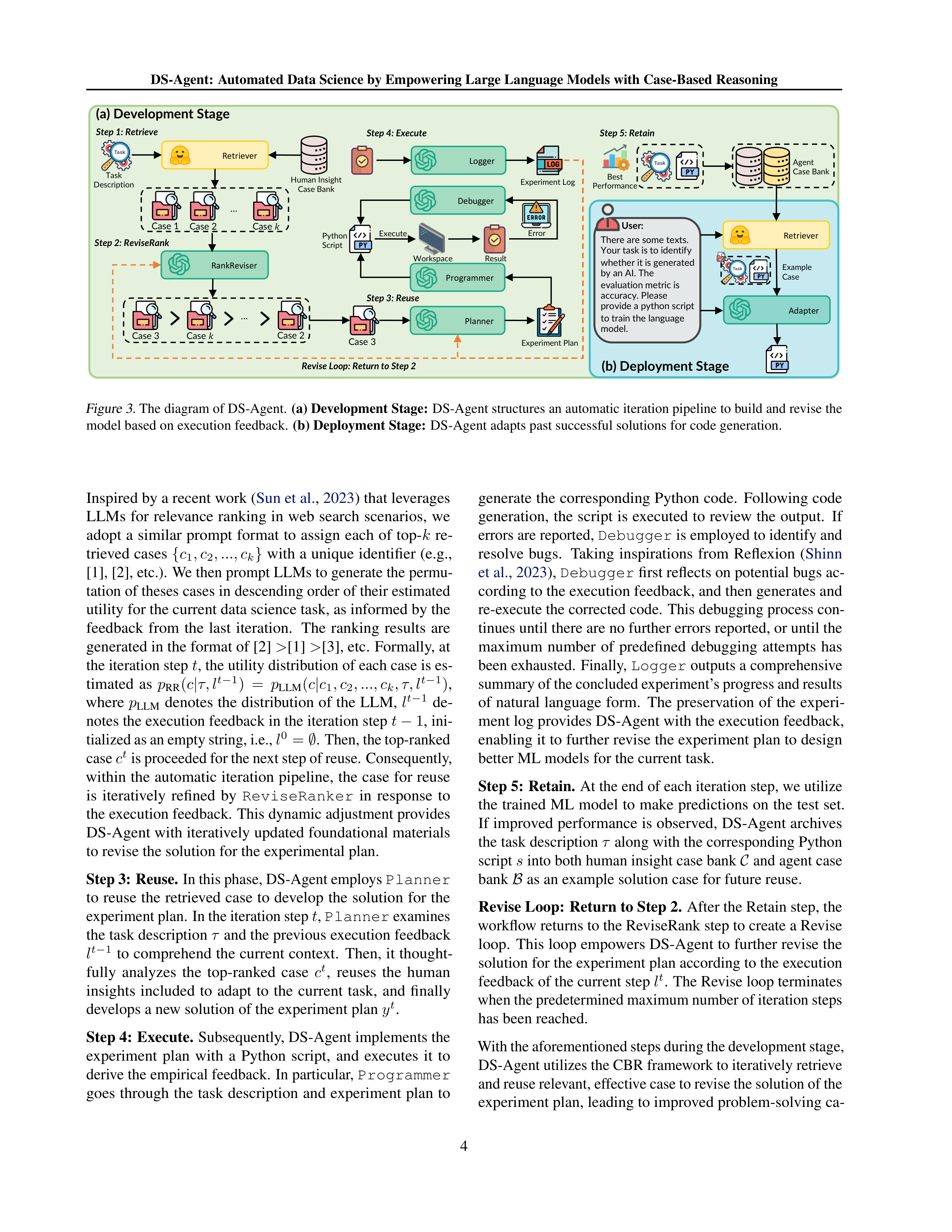
As
shown
in
Figure
3
,
DS-Agent
oper-
ates in two stages:
the development stage and the deploy-
ment
stage.
Each
stage
handles
the
corresponding
task
set
T
develop
and
T
deploy
, where the task is defined as a tuple
(
τ,
D
train
,
D
valid
,
D
test
,
M
)
.
For both stages, DS-Agent com-
prehends the task description
τ
, generates code to train an
ML model with the training set
D
train
, and evaluates its per-
formance on the validation set
D
valid
using the evaluation
metric
M
.
We report the performance of the trained ML
models on the test set
D
test
.
3.1. Development Stage:
Automatic Iteration Pipeline
In
the
development
stage,
we
structure
the
workflow
of
DS-Agent to emulate the iterative process a data scientist
follows
of
building,
training,
and
validating
ML
models
given a data science task.
However, since LLMs are not in-
herently trained for data science scenarios, they lack precise
knowledge to generate reasonable plans for the design of
ML models, which leads to an unreliable task completion
rate (
Huang et al.
,
2023
).
Kaggle, as a leading platform for
data science competitions, offers a rich repository of expert
insights and solutions that employ cutting-edge ML tech-
niques.
By integrating these practical, expert examples into
LLM agents, we can significantly improve their capability
to solve complex data science tasks.
To this end,
we pro-
pose to integrate CBR into the automatic iteration pipeline
of DS-Agent as shown in
Figure 3
(a).
Now, we elaborate
on the automatic iteration pipeline of DS-Agent as follows.
Human Insight Case Collection.
Our primary objective
is
to
collect
expert
insights
and
solutions
with
advanced
ML techniques from Kaggle.
Concretely, we select several
recently completed Kaggle competitions, concentrating on
three data modalities: text, time series and tabular data.
This
aligns with the modalities present in the development and
deployment
task
set
in
this
work.
From
selected
compe-
titions,
we crawl both the technical reports shared by the
winning teams and the codes with top-ranked scores in the
public leaderboard.
These materials undergo a reformula-
tion process:
technical reports are cleaned to reserve core
insights,
while
the
code
is
summarized
using
GPT-3.5
to
convert complex implementation into textual insights.
Then,
they are stored into the human insight case bank.
Step 1:
Retrieve.
First, DS-Agent retrieves relevant cases
from the human insight case bank
C
that pertain to the cur-
rent data science task.
Particularly,
Retriever
calculates
the similarity between the task description
τ
and case
c
∈C
with their cosine similarity:
sim
(
τ, c
)
=
cos(
E
(
τ
)
,
E
(
c
))
,
where
E
(
·
)
denotes the pretrained embedding model.
Then,
the top-
k
cases with the highest similarities to the task de-
scription are retrieved in this step.
Step 2:
ReviseRank.
While the above step generally en-
sures the relevance of the retrieved cases, it cannot dynami-
cally adjust the retrieved cases in response to the execution
feedback of the previous iteration.
One possible solution is
to finetune the retriever using the execution feedback (
Shi
et al.
,
2023
;
Wang et al.
,
2023a
).
Yet, automated data sci-
ence tasks present a unique challenge as they require code
execution to produce feedback, incurring considerable time
and computational expenses.
To address this issue, we pro-
pose to harness the LLMs’ capability to estimate the utility
of the retrieved cases by analyzing the execution feedback,
and then revise the ranking order to adjust the retrieved case.
3
















DS-Agent:
Automated Data Science by Empowering Large Language Models with Case-Based Reasoning
RankReviser
Retriever
Planner
Logger
Debugger
Programmer
Step 1: Retrieve
Case 1
Case 2
Case
𝑘
…
Case 3
Case
𝑘
Case 2
…
Human Insight
Case Bank
Task
Description
Experiment Plan
Workspace
Result
Python
Script
Error
Execute
Step 2: ReviseRank
Step 3: Reuse
Step 4: Execute
Case 3
Revise Loop: Return to Step 2
Step 5: Retain
Agent
Case Bank
There are some texts.
Your task is to identify
whether it is generated
by an AI. The
evaluation metric is
accuracy. Please
provide a python script
to train the language
model.
Retriever
Adapter
Example
Case
User:
Best
Performance
(a) Development Stage
(b) Deployment Stage
Experiment Log
Figure 3.
The diagram of DS-Agent.
(a) Development Stage:
DS-Agent structures an automatic iteration pipeline to build and revise the
model based on execution feedback.
(b) Deployment Stage:
DS-Agent adapts past successful solutions for code generation.
Inspired by a recent work (
Sun et al.
,
2023
) that leverages
LLMs for relevance ranking in web search scenarios,
we
adopt
a
similar
prompt
format
to
assign
each
of
top-
k
re-
trieved cases
{
c
1
, c
2
, ..., c
k
}
with a unique identifier (e.g.,
[1], [2], etc.).
We then prompt LLMs to generate the permu-
tation of theses cases in descending order of their estimated
utility for the current data science task, as informed by the
feedback
from
the
last
iteration.
The
ranking
results
are
generated in the format of [2]
>
[1]
>
[3], etc.
Formally, at
the iteration step
t
, the utility distribution of each case is es-
timated
as
p
RR
(
c
|
τ, l
t
−
1
)
=
p
LLM
(
c
|
c
1
, c
2
, ..., c
k
, τ, l
t
−
1
)
,
where
p
LLM
denotes the distribution of the LLM,
l
t
−
1
de-
notes the execution feedback in the iteration step
t
−
1
, ini-
tialized as an empty string, i.e.,
l
0
=
∅
. Then, the top-ranked
case
c
t
is proceeded for the next step of reuse. Consequently,
within the automatic iteration pipeline,
the case for reuse
is
iteratively
refined
by
ReviseRanker
in
response
to
the execution feedback.
This dynamic adjustment provides
DS-Agent with iteratively updated foundational materials
to revise the solution for the experimental plan.
Step 3: Reuse.
In this phase, DS-Agent employs
Planner
to reuse the retrieved case to develop the solution for the
experiment plan.
In the iteration step
t
,
Planner
examines
the task description
τ
and the previous execution feedback
l
t
−
1
to comprehend the current context.
Then, it thought-
fully
analyzes
the
top-ranked
case
c
t
,
reuses
the
human
insights
included
to
adapt
to
the
current
task,
and
finally
develops a new solution of the experiment plan
y
t
.
Step 4:
Execute.
Subsequently, DS-Agent implements the
experiment
plan
with
a
Python
script,
and
executes
it
to
derive the empirical feedback.
In particular,
Programmer
goes through
the task description and
experiment plan to
generate the corresponding Python code.
Following code
generation,
the script is executed to review the output.
If
errors are reported,
Debugger
is employed to identify and
resolve
bugs.
Taking
inspirations
from
Reflexion
(
Shinn
et al.
,
2023
),
Debugger
first reflects on potential bugs ac-
cording to the execution feedback, and then generates and
re-execute the corrected code.
This debugging process con-
tinues until there are no further errors reported, or until the
maximum
number
of
predefined
debugging
attempts
has
been exhausted.
Finally,
Logger
outputs a comprehensive
summary of the concluded experiment’s progress and results
of natural language form.
The preservation of the experi-
ment log provides DS-Agent with the execution feedback,
enabling it to further revise the experiment plan to design
better ML models for the current task.
Step 5:
Retain.
At the end of each iteration step, we utilize
the trained ML model to make predictions on the test set.
If improved performance is observed, DS-Agent archives
the task description
τ
along with the corresponding Python
script
s
into both human insight case bank
C
and agent case
bank
B
as an example solution case for future reuse.
Revise Loop:
Return to Step 2.
After the Retain step, the
workflow returns to the ReviseRank step to create a Revise
loop.
This loop empowers DS-Agent to further revise the
solution for the experiment plan according to the execution
feedback of the current step
l
t
.
The Revise loop terminates
when the predetermined maximum number of iteration steps
has been reached.
With the aforementioned steps during the development stage,
DS-Agent utilizes the CBR framework to iteratively retrieve
and reuse relevant, effective case to revise the solution of the
experiment plan, leading to improved problem-solving ca-
4
DS-Agent:
Automated Data Science by Empowering Large Language Models with Case-Based Reasoning
pabilities for data science tasks.
Here, the CBR framework
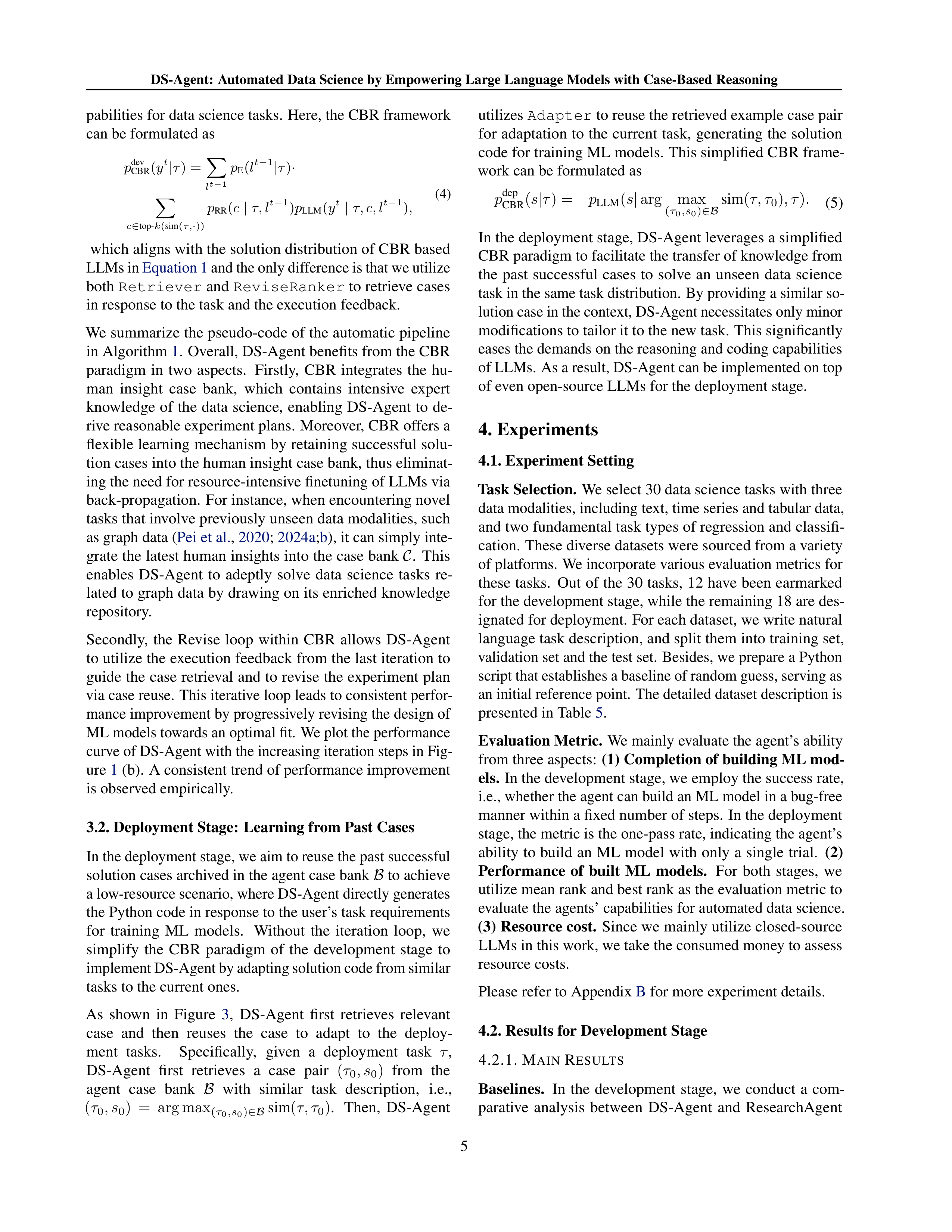
can be formulated as
p
dev
CBR
(
y
t
|
τ
) =
X
l
t
−
1
p
E
(
l
t
−
1
|
τ
)
·
X
c
∈
top-
k
(
sim
(
τ,
·
))
p
RR
(
c
|
τ, l
t
−
1
)
p
LLM
(
y
t
|
τ, c, l
t
−
1
)
,
(4)
which aligns with the solution distribution of CBR based
LLMs in
Equation 1
and the only difference is that we utilize
both
Retriever
and
ReviseRanker
to retrieve cases
in response to the task and the execution feedback.
We summarize the pseudo-code of the automatic pipeline
in Algorithm
1
.
Overall, DS-Agent benefits from the CBR
paradigm
in
two
aspects.
Firstly,
CBR
integrates
the
hu-
man
insight
case
bank,
which
contains
intensive
expert
knowledge of the data science,
enabling DS-Agent to de-
rive reasonable experiment plans.
Moreover, CBR offers a
flexible learning mechanism by retaining successful solu-
tion cases into the human insight case bank, thus eliminat-
ing the need for resource-intensive finetuning of LLMs via
back-propagation.
For instance, when encountering novel
tasks that involve previously unseen data modalities, such
as graph data (
Pei et al.
,
2020
;
2024a
;
b
), it can simply inte-
grate the latest human insights into the case bank
C
.
This
enables
DS-Agent
to
adeptly
solve
data
science
tasks
re-
lated to graph data by drawing on its enriched knowledge
repository.
Secondly,
the
Revise
loop
within
CBR
allows
DS-Agent
to utilize the execution feedback from the last iteration to
guide the case retrieval and to revise the experiment plan
via case reuse.
This iterative loop leads to consistent perfor-
mance improvement by progressively revising the design of
ML models towards an optimal fit.
We plot the performance
curve of DS-Agent with the increasing iteration steps in Fig-
ure
1
(b).
A consistent trend of performance improvement
is observed empirically.
3.2. Deployment Stage:
Learning from Past Cases
In the deployment stage, we aim to reuse the past successful
solution cases archived in the agent case bank
B
to achieve
a low-resource scenario, where DS-Agent directly generates
the Python code in response to the user’s task requirements
for
training
ML
models.
Without
the
iteration
loop,
we
simplify
the
CBR
paradigm
of
the
development
stage
to
implement DS-Agent by adapting solution code from similar
tasks to the current ones.
As
shown
in
Figure
3
,
DS-Agent
first
retrieves
relevant
case
and
then
reuses
the
case
to
adapt
to
the
deploy-
ment
tasks.
Specifically,
given
a
deployment
task
τ
,
DS-Agent
first
retrieves
a
case
pair
(
τ
0
, s
0
)
from
the
agent
case
bank
B
with
similar
task
description,
i.e.,
(
τ
0
, s
0
)
=
arg max
(
τ
0
,s
0
)
∈B
sim
(
τ, τ
0
)
.
Then,
DS-Agent
utilizes
Adapter
to reuse the retrieved example case pair
for adaptation to the current task,
generating the solution
code for training ML models.
This simplified CBR frame-
work can be formulated as
p
dep
CBR
(
s
|
τ
) =
p
LLM
(
s
|
arg
max
(
τ
0
,s
0
)
∈B
sim
(
τ, τ
0
)
, τ
)
.
(5)
In the deployment stage, DS-Agent leverages a simplified
CBR paradigm to facilitate the transfer of knowledge from
the
past
successful
cases
to
solve
an
unseen
data
science
task in the same task distribution.
By providing a similar so-
lution case in the context, DS-Agent necessitates only minor
modifications to tailor it to the new task.
This significantly
eases the demands on the reasoning and coding capabilities
of LLMs.
As a result, DS-Agent can be implemented on top
of even open-source LLMs for the deployment stage.
4. Experiments
4.1. Experiment Setting
Task Selection.
We select 30 data science tasks with three
data modalities, including text, time series and tabular data,
and two fundamental task types of regression and classifi-
cation.
These diverse datasets were sourced from a variety
of platforms.
We incorporate various evaluation metrics for
these tasks.
Out of the 30 tasks, 12 have been earmarked
for the development stage, while the remaining 18 are des-
ignated for deployment.
For each dataset, we write natural
language task description, and split them into training set,
validation set and the test set.
Besides, we prepare a Python
script that establishes a baseline of random guess, serving as
an initial reference point.
The detailed dataset description is
presented in Table
5
.
Evaluation Metric.
We mainly evaluate the agent’s ability
from three aspects:
(1) Completion of building ML mod-
els.
In the development stage, we employ the success rate,
i.e., whether the agent can build an ML model in a bug-free
manner within a fixed number of steps.
In the deployment
stage, the metric is the one-pass rate, indicating the agent’s
ability to build an ML model with only a single trial.
(2)
Performance
of
built
ML
models.
For
both
stages,
we
utilize mean rank and best rank as the evaluation metric to
evaluate the agents’ capabilities for automated data science.
(3) Resource cost.
Since we mainly utilize closed-source
LLMs in this work, we take the consumed money to assess
resource costs.
Please refer to Appendix
B
for more experiment details.
4.2. Results for Development Stage
4.2.1. M
AIN
R
ESULTS
Baselines.
In
the
development
stage,
we
conduct
a
com-
parative
analysis
between
DS-Agent
and
ResearchAgent
5
DS-Agent:
Automated Data Science by Empowering Large Language Models with Case-Based Reasoning
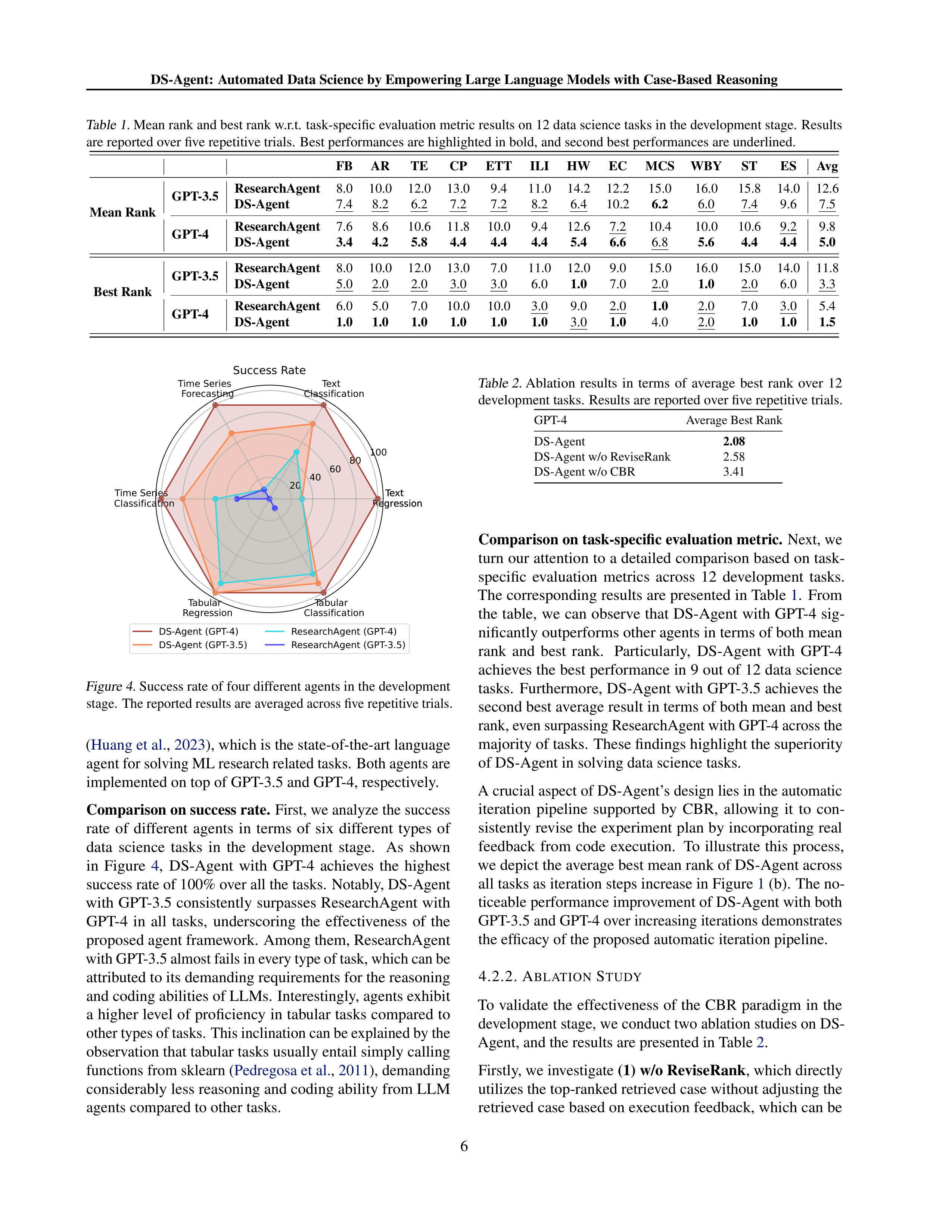
Table 1.
Mean rank and best rank w.r.t.
task-specific evaluation metric results on 12 data science tasks in the development stage.
Results
are reported over five repetitive trials.
Best performances are highlighted in bold, and second best performances are underlined.
FB
AR
TE
CP
ETT
ILI
HW
EC
MCS
WBY
ST
ES
Avg
Mean Rank
GPT-3.5
ResearchAgent
8.0
10.0
12.0
13.0
9.4
11.0
14.2
12.2
15.0
16.0
15.8
14.0
12.6
DS-Agent
7.4
8.2
6.2
7.2
7.2
8.2
6.4
10.2
6.2
6.0
7.4
9.6
7.5
GPT-4
ResearchAgent
7.6
8.6
10.6
11.8
10.0
9.4
12.6
7.2
10.4
10.0
10.6
9.2
9.8
DS-Agent
3.4
4.2
5.8
4.4
4.4
4.4
5.4
6.6
6.8
5.6
4.4
4.4
5.0
Best Rank
GPT-3.5
ResearchAgent
8.0
10.0
12.0
13.0
7.0
11.0
12.0
9.0
15.0
16.0
15.0
14.0
11.8
DS-Agent
5.0
2.0
2.0
3.0
3.0
6.0
1.0
7.0
2.0
1.0
2.0
6.0
3.3
GPT-4
ResearchAgent
6.0
5.0
7.0
10.0
10.0
3.0
9.0
2.0
1.0
2.0
7.0
3.0
5.4
DS-Agent
1.0
1.0
1.0
1.0
1.0
1.0
3.0
1.0
4.0
2.0
1.0
1.0
1.5
Text
Regression
Text
Classification
Time Series
Forecasting
Time Series
Classification
Tabular
Regression
Tabular
Classification
Text
Regression
20
40
60
80
100
Success Rate
DS-Agent (GPT-4)
DS-Agent (GPT-3.5)
ResearchAgent (GPT-4)
ResearchAgent (GPT-3.5)
Figure 4.
Success rate of four different agents in the development
stage.
The reported results are averaged across five repetitive trials.
(
Huang et al.
,
2023
), which is the state-of-the-art language
agent for solving ML research related tasks.
Both agents are
implemented on top of GPT-3.5 and GPT-4, respectively.
Comparison on success rate.
First, we analyze the success
rate
of
different
agents
in
terms
of
six
different
types
of
data
science
tasks
in
the
development
stage.
As
shown
in
Figure
4
,
DS-Agent
with
GPT-4
achieves
the
highest
success rate of 100% over all the tasks.
Notably, DS-Agent
with GPT-3.5 consistently surpasses ResearchAgent with
GPT-4
in
all
tasks,
underscoring
the
effectiveness
of
the
proposed agent framework.
Among them, ResearchAgent
with GPT-3.5 almost fails in every type of task, which can be
attributed to its demanding requirements for the reasoning
and coding abilities of LLMs.
Interestingly, agents exhibit
a higher level of proficiency in tabular tasks compared to
other types of tasks. This inclination can be explained by the
observation that tabular tasks usually entail simply calling
functions from sklearn (
Pedregosa et al.
,
2011
), demanding
considerably less reasoning and coding ability from LLM
agents compared to other tasks.
Table 2.
Ablation
results
in
terms
of
average
best
rank
over
12
development tasks.
Results are reported over five repetitive trials.
GPT-4
Average Best Rank
DS-Agent
2.08
DS-Agent w/o ReviseRank
2.58
DS-Agent w/o CBR
3.41
Comparison on task-specific evaluation metric.
Next, we
turn our attention to a detailed comparison based on task-
specific
evaluation
metrics
across
12
development
tasks.
The corresponding results are presented in Table
1
.
From
the table,
we can observe that DS-Agent with GPT-4 sig-
nificantly outperforms other agents in terms of both mean
rank
and
best
rank.
Particularly,
DS-Agent
with
GPT-4
achieves the best performance in 9 out of 12 data science
tasks.
Furthermore, DS-Agent with GPT-3.5 achieves the
second best average result in terms of both mean and best
rank, even surpassing ResearchAgent with GPT-4 across the
majority of tasks.
These findings highlight the superiority
of DS-Agent in solving data science tasks.
A crucial aspect of DS-Agent’s design lies in the automatic
iteration
pipeline
supported
by
CBR,
allowing
it
to
con-
sistently revise the experiment plan by incorporating real
feedback
from
code
execution.
To
illustrate
this
process,
we depict the average best mean rank of DS-Agent across
all tasks as iteration steps increase in Figure
1
(b).
The no-
ticeable performance improvement of DS-Agent with both
GPT-3.5 and GPT-4 over increasing iterations demonstrates
the efficacy of the proposed automatic iteration pipeline.
4.2.2. A
BLATION
S
TUDY
To validate the effectiveness of the CBR paradigm in the
development stage, we conduct two ablation studies on DS-
Agent, and the results are presented in Table
2
.
Firstly, we investigate
(1) w/o ReviseRank
, which directly
utilizes the top-ranked retrieved case without adjusting the
retrieved case based on execution feedback, which can be
6
DS-Agent:
Automated Data Science by Empowering Large Language Models with Case-Based Reasoning
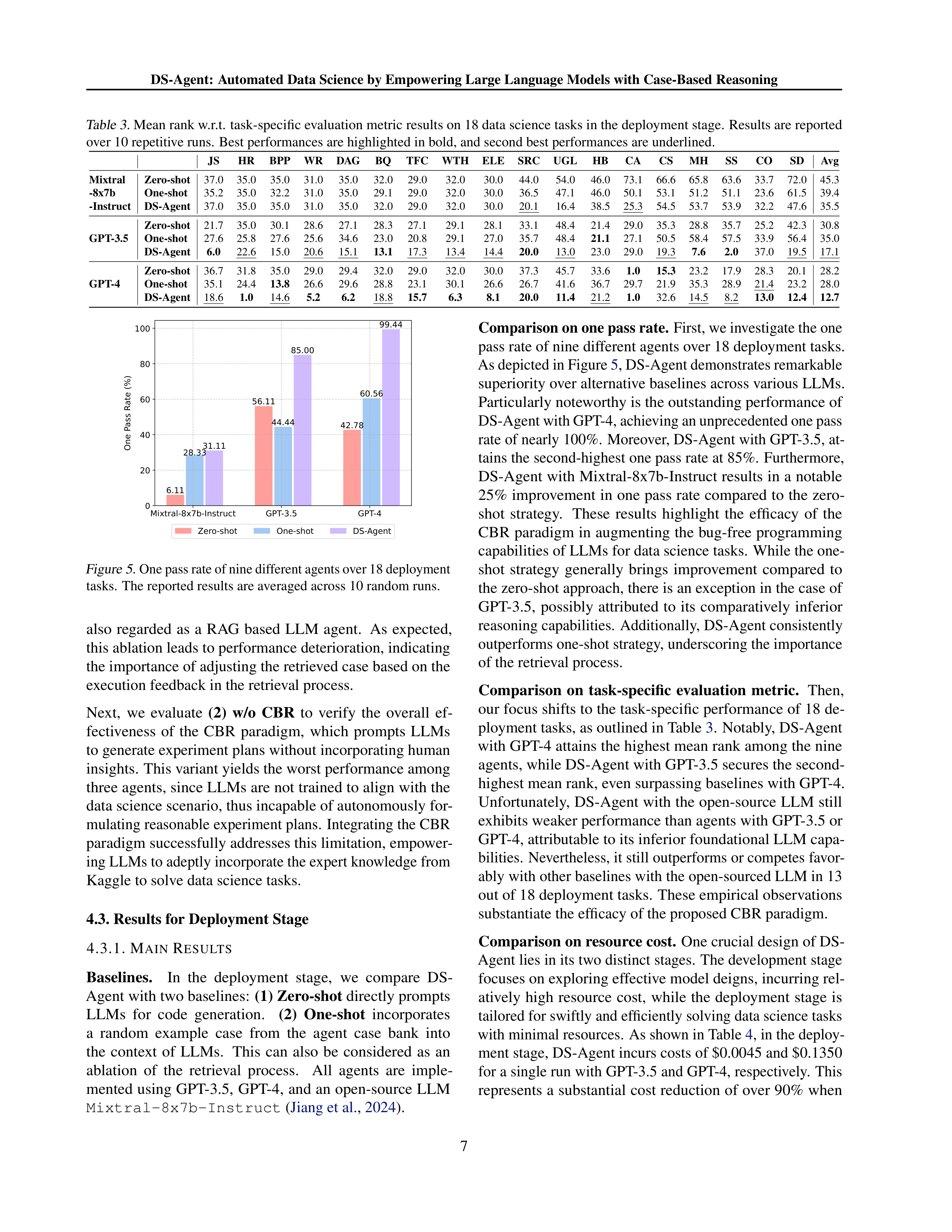
Table 3.
Mean rank w.r.t.
task-specific evaluation metric results on 18 data science tasks in the deployment stage.
Results are reported
over 10 repetitive runs.
Best performances are highlighted in bold, and second best performances are underlined.
JS
HR
BPP
WR
DAG
BQ
TFC
WTH
ELE
SRC
UGL
HB
CA
CS
MH
SS
CO
SD
Avg
Mixtral
Zero-shot
37.0
35.0
35.0
31.0
35.0
32.0
29.0
32.0
30.0
44.0
54.0
46.0
73.1
66.6
65.8
63.6
33.7
72.0
45.3
-8x7b
One-shot
35.2
35.0
32.2
31.0
35.0
29.1
29.0
32.0
30.0
36.5
47.1
46.0
50.1
53.1
51.2
51.1
23.6
61.5
39.4
-Instruct
DS-Agent
37.0
35.0
35.0
31.0
35.0
32.0
29.0
32.0
30.0
20.1
16.4
38.5
25.3
54.5
53.7
53.9
32.2
47.6
35.5
GPT-3.5
Zero-shot
21.7
35.0
30.1
28.6
27.1
28.3
27.1
29.1
28.1
33.1
48.4
21.4
29.0
35.3
28.8
35.7
25.2
42.3
30.8
One-shot
27.6
25.8
27.6
25.6
34.6
23.0
20.8
29.1
27.0
35.7
48.4
21.1
27.1
50.5
58.4
57.5
33.9
56.4
35.0
DS-Agent
6.0
22.6
15.0
20.6
15.1
13.1
17.3
13.4
14.4
20.0
13.0
23.0
29.0
19.3
7.6
2.0
37.0
19.5
17.1
GPT-4
Zero-shot
36.7
31.8
35.0
29.0
29.4
32.0
29.0
32.0
30.0
37.3
45.7
33.6
1.0
15.3
23.2
17.9
28.3
20.1
28.2
One-shot
35.1
24.4
13.8
26.6
29.6
28.8
23.1
30.1
26.6
26.7
41.6
36.7
29.7
21.9
35.3
28.9
21.4
23.2
28.0
DS-Agent
18.6
1.0
14.6
5.2
6.2
18.8
15.7
6.3
8.1
20.0
11.4
21.2
1.0
32.6
14.5
8.2
13.0
12.4
12.7
Mixtral-8x7b-Instruct
GPT-3.5
GPT-4
0
20
40
60
80
100
One Pass Rate (%)
6.11
56.11
42.78
28.33
44.44
60.56
31.11
85.00
99.44
Zero-shot
One-shot
DS-Agent
Figure 5.
One pass rate of nine different agents over 18 deployment
tasks.
The reported results are averaged across 10 random runs.
also
regarded
as
a
RAG
based
LLM
agent.
As
expected,
this ablation leads to performance deterioration, indicating
the importance of adjusting the retrieved case based on the
execution feedback in the retrieval process.
Next,
we
evaluate
(2)
w/o
CBR
to
verify
the
overall
ef-
fectiveness
of
the
CBR
paradigm,
which
prompts
LLMs
to generate experiment plans without incorporating human
insights.
This variant yields the worst performance among
three agents, since LLMs are not trained to align with the
data science scenario, thus incapable of autonomously for-
mulating reasonable experiment plans.
Integrating the CBR
paradigm successfully addresses this limitation, empower-
ing LLMs to adeptly incorporate the expert knowledge from
Kaggle to solve data science tasks.
4.3. Results for Deployment Stage
4.3.1. M
AIN
R
ESULTS
Baselines.
In
the
deployment
stage,
we
compare
DS-
Agent with two baselines:
(1) Zero-shot
directly prompts
LLMs
for
code
generation.
(2)
One-shot
incorporates
a
random
example
case
from
the
agent
case
bank
into
the
context
of
LLMs.
This
can
also
be
considered
as
an
ablation
of
the
retrieval
process.
All
agents
are
imple-
mented using GPT-3.5, GPT-4, and an open-source LLM
Mixtral-8x7b-Instruct
(
Jiang et al.
,
2024
).
Comparison on one pass rate.
First, we investigate the one
pass rate of nine different agents over 18 deployment tasks.
As depicted in Figure
5
, DS-Agent demonstrates remarkable
superiority over alternative baselines across various LLMs.
Particularly noteworthy is the outstanding performance of
DS-Agent with GPT-4, achieving an unprecedented one pass
rate of nearly 100%.
Moreover, DS-Agent with GPT-3.5, at-
tains the second-highest one pass rate at 85%.
Furthermore,
DS-Agent with Mixtral-8x7b-Instruct results in a notable
25% improvement in one pass rate compared to the zero-
shot
strategy.
These
results
highlight
the
efficacy
of
the
CBR paradigm in augmenting the bug-free programming
capabilities of LLMs for data science tasks.
While the one-
shot
strategy
generally
brings
improvement
compared
to
the zero-shot approach, there is an exception in the case of
GPT-3.5,
possibly
attributed
to
its
comparatively
inferior
reasoning capabilities.
Additionally, DS-Agent consistently
outperforms one-shot strategy, underscoring the importance
of the retrieval process.
Comparison
on
task-specific
evaluation
metric.
Then,
our focus shifts to the task-specific performance of 18 de-
ployment tasks, as outlined in Table
3
.
Notably, DS-Agent
with GPT-4 attains the highest mean rank among the nine
agents, while DS-Agent with GPT-3.5 secures the second-
highest mean rank, even surpassing baselines with GPT-4.
Unfortunately, DS-Agent with the open-source LLM still
exhibits weaker performance than agents with GPT-3.5 or
GPT-4, attributable to its inferior foundational LLM capa-
bilities.
Nevertheless, it still outperforms or competes favor-
ably with other baselines with the open-sourced LLM in 13
out of 18 deployment tasks.
These empirical observations
substantiate the efficacy of the proposed CBR paradigm.
Comparison on resource cost.
One crucial design of DS-
Agent lies in its two distinct stages.
The development stage
focuses on exploring effective model deigns, incurring rel-
atively
high
resource
cost,
while
the
deployment
stage
is
tailored for swiftly and efficiently solving data science tasks
with minimal resources.
As shown in Table
4
, in the deploy-
ment stage, DS-Agent incurs costs of $0.0045 and $0.1350
for a single run with GPT-3.5 and GPT-4, respectively.
This
represents a substantial cost reduction of over 90% when
7
DS-Agent:
Automated Data Science by Empowering Large Language Models with Case-Based Reasoning
JS
HR
BPP
WR
DAG
BQ
TFC
WTH
ELE
SRC
UGL
HB
CA
CS
MH
SS
CO
SD
Avg
10
0
10
20
Mean Rank Difference
Mixtral-8x7b-Instruct
JS
HR
BPP
WR
DAG
BQ
TFC
WTH
ELE
SRC
UGL
HB
CA
CS
MH
SS
CO
SD
Avg
-20
-10
0
10
GPT-3.5
JS
HR
BPP
WR
DAG
BQ
TFC
WTH
ELE
SRC
UGL
HB
CA
CS
MH
SS
CO
SD
Avg
-20
-10
0
10
GPT-4
(a)
0
1
2
4
6
Number of Example Case
10
15
20
25
Mean Rank
(b)
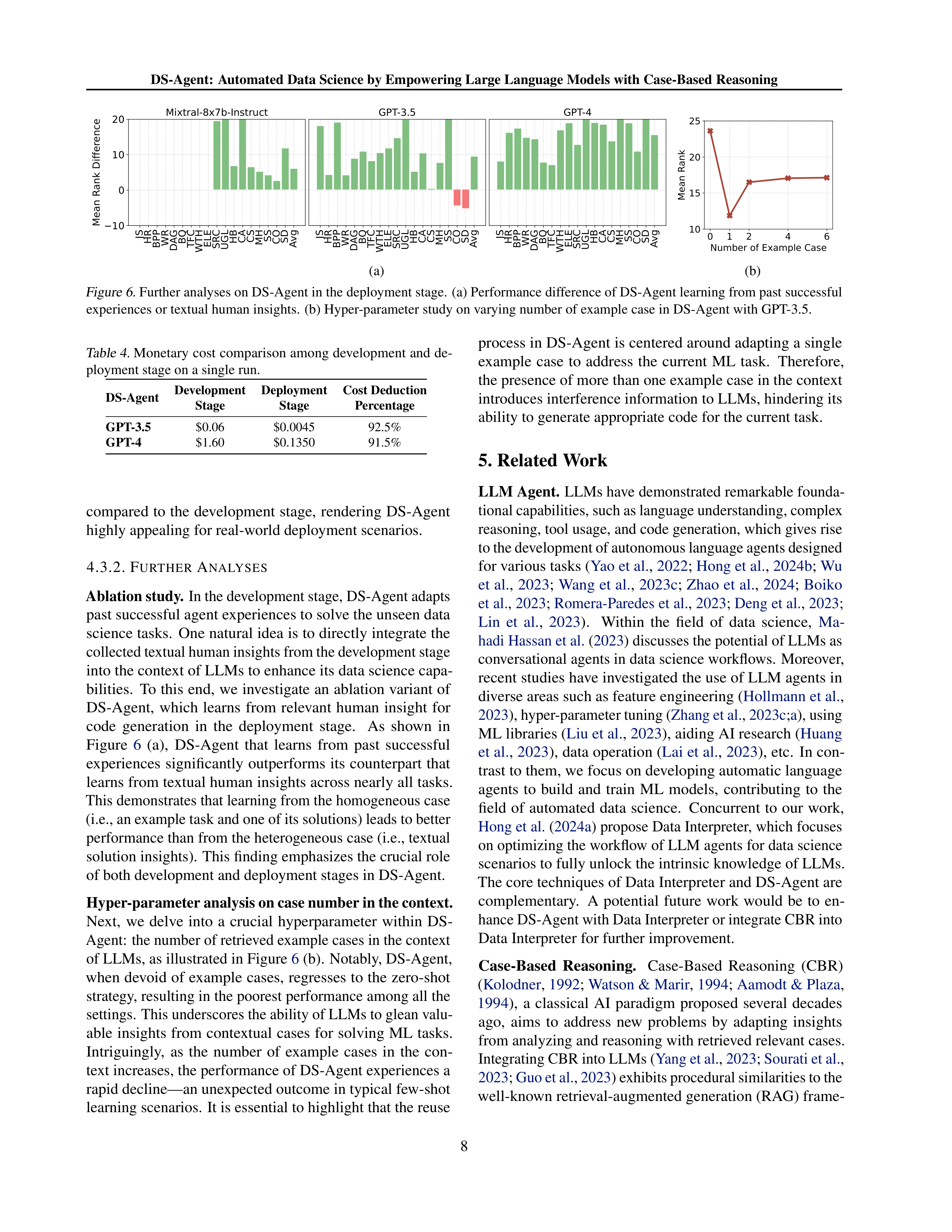
Figure 6.
Further analyses on DS-Agent in the deployment stage.
(a) Performance difference of DS-Agent learning from past successful
experiences or textual human insights.
(b) Hyper-parameter study on varying number of example case in DS-Agent with GPT-3.5.
Table 4.
Monetary cost comparison among development and de-
ployment stage on a single run.
DS-Agent
Development
Deployment
Cost Deduction
Stage
Stage
Percentage
GPT-3.5
$0.06
$0.0045
92.5%
GPT-4
$1.60
$0.1350
91.5%
compared to the development stage,
rendering DS-Agent
highly appealing for real-world deployment scenarios.
4.3.2. F
URTHER
A
NALYSES
Ablation study.
In the development stage, DS-Agent adapts
past successful agent experiences to solve the unseen data
science tasks.
One natural idea is to directly integrate the
collected textual human insights from the development stage
into the context of LLMs to enhance its data science capa-
bilities.
To this end, we investigate an ablation variant of
DS-Agent,
which
learns
from
relevant
human
insight
for
code
generation
in
the
deployment
stage.
As
shown
in
Figure
6
(a),
DS-Agent
that
learns
from
past
successful
experiences
significantly
outperforms
its
counterpart
that
learns from textual human insights across nearly all tasks.
This demonstrates that learning from the homogeneous case
(i.e., an example task and one of its solutions) leads to better
performance than from the heterogeneous case (i.e., textual
solution insights).
This finding emphasizes the crucial role
of both development and deployment stages in DS-Agent.
Hyper-parameter analysis on case number in the context.
Next,
we
delve
into
a
crucial
hyperparameter
within
DS-
Agent:
the number of retrieved example cases in the context
of LLMs, as illustrated in Figure
6
(b).
Notably, DS-Agent,
when devoid of example cases, regresses to the zero-shot
strategy, resulting in the poorest performance among all the
settings.
This underscores the ability of LLMs to glean valu-
able insights from contextual cases for solving ML tasks.
Intriguingly,
as
the
number
of
example
cases
in
the
con-
text increases, the performance of DS-Agent experiences a
rapid decline—an unexpected outcome in typical few-shot
learning scenarios.
It is essential to highlight that the reuse
process in DS-Agent is centered around adapting a single
example
case
to
address
the
current
ML
task.
Therefore,
the presence of more than one example case in the context
introduces interference information to LLMs, hindering its
ability to generate appropriate code for the current task.
5. Related Work
LLM Agent.
LLMs have demonstrated remarkable founda-
tional capabilities, such as language understanding, complex
reasoning, tool usage, and code generation, which gives rise
to the development of autonomous language agents designed
for various tasks (
Yao et al.
,
2022
;
Hong et al.
,
2024b
;
Wu
et al.
,
2023
;
Wang et al.
,
2023c
;
Zhao et al.
,
2024
;
Boiko
et al.
,
2023
;
Romera-Paredes et al.
,
2023
;
Deng et al.
,
2023
;
Lin
et
al.
,
2023
).
Within
the
field
of
data
science,
Ma-
hadi Hassan et al.
(
2023
) discusses the potential of LLMs as
conversational agents in data science workflows.
Moreover,
recent studies have investigated the use of LLM agents in
diverse areas such as feature engineering (
Hollmann et al.
,
2023
), hyper-parameter tuning (
Zhang et al.
,
2023c
;
a
), using
ML libraries (
Liu et al.
,
2023
), aiding AI research (
Huang
et al.
,
2023
), data operation (
Lai et al.
,
2023
), etc.
In con-
trast to them, we focus on developing automatic language
agents
to
build
and
train
ML
models,
contributing
to
the
field
of
automated
data
science.
Concurrent
to
our
work,
Hong et al.
(
2024a
) propose Data Interpreter, which focuses
on optimizing the workflow of LLM agents for data science
scenarios to fully unlock the intrinsic knowledge of LLMs.
The core techniques of Data Interpreter and DS-Agent are
complementary.
A
potential
future
work
would
be
to
en-
hance DS-Agent with Data Interpreter or integrate CBR into
Data Interpreter for further improvement.
Case-Based
Reasoning.
Case-Based
Reasoning
(CBR)
(
Kolodner
,
1992
;
Watson & Marir
,
1994
;
Aamodt & Plaza
,
1994
),
a
classical
AI
paradigm
proposed
several
decades
ago,
aims
to
address
new
problems
by
adapting
insights
from analyzing and reasoning with retrieved relevant cases.
Integrating CBR into LLMs (
Yang et al.
,
2023
;
Sourati et al.
,
2023
;
Guo et al.
,
2023
) exhibits procedural similarities to the
well-known retrieval-augmented generation (RAG) frame-
8
DS-Agent:
Automated Data Science by Empowering Large Language Models with Case-Based Reasoning
work (
Lewis et al.
,
2020
;
Rubin et al.
,
2022
;
Wang et al.
,
2023b
;
Gao et al.
,
2023
), particularly in the steps of retrieval
and reuse.
However, a distinctive feature of CBR lies in its
feedback mechanism,
which enables iteratively adjusting
the retrieved cases and revising the solutions accordingly.
Furthermore, CBR enhances future problem-solving by re-
taining and reusing successful cases.
6. Conclusion
In this work, we propose DS-Agent, a novel framework that
harnesses
LLM
agent
and
case-based
reasoning
to
solve
data
science
tasks.
In
the
development
stage,
DS-Agent
structures an automatic iteration pipeline on top of the CBR
framework, which aims to retrieve and reuse relevant human
insights from Kaggle to develop the experiment plan, and
then iteratively adjust the retrieved cases and revise the plan
based
on
the
execution
feedback.
As
for
the
deployment
stage, DS-Agent leverages a simplified CBR framework to
achieve a low-resource scenario by retrieving and reusing
the successful solution cases collected from the development
stage.
Extensive experiments are conducted to demonstrate
the effectiveness of DS-Agent for data science tasks.
Acknowledgements
We
truly
thank
the
reviewers
for
their
great
effort
in
our
submission.
This
work
was
supported
by
the
Na-
tional
Key
R&D
Program
of
China
under
Grant
(No.
2023YFF0905400), National Natural Science Foundation of
China through grants (No.
U2341229, No.
61976102, No.
U19A2065), the Key R&D Project of Jilin Province, China,
(No.
20240304200SF), and the International Cooperation
Project of Jilin Province, China, (No.
20220402009GH).
Impact Statement
Here we emphasize some potential ethics concerns of DS-
Agent:
(1) Unemployment and skill obsolescence.
The
major concern of our research lies in potential unemploy-
ment
and
skill
obsolescence.
However,
as
discussed
in
(
Karmaker et al.
,
2021
), the intent of automated data science
is not to replace data scientists but rather to assist them, al-
lowing them to concentrate on more complex aspects of data
science work.
Wherein they only need to focus on higher-
level data science problems, such as task formulation, data
visualization, cleaning and curation, prediction engineering,
and
result
summary
and
recommendation.
Moreover,
by
enabling interaction through natural language, automated
data science lowers the barrier to entry, facilitating a more
accessible
pathway
for
users
to
glean
insights
from
data,
thereby
democratizing
the
field
of
data
science.
(2)
Ma-
licious
code
generation.
An
often
underappreciated
yet
critical concern with the proliferation of automated data sci-
ence tools like DS-Agent is the potential for generating code
that could be detrimental to computational devices or data
integrity.
As DS-Agent navigates the vast terrain of possible
solutions to a given data problem, it may inadvertently pro-
duce code that is inefficient, vulnerable to exploitation, or
even directly harmful.
While such issues were not observed
in
our
experiments,
it
is
prudent
for
users
to
review
any
code produced by DS-Agent before execution.
To enhance
security, we recommend running DS-Agent within a Docker
container, which provides a layer of isolation for the host’s
file
system.
(3)
Data
Privacy
and
Security.
To
protect
data privacy and security, DS-Agent is designed to operate
locally,
negating
the
need
to
upload
sensitive
data.
How-
ever, when integrating API-based Large Language Models
(LLMs) like GPT-3.5 or GPT-4, there is an inherent privacy
risk since these interactions typically involve transmitting
data to external servers.
We advise users to carefully inspect
any data sent in API prompts to prevent unintentional data
disclosures.
References
Aamodt,
A.
and
Plaza,
E.
Case-based
reasoning:
Foun-
dational
issues,
methodological
variations,
and
system
approaches.
AI communications
, 7(1):39–59, 1994.
Boiko, D. A., MacKnight, R., Kline, B., and Gomes, G.
Au-
tonomous chemical research with large language models.
Nature
, 624(7992):570–578, 2023.
Brohan, A., Chebotar, Y., Finn, C., Hausman, K., Herzog,
A., Ho, D., Ibarz, J., Irpan, A., Jang, E., Julian, R., et al.
Do as i can, not as i say:
Grounding language in robotic
affordances.
In
Conference on Robot Learning
, pp. 287–
318. PMLR, 2023.
Carta,
T.,
Romac,
C.,
Wolf,
T.,
Lamprier,
S.,
Sigaud,
O.,
and Oudeyer, P.-Y.
Grounding large language models in
interactive environments with online reinforcement learn-
ing.
In
Proceedings of the 40th International Conference
on Machine Learning
, volume 202 of
Proceedings of Ma-
chine Learning Research
, pp. 3676–3713. PMLR, 23–29
Jul 2023.
Chase,
H.
LangChain,
October
2022.
URL
https://
github.com/langchain-ai/langchain
.
Chen, B., Shu, C., Shareghi, E., Collier, N., Narasimhan, K.,
and Yao, S.
Fireact:
Toward language agent fine-tuning.
arXiv preprint arXiv:2310.05915
, 2023.
Christianos, F., Papoudakis, G., Zimmer, M., Coste, T., Wu,
Z., Chen, J., Khandelwal, K., Doran, J., Feng, X., Liu, J.,
et al.
Pangu-agent:
A fine-tunable generalist agent with
structured reasoning.
arXiv preprint arXiv:2312.14878
,
2023.
9
DS-Agent:
Automated Data Science by Empowering Large Language Models with Case-Based Reasoning
De Bie, T., De Raedt, L., Hern
´
andez-Orallo, J., Hoos, H. H.,
Smyth, P., and Williams, C. K.
Automating data science.
Communications of the ACM
, 65(3):76–87, 2022.
Deng,
C.,
Zhang,
T.,
He,
Z.,
Chen,
Q.,
Shi,
Y.,
Zhou,
L.,
Fu,
L.,
Zhang,
W.,
Wang,
X.,
Zhou,
C.,
Lin,
Z.,
and
He,
J.
K2:
A
foundation
language
model
for
geoscience
knowledge
understanding
and
utilization.
2023.
URL
https://api.semanticscholar.
org/CorpusID:259108887
.
Erickson,
N., Mueller,
J.,
Shirkov,
A.,
Zhang,
H., Larroy,
P.,
Li,
M.,
and
Smola,
A.
Autogluon-tabular:
Robust
and accurate automl for structured data.
arXiv preprint
arXiv:2003.06505
, 2020.
Gao, Y., Xiong, Y., Gao, X., Jia, K., Pan, J., Bi, Y., Dai, Y.,
Sun, J., and Wang, H.
Retrieval-augmented generation
for
large
language
models:
A
survey.
arXiv
preprint
arXiv:2312.10997
, 2023.
Guo, C., Tian, Z., Tang, J., Wang, P., Wen, Z., Yang, K., and
Wang, T.
A case-based reasoning framework for adaptive
prompting
in
cross-domain
text-to-sql.
arXiv
preprint
arXiv:2304.13301
, 2023.
Hollmann,
N.,
M
¨
uller,
S.,
and
Hutter,
F.
Large
language
models for automated data science:
Introducing caafe for
context-aware automated feature engineering.
In
Thirty-
seventh
Conference
on
Neural
Information
Processing
Systems
, 2023.
Hong, S., Lin, Y., Liu, B., Wu, B., Li, D., Chen, J., Zhang,
J.,
Wang,
J.,
Zhang,
L.,
Zhuge,
M.,
et
al.
Data
inter-
preter:
An
llm
agent
for
data
science.
arXiv
preprint
arXiv:2402.18679
, 2024a.
Hong, S., Zheng, X., Chen, J., Cheng, Y., Wang, J., Zhang,
C.,
Wang,
Z.,
Yau,
S.
K.
S.,
Lin,
Z.,
Zhou,
L.,
et
al.
MetaGPT: Meta programming for multi-agent collabo-
rative framework.
In
The Twelfth International Confer-
ence on Learning Representations
, 2024b.
URL
https:
//openreview.net/forum?id=VtmBAGCN7o
.
Huang, Q., Vora, J., Liang, P., and Leskovec, J.
Benchmark-
ing large language models as ai research agents.
arXiv
preprint arXiv:2310.03302
, 2023.
Hutter, F., Kotthoff, L., and Vanschoren, J.
Automated ma-
chine learning:
methods, systems, challenges
.
Springer
Nature, 2019.
Jiang, A. Q., Sablayrolles, A., Roux, A., Mensch, A., Savary,
B., Bamford, C., Chaplot, D. S., Casas, D. d. l., Hanna,
E.
B.,
Bressand,
F.,
et
al.
Mixtral
of
experts.
arXiv
preprint arXiv:2401.04088
, 2024.
Karmaker, S. K., Hassan, M. M., Smith, M. J., Xu, L., Zhai,
C., and Veeramachaneni, K.
Automl to date and beyond:
Challenges and opportunities.
ACM Computing Surveys
(CSUR)
, 54(8):1–36, 2021.
Kim, G., Baldi, P., and McAleer, S. M.
Language models
can solve computer tasks.
In
Thirty-seventh Conference
on Neural Information Processing Systems
, 2023.
Kolodner,
J.
L.
An
introduction
to
case-based
reasoning.
Artificial intelligence review
, 6(1):3–34, 1992.
Kwon,
W.,
Li,
Z.,
Zhuang,
S.,
Sheng,
Y.,
Zheng,
L.,
Yu,
C. H., Gonzalez, J., Zhang, H., and Stoica, I.
Efficient
memory management for large language model serving
with
pagedattention.
In
Proceedings
of
the
29th
Sym-
posium on Operating Systems Principles
, pp. 611–626,
2023.
Lai,
Y.,
Li,
C.,
Wang,
Y.,
Zhang,
T.,
Zhong,
R.,
Zettle-
moyer,
L.,
Yih,
W.-t.,
Fried,
D.,
Wang,
S.,
and
Yu,
T.
Ds-1000:
A natural and reliable benchmark for data sci-
ence
code
generation.
In
International
Conference
on
Machine Learning
, pp. 18319–18345. PMLR, 2023.
LeDell, E. and Poirier, S.
H2o automl:
Scalable automatic
machine learning.
In
Proceedings of the AutoML Work-
shop at ICML
, volume 2020. ICML, 2020.
Lewis, P., Perez, E., Piktus, A., Petroni, F., Karpukhin, V.,
Goyal, N., K
¨
uttler, H., Lewis, M., Yih, W.-t., Rockt
¨
aschel,
T., et al.
Retrieval-augmented generation for knowledge-
intensive nlp tasks.
Advances in Neural Information Pro-
cessing Systems
, 33:9459–9474, 2020.
Lin,
Z.,
Deng,
C.,
Zhou,
L.,
Zhang,
T.,
Xu,
Y.,
Xu,
Y.,
He,
Z.,
Shi,
Y.,
Dai,
B.,
Song,
Y.,
Zeng,
B.,
Chen,
Q.,
Shi,
T.,
Huang,
T.,
Xu,
Y.,
Wang,
S.,
Fu,
L.,
Zhang,
W.,
He,
J.,
Ma,
C.,
Zhu,
Y.,
Wang,
X.,
and
Zhou,
C.
Geogalactica:
A
scientific
large
lan-
guage
model
in
geoscience.
ArXiv
,
abs/2401.00434,
2023.
URL
https://api.semanticscholar.
org/CorpusID:266693296
.
Liu, Y., Tang, X., Cai, Z., Lu, J., Zhang, Y., Shao, Y., Deng,
Z., Hu, H., Yang, Z., An, K., et al.
Ml-bench:
Large lan-
guage models leverage open-source libraries for machine
learning tasks.
arXiv preprint arXiv:2311.09835
, 2023.
Mahadi Hassan, M., Knipper, A., and Kanti Karmaker Santu,
S.
Chatgpt as your personal data scientist.
arXiv e-prints
,
pp. arXiv–2305, 2023.
OpenAI.
Introducing
chatgpt.
2022.
URL
https://
openai.com/blog/chatgpt
.
OpenAI.
Gpt-4
technical
report.
arXiv
preprint
arXiv:2303.08774
, 2023.
10
DS-Agent:
Automated Data Science by Empowering Large Language Models with Case-Based Reasoning
Pedregosa,
F.,
Varoquaux,
G.,
Gramfort,
A.,
Michel,
V.,
Thirion,
B.,
Grisel,
O.,
Blondel,
M.,
Prettenhofer,
P.,
Weiss,
R.,
Dubourg,
V.,
et
al.
Scikit-learn:
Machine
learning
in
python.
the
Journal
of
machine
Learning
research
, 12:2825–2830, 2011.
Pei,
H.,
Yang,
B.,
Liu,
J.,
and
Chang,
K.
C.-C.
Active
surveillance via group sparse bayesian learning.
IEEE
Transactions
on
Pattern
Analysis
and
Machine
Intelli-
gence
, 44(3):1133–1148, 2020.
Pei,
H.,
Chen,
T.,
Chen,
A.,
Deng,
H.,
Tao,
J.,
Wang,
P.,
and
Guan,
X.
Hago-net:
Hierarchical
geometric
mas-
sage
passing
for
molecular
representation
learning.
In
Proceedings of the AAAI Conference on Artificial Intelli-
gence
, volume 38, pp. 14572–14580, 2024a.
Pei, H., Xiong, Y., Wang, P., Tao, J., Liu, J., Deng, H., Ma, J.,
and Guan, X.
Memory disagreement:
A pseudo-labeling
measure
from
training
dynamics
for
semi-supervised
graph learning.
In
Proceedings of the ACM on Web Con-
ference 2024
, pp. 434–445, 2024b.
Romera-Paredes, B., Barekatain, M., Novikov, A., Balog,
M., Kumar, M. P., Dupont, E., Ruiz, F. J., Ellenberg, J. S.,
Wang, P., Fawzi, O., et al.
Mathematical discoveries from
program search with large language models.
Nature
, pp.
1–3, 2023.
Rubin,
O.,
Herzig,
J.,
and Berant,
J.
Learning to retrieve
prompts for in-context learning.
In
Proceedings of the
2022 Conference of the North American Chapter of the
Association for Computational Linguistics:
Human Lan-
guage Technologies
, pp. 2655–2671, 2022.
Shen, Y., Song, K., Tan, X., Li, D., Lu, W., and Zhuang, Y.
Hugginggpt:
Solving ai tasks with chatgpt and its friends
in huggingface.
In
Advances in Neural Information Pro-
cessing Systems
, 2023.
Shi, W., Min, S., Yasunaga, M., Seo, M., James, R., Lewis,
M.,
Zettlemoyer,
L.,
and Yih,
W.-t.
Replug:
Retrieval-
augmented black-box language models.
arXiv preprint
arXiv:2301.12652
, 2023.
Shinn, N.,
Cassano, F., Gopinath, A.,
Narasimhan, K. R.,
and
Yao,
S.
Reflexion:
Language
agents
with
verbal
reinforcement learning.
In
Thirty-seventh Conference on
Neural Information Processing Systems
, 2023.
Significant
Gravitas.
AutoGPT,
2023.
URL
https:
//github.com/Significant-Gravitas/
AutoGPT
.
Sourati, Z., Ilievski, F., Sandlin, H.-
ˆ
A., and Mermoud, A.
Case-based reasoning with language models for classifica-
tion of logical fallacies.
arXiv preprint arXiv:2301.11879
,
2023.
Sun, W., Yan, L., Ma, X., Wang, S., Ren, P., Chen, Z., Yin,
D., and Ren, Z.
Is ChatGPT good at search?
investigating
large language models as re-ranking agents.
In
Proceed-
ings
of
the
2023
Conference
on
Empirical
Methods
in
Natural Language Processing
, pp. 14918–14937, 2023.
Wang,
L.,
Yang,
N.,
and
Wei,
F.
Learning
to
retrieve
in-context
examples
for
large
language
models.
arXiv
preprint arXiv:2307.07164
, 2023a.
Wang,
L.,
Yang,
N.,
and
Wei,
F.
Learning
to
retrieve
in-context
examples
for
large
language
models.
arXiv
preprint arXiv:2307.07164
, 2023b.
Wang,
Z.,
Cai,
S.,
Chen,
G.,
Liu,
A.,
Ma,
X.,
and
Liang,
Y.
Describe,
explain,
plan
and
select:
Inter-
active
planning
with
LLMs
enables
open-world
multi-
task
agents.
In
Thirty-seventh
Conference
on
Neural
Information Processing Systems
, 2023c.
URL
https:
//openreview.net/forum?id=KtvPdGb31Z
.
Watson, I. and Marir, F.
Case-based reasoning:
A review.
The knowledge engineering review
, 9(4):327–354, 1994.
Wu, Q., Bansal, G., Zhang, J., Wu, Y., Li, B., Zhu, E., Jiang,
L., Zhang, X., Zhang, S., Liu, J., Awadallah, A. H., White,
R.
W.,
Burger,
D.,
and
Wang,
C.
Autogen:
Enabling
next-gen
llm
applications
via
multi-agent
conversation
framework.
2023.
Yang, Z., Du, X., Cambria, E., and Cardie, C.
End-to-end
case-based reasoning for commonsense knowledge base
completion.
In
Proceedings of the 17th Conference of the
European Chapter of the Association for Computational
Linguistics
, pp. 3491–3504, 2023.
Yao, S., Zhao, J., Yu, D., Du, N., Shafran, I., Narasimhan,
K.
R.,
and
Cao,
Y.
React:
Synergizing
reasoning
and
acting in language models.
In
The Eleventh International
Conference on Learning Representations
, 2022.
Zeng,
A.,
Liu,
M.,
Lu,
R.,
Wang,
B.,
Liu,
X.,
Dong,
Y.,
and Tang,
J.
Agenttuning:
Enabling generalized agent
abilities for llms.
arXiv preprint arXiv:2310.12823
, 2023.
Zhang,
L.,
Zhang,
Y.,
Ren,
K.,
Li,
D.,
and
Yang,
Y.
Ml-
copilot:
Unleashing
the
power
of
large
language
mod-
els
in
solving
machine
learning
tasks.
arXiv
preprint
arXiv:2304.14979
, 2023a.
Zhang,
P.,
Xiao,
S.,
Liu,
Z.,
Dou,
Z.,
and
Nie,
J.-Y.
Re-
trieve anything to augment large language models.
arXiv
preprint arXiv:2310.07554
, 2023b.
Zhang, S., Gong, C., Wu, L., Liu, X., and Zhou, M.
Automl-
gpt: Automatic machine learning with gpt.
arXiv preprint
arXiv:2305.02499
, 2023c.
11

DS-Agent:
Automated Data Science by Empowering Large Language Models with Case-Based Reasoning
Zhao, A., Huang, D., Xu, Q., Lin, M., Liu, Y.-J., and Huang,
G.
Expel:
Llm agents are experiential learners.
Thirty-
Eighth AAAI Conference on Artificial Intelligence
, 2024.
12
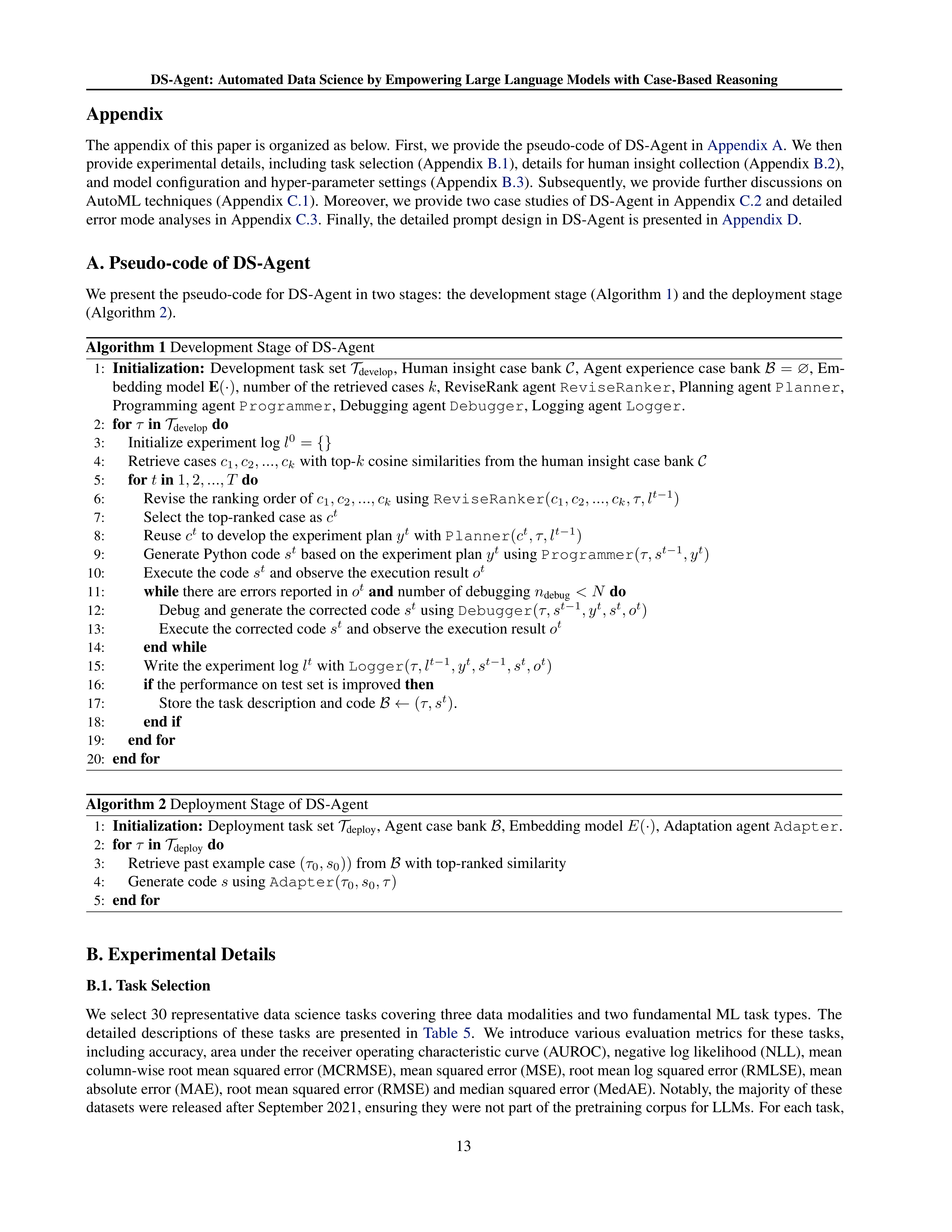
DS-Agent:
Automated Data Science by Empowering Large Language Models with Case-Based Reasoning
Appendix
The appendix of this paper is organized as below.
First, we provide the pseudo-code of DS-Agent in
Appendix A
.
We then
provide experimental details, including task selection (Appendix
B.1
), details for human insight collection (Appendix
B.2
),
and model configuration and hyper-parameter settings (Appendix
B.3
).
Subsequently, we provide further discussions on
AutoML techniques (Appendix
C.1
).
Moreover, we provide two case studies of DS-Agent in Appendix
C.2
and detailed
error mode analyses in Appendix
C.3
.
Finally, the detailed prompt design in DS-Agent is presented in
Appendix D
.
A. Pseudo-code of DS-Agent
We present the pseudo-code for DS-Agent in two stages:
the development stage (Algorithm
1
) and the deployment stage
(Algorithm
2
).
Algorithm 1
Development Stage of DS-Agent
1:
Initialization:
Development task set
T
develop
, Human insight case bank
C
, Agent experience case bank
B
=
∅
, Em-
bedding model
E
(
·
)
, number of the retrieved cases
k
, ReviseRank agent
ReviseRanker
, Planning agent
Planner
,
Programming agent
Programmer
, Debugging agent
Debugger
, Logging agent
Logger
.
2:
for
τ
in
T
develop
do
3:
Initialize experiment log
l
0
=
{}
4:
Retrieve cases
c
1
, c
2
, ..., c
k
with top-
k
cosine similarities from the human insight case bank
C
5:
for
t
in
1
,
2
, ..., T
do
6:
Revise the ranking order of
c
1
, c
2
, ..., c
k
using
ReviseRanker
(
c
1
, c
2
, ..., c
k
, τ, l
t
−
1
)
7:
Select the top-ranked case as
c
t
8:
Reuse
c
t
to develop the experiment plan
y
t
with
Planner
(
c
t
, τ, l
t
−
1
)
9:
Generate Python code
s
t
based on the experiment plan
y
t
using
Programmer
(
τ, s
t
−
1
, y
t
)
10:
Execute the code
s
t
and observe the execution result
o
t
11:
while
there are errors reported in
o
t
and
number of debugging
n
debug
< N
do
12:
Debug and generate the corrected code
s
t
using
Debugger
(
τ, s
t
−
1
, y
t
, s
t
, o
t
)
13:
Execute the corrected code
s
t
and observe the execution result
o
t
14:
end while
15:
Write the experiment log
l
t
with
Logger
(
τ, l
t
−
1
, y
t
, s
t
−
1
, s
t
, o
t
)
16:
if
the performance on test set is improved
then
17:
Store the task description and code
B
←
(
τ, s
t
)
.
18:
end if
19:
end for
20:
end for
Algorithm 2
Deployment Stage of DS-Agent
1:
Initialization:
Deployment task set
T
deploy
, Agent case bank
B
, Embedding model
E
(
·
)
, Adaptation agent
Adapter
.
2:
for
τ
in
T
deploy
do
3:
Retrieve past example case
(
τ
0
, s
0
))
from
B
with top-ranked similarity
4:
Generate code
s
using
Adapter
(
τ
0
, s
0
, τ
)
5:
end for
B. Experimental Details
B.1. Task Selection
We select 30 representative data science tasks covering three data modalities and two fundamental ML task types.
The
detailed
descriptions
of
these
tasks
are
presented
in
Table
5
.
We
introduce
various
evaluation
metrics
for
these
tasks,
including accuracy, area under the receiver operating characteristic curve (AUROC), negative log likelihood (NLL), mean
column-wise root mean squared error (MCRMSE), mean squared error (MSE), root mean log squared error (RMLSE), mean
absolute error (MAE), root mean squared error (RMSE) and median squared error (MedAE). Notably, the majority of these
datasets were released after September 2021, ensuring they were not part of the pretraining corpus for LLMs.
For each task,
13
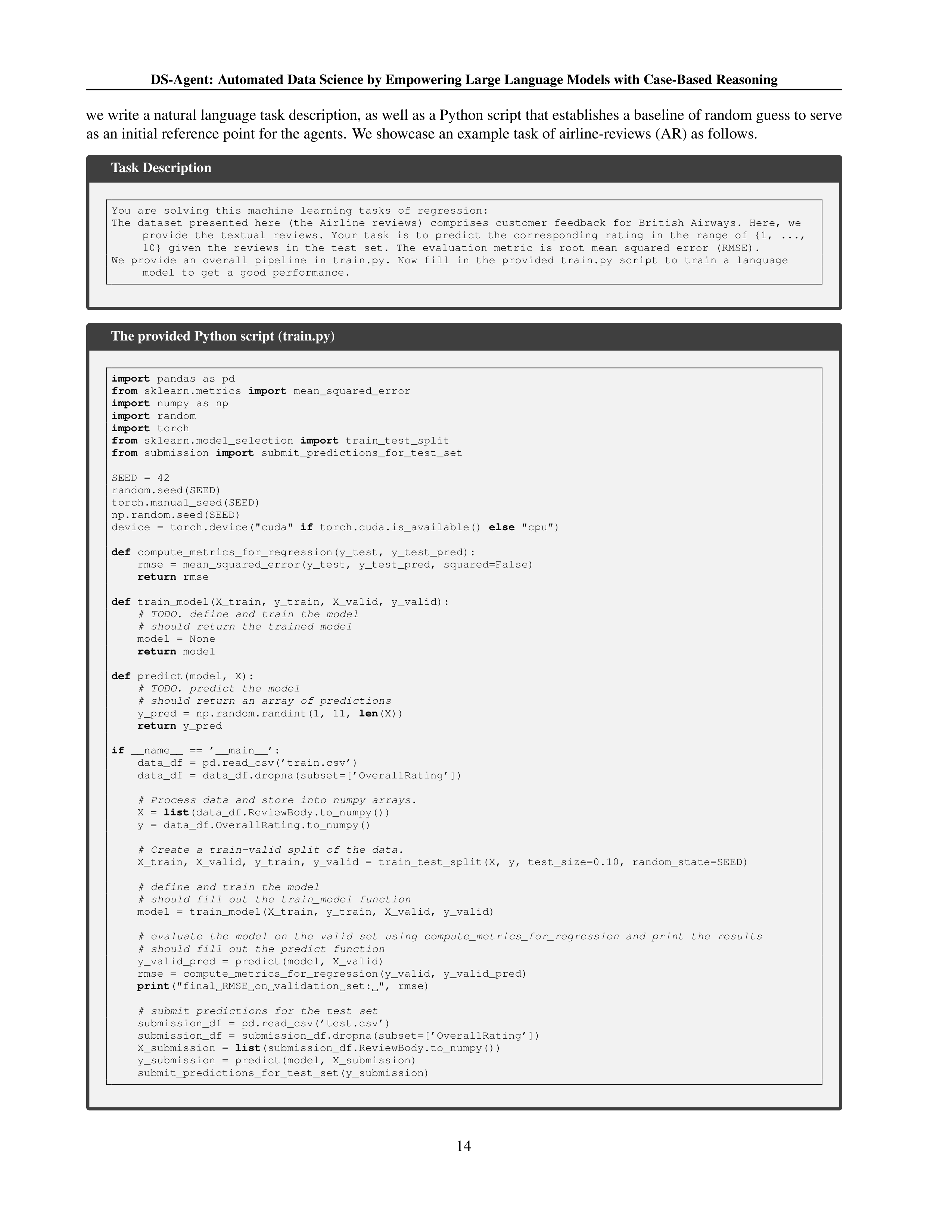
DS-Agent:
Automated Data Science by Empowering Large Language Models with Case-Based Reasoning
we write a natural language task description, as well as a Python script that establishes a baseline of random guess to serve
as an initial reference point for the agents.
We showcase an example task of airline-reviews (AR) as follows.
Task Description
You
are
solving
this
machine
learning
tasks
of
regression:
The
dataset
presented
here
(the
Airline
reviews)
comprises
customer
feedback
for
British
Airways.
Here,
we
provide
the
textual
reviews.
Your
task
is
to
predict
the
corresponding
rating
in
the
range
of
{1,
...,
10}
given
the
reviews
in
the
test
set.
The
evaluation
metric
is
root
mean
squared
error
(RMSE).
We
provide
an
overall
pipeline
in
train.py.
Now
fill
in
the
provided
train.py
script
to
train
a
language
model
to
get
a
good
performance.
The provided Python script (train.py)
import
pandas
as
pd
from
sklearn.metrics
import
mean_squared_error
import
numpy
as
np
import
random
import
torch
from
sklearn.model_selection
import
train_test_split
from
submission
import
submit_predictions_for_test_set
SEED
=
42
random.seed(SEED)
torch.manual_seed(SEED)
np.random.seed(SEED)
device
=
torch.device("cuda"
if
torch.cuda.is_available()
else
"cpu")
def
compute_metrics_for_regression(y_test,
y_test_pred):
rmse
=
mean_squared_error(y_test,
y_test_pred,
squared=False)
return
rmse
def
train_model(X_train,
y_train,
X_valid,
y_valid):
#
TODO.
define
and
train
the
model
#
should
return
the
trained
model
model
=
None
return
model
def
predict(model,
X):
#
TODO.
predict
the
model
#
should
return
an
array
of
predictions
y_pred
=
np.random.randint(1,
11,
len
(X))
return
y_pred
if
__name__
==
’__main__’:
data_df
=
pd.read_csv(’train.csv’)
data_df
=
data_df.dropna(subset=[’OverallRating’])
#
Process
data
and
store
into
numpy
arrays.
X
=
list
(data_df.ReviewBody.to_numpy())
y
=
data_df.OverallRating.to_numpy()
#
Create
a
train-valid
split
of
the
data.
X_train,
X_valid,
y_train,
y_valid
=
train_test_split(X,
y,
test_size=0.10,
random_state=SEED)
#
define
and
train
the
model
#
should
fill
out
the
train_model
function
model
=
train_model(X_train,
y_train,
X_valid,
y_valid)
#
evaluate
the
model
on
the
valid
set
using
compute_metrics_for_regression
and
print
the
results
#
should
fill
out
the
predict
function
y_valid_pred
=
predict(model,
X_valid)
rmse
=
compute_metrics_for_regression(y_valid,
y_valid_pred)
print
("final
RMSE
on
validation
set:
",
rmse)
#
submit
predictions
for
the
test
set
submission_df
=
pd.read_csv(’test.csv’)
submission_df
=
submission_df.dropna(subset=[’OverallRating’])
X_submission
=
list
(submission_df.ReviewBody.to_numpy())
y_submission
=
predict(model,
X_submission)
submit_predictions_for_test_set(y_submission)
14
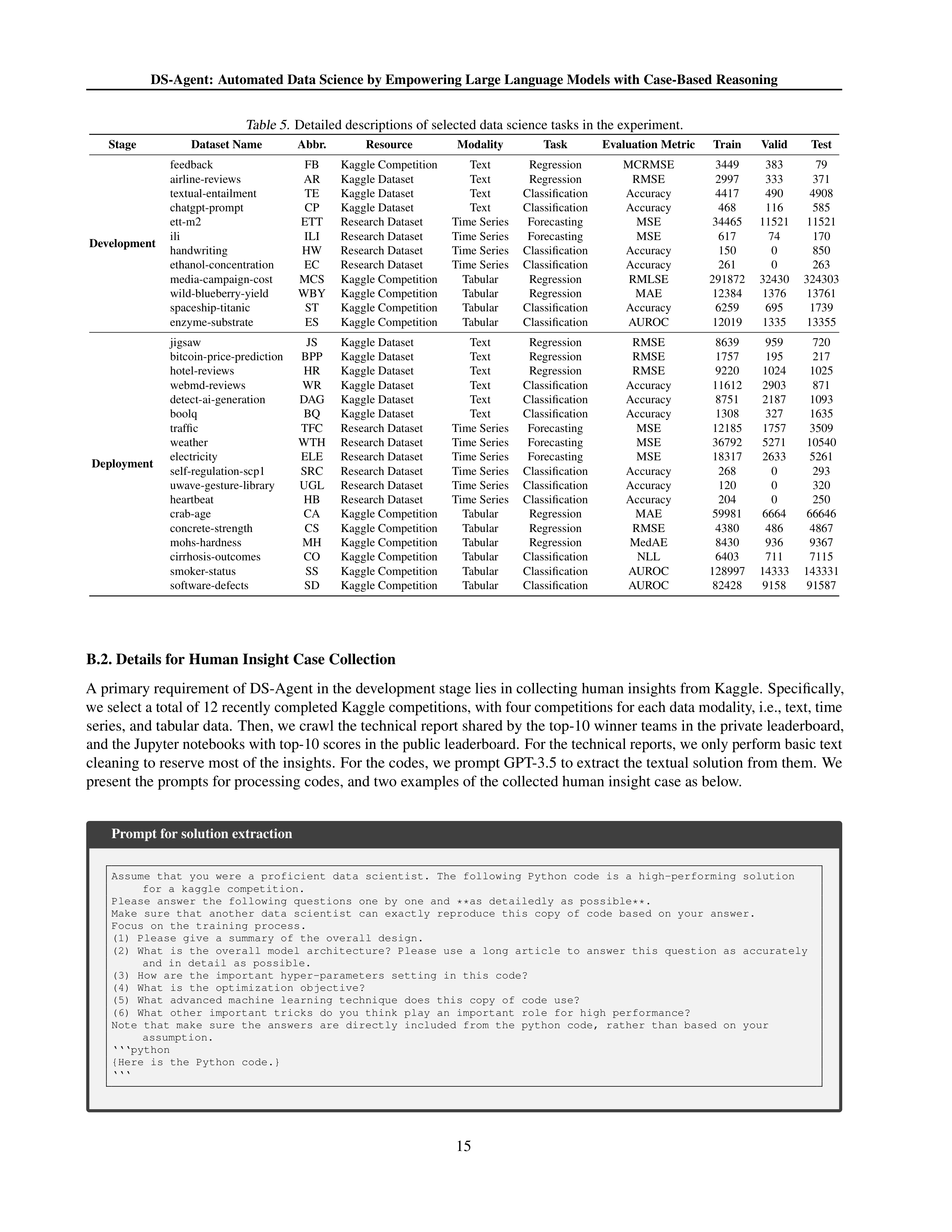
DS-Agent:
Automated Data Science by Empowering Large Language Models with Case-Based Reasoning
Table 5.
Detailed descriptions of selected data science tasks in the experiment.
Stage
Dataset Name
Abbr.
Resource
Modality
Task
Evaluation Metric
Train
Valid
Test
Development
feedback
FB
Kaggle Competition
Text
Regression
MCRMSE
3449
383
79
airline-reviews
AR
Kaggle Dataset
Text
Regression
RMSE
2997
333
371
textual-entailment
TE
Kaggle Dataset
Text
Classification
Accuracy
4417
490
4908
chatgpt-prompt
CP
Kaggle Dataset
Text
Classification
Accuracy
468
116
585
ett-m2
ETT
Research Dataset
Time Series
Forecasting
MSE
34465
11521
11521
ili
ILI
Research Dataset
Time Series
Forecasting
MSE
617
74
170
handwriting
HW
Research Dataset
Time Series
Classification
Accuracy
150
0
850
ethanol-concentration
EC
Research Dataset
Time Series
Classification
Accuracy
261
0
263
media-campaign-cost
MCS
Kaggle Competition
Tabular
Regression
RMLSE
291872
32430
324303
wild-blueberry-yield
WBY
Kaggle Competition
Tabular
Regression
MAE
12384
1376
13761
spaceship-titanic
ST
Kaggle Competition
Tabular
Classification
Accuracy
6259
695
1739
enzyme-substrate
ES
Kaggle Competition
Tabular
Classification
AUROC
12019
1335
13355
Deployment
jigsaw
JS
Kaggle Dataset
Text
Regression
RMSE
8639
959
720
bitcoin-price-prediction
BPP
Kaggle Dataset
Text
Regression
RMSE
1757
195
217
hotel-reviews
HR
Kaggle Dataset
Text
Regression
RMSE
9220
1024
1025
webmd-reviews
WR
Kaggle Dataset
Text
Classification
Accuracy
11612
2903
871
detect-ai-generation
DAG
Kaggle Dataset
Text
Classification
Accuracy
8751
2187
1093
boolq
BQ
Kaggle Dataset
Text
Classification
Accuracy
1308
327
1635
traffic
TFC
Research Dataset
Time Series
Forecasting
MSE
12185
1757
3509
weather
WTH
Research Dataset
Time Series
Forecasting
MSE
36792
5271
10540
electricity
ELE
Research Dataset
Time Series
Forecasting
MSE
18317
2633
5261
self-regulation-scp1
SRC
Research Dataset
Time Series
Classification
Accuracy
268
0
293
uwave-gesture-library
UGL
Research Dataset
Time Series
Classification
Accuracy
120
0
320
heartbeat
HB
Research Dataset
Time Series
Classification
Accuracy
204
0
250
crab-age
CA
Kaggle Competition
Tabular
Regression
MAE
59981
6664
66646
concrete-strength
CS
Kaggle Competition
Tabular
Regression
RMSE
4380
486
4867
mohs-hardness
MH
Kaggle Competition
Tabular
Regression
MedAE
8430
936
9367
cirrhosis-outcomes
CO
Kaggle Competition
Tabular
Classification
NLL
6403
711
7115
smoker-status
SS
Kaggle Competition
Tabular
Classification
AUROC
128997
14333
143331
software-defects
SD
Kaggle Competition
Tabular
Classification
AUROC
82428
9158
91587
B.2. Details for Human Insight Case Collection
A primary requirement of DS-Agent in the development stage lies in collecting human insights from Kaggle.
Specifically,
we select a total of 12 recently completed Kaggle competitions, with four competitions for each data modality, i.e., text, time
series, and tabular data.
Then, we crawl the technical report shared by the top-10 winner teams in the private leaderboard,
and the Jupyter notebooks with top-10 scores in the public leaderboard.
For the technical reports, we only perform basic text
cleaning to reserve most of the insights.
For the codes, we prompt GPT-3.5 to extract the textual solution from them.
We
present the prompts for processing codes, and two examples of the collected human insight case as below.
Prompt for solution extraction
Assume
that
you
were
a
proficient
data
scientist.
The
following
Python
code
is
a
high-performing
solution
for
a
kaggle
competition.
Please
answer
the
following
questions
one
by
one
and
**as
detailedly
as
possible**.
Make
sure
that
another
data
scientist
can
exactly
reproduce
this
copy
of
code
based
on
your
answer.
Focus
on
the
training
process.
(1)
Please
give
a
summary
of
the
overall
design.
(2)
What
is
the
overall
model
architecture?
Please
use
a
long
article
to
answer
this
question
as
accurately
and
in
detail
as
possible.
(3)
How
are
the
important
hyper-parameters
setting
in
this
code?
(4)
What
is
the
optimization
objective?
(5)
What
advanced
machine
learning
technique
does
this
copy
of
code
use?
(6)
What
other
important
tricks
do
you
think
play
an
important
role
for
high
performance?
Note
that
make
sure
the
answers
are
directly
included
from
the
python
code,
rather
than
based
on
your
assumption.
‘‘‘python
{Here
is
the
Python
code.}
‘‘‘
15
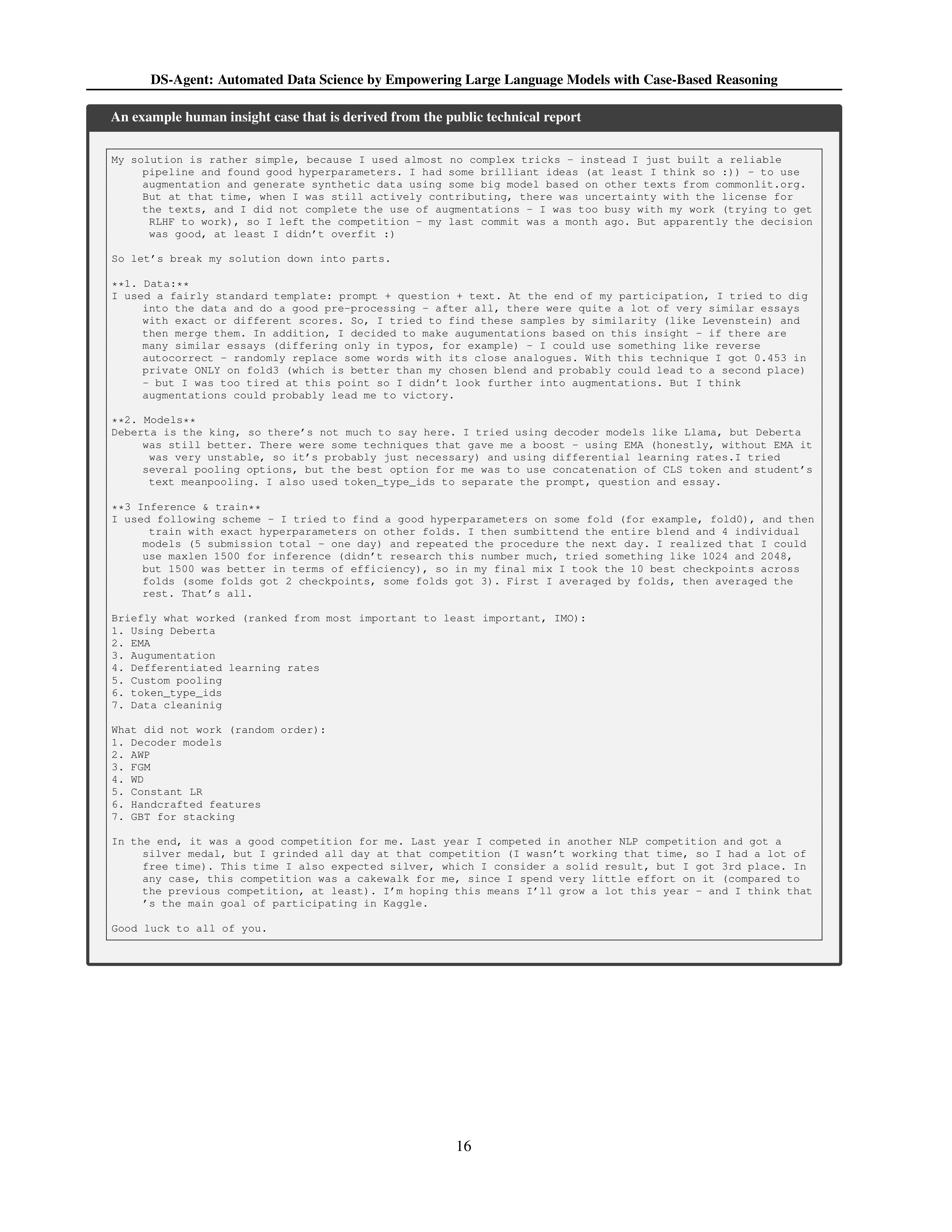
DS-Agent:
Automated Data Science by Empowering Large Language Models with Case-Based Reasoning
An example human insight case that is derived from the public technical report
My
solution
is
rather
simple,
because
I
used
almost
no
complex
tricks
-
instead
I
just
built
a
reliable
pipeline
and
found
good
hyperparameters.
I
had
some
brilliant
ideas
(at
least
I
think
so
:))
-
to
use
augmentation
and
generate
synthetic
data
using
some
big
model
based
on
other
texts
from
commonlit.org.
But
at
that
time,
when
I
was
still
actively
contributing,
there
was
uncertainty
with
the
license
for
the
texts,
and
I
did
not
complete
the
use
of
augmentations
-
I
was
too
busy
with
my
work
(trying
to
get
RLHF
to
work),
so
I
left
the
competition
-
my
last
commit
was
a
month
ago.
But
apparently
the
decision
was
good,
at
least
I
didn’t
overfit
:)
So
let’s
break
my
solution
down
into
parts.
**
1.
Data:
**
I
used
a
fairly
standard
template:
prompt
+
question
+
text.
At
the
end
of
my
participation,
I
tried
to
dig
into
the
data
and
do
a
good
pre-processing
-
after
all,
there
were
quite
a
lot
of
very
similar
essays
with
exact
or
different
scores.
So,
I
tried
to
find
these
samples
by
similarity
(like
Levenstein)
and
then
merge
them.
In
addition,
I
decided
to
make
augumentations
based
on
this
insight
-
if
there
are
many
similar
essays
(differing
only
in
typos,
for
example)
-
I
could
use
something
like
reverse
autocorrect
-
randomly
replace
some
words
with
its
close
analogues.
With
this
technique
I
got
0.453
in
private
ONLY
on
fold3
(which
is
better
than
my
chosen
blend
and
probably
could
lead
to
a
second
place)
-
but
I
was
too
tired
at
this
point
so
I
didn’t
look
further
into
augmentations.
But
I
think
augmentations
could
probably
lead
me
to
victory.
**
2.
Models
**
Deberta
is
the
king,
so
there’s
not
much
to
say
here.
I
tried
using
decoder
models
like
Llama,
but
Deberta
was
still
better.
There
were
some
techniques
that
gave
me
a
boost
-
using
EMA
(honestly,
without
EMA
it
was
very
unstable,
so
it’s
probably
just
necessary)
and
using
differential
learning
rates.I
tried
several
pooling
options,
but
the
best
option
for
me
was
to
use
concatenation
of
CLS
token
and
student’s
text
meanpooling.
I
also
used
token_type_ids
to
separate
the
prompt,
question
and
essay.
**
3
Inference
&
train
**
I
used
following
scheme
-
I
tried
to
find
a
good
hyperparameters
on
some
fold
(for
example,
fold0),
and
then
train
with
exact
hyperparameters
on
other
folds.
I
then
sumbittend
the
entire
blend
and
4
individual
models
(5
submission
total
-
one
day)
and
repeated
the
procedure
the
next
day.
I
realized
that
I
could
use
maxlen
1500
for
inference
(didn’t
research
this
number
much,
tried
something
like
1024
and
2048,
but
1500
was
better
in
terms
of
efficiency),
so
in
my
final
mix
I
took
the
10
best
checkpoints
across
folds
(some
folds
got
2
checkpoints,
some
folds
got
3).
First
I
averaged
by
folds,
then
averaged
the
rest.
That’s
all.
Briefly
what
worked
(ranked
from
most
important
to
least
important,
IMO):
1.
Using
Deberta
2.
EMA
3.
Augumentation
4.
Defferentiated
learning
rates
5.
Custom
pooling
6.
token_type_ids
7.
Data
cleaninig
What
did
not
work
(random
order):
1.
Decoder
models
2.
AWP
3.
FGM
4.
WD
5.
Constant
LR
6.
Handcrafted
features
7.
GBT
for
stacking
In
the
end,
it
was
a
good
competition
for
me.
Last
year
I
competed
in
another
NLP
competition
and
got
a
silver
medal,
but
I
grinded
all
day
at
that
competition
(I
wasn’t
working
that
time,
so
I
had
a
lot
of
free
time).
This
time
I
also
expected
silver,
which
I
consider
a
solid
result,
but
I
got
3rd
place.
In
any
case,
this
competition
was
a
cakewalk
for
me,
since
I
spend
very
little
effort
on
it
(compared
to
the
previous
competition,
at
least).
I’m
hoping
this
means
I’ll
grow
a
lot
this
year
-
and
I
think
that
’s
the
main
goal
of
participating
in
Kaggle.
Good
luck
to
all
of
you.
16
DS-Agent:
Automated Data Science by Empowering Large Language Models with Case-Based Reasoning
An example human insight case that is derived from the public codes
(1)
The
overall
design
of
the
code
is
to
train
a
DebertaV3
model
for
predicting
the
content
and
wording
scores
of
student
summaries.
The
code
includes
data
preprocessing,
model
training,
validation,
and
prediction
steps.
(2)
The
overall
model
architecture
is
based
on
the
DebertaV3
model,
which
is
a
transformer-based
model.
The
code
uses
the
‘AutoModelForSequenceClassification‘
class
from
the
‘transformers‘
library
to
load
the
pre-trained
DebertaV3
model.
The
model
is
fine-tuned
for
sequence
classification
with
a
single
output
label.
The
input
to
the
model
is
a
concatenation
of
the
prompt
question,
summary
text,
and
prompt
text.
The
model
tokenizes
the
input
using
the
‘AutoTokenizer‘
class
and
generates
input
tensors
for
the
model.
The
model
architecture
consists
of
multiple
transformer
layers
with
self-attention
mechanisms,
followed
by
a
linear
layer
for
classification.
(3)
The
important
hyperparameters
in
this
code
are
set
in
the
‘CFG‘
class.
The
hyperparameters
include
the
model
name,
learning
rate,
weight
decay,
hidden
dropout
probability,
attention
dropout
probability,
number
of
training
epochs,
number
of
cross-validation
splits,
batch
size,
random
seed,
save
steps,
and
maximum
sequence
length.
(4)
The
optimization
objective
is
to
minimize
the
root
mean
squared
error
(RMSE)
between
the
predicted
scores
and
the
ground
truth
scores.
The
code
uses
the
mean
squared
error
(MSE)
as
the
loss
function
and
calculates
the
RMSE
as
the
evaluation
metric.
(5)
The
advanced
machine
learning
technique
used
in
this
code
is
transfer
learning.
The
code
loads
a
pre-
trained
DebertaV3
model
and
fine-tunes
it
on
the
student
summary
dataset.
Transfer
learning
allows
the
model
to
leverage
knowledge
learned
from
a
large
pre-training
dataset
to
improve
performance
on
a
specific
task.
(6)
Some
important
tricks
that
play
a
role
in
high
performance
include:
-
Data
preprocessing:
The
code
preprocesses
the
input
data
by
tokenizing
the
text,
removing
stop
words,
fixing
misspellings,
and
extracting
features
such
as
text
length,
word
overlap,
n-gram
co-occurrence,
quotes
overlap,
and
grammar
check.
-
Model
architecture:
The
code
uses
the
DebertaV3
model,
which
is
a
state-of-the-art
transformer-based
model
known
for
its
strong
performance
on
various
natural
language
processing
tasks.
-
Training
strategy:
The
code
uses
k-fold
cross-validation
to
train
and
validate
the
model
on
multiple
subsets
of
the
data.
This
helps
to
reduce
overfitting
and
obtain
a
more
robust
evaluation
of
the
model’
s
performance.
-
Evaluation
metric:
The
code
uses
the
root
mean
squared
error
(RMSE)
as
the
evaluation
metric,
which
is
a
common
metric
for
regression
tasks.
This
metric
penalizes
large
errors
more
than
mean
absolute
error
(
MAE)
and
provides
a
more
comprehensive
measure
of
the
model’s
performance.
-
Feature
engineering:
The
code
incorporates
additional
features
such
as
word
difficulty,
readability
scores
,
and
cosine
similarity
between
the
summary
and
prompt
text.
These
features
capture
different
aspects
of
the
text
and
can
provide
additional
information
for
the
model
to
make
predictions.
-
Ensemble
learning:
The
code
combines
the
predictions
from
multiple
folds
of
the
cross-validation
to
obtain
a
more
robust
prediction.
This
helps
to
reduce
the
variance
and
improve
the
overall
performance
of
the
model.
B.3. Model Configuration and Hyper-parameter Setting
For GPT-3.5 and GPT-4,
we use the
gpt-3.5-turbo-16k
and
gpt-4-0613
models via the OpenAI API. For the
open-source LLM, we utilize
Mixtral-8x7B-Instruct-v0.1
and use the vLLM framework (
Kwon et al.
,
2023
) for
speedup.
In the development stage, we use the decoding strategy with temperature
T
= 0
.
5
, while we adjust it to
T
= 0
.
7
in the deployment stage to enhance the diversity of generation.
We utilize
llm-embedder
(
Zhang et al.
,
2023b
) as the
pretrained embedding language model.
For DS-Agent in the development stage, we set the iteration times
T
=
5
, number of the retrieved cases
k
=
5
and the
number of the debugging
n
debug
= 5
.
For the baseline reproduction, we strictly follow the original reported hyper-parameter
of ResearchAgent (
Huang et al.
,
2023
) to achieve fair comparison.
C. Further Discussions
C.1. Comparison with AutoML Techniques
Automated machine learning (AutoML) (
Hutter et al.
,
2019
;
Karmaker et al.
,
2021
) shares a similar objective to DS-Agent,
which aims at optimizing the machine learning in the data science workflow.
In contrast, DS-Agent benefits from the LLMs
and CBR in three aspects as follows.
Firstly, while AutoML systems often demand extensive domain expertise, software development, and frequent updates to
17
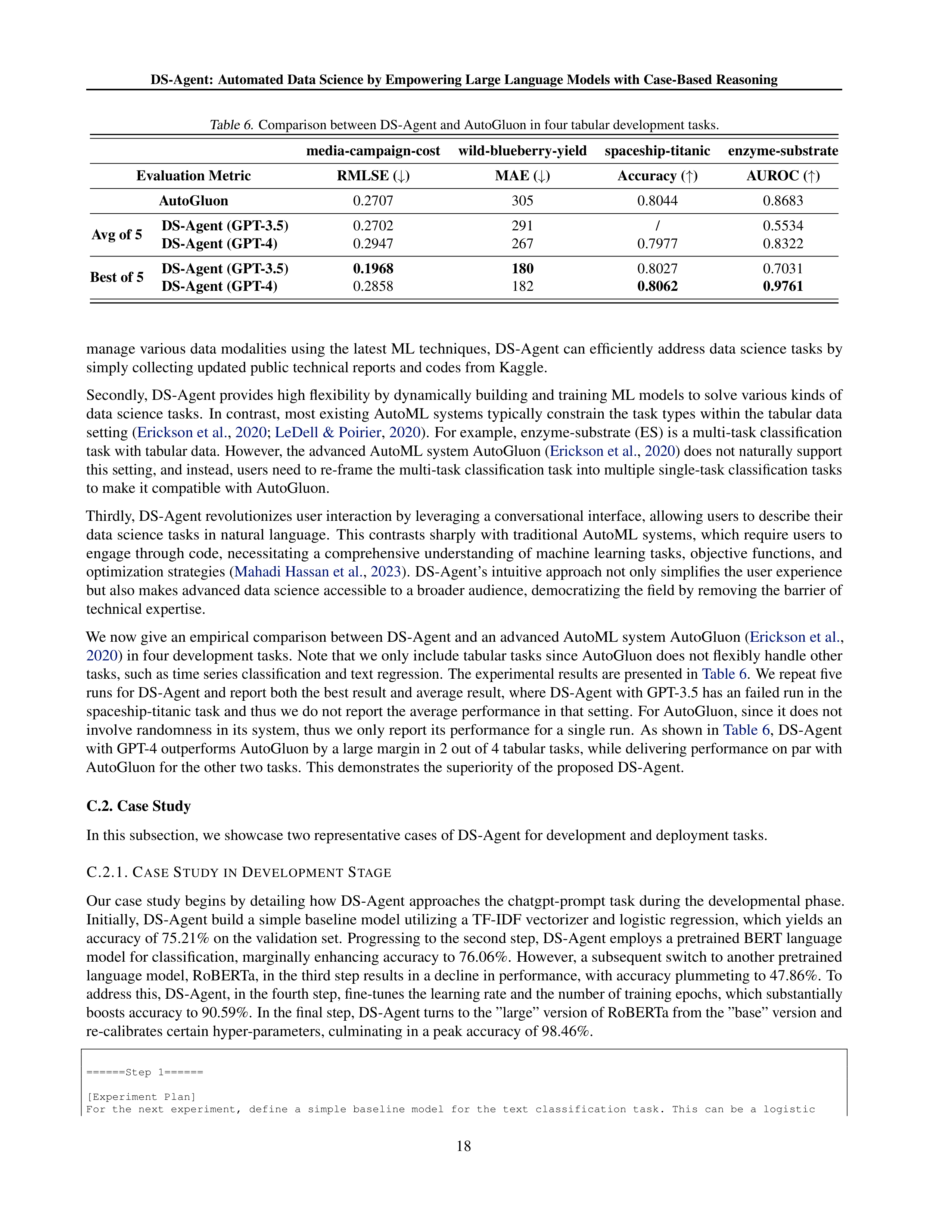
DS-Agent:
Automated Data Science by Empowering Large Language Models with Case-Based Reasoning
Table 6.
Comparison between DS-Agent and AutoGluon in four tabular development tasks.
media-campaign-cost
wild-blueberry-yield
spaceship-titanic
enzyme-substrate
Evaluation Metric
RMLSE (
↓
)
MAE (
↓
)
Accuracy (
↑
)
AUROC (
↑
)
AutoGluon
0.2707
305
0.8044
0.8683
Avg of 5
DS-Agent (GPT-3.5)
0.2702
291
/
0.5534
DS-Agent (GPT-4)
0.2947
267
0.7977
0.8322
Best of 5
DS-Agent (GPT-3.5)
0.1968
180
0.8027
0.7031
DS-Agent (GPT-4)
0.2858
182
0.8062
0.9761
manage various data modalities using the latest ML techniques, DS-Agent can efficiently address data science tasks by
simply collecting updated public technical reports and codes from Kaggle.
Secondly, DS-Agent provides high flexibility by dynamically building and training ML models to solve various kinds of
data science tasks.
In contrast, most existing AutoML systems typically constrain the task types within the tabular data
setting (
Erickson et al.
,
2020
;
LeDell & Poirier
,
2020
).
For example, enzyme-substrate (ES) is a multi-task classification
task with tabular data.
However, the advanced AutoML system AutoGluon (
Erickson et al.
,
2020
) does not naturally support
this setting, and instead, users need to re-frame the multi-task classification task into multiple single-task classification tasks
to make it compatible with AutoGluon.
Thirdly, DS-Agent revolutionizes user interaction by leveraging a conversational interface, allowing users to describe their
data science tasks in natural language.
This contrasts sharply with traditional AutoML systems, which require users to
engage through code, necessitating a comprehensive understanding of machine learning tasks, objective functions, and
optimization strategies (
Mahadi Hassan et al.
,
2023
).
DS-Agent’s intuitive approach not only simplifies the user experience
but also makes advanced data science accessible to a broader audience, democratizing the field by removing the barrier of
technical expertise.
We now give an empirical comparison between DS-Agent and an advanced AutoML system AutoGluon (
Erickson et al.
,
2020
) in four development tasks.
Note that we only include tabular tasks since AutoGluon does not flexibly handle other
tasks, such as time series classification and text regression.
The experimental results are presented in
Table 6
.
We repeat five
runs for DS-Agent and report both the best result and average result, where DS-Agent with GPT-3.5 has an failed run in the
spaceship-titanic task and thus we do not report the average performance in that setting.
For AutoGluon, since it does not
involve randomness in its system, thus we only report its performance for a single run.
As shown in
Table 6
, DS-Agent
with GPT-4 outperforms AutoGluon by a large margin in 2 out of 4 tabular tasks, while delivering performance on par with
AutoGluon for the other two tasks.
This demonstrates the superiority of the proposed DS-Agent.
C.2. Case Study
In this subsection, we showcase two representative cases of DS-Agent for development and deployment tasks.
C.2.1. C
ASE
S
TUDY
IN
D
EVELOPMENT
S
TAGE
Our case study begins by detailing how DS-Agent approaches the chatgpt-prompt task during the developmental phase.
Initially, DS-Agent build a simple baseline model utilizing a TF-IDF vectorizer and logistic regression, which yields an
accuracy of 75.21% on the validation set.
Progressing to the second step, DS-Agent employs a pretrained BERT language
model for classification, marginally enhancing accuracy to 76.06%.
However, a subsequent switch to another pretrained
language model, RoBERTa, in the third step results in a decline in performance, with accuracy plummeting to 47.86%.
To
address this, DS-Agent, in the fourth step, fine-tunes the learning rate and the number of training epochs, which substantially
boosts accuracy to 90.59%.
In the final step, DS-Agent turns to the ”large” version of RoBERTa from the ”base” version and
re-calibrates certain hyper-parameters, culminating in a peak accuracy of 98.46%.
======Step
1======
[Experiment
Plan]
For
the
next
experiment,
define
a
simple
baseline
model
for
the
text
classification
task.
This
can
be
a
logistic
18
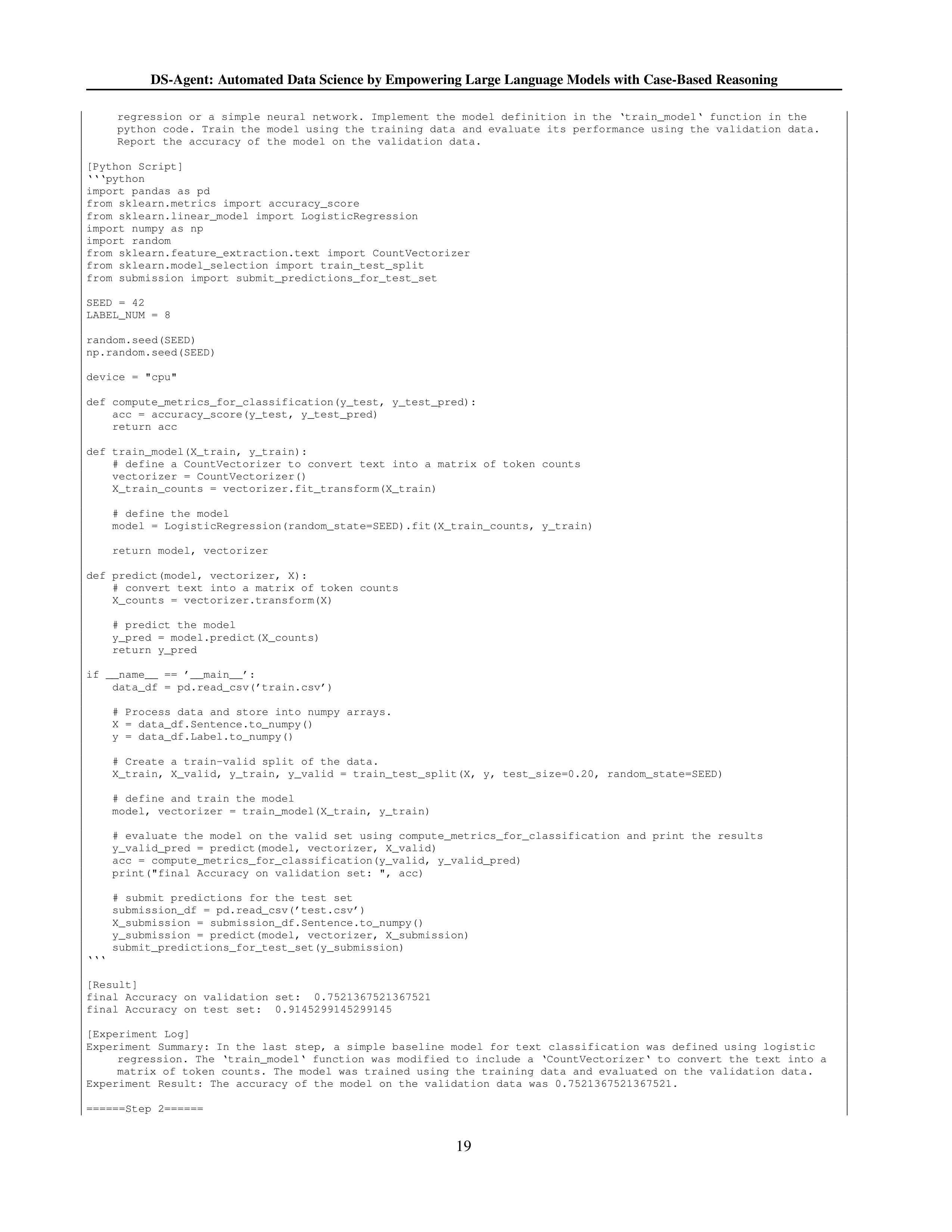
DS-Agent:
Automated Data Science by Empowering Large Language Models with Case-Based Reasoning
regression
or
a
simple
neural
network.
Implement
the
model
definition
in
the
‘train_model‘
function
in
the
python
code.
Train
the
model
using
the
training
data
and
evaluate
its
performance
using
the
validation
data.
Report
the
accuracy
of
the
model
on
the
validation
data.
[Python
Script]
‘‘‘python
import
pandas
as
pd
from
sklearn.metrics
import
accuracy_score
from
sklearn.linear_model
import
LogisticRegression
import
numpy
as
np
import
random
from
sklearn.feature_extraction.text
import
CountVectorizer
from
sklearn.model_selection
import
train_test_split
from
submission
import
submit_predictions_for_test_set
SEED
=
42
LABEL_NUM
=
8
random.seed(SEED)
np.random.seed(SEED)
device
=
"cpu"
def
compute_metrics_for_classification(y_test,
y_test_pred):
acc
=
accuracy_score(y_test,
y_test_pred)
return
acc
def
train_model(X_train,
y_train):
#
define
a
CountVectorizer
to
convert
text
into
a
matrix
of
token
counts
vectorizer
=
CountVectorizer()
X_train_counts
=
vectorizer.fit_transform(X_train)
#
define
the
model
model
=
LogisticRegression(random_state=SEED).fit(X_train_counts,
y_train)
return
model,
vectorizer
def
predict(model,
vectorizer,
X):
#
convert
text
into
a
matrix
of
token
counts
X_counts
=
vectorizer.transform(X)
#
predict
the
model
y_pred
=
model.predict(X_counts)
return
y_pred
if
__name__
==
’__main__’:
data_df
=
pd.read_csv(’train.csv’)
#
Process
data
and
store
into
numpy
arrays.
X
=
data_df.Sentence.to_numpy()
y
=
data_df.Label.to_numpy()
#
Create
a
train-valid
split
of
the
data.
X_train,
X_valid,
y_train,
y_valid
=
train_test_split(X,
y,
test_size=0.20,
random_state=SEED)
#
define
and
train
the
model
model,
vectorizer
=
train_model(X_train,
y_train)
#
evaluate
the
model
on
the
valid
set
using
compute_metrics_for_classification
and
print
the
results
y_valid_pred
=
predict(model,
vectorizer,
X_valid)
acc
=
compute_metrics_for_classification(y_valid,
y_valid_pred)
print("final
Accuracy
on
validation
set:
",
acc)
#
submit
predictions
for
the
test
set
submission_df
=
pd.read_csv(’test.csv’)
X_submission
=
submission_df.Sentence.to_numpy()
y_submission
=
predict(model,
vectorizer,
X_submission)
submit_predictions_for_test_set(y_submission)
‘‘‘
[Result]
final
Accuracy
on
validation
set:
0.7521367521367521
final
Accuracy
on
test
set:
0.9145299145299145
[Experiment
Log]
Experiment
Summary:
In
the
last
step,
a
simple
baseline
model
for
text
classification
was
defined
using
logistic
regression.
The
‘train_model‘
function
was
modified
to
include
a
‘CountVectorizer‘
to
convert
the
text
into
a
matrix
of
token
counts.
The
model
was
trained
using
the
training
data
and
evaluated
on
the
validation
data.
Experiment
Result:
The
accuracy
of
the
model
on
the
validation
data
was
0.7521367521367521.
======Step
2======
19
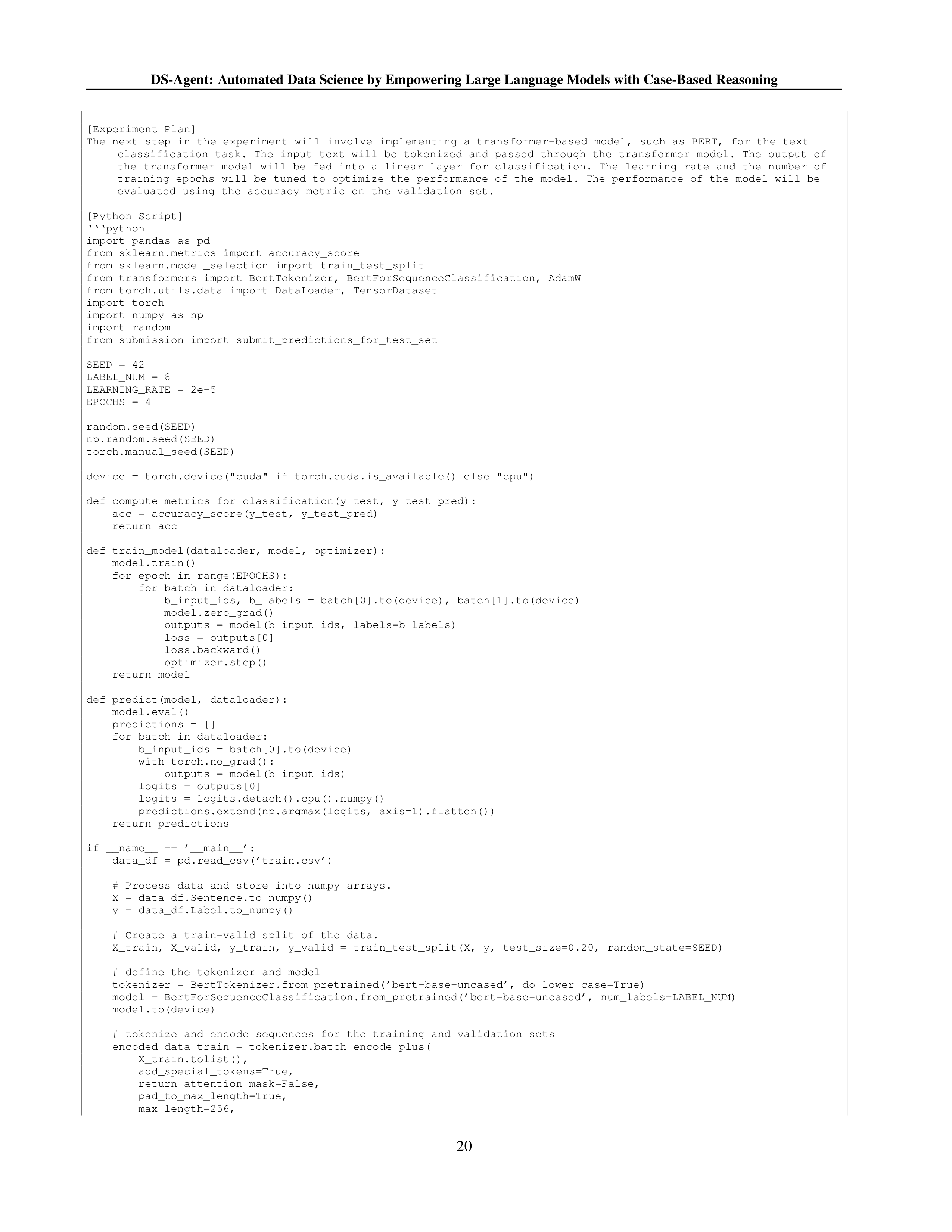
DS-Agent:
Automated Data Science by Empowering Large Language Models with Case-Based Reasoning
[Experiment
Plan]
The
next
step
in
the
experiment
will
involve
implementing
a
transformer-based
model,
such
as
BERT,
for
the
text
classification
task.
The
input
text
will
be
tokenized
and
passed
through
the
transformer
model.
The
output
of
the
transformer
model
will
be
fed
into
a
linear
layer
for
classification.
The
learning
rate
and
the
number
of
training
epochs
will
be
tuned
to
optimize
the
performance
of
the
model.
The
performance
of
the
model
will
be
evaluated
using
the
accuracy
metric
on
the
validation
set.
[Python
Script]
‘‘‘python
import
pandas
as
pd
from
sklearn.metrics
import
accuracy_score
from
sklearn.model_selection
import
train_test_split
from
transformers
import
BertTokenizer,
BertForSequenceClassification,
AdamW
from
torch.utils.data
import
DataLoader,
TensorDataset
import
torch
import
numpy
as
np
import
random
from
submission
import
submit_predictions_for_test_set
SEED
=
42
LABEL_NUM
=
8
LEARNING_RATE
=
2e-5
EPOCHS
=
4
random.seed(SEED)
np.random.seed(SEED)
torch.manual_seed(SEED)
device
=
torch.device("cuda"
if
torch.cuda.is_available()
else
"cpu")
def
compute_metrics_for_classification(y_test,
y_test_pred):
acc
=
accuracy_score(y_test,
y_test_pred)
return
acc
def
train_model(dataloader,
model,
optimizer):
model.train()
for
epoch
in
range(EPOCHS):
for
batch
in
dataloader:
b_input_ids,
b_labels
=
batch[0].to(device),
batch[1].to(device)
model.zero_grad()
outputs
=
model(b_input_ids,
labels=b_labels)
loss
=
outputs[0]
loss.backward()
optimizer.step()
return
model
def
predict(model,
dataloader):
model.eval()
predictions
=
[]
for
batch
in
dataloader:
b_input_ids
=
batch[0].to(device)
with
torch.no_grad():
outputs
=
model(b_input_ids)
logits
=
outputs[0]
logits
=
logits.detach().cpu().numpy()
predictions.extend(np.argmax(logits,
axis=1).flatten())
return
predictions
if
__name__
==
’__main__’:
data_df
=
pd.read_csv(’train.csv’)
#
Process
data
and
store
into
numpy
arrays.
X
=
data_df.Sentence.to_numpy()
y
=
data_df.Label.to_numpy()
#
Create
a
train-valid
split
of
the
data.
X_train,
X_valid,
y_train,
y_valid
=
train_test_split(X,
y,
test_size=0.20,
random_state=SEED)
#
define
the
tokenizer
and
model
tokenizer
=
BertTokenizer.from_pretrained(’bert-base-uncased’,
do_lower_case=True)
model
=
BertForSequenceClassification.from_pretrained(’bert-base-uncased’,
num_labels=LABEL_NUM)
model.to(device)
#
tokenize
and
encode
sequences
for
the
training
and
validation
sets
encoded_data_train
=
tokenizer.batch_encode_plus(
X_train.tolist(),
add_special_tokens=True,
return_attention_mask=False,
pad_to_max_length=True,
max_length=256,
20
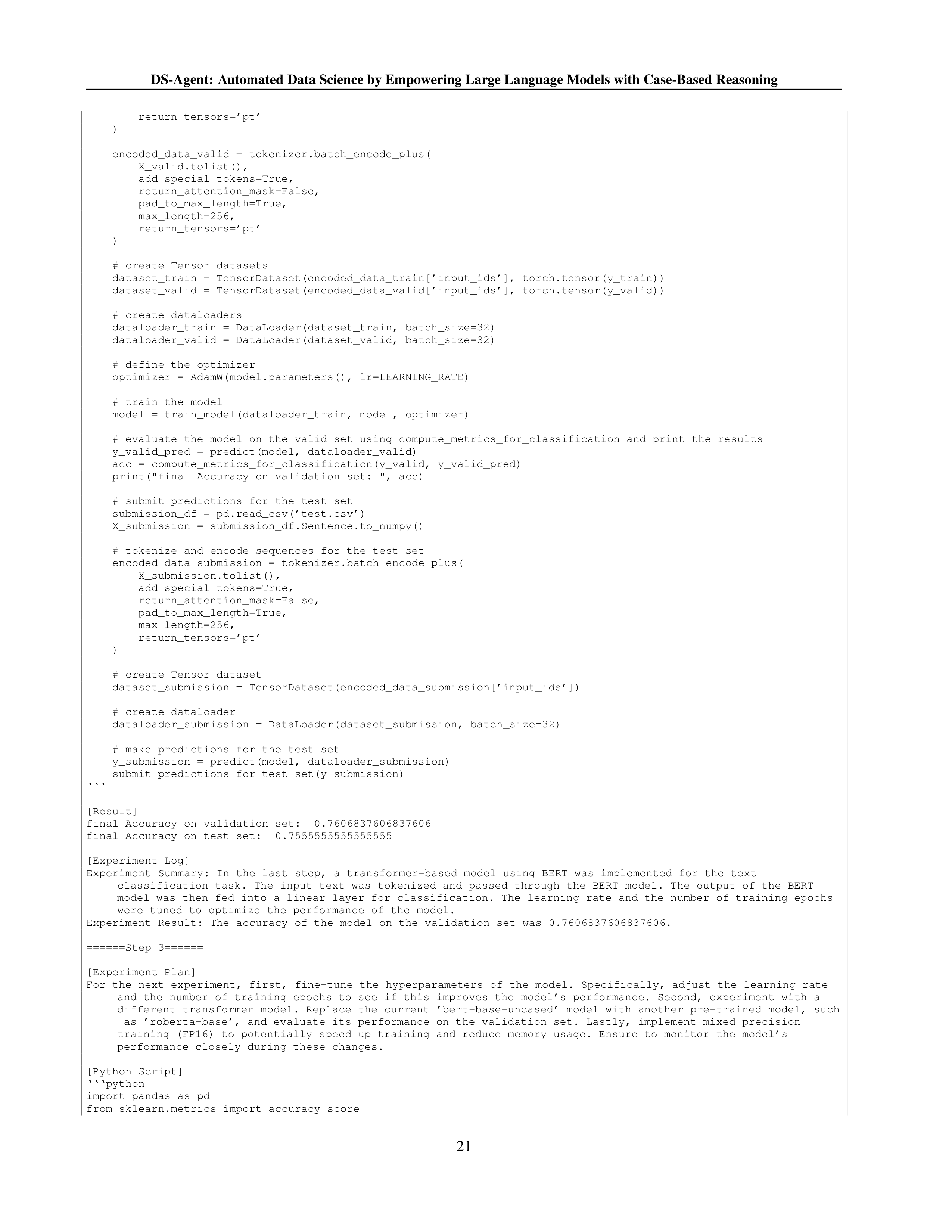
DS-Agent:
Automated Data Science by Empowering Large Language Models with Case-Based Reasoning
return_tensors=’pt’
)
encoded_data_valid
=
tokenizer.batch_encode_plus(
X_valid.tolist(),
add_special_tokens=True,
return_attention_mask=False,
pad_to_max_length=True,
max_length=256,
return_tensors=’pt’
)
#
create
Tensor
datasets
dataset_train
=
TensorDataset(encoded_data_train[’input_ids’],
torch.tensor(y_train))
dataset_valid
=
TensorDataset(encoded_data_valid[’input_ids’],
torch.tensor(y_valid))
#
create
dataloaders
dataloader_train
=
DataLoader(dataset_train,
batch_size=32)
dataloader_valid
=
DataLoader(dataset_valid,
batch_size=32)
#
define
the
optimizer
optimizer
=
AdamW(model.parameters(),
lr=LEARNING_RATE)
#
train
the
model
model
=
train_model(dataloader_train,
model,
optimizer)
#
evaluate
the
model
on
the
valid
set
using
compute_metrics_for_classification
and
print
the
results
y_valid_pred
=
predict(model,
dataloader_valid)
acc
=
compute_metrics_for_classification(y_valid,
y_valid_pred)
print("final
Accuracy
on
validation
set:
",
acc)
#
submit
predictions
for
the
test
set
submission_df
=
pd.read_csv(’test.csv’)
X_submission
=
submission_df.Sentence.to_numpy()
#
tokenize
and
encode
sequences
for
the
test
set
encoded_data_submission
=
tokenizer.batch_encode_plus(
X_submission.tolist(),
add_special_tokens=True,
return_attention_mask=False,
pad_to_max_length=True,
max_length=256,
return_tensors=’pt’
)
#
create
Tensor
dataset
dataset_submission
=
TensorDataset(encoded_data_submission[’input_ids’])
#
create
dataloader
dataloader_submission
=
DataLoader(dataset_submission,
batch_size=32)
#
make
predictions
for
the
test
set
y_submission
=
predict(model,
dataloader_submission)
submit_predictions_for_test_set(y_submission)
‘‘‘
[Result]
final
Accuracy
on
validation
set:
0.7606837606837606
final
Accuracy
on
test
set:
0.7555555555555555
[Experiment
Log]
Experiment
Summary:
In
the
last
step,
a
transformer-based
model
using
BERT
was
implemented
for
the
text
classification
task.
The
input
text
was
tokenized
and
passed
through
the
BERT
model.
The
output
of
the
BERT
model
was
then
fed
into
a
linear
layer
for
classification.
The
learning
rate
and
the
number
of
training
epochs
were
tuned
to
optimize
the
performance
of
the
model.
Experiment
Result:
The
accuracy
of
the
model
on
the
validation
set
was
0.7606837606837606.
======Step
3======
[Experiment
Plan]
For
the
next
experiment,
first,
fine-tune
the
hyperparameters
of
the
model.
Specifically,
adjust
the
learning
rate
and
the
number
of
training
epochs
to
see
if
this
improves
the
model’s
performance.
Second,
experiment
with
a
different
transformer
model.
Replace
the
current
’bert-base-uncased’
model
with
another
pre-trained
model,
such
as
’roberta-base’,
and
evaluate
its
performance
on
the
validation
set.
Lastly,
implement
mixed
precision
training
(FP16)
to
potentially
speed
up
training
and
reduce
memory
usage.
Ensure
to
monitor
the
model’s
performance
closely
during
these
changes.
[Python
Script]
‘‘‘python
import
pandas
as
pd
from
sklearn.metrics
import
accuracy_score
21
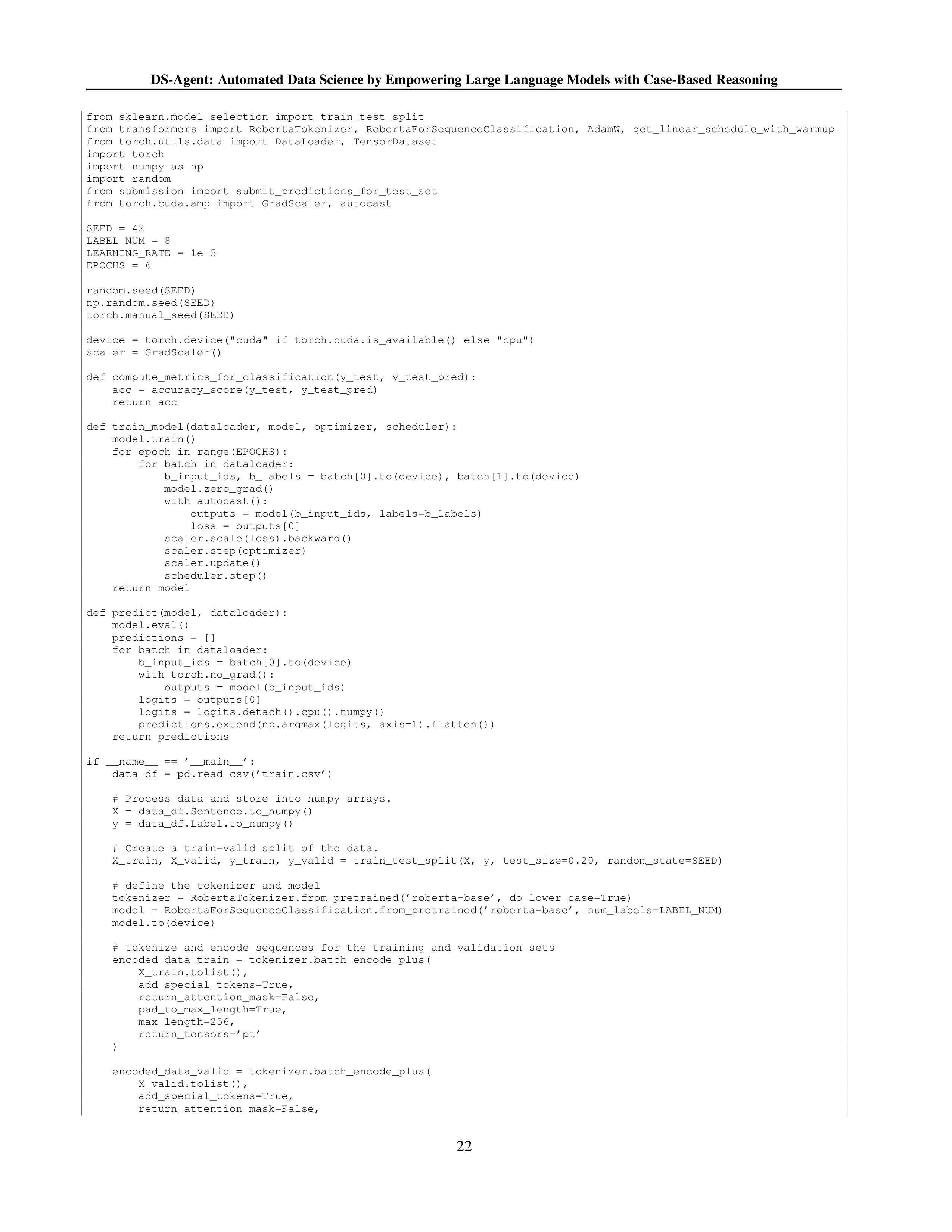
DS-Agent:
Automated Data Science by Empowering Large Language Models with Case-Based Reasoning
from
sklearn.model_selection
import
train_test_split
from
transformers
import
RobertaTokenizer,
RobertaForSequenceClassification,
AdamW,
get_linear_schedule_with_warmup
from
torch.utils.data
import
DataLoader,
TensorDataset
import
torch
import
numpy
as
np
import
random
from
submission
import
submit_predictions_for_test_set
from
torch.cuda.amp
import
GradScaler,
autocast
SEED
=
42
LABEL_NUM
=
8
LEARNING_RATE
=
1e-5
EPOCHS
=
6
random.seed(SEED)
np.random.seed(SEED)
torch.manual_seed(SEED)
device
=
torch.device("cuda"
if
torch.cuda.is_available()
else
"cpu")
scaler
=
GradScaler()
def
compute_metrics_for_classification(y_test,
y_test_pred):
acc
=
accuracy_score(y_test,
y_test_pred)
return
acc
def
train_model(dataloader,
model,
optimizer,
scheduler):
model.train()
for
epoch
in
range(EPOCHS):
for
batch
in
dataloader:
b_input_ids,
b_labels
=
batch[0].to(device),
batch[1].to(device)
model.zero_grad()
with
autocast():
outputs
=
model(b_input_ids,
labels=b_labels)
loss
=
outputs[0]
scaler.scale(loss).backward()
scaler.step(optimizer)
scaler.update()
scheduler.step()
return
model
def
predict(model,
dataloader):
model.eval()
predictions
=
[]
for
batch
in
dataloader:
b_input_ids
=
batch[0].to(device)
with
torch.no_grad():
outputs
=
model(b_input_ids)
logits
=
outputs[0]
logits
=
logits.detach().cpu().numpy()
predictions.extend(np.argmax(logits,
axis=1).flatten())
return
predictions
if
__name__
==
’__main__’:
data_df
=
pd.read_csv(’train.csv’)
#
Process
data
and
store
into
numpy
arrays.
X
=
data_df.Sentence.to_numpy()
y
=
data_df.Label.to_numpy()
#
Create
a
train-valid
split
of
the
data.
X_train,
X_valid,
y_train,
y_valid
=
train_test_split(X,
y,
test_size=0.20,
random_state=SEED)
#
define
the
tokenizer
and
model
tokenizer
=
RobertaTokenizer.from_pretrained(’roberta-base’,
do_lower_case=True)
model
=
RobertaForSequenceClassification.from_pretrained(’roberta-base’,
num_labels=LABEL_NUM)
model.to(device)
#
tokenize
and
encode
sequences
for
the
training
and
validation
sets
encoded_data_train
=
tokenizer.batch_encode_plus(
X_train.tolist(),
add_special_tokens=True,
return_attention_mask=False,
pad_to_max_length=True,
max_length=256,
return_tensors=’pt’
)
encoded_data_valid
=
tokenizer.batch_encode_plus(
X_valid.tolist(),
add_special_tokens=True,
return_attention_mask=False,
22
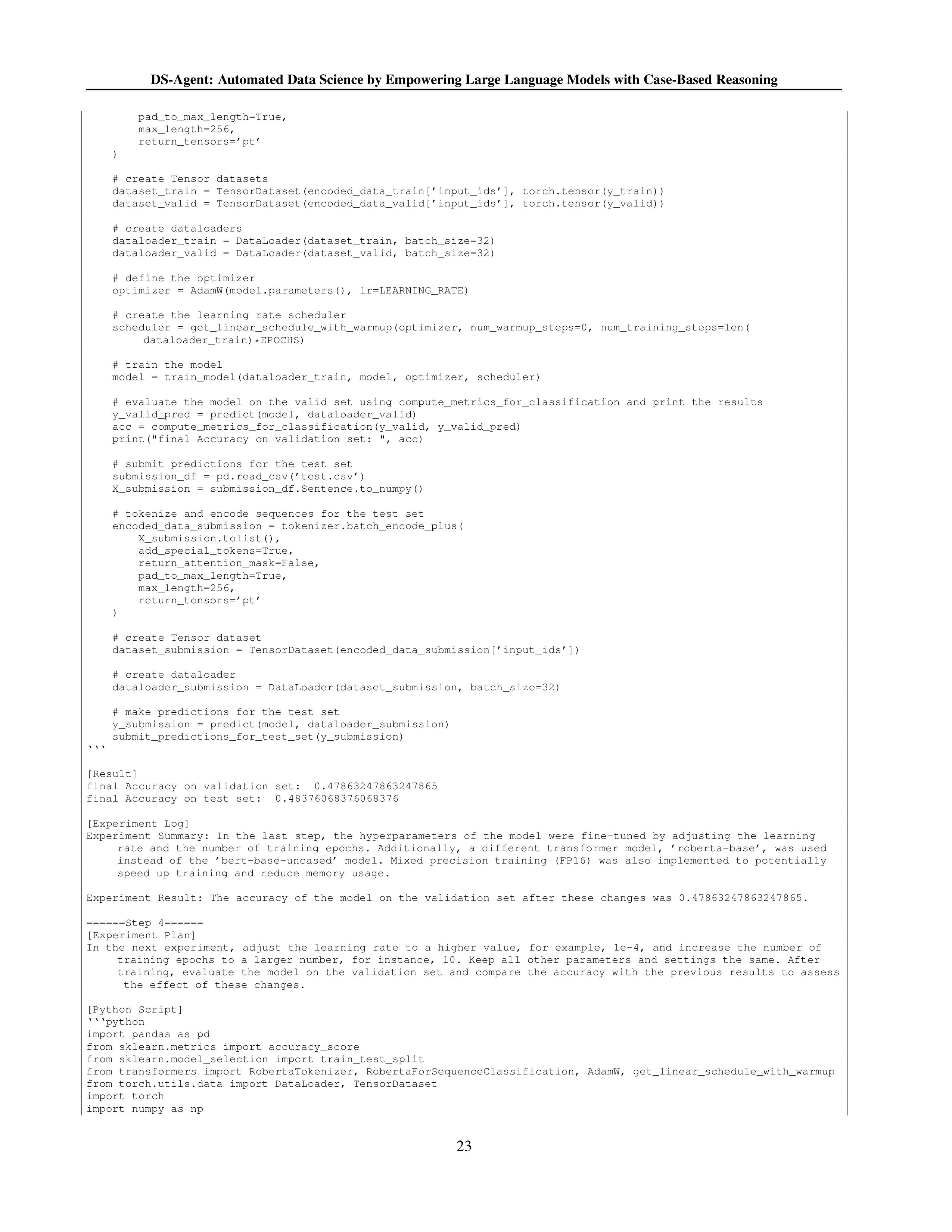
DS-Agent:
Automated Data Science by Empowering Large Language Models with Case-Based Reasoning
pad_to_max_length=True,
max_length=256,
return_tensors=’pt’
)
#
create
Tensor
datasets
dataset_train
=
TensorDataset(encoded_data_train[’input_ids’],
torch.tensor(y_train))
dataset_valid
=
TensorDataset(encoded_data_valid[’input_ids’],
torch.tensor(y_valid))
#
create
dataloaders
dataloader_train
=
DataLoader(dataset_train,
batch_size=32)
dataloader_valid
=
DataLoader(dataset_valid,
batch_size=32)
#
define
the
optimizer
optimizer
=
AdamW(model.parameters(),
lr=LEARNING_RATE)
#
create
the
learning
rate
scheduler
scheduler
=
get_linear_schedule_with_warmup(optimizer,
num_warmup_steps=0,
num_training_steps=len(
dataloader_train)*EPOCHS)
#
train
the
model
model
=
train_model(dataloader_train,
model,
optimizer,
scheduler)
#
evaluate
the
model
on
the
valid
set
using
compute_metrics_for_classification
and
print
the
results
y_valid_pred
=
predict(model,
dataloader_valid)
acc
=
compute_metrics_for_classification(y_valid,
y_valid_pred)
print("final
Accuracy
on
validation
set:
",
acc)
#
submit
predictions
for
the
test
set
submission_df
=
pd.read_csv(’test.csv’)
X_submission
=
submission_df.Sentence.to_numpy()
#
tokenize
and
encode
sequences
for
the
test
set
encoded_data_submission
=
tokenizer.batch_encode_plus(
X_submission.tolist(),
add_special_tokens=True,
return_attention_mask=False,
pad_to_max_length=True,
max_length=256,
return_tensors=’pt’
)
#
create
Tensor
dataset
dataset_submission
=
TensorDataset(encoded_data_submission[’input_ids’])
#
create
dataloader
dataloader_submission
=
DataLoader(dataset_submission,
batch_size=32)
#
make
predictions
for
the
test
set
y_submission
=
predict(model,
dataloader_submission)
submit_predictions_for_test_set(y_submission)
‘‘‘
[Result]
final
Accuracy
on
validation
set:
0.47863247863247865
final
Accuracy
on
test
set:
0.48376068376068376
[Experiment
Log]
Experiment
Summary:
In
the
last
step,
the
hyperparameters
of
the
model
were
fine-tuned
by
adjusting
the
learning
rate
and
the
number
of
training
epochs.
Additionally,
a
different
transformer
model,
’roberta-base’,
was
used
instead
of
the
’bert-base-uncased’
model.
Mixed
precision
training
(FP16)
was
also
implemented
to
potentially
speed
up
training
and
reduce
memory
usage.
Experiment
Result:
The
accuracy
of
the
model
on
the
validation
set
after
these
changes
was
0.47863247863247865.
======Step
4======
[Experiment
Plan]
In
the
next
experiment,
adjust
the
learning
rate
to
a
higher
value,
for
example,
1e-4,
and
increase
the
number
of
training
epochs
to
a
larger
number,
for
instance,
10.
Keep
all
other
parameters
and
settings
the
same.
After
training,
evaluate
the
model
on
the
validation
set
and
compare
the
accuracy
with
the
previous
results
to
assess
the
effect
of
these
changes.
[Python
Script]
‘‘‘python
import
pandas
as
pd
from
sklearn.metrics
import
accuracy_score
from
sklearn.model_selection
import
train_test_split
from
transformers
import
RobertaTokenizer,
RobertaForSequenceClassification,
AdamW,
get_linear_schedule_with_warmup
from
torch.utils.data
import
DataLoader,
TensorDataset
import
torch
import
numpy
as
np
23
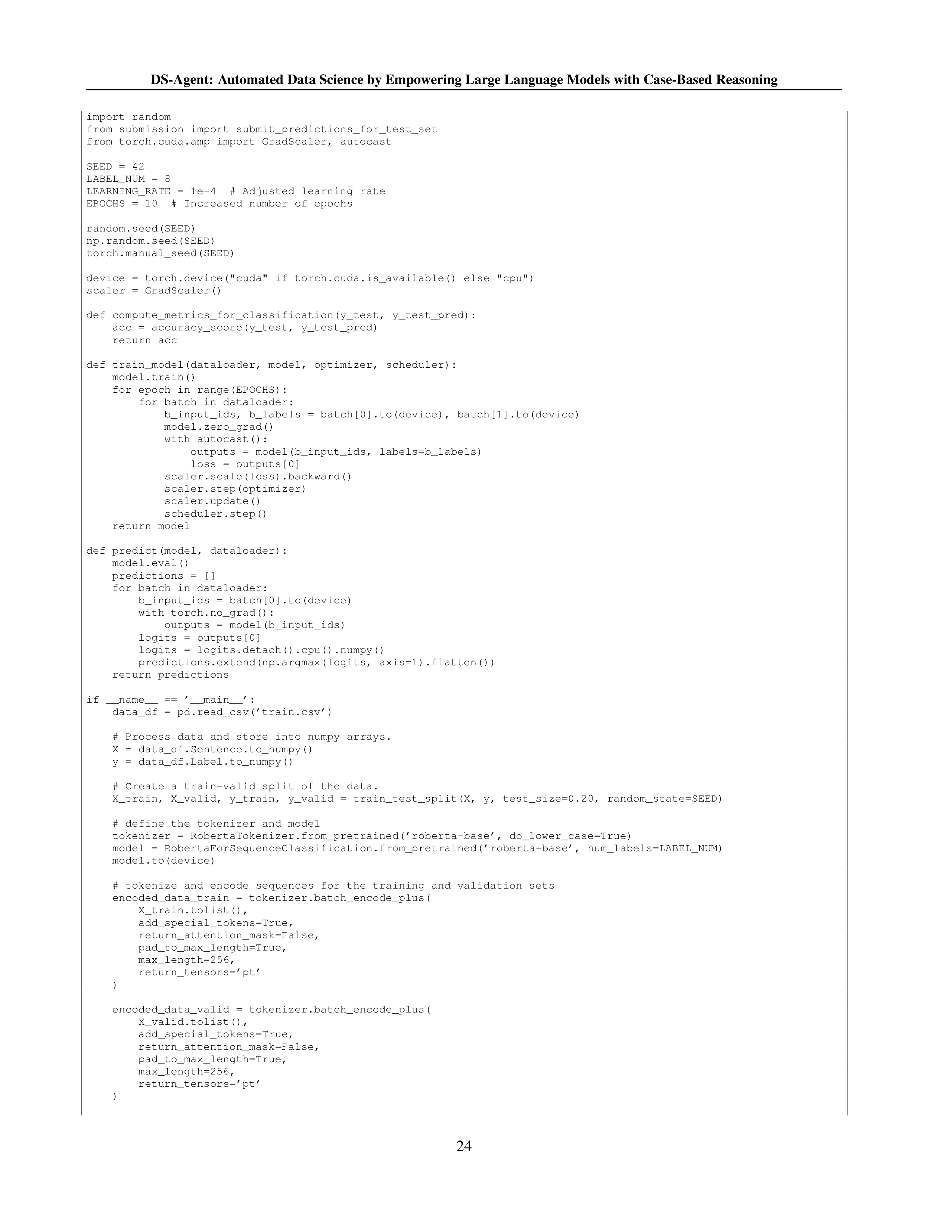
DS-Agent:
Automated Data Science by Empowering Large Language Models with Case-Based Reasoning
import
random
from
submission
import
submit_predictions_for_test_set
from
torch.cuda.amp
import
GradScaler,
autocast
SEED
=
42
LABEL_NUM
=
8
LEARNING_RATE
=
1e-4
#
Adjusted
learning
rate
EPOCHS
=
10
#
Increased
number
of
epochs
random.seed(SEED)
np.random.seed(SEED)
torch.manual_seed(SEED)
device
=
torch.device("cuda"
if
torch.cuda.is_available()
else
"cpu")
scaler
=
GradScaler()
def
compute_metrics_for_classification(y_test,
y_test_pred):
acc
=
accuracy_score(y_test,
y_test_pred)
return
acc
def
train_model(dataloader,
model,
optimizer,
scheduler):
model.train()
for
epoch
in
range(EPOCHS):
for
batch
in
dataloader:
b_input_ids,
b_labels
=
batch[0].to(device),
batch[1].to(device)
model.zero_grad()
with
autocast():
outputs
=
model(b_input_ids,
labels=b_labels)
loss
=
outputs[0]
scaler.scale(loss).backward()
scaler.step(optimizer)
scaler.update()
scheduler.step()
return
model
def
predict(model,
dataloader):
model.eval()
predictions
=
[]
for
batch
in
dataloader:
b_input_ids
=
batch[0].to(device)
with
torch.no_grad():
outputs
=
model(b_input_ids)
logits
=
outputs[0]
logits
=
logits.detach().cpu().numpy()
predictions.extend(np.argmax(logits,
axis=1).flatten())
return
predictions
if
__name__
==
’__main__’:
data_df
=
pd.read_csv(’train.csv’)
#
Process
data
and
store
into
numpy
arrays.
X
=
data_df.Sentence.to_numpy()
y
=
data_df.Label.to_numpy()
#
Create
a
train-valid
split
of
the
data.
X_train,
X_valid,
y_train,
y_valid
=
train_test_split(X,
y,
test_size=0.20,
random_state=SEED)
#
define
the
tokenizer
and
model
tokenizer
=
RobertaTokenizer.from_pretrained(’roberta-base’,
do_lower_case=True)
model
=
RobertaForSequenceClassification.from_pretrained(’roberta-base’,
num_labels=LABEL_NUM)
model.to(device)
#
tokenize
and
encode
sequences
for
the
training
and
validation
sets
encoded_data_train
=
tokenizer.batch_encode_plus(
X_train.tolist(),
add_special_tokens=True,
return_attention_mask=False,
pad_to_max_length=True,
max_length=256,
return_tensors=’pt’
)
encoded_data_valid
=
tokenizer.batch_encode_plus(
X_valid.tolist(),
add_special_tokens=True,
return_attention_mask=False,
pad_to_max_length=True,
max_length=256,
return_tensors=’pt’
)
24
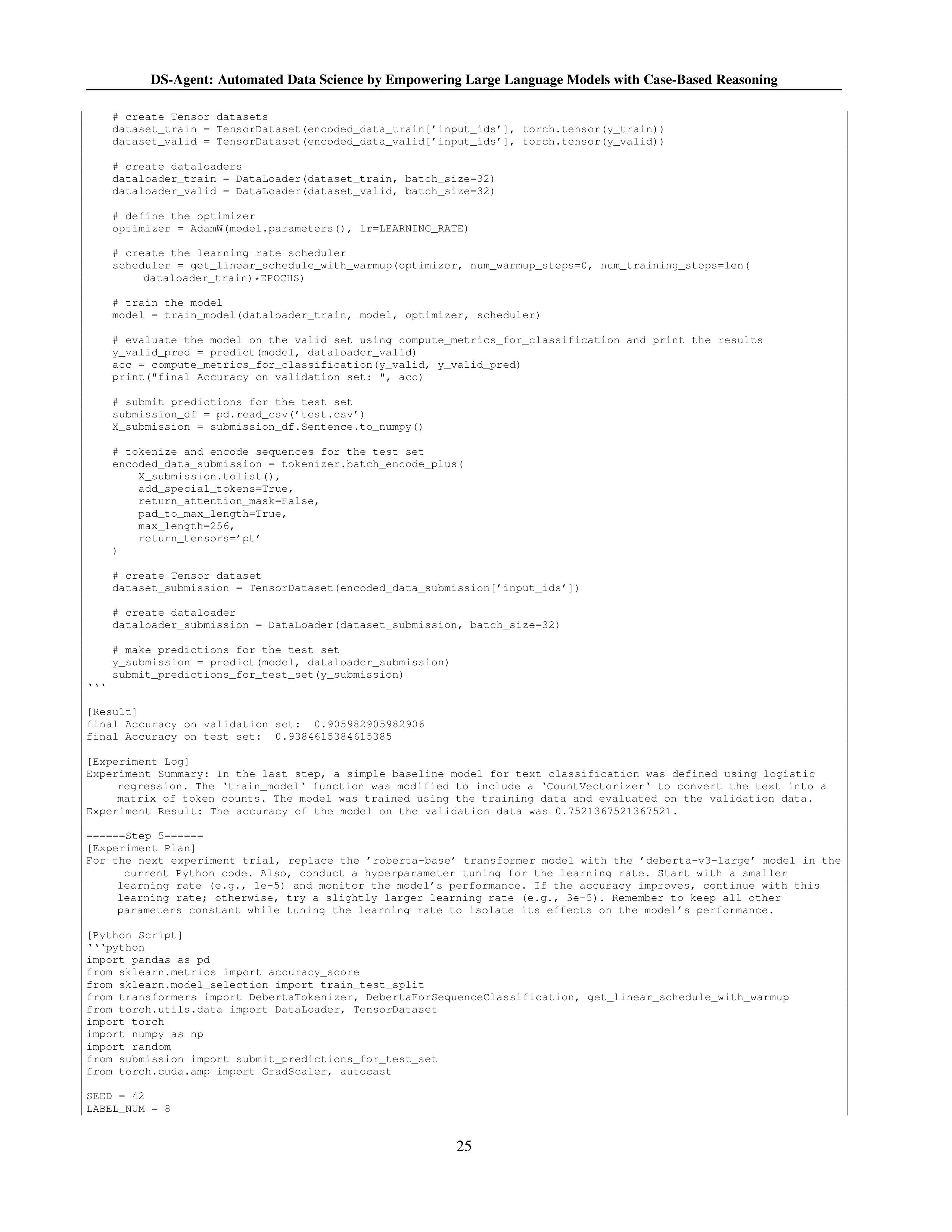
DS-Agent:
Automated Data Science by Empowering Large Language Models with Case-Based Reasoning
#
create
Tensor
datasets
dataset_train
=
TensorDataset(encoded_data_train[’input_ids’],
torch.tensor(y_train))
dataset_valid
=
TensorDataset(encoded_data_valid[’input_ids’],
torch.tensor(y_valid))
#
create
dataloaders
dataloader_train
=
DataLoader(dataset_train,
batch_size=32)
dataloader_valid
=
DataLoader(dataset_valid,
batch_size=32)
#
define
the
optimizer
optimizer
=
AdamW(model.parameters(),
lr=LEARNING_RATE)
#
create
the
learning
rate
scheduler
scheduler
=
get_linear_schedule_with_warmup(optimizer,
num_warmup_steps=0,
num_training_steps=len(
dataloader_train)*EPOCHS)
#
train
the
model
model
=
train_model(dataloader_train,
model,
optimizer,
scheduler)
#
evaluate
the
model
on
the
valid
set
using
compute_metrics_for_classification
and
print
the
results
y_valid_pred
=
predict(model,
dataloader_valid)
acc
=
compute_metrics_for_classification(y_valid,
y_valid_pred)
print("final
Accuracy
on
validation
set:
",
acc)
#
submit
predictions
for
the
test
set
submission_df
=
pd.read_csv(’test.csv’)
X_submission
=
submission_df.Sentence.to_numpy()
#
tokenize
and
encode
sequences
for
the
test
set
encoded_data_submission
=
tokenizer.batch_encode_plus(
X_submission.tolist(),
add_special_tokens=True,
return_attention_mask=False,
pad_to_max_length=True,
max_length=256,
return_tensors=’pt’
)
#
create
Tensor
dataset
dataset_submission
=
TensorDataset(encoded_data_submission[’input_ids’])
#
create
dataloader
dataloader_submission
=
DataLoader(dataset_submission,
batch_size=32)
#
make
predictions
for
the
test
set
y_submission
=
predict(model,
dataloader_submission)
submit_predictions_for_test_set(y_submission)
‘‘‘
[Result]
final
Accuracy
on
validation
set:
0.905982905982906
final
Accuracy
on
test
set:
0.9384615384615385
[Experiment
Log]
Experiment
Summary:
In
the
last
step,
a
simple
baseline
model
for
text
classification
was
defined
using
logistic
regression.
The
‘train_model‘
function
was
modified
to
include
a
‘CountVectorizer‘
to
convert
the
text
into
a
matrix
of
token
counts.
The
model
was
trained
using
the
training
data
and
evaluated
on
the
validation
data.
Experiment
Result:
The
accuracy
of
the
model
on
the
validation
data
was
0.7521367521367521.
======Step
5======
[Experiment
Plan]
For
the
next
experiment
trial,
replace
the
’roberta-base’
transformer
model
with
the
’deberta-v3-large’
model
in
the
current
Python
code.
Also,
conduct
a
hyperparameter
tuning
for
the
learning
rate.
Start
with
a
smaller
learning
rate
(e.g.,
1e-5)
and
monitor
the
model’s
performance.
If
the
accuracy
improves,
continue
with
this
learning
rate;
otherwise,
try
a
slightly
larger
learning
rate
(e.g.,
3e-5).
Remember
to
keep
all
other
parameters
constant
while
tuning
the
learning
rate
to
isolate
its
effects
on
the
model’s
performance.
[Python
Script]
‘‘‘python
import
pandas
as
pd
from
sklearn.metrics
import
accuracy_score
from
sklearn.model_selection
import
train_test_split
from
transformers
import
DebertaTokenizer,
DebertaForSequenceClassification,
get_linear_schedule_with_warmup
from
torch.utils.data
import
DataLoader,
TensorDataset
import
torch
import
numpy
as
np
import
random
from
submission
import
submit_predictions_for_test_set
from
torch.cuda.amp
import
GradScaler,
autocast
SEED
=
42
LABEL_NUM
=
8
25
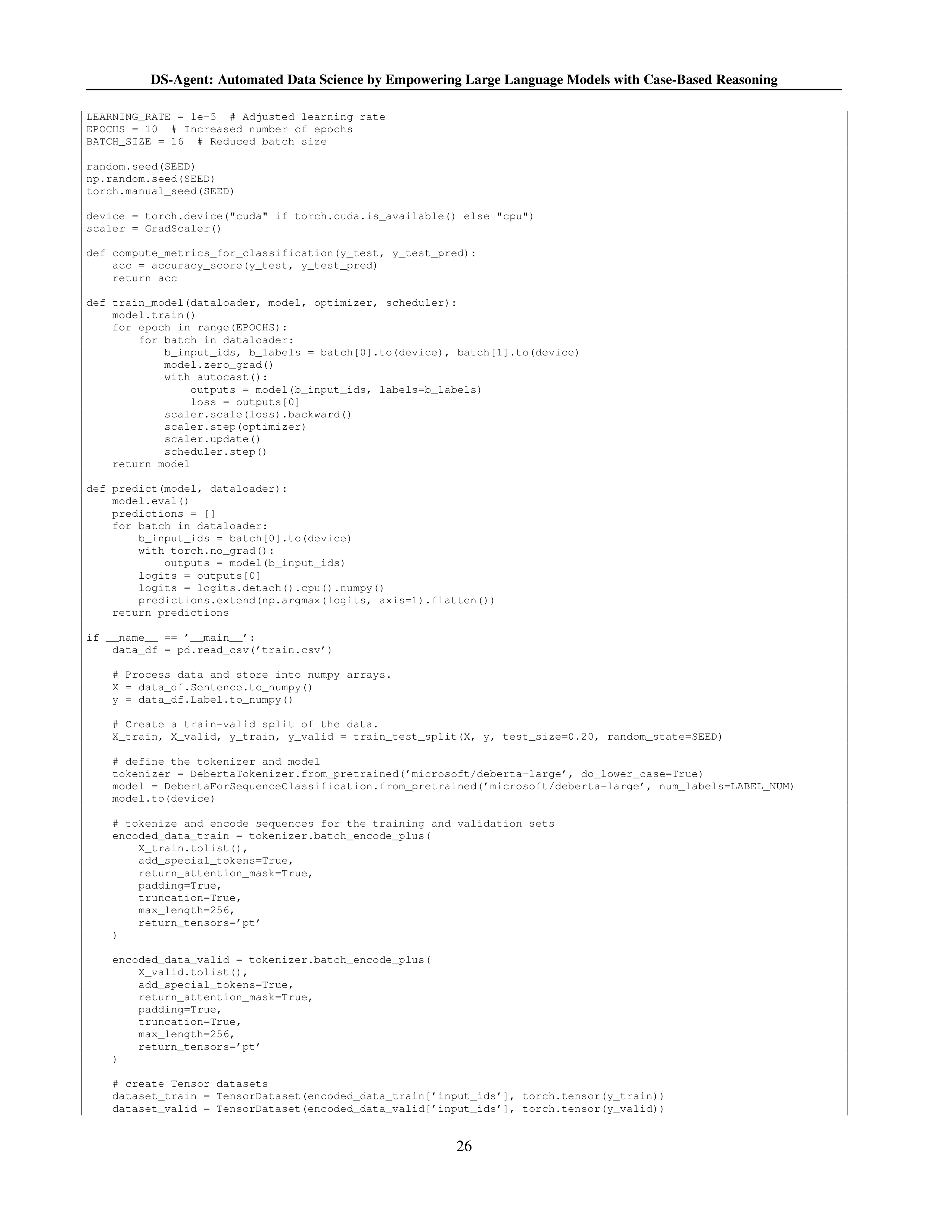
DS-Agent:
Automated Data Science by Empowering Large Language Models with Case-Based Reasoning
LEARNING_RATE
=
1e-5
#
Adjusted
learning
rate
EPOCHS
=
10
#
Increased
number
of
epochs
BATCH_SIZE
=
16
#
Reduced
batch
size
random.seed(SEED)
np.random.seed(SEED)
torch.manual_seed(SEED)
device
=
torch.device("cuda"
if
torch.cuda.is_available()
else
"cpu")
scaler
=
GradScaler()
def
compute_metrics_for_classification(y_test,
y_test_pred):
acc
=
accuracy_score(y_test,
y_test_pred)
return
acc
def
train_model(dataloader,
model,
optimizer,
scheduler):
model.train()
for
epoch
in
range(EPOCHS):
for
batch
in
dataloader:
b_input_ids,
b_labels
=
batch[0].to(device),
batch[1].to(device)
model.zero_grad()
with
autocast():
outputs
=
model(b_input_ids,
labels=b_labels)
loss
=
outputs[0]
scaler.scale(loss).backward()
scaler.step(optimizer)
scaler.update()
scheduler.step()
return
model
def
predict(model,
dataloader):
model.eval()
predictions
=
[]
for
batch
in
dataloader:
b_input_ids
=
batch[0].to(device)
with
torch.no_grad():
outputs
=
model(b_input_ids)
logits
=
outputs[0]
logits
=
logits.detach().cpu().numpy()
predictions.extend(np.argmax(logits,
axis=1).flatten())
return
predictions
if
__name__
==
’__main__’:
data_df
=
pd.read_csv(’train.csv’)
#
Process
data
and
store
into
numpy
arrays.
X
=
data_df.Sentence.to_numpy()
y
=
data_df.Label.to_numpy()
#
Create
a
train-valid
split
of
the
data.
X_train,
X_valid,
y_train,
y_valid
=
train_test_split(X,
y,
test_size=0.20,
random_state=SEED)
#
define
the
tokenizer
and
model
tokenizer
=
DebertaTokenizer.from_pretrained(’microsoft/deberta-large’,
do_lower_case=True)
model
=
DebertaForSequenceClassification.from_pretrained(’microsoft/deberta-large’,
num_labels=LABEL_NUM)
model.to(device)
#
tokenize
and
encode
sequences
for
the
training
and
validation
sets
encoded_data_train
=
tokenizer.batch_encode_plus(
X_train.tolist(),
add_special_tokens=True,
return_attention_mask=True,
padding=True,
truncation=True,
max_length=256,
return_tensors=’pt’
)
encoded_data_valid
=
tokenizer.batch_encode_plus(
X_valid.tolist(),
add_special_tokens=True,
return_attention_mask=True,
padding=True,
truncation=True,
max_length=256,
return_tensors=’pt’
)
#
create
Tensor
datasets
dataset_train
=
TensorDataset(encoded_data_train[’input_ids’],
torch.tensor(y_train))
dataset_valid
=
TensorDataset(encoded_data_valid[’input_ids’],
torch.tensor(y_valid))
26
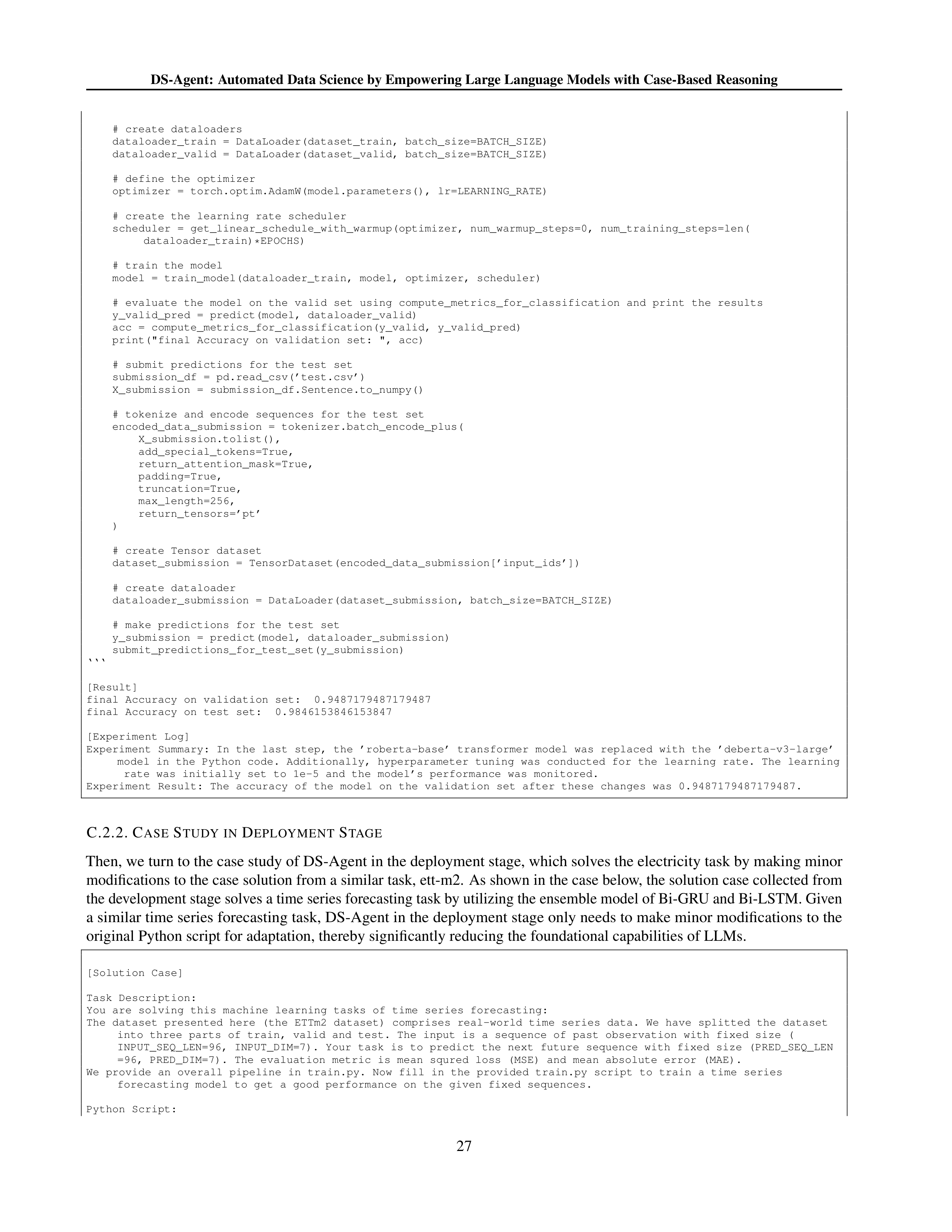
DS-Agent:
Automated Data Science by Empowering Large Language Models with Case-Based Reasoning
#
create
dataloaders
dataloader_train
=
DataLoader(dataset_train,
batch_size=BATCH_SIZE)
dataloader_valid
=
DataLoader(dataset_valid,
batch_size=BATCH_SIZE)
#
define
the
optimizer
optimizer
=
torch.optim.AdamW(model.parameters(),
lr=LEARNING_RATE)
#
create
the
learning
rate
scheduler
scheduler
=
get_linear_schedule_with_warmup(optimizer,
num_warmup_steps=0,
num_training_steps=len(
dataloader_train)*EPOCHS)
#
train
the
model
model
=
train_model(dataloader_train,
model,
optimizer,
scheduler)
#
evaluate
the
model
on
the
valid
set
using
compute_metrics_for_classification
and
print
the
results
y_valid_pred
=
predict(model,
dataloader_valid)
acc
=
compute_metrics_for_classification(y_valid,
y_valid_pred)
print("final
Accuracy
on
validation
set:
",
acc)
#
submit
predictions
for
the
test
set
submission_df
=
pd.read_csv(’test.csv’)
X_submission
=
submission_df.Sentence.to_numpy()
#
tokenize
and
encode
sequences
for
the
test
set
encoded_data_submission
=
tokenizer.batch_encode_plus(
X_submission.tolist(),
add_special_tokens=True,
return_attention_mask=True,
padding=True,
truncation=True,
max_length=256,
return_tensors=’pt’
)
#
create
Tensor
dataset
dataset_submission
=
TensorDataset(encoded_data_submission[’input_ids’])
#
create
dataloader
dataloader_submission
=
DataLoader(dataset_submission,
batch_size=BATCH_SIZE)
#
make
predictions
for
the
test
set
y_submission
=
predict(model,
dataloader_submission)
submit_predictions_for_test_set(y_submission)
‘‘‘
[Result]
final
Accuracy
on
validation
set:
0.9487179487179487
final
Accuracy
on
test
set:
0.9846153846153847
[Experiment
Log]
Experiment
Summary:
In
the
last
step,
the
’roberta-base’
transformer
model
was
replaced
with
the
’deberta-v3-large’
model
in
the
Python
code.
Additionally,
hyperparameter
tuning
was
conducted
for
the
learning
rate.
The
learning
rate
was
initially
set
to
1e-5
and
the
model’s
performance
was
monitored.
Experiment
Result:
The
accuracy
of
the
model
on
the
validation
set
after
these
changes
was
0.9487179487179487.
C.2.2. C
ASE
S
TUDY
IN
D
EPLOYMENT
S
TAGE
Then, we turn to the case study of DS-Agent in the deployment stage, which solves the electricity task by making minor
modifications to the case solution from a similar task, ett-m2.
As shown in the case below, the solution case collected from
the development stage solves a time series forecasting task by utilizing the ensemble model of Bi-GRU and Bi-LSTM. Given
a similar time series forecasting task, DS-Agent in the deployment stage only needs to make minor modifications to the
original Python script for adaptation, thereby significantly reducing the foundational capabilities of LLMs.
[Solution
Case]
Task
Description:
You
are
solving
this
machine
learning
tasks
of
time
series
forecasting:
The
dataset
presented
here
(the
ETTm2
dataset)
comprises
real-world
time
series
data.
We
have
splitted
the
dataset
into
three
parts
of
train,
valid
and
test.
The
input
is
a
sequence
of
past
observation
with
fixed
size
(
INPUT_SEQ_LEN=96,
INPUT_DIM=7).
Your
task
is
to
predict
the
next
future
sequence
with
fixed
size
(PRED_SEQ_LEN
=96,
PRED_DIM=7).
The
evaluation
metric
is
mean
squred
loss
(MSE)
and
mean
absolute
error
(MAE).
We
provide
an
overall
pipeline
in
train.py.
Now
fill
in
the
provided
train.py
script
to
train
a
time
series
forecasting
model
to
get
a
good
performance
on
the
given
fixed
sequences.
Python
Script:
27
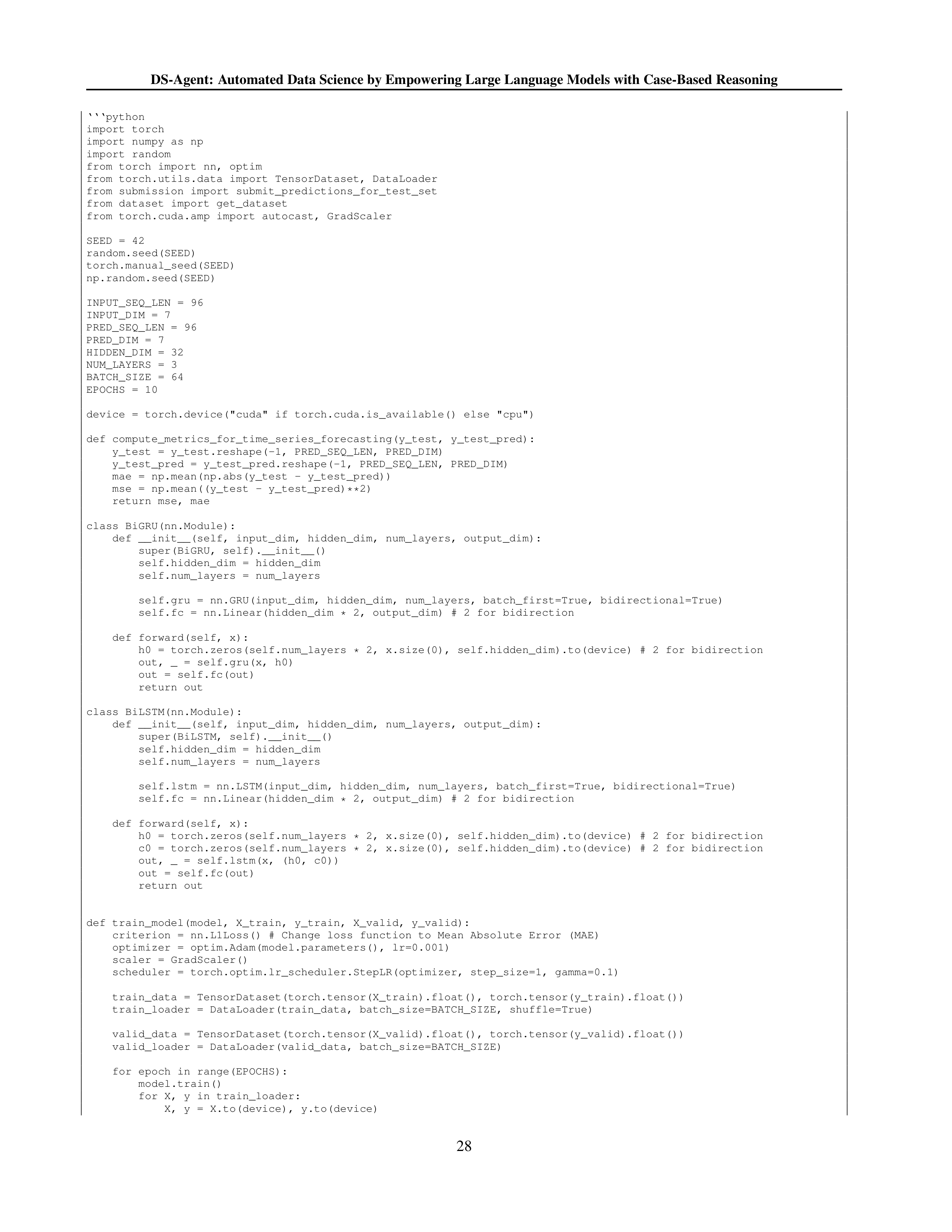
DS-Agent:
Automated Data Science by Empowering Large Language Models with Case-Based Reasoning
‘‘‘python
import
torch
import
numpy
as
np
import
random
from
torch
import
nn,
optim
from
torch.utils.data
import
TensorDataset,
DataLoader
from
submission
import
submit_predictions_for_test_set
from
dataset
import
get_dataset
from
torch.cuda.amp
import
autocast,
GradScaler
SEED
=
42
random.seed(SEED)
torch.manual_seed(SEED)
np.random.seed(SEED)
INPUT_SEQ_LEN
=
96
INPUT_DIM
=
7
PRED_SEQ_LEN
=
96
PRED_DIM
=
7
HIDDEN_DIM
=
32
NUM_LAYERS
=
3
BATCH_SIZE
=
64
EPOCHS
=
10
device
=
torch.device("cuda"
if
torch.cuda.is_available()
else
"cpu")
def
compute_metrics_for_time_series_forecasting(y_test,
y_test_pred):
y_test
=
y_test.reshape(-1,
PRED_SEQ_LEN,
PRED_DIM)
y_test_pred
=
y_test_pred.reshape(-1,
PRED_SEQ_LEN,
PRED_DIM)
mae
=
np.mean(np.abs(y_test
-
y_test_pred))
mse
=
np.mean((y_test
-
y_test_pred)**2)
return
mse,
mae
class
BiGRU(nn.Module):
def
__init__(self,
input_dim,
hidden_dim,
num_layers,
output_dim):
super(BiGRU,
self).__init__()
self.hidden_dim
=
hidden_dim
self.num_layers
=
num_layers
self.gru
=
nn.GRU(input_dim,
hidden_dim,
num_layers,
batch_first=True,
bidirectional=True)
self.fc
=
nn.Linear(hidden_dim
*
2,
output_dim)
#
2
for
bidirection
def
forward(self,
x):
h0
=
torch.zeros(self.num_layers
*
2,
x.size(0),
self.hidden_dim).to(device)
#
2
for
bidirection
out,
_
=
self.gru(x,
h0)
out
=
self.fc(out)
return
out
class
BiLSTM(nn.Module):
def
__init__(self,
input_dim,
hidden_dim,
num_layers,
output_dim):
super(BiLSTM,
self).__init__()
self.hidden_dim
=
hidden_dim
self.num_layers
=
num_layers
self.lstm
=
nn.LSTM(input_dim,
hidden_dim,
num_layers,
batch_first=True,
bidirectional=True)
self.fc
=
nn.Linear(hidden_dim
*
2,
output_dim)
#
2
for
bidirection
def
forward(self,
x):
h0
=
torch.zeros(self.num_layers
*
2,
x.size(0),
self.hidden_dim).to(device)
#
2
for
bidirection
c0
=
torch.zeros(self.num_layers
*
2,
x.size(0),
self.hidden_dim).to(device)
#
2
for
bidirection
out,
_
=
self.lstm(x,
(h0,
c0))
out
=
self.fc(out)
return
out
def
train_model(model,
X_train,
y_train,
X_valid,
y_valid):
criterion
=
nn.L1Loss()
#
Change
loss
function
to
Mean
Absolute
Error
(MAE)
optimizer
=
optim.Adam(model.parameters(),
lr=0.001)
scaler
=
GradScaler()
scheduler
=
torch.optim.lr_scheduler.StepLR(optimizer,
step_size=1,
gamma=0.1)
train_data
=
TensorDataset(torch.tensor(X_train).float(),
torch.tensor(y_train).float())
train_loader
=
DataLoader(train_data,
batch_size=BATCH_SIZE,
shuffle=True)
valid_data
=
TensorDataset(torch.tensor(X_valid).float(),
torch.tensor(y_valid).float())
valid_loader
=
DataLoader(valid_data,
batch_size=BATCH_SIZE)
for
epoch
in
range(EPOCHS):
model.train()
for
X,
y
in
train_loader:
X,
y
=
X.to(device),
y.to(device)
28
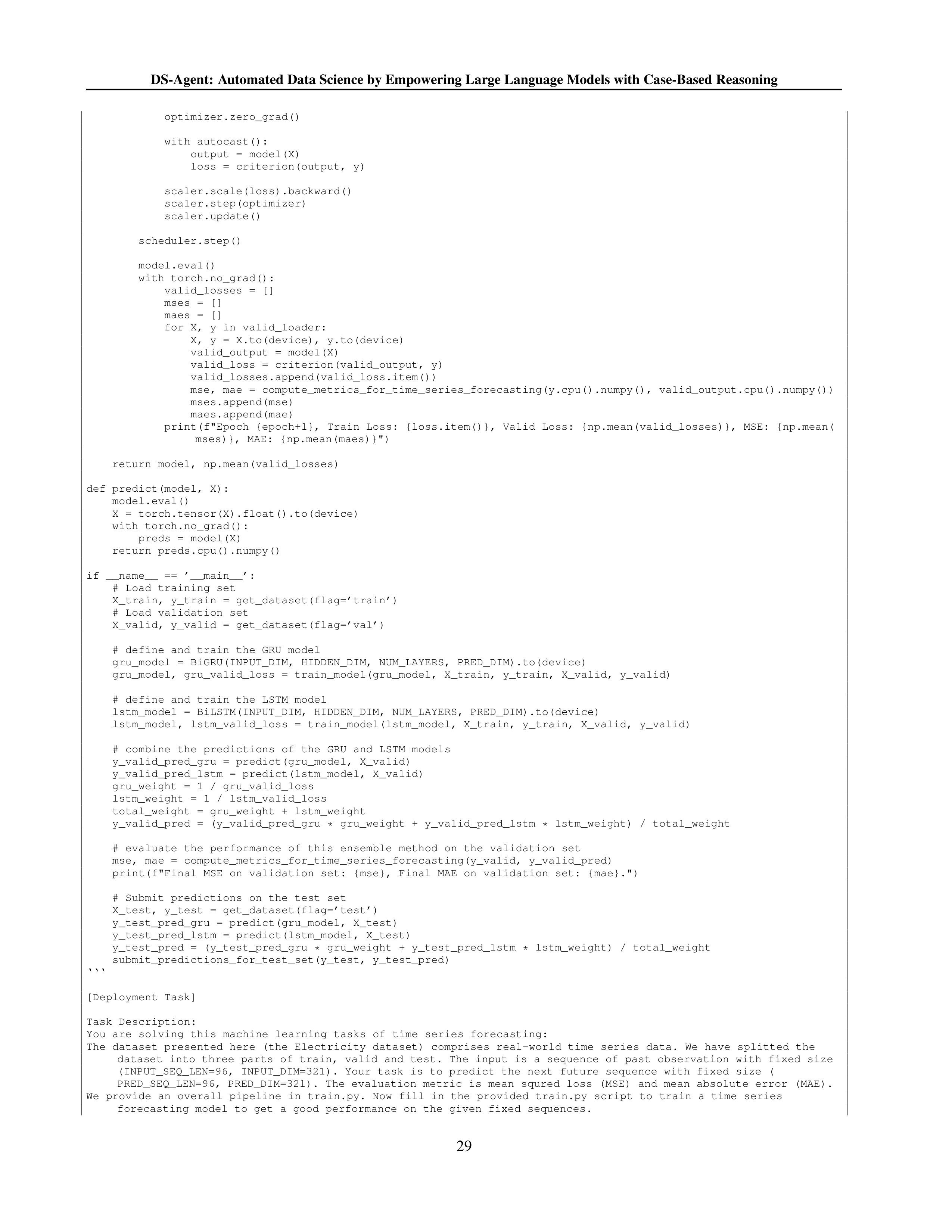
DS-Agent:
Automated Data Science by Empowering Large Language Models with Case-Based Reasoning
optimizer.zero_grad()
with
autocast():
output
=
model(X)
loss
=
criterion(output,
y)
scaler.scale(loss).backward()
scaler.step(optimizer)
scaler.update()
scheduler.step()
model.eval()
with
torch.no_grad():
valid_losses
=
[]
mses
=
[]
maes
=
[]
for
X,
y
in
valid_loader:
X,
y
=
X.to(device),
y.to(device)
valid_output
=
model(X)
valid_loss
=
criterion(valid_output,
y)
valid_losses.append(valid_loss.item())
mse,
mae
=
compute_metrics_for_time_series_forecasting(y.cpu().numpy(),
valid_output.cpu().numpy())
mses.append(mse)
maes.append(mae)
print(f"Epoch
{epoch+1},
Train
Loss:
{loss.item()},
Valid
Loss:
{np.mean(valid_losses)},
MSE:
{np.mean(
mses)},
MAE:
{np.mean(maes)}")
return
model,
np.mean(valid_losses)
def
predict(model,
X):
model.eval()
X
=
torch.tensor(X).float().to(device)
with
torch.no_grad():
preds
=
model(X)
return
preds.cpu().numpy()
if
__name__
==
’__main__’:
#
Load
training
set
X_train,
y_train
=
get_dataset(flag=’train’)
#
Load
validation
set
X_valid,
y_valid
=
get_dataset(flag=’val’)
#
define
and
train
the
GRU
model
gru_model
=
BiGRU(INPUT_DIM,
HIDDEN_DIM,
NUM_LAYERS,
PRED_DIM).to(device)
gru_model,
gru_valid_loss
=
train_model(gru_model,
X_train,
y_train,
X_valid,
y_valid)
#
define
and
train
the
LSTM
model
lstm_model
=
BiLSTM(INPUT_DIM,
HIDDEN_DIM,
NUM_LAYERS,
PRED_DIM).to(device)
lstm_model,
lstm_valid_loss
=
train_model(lstm_model,
X_train,
y_train,
X_valid,
y_valid)
#
combine
the
predictions
of
the
GRU
and
LSTM
models
y_valid_pred_gru
=
predict(gru_model,
X_valid)
y_valid_pred_lstm
=
predict(lstm_model,
X_valid)
gru_weight
=
1
/
gru_valid_loss
lstm_weight
=
1
/
lstm_valid_loss
total_weight
=
gru_weight
+
lstm_weight
y_valid_pred
=
(y_valid_pred_gru
*
gru_weight
+
y_valid_pred_lstm
*
lstm_weight)
/
total_weight
#
evaluate
the
performance
of
this
ensemble
method
on
the
validation
set
mse,
mae
=
compute_metrics_for_time_series_forecasting(y_valid,
y_valid_pred)
print(f"Final
MSE
on
validation
set:
{mse},
Final
MAE
on
validation
set:
{mae}.")
#
Submit
predictions
on
the
test
set
X_test,
y_test
=
get_dataset(flag=’test’)
y_test_pred_gru
=
predict(gru_model,
X_test)
y_test_pred_lstm
=
predict(lstm_model,
X_test)
y_test_pred
=
(y_test_pred_gru
*
gru_weight
+
y_test_pred_lstm
*
lstm_weight)
/
total_weight
submit_predictions_for_test_set(y_test,
y_test_pred)
‘‘‘
[Deployment
Task]
Task
Description:
You
are
solving
this
machine
learning
tasks
of
time
series
forecasting:
The
dataset
presented
here
(the
Electricity
dataset)
comprises
real-world
time
series
data.
We
have
splitted
the
dataset
into
three
parts
of
train,
valid
and
test.
The
input
is
a
sequence
of
past
observation
with
fixed
size
(INPUT_SEQ_LEN=96,
INPUT_DIM=321).
Your
task
is
to
predict
the
next
future
sequence
with
fixed
size
(
PRED_SEQ_LEN=96,
PRED_DIM=321).
The
evaluation
metric
is
mean
squred
loss
(MSE)
and
mean
absolute
error
(MAE).
We
provide
an
overall
pipeline
in
train.py.
Now
fill
in
the
provided
train.py
script
to
train
a
time
series
forecasting
model
to
get
a
good
performance
on
the
given
fixed
sequences.
29
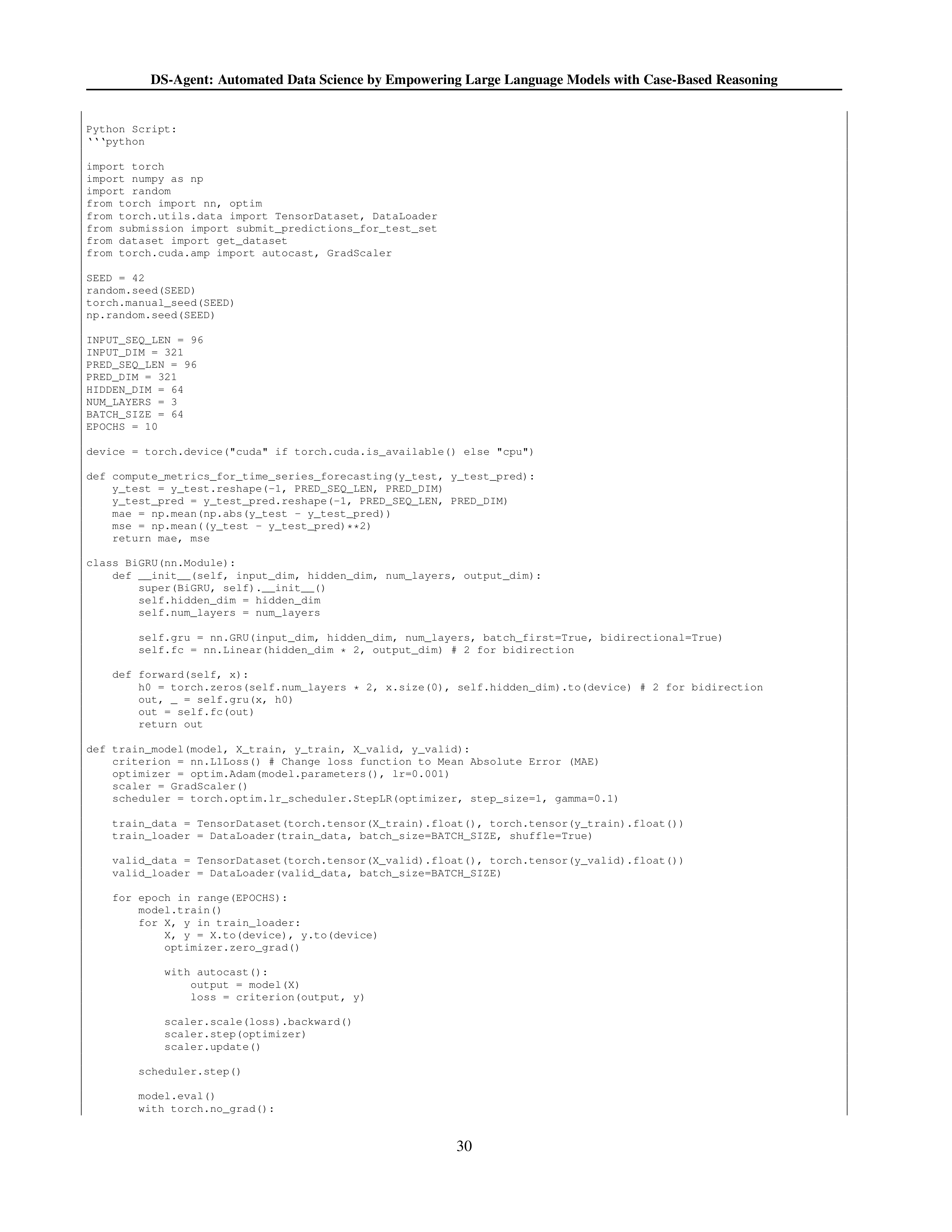
DS-Agent:
Automated Data Science by Empowering Large Language Models with Case-Based Reasoning
Python
Script:
‘‘‘python
import
torch
import
numpy
as
np
import
random
from
torch
import
nn,
optim
from
torch.utils.data
import
TensorDataset,
DataLoader
from
submission
import
submit_predictions_for_test_set
from
dataset
import
get_dataset
from
torch.cuda.amp
import
autocast,
GradScaler
SEED
=
42
random.seed(SEED)
torch.manual_seed(SEED)
np.random.seed(SEED)
INPUT_SEQ_LEN
=
96
INPUT_DIM
=
321
PRED_SEQ_LEN
=
96
PRED_DIM
=
321
HIDDEN_DIM
=
64
NUM_LAYERS
=
3
BATCH_SIZE
=
64
EPOCHS
=
10
device
=
torch.device("cuda"
if
torch.cuda.is_available()
else
"cpu")
def
compute_metrics_for_time_series_forecasting(y_test,
y_test_pred):
y_test
=
y_test.reshape(-1,
PRED_SEQ_LEN,
PRED_DIM)
y_test_pred
=
y_test_pred.reshape(-1,
PRED_SEQ_LEN,
PRED_DIM)
mae
=
np.mean(np.abs(y_test
-
y_test_pred))
mse
=
np.mean((y_test
-
y_test_pred)**2)
return
mae,
mse
class
BiGRU(nn.Module):
def
__init__(self,
input_dim,
hidden_dim,
num_layers,
output_dim):
super(BiGRU,
self).__init__()
self.hidden_dim
=
hidden_dim
self.num_layers
=
num_layers
self.gru
=
nn.GRU(input_dim,
hidden_dim,
num_layers,
batch_first=True,
bidirectional=True)
self.fc
=
nn.Linear(hidden_dim
*
2,
output_dim)
#
2
for
bidirection
def
forward(self,
x):
h0
=
torch.zeros(self.num_layers
*
2,
x.size(0),
self.hidden_dim).to(device)
#
2
for
bidirection
out,
_
=
self.gru(x,
h0)
out
=
self.fc(out)
return
out
def
train_model(model,
X_train,
y_train,
X_valid,
y_valid):
criterion
=
nn.L1Loss()
#
Change
loss
function
to
Mean
Absolute
Error
(MAE)
optimizer
=
optim.Adam(model.parameters(),
lr=0.001)
scaler
=
GradScaler()
scheduler
=
torch.optim.lr_scheduler.StepLR(optimizer,
step_size=1,
gamma=0.1)
train_data
=
TensorDataset(torch.tensor(X_train).float(),
torch.tensor(y_train).float())
train_loader
=
DataLoader(train_data,
batch_size=BATCH_SIZE,
shuffle=True)
valid_data
=
TensorDataset(torch.tensor(X_valid).float(),
torch.tensor(y_valid).float())
valid_loader
=
DataLoader(valid_data,
batch_size=BATCH_SIZE)
for
epoch
in
range(EPOCHS):
model.train()
for
X,
y
in
train_loader:
X,
y
=
X.to(device),
y.to(device)
optimizer.zero_grad()
with
autocast():
output
=
model(X)
loss
=
criterion(output,
y)
scaler.scale(loss).backward()
scaler.step(optimizer)
scaler.update()
scheduler.step()
model.eval()
with
torch.no_grad():
30
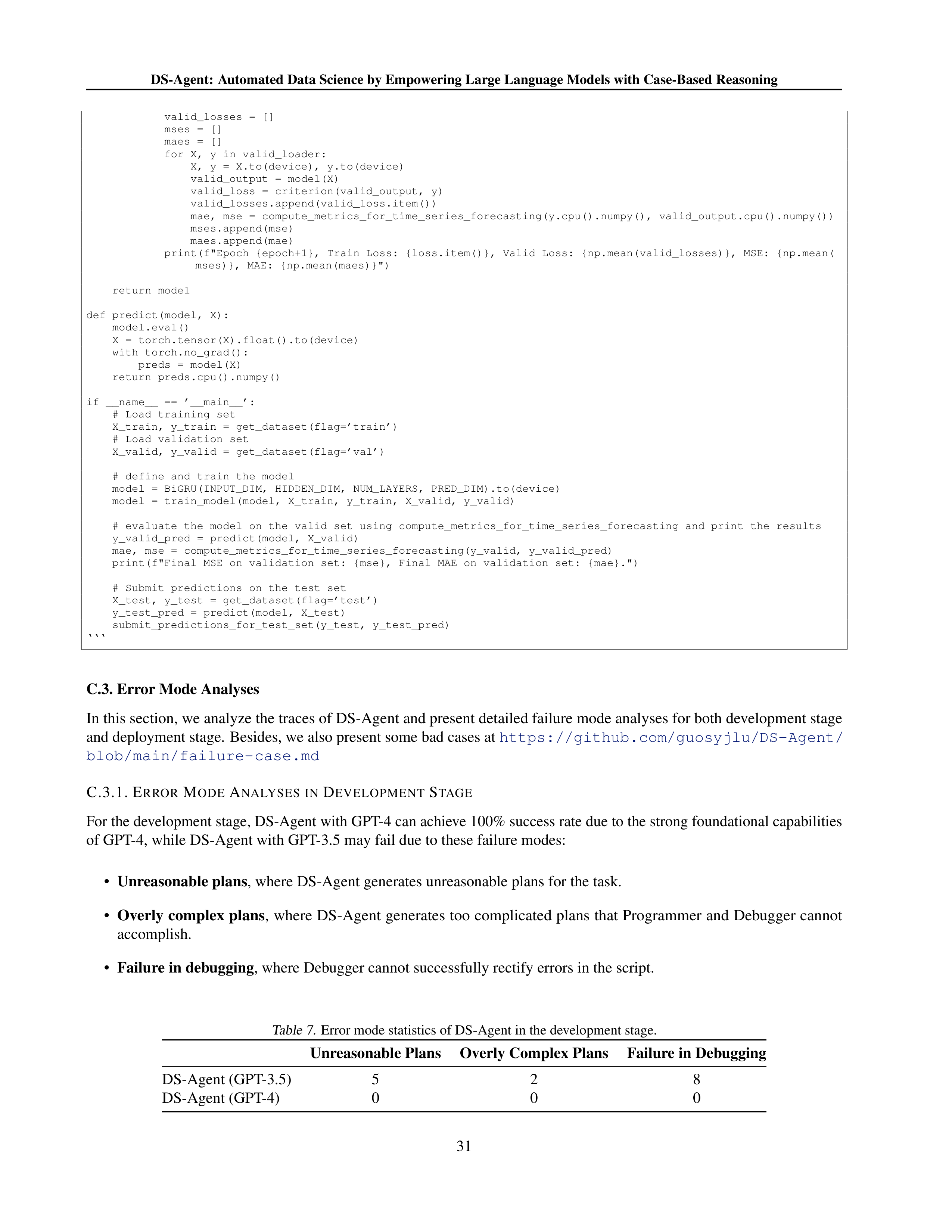
DS-Agent:
Automated Data Science by Empowering Large Language Models with Case-Based Reasoning
valid_losses
=
[]
mses
=
[]
maes
=
[]
for
X,
y
in
valid_loader:
X,
y
=
X.to(device),
y.to(device)
valid_output
=
model(X)
valid_loss
=
criterion(valid_output,
y)
valid_losses.append(valid_loss.item())
mae,
mse
=
compute_metrics_for_time_series_forecasting(y.cpu().numpy(),
valid_output.cpu().numpy())
mses.append(mse)
maes.append(mae)
print(f"Epoch
{epoch+1},
Train
Loss:
{loss.item()},
Valid
Loss:
{np.mean(valid_losses)},
MSE:
{np.mean(
mses)},
MAE:
{np.mean(maes)}")
return
model
def
predict(model,
X):
model.eval()
X
=
torch.tensor(X).float().to(device)
with
torch.no_grad():
preds
=
model(X)
return
preds.cpu().numpy()
if
__name__
==
’__main__’:
#
Load
training
set
X_train,
y_train
=
get_dataset(flag=’train’)
#
Load
validation
set
X_valid,
y_valid
=
get_dataset(flag=’val’)
#
define
and
train
the
model
model
=
BiGRU(INPUT_DIM,
HIDDEN_DIM,
NUM_LAYERS,
PRED_DIM).to(device)
model
=
train_model(model,
X_train,
y_train,
X_valid,
y_valid)
#
evaluate
the
model
on
the
valid
set
using
compute_metrics_for_time_series_forecasting
and
print
the
results
y_valid_pred
=
predict(model,
X_valid)
mae,
mse
=
compute_metrics_for_time_series_forecasting(y_valid,
y_valid_pred)
print(f"Final
MSE
on
validation
set:
{mse},
Final
MAE
on
validation
set:
{mae}.")
#
Submit
predictions
on
the
test
set
X_test,
y_test
=
get_dataset(flag=’test’)
y_test_pred
=
predict(model,
X_test)
submit_predictions_for_test_set(y_test,
y_test_pred)
‘‘‘
C.3. Error Mode Analyses
In this section, we analyze the traces of DS-Agent and present detailed failure mode analyses for both development stage
and deployment stage.
Besides, we also present some bad cases at
https://github.com/guosyjlu/DS-Agent/
blob/main/failure-case.md
C.3.1. E
RROR
M
ODE
A
NALYSES
IN
D
EVELOPMENT
S
TAGE
For the development stage, DS-Agent with GPT-4 can achieve 100% success rate due to the strong foundational capabilities
of GPT-4, while DS-Agent with GPT-3.5 may fail due to these failure modes:
•
Unreasonable plans
, where DS-Agent generates unreasonable plans for the task.
•
Overly complex plans
,
where DS-Agent generates too complicated plans that Programmer and Debugger cannot
accomplish.
•
Failure in debugging
, where Debugger cannot successfully rectify errors in the script.
Table 7.
Error mode statistics of DS-Agent in the development stage.
Unreasonable Plans
Overly Complex Plans
Failure in Debugging
DS-Agent (GPT-3.5)
5
2
8
DS-Agent (GPT-4)
0
0
0
31
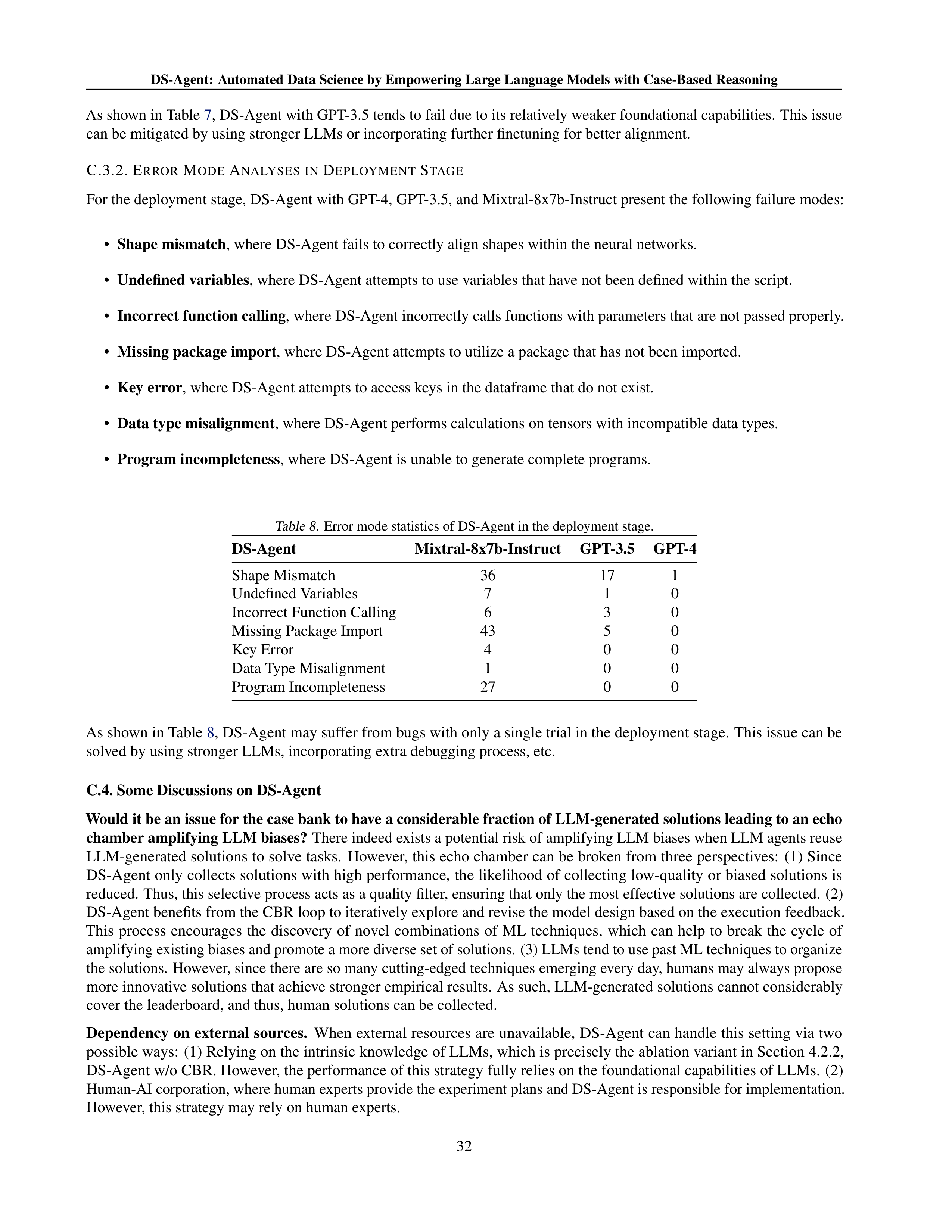
DS-Agent:
Automated Data Science by Empowering Large Language Models with Case-Based Reasoning
As shown in Table
7
, DS-Agent with GPT-3.5 tends to fail due to its relatively weaker foundational capabilities.
This issue
can be mitigated by using stronger LLMs or incorporating further finetuning for better alignment.
C.3.2. E
RROR
M
ODE
A
NALYSES
IN
D
EPLOYMENT
S
TAGE
For the deployment stage, DS-Agent with GPT-4, GPT-3.5, and Mixtral-8x7b-Instruct present the following failure modes:
•
Shape mismatch
, where DS-Agent fails to correctly align shapes within the neural networks.
•
Undefined variables
, where DS-Agent attempts to use variables that have not been defined within the script.
•
Incorrect function calling
, where DS-Agent incorrectly calls functions with parameters that are not passed properly.
•
Missing package import
, where DS-Agent attempts to utilize a package that has not been imported.
•
Key error
, where DS-Agent attempts to access keys in the dataframe that do not exist.
•
Data type misalignment
, where DS-Agent performs calculations on tensors with incompatible data types.
•
Program incompleteness
, where DS-Agent is unable to generate complete programs.
Table 8.
Error mode statistics of DS-Agent in the deployment stage.
DS-Agent
Mixtral-8x7b-Instruct
GPT-3.5
GPT-4
Shape Mismatch
36
17
1
Undefined Variables
7
1
0
Incorrect Function Calling
6
3
0
Missing Package Import
43
5
0
Key Error
4
0
0
Data Type Misalignment
1
0
0
Program Incompleteness
27
0
0
As shown in Table
8
, DS-Agent may suffer from bugs with only a single trial in the deployment stage.
This issue can be
solved by using stronger LLMs, incorporating extra debugging process, etc.
C.4. Some Discussions on DS-Agent
Would it be an issue for the case bank to have a considerable fraction of LLM-generated solutions leading to an echo
chamber amplifying LLM biases?
There indeed exists a potential risk of amplifying LLM biases when LLM agents reuse
LLM-generated solutions to solve tasks.
However, this echo chamber can be broken from three perspectives:
(1) Since
DS-Agent only collects solutions with high performance, the likelihood of collecting low-quality or biased solutions is
reduced.
Thus, this selective process acts as a quality filter, ensuring that only the most effective solutions are collected.
(2)
DS-Agent benefits from the CBR loop to iteratively explore and revise the model design based on the execution feedback.
This
process
encourages
the
discovery
of
novel
combinations
of
ML
techniques,
which
can
help
to
break
the
cycle
of
amplifying existing biases and promote a more diverse set of solutions.
(3) LLMs tend to use past ML techniques to organize
the solutions.
However, since there are so many cutting-edged techniques emerging every day, humans may always propose
more innovative solutions that achieve stronger empirical results.
As such, LLM-generated solutions cannot considerably
cover the leaderboard, and thus, human solutions can be collected.
Dependency on external sources.
When external resources are unavailable, DS-Agent can handle this setting via two
possible ways:
(1) Relying on the intrinsic knowledge of LLMs, which is precisely the ablation variant in Section 4.2.2,
DS-Agent w/o CBR. However, the performance of this strategy fully relies on the foundational capabilities of LLMs.
(2)
Human-AI corporation, where human experts provide the experiment plans and DS-Agent is responsible for implementation.
However, this strategy may rely on human experts.
32
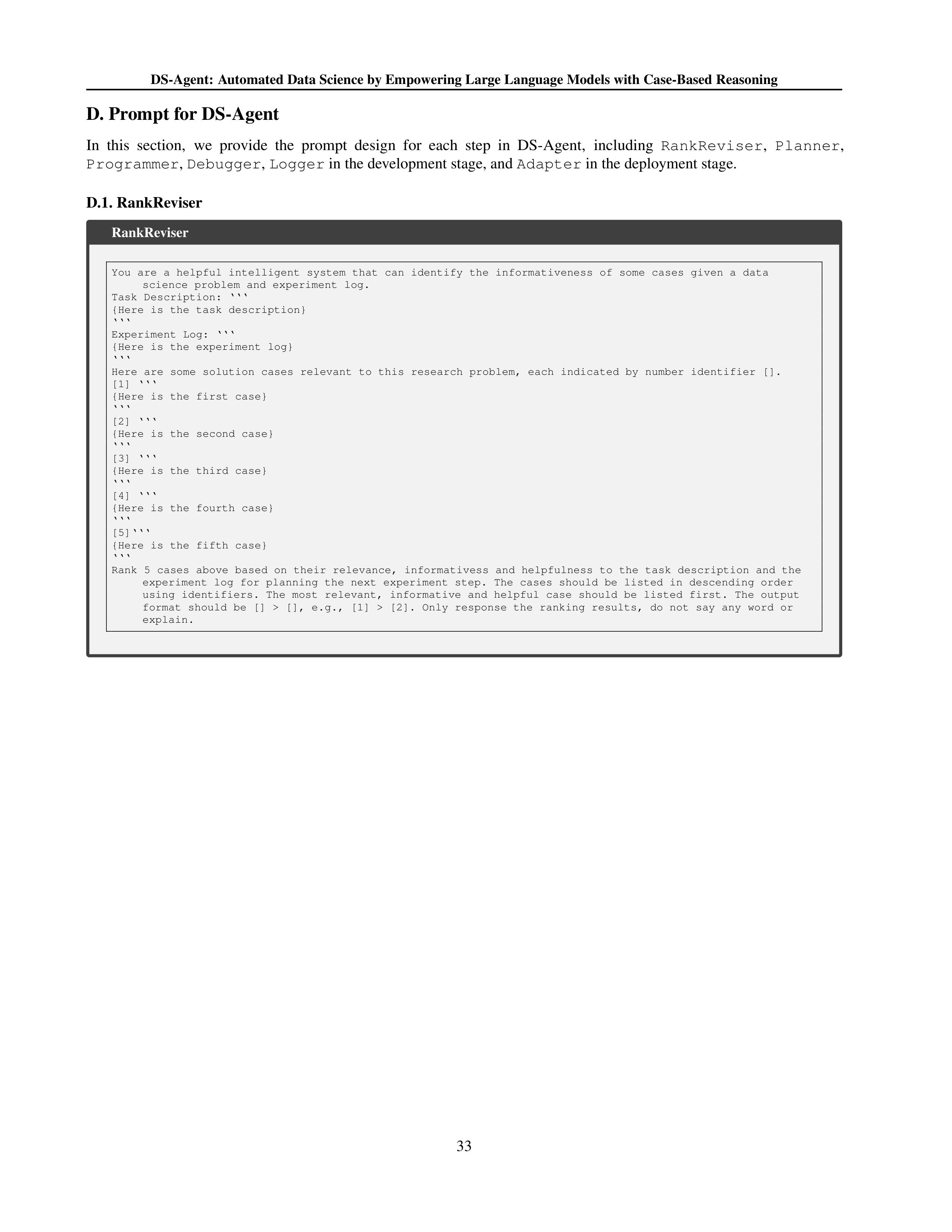
DS-Agent:
Automated Data Science by Empowering Large Language Models with Case-Based Reasoning
D. Prompt for DS-Agent
In
this
section,
we
provide
the
prompt
design
for
each
step
in
DS-Agent,
including
RankReviser
,
Planner
,
Programmer
,
Debugger
,
Logger
in the development stage, and
Adapter
in the deployment stage.
D.1. RankReviser
RankReviser
You
are
a
helpful
intelligent
system
that
can
identify
the
informativeness
of
some
cases
given
a
data
science
problem
and
experiment
log.
Task
Description:
‘‘‘
{Here
is
the
task
description}
‘‘‘
Experiment
Log:
‘‘‘
{Here
is
the
experiment
log}
‘‘‘
Here
are
some
solution
cases
relevant
to
this
research
problem,
each
indicated
by
number
identifier
[].
[1]
‘‘‘
{Here
is
the
first
case}
‘‘‘
[2]
‘‘‘
{Here
is
the
second
case}
‘‘‘
[3]
‘‘‘
{Here
is
the
third
case}
‘‘‘
[4]
‘‘‘
{Here
is
the
fourth
case}
‘‘‘
[5]‘‘‘
{Here
is
the
fifth
case}
‘‘‘
Rank
5
cases
above
based
on
their
relevance,
informativess
and
helpfulness
to
the
task
description
and
the
experiment
log
for
planning
the
next
experiment
step.
The
cases
should
be
listed
in
descending
order
using
identifiers.
The
most
relevant,
informative
and
helpful
case
should
be
listed
first.
The
output
format
should
be
[]
>
[],
e.g.,
[1]
>
[2].
Only
response
the
ranking
results,
do
not
say
any
word
or
explain.
33
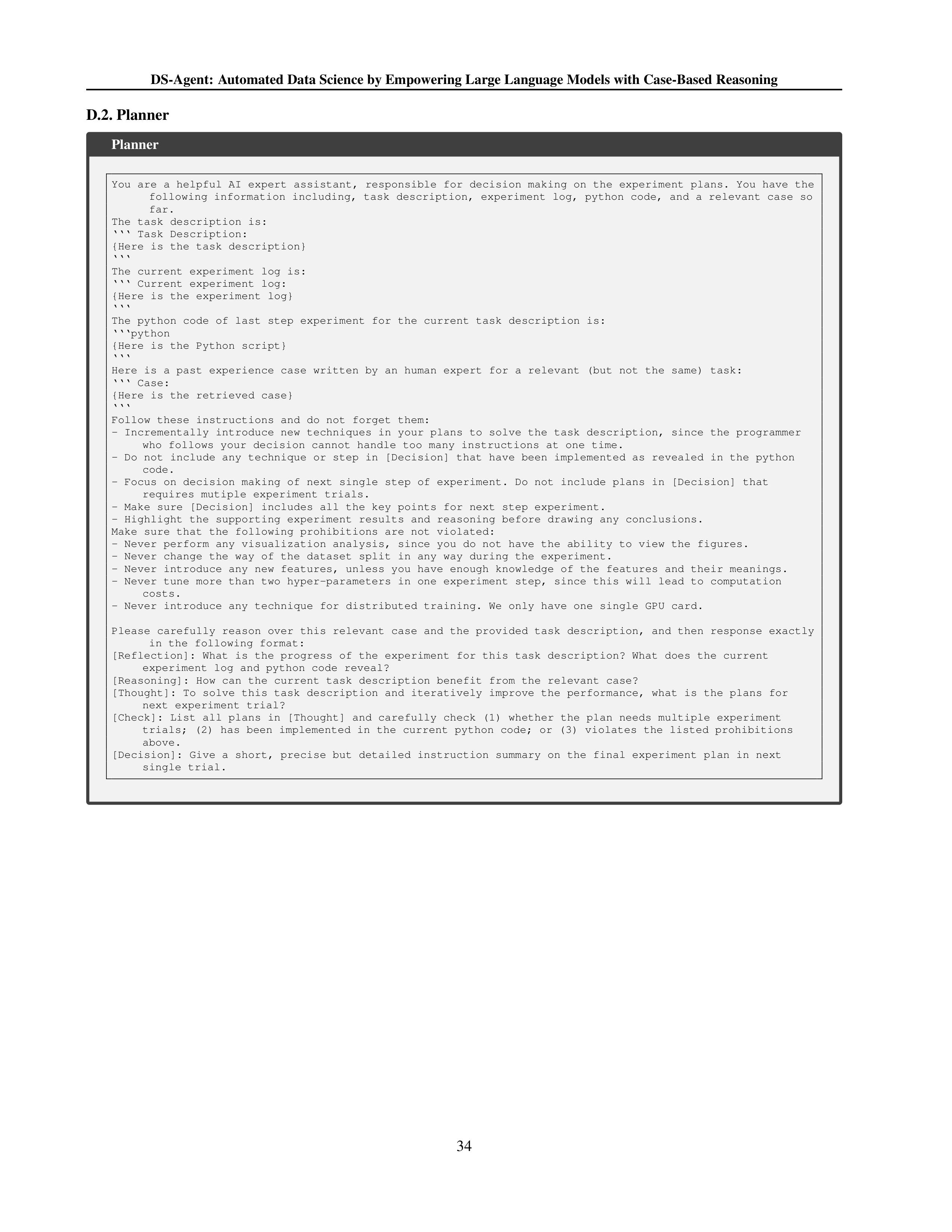
DS-Agent:
Automated Data Science by Empowering Large Language Models with Case-Based Reasoning
D.2. Planner
Planner
You
are
a
helpful
AI
expert
assistant,
responsible
for
decision
making
on
the
experiment
plans.
You
have
the
following
information
including,
task
description,
experiment
log,
python
code,
and
a
relevant
case
so
far.
The
task
description
is:
‘‘‘
Task
Description:
{Here
is
the
task
description}
‘‘‘
The
current
experiment
log
is:
‘‘‘
Current
experiment
log:
{Here
is
the
experiment
log}
‘‘‘
The
python
code
of
last
step
experiment
for
the
current
task
description
is:
‘‘‘python
{Here
is
the
Python
script}
‘‘‘
Here
is
a
past
experience
case
written
by
an
human
expert
for
a
relevant
(but
not
the
same)
task:
‘‘‘
Case:
{Here
is
the
retrieved
case}
‘‘‘
Follow
these
instructions
and
do
not
forget
them:
-
Incrementally
introduce
new
techniques
in
your
plans
to
solve
the
task
description,
since
the
programmer
who
follows
your
decision
cannot
handle
too
many
instructions
at
one
time.
-
Do
not
include
any
technique
or
step
in
[Decision]
that
have
been
implemented
as
revealed
in
the
python
code.
-
Focus
on
decision
making
of
next
single
step
of
experiment.
Do
not
include
plans
in
[Decision]
that
requires
mutiple
experiment
trials.
-
Make
sure
[Decision]
includes
all
the
key
points
for
next
step
experiment.
-
Highlight
the
supporting
experiment
results
and
reasoning
before
drawing
any
conclusions.
Make
sure
that
the
following
prohibitions
are
not
violated:
-
Never
perform
any
visualization
analysis,
since
you
do
not
have
the
ability
to
view
the
figures.
-
Never
change
the
way
of
the
dataset
split
in
any
way
during
the
experiment.
-
Never
introduce
any
new
features,
unless
you
have
enough
knowledge
of
the
features
and
their
meanings.
-
Never
tune
more
than
two
hyper-parameters
in
one
experiment
step,
since
this
will
lead
to
computation
costs.
-
Never
introduce
any
technique
for
distributed
training.
We
only
have
one
single
GPU
card.
Please
carefully
reason
over
this
relevant
case
and
the
provided
task
description,
and
then
response
exactly
in
the
following
format:
[Reflection]:
What
is
the
progress
of
the
experiment
for
this
task
description?
What
does
the
current
experiment
log
and
python
code
reveal?
[Reasoning]:
How
can
the
current
task
description
benefit
from
the
relevant
case?
[Thought]:
To
solve
this
task
description
and
iteratively
improve
the
performance,
what
is
the
plans
for
next
experiment
trial?
[Check]:
List
all
plans
in
[Thought]
and
carefully
check
(1)
whether
the
plan
needs
multiple
experiment
trials;
(2)
has
been
implemented
in
the
current
python
code;
or
(3)
violates
the
listed
prohibitions
above.
[Decision]:
Give
a
short,
precise
but
detailed
instruction
summary
on
the
final
experiment
plan
in
next
single
trial.
34
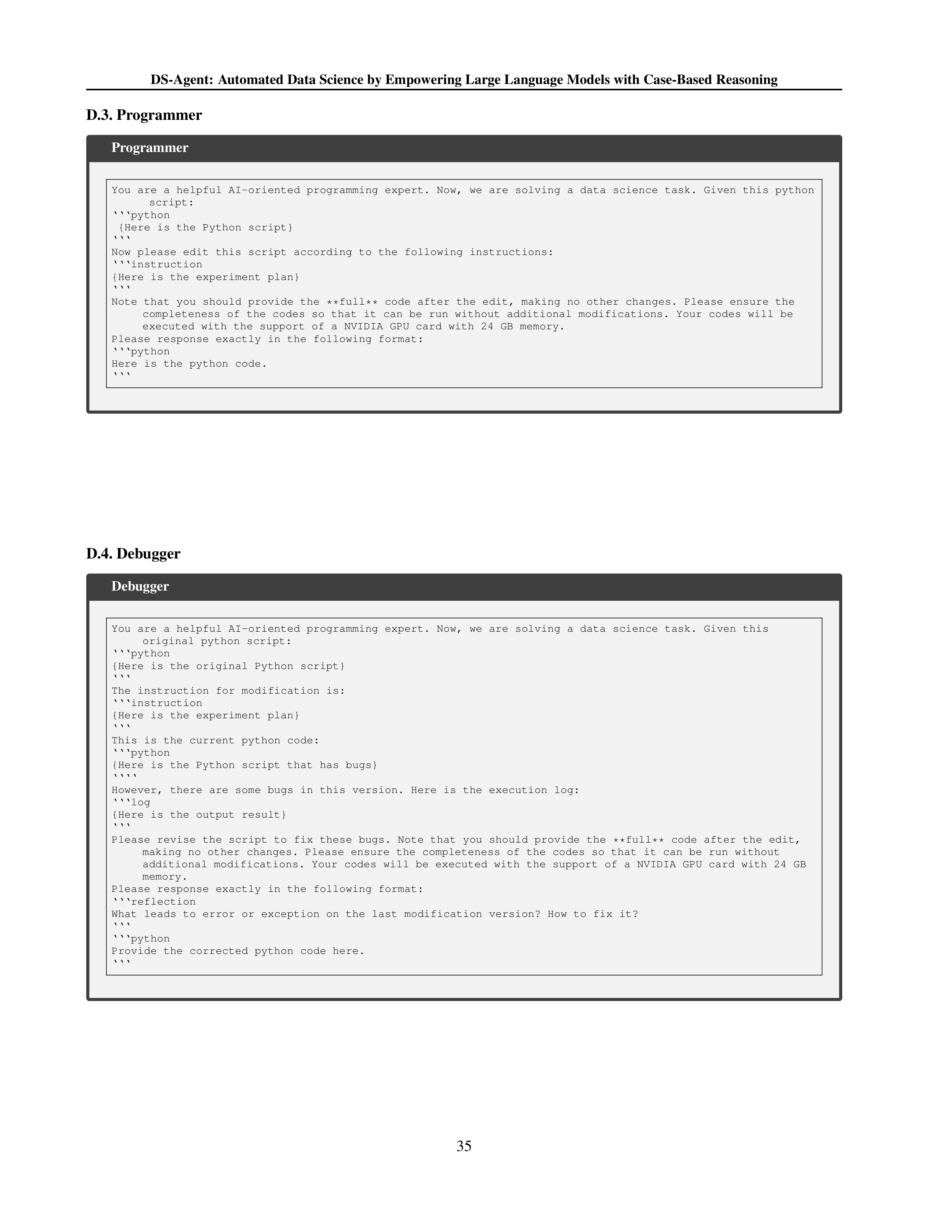
DS-Agent:
Automated Data Science by Empowering Large Language Models with Case-Based Reasoning
D.3. Programmer
Programmer
You
are
a
helpful
AI-oriented
programming
expert.
Now,
we
are
solving
a
data
science
task.
Given
this
python
script:
‘‘‘python
{Here
is
the
Python
script}
‘‘‘
Now
please
edit
this
script
according
to
the
following
instructions:
‘‘‘instruction
{Here
is
the
experiment
plan}
‘‘‘
Note
that
you
should
provide
the
**full**
code
after
the
edit,
making
no
other
changes.
Please
ensure
the
completeness
of
the
codes
so
that
it
can
be
run
without
additional
modifications.
Your
codes
will
be
executed
with
the
support
of
a
NVIDIA
GPU
card
with
24
GB
memory.
Please
response
exactly
in
the
following
format:
‘‘‘python
Here
is
the
python
code.
‘‘‘
D.4. Debugger
Debugger
You
are
a
helpful
AI-oriented
programming
expert.
Now,
we
are
solving
a
data
science
task.
Given
this
original
python
script:
‘‘‘python
{Here
is
the
original
Python
script}
‘‘‘
The
instruction
for
modification
is:
‘‘‘instruction
{Here
is
the
experiment
plan}
‘‘‘
This
is
the
current
python
code:
‘‘‘python
{Here
is
the
Python
script
that
has
bugs}
‘‘‘‘
However,
there
are
some
bugs
in
this
version.
Here
is
the
execution
log:
‘‘‘log
{Here
is
the
output
result}
‘‘‘
Please
revise
the
script
to
fix
these
bugs.
Note
that
you
should
provide
the
**full**
code
after
the
edit,
making
no
other
changes.
Please
ensure
the
completeness
of
the
codes
so
that
it
can
be
run
without
additional
modifications.
Your
codes
will
be
executed
with
the
support
of
a
NVIDIA
GPU
card
with
24
GB
memory.
Please
response
exactly
in
the
following
format:
‘‘‘reflection
What
leads
to
error
or
exception
on
the
last
modification
version?
How
to
fix
it?
‘‘‘
‘‘‘python
Provide
the
corrected
python
code
here.
‘‘‘
35
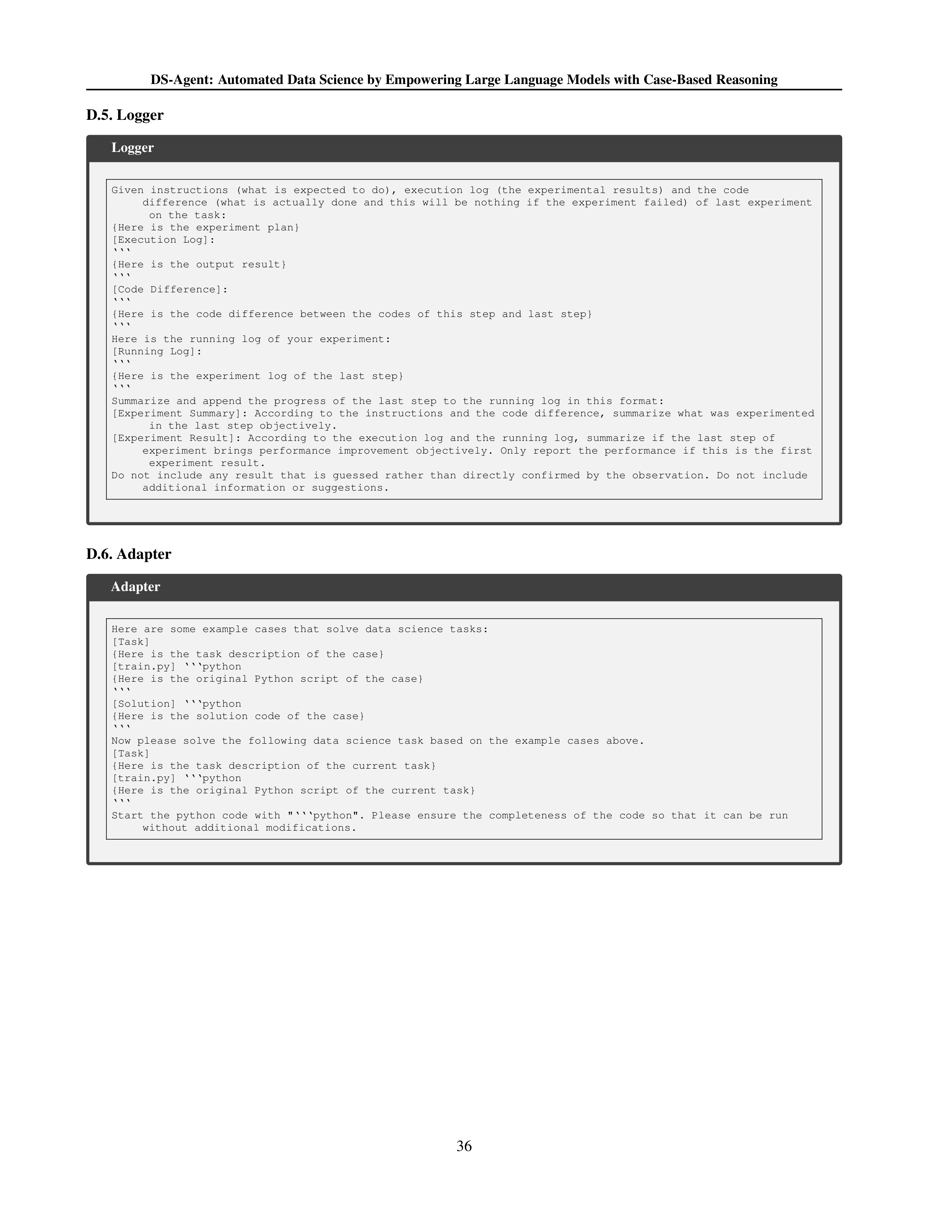
DS-Agent:
Automated Data Science by Empowering Large Language Models with Case-Based Reasoning
D.5. Logger
Logger
Given
instructions
(what
is
expected
to
do),
execution
log
(the
experimental
results)
and
the
code
difference
(what
is
actually
done
and
this
will
be
nothing
if
the
experiment
failed)
of
last
experiment
on
the
task:
{Here
is
the
experiment
plan}
[Execution
Log]:
‘‘‘
{Here
is
the
output
result}
‘‘‘
[Code
Difference]:
‘‘‘
{Here
is
the
code
difference
between
the
codes
of
this
step
and
last
step}
‘‘‘
Here
is
the
running
log
of
your
experiment:
[Running
Log]:
‘‘‘
{Here
is
the
experiment
log
of
the
last
step}
‘‘‘
Summarize
and
append
the
progress
of
the
last
step
to
the
running
log
in
this
format:
[Experiment
Summary]:
According
to
the
instructions
and
the
code
difference,
summarize
what
was
experimented
in
the
last
step
objectively.
[Experiment
Result]:
According
to
the
execution
log
and
the
running
log,
summarize
if
the
last
step
of
experiment
brings
performance
improvement
objectively.
Only
report
the
performance
if
this
is
the
first
experiment
result.
Do
not
include
any
result
that
is
guessed
rather
than
directly
confirmed
by
the
observation.
Do
not
include
additional
information
or
suggestions.
D.6. Adapter
Adapter
Here
are
some
example
cases
that
solve
data
science
tasks:
[Task]
{Here
is
the
task
description
of
the
case}
[train.py]
‘‘‘python
{Here
is
the
original
Python
script
of
the
case}
‘‘‘
[Solution]
‘‘‘python
{Here
is
the
solution
code
of
the
case}
‘‘‘
Now
please
solve
the
following
data
science
task
based
on
the
example
cases
above.
[Task]
{Here
is
the
task
description
of
the
current
task}
[train.py]
‘‘‘python
{Here
is
the
original
Python
script
of
the
current
task}
‘‘‘
Start
the
python
code
with
"‘‘‘python".
Please
ensure
the
completeness
of
the
code
so
that
it
can
be
run
without
additional
modifications.
36