
Reflexion:
Language Agents with
Verbal Reinforcement Learning
Noah Shinn
Northeastern University
noahshinn024@gmail.com
Federico Cassano
Northeastern University
cassano.f@northeastern.edu
Edward Berman
Northeastern University
berman.ed@northeastern.edu
Ashwin Gopinath
Massachusetts Institute of Technology
agopi@mit.edu
Karthik Narasimhan
Princeton University
karthikn@princeton.edu
Shunyu Yao
Princeton University
shunyuy@princeton.edu
Abstract
Large language models (LLMs) have been increasingly used to interact with exter-
nal environments (e.g., games, compilers, APIs) as goal-driven agents.
However,
it remains challenging for these language agents to quickly and efficiently learn
from trial-and-error as traditional reinforcement learning methods require exten-
sive training samples and expensive model fine-tuning.
We propose
Reflexion
, a
novel
framework
to
reinforce
language
agents
not
by
updating
weights,
but
in-
stead through linguistic feedback.
Concretely, Reflexion agents verbally reflect
on
task
feedback
signals,
then
maintain
their
own
reflective
text
in
an
episodic
memory buffer to induce better decision-making in subsequent trials.
Reflexion is
flexible enough to incorporate various types (scalar values or free-form language)
and
sources
(external
or
internally
simulated)
of
feedback
signals,
and
obtains
significant
improvements
over
a baseline
agent
across
diverse
tasks (sequential
decision-making, coding, language reasoning).
For example, Reflexion achieves a
91% pass@1 accuracy on the HumanEval coding benchmark, surpassing the previ-
ous state-of-the-art GPT-4 that achieves 80%. We also conduct ablation and analysis
studies using different feedback signals, feedback incorporation methods, and agent
types, and provide insights into how they affect performance.
We release all code,
demos, and datasets at
https://github.com/noahshinn024/reflexion
.
1
Introduction
Recent
works
such
as
ReAct
[
30
],
SayCan
[
1
],
Toolformer
[
22
],
HuggingGPT
[
23
],
generative
agents [
19
], and WebGPT [
17
] have demonstrated the feasibility of autonomous decision-making
agents that are built on top of a large language model (LLM) core.
These methods use LLMs to
generate
text
and
‘actions‘
that
can
be
used
in
API
calls
and
executed
in
an
environment.
Since
they rely on massive models with an enormous number of parameters, such approaches have been
so far limited to using in-context examples as a way of teaching the agents, since more traditional
optimization schemes like reinforcement learning with gradient descent require substantial amounts
of compute and time.
Preprint.
Under review.
arXiv:2303.11366v4 [cs.AI] 10 Oct 2023
In this paper, we propose an alternative approach called
Reflexion
that uses verbal reinforcement
to
help
agents
learn
from
prior
failings.
Reflexion
converts
binary
or
scalar
feedback
from
the
environment into verbal feedback in the form of a textual summary, which is then added as additional
context
for the
LLM agent
in the
next
episode.
This
self-reflective
feedback acts
as a
‘semantic’
gradient signal by providing the agent with a concrete direction to improve upon, helping it learn
from prior mistakes to perform better on the task.
This is akin to how humans iteratively learn to
accomplish complex tasks in a few-shot manner – by reflecting on their previous failures in order to
form an improved plan of attack for the next attempt.
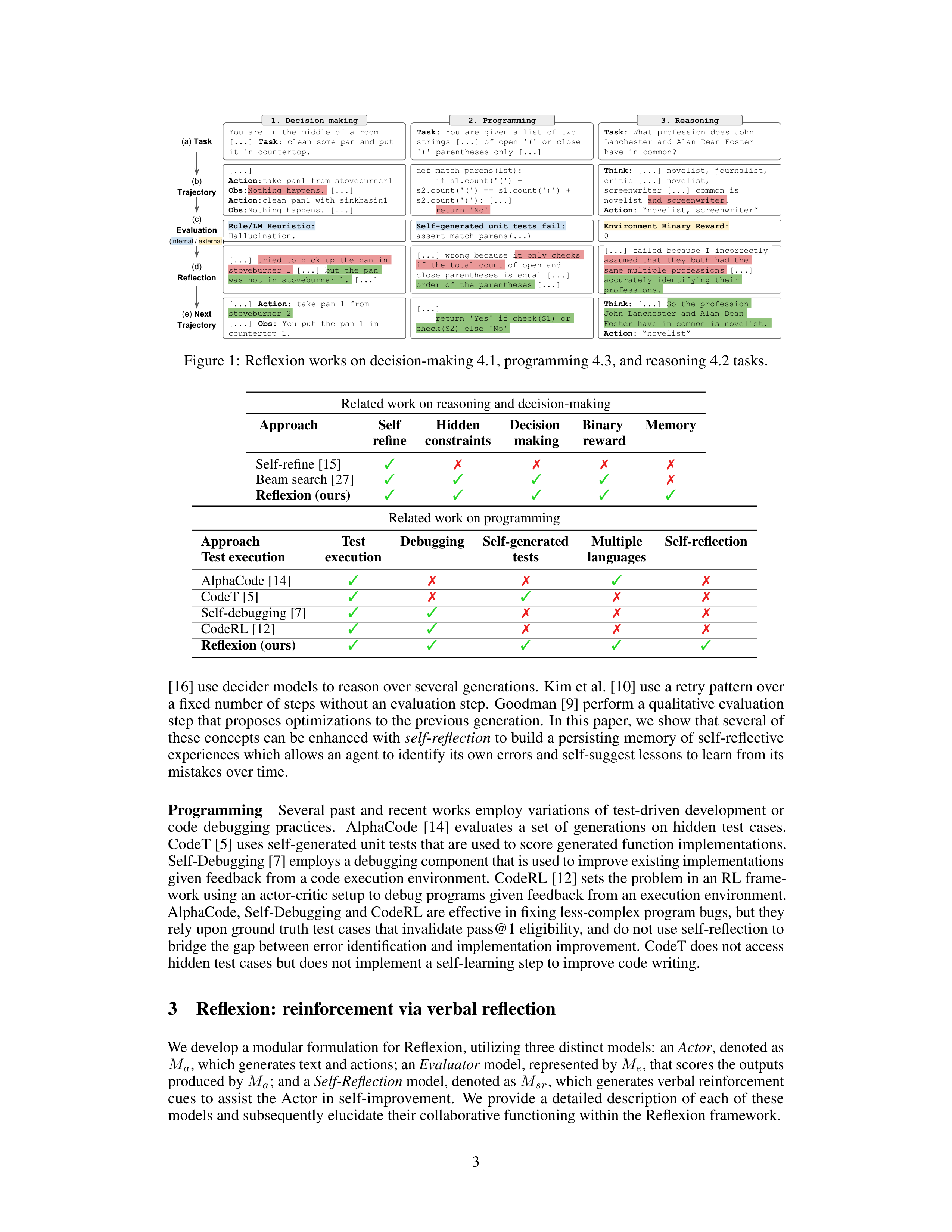
For example, in figure 1, a Reflexion agent
learns to optimize its own behavior to solve decision-making, programming, and reasoning tasks
through trial, error, and self-reflection.
Generating useful reflective feedback is challenging since it requires a good understanding of where
the model made mistakes (i.e.
the credit assignment problem [
25
]) as well as the ability to generate
a
summary
containing
actionable
insights
for
improvement.
We
explore
three
ways
for
doing
this – simple binary environment feedback,
pre-defined heuristics for common failure cases,
and
self-evaluation
such
as
binary
classification
using
LLMs
(decision-making)
or
self-written
unit
tests (programming).
In all implementations, the evaluation signal is amplified to natural language
experience summaries which can be stored in long-term memory.
Reflexion has several advantages compared to more traditional RL approaches like policy or value-
based learning:
1) it is lightweight and doesn’t require finetuning the LLM, 2) it allows for more
nuanced forms of feedback (e.g.
targeted changes in actions), compared to scalar or vector rewards
that are challenging to perform accurate credit assignment with, 3) it allows for a more explicit and
interpretable form of episodic memory over prior experiences, and 4) it provides more explicit hints
for actions in future episodes.
At the same time, it does have the disadvantages of relying on the
power of the LLM’s self-evaluation capabilities (or heuristics) and not having a formal guarantee for
success.
However, as LLM capabilities improve, we only expect this paradigm to get better over time.
We perform experiments on (1) decision-making tasks to test sequential action choices over long
trajectories, (2) reasoning tasks to test knowledge-intensive, single-step generation improvement,
and
(3)
programming
tasks
to
teach
the
agent
to
effectively
use
external
tools
such
as
compilers
and interpreters.
Across all three types of tasks, we observe Reflexion agents are better decision-
makers, reasoners, and programmers.
More concretely, Reflexion agents improve on decision-making
AlfWorld [
24
] tasks over strong baseline approaches by an absolute 22% in 12 iterative learning
steps,
and on reasoning questions in HotPotQA [
28
] by 20%,
and Python programming tasks on
HumanEval [6] by as much as 11%.
To summarize, our contributions are the following:
•
We
propose
Reflexion,
a
new
paradigm
for
‘verbal‘
reinforcement
that
parameterizes
a
policy as an agent’s memory encoding paired with a choice of LLM parameters.
•
We explore this emergent property of
self-reflection
in LLMs and empirically show that
self-reflection is extremely useful to learn complex tasks over a handful of trials.
•
We introduce LeetcodeHardGym, a code-generation RL gym environment consisting of 40
challenging Leetcode questions (‘hard-level‘) in 19 programming languages.
•
We show that Reflexion achieves improvements over strong baselines across several tasks,
and achieves state-of-the-art results on various code generation benchmarks.
2
Related work
Reasoning
and
decision-making
Self-Refine
[
15
]
employs
an
iterative
framework
for
self-
refinement
to
autonomously
improve
generation
through
self-evaluation.
These
self-evaluation
and self-improvement steps are conditioned on given task constraints, such as "How can this genera-
tion be written in a more positive way".
Self-Refine is effective but is limited to single-generation
reasoning tasks.
Pryzant et al.
[21]
performs a similar semantic prompt-writing optimization, but is
also limited to single-generation tasks.
Paul et al.
[20]
fine-tune critic models to provide intermediate
feedback
within
trajectories
to
improve
reasoning
responses.
Xie
et
al.
[27]
use
stochastic
beam
search over actions to perform a more efficient decision-making search strategy which allows the
agent to use foresight advantage due to its self-evaluation component.
Yoran et al.
[31]
and Nair et al.
2
<RXDUHLQWKHPLGGOHRIDURRP
>@
7DVN
FOHDQVRPHSDQDQGSXW
LWLQFRXQWHUWRS
'HFLVLRQPDNLQJ
7DVN
<RXDUHJLYHQDOLVWRIWZR
VWULQJV>@RIRSHQ
RUFORVH
SDUHQWKHVHVRQO\>@
3URJUDPPLQJ
7DVN
:KDWSURIHVVLRQGRHV-RKQ
/DQFKHVWHUDQG$ODQ'HDQ)RVWHU
KDYHLQFRPPRQ"
5HDVRQLQJ
>@
$FWLRQ
WDNHSDQIURPVWRYHEXUQHU
2EV
1RWKLQJKDSSHQV>@
$FWLRQ
FOHDQSDQZLWKVLQNEDVLQ
2EV
1RWKLQJKDSSHQV>@
7KLQN
>@QRYHOLVWMRXUQDOLVW
FULWLF>@QRYHOLVW
VFUHHQZULWHU>@FRPPRQLV
QRYHOLVWDQGVFUHHQZULWHU
$FWLRQ
²QRYHOLVWVFUHHQZULWHU³
GHIPDWFKBSDUHQVOVW
LIVFRXQW
VFRXQW
VFRXQW
VFRXQW
>@
UHWXUQ
1R
6HOIJHQHUDWHGXQLWWHVWVIDLO
DVVHUWPDWFKBSDUHQV
(QYLURQPHQW%LQDU\5HZDUG
5XOH/0+HXULVWLF
+DOOXFLQDWLRQ
>@IDLOHGEHFDXVH,LQFRUUHFWO\
DVVXPHGWKDWWKH\ERWKKDGWKH
VDPHPXOWLSOHSURIHVVLRQV>@
DFFXUDWHO\LGHQWLI\LQJWKHLU
SURIHVVLRQV
>@ZURQJEHFDXVHLWRQO\FKHFNV
LIWKHWRWDOFRXQWRIRSHQDQG
FORVHSDUHQWKHVHVLVHTXDO>@
RUGHURIWKHSDUHQWKHVHV>@
>@WULHGWRSLFNXSWKHSDQLQ
VWRYHEXUQHU>@EXWWKHSDQ
ZDVQRWLQVWRYHEXUQHU>@
>@
UHWXUQ
<HV
LIFKHFN6RU
FKHFN6HOVH
1R
7KLQN
>@6RWKHSURIHVVLRQ
-RKQ/DQFKHVWHUDQG$ODQ'HDQ
)RVWHUKDYHLQFRPPRQLVQRYHOLVW
$FWLRQ
²QRYHOLVW³
>@
$FWLRQ
WDNHSDQIURP
VWRYHEXUQHU
>@
2EV
<RXSXWWKHSDQLQ
FRXQWHUWRS
F
(YDOXDWLRQ
G
5HIOHFWLRQ
H
1H[W
7UDMHFWRU\
E
7UDMHFWRU\
D
7DVN
LQWHUQDOH[WHUQDO
Figure 1:
Reflexion works on decision-making 4.1, programming 4.3, and reasoning 4.2 tasks.
Related work on reasoning and decision-making
Approach
Self
Hidden
Decision
Binary
Memory
refine
constraints
making
reward
Self-refine [15]
✓
✗
✗
✗
✗
Beam search [27]
✓
✓
✓
✓
✗
Reflexion (ours)
✓
✓
✓
✓
✓
Related work on programming
Approach
Test
Debugging
Self-generated
Multiple
Self-reflection
Test execution
execution
tests
languages
AlphaCode [14]
✓
✗
✗
✓
✗
CodeT [5]
✓
✗
✓
✗
✗
Self-debugging [7]
✓
✓
✗
✗
✗
CodeRL [12]
✓
✓
✗
✗
✗
Reflexion (ours)
✓
✓
✓
✓
✓
[16]
use decider models to reason over several generations.
Kim et al.
[10]
use a retry pattern over
a fixed number of steps without an evaluation step.
Goodman
[9]
perform a qualitative evaluation
step that proposes optimizations to the previous generation.
In this paper, we show that several of
these concepts can be enhanced with
self-reflection
to build a persisting memory of self-reflective
experiences which allows an agent to identify its own errors and self-suggest lessons to learn from its
mistakes over time.
Programming
Several
past
and
recent
works
employ
variations
of
test-driven
development
or
code
debugging
practices.
AlphaCode
[
14
]
evaluates
a
set
of
generations
on
hidden
test
cases.
CodeT [
5
] uses self-generated unit tests that are used to score generated function implementations.
Self-Debugging [
7
] employs a debugging component that is used to improve existing implementations
given feedback from a code execution environment.
CodeRL [
12
] sets the problem in an RL frame-
work using an actor-critic setup to debug programs given feedback from an execution environment.
AlphaCode, Self-Debugging and CodeRL are effective in fixing less-complex program bugs, but they
rely upon ground truth test cases that invalidate pass@1 eligibility, and do not use self-reflection to
bridge the gap between error identification and implementation improvement.
CodeT does not access
hidden test cases but does not implement a self-learning step to improve code writing.
3
Reflexion:
reinforcement via verbal reflection
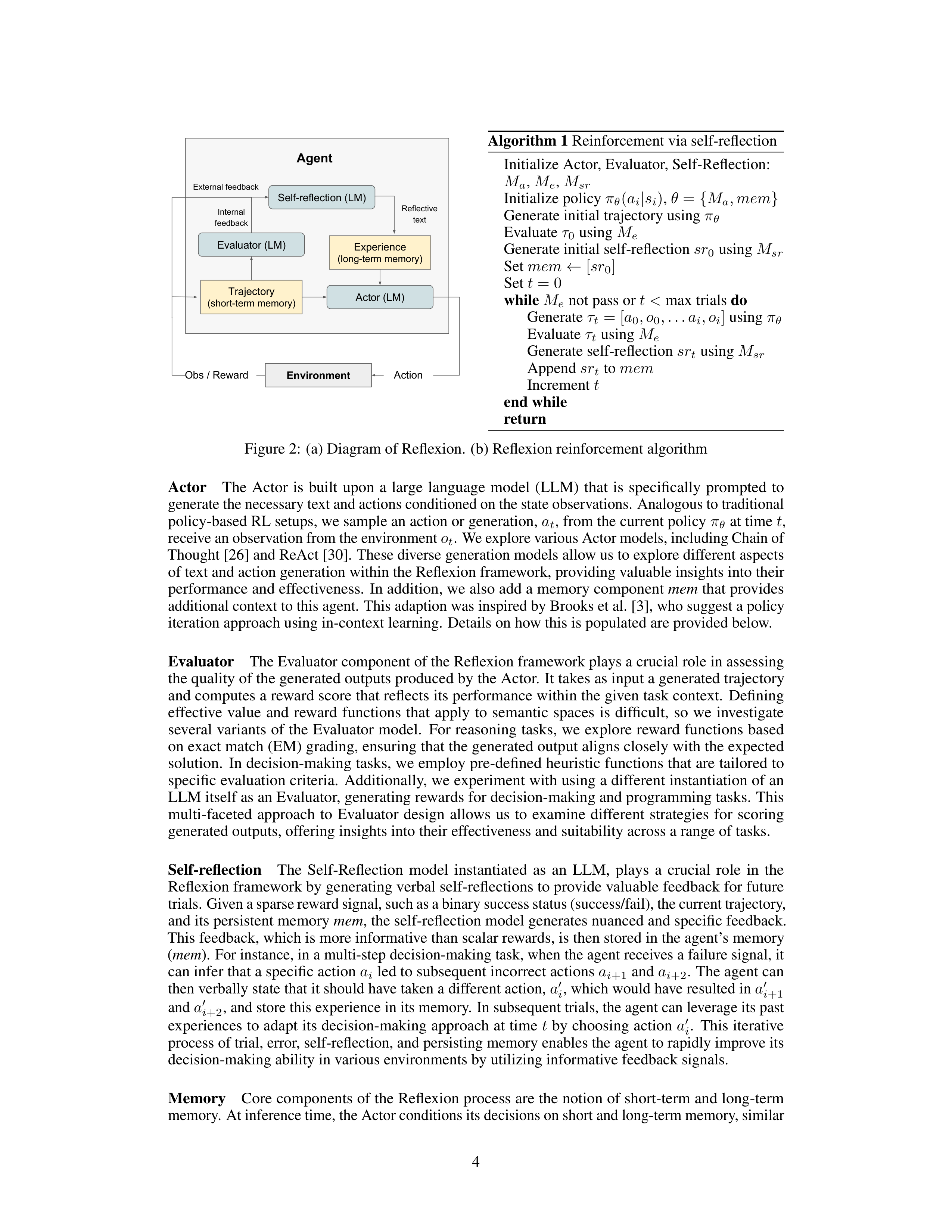
We develop a modular formulation for Reflexion, utilizing three distinct models:
an
Actor
, denoted as
M
a
, which generates text and actions; an
Evaluator
model, represented by
M
e
, that scores the outputs
produced by
M
a
; and a
Self-Reflection
model, denoted as
M
sr
, which generates verbal reinforcement
cues
to
assist
the
Actor
in
self-improvement.
We
provide
a
detailed
description
of
each
of
these
models and subsequently elucidate their collaborative functioning within the Reflexion framework.
3
Action
Obs / Reward
Trajectory
(short-term memory)
Experience
(long-term memory)
Self-reflection (LM)
Agent
Actor (LM)
Environment
Evaluator (LM)
External feedback
Internal
feedback
Reflective
text
Algorithm 1
Reinforcement via self-reflection
Initialize Actor, Evaluator, Self-Reflection:
M
a
,
M
e
,
M
sr
Initialize policy
π
θ
(
a
i
|
s
i
)
,
θ
=
{
M
a
, mem
}
Generate initial trajectory using
π
θ
Evaluate
τ
0
using
M
e
Generate initial self-reflection
sr
0
using
M
sr
Set
mem
←
[
sr
0
]
Set
t
= 0
while
M
e
not pass or
t <
max trials
do
Generate
τ
t
= [
a
0
, o
0
, . . . a
i
, o
i
]
using
π
θ
Evaluate
τ
t
using
M
e
Generate self-reflection
sr
t
using
M
sr
Append
sr
t
to
mem
Increment
t
end while
return
Figure 2:
(a) Diagram of Reflexion.
(b) Reflexion reinforcement algorithm
Actor
The
Actor
is
built
upon
a
large
language
model
(LLM)
that
is
specifically
prompted
to
generate the necessary text and actions conditioned on the state observations.
Analogous to traditional
policy-based RL setups, we sample an action or generation,
a
t
, from the current policy
π
θ
at time
t
,
receive an observation from the environment
o
t
.
We explore various Actor models, including Chain of
Thought [
26
] and ReAct [
30
].
These diverse generation models allow us to explore different aspects
of text and action generation within the Reflexion framework, providing valuable insights into their
performance and effectiveness.
In addition, we also add a memory component
mem
that provides
additional context to this agent.
This adaption was inspired by Brooks et al.
[3]
, who suggest a policy
iteration approach using in-context learning.
Details on how this is populated are provided below.
Evaluator
The Evaluator component of the Reflexion framework plays a crucial role in assessing
the quality of the generated outputs produced by the Actor.
It takes as input a generated trajectory
and computes a reward score that reflects its performance within the given task context.
Defining
effective
value
and
reward
functions
that
apply
to
semantic
spaces
is
difficult,
so
we
investigate
several variants of the Evaluator model.
For reasoning tasks,
we explore reward functions based
on exact match (EM) grading, ensuring that the generated output aligns closely with the expected
solution.
In decision-making tasks, we employ pre-defined heuristic functions that are tailored to
specific evaluation criteria.
Additionally, we experiment with using a different instantiation of an
LLM itself as an Evaluator, generating rewards for decision-making and programming tasks.
This
multi-faceted
approach
to
Evaluator
design
allows
us
to
examine
different
strategies
for
scoring
generated outputs, offering insights into their effectiveness and suitability across a range of tasks.
Self-reflection
The
Self-Reflection
model
instantiated
as
an
LLM,
plays
a
crucial
role
in
the
Reflexion framework by generating verbal self-reflections to provide valuable feedback for future
trials. Given a sparse reward signal, such as a binary success status (success/fail), the current trajectory,
and its persistent memory
mem
, the self-reflection model generates nuanced and specific feedback.
This feedback, which is more informative than scalar rewards, is then stored in the agent’s memory
(
mem
).
For instance, in a multi-step decision-making task, when the agent receives a failure signal, it
can infer that a specific action
a
i
led to subsequent incorrect actions
a
i
+1
and
a
i
+2
.
The agent can
then verbally state that it should have taken a different action,
a
′
i
, which would have resulted in
a
′
i
+1
and
a
′
i
+2
, and store this experience in its memory.
In subsequent trials, the agent can leverage its past
experiences to adapt its decision-making approach at time
t
by choosing action
a
′
i
.
This iterative
process of trial, error, self-reflection, and persisting memory enables the agent to rapidly improve its
decision-making ability in various environments by utilizing informative feedback signals.
Memory
Core components of the Reflexion process are the notion of short-term and long-term
memory.
At inference time, the Actor conditions its decisions on short and long-term memory, similar
4
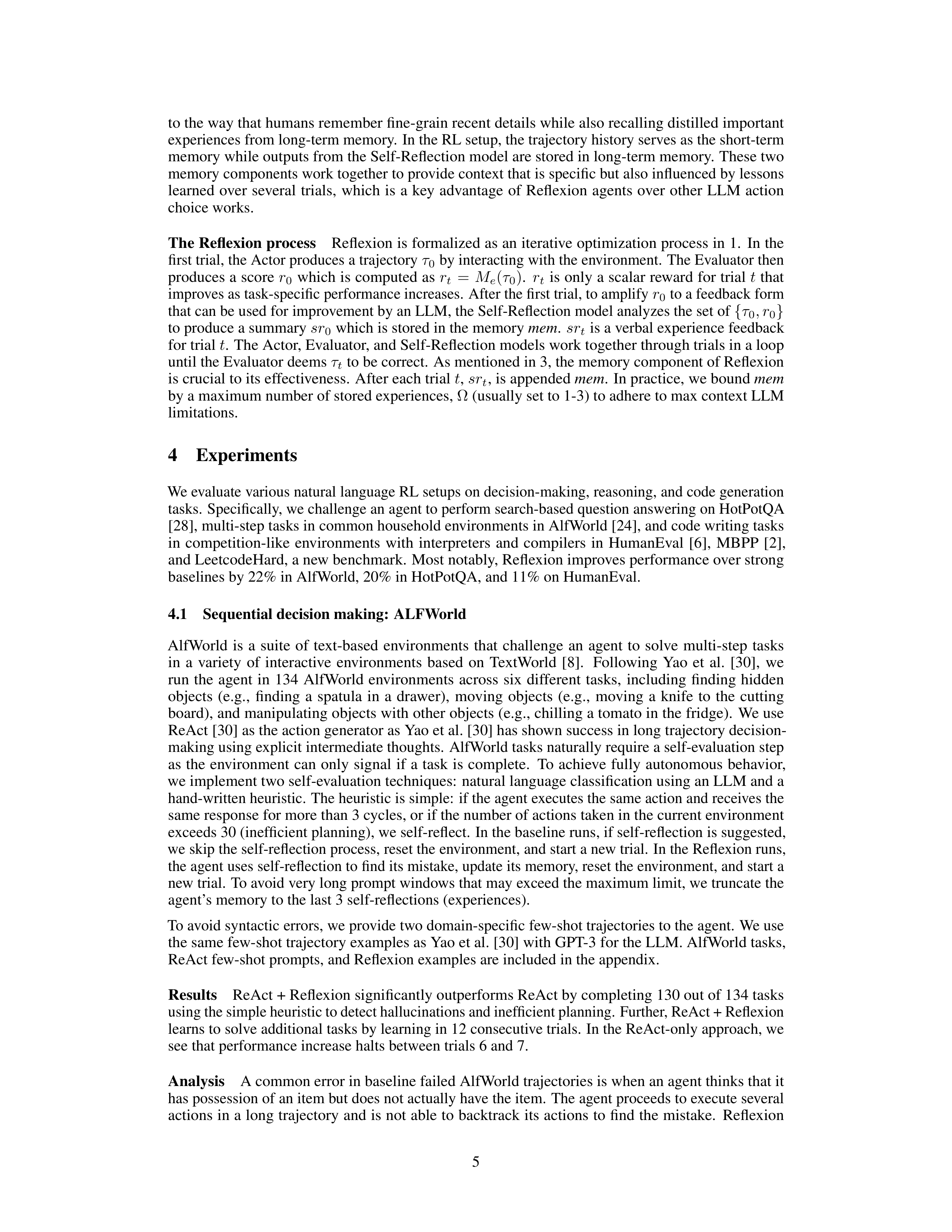
to the way that humans remember fine-grain recent details while also recalling distilled important
experiences from long-term memory.
In the RL setup, the trajectory history serves as the short-term
memory while outputs from the Self-Reflection model are stored in long-term memory.
These two
memory components work together to provide context that is specific but also influenced by lessons
learned
over
several
trials,
which
is
a
key
advantage
of
Reflexion
agents
over
other
LLM
action
choice works.
The Reflexion process
Reflexion is formalized as an iterative optimization process in 1.
In the
first trial, the Actor produces a trajectory
τ
0
by interacting with the environment.
The Evaluator then
produces a score
r
0
which is computed as
r
t
=
M
e
(
τ
0
)
.
r
t
is only a scalar reward for trial
t
that
improves as task-specific performance increases.
After the first trial, to amplify
r
0
to a feedback form
that can be used for improvement by an LLM, the Self-Reflection model analyzes the set of
{
τ
0
, r
0
}
to produce a summary
sr
0
which is stored in the memory
mem
.
sr
t
is a verbal experience feedback
for trial
t
.
The Actor, Evaluator, and Self-Reflection models work together through trials in a loop
until the Evaluator deems
τ
t
to be correct.
As mentioned in 3, the memory component of Reflexion
is crucial to its effectiveness.
After each trial
t
,
sr
t
, is appended
mem
.
In practice, we bound
mem
by a maximum number of stored experiences,
Ω
(usually set to 1-3) to adhere to max context LLM
limitations.
4
Experiments
We evaluate various natural language RL setups on decision-making, reasoning, and code generation
tasks.
Specifically, we challenge an agent to perform search-based question answering on HotPotQA
[28], multi-step tasks in common household environments in AlfWorld [24], and code writing tasks
in
competition-like
environments
with
interpreters
and
compilers
in
HumanEval
[
6
],
MBPP
[
2
],
and LeetcodeHard, a new benchmark.
Most notably, Reflexion improves performance over strong
baselines by 22% in AlfWorld, 20% in HotPotQA, and 11% on HumanEval.
4.1
Sequential decision making:
ALFWorld
AlfWorld
is
a
suite
of
text-based
environments
that
challenge
an
agent
to
solve
multi-step
tasks
in
a
variety
of
interactive
environments
based
on
TextWorld
[
8
].
Following
Yao
et
al.
[30]
,
we
run
the
agent
in
134
AlfWorld
environments
across
six
different
tasks,
including
finding
hidden
objects
(e.g.,
finding
a
spatula
in
a
drawer),
moving
objects
(e.g.,
moving
a
knife
to
the
cutting
board), and manipulating objects with other objects (e.g., chilling a tomato in the fridge).
We use
ReAct [
30
] as the action generator as Yao et al.
[30]
has shown success in long trajectory decision-
making using explicit intermediate thoughts.
AlfWorld tasks naturally require a self-evaluation step
as
the
environment
can
only
signal
if
a
task
is
complete.
To
achieve
fully
autonomous
behavior,
we implement two self-evaluation techniques:
natural language classification using an LLM and a
hand-written heuristic.
The heuristic is simple:
if the agent executes the same action and receives the
same response for more than 3 cycles, or if the number of actions taken in the current environment
exceeds 30 (inefficient planning), we self-reflect.
In the baseline runs, if self-reflection is suggested,
we skip the self-reflection process, reset the environment, and start a new trial.
In the Reflexion runs,
the agent uses self-reflection to find its mistake, update its memory, reset the environment, and start a
new trial.
To avoid very long prompt windows that may exceed the maximum limit, we truncate the
agent’s memory to the last 3 self-reflections (experiences).
To avoid syntactic errors, we provide two domain-specific few-shot trajectories to the agent.
We use
the same few-shot trajectory examples as Yao et al.
[30]
with GPT-3 for the LLM. AlfWorld tasks,
ReAct few-shot prompts, and Reflexion examples are included in the appendix.
Results
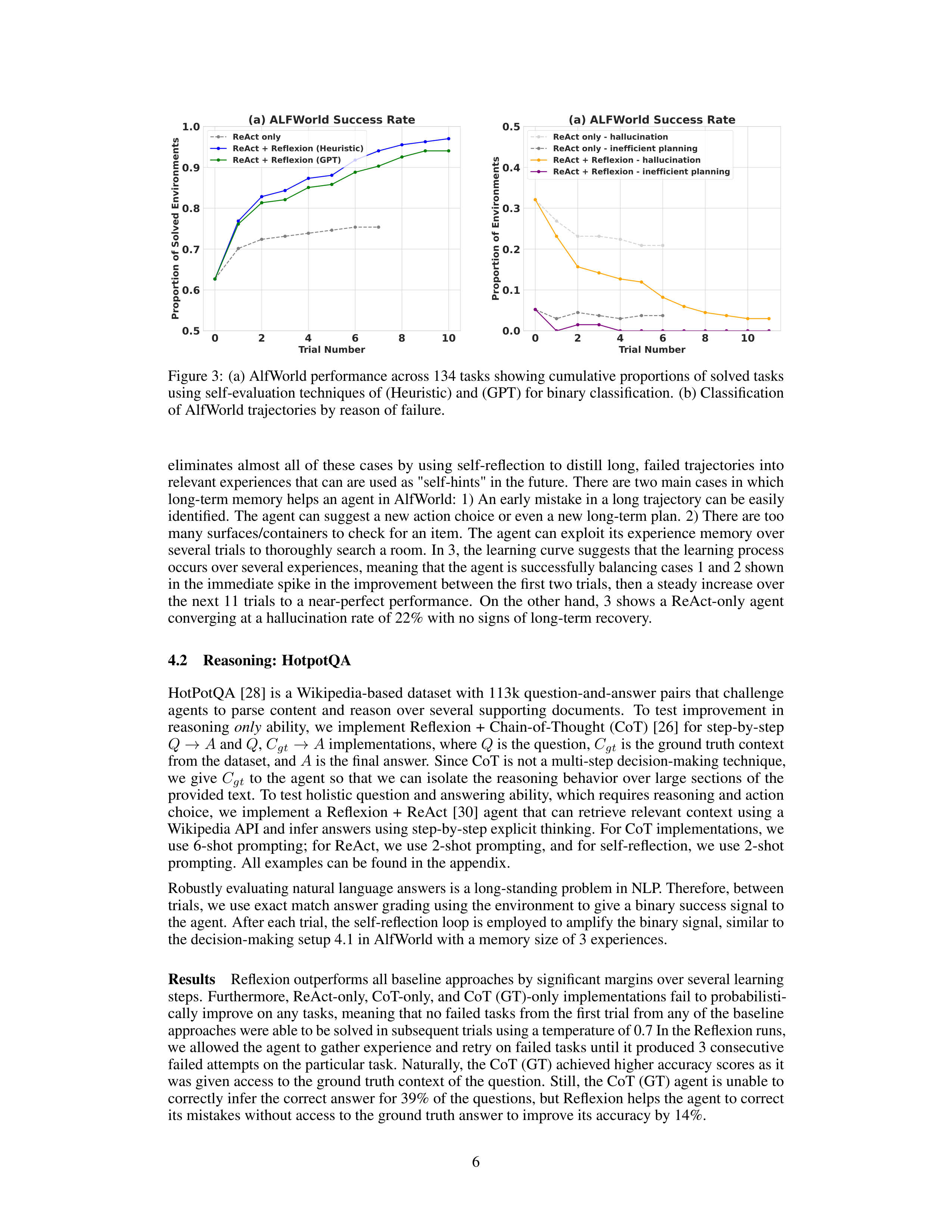
ReAct + Reflexion significantly outperforms ReAct by completing 130 out of 134 tasks
using the simple heuristic to detect hallucinations and inefficient planning.
Further, ReAct + Reflexion
learns to solve additional tasks by learning in 12 consecutive trials.
In the ReAct-only approach, we
see that performance increase halts between trials 6 and 7.
Analysis
A common error in baseline failed AlfWorld trajectories is when an agent thinks that it
has possession of an item but does not actually have the item.
The agent proceeds to execute several
actions in a long trajectory and is not able to backtrack its actions to find the mistake.
Reflexion
5
0
2
4
6
8
10
Trial Number
0.5
0.6
0.7
0.8
0.9
1.0
Proportion of Solved Environments
(a) ALFWorld Success Rate
ReAct only
ReAct + Reflexion (Heuristic)
ReAct + Reflexion (GPT)
0
2
4
6
8
10
Trial Number
0.0
0.1
0.2
0.3
0.4
0.5
Proportion of Environments
(a) ALFWorld Success Rate
ReAct only - hallucination
ReAct only - inefficient planning
ReAct + Reflexion - hallucination
ReAct + Reflexion - inefficient planning
Figure 3:
(a) AlfWorld performance across 134 tasks showing cumulative proportions of solved tasks
using self-evaluation techniques of (Heuristic) and (GPT) for binary classification.
(b) Classification
of AlfWorld trajectories by reason of failure.
eliminates almost all of these cases by using self-reflection to distill long,
failed trajectories into
relevant experiences that can are used as "self-hints" in the future.
There are two main cases in which
long-term memory helps an agent in AlfWorld:
1) An early mistake in a long trajectory can be easily
identified.
The agent can suggest a new action choice or even a new long-term plan.
2) There are too
many surfaces/containers to check for an item.
The agent can exploit its experience memory over
several trials to thoroughly search a room.
In 3, the learning curve suggests that the learning process
occurs over several experiences, meaning that the agent is successfully balancing cases 1 and 2 shown
in the immediate spike in the improvement between the first two trials, then a steady increase over
the next 11 trials to a near-perfect performance.
On the other hand,
3 shows a ReAct-only agent
converging at a hallucination rate of 22% with no signs of long-term recovery.
4.2
Reasoning:
HotpotQA
HotPotQA [
28
] is a Wikipedia-based dataset with 113k question-and-answer pairs that challenge
agents
to
parse
content
and
reason
over
several
supporting
documents.
To
test
improvement
in
reasoning
only
ability,
we
implement
Reflexion
+
Chain-of-Thought
(CoT)
[
26
]
for
step-by-step
Q
→
A
and
Q
,
C
gt
→
A
implementations, where
Q
is the question,
C
gt
is the ground truth context
from the dataset, and
A
is the final answer.
Since CoT is not a multi-step decision-making technique,
we
give
C
gt
to
the
agent
so
that
we
can
isolate
the
reasoning
behavior
over
large
sections
of
the
provided text.
To test holistic question and answering ability, which requires reasoning and action
choice,
we
implement
a
Reflexion
+
ReAct
[
30
]
agent
that
can
retrieve
relevant
context
using
a
Wikipedia API and infer answers using step-by-step explicit thinking.
For CoT implementations, we
use 6-shot prompting; for ReAct, we use 2-shot prompting, and for self-reflection, we use 2-shot
prompting.
All examples can be found in the appendix.
Robustly evaluating natural language answers is a long-standing problem in NLP. Therefore, between
trials, we use exact match answer grading using the environment to give a binary success signal to
the agent.
After each trial, the self-reflection loop is employed to amplify the binary signal, similar to
the decision-making setup 4.1 in AlfWorld with a memory size of 3 experiences.
Results
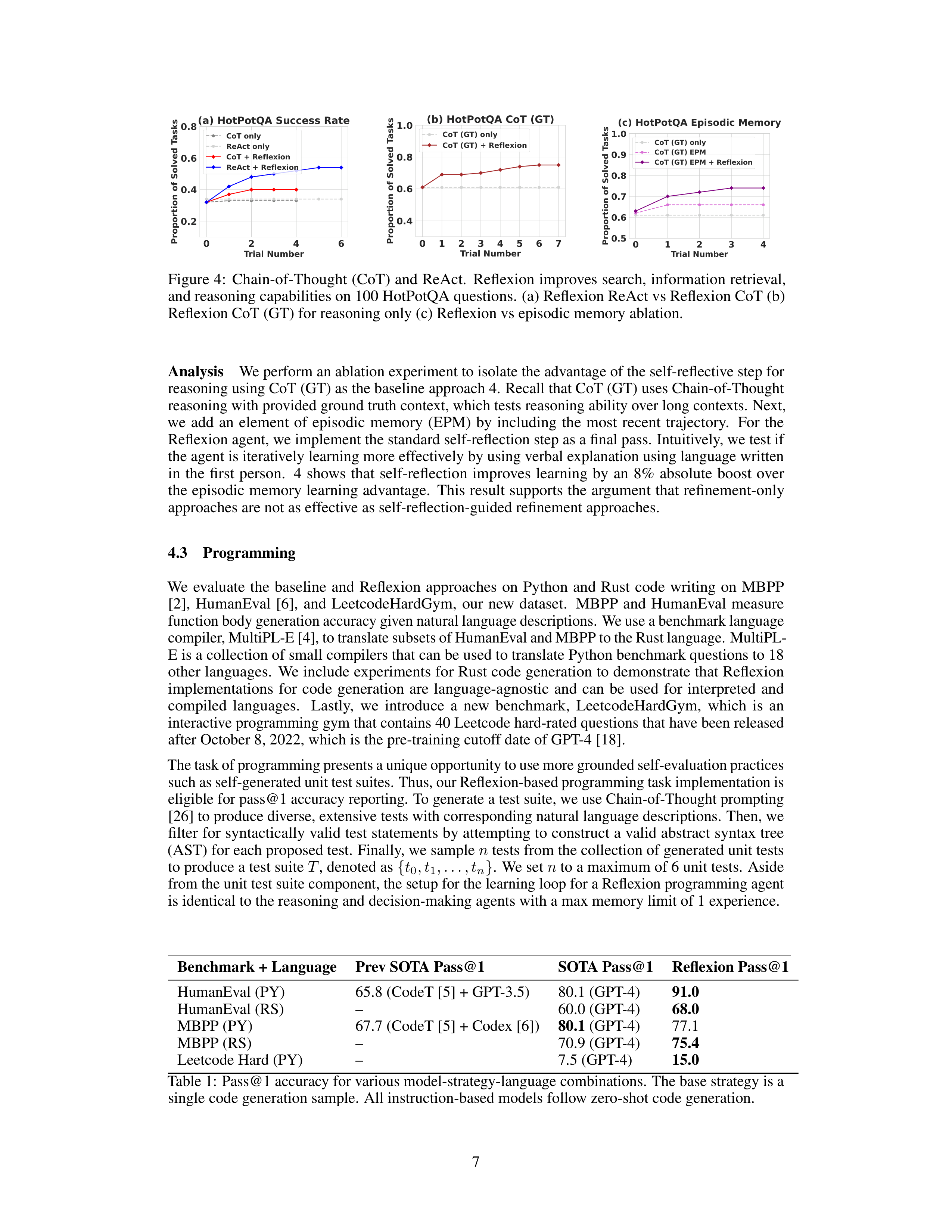
Reflexion outperforms all baseline approaches by significant margins over several learning
steps.
Furthermore, ReAct-only, CoT-only, and CoT (GT)-only implementations fail to probabilisti-
cally improve on any tasks, meaning that no failed tasks from the first trial from any of the baseline
approaches were able to be solved in subsequent trials using a temperature of 0.7 In the Reflexion runs,
we allowed the agent to gather experience and retry on failed tasks until it produced 3 consecutive
failed attempts on the particular task.
Naturally, the CoT (GT) achieved higher accuracy scores as it
was given access to the ground truth context of the question.
Still, the CoT (GT) agent is unable to
correctly infer the correct answer for 39% of the questions, but Reflexion helps the agent to correct
its mistakes without access to the ground truth answer to improve its accuracy by 14%.
6
0
2
4
6
Trial Number
0.2
0.4
0.6
0.8
Proportion of Solved Tasks
(a) HotPotQA Success Rate
CoT only
ReAct only
CoT + Reflexion
ReAct + Reflexion
0
1
2
3
4
5
6
7
Trial Number
0.4
0.6
0.8
1.0
Proportion of Solved Tasks
(b) HotPotQA CoT (GT)
CoT (GT) only
CoT (GT) + Reflexion
0
1
2
3
4
Trial Number
0.5
0.6
0.7
0.8
0.9
1.0
Proportion of Solved Tasks
(c) HotPotQA Episodic Memory
CoT (GT) only
CoT (GT) EPM
CoT (GT) EPM + Reflexion
Figure 4:
Chain-of-Thought (CoT) and ReAct.
Reflexion improves search, information retrieval,
and reasoning capabilities on 100 HotPotQA questions.
(a) Reflexion ReAct vs Reflexion CoT (b)
Reflexion CoT (GT) for reasoning only (c) Reflexion vs episodic memory ablation.
Analysis
We perform an ablation experiment to isolate the advantage of the self-reflective step for
reasoning using CoT (GT) as the baseline approach 4.
Recall that CoT (GT) uses Chain-of-Thought
reasoning with provided ground truth context, which tests reasoning ability over long contexts.
Next,
we
add
an
element
of
episodic
memory
(EPM)
by
including
the
most
recent
trajectory.
For
the
Reflexion agent, we implement the standard self-reflection step as a final pass.
Intuitively, we test if
the agent is iteratively learning more effectively by using verbal explanation using language written
in
the
first
person.
4
shows
that
self-reflection
improves
learning
by
an
8%
absolute
boost
over
the episodic memory learning advantage.
This result supports the argument that refinement-only
approaches are not as effective as self-reflection-guided refinement approaches.
4.3
Programming
We
evaluate
the
baseline
and
Reflexion
approaches
on
Python
and
Rust
code
writing
on
MBPP
[
2
],
HumanEval
[
6
],
and
LeetcodeHardGym,
our
new
dataset.
MBPP
and
HumanEval
measure
function body generation accuracy given natural language descriptions. We use a benchmark language
compiler, MultiPL-E [
4
], to translate subsets of HumanEval and MBPP to the Rust language. MultiPL-
E is a collection of small compilers that can be used to translate Python benchmark questions to 18
other languages.
We include experiments for Rust code generation to demonstrate that Reflexion
implementations
for
code
generation
are
language-agnostic
and
can
be
used
for
interpreted
and
compiled
languages.
Lastly,
we
introduce
a
new
benchmark,
LeetcodeHardGym,
which
is
an
interactive programming gym that contains 40 Leetcode hard-rated questions that have been released
after October 8, 2022, which is the pre-training cutoff date of GPT-4 [18].
The task of programming presents a unique opportunity to use more grounded self-evaluation practices
such as self-generated unit test suites.
Thus, our Reflexion-based programming task implementation is
eligible for pass@1 accuracy reporting.
To generate a test suite, we use Chain-of-Thought prompting
[26] to produce diverse, extensive tests with corresponding natural language descriptions.
Then, we
filter for syntactically valid test statements by attempting to construct a valid abstract syntax tree
(AST) for each proposed test.
Finally, we sample
n
tests from the collection of generated unit tests
to produce a test suite
T
, denoted as
{
t
0
, t
1
, . . . , t
n
}
.
We set
n
to a maximum of 6 unit tests.
Aside
from the unit test suite component, the setup for the learning loop for a Reflexion programming agent
is identical to the reasoning and decision-making agents with a max memory limit of 1 experience.
Benchmark + Language
Prev SOTA Pass@1
SOTA Pass@1
Reflexion Pass@1
HumanEval (PY)
65.8 (CodeT [5] + GPT-3.5)
80.1 (GPT-4)
91.0
HumanEval (RS)
–
60.0 (GPT-4)
68.0
MBPP (PY)
67.7 (CodeT [5] + Codex [6])
80.1
(GPT-4)
77.1
MBPP (RS)
–
70.9 (GPT-4)
75.4
Leetcode Hard (PY)
–
7.5 (GPT-4)
15.0
Table 1:
Pass@1 accuracy for various model-strategy-language combinations.
The base strategy is a
single code generation sample.
All instruction-based models follow zero-shot code generation.
7
Benchmark + Language
Base
Reflexion
TP
FN
FP
TN
HumanEval (PY)
0.80
0.91
0.99
0.40
0.01
0.60
MBPP (PY)
0.80
0.77
0.84
0.59
0.16
0.41
HumanEval (RS)
0.60
0.68
0.87
0.37
0.13
0.63
MBPP (RS)
0.71
0.75
0.84
0.51
0.16
0.49
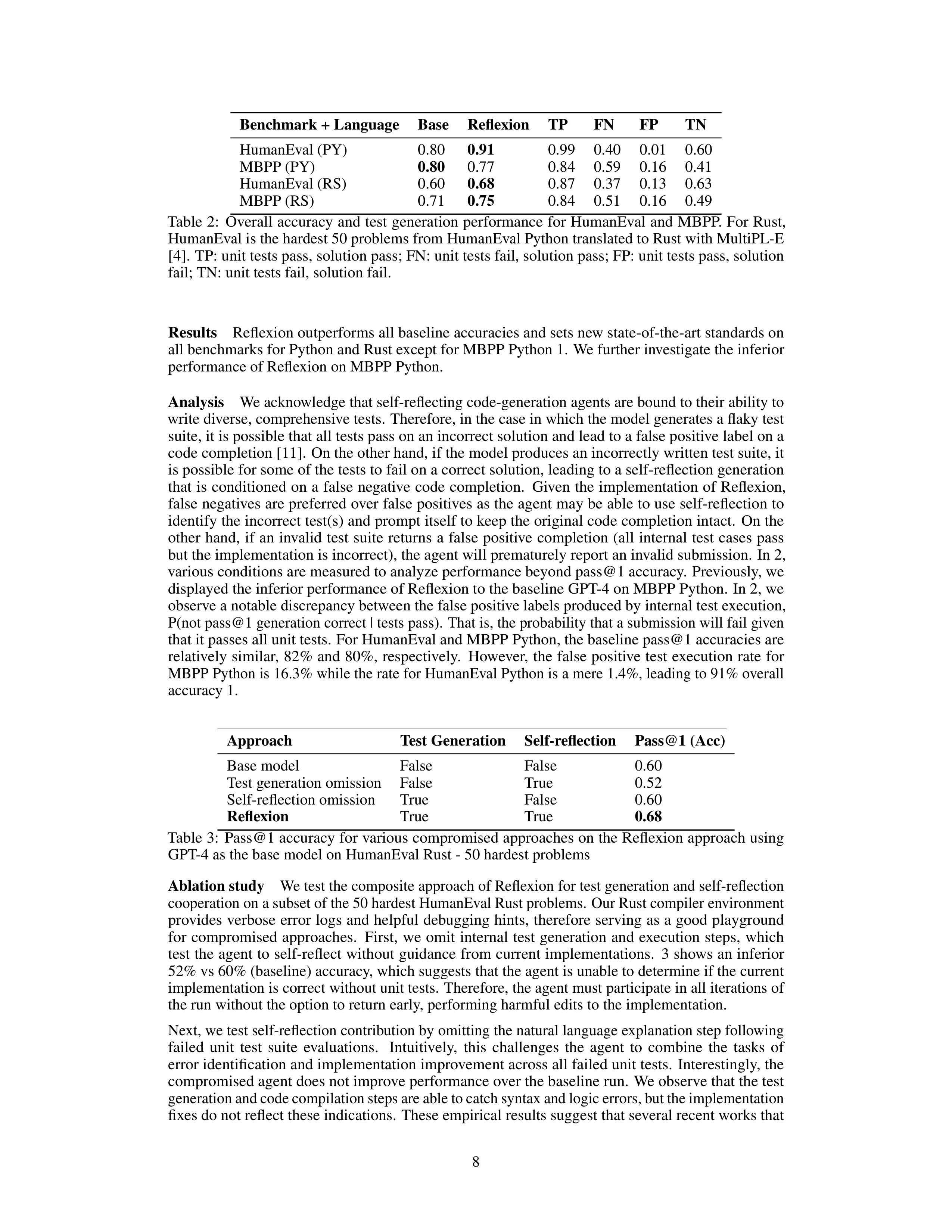
Table 2:
Overall accuracy and test generation performance for HumanEval and MBPP. For Rust,
HumanEval is the hardest 50 problems from HumanEval Python translated to Rust with MultiPL-E
[
4
].
TP: unit tests pass, solution pass; FN: unit tests fail, solution pass; FP: unit tests pass, solution
fail; TN: unit tests fail, solution fail.
Results
Reflexion outperforms all baseline accuracies and sets new state-of-the-art standards on
all benchmarks for Python and Rust except for MBPP Python 1.
We further investigate the inferior
performance of Reflexion on MBPP Python.
Analysis
We acknowledge that self-reflecting code-generation agents are bound to their ability to
write diverse, comprehensive tests.
Therefore, in the case in which the model generates a flaky test
suite, it is possible that all tests pass on an incorrect solution and lead to a false positive label on a
code completion [
11
].
On the other hand, if the model produces an incorrectly written test suite, it
is possible for some of the tests to fail on a correct solution, leading to a self-reflection generation
that
is
conditioned
on
a
false
negative
code
completion.
Given
the
implementation
of
Reflexion,
false negatives are preferred over false positives as the agent may be able to use self-reflection to
identify the incorrect test(s) and prompt itself to keep the original code completion intact.
On the
other
hand,
if
an
invalid
test
suite
returns
a
false
positive
completion
(all
internal
test
cases
pass
but the implementation is incorrect), the agent will prematurely report an invalid submission.
In 2,
various conditions are measured to analyze performance beyond pass@1 accuracy.
Previously, we
displayed the inferior performance of Reflexion to the baseline GPT-4 on MBPP Python.
In 2, we
observe a notable discrepancy between the false positive labels produced by internal test execution,
P(not pass@1 generation correct | tests pass).
That is, the probability that a submission will fail given
that it passes all unit tests.
For HumanEval and MBPP Python, the baseline pass@1 accuracies are
relatively similar,
82% and 80%,
respectively.
However,
the false positive test execution rate for
MBPP Python is 16.3% while the rate for HumanEval Python is a mere 1.4%, leading to 91% overall
accuracy 1.
Approach
Test Generation
Self-reflection
Pass@1 (Acc)
Base model
False
False
0.60
Test generation omission
False
True
0.52
Self-reflection omission
True
False
0.60
Reflexion
True
True
0.68
Table 3:
Pass@1 accuracy for various compromised approaches on the Reflexion approach using
GPT-4 as the base model on HumanEval Rust - 50 hardest problems
Ablation study
We test the composite approach of Reflexion for test generation and self-reflection
cooperation on a subset of the 50 hardest HumanEval Rust problems.
Our Rust compiler environment
provides verbose error logs and helpful debugging hints,
therefore serving as a good playground
for
compromised
approaches.
First,
we
omit
internal
test
generation
and
execution
steps,
which
test the agent to self-reflect without guidance from current implementations.
3 shows an inferior
52% vs 60% (baseline) accuracy, which suggests that the agent is unable to determine if the current
implementation is correct without unit tests.
Therefore, the agent must participate in all iterations of
the run without the option to return early, performing harmful edits to the implementation.
Next, we test self-reflection contribution by omitting the natural language explanation step following
failed
unit
test
suite
evaluations.
Intuitively,
this
challenges
the
agent
to
combine
the
tasks
of
error identification and implementation improvement across all failed unit tests.
Interestingly, the
compromised agent does not improve performance over the baseline run.
We observe that the test
generation and code compilation steps are able to catch syntax and logic errors, but the implementation
fixes do not reflect these indications.
These empirical results suggest that several recent works that
8
propose
blind
trial and error debugging techniques without self-reflection are ineffective on harder
tasks such as writing complex programs in Rust.
5
Limitations
At its core, Reflexion is an optimization technique that uses natural language to do policy optimization.
Policy optimization is a powerful approach to improve action choice through experience, but it may
still succumb to non-optimal local minima solutions.
In this study, we limit long-term memory to
a
sliding
window
with
maximum
capacity,
but
we
encourage
future
work
to
extend
the
memory
component
of
Reflexion
with
more
advanced
structures
such
as
vector
embedding
databases
or
traditional SQL databases.
Specific to code generation, there are many practical limitations to test-
driven development in specifying accurate input-output mappings such as non-deterministic generator
functions, impure functions that interact with APIs, functions that vary output according to hardware
specifications, or functions that invoke parallel or concurrent behavior that may be difficult to predict.
6
Broader impact
Large language models are increasingly used to interact with external environments (e.g. the Internet,
software, robotics, etc.)
and humans.
Our work has the potential of reinforcing and empowering
these agents toward greater automation and work efficiency, but it also amplifies the risks when these
agents were put into misuse.
We believe that this direction of research will need more effort in safety
and ethical considerations.
On
the
other
hand,
reinforcement
learning
has
suffered
from
its
black-box
policy
and
optimiza-
tion setups in which interpretability and alignment have been challenging.
Our proposed “verbal”
reinforcement learning might address some of the issues and turn autonomous agents more inter-
pretable and diagnosable.
For example, in the case of tool-usage that may be too hard for humans to
understand, self-reflections could be monitored to ensure proper intent before using the tool.
7
Conclusion
In this work, we present
Reflexion
, an approach that leverages verbal reinforcement to teach agents
to learn from past mistakes.
We empirically show that Reflexion agents significantly outperform
currently
widely-used
decision-making
approaches
by
utilizing
self-reflection.
In
future
work,
Reflexion could be used to employ more advanced techniques that have been thoroughly studied in
traditional RL settings, such as value learning in natural language or off-policy exploration techniques.
8
Reproducibility
We
highly
advise
others
to
use
isolated
execution
environments
when
running
autonomous
code
writing experiments as the generated code is not validated before execution.
9
References
[1]
Ahn, M., Brohan, A., Brown, N., Chebotar, Y., Cortes, O., David, B., Finn, C., Gopalakrishnan,
K.,
Hausman,
K.,
Herzog,
A.,
et al. (2022).
Do as i can,
not as i say:
Grounding language in
robotic affordances.
arXiv preprint arXiv:2204.01691
.
[2]
Austin,
J.,
Odena,
A.,
Nye,
M.,
Bosma,
M.,
Michalewski,
H.,
Dohan,
D.,
Jiang,
E.,
Cai,
C.,
Terry, M., Le, Q., et al. (2021).
Program synthesis with large language models.
arXiv preprint
arXiv:2108.07732
.
[3]
Brooks,
E.,
Walls,
L.,
Lewis,
R. L.,
and Singh,
S. (2022).
In-context policy iteration.
arXiv
preprint arXiv:2210.03821
.
[4]
Cassano, F., Gouwar, J., Nguyen, D., Nguyen, S., Phipps-Costin, L., Pinckney, D., Yee, M.-H., Zi,
Y., Anderson, C. J., Feldman, M. Q., Guha, A., Greenberg, M., and Jangda, A. (2022).
Multipl-e:
A scalable and extensible approach to benchmarking neural code generation.
[5]
Chen, B., Zhang, F., Nguyen, A., Zan, D., Lin, Z., Lou, J.-G., and Chen, W. (2022).
Codet:
Code
generation with generated tests.
arXiv preprint arXiv:2207.10397
.
[6]
Chen, M., Tworek, J., Jun, H., Yuan, Q., Pinto, H. P. d. O., Kaplan, J., Edwards, H., Burda, Y.,
Joseph, N., Brockman, G., et al. (2021).
Evaluating large language models trained on code.
arXiv
preprint arXiv:2107.03374
.
[7]
Chen,
X.,
Lin,
M.,
Schärli,
N.,
and
Zhou,
D.
(2023).
Teaching
large
language
models
to
self-debug.
arXiv preprint arXiv:2304.05128
.
[8]
Côté, M.-A., Kádár, A., Yuan, X., Kybartas, B., Barnes, T., Fine, E., Moore, J., Hausknecht, M.,
El Asri, L., Adada, M., et al. (2019).
Textworld:
A learning environment for text-based games.
In
Computer Games:
7th Workshop, CGW 2018, Held in Conjunction with the 27th International
Conference on Artificial Intelligence, IJCAI 2018, Stockholm, Sweden, July 13, 2018, Revised
Selected Papers 7
, pages 41–75. Springer.
[9]
Goodman,
N.
(2023).
Meta-prompt:
A
simple
self-improving
language
agent.
noahgood-
man.substack.com
.
[10]
Kim, G., Baldi, P., and McAleer, S. (2023).
Language models can solve computer tasks.
arXiv
preprint arXiv:2303.17491
.
[11]
Lam, W., Winter, S., Wei, A., Xie, T., Marinov, D., and Bell, J. (2020). A large-scale longitudinal
study of flaky tests.
Proc. ACM Program. Lang.
, 4(OOPSLA).
[12]
Le, H., Wang, Y., Gotmare, A. D., Savarese, S., and Hoi, S. C. H. (2022).
Coderl:
Mastering
code generation through pretrained models and deep reinforcement learning.
Advances in Neural
Information Processing Systems
, 35:21314–21328.
[13]
Li, R., Allal, L. B., Zi, Y., Muennighoff, N., Kocetkov, D., Mou, C., Marone, M., Akiki, C., Li, J.,
Chim, J., et al. (2023).
Starcoder:
may the source be with you!
arXiv preprint arXiv:2305.06161
.
[14]
Li, Y., Choi, D., Chung, J., Kushman, N., Schrittwieser, J., Leblond, R., Eccles, T., Keeling,
J., Gimeno, F., Dal Lago, A., et al. (2022).
Competition-level code generation with alphacode.
Science
, 378(6624):1092–1097.
[15]
Madaan, A., Tandon, N., Gupta, P., Hallinan, S., Gao, L., Wiegreffe, S., Alon, U., Dziri, N.,
Prabhumoye, S., Yang, Y., et al. (2023).
Self-refine:
Iterative refinement with self-feedback.
arXiv
preprint arXiv:2303.17651
.
[16]
Nair, V., Schumacher, E., Tso, G., and Kannan, A. (2023).
Dera:
Enhancing large language
model completions with dialog-enabled resolving agents.
arXiv preprint arXiv:2303.17071
.
[17]
Nakano, R., Hilton, J., Balaji, S., Wu, J., Ouyang, L., Kim, C., Hesse, C., Jain, S., Kosaraju, V.,
Saunders, W., et al. (2021).
Webgpt:
Browser-assisted question-answering with human feedback.
arXiv preprint arXiv:2112.09332
.
[18]
OpenAI (2023).
Gpt-4 technical report.
ArXiv
.
10
[19]
Park,
J. S., O’Brien, J. C.,
Cai, C. J., Morris,
M. R., Liang, P., and Bernstein, M. S. (2023).
Generative agents:
Interactive simulacra of human behavior.
arXiv preprint arXiv:2304.03442
.
[20]
Paul,
D.,
Ismayilzada,
M.,
Peyrard,
M.,
Borges,
B.,
Bosselut,
A.,
West,
R.,
and
Faltings,
B.
(2023).
Refiner:
Reasoning
feedback
on
intermediate
representations.
arXiv
preprint
arXiv:2304.01904
.
[21]
Pryzant,
R.,
Iter,
D.,
Li,
J.,
Lee,
Y.
T.,
Zhu,
C.,
and
Zeng,
M.
(2023).
Automatic
prompt
optimization with" gradient descent" and beam search.
arXiv preprint arXiv:2305.03495
.
[22]
Schick, T., Dwivedi-Yu, J., Dessì, R., Raileanu, R., Lomeli, M., Zettlemoyer, L., Cancedda, N.,
and Scialom, T. (2023).
Toolformer:
Language models can teach themselves to use tools.
arXiv
preprint arXiv:2302.04761
.
[23]
Shen, Y., Song, K., Tan, X., Li, D., Lu, W., and Zhuang, Y. (2023).
Hugginggpt:
Solving ai
tasks with chatgpt and its friends in huggingface.
arXiv preprint arXiv:2303.17580
.
[24]
Shridhar,
M.,
Yuan,
X.,
Côté,
M.-A.,
Bisk,
Y.,
Trischler,
A.,
and
Hausknecht,
M.
(2021).
ALFWorld:
Aligning Text and Embodied Environments for Interactive Learning.
In
Proceedings
of the International Conference on Learning Representations (ICLR)
.
[25]
Sutton, R. S. and Barto, A. G. (2018).
Reinforcement Learning:
An Introduction
.
The MIT
Press, second edition.
[26]
Wei, J., Wang, X., Schuurmans, D., Bosma, M., Chi, E., Le, Q., and Zhou, D. (2022).
Chain of
thought prompting elicits reasoning in large language models.
arXiv preprint arXiv:2201.11903
.
[27]
Xie, Y., Kawaguchi, K., Zhao, Y., Zhao, X., Kan, M.-Y., He, J., and Xie, Q. (2023).
Decomposi-
tion enhances reasoning via self-evaluation guided decoding.
arXiv preprint arXiv:2305.00633
.
[28]
Yang, Z., Qi, P., Zhang, S., Bengio, Y., Cohen, W. W., Salakhutdinov, R., and Manning, C. D.
(2018). HotpotQA: A dataset for diverse, explainable multi-hop question answering. In
Conference
on Empirical Methods in Natural Language Processing (EMNLP)
.
[29]
Yao,
S.,
Chen,
H.,
Yang,
J.,
and
Narasimhan,
K.
(preprint).
Webshop:
Towards
scalable
real-world web interaction with grounded language agents.
In
ArXiv
.
[30]
Yao,
S.,
Zhao,
J.,
Yu,
D.,
Du,
N.,
Shafran,
I.,
Narasimhan,
K.,
and
Cao,
Y.
(2023).
ReAct:
Synergizing reasoning and acting in language models.
In
International Conference on Learning
Representations (ICLR)
.
[31]
Yoran,
O.,
Wolfson,
T.,
Bogin,
B.,
Katz,
U.,
Deutch,
D.,
and Berant,
J. (2023).
Answering
questions by meta-reasoning over multiple chains of thought.
arXiv preprint arXiv:2304.13007
.
11
A
Evaluation with additional models
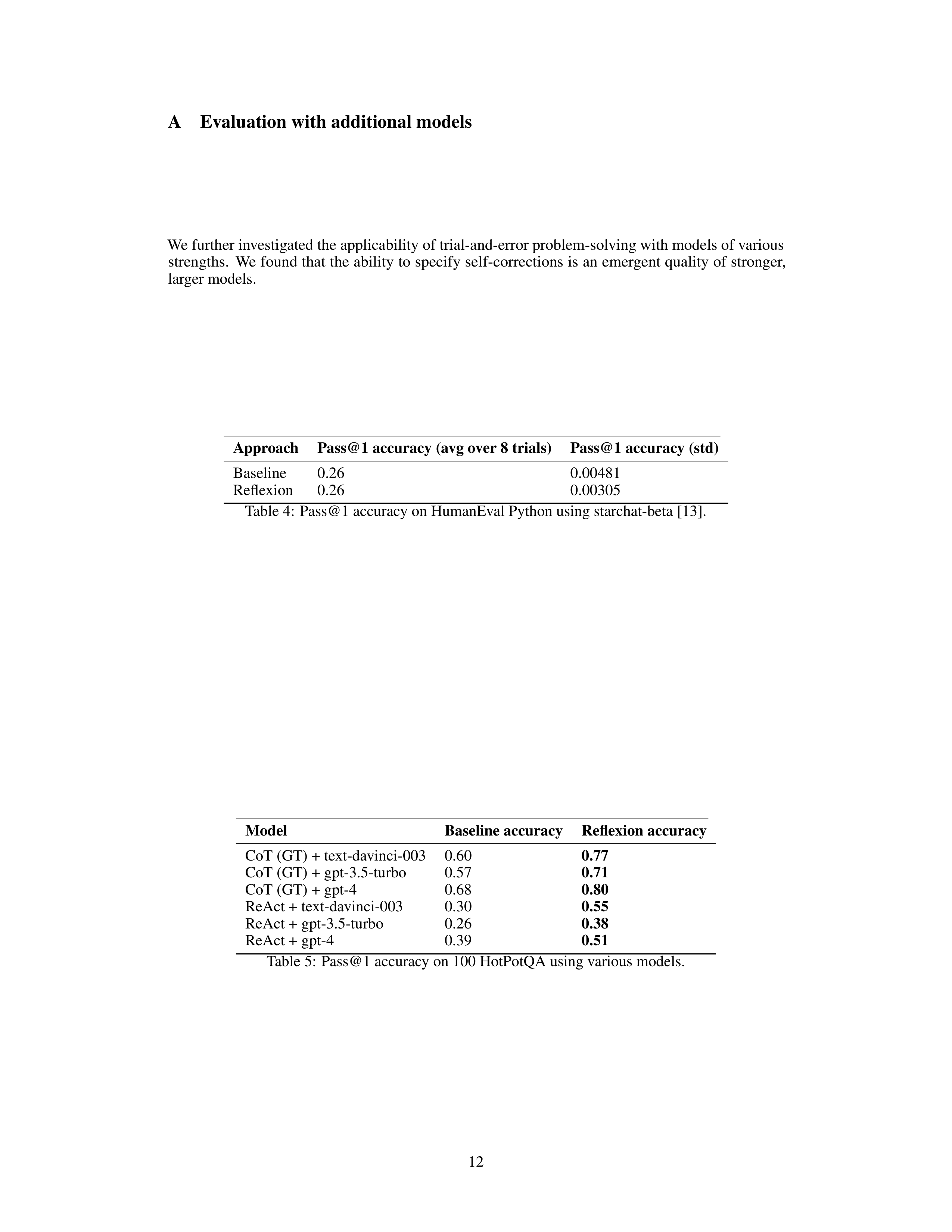
We further investigated the applicability of trial-and-error problem-solving with models of various
strengths.
We found that the ability to specify self-corrections is an emergent quality of stronger,
larger models.
Approach
Pass@1 accuracy (avg over 8 trials)
Pass@1 accuracy (std)
Baseline
0.26
0.00481
Reflexion
0.26
0.00305
Table 4:
Pass@1 accuracy on HumanEval Python using starchat-beta [13].
Model
Baseline accuracy
Reflexion accuracy
CoT (GT) + text-davinci-003
0.60
0.77
CoT (GT) + gpt-3.5-turbo
0.57
0.71
CoT (GT) + gpt-4
0.68
0.80
ReAct + text-davinci-003
0.30
0.55
ReAct + gpt-3.5-turbo
0.26
0.38
ReAct + gpt-4
0.39
0.51
Table 5:
Pass@1 accuracy on 100 HotPotQA using various models.
12
B
Decision-making
Environment:
You are in the middle of a room. Looking quickly around you, you see a bed 1, a desk
2, a desk 1, a drawer 6, a drawer 5, a drawer 4, a drawer 3, a drawer 2, a drawer 1, a garbagecan 1, a
laundryhamper 1, a safe 1, a shelf 6, a shelf 5, a shelf 4, a shelf 3, a shelf 2, and a shelf 1.
Task:
examine the mug with the desklamp.
Trial #1
>
think:
To solve the task, I need to find and take a mug, then find and use a desklamp.
>
think:
First I need to find a mug.
A mug is more likely to appear in drawer (1-6), desk (1-2), shelf
(1-6), garbagecan (1), laundryhamper (1).
I can check one by one, starting with drawer 1.
>
go to drawer 1
The drawer 1 is closed.
. . .
>
open drawer 6
You open the drawer 6.
The drawer 6 is open.
In it, you see a keychain 2.
>
go to desk 1
On the desk 1, you see a creditcard 3, a desklamp 1, a laptop 2, a mug 1, a pen 1, and a pencil 1.
>
think: Now I find a mug (1). Next, I need to take it.
>
take mug 1 from desk 1
You pick up the mug 1 from the desk 1.
>
think:
Now I take a mug (1).
Next, I need to find a desklamp.
A desklamp is more likely to appear
in desk (1-2), sidetable (1-2), shelf (1-6), bed (1), drawer (1-6).
I can check one by one, starting with
desk 1.
>
go to desk 1
Nothing happens.
>
go to desk 2
On the desk 2, you see a alarmclock 1, a bowl 1, a mug 3, a pencil 3, and a pencil 2.
>
think:
Now I find a desklamp (1).
Next, I need to use it.
>
use desklamp 1
Nothing happens.
>
use desklamp 1
Nothing happens.
Status: Fail
Reflection:
In this environment, my plan was to find a mug then find and use a desklamp. However,
the task says to examine the mug with the desklamp. I should have looked for the desklamp first, then
looked for the mug. I noticed that the desklamp was found on desk 1. In the next trial, I will go to
desk 1, find the lamp, then look for the mug and examine it with the desklamp.
Trial #2
>
go to desk 1
On the desk 1, you see a creditcard 3, a desklamp 1, a laptop 2, a mug 1, a pen 1, and a pencil 1.
>
think: To solve the task, I need to find and take a mug, then find and use a desklamp.
>
take mug 1 from desk 1
You pick up the mug 1 from the desk 1.
>
think:
To solve the task, I need to find and take a mug, then find and use a desklamp.
>
use desklamp 1
You turn on the desklamp 1.
Status: Success
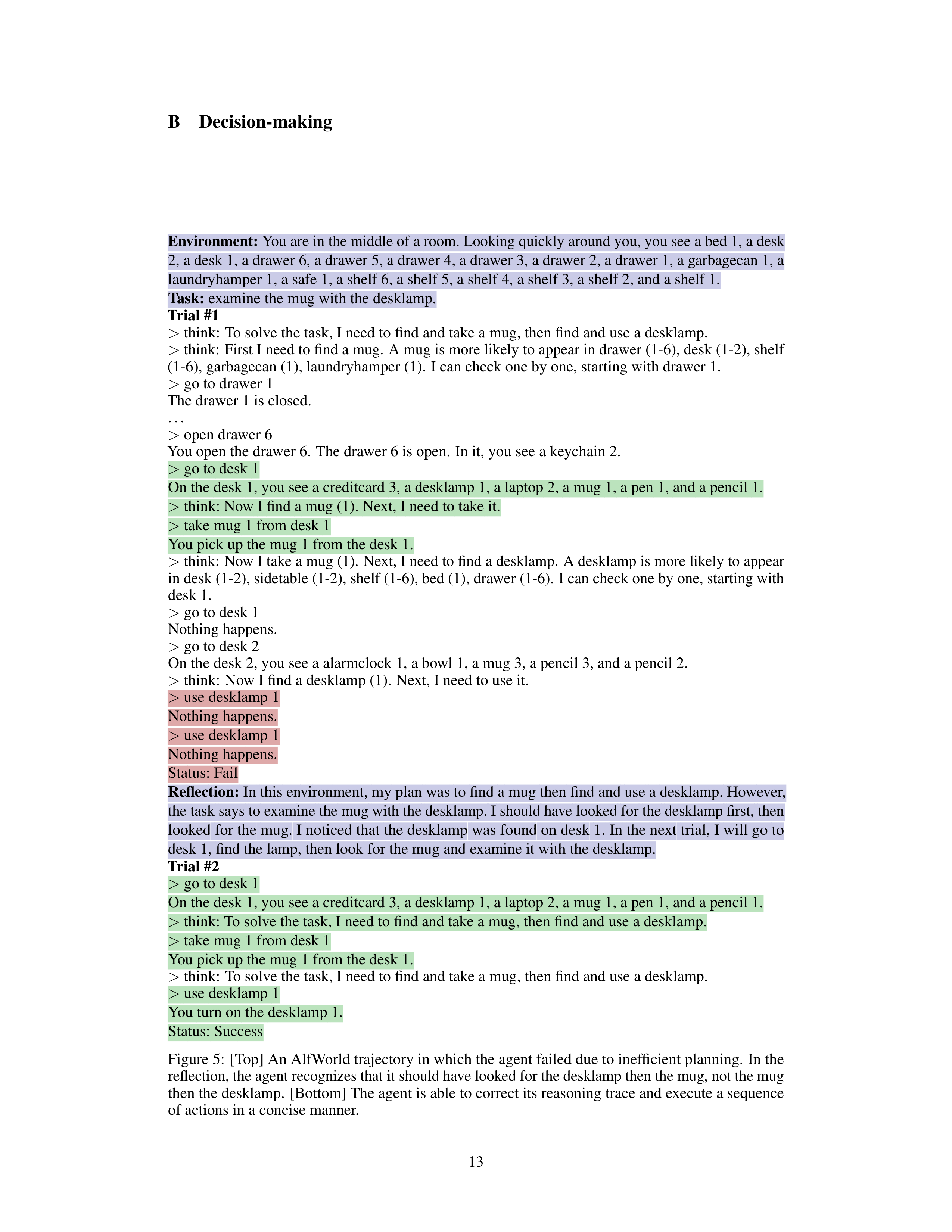
Figure 5:
[Top] An AlfWorld trajectory in which the agent failed due to inefficient planning.
In the
reflection, the agent recognizes that it should have looked for the desklamp then the mug, not the mug
then the desklamp.
[Bottom] The agent is able to correct its reasoning trace and execute a sequence
of actions in a concise manner.
13
B.1
WebShop Limitation
In 5, we briefly state that Reflexion struggles to overcome local minima choices that require extremely
creative
behavior
to
escape.
We
observe
this
shortcoming
in
an
experiment
on
WebShop
[
29
].
WebShop is a web-based problem-solving benchmark that tests agents to navigate an e-commerce
website to locate and purchase products given requests from clients.
We test a two-shot ReAct +
Reflexion agent in 100 environments.
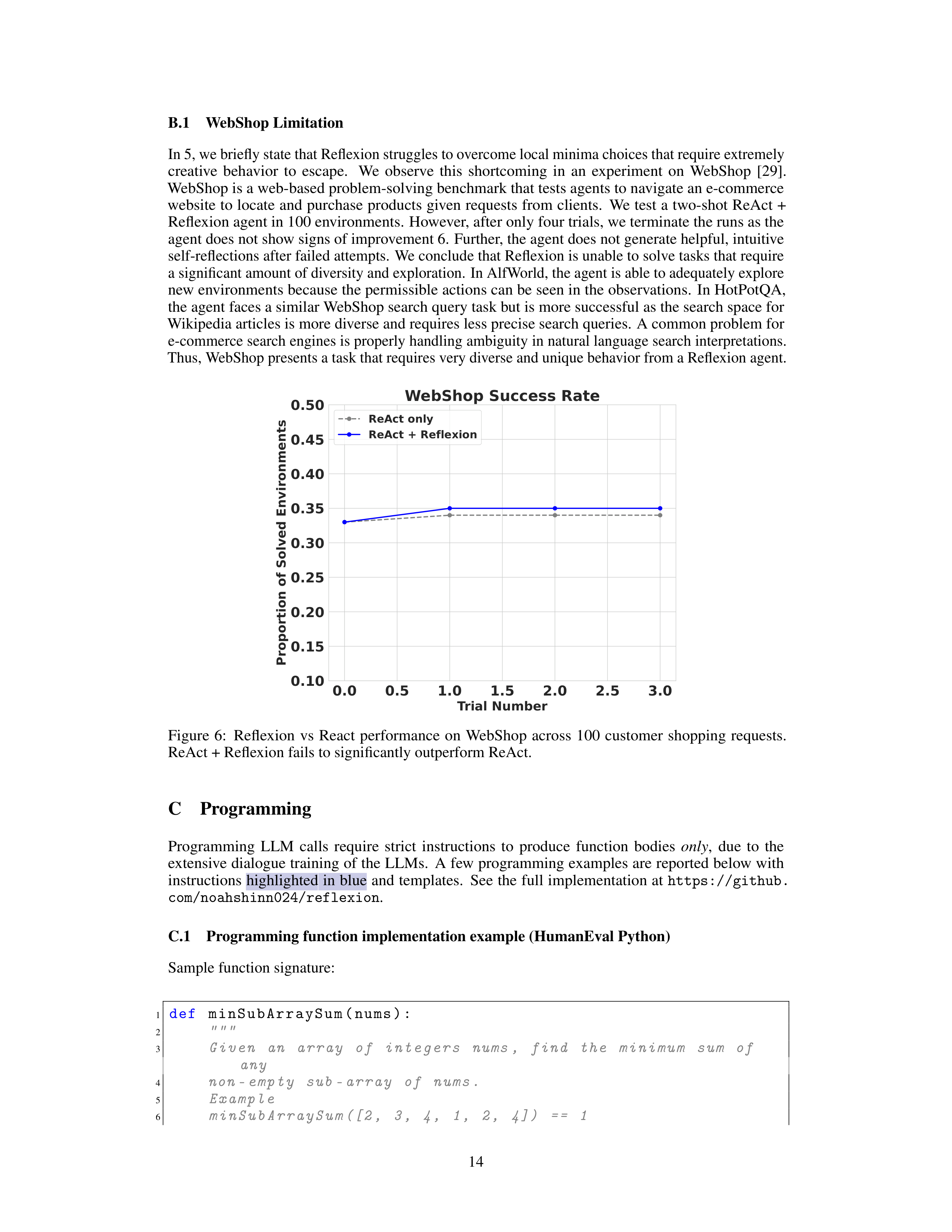
However, after only four trials, we terminate the runs as the
agent does not show signs of improvement 6.
Further, the agent does not generate helpful, intuitive
self-reflections after failed attempts.
We conclude that Reflexion is unable to solve tasks that require
a significant amount of diversity and exploration.
In AlfWorld, the agent is able to adequately explore
new environments because the permissible actions can be seen in the observations.
In HotPotQA,
the agent faces a similar WebShop search query task but is more successful as the search space for
Wikipedia articles is more diverse and requires less precise search queries.
A common problem for
e-commerce search engines is properly handling ambiguity in natural language search interpretations.
Thus, WebShop presents a task that requires very diverse and unique behavior from a Reflexion agent.
0.0
0.5
1.0
1.5
2.0
2.5
3.0
Trial Number
0.10
0.15
0.20
0.25
0.30
0.35
0.40
0.45
0.50
Proportion of Solved Environments
WebShop Success Rate
ReAct only
ReAct + Reflexion
Figure
6:
Reflexion
vs
React
performance
on
WebShop
across
100
customer
shopping
requests.
ReAct + Reflexion fails to significantly outperform ReAct.
C
Programming
Programming
LLM
calls
require
strict
instructions
to
produce
function
bodies
only
,
due
to
the
extensive dialogue training of the LLMs.
A few programming examples are reported below with
instructions highlighted in blue and templates.
See the full implementation at
https://github.
com/noahshinn024/reflexion
.
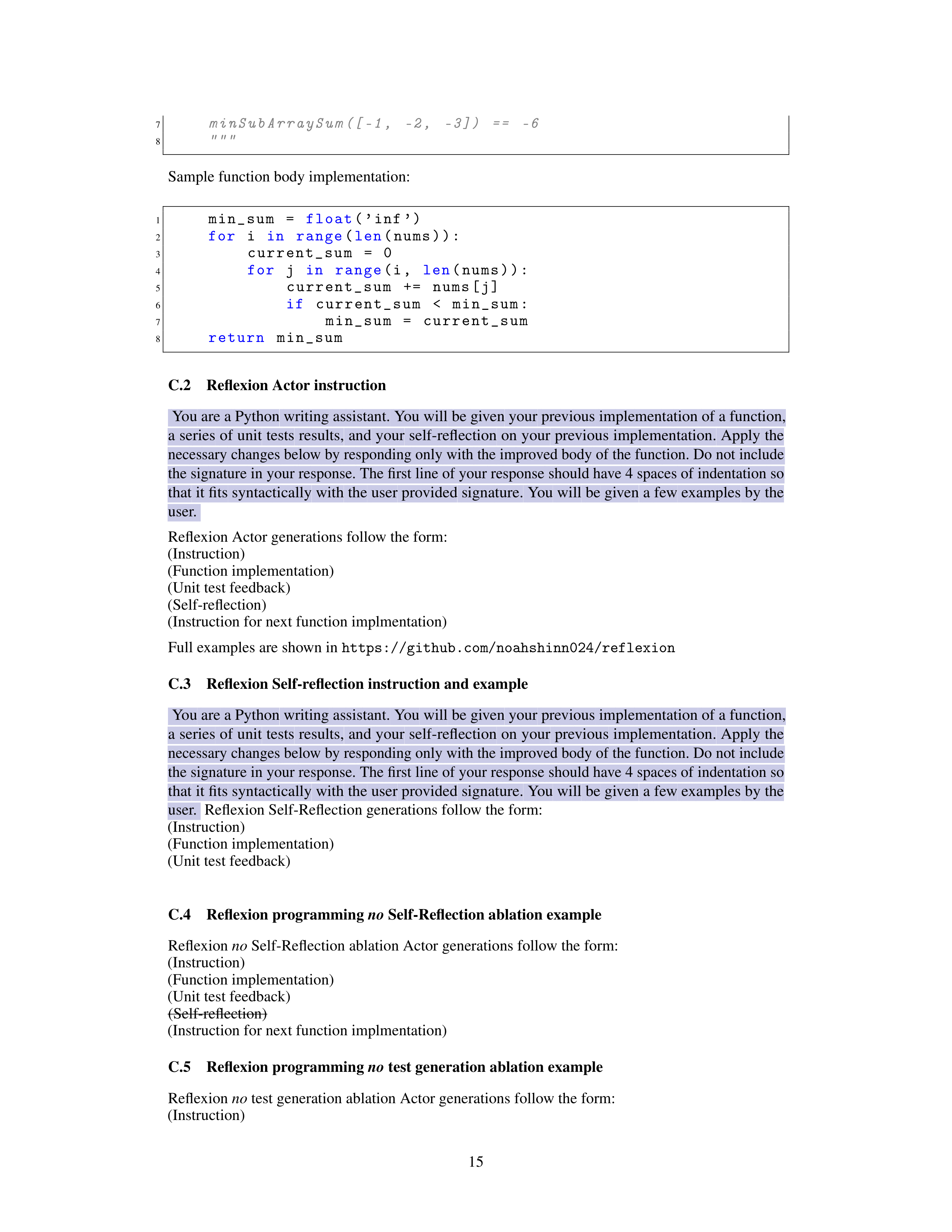
C.1
Programming function implementation example (HumanEval Python)
Sample function signature:
1
def
minSubArraySum (nums):
2
"""
3
Given
an
array
of
integers
nums ,
find
the
minimum
sum
of
any
4
non -empty
sub -array
of
nums.
5
Example
6
minSubArraySum ([2,
3,
4,
1,
2,
4])
==
1
14
7
minSubArraySum ([-1,
-2,
-3])
==
-6
8
"""
Sample function body implementation:
1
min_sum
=
float
(’inf’)
2
for
i
in
range
(
len
(nums)):
3
current_sum
=
0
4
for
j
in
range
(i,
len
(nums)):
5
current_sum
+=
nums[j]
6
if
current_sum
<
min_sum:
7
min_sum
=
current_sum
8
return
min_sum
C.2
Reflexion Actor instruction
You are a Python writing assistant. You will be given your previous implementation of a function,
a series of unit tests results, and your self-reflection on your previous implementation. Apply the
necessary changes below by responding only with the improved body of the function. Do not include
the signature in your response. The first line of your response should have 4 spaces of indentation so
that it fits syntactically with the user provided signature. You will be given a few examples by the
user.
Reflexion Actor generations follow the form:
(Instruction)
(Function implementation)
(Unit test feedback)
(Self-reflection)
(Instruction for next function implmentation)
Full examples are shown in
https://github.com/noahshinn024/reflexion
C.3
Reflexion Self-reflection instruction and example
You are a Python writing assistant. You will be given your previous implementation of a function,
a series of unit tests results, and your self-reflection on your previous implementation. Apply the
necessary changes below by responding only with the improved body of the function. Do not include
the signature in your response. The first line of your response should have 4 spaces of indentation so
that it fits syntactically with the user provided signature. You will be given a few examples by the
user.
Reflexion Self-Reflection generations follow the form:
(Instruction)
(Function implementation)
(Unit test feedback)
C.4
Reflexion programming
no
Self-Reflection ablation example
Reflexion
no
Self-Reflection ablation Actor generations follow the form:
(Instruction)
(Function implementation)
(Unit test feedback)
(Self-reflection)
(Instruction for next function implmentation)
C.5
Reflexion programming
no
test generation ablation example
Reflexion
no
test generation ablation Actor generations follow the form:
(Instruction)
15

(Function implementation)
(Unit test feedback)
(Self-reflection)
(Instruction for next function implmentation)
16
D
Reasoning
D.1
Full example
Trial #1:
Question: Grown-Ups starred the actor
who
was
best
known
for
which
role
on
"’Allo
’Allo!"?
Thought
1:
I
need
to
search
Grown-Ups
and
"’Allo
’Allo!",
find
the
actor
who
starred
in
Grown-Ups, then find the role he was best known
for in "’Allo ’Allo!".
Action 1:
Search[Grown-Ups]
Observation
1:
Grown-Ups
is
a
1980
British
BBC
television
film
devised
and
directed
by
Mike
Leigh.
It
stars
Lesley
Manville,
Philip
Davis, Brenda Blethyn, Janine Duvitski, Lindsay
Duncan and Sam Kelly.
It was edited by Robin
Sales and produced by Louis Marks for the BBC,
and originally shown on BBC 2 on 28 November
1980.
Thought 2:
Grown-Ups starred Lesley Manville,
Philip Davis, Brenda Blethyn, Janine Duvitski,
Lindsay Duncan and Sam Kelly.
I need to search
"’Allo
’Allo!"
and
find
which
actor
was
best
known for which role.
Action 2: Search["’Allo ’Allo!"]
Observation 2:
Could not find ["’Allo ’Allo!"].
Similar:
["’Allo
’Allo!",
"List
of
’Allo
’Allo!
characters", ’Gorden Kaye’, "’Allo ’Allo! (series
2)",
’Allô,
allô’,
’Francesca
Gonshaw’,
"’Allo
’Allo!
(series 4)", ’Kim Hartman’, "’Allo ’Allo!
(series 6)", ’Jeremy Lloyd’]
Thought 3: To find the actor who was best known
for
which
role
on
"’Allo
’Allo!",
I
can
search
Gorden Kaye.
Action 3:
Search[Gorden Kaye]
Observation
3:
Gordon
Irving
Kaye
(7
April
1941
–
23
January
2017),
known
profession-
ally
as
Gorden
Kaye,
was
an
English
actor,
best known for playing womanising café owner
René Artois in the television comedy series ’Allo
’Allo!.
Thought
4:
Gorden
Kaye
was
best
known
for
playing womanising café owner René Artois in
the television comedy series "’Allo ’Allo!".
So
the answer is Rene Artois.
Action 4: Finish[Rene Artois]
Observation 4: Answer is INCORRECT
Trial #2:
Question: Grown-Ups starred the actor
who
was
best
known
for
which
role
on
"’Allo
’Allo!"?
Thought 1:
I need to search the actor who was
best known for a role on "’Allo ’Allo!" and find
out what role they were best known for.
Action 1:
Search[Grown-Ups]
Observation
1:
Grown-Ups
is
a
1980
British
BBC
television
film
devised
and
directed
by
Mike
Leigh.
It
stars
Lesley
Manville,
Philip
Davis, Brenda Blethyn, Janine Duvitski, Lindsay
Duncan and Sam Kelly.
It was edited by Robin
Sales and produced by Louis Marks for the BBC,
and originally shown on BBC 2 on 28 November
1980.
Thought 2: The paragraph does not mention the
actor who was best known for a role on "’Allo
’Allo!". I need to search the actor’s name instead.
Action 2:
Search[Sam Kelly]
Observation 2:
Roger Michael Kelly (19 Decem-
ber 1943 – 14 June 2014), known by the stage
name Sam Kelly, was an English actor who ap-
peared in film, television, radio and theatre.
He
is best known for his roles as Captain Hans Geer-
ing in ’Allo ’Allo!, Warren in Porridge, Sam in
On the Up, and Ted Liversidge in Barbara.
Thought 3:
Sam Kelly is best known for his role
as
Captain
Hans
Geering
in
"’Allo
’Allo!",
so
the answer is Captain Hans Geering.
Action 3: Finish[Captain Hans Geering]
Observation 3: Answer is CORRECT
Reflection:
I searched the wrong title for the show, "’Allo ’Allo!", which resulted in no results. I
should have searched the show’s main character, Gorden Kaye, to find the role he was best known for
in the show.
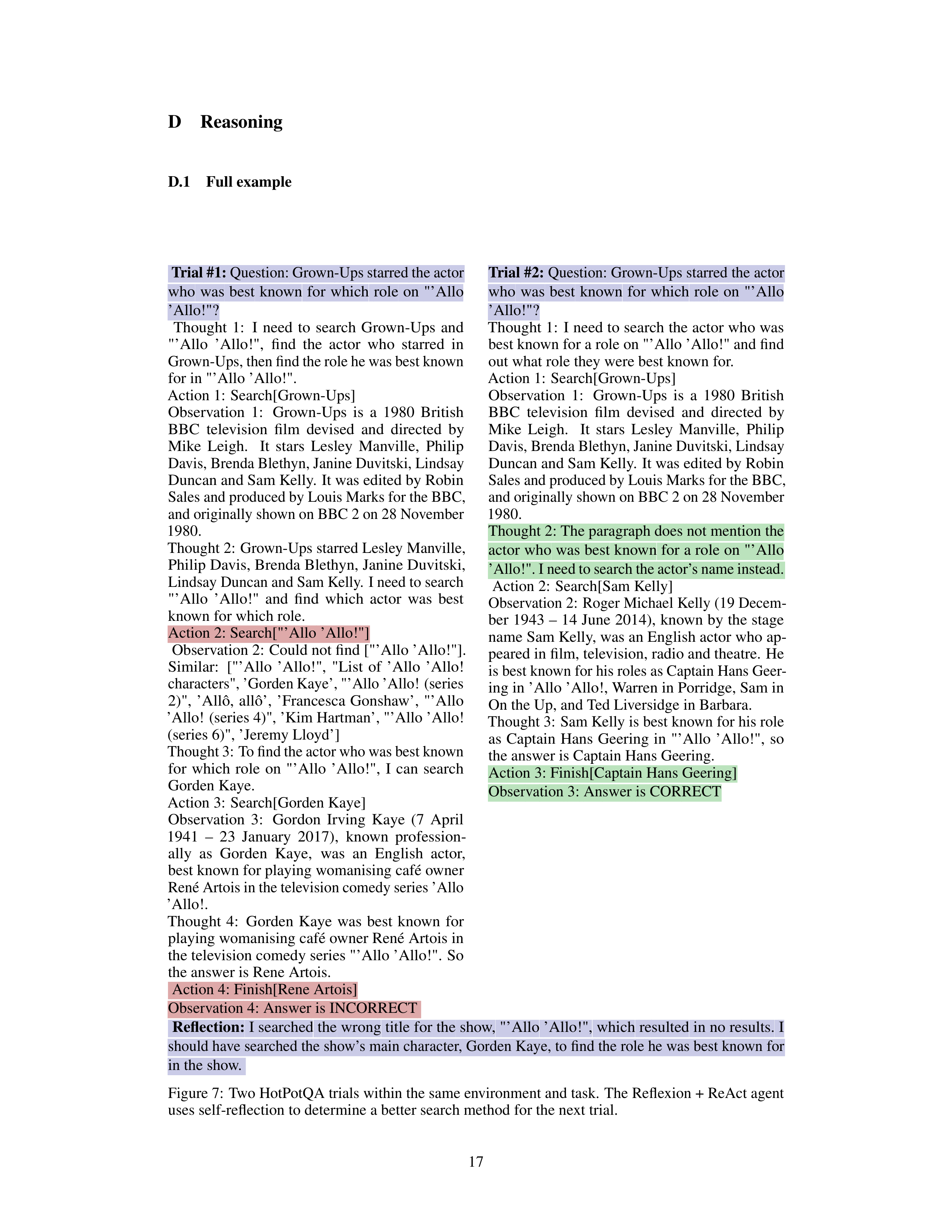
Figure 7:
Two HotPotQA trials within the same environment and task.
The Reflexion + ReAct agent
uses self-reflection to determine a better search method for the next trial.
17
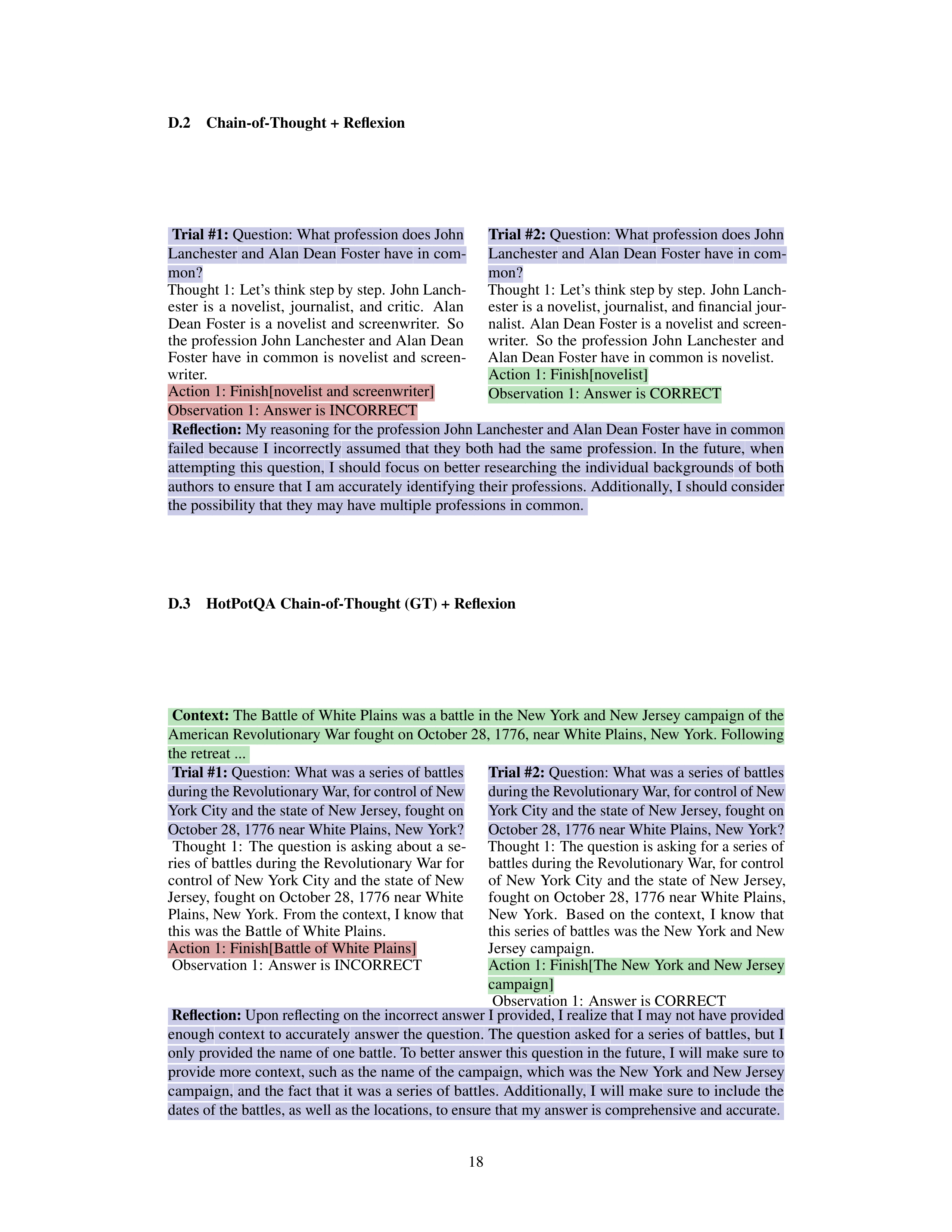
D.2
Chain-of-Thought + Reflexion
Trial #1:
Question: What profession does John
Lanchester and Alan Dean Foster have in com-
mon?
Thought 1:
Let’s think step by step.
John Lanch-
ester
is
a
novelist,
journalist,
and
critic.
Alan
Dean Foster is a novelist and screenwriter.
So
the profession John Lanchester and Alan Dean
Foster
have
in
common
is
novelist
and
screen-
writer.
Action 1: Finish[novelist and screenwriter]
Observation 1: Answer is INCORRECT
Trial #2:
Question: What profession does John
Lanchester and Alan Dean Foster have in com-
mon?
Thought 1:
Let’s think step by step.
John Lanch-
ester is a novelist, journalist, and financial jour-
nalist.
Alan Dean Foster is a novelist and screen-
writer.
So
the
profession
John
Lanchester
and
Alan Dean Foster have in common is novelist.
Action 1: Finish[novelist]
Observation 1: Answer is CORRECT
Reflection:
My reasoning for the profession John Lanchester and Alan Dean Foster have in common
failed because I incorrectly assumed that they both had the same profession. In the future, when
attempting this question, I should focus on better researching the individual backgrounds of both
authors to ensure that I am accurately identifying their professions. Additionally, I should consider
the possibility that they may have multiple professions in common.
D.3
HotPotQA Chain-of-Thought (GT) + Reflexion
Context:
The Battle of White Plains was a battle in the New York and New Jersey campaign of the
American Revolutionary War fought on October 28, 1776, near White Plains, New York. Following
the retreat ...
Trial #1:
Question: What was a series of battles
during the Revolutionary War, for control of New
York City and the state of New Jersey, fought on
October 28, 1776 near White Plains, New York?
Thought 1:
The question is asking about a se-
ries of battles during the Revolutionary War for
control of New York City and the state of New
Jersey, fought on October 28, 1776 near White
Plains, New York.
From the context, I know that
this was the Battle of White Plains.
Action 1: Finish[Battle of White Plains]
Observation 1:
Answer is INCORRECT
Trial #2:
Question: What was a series of battles
during the Revolutionary War, for control of New
York City and the state of New Jersey, fought on
October 28, 1776 near White Plains, New York?
Thought 1:
The question is asking for a series of
battles during the Revolutionary War, for control
of New York City and the state of New Jersey,
fought on October 28, 1776 near White Plains,
New
York.
Based
on
the
context,
I
know
that
this series of battles was the New York and New
Jersey campaign.
Action 1: Finish[The New York and New Jersey
campaign]
Observation 1:
Answer is CORRECT
Reflection:
Upon reflecting on the incorrect answer I provided, I realize that I may not have provided
enough context to accurately answer the question. The question asked for a series of battles, but I
only provided the name of one battle. To better answer this question in the future, I will make sure to
provide more context, such as the name of the campaign, which was the New York and New Jersey
campaign, and the fact that it was a series of battles. Additionally, I will make sure to include the
dates of the battles, as well as the locations, to ensure that my answer is comprehensive and accurate.
18
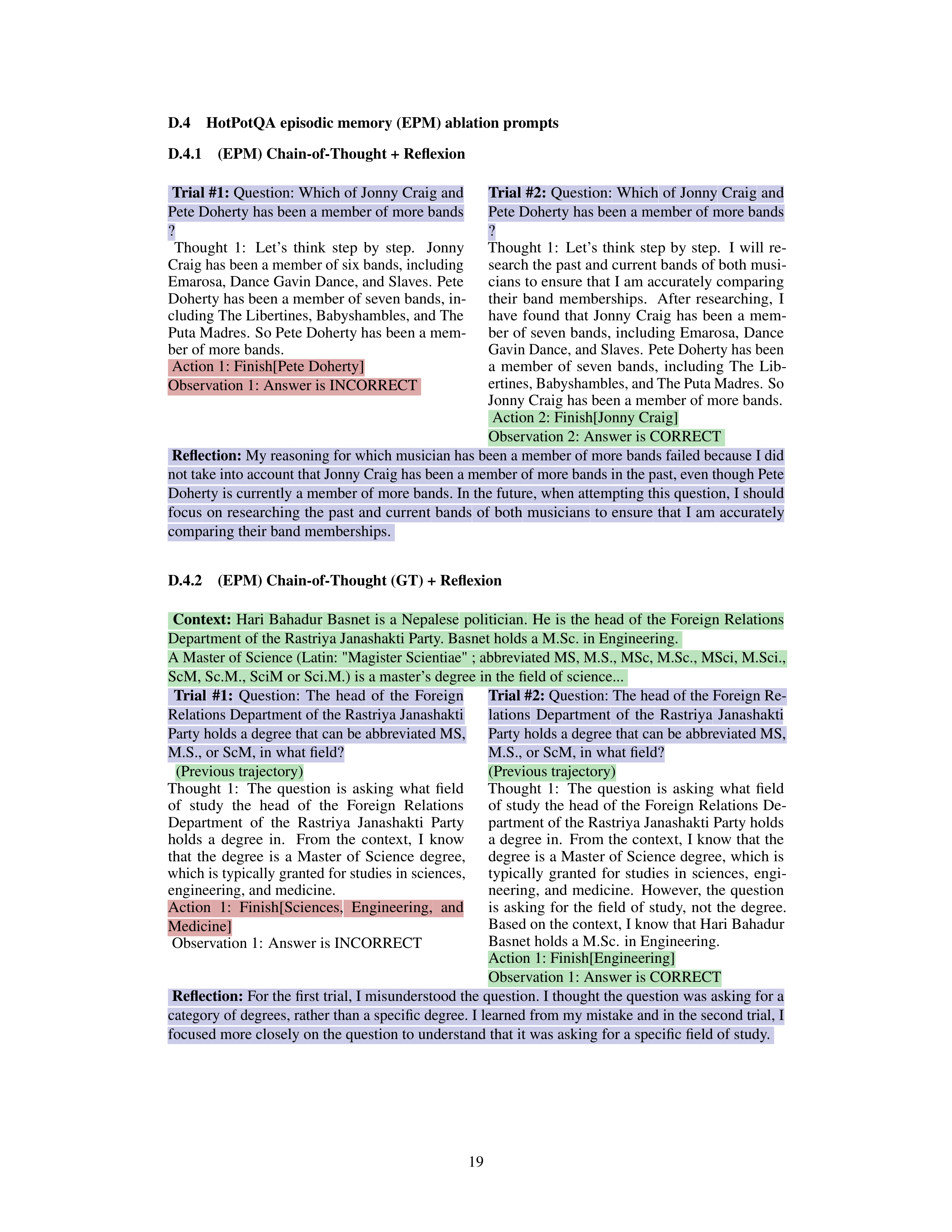
D.4
HotPotQA episodic memory (EPM) ablation prompts
D.4.1
(EPM) Chain-of-Thought + Reflexion
Trial #1:
Question: Which of Jonny Craig and
Pete Doherty has been a member of more bands
?
Thought
1:
Let’s
think
step
by
step.
Jonny
Craig has been a member of six bands, including
Emarosa, Dance Gavin Dance, and Slaves.
Pete
Doherty has been a member of seven bands, in-
cluding The Libertines, Babyshambles, and The
Puta Madres.
So Pete Doherty has been a mem-
ber of more bands.
Action 1: Finish[Pete Doherty]
Observation 1: Answer is INCORRECT
Trial #2:
Question: Which of Jonny Craig and
Pete Doherty has been a member of more bands
?
Thought
1:
Let’s
think
step
by
step.
I
will
re-
search the past and current bands of both musi-
cians to ensure that I am accurately comparing
their
band
memberships.
After
researching,
I
have
found
that
Jonny
Craig
has
been
a
mem-
ber of seven bands, including Emarosa, Dance
Gavin Dance, and Slaves.
Pete Doherty has been
a
member
of
seven
bands,
including
The
Lib-
ertines, Babyshambles, and The Puta Madres. So
Jonny Craig has been a member of more bands.
Action 2: Finish[Jonny Craig]
Observation 2: Answer is CORRECT
Reflection:
My reasoning for which musician has been a member of more bands failed because I did
not take into account that Jonny Craig has been a member of more bands in the past, even though Pete
Doherty is currently a member of more bands. In the future, when attempting this question, I should
focus on researching the past and current bands of both musicians to ensure that I am accurately
comparing their band memberships.
D.4.2
(EPM) Chain-of-Thought (GT) + Reflexion
Context:
Hari Bahadur Basnet is a Nepalese politician. He is the head of the Foreign Relations
Department of the Rastriya Janashakti Party. Basnet holds a M.Sc. in Engineering.
A Master of Science (Latin: "Magister Scientiae" ; abbreviated MS, M.S., MSc, M.Sc., MSci, M.Sci.,
ScM, Sc.M., SciM or Sci.M.) is a master’s degree in the field of science...
Trial
#1:
Question:
The
head
of
the
Foreign
Relations Department of the Rastriya Janashakti
Party holds a degree that can be abbreviated MS,
M.S., or ScM, in what field?
(Previous trajectory)
Thought
1:
The
question
is
asking
what
field
of
study
the
head
of
the
Foreign
Relations
Department
of
the
Rastriya
Janashakti
Party
holds
a
degree
in.
From
the
context,
I
know
that
the
degree
is
a
Master
of
Science
degree,
which is typically granted for studies in sciences,
engineering, and medicine.
Action
1:
Finish[Sciences,
Engineering,
and
Medicine]
Observation 1:
Answer is INCORRECT
Trial #2:
Question: The head of the Foreign Re-
lations
Department
of
the
Rastriya
Janashakti
Party holds a degree that can be abbreviated MS,
M.S., or ScM, in what field?
(Previous trajectory)
Thought
1:
The
question
is
asking
what
field
of study the head of the Foreign Relations De-
partment of the Rastriya Janashakti Party holds
a degree in.
From the context,
I know that the
degree is a Master of Science degree, which is
typically
granted
for
studies
in
sciences,
engi-
neering,
and medicine.
However,
the question
is
asking
for
the
field
of
study,
not
the
degree.
Based on the context, I know that Hari Bahadur
Basnet holds a M.Sc.
in Engineering.
Action 1: Finish[Engineering]
Observation 1: Answer is CORRECT
Reflection:
For the first trial, I misunderstood the question. I thought the question was asking for a
category of degrees, rather than a specific degree. I learned from my mistake and in the second trial, I
focused more closely on the question to understand that it was asking for a specific field of study.
19