
V
OYAGER
:
An Open-Ended Embodied Agent
with Large Language Models
Guanzhi Wang
1 2
#
, Yuqi Xie
3
, Yunfan Jiang
4
∗
, Ajay Mandlekar
1
∗
,
Chaowei Xiao
1 5
, Yuke Zhu
1 3
, Linxi “Jim” Fan
1
†
#
, Anima Anandkumar
1 2
†
1
NVIDIA,
2
Caltech,
3
UT Austin,
4
Stanford,
5
UW Madison
∗
Equal contribution
†
Equal advising
#
Corresponding authors
https://voyager.minedojo.org
Abstract
We introduce
V
OYAGER
, the first LLM-powered embodied lifelong learning agent
in
Minecraft
that
continuously
explores
the
world,
acquires
diverse
skills,
and
makes novel discoveries without human intervention.
V
OYAGER
consists of three
key components:
1) an automatic curriculum that maximizes exploration, 2) an
ever-growing skill library of executable code for storing and retrieving complex
behaviors, and 3) a new iterative prompting mechanism that incorporates environ-
ment feedback, execution errors, and self-verification for program improvement.
V
OYAGER
interacts with GPT-4 via blackbox queries, which bypasses the need for
model parameter fine-tuning.
The skills developed by
V
OYAGER
are temporally
extended, interpretable, and compositional, which compounds the agent’s abilities
rapidly
and
alleviates
catastrophic
forgetting.
Empirically,
V
OYAGER
shows
strong in-context lifelong learning capability and exhibits exceptional proficiency
in
playing
Minecraft.
It
obtains
3
.
3
×
more
unique
items,
travels
2
.
3
×
longer
distances, and unlocks key tech tree milestones up to
15
.
3
×
faster than prior SOTA.
V
OYAGER
is able to utilize the learned skill library in a new Minecraft world to
solve novel tasks from scratch, while other techniques struggle to generalize.
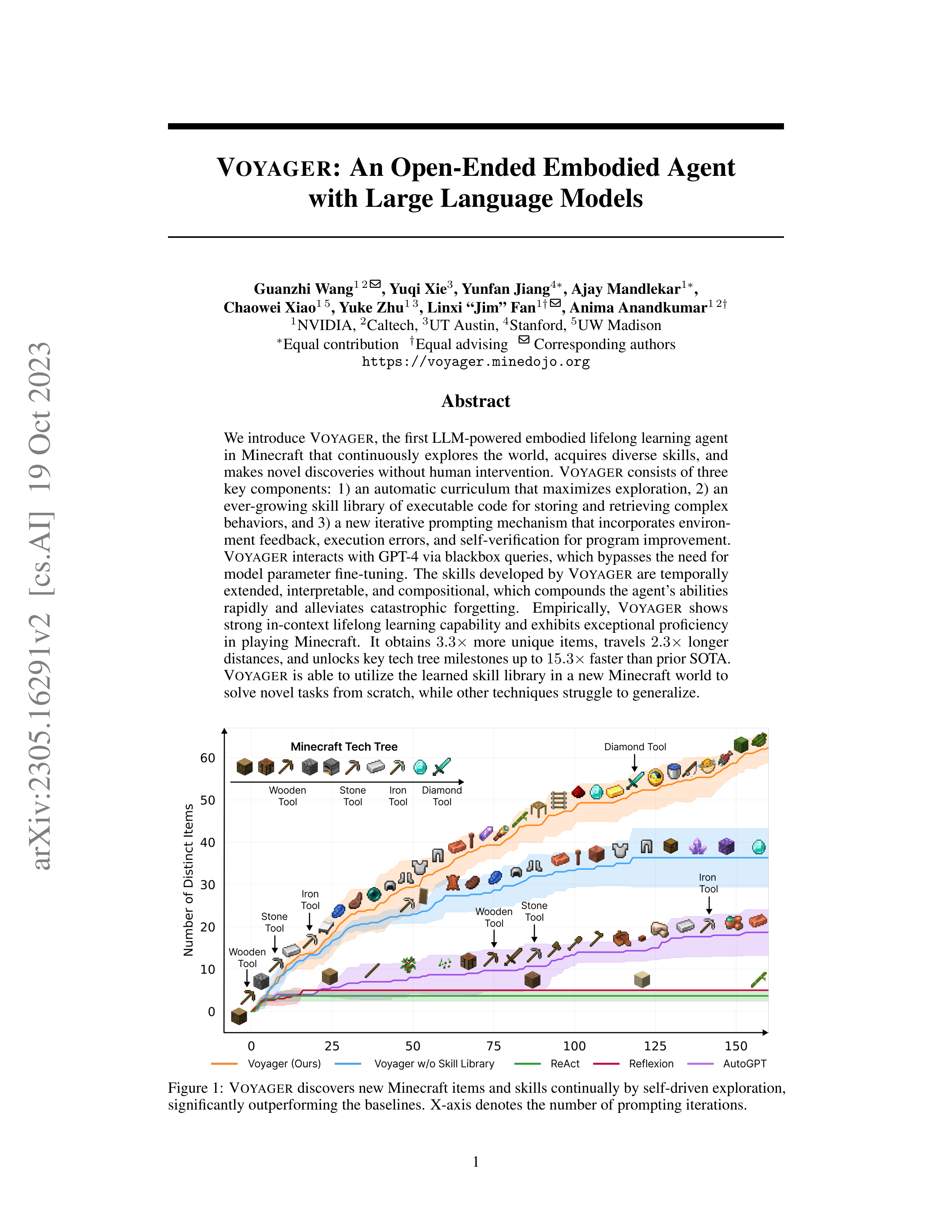
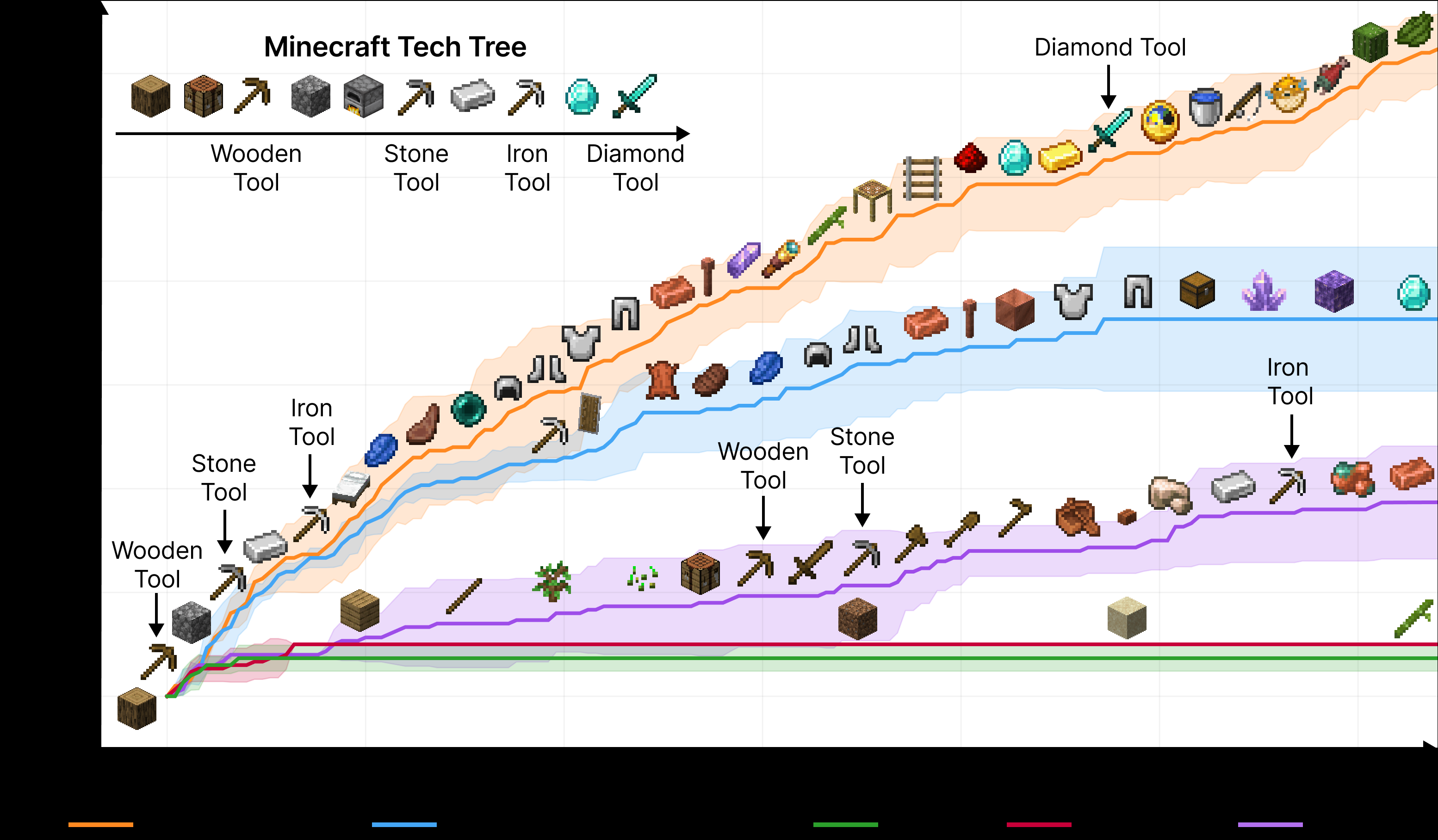
Figure 1:
V
OYAGER
discovers new Minecraft items and skills continually by self-driven exploration,
significantly outperforming the baselines.
X-axis denotes the number of prompting iterations.
1
arXiv:2305.16291v2 [cs.AI] 19 Oct 2023

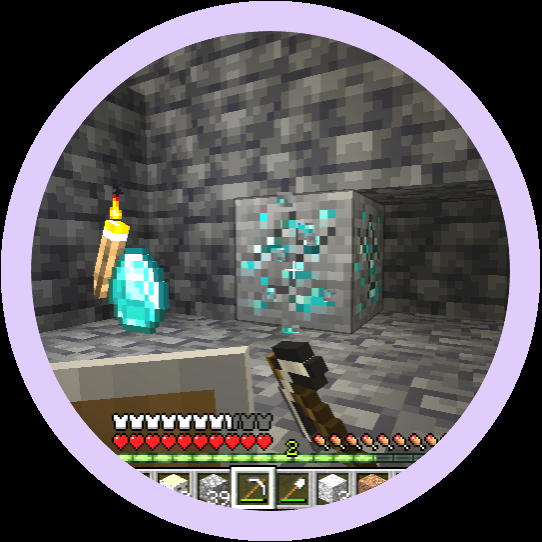



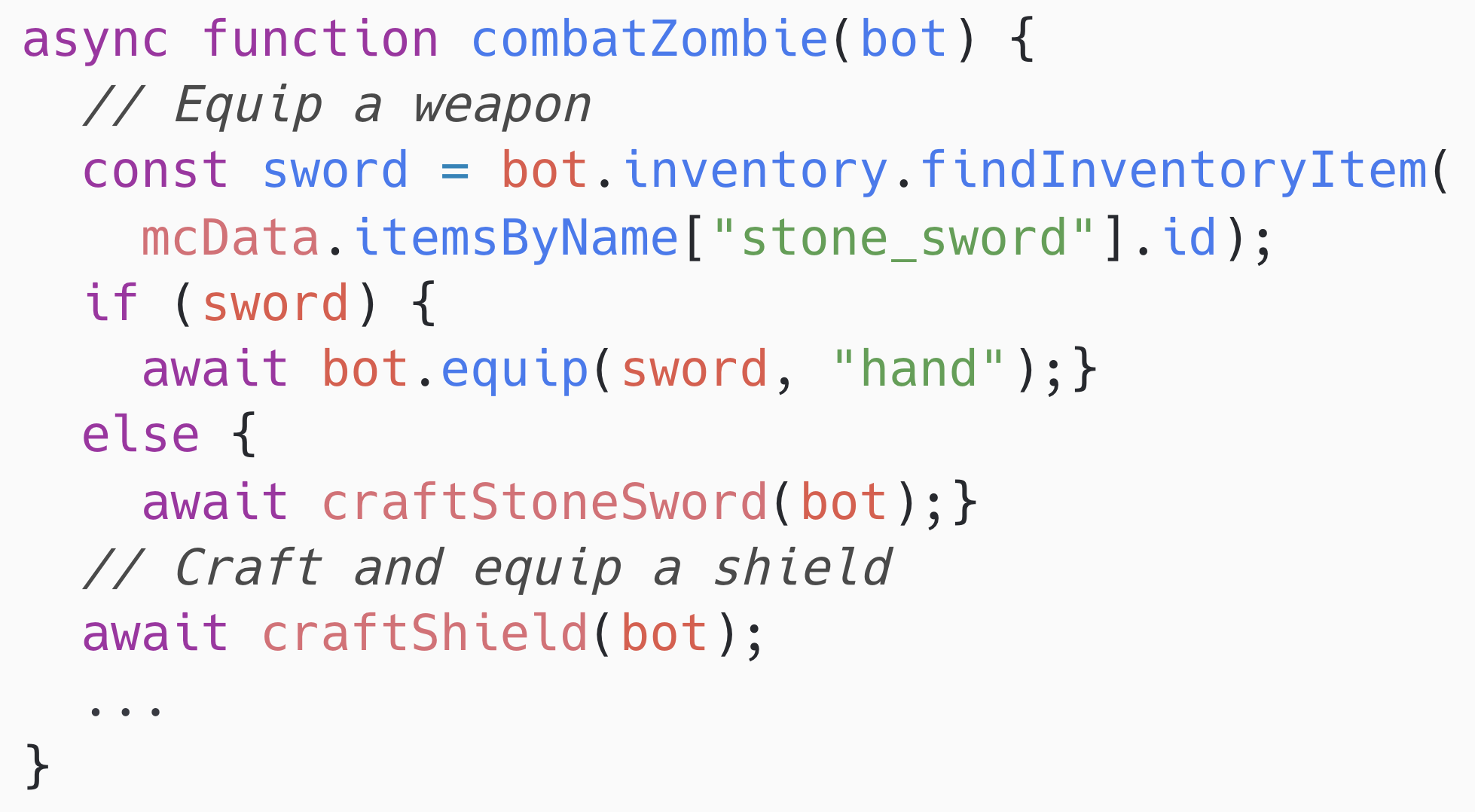
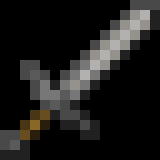
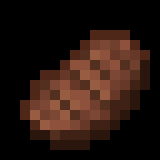

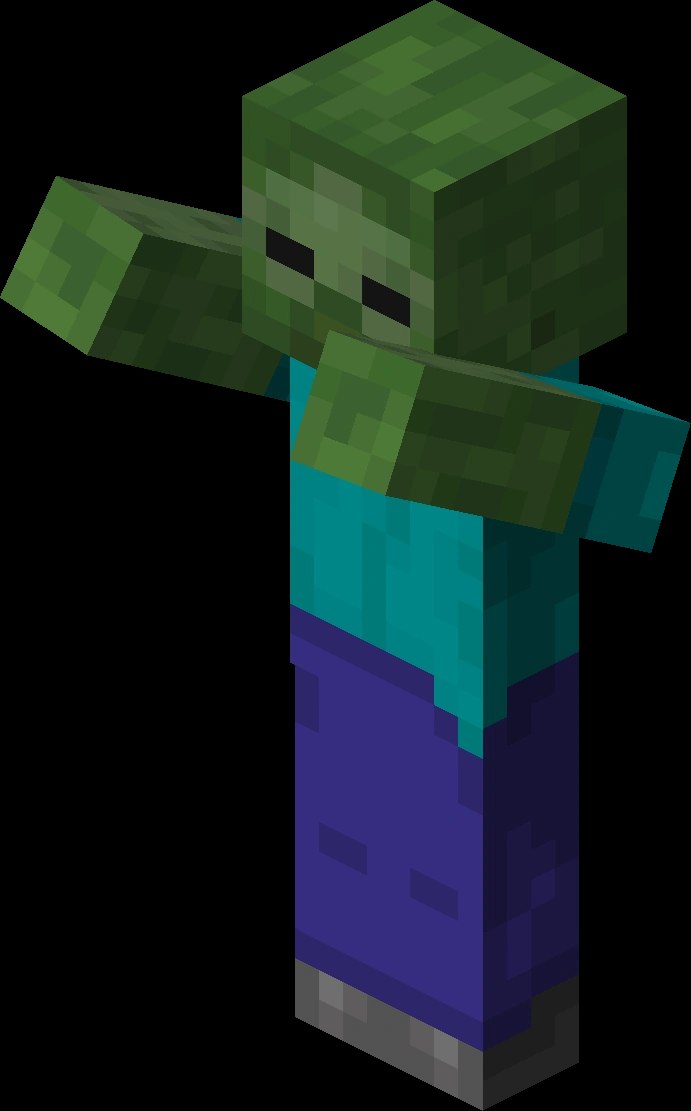

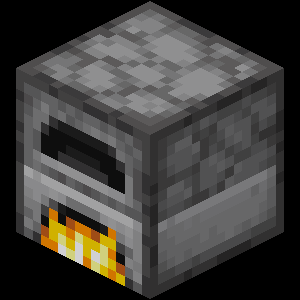
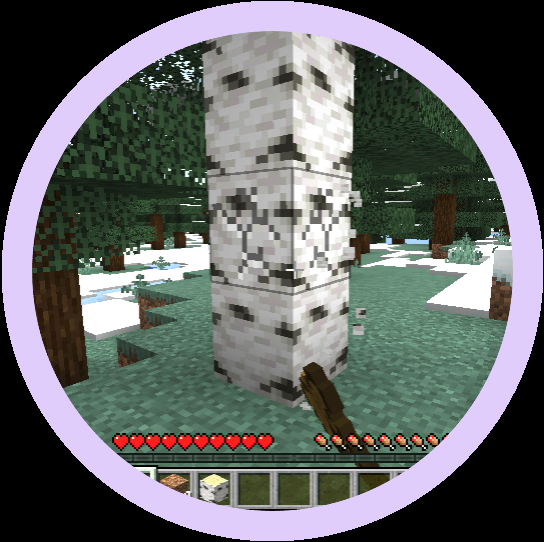
Mine Wood Log
Make Crafting Table
Craft Stone Sword
Craft Shield
Make Furnace
Cook Steak
Combat Zombie
Mine Wood Log
Make Crafting Table
Combat
Zombie
Mine Diamond
New
Task
Code as
Actions
Refine Program
Env Feedback
Execution Errors
Update
Exploration
Progress
Skill
Retrieval
Add New Skill
Automatic Curriculum
Iterative Prompting Mechanism
Skill Library
Environment
Self-Verification
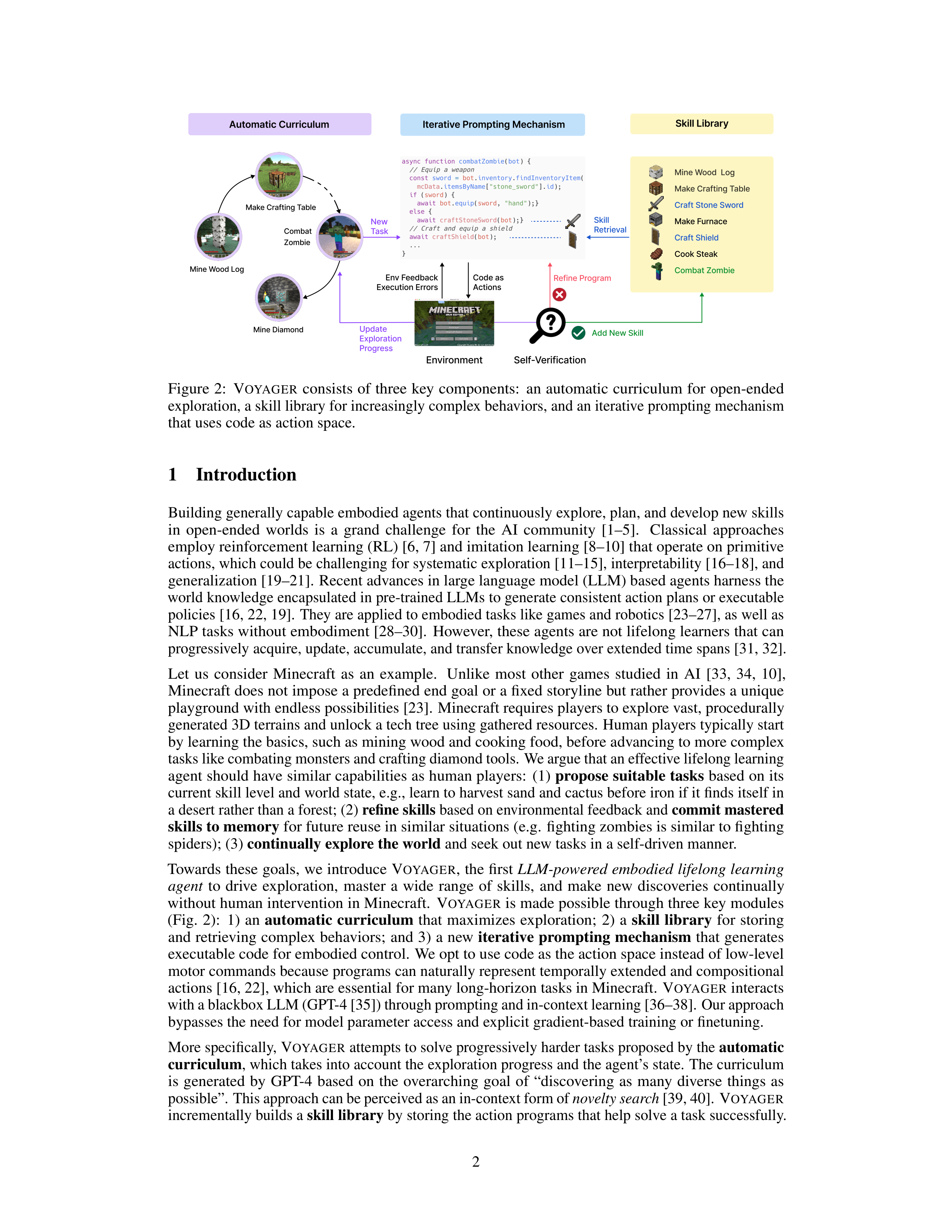
Figure
2:
V
OYAGER
consists
of
three
key
components:
an
automatic
curriculum
for
open-ended
exploration, a skill library for increasingly complex behaviors, and an iterative prompting mechanism
that uses code as action space.
1
Introduction
Building generally capable embodied agents that continuously explore, plan, and develop new skills
in
open-ended
worlds
is
a
grand
challenge
for
the
AI
community
[
1
–
5
].
Classical
approaches
employ reinforcement learning (RL) [
6
,
7
] and imitation learning [
8
–
10
] that operate on primitive
actions, which could be challenging for systematic exploration [
11
–
15
], interpretability [
16
–
18
], and
generalization [
19
–
21
].
Recent advances in large language model (LLM) based agents harness the
world knowledge encapsulated in pre-trained LLMs to generate consistent action plans or executable
policies [
16
,
22
,
19
].
They are applied to embodied tasks like games and robotics [
23
–
27
], as well as
NLP tasks without embodiment [
28
–
30
].
However, these agents are not lifelong learners that can
progressively acquire, update, accumulate, and transfer knowledge over extended time spans [
31
,
32
].
Let
us
consider
Minecraft
as
an
example.
Unlike
most
other
games
studied
in
AI
[
33
,
34
,
10
],
Minecraft does not impose a predefined end goal or a fixed storyline but rather provides a unique
playground with endless possibilities [
23
].
Minecraft requires players to explore vast, procedurally
generated 3D terrains and unlock a tech tree using gathered resources.
Human players typically start
by learning the basics, such as mining wood and cooking food, before advancing to more complex
tasks like combating monsters and crafting diamond tools.
We argue that an effective lifelong learning
agent should have similar capabilities as human players:
(1)
propose suitable tasks
based on its
current skill level and world state, e.g., learn to harvest sand and cactus before iron if it finds itself in
a desert rather than a forest; (2)
refine skills
based on environmental feedback and
commit mastered
skills to memory
for future reuse in similar situations (e.g.
fighting zombies is similar to fighting
spiders); (3)
continually explore the world
and seek out new tasks in a self-driven manner.
Towards these goals, we introduce
V
OYAGER
, the first
LLM-powered embodied lifelong learning
agent
to
drive
exploration,
master
a
wide
range
of
skills,
and
make
new
discoveries
continually
without human intervention in Minecraft.
V
OYAGER
is made possible through three key modules
(Fig.
2):
1)
an
automatic
curriculum
that
maximizes
exploration;
2)
a
skill
library
for
storing
and retrieving complex behaviors;
and 3) a new
iterative prompting mechanism
that generates
executable code for embodied control.
We opt to use code as the action space instead of low-level
motor commands because programs can naturally represent temporally extended and compositional
actions [
16
,
22
], which are essential for many long-horizon tasks in Minecraft.
V
OYAGER
interacts
with a blackbox LLM (GPT-4 [
35
]) through prompting and in-context learning [
36
–
38
]. Our approach
bypasses the need for model parameter access and explicit gradient-based training or finetuning.
More specifically,
V
OYAGER
attempts to solve progressively harder tasks proposed by the
automatic
curriculum
, which takes into account the exploration progress and the agent’s state.
The curriculum
is
generated
by
GPT-4
based
on
the
overarching
goal
of
“discovering
as
many
diverse
things
as
possible”. This approach can be perceived as an in-context form of
novelty search
[
39
,
40
].
V
OYAGER
incrementally builds a
skill library
by storing the action programs that help solve a task successfully.
2
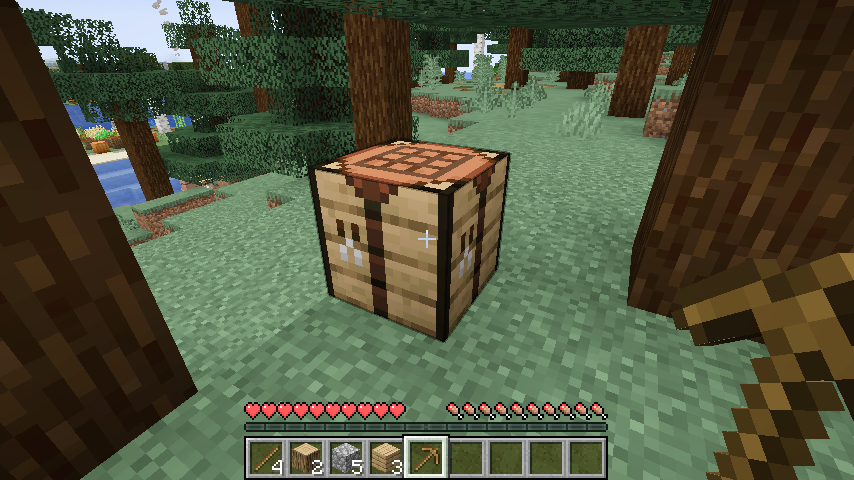
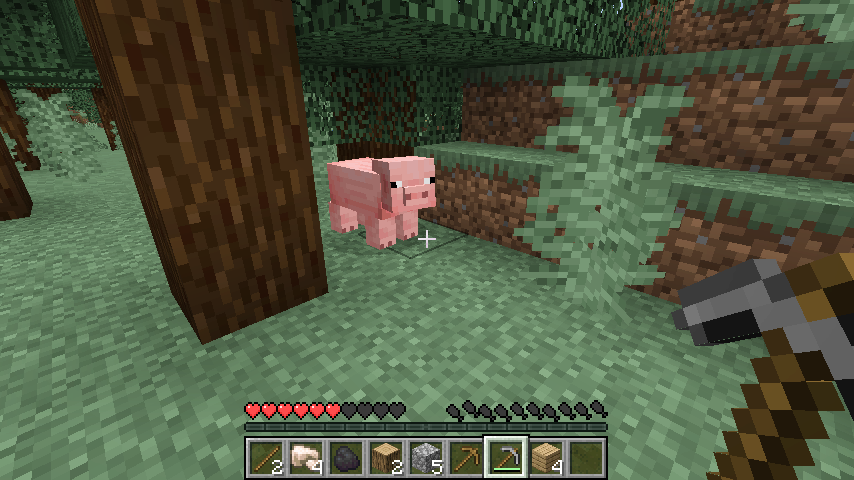
Inventory (5/36): {'oak_planks': 3, 'stick':
4, 'crafting_table': 1, 'stone': 3,
'wooden_pickaxe': 1}
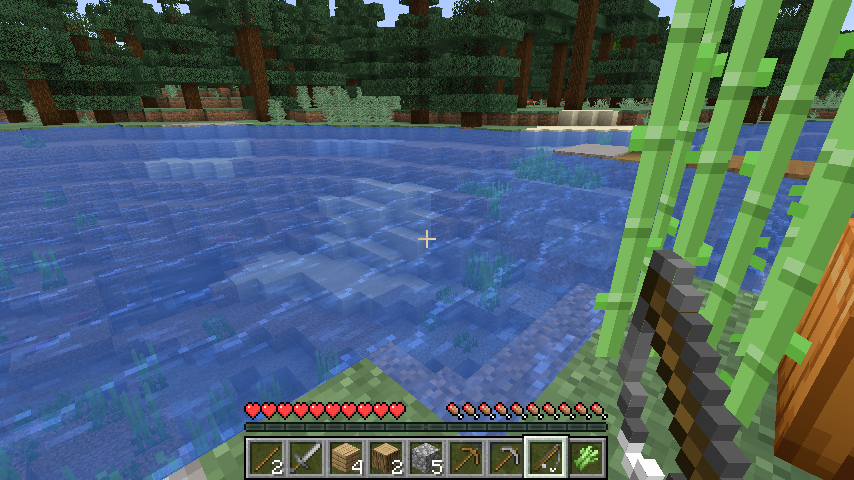
Biome: river
Inventory (4/36): {'sugar_cane': 3, 'paper':
3, 'fishing_rod': 1, 'wooden_pickaxe': 1}
Nearby entities: pig, cat, villager
Health: 12/20
Hunger: 0/20
Inventory (6/36): {'furnace': 1,
'stone_pickaxe': 1, 'oak_planks': 7,
'crafting_table': 1, 'raw_iron': 4, 'coal': 1}
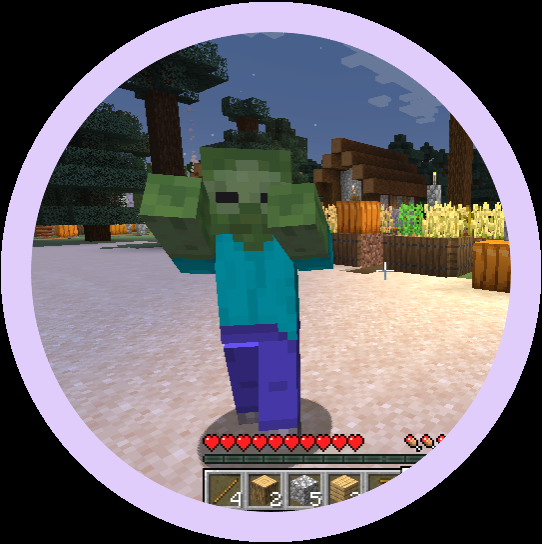
Time: night
Nearby entities: zombie
Equipment: 'stone_sword', 'shield'
Reasoning: Since you have a wooden pickaxe and some stones, it would be
beneficial to upgrade your pickaxe to a stone pickaxe for better efficiency.
Task: Craft 1 stone pickaxe.
Reasoning: Since you have a fishing rod in your inventory and you are near a river
biome, it would be a good opportunity to catch some fish for food and experience.
Task: Catch 1 fish.
Reasoning:
Y
our hunger is at 0, which means you need to find food to replenish
your hunger. Since there are pigs nearby, you can kill one to obtain raw porkchops
.
Task:
K
ill 1 pig.
Reasoning:
Y
ou have raw iron and coal, and you have a furnace.
I
t's time to smelt
the iron to make iron ingots, which can be used to craft better tools and armor.
Task: Smelt 4 raw iron.
Reasoning: Since it's night and there's a zombie nearby, it's a good opportunity to
try killing the zombie now that you have a stone sword and a shield e
q
uipped
.
Task:
K
ill 1 zombie.
GP
T
-
4
GP
T
-
4
GP
T
-
4
GP
T
-
4
GP
T
-
4
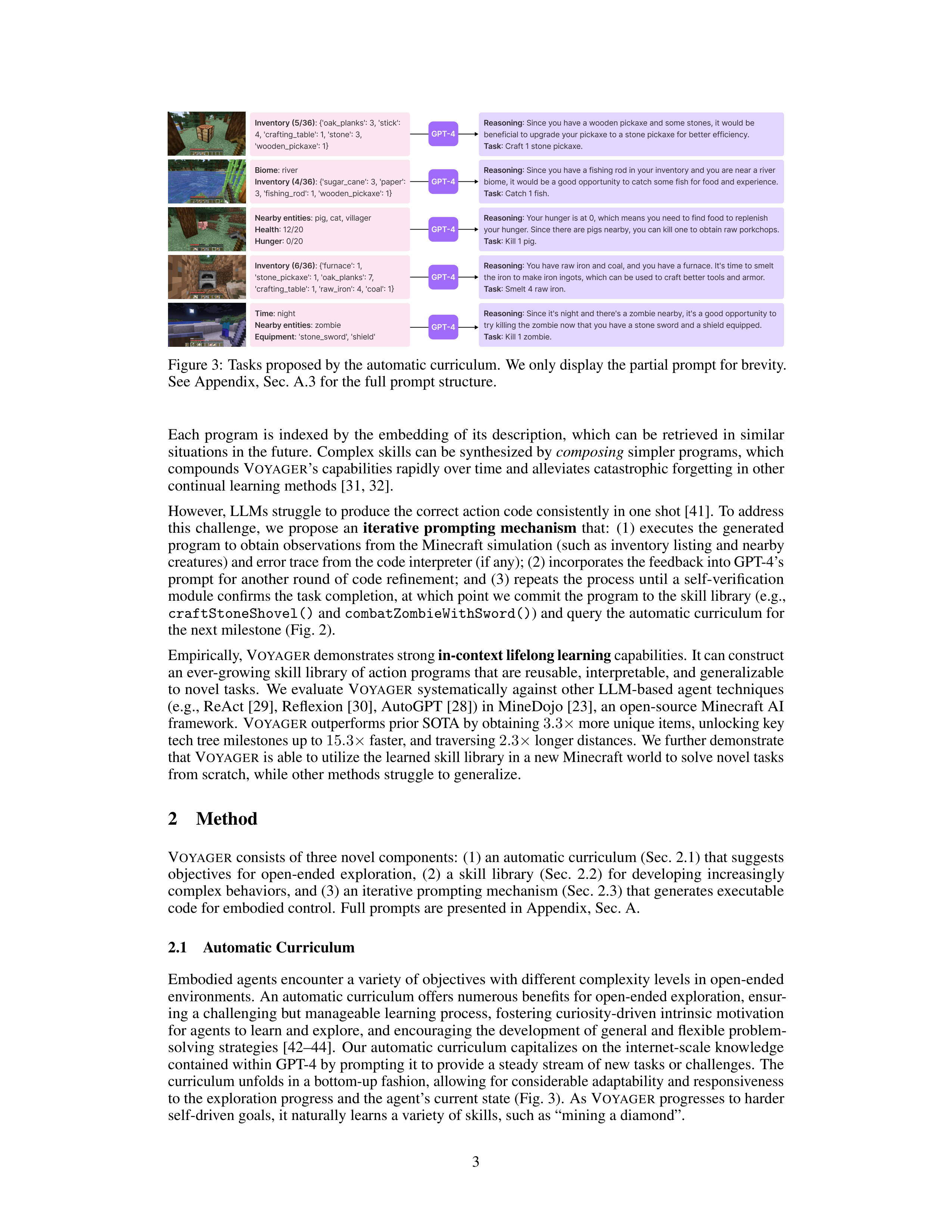
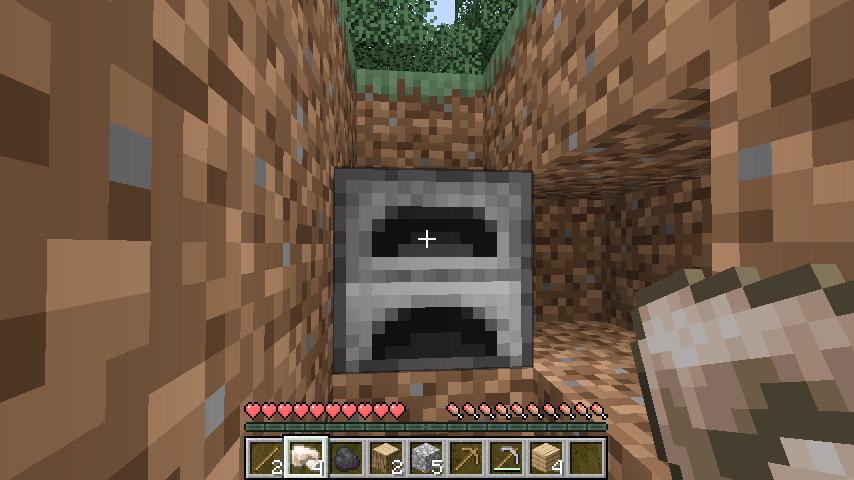
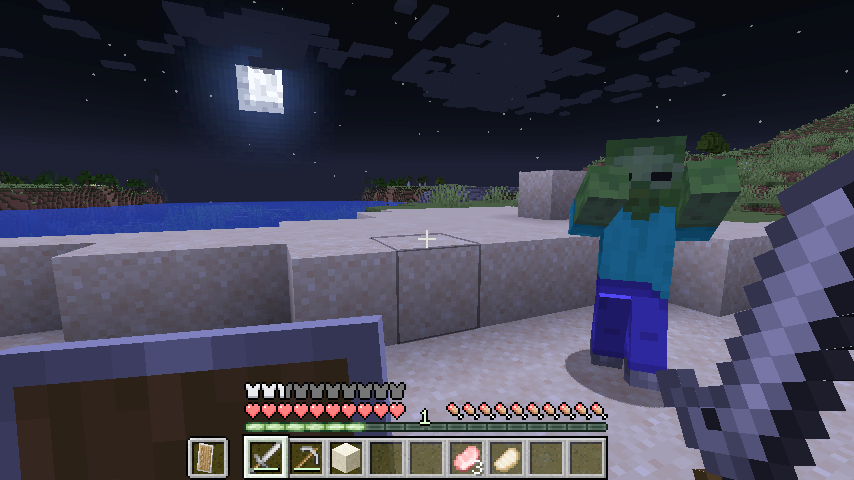
Figure 3:
Tasks proposed by the automatic curriculum.
We only display the partial prompt for brevity.
See Appendix, Sec. A.3 for the full prompt structure.
Each
program
is
indexed
by
the
embedding
of
its
description,
which
can
be
retrieved
in
similar
situations in the future.
Complex skills can be synthesized by
composing
simpler programs, which
compounds
V
OYAGER
’s capabilities rapidly over time and alleviates catastrophic forgetting in other
continual learning methods [31, 32].
However, LLMs struggle to produce the correct action code consistently in one shot [
41
].
To address
this
challenge,
we
propose
an
iterative
prompting
mechanism
that:
(1)
executes
the
generated
program to obtain observations from the Minecraft simulation (such as inventory listing and nearby
creatures) and error trace from the code interpreter (if any); (2) incorporates the feedback into GPT-4’s
prompt for another round of code refinement;
and (3) repeats the process until a self-verification
module confirms the task completion, at which point we commit the program to the skill library (e.g.,
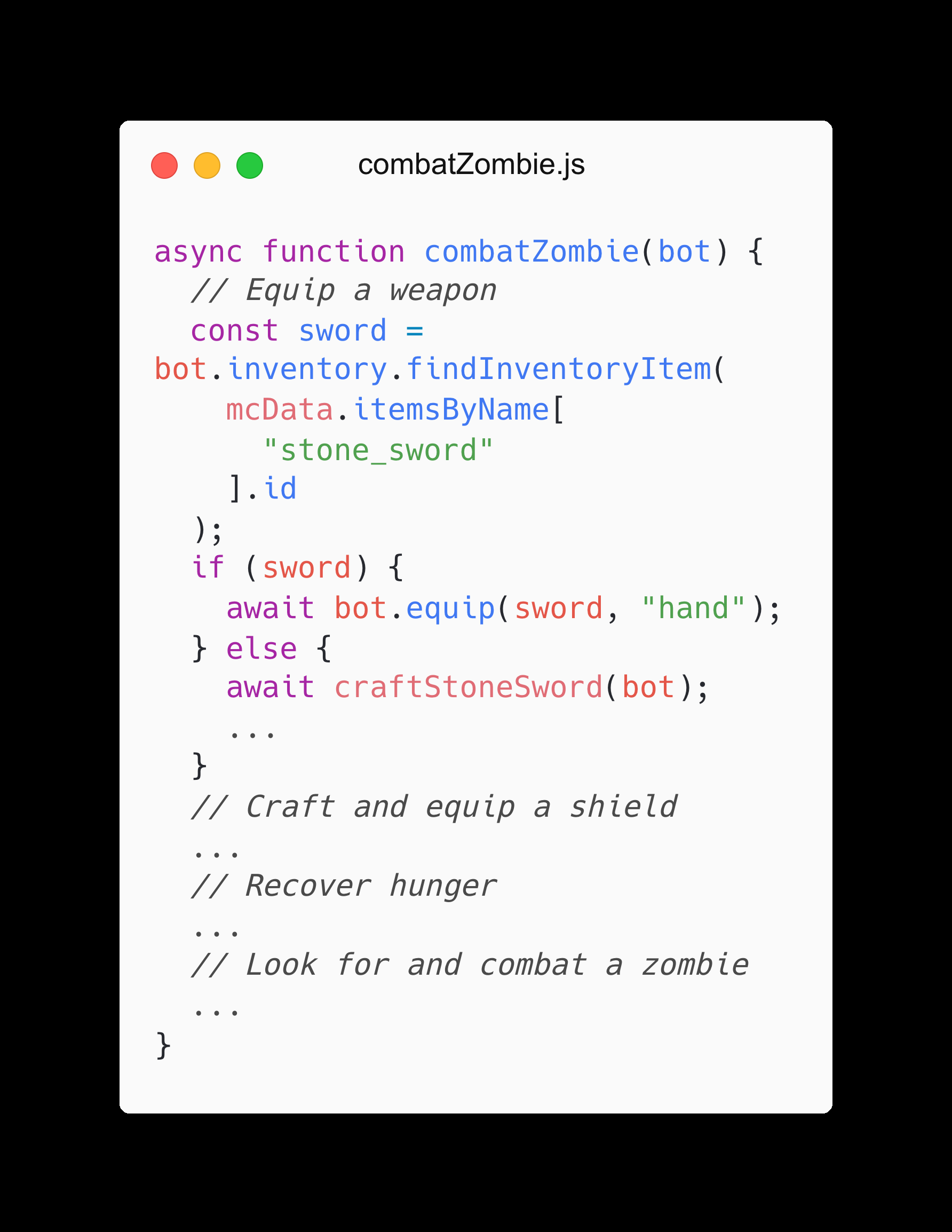
craftStoneShovel()
and
combatZombieWithSword()
) and query the automatic curriculum for
the next milestone (Fig. 2).
Empirically,
V
OYAGER
demonstrates strong
in-context lifelong learning
capabilities. It can construct
an ever-growing skill library of action programs that are reusable, interpretable, and generalizable
to novel tasks.
We evaluate
V
OYAGER
systematically against other LLM-based agent techniques
(e.g., ReAct [
29
], Reflexion [
30
], AutoGPT [
28
]) in MineDojo [
23
], an open-source Minecraft AI
framework.
V
OYAGER
outperforms prior SOTA by obtaining
3
.
3
×
more unique items, unlocking key
tech tree milestones up to
15
.
3
×
faster, and traversing
2
.
3
×
longer distances.
We further demonstrate
that
V
OYAGER
is able to utilize the learned skill library in a new Minecraft world to solve novel tasks
from scratch, while other methods struggle to generalize.
2
Method
V
OYAGER
consists of three novel components:
(1) an automatic curriculum (Sec. 2.1) that suggests
objectives
for
open-ended
exploration,
(2)
a
skill
library
(Sec.
2.2)
for
developing
increasingly
complex behaviors, and (3) an iterative prompting mechanism (Sec. 2.3) that generates executable
code for embodied control.
Full prompts are presented in Appendix, Sec. A.
2.1
Automatic Curriculum
Embodied agents encounter a variety of objectives with different complexity levels in open-ended
environments.
An automatic curriculum offers numerous benefits for open-ended exploration, ensur-
ing a challenging but manageable learning process, fostering curiosity-driven intrinsic motivation
for agents to learn and explore, and encouraging the development of general and flexible problem-
solving strategies [
42
–
44
].
Our automatic curriculum capitalizes on the internet-scale knowledge
contained within GPT-4 by prompting it to provide a steady stream of new tasks or challenges.
The
curriculum unfolds in a bottom-up fashion, allowing for considerable adaptability and responsiveness
to the exploration progress and the agent’s current state (Fig. 3).
As V
OYAGER
progresses to harder
self-driven goals, it naturally learns a variety of skills, such as “mining a diamond”.
3





Program Description
Skill Library
Top-5 Relevant Skills
Program Generated by GPT-4
Task: Craft Iron Pickaxe
Key
Add
Retrieve
Value
Skill Library
Query
How to craft an iron pickaxe in
Minecraft?
To craft an iron pickaxe, you
need to 3 iron ingots and 2
sticks. Once you have gathered
the materials, ....
----------------------------------
Environment Feedback
Mine Wood Log
Make Crafting Table
Craft Wooden Pickaxe
Craft Stone Sword
Make Furnace
...
Combat Cow
Cook Steak
Craft Iron Axe
Combat Zombie
Smelt Iron Ingot
Craft Stick
Make Crafting Table
Make Furnace
Craft Wooden Pickaxe
GPT-
3.
5
Embedding
Embedding
GPT-
3.
5
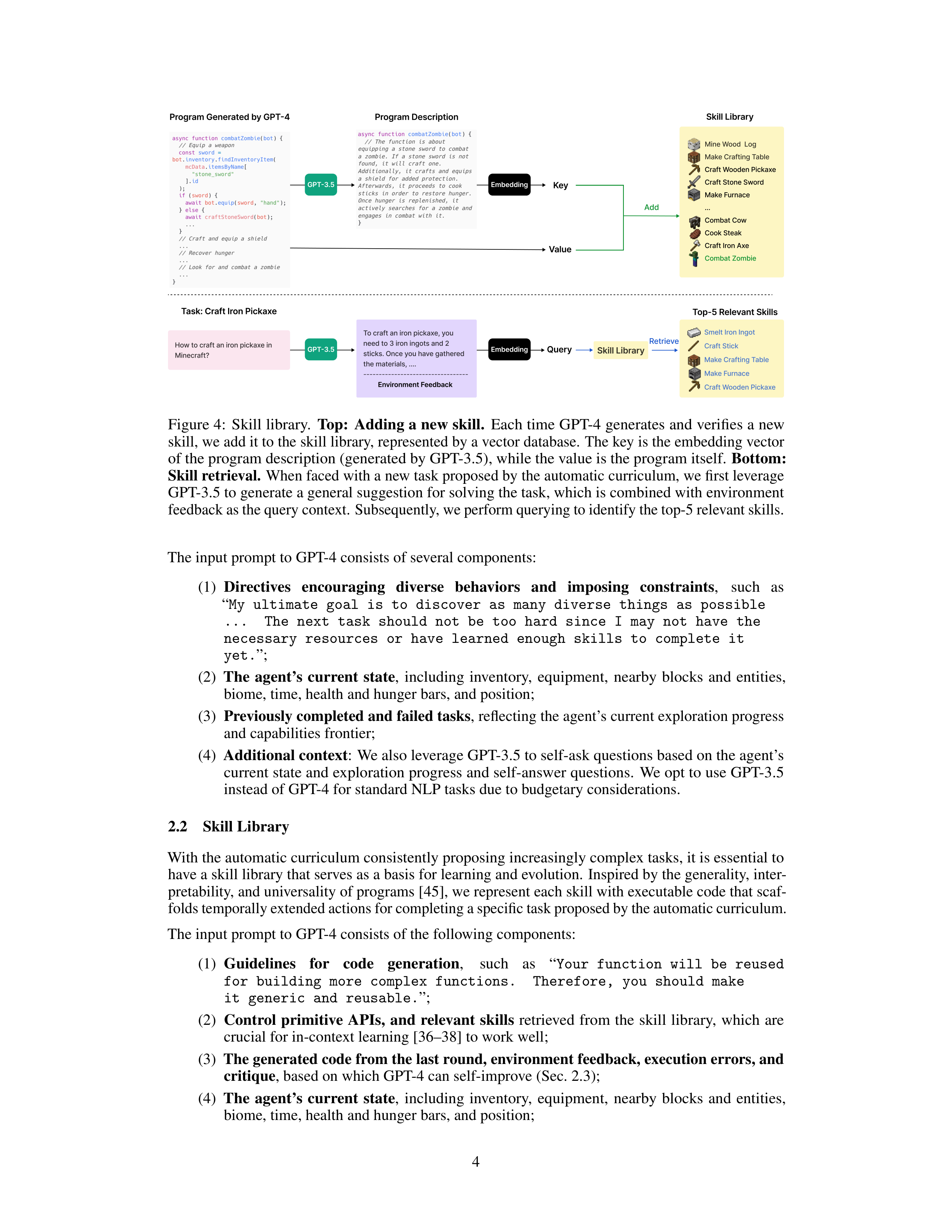
Figure 4:
Skill library.
Top:
Adding a new skill.
Each time GPT-4 generates and verifies a new
skill, we add it to the skill library, represented by a vector database.
The key is the embedding vector
of the program description (generated by GPT-3.5), while the value is the program itself.
Bottom:
Skill retrieval.
When faced with a new task proposed by the automatic curriculum, we first leverage
GPT-3.5 to generate a general suggestion for solving the task, which is combined with environment
feedback as the query context.
Subsequently, we perform querying to identify the top-5 relevant skills.
The input prompt to GPT-4 consists of several components:
(1)
Directives
encouraging
diverse
behaviors
and
imposing
constraints
,
such
as
“
My
ultimate
goal
is
to
discover
as
many
diverse
things
as
possible
...
The
next
task
should
not
be
too
hard
since
I
may
not
have
the
necessary
resources
or
have
learned
enough
skills
to
complete
it
yet.
”;
(2)
The
agent’s
current
state
,
including
inventory,
equipment,
nearby
blocks
and
entities,
biome, time, health and hunger bars, and position;
(3)
Previously completed and failed tasks
, reflecting the agent’s current exploration progress
and capabilities frontier;
(4)
Additional context
:
We also leverage GPT-3.5 to self-ask questions based on the agent’s
current state and exploration progress and self-answer questions.
We opt to use GPT-3.5
instead of GPT-4 for standard NLP tasks due to budgetary considerations.
2.2
Skill Library
With the automatic curriculum consistently proposing increasingly complex tasks, it is essential to
have a skill library that serves as a basis for learning and evolution.
Inspired by the generality, inter-
pretability, and universality of programs [
45
], we represent each skill with executable code that scaf-
folds temporally extended actions for completing a specific task proposed by the automatic curriculum.
The input prompt to GPT-4 consists of the following components:
(1)
Guidelines
for
code
generation
,
such
as
“
Your
function
will
be
reused
for
building
more
complex
functions.
Therefore,
you
should
make
it
generic
and
reusable.
”;
(2)
Control
primitive
APIs,
and
relevant
skills
retrieved
from
the
skill
library,
which
are
crucial for in-context learning [36–38] to work well;
(3)
The generated code from the last round, environment feedback, execution errors, and
critique
, based on which GPT-4 can self-improve (Sec. 2.3);
(4)
The
agent’s
current
state
,
including
inventory,
equipment,
nearby
blocks
and
entities,
biome, time, health and hunger bars, and position;
4
I cannot make stick because I need: 2 more planks
I cannot make stone_shovel because I need: 2 more stick
throw new Error(`No item named ${name}`);
No item named acacia_axe
at line 18:await craftItem(bot, "acacia_axe", 1);
Environment Feedback
Execution Error
GPT-4
GPT-4
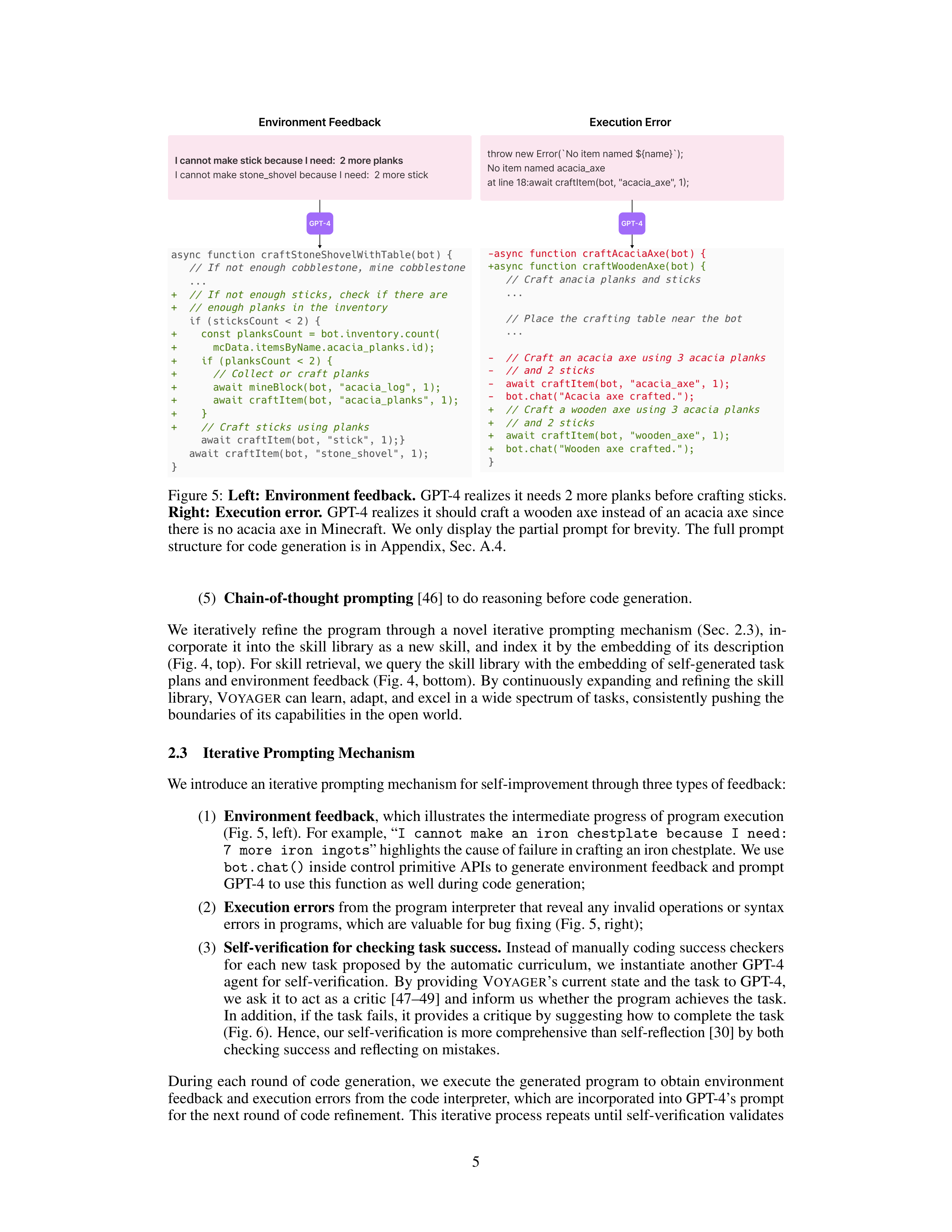
Figure 5:
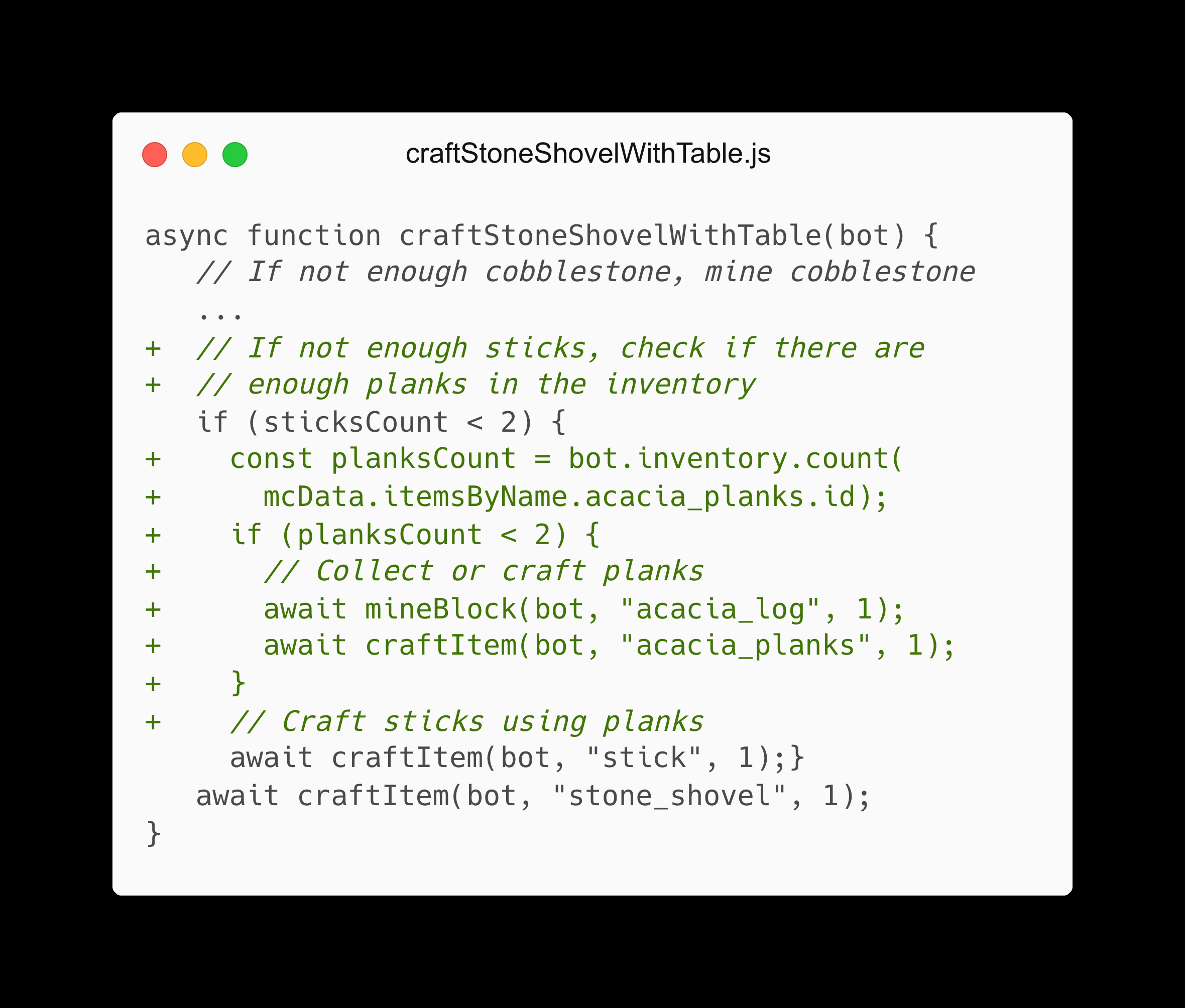
Left:
Environment feedback.
GPT-4 realizes it needs 2 more planks before crafting sticks.
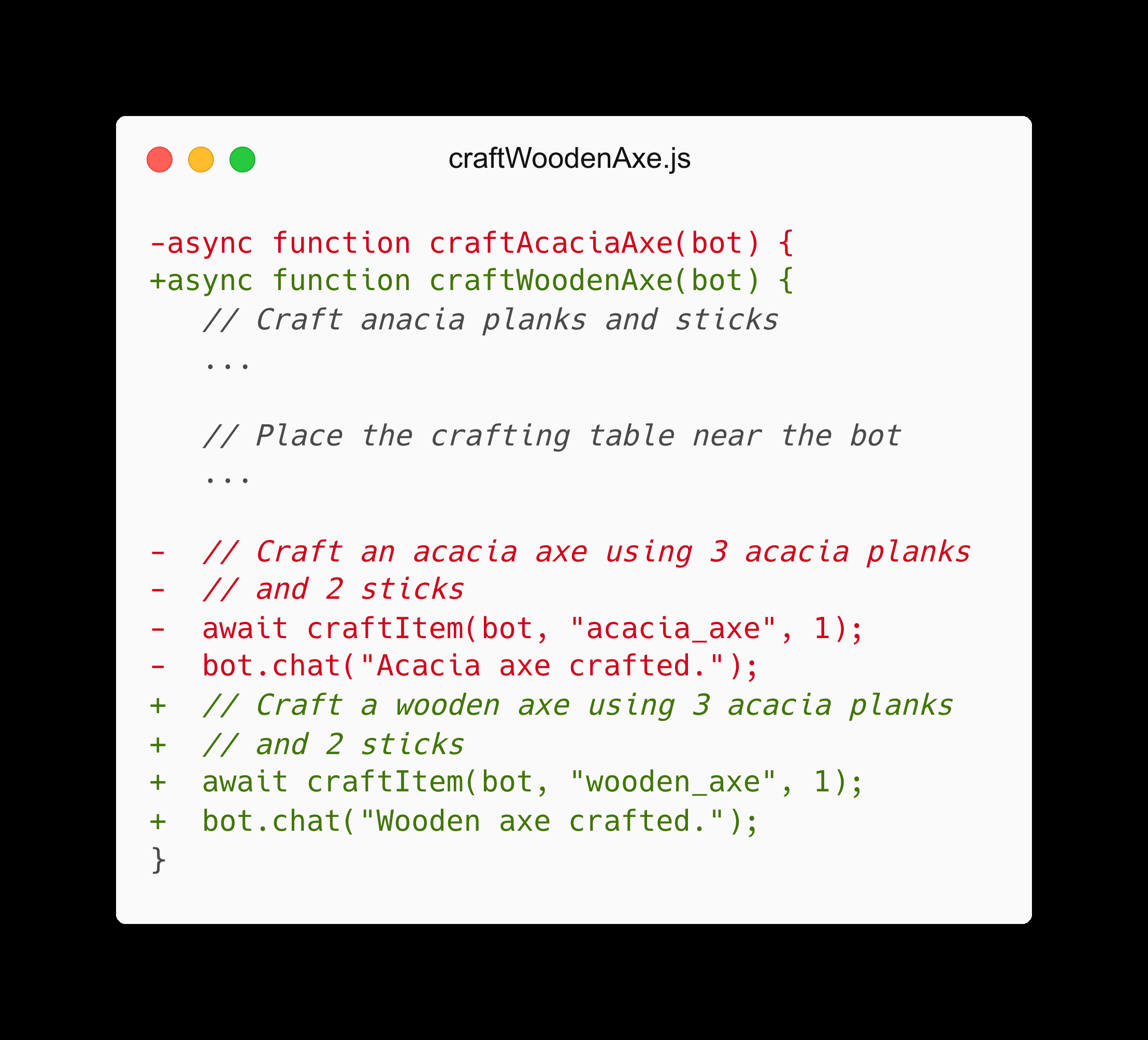
Right:
Execution error.
GPT-4 realizes it should craft a wooden axe instead of an acacia axe since
there is no acacia axe in Minecraft.
We only display the partial prompt for brevity.
The full prompt
structure for code generation is in Appendix, Sec. A.4.
(5)
Chain-of-thought prompting
[46] to do reasoning before code generation.
We
iteratively
refine
the
program
through
a
novel
iterative
prompting
mechanism
(Sec.
2.3),
in-
corporate
it
into
the
skill
library
as
a
new
skill,
and
index
it
by
the
embedding
of
its
description
(Fig. 4, top).
For skill retrieval, we query the skill library with the embedding of self-generated task
plans and environment feedback (Fig. 4, bottom).
By continuously expanding and refining the skill
library,
V
OYAGER
can learn, adapt, and excel in a wide spectrum of tasks, consistently pushing the
boundaries of its capabilities in the open world.
2.3
Iterative Prompting Mechanism
We introduce an iterative prompting mechanism for self-improvement through three types of feedback:
(1)
Environment feedback
, which illustrates the intermediate progress of program execution
(Fig. 5, left).
For example, “
I
cannot
make
an
iron
chestplate
because
I
need:
7
more
iron
ingots
” highlights the cause of failure in crafting an iron chestplate. We use
bot.chat()
inside control primitive APIs to generate environment feedback and prompt
GPT-4 to use this function as well during code generation;
(2)
Execution errors
from the program interpreter that reveal any invalid operations or syntax
errors in programs, which are valuable for bug fixing (Fig. 5, right);
(3)
Self-verification for checking task success.
Instead of manually coding success checkers
for
each
new
task
proposed
by
the
automatic
curriculum,
we
instantiate
another
GPT-4
agent for self-verification.
By providing
V
OYAGER
’s current state and the task to GPT-4,
we ask it to act as a critic [
47
–
49
] and inform us whether the program achieves the task.
In addition, if the task fails, it provides a critique by suggesting how to complete the task
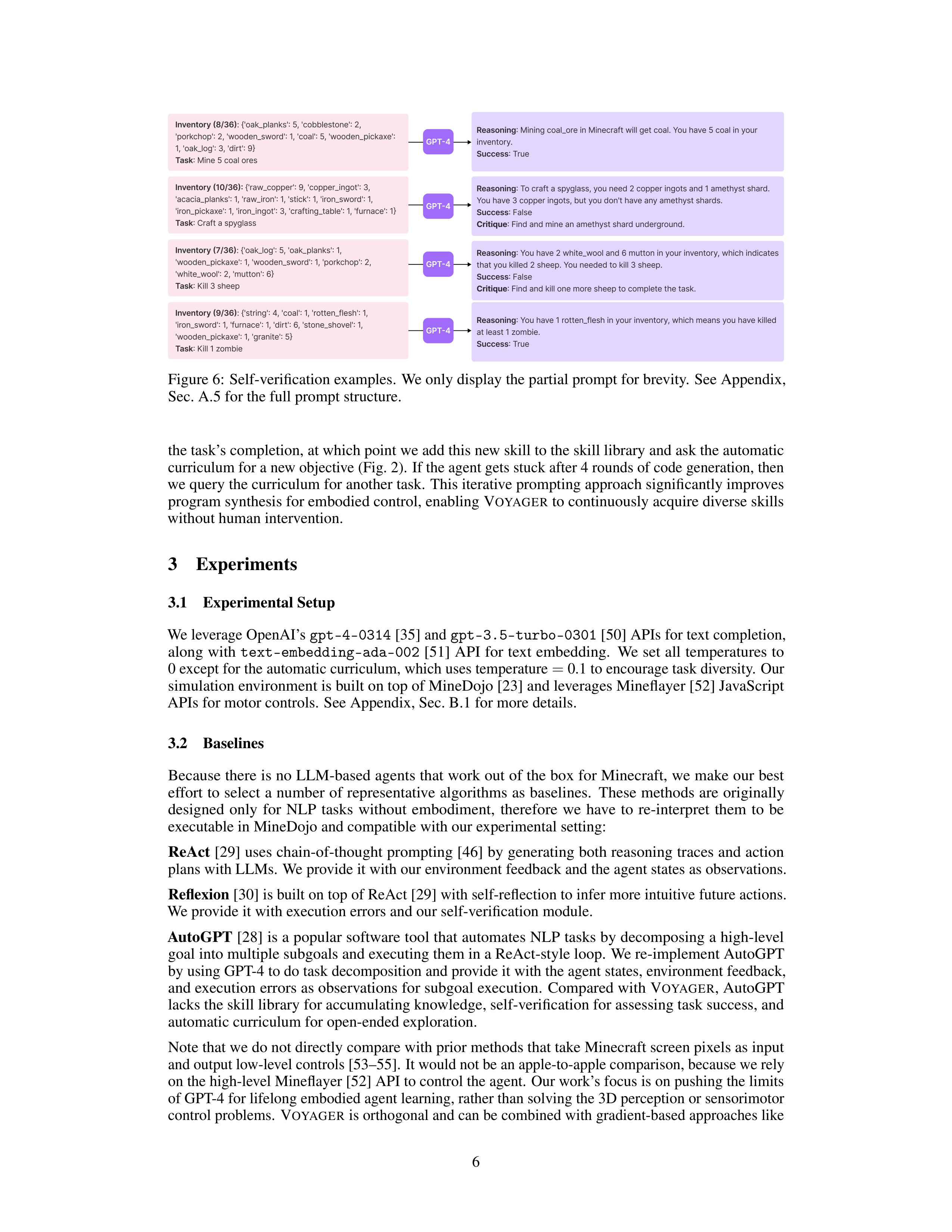
(Fig. 6).
Hence, our self-verification is more comprehensive than self-reflection [
30
] by both
checking success and reflecting on mistakes.
During each round of code generation,
we execute the generated program to obtain environment
feedback and execution errors from the code interpreter, which are incorporated into GPT-4’s prompt
for the next round of code refinement.
This iterative process repeats until self-verification validates
5
Inventory (8/36): {'oak_planks': 5, 'cobblestone': 2,
'porkchop': 2, 'wooden_sword': 1, 'coal': 5, 'wooden_pickaxe':
1, 'oak_log': 3, 'dirt': 9}
Task: Mine 5 coal ores
Inventory (10/36): {'raw_copper': 9, 'copper_ingot': 3,
'acacia_planks': 1, 'raw_iron': 1, 'stick': 1, 'iron_sword': 1,
'iron_pickaxe': 1, 'iron_ingot': 3, 'crafting_table': 1, 'furnace': 1}
Task: Craft a spyglass
Inventory (7/36): {'oak_log': 5, 'oak_planks': 1,
'wooden_pickaxe': 1, 'wooden_sword': 1, 'porkchop': 2,
'white_wool': 2, 'mutton': 6}
Task: Kill 3 sheep
Inventory (9/36): {'string': 4, 'coal': 1, 'rotten_flesh': 1,
'iron_sword': 1, 'furnace': 1, 'dirt': 6, 'stone_shovel': 1,
'wooden_pickaxe': 1, 'granite': 5}
Task: Kill 1 zombie
Reasoning: Mining coal_ore in Minecraft will get coal. You have 5 coal in your
inventory.
Success: True
Reasoning: To craft a spyglass, you need 2 copper ingots and 1 amethyst shard.
You have 3 copper ingots, but you don't have any amethyst shards.
Success:
F
als
e
Critique
:
F
ind and mine an amethyst shard underground.
Reasoning: You have 2 white_wool and 6 mutton in your inventory, which indicates
that you killed 2 sheep. You needed to kill 3 sheep.
Success:
F
als
e
Critique
:
F
ind and kill one more sheep to complete the task.
Reasoning: You have 1 rotten_flesh in your inventory, which means you have killed
at least 1 zombie.
Success: True
GP
T
-4
GP
T
-4
GP
T
-4
GP
T
-4
Figure 6:
Self-verification examples.
We only display the partial prompt for brevity.
See Appendix,
Sec. A.5 for the full prompt structure.
the task’s completion, at which point we add this new skill to the skill library and ask the automatic
curriculum for a new objective (Fig. 2).
If the agent gets stuck after 4 rounds of code generation, then
we query the curriculum for another task.
This iterative prompting approach significantly improves
program synthesis for embodied control, enabling
V
OYAGER
to continuously acquire diverse skills
without human intervention.
3
Experiments
3.1
Experimental Setup
We leverage OpenAI’s
gpt-4-0314
[
35
] and
gpt-3.5-turbo-0301
[
50
] APIs for text completion,
along with
text-embedding-ada-002
[
51
] API for text embedding.
We set all temperatures to
0 except for the automatic curriculum, which uses temperature
=
0.1 to encourage task diversity.
Our
simulation environment is built on top of MineDojo [
23
] and leverages Mineflayer [
52
] JavaScript
APIs for motor controls.
See Appendix, Sec. B.1 for more details.
3.2
Baselines
Because there is no LLM-based agents that work out of the box for Minecraft, we make our best
effort to select a number of representative algorithms as baselines.
These methods are originally
designed
only
for
NLP
tasks
without
embodiment,
therefore
we
have
to
re-interpret
them
to
be
executable in MineDojo and compatible with our experimental setting:
ReAct
[
29
] uses chain-of-thought prompting [
46
] by generating both reasoning traces and action
plans with LLMs.
We provide it with our environment feedback and the agent states as observations.
Reflexion
[
30
] is built on top of ReAct [
29
] with self-reflection to infer more intuitive future actions.
We provide it with execution errors and our self-verification module.
AutoGPT
[
28
] is a popular software tool that automates NLP tasks by decomposing a high-level
goal into multiple subgoals and executing them in a ReAct-style loop.
We re-implement AutoGPT
by using GPT-4 to do task decomposition and provide it with the agent states, environment feedback,
and execution errors as observations for subgoal execution.
Compared with
V
OYAGER
, AutoGPT
lacks the skill library for accumulating knowledge, self-verification for assessing task success, and
automatic curriculum for open-ended exploration.
Note that we do not directly compare with prior methods that take Minecraft screen pixels as input
and output low-level controls [
53
–
55
].
It would not be an apple-to-apple comparison, because we rely
on the high-level Mineflayer [
52
] API to control the agent.
Our work’s focus is on pushing the limits
of GPT-4 for lifelong embodied agent learning, rather than solving the 3D perception or sensorimotor
control problems.
V
OYAGER
is orthogonal and can be combined with gradient-based approaches like
6
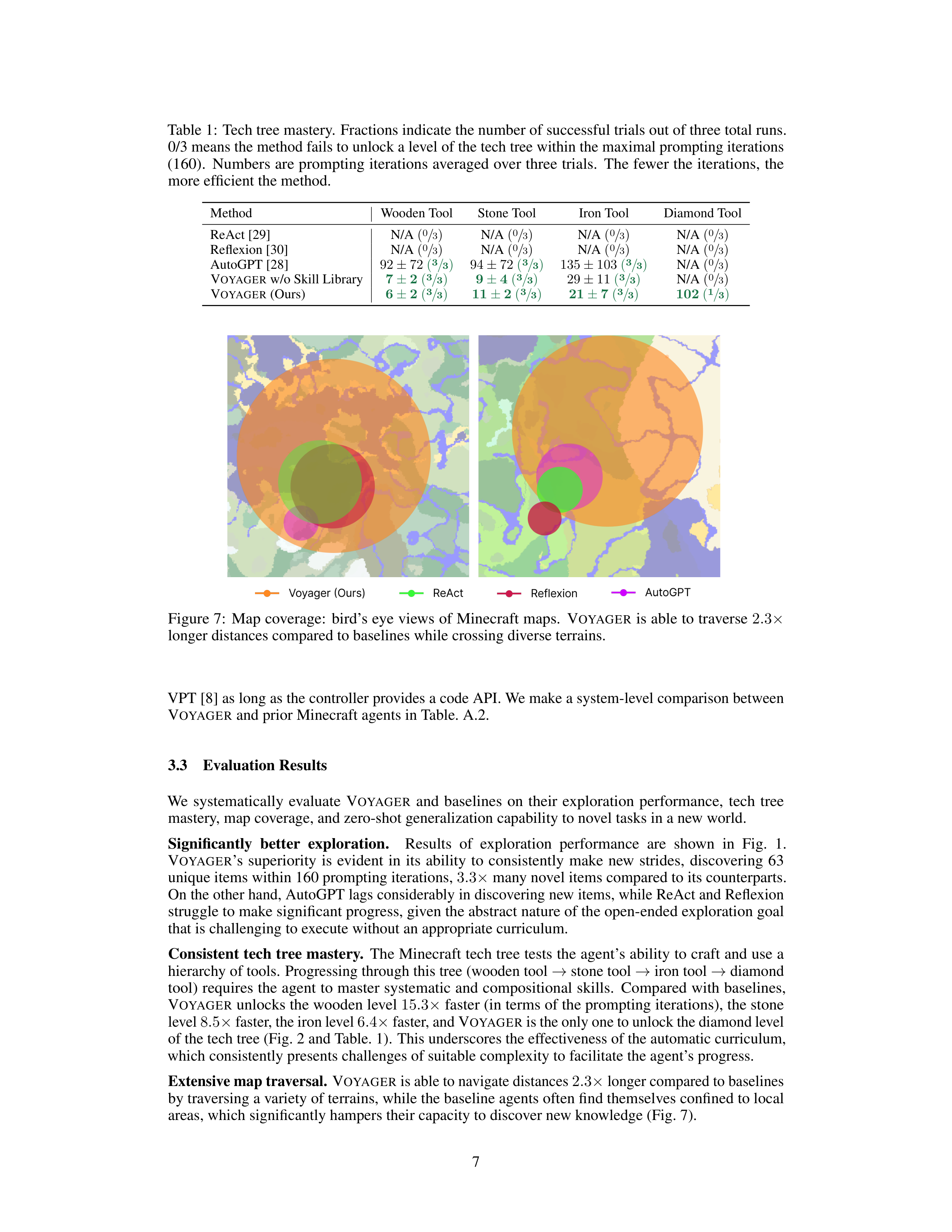
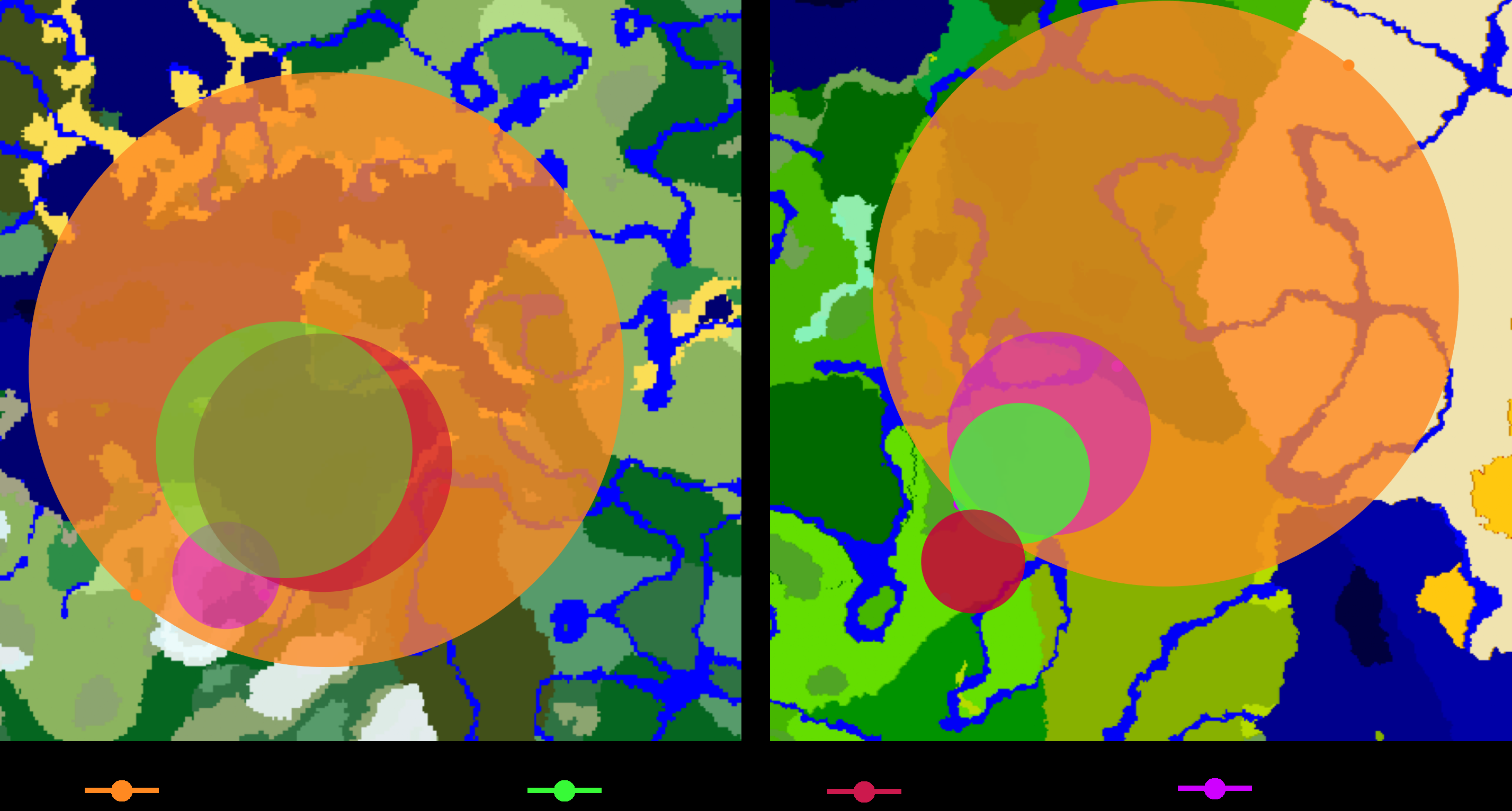
Table 1:
Tech tree mastery.
Fractions indicate the number of successful trials out of three total runs.
0/3 means the method fails to unlock a level of the tech tree within the maximal prompting iterations
(160).
Numbers are prompting iterations averaged over three trials.
The fewer the iterations, the
more efficient the method.
Method
Wooden Tool
Stone Tool
Iron Tool
Diamond Tool
ReAct [29]
N/A
(
0
/
3
)
N/A
(
0
/
3
)
N/A
(
0
/
3
)
N/A
(
0
/
3
)
Reflexion [30]
N/A
(
0
/
3
)
N/A
(
0
/
3
)
N/A
(
0
/
3
)
N/A
(
0
/
3
)
AutoGPT [28]
92
±
72
(
3
/
3
)
94
±
72
(
3
/
3
)
135
±
103
(
3
/
3
)
N/A
(
0
/
3
)
V
OYAGER
w/o Skill Library
7
±
2
(
3
/
3
)
9
±
4
(
3
/
3
)
29
±
11
(
3
/
3
)
N/A
(
0
/
3
)
V
OYAGER
(Ours)
6
±
2
(
3
/
3
)
11
±
2
(
3
/
3
)
21
±
7
(
3
/
3
)
102
(
1
/
3
)
Figure 7:
Map coverage:
bird’s eye views of Minecraft maps.
V
OYAGER
is able to traverse
2
.
3
×
longer distances compared to baselines while crossing diverse terrains.
VPT [
8
] as long as the controller provides a code API. We make a system-level comparison between
V
OYAGER
and prior Minecraft agents in Table. A.2.
3.3
Evaluation Results
We
systematically
evaluate
V
OYAGER
and
baselines
on
their
exploration
performance,
tech
tree
mastery, map coverage, and zero-shot generalization capability to novel tasks in a new world.
Significantly
better
exploration.
Results
of
exploration
performance
are
shown
in
Fig.
1.
V
OYAGER
’s
superiority
is
evident
in
its
ability
to
consistently
make
new
strides,
discovering
63
unique items within 160 prompting iterations,
3
.
3
×
many novel items compared to its counterparts.
On the other hand, AutoGPT lags considerably in discovering new items, while ReAct and Reflexion
struggle to make significant progress, given the abstract nature of the open-ended exploration goal
that is challenging to execute without an appropriate curriculum.
Consistent tech tree mastery.
The Minecraft tech tree tests the agent’s ability to craft and use a
hierarchy of tools.
Progressing through this tree (wooden tool
→
stone tool
→
iron tool
→
diamond
tool) requires the agent to master systematic and compositional skills.
Compared with baselines,
V
OYAGER
unlocks the wooden level
15
.
3
×
faster (in terms of the prompting iterations), the stone
level
8
.
5
×
faster, the iron level
6
.
4
×
faster, and
V
OYAGER
is the only one to unlock the diamond level
of the tech tree (Fig. 2 and Table. 1).
This underscores the effectiveness of the automatic curriculum,
which consistently presents challenges of suitable complexity to facilitate the agent’s progress.
Extensive map traversal.
V
OYAGER
is able to navigate distances
2
.
3
×
longer compared to baselines
by traversing a variety of terrains, while the baseline agents often find themselves confined to local
areas, which significantly hampers their capacity to discover new knowledge (Fig. 7).
7
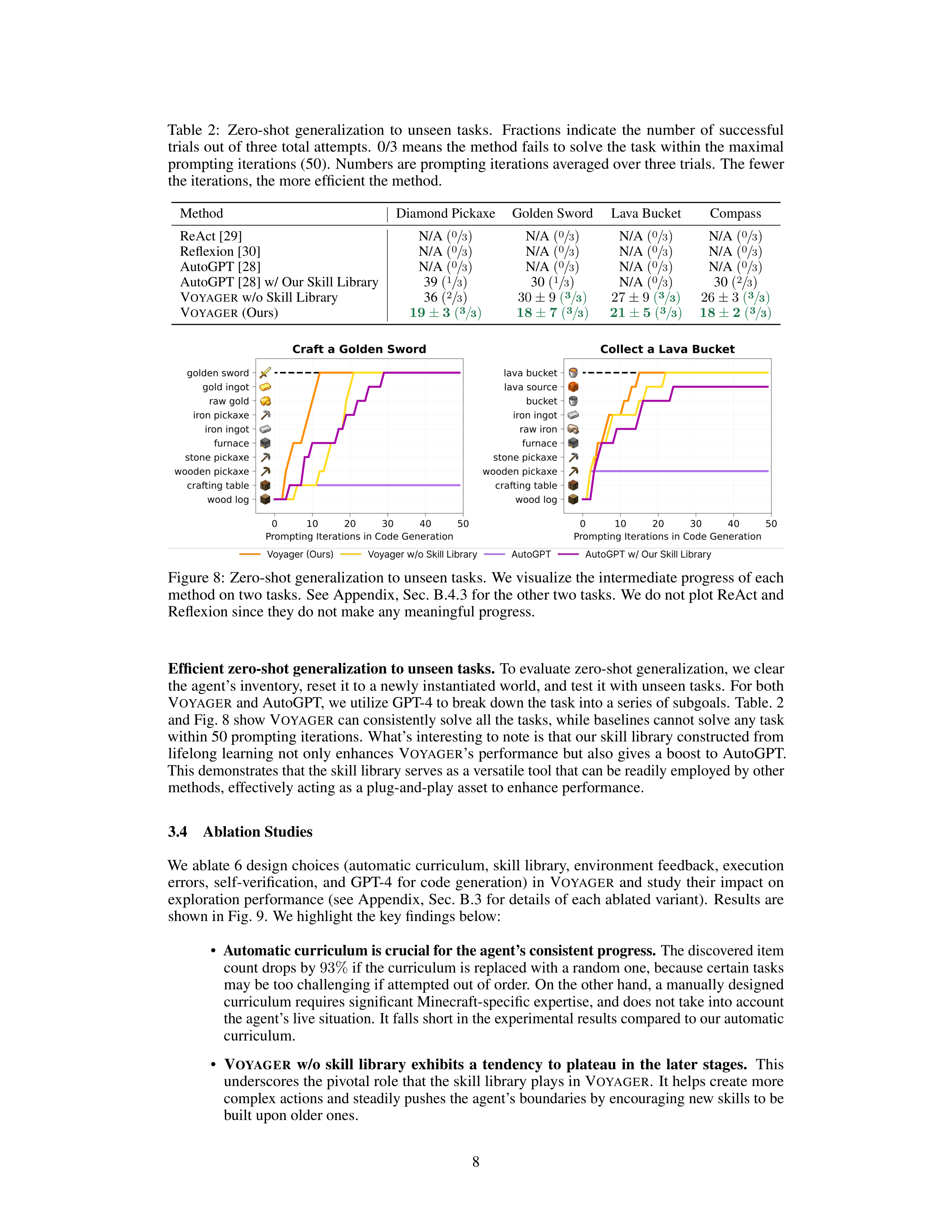
Table
2:
Zero-shot
generalization
to
unseen
tasks.
Fractions
indicate
the
number
of
successful
trials out of three total attempts.
0/3 means the method fails to solve the task within the maximal
prompting iterations (50).
Numbers are prompting iterations averaged over three trials.
The fewer
the iterations, the more efficient the method.
Method
Diamond Pickaxe
Golden Sword
Lava Bucket
Compass
ReAct [29]
N/A
(
0
/
3
)
N/A
(
0
/
3
)
N/A
(
0
/
3
)
N/A
(
0
/
3
)
Reflexion [30]
N/A
(
0
/
3
)
N/A
(
0
/
3
)
N/A
(
0
/
3
)
N/A
(
0
/
3
)
AutoGPT [28]
N/A
(
0
/
3
)
N/A
(
0
/
3
)
N/A
(
0
/
3
)
N/A
(
0
/
3
)
AutoGPT [28] w/ Our Skill Library
39
(
1
/
3
)
30
(
1
/
3
)
N/A
(
0
/
3
)
30
(
2
/
3
)
V
OYAGER
w/o Skill Library
36
(
2
/
3
)
30
±
9
(
3
/
3
)
27
±
9
(
3
/
3
)
26
±
3
(
3
/
3
)
V
OYAGER
(Ours)
19
±
3
(
3
/
3
)
18
±
7
(
3
/
3
)
21
±
5
(
3
/
3
)
18
±
2
(
3
/
3
)
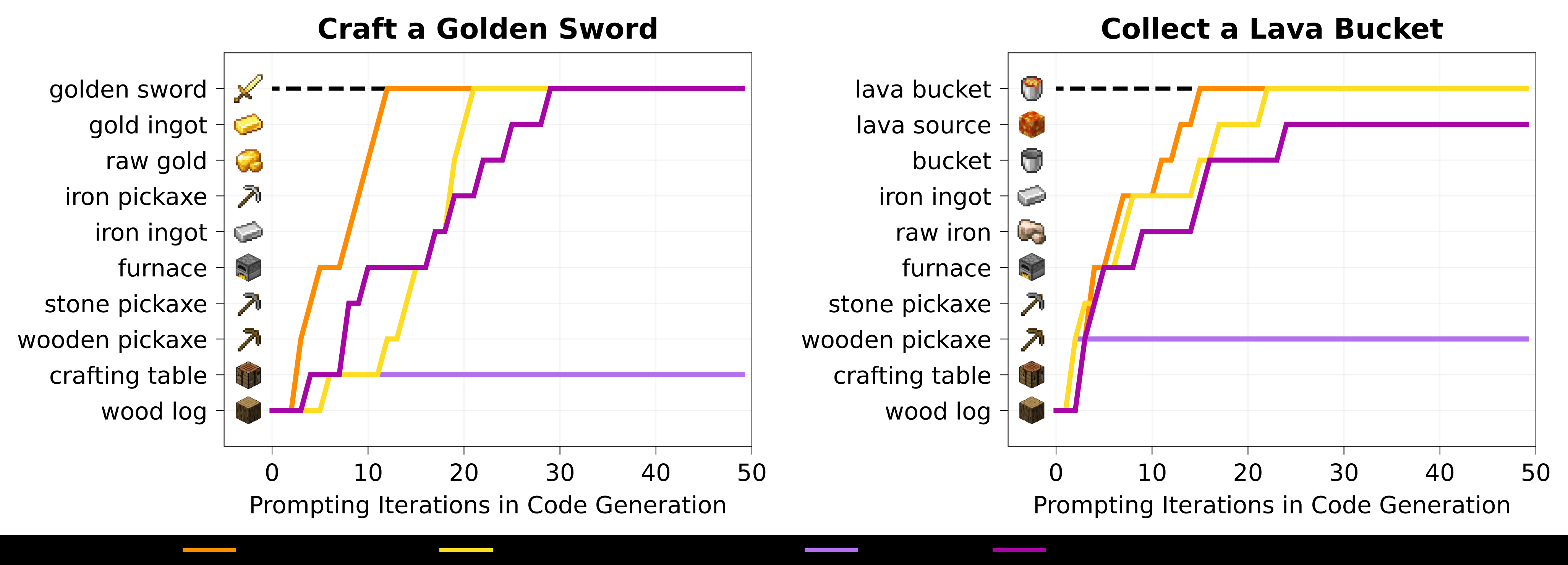
Figure 8:
Zero-shot generalization to unseen tasks.
We visualize the intermediate progress of each
method on two tasks.
See Appendix, Sec. B.4.3 for the other two tasks.
We do not plot ReAct and
Reflexion since they do not make any meaningful progress.
Efficient zero-shot generalization to unseen tasks.
To evaluate zero-shot generalization, we clear
the agent’s inventory, reset it to a newly instantiated world, and test it with unseen tasks.
For both
V
OYAGER
and AutoGPT, we utilize GPT-4 to break down the task into a series of subgoals.
Table. 2
and Fig. 8 show
V
OYAGER
can consistently solve all the tasks, while baselines cannot solve any task
within 50 prompting iterations.
What’s interesting to note is that our skill library constructed from
lifelong learning not only enhances
V
OYAGER
’s performance but also gives a boost to AutoGPT.
This demonstrates that the skill library serves as a versatile tool that can be readily employed by other
methods, effectively acting as a plug-and-play asset to enhance performance.
3.4
Ablation Studies
We ablate 6 design choices (automatic curriculum, skill library, environment feedback, execution
errors,
self-verification,
and
GPT-4
for
code
generation)
in
V
OYAGER
and
study
their
impact
on
exploration performance (see Appendix, Sec. B.3 for details of each ablated variant).
Results are
shown in Fig. 9.
We highlight the key findings below:
•
Automatic curriculum is crucial for the agent’s consistent progress.
The discovered item
count drops by
93%
if the curriculum is replaced with a random one, because certain tasks
may be too challenging if attempted out of order.
On the other hand, a manually designed
curriculum requires significant Minecraft-specific expertise, and does not take into account
the agent’s live situation.
It falls short in the experimental results compared to our automatic
curriculum.
•
V
OYAGER
w/o
skill
library
exhibits
a
tendency
to
plateau
in
the
later
stages.
This
underscores the pivotal role that the skill library plays in
V
OYAGER
.
It helps create more
complex actions and steadily pushes the agent’s boundaries by encouraging new skills to be
built upon older ones.
8
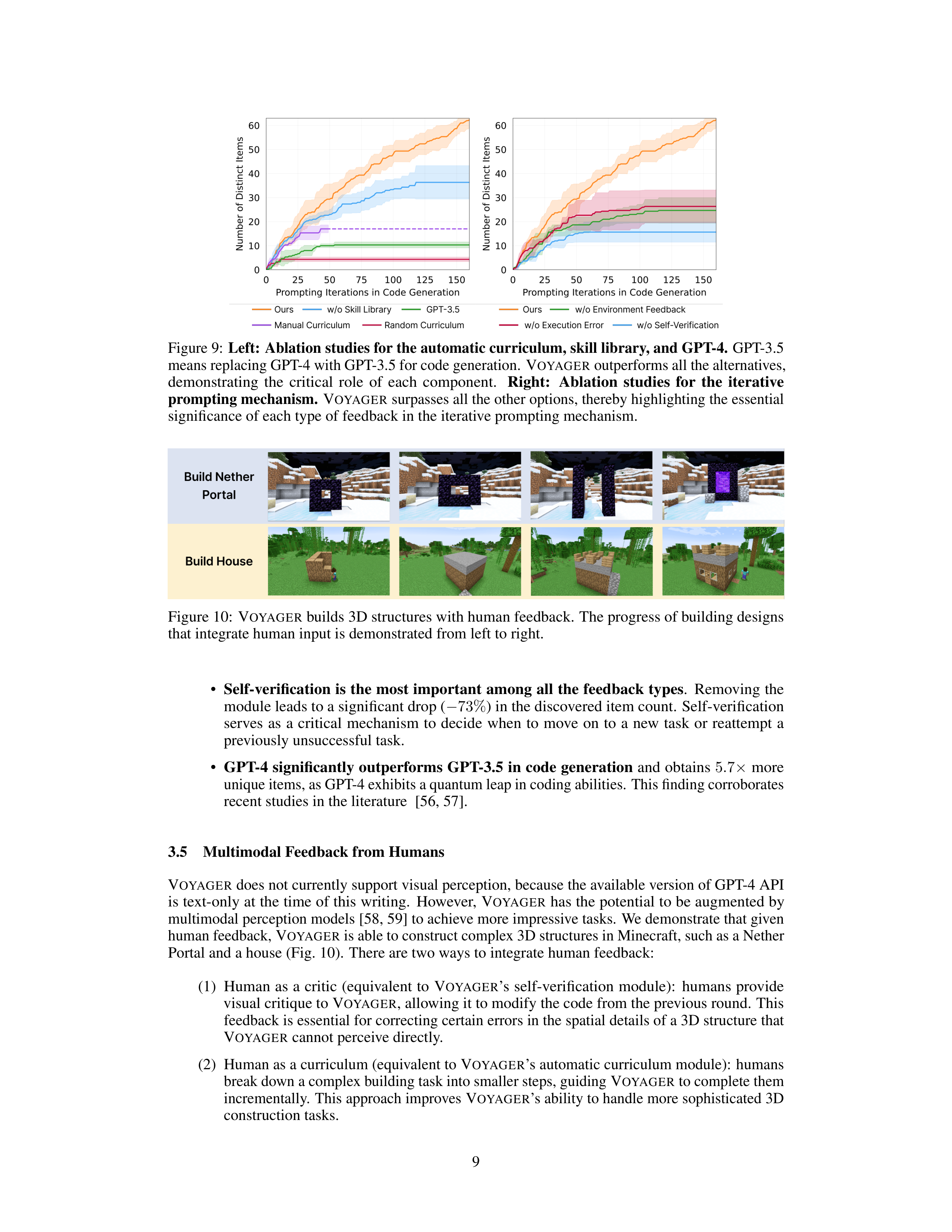
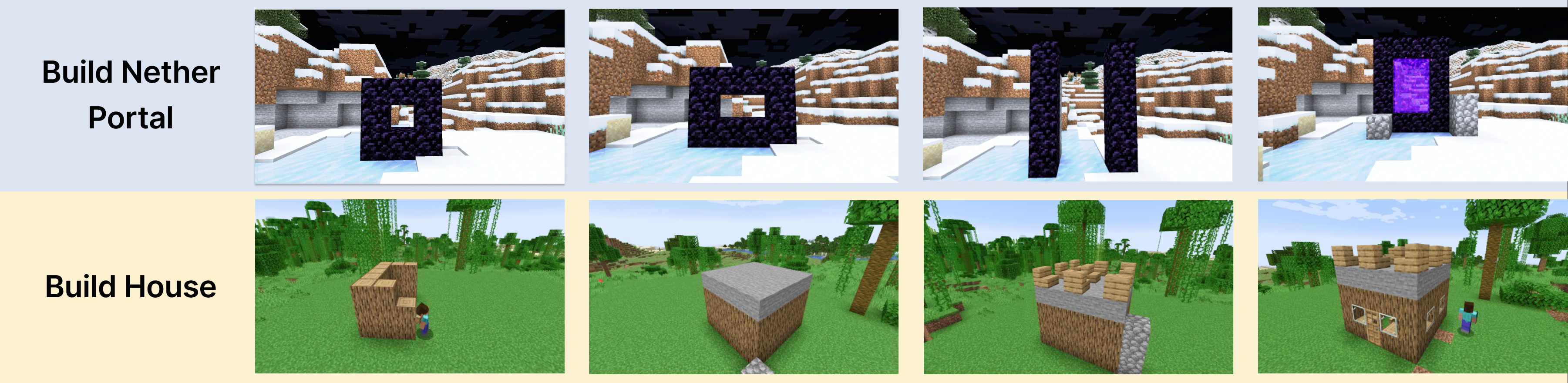
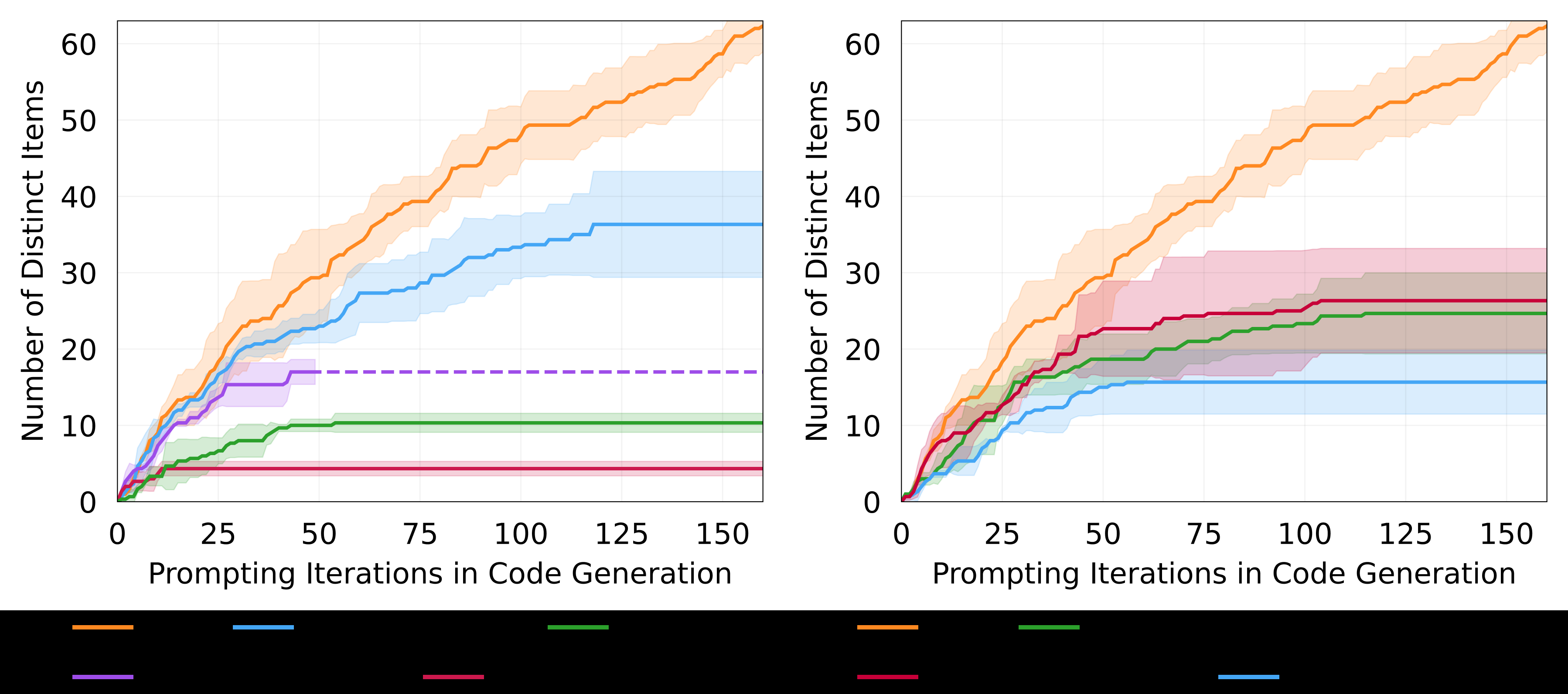
Figure 9:
Left:
Ablation studies for the automatic curriculum, skill library, and GPT-4.
GPT-3.5
means replacing GPT-4 with GPT-3.5 for code generation.
V
OYAGER
outperforms all the alternatives,
demonstrating
the
critical
role
of
each
component.
Right:
Ablation
studies
for
the
iterative
prompting mechanism.
V
OYAGER
surpasses all the other options, thereby highlighting the essential
significance of each type of feedback in the iterative prompting mechanism.
Figure 10:
V
OYAGER
builds 3D structures with human feedback.
The progress of building designs
that integrate human input is demonstrated from left to right.
•
Self-verification is the most important among all the feedback types
.
Removing the
module leads to a significant drop (
−
73%
) in the discovered item count.
Self-verification
serves
as
a
critical
mechanism
to
decide
when
to
move
on
to
a
new
task
or
reattempt
a
previously unsuccessful task.
•
GPT-4 significantly outperforms GPT-3.5 in code generation
and obtains
5
.
7
×
more
unique items, as GPT-4 exhibits a quantum leap in coding abilities.
This finding corroborates
recent studies in the literature
[56, 57].
3.5
Multimodal Feedback from Humans
V
OYAGER
does not currently support visual perception, because the available version of GPT-4 API
is text-only at the time of this writing.
However,
V
OYAGER
has the potential to be augmented by
multimodal perception models [
58
,
59
] to achieve more impressive tasks.
We demonstrate that given
human feedback,
V
OYAGER
is able to construct complex 3D structures in Minecraft, such as a Nether
Portal and a house (Fig. 10).
There are two ways to integrate human feedback:
(1)
Human as a critic (equivalent to
V
OYAGER
’s self-verification module):
humans provide
visual critique to
V
OYAGER
, allowing it to modify the code from the previous round.
This
feedback is essential for correcting certain errors in the spatial details of a 3D structure that
V
OYAGER
cannot perceive directly.
(2)
Human as a curriculum (equivalent to
V
OYAGER
’s automatic curriculum module):
humans
break down a complex building task into smaller steps, guiding
V
OYAGER
to complete them
incrementally.
This approach improves
V
OYAGER
’s ability to handle more sophisticated 3D
construction tasks.
9
4
Limitations and Future Work
Cost.
The GPT-4 API incurs significant costs.
It is
15
×
more expensive than GPT-3.5.
Nevertheless,
V
OYAGER
requires the quantum leap in code generation quality from GPT-4 (Fig. 9), which GPT-3.5
and open-source LLMs cannot provide [60].
Inaccuracies.
Despite the iterative prompting mechanism, there are still cases where the agent gets
stuck and fails to generate the correct skill.
The automatic curriculum has the flexibility to reattempt
this task at a later time.
Occasionally, self-verification module may also fail, such as not recognizing
spider string as a success signal of beating a spider.
Hallucinations.
The automatic curriculum occasionally proposes unachievable tasks.
For example, it
may ask the agent to craft a “copper sword" or “copper chestplate", which are items that do not exist
within the game.
Hallucinations also occur during the code generation process.
For instance, GPT-4
tends to use cobblestone as a fuel input, despite being an invalid fuel source in the game.
Additionally,
it may call functions absent in the provided control primitive APIs, leading to code execution errors.
We are confident that improvements in the GPT API models as well as novel techniques for finetuning
open-source LLMs will overcome these limitations in the future.
5
Related work
Decision-making Agents in Minecraft.
Minecraft is an open-ended 3D world with incredibly
flexible game mechanics supporting a broad spectrum of activities.
Built upon notable Minecraft
benchmarks
[
23
,
61
–
65
],
Minecraft
learning
algorithms
can
be
divided
into
two
categories:
1)
Low-level controller:
Many prior efforts leverage hierarchical reinforcement learning to learn from
human demonstrations [
66
–
68
].
Kanitscheider et al. [
14
] design a curriculum based on success rates,
but its objectives are limited to curated items.
MineDojo [
23
] and VPT [
8
] utilize YouTube videos
for large-scale pre-training.
DreamerV3 [
69
], on the other hand, learns a world model to explore
the environment and collect diamonds.
2) High-level planner:
Volum et al. [
70
] leverage few-shot
prompting
with
Codex
[
41
]
to
generate
executable
policies,
but
they
require
additional
human
interaction.
Recent
works
leverage
LLMs
as
a
high-level
planner
in
Minecraft
by
decomposing
a high-level task into several subgoals following Minecraft recipes [
55
,
53
,
71
],
thus lacking full
exploration flexibility.
Like these latter works,
V
OYAGER
also uses LLMs as a high-level planner by
prompting GPT-4 and utilizes Mineflayer [
52
] as a low-level controller following Volum et al. [
70
].
Unlike prior works,
V
OYAGER
employs an automatic curriculum that unfolds in a bottom-up manner,
driven by curiosity, and therefore enables open-ended exploration.
Large Language Models for Agent Planning.
Inspired by the strong emergent capabilities of
LLMs, such as zero-shot prompting and complex reasoning [
72
,
37
,
38
,
36
,
73
,
74
], embodied agent
research [
75
–
78
] has witnessed a significant increase in the utilization of LLMs for planning purposes.
Recent
efforts
can
be
roughly
classified
into
two
groups.
1)
Large
language
models
for
robot
learning:
Many prior works apply LLMs to generate subgoals for robot planning [
27
,
27
,
25
,
79
,
80
].
Inner Monologue [
26
] incorporates environment feedback for robot planning with LLMs.
Code as
Policies
[
16
]
and
ProgPrompt
[
22
]
directly
leverage
LLMs
to
generate
executable
robot
policies.
VIMA
[
19
]
and
PaLM-E
[
59
]
fine-tune
pre-trained
LLMs
to
support
multimodal
prompts.
2)
Large language models for text agents:
ReAct [
29
] leverages chain-of-thought prompting [
46
] and
generates both reasoning traces and task-specific actions with LLMs.
Reflexion [
30
] is built upon
ReAct [
29
] with self-reflection to enhance reasoning.
AutoGPT [
28
] is a popular tool that automates
NLP
tasks
by
crafting
a
curriculum
of
multiple
subgoals
for
completing
a
high-level
goal
while
incorporating
ReAct
[
29
]’s
reasoning
and
acting
loops.
DERA
[
81
]
frames
a
task
as
a
dialogue
between two GPT-4 [
35
] agents.
Generative Agents [
82
] leverages ChatGPT [
50
] to simulate human
behaviors by storing agents’ experiences as memories and retrieving those for planning, but its agent
actions
are
not
executable.
SPRING
[
83
]
is
a
concurrent
work
that
uses
GPT-4
to
extract
game
mechanics from game manuals, based on which it answers questions arranged in a directed acyclic
graph and predicts the next action.
All these works lack a skill library for developing more complex
behaviors, which are crucial components for the success of V
OYAGER
in lifelong learning.
Code
Generation
with
Execution.
Code
generation
has
been
a
longstanding
challenge
in
NLP
[
41
,
84
,
85
,
73
,
37
],
with
various
works
leveraging
execution
results
to
improve
program
10
synthesis.
Execution-guided approaches leverage intermediate execution outcomes to guide program
search [
86
–
88
].
Another line of research utilizes majority voting to choose candidates based on their
execution performance [
89
,
90
].
Additionally, LEVER [
91
] trains a verifier to distinguish and reject
incorrect programs based on execution results.
CLAIRIFY [
92
], on the other hand, generates code
for
planning
chemistry
experiments
and
makes
use
of
a
rule-based
verifier
to
iteratively
provide
error feedback to LLMs.
V
OYAGER
distinguishes itself from these works by integrating environment
feedback, execution errors, and self-verification (to assess task success) into an iterative prompting
mechanism for embodied control.
6
Conclusion
In
this
work,
we
introduce
V
OYAGER
,
the
first
LLM-powered
embodied
lifelong
learning
agent,
which leverages GPT-4 to explore the world continuously, develop increasingly sophisticated skills,
and make new discoveries consistently without human intervention.
V
OYAGER
exhibits superior
performance in discovering novel items, unlocking the Minecraft tech tree, traversing diverse terrains,
and applying its learned skill library to unseen tasks in a newly instantiated world.
V
OYAGER
serves
as a starting point to develop powerful generalist agents without tuning the model parameters.
7
Broader Impacts
Our research is conducted within Minecraft, a safe and harmless 3D video game environment.
While
V
OYAGER
is designed to be generally applicable to other domains, such as robotics, its application to
physical robots would require additional attention and the implementation of safety constraints by
humans to ensure responsible and secure deployment.
8
Acknowledgements
We are extremely grateful to Ziming Zhu, Kaiyu Yang, Rafał Kocielnik, Colin White, Or Sharir, Sahin
Lale, De-An Huang, Jean Kossaifi, Yuncong Yang, Charles Zhang, Minchao Huang, and many other
colleagues and friends for their helpful feedback and insightful discussions.
This work is done during
Guanzhi Wang’s internship at NVIDIA. Guanzhi Wang is supported by the Kortschak fellowship in
Computing and Mathematical Sciences at Caltech.
References
[1]
Eric
Kolve,
Roozbeh
Mottaghi,
Winson
Han,
Eli
VanderBilt,
Luca
Weihs,
Alvaro
Herrasti,
Daniel
Gordon,
Yuke
Zhu,
Abhinav
Gupta,
and
Ali
Farhadi.
Ai2-thor:
An
interactive
3d
environment for visual ai.
arXiv preprint arXiv:
Arxiv-1712.05474
, 2017.
[2]
Manolis
Savva,
Jitendra
Malik,
Devi
Parikh,
Dhruv
Batra,
Abhishek
Kadian,
Oleksandr
Maksymets,
Yili
Zhao,
Erik
Wijmans,
Bhavana
Jain,
Julian
Straub,
Jia
Liu,
and
Vladlen
Koltun.
Habitat:
A
platform
for
embodied
AI
research.
In
2019
IEEE/CVF
International
Conference on Computer Vision, ICCV 2019, Seoul, Korea (South), October 27 - November 2,
2019
, pages 9338–9346. IEEE, 2019.
[3]
Yuke
Zhu,
Josiah
Wong,
Ajay
Mandlekar,
and
Roberto
Martín-Martín.
robosuite:
A
mod-
ular
simulation
framework
and
benchmark
for
robot
learning.
arXiv
preprint
arXiv:
Arxiv-
2009.12293
, 2020.
[4]
Fei Xia, William B. Shen, Chengshu Li, Priya Kasimbeg, Micael Tchapmi, Alexander Toshev,
Li Fei-Fei, Roberto Martín-Martín, and Silvio Savarese.
Interactive gibson benchmark (igibson
0.5):
A benchmark for interactive navigation in cluttered environments.
arXiv preprint arXiv:
Arxiv-1910.14442
, 2019.
[5]
Bokui Shen, Fei Xia, Chengshu Li, Roberto Martín-Martín, Linxi Fan, Guanzhi Wang, Claudia
Pérez-D’Arpino, Shyamal Buch, Sanjana Srivastava, Lyne P. Tchapmi, Micael E. Tchapmi, Kent
Vainio, Josiah Wong, Li Fei-Fei, and Silvio Savarese.
igibson 1.0:
a simulation environment for
interactive tasks in large realistic scenes.
arXiv preprint arXiv:
Arxiv-2012.02924
, 2020.
11
[6]
Jens Kober, J Andrew Bagnell, and Jan Peters.
Reinforcement learning in robotics:
A survey.
The International Journal of Robotics Research
, 32(11):1238–1274, 2013.
[7]
Kai Arulkumaran, Marc Peter Deisenroth, Miles Brundage, and Anil Anthony Bharath.
Deep
reinforcement learning:
A brief survey.
IEEE Signal Processing Magazine
, 34(6):26–38, 2017.
[8]
Bowen Baker, Ilge Akkaya, Peter Zhokhov, Joost Huizinga, Jie Tang, Adrien Ecoffet, Brandon
Houghton, Raul Sampedro, and Jeff Clune.
Video pretraining (vpt): Learning to act by watching
unlabeled online videos.
arXiv preprint arXiv:
Arxiv-2206.11795
, 2022.
[9]
DeepMind Interactive Agents Team, Josh Abramson, Arun Ahuja, Arthur Brussee, Federico
Carnevale,
Mary
Cassin,
Felix
Fischer,
Petko
Georgiev,
Alex
Goldin,
Mansi
Gupta,
Tim
Harley, Felix Hill, Peter C Humphreys, Alden Hung, Jessica Landon, Timothy Lillicrap, Hamza
Merzic, Alistair Muldal, Adam Santoro, Guy Scully, Tamara von Glehn, Greg Wayne, Nathaniel
Wong,
Chen
Yan,
and
Rui
Zhu.
Creating
multimodal
interactive
agents
with
imitation
and
self-supervised learning.
arXiv preprint arXiv:
Arxiv-2112.03763
, 2021.
[10]
Oriol
Vinyals,
Igor
Babuschkin,
Junyoung
Chung,
Michael
Mathieu,
Max
Jaderberg,
Wo-
jciech
M
Czarnecki,
Andrew
Dudzik,
Aja
Huang,
Petko
Georgiev,
Richard
Powell,
et
al.
Alphastar:
Mastering the real-time strategy game starcraft ii.
DeepMind blog
, 2, 2019.
[11]
Adrien Ecoffet, Joost Huizinga, Joel Lehman, Kenneth O. Stanley, and Jeff Clune.
Go-explore:
a new approach for hard-exploration problems.
arXiv preprint arXiv:
Arxiv-1901.10995
, 2019.
[12]
Joost Huizinga and Jeff Clune.
Evolving multimodal robot behavior via many stepping stones
with
the
combinatorial
multiobjective
evolutionary
algorithm.
Evolutionary
computation
,
30(2):131–164, 2022.
[13]
Rui Wang,
Joel Lehman,
Aditya Rawal,
Jiale Zhi,
Yulun Li,
Jeffrey Clune,
and Kenneth O.
Stanley.
Enhanced POET: open-ended reinforcement learning through unbounded invention of
learning challenges and their solutions.
In
Proceedings of the 37th International Conference on
Machine Learning, ICML 2020, 13-18 July 2020, Virtual Event
, volume 119 of
Proceedings of
Machine Learning Research
, pages 9940–9951. PMLR, 2020.
[14]
Ingmar Kanitscheider, Joost Huizinga, David Farhi, William Hebgen Guss, Brandon Houghton,
Raul Sampedro, Peter Zhokhov, Bowen Baker, Adrien Ecoffet, Jie Tang, Oleg Klimov, and Jeff
Clune. Multi-task curriculum learning in a complex, visual, hard-exploration domain: Minecraft.
arXiv preprint arXiv:
Arxiv-2106.14876
, 2021.
[15]
Michael Dennis, Natasha Jaques, Eugene Vinitsky, Alexandre M. Bayen, Stuart Russell, Andrew
Critch,
and
Sergey
Levine.
Emergent
complexity
and
zero-shot
transfer
via
unsupervised
environment design.
In Hugo Larochelle, Marc’Aurelio Ranzato, Raia Hadsell, Maria-Florina
Balcan, and Hsuan-Tien Lin, editors,
Advances in Neural Information Processing Systems 33:
Annual Conference on Neural Information Processing Systems 2020, NeurIPS 2020, December
6-12, 2020, virtual
, 2020.
[16]
Jacky Liang, Wenlong Huang, Fei Xia, Peng Xu, Karol Hausman, Brian Ichter, Pete Florence,
and Andy Zeng.
Code as policies:
Language model programs for embodied control.
arXiv
preprint arXiv:
Arxiv-2209.07753
, 2022.
[17]
Shao-Hua Sun, Te-Lin Wu, and Joseph J. Lim.
Program guided agent.
In
8th International
Conference on Learning Representations, ICLR 2020, Addis Ababa, Ethiopia, April 26-30, 2020
.
OpenReview.net, 2020.
[18]
Zelin Zhao, Karan Samel, Binghong Chen, and Le Song. Proto: Program-guided transformer for
program-guided tasks.
In Marc’Aurelio Ranzato, Alina Beygelzimer, Yann N. Dauphin, Percy
Liang, and Jennifer Wortman Vaughan, editors,
Advances in Neural Information Processing
Systems
34:
Annual
Conference
on
Neural
Information
Processing
Systems
2021,
NeurIPS
2021, December 6-14, 2021, virtual
, pages 17021–17036, 2021.
[19]
Yunfan
Jiang,
Agrim
Gupta,
Zichen
Zhang,
Guanzhi
Wang,
Yongqiang
Dou,
Yanjun
Chen,
Li Fei-Fei, Anima Anandkumar, Yuke Zhu, and Linxi (Jim) Fan.
Vima:
General robot manipu-
lation with multimodal prompts.
ARXIV.ORG
, 2022.
12
[20]
Mohit Shridhar, Lucas Manuelli, and Dieter Fox.
Cliport:
What and where pathways for robotic
manipulation.
arXiv preprint arXiv:
Arxiv-2109.12098
, 2021.
[21]
Linxi Fan, Guanzhi Wang, De-An Huang, Zhiding Yu, Li Fei-Fei, Yuke Zhu, and Animashree
Anandkumar.
SECANT: self-expert cloning for zero-shot generalization of visual policies.
In
Marina Meila and Tong Zhang, editors,
Proceedings of the 38th International Conference on
Machine Learning, ICML 2021, 18-24 July 2021, Virtual Event
, volume 139 of
Proceedings of
Machine Learning Research
, pages 3088–3099. PMLR, 2021.
[22]
Ishika Singh, Valts Blukis, Arsalan Mousavian, Ankit Goyal, Danfei Xu, Jonathan Tremblay,
Dieter Fox, Jesse Thomason, and Animesh Garg.
Progprompt:
Generating situated robot task
plans using large language models.
arXiv preprint arXiv:
Arxiv-2209.11302
, 2022.
[23]
Linxi Fan, Guanzhi Wang, Yunfan Jiang, Ajay Mandlekar, Yuncong Yang, Haoyi Zhu, Andrew
Tang, De-An Huang, Yuke Zhu, and Anima Anandkumar.
Minedojo:
Building open-ended
embodied agents with internet-scale knowledge.
arXiv preprint arXiv:
Arxiv-2206.08853
, 2022.
[24]
Andy Zeng, Adrian Wong, Stefan Welker, Krzysztof Choromanski, Federico Tombari, Aveek
Purohit, Michael Ryoo, Vikas Sindhwani, Johnny Lee, Vincent Vanhoucke, and Pete Florence.
Socratic models:
Composing zero-shot multimodal reasoning with language.
arXiv preprint
arXiv:
Arxiv-2204.00598
, 2022.
[25]
Michael Ahn, Anthony Brohan, Noah Brown, Yevgen Chebotar, Omar Cortes, Byron David,
Chelsea Finn, Keerthana Gopalakrishnan, Karol Hausman, Alex Herzog, Daniel Ho, Jasmine
Hsu, Julian Ibarz, Brian Ichter, Alex Irpan, Eric Jang, Rosario Jauregui Ruano, Kyle Jeffrey,
Sally Jesmonth, Nikhil J Joshi, Ryan Julian, Dmitry Kalashnikov, Yuheng Kuang, Kuang-Huei
Lee,
Sergey
Levine,
Yao
Lu,
Linda
Luu,
Carolina
Parada,
Peter
Pastor,
Jornell
Quiambao,
Kanishka Rao, Jarek Rettinghouse, Diego Reyes, Pierre Sermanet, Nicolas Sievers, Clayton Tan,
Alexander Toshev, Vincent Vanhoucke, Fei Xia, Ted Xiao, Peng Xu, Sichun Xu, and Mengyuan
Yan.
Do as i can, not as i say:
Grounding language in robotic affordances.
arXiv preprint arXiv:
Arxiv-2204.01691
, 2022.
[26]
Wenlong
Huang,
Fei
Xia,
Ted
Xiao,
Harris
Chan,
Jacky
Liang,
Pete
Florence,
Andy
Zeng,
Jonathan Tompson, Igor Mordatch, Yevgen Chebotar, Pierre Sermanet, Noah Brown, Tomas
Jackson,
Linda
Luu,
Sergey
Levine,
Karol
Hausman,
and
Brian
Ichter.
Inner
monologue:
Embodied
reasoning
through
planning
with
language
models.
arXiv
preprint
arXiv:
Arxiv-
2207.05608
, 2022.
[27]
Wenlong Huang, Pieter Abbeel, Deepak Pathak, and Igor Mordatch.
Language models as zero-
shot planners:
Extracting actionable knowledge for embodied agents.
In Kamalika Chaudhuri,
Stefanie Jegelka, Le Song, Csaba Szepesvári, Gang Niu, and Sivan Sabato, editors,
International
Conference on Machine Learning, ICML 2022, 17-23 July 2022, Baltimore, Maryland, USA
,
volume 162 of
Proceedings of Machine Learning Research
, pages 9118–9147. PMLR, 2022.
[28]
Significant-gravitas/auto-gpt:
An experimental open-source attempt to make gpt-4 fully au-
tonomous., 2023.
[29]
Shunyu Yao, Jeffrey Zhao, Dian Yu, Nan Du, Izhak Shafran, Karthik Narasimhan, and Yuan
Cao.
React:
Synergizing
reasoning
and
acting
in
language
models.
arXiv
preprint
arXiv:
Arxiv-2210.03629
, 2022.
[30]
Noah
Shinn,
Beck
Labash,
and
Ashwin
Gopinath.
Reflexion:
an
autonomous
agent
with
dynamic memory and self-reflection.
arXiv preprint arXiv:
Arxiv-2303.11366
, 2023.
[31]
German Ignacio Parisi, Ronald Kemker, Jose L. Part, Christopher Kanan, and Stefan Wermter.
Continual lifelong learning with neural networks:
A review.
Neural Networks
, 113:54–71, 2019.
[32]
Liyuan Wang, Xingxing Zhang, Hang Su, and Jun Zhu.
A comprehensive survey of continual
learning:
Theory, method and application.
arXiv preprint arXiv:
Arxiv-2302.00487
, 2023.
[33]
Volodymyr Mnih, Koray Kavukcuoglu, David Silver, Alex Graves, Ioannis Antonoglou, Daan
Wierstra, and Martin Riedmiller.
Playing atari with deep reinforcement learning.
arXiv preprint
arXiv:
Arxiv-1312.5602
, 2013.
13
[34]
OpenAI,
:,
Christopher
Berner,
Greg
Brockman,
Brooke
Chan,
Vicki
Cheung,
Przemysław
D˛ebiak, Christy Dennison, David Farhi, Quirin Fischer, Shariq Hashme, Chris Hesse, Rafal Józe-
fowicz, Scott Gray, Catherine Olsson, Jakub Pachocki, Michael Petrov, Henrique P. d. O. Pinto,
Jonathan
Raiman,
Tim
Salimans,
Jeremy
Schlatter,
Jonas
Schneider,
Szymon
Sidor,
Ilya
Sutskever, Jie Tang, Filip Wolski, and Susan Zhang.
Dota 2 with large scale deep reinforcement
learning.
arXiv preprint arXiv:
Arxiv-1912.06680
, 2019.
[35]
OpenAI.
Gpt-4 technical report.
arXiv preprint arXiv:
Arxiv-2303.08774
, 2023.
[36]
Jason Wei, Yi Tay, Rishi Bommasani, Colin Raffel, Barret Zoph, Sebastian Borgeaud, Dani
Yogatama, Maarten Bosma, Denny Zhou, Donald Metzler, Ed H. Chi, Tatsunori Hashimoto,
Oriol Vinyals, Percy Liang, Jeff Dean, and William Fedus.
Emergent abilities of large language
models.
arXiv preprint arXiv:
Arxiv-2206.07682
, 2022.
[37]
Tom B. Brown, Benjamin Mann, Nick Ryder, Melanie Subbiah, Jared Kaplan, Prafulla Dhariwal,
Arvind Neelakantan, Pranav Shyam, Girish Sastry, Amanda Askell, Sandhini Agarwal, Ariel
Herbert-Voss,
Gretchen
Krueger,
Tom
Henighan,
Rewon
Child,
Aditya
Ramesh,
Daniel
M.
Ziegler,
Jeffrey
Wu,
Clemens
Winter,
Christopher
Hesse,
Mark
Chen,
Eric
Sigler,
Mateusz
Litwin, Scott Gray, Benjamin Chess, Jack Clark, Christopher Berner, Sam McCandlish, Alec
Radford, Ilya Sutskever, and Dario Amodei.
Language models are few-shot learners.
In Hugo
Larochelle, Marc’Aurelio Ranzato, Raia Hadsell, Maria-Florina Balcan, and Hsuan-Tien Lin,
editors,
Advances in Neural Information Processing Systems 33:
Annual Conference on Neural
Information Processing Systems 2020, NeurIPS 2020, December 6-12, 2020, virtual
, 2020.
[38]
Colin Raffel, Noam Shazeer, Adam Roberts, Katherine Lee, Sharan Narang, Michael Matena,
Yanqi Zhou, Wei Li, and Peter J. Liu.
Exploring the limits of transfer learning with a unified
text-to-text transformer.
J. Mach. Learn. Res.
, 21:140:1–140:67, 2020.
[39]
Benjamin Eysenbach, Abhishek Gupta, Julian Ibarz, and Sergey Levine.
Diversity is all you
need:
Learning skills without a reward function.
In
7th International Conference on Learning
Representations, ICLR 2019, New Orleans, LA, USA, May 6-9, 2019
. OpenReview.net, 2019.
[40]
Edoardo Conti, Vashisht Madhavan, Felipe Petroski Such, Joel Lehman, Kenneth O. Stanley,
and Jeff Clune. Improving exploration in evolution strategies for deep reinforcement learning via
a population of novelty-seeking agents.
In Samy Bengio, Hanna M. Wallach, Hugo Larochelle,
Kristen
Grauman,
Nicolò
Cesa-Bianchi,
and
Roman
Garnett,
editors,
Advances
in
Neural
Information Processing Systems 31:
Annual Conference on Neural Information Processing
Systems 2018, NeurIPS 2018, December 3-8, 2018, Montréal, Canada
, pages 5032–5043, 2018.
[41]
Mark
Chen,
Jerry
Tworek,
Heewoo
Jun,
Qiming
Yuan,
Henrique
Ponde
de
Oliveira
Pinto,
Jared Kaplan, Harri Edwards, Yuri Burda, Nicholas Joseph, Greg Brockman, Alex Ray, Raul
Puri, Gretchen Krueger, Michael Petrov, Heidy Khlaaf, Girish Sastry, Pamela Mishkin, Brooke
Chan, Scott Gray, Nick Ryder, Mikhail Pavlov, Alethea Power, Lukasz Kaiser, Mohammad
Bavarian, Clemens Winter, Philippe Tillet, Felipe Petroski Such, Dave Cummings, Matthias
Plappert, Fotios Chantzis, Elizabeth Barnes, Ariel Herbert-Voss, William Hebgen Guss, Alex
Nichol, Alex Paino, Nikolas Tezak, Jie Tang, Igor Babuschkin, Suchir Balaji, Shantanu Jain,
William Saunders, Christopher Hesse, Andrew N. Carr, Jan Leike, Josh Achiam, Vedant Misra,
Evan Morikawa, Alec Radford, Matthew Knight, Miles Brundage, Mira Murati, Katie Mayer,
Peter Welinder, Bob McGrew, Dario Amodei, Sam McCandlish, Ilya Sutskever, and Wojciech
Zaremba.
Evaluating
large
language
models
trained
on
code.
arXiv
preprint
arXiv:
Arxiv-
2107.03374
, 2021.
[42]
Rui Wang, Joel Lehman, Jeff Clune, and Kenneth O. Stanley.
Paired open-ended trailblazer
(poet):
Endlessly generating increasingly complex and diverse learning environments and their
solutions.
arXiv preprint arXiv:
Arxiv-1901.01753
, 2019.
[43]
Rémy Portelas, Cédric Colas, Lilian Weng, Katja Hofmann, and Pierre-Yves Oudeyer.
Auto-
matic curriculum learning for deep RL: A short survey. In Christian Bessiere, editor,
Proceedings
of the Twenty-Ninth International Joint Conference on Artificial Intelligence, IJCAI 2020
, pages
4819–4825. ijcai.org, 2020.
14
[44]
Sébastien
Forestier,
Rémy
Portelas,
Yoan
Mollard,
and
Pierre-Yves
Oudeyer.
Intrinsically
motivated
goal
exploration
processes
with
automatic
curriculum
learning.
The
Journal
of
Machine Learning Research
, 23(1):6818–6858, 2022.
[45]
Kevin Ellis, Catherine Wong, Maxwell Nye, Mathias Sable-Meyer, Luc Cary, Lucas Morales,
Luke
Hewitt,
Armando
Solar-Lezama,
and
Joshua
B.
Tenenbaum.
Dreamcoder:
Growing
generalizable,
interpretable
knowledge
with
wake-sleep
bayesian
program
learning.
arXiv
preprint arXiv:
Arxiv-2006.08381
, 2020.
[46]
Jason Wei, Xuezhi Wang, Dale Schuurmans, Maarten Bosma, Ed Chi, Quoc Le, and Denny
Zhou.
Chain of thought prompting elicits reasoning in large language models.
arXiv preprint
arXiv:
Arxiv-2201.11903
, 2022.
[47]
Volodymyr Mnih, Adrià Puigdomènech Badia, Mehdi Mirza, Alex Graves, Timothy P. Lillicrap,
Tim
Harley,
David
Silver,
and
Koray
Kavukcuoglu.
Asynchronous
methods
for
deep
rein-
forcement learning.
In Maria-Florina Balcan and Kilian Q. Weinberger, editors,
Proceedings
of the 33nd International Conference on Machine Learning, ICML 2016, New York City, NY,
USA, June 19-24, 2016
, volume 48 of
JMLR Workshop and Conference Proceedings
, pages
1928–1937. JMLR.org, 2016.
[48]
John Schulman, Filip Wolski, Prafulla Dhariwal, Alec Radford, and Oleg Klimov.
Proximal
policy optimization algorithms.
arXiv preprint arXiv:
Arxiv-1707.06347
, 2017.
[49]
Timothy
P.
Lillicrap,
Jonathan
J.
Hunt,
Alexander
Pritzel,
Nicolas
Heess,
Tom
Erez,
Yuval
Tassa, David Silver, and Daan Wierstra.
Continuous control with deep reinforcement learning.
In Yoshua Bengio and Yann LeCun, editors,
4th International Conference on Learning Repre-
sentations, ICLR 2016, San Juan, Puerto Rico, May 2-4, 2016, Conference Track Proceedings
,
2016.
[50]
Introducing chatgpt, 2022.
[51]
New and improved embedding model, 2022.
[52]
PrismarineJS.
Prismarinejs/mineflayer:
Create minecraft bots with a powerful, stable, and high
level javascript api., 2013.
[53]
Kolby Nottingham, Prithviraj Ammanabrolu, Alane Suhr, Yejin Choi, Hanna Hajishirzi, Sameer
Singh,
and
Roy
Fox.
Do
embodied
agents
dream
of
pixelated
sheep?:
Embodied
decision
making using language guided world modelling.
ARXIV.ORG
, 2023.
[54]
Shaofei Cai,
Zihao Wang,
Xiaojian Ma,
Anji Liu,
and Yitao Liang.
Open-world multi-task
control
through
goal-aware
representation
learning
and
adaptive
horizon
prediction.
arXiv
preprint arXiv:
Arxiv-2301.10034
, 2023.
[55]
Zihao Wang, Shaofei Cai, Anji Liu, Xiaojian Ma, and Yitao Liang.
Describe, explain, plan and
select:
Interactive planning with large language models enables open-world multi-task agents.
arXiv preprint arXiv:
Arxiv-2302.01560
, 2023.
[56]
Sébastien Bubeck, Varun Chandrasekaran, Ronen Eldan, Johannes Gehrke, Eric Horvitz, Ece
Kamar,
Peter
Lee,
Yin
Tat
Lee,
Yuanzhi
Li,
Scott
Lundberg,
Harsha
Nori,
Hamid
Palangi,
Marco Tulio Ribeiro, and Yi Zhang.
Sparks of artificial general intelligence:
Early experiments
with gpt-4.
arXiv preprint arXiv:
Arxiv-2303.12712
, 2023.
[57]
Yiheng Liu, Tianle Han, Siyuan Ma, Jiayue Zhang, Yuanyuan Yang, Jiaming Tian, Hao He,
Antong Li,
Mengshen He,
Zhengliang Liu,
Zihao Wu,
Dajiang Zhu,
Xiang Li,
Ning Qiang,
Dingang Shen, Tianming Liu, and Bao Ge.
Summary of chatgpt/gpt-4 research and perspective
towards the future of large language models.
arXiv preprint arXiv:
Arxiv-2304.01852
, 2023.
[58]
Shikun Liu, Linxi Fan, Edward Johns, Zhiding Yu, Chaowei Xiao, and Anima Anandkumar.
Prismer:
A vision-language model with an ensemble of experts.
arXiv preprint arXiv:
Arxiv-
2303.02506
, 2023.
15
[59]
Danny Driess, Fei Xia, Mehdi S. M. Sajjadi, Corey Lynch, Aakanksha Chowdhery, Brian Ichter,
Ayzaan Wahid, Jonathan Tompson, Quan Vuong, Tianhe Yu, Wenlong Huang, Yevgen Chebotar,
Pierre Sermanet, Daniel Duckworth, Sergey Levine, Vincent Vanhoucke, Karol Hausman, Marc
Toussaint, Klaus Greff, Andy Zeng, Igor Mordatch, and Pete Florence.
Palm-e:
An embodied
multimodal language model.
arXiv preprint arXiv:
Arxiv-2303.03378
, 2023.
[60]
Hugo Touvron, Thibaut Lavril, Gautier Izacard, Xavier Martinet, Marie-Anne Lachaux, Timo-
thée Lacroix, Baptiste Rozière, Naman Goyal, Eric Hambro, Faisal Azhar, Aurelien Rodriguez,
Armand Joulin, Edouard Grave, and Guillaume Lample.
Llama:
Open and efficient foundation
language models.
arXiv preprint arXiv:
Arxiv-2302.13971
, 2023.
[61]
William H. Guss, Brandon Houghton, Nicholay Topin, Phillip Wang, Cayden Codel, Manuela
Veloso, and Ruslan Salakhutdinov.
Minerl:
A large-scale dataset of minecraft demonstrations.
In
Sarit
Kraus,
editor,
Proceedings
of
the
Twenty-Eighth
International
Joint
Conference
on
Artificial
Intelligence,
IJCAI
2019,
Macao,
China,
August
10-16,
2019
,
pages
2442–2448.
ijcai.org, 2019.
[62]
William H. Guss, Cayden Codel, Katja Hofmann, Brandon Houghton, Noboru Kuno, Stephanie
Milani,
Sharada
Mohanty,
Diego
Perez
Liebana,
Ruslan
Salakhutdinov,
Nicholay
Topin,
Manuela
Veloso,
and
Phillip
Wang.
The
minerl
2019
competition
on
sample
efficient
re-
inforcement learning using human priors.
arXiv preprint arXiv:
Arxiv-1904.10079
, 2019.
[63]
William H. Guss, Mario Ynocente Castro, Sam Devlin, Brandon Houghton, Noboru Sean Kuno,
Crissman Loomis, Stephanie Milani, Sharada Mohanty, Keisuke Nakata, Ruslan Salakhutdinov,
John Schulman, Shinya Shiroshita, Nicholay Topin, Avinash Ummadisingu, and Oriol Vinyals.
The minerl 2020 competition on sample efficient reinforcement learning using human priors.
arXiv preprint arXiv:
Arxiv-2101.11071
, 2021.
[64]
Anssi Kanervisto, Stephanie Milani, Karolis Ramanauskas, Nicholay Topin, Zichuan Lin, Jun-
you Li, Jianing Shi, Deheng Ye, Qiang Fu, Wei Yang, Weijun Hong, Zhongyue Huang, Haicheng
Chen, Guangjun Zeng, Yue Lin, Vincent Micheli, Eloi Alonso, François Fleuret, Alexander
Nikulin,
Yury
Belousov,
Oleg
Svidchenko,
and
Aleksei
Shpilman.
Minerl
diamond
2021
competition:
Overview, results, and lessons learned.
arXiv preprint arXiv:
Arxiv-2202.10583
,
2022.
[65]
Matthew Johnson, Katja Hofmann, Tim Hutton, and David Bignell.
The malmo platform for
artificial intelligence experimentation.
In Subbarao Kambhampati, editor,
Proceedings of the
Twenty-Fifth International Joint Conference on Artificial Intelligence, IJCAI 2016, New York,
NY, USA, 9-15 July 2016
, pages 4246–4247. IJCAI/AAAI Press, 2016.
[66]
Zichuan Lin, Junyou Li, Jianing Shi, Deheng Ye, Qiang Fu, and Wei Yang.
Juewu-mc:
Playing
minecraft
with
sample-efficient
hierarchical
reinforcement
learning.
arXiv
preprint
arXiv:
Arxiv-2112.04907
, 2021.
[67]
Hangyu
Mao,
Chao
Wang,
Xiaotian
Hao,
Yihuan
Mao,
Yiming
Lu,
Chengjie
Wu,
Jianye
Hao, Dong Li, and Pingzhong Tang.
Seihai:
A sample-efficient hierarchical ai for the minerl
competition.
arXiv preprint arXiv:
Arxiv-2111.08857
, 2021.
[68]
Alexey Skrynnik, Aleksey Staroverov, Ermek Aitygulov, Kirill Aksenov, Vasilii Davydov, and
Aleksandr I. Panov.
Hierarchical deep q-network from imperfect demonstrations in minecraft.
Cogn. Syst. Res.
, 65:74–78, 2021.
[69]
Danijar Hafner, Jurgis Pasukonis, Jimmy Ba, and Timothy Lillicrap.
Mastering diverse domains
through world models.
arXiv preprint arXiv:
Arxiv-2301.04104
, 2023.
[70]
Ryan
Volum,
Sudha
Rao,
Michael
Xu,
Gabriel
DesGarennes,
Chris
Brockett,
Benjamin
Van
Durme,
Olivia
Deng,
Akanksha
Malhotra,
and
Bill
Dolan.
Craft
an
iron
sword:
Dy-
namically generating interactive game characters by prompting large language models tuned on
code.
In
Proceedings of the 3rd Wordplay:
When Language Meets Games Workshop (Wordplay
2022)
, pages 25–43, Seattle, United States, 2022. Association for Computational Linguistics.
[71]
Haoqi Yuan, Chi Zhang, Hongcheng Wang, Feiyang Xie, Penglin Cai, Hao Dong, and Zongqing
Lu.
Plan4mc:
Skill reinforcement learning and planning for open-world minecraft tasks.
arXiv
preprint arXiv:
2303.16563
, 2023.
16
[72]
Rishi Bommasani, Drew A. Hudson, Ehsan Adeli, Russ Altman, Simran Arora, Sydney von Arx,
Michael S. Bernstein, Jeannette Bohg, Antoine Bosselut, Emma Brunskill, Erik Brynjolfsson,
Shyamal Buch, Dallas Card, Rodrigo Castellon, Niladri Chatterji, Annie Chen, Kathleen Creel,
Jared Quincy Davis, Dora Demszky, Chris Donahue, Moussa Doumbouya, Esin Durmus, Stefano
Ermon, John Etchemendy, Kawin Ethayarajh, Li Fei-Fei, Chelsea Finn, Trevor Gale, Lauren
Gillespie, Karan Goel, Noah Goodman, Shelby Grossman, Neel Guha, Tatsunori Hashimoto,
Peter
Henderson,
John
Hewitt,
Daniel
E.
Ho,
Jenny
Hong,
Kyle
Hsu,
Jing
Huang,
Thomas
Icard,
Saahil
Jain,
Dan
Jurafsky,
Pratyusha
Kalluri,
Siddharth
Karamcheti,
Geoff
Keeling,
Fereshte Khani, Omar Khattab, Pang Wei Koh, Mark Krass, Ranjay Krishna, Rohith Kuditipudi,
Ananya Kumar, Faisal Ladhak, Mina Lee, Tony Lee, Jure Leskovec, Isabelle Levent, Xiang Lisa
Li,
Xuechen
Li,
Tengyu
Ma,
Ali
Malik,
Christopher
D.
Manning,
Suvir
Mirchandani,
Eric
Mitchell, Zanele Munyikwa, Suraj Nair, Avanika Narayan, Deepak Narayanan, Ben Newman,
Allen Nie, Juan Carlos Niebles, Hamed Nilforoshan, Julian Nyarko, Giray Ogut, Laurel Orr,
Isabel Papadimitriou, Joon Sung Park, Chris Piech, Eva Portelance, Christopher Potts, Aditi
Raghunathan,
Rob
Reich,
Hongyu
Ren,
Frieda
Rong,
Yusuf
Roohani,
Camilo
Ruiz,
Jack
Ryan, Christopher Ré, Dorsa Sadigh, Shiori Sagawa, Keshav Santhanam, Andy Shih, Krishnan
Srinivasan,
Alex
Tamkin,
Rohan
Taori,
Armin
W.
Thomas,
Florian
Tramèr,
Rose
E.
Wang,
William Wang, Bohan Wu, Jiajun Wu, Yuhuai Wu, Sang Michael Xie, Michihiro Yasunaga,
Jiaxuan You, Matei Zaharia, Michael Zhang, Tianyi Zhang, Xikun Zhang, Yuhui Zhang, Lucia
Zheng, Kaitlyn Zhou, and Percy Liang.
On the opportunities and risks of foundation models.
arXiv preprint arXiv:
Arxiv-2108.07258
, 2021.
[73]
Aakanksha Chowdhery, Sharan Narang, Jacob Devlin, Maarten Bosma, Gaurav Mishra, Adam
Roberts,
Paul
Barham,
Hyung
Won
Chung,
Charles
Sutton,
Sebastian
Gehrmann,
Parker
Schuh,
Kensen
Shi,
Sasha
Tsvyashchenko,
Joshua
Maynez,
Abhishek
Rao,
Parker
Barnes,
Yi
Tay,
Noam
Shazeer,
Vinodkumar
Prabhakaran,
Emily
Reif,
Nan
Du,
Ben
Hutchinson,
Reiner
Pope,
James
Bradbury,
Jacob
Austin,
Michael
Isard,
Guy
Gur-Ari,
Pengcheng
Yin,
Toju Duke, Anselm Levskaya, Sanjay Ghemawat, Sunipa Dev, Henryk Michalewski, Xavier
Garcia,
Vedant
Misra,
Kevin
Robinson,
Liam
Fedus,
Denny
Zhou,
Daphne
Ippolito,
David
Luan, Hyeontaek Lim, Barret Zoph, Alexander Spiridonov, Ryan Sepassi, David Dohan, Shivani
Agrawal, Mark Omernick, Andrew M. Dai, Thanumalayan Sankaranarayana Pillai, Marie Pellat,
Aitor Lewkowycz, Erica Moreira, Rewon Child, Oleksandr Polozov, Katherine Lee, Zongwei
Zhou,
Xuezhi
Wang,
Brennan
Saeta,
Mark
Diaz,
Orhan
Firat,
Michele
Catasta,
Jason
Wei,
Kathy Meier-Hellstern, Douglas Eck, Jeff Dean, Slav Petrov, and Noah Fiedel.
Palm:
Scaling
language modeling with pathways.
arXiv preprint arXiv:
Arxiv-2204.02311
, 2022.
[74]
Hyung Won Chung, Le Hou, Shayne Longpre, Barret Zoph, Yi Tay, William Fedus, Eric Li,
Xuezhi Wang,
Mostafa Dehghani,
Siddhartha Brahma,
Albert Webson,
Shixiang Shane Gu,
Zhuyun Dai, Mirac Suzgun, Xinyun Chen, Aakanksha Chowdhery, Sharan Narang, Gaurav
Mishra, Adams Yu, Vincent Zhao, Yanping Huang, Andrew Dai, Hongkun Yu, Slav Petrov,
Ed H. Chi, Jeff Dean, Jacob Devlin, Adam Roberts, Denny Zhou, Quoc V. Le, and Jason Wei.
Scaling instruction-finetuned language models.
arXiv preprint arXiv:
Arxiv-2210.11416
, 2022.
[75]
Jiafei Duan, Samson Yu, Hui Li Tan, Hongyuan Zhu, and Cheston Tan.
A survey of embodied
AI: from simulators to research tasks.
IEEE Trans. Emerg. Top. Comput. Intell.
, 6(2):230–244,
2022.
[76]
Dhruv Batra, Angel X. Chang, Sonia Chernova, Andrew J. Davison, Jia Deng, Vladlen Koltun,
Sergey Levine, Jitendra Malik, Igor Mordatch, Roozbeh Mottaghi, Manolis Savva, and Hao Su.
Rearrangement:
A challenge for embodied ai.
arXiv preprint arXiv:
Arxiv-2011.01975
, 2020.
[77]
Harish
Ravichandar,
Athanasios
S
Polydoros,
Sonia
Chernova,
and
Aude
Billard.
Recent
advances
in
robot
learning
from
demonstration.
Annual
review
of
control,
robotics,
and
autonomous systems
, 3:297–330, 2020.
[78]
Jack Collins, Shelvin Chand, Anthony Vanderkop, and David Howard.
A review of physics
simulators for robotic applications.
IEEE Access
, 9:51416–51431, 2021.
[79]
So Yeon Min, Devendra Singh Chaplot, Pradeep Ravikumar, Yonatan Bisk, and R. Salakhutdi-
nov.
Film:
Following instructions in language with modular methods.
International Conference
on Learning Representations
, 2021.
17
[80]
Valts Blukis, Chris Paxton, Dieter Fox, Animesh Garg, and Yoav Artzi.
A persistent spatial
semantic representation for high-level natural language instruction execution.
In
5th Annual
Conference on Robot Learning
, 2021.
[81]
Varun
Nair,
Elliot
Schumacher,
Geoffrey
Tso,
and
Anitha
Kannan.
Dera:
Enhancing
large
language
model
completions
with
dialog-enabled
resolving
agents.
arXiv
preprint
arXiv:
Arxiv-2303.17071
, 2023.
[82]
Joon Sung Park, Joseph C. O’Brien, Carrie J. Cai, Meredith Ringel Morris, Percy Liang, and
Michael
S.
Bernstein.
Generative
agents:
Interactive
simulacra
of
human
behavior.
arXiv
preprint arXiv:
Arxiv-2304.03442
, 2023.
[83]
Yue
Wu,
Shrimai
Prabhumoye,
So
Yeon
Min,
Yonatan
Bisk,
Ruslan
Salakhutdinov,
Amos
Azaria, Tom Mitchell, and Yuanzhi Li.
Spring:
Gpt-4 out-performs rl algorithms by studying
papers and reasoning.
arXiv preprint arXiv:
2305.15486
, 2023.
[84]
Erik Nijkamp, Bo Pang, Hiroaki Hayashi, Lifu Tu, Huan Wang, Yingbo Zhou, Silvio Savarese,
and Caiming Xiong.
A conversational paradigm for program synthesis.
arXiv preprint arXiv:
Arxiv-2203.13474
, 2022.
[85]
Hung Le, Yue Wang, Akhilesh Deepak Gotmare, Silvio Savarese, and Steven C. H. Hoi.
Coderl:
Mastering code generation through pretrained models and deep reinforcement learning.
arXiv
preprint arXiv:
Arxiv-2207.01780
, 2022.
[86]
Xinyun Chen, Chang Liu, and Dawn Song.
Execution-guided neural program synthesis.
In
7th
International Conference on Learning Representations, ICLR 2019, New Orleans, LA, USA,
May 6-9, 2019
. OpenReview.net, 2019.
[87]
Xinyun Chen, Dawn Song, and Yuandong Tian.
Latent execution for neural program synthesis.
arXiv preprint arXiv:
Arxiv-2107.00101
, 2021.
[88]
Kevin Ellis,
Maxwell I. Nye,
Yewen Pu,
Felix Sosa,
Josh Tenenbaum,
and Armando Solar-
Lezama.
Write, execute, assess:
Program synthesis with a REPL.
In Hanna M. Wallach, Hugo
Larochelle,
Alina
Beygelzimer,
Florence
d’Alché-Buc,
Emily
B.
Fox,
and
Roman
Garnett,
editors,
Advances in Neural Information Processing Systems 32:
Annual Conference on Neural
Information Processing Systems 2019, NeurIPS 2019, December 8-14, 2019, Vancouver, BC,
Canada
, pages 9165–9174, 2019.
[89]
Yujia Li, David Choi, Junyoung Chung, Nate Kushman, Julian Schrittwieser, Rémi Leblond,
Tom Eccles, James Keeling, Felix Gimeno, Agustin Dal Lago, Thomas Hubert, Peter Choy,
Cyprien de Masson d’Autume, Igor Babuschkin, Xinyun Chen, Po-Sen Huang, Johannes Welbl,
Sven Gowal, Alexey Cherepanov, James Molloy, Daniel J. Mankowitz, Esme Sutherland Robson,
Pushmeet Kohli, Nando de Freitas, Koray Kavukcuoglu, and Oriol Vinyals.
Competition-level
code generation with alphacode.
arXiv preprint arXiv:
Arxiv-2203.07814
, 2022.
[90]
Karl Cobbe, Vineet Kosaraju, Mohammad Bavarian, Mark Chen, Heewoo Jun, Lukasz Kaiser,
Matthias
Plappert,
Jerry
Tworek,
Jacob
Hilton,
Reiichiro
Nakano,
Christopher
Hesse,
and
John Schulman.
Training verifiers to solve math word problems.
arXiv preprint arXiv:
Arxiv-
2110.14168
, 2021.
[91]
Ansong
Ni,
Srini
Iyer,
Dragomir
Radev,
Ves
Stoyanov,
Wen
tau
Yih,
Sida
I.
Wang,
and
Xi Victoria Lin.
Lever:
Learning to verify language-to-code generation with execution.
arXiv
preprint arXiv:
Arxiv-2302.08468
, 2023.
[92]
Marta Skreta, Naruki Yoshikawa, Sebastian Arellano-Rubach, Zhi Ji, Lasse Bjørn Kristensen,
Kourosh Darvish, Alán Aspuru-Guzik, Florian Shkurti, and Animesh Garg.
Errors are useful
prompts:
Instruction guided task programming with verifier-assisted iterative prompting.
arXiv
preprint arXiv:
Arxiv-2303.14100
, 2023.
18
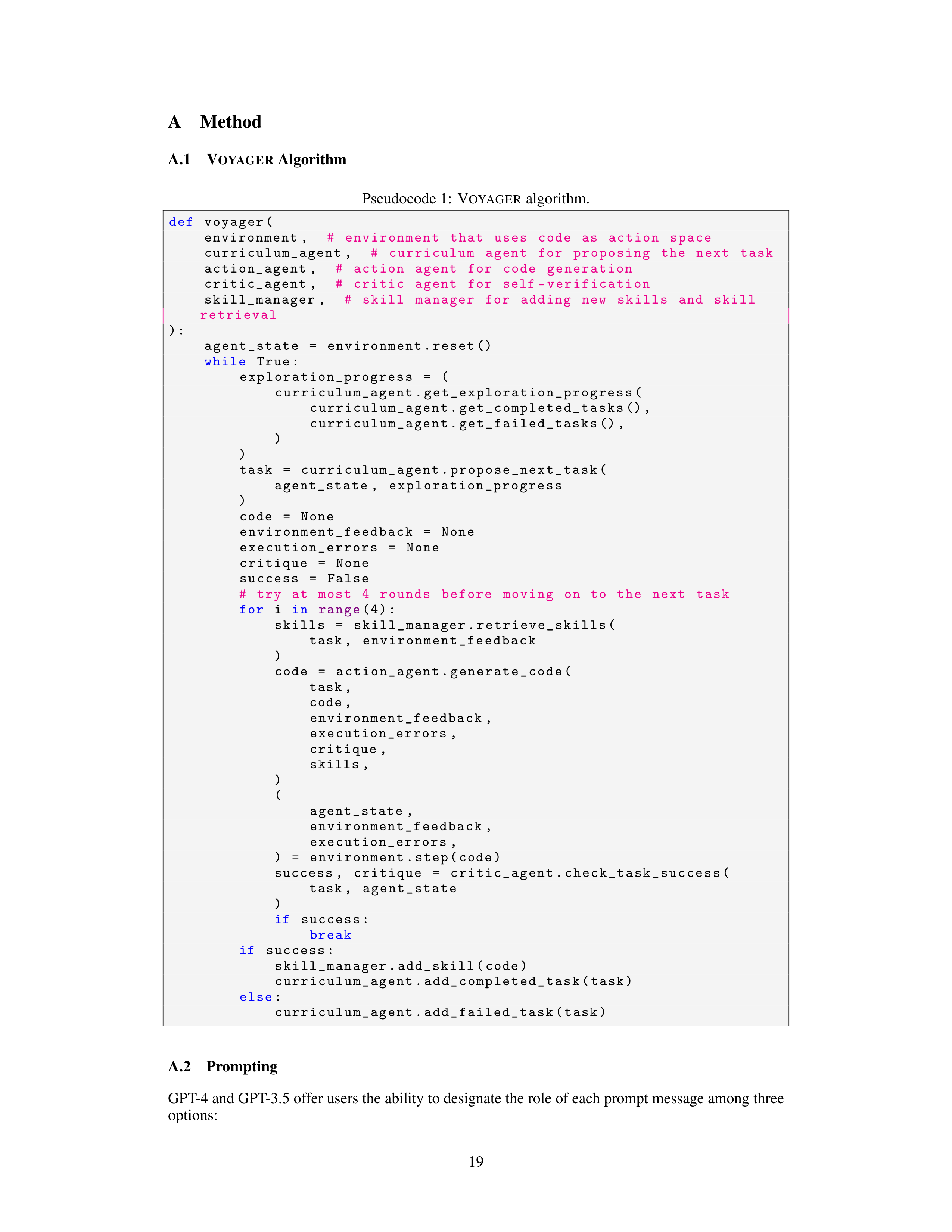
A
Method
A.1
V
OYAGER
Algorithm
Pseudocode 1:
V
OYAGER
algorithm.
def
voyager(
environment ,
#
environment
that
uses
code
as
action
space
curriculum_agent ,
#
curriculum
agent
for
proposing
the
next
task
action_agent ,
#
action
agent
for
code
generation
critic_agent ,
#
critic
agent
for
self -verification
skill_manager ,
#
skill
manager
for
adding
new
skills
and
skill
retrieval
):
agent_state
=
environment.reset ()
while
True:
exploration_progress
=
(
curriculum_agent . get_exploration_progress (
curriculum_agent . get_completed_tasks (),
curriculum_agent . get_failed_tasks (),
)
)
task
=
curriculum_agent . propose_next_task (
agent_state ,
exploration_progress
)
code
=
None
environment_feedback
=
None
execution_errors
=
None
critique
=
None
success
=
False
#
try
at
most
4
rounds
before
moving
on
to
the
next
task
for
i
in
range
(4):
skills
=
skill_manager . retrieve_skills (
task ,
environment_feedback
)
code
=
action_agent. generate_code (
task ,
code ,
environment_feedback ,
execution_errors ,
critique ,
skills ,
)
(
agent_state ,
environment_feedback ,
execution_errors ,
)
=
environment.step(code)
success ,
critique
=
critic_agent. check_task_success (
task ,
agent_state
)
if
success:
break
if
success:
skill_manager.add_skill(code)
curriculum_agent . add_completed_task (task)
else
:
curriculum_agent . add_failed_task (task)
A.2
Prompting
GPT-4 and GPT-3.5 offer users the ability to designate the role of each prompt message among three
options:
19
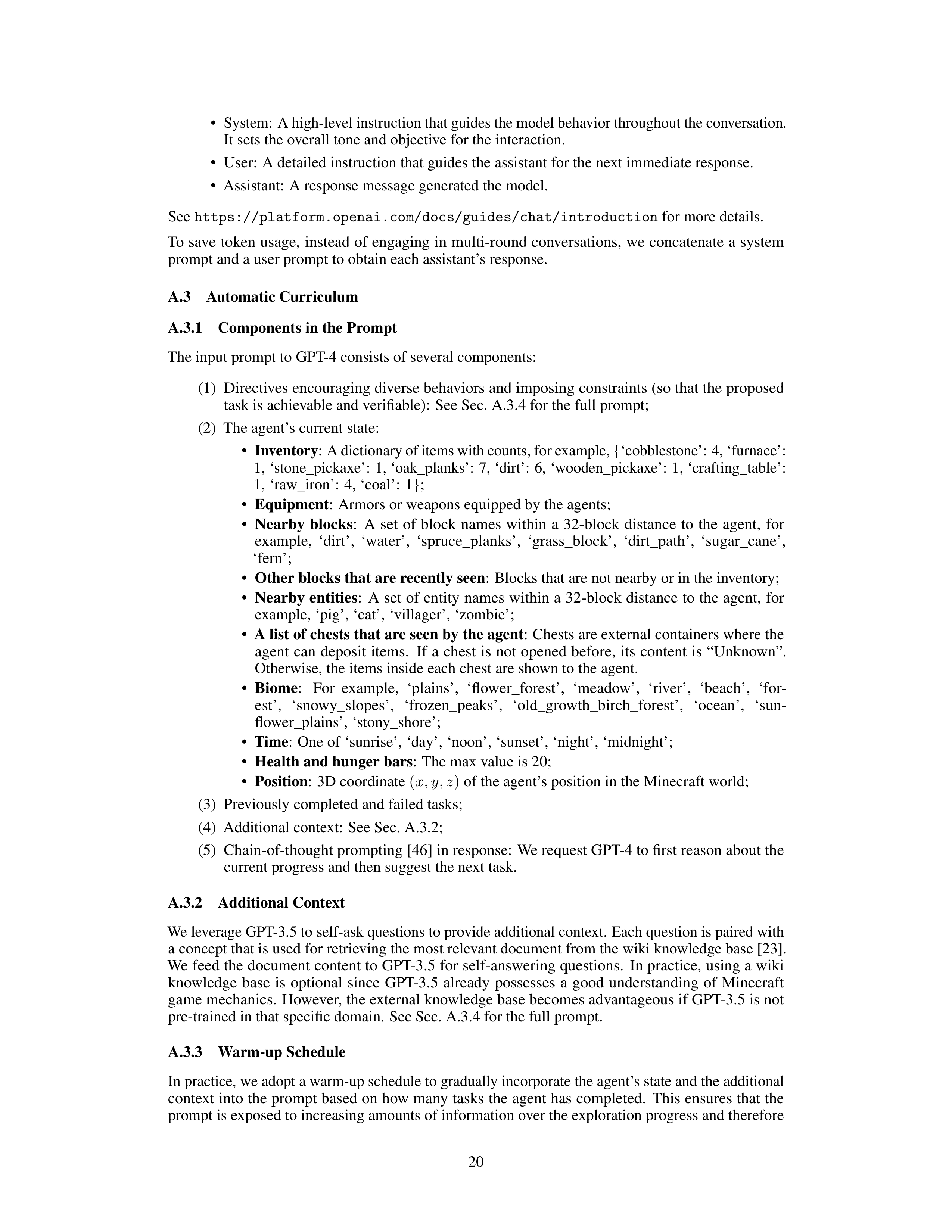
•
System:
A high-level instruction that guides the model behavior throughout the conversation.
It sets the overall tone and objective for the interaction.
•
User:
A detailed instruction that guides the assistant for the next immediate response.
•
Assistant:
A response message generated the model.
See
https://platform.openai.com/docs/guides/chat/introduction
for more details.
To save token usage,
instead of engaging in multi-round conversations,
we concatenate a system
prompt and a user prompt to obtain each assistant’s response.
A.3
Automatic Curriculum
A.3.1
Components in the Prompt
The input prompt to GPT-4 consists of several components:
(1)
Directives encouraging diverse behaviors and imposing constraints (so that the proposed
task is achievable and verifiable):
See Sec. A.3.4 for the full prompt;
(2)
The agent’s current state:
•
Inventory
: A dictionary of items with counts, for example, {‘cobblestone’: 4, ‘furnace’:
1, ‘stone_pickaxe’:
1, ‘oak_planks’:
7, ‘dirt’:
6, ‘wooden_pickaxe’:
1, ‘crafting_table’:
1, ‘raw_iron’:
4, ‘coal’:
1};
•
Equipment
:
Armors or weapons equipped by the agents;
•
Nearby
blocks
:
A
set
of
block
names
within
a
32-block
distance
to
the
agent,
for
example,
‘dirt’,
‘water’,
‘spruce_planks’,
‘grass_block’,
‘dirt_path’,
‘sugar_cane’,
‘fern’;
•
Other blocks that are recently seen
:
Blocks that are not nearby or in the inventory;
•
Nearby entities
:
A set of entity names within a 32-block distance to the agent, for
example, ‘pig’, ‘cat’, ‘villager’, ‘zombie’;
•
A list of chests that are seen by the agent
:
Chests are external containers where the
agent
can
deposit
items.
If
a
chest
is
not
opened
before,
its
content
is
“Unknown”.
Otherwise, the items inside each chest are shown to the agent.
•
Biome
:
For
example,
‘plains’,
‘flower_forest’,
‘meadow’,
‘river’,
‘beach’,
‘for-
est’,
‘snowy_slopes’,
‘frozen_peaks’,
‘old_growth_birch_forest’,
‘ocean’,
‘sun-
flower_plains’, ‘stony_shore’;
•
Time
:
One of ‘sunrise’, ‘day’, ‘noon’, ‘sunset’, ‘night’, ‘midnight’;
•
Health and hunger bars
:
The max value is 20;
•
Position
:
3D coordinate
(
x, y, z
)
of the agent’s position in the Minecraft world;
(3)
Previously completed and failed tasks;
(4)
Additional context:
See Sec. A.3.2;
(5)
Chain-of-thought prompting [
46
] in response:
We request GPT-4 to first reason about the
current progress and then suggest the next task.
A.3.2
Additional Context
We leverage GPT-3.5 to self-ask questions to provide additional context.
Each question is paired with
a concept that is used for retrieving the most relevant document from the wiki knowledge base [
23
].
We feed the document content to GPT-3.5 for self-answering questions.
In practice, using a wiki
knowledge
base
is
optional
since
GPT-3.5
already
possesses
a
good
understanding
of
Minecraft
game mechanics.
However, the external knowledge base becomes advantageous if GPT-3.5 is not
pre-trained in that specific domain.
See Sec. A.3.4 for the full prompt.
A.3.3
Warm-up Schedule
In practice, we adopt a warm-up schedule to gradually incorporate the agent’s state and the additional
context into the prompt based on how many tasks the agent has completed.
This ensures that the
prompt is exposed to increasing amounts of information over the exploration progress and therefore
20
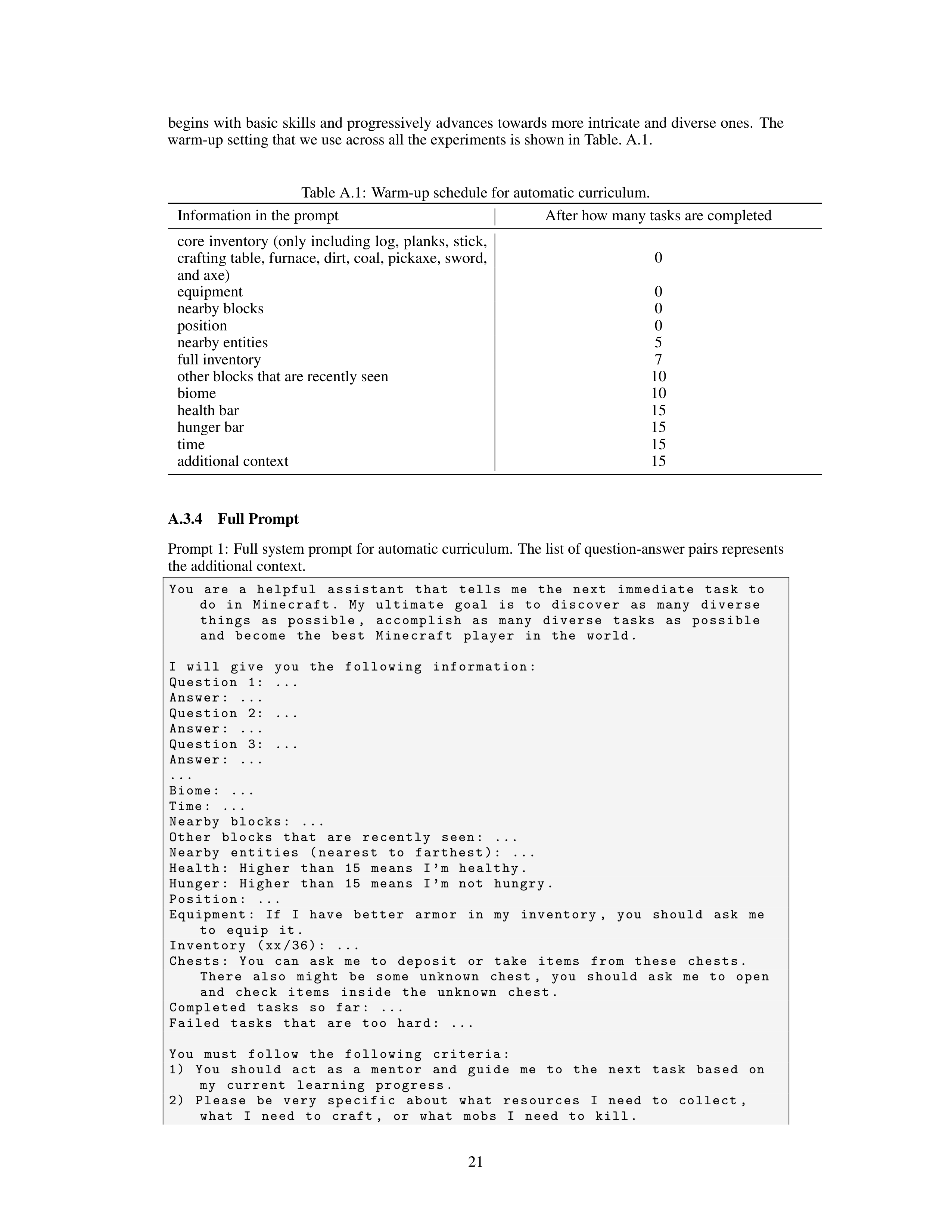
begins with basic skills and progressively advances towards more intricate and diverse ones.
The
warm-up setting that we use across all the experiments is shown in Table. A.1.
Table A.1:
Warm-up schedule for automatic curriculum.
Information in the prompt
After how many tasks are completed
core inventory (only including log, planks, stick,
crafting table, furnace, dirt, coal, pickaxe, sword,
and axe)
0
equipment
0
nearby blocks
0
position
0
nearby entities
5
full inventory
7
other blocks that are recently seen
10
biome
10
health bar
15
hunger bar
15
time
15
additional context
15
A.3.4
Full Prompt
Prompt 1:
Full system prompt for automatic curriculum.
The list of question-answer pairs represents
the additional context.
You
are
a
helpful
assistant
that
tells
me
the
next
immediate
task
to
do
in
Minecraft.
My
ultimate
goal
is
to
discover
as
many
diverse
things
as
possible ,
accomplish
as
many
diverse
tasks
as
possible
and
become
the
best
Minecraft
player
in
the
world.
I
will
give
you
the
following
information:
Question
1:
...
Answer:
...
Question
2:
...
Answer:
...
Question
3:
...
Answer:
...
...
Biome:
...
Time:
...
Nearby
blocks:
...
Other
blocks
that
are
recently
seen:
...
Nearby
entities
(nearest
to
farthest):
...
Health:
Higher
than
15
means
I’m
healthy.
Hunger:
Higher
than
15
means
I’m
not
hungry.
Position:
...
Equipment:
If
I
have
better
armor
in
my
inventory ,
you
should
ask
me
to
equip
it.
Inventory
(xx /36):
...
Chests:
You
can
ask
me
to
deposit
or
take
items
from
these
chests.
There
also
might
be
some
unknown
chest ,
you
should
ask
me
to
open
and
check
items
inside
the
unknown
chest.
Completed
tasks
so
far:
...
Failed
tasks
that
are
too
hard:
...
You
must
follow
the
following
criteria:
1)
You
should
act
as
a
mentor
and
guide
me
to
the
next
task
based
on
my
current
learning
progress.
2)
Please
be
very
specific
about
what
resources
I
need
to
collect ,
what
I
need
to
craft ,
or
what
mobs
I
need
to
kill.
21
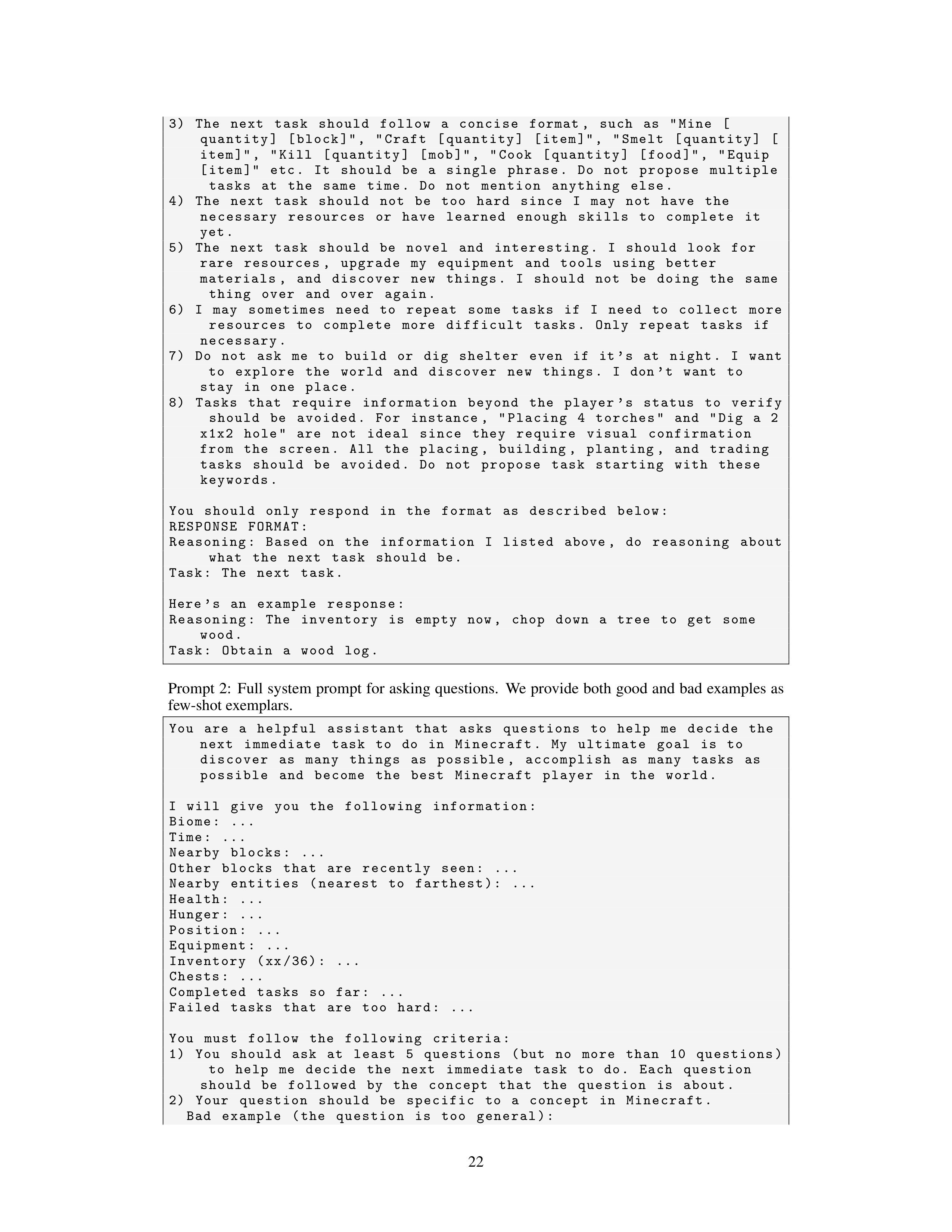
3)
The
next
task
should
follow
a
concise
format ,
such
as
"Mine
[
quantity]
[block ]",
"Craft
[quantity]
[item]",
"Smelt
[quantity]
[
item]",
"Kill
[quantity]
[mob]",
"Cook
[quantity]
[food]",
"Equip
[item ]"
etc.
It
should
be
a
single
phrase.
Do
not
propose
multiple
tasks
at
the
same
time.
Do
not
mention
anything
else.
4)
The
next
task
should
not
be
too
hard
since
I
may
not
have
the
necessary
resources
or
have
learned
enough
skills
to
complete
it
yet.
5)
The
next
task
should
be
novel
and
interesting.
I
should
look
for
rare
resources ,
upgrade
my
equipment
and
tools
using
better
materials ,
and
discover
new
things.
I
should
not
be
doing
the
same
thing
over
and
over
again.
6)
I
may
sometimes
need
to
repeat
some
tasks
if
I
need
to
collect
more
resources
to
complete
more
difficult
tasks.
Only
repeat
tasks
if
necessary.
7)
Do
not
ask
me
to
build
or
dig
shelter
even
if
it ’s
at
night.
I
want
to
explore
the
world
and
discover
new
things.
I
don ’t
want
to
stay
in
one
place.
8)
Tasks
that
require
information
beyond
the
player ’s
status
to
verify
should
be
avoided.
For
instance ,
"Placing
4
torches"
and
"Dig
a
2
x1x2
hole"
are
not
ideal
since
they
require
visual
confirmation
from
the
screen.
All
the
placing ,
building ,
planting ,
and
trading
tasks
should
be
avoided.
Do
not
propose
task
starting
with
these
keywords.
You
should
only
respond
in
the
format
as
described
below:
RESPONSE
FORMAT:
Reasoning:
Based
on
the
information
I
listed
above ,
do
reasoning
about
what
the
next
task
should
be.
Task:
The
next
task.
Here ’s
an
example
response:
Reasoning:
The
inventory
is
empty
now ,
chop
down
a
tree
to
get
some
wood.
Task:
Obtain
a
wood
log.
Prompt 2:
Full system prompt for asking questions.
We provide both good and bad examples as
few-shot exemplars.
You
are
a
helpful
assistant
that
asks
questions
to
help
me
decide
the
next
immediate
task
to
do
in
Minecraft.
My
ultimate
goal
is
to
discover
as
many
things
as
possible ,
accomplish
as
many
tasks
as
possible
and
become
the
best
Minecraft
player
in
the
world.
I
will
give
you
the
following
information:
Biome:
...
Time:
...
Nearby
blocks:
...
Other
blocks
that
are
recently
seen:
...
Nearby
entities
(nearest
to
farthest):
...
Health:
...
Hunger:
...
Position:
...
Equipment:
...
Inventory
(xx /36):
...
Chests:
...
Completed
tasks
so
far:
...
Failed
tasks
that
are
too
hard:
...
You
must
follow
the
following
criteria:
1)
You
should
ask
at
least
5
questions
(but
no
more
than
10
questions)
to
help
me
decide
the
next
immediate
task
to
do.
Each
question
should
be
followed
by
the
concept
that
the
question
is
about.
2)
Your
question
should
be
specific
to
a
concept
in
Minecraft.
Bad
example
(the
question
is
too
general):
22
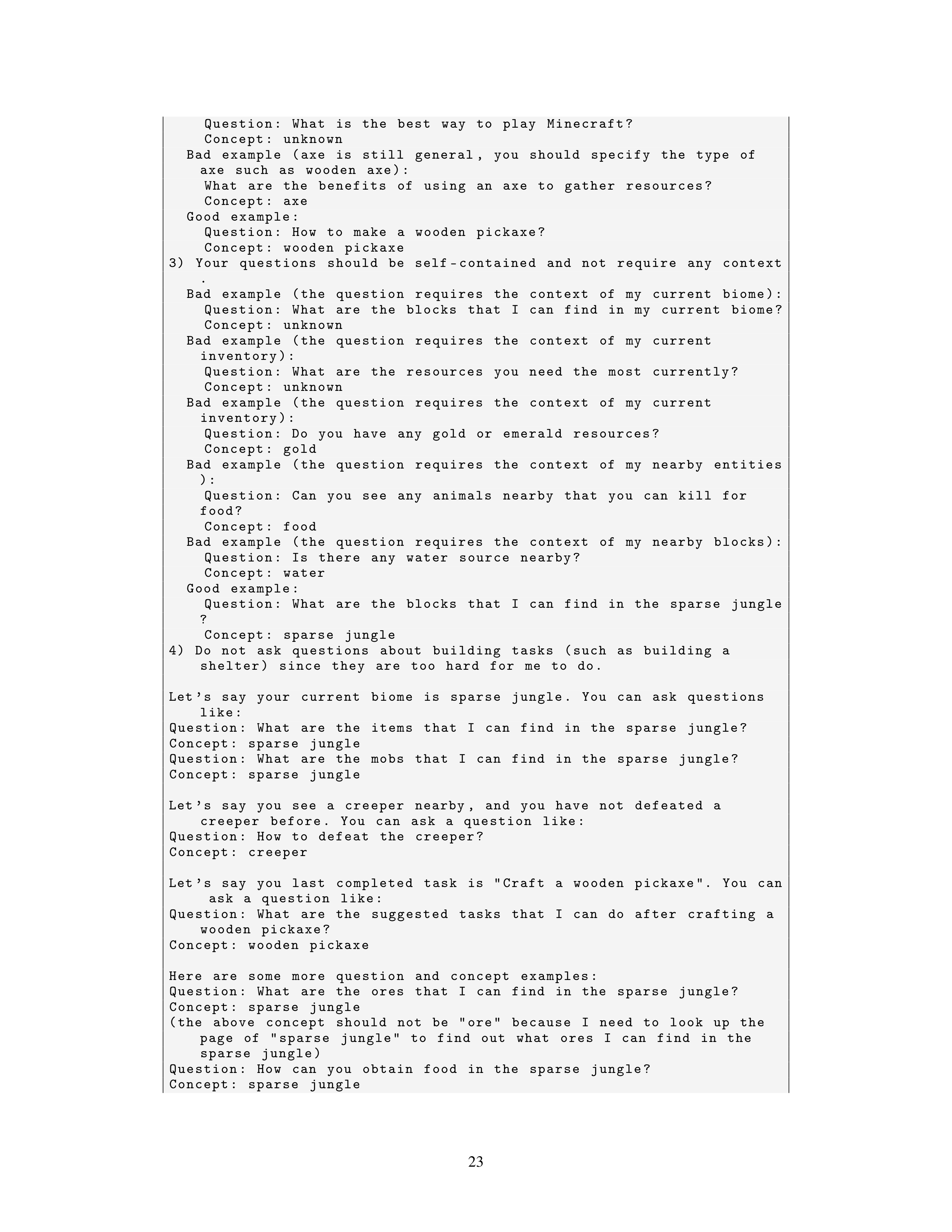
Question:
What
is
the
best
way
to
play
Minecraft?
Concept:
unknown
Bad
example
(axe
is
still
general ,
you
should
specify
the
type
of
axe
such
as
wooden
axe):
What
are
the
benefits
of
using
an
axe
to
gather
resources?
Concept:
axe
Good
example:
Question:
How
to
make
a
wooden
pickaxe?
Concept:
wooden
pickaxe
3)
Your
questions
should
be
self -contained
and
not
require
any
context
.
Bad
example
(the
question
requires
the
context
of
my
current
biome):
Question:
What
are
the
blocks
that
I
can
find
in
my
current
biome?
Concept:
unknown
Bad
example
(the
question
requires
the
context
of
my
current
inventory):
Question:
What
are
the
resources
you
need
the
most
currently?
Concept:
unknown
Bad
example
(the
question
requires
the
context
of
my
current
inventory):
Question:
Do
you
have
any
gold
or
emerald
resources?
Concept:
gold
Bad
example
(the
question
requires
the
context
of
my
nearby
entities
):
Question:
Can
you
see
any
animals
nearby
that
you
can
kill
for
food?
Concept:
food
Bad
example
(the
question
requires
the
context
of
my
nearby
blocks):
Question:
Is
there
any
water
source
nearby?
Concept:
water
Good
example:
Question:
What
are
the
blocks
that
I
can
find
in
the
sparse
jungle
?
Concept:
sparse
jungle
4)
Do
not
ask
questions
about
building
tasks
(such
as
building
a
shelter)
since
they
are
too
hard
for
me
to
do.
Let ’s
say
your
current
biome
is
sparse
jungle.
You
can
ask
questions
like:
Question:
What
are
the
items
that
I
can
find
in
the
sparse
jungle?
Concept:
sparse
jungle
Question:
What
are
the
mobs
that
I
can
find
in
the
sparse
jungle?
Concept:
sparse
jungle
Let ’s
say
you
see
a
creeper
nearby ,
and
you
have
not
defeated
a
creeper
before.
You
can
ask
a
question
like:
Question:
How
to
defeat
the
creeper?
Concept:
creeper
Let ’s
say
you
last
completed
task
is
"Craft
a
wooden
pickaxe ".
You
can
ask
a
question
like:
Question:
What
are
the
suggested
tasks
that
I
can
do
after
crafting
a
wooden
pickaxe?
Concept:
wooden
pickaxe
Here
are
some
more
question
and
concept
examples:
Question:
What
are
the
ores
that
I
can
find
in
the
sparse
jungle?
Concept:
sparse
jungle
(the
above
concept
should
not
be
"ore"
because
I
need
to
look
up
the
page
of
"sparse
jungle"
to
find
out
what
ores
I
can
find
in
the
sparse
jungle)
Question:
How
can
you
obtain
food
in
the
sparse
jungle?
Concept:
sparse
jungle
23
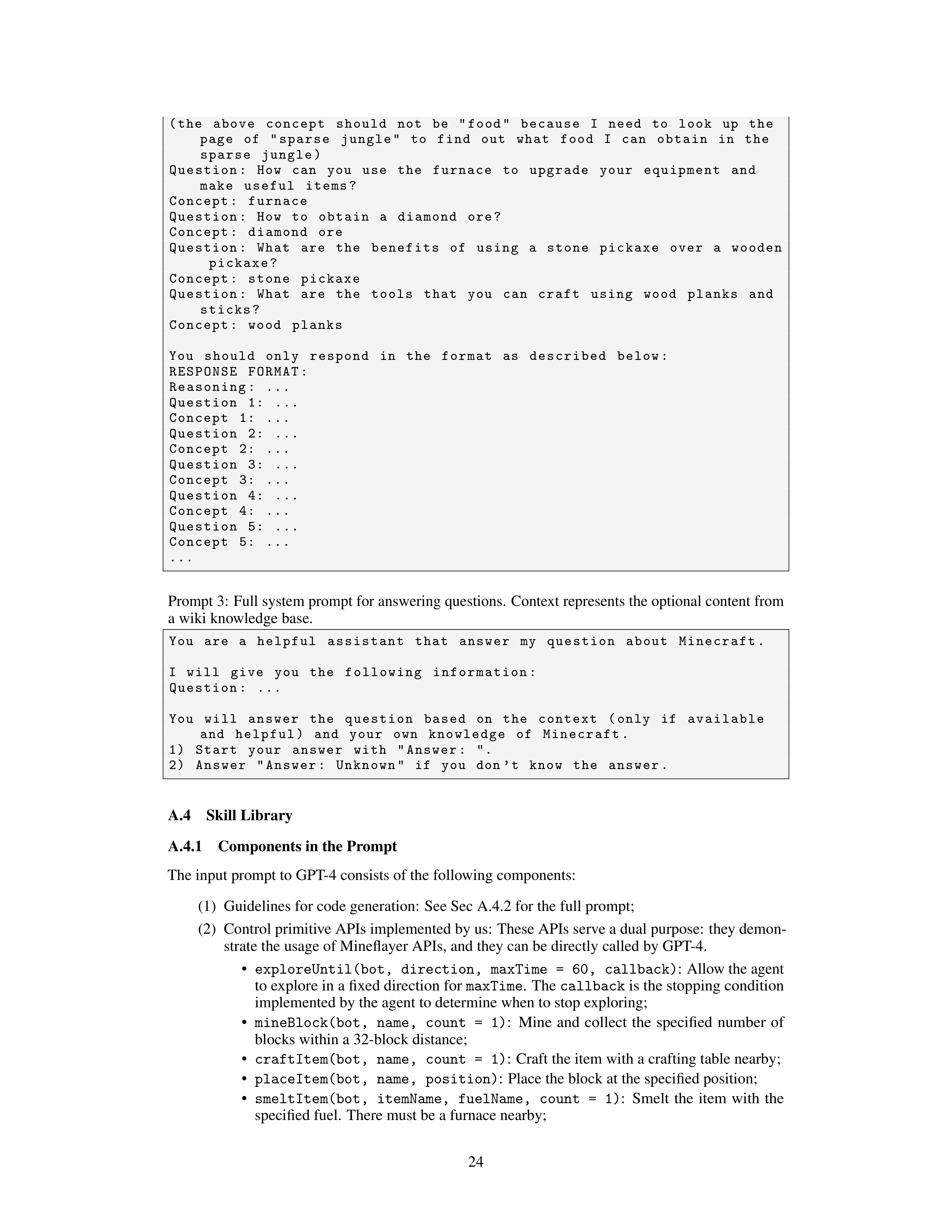
(the
above
concept
should
not
be
"food"
because
I
need
to
look
up
the
page
of
"sparse
jungle"
to
find
out
what
food
I
can
obtain
in
the
sparse
jungle)
Question:
How
can
you
use
the
furnace
to
upgrade
your
equipment
and
make
useful
items?
Concept:
furnace
Question:
How
to
obtain
a
diamond
ore?
Concept:
diamond
ore
Question:
What
are
the
benefits
of
using
a
stone
pickaxe
over
a
wooden
pickaxe?
Concept:
stone
pickaxe
Question:
What
are
the
tools
that
you
can
craft
using
wood
planks
and
sticks?
Concept:
wood
planks
You
should
only
respond
in
the
format
as
described
below:
RESPONSE
FORMAT:
Reasoning:
...
Question
1:
...
Concept
1:
...
Question
2:
...
Concept
2:
...
Question
3:
...
Concept
3:
...
Question
4:
...
Concept
4:
...
Question
5:
...
Concept
5:
...
...
Prompt 3:
Full system prompt for answering questions.
Context represents the optional content from
a wiki knowledge base.
You
are
a
helpful
assistant
that
answer
my
question
about
Minecraft.
I
will
give
you
the
following
information:
Question:
...
You
will
answer
the
question
based
on
the
context
(only
if
available
and
helpful)
and
your
own
knowledge
of
Minecraft.
1)
Start
your
answer
with
"Answer:
".
2)
Answer
"Answer:
Unknown"
if
you
don ’t
know
the
answer.
A.4
Skill Library
A.4.1
Components in the Prompt
The input prompt to GPT-4 consists of the following components:
(1)
Guidelines for code generation:
See Sec A.4.2 for the full prompt;
(2)
Control primitive APIs implemented by us:
These APIs serve a dual purpose:
they demon-
strate the usage of Mineflayer APIs, and they can be directly called by GPT-4.
•
exploreUntil(bot,
direction,
maxTime
=
60,
callback)
:
Allow the agent
to explore in a fixed direction for
maxTime
.
The
callback
is the stopping condition
implemented by the agent to determine when to stop exploring;
•
mineBlock(bot,
name,
count
=
1)
:
Mine
and
collect
the
specified
number
of
blocks within a 32-block distance;
•
craftItem(bot,
name,
count
=
1)
:
Craft the item with a crafting table nearby;
•
placeItem(bot,
name,
position)
:
Place the block at the specified position;
•
smeltItem(bot,
itemName,
fuelName,
count
=
1)
:
Smelt
the
item
with
the
specified fuel.
There must be a furnace nearby;
24
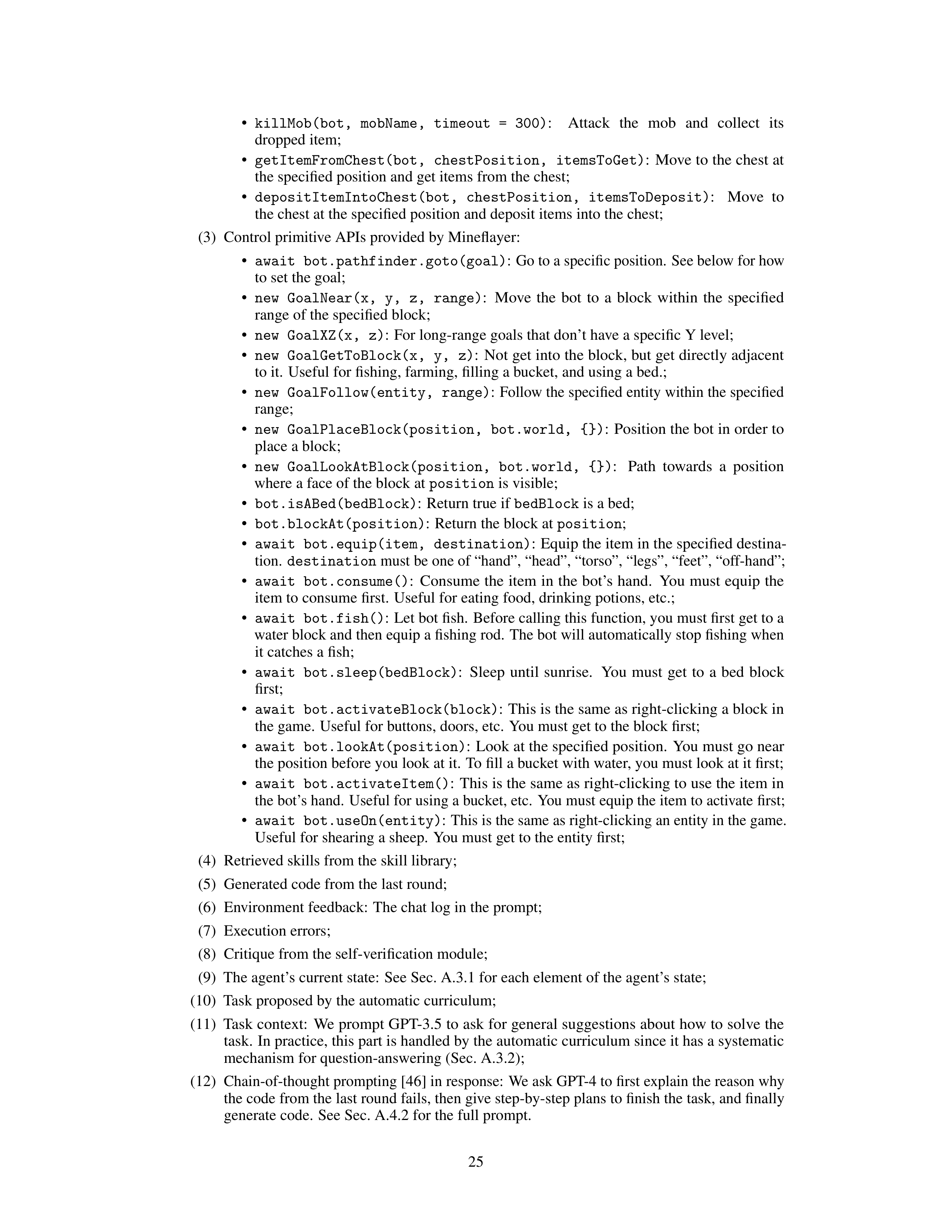
•
killMob(bot,
mobName,
timeout
=
300)
:
Attack
the
mob
and
collect
its
dropped item;
•
getItemFromChest(bot,
chestPosition,
itemsToGet)
:
Move to the chest at
the specified position and get items from the chest;
•
depositItemIntoChest(bot,
chestPosition,
itemsToDeposit)
:
Move
to
the chest at the specified position and deposit items into the chest;
(3)
Control primitive APIs provided by Mineflayer:
•
await
bot.pathfinder.goto(goal)
:
Go to a specific position.
See below for how
to set the goal;
•
new
GoalNear(x,
y,
z,
range)
:
Move
the
bot
to
a
block
within
the
specified
range of the specified block;
•
new
GoalXZ(x,
z)
:
For long-range goals that don’t have a specific Y level;
•
new
GoalGetToBlock(x,
y,
z)
:
Not get into the block, but get directly adjacent
to it.
Useful for fishing, farming, filling a bucket, and using a bed.;
•
new
GoalFollow(entity,
range)
:
Follow the specified entity within the specified
range;
•
new
GoalPlaceBlock(position,
bot.world,
{})
:
Position the bot in order to
place a block;
•
new
GoalLookAtBlock(position,
bot.world,
{})
:
Path
towards
a
position
where a face of the block at
position
is visible;
•
bot.isABed(bedBlock)
:
Return true if
bedBlock
is a bed;
•
bot.blockAt(position)
:
Return the block at
position
;
•
await
bot.equip(item,
destination)
:
Equip the item in the specified destina-
tion.
destination
must be one of “hand”, “head”, “torso”, “legs”, “feet”, “off-hand”;
•
await
bot.consume()
:
Consume the item in the bot’s hand.
You must equip the
item to consume first.
Useful for eating food, drinking potions, etc.;
•
await
bot.fish()
:
Let bot fish.
Before calling this function, you must first get to a
water block and then equip a fishing rod.
The bot will automatically stop fishing when
it catches a fish;
•
await
bot.sleep(bedBlock)
:
Sleep
until
sunrise.
You
must
get
to
a
bed
block
first;
•
await
bot.activateBlock(block)
:
This is the same as right-clicking a block in
the game.
Useful for buttons, doors, etc.
You must get to the block first;
•
await
bot.lookAt(position)
:
Look at the specified position.
You must go near
the position before you look at it.
To fill a bucket with water, you must look at it first;
•
await
bot.activateItem()
:
This is the same as right-clicking to use the item in
the bot’s hand.
Useful for using a bucket, etc.
You must equip the item to activate first;
•
await
bot.useOn(entity)
:
This is the same as right-clicking an entity in the game.
Useful for shearing a sheep.
You must get to the entity first;
(4)
Retrieved skills from the skill library;
(5)
Generated code from the last round;
(6)
Environment feedback:
The chat log in the prompt;
(7)
Execution errors;
(8)
Critique from the self-verification module;
(9)
The agent’s current state:
See Sec. A.3.1 for each element of the agent’s state;
(10)
Task proposed by the automatic curriculum;
(11)
Task context:
We prompt GPT-3.5 to ask for general suggestions about how to solve the
task.
In practice, this part is handled by the automatic curriculum since it has a systematic
mechanism for question-answering (Sec. A.3.2);
(12)
Chain-of-thought prompting [
46
] in response:
We ask GPT-4 to first explain the reason why
the code from the last round fails, then give step-by-step plans to finish the task, and finally
generate code.
See Sec. A.4.2 for the full prompt.
25
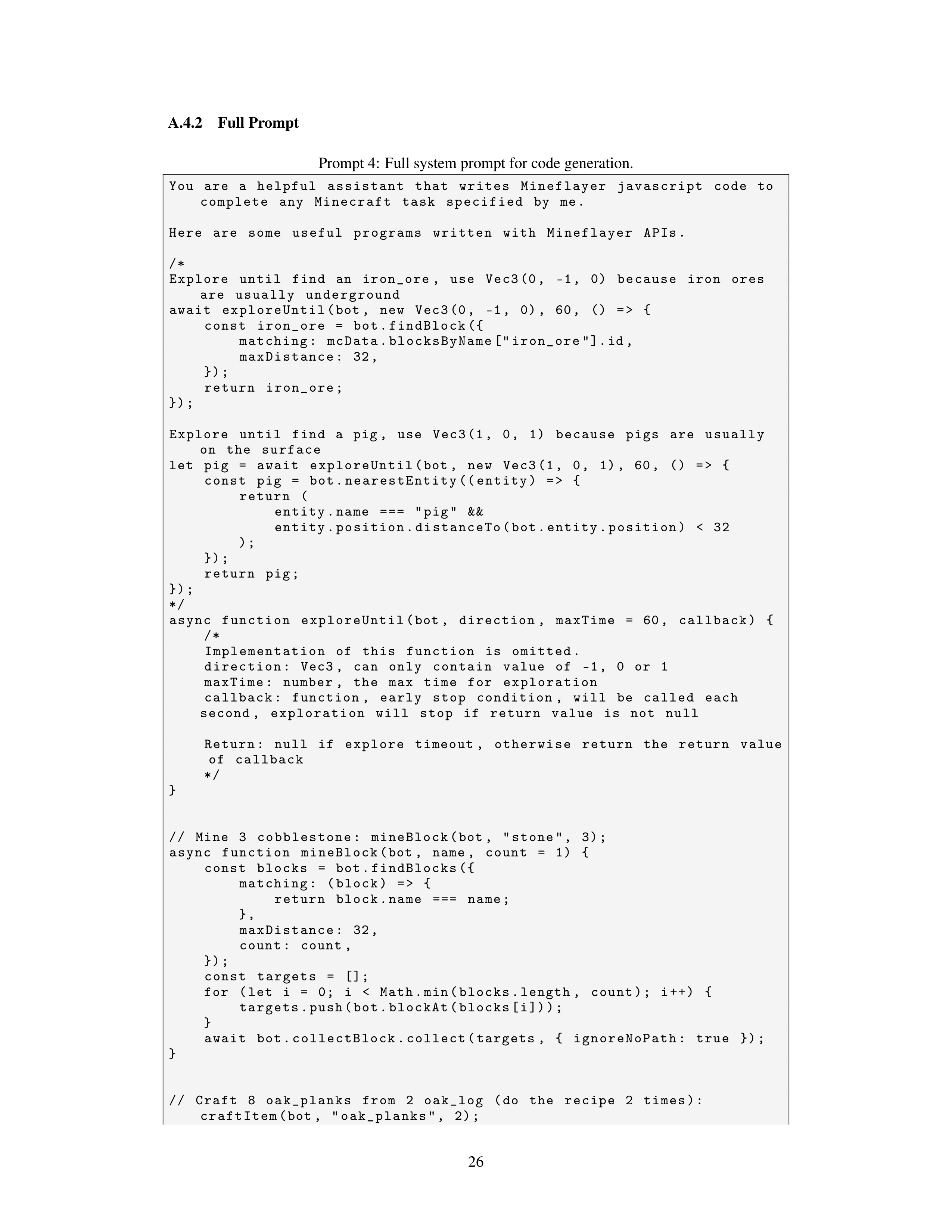
A.4.2
Full Prompt
Prompt 4:
Full system prompt for code generation.
You
are
a
helpful
assistant
that
writes
Mineflayer
javascript
code
to
complete
any
Minecraft
task
specified
by
me.
Here
are
some
useful
programs
written
with
Mineflayer
APIs.
/*
Explore
until
find
an
iron_ore ,
use
Vec3(0,
-1,
0)
because
iron
ores
are
usually
underground
await
exploreUntil(bot ,
new
Vec3(0,
-1,
0),
60,
()
=>
{
const
iron_ore
=
bot.findBlock ({
matching:
mcData.blocksByName [" iron_ore "].id ,
maxDistance:
32,
});
return
iron_ore;
});
Explore
until
find
a
pig ,
use
Vec3(1,
0,
1)
because
pigs
are
usually
on
the
surface
let
pig
=
await
exploreUntil(bot ,
new
Vec3(1,
0,
1),
60,
()
=>
{
const
pig
=
bot.nearestEntity (( entity)
=>
{
return
(
entity.name
===
"pig"
&&
entity.position.distanceTo(bot.entity.position)
<
32
);
});
return
pig;
});
*/
async
function
exploreUntil (bot ,
direction ,
maxTime
=
60,
callback)
{
/*
Implementation
of
this
function
is
omitted.
direction:
Vec3 ,
can
only
contain
value
of
-1,
0
or
1
maxTime:
number ,
the
max
time
for
exploration
callback:
function ,
early
stop
condition ,
will
be
called
each
second ,
exploration
will
stop
if
return
value
is
not
null
Return:
null
if
explore
timeout ,
otherwise
return
the
return
value
of
callback
*/
}
//
Mine
3
cobblestone:
mineBlock(bot ,
"stone",
3);
async
function
mineBlock(bot ,
name ,
count
=
1)
{
const
blocks
=
bot.findBlocks ({
matching:
(block)
=>
{
return
block.name
===
name;
},
maxDistance:
32,
count:
count ,
});
const
targets
=
[];
for
(let
i
=
0;
i
<
Math.min(blocks.length ,
count);
i++)
{
targets.push(bot.blockAt(blocks[i]));
}
await
bot.collectBlock.collect(targets ,
{
ignoreNoPath:
true
});
}
//
Craft
8
oak_planks
from
2
oak_log
(do
the
recipe
2
times):
craftItem(bot ,
"oak_planks",
2);
26
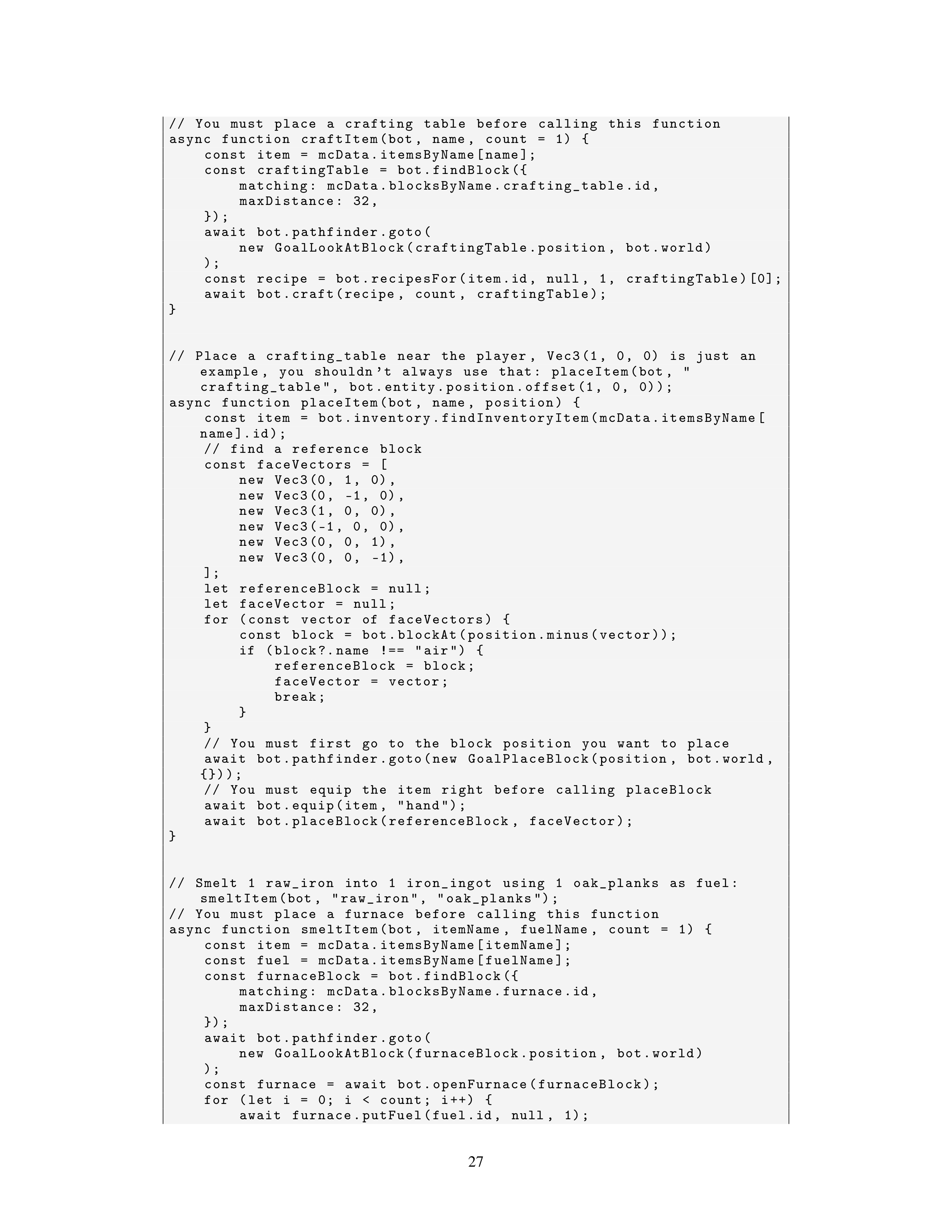
//
You
must
place
a
crafting
table
before
calling
this
function
async
function
craftItem(bot ,
name ,
count
=
1)
{
const
item
=
mcData.itemsByName[name ];
const
craftingTable
=
bot.findBlock ({
matching:
mcData.blocksByName . crafting_table .id ,
maxDistance:
32,
});
await
bot.pathfinder.goto(
new
GoalLookAtBlock ( craftingTable .position ,
bot.world)
);
const
recipe
=
bot.recipesFor(item.id ,
null ,
1,
craftingTable)[0];
await
bot.craft(recipe ,
count ,
craftingTable );
}
//
Place
a
crafting_table
near
the
player ,
Vec3(1,
0,
0)
is
just
an
example ,
you
shouldn ’t
always
use
that:
placeItem(bot ,
"
crafting_table ",
bot.entity.position.offset (1,
0,
0));
async
function
placeItem(bot ,
name ,
position)
{
const
item
=
bot.inventory. findInventoryItem (mcData.itemsByName[
name ].id);
//
find
a
reference
block
const
faceVectors
=
[
new
Vec3(0,
1,
0),
new
Vec3(0,
-1,
0),
new
Vec3(1,
0,
0),
new
Vec3(-1,
0,
0),
new
Vec3(0,
0,
1),
new
Vec3(0,
0,
-1),
];
let
referenceBlock
=
null;
let
faceVector
=
null;
for
(const
vector
of
faceVectors)
{
const
block
=
bot.blockAt(position.minus(vector));
if
(block ?. name
!==
"air")
{
referenceBlock
=
block;
faceVector
=
vector;
break;
}
}
//
You
must
first
go
to
the
block
position
you
want
to
place
await
bot.pathfinder.goto(new
GoalPlaceBlock (position ,
bot.world ,
{}));
//
You
must
equip
the
item
right
before
calling
placeBlock
await
bot.equip(item ,
"hand ");
await
bot.placeBlock(referenceBlock ,
faceVector);
}
//
Smelt
1
raw_iron
into
1
iron_ingot
using
1
oak_planks
as
fuel:
smeltItem(bot ,
"raw_iron",
"oak_planks ");
//
You
must
place
a
furnace
before
calling
this
function
async
function
smeltItem(bot ,
itemName ,
fuelName ,
count
=
1)
{
const
item
=
mcData.itemsByName[itemName ];
const
fuel
=
mcData.itemsByName[fuelName ];
const
furnaceBlock
=
bot.findBlock ({
matching:
mcData.blocksByName .furnace.id ,
maxDistance:
32,
});
await
bot.pathfinder.goto(
new
GoalLookAtBlock (furnaceBlock.position ,
bot.world)
);
const
furnace
=
await
bot.openFurnace(furnaceBlock);
for
(let
i
=
0;
i
<
count;
i++)
{
await
furnace.putFuel(fuel.id ,
null ,
1);
27
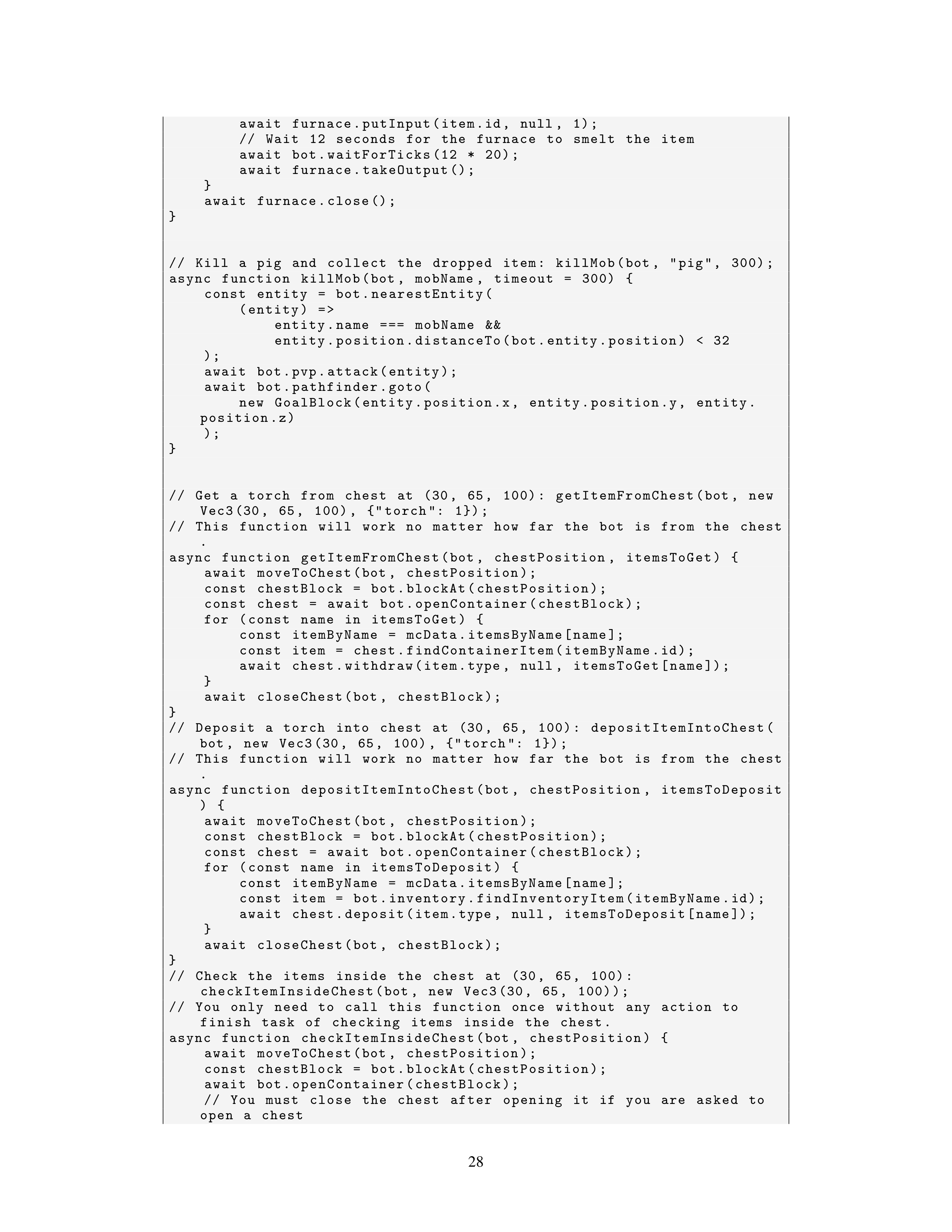
await
furnace.putInput(item.id ,
null ,
1);
//
Wait
12
seconds
for
the
furnace
to
smelt
the
item
await
bot.waitForTicks (12
*
20);
await
furnace.takeOutput ();
}
await
furnace.close ();
}
//
Kill
a
pig
and
collect
the
dropped
item:
killMob(bot ,
"pig",
300);
async
function
killMob(bot ,
mobName ,
timeout
=
300)
{
const
entity
=
bot.nearestEntity (
(entity)
=>
entity.name
===
mobName
&&
entity.position.distanceTo(bot.entity.position)
<
32
);
await
bot.pvp.attack(entity);
await
bot.pathfinder.goto(
new
GoalBlock(entity.position.x,
entity.position.y,
entity.
position.z)
);
}
//
Get
a
torch
from
chest
at
(30,
65,
100):
getItemFromChest (bot ,
new
Vec3 (30,
65,
100) ,
{" torch ":
1});
//
This
function
will
work
no
matter
how
far
the
bot
is
from
the
chest
.
async
function
getItemFromChest (bot ,
chestPosition ,
itemsToGet)
{
await
moveToChest(bot ,
chestPosition );
const
chestBlock
=
bot.blockAt( chestPosition );
const
chest
=
await
bot.openContainer (chestBlock);
for
(const
name
in
itemsToGet)
{
const
itemByName
=
mcData.itemsByName[name ];
const
item
=
chest. findContainerItem (itemByName.id);
await
chest.withdraw(item.type ,
null ,
itemsToGet[name ]);
}
await
closeChest(bot ,
chestBlock);
}
//
Deposit
a
torch
into
chest
at
(30,
65,
100):
depositItemIntoChest (
bot ,
new
Vec3 (30,
65,
100) ,
{" torch ":
1});
//
This
function
will
work
no
matter
how
far
the
bot
is
from
the
chest
.
async
function
depositItemIntoChest (bot ,
chestPosition ,
itemsToDeposit
)
{
await
moveToChest(bot ,
chestPosition );
const
chestBlock
=
bot.blockAt( chestPosition );
const
chest
=
await
bot.openContainer (chestBlock);
for
(const
name
in
itemsToDeposit )
{
const
itemByName
=
mcData.itemsByName[name ];
const
item
=
bot.inventory. findInventoryItem (itemByName.id);
await
chest.deposit(item.type ,
null ,
itemsToDeposit [name ]);
}
await
closeChest(bot ,
chestBlock);
}
//
Check
the
items
inside
the
chest
at
(30,
65,
100):
checkItemInsideChest (bot ,
new
Vec3 (30,
65,
100));
//
You
only
need
to
call
this
function
once
without
any
action
to
finish
task
of
checking
items
inside
the
chest.
async
function
checkItemInsideChest (bot ,
chestPosition )
{
await
moveToChest(bot ,
chestPosition );
const
chestBlock
=
bot.blockAt( chestPosition );
await
bot.openContainer (chestBlock);
//
You
must
close
the
chest
after
opening
it
if
you
are
asked
to
open
a
chest
28
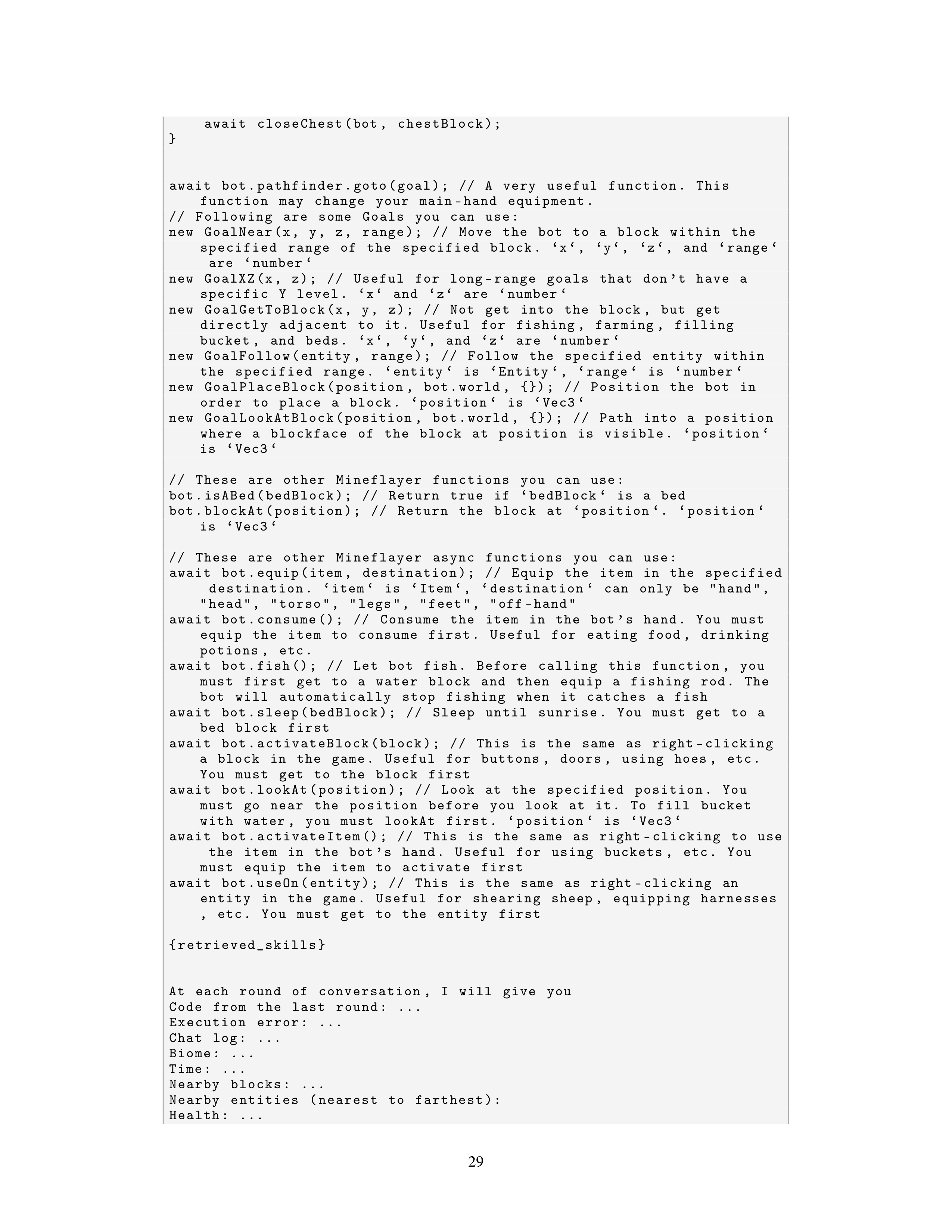
await
closeChest(bot ,
chestBlock);
}
await
bot.pathfinder.goto(goal);
//
A
very
useful
function.
This
function
may
change
your
main -hand
equipment.
//
Following
are
some
Goals
you
can
use:
new
GoalNear(x,
y,
z,
range);
//
Move
the
bot
to
a
block
within
the
specified
range
of
the
specified
block.
‘x‘,
‘y‘,
‘z‘,
and
‘range ‘
are
‘number ‘
new
GoalXZ(x,
z);
//
Useful
for
long -range
goals
that
don ’t
have
a
specific
Y
level.
‘x‘
and
‘z‘
are
‘number ‘
new
GoalGetToBlock (x,
y,
z);
//
Not
get
into
the
block ,
but
get
directly
adjacent
to
it.
Useful
for
fishing ,
farming ,
filling
bucket ,
and
beds.
‘x‘,
‘y‘,
and
‘z‘
are
‘number ‘
new
GoalFollow(entity ,
range);
//
Follow
the
specified
entity
within
the
specified
range.
‘entity ‘
is
‘Entity ‘,
‘range ‘
is
‘number ‘
new
GoalPlaceBlock (position ,
bot.world ,
{});
//
Position
the
bot
in
order
to
place
a
block.
‘position ‘
is
‘Vec3 ‘
new
GoalLookAtBlock (position ,
bot.world ,
{});
//
Path
into
a
position
where
a
blockface
of
the
block
at
position
is
visible.
‘position ‘
is
‘Vec3 ‘
//
These
are
other
Mineflayer
functions
you
can
use:
bot.isABed(bedBlock);
//
Return
true
if
‘bedBlock ‘
is
a
bed
bot.blockAt(position);
//
Return
the
block
at
‘position ‘.
‘position ‘
is
‘Vec3 ‘
//
These
are
other
Mineflayer
async
functions
you
can
use:
await
bot.equip(item ,
destination);
//
Equip
the
item
in
the
specified
destination.
‘item ‘
is
‘Item ‘,
‘destination ‘
can
only
be
"hand",
"head",
"torso",
"legs",
"feet",
"off -hand"
await
bot.consume ();
//
Consume
the
item
in
the
bot ’s
hand.
You
must
equip
the
item
to
consume
first.
Useful
for
eating
food ,
drinking
potions ,
etc.
await
bot.fish ();
//
Let
bot
fish.
Before
calling
this
function ,
you
must
first
get
to
a
water
block
and
then
equip
a
fishing
rod.
The
bot
will
automatically
stop
fishing
when
it
catches
a
fish
await
bot.sleep(bedBlock);
//
Sleep
until
sunrise.
You
must
get
to
a
bed
block
first
await
bot.activateBlock(block);
//
This
is
the
same
as
right -clicking
a
block
in
the
game.
Useful
for
buttons ,
doors ,
using
hoes ,
etc.
You
must
get
to
the
block
first
await
bot.lookAt(position);
//
Look
at
the
specified
position.
You
must
go
near
the
position
before
you
look
at
it.
To
fill
bucket
with
water ,
you
must
lookAt
first.
‘position ‘
is
‘Vec3 ‘
await
bot.activateItem ();
//
This
is
the
same
as
right -clicking
to
use
the
item
in
the
bot ’s
hand.
Useful
for
using
buckets ,
etc.
You
must
equip
the
item
to
activate
first
await
bot.useOn(entity);
//
This
is
the
same
as
right -clicking
an
entity
in
the
game.
Useful
for
shearing
sheep ,
equipping
harnesses
,
etc.
You
must
get
to
the
entity
first
{ retrieved_skills }
At
each
round
of
conversation ,
I
will
give
you
Code
from
the
last
round:
...
Execution
error:
...
Chat
log:
...
Biome:
...
Time:
...
Nearby
blocks:
...
Nearby
entities
(nearest
to
farthest):
Health:
...
29
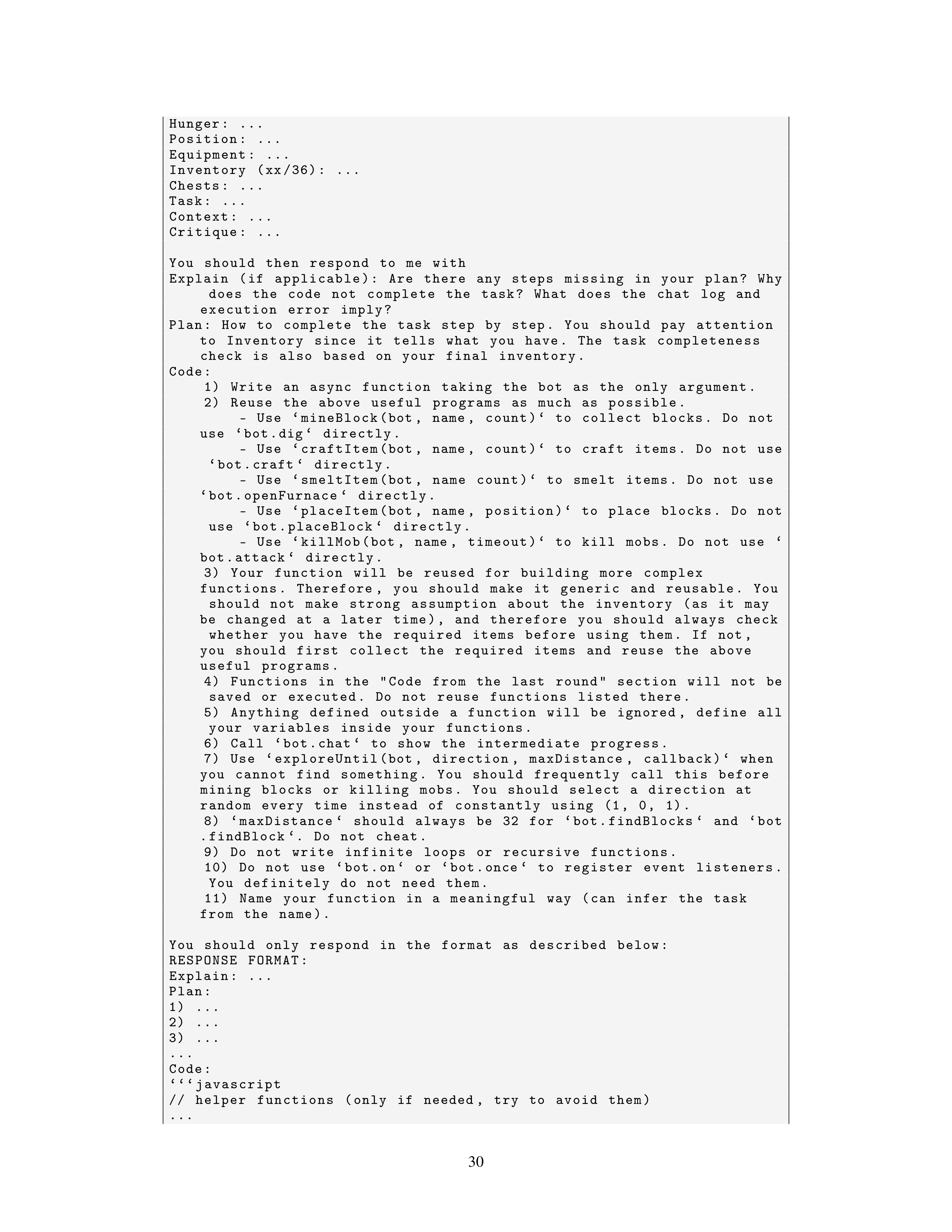
Hunger:
...
Position:
...
Equipment:
...
Inventory
(xx /36):
...
Chests:
...
Task:
...
Context:
...
Critique:
...
You
should
then
respond
to
me
with
Explain
(if
applicable):
Are
there
any
steps
missing
in
your
plan?
Why
does
the
code
not
complete
the
task?
What
does
the
chat
log
and
execution
error
imply?
Plan:
How
to
complete
the
task
step
by
step.
You
should
pay
attention
to
Inventory
since
it
tells
what
you
have.
The
task
completeness
check
is
also
based
on
your
final
inventory.
Code:
1)
Write
an
async
function
taking
the
bot
as
the
only
argument.
2)
Reuse
the
above
useful
programs
as
much
as
possible.
-
Use
‘mineBlock(bot ,
name ,
count)‘
to
collect
blocks.
Do
not
use
‘bot.dig ‘
directly.
-
Use
‘craftItem(bot ,
name ,
count)‘
to
craft
items.
Do
not
use
‘bot.craft ‘
directly.
-
Use
‘smeltItem(bot ,
name
count)‘
to
smelt
items.
Do
not
use
‘bot.openFurnace ‘
directly.
-
Use
‘placeItem(bot ,
name ,
position)‘
to
place
blocks.
Do
not
use
‘bot.placeBlock ‘
directly.
-
Use
‘killMob(bot ,
name ,
timeout)‘
to
kill
mobs.
Do
not
use
‘
bot.attack ‘
directly.
3)
Your
function
will
be
reused
for
building
more
complex
functions.
Therefore ,
you
should
make
it
generic
and
reusable.
You
should
not
make
strong
assumption
about
the
inventory
(as
it
may
be
changed
at
a
later
time),
and
therefore
you
should
always
check
whether
you
have
the
required
items
before
using
them.
If
not ,
you
should
first
collect
the
required
items
and
reuse
the
above
useful
programs.
4)
Functions
in
the
"Code
from
the
last
round"
section
will
not
be
saved
or
executed.
Do
not
reuse
functions
listed
there.
5)
Anything
defined
outside
a
function
will
be
ignored ,
define
all
your
variables
inside
your
functions.
6)
Call
‘bot.chat ‘
to
show
the
intermediate
progress.
7)
Use
‘exploreUntil(bot ,
direction ,
maxDistance ,
callback)‘
when
you
cannot
find
something.
You
should
frequently
call
this
before
mining
blocks
or
killing
mobs.
You
should
select
a
direction
at
random
every
time
instead
of
constantly
using
(1,
0,
1).
8)
‘maxDistance ‘
should
always
be
32
for
‘bot.findBlocks ‘
and
‘bot
.findBlock ‘.
Do
not
cheat.
9)
Do
not
write
infinite
loops
or
recursive
functions.
10)
Do
not
use
‘bot.on ‘
or
‘bot.once ‘
to
register
event
listeners.
You
definitely
do
not
need
them.
11)
Name
your
function
in
a
meaningful
way
(can
infer
the
task
from
the
name).
You
should
only
respond
in
the
format
as
described
below:
RESPONSE
FORMAT:
Explain:
...
Plan:
1)
...
2)
...
3)
...
...
Code:
‘‘‘javascript
//
helper
functions
(only
if
needed ,
try
to
avoid
them)
...
30
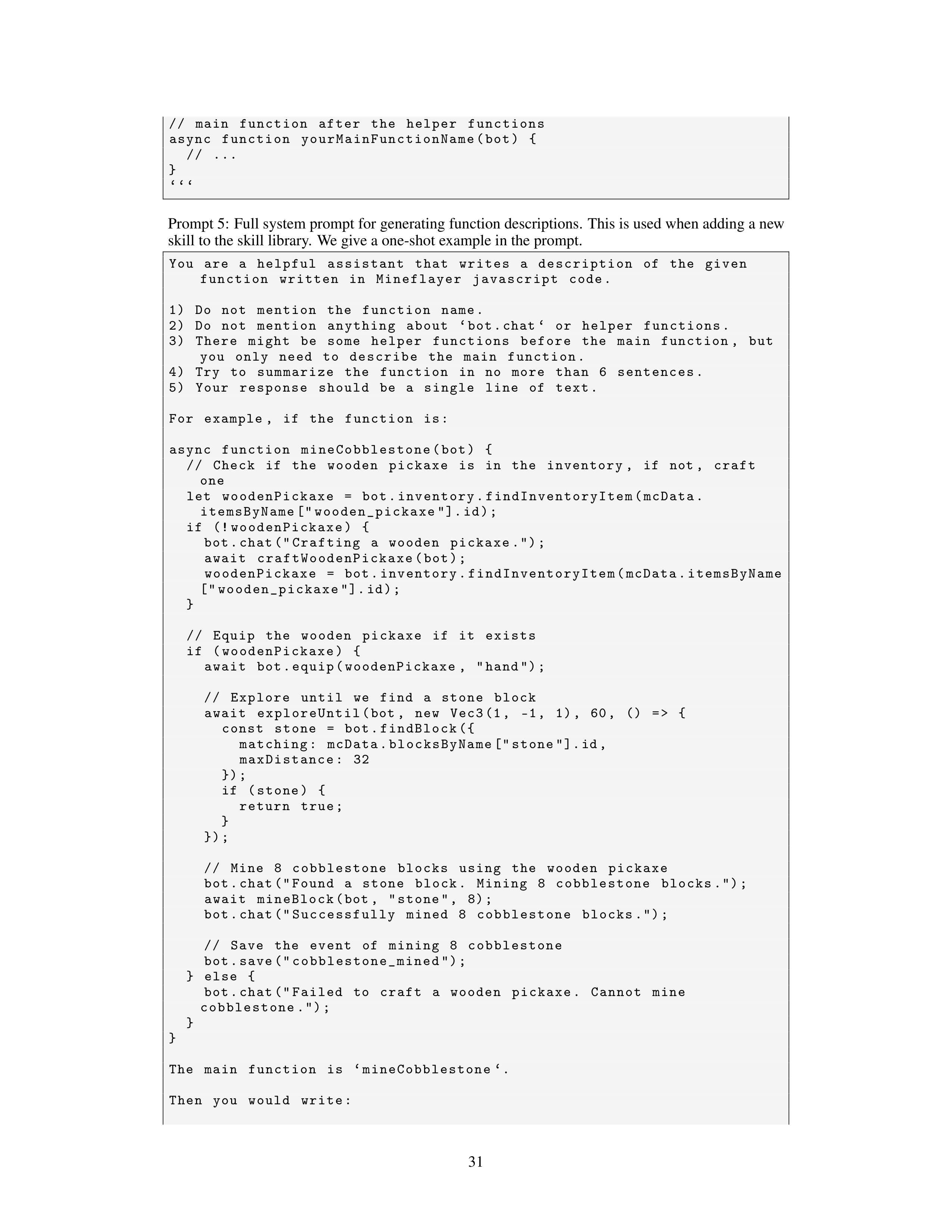
//
main
function
after
the
helper
functions
async
function
yourMainFunctionName (bot)
{
//
...
}
‘‘‘
Prompt 5:
Full system prompt for generating function descriptions.
This is used when adding a new
skill to the skill library.
We give a one-shot example in the prompt.
You
are
a
helpful
assistant
that
writes
a
description
of
the
given
function
written
in
Mineflayer
javascript
code.
1)
Do
not
mention
the
function
name.
2)
Do
not
mention
anything
about
‘bot.chat ‘
or
helper
functions.
3)
There
might
be
some
helper
functions
before
the
main
function ,
but
you
only
need
to
describe
the
main
function.
4)
Try
to
summarize
the
function
in
no
more
than
6
sentences.
5)
Your
response
should
be
a
single
line
of
text.
For
example ,
if
the
function
is:
async
function
mineCobblestone (bot)
{
//
Check
if
the
wooden
pickaxe
is
in
the
inventory ,
if
not ,
craft
one
let
woodenPickaxe
=
bot.inventory. findInventoryItem (mcData.
itemsByName [" wooden_pickaxe "].id);
if
(! woodenPickaxe)
{
bot.chat (" Crafting
a
wooden
pickaxe .");
await
craftWoodenPickaxe (bot);
woodenPickaxe
=
bot.inventory. findInventoryItem (mcData.itemsByName
[" wooden_pickaxe "].id);
}
//
Equip
the
wooden
pickaxe
if
it
exists
if
(woodenPickaxe)
{
await
bot.equip(woodenPickaxe ,
"hand ");
//
Explore
until
we
find
a
stone
block
await
exploreUntil(bot ,
new
Vec3(1,
-1,
1),
60,
()
=>
{
const
stone
=
bot.findBlock ({
matching:
mcData.blocksByName [" stone "].id ,
maxDistance:
32
});
if
(stone)
{
return
true;
}
});
//
Mine
8
cobblestone
blocks
using
the
wooden
pickaxe
bot.chat (" Found
a
stone
block.
Mining
8
cobblestone
blocks .");
await
mineBlock(bot ,
"stone",
8);
bot.chat (" Successfully
mined
8
cobblestone
blocks .");
//
Save
the
event
of
mining
8
cobblestone
bot.save (" cobblestone_mined ");
}
else
{
bot.chat (" Failed
to
craft
a
wooden
pickaxe.
Cannot
mine
cobblestone .");
}
}
The
main
function
is
‘mineCobblestone ‘.
Then
you
would
write:
31
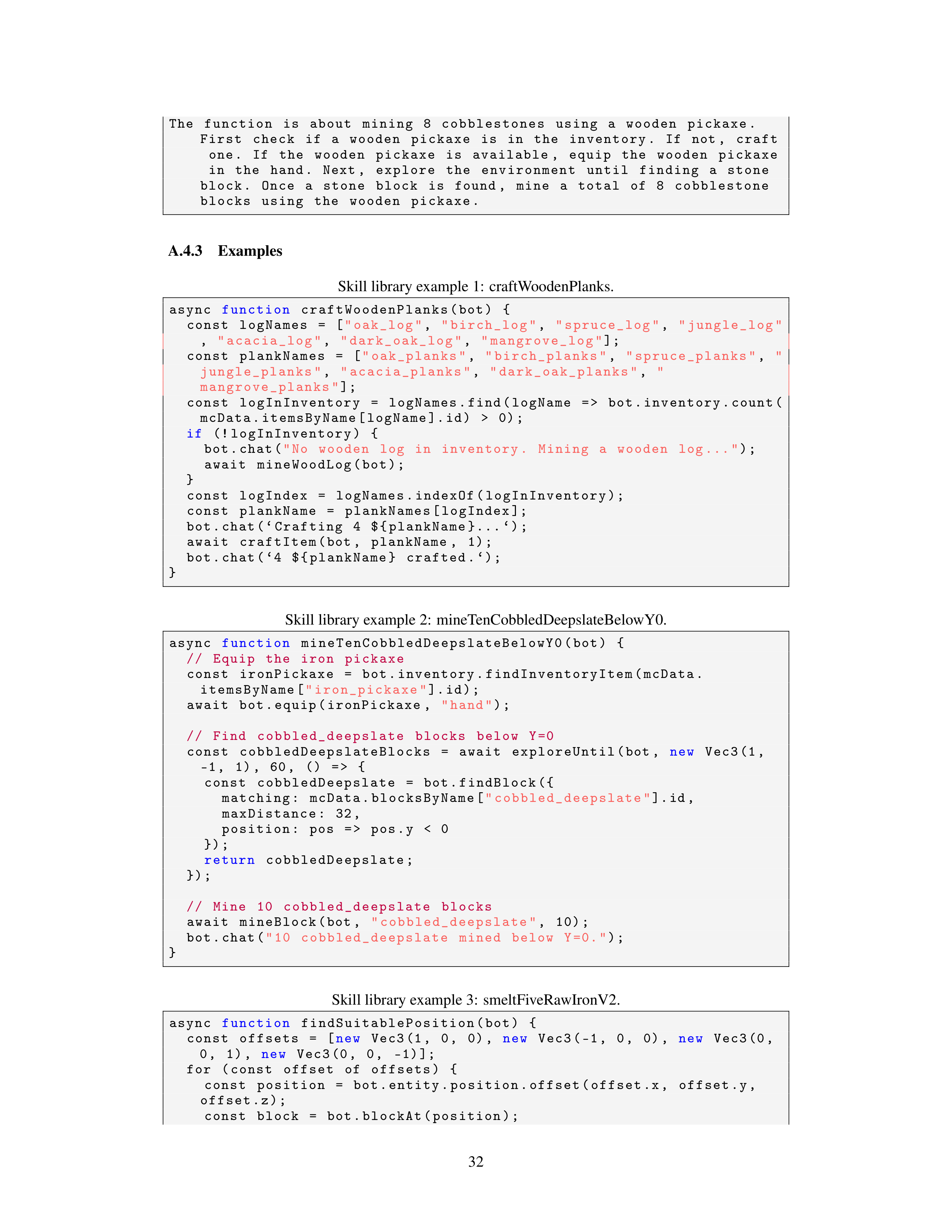
The
function
is
about
mining
8
cobblestones
using
a
wooden
pickaxe.
First
check
if
a
wooden
pickaxe
is
in
the
inventory.
If
not ,
craft
one.
If
the
wooden
pickaxe
is
available ,
equip
the
wooden
pickaxe
in
the
hand.
Next ,
explore
the
environment
until
finding
a
stone
block.
Once
a
stone
block
is
found ,
mine
a
total
of
8
cobblestone
blocks
using
the
wooden
pickaxe.
A.4.3
Examples
Skill library example 1:
craftWoodenPlanks.
async
function
craftWoodenPlanks (bot)
{
const
logNames
=
[
"oak_log"
,
"birch_log"
,
"spruce_log"
,
"jungle_log"
,
"acacia_log"
,
"dark_oak_log "
,
"mangrove_log"
];
const
plankNames
=
[
"oak_planks"
,
"birch_planks"
,
" spruce_planks "
,
"
jungle_planks"
,
"acacia_planks"
,
" dark_oak_planks "
,
"
mangrove_planks "
];
const
logInInventory
=
logNames.find(logName
=>
bot.inventory.count(
mcData.itemsByName[logName ].id)
>
0);
if
(! logInInventory)
{
bot.chat(
"No
wooden
log
in
inventory.
Mining
a
wooden
log ..."
);
await
mineWoodLog(bot);
}
const
logIndex
=
logNames.indexOf( logInInventory );
const
plankName
=
plankNames[logIndex ];
bot.chat(‘Crafting
4
${plankName }... ‘);
await
craftItem(bot ,
plankName ,
1);
bot.chat(‘4
${plankName}
crafted .‘);
}
Skill library example 2:
mineTenCobbledDeepslateBelowY0.
async
function
mineTenCobbledDeepslateBelowY0 (bot)
{
//
Equip
the
iron
pickaxe
const
ironPickaxe
=
bot.inventory. findInventoryItem (mcData.
itemsByName[
"iron_pickaxe"
].id);
await
bot.equip(ironPickaxe ,
"hand"
);
//
Find
cobbled_deepslate
blocks
below
Y=0
const
cobbledDeepslateBlocks
=
await
exploreUntil(bot ,
new
Vec3(1,
-1,
1),
60,
()
=>
{
const
cobbledDeepslate
=
bot.findBlock ({
matching:
mcData.blocksByName [
" cobbled_deepslate "
].id ,
maxDistance:
32,
position:
pos
=>
pos.y
<
0
});
return
cobbledDeepslate ;
});
//
Mine
10
cobbled_deepslate
blocks
await
mineBlock(bot ,
" cobbled_deepslate "
,
10);
bot.chat(
"10
cobbled_deepslate
mined
below
Y=0."
);
}
Skill library example 3:
smeltFiveRawIronV2.
async
function
findSuitablePosition (bot)
{
const
offsets
=
[
new
Vec3(1,
0,
0),
new
Vec3(-1,
0,
0),
new
Vec3(0,
0,
1),
new
Vec3(0,
0,
-1)];
for
(const
offset
of
offsets)
{
const
position
=
bot.entity.position.offset(offset.x,
offset.y,
offset.z);
const
block
=
bot.blockAt(position);
32
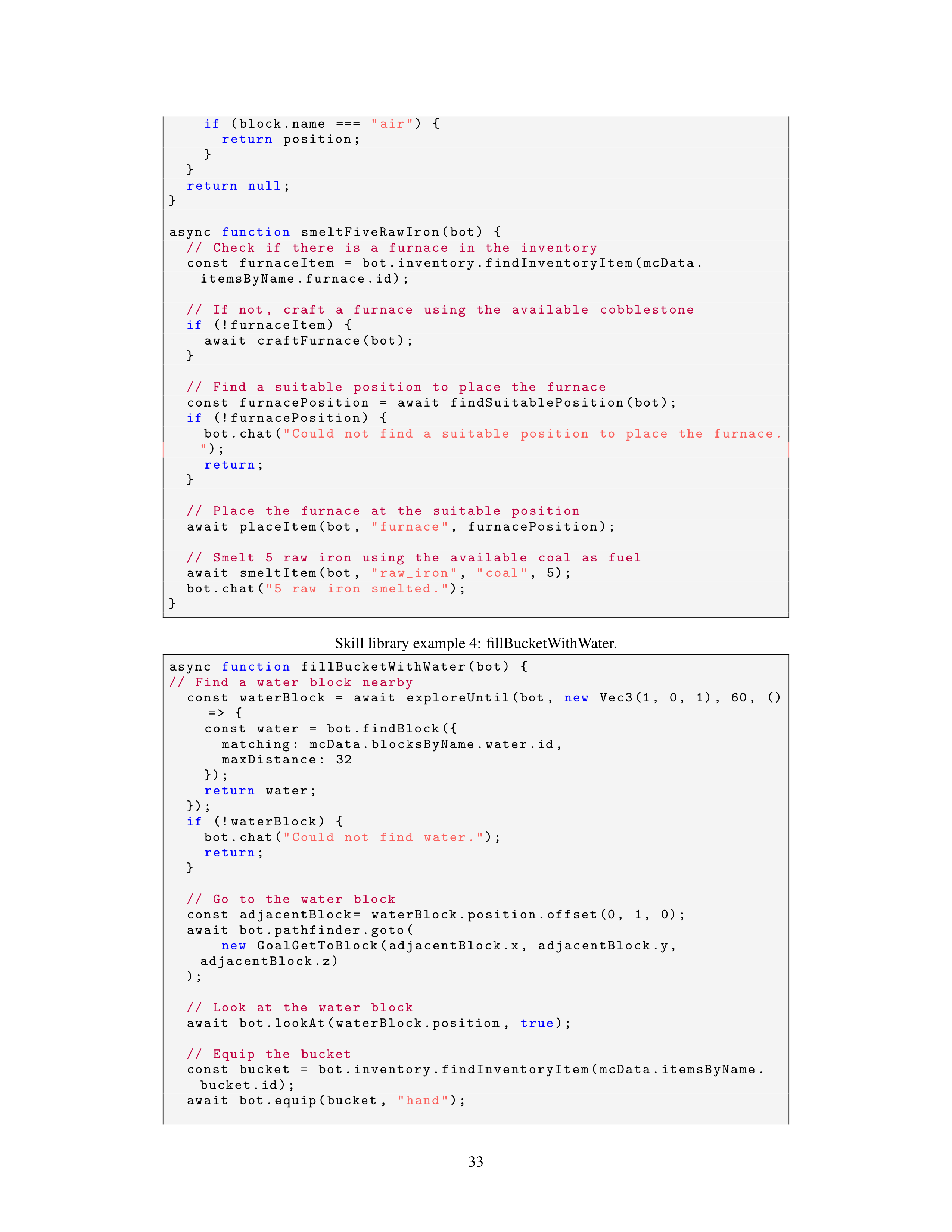
if
(block.name
===
"air"
)
{
return
position;
}
}
return
null
;
}
async
function
smeltFiveRawIron (bot)
{
//
Check
if
there
is
a
furnace
in
the
inventory
const
furnaceItem
=
bot.inventory. findInventoryItem (mcData.
itemsByName.furnace.id);
//
If
not ,
craft
a
furnace
using
the
available
cobblestone
if
(! furnaceItem)
{
await
craftFurnace(bot);
}
//
Find
a
suitable
position
to
place
the
furnace
const
furnacePosition
=
await
findSuitablePosition (bot);
if
(! furnacePosition)
{
bot.chat(
"Could
not
find
a
suitable
position
to
place
the
furnace.
"
);
return
;
}
//
Place
the
furnace
at
the
suitable
position
await
placeItem(bot ,
"furnace"
,
furnacePosition );
//
Smelt
5
raw
iron
using
the
available
coal
as
fuel
await
smeltItem(bot ,
"raw_iron"
,
"coal"
,
5);
bot.chat(
"5
raw
iron
smelted."
);
}
Skill library example 4:
fillBucketWithWater.
async
function
fillBucketWithWater (bot)
{
//
Find
a
water
block
nearby
const
waterBlock
=
await
exploreUntil (bot ,
new
Vec3(1,
0,
1),
60,
()
=>
{
const
water
=
bot.findBlock ({
matching:
mcData.blocksByName .water.id ,
maxDistance:
32
});
return
water;
});
if
(! waterBlock)
{
bot.chat(
"Could
not
find
water."
);
return
;
}
//
Go
to
the
water
block
const
adjacentBlock=
waterBlock.position.offset (0,
1,
0);
await
bot.pathfinder.goto(
new
GoalGetToBlock (adjacentBlock .x,
adjacentBlock .y,
adjacentBlock.z)
);
//
Look
at
the
water
block
await
bot.lookAt(waterBlock.position ,
true
);
//
Equip
the
bucket
const
bucket
=
bot.inventory. findInventoryItem (mcData.itemsByName.
bucket.id);
await
bot.equip(bucket ,
"hand"
);
33
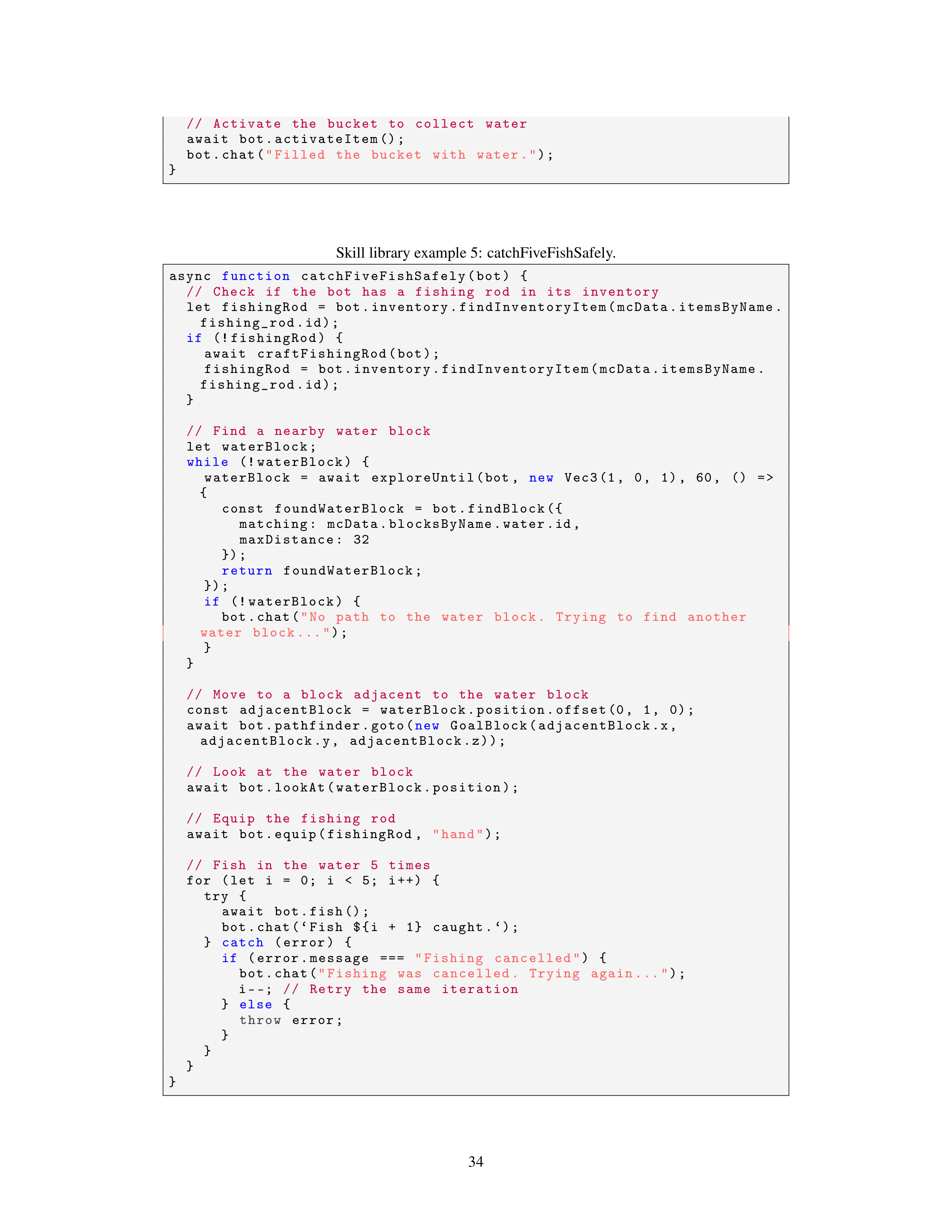
//
Activate
the
bucket
to
collect
water
await
bot.activateItem ();
bot.chat(
"Filled
the
bucket
with
water."
);
}
Skill library example 5:
catchFiveFishSafely.
async
function
catchFiveFishSafely (bot)
{
//
Check
if
the
bot
has
a
fishing
rod
in
its
inventory
let
fishingRod
=
bot.inventory. findInventoryItem (mcData.itemsByName.
fishing_rod.id);
if
(! fishingRod)
{
await
craftFishingRod (bot);
fishingRod
=
bot.inventory. findInventoryItem (mcData.itemsByName.
fishing_rod.id);
}
//
Find
a
nearby
water
block
let
waterBlock;
while
(! waterBlock)
{
waterBlock
=
await
exploreUntil(bot ,
new
Vec3(1,
0,
1),
60,
()
=>
{
const
foundWaterBlock
=
bot.findBlock ({
matching:
mcData.blocksByName .water.id ,
maxDistance:
32
});
return
foundWaterBlock ;
});
if
(! waterBlock)
{
bot.chat(
"No
path
to
the
water
block.
Trying
to
find
another
water
block ..."
);
}
}
//
Move
to
a
block
adjacent
to
the
water
block
const
adjacentBlock
=
waterBlock.position.offset (0,
1,
0);
await
bot.pathfinder.goto(
new
GoalBlock( adjacentBlock .x,
adjacentBlock.y,
adjacentBlock.z));
//
Look
at
the
water
block
await
bot.lookAt(waterBlock.position);
//
Equip
the
fishing
rod
await
bot.equip(fishingRod ,
"hand"
);
//
Fish
in
the
water
5
times
for
(let
i
=
0;
i
<
5;
i++)
{
try
{
await
bot.fish ();
bot.chat(‘Fish
${i
+
1}
caught .‘);
}
catch
(error)
{
if
(error.message
===
"Fishing
cancelled"
)
{
bot.chat(
"Fishing
was
cancelled.
Trying
again ..."
);
i--;
//
Retry
the
same
iteration
}
else
{
throw
error;
}
}
}
}
34
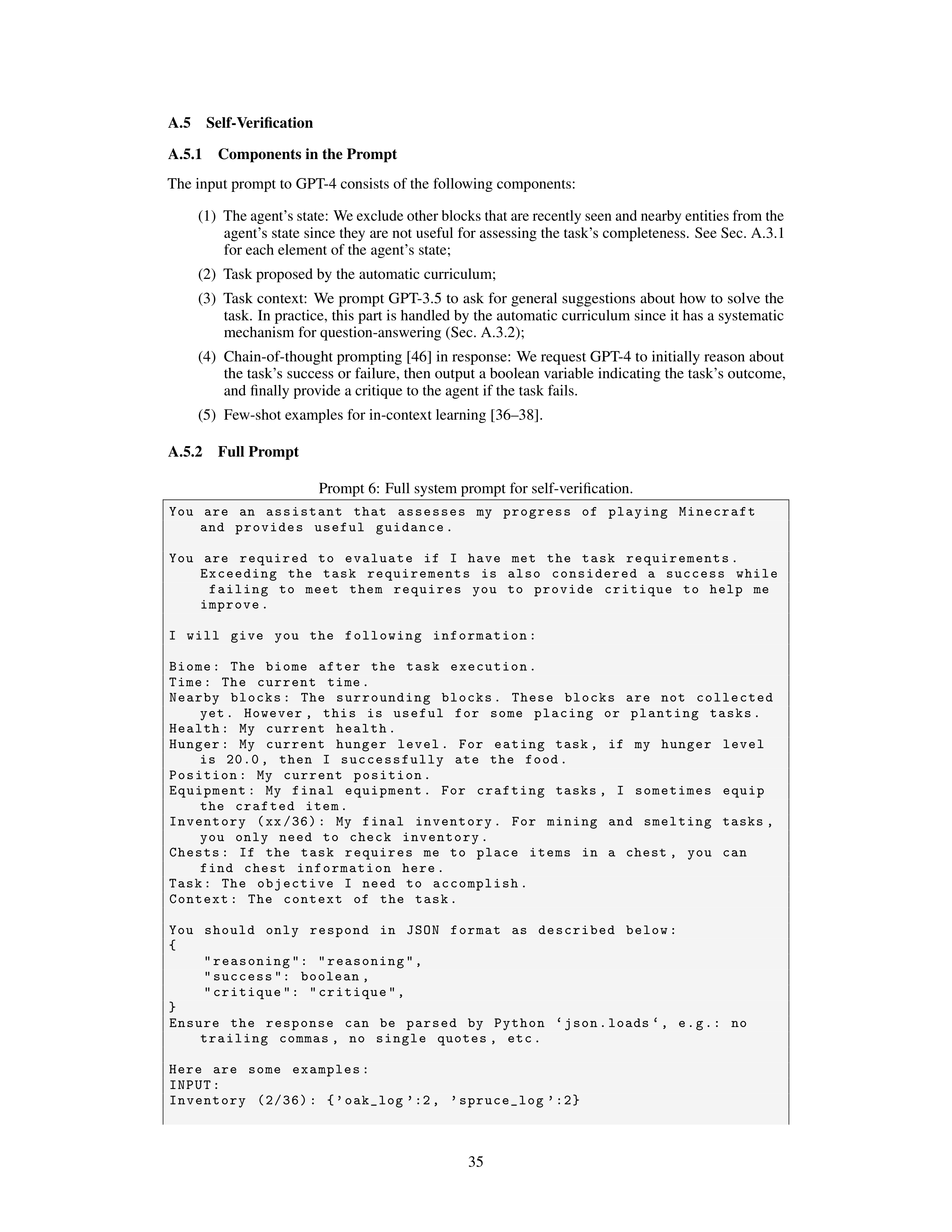
A.5
Self-Verification
A.5.1
Components in the Prompt
The input prompt to GPT-4 consists of the following components:
(1)
The agent’s state: We exclude other blocks that are recently seen and nearby entities from the
agent’s state since they are not useful for assessing the task’s completeness.
See Sec. A.3.1
for each element of the agent’s state;
(2)
Task proposed by the automatic curriculum;
(3)
Task context:
We prompt GPT-3.5 to ask for general suggestions about how to solve the
task.
In practice, this part is handled by the automatic curriculum since it has a systematic
mechanism for question-answering (Sec. A.3.2);
(4)
Chain-of-thought prompting [
46
] in response:
We request GPT-4 to initially reason about
the task’s success or failure, then output a boolean variable indicating the task’s outcome,
and finally provide a critique to the agent if the task fails.
(5)
Few-shot examples for in-context learning [36–38].
A.5.2
Full Prompt
Prompt 6:
Full system prompt for self-verification.
You
are
an
assistant
that
assesses
my
progress
of
playing
Minecraft
and
provides
useful
guidance.
You
are
required
to
evaluate
if
I
have
met
the
task
requirements .
Exceeding
the
task
requirements
is
also
considered
a
success
while
failing
to
meet
them
requires
you
to
provide
critique
to
help
me
improve.
I
will
give
you
the
following
information:
Biome:
The
biome
after
the
task
execution.
Time:
The
current
time.
Nearby
blocks:
The
surrounding
blocks.
These
blocks
are
not
collected
yet.
However ,
this
is
useful
for
some
placing
or
planting
tasks.
Health:
My
current
health.
Hunger:
My
current
hunger
level.
For
eating
task ,
if
my
hunger
level
is
20.0,
then
I
successfully
ate
the
food.
Position:
My
current
position.
Equipment:
My
final
equipment.
For
crafting
tasks ,
I
sometimes
equip
the
crafted
item.
Inventory
(xx /36):
My
final
inventory.
For
mining
and
smelting
tasks ,
you
only
need
to
check
inventory.
Chests:
If
the
task
requires
me
to
place
items
in
a
chest ,
you
can
find
chest
information
here.
Task:
The
objective
I
need
to
accomplish.
Context:
The
context
of
the
task.
You
should
only
respond
in
JSON
format
as
described
below:
{
"reasoning ":
"reasoning",
"success ":
boolean ,
"critique ":
"critique",
}
Ensure
the
response
can
be
parsed
by
Python
‘json.loads ‘,
e.g.:
no
trailing
commas ,
no
single
quotes ,
etc.
Here
are
some
examples:
INPUT:
Inventory
(2/36):
{’oak_log ’:2,
’spruce_log ’:2}
35
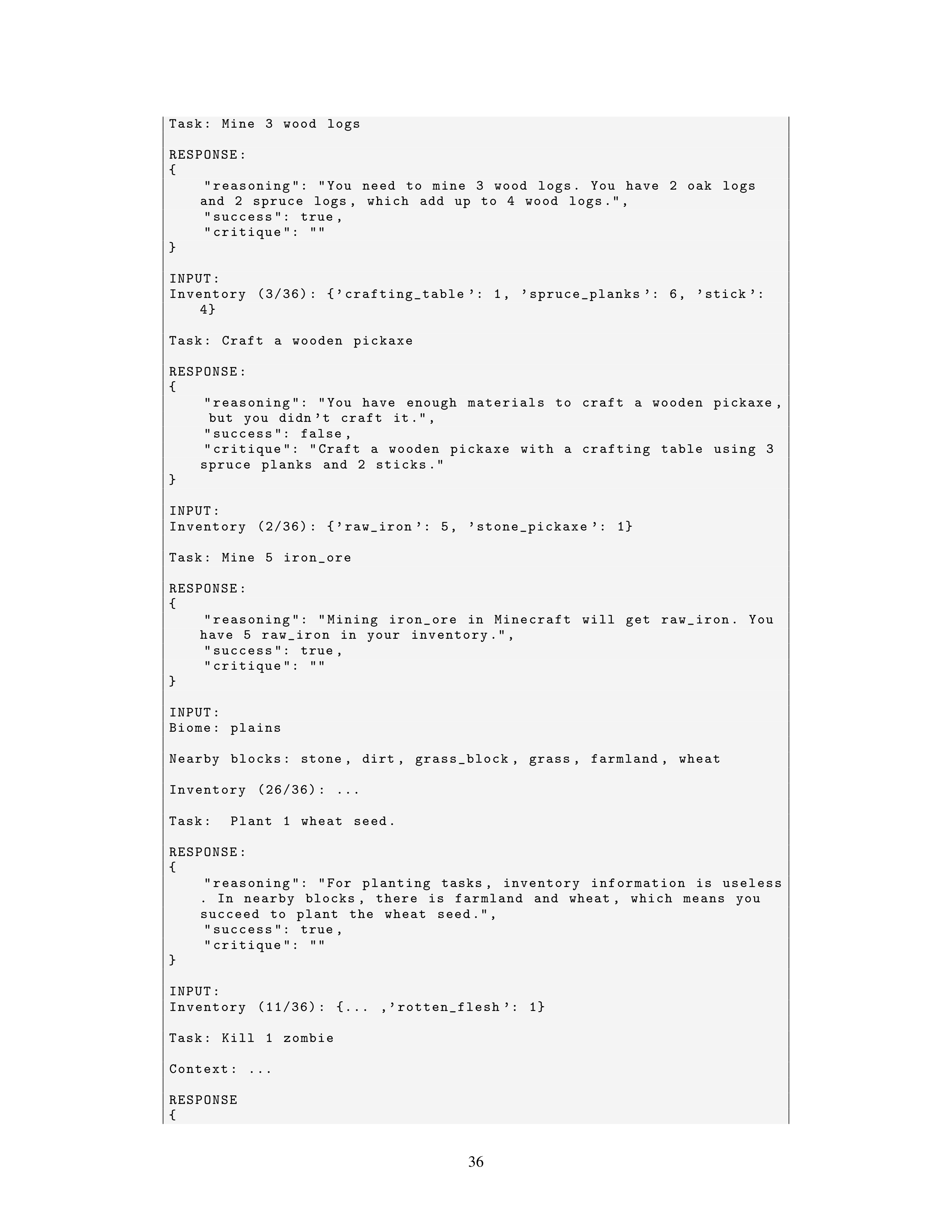
Task:
Mine
3
wood
logs
RESPONSE:
{
"reasoning ":
"You
need
to
mine
3
wood
logs.
You
have
2
oak
logs
and
2
spruce
logs ,
which
add
up
to
4
wood
logs.",
"success ":
true ,
"critique ":
""
}
INPUT:
Inventory
(3/36):
{’crafting_table ’:
1,
’spruce_planks ’:
6,
’stick ’:
4}
Task:
Craft
a
wooden
pickaxe
RESPONSE:
{
"reasoning ":
"You
have
enough
materials
to
craft
a
wooden
pickaxe ,
but
you
didn ’t
craft
it.",
"success ":
false ,
"critique ":
"Craft
a
wooden
pickaxe
with
a
crafting
table
using
3
spruce
planks
and
2
sticks ."
}
INPUT:
Inventory
(2/36):
{’raw_iron ’:
5,
’stone_pickaxe ’:
1}
Task:
Mine
5
iron_ore
RESPONSE:
{
"reasoning ":
"Mining
iron_ore
in
Minecraft
will
get
raw_iron.
You
have
5
raw_iron
in
your
inventory .",
"success ":
true ,
"critique ":
""
}
INPUT:
Biome:
plains
Nearby
blocks:
stone ,
dirt ,
grass_block ,
grass ,
farmland ,
wheat
Inventory
(26/36):
...
Task:
Plant
1
wheat
seed.
RESPONSE:
{
"reasoning ":
"For
planting
tasks ,
inventory
information
is
useless
.
In
nearby
blocks ,
there
is
farmland
and
wheat ,
which
means
you
succeed
to
plant
the
wheat
seed.",
"success ":
true ,
"critique ":
""
}
INPUT:
Inventory
(11/36):
{...
,’rotten_flesh ’:
1}
Task:
Kill
1
zombie
Context:
...
RESPONSE
{
36
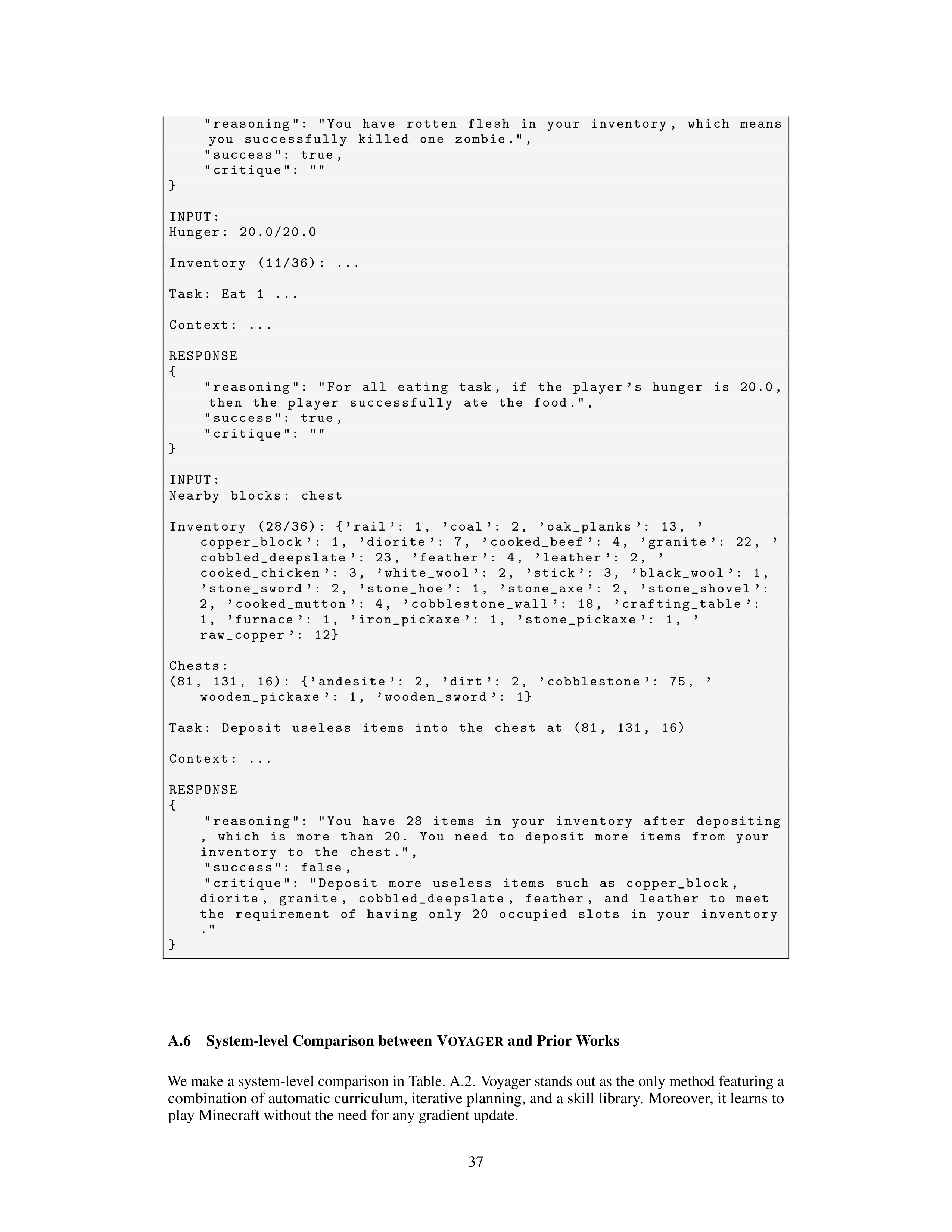
"reasoning ":
"You
have
rotten
flesh
in
your
inventory ,
which
means
you
successfully
killed
one
zombie .",
"success ":
true ,
"critique ":
""
}
INPUT:
Hunger:
20.0/20.0
Inventory
(11/36):
...
Task:
Eat
1
...
Context:
...
RESPONSE
{
"reasoning ":
"For
all
eating
task ,
if
the
player ’s
hunger
is
20.0 ,
then
the
player
successfully
ate
the
food.",
"success ":
true ,
"critique ":
""
}
INPUT:
Nearby
blocks:
chest
Inventory
(28/36):
{’rail ’:
1,
’coal ’:
2,
’oak_planks ’:
13,
’
copper_block ’:
1,
’diorite ’:
7,
’cooked_beef ’:
4,
’granite ’:
22,
’
cobbled_deepslate ’:
23,
’feather ’:
4,
’leather ’:
2,
’
cooked_chicken ’:
3,
’white_wool ’:
2,
’stick ’:
3,
’black_wool ’:
1,
’stone_sword ’:
2,
’stone_hoe ’:
1,
’stone_axe ’:
2,
’stone_shovel ’:
2,
’cooked_mutton ’:
4,
’cobblestone_wall ’:
18,
’crafting_table ’:
1,
’furnace ’:
1,
’iron_pickaxe ’:
1,
’stone_pickaxe ’:
1,
’
raw_copper ’:
12}
Chests:
(81,
131,
16):
{’andesite ’:
2,
’dirt ’:
2,
’cobblestone ’:
75,
’
wooden_pickaxe ’:
1,
’wooden_sword ’:
1}
Task:
Deposit
useless
items
into
the
chest
at
(81,
131,
16)
Context:
...
RESPONSE
{
"reasoning ":
"You
have
28
items
in
your
inventory
after
depositing
,
which
is
more
than
20.
You
need
to
deposit
more
items
from
your
inventory
to
the
chest.",
"success ":
false ,
"critique ":
"Deposit
more
useless
items
such
as
copper_block ,
diorite ,
granite ,
cobbled_deepslate ,
feather ,
and
leather
to
meet
the
requirement
of
having
only
20
occupied
slots
in
your
inventory
."
}
A.6
System-level Comparison between V
OYAGER
and Prior Works
We make a system-level comparison in Table. A.2.
Voyager stands out as the only method featuring a
combination of automatic curriculum, iterative planning, and a skill library.
Moreover, it learns to
play Minecraft without the need for any gradient update.
37
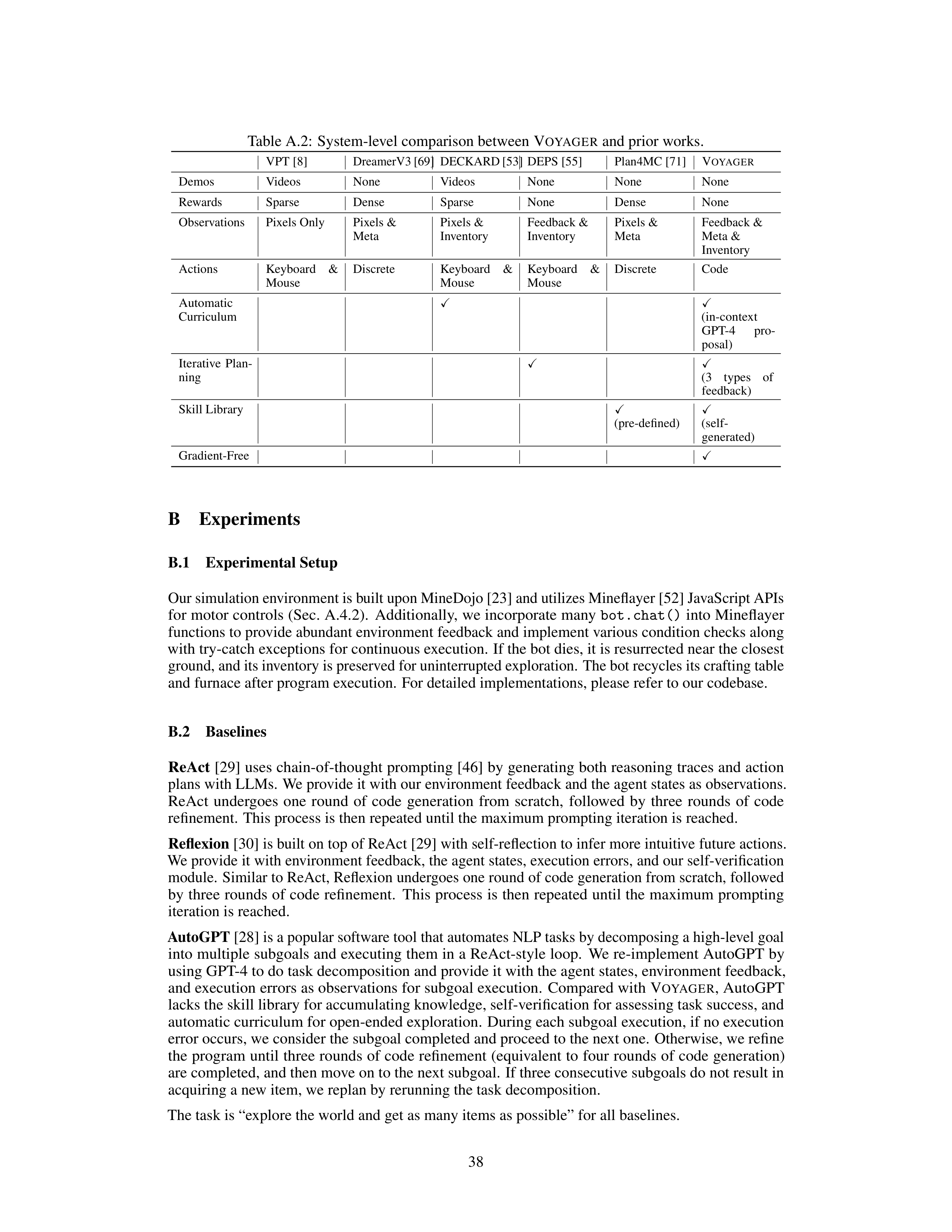
Table A.2:
System-level comparison between V
OYAGER
and prior works.
VPT [8]
DreamerV3 [
69
]
DECKARD [
53
]
DEPS [55]
Plan4MC [
71
]
V
OYAGER
Demos
Videos
None
Videos
None
None
None
Rewards
Sparse
Dense
Sparse
None
Dense
None
Observations
Pixels Only
Pixels &
Meta
Pixels &
Inventory
Feedback &
Inventory
Pixels &
Meta
Feedback &
Meta &
Inventory
Actions
Keyboard
&
Mouse
Discrete
Keyboard
&
Mouse
Keyboard
&
Mouse
Discrete
Code
Automatic
Curriculum
✓
✓
(in-context
GPT-4
pro-
posal)
Iterative
Plan-
ning
✓
✓
(3
types
of
feedback)
Skill Library
✓
(pre-defined)
✓
(self-
generated)
Gradient-Free
✓
B
Experiments
B.1
Experimental Setup
Our simulation environment is built upon MineDojo [
23
] and utilizes Mineflayer [
52
] JavaScript APIs
for motor controls (Sec. A.4.2).
Additionally, we incorporate many
bot.chat()
into Mineflayer
functions to provide abundant environment feedback and implement various condition checks along
with try-catch exceptions for continuous execution.
If the bot dies, it is resurrected near the closest
ground, and its inventory is preserved for uninterrupted exploration.
The bot recycles its crafting table
and furnace after program execution.
For detailed implementations, please refer to our codebase.
B.2
Baselines
ReAct
[
29
] uses chain-of-thought prompting [
46
] by generating both reasoning traces and action
plans with LLMs.
We provide it with our environment feedback and the agent states as observations.
ReAct
undergoes
one
round
of
code
generation
from
scratch,
followed
by
three
rounds
of
code
refinement.
This process is then repeated until the maximum prompting iteration is reached.
Reflexion
[
30
] is built on top of ReAct [
29
] with self-reflection to infer more intuitive future actions.
We provide it with environment feedback, the agent states, execution errors, and our self-verification
module.
Similar to ReAct, Reflexion undergoes one round of code generation from scratch, followed
by three rounds of code refinement.
This process is then repeated until the maximum prompting
iteration is reached.
AutoGPT
[
28
] is a popular software tool that automates NLP tasks by decomposing a high-level goal
into multiple subgoals and executing them in a ReAct-style loop.
We re-implement AutoGPT by
using GPT-4 to do task decomposition and provide it with the agent states, environment feedback,
and execution errors as observations for subgoal execution.
Compared with
V
OYAGER
, AutoGPT
lacks the skill library for accumulating knowledge, self-verification for assessing task success, and
automatic curriculum for open-ended exploration.
During each subgoal execution, if no execution
error occurs, we consider the subgoal completed and proceed to the next one.
Otherwise, we refine
the program until three rounds of code refinement (equivalent to four rounds of code generation)
are completed, and then move on to the next subgoal.
If three consecutive subgoals do not result in
acquiring a new item, we replan by rerunning the task decomposition.
The task is “explore the world and get as many items as possible” for all baselines.
38
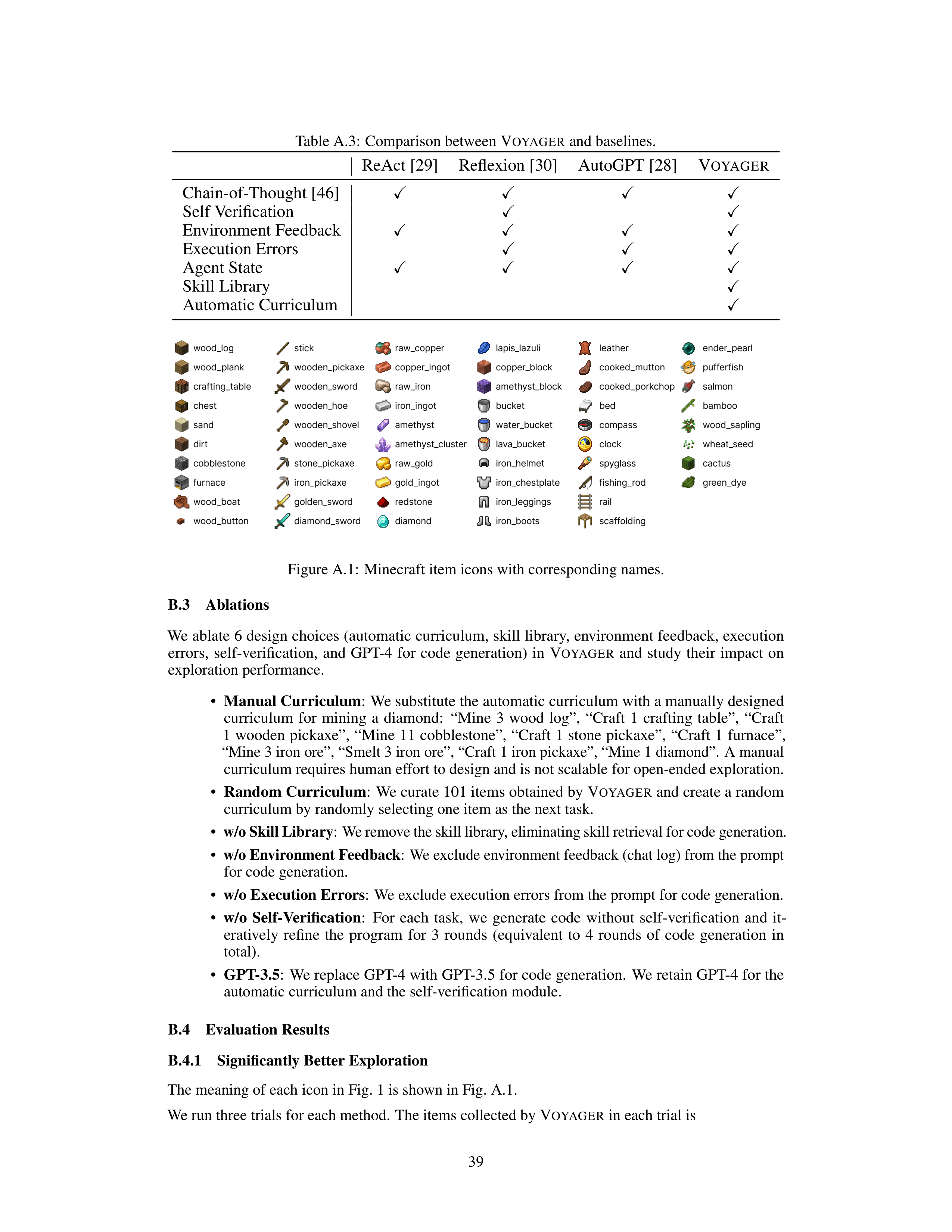
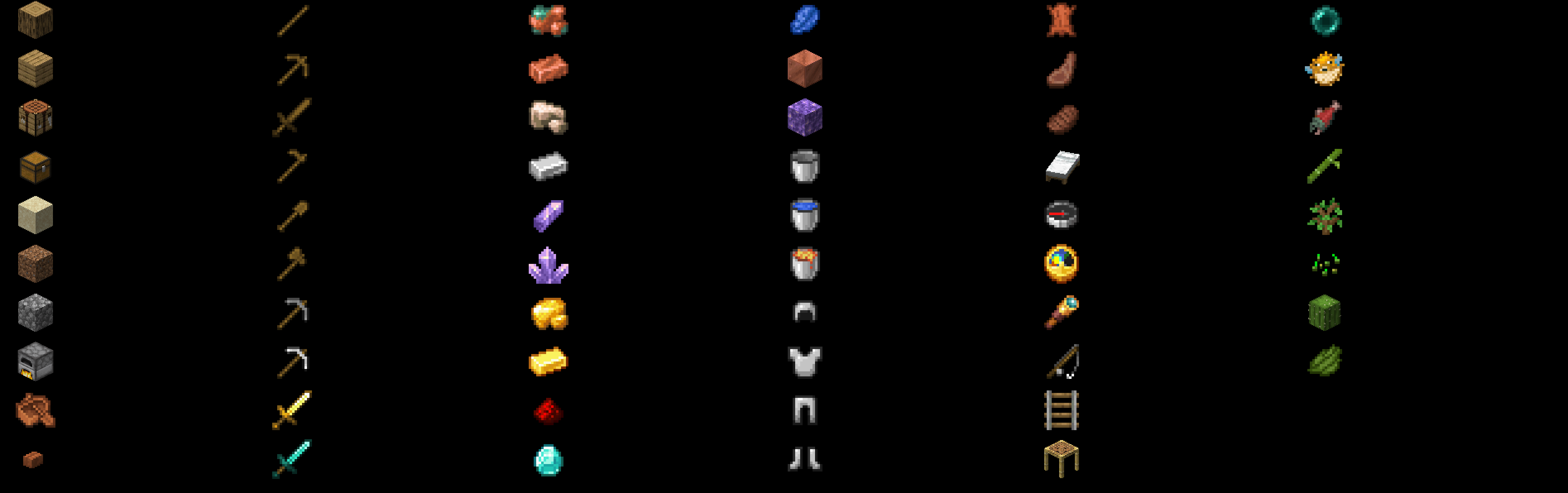
Table A.3:
Comparison between V
OYAGER
and baselines.
ReAct [29]
Reflexion [30]
AutoGPT [28]
V
OYAGER
Chain-of-Thought [46]
✓
✓
✓
✓
Self Verification
✓
✓
Environment Feedback
✓
✓
✓
✓
Execution Errors
✓
✓
✓
Agent State
✓
✓
✓
✓
Skill Library
✓
Automatic Curriculum
✓
Figure A.1:
Minecraft item icons with corresponding names.
B.3
Ablations
We ablate 6 design choices (automatic curriculum, skill library, environment feedback, execution
errors,
self-verification,
and
GPT-4
for
code
generation)
in
V
OYAGER
and
study
their
impact
on
exploration performance.
•
Manual Curriculum
:
We substitute the automatic curriculum with a manually designed
curriculum
for
mining
a
diamond:
“Mine
3
wood
log”,
“Craft
1
crafting
table”,
“Craft
1 wooden pickaxe”,
“Mine 11 cobblestone”,
“Craft 1 stone pickaxe”,
“Craft 1 furnace”,
“Mine 3 iron ore”, “Smelt 3 iron ore”, “Craft 1 iron pickaxe”, “Mine 1 diamond”.
A manual
curriculum requires human effort to design and is not scalable for open-ended exploration.
•
Random Curriculum
:
We curate 101 items obtained by
V
OYAGER
and create a random
curriculum by randomly selecting one item as the next task.
•
w/o Skill Library
: We remove the skill library, eliminating skill retrieval for code generation.
•
w/o Environment Feedback
:
We exclude environment feedback (chat log) from the prompt
for code generation.
•
w/o Execution Errors
:
We exclude execution errors from the prompt for code generation.
•
w/o
Self-Verification
:
For
each
task,
we
generate
code
without
self-verification
and
it-
eratively
refine
the
program
for
3
rounds
(equivalent
to
4
rounds
of
code
generation
in
total).
•
GPT-3.5
:
We replace GPT-4 with GPT-3.5 for code generation.
We retain GPT-4 for the
automatic curriculum and the self-verification module.
B.4
Evaluation Results
B.4.1
Significantly Better Exploration
The meaning of each icon in Fig. 1 is shown in Fig. A.1.
We run three trials for each method.
The items collected by V
OYAGER
in each trial is
39
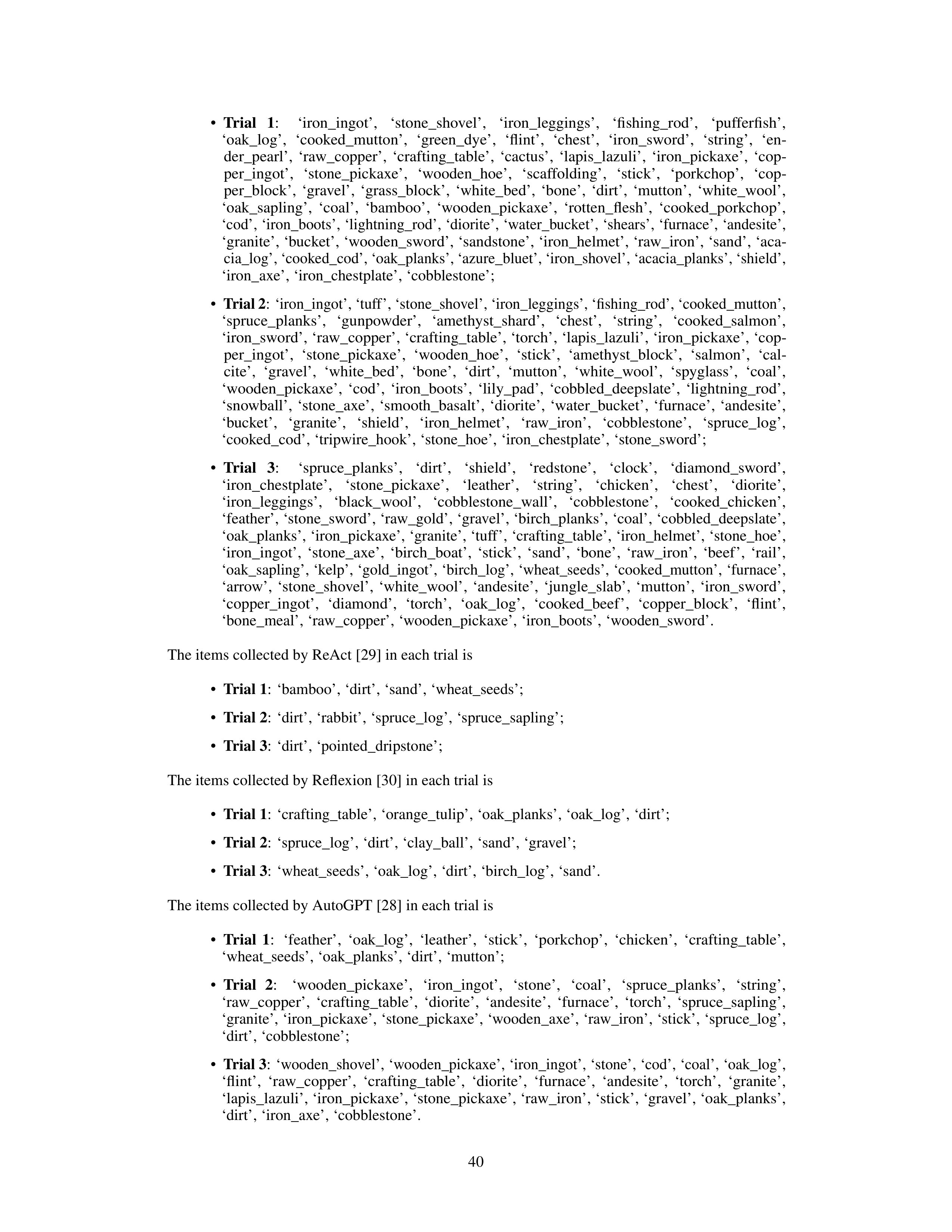
•
Trial
1
:
‘iron_ingot’,
‘stone_shovel’,
‘iron_leggings’,
‘fishing_rod’,
‘pufferfish’,
‘oak_log’,
‘cooked_mutton’,
‘green_dye’,
‘flint’,
‘chest’,
‘iron_sword’,
‘string’,
‘en-
der_pearl’,
‘raw_copper’,
‘crafting_table’,
‘cactus’,
‘lapis_lazuli’,
‘iron_pickaxe’,
‘cop-
per_ingot’,
‘stone_pickaxe’,
‘wooden_hoe’,
‘scaffolding’,
‘stick’,
‘porkchop’,
‘cop-
per_block’,
‘gravel’,
‘grass_block’,
‘white_bed’,
‘bone’,
‘dirt’,
‘mutton’,
‘white_wool’,
‘oak_sapling’,
‘coal’,
‘bamboo’,
‘wooden_pickaxe’,
‘rotten_flesh’,
‘cooked_porkchop’,
‘cod’, ‘iron_boots’, ‘lightning_rod’, ‘diorite’, ‘water_bucket’, ‘shears’, ‘furnace’, ‘andesite’,
‘granite’, ‘bucket’, ‘wooden_sword’, ‘sandstone’, ‘iron_helmet’, ‘raw_iron’, ‘sand’, ‘aca-
cia_log’, ‘cooked_cod’, ‘oak_planks’, ‘azure_bluet’, ‘iron_shovel’, ‘acacia_planks’, ‘shield’,
‘iron_axe’, ‘iron_chestplate’, ‘cobblestone’;
•
Trial 2
: ‘iron_ingot’, ‘tuff’, ‘stone_shovel’, ‘iron_leggings’, ‘fishing_rod’, ‘cooked_mutton’,
‘spruce_planks’,
‘gunpowder’,
‘amethyst_shard’,
‘chest’,
‘string’,
‘cooked_salmon’,
‘iron_sword’, ‘raw_copper’, ‘crafting_table’, ‘torch’, ‘lapis_lazuli’, ‘iron_pickaxe’, ‘cop-
per_ingot’,
‘stone_pickaxe’,
‘wooden_hoe’,
‘stick’,
‘amethyst_block’,
‘salmon’,
‘cal-
cite’,
‘gravel’,
‘white_bed’,
‘bone’,
‘dirt’,
‘mutton’,
‘white_wool’,
‘spyglass’,
‘coal’,
‘wooden_pickaxe’,
‘cod’,
‘iron_boots’,
‘lily_pad’,
‘cobbled_deepslate’,
‘lightning_rod’,
‘snowball’, ‘stone_axe’, ‘smooth_basalt’, ‘diorite’, ‘water_bucket’, ‘furnace’, ‘andesite’,
‘bucket’,
‘granite’,
‘shield’,
‘iron_helmet’,
‘raw_iron’,
‘cobblestone’,
‘spruce_log’,
‘cooked_cod’, ‘tripwire_hook’, ‘stone_hoe’, ‘iron_chestplate’, ‘stone_sword’;
•
Trial
3
:
‘spruce_planks’,
‘dirt’,
‘shield’,
‘redstone’,
‘clock’,
‘diamond_sword’,
‘iron_chestplate’,
‘stone_pickaxe’,
‘leather’,
‘string’,
‘chicken’,
‘chest’,
‘diorite’,
‘iron_leggings’,
‘black_wool’,
‘cobblestone_wall’,
‘cobblestone’,
‘cooked_chicken’,
‘feather’, ‘stone_sword’, ‘raw_gold’, ‘gravel’, ‘birch_planks’, ‘coal’, ‘cobbled_deepslate’,
‘oak_planks’, ‘iron_pickaxe’, ‘granite’, ‘tuff’, ‘crafting_table’, ‘iron_helmet’, ‘stone_hoe’,
‘iron_ingot’,
‘stone_axe’,
‘birch_boat’,
‘stick’,
‘sand’,
‘bone’,
‘raw_iron’,
‘beef’,
‘rail’,
‘oak_sapling’, ‘kelp’, ‘gold_ingot’, ‘birch_log’, ‘wheat_seeds’, ‘cooked_mutton’, ‘furnace’,
‘arrow’,
‘stone_shovel’,
‘white_wool’,
‘andesite’,
‘jungle_slab’,
‘mutton’,
‘iron_sword’,
‘copper_ingot’,
‘diamond’,
‘torch’,
‘oak_log’,
‘cooked_beef’,
‘copper_block’,
‘flint’,
‘bone_meal’, ‘raw_copper’, ‘wooden_pickaxe’, ‘iron_boots’, ‘wooden_sword’.
The items collected by ReAct [29] in each trial is
•
Trial 1
:
‘bamboo’, ‘dirt’, ‘sand’, ‘wheat_seeds’;
•
Trial 2
:
‘dirt’, ‘rabbit’, ‘spruce_log’, ‘spruce_sapling’;
•
Trial 3
:
‘dirt’, ‘pointed_dripstone’;
The items collected by Reflexion [30] in each trial is
•
Trial 1
:
‘crafting_table’, ‘orange_tulip’, ‘oak_planks’, ‘oak_log’, ‘dirt’;
•
Trial 2
:
‘spruce_log’, ‘dirt’, ‘clay_ball’, ‘sand’, ‘gravel’;
•
Trial 3
:
‘wheat_seeds’, ‘oak_log’, ‘dirt’, ‘birch_log’, ‘sand’.
The items collected by AutoGPT [28] in each trial is
•
Trial
1
:
‘feather’,
‘oak_log’,
‘leather’,
‘stick’,
‘porkchop’,
‘chicken’,
‘crafting_table’,
‘wheat_seeds’, ‘oak_planks’, ‘dirt’, ‘mutton’;
•
Trial
2
:
‘wooden_pickaxe’,
‘iron_ingot’,
‘stone’,
‘coal’,
‘spruce_planks’,
‘string’,
‘raw_copper’,
‘crafting_table’,
‘diorite’,
‘andesite’,
‘furnace’,
‘torch’,
‘spruce_sapling’,
‘granite’, ‘iron_pickaxe’, ‘stone_pickaxe’, ‘wooden_axe’, ‘raw_iron’, ‘stick’, ‘spruce_log’,
‘dirt’, ‘cobblestone’;
•
Trial 3
:
‘wooden_shovel’, ‘wooden_pickaxe’, ‘iron_ingot’, ‘stone’, ‘cod’, ‘coal’, ‘oak_log’,
‘flint’,
‘raw_copper’,
‘crafting_table’,
‘diorite’,
‘furnace’,
‘andesite’,
‘torch’,
‘granite’,
‘lapis_lazuli’, ‘iron_pickaxe’, ‘stone_pickaxe’, ‘raw_iron’, ‘stick’, ‘gravel’, ‘oak_planks’,
‘dirt’, ‘iron_axe’, ‘cobblestone’.
40
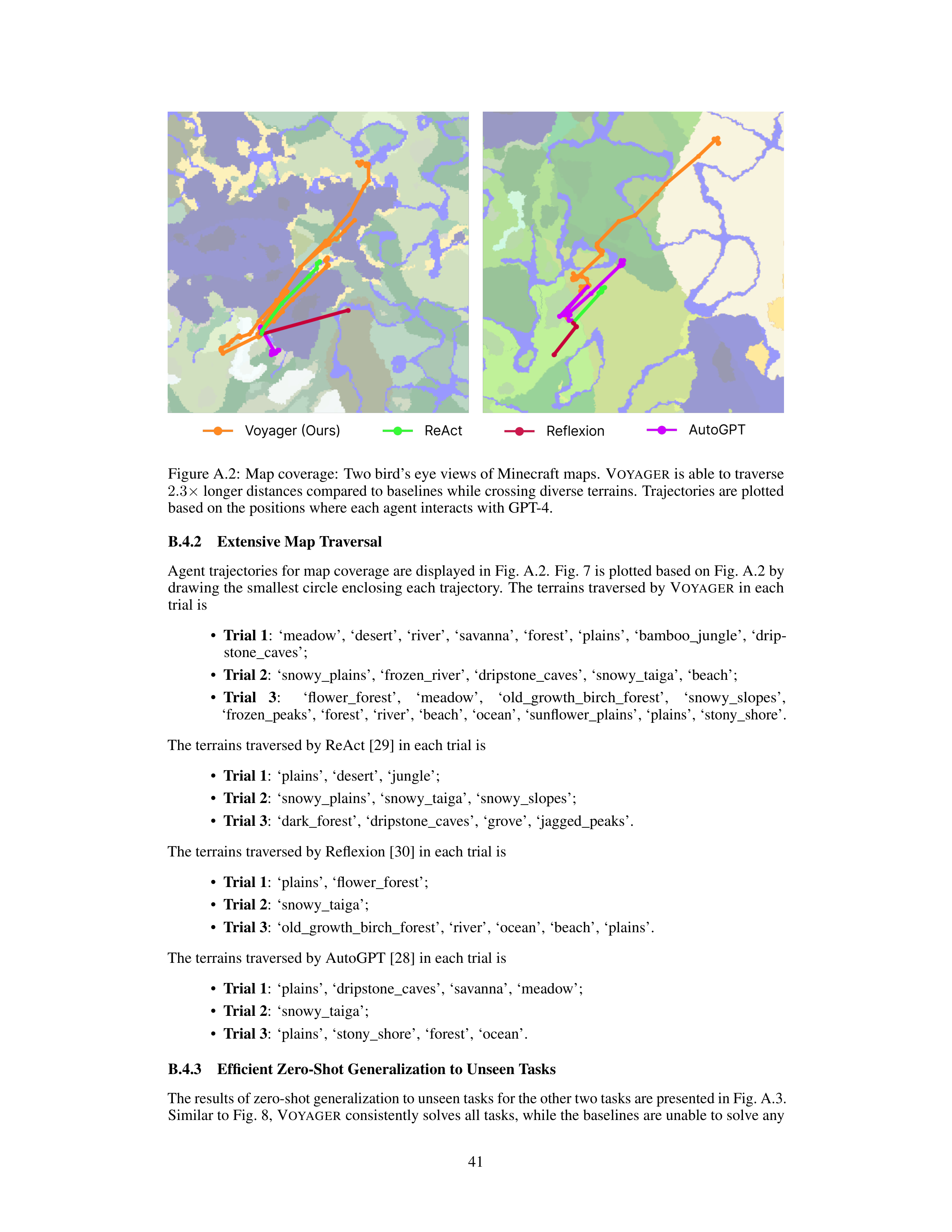
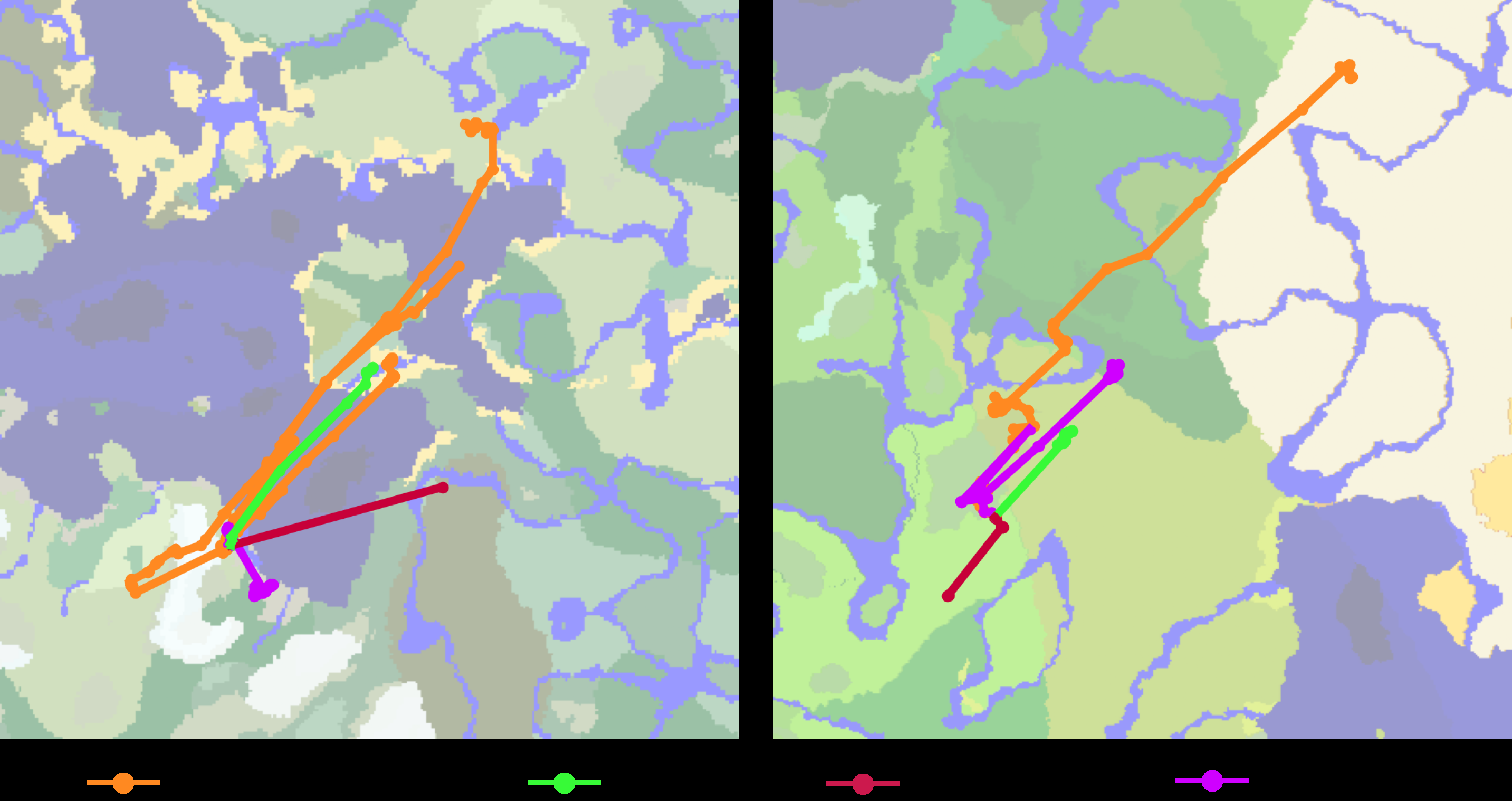
Figure A.2:
Map coverage:
Two bird’s eye views of Minecraft maps.
V
OYAGER
is able to traverse
2
.
3
×
longer distances compared to baselines while crossing diverse terrains.
Trajectories are plotted
based on the positions where each agent interacts with GPT-4.
B.4.2
Extensive Map Traversal
Agent trajectories for map coverage are displayed in Fig. A.2.
Fig. 7 is plotted based on Fig. A.2 by
drawing the smallest circle enclosing each trajectory.
The terrains traversed by
V
OYAGER
in each
trial is
•
Trial 1
:
‘meadow’, ‘desert’, ‘river’, ‘savanna’, ‘forest’, ‘plains’, ‘bamboo_jungle’, ‘drip-
stone_caves’;
•
Trial 2
:
‘snowy_plains’, ‘frozen_river’, ‘dripstone_caves’, ‘snowy_taiga’, ‘beach’;
•
Trial
3
:
‘flower_forest’,
‘meadow’,
‘old_growth_birch_forest’,
‘snowy_slopes’,
‘frozen_peaks’, ‘forest’, ‘river’, ‘beach’, ‘ocean’, ‘sunflower_plains’, ‘plains’, ‘stony_shore’.
The terrains traversed by ReAct [29] in each trial is
•
Trial 1
:
‘plains’, ‘desert’, ‘jungle’;
•
Trial 2
:
‘snowy_plains’, ‘snowy_taiga’, ‘snowy_slopes’;
•
Trial 3
:
‘dark_forest’, ‘dripstone_caves’, ‘grove’, ‘jagged_peaks’.
The terrains traversed by Reflexion [30] in each trial is
•
Trial 1
:
‘plains’, ‘flower_forest’;
•
Trial 2
:
‘snowy_taiga’;
•
Trial 3
:
‘old_growth_birch_forest’, ‘river’, ‘ocean’, ‘beach’, ‘plains’.
The terrains traversed by AutoGPT [28] in each trial is
•
Trial 1
:
‘plains’, ‘dripstone_caves’, ‘savanna’, ‘meadow’;
•
Trial 2
:
‘snowy_taiga’;
•
Trial 3
:
‘plains’, ‘stony_shore’, ‘forest’, ‘ocean’.
B.4.3
Efficient Zero-Shot Generalization to Unseen Tasks
The results of zero-shot generalization to unseen tasks for the other two tasks are presented in Fig. A.3.
Similar to Fig. 8,
V
OYAGER
consistently solves all tasks, while the baselines are unable to solve any
41
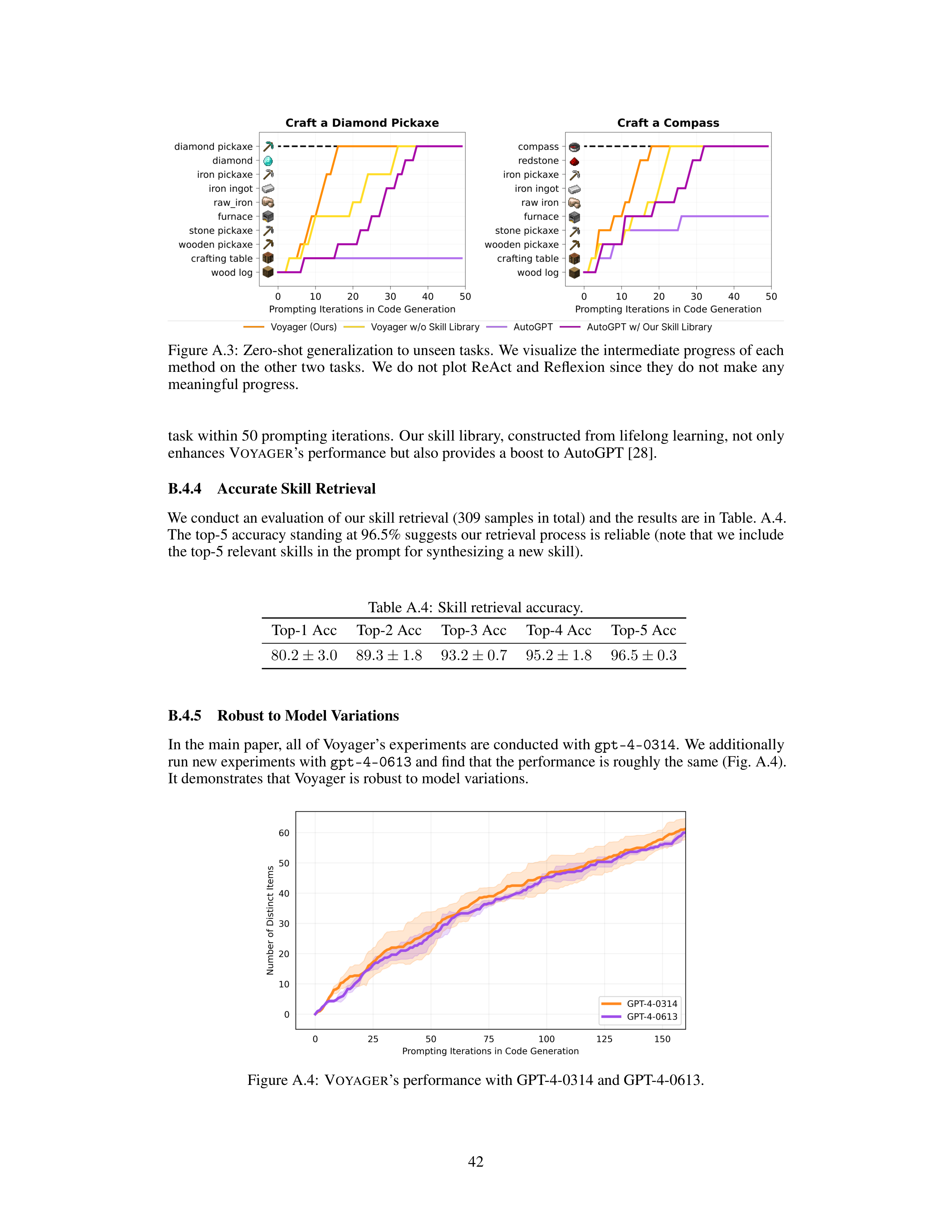
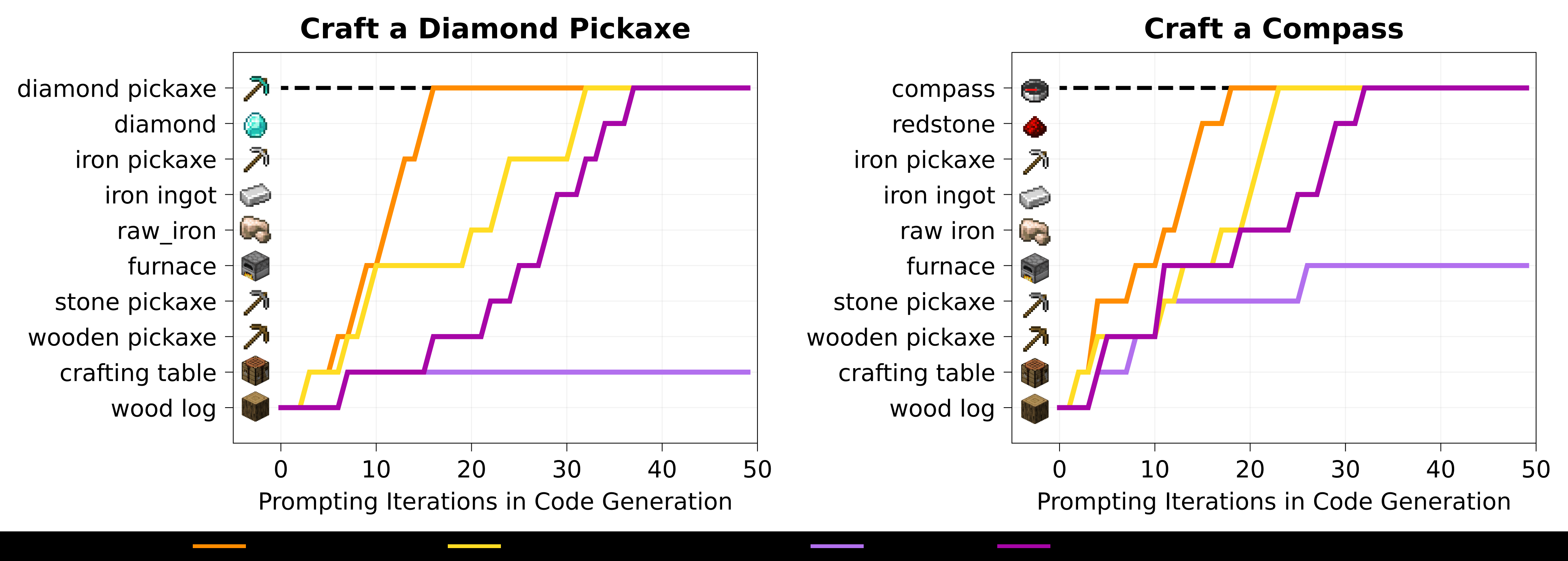
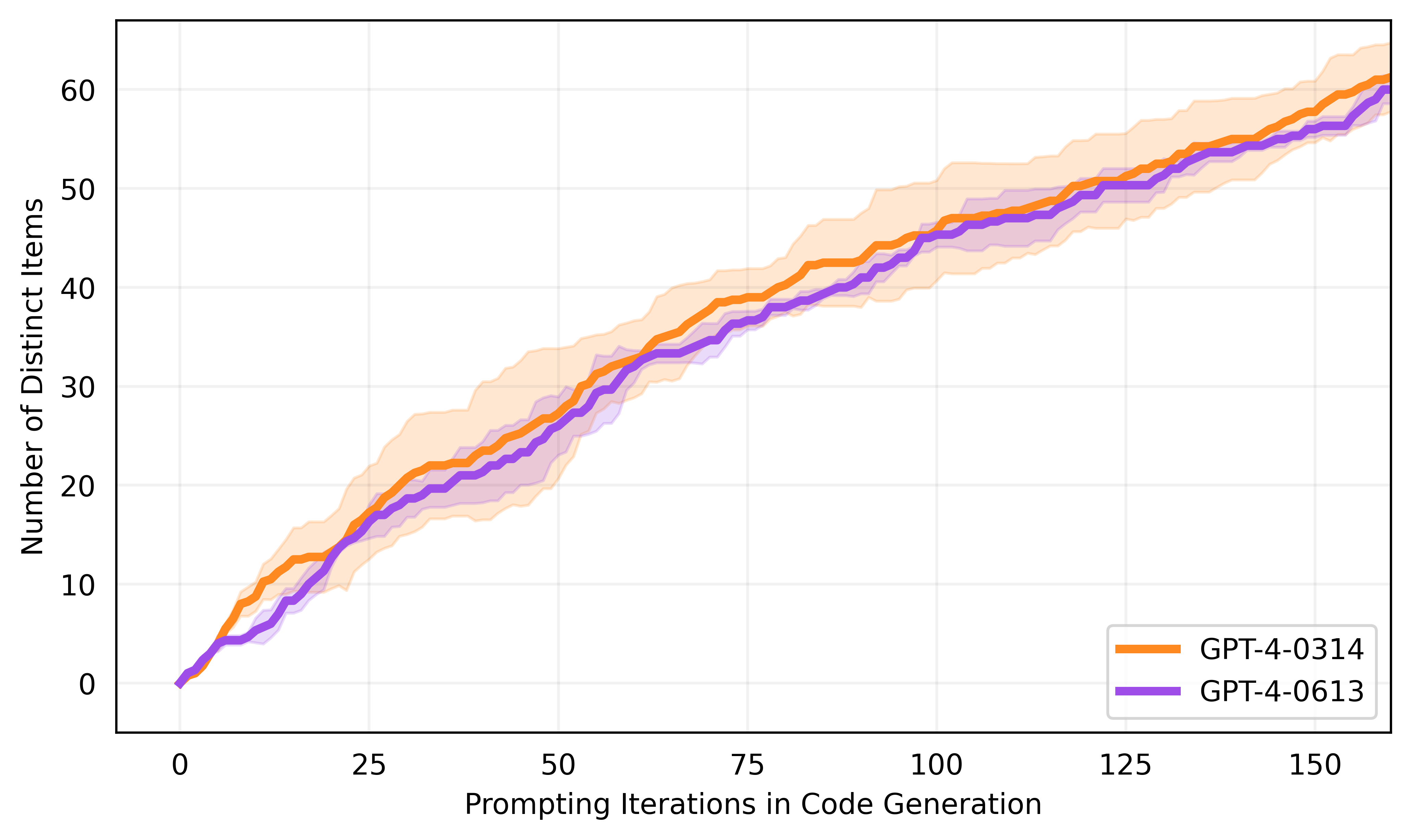
Figure A.3:
Zero-shot generalization to unseen tasks.
We visualize the intermediate progress of each
method on the other two tasks.
We do not plot ReAct and Reflexion since they do not make any
meaningful progress.
task within 50 prompting iterations.
Our skill library, constructed from lifelong learning, not only
enhances V
OYAGER
’s performance but also provides a boost to AutoGPT [28].
B.4.4
Accurate Skill Retrieval
We conduct an evaluation of our skill retrieval (309 samples in total) and the results are in Table. A.4.
The top-5 accuracy standing at 96.5% suggests our retrieval process is reliable (note that we include
the top-5 relevant skills in the prompt for synthesizing a new skill).
Table A.4:
Skill retrieval accuracy.
Top-1 Acc
Top-2 Acc
Top-3 Acc
Top-4 Acc
Top-5 Acc
80
.
2
±
3
.
0
89
.
3
±
1
.
8
93
.
2
±
0
.
7
95
.
2
±
1
.
8
96
.
5
±
0
.
3
B.4.5
Robust to Model Variations
In the main paper, all of Voyager’s experiments are conducted with
gpt-4-0314
.
We additionally
run new experiments with
gpt-4-0613
and find that the performance is roughly the same (Fig. A.4).
It demonstrates that Voyager is robust to model variations.
Figure A.4:
V
OYAGER
’s performance with GPT-4-0314 and GPT-4-0613.
42