
















































ChatDev:
Communicative Agents for Software Development
Chen Qian
⋆
Wei Liu
⋆
Hongzhang Liu
♠
Nuo Chen
⋆
Yufan Dang
⋆
Jiahao Li
⋆
Cheng Yang
♣
Weize Chen
⋆
Yusheng Su
⋆
Xin Cong
⋆
Juyuan Xu
⋆
Dahai Li
♦
Zhiyuan Liu
⋆
B
Maosong Sun
⋆
B
⋆
Tsinghua University
♠
The University of Sydney
♣
BUPT
♦
Modelbest Inc.
qianc62@gmail.com
liuzy@tsinghua.edu.cn
sms@tsinghua.edu.cn
Abstract
Software development is a complex task that
necessitates cooperation among multiple mem-
bers with diverse skills.
Numerous studies used
deep learning to improve specific phases in a
waterfall
model,
such
as
design,
coding,
and
testing.
However,
the
deep
learning
model
in
each
phase
requires
unique
designs,
lead-
ing to technical inconsistencies across various
phases, which results in a fragmented and in-
effective
development
process.
In
this
paper,
we
introduce
ChatDev,
a
chat-powered
soft-
ware development framework in which special-
ized
agents
driven
by
large
language
models
(LLMs)
are
guided
in
what
to
communicate
(via
chat chain
) and how to communicate (via
communicative dehallucination
).
These agents
actively contribute to the design, coding, and
testing phases through unified language-based
communication,
with
solutions
derived
from
their multi-turn dialogues.
We found their uti-
lization
of
natural
language
is
advantageous
for system design, and communicating in pro-
gramming
language
proves
helpful
in
debug-
ging.
This paradigm demonstrates how linguis-
tic communication facilitates multi-agent col-
laboration,
establishing
language
as
a
unify-
ing bridge for autonomous task-solving among
LLM agents.
The code and data are available
at
https://github.com/OpenBMB/ChatDev
.
1
Introduction
Large
language
models
(LLMs)
have
led
to
sub-
stantial
transformations
due
to
their
ability
to
ef-
fortlessly integrate extensive knowledge expressed
in
language
(
Brown
et
al.
,
2020
;
Bubeck
et
al.
,
2023
), combined with their strong capacity for role-
playing within designated roles (
Park et al.
,
2023
;
Hua
et
al.
,
2023
;
Chen
et
al.
,
2023b
).
This
ad-
vancement eliminates the need for model-specific
designs
and
delivers
impressive
performance
in
B
: Corresponding Author.
main
()
Docs
Codes
Software
Develop a
Gomoku game
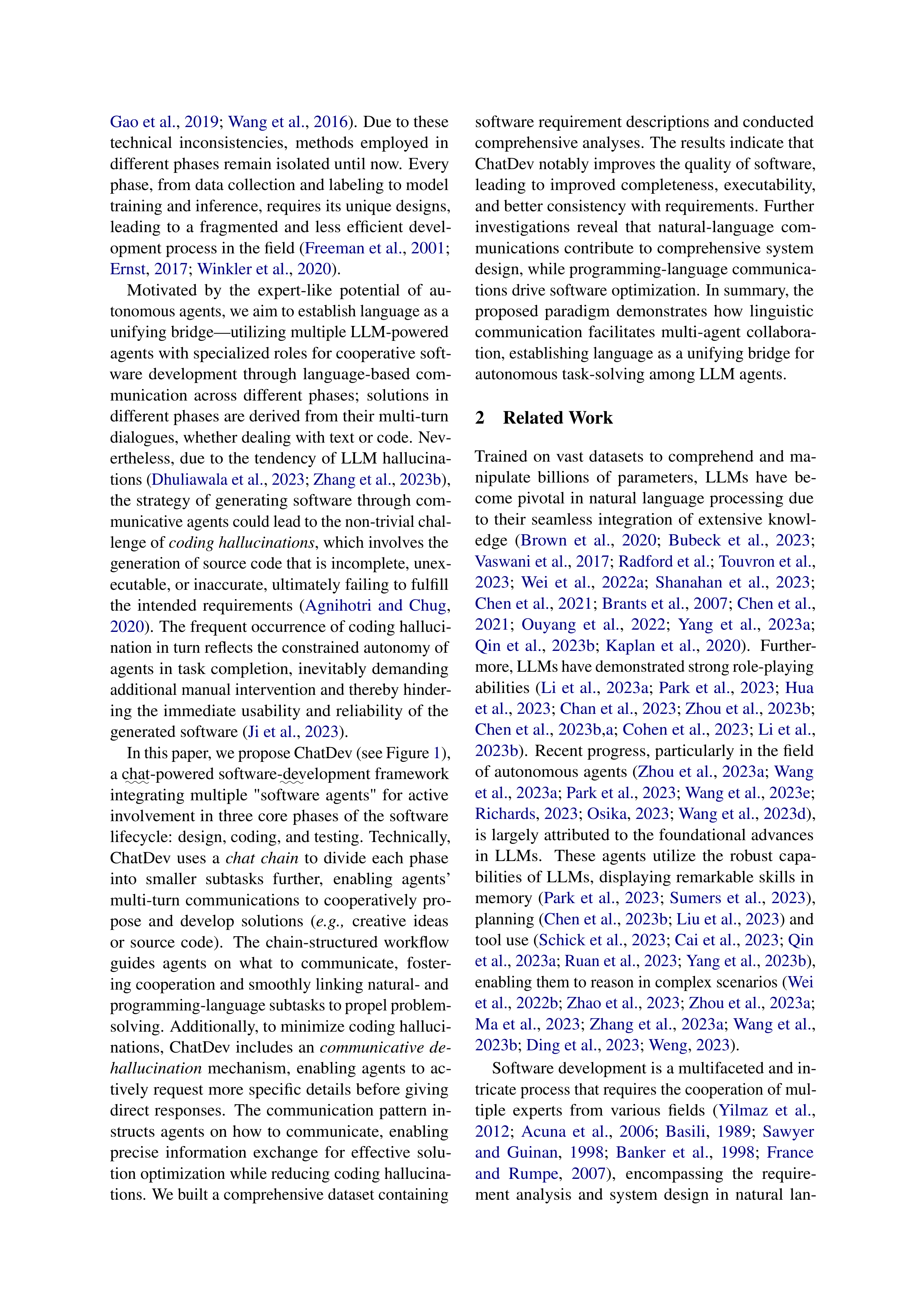
Figure
1:
ChatDev,
a
:::
chat
-powered
software
:::
dev
elopment framework, integrates LLM agents with
various social roles, working autonomously to develop
comprehensive solutions via multi-agent collaboration.
diverse
downstream
applications.
Furthermore,
autonomous
agents
(
Richards
,
2023
;
Zhou
et
al.
,
2023a
) have gained attention for enhancing the ca-
pabilities of LLMs with advanced features such as
context-aware memory (
Sumers et al.
,
2023
), multi-
step planning (
Liu et al.
,
2023
), and strategic tool
using (
Schick et al.
,
2023
).
Software development is a complex task that ne-
cessitates
cooperation
among
multiple
members
with diverse skills (
e.g.,
architects, programmers,
and
testers)
(
Basili
,
1989
;
Sawyer
and
Guinan
,
1998
).
This
entails
extensive
communication
among
different
roles
to
understand
and
analyze
requirements through natural language, while also
encompassing development and debugging using
programming languages (
Ernst
,
2017
;
Banker et al.
,
1998
).
Numerous studies use deep learning to im-
prove specific phases of the waterfall model in soft-
ware development, such as design, coding, and test-
ing (
Pudlitz et al.
,
2019
;
Martín and Abran
,
2015
;
arXiv:2307.07924v5 [cs.SE] 5 Jun 2024
Gao et al.
,
2019
;
Wang et al.
,
2016
).
Due to these
technical
inconsistencies,
methods
employed
in
different phases remain isolated until now.
Every
phase, from data collection and labeling to model
training and inference, requires its unique designs,
leading
to
a
fragmented
and
less
efficient
devel-
opment process in the field (
Freeman et al.
,
2001
;
Ernst
,
2017
;
Winkler et al.
,
2020
).
Motivated
by
the
expert-like
potential
of
au-
tonomous agents, we aim to establish language as a
unifying bridge—utilizing multiple LLM-powered
agents with specialized roles for cooperative soft-
ware
development
through
language-based
com-
munication
across
different
phases;
solutions
in
different phases are derived from their multi-turn
dialogues, whether dealing with text or code.
Nev-
ertheless,
due to the tendency of LLM hallucina-
tions (
Dhuliawala et al.
,
2023
;
Zhang et al.
,
2023b
),
the strategy of generating software through com-
municative agents could lead to the non-trivial chal-
lenge of
coding hallucinations
, which involves the
generation of source code that is incomplete, unex-
ecutable, or inaccurate, ultimately failing to fulfill
the
intended
requirements
(
Agnihotri
and
Chug
,
2020
).
The frequent occurrence of coding halluci-
nation in turn reflects the constrained autonomy of
agents
in
task completion,
inevitably
demanding
additional manual intervention and thereby hinder-
ing the immediate usability and reliability of the
generated software (
Ji et al.
,
2023
).
In this paper, we propose ChatDev (see Figure
1
),
a
:::
chat
-powered software-
:::
dev
elopment framework
integrating
multiple
"software
agents"
for
active
involvement in three core phases of the software
lifecycle:
design, coding, and testing.
Technically,
ChatDev
uses
a
chat
chain
to
divide
each
phase
into
smaller
subtasks
further,
enabling
agents’
multi-turn
communications
to
cooperatively
pro-
pose
and
develop
solutions
(
e.g.,
creative
ideas
or
source
code).
The
chain-structured
workflow
guides
agents
on
what
to
communicate,
foster-
ing cooperation and smoothly linking natural- and
programming-language subtasks to propel problem-
solving.
Additionally, to minimize coding halluci-
nations,
ChatDev
includes an
communicative
de-
hallucination
mechanism,
enabling
agents
to
ac-
tively request more specific details before giving
direct
responses.
The
communication
pattern
in-
structs
agents
on
how
to
communicate,
enabling
precise
information
exchange
for
effective
solu-
tion optimization while reducing coding hallucina-
tions.
We built a comprehensive dataset containing
software requirement descriptions and conducted
comprehensive analyses.
The results indicate that
ChatDev notably improves the quality of software,
leading
to
improved
completeness,
executability,
and better consistency with requirements.
Further
investigations
reveal
that
natural-language
com-
munications contribute to comprehensive system
design, while programming-language communica-
tions drive software optimization.
In summary, the
proposed
paradigm
demonstrates
how
linguistic
communication
facilitates
multi-agent
collabora-
tion, establishing language as a unifying bridge for
autonomous task-solving among LLM agents.
2
Related Work
Trained
on
vast
datasets
to
comprehend
and
ma-
nipulate
billions
of
parameters,
LLMs
have
be-
come
pivotal
in
natural
language
processing
due
to
their
seamless
integration
of
extensive
knowl-
edge
(
Brown
et
al.
,
2020
;
Bubeck
et
al.
,
2023
;
Vaswani et al.
,
2017
;
Radford et al.
;
Touvron et al.
,
2023
;
Wei
et
al.
,
2022a
;
Shanahan
et
al.
,
2023
;
Chen et al.
,
2021
;
Brants et al.
,
2007
;
Chen et al.
,
2021
;
Ouyang
et
al.
,
2022
;
Yang
et
al.
,
2023a
;
Qin
et
al.
,
2023b
;
Kaplan
et
al.
,
2020
).
Further-
more, LLMs have demonstrated strong role-playing
abilities
(
Li
et
al.
,
2023a
;
Park
et
al.
,
2023
;
Hua
et al.
,
2023
;
Chan et al.
,
2023
;
Zhou et al.
,
2023b
;
Chen et al.
,
2023b
,
a
;
Cohen et al.
,
2023
;
Li et al.
,
2023b
).
Recent progress, particularly in the field
of autonomous agents (
Zhou et al.
,
2023a
;
Wang
et al.
,
2023a
;
Park et al.
,
2023
;
Wang et al.
,
2023e
;
Richards
,
2023
;
Osika
,
2023
;
Wang et al.
,
2023d
),
is largely attributed to the foundational advances
in
LLMs.
These
agents
utilize
the
robust
capa-
bilities of LLMs,
displaying remarkable skills in
memory
(
Park
et
al.
,
2023
;
Sumers
et
al.
,
2023
),
planning (
Chen et al.
,
2023b
;
Liu et al.
,
2023
) and
tool use (
Schick et al.
,
2023
;
Cai et al.
,
2023
;
Qin
et al.
,
2023a
;
Ruan et al.
,
2023
;
Yang et al.
,
2023b
),
enabling them to reason in complex scenarios (
Wei
et al.
,
2022b
;
Zhao et al.
,
2023
;
Zhou et al.
,
2023a
;
Ma et al.
,
2023
;
Zhang et al.
,
2023a
;
Wang et al.
,
2023b
;
Ding et al.
,
2023
;
Weng
,
2023
).
Software development is a multifaceted and in-
tricate process that requires the cooperation of mul-
tiple
experts
from
various
fields
(
Yilmaz
et
al.
,
2012
;
Acuna
et
al.
,
2006
;
Basili
,
1989
;
Sawyer
and
Guinan
,
1998
;
Banker
et
al.
,
1998
;
France
and
Rumpe
,
2007
),
encompassing
the
require-
ment
analysis
and
system
design
in
natural
lan-














{ideas}
{code}
{code}
{code}
{task}
{code}
Instructor
Assistant
Phases
CEO
CTO
CTO
Programmer
CTO
Programmer
Reviewer
Programmer
Tester
Programmer
Subtasks
Design
Coding
Testing
Design
Chat Chain
Coding
Code
Complete
Code
Review
Testing
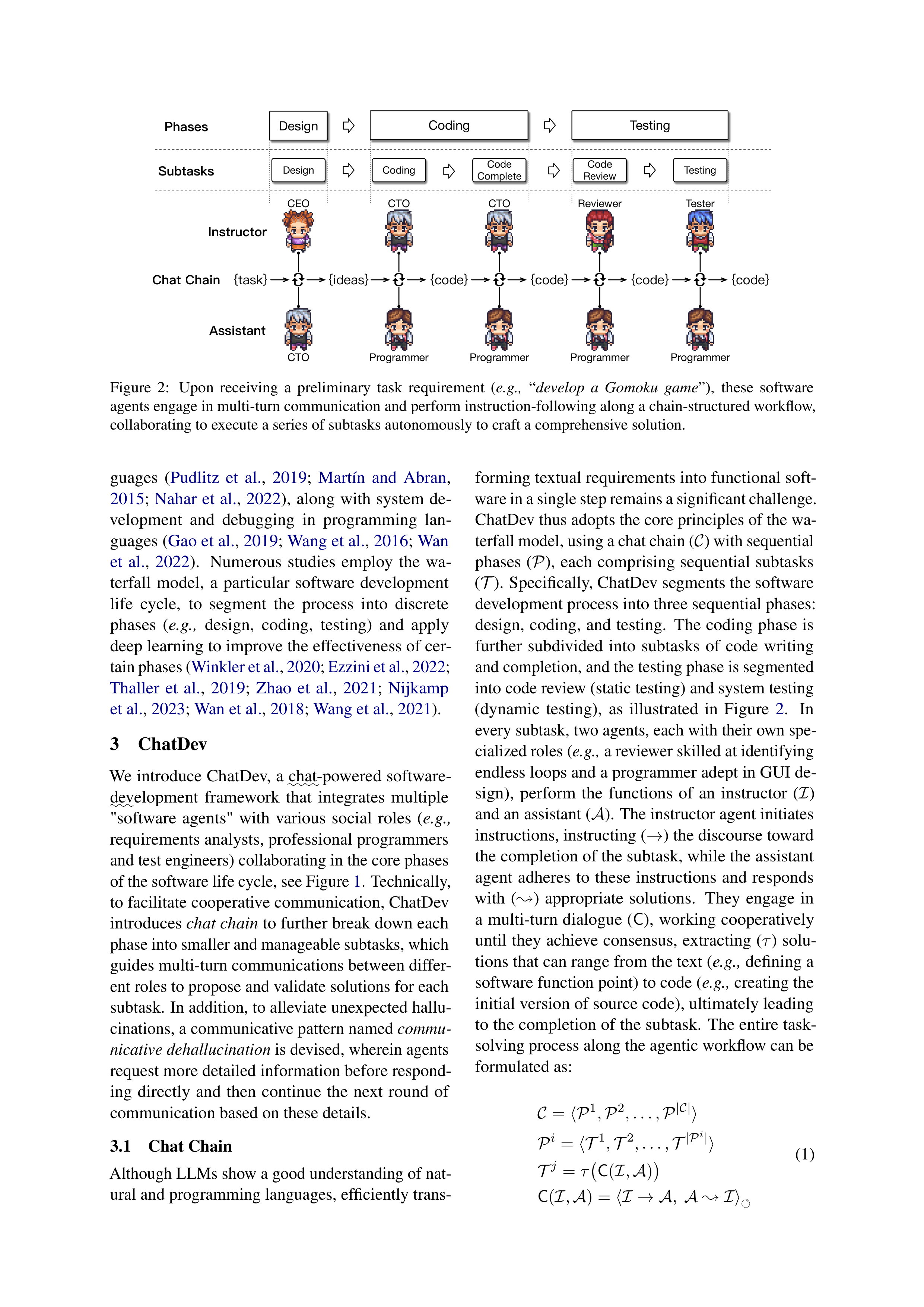
Figure
2:
Upon
receiving
a
preliminary
task
requirement
(
e.g.,
“
develop
a
Gomoku
game
”),
these
software
agents engage in multi-turn communication and perform instruction-following along a chain-structured workflow,
collaborating to execute a series of subtasks autonomously to craft a comprehensive solution.
guages
(
Pudlitz
et
al.
,
2019
;
Martín
and
Abran
,
2015
;
Nahar
et
al.
,
2022
),
along
with
system
de-
velopment
and
debugging
in
programming
lan-
guages (
Gao et al.
,
2019
;
Wang et al.
,
2016
;
Wan
et
al.
,
2022
).
Numerous
studies
employ
the
wa-
terfall
model,
a
particular
software
development
life
cycle,
to
segment
the
process
into
discrete
phases
(
e.g.,
design,
coding,
testing)
and
apply
deep learning to improve the effectiveness of cer-
tain phases (
Winkler et al.
,
2020
;
Ezzini et al.
,
2022
;
Thaller
et
al.
,
2019
;
Zhao
et
al.
,
2021
;
Nijkamp
et al.
,
2023
;
Wan et al.
,
2018
;
Wang et al.
,
2021
).
3
ChatDev
We introduce ChatDev, a
::::
chat
-powered software-
:::
dev
elopment
framework
that
integrates
multiple
"software
agents"
with
various
social
roles
(
e.g.,
requirements analysts, professional programmers
and test engineers) collaborating in the core phases
of the software life cycle, see Figure
1
.
Technically,
to facilitate cooperative communication, ChatDev
introduces
chat chain
to further break down each
phase into smaller and manageable subtasks, which
guides multi-turn communications between differ-
ent roles to propose and validate solutions for each
subtask.
In addition, to alleviate unexpected hallu-
cinations, a communicative pattern named
commu-
nicative dehallucination
is devised, wherein agents
request more detailed information before respond-
ing
directly
and
then
continue
the
next
round
of
communication based on these details.
3.1
Chat Chain
Although LLMs show a good understanding of nat-
ural and programming languages, efficiently trans-
forming textual requirements into functional soft-
ware in a single step remains a significant challenge.
ChatDev thus adopts the core principles of the wa-
terfall model, using a chat chain (
C
) with sequential
phases (
P
),
each comprising sequential subtasks
(
T
).
Specifically, ChatDev segments the software
development process into three sequential phases:
design,
coding,
and testing.
The coding phase is
further
subdivided
into
subtasks
of
code
writing
and completion, and the testing phase is segmented
into code review (static testing) and system testing
(dynamic
testing),
as
illustrated
in
Figure
2
.
In
every subtask, two agents, each with their own spe-
cialized roles (
e.g.,
a reviewer skilled at identifying
endless loops and a programmer adept in GUI de-
sign),
perform
the
functions
of
an
instructor
(
I
)
and an assistant (
A
).
The instructor agent initiates
instructions, instructing (
→
) the discourse toward
the completion of the subtask, while the assistant
agent
adheres
to
these
instructions
and
responds
with
(
;
)
appropriate
solutions.
They
engage
in
a multi-turn dialogue (
C
), working cooperatively
until they achieve consensus, extracting (
τ
) solu-
tions that can range from the text (
e.g.,
defining a
software function point) to code (
e.g.,
creating the
initial version of source code), ultimately leading
to the completion of the subtask.
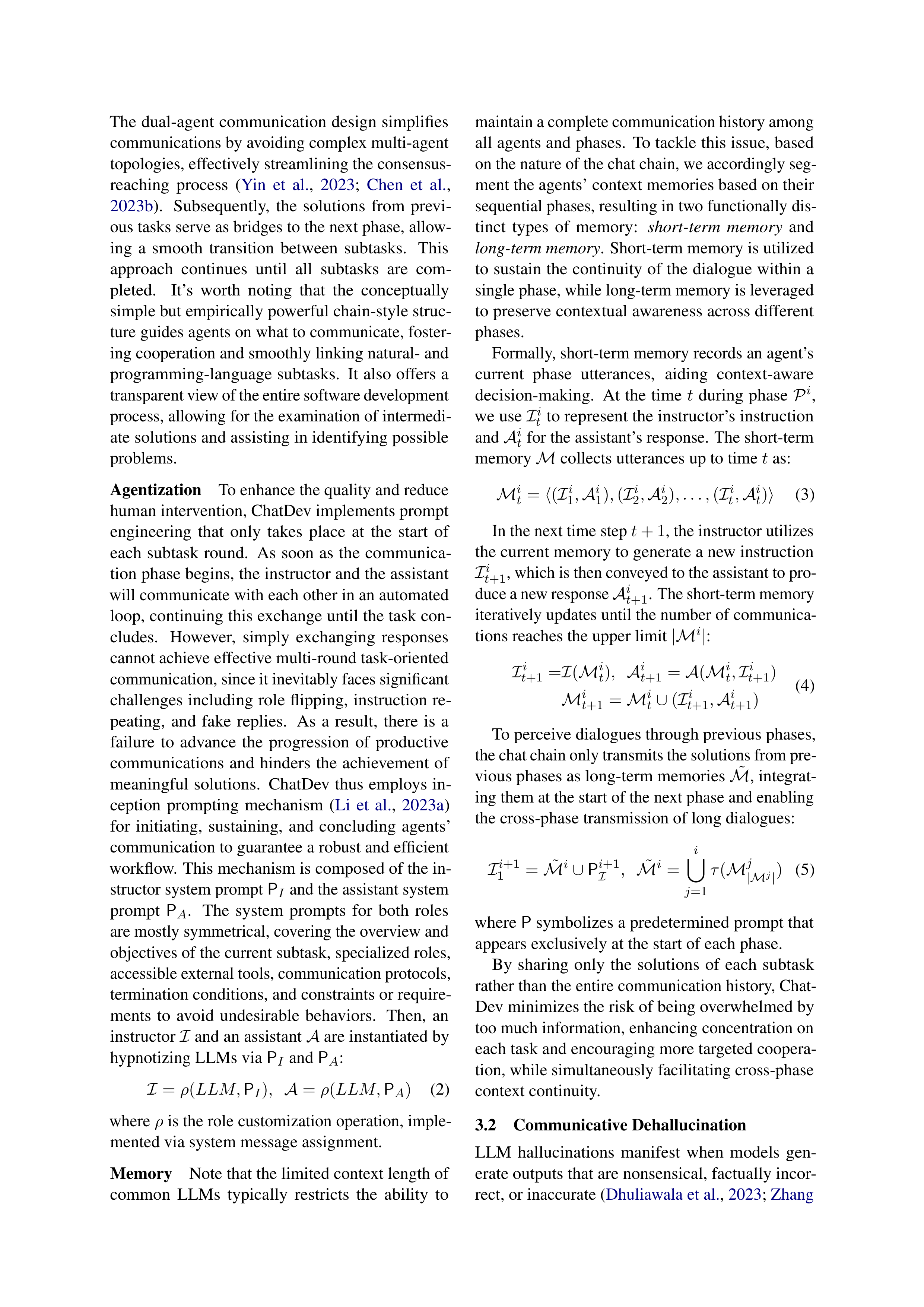
The entire task-
solving process along the agentic workflow can be
formulated as:
C
=
⟨P
1
,
P
2
, . . . ,
P
|C|
⟩
P
i
=
⟨T
1
,
T
2
, . . . ,
T
|P
i
|
⟩
T
j
=
τ
C
(
I
,
A
)
C
(
I
,
A
) =
⟨I
→A
,
A
;
I⟩
⟲
(1)
The dual-agent communication design simplifies
communications by avoiding complex multi-agent
topologies, effectively streamlining the consensus-
reaching
process
(
Yin
et
al.
,
2023
;
Chen
et
al.
,
2023b
).
Subsequently,
the
solutions
from
previ-
ous tasks serve as bridges to the next phase, allow-
ing
a
smooth
transition
between
subtasks.
This
approach
continues
until
all
subtasks
are
com-
pleted.
It’s
worth
noting
that
the
conceptually
simple but empirically powerful chain-style struc-
ture guides agents on what to communicate, foster-
ing cooperation and smoothly linking natural- and
programming-language subtasks.
It also offers a
transparent view of the entire software development
process, allowing for the examination of intermedi-
ate solutions and assisting in identifying possible
problems.
Agentization
To enhance the quality and reduce
human intervention, ChatDev implements prompt
engineering
that
only
takes
place
at
the
start
of
each
subtask
round.
As
soon
as
the
communica-
tion phase begins, the instructor and the assistant
will communicate with each other in an automated
loop, continuing this exchange until the task con-
cludes.
However,
simply
exchanging
responses
cannot achieve effective multi-round task-oriented
communication, since it inevitably faces significant
challenges including role flipping,
instruction re-
peating,
and
fake
replies.
As
a
result,
there
is
a
failure
to
advance
the
progression
of
productive
communications
and
hinders
the
achievement
of
meaningful
solutions.
ChatDev
thus
employs
in-
ception
prompting
mechanism
(
Li
et
al.
,
2023a
)
for
initiating,
sustaining,
and
concluding
agents’
communication to guarantee a robust and efficient
workflow.
This mechanism is composed of the in-
structor system prompt
P
I
and the assistant system
prompt
P
A
.
The
system
prompts
for
both
roles
are mostly symmetrical, covering the overview and
objectives of the current subtask, specialized roles,
accessible external tools, communication protocols,
termination conditions, and constraints or require-
ments
to
avoid
undesirable
behaviors.
Then,
an
instructor
I
and an assistant
A
are instantiated by
hypnotizing LLMs via
P
I
and
P
A
:
I
=
ρ
(
LLM,
P
I
)
,
A
=
ρ
(
LLM,
P
A
)
(2)
where
ρ
is the role customization operation, imple-
mented via system message assignment.
Memory
Note that the limited context length of
common
LLMs
typically
restricts
the
ability
to
maintain a complete communication history among
all agents and phases.
To tackle this issue, based
on the nature of the chat chain, we accordingly seg-
ment the agents’ context memories based on their
sequential phases, resulting in two functionally dis-
tinct
types
of
memory:
short-term
memory
and
long-term memory
.
Short-term memory is utilized
to sustain the continuity of the dialogue within a
single phase, while long-term memory is leveraged
to preserve contextual awareness across different
phases.
Formally, short-term memory records an agent’s
current
phase
utterances,
aiding
context-aware
decision-making.
At
the
time
t
during
phase
P
i
,
we use
I
i
t
to represent the instructor’s instruction
and
A
i
t
for the assistant’s response.
The short-term
memory
M
collects utterances up to time
t
as:
M
i
t
=
⟨
(
I
i
1
,
A
i
1
)
,
(
I
i
2
,
A
i
2
)
, . . . ,
(
I
i
t
,
A
i
t
)
⟩
(3)
In the next time step
t
+ 1
, the instructor utilizes
the current memory to generate a new instruction
I
i
t
+1
, which is then conveyed to the assistant to pro-
duce a new response
A
i
t
+1
. The short-term memory
iteratively updates until the number of communica-
tions reaches the upper limit
|M
i
|
:
I
i
t
+1
=
I
(
M
i
t
)
,
A
i
t
+1
=
A
(
M
i
t
,
I
i
t
+1
)
M
i
t
+1
=
M
i
t
∪
(
I
i
t
+1
,
A
i
t
+1
)
(4)
To perceive dialogues through previous phases,
the chat chain only transmits the solutions from pre-
vious phases as long-term memories
˜
M
, integrat-
ing them at the start of the next phase and enabling
the cross-phase transmission of long dialogues:
I
i
+1
1
=
˜
M
i
∪
P
i
+1
I
,
˜
M
i
=
i
[
j
=1
τ
(
M
j
|M
j
|
)
(5)
where
P
symbolizes a predetermined prompt that
appears exclusively at the start of each phase.
By
sharing
only
the
solutions
of
each
subtask
rather than the entire communication history, Chat-
Dev minimizes the risk of being overwhelmed by
too much information, enhancing concentration on
each task and encouraging more targeted coopera-
tion, while simultaneously facilitating cross-phase
context continuity.
3.2
Communicative Dehallucination
LLM
hallucinations
manifest
when
models
gen-
erate outputs that are nonsensical, factually incor-
rect, or inaccurate (
Dhuliawala et al.
,
2023
;
Zhang
et al.
,
2023b
).
This issue is particularly concern-
ing in software development, where programming
languages demand precise syntax—the absence of
even a single line can lead to system failure.
We
have observed that LLMs often produce
coding hal-
lucinations
, which encompass potential issues like
incomplete
implementations,
unexecutable
code,
and inconsistencies that don’t meet requirements.
Coding hallucinations frequently appear when the
assistant struggles to precisely follow instructions,
often
due
to
the
vagueness
and
generality
of
cer-
tain instructions that require multiple adjustments,
making
it
challenging
for
agents
to
achieve
full
compliance.
Inspired
by
this,
we
introduce
com-
municative dehallucination
, which encourages the
assistant to actively seek more detailed suggestions
from the instructor before delivering a formal re-
sponse.
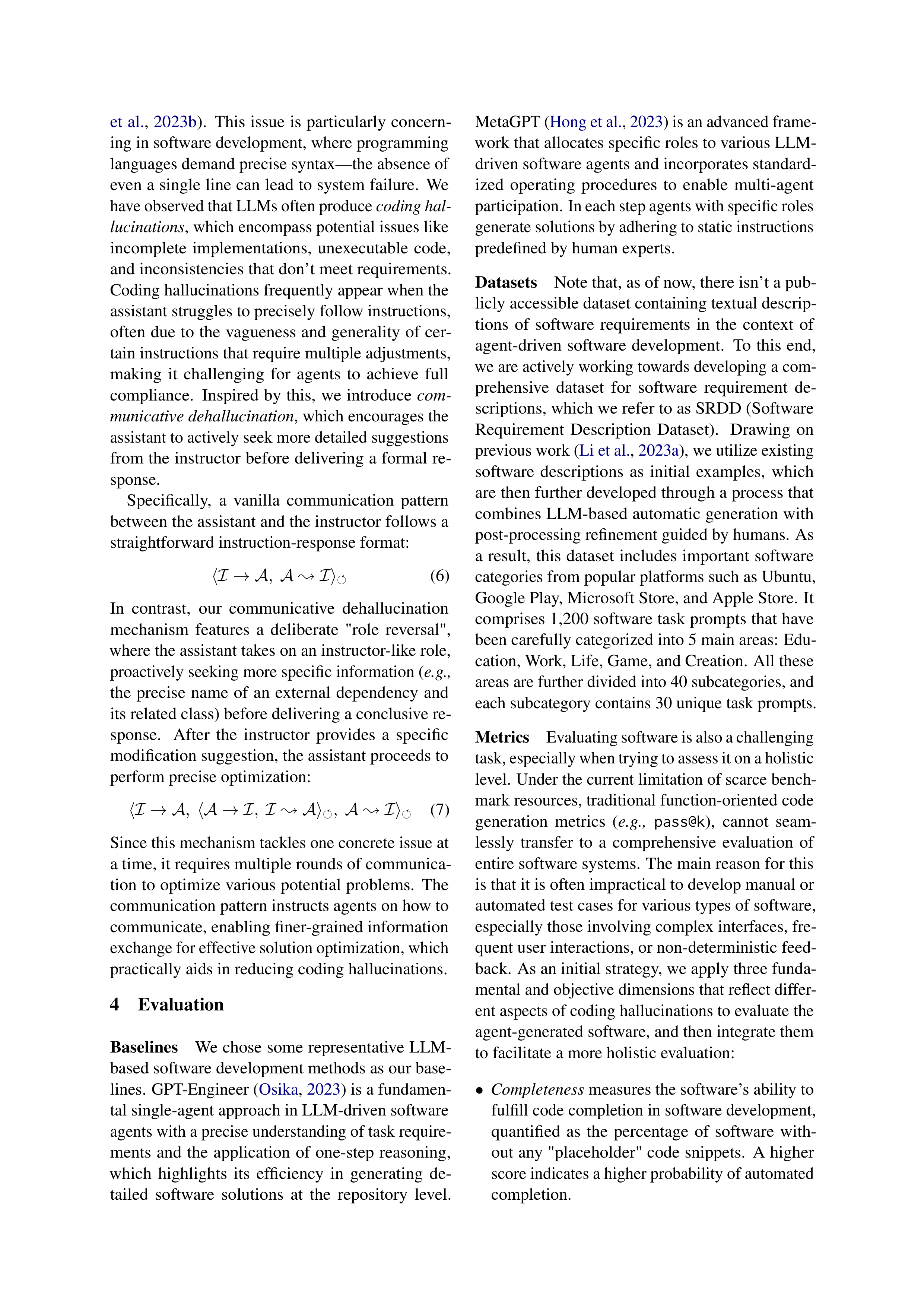
Specifically,
a
vanilla
communication
pattern
between the assistant and the instructor follows a
straightforward instruction-response format:
⟨I
→A
,
A
;
I⟩
⟲
(6)
In
contrast,
our
communicative
dehallucination
mechanism
features
a
deliberate
"role
reversal",
where the assistant takes on an instructor-like role,
proactively seeking more specific information (
e.g.,
the
precise
name
of
an
external
dependency
and
its related class) before delivering a conclusive re-
sponse.
After
the
instructor
provides
a
specific
modification suggestion, the assistant proceeds to
perform precise optimization:
⟨I
→A
,
⟨A →I
,
I
;
A⟩
⟲
,
A
;
I⟩
⟲
(7)
Since this mechanism tackles one concrete issue at
a time, it requires multiple rounds of communica-
tion to optimize various potential problems.
The
communication pattern instructs agents on how to
communicate, enabling finer-grained information
exchange for effective solution optimization, which
practically aids in reducing coding hallucinations.
4
Evaluation
Baselines
We chose some representative LLM-
based software development methods as our base-
lines.
GPT-Engineer (
Osika
,
2023
) is a fundamen-
tal single-agent approach in LLM-driven software
agents with a precise understanding of task require-
ments
and
the
application
of
one-step
reasoning,
which
highlights
its
efficiency
in
generating
de-
tailed
software
solutions
at
the
repository
level.
MetaGPT (
Hong et al.
,
2023
) is an advanced frame-
work that allocates specific roles to various LLM-
driven software agents and incorporates standard-
ized
operating
procedures
to
enable
multi-agent
participation. In each step agents with specific roles
generate solutions by adhering to static instructions
predefined by human experts.
Datasets
Note that, as of now, there isn’t a pub-
licly accessible dataset containing textual descrip-
tions
of
software
requirements
in
the
context
of
agent-driven
software
development.
To
this
end,
we are actively working towards developing a com-
prehensive
dataset
for
software
requirement
de-
scriptions, which we refer to as SRDD (Software
Requirement
Description
Dataset).
Drawing
on
previous work (
Li et al.
,
2023a
), we utilize existing
software
descriptions
as
initial
examples,
which
are then further developed through a process that
combines LLM-based automatic generation with
post-processing refinement guided by humans.
As
a
result,
this
dataset
includes
important
software
categories from popular platforms such as Ubuntu,
Google Play, Microsoft Store, and Apple Store.
It
comprises 1,200 software task prompts that have
been carefully categorized into 5 main areas:
Edu-
cation, Work, Life, Game, and Creation.
All these
areas are further divided into 40 subcategories, and
each subcategory contains 30 unique task prompts.
Metrics
Evaluating software is also a challenging
task, especially when trying to assess it on a holistic
level.
Under the current limitation of scarce bench-
mark resources, traditional function-oriented code
generation
metrics
(
e.g.,
pass@k
),
cannot
seam-
lessly
transfer
to
a
comprehensive
evaluation
of
entire software systems.
The main reason for this
is that it is often impractical to develop manual or
automated test cases for various types of software,
especially those involving complex interfaces, fre-
quent user interactions, or non-deterministic feed-
back.
As an initial strategy, we apply three funda-
mental and objective dimensions that reflect differ-
ent aspects of coding hallucinations to evaluate the
agent-generated software, and then integrate them
to facilitate a more holistic evaluation:
•
Completeness
measures the software’s ability to
fulfill code completion in software development,
quantified
as
the
percentage
of
software
with-
out any "placeholder" code snippets.
A higher
score indicates a higher probability of automated
completion.


Method
Paradigm
Completeness
Executability
Consistency
Quality
GPT-Engineer
0.5022
†
0.3583
†
0.7887
†
0.1419
†
MetaGPT
0.4834
†
0.4145
†
0.7601
†
0.1523
†
ChatDev
0.5600
0.8800
0.8021
0.3953
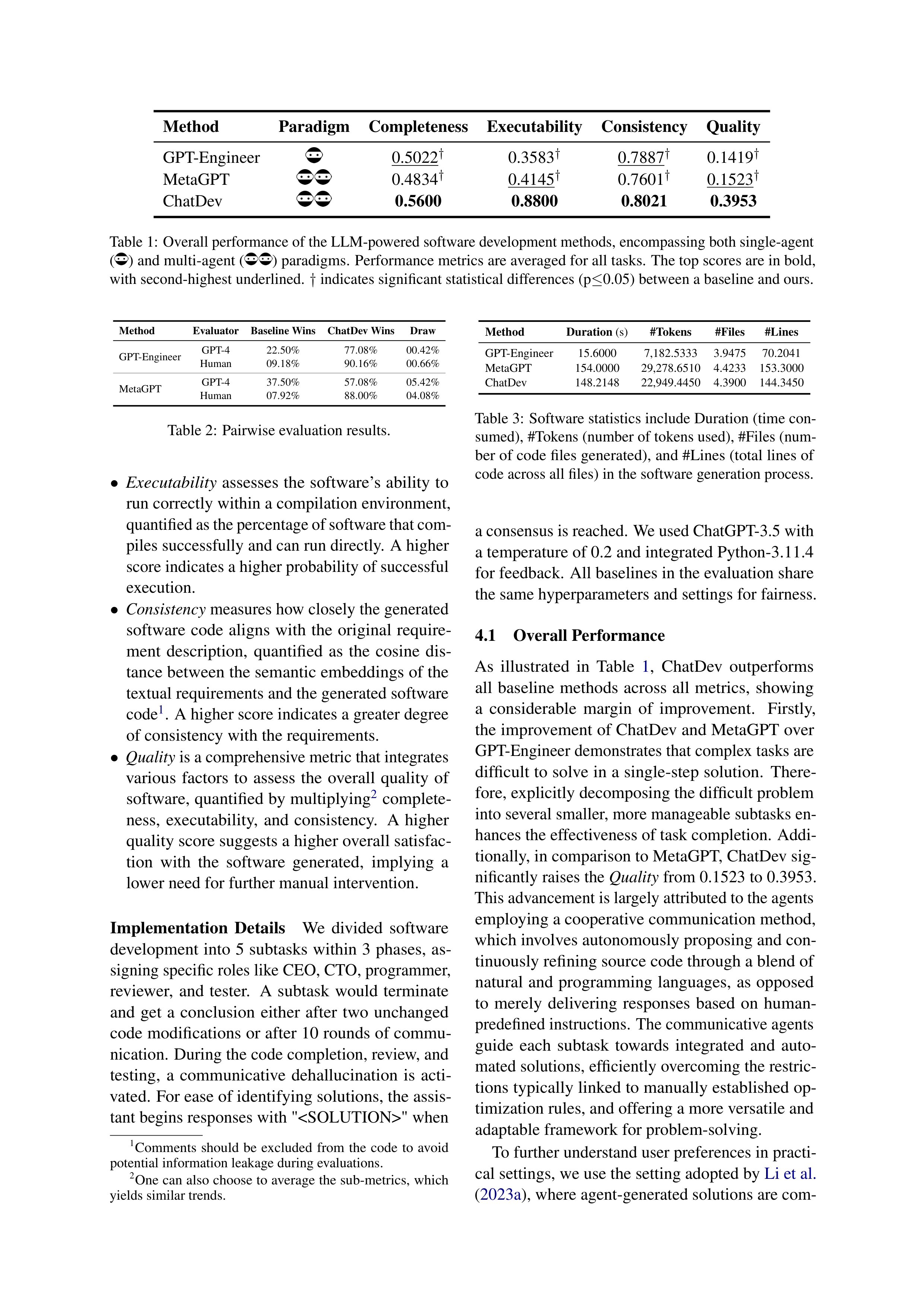
Table 1:
Overall performance of the LLM-powered software development methods, encompassing both single-agent
(
) and multi-agent (
) paradigms.
Performance metrics are averaged for all tasks.
The top scores are in bold,
with second-highest underlined.
†
indicates significant statistical differences (p
≤
0.05) between a baseline and ours.
Method
Evaluator
Baseline Wins
ChatDev Wins
Draw
GPT-Engineer
GPT-4
22.50%
77.08%
00.42%
Human
09.18%
90.16%
00.66%
MetaGPT
GPT-4
37.50%
57.08%
05.42%
Human
07.92%
88.00%
04.08%
Table 2:
Pairwise evaluation results.
•
Executability
assesses
the
software’s
ability
to
run correctly within a compilation environment,
quantified as the percentage of software that com-
piles successfully and can run directly.
A higher
score indicates a higher probability of successful
execution.
•
Consistency
measures how closely the generated
software
code
aligns
with
the
original
require-
ment
description,
quantified
as
the
cosine
dis-
tance between the semantic embeddings of the
textual requirements and the generated software
code
1
.
A higher score indicates a greater degree
of consistency with the requirements.
•
Quality
is a comprehensive metric that integrates
various
factors
to
assess
the
overall
quality
of
software, quantified by multiplying
2
complete-
ness,
executability,
and
consistency.
A
higher
quality score suggests a higher overall satisfac-
tion
with
the
software
generated,
implying
a
lower need for further manual intervention.
Implementation
Details
We
divided
software
development into 5 subtasks within 3 phases,
as-
signing specific roles like CEO, CTO, programmer,
reviewer,
and
tester.
A
subtask
would
terminate
and
get
a
conclusion
either
after
two
unchanged
code modifications or after 10 rounds of commu-
nication.
During the code completion, review, and
testing,
a
communicative
dehallucination
is
acti-
vated.
For ease of identifying solutions, the assis-
tant begins responses with "" when
1
Comments
should
be
excluded
from
the
code
to
avoid
potential information leakage during evaluations.
2
One can also choose to average the sub-metrics, which
yields similar trends.
Method
Duration
(s)
#Tokens
#Files
#Lines
GPT-Engineer
15.6000
7,182.5333
3.9475
70.2041
MetaGPT
154.0000
29,278.6510
4.4233
153.3000
ChatDev
148.2148
22,949.4450
4.3900
144.3450
Table 3:
Software statistics include Duration (time con-
sumed), #Tokens (number of tokens used), #Files (num-
ber of code files generated), and #Lines (total lines of
code across all files) in the software generation process.
a consensus is reached.
We used ChatGPT-3.5 with
a temperature of 0.2 and integrated Python-3.11.4
for feedback.
All baselines in the evaluation share
the same hyperparameters and settings for fairness.
4.1
Overall Performance
As
illustrated
in
Table
1
,
ChatDev
outperforms
all
baseline
methods
across
all
metrics,
showing
a
considerable
margin
of
improvement.
Firstly,
the improvement of ChatDev and MetaGPT over
GPT-Engineer demonstrates that complex tasks are
difficult to solve in a single-step solution.
There-
fore, explicitly decomposing the difficult problem
into several smaller, more manageable subtasks en-
hances the effectiveness of task completion.
Addi-
tionally, in comparison to MetaGPT, ChatDev sig-
nificantly raises the
Quality
from 0.1523 to 0.3953.
This advancement is largely attributed to the agents
employing a cooperative communication method,
which involves autonomously proposing and con-
tinuously refining source code through a blend of
natural
and
programming
languages,
as
opposed
to
merely
delivering
responses
based
on
human-
predefined instructions.
The communicative agents
guide
each
subtask
towards
integrated
and
auto-
mated solutions, efficiently overcoming the restric-
tions typically linked to manually established op-
timization rules, and offering a more versatile and
adaptable framework for problem-solving.
To further understand user preferences in practi-
cal settings, we use the setting adopted by
Li et al.
(
2023a
), where agent-generated solutions are com-



















Variant
Completeness
Executability
Consistency
Quality
ChatDev
0.5600
0.8800
0.8021
0.3953
≤
Coding
0.4100
0.7700
0.7958
0.2512
≤
Complete
0.6250
0.7400
0.7978
0.3690
≤
Review
0.5750
0.8100
0.7980
0.3717
≤
Testing
0.5600
0.8800
0.8021
0.3953
⧹
CDH
0.4700
0.8400
0.7983
0.3094
⧹
Roles
0.5400
0.5800
0.7385
0.2212
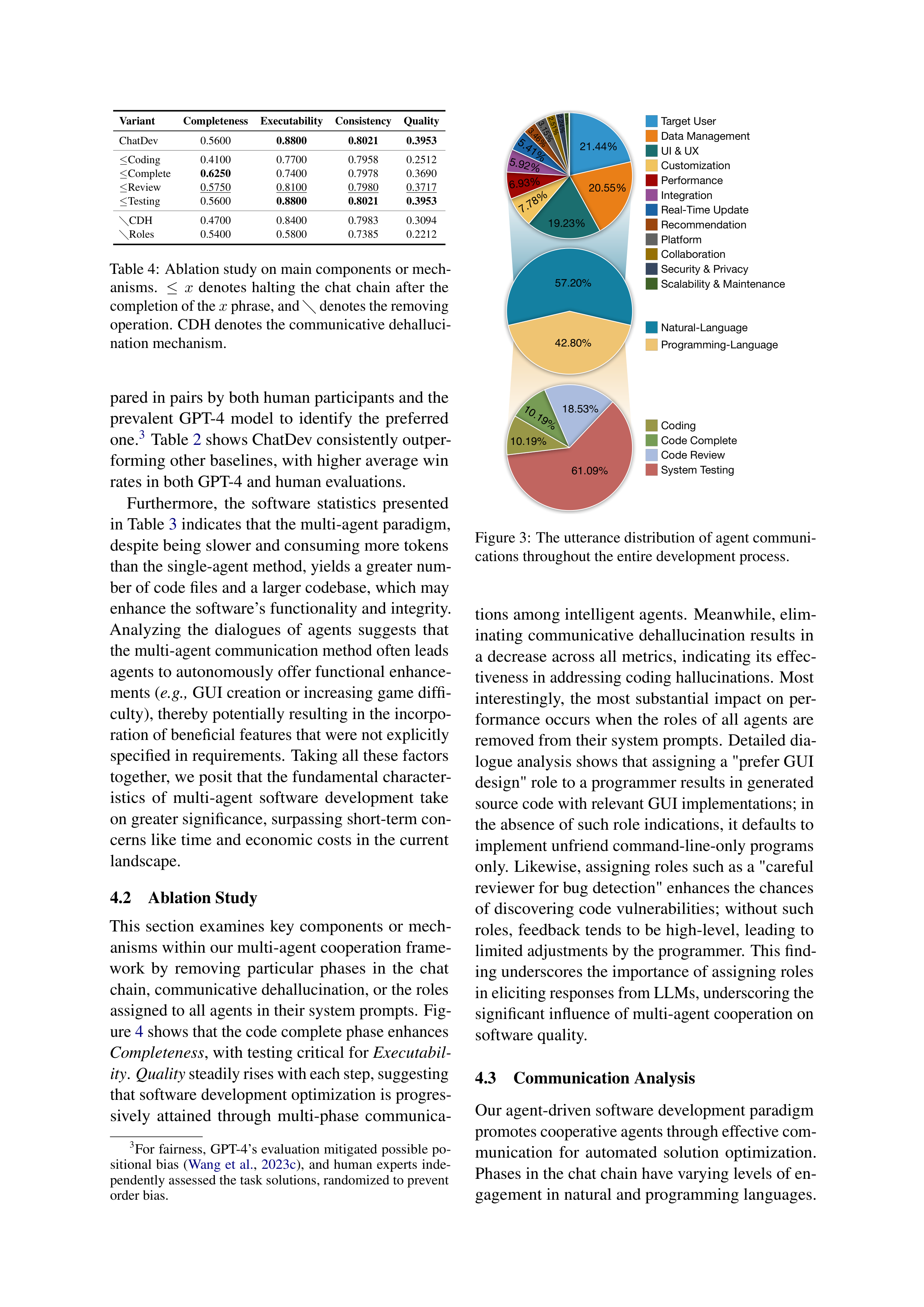
Table 4:
Ablation study on main components or mech-
anisms.
≤
x
denotes
halting
the
chat
chain
after
the
completion of the
x
phrase, and
⧹
denotes the removing
operation.
CDH denotes the communicative dehalluci-
nation mechanism.
pared in pairs by both human participants and the
prevalent
GPT-4
model
to
identify
the
preferred
one.
3
Table
2
shows ChatDev consistently outper-
forming other baselines, with higher average win
rates in both GPT-4 and human evaluations.
Furthermore,
the
software
statistics
presented
in Table
3
indicates that the multi-agent paradigm,
despite being slower and consuming more tokens
than the single-agent method, yields a greater num-
ber of code files and a larger codebase, which may
enhance the software’s functionality and integrity.
Analyzing
the
dialogues
of
agents
suggests
that
the multi-agent communication method often leads
agents to autonomously offer functional enhance-
ments (
e.g.,
GUI creation or increasing game diffi-
culty), thereby potentially resulting in the incorpo-
ration of beneficial features that were not explicitly
specified in requirements.
Taking all these factors
together, we posit that the fundamental character-
istics
of
multi-agent
software
development
take
on greater significance, surpassing short-term con-
cerns like time and economic costs in the current
landscape.
4.2
Ablation Study
This
section
examines
key
components
or
mech-
anisms within our multi-agent cooperation frame-
work
by
removing
particular
phases
in
the
chat
chain, communicative dehallucination, or the roles
assigned to all agents in their system prompts.
Fig-
ure
4
shows that the code complete phase enhances
Completeness
, with testing critical for
Executabil-
ity
.
Quality
steadily rises with each step, suggesting
that software development optimization is progres-
sively
attained
through
multi-phase
communica-
3
For fairness,
GPT-4’s evaluation mitigated possible po-
sitional
bias
(
Wang
et
al.
,
2023c
),
and
human
experts
inde-
pendently assessed the task solutions, randomized to prevent
order bias.
Natural-Language
Programming-Language
Target User
UI & UX
Data Management
Customization
Performance
Integration
Real-Time Update
Recommendation
Platform
Collaboration
Security & Privacy
Scalability & Maintenance
Coding
Code Complete
Code Review
System Testing
57.20%
42.80%
10.19%
61.09%
10.19%
18.53%
21.44%
20.55%
19.23%
7.78%
6.93%
5.92%
5.41%
3.46%
3.15%
2.51%
2.24%
1.39%
Figure 3:
The utterance distribution of agent communi-
cations throughout the entire development process.
tions among intelligent agents.
Meanwhile, elim-
inating communicative dehallucination results in
a decrease across all metrics, indicating its effec-
tiveness in addressing coding hallucinations.
Most
interestingly,
the
most
substantial
impact
on
per-
formance occurs when the roles of all agents are
removed from their system prompts.
Detailed dia-
logue analysis shows that assigning a "prefer GUI
design" role to a programmer results in generated
source code with relevant GUI implementations; in
the absence of such role indications, it defaults to
implement unfriend command-line-only programs
only.
Likewise, assigning roles such as a "careful
reviewer for bug detection" enhances the chances
of discovering code vulnerabilities; without such
roles, feedback tends to be high-level, leading to
limited adjustments by the programmer.
This find-
ing underscores the importance of assigning roles
in eliciting responses from LLMs, underscoring the
significant influence of multi-agent cooperation on
software quality.
4.3
Communication Analysis
Our agent-driven software development paradigm
promotes cooperative agents through effective com-
munication
for
automated
solution
optimization.
Phases in the chat chain have varying levels of en-
gagement in natural and programming languages.
Input
Output
Method Not Implemented
Modules Not Imported
Missing Code Segments
Not Configure Layout
Missing Comments
Class Defined Twice
Methods Not Called
Missing Exception Handling
Missing Initialization
Missing Files
Not Correctly Processing Data
Class Not Used
Calling without Correct Arguments
Not Handle Cases
Missing Imports
No Further Suggestions
Method Not Implemented
Modules Not Imported
Missing Code Segments
Not Configure Layout
Not Correctly Processing Data
Missing Comments
Missing Exception Handling
Missing Files
Missing Initialization
Missing Imports
Methods Not Called
No Further Suggestions
Calling without Correct Arguments
Class Not Used
Class Defined Twice
Not Handle Cases
Method Not Implemented
Modules Not Imported
Missing Code Segments
Missing Comments
Not Configure Layout
No Further Suggestions
Missing Files
Methods Not Called
Not Correctly Processing Data
Missing Exception Handling
Missing Initialization
Class Not Used
Missing Imports
Calling without Correct Arguments
Not Handle Cases
Class Defined Twice
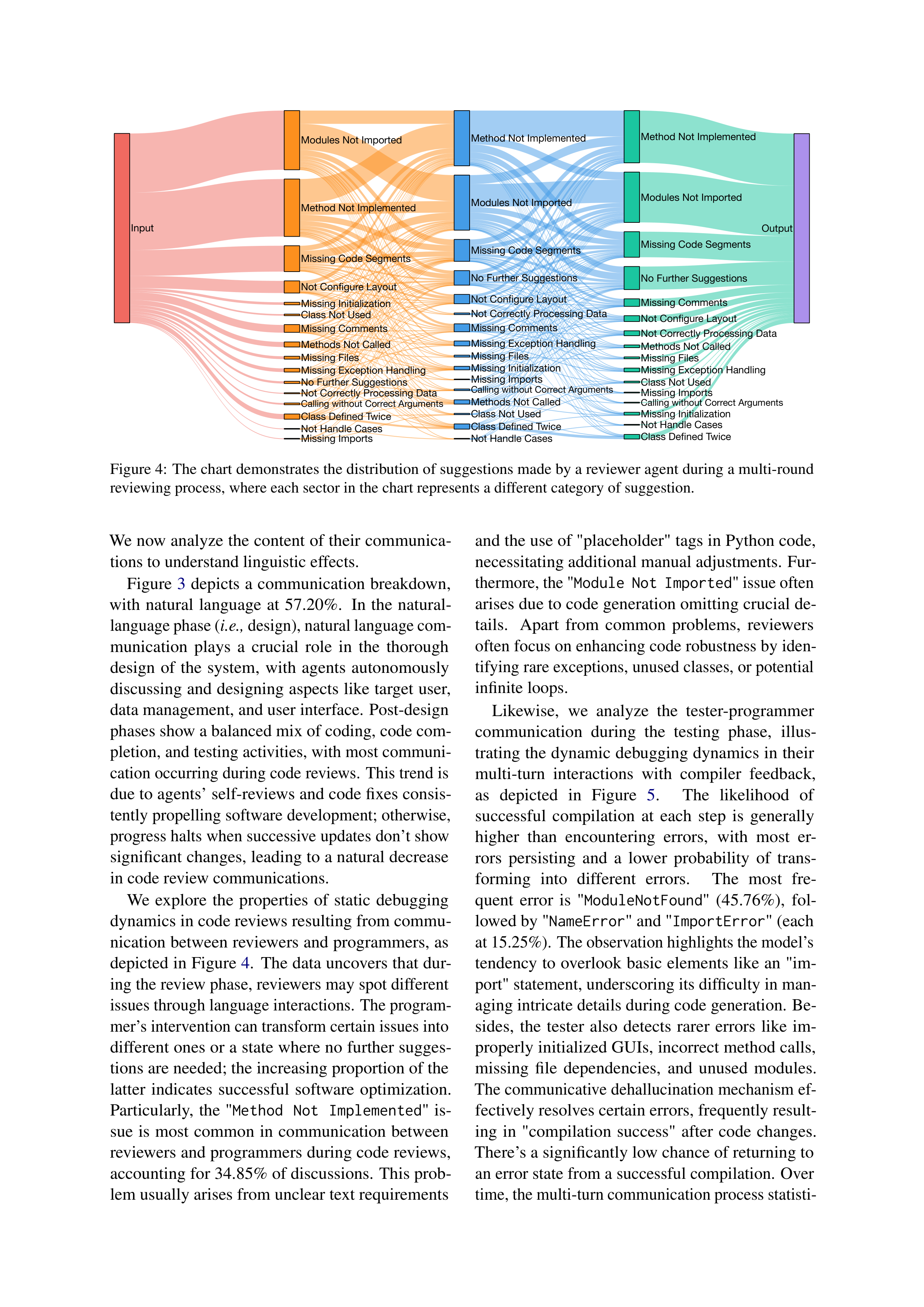
Figure 4:
The chart demonstrates the distribution of suggestions made by a reviewer agent during a multi-round
reviewing process, where each sector in the chart represents a different category of suggestion.
We now analyze the content of their communica-
tions to understand linguistic effects.
Figure
3
depicts a communication breakdown,
with
natural
language
at
57.20%.
In
the
natural-
language phase (
i.e.,
design), natural language com-
munication
plays
a
crucial
role
in
the
thorough
design
of
the
system,
with
agents
autonomously
discussing and designing aspects like target user,
data management, and user interface.
Post-design
phases show a balanced mix of coding, code com-
pletion, and testing activities, with most communi-
cation occurring during code reviews.
This trend is
due to agents’ self-reviews and code fixes consis-
tently propelling software development; otherwise,
progress halts when successive updates don’t show
significant changes, leading to a natural decrease
in code review communications.
We
explore
the
properties
of
static
debugging
dynamics in code reviews resulting from commu-
nication between reviewers and programmers, as
depicted in Figure
4
.
The data uncovers that dur-
ing the review phase, reviewers may spot different
issues through language interactions.
The program-
mer’s intervention can transform certain issues into
different ones or a state where no further sugges-
tions are needed; the increasing proportion of the
latter
indicates
successful
software
optimization.
Particularly,
the
"
Method
Not
Implemented
"
is-
sue
is
most
common
in
communication
between
reviewers and programmers during code reviews,
accounting for 34.85% of discussions.
This prob-
lem usually arises from unclear text requirements
and the use of "placeholder" tags in Python code,
necessitating additional manual adjustments.
Fur-
thermore, the "
Module
Not
Imported
" issue often
arises due to code generation omitting crucial de-
tails.
Apart
from
common
problems,
reviewers
often focus on enhancing code robustness by iden-
tifying rare exceptions, unused classes, or potential
infinite loops.
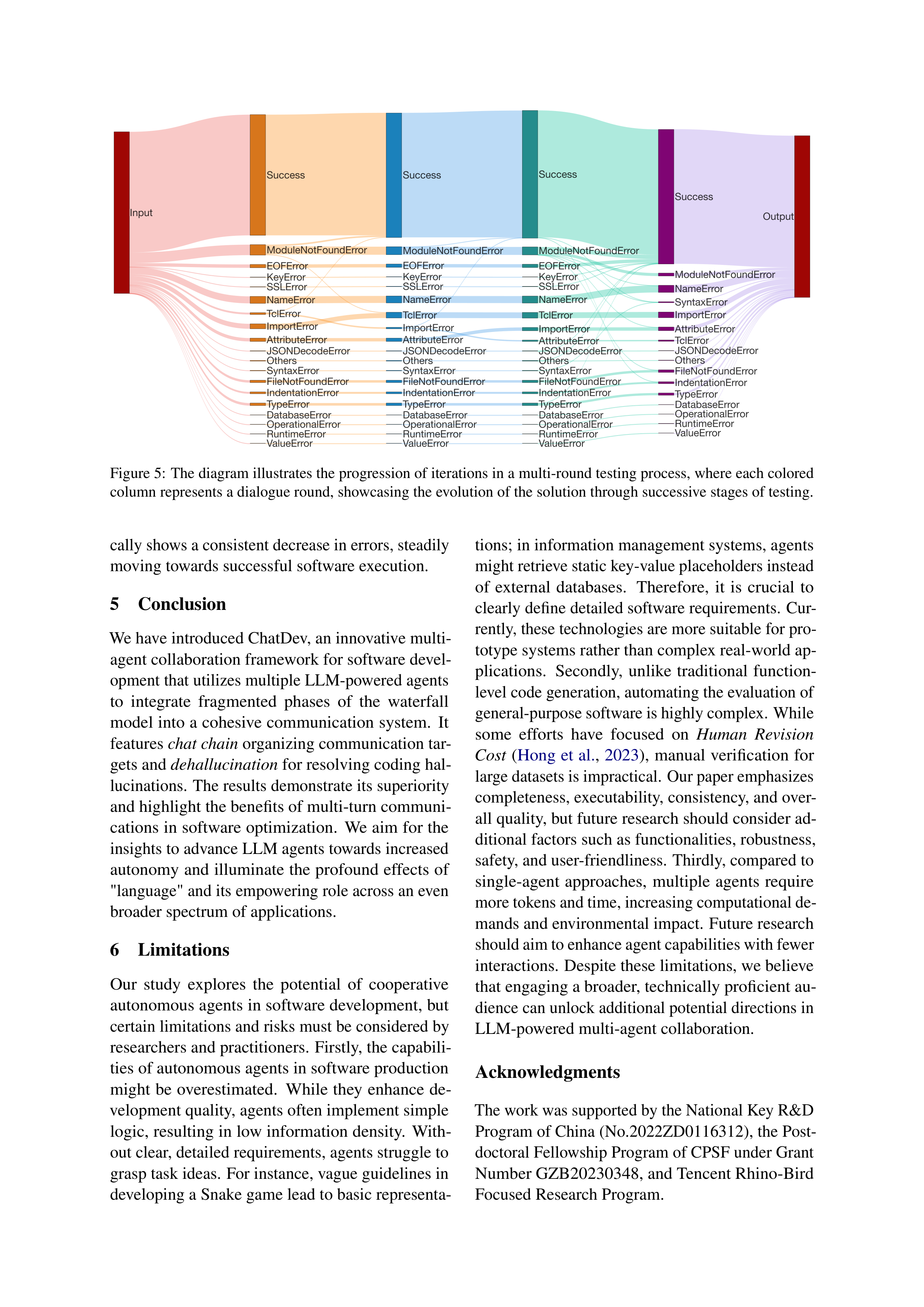
Likewise,
we
analyze
the
tester-programmer
communication
during
the
testing
phase,
illus-
trating the dynamic debugging dynamics in their
multi-turn
interactions
with
compiler
feedback,
as
depicted
in
Figure
5
.
The
likelihood
of
successful
compilation
at
each
step
is
generally
higher
than
encountering
errors,
with
most
er-
rors
persisting
and
a
lower
probability
of
trans-
forming
into
different
errors.
The
most
fre-
quent
error
is
"
ModuleNotFound
"
(45.76%),
fol-
lowed by "
NameError
" and "
ImportError
" (each
at 15.25%).
The observation highlights the model’s
tendency to overlook basic elements like an "im-
port" statement, underscoring its difficulty in man-
aging intricate details during code generation.
Be-
sides,
the
tester
also
detects
rarer
errors
like
im-
properly initialized GUIs, incorrect method calls,
missing
file
dependencies,
and
unused
modules.
The communicative dehallucination mechanism ef-
fectively resolves certain errors, frequently result-
ing
in
"compilation
success"
after
code
changes.
There’s a significantly low chance of returning to
an error state from a successful compilation.
Over
time, the multi-turn communication process statisti-
Success
AttributeError
DatabaseError
EOFError
FileNotFoundError
ImportError
IndentationError
JSONDecodeError
KeyError
ModuleNotFoundError
NameError
OperationalError
RuntimeError
SSLError
SyntaxError
TclError
TypeError
ValueError
Others
Success
Success
Input
Output
Success
AttributeError
DatabaseError
EOFError
FileNotFoundError
ImportError
IndentationError
JSONDecodeError
KeyError
ModuleNotFoundError
NameError
OperationalError
RuntimeError
SSLError
SyntaxError
TclError
TypeError
ValueError
Others
AttributeError
DatabaseError
EOFError
FileNotFoundError
ImportError
IndentationError
JSONDecodeError
KeyError
ModuleNotFoundError
NameError
OperationalError
RuntimeError
SSLError
SyntaxError
TclError
TypeError
ValueError
Others
AttributeError
DatabaseError
FileNotFoundError
ImportError
IndentationError
JSONDecodeError
ModuleNotFoundError
NameError
OperationalError
RuntimeError
SyntaxError
TclError
TypeError
ValueError
Others
Figure 5:
The diagram illustrates the progression of iterations in a multi-round testing process, where each colored
column represents a dialogue round, showcasing the evolution of the solution through successive stages of testing.
cally shows a consistent decrease in errors, steadily
moving towards successful software execution.
5
Conclusion
We have introduced ChatDev, an innovative multi-
agent collaboration framework for software devel-
opment that utilizes multiple LLM-powered agents
to
integrate
fragmented
phases
of
the
waterfall
model into a cohesive communication system.
It
features
chat chain
organizing communication tar-
gets and
dehallucination
for resolving coding hal-
lucinations.
The results demonstrate its superiority
and highlight the benefits of multi-turn communi-
cations in software optimization.
We aim for the
insights to advance LLM agents towards increased
autonomy and illuminate the profound effects of
"language" and its empowering role across an even
broader spectrum of applications.
6
Limitations
Our
study
explores
the
potential
of
cooperative
autonomous agents in software development, but
certain limitations and risks must be considered by
researchers and practitioners.
Firstly, the capabili-
ties of autonomous agents in software production
might
be
overestimated.
While
they
enhance
de-
velopment quality, agents often implement simple
logic, resulting in low information density.
With-
out clear, detailed requirements, agents struggle to
grasp task ideas.
For instance, vague guidelines in
developing a Snake game lead to basic representa-
tions; in information management systems, agents
might retrieve static key-value placeholders instead
of
external
databases.
Therefore,
it
is
crucial
to
clearly define detailed software requirements.
Cur-
rently, these technologies are more suitable for pro-
totype systems rather than complex real-world ap-
plications.
Secondly,
unlike
traditional
function-
level code generation, automating the evaluation of
general-purpose software is highly complex.
While
some
efforts
have
focused
on
Human
Revision
Cost
(
Hong et al.
,
2023
),
manual verification for
large datasets is impractical.
Our paper emphasizes
completeness, executability, consistency, and over-
all quality, but future research should consider ad-
ditional factors such as functionalities, robustness,
safety, and user-friendliness.
Thirdly, compared to
single-agent
approaches,
multiple
agents
require
more tokens and time, increasing computational de-
mands and environmental impact.
Future research
should aim to enhance agent capabilities with fewer
interactions.
Despite these limitations, we believe
that engaging a broader, technically proficient au-
dience can unlock additional potential directions in
LLM-powered multi-agent collaboration.
Acknowledgments
The work was supported by the National Key R&D
Program of China (No.2022ZD0116312), the Post-
doctoral Fellowship Program of CPSF under Grant
Number GZB20230348, and Tencent Rhino-Bird
Focused Research Program.
References
Silvia
T
Acuna,
Natalia
Juristo,
and
Ana
M
Moreno.
2006.
Emphasizing Human Capabilities in Software
Development
.
In
IEEE Software
, volume 23, pages
94–101.
Mansi
Agnihotri
and
Anuradha
Chug.
2020.
A
Sys-
tematic Literature Survey of Software Metrics, Code
Smells and Refactoring Techniques
.
In
booktitle of
Information Processing Systems
, volume 16, pages
915–934.
Rajiv D Banker, Gordon B Davis, and Sandra A Slaugh-
ter. 1998.
Software Development Practices, Software
Complexity, and Software Maintenance Performance:
A Field Study
.
In
Management science
, volume 44,
pages 433–450.
Victor
R
Basili.
1989.
Software
Development:
A
Paradigm for The Future
.
In
Proceedings of the An-
nual International Computer Software and Applica-
tions Conference
, pages 471–485. IEEE.
Thorsten Brants, Ashok C Popat, Peng Xu, Franz J Och,
and Jeffrey Dean. 2007.
Large Language Models in
Machine
Translation
.
In
Proceedings
of
the
2007
Joint Conference on Empirical Methods in Natural
Language
Processing
and
Computational
Natural
Language Learning (EMNLP-CoNLL)
, pages 858–
867.
Tom
Brown,
Benjamin
Mann,
Nick
Ryder,
Melanie
Subbiah, Jared D Kaplan, Prafulla Dhariwal, Arvind
Neelakantan, Pranav Shyam, Girish Sastry, Amanda
Askell,
Sandhini
Agarwal,
Ariel
Herbert-Voss,
Gretchen
Krueger,
Tom
Henighan,
Rewon
Child,
Aditya Ramesh, Daniel Ziegler, Jeffrey Wu, Clemens
Winter,
Chris
Hesse,
Mark
Chen,
Eric
Sigler,
Ma-
teusz
Litwin,
Scott
Gray,
Benjamin
Chess,
Jack
Clark,
Christopher Berner,
Sam McCandlish,
Alec
Radford,
Ilya
Sutskever,
and
Dario
Amodei.
2020.
Language
Models
are
Few-Shot
Learners
.
In
Ad-
vances
in
Neural
Information
Processing
Systems
(NeurIPS)
, volume 33, pages 1877–1901.
Sébastien
Bubeck,
Varun
Chandrasekaran,
Ronen
El-
dan, Johannes Gehrke, Eric Horvitz, Ece Kamar, Pe-
ter
Lee,
Yin
Tat
Lee,
Yuanzhi
Li,
Scott
Lundberg,
Harsha Nori, Hamid Palangi, Marco Tulio Ribeiro,
and Yi Zhang. 2023.
Sparks of artificial general in-
telligence:
Early experiments with gpt-4
.
In
arXiv
preprint arXiv:2303.12712
.
Tianle Cai,
Xuezhi Wang,
Tengyu Ma,
Xinyun Chen,
and Denny Zhou. 2023.
Large Language Models as
Tool Makers
.
In
arXiv preprint arXiv:2305.17126
.
Chi-Min Chan, Weize Chen, Yusheng Su, Jianxuan Yu,
Wei
Xue,
Shanghang
Zhang,
Jie
Fu,
and
Zhiyuan
Liu.
2023.
ChatEval:
Towards
Better
LLM-based
Evaluators
through
Multi-Agent
Debate
.
In
arXiv
preprint arXiv:2308.07201
.
Dake
Chen,
Hanbin
Wang,
Yunhao
Huo,
Yuzhao
Li,
and Haoyang Zhang. 2023a.
GameGPT: Multi-agent
Collaborative Framework for Game Development
.
In
arXiv preprint arXiv:2310.08067
.
Mark Chen, Jerry Tworek, Heewoo Jun, Qiming Yuan,
Henrique
Ponde
de
Oliveira
Pinto,
Jared
Kaplan,
Harri Edwards, Yuri Burda, Nicholas Joseph, Greg
Brockman,
et
al.
2021.
Evaluating
Large
Lan-
guage Models Trained on Code
.
In
arXiv preprint
arXiv:2107.03374
.
Weize Chen,
Yusheng Su,
Jingwei Zuo,
Cheng Yang,
Chenfei Yuan, Chen Qian, Chi-Min Chan, Yujia Qin,
Yaxi
Lu,
Ruobing
Xie,
et
al.
2023b.
AgentVerse:
Facilitating
Multi-agent
Collaboration
and
Explor-
ing Emergent Behaviors in Agents
.
In
International
Conference on Learning Representations (ICLR)
.
Roi Cohen, May Hamri, Mor Geva, and Amir Glober-
son.
2023.
LM
vs
LM:
Detecting
Factual
Er-
rors
via
Cross
Examination
.
In
ArXiv
,
volume
abs/2305.13281.
Shehzaad
Dhuliawala,
Mojtaba
Komeili,
Jing
Xu,
Roberta
Raileanu,
Xian
Li,
Asli
Celikyilmaz,
and
Jason Weston. 2023.
Chain-of-Verification Reduces
Hallucination in Large Language Models
.
In
arXiv
preprint arXiv:2309.11495
.
Shiying Ding, Xinyi Chen, Yan Fang, Wenrui Liu, Yiwu
Qiu,
and
Chunlei
Chai.
2023.
DesignGPT:
Multi-
Agent
Collaboration
in
Design
.
In
arXiv
preprint
arXiv:2311.11591
.
Michael
D.
Ernst.
2017.
Natural
Language
is
a
Pro-
gramming
Language:
Applying
Natural
Language
Processing to Software Development
.
In
Advances
in
Programming
Languages
(SNAPL)
,
volume
71,
pages 4:1–4:14.
Saad
Ezzini,
Sallam
Abualhaija,
Chetan
Arora,
and
Mehrdad
Sabetzadeh.
2022.
Automated
Handling
of Anaphoric Ambiguity in Requirements:
A Multi-
solution Study
.
In
International Conference on Soft-
ware Engineering (ICSE)
, pages 187–199.
Robert
France
and
Bernhard
Rumpe.
2007.
Model-
driven
Development
of
Complex
Software:
A
Re-
search Roadmap
.
In
Future of Software Engineering
(FOSE)
, pages 37–54.
Peter
Freeman,
Donald
J.
Bagert,
Hossein
Saiedian,
Mary Shaw, Robert Dupuis, and J. Barrie Thompson.
2001.
Software
Engineering
Body
of
Knowledge
(SWEBOK)
.
In
Proceedings
of
the
International
Conference on Software Engineering (ICSE)
, pages
693–696.
Sa Gao, Chunyang Chen, Zhenchang Xing, Yukun Ma,
Wen
Song,
and
Shang-Wei
Lin.
2019.
A
Neural
Model for Method Name Generation from Functional
Description
.
In
26th IEEE International Conference
on Software Analysis, Evolution and Reengineering
(SANER)
, pages 411–421.
Sirui Hong, Mingchen Zhuge, Jonathan Chen, Xiawu
Zheng, Yuheng Cheng, Ceyao Zhang, Jinlin Wang,
Zili Wang, Steven Ka Shing Yau, Zijuan Lin, Liyang
Zhou,
Chenyu
Ran,
Lingfeng
Xiao,
Chenglin
Wu,
and Jürgen Schmidhuber. 2023.
MetaGPT: Meta Pro-
gramming for A Multi-Agent Collaborative Frame-
work
.
In
International Conference on Learning Rep-
resentations (ICLR)
.
Wenyue
Hua,
Lizhou
Fan,
Lingyao
Li,
Kai
Mei,
Jianchao
Ji,
Yingqiang
Ge,
Libby
Hemphill,
and
Yongfeng
Zhang.
2023.
War
and
Peace
(WarA-
gent):
Large
Language
Model-based
Multi-Agent
Simulation
of
World
Wars
.
In
arXiv
preprint
arXiv:2311.17227
.
Ziwei Ji, Nayeon Lee, Rita Frieske, Tiezheng Yu, Dan
Su,
Yan
Xu,
Etsuko
Ishii,
Ye
Jin
Bang,
Andrea
Madotto,
and
Pascale
Fung.
2023.
Survey
of
Hal-
lucination in Natural Language Generation
.
In
ACM
Computing Surveys
, volume 55, pages 1–38.
Jared Kaplan, Sam McCandlish, Tom Henighan, Tom B.
Brown, Benjamin Chess, Rewon Child, Scott Gray,
Alec Radford, Jeffrey Wu, and Dario Amodei. 2020.
Scaling Laws for Neural Language Models
.
In
arXiv
preprint arXiv:2001.08361
.
Guohao
Li,
Hasan
Abed
Al
Kader
Hammoud,
Hani
Itani,
Dmitrii
Khizbullin,
and
Bernard
Ghanem.
2023a.
CAMEL: Communicative Agents for "Mind"
Exploration of Large Scale Language Model Society
.
In
Thirty-seventh Conference on Neural Information
Processing Systems (NeurIPS)
.
Yuan
Li,
Yixuan
Zhang,
and
Lichao
Sun.
2023b.
MetaAgents:
Simulating
Interactions
of
Human
Behaviors for LLM-based Task-oriented Coordina-
tion via Collaborative Generative Agents
.
In
arXiv
preprint arXiv:2310.06500
.
Zhiwei
Liu,
Weiran
Yao,
Jianguo
Zhang,
Le
Xue,
Shelby
Heinecke,
Rithesh
Murthy,
Yihao
Feng,
Zeyuan Chen, Juan Carlos Niebles, Devansh Arpit,
Ran Xu, Phil Mui, Huan Wang, Caiming Xiong, and
Silvio Savarese. 2023.
BOLAA: Benchmarking and
Orchestrating LLM-augmented Autonomous Agents
.
In
arXiv preprint arXiv:2308.05960
.
Kaixin Ma, Hongming Zhang,
Hongwei Wang, Xiao-
man Pan, and Dong Yu. 2023.
LASER: LLM Agent
with State-Space Exploration for Web Navigation
.
In
arXiv preprint arXiv:2309.08172
.
Cuauhtémoc López Martín and Alain Abran. 2015.
Neu-
ral networks for predicting the duration of new soft-
ware projects
.
In
J. Syst. Softw.
, volume 101, pages
127–135.
Nadia
Nahar,
Shurui
Zhou,
Grace
A.
Lewis,
and
Christian Kästner. 2022.
Collaboration Challenges
in
Building
ML-Enabled
Systems:
Communica-
tion, Documentation, Engineering, and Process
.
In
IEEE/ACM
International
Conference
on
Software
Engineering (ICSE)
, pages 413–425.
Erik Nijkamp, Bo Pang, Hiroaki Hayashi, Lifu Tu, Huan
Wang, Yingbo Zhou, Silvio Savarese, and Caiming
Xiong. 2023.
CodeGen:
An Open Large Language
Model
for
Code
with
Multi-Turn
Program
Synthe-
sis
.
In
The
International
Conference
on
Learning
Representations (ICLR)
.
Anton
Osika.
2023.
GPT-Engineer
.
In
https://github.com/AntonOsika/gpt-engineer
.
Long
Ouyang,
Jeff
Wu,
Xu
Jiang,
Diogo
Almeida,
Carroll
L.
Wainwright,
Pamela
Mishkin,
Chong
Zhang,
Sandhini
Agarwal,
Katarina
Slama,
Alex
Ray,
John
Schulman,
Jacob
Hilton,
Fraser
Kelton,
Luke
Miller,
Maddie
Simens,
Amanda
Askell,
Pe-
ter Welinder, Paul Christiano, Jan Leike, and Ryan
Lowe. 2022.
Training Language Models to Follow
Instructions with Human Feedback
.
In
arXiv preprint
arXiv:2203.02155
.
Joon Sung Park, Joseph O’Brien, Carrie Jun Cai, Mered-
ith Ringel Morris, Percy Liang, and Michael S. Bern-
stein.
2023.
Generative
Agents:
Interactive
Simu-
lacra of Human Behavior
.
In
Proceedings of the 36th
Annual ACM Symposium on User Interface Software
and Technology (UIST)
.
Florian Pudlitz, Florian Brokhausen, and Andreas Vo-
gelsang.
2019.
Extraction
of
System
States
from
Natural Language Requirements
.
In
IEEE Interna-
tional Requirements Engineering Conference (RE)
,
pages 211–222.
Yujia Qin, Shihao Liang, Yining Ye, Kunlun Zhu, Lan
Yan, Yaxi Lu, Yankai Lin, Xin Cong, Xiangru Tang,
Bill Qian, et al. 2023a.
ToolLLM: Facilitating Large
Language
Models
to
Master
16000+
Real-World
APIs
.
In
arXiv preprint arXiv:2307.16789
.
Zhen
Qin,
Rolf
Jagerman,
Kai
Hui,
Honglei
Zhuang,
Junru Wu, Jiaming Shen, Tianqi Liu, Jialu Liu, Don-
ald Metzler, Xuanhui Wang, and Michael Bendersky.
2023b.
Large Language Models are Effective Text
Rankers with Pairwise Ranking Prompting
.
In
arXiv
preprint arXiv:2306.17563
.
Alec Radford, Jeffrey Wu, Rewon Child, David Luan,
Dario Amodei, Ilya Sutskever, et al.
Language Mod-
els are Unsupervised Multitask Learners
.
In
OpenAI
Blog
, volume 1, page 9.
Toran
Bruce
Richards.
2023.
AutoGPT
.
In
https://github.com/Significant-Gravitas/AutoGPT
.
Jingqing Ruan, Yihong Chen, Bin Zhang, Zhiwei Xu,
Tianpeng
Bao,
Guoqing
Du,
Shiwei
Shi,
Hangyu
Mao, Ziyue Li, Xingyu Zeng, and Rui Zhao. 2023.
TPTU: Large Language Model-based AI Agents for
Task
Planning
and
Tool
Usage
.
In
arXiv
preprint
arXiv:2308.03427
.
Steve Sawyer and Patricia J. Guinan. 1998.
Software
development:
Processes and Performance
.
In
IBM
Systems Journal
, volume 37, pages 552–569.
Timo Schick, Jane Dwivedi-Yu, Roberto Dessì, Roberta
Raileanu, Maria Lomeli, Luke Zettlemoyer, Nicola
Cancedda, and Thomas Scialom. 2023.
ToolFormer:
Language
Models
Can
Teach
Themselves
to
Use
Tools
.
In
arXiv preprint arXiv:2302.04761
.
Murray Shanahan, Kyle McDonell, and Laria Reynolds.
2023.
Role Play with Large Language Models
.
In
Nature
, volume 623, pages 493–498.
Theodore R. Sumers, Shunyu Yao, Karthik Narasimhan,
and
Thomas
L.
Griffiths.
2023.
Cognitive
Archi-
tectures
for
Language
Agents
.
In
arXiv
preprint
arXiv:2309.02427
.
Hannes Thaller, Lukas Linsbauer, and Alexander Egyed.
2019.
Feature Maps:
A Comprehensible Software
Representation
for
Design
Pattern
Detection
.
In
IEEE
International
Conference
on
Software
Anal-
ysis, Evolution and Reengineering (SANER)
, pages
207–217.
Hugo Touvron, Thibaut Lavril, Gautier Izacard, Xavier
Martinet, Marie-Anne Lachaux, Timothée Lacroix,
Baptiste Rozière, Naman Goyal, Eric Hambro, Faisal
Azhar,
et
al.
2023.
LLaMA:
Open
and
Efficient
Foundation
Language
Models
.
In
arXiv
preprint
arXiv:2302.13971
.
Ashish
Vaswani,
Noam
Shazeer,
Niki
Parmar,
Jakob
Uszkoreit,
Llion
Jones,
Aidan
N
Gomez,
Łukasz
Kaiser, and Illia Polosukhin. 2017.
Attention is All
You Need
.
In
Advances in Neural Information Pro-
cessing Systems (NeurIPS)
, volume 30.
Chengcheng
Wan,
Shicheng
Liu,
Sophie
Xie,
Yifan
Liu, Henry Hoffmann, Michael Maire, and Shan Lu.
2022.
Automated Testing of Software that Uses Ma-
chine
Learning
APIs
.
In
IEEE/ACM
International
Conference on Software Engineering (ICSE)
, pages
212–224.
Yao
Wan,
Zhou
Zhao,
Min
Yang,
Guandong
Xu,
Haochao Ying, Jian Wu, and Philip S. Yu. 2018.
Im-
proving Automatic Source Code Summarization via
Deep Reinforcement Learning
.
In
Proceedings of the
ACM/IEEE International Conference on Automated
Software Engineering (ASE)
, pages 397–407.
Guanzhi
Wang,
Yuqi
Xie,
Yunfan
Jiang,
Ajay
Man-
dlekar, Chaowei Xiao, Yuke Zhu, Linxi Fan, and An-
ima Anandkumar. 2023a.
Voyager:
An Open-ended
Embodied Agent with Large Language Models
.
In
arXiv preprint arXiv:2305.16291
.
Lei
Wang,
Jingsen
Zhang,
Hao
Yang,
Zhiyuan
Chen,
Jiakai Tang, Zeyu Zhang, Xu Chen, Yankai Lin, Rui-
hua Song, Wayne Xin Zhao, Jun Xu, Zhicheng Dou,
Jun
Wang,
and
Ji-Rong
Wen.
2023b.
When
Large
Language Model based Agent Meets User Behavior
Analysis:
A
Novel
User
Simulation
Paradigm
.
In
arXiv preprint arXiv:2306.02552
.
Peiyi Wang, Lei Li, Liang Chen, Zefan Cai, Dawei Zhu,
Binghuai Lin, Yunbo Cao, Qi Liu, Tianyu Liu, and
Zhifang Sui. 2023c.
Large Language Models are not
Fair Evaluators
.
In
arXiv preprint arXiv:2305.17926
.
Song Wang, Taiyue Liu, and Lin Tan. 2016.
Automati-
cally Learning Semantic Features for Defect Predic-
tion
.
In
Proceedings of the International Conference
on Software Engineering (ICSE)
, pages 297–308.
Song Wang, Nishtha Shrestha, Abarna Kucheri Subbu-
raman,
Junjie
Wang,
Moshi
Wei,
and
Nachiappan
Nagappan.
2021.
Automatic
Unit
Test
Generation
for Machine Learning Libraries:
How Far Are We?
In
IEEE/ACM International Conference on Software
Engineering (ICSE)
, pages 1548–1560.
Xinyuan Wang, Chenxi Li, Zhen Wang, Fan Bai, Hao-
tian Luo, Jiayou Zhang, Nebojsa Jojic, Eric P. Xing,
and
Zhiting
Hu.
2023d.
PromptAgent:
Strategic
Planning
with
Language
Models
Enables
Expert-
level
Prompt
Optimization
.
In
arXiv
preprint
arXiv:2310.16427
.
Zhilin
Wang,
Yu
Ying
Chiu,
and
Yu
Cheung
Chiu.
2023e.
Humanoid Agents:
Platform for Simulating
Human-like
Generative
Agents
.
In
arXiv
preprint
arXiv:2310.05418
.
Jason
Wei,
Yi
Tay,
Rishi
Bommasani,
Colin
Raffel,
Barret
Zoph,
Sebastian
Borgeaud,
Dani
Yogatama,
Maarten Bosma, Denny Zhou, Donald Metzler, et al.
2022a.
Emergent Abilities of Large Language Mod-
els
.
In
arXiv preprint arXiv:2206.07682
.
Jason Wei, Xuezhi Wang, Dale Schuurmans, Maarten
Bosma, Fei Xia, Ed Chi, Quoc V Le, Denny Zhou,
et
al.
2022b.
Chain-of-Thought
Prompting
Elicits
Reasoning in Large Language Models
.
In
Advances
in Neural Information Processing Systems (NeurIPS)
,
volume 35, pages 24824–24837.
Lilian Weng. 2023.
LLM-powered Autonomous Agents
.
In
lilianweng.github.io
.
Jonas
Winkler,
Jannis
Grönberg,
and
Andreas
Vogel-
sang. 2020.
Predicting How to Test Requirements:
An Automated Approach
.
In
Software Engineering
,
volume P-300 of
LNI
, pages 141–142.
Chengrun Yang, Xuezhi Wang, Yifeng Lu, Hanxiao Liu,
Quoc V. Le, Denny Zhou, and Xinyun Chen. 2023a.
Large
Language
Models
as
Optimizers
.
In
arXiv
preprint arXiv:2309.03409
.
Rui
Yang,
Lin
Song,
Yanwei
Li,
Sijie
Zhao,
Yixiao
Ge,
Xiu
Li,
and
Ying
Shan.
2023b.
GPT4Tools:
Teaching
Large
Language
Model
to
Use
Tools
via
Self-instruction
.
In
Advances in Neural Information
Processing Systems (NeurIPS)
.
Murat Yilmaz, Rory V O’Connor, and Paul Clarke. 2012.
A Systematic Approach to the Comparison of Roles
in
the
Software
Development
Processes
.
In
Inter-
national Conference on Software Process Improve-
ment and Capability Determination
, pages 198–209.
Springer.
Zhangyue Yin, Qiushi Sun, Cheng Chang, Qipeng Guo,
Junqi Dai, Xuanjing Huang, and Xipeng Qiu. 2023.
Exchange-of-Thought:
Enhancing Large Language
Model Capabilities through Cross-Model Communi-
cation
.
In
Proceedings
of
the
2023
Conference
on
Empirical Methods in Natural Language Processing
(EMNLP)
, pages 15135–15153.
An Zhang, Leheng Sheng, Yuxin Chen, Hao Li, Yang
Deng, Xiang Wang, and Tat-Seng Chua. 2023a.
On
Generative
Agents
in
Recommendation
.
In
arXiv
preprint arXiv:2310.10108
.
Yue Zhang, Yafu Li, Leyang Cui, Deng Cai, Lemao Liu,
Tingchen Fu, Xinting Huang, Enbo Zhao, Yu Zhang,
Yulong Chen,
et al. 2023b.
Siren’s Song in the AI
Ocean:
A
Survey
on
Hallucination
in
Large
Lan-
guage Models
.
In
arXiv preprint arXiv:2309.01219
.
Andrew
Zhao,
Daniel
Huang,
Quentin
Xu,
Matthieu
Lin,
Yong-Jin
Liu,
and
Gao
Huang.
2023.
ExpeL:
LLM
Agents
Are
Experiential
Learners
.
In
AAAI
Conference on Artificial Intelligence (AAAI)
.
Tianming
Zhao,
Chunyang
Chen,
Yuanning
Liu,
and
Xiaodong Zhu. 2021.
GUIGAN: Learning to Gener-
ate GUI Designs Using Generative Adversarial Net-
works
.
In
IEEE/ACM International Conference on
Software Engineering (ICSE)
, pages 748–760.
Shuyan
Zhou,
Frank
F
Xu,
Hao
Zhu,
Xuhui
Zhou,
Robert Lo, Abishek Sridhar, Xianyi Cheng, Yonatan
Bisk,
Daniel
Fried,
Uri
Alon,
et
al.
2023a.
We-
bArena:
A
Realistic
Web
Environment
for
Build-
ing
Autonomous
Agents
.
In
arXiv
preprint
arXiv:2307.13854
.
Wangchunshu
Zhou,
Yuchen
Eleanor
Jiang,
Long
Li,
Jialong Wu, Tiannan Wang, Shi Qiu, Jintian Zhang,
Jing Chen, Ruipu Wu, Shuai Wang, Shiding Zhu, Jiyu
Chen, Wentao Zhang, Ningyu Zhang, Huajun Chen,
Peng Cui, and Mrinmaya Sachan. 2023b.
Agents: An
Open-source Framework for Autonomous Language
Agents
.
In
arXiv preprint arXiv:2309.07870
.