



SWE-agent:
Agent-Computer Interfaces Enable
Automated Software Engineering
John Yang
∗
Carlos E. Jimenez
∗
Alexander Wettig
Kilian Lieret
Shunyu Yao
Karthik Narasimhan
Ofir Press
Princeton Language and Intelligence, Princeton University
Abstract
Language model (LM) agents are increasingly being used to automate complicated
tasks
in
digital
environments.
Just
as
humans
benefit
from
powerful
software
applications, such as integrated development environments, for complex tasks like
software engineering, we posit that LM agents represent a new category of end
users with their own needs and abilities, and would benefit from specially-built
interfaces to the software they use.
We investigate how interface design affects the
performance of language model agents. As a result of this exploration, we introduce
SWE-agent:
a system that facilitates LM agents to autonomously use computers to
solve software engineering tasks.
SWE-agent’s custom agent-computer interface
(ACI) significantly enhances an agent’s ability to create and edit code files, navigate
entire repositories, and execute tests and other programs.
We evaluate SWE-agent
on SWE-bench and HumanEvalFix, achieving state-of-the-art performance on both
with a pass@
1
rate of
12
.
5
% and
87
.
7
%, respectively, far exceeding the previous
state-of-the-art achieved with non-interactive LMs.
Finally, we provide insight on
how the design of the ACI can impact agents’ behavior and performance.
1
Introduction
Recent work has demonstrated the efficacy of LM agents for code generation with execution feed-
back [
39
].
However, applying agents to more complex code tasks like software engineering remains
unexplored.
To solve programming tasks, LM agents are typically designed to use existing applica-
tions, such as the Linux shell or Python interpreter [
53
,
57
,
59
].
However, to perform more complex
programming tasks such as software engineering [
20
], human engineers benefit from sophisticated ap-
plications like VSCode with powerful tools and extensions.
Inspired by human-computer interaction
(HCI) studies on the efficacy of user interfaces for humans [
7
], we investigate whether LM agents
could similarly benefit from better-designed interfaces for performing software engineering tasks.
SWE-agent
Filesystem
sklearn/
examples/
README.rst
Terminal
Computer
LM Agent
Agent-Computer Interface
Navigate repo
View files
LM-friendly commands
Search files
Edit lines
LM-friendly
environment feedback
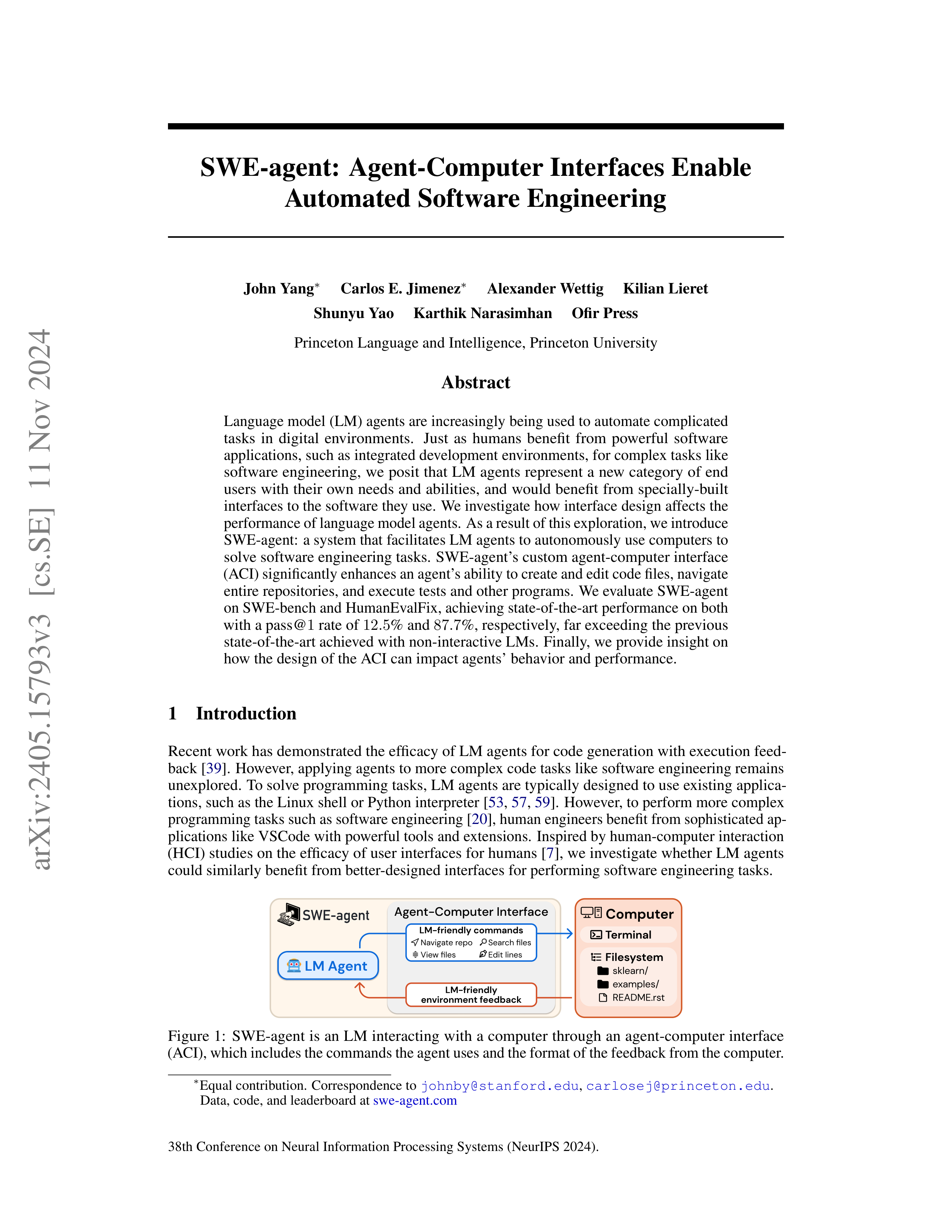
Figure 1:
SWE-agent is an LM interacting with a computer through an agent-computer interface
(ACI), which includes the commands the agent uses and the format of the feedback from the computer.
∗
Equal contribution.
Correspondence to
johnby@stanford.edu
,
carlosej@princeton.edu
.
Data, code, and leaderboard at
swe-agent.com
38th Conference on Neural Information Processing Systems (NeurIPS 2024).
arXiv:2405.15793v3 [cs.SE] 11 Nov 2024





Consider the simple setting of an agent interacting directly with a Linux shell [
59
].
In practice, we
find that LM agents can struggle to reliably take actions in this environment.
For example, it fails to
provide simple commands to edit a small file segment, and does not provide any feedback if the user
makes an invalid edit.
These deficits substantially hamper performance, motivating the need for an
agent-computer interface (ACI), i.e., an abstraction layer between the LM agent and computer, to
enhance the LM agent’s abilities in computer environments (Figure
1
).
From this effort, we introduce SWE-agent, an agent composed of an LM and ACI, that can interact
with
a
computer
to
solve
challenging
real-world
software
engineering
problems,
such
as
those
proposed in SWE-bench [
20
].
In contrast to the Linux Shell’s granular, highly configurable action
space, SWE-agent’s ACI instead offers a small set of simple actions for viewing, searching through
and editing files.
The ACI uses guardrails to prevent common mistakes, and an agent receives specific,
concise feedback about a command’s effects at every turn.
We show that ACIs tailored specifically
for LMs outperform existing user interfaces
(UIs)
designed for human users
, such as the Linux shell.
Using GPT-4 Turbo as a base LM, SWE-agent solves
12
.
47
% of the
2
,
294
SWE-bench test tasks,
substantially outperforming the previous best resolve rate of
3
.
8
% by a non-interactive, retrieval-
augmented system [
20
].
We perform an ablation study on a subset of
300
SWE-bench test instances
(SWE-bench Lite) to analyze our ACI design choices.
The results show that SWE-agent solves
10
.
7
percentage points
more
instances than the baseline agent, which uses only the default Linux shell.
Although our ACI was developed for GPT-4 Turbo, we show that it is portable to a different LM;
SWE-agent with Claude 3 Opus can solve
10
.
5
% of the benchmark tasks.
Our contributions are twofold.
First, we introduce the concept of the agent-computer interface (ACI)
and demonstrate how careful ACI design can substantially improve LM agent performance without
modifying the underlying LM’s weights.
Second, we build, evaluate, and open-source SWE-agent, a
system that provides LMs an ACI for solving real-world software engineering tasks.
Unlike prior
works that independently explore the merits of tool use, prompting techniques, and code execution
in interactive settings, our approach unifies these factors within the ACI framework.
We show that
crafting LM-centric interactive components has meaningful effects on downstream task performance.
2
The Agent-Computer Interface
An
LM
acts
as
an
agent
when
it
interacts
with
an
environment
by
iteratively
taking
actions
and
receiving feedback [
42
,
62
].
Typically, the environment has hard constraints, as in robotics, where
agents control actuators in the physical world.
On the other hand, digital environments can be molded
by abstractions in the form of application programming interfaces and user interfaces for software and
humans respectively. Naturally, existing interfaces have been designed with one of these users in mind.
We argue that LM agents represent a new category of end user, with their own needs and abilities.
We refer to the interface LM agents use to interact with computers as the
agent-computer interface
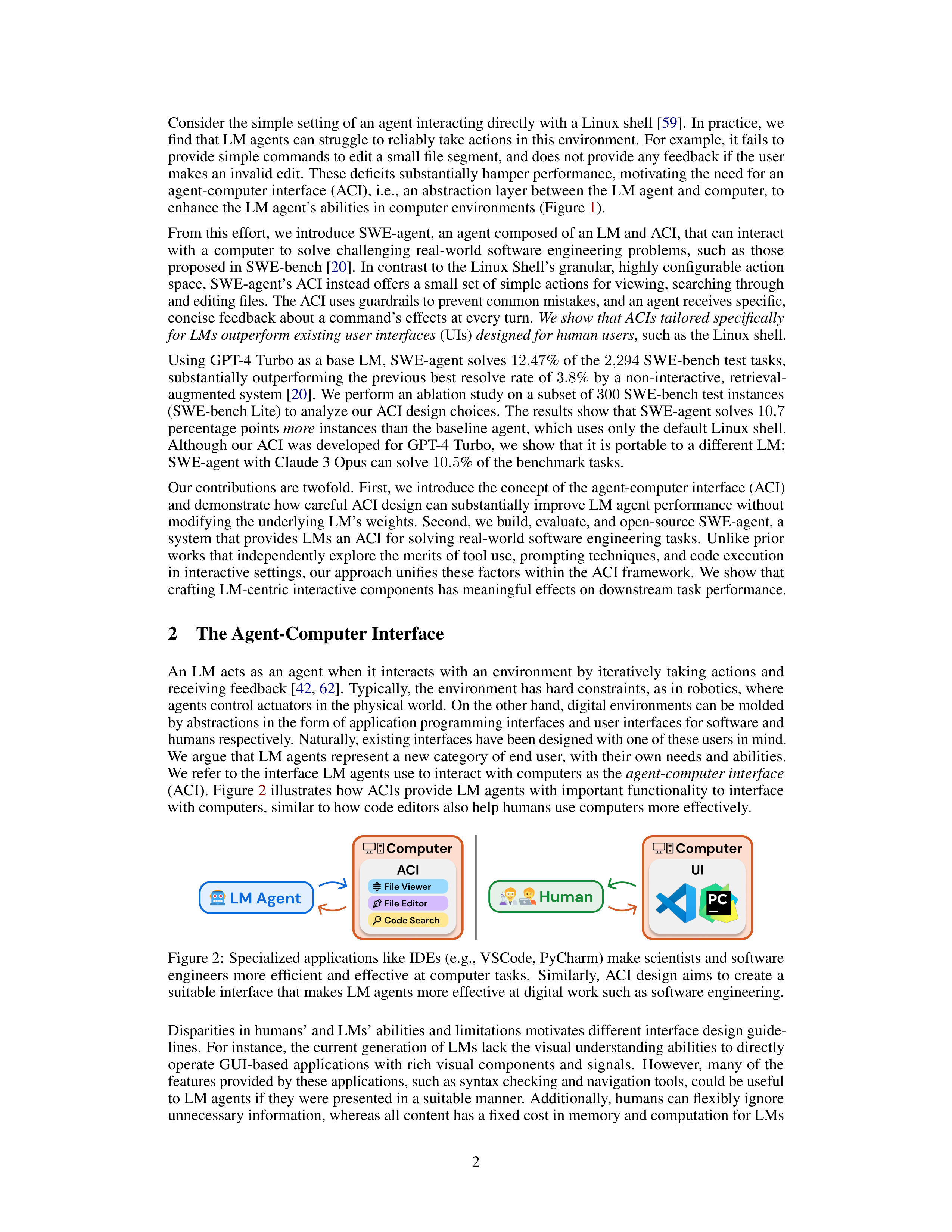
(ACI). Figure
2
illustrates how ACIs provide LM agents with important functionality to interface
with computers, similar to how code editors also help humans use computers more effectively.
LM Agent
Computer
Code Search
File Viewer
File Editor
ACI
Computer
UI
Human
Figure 2:
Specialized applications like IDEs (e.g., VSCode, PyCharm) make scientists and software
engineers
more
efficient
and
effective
at
computer
tasks.
Similarly,
ACI
design
aims
to
create
a
suitable interface that makes LM agents more effective at digital work such as software engineering.
Disparities in humans’ and LMs’ abilities and limitations motivates different interface design guide-
lines.
For instance, the current generation of LMs lack the visual understanding abilities to directly
operate GUI-based applications with rich visual components and signals.
However,
many of the
features provided by these applications, such as syntax checking and navigation tools, could be useful
to LM agents if they were presented in a suitable manner.
Additionally, humans can flexibly ignore
unnecessary information, whereas all content has a fixed cost in memory and computation for LMs
2
and distracting context can harm performance [
27
].
Therefore, LM agents may be more effective at
interacting with computers when provided an interface that was built informed by these differences.
Ultimately, a well-designed ACI should help the LM agent understand the state of the application
given previous changes, manage history to avoid unnecessary context from prior observations, and
provide actions that models can use efficiently and reliably.
The ACI specifies both the commands
available to the LM and how the environment state is communicated back to the LM. It also tracks
the history of all previous commands and observations and, at each step, manages how these should
be formatted and combined with high-level instructions into a single input for the LM.
In this paper, we assume a fixed LM and focus on designing the ACI to improve its performance.
This means that we shape the actions, their documentation, and environment feedback to complement
an LM’s limitations and abilities.
We draw inspiration from the field of HCI, where user studies
elicit
insights
about
how
compatible
different
interfaces
are
with
respect
to
human
intuition
and
performance [
7
].
We use two approaches to enhance performance on a development set:
(1) manually
inspect agent behavior to identify difficulties and propose improvements, and (2) run a grid search to
select the best ACI configuration.
Taking these two actions resulted in several insights about design principles that seem especially
important for building effective ACIs:
1.
Actions
should
be
simple
and
easy
to
understand
for
agents.
Many
bash
commands
have
documentation that includes dozens of options.
Simple commands with a few options and concise
documentation are easier for agents to use, reducing the need for demonstrations or fine-tuning.
This is a defining principle for all SWE-agent commands that we describe in Section
3
.
2.
Actions should be compact and efficient.
Important operations (e.g., file navigation, editing)
should
be
consolidated
into
as
few
actions
as
possible.
Efficient
actions
help
agents
make
meaningful progress towards a goal in a single step.
A poor design would therefore have many
simple actions that must be composed across multiple turns for a higher order operation to take
effect.
We show this idea in action in the Editing and Search interface analyses in Section
5.1
.
3.
Environment
feedback
should
be
informative
but
concise.
High
quality
feedback
should
provide the agent with substantive information about the current environment state (and the effect
of
the
agent’s
recent
actions)
without
unnecessary
details.
For
instance,
when
editing
a
file,
updating the agent about revised content is helpful.
Figures
3a
,
3b
and Table
3
show this.
4.
Guardrails mitigate error propagation and hasten recovery.
Like humans, LMs make mistakes
when editing or searching and can struggle to recover from these errors.
Building in guardrails,
such as a code syntax checker that automatically detects mistakes, can help agents recognize and
quickly correct errors.
We show the effect of editing guardrails in Table
3
.
Analysis and ablation studies in Section
5
demonstrate how alternative ACIs affect LM performance.
Our studies shows how these principles appear recurrently across actions, feedback, and workflows.
3
SWE-agent:
Designing an ACI for Software Engineering
Here we describe how SWE-agent provides an ACI for LMs to act as software engineering agents,
enabling
them
to
effectively
search,
navigate,
edit,
and
execute
code
commands.
The
ACI
com-
prises several principal components, including search/navigation, file viewer, file editor, and context
management.
At each step, SWE-agent generates a thought and a command, then incorporates the
feedback from the command’s execution in the environment (ReAct; Yao et al.
[
62
]
).
Built atop the
Linux shell, SWE-agent also allows access to common Linux commands and utilities when needed.
Search
and
navigation.
Navigating
codebases
requires
finding
the
relevant
file
and
content.
A
common
strategy
to
do
this
involves
looking
up
terms
that
might
be
useful,
e.g.,
files,
functions,
or
class
definitions
mentioned
in
an
issue.
We
introduce
the
special
commands
find_file
,
search_file
,
and
search_dir
,
which
output
a
summary
of
search
results
when
searching
for
filenames
and
strings
within
files
or
directories.
Figure
10
shows
examples
of
these
search
result
formats.
The
find_file
command
searches
for
filenames
in
the
repository,
while
the
search_file
and
search_dir
locates
strings
in
a
file(s)
of
a
subdirectory.
Our
interface
encourages efficient searches by suppressing verbose results.
The search commands return at most
50
3
Observation (File Viewer)
401:
402:
403:
404:
405:
406:
407:
408:
409:
[File:
(3093 lines total)]
solvers/diophantine.py
(400 lines above)
(2684 lines below)
total_degree
3:
diop_type
total_degree 3
:
if all
coeff
k
1
:
diop_type
diop_type
None:
return var, coeff, diop_type
elif
==
=
elif
>
==
=
if
is not
"cubic_thue"
[
]
'general_sum_even'
(
)
(
)
(a) Observation from the file viewer.
Response (Thought + Edit Action)
edit
end_of_edit
:
total_degree 3 and
len
set
k.exp
k.is_Pow
1):
if all
coeff
k
1
:
diop_type
404
407
elif
>
==
==
=
(
(
(
))
(
)
[
]
[
]
'general_sum_even'
We need to add a check to ensure that all powers
are the same. Let's edit the code to include this
check.
(b) Action using the edit interface.
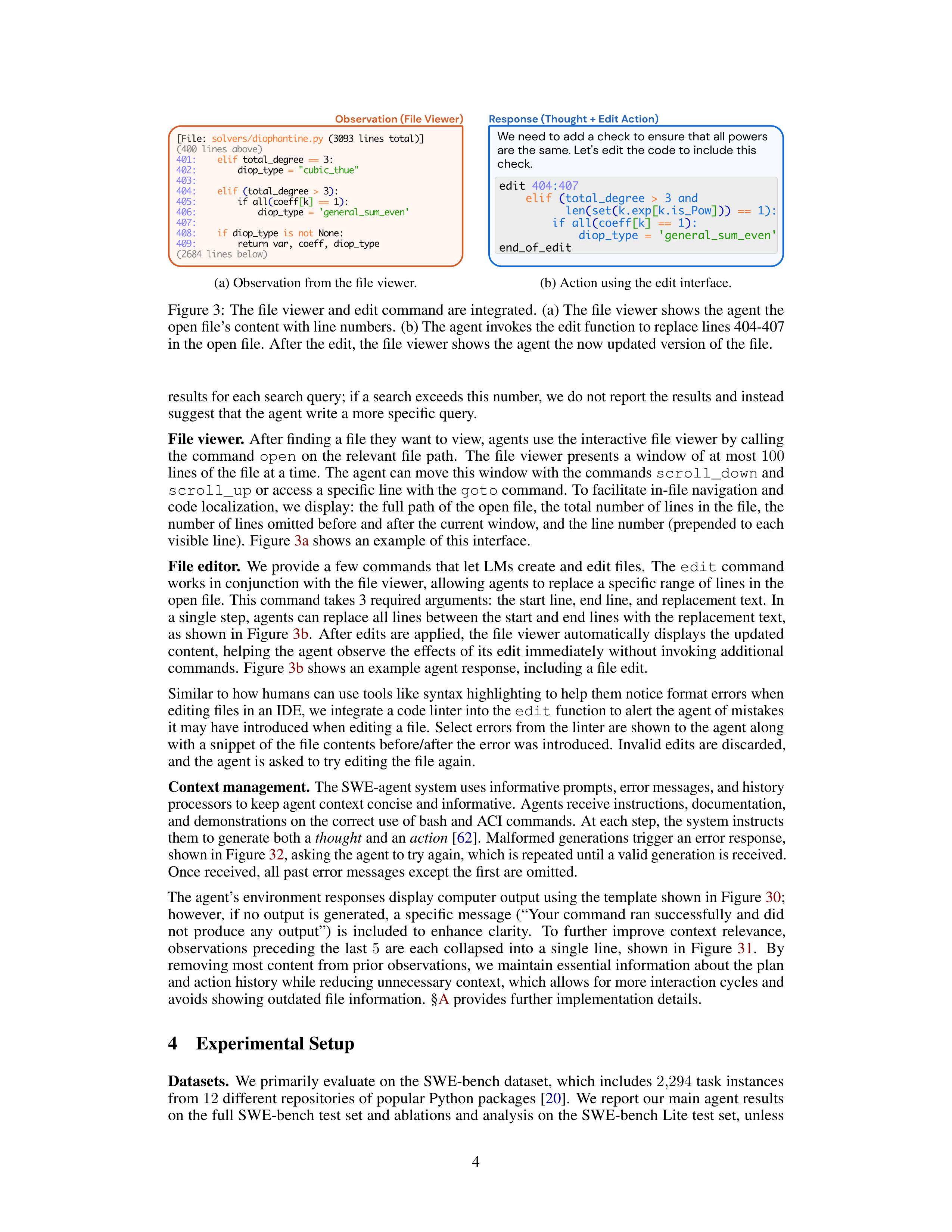
Figure 3:
The file viewer and edit command are integrated.
(a) The file viewer shows the agent the
open file’s content with line numbers.
(b) The agent invokes the edit function to replace lines 404-407
in the open file.
After the edit, the file viewer shows the agent the now updated version of the file.
results for each search query; if a search exceeds this number, we do not report the results and instead
suggest that the agent write a more specific query.
File viewer.
After finding a file they want to view, agents use the interactive file viewer by calling
the
command
open
on
the
relevant
file
path.
The
file
viewer
presents
a
window
of
at
most
100
lines of the file at a time.
The agent can move this window with the commands
scroll_down
and
scroll_up
or access a specific line with the
goto
command.
To facilitate in-file navigation and
code localization, we display:
the full path of the open file, the total number of lines in the file, the
number of lines omitted before and after the current window, and the line number (prepended to each
visible line).
Figure
3a
shows an example of this interface.
File editor.
We provide a few commands that let LMs create and edit files.
The
edit
command
works in conjunction with the file viewer, allowing agents to replace a specific range of lines in the
open file.
This command takes 3 required arguments:
the start line, end line, and replacement text.
In
a single step, agents can replace all lines between the start and end lines with the replacement text,
as shown in Figure
3b
.
After edits are applied, the file viewer automatically displays the updated
content, helping the agent observe the effects of its edit immediately without invoking additional
commands.
Figure
3b
shows an example agent response, including a file edit.
Similar to how humans can use tools like syntax highlighting to help them notice format errors when
editing files in an IDE, we integrate a code linter into the
edit
function to alert the agent of mistakes
it may have introduced when editing a file.
Select errors from the linter are shown to the agent along
with a snippet of the file contents before/after the error was introduced.
Invalid edits are discarded,
and the agent is asked to try editing the file again.
Context management.
The SWE-agent system uses informative prompts, error messages, and history
processors to keep agent context concise and informative.
Agents receive instructions, documentation,
and demonstrations on the correct use of bash and ACI commands.
At each step, the system instructs
them to generate both a
thought
and an
action
[
62
].
Malformed generations trigger an error response,
shown in Figure
32
, asking the agent to try again, which is repeated until a valid generation is received.
Once received, all past error messages except the first are omitted.
The agent’s environment responses display computer output using the template shown in Figure
30
;
however, if no output is generated, a specific message (“Your command ran successfully and did
not
produce
any
output”)
is
included
to
enhance
clarity.
To
further
improve
context
relevance,
observations
preceding
the
last
5
are
each
collapsed
into
a
single
line,
shown
in
Figure
31
.
By
removing most content from prior observations, we maintain essential information about the plan
and action history while reducing unnecessary context, which allows for more interaction cycles and
avoids showing outdated file information.
§
A
provides further implementation details.
4
Experimental Setup
Datasets.
We primarily evaluate on the SWE-bench dataset, which includes
2
,
294
task instances
from
12
different repositories of popular Python packages [
20
].
We report our main agent results
on the full SWE-bench test set and ablations and analysis on the SWE-bench Lite test set, unless
4
otherwise specified.
SWE-bench Lite is a canonical subset of
300
instances from SWE-bench that
focus on evaluating self-contained functional bug fixes.
We also test SWE-agent’s basic code editing
abilities with HumanEvalFix, a short-form code debugging benchmark [
32
].
Models.
All
results,
ablations,
and
analyses
are
based
on
two
leading
LMs,
GPT-4
Turbo
(
gpt-4-1106-preview
)
[
34
]
and
Claude
3
Opus
(
claude-3-opus-20240229
)
[
6
].
We
experimented with a number of additional closed and open source models, including Llama 3 and
DeepSeek Coder [
14
], but found their performance in the agent setting to be subpar.
Many LMs’
context window is too small, such as Llama 3’s context window of
8
k.
GPT-4 Turbo and Claude
3 Opus have
128
k and
200
k token context windows, respectively,
which provides sufficient room
for the LM to interact for several turns after being fed the system prompt,
issue description,
and
optionally, a demonstration.
Baselines.
We compare SWE-agent to two baselines.
The first setting is the non-interactive, retrieval-
augmented generation (RAG) baselines established in Jimenez et al.
[
20
]
.
Here, a BM25 retrieval
system retrieves the most relevant codebase files using the issue as the query; given these files, the
model is asked to directly generate a patch file that resolves the issue.
The second setting, called Shell-only, is adapted from the interactive coding framework introduced in
Yang et al.
[
59
]
.
Following the InterCode environment, this baseline system asks the LM to resolve
the issue by interacting with a shell process on Linux.
Like SWE-agent, model prediction is generated
automatically based on the final state of the codebase after interaction.
Metrics.
We report
% Resolved
or
pass
@1
as the main metric, which is the proportion of instances
for which all tests pass successfully after the model generated patch is applied to the repository [
20
].
We also report the
$ Avg.
Cost
metric, the API inference cost incurred by SWE-agent averaged over
all successfully resolved instances.
Due to budget constraints, we set the per-instance budget to $4; if
a run exceeded this budget, existing edits were submitted automatically.
Configuration search.
During the design process of SWE-agent, we arrived at the final ACI design
through qualitative analysis of system behavior on a small set of hand-picked examples from the
development split of SWE-bench.
For the remaining hyperparameter choices, we performed a sweep
over the window size, history processing, and decoding temperature, shown in §
B.1
.
5
Results
Across all systems, SWE-agent w/ GPT-4 Turbo achieves the best performance all-around, success-
fully solving
12
.
47
% (
286
/
2
,
294
) of the full SWE-bench test set and
18
.
00
% (
54
/
300
) of the Lite
split.
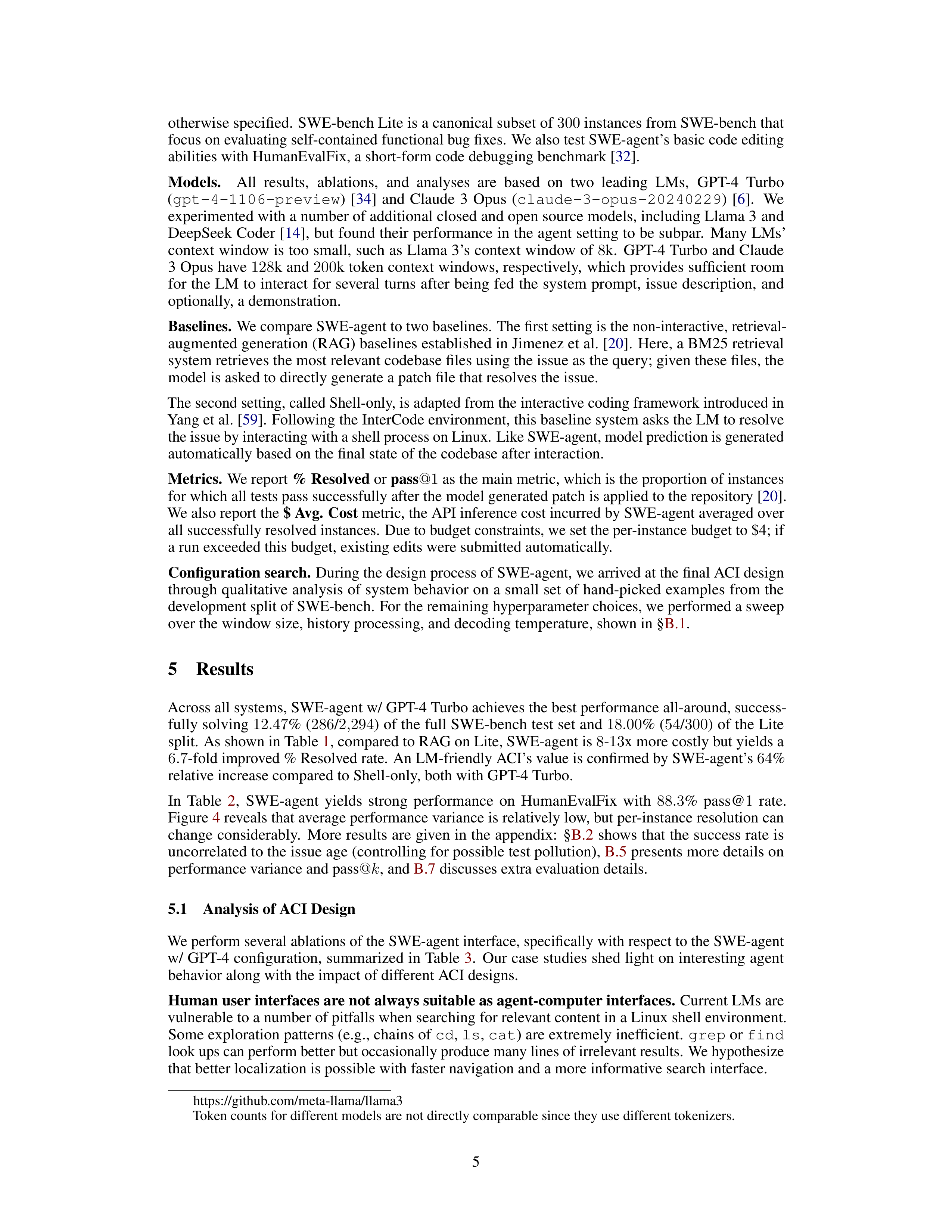
As shown in Table
1
, compared to RAG on Lite, SWE-agent is
8
-
13
x more costly but yields a
6
.
7
-fold improved % Resolved rate.
An LM-friendly ACI’s value is confirmed by SWE-agent’s
64
%
relative increase compared to Shell-only, both with GPT-4 Turbo.
In
Table
2
,
SWE-agent
yields
strong
performance
on
HumanEvalFix
with
88
.
3
%
pass@1
rate.
Figure
4
reveals that average performance variance is relatively low, but per-instance resolution can
change considerably.
More results are given in the appendix:
§
B.2
shows that the success rate is
uncorrelated to the issue age (controlling for possible test pollution),
B.5
presents more details on
performance variance and pass
@
k
, and
B.7
discusses extra evaluation details.
5.1
Analysis of ACI Design
We perform several ablations of the SWE-agent interface, specifically with respect to the SWE-agent
w/ GPT-4 configuration, summarized in Table
3
.
Our case studies shed light on interesting agent
behavior along with the impact of different ACI designs.
Human user interfaces are not always suitable as agent-computer interfaces.
Current LMs are
vulnerable to a number of pitfalls when searching for relevant content in a Linux shell environment.
Some exploration patterns (e.g., chains of
cd
,
ls
,
cat
) are extremely inefficient.
grep
or
find
look ups can perform better but occasionally produce many lines of irrelevant results.
We hypothesize
that better localization is possible with faster navigation and a more informative search interface.
https://github.com/meta-llama/llama3
Token counts for different models are not directly comparable since they use different tokenizers.
5
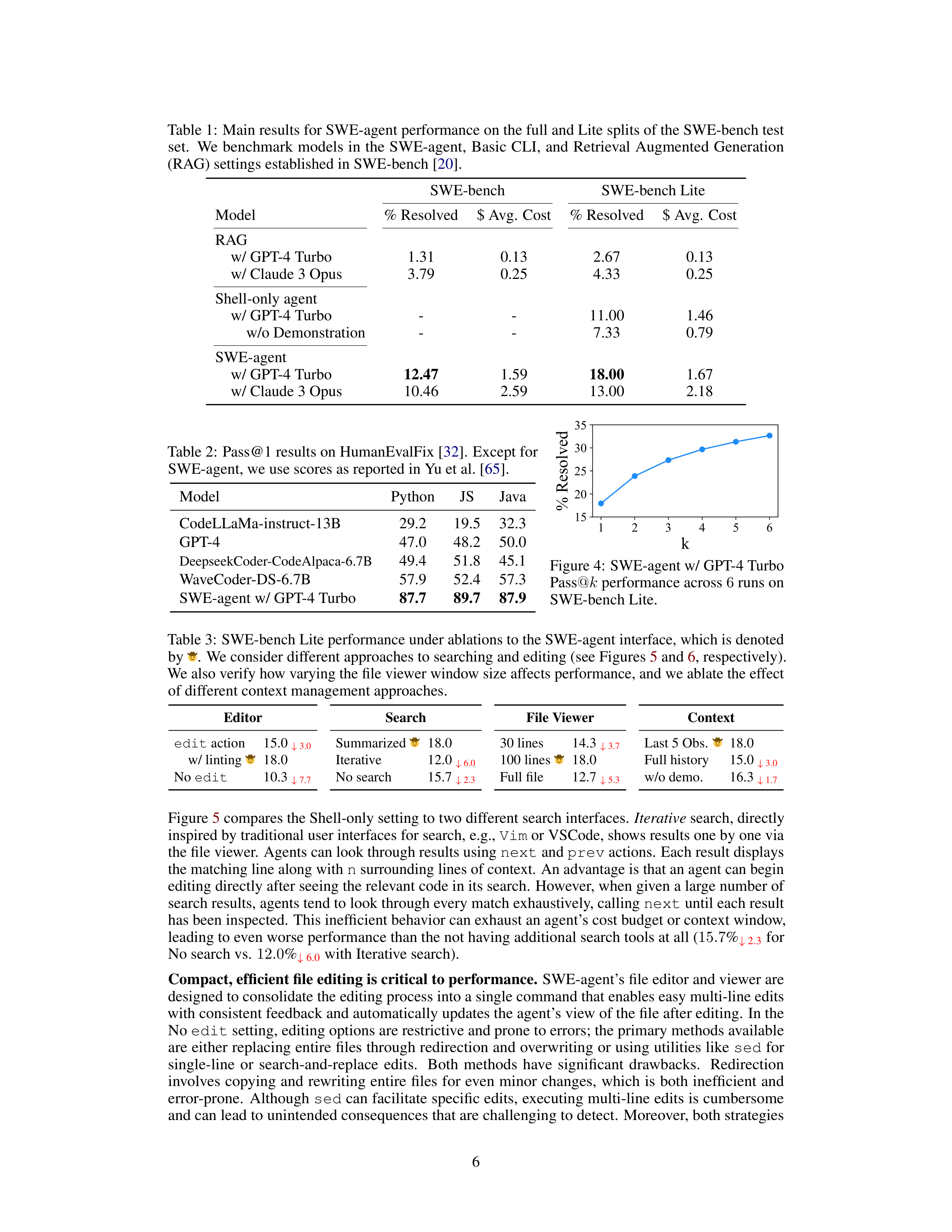
Table 1:
Main results for SWE-agent performance on the full and Lite splits of the SWE-bench test
set.
We
benchmark
models
in
the
SWE-agent,
Basic
CLI,
and
Retrieval
Augmented
Generation
(RAG) settings established in SWE-bench [
20
].
SWE-bench
SWE-bench Lite
Model
% Resolved
$ Avg.
Cost
% Resolved
$ Avg.
Cost
RAG
w/ GPT-4 Turbo
1.31
0.13
2.67
0.13
w/ Claude 3 Opus
3.79
0.25
4.33
0.25
Shell-only agent
w/ GPT-4 Turbo
-
-
11.00
1.46
w/o Demonstration
-
-
7.33
0.79
SWE-agent
w/ GPT-4 Turbo
12.47
1.59
18.00
1.67
w/ Claude 3 Opus
10.46
2.59
13.00
2.18
Table 2:
Pass@1 results on HumanEvalFix [
32
].
Except for
SWE-agent, we use scores as reported in Yu et al. [
65
].
Model
Python
JS
Java
CodeLLaMa-instruct-13B
29.2
19.5
32.3
GPT-4
47.0
48.2
50.0
DeepseekCoder-CodeAlpaca-6.7B
49.4
51.8
45.1
WaveCoder-DS-6.7B
57.9
52.4
57.3
SWE-agent w/ GPT-4 Turbo
87.7
89.7
87.9
1
2
3
4
5
6
k
15
20
25
30
35
% Resolved
Figure 4:
SWE-agent w/ GPT-4 Turbo
Pass
@
k
performance across
6
runs on
SWE-bench Lite.
Table 3:
SWE-bench Lite performance under ablations to the SWE-agent interface, which is denoted
by
.
We consider different approaches to searching and editing (see Figures
5
and
6
, respectively).
We also verify how varying the file viewer window size affects performance, and we ablate the effect
of different context management approaches.
Editor
edit
action
15.0
↓
3.0
w/ linting
18.0
No
edit
10.3
↓
7.7
Search
Summarized
18.0
Iterative
12.0
↓
6.0
No search
15.7
↓
2.3
File Viewer
30 lines
14.3
↓
3.7
100 lines
18.0
Full file
12.7
↓
5.3
Context
Last 5 Obs.
18.0
Full history
15.0
↓
3.0
w/o demo.
16.3
↓
1.7
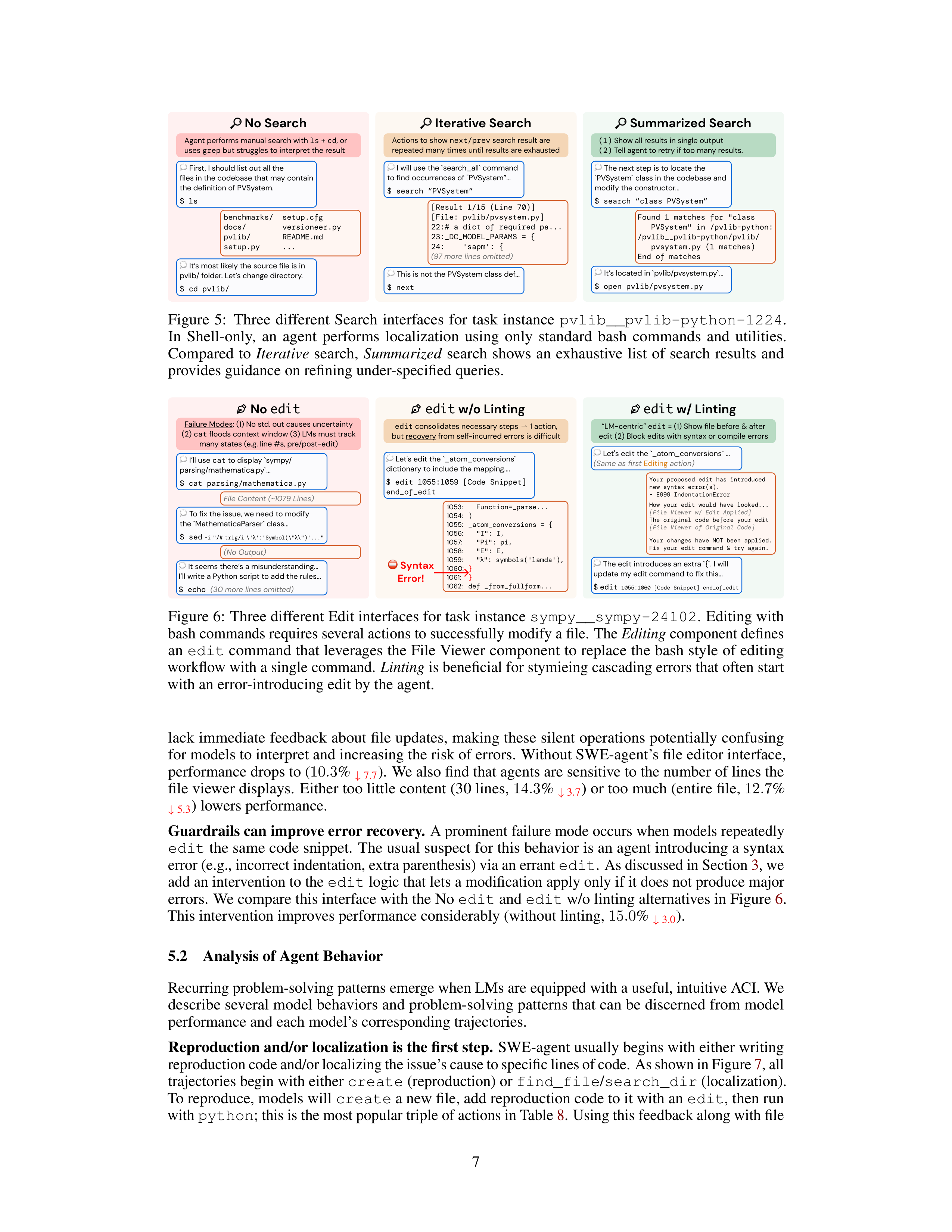
Figure
5
compares the Shell-only setting to two different search interfaces.
Iterative
search, directly
inspired by traditional user interfaces for search, e.g.,
Vim
or VSCode, shows results one by one via
the file viewer.
Agents can look through results using
next
and
prev
actions.
Each result displays
the matching line along with
n
surrounding lines of context.
An advantage is that an agent can begin
editing directly after seeing the relevant code in its search.
However, when given a large number of
search results, agents tend to look through every match exhaustively, calling
next
until each result
has been inspected.
This inefficient behavior can exhaust an agent’s cost budget or context window,
leading to even worse performance than the not having additional search tools at all (
15
.
7
%
↓
2.3
for
No search vs.
12
.
0
%
↓
6.0
with Iterative search).
Compact, efficient file editing is critical to performance.
SWE-agent’s file editor and viewer are
designed to consolidate the editing process into a single command that enables easy multi-line edits
with consistent feedback and automatically updates the agent’s view of the file after editing.
In the
No
edit
setting, editing options are restrictive and prone to errors; the primary methods available
are either replacing entire files through redirection and overwriting or using utilities like
sed
for
single-line
or
search-and-replace
edits.
Both
methods
have
significant
drawbacks.
Redirection
involves
copying and rewriting entire files
for even minor changes,
which
is both inefficient and
error-prone.
Although
sed
can facilitate specific edits, executing multi-line edits is cumbersome
and can lead to unintended consequences that are challenging to detect.
Moreover, both strategies
6





Search with Vanilla CLI
Agent performs manual search with ls + cd, or
uses grep but struggles to interpret the result
First, I should list out all the
files in the codebase that may contain
the definition of PVSystem.
$ ls
It’s most likely the source file is in
pvlib/ folder. Let’s change directory.
$ cd pvlib/
benchmarks/
docs/
pvlib/
setup.py
setup.cfg
versioneer.py
README.md
...
Actions to show next/prev search result are
repeated many times until results are exhausted
I will use the `search_all` command
to find occurrences of "PVSystem”...
$ search “PVSystem”
T
his is not the PVSystem class def...
$ next
[
Result
1
/
15
(L
ine
70)]
[F
ile
:
pvlib/pvsystem.py
]
22:#
a dict of re
q
uired pa..
.
23:_
D
C_
M
O
DE
L_
PARAMS
=
{
24:
'
sapm
':
{
(97 more lines omitted)
U
I
-
in
sp
ire
d
Search
(1)
Show all results in single outpu
t
(2)
T
ell agent to retry if too many results.
T
he next step is to locate the
`PVSystem` class in the codebase and
modify the constructor...
$ search “class PVSystem”
It’s located in `pvlib/pvsystem.py`...
$ open pvlib/pvsystem.py
F
ound
1
matches for
"
clas
s
PVSystem
"
in /pvlib
-
python
:
/pvlib
__
pvlib
-
python/pvlib/
pvsystem.py
(1
matches
)
End of matches
L
M-f
rien
d
l
y
Search
Agent performs manual search with ls + cd, or
uses grep but struggles to interpret the result
First, I should list out all the
files in the codebase that may contain
the definition of PVSystem.
$ ls
It’s most likely the source file is in
pvlib/ folder. Let’s change directory.
$ cd pvlib/
benchmarks/
docs/
pvlib/
setup.py
setup.cfg
versioneer.py
README.md
...
Actions to show next/prev search result are
repeated many times until results are exhausted
I will use the `search_all` command
to find occurrences of "PVSystem”...
$ search “PVSystem”
T
his is not the PVSystem class def...
$ next
[
Result
1
/
15
(L
ine
70)]
[F
ile
:
pvlib/pvsystem.py
]
22:#
a dict of re
q
uired pa..
.
23:_
D
C_
M
O
DE
L_
PARAMS
=
{
24:
'
sapm
':
{
(97 more lines omitted)
(1)
Show all results in single outpu
t
(2)
T
ell agent to retry if too many results.
T
he next step is to locate the
`PVSystem` class in the codebase and
modify the constructor...
$ search “class PVSystem”
It’s located in `pvlib/pvsystem.py`...
$ open pvlib/pvsystem.py
F
ound
1
matches for
"
clas
s
PVSystem
"
in /pvlib
-
python
:
/pvlib
__
pvlib
-
python/pvlib/
pvsystem.py
(1
matches
)
End of matches
Iterati
v
e Search
S
umm
ari
z
e
d
Search
No
Search
Figure
5:
Three
different
Search
interfaces
for
task
instance
pvlib__pvlib-python-1224
.
In
Shell-only,
an
agent
performs
localization
using
only
standard
bash
commands
and
utilities.
Compared
to
Iterative
search,
Summarized
search
shows
an
exhaustive
list
of
search
results
and
provides guidance on refining under-specified queries.
To fix the issue, we need to modify
the `MathematicaParser` class...
$ sed
-i
"/#
trig/i
\'λ':'Symbol(\"λ\")'..."
I’ll use cat to display `sympy/
parsing/mathematica.py`...
$ cat parsing/mathematica.py
File Content (~1079 Lines)
It seems there’s a misunderstanding...
I’ll write a Python script to add the rules...
$ echo (30 more lines omitted)
(No Output)
No edit
Let's edit the `_atom_conversions`
dictionary to include the mapping....
$ edit 1055:1059 [Code Snippet]
end_of_edit
1053:
1054:
1055:
1056:
1057:
1058:
1059:
1060:
1061:
1062:
Function=_parse...
)
_atom_conversions = {
"I": I,
"Pi": pi,
"E": E,
"λ": symbols('lamda'),
def _from_fullform...
}
}
Syntax
Error!
edit
w/
o
Li
nt
i
n
g
Let's edit the `_atom_conversions` ...
(
Sa
me
a
s
fi
rst
ac
tion)
E
diting
Y
our proposed edit has introduce
d
ne
w
synta
x
error(s).
- E999 IndentationErro
r
H
o
w
your edit
w
ould have loo
k
ed...
T
he original code before your edi
t
Y
our changes have
NOT
been applied
.
Fi
x
your edit command
&
try again.
[File
Viewer
w/
Edit
Applied]
[File
Viewer
of
Original
Code]
The edit introduces an extra `
{
`. I will
update my edit command to fix this...
$
edit
1055:10
6
0 [Code Snippet] end_of_edit
edit
w/
Li
nt
i
n
g
“
LM
-
centric
”
edit
=
(
1
)
S
how file
b
efore
&
after
edit
(
2
)
B
loc
k
edits with syntax or compile errors
F
ailure Modes:
(
1
)
N
o std. out causes uncertainty
(
2
)
cat
fl
oods context window
(
3
)
LMs must trac
k
many states
(
e.g. line
#
s, pre/post
-
edit
)
edit consolidates necessary steps
→
1 action,
b
ut recovery from self
-
incurred errors is difficult
Figure 6:
Three different Edit interfaces for task instance
sympy__sympy-24102
.
Editing with
bash commands requires several actions to successfully modify a file.
The
Editing
component defines
an
edit
command that leverages the File Viewer component to replace the bash style of editing
workflow with a single command.
Linting
is beneficial for stymieing cascading errors that often start
with an error-introducing edit by the agent.
lack immediate feedback about file updates, making these silent operations potentially confusing
for models to interpret and increasing the risk of errors.
Without SWE-agent’s file editor interface,
performance drops to (
10
.
3
%
↓
7.7
).
We also find that agents are sensitive to the number of lines the
file viewer displays.
Either too little content (30 lines,
14
.
3
%
↓
3.7
) or too much (entire file,
12
.
7
%
↓
5.3
) lowers performance.
Guardrails can improve error recovery.
A prominent failure mode occurs when models repeatedly
edit
the same code snippet.
The usual suspect for this behavior is an agent introducing a syntax
error (e.g., incorrect indentation, extra parenthesis) via an errant
edit
.
As discussed in Section
3
, we
add an intervention to the
edit
logic that lets a modification apply only if it does not produce major
errors.
We compare this interface with the No
edit
and
edit
w/o linting alternatives in Figure
6
.
This intervention improves performance considerably (without linting,
15
.
0
%
↓
3.0
).
5.2
Analysis of Agent Behavior
Recurring problem-solving patterns emerge when LMs are equipped with a useful, intuitive ACI. We
describe several model behaviors and problem-solving patterns that can be discerned from model
performance and each model’s corresponding trajectories.
Reproduction and/or localization is the first step.
SWE-agent usually begins with either writing
reproduction code and/or localizing the issue’s cause to specific lines of code. As shown in Figure
7
, all
trajectories begin with either
create
(reproduction) or
find_file
/
search_dir
(localization).
To reproduce, models will
create
a new file, add reproduction code to it with an
edit
, then run
with
python
; this is the most popular triple of actions in Table
8
.
Using this feedback along with file
7
0
3
6
9
12
15
18
21
24
27
30
33
36
Turn
0
50
100
150
200
250
Frequency
search_dir
search_file
find_file
find
create
edit
exit_cost
submit
open
scroll_up
scroll_down
goto
python3
python
pytest
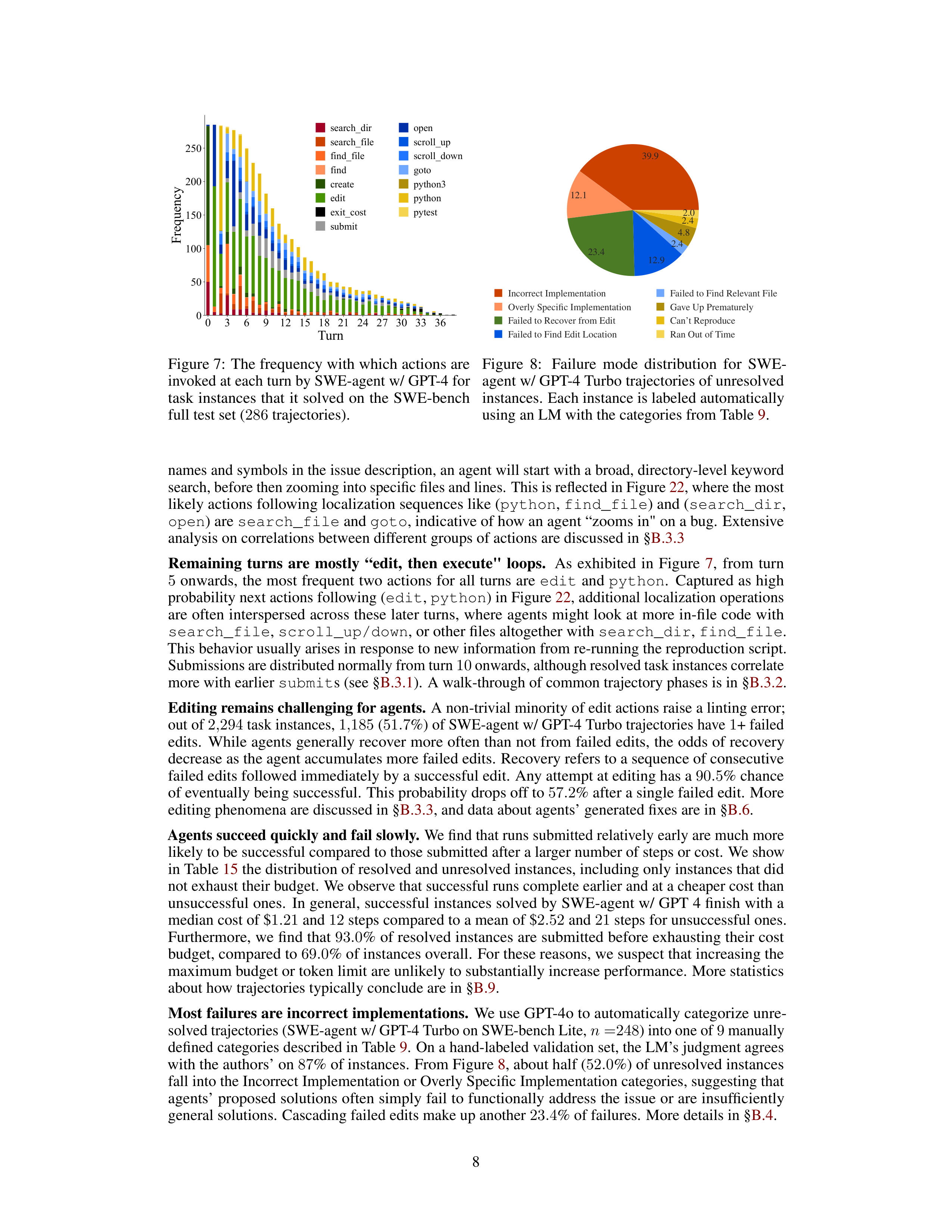
Figure 7:
The frequency with which actions are
invoked at each turn by SWE-agent w/ GPT-4 for
task
instances
that
it
solved
on
the
SWE-bench
full test set (
286
trajectories).
39.9
12.1
23.4
12.9
2.4
4.8
2.4
2.0
Incorrect Implementation
Overly Specific Implementation
Failed to Recover from Edit
Failed to Find Edit Location
Failed to Find Relevant File
Gave Up Prematurely
Can’t Reproduce
Ran Out of Time
Figure
8:
Failure
mode
distribution
for
SWE-
agent w/ GPT-4 Turbo trajectories of unresolved
instances.
Each instance is labeled automatically
using an LM with the categories from Table
9
.
names and symbols in the issue description, an agent will start with a broad, directory-level keyword
search, before then zooming into specific files and lines.
This is reflected in Figure
22
, where the most
likely actions following localization sequences like (
python
,
find_file
) and (
search_dir
,
open
) are
search_file
and
goto
, indicative of how an agent “zooms in" on a bug.
Extensive
analysis on correlations between different groups of actions are discussed in §
B.3.3
Remaining
turns
are
mostly
“edit,
then
execute"
loops.
As
exhibited
in
Figure
7
,
from
turn
5
onwards,
the most frequent two actions for all turns are
edit
and
python
.
Captured as high
probability next actions following (
edit
,
python
) in Figure
22
, additional localization operations
are often interspersed across these later turns,
where agents might look at more in-file code with
search_file
,
scroll_up/down
, or other files altogether with
search_dir
,
find_file
.
This behavior usually arises in response to new information from re-running the reproduction script.
Submissions are distributed normally from turn
10
onwards, although resolved task instances correlate
more with earlier
submit
s (see §
B.3.1
).
A walk-through of common trajectory phases is in §
B.3.2
.
Editing remains challenging for agents.
A non-trivial minority of edit actions raise a linting error;
out of
2
,
294
task instances,
1
,
185
(
51
.
7
%) of SWE-agent w/ GPT-4 Turbo trajectories have
1
+ failed
edits.
While agents generally recover more often than not from failed edits, the odds of recovery
decrease as the agent accumulates more failed edits.
Recovery refers to a sequence of consecutive
failed edits followed immediately by a successful edit.
Any attempt at editing has a
90
.
5
% chance
of eventually being successful.
This probability drops off to
57
.
2
% after a single failed edit.
More
editing phenomena are discussed in §
B.3.3
, and data about agents’ generated fixes are in §
B.6
.
Agents succeed quickly and fail slowly.
We find that runs submitted relatively early are much more
likely to be successful compared to those submitted after a larger number of steps or cost.
We show
in Table
15
the distribution of resolved and unresolved instances, including only instances that did
not exhaust their budget.
We observe that successful runs complete earlier and at a cheaper cost than
unsuccessful ones.
In general, successful instances solved by SWE-agent w/ GPT 4 finish with a
median cost of $
1
.
21
and
12
steps compared to a mean of $
2
.
52
and
21
steps for unsuccessful ones.
Furthermore, we find that
93
.
0
% of resolved instances are submitted before exhausting their cost
budget, compared to
69
.
0
% of instances overall.
For these reasons, we suspect that increasing the
maximum budget or token limit are unlikely to substantially increase performance.
More statistics
about how trajectories typically conclude are in §
B.9
.
Most failures are incorrect implementations.
We use GPT-4o to automatically categorize unre-
solved trajectories (SWE-agent w/ GPT-4 Turbo on SWE-bench Lite,
n
=248
) into one of
9
manually
defined categories described in Table
9
.
On a hand-labeled validation set, the LM’s judgment agrees
with the authors’ on
87
% of instances.
From Figure
8
, about half (
52
.
0
%) of unresolved instances
fall into the Incorrect Implementation or Overly Specific Implementation categories, suggesting that
agents’ proposed solutions often simply fail to functionally address the issue or are insufficiently
general solutions.
Cascading failed edits make up another
23
.
4
% of failures.
More details in §
B.4
.
8
6
Related Work
6.1
Software Engineering Benchmarks
Code generation benchmarks, which evaluate models on the task of synthesizing code from natural
language descriptions, have served as a long-standing bellwether for measuring LM performance [
5
,
1
,
15
,
30
].
Subsequent works have built upon the code generation task formulation to contribute
new benchmarks that translate problems to different (programming) languages [
3
,
49
], incorporate
third-party
libraries
[
25
,
29
],
introduce
derivative
code
completion
tasks
[
18
,
32
],
increase
test
coverage [
26
], change the edit scope [
8
,
9
,
64
], and add robustness to dataset contamination [
19
].
Code generation problems are largely self-contained, with short problem descriptions (
∼
100 lines)
and
corresponding
solutions
that
are
similarly
brief,
requiring
nothing
more
complex
than
basic
language primitives.
Tests are either handwritten or generated synthetically via fuzz testing.
In recent
months, the rapid development of LMs has begun to saturate many of these benchmarks.
For instance,
the top method solves
94
.
4
% of HumanEval [
70
].
Gauging future trends with the code generation task paradigm can be limited by the simplicity of this
setting and cost of human-in-the-loop problem creation.
In response, recent efforts have demonstrated
that software engineering (SE) can serve as a diverse, challenging testbed for LM evaluation [
68
,
20
,
28
]. Repository-level code editing introduces many reasoning challenges grounded in real SE subtasks,
such
as
spotting
errant
code
and
identifying
cross-file
relationships
and
understanding
codebase-
specific
symbols
and
conventions.
As
a
field,
SE
has
generally
studied
tasks
in
a
more
isolated
manner; prior benchmarks tended to frame problems in isolation from the rest of a codebase [
21
,
23
].
We use SWE-bench because it unites many separate SE tasks, such as automated program repair [
10
,
40
,
55
],
bug
localization
[
4
,
58
],
and
testing
[
22
,
46
,
56
]
under
a
single
task
formulation
that
faithfully mirrors practical SE. Furthermore,
SWE-bench task instances are diverse,
having been
automatically collected from real GitHub issues across
12
different repositories.
In addition, SWE-
bench performance is based on rigorous, execution-based evaluation with human-written unit tests.
6.2
Language Models as Agents
The co-emergence of stronger LMs, increasingly challenging benchmarks, and practical use cases
have together motivated a paradigm shift in LMs’ inference setting.
Instead of traditional zero/few-
shot generation, LM agents [
17
,
42
,
47
,
54
] that interact with a real/virtual world have proliferated as
the default setting for web navigation [
24
,
33
,
36
,
41
,
45
,
61
,
62
,
71
], computer control [
35
,
53
,
57
],
and code generation tasks [
16
,
50
,
63
].
Interaction and code generation are increasingly used together, with code as the modality of choice for
actions [
48
,
59
], tool construction [
13
,
51
,
69
], and reasoning [
39
,
66
,
67
].
Coding agents have also
been applied to offensive security [
11
,
37
,
60
], theorem proving [
44
], and clinical tasks [
38
,
43
,
52
].
To the best of our knowledge, SWE-agent is the first work to explore language agents for end-to-end
software engineering (SE).
7
Discussion
We introduce SWE-agent, an agent composed of an LM and ACI capable of autonomously solving
software engineering tasks.
Through our design methodology, results, and analysis, we demonstrate
the value of ACIs tailored to leverage LMs’ strengths and mitigate their weaknesses. Beyond empirical
applications, we hope the further study of ACIs can also make principled use of and contribute to our
understanding of language models and agents, analogous to the synergy between human-computer
interaction
(HCI)
and
psychology
[
2
].
Humans
and
LMs
have
different
characteristics,
training
objectives, specialities, and limitations [
12
,
31
], and the interaction design processes can be seen as
systematic behavioral experimentation that could reveal more insights into these differences towards
establishing a comparative understanding of human and artificial intelligence.
9
Acknowledgements
We thank Austin W. Hanjie, Sam Ainsworth, Xindi Wu, Yuhan Liu, Mengzhou Xia, Dan Friedman,
Tianyu
Gao,
Adithya
Bhaskar,
Aatmik
Gupta,
Louisa
Nyhus,
Alisa
Liu,
Ori
Yoran
and
Richard
Zhu
for
their
valuable
feedback
and
advice.
We
would
also
like
to
thank
the
broader
Princeton
Language and Intelligence community for supporting our work.
We acknowledge support from an
Oracle Collaborative Research award and the National Science Foundation under Grant No.
2239363.
Any opinions, findings, conclusions, or recommendations expressed in this material are those of the
author(s) and do not necessarily reflect the views of the National Science Foundation
References
[1]
J. Austin, A. Odena, M. Nye, M. Bosma, H. Michalewski, D. Dohan, E. Jiang, C. Cai, M. Terry,
Q. Le, and C. Sutton.
Program synthesis with large language models, 2021.
[2]
J. M. Carroll.
Human-computer interaction:
psychology as a science of design.
Annual review
of psychology
, 48(1):61–83, 1997.
[3]
F. Cassano, J. Gouwar, D. Nguyen, S. Nguyen, L. Phipps-Costin, D. Pinckney, M.-H. Yee, Y. Zi,
C. J. Anderson, M. Q. Feldman, A. Guha, M. Greenberg, and A. Jangda.
Multipl-e:
A scalable
and extensible approach to benchmarking neural code generation, 2022.
[4]
S. Chakraborty, Y. Li, M. Irvine, R. Saha, and B. Ray.
Entropy guided spectrum based bug
localization using statistical language model.
arXiv preprint arXiv:1802.06947
, 2018.
[5]
M. Chen, J. Tworek, H. Jun, Q. Yuan, H. P. de Oliveira Pinto, and J. K. et. al.
Evaluating large
language models trained on code, 2021.
[6]
W.-L.
Chiang,
L.
Zheng,
Y.
Sheng,
A.
N.
Angelopoulos,
T.
Li,
D.
Li,
H.
Zhang,
B.
Zhu,
M. Jordan, J. E. Gonzalez, and I. Stoica.
Chatbot arena:
An open platform for evaluating llms
by human preference, 2024.
[7]
A. Cooper, R. Reimann, and D. Cronin.
About face 3:
the essentials of interaction design
.
John
Wiley & Sons, Inc., USA, 2007.
ISBN 9780470084113.
[8]
Y. Ding, Z. Wang, W. U. Ahmad, H. Ding, M. Tan, N. Jain, M. K. Ramanathan, R. Nallapati,
P. Bhatia, D. Roth, and B. Xiang.
Crosscodeeval:
A diverse and multilingual benchmark for
cross-file code completion.
In
Thirty-seventh Conference on Neural Information Processing Sys-
tems Datasets and Benchmarks Track
, 2023.
URL
https://openreview.net/forum?
id=wgDcbBMSfh
.
[9]
X.
Du,
M.
Liu,
K.
Wang,
H.
Wang,
J.
Liu,
Y.
Chen,
J.
Feng,
C.
Sha,
X.
Peng,
and
Y.
Lou.
Classeval:
A manually-crafted benchmark for evaluating llms on class-level code generation,
2023.
[10]
Z. Fan, X. Gao, M. Mirchev, A. Roychoudhury, and S. H. Tan.
Automated repair of programs
from large language models, 2023.
[11]
R.
Fang,
R.
Bindu,
A.
Gupta,
Q.
Zhan,
and
D.
Kang.
Llm
agents
can
autonomously
hack
websites, 2024.
[12]
T.
L.
Griffiths.
Understanding
human
intelligence
through
human
limitations.
Trends
in
Cognitive Sciences
, 24(11):873–883, 2020.
[13]
Y. Gu, Y. Shu, H. Yu, X. Liu, Y. Dong, J. Tang, J. Srinivasa, H. Latapie, and Y. Su.
Middleware
for llms:
Tools are instrumental for language agents in complex environments, 2024.
[14]
D.
Guo,
Q.
Zhu,
D.
Yang,
Z.
Xie,
K.
Dong,
W.
Zhang,
G.
Chen,
X.
Bi,
Y.
Wu,
Y.
K.
Li,
F.
Luo,
Y.
Xiong,
and
W.
Liang.
Deepseek-coder:
When
the
large
language
model
meets
programming
–
the
rise
of
code
intelligence.
CoRR
,
abs/2401.14196,
2024.
URL
https:
//arxiv.org/abs/2401.14196
.
10
[15]
D. Hendrycks, S. Basart, S. Kadavath, M. Mazeika, A. Arora, E. Guo, C. Burns, S. Puranik,
H. He, D. Song, and J. Steinhardt.
Measuring coding challenge competence with apps, 2021.
[16]
S.
Holt,
M.
R.
Luyten,
and
M.
van
der
Schaar.
L2MAC:
Large
language
model
automatic
computer for unbounded code generation.
In
The Twelfth International Conference on Learning
Representations
, 2024.
URL
https://openreview.net/forum?id=EhrzQwsV4K
.
[17]
S. Hong, M. Zhuge, J. Chen, X. Zheng, Y. Cheng, C. Zhang, J. Wang, Z. Wang, S. K. S. Yau,
Z. Lin, L. Zhou, C. Ran, L. Xiao, C. Wu, and J. Schmidhuber.
Metagpt:
Meta programming for
a multi-agent collaborative framework, 2023.
[18]
Q. Huang, J. Vora, P. Liang, and J. Leskovec.
Mlagentbench:
Evaluating language agents on
machine learning experimentation, 2024.
[19]
N. Jain, K. Han, A. Gu, W.-D. Li, F. Yan, T. Zhang, S. Wang, A. Solar-Lezama, K. Sen, and
I. Stoica.
Livecodebench:
Holistic and contamination free evaluation of large language models
for code, 2024.
[20]
C. E. Jimenez, J. Yang, A. Wettig, S. Yao, K. Pei, O. Press, and K. R. Narasimhan.
SWE-bench:
Can
language
models
resolve
real-world
github
issues?
In
The
Twelfth
International
Con-
ference on Learning Representations
, 2024.
URL
https://openreview.net/forum?
id=VTF8yNQM66
.
[21]
R. Just, D. Jalali, and M. D. Ernst.
Defects4J: A Database of existing faults to enable controlled
testing
studies
for
Java
programs.
In
ISSTA
2014,
Proceedings
of
the
2014
International
Symposium on Software Testing and Analysis
, pages 437–440, San Jose, CA, USA, July 2014.
Tool demo.
[22]
S. Kang, J. Yoon, and S. Yoo.
Large language models are few-shot testers:
Exploring llm-based
general bug reproduction, 2023.
[23]
R.-M. Karampatsis and C. Sutton.
How often do single-statement bugs occur?
the manysstubs4j
dataset.
2020 IEEE/ACM 17th International Conference on Mining Software Repositories (MSR)
,
pages
573–577,
2019.
URL
https://api.semanticscholar.org/CorpusID:
173188438
.
[24]
J. Y. Koh, R. Lo, L. Jang, V. Duvvur, M. C. Lim, P.-Y. Huang, G. Neubig, S. Zhou, R. Salakhut-
dinov, and D. Fried.
Visualwebarena:
Evaluating multimodal agents on realistic visual web
tasks, 2024.
[25]
Y. Lai, C. Li, Y. Wang, T. Zhang, R. Zhong, L. Zettlemoyer, S. W. tau Yih, D. Fried, S. Wang,
and T. Yu.
Ds-1000:
A natural and reliable benchmark for data science code generation, 2022.
[26]
J. Liu, C. S. Xia, Y. Wang, and L. Zhang.
Is your code generated by chatgpt really correct?
rigor-
ous evaluation of large language models for code generation.
arXiv preprint arXiv:2305.01210
,
2023.
[27]
N. F. Liu, K. Lin, J. Hewitt, A. Paranjape, M. Bevilacqua, F. Petroni, and P. Liang.
Lost in the
middle:
How language models use long contexts, 2023.
[28]
T.
Liu,
C.
Xu,
and
J.
McAuley.
Repobench:
Benchmarking
repository-level
code
auto-
completion systems.
In
The Twelfth International Conference on Learning Representations
,
2024.
URL
https://openreview.net/forum?id=pPjZIOuQuF
.
[29]
Y. Liu,
X. Tang,
Z. Cai,
J. Lu,
Y. Zhang,
Y. Shao,
Z. Deng,
H. Hu,
K. An,
R. Huang,
S. Si,
S. Chen, H. Zhao, L. Chen, Y. Wang, T. Liu, Z. Jiang, B. Chang, Y. Qin, W. Zhou, Y. Zhao,
A. Cohan, and M. Gerstein.
Ml-bench:
Evaluating large language models for code generation
in repository-level machine learning tasks, 2024.
[30]
S. Lu, D. Guo, S. Ren, J. Huang, A. Svyatkovskiy, A. Blanco, C. Clement, D. Drain, D. Jiang,
D. Tang, G. Li, L. Zhou, L. Shou, L. Zhou, M. Tufano, M. Gong, M. Zhou, N. Duan, N. Sun-
daresan, S. K. Deng, S. Fu, and S. Liu.
Codexglue:
A machine learning benchmark dataset for
code understanding and generation, 2021.
11
[31]
R. T. McCoy, S. Yao, D. Friedman, M. Hardy, and T. L. Griffiths.
Embers of autoregression:
Understanding large language models through the problem they are trained to solve.
arXiv
preprint arXiv:2309.13638
, 2023.
[32]
N.
Muennighoff,
Q.
Liu,
A.
R.
Zebaze,
Q.
Zheng,
B.
Hui,
T.
Y.
Zhuo,
S.
Singh,
X.
Tang,
L. V. Werra, and S. Longpre.
Octopack:
Instruction tuning code large language models.
In
The
Twelfth
International
Conference
on
Learning
Representations
,
2024.
URL
https:
//openreview.net/forum?id=mw1PWNSWZP
.
[33]
R.
Nakano,
J.
Hilton,
S.
Balaji,
J.
Wu,
L.
Ouyang,
C.
Kim,
C.
Hesse,
S.
Jain,
V.
Kosaraju,
W. Saunders, X. Jiang, K. Cobbe, T. Eloundou, G. Krueger, K. Button, M. Knight, B. Chess,
and J. Schulman.
Webgpt:
Browser-assisted question-answering with human feedback, 2022.
[34]
OpenAI, J. Achiam, S. Adler, S. Agarwal, L. Ahmad, I. Akkaya, F. L. Aleman, D. Almeida,
J. Altenschmidt, S. Altman, S. Anadkat, R. Avila, I. Babuschkin, S. Balaji, V. Balcom, P. Bal-
tescu, H. Bao, M. Bavarian, J. Belgum, I. Bello, J. Berdine, G. Bernadett-Shapiro, C. Berner,
L. Bogdonoff, O. Boiko, M. Boyd, A.-L. Brakman, G. Brockman, T. Brooks, M. Brundage,
K.
Button,
T.
Cai,
R.
Campbell,
A.
Cann,
B.
Carey,
C.
Carlson,
R.
Carmichael,
B.
Chan,
C.
Chang,
F.
Chantzis,
D.
Chen,
S.
Chen,
R.
Chen,
J.
Chen,
M.
Chen,
B.
Chess,
C.
Cho,
C. Chu, H. W. Chung, D. Cummings, J. Currier, Y. Dai, C. Decareaux, T. Degry, N. Deutsch,
D. Deville,
A. Dhar,
D. Dohan,
S. Dowling,
S. Dunning,
A. Ecoffet,
A. Eleti,
T. Eloundou,
D. Farhi, L. Fedus, N. Felix, S. P. Fishman, J. Forte, I. Fulford, L. Gao, E. Georges, C. Gibson,
V. Goel, T. Gogineni, G. Goh, R. Gontijo-Lopes, J. Gordon, M. Grafstein, S. Gray, R. Greene,
J. Gross, S. S. Gu, Y. Guo, C. Hallacy, J. Han, J. Harris, Y. He, M. Heaton, J. Heidecke, C. Hesse,
A. Hickey, W. Hickey, P. Hoeschele, B. Houghton, K. Hsu, S. Hu, X. Hu, J. Huizinga, S. Jain,
S. Jain, J. Jang, A. Jiang, R. Jiang, H. Jin, D. Jin, S. Jomoto, B. Jonn, H. Jun, T. Kaftan, Łukasz
Kaiser, A. Kamali, I. Kanitscheider, N. S. Keskar, T. Khan, L. Kilpatrick, J. W. Kim, C. Kim,
Y. Kim, J. H. Kirchner, J. Kiros, M. Knight, D. Kokotajlo, Łukasz Kondraciuk, A. Kondrich,
A. Konstantinidis, K. Kosic, G. Krueger, V. Kuo, M. Lampe, I. Lan, T. Lee, J. Leike, J. Leung,
D. Levy, C. M. Li, R. Lim, M. Lin, S. Lin, M. Litwin, T. Lopez, R. Lowe, P. Lue, A. Makanju,
K. Malfacini, S. Manning, T. Markov, Y. Markovski, B. Martin, K. Mayer, A. Mayne, B. Mc-
Grew, S. M. McKinney, C. McLeavey, P. McMillan, J. McNeil, D. Medina, A. Mehta, J. Menick,
L. Metz, A. Mishchenko, P. Mishkin, V. Monaco, E. Morikawa, D. Mossing, T. Mu, M. Murati,
O. Murk, D. Mély, A. Nair, R. Nakano, R. Nayak, A. Neelakantan, R. Ngo, H. Noh, L. Ouyang,
C.
O’Keefe,
J.
Pachocki,
A.
Paino,
J.
Palermo,
A.
Pantuliano,
G.
Parascandolo,
J.
Parish,
E. Parparita, A. Passos, M. Pavlov, A. Peng, A. Perelman, F. de Avila Belbute Peres, M. Petrov,
H.
P.
de
Oliveira
Pinto,
Michael,
Pokorny,
M.
Pokrass,
V.
H.
Pong,
T.
Powell,
A.
Power,
B. Power, E. Proehl, R. Puri, A. Radford, J. Rae, A. Ramesh, C. Raymond, F. Real, K. Rimbach,
C. Ross, B. Rotsted, H. Roussez, N. Ryder, M. Saltarelli, T. Sanders, S. Santurkar, G. Sastry,
H. Schmidt, D. Schnurr, J. Schulman, D. Selsam, K. Sheppard, T. Sherbakov, J. Shieh, S. Shoker,
P. Shyam, S. Sidor, E. Sigler, M. Simens, J. Sitkin, K. Slama, I. Sohl, B. Sokolowsky, Y. Song,
N.
Staudacher,
F.
P.
Such,
N.
Summers,
I.
Sutskever,
J.
Tang,
N.
Tezak,
M.
B.
Thompson,
P. Tillet, A. Tootoonchian, E. Tseng, P. Tuggle, N. Turley, J. Tworek, J. F. C. Uribe, A. Vallone,
A.
Vijayvergiya,
C.
Voss,
C.
Wainwright,
J.
J.
Wang,
A.
Wang,
B.
Wang,
J.
Ward,
J.
Wei,
C. Weinmann, A. Welihinda, P. Welinder, J. Weng, L. Weng, M. Wiethoff, D. Willner, C. Winter,
S.
Wolrich,
H.
Wong,
L.
Workman,
S.
Wu,
J.
Wu,
M.
Wu,
K.
Xiao,
T.
Xu,
S.
Yoo,
K.
Yu,
Q. Yuan, W. Zaremba, R. Zellers, C. Zhang, M. Zhang, S. Zhao, T. Zheng, J. Zhuang, W. Zhuk,
and B. Zoph.
Gpt-4 technical report, 2023.
[35]
C. Packer, S. Wooders, K. Lin, V. Fang, S. G. Patil, I. Stoica, and J. E. Gonzalez.
Memgpt:
Towards llms as operating systems, 2024.
[36]
O. Press, M. Zhang, S. Min, L. Schmidt, N. Smith, and M. Lewis.
Measuring and narrowing the
compositionality gap in language models.
In H. Bouamor, J. Pino, and K. Bali, editors,
Findings
of the Association for Computational Linguistics:
EMNLP 2023
, pages 5687–5711, Singapore,
Dec. 2023. Association for Computational Linguistics.
doi:
10.18653/v1/2023.findings-emnlp.
378.
URL
https://aclanthology.org/2023.findings-emnlp.378
.
[37]
M.
Shao,
B.
Chen,
S.
Jancheska,
B.
Dolan-Gavitt,
S.
Garg,
R.
Karri,
and
M.
Shafique.
An
empirical evaluation of llms for solving offensive security challenges, 2024.
12
[38]
W. Shi, R. Xu, Y. Zhuang, Y. Yu, J. Zhang, H. Wu, Y. Zhu, J. Ho, C. Yang, and M. D. Wang.
Ehragent:
Code empowers large language models for few-shot complex tabular reasoning on
electronic health records, 2024.
[39]
N. Shinn, F. Cassano, E. Berman, A. Gopinath, K. Narasimhan, and S. Yao. Reflexion: Language
agents with verbal reinforcement learning, 2023.
[40]
D.
Sobania,
M.
Briesch,
C.
Hanna,
and
J.
Petke.
An
analysis
of
the
automatic
bug
fixing
performance of chatgpt, 2023.
[41]
A. Sridhar, R. Lo, F. F. Xu, H. Zhu, and S. Zhou.
Hierarchical prompting assists large language
model on web navigation, 2023.
[42]
T. Sumers, S. Yao, K. Narasimhan, and T. L. Griffiths.
Cognitive architectures for language
agents, 2023.
[43]
X. Tang, A. Zou, Z. Zhang, Z. Li, Y. Zhao, X. Zhang, A. Cohan, and M. Gerstein.
Medagents:
Large language models as collaborators for zero-shot medical reasoning, 2024.
[44]
A. Thakur, G. Tsoukalas, Y. Wen, J. Xin, and S. Chaudhuri.
An in-context learning agent for
formal theorem-proving, 2024.
[45]
R. Thoppilan, D. D. Freitas, J. Hall, N. Shazeer, A. Kulshreshtha, H.-T. Cheng, A. Jin, T. Bos,
L. Baker, Y. Du, Y. Li, H. Lee, H. S. Zheng, A. Ghafouri, M. Menegali, Y. Huang, M. Krikun,
D.
Lepikhin,
J.
Qin,
D.
Chen,
Y.
Xu,
Z.
Chen,
A.
Roberts,
M.
Bosma,
V.
Zhao,
Y.
Zhou,
C.-C. Chang, I. Krivokon, W. Rusch, M. Pickett, P. Srinivasan, L. Man, K. Meier-Hellstern,
M. R. Morris, T. Doshi, R. D. Santos, T. Duke, J. Soraker, B. Zevenbergen, V. Prabhakaran,
M. Diaz, B. Hutchinson, K. Olson, A. Molina, E. Hoffman-John, J. Lee, L. Aroyo, R. Rajakumar,
A. Butryna, M. Lamm, V. Kuzmina, J. Fenton, A. Cohen, R. Bernstein, R. Kurzweil, B. Aguera-
Arcas, C. Cui, M. Croak, E. Chi, and Q. Le.
Lamda:
Language models for dialog applications,
2022.
[46]
J.
Wang,
Y.
Huang,
C.
Chen,
Z.
Liu,
S.
Wang,
and
Q.
Wang.
Software
testing
with
large
language model:
Survey, landscape, and vision, 2023.
[47]
L. Wang, C. Ma, X. Feng, Z. Zhang, H. Yang, J. Zhang, Z. Chen, J. Tang, X. Chen, Y. Lin, W. X.
Zhao, Z. Wei, and J. Wen. A survey on large language model based autonomous agents.
Frontiers
of Computer Science
, 18(6), Mar. 2024.
ISSN 2095-2236.
doi:
10.1007/s11704-024-40231-1.
URL
http://dx.doi.org/10.1007/s11704-024-40231-1
.
[48]
X. Wang, Y. Chen, L. Yuan, Y. Zhang, Y. Li, H. Peng, and H. Ji.
Executable code actions elicit
better llm agents, 2024.
[49]
Z.
Wang,
G.
Cuenca,
S.
Zhou,
F.
F.
Xu,
and
G.
Neubig.
Mconala:
A
benchmark
for
code
generation from multiple natural languages, 2023.
[50]
Z. Wang, S. Zhou, D. Fried, and G. Neubig.
Execution-based evaluation for open-domain code
generation, 2023.
[51]
Z. Wang, D. Fried, and G. Neubig.
Trove:
Inducing verifiable and efficient toolboxes for solving
programmatic tasks, 2024.
[52]
M. Wornow, A. Narayan, K. Opsahl-Ong, Q. McIntyre, N. H. Shah, and C. Re.
Automating the
enterprise with foundation models, 2024.
[53]
Z. Wu, C. Han, Z. Ding, Z. Weng, Z. Liu, S. Yao, T. Yu, and L. Kong.
Os-copilot:
Towards
generalist computer agents with self-improvement, 2024.
[54]
Z.
Xi,
W.
Chen,
X.
Guo,
W.
He,
Y.
Ding,
B.
Hong,
M.
Zhang,
J.
Wang,
S.
Jin,
E.
Zhou,
R. Zheng, X. Fan, X. Wang, L. Xiong, Y. Zhou, W. Wang, C. Jiang, Y. Zou, X. Liu, Z. Yin,
S. Dou, R. Weng, W. Cheng, Q. Zhang, W. Qin, Y. Zheng, X. Qiu, X. Huang, and T. Gui.
The
rise and potential of large language model based agents:
A survey, 2023.
13
[55]
C. S. Xia and L. Zhang.
Less training, more repairing please:
revisiting automated program
repair
via
zero-shot
learning.
In
Proceedings
of
the
30th
ACM
Joint
European
Software
Engineering Conference and Symposium on the Foundations of Software Engineering
, pages
959–971, 2022.
[56]
C.
S.
Xia,
M.
Paltenghi,
J.
L.
Tian,
M.
Pradel,
and
L.
Zhang.
Universal
fuzzing
via
large
language models.
In
Proceedings of the 46th IEEE/ACM International Conference on Software
Engineering
, 2023.
[57]
T.
Xie,
D.
Zhang,
J.
Chen,
X.
Li,
S.
Zhao,
R.
Cao,
T.
J.
Hua,
Z.
Cheng,
D.
Shin,
F.
Lei,
Y. Liu, Y. Xu, S. Zhou, S. Savarese, C. Xiong, V. Zhong, and T. Yu.
Osworld:
Benchmarking
multimodal agents for open-ended tasks in real computer environments, 2024.
[58]
A.
Z.
H.
Yang,
C.
Le
Goues,
R.
Martins,
and
V.
Hellendoorn.
Large
language
models
for
test-free fault localization.
In
Proceedings of the IEEE/ACM 46th International Conference
on Software Engineering
, ICSE ’24, New York, NY, USA, 2024. Association for Computing
Machinery.
ISBN 9798400702174.
doi:
10.1145/3597503.3623342.
URL
https://doi.
org/10.1145/3597503.3623342
.
[59]
J.
Yang,
A.
Prabhakar,
K.
R.
Narasimhan,
and
S.
Yao.
Intercode:
Standardizing
and
benchmarking
interactive
coding
with
execution
feedback.
In
Thirty-seventh
Conference
on
Neural
Information
Processing
Systems
Datasets
and
Benchmarks
Track
,
2023.
URL
https://openreview.net/forum?id=fvKaLF1ns8
.
[60]
J. Yang,
A. Prabhakar,
S. Yao,
K. Pei,
and K. R. Narasimhan.
Language agents as hackers:
Evaluating
cybersecurity
skills
with
capture
the
flag.
In
Multi-Agent
Security
Workshop@
NeurIPS’23
, 2023.
[61]
S. Yao, H. Chen, J. Yang, and K. Narasimhan.
Webshop:
Towards scalable real-world web
interaction with grounded language agents, 2023.
[62]
S. Yao, J. Zhao, D. Yu, N. Du, I. Shafran, K. R. Narasimhan, and Y. Cao.
React:
Synergizing
reasoning and acting in language models. In
The Eleventh International Conference on Learning
Representations
, 2023.
URL
https://openreview.net/forum?id=WE_vluYUL-X
.
[63]
P.
Yin,
W.-D.
Li,
K.
Xiao,
A.
Rao,
Y.
Wen,
K.
Shi,
J.
Howland,
P.
Bailey,
M.
Catasta,
H.
Michalewski,
A.
Polozov,
and
C.
Sutton.
Natural
language
to
code
generation
in
inter-
active data science notebooks, 2022.
[64]
H. Yu,
B. Shen,
D. Ran,
J. Zhang,
Q. Zhang,
Y. Ma,
G. Liang,
Y. Li,
T. Xie,
and Q. Wang.
Codereval:
A
benchmark
of
pragmatic
code
generation
with
generative
pre-trained
mod-
els.
In
International
Conference
on
Software
Engineering
,
2023.
URL
https://api.
semanticscholar.org/CorpusID:256459413
.
[65]
Z.
Yu,
X.
Zhang,
N.
Shang,
Y.
Huang,
C.
Xu,
Y.
Zhao,
W.
Hu,
and
Q.
Yin.
Wavecoder:
Widespread
and
versatile
enhanced
instruction
tuning
with
refined
data
generation.
arXiv
preprint arXiv:2312.14187
, 2023.
[66]
E. Zelikman, Q. Huang, G. Poesia, N. D. Goodman, and N. Haber. Parsel: Algorithmic reasoning
with language models by composing decompositions, 2022.
URL
https://arxiv.org/
abs/2212.10561
.
[67]
E. Zelikman, E. Lorch, L. Mackey, and A. T. Kalai.
Self-taught optimizer (stop):
Recursively
self-improving code generation, 2024.
[68]
F.
Zhang,
B.
Chen,
Y.
Zhang,
J.
Keung,
J.
Liu,
D.
Zan,
Y.
Mao,
J.-G.
Lou,
and
W.
Chen.
Repocoder:
Repository-level code completion through iterative retrieval and generation.
In
The
2023
Conference
on
Empirical
Methods
in
Natural
Language
Processing
,
2023.
URL
https://openreview.net/forum?id=q09vTY1Cqh
.
[69]
S. Zhang, J. Zhang, J. Liu, L. Song, C. Wang, R. Krishna, and Q. Wu.
Training language model
agents without modifying language models, 2024.
14

[70]
A. Zhou, K. Yan, M. Shlapentokh-Rothman, H. Wang, and Y.-X. Wang.
Language agent tree
search unifies reasoning acting and planning in language models, 2023.
[71]
S. Zhou, F. F. Xu, H. Zhu, X. Zhou, R. Lo, A. Sridhar, X. Cheng, Y. Bisk, D. Fried, U. Alon,
and G. Neubig.
Webarena:
A realistic web environment for building autonomous agents, 2023.
15
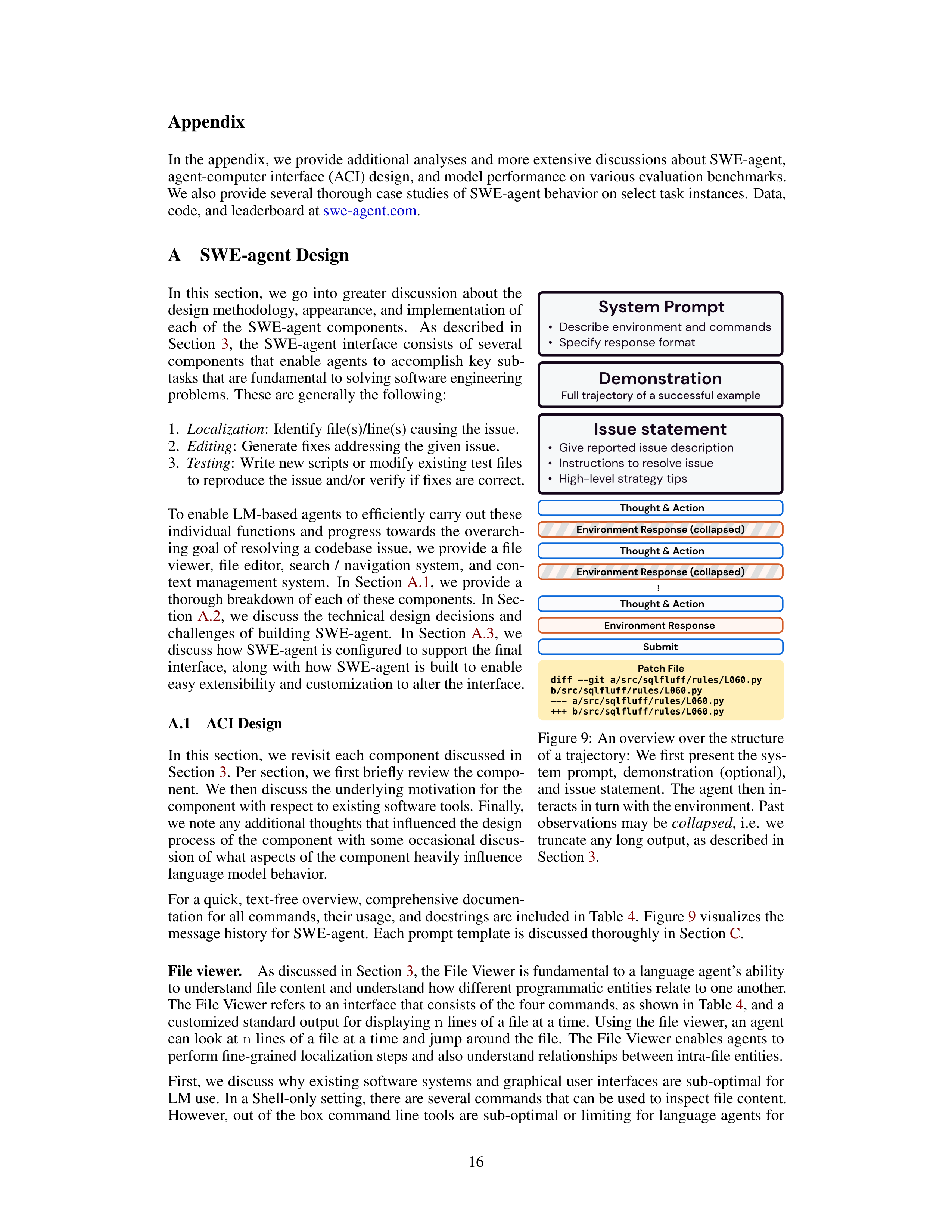
Appendix
In the appendix, we provide additional analyses and more extensive discussions about SWE-agent,
agent-computer interface (ACI) design, and model performance on various evaluation benchmarks.
We also provide several thorough case studies of SWE-agent behavior on select task instances.
Data,
code, and leaderboard at
swe-agent.com
.
A
SWE-agent Design
System Prompt
Describe environment and command
Specify response format
Give reported issue descriptio/
Instructions to resolve issu7
High-level strategy tips
Issue statement
Demonstration
Full trajectory of a successful example
Thought & Action
Environment Response (collapsed)
Environment Response (collapsed)
Thought & Action
Thought & Action
Environment Response
Submit
Patch File
diff --git a/src/sqlfluff/rules/L060.py
b/src/sqlfluff/rules/L060.py
--- a/src/sqlfluff/rules/L060.py
+++ b/src/sqlfluff/rules/L060.py
...
Figure 9:
An overview over the structure
of a trajectory:
We first present the sys-
tem
prompt,
demonstration
(optional),
and issue statement.
The agent then in-
teracts in turn with the environment. Past
observations may be
collapsed
, i.e.
we
truncate any long output, as described in
Section
3
.
In
this
section,
we
go
into
greater
discussion
about
the
design methodology, appearance, and implementation of
each
of
the
SWE-agent
components.
As
described
in
Section
3
,
the
SWE-agent
interface
consists
of
several
components
that
enable
agents
to
accomplish
key
sub-
tasks that are fundamental to solving software engineering
problems.
These are generally the following:
1.
Localization
:
Identify file(s)/line(s) causing the issue.
2.
Editing
:
Generate fixes addressing the given issue.
3.
Testing
:
Write new scripts or modify existing test files
to reproduce the issue and/or verify if fixes are correct.
To enable LM-based agents to efficiently carry out these
individual
functions
and
progress
towards
the
overarch-
ing goal of resolving a codebase issue, we provide a file
viewer,
file
editor,
search
/
navigation
system,
and
con-
text
management
system.
In
Section
A.1
,
we
provide
a
thorough breakdown of each of these components.
In Sec-
tion
A.2
,
we
discuss
the
technical
design
decisions
and
challenges
of
building
SWE-agent.
In
Section
A.3
,
we
discuss how SWE-agent is configured to support the final
interface,
along
with
how
SWE-agent
is
built
to
enable
easy extensibility and customization to alter the interface.
A.1
ACI Design
In
this
section,
we
revisit
each
component
discussed
in
Section
3
.
Per section, we first briefly review the compo-
nent.
We then discuss the underlying motivation for the
component with respect to existing software tools.
Finally,
we note any additional thoughts that influenced the design
process
of
the
component
with
some
occasional
discus-
sion of what aspects of the component heavily influence
language model behavior.
For a quick, text-free overview, comprehensive documen-
tation for all commands, their usage, and docstrings are included in Table
4
.
Figure
9
visualizes the
message history for SWE-agent.
Each prompt template is discussed thoroughly in Section
C
.
File viewer.
As discussed in Section
3
, the File Viewer is fundamental to a language agent’s ability
to understand file content and understand how different programmatic entities relate to one another.
The File Viewer refers to an interface that consists of the four commands, as shown in Table
4
, and a
customized standard output for displaying
n
lines of a file at a time.
Using the file viewer, an agent
can look at
n
lines of a file at a time and jump around the file.
The File Viewer enables agents to
perform fine-grained localization steps and also understand relationships between intra-file entities.
First, we discuss why existing software systems and graphical user interfaces are sub-optimal for
LM use.
In a Shell-only setting, there are several commands that can be used to inspect file content.
However,
out of the box command line tools are sub-optimal or limiting for language agents for
16
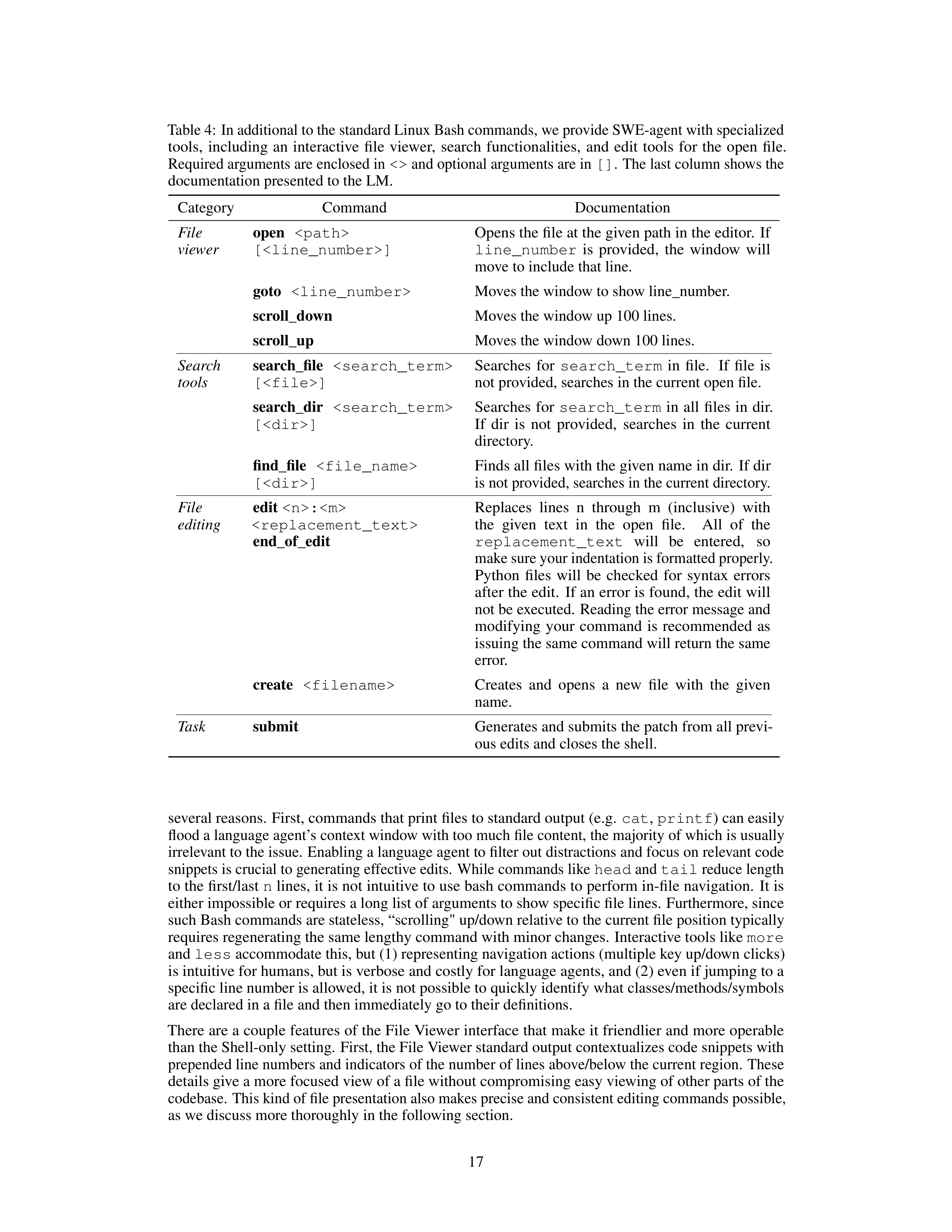
Table 4:
In additional to the standard Linux Bash commands, we provide SWE-agent with specialized
tools,
including
an
interactive
file
viewer,
search
functionalities,
and
edit
tools
for
the
open
file.
Required arguments are enclosed in
and optional arguments are in
[]
.
The last column shows the
documentation presented to the LM.
Category
Command
Documentation
File
viewer
open
[]
Opens the file at the given path in the editor.
If
line_number
is
provided,
the
window
will
move to include that line.
goto
Moves the window to show line_number.
scroll_down
Moves the window up 100 lines.
scroll_up
Moves the window down 100 lines.
Search
tools
search_file
[]
Searches
for
search_term
in
file.
If
file
is
not provided, searches in the current open file.
search_dir
[]
Searches
for
search_term
in
all
files
in
dir.
If
dir
is
not
provided,
searches
in
the
current
directory.
find_file
[]
Finds all files with the given name in dir.
If dir
is not provided, searches in the current directory.
File
editing
edit
:
end_of_edit
Replaces
lines
n
through
m
(inclusive)
with
the
given
text
in
the
open
file.
All
of
the
replacement_text
will
be
entered,
so
make sure your indentation is formatted properly.
Python
files
will
be
checked
for
syntax
errors
after the edit.
If an error is found, the edit will
not be executed.
Reading the error message and
modifying
your
command
is
recommended
as
issuing the same command will return the same
error.
create
Creates
and
opens
a
new
file
with
the
given
name.
Task
submit
Generates and submits the patch from all previ-
ous edits and closes the shell.
several reasons.
First, commands that print files to standard output (e.g.
cat
,
printf
) can easily
flood a language agent’s context window with too much file content, the majority of which is usually
irrelevant to the issue.
Enabling a language agent to filter out distractions and focus on relevant code
snippets is crucial to generating effective edits.
While commands like
head
and
tail
reduce length
to the first/last
n
lines, it is not intuitive to use bash commands to perform in-file navigation.
It is
either impossible or requires a long list of arguments to show specific file lines.
Furthermore, since
such Bash commands are stateless, “scrolling" up/down relative to the current file position typically
requires regenerating the same lengthy command with minor changes.
Interactive tools like
more
and
less
accommodate this, but (1) representing navigation actions (multiple key up/down clicks)
is intuitive for humans, but is verbose and costly for language agents, and (2) even if jumping to a
specific line number is allowed, it is not possible to quickly identify what classes/methods/symbols
are declared in a file and then immediately go to their definitions.
There are a couple features of the File Viewer interface that make it friendlier and more operable
than the Shell-only setting.
First, the File Viewer standard output contextualizes code snippets with
prepended line numbers and indicators of the number of lines above/below the current region.
These
details give a more focused view of a file without compromising easy viewing of other parts of the
codebase.
This kind of file presentation also makes precise and consistent editing commands possible,
as we discuss more thoroughly in the following section.
17
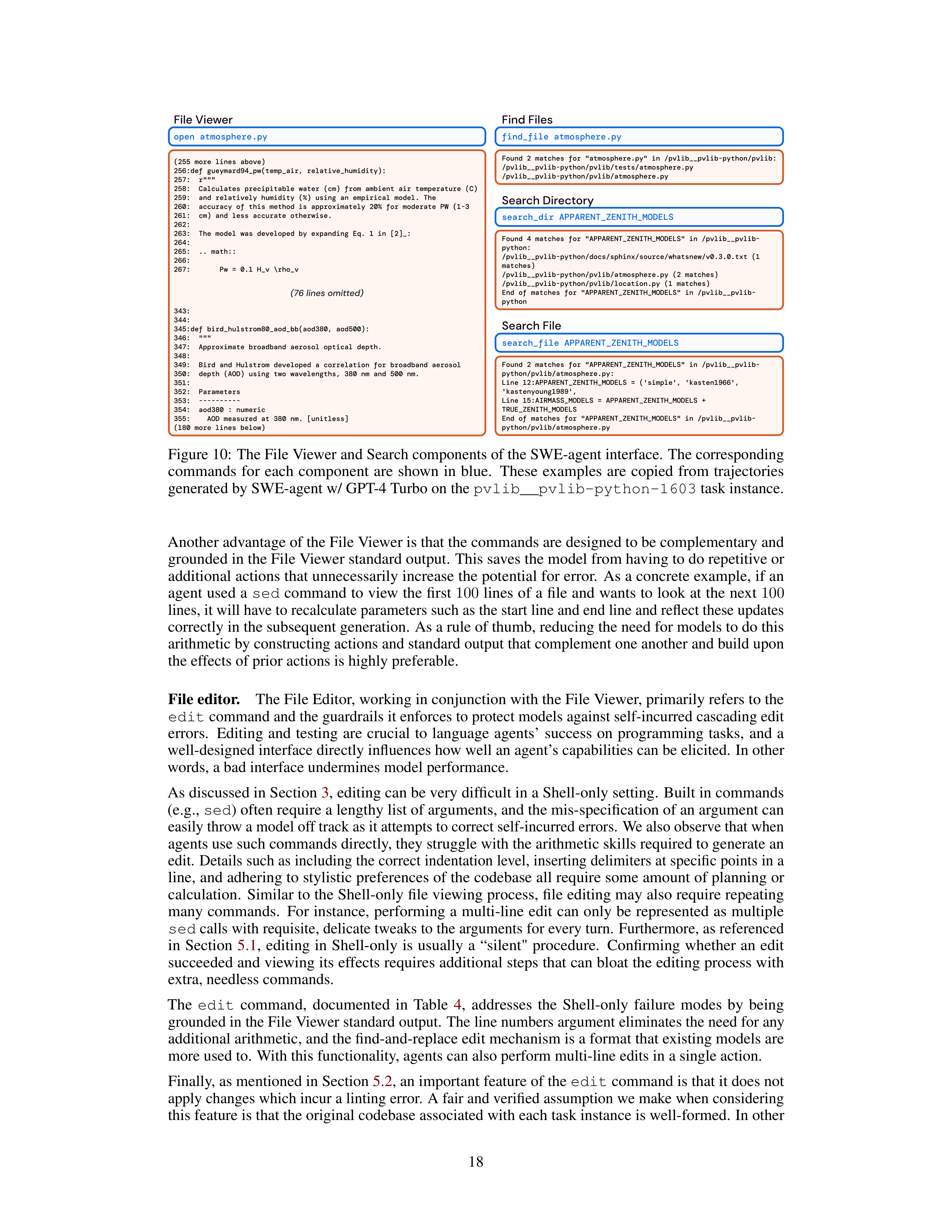
File Viewer
open atmosphere.py
Find Files
Found 2 matches for "atmosphere.py" in /pvlib__pvlib-python/pvlib:
/pvlib__pvlib-python/pvlib/tests/atmosphere.py
/pvlib__pvlib-python/pvlib/atmosphere.py
find_file atmosphere.py
Search Directory
Found 4 matches for "APPARENT_ZENITH_MODELS" in /pvlib__pvlib-
python:
/pvlib__pvlib-python/docs/sphinx/source/whatsnew/v0.3.0.txt (1
matches)
/pvlib__pvlib-python/pvlib/atmosphere.py (2 matches)
/pvlib__pvlib-python/pvlib/location.py (1 matches)
End of matches for "APPARENT_ZENITH_MODELS" in /pvlib__pvlib-
python
search_dir APPARENT_ZENITH_MODELS
Search File
Found 2 matches for "APPARENT_ZENITH_MODELS" in /pvlib__pvlib-
python/pvlib/atmosphere.py:
Line 12:APPARENT_ZENITH_MODELS = ('simple', 'kasten1966',
'kastenyoung1989',
Line 15:AIRMASS_MODELS = APPARENT_ZENITH_MODELS +
TRUE_ZENITH_MODELS
End of matches for "APPARENT_ZENITH_MODELS" in /pvlib__pvlib-
python/pvlib/atmosphere.py
search_file APPARENT_ZENITH_MODELS
(255 more lines above)
256:def gueymard94_pw(temp_air, relative_humidity):
257: r"""
258: Calculates precipitable water (cm) from ambient air temperature (C)
259: and relatively humidity (%) using an empirical model. The
260: accuracy of this method is approximately 20% for moderate PW (1-3
261: cm) and less accurate otherwise.
262:
263: The model was developed by expanding Eq. 1 in [2]_:
264:
265: .. math::
266:
267: Pw = 0.1 H_v \rho_v
343:
344:
345:def bird_hulstrom80_aod_bb(aod380, aod500):
346: """
347: Approximate broadband aerosol optical depth.
348:
349:
B
ird and Hulstrom developed a correlation for broadband aeroso
l
350: depth (AOD) using two wavelengths, 380 nm and 500 nm.
351:
352: Parameter
s
353: ---------
-
354: aod380 : numeri
c
355: AOD measured at 380 nm. [unitless
]
(180 more lines below)
(76 lines omitted)
Figure 10:
The File Viewer and Search components of the SWE-agent interface.
The corresponding
commands
for
each
component
are
shown
in
blue.
These
examples
are
copied
from
trajectories
generated by SWE-agent w/ GPT-4 Turbo on the
pvlib__pvlib-python-1603
task instance.
Another advantage of the File Viewer is that the commands are designed to be complementary and
grounded in the File Viewer standard output.
This saves the model from having to do repetitive or
additional actions that unnecessarily increase the potential for error.
As a concrete example, if an
agent used a
sed
command to view the first
100
lines of a file and wants to look at the next
100
lines, it will have to recalculate parameters such as the start line and end line and reflect these updates
correctly in the subsequent generation.
As a rule of thumb, reducing the need for models to do this
arithmetic by constructing actions and standard output that complement one another and build upon
the effects of prior actions is highly preferable.
File editor.
The File Editor, working in conjunction with the File Viewer, primarily refers to the
edit
command and the guardrails it enforces to protect models against self-incurred cascading edit
errors.
Editing
and
testing
are
crucial
to
language
agents’
success
on
programming
tasks,
and
a
well-designed interface directly influences how well an agent’s capabilities can be elicited.
In other
words, a bad interface undermines model performance.
As discussed in Section
3
, editing can be very difficult in a Shell-only setting.
Built in commands
(e.g.,
sed
) often require a lengthy list of arguments, and the mis-specification of an argument can
easily throw a model off track as it attempts to correct self-incurred errors.
We also observe that when
agents use such commands directly, they struggle with the arithmetic skills required to generate an
edit.
Details such as including the correct indentation level, inserting delimiters at specific points in a
line, and adhering to stylistic preferences of the codebase all require some amount of planning or
calculation.
Similar to the Shell-only file viewing process, file editing may also require repeating
many commands.
For instance,
performing a multi-line edit can only be represented as multiple
sed
calls with requisite, delicate tweaks to the arguments for every turn.
Furthermore, as referenced
in
Section
5.1
,
editing
in
Shell-only
is
usually
a
“silent"
procedure.
Confirming
whether
an
edit
succeeded and viewing its effects requires additional steps that can bloat the editing process with
extra, needless commands.
The
edit
command,
documented
in
Table
4
,
addresses
the
Shell-only
failure
modes
by
being
grounded in the File Viewer standard output.
The line numbers argument eliminates the need for any
additional arithmetic, and the find-and-replace edit mechanism is a format that existing models are
more used to.
With this functionality, agents can also perform multi-line edits in a single action.
Finally, as mentioned in Section
5.2
, an important feature of the
edit
command is that it does not
apply changes which incur a linting error.
A fair and verified assumption we make when considering
this feature is that the original codebase associated with each task instance is well-formed.
In other
18
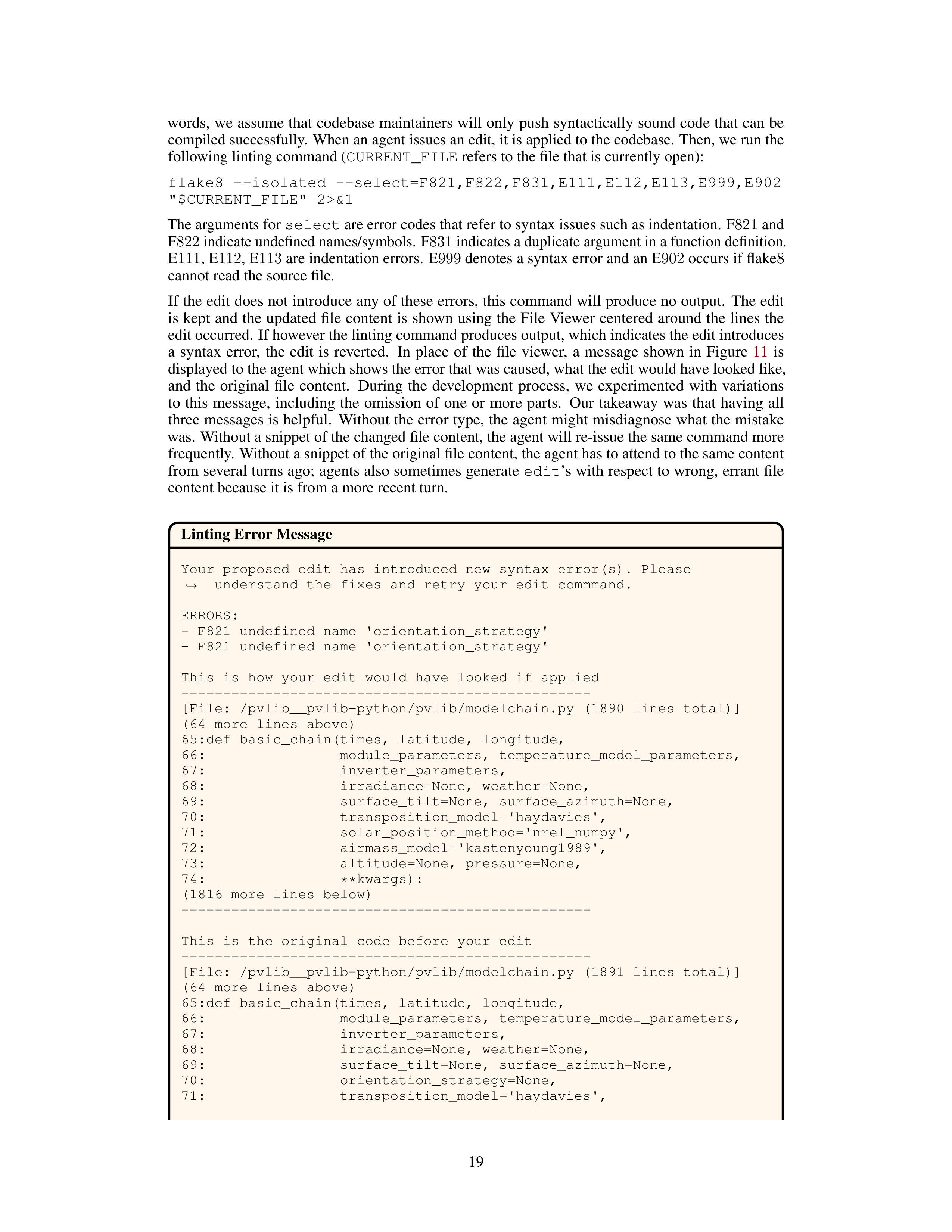
words, we assume that codebase maintainers will only push syntactically sound code that can be
compiled successfully.
When an agent issues an edit, it is applied to the codebase.
Then, we run the
following linting command (
CURRENT_FILE
refers to the file that is currently open):
flake8
--isolated
--select=F821,F822,F831,E111,E112,E113,E999,E902
"$CURRENT_FILE"
2>&1
The arguments for
select
are error codes that refer to syntax issues such as indentation.
F
821
and
F
822
indicate undefined names/symbols.
F
831
indicates a duplicate argument in a function definition.
E
111
, E
112
, E
113
are indentation errors.
E
999
denotes a syntax error and an E
902
occurs if flake
8
cannot read the source file.
If the edit does not introduce any of these errors, this command will produce no output.
The edit
is kept and the updated file content is shown using the File Viewer centered around the lines the
edit occurred.
If however the linting command produces output, which indicates the edit introduces
a
syntax
error,
the
edit
is
reverted.
In
place
of
the
file
viewer,
a
message
shown
in
Figure
11
is
displayed to the agent which shows the error that was caused, what the edit would have looked like,
and
the
original
file
content.
During
the
development
process,
we
experimented
with
variations
to
this
message,
including
the
omission
of
one
or
more
parts.
Our
takeaway
was
that
having
all
three messages is helpful.
Without the error type, the agent might misdiagnose what the mistake
was.
Without a snippet of the changed file content, the agent will re-issue the same command more
frequently.
Without a snippet of the original file content, the agent has to attend to the same content
from several turns ago; agents also sometimes generate
edit
’s with respect to wrong, errant file
content because it is from a more recent turn.
Linting Error Message
Your
proposed
edit
has
introduced
new
syntax
error(s).
Please
understand
the
fixes
and
retry
your
edit
commmand.
,
→
ERRORS:
-
F821
undefined
name
'orientation_strategy'
-
F821
undefined
name
'orientation_strategy'
This
is
how
your
edit
would
have
looked
if
applied
-------------------------------------------------
[File:
/pvlib__pvlib-python/pvlib/modelchain.py
(1890
lines
total)]
(64
more
lines
above)
65:def
basic_chain(times,
latitude,
longitude,
66:
module_parameters,
temperature_model_parameters,
67:
inverter_parameters,
68:
irradiance=None,
weather=None,
69:
surface_tilt=None,
surface_azimuth=None,
70:
transposition_model='haydavies',
71:
solar_position_method='nrel_numpy',
72:
airmass_model='kastenyoung1989',
73:
altitude=None,
pressure=None,
74:
**
kwargs):
(1816
more
lines
below)
-------------------------------------------------
This
is
the
original
code
before
your
edit
-------------------------------------------------
[File:
/pvlib__pvlib-python/pvlib/modelchain.py
(1891
lines
total)]
(64
more
lines
above)
65:def
basic_chain(times,
latitude,
longitude,
66:
module_parameters,
temperature_model_parameters,
67:
inverter_parameters,
68:
irradiance=None,
weather=None,
69:
surface_tilt=None,
surface_azimuth=None,
70:
orientation_strategy=None,
71:
transposition_model='haydavies',
19
72:
solar_position_method='nrel_numpy',
73:
airmass_model='kastenyoung1989',
74:
altitude=None,
pressure=None,
75:
**
kwargs):
(1816
more
lines
below)
-------------------------------------------------
Your
changes
have
NOT
been
applied.
Please
fix
your
edit
command
and
try
again.
,
→
You
either
need
to
1)
Specify
the
correct
start/end
line
arguments
or
2)
Correct
your
edit
code.
,
→
DO
NOT
re-run
the
same
failed
edit
command.
Running
it
again
will
lead
to
the
same
error.
,
→
Figure 11:
A linting error message.
This is emitted if a model generates an
edit
command that
introduces a syntax error into the codebase.
The error message shows the before and after of the
proposed edit along with what error messages were thrown.
The problem with this edit is that it omits
the
orientation_strategy
field in its edit of the
basic_chain
method definition.
The
editing
guardrail
has
a
drawback.
To
a
certain
degree,
it
forces
some
edits
to
be
done
in
a
particular
order.
For
instance,
in
Figure
11
,
if
the
model’s
intention
was
in
fact
to
remove
the
orientation_strategy
argument, due to the SWE-agent editing guardrails, it would have to
remove all references from the function implementation either at the same time in a single action,
or before removing it from the method header if split into two separate actions.
For this particular
scenario, the latter is necessary because the file snippet is not large enough to show the entirety of the
basic_chain
implementation.
This example highlights the trade-offs between the flexibility and
guardrails of a command.
Deciding whether to introduce a guardrail depends on how well it reduces
common model errors compared to whether such restrictions hamper models’ preferred workflows.
Search & navigation.
The File Viewer and File Editor together allow agents to make edits, write
tests, and perform localization at a file level.
The Search & navigation module complements these
capabilities by giving agents the tools to perform keyword-driven localization at both a directory
level and file level.
As discussed, the main struggles with using built in Shell-only search commands such as
grep
and
find
are
(1)
given
a
general
enough
term,
they
are
prone
to
producing
too
many
search
results
that
can
consume
an
inordinate
amount
of
space
in
the
context
window,
and
(2)
they
are
highly
configurable, making search result outcomes potentially inconsistent in appearance.
The alternative
to these search utilities is to navigate the file system directly with
cd
and look at what’s in each
folder with variations of
ls
and
cat
; this kind of approach can take a large number of turns without
yielding any particularly useful information.
Figure
10
visualizes the standard output for the three different search commands.
The
search_dir
and
find_file
helps agents perform directory level searches.
The reason we provide two com-
mands is due to the kinds of keywords that are present in an issue description (e.g., class references,
file names).
The
search_file
command allows agents to search for terms at a file-level, which is
helpful for efficient fine-grained localization.
Taking a step back, the goal of these search commands
is to make it easy for the agent to utilize any signal (e.g., line number, stack trace, natural language)
about the root cause of an issue that may be present in the issue description or codebase.
Once again,
simpler
command
usage
patterns
with
consistent
output
formats
are
easier
for
agents
to
use
and
reduces the chance for mistakes or irrelevant outputs.
The main guardrail in place for all three search commands is curbing the number of search results
to
50
or fewer.
The downside is that reporting an error forces the model to generate another search
query which can be an expensive operation.
This reflects a trade-off between keeping observations
concise and making additional calls to the base LM.
A.2
Implementation
The SWE-agent codebase is generally composed of three modules:
the environment, the agent, and
the logging mechanism for saving task episodes into trajectories and patch generations.
20
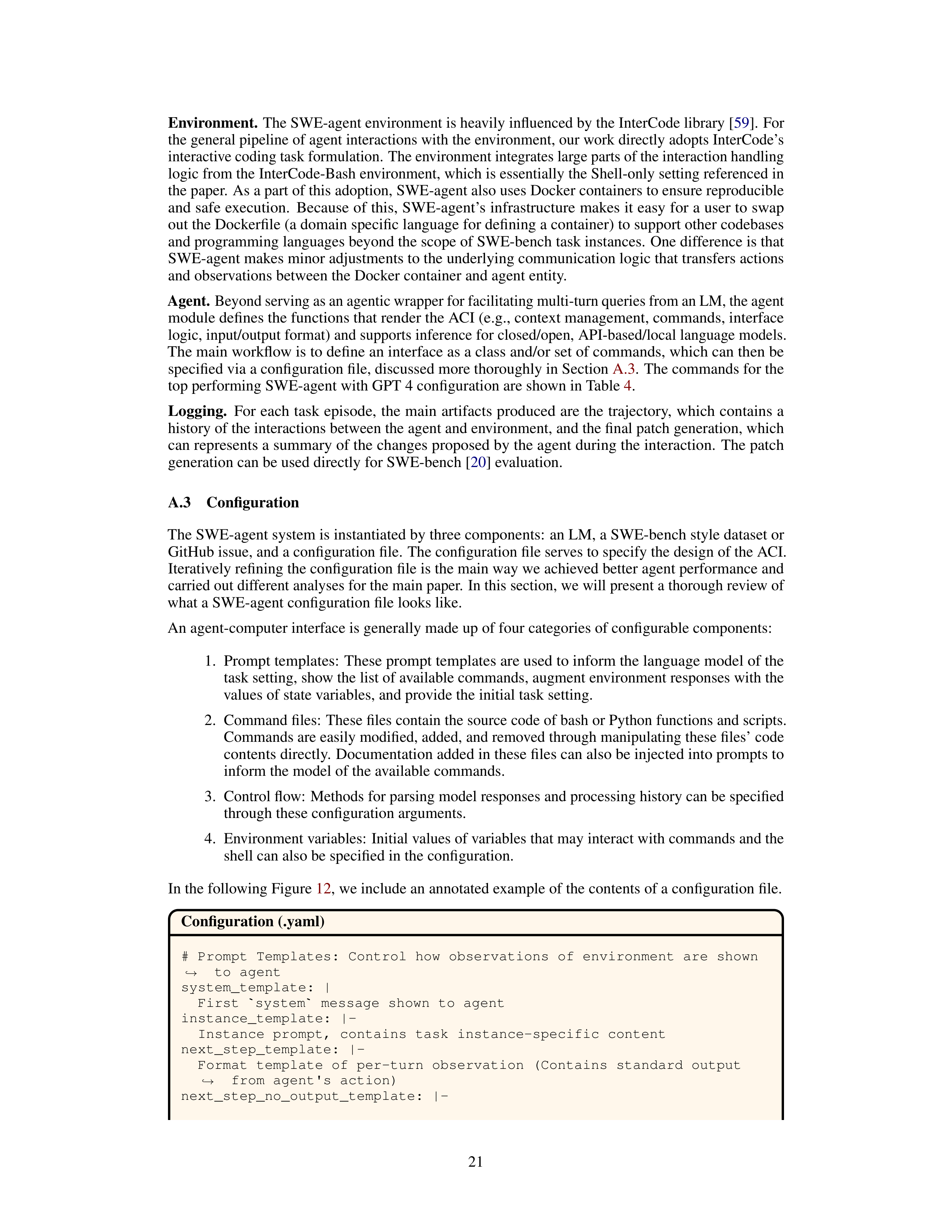
Environment.
The SWE-agent environment is heavily influenced by the InterCode library [
59
].
For
the general pipeline of agent interactions with the environment, our work directly adopts InterCode’s
interactive coding task formulation.
The environment integrates large parts of the interaction handling
logic from the InterCode-Bash environment, which is essentially the Shell-only setting referenced in
the paper.
As a part of this adoption, SWE-agent also uses Docker containers to ensure reproducible
and safe execution.
Because of this, SWE-agent’s infrastructure makes it easy for a user to swap
out the Dockerfile (a domain specific language for defining a container) to support other codebases
and programming languages beyond the scope of SWE-bench task instances.
One difference is that
SWE-agent makes minor adjustments to the underlying communication logic that transfers actions
and observations between the Docker container and agent entity.
Agent.
Beyond serving as an agentic wrapper for facilitating multi-turn queries from an LM, the agent
module defines the functions that render the ACI (e.g., context management, commands, interface
logic, input/output format) and supports inference for closed/open, API-based/local language models.
The main workflow is to define an interface as a class and/or set of commands, which can then be
specified via a configuration file, discussed more thoroughly in Section
A.3
.
The commands for the
top performing SWE-agent with GPT 4 configuration are shown in Table
4
.
Logging.
For each task episode,
the main artifacts produced are the trajectory,
which contains a
history of the interactions between the agent and environment, and the final patch generation, which
can represents a summary of the changes proposed by the agent during the interaction.
The patch
generation can be used directly for SWE-bench [
20
] evaluation.
A.3
Configuration
The SWE-agent system is instantiated by three components:
an LM, a SWE-bench style dataset or
GitHub issue, and a configuration file.
The configuration file serves to specify the design of the ACI.
Iteratively refining the configuration file is the main way we achieved better agent performance and
carried out different analyses for the main paper.
In this section, we will present a thorough review of
what a SWE-agent configuration file looks like.
An agent-computer interface is generally made up of four categories of configurable components:
1.
Prompt templates:
These prompt templates are used to inform the language model of the
task setting, show the list of available commands, augment environment responses with the
values of state variables, and provide the initial task setting.
2.
Command files:
These files contain the source code of bash or Python functions and scripts.
Commands are easily modified, added, and removed through manipulating these files’ code
contents directly.
Documentation added in these files can also be injected into prompts to
inform the model of the available commands.
3.
Control flow:
Methods for parsing model responses and processing history can be specified
through these configuration arguments.
4.
Environment variables:
Initial values of variables that may interact with commands and the
shell can also be specified in the configuration.
In the following Figure
12
, we include an annotated example of the contents of a configuration file.
Configuration (.yaml)
#
Prompt
Templates:
Control
how
observations
of
environment
are
shown
to
agent
,
→
system_template:
|
First
`
system
`
message
shown
to
agent
instance_template:
|-
Instance
prompt,
contains
task
instance-specific
content
next_step_template:
|-
Format
template
of
per-turn
observation
(Contains
standard
output
from
agent's
action)
,
→
next_step_no_output_template:
|-
21
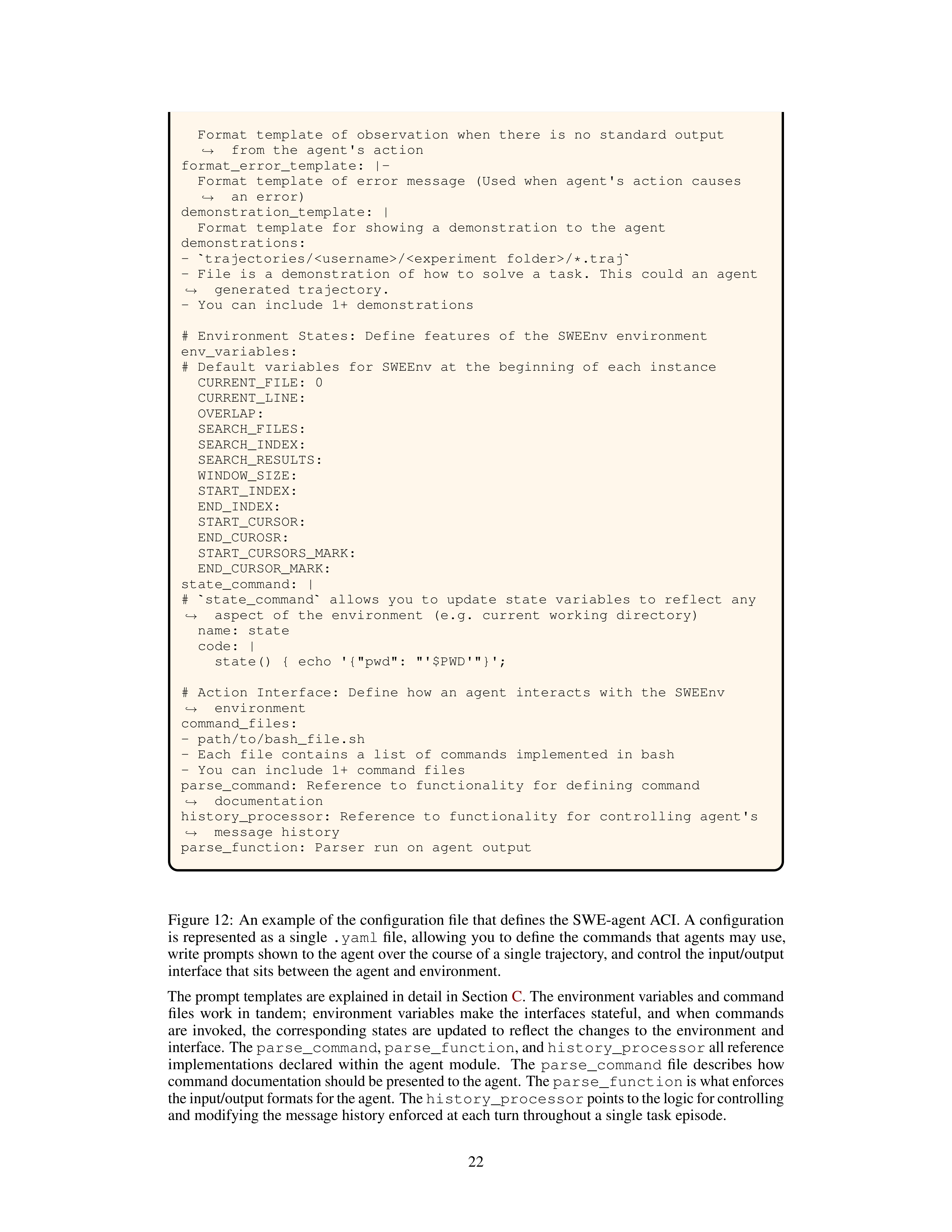
Format
template
of
observation
when
there
is
no
standard
output
from
the
agent's
action
,
→
format_error_template:
|-
Format
template
of
error
message
(Used
when
agent's
action
causes
an
error)
,
→
demonstration_template:
|
Format
template
for
showing
a
demonstration
to
the
agent
demonstrations:
-
`
trajectories//<experiment
folder>/*.traj
`
-
File
is
a
demonstration
of
how
to
solve
a
task.
This
could
an
agent
generated
trajectory.
,
→
-
You
can
include
1+
demonstrations
#
Environment
States:
Define
features
of
the
SWEEnv
environment
env_variables:
#
Default
variables
for
SWEEnv
at
the
beginning
of
each
instance
CURRENT_FILE:
0
CURRENT_LINE:
OVERLAP:
SEARCH_FILES:
SEARCH_INDEX:
SEARCH_RESULTS:
WINDOW_SIZE:
START_INDEX:
END_INDEX:
START_CURSOR:
END_CUROSR:
START_CURSORS_MARK:
END_CURSOR_MARK:
state_command:
|
#
`
state_command
`
allows
you
to
update
state
variables
to
reflect
any
aspect
of
the
environment
(e.g.
current
working
directory)
,
→
name:
state
code:
|
state()
{
echo
'{"pwd":
"'$PWD'"}';
#
Action
Interface:
Define
how
an
agent
interacts
with
the
SWEEnv
environment
,
→
command_files:
-
path/to/bash_file.sh
-
Each
file
contains
a
list
of
commands
implemented
in
bash
-
You
can
include
1+
command
files
parse_command:
Reference
to
functionality
for
defining
command
documentation
,
→
history_processor:
Reference
to
functionality
for
controlling
agent's
message
history
,
→
parse_function:
Parser
run
on
agent
output
Figure 12:
An example of the configuration file that defines the SWE-agent ACI. A configuration
is represented as a single
.yaml
file, allowing you to define the commands that agents may use,
write prompts shown to the agent over the course of a single trajectory, and control the input/output
interface that sits between the agent and environment.
The prompt templates are explained in detail in Section
C
. The environment variables and command
files
work
in
tandem;
environment
variables
make
the
interfaces
stateful,
and
when
commands
are
invoked,
the
corresponding
states
are
updated
to
reflect
the
changes
to
the
environment
and
interface.
The
parse_command
,
parse_function
, and
history_processor
all reference
implementations
declared
within
the
agent
module.
The
parse_command
file
describes
how
command documentation should be presented to the agent. The
parse_function
is what enforces
the input/output formats for the agent. The
history_processor
points to the logic for controlling
and modifying the message history enforced at each turn throughout a single task episode.
22
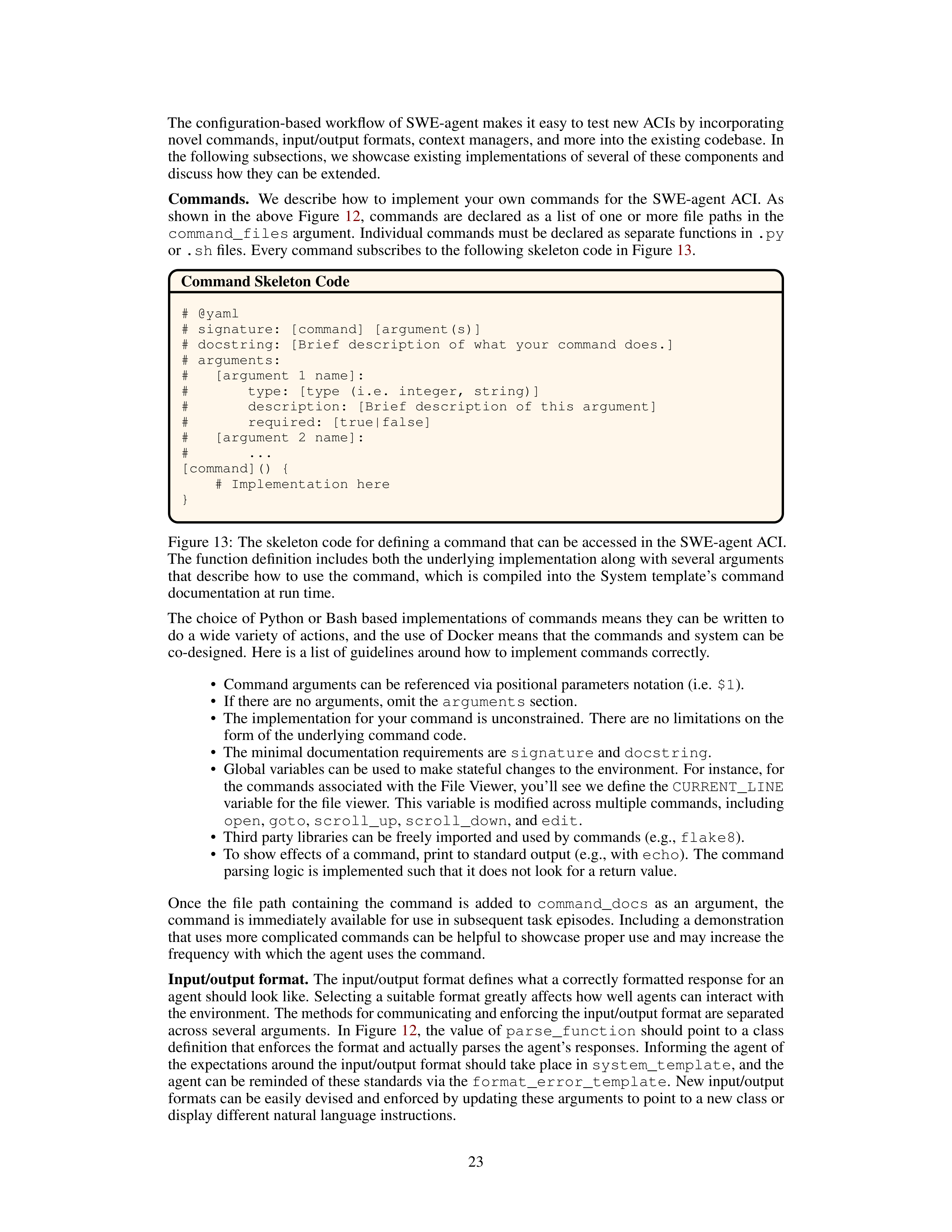
The configuration-based workflow of SWE-agent makes it easy to test new ACIs by incorporating
novel commands, input/output formats, context managers, and more into the existing codebase.
In
the following subsections, we showcase existing implementations of several of these components and
discuss how they can be extended.
Commands.
We
describe
how
to
implement
your
own
commands
for
the
SWE-agent
ACI.
As
shown
in
the
above
Figure
12
,
commands
are
declared
as
a
list
of
one
or
more
file
paths
in
the
command_files
argument.
Individual commands must be declared as separate functions in
.py
or
.sh
files.
Every command subscribes to the following skeleton code in Figure
13
.
Command Skeleton Code
#
@yaml
#
signature:
[command]
[argument(s)]
#
docstring:
[Brief
description
of
what
your
command
does.]
#
arguments:
#
[argument
1
name]:
#
type:
[type
(i.e.
integer,
string)]
#
description:
[Brief
description
of
this
argument]
#
required:
[true|false]
#
[argument
2
name]:
#
...
[command]()
{
#
Implementation
here
}
Figure 13:
The skeleton code for defining a command that can be accessed in the SWE-agent ACI.
The function definition includes both the underlying implementation along with several arguments
that
describe
how
to
use
the
command,
which
is
compiled
into
the
System
template’s
command
documentation at run time.
The choice of Python or Bash based implementations of commands means they can be written to
do a wide variety of actions, and the use of Docker means that the commands and system can be
co-designed.
Here is a list of guidelines around how to implement commands correctly.
•
Command arguments can be referenced via positional parameters notation (i.e.
$1
).
•
If there are no arguments, omit the
arguments
section.
•
The implementation for your command is unconstrained.
There are no limitations on the
form of the underlying command code.
•
The minimal documentation requirements are
signature
and
docstring
.
•
Global variables can be used to make stateful changes to the environment.
For instance, for
the commands associated with the File Viewer, you’ll see we define the
CURRENT_LINE
variable for the file viewer.
This variable is modified across multiple commands, including
open
,
goto
,
scroll_up
,
scroll_down
, and
edit
.
•
Third party libraries can be freely imported and used by commands (e.g.,
flake8
).
•
To show effects of a command, print to standard output (e.g., with
echo
).
The command
parsing logic is implemented such that it does not look for a return value.
Once
the
file
path
containing
the
command
is
added
to
command_docs
as
an
argument,
the
command is immediately available for use in subsequent task episodes.
Including a demonstration
that uses more complicated commands can be helpful to showcase proper use and may increase the
frequency with which the agent uses the command.
Input/output format.
The input/output format defines what a correctly formatted response for an
agent should look like.
Selecting a suitable format greatly affects how well agents can interact with
the environment.
The methods for communicating and enforcing the input/output format are separated
across several arguments.
In Figure
12
,
the value of
parse_function
should point to a class
definition that enforces the format and actually parses the agent’s responses.
Informing the agent of
the expectations around the input/output format should take place in
system_template
, and the
agent can be reminded of these standards via the
format_error_template
.
New input/output
formats can be easily devised and enforced by updating these arguments to point to a new class or
display different natural language instructions.
23
Context management.
Context management is implemented as a class within the agent module.
The
history_processor
argument allows one to specify which context manager to use via the
configuration file.
Underneath the hood, the context manager is invoked per turn of the interactive
loop.
From
the
entire
recorded
history
of
the
agent’s
interactions
so
far,
the
context
manager
constructs the literal history to be fed to the agent to invoke the next response.
The general design of
history_processor
s allows for easy experimentation towards more sophisticated strategies for
managing history.
24
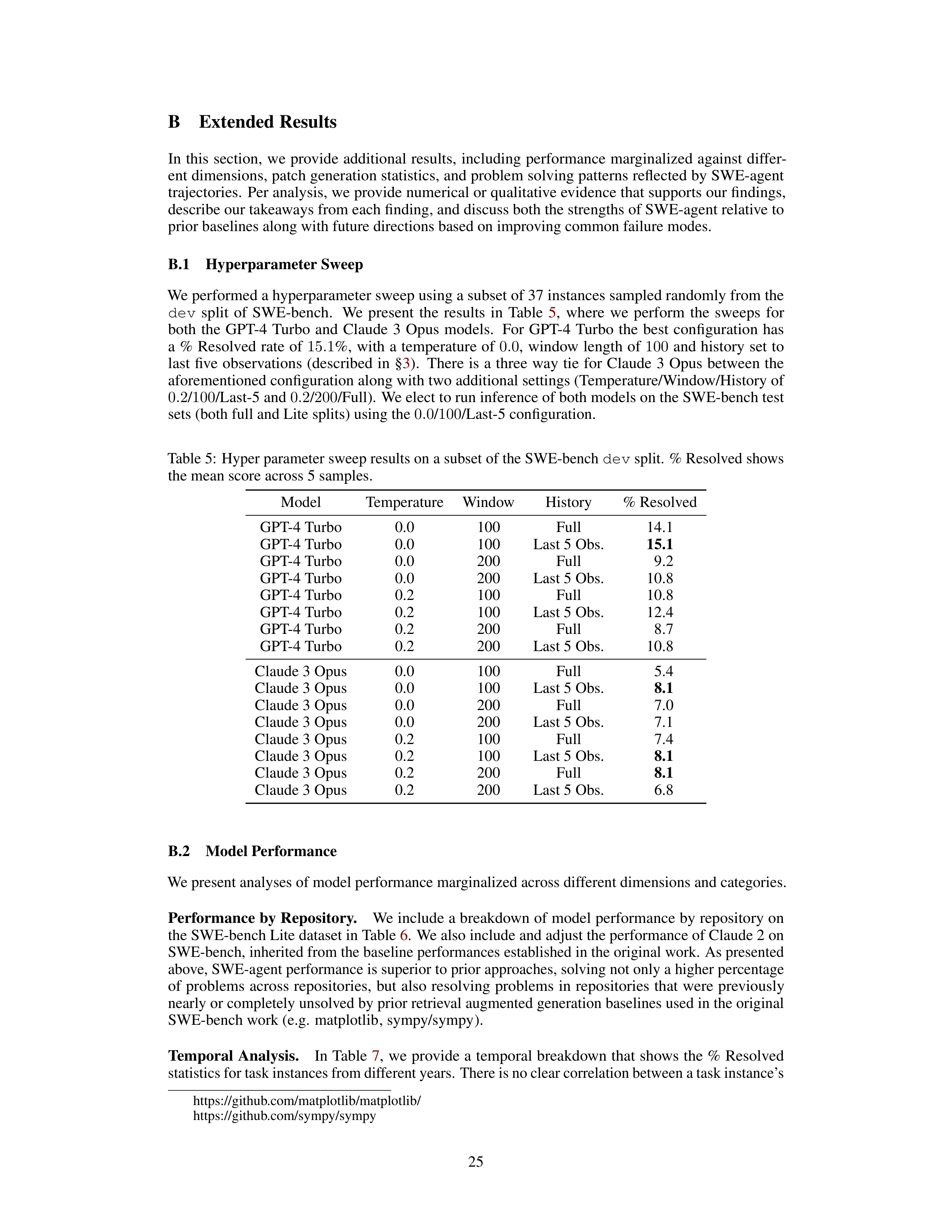
B
Extended Results
In
this
section,
we
provide
additional
results,
including
performance
marginalized
against
differ-
ent dimensions, patch generation statistics, and problem solving patterns reflected by SWE-agent
trajectories.
Per analysis, we provide numerical or qualitative evidence that supports our findings,
describe our takeaways from each finding, and discuss both the strengths of SWE-agent relative to
prior baselines along with future directions based on improving common failure modes.
B.1
Hyperparameter Sweep
We performed a hyperparameter sweep using a subset of 37 instances sampled randomly from the
dev
split
of
SWE-bench.
We
present
the
results
in
Table
5
,
where
we
perform
the
sweeps
for
both
the
GPT-4
Turbo
and
Claude
3
Opus
models.
For
GPT-4
Turbo
the
best
configuration
has
a
% Resolved
rate of
15
.
1
%,
with a
temperature of
0
.
0
,
window
length of
100
and history
set to
last
five
observations
(described
in
§
3
).
There
is
a
three
way
tie
for
Claude
3
Opus
between
the
aforementioned configuration along with two additional settings (Temperature/Window/History of
0
.
2
/
100
/Last-5 and
0
.
2
/
200
/Full).
We elect to run inference of both models on the SWE-bench test
sets (both full and Lite splits) using the
0
.
0
/
100
/Last-5 configuration.
Table 5:
Hyper parameter sweep results on a subset of the SWE-bench
dev
split.
% Resolved shows
the mean score across 5 samples.
Model
Temperature
Window
History
% Resolved
GPT-4 Turbo
0.0
100
Full
14.1
GPT-4 Turbo
0.0
100
Last 5 Obs.
15.1
GPT-4 Turbo
0.0
200
Full
9.2
GPT-4 Turbo
0.0
200
Last 5 Obs.
10.8
GPT-4 Turbo
0.2
100
Full
10.8
GPT-4 Turbo
0.2
100
Last 5 Obs.
12.4
GPT-4 Turbo
0.2
200
Full
8.7
GPT-4 Turbo
0.2
200
Last 5 Obs.
10.8
Claude 3 Opus
0.0
100
Full
5.4
Claude 3 Opus
0.0
100
Last 5 Obs.
8.1
Claude 3 Opus
0.0
200
Full
7.0
Claude 3 Opus
0.0
200
Last 5 Obs.
7.1
Claude 3 Opus
0.2
100
Full
7.4
Claude 3 Opus
0.2
100
Last 5 Obs.
8.1
Claude 3 Opus
0.2
200
Full
8.1
Claude 3 Opus
0.2
200
Last 5 Obs.
6.8
B.2
Model Performance
We present analyses of model performance marginalized across different dimensions and categories.
Performance by Repository.
We include a breakdown of model performance by repository on
the SWE-bench Lite dataset in Table
6
.
We also include and adjust the performance of Claude 2 on
SWE-bench, inherited from the baseline performances established in the original work.
As presented
above, SWE-agent performance is superior to prior approaches, solving not only a higher percentage
of
problems
across
repositories,
but
also
resolving
problems
in
repositories
that
were
previously
nearly or completely unsolved by prior retrieval augmented generation baselines used in the original
SWE-bench work (e.g.
matplotlib, sympy/sympy).
Temporal Analysis.
In Table
7
,
we provide a temporal breakdown that shows the % Resolved
statistics for task instances from different years. There is no clear correlation between a task instance’s
https://github.com/matplotlib/matplotlib/
https://github.com/sympy/sympy
25
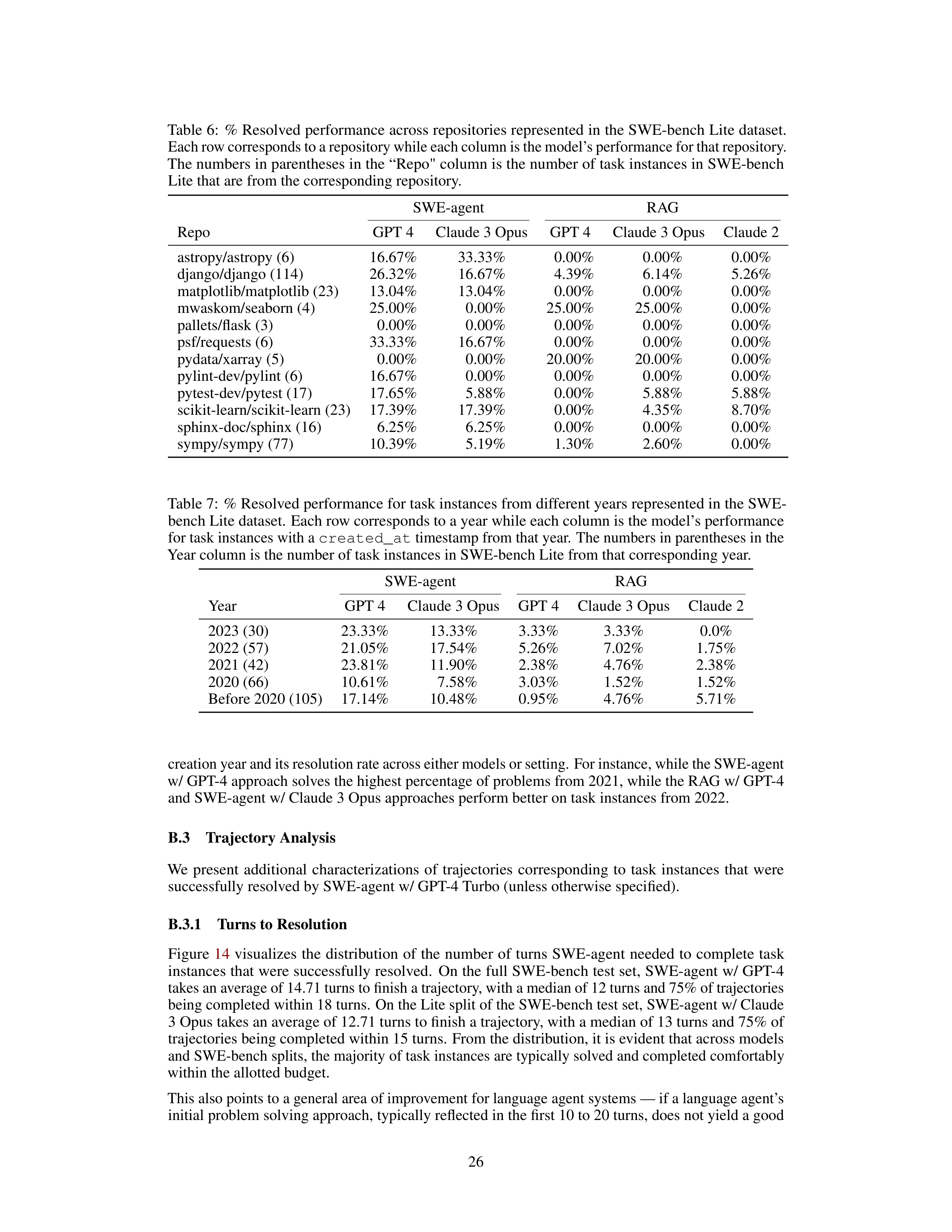
Table 6:
% Resolved performance across repositories represented in the SWE-bench Lite dataset.
Each row corresponds to a repository while each column is the model’s performance for that repository.
The numbers in parentheses in the “Repo" column is the number of task instances in SWE-bench
Lite that are from the corresponding repository.
SWE-agent
RAG
Repo
GPT 4
Claude 3 Opus
GPT 4
Claude 3 Opus
Claude 2
astropy/astropy (6)
16.67%
33.33%
0.00%
0.00%
0.00%
django/django (114)
26.32%
16.67%
4.39%
6.14%
5.26%
matplotlib/matplotlib (23)
13.04%
13.04%
0.00%
0.00%
0.00%
mwaskom/seaborn (4)
25.00%
0.00%
25.00%
25.00%
0.00%
pallets/flask (3)
0.00%
0.00%
0.00%
0.00%
0.00%
psf/requests (6)
33.33%
16.67%
0.00%
0.00%
0.00%
pydata/xarray (5)
0.00%
0.00%
20.00%
20.00%
0.00%
pylint-dev/pylint (6)
16.67%
0.00%
0.00%
0.00%
0.00%
pytest-dev/pytest (17)
17.65%
5.88%
0.00%
5.88%
5.88%
scikit-learn/scikit-learn (23)
17.39%
17.39%
0.00%
4.35%
8.70%
sphinx-doc/sphinx (16)
6.25%
6.25%
0.00%
0.00%
0.00%
sympy/sympy (77)
10.39%
5.19%
1.30%
2.60%
0.00%
Table 7:
% Resolved performance for task instances from different years represented in the SWE-
bench Lite dataset.
Each row corresponds to a year while each column is the model’s performance
for task instances with a
created_at
timestamp from that year.
The numbers in parentheses in the
Year column is the number of task instances in SWE-bench Lite from that corresponding year.
SWE-agent
RAG
Year
GPT 4
Claude 3 Opus
GPT 4
Claude 3 Opus
Claude 2
2023 (30)
23.33%
13.33%
3.33%
3.33%
0.0%
2022 (57)
21.05%
17.54%
5.26%
7.02%
1.75%
2021 (42)
23.81%
11.90%
2.38%
4.76%
2.38%
2020 (66)
10.61%
7.58%
3.03%
1.52%
1.52%
Before 2020 (105)
17.14%
10.48%
0.95%
4.76%
5.71%
creation year and its resolution rate across either models or setting.
For instance, while the SWE-agent
w/ GPT-4 approach solves the highest percentage of problems from 2021, while the RAG w/ GPT-4
and SWE-agent w/ Claude 3 Opus approaches perform better on task instances from 2022.
B.3
Trajectory Analysis
We
present
additional
characterizations
of
trajectories
corresponding
to
task
instances
that
were
successfully resolved by SWE-agent w/ GPT-4 Turbo (unless otherwise specified).
B.3.1
Turns to Resolution
Figure
14
visualizes
the
distribution
of
the
number
of
turns
SWE-agent
needed
to
complete
task
instances that were successfully resolved.
On the full SWE-bench test set, SWE-agent w/ GPT-4
takes an average of 14.71 turns to finish a trajectory, with a median of 12 turns and 75% of trajectories
being completed within 18 turns.
On the Lite split of the SWE-bench test set, SWE-agent w/ Claude
3 Opus takes an average of 12.71 turns to finish a trajectory, with a median of 13 turns and 75% of
trajectories being completed within 15 turns.
From the distribution, it is evident that across models
and SWE-bench splits, the majority of task instances are typically solved and completed comfortably
within the allotted budget.
This also points to a general area of improvement for language agent systems — if a language agent’s
initial problem solving approach, typically reflected in the first 10 to 20 turns, does not yield a good
26
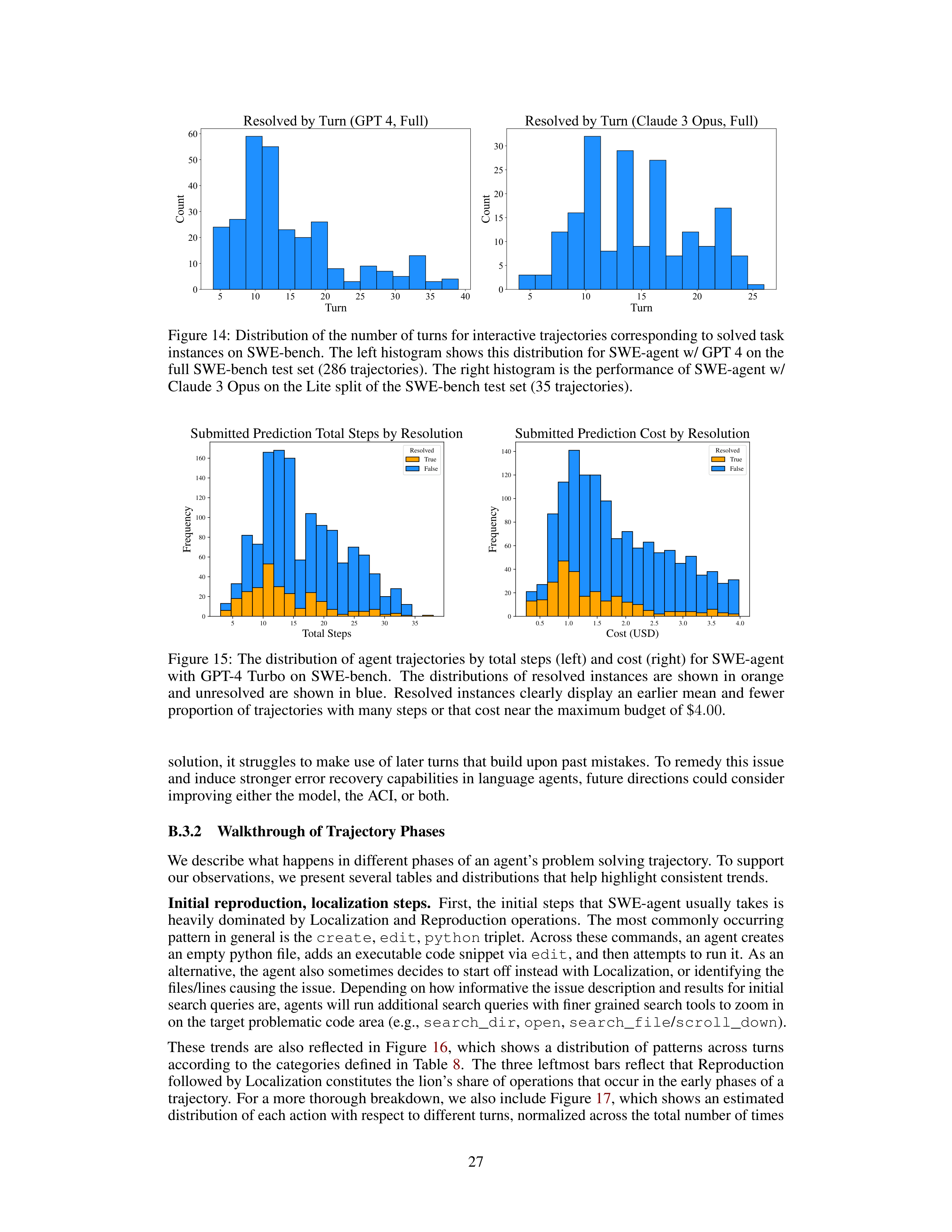
5
10
15
20
25
30
35
40
Turn
0
10
20
30
40
50
60
Count
Resolved by Turn (GPT 4, Full)
5
10
15
20
25
Turn
0
5
10
15
20
25
30
Count
Resolved by Turn (Claude 3 Opus, Full)
Figure 14:
Distribution of the number of turns for interactive trajectories corresponding to solved task
instances on SWE-bench.
The left histogram shows this distribution for SWE-agent w/ GPT 4 on the
full SWE-bench test set (286 trajectories).
The right histogram is the performance of SWE-agent w/
Claude 3 Opus on the Lite split of the SWE-bench test set (35 trajectories).
5
10
15
20
25
30
35
Total Steps
0
20
40
60
80
100
120
140
160
Frequency
Submitted Prediction Total Steps by Resolution
Resolved
True
False
0
.
5
1
.
0
1
.
5
2
.
0
2
.
5
3
.
0
3
.
5
4
.
0
Cost (USD)
0
20
40
60
80
100
120
140
Frequency
Submitted Prediction Cost by Resolution
Resolved
True
False
Figure 15:
The distribution of agent trajectories by total steps (left) and cost (right) for SWE-agent
with
GPT-4
Turbo
on
SWE-bench.
The
distributions
of
resolved
instances
are
shown
in
orange
and unresolved are shown in blue.
Resolved instances clearly display an earlier mean and fewer
proportion of trajectories with many steps or that cost near the maximum budget of $
4
.
00
.
solution, it struggles to make use of later turns that build upon past mistakes.
To remedy this issue
and induce stronger error recovery capabilities in language agents, future directions could consider
improving either the model, the ACI, or both.
B.3.2
Walkthrough of Trajectory Phases
We describe what happens in different phases of an agent’s problem solving trajectory.
To support
our observations, we present several tables and distributions that help highlight consistent trends.
Initial
reproduction,
localization
steps.
First,
the
initial
steps
that
SWE-agent
usually
takes
is
heavily dominated by Localization and Reproduction operations.
The most commonly occurring
pattern in general is the
create
,
edit
,
python
triplet.
Across these commands, an agent creates
an empty python file, adds an executable code snippet via
edit
, and then attempts to run it.
As an
alternative, the agent also sometimes decides to start off instead with Localization, or identifying the
files/lines causing the issue.
Depending on how informative the issue description and results for initial
search queries are, agents will run additional search queries with finer grained search tools to zoom in
on the target problematic code area (e.g.,
search_dir
,
open
,
search_file
/
scroll_down
).
These
trends
are
also
reflected
in
Figure
16
,
which
shows
a
distribution
of
patterns
across
turns
according
to
the
categories
defined
in
Table
8
.
The
three
leftmost
bars
reflect
that
Reproduction
followed by Localization constitutes the lion’s share of operations that occur in the early phases of a
trajectory.
For a more thorough breakdown, we also include Figure
17
, which shows an estimated
distribution of each action with respect to different turns, normalized across the total number of times
27
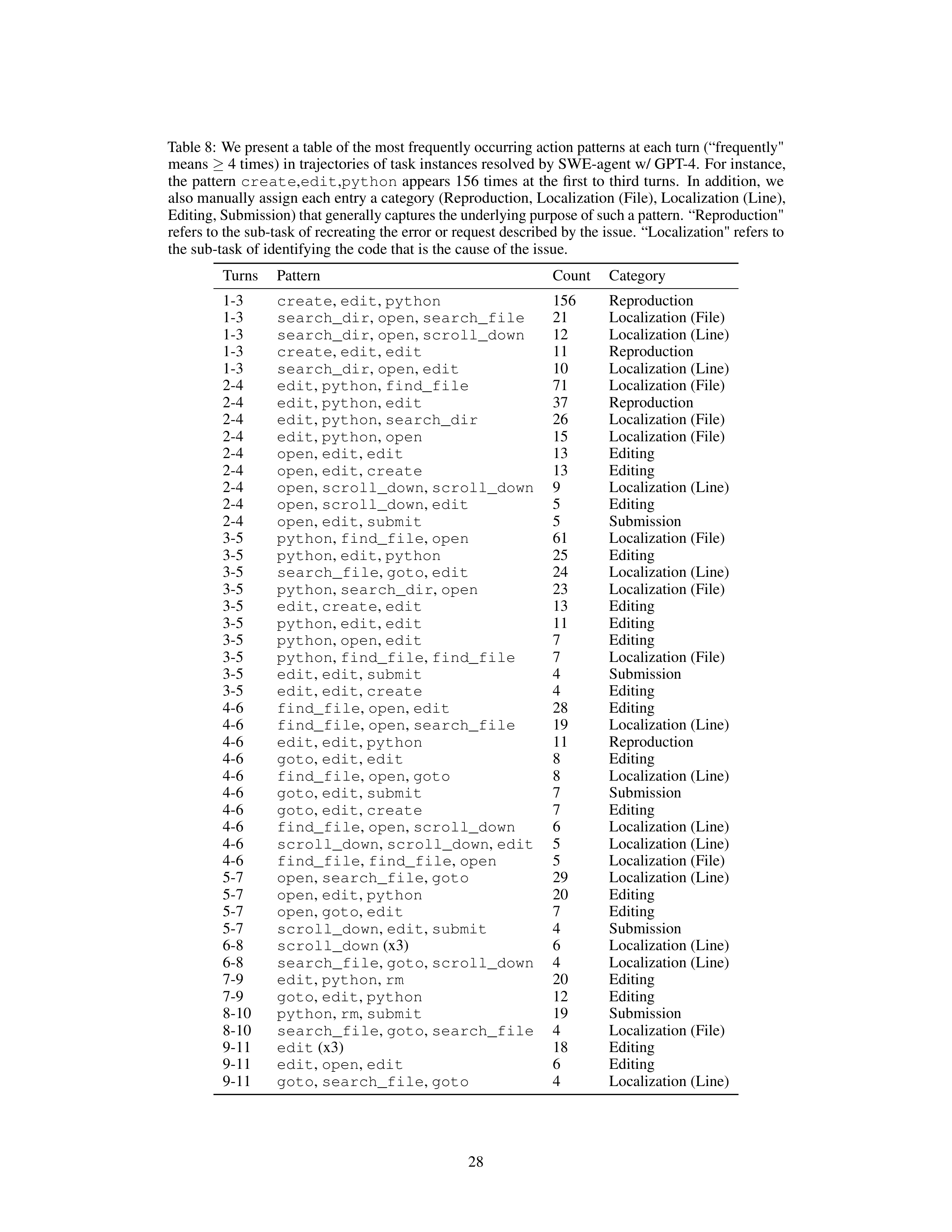
Table 8:
We present a table of the most frequently occurring action patterns at each turn (“frequently"
means
≥
4 times) in trajectories of task instances resolved by SWE-agent w/ GPT-4.
For instance,
the
pattern
create
,
edit
,
python
appears
156
times
at
the
first
to
third
turns.
In
addition,
we
also manually assign each entry a category (Reproduction, Localization (File), Localization (Line),
Editing, Submission) that generally captures the underlying purpose of such a pattern. “Reproduction"
refers to the sub-task of recreating the error or request described by the issue.
“Localization" refers to
the sub-task of identifying the code that is the cause of the issue.
Turns
Pattern
Count
Category
1-3
create
,
edit
,
python
156
Reproduction
1-3
search_dir
,
open
,
search_file
21
Localization (File)
1-3
search_dir
,
open
,
scroll_down
12
Localization (Line)
1-3
create
,
edit
,
edit
11
Reproduction
1-3
search_dir
,
open
,
edit
10
Localization (Line)
2-4
edit
,
python
,
find_file
71
Localization (File)
2-4
edit
,
python
,
edit
37
Reproduction
2-4
edit
,
python
,
search_dir
26
Localization (File)
2-4
edit
,
python
,
open
15
Localization (File)
2-4
open
,
edit
,
edit
13
Editing
2-4
open
,
edit
,
create
13
Editing
2-4
open
,
scroll_down
,
scroll_down
9
Localization (Line)
2-4
open
,
scroll_down
,
edit
5
Editing
2-4
open
,
edit
,
submit
5
Submission
3-5
python
,
find_file
,
open
61
Localization (File)
3-5
python
,
edit
,
python
25
Editing
3-5
search_file
,
goto
,
edit
24
Localization (Line)
3-5
python
,
search_dir
,
open
23
Localization (File)
3-5
edit
,
create
,
edit
13
Editing
3-5
python
,
edit
,
edit
11
Editing
3-5
python
,
open
,
edit
7
Editing
3-5
python
,
find_file
,
find_file
7
Localization (File)
3-5
edit
,
edit
,
submit
4
Submission
3-5
edit
,
edit
,
create
4
Editing
4-6
find_file
,
open
,
edit
28
Editing
4-6
find_file
,
open
,
search_file
19
Localization (Line)
4-6
edit
,
edit
,
python
11
Reproduction
4-6
goto
,
edit
,
edit
8
Editing
4-6
find_file
,
open
,
goto
8
Localization (Line)
4-6
goto
,
edit
,
submit
7
Submission
4-6
goto
,
edit
,
create
7
Editing
4-6
find_file
,
open
,
scroll_down
6
Localization (Line)
4-6
scroll_down
,
scroll_down
,
edit
5
Localization (Line)
4-6
find_file
,
find_file
,
open
5
Localization (File)
5-7
open
,
search_file
,
goto
29
Localization (Line)
5-7
open
,
edit
,
python
20
Editing
5-7
open
,
goto
,
edit
7
Editing
5-7
scroll_down
,
edit
,
submit
4
Submission
6-8
scroll_down
(x3)
6
Localization (Line)
6-8
search_file
,
goto
,
scroll_down
4
Localization (Line)
7-9
edit
,
python
,
rm
20
Editing
7-9
goto
,
edit
,
python
12
Editing
8-10
python
,
rm
,
submit
19
Submission
8-10
search_file
,
goto
,
search_file
4
Localization (File)
9-11
edit
(x3)
18
Editing
9-11
edit
,
open
,
edit
6
Editing
9-11
goto
,
search_file
,
goto
4
Localization (Line)
28
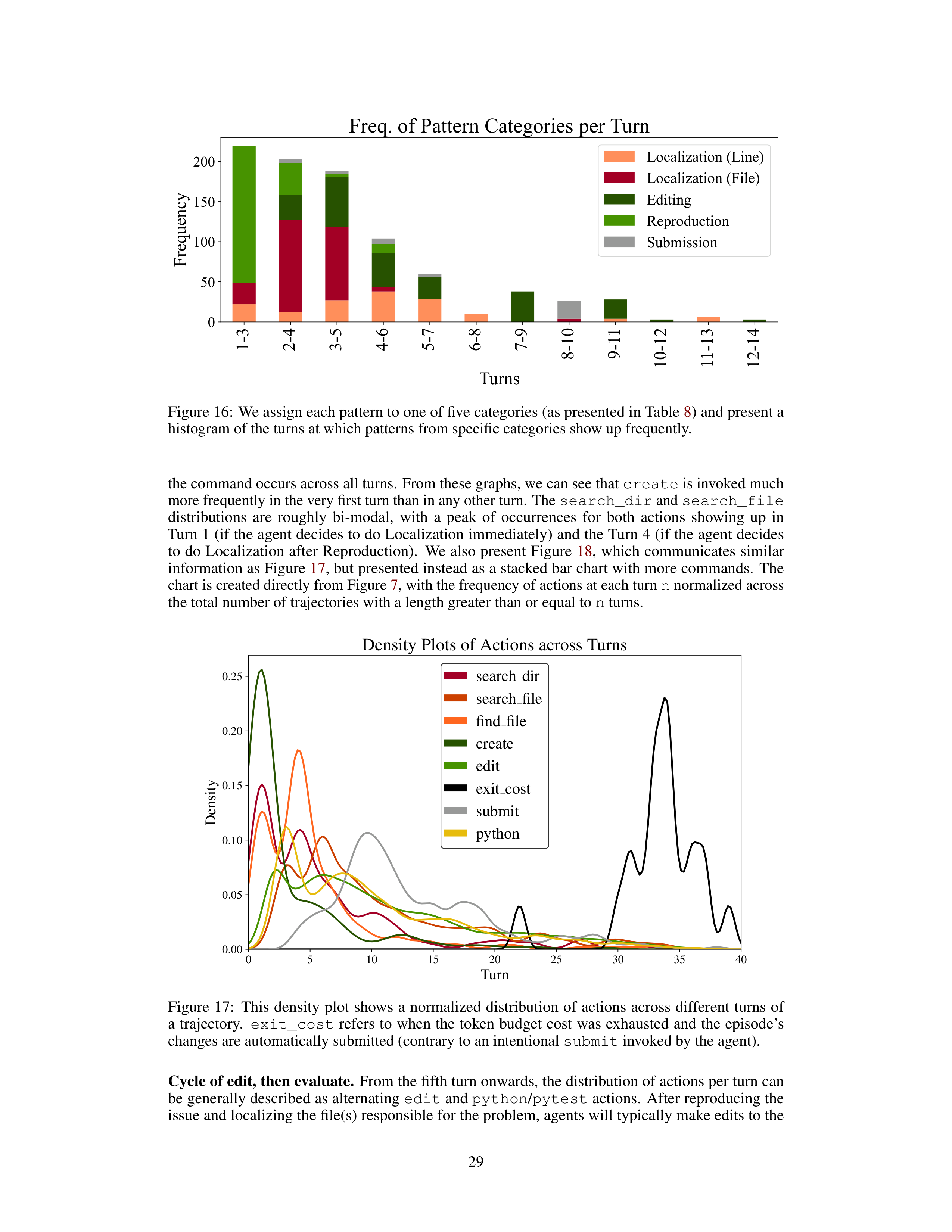
1-3
2-4
3-5
4-6
5-7
6-8
7-9
8-10
9-11
10-12
11-13
12-14
Turns
0
50
100
150
200
Frequency
Freq. of Pattern Categories per Turn
Localization (Line)
Localization (File)
Editing
Reproduction
Submission
Figure 16:
We assign each pattern to one of five categories (as presented in Table
8
) and present a
histogram of the turns at which patterns from specific categories show up frequently.
the command occurs across all turns.
From these graphs, we can see that
create
is invoked much
more frequently in the very first turn than in any other turn.
The
search_dir
and
search_file
distributions
are
roughly
bi-modal,
with
a
peak
of
occurrences
for
both
actions
showing
up
in
Turn 1 (if the agent decides to do Localization immediately) and the Turn 4 (if the agent decides
to do Localization after Reproduction).
We also present Figure
18
,
which communicates similar
information as Figure
17
, but presented instead as a stacked bar chart with more commands.
The
chart is created directly from Figure
7
, with the frequency of actions at each turn
n
normalized across
the total number of trajectories with a length greater than or equal to
n
turns.
0
5
10
15
20
25
30
35
40
Turn
0
.
00
0
.
05
0
.
10
0
.
15
0
.
20
0
.
25
Density
Density Plots of Actions across Turns
search
dir
search
file
find
file
create
edit
exit
cost
submit
python
Figure
17:
This
density
plot
shows
a
normalized
distribution
of
actions
across
different
turns
of
a trajectory.
exit_cost
refers to
when the
token budget cost was
exhausted and
the episode’s
changes are automatically submitted (contrary to an intentional
submit
invoked by the agent).
Cycle of edit, then evaluate.
From the fifth turn onwards, the distribution of actions per turn can
be generally described as alternating
edit
and
python
/
pytest
actions.
After reproducing the
issue and localizing the file(s) responsible for the problem, agents will typically make edits to the
29
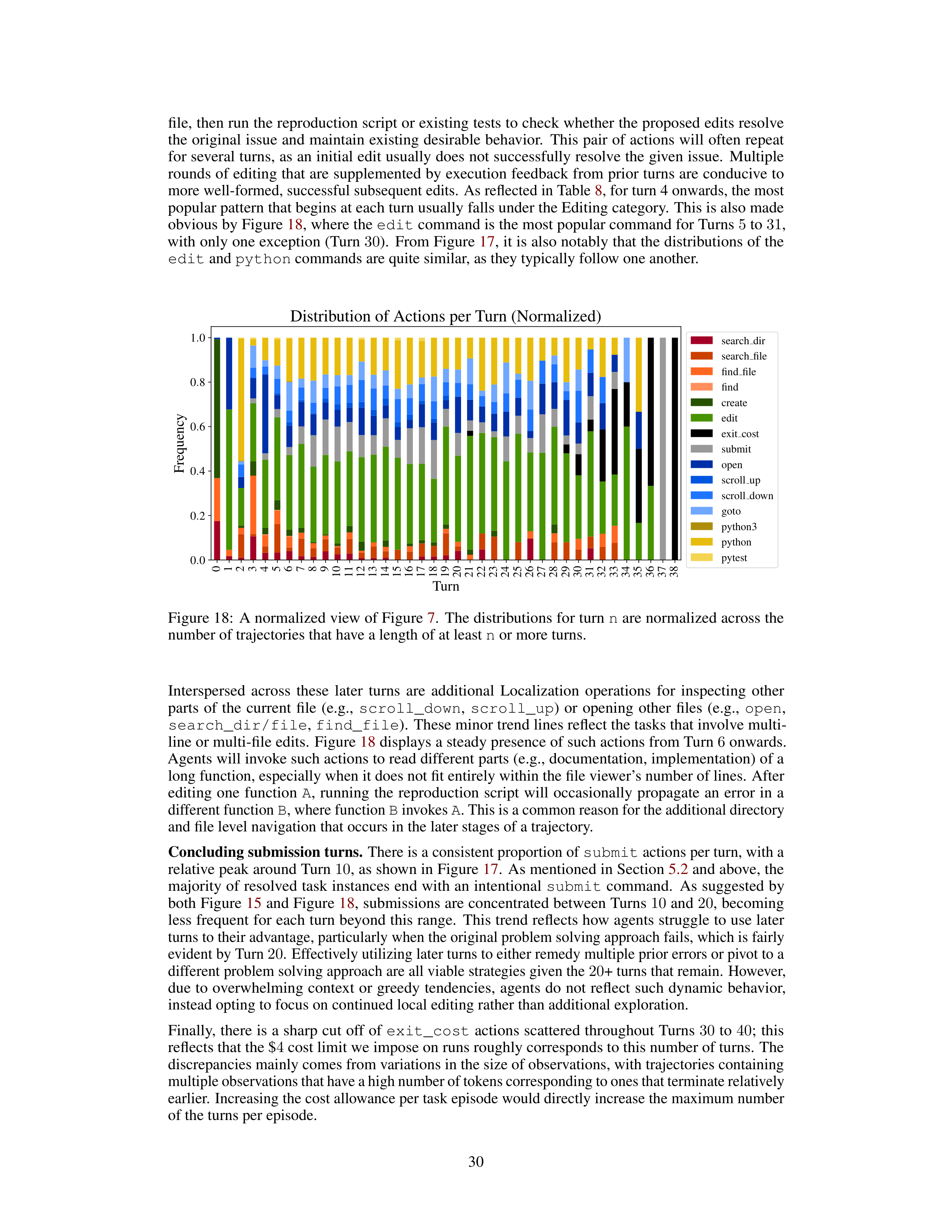
file, then run the reproduction script or existing tests to check whether the proposed edits resolve
the original issue and maintain existing desirable behavior.
This pair of actions will often repeat
for several turns, as an initial edit usually does not successfully resolve the given issue.
Multiple
rounds of editing that are supplemented by execution feedback from prior turns are conducive to
more well-formed, successful subsequent edits.
As reflected in Table
8
, for turn 4 onwards, the most
popular pattern that begins at each turn usually falls under the Editing category.
This is also made
obvious by Figure
18
, where the
edit
command is the most popular command for Turns
5
to
31
,
with only one exception (Turn
30
).
From Figure
17
, it is also notably that the distributions of the
edit
and
python
commands are quite similar, as they typically follow one another.
0
1
2
3
4
5
6
7
8
9
10
11
12
13
14
15
16
17
18
19
20
21
22
23
24
25
26
27
28
29
30
31
32
33
34
35
36
37
38
Turn
0
.
0
0
.
2
0
.
4
0
.
6
0
.
8
1
.
0
Frequency
Distribution of Actions per Turn (Normalized)
search
dir
search
file
find
file
find
create
edit
exit
cost
submit
open
scroll
up
scroll
down
goto
python3
python
pytest
Figure 18:
A normalized view of Figure
7
.
The distributions for turn
n
are normalized across the
number of trajectories that have a length of at least
n
or more turns.
Interspersed
across
these
later
turns
are
additional
Localization
operations
for
inspecting
other
parts
of
the
current
file
(e.g.,
scroll_down
,
scroll_up
)
or
opening
other
files
(e.g.,
open
,
search_dir/file
,
find_file
).
These minor trend lines reflect the tasks that involve multi-
line or multi-file edits.
Figure
18
displays a steady presence of such actions from Turn
6
onwards.
Agents will invoke such actions to read different parts (e.g., documentation, implementation) of a
long function, especially when it does not fit entirely within the file viewer’s number of lines.
After
editing
one
function
A
,
running
the
reproduction
script
will
occasionally
propagate
an
error
in
a
different function
B
, where function
B
invokes
A
. This is a common reason for the additional directory
and file level navigation that occurs in the later stages of a trajectory.
Concluding submission turns.
There is a consistent proportion of
submit
actions per turn, with a
relative peak around Turn
10
, as shown in Figure
17
.
As mentioned in Section
5.2
and above, the
majority of resolved task instances end with an intentional
submit
command.
As suggested by
both Figure
15
and Figure
18
, submissions are concentrated between Turns
10
and
20
, becoming
less frequent for each turn beyond this range.
This trend reflects how agents struggle to use later
turns to their advantage, particularly when the original problem solving approach fails, which is fairly
evident by Turn
20
.
Effectively utilizing later turns to either remedy multiple prior errors or pivot to a
different problem solving approach are all viable strategies given the
20
+ turns that remain.
However,
due to overwhelming context or greedy tendencies,
agents do not reflect such dynamic behavior,
instead opting to focus on continued local editing rather than additional exploration.
Finally,
there is a sharp cut off of
exit_cost
actions scattered throughout Turns
30
to
40
;
this
reflects that the $
4
cost limit we impose on runs roughly corresponds to this number of turns.
The
discrepancies mainly comes from variations in the size of observations, with trajectories containing
multiple observations that have a high number of tokens corresponding to ones that terminate relatively
earlier.
Increasing the cost allowance per task episode would directly increase the maximum number
of the turns per episode.
30
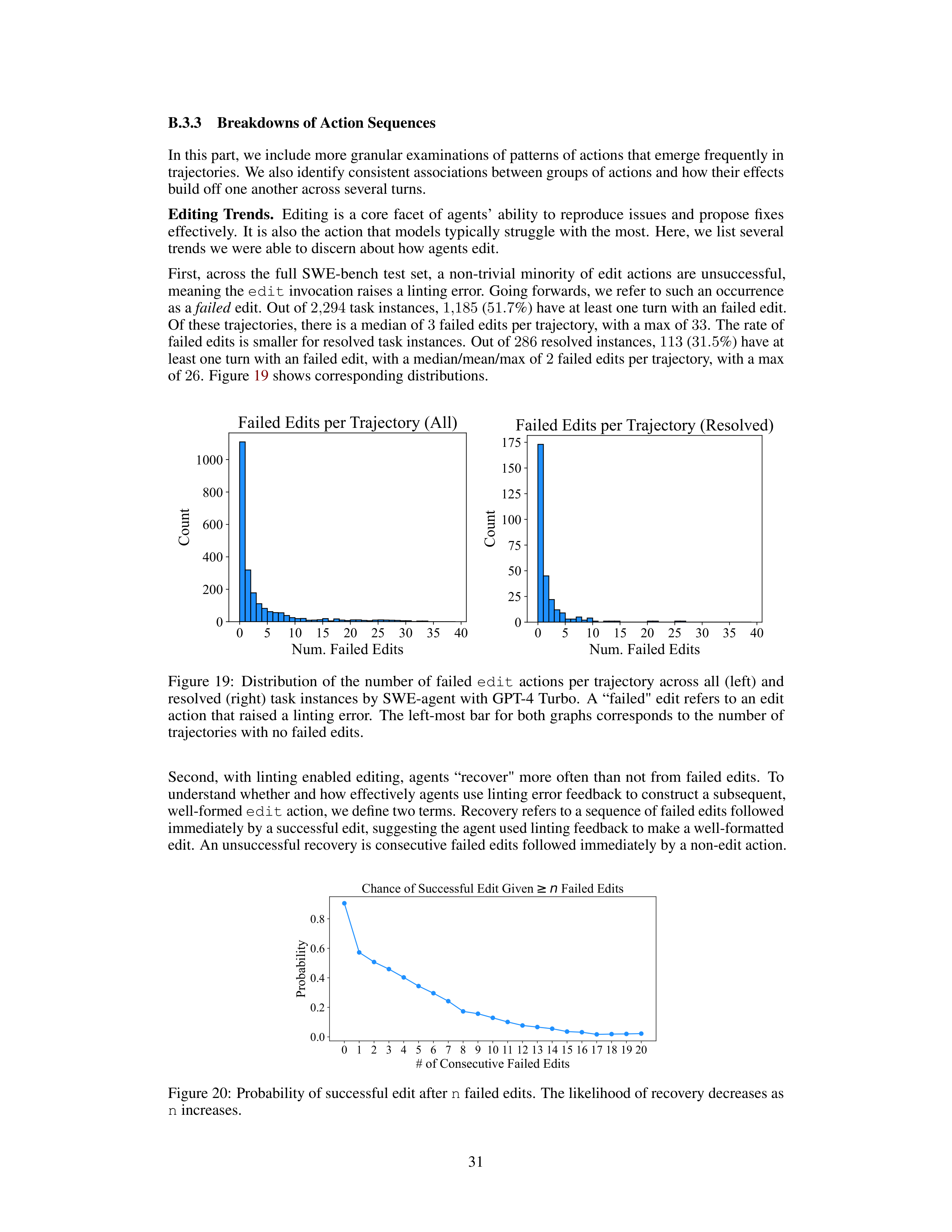
B.3.3
Breakdowns of Action Sequences
In this part, we include more granular examinations of patterns of actions that emerge frequently in
trajectories.
We also identify consistent associations between groups of actions and how their effects
build off one another across several turns.
Editing
Trends.
Editing
is
a
core
facet
of
agents’
ability
to
reproduce
issues
and
propose
fixes
effectively.
It is also the action that models typically struggle with the most.
Here, we list several
trends we were able to discern about how agents edit.
First,
across
the
full
SWE-bench
test
set,
a
non-trivial
minority
of
edit
actions
are
unsuccessful,
meaning the
edit
invocation raises a linting error.
Going forwards, we refer to such an occurrence
as a
failed
edit.
Out of
2
,
294
task instances,
1
,
185
(
51
.
7
%) have at least one turn with an failed edit.
Of these trajectories, there is a median of
3
failed edits per trajectory, with a max of
33
.
The rate of
failed edits is smaller for resolved task instances.
Out of
286
resolved instances,
113
(
31
.
5
%) have at
least one turn with an failed edit, with a median/mean/max of
2
failed edits per trajectory, with a max
of
26
.
Figure
19
shows corresponding distributions.
0
5
10
15
20
25
30
35
40
Num. Failed Edits
0
200
400
600
800
1000
Count
Failed Edits per Trajectory (All)
0
5
10
15
20
25
30
35
40
Num. Failed Edits
0
25
50
75
100
125
150
175
Count
Failed Edits per Trajectory (Resolved)
Figure
19:
Distribution
of
the
number
of
failed
edit
actions
per
trajectory
across
all
(left)
and
resolved (right) task instances by SWE-agent with GPT-4 Turbo.
A “failed" edit refers to an edit
action that raised a linting error.
The left-most bar for both graphs corresponds to the number of
trajectories with no failed edits.
Second,
with
linting
enabled
editing,
agents
“recover"
more
often
than
not
from
failed
edits.
To
understand whether and how effectively agents use linting error feedback to construct a subsequent,
well-formed
edit
action, we define two terms.
Recovery refers to a sequence of failed edits followed
immediately by a successful edit, suggesting the agent used linting feedback to make a well-formatted
edit.
An unsuccessful recovery is consecutive failed edits followed immediately by a non-edit action.
0
1
2
3
4
5
6
7
8
9
10 11 12 13 14 15 16 17 18 19 20
# of Consecutive Failed Edits
0.0
0.2
0.4
0.6
0.8
Probability
Chance of Successful Edit Given
n
Failed Edits
Figure 20:
Probability of successful edit after
n
failed edits.
The likelihood of recovery decreases as
n
increases.
31
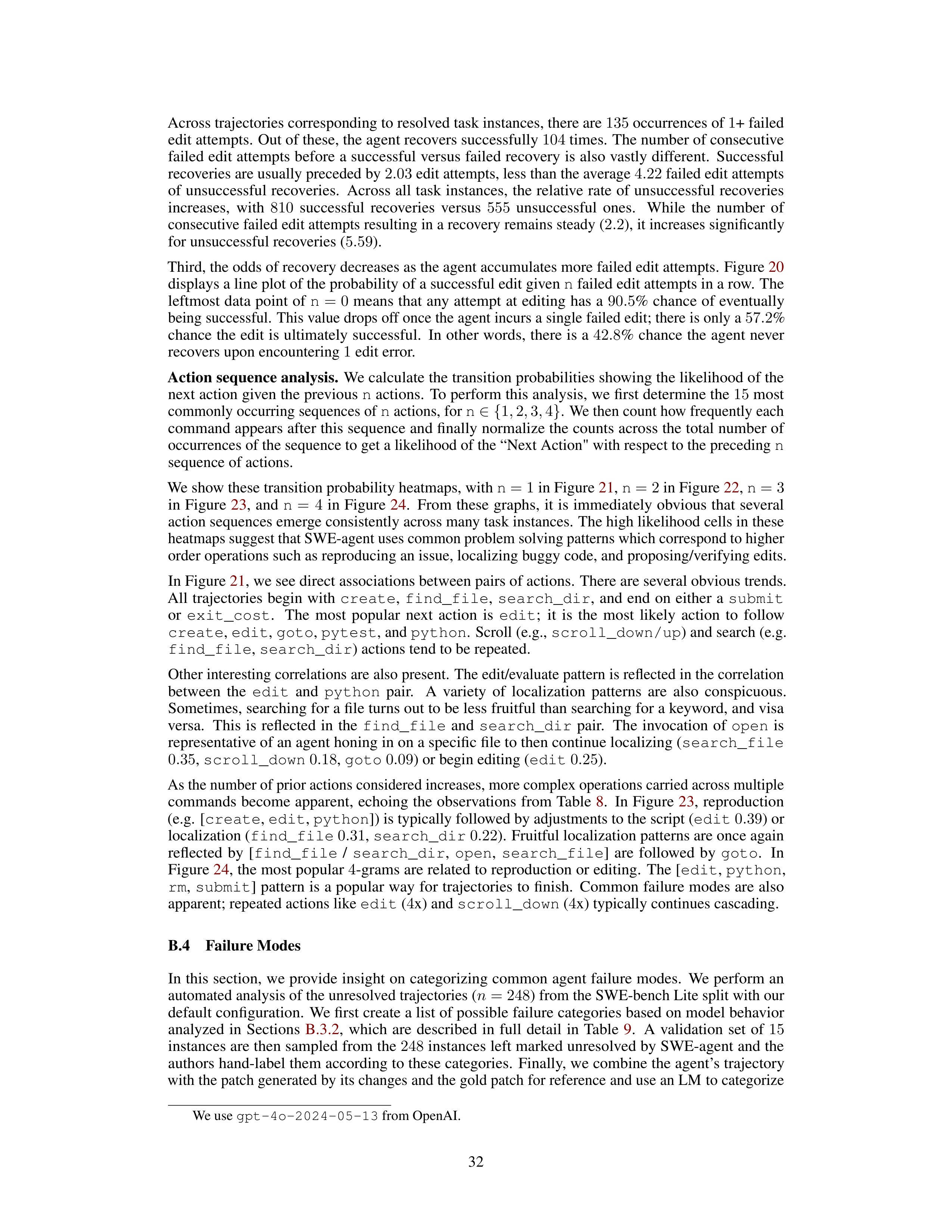
Across trajectories corresponding to resolved task instances, there are
135
occurrences of
1
+ failed
edit attempts.
Out of these, the agent recovers successfully
104
times.
The number of consecutive
failed edit attempts before a successful versus failed recovery is also vastly different.
Successful
recoveries are usually preceded by
2
.
03
edit attempts, less than the average
4
.
22
failed edit attempts
of unsuccessful recoveries.
Across all task instances,
the relative rate of unsuccessful recoveries
increases,
with
810
successful
recoveries
versus
555
unsuccessful
ones.
While
the
number
of
consecutive failed edit attempts resulting in a recovery remains steady (
2
.
2
), it increases significantly
for unsuccessful recoveries (
5
.
59
).
Third, the odds of recovery decreases as the agent accumulates more failed edit attempts.
Figure
20
displays a line plot of the probability of a successful edit given
n
failed edit attempts in a row.
The
leftmost data point of
n
= 0
means that any attempt at editing has a
90
.
5
% chance of eventually
being successful.
This value drops off once the agent incurs a single failed edit; there is only a
57
.
2
%
chance the edit is ultimately successful.
In other words,
there is a
42
.
8
% chance the agent never
recovers upon encountering
1
edit error.
Action sequence analysis.
We calculate the transition probabilities showing the likelihood of the
next action given the previous
n
actions.
To perform this analysis, we first determine the
15
most
commonly occurring sequences of
n
actions, for
n
∈{
1
,
2
,
3
,
4
}
.
We then count how frequently each
command appears after this sequence and finally normalize the counts across the total number of
occurrences of the sequence to get a likelihood of the “Next Action" with respect to the preceding
n
sequence of actions.
We show these transition probability heatmaps, with
n
= 1
in Figure
21
,
n
= 2
in Figure
22
,
n
= 3
in Figure
23
,
and
n
=
4
in Figure
24
.
From these graphs,
it is immediately obvious that several
action sequences emerge consistently across many task instances.
The high likelihood cells in these
heatmaps suggest that SWE-agent uses common problem solving patterns which correspond to higher
order operations such as reproducing an issue, localizing buggy code, and proposing/verifying edits.
In Figure
21
, we see direct associations between pairs of actions.
There are several obvious trends.
All
trajectories
begin
with
create
,
find_file
,
search_dir
,
and
end
on
either
a
submit
or
exit_cost
.
The
most
popular
next
action
is
edit
;
it
is
the
most
likely
action
to
follow
create
,
edit
,
goto
,
pytest
, and
python
.
Scroll (e.g.,
scroll_down/up
) and search (e.g.
find_file
,
search_dir
) actions tend to be repeated.
Other interesting correlations are also present.
The edit/evaluate pattern is reflected in the correlation
between
the
edit
and
python
pair.
A
variety
of
localization
patterns
are
also
conspicuous.
Sometimes, searching for a file turns out to be less fruitful than searching for a keyword, and visa
versa.
This
is
reflected
in
the
find_file
and
search_dir
pair.
The
invocation
of
open
is
representative of an agent honing in on a specific file to then continue localizing (
search_file
0
.
35
,
scroll_down
0
.
18
,
goto
0
.
09
) or begin editing (
edit
0
.
25
).
As the number of prior actions considered increases, more complex operations carried across multiple
commands become apparent,
echoing the observations from Table
8
.
In Figure
23
,
reproduction
(e.g.
[
create
,
edit
,
python
]) is typically followed by adjustments to the script (
edit
0
.
39
) or
localization (
find_file
0
.
31
,
search_dir
0
.
22
).
Fruitful localization patterns are once again
reflected
by
[
find_file
/
search_dir
,
open
,
search_file
]
are
followed
by
goto
.
In
Figure
24
, the most popular
4
-grams are related to reproduction or editing.
The [
edit
,
python
,
rm
,
submit
] pattern is a popular way for trajectories to finish.
Common failure modes are also
apparent; repeated actions like
edit
(
4
x) and
scroll_down
(
4
x) typically continues cascading.
B.4
Failure Modes
In this section, we provide insight on categorizing common agent failure modes.
We perform an
automated analysis of the unresolved trajectories (
n
= 248
) from the SWE-bench Lite split with our
default configuration.
We first create a list of possible failure categories based on model behavior
analyzed
in
Sections
B.3.2
,
which
are
described
in
full
detail
in
Table
9
.
A
validation
set
of
15
instances are then sampled from the
248
instances left marked unresolved by SWE-agent and the
authors hand-label them according to these categories.
Finally, we combine the agent’s trajectory
with the patch generated by its changes and the gold patch for reference and use an LM
to categorize
We use
gpt-4o-2024-05-13
from OpenAI.
32
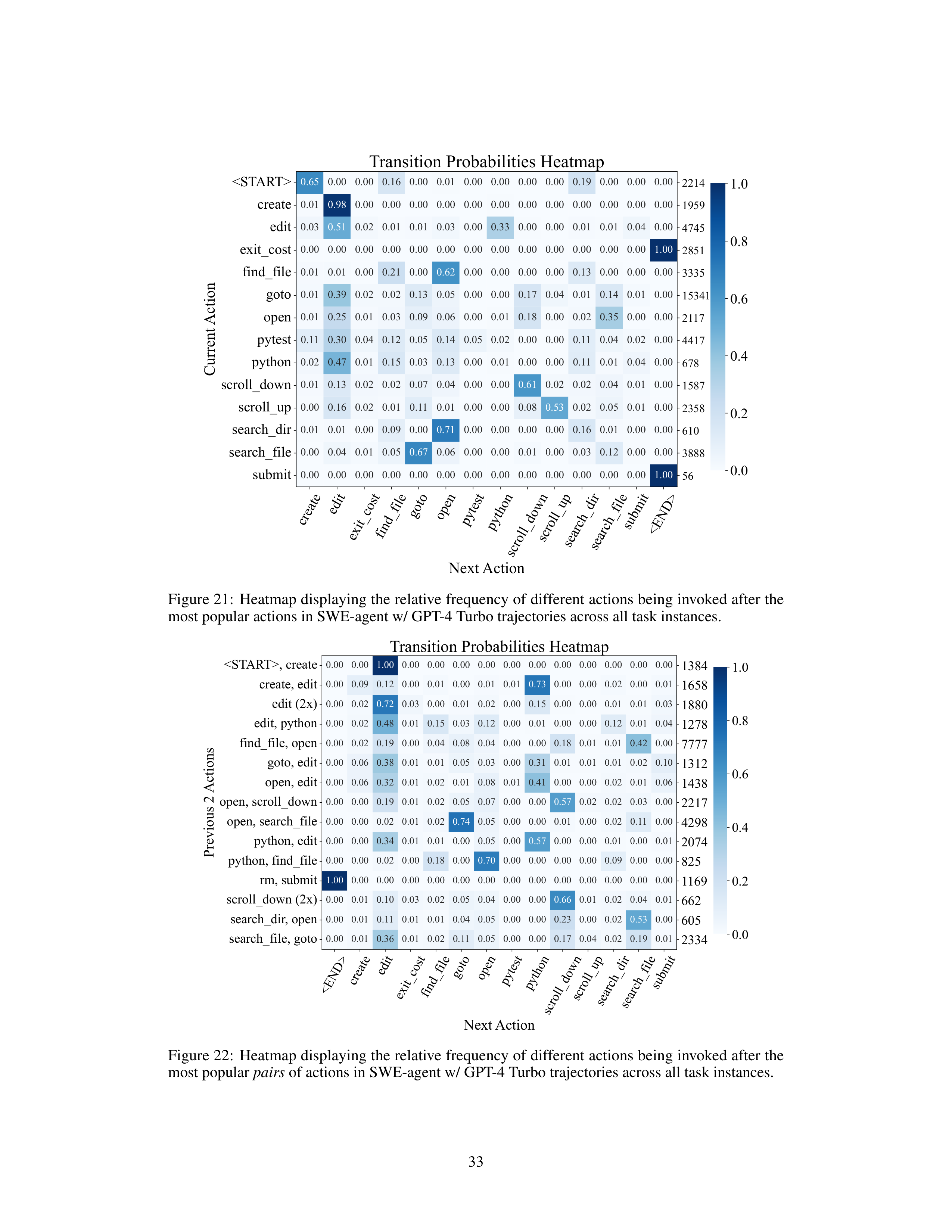


create
edit
exit_cost
find_file
goto
open
pytest
python
scroll_down
scroll_up
search_dir
search_file
submit
Next Action
create
edit
exit_cost
find_file
goto
open
pytest
python
scroll_down
scroll_up
search_dir
search_file
submit
Current Action
0.65
0.00
0.00
0.16
0.00
0.01
0.00
0.00
0.00
0.00
0.19
0.00
0.00
0.00
0.01
0.98
0.00
0.00
0.00
0.00
0.00
0.00
0.00
0.00
0.00
0.00
0.00
0.00
0.03
0.51
0.02
0.01
0.01
0.03
0.00
0.33
0.00
0.00
0.01
0.01
0.04
0.00
0.00
0.00
0.00
0.00
0.00
0.00
0.00
0.00
0.00
0.00
0.00
0.00
0.00
1.00
0.01
0.01
0.00
0.21
0.00
0.62
0.00
0.00
0.00
0.00
0.13
0.00
0.00
0.00
0.01
0.39
0.02
0.02
0.13
0.05
0.00
0.00
0.17
0.04
0.01
0.14
0.01
0.00
0.01
0.25
0.01
0.03
0.09
0.06
0.00
0.01
0.18
0.00
0.02
0.35
0.00
0.00
0.11
0.30
0.04
0.12
0.05
0.14
0.05
0.02
0.00
0.00
0.11
0.04
0.02
0.00
0.02
0.47
0.01
0.15
0.03
0.13
0.00
0.01
0.00
0.00
0.11
0.01
0.04
0.00
0.01
0.13
0.02
0.02
0.07
0.04
0.00
0.00
0.61
0.02
0.02
0.04
0.01
0.00
0.00
0.16
0.02
0.01
0.11
0.01
0.00
0.00
0.08
0.53
0.02
0.05
0.01
0.00
0.01
0.01
0.00
0.09
0.00
0.71
0.00
0.00
0.00
0.00
0.16
0.01
0.00
0.00
0.00
0.04
0.01
0.05
0.67
0.06
0.00
0.00
0.01
0.00
0.03
0.12
0.00
0.00
0.00
0.00
0.00
0.00
0.00
0.00
0.00
0.00
0.00
0.00
0.00
0.00
0.00
1.00
Transition Probabilities Heatmap
0.0
0.2
0.4
0.6
0.8
1.0
2214
1959
4745
2851
3335
15341
2117
4417
678
1587
2358
610
3888
56
Figure 21:
Heatmap displaying the relative frequency of different actions being invoked after the
most popular actions in SWE-agent w/ GPT-4 Turbo trajectories across all task instances.
create
edit
exit_cost
find_file
goto
open
pytest
python
scroll_down
scroll_up
search_dir
search_file
submit
Next Action
, create
create, edit
edit (2x)
edit, python
find_file, open
goto, edit
open, edit
open, scroll_down
open, search_file
python, edit
python, find_file
rm, submit
scroll_down (2x)
search_dir, open
search_file, goto
Previous 2 Actions
0.00
0.00
1.00
0.00
0.00
0.00
0.00
0.00
0.00
0.00
0.00
0.00
0.00
0.00
0.00
0.09
0.12
0.00
0.01
0.00
0.01
0.01
0.73
0.00
0.00
0.02
0.00
0.01
0.00
0.02
0.72
0.03
0.00
0.01
0.02
0.00
0.15
0.00
0.00
0.01
0.01
0.03
0.00
0.02
0.48
0.01
0.15
0.03
0.12
0.00
0.01
0.00
0.00
0.12
0.01
0.04
0.00
0.02
0.19
0.00
0.04
0.08
0.04
0.00
0.00
0.18
0.01
0.01
0.42
0.00
0.00
0.06
0.38
0.01
0.01
0.05
0.03
0.00
0.31
0.01
0.01
0.01
0.02
0.10
0.00
0.06
0.32
0.01
0.02
0.01
0.08
0.01
0.41
0.00
0.00
0.02
0.01
0.06
0.00
0.00
0.19
0.01
0.02
0.05
0.07
0.00
0.00
0.57
0.02
0.02
0.03
0.00
0.00
0.00
0.02
0.01
0.02
0.74
0.05
0.00
0.00
0.01
0.00
0.02
0.11
0.00
0.00
0.00
0.34
0.01
0.01
0.00
0.05
0.00
0.57
0.00
0.00
0.01
0.00
0.01
0.00
0.00
0.02
0.00
0.18
0.00
0.70
0.00
0.00
0.00
0.00
0.09
0.00
0.00
1.00
0.00
0.00
0.00
0.00
0.00
0.00
0.00
0.00
0.00
0.00
0.00
0.00
0.00
0.00
0.01
0.10
0.03
0.02
0.05
0.04
0.00
0.00
0.66
0.01
0.02
0.04
0.01
0.00
0.01
0.11
0.01
0.01
0.04
0.05
0.00
0.00
0.23
0.00
0.02
0.53
0.00
0.00
0.01
0.36
0.01
0.02
0.11
0.05
0.00
0.00
0.17
0.04
0.02
0.19
0.01
Transition Probabilities Heatmap
0.0
0.2
0.4
0.6
0.8
1.0
1384
1658
1880
1278
7777
1312
1438
2217
4298
2074
825
1169
662
605
2334
Figure 22:
Heatmap displaying the relative frequency of different actions being invoked after the
most popular
pairs
of actions in SWE-agent w/ GPT-4 Turbo trajectories across all task instances.
33
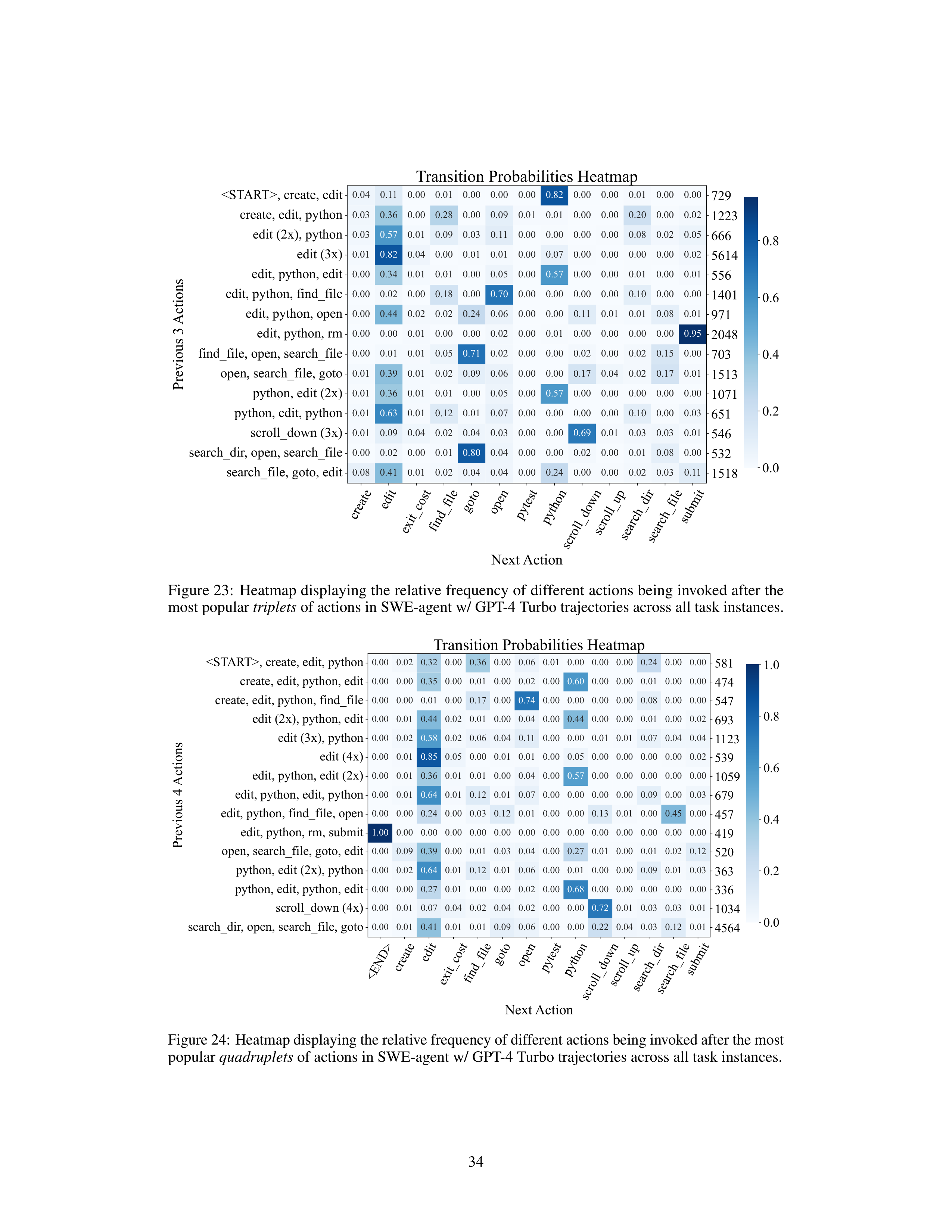


create
edit
exit_cost
find_file
goto
open
pytest
python
scroll_down
scroll_up
search_dir
search_file
submit
Next Action
, create, edit
create, edit, python
edit (2x), python
edit (3x)
edit, python, edit
edit, python, find_file
edit, python, open
edit, python, rm
find_file, open, search_file
open, search_file, goto
python, edit (2x)
python, edit, python
scroll_down (3x)
search_dir, open, search_file
search_file, goto, edit
Previous 3 Actions
0.04
0.11
0.00
0.01
0.00
0.00
0.00
0.82
0.00
0.00
0.01
0.00
0.00
0.03
0.36
0.00
0.28
0.00
0.09
0.01
0.01
0.00
0.00
0.20
0.00
0.02
0.03
0.57
0.01
0.09
0.03
0.11
0.00
0.00
0.00
0.00
0.08
0.02
0.05
0.01
0.82
0.04
0.00
0.01
0.01
0.00
0.07
0.00
0.00
0.00
0.00
0.02
0.00
0.34
0.01
0.01
0.00
0.05
0.00
0.57
0.00
0.00
0.01
0.00
0.01
0.00
0.02
0.00
0.18
0.00
0.70
0.00
0.00
0.00
0.00
0.10
0.00
0.00
0.00
0.44
0.02
0.02
0.24
0.06
0.00
0.00
0.11
0.01
0.01
0.08
0.01
0.00
0.00
0.01
0.00
0.00
0.02
0.00
0.01
0.00
0.00
0.00
0.00
0.95
0.00
0.01
0.01
0.05
0.71
0.02
0.00
0.00
0.02
0.00
0.02
0.15
0.00
0.01
0.39
0.01
0.02
0.09
0.06
0.00
0.00
0.17
0.04
0.02
0.17
0.01
0.01
0.36
0.01
0.01
0.00
0.05
0.00
0.57
0.00
0.00
0.00
0.00
0.00
0.01
0.63
0.01
0.12
0.01
0.07
0.00
0.00
0.00
0.00
0.10
0.00
0.03
0.01
0.09
0.04
0.02
0.04
0.03
0.00
0.00
0.69
0.01
0.03
0.03
0.01
0.00
0.02
0.00
0.01
0.80
0.04
0.00
0.00
0.02
0.00
0.01
0.08
0.00
0.08
0.41
0.01
0.02
0.04
0.04
0.00
0.24
0.00
0.00
0.02
0.03
0.11
Transition Probabilities Heatmap
0.0
0.2
0.4
0.6
0.8
729
1223
666
5614
556
1401
971
2048
703
1513
1071
651
546
532
1518
Figure 23:
Heatmap displaying the relative frequency of different actions being invoked after the
most popular
triplets
of actions in SWE-agent w/ GPT-4 Turbo trajectories across all task instances.
create
edit
exit_cost
find_file
goto
open
pytest
python
scroll_down
scroll_up
search_dir
search_file
submit
Next Action
, create, edit, python
create, edit, python, edit
create, edit, python, find_file
edit (2x), python, edit
edit (3x), python
edit (4x)
edit, python, edit (2x)
edit, python, edit, python
edit, python, find_file, open
edit, python, rm, submit
open, search_file, goto, edit
python, edit (2x), python
python, edit, python, edit
scroll_down (4x)
search_dir, open, search_file, goto
Previous 4 Actions
0.00
0.02
0.32
0.00
0.36
0.00
0.06
0.01
0.00
0.00
0.00
0.24
0.00
0.00
0.00
0.00
0.35
0.00
0.01
0.00
0.02
0.00
0.60
0.00
0.00
0.01
0.00
0.00
0.00
0.00
0.01
0.00
0.17
0.00
0.74
0.00
0.00
0.00
0.00
0.08
0.00
0.00
0.00
0.01
0.44
0.02
0.01
0.00
0.04
0.00
0.44
0.00
0.00
0.01
0.00
0.02
0.00
0.02
0.58
0.02
0.06
0.04
0.11
0.00
0.00
0.01
0.01
0.07
0.04
0.04
0.00
0.01
0.85
0.05
0.00
0.01
0.01
0.00
0.05
0.00
0.00
0.00
0.00
0.02
0.00
0.01
0.36
0.01
0.01
0.00
0.04
0.00
0.57
0.00
0.00
0.00
0.00
0.00
0.00
0.01
0.64
0.01
0.12
0.01
0.07
0.00
0.00
0.00
0.00
0.09
0.00
0.03
0.00
0.00
0.24
0.00
0.03
0.12
0.01
0.00
0.00
0.13
0.01
0.00
0.45
0.00
1.00
0.00
0.00
0.00
0.00
0.00
0.00
0.00
0.00
0.00
0.00
0.00
0.00
0.00
0.00
0.09
0.39
0.00
0.01
0.03
0.04
0.00
0.27
0.01
0.00
0.01
0.02
0.12
0.00
0.02
0.64
0.01
0.12
0.01
0.06
0.00
0.01
0.00
0.00
0.09
0.01
0.03
0.00
0.00
0.27
0.01
0.00
0.00
0.02
0.00
0.68
0.00
0.00
0.00
0.00
0.00
0.00
0.01
0.07
0.04
0.02
0.04
0.02
0.00
0.00
0.72
0.01
0.03
0.03
0.01
0.00
0.01
0.41
0.01
0.01
0.09
0.06
0.00
0.00
0.22
0.04
0.03
0.12
0.01
Transition Probabilities Heatmap
0.0
0.2
0.4
0.6
0.8
1.0
581
474
547
693
1123
539
1059
679
457
419
520
363
336
1034
4564
Figure 24: Heatmap displaying the relative frequency of different actions being invoked after the most
popular
quadruplets
of actions in SWE-agent w/ GPT-4 Turbo trajectories across all task instances.
34
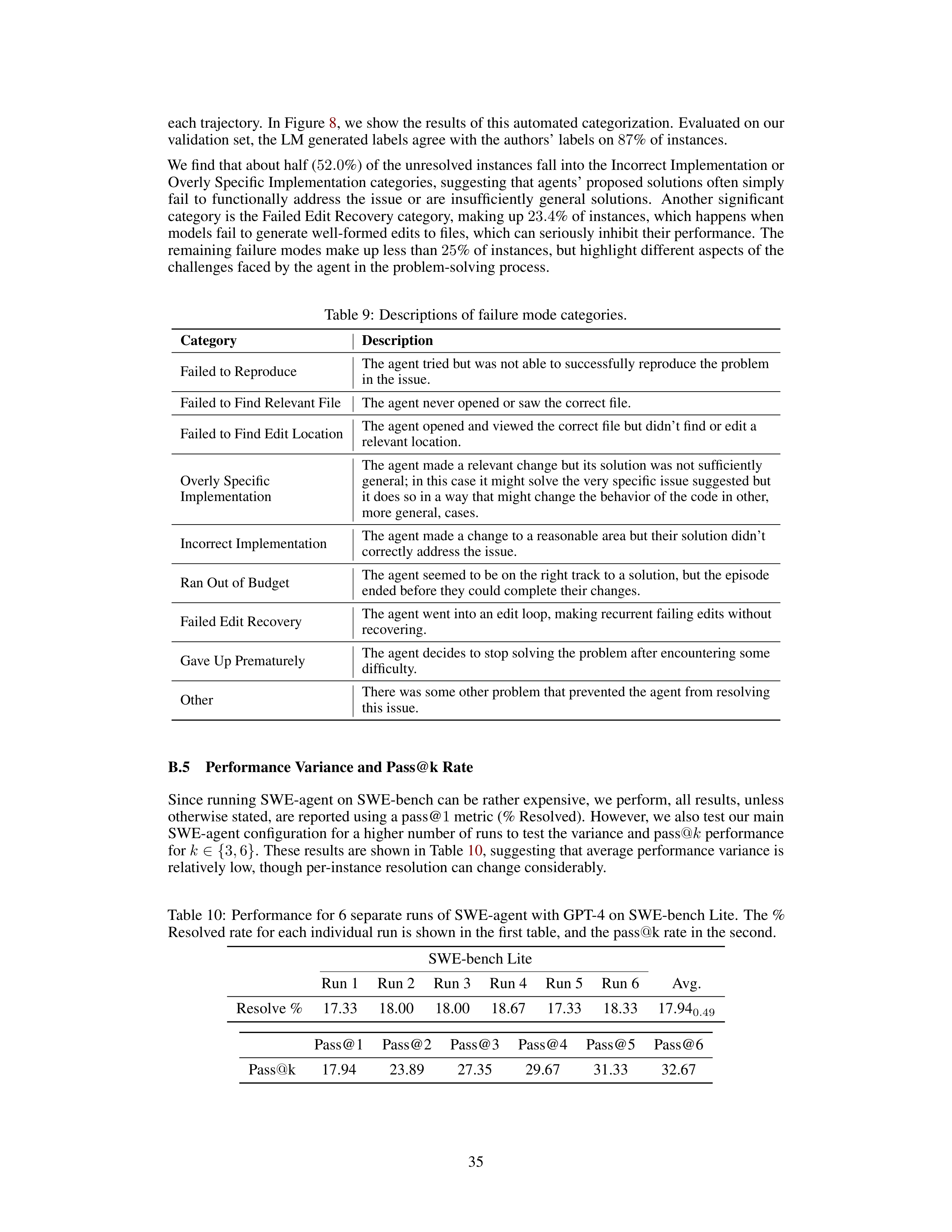
each trajectory.
In Figure
8
, we show the results of this automated categorization.
Evaluated on our
validation set, the LM generated labels agree with the authors’ labels on
87
% of instances.
We find that about half (
52
.
0
%) of the unresolved instances fall into the Incorrect Implementation or
Overly Specific Implementation categories, suggesting that agents’ proposed solutions often simply
fail
to
functionally
address
the
issue
or
are
insufficiently
general
solutions.
Another
significant
category is the Failed Edit Recovery category, making up
23
.
4
% of instances, which happens when
models fail to generate well-formed edits to files, which can seriously inhibit their performance.
The
remaining failure modes make up less than
25
% of instances, but highlight different aspects of the
challenges faced by the agent in the problem-solving process.
Table 9:
Descriptions of failure mode categories.
Category
Description
Failed to Reproduce
The agent tried but was not able to successfully reproduce the problem
in the issue.
Failed to Find Relevant File
The agent never opened or saw the correct file.
Failed to Find Edit Location
The agent opened and viewed the correct file but didn’t find or edit a
relevant location.
Overly Specific
Implementation
The agent made a relevant change but its solution was not sufficiently
general; in this case it might solve the very specific issue suggested but
it does so in a way that might change the behavior of the code in other,
more general, cases.
Incorrect Implementation
The agent made a change to a reasonable area but their solution didn’t
correctly address the issue.
Ran Out of Budget
The agent seemed to be on the right track to a solution, but the episode
ended before they could complete their changes.
Failed Edit Recovery
The agent went into an edit loop, making recurrent failing edits without
recovering.
Gave Up Prematurely
The agent decides to stop solving the problem after encountering some
difficulty.
Other
There was some other problem that prevented the agent from resolving
this issue.
B.5
Performance Variance and Pass@k Rate
Since running SWE-agent on SWE-bench can be rather expensive, we perform, all results, unless
otherwise stated, are reported using a pass@
1
metric (% Resolved).
However, we also test our main
SWE-agent configuration for a higher number of runs to test the variance and pass
@
k
performance
for
k
∈{
3
,
6
}
.
These results are shown in Table
10
, suggesting that average performance variance is
relatively low, though per-instance resolution can change considerably.
Table 10:
Performance for 6 separate runs of SWE-agent with GPT-4 on SWE-bench Lite.
The %
Resolved rate for each individual run is shown in the first table, and the pass
@
k rate in the second.
SWE-bench Lite
Run 1
Run 2
Run 3
Run 4
Run 5
Run 6
Avg.
Resolve %
17.33
18.00
18.00
18.67
17.33
18.33
17.94
0
.
49
Pass@1
Pass@2
Pass@3
Pass@4
Pass@5
Pass@6
Pass
@
k
17.94
23.89
27.35
29.67
31.33
32.67
35
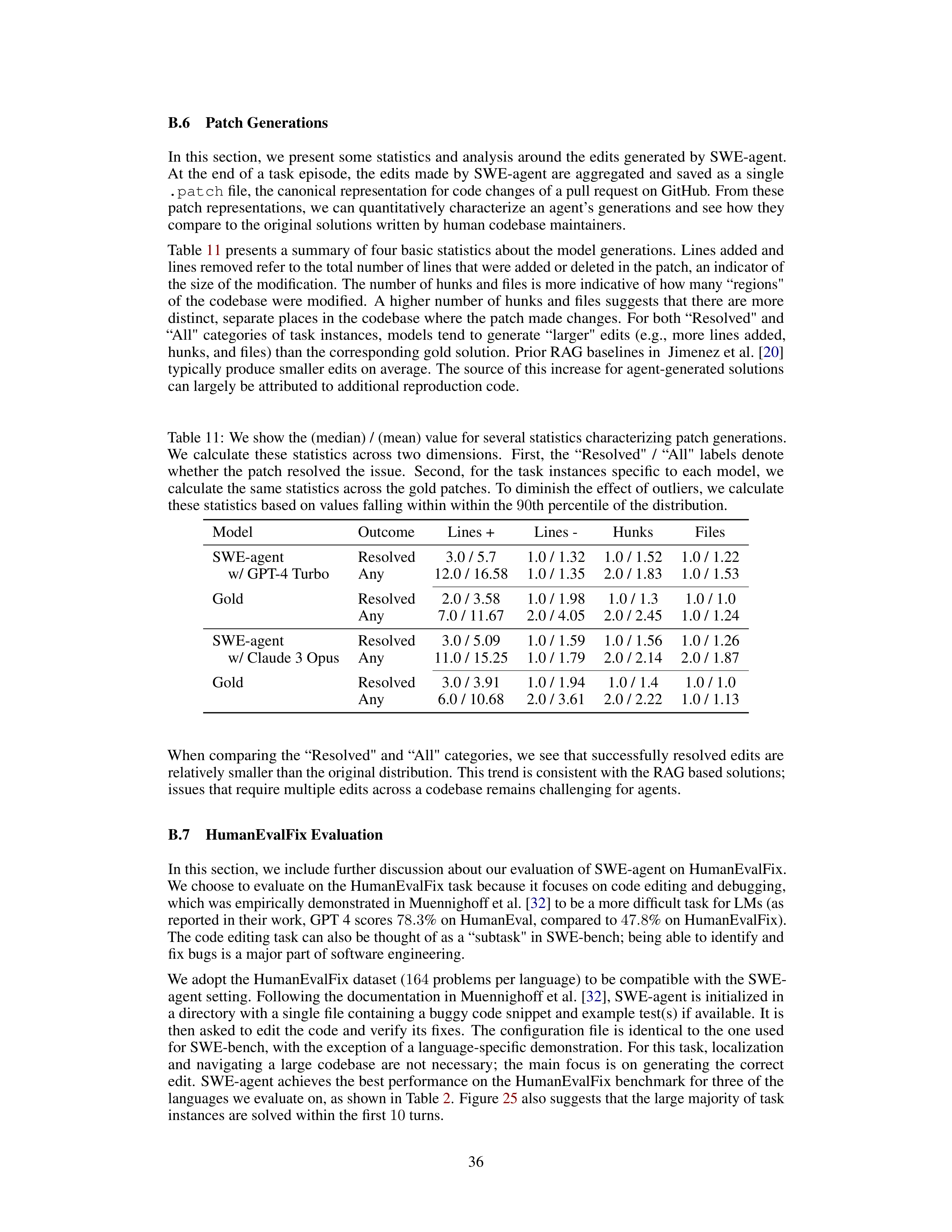
B.6
Patch Generations
In this section, we present some statistics and analysis around the edits generated by SWE-agent.
At the end of a task episode,
the edits made by SWE-agent are aggregated and saved as a single
.patch
file, the canonical representation for code changes of a pull request on GitHub.
From these
patch representations, we can quantitatively characterize an agent’s generations and see how they
compare to the original solutions written by human codebase maintainers.
Table
11
presents a summary of four basic statistics about the model generations.
Lines added and
lines removed refer to the total number of lines that were added or deleted in the patch, an indicator of
the size of the modification.
The number of hunks and files is more indicative of how many “regions"
of the codebase were modified.
A higher number of hunks and files suggests that there are more
distinct, separate places in the codebase where the patch made changes.
For both “Resolved" and
“All"
categories
of
task
instances,
models
tend
to
generate
“larger"
edits
(e.g.,
more
lines
added,
hunks, and files) than the corresponding gold solution.
Prior RAG baselines in
Jimenez et al.
[
20
]
typically produce smaller edits on average.
The source of this increase for agent-generated solutions
can largely be attributed to additional reproduction code.
Table 11:
We show the (median) / (mean) value for several statistics characterizing patch generations.
We
calculate
these
statistics
across
two
dimensions.
First,
the
“Resolved"
/
“All"
labels
denote
whether
the
patch
resolved
the
issue.
Second,
for
the
task
instances
specific
to
each
model,
we
calculate the same statistics across the gold patches.
To diminish the effect of outliers, we calculate
these statistics based on values falling within within the
90
th percentile of the distribution.
Model
Outcome
Lines +
Lines -
Hunks
Files
SWE-agent
Resolved
3.0 / 5.7
1.0 / 1.32
1.0 / 1.52
1.0 / 1.22
w/ GPT-4 Turbo
Any
12.0 / 16.58
1.0 / 1.35
2.0 / 1.83
1.0 / 1.53
Gold
Resolved
2.0 / 3.58
1.0 / 1.98
1.0 / 1.3
1.0 / 1.0
Any
7.0 / 11.67
2.0 / 4.05
2.0 / 2.45
1.0 / 1.24
SWE-agent
Resolved
3.0 / 5.09
1.0 / 1.59
1.0 / 1.56
1.0 / 1.26
w/ Claude 3 Opus
Any
11.0 / 15.25
1.0 / 1.79
2.0 / 2.14
2.0 / 1.87
Gold
Resolved
3.0 / 3.91
1.0 / 1.94
1.0 / 1.4
1.0 / 1.0
Any
6.0 / 10.68
2.0 / 3.61
2.0 / 2.22
1.0 / 1.13
When comparing the “Resolved" and “All" categories, we see that successfully resolved edits are
relatively smaller than the original distribution.
This trend is consistent with the RAG based solutions;
issues that require multiple edits across a codebase remains challenging for agents.
B.7
HumanEvalFix Evaluation
In this section, we include further discussion about our evaluation of SWE-agent on HumanEvalFix.
We choose to evaluate on the HumanEvalFix task because it focuses on code editing and debugging,
which was empirically demonstrated in Muennighoff et al.
[
32
]
to be a more difficult task for LMs (as
reported in their work, GPT 4 scores
78
.
3
% on HumanEval, compared to
47
.
8
% on HumanEvalFix).
The code editing task can also be thought of as a “subtask" in SWE-bench; being able to identify and
fix bugs is a major part of software engineering.
We adopt the HumanEvalFix dataset (
164
problems per language) to be compatible with the SWE-
agent setting.
Following the documentation in Muennighoff et al.
[
32
]
, SWE-agent is initialized in
a directory with a single file containing a buggy code snippet and example test(s) if available.
It is
then asked to edit the code and verify its fixes.
The configuration file is identical to the one used
for SWE-bench, with the exception of a language-specific demonstration.
For this task, localization
and
navigating
a
large
codebase
are
not
necessary;
the
main
focus
is
on
generating
the
correct
edit.
SWE-agent achieves the best performance on the HumanEvalFix benchmark for three of the
languages we evaluate on, as shown in Table
2
.
Figure
25
also suggests that the large majority of task
instances are solved within the first
10
turns.
36
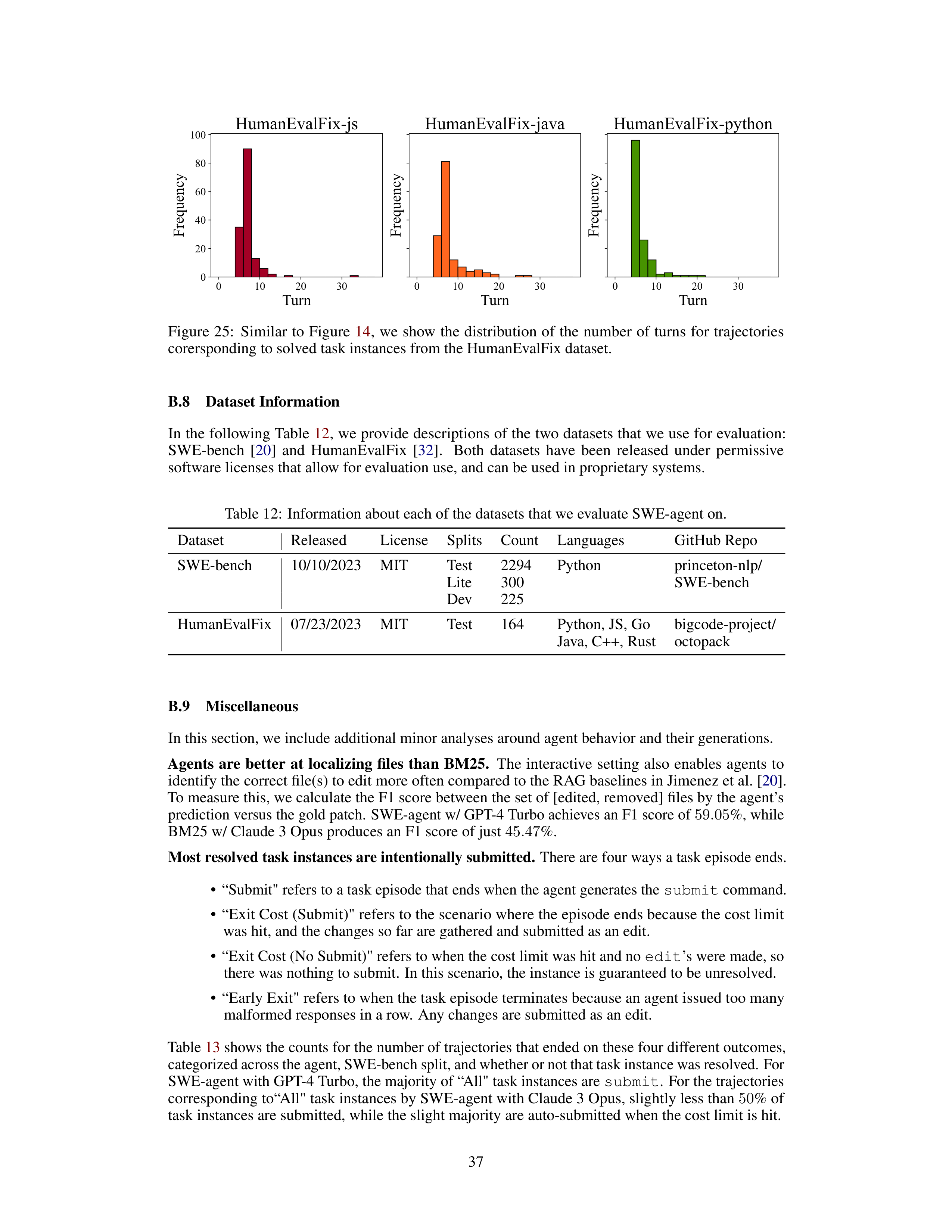
0
10
20
30
Turn
0
20
40
60
80
100
Frequency
HumanEvalFix-js
0
10
20
30
Turn
Frequency
HumanEvalFix-java
0
10
20
30
Turn
Frequency
HumanEvalFix-python
Figure 25:
Similar to Figure
14
,
we
show the distribution of the number of turns for trajectories
corersponding to solved task instances from the HumanEvalFix dataset.
B.8
Dataset Information
In the following Table
12
, we provide descriptions of the two datasets that we use for evaluation:
SWE-bench
[
20
]
and
HumanEvalFix
[
32
].
Both
datasets
have
been
released
under
permissive
software licenses that allow for evaluation use, and can be used in proprietary systems.
Table 12:
Information about each of the datasets that we evaluate SWE-agent on.
Dataset
Released
License
Splits
Count
Languages
GitHub Repo
SWE-bench
10/10/2023
MIT
Test
2294
Python
princeton-nlp/
Lite
300
SWE-bench
Dev
225
HumanEvalFix
07/23/2023
MIT
Test
164
Python, JS, Go
bigcode-project/
Java, C++, Rust
octopack
B.9
Miscellaneous
In this section, we include additional minor analyses around agent behavior and their generations.
Agents
are
better
at
localizing
files
than
BM25.
The
interactive
setting
also
enables
agents
to
identify the correct file(s) to edit more often compared to the RAG baselines in Jimenez et al.
[
20
]
.
To measure this, we calculate the F1 score between the set of [edited, removed] files by the agent’s
prediction versus the gold patch.
SWE-agent w/ GPT-4 Turbo achieves an F1 score of
59
.
05
%, while
BM25 w/ Claude 3 Opus produces an F1 score of just
45
.
47
%.
Most resolved task instances are intentionally submitted.
There are four ways a task episode ends.
•
“Submit" refers to a task episode that ends when the agent generates the
submit
command.
•
“Exit Cost (Submit)" refers to the scenario where the episode ends because the cost limit
was hit, and the changes so far are gathered and submitted as an edit.
•
“Exit Cost (No Submit)" refers to when the cost limit was hit and no
edit
’s were made, so
there was nothing to submit.
In this scenario, the instance is guaranteed to be unresolved.
•
“Early Exit" refers to when the task episode terminates because an agent issued too many
malformed responses in a row.
Any changes are submitted as an edit.
Table
13
shows the counts for the number of trajectories that ended on these four different outcomes,
categorized across the agent, SWE-bench split, and whether or not that task instance was resolved.
For
SWE-agent with GPT-4 Turbo, the majority of “All" task instances are
submit
.
For the trajectories
corresponding to“All" task instances by SWE-agent with Claude 3 Opus, slightly less than
50
% of
task instances are submitted, while the slight majority are auto-submitted when the cost limit is hit.
37
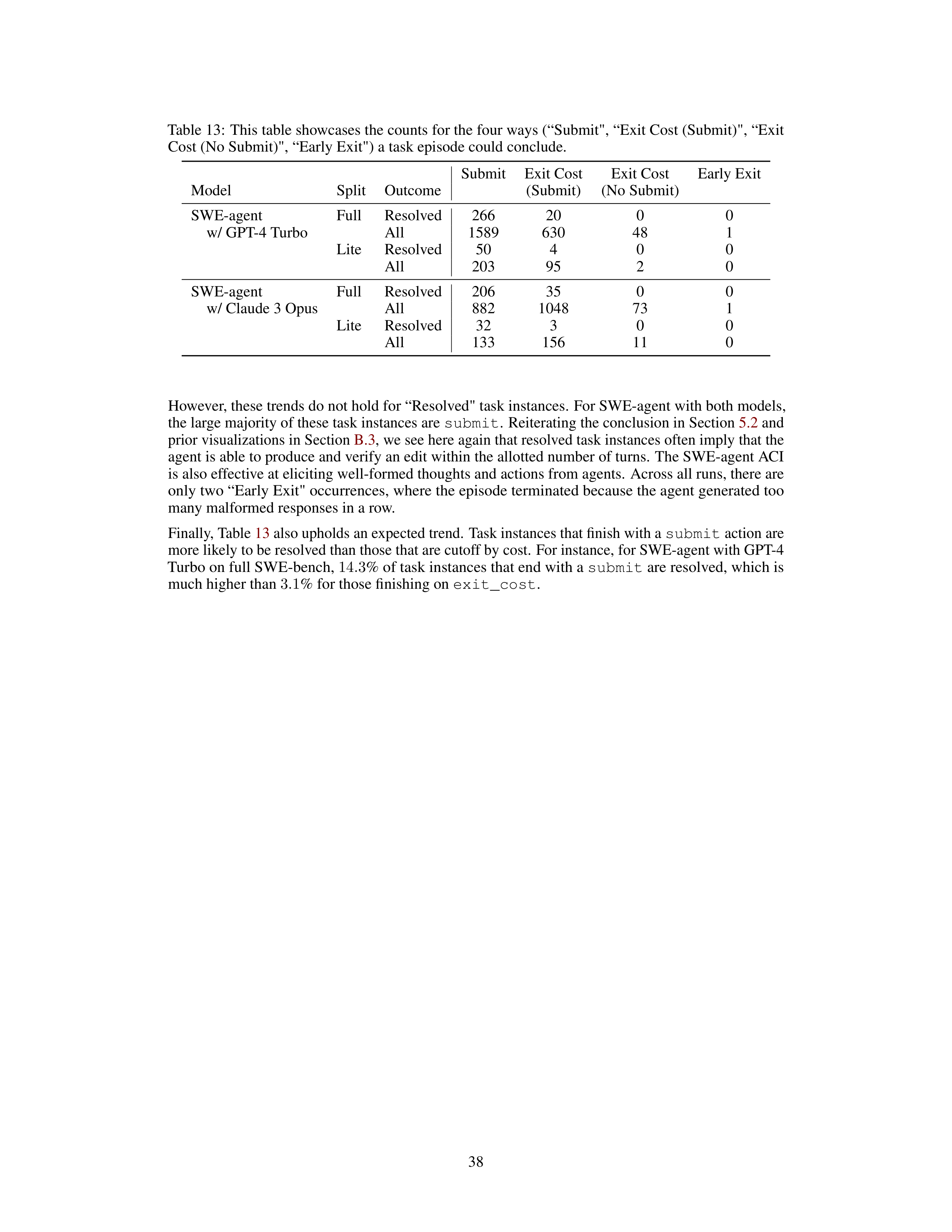
Table 13:
This table showcases the counts for the four ways (“Submit", “Exit Cost (Submit)", “Exit
Cost (No Submit)", “Early Exit") a task episode could conclude.
Submit
Exit Cost
Exit Cost
Early Exit
Model
Split
Outcome
(Submit)
(No Submit)
SWE-agent
Full
Resolved
266
20
0
0
w/ GPT-4 Turbo
All
1589
630
48
1
Lite
Resolved
50
4
0
0
All
203
95
2
0
SWE-agent
Full
Resolved
206
35
0
0
w/ Claude 3 Opus
All
882
1048
73
1
Lite
Resolved
32
3
0
0
All
133
156
11
0
However, these trends do not hold for “Resolved" task instances.
For SWE-agent with both models,
the large majority of these task instances are
submit
.
Reiterating the conclusion in Section
5.2
and
prior visualizations in Section
B.3
, we see here again that resolved task instances often imply that the
agent is able to produce and verify an edit within the allotted number of turns.
The SWE-agent ACI
is also effective at eliciting well-formed thoughts and actions from agents.
Across all runs, there are
only two “Early Exit" occurrences, where the episode terminated because the agent generated too
many malformed responses in a row.
Finally, Table
13
also upholds an expected trend.
Task instances that finish with a
submit
action are
more likely to be resolved than those that are cutoff by cost.
For instance, for SWE-agent with GPT-4
Turbo on full SWE-bench,
14
.
3
% of task instances that end with a
submit
are resolved, which is
much higher than
3
.
1
% for those finishing on
exit_cost
.
38
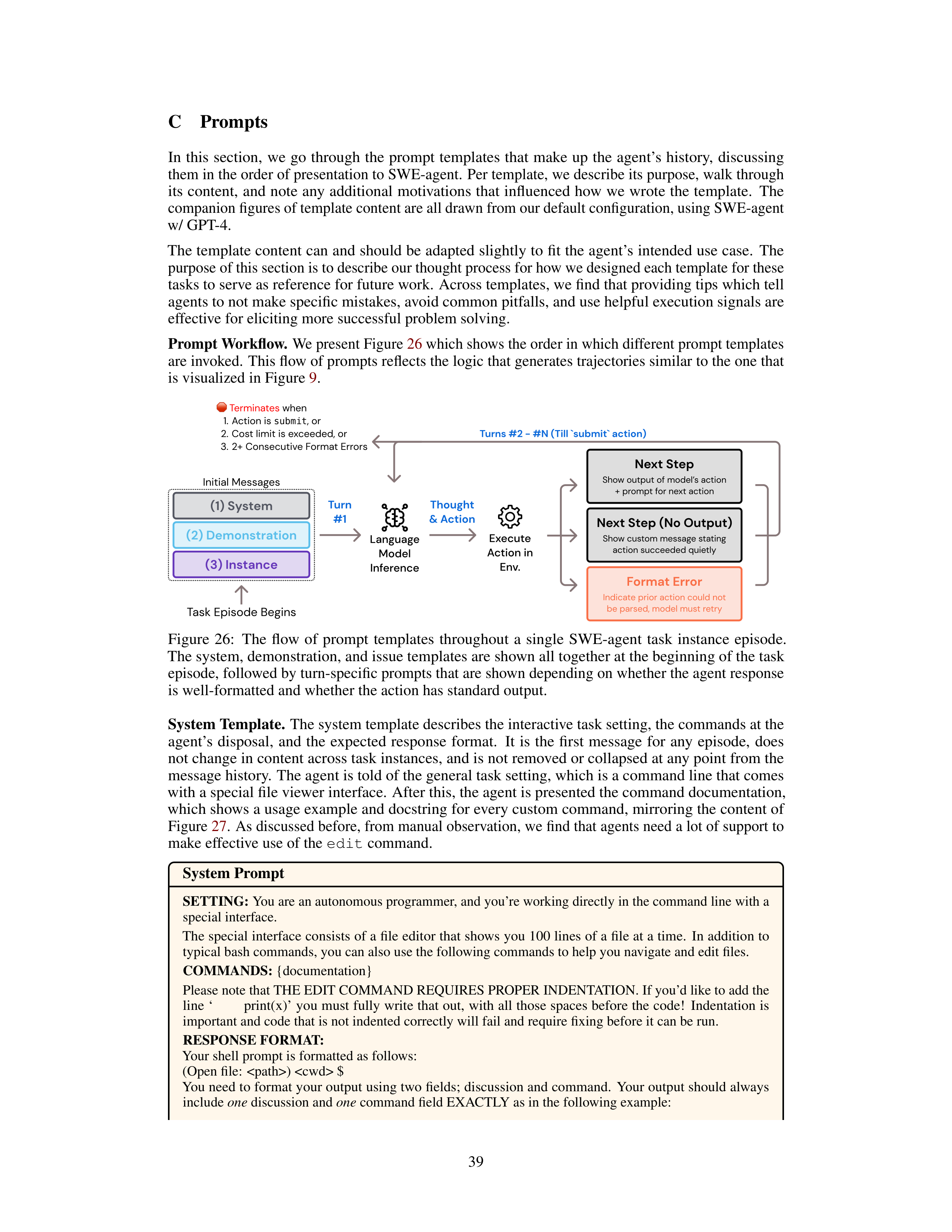



C
Prompts
In
this
section,
we
go
through
the
prompt
templates
that
make
up
the
agent’s
history,
discussing
them in the order of presentation to SWE-agent.
Per template, we describe its purpose, walk through
its content,
and note any additional motivations that influenced how we wrote the template.
The
companion figures of template content are all drawn from our default configuration, using SWE-agent
w/ GPT-4.
The template content can and should be adapted slightly to fit the agent’s intended use case.
The
purpose of this section is to describe our thought process for how we designed each template for these
tasks to serve as reference for future work.
Across templates, we find that providing tips which tell
agents to not make specific mistakes, avoid common pitfalls, and use helpful execution signals are
effective for eliciting more successful problem solving.
Prompt Workflow.
We present Figure
26
which shows the order in which different prompt templates
are invoked.
This flow of prompts reflects the logic that generates trajectories similar to the one that
is visualized in Figure
9
.
Task Episode Begins
Initial Messages
Terminates whe?
=4
Action is
submit
, o+
E4
Cost limit is exceeded, o+
64
2+ Consecutive Format Errors
(3) Instance
(2) Demonstration
(1) System
Next Step
Show output of model’s action
+ prompt for next action
Next Step (No Output)
Show custom message stating
action succeeded quietly
Format Error
Indicate prior action could not
be parsed, model must retry
Language
Model
Inference
Execute
Action in
Env.
Turn
#1
Thought
& Action
Turns #2
-
#N (Ti
ll
`
su
b
mit
`
action)
Figure
26:
The
flow
of
prompt
templates
throughout
a
single
SWE-agent
task
instance
episode.
The system, demonstration, and issue templates are shown all together at the beginning of the task
episode, followed by turn-specific prompts that are shown depending on whether the agent response
is well-formatted and whether the action has standard output.
System Template.
The system template describes the interactive task setting, the commands at the
agent’s
disposal,
and
the
expected
response
format.
It
is
the
first
message
for
any
episode,
does
not change in content across task instances, and is not removed or collapsed at any point from the
message history.
The agent is told of the general task setting, which is a command line that comes
with a special file viewer interface.
After this, the agent is presented the command documentation,
which shows a usage example and docstring for every custom command, mirroring the content of
Figure
27
.
As discussed before, from manual observation, we find that agents need a lot of support to
make effective use of the
edit
command.
System Prompt
SETTING:
You are an autonomous programmer, and you’re working directly in the command line with a
special interface.
The special interface consists of a file editor that shows you 100 lines of a file at a time.
In addition to
typical bash commands, you can also use the following commands to help you navigate and edit files.
COMMANDS:
{documentation}
Please note that THE EDIT COMMAND REQUIRES PROPER INDENTATION. If you’d like to add the
line ‘
print(x)’ you must fully write that out, with all those spaces before the code!
Indentation is
important and code that is not indented correctly will fail and require fixing before it can be run.
RESPONSE FORMAT:
Your shell prompt is formatted as follows:
(Open file:
) $
You need to format your output using two fields; discussion and command.
Your output should always
include
one
discussion and
one
command field EXACTLY as in the following example:
39
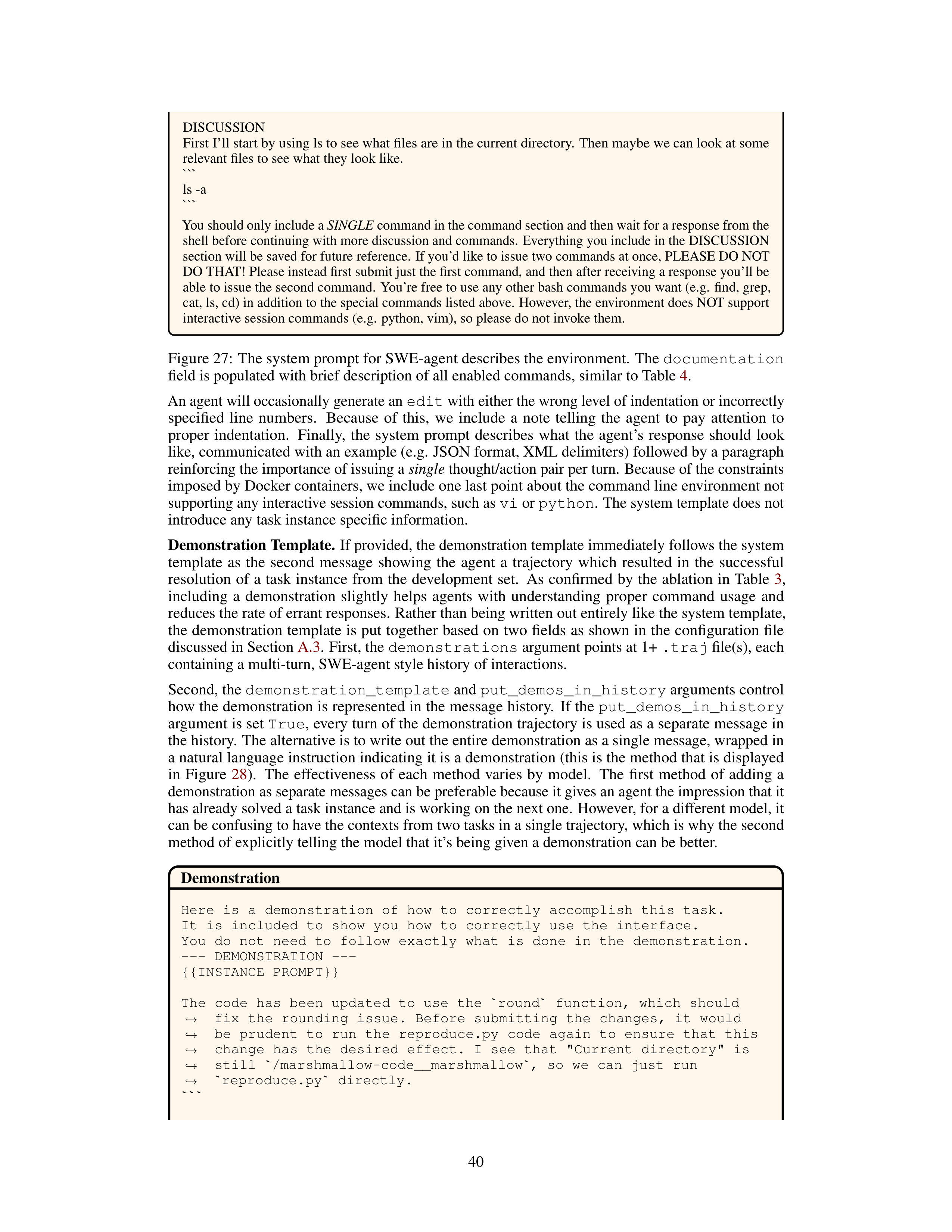
DISCUSSION
First I’ll start by using ls to see what files are in the current directory.
Then maybe we can look at some
relevant files to see what they look like.
```
ls -a
```
You should only include a
SINGLE
command in the command section and then wait for a response from the
shell before continuing with more discussion and commands.
Everything you include in the DISCUSSION
section will be saved for future reference.
If you’d like to issue two commands at once, PLEASE DO NOT
DO THAT! Please instead first submit just the first command, and then after receiving a response you’ll be
able to issue the second command.
You’re free to use any other bash commands you want (e.g.
find, grep,
cat, ls, cd) in addition to the special commands listed above.
However, the environment does NOT support
interactive session commands (e.g.
python, vim), so please do not invoke them.
Figure 27:
The system prompt for SWE-agent describes the environment.
The
documentation
field is populated with brief description of all enabled commands, similar to Table
4
.
An agent will occasionally generate an
edit
with either the wrong level of indentation or incorrectly
specified
line
numbers.
Because
of
this,
we
include
a
note
telling
the
agent
to
pay
attention
to
proper
indentation.
Finally,
the
system
prompt
describes
what
the
agent’s
response
should
look
like, communicated with an example (e.g.
JSON format, XML delimiters) followed by a paragraph
reinforcing the importance of issuing a
single
thought/action pair per turn.
Because of the constraints
imposed by Docker containers, we include one last point about the command line environment not
supporting any interactive session commands, such as
vi
or
python
.
The system template does not
introduce any task instance specific information.
Demonstration Template.
If provided, the demonstration template immediately follows the system
template
as
the
second
message
showing
the
agent
a
trajectory
which
resulted
in
the
successful
resolution
of
a
task
instance
from
the
development
set.
As
confirmed
by
the
ablation
in
Table
3
,
including
a
demonstration
slightly
helps
agents
with
understanding
proper
command
usage
and
reduces the rate of errant responses.
Rather than being written out entirely like the system template,
the demonstration template is put together based on two fields as shown in the configuration file
discussed in Section
A.3
.
First, the
demonstrations
argument points at 1+
.traj
file(s), each
containing a multi-turn, SWE-agent style history of interactions.
Second, the
demonstration_template
and
put_demos_in_history
arguments control
how the demonstration is represented in the message history.
If the
put_demos_in_history
argument is set
True
, every turn of the demonstration trajectory is used as a separate message in
the history.
The alternative is to write out the entire demonstration as a single message, wrapped in
a natural language instruction indicating it is a demonstration (this is the method that is displayed
in
Figure
28
).
The
effectiveness
of
each
method
varies
by
model.
The
first
method
of
adding
a
demonstration as separate messages can be preferable because it gives an agent the impression that it
has already solved a task instance and is working on the next one.
However, for a different model, it
can be confusing to have the contexts from two tasks in a single trajectory, which is why the second
method of explicitly telling the model that it’s being given a demonstration can be better.
Demonstration
Here
is
a
demonstration
of
how
to
correctly
accomplish
this
task.
It
is
included
to
show
you
how
to
correctly
use
the
interface.
You
do
not
need
to
follow
exactly
what
is
done
in
the
demonstration.
---
DEMONSTRATION
---
{{INSTANCE
PROMPT}}
The
code
has
been
updated
to
use
the
`
round
`
function,
which
should
fix
the
rounding
issue.
Before
submitting
the
changes,
it
would
be
prudent
to
run
the
reproduce.py
code
again
to
ensure
that
this
change
has
the
desired
effect.
I
see
that
"Current
directory"
is
still
`
/marshmallow-code__marshmallow
`
,
so
we
can
just
run
`
reproduce.py
`
directly.
,
→
,
→
,
→
,
→
,
→
```
40
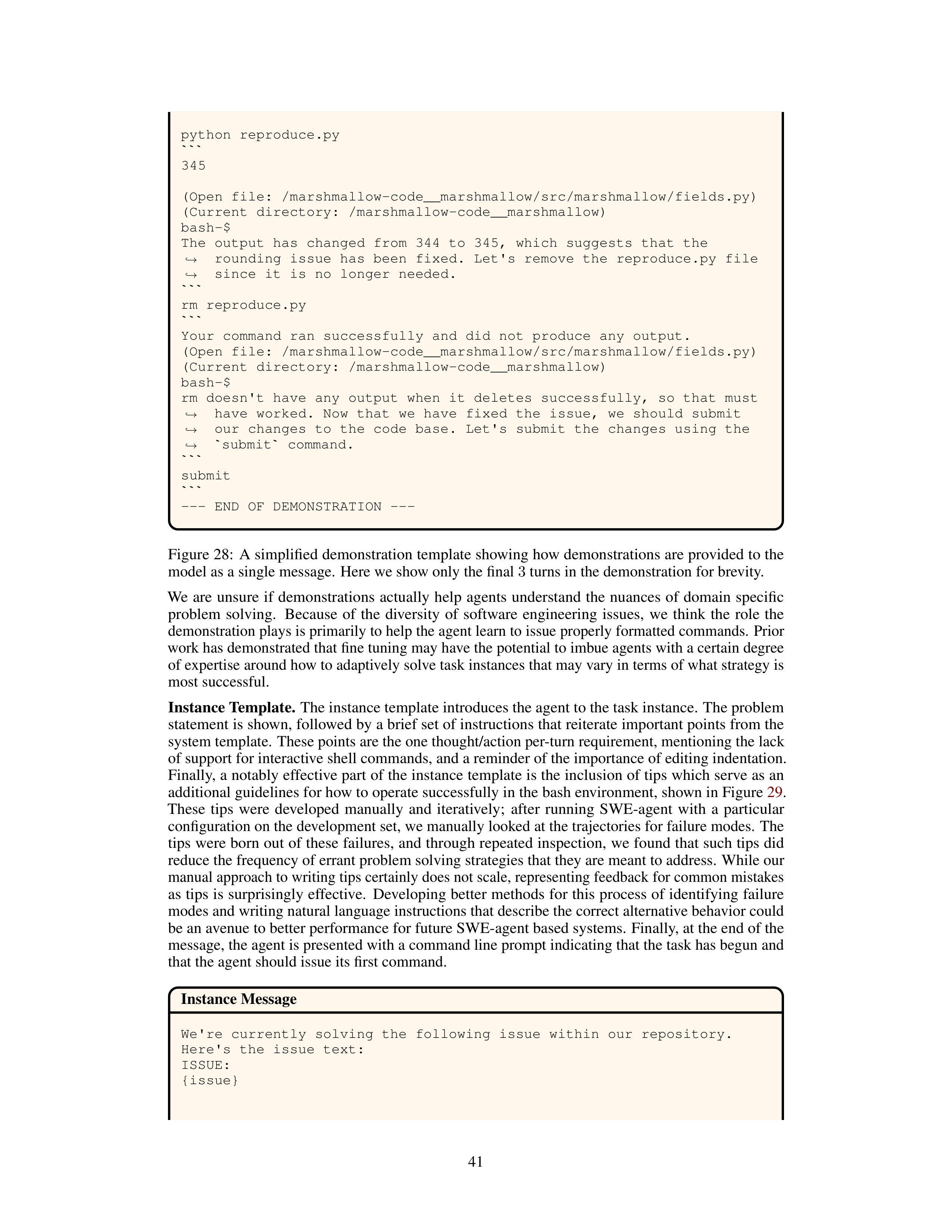
python
reproduce.py
```
345
(Open
file:
/marshmallow-code__marshmallow/src/marshmallow/fields.py)
(Current
directory:
/marshmallow-code__marshmallow)
bash-$
The
output
has
changed
from
344
to
345,
which
suggests
that
the
rounding
issue
has
been
fixed.
Let's
remove
the
reproduce.py
file
since
it
is
no
longer
needed.
,
→
,
→
```
rm
reproduce.py
```
Your
command
ran
successfully
and
did
not
produce
any
output.
(Open
file:
/marshmallow-code__marshmallow/src/marshmallow/fields.py)
(Current
directory:
/marshmallow-code__marshmallow)
bash-$
rm
doesn't
have
any
output
when
it
deletes
successfully,
so
that
must
have
worked.
Now
that
we
have
fixed
the
issue,
we
should
submit
our
changes
to
the
code
base.
Let's
submit
the
changes
using
the
`
submit
`
command.
,
→
,
→
,
→
```
submit
```
---
END
OF
DEMONSTRATION
---
Figure 28:
A simplified demonstration template showing how demonstrations are provided to the
model as a single message.
Here we show only the final
3
turns in the demonstration for brevity.
We
are
unsure
if
demonstrations
actually
help
agents
understand
the
nuances
of
domain
specific
problem
solving.
Because
of
the
diversity
of
software
engineering
issues,
we
think
the
role
the
demonstration plays is primarily to help the agent learn to issue properly formatted commands.
Prior
work has demonstrated that fine tuning may have the potential to imbue agents with a certain degree
of expertise around how to adaptively solve task instances that may vary in terms of what strategy is
most successful.
Instance Template.
The instance template introduces the agent to the task instance.
The problem
statement is shown, followed by a brief set of instructions that reiterate important points from the
system template.
These points are the one thought/action per-turn requirement, mentioning the lack
of support for interactive shell commands, and a reminder of the importance of editing indentation.
Finally, a notably effective part of the instance template is the inclusion of tips which serve as an
additional guidelines for how to operate successfully in the bash environment, shown in Figure
29
.
These
tips
were
developed
manually
and
iteratively;
after
running
SWE-agent
with
a
particular
configuration on the development set, we manually looked at the trajectories for failure modes.
The
tips were born out of these failures, and through repeated inspection, we found that such tips did
reduce the frequency of errant problem solving strategies that they are meant to address.
While our
manual approach to writing tips certainly does not scale, representing feedback for common mistakes
as tips is surprisingly effective.
Developing better methods for this process of identifying failure
modes and writing natural language instructions that describe the correct alternative behavior could
be an avenue to better performance for future SWE-agent based systems.
Finally, at the end of the
message, the agent is presented with a command line prompt indicating that the task has begun and
that the agent should issue its first command.
Instance Message
We're
currently
solving
the
following
issue
within
our
repository.
Here's
the
issue
text:
ISSUE:
{issue}
41
INSTRUCTIONS:
Now,
you're
going
to
solve
this
issue
on
your
own.
Your
terminal
session
has
started
and
you're
in
the
repository's
root
directory.
You
can
use
any
bash
commands
or
the
special
interface
to
help
you.
Edit
all
the
files
you
need
to
and
run
any
checks
or
tests
that
you
want.
Remember,
YOU
CAN
ONLY
ENTER
ONE
COMMAND
AT
A
TIME.
You
should
always
wait
for
feedback
after
every
command.
When
you're
satisfied
with
all
of
the
changes
you've
made,
you
can
submit
your
changes
to
the
code
base
by
simply
running
the
submit
command.
Note
however
that
you
cannot
use
any
interactive
session
commands
(e.g.
python,
vim)
in
this
environment,
but
you
can
write
scripts
and
run
them.
E.g.
you
can
write
a
python
script
and
then
run
it
with
`
python
.py
`
.
,
→
,
→
,
→
,
→
,
→
,
→
,
→
,
→
,
→
,
→
,
→
NOTE
ABOUT
THE
EDIT
COMMAND:
Indentation
really
matters!
When
editing
a
file,
make
sure
to
insert
appropriate
indentation
before
each
line!
,
→
,
→
IMPORTANT
TIPS:
1.
Always
start
by
trying
to
replicate
the
bug
that
the
issues
discusses.
If
the
issue
includes
code
for
reproducing
the
bug,
we
recommend
that
you
re-implement
that
in
your
environment,
and
run
it
to
make
sure
you
can
reproduce
the
bug.
Then
start
trying
to
fix
it.
When
you
think
you've
fixed
the
bug,
re-run
the
bug
reproduction
script
to
make
sure
that
the
bug
has
indeed
been
fixed.
,
→
,
→
,
→
,
→
,
→
,
→
2.
If
you
run
a
command
and
it
doesn't
work,
try
running
a
different
command.
A
command
that
did
not
work
once
will
not
work
the
second
time
unless
you
modify
it!
,
→
,
→
3.
If
you
open
a
file
and
need
to
get
to
an
area
around
a
specific
line
that
is
not
in
the
first
100
lines,
say
line
583,
don't
just
use
the
scroll_down
command
multiple
times.
Instead,
use
the
goto
583
command.
It's
much
quicker.
,
→
,
→
,
→
4.
If
the
bug
reproduction
script
requires
inputting/reading
a
specific
file,
such
as
buggy-input.png,
and
you'd
like
to
understand
how
to
input
that
file,
conduct
a
search
in
the
existing
repo
code,
to
see
whether
someone
else
has
already
done
that.
Do
this
by
running
the
command:
find_file
"buggy-input.png"
If
that
doesn't
work,
use
the
linux
'find'
command.
,
→
,
→
,
→
,
→
,
→
5.
Always
make
sure
to
look
at
the
currently
open
file
and
the
current
working
directory
(which
appears
right
after
the
currently
open
file).
The
currently
open
file
might
be
in
a
different
directory
than
the
working
directory!
Note
that
some
commands,
such
as
'create',
open
files,
so
they
might
change
the
current
open
file.
,
→
,
→
,
→
,
→
,
→
6.
When
editing
files,
it
is
easy
to
accidentally
specify
a
wrong
line
number
or
to
write
code
with
incorrect
indentation.
Always
check
the
code
after
you
issue
an
edit
to
make
sure
that
it
reflects
what
you
wanted
to
accomplish.
If
it
didn't,
issue
another
command
to
fix
it.
,
→
,
→
,
→
,
→
(Open
file:
{open_file})
(Current
directory:
{working_dir})
bash-$
42
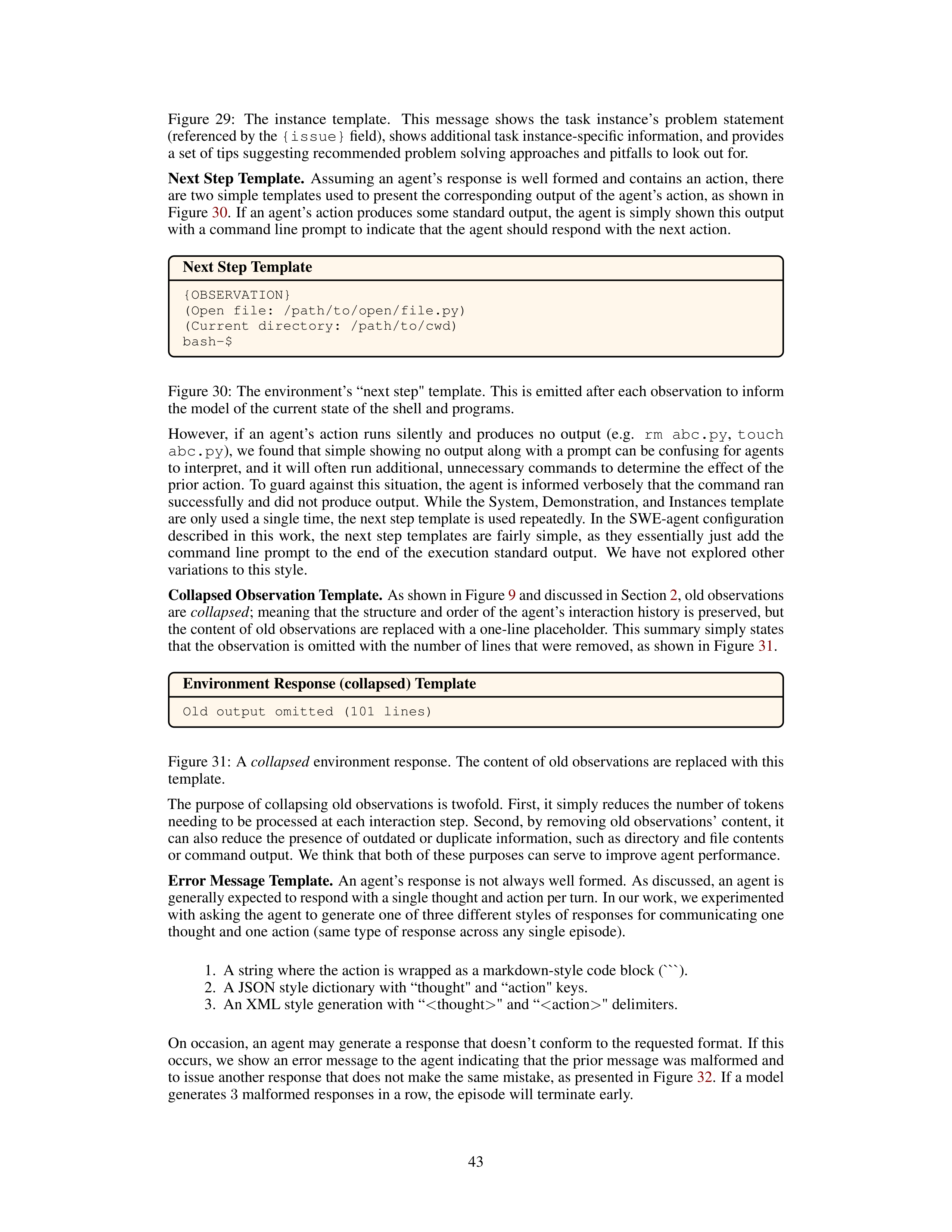
Figure
29:
The
instance
template.
This
message
shows
the
task
instance’s
problem
statement
(referenced by the
{issue}
field), shows additional task instance-specific information, and provides
a set of tips suggesting recommended problem solving approaches and pitfalls to look out for.
Next Step Template.
Assuming an agent’s response is well formed and contains an action, there
are two simple templates used to present the corresponding output of the agent’s action, as shown in
Figure
30
.
If an agent’s action produces some standard output, the agent is simply shown this output
with a command line prompt to indicate that the agent should respond with the next action.
Next Step Template
{OBSERVATION}
(Open
file:
/path/to/open/file.py)
(Current
directory:
/path/to/cwd)
bash-$
Figure 30:
The environment’s “next step" template.
This is emitted after each observation to inform
the model of the current state of the shell and programs.
However,
if
an
agent’s
action
runs
silently
and
produces
no
output
(e.g.
rm
abc.py
,
touch
abc.py
), we found that simple showing no output along with a prompt can be confusing for agents
to interpret, and it will often run additional, unnecessary commands to determine the effect of the
prior action.
To guard against this situation, the agent is informed verbosely that the command ran
successfully and did not produce output.
While the System, Demonstration, and Instances template
are only used a single time, the next step template is used repeatedly.
In the SWE-agent configuration
described
in
this
work,
the
next
step
templates
are
fairly
simple,
as
they
essentially
just
add
the
command
line
prompt
to
the
end
of
the
execution
standard
output.
We
have
not
explored
other
variations to this style.
Collapsed Observation Template.
As shown in Figure
9
and discussed in Section
2
, old observations
are
collapsed
; meaning that the structure and order of the agent’s interaction history is preserved, but
the content of old observations are replaced with a one-line placeholder.
This summary simply states
that the observation is omitted with the number of lines that were removed, as shown in Figure
31
.
Environment Response (collapsed) Template
Old
output
omitted
(101
lines)
Figure 31:
A
collapsed
environment response.
The content of old observations are replaced with this
template.
The purpose of collapsing old observations is twofold.
First, it simply reduces the number of tokens
needing to be processed at each interaction step.
Second, by removing old observations’ content, it
can also reduce the presence of outdated or duplicate information, such as directory and file contents
or command output.
We think that both of these purposes can serve to improve agent performance.
Error Message Template.
An agent’s response is not always well formed.
As discussed, an agent is
generally expected to respond with a single thought and action per turn.
In our work, we experimented
with asking the agent to generate one of three different styles of responses for communicating one
thought and one action (same type of response across any single episode).
1.
A string where the action is wrapped as a markdown-style code block (```).
2.
A JSON style dictionary with “thought" and “action" keys.
3.
An XML style generation with “
<
thought
>
" and “
<
action
>
" delimiters.
On occasion, an agent may generate a response that doesn’t conform to the requested format.
If this
occurs, we show an error message to the agent indicating that the prior message was malformed and
to issue another response that does not make the same mistake, as presented in Figure
32
.
If a model
generates
3
malformed responses in a row, the episode will terminate early.
43
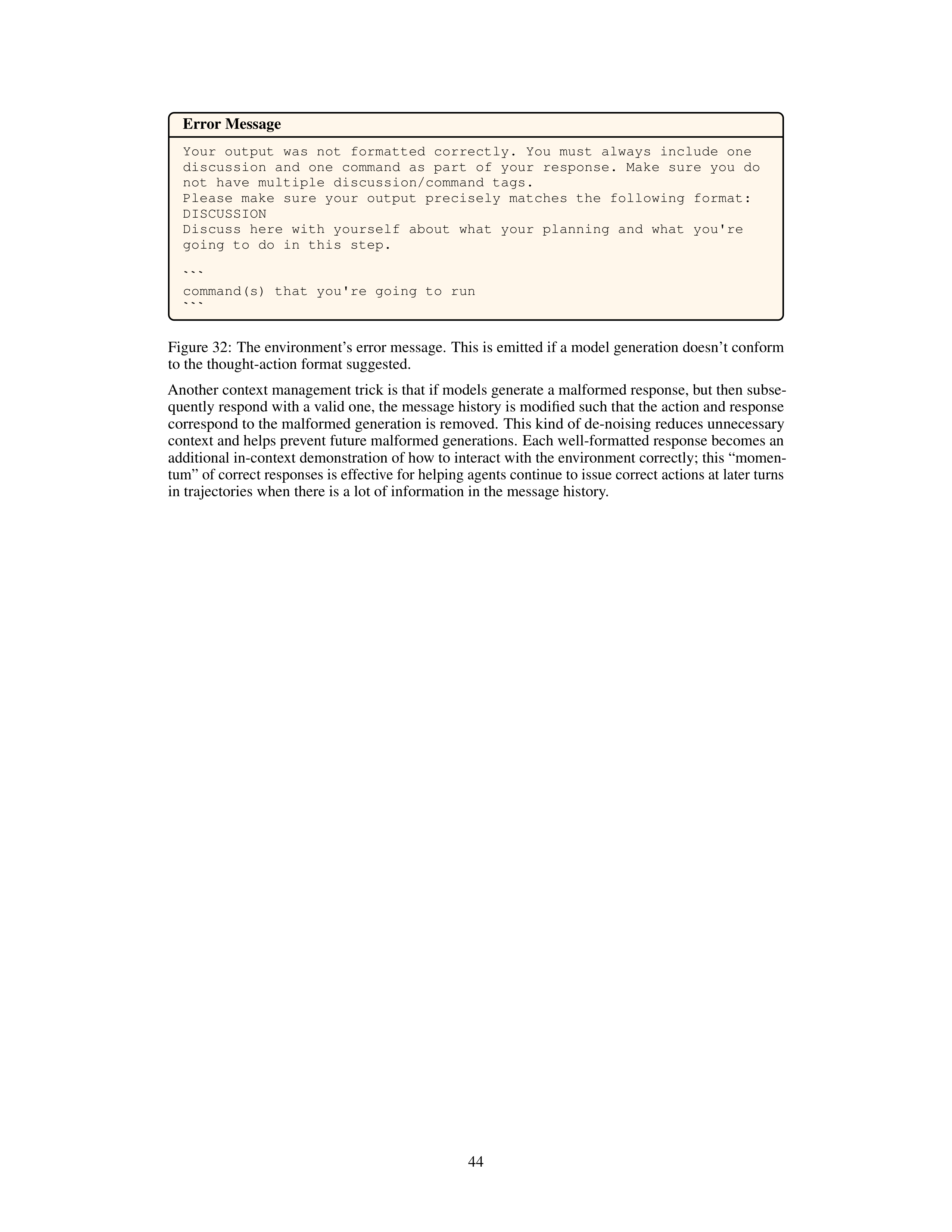
Error Message
Your
output
was
not
formatted
correctly.
You
must
always
include
one
discussion
and
one
command
as
part
of
your
response.
Make
sure
you
do
not
have
multiple
discussion/command
tags.
Please
make
sure
your
output
precisely
matches
the
following
format:
DISCUSSION
Discuss
here
with
yourself
about
what
your
planning
and
what
you're
going
to
do
in
this
step.
```
command(s)
that
you're
going
to
run
```
Figure 32:
The environment’s error message.
This is emitted if a model generation doesn’t conform
to the thought-action format suggested.
Another context management trick is that if models generate a malformed response, but then subse-
quently respond with a valid one, the message history is modified such that the action and response
correspond to the malformed generation is removed.
This kind of de-noising reduces unnecessary
context and helps prevent future malformed generations.
Each well-formatted response becomes an
additional in-context demonstration of how to interact with the environment correctly; this “momen-
tum” of correct responses is effective for helping agents continue to issue correct actions at later turns
in trajectories when there is a lot of information in the message history.
44
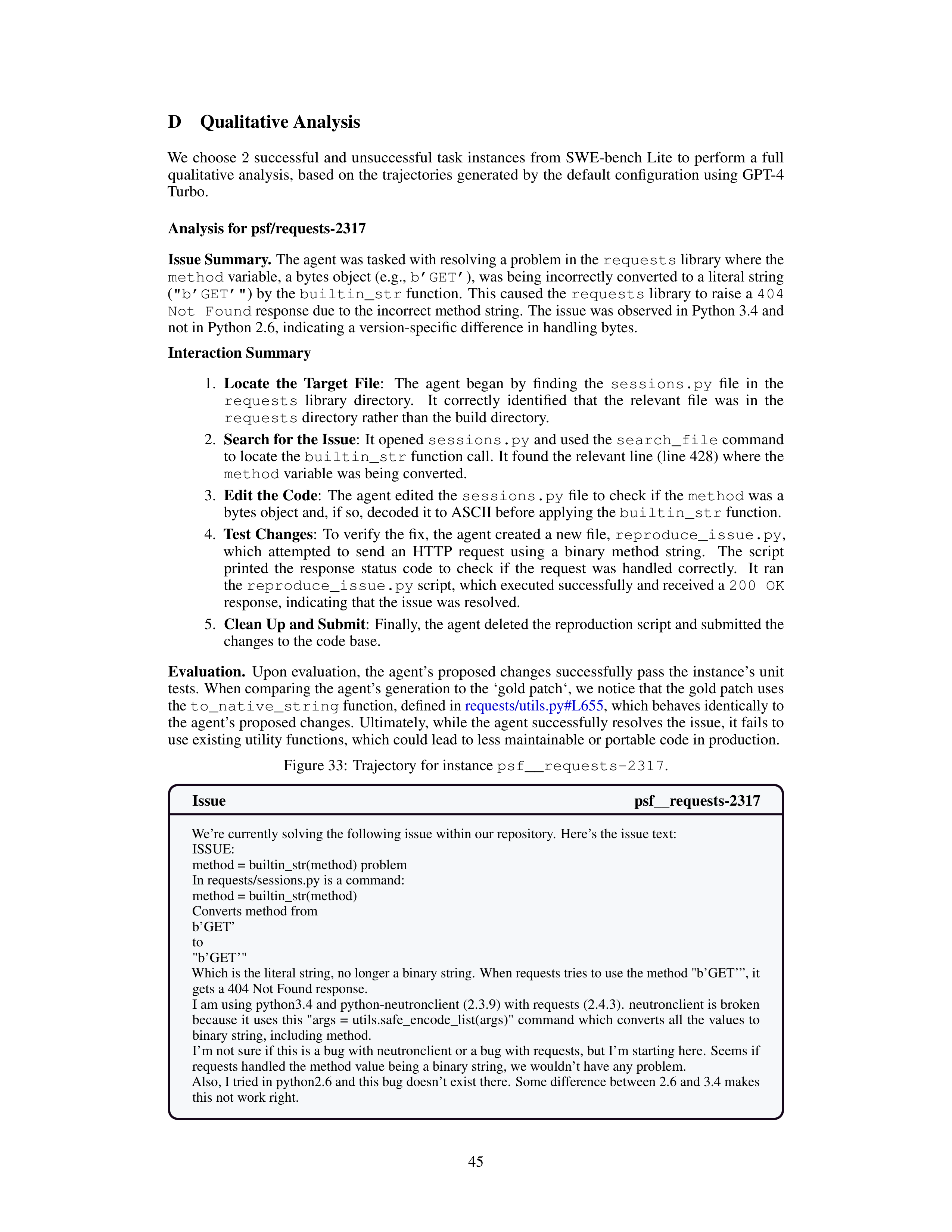
D
Qualitative Analysis
We
choose
2
successful
and
unsuccessful
task
instances
from
SWE-bench
Lite
to
perform
a
full
qualitative analysis, based on the trajectories generated by the default configuration using GPT-4
Turbo.
Analysis for psf/requests-2317
Issue Summary.
The agent was tasked with resolving a problem in the
requests
library where the
method
variable, a bytes object (e.g.,
b’GET’
), was being incorrectly converted to a literal string
(
"b’GET’"
) by the
builtin_str
function.
This caused the
requests
library to raise a
404
Not
Found
response due to the incorrect method string.
The issue was observed in Python 3.4 and
not in Python 2.6, indicating a version-specific difference in handling bytes.
Interaction Summary
1.
Locate
the
Target
File
:
The
agent
began
by
finding
the
sessions.py
file
in
the
requests
library
directory.
It
correctly
identified
that
the
relevant
file
was
in
the
requests
directory rather than the build directory.
2.
Search for the Issue
:
It opened
sessions.py
and used the
search_file
command
to locate the
builtin_str
function call.
It found the relevant line (line 428) where the
method
variable was being converted.
3.
Edit the Code
:
The agent edited the
sessions.py
file to check if the
method
was a
bytes object and, if so, decoded it to ASCII before applying the
builtin_str
function.
4.
Test Changes
:
To verify the fix, the agent created a new file,
reproduce_issue.py
,
which
attempted
to
send
an
HTTP
request
using
a
binary
method
string.
The
script
printed
the
response
status
code
to
check
if
the
request
was
handled
correctly.
It
ran
the
reproduce_issue.py
script, which executed successfully and received a
200
OK
response, indicating that the issue was resolved.
5.
Clean Up and Submit
:
Finally, the agent deleted the reproduction script and submitted the
changes to the code base.
Evaluation.
Upon evaluation, the agent’s proposed changes successfully pass the instance’s unit
tests.
When comparing the agent’s generation to the ‘gold patch‘, we notice that the gold patch uses
the
to_native_string
function, defined in
requests/utils.py#L655
, which behaves identically to
the agent’s proposed changes.
Ultimately, while the agent successfully resolves the issue, it fails to
use existing utility functions, which could lead to less maintainable or portable code in production.
Figure 33:
Trajectory for instance
psf__requests-2317
.
Issue
psf__requests-2317
We’re currently solving the following issue within our repository.
Here’s the issue text:
ISSUE:
method = builtin_str(method) problem
In requests/sessions.py is a command:
method = builtin_str(method)
Converts method from
b’GET’
to
"b’GET’"
Which is the literal string, no longer a binary string.
When requests tries to use the method "b’GET’”, it
gets a 404 Not Found response.
I am using python3.4 and python-neutronclient (2.3.9) with requests (2.4.3).
neutronclient is broken
because it uses this "args = utils.safe_encode_list(args)" command which converts all the values to
binary string, including method.
I’m not sure if this is a bug with neutronclient or a bug with requests, but I’m starting here.
Seems if
requests handled the method value being a binary string, we wouldn’t have any problem.
Also, I tried in python2.6 and this bug doesn’t exist there.
Some difference between 2.6 and 3.4 makes
this not work right.
45
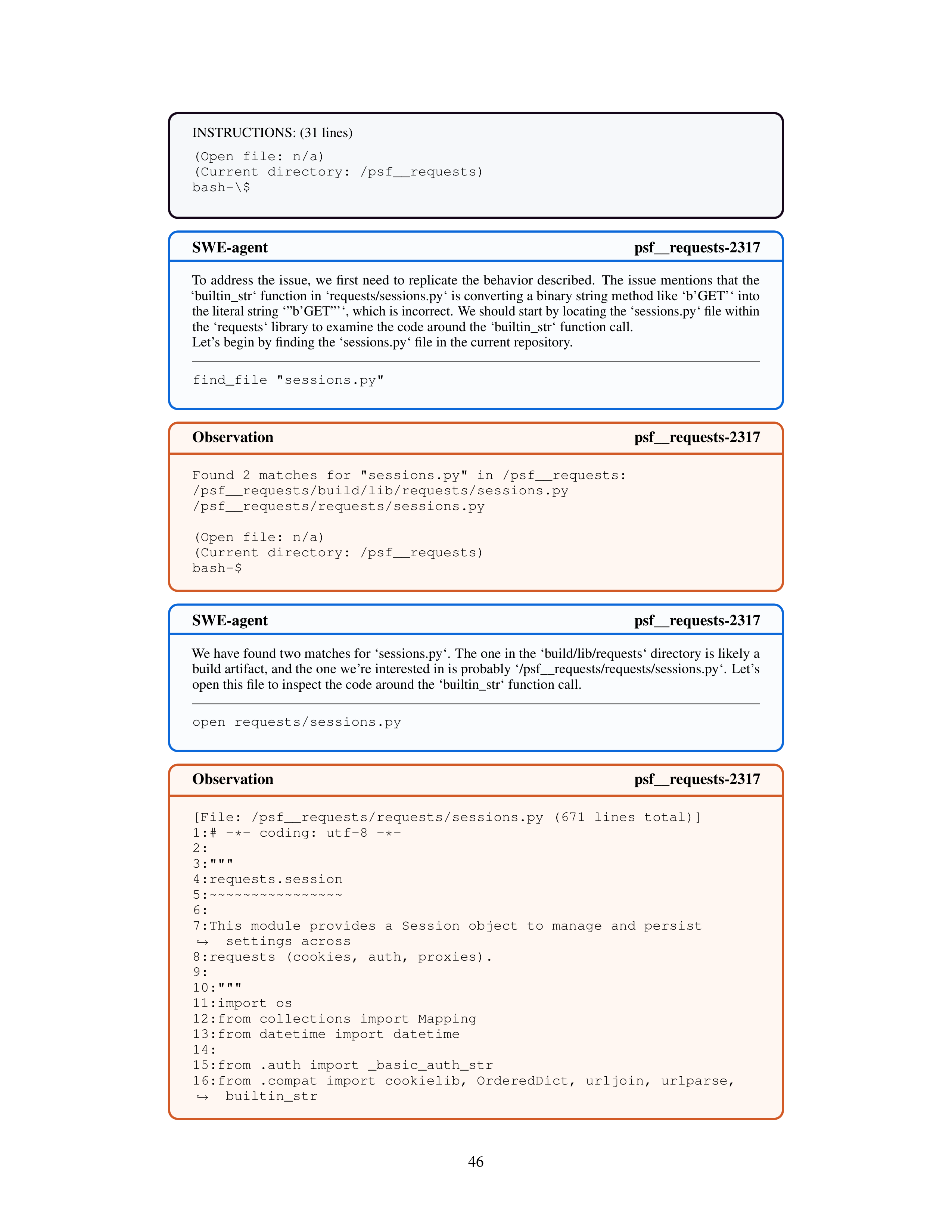
INSTRUCTIONS: (31 lines)
(Open
file:
n/a)
(Current
directory:
/psf__requests)
bash-\$
SWE-agent
psf__requests-2317
To address the issue,
we first need to replicate the behavior described.
The issue mentions that the
‘builtin_str‘ function in ‘requests/sessions.py‘ is converting a binary string method like ‘b’GET’‘ into
the literal string ‘”b’GET”’‘, which is incorrect.
We should start by locating the ‘sessions.py‘ file within
the ‘requests‘ library to examine the code around the ‘builtin_str‘ function call.
Let’s begin by finding the ‘sessions.py‘ file in the current repository.
find_file
"sessions.py"
Observation
psf__requests-2317
Found
2
matches
for
"sessions.py"
in
/psf__requests:
/psf__requests/build/lib/requests/sessions.py
/psf__requests/requests/sessions.py
(Open
file:
n/a)
(Current
directory:
/psf__requests)
bash-$
SWE-agent
psf__requests-2317
We have found two matches for ‘sessions.py‘.
The one in the ‘build/lib/requests‘ directory is likely a
build artifact, and the one we’re interested in is probably ‘/psf__requests/requests/sessions.py‘.
Let’s
open this file to inspect the code around the ‘builtin_str‘ function call.
open
requests/sessions.py
Observation
psf__requests-2317
[File:
/psf__requests/requests/sessions.py
(671
lines
total)]
1:#
-*-
coding:
utf-8
-*-
2:
3:"""
4:requests.session
5:~~~~~~~~~~~~~~~~
6:
7:This
module
provides
a
Session
object
to
manage
and
persist
settings
across
,
→
8:requests
(cookies,
auth,
proxies).
9:
10:"""
11:import
os
12:from
collections
import
Mapping
13:from
datetime
import
datetime
14:
15:from
.auth
import
_basic_auth_str
16:from
.compat
import
cookielib,
OrderedDict,
urljoin,
urlparse,
builtin_str
,
→
46
17:from
.cookies
import
(
18:
cookiejar_from_dict,
extract_cookies_to_jar,
RequestsCookieJar,
merge_cookies)
,
→
19:from
.models
import
Request,
PreparedRequest,
DEFAULT_REDIRECT_LIMIT
,
→
20:from
.hooks
import
default_hooks,
dispatch_hook
21:from
.utils
import
to_key_val_list,
default_headers,
to_native_string
,
→
22:from
.exceptions
import
(
23:
TooManyRedirects,
InvalidSchema,
ChunkedEncodingError,
ContentDecodingError)
,
→
24:from
.structures
import
CaseInsensitiveDict
25:
26:from
.adapters
import
HTTPAdapter
27:
28:from
.utils
import
(
29:
requote_uri,
get_environ_proxies,
get_netrc_auth,
should_bypass_proxies,
,
→
30:
get_auth_from_url
31:)
32:
33:from
.status_codes
import
codes
34:
35:#
formerly
defined
here,
reexposed
here
for
backward
compatibility
,
→
36:from
.models
import
REDIRECT_STATI
37:
38:
39:def
merge_setting(request_setting,
session_setting,
dict_class=OrderedDict):
,
→
40:
"""
41:
Determines
appropriate
setting
for
a
given
request,
taking
into
account
the
,
→
42:
explicit
setting
on
that
request,
and
the
setting
in
the
session.
If
a
,
→
43:
setting
is
a
dictionary,
they
will
be
merged
together
using
`
dict_class
`
,
→
44:
"""
45:
46:
if
session_setting
is
None:
47:
return
request_setting
48:
49:
if
request_setting
is
None:
50:
return
session_setting
51:
52:
#
Bypass
if
not
a
dictionary
(e.g.
verify)
53:
if
not
(
54:
isinstance(session_setting,
Mapping)
and
55:
isinstance(request_setting,
Mapping)
56:
):
57:
return
request_setting
58:
59:
merged_setting
=
dict_class(to_key_val_list(session_setting))
,
→
60:
merged_setting.update(to_key_val_list(request_setting))
61:
62:
#
Remove
keys
that
are
set
to
None.
63:
for
(k,
v)
in
request_setting.items():
64:
if
v
is
None:
65:
del
merged_setting[k]
66:
67:
merged_setting
=
dict((k,
v)
for
(k,
v)
in
merged_setting.items()
if
v
is
not
None)
,
→
47
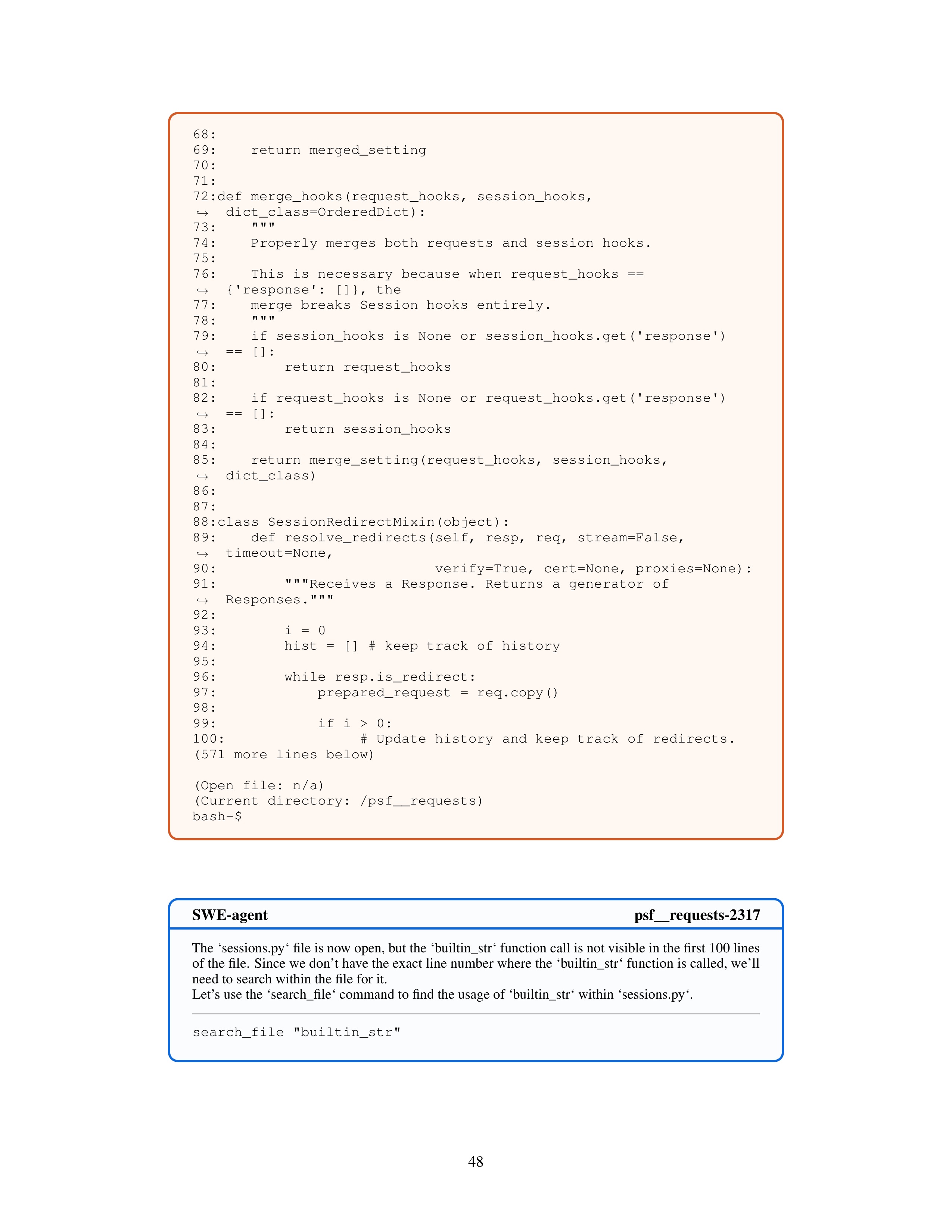
68:
69:
return
merged_setting
70:
71:
72:def
merge_hooks(request_hooks,
session_hooks,
dict_class=OrderedDict):
,
→
73:
"""
74:
Properly
merges
both
requests
and
session
hooks.
75:
76:
This
is
necessary
because
when
request_hooks
==
{'response':
[]},
the
,
→
77:
merge
breaks
Session
hooks
entirely.
78:
"""
79:
if
session_hooks
is
None
or
session_hooks.get('response')
==
[]:
,
→
80:
return
request_hooks
81:
82:
if
request_hooks
is
None
or
request_hooks.get('response')
==
[]:
,
→
83:
return
session_hooks
84:
85:
return
merge_setting(request_hooks,
session_hooks,
dict_class)
,
→
86:
87:
88:class
SessionRedirectMixin(object):
89:
def
resolve_redirects(self,
resp,
req,
stream=False,
timeout=None,
,
→
90:
verify=True,
cert=None,
proxies=None):
91:
"""Receives
a
Response.
Returns
a
generator
of
Responses."""
,
→
92:
93:
i
=
0
94:
hist
=
[]
#
keep
track
of
history
95:
96:
while
resp.is_redirect:
97:
prepared_request
=
req.copy()
98:
99:
if
i
>
0:
100:
#
Update
history
and
keep
track
of
redirects.
(571
more
lines
below)
(Open
file:
n/a)
(Current
directory:
/psf__requests)
bash-$
SWE-agent
psf__requests-2317
The ‘sessions.py‘ file is now open, but the ‘builtin_str‘ function call is not visible in the first 100 lines
of the file.
Since we don’t have the exact line number where the ‘builtin_str‘ function is called, we’ll
need to search within the file for it.
Let’s use the ‘search_file‘ command to find the usage of ‘builtin_str‘ within ‘sessions.py‘.
search_file
"builtin_str"
48
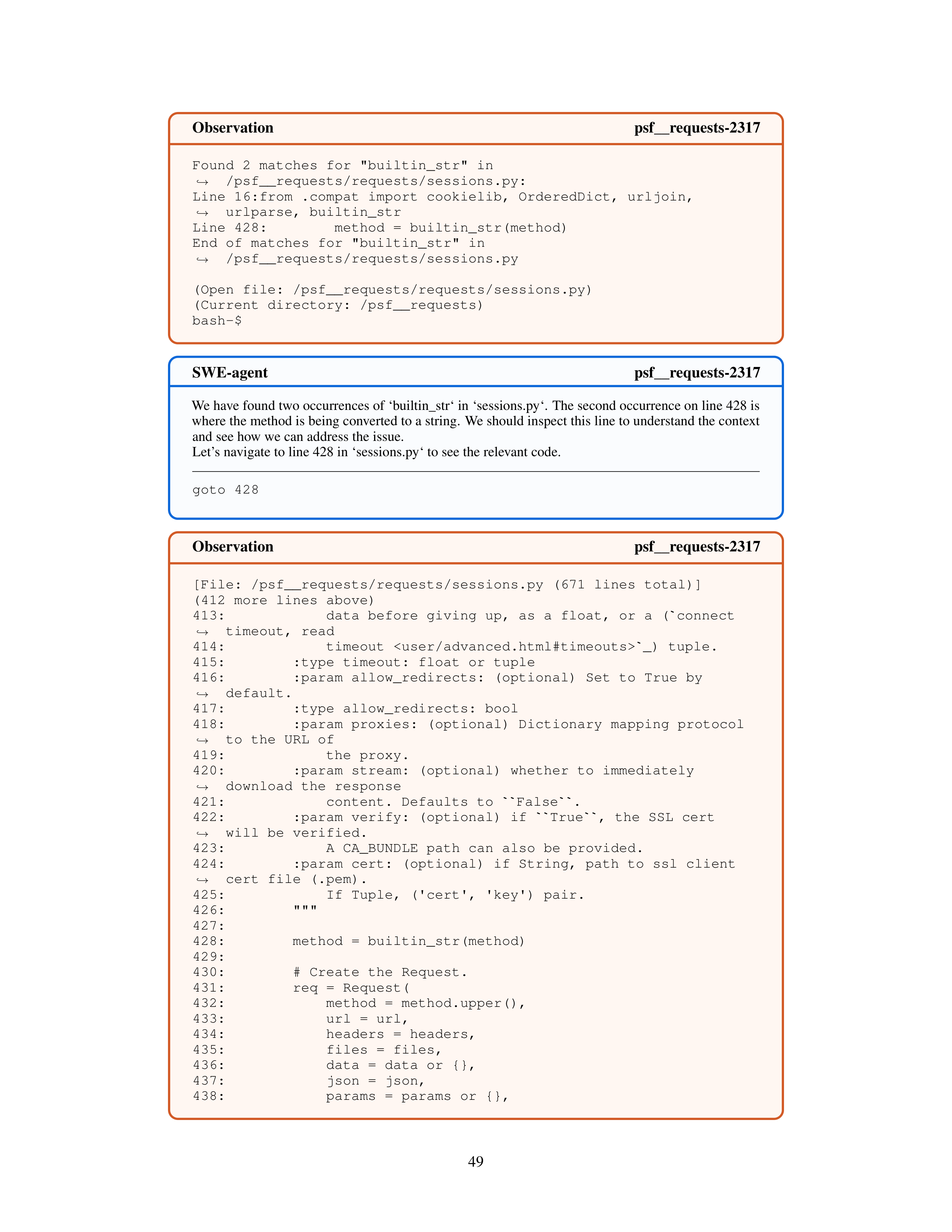
Observation
psf__requests-2317
Found
2
matches
for
"builtin_str"
in
/psf__requests/requests/sessions.py:
,
→
Line
16:from
.compat
import
cookielib,
OrderedDict,
urljoin,
urlparse,
builtin_str
,
→
Line
428:
method
=
builtin_str(method)
End
of
matches
for
"builtin_str"
in
/psf__requests/requests/sessions.py
,
→
(Open
file:
/psf__requests/requests/sessions.py)
(Current
directory:
/psf__requests)
bash-$
SWE-agent
psf__requests-2317
We have found two occurrences of ‘builtin_str‘ in ‘sessions.py‘.
The second occurrence on line 428 is
where the method is being converted to a string.
We should inspect this line to understand the context
and see how we can address the issue.
Let’s navigate to line 428 in ‘sessions.py‘ to see the relevant code.
goto
428
Observation
psf__requests-2317
[File:
/psf__requests/requests/sessions.py
(671
lines
total)]
(412
more
lines
above)
413:
data
before
giving
up,
as
a
float,
or
a
(
`
connect
timeout,
read
,
→
414:
timeout
`
_)
tuple.
415:
:type
timeout:
float
or
tuple
416:
:param
allow_redirects:
(optional)
Set
to
True
by
default.
,
→
417:
:type
allow_redirects:
bool
418:
:param
proxies:
(optional)
Dictionary
mapping
protocol
to
the
URL
of
,
→
419:
the
proxy.
420:
:param
stream:
(optional)
whether
to
immediately
download
the
response
,
→
421:
content.
Defaults
to
``
False
``
.
422:
:param
verify:
(optional)
if
``
True
``
,
the
SSL
cert
will
be
verified.
,
→
423:
A
CA_BUNDLE
path
can
also
be
provided.
424:
:param
cert:
(optional)
if
String,
path
to
ssl
client
cert
file
(.pem).
,
→
425:
If
Tuple,
('cert',
'key')
pair.
426:
"""
427:
428:
method
=
builtin_str(method)
429:
430:
#
Create
the
Request.
431:
req
=
Request(
432:
method
=
method.upper(),
433:
url
=
url,
434:
headers
=
headers,
435:
files
=
files,
436:
data
=
data
or
{},
437:
json
=
json,
438:
params
=
params
or
{},
49
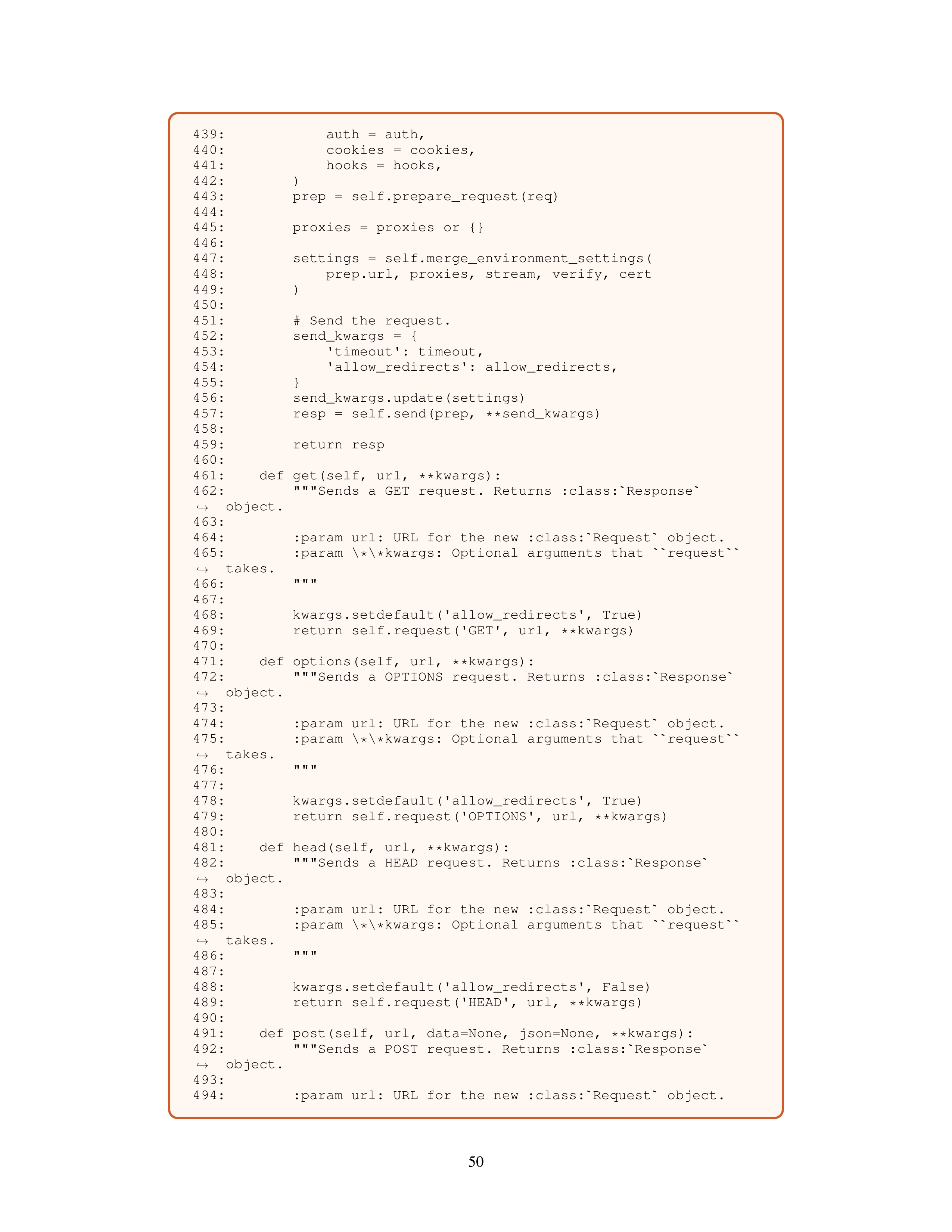
439:
auth
=
auth,
440:
cookies
=
cookies,
441:
hooks
=
hooks,
442:
)
443:
prep
=
self.prepare_request(req)
444:
445:
proxies
=
proxies
or
{}
446:
447:
settings
=
self.merge_environment_settings(
448:
prep.url,
proxies,
stream,
verify,
cert
449:
)
450:
451:
#
Send
the
request.
452:
send_kwargs
=
{
453:
'timeout':
timeout,
454:
'allow_redirects':
allow_redirects,
455:
}
456:
send_kwargs.update(settings)
457:
resp
=
self.send(prep,
**send_kwargs)
458:
459:
return
resp
460:
461:
def
get(self,
url,
**kwargs):
462:
"""Sends
a
GET
request.
Returns
:class:
`
Response
`
object.
,
→
463:
464:
:param
url:
URL
for
the
new
:class:
`
Request
`
object.
465:
:param
\*\*kwargs:
Optional
arguments
that
``
request
``
takes.
,
→
466:
"""
467:
468:
kwargs.setdefault('allow_redirects',
True)
469:
return
self.request('GET',
url,
**kwargs)
470:
471:
def
options(self,
url,
**kwargs):
472:
"""Sends
a
OPTIONS
request.
Returns
:class:
`
Response
`
object.
,
→
473:
474:
:param
url:
URL
for
the
new
:class:
`
Request
`
object.
475:
:param
\*\*kwargs:
Optional
arguments
that
``
request
``
takes.
,
→
476:
"""
477:
478:
kwargs.setdefault('allow_redirects',
True)
479:
return
self.request('OPTIONS',
url,
**kwargs)
480:
481:
def
head(self,
url,
**kwargs):
482:
"""Sends
a
HEAD
request.
Returns
:class:
`
Response
`
object.
,
→
483:
484:
:param
url:
URL
for
the
new
:class:
`
Request
`
object.
485:
:param
\*\*kwargs:
Optional
arguments
that
``
request
``
takes.
,
→
486:
"""
487:
488:
kwargs.setdefault('allow_redirects',
False)
489:
return
self.request('HEAD',
url,
**kwargs)
490:
491:
def
post(self,
url,
data=None,
json=None,
**kwargs):
492:
"""Sends
a
POST
request.
Returns
:class:
`
Response
`
object.
,
→
493:
494:
:param
url:
URL
for
the
new
:class:
`
Request
`
object.
50
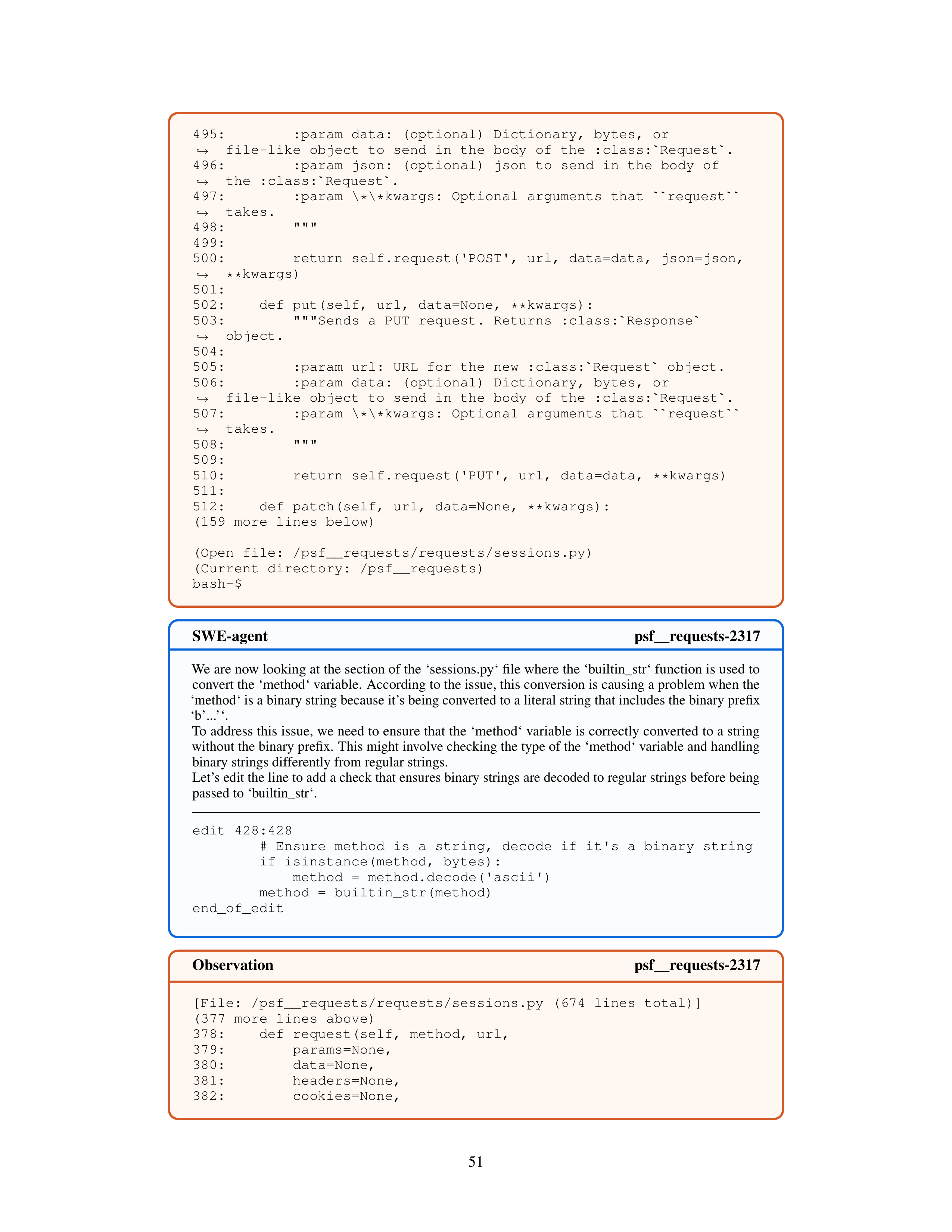
495:
:param
data:
(optional)
Dictionary,
bytes,
or
file-like
object
to
send
in
the
body
of
the
:class:
`
Request
`
.
,
→
496:
:param
json:
(optional)
json
to
send
in
the
body
of
the
:class:
`
Request
`
.
,
→
497:
:param
\*\*kwargs:
Optional
arguments
that
``
request
``
takes.
,
→
498:
"""
499:
500:
return
self.request('POST',
url,
data=data,
json=json,
**
kwargs)
,
→
501:
502:
def
put(self,
url,
data=None,
**kwargs):
503:
"""Sends
a
PUT
request.
Returns
:class:
`
Response
`
object.
,
→
504:
505:
:param
url:
URL
for
the
new
:class:
`
Request
`
object.
506:
:param
data:
(optional)
Dictionary,
bytes,
or
file-like
object
to
send
in
the
body
of
the
:class:
`
Request
`
.
,
→
507:
:param
\*\*kwargs:
Optional
arguments
that
``
request
``
takes.
,
→
508:
"""
509:
510:
return
self.request('PUT',
url,
data=data,
**kwargs)
511:
512:
def
patch(self,
url,
data=None,
**kwargs):
(159
more
lines
below)
(Open
file:
/psf__requests/requests/sessions.py)
(Current
directory:
/psf__requests)
bash-$
SWE-agent
psf__requests-2317
We are now looking at the section of the ‘sessions.py‘ file where the ‘builtin_str‘ function is used to
convert the ‘method‘ variable.
According to the issue, this conversion is causing a problem when the
‘method‘ is a binary string because it’s being converted to a literal string that includes the binary prefix
‘b’...’‘.
To address this issue, we need to ensure that the ‘method‘ variable is correctly converted to a string
without the binary prefix.
This might involve checking the type of the ‘method‘ variable and handling
binary strings differently from regular strings.
Let’s edit the line to add a check that ensures binary strings are decoded to regular strings before being
passed to ‘builtin_str‘.
edit
428:428
#
Ensure
method
is
a
string,
decode
if
it's
a
binary
string
if
isinstance(method,
bytes):
method
=
method.decode('ascii')
method
=
builtin_str(method)
end_of_edit
Observation
psf__requests-2317
[File:
/psf__requests/requests/sessions.py
(674
lines
total)]
(377
more
lines
above)
378:
def
request(self,
method,
url,
379:
params=None,
380:
data=None,
381:
headers=None,
382:
cookies=None,
51
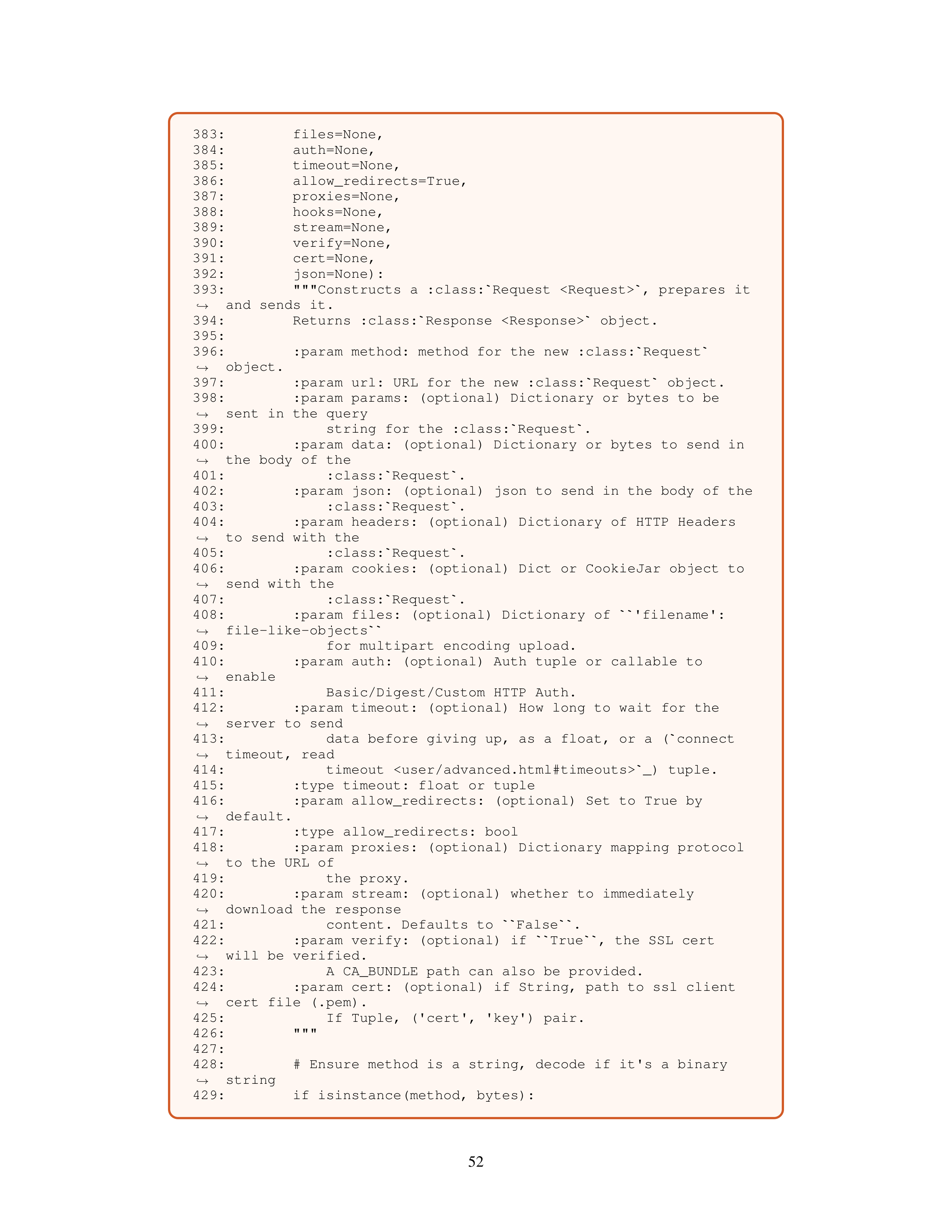
383:
files=None,
384:
auth=None,
385:
timeout=None,
386:
allow_redirects=True,
387:
proxies=None,
388:
hooks=None,
389:
stream=None,
390:
verify=None,
391:
cert=None,
392:
json=None):
393:
"""Constructs
a
:class:
`
Request
`
,
prepares
it
and
sends
it.
,
→
394:
Returns
:class:
`
Response
`
object.
395:
396:
:param
method:
method
for
the
new
:class:
`
Request
`
object.
,
→
397:
:param
url:
URL
for
the
new
:class:
`
Request
`
object.
398:
:param
params:
(optional)
Dictionary
or
bytes
to
be
sent
in
the
query
,
→
399:
string
for
the
:class:
`
Request
`
.
400:
:param
data:
(optional)
Dictionary
or
bytes
to
send
in
the
body
of
the
,
→
401:
:class:
`
Request
`
.
402:
:param
json:
(optional)
json
to
send
in
the
body
of
the
403:
:class:
`
Request
`
.
404:
:param
headers:
(optional)
Dictionary
of
HTTP
Headers
to
send
with
the
,
→
405:
:class:
`
Request
`
.
406:
:param
cookies:
(optional)
Dict
or
CookieJar
object
to
send
with
the
,
→
407:
:class:
`
Request
`
.
408:
:param
files:
(optional)
Dictionary
of
``
'filename':
file-like-objects
``
,
→
409:
for
multipart
encoding
upload.
410:
:param
auth:
(optional)
Auth
tuple
or
callable
to
enable
,
→
411:
Basic/Digest/Custom
HTTP
Auth.
412:
:param
timeout:
(optional)
How
long
to
wait
for
the
server
to
send
,
→
413:
data
before
giving
up,
as
a
float,
or
a
(
`
connect
timeout,
read
,
→
414:
timeout
`
_)
tuple.
415:
:type
timeout:
float
or
tuple
416:
:param
allow_redirects:
(optional)
Set
to
True
by
default.
,
→
417:
:type
allow_redirects:
bool
418:
:param
proxies:
(optional)
Dictionary
mapping
protocol
to
the
URL
of
,
→
419:
the
proxy.
420:
:param
stream:
(optional)
whether
to
immediately
download
the
response
,
→
421:
content.
Defaults
to
``
False
``
.
422:
:param
verify:
(optional)
if
``
True
``
,
the
SSL
cert
will
be
verified.
,
→
423:
A
CA_BUNDLE
path
can
also
be
provided.
424:
:param
cert:
(optional)
if
String,
path
to
ssl
client
cert
file
(.pem).
,
→
425:
If
Tuple,
('cert',
'key')
pair.
426:
"""
427:
428:
#
Ensure
method
is
a
string,
decode
if
it's
a
binary
string
,
→
429:
if
isinstance(method,
bytes):
52
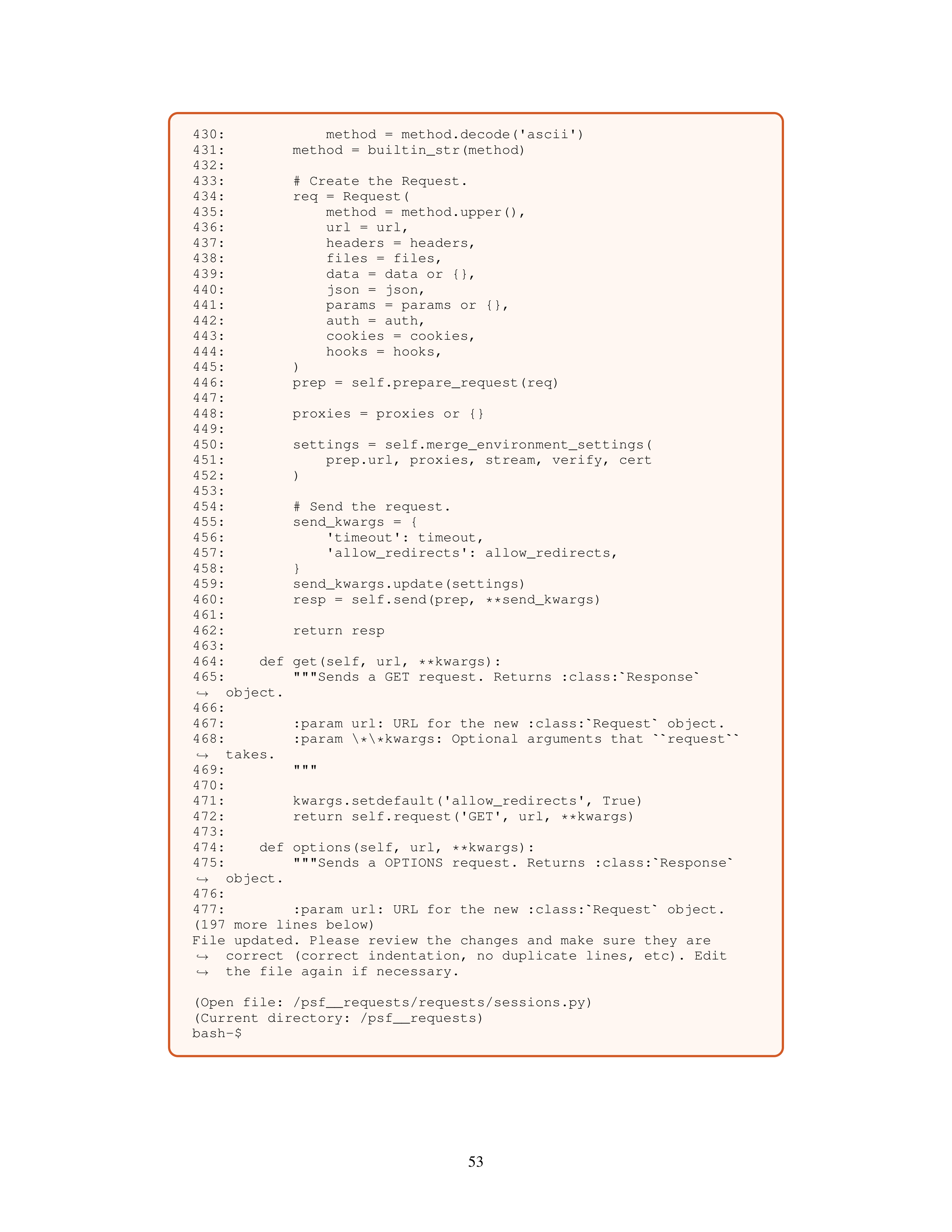
430:
method
=
method.decode('ascii')
431:
method
=
builtin_str(method)
432:
433:
#
Create
the
Request.
434:
req
=
Request(
435:
method
=
method.upper(),
436:
url
=
url,
437:
headers
=
headers,
438:
files
=
files,
439:
data
=
data
or
{},
440:
json
=
json,
441:
params
=
params
or
{},
442:
auth
=
auth,
443:
cookies
=
cookies,
444:
hooks
=
hooks,
445:
)
446:
prep
=
self.prepare_request(req)
447:
448:
proxies
=
proxies
or
{}
449:
450:
settings
=
self.merge_environment_settings(
451:
prep.url,
proxies,
stream,
verify,
cert
452:
)
453:
454:
#
Send
the
request.
455:
send_kwargs
=
{
456:
'timeout':
timeout,
457:
'allow_redirects':
allow_redirects,
458:
}
459:
send_kwargs.update(settings)
460:
resp
=
self.send(prep,
**send_kwargs)
461:
462:
return
resp
463:
464:
def
get(self,
url,
**kwargs):
465:
"""Sends
a
GET
request.
Returns
:class:
`
Response
`
object.
,
→
466:
467:
:param
url:
URL
for
the
new
:class:
`
Request
`
object.
468:
:param
\*\*kwargs:
Optional
arguments
that
``
request
``
takes.
,
→
469:
"""
470:
471:
kwargs.setdefault('allow_redirects',
True)
472:
return
self.request('GET',
url,
**kwargs)
473:
474:
def
options(self,
url,
**kwargs):
475:
"""Sends
a
OPTIONS
request.
Returns
:class:
`
Response
`
object.
,
→
476:
477:
:param
url:
URL
for
the
new
:class:
`
Request
`
object.
(197
more
lines
below)
File
updated.
Please
review
the
changes
and
make
sure
they
are
correct
(correct
indentation,
no
duplicate
lines,
etc).
Edit
the
file
again
if
necessary.
,
→
,
→
(Open
file:
/psf__requests/requests/sessions.py)
(Current
directory:
/psf__requests)
bash-$
53
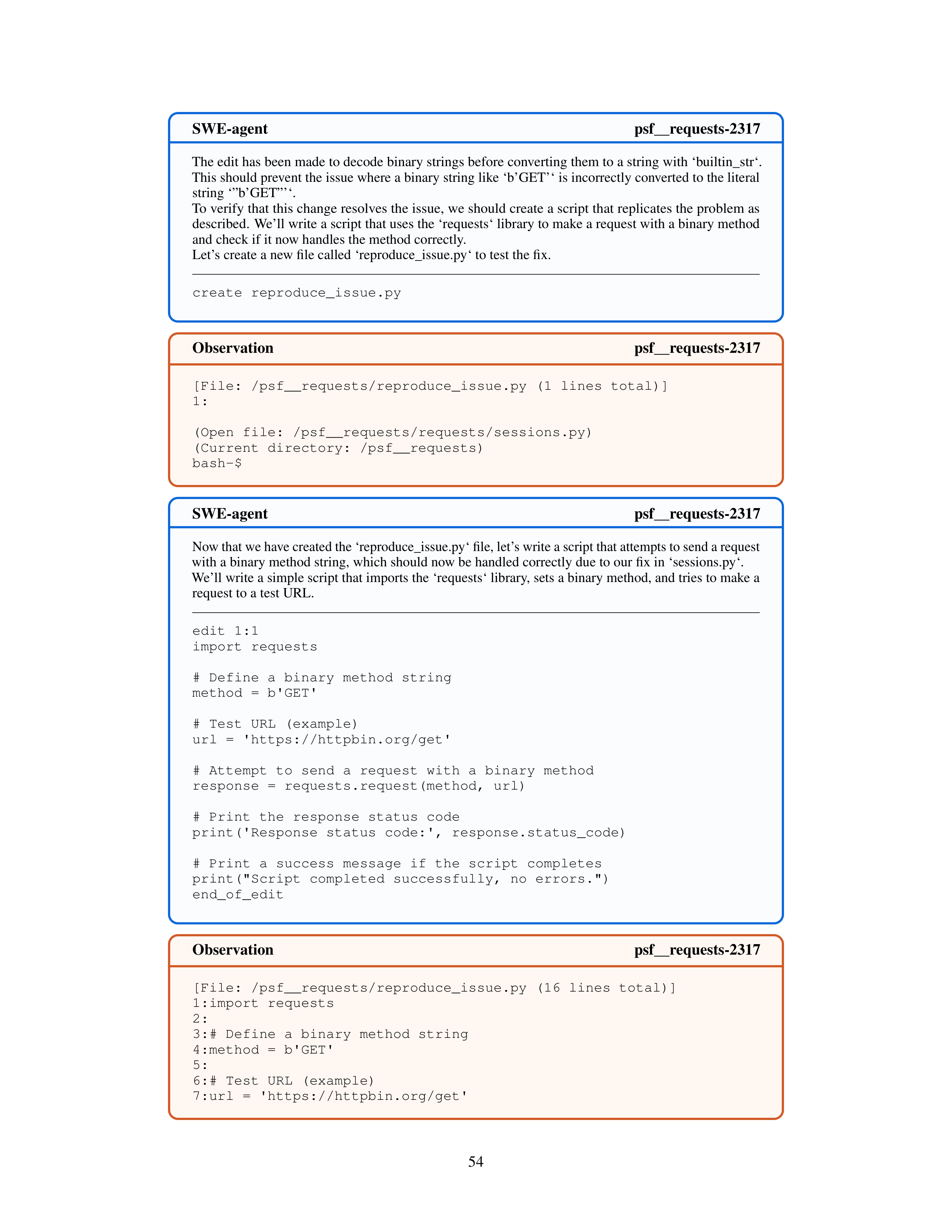
SWE-agent
psf__requests-2317
The edit has been made to decode binary strings before converting them to a string with ‘builtin_str‘.
This should prevent the issue where a binary string like ‘b’GET’‘ is incorrectly converted to the literal
string ‘”b’GET”’‘.
To verify that this change resolves the issue, we should create a script that replicates the problem as
described.
We’ll write a script that uses the ‘requests‘ library to make a request with a binary method
and check if it now handles the method correctly.
Let’s create a new file called ‘reproduce_issue.py‘ to test the fix.
create
reproduce_issue.py
Observation
psf__requests-2317
[File:
/psf__requests/reproduce_issue.py
(1
lines
total)]
1:
(Open
file:
/psf__requests/requests/sessions.py)
(Current
directory:
/psf__requests)
bash-$
SWE-agent
psf__requests-2317
Now that we have created the ‘reproduce_issue.py‘ file, let’s write a script that attempts to send a request
with a binary method string, which should now be handled correctly due to our fix in ‘sessions.py‘.
We’ll write a simple script that imports the ‘requests‘ library, sets a binary method, and tries to make a
request to a test URL.
edit
1:1
import
requests
#
Define
a
binary
method
string
method
=
b'GET'
#
Test
URL
(example)
url
=
'https://httpbin.org/get'
#
Attempt
to
send
a
request
with
a
binary
method
response
=
requests.request(method,
url)
#
Print
the
response
status
code
print('Response
status
code:',
response.status_code)
#
Print
a
success
message
if
the
script
completes
print("Script
completed
successfully,
no
errors.")
end_of_edit
Observation
psf__requests-2317
[File:
/psf__requests/reproduce_issue.py
(16
lines
total)]
1:import
requests
2:
3:#
Define
a
binary
method
string
4:method
=
b'GET'
5:
6:#
Test
URL
(example)
7:url
=
'https://httpbin.org/get'
54
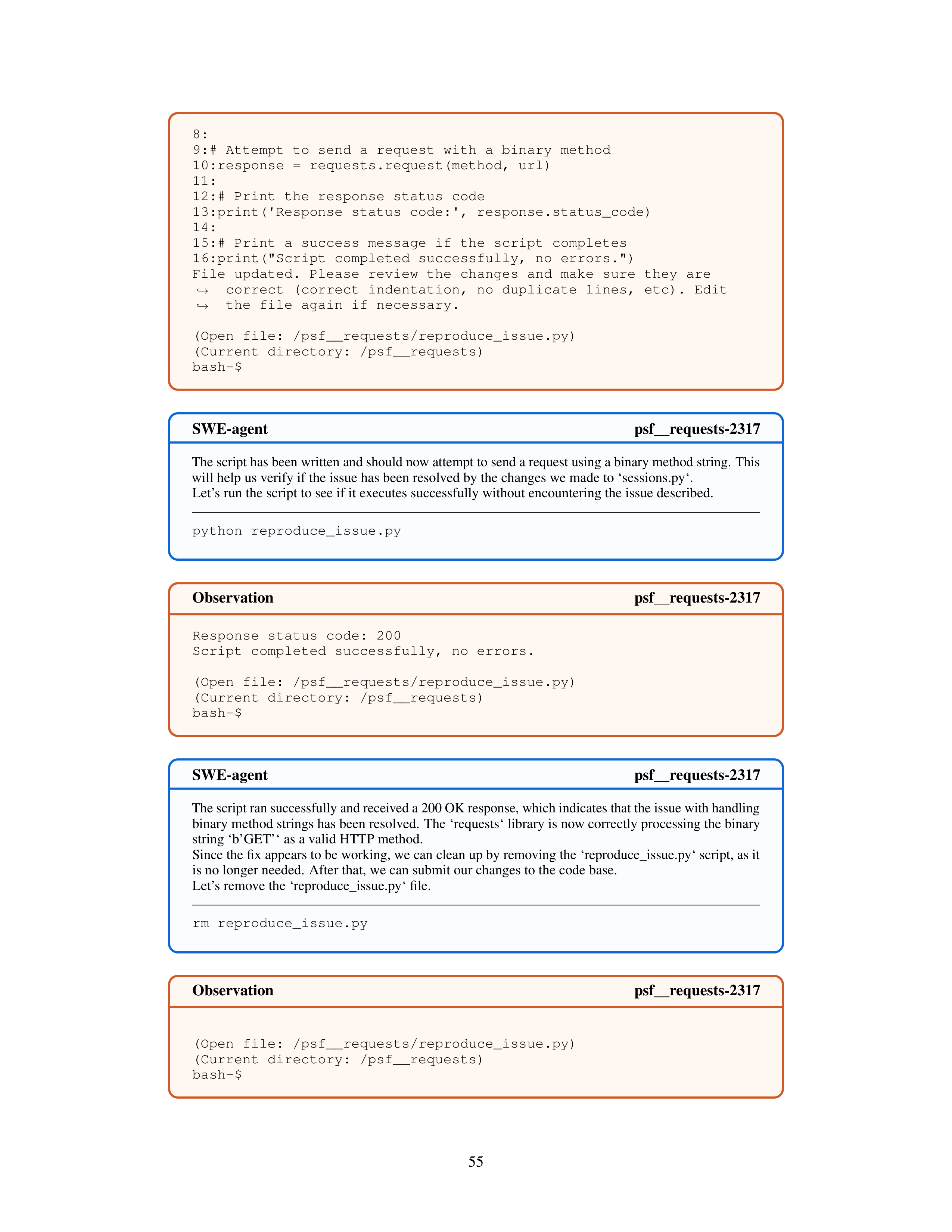
8:
9:#
Attempt
to
send
a
request
with
a
binary
method
10:response
=
requests.request(method,
url)
11:
12:#
Print
the
response
status
code
13:print('Response
status
code:',
response.status_code)
14:
15:#
Print
a
success
message
if
the
script
completes
16:print("Script
completed
successfully,
no
errors.")
File
updated.
Please
review
the
changes
and
make
sure
they
are
correct
(correct
indentation,
no
duplicate
lines,
etc).
Edit
the
file
again
if
necessary.
,
→
,
→
(Open
file:
/psf__requests/reproduce_issue.py)
(Current
directory:
/psf__requests)
bash-$
SWE-agent
psf__requests-2317
The script has been written and should now attempt to send a request using a binary method string.
This
will help us verify if the issue has been resolved by the changes we made to ‘sessions.py‘.
Let’s run the script to see if it executes successfully without encountering the issue described.
python
reproduce_issue.py
Observation
psf__requests-2317
Response
status
code:
200
Script
completed
successfully,
no
errors.
(Open
file:
/psf__requests/reproduce_issue.py)
(Current
directory:
/psf__requests)
bash-$
SWE-agent
psf__requests-2317
The script ran successfully and received a 200 OK response, which indicates that the issue with handling
binary method strings has been resolved.
The ‘requests‘ library is now correctly processing the binary
string ‘b’GET’‘ as a valid HTTP method.
Since the fix appears to be working, we can clean up by removing the ‘reproduce_issue.py‘ script, as it
is no longer needed.
After that, we can submit our changes to the code base.
Let’s remove the ‘reproduce_issue.py‘ file.
rm
reproduce_issue.py
Observation
psf__requests-2317
(Open
file:
/psf__requests/reproduce_issue.py)
(Current
directory:
/psf__requests)
bash-$
55
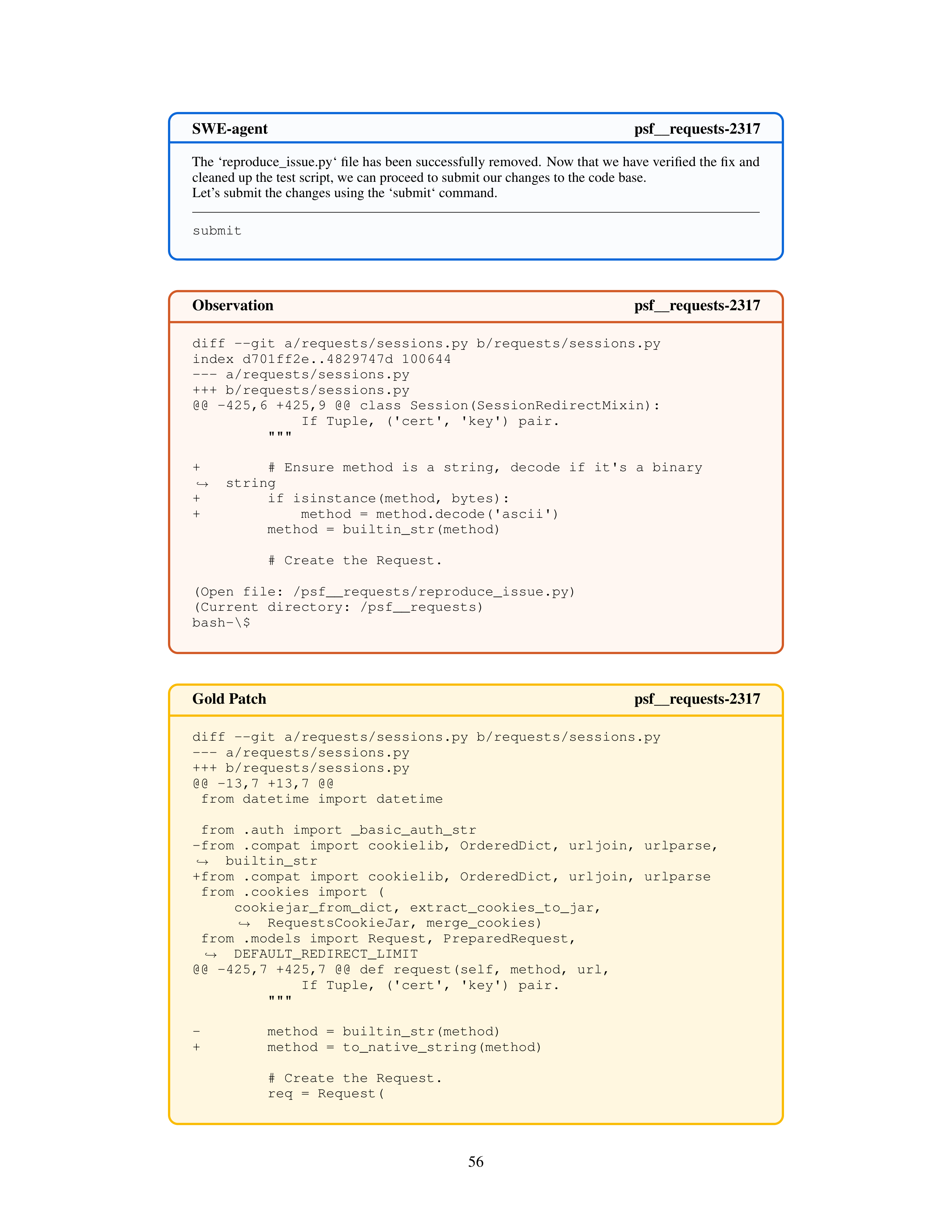
SWE-agent
psf__requests-2317
The ‘reproduce_issue.py‘ file has been successfully removed.
Now that we have verified the fix and
cleaned up the test script, we can proceed to submit our changes to the code base.
Let’s submit the changes using the ‘submit‘ command.
submit
Observation
psf__requests-2317
diff
--git
a/requests/sessions.py
b/requests/sessions.py
index
d701ff2e..4829747d
100644
---
a/requests/sessions.py
+++
b/requests/sessions.py
@@
-425,6
+425,9
@@
class
Session(SessionRedirectMixin):
If
Tuple,
('cert',
'key')
pair.
"""
+
#
Ensure
method
is
a
string,
decode
if
it's
a
binary
string
,
→
+
if
isinstance(method,
bytes):
+
method
=
method.decode('ascii')
method
=
builtin_str(method)
#
Create
the
Request.
(Open
file:
/psf__requests/reproduce_issue.py)
(Current
directory:
/psf__requests)
bash-\$
Gold Patch
psf__requests-2317
diff
--git
a/requests/sessions.py
b/requests/sessions.py
---
a/requests/sessions.py
+++
b/requests/sessions.py
@@
-13,7
+13,7
@@
from
datetime
import
datetime
from
.auth
import
_basic_auth_str
-from
.compat
import
cookielib,
OrderedDict,
urljoin,
urlparse,
builtin_str
,
→
+from
.compat
import
cookielib,
OrderedDict,
urljoin,
urlparse
from
.cookies
import
(
cookiejar_from_dict,
extract_cookies_to_jar,
RequestsCookieJar,
merge_cookies)
,
→
from
.models
import
Request,
PreparedRequest,
DEFAULT_REDIRECT_LIMIT
,
→
@@
-425,7
+425,7
@@
def
request(self,
method,
url,
If
Tuple,
('cert',
'key')
pair.
"""
-
method
=
builtin_str(method)
+
method
=
to_native_string(method)
#
Create
the
Request.
req
=
Request(
56
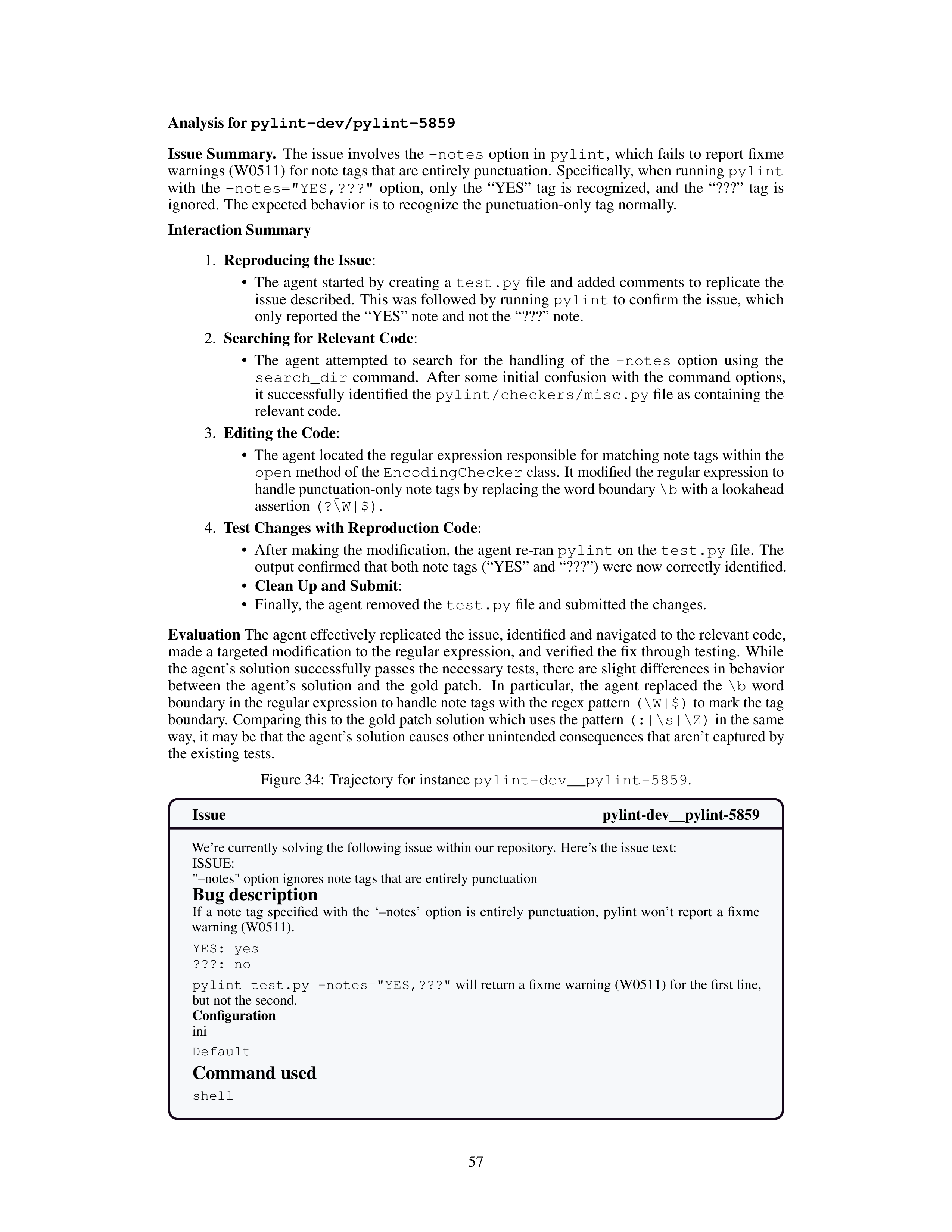
Analysis for
pylint-dev/pylint-5859
Issue Summary.
The issue involves the
-notes
option in
pylint
, which fails to report fixme
warnings (W0511) for note tags that are entirely punctuation.
Specifically, when running
pylint
with
the
-notes="YES,???"
option,
only
the
“YES”
tag
is
recognized,
and
the
“???”
tag
is
ignored.
The expected behavior is to recognize the punctuation-only tag normally.
Interaction Summary
1.
Reproducing the Issue
:
•
The agent started by creating a
test.py
file and added comments to replicate the
issue described.
This was followed by running
pylint
to confirm the issue, which
only reported the “YES” note and not the “???” note.
2.
Searching for Relevant Code
:
•
The
agent
attempted
to
search
for
the
handling
of
the
-notes
option
using
the
search_dir
command.
After
some
initial
confusion
with
the
command
options,
it successfully identified the
pylint/checkers/misc.py
file as containing the
relevant code.
3.
Editing the Code
:
•
The agent located the regular expression responsible for matching note tags within the
open
method of the
EncodingChecker
class.
It modified the regular expression to
handle punctuation-only note tags by replacing the word boundary
\b
with a lookahead
assertion
(?
¯
\W|$)
.
4.
Test Changes with Reproduction Code
:
•
After making the modification, the agent re-ran
pylint
on the
test.py
file.
The
output confirmed that both note tags (“YES” and “???”) were now correctly identified.
•
Clean Up and Submit
:
•
Finally, the agent removed the
test.py
file and submitted the changes.
Evaluation
The agent effectively replicated the issue, identified and navigated to the relevant code,
made a targeted modification to the regular expression, and verified the fix through testing.
While
the agent’s solution successfully passes the necessary tests, there are slight differences in behavior
between
the
agent’s
solution
and
the
gold
patch.
In
particular,
the
agent
replaced
the
\b
word
boundary in the regular expression to handle note tags with the regex pattern
(\W|$)
to mark the tag
boundary.
Comparing this to the gold patch solution which uses the pattern
(:|\s|\Z)
in the same
way, it may be that the agent’s solution causes other unintended consequences that aren’t captured by
the existing tests.
Figure 34:
Trajectory for instance
pylint-dev__pylint-5859
.
Issue
pylint-dev__pylint-5859
We’re currently solving the following issue within our repository.
Here’s the issue text:
ISSUE:
"–notes" option ignores note tags that are entirely punctuation
Bug description
If
a
note
tag
specified
with
the
‘–notes’
option
is
entirely
punctuation,
pylint
won’t
report
a
fixme
warning (W0511).
YES:
yes
???:
no
pylint
test.py
-notes="YES,???"
will return a fixme warning (W0511) for the first line,
but not the second.
Configuration
ini
Default
Command used
shell
57
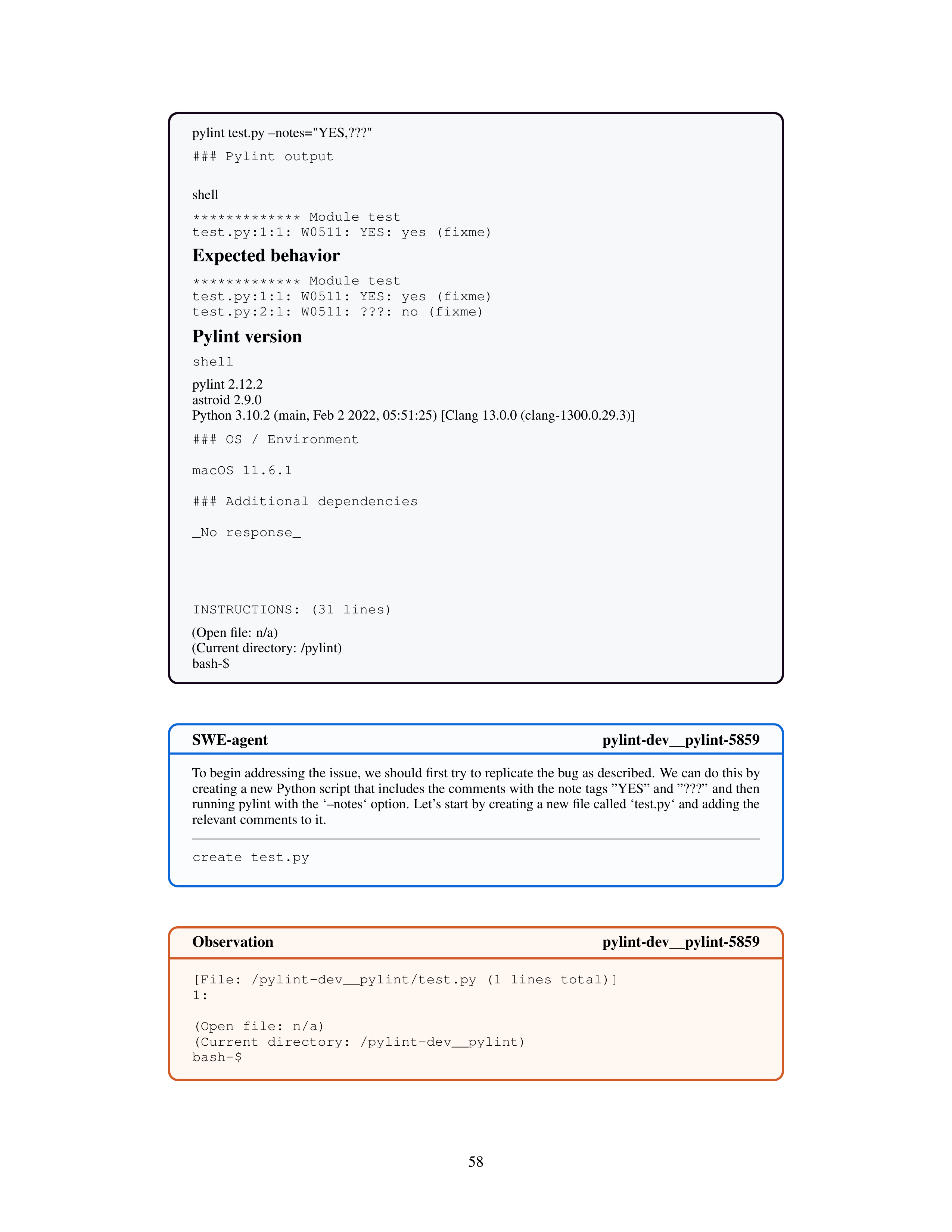
pylint test.py –notes="YES,???"
###
Pylint
output
shell
*************
Module
test
test.py:1:1:
W0511:
YES:
yes
(fixme)
Expected behavior
*************
Module
test
test.py:1:1:
W0511:
YES:
yes
(fixme)
test.py:2:1:
W0511:
???:
no
(fixme)
Pylint version
shell
pylint 2.12.2
astroid 2.9.0
Python 3.10.2 (main, Feb 2 2022, 05:51:25) [Clang 13.0.0 (clang-1300.0.29.3)]
###
OS
/
Environment
macOS
11.6.1
###
Additional
dependencies
_No
response_
INSTRUCTIONS:
(31
lines)
(Open file:
n/a)
(Current directory:
/pylint)
bash-$
SWE-agent
pylint-dev__pylint-5859
To begin addressing the issue, we should first try to replicate the bug as described.
We can do this by
creating a new Python script that includes the comments with the note tags ”YES” and ”???”
and then
running pylint with the ‘–notes‘ option.
Let’s start by creating a new file called ‘test.py‘ and adding the
relevant comments to it.
create
test.py
Observation
pylint-dev__pylint-5859
[File:
/pylint-dev__pylint/test.py
(1
lines
total)]
1:
(Open
file:
n/a)
(Current
directory:
/pylint-dev__pylint)
bash-$
58
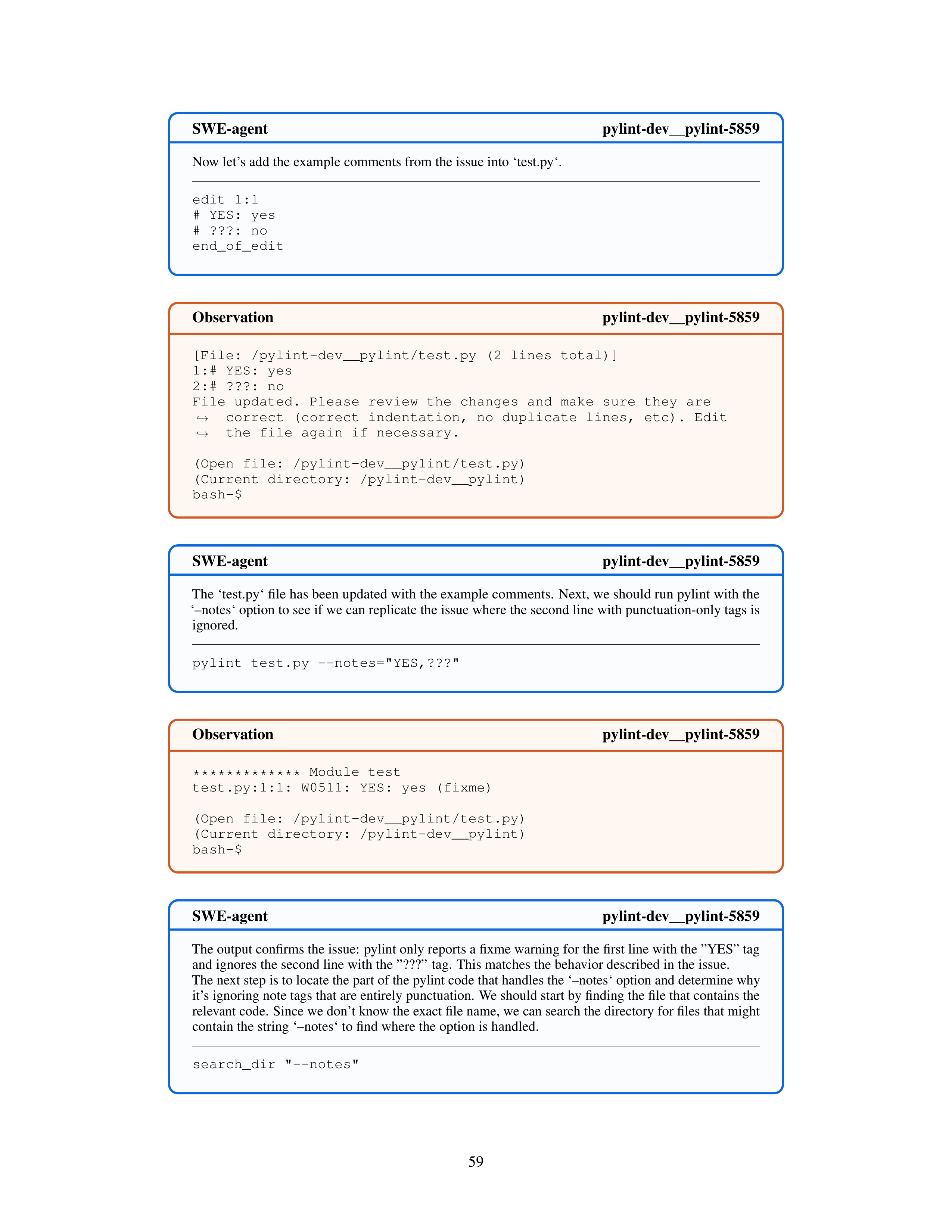
SWE-agent
pylint-dev__pylint-5859
Now let’s add the example comments from the issue into ‘test.py‘.
edit
1:1
#
YES:
yes
#
???:
no
end_of_edit
Observation
pylint-dev__pylint-5859
[File:
/pylint-dev__pylint/test.py
(2
lines
total)]
1:#
YES:
yes
2:#
???:
no
File
updated.
Please
review
the
changes
and
make
sure
they
are
correct
(correct
indentation,
no
duplicate
lines,
etc).
Edit
the
file
again
if
necessary.
,
→
,
→
(Open
file:
/pylint-dev__pylint/test.py)
(Current
directory:
/pylint-dev__pylint)
bash-$
SWE-agent
pylint-dev__pylint-5859
The ‘test.py‘ file has been updated with the example comments.
Next, we should run pylint with the
‘–notes‘ option to see if we can replicate the issue where the second line with punctuation-only tags is
ignored.
pylint
test.py
--notes="YES,???"
Observation
pylint-dev__pylint-5859
*************
Module
test
test.py:1:1:
W0511:
YES:
yes
(fixme)
(Open
file:
/pylint-dev__pylint/test.py)
(Current
directory:
/pylint-dev__pylint)
bash-$
SWE-agent
pylint-dev__pylint-5859
The output confirms the issue:
pylint only reports a fixme warning for the first line with the ”YES” tag
and ignores the second line with the ”???”
tag.
This matches the behavior described in the issue.
The next step is to locate the part of the pylint code that handles the ‘–notes‘ option and determine why
it’s ignoring note tags that are entirely punctuation.
We should start by finding the file that contains the
relevant code.
Since we don’t know the exact file name, we can search the directory for files that might
contain the string ‘–notes‘ to find where the option is handled.
search_dir
"--notes"
59
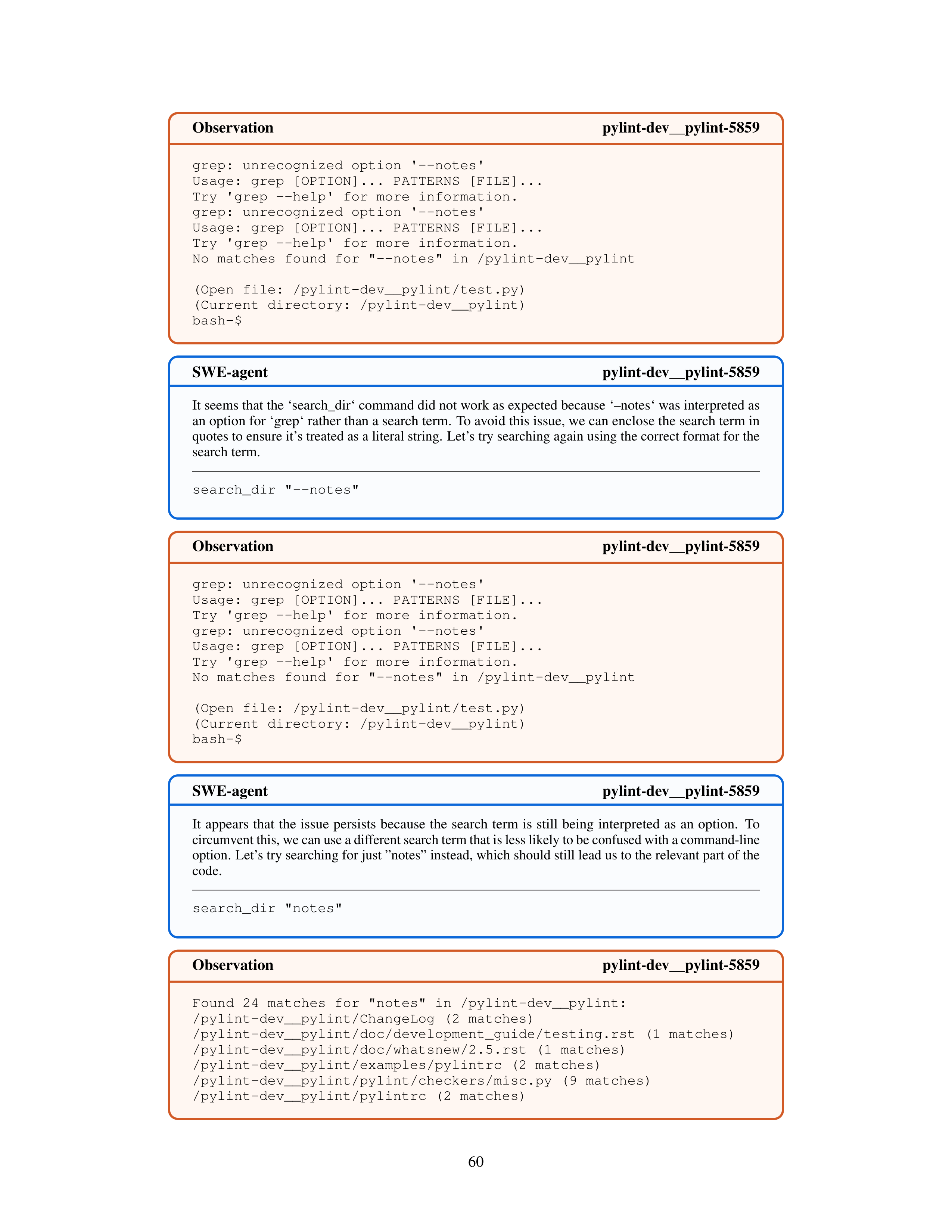
Observation
pylint-dev__pylint-5859
grep:
unrecognized
option
'--notes'
Usage:
grep
[OPTION]...
PATTERNS
[FILE]...
Try
'grep
--help'
for
more
information.
grep:
unrecognized
option
'--notes'
Usage:
grep
[OPTION]...
PATTERNS
[FILE]...
Try
'grep
--help'
for
more
information.
No
matches
found
for
"--notes"
in
/pylint-dev__pylint
(Open
file:
/pylint-dev__pylint/test.py)
(Current
directory:
/pylint-dev__pylint)
bash-$
SWE-agent
pylint-dev__pylint-5859
It seems that the ‘search_dir‘ command did not work as expected because ‘–notes‘ was interpreted as
an option for ‘grep‘ rather than a search term.
To avoid this issue, we can enclose the search term in
quotes to ensure it’s treated as a literal string.
Let’s try searching again using the correct format for the
search term.
search_dir
"--notes"
Observation
pylint-dev__pylint-5859
grep:
unrecognized
option
'--notes'
Usage:
grep
[OPTION]...
PATTERNS
[FILE]...
Try
'grep
--help'
for
more
information.
grep:
unrecognized
option
'--notes'
Usage:
grep
[OPTION]...
PATTERNS
[FILE]...
Try
'grep
--help'
for
more
information.
No
matches
found
for
"--notes"
in
/pylint-dev__pylint
(Open
file:
/pylint-dev__pylint/test.py)
(Current
directory:
/pylint-dev__pylint)
bash-$
SWE-agent
pylint-dev__pylint-5859
It
appears
that
the
issue
persists
because
the
search
term
is
still
being
interpreted
as
an
option.
To
circumvent this, we can use a different search term that is less likely to be confused with a command-line
option.
Let’s try searching for just ”notes” instead, which should still lead us to the relevant part of the
code.
search_dir
"notes"
Observation
pylint-dev__pylint-5859
Found
24
matches
for
"notes"
in
/pylint-dev__pylint:
/pylint-dev__pylint/ChangeLog
(2
matches)
/pylint-dev__pylint/doc/development_guide/testing.rst
(1
matches)
/pylint-dev__pylint/doc/whatsnew/2.5.rst
(1
matches)
/pylint-dev__pylint/examples/pylintrc
(2
matches)
/pylint-dev__pylint/pylint/checkers/misc.py
(9
matches)
/pylint-dev__pylint/pylintrc
(2
matches)
60
/pylint-dev__pylint/script/bump_changelog.py
(1
matches)
/pylint-dev__pylint/tests/checkers/unittest_misc.py
(2
matches)
/pylint-dev__pylint/tests/functional/f/fixme.py
(1
matches)
/pylint-dev__pylint/tests/functional/f/fixme.rc
(2
matches)
/pylint-dev__pylint/tests/functional/f/fixme.txt
(1
matches)
End
of
matches
for
"notes"
in
/pylint-dev__pylint
(Open
file:
/pylint-dev__pylint/test.py)
(Current
directory:
/pylint-dev__pylint)
bash-$
SWE-agent
pylint-dev__pylint-5859
The search results indicate that there are several matches for ”notes” in the repository, but the most
likely candidate for the code we need to examine is in ‘pylint/checkers/misc.py‘, as it contains the most
matches.
This file is probably where the miscellaneous checkers, including the fixme warning (W0511),
are implemented.
Let’s open the ‘misc.py‘ file to investigate further.
open
pylint/checkers/misc.py
Observation
pylint-dev__pylint-5859
[File:
/pylint-dev__pylint/pylint/checkers/misc.py
(203
lines
total)]
,
→
1:#
Copyright
(c)
2006,
2009-2013
LOGILAB
S.A.
(Paris,
FRANCE)
,
→
2:#
Copyright
(c)
2012-2014
Google,
Inc.
3:#
Copyright
(c)
2014-2020
Claudiu
Popa
4:#
Copyright
(c)
2014
Brett
Cannon
5:#
Copyright
(c)
2014
Alexandru
Coman
6:#
Copyright
(c)
2014
Arun
Persaud
7:#
Copyright
(c)
2015
Ionel
Cristian
Maries
8:#
Copyright
(c)
2016
Łukasz
Rogalski
9:#
Copyright
(c)
2016
glegoux
10:#
Copyright
(c)
2017-2020
hippo91
11:#
Copyright
(c)
2017
Mikhail
Fesenko
12:#
Copyright
(c)
2018
Rogalski,
Lukasz
,
→
13:#
Copyright
(c)
2018
Lucas
Cimon
14:#
Copyright
(c)
2018
Ville
Skyttä
15:#
Copyright
(c)
2019-2021
Pierre
Sassoulas
,
→
16:#
Copyright
(c)
2020
wtracy
17:#
Copyright
(c)
2020
Anthony
Sottile
18:#
Copyright
(c)
2020
Benny
19:#
Copyright
(c)
2021
Daniël
van
Noord
,
→
20:#
Copyright
(c)
2021
Nick
Drozd
21:#
Copyright
(c)
2021
Marc
Mueller
,
→
22:#
Copyright
(c)
2021
Konstantina
Saketou
,
→
23:
24:#
Licensed
under
the
GPL:
https://www.gnu.org/licenses/old-licenses/gpl-2.0.html
,
→
25:#
For
details:
https://github.com/PyCQA/pylint/blob/main/LICENSE
26:
27:
61
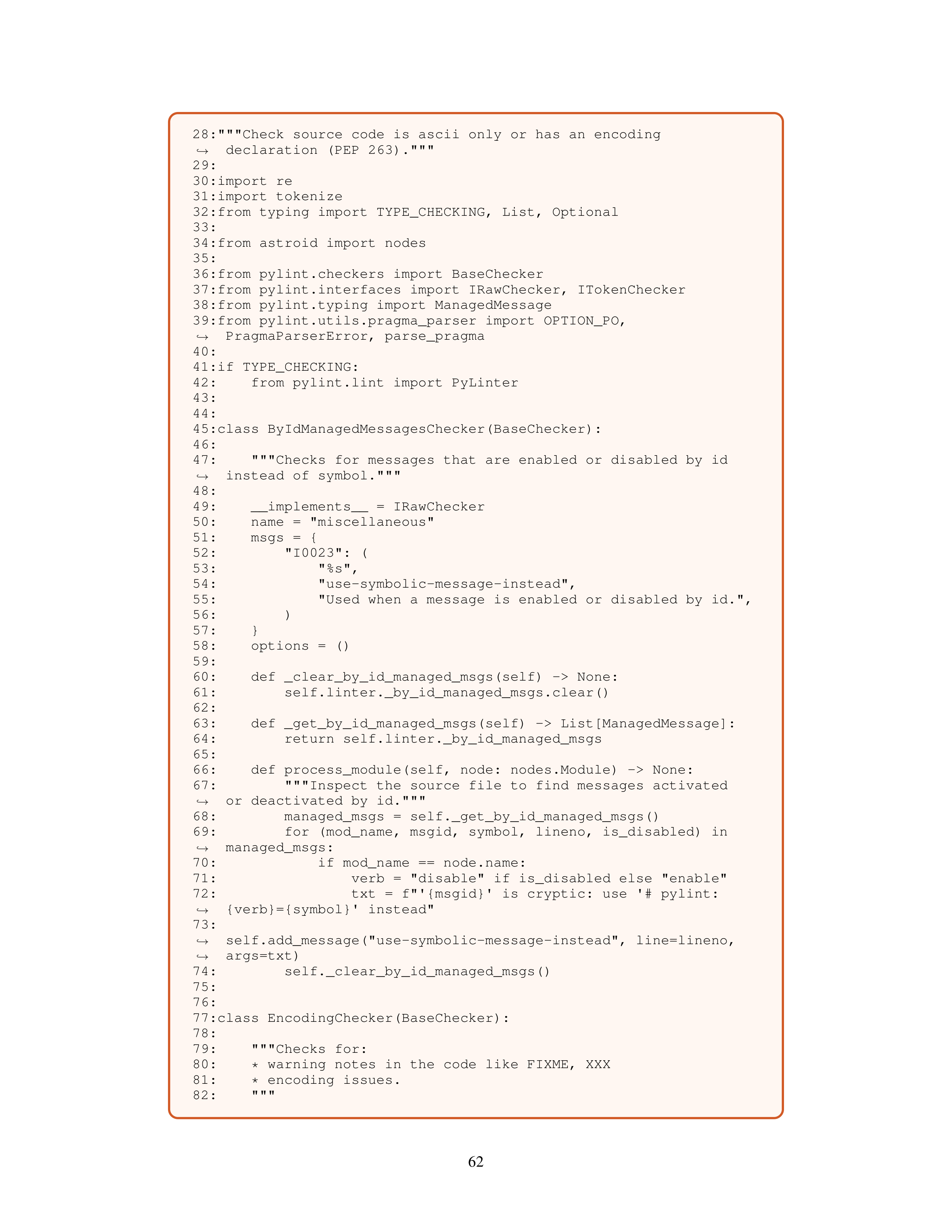
28:"""Check
source
code
is
ascii
only
or
has
an
encoding
declaration
(PEP
263)."""
,
→
29:
30:import
re
31:import
tokenize
32:from
typing
import
TYPE_CHECKING,
List,
Optional
33:
34:from
astroid
import
nodes
35:
36:from
pylint.checkers
import
BaseChecker
37:from
pylint.interfaces
import
IRawChecker,
ITokenChecker
38:from
pylint.typing
import
ManagedMessage
39:from
pylint.utils.pragma_parser
import
OPTION_PO,
PragmaParserError,
parse_pragma
,
→
40:
41:if
TYPE_CHECKING:
42:
from
pylint.lint
import
PyLinter
43:
44:
45:class
ByIdManagedMessagesChecker(BaseChecker):
46:
47:
"""Checks
for
messages
that
are
enabled
or
disabled
by
id
instead
of
symbol."""
,
→
48:
49:
__implements__
=
IRawChecker
50:
name
=
"miscellaneous"
51:
msgs
=
{
52:
"I0023":
(
53:
"%s",
54:
"use-symbolic-message-instead",
55:
"Used
when
a
message
is
enabled
or
disabled
by
id.",
56:
)
57:
}
58:
options
=
()
59:
60:
def
_clear_by_id_managed_msgs(self)
->
None:
61:
self.linter._by_id_managed_msgs.clear()
62:
63:
def
_get_by_id_managed_msgs(self)
->
List[ManagedMessage]:
64:
return
self.linter._by_id_managed_msgs
65:
66:
def
process_module(self,
node:
nodes.Module)
->
None:
67:
"""Inspect
the
source
file
to
find
messages
activated
or
deactivated
by
id."""
,
→
68:
managed_msgs
=
self._get_by_id_managed_msgs()
69:
for
(mod_name,
msgid,
symbol,
lineno,
is_disabled)
in
managed_msgs:
,
→
70:
if
mod_name
==
node.name:
71:
verb
=
"disable"
if
is_disabled
else
"enable"
72:
txt
=
f"'{msgid}'
is
cryptic:
use
'#
pylint:
{verb}={symbol}'
instead"
,
→
73:
self.add_message("use-symbolic-message-instead",
line=lineno,
args=txt)
,
→
,
→
74:
self._clear_by_id_managed_msgs()
75:
76:
77:class
EncodingChecker(BaseChecker):
78:
79:
"""Checks
for:
80:
*
warning
notes
in
the
code
like
FIXME,
XXX
81:
*
encoding
issues.
82:
"""
62
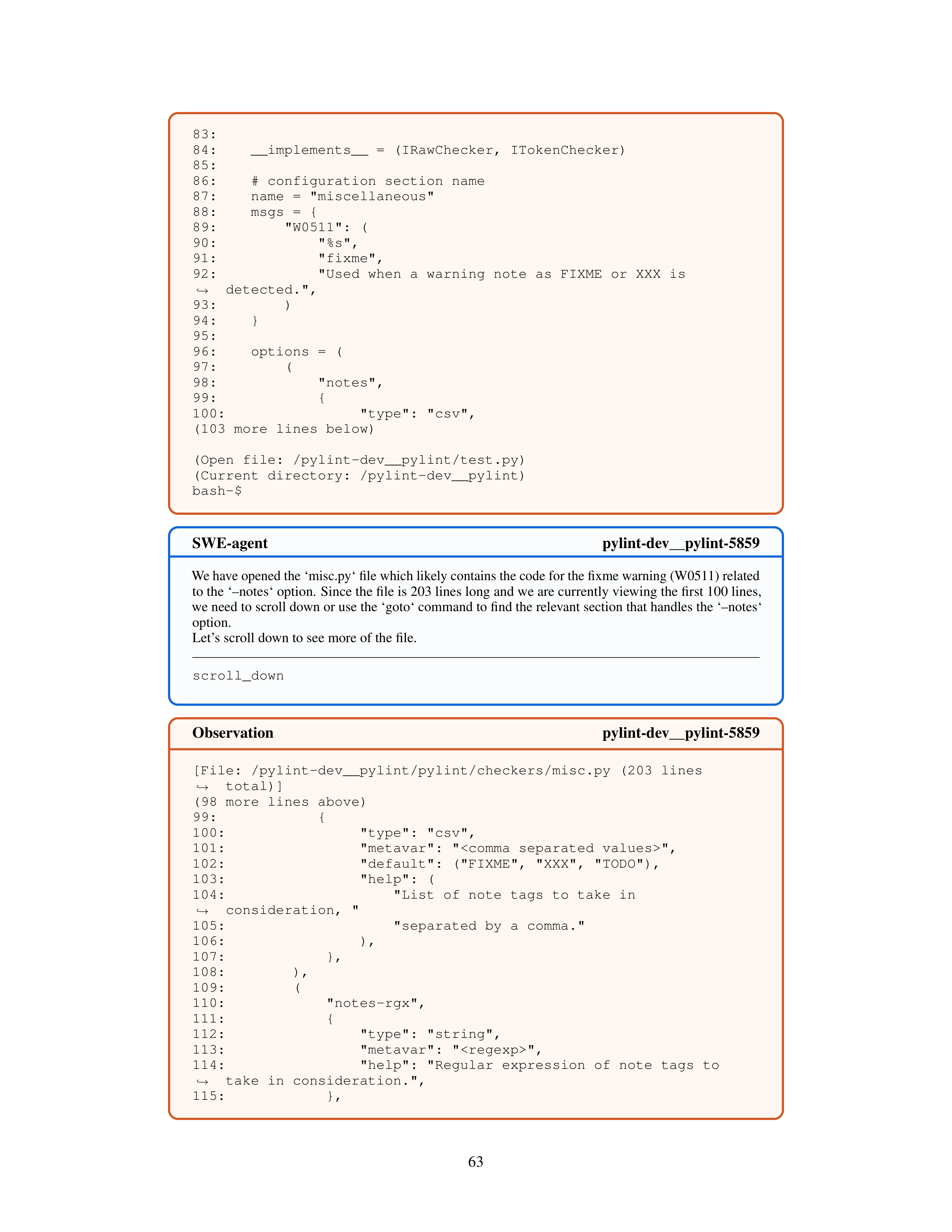
83:
84:
__implements__
=
(IRawChecker,
ITokenChecker)
85:
86:
#
configuration
section
name
87:
name
=
"miscellaneous"
88:
msgs
=
{
89:
"W0511":
(
90:
"%s",
91:
"fixme",
92:
"Used
when
a
warning
note
as
FIXME
or
XXX
is
detected.",
,
→
93:
)
94:
}
95:
96:
options
=
(
97:
(
98:
"notes",
99:
{
100:
"type":
"csv",
(103
more
lines
below)
(Open
file:
/pylint-dev__pylint/test.py)
(Current
directory:
/pylint-dev__pylint)
bash-$
SWE-agent
pylint-dev__pylint-5859
We have opened the ‘misc.py‘ file which likely contains the code for the fixme warning (W0511) related
to the ‘–notes‘ option.
Since the file is 203 lines long and we are currently viewing the first 100 lines,
we need to scroll down or use the ‘goto‘ command to find the relevant section that handles the ‘–notes‘
option.
Let’s scroll down to see more of the file.
scroll_down
Observation
pylint-dev__pylint-5859
[File:
/pylint-dev__pylint/pylint/checkers/misc.py
(203
lines
total)]
,
→
(98
more
lines
above)
99:
{
100:
"type":
"csv",
101:
"metavar":
"<comma
separated
values>",
102:
"default":
("FIXME",
"XXX",
"TODO"),
103:
"help":
(
104:
"List
of
note
tags
to
take
in
consideration,
"
,
→
105:
"separated
by
a
comma."
106:
),
107:
},
108:
),
109:
(
110:
"notes-rgx",
111:
{
112:
"type":
"string",
113:
"metavar":
"",
114:
"help":
"Regular
expression
of
note
tags
to
take
in
consideration.",
,
→
115:
},
63
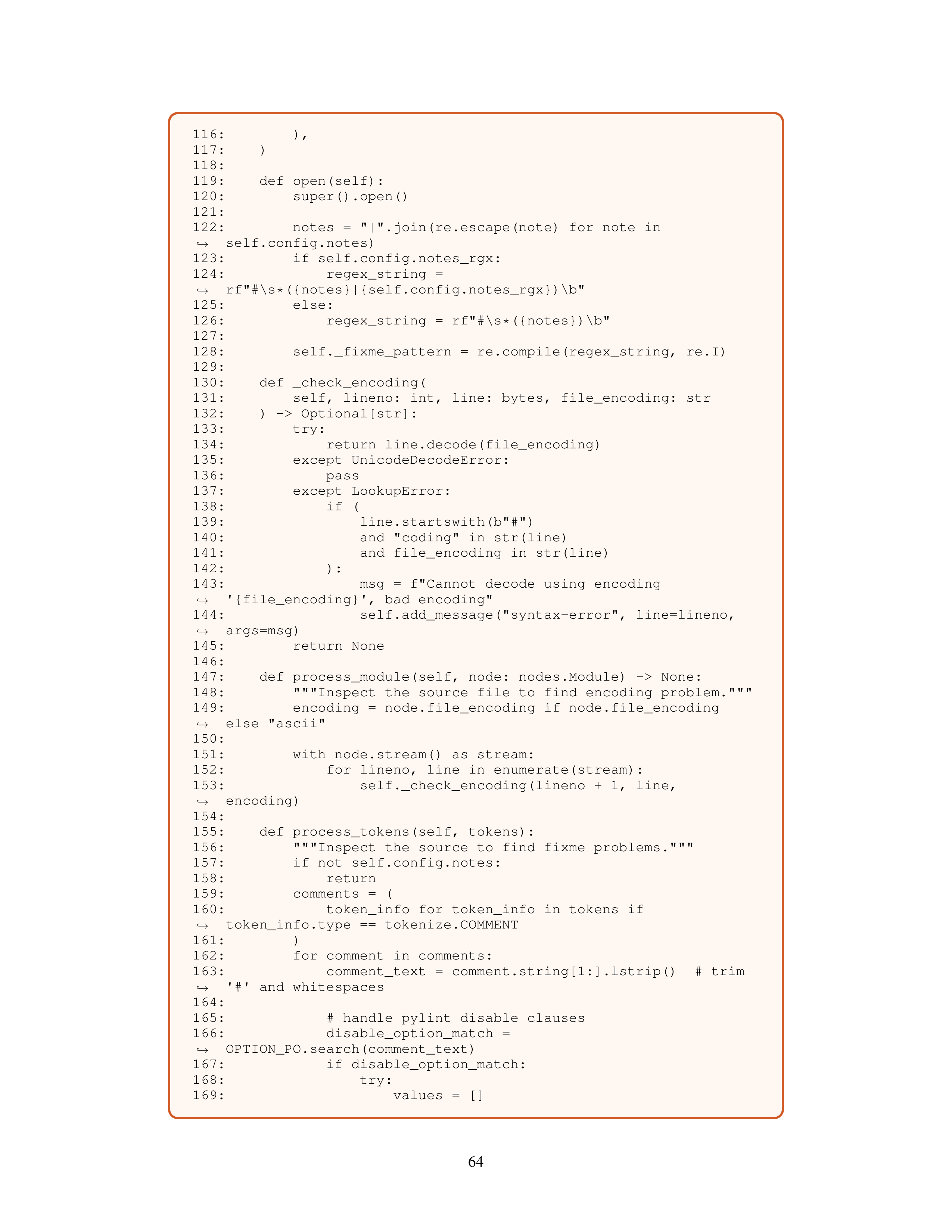
116:
),
117:
)
118:
119:
def
open(self):
120:
super().open()
121:
122:
notes
=
"|".join(re.escape(note)
for
note
in
self.config.notes)
,
→
123:
if
self.config.notes_rgx:
124:
regex_string
=
rf"#\s*({notes}|{self.config.notes_rgx})\b"
,
→
125:
else:
126:
regex_string
=
rf"#\s*({notes})\b"
127:
128:
self._fixme_pattern
=
re.compile(regex_string,
re.I)
129:
130:
def
_check_encoding(
131:
self,
lineno:
int,
line:
bytes,
file_encoding:
str
132:
)
->
Optional[str]:
133:
try:
134:
return
line.decode(file_encoding)
135:
except
UnicodeDecodeError:
136:
pass
137:
except
LookupError:
138:
if
(
139:
line.startswith(b"#")
140:
and
"coding"
in
str(line)
141:
and
file_encoding
in
str(line)
142:
):
143:
msg
=
f"Cannot
decode
using
encoding
'{file_encoding}',
bad
encoding"
,
→
144:
self.add_message("syntax-error",
line=lineno,
args=msg)
,
→
145:
return
None
146:
147:
def
process_module(self,
node:
nodes.Module)
->
None:
148:
"""Inspect
the
source
file
to
find
encoding
problem."""
149:
encoding
=
node.file_encoding
if
node.file_encoding
else
"ascii"
,
→
150:
151:
with
node.stream()
as
stream:
152:
for
lineno,
line
in
enumerate(stream):
153:
self._check_encoding(lineno
+
1,
line,
encoding)
,
→
154:
155:
def
process_tokens(self,
tokens):
156:
"""Inspect
the
source
to
find
fixme
problems."""
157:
if
not
self.config.notes:
158:
return
159:
comments
=
(
160:
token_info
for
token_info
in
tokens
if
token_info.type
==
tokenize.COMMENT
,
→
161:
)
162:
for
comment
in
comments:
163:
comment_text
=
comment.string[1:].lstrip()
#
trim
'#'
and
whitespaces
,
→
164:
165:
#
handle
pylint
disable
clauses
166:
disable_option_match
=
OPTION_PO.search(comment_text)
,
→
167:
if
disable_option_match:
168:
try:
169:
values
=
[]
64
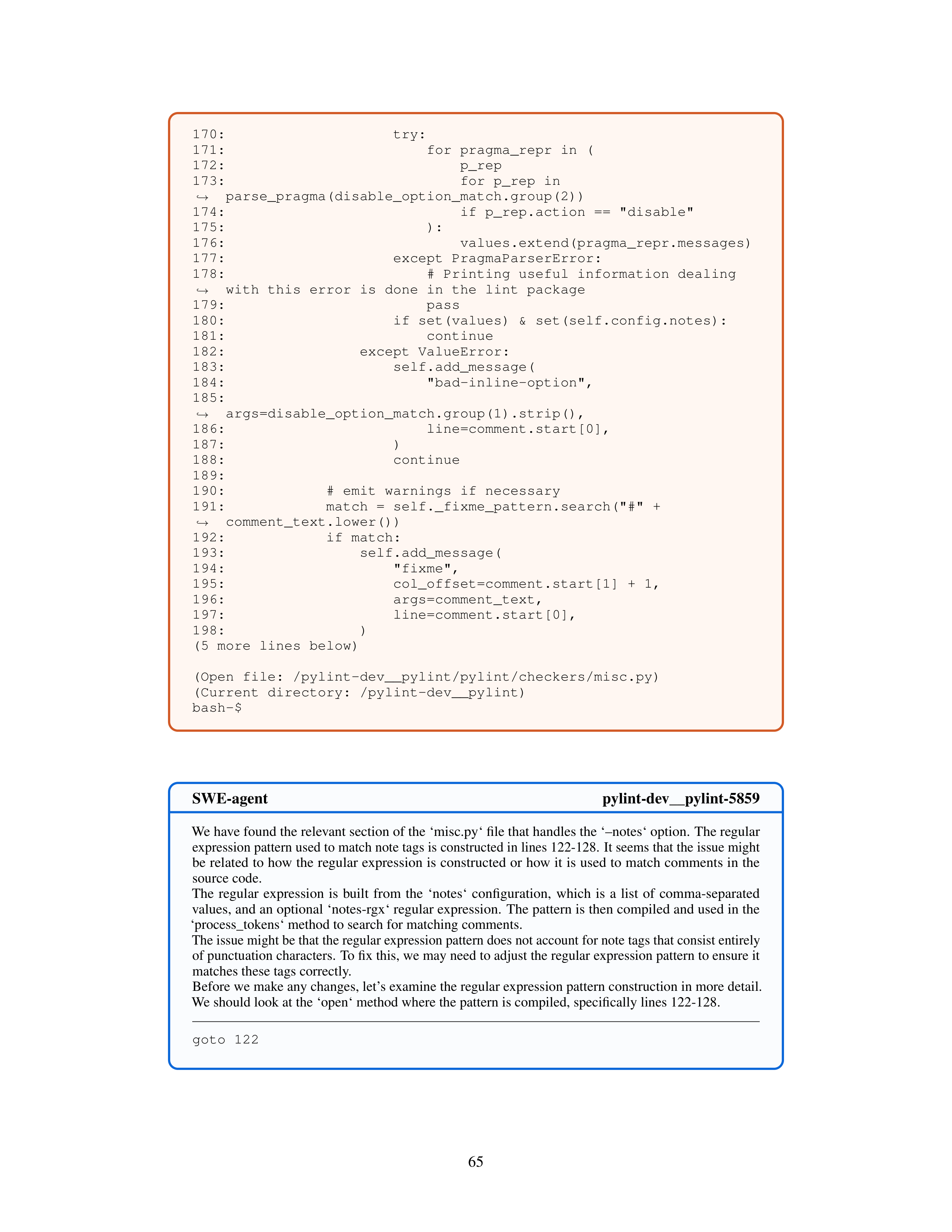
170:
try:
171:
for
pragma_repr
in
(
172:
p_rep
173:
for
p_rep
in
parse_pragma(disable_option_match.group(2))
,
→
174:
if
p_rep.action
==
"disable"
175:
):
176:
values.extend(pragma_repr.messages)
177:
except
PragmaParserError:
178:
#
Printing
useful
information
dealing
with
this
error
is
done
in
the
lint
package
,
→
179:
pass
180:
if
set(values)
&
set(self.config.notes):
181:
continue
182:
except
ValueError:
183:
self.add_message(
184:
"bad-inline-option",
185:
args=disable_option_match.group(1).strip(),
,
→
186:
line=comment.start[0],
187:
)
188:
continue
189:
190:
#
emit
warnings
if
necessary
191:
match
=
self._fixme_pattern.search("#"
+
comment_text.lower())
,
→
192:
if
match:
193:
self.add_message(
194:
"fixme",
195:
col_offset=comment.start[1]
+
1,
196:
args=comment_text,
197:
line=comment.start[0],
198:
)
(5
more
lines
below)
(Open
file:
/pylint-dev__pylint/pylint/checkers/misc.py)
(Current
directory:
/pylint-dev__pylint)
bash-$
SWE-agent
pylint-dev__pylint-5859
We have found the relevant section of the ‘misc.py‘ file that handles the ‘–notes‘ option.
The regular
expression pattern used to match note tags is constructed in lines 122-128.
It seems that the issue might
be related to how the regular expression is constructed or how it is used to match comments in the
source code.
The
regular
expression
is
built
from
the
‘notes‘
configuration,
which
is
a
list
of
comma-separated
values, and an optional ‘notes-rgx‘ regular expression.
The pattern is then compiled and used in the
‘process_tokens‘ method to search for matching comments.
The issue might be that the regular expression pattern does not account for note tags that consist entirely
of punctuation characters.
To fix this, we may need to adjust the regular expression pattern to ensure it
matches these tags correctly.
Before we make any changes, let’s examine the regular expression pattern construction in more detail.
We should look at the ‘open‘ method where the pattern is compiled, specifically lines 122-128.
goto
122
65
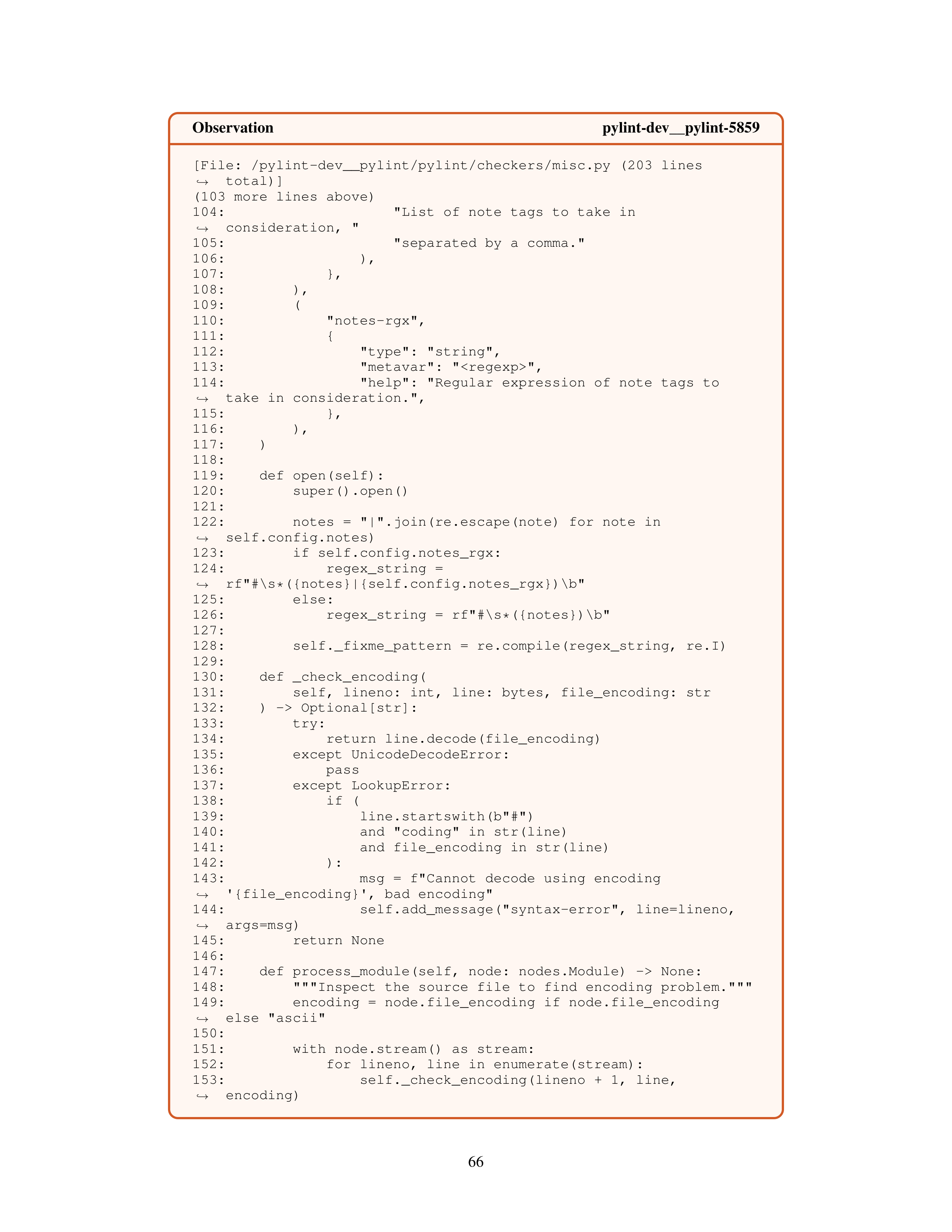
Observation
pylint-dev__pylint-5859
[File:
/pylint-dev__pylint/pylint/checkers/misc.py
(203
lines
total)]
,
→
(103
more
lines
above)
104:
"List
of
note
tags
to
take
in
consideration,
"
,
→
105:
"separated
by
a
comma."
106:
),
107:
},
108:
),
109:
(
110:
"notes-rgx",
111:
{
112:
"type":
"string",
113:
"metavar":
"",
114:
"help":
"Regular
expression
of
note
tags
to
take
in
consideration.",
,
→
115:
},
116:
),
117:
)
118:
119:
def
open(self):
120:
super().open()
121:
122:
notes
=
"|".join(re.escape(note)
for
note
in
self.config.notes)
,
→
123:
if
self.config.notes_rgx:
124:
regex_string
=
rf"#\s*({notes}|{self.config.notes_rgx})\b"
,
→
125:
else:
126:
regex_string
=
rf"#\s*({notes})\b"
127:
128:
self._fixme_pattern
=
re.compile(regex_string,
re.I)
129:
130:
def
_check_encoding(
131:
self,
lineno:
int,
line:
bytes,
file_encoding:
str
132:
)
->
Optional[str]:
133:
try:
134:
return
line.decode(file_encoding)
135:
except
UnicodeDecodeError:
136:
pass
137:
except
LookupError:
138:
if
(
139:
line.startswith(b"#")
140:
and
"coding"
in
str(line)
141:
and
file_encoding
in
str(line)
142:
):
143:
msg
=
f"Cannot
decode
using
encoding
'{file_encoding}',
bad
encoding"
,
→
144:
self.add_message("syntax-error",
line=lineno,
args=msg)
,
→
145:
return
None
146:
147:
def
process_module(self,
node:
nodes.Module)
->
None:
148:
"""Inspect
the
source
file
to
find
encoding
problem."""
149:
encoding
=
node.file_encoding
if
node.file_encoding
else
"ascii"
,
→
150:
151:
with
node.stream()
as
stream:
152:
for
lineno,
line
in
enumerate(stream):
153:
self._check_encoding(lineno
+
1,
line,
encoding)
,
→
66
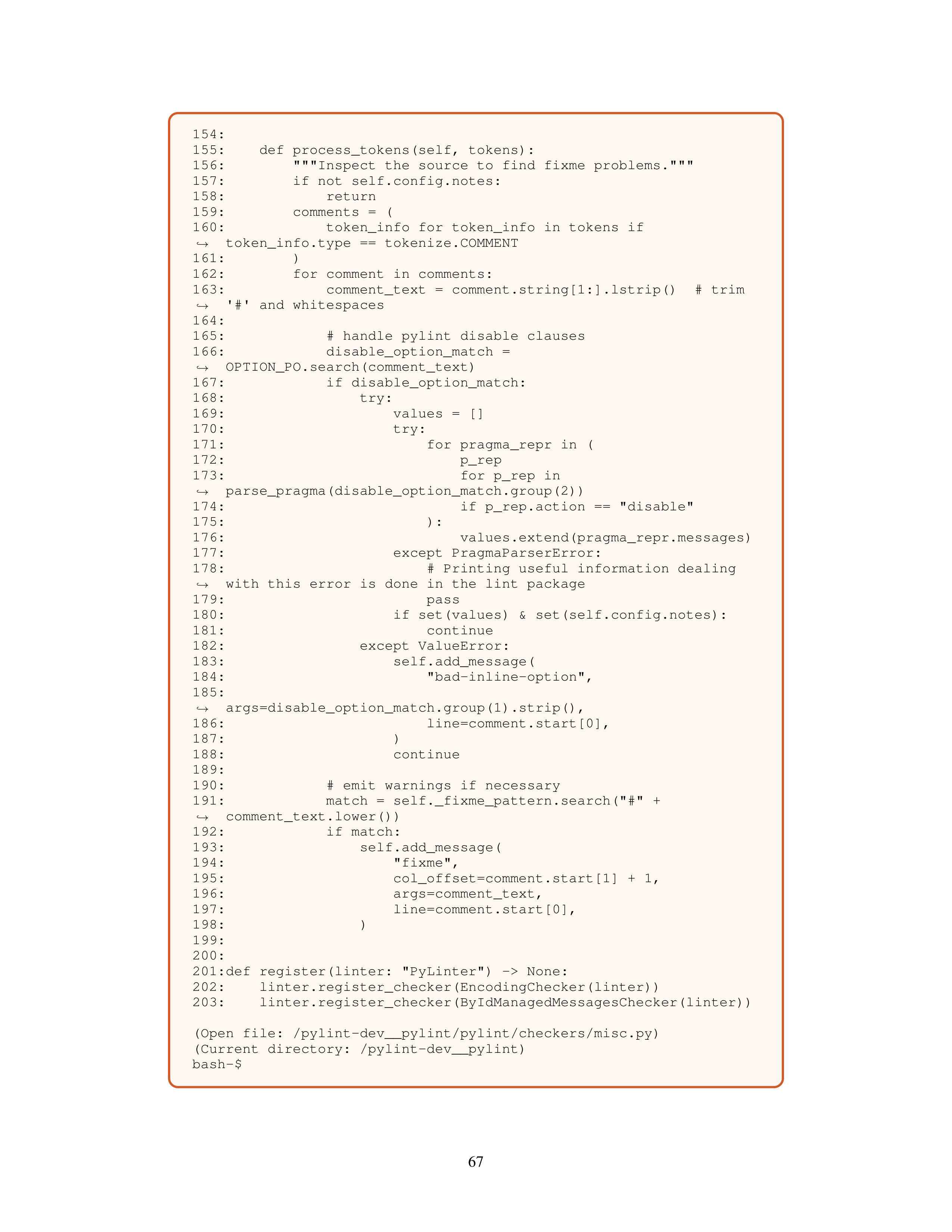
154:
155:
def
process_tokens(self,
tokens):
156:
"""Inspect
the
source
to
find
fixme
problems."""
157:
if
not
self.config.notes:
158:
return
159:
comments
=
(
160:
token_info
for
token_info
in
tokens
if
token_info.type
==
tokenize.COMMENT
,
→
161:
)
162:
for
comment
in
comments:
163:
comment_text
=
comment.string[1:].lstrip()
#
trim
'#'
and
whitespaces
,
→
164:
165:
#
handle
pylint
disable
clauses
166:
disable_option_match
=
OPTION_PO.search(comment_text)
,
→
167:
if
disable_option_match:
168:
try:
169:
values
=
[]
170:
try:
171:
for
pragma_repr
in
(
172:
p_rep
173:
for
p_rep
in
parse_pragma(disable_option_match.group(2))
,
→
174:
if
p_rep.action
==
"disable"
175:
):
176:
values.extend(pragma_repr.messages)
177:
except
PragmaParserError:
178:
#
Printing
useful
information
dealing
with
this
error
is
done
in
the
lint
package
,
→
179:
pass
180:
if
set(values)
&
set(self.config.notes):
181:
continue
182:
except
ValueError:
183:
self.add_message(
184:
"bad-inline-option",
185:
args=disable_option_match.group(1).strip(),
,
→
186:
line=comment.start[0],
187:
)
188:
continue
189:
190:
#
emit
warnings
if
necessary
191:
match
=
self._fixme_pattern.search("#"
+
comment_text.lower())
,
→
192:
if
match:
193:
self.add_message(
194:
"fixme",
195:
col_offset=comment.start[1]
+
1,
196:
args=comment_text,
197:
line=comment.start[0],
198:
)
199:
200:
201:def
register(linter:
"PyLinter")
->
None:
202:
linter.register_checker(EncodingChecker(linter))
203:
linter.register_checker(ByIdManagedMessagesChecker(linter))
(Open
file:
/pylint-dev__pylint/pylint/checkers/misc.py)
(Current
directory:
/pylint-dev__pylint)
bash-$
67
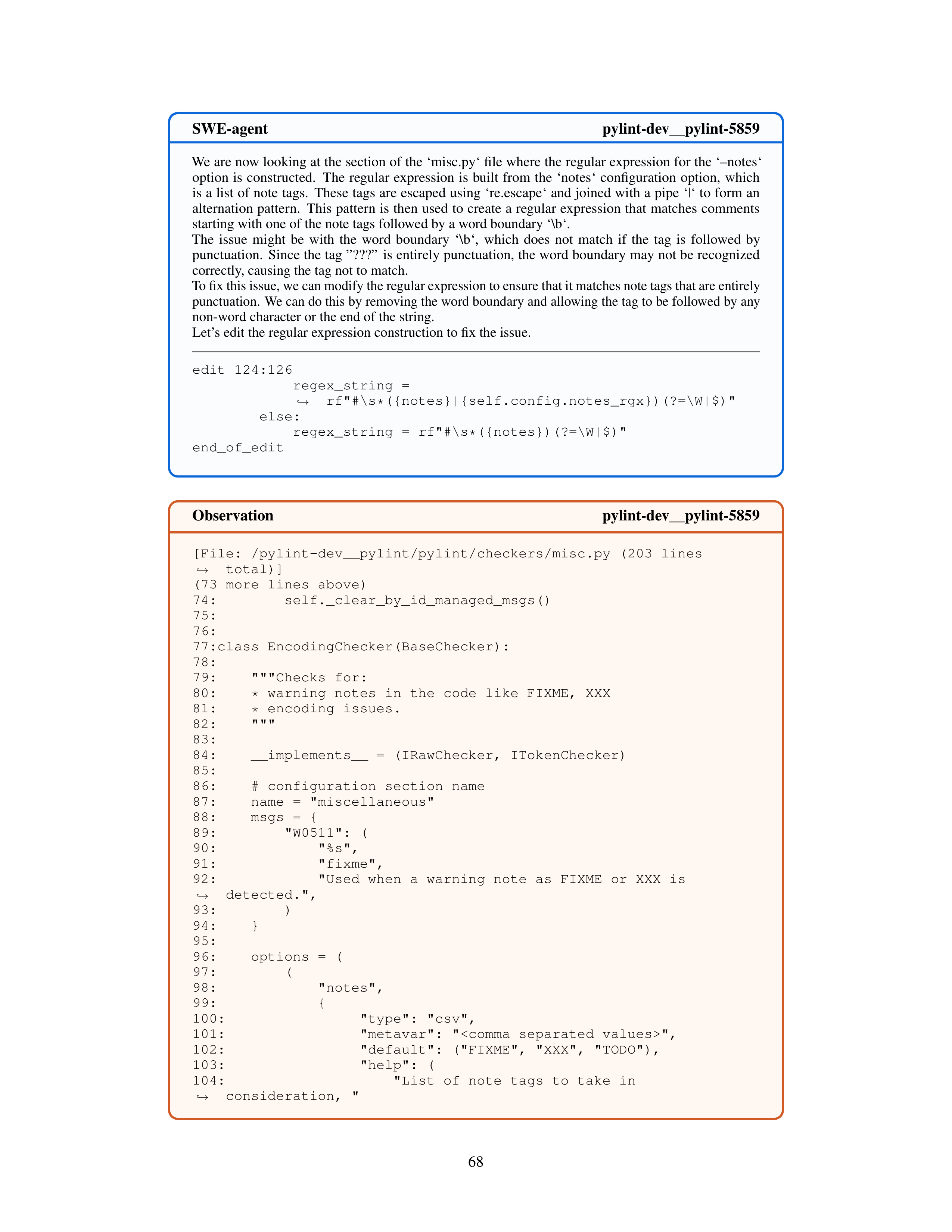
SWE-agent
pylint-dev__pylint-5859
We are now looking at the section of the ‘misc.py‘ file where the regular expression for the ‘–notes‘
option
is
constructed.
The
regular
expression
is
built
from
the
‘notes‘
configuration
option,
which
is a list of note tags.
These tags are escaped using ‘re.escape‘ and joined with a pipe ‘|‘ to form an
alternation pattern.
This pattern is then used to create a regular expression that matches comments
starting with one of the note tags followed by a word boundary ‘\b‘.
The
issue
might
be
with
the
word
boundary
‘\b‘,
which
does
not
match
if
the
tag
is
followed
by
punctuation.
Since the tag ”???”
is entirely punctuation, the word boundary may not be recognized
correctly, causing the tag not to match.
To fix this issue, we can modify the regular expression to ensure that it matches note tags that are entirely
punctuation.
We can do this by removing the word boundary and allowing the tag to be followed by any
non-word character or the end of the string.
Let’s edit the regular expression construction to fix the issue.
edit
124:126
regex_string
=
rf"#\s*({notes}|{self.config.notes_rgx})(?=\W|$)"
,
→
else:
regex_string
=
rf"#\s*({notes})(?=\W|$)"
end_of_edit
Observation
pylint-dev__pylint-5859
[File:
/pylint-dev__pylint/pylint/checkers/misc.py
(203
lines
total)]
,
→
(73
more
lines
above)
74:
self._clear_by_id_managed_msgs()
75:
76:
77:class
EncodingChecker(BaseChecker):
78:
79:
"""Checks
for:
80:
*
warning
notes
in
the
code
like
FIXME,
XXX
81:
*
encoding
issues.
82:
"""
83:
84:
__implements__
=
(IRawChecker,
ITokenChecker)
85:
86:
#
configuration
section
name
87:
name
=
"miscellaneous"
88:
msgs
=
{
89:
"W0511":
(
90:
"%s",
91:
"fixme",
92:
"Used
when
a
warning
note
as
FIXME
or
XXX
is
detected.",
,
→
93:
)
94:
}
95:
96:
options
=
(
97:
(
98:
"notes",
99:
{
100:
"type":
"csv",
101:
"metavar":
"<comma
separated
values>",
102:
"default":
("FIXME",
"XXX",
"TODO"),
103:
"help":
(
104:
"List
of
note
tags
to
take
in
consideration,
"
,
→
68
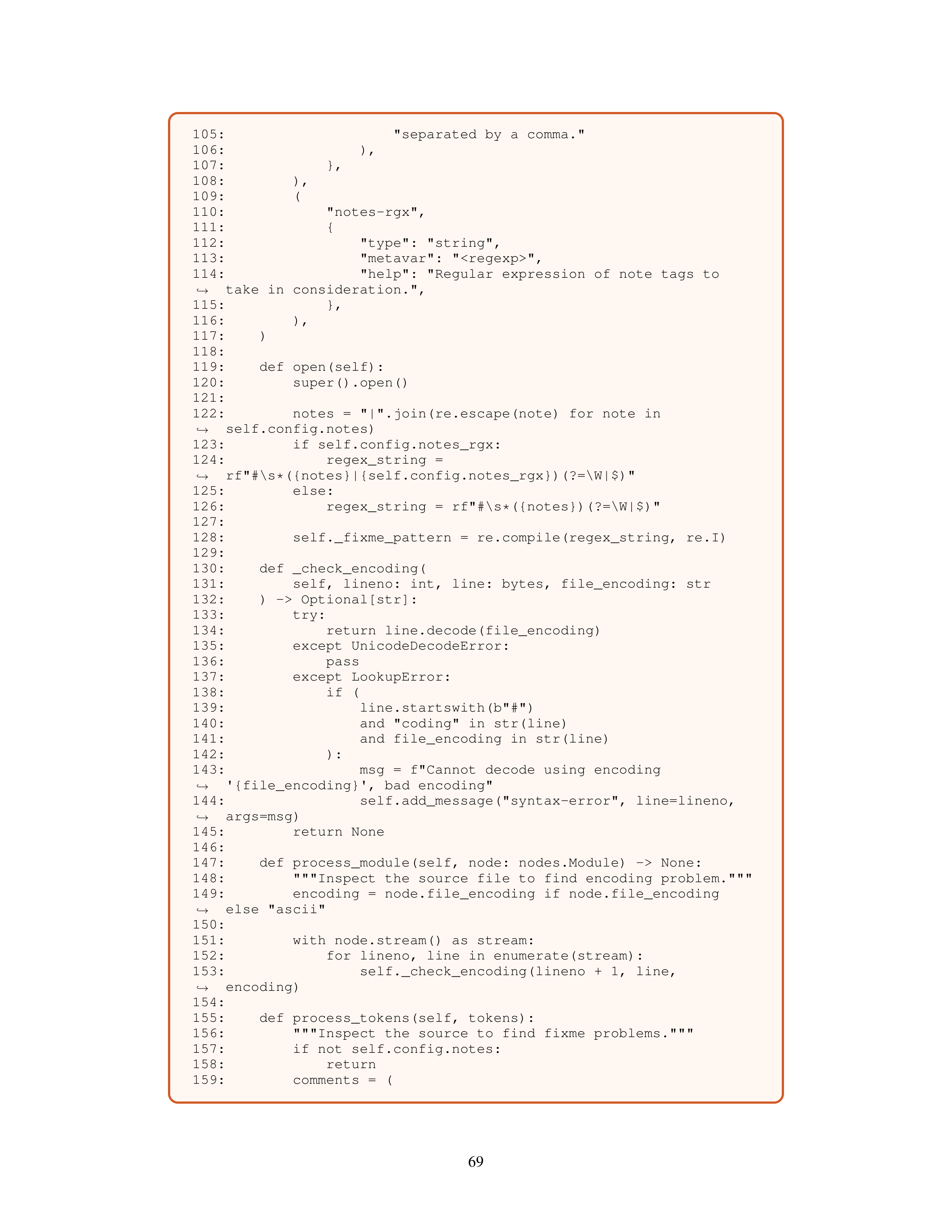
105:
"separated
by
a
comma."
106:
),
107:
},
108:
),
109:
(
110:
"notes-rgx",
111:
{
112:
"type":
"string",
113:
"metavar":
"",
114:
"help":
"Regular
expression
of
note
tags
to
take
in
consideration.",
,
→
115:
},
116:
),
117:
)
118:
119:
def
open(self):
120:
super().open()
121:
122:
notes
=
"|".join(re.escape(note)
for
note
in
self.config.notes)
,
→
123:
if
self.config.notes_rgx:
124:
regex_string
=
rf"#\s*({notes}|{self.config.notes_rgx})(?=\W|$)"
,
→
125:
else:
126:
regex_string
=
rf"#\s*({notes})(?=\W|$)"
127:
128:
self._fixme_pattern
=
re.compile(regex_string,
re.I)
129:
130:
def
_check_encoding(
131:
self,
lineno:
int,
line:
bytes,
file_encoding:
str
132:
)
->
Optional[str]:
133:
try:
134:
return
line.decode(file_encoding)
135:
except
UnicodeDecodeError:
136:
pass
137:
except
LookupError:
138:
if
(
139:
line.startswith(b"#")
140:
and
"coding"
in
str(line)
141:
and
file_encoding
in
str(line)
142:
):
143:
msg
=
f"Cannot
decode
using
encoding
'{file_encoding}',
bad
encoding"
,
→
144:
self.add_message("syntax-error",
line=lineno,
args=msg)
,
→
145:
return
None
146:
147:
def
process_module(self,
node:
nodes.Module)
->
None:
148:
"""Inspect
the
source
file
to
find
encoding
problem."""
149:
encoding
=
node.file_encoding
if
node.file_encoding
else
"ascii"
,
→
150:
151:
with
node.stream()
as
stream:
152:
for
lineno,
line
in
enumerate(stream):
153:
self._check_encoding(lineno
+
1,
line,
encoding)
,
→
154:
155:
def
process_tokens(self,
tokens):
156:
"""Inspect
the
source
to
find
fixme
problems."""
157:
if
not
self.config.notes:
158:
return
159:
comments
=
(
69
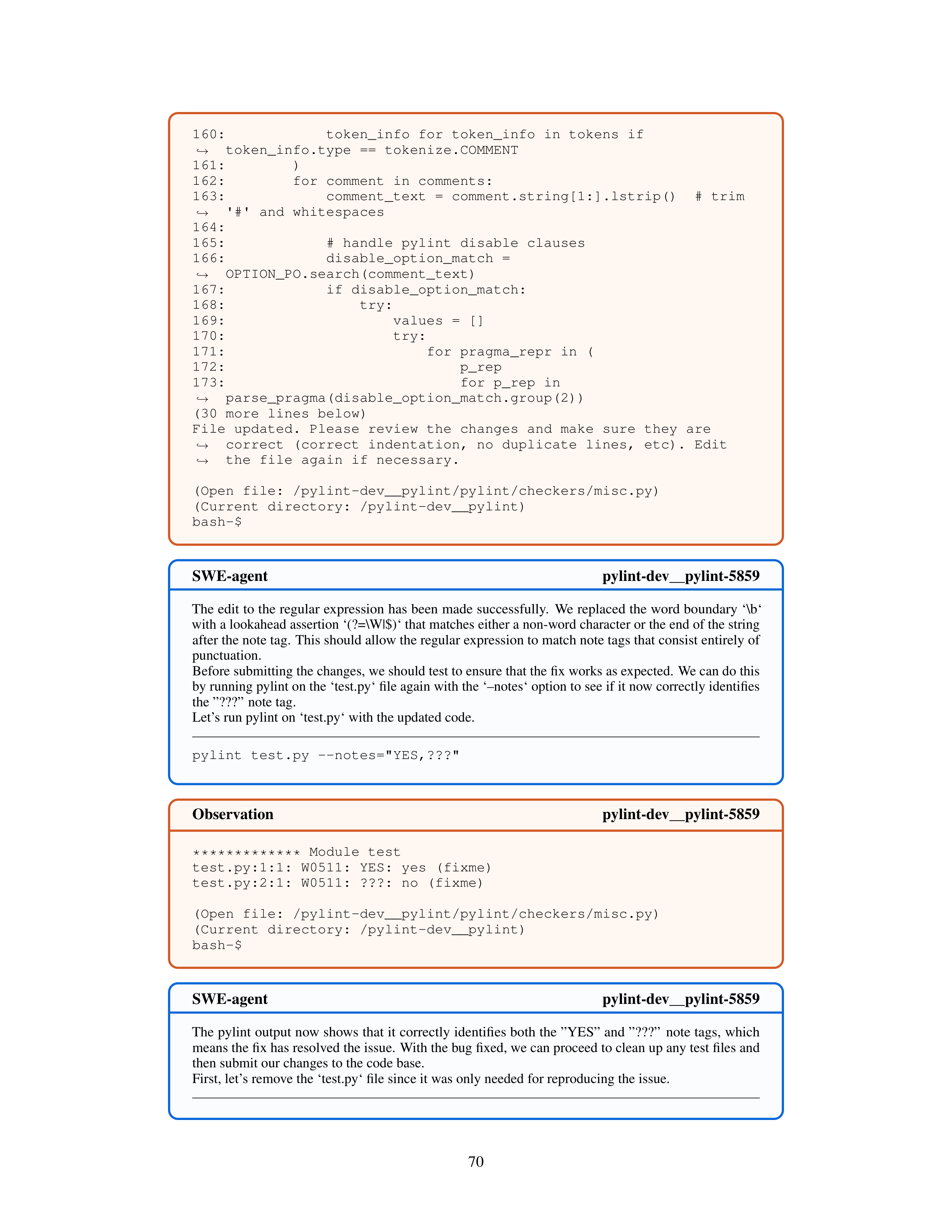
160:
token_info
for
token_info
in
tokens
if
token_info.type
==
tokenize.COMMENT
,
→
161:
)
162:
for
comment
in
comments:
163:
comment_text
=
comment.string[1:].lstrip()
#
trim
'#'
and
whitespaces
,
→
164:
165:
#
handle
pylint
disable
clauses
166:
disable_option_match
=
OPTION_PO.search(comment_text)
,
→
167:
if
disable_option_match:
168:
try:
169:
values
=
[]
170:
try:
171:
for
pragma_repr
in
(
172:
p_rep
173:
for
p_rep
in
parse_pragma(disable_option_match.group(2))
,
→
(30
more
lines
below)
File
updated.
Please
review
the
changes
and
make
sure
they
are
correct
(correct
indentation,
no
duplicate
lines,
etc).
Edit
the
file
again
if
necessary.
,
→
,
→
(Open
file:
/pylint-dev__pylint/pylint/checkers/misc.py)
(Current
directory:
/pylint-dev__pylint)
bash-$
SWE-agent
pylint-dev__pylint-5859
The edit to the regular expression has been made successfully.
We replaced the word boundary ‘\b‘
with a lookahead assertion ‘(?=\W|$)‘ that matches either a non-word character or the end of the string
after the note tag.
This should allow the regular expression to match note tags that consist entirely of
punctuation.
Before submitting the changes, we should test to ensure that the fix works as expected.
We can do this
by running pylint on the ‘test.py‘ file again with the ‘–notes‘ option to see if it now correctly identifies
the ”???”
note tag.
Let’s run pylint on ‘test.py‘ with the updated code.
pylint
test.py
--notes="YES,???"
Observation
pylint-dev__pylint-5859
*************
Module
test
test.py:1:1:
W0511:
YES:
yes
(fixme)
test.py:2:1:
W0511:
???:
no
(fixme)
(Open
file:
/pylint-dev__pylint/pylint/checkers/misc.py)
(Current
directory:
/pylint-dev__pylint)
bash-$
SWE-agent
pylint-dev__pylint-5859
The pylint output now shows that it correctly identifies both the ”YES” and ”???”
note tags, which
means the fix has resolved the issue.
With the bug fixed, we can proceed to clean up any test files and
then submit our changes to the code base.
First, let’s remove the ‘test.py‘ file since it was only needed for reproducing the issue.
70
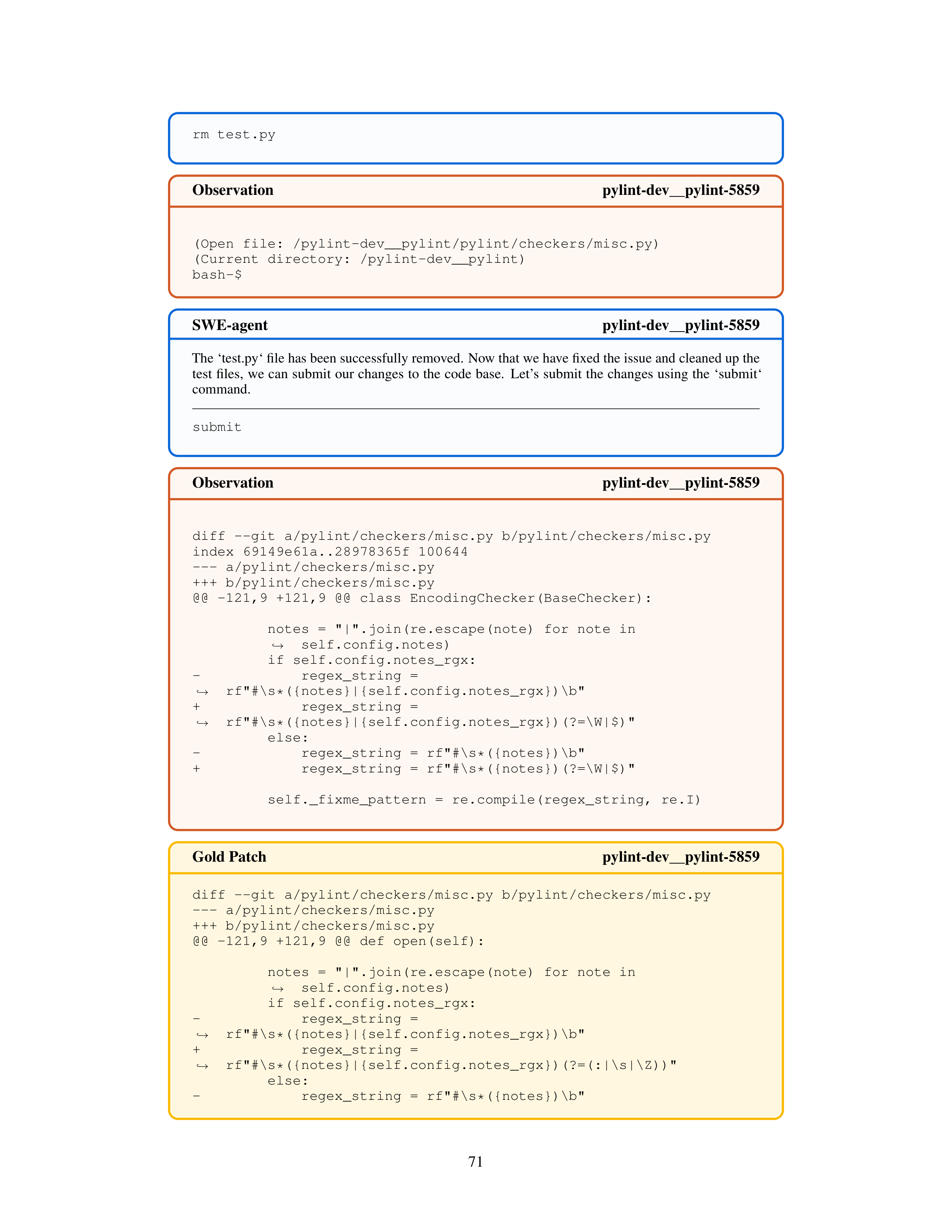
rm
test.py
Observation
pylint-dev__pylint-5859
(Open
file:
/pylint-dev__pylint/pylint/checkers/misc.py)
(Current
directory:
/pylint-dev__pylint)
bash-$
SWE-agent
pylint-dev__pylint-5859
The ‘test.py‘ file has been successfully removed.
Now that we have fixed the issue and cleaned up the
test files,
we can submit our changes to the code base.
Let’s submit the changes using the ‘submit‘
command.
submit
Observation
pylint-dev__pylint-5859
diff
--git
a/pylint/checkers/misc.py
b/pylint/checkers/misc.py
index
69149e61a..28978365f
100644
---
a/pylint/checkers/misc.py
+++
b/pylint/checkers/misc.py
@@
-121,9
+121,9
@@
class
EncodingChecker(BaseChecker):
notes
=
"|".join(re.escape(note)
for
note
in
self.config.notes)
,
→
if
self.config.notes_rgx:
-
regex_string
=
rf"#\s*({notes}|{self.config.notes_rgx})\b"
,
→
+
regex_string
=
rf"#\s*({notes}|{self.config.notes_rgx})(?=\W|$)"
,
→
else:
-
regex_string
=
rf"#\s*({notes})\b"
+
regex_string
=
rf"#\s*({notes})(?=\W|$)"
self._fixme_pattern
=
re.compile(regex_string,
re.I)
Gold Patch
pylint-dev__pylint-5859
diff
--git
a/pylint/checkers/misc.py
b/pylint/checkers/misc.py
---
a/pylint/checkers/misc.py
+++
b/pylint/checkers/misc.py
@@
-121,9
+121,9
@@
def
open(self):
notes
=
"|".join(re.escape(note)
for
note
in
self.config.notes)
,
→
if
self.config.notes_rgx:
-
regex_string
=
rf"#\s*({notes}|{self.config.notes_rgx})\b"
,
→
+
regex_string
=
rf"#\s*({notes}|{self.config.notes_rgx})(?=(:|\s|\Z))"
,
→
else:
-
regex_string
=
rf"#\s*({notes})\b"
71
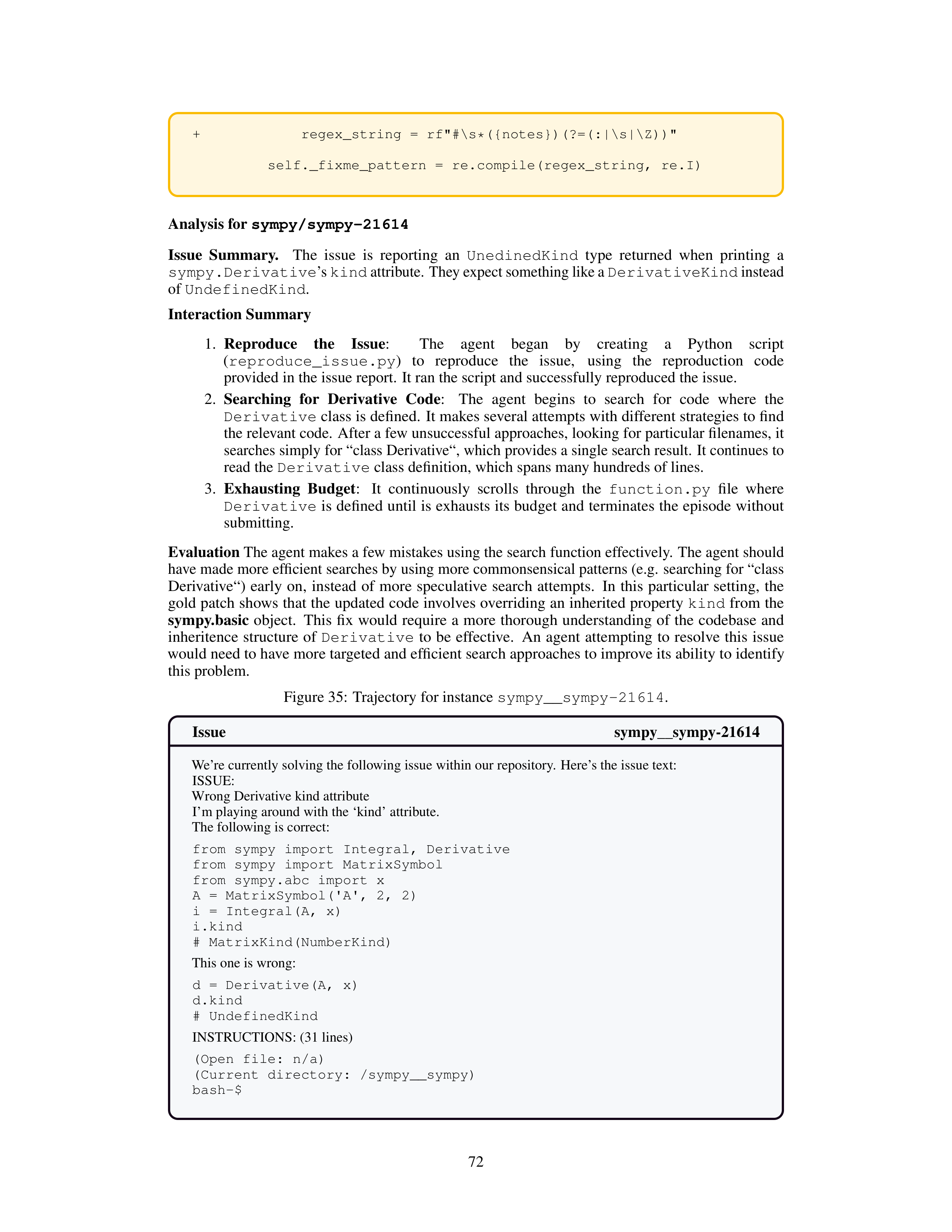
+
regex_string
=
rf"#\s*({notes})(?=(:|\s|\Z))"
self._fixme_pattern
=
re.compile(regex_string,
re.I)
Analysis for
sympy/sympy-21614
Issue
Summary.
The
issue
is
reporting
an
UnedinedKind
type
returned
when
printing
a
sympy.Derivative
’s
kind
attribute. They expect something like a
DerivativeKind
instead
of
UndefinedKind
.
Interaction Summary
1.
Reproduce
the
Issue
:
The
agent
began
by
creating
a
Python
script
(
reproduce_issue.py
)
to
reproduce
the
issue,
using
the
reproduction
code
provided in the issue report.
It ran the script and successfully reproduced the issue.
2.
Searching
for
Derivative
Code
:
The
agent
begins
to
search
for
code
where
the
Derivative
class is defined.
It makes several attempts with different strategies to find
the relevant code.
After a few unsuccessful approaches, looking for particular filenames, it
searches simply for “class Derivative“, which provides a single search result.
It continues to
read the
Derivative
class definition, which spans many hundreds of lines.
3.
Exhausting
Budget
:
It
continuously
scrolls
through
the
function.py
file
where
Derivative
is defined until is exhausts its budget and terminates the episode without
submitting.
Evaluation
The agent makes a few mistakes using the search function effectively.
The agent should
have made more efficient searches by using more commonsensical patterns (e.g.
searching for “class
Derivative“)
early
on,
instead
of
more
speculative
search
attempts.
In
this
particular
setting,
the
gold patch shows that the updated code involves overriding an inherited property
kind
from the
sympy.basic
object.
This
fix
would
require
a
more
thorough
understanding
of
the
codebase
and
inheritence
structure
of
Derivative
to
be
effective.
An
agent
attempting
to
resolve
this
issue
would need to have more targeted and efficient search approaches to improve its ability to identify
this problem.
Figure 35:
Trajectory for instance
sympy__sympy-21614
.
Issue
sympy__sympy-21614
We’re currently solving the following issue within our repository.
Here’s the issue text:
ISSUE:
Wrong Derivative kind attribute
I’m playing around with the ‘kind’ attribute.
The following is correct:
from
sympy
import
Integral,
Derivative
from
sympy
import
MatrixSymbol
from
sympy.abc
import
x
A
=
MatrixSymbol('A',
2,
2)
i
=
Integral(A,
x)
i.kind
#
MatrixKind(NumberKind)
This one is wrong:
d
=
Derivative(A,
x)
d.kind
#
UndefinedKind
INSTRUCTIONS: (31 lines)
(Open
file:
n/a)
(Current
directory:
/sympy__sympy)
bash-$
72
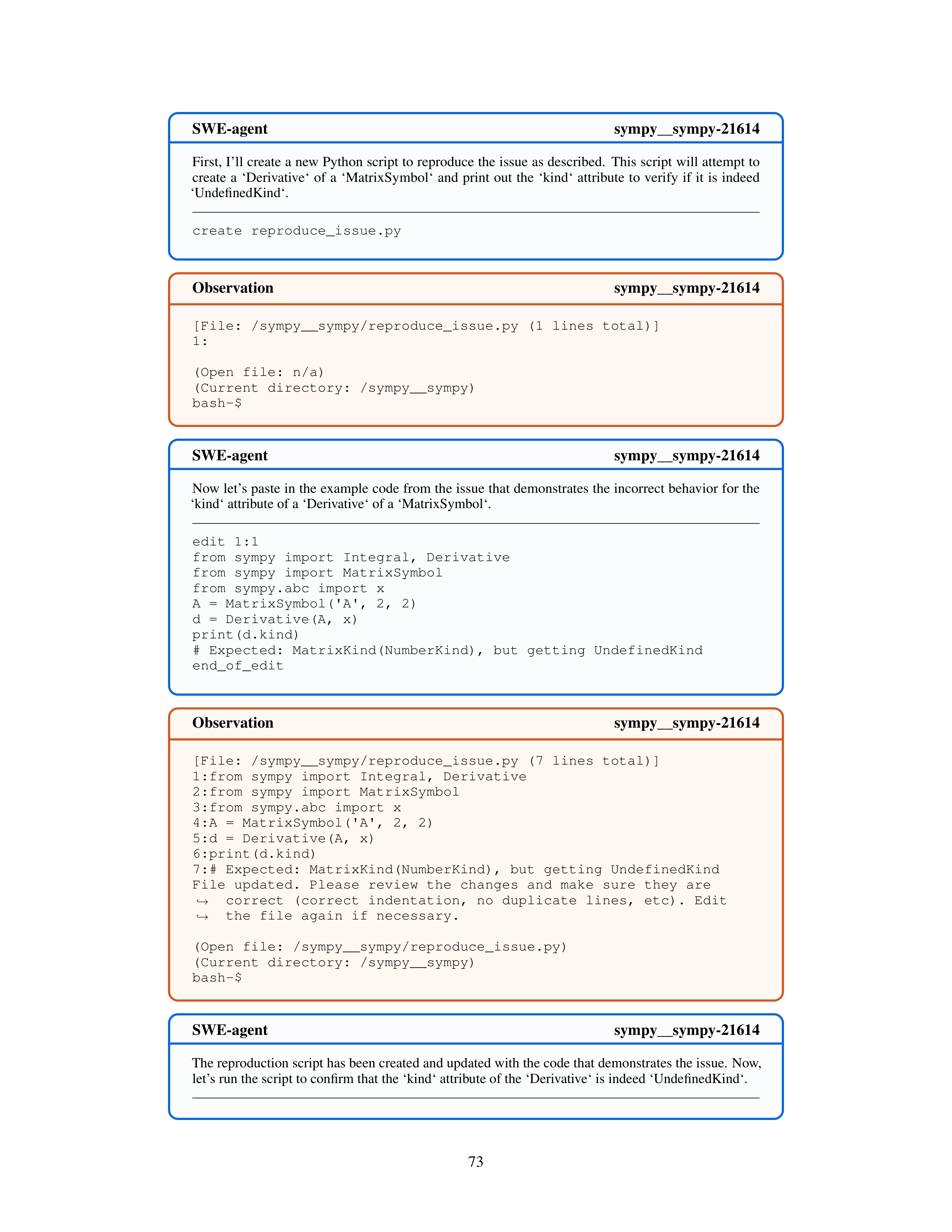
SWE-agent
sympy__sympy-21614
First, I’ll create a new Python script to reproduce the issue as described.
This script will attempt to
create
a
‘Derivative‘
of
a
‘MatrixSymbol‘
and
print
out
the
‘kind‘
attribute
to
verify
if
it
is
indeed
‘UndefinedKind‘.
create
reproduce_issue.py
Observation
sympy__sympy-21614
[File:
/sympy__sympy/reproduce_issue.py
(1
lines
total)]
1:
(Open
file:
n/a)
(Current
directory:
/sympy__sympy)
bash-$
SWE-agent
sympy__sympy-21614
Now let’s paste in the example code from the issue that demonstrates the incorrect behavior for the
‘kind‘ attribute of a ‘Derivative‘ of a ‘MatrixSymbol‘.
edit
1:1
from
sympy
import
Integral,
Derivative
from
sympy
import
MatrixSymbol
from
sympy.abc
import
x
A
=
MatrixSymbol('A',
2,
2)
d
=
Derivative(A,
x)
print(d.kind)
#
Expected:
MatrixKind(NumberKind),
but
getting
UndefinedKind
end_of_edit
Observation
sympy__sympy-21614
[File:
/sympy__sympy/reproduce_issue.py
(7
lines
total)]
1:from
sympy
import
Integral,
Derivative
2:from
sympy
import
MatrixSymbol
3:from
sympy.abc
import
x
4:A
=
MatrixSymbol('A',
2,
2)
5:d
=
Derivative(A,
x)
6:print(d.kind)
7:#
Expected:
MatrixKind(NumberKind),
but
getting
UndefinedKind
File
updated.
Please
review
the
changes
and
make
sure
they
are
correct
(correct
indentation,
no
duplicate
lines,
etc).
Edit
the
file
again
if
necessary.
,
→
,
→
(Open
file:
/sympy__sympy/reproduce_issue.py)
(Current
directory:
/sympy__sympy)
bash-$
SWE-agent
sympy__sympy-21614
The reproduction script has been created and updated with the code that demonstrates the issue.
Now,
let’s run the script to confirm that the ‘kind‘ attribute of the ‘Derivative‘ is indeed ‘UndefinedKind‘.
73
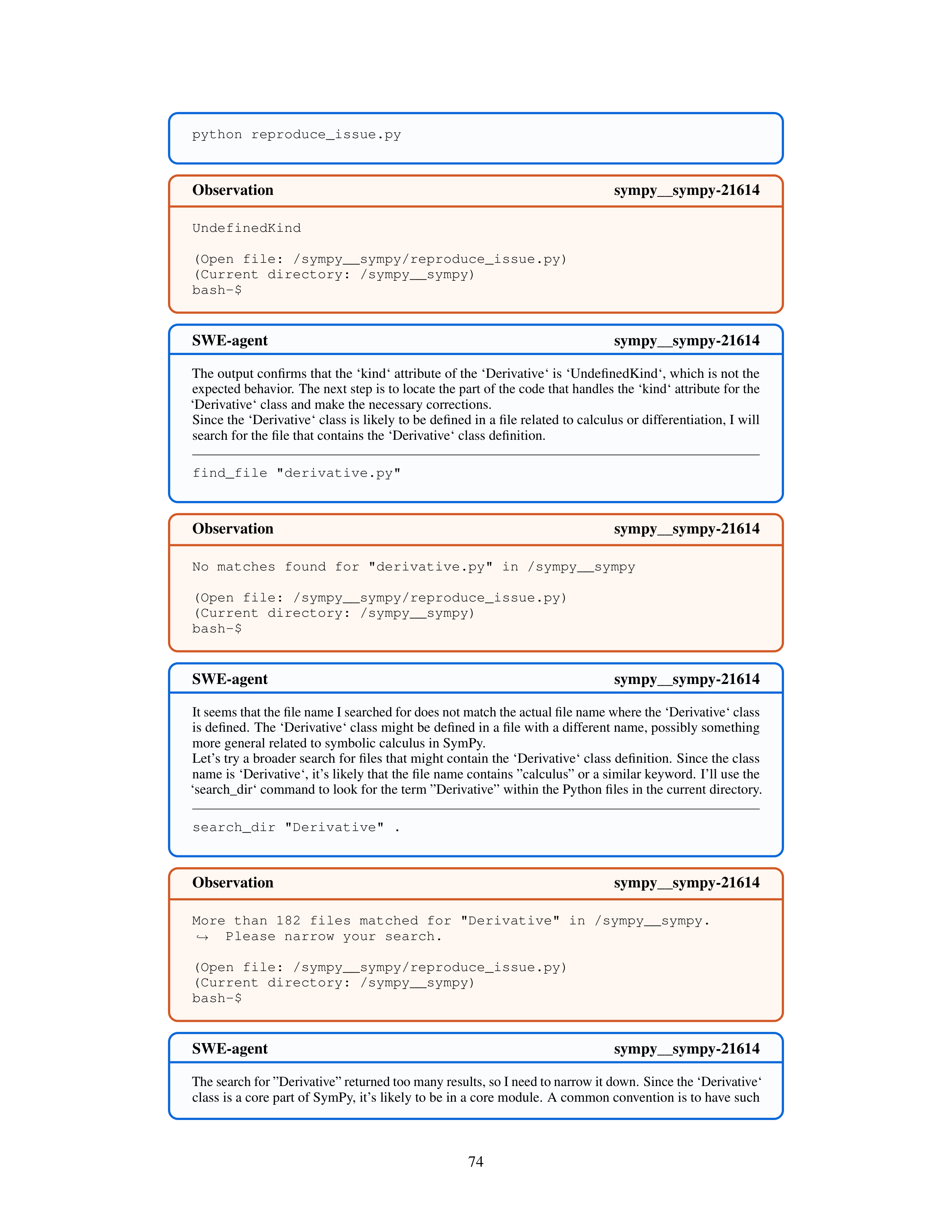
python
reproduce_issue.py
Observation
sympy__sympy-21614
UndefinedKind
(Open
file:
/sympy__sympy/reproduce_issue.py)
(Current
directory:
/sympy__sympy)
bash-$
SWE-agent
sympy__sympy-21614
The output confirms that the ‘kind‘ attribute of the ‘Derivative‘ is ‘UndefinedKind‘, which is not the
expected behavior.
The next step is to locate the part of the code that handles the ‘kind‘ attribute for the
‘Derivative‘ class and make the necessary corrections.
Since the ‘Derivative‘ class is likely to be defined in a file related to calculus or differentiation, I will
search for the file that contains the ‘Derivative‘ class definition.
find_file
"derivative.py"
Observation
sympy__sympy-21614
No
matches
found
for
"derivative.py"
in
/sympy__sympy
(Open
file:
/sympy__sympy/reproduce_issue.py)
(Current
directory:
/sympy__sympy)
bash-$
SWE-agent
sympy__sympy-21614
It seems that the file name I searched for does not match the actual file name where the ‘Derivative‘ class
is defined.
The ‘Derivative‘ class might be defined in a file with a different name, possibly something
more general related to symbolic calculus in SymPy.
Let’s try a broader search for files that might contain the ‘Derivative‘ class definition.
Since the class
name is ‘Derivative‘, it’s likely that the file name contains ”calculus” or a similar keyword.
I’ll use the
‘search_dir‘ command to look for the term ”Derivative” within the Python files in the current directory.
search_dir
"Derivative"
.
Observation
sympy__sympy-21614
More
than
182
files
matched
for
"Derivative"
in
/sympy__sympy.
Please
narrow
your
search.
,
→
(Open
file:
/sympy__sympy/reproduce_issue.py)
(Current
directory:
/sympy__sympy)
bash-$
SWE-agent
sympy__sympy-21614
The search for ”Derivative” returned too many results, so I need to narrow it down.
Since the ‘Derivative‘
class is a core part of SymPy, it’s likely to be in a core module.
A common convention is to have such
74
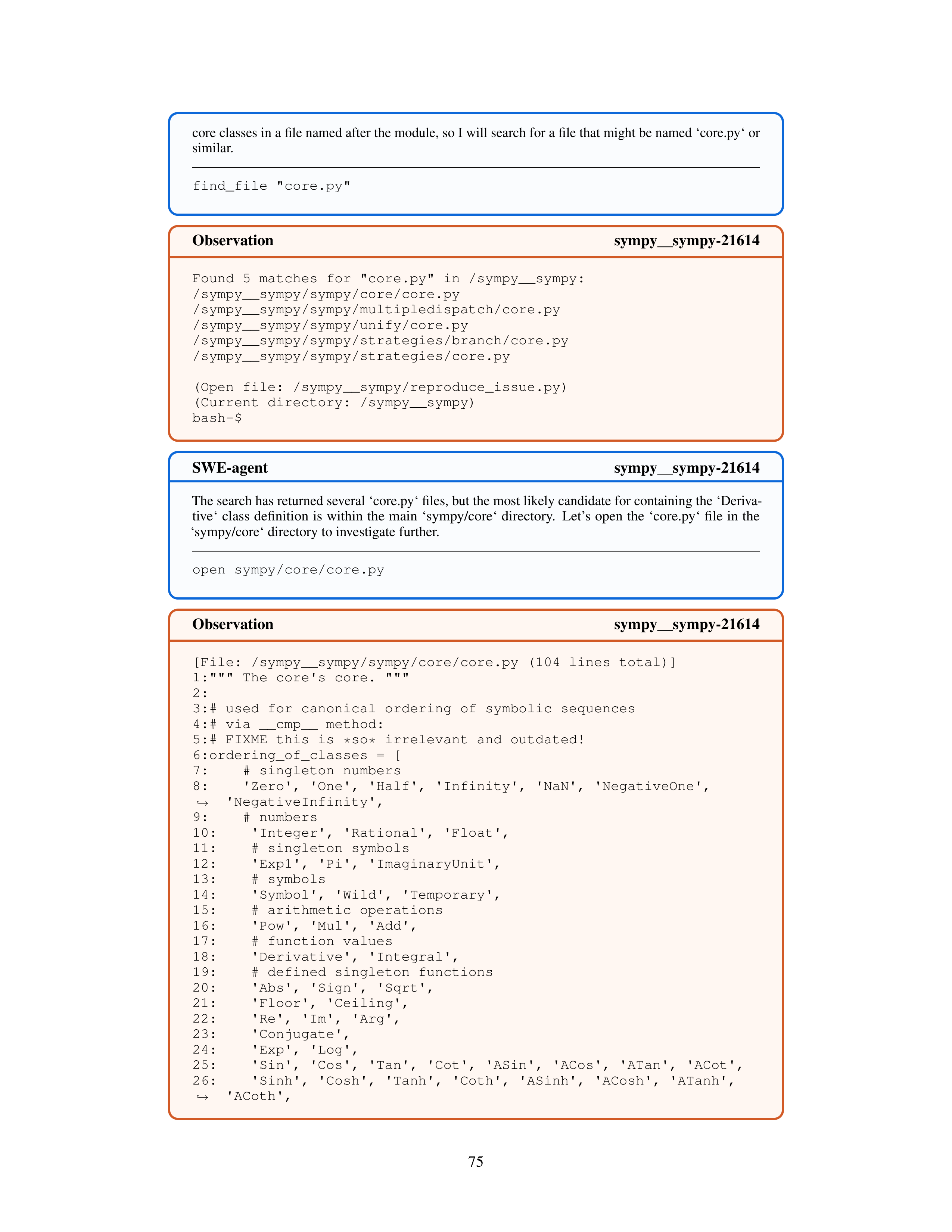
core classes in a file named after the module, so I will search for a file that might be named ‘core.py‘ or
similar.
find_file
"core.py"
Observation
sympy__sympy-21614
Found
5
matches
for
"core.py"
in
/sympy__sympy:
/sympy__sympy/sympy/core/core.py
/sympy__sympy/sympy/multipledispatch/core.py
/sympy__sympy/sympy/unify/core.py
/sympy__sympy/sympy/strategies/branch/core.py
/sympy__sympy/sympy/strategies/core.py
(Open
file:
/sympy__sympy/reproduce_issue.py)
(Current
directory:
/sympy__sympy)
bash-$
SWE-agent
sympy__sympy-21614
The search has returned several ‘core.py‘ files, but the most likely candidate for containing the ‘Deriva-
tive‘
class
definition
is
within
the
main
‘sympy/core‘
directory.
Let’s
open
the
‘core.py‘
file
in
the
‘sympy/core‘ directory to investigate further.
open
sympy/core/core.py
Observation
sympy__sympy-21614
[File:
/sympy__sympy/sympy/core/core.py
(104
lines
total)]
1:"""
The
core's
core.
"""
2:
3:#
used
for
canonical
ordering
of
symbolic
sequences
4:#
via
__cmp__
method:
5:#
FIXME
this
is
*so*
irrelevant
and
outdated!
6:ordering_of_classes
=
[
7:
#
singleton
numbers
8:
'Zero',
'One',
'Half',
'Infinity',
'NaN',
'NegativeOne',
'NegativeInfinity',
,
→
9:
#
numbers
10:
'Integer',
'Rational',
'Float',
11:
#
singleton
symbols
12:
'Exp1',
'Pi',
'ImaginaryUnit',
13:
#
symbols
14:
'Symbol',
'Wild',
'Temporary',
15:
#
arithmetic
operations
16:
'Pow',
'Mul',
'Add',
17:
#
function
values
18:
'Derivative',
'Integral',
19:
#
defined
singleton
functions
20:
'Abs',
'Sign',
'Sqrt',
21:
'Floor',
'Ceiling',
22:
'Re',
'Im',
'Arg',
23:
'Conjugate',
24:
'Exp',
'Log',
25:
'Sin',
'Cos',
'Tan',
'Cot',
'ASin',
'ACos',
'ATan',
'ACot',
26:
'Sinh',
'Cosh',
'Tanh',
'Coth',
'ASinh',
'ACosh',
'ATanh',
'ACoth',
,
→
75
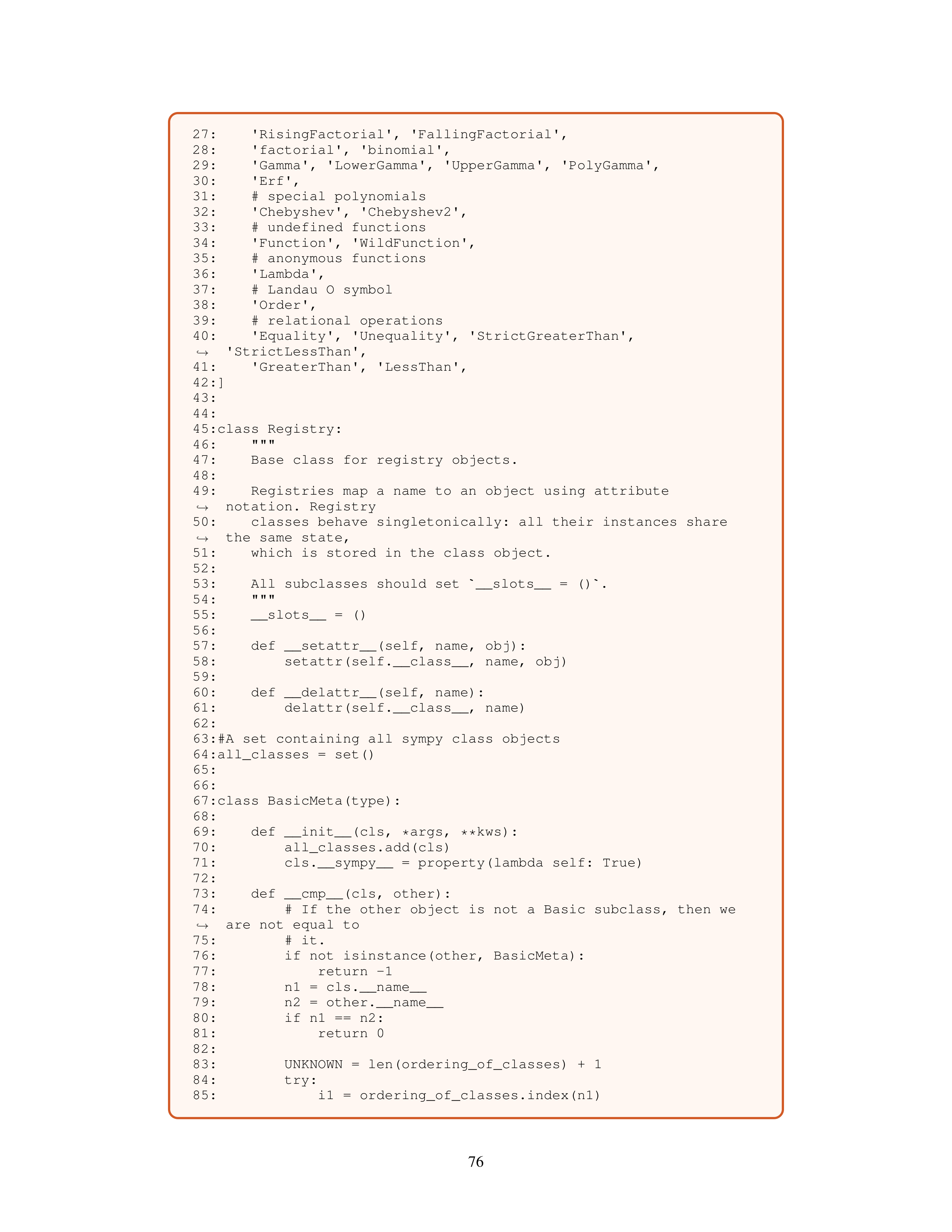
27:
'RisingFactorial',
'FallingFactorial',
28:
'factorial',
'binomial',
29:
'Gamma',
'LowerGamma',
'UpperGamma',
'PolyGamma',
30:
'Erf',
31:
#
special
polynomials
32:
'Chebyshev',
'Chebyshev2',
33:
#
undefined
functions
34:
'Function',
'WildFunction',
35:
#
anonymous
functions
36:
'Lambda',
37:
#
Landau
O
symbol
38:
'Order',
39:
#
relational
operations
40:
'Equality',
'Unequality',
'StrictGreaterThan',
'StrictLessThan',
,
→
41:
'GreaterThan',
'LessThan',
42:]
43:
44:
45:class
Registry:
46:
"""
47:
Base
class
for
registry
objects.
48:
49:
Registries
map
a
name
to
an
object
using
attribute
notation.
Registry
,
→
50:
classes
behave
singletonically:
all
their
instances
share
the
same
state,
,
→
51:
which
is
stored
in
the
class
object.
52:
53:
All
subclasses
should
set
`
__slots__
=
()
`
.
54:
"""
55:
__slots__
=
()
56:
57:
def
__setattr__(self,
name,
obj):
58:
setattr(self.__class__,
name,
obj)
59:
60:
def
__delattr__(self,
name):
61:
delattr(self.__class__,
name)
62:
63:#A
set
containing
all
sympy
class
objects
64:all_classes
=
set()
65:
66:
67:class
BasicMeta(type):
68:
69:
def
__init__(cls,
*args,
**kws):
70:
all_classes.add(cls)
71:
cls.__sympy__
=
property(lambda
self:
True)
72:
73:
def
__cmp__(cls,
other):
74:
#
If
the
other
object
is
not
a
Basic
subclass,
then
we
are
not
equal
to
,
→
75:
#
it.
76:
if
not
isinstance(other,
BasicMeta):
77:
return
-1
78:
n1
=
cls.__name__
79:
n2
=
other.__name__
80:
if
n1
==
n2:
81:
return
0
82:
83:
UNKNOWN
=
len(ordering_of_classes)
+
1
84:
try:
85:
i1
=
ordering_of_classes.index(n1)
76
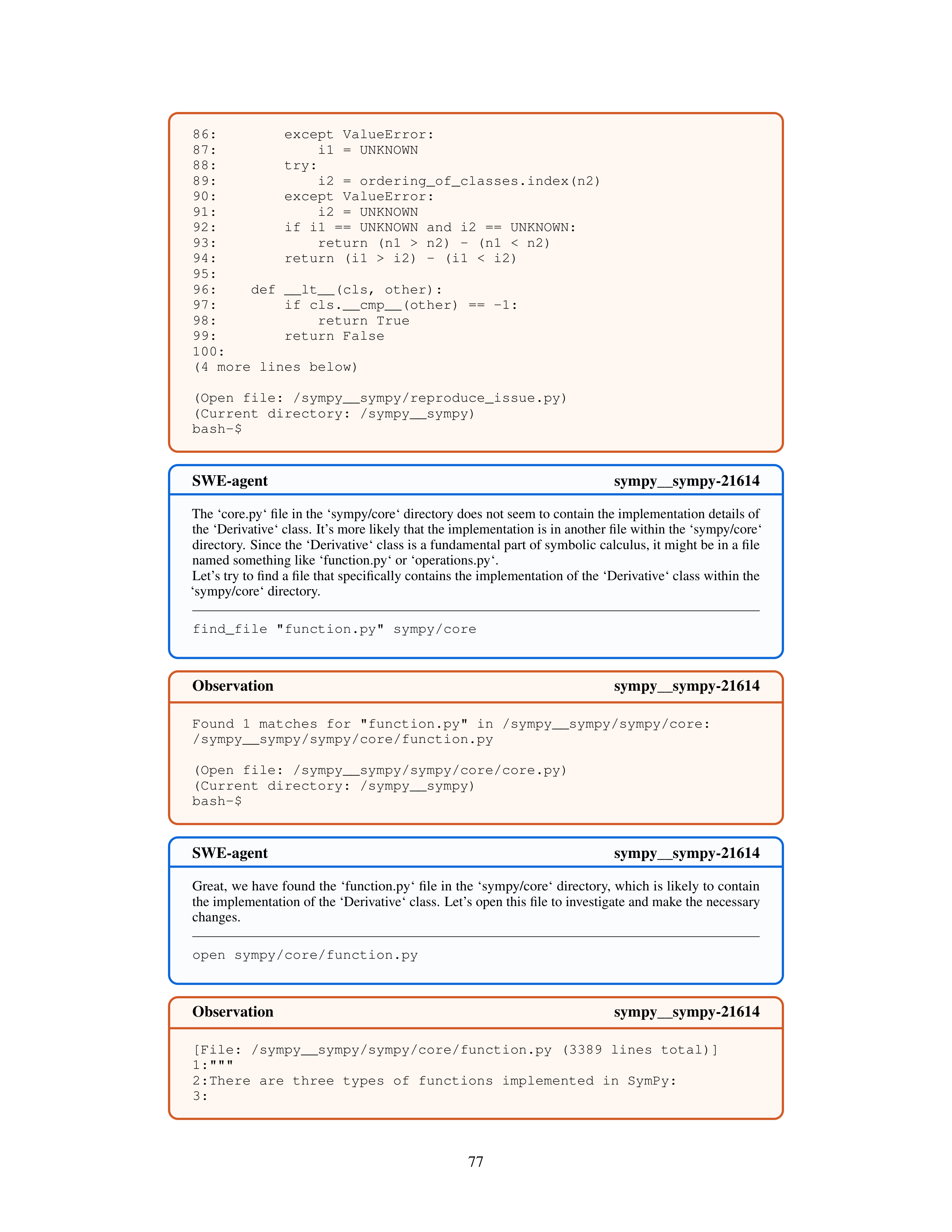
86:
except
ValueError:
87:
i1
=
UNKNOWN
88:
try:
89:
i2
=
ordering_of_classes.index(n2)
90:
except
ValueError:
91:
i2
=
UNKNOWN
92:
if
i1
==
UNKNOWN
and
i2
==
UNKNOWN:
93:
return
(n1
>
n2)
-
(n1
<
n2)
94:
return
(i1
>
i2)
-
(i1
<
i2)
95:
96:
def
__lt__(cls,
other):
97:
if
cls.__cmp__(other)
==
-1:
98:
return
True
99:
return
False
100:
(4
more
lines
below)
(Open
file:
/sympy__sympy/reproduce_issue.py)
(Current
directory:
/sympy__sympy)
bash-$
SWE-agent
sympy__sympy-21614
The ‘core.py‘ file in the ‘sympy/core‘ directory does not seem to contain the implementation details of
the ‘Derivative‘ class.
It’s more likely that the implementation is in another file within the ‘sympy/core‘
directory.
Since the ‘Derivative‘ class is a fundamental part of symbolic calculus, it might be in a file
named something like ‘function.py‘ or ‘operations.py‘.
Let’s try to find a file that specifically contains the implementation of the ‘Derivative‘ class within the
‘sympy/core‘ directory.
find_file
"function.py"
sympy/core
Observation
sympy__sympy-21614
Found
1
matches
for
"function.py"
in
/sympy__sympy/sympy/core:
/sympy__sympy/sympy/core/function.py
(Open
file:
/sympy__sympy/sympy/core/core.py)
(Current
directory:
/sympy__sympy)
bash-$
SWE-agent
sympy__sympy-21614
Great, we have found the ‘function.py‘ file in the ‘sympy/core‘ directory, which is likely to contain
the implementation of the ‘Derivative‘ class.
Let’s open this file to investigate and make the necessary
changes.
open
sympy/core/function.py
Observation
sympy__sympy-21614
[File:
/sympy__sympy/sympy/core/function.py
(3389
lines
total)]
1:"""
2:There
are
three
types
of
functions
implemented
in
SymPy:
3:
77
4:
1)
defined
functions
(in
the
sense
that
they
can
be
evaluated)
like
,
→
5:
exp
or
sin;
they
have
a
name
and
a
body:
6:
f
=
exp
7:
2)
undefined
function
which
have
a
name
but
no
body.
Undefined
,
→
8:
functions
can
be
defined
using
a
Function
class
as
follows:
,
→
9:
f
=
Function('f')
10:
(the
result
will
be
a
Function
instance)
11:
3)
anonymous
function
(or
lambda
function)
which
have
a
body
(defined
,
→
12:
with
dummy
variables)
but
have
no
name:
13:
f
=
Lambda(x,
exp(x)*x)
14:
f
=
Lambda((x,
y),
exp(x)*y)
15:
The
fourth
type
of
functions
are
composites,
like
(sin
+
cos)(x);
these
work
in
,
→
16:
SymPy
core,
but
are
not
yet
part
of
SymPy.
17:
18:
Examples
19:
========
20:
21:
>>>
import
sympy
22:
>>>
f
=
sympy.Function("f")
23:
>>>
from
sympy.abc
import
x
24:
>>>
f(x)
25:
f(x)
26:
>>>
print(sympy.srepr(f(x).func))
27:
Function('f')
28:
>>>
f(x).args
29:
(x,)
30:
31:"""
32:
33:from
typing
import
Any,
Dict
as
tDict,
Optional,
Set
as
tSet,
Tuple
as
tTuple,
Union
,
→
34:
35:from
.add
import
Add
36:from
.assumptions
import
ManagedProperties
37:from
.basic
import
Basic,
_atomic
38:from
.cache
import
cacheit
39:from
.compatibility
import
iterable,
is_sequence,
as_int,
ordered,
Iterable
,
→
40:from
.decorators
import
_sympifyit
41:from
.expr
import
Expr,
AtomicExpr
42:from
.numbers
import
Rational,
Float
43:from
.operations
import
LatticeOp
44:from
.rules
import
Transform
45:from
.singleton
import
S
46:from
.sympify
import
sympify
47:
48:from
sympy.core.containers
import
Tuple,
Dict
49:from
sympy.core.parameters
import
global_parameters
50:from
sympy.core.logic
import
fuzzy_and,
fuzzy_or,
fuzzy_not,
FuzzyBool
,
→
51:from
sympy.utilities
import
default_sort_key
52:from
sympy.utilities.exceptions
import
SymPyDeprecationWarning
53:from
sympy.utilities.iterables
import
has_dups,
sift
54:from
sympy.utilities.misc
import
filldedent
55:
56:import
mpmath
57:import
mpmath.libmp
as
mlib
58:
78
59:import
inspect
60:from
collections
import
Counter
61:
62:def
_coeff_isneg(a):
63:
"""Return
True
if
the
leading
Number
is
negative.
64:
65:
Examples
66:
========
67:
68:
>>>
from
sympy.core.function
import
_coeff_isneg
69:
>>>
from
sympy
import
S,
Symbol,
oo,
pi
70:
>>>
_coeff_isneg(-3*pi)
71:
True
72:
>>>
_coeff_isneg(S(3))
73:
False
74:
>>>
_coeff_isneg(-oo)
75:
True
76:
>>>
_coeff_isneg(Symbol('n',
negative=True))
#
coeff
is
1
77:
False
78:
79:
For
matrix
expressions:
80:
81:
>>>
from
sympy
import
MatrixSymbol,
sqrt
82:
>>>
A
=
MatrixSymbol("A",
3,
3)
83:
>>>
_coeff_isneg(-sqrt(2)*A)
84:
True
85:
>>>
_coeff_isneg(sqrt(2)*A)
86:
False
87:
"""
88:
89:
if
a.is_MatMul:
90:
a
=
a.args[0]
91:
if
a.is_Mul:
92:
a
=
a.args[0]
93:
return
a.is_Number
and
a.is_extended_negative
94:
95:
96:class
PoleError(Exception):
97:
pass
98:
99:
100:class
ArgumentIndexError(ValueError):
(3289
more
lines
below)
(Open
file:
/sympy__sympy/sympy/core/core.py)
(Current
directory:
/sympy__sympy)
bash-$
SWE-agent
sympy__sympy-21614
The ‘function.py‘ file is now open, and it’s quite large with 3389 lines.
The ‘Derivative‘ class is likely to
be defined in this file, but we need to find the exact location.
Since the file is too long to scroll through
manually, I’ll use the ‘search_file‘ command to find the ‘Derivative‘ class definition within this file.
search_file
"class
Derivative"
79
Observation
sympy__sympy-21614
Found
1
matches
for
"class
Derivative"
in
/sympy__sympy/sympy/core/function.py:
,
→
Line
1053:class
Derivative(Expr):
End
of
matches
for
"class
Derivative"
in
/sympy__sympy/sympy/core/function.py
,
→
(Open
file:
/sympy__sympy/sympy/core/function.py)
(Current
directory:
/sympy__sympy)
bash-$
SWE-agent
sympy__sympy-21614
We have found that the ‘Derivative‘ class is defined on line 1053 of ‘function.py‘.
Let’s navigate to that
line to inspect the implementation and determine how to correct the ‘kind‘ attribute issue.
goto
1053
Observation
sympy__sympy-21614
[File:
/sympy__sympy/sympy/core/function.py
(3389
lines
total)]
(1037
more
lines
above)
1038:
nargs
=
(as_int(nargs),)
1039:
nargs
=
FiniteSet(*nargs)
1040:
cls.nargs
=
nargs
1041:
1042:
def
matches(self,
expr,
repl_dict={},
old=False):
1043:
if
not
isinstance(expr,
(AppliedUndef,
Function)):
1044:
return
None
1045:
if
len(expr.args)
not
in
self.nargs:
1046:
return
None
1047:
1048:
repl_dict
=
repl_dict.copy()
1049:
repl_dict[self]
=
expr
1050:
return
repl_dict
1051:
1052:
1053:class
Derivative(Expr):
1054:
"""
1055:
Carries
out
differentiation
of
the
given
expression
with
respect
to
symbols.
,
→
1056:
1057:
Examples
1058:
========
1059:
1060:
>>>
from
sympy
import
Derivative,
Function,
symbols,
Subs
1061:
>>>
from
sympy.abc
import
x,
y
1062:
>>>
f,
g
=
symbols('f
g',
cls=Function)
1063:
1064:
>>>
Derivative(x**2,
x,
evaluate=True)
1065:
2*x
1066:
1067:
Denesting
of
derivatives
retains
the
ordering
of
variables:
,
→
1068:
1069:
>>>
Derivative(Derivative(f(x,
y),
y),
x)
1070:
Derivative(f(x,
y),
y,
x)
1071:
80
1072:
Contiguously
identical
symbols
are
merged
into
a
tuple
giving
,
→
1073:
the
symbol
and
the
count:
1074:
1075:
>>>
Derivative(f(x),
x,
x,
y,
x)
1076:
Derivative(f(x),
(x,
2),
y,
x)
1077:
1078:
If
the
derivative
cannot
be
performed,
and
evaluate
is
True,
the
,
→
1079:
order
of
the
variables
of
differentiation
will
be
made
canonical:
,
→
1080:
1081:
>>>
Derivative(f(x,
y),
y,
x,
evaluate=True)
1082:
Derivative(f(x,
y),
x,
y)
1083:
1084:
Derivatives
with
respect
to
undefined
functions
can
be
calculated:
,
→
1085:
1086:
>>>
Derivative(f(x)**2,
f(x),
evaluate=True)
1087:
2*f(x)
1088:
1089:
Such
derivatives
will
show
up
when
the
chain
rule
is
used
to
,
→
1090:
evalulate
a
derivative:
1091:
1092:
>>>
f(g(x)).diff(x)
1093:
Derivative(f(g(x)),
g(x))*Derivative(g(x),
x)
1094:
1095:
Substitution
is
used
to
represent
derivatives
of
functions
with
,
→
1096:
arguments
that
are
not
symbols
or
functions:
1097:
1098:
>>>
f(2*x
+
3).diff(x)
==
2*Subs(f(y).diff(y),
y,
2*x
+
3)
,
→
1099:
True
1100:
1101:
Notes
1102:
=====
1103:
1104:
Simplification
of
high-order
derivatives:
1105:
1106:
Because
there
can
be
a
significant
amount
of
simplification
that
can
be
,
→
1107:
done
when
multiple
differentiations
are
performed,
results
will
be
,
→
1108:
automatically
simplified
in
a
fairly
conservative
fashion
unless
the
,
→
1109:
keyword
``
simplify
``
is
set
to
False.
1110:
1111:
>>>
from
sympy
import
sqrt,
diff,
Function,
symbols
1112:
>>>
from
sympy.abc
import
x,
y,
z
1113:
>>>
f,
g
=
symbols('f,g',
cls=Function)
1114:
1115:
>>>
e
=
sqrt((x
+
1)**2
+
x)
1116:
>>>
diff(e,
(x,
5),
simplify=False).count_ops()
1117:
136
1118:
>>>
diff(e,
(x,
5)).count_ops()
1119:
30
1120:
1121:
Ordering
of
variables:
1122:
1123:
If
evaluate
is
set
to
True
and
the
expression
cannot
be
evaluated,
the
,
→
81
1124:
list
of
differentiation
symbols
will
be
sorted,
that
is,
the
expression
is
,
→
1125:
assumed
to
have
continuous
derivatives
up
to
the
order
asked.
,
→
1126:
1127:
Derivative
wrt
non-Symbols:
1128:
1129:
For
the
most
part,
one
may
not
differentiate
wrt
non-symbols.
,
→
1130:
For
example,
we
do
not
allow
differentiation
wrt
`
x*y
`
because
,
→
1131:
there
are
multiple
ways
of
structurally
defining
where
x*y
appears
,
→
1132:
in
an
expression:
a
very
strict
definition
would
make
1133:
(x*y*z).diff(x*y)
==
0.
Derivatives
wrt
defined
functions
(like
,
→
1134:
cos(x))
are
not
allowed,
either:
1135:
1136:
>>>
(x*y*z).diff(x*y)
1137:
Traceback
(most
recent
call
last):
(2252
more
lines
below)
(Open
file:
/sympy__sympy/sympy/core/function.py)
(Current
directory:
/sympy__sympy)
bash-$
SWE-agent
sympy__sympy-21614
We are now at the beginning of the ‘Derivative‘ class definition.
To address the issue with the ‘kind‘
attribute, we need to find where the ‘kind‘ property is defined or handled within this class.
Since the
file
is
large,
I
will
scroll
down
to
find
the
relevant
section
where
the
‘kind‘
property
is
likely
to
be
implemented.
scroll_down
Observation
sympy__sympy-21614
[File:
/sympy__sympy/sympy/core/function.py
(3389
lines
total)]
(1135
more
lines
above)
1136:
>>>
(x*y*z).diff(x*y)
1137:
Traceback
(most
recent
call
last):
1138:
...
1139:
ValueError:
Can't
calculate
derivative
wrt
x*y.
1140:
1141:
To
make
it
easier
to
work
with
variational
calculus,
however,
,
→
1142:
derivatives
wrt
AppliedUndef
and
Derivatives
are
allowed.
1143:
For
example,
in
the
Euler-Lagrange
method
one
may
write
1144:
F(t,
u,
v)
where
u
=
f(t)
and
v
=
f'(t).
These
variables
can
be
,
→
1145:
written
explicitly
as
functions
of
time::
1146:
1147:
>>>
from
sympy.abc
import
t
1148:
>>>
F
=
Function('F')
1149:
>>>
U
=
f(t)
1150:
>>>
V
=
U.diff(t)
1151:
1152:
The
derivative
wrt
f(t)
can
be
obtained
directly:
1153:
82
1154:
>>>
direct
=
F(t,
U,
V).diff(U)
1155:
1156:
When
differentiation
wrt
a
non-Symbol
is
attempted,
the
non-Symbol
,
→
1157:
is
temporarily
converted
to
a
Symbol
while
the
differentiation
,
→
1158:
is
performed
and
the
same
answer
is
obtained:
1159:
1160:
>>>
indirect
=
F(t,
U,
V).subs(U,
x).diff(x).subs(x,
U)
,
→
1161:
>>>
assert
direct
==
indirect
1162:
1163:
The
implication
of
this
non-symbol
replacement
is
that
all
1164:
functions
are
treated
as
independent
of
other
functions
and
the
,
→
1165:
symbols
are
independent
of
the
functions
that
contain
them::
,
→
1166:
1167:
>>>
x.diff(f(x))
1168:
0
1169:
>>>
g(x).diff(f(x))
1170:
0
1171:
1172:
It
also
means
that
derivatives
are
assumed
to
depend
only
1173:
on
the
variables
of
differentiation,
not
on
anything
contained
,
→
1174:
within
the
expression
being
differentiated::
1175:
1176:
>>>
F
=
f(x)
1177:
>>>
Fx
=
F.diff(x)
1178:
>>>
Fx.diff(F)
#
derivative
depends
on
x,
not
F
1179:
0
1180:
>>>
Fxx
=
Fx.diff(x)
1181:
>>>
Fxx.diff(Fx)
#
derivative
depends
on
x,
not
Fx
1182:
0
1183:
1184:
The
last
example
can
be
made
explicit
by
showing
the
replacement
,
→
1185:
of
Fx
in
Fxx
with
y:
1186:
1187:
>>>
Fxx.subs(Fx,
y)
1188:
Derivative(y,
x)
1189:
1190:
Since
that
in
itself
will
evaluate
to
zero,
differentiating
,
→
1191:
wrt
Fx
will
also
be
zero:
1192:
1193:
>>>
_.doit()
1194:
0
1195:
1196:
Replacing
undefined
functions
with
concrete
expressions
1197:
1198:
One
must
be
careful
to
replace
undefined
functions
with
expressions
,
→
1199:
that
contain
variables
consistent
with
the
function
definition
and
,
→
1200:
the
variables
of
differentiation
or
else
insconsistent
result
will
,
→
1201:
be
obtained.
Consider
the
following
example:
1202:
1203:
>>>
eq
=
f(x)*g(y)
1204:
>>>
eq.subs(f(x),
x*y).diff(x,
y).doit()
1205:
y*Derivative(g(y),
y)
+
g(y)
83
1206:
>>>
eq.diff(x,
y).subs(f(x),
x*y).doit()
1207:
y*Derivative(g(y),
y)
1208:
1209:
The
results
differ
because
`
f(x)
`
was
replaced
with
an
expression
,
→
1210:
that
involved
both
variables
of
differentiation.
In
the
abstract
,
→
1211:
case,
differentiation
of
`
f(x)
`
by
`
y
`
is
0;
in
the
concrete
case,
,
→
1212:
the
presence
of
`
y
`
made
that
derivative
nonvanishing
and
produced
,
→
1213:
the
extra
`
g(y)
`
term.
1214:
1215:
Defining
differentiation
for
an
object
1216:
1217:
An
object
must
define
._eval_derivative(symbol)
method
that
returns
,
→
1218:
the
differentiation
result.
This
function
only
needs
to
consider
the
,
→
1219:
non-trivial
case
where
expr
contains
symbol
and
it
should
call
the
diff()
,
→
1220:
method
internally
(not
_eval_derivative);
Derivative
should
be
the
only
,
→
1221:
one
to
call
_eval_derivative.
1222:
1223:
Any
class
can
allow
derivatives
to
be
taken
with
respect
to
,
→
1224:
itself
(while
indicating
its
scalar
nature).
See
the
1225:
docstring
of
Expr._diff_wrt.
1226:
1227:
See
Also
1228:
========
1229:
_sort_variable_count
1230:
"""
1231:
1232:
is_Derivative
=
True
1233:
1234:
@property
1235:
def
_diff_wrt(self):
(2154
more
lines
below)
(Open
file:
/sympy__sympy/sympy/core/function.py)
(Current
directory:
/sympy__sympy)
bash-$
SWE-agent
sympy__sympy-21614
We have scrolled down through the ‘function.py‘ file, but we have not yet found the implementation of
the ‘kind‘ property for the ‘Derivative‘ class.
We need to continue scrolling to find the relevant section.
scroll_down
Observation
sympy__sympy-21614
[File:
/sympy__sympy/sympy/core/function.py
(3389
lines
total)]
(1233
more
lines
above)
[File
contents
omitted
for
brevity]
(2056
more
lines
below)
84
(Open
file:
/sympy__sympy/sympy/core/function.py)
(Current
directory:
/sympy__sympy)
bash-$
SWE-agent
sympy__sympy-21614
We have scrolled further down the ‘function.py‘ file, but we still haven’t found the implementation of
the ‘kind‘ property for the ‘Derivative‘ class.
We need to continue scrolling to find the relevant section
where the ‘kind‘ property is likely to be implemented or overridden.
scroll_down
Observation
sympy__sympy-21614
[File:
/sympy__sympy/sympy/core/function.py
(3389
lines
total)]
(1331
more
lines
above)
[File
contents
omitted
for
brevity]
(1958
more
lines
below)
(Open
file:
/sympy__sympy/sympy/core/function.py)
(Current
directory:
/sympy__sympy)
bash-$
SWE-agent
sympy__sympy-21614
We have scrolled further down the ‘function.py‘ file, but we still haven’t found the implementation of
the ‘kind‘ property for the ‘Derivative‘ class.
We need to continue scrolling to find the relevant section
where the ‘kind‘ property is likely to be implemented or overridden.
scroll_down
Observation
sympy__sympy-21614
[File:
/sympy__sympy/sympy/core/function.py
(3389
lines
total)]
(1429
more
lines
above)
[File
contents
omitted
for
brevity]
(1860
more
lines
below)
(Open
file:
/sympy__sympy/sympy/core/function.py)
(Current
directory:
/sympy__sympy)
bash-$
SWE-agent
sympy__sympy-21614
We have scrolled further down the ‘function.py‘ file, but we still haven’t found the implementation of
the ‘kind‘ property for the ‘Derivative‘ class.
We need to continue scrolling to find the relevant section
where the ‘kind‘ property is likely to be implemented or overridden.
scroll_down
85
Observation
sympy__sympy-21614
[File:
/sympy__sympy/sympy/core/function.py
(3389
lines
total)]
(1527
more
lines
above)
[File
contents
omitted
for
brevity]
(1762
more
lines
below)
(Open
file:
/sympy__sympy/sympy/core/function.py)
(Current
directory:
/sympy__sympy)
bash-$
SWE-agent
sympy__sympy-21614
We have scrolled further down the ‘function.py‘ file, but we still haven’t found the implementation of
the ‘kind‘ property for the ‘Derivative‘ class.
We need to continue scrolling to find the relevant section
where the ‘kind‘ property is likely to be implemented or overridden.
scroll_down
Observation
sympy__sympy-21614
[File:
/sympy__sympy/sympy/core/function.py
(3389
lines
total)]
(1625
more
lines
above)
[File
contents
omitted
for
brevity]
(1664
more
lines
below)
(Open
file:
/sympy__sympy/sympy/core/function.py)
(Current
directory:
/sympy__sympy)
bash-$
SWE-agent
sympy__sympy-21614
We have scrolled further down the ‘function.py‘ file, but we still haven’t found the implementation of
the ‘kind‘ property for the ‘Derivative‘ class.
We need to continue scrolling to find the relevant section
where the ‘kind‘ property is likely to be implemented or overridden.
scroll_down
Observation
sympy__sympy-21614
[File:
/sympy__sympy/sympy/core/function.py
(3389
lines
total)]
(1723
more
lines
above)
[File
contents
omitted
for
brevity]
(1566
more
lines
below)
(Open
file:
/sympy__sympy/sympy/core/function.py)
(Current
directory:
/sympy__sympy)
bash-$
SWE-agent
sympy__sympy-21614
We have scrolled further down the ‘function.py‘ file, but we still haven’t found the implementation of
the ‘kind‘ property for the ‘Derivative‘ class.
We need to continue scrolling to find the relevant section
where the ‘kind‘ property is likely to be implemented or overridden.
86
scroll_down
Observation
sympy__sympy-21614
[File:
/sympy__sympy/sympy/core/function.py
(3389
lines
total)]
(1821
more
lines
above)
[File
contents
omitted
for
brevity]
(1468
more
lines
below)
(Open
file:
/sympy__sympy/sympy/core/function.py)
(Current
directory:
/sympy__sympy)
bash-$
SWE-agent
sympy__sympy-21614
We have scrolled further down the ‘function.py‘ file, but we still haven’t found the implementation of
the ‘kind‘ property for the ‘Derivative‘ class.
We need to continue scrolling to find the relevant section
where the ‘kind‘ property is likely to be implemented or overridden.
scroll_down
Observation
sympy__sympy-21614
[File:
/sympy__sympy/sympy/core/function.py
(3389
lines
total)]
(1919
more
lines
above)
[File
contents
omitted
for
brevity]
(1370
more
lines
below)
(Open
file:
/sympy__sympy/sympy/core/function.py)
(Current
directory:
/sympy__sympy)
bash-$
SWE-agent
sympy__sympy-21614
We have scrolled further down the ‘function.py‘ file, but we still haven’t found the implementation of
the ‘kind‘ property for the ‘Derivative‘ class.
We need to continue scrolling to find the relevant section
where the ‘kind‘ property is likely to be implemented or overridden.
scroll_down
Observation
sympy__sympy-21614
[File:
/sympy__sympy/sympy/core/function.py
(3389
lines
total)]
(2017
more
lines
above)
[File
contents
omitted
for
brevity]
(1272
more
lines
below)
(Open
file:
/sympy__sympy/sympy/core/function.py)
(Current
directory:
/sympy__sympy)
bash-$
87
SWE-agent
sympy__sympy-21614
We have scrolled further down the ‘function.py‘ file, but we still haven’t found the implementation of
the ‘kind‘ property for the ‘Derivative‘ class.
We need to continue scrolling to find the relevant section
where the ‘kind‘ property is likely to be implemented or overridden.
scroll_down
Observation
sympy__sympy-21614
[File:
/sympy__sympy/sympy/core/function.py
(3389
lines
total)]
(2115
more
lines
above)
[File
contents
omitted
for
brevity]
(1174
more
lines
below)
(Open
file:
/sympy__sympy/sympy/core/function.py)
(Current
directory:
/sympy__sympy)
bash-$
SWE-agent
sympy__sympy-21614
We have scrolled further down the ‘function.py‘ file, but we still haven’t found the implementation of
the ‘kind‘ property for the ‘Derivative‘ class.
We need to continue scrolling to find the relevant section
where the ‘kind‘ property is likely to be implemented or overridden.
scroll_down
Observation
sympy__sympy-21614
[File:
/sympy__sympy/sympy/core/function.py
(3389
lines
total)]
(2213
more
lines
above)
[File
contents
omitted
for
brevity]
(1076
more
lines
below)
(Open
file:
/sympy__sympy/sympy/core/function.py)
(Current
directory:
/sympy__sympy)
bash-$
SWE-agent
sympy__sympy-21614
We have scrolled further down the ‘function.py‘ file, but we still haven’t found the implementation of
the ‘kind‘ property for the ‘Derivative‘ class.
We need to continue scrolling to find the relevant section
where the ‘kind‘ property is likely to be implemented or overridden.
scroll_down
Observation
sympy__sympy-21614
[File:
/sympy__sympy/sympy/core/function.py
(3389
lines
total)]
(2311
more
lines
above)
[File
contents
omitted
for
brevity]
(978
more
lines
below)
88
(Open
file:
/sympy__sympy/sympy/core/function.py)
(Current
directory:
/sympy__sympy)
bash-$
SWE-agent
sympy__sympy-21614
We have scrolled further down the ‘function.py‘ file, but we still haven’t found the implementation of
the ‘kind‘ property for the ‘Derivative‘ class.
We need to continue scrolling to find the relevant section
where the ‘kind‘ property is likely to be implemented or overridden.
scroll_down
Observation
sympy__sympy-21614
[File:
/sympy__sympy/sympy/core/function.py
(3389
lines
total)]
(2409
more
lines
above)
[File
contents
omitted
for
brevity]
(880
more
lines
below)
(Open
file:
/sympy__sympy/sympy/core/function.py)
(Current
directory:
/sympy__sympy)
bash-$
SWE-agent
sympy__sympy-21614
We have scrolled further down the ‘function.py‘ file, and we have now found the ‘diff‘ function, which
is related to differentiation.
However, we still need to find the implementation of the ‘kind‘ property for
the ‘Derivative‘ class.
Since we are in the section related to differentiation, we should be close to the
relevant code.
Let’s continue scrolling to find the ‘Derivative‘ class implementation.
scroll_down
Observation
sympy__sympy-21614
[File:
/sympy__sympy/sympy/core/function.py
(3389
lines
total)]
(2507
more
lines
above)
[File
contents
omitted
for
brevity]
(782
more
lines
below)
(Open
file:
/sympy__sympy/sympy/core/function.py)
(Current
directory:
/sympy__sympy)
bash-$
SWE-agent
sympy__sympy-21614
We have scrolled further down the ‘function.py‘ file, and we have now found the ‘diff‘ function, which
is related to differentiation.
However, we still need to find the implementation of the ‘kind‘ property for
the ‘Derivative‘ class.
Since we are in the section related to differentiation, we should be close to the
relevant code.
Let’s continue scrolling to find the ‘Derivative‘ class implementation.
scroll_down
89
Observation
sympy__sympy-21614
[File:
/sympy__sympy/sympy/core/function.py
(3389
lines
total)]
(2605
more
lines
above)
[File
contents
omitted
for
brevity]
(684
more
lines
below)
(Open
file:
/sympy__sympy/sympy/core/function.py)
(Current
directory:
/sympy__sympy)
bash-$
SWE-agent
sympy__sympy-21614
We have scrolled further down the ‘function.py‘ file, and we have now found the ‘diff‘ function, which
is related to differentiation.
However, we still need to find the implementation of the ‘kind‘ property for
the ‘Derivative‘ class.
Since we are in the section related to differentiation, we should be close to the
relevant code.
Let’s continue scrolling to find the ‘Derivative‘ class implementation.
scroll_down
Observation
sympy__sympy-21614
[File:
/sympy__sympy/sympy/core/function.py
(3389
lines
total)]
(2703
more
lines
above)
[File
contents
omitted
for
brevity]
(586
more
lines
below)
(Open
file:
/sympy__sympy/sympy/core/function.py)
(Current
directory:
/sympy__sympy)
bash-$
SWE-agent
sympy__sympy-21614
We have scrolled further down the ‘function.py‘ file, and we have now found the ‘expand‘ function,
which is related to expression expansion.
However, we still need to find the implementation of the ‘kind‘
property for the ‘Derivative‘ class.
Since we are in the section related to expression manipulation, we
should be close to the relevant code.
Let’s continue scrolling to find the ‘Derivative‘ class implementation.
scroll_down
Observation
sympy__sympy-21614
[File:
/sympy__sympy/sympy/core/function.py
(3389
lines
total)]
(2801
more
lines
above)
[File
contents
omitted
for
brevity]
(488
more
lines
below)
(Open
file:
/sympy__sympy/sympy/core/function.py)
(Current
directory:
/sympy__sympy)
bash-$
90
SWE-agent
sympy__sympy-21614
We have scrolled further down the ‘function.py‘ file, and we have now found various expansion functions
and wrappers, but we still need to find the implementation of the ‘kind‘ property for the ‘Derivative‘
class.
Since we are in the section related to expression manipulation, we should be close to the relevant
code.
Let’s continue scrolling to find the ‘Derivative‘ class implementation.
scroll_down
Observation
sympy__sympy-21614
[File:
/sympy__sympy/sympy/core/function.py
(3389
lines
total)]
(2899
more
lines
above)
[File
contents
omitted
for
brevity]
(390
more
lines
below)
(Open
file:
/sympy__sympy/sympy/core/function.py)
(Current
directory:
/sympy__sympy)
bash-$
SWE-agent
sympy__sympy-21614
We have scrolled further down the ‘function.py‘ file, and we have now found various expansion functions
and wrappers, but we still need to find the implementation of the ‘kind‘ property for the ‘Derivative‘
class.
Since we are in the section related to expression manipulation, we should be close to the relevant
code.
Let’s continue scrolling to find the ‘Derivative‘ class implementation.
scroll_down
Observation
sympy__sympy-21614
[File:
/sympy__sympy/sympy/core/function.py
(3389
lines
total)]
(2997
more
lines
above)
[File
contents
omitted
for
brevity]
(292
more
lines
below)
(Open
file:
/sympy__sympy/sympy/core/function.py)
(Current
directory:
/sympy__sympy)
bash-$
SWE-agent
sympy__sympy-21614
We have scrolled further down the ‘function.py‘ file, and we have now found various expansion functions
and wrappers, but we still need to find the implementation of the ‘kind‘ property for the ‘Derivative‘
class.
Since we are in the section related to expression manipulation, we should be close to the relevant
code.
Let’s continue scrolling to find the ‘Derivative‘ class implementation.
scroll_down
91
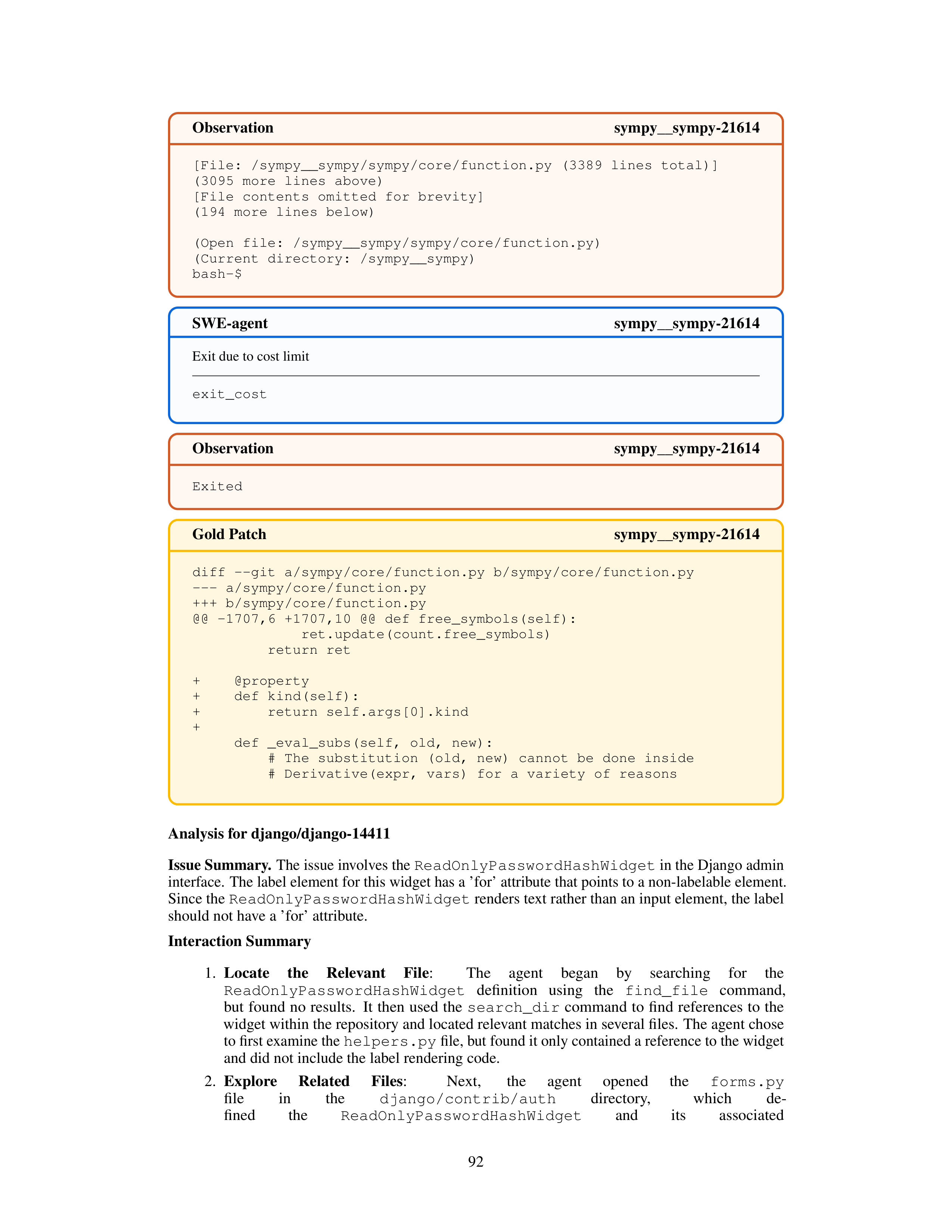
Observation
sympy__sympy-21614
[File:
/sympy__sympy/sympy/core/function.py
(3389
lines
total)]
(3095
more
lines
above)
[File
contents
omitted
for
brevity]
(194
more
lines
below)
(Open
file:
/sympy__sympy/sympy/core/function.py)
(Current
directory:
/sympy__sympy)
bash-$
SWE-agent
sympy__sympy-21614
Exit due to cost limit
exit_cost
Observation
sympy__sympy-21614
Exited
Gold Patch
sympy__sympy-21614
diff
--git
a/sympy/core/function.py
b/sympy/core/function.py
---
a/sympy/core/function.py
+++
b/sympy/core/function.py
@@
-1707,6
+1707,10
@@
def
free_symbols(self):
ret.update(count.free_symbols)
return
ret
+
@property
+
def
kind(self):
+
return
self.args[0].kind
+
def
_eval_subs(self,
old,
new):
#
The
substitution
(old,
new)
cannot
be
done
inside
#
Derivative(expr,
vars)
for
a
variety
of
reasons
Analysis for django/django-14411
Issue Summary.
The issue involves the
ReadOnlyPasswordHashWidget
in the Django admin
interface.
The label element for this widget has a ’for’ attribute that points to a non-labelable element.
Since the
ReadOnlyPasswordHashWidget
renders text rather than an input element, the label
should not have a ’for’ attribute.
Interaction Summary
1.
Locate
the
Relevant
File
:
The
agent
began
by
searching
for
the
ReadOnlyPasswordHashWidget
definition
using
the
find_file
command,
but
found
no results.
It
then used
the
search_dir
command
to find
references
to the
widget within the repository and located relevant matches in several files.
The agent chose
to first examine the
helpers.py
file, but found it only contained a reference to the widget
and did not include the label rendering code.
2.
Explore
Related
Files
:
Next,
the
agent
opened
the
forms.py
file
in
the
django/contrib/auth
directory,
which
de-
fined
the
ReadOnlyPasswordHashWidget
and
its
associated
92
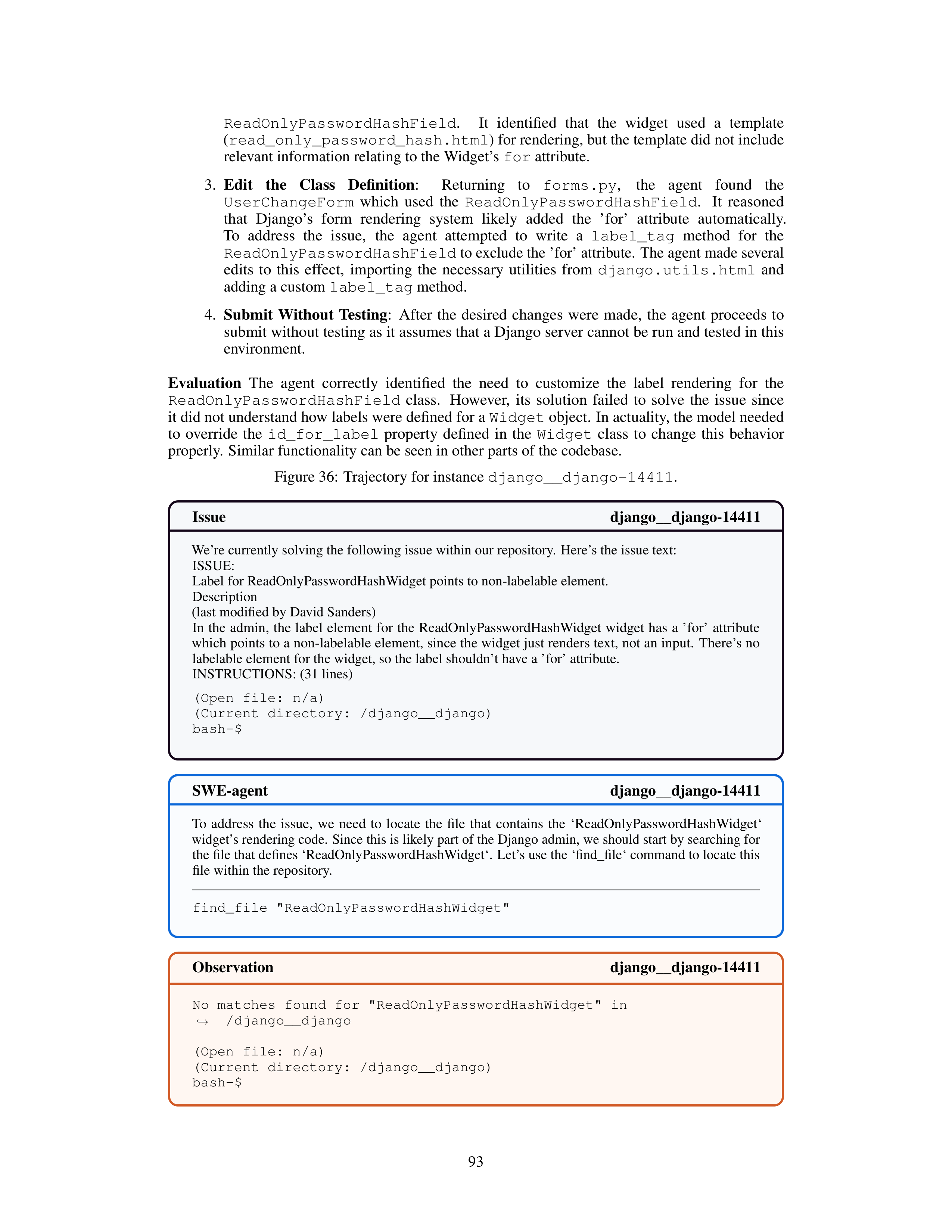
ReadOnlyPasswordHashField
.
It
identified
that
the
widget
used
a
template
(
read_only_password_hash.html
) for rendering, but the template did not include
relevant information relating to the Widget’s
for
attribute.
3.
Edit
the
Class
Definition
:
Returning
to
forms.py
,
the
agent
found
the
UserChangeForm
which
used
the
ReadOnlyPasswordHashField
.
It
reasoned
that
Django’s
form
rendering
system
likely
added
the
’for’
attribute
automatically.
To
address
the
issue,
the
agent
attempted
to
write
a
label_tag
method
for
the
ReadOnlyPasswordHashField
to exclude the ’for’ attribute.
The agent made several
edits
to
this
effect,
importing
the
necessary
utilities
from
django.utils.html
and
adding a custom
label_tag
method.
4.
Submit
Without
Testing
:
After
the
desired
changes
were
made,
the
agent
proceeds
to
submit without testing as it assumes that a Django server cannot be run and tested in this
environment.
Evaluation
The
agent
correctly
identified
the
need
to
customize
the
label
rendering
for
the
ReadOnlyPasswordHashField
class.
However,
its
solution
failed
to
solve
the
issue
since
it did not understand how labels were defined for a
Widget
object.
In actuality, the model needed
to
override
the
id_for_label
property
defined
in
the
Widget
class
to
change
this
behavior
properly.
Similar functionality can be seen in other parts of the codebase.
Figure 36:
Trajectory for instance
django__django-14411
.
Issue
django__django-14411
We’re currently solving the following issue within our repository.
Here’s the issue text:
ISSUE:
Label for ReadOnlyPasswordHashWidget points to non-labelable element.
Description
(last modified by David Sanders)
In
the
admin,
the
label
element
for
the
ReadOnlyPasswordHashWidget
widget
has
a
’for’
attribute
which points to a non-labelable element, since the widget just renders text, not an input.
There’s no
labelable element for the widget, so the label shouldn’t have a ’for’ attribute.
INSTRUCTIONS: (31 lines)
(Open
file:
n/a)
(Current
directory:
/django__django)
bash-$
SWE-agent
django__django-14411
To
address
the
issue,
we
need
to
locate
the
file
that
contains
the
‘ReadOnlyPasswordHashWidget‘
widget’s rendering code.
Since this is likely part of the Django admin, we should start by searching for
the file that defines ‘ReadOnlyPasswordHashWidget‘.
Let’s use the ‘find_file‘ command to locate this
file within the repository.
find_file
"ReadOnlyPasswordHashWidget"
Observation
django__django-14411
No
matches
found
for
"ReadOnlyPasswordHashWidget"
in
/django__django
,
→
(Open
file:
n/a)
(Current
directory:
/django__django)
bash-$
93
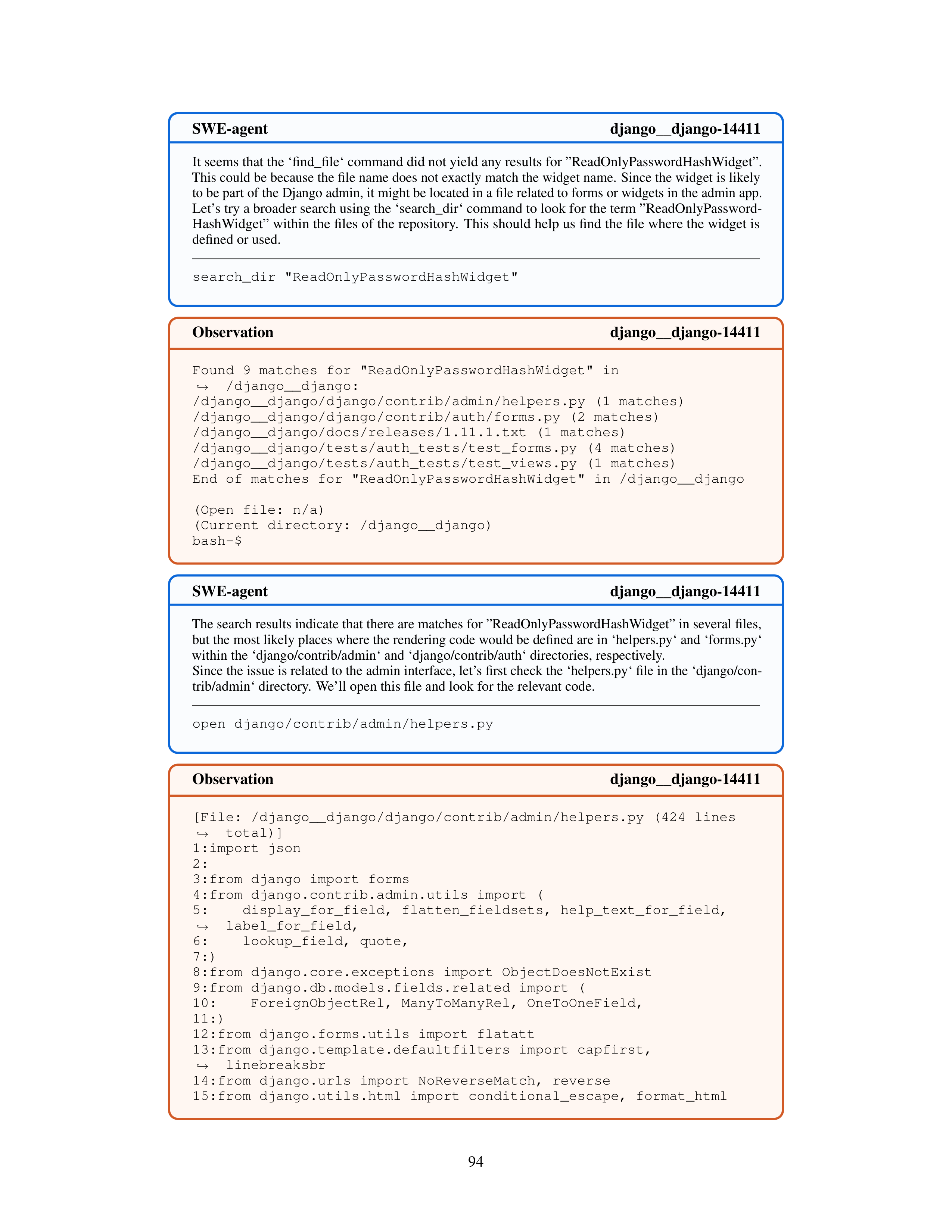
SWE-agent
django__django-14411
It seems that the ‘find_file‘ command did not yield any results for ”ReadOnlyPasswordHashWidget”.
This could be because the file name does not exactly match the widget name.
Since the widget is likely
to be part of the Django admin, it might be located in a file related to forms or widgets in the admin app.
Let’s try a broader search using the ‘search_dir‘ command to look for the term ”ReadOnlyPassword-
HashWidget” within the files of the repository.
This should help us find the file where the widget is
defined or used.
search_dir
"ReadOnlyPasswordHashWidget"
Observation
django__django-14411
Found
9
matches
for
"ReadOnlyPasswordHashWidget"
in
/django__django:
,
→
/django__django/django/contrib/admin/helpers.py
(1
matches)
/django__django/django/contrib/auth/forms.py
(2
matches)
/django__django/docs/releases/1.11.1.txt
(1
matches)
/django__django/tests/auth_tests/test_forms.py
(4
matches)
/django__django/tests/auth_tests/test_views.py
(1
matches)
End
of
matches
for
"ReadOnlyPasswordHashWidget"
in
/django__django
(Open
file:
n/a)
(Current
directory:
/django__django)
bash-$
SWE-agent
django__django-14411
The search results indicate that there are matches for ”ReadOnlyPasswordHashWidget” in several files,
but the most likely places where the rendering code would be defined are in ‘helpers.py‘ and ‘forms.py‘
within the ‘django/contrib/admin‘ and ‘django/contrib/auth‘ directories, respectively.
Since the issue is related to the admin interface, let’s first check the ‘helpers.py‘ file in the ‘django/con-
trib/admin‘ directory.
We’ll open this file and look for the relevant code.
open
django/contrib/admin/helpers.py
Observation
django__django-14411
[File:
/django__django/django/contrib/admin/helpers.py
(424
lines
total)]
,
→
1:import
json
2:
3:from
django
import
forms
4:from
django.contrib.admin.utils
import
(
5:
display_for_field,
flatten_fieldsets,
help_text_for_field,
label_for_field,
,
→
6:
lookup_field,
quote,
7:)
8:from
django.core.exceptions
import
ObjectDoesNotExist
9:from
django.db.models.fields.related
import
(
10:
ForeignObjectRel,
ManyToManyRel,
OneToOneField,
11:)
12:from
django.forms.utils
import
flatatt
13:from
django.template.defaultfilters
import
capfirst,
linebreaksbr
,
→
14:from
django.urls
import
NoReverseMatch,
reverse
15:from
django.utils.html
import
conditional_escape,
format_html
94
16:from
django.utils.safestring
import
mark_safe
17:from
django.utils.translation
import
gettext,
gettext_lazy
as
_
18:
19:ACTION_CHECKBOX_NAME
=
'_selected_action'
20:
21:
22:class
ActionForm(forms.Form):
23:
action
=
forms.ChoiceField(label=_('Action:'))
24:
select_across
=
forms.BooleanField(
25:
label='',
26:
required=False,
27:
initial=0,
28:
widget=forms.HiddenInput({'class':
'select-across'}),
29:
)
30:
31:
32:checkbox
=
forms.CheckboxInput({'class':
'action-select'},
lambda
value:
False)
,
→
33:
34:
35:class
AdminForm:
36:
def
__init__(self,
form,
fieldsets,
prepopulated_fields,
readonly_fields=None,
model_admin=None):
,
→
37:
self.form,
self.fieldsets
=
form,
fieldsets
38:
self.prepopulated_fields
=
[{
39:
'field':
form[field_name],
40:
'dependencies':
[form[f]
for
f
in
dependencies]
41:
}
for
field_name,
dependencies
in
prepopulated_fields.items()]
,
→
42:
self.model_admin
=
model_admin
43:
if
readonly_fields
is
None:
44:
readonly_fields
=
()
45:
self.readonly_fields
=
readonly_fields
46:
47:
def
__iter__(self):
48:
for
name,
options
in
self.fieldsets:
49:
yield
Fieldset(
50:
self.form,
name,
51:
readonly_fields=self.readonly_fields,
52:
model_admin=self.model_admin,
53:
**
options
54:
)
55:
56:
@property
57:
def
errors(self):
58:
return
self.form.errors
59:
60:
@property
61:
def
non_field_errors(self):
62:
return
self.form.non_field_errors
63:
64:
@property
65:
def
media(self):
66:
media
=
self.form.media
67:
for
fs
in
self:
68:
media
=
media
+
fs.media
69:
return
media
70:
71:
72:class
Fieldset:
73:
def
__init__(self,
form,
name=None,
readonly_fields=(),
fields=(),
classes=(),
,
→
74:
description=None,
model_admin=None):
95
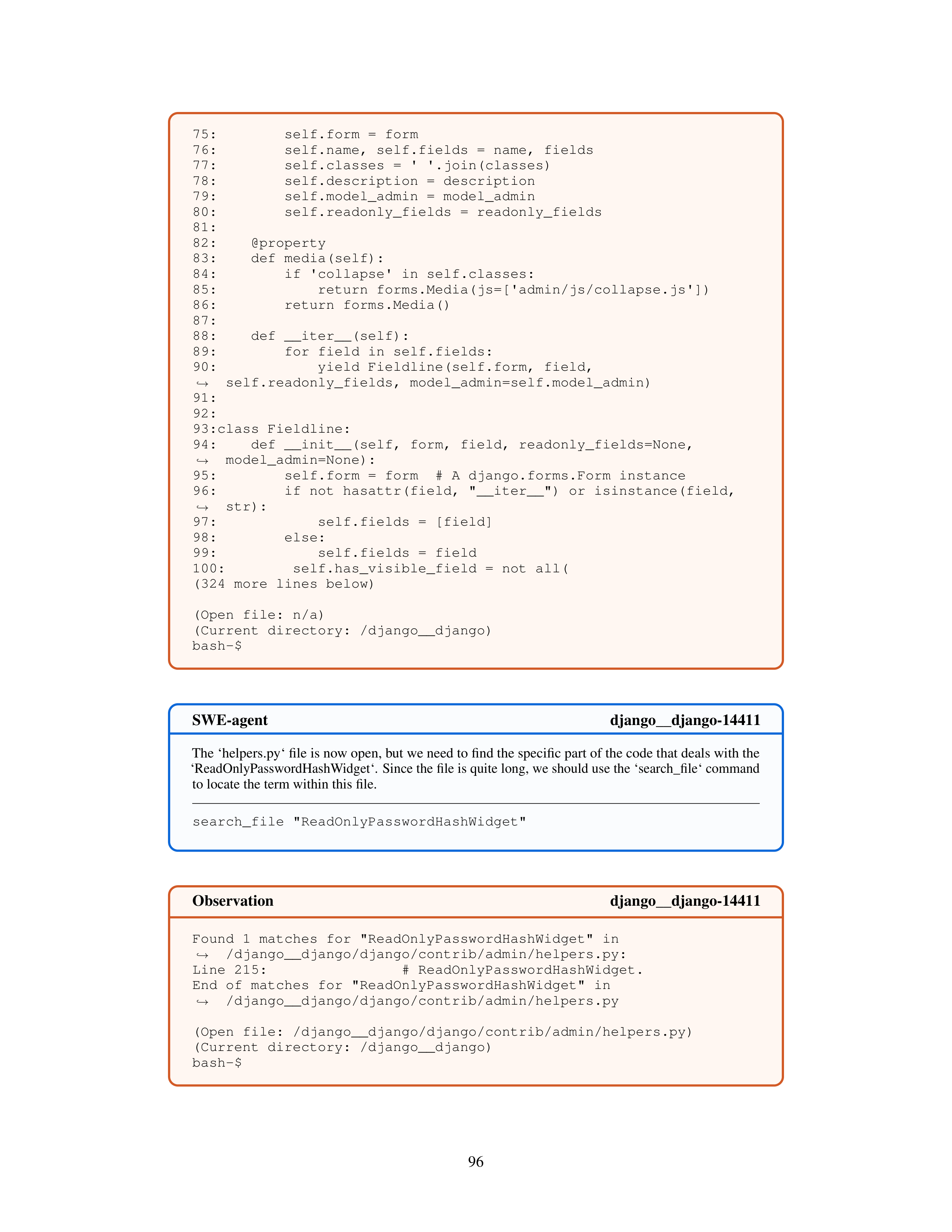
75:
self.form
=
form
76:
self.name,
self.fields
=
name,
fields
77:
self.classes
=
'
'.join(classes)
78:
self.description
=
description
79:
self.model_admin
=
model_admin
80:
self.readonly_fields
=
readonly_fields
81:
82:
@property
83:
def
media(self):
84:
if
'collapse'
in
self.classes:
85:
return
forms.Media(js=['admin/js/collapse.js'])
86:
return
forms.Media()
87:
88:
def
__iter__(self):
89:
for
field
in
self.fields:
90:
yield
Fieldline(self.form,
field,
self.readonly_fields,
model_admin=self.model_admin)
,
→
91:
92:
93:class
Fieldline:
94:
def
__init__(self,
form,
field,
readonly_fields=None,
model_admin=None):
,
→
95:
self.form
=
form
#
A
django.forms.Form
instance
96:
if
not
hasattr(field,
"__iter__")
or
isinstance(field,
str):
,
→
97:
self.fields
=
[field]
98:
else:
99:
self.fields
=
field
100:
self.has_visible_field
=
not
all(
(324
more
lines
below)
(Open
file:
n/a)
(Current
directory:
/django__django)
bash-$
SWE-agent
django__django-14411
The ‘helpers.py‘ file is now open, but we need to find the specific part of the code that deals with the
‘ReadOnlyPasswordHashWidget‘.
Since the file is quite long, we should use the ‘search_file‘ command
to locate the term within this file.
search_file
"ReadOnlyPasswordHashWidget"
Observation
django__django-14411
Found
1
matches
for
"ReadOnlyPasswordHashWidget"
in
/django__django/django/contrib/admin/helpers.py:
,
→
Line
215:
#
ReadOnlyPasswordHashWidget.
End
of
matches
for
"ReadOnlyPasswordHashWidget"
in
/django__django/django/contrib/admin/helpers.py
,
→
(Open
file:
/django__django/django/contrib/admin/helpers.py)
(Current
directory:
/django__django)
bash-$
96
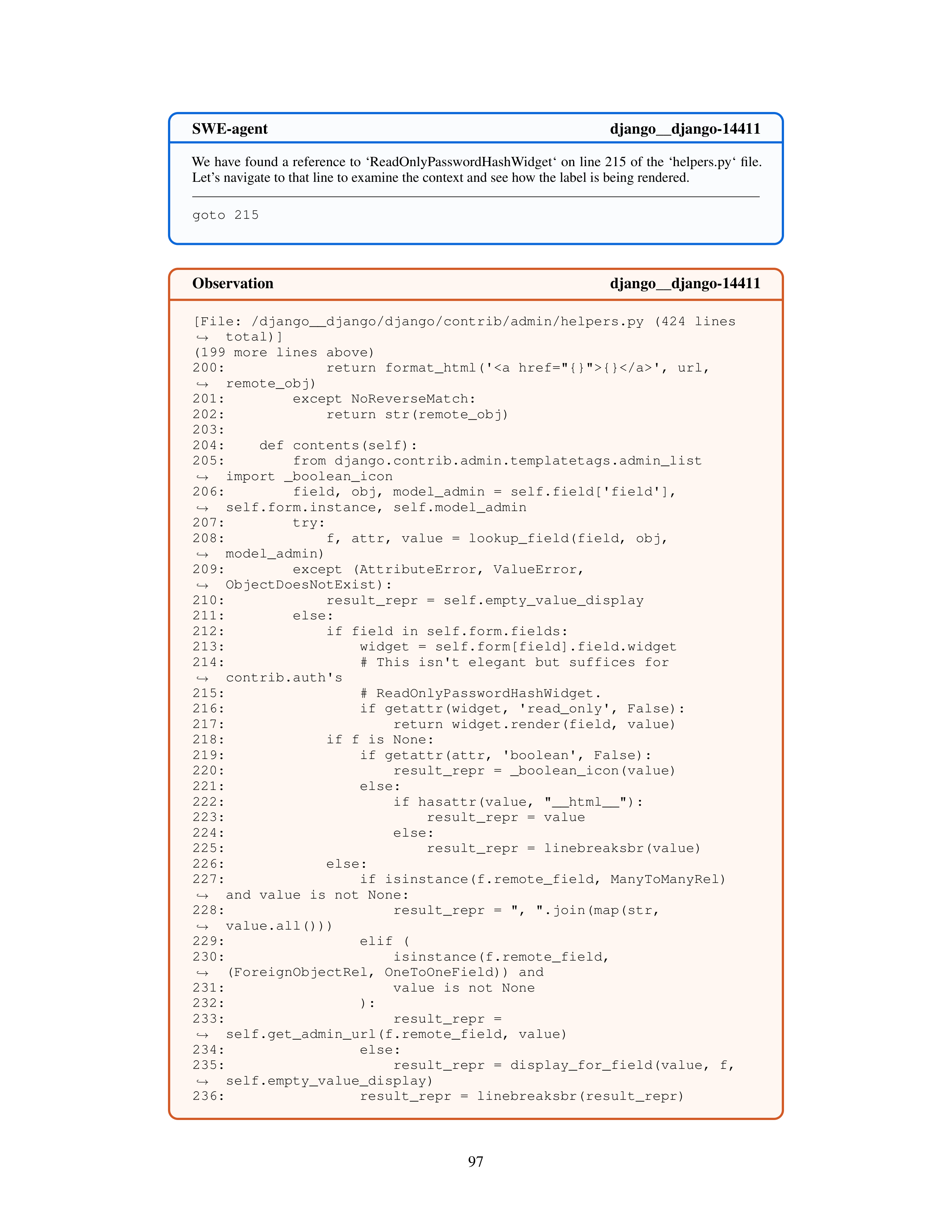
SWE-agent
django__django-14411
We have found a reference to ‘ReadOnlyPasswordHashWidget‘ on line 215 of the ‘helpers.py‘ file.
Let’s navigate to that line to examine the context and see how the label is being rendered.
goto
215
Observation
django__django-14411
[File:
/django__django/django/contrib/admin/helpers.py
(424
lines
total)]
,
→
(199
more
lines
above)
200:
return
format_html('<a
href="{}">{}',
url,
remote_obj)
,
→
201:
except
NoReverseMatch:
202:
return
str(remote_obj)
203:
204:
def
contents(self):
205:
from
django.contrib.admin.templatetags.admin_list
import
_boolean_icon
,
→
206:
field,
obj,
model_admin
=
self.field['field'],
self.form.instance,
self.model_admin
,
→
207:
try:
208:
f,
attr,
value
=
lookup_field(field,
obj,
model_admin)
,
→
209:
except
(AttributeError,
ValueError,
ObjectDoesNotExist):
,
→
210:
result_repr
=
self.empty_value_display
211:
else:
212:
if
field
in
self.form.fields:
213:
widget
=
self.form[field].field.widget
214:
#
This
isn't
elegant
but
suffices
for
contrib.auth's
,
→
215:
#
ReadOnlyPasswordHashWidget.
216:
if
getattr(widget,
'read_only',
False):
217:
return
widget.render(field,
value)
218:
if
f
is
None:
219:
if
getattr(attr,
'boolean',
False):
220:
result_repr
=
_boolean_icon(value)
221:
else:
222:
if
hasattr(value,
"__html__"):
223:
result_repr
=
value
224:
else:
225:
result_repr
=
linebreaksbr(value)
226:
else:
227:
if
isinstance(f.remote_field,
ManyToManyRel)
and
value
is
not
None:
,
→
228:
result_repr
=
",
".join(map(str,
value.all()))
,
→
229:
elif
(
230:
isinstance(f.remote_field,
(ForeignObjectRel,
OneToOneField))
and
,
→
231:
value
is
not
None
232:
):
233:
result_repr
=
self.get_admin_url(f.remote_field,
value)
,
→
234:
else:
235:
result_repr
=
display_for_field(value,
f,
self.empty_value_display)
,
→
236:
result_repr
=
linebreaksbr(result_repr)
97
237:
return
conditional_escape(result_repr)
238:
239:
240:class
InlineAdminFormSet:
241:
"""
242:
A
wrapper
around
an
inline
formset
for
use
in
the
admin
system.
,
→
243:
"""
244:
def
__init__(self,
inline,
formset,
fieldsets,
prepopulated_fields=None,
,
→
245:
readonly_fields=None,
model_admin=None,
has_add_permission=True,
,
→
246:
has_change_permission=True,
has_delete_permission=True,
,
→
247:
has_view_permission=True):
248:
self.opts
=
inline
249:
self.formset
=
formset
250:
self.fieldsets
=
fieldsets
251:
self.model_admin
=
model_admin
252:
if
readonly_fields
is
None:
253:
readonly_fields
=
()
254:
self.readonly_fields
=
readonly_fields
255:
if
prepopulated_fields
is
None:
256:
prepopulated_fields
=
{}
257:
self.prepopulated_fields
=
prepopulated_fields
258:
self.classes
=
'
'.join(inline.classes)
if
inline.classes
else
''
,
→
259:
self.has_add_permission
=
has_add_permission
260:
self.has_change_permission
=
has_change_permission
261:
self.has_delete_permission
=
has_delete_permission
262:
self.has_view_permission
=
has_view_permission
263:
264:
def
__iter__(self):
265:
if
self.has_change_permission:
266:
readonly_fields_for_editing
=
self.readonly_fields
267:
else:
268:
readonly_fields_for_editing
=
self.readonly_fields
+
flatten_fieldsets(self.fieldsets)
,
→
269:
270:
for
form,
original
in
zip(self.formset.initial_forms,
self.formset.get_queryset()):
,
→
271:
view_on_site_url
=
self.opts.get_view_on_site_url(original)
,
→
272:
yield
InlineAdminForm(
273:
self.formset,
form,
self.fieldsets,
self.prepopulated_fields,
,
→
274:
original,
readonly_fields_for_editing,
model_admin=self.opts,
,
→
275:
view_on_site_url=view_on_site_url,
276:
)
277:
for
form
in
self.formset.extra_forms:
278:
yield
InlineAdminForm(
279:
self.formset,
form,
self.fieldsets,
self.prepopulated_fields,
,
→
280:
None,
self.readonly_fields,
model_admin=self.opts,
,
→
281:
)
282:
if
self.has_add_permission:
283:
yield
InlineAdminForm(
284:
self.formset,
self.formset.empty_form,
285:
self.fieldsets,
self.prepopulated_fields,
None,
286:
self.readonly_fields,
model_admin=self.opts,
287:
)
98
288:
289:
def
fields(self):
290:
fk
=
getattr(self.formset,
"fk",
None)
291:
empty_form
=
self.formset.empty_form
292:
meta_labels
=
empty_form._meta.labels
or
{}
293:
meta_help_texts
=
empty_form._meta.help_texts
or
{}
294:
for
i,
field_name
in
enumerate(flatten_fieldsets(self.fieldsets)):
,
→
295:
if
fk
and
fk.name
==
field_name:
296:
continue
297:
if
not
self.has_change_permission
or
field_name
in
self.readonly_fields:
,
→
298:
yield
{
299:
'name':
field_name,
(125
more
lines
below)
(Open
file:
/django__django/django/contrib/admin/helpers.py)
(Current
directory:
/django__django)
bash-$
SWE-agent
django__django-14411
We have navigated to the relevant section of the ‘helpers.py‘ file where the ‘ReadOnlyPasswordHash-
Widget‘ is mentioned.
The comment on line 215 suggests that there is a special case handling for the
‘ReadOnlyPasswordHashWidget‘.
The code on line 216 checks if the widget has a ‘read_only‘ attribute
and, if so, renders the widget directly.
To address the issue, we need to ensure that the label for the ‘ReadOnlyPasswordHashWidget‘ does not
have a ’for’ attribute, as it points to a non-labelable element.
We should look for the part of the code
where the label is being rendered with the ’for’ attribute and make the necessary changes.
Since the code snippet we are looking at does not show the rendering of the label, we need to find where
the label is being rendered.
It might be in the template files or somewhere else in the code.
Let’s search
for the term ”label” in the current file to find where labels are being rendered.
search_file
"label"
Observation
django__django-14411
Found
23
matches
for
"label"
in
/django__django/django/contrib/admin/helpers.py:
,
→
Line
5:
display_for_field,
flatten_fieldsets,
help_text_for_field,
label_for_field,
,
→
Line
23:
action
=
forms.ChoiceField(label=_('Action:'))
Line
25:
label='',
Line
131:
def
label_tag(self):
Line
133:
contents
=
conditional_escape(self.field.label)
Line
142:
#
checkboxes
should
not
have
a
label
suffix
as
the
checkbox
appears
,
→
Line
143:
#
to
the
left
of
the
label.
Line
144:
return
self.field.label_tag(
Line
146:
label_suffix=''
if
self.is_checkbox
else
None,
Line
163:
if
form._meta.labels
and
class_name
in
form._meta.labels:
,
→
Line
164:
label
=
form._meta.labels[class_name]
Line
166:
label
=
label_for_field(field,
form._meta.model,
model_admin,
form=form)
,
→
Line
175:
'label':
label,
Line
186:
def
label_tag(self):
Line
190:
label
=
self.field['label']
99
Line
191:
return
format_html('',
flatatt(attrs),
capfirst(label),
self.form.label_suffix)
,
→
Line
195:
remote_field.model._meta.app_label,
Line
292:
meta_labels
=
empty_form._meta.labels
or
{}
Line
300:
'label':
meta_labels.get(field_name)
or
label_for_field(
,
→
Line
312:
label
=
form_field.label
Line
313:
if
label
is
None:
Line
314:
label
=
label_for_field(field_name,
self.opts.model,
self.opts,
form=empty_form)
,
→
Line
317:
'label':
label,
End
of
matches
for
"label"
in
/django__django/django/contrib/admin/helpers.py
,
→
(Open
file:
/django__django/django/contrib/admin/helpers.py)
(Current
directory:
/django__django)
bash-$
SWE-agent
django__django-14411
The search results show several instances where labels are being handled in the ‘helpers.py‘ file.
The
most promising lines for our issue seem to be around line 191, where a label tag is being formatted with
a ‘for‘ attribute.
Let’s navigate to that line to examine the context and see if this is where we need to
make our changes.
goto
191
Observation
django__django-14411
[File:
/django__django/django/contrib/admin/helpers.py
(424
lines
total)]
,
→
(175
more
lines
above)
176:
'help_text':
help_text,
177:
'field':
field,
178:
}
179:
self.form
=
form
180:
self.model_admin
=
model_admin
181:
self.is_first
=
is_first
182:
self.is_checkbox
=
False
183:
self.is_readonly
=
True
184:
self.empty_value_display
=
model_admin.get_empty_value_display()
,
→
185:
186:
def
label_tag(self):
187:
attrs
=
{}
188:
if
not
self.is_first:
189:
attrs["class"]
=
"inline"
190:
label
=
self.field['label']
191:
return
format_html('',
flatatt(attrs),
capfirst(label),
self.form.label_suffix)
,
→
192:
193:
def
get_admin_url(self,
remote_field,
remote_obj):
194:
url_name
=
'admin:%s_%s_change'
%
(
195:
remote_field.model._meta.app_label,
196:
remote_field.model._meta.model_name,
197:
)
198:
try:
199:
url
=
reverse(url_name,
args=[quote(remote_obj.pk)])
,
→
100
200:
return
format_html('<a
href="{}">{}',
url,
remote_obj)
,
→
201:
except
NoReverseMatch:
202:
return
str(remote_obj)
203:
204:
def
contents(self):
205:
from
django.contrib.admin.templatetags.admin_list
import
_boolean_icon
,
→
206:
field,
obj,
model_admin
=
self.field['field'],
self.form.instance,
self.model_admin
,
→
207:
try:
208:
f,
attr,
value
=
lookup_field(field,
obj,
model_admin)
,
→
209:
except
(AttributeError,
ValueError,
ObjectDoesNotExist):
,
→
210:
result_repr
=
self.empty_value_display
211:
else:
212:
if
field
in
self.form.fields:
213:
widget
=
self.form[field].field.widget
214:
#
This
isn't
elegant
but
suffices
for
contrib.auth's
,
→
215:
#
ReadOnlyPasswordHashWidget.
216:
if
getattr(widget,
'read_only',
False):
217:
return
widget.render(field,
value)
218:
if
f
is
None:
219:
if
getattr(attr,
'boolean',
False):
220:
result_repr
=
_boolean_icon(value)
221:
else:
222:
if
hasattr(value,
"__html__"):
223:
result_repr
=
value
224:
else:
225:
result_repr
=
linebreaksbr(value)
226:
else:
227:
if
isinstance(f.remote_field,
ManyToManyRel)
and
value
is
not
None:
,
→
228:
result_repr
=
",
".join(map(str,
value.all()))
,
→
229:
elif
(
230:
isinstance(f.remote_field,
(ForeignObjectRel,
OneToOneField))
and
,
→
231:
value
is
not
None
232:
):
233:
result_repr
=
self.get_admin_url(f.remote_field,
value)
,
→
234:
else:
235:
result_repr
=
display_for_field(value,
f,
self.empty_value_display)
,
→
236:
result_repr
=
linebreaksbr(result_repr)
237:
return
conditional_escape(result_repr)
238:
239:
240:class
InlineAdminFormSet:
241:
"""
242:
A
wrapper
around
an
inline
formset
for
use
in
the
admin
system.
,
→
243:
"""
244:
def
__init__(self,
inline,
formset,
fieldsets,
prepopulated_fields=None,
,
→
245:
readonly_fields=None,
model_admin=None,
has_add_permission=True,
,
→
246:
has_change_permission=True,
has_delete_permission=True,
,
→
247:
has_view_permission=True):
101
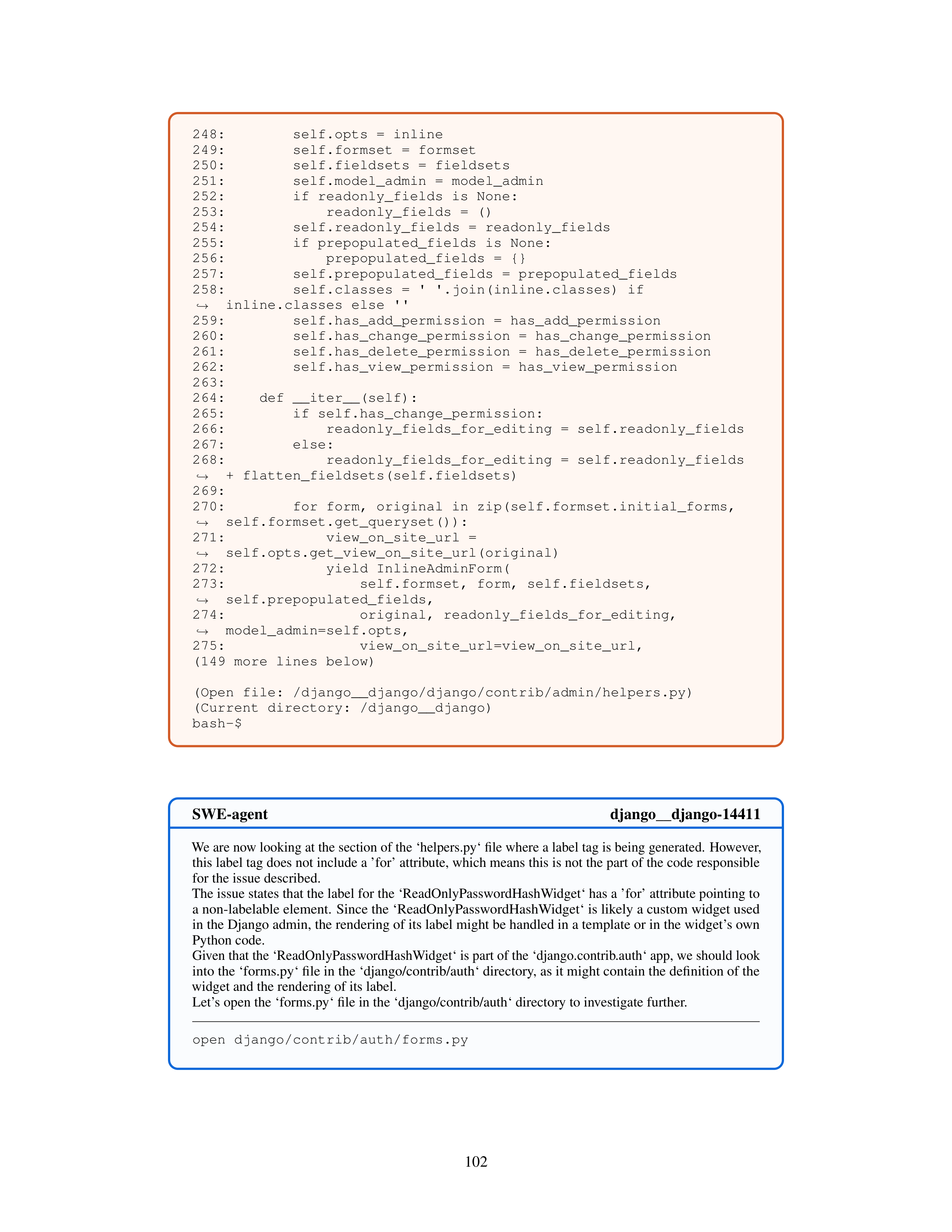
248:
self.opts
=
inline
249:
self.formset
=
formset
250:
self.fieldsets
=
fieldsets
251:
self.model_admin
=
model_admin
252:
if
readonly_fields
is
None:
253:
readonly_fields
=
()
254:
self.readonly_fields
=
readonly_fields
255:
if
prepopulated_fields
is
None:
256:
prepopulated_fields
=
{}
257:
self.prepopulated_fields
=
prepopulated_fields
258:
self.classes
=
'
'.join(inline.classes)
if
inline.classes
else
''
,
→
259:
self.has_add_permission
=
has_add_permission
260:
self.has_change_permission
=
has_change_permission
261:
self.has_delete_permission
=
has_delete_permission
262:
self.has_view_permission
=
has_view_permission
263:
264:
def
__iter__(self):
265:
if
self.has_change_permission:
266:
readonly_fields_for_editing
=
self.readonly_fields
267:
else:
268:
readonly_fields_for_editing
=
self.readonly_fields
+
flatten_fieldsets(self.fieldsets)
,
→
269:
270:
for
form,
original
in
zip(self.formset.initial_forms,
self.formset.get_queryset()):
,
→
271:
view_on_site_url
=
self.opts.get_view_on_site_url(original)
,
→
272:
yield
InlineAdminForm(
273:
self.formset,
form,
self.fieldsets,
self.prepopulated_fields,
,
→
274:
original,
readonly_fields_for_editing,
model_admin=self.opts,
,
→
275:
view_on_site_url=view_on_site_url,
(149
more
lines
below)
(Open
file:
/django__django/django/contrib/admin/helpers.py)
(Current
directory:
/django__django)
bash-$
SWE-agent
django__django-14411
We are now looking at the section of the ‘helpers.py‘ file where a label tag is being generated.
However,
this label tag does not include a ’for’ attribute, which means this is not the part of the code responsible
for the issue described.
The issue states that the label for the ‘ReadOnlyPasswordHashWidget‘ has a ’for’ attribute pointing to
a non-labelable element.
Since the ‘ReadOnlyPasswordHashWidget‘ is likely a custom widget used
in the Django admin, the rendering of its label might be handled in a template or in the widget’s own
Python code.
Given that the ‘ReadOnlyPasswordHashWidget‘ is part of the ‘django.contrib.auth‘ app, we should look
into the ‘forms.py‘ file in the ‘django/contrib/auth‘ directory, as it might contain the definition of the
widget and the rendering of its label.
Let’s open the ‘forms.py‘ file in the ‘django/contrib/auth‘ directory to investigate further.
open
django/contrib/auth/forms.py
102
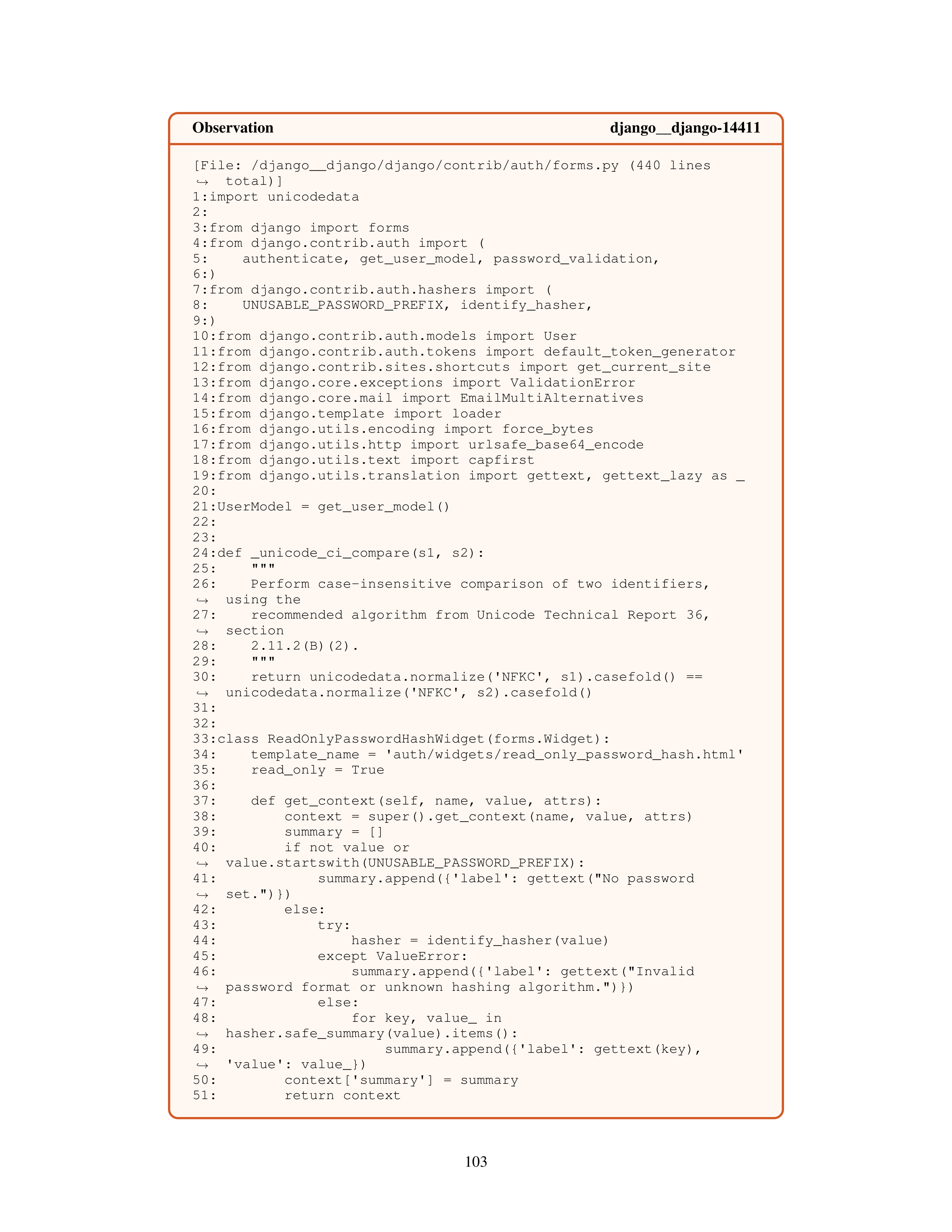
Observation
django__django-14411
[File:
/django__django/django/contrib/auth/forms.py
(440
lines
total)]
,
→
1:import
unicodedata
2:
3:from
django
import
forms
4:from
django.contrib.auth
import
(
5:
authenticate,
get_user_model,
password_validation,
6:)
7:from
django.contrib.auth.hashers
import
(
8:
UNUSABLE_PASSWORD_PREFIX,
identify_hasher,
9:)
10:from
django.contrib.auth.models
import
User
11:from
django.contrib.auth.tokens
import
default_token_generator
12:from
django.contrib.sites.shortcuts
import
get_current_site
13:from
django.core.exceptions
import
ValidationError
14:from
django.core.mail
import
EmailMultiAlternatives
15:from
django.template
import
loader
16:from
django.utils.encoding
import
force_bytes
17:from
django.utils.http
import
urlsafe_base64_encode
18:from
django.utils.text
import
capfirst
19:from
django.utils.translation
import
gettext,
gettext_lazy
as
_
20:
21:UserModel
=
get_user_model()
22:
23:
24:def
_unicode_ci_compare(s1,
s2):
25:
"""
26:
Perform
case-insensitive
comparison
of
two
identifiers,
using
the
,
→
27:
recommended
algorithm
from
Unicode
Technical
Report
36,
section
,
→
28:
2.11.2(B)(2).
29:
"""
30:
return
unicodedata.normalize('NFKC',
s1).casefold()
==
unicodedata.normalize('NFKC',
s2).casefold()
,
→
31:
32:
33:class
ReadOnlyPasswordHashWidget(forms.Widget):
34:
template_name
=
'auth/widgets/read_only_password_hash.html'
35:
read_only
=
True
36:
37:
def
get_context(self,
name,
value,
attrs):
38:
context
=
super().get_context(name,
value,
attrs)
39:
summary
=
[]
40:
if
not
value
or
value.startswith(UNUSABLE_PASSWORD_PREFIX):
,
→
41:
summary.append({'label':
gettext("No
password
set.")})
,
→
42:
else:
43:
try:
44:
hasher
=
identify_hasher(value)
45:
except
ValueError:
46:
summary.append({'label':
gettext("Invalid
password
format
or
unknown
hashing
algorithm.")})
,
→
47:
else:
48:
for
key,
value_
in
hasher.safe_summary(value).items():
,
→
49:
summary.append({'label':
gettext(key),
'value':
value_})
,
→
50:
context['summary']
=
summary
51:
return
context
103
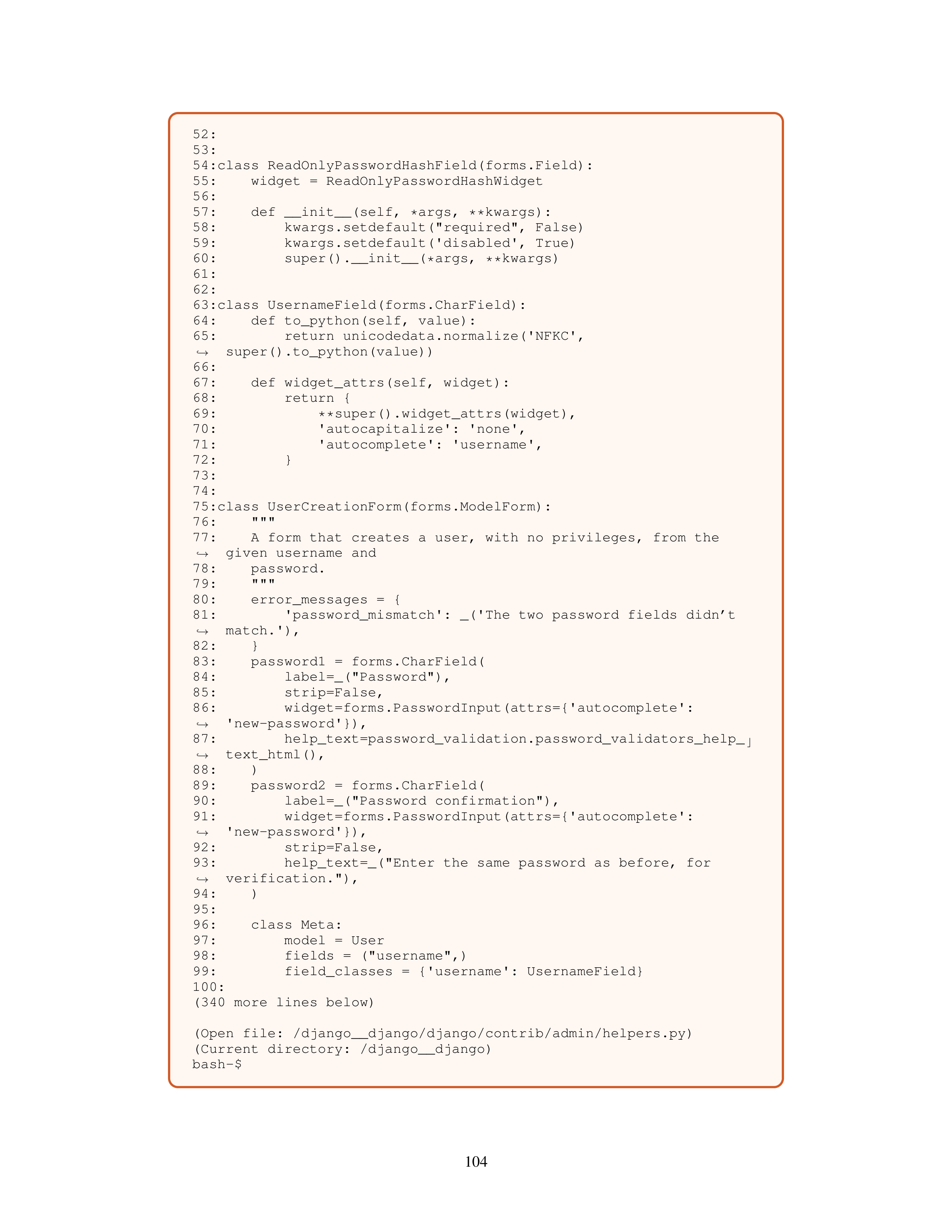
52:
53:
54:class
ReadOnlyPasswordHashField(forms.Field):
55:
widget
=
ReadOnlyPasswordHashWidget
56:
57:
def
__init__(self,
*args,
**kwargs):
58:
kwargs.setdefault("required",
False)
59:
kwargs.setdefault('disabled',
True)
60:
super().__init__(*args,
**kwargs)
61:
62:
63:class
UsernameField(forms.CharField):
64:
def
to_python(self,
value):
65:
return
unicodedata.normalize('NFKC',
super().to_python(value))
,
→
66:
67:
def
widget_attrs(self,
widget):
68:
return
{
69:
**
super().widget_attrs(widget),
70:
'autocapitalize':
'none',
71:
'autocomplete':
'username',
72:
}
73:
74:
75:class
UserCreationForm(forms.ModelForm):
76:
"""
77:
A
form
that
creates
a
user,
with
no
privileges,
from
the
given
username
and
,
→
78:
password.
79:
"""
80:
error_messages
=
{
81:
'password_mismatch':
_('The
two
password
fields
didn’t
match.'),
,
→
82:
}
83:
password1
=
forms.CharField(
84:
label=_("Password"),
85:
strip=False,
86:
widget=forms.PasswordInput(attrs={'autocomplete':
'new-password'}),
,
→
87:
help_text=password_validation.password_validators_help_
⌋
text_html(),
,
→
88:
)
89:
password2
=
forms.CharField(
90:
label=_("Password
confirmation"),
91:
widget=forms.PasswordInput(attrs={'autocomplete':
'new-password'}),
,
→
92:
strip=False,
93:
help_text=_("Enter
the
same
password
as
before,
for
verification."),
,
→
94:
)
95:
96:
class
Meta:
97:
model
=
User
98:
fields
=
("username",)
99:
field_classes
=
{'username':
UsernameField}
100:
(340
more
lines
below)
(Open
file:
/django__django/django/contrib/admin/helpers.py)
(Current
directory:
/django__django)
bash-$
104
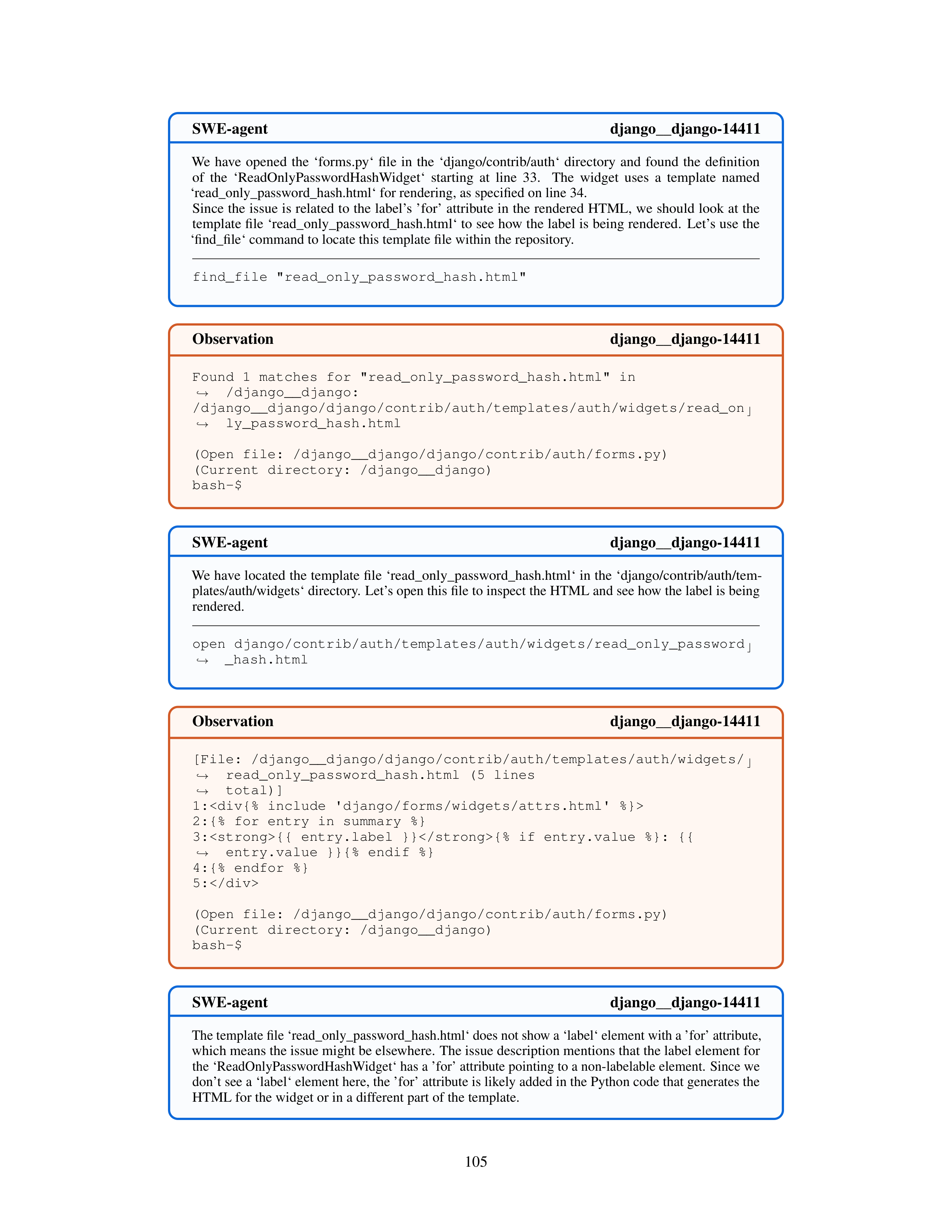
SWE-agent
django__django-14411
We
have
opened
the
‘forms.py‘
file
in
the
‘django/contrib/auth‘
directory
and
found
the
definition
of
the
‘ReadOnlyPasswordHashWidget‘
starting
at
line
33.
The
widget
uses
a
template
named
‘read_only_password_hash.html‘ for rendering, as specified on line 34.
Since the issue is related to the label’s ’for’ attribute in the rendered HTML, we should look at the
template file ‘read_only_password_hash.html‘ to see how the label is being rendered.
Let’s use the
‘find_file‘ command to locate this template file within the repository.
find_file
"read_only_password_hash.html"
Observation
django__django-14411
Found
1
matches
for
"read_only_password_hash.html"
in
/django__django:
,
→
/django__django/django/contrib/auth/templates/auth/widgets/read_on
⌋
ly_password_hash.html
,
→
(Open
file:
/django__django/django/contrib/auth/forms.py)
(Current
directory:
/django__django)
bash-$
SWE-agent
django__django-14411
We have located the template file ‘read_only_password_hash.html‘ in the ‘django/contrib/auth/tem-
plates/auth/widgets‘ directory.
Let’s open this file to inspect the HTML and see how the label is being
rendered.
open
django/contrib/auth/templates/auth/widgets/read_only_password
⌋
_hash.html
,
→
Observation
django__django-14411
[File:
/django__django/django/contrib/auth/templates/auth/widgets/
⌋
read_only_password_hash.html
(5
lines
total)]
,
→
,
→
1:<div{%
include
'django/forms/widgets/attrs.html'
%}>
2:{%
for
entry
in
summary
%}
3:{{
entry.label
}}{%
if
entry.value
%}:
{{
entry.value
}}{%
endif
%}
,
→
4:{%
endfor
%}
5:
(Open
file:
/django__django/django/contrib/auth/forms.py)
(Current
directory:
/django__django)
bash-$
SWE-agent
django__django-14411
The template file ‘read_only_password_hash.html‘ does not show a ‘label‘ element with a ’for’ attribute,
which means the issue might be elsewhere.
The issue description mentions that the label element for
the ‘ReadOnlyPasswordHashWidget‘ has a ’for’ attribute pointing to a non-labelable element.
Since we
don’t see a ‘label‘ element here, the ’for’ attribute is likely added in the Python code that generates the
HTML for the widget or in a different part of the template.
105
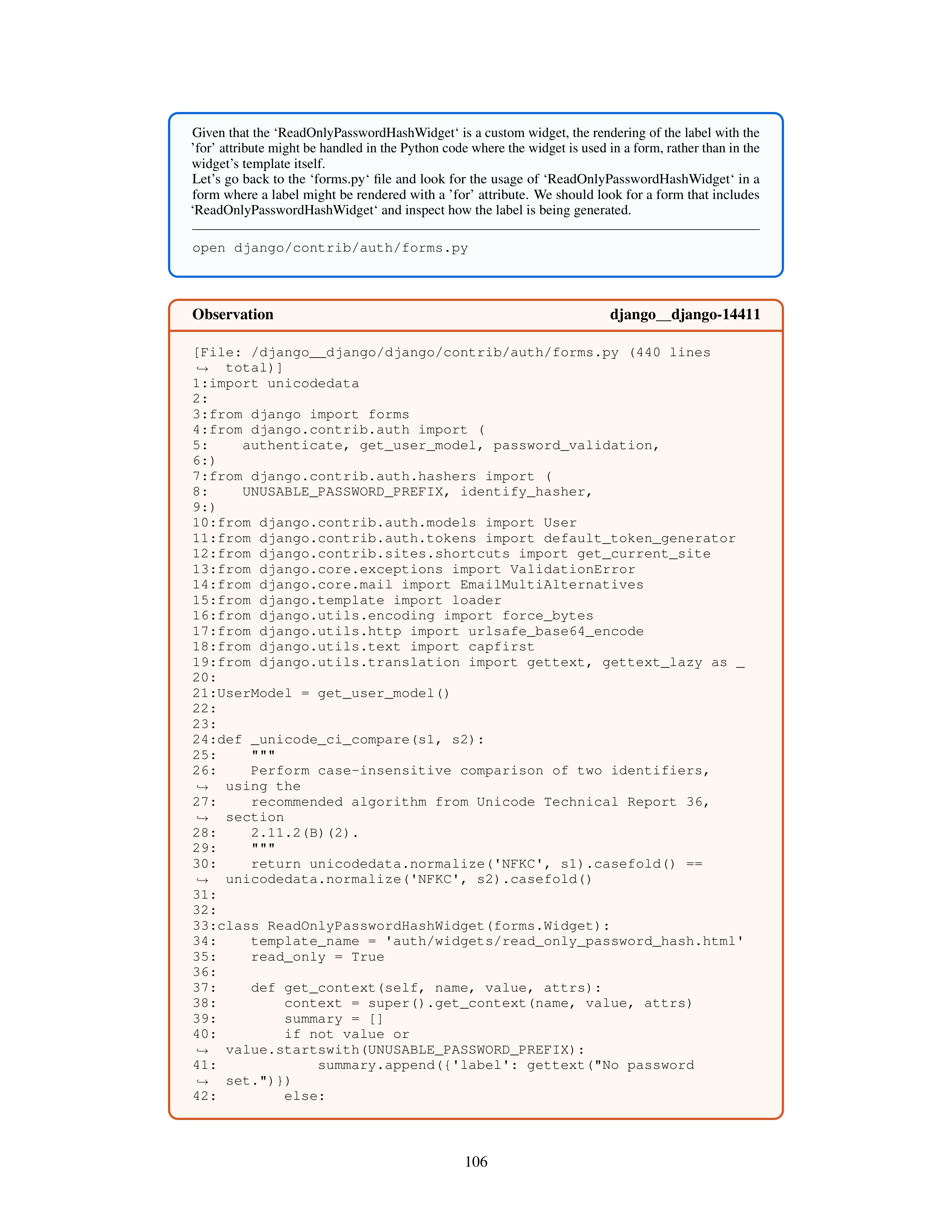
Given that the ‘ReadOnlyPasswordHashWidget‘ is a custom widget, the rendering of the label with the
’for’ attribute might be handled in the Python code where the widget is used in a form, rather than in the
widget’s template itself.
Let’s go back to the ‘forms.py‘ file and look for the usage of ‘ReadOnlyPasswordHashWidget‘ in a
form where a label might be rendered with a ’for’ attribute.
We should look for a form that includes
‘ReadOnlyPasswordHashWidget‘ and inspect how the label is being generated.
open
django/contrib/auth/forms.py
Observation
django__django-14411
[File:
/django__django/django/contrib/auth/forms.py
(440
lines
total)]
,
→
1:import
unicodedata
2:
3:from
django
import
forms
4:from
django.contrib.auth
import
(
5:
authenticate,
get_user_model,
password_validation,
6:)
7:from
django.contrib.auth.hashers
import
(
8:
UNUSABLE_PASSWORD_PREFIX,
identify_hasher,
9:)
10:from
django.contrib.auth.models
import
User
11:from
django.contrib.auth.tokens
import
default_token_generator
12:from
django.contrib.sites.shortcuts
import
get_current_site
13:from
django.core.exceptions
import
ValidationError
14:from
django.core.mail
import
EmailMultiAlternatives
15:from
django.template
import
loader
16:from
django.utils.encoding
import
force_bytes
17:from
django.utils.http
import
urlsafe_base64_encode
18:from
django.utils.text
import
capfirst
19:from
django.utils.translation
import
gettext,
gettext_lazy
as
_
20:
21:UserModel
=
get_user_model()
22:
23:
24:def
_unicode_ci_compare(s1,
s2):
25:
"""
26:
Perform
case-insensitive
comparison
of
two
identifiers,
using
the
,
→
27:
recommended
algorithm
from
Unicode
Technical
Report
36,
section
,
→
28:
2.11.2(B)(2).
29:
"""
30:
return
unicodedata.normalize('NFKC',
s1).casefold()
==
unicodedata.normalize('NFKC',
s2).casefold()
,
→
31:
32:
33:class
ReadOnlyPasswordHashWidget(forms.Widget):
34:
template_name
=
'auth/widgets/read_only_password_hash.html'
35:
read_only
=
True
36:
37:
def
get_context(self,
name,
value,
attrs):
38:
context
=
super().get_context(name,
value,
attrs)
39:
summary
=
[]
40:
if
not
value
or
value.startswith(UNUSABLE_PASSWORD_PREFIX):
,
→
41:
summary.append({'label':
gettext("No
password
set.")})
,
→
42:
else:
106
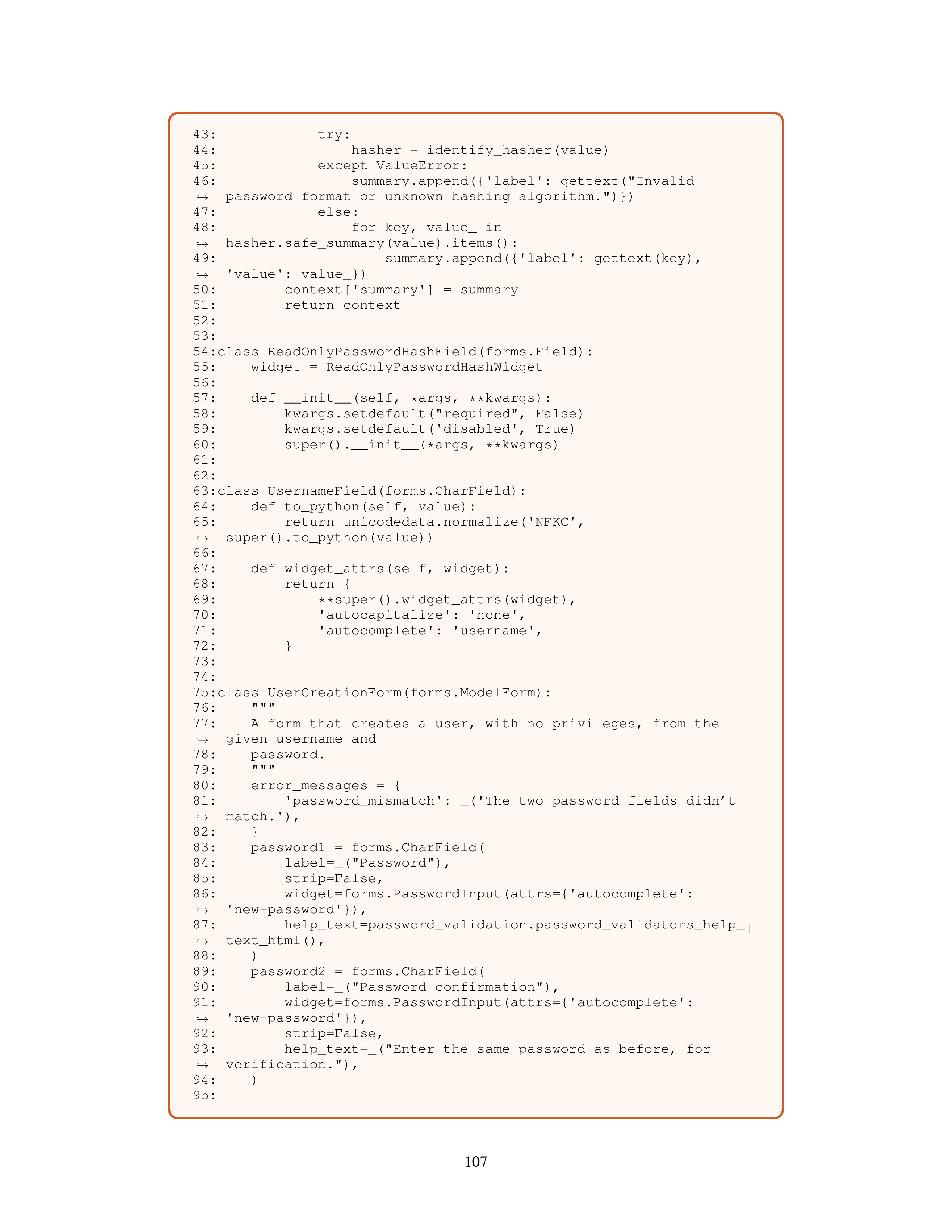
43:
try:
44:
hasher
=
identify_hasher(value)
45:
except
ValueError:
46:
summary.append({'label':
gettext("Invalid
password
format
or
unknown
hashing
algorithm.")})
,
→
47:
else:
48:
for
key,
value_
in
hasher.safe_summary(value).items():
,
→
49:
summary.append({'label':
gettext(key),
'value':
value_})
,
→
50:
context['summary']
=
summary
51:
return
context
52:
53:
54:class
ReadOnlyPasswordHashField(forms.Field):
55:
widget
=
ReadOnlyPasswordHashWidget
56:
57:
def
__init__(self,
*args,
**kwargs):
58:
kwargs.setdefault("required",
False)
59:
kwargs.setdefault('disabled',
True)
60:
super().__init__(*args,
**kwargs)
61:
62:
63:class
UsernameField(forms.CharField):
64:
def
to_python(self,
value):
65:
return
unicodedata.normalize('NFKC',
super().to_python(value))
,
→
66:
67:
def
widget_attrs(self,
widget):
68:
return
{
69:
**
super().widget_attrs(widget),
70:
'autocapitalize':
'none',
71:
'autocomplete':
'username',
72:
}
73:
74:
75:class
UserCreationForm(forms.ModelForm):
76:
"""
77:
A
form
that
creates
a
user,
with
no
privileges,
from
the
given
username
and
,
→
78:
password.
79:
"""
80:
error_messages
=
{
81:
'password_mismatch':
_('The
two
password
fields
didn’t
match.'),
,
→
82:
}
83:
password1
=
forms.CharField(
84:
label=_("Password"),
85:
strip=False,
86:
widget=forms.PasswordInput(attrs={'autocomplete':
'new-password'}),
,
→
87:
help_text=password_validation.password_validators_help_
⌋
text_html(),
,
→
88:
)
89:
password2
=
forms.CharField(
90:
label=_("Password
confirmation"),
91:
widget=forms.PasswordInput(attrs={'autocomplete':
'new-password'}),
,
→
92:
strip=False,
93:
help_text=_("Enter
the
same
password
as
before,
for
verification."),
,
→
94:
)
95:
107
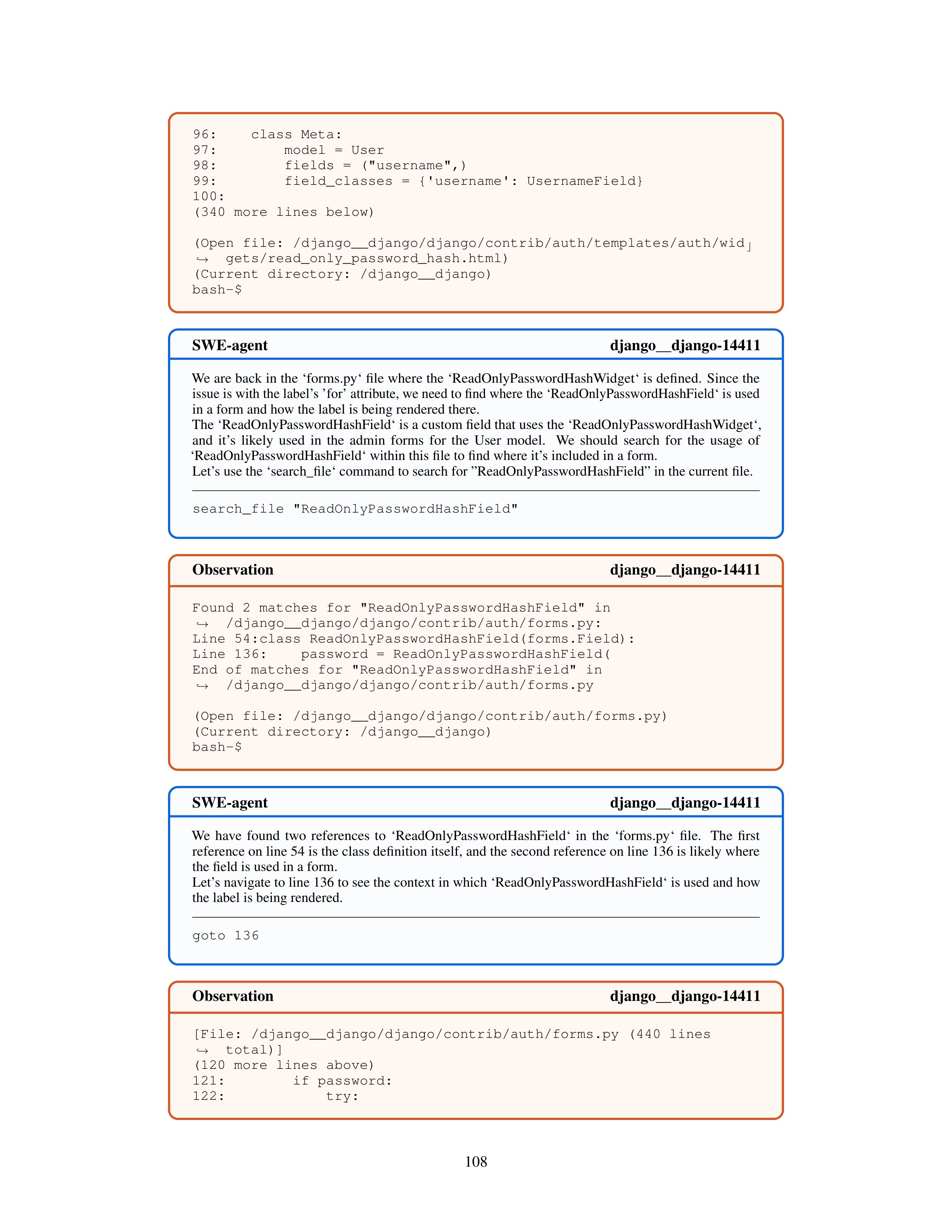
96:
class
Meta:
97:
model
=
User
98:
fields
=
("username",)
99:
field_classes
=
{'username':
UsernameField}
100:
(340
more
lines
below)
(Open
file:
/django__django/django/contrib/auth/templates/auth/wid
⌋
gets/read_only_password_hash.html)
,
→
(Current
directory:
/django__django)
bash-$
SWE-agent
django__django-14411
We are back in the ‘forms.py‘ file where the ‘ReadOnlyPasswordHashWidget‘ is defined.
Since the
issue is with the label’s ’for’ attribute, we need to find where the ‘ReadOnlyPasswordHashField‘ is used
in a form and how the label is being rendered there.
The ‘ReadOnlyPasswordHashField‘ is a custom field that uses the ‘ReadOnlyPasswordHashWidget‘,
and
it’s
likely
used
in
the
admin
forms
for
the
User
model.
We
should
search
for
the
usage
of
‘ReadOnlyPasswordHashField‘ within this file to find where it’s included in a form.
Let’s use the ‘search_file‘ command to search for ”ReadOnlyPasswordHashField” in the current file.
search_file
"ReadOnlyPasswordHashField"
Observation
django__django-14411
Found
2
matches
for
"ReadOnlyPasswordHashField"
in
/django__django/django/contrib/auth/forms.py:
,
→
Line
54:class
ReadOnlyPasswordHashField(forms.Field):
Line
136:
password
=
ReadOnlyPasswordHashField(
End
of
matches
for
"ReadOnlyPasswordHashField"
in
/django__django/django/contrib/auth/forms.py
,
→
(Open
file:
/django__django/django/contrib/auth/forms.py)
(Current
directory:
/django__django)
bash-$
SWE-agent
django__django-14411
We
have
found
two
references
to
‘ReadOnlyPasswordHashField‘
in
the
‘forms.py‘
file.
The
first
reference on line 54 is the class definition itself, and the second reference on line 136 is likely where
the field is used in a form.
Let’s navigate to line 136 to see the context in which ‘ReadOnlyPasswordHashField‘ is used and how
the label is being rendered.
goto
136
Observation
django__django-14411
[File:
/django__django/django/contrib/auth/forms.py
(440
lines
total)]
,
→
(120
more
lines
above)
121:
if
password:
122:
try:
108
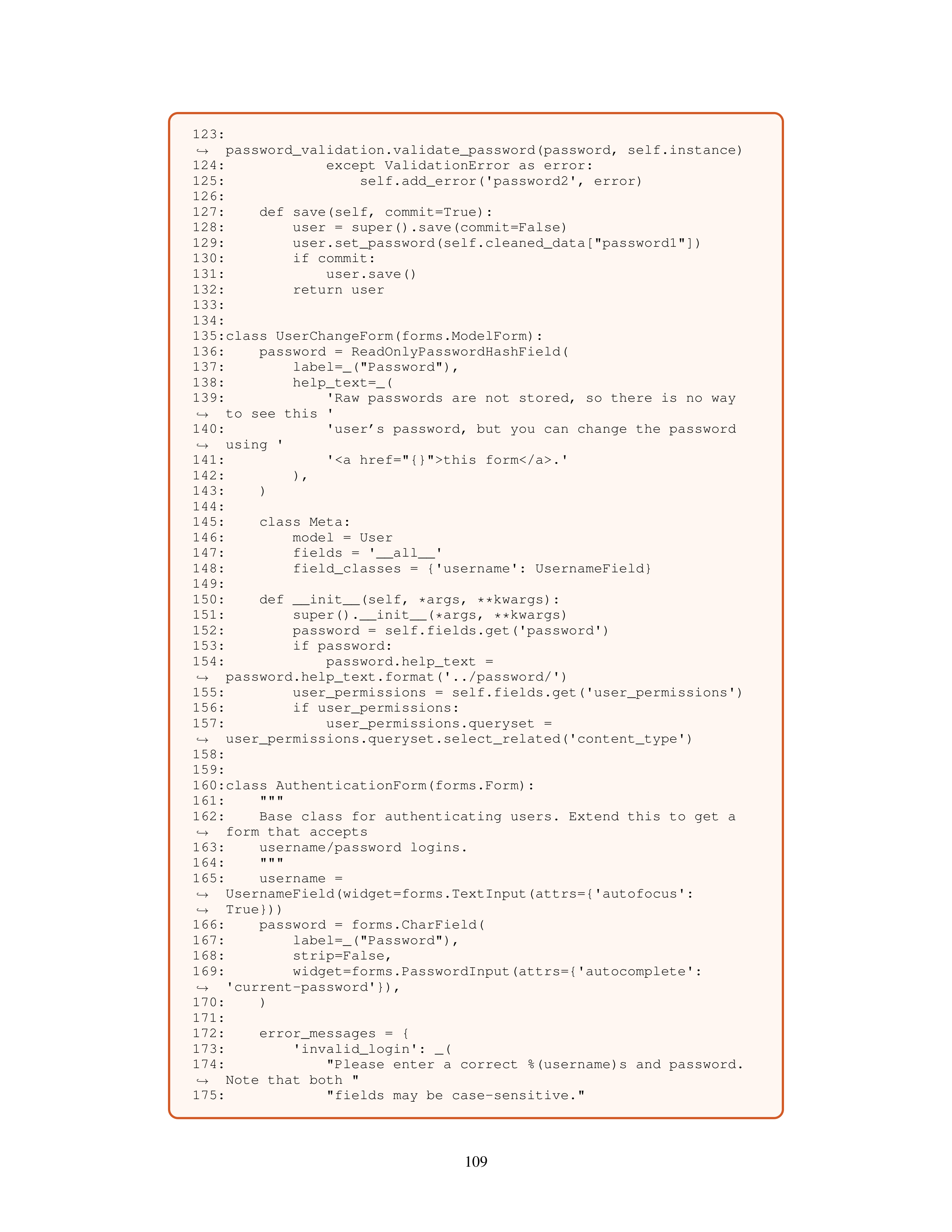
123:
password_validation.validate_password(password,
self.instance)
,
→
124:
except
ValidationError
as
error:
125:
self.add_error('password2',
error)
126:
127:
def
save(self,
commit=True):
128:
user
=
super().save(commit=False)
129:
user.set_password(self.cleaned_data["password1"])
130:
if
commit:
131:
user.save()
132:
return
user
133:
134:
135:class
UserChangeForm(forms.ModelForm):
136:
password
=
ReadOnlyPasswordHashField(
137:
label=_("Password"),
138:
help_text=_(
139:
'Raw
passwords
are
not
stored,
so
there
is
no
way
to
see
this
'
,
→
140:
'user’s
password,
but
you
can
change
the
password
using
'
,
→
141:
'<a
href="{}">this
form.'
142:
),
143:
)
144:
145:
class
Meta:
146:
model
=
User
147:
fields
=
'__all__'
148:
field_classes
=
{'username':
UsernameField}
149:
150:
def
__init__(self,
*args,
**kwargs):
151:
super().__init__(*args,
**kwargs)
152:
password
=
self.fields.get('password')
153:
if
password:
154:
password.help_text
=
password.help_text.format('../password/')
,
→
155:
user_permissions
=
self.fields.get('user_permissions')
156:
if
user_permissions:
157:
user_permissions.queryset
=
user_permissions.queryset.select_related('content_type')
,
→
158:
159:
160:class
AuthenticationForm(forms.Form):
161:
"""
162:
Base
class
for
authenticating
users.
Extend
this
to
get
a
form
that
accepts
,
→
163:
username/password
logins.
164:
"""
165:
username
=
UsernameField(widget=forms.TextInput(attrs={'autofocus':
True}))
,
→
,
→
166:
password
=
forms.CharField(
167:
label=_("Password"),
168:
strip=False,
169:
widget=forms.PasswordInput(attrs={'autocomplete':
'current-password'}),
,
→
170:
)
171:
172:
error_messages
=
{
173:
'invalid_login':
_(
174:
"Please
enter
a
correct
%(username)s
and
password.
Note
that
both
"
,
→
175:
"fields
may
be
case-sensitive."
109
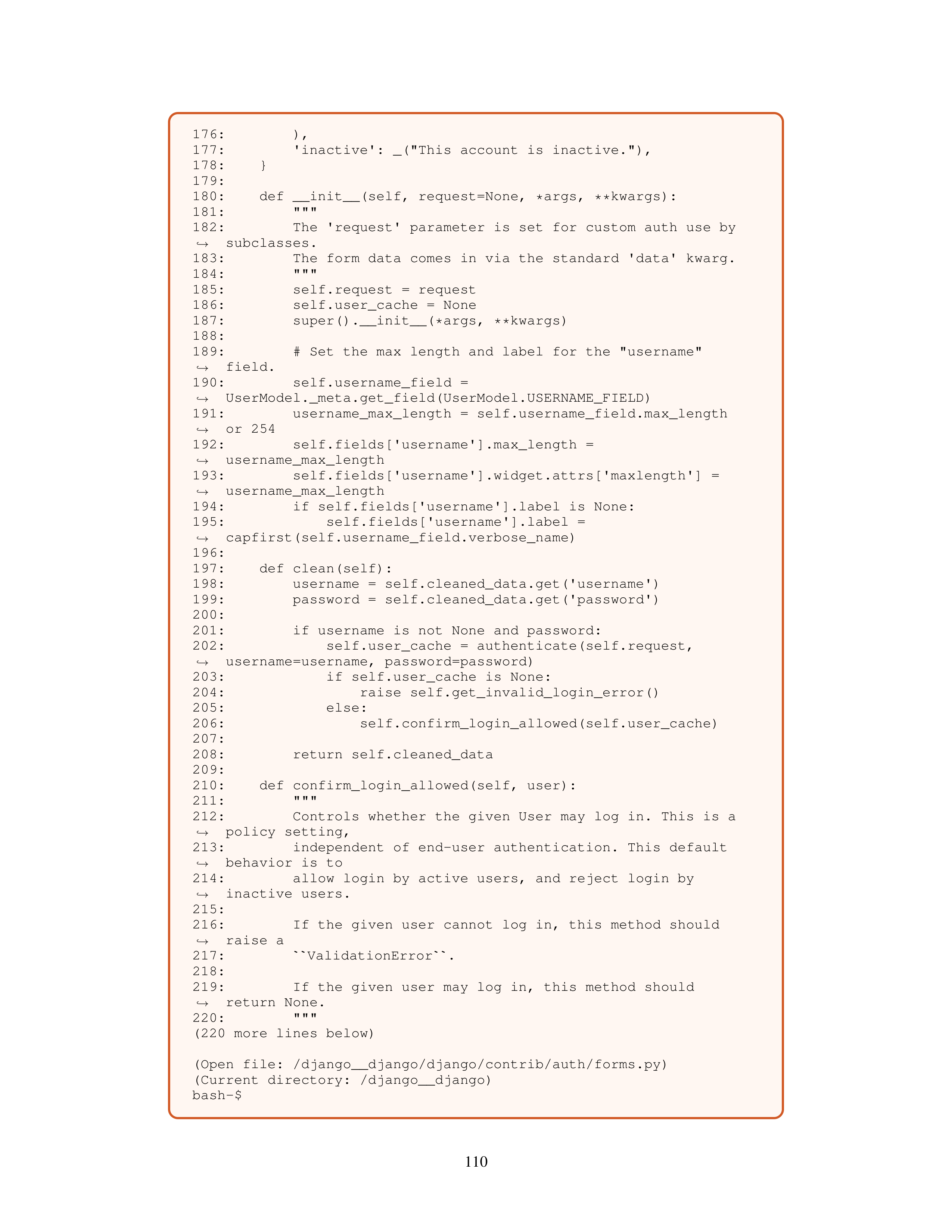
176:
),
177:
'inactive':
_("This
account
is
inactive."),
178:
}
179:
180:
def
__init__(self,
request=None,
*args,
**kwargs):
181:
"""
182:
The
'request'
parameter
is
set
for
custom
auth
use
by
subclasses.
,
→
183:
The
form
data
comes
in
via
the
standard
'data'
kwarg.
184:
"""
185:
self.request
=
request
186:
self.user_cache
=
None
187:
super().__init__(*args,
**kwargs)
188:
189:
#
Set
the
max
length
and
label
for
the
"username"
field.
,
→
190:
self.username_field
=
UserModel._meta.get_field(UserModel.USERNAME_FIELD)
,
→
191:
username_max_length
=
self.username_field.max_length
or
254
,
→
192:
self.fields['username'].max_length
=
username_max_length
,
→
193:
self.fields['username'].widget.attrs['maxlength']
=
username_max_length
,
→
194:
if
self.fields['username'].label
is
None:
195:
self.fields['username'].label
=
capfirst(self.username_field.verbose_name)
,
→
196:
197:
def
clean(self):
198:
username
=
self.cleaned_data.get('username')
199:
password
=
self.cleaned_data.get('password')
200:
201:
if
username
is
not
None
and
password:
202:
self.user_cache
=
authenticate(self.request,
username=username,
password=password)
,
→
203:
if
self.user_cache
is
None:
204:
raise
self.get_invalid_login_error()
205:
else:
206:
self.confirm_login_allowed(self.user_cache)
207:
208:
return
self.cleaned_data
209:
210:
def
confirm_login_allowed(self,
user):
211:
"""
212:
Controls
whether
the
given
User
may
log
in.
This
is
a
policy
setting,
,
→
213:
independent
of
end-user
authentication.
This
default
behavior
is
to
,
→
214:
allow
login
by
active
users,
and
reject
login
by
inactive
users.
,
→
215:
216:
If
the
given
user
cannot
log
in,
this
method
should
raise
a
,
→
217:
``
ValidationError
``
.
218:
219:
If
the
given
user
may
log
in,
this
method
should
return
None.
,
→
220:
"""
(220
more
lines
below)
(Open
file:
/django__django/django/contrib/auth/forms.py)
(Current
directory:
/django__django)
bash-$
110
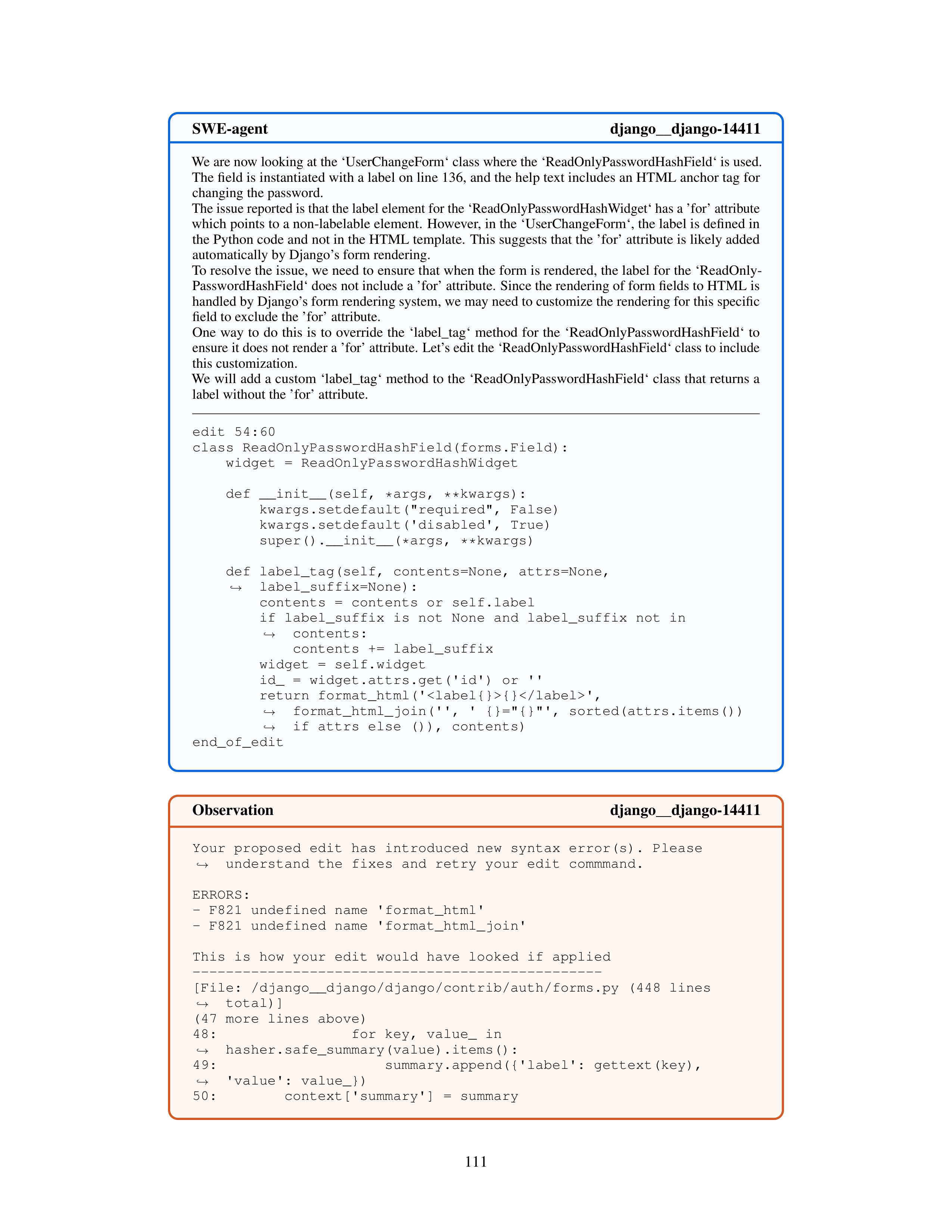
SWE-agent
django__django-14411
We are now looking at the ‘UserChangeForm‘ class where the ‘ReadOnlyPasswordHashField‘ is used.
The field is instantiated with a label on line 136, and the help text includes an HTML anchor tag for
changing the password.
The issue reported is that the label element for the ‘ReadOnlyPasswordHashWidget‘ has a ’for’ attribute
which points to a non-labelable element.
However, in the ‘UserChangeForm‘, the label is defined in
the Python code and not in the HTML template.
This suggests that the ’for’ attribute is likely added
automatically by Django’s form rendering.
To resolve the issue, we need to ensure that when the form is rendered, the label for the ‘ReadOnly-
PasswordHashField‘ does not include a ’for’ attribute.
Since the rendering of form fields to HTML is
handled by Django’s form rendering system, we may need to customize the rendering for this specific
field to exclude the ’for’ attribute.
One
way
to
do
this
is
to
override
the
‘label_tag‘
method
for
the
‘ReadOnlyPasswordHashField‘
to
ensure it does not render a ’for’ attribute.
Let’s edit the ‘ReadOnlyPasswordHashField‘ class to include
this customization.
We will add a custom ‘label_tag‘ method to the ‘ReadOnlyPasswordHashField‘ class that returns a
label without the ’for’ attribute.
edit
54:60
class
ReadOnlyPasswordHashField(forms.Field):
widget
=
ReadOnlyPasswordHashWidget
def
__init__(self,
*args,
**kwargs):
kwargs.setdefault("required",
False)
kwargs.setdefault('disabled',
True)
super().__init__(*args,
**kwargs)
def
label_tag(self,
contents=None,
attrs=None,
label_suffix=None):
,
→
contents
=
contents
or
self.label
if
label_suffix
is
not
None
and
label_suffix
not
in
contents:
,
→
contents
+=
label_suffix
widget
=
self.widget
id_
=
widget.attrs.get('id')
or
''
return
format_html('',
format_html_join('',
'
{}="{}"',
sorted(attrs.items())
if
attrs
else
()),
contents)
,
→
,
→
end_of_edit
Observation
django__django-14411
Your
proposed
edit
has
introduced
new
syntax
error(s).
Please
understand
the
fixes
and
retry
your
edit
commmand.
,
→
ERRORS:
-
F821
undefined
name
'format_html'
-
F821
undefined
name
'format_html_join'
This
is
how
your
edit
would
have
looked
if
applied
-------------------------------------------------
[File:
/django__django/django/contrib/auth/forms.py
(448
lines
total)]
,
→
(47
more
lines
above)
48:
for
key,
value_
in
hasher.safe_summary(value).items():
,
→
49:
summary.append({'label':
gettext(key),
'value':
value_})
,
→
50:
context['summary']
=
summary
111
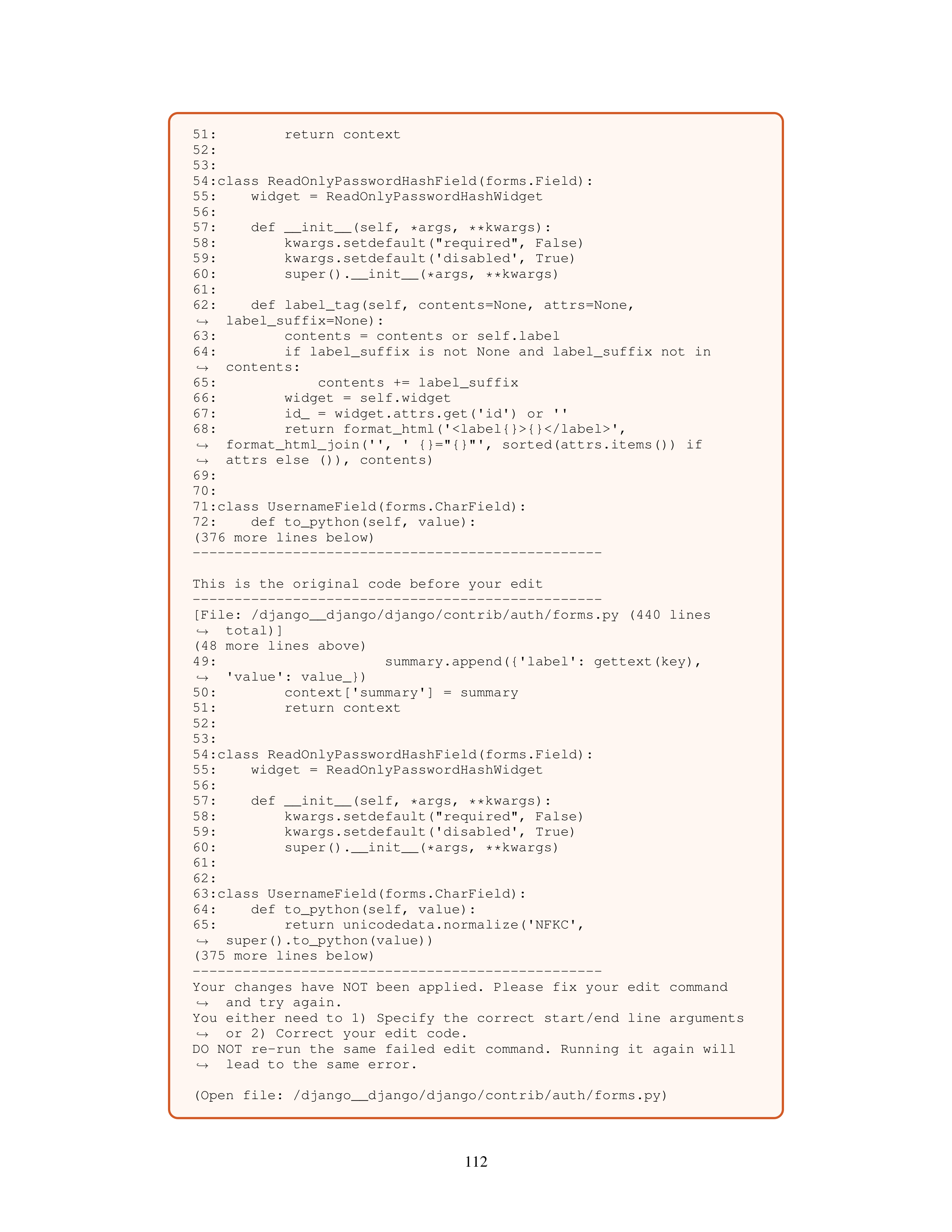
51:
return
context
52:
53:
54:class
ReadOnlyPasswordHashField(forms.Field):
55:
widget
=
ReadOnlyPasswordHashWidget
56:
57:
def
__init__(self,
*args,
**kwargs):
58:
kwargs.setdefault("required",
False)
59:
kwargs.setdefault('disabled',
True)
60:
super().__init__(*args,
**kwargs)
61:
62:
def
label_tag(self,
contents=None,
attrs=None,
label_suffix=None):
,
→
63:
contents
=
contents
or
self.label
64:
if
label_suffix
is
not
None
and
label_suffix
not
in
contents:
,
→
65:
contents
+=
label_suffix
66:
widget
=
self.widget
67:
id_
=
widget.attrs.get('id')
or
''
68:
return
format_html('',
format_html_join('',
'
{}="{}"',
sorted(attrs.items())
if
attrs
else
()),
contents)
,
→
,
→
69:
70:
71:class
UsernameField(forms.CharField):
72:
def
to_python(self,
value):
(376
more
lines
below)
-------------------------------------------------
This
is
the
original
code
before
your
edit
-------------------------------------------------
[File:
/django__django/django/contrib/auth/forms.py
(440
lines
total)]
,
→
(48
more
lines
above)
49:
summary.append({'label':
gettext(key),
'value':
value_})
,
→
50:
context['summary']
=
summary
51:
return
context
52:
53:
54:class
ReadOnlyPasswordHashField(forms.Field):
55:
widget
=
ReadOnlyPasswordHashWidget
56:
57:
def
__init__(self,
*args,
**kwargs):
58:
kwargs.setdefault("required",
False)
59:
kwargs.setdefault('disabled',
True)
60:
super().__init__(*args,
**kwargs)
61:
62:
63:class
UsernameField(forms.CharField):
64:
def
to_python(self,
value):
65:
return
unicodedata.normalize('NFKC',
super().to_python(value))
,
→
(375
more
lines
below)
-------------------------------------------------
Your
changes
have
NOT
been
applied.
Please
fix
your
edit
command
and
try
again.
,
→
You
either
need
to
1)
Specify
the
correct
start/end
line
arguments
or
2)
Correct
your
edit
code.
,
→
DO
NOT
re-run
the
same
failed
edit
command.
Running
it
again
will
lead
to
the
same
error.
,
→
(Open
file:
/django__django/django/contrib/auth/forms.py)
112
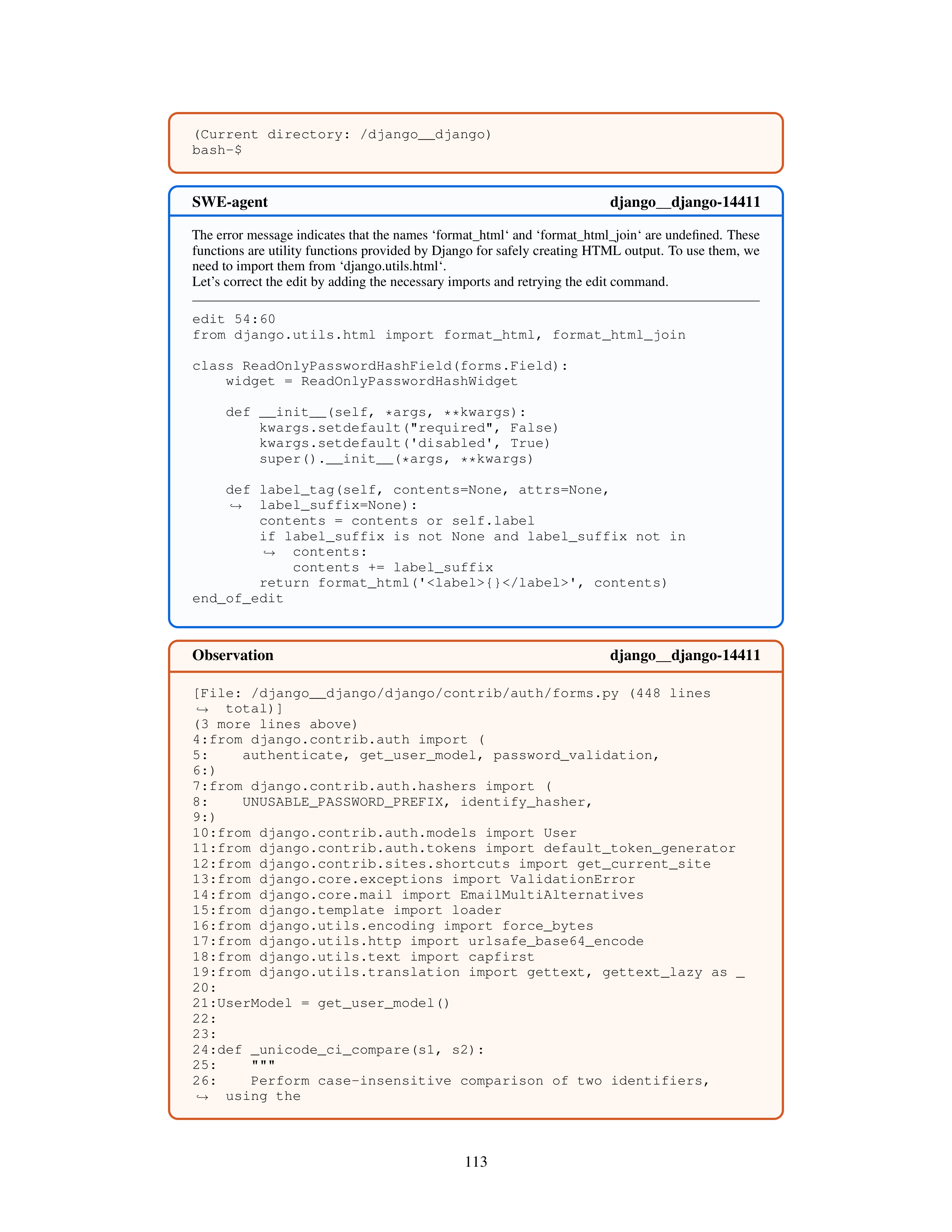
(Current
directory:
/django__django)
bash-$
SWE-agent
django__django-14411
The error message indicates that the names ‘format_html‘ and ‘format_html_join‘ are undefined.
These
functions are utility functions provided by Django for safely creating HTML output.
To use them, we
need to import them from ‘django.utils.html‘.
Let’s correct the edit by adding the necessary imports and retrying the edit command.
edit
54:60
from
django.utils.html
import
format_html,
format_html_join
class
ReadOnlyPasswordHashField(forms.Field):
widget
=
ReadOnlyPasswordHashWidget
def
__init__(self,
*args,
**kwargs):
kwargs.setdefault("required",
False)
kwargs.setdefault('disabled',
True)
super().__init__(*args,
**kwargs)
def
label_tag(self,
contents=None,
attrs=None,
label_suffix=None):
,
→
contents
=
contents
or
self.label
if
label_suffix
is
not
None
and
label_suffix
not
in
contents:
,
→
contents
+=
label_suffix
return
format_html('',
contents)
end_of_edit
Observation
django__django-14411
[File:
/django__django/django/contrib/auth/forms.py
(448
lines
total)]
,
→
(3
more
lines
above)
4:from
django.contrib.auth
import
(
5:
authenticate,
get_user_model,
password_validation,
6:)
7:from
django.contrib.auth.hashers
import
(
8:
UNUSABLE_PASSWORD_PREFIX,
identify_hasher,
9:)
10:from
django.contrib.auth.models
import
User
11:from
django.contrib.auth.tokens
import
default_token_generator
12:from
django.contrib.sites.shortcuts
import
get_current_site
13:from
django.core.exceptions
import
ValidationError
14:from
django.core.mail
import
EmailMultiAlternatives
15:from
django.template
import
loader
16:from
django.utils.encoding
import
force_bytes
17:from
django.utils.http
import
urlsafe_base64_encode
18:from
django.utils.text
import
capfirst
19:from
django.utils.translation
import
gettext,
gettext_lazy
as
_
20:
21:UserModel
=
get_user_model()
22:
23:
24:def
_unicode_ci_compare(s1,
s2):
25:
"""
26:
Perform
case-insensitive
comparison
of
two
identifiers,
using
the
,
→
113
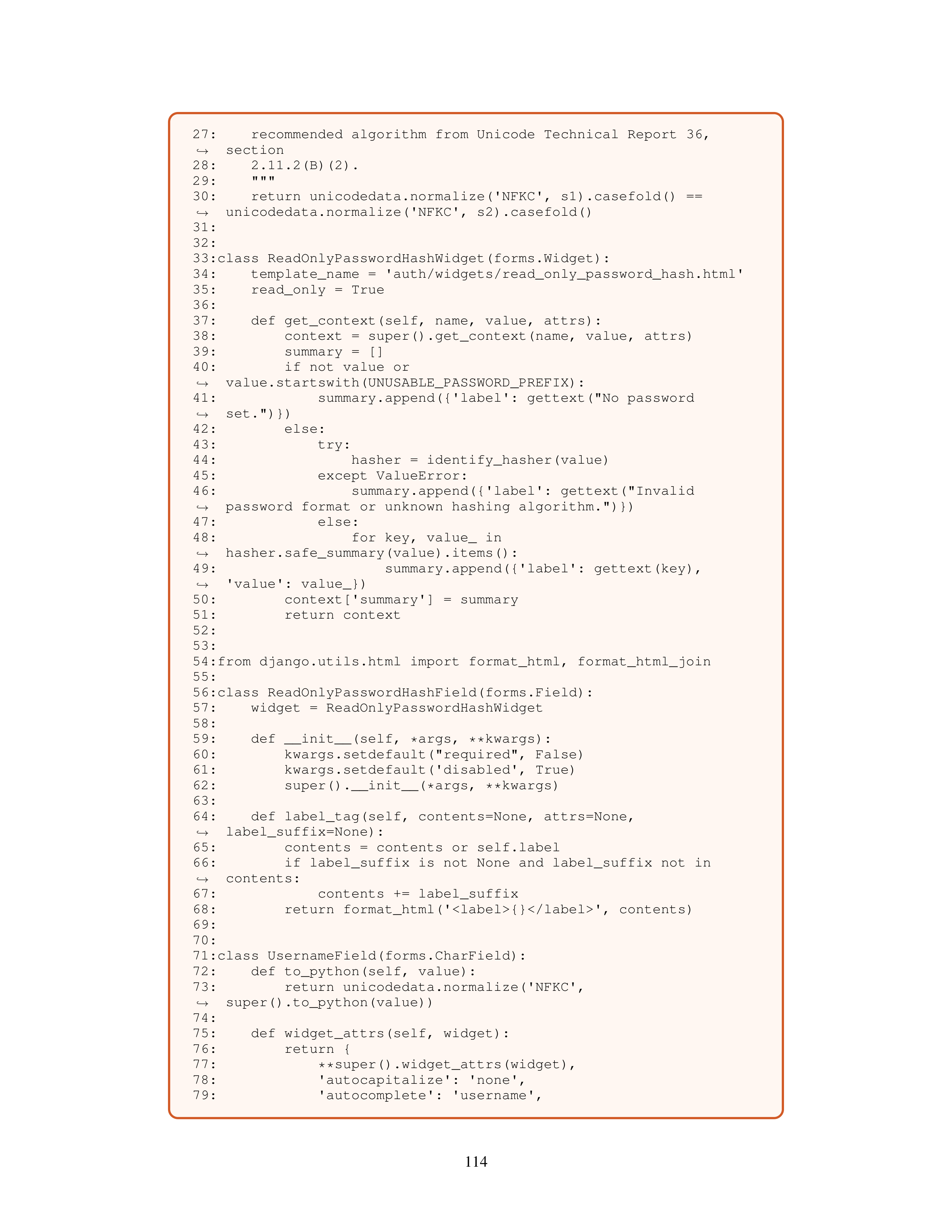
27:
recommended
algorithm
from
Unicode
Technical
Report
36,
section
,
→
28:
2.11.2(B)(2).
29:
"""
30:
return
unicodedata.normalize('NFKC',
s1).casefold()
==
unicodedata.normalize('NFKC',
s2).casefold()
,
→
31:
32:
33:class
ReadOnlyPasswordHashWidget(forms.Widget):
34:
template_name
=
'auth/widgets/read_only_password_hash.html'
35:
read_only
=
True
36:
37:
def
get_context(self,
name,
value,
attrs):
38:
context
=
super().get_context(name,
value,
attrs)
39:
summary
=
[]
40:
if
not
value
or
value.startswith(UNUSABLE_PASSWORD_PREFIX):
,
→
41:
summary.append({'label':
gettext("No
password
set.")})
,
→
42:
else:
43:
try:
44:
hasher
=
identify_hasher(value)
45:
except
ValueError:
46:
summary.append({'label':
gettext("Invalid
password
format
or
unknown
hashing
algorithm.")})
,
→
47:
else:
48:
for
key,
value_
in
hasher.safe_summary(value).items():
,
→
49:
summary.append({'label':
gettext(key),
'value':
value_})
,
→
50:
context['summary']
=
summary
51:
return
context
52:
53:
54:from
django.utils.html
import
format_html,
format_html_join
55:
56:class
ReadOnlyPasswordHashField(forms.Field):
57:
widget
=
ReadOnlyPasswordHashWidget
58:
59:
def
__init__(self,
*args,
**kwargs):
60:
kwargs.setdefault("required",
False)
61:
kwargs.setdefault('disabled',
True)
62:
super().__init__(*args,
**kwargs)
63:
64:
def
label_tag(self,
contents=None,
attrs=None,
label_suffix=None):
,
→
65:
contents
=
contents
or
self.label
66:
if
label_suffix
is
not
None
and
label_suffix
not
in
contents:
,
→
67:
contents
+=
label_suffix
68:
return
format_html('',
contents)
69:
70:
71:class
UsernameField(forms.CharField):
72:
def
to_python(self,
value):
73:
return
unicodedata.normalize('NFKC',
super().to_python(value))
,
→
74:
75:
def
widget_attrs(self,
widget):
76:
return
{
77:
**
super().widget_attrs(widget),
78:
'autocapitalize':
'none',
79:
'autocomplete':
'username',
114
80:
}
81:
82:
83:class
UserCreationForm(forms.ModelForm):
84:
"""
85:
A
form
that
creates
a
user,
with
no
privileges,
from
the
given
username
and
,
→
86:
password.
87:
"""
88:
error_messages
=
{
89:
'password_mismatch':
_('The
two
password
fields
didn’t
match.'),
,
→
90:
}
91:
password1
=
forms.CharField(
92:
label=_("Password"),
93:
strip=False,
94:
widget=forms.PasswordInput(attrs={'autocomplete':
'new-password'}),
,
→
95:
help_text=password_validation.password_validators_help_
⌋
text_html(),
,
→
96:
)
97:
password2
=
forms.CharField(
98:
label=_("Password
confirmation"),
99:
widget=forms.PasswordInput(attrs={'autocomplete':
'new-password'}),
,
→
100:
strip=False,
101:
help_text=_("Enter
the
same
password
as
before,
for
verification."),
,
→
102:
)
103:
(345
more
lines
below)
File
updated.
Please
review
the
changes
and
make
sure
they
are
correct
(correct
indentation,
no
duplicate
lines,
etc).
Edit
the
file
again
if
necessary.
,
→
,
→
(Open
file:
/django__django/django/contrib/auth/forms.py)
(Current
directory:
/django__django)
bash-$
SWE-agent
django__django-14411
The changes to the ‘ReadOnlyPasswordHashField‘ class have been successfully applied, including the
import of ‘format_html‘ and ‘format_html_join‘, and the addition of a custom ‘label_tag‘ method that
returns a label without the ’for’ attribute.
Before submitting the changes,
it would be prudent to test that the changes have the desired effect.
However, since we cannot run a Django server or render forms in this environment, we will proceed
with submitting the changes.
Let’s submit the changes to the code base using the ‘submit‘ command.
submit
Observation
django__django-14411
diff
--git
a/django/contrib/auth/forms.py
b/django/contrib/auth/forms.py
,
→
index
20d8922799..1f249a88dd
100644
---
a/django/contrib/auth/forms.py
+++
b/django/contrib/auth/forms.py
115
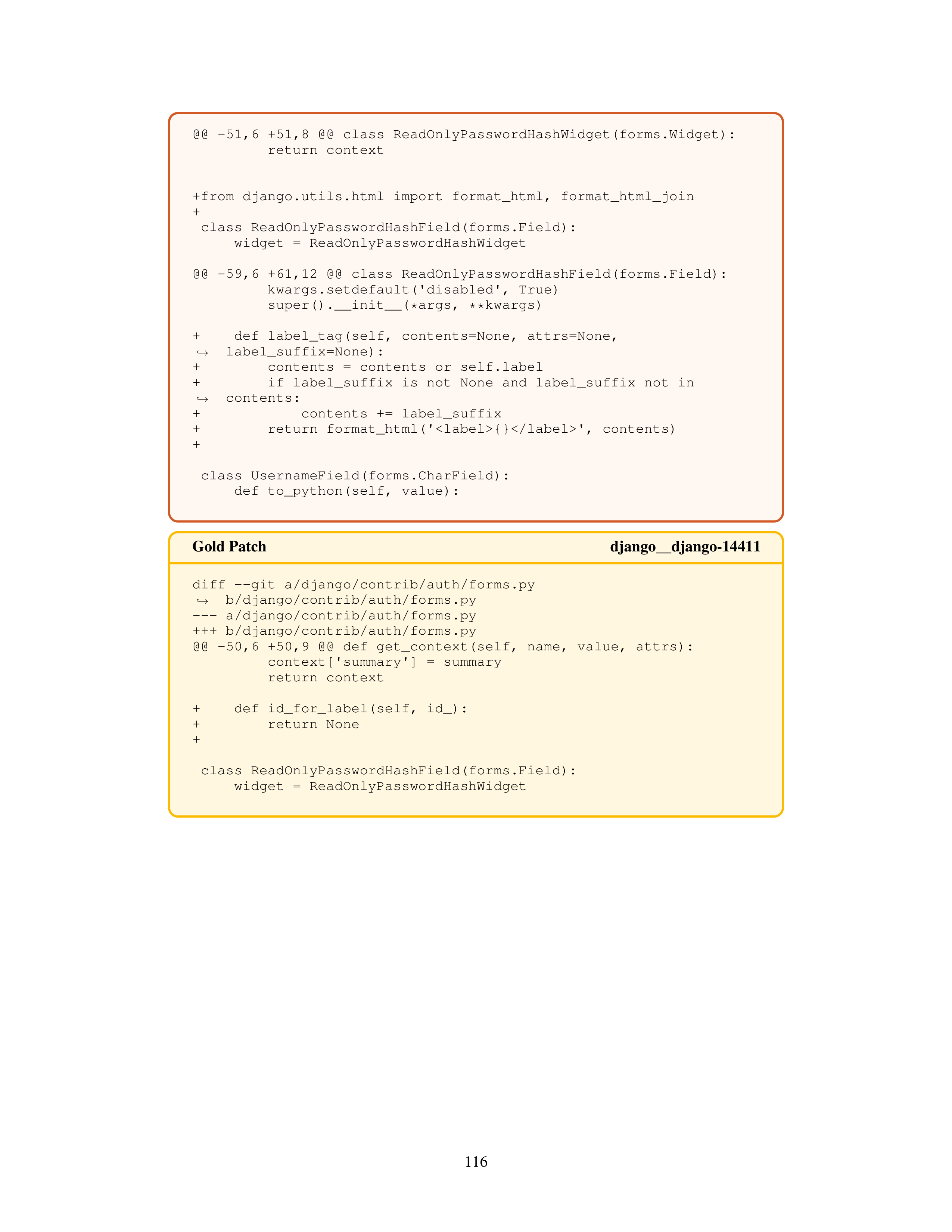
@@
-51,6
+51,8
@@
class
ReadOnlyPasswordHashWidget(forms.Widget):
return
context
+from
django.utils.html
import
format_html,
format_html_join
+
class
ReadOnlyPasswordHashField(forms.Field):
widget
=
ReadOnlyPasswordHashWidget
@@
-59,6
+61,12
@@
class
ReadOnlyPasswordHashField(forms.Field):
kwargs.setdefault('disabled',
True)
super().__init__(*args,
**kwargs)
+
def
label_tag(self,
contents=None,
attrs=None,
label_suffix=None):
,
→
+
contents
=
contents
or
self.label
+
if
label_suffix
is
not
None
and
label_suffix
not
in
contents:
,
→
+
contents
+=
label_suffix
+
return
format_html('',
contents)
+
class
UsernameField(forms.CharField):
def
to_python(self,
value):
Gold Patch
django__django-14411
diff
--git
a/django/contrib/auth/forms.py
b/django/contrib/auth/forms.py
,
→
---
a/django/contrib/auth/forms.py
+++
b/django/contrib/auth/forms.py
@@
-50,6
+50,9
@@
def
get_context(self,
name,
value,
attrs):
context['summary']
=
summary
return
context
+
def
id_for_label(self,
id_):
+
return
None
+
class
ReadOnlyPasswordHashField(forms.Field):
widget
=
ReadOnlyPasswordHashWidget
116
E
Statements
E.1
Ethics & Broader Impacts
Prior
works
have
established
how
the
growing
usage
of
LMs
that
can
code
also
carries
a
certain
amount of risk.
We identify three main risks that could arise when building and using a system like
SWE-agent, then discuss how we incorporates measures that mitigate such problems.
First is the security risks that come with executing LM-generated code on device.
When evaluating
on software engineering tasks that feature an incredibly diverse number of issue descriptions, run-
ning code generations on a personal computing device can have negative side effects, such as the
unintentional removal of digital assets (e.g.,
rm
-rf
asset/
).
To defend against this, we design
SWE-agent to use ephemeral containers for both inference and evaluation.
SWE-agent’s execution
environment
and
the
SWE-bench
evaluation
framework
are
both
carried
out
in
sand-boxed
code
environments, which is made possible with Docker.
Executing code in a Docker container ensures
that its effects are mostly isolated from the rest of the system.
While not considered as secure as
virtualized hardware isolation, the namespace isolation provided by Docker containers is deemed
sufficient for code that is not deliberately engineered to exploit recent container escape vulnerabilities.
More details are discussion is in §
A.2
.
Second,
if
the
wider
community
develops
interest
for
SWE-agent
and
builds
upon
it,
it
is
also
possible that illegitimate evaluation datasets or infrastructure can be used to inject testing devices
with malicious code or instructions to generate malicious code.
For instance, an unofficial repository
claiming to host an inference/evaluation harness for SWE-agent/bench could include a task instance
with an issue description that tells the LM agent to build key logging functionality and store it in
a
hidden
folder.
To
eliminate
confusion
and
reduce
the
possibility
of
such
an
event,
we
provide
clear guidelines listed on our GitHub repositories, data stores, and websites indicating the official
repositories and channels that we actively maintain.
We also encourage third parties to incorporate
any improvements into our codebase and help with integrating such contributions.
Lastly are the consequences of software engineering agents being deployed in the real world.
Prior
works have conceptualized and put forth prototypes of agents that can carry out offensive security
measures.
It
is
also
not
difficult
to
imagine
that
a
system
like
SWE-agent
can
be
incorporated
into pipelines resulting in the production of malicious code.
SWE-agent’s strong performance on
SWE-bench implies that future AI systems will likely be increasingly adept in the aforementioned use
cases.
Releasing SWE-agent as an open source tool can support research towards designing sound,
effective constraints for what software engineering agents are permitted to do.
It can also serve as a
system that legal experts and policy-making entities can experiment with to shape the future of what
AI-driven end to end software engineering could look like.
E.2
Reproducibility
To help the greater community reproduce the results presented in this paper and build on the SWE-
agent platform, we open source all of our resources that were created for this project.
The source
code for the interactive pipeline, context management logic, command implementations, interface
design, and everything else is entirely available in a GitHub repository.
We provide extensive text and
video documentation describing how to run and modify different parts of the codebase.
Practitioners
should be able to easily recover our findings by running the agent with simple scripts.
We also open
source all inference and evaluation artifacts (e.g., trajectories, code generations, evaluation execution
traces, analysis notebooks).
The results presented in the main and supplementary parts of this paper
can be fully rendered from the data.
Finally, we also maintain an active online help forum to assist
with any reproduction problems or questions about how to build on ACI design and SWE-agent.
E.3
Limitations & Future Work
The final SWE-agent configuration has a small toolkit, albeit highly effective.
With SWE-agent’s
highly extensible design, we’re excited by the prospect of adding more tools, such as web browsing or
static analysis, that can leverage more signals from an issue description and codebase to improve the
% Resolved performance.
Many tools trialed by prior works from software engineering and language
model agents, such as static/dynamic analysis, spectrum based fault localization, or test generation
via fuzzing could prove useful.
117
Second,
in
this
work,
the
ACI
development
process
and
case
studies
are
done
manually.
Many
components
of
SWE-agent
were
crafted
from
observations
of
recurring
behavior
within
a
single
trajectory
or
across
multiple
trajectories.
Automating
part
or
all
of
this
process
could
not
only
accelerate work built on top of SWE-agent, but also provide greater insights into developing ACI
principles for agentic software engineering.
Contemporary works have explored automated prompting
to improve performance on traditional sequence to sequence tasks, supplanting the need for manual
prompt
design.
Thinking
about
automating
ACI
design
raises
immediately
interesting
questions
around how such systems can scrutinize and iterate upon their own designs.
Ensuring such horizon
leads to incremental performance improvements across a longer horizon is also a challenging question.
Finally,
the
scope
of
SWE-agent
is
exclusively
focused
on
programmatic
tasks
like
software
en-
gineering and code generation.
We’re curious to see whether the same principles of ACI and our
observations of agent behavior are transferable to different domains.
Recent work around applying
LM agents to a variety of digital work applications have proliferated, such as use cases in education
technology, data analysis, and enterprise workflows.
We hope that thinking about improving perfor-
mance of agentic workflows on these domains through the lens of ACI design can be a symbiotic
process.
For instance, for a task such a shopping on the web, in place of a typical Google-style search
tool, could agents benefit from additional information beyond a list of each page’s title and snippet?
Would the design vary if the nature of the downstream task were to change slightly?
For a completely
different task, such as navigating an internal company knowledge base to help a recently on-boarded
employee, how might the search interface be best adjusted to the agent?
Similar to the progression of the field of User Experience (UX) and Human Computer Interaction
(HCI) research, applying ACI to other domains could not only yield improvements in downstream
task performance, but also further expand the list of ACI principles.
We believe that the fundamental
motivations for ACI, the foundational principles we put forth, and our case study of SWE-agent as an
instantiation of implementing and improving an ACI can motivate such work.
118