
October 2023
Comcast
Equity Program

This brochure describing the Comcast Equity Program is not a legal document and
does not apply to all employees. Please note that not all employees receive either
or both types of awards.
This brochure provides highlights of the provisions that generally apply to awards of
restricted stock units and stock options under the Comcast Equity Program. It is not
intended to be a complete description of the program. A summary of the Comcast
Equity Program is also available in the prospectuses that have been filed for the
Comcast Corporation 2023 Omnibus Equity Incentive Plan, the Comcast Corporation
2002 Restricted Stock Plan, and the Comcast Corporation 2003 Stock Option Plan
(collectively, the “Equity Plans”) (available on NetBenefits.com). Participants who receive
awards should also reference their restricted stock unit and/or stock option award
document(s) and the Equity Plan documents, (available on NetBenefits.com) for the
specific provisions that apply to their award(s). If there are any discrepancies between
this brochure and the award document(s) or Equity Plan document(s), the award
document(s) and the Equity Plan document(s) will prevail. Participation in this program
does not constitute a contract of employment, implied or otherwise, and does not
provide by implication or otherwise, for rights to receive additional awards.
Eligibility..................................................................................................... 1
How Restricted Stock Units Work ........................................................... 1
Overview......................................................................................................................1
Vesting..........................................................................................................................2
Receiving Your Shares and Taxes ..............................................................................2
Dividend Equivalents .................................................................................................3
If Your Employment Ends...........................................................................................3
New Accelerated Vesting Feature for Retirement Eligible Employees..................4
The Life Cycle of Restricted Stock Units.................................................. 5
How Stock Options Work ........................................................................ 6
Overview......................................................................................................................6
Vesting ....................................................................................................... 7
. Exercising Your Options.............................................................................................7
. Net-Settled Options...................................................................................................7
Exercise Methods, Descriptions, and Strategies......................................................8
Taxes........................................................................................................... 9
If Your Employment Ends....................................................................... 10
The Life Cycle of an Option................................................................... 11
What’s Inside
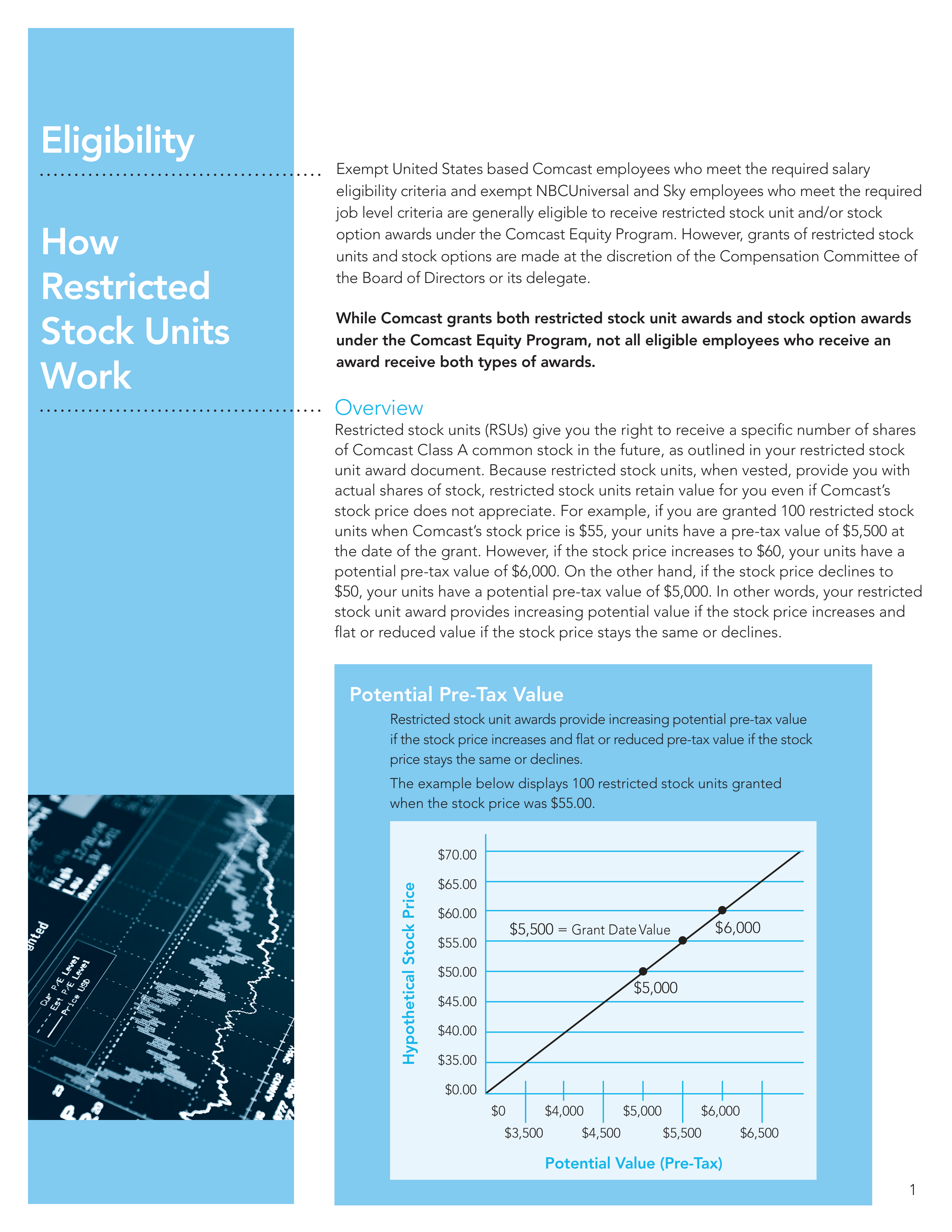

Potential Pre-Tax Value
Restricted stock unit awards provide increasing potential pre-tax value
if the stock price increases and flat or reduced pre-tax value if the stock
price stays the same or declines.
The example below displays 100 restricted stock units granted
when the stock price was $55.00.
$70.00
$65.00
$60.00
$55.00
$50.00
$45.00
$40.00
$35.00
$0.00
Hypothetical Stock Price
$6,000
Potential Value (Pre-Tax)
$0
$4,000
$5,000
$6,000
$5,500 =
Grant Date Value
$5,000
$3,500 $4,500 $5,500 $6,500
How
Restricted
Stock Units
Work
Overview
Restricted stock units (RSUs) give you the right to receive a specific number of shares
of Comcast Class A common stock in the future, as outlined in your restricted stock
unit award document. Because restricted stock units, when vested, provide you with
actual shares of stock, restricted stock units retain value for you even if Comcast’s
stock price does not appreciate. For example, if you are granted 100 restricted stock
units when Comcast’s stock price is $55, your units have a pre-tax value of $5,500 at
the date of the grant. However, if the stock price increases to $60, your units have a
potential pre-tax value of $6,000. On the other hand, if the stock price declines to
$50, your units have a potential pre-tax value of $5,000. In other words, your restricted
stock unit award provides increasing potential value if the stock price increases and
flat or reduced value if the stock price stays the same or declines.
Eligibility
Exempt United States based Comcast employees who meet the required salary
eligibility criteria and exempt NBCUniversal and Sky employees who meet the required
job level criteria are generally eligible to receive restricted stock unit and/or stock
option awards under the Comcast Equity Program. However, grants of restricted stock
units and stock options are made at the discretion of the Compensation Committee of
the Board of Directors or its delegate.
While Comcast grants both restricted stock unit awards and stock option awards
under the Comcast Equity Program, not all eligible employees who receive an
award receive both types of awards.
1


2
Vesting
Newer Grants
Vesting is your right to receive Comcast shares. Your restricted stock units will generally
vest over five years, provided that you continue in service through the vesting dates—see
If Your Employment Ends
section on page 3. Your shares will vest as follows:
• 20% on each of the first, second, third, fourth, and fifth anniversaries of the
grant date
Older Grants
The above vesting schedule generally applies for restricted stock units granted on or
after January 1, 2022. For outstanding Comcast restricted stock units granted prior to
January 1, 2022, there was a different vesting schedule in place, as follows:
• 15% on each of the first, second, third, and fourth anniversaries of the grant date
• An additional 40% on the fifth anniversary of the grant date
Receiving Your Shares and Taxes
We strongly recommend that you consult with a personal tax advisor to discuss the tax
treatment of your restricted stock units. However, some general guidelines for federal
taxes follow.
When your shares vest, Comcast will automatically deposit into your account at Fidelity
the net number of shares equal to (1) the gross number of shares vesting, less (2) shares
that must be withheld to satisfy your tax obligation. For example, if you have 15 shares
vesting and your effective withholding tax rate is 33%, Comcast will deposit 10 shares
into your account and withhold 5 shares to satisfy your tax obligation. Please note that
the income taxes withheld are at fixed rates prescribed by the IRS and may be more or
less than the taxes you owe on the taxable income associated with the vesting. Also,
Comcast will round up the number of shares withheld for taxes to the next whole share
amount and will credit your federal tax withholdings for this rounding. The value of the
shares vesting (15 shares in this example) and the value of the shares withheld to satisfy
your tax obligation (5 shares in this example) will be included in your Comcast pay
records and Form W-2 as taxable income and tax withholding, respectively. The values
will be based on the closing stock price on the date of vesting.
After the shares are deposited into your Fidelity account (10 shares in the above
example), you can either hold or sell all or a portion of the net shares you received on
the open market for cash. If you sell, the cash will then be deposited into your account at
Fidelity. When you dispose of the shares you acquired upon RSU vesting, capital gains or
losses will be measured by the difference, if any, between the market price of Comcast
Stock at the time of disposition and the market price of Comcast stock at the time of
RSU vesting. The tax treatment depends on the length of time you held the shares.
• If you hold the shares for more than one year from the vesting date, your capital
gain or loss will be a long-term capital gain or loss, which is generally taxed at a
lower rate than ordinary income.
• If you hold the shares for one year or less from the vesting date, your capital gain
or loss will be considered a short-term capital gain or loss, which is taxed at the
same rate as ordinary income.
• Capital gains and losses are reportable on Schedule D of your personal income
tax return.
These will be recorded on the year-end Fidelity provided 1099.
As a reminder, employees may only buy or sell stock when they are not aware of
any material non-public information about Comcast.
3
Dividend Equivalents
Generally, RSU awards include a dividend equivalents feature. If a dividend record date occurs with respect
to Comcast common stock after the date of your grant, each of your unvested RSUs is credited with
dividend equivalents for the same value as dividends paid to shareholders and are paid in cash when your
RSUs vest. This cash amount is subject to the same vesting, termination, and forfeiture rules as the share
award to which it relates. As the awards vest, the accumulated cash dividend amount, less applicable tax
withholding, will be paid into your account at Fidelity Stock Plan Services (without accrued interest).
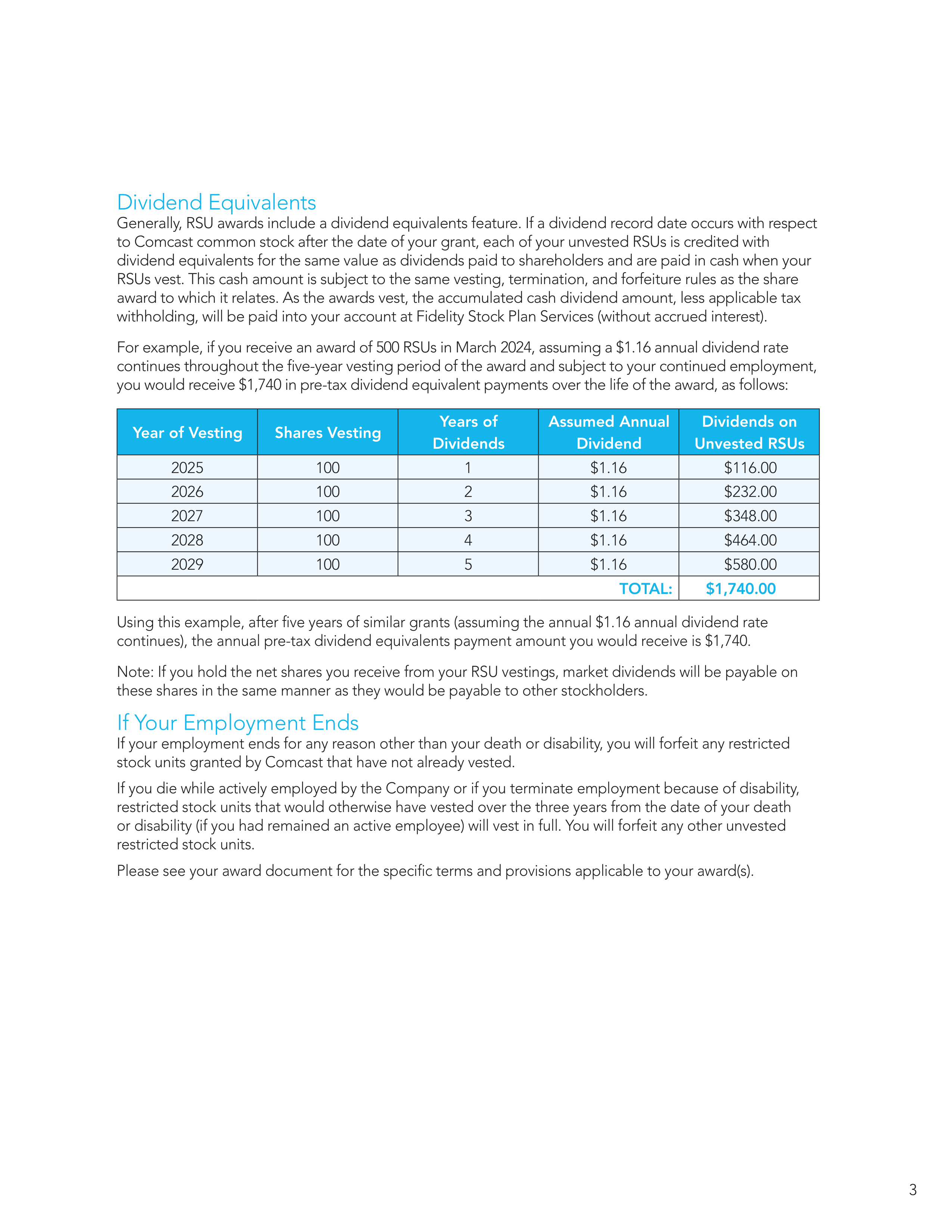
For example, if you receive an award of 500 RSUs in March 2024, assuming a $1.16 annual dividend rate
continues throughout the five-year vesting period of the award and subject to your continued employment,
you would receive $1,740 in pre-tax dividend equivalent payments over the life of the award, as follows:
Year of Vesting
Shares Vesting
Years of
Dividends
Assumed Annual
Dividend
Dividends on
Unvested RSUs
2025
100
1
$1.16
$116.00
2026
100
2
$1.16
$232.00
2027
100
3
$1.16
$348.00
2028
100
4
$1.16
$464.00
2029
100
5
$1.16
$580.00
TOTAL:
$1,740.00
Using this example, after five years of similar grants (assuming the annual $1.16 annual dividend rate
continues), the annual pre-tax dividend equivalents payment amount you would receive is $1,740.
Note: If you hold the net shares you receive from your RSU vestings, market dividends will be payable on
these shares in the same manner as they would be payable to other stockholders.
If Your Employment Ends
If your employment ends for any reason other than your death or disability, you will forfeit any restricted
stock units granted by Comcast that have not already vested.
If you die while actively employed by the Company or if you terminate employment because of disability,
restricted stock units that would otherwise have vested over the three years from the date of your death
or disability (if you had remained an active employee) will vest in full. You will forfeit any other unvested
restricted stock units.
Please see your award document for the specific terms and provisions applicable to your award(s).
Example: 500 RSUs Granted—Original Vesting Schedule:
RSUs scheduled to vest:
Year 5
Anniversary
100 RSUs vest
Year 4
Anniversary
100 RSUs vest
Year 3
Anniversary
100 RSUs vest
Year 2
Anniversary
100 RSUs vest
Grantee meets defined retirement eligibility
Year 1
Anniversary
100 RSUs vest
Grant
Date
New Accelerated Vesting Feature for Retirement Eligible Employees
For RSU awards granted on and after March 1, 2024, we have added a new RSU feature that accelerates the vesting of awards
to employees who meet the equity retirement eligibility definition. Retirement eligible employees are defined as those who
have reached age 62 and have completed 10 or more years of continuous service.
When an active grantee meets the retirement eligibility definition, RSUs that were originally scheduled to vest and distribute
over the next 24 months will be accelerated and will vest immediately upon meeting retirement eligibility and distribute as
soon as administratively possible, and all future vesting and distribution date(s) will also be accelerated by 24 months.
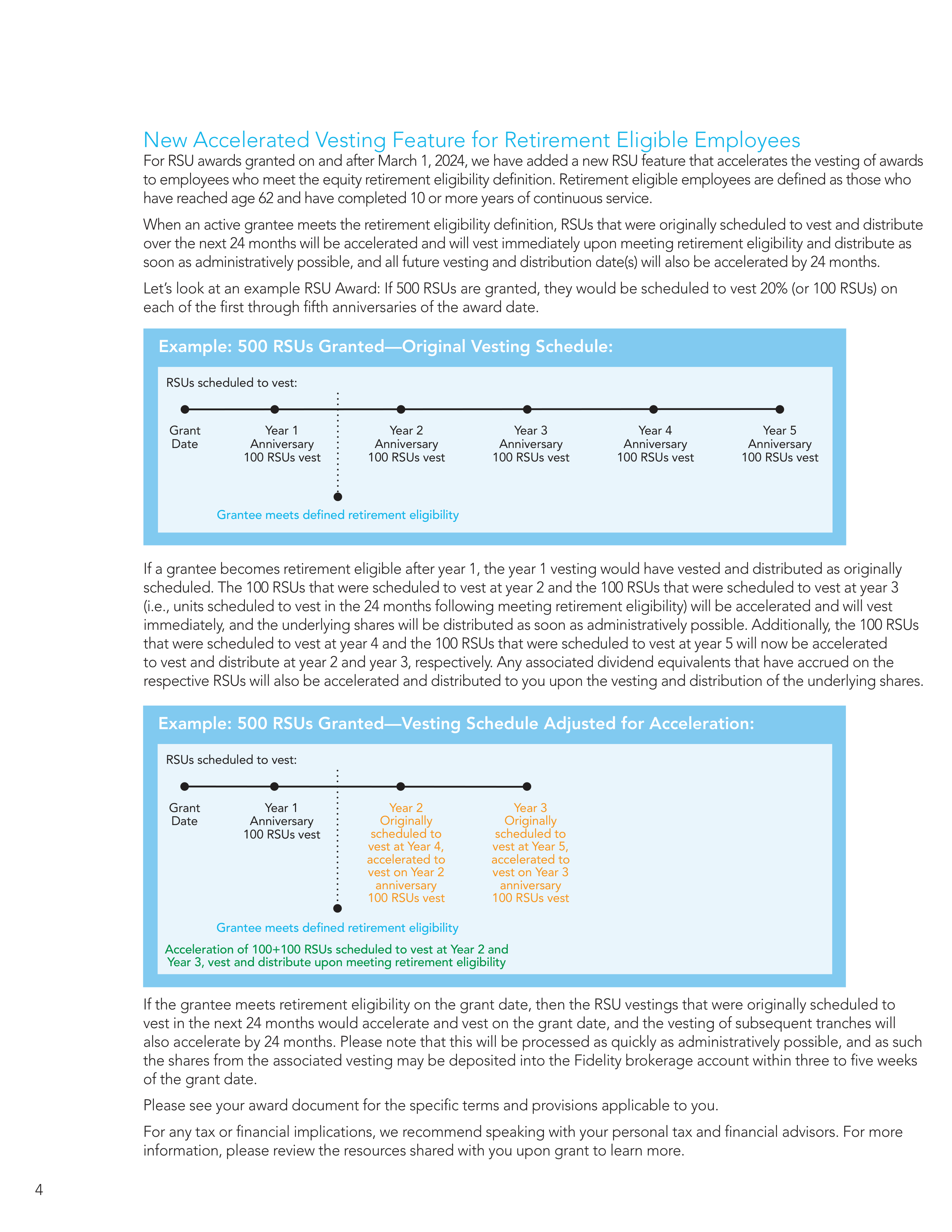
Let’s look at an example RSU Award: If 500 RSUs are granted, they would be scheduled to vest 20% (or 100 RSUs) on
each of the first through fifth anniversaries of the award date.
If a grantee becomes retirement eligible after year 1, the year 1 vesting would have vested and distributed as originally
scheduled. The 100 RSUs that were scheduled to vest at year 2 and the 100 RSUs that were scheduled to vest at year 3
(i.e., units scheduled to vest in the 24 months following meeting retirement eligibility) will be accelerated and will vest
immediately, and the underlying shares will be distributed as soon as administratively possible. Additionally, the 100 RSUs
that were scheduled to vest at year 4 and the 100 RSUs that were scheduled to vest at year 5 will now be accelerated
to vest and distribute at year 2 and year 3, respectively. Any associated dividend equivalents that have accrued on the
respective RSUs will also be accelerated and distributed to you upon the vesting and distribution of the underlying shares.
4
If the grantee meets retirement eligibility on the grant date, then the RSU vestings that were originally scheduled to
vest in the next 24 months would accelerate and vest on the grant date, and the vesting of subsequent tranches will
also accelerate by 24 months. Please note that this will be processed as quickly as administratively possible, and as such
the shares from the associated vesting may be deposited into the Fidelity brokerage account within three to five weeks
of the grant date.
Please see your award document for the specific terms and provisions applicable to you.
For any tax or financial implications, we recommend speaking with your personal tax and financial advisors. For more
information, please review the resources shared with you upon grant to learn more.
Example: 500 RSUs Granted—Vesting Schedule Adjusted for Acceleration:
RSUs scheduled to vest:
Year 3
Originally
scheduled to
vest at Year 5,
accelerated to
vest on Year 3
anniversary
100 RSUs vest
Year 2
Originally
scheduled to
vest at Year 4,
accelerated to
vest on Year 2
anniversary
100 RSUs vest
Year 1
Anniversary
100 RSUs vest
Grant
Date
Grantee meets defined retirement eligibility
Acceleration of 100+100 RSUs scheduled to vest at Year 2 and
Year 3, vest and distribute upon meeting retirement eligibility
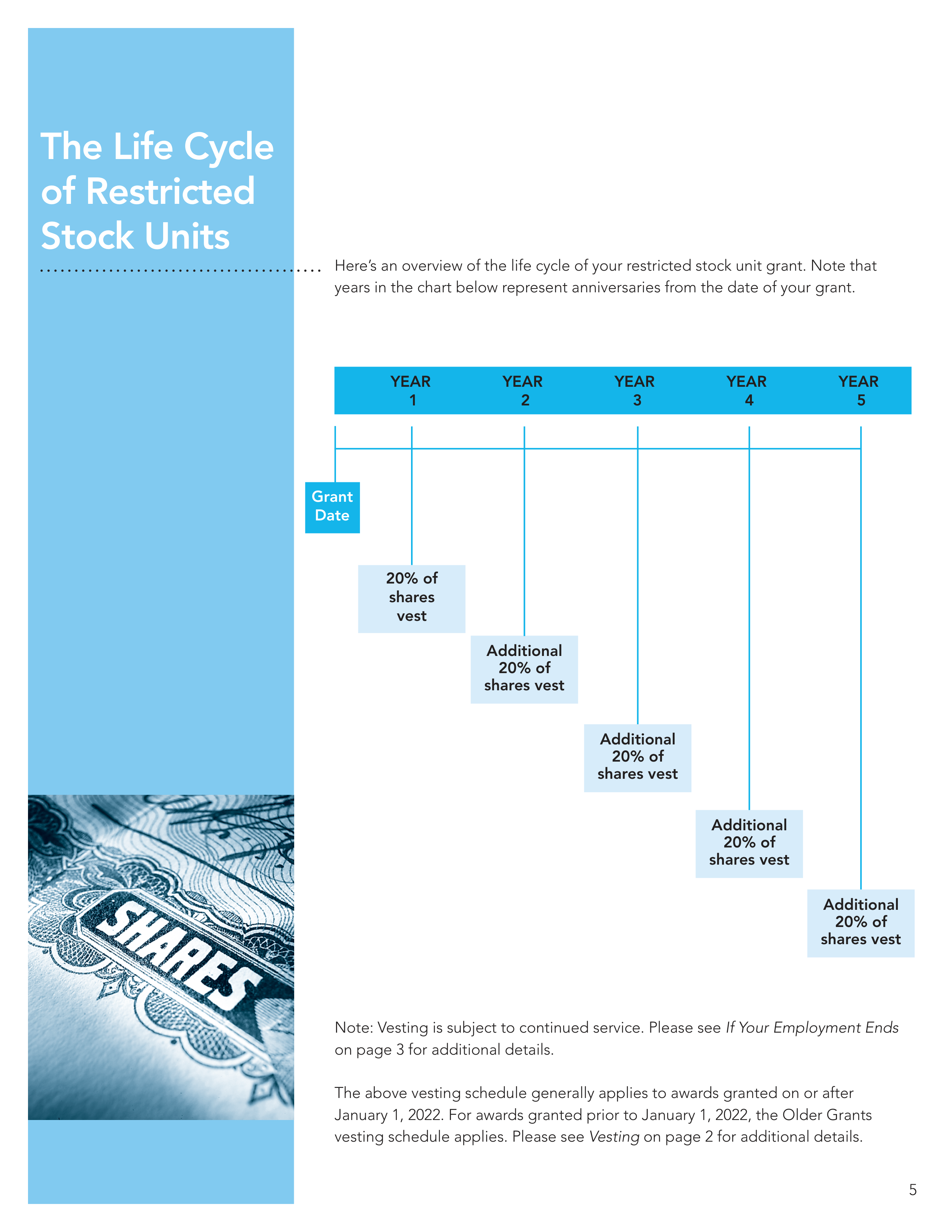

Here’s an overview of the life cycle of your restricted stock unit grant. Note that
years in the chart below represent anniversaries from the date of your grant.
The Life Cycle
of Restricted
Stock Units
20% of
shares
vest
Additional
20% of
shares vest
Additional
20% of
shares vest
Additional
20% of
shares vest
Additional
20% of
shares vest
YEAR
YEAR
YEAR
YEAR
YEAR
1
2
3
4
5
Grant
Date
Note: Vesting is subject to continued service. Please see
If Your Employment Ends
on page 3 for additional details.
The above vesting schedule generally applies to awards granted on or after
January 1, 2022. For awards granted prior to January 1, 2022, the Older Grants
vesting schedule applies. Please see
Vesting
on page 2 for additional details.
5

How Stock
Options Work
Overview
Note: Prior to March 1, 2024, Comcast generally granted stock options as part of the
annual equity award program. Annual awards made on and after March 1, 2024 are
generally made exclusively in RSUs.
Stock options give you the right to acquire a specific number of shares of Comcast Class
A common stock in the future at a fixed price (the exercise price) for a fixed period of
time, as outlined in your stock option award document. How much value you ultimately
receive from your vested options, if any, depends on the future price of Comcast stock.
If the stock price goes up above the exercise price, your options are “in the money” and
the difference between that price and the exercise price will be your potential pre-tax
gain, reflecting the value of your options. However, if the stock price remains flat or falls
below the exercise price, your options will have no value at that time.
The exercise price (that is, the purchase price) represents the Comcast closing stock price
on the date of grant and never changes over the life of the option, even though the price
of our stock changes constantly. If the stock price rises above the exercise price, you will
be able to exercise your vested options to acquire shares at the lower exercise price. For
example, if the exercise price, which was established when you received your options, is
$55, and the market value rises to $60 over the term of the option, you have a potential
$5 pre-tax gain on each option you exercise. If the stock price falls below the exercise
price, your options have no value at that time.
The quarterly cash dividend paid by Comcast has no impact on your stock option grants.
6
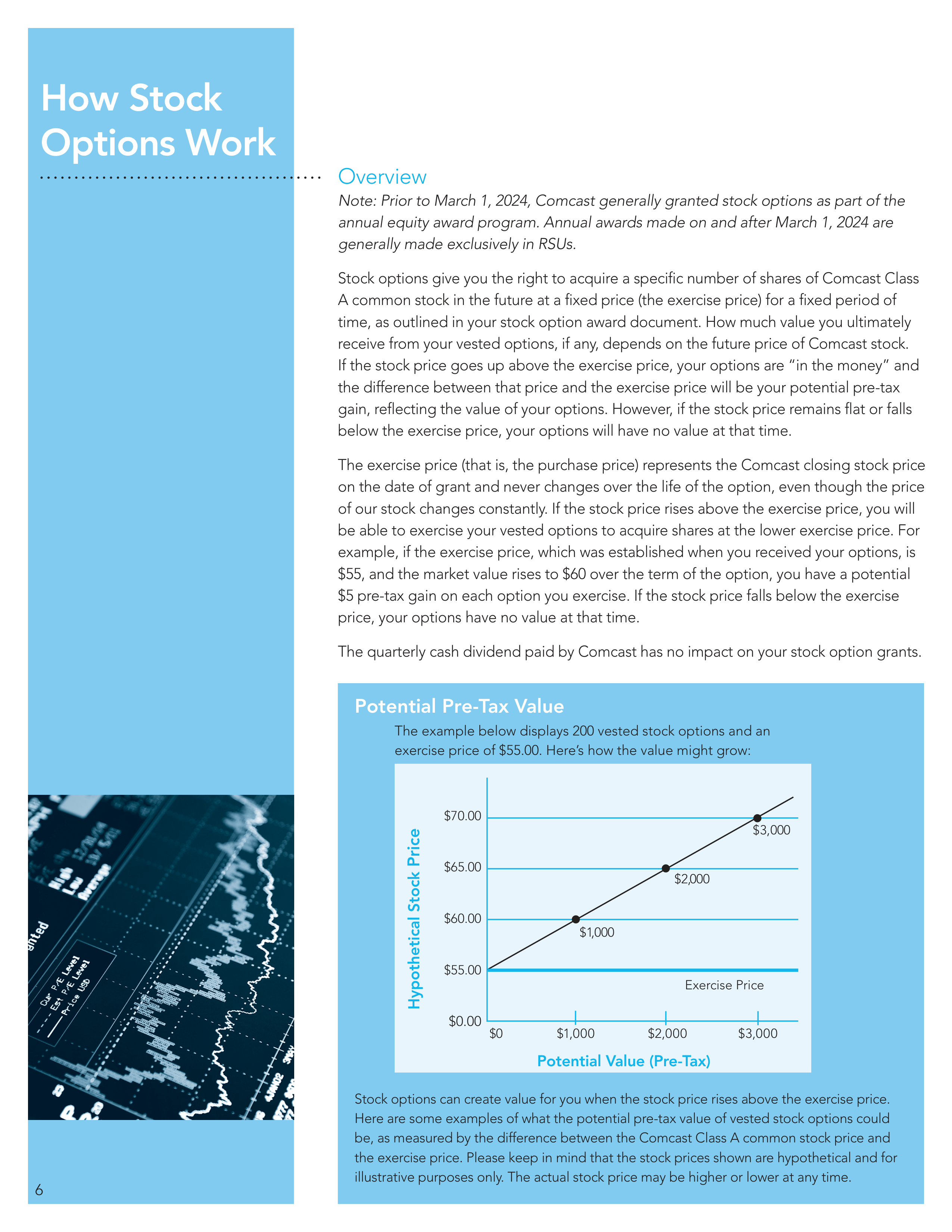
Stock options can create value for you when the stock price rises above the exercise price.
Here are some examples of what the potential pre-tax value of vested stock options could
be, as measured by the difference between the Comcast Class A common stock price and
the exercise price. Please keep in mind that the stock prices shown are hypothetical and for
illustrative purposes only. The actual stock price may be higher or lower at any time.
Potential Pre-Tax Value
The example below displays 200 vested stock options and an
exercise price of $55.00. Here’s how the value might grow:
$70.00
$65.00
$60.00
$55.00
$0.00
Potential Value (Pre-Tax)
$0
$1,000
$2,000
$3,000
$1,000
$2,000
$3,000
Hypothetical Stock
Price
Exercise Price

Vesting
Newer Grants
Vesting is when you first have the right to exercise your options to acquire Comcast
shares. Your options will generally vest over five years (provided that you continue in
service through each vesting date) as follows:
• 20% on each of the first, second, third, fourth, and fifth anniversaries of the
grant date
The grant date, exercise price, and vesting terms are outlined in your stock option
award document.
Older Grants
The above vesting schedule applies for stock options granted on or after January 1,
2022. For outstanding Comcast options granted prior to January 1, 2022, there was a
different vesting schedule in place, as follows:
• 40% on the second anniversary of the grant date
• An additional 20% on each of the third, fourth, and fifth anniversaries of the
grant date
Exercising Your Options
You can exercise some or all of your options once they’re vested. The term of your grant is
10 years, so your options will expire 10 years after the grant date (subject to your continued
employment with the Company—see
If Your Employment Ends
on page 10).
Net-Settled Options
When a stock option is exercised, and the payment of both the cost to exercise the
option and any withholding taxes due is accomplished through share withholding, this
is referred to as a “net-settled” stock option. In other words, when you exercise a net-
settled stock option, you will receive a number of shares of Comcast Class A common
stock equal to the number of options being exercised, less the number of shares
(valued at their then market price) necessary to pay the exercise price and applicable
withholding taxes. Please note that the income taxes withheld are at fixed rates
prescribed by the IRS and may be more or less than the taxes you owe on the taxable
income associated with the exercise. Thereafter, you can either hold or sell all or a
portion of the net shares you received from the exercise on the open market for cash. If
you sell, the cash will then be deposited into your account at Fidelity.
As a reminder, employees may only buy or sell stock when they are not aware of
any material non-public information about Comcast.
7
Vesting
Exercise Methods, Descriptions, and Strategies
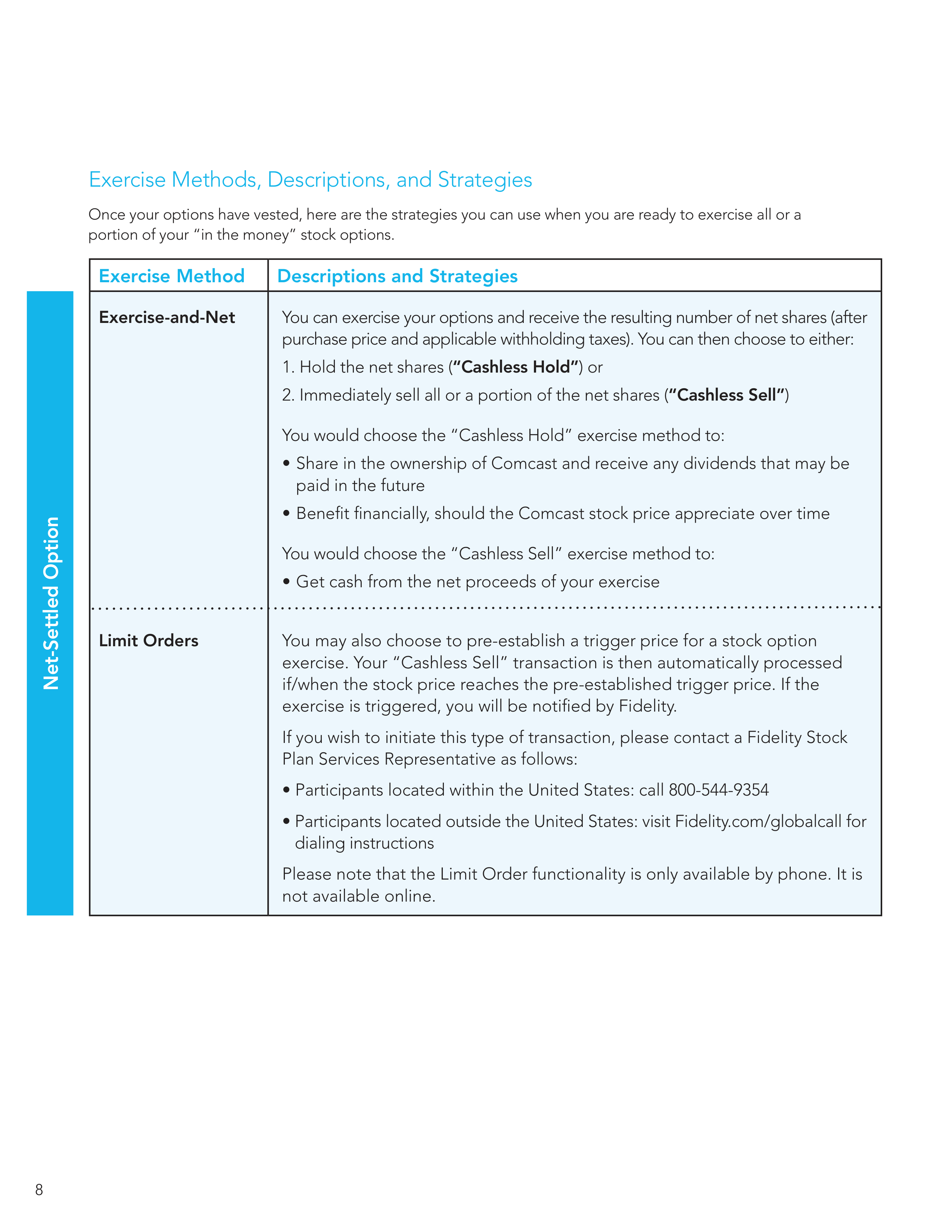
Once your options have vested, here are the strategies you can use when you are ready to exercise all or a
portion of your “in the money” stock options.
Exercise Method
Descriptions and Strategies
Net-Settled Option
Exercise-and-Net
Limit Orders
You can exercise your options and receive the resulting number of net shares (after
purchase price and applicable withholding taxes). You can then choose to either:
1. Hold the net shares (
“Cashless Hold”
) or
2. Immediately sell all or a portion of the net shares (
“Cashless Sell”
)
You would choose the “Cashless Hold” exercise method to:
• Share in the ownership of Comcast and receive any dividends that may be
paid in the future
• Benefit financially, should the Comcast stock price appreciate over time
You would choose the “Cashless Sell” exercise method to:
• Get cash from the net proceeds of your exercise
You may also choose to pre-establish a trigger price for a stock option
exercise. Your “Cashless Sell” transaction is then automatically processed
if/when the stock price reaches the pre-established trigger price. If the
exercise is triggered, you will be notified by Fidelity.
If you wish to initiate this type of transaction, please contact a Fidelity Stock
Plan Services Representative as follows:
• Participants located within the United States: call 800-544-9354
• Participants located outside the United States: visit Fidelity.com/globalcall for
dialing instructions
Please note that the Limit Order functionality is only available by phone. It is
not available online.
8

9
Taxes
We strongly recommend that you consult with a personal tax advisor to discuss the tax
treatment of your options. However, some general guidelines for federal taxes follow.
Your options under this program are nonqualified stock options. These options are not
taxed at grant. If you exercise your vested stock options, ordinary income and FICA
taxes will be due on the income resulting from the difference between the market
price of Comcast Stock at the time you exercise your options and the exercise price of
your options. Comcast will record this income and related tax withholding in your pay
records and on your Form W-2.
When you dispose of the shares you acquired by exercising your options, capital gain
or loss will be measured by the difference, if any, between the market price of Comcast
Stock at the time of disposition and the market price of Comcast stock at the time of
exercise. The tax treatment depends on the length of time you held the shares.
• If you hold the shares for more than one year from the exercise date, your
capital gain or loss will be a long-term capital gain or loss, which is generally
taxed at a lower rate than ordinary income.
• If you hold the shares for one year or less from the exercise date, your capital
gain or loss will be considered a short-term capital gain or loss, which is
taxed at the same rate as ordinary income.
• Capital gains and losses are reportable on Schedule D of your personal
income tax return. These will be recorded on the year-end Fidelity
provided 1099.
Note that because of fluctuations in the trading price of Comcast stock, an Exercise-
and-Net transaction of a net-settled stock option, followed by a sale (immediate or not)
of all or a portion of the net shares, may result in a difference between the market price
of the shares at the time of exercise of the options and the market price of the shares
when sold. Such a difference would result in a capital gain or loss.
10
If your employment ends for any reason other than your death, disability, defined
retirement, or “cause,” you will forfeit any options that have not vested before your
employment ends. You will then have 90 days to exercise any vested options, or until
the expiration date of your options if the option term expires sooner.
If you die while actively employed by the Company or if you terminate employment
because of disability, your options will vest in full. You or your successors-in-interest may
exercise your options until the third anniversary of your termination of employment, or
the expiration date of your options if the option term expires sooner.
If you terminate employment after you reach age 62 and complete 10 or more years of
service with the Company (your “retirement”), your options that were granted prior to
March 1, 2024, will continue to vest for the three years following your retirement as if you
had continued in active employment, and you may exercise your vested options for up
to 39 months following your retirement‚ or until the expiration date of your options if
the option term expires sooner. Any stock options granted on and after March 1, 2024,
will continue to vest for the two years following your retirement as if you had continued
in active employment, and you may exercise your vested options for up to 27 months
following your retirement, or until the expiration date of your options, if the option term
expires sooner. If, however, you breach any noncompetition or nonsolicitation obligation
to the Company during the post-retirement exercise period following termination‚ the
Company may cancel your options.
If your employment ends because of a Company-initiated termination for “cause,” all
of your options, whether vested or unvested, will be forfeited.
All options expire on the day before the 10th anniversary of the date of the grant,
regardless of whether or not your employment continues.
If you do not exercise your vested options before they expire, your options will be
automatically exercised on your behalf at Comcast’s closing stock price on the date
of expiration if they hold value at that time. The exercise method will be a “Cashless
Hold.”
Please see your award document for the specific terms and provisions applicable to
your award(s).
If Your
Employment
Ends

11
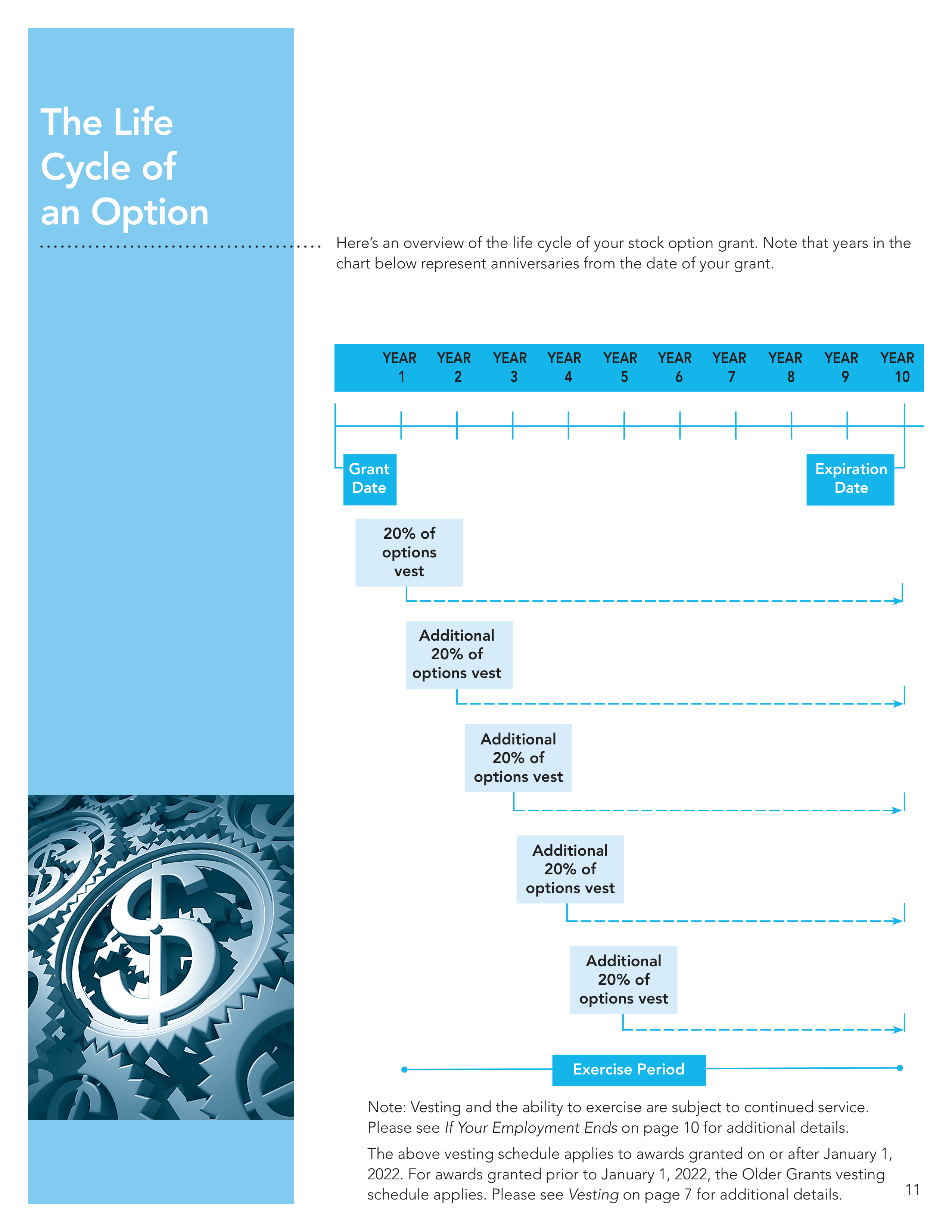
Here’s an overview of the life cycle of your stock option grant. Note that years in the
chart below represent anniversaries from the date of your grant.
The Life
Cycle of
an Option
Grant
Date
Expiration
Date
Additional
20% of
options vest
20% of
options
vest
Additional
20% of
options vest
Additional
20% of
options vest
Additional
20% of
options vest
Exercise Period
YEAR
YEAR
YEAR
YEAR
YEAR
YEAR
YEAR
YEAR
YEAR
YEAR
1
2
3
4
5
6
7
8
9
10
Note: Vesting and the ability to exercise are subject to continued service.
Please see
If Your Employment Ends
on page 10 for additional details.
The above vesting schedule applies to awards granted on or after January 1,
2022. For awards granted prior to January 1, 2022, the Older Grants vesting
schedule applies. Please see
Vesting
on page 7 for additional details.

46720_01
COM-SOPRS-BRO-1023
One Comcast Center
Philadelphia, PA 19103-2838
This material has been prepared and distributed by Comcast Corporation, and Comcast Corporation is solely responsible for its accuracy. Comcast Corporation, NBCUniversal,
Sky, and its affiliates are not associated with any Fidelity entity.
Fidelity Stock Plan Services, LLC, provides recordkeeping and/or administrative services to your company's equity compensation plan, in addition to any services provided
directly to the plan by your company or its service providers.