

3
Oracle for High Tech: A Platform for the New Next in High Technology
1
Volatile demand and supply chain disruption
The wild fluctuations in demand triggered by the pandemic were a once-in-a-lifetime event
for most manufacturers. Supply couldn’t meet consumer demand, resulting in higher prices.
Manufacturers encountered long lead times, higher transportation costs, and severe labor
shortages. In a
survey
last fall of nearly 300 global manufacturers by Oracle and IndustryWeek,
2
Greater focus on sustainability
Increasing adoption of smart,
3
data-driven
manufacturing
The pandemic tested the resilience of manufacturers like never before. Companies had to
adapt faster and boost manufacturing productivity to new levels. To meet this challenge,
manufacturers are investing in advanced technologies. The IndustryWeek survey found that
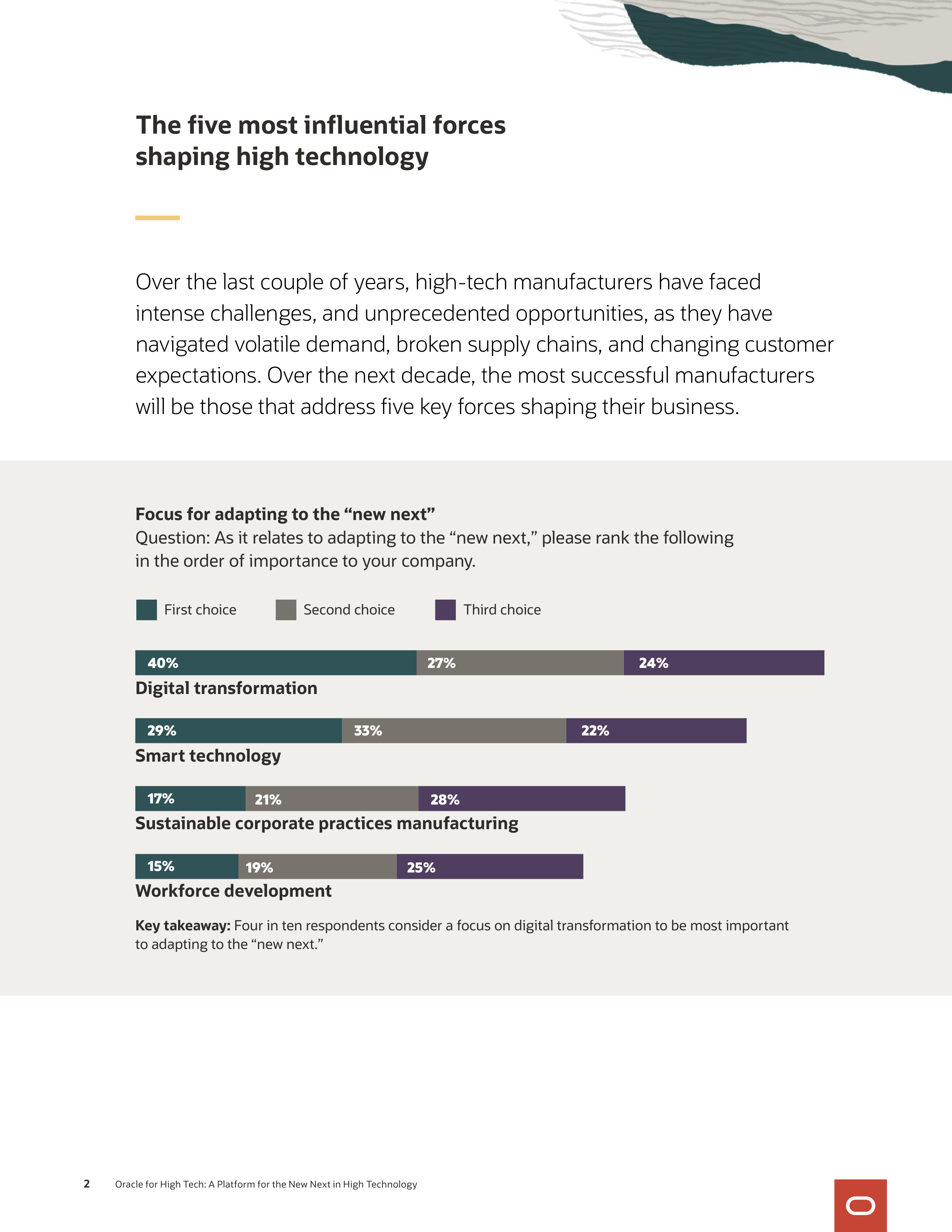
30% are investing in digital transformation and 28% in smart technologies. For example,
by deploying AI-powered “digital twins”—digital representations of products, processes,
and facilities—manufacturers can simulate the effects of supply and demand variability on
performance, quickly and cost-effectively.
Successful manufacturers are also pursuing digitalization initiatives that, together with
digital twins and a “digital thread” (a communication framework for data across the product
lifecycle), can connect all business processes and track asset availability and product quality
in real time using
Industry 4.0 technologies
, such as the IoT.
29% reported that creating a more robust, resilient supply chain was a necessity going forward.
Market volatility and supply chain challenges expected to continue
and some industry
segments are already experiencing major demand contraction creating new kind of demand
disruption. Additionally, newly enacted global trade restrictions are forcing companies to
rethink their global supply chain and take into account localization constraints.
As customers, investors, and governments deepen their scrutiny of corporate environmental
practices, sustainability has become an indispensable strategy for manufacturers seeking
business investment and growth.
From minimizing carbon emissions and energy consumption to using smarter packaging
and safe disposal, manufacturers and their suppliers are revamping value-chain processes
to support sustainability. They’re also embracing new business models for long-term
sustainability, such as moving from a “make and forget” mindset to a “make to last” one
where products are supplemented with maintenance services that maximize their lifespan.